SP
OT FR LIGH EIG T HT ON
YOUR GUIDE TO RAIL NEWS, VIEWS, AND INSIGHT October 2026
Marc Hurn Supporting the UK’s growing rail freight sector David Fletcher The route to one million tonnes Adam Parkinson Putting parcels on high-speed trains Robin Gisby OBE Middle-mile express freight
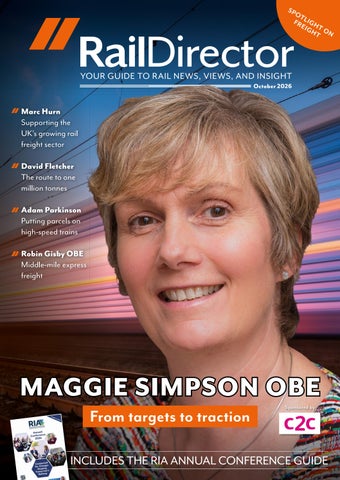
MAGGIE SIMPSON OBE From targets to traction
Sponsored by
INCLUDES THE RIA ANNUAL CONFERENCE GUIDE
3
INTRODUCTION
Clear actions and deliverables needed for rail freight to thrive
W
elcome to the latest edition of Rail Director, which comes just weeks after the Government announced a new target to increase rail freight by at least 40 per cent by 2040. The target is the first milestone towards the ambition of increasing rail freight by at least 75 per cent by 2050. It’s a challenge the industry and in particular this month’s cover feature Maggie Simpson OBE, the Director General of the Rail Freight Group (RFG) is up for, but she stresses that targets alone do not move a single tonne of freight. “What is needed now are clear actions and deliverables that will underpin the ambition,” she said. Last month the RFG also hosted its Annual Awards, celebrating those involved in rail freight. You can read more about the awards on page 98, and from page 28 you can read in more detail about the Business of the Year winner, DC Rail. David Fletcher, Director Rail at the owning Cappagh Group, reflects on the route to one million tonnes, and some exciting plans ahead. One of the big UK rail freight stories in recent weeks has been the sale of VTG Rail UK Ltd to Universities Superannuation Scheme, one of the UK’s largest pension funds. From page 16, its Chief Executive Officer reflects on the new ownership and discusses the next generation of freight wagons. Another exciting development is around transport parcels by rail, highlighted in conversations with Robin Gisby OBE, who has recently been appointed Chair of InterCity Rail Freight (page 10), and Adam Parkinson, Chief Executive Officer and Founder of Go-Express (page 36). If all the rail freight articles aren’t enough, in this edition you’ll also find the official preview of the Railway Industry Association (RIA) Annual Conference from page 41, with contributions from speakers Alex Hynes, Chief Executive Officer of the Department for Transport Operator, Jeremy Westlake, the Chief Executive of Network Rail, and Claire Mann, Transport for London’s Chief Operating Officer. It is already shaping up to be a wonderful two days, so I’d highly recommend attending. As Darren Caplan, Chief Executive at RIA says: “Under this year’s theme, Connected for Change: Shaping Tomorrow’s Railway, our flagship event arrives at a crucial juncture for the UK rail sector.” This month we also reflect on last month’s InnoTrans, which was attended by 175,000 trade visitors from more than 120 countries. Read about the event from page 78. I hope you enjoy reading the latest edition. Work is already well underway on November’s magazine which is focused on signalling, with a special section on light rail. All the best,
The target is the first milestone towards the ambition of increasing rail freight by at least 75 per cent by 2050
Danny Longhorn Editor
Rail Director magazine and Railbusinessdaily.com are assets owned by the Railway Industry Association. Railbusinessdaily.com delivers more than 70 stories a week to +50,000 rail industry professionals in our daily 7am newsletter. If you have not already subscribed, it’s free and it’s easy to do so at www.railbusinessdaily.com, please also encourage your colleagues to do the same. This is the very best way to keep abreast of what is happening on the UK’s railways. There is a digital copy of Rail Director on our website.
LIFTING
SERVICING
TRAINING
RAIL LIFTING JACKS
MOBILE RAIL LIFTING JACKS
With over 40 years’ experience of high quality, heavy duty vehicle lifting, Totalkare combines world class products with industry leading support to facilitate effective maintenance and repair.
HEAVY DUTY SYNCHRONISED
For more information or to request a site visit:
RELIABLE
October 2026
4
CONTENTS
16
6
From targets to traction
Maggie Simpson OBE, Director General of the Rail Freight Group, reflects on Government targets to grow rail freight, turning ambition into commercial growth.
10 Middle-mile express freight
Robin Gisby OBE has recently joined InterCity Rail Freight as its Chair. He has spoken with Rail Director about the opportunities for passengerbased rail logistics.
16 Supporting the UK’s growing rail freight sector
28
Marc Hurn, Chief Executive Officer of VTG Rail UK, reflects on new ownership and the next generation of freight wagons.
28 The route to one million tonnes
David Fletcher, Director Rail at the Cappagh Group, discusses the success of DCRail, which was named Business of the Year at the recent Rail Freight Group Awards.
36 Putting parcels on high-speed trains
Adam Parkinson, Chief Executive Officer and Founder of GoExpress, discusses a pioneering end-to-end high-speed rail middle-mile trial for the express logistics industry.
41
41 Connect, debate, and help shape the future of the railways
The Railway Industry Association’s award-winning Annual Conference is a highly regarded highlight of the UK rail calendar. 2026 will be no exception. The official preview includes contributions from Darren Caplan, Jeremy Westlake and Alex Hynes.
62 Unlocking the next phase of UK rail freight growth
Adam Parkinson, Commercial Rail Development Director at DP World, examines what is needed to realise the full potential of rail freight.
October 2026
5
CONTENTS
66 Direct Rail Services (DRS) and Tesco celebrate 20 years of rail freight operations
Ciara Middlehurst, Co-CEO of Nuclear Transport Solutions, owner and operator of DRS, reflects on an award-winning collaboration that continues to deliver carbon savings, remove lorries from roads and drive innovation across UK logistics.
72 Capturing the zeitgeist and its impact on the future of rail
In his latest quarterly column Haydon Bartlett-Tasker, Founder and Managing Director of CrossTech, talks about the digital future of Great British Railways and the importance of not falling into old habits.
78 Record-breaking numbers for InnoTrans
Approximately 175,000 trade visitors from more than 120 countries attended this year’s InnoTrans. Rail Director was among those in Germany for the 30th anniversary.
86 The Rolling Stock and Infrastructure Strategy: ‘A positive step forward’
Rail Director’s Rosie Crampton takes a closer look at the Government’s new Rolling Stock and Infrastructure Strategy. What are the key takeaways, and how is the industry responding?
92 ‘Building lasting capability, developing talent, and supporting organisations to achieve their ambitions’
Former Network Rail Route Director Phil James has joined AARC Professional Services as a Principal Consultant. While the opportunity of early retirement from Network Rail presented itself earlier this year, rather than hang up his boots completely, Phil took the decision to join the rail consultancy. He explains more.
94 Moving toward genuine, whole-life value creation Justin Moss has recently been appointed as Business Development Director – Rail and Public Transportation at Unipart. He reflects on his experience of success in driving sales within the rail and public transport sector, and discusses the challenges ahead.
October 2026
Image: Rail Freight Group; Denis Belitsky/Shutterstock
Tel: 01132 082620 Sales: 07494 529 803 Editor Danny Longhorn Danny@railbusinessdaily.com Designer and Production Manager Debbie Nolan Writers Rosie Crampton Nigel Wordsworth Advertising Sales Christian Wiles Chrisw@railbusinessdaily.com Marketing Sales Sarah Hopton Sarah@railbusinessdaily.com Production Executive Mia Hargreaves Published by Rail Business Daily 2 Bond Court, Leeds, LS1 2JZ Printed by The Manson Group © 2026 All rights reserved. Reproduction of the contents of this magazine in any manner whatsoever is prohibited without prior consent from the publisher. For subscription enquiries and to make sure you get your copy of Rail Director please ring 01132 082620 or email info@railbusinessdaily.com. The views expressed in the articles reflect the author’s opinions and do not necessarily reflect the views of the publisher and editor. The published material, adverts, editorials and all other content is published in good faith.
6
FREIGHT
From targets to traction
Maggie Simpson OBE, Director General of the Rail Freight Group (RFG), reflects on Government targets to grow rail freight, turning ambition into commercial growth.
Maggie Simpson OBE speaking at RFG’s Parliamentary Reception. Image: RFG
T
he Government’s announcement of an interim target to grow rail freight by 40 per cent by 2040 is a welcome and important step towards the longer-term goal of at least 75 per cent growth by 2050. It provides a clearer stepping stone and recognises the benefits to the UK of moving more goods by rail, including economic growth, more resilient supply chains and lower-carbon transport. Targets alone, however, do not move a single tonne of freight. What is needed now are clear actions and deliverables that will underpin the ambition.
A stable framework for freight Government, of course, does not run freight trains and neither will Great British Railways (GBR).
Finding new customers, designing new services and investing in rolling stock and terminals are resolutely jobs for the private sector rail freight industry. Yet the actions of Government, and the frameworks around GBR, must support the sector in delivering growth and remaining vibrant and innovative. As rail reform moves towards its conclusion, ensuring stability for freight is key. Freight operators, terminal owners and developers, rolling-stock companies and customers make investment decisions over long timescales. Rail freight relies on expensive assets with long lifecycles, and establishing a new service can require considerable commercial development before the first train ever runs. Businesses need confidence that the policy and regulatory
October 2026
framework will remain supportive throughout that investment cycle. Rail reform must embed freight in the governance and decision-making of GBR from the outset. Freight cannot be treated as a secondary user of a predominantly passenger network. It serves ports, distribution centres, quarries, factories and construction sites across Britain, often crossing several regional boundaries. Its needs must be represented at the centre, with clear accountability for the growth targets. The establishment of a Strategic Freight Unit is welcome, but it must have sufficient authority and influence. Decisions about timetables, engineering work, investment and network strategy all affect the commercial proposition offered to freight customers. Growth must be built
FREIGHT
Targets alone do not move a Reliable capacity customers can use single tonne of The second pillar is reliable, high-performing capacity. Freight customers do not buy train freight. What is paths; they buy dependable supply-chain outcomes. A service must leave at the right time, needed now are travel on an efficient route and arrive when promised. clear actions and If a manufacturer cannot rely on components reaching a factory, a retailer cannot plan deliverables that stock movements or a construction customer cannot schedule deliveries, the environmental Access and charging that support will underpin the advantages of rail alone will not be enough to investment secure the new business. Third, the commercial framework for access That means protecting freight capacity on and charging must be fair, proportionate and ambition into those decisions from the outset rather than considered only after all passenger priorities have been settled.
every railway user, but freight services can be particularly vulnerable when recovery plans prioritise passenger operations or when diversionary routes cannot accommodate the same trains. Network plans should provide workable alternatives, protect access to terminals and ports, and ensure that engineering possessions are planned with freight supply chains in mind. Better day-to-day performance is not simply an operational objective but is one of the strongest tools available for retaining existing traffic and winning new business.
the busiest corridors and recognising that not all paths have equal commercial value. A route that adds hours to a journey, restricts train length or operates at an unsuitable time may be unviable. Capacity planning must reflect customer requirements and allow operators to respond as markets change. We have been encouraged by the protections for freight in the draft Access and Use Policy now being consulted on by Network Rail, but in a complex new system we will need to work to ensure the right outcomes for freight are delivered. Resilience matters too. Disruption affects
predictable. Operators need sufficient certainty over future access to develop services and negotiate long-term contracts. Customers need confidence that rail will remain competitive against road, while investors need to understand the likely returns on terminals, equipment and technology. This does not mean insulating the sector from cost or competition. It means recognising the wider benefits created when goods move by rail and avoiding sudden changes that undermine business cases. Charges, incentives and performance regimes should encourage
based in Derby
ENHANCING RAIL INFRASTRUCTURE WITH LOCAL EXPERTISE AND LONG TERM SUPPORT
October 2026
7
8
FREIGHT
efficient use of the network while supporting growth. Clarity is especially important during the transition to GBR. Uncertainty can delay decisions even when the underlying opportunity remains strong. Government and the regulator should provide a clear path through reform, protect the independence and confidence freight customers require, and ensure that operators can plan beyond the next timetable or control period.
Infrastructure and planning that make growth possible The fourth pillar is investment in the physical network and the places where freight begins and ends. Growth on some routes requires targeted improvements to alleviate bottlenecks or improve capability. Recognising the tight funding environment, the focus needs to be on the outcomes unlocked through relatively modest interventions, such as longer loops, an upgraded junction, a strengthened bridge, improvements to a level crossing or better access to a port or terminal. That does not mean larger schemes should be ignored, but a realistic approach could continue to unlock short-term benefits until funding becomes available. Planning policy is equally important. Rail freight should be designed into major developments at the earliest stage. New housing, reservoirs, energy infrastructure, industrial sites and logistics parks will generate huge movements of construction materials and finished goods. If rail access is considered only after sites and supply chains have been designed, the opportunity can be lost. Protecting land for terminals, supporting Strategic Rail Freight Interchanges and safeguarding existing rail-connected sites will allow businesses to choose rail when the demand emerges. Services the market wants to buy The fifth pillar belongs primarily to the industry. Supportive policy and additional capacity create opportunity but they do not guarantee demand. Operators, ports, terminals, suppliers and logistics businesses must turn that opportunity into services that solve customers’ problems and compete on cost, reliability and convenience. That will mean deepening rail’s position in established markets such as intermodal and construction while developing credible offers for higher-value and time-sensitive goods. It may involve new service patterns, more flexible contracts, shared-user trains, investment in handling equipment or closer partnerships with road hauliers for the first and final miles. Freight growth should not be seen as rail replacing road in every circumstance but rather an interconnected freight network where all tools are best used. Winning new customers also requires reducing friction. Businesses unfamiliar with rail face a complicated landscape of operators, terminals, equipment and access arrangements. The sector should make it easier to understand what is
Maggie Simpson OBE speaking at the RFG Annual Awards. Image: RFG
Government and GBR must create the right conditions through stable policy, workable access, reliable capacity and targeted investment possible and obtain a competitive proposal. Trial services can help prove new flows work but they must lead towards commercially sustainable propositions.
Modernisation and a credible path to decarbonisation The final pillar is a modern railway capable of meeting customers’ future expectations. Better use of data can improve visibility, planning and asset utilisation, giving customers clearer information about their goods and helping operators respond to disruption. Digital systems, automation and more efficient terminals can raise productivity and make rail easier to integrate into wider logistics networks. Decarbonisation must remain part of the commercial offer. Rail already produces substantially lower carbon emissions than road freight, but the sector cannot stand still as road vehicles become cleaner. A coherent plan for electrification, including infill schemes that allow electric locomotives to complete more end-to-end journeys, would improve efficiency and reduce reliance on diesel.
October 2026
In its absence, incentives to use more electric traction wherever possible can still help move the dial. Alternative traction and low-carbon fuels will also have a role where full electrification is not practical.
Turning ambition into commercial growth There is no single plan that can deliver freight growth, nor should there be. Government and GBR must create the right conditions through stable policy, workable access, reliable capacity and targeted investment. The private-sector rail freight industry must then compete for business, invest with confidence, innovate and turn opportunity into commercially sustainable services. Progress should be judged not only by total volumes, but also by whether the railway is becoming easier for customers to use and invest in: through better performance and journey times, more usable paths, terminal development, private investment and the launch of new services. Government and GBR must provide the framework and railway to support new growth. The freight sector must invest, innovate and win the traffic. Customers, ports, developers and local authorities also have an important part to play, because decisions made beyond the railway boundary will determine whether rail is a practical option. The 40 per cent target is valuable because it raises the level of ambition and provides a milestone against which progress can be tested, but commercial reality will be built one path, terminal, contract and train service at a time. If the target is matched by sustained action across these six pillars, rail freight can make a much greater contribution to Britain’s economy and supply chains. The task now is to turn a statement of intent into conditions that give businesses the confidence and capability to act. The Rail Freight Group will work closely with its counterparts in both the private and renationalised sectors to ensure rail freight is always considered as part of Britain’s freight network.
9
ADVERTORIAL
Celebrating 10 years of RIN
Antoinette Stevenson, Marketing and Events Manager at Jobson James Rail, reflects on the success of Rail Infrastructure Networking and how it highlights the enduring value of bringing the rail industry together.
Images: Jobson James
T
he rail industry has never been more connected. Teams calls have become commonplace, procurement platforms continue to evolve, and digital marketing allows organisations to engage with customers and prospects every day. Yet despite the growth of technology, one thing that remains consistent is the fact that business is still built on relationships. Whether it’s Network Rail seeking innovative solutions, a Tier 1 contractor strengthening its preferred supplier network or an SME looking to secure its next opportunity, meaningful connections remain at the heart of successful project delivery. While digital channels have transformed the way we communicate, there is still no substitute for meeting people face-to-face. Perhaps that’s why, 10 years after it first began, Rail Infrastructure Networking (RIN) Events continue to attract thousands of rail professionals every year. It was never intended to become one of the UK’s leading rail infrastructure trade shows. The concept was founded by Keven Parker, Head of Rail at Jobson James Rail, who recognised that many organisations across the rail sector faced similar challenges but rarely had the opportunity to connect directly. His solution was simple: invite a small group of clients and suppliers together for coffee, encourage introductions and create opportunities for collaboration. The first event welcomed just 14 organisations into a small Birmingham venue. Today, RIN Events attract thousands of rail professionals annually and have become recognised fixtures within the rail industry calendar. Yet despite the growth, the objective remains exactly the same as it was 10 years ago: creating opportunities for businesses to meet, share knowledge and build valuable commercial relationships. Keven, Founder of RIN Events, said: “The goal wasn’t to create a leading trade show. It was simply to get good rail businesses in the same
room and help them start conversations. The scale has changed, but the principle remains exactly the same today.” What makes RIN particularly relevant in today’s market is efficiency. Time is one of the most valuable resources available to any rail professional. Building relationships across the industry can often involve weeks of diary planning, lengthy travel commitments and multiple individual meetings. A single visit to RIN provides an opportunity to meet suppliers, buyers, Tier 1 contractors, infrastructure organisations and industry peers, all under one roof, in just four hours. For visitors, that means gaining valuable market insight, discovering new products and services, and making connections that could otherwise take months to achieve. For exhibitors, it provides direct access to a highly targeted rail audience actively looking to engage with the wider supply chain. The continued demand for this approach was evident at RIN Derby earlier this year. The event welcomed more than 1,000 registered attendees, 190 exhibiting organisations and 12 Tier 1 companies conducting more than 120 pre-arranged procurement meetings during the popular Meet the Buyer session. However, statistics only tell part of the story. The real value of the event is reflected in the experiences of the businesses that continue to support it. Jake Sollis, Head of Operations – Rail, Matchtech, said: “We have attended RIN events for several years and consistently find them to be a valuable opportunity to build new industry relationships while catching up with existing contacts. After exhibiting for the first time in London earlier this year, we were keen to return in Derby. “The event was a great success, both on our stand and through networking across the
October 2026
venue. RIN provides valuable insight into the rail industry and gives us the opportunity to engage with organisations and individuals we may not otherwise have the chance to meet.” Another factor behind RIN’s continued success is its commitment to remaining accessible to businesses of all sizes. Uniquely, RIN is organised by Jobson James Rail, the specialist rail insurance broker rather than an events company. The events are delivered on a not-for-profit basis, helping to keep exhibitor rates competitive and encouraging participation from across the entire rail supply chain, from major contractors and infrastructure organisations through to specialist SMEs and emerging innovators. As the rail industry looks ahead to 2027, maintaining strong connections across the supply chain will remain as important as ever. New technologies, major projects and evolving industry priorities will continue to create opportunities for organisations that are visible, engaged and connected to the wider market. Before attention fully turns to next year, however, there is one final opportunity to connect in 2026. On 12 November, rail professionals from across the UK will gather at the Great Yorkshire Event Centre, Harrogate, for the final RIN Event of this milestone anniversary year. For many organisations, it represents one last opportunity to meet prospective customers, engage with buyers, strengthen existing relationships and identify new opportunities before business development plans turn fully towards 2027. The projects may differ, the organisations may change, but bringing the rail industry together at RIN Events continues to create valuable opportunities. www.rinevents.co.uk/ antoinette.stevenson@jjrail.co.uk 07849 835412
10
FREIGHT
Middle-mile express freight
Robin Gisby OBE has recently joined InterCity Rail Freight as its Chair. He has spoken with Rail Director about the opportunities for passenger-based rail logistics.
Robin Gisby OBE (second from the left) pictured with the ICRF team. Image: ICRF
“U
nfinished business” are the words Robin Gisby OBE uses to describe his appointment as Executive Chair of InterCity Rail Freight (ICRF). It was more than 40 years ago that his railway journey began with the launch of a private sector intermodal freight service. A little less fresh faced now but still full of energy, his return follows an illustrious career that has included various senior posts at Railtrack and Network Rail and most recently as Chief Executive Officer of the Department for Transport Operator Limited (DFTO). “It does feel like I’ve gone full circle and it’s fun being the little guy again, helping to build something from scratch,” he said.
“It also feels like unfinished business because I’ve had a few attempts in the past that haven’t quite worked out. I now want to use whatever influence and skills I’ve got to make it work this time. “Traditional rail freight markets are declining, and if the core as we remember it continues to dwindle, much of it becomes just an inland intermodal business in which the shipping companies take an interest. “That would be a sad place to get to especially with the potential of high-speed lightweight consignments in passenger trains. I want to see electric bikes doing the final mile delivering parcels for which the packaging says ‘transported by rail’.”
October 2026
It echoes the Red Star Parcels days, a railwaycentric registered courier service that was initially owned and operated by British Rail, latterly by Lynx Express, up until 2021, using passenger trains for transporting parcels between passenger railway stations. It’s a concept that means a lot to Robin. It was towards the start of his career that he set up an intermodal business as a joint venture between his then employer GKN and British Rail called Charterrail. It used some innovative road rail trailer kit and operated for several big companies including Pedigree Petfoods, Marks & Spencer and the water companies in Scotland. “It ran through privatisation and out the other
FREIGHT
side, but we stumbled over the cost of rail trunk haulage and we didn’t have our own locos,” he said. “We bought in hook and haul from what was then the British Rail freight business and we had to stop because we just couldn’t do the right deal on track access.” Following its closure in the early 1990s, Robin held many Managing Director roles at Railtrack and Network Rail before moving away from the industry for several years. He was lured back to the sector by the opportunity of Chief Executive Officer at what was the Operator of Last Resort and became the DFTO, a role he stepped down from last December. “I’ve always been interested in using the station network for other purposes and in middle-mile express freight, so long as you come to the railway effectively as a Class One train,” he said. “You’re not trying to path a Class Four or Class Six, you’re not slowing down going over the hills and into Scotland and so on. “I remember Red Star Parcels and why it fell over when the passenger operators got fragmented, but I think where we are now is with a large and growing demand for same day and overnight delivery. “A lot of the big courier firms transport by road and they say that is just not acceptable especially with the age profile of HGV drivers, congestion
It also feels like unfinished business because Realising the opportunity Earlier this year Robin joined ICRF as its Chair. ICRF has developed the operational capability, I’ve had a few systems and technology required to enable passenger trains across the GB network to once attempts in the again carry parcels and light logistics traffic. It can create an incremental financial past that haven’t opportunity for the passenger railway to generate new revenue, support greener logistics and quite worked out. reduce HGV movements on trunk routes and vans I now want to use in towns and cities. The organisation is a pioneer of the Parcels whatever influence as Passengers initiative, wanting to make use of some of the 2,500 railway stations as hubs for and skills I’ve got handling mail and parcels. Alongside this, Robin is also involved in a to make it work similar role with Varamis Rail, which transports larger volumes quickly and efficiently between this time logistics centres and heavily populated cities
on the road, the comparative speed with rail and the environment. That is why I am interested in making something work in high-speed, middlemile rail logistics.”
as a complete end to end solution, with zero emission, dedicated electric trains at its core. With passenger trains being able to reach speeds above 100mph and some stations being served up to 200 times a day, these are opportunities too good to miss for Robin.
October 2026
11
12
FREIGHT
Dynamic Universal Capacity Capture smart locker. Images: InterCity Rail Freight
A lot of these stations have still got, from their Victorian inheritance, the space from where they once transhipped newspapers or handled the mail
“I’ve taken on these roles to try to make something work in the next two or three years,” he said. “I think at ICRF the fundamentals are right, the market is there, they’ve got the right format with the magic little bag (Dynamic Universal Capacity Capture smart locker) that can be tracked, it’s safe and secure, and the money they can pay the train operator for the middle movement will be significant. “It’s going to be worth the average yield of a couple of passenger seats to take a bag that is a little bit bigger than you could carry on to a plane. It doesn’t get in the way, it’s not going to impact dwell times, you’re not going to do it if the train is full and standing and you can move things at very high speed that you can’t do a different way. “A lot of these stations have still got, from their Victorian inheritance, the space from where they once transhipped newspapers or handled the mail. “It’s not going to go to platforms in the middle of nowhere, but if you take a network of up to 1,000 trains and 300 stations you could put something together that makes sense for the logistics industry, so long as the first mile and last mile are green and efficient that would make a difference, and you’re able to do things that you just can’t do by road.
October 2026
“It’s important that the railway sticks to what it is good at, which is the middle bit, with highspeed Class One electric multiple units with a bit of bimodal at either end of the central bit. I am not interested in collection and delivery, too many other people can do that better. Maybe that was partly where Red Star might have fallen over?” Initially Robin envisions it as a B2B business, doing some good work at the moment for medical and research samples, which are collected by road in Newcastle, York and Manchester, consolidated onto the rail network and brought into London the same day for delivery to laboratories. “Our rollout programme deliberately begins on an accompanied basis,” he said. “That allows us to prove the end-to-end operation, test the systems and technology in a live environment and give customers, train operators and the relevant security stakeholders confidence in the model. “Once that capability has been demonstrated, the model is designed to move progressively towards unaccompanied operation at scale. “From my own experience, I can remember being in Cairo for a year or two in the early 1980s, and the DHL person went around the business district and said, ‘what packages have you got for London?’ and he collected them, put them in a bag and he got on the plane and hand delivered them.
Network rail approved portable power Instagrid GO RAIL The world’s most advanced 110 V portable power station designed for professionals in the UK’s Rail Industry who need a grid-like supply in remote and off-grid locations. GO RAIL is approved for use on the UK Rail Network (PA05/08057) combining reliable performance with hand portability. Available to hire (via our rental partners) or purchase. To enquire or find out more scan the QR code.
110 V Output voltage
<3h Charging time
2,1 kWh Power your workday
21 kg Hand portable
https://instagrid.co/gb/products/go-rail
14
FREIGHT
Image: David Hughes / Shutterstock.com
“That’s how it started, because the packages were important enough that you could afford an airfare. But I don’t think you can operate with 10 people turning up at Euston, each with their own package, and handing it over the ticket gate. Unaccompanied is the scalable future. ICRF is now building that transition. “You need to move to something unaccompanied on the train with the packages coming in every couple of hours, and then you regularly put them in a bag, shove them on a train, and they’re in Birmingham or Glasgow or whatever. “But the backbone of it is starting off with dedicated customers and so it is B2B. Developing a further service for you or me getting a forgotten birthday present to a distant relative in a hurry, that will come; a retail proposition I think comes a bit later.” Robin doesn’t think there are too many barriers to overcome, saying it is just a case of knitting it all together, demonstrating it works, adding that with the bag, its tracking and remote operation means it is easy to keep control of it. “The train operators seem a bit hard pressed at the moment, so the business has to make it simple for them to get involved by investing in the bags and tracking them by operating a pool,” he said.
“You are looking for a bit of space nearby to a platform and using your own staff to help make it happen. “It’s not difficult to load food onto LNER at Kings Cross and to know by Peterborough, that you’re going to run out of something before you get to Edinburgh and to send a message and somebody at York has got that and added it on. “So it should be straightforward to gather a consignment of parcels for a bag for Edinburgh during the morning at King’s Cross and stick it on the 12.00 and it’s in Edinburgh by tea time, or to take some off at Doncaster and send them to Leeds. Between us we can do that.”
Next steps Looking to the future and it is full steam ahead. From a Varamis Rail perspective Robin would like to get the original service, from Birmingham International to Mossend, going again with the Class 321s this year for the likes of Amazon. He’d also like to get some bi-modes going out of DIRFT at Daventry, before looking to raise some more money to invest and build out a network more quickly – to go further than the Central Belt, up the East Coast Main Line, get out to Bristol, the South West and south Wales, East Anglia and to London and south of the Thames. With ICRF, the journey ahead is to continue
October 2026
proving the model through its phased rollout programme. Early operations are deliberately controlled, allowing ICRF to build live operating experience, demonstrate the systems and security arrangements and establish confidence with customers and train operators. The next stage is to progressively develop that capability across further routes and operators, moving towards scalable operations. When the tests are proven successful, Robin would like to build out a network and develop a few logistics hubs with local partners, making use of unused capacity on the station network, such as the deck above Euston, and what’s available underneath larger stations such as Waterloo and Manchester Piccadilly. “When you talk to logistics companies and you look at what was done at St. Pancras and London Bridge, they are very interested in the space under Waterloo and it’s not being used, or there’s something similar underneath Manchester Piccadilly,” he said. “The railway is sitting on these slightly tired assets and we need to get them back in to use them. “If this was a network of a few hundred trains a day at up to 100 stations with three or four deliveries a day that is a pretty big business for the train operators, and it’s doing an important thing
FREIGHT
for logistics and distribution, demonstrating what rail can do. “Maybe later at night if there are three passenger trains an hour still to Manchester, if you were to take the amount of people you have got in a carriage and what they’re paying, and what you can get for parcels, you might find that this isn’t just a bag, maybe it does become two or three bags because for the yields you could get on certain trains at certain times, Parcels as Passengers could be quite good.” Looking longer term, Robin is also interested in a different take on left luggage, carrying your baggage the same day and it being delivered to a hotel to be there when the passenger arrives. “Let’s say you are travelling from Hull to London,” he explained. “Wouldn’t it be great if you could give your luggage to someone at Hull station knowing that when you get to London, you can go to your event during the day, without having to carry it around, and when you get to the hotel your luggage will already be there waiting for you. “That is perfectly possible. It is about creating a service that is really valuable for the customer and the train operator. “This is an aspiration, it starts in getting the network going on a few lines of route and getting the bags in circulation on the basis of half a dozen key contracts. Where else could you go – critical parts, passports, Government business,
The railway is sitting on these slightly tired assets Honours Alongside his work in parcel delivery, Robin and we need to celebrated a special recognition in June, when he was awarded an OBE in the King’s Birthday get them back in Honours List for his significant contributions to the rail network and rail safety. It’s an accolade to use them
legal stuff, so many options. “That’s for tomorrow. What we’ve got to do at the moment is not screw up, not lose anything, get things to the other end and convince people this is worth doing.”
he is keen to downplay, instead paying tribute to those he has worked with over the years. “I didn’t expect it, and it was a nice way to draw a line and move on,” he said. “After leaving Network Rail I came back to DFTO so stayed longer than I expected. “My memory from starting in the industry in my 40s was just how helpful and supportive everybody has been. If I did anything it was because of the people who supported me, looked after me and made it all work, particularly during the difficult times. “Now it is about looking forward and moving on. What I want to do is absolutely give something back, and if I can help revitalise some bits of the rail industry and get something like Red Star going again for the new markets and challenges the logistics market faces today, I’ll be happy with that.”
Engineering the Future of Rail. With more than three decades of global experience, Aarvee is a trusted partner in railway infrastructure consultancy. From high-speed networks to urban metro systems, we bring deep expertise across all rail formats. Driven by innovation, we deliver practical, buildable designs that reduce complexity, optimise costs, and accelerate project delivery.
Aarvee.co.uk
October 2026
15
16
FREIGHT
Supporting the UK’s growing rail freight sector Marc Hurn, Chief Executive Officer of VTG Rail UK, reflects on new ownership and the next generation of freight wagons.
T
Images: VTG Rail UK
October 2026
here are changes afoot for the UK rail freight industry. The Government has set a 40 per cent increase target for freight moved by rail by 2040, which it is estimated could save a million tonnes of CO2 per year compared to if it went by road. Alongside this, in recent months Freightliner has been acquired by CMA CGM Group, DB Cargo UK is up for sale, and VTG Rail UK has been sold to the Universities Superannuation Scheme (USS), one of the UK’s largest pension funds. “It’s a shot in the arm for rail freight and a positive environment to be in with the technology coming in, the growth and the confidence from investors,” said Marc Hurn, Chief Executive Officer (CEO) of VTG Rail UK. “I’m super excited for not just the future of VTG Rail UK but UK rail freight generally. “Transporting goods by rail is a no brainer. We’re looking to reduce CO2 emissions, congestion on the roads is getting worse, and there is a shortage of HGV drivers. Transporting more freight by rail can help all of that.” It’s been a busy year for Marc and the rest of the team. Alongside the day-to-day running of the wagon leasing business, its owners commenced a process to evaluate options for VTG Rail UK and access opportunities to maximise value for the VTG Group. Following a comprehensive and competitive process, the owners concluded that the transaction with USS represented an attractive outcome for the VTG Group and its stakeholders. Marc says the acquisition by one of the largest pension schemes in the UK, with assets of around £84 billion, with a strong track record of investing its long-term, patient capital into UK businesses, marks an “exciting chapter, securing jobs, leading innovation and driving growth in the UK rail freight sector.” He added: “VTG has been a fantastic owner but our products operate slightly differently outside of their markets, and we operate at a different pace. Now, with our new owners, we have a fantastic opportunity to move forward and further strengthen VTG Rail UK’s position as a leading player in the country’s rail freight sector. “Under the new ownership it has given us more potential to create more value for the business and create more scope in areas that we think might be
17
FREIGHT
good for the coming years, potentially taking the business in a different direction and diversifying.” An example Marc gives is digital both on and off the wagon. It’s an area that is already bearing fruit for the company with its iWagon, the UK’s first digital freight wagon. It integrates Wheel Flat Prevention (WFP), advanced sensors, realtime data analytics, and automation to deliver enhanced asset visibility, enabling organisations to streamline logistics operations while improving safety, efficiency, and sustainability across the supply chain. “The iWagon is proving to be our Pandora’s box, such that you open it and it just keeps giving and developing,” Marc said. “We have other ways of collating data now from either digital handheld devices or lineside devices, which adds better value to our offering, customer expectations and journey. “It’s then about having platforms that can develop data using things such as AI that can help other players in the market. “We can start collating data from our wagons that may be able to assist the likes of Network Rail in giving them information about the condition of their track, or where they have hotspots of areas of concern. That’s the kind of diversification we’re looking into.” It’s that system that is getting the backing of the industry, with the technology already in use
for the likes of Breedon, Tarmac and Heidelberg Materials. Overall, there are more than 1,000 wagons signed up to be fitted, with another 1,000 ready to be signed up. This is alongside VTG Rail UK’s 4,500 wagons, with around 3,000 to be retrofitted, as well as all the new build. “In some ways, the industry has been relatively stale for a long time, so when we came along with the iWagon there was quite a lot of resistance, but we’ve persevered and developed this into the product we have now, which is working and benefiting the sector,” Marc said. “The industry has woken up to the fact that this is a good solution and the principle of having data and data-enabled wagons is a no brainer for the industry. That’s where we should be going and it just happens that VTG Rail UK was the first to be doing this. “Ultimately, we started the iWagon project for safety and from a moral point of view, but it’s fantastic we can improve the safety while still having a very strong business case not just to benefit VTG and the customer, but also the whole industry. “This technology makes doing business on rail a lot easier for those in the market, or coming into the market.” Marc heads into the new chapter with VTG Rail UK full of optimism, particularly reflecting
October 2026
We are driven by a passion to grow both the business and the freight industry
18
FREIGHT
back on how far the business has come in the three-and-a-half years he’s been involved. “It’s been a great honour to be involved with VTG Rail UK and to work with such a fantastic team,” he said. “It’s been a whirlwind, a lot of hard work, and opportunities like the sales process has given me the ability to assess who I am and how I operate within the team and outside of the business as well. “We’ve done psychological profiling within to develop the way we work as a team, something that has been really beneficial for everyone, including myself. “Overall, it’s been a very steep learning curve,
but an enjoyable one and one that is going to continue to be exciting in the years ahead.” When it comes to the future Marc says new contracts are set to be announced in the coming months, along with a vow to continue the innovation to create an offering with what clients and the industry needs. “We are fully engaged with the industry, building on what we’ve been doing the last few years, where we’ve really tried to listen and create products and systems that will have a positive impact,” he said. “We are driven by a passion to grow both the business and the freight industry. “It’s an exciting time for the sector. I take a lot of positivity from the Government’s freight growth
October 2026
plans, alongside the amount of infrastructure that is going to be built by Network Rail in the coming 10 years. It feels like everyone is working together for the good of rail freight. “Personally, VTG Rail UK enters this new chapter in a relatively strong position in the market, but we won’t rest on our laurels, we need to ensure we stay ahead, continuing to push our offering, growing our technology, and creating a better rail freight industry. “We’ve shown what can be achieved with the iWagon, so the future is about building on that, bringing the technology in, creating more efficiencies, and developing more routes, pathways and business within the industry.”
Specialising in the provision of Overhead electrification and Specialising thethe provision rail services in since company’s of Overhead electrification and formation in 2007. rail services since the company’s Specialising Specialising in in the the Specialising Specialising Specialising provision provision in in inthe the theprovision provision provision We have established ourselves in becoming a trusted supplier for of of Overhead Overhead electrification electrification of of ofOverhead Overhead Overhead and and electrification electrification electrificationand and and formation in 2007. our client base offering flexible and valued working relationships.
rail rail services services since since rail rail rail the the services services services company’s company’s since since sincethe the thecompany’s company’s company’s Krause and Hall aourselves proven record inin the industry and We have established in becoming a trusted supplier for formation formation in inhas 2007. 2007. formation formation formation in in2007. 2007. 2007.
is able to provide experienced and our client base offering flexiblemanagement and valued working relationships. delivery systems ourselves to enable our clients We We have haveestablished established ourselves We We We in have in have have becoming becoming established established established aatrusted trusted ourselves ourselves ourselves supplier supplier ininin becoming becoming for becoming for aatrusted atrusted trusted supplier supplier supplier for fof Krause and Hall has a proven record in the industry and requirements to beflexible met. our our client clientbase baseoffering offering flexible our our our client and client and client valued valued base base base offering working offering working offering flexible relationships. flexible relationships. flexible and and and valued valued valued working working working relationships. relationships relationship is able to provide experienced management and Krause Krause and andsystems Hall Hallhas hasaato proven proven Krause Krause Krause record record and and in and in the Hall the Hall Hall industry has industry has has aaproven aproven proven and and record record record ininin the the the industry industry industry and and and delivery enable our clients isis able ableto toprovide provideto experienced experienced isisis able able management able management to toto provide provide provide and experienced and experienced experienced management management management and and and requirements be met. delivery deliverysystems systemsto toenable enableour delivery our delivery delivery clients clients systems systems systems to toto enable enable enable our our our clients clients clients requirements requirementsto tobe bemet. met. requirements requirements requirements to toto be be be met. met. met.
info@krauseandhall.co.uk
www.krauseandhall.com
info@krauseandhall.co.uk www.krauseandhall.com info@krauseandhall.co.uk info@krauseandhall.co.uk info@krauseandhall.co.uk info@krauseandhall.co.uk info@krauseandhall.co.uk www.krauseandhall.com www.krauseandhall.com www.krauseandhall.com www.krauseandhall.com www.krauseandhall.com
20
ADVERTORIAL
Creating access, connecting communities and controlling environments James Lees, KITE Projects Business Development Lead, discusses the importance of the ‘why’ question, and how the organisation is playing its part in keeping the network moving whilst making the world a safer place.
Images: KITE Projects
T
he team at KITE Projects have a simple mantra: ‘We draw what we can build. We can build what we draw’, inspired by safe and sustainable engineering, and driven by a mission to keep networks moving while making the world a safer place. Its success in the design and supply of handrail and access systems and complex engineering solutions for infrastructure projects comes from its experts bringing design intent to design reality, by working in partnership to deliver project ambitions.
“This is about looking to evolve the way we do things, integrating some new thinking and new ideas, with compliance as a focus,” James Lees, Business Development Lead, explained. KITE Projects approaches projects taking inspiration from Simon Sinek’s Golden Circle model, which starts with ‘why’ at its core, followed by ‘how’ and ‘what’. In the context of the railways, this involves the organisation looking at why the network isn’t moving before deciding if there’s a solution that can be utilised. “There’s a danger that a lot of offerings and
October 2026
quotes just focus on the ‘how’ and the ‘what’ without even thinking about the ‘why’,” James said. “KITE Projects focuses on keeping the rail network moving whilst making the world a safer place. The questions we ask are how can we make the networks safer when it comes to access issues, flooding/drainage problems, landslips and signalling and telecoms failures? “Asking that question leads to us coming up with different answers, but more importantly, it de-commoditises the answer so that everything
21
ADVERTORIAL
we do is bespoke modular for that location. “If we can’t answer the question, we won’t do it because we are a heavy value set company. We don’t want to commoditise our solutions.” Explaining the organisation’s approach, James says the questions asked are whether it is compliant, buildable, can it be manufactured consistently, installed efficiently, and can the same approach be repeated with confidence? “If we can’t get people away from the railway network because there’s no safe access, we look for a solution that is compliant whether you’re a worker or a member of the public, or need to get access to or escape from that railway, that highway, that coastal environment,” he said. “Our solutions also extend to ones that deal with flooding and getting water away from the railway and highway. If we always do what we’ve always done, we’re always going to have the same problem. “We design things in a bespoke, compliant way for that location and situation, always starting off with the question ‘why?’. It means we are doing something slightly different, coming up with a different way of doing the same thing better, quicker, more cost effectively and better value.”
The solutions KITE Projects carries out in-house design and fabricating. Although it isn’t a subcontractor or installer, a lot of thought is put into its solutions to allow a significant ease of installation, such as concrete-free foundations and screw piles. A recent addition to KITE Projects range is KITE Modus platform, already proving popular with designers and specifiers looking to create a platform solution that is scalable, with the adaptability for hard-to-access locations. “KITE Modus embodies the KITE Projects modular efficiency ethos, offering flexibility, fewer co-ordination challenges and compliance as standard,” James said. “It’s a platform that can take a comms box or can be a safe refuge that is highly adjustable, legs that can move up and down, it can use screw pile foundations and it can be made in such a way that is compliant with Network Rail standards. “Basically it is a safe place of work beside a railway, beside the asset. We’ve come across many locations where frankly it isn’t safe to work so the asset has been closed, or access closed, the comms have gone down and the network doesn’t keep moving. “This gives you a compliant solution which mitigates the risks. We’ve currently got three jobs on the Thames Valley routes, around 30 platforms for assets around telecoms.” Network Rail is one of the organisation’s biggest clients for its wide range of products, receiving orders almost weekly.. Such is the level of partnership that KITE Projects also gets a forward view of next year’s access points in certain regions, allowing designs to be done early and through the system.
“We often get the materials fabricated up, to ensure they are in our store and ready to go and are not delaying the programme, which really helps Network Rail’s delivery team,” James said. “Next year’s portfolio is mainly focused on stepped access, crossings, with a lot of traction with Network Rail’s signalling and telecoms teams.” It is the organisation mindset of looking to the next solutions that is particularly exciting for James. “The aspirations moving forward are to maintain the focus on compliance, doing the right thing and keeping the network moving and by achieving that, the business will continue to grow,” he said. “Alongside that it is the ongoing challenge of developing low-carbon offerings, ensuring that we don’t do things the same way that they’ve always been done.” An example of this is KITE Projects drainage headwall, made of galvanised steel, with an extended design life; it’s all bolted together and is a lot lighter than a precast concrete equivalent. “I’m keen to raise awareness about the way we are doing things differently, looking to see if we can come up with a solution to solve a problem that is not what you might expect,” James said. “It’s the right alternative because GRP (glass reinforced plastic) isn’t cheaper as a whole-life thing, it’s not as sustainable, and GRP will burn whereas galvanised steel won’t. GRP is also difficult to dispose of but galvanised steel is 75 per cent or more recycled content anyway.” Another example is KITE Cascade, which is designed to provide an engineered cascade solution where water has to be taken from a high level and deposited into an adjacent drainage system. It can be engineered for a multitude of flow rates and volumes, anchored to an embankment with a minimum of foundations, and designed to be manoeuvred with minimal handling equipment. “It can be compatible with our staircase system and is above ground,” James said. “There are no concrete foundations, it is screw pile, no muck away, good for the environment, 50-year design life, man-handled, and modular. “Our role is in getting to a place where we can develop and design something that can solve the problem. That’s achieved by working with the customer. “That is the same whether we’re talking to Network Rail, a Tier 1 contractor, or local design houses. We want to sit in the whole network of supply chain, supporting that network of rail, road and coastal.” James added: “My overall message to the industry is to emphasise the importance of access, guardrails, handrails and platform walkways. They may seem like small aspects in the wider infrastructure schemes but they should be seen as strategic in the overall spend, not just strategic in terms of health and safety.”
October 2026
KITE Projects focuses on keeping the rail network moving whilst making the world a safer place
www.kite-projects.co.uk
22
FREIGHT
Victa Railfreight celebrates rail legacy while investing in future talent Debbie Simmons, Managing Director of Victa Railfreight, reflects on the organisation’s success, putting it down to passion and expertise.
V
icta Railfreight combines decades of industry experience with a commitment to developing the next generation of rail talent. At the 2026 Rail Freight Group Awards, board advisor Julian Worth received the Outstanding Individual Contribution award, recognising his 47-year career in rail. He joins previous recipients Neil Sime, Victa Railfreight’s founder and Executive Chairman, and David Barney, who began his railway career in the 1970s and joined Victa as Engineering Director in 2006. Together, the three have contributed more than 155 years to the rail industry. Victa Railfreight is a trusted operational partner to freight operators, industrial customers and infrastructure organisations across the UK, providing specialist rail freight services, terminal management, safety training, consultancy and workforce solutions. Neil founded Victa Railfreight in 1995 and has since delivered solutions to complex logistics challenges, developed terminal operations and improved safety across commercial and heritage rail. Across a 46-year rail freight career, he has demonstrated innovation, leadership and a commitment to advancing UK rail logistics and operations. Julian joined Victa Railfreight as a board advisor in 2002. His vision and operational expertise helped Victa become a licensed UK freight train operator and support major projects including HS1, Heathrow Terminal 5 and Crossrail. David began his railway career in the 1970s as a mechanical engineer with British Rail. He joined Victa as Engineering Director in 2006 and continues to advise the company. Under the leadership of Managing Director Debbie Simmons and Executive Chairman Neil Sime, Victa has more than 30 years as a customer focused collaborator with a leadership team and specialist advisers whose collective experience spans several centuries of rail industry operations, engineering, safety and logistics. Debbie, Managing Director of Victa Railfreight, said: “Neil, Julian and David have made - and continue to make - an exceptional contribution to rail freight. Neil built Victa from the ground up with trusted colleagues including Julian and David joining the team in 2002 and 2006. Their passion, contacts and expertise have shaped the business we are today.
L to R: Neil Sime, Julian Worth and David Barney. Image: Victa Railfreight
“People have been at the heart of Victa since day one. By combining decades of experience with emerging talent, we create long-term careers and make a vital contribution to the UK supply chain. “Rail freight demands more than technical knowledge. It requires attention to detail, clear communication, situational awareness and an unwavering commitment to safety. Our teams work in busy industrial environments where precision, consistency and high standards are essential. “These values have been embedded in Victa since Neil founded the company in 1995. The expertise of Neil, Julian, David and colleagues across the business gives us strong foundations for the future and helps the next generation of rail freight professionals uphold those standards.” Victa works with industrial customers, freight operators and infrastructure organisations helping to deliver safe, efficient and reliable rail operations. Its services include rail freight terminal management, train preparation, shunting, operational auditing, Rail Safety Awareness training and specialist consultancy.
October 2026
People have been at the heart of Victa since day one. By combining decades of experience with emerging talent, we create longterm careers and make a vital contribution to the UK supply chain
24
ADVERTORIAL
Providing a platform for successful projects Michael Jones, UK & Europe Rail Sector Director at Mace Consult, discusses how forthcoming rail infrastructure can and should be delivered.
Image: Mace Consult
T
he delivery of infrastructure and capital programmes rarely fails because of a lack of expertise, but more so because decisions are taken too late, risks aren’t surfaced early enough, or accountability becomes fragmented across too many parties. “It’s about looking at outcomes first and foremost,” explained Michael Jones, UK & Europe Rail Sector Lead at Mace Consult. “We can’t look at organisational charts, we’ve got to look at what is going to be the best fit for not just the tier ones, the principal contractors and the client, but the best for the public, passengers and community.” As a delivery partner, Mace Consult works alongside programme sponsors and investors to bring clarity where complexity threatens momentum on the delivery of infrastructure and
capital programmes - a challenge the UK must overcome to update its aging assets and increase connectivity to inspire growth. All over the world, Mace’s experts provide objective advice, practical leadership and structured assurance, so critical decisions are made with confidence and with the valuable data to back them up. Its services – Advisory, Cost and Commercial Management, Programme Management Office (PMO), and Planning, and Programme and Project Management – focus on helping clients set programmes up for success, keeping them on track as they evolve. “We combine deep rail experience with programme management capabilities, expertise that has helped shape complex rail projects all over the world,” Michael said. “A key to the success is in clear deliverable
October 2026
plans, and a shared understanding by everyone involved about what success looks like. “It’s about ensuring the connection between people, key decisions, data and information, schedule, cost, risk position, design strategy, and taking everybody on that journey. “It’s something we’ve been doing for years and in an environment that encourages open and honest conversations, looks to identify uncertainty at an early stage and works together as one team with clients, partners and suppliers.” Mace Consult operates across the full lifecycle of a major project from early concept and investment decisions through to mobilisation, execution and maintenance. All the while, supporting clients to navigate uncertainty, manage competing priorities and maintain control as programmes scale. “The challenges the rail sector is facing
25
ADVERTORIAL
centre on efficiencies, managing aging assets, constrained access, complex interfaces and changing passenger freight needs,” Michael said. “Our solution to all of these is not simply to work faster, but look at more stable outcomes for people, using delivery models that unlock value throughout the programme lifecycle, and tapping into the way we exploit data and AI to support our approach. “From an AI perspective it is about how it can undertake some of the manual tasks to free up leadership conversations, that engagement and visibility on site, which supports and drives these major programmes. “These technologies can also help us identify emerging risks much earlier by how we study and manipulate the tens of thousands of different pieces of data that are generated across projects. “Digital technology can certainly be useful in pulling together and presenting data to help our teams make more informed decisions. It’s an exciting space to be involved in and something Mace Consult is using across its programmes to increase the speed and quality of decisions for clients and communities.”
A catalyst for inner city regeneration Michael takes a lot of pride in what he’s achieved during his 25 years in the rail industry, particularly his 11 years at Mace Consult, where the projects he’s been involved in have not only improved infrastructure but transformed areas for the better, for passengers, businesses and communities. This was certainly the case during the Birmingham New Street station refurbishment, where Michael managed all of the associated works as Project Director.The initial project was part of a £803 million multi-disciplinary scheme comprising the refurbishment and reconstruction of the station and The Pallasades Shopping Centre, and the construction of a new multi-storey John Lewis department store. The construction works were managed while the station remained open for 130,000 passengers every day. The shopping centre also remained open throughout the project lifecycle. “It was one of the biggest and best programme of works I’ve been involved in and at its peak there were 1,000 people on site, all working for the same outcome,” he reflected. “I take so much pride in having played a part in transforming the area into something special, bringing jobs to the local community. It highlighted the benefit these projects bring to people and businesses. “It was while working on this project that I started to see how new digital solutions can work to help organisations like Mace going forward, and so much has changed since then.” BIM was used from the earliest stages of the project to map out every step of the works ensuring that issues could be identified before they got to site, but also vital when working with the client and supply chain for scenario planning in a safe environment.
The project didn’t come without its challenges due to the complexity of a station located in the city centre with trains arriving or departing every 37 seconds, as well as issues such as crumbling 1960s concrete and the presence of significant asbestos. “It was outcome focused and an example of the importance of bringing everyone together to work to the same goal,” Michael explained. “Having that clear visible leadership across all parts of the portfolio was important, but so was ensuring stakeholders came along the journey with us, keeping them engaged. “It was very successful, and this was recognised across the industry through the sheer number of awards it won.” This learning helped shape the organisation’s work on Brent Cross West, where Mace worked in partnership with Barnet Council to project manage the creation of London’s first new railway station in more than a decade. Overcoming challenges in a live rail environment, Mace and its partners laid more than 10km of new track, delivered 700 tonnes of steel, and coordinated works around operational rail assets. “I’m always taking learnings from every single project I’ve been involved in,” Michael said. “In the case of Birmingham New Street, one thing I took was around the stakeholder management, making sure to update the local community. I can’t emphasise enough the importance of connecting with the community.”
The journey ahead There are no signs of things slowing down for the organisation. Six months ago, Goldman Sachs Alternatives completed a majority investment in Mace Consult, creating a new and independent leading programme and project management services provider business. The partnership aims to give the company the capital and strategic backing to scale its operations and invest in digital tools that provide greater predictability, automation and control to set new standards for programme and project delivery. Alongside this, the organisation has also been successful in two major rail contracts: appointed to support Amey in the early development of the Leeds-Sheffield corridor as part of the Northern Powerhouse Rail programme; and successful on six lots of Transport for London’s Professional Services Framework 3, providing a broad range of specialist services including project, programme and portfolio management. “My own personal aim remains the same on every project, to help shape a more integrated, productive and attractive rail sector,” Michael said. It’s an aim that feels particularly personal, which goes beyond the connection to the industry from his home town of Merthyr Tydfil – famous as the location of the first steam locomotive journey on rails in 1804. “Within my family there are generations of
October 2026
It’s about ensuring the connection between people, key decisions, data and information, schedule, cost, risk position, design strategy, and taking everybody on that journey
people who have worked within rail, whether that’s working on the tools, as a controller of site safety, machine and crane controller,” said Michael, who joined the industry at 16. “My son works in rail as part of the Mace Consult team in Canada and has done for the last three years, and my daughter has recently joined the rail network on a civil engineering apprenticeship. “It’s been a fantastic career for me and one that continues to be, learning something new every day and playing my part on some of the biggest rail programmes. “We’ve got to shout out about this, attracting the next generation of talent into the industry, so they can have a career in an industry I continue to find so exciting.” https://www.macegroup.com/consultancyservices/
26
ADVERTORIAL
The one true answer Andy Castledine, Magellan’s Product Consultant, explains more about a single planning platform to end the rail freight guessing game.
P
icture a freight operator repeatedly trying to launch a new service only to be told there’s no room left on the
network. It’s a credible response, in part because different parties can arrive at different answers about what the network is capable of handling. That comes at a time when the Government has challenged the industry to increase freight moved by rail by at least 40 per cent by 2040 – a milestone it estimates could mean around £15 billion more goods moving by rail every year. But a target alone won’t create capacity, build new terminals or fund the infrastructure needed to hit those volumes, says Andy Castledine, Magellan’s Product Consultant. “That’s the gap ROMAN NG is built to close – not by laying more track, but by proving the capacity that already exists,” he said. “We’re told ‘there’s no capacity, it’s always full’ but that’s nonsense. A lot of the time there’s a lot of free capacity, but we just don’t use it.” A planning tool capable of giving different parties the same evidence-based answer could, he argues, fundamentally change the way rail capacity is planned. Magellan’s answer is ROMAN NG, a capacityplanning platform capable of modelling how proposed services interact with the network before they run. Network guesswork becomes shared certainty. Andy said: “It’s the one true, consistent answer. Quicker, better, and with the many imponderables of the current system made simple.” He believes the industry currently works from a fragmented picture, shaped by a huge number of variables, while ROMAN NG is designed to provide consistency across every type of route and variable. “This is a mixed fidelity approach… it will work with really low traffic, low density, low frequency routes as well as highly congested, highly populated ones. It’s seconds between signals type stuff,” he said “You can use it whether they’re lightly used or intensely used railway networks.” ROMAN NG as a common platform used across infrastructure management, regulation and operators could create greater confidence in capacity decisions, rather than different parties relying on separate modelling approaches. The Rail Regulator could then arbitrate with supporting data on applications for new trains or paths, assessing the capacity implications of different operating speeds, rolling stock and stopping patterns. That matters particularly for freight, where
Image: Magellan
customer demand can result in services being requested, altered or cancelled at much shorter notice than conventional passenger timetables. Freight operators gain speed as well as assurance. “They want a good answer fast,” Andy said. “You don’t want to be saying ‘let me ring you back next week because I need to run a bunch of simulations’ – the aim has to be to help our customers meet their own time promise.” Great British Railways could gain enhanced strategic capacity planning, while the system operator gets one complete, overarching picture of the network. The technicalities of the capacity debate ultimately boil down to understanding what capacity is actually worth to an aspirant operator. “For an aspirant operator, it’s about having clear sight of the capacity available and how useful it is to you,” he said. “What might be great for a 125-mile-an-hour passenger operator would be useless for a heavy freight operator needing four times the capacity.” The same logic applies to faster freight services recently trialled by using the new Class 93 locomotive. Faster freight can reduce journey times and make services easier to integrate alongside higher-speed passenger traffic, strengthening rail’s ability to compete with road haulage. ROMAN NG allows those impacts on capacity and journey times to be modelled down to individual infrastructure constraints. “Every little bit of infrastructure is listed in the model – points, switches, signals right down to platform lengths and even the changes in air pressure in tunnels are considered,” Andy added.
October 2026
“The level of detail is mind-blowing. “You just put the data in, and it does it right first time, no need to run simulation after simulation. Some models take days to set up and run and have to be left running overnight.” That capability isn’t theoretical. In Turkey, Magellan is about to deploy the next-generation upgrade of the legacy version of ROMAN that state operator TCDD has relied on for the last 30 years. Timetabling of 250km/h-plus high-speed services sharing track with slower freight and commuter trains across a 15,000km network will replace spreadsheets and manual planning within months. That will bring automated conflict detection and UIC 406-standard capacity calculations to a network already stretched by demand for both speed and freight growth. Andy says the danger of doing nothing is real: “Much of the UK’s existing capacity data goes back to manual stopwatch timings, and the industry still schedules trains in half-minute and minute blocks rather than seconds. “The commercial stakes of getting it wrong are bad for business. If a train is late, you’re paying compensation. If a train is cancelled, you’ve lost all the revenue. At best you damage customer trust. At worst you lose revenue and contracts.” For an industry being asked to grow so quickly by 2040 while decarbonising and making better use of a shared network, finding that ‘one true answer’ to capacity could become increasingly important. magellangroup.eu andrew.castledine@megellangroup.eu
ACCESS ACCESS ENGINEERED ENGINEERED AROUND AROUND RAIL RAIL AeroTruss™ provides superior access AeroTruss™ provides superior access for inspections and maintenance work for inspections and maintenance work in demanding railway environments, in demanding railway environments, for both temporary and permanent for both temporary and permanent applications. applications. Its adaptable, lightweight aluminium Its adaptable, lightweight aluminium construction can be configured around construction can be configured around the requirements of railway assets, the requirements of railway assets, providing an efficient alternative where providing an efficient alternative where conventional access solutions may be conventional access solutions may be costly, disruptive or impractical. costly, disruptive or impractical. AeroTruss™ can be configured for: AeroTruss™ can be configured for: • Temporary passenger footbridges • Temporary passenger footbridges over railway lines over railway lines • Bridge, viaduct and structure access • Bridge, viaduct and structure access • Inspection and maintenance • Inspection and maintenance platforms platforms • Static or moving access systems • Static or moving access systems • Temporary or permanent • Temporary or permanent installations installations • Encapsulated working environments • Encapsulated working environments
Discover what’s possible, visit aerotruss.co.uk or scan the QR code for more information Discover what’s possible, visit aerotruss.co.uk or scan the QR code for more information
28
FREIGHT
The route to one million tonnes
David Fletcher, Director Rail at the Cappagh Group, discusses the success of DCRail, which was named Business of the Year at the recent Rail Freight Group Awards.
Image: Jack Boskett
T
he mantra for David Fletcher on taking on the role eight years ago of Director Rail at the Cappagh Group of Companies, which includes the freight operating company DCRail, was simple – operate the rail fleet as if it was a road fleet. On his arrival he set out a five-year strategy to build the business from a £1.5 million turnover, operating almost entirely on a subcontract basis for other freight operators, into a sustainable £10 million turnover operation. In its most recent figures, the organisation moved more than a million tonnes per annum for some of the biggest users of rail freight, employing 67 staff and achieving a turnover of more than £11 million per annum. “I’m a logistics person, not a railway person,” David said. “Over the years I’ve often had rail as
part of my job description either being a customer or working for freight companies, but it’s always been about efficient supply chains. “The model that we brought to this operation is to treat locomotives and wagons as you would a road fleet and to make sure that we are a master of our chosen trade, focusing efforts on the bulk market. “If you go into a road haulier’s yard, the vast majority are specialised in one product such as a container carrier, retail, bulk carrier or a car transporter. That’s the way I see it for our rail freight business, standardising on one locomotive type, one wagon type and to utilise those as best we can.” It’s a mindset that has served the organisation well, with David highlighting that the train crew are well equipped on driving one type of
October 2026
loco, operating the same routes to the same terminals; leading to a team specialised in what they are doing. He added that the company benefits from the expertise of being part of the Cappagh Group, a business that has served the construction industry for more than 50 years. “We understand the construction sector, we are big users of aggregates as a business, so we can talk the same language, with a strong understanding of the quarrying industry and construction materials,” he explained. “Alongside that we are specialists in rail freight and supply chain, so we’re quite uniquely placed as a major user of aggregates and running a rail freight company. We know how the sector works and what it needs, so we focus on what we can do well.” It’s a success story that has been recognised
FIRST CLASS IN RAIL
A trusted multi-disciplinary team of rail experts, delivering end-to-end construction and maintenance projects, safely and efficiently, in the UK and Ireland.
Rail industry specialists: Electrification
Permanent way
Civil Engineering
Need help delivering your next project? G
TH
E RAIL IN
D
-T R A K
N
VI SER
T RY
POD
US
2007 SINCE
0845 450 4190 enquiries@pod-trak.com Offices in the UK and Ireland:
• Rivermead, Oxford Road, Denham, Uxbridge UB9 4BF • Woodrow Way, Thames Trading Estate, Irlam, Manchester M44 6NN • Apex Business Centre, 1 Watervole Way, Balby, Doncaster DN4 5JP • 38/40 Mount Street Upper, Dublin, D02 XH76 Ireland
Communications
SCAN ME
30
FREIGHT
Image: Jamie Squibbs
at the recent Rail Freight Group (RFG) Awards, where DCRail was named Business of the Year, praised for demonstrating excellence in sustainability, safety and driving rail freight growth. “It’s fantastic for all the hard work of the DCRail team to be recognised and noticed by the industry,” David reflected. “We are a family-owned operator in an industry dominated by large businesses, but we try to make a difference in what we’re doing.” It’s an impact that shouldn’t be underestimated. Over the past seven years, DCRail has brought disused rail terminals and depots back into operation, made challenging traffic flows commercially viable and helped attract new freight to rail, using its fleet of eight locomotives and 100 box wagons. “The key to the success has been a team that is focused and driven, not taking the eye off the ball,” he said. “The Cappagh Group is very customerfocused with long-term relationships with the likes of Thames Water, Southern Gas Networks, Portsmouth Water, and it’s this same focus on customers and delivering for customers that we’ve embedded into the team at DCRail. “It has been important to recruit people who share the same values in getting the job done safely, and in giving customers a service they can rely on to deliver, and be delivered with pride. “That includes the finer details of making sure our locomotive and wagon fleet look as clean as possible. It’s about presenting a positive image and is all part of our aim of making small noises that people hear and continuing to do things differently.”
The future There is no slowing down on the momentum DCRail was celebrated for at the recent RFG Awards, with David and the team passionate to drive the organisation and industry forward. Last month DCRail launched the locomotive 60022, unveiled as Ingleborough, forming part of its multi-million-pound investment in modernised heavy freight capability, enabling the company to haul more aggregates to construction projects throughout the country. By early next year the organisation will have opened a fourth new rail freight terminal, with Plumstead joining Wembley, Leicester and Chessington South, with each generating new-torail bulk freight traffic. Its newest addition, which involves the reopening of a former coal yard at Plumstead, Southeast London, hasn’t been without its challenges. Pathing of services into the site on
We need to make sure freight is high up on the agenda and show that the industry can only work and survive by being profitable October 2026
the busy commuter network radiating from London Bridge proved difficult but was resolved through cross industry collaboration through the integrated South Eastern Railway. David said: “Working with the South Eastern Railway team showed the real potential of an integrated railway to deliver solutions for the wider good. “In the past it would be a battle to get other operators to assist in freeing up capacity to allow freight to run, but from the start it was clear everyone wanted it to happen.” DCRail is expecting the site to play an important role in supporting major development in the area, including the proposed developments at nearby Thamesmead. “The business is now pretty much where we wanted it to be when we set out in 2019, and with some more traffic starting this side of Christmas we will continue to focus on bulk markets with either our own wagons or hook and haul,” he said. “There are also future opportunities that come with the opening of the site in Plumstead and our other sites. “Overall, it is about steady, controlled and focused growth. A recent example was adding two extra rail services per week, moving internal product that was previously moved by road. “These services were delivered without additional rolling stock but through changing the weekly collection plan to free up capacity. It’s about going in the right direction, while at the same time integrating more with the wider business. “We have more than 100 tipper lorries, lots of yellow plant, and we are already offering a doorto-door service for some customers. I can see
Transport Benevolent Fund CIO
All about people...
people working in public transport
Help and support for you, your live-in partner and dependent children during times of need
A comprehensive range of health, welfare and financial support for less than 20p per day.
JOIN ONLINE TODAY www.tbf.org.uk
Registered charity: England and Wales 1160901, Scotland SC047016.
32
FREIGHT
an opportunity for rail getting more integrated with the wider group, providing a one-stop shop for more customers.” A recent area of success has been a collaboration between the DCRail team and Network Rail in taking full advantage of the haulage capability of its Class 60 locomotives to extend the train lengths on services to a range of customers. This has led to increased volumes moved by rail and further improves rail freight’s environmental performance. Examples include a train length increase of 42 per cent at Purfleet in Essex (a CO2 reduction of 19 tonnes per annum); a 37 per cent increase at Snetterton in Norfolk (a CO2 reduction of 209 tonnes); an 11 per cent increase in Chessington South, London (a CO2 reduction of 37 tonnes); and five per cent increase in St Helens, Liverpool City Region (a CO2 reduction of 24 tonnes). “There’s a big drive to maximise train length, because increased train lengths have significantly enhanced operational efficiency for DCRail and its customers and it burns very little extra fuel,” David said. “Increasing freight train lengths is a high-impact, low-carbon win for Britain’s railway. By moving more goods per path, longer trains cut emissions per tonne and remove even more HGVs from the road, easing congestion and improving air quality. “They also maximise scarce network capacity and make rail freight more competitive by spreading resource costs across a larger payload. “For customers, this delivers a greener, more efficient service - strengthening rail’s position against road and accelerating the shift to more sustainable supply chains. “By embracing innovative solutions that challenge the excepted norms, DCRail, its’ customers and Network Rail have maximised train lengths, greatly assisting us to build a sustainable rail freight business.“ “By embracing innovative solutions that challenge the excepted norms, DCRail and Network Rail are setting a positive example for others in the industry and paving the way for a greener future.” Throughout the conversation with Rail Director, David emphasises the importance that every train matters, getting them to their destinations safely and efficiently. “If we cancel a train it is a big hit on the bottom line, but also more importantly than that it is reputational damage. We want to be seen by customers as a reliable operator that puts that extra effort into making sure we get the train there safely, on time and in full,” he said. “There are a lot of customers who want to move more freight by rail. People want to use rail freight. The challenge is capacity and efficiency, and that we can get the price to where it needs to be. “Rail freight has got to compete with road. As much as it’s great for the environment, it’s got to be at least very close to the costs of doing it by road. The other thing is that reliability is key. If a
Image: David Fletcher
train is cancelled you are probably losing a day’s production at a site, if you lose a lorry you’ve lost 30 tonnes, not 1,500 tonnes. So, it must be reliable. “But the key challenge I see as the railway gets busier is efficiency in getting that fifth, or sixth trip out of a set of wagons each week. That’s where the real gains are – don’t use wagons over four days, use them over six days, and that’s how we can compete. “The busier the railway gets the harder it is to path freight trains but as an industry we need to be looking at the overall picture, the weekly utilisation of assets, not just planning individual paths.”
Investment certainty David is very optimistic about the future but would like to see how pathing can be challenged to free up capacity. He said: “If the trend is for passenger customers to buy tickets in advance, then is a clock-faced timetable still as important or is there some flexibility that could be had there to free up capacity? “It is not always about speed; it is getting across junctions and small tweaks to clock-face schedules could facilitate that. We are now getting better support from Network Rail and it does feel that it isn’t always a case of passengers first anymore. “There’s been some great successes
October 2026
particularly with paths into Plumstead and the operation of longer trains, so overall I am positive for the future. With the Government’s freight growth target, we now have something we can work towards together as an industry. “The consensus is that people want more freight on rail, public perception is good towards moving goods by rail, so our challenge is to ensure we are efficient and attractive to customers. “We need to make sure freight is high up on the agenda and show that the industry can only work and survive by being profitable.” On the topic of life under Great British Railways, David has one ask for the organisation to thrive and that is ‘certainty’, emphasising the fact that rail freight investment is long term. “You’re talking about locomotives having 15 years’ life before the next overhaul is due and if you’re buying new locomotives they have 30 to 40 years’ life; it’s similar with wagons,” he said. “We are talking massive investment. We can buy 20 lorries, know pretty much what they are going to cost to run for the next five years and know what we will be able to sell them on for. “With rail freight we’re looking so much further into the future and it’s a different conversation you’ve got to have. We’re investing millions into sites, locomotives, wagons. “We need to know that we’re going to be able to use them into the future at prices the market can accept, and that’s the biggest challenge, knowing that certainty.”
Your managed service provider of transport data for apps,managed screens and analytics Your service
provider of transport data for apps, screens and analytics Data available
TAPI Bus Information TAPI Bus Performance TAPI Bus Disruption
TAPI Bus Fares TAPI Rail Information TAPI Rail Performance
TAPI Journey Planner TAPI Places
TAPI Bus Fares TAPI Rail Information
TAPI Journey Planner TAPI Places
Data available
TAPI Bus Information TAPI Bus Performance TAPI Bus Disruption
TAPI Rail Performance
We deliver 1bn requests for information every month. Learn more at www.transportapi.com or email info@transportapi.com ta011 full page ad copy.pdf
1
14/07/2025
17:18
34
ADVERTORIAL
Future rail innovations Les Bryant, Freight Technical Director at Buckland Rail, discusses innovation at the organisation.
Images: Buckland Rail
T
he team at Buckland Rail don’t just look at innovation as new technology, but as finding ways to solve challenges facing the future as well. The leading integrated rail services company, consisting of W.H. Davis, Davis Wagon Services and Yellow Rail, prides itself on the work it is doing for innovation at all levels for the railway of tomorrow. “Together we design, manufacture, maintain, overhaul and support rail assets through their life – a breadth which gives us something quite unique,” explained Les Bryant, Freight Technical Director. “It allows us to innovate across company boundaries, something that is becoming increasingly important because the challenges facing the railways are becoming much bigger than one company can solve.” W.H. Davis is the UK’s leading railway wagon manufacturer; Yellow Rail provides high-value and safety-critical rail services to improve asset performance, availability and end-user experience; and Davis Wagon Services is the leading UK supplier of rail wagon maintenance and repair. “The future railway won’t be transformed by technology alone, but shaped by the intelligent integration of data, engineering and collaboration across the entire asset lifecycle,” explained Les. “That’s where Buckland Rail can make a difference. “The innovation we look to provide is strategic, bringing together shared expertise and knowledge, investment, integrated lifecycle thinking, and engineering capabilities across multiple businesses.”
Future rail innovations There’s a lot of excitement at Buckland Rail about the innovation being brought to the industry. W.H. Davis is working on smart wagon designs, circular engineering and intermodal freight solutions. Yellow Rail is looking at digital asset
intelligence, predictive maintenance and asset life extension. Meanwhile Davis Wagon Services is using precision digital brake testing, digital supply chain assurance, real-time project visibility with precision, and connected fleet information. Les said: “At W.H. Davis we’re looking at what we can do to improve the availability and make the wagons more efficient and more reliable. “We’re looking at things like lightweight wagons, new materials, lightweight steels and the whole manufacturing process to take weight out of the wagon, which increases its payload and can potentially increase customers’ profit, but without compromising reliability. “Looking ahead, it’s about whether the domestic intermodal market can be unlocked for freight and if we can increase speed while using fewer train paths.” For Yellow Rail Les highlights the need to be more predictive when it comes to maintenance and asset management. “Using engineering knowledge together with digital data, we want to be able to identify deterioration in vehicle performance earlier,” he said. “We need to be able to intervene before the failures occur, and look to extend the asset life, and reduce the operational risk for the vehicle. “That’s not replacing engineering expertise –
October 2026
it’s giving engineers better information to make better choices, better decisions in the operation and maintenance requirements of vehicles.” At Davis Wagon Services the innovation under way is about making maintenance more efficient. “Take the digital brake test route,” Les said. “We’re looking at moving from the traditional driver’s brake valve type of setup, which has been used for decades in the rail industry, to now having a fully automated digital brake system that we plug in, we push a button and it goes to the automated brake test. “This takes out the human element of the brake test, giving us accurate data, readings and timings for brake tests. This isn’t simply faster testing, it’s just greater consistency and greater accuracy.” All the innovations across all three groups ultimately aim to serve the same purpose: to increase capacity, improve reliability, reduce downtime, extend the asset life, and make better use of data. “The innovation never stops,” Les said. “We’re already looking at what’s next and what the future freight railway needs to move more goods more efficiently and effectively. “We’re exploring new intermodal concepts, improved payloads for intermodal vehicles, faster freight, smarter wagon designs. “When we think about the next generation railway, we don’t simply see smart technology. We see a railway that’s more connected where design, manufacturing, maintenance and operational data work together. “A railway that’s more intelligent, using data to support engineering decisions more sustainably by extending asset life and making better use of the resources available. “Also an industry that is more collaborative, because I genuinely believe that innovation happens when different expert groups and experts come together around a common purpose.” https://www.bucklandrail.co.uk/
Pre-fabricated Rail Pits
Transforming Rolling Stock Maintenance and Inspectio Inspection. MAINTENANCE PITS
• Welded construction to ensure a water tight finish • Quicker installation time compared to precast concrete
WASHDOWN & ASH COLLECTION PITS • High quality finish SAFETY COVERS PIT ACCESSORIES
• All internal service ducts fitted prior to installation • Easy to clean • Rail attachments fitted prior to installation
Premier Pits has led the way in pit manufacturing for o over 35 years, supplying workshops worldwide. From inspection and maintenance to ATF, rail, and wash pits, we don’t just manufacture - our experienced Installations Teams handle the complete fitmen fitment, ensuring your pit is installed safely, efficiently, and with total peace of mind.
www.premierpits.com
+44 (0)1775 821222
info@premierpits.com
36
FREIGHT
Putting parcels on high-speed trains
Adam Parkinson, Chief Executive Officer and Founder of GoExpress, discusses a pioneering end-to-end high-speed rail middle-mile trial for the express logistics industry.
Adam Parkinson at Crewe Gresty Bridge with Class 93s and branding. Images: GoExpress
T
he numbers make for exciting reading on a recent high-speed, low carbon logistics proof of concept operation – believed to be the UK’s first highspeed middle-mile operation at a sustained maximum speed of 90mph. Anglo-Scottish rail transit times halved from eight hours to four hours 30 minutes, with the end-to-end transit time between DPD’s Hub in Leicestershire and the firm’s Glasgow Eurocentral Distribution Centre completed in under seven hours. “Our trial demonstrates that express logistics companies can rapidly optimise their middle mile networks through the adoption of high-speed rail,” Adam Parkinson, Chief Executive Officer and Founder of GoExpress, explained. “For operators under pressure to take time, cost and carbon out of their networks, our
reliable high-speed rail product is now a proven, commercial option that can complement existing eHGV rollout and scope 3 sustainability targets. “The technology exists, the reliability is there, and GoExpress is ready to make it a day-to-day part of the UK supply chain.” Founded in 2025 as a spin-out of the Department for Transport (DfT) funded Connected Places Catapult Freight Innovation Fund 4 accelerator, GoExpress uses high-speed, electrified rail and smart technology to deliver a fast, reliable, and future-proofed middle-mile transport network. The idea is driven by the challenges facing transporting freight by road, which include the prediction that half of the HGV workforce will retire in the next five or six years; the need to electrify; and the overall increase in costs in moving goods by road.
October 2026
“There’s a pressing need to do things differently and untapped potential in moving more goods by rail,” Adam said. “We’ve got an electrified network in parts, brand new locomotives and technology coming online, so now’s the time to figure out how to utilise them in a different way. “We’ve got to take a punt in trying to push a new operating model, to open up new markets that ultimately support the rail freight growth agenda and allow us to move time-critical volume around the UK differently.” The project has been supported by an industry-wide workstream, including Connected Places Catapult, Network Rail, the DfT, the Rail Safety and Standards Board, industry experts, academia, and courier and express parcel sector operator DPD. Their backing has been rewarded with the success of a four-week trial on the
37
RBDM Marketing
The ra i marke l ting exper ts
Build your brand. Enhance your profile. Reach the right people.
trouble Having ur carbon yo hitting ets? nge zero targ
ORANGE
re of Train The Futu
TRAIN WASH
is Cleaning
98%
with is recycled water used e required 90% of l or drainag no chemica
r Less Wate
than less water Uses 98% cleaning systems al train tradition
ning Rapid Clea
every day s cleaned year 0a 40 carriage £322,00 saving
r Verify wate
Ora
l-Free Chemica
Less Water
gy use and ener saving
in real
time with
our IOT
m inwash.co orangetra h.com sales@the etrainwas Email: .theorang Visit: www t is for illustrative
Data in
Put your marketing on the right track, get in touch today.
purposes
only. For
an accurate
assessment
of the savings
that you
can make
in your
business,
please
platform Scan the QR code to find out more
us Contact
get in touch.
this advertisemen
07743 943 738 / 0113 208 2620
sarah@railbusinessdaily.com
October 2026
38
FREIGHT
GoExpress Train 3Q03 1745 Mossend to East Midlands Gateway operating at 90mph on the West Coast Main Line
West Coast Main Line, where tri-mode Class 93 locomotives hauled 40ft-high cube container wagons leased from Freightliner, demonstrating the feasibility of introducing new high-speed intermodal rail services for the express logistics sector on key middle-mile routes across the country. A total of 54 special test trains ran on dedicated high-speed paths provided by Network Rail, with DAF XF eHGV (Maritime) used for first and final mile movements. “The trial involved two weeks of technical trials and two weeks of performance trials,” Adam said. “The first half involved incremental speed increases with accelerometers fitted to the wagons to get all the data to see how they performed as the speed increased. “We did that between Crewe and Wigan, going up and down every night with incremental speed increases of 5mph. “Once we were happy that the wagons were behaving at 90mph we took the whole 710 tonne
This is actually a road logistics business with a high-speed rail middle mile in the middle of it consist up to Scotland and operated between Mossend and East Midlands Gateway (Maritime) terminals. This was to prove over a much longer distance the network benefits by getting to that operating speed.” Journeys took four-and-a-half hours, with on-time arrival for 53 of 54 journeys. The trial results also found:
Class 93 90mph speedo 3Q03
Energy efficient technology uses the train’s momentum to generate electricity and reduce overall energy consumption, with a metered average of more than 1100 kWh generated per journey, enough to power an eHGV for more than 500 miles. Metered energy consumption more than 270 miles using overhead electrification for a 20-container train demonstrated reduced energy consumption of 58 per cent versus eHGV. Each rail journey using renewable electricity would reduce the carbon impact of each container’s journey by more than 390kg versus diesel-powered road transport, and more than 74kg versus HVO (base carbon). Optimisation in West Coast Main Line path utilisation creates more capacity on the railway without the need for investment in new infrastructure to increase revenues. 3Q03 Mossend - East Midlands Gateway, 90mph
October 2026
39
FREIGHT
Overnight energy use for express parcels utilises baseload renewable energy and supports UK Grid management. “Shorter, lighter, faster trains get the utilisation of the assets, the speed on the network, but actually you can then open up terminals that weren’t previously suitable for traditional intermodal freight operations because you can access the much smaller sites that may have previously been deemed unsuitable,” Adam said. “Some of those are a lot closer to the target customers than the existing terminals. So you start to put it all together and it all shapes up for quite a nice network.” The trial is very timely for a sector that has been set a 75 per cent increase in net tonne kilometres by 2050 (40 per cent by 2040) by the UK Government. The rail sector currently moves around nine per cent of UK surface freight (by tonne-kilometres). Industry analysis suggests that a faster, nimbler rail product such as GoExpress could shift a further four or five percentage points onto this over the next decade, with disproportionate gains on the middle-mile lanes where there are significant cost and HGV driver demographic challenges.
The journey ahead With the commercial case now proven, the next step for GoExpress is to build towards regular 90mph middle-mile services, with the organisation calling on express logistics operators that want to take cost, time and carbon out of long-haul UK lanes to reach out. Additional partners will be able to help shape these services and secure priority capacity on the first routes to launch, as GoExpress aims to become an end-to-end market leader in highspeed, low carbon electrified logistics, supporting UK plc with a resilient and sustainable logistics sector. “We’ve got a network of seven routes, which covers the main market routes for those high parcel demand routes, so for us it is about raising investment as well as looking at strategic commercial opportunities that might help us get there quicker,” Adam said.
Adam Parkinson with Rail Operations Group Driver Rob Buchanan
“We need bespoke wagons, but initially we’re looking at putting together a proposition to the market and are already actively in discussions to see whether they are willing to back us on it. “The potential options are an asset light version or an asset heavy, depending on investor appetite. “If it’s done right and properly it could be quite an innovative venture because ultimately you’re going to have a lot of high-asset utilisation that’s going to maximise your revenue earning potential. “We have done significant commercial modelling of current courier, express, parcel operator middle-mile road transport costs, and validated these with our target customers. Against our own end-to-end cost model, we believe we are a genuine competitive alternative and can enable modal shift.” Enthused by the success of the trial and its potential, Adam has great expectations of where the opportunity can be taken with the right backing in place.
Working together to empower a brighter energy future for the railways
October 2026
“Ultimately the vision is to be the market leader in sustainable middle-mile transportation through road and rail and to potentially scale into Europe,” he said. “This is a road logistics business with a highspeed rail middle mile in the middle of it. “I’d also like to see us diversifying into less than container load consolidation services, maybe doing some of the fulfilment and logistics operations ourselves rather than just being an end-to-end transport provider. “We could get to a point where we’re able to handle products ourselves. That with high-speed rail-connected warehouses, and you’re in that sweet spot where you’ve got the hubs and rail hubs right next to each other. That’s another level of optimisation to further enhance the model. “That would be years down the line. The priority now is to get it started and prove it can work and then we scale to the priority seven routes.” https://www.goexpress.co.uk/
Transformation starts with people
From apprentices and engineers to digital specialists and leaders, we’re investing in skills that will shape the future of UK rail. New skills. New opportunities. One team.
UI
Hosted by one of television’s best-loved broadcasters Natasha Kaplinsky OBE
DE
an
Leonardo Royal Hotel London Tower Bridge, London
TG
Sc
:
21
Connected for Change: Shaping Tomorrow’s Railway
4-5 November
EN
th e O QR r vis cod i t ria e o r e g b .o r g i s t g .uk er to d / A C2 ay 4
/0
02
24
6/2 0
Annual Conference 2026
EV
RIA ANNUAL CONFERENCE
Connect, debate, and help shape the future of the railways The Railway Industry Association’s award-winning Annual Conference is a highly regarded highlight of the UK rail calendar. 2026 will be no exception.
T
he Railway Industry Association’s (RIA) award-winning conference will return next month providing a fantastic opportunity to meet face-to-face with clients, industry leaders, influencers, international guests and policy makers. Over the space of two days, the programme will combine keynote speeches, panel discussions, interview sessions, spotlight exhibitor pitches and unique networking opportunities. This year’s event, taking place on 4 and 5 November at the Leonardo Royal London Tower Bridge in London, focuses on the theme ‘Connected for Change: Shaping Tomorrow’s Railway’. To ensure as many suppliers and industry players can attend the conference, RIA has introduced a much broader range of ticket options than in previous years, with affordably priced packages for all. So whether delegates want to attend the full two-day conference and dinner, use their two-day ticket flexibly with a colleague, or just visit the conference on a one-day pass, get in touch with the events team for more details about the offers. Reduced prices are available for SMEs too. The event is open to both RIA and non-RIA members. Visit www.riagb. org.uk/AC26 for more details.
This year’s sponsors Platinum
Gold Dinner & Drinks Sponsor
Silver
Media Partner
All images: Rob Finney, unless otherwise stated
October 2026
RIA ANNUAL CONFERENCE
Connected for Change
Darren Caplan, Chief Executive at the Railway Industry Association, looks ahead to this year’s Annual Conference, emphasising the importance of the industry coming together to build a more resilient, integrated, and prosperous railway for the future.
W
elcome to the preview for this year’s Railway Industry Association (RIA) Annual Conference 2026, taking place on 4–5 November in London. Under this year’s theme, Connected for Change: Shaping Tomorrow’s Railway, our flagship event arrives at a crucial juncture for the UK rail sector. As rail reform gathers momentum and the creation of Great British Railways (GBR) nears, we have an unprecedented opportunity to reset our network for long-term growth. Rail can be a primary catalyst to drive economic prosperity, enhance regional connectivity, and deliver tangible benefits to every postcode across the country. To realise this ambition, we must recognise the sector’s substantial economic footprint. UK rail supports more than 640,000 jobs (including more than 275,000 in the rail supply chain), generates £41 billion in economic value, and yields £14 billion in tax revenues annually. Crucially, supply chain roles are nearly 30 per cent more productive than the UK average. As the Railways Bill progresses through Parliament, our RIA team is advancing three essential reform asks: safeguarding five-year funding cycles to preserve business confidence; ensuring GBR is easy to do business with such as through procurement processes; and establishing clear, longterm investment pipelines. While we welcome the Government’s recent Rolling Stock and Infrastructure Strategy, it must now be converted into a fully funded Fleet and Infrastructure Plan (FIP). This plan will turn high-level vision into an investable, actionable programme focusing on battery-electric fleets, repeatable procurement, and smooth supply chain pipelines to support the Chancellor’s ambition to re-industrialise Britain. This year’s conference features a stellar line-up of key industry figures who are directly shaping these structural changes. We are delighted to welcome Lord Hendy of Richmond Hill CBE, Rail Minister, who will outline the Government’s political direction on rail reform, infrastructure investment, and national economic growth.
Mark Wild OBE, Chief Executive Officer of HS2 Ltd, will share vital updates on major national infrastructure delivery, legacy planning, and future network integration. Furthermore, Julia Prescot CBE, Chair of the National Infrastructure and Service Transformation Authority (NISTA), will explore strategic infrastructure delivery, cross-sector planning, and longterm asset management. Alex Hynes, Chief Executive of DfT Operator, and Jeremy Westlake, Chief Executive of Network Rail, will together bring complementary perspectives from the organisations at the centre of rail’s current transition, reflecting the close relationship between train operations, infrastructure, finance, and the practical delivery of reform as the sector moves towards GBR. Together with contributions from metro mayors and devolved authority leaders, these discussions will highlight how unifying track and train under GBR can empower regions, drive local supply chain collaboration, and deliver sustainable economic expansion. To ensure this dialogue reflects the breadth of the sector, RIA has expanded access across the UK supply chain. This year, industry players looking to attend can benefit from a broader ticketing range than in previous years, with new affordably priced packages designed to suit different budgets and diaries. Delegates can choose to join the full two-day conference and dinner, use a two-day ticket flexibly with a colleague, or attend with a one-day pass, while SMEs can also take advantage of special reduced prices. Alongside expanded exhibition opportunities, these options are intended to help suppliers of all sizes, from ambitious SMEs to global Tier 1 contractors, participate in the conversations shaping rail’s future. The RIA Annual Conference remains an important forum to meet face-to-face with clients, policy makers, and fellow industry leaders. On behalf of all of us at RIA, I warmly invite you to join us in London on 4–5 November as we work together to build a more resilient, integrated, and prosperous railway for the future.
The RIA Annual Conference remains an important forum to meet face-toface with clients, policy makers, and fellow industry leaders October 2026
RIA ANNUAL CONFERENCE
‘We’re not waiting for Great British Railways to deliver positive change’ Alex Hynes, Chief Executive Officer of the Department for Transport Operator, and Jeremy Westlake, Chief Executive of Network Rail, have co-written an article emphasising how important it is that everyone plays their part in making Great British Railways a success.
T
he journey to Great British Railways (GBR) and the once-in-ageneration opportunity to transform Britain’s railway for the better, continues at pace. The Railways Bill is progressing well through Parliament. Ten train operators are now in public ownership following the transfer of Chiltern Railways in September, and we have taken a big step forward in recent months with the publication of both the industry rolling stock strategy, which sets out our long-term requirements for rolling stock and supporting infrastructure, and our access and use policy, showcasing how GBR will manage access to the rail network moving forward. We’ve been clear that we can’t wait for GBR to deliver the improvements that passengers, freight customers and taxpayers are demanding. The
For too long, fragmented structures have made it harder to make decisions, respond to challenges and deliver the service that customers rightly expect
October 2026
RIA ANNUAL CONFERENCE
changes we are delivering now demonstrate how we are putting our customers at the heart of these generational reforms. Our core belief is that better outcomes come when different parts of the railway work together towards shared goals. For too long, fragmented structures have made it harder to make decisions, respond to challenges and deliver the service that customers rightly expect. We are already seeing the benefits of a more integrated approach. Integrated railways, like GBR South East and GBR West Midlands, are bringing signallers and drivers, fleet managers and maintenance teams, closer together. This leads to a more responsive railway that makes better decisions and can respond faster when things go wrong. Train-mounted cameras are also helping identify infrastructure risks from operators’ services, giving better insight to target maintenance. Joint drone trials are helping tackle trespass incidents, while collaborative delay reduction plans are improving performance across parts of the network. Integration is not just about improving day-to-day operations. It is also about creating a railway that reflects the needs of the communities it serves. Working closely with devolved authorities and local leaders, we can respond more effectively to local travel patterns and economic priorities. Publicly owned operators are already strengthening relationships with mayors and combined authorities, creating clearer accountability and enabling more coordinated planning. These partnerships matter because local leaders understand the needs and ambitions of their communities. By working alongside them as delivery partners rather than simply stakeholders, the railway can play a stronger role in supporting housing, jobs, regeneration and economic growth. Passengers are also increasingly seeing the benefits the railway is delivering. In the North, TransPennine Express announced a £1 billion investment in 29 new battery electric trains that will transform rail travel in the region, while creating jobs and driving growth. Northern is also leasing 37 modern class 350s ahead of its wider procurement of 450 new trains. These modified and refurbished trains will improve performance and provide a much better customer experience, while driving down costs. Customers can now also benefit from an improved ticket acceptance policy meaning that if their train is cancelled, they will be able to transfer to another service run by a different participating operator to complete their journey at zero costs. For freight operators and businesses that depend on rail, reliable infrastructure remains essential. Strengthening the performance and resilience of our assets is central to creating a railway that supports economic growth, enables supply chains to thrive and encourages greater use of sustainable rail freight. While delivering these changes is important, if we are to deliver the full benefits of GBR, we will need to get its culture right. Our biggest opportunity is to build a more collaborative, accountable and customer-focused railway.
Integration is not just about improving day-today operations. It is also about creating a railway that reflects the needs of the communities it serves That requires leaders across the industry to work differently, embrace shared accountability and focus relentlessly on outcomes rather than organisational boundaries. It also means recognising local elected leaders as genuine partners in delivery. Everyone has a role to play in making GBR a success. The good news is that the transformation has already begun. By working together now, we can build a better railway for everyone in Britain. Jeremy and Alex are due to take part in a fireside chat on day two of the RIA Annual Conference at 2.45pm.
About Alex Hynes: Alex was appointed Chief Executive of Department for Transport Operator in December 2025 after more than a year-and-ahalf as Director General, Rail Services at the Department for Transport. Before joining the civil service, Alex held senior positions at both ScotRail and Network Rail Scotland between 2017 and 2024. This followed his extensive career as Managing Director of Northern before the operator transferred into public ownership in 2020. About Jeremy Westlake: Jeremy was appointed Chief Executive of Network Rail in October 2025, having served as Chief Financial Officer at Network Rail since 2016. Prior to this, he held senior finance, operational and supply chain roles over 14 years at Rolls-Royce, based in both the UK and the United States. In 2013, he joined Alstom Transport as SVP Finance, where he played a key role in driving international growth through acquisitions and operational improvements.
Connecting Expertise. Shaping the Future of Rail. Proud to be the Platinum Sponsor of the RIA Annual Conference 2026 enquiries@bucklandrail.co.uk | +44 (0) 1332 470 214
October 2026
RIA ANNUAL CONFERENCE
Shaping Tomorrow’s Railway Claire Mann, Transport for London’s Chief Operating Officer, writes about the importance in recognising that success for Great British Railways will be about far more than structures and governance.
O
ne of the things I love most about working in rail is that no two days are the same. Our industry touches millions of lives, often in ways people barely notice. We help people get to work, connect with family and friends, access education, travel for leisure, and seize opportunities that shape their futures. It’s a responsibility I never take for granted. Over the past few years, we’ve navigated extraordinary change. We’ve seen shifts in travel patterns, increasing financial pressures, evolving customer expectations, and advances in technology. Through it all, one thing has remained constant: the dedication, resilience, and professionalism of our people. I’m reminded how fortunate we are to work alongside colleagues who care deeply about what they do. They are passionate about serving customers, committed to keeping people safe, and driven to improve every day. It is this commitment that gives me confidence about what comes next. For many years, one of rail’s greatest challenges has been its complexity. Customers don’t distinguish between infrastructure and operators. They simply want a railway that is safe, reliable, and easy to use. Great British Railways (GBR) presents a significant opportunity to address that challenge. It gives us the chance to build a railway that is more connected, accountable, and focused on delivering a better experience for customers. But if GBR is to succeed, we must recognise that success will be about far more than structures and governance. For me, three things matter most. The first is a relentless focus on the customer. Every decision we make should begin with: how will this improve the experience of our customers? Whether investing in technology, improving accessibility, or responding to disruption, the customer must remain at the centre of our thinking. The second is our people. As the industry evolves, we must create an environment where people feel empowered to contribute, where new ideas are welcomed, and where colleagues understand how their role contributes to a bigger purpose. The third is collaboration. The challenges we face are complex, and success depends on all of us working together. We achieve our best outcomes when we focus on what unites us rather than what separates us. The test of any new arrangement is whether it feels simpler for
customers, not whether the organisational chart looks different. GBR and Transport for London (TfL) should operate as genuine partners, with clear accountability, a shared understanding of demand and performance, and joint planning wherever services interact. For customers, ticketing, information, and services should feel seamless, with clear responsibilities and a focus on delivery and performance. Technology will play an increasingly important role in shaping the future of rail. But technology only creates value when it solves real problems. The most successful innovations will be those that combine digital capability with the practical experience, expertise, and insight of our people. Rail also has a vital role to play in supporting the UK’s wider ambitions. As we work towards a more sustainable future, rail is uniquely positioned to provide safe, reliable, lower-carbon transport at scale. Few industries have such a direct opportunity to contribute simultaneously to economic growth, social mobility, and environmental sustainability. The journey ahead will not always be straightforward. Meaningful Image: TfL change rarely is. But when I look across our industry, I see every reason to be optimistic. I see talented people, innovative thinking, and a shared determination to build something better. If we stay focused on our customers, invest in our people, and strengthen our partnerships, GBR can help create a railway that is simpler, stronger, and fit for the future. It’s a future I’m incredibly excited to be part of. Claire is due to speak on day two of the RIA Annual Conference at 2.15pm.
About: Claire Mann was appointed Chief Operating Officer at TfL in April 2024. In the role she leads the planning and delivery of services on the Tube, Elizabeth line, London Overground and Docklands Light Railway as well the bus and tram networks, cable car and Santander Cycle Hire. She also has responsibility for the management of TfL roads and road infrastructure, policing and security of the transport network and TfL’s regulation of the taxi and private hire industry. She has been involved in the transport sector for more than three decades, having held a number of senior leadership positions, including as Managing Director at South Western Railway.
October 2026
0845 838 7178 www.onebigcircle.co.uk
Critical Infrastructure Monitoring enquiries@onebigcircle.co.uk
AIVR transforms infrastructure monitoring across the UK rail network, delivering cost and time savings, safety improvements, and enhanced efficiency across all disciplines.
Ops, Safety & Performance
Lineside
Signalling
E&P: Conductor Rail
Track
E&P: OLE
Fleet & Rolling Stock
Vegetation Encroachment
Assisted Signal Sighting
Track Inspection Imagery
Rail Head Defects
Rail Defects
Track Components
Rail Profile
Track Geometry
Ballast Conditions
OLE Monitoring
OLE Height & Stagger
Conductor Rail Monitoring
Overheating Assets
OLE Seasonal Preparation
Structures Examinations
Ballast Scanning
Book a Demonstration enquiries@onebigcircle.co.uk
www.onebigcircle.co.uk
RIA ANNUAL CONFERENCE
Building a better-connected rail future Gerard Carlin, Group Chief Executive, Translink, is looking to the future full of confidence. He writes about why ahead of his talk at the RIA Annual Conference.
T
he theme of this year’s RIA Annual Conference ‘Connected for Change: Shaping Tomorrow’s Railway’ comes at a particularly important time for rail. There is renewed focus across the industry on the railway we will need in the decades ahead and how investment can support economic growth, improve connectivity and encourage more people to choose public transport. In Northern Ireland, that conversation is already taking shape, with growing passenger demand, significant investment and ambitious plans for the network. At Translink, this sits firmly within our Better Connected strategy and our ambition to lead the transformation of transport in Northern Ireland. We want public transport to be the first choice for travel, connecting people and supporting the economic, social and environmental wellbeing of the region. Investment in Northern Ireland’s rail network has gathered pace in recent years, most visibly with the opening of Belfast Grand Central Station – a major new integrated transport hub – alongside continued investment in fleet, infrastructure, technology and customer experience. We are also seeing a strong response from passengers. The introduction of an hourly Belfast-Dublin Enterprise service has been followed by passenger growth of more than 40 per cent on the route, demonstrating the demand for rail when passengers have greater frequency and better connections. The All-Island Strategic Rail Review, published in 2024, has provided a long-term framework for the network through to 2050. Its recommendations include greater capacity, electrification, faster and more frequent services and the restoration of the rail network to regions that have been without a connection for generations. Work has since begun to establish what delivering some of those proposals could involve. The Rail Project Prioritisation Strategy, developed by the Department of Transport in Ireland and the Department for Infrastructure in Northern Ireland, with support from the European Investment Bank, has since identified priorities for the next 10 years. Translink has already carried out preliminary feasibility work on Belfast-Dublin electrification, reopening Antrim-Lisburn with a connection to Belfast International Airport, restoring the Portadown-Armagh line and a new intercity route from Portadown to Derry~Londonderry. A connection to Belfast International Airport would address a longstanding gap in our transport network, while restoring rail to Armagh would reconnect the city for the first time in more than 60 years. For the North-West, the potential is particularly significant. The ambition is a Belfast-Derry~Londonderry journey of around one hour 30 minutes, with Derry~Londonderry-Dublin targeted at around two hours 45 minutes. Journey times of that order would be transformational, changing the proposition for rail between the North-West and the two largest cities on the island. We are conscious of the scale of the programme. Major rail projects need sustained investment and long-term planning, supported by a supply chain with the skills and capacity to take projects from development through to operation. Greater visibility of the pipeline will give industry confidence to invest in those capabilities. That makes discussion at this year’s RIA Annual Conference especially relevant. Bringing together Government, operators and the supply chain allows us to share experience, understand the capability required and consider how a long-term programme can be delivered successfully.
Images: Translink
Bringing together government, operators and the supply chain allows us to share experience, understand the capability required and consider how a long-term programme can be delivered successfully There is good reason to look ahead with confidence. We have seen passenger demand respond to investment and now have a much clearer view of how the railway could develop. For Translink, the focus is on maintaining that progress, making Northern Ireland a more connected, competitive and sustainable place by improving the railway our customers use today while laying the foundations for those crucial future connections that will be made by generations to come. Gerard is due to speak on day two of the RIA Annual Conference as part of a panel discussion and Q&A on Ireland at 12.20pm.
About: Gerard Carlin became Translink Group Chief Executive in July 2026, bringing more than 20 years’ experience in major infrastructure delivery across rail and the energy sectors. His previous roles include senior positions with London Underground, Crossrail and Transport for London, where he was part of the leadership team that recovered the Crossrail programme and, as Programme Transition Director, oversaw the handover of the Elizabeth line into operational service.
October 2026
Cable Connectivity Solutions
One Group. Connected Solutions for Rail. Specialist cable, connectivity, identification and protection solutions supporting infrastructure, signalling, telecoms and rolling stock across the UK, Europe and globally.
Wide Coverage
Fast Availability
Cable accessories to identify, connect, secure & protect.
cablecraft.co.uk
Reliable Supply
Flexible & specialist cable solutions & accessories.
fscables.com
Lifecycle Support
Technical Expertise
Cable terminations, glands, fixings, fastenings & tools.
swaonline.co.uk
Contact our team and we’ll connect you with the right rail specialist. sales@shoal-group.com | +44 (0) 1582 818 555
RIA ANNUAL CONFERENCE
Agenda WEDNESDAY, 4 NOVEMBER
DAY ONE
THURSDAY, 5 NOVEMBER
DAY TWO
08:45 Registration, exhibition, and welcome refreshments
09:00 Registration, exhibition, and welcome refreshments
09:00 Annual general meeting (RIA members only)
09:45 Conference introduction Host: Natasha Kaplinsky OBE, Broadcaster and Journalist
10:00 Conference introduction Host: Natasha Kaplinsky OBE, Broadcaster and Journalist
09:50 Live podcast with Richard Bowker CBE and Nigel Harris, Green Signals Chris Gibb
10:05 Opening remarks Darren Caplan, Chief Executive, RIA
10:45 Keynote speeches and Q&A Steve White, Managing Director, South Eastern Railway and the designate Managing Director for the Integrated Greater Thameslink Railway, Tricia Williams, Managing Director, Northern
10:10 Keynote speech and Q&A Lord Hendy of Richmond Hill CBE, Rail Minister 10:50 Keynote speech and Q&A Richard Holden MP
11:30 Networking break and exhibition
11:20 Networking break and exhibition 11:50 Panel discussion and Q&A: Industry leaders Chair: Olivia Perkins, Managing Director for Rail, Morgan Sindall. Lawrence Bowman, Managing Director, South Western Railway Dave Penney, CEO, Heavy Haul Rail Alex Robertson, Chief Executive, Transport Focus Kelly Warburton, Senior Sales Director, Hitachi Rail UK John Whitehurst, CEO Greater Thameslink Railway (GTR)
12:00 Virtual discussion: Australia Tim Parker, CEO, High Speed Rail Authority Australia 12:20 Panel discussion and Q&A: Ireland Chair: Tristan McMichael, RIA Northern Ireland Chair Gerard Carlin, Group Chief Executive, Translink Lorcan O’Connor, CEO, Transport Infrastructure Ireland Anne Shaw, CEO, National Transport Authority 13:15 Networking lunch and exhibition spotlights
12:50 Networking lunch and exhibition spotlights 14:00 Panel discussion and Q&A: Nations & Regions Chair: Ben Plowden, Chief Executive, Campaign for Better Transport Graeme Cook, Director of Rail Delivery Transport Scotland Oliver Coppard, Mayor of South Yorkshire Claire Ward, Mayor of the East Midlands Vernon Everitt CBE, Transport Commissioner for Greater Manchester Tom Painter, Executive Director, West Midlands Rail Executive & Director of Rail, Transport for West Midlands
14:15 Keynote speech and Q&A Claire Mann, Chief Operating Officer, Transport for London 14:45 Fireside chat Jeremy Westlake, Chief Executive, Network Rail Alex Hynes, Chief Executive, DfT Operator 15:30 Closing remarks Noel Travers, Chair, RIA
15:00 Networking break and exhibition 15:30 Keynote speech Feras Alshaker, Interim CEO, Office of Rail and Road (ORR) 16:00 Fireside chat Julia Prescot CBE, NISTA Chair 16:30 Fireside chat Mark Wild OBE, Chief Executive Officer, HS2 Ltd 17:00 Networking drinks 19:00 Evening dinner – doors open 19:30 Host speech Stefanie Foster, Green Signals 19:45 Keynote speech Rt Hon Baroness Neville-Jones DCMG 00:00 Carriages
Tickets are selling fast. Anyone wishing to attend should visit www.riagb.org.uk/AC26
October 2026
The rapid, cost effective lower carbon alternative to conventional concrete
Reduce Line Possession. Protect Assets. Register For the Rail Webinar Today.
concretecanvas.com | info@concretecanvas.com | +44 (0) 345 680 1908
Your Rail Data Made Better...
An
solution
Combine Data from Multiple Streams View CCTV Footage Live and Review Recorded Footage View and Validate Passenger Count Data Versatile Secure Sharing to Your Stakeholders Apply y Analytics, Support Operations, Understand Demand
...In One Integrated Platform. October 2026
Get in touch today enquiry@adcomms.ltd
ADComms adcomms.ltd
RIA ANNUAL CONFERENCE
Evening programme
Photos from last year’s RIA Annual Conference and top left George Anthony Jr who is performing this year
F
ollowing a busy day of keynote speakers and networking Day One will be brought to a close with networking drinks and a special evening dinner, where Baroness Neville-Jones DCMG, will deliver the keynote address. A three-course meal and entertainment will round off the evening, offering ample opportunity to connect with colleagues before the second day of the conference gets underway. There will also be entertainment from singer George Anthony Jr.
Rt Hon Baroness Neville-Jones DCMG A Conservative peer in the UK House of Lords. She has been a member of the Joint Committee for the National Security Strategy, the Lords Science and Technology Committee and of the Engineering and Physical Sciences Research Council. She was David Cameron’s National Security Adviser, subsequently becoming Minister for Security and Counter Terrorism in the 2010 -2015 Coalition Government. She was the PM’s Special Representative to business for cyber security until 2014 and continues to consult in cyber security and risk management. Pauline was a member of the UK Diplomatic Service from 1963 to 1995 during which time she served in Singapore; Washington; the European Commission as Chef de Cabinet to the Budget Commissioner; as Head of the FCO policy planning staff and in Germany. In the Cabinet Office she was head of the Overseas and Defence Policy Secretariat; Chairman of the Joint Intelligence Committee and Foreign Affairs Adviser to Prime Minister John Major. As Political Director of the Foreign and Commonwealth
Office she led the UK delegation to the Dayton negotiations on Bosnia in 1995. She has been Chairman of the FTSE 250 UK technology company QinetiQ and has served on the governing board of the BBC. She has been on the governing Councils of City; Oxford and Lancaster Universities and is a Fellow of Lady Margaret Hall Oxford where she took a degree in Modern History. She has honorary degrees from London, the Open and Lancaster Universities, is a Freeman of the City of London and is a Dame Commander of the Order of St Michael and St George and a Chevalier of the Legion d’Honneur. Pauline is also a member of the Privy Council.
Host – Stefanie Foster Stefanie is General Manager of the Green Signals podcast. A former Acting Editor of RAIL magazine, she spent 16 years working her way up from Editorial and Production Assistant in 2007, to Deputy Editor in 2020, and finally Acting Editor in 2023. In between that time, she held a variety of roles across events management, production management and editorial. She fell into journalism (and railways) completely by accident after deciding she wanted to embark on a career in publishing. But, as with many people on the railway, once she was bitten by the rail bug, it was hard to shake. Stef has interviewed many senior people on the railway, spoken at conferences, and become a passionate supporter of championing diversity on the railway and the personal development of individuals. She also feels strongly about the railway’s role in achieving net zero.
October 2026
RIA Innovation Conference 2027 Delivering Value from Innovation Investments 23-24 March Royal Armouries Leeds The RIA Innovation Conference returns in 2027 to focus on a critical industry priority: driving tangible financial and operational value from innovation investments. Aligned with our Unlocking Innovation Programme — Innovate | Accelerate | Deliver — the RIA Innovation Conference will this year explore how the sector transitions from early concepts to fully deployed, scalable solutions that deliver long-term benefits. Interactive sessions and structured networking will create opportunities to: Engage directly with clients, prime contractors, and supply chain partners Contribute to industry-wide discussions on removing barriers to innovation adoption Explore strategic partnerships and build new commercial relationships Invest in a sponsorship or exhibition package to ensure your business is front of mind for key-decision makers.
Scan the QR code to register today or visit
www.riagb.org.uk/RIC27
56
ADVERTORIAL
More than a retail channel: Apps are trusted companions for millions of passengers James Watson, Managing Director at ticketing tech specialist OnTrack Retail, writes about taking the stress of travel away so passengers can focus on enjoying their journey.
T
ransport Focus’ Rail Customer Experience Survey, published in July, revealed a fascinating insight into just how heavily UK rail passengers rely on mobile phone apps. It is often overlooked that apps are the number one channel for buying train tickets, but the scale of their popularity with customers was underlined by the survey. Two-thirds of those who bought an individual ticket for their journey used an app for their purchase, with only one-third buying tickets from ticket offices, ticket machines and websites combined. With the rail industry’s reputation for complex ticketing, combined with the challenge of reducing public subsidy, there is an understandable focus on how we make it easier for passengers to buy tickets. But the truth is that a good app can simplify or hide much of this complexity – especially for regular travellers who know what they want to buy and simply want a quick transaction with minimum fuss. But even more than a retail channel, apps are a crucial and popular source of information. Transport Focus’ survey found that more than two-thirds of UK travellers used apps to check for details about their journey – primarily for live departure times or platform information. There are many specialist apps aimed at rail passengers. From household names like Trainline and National Rail, through the official apps for each individual train operator, to smaller independent specialists like Live Train Times or TicketyBoo. But not all apps are created equal according to James Watson, Managing Director at ticketing tech specialist OnTrack Retail: “A good app can be the gateway to a stress-free rail journey for passengers, providing support before, during and after their journey. “No matter how punctual an operator strives to be, occasionally things will go wrong. What counts is the support you offer your passengers when that happens. How well do you reassure them? How easy do you make it to provide the answers they need?” OnTrack provides the technology behind the award-winning Southeastern app. As well as offering fee-free ticket sales and journey planning, this includes a range of features such as disruption
Images: OnTrack
October 2026
alerts, integrated one-click Delay Repay support, seat finder advice, customer information and live travel updates. The Rail Customer Experience Survey showed that Southeastern passengers are among the most likely in England to use the train operator’s own app, both for buying tickets and for looking up information. They also reported some of the highest satisfaction levels with how easy it was to find the information they needed. James explained: “When the unexpected happens, we know passengers will turn to our app, so we ensure the information they need is readily available. “For example last year we sent nine million personalised journey alerts warning customers about disruption. That’s nine million journeys made easier when the unexpected happened, and nine million times we reassured customers that despite the disruption, the railway is on their side and providing useful information.” The needs of different passengers vary. For example, OnTrack has worked with volunteers from the Sight Loss Council to understand the accessibility needs of travellers with no or heavily limited sight. Over an 18-month project, the volunteers provided lived experience that helped OnTrack deliver significant improvements to optimise the app for screen reader users – a collaboration so unique that it was named national campaign of the year at the Sight Council’s annual volunteer awards. Likewise the Southeastern app has become the first train operator app to integrate the Passenger Assist booking process into the ticket purchase flow. This means users can easily request passenger assistance at the same time as buying their ticket, rather than having to make two separate bookings. James said: “Why should those passengers who find rail travel most difficult face more challenges accessing the information they need? Provide the details people want to know, simplify and demystify the process, and you’ll find that an app becomes a trusted travel companion that passengers know they can rely on. “Take the stress of travel away, and they can focus on enjoying their journey.” www.ontrackretail.co.uk/
57
RIBA Chartered Architects to the UK Rail Industry Supporrng Principal Contractors, Engineering disciplines, Network Rail & TOCs Opron Selecron Reports, ES 4&5 design to ES 6-8 PM or support
+44(0)161 832 5750 office@seedarchitects.co.uk www.seedarchitects.co.uk
October 2026
58
ADVERTORIAL
Rethinking movement: What comes next for the wheel-rail interface? Following the launch of ActiGlide at InnoTrans 2026, SET Chairman Martin Whitley considers how greater control at the wheel-rail interface could create new opportunities for railway performance and future vehicle design.
R
ail engineering has always been about balancing competing requirements. Nowhere is that more apparent than at the point where vehicle meets infrastructure: the wheel-rail interface. Conventional railway wheelsets use conical wheels connected by a fixed axle. It is an established and proven design, but one that creates an inherent compromise between lowspeed curving and high-speed stability. The resulting forces at the wheel-rail interface can contribute to wheel and rail wear, rolling contact fatigue, noise and reduced ride quality. Much of the industry’s engineering effort is understandably focused on managing these effects. But what becomes possible if we can exercise greater control over the interaction between wheel and rail in the first place? That is the question behind ActiGlide.
A different approach to movement SET was proud to unveil ActiGlide with Truemotion technology at InnoTrans 2026 in September. Rather than mechanically linking the wheels through a conventional fixed axle, the system enables each wheel to be independently controlled. Truemotion brings together individual wheel control, in-wheel magnetic propulsion and regenerative braking, active wheel guidance, real-time control and data capture, and optimised suspension. By precisely controlling torque at each wheel and actively guiding the wheelset towards the centre of the track, ActiGlide is designed to
Images: ActiGlide
reduce creep forces, flange contact, wear and noise while improving stability, ride and adhesion performance. The opportunity extends beyond these benefits. Traditional wheelset and bogie architecture influences many aspects of railway vehicle design. Removing some of those constraints could create new possibilities for future vehicles, including propulsion and braking, suspension and continuous low-floor designs. For us, ActiGlide has the potential to become a platform for further innovation.
The programme was restarted in 2025 and has since been further developed and rebranded as ActiGlide. The project is now moving into its next major phase of real-world testing using the prototype unit fitted with ActiGlide, based in the Midlands, UK. Our development roadmap anticipates progressing software and hardware certification in 2027, followed by production-version development and testing, trial operation and, ultimately, potential fleet rollout and new-build integration.
Turning innovation into application Of course, potential has to be demonstrated. ActiGlide builds on more than two decades of research and testing. Earlier stages included dynamometer testing, more than 2,000km of operation using Wheelmotor technology on the Blackpool tramway in the UK, further development supported by RSSB and UK universities, and demonstration of the wider system under its former ActiWheel name.
Collaboration is the next step Moving from engineering development to deployment requires collaboration across the industry. Following InnoTrans, we want to continue the conversations ActiGlide has started. We are looking to engage with organisations that share our ambition and can help accelerate ActiGlide towards deployment. At SET, our work has always centred on protecting value and solving problems through technology and engineering. That means ensuring proven technology is not lost to obsolescence, but it also means looking ahead and investing in better solutions for the future. The wheel–rail interface is fundamental to railway engineering. We believe greater control at that interface could provide new ways to address established challenges and create possibilities previously constrained by conventional vehicle architecture. The next phase is about putting that potential to the test. actiglide.com
At SET, our work has always centred on protecting value and solving problems through technology and engineering October 2026
59 SCAN ME
Keep Railway Stations Moving with Klüber
Reliable lubrication for demanding station enviornments.
Escalator & Passenger Conveyors
Automatic Doors
Gearboxes
Kluberoil C 1-150
Barrierta L 25 DL
Specially developed for the lubrication of escalator drive chains, helping operators maintain reliable performance in outdoor and mixed indoor/ outdoor environments.
Developed for demanding railway and transport door applications. It provides dependable performance in environments exposed to frequent cleaning and washdown conditions.
Klübersynth GH 6 Series Fully synthetic gear oil designed for heavily loaded industrial gearboxes, providing reliable protection, long oil life and reduced maintenance requirements.
Visit our site to learn more. Contact: info.uk@klueber.com
Keeping you on track with Elite Precast interlocking blocks, barriers and walling...
Workforce protection barriers with proven ALO, avoiding all line closures and costly programme delays with the adjacent line open
Ensure that rhe rail transport networks can remain operational with embankment retention, using a choice of versatile interlocking blocks
Hoarding & fencing stabilisation, with ballast or counterweights, using above ground/no dig fencing and hoarding systems
Secure your workforce with trackside refuges built with RetainerRock®, Legato®, Duo™ or Vee-Rock™ retaining walls and interlocking blocks
Protect people, services and infrastructure with channels, troughs, cable protection covers, indicator posts and utility protection covers
Protect rail lines and stations from unwanted visitors with our bollards, Jersey-Lite™, Jersey barriers and security block solutions
Creating safer spaces with quality concrete solutions KM 642263 BS EN 1917 & BS 5911-3
KM 658166 BS 5911-6
For more information please call 01952 588 885 email sales@eliteprecast.co.uk or visit www.eliteprecast.co.uk
October 2026
60
INNOVATION
Modernising railway operations Resonate’s Sales Director Crispin Humm explains why he joined the company and his aspirations for the journey ahead.
W
hen Crispin Humm joined Resonate as Sales Director earlier this year, he brought with him a career shaped by leadership, technology and a passion for solving complex operational challenges. For a company whose mission is modernising railway operations through purposeful innovation, his blend of experience feels like a natural fit. His professional journey began in the military, where he served as a commissioned Army officer. That experience instilled values that continue to influence his leadership style today: accountability, resilience, collaboration, and a relentless focus on delivering outcomes. He was later awarded an MBE for inspirational leadership – recognition of an approach that has underpinned his career across both public and private sectors. In the years that followed, Crispin built an impressive commercial track record spanning technology, transport and customerfocused businesses. Senior roles in the Rail Delivery Group and businesses including Optibus and Transreport gave him first-hand experience of helping transport operators harness technology, data and digital services to improve performance. Along the way, he developed a reputation for building trusted relationships, leading winning teams and translating ambitious strategies into real-world results. His background is directly relevant to Resonate. At a time of increasing pressure on funding, changing passenger expectations and a rapidly evolving operating landscape, rail is seeking ways to improve performance without relying solely on major infrastructure investment. Resonate’s tech ensures infrastructure managers and operators can optimise existing assets, networks and systems, unlocking greater capacity, resilience and efficiency through smarter operational decision-making. For Crispin, that focus on delivering tangible value was a key attraction. “Resonate has a strong reputation for delivering technology that genuinely improves railway operations,” Crispin said. “What excites me most is the combination of deep rail expertise, proven products and a culture focused on solving customer challenges.
Image: Resonate
What excites me most is the combination of deep rail expertise, proven products and a culture focused on solving customer challenges
October 2026
“Across the industry, there is enormous pressure to do more with existing infrastructure and resources. Resonate’s tech helps customers unlock greater value from the assets they already have, improving performance, capacity and resilience without always needing large-scale capital investment. “That is a powerful proposition and one I am excited to help bring to more customers.” Crispin’s appointment comes at a pivotal moment for the rail sector. Sector transformation, changing customer requirements and continued financial constraints are driving rail to look for smarter ways of working. Crispin believes technology has a vital role to play in helping the industry meet those challenges. “Railways are incredibly complex systems, but technology is creating new ways to improve performance, decision-making and customer outcomes,” he said. “What I find particularly exciting is that digital innovation now allows operators to extract far more value from their existing networks and operational assets. “Resonate is already making a meaningful contribution in those areas. The opportunity is to build even stronger partnerships with customers and help them deliver better outcomes through smarter use of technology, data and operational insight.” Blake Richmond, Chief Executive Officer of Resonate, said: “Crispin combines strategic thinking with a practical understanding of delivery. Those qualities are particularly valuable in rail, where progress depends on bringing together diverse stakeholders around shared objectives. “As Sales Director, he’s focusing on strengthening customer relationships, supporting growth and ensuring Resonate remains closely aligned with the needs of the railway industry.” For Crispin, the appeal of Resonate is clear: exceptional people, proven technology and an opportunity to help customers meet the future’s opportunities and challenges. For Resonate, his arrival marks another step toward achieving its vision of being the trusted partner, leading the modernisation of railway operations through purposeful innovation. https://resonate.tech/
61 Qualified Train Driver Trainers and Assessors, Ready When You Need Them Experienced, Qualified and Ready to Help Qualified driver trainers and assessors who hold a current Train Driving Licence. Most still drive trains. Support or lead your in-house programmes, including all elements of Part A and Part B new driver training. Cyclical training and assessment, including rules, traction and route refreshes, on a short or long-term basis.
Short of trainers? Let’s talk about how we can help. enquiries@therailacademy.com
07776 825757
www.therailacademy.com
In partnership with
Track Renewals: Balancing Cost, Risk & Value 18 November 2026 | London South Bank University
Industry experts exploring the future of affordable, efficient and innovative track renewals. • Reducing costs while maintaining safety and quality
• Progress from Network Rail, Transport for London and High Speed 1 • Interactive workshops shaping the future of track renewals
Scan to book
Book now at www.railei.org
£97 Members | £177 Non-Members | £20 Students
Sponsorship and exhibition spaces available. Please contact events@railei.org Sponsored by:
October 2026
62
FREIGHT
Unlocking the next phase of UK rail freight growth Adam Parkinson, Commercial Rail Development Director at DP World, examines what is needed to realise the full potential of rail freight.
Image: Miru Visuals
B
ritain’s ports are growing, and rail freight has an increasingly important role to play in ensuring that growth can be accommodated efficiently and sustainably. If Britain is to unlock the next phase of rail freight growth, we need to match growing demand with the capacity and capability to move more goods across the wider network. At DP World, we are seeing that opportunity first-hand. Across our UK operations, we are investing to increase the capacity available to importers and exporters, while working to move a greater proportion of the goods passing through our ports onto rail. Our Modal Shift Programme demonstrates what can be achieved when customers are given a practical incentive to choose rail where it makes sense for their supply chains. Since its launch in
September 2023, the programme has helped shift more than 200,000 truck journeys from road to rail, while we have continued to develop the scheme based on what we have learned. But incentives are only one part of the picture. Sustaining this growth over the long term will depend on ensuring the wider rail network has the capacity and capability to accommodate increasing freight volumes. That is particularly important as we continue the expansion of London Gateway. The port handled more than three million containers last year and is at the centre of a further £1 billion investment programme, which will significantly increase its capacity in the years ahead. Rail infrastructure is an important part of that expansion. As part of this wider investment, £30 million is going towards a second rail terminal at London Gateway, providing additional capacity
October 2026
to move growing volumes of freight between the port and destinations across the country. The Government’s recently announced target to increase rail freight by at least 40 per cent by 2040 underlines the scale of the opportunity for the sector as demand continues to grow. Alongside investment in terminals, we are also seeing welcome investment by freight operators in the services that use them, including the introduction of new bi-mode locomotives. These investments give operators greater flexibility across a network that includes both electrified and non-electrified routes. There are currently no immediate plans to electrify the branch line into London Gateway, with these new bi-mode locomotives demonstrating how targeted investment in rolling stock can reduce the need for full route electrification in some locations. We may
64
FREIGHT
Image: DP World
Ports and terminal operators form one part of a much larger national freight network, and our customers need reliable connections and sufficient capacity beyond the port gate if they are to make greater use of rail
consider electrification of the rail terminal in future where there is a clear operational and commercial case to do so. However, investment within the port boundary can only take us so far. Ports and terminal operators form one part of a much larger national freight network, and our customers need reliable connections and sufficient capacity beyond the port gate if they are to make greater use of rail. This is why we are working closely with Network Rail, the Department for Transport and other partners to identify practical interventions that can help unlock further growth. At East Tilbury, for example, DP World is in advanced discussions on a scheme developed with Thames Freeport, Network Rail and Thurrock Council to construct a new road overbridge and close the existing level crossing. The current arrangements restrict freight operator arrivals and departures during peak periods. Removing that constraint would provide greater flexibility for freight services while also alleviating the impact of the level crossing on local residents. With public-sector infrastructure funding not forthcoming to date, a privately funded solution is now being explored. There are similar opportunities across the wider network. Gauge clearance between Junction Road junction, near Upper Holloway, and Bedford could create an enhanced cross-London route to the Midland Main Line for intermodal freight, spreading services more effectively across the network and reducing pressure on existing routes. Private investment is already taking place on part of this corridor, including limited W10
October 2026
gauge clearance between Radlett and Hendon to support new rail freight infrastructure. Coordinating greater network improvements with work already under way could minimise disruption while unlocking additional capacity for freight operators and their customers. These interventions also sit within a broader programme of potential improvements to freight infrastructure in the Anglia region, including level crossing changes along the Essex Thameside route, a new freight recess point at Barking, signalling improvements on the Gospel Oak to Barking route and power supply upgrades. Taken together, these projects demonstrate the value of looking at rail freight as a network and coordinating investment in ports and terminals with improvements to the routes that connect them. At DP World, we will continue investing in the infrastructure needed to support our customers and the growth of UK trade. But realising the full potential of rail freight will also require continued collaboration between ports, freight operators, developers, Network Rail and Government. The establishment of Great British Railways presents an important opportunity to give freight a strong voice in long-term network planning, ensuring that investment in ports and terminals is matched by the capacity and capability of the wider rail network. With the right investment in the right places, we can create the additional capacity needed to move more freight by rail, give customers greater choice and reliability, support growing trade volumes and build a more efficient and resilient national freight network.
65 HOME
NEWS
ABOUT US
PRODUCTS AND SERVICES
50 years of engineering excellence.
CONTACT US
Delivering beyond expectations
COMPONENT SERVICING We carry out thorough analysis of components before providing a full report detailing the necessary repairs. From welding to replacement parts to corrosion prevention, your components will be returned to full working order complete with certi<cates of conformity.
Experience, and HOME NEWS expertise ABOUT US PRODUCTS AND SERVICES CONTACT US Innovation in rail Infrastructure Our investigation and repair services include components such as: From heritage bridge refurbishments to modern flood defences, Kaymac blends proven craftsmanship with cutting‑edge techniques to extend asset life and maintain network performance.
ONENT SERVICING
PRESSURISED: Partnering for progress.
Air reservoirs
Ĺ Innovating with integrity. Delivering with pride.
Hydrotanks
HOME
NEWS
ABOUT US
Tanks PRODUCTS ANDFuel SERVICES Water Tanks
CONTACT US � 01792 301818
| � kaymacmarine.co.uk
alysis of components before iling the necessary repairs. From
COMPONENT SERVICING
8 arts to corrosion 10684_Rail_Campaign_Half_Advert.indd prevention, your ed to full working order complete mity.
16/01/2026 11:42
We carry out thorough analysis of components before providing a full report detailing the necessary repairs. From
repair services include components such as:
welding to replacement parts to corrosion prevention, your components will be returned to full working order complete with certi<cates of conformity.
Corrosion Management & Asset Life Protecting Performance Over Time
Our investigation and repair services include components such as: PRESSURISED: Air reservoirs Hydrotanks Fuel Tanks Water Tanks
NON- unless PRESSURISED: it’s managed properly. Tecforce Corrosion can quietly shorten asset life
PRESSURISED: Air reservoirs Hydrotanks Fuel Tanks Water Tanks
Limited supports operators with Bogies
targeted inspection, assessment and Traction motors Yaw dampers repair strategies that control corrosion Header beams and protect long-term performance. Gangways Charge airpipes
HSTissues lifeguards By identifying early and
addressing root causes, Tecforce Limited helps extend fleet life, reduce cost and maintain safety. Effective corrosion management isn’t just maintenance - it’s asset protection.
CHE MCCARTHY Project Supply Chain Leader, Alstom “I wish to thank you on behalf of Alstom for very positive first 3rd of the overhaul. You have been a pleasure to work with, providing great communication along the way and providing a quality service with regards to materials, deliveries and collections, ensuring everything has run smoothly after some initial teething problems from our end.”
Contact us +44NON(0) 1332 268000 | sales@tecforce.co.uk | tecforce.co.uk NONPRESSURISED: PRESSURISED: Bogies Traction motors
Bogies Traction motors Yaw dampers Header beams Gangways
October 2026
66
FREIGHT
Direct Rail Services and Tesco celebrate 20 years of rail freight operations Ciara Middlehurst, Co-CEO of Nuclear Transport Solutions, owner and operator of DRS, reflects on an award-winning collaboration that continues to deliver carbon savings, remove lorries from roads and drive innovation across UK logistics.
Images: DRS
T
his year marks 20 years since Direct Rail Services (DRS) and Tesco first teamed up to transform the movement of goods across the UK through sustainable rail freight. The partnership, which began with a single service, has grown into one of the UK’s most successful rail freight operations, with DRS now operating up to 10 services per day on behalf of Tesco. Over that time the collaboration has helped remove hundreds of thousands of lorry journeys from Britain’s roads, reducing congestion and significantly lowering carbon emissions. Each train removes around 40 lorries from the road network, meaning hundreds of lorries off the road network every day. Rail freight produces at least 76 per cent less carbon dioxide than road
haulage, helping Tesco and DRS support the UK’s net zero ambitions. Ciara Middlehurst, Co-CEO of Nuclear Transport Solutions (NTS), owner and operator of DRS, said: “What started as a single service has grown year-on-year into a major operation that moves millions of miles’ worth of freight while delivering substantial environmental benefits. “This partnership demonstrates the vital role rail freight can play in supporting the UK’s economy while reducing emissions and congestion. “With the UK Government committed to increasing rail freight growth in the years ahead, partnerships like this will have an increasingly important role to play.” The milestone, celebrated last month, comes just a week after DRS and Tesco were named
October 2026
winners of the Freight & Logistics Achievement of the Year category at the National Rail Awards, recognising the success and impact of the partnership over the past two decades. The occasion was marked with the unveiling of a new name for the 88010 locomotive – Tesco 20 years of rail freight – at Tesco’s Daventry terminal. Ciara and Tesco’s Matthew Rhind, UK Transport Distribution Director, revealed the new nameplate. There was also a special cake produced for the celebration in the shape of 88010 with a Tesco container in tow. Ciara said: “It is an absolute pleasure to celebrate this significant milestone. DRS has been Tesco’s trusted rail partner from the very beginning and together we have built one
67 A safer alternative to rock salt
Opening development opportunities next to the railway
WORKS BETTER & FASTER FOR LONGER
Specialist project support for developments next to the railway
Rail Interface Management
Get in Touch With Us
Rail Interface Engineers
0800 1936466 questions@ecogrit.co.uk ecogrit.co.uk
CEM & CRE Services Find out more
Construction Management / HSQE
Cutting-edge train wash technology proven worldwide
Predict Problems. Prevent Disruption. Protect People.
Learn more at wilcomatic.co.uk
Supporting safer, smarter critical infrastructure with plug-and-play Intelligent Vision®.
Advanced AI Inspection, Trusted Across the Rail Network
Predictive Vegetation and Asset Inspection at Scale
Real Time Critical Rolling Stock Monitoring
Passenger Safety & Trespass Prevention
October 2026
68
FREIGHT
What started as a single service has grown yearon-year into a major operation that moves millions of miles’ worth of freight while delivering substantial environmental benefits
of the most recognisable and successful rail freight partnerships in the country.” She also paid tribute to the employees across DRS whose efforts have underpinned the partnership’s success. “The achievements of the last 20 years would not have been possible without the dedication and professionalism of our people,” she added. “From drivers, planners and fitters to control staff and support teams, their commitment ensures products reach stores reliably and efficiently every day. “Their work helps keep shelves stocked and products fresh for customers across the country, and I want to thank every colleague who has played a part in this success.” Innovation has been a key driver throughout the partnership. DRS has continually invested in new operating models, wagon designs and technologies to improve performance and sustainability. The company was also the first rail freight operator in the UK to introduce a main line
October 2026
overhead-powered bi-mode locomotive with its Class 88 fleet. Capable of hauling up to 1,500 tonnes of freight with zero exhaust emissions when operating under electric power, the Class 88 has set the benchmark for sustainable and flexible rail freight operations for almost a decade. Looking ahead, DRS and Tesco remain committed to growing the use of rail freight, identifying new opportunities to reduce carbon emissions and continuing to deliver efficient, reliable and sustainable supply chain solutions. Ciara added: “Tesco has worked alongside us every step of the way, helping drive greater efficiency, reliability and continuous improvement. “Together, we have grown rail freight, overcome challenges, embraced innovation and demonstrated what can be achieved when organisations work towards a common goal. “We are incredibly proud to have played a part in Tesco’s rail freight journey and look forward to continuing that journey together for many years to come.”
70
UK RAIL NEWS
Sir John Kingman appointed Chair of Great British Railways The appointment marks a defining moment in the Government’s mission to put passengers first and rebuild Britain’s railways.
S
ir John Kingman has vowed to help build a simpler, more unified railway that puts the interests of the passenger and customers first, supports growth and creates opportunities across the country. It comes as he has been appointed the first Chair of Great British Railways (GBR), marking an important step towards bringing the railways back under public control. His role began earlier this month shaping the design of the new organisation, continuing the integration of train and track operations and driving industry readiness for transition, as the Railways Bill continues its passage through Parliament. Sir John said: “I want to help to build a simpler, more unified railway that puts the interests of the passengers and customers first, supports growth and creates opportunity across the country.” Once GBR is formally established, Sir John will lead the third biggest public sector organisation in Britain. As Chair, he will work closely with the rail industry and devolved transport bodies with a relentless focus on improving passenger experience and services. Sir John brings a wealth of experience forged in distinguished careers in both Government and the private sector. His experience in leadership of national, customer-focused businesses, such as the Chair of Barclays UK PLC, and as the former Chair of Legal and General Group PLC and Tesco Personal Finance, will be invaluable to improving the experience of passengers and management of the network as GBR is established. Sir John has also served as Second Permanent Secretary at HM Treasury, where he played a central role in the UK Government’s response to the financial crisis, including the nationalisation of Northern Rock and negotiated on Greater Manchester’s flagship devolution deal. He later became the first Chair of UK Research and Innovation, where he oversaw £8 billion in annual science funding. Transport Secretary Heidi Alexander said: “Sir John Kingman’s appointment marks a defining moment in our mission to put passengers first and rebuild Britain’s railways. “His exceptional record across Government and industry makes him precisely the leader we need to steer GBR through this landmark transformation.
Image: DfT
I want to help to build a simpler, more unified railway that puts the interests of the passengers and customers first, supports growth and creates opportunity across the country “I look forward to working with him as we deliver a more reliable railway that this country can be proud of.” The decisions mark a significant milestone in the Government’s plan to establish GBR, creating a publicly owned railway that means
October 2026
services are run in the interests of passengers and customers, not private shareholders. This is the latest building block in the journey towards GBR, after the headquarters site for the organisation at Becketwell, Derby was revealed earlier this month. The site will bring hundreds of rail jobs to the city and an estimated £151 million boost to the region’s economy, supporting the Government’s mission to drive growth in every postcode. Richard George, Chair of Network Rail, said: “I’m delighted to welcome John to the railway at such a pivotal point in our transformation. There is already a huge amount of work underway to bring track and train closer together and create a railway that works better for passengers, freight customers and taxpayers. “I look forward to working closely with John as we build on that progress and turn the ambition for GBR into reality.” Sir Andrew Haines, Chair of DFTO, said: “I am delighted to welcome John to the railway. His extensive experience, from senior leadership roles in Government to chairing some of the UK’s most significant institutions and businesses, will be invaluable as we continue the transformation necessary to establish GBR. “John’s expertise and leadership will help us build a more integrated, customer-focused railway that delivers better outcomes for all, and I very much look forward to working with him.” Reacting, Railway Industry Association Chief Executive Darren Caplan said: “On behalf of the Railway Industry Association and our members I would like to congratulate Sir John Kingman on his appointment as the first Chair of GBR. “This is a key moment in the development of GBR, and we wish him well in his new role and look forward to working with him as GBR becomes a reality. “As GBR takes shape further, it is important that it recognises the central role of the rail supply sector, which delivers some two-thirds of UK rail investment and drives high quality jobs and economic growth in all areas of the country. “We and the supply chain have had many collaborative discussions in the creation of GBR already, and are committed to working with Sir John and the full GBR leadership team in the months and years ahead.”
71
“Coaching gave me
Space
to challenge my own thinking
”
- Rail Sector Manager, participating in Epion development coaching Epion is a people-first consultancy, enabling business change. From frontline adoption support to preparing managers to lead with confidence, we know that people make change. Get in touch and let’s talk. hello@epion.co.uk
Untitled-1 1
Standby Power Solutions Specialist DC Switch Tripping & Power Assurance for UK Rail
30 Est.
YEARS
PADS-approved solutions meeting Network Rail
requirements, with proven delivery across complex London Underground installations.
+ Proven thyristor-based technology + 20+ year operational lifespans + Battery tripping units for safe operation + Secure substation telecoms & SCADA integration + Managed battery replacement & lifecycle support Call us today: +44 1275 874411
Visit: www.pbdesign.co.uk
Send an email: sales@pbdesign.co.uk
Engineered for reliability. Delivered for live rail environments
Template.indd 4
October 13:25 2026 18/02/2026
0333 339 4035
14/10/2026 12:52
72
TECHNOLOGY
Capturing the zeitgeist and its impact on the future of rail In his latest quarterly column Haydon Bartlett-Tasker, Founder and Managing Director of CrossTech, talks about the digital future of Great British Railways and the importance of not falling into old habits.
O
ver the past year I have written extensively on the potential impact of large language models and artificial general intelligence (AGI) on society. It’s a defining moment, the direction of travel is fairly set and some of the major AGI technology players will win and some will lose. As this gameboard plays out it will have a dramatic, hopefully positive, impact on society and therefore the rail sector, but this point is a discussion for another time. As to those who propose that most of this technology is really poor and essentially AI slop, in some use cases I agree with those observations completely. No one wants an AI slop machine unless for parody, right? There is of course lots of AI slop out there right now, but then again there was a lot of internet slop out there during the dot-com bubble. When the dot-com bubble burst some of the same organisations that dominate our lives today were there in the pop. However, among all the AI slop, there will be some truly remarkable companies that do some amazing things. Now you may not agree with all of what the winners of the dot-com era have done and are doing, but it is hard to deny if we are being objective that some of what these companies have done for society is quite remarkable, such as Google Maps. And it is with this vein of thought that the winners of this AGI era will continue to have a most profound impact on our lives and our children’s lives, as AGI slots into our everyday lives ubiquitously. As did mobile phones over the last decade and more. So let’s discuss something more fundamental around technology and culture that is relevant to us now. After all, this is the topic of the column. According to Wikipedia the word zeitgeist means ‘spirit of the age’. A fitting choice of word due to the global rail industry having descended on Berlin for InnoTrans 2026 last month. So let me get to the point, each generation has a digital invention or technology of its time which is highly disruptive. The delimitations of recent years could be simplified into:
Mobile phones. Digital age communication networks, smartphones and cloud computing. Social media platforms and the rise of digital influencers as a ‘thing’ and Internet of Things (IoT) / in-home connected devices. AGI. Embedding AGI into robotics *coming soon*. Each generation has a major digital technology emerging with them. Taking you back to when I was Year 7 with my first mobile phone, which wasn’t fancy and didn’t even have Snake, but you could make calls on it. There was no real demand for students to have them, but two years later they were more common and by the time I was in sixth form the majority of young people and lots of adults had them. Around this time it changed from just using the
October 2026
device to make calls to then send images – which at the time would remove your credit balance for a month. You were charged to receive a message you had no control over – crazy times and back to the landline you went.
The relevance to rail If we map this emergent technology list back to the railway sector we can ask some helpful questions: 1. Have we translated these key technologies into potential benefits cases of passengers, freight customers and our own railway people well? In essence how do we use these technologies to improve performance, safety and efficiency – what are all the hypothesis and use cases to validate? 2. When we did move forward to execute on a hypothesis, did we execute and capture the benefits in real-life – in control rooms, delivery units, stations, depots and central offices?
73
GEMS OF CHINA T H E A W A R D - W I N N I N G TO U R S P E C I A L I S T
Beijing | Xian | Chengdu | Yangtze River Cruise | Zhangjiajie | Shanghai
EXPERIENCE THE EXTRAORDINARY
Marvel at China’s most incredible landscapes, from the sweeping views atop the mighty Great Wall, to the impressive Three Gorges onboard your 3-night Yangtze River cruise, and the soaring peaks that inspired the blockbuster film ‘Avatar’ at Zhangjiajie National Park. Immerse yourself in the local culture of Xian’s Muslim Quarter, feast your eyes and taste buds on dumplings with a side of Tang Dynasty dancing, and get to know the nation’s favourite bear at Chengdu’s Panda Conservation Centre.
ON A FULLY INCLUSIVE ESCORTED GROUP TOUR
16 DAY FULLY INCLUSIVE TOUR FROM
JAPAN | CHINA | SOUTHEAST ASIA | INDIA SRI LANK A | AFRICA | CENTRAL ASIA MIDDLE EAST | EUROPE | LATIN AMERICA
£4,170pp
EXTRA 5% OFF ANY WENDY WU TOUR Exclusive to Rail Director readers
Tour includes return flights, all hotels, all meals, expert local guide, all transport in destination, all sightseeing & entrance fees, authentic cultural experiences.
Use code RIA5 to claim your 5% discount at time of booking To book, call Wendy Wu Tours on 0808 239 5017 or email ruth.bruce@wendywutours.co.uk
Explore more at wendywutours.co.uk *Prices are correct as of October 2026. The discount code must be used at time of booking and cannot be added retrospectively. Membership will need to be ratified to ensure membership criteria is met. The discount is applicable to direct bookings only with Wendy Wu Tours. Please note, holidays booked more than 11 months in advance may be subject to supplement when airline fares are published. Wendy Wu Tours reserve the right to withdraw the discount at any time and without prior notice.
1863_Rail Oct Ad-132x185mm.indd 1
18/09/2026 11:48
October 2026
74
TECHNOLOGY
Above is a graph courtesy of Bond via Marketing Week showing years to reach 100MM users
We must do something different and not fall into old habits. Creating vertically integrated solutions is what we did and have done for many years and where are we now?
3. When we have done it successfully, what did we do well? How did we capture these technologies and was this due to good timing, external circumstance, talent, or our own skill and planning to extract a successful blueprint? 4. Where we have not – why did we not? What is a blueprint for what we shouldn’t do? These questions are important because as Great Britain Railways (GBR) ushers in a new dawn, we have the opportunity to set the foundations that will support the adoption of future digital technologies or ‘spirit of the age’. Hence, if we take an informed extrapolation of the trend, once AGI and robotics become seriously embedded and co-exist and users are no longer just humans but mass-produced robots and agents as an industry let’s be bold and challenge ourselves to be ready to capture this technology and diffuse it across rail on-time, in depots, in stations, in offices etc. This doesn’t mean replacement of humans in rail, as I’ve explained in previous articles. Now don’t get me wrong this is really hard. However, it is critical we are bold and try hard. Timing is hard, and each year it gets harder. Reflecting back to my mobile phone at school, it took several years before it reached the tipping point of network effects. In Year 7, there wasn’t
October 2026
much point having a phone as only three other people had one. Today’s technology diffuses a lot faster. Below is a graph courtesy of Bond via Marketing Week showing years to reach 100MM users. Perhaps you are like me and you find solace in the data supporting how you experience the velocity of day-to-day life right now. Not to cause worry but if the social media era was fast, the AGI era that is approaching with robots as users will be a whole step change. This is why we have to get ready now. This ability to capture future technologies is a key task of GBR in the digital sphere. It is an ‘execution’ or a ‘how’ task not a ‘what’ task. The railway industry is a mighty talented and qualified sector. We know the ‘what’, it is the ‘how’ we capture new technology where the focus should lie. The ‘how’ requires a fundamental and bold change from the methods that have gone before. If you consider the questions I set out above you may start to recognise a number of major digital programmes that you or your colleagues have worked on or led. Many of these would have been designed as end-to-end vertical solutions. Complete technology stack or digital towers built from the top of an operational problem down through
75
Predict and Prevent Switch & Crossing and other Asset Failures with SWiX
Bizlink Tailor Made Cable Where possibilities connect
SWIX remotely monitors track substructure and critical components to extend asset life, eliminate service affecting failures, reduce downtime and optimise maintenance activities.
For all of your cable and cable assembly requirements EMAIL WEB PHONE
buk-sales@bizlinktech.com www.bizlink-tmc.co.uk 01246 558618
Head Office: Unit 19 Innovation Centre, 320 Cambridge Science Park, Cambridge CB4 0WG T: +44 (0)1223 827160 E: info@smartcomptech.co
www.smartcomptech.com
0114 257 3500 0114 257 0909
0114 257 3500 0114 257 1414
October 2026
76
TECHNOLOGY
the applications, data, integrations and infrastructure needed to solve it. This approach feels safe and gives control but when repeated across the railway, gives rise to the infamous digital silos we all complain about. If you take the technologies mentioned above, in particular AGI, you are already seeing the vertical integration of these powerful future technologies play out at a geopolitical level – raw materials to produce chips, energy infrastructure, datacentre, chips in the data-centre, communication backbone, models, user interface. I have avoided the brand or country names but you get the gist. As track and train come together and vertically integrate in the physical world, in the digital sphere we must resist this temptation despite the contradiction. This is not the future way to digital success. Paradoxically to get the most out of these future technologies, GBR must do the opposite of the wider direction and build horizontal digital layers that act as facilitators to capturing future technologies. If we do not do this the risk is twofold: 1. Continuing vertical integration leaves railway passengers and taxpayers with the incumbent, not the best option. It also prevents anyone or anything (i.e. new technology) becoming the next best option. We just get stuck.
2. Building GBR in the digital space as anything other than a facilitator means we cannot plug in new innovations quickly and we simply miss the benefits of them and we don’t capture the zeitgeist or spirit of our age. Efficiency and performance benefit cannot be easily captured. So now is the time to build left to right rather than top to bottom. A left-to-right platform establishes common digital capabilities horizontally across the railway. Data, integration, identity, security, interfaces and other shared services become reusable foundations on which many different operational solutions can be built. Suppliers compete and innovate above and alongside that platform, using open interfaces and common standards. So instead of integrating everything tightly within one solution, we make the digital elements of the railway itself easier to integrate with. Individual applications can then evolve rapidly as the technology and spirit of our age does, capturing the benefits along the way. What can we do now – if we are working on digital initiatives or sponsoring them it is worth reflecting if we are building for the future or building for the past. It may not be as cool to build left to right but it is the foundation for future digital success.
At this point if you disagree on why I am linking the spirit of our age with technology, I believe the human eras are remembered and often defined by the technology of the time and the cultural impact, for example fire, the printing press, steam engines, internal combustion engines etc. So as we set about the digital future of GBR it is obvious to say but we must do something different and not fall into old habits. Creating vertically integrated solutions is what we did and have done for many years and where are we now? So what is the harm in a change of approach, mindset and culture of digital teams from building solutions that answer the challenge/problem themselves top to bottom and being bold to create solutions under new horizontal facilitator platforms that are fit for the spirit of our age. I’m excited having recently been to InnoTrans and met organisations from all over the world, but it has also highlighted that there is much important work to be done together.
About: Haydon Bartlett-Tasker is the Founder and Managing Director of CrossTech, a pioneer in automated AI infrastructure and rolling stock inspection, applying advanced computer vision to detect issues across railways, highways and industrial assets from image/video data.
InnoTrans 2026
October 2026
Looking to recruit safe and effective engineers? At OPC Assessment, we offer a wide range of innovative psychometric tools that help recruit and develop engineers with strong safety performance. Our expert psychologists believe that certain Non-Technical Skills (NTS) are vital when recruiting for high-risk environments.
Assess candidates online using our practical, psychometric tests
Non-Technical Skills such as: Risk Anticipation and Time Focus: Crucial for safety-critical work settings. Constant Vigilance: Monitoring for hazards, safety alerts, and changing situations. Understanding Rules and Regulations: Vital for upholding high safety standards. Checking and conscientiousness: Key to performing tasks to a high standard, and helping reduce safety incidents.
Our Candela™ platform hosts tools that help to evaluate concentration, identify safe behaviours, and measure rules-adherence. OPC Assessment can support your talent search, streamline recruitment, and help improve safety performance. Scan the QR code below for more information.
Email us today
Scan for info!
to strengthen your engineering recruitment
+44 (0)1923 234646
admin@theopc.co.uk
One Wellstones, Watford, WD17 2AE
www.theopc.co.uk
78
INNOTRANS
Record-breaking numbers for InnoTrans Approximately 175,000 trade visitors from more than 120 countries attended this year’s InnoTrans. Rail Director was among those in Germany for the 30th anniversary.
Image: InnoTrans, unless otherwise stated
“A
n InnoTrans of superlatives” is how Dirk Hoffmann, Chief Operating Officer of Messe Berlin, describes the 15th edition of the trade fair for transportation technology, having brought together the global rail and transportation industry. Approximately 175,000 trade visitors from more than 120 countries flocked through the 42 fully booked halls, a new record in the event’s 30-year history. A total of 3,190 exhibitors from 59 countries (including 750 first-time exhibitors) showcased their products across Messe Berlin’s 200,000sq m exhibition grounds. “An increase of more than 5,000 trade visitors compared to 2024, plus 3,190 exhibitors from 59 countries and 180 world premieres,” Dirk said. “These figures make us very proud and demonstrate the influence InnoTrans still wields 30 years after its debut. “Once again, Berlin has brought the global mobility industry together and created the space for personal encounters, new partnerships, and
concrete business deals. It is truly the world’s leading trade fair.” In the outside and track space exhibitors presented 113 vehicles from 17 countries ranging from the hybrid locomotive by Chinese exhibitor CRRC, which celebrated its world premiere in Berlin, to Stadler’s hydrogen-powered narrowgauge train and Siemens Mobility’s softwaredefined locomotive platform. Other key themes of the trade show included digitalisation, automation, and cybersecurity. With the inaugural ‘AI on Track’ AI hackathon and the AI Mobility Lab, InnoTrans also placed additional focus on new AI applications for the mobility sector. The French exhibitor Alstom, for example, introduced the AI assistant ‘Talk to my train’, which is designed to help maintenance teams identify and repair problems on trains more quickly. InnoTrans Director Kerstin Schulz said: “Over the past two years, AI has evolved from a trending topic into the single most dominant topic of conversation. With InnoTrans 2026, artificial
October 2026
intelligence has become a widespread reality across the industry. “The high satisfaction ratings show us that we are striking a chord with our visitors through this programme while also providing our exhibitors with the ideal conditions to showcase their innovative strength.” The InnoTrans Convention also brought together high-ranking representatives from business, politics, and industry associations – including at the Rail Leaders’ Summit, the kick-off event of the European infrastructure association ENIM, and the European-African Industry Dialogue. Opening the event, Steffen Bilger, Federal Minister of Transportation, said: “Rail is one of the most important projects for the future of modern mobility. “No other system transports so many people and so much freight in such an energy-efficient and climate-friendly way. InnoTrans shows us what modern mobility will look like tomorrow.” InnoTrans is held every two years in Berlin. The
79
INNOTRANS
five segments of InnoTrans comprise Railway Technology, Railway Infrastructure, Public Transport, Interiors and Tunnel Construction. Apostolos Tzitzikostas, EU Commissioner for Sustainable Transport added: “InnoTrans is an opportunity to strengthen partnerships and assess global markets. For Europe, it is also an opportunity to show the world what Europe has to offer. “We are very proud of our contribution. And we are convinced that Europe’s railway technology, open standards, and regulatory expertise make us an attractive international partner and a promising option for connectivity.”
Flying the flag of UK expertise There was a strong contingent of UK organisations represented at this year’s InnoTrans, with more than 100 exhibiting. Thirtyfive of those were based at the Railway Industry Association (RIA) UK Pavilion, in partnership with the Department for Business, Innovation, Science and Trade (BIST), attracting attention from several foreign delegations. Hari Patel, Head of Rail (Technical) at Connected Places Catapult, had several reasons to take a stand in the UK Pavillion. “We’re here because we wanted to bring the three SMEs that we’ve got on the Station Innovation Zone programme this year (Createc, WeWalk and JourneyAlerts) to the international market, as we help them to scale up and get their products out,” he explained. “We thought it would be valuable for them to see the wider international market and see what other challenges they could solve for some of those customers. I think that adds to the value for us as a result. “As Connected Places Catapult, a lot of our remit from Innovate UK is to help businesses scale up and grow and attending an event like this and meeting the international market is all part of that growth for them. So that’s been really useful and hopefully valuable for our SMEs. “On a second point, as Connected Places Catapult, it’s been valuable for us to see the kind of challenges that exist in the international market and understand those, both to help our customers back in the UK with solving some of their innovation challenges but also to show the international market the solutions and the services we provide in the UK. “It has been fantastic that the UK Pavilion itself has felt like its own community and it has also been a really good exercise in understanding the innovative products of the UK that we may not necessarily come across even though we’re there. “So it’s been good to build that UK connection as well as an international one.” Becky Wood, CEO of the National Infrastructure and Service Transformation Authority (NISTA), toured the Pavilion visiting exhibitors on their stands and meeting with the RIA team and others after the end of her tour. “Transport’s a huge part of what NISTA is about,” she said.
“We’re a national infrastructure body, we cover lots of sectors, but rail and transport are huge elements of that, a massive proportion of our pipeline. “What’s really impressed me is both the mix of seeing Wales and Scotland as well as the UK together at the Pavilion, but also the rich mix of SMEs across our supply chain, and loads and loads of technology and inspiring innovation. “That’s what we should be about as UK, but it’s also what NISTA wants to champion through our dynamic infrastructure pipeline. “There’s lots of buzz around the Pavilion but also across the site, and I think that’s testament to the fact that, as a global industry, we’re very much part of that conversation.” In the Pavilion Hub itself there were also Meet the Trade Advisor meetings, with UK suppliers having the opportunity to spend 20 minutes with UK Trade Advisors from a number of overseas embassies, including Africa, USA, Brazil, India, Saudi Arabia and Turkey. Day three saw a delegation from the Australasian Railway Association (ASA)
No other system transports so many people and so much freight in such an energy-efficient and climate-friendly way. InnoTrans shows us what modern mobility will look like tomorrow
Opening of InnoTrans 2026 Speaker Dirk Hoffmann, Managing Director of Messe Berlin GmbH
October 2026
80
INNOTRANS
It’s been an outstanding InnoTrans this year, the footfall has been tremendous. So many people have visited the UK Pavilion
Image: Nigel Wordsworth
welcomed to the UK Pavilion. Rather than tour as a group, they split up to visit the range of UK suppliers in Berlin. Emma Woods, ARA Chief Operating Officer and Company Secretary, said: “We have brought a delegation to InnoTrans, 113 Australians from 64 organisations. “As part of our planned programme we arranged scheduled visits to a number of the major exhibitors, including the UK Pavilion. “It’s an incredible opportunity for our delegation members to connect with different suppliers and entities in the UK to identify potential partnerships and potential innovations. “We provide the platform for our members to connect with other organisations based on their needs, and people come to visit different elements depending on what they’re looking for. “It’s been a great week, very successful. We all have tired feet but we’ve made lots of connections and held lots of conversations.” Elsewhere at InnoTrans, RIA member Siemens Mobility launched its new Piccadilly line train for Transport for London. UK Managing Director Aglaja Schneider explained that 20 per cent of the order was being manufactured in Vienna while 80 per cent will be built in the new factory in Goole, East Yorkshire. “This up to €240 million investment is more than just a factory,” she added. “It is a catalyst for regional growth. It is so important for us to give back to the community in which we work.” RIA Chair Noel Travers said: “I’ve been coming to InnoTrans for 26 years and every year the UK presence has got bigger and bigger. “I think the UK supply chain is starting to realise that they’re operating in a global market, and the investment in coming to InnoTrans is money well spent. “The show gets bigger every year. It takes up more space every year. It is time well spent. “And even if you’re only engaging with UK people that are visiting here, it’s a chance to meet and have some proper conversations. And you
Image: Siemens
never know, coming here might open the door to an opportunity internationally.” Looking back on the week, RIA Chief Executive Darren Caplan said: “It’s been an outstanding InnoTrans this year, the footfall has been tremendous. So many people have visited the UK Pavilion. “We’ve had some fantastic delegations of people to take round, including Richard Goodman, the Director General Rail Reform for DfT, Bill Reeve, Director of Rail at Transport Scotland, and also the British Ambassador, Andrew Mitchell, CMG. So, they’ve got a real sense of what the rail supply sector is all about. “The Meet the Trade Advisor lounge in the Pavilion has been inundated and packed every day, so we couldn’t really ask for more than that. InnoTrans has been all about fantastic engagement, networking, and understanding of what British businesses are doing to sell their goods and services overseas.”
Sarah Hopton, Senior Business Development Manager at Rail Business Daily (RBD), said: “My second InnoTrans really exceeded all my expectations. I had attended two years ago for Rail Business Daily, and this year the atmosphere seemed more charged and the RIA/RBD stand was so busy that I hardly had a chance to leave the stand. “I’m not complaining because that is what events like this are all about. It felt busier and I was delighted that people were actually taking time to come and find me or make a new connection, evidence of how RBD continues to evolve and become an important service for so many rail organisations. I was proud to represent RBD and to be a part of it.” InnoTrans will return on 19 to 22 September 2028 at Messe Berlin, while the first edition of InnoTrans Asia will take place from September 7 to 9 2027, at Singapore EXPO.
w October 2026
Signalling Control
Signalling Control SCALABLE
SCALABLE
Traffic Management
Trraffic Traffic M anagement Management LUMINATE
LUMINATE LUM MINATE Access Management
A cces ss Access Ma a n a gement Management INITIATE
INITIATE IN NIT ITIA ATE
Enabling the Enabling E the transition ttransition from reactive ffrom reactive operations operations to to o a proactive, a proactive, integrated integrated Unlocking Un U n Unlocking more more railway. railway. productive productive pr p r access access to to ac a c infrastructure, infrastructure, in n maximising maximising the the m value of value every of every engineering engineering possession. possession.
De Designed e Designed from from the outset the outset to to th integrate integrate int t signalling signalling with with sig g modern modern railwayrailway m operations. operations.
EnablEnabling ing rail op rail eraoperations tions by em by beembedding dding intelliiintelligent, gent, connected the conne cted techntechnology ology into tinto he op eraoperational tional fabricfabric railway. of theofrathe ilwa y. www.resonate.tech www.resonate.tech
www.resonate.tech ewww.resonate.tech esonate.tech
82
INNOTRANS
RIA InnoTrans Networking Reception highlights importance of partnerships The Railway Industry Association hosted the UK InnoTrans Networking Reception at the British Embassy in Berlin, with several hundred people in attendance, including key influencers, Government officials and industry leaders.
T
he Department for Transport’s (DfT) Director General, Rail Reform and Strategy, has highlighted the importance of partnerships or alliances, describing them as “the ingredients for what we provide the public who we are fundamentally here to serve”. Addressing several hundred attendees at The Railway Industry Association’s (RIA) UK InnoTrans Networking Reception at the British Embassy in Berlin, Richard Goodman described partnership working as central to the Government’s vision for Great British Railways, emphasising the importance of strong supply chain relationships. “The partnership that we have with the broader industry and our supply chain is not a nice to have, it is not an add on, it is not an ancillary consideration. It is central to giving the public the service that they ask for and that they deserve,” he said, adding how he had been “spectacularly wowed” by the scale and the level of partnership, interest and innovation in evidence at InnoTrans. He also highlighted the importance of global relationships – a view shared by another of the evening’s speakers Andrew Mitchell CMG, British Ambassador to the Federal Republic of Germany, who referenced the Kensington Treaty that was signed between Germany and the UK last year. “It’s the first such treaty-based relationship that the UK and Germany have ever had and it really does express the level of ambition that we have for the relationship,” Andrew said. The friendship treaty includes plans to deliver a direct rail link between London and Berlin. Andrew said: “We’re acting together to explore all the possibilities around this connection, on a vision that really will send a particularly relevant signal about the relationship to the people of both countries.” RIA’s UK InnoTrans Networking Reception brought day two of InnoTrans 2026 to a buoyant close, bringing together key influencers, Government officials and industry leaders. During his speech, Bill Reeve, Director of Rail Reform, Transport for Scotland, paid tribute to the supply chain, highlighting its critical role in the success Scotland’s devolved railway had enjoyed. He said: “Scotland’s Devolved Railway has earned respect for its significant progress maintained consistently and delivering efficiently and effectively over many years. We’ve done that in partnership with our supply base in Scotland.”
Richard Goodman, the Department for Transport’s Director General, Rail Reform and Strategy. Images: Sarah Hopton
On UK rail reform, he was optimistic, expressing confidence that it would “contribute to improvement in the railway and more opportunity for the supply base in Britain to thrive”. It was an excitement shared by Isabel Dredding, Managing Director, Transport, Arup, who described reform as a “time of great change” for the industry, and highlighted the need for shared learning. She said: “There’s something about the British way of working, how we are integrated, how we create partnerships, the porosity and collaboration, whether that’s how we invest in the existing network, whether that’s bringing new finance sources and funding and talent into the railway. “These events are an opportunity for us to cross-fertilise and to demonstrate that porosity and to bring some of the ways of working in the approaches I think we should be proud of, to other markets and other parts of the world.”
October 2026
Highlighting the important role of the supply chain was Transport for London (TfL) Commissioner Andy Lord. “We spend about £6 billion a year with the supply chain, we’re accountable for about 100,000 jobs across the UK, so investing in London and the expenditure that TfL makes drives a whole UK economy and in particular plays a key role in the early careers, innovation and technology going forward,” he said. This year, TfL attended InnoTrans not just as a client but also as a supplier, with TfL Manufacturing (Silver Sponsor of the RIA UK InnoTrans Networking Reception), its dedicated manufacturing business unit. TfL Manufacturing now supports the wider transport industry, with expertise ranging from rolling stock to points and crossings. “We’re keen to work with those of you who can help us supply real specialist technical expertise, particularly in our manufacturing organisation,” he said. “We have one of the largest manufacturing sites in the UK at West London, Acton; it has incredible capabilities. “As well as providing support to TfL, how we can provide support to the wider and rail industry as well?” Concluding the speeches, Colette Carroll, Global Market Leader Rail at AtkinsRéalis, emphasised the magic of InnoTrans in meeting up with clients, teams, partners and SMEs and on the 30th anniversary of InnoTrans asked attendees to look ahead to the next three decades. “We are a generation that has learned so much and for the next 30 years we’ve got so much more to give to those people who may not be here today, but are the future of our rail industry, of the supply chain and of our sector,” she said. “Everything we can do to support, from every SME all the way up to every single decision maker, that is on us. “While we’re here in Berlin, it is on us to have those conversations, make those connections and just make the most of being the most fantastic rail supply chain anywhere in the world.” The RIA UK InnoTrans Networking Reception was supported by Platinum sponsors Arup and AtkinsRéalis, Gold sponsors Telent and Network Rail Consulting, and Silver sponsors Lineform.AI and Transport for London Manufacturing.
Asset Management Specialists Delivering innovative solutions for every rail asset management challenge - no matter the scale. www.geoaccess.co.uk
Asset Inspections Access Solutions Bespoke Projects Enabling Works
84
INTERNATIONAL NEWS
Alstom and Vingroup join forces to advance Vietnam’s urban rail ambitions
A
lstom and Vingroup, through its member company Vinhomes, have entered an agreement to design, manufacture and supply up to 83 five-car Metropolis trains and a technology license to support the assembly of 117 additional trains in Vietnam for urban rail projects in Hanoi. Alstom will design and manufacture the trains in France, at Valenciennes Petite-Forêt site, its centre of expertise for metros. These will be newgeneration five-car trains, offering advanced features in design, operational efficiency and safety. The remaining 117 trains will be assembled by Vingroup in Vietnam using components delivered by Alstom. The agreement was signed at Vingroup headquarters in Hanoi in the presence of Martin Sion, Chief Executive Officer (CEO) of Alstom and H.E Mr. Didier Le Bret French Ambassador in Vietnam, highlighting the growing strategic cooperation between France and Vietnam in infrastructure, innovation and sustainable development. Martin Sion, Alstom CEO, said: “This agreement is a major milestone for Alstom in one of the fastest-growing mobility markets in the world. By combining Alstom’s global expertise with Vingroup’s industrial strength and long-term vision, we are creating a unique partnership that supports both the expansion of Hanoi’s metro network and the development
Image: Alstom
of local rail capabilities. “This agreement also demonstrates the strength of French rail technology and reinforces Alstom’s position as a trusted partner for major mobility projects across the region.” Nguyen Viet Quang, Vice Chairman and CEO of Vingroup, said: “Our partnership with Alstom will create an opportunity for Vietnam to access and progressively develop capabilities in advanced rail technologies. “This is an important step in Vingroup’s strategy to develop Infrastructure as a new strategic pillar, with the vision to contribute to building infrastructure foundations that are of long-term significance to the country. We believe that connecting international technology and expertise with Vietnam’s industrial capabilities will
CargoBeamer expands three routes in Germany, Italy, and France
create value beyond a single project, contributing to the development of a rail industrial ecosystem and strengthening Vietnam’s self-reliance and competitiveness in next-generation transport infrastructure.” The partnership between Alstom and Vingroup comes as Hanoi accelerates the development of its urban rail network, with the aspiration of building a modern, integrated and sustainable transport system for the capital. Under Hanoi’s Capital Master Plan with a 100-year vision, the city intends to develop a 979-kilometre urban rail network consisting of 18 lines by 2045. The network is expected to serve as the backbone of public transport, helping reduce congestion, limit environmental pollution and improve quality of life for residents.
Knorr-Bremse and China Railway join forces to deliver next-gen technologies
CargoBeamer has expanded three of its connections, including its Kaldenkirchen – Domodossola service, the company’s first highfrequency connection. The number of trains operated on this route has been increased to 22 weekly roundtrips, which makes it one of the most frequent intermodal rail connections in Europe. In parallel, the number of trains operated on the domestic French route connecting Calais and Perpignan has grown to eight weekly roundtrips, and the service between Stuttgart and Milan was increased to five weekly roundtrips. Tilman Apitzsch, Chief Commercial Officer of CargoBeamer, said: “We believe that high-frequency routes are the key to unlocking the full potential of intermodal transport and have therefore increased the frequencies on three of our routes. “The more often a train runs on a given connection, the more it strengthens the reliability and schedule attractiveness of our routes, providing an even stronger offering for time-sensitive supply chains. “With the two expanded CargoBeamer terminals in Kaldenkirchen and Domodossola going live in 2027, we are excited to drastically increase the frequency on Kaldenkirchen – Domodossola again.”
Knorr-Bremse and China Railway’s CARS (China Academy of Railway Sciences) have signed a comprehensive Memorandum of Understanding to develop next-generation technologies: The cooperation focuses on digital solutions, driver assistance systems, and advanced braking technologies to further enhance the safety, efficiency, and performance of China’s freight rail transport. Marc Llistosella, CEO of Knorr-Bremse AG said: “Our ambition is clear: we want to grow, leverage new business opportunities, and succeed in a competitive global market. To achieve this, we invest with a long-term perspective and entrepreneurial mindset. “Our collaboration with China Railway is an excellent example of how strategic initiative, a clear focus on our core strengths, and strong partnerships enable us to develop new markets, drive innovation, and create sustainable value together.” Dr. Nicolas Lange, Executive Board Member responsible for Rail of Knorr-Bremse AG said: “Together with CARS, we are elevating our longterm partnership in the Chinese railway industry to the next level – from product collaboration to joint development of system-level innovations. “China is a key growth market for Knorr-Bremse, and by combining our global expertise with local excellence, we are strengthening our role as a systems partner while shaping the future of efficient, intelligent, and sustainable rail freight.”
October 2026
Continuous Continuous track geometry ride quality Continuous Continuoustrack track trackgeometry geometry geometry& && &ride ride ridequality quality quality monitoring monitoring from in-service trains monitoring monitoringfrom from fromin-service in-service in-servicetrains trains trains
Track Track geometry Track Trackgeometry geometry geometry
Ride Ride quality Ride Ridequality quality quality
Instability Instability monitoring Instability Instabilitymonitoring monitoring monitoring
Improves Improves efficiency Improves Improvesefficiency efficiency efficiency Fits Fits fast, built last Fits Fitsfast, fast, fast,built built builtto toto tolast last last Real-time Real-time data Real-time Real-timedata data data Predictive Predictive Predictive Predictive maintenance maintenance maintenance maintenance info@monirail.co.uk info@monirail.co.uk info@monirail.co.uk info@monirail.co.uk
MoniRail MoniRail MoniRail MoniRail
86
ROLLING STOCK
The Rolling Stock and Infrastructure Strategy: ‘A positive step forward’ Rail Director’s Rosie Crampton takes a closer look at the Government’s new Rolling Stock and Infrastructure Strategy. What are the key takeaways, and how is the industry responding?
Image: Jack Cousin / shutterstock
T
he UK Government has published its much-anticipated Rolling Stock and Infrastructure (RSI) Strategy, answering industry calls for greater pipeline visibility and more integrated planning. The strategy (which will work in concert with Government’s Long Term Rail Strategy) promises a coordinated approach to trains, track, depots and maintenance through Great British Railways (GBR), delivering greater certainty for the rail supply chain. But two years since the Labour Party vowed to develop a long-term plan for rolling stock in its ‘Getting Britain Moving’ document, does this new RSI Strategy deliver? The wider industry has welcomed its publication, while urging Government to ensure it becomes a credible programme that delivers real improvements.
A more stable basis for the supply chain The strategy itself acknowledges that there is significant room for improvement, not least where
the railway’s relationship with its supply chain is concerned. In the 27-page document, the Department for Transport (DfT) points to historically “uncoordinated” decisions about trains, track, traction power, signalling, depots and maintenance, often involving “different organisations and varied timescales.” This, it says, has resulted in “fragmented train fleet procurement decisions often misaligned with required infrastructure, constrained maintenance and depot arrangements and a stop-start work pipeline for suppliers”. The document goes on to acknowledge the wider impact this ‘stop-start’ pipeline has had on the rail supply chain, stating that “unclear and volatile demand” has led to “job uncertainty, repeated mobilisation and demobilisation and ultimately higher costs.” The DfT argues that its new RSI Strategy will provide a “more stable basis on which the rail supply chain for the UK can plan and invest in
October 2026
skills, apprenticeships, facilities and innovation, supporting economic growth and opportunity across the country.”
Key takeaways There are key takeaways, not just around the railway’s relationship with its supply chain, but its approach to train design (which will prioritise level boarding), fleet management, traction, track and train integration, depots, maintenance, materials and logistics, and train ownership and financing. Publicly owned trains Secretary of State for Transport Heidi Alexander addressed the latter point on day two of the Labour Party Conference, announcing that trains could be publicly owned rather than leased under GBR. This new train procurement policy, outlined in the RSI Strategy, will see GBR consider whether “direct public ownership, leasing or other financing arrangements offer the best value
87
LIFTING
SERVICING
RAIL LIFTING JACKS & PIT EXPERTS
TRAINING
Navigation Menu Reliable lifting and testing equipment Navigation Menu for all rail vehicle maintenance.
MOBILE RAIL LIFTING JACKS
With over 40 years’ experience of high
Navigationquality, Menu heavy duty vehicle lifting,
HEAVY DUTY
ort t
SYNCHRONISED RELIABLE
omoting moting aa a rld of ldPromoting of world of portunity portunity Promoting a opportunity cessible to all. essible to all. omoting a
Promoting a world of Promoting a opportunity world of to all. accessible
Navigation Menu
Transport
Navigation Menu
INCREASE PRODUCTIVITY SAFE
Transport QUALITY
LIGHTING
Navigation Menu
Transport
port
RAIL INSPECTION PITS
Totalkare combines world class Transport products with industry leading support to facilitate effective maintenance and repair.
opportunity accessible to all
For more information or to request a site visit:
Transport
world of Promoting a all. accessible to orld of
opportunity world of portunity Goss Consultancy Ltd (GCL) are worki opportunity accessible to all. into project management and deliver cessible to all. to all. accessible onsultancyLtd Ltd(GCL) (GCL)are areworking workingacross acrossthe theRail RailIndustry Industrytotohardwire hardwireaccess accessand andinclusion inclusion Goss Consultancy Ltd (GCL) are wo nsultancy
GOSS
Promoting a world of opportunity accessible to all.
oject management and delivery. ject management and into project management and deliv Goss Consultancy Ltddelivery. (GCL) are working across the Rail Industry to hardwire access and inclusion Our services include: into project management and delivery.
Consultancy Ltd
Access and Inclusive Design Appraisals
Goss Consultancy Ltd (GCL) are working across the Rail Industry to hardwire access and Ourinclusion services include: Access and Inclusive Design Training
rvicesinclude: include: vices Consultancy Ltd (GCL) areinto working across the Rail Industry to hardwire access and inclusion project management and delivery.
Goss Consultancy Ltd (GCL)Ltd are working the Rail Industry to hardwire access and inclusion Our services include: Goss Consultancy (GCL) across are working across roject management and delivery. ess and Inclusive Design Appraisals ss and Inclusive Appraisals intoDesign project management and delivery. Access and Inclusive Design Appraisals the Rail Industry to hardwire access and inclusion ess and Inclusive Design Training ss and Inclusive Design Training Our services include: Access and Inclusive Design Training ess and Inclusion Project Management Support ss and Inclusion Project Management Support into project management and delivery. ervices include: Access and Inclusion Project Management Support Access and Inclusive Design Appraisals ess and Inclusion Strategy Reviews Our services include: ss and Inclusion Strategy Reviews
cess and Inclusive Design Appraisals
Our services include: Access and Inclusion Strategy Reviews Inclusive Design Training ess Audits/Reviews Access and InclusiveAccess Designand Appraisals ss Audits/Reviews cess and Inclusive Design Training Access and Inclusion Project Management Support Access Audits/Reviews Access and Inclusive Design Appraisals Access and Inclusive Design Training tal Accessibility Reviews l Accessibility cess and InclusionReviews Project Management Support Access and Inclusion Strategy Access and Inclusion ProjectDesign Management Support Reviews Digital Accessibility Reviews Access and Inclusive Training ersity/Equality Impact Assessment Training and Development cess and Inclusion Strategy Reviews sity/Equality Impact Assessment Training and Development Access Audits/Reviews Access and Inclusion Strategy Reviews Diversity/Equality Impact Assessment Training and Development Access and Audits/Reviews Inclusion Project Management Support cess Audits/Reviews ality, Diversity and Inclusion ity, Diversity and Inclusion Audits/Reviews Digital Accessibility Reviews Access Audits/Reviews
• • • Equality, Diversityand andInclusion Inclusion Audits/Reviews Access Strategy Reviews gital Accessibility •Reviews usive Customer Service TrainingReviews Diversity/Equality Impact Assessment Training and Development Digital Accessibility ive Customer Service Training versity/Equality Impact Assessment Training and Development Inclusive Customer Service Training Access Audits/Reviews • Diversity/Equality Impact Assessment and Development Equality, DiversityTraining and Inclusion Audits/Reviews cy/Practice Development /Practice Development uality, Diversity and Digital InclusionAccessibility Audits/ReviewsReviews Policy/Practice Development • Equality, Diversity and Inclusion Audits/Reviews Inclusive Customer Service Training keholder Engagement lusive Customer Training holder Engagement Diversity/Equality Impact Assessment Stakeholder Engagement •Service Inclusive Customer Service Training Policy/Practice DevelopmentTraining and Development licy/Practice Development Policy/Practice Development Equality, Diversity and Inclusion Audits/Reviews • Stakeholder Engagement akeholder Engagement esupporting supporting thetransport transport sector future-proof theRail Rail sector toto future-proof the Stakeholder Engagement We are supporting the transport sector to future-proof the Rail Inclusive Customer Service Training • the We are supporting the transport sector to future-proof the Rail forall. all.We e for supporting transport sector to future-proof the Rail Policy/Practice Development y,ry, •the Industry, for all. are supporting the transport sector to future-proof the Rail Engagement for all. try, for all. • StakeholderIndustry, Industry, for all.
AccessAccess and Inclusion Project Management and Inclusive Design Appraisals S AccessAccess and Inclusion Strategy Reviews and Inclusive Design Training
AccessAccess Audits/Reviews and Inclusion Project Managemen Access and Inclusion Strategy Reviews Digital Accessibility Reviews
Access Audits/Reviews Diversity/Equality Impact Assessment Trainin
Digital Accessibility ReviewsAudits/Revie Equality, Diversity and Inclusion
Diversity/Equality Impact Assessment Tra Inclusive Customer Service Training
Equality, Diversity and Inclusion Audits/R
Policy/Practice Development
Inclusive Customer Service Training
Stakeholder Engagement
Policy/Practice Development Stakeholder Engagement
We are supporting the transport sect We are supporting the transport se Industry, for all. Industry, for all.
Our clients
Our clients
We are supporting the transport sector to future-proof ents Our clients nts the Rail Industry, for all. ients Our clients Our clients
Clients include:
Get in touch, email us at: info@gossconsultancy.com or call on: 01442 877117
o Home
Back to Home
Back to Home
Home ome
Back to Home
October 2026
to Home Back toBack Home
Call us on:
Call us on: +44 (0)1442 877117 +44 (0)1442 877117
Connect with u
Connect with us:
88
ROLLING STOCK
for taxpayers and fare payers”, taking a caseby-case approach. DfT confirmed that leasing would “remain in place for existing contracts but would no longer be the default”. It added that the strategy offered “a clearer, longer-term pipeline of investment in trains and infrastructure”, creating further certainty for the supply chain. Union TSSA welcomed the news that future trains could be publicly owned, with General Secretary Maryam Eslamdoust calling it a “step in the right direction.” ASLEF (which launched its Own Our Trains campaign in 2026) was similarly positive. More broadly, the strategy states that GBR will act as a “a stronger and more coordinated national customer”, taking a “consistent approach” to train procurement and securing better value across systems and the lifetime of assets. Fleet families The RSI Strategy also outlines plans to manage train fleets as a national portfolio, comprising a smaller number of ‘fleet families’ with more standardised designs. According to the strategy, these fleet families will reflect Great Britain’s main passenger markets, as well as the “broad train design product platforms already available”. It identifies four key fleet family groups: Intercity, Regional Express, Commuter and Metro. This approach will, DfT argues, enable GBR to align procurement, refurbishment, life extension, replacement and redeployment with infrastructure and operational needs, while retaining the flexibility required for different markets and communities. Train design The strategy also outlines GBR’s approach to train design, stating that it will centre on passengers with level boarding a “baseline expectation for new fleets”. Traction Traction is also addressed, with DfT stating its ambition to move “progressively away” from diesel in favour of electric. It adds that this will be achieved with battery-electric trains and targeted electrification (including discontinuous electrification on routes where BEMUs are replacing diesel trains). A single integrated system According to the strategy, plans about trains and infrastructure will be coordinated as part of a “single integrated system” approach. It adds that depots, maintenance, materials and logistics will be treated as “core parts of the systems design”, with a move towards “more condition-based and predictive maintenance”. Fleet and Infrastructure Plan This work will be underpinned by the yet-to-bepublished Fleet and Infrastructure Plan (FIP),
Image: DfT
which DfT describes as the “principal internal mechanism for planning and coordinating rolling stock and related infrastructure activity across the integrated railway.” The FIP is expected to create a “credible, coordinated and deliverable long-term pipeline” of rolling stock and infrastructure activity, providing greater confidence for suppliers.
The industry responds Industry organisations have long been calling for this kind of pipeline visibility, which they hope will help to address an ongoing cycle of boom-andbust investment in UK rail. The Railway Industry Association (RIA), which has campaigned for “a clear and visible pipeline of work” since the launch of the Rail Network Enhancements Pipeline in 2019, hailed the RSI Strategy as a “positive step forward”, while stressing that it needs to be “made investible”. In a statement, RIA said it welcomes the strategy, while “urgently calling for the forthcoming Fleet and Infrastructure Plan to turn the strategy into a credible and investable programme which would help support the Chancellor’s recently stated ambition to ‘re-industrialise Britain’.” Darren Caplan, Chief Executive of RIA, said: “The Rolling Stock and Infrastructure Strategy is a welcome step towards a more joined-up and long-term approach to investment in the railway and reflects several priorities RIA has consistently championed. “We particularly welcome the prospect of a clearer, longer-term pipeline. Having campaigned for many years against boom and bust, greater visibility of future work can give suppliers the confidence to invest in people, skills and innovation. “But there are important gaps to address. Freight is notably absent, and the Fleet and Infrastructure Plan must now support the Government target to grow rail freight by 75 per cent by 2050, as well as plan for substantial expected passenger growth and show what this will require in terms of electrification, signalling
October 2026
and rolling stock. “The FIP is therefore urgent. To support UK jobs, suppliers will need clarity on what is coming, when it is needed and how it will be funded if they are to invest with confidence. “Overall, RIA welcomes the Government’s engagement with RIA and our members in developing this strategy. As GBR potentially takes on a more active role in areas such as maintenance, depots and rolling stock, there needs to be continued strong engagement with suppliers, with decisions based on evidence and their impact across the whole railway rather than on individual parts of the system. “It will also be important to set out how this approach will work alongside devolved and other non-GBR operators, so that changes to fleet, procurement and infrastructure are properly coordinated. In summary, though, this is a positive step forward.” Ben Plowden, Chief Executive of Campaign for Better Transport, also responded to the RSI Strategy. He said: “This strategy marks another important step towards the integrated railway passengers have long needed. “Planning trains and infrastructure together, creating a more predictable investment pipeline, improving standardisation and better coordinating fleet renewal with electrification should help deliver a more reliable, accessible and cost-effective railway. “We are also pleased to see a focus on ensuring new fleets meet modern passenger needs from step-free boarding and cycle storage to better facilities for families. “The challenge now will be how quickly these ambitions can be translated into real improvements for passengers across the country.” As Rail Director went to print, many rail organisations had yet to comment on the RSI Strategy – perhaps reserving judgement until the Government publishes its Fleet and Infrastructure Plan. But with commentators acknowledging that this ambitious strategy sets the direction of travel for GBR, the prevailing mood seems to be one of cautious optimism.
89
SPECIALIST SOLUTIONS
FOR RAIL INFRASTRUCTURE CONCRETE CONDITION SURVEYS HYDRO-DEMOLITION CONCRETE & STRUCTURAL REPAIRS STRUCTURAL STRENGTHENING RESIN INJECTION & LEAK SEALING WATERPROOFING PROTECTIVE COATINGS GROUND STABILISATION SELF-DELIVERY | MULTI-DISCIPLINARY CAPABILITY RISQS ACCREDITED
TOTAL SPECIALIST MAINTENANCE 0115 7788661 info@totalsm.co.uk totalsm.co.uk
Better fare collection solutions for everyone. Smart. Efficient. Reliable. www.scheidt-bachmann.com
October 2026
90
COMMUNITY RAIL
Community rail: An established partner for the railway of the future Rail Director is highlighting the work of the Community Rail Network. This month Bill Freeman, the organisation’s Chief Executive, reflects on his time and highlights some of the latest projects.
I
joined Community Rail Network as Chief Executive in August, bringing with me a career spent working with community-focused charities and notfor-profit organisations. What has struck me quickly is how closely community rail reflects the principles that make effective community organisations successful: partnership, practical delivery and a deep and enduring understanding of the places they serve. Community rail is not something that sits alongside the railway. It is already part of how the railway functions in communities across Britain. More than 75 community rail partnerships (CRPs) work with train operators, Network Rail, local authorities, businesses, voluntary organisations and communities. Alongside more than 1,300 station groups and thousands of volunteers, they contribute to station improvement, accessibility, tourism, economic development, community engagement, education and modal shift. That breadth creates a depth of knowledge about places, passengers and partnerships that is difficult to replicate. It comes from being present locally, building relationships over time and understanding how the railway interacts with the wider needs of a community. It is the kind of insight many senior rail leaders recognise as invaluable and irreplaceable, because it is developed through everyday experiences of life on the railway and the communities around it rather than occasional consultation. This makes community rail a natural partner as Great British Railways (GBR) takes shape, particularly through the development of Integrated Business Units (IBUs). The opportunity is not to create another layer of engagement, but to build on an established network already helping the railway deliver locally and connect it with communities. Community rail has evolved alongside the Department for Transport’s community rail strategies. Its role is to broaden and deepen their impact, responding to changing community needs and finding new ways to maximise the
Image: Community Rail Network
social, economic and environmental value of the railway. Community Rail Network, as the sector’s membership organisation, supports CRPs and station groups through evidence, advocacy, practical support and connections, while ensuring their collective experience and insights informs the wider industry. The results can be seen across the network. At St Margarets on the New River line, station adopters Robin and Rosemary, ticket office colleague Elena and the local CRP have worked together to make the station an asset to its community and a gateway to the wider area. Their efforts were recognised in September when St Margarets won Best Small Station at the National Rail Awards. The station provides a starting point for exploring the towpath towards Amwell Nature Reserve, while independent businesses in nearby Stanstead Abbotts offer passengers another reason to stop and discover the local area. It is a practical example of what can happen when railway staff, volunteers and the community work together.
October 2026
On the Heart of Wales line, ‘Goods Along the Line’ is helping local makers and traders turn their connection with the railway into new opportunities. Through local events, online promotion and trade fairs, the initiative showcases independent businesses and encourages passengers and residents to explore local producers, creators and businesses. These projects demonstrate that community rail’s contribution goes well beyond passenger engagement. It helps connect the railway to local economies, places and people, creating value that benefits both the railway and the communities it serves. Community Rail Network is working to ensure that this experience and expertise can contribute constructively to the development of GBR and its IBUs. We want community rail to be understood as a delivery partner, with a practical role in helping the railway achieve its ambitions locally and demonstrate its social value. Rail reform offers an opportunity to strengthen the relationship between the railway and the communities it serves. Community rail is already doing that every day. The opportunity now is to build that capability into the railway’s future by design.
Community rail is not something that sits alongside the railway. It is already part of how the railway functions in communities across Britain
91
WHEN EVERYONE ELSE GOES HOME WE GO TO WORK KEEPING YOUR TRAIN CLEAN AND ON TRACK
Airquick Rail has the following service sectors tailored to the needs of the rail industry: TRAINWASH CET SYSTEMS FUELLING SYSTEMS ADBLUE SYSTEMS OIL & COOLANT SYSTEMS
GET IN TOUCH W : www.airquick.co.uk T : 01636 640480 E : sales@airquick.co.uk
VIEW OUR VIDEO
Transforming Infrastructure Delivery
Creating a better future through first-class infrastructure delivery worldwide
Specialist knowledge
Collaborative working
Get in touch
Calluson +44 7738 544703 for an informal discussion about how we can help you meet the challenges of your project.
tenbroekeco.com
October 20264 Template.indd
18/02/2026 13:26
92
MOVERS AND SHAKERS
‘Building lasting capability, developing talent, and supporting organisations to achieve their ambitions’ Former Network Rail Route Director Phil James has joined AARC Professional Services as a Principal Consultant. While the opportunity of early retirement from Network Rail presented itself earlier this year, rather than hang up his boots completely, Phil took the decision to join the rail consultancy. He explains more. Congratulations on your appointment. What attracted you to the opportunity and brought you out of retirement? Retirement gave me the opportunity to step back and reflect on what had been a hugely rewarding career. However, rail has never been just a job to me. It has been a lifelong passion, and once rail gets into your blood it is very difficult to walk away completely. What attracted me to this opportunity was the chance to work with an organisation that sits at the heart of developing the next generation of railway talent and supporting the industry’s future. AARC has built a strong reputation for helping people and organisations succeed, and the opportunity to contribute to that mission was simply too good to refuse. I didn’t come back because I missed being busy. I came back because I believe I still have something to offer. The experience gained over many years in the industry only has value if it is shared, and this role gives me the opportunity to give something back to a sector that has given me so much throughout my career. What are your aims and aspirations in the role? My primary aim is to help strengthen and grow the positive impact AARC already has across the industry. I want to support clients in finding the right people, developing future leaders, and building capability that will help the railway for years to come. Equally important is helping individuals realise their potential. Throughout my career I have received help from the guidance and encouragement of others, and I am passionate about creating those same opportunities for the next generation. If, in a few years’ time, I can look back and see that I have helped organisations succeed, opened doors for talented people, and contributed in some small way to making our industry stronger, I will consider that a success. Drawing on your career, what are the biggest lessons learned, and how will they help you in your role at AARC? The biggest lesson is that railways are ultimately
Image: AARC
about people. We often talk about infrastructure, technology, and investment, but it is talented, committed people who make everything happen. I’ve also learned that listening is one of the most underappreciated leadership skills. The best solutions rarely come from one individual. They come from understanding different perspectives, building trust and bringing people together around a common goal. Another lesson is that change is constant. The railway has evolved enormously during my career, and organisations that embrace innovation while holding onto their core values tend to be the ones that thrive. Those lessons are directly relevant to my role at AARC. Understanding people, building relationships, and helping organisations navigate change are at the centre of what we do.
October 2026
What message would you give to the industry about why organisations should turn to AARC? The railway is facing significant challenges, but also tremendous opportunities. Success will depend on having the right people, with the right skills, in the right roles. What makes AARC different is that it understands both the technical and human sides of the railway. It is not simply about recruitment or consultancy. It is about building lasting capability, developing talent, and supporting organisations to achieve their ambitions. AARC combines industry knowledge with a genuine commitment to people. That combination creates real value, whether you are looking to strengthen your leadership team, develop future talent or navigate industry change.
93
MOVERS AND SHAKERS
It’s been a fantastic career in the railways. What attracted you to the industry, what kept you there, and what have been some of the highlights? Like many people in rail, I was initially attracted by the scale of the industry and the opportunity to be part of something that serves millions of people every day. There is something quite unique about a railway. It is a complex system, but one with a very simple purpose: connecting people, communities, and opportunities. What kept me in the industry was the variety and the people. No two days were ever the same, and throughout my career I had the privilege of working alongside some exceptionally talented and dedicated individuals. The highlights are many, but they all come back to seeing positive outcomes. Delivering major projects, overcoming challenges as a team, mentoring colleagues who went on to have successful careers and seeing improvements that made a genuine difference to passengers all stand out as particularly rewarding moments. Put into words the amount of pride you get from being involved in projects that transform so many lives. It is difficult to fully describe. Rail projects are often discussed in terms of budgets, programmes and engineering achievements, but their true impact is measured in people’s lives.
Every new station, upgraded route or improved service creates opportunities. It can reduce journey times, connect communities, support economic growth, and make daily life easier for thousands of people. Knowing that the work you have contributed to helps someone get to work more easily, access education, spend more time with family or connect with opportunities they might not otherwise have had brings an immense sense of pride. That is one of the most satisfying aspects of a career in rail and something that never loses its importance, regardless of how many years you spend in the industry.
Are you optimistic about the future of the rail industry and the role AARC has to play? Absolutely. The railway has always evolved to meet the needs of society, and I believe the future remains incredibly positive. The challenges we face are real, but so are the opportunities. Demand for sustainable transport, advances in technology and the need to create better-connected communities all point towards a strong future for rail. However, none of that happens without skilled, capable, and motivated people. Developing, attracting, and keeping talent will be one of the defining priorities for our industry.
55+ years of supplying sharp talent into rail projects across the UK
In rail, there’s no room for delays. From design to delivery, the sector needs skilled people who can keep pace with rising demand, sustainability goals and complex programmes. Morson Edge connects the sharpest rail talent with the missions that matter most. Rail jobs for candidates. Workforce support for clients. www.morson-edge.com
October 2026
Demand for sustainable transport, advances in technology and the need to create better-connected communities all point towards a strong future for rail AARC’s role is both practical and peoplefocused: helping organisations solve complex challenges, strengthening client teams through the insight and experience of seasoned industry experts, and supporting professional development to nurture the next generation of leaders. By unlocking the potential of people and organisations, AARC contributes directly to the railway’s long-term success. I feel privileged to be part of that journey and excited about what can be achieved together in the years ahead.
94
MOVERS AND SHAKERS
Image: Unipart
Moving toward genuine, whole-life value creation Justin Moss has recently been appointed as Business Development Director – Rail and Public Transportation at Unipart. He reflects on his experience of success in driving sales within the rail and public transport sector, and discusses the challenges ahead.
What attracted you to the role at Unipart and how are you settling in? What really drew me to Unipart was a deep alignment with its culture, values, and relentless drive for continuous learning and operational improvement – something that has defined my own leadership journey. Starting out during my apprenticeship at MITIE Engineering, through major project delivery with Balfour Beatty and Carillion, and right through my 13 years at Siemens, I’ve seen firsthand what it takes to transform complex transport networks. Whether it was delivering landmark infrastructure like Phase 1a of the East London Line, modernising power infrastructure on the
To thrive, Unipart needs to continue to focus on delivering cost certainty, flexibility, and risk mitigation for our partners October 2026
East Coast Main Line, or getting the Edinburgh Trams over the line, none of those award-winning programmes could have succeeded without exceptional, high-performing teams pulling together. Unipart operates at that exact intersection of capability, culture, and agility. It has the technology and mindset needed to help the UK rail industry step confidently into its next chapter under Great British Railways (GBR). Having founded and initially chaired the Northern Rail Industry Leaders group, which served as the blueprint for the Railway Industry Association’s Nations & Regions initiative, coming to Unipart feels like a natural continuation
95
MOVERS AND SHAKERS
of my commitment to advocating for a resilient, forward-thinking supply chain. Settling in has been fast-paced and incredibly rewarding. A real standout moment recently was securing Network Rail Product Acceptance for Unipart’s rail handlers. Milestones like that prove we aren’t just talking about innovation; our teams are actively delivering safety-assured, practical solutions that boost frontline productivity and keep the network moving.
What is going to be the key to driving growth within the rail and public transportation sector? Driving growth today means moving away from traditional, transactional supplier relationships and moving toward genuine, whole-life value creation. If we want to unlock real growth, we need to focus on three main areas: Predictive asset management: Moving away from ‘fix it when it breaks’ to conditionbased maintenance. Using data to catch component failures before they disrupt service protects network capacity and significantly saves lifecycle costs. Decarbonisation and circularity: The biggest growth opportunities will belong to businesses that help lower the industry’s carbon footprint. That means embracing circular economy practices – refurbishing, reverse-engineering, and extending the life of critical assets instead of just replacing them. System-wide collaboration: We have to break down the traditional walls between rolling stock, infrastructure, and supply chain logistics. Growth happens when the entire ecosystem works together seamlessly, boosting passenger confidence and network throughput.
What have been your biggest learnings from your vast experience in the sector, and how will they help you in your current role? Looking back across my career, three big lessons stand out:
Innovation without integration falls flat: You can build the most advanced piece of tech in the world, but if it doesn’t fit into everyday maintenance workflows, regulatory frameworks or operational realities, it won’t deliver real value. Reliability builds reputation: In public transport, consistency is everything. A tiny supply chain bottleneck or a minor component fault can cause cascading delays across an entire network. High-performing teams over technology every time: Tools and tech will always evolve, but success ultimately comes down to people. Every award-winning project I’ve been part of from major power upgrades to complex tramway rollouts was built on highperforming teams aligned around a shared culture of continuous improvement, very much like The Unipart Way. In my role today, these learnings keep me focused on practical, scalable execution. It’s about ensuring our teams aren’t just delivering standalone components, but fully integrated solutions that solve real operational headaches for our partners.
In what is a tough market for suppliers in the railways, what is going to be key in ensuring Unipart continues to thrive? It’s definitely a tough market right now, defined by tight capital constraints, shifting demand, and ongoing cost pressures. To thrive, Unipart needs to continue to focus on delivering cost certainty, flexibility, and risk mitigation for our partners.
localised supply chains protects our partners from global supply chain shocks and stockout risks. Agility and problem-solving: Being the partner who can respond quickly to complex engineering challenges, whether that’s retrofitting tech, modernising legacy systems or manufacturing bespoke parts, ensures we remain an indispensable partner to the industry.
How optimistic are you for the industry with the ongoing transition to GBR? What is key to GBR being a success, and what role does Unipart play? I am genuinely optimistic about the transition to GBR. It is a once-in-a-generation chance to build a unified, customer-focused railway that finally aligns track and train. For GBR to succeed, we need industry-wide standardisation, streamlined procurement, and a shift toward prioritising long-term value over short-term savings. The sector needs a commercial environment that encourages suppliers to invest in long-term innovation rather than competing purely on thin margins. Unipart has a vital role to play as the bridge between high-level policy goals and real-world operational execution. By bringing together our supply chain expertise, safety-critical manufacturing, and digital intelligence, we can help GBR hit its core goals: lowering operational costs, improving punctuality, and building a sustainable transit network for the future.
Tools and tech will always evolve, but success Building supply chain resilience: ultimately comes Operational resilience is one of Unipart’s absolute core strengths. Having robust, down to people
Focusing on whole-life value: When budgets are tight, the upfront purchase price is only half the story. By extending asset longevity and building in reliability, we help operators get maximum value out of every pound spent.
October 2026
96
RAIL DIRECTORY
Discover organisations that you want to do more business with. Find new rail suppliers, buyers, partners, and investment opportunities
The UK market leader in insurance solutions for railway companies. Jobson James Rail has a rail client base, currently at 1000+, growing month by month.
EJS Consulting supports rail transformation. From strategy creation with industry leaders to hands-on delivery for operators and partners, we combine industry expertise, quality and value to deliver measurable, lasting results.
connect@ejsconsulting.co.uk www.ejsconsulting.co.uk 07791 458815
keven.parker@jjrail.co.uk www.jjrail.co.uk 07816 283949
Practical Asset Management for Light Rail and Urban Transit, delivering full lifecycle solutions and improvements.
A people driven consultancy specialising in complex transport and infrastructure programmes. We help reduce risk and deliver safe, efficient, sustainable outcomes across the UK and internationally.
Lindsay Murphy | LinkedIn LEMurphy@LEMentary.com 07714 277696
We focus on solving real-world industry problems by fusing new technology in the field of Video, IoT, Cloud, and AI.
enquiries@m3consult.co.uk www.mercury3consult.com
The Railway Industry Association – Championing a dynamic rail supply sector.
ria@riagb.org.uk www.riagb.org.uk 02072 010777
info@onebigcircle.co.uk www.aivr.video 08458 387178
We are here for all your signal sighting needs. We offer and deliver signal sighting forms, assessments and committee meetings. Working closely with client project teams, we provide clear, accurate and safe sighting decisions.
We solve your energy challenges through innovative solutions, delivery resilience, cost efficiency and sustainability to deliver a bright energy future.
info@turnkeysignalsighting.com www.turnkeysignalsighting.com 07393 814780
enquiries@ukpowernetworks.co.uk www.ukpowernetworksservices.co.uk/rail 07938 740407 October 2026
SPSC
SCREW PILE SUPPL SUPPLY AND CONTRACTING EUROPE LTD Providing solutions for underpinning and structural foundations that can be installed quickly, efficiently and with minimum disruption to existing facilities
1 Grove Street, Wilmslow, Cheshire,SK9 1DU United Kingdom
13 Society Street, Ballinasloe Co. Galway, H53 N9X3 Ireland
info@screwpile.eu Tel: +353 (0)90 96 44392
www.screwpile.eu
98
AND FINALLY...
Celebrating the best of UK rail freight DCRail was among the big winners at this year’s Rail Freight Group Awards.
T
here were a record number of entries received for this year’s Rail Freight Group (RFG) Awards, with the winners announced at the RFG Awards Dinner last month. DCRail was named Business of the Year, praised for demonstrating excellence in sustainability, safety and driving rail freight growth; and a special Lifetime Achievement Award was presented to John Smith OBE of GB Railfreight in recognition of his longstanding contribution to the rail freight industry. Associated British Ports (ABP) won a Safety Excellence Award for an innovative approach to steel slab handling at the Port of Newport, the UK’s leading steel handling port, in South Wales. It recognised the work delivered by ABP in collaboration with Tata Steel and DB Cargo UK to improve the safety of steel slab handling within the port’s rail terminal. Craig Stephen, Head of Operations (Wales) at ABP, who accepted the award on behalf of the project team, said: “This award is a great recognition of the work that has gone into changing the way we handle steel slabs at Newport. “Moving away from chain-based lifting has removed a significant area of manual interaction and reduced the number of people exposed to operational risks. “It is a practical improvement that has made the operation safer for our colleagues while also improving the way we move steel through the port.” Maritime Transport won the Sustainability and Environmental Excellence Award, recognising the delivery of one of the UK’s most ambitious decarbonisation programmes to shift more longdistance container movements from road to rail while electrifying the essential road miles that remain. John Bailey, Managing Director – Intermodal,
Images: RFG
Maritime Transport, said: “We’re incredibly proud to win this award. Rail has a critical role to play in decarbonising UK supply chains, and increasing the proportion of long-distance container movements we move by rail is
RFG Award winners Business of the Year: DCRail Driving Rail Freight Growth: Network Rail – Access Charge Discount Policy Rail Freight Innovation: Railfreight Consulting Ltd and RSSB Safety Excellence: ABP, Tata Steel and DB Cargo UK Sustainability and Environmental Excellence: Maritime Transport Rail Freight Project of the Year: Fishbone – HS2 project Outstanding Individual Contribution: Julian Worth Young Rail Freight Professional: Jozef Ochwat, Hutchison Ports UK Lifetime Achievement Award: John Smith, GB Railfreight
October 2026
fundamental to that. “Integrating those journeys with electric road transport at either end reduces emissions across the overall movement, and it’s encouraging to see our eHGVs now operating across a growing number of customers’ supply chains, with the high-powered charging network behind them addressing one of the biggest barriers to wider adoption. “This award from the RFG is fantastic recognition for our teams across Maritime, and for the customers and partners working closely with us to make it all happen.” A raffle at the event raised £3,500 for the Railway Benefit Fund, the RFG’s chosen charity. Richard Bowker CBE was a guest speaker, and award sponsors were Burges Salmon and GB Railfreight.
ACHIEVING MORE TOGETHER
Integrated Rail, Power, Civils, Plant & Design Solutions - Delivered With Certainty
ECS Group's one seamless delivery model. Unlocking efficiency. Driving performance. • OLE installation, foundations, vegetation management and specialist labour.
• HV/LV and integrated energy solutions that boost efficiency and cut carbon impact.
• Operated plant, Hybrid MEWPs, AC/DC isolations, POS and ALO services.
• ESG driven, sustainable delivery for stronger, future ready infrastructure.
www.ecs-ltd.uk info@ecs-ltd.uk
A career in rail soon became more than just a job. Now I deliver signalling and electrification to help transform rail in Scotland. Heather, Signalling Project Engineer
siemens.co.uk/scotland