The old wooden dooroftheirtinyshackshookonitsrustyhinges.Itwasthemiddleofthenight, and the moon outside was slightly peeking through the clouds.Theairthatnightcarriedaquiet, unsettlinghush,asifitwasholdingitsbreathforsomethingeviltocome.
Before Noor could answer, the door burst open with aloudcrack.Threetallmenindarkclothes stomped inside towards their parent’s room. One of them had athickbeardandeyesthatlooked like ice.Anotherworeablackscarfoverhisface.Thethird,thetallest,carriedastickinhishand thatgleamedinthemoonlight.
Panicked, Noor struggled to think of a plan to save her father from these menacing men before her.Butitwastoolate.Themenhadalreadyseizedhim.
“No!”Noorscreamed,hervoicetrembling.
Noor and Ali watched in horror as their father wasdraggedoutoftheirlittlehome,barefootand coughing. Hisoldshirtwastorn,andhekeptpleading,“Please!Justgivemeonemoreweek!I’ll getthemoney—Iswear!”
“You said that last month,” one man growled. The cruel sneer in his words sent an icy tremor alongNoor’sback.“Debtsdon’twait,”anotheronebitterlysnapped.
Ali grabbed Noor’s tremblinghandastheypeekedthroughthetorncurtainoftheironlywindow Outside, under the dullglowofthevillage’ssinglestreetlamp,theysawtheirfatheronhisknees, hishandsclaspedtogether.
Ali’s fists were clenched. “We have todosomething.WecannotletAbbasufferlikethis.”Noor onlyhummedinresponse,andtheairaroundthemfilledwithadeafeningsilence.
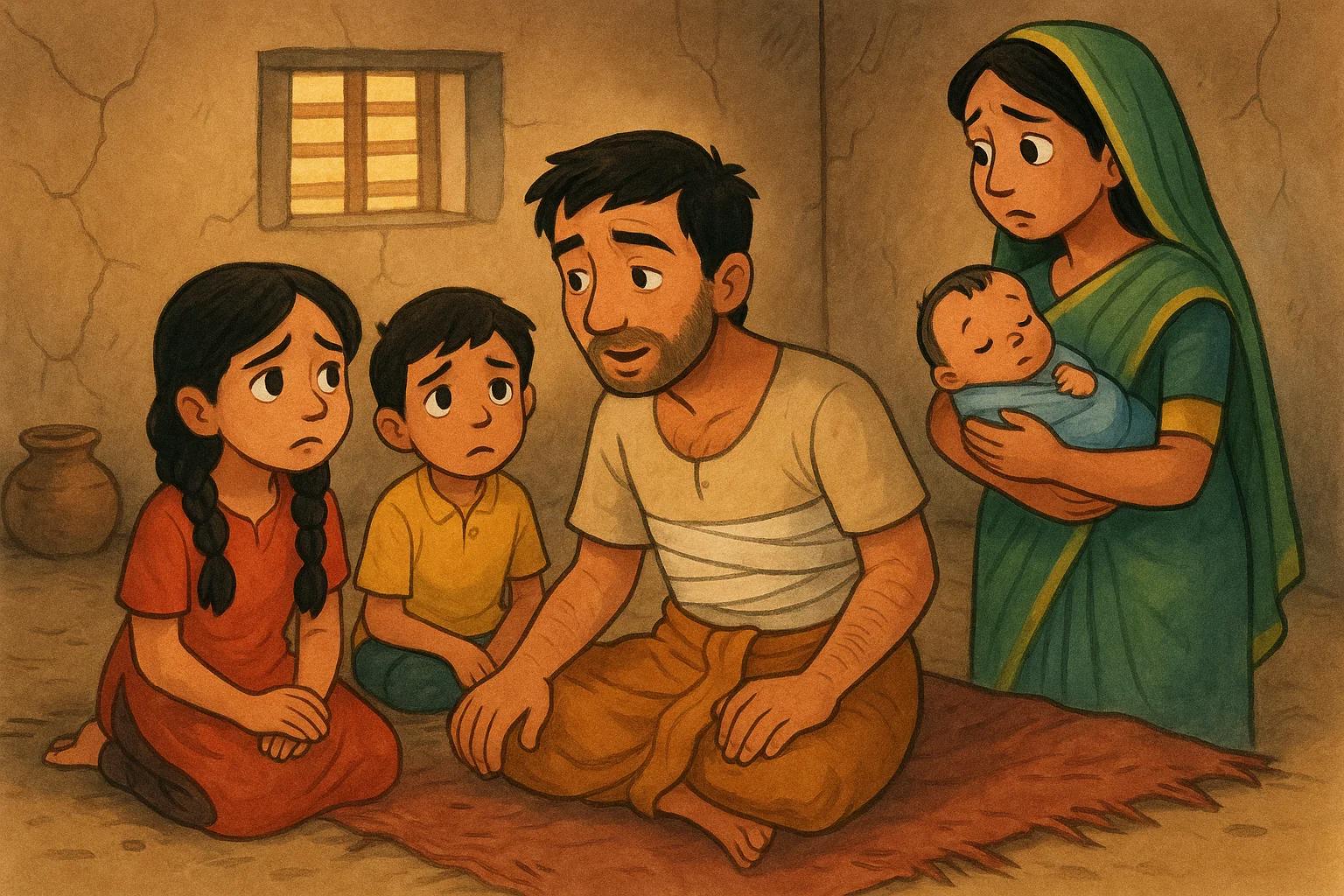
Their father looked at them both, then down at his injured, calloused hands. “It means I borrowedmoneyfromthem,tofixtheroofafterthestorm.Andforyourgrandma’smedicine.”
“But we can pay them back, right?” Noor asked quickly, her eyes shining with hope—hope for anendtothismisery,hopeforbetterdaysahead.
He sighed. “That’swhatItried.Butmyjobattheminepayslittle.AndwhenImissaday…they addmoretowhatIowe.Likeamonstergrowingbiggerandbigger.”
The next morning, the twins walked handinhandtotheedgeofthevillage,wherealarge,white van waited, humming like a beast eager to feast. Their father stood beside them, silent and ashamed, his eyes fixed on the dusty ground. A man in a grey uniform, holding a clipboard, nodded at their father before quickly ushering Noor and Ali into the back of the van withafew otherchildren—someolder,someevenyounger.
They were driven to a place that looked nothing like their village. It was huge, grey, and surrounded by a metal fence with sharp wires on top. Black smoke rose from giant chimneys, chokingtheair.Therewasnothingbrightorhappyaboutthisplace.
It was no use. The masked men dragged her down a long, dark hallway. Her shoes scraped against the floor as she tried to pull away, but their grip was too strong. Her tears kept falling—fast,hot,anduseless.
Theypushedherthroughametaldoor,andshestoppedcold.
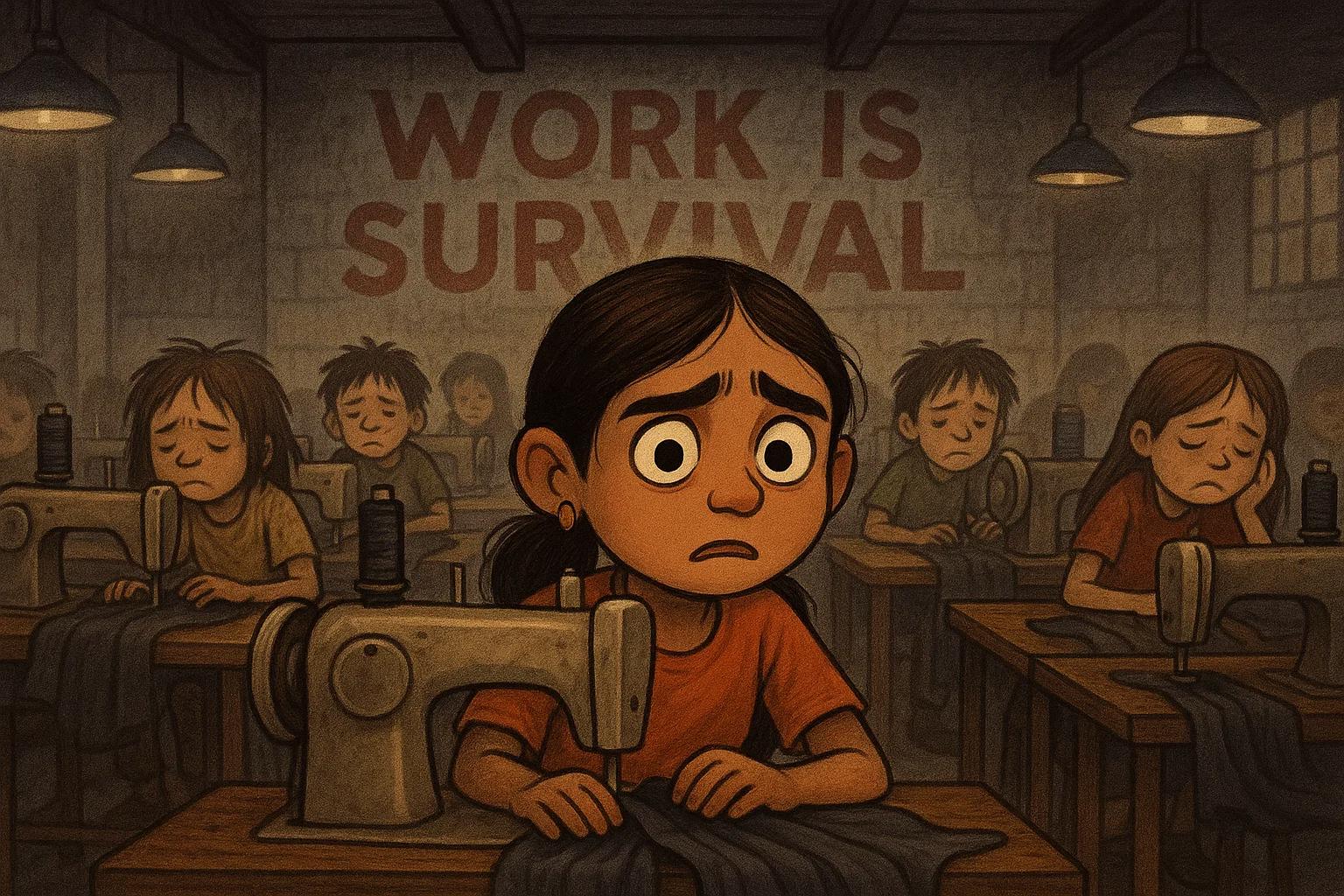
She was in a huge room. Dozens of children satinrows,sewing.Noonelookedup.Theirheads were bent low, their hands moving quickly like they’d done this a thousand times. They didn’t speak.Theydidn’tcry Theyjustworked,likerobots.
The air wasthickandheavy.Theonlysoundsweretheclickingofneedles,thehumofmachines, andfootstepsfromaguardwalkingslowlybetweentherows.
The moment she tried sewing, the needle pricked her finger Then again. And again. Her small hands shook. Blood stained the fabric and tears welled up in her eyes. But no one noticed. No onecared.
ChapterFour:TheMachines
Ali’s heart was pounding as he was dragged down the metal hallway The floor beneathhisfeet was cold, and the walls were grey and peeling. The man dragging him looked down upon him withdisdain.
They turned a corner and entered a giant room filled with machines that looked like beasts—loud, shaking, growling things with gears and belts and smoke puffing out. The air smelledlikeoilandsomethingburning.ItmadeAli’seyessting.
The man pointed to a large metal machine. “This one’s yours. You will have to learn how to operateit.Fast!”hecommanded.
Ali stared at it. The machine had levers, buttons, and a platform where pieces of fabric were beingpressedandcut.Anotherboystoodnearby,armsmovingfastlikearobot.
“HowdoI—”Alibegantoask.
A different, larger man walked over—this one had a bent back and an eye that looked in the wrong direction. He didn’t say a word. Just grabbed Ali’s arm, yanked him close, and showed himhowtoliftametalrodandslideafabricrollintoplace. Itlookedsimple.Butitwasheavy.
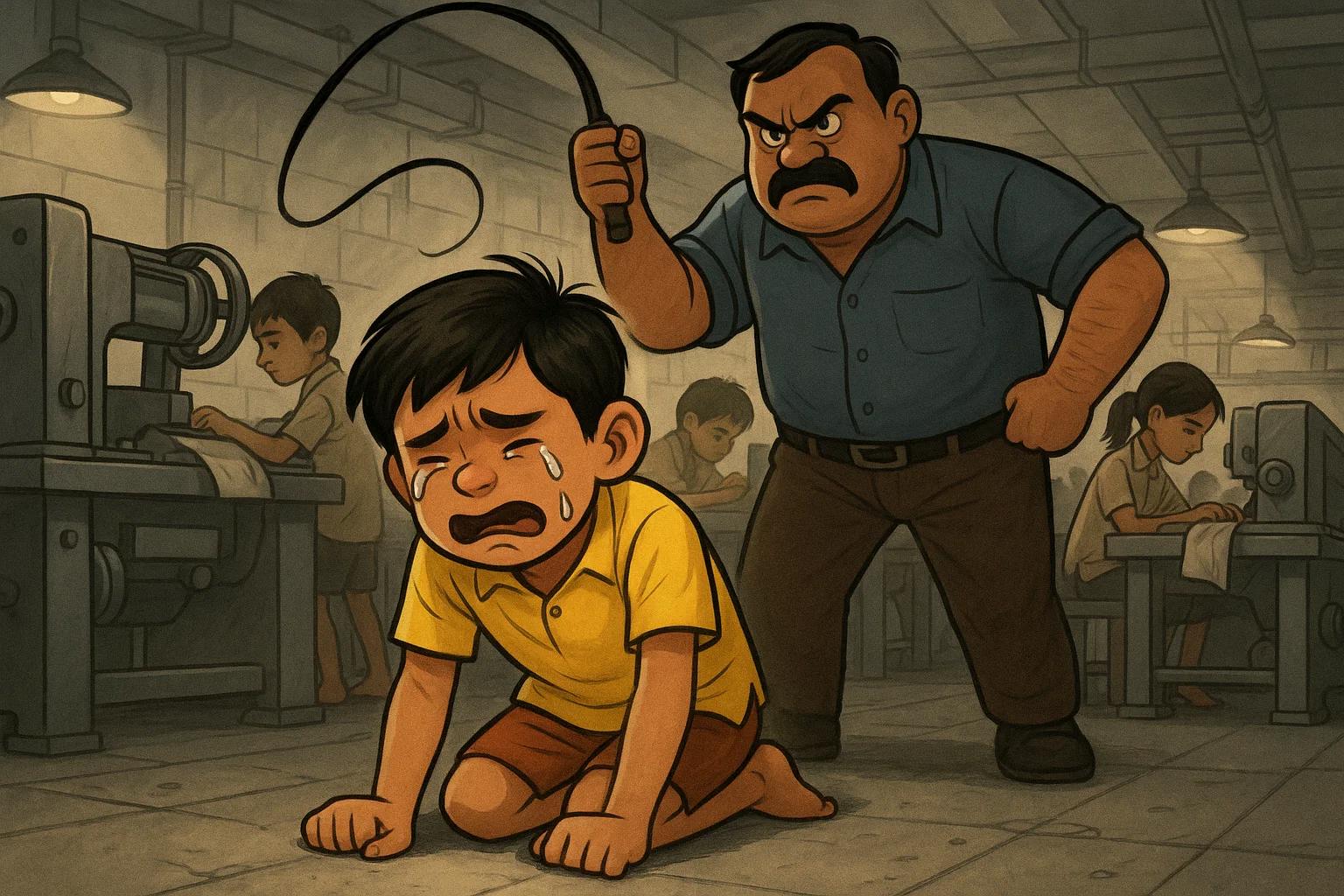
A lash of the whip tore through his shirt and burned across his back. Ali screamed as pain exploded down his spine. His knees hit the floor, hands clutching at thetornclothandrawskin.
Tearsblurredhisvisionandhegaspedforair
Butnoonelooked.
The other children didn’t even flinch. Heads down. Fingers moving. Sewing. Stitching. Surviving.
Ali was led down a narrow, dim hallway, his steps slow, as if his body had forgotten how to movewithoutpain.Ahead,Noorwasalreadywaiting.Themomentshesawhim,sheranforward but stopped short,frozen.Hereyeswidenedinshockandherfacedrainedofallcolorashereyes scannedoverAli’sback.
She lowered herself beside him, fingers trembling, pain etched across her own face. “My hands… theyhurtsomuch,”shemurmured.“Theneedleskeeppokingme.Andnoonetalks.No oneevenlooksup.”
Their thoughtswerebrokenbyahandthrustingtowardthem—offeringapieceofstalebreadand a small cup of hot water. It was the same for everyone. Just enough to keep them going. Just enoughtokeepthemtrapped.
Theyateinsilence.Evenchewinghurt.
“Iwanttogohome,”Noorwhisperedeventually.
“Metoo,”Aliadmitted.
Apause.
“Let’s tell Abba everything. Maybe he’ll come get us. Maybehe’llmakeitstop,”Noorsaid,her voiceliftingjustslightly
Alinodded,slowly,mechanically “Yeah…maybe.”
But deep inside, something in him already knew the truth: nothing about this was going to be easy.
ChapterSix:WhatTheyBroughtHome
That evening, when thebellrangagain,NoorandAliwereshovedintothevanoncemore,limbs sore and shirts sticking to their backs with sweat. As thesundippedbelowthehorizon,painting theskyinexhaustedshadesoforangeandrust,thefactorygatesclosedbehindthem.
“I never wanted this,” he replied, his voice trembling. “I just wanted… something better.”
And so they sat—Noor, Ali, their parents—in that small, silent room, surrounded by shadows, searchingforanswersthatdidn’tseemtoexist. (16)
ChapterSeven:DaysofDustandDarkness
Thedaysdraggedon,identicalandcruel.
Each morning began before the sun could rise, when even thebirdswerestillquietandthestars reluctant to disappear. Noor and Ali stumbled through sleep, their feet raw, arms sore, eyes burningfromtheweightofexhaustion.
School became a distant memory. Laughter felt like something imagined. Books, friends, the tasteoffreedom—thesehadallvanished.
Every day brought the same things: the choking van, the thunder of machines, the suffocating silence.Fear,smokeandpain.
Noor’s fingers, once so careful and clever, were now covered in pinpricks that bled throughthe cloth. Her back was stiff and locked from the hours spent frozen in place, shoulders hunched. The man with the snake cane rarely spoke—but whenhedid,itwastopunish,tothreatenandto remindthemofwhowasincontrol.
Ali’s muscles throbbed constantly. His arms, too weak to carry the heavy machine parts, often gaveout.He’dlearnedtoflinchjustfastenoughtoavoidthewhip…mostofthetime.
The van’s doors creaked open, and instead of the same lifeless routine, two new faces emerged—a young boy and his sister. The girl looked even younger than Noor, maybe seven at most.TheboywassmallerthanAli,wide-eyedandterrified.
At break, Noor tried to talk to thegirl.Sheheldoutapieceofbreadandgaveheragentlesmile. But the girl said nothing. Not because she didn’t want to, but because she was too scared to speak.
The sky was a pale shade of gray, not quite night,notquitemorning.Afaintchillfloatedinthe air, making the leaves on the neem treesrustlegently.Noorsatcross-leggedonthecornerofher mattress, her arms wrapped tightly around her knees. A strange knot twisted in her stomach notfromhunger,butfromfear,fromhope,fromsomethingbiggerthanboth.
Ali was on the other side of the room, quietly pulling on his sandals. His shirt was still damp from being washed in the basinthenightbefore.Itsmelledfaintlyofsoapandsun.Theirmother was asleep in the other room with the baby curled beside her,andtheirfatherlaysnoringonthe charpoyjustoutside,undertheopensky.
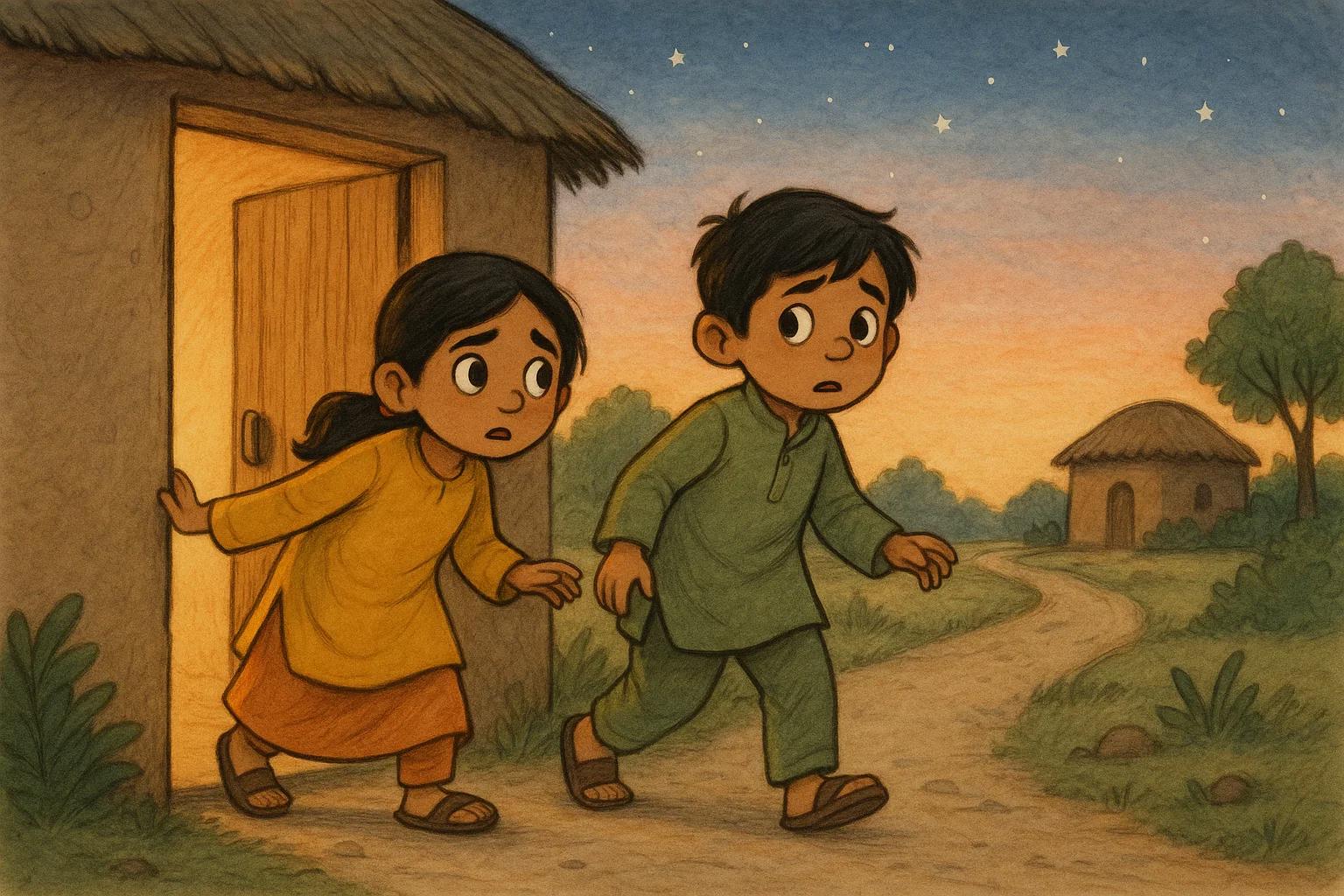
Noor crept to the door and opened it slowly. The wooden hinges gave a soft creak, but no one stirred. She stepped out, her bare feet brushing against the cool earth. Ali followed a moment later,andforafewseconds,thetwinsstoodstill justbreathing.
“Ready?”Aliwhispered.
Noor nodded, clutching the small cloth bag she had tied around her waist. It held nothing more than a pencilstubandafoldedscrapofpaperwithapoemshehadwrittenduringaschoollesson monthsago.Itwastheonlypieceofheroldlifeshestillcarried.
They took off down the narrow alley that wound behind the fields and mud houses, moving quickly, hearts pounding, staying low to the ground. Every time a goat bleated or a dogbarked, Noor’s breath caught in her throat. She kept glancing back, expecting one of the factorymento comethunderingafterthem,callingthembacktothatplaceofsmokeandpain.
Butnoonefollowed.
The villagewasquiet,stillwrappedinsleep,theonlysoundswerethesofttapoftheirfeetonthe dirtpathandthefaintcooingofmorningbirds.
Finally, after what felt like a full hour, they reached the small yellow buildingattheedgeofthe village:theschool.
Miss Rani stood there and held a steaming cup of tea in one hand. Her hair was tied in a loose braid,andhereyeslookedtiredbutkind.
Sheblinked.Thenhereyeswidenedinsurprise.
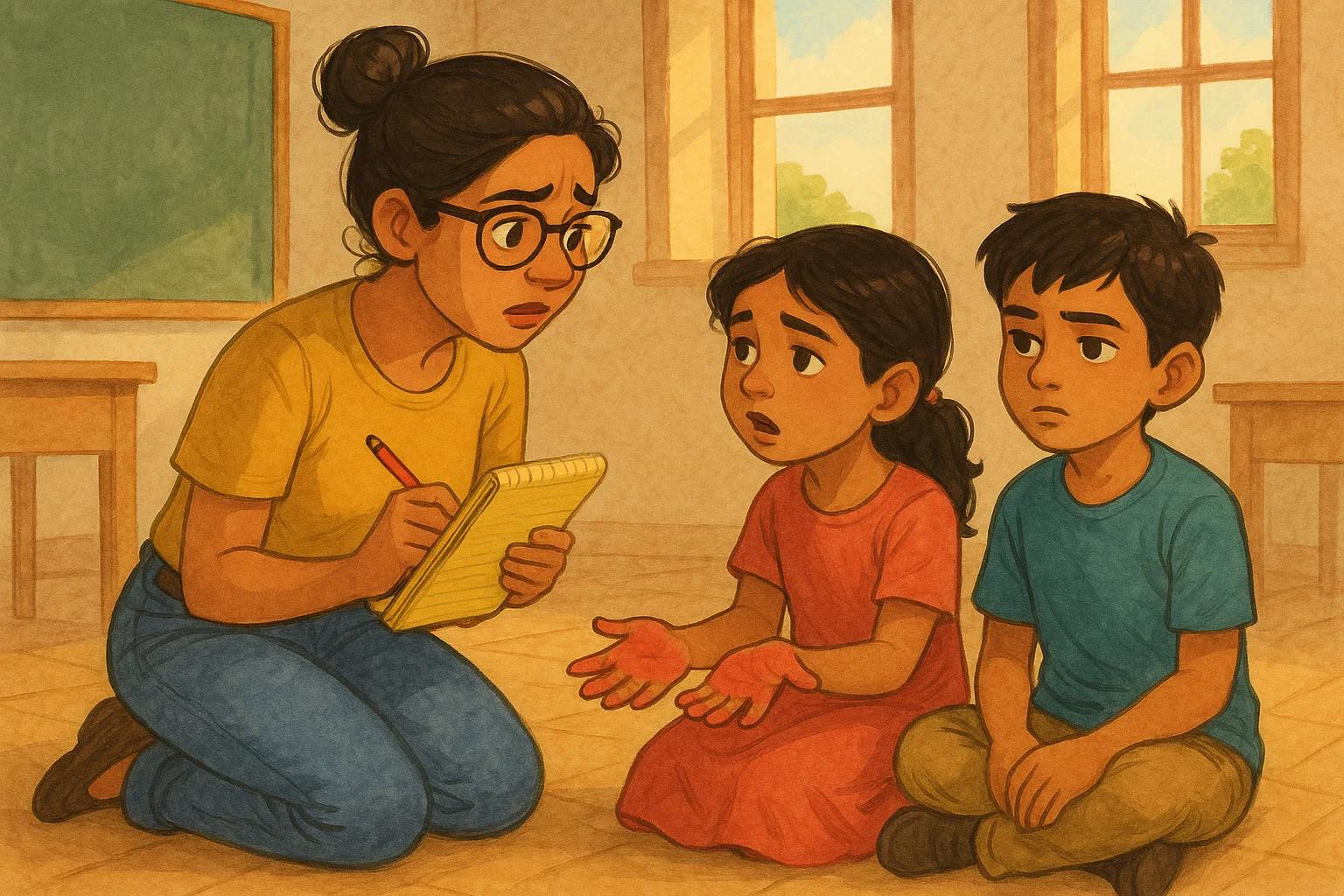
“Noor? Ali?” she said, stepping fully into the doorway. Her eyes swept over their dust-covered clothes, the fear in their eyes, the bruises peeking out from under Ali’s sleeve. Her voice softened.“Whatareyoutwodoingheresoearly?”
The classroom was quiet- peaceful in a way the factory never was. The smell of chalk dust and wooden desks filled the air, warm and familiar The morning light streamedinthroughtheopen windows,paintinggoldenpatchesacrossthetiledfloor
At first, her voice was barely louder than the whisper of the wind but she slowly gained her strength.. She told Miss Rani about the night it all began the way the men had broken down their door like monsters from a nightmare, dragging their father into the street, shouting about money and promises and debt. Her voice shook as she described thesoundofthewhip,theway herfather’scrieshauntedherdreams.
Then Alispoke.Hetalkedaboutthefactory howbigandcoldandfrighteningitwas.Howthe machines were louder than thunder and smelledlikeburntrubberandsmoke.Howeveryday,he was forced to carry heavy parts with his small hands and weak arms, and how, when he failed, painfollowed.Painintheformofawhiporaslap.
Noor told her about how the sewing room was filled with rowsofchildrensittingperfectlystill, like dolls, their eyes dead and their mouths shut.Andaboutthemanwiththesnake-headedcane whoseemedtoenjoywatchingthemsuffer
Miss Rani listened to every word, herhandsfoldedinherlap,hereyeslockedonthem,noteven blinking. At times, her jaw tightened. Other times, she looked like she mightcry.Butshedidn’t interruptonce.
Whentheywerefinished,therewassilence.
Noorsatfrozen,afraidshehadsaidtoomuch.
Alilookeddownathislap,ashamed.
Miss Rani finally spoke, her voice trembling just slightly. “No child… no human being should havetogothroughwhatyou’vegonethrough.Iamsosorry.”
She stood suddenly, walked to her desk, and pulled out an old, cracked cellphone. Her fingers moved quickly over thekeypadasshesaid,“Iknowsomeone—Zara.She’sareporter Shecares, and she listens. She’s not one of those people who just write storiesandmoveon.She’lltellthe world.”
Shehitcall.
Noor and Ali didn’t know it yet, but this moment this single phone call would change everything.
ChapterEleven:TheStoryGoesOut
The next afternoon, the yellow school building stirred with a quiet kind of urgency Miss Rani stood at the front gate, her dupatta fluttering like a flag inthebreeze.NoorandAlistoodbeside her,waiting.
“ShesaidhernameisZara?”Noorasked.
Miss Rani nodded. “She writes for the national paper. She used to teach before she became a journalist.Shelistenswithherwholeheart.”
A few minutes later, a motorcycle pulled up. A woman in jeans, dusty sneakers, and a brown leather backpack swung her leg over the seat and removed her helmet. Herdarkhairwaspulled intoaquickbun,andhereyeswerehiddenbehindlargeglassesthatreflectedtheafternoonsun.
“Zara!”MissRanicalled,waving.
Thewomansmiledandjoggeduptheschoolsteps.
“I came as fast as I could,” shesaid,adjustingthestraponherbag.“Yousaiditwasurgent.And fromyourvoice…Iknewitwasserious.”
Beside the headline was a photo of Noor’s small, bandaged hands holding a broken sewing needleinonepalm.Belowthatwasaclose-upofabruiseacrossAli’sback.
Zarahadwritteneverywordlikepoetrydippedinpain.
The article spread like a dust storm through the desert. By noon, the whole village knew. By evening, city officials had read it too. By morning, government workers in pressed uniforms wereatthedoorstepofthefactory.
Noor and Ali stood across the street, half-hidden behind a stack of crates, watching as the tall men in navy blue and grey stormed through the factory gates. Their boots echoed off the concrete,andtheireyesdartedleftandright,inspectingeverycornerlikehawks.
Thencametheshouting.
Children began emerging from the factory dozens of them. Small, scared, stunned. Their hands clutchedeachother Someblinkedagainstthesunlightasiftheyhadn’tseenitinweeks.A fewcoveredtheirearsatthesoundoftrucksandwhistles.
Oneboy,noolderthanseven,weptashewasledout.
Noor’sheartclenchedandAli’sfistsballedathissides.
Then they saw the manwiththesnake-headedcane.Hewasyelling,red-faced,andwastryingto pushpasttheofficers.Buttheysurroundedhim.
One officer, a tall woman in a crisp white kameez, read from a clipboard: “You’re being investigatedforhurtingchildren,lockingthemup,andmakingthemworkwhentheyshouldn’t.”
Their father walked beside them. He had shaved, worn a clean kurta, and even bought Noor a new hairband from the village stall. Their mother had packed them lunch wrapped in a clean cloth,andhereyeshadshonewithtearsandpride.
Insidetheschool,somethingmagicalhappened.
Children who had once been ghosts inside the factory were now sitting at desks. Some leaned againstwallsshylyandothersheldpencilsawkwardly,asifthey’dforgottenhowtowrite. Buttheywerethere.Theywerepresent.Theywerefree.
Miss Rani stoodatthefrontoftheclass,wipingherglassesontheedgeofherdupatta.Hervoice trembledslightlyasshewelcomedeachchildbyname.
That evening, the sun dipped behind the hills like it always did, turning the sky orange and purple,likeapaintingmadejustforthem.
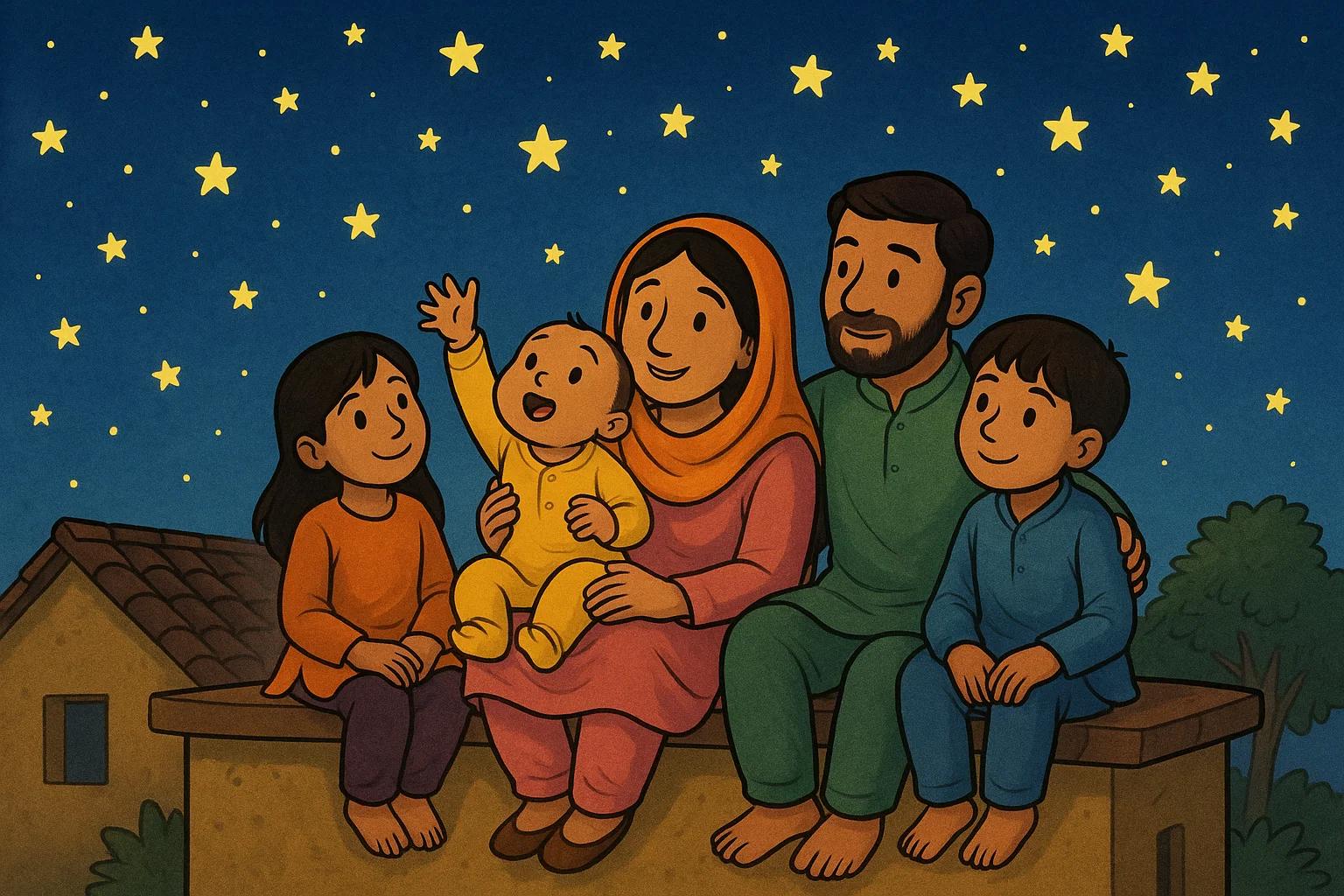
Noor and Ali sat on the roof of their shack, feet swinging over theedge,thesamewaytheyhad donetwoweeksago thenighttheymadetheirplan.
Onlythistime,therewaspeaceintheirhearts.
Their father came up the ladderslowly,asteamingsteelcupinonehand.Hesatbesidethem,his back a little straighter than before. The lines on his forehead looked softer, like some heavy weighthadbeenlifted.
They sat there, the five of them notrich,notsafeforever,notperfect. Buttheyweretogether andthatwaseverything.
ChapterFifteen:AVoicefortheVoiceless
The school bell rang the next morning, clear and proud like the sound of avictoryflagflapping in the wind. Noor and Ali sat at their desks, pencils in hand, listening to Miss Rani explain a lessonon"voice."
“Your voice isn’t just sound,” Miss Rani said, walking across the room slowly. “It’s your truth. It’s your story. And sometimes, it’s the only thing that can cut through injustice like a knife throughdarkness.”
Noor’shandfrozeoverhernotebook.
Alilookedupsharply.
Thatword injustice echoedinhischestlikeadrumbeat.
After class, while the other children poured into the yard for lunch break, Noor and Ali stayed behind. Noor stood quietly at Miss Rani’s desk, while Ali paced in front of the chalkboard, his browsknittogether
“Wedon’twantittoendwithus,”Noorsaid.
MissRanitiltedherhead.“Whatdoyoumean?”
Ali stopped pacing. “There are still more kids, Miss. Not just here. In other villages. Other factories.Wewereluckythatsomeonelistened.Butnoteveryonehasthat.”
Every child who had ever worked in the factory or whohadsiblings,cousins,orfriendswho had wasinvitedtowritetheirstory,ordrawit,orevenjustputahandprintinpaint.
Theboardbegantofillup.
Some drawings showed giant machines while others showed scared children behind fences. Somehadwordslike:
Children from nearby villages, hearing about the story through their parents or Zara’s article, begancomingtotheschooljusttovisittheboard justtofeelseen.
Noor and Ali stood by the display every afternoon, helping younger kids write their stories or drawtheirpain.
One warm afternoon, asthewinddancedthroughthetreesandkitesflutteredabovetherooftops, Zarareturnedtotheschool.Thistimeshebroughtasurprise.
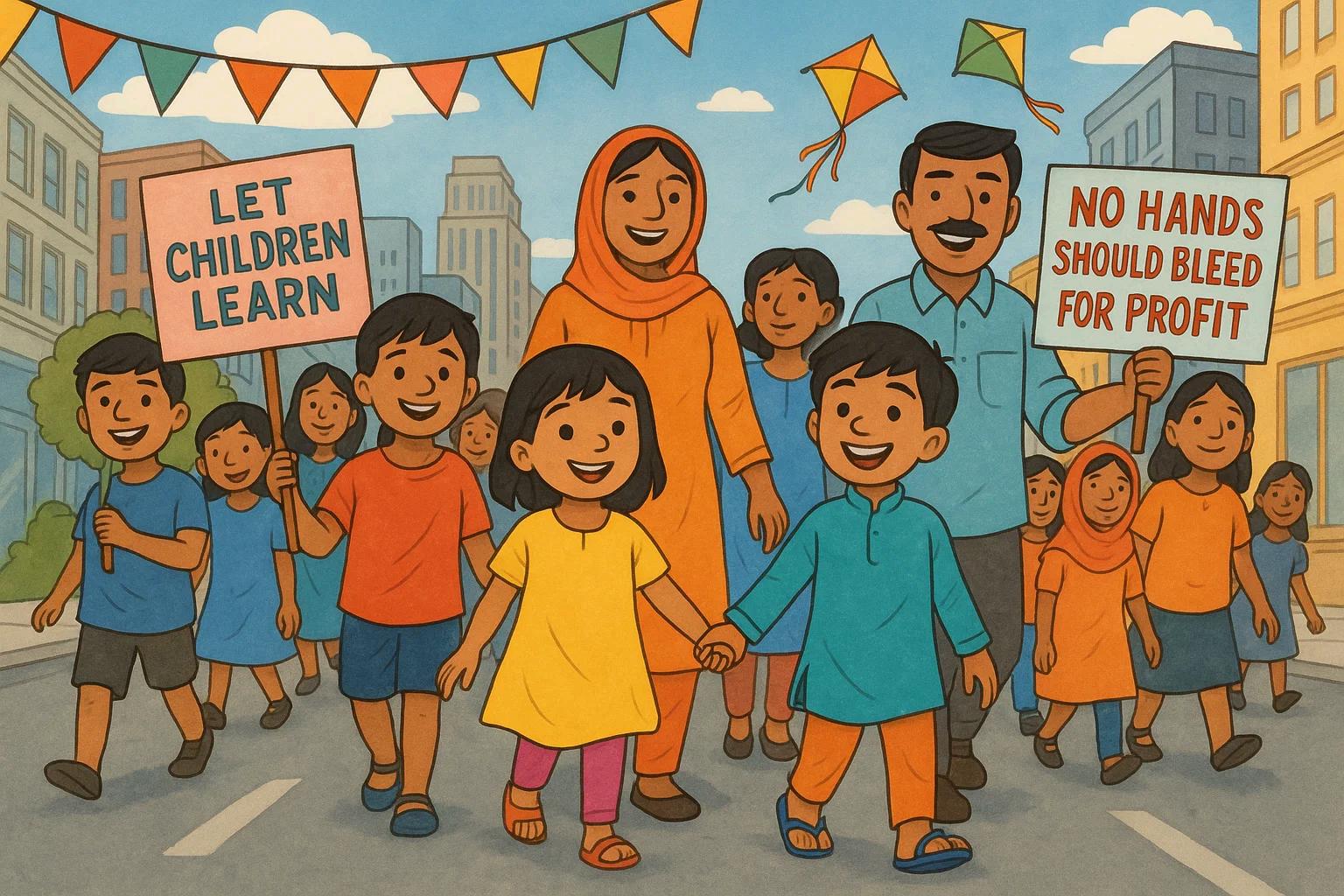
“There's going to be a march in the city,” she said, her eyes sparkling behind her glasses. “A marchforchildren’srights,foreducationandforendingchildlabour.”
Hundreds of children and adults filled the road, holding signs and banners that read: “Let ChildrenLearn,”“NoHandsShouldBleedforProfit,”and“WeAreNotMachines.” Theseaoffeetmovedslowlyandsteadily,likeariverofdreams.
AligrippedNoor’shandtightlyandtheybegantomarch.
With every step, Noor felt something rise inside her: something fierce and bright. Her chest swelledwithprideasstrangersshouted,“That’sthem!Thetwinsfromthearticle!”
After the march, the school wasbuzzingwithenergy Childrenwhooncebarelyspokewerenow writingletters,drawingcomics,andmakingposters.
Oneday,MissRanihandedNoorandAlitwofreshnotebooks.
“Zara’s asked if you’ll write letters for newspapers, for the Minister of Education and for lawmakers.Shebelievesinyourvoice.”
Noorflippedopenthefirstpage.
Shepressedherpenciltothepaperandwrote:
Dear World,
My name is Noor I am ten years old. I used to be a girl who sewed until her fingers bled. Now I am a girl who writes until her heart feels full.
My story is just one. But there are many like me. Please don’t look away.
We don’t want pity. We want change.
Let children be children again.
Aliwroteonetoothatsaid:
To the People in Power,
My name is Ali. I am ten. I used to carry metal parts heavier than my whole body I used to be afraid of sleep because I’d wake up to machines instead of dreams.
But now I am a student again.
I ask you to visit the places you ignore. Look into the eyes of the children working there. They don’t need silence. They need you.
It was acoolmorningwhenawhitegovernmentcarrolledintotheirvillage.Childrenpeekedout of doorways, mothers whispered to each other, and fathers crossed their arms and stood watchfully
When the car door opened and a woman in a crisp cream shalwar kameez stepped out, smiling gently,everythingchanged.
“I’m the Minister of Human Rights,” she said, walking directly to the school gate. “And I’ve cometomeetNoorandAli.”
“CHILD LABOUR BAN EXPANDS: Inspired by Twins’ Story, New Law BringsHope”
The new policy made it illegalforanyfactorytoemploychildrenunder14.Itpromisedmonthly aid to families in extreme poverty and even launched a “Back to School” initiative with government-fundedmeals,supplies,andtransportationforstrugglingchildren.
Even children in faraway villages began writing their own letters, drawing posters and starting clubscalled“Noor&AliCircles” safespacesforyoungvoicestospeakup.
ChapterTwenty:APlaceforEveryChild
One sunny afternoon, the schoolyard was filled with color Bright chalk drawings covered the ground suns, stars, books, and tiny hearts. Children ran, laughed, and played tag under the shadeofthetrees.
Noor sat under the biggest neem tree, reading a storybook to a group of smaller kids some whousedtoworkinthefactory,somewhohadneverbeentoschoolbefore.