The Chatter

Page 1


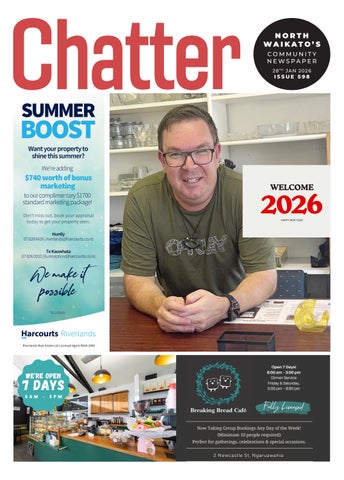
On the cover: We chat to Te Kauwhata Colleg teacher, Chris Plant . Full story on page 5.

Antarctic Parliamentarians Assembly a huge success

Happy New Year everyone! I trust you had a good Christmas and a restful break over the summer.

In December in Parliament, I was extremely honoured to chair the third Antarctic Parliamentarians Assembly, the first time it has been held in the Southern Hemisphere.

I have always felt the allure of Antarctica, having been inspired to visit by the exploits of the great explorers Scott, Shackleton and Amundsen, and was very fortunate to spend a month there over the 2012/13 summer.

Tim’s News

IChatter Community Newspaper is published fortnightly on a Wednesday and circulated throughout the North Waikato.

Readers contributions of articles and letters are welcome. Publication of contributions are entirely at the discretion of the Editor.

Contributions will only be considered for publication when accompanied by the author’s name and surname, telephone number and residential address.

All reasonable steps are taken to ensure accuracy.

Opinions expressed are not necessarily those of the owner or publisher.

Contact Jacqui Phone: 021 428 808 Email: info@chatternews.co.nz www.chatternewspaper.co.nz

Looking for the best in animal bedding?

Our premium untreated dry pinewood shavings, chipper fines or woodchip offer superior comfort and cleanliness for your pets or livestock. Don’t wait until the last minute-purchase early and take advantage of our summer deal for bulk or bagged deliveries.

Enquire now at 07 888 1955 or order at orders@moorey.co.nz

After becoming an MP, I was one of the organisers of the inaugural Antarctic Parliamentarians Assembly in London in December 2019 when, on the 60th anniversary of the signing of the Antarctic Treaty, parliamentarians were invited from the 54 signatories to the Treaty to celebrate its signing and to discuss the future of the ‘White Continent’. New Zealand was one of the original 12 parties to sign the Treaty in 1959.

The Assembly aimed to highlight the importance of Antarctica to the understanding of our planet, and provided an opportunity for parliamentarians to learn more about Antarctica and press their legislatures to support and prioritise the work of the Treaty. Much of this work is normally conducted at official levels.

The purpose of the Assembly is to ensure parliamentarians can advocate better to protect Antarctica in an informed manner. Parliamentarians are in a privileged position, able to speak up for Antarctica’s global significance and protection at the very highest levels of governance in their respective countries.

The Antarctic Treaty designates Antarctica as a natural reserve for peace and science. It prohibits military activity, nuclear tests and waste disposal, while promoting international scientific cooperation, setting aside territorial disputes. It ensures freedom of scientific investigation and establishes a framework for managing activities, including tourism, under the broader Antarctic Treaty System to ensure its unique environment is protected.

In Wellington in December, 22 parliamentarians and two special parliamentary advisors from 14 countries party to the Antarctic Treaty were educated and informed by a number of world-leading experts, with presentations ranging from international science cooperation, the impacts of tourism, and environmental governance. Representatives from the New Zealand and UK Antarctic Heritage Trusts gave a presentation on the importance of preserving the heritage of Antarctica.

The Assembly noted pressure on the Antarctic from shifts in the geopolitical landscape, climate change and increasing human activities. Changes in Antarctica are significant and accelerating – it is particularly vulnerable to ocean and atmospheric warming, and it is warming faster than we thought. As the Antarctic is fundamental to our global climate, these changes are affecting us all via the ocean, atmosphere and sea level.

The use of Antarctica for peaceful purposes only, and its status as a natural reserve for science, is more important than ever.

With over 60 people attending in Wellington, the Antarctic Parliamentarians Assembly continues to create a network of advocates in parliaments around the world, representing diverse cultures, histories and values. Planning is now underway for the next Assembly in 2027. I have been nominated as the Chair and four countries have already expressed interest in hosting the event.

n this first issue of Chatter for 2026, I’m pleased to have this opportunity to wish you all the best for the year ahead. I hope you’ve enjoyed wonderful times with relatives and friends over the holiday season. Last week’s tempestuous summer weather dealt a blow to Waikato and across the Bay of Plenty, Coromandel, Auckland, Northland, and East Coast. Tropical storm conditions brought heavy rain and excessive winds, impacting power supply to thousands of properties. Locally, there was tree debris strewn across roads and footpaths and some major damage but thankfully not widespread, whereas the storm left other region’s residents and visitors dealing with flooding, slips, and more significant property and infrastructure damage. The storm caused injuries and fatalities with some people unaccounted for (at this time); families of those loved ones were tragically left devastated.

I extend my gratitude to our incredible Waikato first responders for their work during this extreme weather. Police, Volunteer Fire Brigades, and St John Ambulance are our first port of call when we need emergency assistance, and they unreservedly step up every time. Their task can be daunting, potentially dangerous, unpleasant, and distressing. They routinely and professionally deal with injuries, vehicle and property damage, or anti-social behaviour. It’s a role many can’t or won’t take on; my sincere thanks to those who do.

New Zealand experiences frequent earthquakes, fortunately mostly small or unnoticeable, but the large Christchurch and Kaikoura events are still fresh in our minds. We live in proximity to the central volcanic plateau and are surrounded by multiple extinct volcanoes, evidence of the prevalence of past volcanic activity in neighbouring regions. Our weather can be unpredictable and chaotic, as last week’s storm demonstrated. All Waikato locals would benefit from being prepared for extreme weather and natural disasters. In the event of an emergency, having a grab bag of provisions, along with sources of power in case of outages are key components to getting your family through the difficult time. I urge you to ensure you have supplies and plans in place for you and the loved ones in your household. The Civil Defence website www.getready.govt.nz is an excellent source for advice on items you may need.

As the Government, we’re ensuring the nation is better prepared for natural emergencies. We’re replacing the outdated Civil Defence Emergency Management Act 2002 with the Emergency Management Bill. The bill clarifies who is in control during an emergency, local level accountabilities, and the need for strengthened local community representation. The bill expands the recognition of utilities and essential infrastructure providers to minimise disruption of essential services. Being best prepared is our first line of defence.

Should you wish to share your views on an issue, or reach out for my support, please connect with my Waikato Electorate Parliamentary Service team on 0800 GET TIM (0800 438 846) or email Tim.vandeMolenMP@parliament.govt.nz. I’m regularly in the communities around the electorate and look forward to connecting with you. Tim van de Molen – MP for Waikato.

van de Molen

0800 GET TIM (0800 438 846)

TimvandeMolenWaikato

TimvandeMolen

timvandemolen.co.nz

Authorised by Tim van de Molen, Parliament Buildings, Wellington.
Authorised by Andrew Bayly, Parliament Buildings, Wgtn.

Sweetest spot in Rangiriri

The Chatter chats to Paul and Jeni, the new owners of Rangiriri Ice Cream.

Paul and Jeni have been bringing unique family events to Kiwis for over 15 years and have been touring with their business all around New Zealand, but now they are excited to finally put down roots in Rangiriri.

Tell us about your vision for the site once you purchased it in May 2025.

When we bought the old shop, originally a butcher’s from the early 1900s, we knew straight away we wanted to share our passion and experience by bringing amazing family fun to the newly acquired Rangiriri Hut. What better than a traditional ice cream parlour.

Who helped transform the building?

The building has been restored to its former glory, with the front window and weatherboard appearance matching its original look. Easy access and disabledfriendly, with seating inside or outside.

Local craftsmen recladded the building, with Paul and Jeni transforming the interior themselves to a truly quirky ice cream parlour experience.

What are you offering at your special ice cream shop? What makes it unique?

We offer New Zealand’s most favourite ice cream, with the choice of Tip Top and Kapiti to excite your taste buds. We also offer milkshakes, iced coffee/iced chocolate, and a dessert menu is on the way.

Our shop is all about good vibes and great value. Come enjoy a warm, welcoming atmosphere plus generously

portioned scoops of your favourite ice cream.

What do you like and value about the Rangiriri village and hub?

The unique and rich history of the village. The hub supports locals and visiting customers. It’s a vibrant and friendly environment located between Hamilton and Auckland, offering quick and easy transit.

Great timing for summer. What feedback are you receiving?

Since opening, we have experienced sensational support from lovely locals, giving great feedback and online reviews. Also great feedback from stopovers passing through and the international hikers as they plod past.

One message that we think perfectly captures our shop:

“The prettiest and sweetest spot in Rangiriri.”

Where are you located and what are your opening hours?

16 Rangiriri Road, Rangiriri

Open daily from 12pm–5pm

How do people contact you?

Facebook: Rangiriri Ice Cream

Phone: 021 688 211

Waikato District Council – Community

Boards Update by Ganga Sudhan

All community boards will resume their meetings in February and the meetings are open to the public.

The board in Raglan meets 1.30pm at the local Town Hall, the board at Tuakau meets at 6pm at the local Town Hall, and the Ngaaruawaahia board meets 6pm at the Waikato District Council.

Upcoming Meetings

1. Raglan Community Board meets Wednesday, 04 February 2026

2. Tuakau Community Board meets Monday, 09 February 2026

3. Ngaaruawaahia Community Board meets Tuesday, 10 February 2026

4. Rural–Port Waikato Community Board meets Thursday, 12 February 2026

5. Taupiri Community Board meets Monday, 16 February 2026

6. Huntly Community Board meets Tuesday, 17 February 2026

Rick Henderson: A Lifetime of Building Community — One Trail at a Time by

For more than three decades, one Ngaruawahia local has quietly shaped community spaces not through committees or funding applications, but through passion, persistence, and a willingness to put in the work.

Rick Henderson, a long-time resident of Ngaruawahia, has spent much of his adult life creating and maintaining informal bike trails that generations of riders have come to know, use, and remember. What began as a personal passion for cycling gradually evolved into shared spaces that welcomed both professional riders and local kids, many of whom are now adults with families of their own.

Some may remember the bike track down the old Taupiri Road — a place where local riders mixed with visiting professionals, where skills were developed, friendships formed, and confidence built. Although the track has long since returned to the earth, the memories it created remain firmly embedded in the community’s collective history.

Less visible, but equally significant, are the trails Rick built by hand more than 25 years ago in the hills beyond the water treatment plant. Using little more than basic tools and determination, he carved out short riding lines and connected sections of land to create accessible spaces for mountain biking. These trails were never intended to be grand or commercial. They were simply a way to share the joy of riding and to encourage younger people to take up the sport.

That philosophy of openness extended beyond the trails themselves. Riders from out of town were welcomed, tents were pitched on lawns during weekend sessions, and the property became a gathering place for people drawn together by a shared love of bikes. Local riders on basic, entrylevel bikes rode alongside experienced cyclists with highend equipment, breaking down barriers that often exist in organised sport.

Out of this environment grew High Speed Cycles, a small bike workshop established by Rick. The shop was not only a place to purchase parts or service bikes, but a means of sustaining the trails themselves. Any income helped maintain the land and riding areas, which always remained free to use. Almost all trail work was completed by hand, with Rick doing the bulk of the labour in the early years before others joined in to help maintain and develop new features.

The property also became a base for wider riding activity in the region, including downhill sessions connected to trails built by Hamilton riders in nearby forest areas. These weekends brought together young riders, families, and enthusiasts who shared not just the sport, but a sense of belonging.

At one point, Rick attempted to take this civic-minded approach further, engaging with council staff to propose public bike trails in the hills above Ngaruawahia. He offered the support of dozens of local riders to build and maintain the tracks and to take responsibility for safety and upkeep. Although the proposal did not proceed, the idea reflected a vision that has since become common in communities worldwide, where cycling trails are recognised as valuable social and economic assets.

After several years away from riding due to illness, Rick has recently returned to the hills, clearing old trails and reopening sections for use. He is once again a familiar sight, pushing his downhill bike uphill before enjoying the short but rewarding ride back down.

Reflecting on his efforts, Rick remains modest. He does not view his contribution as anything extraordinary, but rather as the natural outcome of sharing a passion and having the opportunity to act on it.

In a time when community spaces are often measured by budgets and formal plans, his story is a reminder that some of the most meaningful places are created quietly — shaped by individuals who care deeply about where they live and who choose to give something back, simply because they can.

Chris Plant – Fully Immersed in the Community

Te Kauwhata teacher Chris Plant describes himself as a ‘people person who really loves meeting and talking to new people’ and he’s fulfilling that many times over that in his current job, interests and extensive community work.

Teaching at Te Kauwhata College since 2019, Chris (“Mr Plant”) enjoys the variety of the unexpected. “Each day I get to do something I enjoy and share the excitement of finding out new things. Seeing the look of excitement and satisfaction on students’ faces when it all finally clicks is totally rewarding.”

But little do Te Kauwhata’s students know, Chris Plant was not aiming for a teaching career but early on had his sights set on his first passion – flying. “I wanted to be a pilot but unfortunately, I have Meniere’s disease which affects my ears causing things like vertigo so that wasn’t an option for me.

“I knew I liked working with people, so since I couldn’t be a pilot, I looked at training to be cabin crew. Then Sept 11 happened and Air NZ wasn’t in a healthy or hiring position, so I did work experience back at Huntly College. A teacher there suggested I train as a teacher, and the rest is history. I got my first posit in Te Kauwhata Primary in 2007 and it soon became clear that teaching was an obvious choice as a long term career.

‘I also quickly learned to double check everything, even things that seemed harmless. When teaching there early in my career, a parent donated a pile of magazines, which I didn’t check. While being observed by the principal (and that always happens at the most awkward moments!) a student brought up a magazine and said, “look what I found Mr Plant” and a centrefold fell out from the middle of the mag.”

Living the country dream

Although not born locally, Chris and parents moved from New Plymouth to Huntly when he was two and father Martin was transferred to work at the Huntly power station. Chris grew up in Huntly West and started school at St Anthony’s. By the time he was eight, the family had moved to Ruawaro and he jumped wholeheartedly into country schooling at Rotongaro Primary.

“My first experience of country life was going to the annual Rotongaro sports day, food, wood chopping and trying the catch the greasy pig. Lamb and calf days were always a challenge between my friends. I then moved to Ruawaro primary when we combined schools with the closing of Rotongaro. I went to Huntly college for my college years”

He admits he’s not a natural rule-breaker, tried wagging once, but was caught by the deputy principal after walking (without attempting to hide) into Huntly.

When he’s not teaching Chris can be found taking part in a wide range of activities in Te Kauwhata. “Besides teaching, I’m a Co-manager at St Andrews Shop, which fills up my spare hours of the week. I am also into my third year as a Justice of the Peace, following in the footsteps of my grandfather. I also support the St Andrew’s church as a manager, much like a board member.”

Being active in the community is important to Chris, as is having a good work/ life balance. “All the things I do are important to me. Work gives me the satisfaction of doing something well, my faith and working in the Opshop keep me grounded and travelling gives me experiences I can’t get here but also reminding me how lucky I am to call NZ home.

For my work life balance, I make sure that work is done at work. I’d rather stay late and not have to bring it home. Anything arty is my happy place, watercolours are my new fav, and I might need to get a pottery wheel at some point. Just being with people keeps my batteries full.”

Travelling’ man

Chris tries to travel overseas at least once a year and enjoys group tours with a company, Teacher Xpress, specially designed for teachers during school holidays.

So far he’s visited around 16 countries on tour and has some life lessons to share – including how to fend off mass marriage proposals! But the biggest thing, he says, is when travelling is taking off your kiwi hat and living like locals to make any experience way more authentic.

Huntly Museum digs deep with thrilling new VR adventure!

H

untlys newest cultural hotspot is bringing new technology to showcase old stories with generous support from Genesis

Energy and Bathhurst Mining the museum has created a Virtual Reality experience to test your reflexes and take you deep under the earth.

Located in the old Railway Station at 2 a Glasgow St the experience was made especially for Raahui Pookeka Huntly Museum and will be launched on Waitangi Day Feb 6th 2026.

Entry to the Museum is free on Waitangi Day with a small charge for the VR.

The Museum is open 10- 4pm Wed, Thurs Fri, Saturdays. Free on the first Friday of the month and this month that falls on Waitangi Day!

“Each trip has been magical; walking around the corner at Machu Picchu and the whole sight coming into view just takes your breath away. So do the Terracotta Warriors in China, or the Taj Mahal. Seeing elephants in the wild in Chobe was amazing, though funny enough, did not see one single zebra the entire time we were there.

“I’ve tried lots of different foods including Guinea pig, snake, warthog, ostrich – but I wasn’t brave enough to try donkey. I had plenty of marriage proposals in Vietnam on an overnight train, we even started bargaining how many cows were going to be traded!.

“China was an amazing place. We went out one night and decided we wanted

dumplings – but no-one one spoke English, so we relied on good old google translate. I’m not entirely sure how accurate it was but haven’t laughed so much in years. No-one on either side knew what was happening, but the food arrived and was a stunning 10/10… whatever it was!”

Next on the list is Japan this year: and Chris says he’s really looking forward to that as yet another different experience. His 2026 ambitions echo those of many- aiming for good health as a starter. Now in his 19th year of teaching and second year as Assistant Principal at the college, he’s looking forward to growing into that position.

Photo supplied: Toriesa Howell trying out the VR.

Safer Plates for Te Kauwhata

Te Kauwhata Community Patrol and Neighbourhood Support are pleased to work together to deliver a special community event in Saleyard Rd on Friday 20 February. Drive down and see us by the Skatepark between 4pm and 6pm so we can tell you more about our organisations, make your number plate safer and assist with tool engraving if needed. A koha towards costs would be appreciated.

Safer Plates - Number plates are stolen for the sole purpose of criminal activity. Criminals then use the stolen plates on vehicles for petrol drive-offs, driving through toll roads, drug crime, burglary and other thefts. They only care about what is the easiest and fastest number plate to take, usually only carrying a standard phillips x or flathead screwdriver in their pocket. Sometimes, you do not even know that your plates have been taken, until Police contact you when your stolen plate has been used for a crime. You can reduce the chance of number plate theft by allowing us to secure your number plate with special screws.

Engraving - Whether you are a Tradie or you want to bring along your tools from home, come along and take advantage of this service. Have your tools engraved with your drivers license, so you have a better chance of recovering your tools if they are stolen. This will also link a criminal with a theft.

Te Kauwhata Community Patrol & Te Kauwhata Neighbourhood Support are both committed to a safer, stronger community. Speak to us about opportunities to volunteer, or to sign up for our monthly newsletters. For more information phone 0212225682.

2026 at TK Community House

Te Kauwhata Community House wishes everyone a peaceful and plentiful 2026. All our regular programmes are running again this year. We support residents of Te Kauwhata and Districts (Ohinewai, Rangiriri, Glen Murray, Meremere, Waerenga). If you live in our districts please get in touch if we can assist you with:

Cuppas - we are open 9.30am to 4pm weekdays. The kettle is always boiled, and we are happy to listen and/or to find the information you need.

Social Transport - fortnightly free trips to natural spaces and retail places. We may be able to pick you up from home.

Medical Transport - transport to Thames and Waikato hospitals and specialist appointments, for those without other transport options

Luncheon Club for Seniors (in partnership with Lions)monthly lunch at the Bowling Club. Yummy two courses and a raffle for $12.

Frozen Meals - delicious, healthy, low-cost meals to enjoy in your own home

New Parent Group - six week programme starting on Feb 20 for parents with babies under 5 months

Grieve and Grow Group - fortnightly peer support group for people who have lost significant others

Cancer Support Group - fortnightly peer support group for people affected by Cancer

Counselling - individual sessions for people needing mental health support

Financial Mentoring - support to achieve your financial goals this year

Law Clinic - short appointments for people with legal queries

Neighbourhood Support - we are the local reps for Neighbourhood Support New Zealand. Always here to talk about safer and more connected communities. We also have signage and resources available.

CV writing and job search - we can help you get work ready

Print/Copy/Laminate - we can assist with most simple copy centre needs

Mobility Equipment - we offer wheel chairs, crutches, walkers, shower seats and much more equipment for loan Toi Ako Artspace - full of clubs, classes and opportunities for fun. See www.toiako.org

Volunteers - we are always seeking drivers and gardener, some event support is also appreciated

You can find us at 1a Waerenga Rd, email assistant@ tekauwhata.org.nz or phone 07 826 4303. Ngaa mihi nui.

Join a choir

Te Kauwhata Community Choir will shortly resume for 2026. We are a fun group singing songs chosen by our members - musicals, rock, pop, country, jazz, we’ll give everything a go.

Choir director Sandra Pace arranges each song to suit the group. Some members like to work off sheet music, but most sing directly from lyric sheets. We aim to perform in the community 2-3 times a year, however that is entirely optional. What matters most is your participation. Evidence tells is that singing is a balm for the soul and a health elixir. It can boost immune function, improve heart rate and blood pressure. It can reduce stress and anxiety, lift mood, increase lung capacity, improve cognitive function and promotes social interaction.

We welcome you whether you are an experienced chorister or are more at home singing in the shower. We meet at the Toi Ako Artspace on a Thursday from 5.30pm to 6.45pm. For more information contact Lauren on artstekauwhata@gmail. com. Lauren Hughes

The Chatter: Meet Our Farmers

Q&A with Te Akau farmer Bronwyn Main with Annika Stricker

W

ith a sweeping hill-country farm that runs all the way down to the Tasman Sea, Bronwyn Main is part of the fabric of rural North Waikato.

She and her husband farm sheep and beef on 700 hectares north of Raglan. Bronwyn shares what farming looks like in Te Akau, and how sustainability shapes their operation, as well as her involvement in community leadership through Rural Women New Zealand (RWNZ).

Can you tell us a bit about your farm and what you enjoy most about your work?

We farm around 700 hectares in Te Akau, about ten kilometres north of Raglan. Ours is a coastal, hill-country farm focused mainly on producing heavy lambs for the US market and finishing beef steers (editor’s note: “Finishing” means growing stock to a healthy, market-ready weight). The land is very rolling and exposed to the Tasman, so we often get all four seasons in a single day.

From the house, we can look right down a long valley and across the farm so there is always something happening: stock moving, or just the light shifting across the hills. It is a beautiful place to work each day.

What sustainable or good-practice habits are part of your everyday farming routine?

Sustainability is woven into everything we do. Our farm is GAP (Good Agricultural Practices) certified, which means it meets international standards for environmental care and food safety, which is a requirement for exporting heavy lamb into the USA. We are also certified through ZQRX, which is a global accreditation that recognises wool grown with a focus on environmental stewardship, biodiversity, animal care and community wellbeing.

A few years ago, we were category winners in the Ballance Farm Environment Awards, which showcase farms that are leading the way in sustainable land management. That recognition meant a lot, because it reflected years of careful decisions to look after the soil, the water and the wider environment.

Are there any tools, ideas, or small innovations that have made farm life easier or more enjoyable lately?

We were early adopters of finishing lambs on crops, which helps them reach prime condition more efficiently. Our river flats have pure clover swards, which is incredibly nutritious for stock. That has been a real game-changer for growing healthy lambs.

We also move stock frequently so they are always on the best feed and the land gets time to rest. It is a simple idea but makes a huge difference to animal health and pasture quality.

Beyond the farm systems themselves, we have always invested in great relationships with stock agents, vets, suppliers, our accountant, and our staff. Farming is easier and far more enjoyable when you have people around you who treat your place with the same care you do.

What do you find most rewarding about farming in the Waikato community?

Te Akau is a very special community. Being part of it has been a big part of my life:

I have served on the local school board and was once a district councillor. Strong rural communities are vital, both socially and for the resilience of farming.

We have been lucky to have exceptional staff who take pride in the farm as if it were their own. And of course, the landscape itself keeps you grounded. There is a raw, rugged beauty, especially down at the beach end of the property that never gets old.

As a Board Member of Rural Women New Zealand, what are some things you are most passionate about in your work?

Rural Women New Zealand connects smart, rural women from all kinds of backgrounds far more diverse than many people realise. This year marks 100 years of RWNZ, and I’m Chair of the National Centennial Committee, which has coordinated celebrations from July 2024 through to June 2025.

My policy area on the board is Rural Health, and that is something I’m deeply passionate about. We are seeing real progress in expanding access to healthcare for rural communities, especially through tele-health. There is so much potential to make rural health services more accessible for everyone.

How do you see RWNZ supporting and uplifting rural people in North Waikato?

Across New Zealand, including North Waikato, you’ll find groups of rural women gathering for friendship, and support. One of our most successful recent initiatives has been Dinner Groups, where women can meet over dinner often with a guest speaker, and come away feeling more connected and empowered.

We are looking to provide communication, connectivity and engagement among rural women and their communities. For many members, involvement is intergenerational. My own mother joined in 1942, so being part of RWNZ feels like continuing her legacy.

What keeps you inspired in your community roles and in rural life in general?

I’m a can-do person who likes to keep busy. I believe the best thing you can give anyone is your time, and I try to pay it forward wherever I can.

Outside of farming and RWNZ, I’m also an International Cat Judge, usually judging eight to ten times a year, half in New Zealand and half in Australia. We are parents to four very spoiled Burmese cats who keep life interesting.

2026 is looking to be a year filled with music at Te Whare Toi o Hakanoa

The centre, also called Creative Huntly, has enjoyed a year of stretching out its wings in its brand new space on Hakanoa Lake. New ventures have already begun appearing, enticing the community’s creatives.

Now heading into the new year, Creative Huntly is looking towards new musical opportunities.

Run by Arts Coordinator Sarah Morcom, several new songwriting workshops for both adults and teens are beginning in February.

These workshops were trialed at the centre in October 2025, and were a success with a group of musical teens. Now those over 18 will also be able to join the fun.

A Huntly Choir will also begin rehearsals in February 2026. This will be an opportunity for singers to develop their skills and meet other vocalists in a relaxed space.

Along with the existing ukulele lessons available at the centre, private piano lessons will also be available at $15 per student, per session.

Come along to 17 Park Avenue in early 2026 to join the fun and rock out. Visit rpcct.huntly.co.nz/creative-huntly for more information.

Toi Rangatahi Programme

Huntly’s rangatahi can look forward to a new community programme that will provide opportunities for fun, creativity, and growth.

Toi Rangatahi, a project dreamed up by Te Whare Toi o Hakanoa (Creative Huntly), will take place once a month from February 2026.

On a Friday evening, youth from 12-24 years of age will be invited to engage in a creative activity that will help grow their skills and widen their opportunities.

Each month will present a different skill to learn, with experienced tutors coming along to share their knowledge.

The first session will be an exploration of journalism and reporting, led by Chatter News and Creative Huntly’s own Sarah Morcom, who has studied and worked in the media industry.

Each session will leave students with resources and an understanding of where to go to learn more if they wish. Students will be given assignments after each class, with a month to work on until the next session comes around.

This programme will give Raahui Pookeka’s youth an encouraging push to consider a multitude of different creative options that have potential to turn into real careers. The courses will also include information on finding and applying for university and polytechnics.

Toi Rangitahi will begin on Friday February 13 from 5pm to 6.30pm. Following this, the programme will take place on the first Friday of each month. Entry is koha.

Toi Rangatahi dates:

• Friday February 13: Journalism and news media

• Friday March 6: Podcasting and radio

• Friday April 10: Photography and image editing

• Friday May 1: Music/sound production

• Friday June 5: What’s Next? Uni applications and information for 16+

• Friday July 3: Architecture design

• Friday August 7: Nail art and beauty

• Friday September 4: Conservation/ Trap building

• Friday October 2: Animation/ Digital art

• Friday November 6: Dessert making/ Cake decorating

• Friday December 4: Special Christmas session

The Kai Connection: Bringing People Together Through Food

Anew community programme, The Kai Connection, is starting this February at Te Whare Awhi, hosted by Raahui Pookeka Community Centres Trust. Running for six weeks from Tuesday 10 February, 9.30am–12 noon, the programme uses food as a way to build confidence, life skills, and connection within the community.

Facilitated by Jodie Collins, The Kai Connection is a hands-on cooking and learning programme designed to support people to cook nutritious meals on a budget, reduce food waste, and develop practical skills they can use for life.

“Kai is something we all connect with,” says Jodie. “Many people want to cook well for themselves and their whānau but face barriers like cost, lack of confidence, or limited access to food education. This programme was created to turn that shared need into a positive, supportive learning experience.”

Learning Through Kai

Food is at the heart of the programme because it naturally brings people together. Cooking side by side creates a relaxed, non-judgemental environment where participants learn together, share stories, and support one another. Along the way, people also build everyday literacy and numeracy skills by reading recipes, measuring ingredients, adjusting quantities, and planning meals.

Participants will learn practical skills such as:

• Basic cooking techniques and kitchen confidence

• Planning and preparing low-cost, nutritious meals

• Reading recipes and food labels

• Safe food handling and storage

• Reducing food waste and using leftovers creatively

• Understanding seasonal and local food choices

These are skills that can be used immediately at home and passed on to whānau.

Supporting Hauora in All Its Dimensions

The Kai Connection takes a holistic approach to wellbeing, supporting all four dimensions of hauora.

• Taha Tinana (Physical Wellbeing): Participants gain skills to prepare balanced, affordable meals, understand portion sizes, and make healthier food choices.

• Taha Hinengaro (Mental & Emotional Wellbeing): Learning to cook builds confidence, reduces stress, and creates a strong sense of achievement in a supportive group setting.

• Taha Whānau (Social Wellbeing): Cooking together encourages whakawhanaungatanga, strengthens relationships, and builds community connections.

• Taha Wairua (Spiritual Wellbeing): Kai holds cultural and spiritual significance. Preparing and sharing food with intention fosters gratitude, identity, and belonging.

When these four walls are supported together, cooking becomes more than just making a meal — it becomes a pathway to empowerment and long-term wellbeing.

Who Is It For?

The Kai Connection is open to anyone in the community who wants to build confidence and skills around food. No prior cooking experience is needed, and everything is supplied. The programme is welcoming, inclusive, and adaptable, meeting people where they are.

Looking ahead, Jodie says she’s most excited to see participants grow in confidence and support one another.

“Watching people realise ‘I can do this’ — and then turn around to help someone else believe it too — is wonderful.”

How to Get Involved

The Kai Connection starts Tuesday 10 February, 9.30am–12 noon, at Te Whare Awhi.

• 6-week programme - Koha

• Te Whare Awhi

• 07 828 0066

• tewhareawhi@huntly.co.nz

Cultural connection and energy careers on students’ field trip with Genesis Energy

Students from two schools at opposite ends of the Waikato River came together to learn about their connection, and career potential in the energy sector.

Supported by Genesis Energy, the students explored how education in STEMM (science, technology, engineering, maths and matauranga Māori), combined with care for community and the environment, can lead to roles powering the future of New Zealand.

Te Wharekura o Rakaumanga in Raahui Pookeka Huntly hosted Te Kura o Hirangi from Tūrangi, located near Genesis’ Tokaanu hydro power station.

The three day trip included a tour of Huntly Power Station, an experience with Māori and Pasifika 3D printing company

Vaka, an historical tour of Rangiriri Pā and Te Puaha o Waikato, and an overnight noho (stay) at Waipapa Marae at the University of Auckland.

Matua Hemi Ferris-Bretherton, a teacher at Te Kura o Hirangi, said it was important for the students to learn about the historic relationship between Ngāti Tūwharetoa and Tainui iwi, connected by the Waikato River.

“We want to see our students strengthen those bonds, and learn about the close affinity our two tribes have to the environment.”

Matua Ora Kihi, a teacher at Te Wharekura o Rakaumanga, said the field trip would not only help the growth of the students, but also the community.

“Events like this are important for how we look at our natural resources, the way we

look at Huntly Power Station, and the marae and community’s view of how we create a partnership,” said Kihi.

Cornelia Dempsey, Genesis’ Community Partnerships Manager, said the company wanted to inspire young people to see themselves working in the energy sector.

“We want rangatahi to see themselves as engineers, electricians, environmental technicians, and create interest and excitement so that one day we might bring them to work for us.”

Uenuku Harris, a student at Te Wharekura o Rakaumanga, said she enjoyed learning about the power stations located along the Waikato River.

Anahera Eru of Te Kura o Hirangi said she was inspired by a saying she learned on

the trip – Hinana Ki Tai, “Which means that we’re able to take whatever we want to do and carry it into our future.”

Next year the Tūrangi students will host those from Raahui Pookeka Huntly, when they will tour Genesis’ Tongariro Hydro Power Scheme.

Dempsey says the students will not only continue their cultural connection, but also learn more about how Huntly Power Station and the Tongariro hydro scheme are connected and the variety of careers available.

“We gain most of our power from hydro schemes, and Huntly Power Station provides critical back-up when hydro lakes are low. We call it ‘energy that never stops’,” says Dempsey.

Issue 29 of Rex Hohaia Rugby League History: The Waikato Country Fare Cougars... Chapter 1

Tuatahi he mihi atu tēnei ki te tangata Joe Wade. Joe was appointed as the original Football Team Manager for the Cougars. He tragically passed away in late 1993, doing what he loved; playing rugby league at League Park, Ngaruawahia, during an Annual Awards weekend where a Club Captains’ Selection played a Presidents’ team. Moe mai rā e hoa….

Born out of an idea in the early 90s that a national weekly competition should be held, with games regularly televised and ‘healthy’ sponsorship deals on offer, the game of rugby league was about to undertake some major changes in Aotearoa. Having seen the rise in popularity of the 1980s’ Wrangler Cup and Tusk Cup as end-of-season Champion Club competitions, the NZ Rugby League decided to anoint Graham Carden as General Manager to facilitate said competition. To be called the Lion Red Cup and set to commence in 1994, it would involve a $4 million budget and 12 teams with major jersey sponsors on board, along with high-profile coaches.

The Auckland City Vulcans (CRC, coach Gary Prohm), North Harbour Sea Eagles (Just Jeans, Graham Norton), Counties Manukau Heroes (Enzed Hose Doctors, Stan Martin), Waitakere City Raiders (FM Country Radio, Ron O’Regan), Wellington City Dukes (Projex, James Leuluai), Hutt Valley Fire Hawks (Firestone, Tyrone Paikea), Christchurch City Shiners (Wastecare, Wayne Wallace), Canterbury Cardinals (Cardinal Network, Gerard Stokes), Bay of Plenty Stags (Sportsmans Hotel/Sports Signco, Neil Joyce), Waikato Cougars (Country Fare Bakery, Joe Gwynne), Taranaki Rockets (Smokefree, Teri Tamati) and Hawkes Bay Unicorns (Super Liquor/Terminus Tavern, Gary Kemble) were set to be unleashed onto the New Zealand sporting public…… But a ‘new kid on the block’ was lurking!

The concept began with a hiss and a roar; in fact, it sparked a ‘breweries war’. Lion Red, whose parent company Lion Nathan had been a long-time supporter of rugby league, had been hoodwinked by competitor DB Breweries, who were the major sponsor of this ‘new kid on the block’, the DB Bitter Auckland Warriors, who were about to enter a team into the Sydney competition. The

Australian Rugby League’s Winfield Cup had been on people’s television sets since the mid-80s (on Channel 2 at 11pm – ouch!) and many ‘followers’ would conduct an annual pilgrimage to the September Grand Final in Sydney. The State of Origin had also had a massive following on both sides of the Tasman since its inception in 1980, and this one-town, one-team franchise was about to enter that Australian Winfield Cup in 1995. This, of course, did not go down too well with the Myers family, who had been in the game since Adam was a cowboy, and the immediate effect was that the game, once classified as a game for thugs, was front and centre of the evening news as these two giants of the liquor industry tried to outdo each other. Promotional events sprung up left, right and centre. The DB Auckland Warriors conducted a pre-season camp at the Te Rapa Air Force Base (where Te Awa now sits) and every man and his dog was there to observe...

Meanwhile, the newly named NZRL Lion Red Cup began to take shape in late 1992. This semi-professional competition would see local players signing legally binding contracts and team coaches being paid, with each franchise having a Development Officer who would be in the playing ranks and introduce the game to primary and secondary schools – a domain untapped for years previous. The Warriors had signed Canterbury Bulldogs prop Gavin Hill for their inaugural 1995 season and he was assigned to the Joe Gwynne-coached Waikato team.

It became ‘fashionable’ to have a mascot associated with every team and a ‘naming’ competition first picked the Waikato Chiefs, but a prominent Māori elder, Binga Haggie, stated, “You can’t be a chief overnight!” so that tag was dropped pronto and the Waikato Cougars was born (although the team was tagged ‘pussycats’ when beaten – haha). Ross Forrester, General Manager of Country Fare Bakeries in Frankton, was only too happy to jump on board as the main jersey sponsor. An official launch was held at the Red Gables Tavern in Te Rapa with a full-page advert the following day in the Waikato Times, edited by reporter Terry Power.

A number of Huntly businesses signed on as second-tier sponsors, including

Glen Afton Sports and Citizens Club, Huntly South Sports Trust, Medlab, Great South Investments, Simpson Bus Service, Tainui Trust Board, Challinor and Staines, Doug Morris Appliance Court and Major Decorating. Whilst many league followers had never heard of Country Fare Bakeries –“Best taste by a country mile” – it did cause a hiccup. In the past, rep players travelling north or south were ‘picked up’ outside Shands’ Bakery on the Great South Road in Huntly. That practice had to be abandoned –geesh! Talk about sponsor overkill!

Throughout the 12-team competition, all franchises consisted of a squad of 30 signed players. The 1994 Waikato franchise consisted of Joe Gwynne (Coach), Bill Kells (Assistant Coach), Rex Hohaia (Football Team Manager), Rick Muru (Selector), Lance Sheeran (Business Manager), Campbell Haggie (Trainer), Bessie Kingi (Masseuse), Monty Wawatai (Physiotherapist) and David Young (Doctor). A six-person Board of Directors consisting of Chairman Stan Walters, Johnson Raumati, Robert Tukiri, Tahi Ngakete, Janet Haggie and Roy Sheeran registered the Waikato Country Fare Cougars as a company. Nath Pritchard was Media Liaison.

All 30 players were signed to a standard contract of $150 per win, $50 per loss (petrol money). Development Officers received an annual base rate salary of $10,000 plus vehicle and fuel card, and coaches were paid $20,000 plus vehicle and fuel card. Everyone was supplied training gear, tracksuit, runners and boots, with management being the ‘paupers’ of the franchise. It was compulsory to wear sponsor gear at all times. Kangaroo courts were a long-held footy tradition (and a heap of laughs!) and the Pussycats Social Club ‘slush fund’ soon began accumulating a healthy bank balance as players and management struggled with this new, semi-

professional approach to conducting a footy franchise.

The 1993 WRL season produced a record score in the Grand Final at Davies Park when Hamilton City Tigers mauled the Ngaruawahia Panthers 50–10, and all players were primed to be in Joe Gwynne’s Cougars team come kick-off in 1994. The inaugural NZ Māori tournament was held in Wellington over Labour Weekend 1993 and a very young Stevie Boy Berryman had been ‘signed’ by Manly Warringah coach Bob Fulton, whilst all remaining Waikato Māori team-mates returned home. Trials were immediately held at Davies Park with enough players to fill six team cards with 10 reserves each. Trials convener Cecil Kells, head coach Gwynne, along with local ex-Kiwis Rick Muru, Billy Kells and Vaughan O’Callaghan, set about moulding an inaugural Cougar squad to enter this ‘brand new’ Lion Red Cup.

Companies that would not have had anything to do with the local league scene in the past were suddenly appearing out of the woodwork as a national interest began to take hold. Radio stations were clamouring to have players ‘in studio’ for interviews. In October 1992, local radio station executive Grant Hislop from Hamilton’s Rock 93FM urged Waikato to aim even higher than having an entry in next year’s Super League. “We want to be the second New Zealand team in the Winfield Cup,” he said at a Ngaruawahia meeting of clubs. Stating that he had 10 company shareholders intending to invest $5,000 were words never heard before at a Waikato RL club board hui… and so it proved to be – all whoey!

….so stay tuned, whānau. There’s lots more to come.

Researched by Rex Hohaia

25 October 2025

From Ngaaruawaahia to Vietnam, With Love by Meg Daly

We four COGs (Cool Old Gals) from Ngaaruawaahia arrived back from our trip of a lifetime to Vietnam in the early morning of Saturday 10 January. How calm and empty the streets of our town seemed in comparison to the endless stream of beeping cars and scooters that typify Vietnamese city life.

We were tired but very happy to be home after three nonstop weeks travelling from north to south – from Hanoi to Ho Chi Minh City (Saigon). During that time, we visited many of the main tourist hot spots of Hanoi, Hoi An, Hue, Da Nang, Saigon, Can Tho and Da Lat.

Despite being somewhat older ladies (88, 82, 75 and 68), the only real difficulties we faced were getting in and out of taxis and vans, and climbing up and down innumerable steps – often with no handrails – to reach Buddhist temples and pagodas. Otherwise, we took it easy and ambled along at our own pace.

Our kind fellow travellers and guides kept a watchful eye on us, making sure we were all back on the bus and delivered to the correct hotel each night. We loved being treated with such respect. The Vietnamese treasure their elders and were very impressed by what they saw as our adventurous spirit and fortitude, which was rather nice.

Our first impression of Vietnam was sheer overwhelm. Packed streets, and a non-stop river of scooters flowing steadily through the narrow alleyways of Hanoi’s Old Quarter, where everything from a single stick of incense to high-class furniture can be bought.

Crossing the road required walking at a steady speed so the scooters could weave around us. The mortal sin was stopping halfway or trying to run. You simply put your hand up and walked through the traffic with imagined confidence. Terrifying but we got used to it quickly because there is no other choice. We soon latched onto the locals. They knew what they were doing.

Every square inch of space in the city has a purpose. Goods from thousands of tiny shopfronts spill onto the pavements, where scooters are parked tightly side-by-side, leaving only inches for pedestrians. We eventually gave up and walked on the road, trusting we wouldn’t be wiped out by a scooter. We weren’t.

Our second big impression was the kindness and gentleness of the Vietnamese people. Yes, the vendors try to sell you things but a firm “no thank you” and a smile is enough. They don’t hassle you. The staff in our accommodation were charming and helpful, some taking quite a shine to us. It really warmed the heart.

Food was the third “in-your-face” aspect of Vietnam. It’s everywhere. Those precious square inches of pavement are filled with hawkers selling banh mi (baguettes stuffed with meats, vegetables and herbs) or pho, a hot fragrant broth

with meat, vegetables and rice noodles. Both cost around the equivalent of $3.

Others sell dried frog or crispy snake snacks. Not our first choice, to be honest. The sights, sounds and aromas of the night markets were thrilling and so completely different from what we are used to.

And the coffee… oh my. We thought we were rather fancy back home with our lattes and cappuccinos but in Vietnam we were offered Vietnamese coffee with condensed milk, coconut coffee with coconut ice, egg coffee (thick and eggnog-y), and salted coffee (which sounds dreadful but think how good salted chocolate is and apply that to coffee).

We also saw civet coffee of which Vietnam is the biggest producer. The beans are fed to poor weasels (civet cats), retrieved post-digestion, washed and roasted. We drew the line at that.

In Ho Chi Minh City, we learnt a lot about what the Vietnamese call the American War. We visited the Cu Chi tunnels where Viet Cong soldiers lived in a vast underground network, using stealth, sniper fire and deadly ground traps.

We noticed how young many of the jungle trees were. The original forest was destroyed by Agent Orange over 50 years ago and the effects (including genetic deformities) are still evident today.

The Vietnamese proudly say they won the war against the Americans, which they did. Today, Vietnam is a unified country ruled by a non-oppressive form of communism. People are free to run businesses but have no say over who governs them. It is a one-party system that provides political stability, where long-term decisions are made and carried through without being undone by the next government.

Future party leaders are identified young within the civil service. Those with potential are educated – often abroad –then given positions of responsibility and closely observed. Of the few who rise to the top, only the strongest candidate is eventually chosen as party secretary. A very long training process, resulting (one hopes) in the best of the best.

It seems to be working. Vietnam has now outpaced Thailand economically and has virtually taken over much of the tourist market because it is still cheap, safe and friendly. The government is also backing the manufacture of quality, lower-cost electric vehicles for the domestic market, with plans to export them worldwide, taking on Tesla.

From a war-torn land to an astonishing economic success in under 50 years, Vietnam is a real success story. If you get the chance, go.

We COGs had a blast and would happily recommend travelling with Unique Tours, a Hanoi-based Vietnamese company. Their organisation was first-class and the cost beyond reasonable. All itineraries are customisable and can start on any date.

Excluding international flights, our 19-day tour cost about $3,000 each, including accommodation, transfers, taxis, tour tickets and two internal flights. We also added three days in Da Lat in the mountains for cooler weather.

It’s never too late to start travelling. Don’t just think about it — phone the travel agent today.

Tell them the COGs sent you.

Reflections on work, life, and the little things that make a difference

This column makes room for the everyday – exploring how small moments can reveal deeper meaning. It doesn’t set out to instruct but to walk alongside, offering insight, reflection, or simply a different way of seeing.

New Year’s Resolutions in Draft Mode

A

friend in Whatawhata shared some of his plans for 2026 last week. Among them was an idea for a trial garden bed on his lifestyle block to grow exotic fruits. “If it works, great,” he said, “and if not, at least I’ll know.”

Something about that felt refreshing. His tone wasn’t overconfident, nor was it cautious. He wasn’t trying to make a permanent change but to just test an idea. There was no pressure to succeed – just a willingness to try.

It reminded me of how many of us approach new year’s resolutions. We declare major life changes and then feel deflated when we don’t keep up. We imagine a better version of ourselves and expect to lock it in from Day One. The thing is though, most resolutions fail not because we’re lazy but because we treat them as permanent declarations rather than gentle experiments.

A Thought to Carry With Us?

What if, instead of setting a resolution to “start running every morning”, we framed it as “let’s try running a few mornings this month and see how it feels”? That shift in mindset could turn the pressure (and the resulting guilt for not seeing it through) into curiosity instead. And the outcome would be forming a good habit that grows out of experience (and not obligation), or something we don’t continue with but still gain some understanding of ourselves.

Essentially, it’s not about expecting less from ourselves but about learning more about what truly works for us. By treating resolutions as trials, we give ourselves the chance to learn what works, what doesn’t, and why. We give ourselves room to reflect and adjust. We step into the year not with the weight of perfection but with the freedom to experiment.

A trial garden bed doesn’t need to bear fruit straight away. Its purpose is to explore, observe and learn. And that might be the most fruitful approach of all.

Ganga Sudhan enjoys finding small insights in everyday moments and sharing them as reflections on work, life, and the in-betweens. You can reach him at ganga@rte.co.nz or find him on LinkedIn via the QR Code to follow his latest musings.

A New Year Message to the Huntly Community

A

s we step into 2026, Manaaki Tangata 3700 Trust would like to wish the Huntly community a safe, hopeful, and positive New Year.

On behalf of Serena Neho, Jo Murray, and Teauta Kingi, Trustees of Manaaki Tangata 3700 Trust, we want to acknowledge the strength, resilience, and aroha that continues to exist within our town and surrounding communities. It is this shared spirit that drives the mahi we do and the services we are building for our people.

As part of our ongoing commitment to supporting whanau in times of need, Manaaki Tangata 3700 Trust is introducing AWHI HOURS — an after-hours emergency food support service. AWHI HOURS has been created to help fill the gap when other

services are closed, offering support where possible while working within the capacity of our trustees and their own whanau.

AWHI HOURS will operate: 9:00pm – 9:00am Saturday to Wednesday Commencing 28 February 2026

This service will support whanau and referrals across Huntly, Te Kauwhata, and Ngaruawahia, working alongside local organisations and emergency services where appropriate.

AWHI HOURS is an after-hours emergency food support service intended for urgent situations only, operating within the capacity of our trustees and available resources — because we choose impact over exhaustion.

What’s the damage? The cost of vandalism

Waikato District Council says vandalism across Council assets has cost ratepayers over $120,000 between January and November 2025, with further costs expected as repairs continue into the end of the year and beyond.

To highlight this needless spend, Council is launching a summer awareness campaign titled What’s the damage?

The campaign aims to make communities aware of the physical damage being caused to public assets such as sports fields, toilets, and park furniture, and the financial damage of repairing and replacing vandalised facilities.

Confirmed repair costs from Council’s open spaces, facilities, and graffiti removal alone total $122,852.65 (excluding GST) for the period. This reflects damage to parks, toilets, walkways, and community facilities across the district. The cost does not include vandalism-related damage to roading assets such as skid marks, signage or barriers, staff time diverted from planned work, contractor callouts, or additional incidents occurring in November and December.

Council’s General Manager for Assets and Infrastructure, Megan May, says the cost of vandalism falls on ratepayers.

“Repairing vandalism takes funding away from other priorities, including

maintaining services and improving facilities for the community,” says May. “Ratepayers foot the bill for repairing the damage, not the people causing it.”

Beyond the financial impact, vandalism creates ongoing safety risks and reduces access to public facilities.

“Damage to bridges, playgrounds, toilets, and public walkways can make them unsafe or unusable, which is particularly concerning during the busy summer period when demand is high,” says May.

“We know it’s a very small proportion of our communities causing this damage, but repeated vandalism puts pressure on teams to carry out urgent repairs so facilities can stay open and safe,” May says.

“That work takes resources away from planned maintenance and improvements”.

As part of What’s the damage?, Council is encouraging residents to report vandalism as soon as they see it using the free Antenno app, which allows issues to be logged directly with Council for action.

“Early reporting through the Antenno app helps us respond faster, reduces safety risks, and limits repeated damage. Community reporting makes a real difference,” says May.

If members of the public witness vandalism occurring, they’re encouraged to contact the Police.

In addition to this new service, we are pleased to confirm the return of our monthly Community Dinners, beginning Tuesday 3 February 2026, held at The Church of Jesus Christ of Latter-day Saints, Riverview Road. Dinner will be served from 6:00pm to 7:15pm, providing a welcoming, whanaufriendly space for connection, kai, and community.

As we move into a new year of service, connection, and collective strength, Manaaki Tangata 3700 Trust remains committed to walking alongside our people with integrity, consistency, and heart. Our work is built on the belief that every act of awhi — big or small — contributes to a stronger, kinder community for all. We thank everyone who continues to uplift, support, and believe in the

and standing together for our whanau.

Huntly Bowling Club Tournament Results

The Huntly Bowling Club held its first tournament in 2026 on Thursday 15 January. The weather forecast was not good, with thunderstorms and rain predicted for the whole day.

Because of the forecast, the tournament was reduced to three games of eight ends. Fortunately, the forecast was wrong and all three games were played, with only a small stoppage for one short shower. The day was overcast with a light breeze, and the green played well and fast. Conditions were quite pleasant.

We enjoyed the company of nine visiting teams from Raglan (2), Taupiri (2), Morrinsville (2), Beerescourt, Te Kauwhata, and Morrinsville RSA, as well as seven local Huntly teams

The winning team on the day was the Beerescourt team with 2½ wins, skipped by Carl Perrin, with Raewyn Davis and Robin Sarbutt. Second was a Huntly team with two wins and 29 points, skipped by Lyn Welch, with Satish Ram and Graham Simpson. Third on the day was another Huntly team with two wins and 28 points, skipped by Graham Gunn, with Phil Giles and Tama Putu. The first Huntly team was skipped by Kevin Judson, with Robert Clay and Carole Rodgers.

The tournament was sponsored by Rivertown Electoral and Huntly Tyres & Mechanical.

Our next tournament will be held on February 5. For entries, contact Gary Robinson on 027 281 8990.

Good Neighbour

I thought I would bring this to the TK community. In this photo is Warren of Arkle Ave Te Kauwhata. A top bloke. He cuts those grass patches in their street without being asked to.

It does not even belong to him. But here is a true neighbour who takes pride not only in his own property but those areas way outside his property. In December I caught up with him when he was spraying along his entire street. Warren, it looks beautiful, hopefully you can get more hands to support you in the upkeep of your neighbourhood. from Dean

kaupapa. Here’s to a year of impact, growth,

Te Kauwhata Bowling Club News

Club members hit the ground bowling after the Christmas break, with several Club Championship events occurring in January. The results were:

Over 60s Pairs: Russell Harrison & Neville Siebert

Mens Singles: Chris Paget runner-up Neil Rollo

Womens Singles: Linda Williams

The Best TKBC team for the first 2026 OPEN Tournament sponsored by ANEXA VETS were : Larry Simmonds, Fred Renouf & Tony Hall.

Huntly Fire Station call outs

10/12 18:23 Car fire, Rotowaro Rd, Huntly.

13/12 16:50 Scrub fire, Paki St, Huntly.

15/12 12:19 Scrub fire on lake, Glen Murray Rd, Glen Murray.

16/12 13:29 Fire in bark garden, Great South Rd, Huntly.

23/12 13:12 Motor vehicle crash car off road, Rotowaro Rd, Huntly.

25/12 22:29 Scrub fire, Hetherington Rd, Huntly.

26/12 10:11 Medical call, unconscious patient, Great South Rd, Taupiri.

26/12 11:44 Medical call, cardiac arrest, Norwood Rd, Taupiri.

27/12 01:16 Fire alarm activation, Bridge St, Huntly.

28/12 19:36 Motor vehicle crash car v power pole, Glen Murray Rd, Rotongaro.

29/12 17:58 Powerlines arching, Harris St, Huntly.

30/12 22:35 Assist ambulance with patient lift, Kimihia Rd, Huntly.

31/12 00:42 Motor vehicle crash car v tree, Orini Rd, Taupiri.

02/01 12:08 Tractor fire, Hetherington Rd, Huntly.

02/01 12:27 Medical call, cardiac arrest, Pukekapia Rd, Huntly.

04/01 07:13 Fire alarm activation, Main St, Huntly.

08/01 16:58 Scrub/ Vegetation fire, Great South Rd, Huntly.

David Horrox , Station officer Huntly fire brigade

There are two TWILIGHT LEAUGUE events underway this year as it was so popular in 2025 - one is on TUESDAY evenings and one on FRIDAYS. Starting at 6.15pm – come along and be entertained. There are several talented bowlers among the entrants and lots are learning fast.

Hopefully there will be some who wish to continue bowling after the Twilight event has finished. Such as Linda Williams did – she only took up bowling in the 2025 Twilight season and this year she won the Womens Singles Club Championship. (with lots of effort and practice in between, and of course pure talent)

Saturday Vigil 5:00pm OUR LADY QUEEN OF PEACE CATHOLIC CHURCH

Turn static files into dynamic content formats.

Create a flipbook