UNESCO and UN Tourism sign new agreement to advance Sustainable Tourism worldwide
HOSPITALITY HOSPITALITY
The Leela acquires ultra-luxury resort in Coorg
IINTERVIEW NTERVIEW
Vikram Singh Chauhan, Founder and CEO at Nile Hospitality
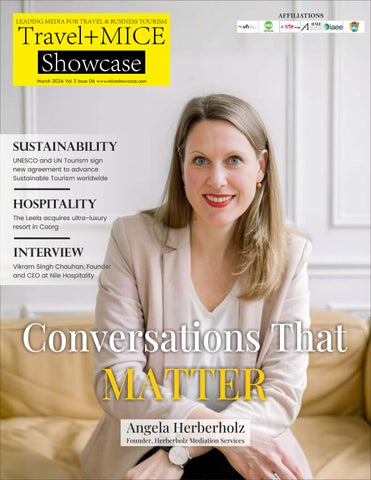
Conversations That MATTER
Angela Herberholz
As we present the March issue of Travel + MICE Showcase, the global travel and tourism landscapestandsatamomentofrecalibration.Theindustryhasmovedbeyondrecoveryandis now navigating a phase defined by resilience, reinvention, and strategic growth. For business tourisminparticular,themomentumisunmistakable.
Across markets, there is a visible shift in how corporate travel and MICE activities are being planned and executed. Experiences are becoming more curated, technology is being deeply integratedintoevents,andsustainabilityisnolongeroptionalbutexpected.Hybridformatshave matured into meaningful extensions of physical events, while data-driven decision making is shaping how destinations and organisers approach delegate engagement. Business travel is no longerjustaboutmovement;itisaboutmeasurablevalue,purposefulnetworking,andlong-term impact.
However, this growth story is unfolding alongside a complex geopolitical backdrop. Ongoing conflicts, trade tensions, and evolving visa and mobility policies have created pockets of uncertainty Airconnectivitydisruptions,fluctuatingfuelcosts,andregionalinstabilitieshave,at times,impactedtravelsentimentandeventplanningcycles.Yet,whatstandsoutistheindustry’s ability to adapt. Stakeholders are diversifying markets, building contingency strategies, and strengtheningregionalcollaborationstoensurecontinuity.
Inthisevolvingglobalnarrative,Indiaissteadilyemergingasoneofthemostpromisingdestinationsforbusinesstourism. The country’s investment in world-class infrastructure is beginning to yield tangible results. State-of-the-art convention centres,improvedairconnectivity,digitaladvancements,andagrowinghospitalityecosystemarecollectivelyenhancing India’scapabilitytohostlarge-scaleinternationalexhibitionsandconferences.
Equallyencouragingaretheongoingdiscussionsaroundestablishingcity-levelconventionbureaus.Suchinitiativeshave the potential to transform how Indian cities position themselves in the global MICE marketplace. By creating focused destinationmarketingstrategies,facilitatingsmoothercoordinationbetweenstakeholders,andofferingstructuredsupport toeventorganisers,thesebureauscansignificantlyelevateIndia’scompetitiveness.
What we are witnessing is not just growth, but a strategic shift in perception. India is no longer viewed merely as an emergingmarket,butasaseriouscontenderforhostinghigh-value,globalbusinessevents.
Carnival Encounter in Brisbane after its Singapore dry dock, unveiling refreshed interiors, updated livery, and new guest experiences like Cloud 9 Spa Thermal Suites and an upgraded Pantry.
#Carnival Corporation & plc
y g F y
with a dynamic lineup of elite races and community events. Kicking off with National Ride2School Day, the festival promotes active lifestyles while hosting 60+ events over four weeks. #Brisbane Economic Development Agency
p o p g
panels to unforgettable moments, this year ’ s fair was one for the books. Thank you to everyone who joined us to celebrate the world of publishing. #The London Book Fair
y S
strong momentum with 517+ crore in business enquiries, 1200+ global interactions, and 500+ exhibitors #Bharat Electricity Summit
k p
Tourism to host FAM Tours for 65 global delegates, showcasing the state’s rich culture, hospitality, and key destinations including Mahabaleshwar, Tarkarli, Nashik, and Tadoba. #Thomas Cook India Limited p
Center, Uzbekistan highlighted its evolving tourism landscape, focusing on diverse segments and major infrastructure upgrades. #Uzbekistan Tourism Committee
fossil heritage into a unique tourism experience, centered around the Fukui Prefectural Dinosaur Museum one of the world’s notable dinosaur museums featuring 50+ full skeletons and interactive exhibits
#Japan Convention Bureau
y o g
Commission of India in Malaysia organised the India–Malaysia Tourism Roadshow and B2B Seller–Buyer Meet on 11–12 March 2026 in Kuala Lumpur and Penang. #Incredible India, Ministry of Tourism, India
m j y l
2026 Outlook Forum to explore the future of travel and California’s global competitiveness. #Visit Anaheim
The World Of Social Media
, t Diversity in Tech event marked International Women's Day with impactful discussions on leadership, inclusion, and growth in tech. #Tech Show London
, B
strengthened its global MICE appeal, connecting with 180+ North American buyers With the United States as a key source market, the event highlighted growing demand for meetings and incentive travel in Barcelona. #Barcelona Convention Bureau
g
to InterBattery 2026 in South Korea, showcasing innovation across the battery ecosystem. #Business Sweden Asia-Pacific
p
FAM visit for a delegation from Almaty to boost tourism collaboration and showcase Goa’s diverse offerings beyond beaches #Goa Tourism
y
of the India–EFTA Trade and Economic Partnership Agreement, highlighting its transformative impact on trade and investment. #ASSOCHAM (The Associated Chambers of Commerce and Industry of India)
g
together global industry leaders, reinforcing its status as a key B2B platform for wines and spirits. #Messe Düsseldorf
PaintIndia 2026 concluded after three impactful days, bringing together top industry leaders and innovators to showcase trends and technologies.
#NürnbergMesse India
,
delegates kicked off the day with the UFI Sport Club blending wellness and Thai culture. #TCEB Thailand Exhibitions
, i
collaboration with All India Association of Industries, a Business Roundtable with a Canadian Trade Delegation brought together leaders from technology, education, clean energy, manufacturing, agriculture, and finance. #World Trade Center Mumbai
Vienna
The American Society of Travel Advisors (ASTA) has announced that its 2027 River Cruise Expo will take place in Vienna, Austria, from March 10–14, 2027. The five-day event will bring together travel advisors and top river cruise brands for education, ship tours, and networking The upcoming edition is set to expand with at least 13 cruise brands and 17 ships, along with post-event FAM sailings for hands-on cruising experiences
Bogotá
Bogotá is strengthening its business tourism strategy with the launch of Visit Bogotá Conecta, a digital platform designed to facilitate event planning in the Colombian capital. Presented during EXPOMICE 2026, this initiative brings together, in a single digital space, service providers specialized in hosting congresses, conventions, and professional events. The project is led by the Instituto Distrital de Turismo, in collaboration with the Bogotá Chamber of Commerce, the Convention Bureau of Invest, and Fenalco The objective is straightforward: to enable event organizers to more easily identify local companies capable of providing the services required to deliver a congress, trade show, or convention.
Cape Town
The V&A Waterfront is investing R230 million to develop the Quay 7 Superyacht Marina in Cape Town Located at a historic harbour near the u p c o m i n g C a p e T o w n EDITION hotel, the marina will offer scenic views of the Atlantic Ocean, City Bowl, and Table Mountain Set for completion by October 2026, the project aims to boost the marine services sector and position Cape Town as a key global maritime hub
Singapore
In partnership with the Singapore Tourism Board (STB), Scoot, the low-cost subsidiary of Singapore Airlines (SIA), has unveiled the third edition of its Singapore Superfans campaign, a multimarket campaign that flips the script on how Singapore’s most recognisable icon shows up in culture. Instead of serving as just a photo opportunity, the Merlion takes centre stage as a self-aware, slightly mischievous character that ‘nudges’ travellers to discover more of the city The campaign aligns with STB’s broader ‘We Don’t Wait For Fun’ campaign, which specifically targets Early Career travellers aged 25-39 who prioritise authentic and spontaneous experiences
Melbourne Airport has revealed details of a planned $4 5 billion expansion of its international terminal, following the busiest summer for international travel on record The plans incorporate several projects, including an expansion of both international check-in and baggage claim halls to better accommodate the increasing number of passengers flying in and out of Australia’s largest 24-hour gateway Five new gates will be added to the existing international pier, giving airlines more flexibility to schedule flights to more destinations. Preliminary works on the first stage of the international terminal expansion will begin following the opening of Melbourne Airport’s new road network in September.
Disclaimer: Map is for representa on purpose only
Melbourne
The all-electric train company Lumo has launched an affordable and reliable new service linking Glasgow directly with Falkirk, Edinburgh, the North East of England and London Customers will be able to travel for as little as £33 10 between London and Glasgow, with tickets starting from £10 90 between Newcastle and Glasgow The low fares combined with Lumo’s highscoring onboard customer satisfaction results will make travelling between the popular destinations even more accessible for all Customers will be able to travel on two northbound services each weekday and one southbound It’s anticipated that the Lumo connection will attract more people to the Commonwealth Games, due to take place in Glasgow in July 2026. Lumo is also set to launch a brand new route connecting Stirling with London E ston from May 2026. Designed around simplicity, value and co builds on Lumo’s reputation for low fares and customer-firs new choices for business, leisure and visiting friends and famil
ICC Sydney Unveils Podcast Studios and Production Service
International Convention Centre Sydney (ICC Sydney) has unveiled premium podcast studios conveniently located at the venue Backed by its in-house content production services, ICC Sydney’s A Quick Yarn Podcast Studios are ideal for thought leaders, event organisers, speakers, brands and content creators looking to capture engaging content, share knowledge or extend the impact of an event Podcasting in Australia continues its strong upward trajectory, with more than half of Australians now listening monthly – a record 52% and an 8% year on year increase –cementing the medium as one of the nation’s fastest growing audio formats according to the Commercial Radio & Audio (CRA) key findings in the Infinite Dial Australia 2025 report
Lumo launches new affordable service linking Glasgow directly with London
With 60 Blue Flag certified beaches, Brazil Promotes its international tourism
In Lisbon, during the event Galeria Visit Brasil Oceano, the Brazilian Agency for International Tourism Promotion (Embratur) and the Instituto Ambientes em Rede (IAR) signed an agreement aimed at promoting abroad their destinations that hold the international Blue Flag certification The agreement, signed for two years, plans to coordinate market analysis, strategic promotion and commercial support so that these destinations can be better integrated into international promotion campaigns, particularly among travelers who consider environmental criteria when choosing where to travel The Blue Flag certification distinguishes beaches and marinas that meet strict standards regarding water quality, environmental management, safety and environmental education. More than a simple label, it reflects long-term work between public authorities, local communities and tourism stakeholders to preserve coastal spaces while allowing their use. For the 2025–2026 season, Brazil reached a record of 60 certified destinations, including 50 beaches and 10 marinas The certification is based on 34 measurable international criteria, including water quality, safety, infrastructure and environmental education The recognized sites are mainly concentrated in the state of Santa Catarina, which accounts for more than half of the awarded locations, as well as in Rio de Janeiro, but they also include destinations in Bahia, São Paulo and Alagoas, illustrating the diversity of the Brazilian coastline.
Budget 2026: 385 Crore Boost for Tourism as Visitor Arrivals Cross 1.08 Crore
In a strong reaffirmation of the State’s commitment to tourismled growth, Chief Minister Pramod Sawant announced a significant allocation of 385 crore for the Tourism Department during the ongoing Goa Legislative Assembly Budget Session. Out of the 385 crore, 269 crore is allocated under the revenue account and 116 crore under the capital expenditure The announcement comes at a time when the State continues to witness robust tourism growth, with total tourist arrivals reaching 1 08 crore in 2025, marking a 10% increase compared to the previous year, alongside a 20% rise in foreign tourist arrivals.
The Chief Minister highlighted that the allocation will support strategic tourism infrastructure development, destination enhancement, and new initiatives aimed at strengthening Goa’s global tourism competitiveness
As part of these efforts, the Government will introduce an Inbound Tour Operators’ Incentive Scheme worth 2 crore to revive and encourage charter flight operations and boost international tourist inflow Reinforcing Goa’s positioning as a leading wellness destination, the Chief Minister announced that the Goa Wellness and Ayurveda Policy 2026 will be implemented with a structured regulatory and accreditation framework for wellness centres and
practitioners. Complementing this initiative, the State will establish a new AYUSH Department this year, along with the organisation of AYUSH wellness camps across Goa Further strengthening the tourism ecosystem, the Government will partner with a leading industry player under a Public–Private Partnership (PPP) model to establish a state-of-theart Hospitality Training Centre at Aguada–Sinquerim. The Chief Minister also announced that 32 tourism-related projects undertaken by the Goa Tourism Development Corporation (GTDC) are scheduled for completion during the current financial year, further strengthening tourism infrastructure across the State. An allocation of 1 04 crore has been earmarked for beautification works associated with these projects, aimed at enhancing visitor experience and improving destination aesthetics.
A New Chapter in Assam’s Heritage Tourism at Kaziranga National Park
On 3 March 2026, a major milestone in Assam tourism was marked with the inauguration of Kaziranga Heritage, a distinctive heritage resort in Kaziranga located in the iconic landscape of Kaziranga National Park. Developed as a Public–Private Partnership between the Assam Tourism Development Corporation (ATDC) and Centre Point Hospitality Group, the project will support the development of heritage tourism in Assam while also promoting eco-tourism in Kaziranga. Kaziranga Heritage seeks to establish a destination for eco-friendly accommodation in Kaziranga that complements Kaziranga's natural environment and the people living there. The
estate sits within the biodiverse floodplains shaped by the Brahmaputra River system
Bonani
Bungalow:
The Historic Core
Bonani Bungalow sits in the centre of the estate and is the historic heart of Kaziranga Heritage. The property has preserved guest registers as far back as 1938, making it one of the earliest examples of hospitality architecture associated with Kaziranga's tourism historic record. The estate offers 28 rooms in Kaziranga Heritage, distributed across multiple heritageinspired spaces.The estate also integrates art and culture through works by Mridu Moshum
The project aims to enhance the visitor experience around Kaziranga National Park tourism, a UNESCO World Heritage Site By blending heritage architecture with Assamese culture, ecosensitive hospitality, and storytelling that highlights the region’s biodiversity, the project will provide visitors a greater connection to the Kaziranga area and its legacy – thus serving as arguably one of the most significant developments in Assam's sustainable tourism ecosystem
Bora and tributes to iconic Assamese musicians Bhupen Hazarika and Zubeen Garg
MakeMyTrip Acquires Majority Stake in Flamingo Transworld to Strengthen its Holiday Packages Business
MakeMyTrip, India’s leading online travel company, has announced that it has entered into an agreement to acquire a majority stake in Flamingo Transworld, one of India’s leading regional tour operators, subject to the fulfilment of certain closing conditions. Over the last 30 years of its operations, Flamingo has created a strong affinity in the regional markets of Gujarat, Maharashtra, Rajasthan and Madhya Pradesh with its group tour services
These tours are curated to make holidays a memorable experience and are particularly popular for having curated selection of Indian meals made by on-tour chefs or verified Indian vegetarian/Jain kitchens, in-house tour managers fluent in regional languages and extensive coverage of popular attractions and experiences for domestic and international tourists. Flamingo's popular international and domestic group travel packages, which
are currently sold largely through 51 offices across Gujarat, Maharashtra, Rajasthan and Madhya Pradesh, will complement MakeMyTrip's established Holiday Packages business and help the platform penetrate deeper into markets across India.
Commenting on the acquisition, Rajesh Magow, CoFounder and Group CEO, MakeMyTrip, said, “Flamingo aligns closely with the growth strategy of our Holiday Packages business. It is a strong, growing business that has developed a unique moat in the group travel domain. We plan to leverage the complementary customer base, products and distribution focus between the two brands to widen holiday package options for our customers.” Mohit Kabra, Group Chief
Operating Officer, MakeMyTrip, said, “We believe that our proposed acquisition of Flamingo creates a profitable growth opportunity to help MakeMyTrip drive a deeper presence in regional markets across India.”
Sanjay Shah, Director and CoFounder of Flamingo Transworld, said, “For over three decades, Flamingo has built something unique in Indian travel, genuine trust. From chefled tours to regional language guides, the brand has grown by going deeper. By combining Flamingo’s brand equity and operational depth with MakeMyTrip’s digital platform and national customer reach, we aim to build a truly pan-India tour company that brings Flamingo’s signature experience to millions of new customers.”
Thomas Cook India and SOTC Travel collaborate with Booking.com to enhance accommodation solutions for Indian corporates
Thomas Cook (India) Limited, India’s leading omnichannel travel management company and its group company SOTC Travel have announced a strategic partnership with Booking.com, one of the world’s leading digital travel platforms, to deliver comprehensive and enhanced accommodation solutions for Indian corporates. Booking.com’s accommodation content is live on Thomas Cook India and SOTC’s corporate booking tool, giving business clients immediate access to a vast network of over 31 million reported listings across 220+
The Union Cabinet chaired by the Prime Minister Shri Narendra Modi has approved declaration of Madurai Airport, Tamil Nadu, as an International Airport. Madurai Airport, located in the Temple City of Madurai, Tamil Nadu, is one of the oldest airports in the State. It serves as a crucial gateway to Southern Tamil Nadu and plays a pivotal role in promoting tourism and pilgrimage, thereby contributing to the overall growth of the region. Referred to as the ‘Athens of the
Cabinet approves Declaration of Madurai Airport, Tamil Nadu, as an International Airport
East’ due to the lofty towers of Meenakshi Sundareswarar Temple just like the Greek Pantheon, the city finds reference in many literary works of Arabs, Romans and Greek travellers
Elevating Madurai Airport to International Status would enhance regional connectivity, promote trade, and drive economic development in the region. The airport's potential to attract international pilgrims and businesses aligns with the city's historical prominence
countries and territories, including India. This collaboration offers an unparalleled selection ranging from world-class hotels and resorts to homes and apartments, all supported by seamless integration into enterprise travel approval systems, enterprisespecific rates, loyalty benefits, and easy, real-time, on-the-go access through digital applications. The program offers wider choice while staying within company travel policies, invoice integrity with GST compliance, safer stays for diverse traveller profiles, and service support that goes beyond standard online booking platforms
Abeno Harukas—popularly known as Harukas 300—is a symbol of modern engineering and urban sophistication. Standing at an impressive height of 300 meters, it is a must-visit destination for tourists and locals alike in Japan.
Harukas 300 refers specifically to the observation deck located on the top three floors (58th to 60th) of Abeno Harukas. The name “Harukas” comes from an old Japanese expression meaning “to brighten” or “to clear up,” perfectly reflecting the breathtaking panoramic views visitors enjoy from the top
Completed in 2014, Abeno Harukas was designed to redefine Osaka’s skyline. The building houses multiple facilities, including offices, a luxury hotel, a department store, and an art museum. Its sleek glass façade and modern design make it a standout landmark in Japan’s architectural landscape. The observation deck is accessed by elevator from the 16th floor. With large floor-to-ceiling glass panels all around, the 60th floor offers 360 degree views of Osaka, while the 58th floor features an attractively designed inner court with a wooden deck and cafe. A souvenir shop and restrooms with views are also available. The Abeno Harukas Art Museum is located on the 16th floor next to the elevators that lead to the observation deck. The museum doesn't have a permanent collection and stages changing exhibitions of mainly Western and Buddhist art every few months
A garden terrace on the same floor offers some green space to sit down and relax. Freely accessibly to everyone, the terrace also affords views down one side of the building (onto central Osaka), but the views are
naturally not quite as commanding as the ones from the 60th floor
A rooftop plaza is, furthermore, found on the wing building of the Abeno Harukas Kintetsu Department Store. Accessed from the 10th floor of the main tower, the plaza contains a small vegetable garden and a small shrine You can also have a close-up view of Abeno Harukas's main tower from the rooftop plaza. While the daytime scenery is stunning, Harukas 300 truly comes alive at night. The city lights of Osaka create a dazzling sea of illumination, making it one of the most romantic and memorable viewpoints in Japan. Conveniently located above Tennoji Station, the building is easily accessible via major train and subway lines. This makes it a perfect stop for travelers exploring Osaka. Harukas 300 is more than just an observation deck—it’s an experience that combines architecture, nature, and city life into one unforgettable destination. Whether you’re a photography enthusiast, a traveler seeking scenic views, or someone who simply enjoys high-rise adventures, this iconic landmark offers something for everyone
New £10m fund to attract major events to Liverpool
Anew fund has been
launched by Liverpool’s Accommodation BID of almost £10m to support events hosted by the city. The fund is generated from the overnight £2 per room per night visitor charge, managed by the Liverpool Accommodation BID, a business improvement district governed by the city’s accommodation industry, and managed by Liverpool Business Improvement District. Almost £7m of the fund is forecast to be spent
on major events, £1m will be invested in destination marketing and the remaining funds will be invested in visitor economy support. Liverpool’s overnight levy has been in place since June 2025
It has contributed to events in the city, including the Labour Party Conference, World Chess Championships and World Boxing Championships. The Conferences and Exhibition Fund has two rounds of applications, Friday 29
May and Friday 28 August. In July last year, Liverpool’s hotels saw their highest occupancy rate for a month, with the city ranking in the top 20 for occupancy rates over weekends globally in 2025 Tourism contributes 4% to the GDP across all regions and nations of the UK In the Liverpool city region it is worth £6 2bn a year. The direct visitor economy in the UK in 2024 generated an estimated £70bn in direct GDP impacts and a wider £78bn through the supply chain
Avalon Airshow to Return in 2027
Victoria will once again host the largest aviation, aerospace and defence exhibition in the Southern Hemisphere. The Allan Labor Government has secured the return of the Australian International Airshow to Avalon next year. It will be held from 23 to 28 February. Held in Victoria since 1992, the biennial event features breathtaking flying displays alongside a major trade exhibition showcasing cutting-edge aviation, aerospace and defence technologies. The 2025 event generated $240 9 million for Victoria’s economy and attracted record crowds
Delivered by the AMDA Foundation in
collaboration with the Royal Australian Air Force, the event connects Victorian supply-chain businesses with global decision-makers to unlock new commercial opportunities. More than 900 companies exhibited at the trade show, drawing 291 official delegations from
43 nations. Avalon 2025 also delivered an estimated $31 85 million in direct economic benefits for the Geelong region Securing the event will further strengthen the Avalon Airport Industrial Precinct as a major regional economic hub. The Labor Government has backed major investment in the precinct, including Hanwha Defence Australia’s $225 million Armoured Vehicle Centre of Excellence. Labor has also supported Avalon Airport to establish a new $8 million dedicated freight handling and processing facility, while the new Route 18 bus service between Lara Station and the Airport is now running
Arabian Travel Market 2026 RESCHEDULED TO AUGUST
RESCHEDULED TO AUGUST
RX has confirmed that the
2026 edition of Arabian Travel Market (ATM) 2026, originally scheduled to take place from 4–7 May 2026 at Dubai World Trade Centre, will now take place from 17-20 August 2026, with the venue remaining unchanged. The decision to reschedule the event has been made to prioritise the safety and well-being of customers, partners and colleagues, and to give the global travel and tourism community greater confidence and flexibility to attend Danielle Curtis, Exhibition Director
ME, Arabian Travel Market, said:
“Arabian Travel Market has long served as a vital platform for bringing the global travel and tourism community together in Dubai, enabling destinations, suppliers and industry leaders to connect, collaborate and shape the future of the sector.
“The safety and well-being of our customers, partners and colleagues remains our highest priority, and the decision to reschedule ATM 2026 to August reflects our commitment to
ensuring that everyone can participate at this important industry gathering We look forward to welcoming the international travel community back to Dubai later this year. ”
The RX team remains committed to supporting all participants .Now in its 33rd edition, Arabian Travel Market serves as a key global platform connecting destinations, travel suppliers, hospitality brands, airlines, technology providers and industry professionals from across the travel ecosystem.
Early Dialogue, Lasting Impact: Equipping Leaders and Teams to Navigate Complexity, Build Trust, and Thrive Together
TMS. You’ve spent 15+ years working at the intersection of mediation, conflict management and the business events world — can you share how your journey evolved from exhibition and event management into founding Herberholz Mediation Services?
Angela Herberholz. My journey in mediation and business events was intertwined from the very beginning. I studied exhibition and event management at DHBW Ravensburg (Germany) while completing an additional year in mediation and conflict prevention in a business context. The bridge between both fields was immediate. Constructive dialogue is essential in an industry built on collaboration. I started with a German exhibition organiser, working across Morocco, Algeria, Ukraine, and Russia. Early on, I saw how delivery depends not only on planning, but on how people handle different expectations and working styles.
I then moved to Paris to deepen my mediation practice at the International Chamber of Commerce, and later spent nine years at UFI in multiple roles. Mediation stayed with me in parallel throughout. Over time, I kept coming back to one
observation: our industry is fundamentally a relationship industry. Exhibitions are marketplaces for products, yes, but more importantly, they are marketplaces for trust. Strong business relationships include disagreement and tension. The difference is whether people address it early and well. That is also why I launched a biannual survey to understand how organisations handle interpersonal strain.
My practice celebrates its third successful year in March 2026. Today, I build dialogue infrastructure for the business events industry. I support organisers, venues, associations, and service providers through mediation, facilitated dialogue, and upskilling. And personally, what still draws me to this industry is the mix of international collaboration and human connection. It is where relationships are built, tested, and strengthened in real time.
TMS. Your mediation and conflict management work spans multiple sectors. What unique challenges do you see in communication and dispute resolution within the exhibitions and live events ecosystem, and how can they be addressed proactively?
ANGELA HERBERHOLZ
Angela Herberholz. What makes exhibitions and live events unique is not that tension happens, but the conditions under which it happens. Deadlines do not move, the work is highly visible, and delivery depends on a long dependency chain
Three patterns stand out. First, when timelines tighten, empathy and curiosity are often the first things that disappear Messages get shorter, assumptions multiply, and small issues start to feel personal. Second, tensions that simmer during planning can escalate onsite within seconds, when fatigue and urgency leave little room for careful conversation. Third, because organisers, venues, service providers, exhibitors and agencies are interdependent, one breakdown quickly cascades across the wider working system.
A short example from an international show team illustrates this. Two long-standing colleagues were joined by a new team member from another industry. A clash around work-life boundaries hardened over time, and onsite strain turned it into avoidance and open friction. After 2 5 days of facilitated dialogue, the team rebuilt understanding and agreed practical ways of working. The feedback afterwards was, “I wish we’d talked about this months ago.” The proactive opportunity is to treat dialogue like infrastructure, not a last resort. In practice, that can be simple. Upskill leaders and teams in early dialogue and de-escalation, to strengthen how they navigate tension and preserve relationships when stakes are high. And to create a visible resolution pathway, so people know where to go early and what happens next, before issues become formal or public
For reference, the 2025 edition of my biannual industry survey is published as “Navigating Workplace Tension” here: www.herberholzmediation.com/navigatingworkplace-tension
TMS. As a lecturer, mentor and global facilitator, what
emerging skills or competencies do you believe future exhibition professionals must master to thrive in today’s interconnected and culturally diverse environment?
Angela Herberholz. In the business events industry, thriving is not only about operational excellence. It is also about navigating human dynamics well, especially when collaboration depends on many stakeholders and diverse expectations
Five competencies stand out
First, tension escalation prevention. I deliberately say tension, not conflict, because the most important moments happen before anything is openly addressed. Noticing early signals such as silence, avoidance, or a drop in collaboration allows teams to respond before situations escalate.
Second, de-escalation. In busy phases, misunderstandings can spiral fast, and the ability to slow things down without losing momentum protects both delivery and working relationships.
Third, alignment across the dependency chain, including the question, “What do we do when things go wrong?” Healthy business relationships create clarity early on how issues are escalated, and how accountability is shared
Fourth, self-awareness, especially knowing one’s limits Recognising when facilitation support is useful and asking early, prevents cracks in trust and collaboration.
Fifth, the ability to hold constructive, difficult conversations, supported by curiosity. Taking time to understand the why rather than assuming intent is often what keeps culturally diverse teams aligned.
Swiss Mediation Price 2025
IELA Congress 2025
The good news is that these competencies are not new. Most of us already draw on them. The opportunity lies in applying them in moments that feel uncomfortable, complex, or uncertain, when it would be easier to avoid the conversation.
TMS. Mediation isn’t widely used in many parts of the exhibition industry. From your experience, how can organisers and stakeholders integrate mediation and constructive dialogue into industry practices to strengthen collaboration and resilience?
Angela Herberholz In parts of the business events industry, mediation is still viewed as something you use only when a situation has already become serious. In my experience, it creates value when it is positioned as a practical form of support that can be used early, without automatically turning into a formal complaint process. Two shifts help organisers and stakeholders integrate this into everyday practice
bureaucracy. It is about protecting working relationships and keeping collaboration functional in complex environments.
TMS. Looking ahead, what exciting initiatives, programs or developments is Herberholz Mediation Services focusing on — especially those that could positively impact communication, leadership and collaboration in the exhibitions sector?
Angela Herberholz. A key focus of Herberholz Mediation Services is making dialogue infrastructure more accessible to the business events industry. In other words, supporting professionals to discover and apply practical tools to address interpersonal strain early, and at the same time save time and costs in doing so.
First, make the options visible and easy to access. People often stay silent because they are unsure what the next step should be, or they worry that speaking up will trigger escalation. A clear, well- communicated approach helps, who someone can speak to, what support exists, what confidentiality looks like, and when a neutral third party can be brought in. Second, equip key roles with a small set of dialogue tools they can use in real situations This includes how to name tension without blaming, how to structure a difficult conversation so it ends in clear agreements, and how to recognise when neutrality is needed because the topic is too loaded internally. Some organisations train internal facilitators for early conversations, with external mediation available when trust or power dynamics require it.
What often shifts mindsets fastest is experiencing the impact directly. As Damion Angus, Group Managing Director at Montgomery Group, shared after using external mediation support, “Not only did we resolve an immediate dispute within our business but we also laid the foundation for improved communication and collaboration moving forward ” Ultimately, integrating mediation is not about adding
This focus currently shows up in three ways
First, I continue to design and deliver bespoke workshops and facilitated sessions that translate into day-to-day practice. They support teams build a shared language for addressing disagreements, holding constructive conversations, and creating resolution pathways that people actually want to use.
Second, it shows up in my industryfacing awareness work. Many organisations still associate conflict resolution primarily with formal procedures, so I focus on raising visibility of early-stage options and what good support can look like. In 2026, this is reflected in speaking and workshop invitations with industry associations, including UFI and AIPC, as well as communities such as Women in Exhibitions.
Third, it shows up in research that keeps the conversation grounded. Through my biannual survey with global reach, I continue to track how organisations handle interpersonal challenges, what is improving, and where support systems can be strengthened. The objective is to keep the topic concrete, usable, and relevant, so constructive dialogue becomes part of everyday leadership and collaboration
Mediation
Keynote 2025
The Global Exhibition Industry Is No Longer Recovering - It Is
Recalibrating For A Structurally Different Future.
SEBASTIAN WITT “ ”
Partner, jwc
TMS. Your latest jwc report (the Global Industry Performance Review – GIPR) suggests the global exhibition industry is stabilising with moderate growth expected across most regions. How would you describe the current phase of the industry — recovery, expansion, or structural transformation?
Sebastian Witt It is no longer a recovery phase. That ended in 2024, when most major markets surpassed 2019 revenue levels. What we are seeing now at jwc is stabilisation under normalised growth conditions, with global revenues forecast to grow at around 3 3% annually through 2030, broadly in line with global GDP
The more relevant shift is structural. Revenue has recovered faster than net rented space, reflecting higher pricing, changes in exhibitor mix and a rising contribution from services . Physical expansion remains constrained in many established markets, particularly in Europe and North America
At the same time, regional trajectories are diverging and market share continues to concentrate among the largest organisers. In that sense, this is not a new expansion cycle. It is a period of structural adjustment, where relative performance between regions, sectors and business models
becomes more visible - and more decisive
TMS. Economic conditions and geopolitical uncertainty remain among the top business concerns globally. How are organisers practically adapting their strategies to manage these macro risks while continuing to expand internationally?
Sebastian Witt. While some regions are currently facing higher levels of uncertainty and volatility, we see organisers reacting in a fairly pragmatic way. Rather than stepping back from international expansion altogether, they are shifting their focus towards markets that offer more stability and clearer economic prospects
This reflects a broader trend in the global economy. When established partnerships become more difficult due to geopolitical tensions or regulatory changes, businesses look for new opportunities in other regions. Exhibition organisers are doing the same. They are diversifying their portfolios, spreading risk across different markets, and being more selective about where they invest and grow
TMS. Emerging markets like the Middle East, India, and parts of Latin America are showing strong revenue growth. What structural factors are driving this momentum,
and do you see this shifting the global centre of exhibition power?
Sebastian Witt Different markets offer different value propositions, and that largely explains the current momentum.
In the more established Middle Eastern markets, such as the UAE or Qatar, the strength lies in their role as international meeting points, effectively “East meets West” platforms. They benefit from strong infrastructure, good connectivity and a business-friendly environment, which makes them attractive hubs for international editions of established brands. Saudi Arabia is somewhat different. There, the focus for many organisers is less about acting as a global hub and more about entering and developing a large and fast-growing domestic market, supported by significant government investment and economic diversification efforts
India and parts of Latin America show strong growth for another reason: the exhibition industry in these regions is still comparatively underdeveloped relative to the size of their economies and populations. That creates structural upside potential. As local industries formalise and internationalise, demand for professional trade platforms naturally increases.
Looking ahead, we will certainly see new markets gaining relevance and a more diversified global landscape. However, over the next decade, we do not expect a fundamental shift in the global centre of exhibition power. The established major markets will remain dominant, even as emerging regions close part of the gap.
TMS. Are we entering a phase where growth will depend more on operational efficiency than market expansion?
Sebastian Witt. It very much depends on the region. In mature and highly developed markets, particularly in Europe, future growth will be less about simply increasing net
square metres and more about delivering stronger value to stakeholders. Organisers are focusing more on profitability, pricing strategies, content quality, and measurable ROI for exhibitors and visitors. Growth in space alone is no longer the primary success metric.
In many emerging markets, however, market expansion remains a key growth driver. As industries and economies grow, there is still room for new launches, geographic expansion, and increases in overall exhibition capacity.
TMS. There is only limited deep integration or proprietary development of AI across the industry. What is holding the industry back from full-scale AI adoption, and where do you see the first real commercial breakthroughs?
Sebastian Witt. The barrier is not technology, it is economics. AI is widely used for content creation, marketing automation and internal productivity. But the industry discussion has focused on efficiency rather than revenue impact . As long as AI is framed as a cost tool, integration will remain shallow
There are also structural limits. Many organisers operate with fragmented data, legacy IT and tight capital allocation Proprietary AI development requires reliable data environments and clear commercial use cases. That foundation is uneven.
At jwc, we map AI applications in a matrix with two axes: customer value and organiser revenue potential. Most current use cases sit in the low-revenue quadrant. The first commercial breakthroughs will come where AI directly affects monetisable outcomes: pricing optimisation, paid lead qualification, premium matchmaking, and data-backed sponsorship products. That is the shift from operational support to revenue design.
TMS. Is the industry moving toward multi-service platform models rather than traditional exhibition organising?
Sebastian Witt. Partly so, and mainly in mature markets. In established exhibition economies, floor space still represents more than 50% of total revenue, but its share is declining. Service revenues (think on-site services, sponsorship, ticketing and subscription models) are growing faster Revenue growth is increasingly driven by pricing models and services built around the event rather than by physical expansion. Organisers are investing in data capabilities, hybrid products and year-round community offers. Some are acquiring media and digital assets to develop subscription
and membership income. These elements extend monetisation beyond show dates
However, the exhibition remains the core product. The shift is incremental. Most businesses are adding service layers and recurring revenue streams around a spacedriven model, not replacing it
TMS. India is among the strongest growth markets in revenues, hiring and operating profit expectations, and also ranks highly in market attractiveness in the new GIPR framework. What structural advantages are positioning India as a long-term global exhibition growth engine?
Sebastian Witt India’s structural advantages are primarily macroeconomic. The country combines scale - in terms of population and GDP - with one of the strongest long-term economic growth outlooks among major economies. That alone creates a powerful foundation for sustained exhibition demand. At the same time, the exhibition industry in India is still relatively underdeveloped compared to the size of its economy and industrial base. Exhibition capacity per capita and per unit of GDP remains low by international standards. This gap represents significant structural upside
TMS. With strong expansion forecasts, infrastructure investment, and rising demand, what are the biggest risks that could slow India’s exhibition growth — capacity, policy, talent, or market maturity?
Sebastian Witt The biggest structural risk for India is that the exhibition industry is not yet treated as a strategic
priority at policy level. In most leading exhibition markets globally, the sector benefits - directly or indirectly - from supportive government frameworks. This includes coordinated infrastructure planning, destination marketing support and recognition of exhibitions as trade and economic development platforms. In India, this policy alignment is still evolving and not yet consistent across states
Infrastructure is another key constraint Despite recent investments, India’s total indoor exhibition space remains very limited relative to the size of the country and its economy. With roughly around 660,000 m² of indoor exhibition space nationwide, India offers a comparable scale to what cities like Frankfurt and Cologne provide combined. For a country of India’s size, that is clearly insufficient to support long-term structural growth
TMS. What is your message for the Decennial edition of Exhibition Excellence Awards 2026?
Sebastian Witt My sincere congratulations to the Exhibition Excellence Awards on reaching this impressive ten-year milestone. We are thrilled and honored to be a part in this years special edition!
Leadership in events is about clarity calmness, and planning ahead
Naveen Rizvi, Executive Director, ICE-Incentive Conference and
Event Management
TMS. Looking back at your early professional years, what experiences most decisively shaped your leadership philosophy in the meetings and conferences industry?
Naveen Rizvi. My initial years in the industry shaped me by putting me into high-pressure, large-scale events very early in my career. I learned quickly that leadership in this business is not about authority, but about planning ahead, staying calm under pressure, and taking responsibility when it matters most. Working closely with experienced mentors taught me the value of discipline and structure, but also the need to stay flexible. Events involve many stakeholders, and a leader’s role is to quietly align people, manage expectations, and keep the focus on delivery
My academic work in conference management also helped me think long term. It pushed me to look beyond execution and focus on building strong systems and consistent standards. Above all, those years taught me that events succeed when teams feel supported and prepared That belief has stayed with me throughout my journey: lead with clarity, stay hands-on when it matters, and always think a few steps ahead
TMS. ICE played a role in some of India’s most visible international engagements, including G20-related events
What were the scale, complexity, and expectations
involved in these assignments?
Naveen Rizvi. Being associated with the G20 and SCO meetings was a defining professional experience for us at ICE. The overall scale of these engagements was unprecedented, with over 220 meetings held across nearly 60 cities in India over the course of a year. We had the opportunity to be involved in several of these assignments, which gave us first-hand experience of the complexity and intensity involved. What added to the challenge was that many meetings were hosted beyond metro cities, in destinations such as Hampi, Shillong, Kumarakom, Andaman & Nicobar and Udaipur, each bringing its own logistical, infrastructural and coordination requirements Managing these programs demanded detailed planning, local coordination and the ability to adapt quickly to diverse environments
Expectations were understandably very high. These were not just conferences, they were a global showcase of India’s capability, culture, hospitality and organisational strength. Every element mattered, from protocol and security to delegate movement, venue preparedness and cultural representation. Delivering Working Group and Ministerial-level meetings, as well as the G20 University Connect Programme at Bharat Mandapam, required close coordination with government authorities, local administrations and multiple stakeholders
What stood out most was the trust placed in us and the strong collaboration with partners, hotels and venues across the country. Despite the scale and pressure, it was deeply rewarding to contribute to events that presented India with confidence on the global stage.
TMS. How would you describe 2025 in terms of growth, complexity of projects, and strategic outcomes?
Naveen Rizvi. 2025 was a strong and rewarding year for us, marked by both steady growth and increasing complexity of work. The year began with business events across multiple verticals—government-led forums, international conferences, corporate incentive programs, and reward and recognition initiatives—delivered both within India and overseas. Early on, we were handling multi-stakeholder engagements that required scale, precision and the ability to manage diverse formats seamlessly.
Mid-year assignments further reflected the strategic nature of our work, including high-level bilateral engagements during the State Visit of the President of the Philippines, with business forums delivered across New Delhi and Bengaluru. These projects demanded careful coordination, protocol sensitivity and flawless execution. The year concluded on a particularly strong note with large global conferences, bringing together international delegates, policymakers and industry leaders from across the world including the Globalaw Annual Members Meeting 2025 and the 18th Global Forum Plenary & Associated
Meetings. Managing multi-day programs with conference sessions, cultural events, destination experiences and complex delegate movements highlighted the depth and scalability of our operations.
Overall, 2025 tested and strengthened our capabilities. It was a year that demanded agility, detailed planning and resilience, while reinforcing our position as a reliable partner for complex and high-profile business events.
TMS. From a PCO’s standpoint, what policy or infrastructure changes are most critical for the sustained growth of India’s MICE industry?
Naveen Rizvi. From a PCO’s perspective, the real need for the growth of the MICE industry in India is simplicity and consistency on ground. Having managed conferences and incentive programs across multiple Indian cities, we see that while India has strong capability, the experience can still vary from one destination to another. This is where well-structured City MICE Bureaus can make a real difference. When cities offer a true single-window system for coordinating approvals, local authorities, venues, transport and destination services, it becomes much easier for organisers to plan efficiently. It also helps position India as organised and dependable in the eyes of international planners. For delegates, the journey should feel effortless from the moment they plan their trip: clear visa processes, quicker approvals, good air connectivity, and a smooth arrival experience all influence whether India is chosen again.
On the infrastructure side, the focus needs to go beyond large convention centres. Venues to handle conferences and events upto 500 pax, quality hotels with event spaces, strong air and road connectivity, reliable local transport and experienced local partners, especially in emerging destinations, are essential. MICE today is not only about meetings; it also includes delegate travel, incentive programs, and pre- and post-conference/ event experiences. When movement within a city is easy and transport systems work smoothly, the overall event experience improves significantly
At the end of the day, global planners look for destinations where things work as expected, every time. If India can deliver that level of consistency through strong City MICE Bureaus, good connectivity and dependable infrastructure across cities, it will continue to grow as a trusted and competitive MICE destination.
TMS. Given your close association with ICPB, how do you assess the growth trajectory of the MICE industry in the coming years?
Naveen Rizvi. Looking ahead, the growth trajectory of India’s MICE industry should be strong and wellstructured, particularly for international association meetings and mid-sized conferences. One of the most important shifts we should see is the growing role of state and city convention bureaus, which will be central to how India competes globally. As more cities establish empowered convention bureaus that act as single-window bodies for bidding and clearances, India should be able to bid more confidently for international conferences
Cities like Hyderabad have already shown how proactive bureaus can position destinations effectively, coordinate stakeholders and attract global events. Globally, a large majority of conferences involve under 500 delegates, and India is well placed to serve this segment. Many Indian cities already have the hotel inventory, venues and connectivity required for such events. With focused bidding
and stronger city-level promotion, we should see more international associations choosing India. In the coming years, growth should come from more cities entering the MICE ecosystem, improved bidding capability, and closer collaboration between convention bureaus, PCOs and hotels helping India build a more consistent and sustainable MICE pipeline.
TMS. What are your views on the incentive travel segment, and how well is India positioned to capitalise on its potential in the years ahead?
Naveen Rizvi. Incentive travel is gaining strong momentum, with a clear shift towards personal, wellcurated journeys that reward people with experiences rather than standard programs. This shift works strongly in India’s favour. India is exceptionally well-positioned as an incoming incentive destination because it offers depth, variety and authenticity at a scale very few countries can match. The country has the infrastructure to support highend incentive travel: heritage hotels, royal palaces, luxury resorts, and venues rooted in history and culture, which are ideal for premium and luxury incentive programs. At the same time, improving connectivity and hospitality infrastructure beyond metro cities has opened up many new regions for well-planned incentive itineraries
What truly sets India apart is the range of experiences that can be woven into an incentive journey. From curated cultural evenings and historic settings to India’s rich culinary heritage, crafts, textiles, wellness traditions and local interactions, itineraries can be designed around different interests and group profiles. Whether a client is looking for culture-led programs, experiential luxury, wellness, nature, or immersive storytelling, India allows incentive travel to be customised in a very personal way With the right focus on curation, consistency and quality execution, India is not just ready to attract incentive travel, it is well placed to grow as a preferred global incentive destination in the years ahead.
NILE Hospitality was built to combine global brand discipline with deep local market insight
Vikram Singh Chauhan Founder and CEO at Nile Hospitality
TMS Your career spans global hotel brands and leadership roles before founding Nile Hospitality. What inspired you to take the entrepreneurial leap and build your own hospitality platform?
Vikram Singh Chauhan After working with global hotel brands, we saw a clear opportunity to build an India-first third party management company - global brand discipline with local market intelligence, faster decision-making, and hands-on leadership NILE Hospitality was created to be owner-centric, entrepreneurial, and focused on long-term asset value.
TMS Congratulations on the strategic partnership with Hampton by Hilton hotels in India How did this collaboration originate, and what were the key strategic priorities for Nile Hospitality in bringing Hampton by Hilton into the Indian market?
Vikram Singh Chauhan Thank you The Hampton by Hilton partnership was a very strategic and wellthought-out partnership For NILE Hospitality, the priority was to introduce a globally trusted brand that could scale efficiently across Tier 1, Tier 2, and emerging business, leisure & Spritual destinations. Hampton’s strong brand promise and guest-focused design made it an ideal fit for the Indian market Equally important was alignment in vision Hilton’s long-term commitment to India and NILE’s onground execution capabilities, operational efficiency created a strong foundation for this partnership
TMS Nile Hospitality has also engaged in other strategic brand collaborations (e.g , Radisson Park Inn & Suites, Microtel by Wyndham). How do such partnerships help enhance value for hotel owners, developers, and guests alike?
Vikram Singh Chauhan Each brand partnership at NILE Hospitality is purpose-driven - the Indian market at its core. We work with brands that complement specific market needs, asset profiles, and investment objectives Partnership with brands like Radisson and Wyndham allow us to offer owners globally recognised systems, strong distribution platforms, and brand equity while we bring local execution strength, cost optimisation, and market adaptability With our presence in 19 states, NILE Hospitality is rapidly expanding with 11 Radisson hotels, 7 Wyndham
hotels and 22 hotels in pipeline across key Indian markets For owners and developers, this model reduces risk, improves operational efficiency, and enhances long-term asset value. For guests, it ensures a consistent, credible experience backed by international standards, while still reflecting the local destination Ultimately, these partnerships enable us to create a win-win-win ecosystem for brands, owners, and travellers
TMS Sustainability and responsible travel are increasingly important to travellers and investors How is Nile Hospitality integrating sustainability into both brand partnerships and day-to-day operations?
Vikram Singh Chauhan At NILE Hospitality, we approach sustainability from both a strategic and operational lens At the brand partnership level, we align closely with global brands that have strong ESG frameworks and measurable sustainability commitments
Operationally, we focus on practical, highimpact initiatives energy efficiency, water conservation, waste reduction, responsible sourcing, and community engagement We also emphasise training teams to adopt sustainable practices as part of everyday operations rather than standalone initiatives. Our goal is to create hotels that are environmentally responsible, economically viable, and socially relevant
to the communities they operate in
TMS Looking ahead, what are your top priorities for Nile Hospitality in the next 3 years, especially regarding brand expansion, talent development, and guest engagement?
Vikram Singh Chauhan Our focus over the next three years is clear thoughtful brand expansion, strong leadership and talent development, and deeper guest engagement through consistent service and smart use of technology. With immediate openings like Wyndham Garden Udaipur, Radisson Chail, Radisson Resort & Spa Gir, and upcoming Hampton by Hilton hotels in Amritsar, Lonavala, Raipur, and Vrindavan, we ’ re committed to scaling responsibly while building enduring value for all stakeholders
UNESCO Director General Khaled El-Enany and UN Tourism Secretary-General Shaikha Al Nuwais have signed a new agreement, marking a landmark step in strengthening cooperation to advance sustainable, inclusive and resilient tourism worldwide . Planned initiatives include country-level programmes, pilot projects, and expanded knowledge-sharing platforms aimed at supporting tourism development on the ground
A key area of focus will be transnational tourism routes, including the historic Silk Roads, with UN Tourism supporting coordination across destinations and UNESCO contributing its cultural and heritage expertise. The partnership will also expand education and capacitybuilding programmes that connect tourism with heritage conservation and the creative industries
UNESCO also signaled its readiness
UNESCO andUNTourism sign new agreement to advance Sustainable Tourism worldwide
to mobilize its extensive global network — including World Heritage sites, Creative Cities, Biosphere Reserves, Global Geoparks, and elements of Intangible Cultural Heritage — as well as partnerships through UNESCO Chairs and
Goodwill Ambassadors. The renewed partnership reflects a shared ambition to harness tourism as a driver of cultural exchange, economic development and sustainable growthdelivering lasting value for communities around the world.
The Kuala Lumpur Convention Centre (KLCC) is the first venue in the country to achieve ISO 20121 Event Sustainability Management certification, an international standard that guides how events are planned, managed and delivered with environmental and social responsibility. Developed for the global events industry, ISO 20121 provides a structured framework for managing sustainability impacts, from resource use and waste management to responsible sourcing and operational governance For event organisers, this certification provides confidence that their events can be delivered with clear sustainability systems, measurable outcomes and internationally recognised standards.For Malaysia’s business events industry, it signals a
stronger commitment to responsible growth and positions Kuala Lumpur among destinations advancing sustainable event practices.
BRITISH AIRWAYS ANNOUNCES MAJOR WINTER 2026 EXPANSION
British Airways has announced a significant planned expansion to its network for
winter 2026, with the addition of two new destinations, Melbourne in Australia and Colombo in Sri Lanka British Airways will commence flights to Melbourne in Australia from 9 January 2027, launching in time for the Australian Open and the Melbourne Grand Prix. Flights will operate year-round from London Heathrow, via Kuala Lumpur, on a daily basis. Launching on 23 October 2026, British Airways will fly three times per week from London Gatwick to Colombo, the vibrant gateway to Sri Lanka.
The route will operate for the winter season only, taking customers directly to the Indian Ocean island and home to picturesque beaches,
scenic wildlife, vibrant culture and rich cuisine. In addition, the airline will be adding more flights for winter to Cape Town (South Africa), Haneda (Tokyo), Bridgetown (Barbados), Kingston (Jamaica) and San Jose (Costa Rica). The new schedule reflects a nine per cent growth in British Airways’ long-haul route network, as the airline continues to invest in providing more choice for customers
These planned new routes and frequency growth for winter 2026 is in addition to short-term capacity increases to destinations to meet customer demand, as a result of the situation in the Middle East
IndiGo Announces Daily, Direct Flights Between Kolkata and Shanghai
IndiGo has announced the launch of daily, direct flights between Kolkata and Shanghai, effective 29 March 2026. The new route will be operated using IndiGo’s A320 aircraft. This announcement follows the recent reinstatement of IndiGo’s services to Guangzhou, highlighting the airline’s focus on improving connectivity and enabling smoother travel between India and China.
Shanghai, China’s premier global financial centre and a major innovation hub, is an essential addition to the 6E network. With
continued growth in exports from West Bengal to China in FY25-26, including marine products, leather goods, and specialized textiles, direct air connectivity will further strengthen trade flows between the two countries. Vinay Malhotra, Global Head of Sales, IndiGo, said,
“We are pleased to announce the launch of our new daily, direct connectivity between Kolkata and Shanghai, China, in addition to our flights to Guangzhou. This development underscores our commitment to connecting India to key global destinations Shanghai is the country’s biggest city, a global financial hub, and famous for its dazzling futuristic skyline complemented with historic architecture This addition to our network will play an important role in facilitating bilateral trade and is expected to boost tourism and promote greater cultural exchange between the two nations.”
Radisson Hotel Group and Amadeus launch direct API connectivity to modernize hotel distribution
In
a move that supports its technological ambitions to improve guest experience across its global hotel portfolio, Radisson Hotel Group and Amadeus have built an API connectivity between the Group’s EMMA Central Reservation System (CRS) and the Amadeus Travel Platform. Moving beyond the limitations of traditional models and classic Global Distribution System (GDS) protocols, this innovative collaboration will empower travel sellers, delivering enhanced efficiency and asuperior booking experience when accessing the Group's booking platform. The direct connectivity offers multiple benefits
across different teams and guest segments. Travel sellers and travelers can make richer comparisons across room-level amenities, room types, and rates for more informed decisions and personalized stays, while the Group’s employees benefit from a reduction in manual tasks as updates take place automatically. The result is enhanced efficiency and improved
communication between hoteliers, travel sellers and travelers
The solution integrates with the Group’s existing API, eliminating the need to maintain separate interfaces. The Amadeus connection updates in real time with Radisson Hotel Group’s API, ensuring accurate, timely booking data is brought directly into the Amadeus Travel Platform, for travel sellers to access. Additionally, the new API connection integrates AI-driven data mapping in the back end to streamline search and booking flows, boosting efficiency while significantly enhancing the accuracy and relevance of results.
Hilton Announces Exclusive Agreement with YOTEL to Expand Global Footprint in Lifeyle Segment
Hilton has announced an exclusive agreement with YOTEL that will provide guests yet another way to stay within the hospitality leader’s growing global portfolio. With highly efficient hotels in urban markets, YOTEL has pioneered ways to meet changing guest needs through stays that feature smart room design, and clever techenabled features. Launched in London in 2007, YOTEL has extended its innovative brand to hotels in key markets like New York, Tokyo, Amsterdam, Glasgow and Singapore with smart, efficient room designs
The franchise agreement with YOTEL expands Hilton’s network, filling a distinct customer need in the growing lifestyle segment in a manner consistent with its proven asset-light model. YOTEL will continue to independently manage
and license its brand at 23 hotels across 10 countries, with a goal of more than tripling its portfolio in the coming years. YOTEL will be the first brand in the newly established Select by Hilton. Select by Hilton is designed to grow into a brand that creates new ways to stay for guests, with the trust, confidence, and perks they expect from Hilton. Once integrated into Hilton’s network, Hilton Honors members staying at participating YOTEL properties will enjoy the benefits of Hilton Honors, the awardwinning guest loyalty program for Hilton’s world-class brands
THELEELAACQUIRESULTRALUXURYRESORTINCOORG,
The Leela Palaces, Hotels and Resorts, India’s pure play luxury hospitality brand, has announced acquisition of an ultraluxury resort in Coorg, marking the brand’s entry into immersive, natureled and wellness anchored hospitality. The 71 all-villa property, set within 76 acres of lush landscape near Madikeri and surrounded by coffee and spice plantations, will be unveiled as The Leela Coorg Forest Sanctuary later this year
The acquisition, which coincides with The Leela’s 40th anniversary, introduces the brand’s first Sanctuary and extends its portfolio into one of South India’s most compelling leisure destinations. Situated in the Western Ghats with proximity to both Bengaluru and Mangaluru, Coorg is distinguished by its rolling coffee estates, mist-laden hills, scenic waterfalls, storied Kodava heritage and consistently high air quality –
attributes that underpin enduring premium demand from the discerning global traveller.
The IGBC Platinumcertified resort has been designed in harmony with its natural setting, with architecture that blends contemporary form with local craftsmanship and the textures of its surroundings
The property benefits from significant land reserves that support thoughtful densification, with a first phase adding 19 keys to bring total inventory to 90 villas. A 7-acre lake forms the tranquil heart of the sanctuary, while a private helipad ensures seamless access for travellers. The property is further distinguished by its expansive fourbedroom presidential villa with a
private pool and integrated wellness facilities, positioning it among South India’s most immersive forest sanctuaries
Mahindra Holidays & Resorts India Limited (MHRIL), India’s leading leisure hospitality company, has announced the launch of two new resorts in Club Mahindra Amba Ghat, Maharashtra and Club Mahindra Bandhavgarh, Madhya Pradesh, adding 159 keys to its growing portfolio thus strengthening its presence across Western and Central India. These launches reflect Club Mahindra’s broader strategy of pioneering new destinations by bringing lesser-known destinations onto the travel map for Indian holidaymakers. Supported by strong and sustained demand for leisure travel, the company has adopted a capital-efficient, asset-light approach to expand its portfolio through a mix of greenfield developments, management contracts, and other flexible operating models. The additions are aligned with MHRIL’s expansion strategy of scaling the portfolio to 12,000 keys by Fy30
Commenting on the launch, Manoj Bhat, Managing Director & Chief Executive Officer, Mahindra Holidays & Resorts India Limited, said, " Destinations such as Amba Ghat and Bandhavgarh reflect the growing preference for immersive, nature-led experiences among today’s travellers At Club Mahindra, we have always believed in identifying and thoughtfully developing emerging leisure destinations for India’s evolving base of holidaying families
As we build for the future, our focus remains on expanding high-quality inventory across diverse locations, while consistently delivering memorable family holiday experiences This approach continues to guide us in our journey towards becoming India’s most trusted leisure hospitality
brand”. Amba Ghat, a scenic mountain pass along the Kolhapur–Ratnagiri route in Maharashtra’s Sahyadri ranges, is steadily emerging as a serene hill getaway for travellers seeking nature-led escapes away from crowded tourist circuits. The Amba Ghat resort comprising 96 keys will feature river-facing apartments with the Kadvi River flowing through the property, offering guests a tranquil retreat amid the lush Sahyadri landscape
Bandhavgarh, located in the Vindhya Hills of Madhya Pradesh, is globally renowned for Bandhavgarh National Park, one of the world’s premier wildlife tourism destinations and home to the highest density of Bengal tigers. The Bandhavgarh resort with 63 keys will offer an immersive wilderness stay experience with expansive verandas, outdoor decks, and uninterrupted forest views, designed to bring guests closer to the surrounding natural environment.
Conflict Is Already Costing The Travel & Tourism Sector at Least US$600
Million Per Day: WTTC
The World Travel & Tourism Council (WTTC) estimates that the escalating conflict in Iran is already impacting the Travel & Tourism sector across the Middle East by at least US$600 million per day in international visitor spending, as disruptions to air travel, traveller confidence and regional connectivity affect demand
The Middle East plays a vital role in global travel with the region accounting for 5% of global international arrivals and 14% of global international transit traffic. Any disruption affects demand worldwide, which impacts airports and flights, hotels, car hire companies and cruise lines. The major regional aviation hubs including Dubai, Abu Dhabi, Doha and Bahrain, which together normally process around 526,000 passengers per day, have experienced closures and operational disruption as the conflict escalates, significantly affecting regional and global connectivity.
WTTC’s analysis is based on its 2026 pre-conflict forecast for the Middle East, which projected US$207 billion in international
visitor spending across the region this year. Any disruption to travel flows therefore quickly translates into substantial economic impact across the tourism ecosystem
Despite the current challenges, WTTC emphasises that Travel & Tourism is one of the world’s most resilient economic sectors. WTTC research of previous crisis shows that tourism demand following security-related incidents, with the right response, can recover in as little as two months when governments and industry act quickly to restore traveller confidence.
81% of Vietnamese Travelers want to use AI to plan their next trip: Agoda Report
Vietnam’s rapid digital transformation and booming tech ecosystem are accelerating the integration of AI into everyday life from work and education to shopping and entertainment. Travel planning is no exception. Among Vietnamese users who already engage with AI, Agoda’s report found that the most common applications include recommending local attractions and activities , suggesting restaurant and dining options, creating personalised travel itineraries (30%), and real-time language translation (30%) –demonstrating a clear appetite for smarter, more personalised travel
experiences
According to the Agoda 2026 Travel Outlook Report, Vietnamese travelers are emerging as the region’s most enthusiastic adopters of artificial intelligence (AI) in travel planning The report reveals that 81% of
Vietnamese travelers are likely to use AI to plan their next journey – the highest rate in Asia, where the average is 63%
Despite being at an early stage of adoption, sentiment towards AI remains largely positive. Agoda’s study shows that 86% of Vietnamese travelers either trust AI-generated information or feel neutral about it, with 59% expressing a neutral stance and 28% saying they actively trust AI This openness suggests strong potential for wider adoption as AIpowered travel solutions become more accessible and familiar.
Uzbekistan’s 2026–2030 Tourism Strategy aims to Double International Visitors by 2030
Uzbekistan’s tourism boom is being formalised into longterm policy. A new draft government strategy for 2026–2030 sets out plans to double foreign visitor numbers, expand accommodation capacity nationwide, and significantly increase tourism export revenues, building on a surge that made the country one of the fastest-growing destinations for international travel in 2025. According to data published by the World Tourism Organization, Uzbekistan was among the world’s fastest-growing destinations for international travel in 2025, as global tourism continued its post-pandemic recovery. Official statistics from
Uzbekistan’s national statistics authority show that 10 7 million foreign citizens visited the country between January and November 2025, underlining the scale of inbound growth achieved during the year. The
rise in visitor numbers followed several years of steady expansion, with tourism increasingly cited by the government as both an economic growth sector and a contributor to international engagement
NOT TAKE PLACE IN APRIL
Formula 1 has officially announced that after careful evaluations, due to the ongoing situation in the Middle East region, the Bahrain and Saudi Arabian Grands Prix will not take place in April.
While several alternatives were considered, it was ultimately decided that no substitutions will be made in April. The Formula 2, Formula 3 and F1 ACADEMY rounds will also not take place during their scheduled times. The decision has been taken in full consultation with the FIA and respective promoters. “It’s an unfortunate decision, but one that has to be taken considering what is going on in the region,” said Stefano Domenicali, President and CEO of Formula 1. “As always when you have
to take this action, it’s not easy because you have to think of the bigger picture. But thank you to the FIA and the promoters, as we took this joint decision together for the benefit of the sport. For the fans that follow us in the region, we are thinking of you, be safe, and we want to come back as soon as possible.”
FIA President Mohammed Ben
Sulayem added: “Bahrain and Saudi Arabia are incredibly important to the ecosystem of our racing season, and I look forward to returning to both as soon as circumstances allow. My sincere thanks to the promoters, our partners, and our colleagues across the championship for the collaborative and constructive approach that has led to this decision.”
It is not unprecedented for F1 races to be called off at the last minute. A few years ago, heavy flooding in northern Italy led to the cancellation of the Emilia Romagna GP. Back in 2011, Bahrain suffered a postponement due to civil unrest on the Gulf island. Most recently, in 2020, Covid-19 have also led to races not going ahead as planned.
Healing is the New Luxury: Healing is the New Luxury:
Global Wellness Tourism Initiative Global Wellness Tourism Initiative
The Tourism Authority of Thailand (TAT) presents a
renewed vision of balanced travel through its global Healing Journey Thailand campaign, guided by the communication concept “Healing is the New Luxury” Launched in January 2026, the initiative reflects Thailand’s shift toward highvalue, wellness-focused, and purpose-driven tourism, positioning the country as a destination where travellers can reconnect with themselves through authentic cultural experiences and restorative journeys
British singer-songwriter Henry Moodie plays a central role in the campaign, with his personal storytelling shaping its creative narrative. His journey, featured in the campaign film recently presented by TAT at The Cinema at Selfridges London, documents his travels through Krabi and Trang, capturing moments of reflection and discovery. From the tranquil shores of Ko Muk and Ko Kradan to encounters with the artisanal traditions of the Na Muen Sri community, the experience reveals Thailand’s living culture and welcoming spirit, allowing travellers to pause, reconnect, and return home renewed
The campaign also features a series of creator-led journeys across the Kingdom, where international storytellers explore their own paths to restoration across Thailand, reflecting a global shift in the meaning of luxury from material indulgence to meaningful experiences and genuine emotional connection.
ROYAL CARIBBEAN ANNOUNCES QUANTUM OF THE SEAS’
2027-28 SINGAPORE GETAWAYS
Quantum of the Seas will once again call Singapore home in 2027, giving adventurers across the region more ways to explore Asia. From October 2027 to March 2028, families and friends can choose from 3to 10-night vacations from Singapore, sailing to the beaches, cities and cultures of Malaysia, Thailand, Vietnam, Hong Kong and Japan with the convenience of starting and ending their holiday in one of Asia’s best-connected hubs.
“Quantum of the Seas has become a familiar and much-loved ship for guests across Asia, and we’re excited to bring these thrilling adventures back to Singapore,” said Chad Grospe, vice president and managing director, Asia-Pacific, Royal Caribbean. “With these 2027-28 holidays, we’re building on strong demand we’ve seen over past seasons – from 3and 4-night getaways to longer adventures that connect vacationers to spectacular landscapes,
cuisines and cultural wonders around Asia. Whether it’s a multigenerational family holiday or a getaway with friends, it’s all about making memories together.”
Holidaymakers of all ages on Quantum of the Seas can choose from a variety of adventures and must-see destinations in the region, with easy access for both local guests and flycruise holidaymakers. Highlights of the 2027-28 season include:
Ÿ Guests can experience the ultimate weekend escape with 3- and 4-night
getaways through Southeast Asia’s most captivating destinations, savouring the world-renowned street food of Penang’s historic George Town and unwinding on the sun-soaked shores of Phuket.
Ÿ Those looking for more time away can choose between 4- and 5-night adventures to the sun-soaked shores of Phuket, Thailand, or delight in 10-night journeys that reach further to the bustling city of Bangkok, Thailand.
Ÿ For an extended journey, guests can embark on longer holidays of up to 10 nights to iconic cities like Ho Chi Minh City, Vietnam, and Hong Kong , along with bucket-list destinations in Japan such as Tokyo, Nagoya and Kobe where holidaymakers can experience each city’s unique heritage as they travel westward from Tokyo to Nagoya’s industrial origins and Kobe’s awe-inspiring mountain views.