
![]()


When you’re specifying building materials, transparency and trust in your supply chain counts. Whether it’s construction and roofing membranes, ventilation or damp proofing solutions, reliance on technical data is key.
For over 40 years, we’ve been a partner that you can rely on. Turn to Glidevale Protect today for all the technical support you need.
Advertising Opportunities
For all advertising enquiries contact: Yuliya Stuart, Account Manager
Timber Media Ltd
T: 01743 290014
E: yuliya.stuart@timbermedia.co.uk
Printed on FSC Mix paper by Buxton Press Ltd Palace Road, Buxton, Derbyshire, SK17 6AE
T: 01298 212000 W: www.buxtonpress.com

Circulation: Sian Hawkins T: 01743 290006
E: info@timbermedia.co.uk
Production: Design Team T: 01743 290001
E: info@timbermedia.co.uk
Accounts: Debra Brooks T: 01743 290016
E: accounts@timbermedia.co.uk
Structural Timber Magazine is produced and published by Timber Media Ltd
Suites A & B Hermes House, Oxon Business Park, Shrewsbury SY3 5HJ T: 01743 290001
Subscriptions and back issues visit W: www.timbermedia.co.uk/structural-timber-magazine
Disclaimer: The content of Structural Timber Magazine does not necessarily reflect the views of the editor or publishers and are the views of its contributors and advertisers. The digital edition may include hyperlinks to third-party content, advertising, or websites, provided for the sake of convenience and interest. The publishers accept no legal responsibility for loss arising from information in this publication and do not endorse any advertising or products available from external sources. The publisher does not accept any liability of any loss arising from the late appearance or non-publication of any advertisement. Content including images and illustrations supplied by third parties are accepted in good faith and the publishers expect third parties to have obtained appropriate permissions, consents, licences or otherwise. The publisher does not accept any liability or any loss arising in the absence of these permissions for material used in both physical and digital editions. No part of this publication may be reproduced or stored in a retrieval system without the written consent of the publishers. All rights reserved.
Welcome to the first Structural Timber Magazine of 2026 with the usual mix of news and views from those working with timber to create a healthier, natural built environment and promote wood as a central material in our low carbon futures.
hat would happen to the construction industry if there were no productive, commercial forests managed responsibly to provide the huge amount of timber consumed each year – never mind the catastrophic effect on the climate, wider environment, and the planet we call home? As a thought experiment and to focus readers minds, I posed this question to generative AI. The answer was not a pretty one.
Our cyber guide predicted that if there were no responsibly managed, productive commercial forests supplying timber, construction would get hit from a ‘bunch’ of directions. Wood would become scarcer and more expensive plus prices would spike hard with projects slowing or cancelled. Competing materials including steel, concrete, aluminium, and plastics would be specified more increasing the carbon footprint of buildings.
Frighteningly, pressure would also shift onto natural forests. Cue increased illegal logging, destructive harvesting of a resource that is decades in the making. Paradoxically, reducing responsible and certified timber production means catastrophic outcomes for biodiversity.
Gary Ramsay | Consultant Editor
Housing affordability would probably get worse – can you believe that is even possible? An increase in more expensive material substitutes feed through into higher home prices, higher rents, and even higher maintenance costs. Rural economies would take a huge hit. Forest management, harvesting, sawmills, manufacturers and merchants and in every timber-associated supply chain will weaken or collapse.
Like I said, not a pretty answer. The point of the above is not to add to the doomscrolling nature of the world we currently live in, but to provide some compelling reasons why timber is such an important material to adopt across the built environment. A ‘wood first’ construction policy with circularity in mind is not a bad starting place. Inside this issue you will find several examples of those that are taking timber to exceptional levels of technical achievement and aesthetic design with one of most precious natural resources. Use more timber if you can – not less.
Huge thanks to all our contributors, advertisers, and supporters for their help with this issue. It is greatly appreciated.
Email: gary.ramsay@structuraltimbermagazine.co.uk
We are always looking for the latest industry news, people appointments and project case studies using all types of timber systems and products. For use both in print and online please send them to me at the contact email above.


competitive
As specialists in industrialised construction technologies – our objective is to increase productivity and profitability by making offsite manufacturing operations leaner, safer and more efficient. We
Manufacturing logistics assessments
Manufacturing controls systems
Management systems implementation
Manufacturing process improvement
Offsite manufacturing audits and gap analysis
Digital factory simulation
Manufacturing systems integration

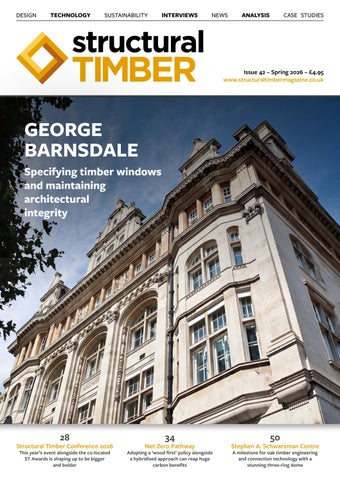
Cover: George Barnsdale
As Tom Wright, Managing Director at George Barnsdale points out, maintaining architectural integrity when specifying timber windows involves a careful balance between preserving historical aesthetics and meeting modern performance standards.


28 Structural Timber Conference 2026
Returning to the NCC Birmingham on 07 October, the event will bring the industry together again to examine the ideas, challenges and practical solutions shaping timber construction.
32 Slow Housing Recovery, Rising Timber Opportunity
The Housing Market Report 2025 paints a picture of a UK housing market that is stabilising. Andrew Orriss, Chief Executive of the STA highlights the ways that this could favour structural timber.

A quick round-up of some recent news stories from the timber and construction sectors that you may have missed including: new digital platforms that make timber frame construction easier to understand, Bellway’s Silver End timber homes development gets ministerial visit, progress on Trust C16 Timber campaign continues and Accoya helps restore a Plymouth Art Deco landmark.


50 Under the Timber Dome Expert analysis from the team behind Oxford’s Stephen A. Schwarzman Centre for the Humanities, which features a stunning, new timber and glass dome in its Great Hall.
54 Constructing Sustainable Careers
Declan McDonnell, Director at T3 Training & Development, outlines how they are working with housebuilder Vistry to redefine timber frame apprenticeships.


As Tom Wright, Managing Director at George Barnsdale points out, maintaining architectural integrity when specifying timber windows involves a careful balance between preserving historical aesthetics and meeting modern performance standards.
Timber windows play a crucial role in the building’s aesthetics, influencing both its external appearance and complementing its interior design. The window style can often define the architectural style, with Georgian buildings being known for their tall, elegant sliding sash window bars and individual glazing, and contemporary buildings favouring simplistic designs with large expansive glazing and often finished in darker tones such as black or grey. Whether you are specifying windows for a contemporary newbuild, commercial renovation or historic building, we will guide you through what to consider when building your specifications.
Timber windows are celebrated for their versatility in style, making them a popular choice in both heritage and contemporary architecture.
Casement Windows – a popular option is a Flush Casement. A classic design with the sash sitting flush to the frame. This is a timeless style that can be specified to match existing windows or create your own design, whether it’s traditional, historic, or contemporary.
Sliding Sash Windows – available as box sash and spiral balance sash designs, sliding sash windows are designed to closely match existing products and provide excellent performance.
Tilt & Turn Windows – originating in Germany, this style of window is now the most prevalent design across mainland Europe. Incorporating a high-performance dual hinge system, the window design can open into the room from either the side or top.
Image 1-3
Timber is suitable, whether you are specifying windows for a contemporary newbuild, commercial renovation or historic building
Pivot Windows – pivot windows are an ideal solution when you have a shaped window (e.g. circular) that needs to open. Pivot windows are designed to allow for easy and safe maintenance with 180-degree hinge rotation.
Working with a timber window manufacturer that can support you at the early stages of specification and that can provide fully customisable window styles is important in building specifications and can help maintain the building’s visual identity whilst ensuring modern performance standards are met.
You can choose from a range of glazing options that allow you to match existing designs, or opt for something new, whilst maintaining high performance. It may be that you have special applications that require higher transmittance or lower reflective characteristics. For example, shopfronts, showrooms or display screens may want a higher specification than standard, which can be achieved with specialist coatings. Or you may require element extras like painted


“Working with a timber window manufacturer that can support you at the early stages of specification and that can provide fully customisable window styles is important in building specifications and can help maintain the building’s visual identity whilst ensuring modern performance standards are met.”
panels, stained glass, or bevelled edges, which enhance the look of your glazing and play into the unique style you are trying to achieve. For heritage properties or listed buildings, single glazing remains a popular choice, preserving the historical integrity of the window, whilst improving other performance elements such as the acoustic rating. This can be achieved by altering the design of the window to allow for thicker acoustic glass, whilst maintaining the historic aesthetic.
When it comes to choosing the paint or stain finish of your window, there are various factors to consider. The type of finish you choose and how it is applied will affect the window’s longevity and level of maintenance required over its lifespan, so choosing a finish that is durable and long-lasting in various conditions, and that is most suited to the type of timber you choose, is essential.
When choosing the paint or stain finish for your timber window, it is important to consider the fact that light stains are not as good as opaque finishes, as they are not as efficient at blocking out UV light, which means shorter maintenance intervals. This will affect the coating and the substrate. Also, dark colours, particularly windows fitted on the South or South West, will absorb a large amount of heat on a sunny day, which is more likely to cause the timber to move. From an aesthetic perspective, dual colour has become more popular recently and allows you to choose contrasting colours for the inside and outside, or even different coloured sashes and frames of your window.
Most modern coatings are water-based and breathable. The British Woodworking Federation (BWF) recommends: “all coatings to be water-based, with no heavy metal additives.” The BWF also advises that selected coatings are to BS EN 927-1, which is the standard for paints and varnishes for exterior wood.
It is recommended to use one manufacturer for all elements of your window to ensure it remains compliant and within the scope of certification the manufacturer holds. Most manufacturers allow you to purchase hardware separately, but this may not offer exactly what you require, and you may risk your product not being fully compliant for tests such as PAS24 for security, BS6375-1 for weather testing and BS63752 for operational forces. It is also important to ensure the hardware has been salt spray tested to evaluate the hardware’s corrosion resistance and durability, ensuring the overall quality of the products is sound.
When choosing the style of hardware for your timber window, sleek chrome designs usually work well in a contemporary setting, whilst traditional black monkey tail handles commonly work in a cottage setting. There are a variety of options to choose from to match the character of the building, and that also allows the window to remain compliant.
Maintaining architectural integrity when specifying your timber windows is a multi-faceted approach considering the building’s heritage, operation and performance, the function and operation, regulatory and conservation requirements, environmental context and aesthetic factors. Working with a manufacturer at the early stages of a project can assist in balancing these factors in conjunction with modern performance requirements to build specifications that are sensitive to the architectural style and meet regulatory requirements.
For more information about factors to consider when specifying timber window and doors, get in touch: contactus@georgebarnsdale.co.uk
Fleming Homes has announced a major step forward in its manufacturing capability with the launch of Platform 1 – a new factory, state-of-the-art CNC technology and an expanded prefabricated product offering designed to give self-builders more certainty, reduce on-site disruption, and create a smoother, faster process.
The investment responds to rising demand for factory-built solutions that ease on-site labour pressures, improve consistency and help teams deliver more predictable build programmes. Based in Berwickshire, Fleming Homes has been designing and manufacturing bespoke timber frame homes for 40 years. Platform 1 marks the next stage in the Company’s evolution –strengthening its commitment to innovation and continuous improvement, while keeping the experience firmly centred on the customer.
The new factory introduces an enhanced prefabricated product range, including a closed panel solution in which key elements are installed in the factory – an additional layer of 50mm rigid insulation, air-tight VC Foil Membrane and internal 45 x 45mm internal battens that create a service cavity for wiring and pipework. The facility also introduces the manufacture of roof cassettes –prefabricated roof sections designed to form a vaulted ceiling. By increasing the level of offsite manufacturing, Fleming Homes will reduce on-site work and deliver more consistent results.
At the heart of Platform 1 is a major investment in advanced manufacturing technology. A new CNC-controlled saw fully integrated with Fleming Homes’ design software allows components to be precision-cut directly from digital models, improving accuracy and consistency while optimising material use and reducing waste. The CNC technology supports faster frame erection and smoother build schedules in the short term, while creating flexibility to further develop Fleming Homes’ product offering in the future.

“Platform 1 is about making self-building feel more straightforward,” said Managing Director, Sarah Mathieson. “When we can complete more of the work in the factory, we reduce complexity onsite, shorten build programmes and help customers move through the process with greater confidence. The saw gives us enhanced manufacturing flexibility. It speeds up production and allows us to prefabricate more structural detail. That efficiency directly benefits our customers.”
Notably, it’s the first Technosaw to be supplied to the UK market by Essetre, Weinig UK, selected for performance rather than convention. (For more on this development see page 46)
For self-builders, a higher level of factory manufacture can reduce on-site labour, cut the number of trades and shorten build timelines. Where materials are supplied as part of a qualifying supply-and-install package for a new home, greater offsite manufacture can reduce upfront VAT outlay, supporting cashflow and affordability. Architects will now benefit from factory-controlled secondary insulation layers that
deliver consistent thermal performance, while contractors gain from faster, more cost-effective installation and reduced programme risk.
Jane Morrison-Ross, Chief Executive of South of Scotland Enterprise who provided almost £200,000 worth of funding to the project, said: “Creating more homes and more choice of homes is one of the key priorities which SOSE and partners have identified for the South, as well as encouraging innovation and improving productivity. Fleming Homes’ new facility will contribute towards all of these aims, with the efficiencies it will deliver helping reduce the time required to build new homes and cutting waste.
Sarah added: “Our standards and care won’t change. This new facility helps us deliver the benefits of offsite manufacture at greater scale, while continuing to develop what we do and how we support our clients.” With the launch of Platform 1, Fleming Homes is responding directly to demand for higher-performing homes, faster construction and a more efficient building process.
www.fleminghomes.co.uk

As the offsite industry’s leading communication specialists, we have over 15+ years’ experience working with businesses operating in the structural timber sector –driving leads, visibility and growth for our clients.
Stop missing opportunities. Start leading your sector. Get the Radar Media marketing advantage
Contact our team at hannah.jones@radar-media.co.uk or call 01743 290 001


Accsys has announced that Accoya and Medite Tricoya Extreme were chosen as key materials in the restoration of Tinside Lido, a Grade II listed Art Deco landmark located on the edge of Plymouth Hoe.
Commissioned by Plymouth City Council as part of its National Marine Park project, the redevelopment transforms the 1935 seafront structure into a viable, year-round public destination. The brief was to safeguard a heritage asset in one of the UK’s most aggressive marine environments, while ensuring long-term environmental resilience and consequential value for money.
The scheme, managed by Currie & Brown and designed by LHC Design, with structural input from Airey & Coles and building services engineering by SDS, required materials capable of enduring salt spray, sustained humidity, storm impact and heavy public use.
Accoya is showcased in a range of applications, including sun terrace decking, external doors, windows, benches, planters and handrails, as well as in sensitive joinery repairs. Medite Tricoya Extreme Panels were engineered into large-format seasonal storm shutters, providing low maintenance protection during winter months. Installation was delivered
by Nevada Construction, under the planning guidance of Devon & Cornwall Planning Consultant.
Matt Oxley, Architect at LHC Design commented: “As an architect, my role is to honour the past while shaping spaces that endure over time. At Tinside Lido, every decision had to support longevity, precision, and aesthetics in one of the UK’s most challenging coastal environments – no small task. Accoya allowed us to revitalise the Lido’s Art Deco elegance with durable, low-maintenance elements that will endure decades of public use.”
As a restoration project, integration with heritage features was important. Accoya’s stability and durability allowed the design team to introduce slimmer profiles and tighter tolerances, particularly across curved and exposed components aligned with the Lido’s Art Deco geometry, while maintaining structural reliability. Left uncoated, the timber will weather to a uniform silver-grey, eliminating repeat finishing cycles and aligning visually with the coastal context. The material choice therefore serves both architectural intent and operational efficiency.
www.accoya.com
Due to significant changes in the ‘competitive landscape and evolving customer requirements’, Metsä Wood has announced it will be scaling down its UK operations. The changes will affect roles, responsibilities across the organisation with an impact on around 140 positions. The company also announced the cessation of its longstanding trading relationship with B&Q later in 2026.
Rettenmeier Holding, one of Europe’s leading manufacturers of solid wood products is expanding. Headquartered in Birmingham, Rettenmeier UK will manage and co-ordinate all Rettenmeier Group activities in the UK alongside a new warehouse facility in Warrington. As part of this expansion, Rettenmeier UK. will further strengthen its existing team with additional positions created in sales, logistics and operations.
After successfully completing a Pilot Phase and receiving invaluable feedback from over 200 participating projects, alongside the wider industry, a final document which creates a unified definition for Net Zero Carbon Aligned Buildings in the UK has been published. The Standard is the product of unprecedented collaboration across the built environment industry.
TDUK has unveiled an updated version of the 2025 Embodied Carbon Data for Timber Products. The Timber Knowledge Sheet provides weighted average upfront A1-A4 and end-of-life C1-C4 biogenic and embodied carbon data for several common timber products, and outlines the methodology used to calculate them. The data has been verified in accordance with CEN/TR 15941:2010.
Glennon Brothers has acquired Pontrilas Group, one of the UK's largest independent wood-processing firms, adding £120million of turnover to its business. Glennon Brothers joint MD Mike Glennon, said this significant milestone in Glennon Brothers history, provides its customers with an enhanced product and service offering, as well as increased overall production capacity for the future.
NMITE has appointed three new Trustees to its Board. Bill Jackson, Julian Drinkall and Natasha RothbucherThomas bring valuable expertise as NMITE continues to expand following a year of significant progress, with record student intakes, growing national recognition, and continued development of its pioneering Centres for Advanced Timber Technology (CATT) and Automated Manufacturing.

West Fraser, a leading manufacturer of engineered wood panels for the UK construction and housebuilding sectors, continues to support customers with a suite of digital tools - including a highly popular downloadable checklist for housebuilders and an interactive product guide that has proven popular with housebuilders and specifiers.
The comprehensive checklist, designed to help specifiers and site teams select the most suitable panel products from floor to roof, remains one of West Fraser’s most widely accessed resources. It forms part of a collection of specialist materials created specifically for housebuilders and available through the company’s website. The dedicated housebuilder webpage offers a fully interactive downloadable product guide, a builder's guide to choosing the right wood panels, fact sheets on SterlingOSB Zero and CaberShield Eco and options to order product samples and ask questions.
The guide covers all products within the SterlingOSB Zero, CaberFloor, and CaberMDF ranges, bringing together essential technical specifications, installation guidance, and performance information. It also highlights the wide scope of applications for West Fraser’s engineered wood panelsincluding roofing, flooring, walling, timber framing, hoarding, shopfitting, furniture manufacture, mouldings, and packaging.
With clear, practical information and easy-to-use digital tools, West Fraser continues to support the UK housebuilding community with resources that simplify product choice, improve efficiency, and promote best practice across every stage of construction. Paper copies of the guide, which also encompasses contact information for general enquiries and technical expertise are available on request. All products are net carbon negative. All West Fraser panel products produced in the UK are manufactured in mills that have obtained the coveted environmental ISO 14001 accreditation. Responsibly sourced, the panels are FSC-certified and created from locally grown timber, cutting embodied carbon from transportation.
uk.westfraser.com/housebuilders


The winners of the Confor Awards 2026 were honoured and celebrated by the industry at an event in Edinburgh on Wednesday 11 March. Among the special accolades of the evening was the first ever Confor Chair Award, given to the groundbreaking Trust UK C16 Timber Campaign. Lord Ian Duncan of Springbank, Chair of Confor, noted that the campaign has real future potential to positively impact the perception of homegrown timber and drive growth in its use, especially in the construction and housing sectors.
A highlight of the annual industry calendar, the Confor Awards recognise those driving progress for forestry and the wood-using sector, through leadership, communication, resilience and sustainability. Confor Chief Executive Stuart Goodall commented that the industry is “walking the talk” by investing in a sustainable future for forestry and timber, and by making a positive impact on the attitudes of the public and policymakers.
Speaking ahead of the Awards, he said: “In these times of global insecurity and economic and climate challenges, our industry can make a valuable contribution that ticks so many economic and environmental boxes. There are barriers to overcome, not least those related to misinformation and often polarised debate.
The sector needs great people and businesses who can promote the industry and who can demonstrate excellence and drive growth - those shortlisted for this year's awards fit the bill.”
Building on their groundbreaking campaign to champion UK timber, the country’s three largest sawmillers – BSW Timber, James Jones & Sons, and Glennon Brothers recently announced a partnership with the country’s leading construction industry bodies. As a collective, the C16 Campaign is now working strategically with the RIBA, Royal Incorporation of Architects in Scotland (RIAS) and Institute of Structural Engineers (IStructE).
Aimed primarily at architects and structural engineers, the renewed campaign seeks to raise awareness of the benefits and strategic importance of domestically grown and manufactured timber across the construction industry, reducing the UK’s reliance on imported materials. At the heart of the campaign is C16 graded timber, grown and manufactured in the UK. C16 timber is suitable for most standard construction applications, offering strength, versatility, and lower embodied carbon than many imported alternatives, such as C24 timber.
John Ward, Corporate Partnerships Manager at RIBA, said: “We are delighted to be aligned with the Trust UK C16 Timber Campaign. We look forward to supporting the delivery of this important initiative to the architectural

community, highlighting the economic and sustainability benefits of growing, manufacturing and specifying UK-grown timber.”
Stuart Goodall, Chief Executive at Confor, added: “The response we’ve seen to our campaign so far has been staggering, which really goes to show the impact we can make when we unite as an industry. We’re delighted to be extending this collaboration to IStructE, RIAS and RIBA, the UK’s leading bodies for structural engineers and architects. If we want to futureproof our domestic timber supply for the built environment, and become more self-sufficient, it’s vital to have buy-in from the planning stages, all the way through to completion. We’re excited to continue bringing UK timber to the forefront.”
www.confor.org.uk
https://cti-timber.org/trust-uk-c16-timber
Deeside Timberframe has secured a series of major residential projects across England in recent months, marking a significant expansion of its footprint south of the border. Collectively, the developments represent more than 300 new homes across the North East and North West of England and a multimillion-pound pipeline of work, reflecting a growing confidence among English developers in proven offsite construction partners with the capacity to deliver at scale.
The schemes, awarded in parallel, span North Yorkshire, Cumbria and Sunderland and include a mix of houses and bungalows across sites ranging from 68 to more than 100 units. While geographically dispersed, the projects share a common theme: developers seeking delivery certainty at a time when programme risk, labour availability

and sustainability requirements are reshaping procurement decisions across the housing sector.
Derek Wann, Business Development Director at Deeside Timberframe, says the demand the company is seeing in England mirrors changes that took place earlier in Scotland. “Developers are under more pressure than ever to deliver homes quickly, efficiently and to a consistent standard,” he says. “What we’re seeing now is a clear preference for timber frame
partners who already understand how to deliver at scale. These are live residential developments where programme certainty underpins every commercial decision.”
The scale of Deeside’s recent English appointments reinforces that point. The projects include complex residential schemes incorporating infrastructure works such as highways, landscaping and sustainable drainage, requiring close co-ordination between design, manufacture and site delivery.
Offsite manufacture allows greater control over quality and sequencing, while helping to mitigate labour constraints that continue to affect traditional build routes. Graeme Guy, National Sales Manager at Deeside Timberframe, believes this shift is changing how developers engage with timber frame specialists. “We’re being brought into conversations much earlier than before,” he says.
“Developers want partners who can support them strategically, not just supply panels. They’re looking for manufacturing capability, technical assurance and the confidence that delivery can be maintained across multiple sites. This isn’t about chasing work in new regions, it’s about responding to where housing delivery is accelerating and where developers are actively seeking established timber frame partners who can help them scale.”
www.deesidetimberframe.com


The role of Scottish timber in supporting the circular economy and delivering sustainable homes has been recognised by the Irish government during a St Patrick’s Day visit to Alexanders Timber Design (ATD) in Irvine, North Ayrshire, part of Irish-owned Glennon Brothers.
Ireland’s Minister with responsibility for Housing, Local Government and Planning, John Cummins TD, visited the advanced timber frame manufacturing facility as part of the Irish Government’s St Patrick’s Day Global Outreach programme, which sees ministers travel internationally to strengthen economic ties.
The visit took place on 13 March at ATD’s £18million Irvine facility which was opened by UK and Ireland timber industry leader Glennon Brothers in 2025. The visit showcased how collaboration between Ireland and Scotland’s forestry and construction sectors can help address housing shortages while reducing the carbon footprint of housebuilding. Demand for sustainable housing continues to grow across Scotland, where around 95% of new homes are built using timber frame structures, compared with approximately 12% across the rest of the UK.
Opened in April 2025 by Scotland’s First Minister, John Swinney, the Irvine facility uses advanced robotics, digital design systems and precision engineering to manufacture timber frame structures from homegrown Scottish timber. The site has the capacity to support the build of up to 2,500 homes per year.
Much of the timber used in the manufacturing process is sourced from forests within a 70mile radius, processed at Glennon Brothers’ sawmill in Troon and then converted into timber frame homes at the Irvine facility for housing developments across Scotland’s central belt. The facility supplies well-known housebuilders across the country, including Persimmon Homes, Taylor Wimpey, Bellway and Ashleigh Construction.
Founded in 1913 in Longford, Ireland, Glennon Brothers is a third-generation business which now operates four sites in Scotland - Irvine, Troon, East Lothian and Invergordon. The company employs over 350 people, making it one of the most significant Irish employers in Scotland.
Speaking during the visit, Minister Cummins said: “Scotland and Ireland have built a strong reputation for innovation in timber frame construction and modern methods of housebuilding, and facilities such as Alexanders Timber Design show how this expertise can help deliver sustainable homes at scale. I recently visited offsite construction facilities, and it is great to see innovation driving increased housing delivery.
Last year Ireland saw a 20% increase in output to 36,000 homes and 70% of all scheme houses delivered were via MMC, predominantly timber frame construction. I want to compliment Glennon Brothers for the work they are doing in Scotland and in Ireland. This facility demonstrates how we can connect forestry, processing and modern methods of construction to build a more resilient housing system that meets the needs of our growing population.”
Jim Patterson, Head of Timber Frame at ATD, added: “Scotland has long been recognised as a leader in timber frame construction, and we are proud to support housebuilders across the country with high-quality timber frame solutions. By combining locally sourced timber with advanced manufacturing technology, we are helping our customers deliver the homes Scotland needs while reducing the carbon footprint of construction.”
Mike Glennon, Joint Managing Director of Glennon Brothers, also said: “Glennon Brothers is a strong example of the circular economy in action. Our approach is built around the principle ‘from forest to front door’, using homegrown timber to manufacture highquality building products that support the delivery of sustainable homes in our local areas. Scotland has long been a leader in timber frame construction. There’s a huge opportunity for the rest of the UK to learn from the expertise that exists here, particularly as the industry looks for new ways to deliver homes more efficiently and sustainably.”
Glennon Brothers’ recent acquisition of the Pontrilas Group, one of the UK’s leading independent sawmill and packaging businesses, has further strengthened the group’s position in the UK market, bringing total headcount to around 1,400 and combined revenues to €430 million (c.£370 million).
www.alexanderstimberdesign.co.uk


Timber Development UK (TDUK), the Structural Timber Association (STA) and Swedish Wood – have launched a new digital platform that makes timber frame construction easier for built environment professionals to understand and adopt. ‘Timber Frame: Where to Start’ is a practical, accessible guide that provides a clear introduction to timber frame construction and its principal elements.
The purpose of the guide is simple: to give users a quick and easy way to understand how timber frame works, while signposting them to credible and accessible information. Designed for anyone interested in timber frame construction, the guide supports a wide audience. It will be particularly useful for architects, specifiers, engineers, timber frame suppliers, building operators, home builders and contractors. It also serves as a straightforward introduction for those new to timber frame who want reliable information in one place.
Seven of the top ten UK homebuilders operate their own timber frame manufacturing facilities, and it has been predicted that as many as one in three UK homes could be timber frame by 2030. In Scotland, 92% of all newbuild homes are constructed using timber frame.
With the top construction companies now moving towards greater use of timber frame, and many smaller firms beginning that transition, the demand for clear and practical guidance is clear. This new digital guide has been created to help companies build confidently in timber, providing the insight needed to deliver successful projects and positive experiences with the system.

Dave Hopkins, Chief Executive of Timber Development UK, said: “Timber frame is no longer an alternative method of construction. It is a mainstream solution that supports productivity and sustainability. This guide brings together the information businesses need to get started, all in one accessible place.”
Andrew Orriss, CEO of the Structural Timber Association, added: “There is a growing appetite across the sector to build more in timber. The challenge for many organisations is knowing where to begin. ‘Timber Frame: Where to Start’ provides a clear route in, backed by trusted industry bodies and credible information.”
Stephen King, UK Project Manager, Swedish Wood, commented: “As a long-standing supplier of structural timber to the UK market, we’re seeing strong growth in demand for timber frame construction. By supporting this initiative, we’re helping ensure that companies looking to build in timber have the confidence, knowledge and supply chain support they need to do it well.”
The digital platform reflects a shared commitment from TDUK, STA and Swedish Wood to support industry growth, encourage informed decisionmaking and promote high standards across the sector.
To access the ‘Timber Frame: Where to Start’ guide visit: https://timber-frame.uk

For 25 years, Combilift has been revolutionising the way companies handle and store goods. Our pioneering product range of multidirectional, articulated and pedestrian forklifts, straddle carriers and container loaders allows you to manoeuvre long loads safely, reduce aisle widths and increase the amount of space available for storage.
To find out how Combilift can help you unlock every inch of your storage space.

Witham MP Dame Priti Patel visited Bellway’s Francis Gardens development in Silver End, Essex to see new homes being built using modern methods of construction (MMC). All 94 homes at the site are being made with a timber frame structure, offering greater energy efficiency, quicker build times and a lower carbon footprint than traditional construction methods.
Bellway is expanding its use of timber frames and the homes at Francis Gardens represent the first such properties to be delivered by the company’s Essex division as part of the wider roll-out. After meeting members of the Bellway team in the site office to hear about the benefits of timber frame construction, the MP was shown across to a viewing area on site from where she was able to see mobile cranes lifting timber frame sections onto plots currently under construction.
Paul Feeney, Construction Director at Bellway Essex, said: “I’d like to thank Dame Priti for visiting Francis Gardens to see first-hand how Bellway is pushing forward with more sustainable methods of building homes in her constituency. We are committed to much greater use of timber frames as part of our wider sustainability strategy. The trees we use absorb carbon throughout the time they are growing, which offsets the amount of carbon needed to process the timber. All the wood is responsibly sourced, which means that for every tree felled, another is planted.
“Timber frame homes require less energy to produce and less energy to heat due to their exceptional thermal efficiency. They also speed up the build process, allowing homes to be watertight almost 40% quicker, meaning that high-quality, energy-efficient properties can be delivered at greater pace to meet demand. Thanks to the use of timber frame and the inclusion of solar PV panels, the homes at Francis Gardens will achieve a 19% improvement in energy performance over the requirements of the 2013 Building Regulations.”

Dame Priti highlighted several key priorities during her visit, including how new developments must be sympathetic to the local communities they are built in, and provide funding for new infrastructure and public services, as is the case at Francis Gardens, she said: “During my visit to the new Francis Gardens development, I discussed these priorities with Bellway, as well as seeing how the modern, sustainable timber-frame homes are being delivered, helping to improve energy efficiency while supporting local construction jobs.”
Bellway is increasing its use of timber frames having opened a new timber frame factory, called Bellway Home Space, in Nottinghamshire which began supplying sites in January this year.. The company aims to increase its timber frame property construction to around 30% of new homes by 2030, to drive long-term volume growth and help meet the targets set out in its Better with Bellway sustainability strategy, which includes achieving net zero by 2045.
www.bellway.co.uk/new-homes/essex/francis-gardens

Grafton Group plc, one of Europe’s leading multinational distributors of construction related products and solutions has acquired Cygnum Holdings Limited. Founded in 1997 and based in Macroom, Co. Cork, Cygnum is a leading made-to-order supplier of timber frame solutions to developers and contractors in the Irish market. According to the Irish Timber Frame Manufacturers' Association (ITFMA), the proportion of timber frame used in low-rise housing schemes was 37% in 2019, while data from the Department of Housing, Local Government and Heritage indicates that in the second half of 2025, 61% of homes in scheme developments had notified the intention to use timber frame construction. Sustained growth has been fuelled by the cost, quality and delivery efficiencies of timber frame, a trend that is expected to continue over the next decade as Ireland seeks to address a structural housing shortage. With just over 36,000 homes completed in Ireland in 2025 and a government target of 60,000 homes
to be completed annually by 2030, Cygnum is an exciting addition to Grafton's portfolio in the Island of Ireland segment.
Grafton intends to operate Cygnum as part of Chadwicks Group, its market-leading distribution business in the Republic of Ireland. This acquisition aligns with Chadwicks Group's strategy to extend its offering and acquire adjacent competencies and allows Chadwicks to continue to be a onestop shop for customers as they adopt modern methods of construction.
Eric Born, CEO of Grafton Group plc said: “This acquisition strongly complements Chadwicks Group's trade portfolio and supports the faster, more efficient delivery of new homes to help address Ireland's structural housing shortage. For Grafton, it provides an opportunity to increase our exposure to the newbuild market and to support Cygnum customers with access to a broader range of construction related products and solutions.”
John Desmond, Managing Director, Cygnum Holdings Ltd, added: “This is a hugely positive step for our business, customers and employees. We have built a strong and loyal customer base by consistently delivering highquality timber frame solutions. Becoming part of Chadwicks Group gives us the backing, scale, and strategic support to accelerate our growth, while maintaining the service levels and relationships our customers value.”
www.cygnum.ie


Envirograf® intumescent coatings expand when exposed to heat or flame, swelling to create a protective barrier.
Whether you are fireproofing a new structure or ensuring that existing structures are compliant with the latest legislation, with over 40 years experience our British manufactured products can help you secure a fire resilient future.


With over 150 products, Envirograf has all your timber fire-proofing needs covered, from paints to sprays, sealants to fire door upgrade kits. Our technical team can assist with any queries you might have, ensuring you are supplied with the products best suited to your needs.


Building products manufacturer Glidevale Protect is helping to make roofing contractors’ lives that bit easier by offering a co-branded service that provides clear and concise fixing instructions printed directly onto its pitched roofing underlays.
The simple instructions provide roofing contractors with a straightforward guide to ensure underlays are installed correctly and in accordance with the manufacturer recommendations alongside any specific guidance from the roofing contractor. This includes the requirement detailed within BS 5534 to lay the membrane with a maximum 15mm drape, the instruction to install with a batten restrained headlap as well as specific requirements for clout nails or stainless-steel fixings required for installation.
The guidance helps reduce the risk of a ‘performance and skills gap’, allowing roofing contractors to incorporate into their training programme to their workforce, ensuring the roofing underlays provide the maximum benefits when installed. The move to print instructions directly onto the underlays also provides greater transparency for Building Control, helping to meet the requirements of warranty providers where proof is required that products have been installed correctly and as per the manufacturer’s instructions, typically with photographic evidence to back this up.
The initiative was a result of the collaboration between Brandon McDonnell at McDonnell Price Roofing Contractors Ltd in Gloucester and Glidevale Protect, being trialled for the first time on a roofing refurbishment for a new
mixed-use residential development project in Charlton Hayes, Bristol. Fixing instructions were printed by Glidevale Protect on all Protect VP300 pitched roofing underlays and supplied to McDonnell Price for installation on site. Following the success of this trial, the co-branded membrane with fixing instructions will be rolled out by the contractor on all projects with Glidevale Protect going forward.
Brandon McDonnell, Director at McDonnell Price commented: “We felt it would be extremely useful to print the fixing instructions on the membrane in order to prompt the operatives when on site. By providing an open and honest reflection of how the product should be fitted this is helping to drive the quality of installation. I’m delighted with the end result and the work undertaken with Glidevale
Protect on this important is helping make our team’s lives a lot easier.”
John Mellor, Head of Marketing at Glidevale Protect said: “This is a great initiative, a simple but effective idea to make things easier on site, providing a handy reminder of installation best practice for roofing contractors. We’re confident that printing guidance like this can help reduce the number of on-site installation issues and will help inform contractors as to the key pointers when fitting the underlay, reducing the performance gap so that our products always deliver as expected. Our focus continues to be on developing products that combine verified technical performance with ease of use, and this latest customer collaboration is the perfect example.”
www.glidevaleprotect.com
The Structural Timber Association (STA) has been awarded Continuing Professional Development (CPD) accreditation for its Installer Training Scheme, recognising the programme’s quality and commitment to professional development.
The accreditation confirms the STA’s Installer Training Scheme meets the rigorous standards required by the CPD and provides professionals with an industry recognised qualification, certifying their ongoing knowledge, skills and career progression.

Andrew Orriss, CEO of the Structural Timber Association, said: “Gaining CPD accreditation for our Installer Training Scheme is an important milestone for the STA as it demonstrates the quality and relevance of our training courses. The skills and knowledge we’re offering enables us to help shape the construction workforce of the future and underlines the STA’s commitment to learning and development within the sector.”
The STA’s Installer Training Scheme provides sector specific learning support for timber frame and Structural Insulated Panel (SIP) installers to


give them the required knowledge to assemble and erect structural timber buildings to the highest standards.
Structural Timber Association Skills and Training Manager, Julie Purdie, added: “It’s no secret that the construction sector is in the midst of a skills shortage. The timber industry is working hard to provide the kind of skilled workplace environment that school and university leavers want to work in. We want to be part of the solution and help people develop the skills needed to deliver high quality timber frame homes.”
CPD is a practical and methodical approach to enhance work-related skills and knowledge and is increasingly becoming recognised as the international terminology for professional further learning.
Gerard Lockey, Director of Mint Construction and STA member, said: “Skills and training are vital to the continued growth and success of the timber frame industry. It’s great to see the STA's Installer Training Scheme receive CPD accreditation, reinforcing the importance.
www.structuraltimber.co.uk


Calldene Structural Timber Solutions has completed the latest investment phase at its Dover Trussed Roof Company site with a £60k premise modification to increase production capacity and support truss assembly.
By increasing ceiling height to an existing production facility, the investment provides a dedicated space for truss assembly, enabling more efficient use of the current building footprint. This intelligent engineering boosts manufacturing capabilities by improving assembly capacity and increasing Calldene’s overall production output by 20%.
Ecological Building Systems (EBS) has revealed its comprehensive CPD programme for the year ahead. The programme, which is run via live webinars by Ecological Building Systems’ technical experts, includes, for the first time a CPD on designing and building homes using the sustainable EcoCocon straw wall system.
The new CPD will focus on how the EcoCocon straw wall system helps create more sustainable, healthy and high-performance buildings with minimal environmental impact. Aimed at architects, architectural technologists, structural engineers, specifiers, building surveyors, contractors, consultants and students in the industry, the CPD provides an informative overview of how to design and build with these building blocks of the future.
Alongside the EcoCocon webinar, Ecological Building Systems will be hosting a wide range of insightful CPDs through the year on a variety of building topics, including airtightness and moisture vapour management, natural fibre insulation in low carbon construction and vapour-open internal wall insulation systems. The topics are repeated at regular intervals to offer as many construction professionals as possible the chance to benefit.
Neil Turner, UK Technical Manager at Ecological Building Systems, explains: “We’re excited to have added a technical webinar on the EcoCocon straw wall system to our CPD programme. We became the exclusive distributor for the UK & Ireland of EcoCocon in 2025 and have had a great deal of interest from specifiers and other building professionals.
The expansion creates a new space for truss assembly and is also a crucial investment in safer working practices and improved conditions, enabling further efficiency in the production process. The combination of reduced manual handling and increased circulation capacity will contribute to higher productivity and smoother workflows.
Les Fuller, Managing Director at Calldene Structural Timber Solutions, said: “This expansion is an important step in our ongoing investment programme. It’s about creating a safer, more efficient working environment at Dover Trussed Roof Company while increasing capacity and capability – so we can continue to improve availability, lead times and service for customers across the South of England.”
The latest investment aligns with Calldene’s continual improvement path for long-term business strategy and growth, strengthening its position within the structural timber market. Fully operational, the site expansion is set to increase product flexibility and scope, benefiting customers served by Calldene’s Canterbury and Lancing operations. In many cases, the additional capability will also reduce the need for ‘two-piece’ frames, helping to cut costs and delivery times while improving structural integrity and installation efficiency for clients.
www.calldene.co.uk

We’re offering a comprehensive CPD programme for 2026, which covers many new build and retrofit construction methods to give attendees the opportunity to ask questions of our technical team and to take advantage of a free design review, if required. These webinars provide structured CPD points and attendees receive certification on completion.”
Ecological Building Systems has been delivering training in low-carbon impact construction for over 20 years. The company is recognised for his expertise in high-performance building products, supplying a wide range of innovative airtightness systems and insulation materials, backed up by expert technical support. The company also has a permanent display at the National Self Build and Renovation Centre in Swindon (stands 159 & 160), where visitors can arrange one-to-one meetings with technical experts to discuss their projects and explore suitable solutions.
www.ecologicalbuildingsystems.com

Driven by innovation and craftsmanship, Pelham Structures has continually invested in both people and technology including Hundegger technology.
Pelham Structures is a trusted leader in timber frame construction, delivering high performance homes for over 30 years. Established in 1993 by Bill Bampton, the Pelham Structures business began as a specialist timber frame manufacturer serving developers and self builders, with early expertise also spanning agricultural buildings and outbuildings.
In the early 2000s, the company became the first in the UK to install a Hundegger K2 CAD/CAM joinery machine, transforming its ability to manufacture complex timber frames efficiently and cost effectively. This forward thinking approach helped make architecturally ambitious, energy efficient homes accessible to a wider market.
Beyond manufacturing, Pelham Structures has successfully expanded into residential development, delivering a mix of speculative and supported self build projects. Today, this integrated development model underpins the timber frame business, ensuring every frame is designed and built with real world performance, buildability, and long term value in mind. Pelham Structures supply both open panel and pre-insulated panel designs according to their clients’ specific requirements for design and thermal performance, all exceeding current building control standards and with a mind also on optimising living space.
To further strengthen control and quality, Pelham established an in house land, planning, and design team. This allows the business to identify exceptional sites, secure planning consent, and produce detailed technical and construction drawings entirely in house. The result is a seamless, end to end service that supports the delivery of around 100 highly specified homes each year.
Continued investment remains central to Pelham’s vision. The recent construction of a new factory, alongside the installation of a Hundegger speedcut SC3 machine and Wood Tech assembly table, has significantly
increased offsite manufacturing capacity. This commitment enhances efficiency, build quality, and sustainability – ensuring Pelham Structures remains at the forefront of modern timber construction.
"Bill Bampton and Pelham Structures are strong advocates of the benefits that timber frame construction brings to modern developments," says Hundegger UK's Chris Osborne. "Over the years, they have developed a highly specified timber frame system engineered to perform at the highest standards in efficiency, precision, and sustainability. Bill himself demonstrated this commitment early on by investing in the first ever Hundegger machine delivered to the UK - a K2 model. Remarkably, that same machine is still in full production today, now operating within another company. There could be no better testament to the long-term performance, reliability, and service quality associated with Hundegger technology."
To support the company’s quality ethos and to drive continuous improvement Pelham were recognised in 2022 with the accreditation of ISO9001 and CATG Frame Mark standards and recently secured STA Assure Gold Standard across design, manufacture and erection.
Pelham Structures remains committed to a future defined by investment, innovation, and excellence. Its ambition is to continue strengthening its capabilities by investing in people, technology and machinery, ensuring it consistently delivers high quality builds that exceed building control requirements. By combining advanced manufacturing technology with skilled craftsmanship, they aim to provide clients with beautifully designed, high performance homes that stand the test of time.
www.hundegger.com www.pelham-structures.co.uk


London has taken a major step towards circular construction with the launch of the UK’s first Circular Construction Hub in the Royal Docks – a project that could reshape how materials are used, reused and recovered across its rapidly expanding built environment.
Backed by the Mayor of London, Sadiq Khan, and the London Borough of Newham, the new facility will focus on recovering materials from construction and demolition, enabling them to be reused in new projects rather than sent to landfill. When fully operational, the hub is expected to become the largest facility of its kind in Europe and will support the Mayor’s ambition for the capital to be a ‘zero carbon city’ by 2030.
“London is leading the way in the green transition of the construction sector,” said Mayor of London, Sadiq Khan. “This new hub is part of a wider plan to create a Circular Economy Village in the area, with the hub set to become the largest in Europe when fully activated.”
Images 1-2
The reuse of mass timber is at the heart of the Hub’s construction.
Courtesy Henry Woide
Image 3
Launch of Tipping Point East. Courtesy Stephen Norman Young

3
The hub sits within the Royal Docks Enterprise Zone, a major regeneration area in East London that is set to deliver more than 36,000 homes and 55,000 jobs in the coming years. With large-scale development planned across the area, city leaders say embedding circular economy principles into construction will be essential.
By capturing materials from construction and demolition activities and reintroducing them into the supply chain, the Circular Construction Hub will support lower embodied carbon across these projects. Early projections suggest the facility could divert at least 950 tonnes of material from landfill over its first five years of operation. The hub is designed around circular economy principles that aim to keep materials in use for as long as possible through reuse, refurbishment and recycling.
Construction remains one of the UK’s most resource-intensive sectors. The industry accounts for around 62% of the country’s total waste, while the construction, demolition and excavation sector produces more than 100


Yes Make, the ‘regenerative design and build practice’ has been creating a new home for itself, Material Cultures and Resolve Collective using reclaimed mass timber. Designed in collaboration with Material Cultures and built by Yes Make, it is made entirely from reclaimed materials, including a structure formed from a hotel CLT floor slab, bespoke windows from office glazed partitions, custom metal brackets from I-Beam offcuts and insulating walls retrofitted from theatre flats. It has also been designed for disassembly and future reuse.
million tonnes of waste every year. Although recycling rates are high, millions of tonnes still end up in landfill.
The Circular Construction Hub is being delivered by Tipping Point East, a registered charity led by founding organisations Yes Make, RESOLVE Collective and Material Cultures, in partnership with the Mayor of London, the Mayor of Newham and the London Borough of Newham as part of its Just Transition Climate Action Plan.
The Mayor of Newham, Rokhsana Fiaz OBE, said: “By transforming how we build, we aren't just reducing waste, we are also pioneering our 'just transition' impact through the creation of green jobs and delivery of high-quality, sustainable homes our residents deserve and can afford.
Tipping Point East is transforming a temporary ‘meanwhile’ site and warehouse building using reclaimed and bio-based materials, demonstrating alternative low-carbon construction techniques. The facility will operate as a working hub for circular building practices while also hosting training, research and community programmes. Alongside material reuse, a key focus will be developing the workforce needed to support the transition to low-carbon construction.
This aligns with wider initiatives such as the Mayor’s Green Skills Academy, which aims to tackle skills shortages in areas including retrofit, low-carbon construction and sustainable building technologies.
George Massoud, Trustee at Tipping Point East and Founding Director of Material Cultures, said: “Tipping Point East will be a radical new Climate Futures centre and crucial piece of infrastructure for the circular economy in London, accelerating the transition towards net-zero and developing the construction sector's Green Skill capacity.”
The launch also reflects wider changes to planning policy in London. Since 2016, major developments in the capital have been required to follow circular economy principles under the London Plan. Developers must demonstrate how projects will minimise waste, reuse existing materials where possible and reduce embodied carbon throughout the building lifecycle. These requirements have pushed contractors and developers to rethink material flows and explore more sustainable construction methods.
For the construction industry, the Royal Docks Circular Construction Hub will act as a practical testbed for new ways of designing, building and managing materials. By embedding circular processes directly into London’s construction supply chain, the project aims to demonstrate how large cities can reduce waste, cut carbon emissions and create more sustainable building practices.
www.yesmake.co.uk www.materialcultures.org

Returning to the NCC Birmingham on 07 October, the Structural Timber Conference 2026 will bring the industry together again to examine the ideas, challenges and practical solutions shaping timber construction right now.
After a successful event last year, the Structural Timber Conference returns with a clear focus on the issues now shaping the sector – circularity, sustainability, practical delivery and the commercial realities of building with timber at scale.
Taking place on 07 October 2026 at the National Conference Centre (NCC) and colocated with the Structural Timber Awards, the event arrives at a time when timber is under growing pressure to prove not just its environmental credentials, but its ability to support efficient, confident and repeatable delivery across the built environment. That gives this year’s programme particular weight.
The agenda will explore the benefits of timber construction, look at future opportunities for the sector and examine the challenges, solutions and success stories helping to move the industry forward. Circularity and sustainability sit at the heart of that conversation, but so too does the wider question of what matters most for structural timber right now.
A timely moment for timber
That makes the conference more than just another date in the calendar. It offers an opportunity to step back from the pace of live projects and take stock of where timber
is heading in the UK – and what still needs to happen if the material is to expand its place in mainstream construction. For a sector that continues to balance innovation with regulation, environmental ambition with cost pressures and technical progress with market confidence, which feels especially timely.
A broad cross-section of the industry is expected to attend, including architects, engineers, clients, contractors, local authorities, housebuilders and developers. That breadth remains one of the event’s biggest strengths. Timber does not move forward through one part of the supply chain acting alone. Progress depends on closer


alignment between specifiers, manufacturers, contractors, policymakers and end clients, and one of the day’s real values lies in bringing those different perspectives together in the same room.
A programme grounded in real projects
That sense of substance is already visible in the programme. Paul King of Built by Nature

will open with a keynote on why timber must move from niche to mainstream, before Kirsten Haggart of Waugh Thistleton turns to the next generation of commercial timber buildings. From there, the agenda moves through project-led sessions from Becca Troy of Webb Yates and Tonkin Liu, Adrian Campbell of ChangeBuilding and Charlie Butterwick of Architecture Unknown, before widening into education, infrastructure and


housing. Contributions from Paul Inch of OSKOP and Strata Consulting, Hannah Dixon and Sam Bailey, and Rob Wheaton underline an agenda shaped around real projects, practical lessons and the wider question of how timber can be delivered with greater confidence and consistency.
There is also a strong practical thread running through the day. For delegates, that means more than a run of presentations. It

means direct access to the people, projects and ideas shaping timber construction now, with sessions designed to inform live decisions around specification, procurement, design development, manufacturing strategy and site delivery. In that sense, the value lies not only in the variety of discussion, but in how closely it connects to the realities of project work.
That wider relevance feels especially important at a time when timber is being discussed not simply as a material choice, but as part of a broader rethink around carbon, productivity, material efficiency, manufacture and design. With sessions spanning commercial, education, infrastructure and housing, the agenda reflects a market moving beyond advocacy and into questions of application, repeatability and scale. That gives the event weight not only for those already immersed in structural timber, but for anyone working in MMC, industrialised delivery or lowcarbon building strategy.
07 OCTOBER 2026
NCC, Birmingham


There is, of course, a networking element to the day, but the value of that goes beyond simple visibility. In a market where early confidence, informed clients and shared understanding often shape outcomes as much as technical capability, face-to-face discussion still matters. Bringing clients, designers, manufacturers and contractors together does not solve every challenge, but it gives the right conversations a far better chance of leading somewhere practical.
Set against a market asking bigger questions about carbon, efficiency and delivery, Structural Timber Conference 2026 arrives at the right moment. For anyone serious about where timber goes next in the UK, Birmingham on 07 October 2026 should prove a worthwhile place to be.
Do not miss your chance to be part of the conversation shaping timber construction in the UK – book your place today at: www.radarbookingsystem.co.uk/structural-timber-conference-2026/home
The STRUCTURAL TIMBER CONFERENCE will return in 2026 following the success of the 2025 event, once again taking place alongside the STRUCTURAL TIMBER AWARDS to create a full day dedicated to celebrating innovation, best practice and excellence across the industry.
Speakers include representatives from: Stride Treglown, Barratt Redrow/Oregon, Bellway Homes, Vistry, Buckland Timber, Architecture Unknown, ChangeBuilding, B&K Hybrid Solutions, Morgan Sindall Construction & Infrastructure, Built by Nature, Waugh Thistleton, Heyne Tillett Steel, and many more!
LIMITED EXHIBITION STANDS AND SPONSORSHIP OPPORTUNITIES REMAINING!
Contact Yuliya Stuart on 01743 290014 or yuliya.stuart@radar-media.co.uk to discuss how you can get involved as an exhibitor or sponsor!


From insight by day to celebration by night, the Structural Timber Awards 2026 give the sector a chance to recognise the projects, products and people pushing
timber forward. The Awards offer a key industry platform, presenting networking opportunities, stakeholder visibility, and collaboration across the timber supply chain.
Co-located with the conference, they help create a standout full day for the industry to learn, connect and celebrate together.
The Awards Entry Platform will be opening soon and the deadline for submissions is 11 July 2026 via the Structural Timber Awards website: enter.structuraltimberawards.co.uk


The latest figures from the Housing Market Report 2025 and associated industry data paint a picture of a UK housing market that is stabilising rather than surging, but as Andrew Orriss, Chief Executive of the Structural Timber Association (STA) highlights, is also one shifting in ways that could favour structural timber.
The economic backdrop is steady but subdued. UK GDP data, sourced from ONS and presented alongside winter forecasts, shows the sharp contraction in 2020 followed by a gradual recovery and modest projected growth through to 2027. Growth is forecast at 1.1% in 2024, 1.4% in 2025 and 1.1% in 2026, easing slightly to 1.6% in 2027. It is not rapid expansion, but it does suggest a more predictable environment for developers and manufacturers after several turbulent years.
Private housing output reflects that same pattern. ONS data charting private housebuilding in cash terms highlights the pandemic dip, the strong rebound, and a subsequent cooling in activity. Construction Products Association figures show private housing output falling by 14.3% in 2023 and a further 4.9% in 2024. From there, the outlook improves only gradually, with projected growth of 1.0% in 2025, 1.5% in 2026 and 4.0% in 2027.
Market pressures
Behind those numbers sit several fundamental pressures. Demand has slowed sharply in recent months. Housing Associations and councils are

not purchasing Section 106 units at previous levels. Build-to-Rent investment remains active, but much of it is focused on existing stock. High-rise schemes have declined significantly, largely due to Building Safety Regulator delays, with London particularly exposed given affordability constraints and the requirement for 35% affordable housing on many schemes. Smaller housebuilders are seeing some demand recovery yet planning barriers and added cost burdens continue to challenge viability.
Yet within this cautious environment, timber frame is quietly strengthening its position. According to the Housing Market Report 2025, total UK housing starts in 2024 reached 132,460 units. Of these, 31,493 were timber frame, giving timber a 24% share across the UK.

Scotland is the dominant consumer, with 95% of starts using timber frame. England accounts for 81% of total starts but currently has a lower timber frame share at 13%. Importantly, commentary in the data shows that England’s share has risen from 12% to 15% during 2024. Long-term regional data from NHBC registrations reinforces the direction of travel.
Timber frame has steadily expanded its footprint across Great Britain, with particularly high repetition in Scotland and growing adoption across northern English regions. The divergence between houses and apartments is also notable. The ratio continues to move in favour of houses, a segment where timber frame is particularly competitive.
There is a growing timber frame market share but this needs to increase across all housebuilding typologies
A further catalyst is emerging among the major housebuilders. Data presented alongside the HBF Housing Market Report 2025 indicates that seven of the fifteen national housebuilders are expected to self-supply timber frame by 2026. This represents what has been described as a medium-term seismic shift. When the largest players alter procurement and delivery models, the impact ripples through the wider market, including the UK’s estimated 2,500 SME developers.
Forecast modelling to 2030 illustrates the scale of potential change. One scenario assumes timber frame demand grows to 25% over five years, driven by both overall market activity and rising market share. Current output is around 35,000 units (averaged out over various house types and sizes) per year. STA estimates the current capacity from the industry being closer to 45,000 units. Once the national housebuilders are fully on stream with their self-supply to overall capacity of the industry could be as high as 70,000 units by 2030. With further investment and industrialisation capacity could comfortably riser to 90,000 units.
These projections depend on several assumptions set out in the forecast. Effective planning reform, a confirmed housing kick-start programme, unlocked council housing, supportive fiscal policy to restore consumer confidence, partial recovery of the Housing Association market, strong skills programmes, and a reconsideration of noncombustible structure restrictions in London are all identified as critical enablers. The absence of further economic shocks is also assumed.
The recovery in private housing is steady rather than spectacular, but the underlying trends are significant. We are seeing growing timber frame market share, major housebuilders investing in self-supply, and continued skills pressures in traditional construction. That combination creates a real opportunity for structural timber to play a much bigger role in UK housing delivery over the next five years.
Risks remain. Regulatory delays, cost inflation, rising insolvencies and medium-term skills availability are all highlighted as live concerns. Even so, the data from ONS, the Construction Products Association and the Housing Market Report 2025 suggests that while overall housing growth may be modest, timber’s share of that market is likely to continue rising. In a flat market, share gains matter more. If policy conditions align with industry investment, timber frame could move decisively from a growing segment to a central pillar of UK housebuilding before the end of the decade.
www.structuraltimber.co.uk

"If policy conditions align with industry investment, timber frame could move decisively from a growing segment to a central pillar of UK housebuilding before the end of the decade."
Andrew Orriss, Chief Executive, STA

Alex Brock, Senior Pre-Construction Manager at B&K Hybrid Solutions (BKHS), explains why a ‘Wood First’ philosophy creates a pathway to lower-carbon construction and how gains can be further achieved through hybrid solutions.
The UK construction sector is entering a decisive phase in its response to climate change. With net zero targets firmly established and embodied carbon now under intense scrutiny, the industry must rethink how buildings are conceived and delivered. While improving operational performance remains essential, material choice is increasingly recognised as one of the most immediate and effective options available.
The built environment continues to represent a significant share of the UK’s carbon footprint. Construction activity alone accounts for around 10% of national emissions, rising to approximately 45% when the wider built environment is included. Meeting the UK’s 2050 net zero commitments therefore demands a dual focus on both operational and embodied carbon. Structural timber, particularly engineered products such as cross laminated timber (CLT) and glulam, offers a powerful response to this challenge. Unlike more energy-intensive materials, timber requires relatively low processing energy and acts as a biogenic carbon store, locking away CO₂ absorbed during tree growth for the life of the building. The longer the materials are in use, the longer the carbon is trapped and not emitted back into the atmosphere.
Despite these advantages, an all-timber approach is not always the most structurally efficient or commercially viable solution. Structural demands, span requirements and fire strategies frequently require a more nuanced response. This is where hybrid construction provides a pragmatic route forward. By intelligently combining timber with steel, project teams can maximise the carbon benefits of timber while maintaining structural
Images 1-3
Mass engineered timber is a key element of high-performance buildings with net zero targets in mind
performance, cost certainty and buildability. At BKHS, this philosophy is encapsulated in a simple but critical principle: the right material in the right place.
Successful ‘Wood First’ strategies begin at concept stage. Early engagement with hybrid specialists, such as BKHS, allows the structural grid, load paths and floor solutions to be developed specifically around timber efficiency. This early collaboration enables teams to rationalise spans, optimise panel sizes and resolve complex interfaces before they reach site.
A key aspect of using timber effectively lies in understanding where it delivers the greatest value. A ‘Wood First’ approach does not mean timber everywhere: rather, it prioritises its use in elements where it achieves maximum structural efficiency and aesthetics. Floor plates, walls and repetitive components typically provide the strongest opportunities. In many schemes, CLT walls and floors paired with steel or glulam frames columns create an efficient structural solution while also delivering the warmth and visual quality increasingly sought by architects and clients. Where heavier loads, long spans or slenderness


Choosing the right partner for a structural timber project goes beyond price and programme. It comes down to confidence: confidence that the company you are working with has the skills, systems, and standards to deliver. That is exactly what STA Assure is designed to provide.
STA Assure is the Structural Timber Association’s Quality Assurance Scheme, and it sets a clear benchmark for competence and compliance across the timber construction sector. For clients, contractors, investors, and insurers, it offers genuine peace of mind backed by independent verification.
All STA manufacturing members are required to participate in the scheme. They are also required to work with installer companies that hold STA membership and engage with STA Assure, creating a consistent standard of quality from the factory floor through to on-site assembly.
This matters more than ever. Timber construction has a significant role to play in helping the UK reach its Net Zero targets by 2050, and the integrity of that contribution depends on the quality of the work being done. STA Assure helps ensure that standard is maintained across the industry.
The scheme operates across three levels of accreditation, each reflecting a greater degree of quality and assurance. Every manufacturing member undergoes an annual on-site audit, providing ongoing evidence of their commitment to high standards rather than a one-off snapshot.
Coverage extends across the full construction process, from initial design and factory production through to on-site assembly, ensuring nothing falls through the gaps. Health and safety is also central to the scheme, with all manufacturing members checked against Site Safe procedures to demonstrate compliance with the Construction (Design and Management) Regulations 2015.
Installer competence is taken equally seriously. At least 66% of each installation team must have completed the STA’s Installer Training Scheme, ensuring the people carrying out the work are properly trained and qualified to do so.
STA Assure is independently audited, and is recognised by major warranty providers including NHBC, LABC Warranty, Premier Guarantee and Build-Zone, giving further weight to the scheme for anyone involved in a timber construction project.

"As the UK construction sector continues its transition toward net zero, it is becoming clear that no single material will provide a universal solution. Instead, progress will be driven by intelligent, evidence-based hybridisation that balances carbon, cost and performance."
Alex Brock, Senior Pre-Construction Manager, B&K Hybrid Solutions
requirements dominate, steel may remain the most appropriate choice. This targeted hybridisation is what enables timber to perform competitively on complex, large-scale projects.
The lightweight nature of engineered timber also unlocks a range of secondary project benefits that are often underestimated. Timber structures can be approximately one-fifth the weight of equivalent concrete solutions, reducing demands on foundations and substructures while improving viability on challenging ground conditions. Lighter components are easier to transport and install, supporting faster superstructure programmes and reducing site disruption.
Performance requirements must also be addressed holistically from the outset. Modern hybrid timber buildings are capable of fully satisfying UK fire, acoustic and structural requirements, but success depends on integrated design thinking. Hybrid solutions often provide valuable flexibility in this regard, allowing teams to balance exposed timber aspirations with meeting individual project requirements. For this, early engagement with insurers and regulators is increasingly important, particularly on larger or higher-risk schemes.
Delivering such projects successfully relies on close supply chain integration. The interface between structural steel, engineered timber, connection design and erection sequencing must be carefully orchestrated. Working with an experienced hybrid specialist like BKHS provides a single point of responsibility across the structural frame, reducing coordination risk and improving programme certainty. Established relationships with key manufacturers and structural engineers also help ensure the high levels of precision required for hybrid buildings are consistently achieved.
As the UK construction sector continues its transition toward net zero, it is becoming clear that no single material will provide a universal solution. Instead, progress will be driven by intelligent, evidence-based hybridisation that balances carbon, cost and performance. A ‘Wood First’ mindset, applied pragmatically, offers one of the most effective routes currently available.
The next generation of high-performance buildings will be defined by early collaboration and precise material deployment. By placing timber where it performs best and combining it intelligently with complementary materials, project teams can unlock meaningful embodied carbon reductions while maintaining commercial viability. In this way, hybrid timber construction is not simply an alternative structural option, but a practical and scalable pathway toward net zero.
www.bkhybridsolutions.co.uk


Helping make a difference to our planet, our homes and our energy bills


Superglass insulation doesn’t just help to make our homes and workplaces warmer, quieter and more comfortable – it’s also manufactured with sustainability in mind. Our glass mineral wool is spun from up to 84% recycled glass, in an advanced production process designed to minimise energy use and recycle waste. The finished product is then compression-packed to one-ninth its original size, both reducing packaging and transportation miles. The final result is glass mineral wool insulation that can save up to 200 times the energy used to create it.
Superglass. Made to make a di erence.


superglass.co.uk


Discover more about our sustainability journey with Kevin McCloud. Watch now.

Celebrating all the benefits and achievements of offsite construction, the OFFSITE HUB features new and emerging technologies, informative project case studies and thought leadership articles from leading industry figures.

What will it really take to hit the much referenced 1.5 million homes target? Roly Ward, Head of Business Development at MEDITE SMARTPLY outlines some key issues to be addressed.
The UK Government has said it is “absolutely committed” to delivering 1.5 million new homes by 2029. It is an eye-catching figure, and one that reflects genuine housing need. However, that level of output would represent a significant acceleration in delivery at a time when the industry is already managing regulatory change, cost pressure and constrained labour supply.
The industry is being asked to accelerate output while simultaneously improving energy performance, fire resilience and overall build quality. However, quantity cannot override quality. If homes are delivered at pace but fall short on durability, comfort or running costs, the long-term consequences will outweigh the short-term gains.
Within the current housing climate, there is a significant disconnect between ambition and delivery capacity, especially when it comes to workforce capability and the practicalities of delivering highperformance housing at scale.
The UK construction workforce currently stands at around 2.7 million. Figures from the CITB estimate that almost 240,000 extra workers may be required by 2029 to meet national housing ambitions. Even with recent funding announcements aimed at training tens of thousands of new entrants, the gap is substantial.
And the gap is deeper than simply being a difference in numbers. As experienced tradespeople retire, they take with them a wealth of knowledge and skills that aren’t being passed on to the next generation of builders. Combined with fewer young people entering the construction trade, it’s leaving a question mark over the future of the industry.


If the government is serious about unlocking higher volumes of timber housing, financial incentives need to directly support employers taking on apprentices. Support for timberspecific training routes – from college training programmes through to on-site upskilling – is essential. Without it, the industry risks overpromising against a shrinking skills base.
“Within the current housing climate, there is a significant disconnect between ambition and delivery capacity, especially when it comes to workforce capability and the practicalities of delivering highperformance housing at scale.”
Performance must be built in, not added on later
In parallel with delivery pressure, performance expectations are rising. Energy efficiency standards are tightening. Airtightness, acoustics and moisture risk are now central design considerations. In this environment, ‘good enough’ is just not good enough.
Airtightness, for example, has a direct impact on heating demand and occupant bills. Gaps in membranes, poorly sealed edges or inconsistent board surfaces can undermine otherwise compliant designs. Highperformance airtightness is not achieved by default: it requires coherent specification and precise execution. Enhanced acoustic performance is equally important. As housing density increases and more homes are delivered on constrained sites, managing sound leakage becomes critical to resident satisfaction, as well as regulatory compliance. Retrofitting acoustic solutions after complaints arise is costly and reputationally damaging.
If the 1.5 million target is met but homes are uncomfortable to live in or expensive to heat, the sector will have failed in a different way. Quality-led design must be implemented from the get-go, not bolted on to meet a compliance checklist.
Timber frame is well positioned to contribute to housing delivery. It offers speed of installation, lower embodied carbon and consistent manufacturing quality. Scaling timber is not simply about increasing panel production. It is about simplifying the build-up to reduce reliance on multiple trades and ease labour constraints. Specialist engineered panels with integrated vapour control and air barrier properties remove layers of complexity and simplify the construction process while contributing to more energy-efficient buildings.
OSB panels, such as SMARTPLY AIRTIGHT, have airtightness engineered into the panel substrate and provide an integrated vapour barrier with consistently high vapour resistance over the entire surface. Used as structural sheathing in timber frame structures, these panels also enhance
Images 1-3
Timber can play a central role in meeting national housing needs but high-performance homes require careful detailing
the buildings’ environmental credentials by reducing its overall carbon footprint.
By integrating multiple functions within a single product, manufacturers can help improve consistency of performance and reduce dependency on skilled labour for multiple installation stages. When correctly specified, modern timber systems provide a practical route to meeting tightening energy and performance standards without introducing unnecessary complication.
There is no shortage of political will to increase housing supply. The question is whether the supporting ecosystem – skills, product innovation and regulatory clarity –is aligned with that ambition. The 1.5 million target is achievable only if delivery is grounded in operational reality. That means recognising that labour shortages are a primary constraint. It means understanding that high-performance homes require careful detailing, not just accelerated programmes. Timber can play a central role in meeting national housing needs. But it will do so most effectively where policy ambition is matched by practical support –for skills, for innovation and for the consistent delivery of homes that not only strive to meet targets, but are safe, comfortable and built to last.
www.mdfosb.com
In 2025, the UK Government elevated Grown in Britain (GiB) to Category A status within the Timber Procurement Policy, placing GiB certification on equal footing with established international schemes for public procurement.
For architects, specifiers, and construction professionals, this recognition opens new opportunities to deliver sustainable projects while supporting domestic forestry and government ambitions to use more homegrown timber. Category A status is official government approval of the robust certification we've always delivered. This means construction projects can now confidently specify GiB-certified timber to meet public procurement requirements, supporting the government's roadmap for sustainable construction and net-zero targets.
The logic is compelling: why rely on international certification schemes for UK timber? GiB is tailored to UK legislation and is
the only scheme to certify provenance alongside sustainability and legality. For projects where demonstrable sustainability credentials matter, this traceability provides an authentic story from forest to finished building.
“BREEAM now recognises GiB certification under the prerequisite for legal and sustainable timber in our new construction and refurbishment standards. We look forward to seeing GiB continue to promote and enhance sustainable forestry in the UK.” Alejandro Romero - Science Lead, BREEAM
Now that Category A recognition is official, it's time for procurement policies to catch up. GiB certification offers construction professionals a straightforward route to


compliance through a secure supply chain with verified provenance. Compliance doesn't have to come with international overheads – it can come from supporting UK forestry through accessible, robust certification delivered with business-friendly support built in. Don't miss out on the opportunities Category A status brings – include GiB in your procurement policies to access a wider range of certified timber options and strengthen your sustainability credentials.
For more information on specifying or sourcing GiB-certified timber visit: growninbritain.org or contact rachel@growninbritain.org


CLIMATE CHANGE IS HERE. With ever increasing global temperatures the risk of fire has never been greater. Our Enviro Eco Buildings are fully fire resistant, internally and externally. Plus, can be built on a frame providing flood protection – and can even be raised up later should an increased threat of flooding present itself!
Our high quality Enviro Eco Wall building panels, a key component of the modular design, are industry leaders and are KIWA and BDA approved; plus fire tested by Warrington (internally) and Efectis (externally), for up to 90 minutes.
Manufactured in Great Britain utilising Oriented Strand Board (OSB).
Comprehensively fire tested, and certified by KIWA.
Speedy construction (just 5-7 days for smaller units).
Protected from flood damage by unique elevated metal sub-frame.
Available in single-storey, two-storey, and apartment blocks.
Attractive to investors, private purchasers and landowners.


Eco-friendly timber from sustainable sources.
Fire resistant for up to 90 minutes.
Budget friendly.
Fully insulated.
Tested for thermal and acoustic qualities.
Low air permeability.


‘The Timber Truth’ written by architectural engineer and internationally recognised expert in sustainable construction Dr Pablo van der Lugt, aims to dispel some ‘common myths’ surrounding the use of timber across the built environment.
Despite the growing momentum behind timber construction across the globe, misconceptions about the use of wood in the built environment persist. The Timber Truth was developed to address these misconceptions, drawing on questions posed by thousands of global participants in the Tomorrow’s Timber Talks programme hosted by Programme for the Endorsement of Forest Certification (PEFC), the international non-profit, non-governmental organisation, dedicated to promoting sustainable forest management.
The publication presents clear, science-based insights into topics such as fire safety, material availability, carbon storage, and sustainable forest management and is aimed at all those wanting to learn more about the role timber plays in construction. Based on the latest scientific research, European construction practices, and policy developments, the book reveals what the data shows and where the real challenges lie in accelerating the shift toward responsible wood use.
With a foreword by leading UK architect Andrew Waugh, co-founder of the practice Waugh Thistleton – and behind several award-winning buildings using structural timber for many years – the publication links
Image 1
Limberlost Place, Toronto. The 10-storey mass timber building is a showpiece for Canada’s tall timber construction industry.
Courtesy Doublespace Photography
research to global examples of innovative timber and biobased architecture, underscoring how responsibly sourced and efficiently used wood, can play a vital role in creating a circular construction sector. Andrew Waugh describes the book as a: “call to action, an open dialogue based on latest insights from industry and academia alike. It also transparently addresses some of the over-optimistic myths surrounding modern timber construction.”
The book is not ‘uncritically pro-timber’ but presents a balanced perspective that addresses real world challenges – such as pressure on forests and the need for better resource efficiency – and tempers both excessive scepticism and perhaps some of the ‘unrealistic optimism’ about timber construction.


Cutting edge technology. Cutting time on site.
• Light and quick to install, with no cutting between rafters
• Self-adhesive lap for ease of installation
• Innovative technology for excellent thermal performance
• Made with 100% recyclable components
Refl ective Insulation created using our new innovative Triplex technology provides dual features in one product. With an integrated vapour barrier it’s possible to insulate and achieve airtightness in a single operation.
To request a free sample, arrange a CPD or find out more about our solutions, please contact solutions@insulation-actis.com quoting ST magazine in the email subject line.


The book tackles 16 persistent myths that have historically limited timber’s role in construction, especially when compared to competing mainstream materials such as steel and concrete.
Presented across four core pillars: Building Quality and Performance, Environment and Climate, Forestry and Availability and Economy and Market, the arguments are that many of these assumptions are outdated, rooted in incomplete science or industry bias, and that contemporary systems – particularly mass engineered systems such as cross laminated timber (CLT) and glulam – offer a highly ‘sustainable, safe, and scalable’ solution for contemporary construction.
The central theme of the book is environmental performance. One of the most common myths is that using wood contributes to deforestation. Pablo Van der Lugt counters this by explaining that responsibly managed forests, particularly in regions with clear sustainable forest management and certification systems, expand over time. Sustainable forestry ensures that harvested trees are replanted, and growing forests absorb carbon dioxide. Timber buildings therefore act as carbon storage systems, locking in carbon that trees absorbed during their growth. This makes wood one of the few structural materials that can be carbon-negative when sourced and used correctly, challenging the assumption that it is environmentally harmful.
Another myth addressed is that timber is inherently weak or unsuitable for large-scale construction. The rise of mass engineered wood products such as CLT possess remarkable strength and stability. As all regular readers will understand, these materials can rival or even outperform traditional materials in certain applications. Tall timber buildings – outside of the UK anyway – exceed 20 storeys and demonstrate that wood is no longer confined to low-rise structures. Advances in design technology, prefabrication and industrialised construction, and digital engineering have made timber a viable option for complex, high-performance and energy efficient buildings.
Fire safety is always flagged as a major concern associated with timber. The book dismantles the myth that wood is dangerously flammable by explaining how engineered timber behaves in fires. Large timber elements char on the outside when exposed to flames, creating a protective layer
Image 3
Dr Pablo van der Lugt
Image 4
The Timber Truth aims to shatter 16 common myths surrounding global timber supply and specification
that slows further combustion and maintains structural integrity for a predictable period. Modern fire engineering, combined with building codes, protective systems and timber treatments, ensures that timber buildings meet or exceed many safety standards.
Durability and longevity also come under scrutiny. Many believe timber structures degrade quickly due to moisture among other problems. But with proper design, treatments, and maintenance, timber buildings can last for centuries, as evidenced by historic wooden structures around the world.
Importantly a key myth ‘busted’ is the misconception surrounding cost. Timber is often perceived as more expensive than other more ‘conventional’ materials. While initial material costs can vary, Pablo van der Lugt argues that timber construction can reduce overall project costs through faster build times, lighter foundations, and prefabrication efficiencies. Reduced construction time translates into lower labour costs and quicker returns on investment, making timber economically competitive – the bedrock of successful offsite construction methods.
Critics often claim timber buildings suffer from poor sound insulation. However, acoustic performance depends more on design and assembly than on the material itself. Proper layering, insulation, and detailing can ensure that timber buildings meet high acoustic standards comparable to those of concrete or steel structures.
The book also challenges the idea that timber is a ‘niche or aesthetic choice’ rather than a mainstream solution and presents timber as a scalable material capable of addressing global housing shortages and urbanisation challenges. Its compatibility with modular construction makes it particularly suited for rapid, high-quality building in both developed and developing contexts. The timber industry is at the forefront of digital design, automation, and circular economy practices. Mass engineered wood products are highly adaptable, and timber buildings can be designed for disassembly and reuse, reducing waste and extending material lifecycles.
Health and wellbeing form another key argument. Timber interiors have been shown to create warmer, more pleasant environments, with potential benefits for mental health and productivity. This biophilic aspect of wood is increasingly valued in architecture, especially in workplaces, schools, and healthcare settings. Finally, the book places timber within the broader context of climate change. The need to transition to biobased materials is essential for reducing the construction sector’s carbon footprint, which is one of the largest contributors to global emissions. By replacing

carbon-intensive materials with sustainably sourced timber, the built environment can significantly cut carbon emissions while maintaining high performance.
Overall, The Timber Truth is a combination of scientific evidence, real-world case studies, and clear industry validation that positions it as an influential contribution to the shift toward biobased, circular and timber-led

construction. As succinctly put by Andrew Waugh: “we know how to build better. This book reminds us why we must.”
The Timber Truth: Busting the Myths about the Real Potential of Timber Buildings by Dr Pablo van der Lugt is published by Material District and is available at: https://thetimbertruth.com


A focus on making self-build simpler led Fleming Homes to invest in the Essetre Techno Saw CNC, the first of its kind supplied to the UK through the respected Weinig UK sales network.
Fleming Homes, founded in 1986 by Thomas Fleming, has grown into a trusted provider of bespoke timber frame homes for self-builders and developers across the UK. Managing Director Hayden Martin, who began his career at Fleming Homes as a panel fabricator and later trained as a construction design technician, led a management buy-out in 2013.
Sarah Mathieson, who had previously advised the company, joined the board and was appointed Managing Director in 2017. Hayden now serves as Operations Director, and together they are committed to making self-build more straightforward, helping more people gain the confidence to create their own homes.
Selected for its precision and performance rather than following industry convention, the machine works seamlessly with Fleming Homes’ design software to cut components directly from digital models. It is ideal for smaller cross-section timber elements such as trusses, frames and roof cassettes, while also offering the flexibility to produce carports, playground structures and other garden features.
Fleming Homes recently opened the doors of its new factory, Platform 1, which has provided the perfect backdrop for this investment. The facility expands offsite manufacturing with enhanced prefabricated solutions, including closed panels with factoryinstalled insulation, airtight membranes and service cavities for wiring and plumbing.
Roof cassettes are manufactured offsite, allowing vaulted ceilings to be prefabricated in the factory. By increasing offsite construction, Fleming Homes reduces on-site work, shortens build timelines and improves consistency for customers, architects and contractors alike.

Images 1-2
The Essetre Techno Saw CNC is providing precision and high performance for Fleming’s timber frame homes
“This investment is making self-building far more straightforward,” says Sarah Mathieson. “When we can complete more of the work in the factory, we reduce complexity onsite, shorten build programmes and help customers move through the process with greater confidence. The Essetre Techno Saw speeds up production and allows us to prefabricate more structural detail. That efficiency directly benefits our customers.”
Hayden adds: “We chose the machine that best suited our needs. Rather than being led by industry convention we are leading the way with decision making driven by what delivers the best outcomes for our customers.”
Fleming Homes worked closely with Damon Harris, UK Sales Manager for Essetre, and benefited from an extensive training programme delivered by Weinig UK technician Steven Brockie, ensuring the team could fully integrate the machine into production. Visiting Essetre’s Italian facility also gave the team firsthand insight into the machine’s precision and capabilities.

Image 3
L-R Damon Harris, UK Sales Manager, Essetre and Hayden Martin, Operations Director, Fleming Homes
Hayden Martin says: “Working with Weinig UK has been a very positive experience. From initial discussions through to installation and training, the process has been straightforward and well supported, giving us confidence that we could integrate the technology effectively into our production.”
With the Techno Saw fully operational, Fleming Homes reports faster, more consistent production, reduced on-site work and the ability to take on more complex architectural features, all while maintaining the company’s reputation for quality and attention to detail. The Weinig-Essetre partnership is playing an important role in advancing offsite construction in the UK, equipping manufacturers with high-performance technology and dependable support to meet growing demand for faster, more efficient building solutions.
For further information about the Essetre product range, contact Weinig UK at 01235 557600 or email sales.uk@weinig.com


A pioneering 3600sq m development for the first purpose-built extra care facility in the Falkland Islands, was a huge favourite at the 2025 Structural Timber Awards and set a new benchmark for healthcare and assisted living for the Islands.
Designed by ONE Creative environments and providing a highquality facility tailored to the needs of its residents, it features a low embodied carbon timber frame, using offsite manufacturing with precise and efficient production, minimising waste generation and reduced on-site construction in a remote location.
Commissioned by the Falkland Islands Government (FIG), Tussac House is the Islands’ first purpose-built vulnerable person extra care facility, redefining local care provision. The state-of-the-art facility is positioned on the coast of Stanley Harbour overlooking The Narrows. While construction began in 2022 and was initially expected to be complete by 2024, the project faced several delays due to COVID-19 and was officially opened in March 2025.
The construction of Tussac House was carried out by RSK Falklands Ltd on behalf of FIG. The single-storey building was constructed using a prefabricated panelised timber frame from Scotframe and features 27 apartments plus 10 single bedrooms with maximised sea views, assistive technology, and inclusive design supporting physical and cognitive needs. The village feel layout is safe, socially engaging and connected, with communal areas that can host community events and landscaped outdoor spaces, encouraging independence and group interaction.
Tussac House introduces a holistic care model and architectural innovation not previously seen in the overseas territory. The design utilises a timber frame design which is often used locally, reflecting a deep understanding of the location and a modern but familiar environment for residents, staff and visitors. The structural design, in tandem with biophilic design, targeted to improve people’s sensory experience of the space for both patients and visitors through exposing the timber wherever possible, to positively improve their physical, social and mental wellbeing.
1-4
Offsite manufactured timber frame has provided a valuable, community-based and sustainable, healthcare facility in a remote location. Courtesy One Creative environments
An offsite premanufactured timber trussed roof was incorporated to provide the built forms of duo pitched roofs that emulate the local vernacular, whilst also being engineered in units for ease of containerised shipping and erection on-site, with minimal material wastage.
Combining UK best practice in healthcare design with deep cultural, environmental and site sensitivity, it reflects a true partnership with the Falkland Islands community.


The timber frame creates a warm, natural environment tailored to dementia patients, who are particularly responsive to sensory surroundings. The main entrance and communal atrium space utilised with large glulam portal frames clad with extremely durable Accoya timber cladding suited to the South Atlantic climate, enhancing the building’s calming, biophilic qualities.
The building integrates efficient, lowenergy systems designed for minimal environmental impact, through a fabric first design. For structural elements, a target was set of 201kgCO2e/m² - 60% of the 2030 LETI Residential Target. By the end of RIBA Stage 4, it had achieved 196kgCO2e/m², surpassing the original goal. Deconstruction is relatively straightforward due to the panelised construction solution.
Craig Walding, Director at ONE and their Architectural Lead in the Falkland Islands said: “This has been an incredible project working with a fantastic team on the islands. The design of Tussac House works in harmony with the local area while maximising the well-being potential of this wonderful location with stunning views across the harbour, beautifully landscaped external spaces as well as a highly sustainable, accessible new care facility. It has been a privilege to have delivered this project that will provide care and comfort for the islands’ local community now and for future generations.”
Despite logistical challenges of working in a remote location, the project was successfully delivered to the highest quality standards to meticulous planning, stakeholder engagement, monitoring and communication. Winning the Healthcare Project of the Year at the 2025 Structural Timber Awards, the facility will also free up capacity in King Edward VII Memorial Hospital (KEMH) in Stanley, the Islands’ only hospital.
www.oneltd.com

"Tussac House introduces a holistic care model and architectural innovation not previously seen in the overseas territory. The design utilises a timber frame design which is often used locally, reflecting a deep understanding of the location and a modern but familiar environment for residents, staff and visitors."


Nicola Carniato, Director at AKT II, Kitty Byrne, Senior Architect at Hopkins Architects and Steve Holland, Project Director at Laing O’Rourke, provide a triple-pronged summary of a stunning, new timber structure in Oxford.
The Stephen A. Schwarzman Centre for the Humanities conceived and designed by Hopkins Architects and delivered by Laing O’Rourke (LOR), is a major academic and cultural building at the University of Oxford, created to bring together the University’s humanities faculties, libraries, and public performance spaces within a single, publicly accessible campus.
The building is organised around the Great Hall, a monumental four storey atrium whose ground floor is open to the public. At its apex sits a timber and glass dome, the spatial and symbolic heart of the building, recalling Oxford’s tradition of civic ‘rooms’ while reinterpreting them through contemporary construction and environmental performance.
The glazed dome is visually legible in relation to the Radcliffe Observatory, especially when approaching from Walton Street, reinforcing a dialogue between the two buildings across the site. The scheme exemplifies a contemporary response to historic collegiate materiality, blending traditional aesthetics with modern methods of construction (MMC) to enable faster, safer, and more sustainable building. The structure features precast concrete columns and slabs, enabling rapid assembly as well as the brick and Clipsham stone façade panels which were manufactured offsite completed in ten weeks.
Images 1, 3-4
The building is organised around the Great Hall, a monumental four storey atrium whose ground floor is open to the public. At its apex sits a timber and glass dome
Image 2
The timber dome was manufactured offsite, pre-assembled on the ground logistics area and lifted as a single unit into position
The dome is the crown of the Great Hall, and its design follows the same principles of the main structure where aesthetics are blended with efficiency in design. The timberframed, faceted dome structure is 19m-wide with an intricate geometric form that rises 7m above the building's roofline. Above the timber dome, a polyhedral glass-and-steel envelope allows for environmental control, while the internal timber dome controls the light and creates a warmer environment.
The dome is integrated into the environmental strategy of the building developed by Max Fordham and contributes to the natural ventilation within the Great Hall. Ventilation is delivered via a demand controlled system with heat recovery which supports Passivhaus performance which was co-ordinated by Etude and maintains

appropriate thermal performance and airtightness strategy. This strategy was coordinated closely with the architectural and structural design, ensuring that environmental performance requirements were met without compromising the clarity of the space or the architectural expression of the timber dome.
The dome’s design contributes to the fabric first approach adopted across the project, with emphasis on minimising heat loss, avoiding thermal bridges, and maintaining continuity of insulation and airtightness at interfaces between the timber structure, glazing, and supporting concrete frame.
While the glazed envelope is supported at fourth-floor level by the reinforced concrete ring beam spanning between the columns, the timber dome is supported on the exposed precast concrete columns at third-floor level, where it directly engages with the internal environment.
The engineered oak timber primary structure of the dome consists of three rings which are running at different levels and are supported by timber struts, forming the characteristic triangular shapes where the louvres can span into. The structure is self-supported, and the members are pinned connected to each other. This simplified design offered further opportunities to achieve the architectural requirement of the details of the connection between the timber members and at the base with the precast columns.
The result was a milestone for timber engineering where the structure enhances
the aesthetic appeal of the building. This accomplishment couldn’t be achieved without the successful collaboration of the design team with the main contractor and sub- contractor Novum Structures Europe, the manufacturer Constructional Timber and Tamarind Engineering who provided their expertise for the timber connections.


The connection strategy was intended to blend traditional carpentry forms with modern screw fixings, rather than relying on fully exposed steel connectors. The primary timber members are connected using traditional mortise-and-tenon joints. The connection between the timber struts and the precast concrete columns at third-floor level was the subject of an intensive, collaborative design process, resolving architectural ambition alongside the constraints of manufacture, erection, and structural performance.
The precast circular columns reduce in diameter between the third and fourth floors, with the change in section articulated through a conical capital. This geometry helps accommodating an embedded tubular steel element, which provides support to the timber struts of the dome. This base connection was a key focus of the detailed design, precisely because the dome was prefabricated and installed in stages, requiring the connection to perform under both temporary and permanent conditions and to accommodate fabrication and erection tolerances.
The transportation strategy for the timber dome was developed in parallel with its structural and fabrication design, ensuring that individual timber elements could be manufactured offsite, pre-assembled on the ground logistic area and subsequently lifted as a single unit via a bespoke lifting frame to equalise tension across the 8no lifting points with the use tri-plates provided by Multi-Sec ensuring a precise and safe process.
The timber dome at the Schwarzman Centre is the result of a holistic approach of the both the design and contractor’s team, bringing together structure, architecture, and environmental performance within a single, integrated element. Its design demonstrates a disciplined approach where architectural and structural requirements satisfy fabrication and erection constraints demonstrate a disciplined structural approach. At the same time, the dome supports daylighting, ventilation, and Passivhaus performance, illustrating how architectural ambition and technical rigour can be aligned through close interdisciplinary collaboration.


⟩ Timber structural surveys
⟩ Historic buildings inspections
⟩ Bespoke training courses
⟩ Cladding, decking, joinery & flooring inspections
⟩ Engineered wood & panel products
⟩ Expert witness
⟩ Timber product evaluation
⟩ Timber framecheck

⟩ Design evaluation
www.filros.co.uk
email: ask@filros.co.uk


Declan McDonnell, Director at T3 Training & Development, outlines how they are working with housebuilder Vistry to redefine timber frame apprenticeships.
The UK construction industry stands at a pivotal moment. With ambitious housing targets, an ageing workforce and a critical skills shortage, the need to modernise how homes are built and how people are trained to construct them has never been more urgent. Against this backdrop, the collaboration between Vistry and T3 Training & Development represents a significant step forward for the timber frame and MMC sectors – demonstrating what is possible when employers and education work in true partnership.
In 2025, Vistry, the UK’s largest housebuilder, worked alongside T3 Training & Development to design and launch the UK’s first Timber Frame Construction Assembly & Installation Operative Apprenticeship. Rather than adapting an existing standard, the programme was built from scratch to meet modern construction needs, with Vistry playing a central role in shaping a framework that directly reflects the requirements of modern, offsite-led construction.
That employer-led approach is evident throughout the programme. Early in the apprenticeship programme, Vistry donated a full-scale, two-storey timber-frame townhouse and helped design a practical training environment that accurately reflects real construction conditions. Based at a purpose-built training facility in Barnsley,
Images 1-3
Vistry donated a full-scale, two-storey timber-frame townhouse and helped design a practical training environment reflecting real construction conditions
apprentices train on the same materials, components and systems used on live Vistry sites across the UK – not simulated models or mock-ups – ensuring learning is fully aligned with industry practice.
Crucially, the facility has been designed as a controlled, safe learning environment rather than a live construction site. This enables apprentices to develop practical skills in real construction activities – such as wall panel installation, erection sequencing, and crane slinging and lifting – within a structured and supportive learning environment. A dedicated safe viewing platform allows learners to observe lifting operations at close quarters, reinforcing learning while maintaining the highest safety standards.
A defining strength of the programme is its industry-driven curriculum. Working closely with Vistry’s sector specialists and the Structural Timber Association (STA), T3 Training & Development ensured the syllabus

reflects current best practice in timber frame construction, quality assurance, sustainability and digital construction tools. Importantly, the training deliberately incorporates common technical challenges and imperfections giving learners the opportunity to identify issues, problem-solve and apply corrective action in a structured learning environment. The result is a future-focused curriculum aligned with modern methods of construction (MMC) principles and the UK’s net zero ambitions, shaped by the realities of how homes are being built today.
The partnership extends beyond apprentice training. Recognising that effective collaboration must also invest in educators, Vistry supported the upskilling of T3’s trainers and assessors. Through direct engagement with the Vistry team, T3 teaching staff have
“This apprenticeship is about far more than learning how to assemble timber frames. It’s about building confidence, competence and pride in a modern construction skillset that the UK urgently needs.”

enhanced their knowledge of timber-frame installation techniques, crane operations and modern construction technologies, ensuring training delivery remains firmly grounded in industry expertise.
This apprenticeship is about far more than learning how to assemble timber frames. It’s about building confidence, competence and pride in a modern construction skillset that the UK urgently needs. By working so closely with Vistry and training apprentices in a real, full-scale environment using live industry systems, we are closing the gap between education and practice and equipping the next generation to help shape the future of housebuilding.
Speaking about the apprenticeship programme, Danica McLean, Group People Director at Vistry, said: “Meeting the UK’s housing targets requires more than innovation in construction – it requires longterm investment in people. By working collaboratively to design this programme, we are equipping colleagues with the skills and confidence to deliver modern, sustainable homes at pace, while creating meaningful career pathways across our business.”
Nationally, the programme stands as a centre of excellence for timber frame skills and a replicable blueprint for how employers and education providers can work together to address the construction skills gap. At a time when the sector must adapt to survive, the collaboration between Vistry and T3 Training & Development demonstrates how shared investment, industry leadership and partnership can deliver lasting impact – for apprentices, for timber frame construction and for the future of UK housebuilding.
www.t3-training.com www.vistry.co.uk

Wendy Thomson, an Associate at multi-disciplinary engineering firm Clancy Consulting, and a member of the STA, takes stock of the Timber in Construction Roadmap almost a year since its update.
The UK Government published an update to its Timber in Construction Roadmap in March 2025 to position timber as a mature, high-performance material that should be embraced in the construction of homes and commercial buildings. However, the policy acknowledges that data gaps still hold back wider adoption –particularly around whole-life carbon and the use of UK-grown timber. In short, reliable, comparable data on homegrown timber can be difficult to obtain, and the Government has highlighted that over-specification by non-specialist engineers continues to limit its uptake.
The Timber in Construction Roadmap emphasises that improving carbon data, life cycle assessment and supply-chain transparency is taking us in the right direction when it comes to timber construction. The plan also highlights that the delivery of more timber projects will depend on education and confidence-building across the entire design and specification community – something at Clancy we have championed for many years. With imports still nudging embodied carbon and cost upwards, the case for homegrown timber is particularly strong. That said, the sector still faces broader industry misconceptions around quality, grading, and safety.
On safety and confidence, the Roadmap reflects progress already being made by the sector, particularly through the work of the STA in engaging insurers and promoting robust site and fire safety strategies. Any fire risk is most acute during construction, but when properly
designed, detailed and managed, we know that timber buildings can perform on a par with other materials. Pattern books, tested details and clearer guidance, alongside initiatives such as a proposed mass timber insurance playbook, are all critical tools in reassuring insurers, lenders and warranty providers.


To ensure that timber is considered a viable material when it comes to constructing new buildings across the UK, it’s vital to continue collaboration between academia and industry, while freeing up more funding for new training and apprenticeships. Without it, innovation risks outpacing adoption, regardless of technical merit. After all, skills, supply and innovation underpin the Roadmap’s long-term ambition. Though the prevalence of timber frame building in Scotland has somewhat contributed to a decline in specialist timber degree courses, the overall industry response is encouraging – which should be good news for the rest of the UK.
We now have refreshed STA installer and designer training schemes, new apprenticeships launching in 2026, and funding support from the NHBC and CITB – all positive steps towards a timber revolution. However, it’s often still the case that non-specialist engineers specify higher-grade imported timber, unnecessarily increasing cost and embodied carbon. An educational effort is needed, backed by trusted, peer-reviewed research, to highlight the quality of UK timber and dispel misconceptions about rapid tree growth affecting its performance.
Championing the wealth of insights, research and innovation within our sector – particularly in industrialised and offsite timber solutions – is key to this. So, it’s great to see this already being driven from the front by organisations such as Built Environment - Smarter Transformation (BEST), Scotland’s national innovation centre for construction and the built environment, and academic institutions like Edinburgh Napier University.
Combined with leaps towards more advanced timber manufacturing, increased automation and precision – as seen in panelised and mass timber production – innovation is clearly already well underway. Ultimately, the Roadmap’s challenge is less about invention, and more about scaling what works: aligning skills, supply, insurance and perception to allow timber to fulfil its low-carbon potential at pace.
Moorpark Primary School – a sustainable timber frame solution for 21st century education
Moorpark Primary School in Kilbirnie, North Ayrshire, is a modern, purpose-built education facility that places sustainable timber construction at the heart of its design.

Delivered through the Hub South West Scotland Framework, as part of North Ayrshire Council’s Capital Investment Programme, the project replaced the town’s former primary school, which could no longer meet the needs of a growing community.
Located adjacent to the original site, the new school accommodates 12 primary classrooms and a 16-place early years provision, alongside a large hall, breakout spaces and an all-weather pitch. The building also incorporates a natural ventilation strategy to deliver fresh air year-round, solar PV panels to generate renewable electricity, and enhanced pedestrian and cycle routes, including new cycle and scooter storage. Constructed by Clark Contracts, sustainability was a key driver in the choice of a structural timber system. The contractor appointed Clancy Consulting to provide structural engineering services, working closely with Robertson Timber Engineering to finalise the timber frame kit design.
Early plans specified cross laminated timber (CLT), but this was later ruled out on cost grounds. Clancy collaborated with the local authority and timber specialist to value-engineer the scheme, arriving at a traditional open-panel timber frame solution that preserved environmental performance while reducing capital cost. The approach also delivered programme benefits, cutting the construction schedule from 22 weeks to 16 weeks and reducing embodied carbon.
A standout architectural feature is the circular drum at the heart of the school. Rather than using curved elements, Clancy developed a faceted solution formed from standardised timber panels, enabling efficient offsite manufacture and rapid on-site assembly. The drum roof is supported by 840mm-deep glulam beams, while increased stud depths were used to accommodate the structure’s height. Another challenge was the inclusion of a large first-floor water tank within the timber structure. Clancy designed a bespoke steel support frame to safely integrate this non-standard load without compromising the timber system.
The project demonstrates how collaborative, engineering-led design can unlock the full potential of timber. By combining low-carbon timber, efficient construction and renewable technologies, Moorpark Primary School provides a robust template for future sustainable buildings across the UK, not just Scotland. In this, its achievement directly supports the ambitions outlined in the UK's Timber Roadmap – offering a tangible lesson for the industry.

TToday’s construction projects want certainty of programme, certainty of cost and certainty of performance.
Timber has plenty of answers to those demands, says Jason Partlett, Construction Director at Black Sheep Homes.
he UK construction industry has always placed value on tradition. In many respects that caution has protected standards and safeguarded quality. However, there is a point at which tradition becomes habit, and habit becomes resistance to improvement. The phrase ‘traditional build’ continues to be used as a reassurance, yet in some cases it represents a reluctance to adopt methods that are already well proven elsewhere.
Clients expect buildings to be delivered faster, perform more efficiently and remain adaptable throughout the design process. At the same time, labour shortages, tighter regulations and unpredictable weather present ongoing challenges. Within this context, it is reasonable to question whether long-established site-led construction methods can consistently meet modern expectations.
At Black Sheep Homes (BSH) we have moved towards timber frame construction as a practical response to these pressures. This is not an experimental approach. Timber frame has been successfully used across much of Europe for decades and is supported by established engineering standards. The hesitation surrounding its wider adoption in parts of the UK is therefore less about technical capability and more about familiarity.
One of the most immediate advantages is programme predictability. Structural elements are manufactured in controlled factory conditions, ensuring dimensional accuracy and consistent quality before arriving on-site. Erection then becomes a defined installation process rather than a prolonged build-up of materials. A structure can reach a watertight stage significantly faster than masonry construction, allowing follow-on trades to begin earlier and giving clients tangible progress sooner in the programme.
measured performance outcomes. Instead of relying heavily on-site conditions, compliance becomes designed into the structure itself.
Contrary to a common perception, system construction does not restrict architectural expression. Timber frame accommodates a wide range of façade treatments, including brick, render and cladding systems, enabling buildings to reflect local character while benefiting from modern construction standards. Externally, the building appears entirely conventional; internally, it performs to contemporary expectations.
Design development remains a reality on nearly every project, and changes rarely occur at convenient stages. Traditional construction can amplify the disruption caused by late alterations. Timber frame offers a practical advantage in this regard, as the material allows modifications to be implemented with comparatively less impact on the overall programme. Adjustments can be incorporated without disproportionate delay, maintaining momentum on-site.
The internal fit-out stage also benefits from the approach. Preformed internal wall panels allow first-fix trades to commence earlier and progress in a coordinated sequence. This reduces congestion, improves productivity and supports safer working conditions by limiting overlapping activities.
“The phrase ‘traditional build’ continues to be used as a reassurance, yet in some cases it represents a reluctance to adopt methods that are already well proven elsewhere.”
Perhaps most relevant to UK construction is weather resilience. Once the frame and roof are in place, the building quickly becomes dry internally. Work can then continue inside while external finishes proceed simultaneously, greatly reducing downtime caused by rainfall and improving programme reliability.
Predictability also supports cost control. Shorter construction periods reduce preliminaries and site overheads, while fewer wet trades minimise delays associated with curing times and sequencing conflicts. In a sector increasingly affected by skilled labour shortages, systems that reduce dependence on large on-site teams offer clear operational advantages.
Performance requirements have likewise evolved. Achieving demanding airtightness targets, improved U-values and reliable acoustic separation is now fundamental rather than aspirational. The precision inherent in factory manufacture allows insulation and membranes to be installed accurately and consistently, reducing thermal bridging and improving
Timber frame should not be viewed as a departure from established construction values but as a continuation of them. The industry has continually evolved through improved materials, processes and understanding. When a method demonstrably delivers efficiency, performance and predictability, adopting it represents progression rather than risk.
The discussion is therefore no longer whether timber frame is viable, but whether maintaining exclusive reliance on traditional site-led methods best serves the needs of modern projects. Construction has always advanced by building on experience, and embracing proven systems is simply the next step in that evolution.
The Timber Media Products and Services Directory provides the industry with a comprehensive listing of top suppliers and manufacturers operating in the timber sector, all in one place on the www.timbermedia.co.uk website.
A listing provides a highly effective, cost-efficient way to promote your products and services online, alongside the industry’s top brands. Generating inbound leads and enquiries, as well as backlinks through to your own website!
Your company profile will include:

The directory will also be promoted regularly via eshots, newsletters, magazines and social media channels – providing additional exposure to a large, specific network.


