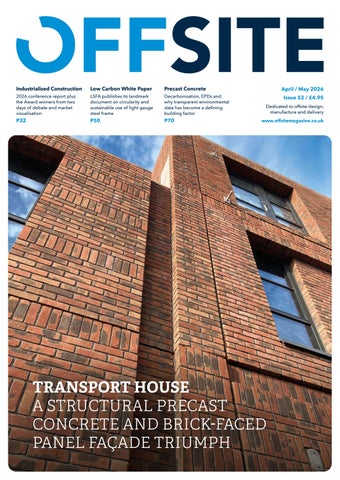
Offsite Magazine - Issue 52

Page 1


Industrialised Construction

2026 conference report plus the Award winners from two days of debate and market visualisation P32

Low Carbon White Paper

LSFA publishes its landmark document on circularity and sustainable use of light gauge steel frame P50

Precast Concrete Decarbonisation, EPDs and why transparent environmental data has become a defining building factor P70

Editorial

Gary Ramsay / Consultant Editor

T: 01743 290001

E: gary.ramsay@offsitemagazine.co.uk

Advertising and Events

Julie Williams / Digital and print sales

T: 01743 290042

E: julie.williams@offsitemedia.co.uk

Rhian Morris/ Event enquiries

T: 01743 290025

E: rhian.morris@radar-media.co.uk

Production and Finance

Sian Hawkins / Production

T: 01743 290006

E: sian.hawkins@radar-media.co.uk

Debra Brooks / Finance

T: 01743 290001

E: accounts@radar-media.co.uk

Publisher Offsite Media Ltd

Suites A & B Hermes House, Oxon Business Park, Shrewsbury SY3 5HJ

T: 01743 290001

E: info@offsitemagazine.co.uk

W: www.offsitemagazine.co.uk

Subscriptions

W: www.radarbookingsystem.co.uk/ offsite-magazine-subscription/

Print

Printed on FSC Mix paper by Buxton Press Ltd

Palace Road, Buxton, Derbyshire, SK17 6AE

T: 01298 212000

Progress or Slowgress?

Welcome to the latest edition of Offsite Magazine in which we carry reports from two key events that have thrown the spotlight on various aspects of the offsite and industrialised construction sector, highlighting its status as a maturing method of construction.

THE FOURTH MMC IRELAND NATIONAL CONFERENCE was a buzzing event to network and discuss the vibrant Irish offsite market. Strong government engagement and a rapidly expanding eco-system of manufacturers, designers and researchers, give the impression of an increasing understanding and balanced view of Ireland’s MMC sector. The Irish market faces many of the UK’s building dilemmas, but the aura surrounding it is bright.

The second Industrialised Construction Conference – held only a few weeks ago in central London – was also a vibrant space with two mind-expanding days of discussion surrounding factory-based manufacture, data-driven processes and supporting policy. But as I point out inside, while the tone across both days was upbeat and committed, the momentum to adopt more industrialised methods, alongside a willingness to use them, feels sluggish. It will not scale without fundamental changes to how the construction industry operates. The challenge is not a lack of technology, cutting-edge systems, product or even

Disclaimer

The content of Offsite Magazine does not necessarily reflect the views of the editor or publishers and are the views of its contributors and advertisers. The digital edition may include hyperlinks to third-party content, advertising, or websites, provided for the sake of convenience and interest. The publishers accept no legal responsibility for loss arising from information in this publication and do not endorse any advertising or products available from external sources. The publisher does not accept any liability of any loss arising from the late appearance or nonpublication of any advertisement. Content including images and illustrations supplied by third parties are accepted in good faith and the publishers expect third parties to have obtained appropriate permissions, consents, licences or otherwise. The publisher does not accept any liability or any loss arising in the absence of these permissions for material used in both physical and digital editions. No part of this publication may be reproduced or stored in a retrieval system without the written consent of the publishers. All rights reserved.

ideas, but the absence of the right conditions to enable those ideas to flourish and succeed.

What is the pace and trajectory of the UK’s offsite market then? The UK’s offsite construction market sits at a curious juncture where its benefits are widely acknowledged but endlessly seems to struggle to gain significant traction. Where does offsite sit on the Technology Adoption Curve? Having just looked up the stages, I hope it is not in ‘The Chasm’. One thing is for certain – the commitment of government departments in propelling real-life developments forward must be applauded.

Amongst our usual spread of content this issue we focus on the precast concrete sector. MPA Precast provide a lead feature on the importance of harnessing environmental product data within the built environment to help decarbonise – and related to this – they were hosts of an industry roundtable that unpicked the ways precast can contribute to a ‘climate resilient’ built environment.

The customary final thanks to all our contributors, advertisers, and supporters for their efforts and help with this issue. It is hugely appreciated.

Gary Ramsay | Consultant Editor Email: gary.ramsay@offsitemagazine.co.uk

We are always looking for the latest industry news, people appointments and project case studies using all types of offsite systems and products. For use both in print and online please send them to me at the contact email above.

Invaluable Resource for Construction Professionals

Celebrating all the benefits and achievements of offsite construction, the OFFSITE HUB features new and emerging technologies, informative project case studies and thought leadership articles from leading industry figures.

WWW.OFFSITEHUB.CO.UK

The perfect partner for the education sector

James Latham is one of the UK and Ireland’s largest independent distributors of timber, panels and decorative surfaces.

With a huge stockholding, solid supply chains and market-leading environmental credentials, we can supply everything you need, from standard construction products to high performing specialist materials

Carbon data available Great service Rapid delivery

Nationwide depots Product knowledge Huge stockholding

Scan the QR code to find out more

In terms of strength, workability, consistency and certification, WISA-Spruce Special is perfect for an industry that prizes quality, repeatability and accuracy.

• Structurally robust

• Dimensionally consistent

• Also available as a Class-B (B-s1,d0 and Bfl-s1) fire rated variant (WISA Spruce FR)

• Fully certified and sustainable Or visit our website at

FP McCann recently completed the New Multi-Level Residential Development, in Dagenham, East London. This is another successful partnership build with London-based residential and commercial property developer, Hollybrook and used an offsite manufactured structural and architectural precast frame system.

Transforming

Construction in Ireland

More than 400 delegates from across Ireland’s construction, manufacturing, policy and research communities gathered recently for the fourth annual MMC Ireland National Conference. What were its key comments and important messages?

Understanding The Compliance Gap

Building safety isn’t health and safety. As Ari Fatah, Technical Standards Manager at Veriforce CHAS explains, this critical point still causes compliance confusion.

Industrialised Construction Conference 2026

ICC 2026 offered a wide and generous scope of interest for all those wanting to know more about deeper and more integrated manufacturing aspects of the built environment.

44 A Pathway to Whole-Life Carbon Reduction

Richard Hipkiss, Development Director of the MPBA, sets out a compelling case for volumetric modular technology and industrialised methods accelerating the transition to low carbon construction.

48 Powering the Rise of Airspace Development

Nik Teagle and Martin Jamieson, joint Managing Directors of light steel frame specialists, Frameclad, are witnessing first-hand a quiet but transformative shift taking place ‘above’ the UK’s landscape.

50 Driving the Future Forward

The UK construction sector is entering a new era, defined by safety, precision, automation and digital integration. Reflecting this the LSFA has published a White Paper setting out a clear direction of travel for the light steel frame industry.

News and developments from across the UK offsite industry and wider construction arena including: Donaldson Timber Systems introduce a range of affordable house typologies, P+HS Architects and McAvoy partner in Bradford, and Liverpool named as a pilot region to improve UK construction productivity using more industrialised construction methods.

52 IC Awards 2026

Who were the stellar game changers and industry champions celebrated at the inaugural IC Awards?

58 Slow Housing Recovery, Rising Timber Opportunity

Figures from the Housing Market Report 2025 and associated industry data paint a picture of a UK housing market stabilising – how can structural timber help shift the homebuilding market forward quicker?

62 Industrialised and Sustainable Living

A new housing development in the Netherlands highlights the potential of large-scale modular construction using mass engineered timber. A development and approach where the UK lags behind.

64 Designing Out Rework: The Case For Standardised Construction

Craig Johnson, Senior Account Executive at Trimble, explores the value of standardised construction and how digital technology can solve one of the construction industry’s hidden financial burdens.

67 Precast Concrete

This issue’s special magazine section highlights some key buildings and businesses operating within one of offsite industry’s central manufacturing methods. Find out more about the precast approach from a range of specialists including a lead feature from MPA Precast and stunning precast and Passivhaus work at the Stephen A. Schwarzman Centre.

Amplify Your Expertise: Connect Your Brand with a Targeted Construction Audience Your CPD. Our Audience. Maximum Impact.

Fresh Face for Transport House

FP McCann recently completed the New Multi-Level Residential Development, in Dagenham, East London. This is another successful partnership build with London-based residential and commercial property developer, Hollybrook and used an offsite manufactured structural and architectural precast frame system.

THE LONDON BOROUGH of Barking-owned Transport House site in Dagenham, is the former office block home to the Unite trade union. The building consists of 149 brand new, sustainably heated residential properties with undercroft parking, which also serves a Premier Inn next door. The project is Hollybrook’s second collaboration between Barking and Dagenham council-owned BeFirst, a pioneering urban regeneration company.

With full adoption of modern methods of construction (MMC) on the build, FP McCann – the Tier 2, BIM Level 2-certified supplier – has been instrumental in the design, manufacture, and installation of the precast concrete structural frame and architectural brickfaced system. As on all such contracts undertaken by FP McCann, BIM Execution Plans (BEP) were prepared for the Transport House site development, demonstrating FP McCann’s proposed approach, capabilities, capacity and competence to meet stringent Employer’s Information Requirements (EIR).

MMC and precast approach

The FP McCann precast structural frame comprises precast concrete core and party walls, prestressed hollowcore flooring

planks and precast stair cores and stair landings. Integral to the structural frame itself are the architectural brick-faced insulated sandwich panels, which provide the building’s attractive external finish. Transfer slab cladding and ground floor cladding are other key precast concrete elements of the build. Many other MMC features included the supply and fix of galvanised conduits and the fair-faced finish to internal walls, allowing follow-on trades to complete their works in a timely and efficient manner. Co-ordinated works in conjunction with other contractors, incorporated the bolton stair and balcony fixings and the placement of bathroom, ensuite and utility pods. The accelerated construction time typically seen in such offsite precast concrete structural frame builds was evident in the Transport House project in Dagenham, which was completed in just 50 weeks.

Aesthetic and brick-faced style

The visual impact of the development is striking, as evidenced by the high-quality architectural brick-faced panels that seamlessly blend with the surrounding urban landscape. The meticulous detailing of the brickwork, with varied bonding patterns and

subtle tonal shifts, creates a dynamic, textured facade. This aesthetic excellence is achieved without compromising the building’s structural integrity or thermal performance, thanks to the integrated insulation in the sandwich panels.

Furthermore, the development incorporates thoughtfully designed communal spaces, including a vibrant, landscaped central courtyard that provides residents with a safe and engaging outdoor environment. The inclusion of play areas and green spaces within the courtyard underscores the project’s commitment to fostering a strong sense of community and enhancing the overall well-being of its inhabitants. The integration of these elements highlights the versatility and superior finish achievable with FP McCann’s precast solutions.

Commenting on the Transport House residential development, David Langley, Project Quantity Surveyor for Hollybrook, said: “Traditional construction methods, while tried and tested, are increasingly inadequate to meet the soaring demand for quality, affordable housing. The Transport House residential development is a clear demonstration that offsite modular precast concrete construction and MMC in urban locations, not only help address the current housing challenge but also lay the groundwork for a more efficient and sustainable homebuilding industry.

“By embracing these methods, we can build faster with construction times reduced by up to 60%, minimise our environmental impact and provide safe, affordable living space, delivering quality, sustainable living options for a diverse range of residents. The building is a great showpiece scheme in a key location, and we look forward to partnering with FP McCann on future keynote urban projects.”

Precast components

Precast concrete building frames are individual concrete components that make up structural systems. These include products such as vertical columns and balconies, horizontal beams, precast walls, and floor slabs. Each element is manufactured offsite to precise specifications using moulds and high-strength concrete mixes, ensuring consistency, accuracy, and quality. From a sustainability

Images 1-4: The visual impact of the development is striking with architectural brickfaced panels seamlessly blending with the surrounding urban landscape

perspective, precast concrete frames also offer clear benefits compared to other construction methods. Carefully controlled factory production generates less waste, reduces the number of site deliveries and has lower embodied carbon levels as the concrete is produced in factories that use renewable sources for power. FP McCann provides a full structural frame design, including cores, columns, beams, stairs and landings which can all be designed for a 2-hour fire rating. 

Starship and Vandersanden Team Up for Façade Future

Vandersanden, one of Europe’s leading brick manufacturers and developer Starship have announced a new strategic partnership to accelerate sustainable housing delivery across the UK. The pioneering new partnership was announced at Starship’s two-day event, Changemakers Live on 5 March.

With a shared forward-thinking approach and an ambition to deliver high quality housing, this new collaboration is set to reshape the landscape of offsite construction using advanced facade automation and next-generation modular development. Vandersanden’s fully integrated industrial facade solution, RoboBrick®, will support the partnership by offering a scalable, sustainable and highly efficient method of housebuilding. For Starship, the collaboration also addresses the need for greater facade capacity and consistency as the business continues to expand.

RoboBrick® is a total solution that automatically bonds brick slips to various substrates and can be incorporated into new and existing production lines. The comprehensive infrastructure supports quality, consistency, safety and speed, essential to Starship’s long-term delivery mode. The sustainable solution has already been proven in Europe to dramatically reduce waste, cutting raw material and energy use by up to 60% with brick slip technology, as well as a reduction in transport movement.

Maarten Leën, Director of Offsite Solutions & Innovation for Vandersanden, said: “This partnership represents a powerful step towards making offsite construction an accepted and trusted part of the UK’s building landscape. We’re committed to building something that delivers long-term value for the entire industry with a proven, high-quality solution. Offsite construction, supported by industrialised

facade systems, is one of the most viable solutions to increase the volume of housebuilding without compromising quality.”

The collaboration is a direct response to several longstanding issues in UK construction, including energy efficiency standards, skills shortages and the ongoing housing crisis. To support faster and more reliable housing delivery, RoboBrick® enables a factory-controlled facade process that avoids weather delays, reduces on-site risk and significantly shortens installation times.

The partnership builds on Vandersanden’s growing focus on the UK market, where it continues to strengthen its versatile offering and choice for developers, architects, contractors and other specifiers.

“Working with Vandersanden means we can push boundaries and deliver on our shared vision of transforming the UK’s housing market,” said Founder and CEO of Starship, Dave Dargan. “RoboBrick®’s integrated ecosystem gives us the tools to address industry challenges head-on by improving efficiency and helping us maintain the high level of quality we prioritise in our developments. Our collaboration with Vandersanden enables us to advance together, using established technologies and scalable methods that are already delivering results.”

The new partnership is a pivotal step in making offsite construction a trusted, mainstream solution in the UK. Vandersanden and Starship’s shared ambition will accelerate the adoption of high-quality, industrialised housing, helping to deliver millions of new, affordable homes throughout the country.

Source: www.vandersanden.com/en-uk www.starshipgroup.co.uk

News in Brief

Modular Social Housing Delivered in Hemyock

ZED PODS working in partnership with Mid Devon District Council has completed its latest development of high‑quality, energy‑efficient council homes at Eastlands, Hemyock. The modular homes transform a former area of underused garages and parking into five modern homes. Construction of the modules was delivered through the Prisoners Building Homes programme.

Integra Appointed to £500m Public Sector Framework

The Framework from public sector procurement organisation YPO has been designed to address the challenge of sourcing modern, adaptable and sustainable buildings to improve the public estate. Integra has a proven track record of delivering bespoke modular and anti vandal buildings of outstanding quality and has been appointed onto 11 lots within the framework, covering both permanent and hire buildings.

New Head for NG Bailey OSM

NG Bailey has named Paul Wylie as Managing Director of its Offsite Manufacturing (OSM) division, marking a major milestone in his 25 year career with the engineering leader. Wylie will oversee a critical part of NG Bailey’s engineering operations. Paul said: “I’m excited to lead the next phase of growth and continue pushing the boundaries of what modern methods of construction can deliver.”

FastHouse Expand Operations

FastHouse has announced that it has completed the incorporation of the Monaghan based Century timber frame business. Kingspan Group will retain a minority shareholding in the expanded FastHouse business. This represents a major milestone for FastHouse, which will see the company doubling its production capacity to 3,000 homes and increasing its workforce to over 380.

STEICO Wood Fibre Insulation Growth Plans

STEICO has expanded its specification team to support its strategy to drive forward the adoption of wood fibre insulation in mainstream housebuilding and construction. Newly appointed Specification Managers Andy Cook and Pete Kelly will work closely with architects, housebuilders, specifiers and contractors to provide technical advice to ensure compliance with the Building Standards.

*For further technical information and fire test reports, contact us on +44 (0)161 905 5700 or e-mail info@glidevaleprotect.com www.glidevaleprotect.com/frsolutions

Donaldson Timber Systems Introduces Affordable Housing Range

Donaldson Timber Systems has introduced a range of house types to meet the increasing demand for cost-effective, sustainable, and modern methods of construction (MMC) compliant housing solutions across the UK.

The Affordable Housing Range offers a carefully curated mix of 16 house types, designed to meet local housing need while maintaining delivery efficiency. The portfolio includes one, two, three and fourbedroom homes arranged in terraced, semi-detached and detached formats.

Each architect-designed house type has been developed around Donaldson Timber Systems’ Sigma II closed panel timber frame system, ensuring consistency in performance, manufacture and programme, which is backed by third party accreditations including BOPAS+, BBA and STA Gold.

As part of the ‘Smarter Inside’ approach, fabric performance is designed and built in, delivering lowenergy living, long-term durability and compliance with current and future regulatory standards, including achieving the performance of the Future Homes Standard with no additional works required on site. The housing range also meets and exceeds Homes England’s minimum requirement for a PreManufactured Value (PMV) of 55% using only the timber frame build system; and allows the frames to be windproof and watertight on site in one day.

The specified components are consistent, using a limited range of window sizes and uniform bathroom and WC setting-out to ensure the efficient procurement of materials from a variety of manufacturers, while reducing embodied energy usage through material optimisation and repeatability.

The homes are also land-efficient, with the width of each floorplan reduced to ensure roads, footpaths and services are minimised, and a consistent depth of floorplan, enabling seamless terracing and efficient master planning. The result is a flexible yet controlled housing portfolio that can be confidently deployed across a range of development sizes and locations.

While standardisation is key, each home incorporates individual design flexibility to factor in local need, planning context and long-term adaptability, such as identified space for future showers in ground floor bathrooms; additional kitchen storage; and space for air source heat pump hot water cylinders. This ensures Registered Providers retain control over specification and appearance, while futureproofing for simple adaptions to suit lifestyle changes or improved energy efficiency.

The house range is supported with a suite of information, including architectural drawings and schedules, Revit files and embodied carbon calculations and a PMV assessment.

The housing range is previewing to select affordable housing providers and local councils.

John Smith, Technical Director at Donaldson Timber Systems said: “This housing range has been specifically developed to respond to the pressures facing the affordable housing sector; delivering more affordable homes, faster and at lower cost, without compromising on quality, performance or compliance.

“Offsite timber frame construction is uniquely positioned to respond to this challenge. By moving elements of the build process into a controlled manufacturing environment, we reduce on-site labour requirements, improve quality consistency and accelerate programme delivery, while exceeding required performance standards and delivering quality homes that people want to live in. The result is a smarter delivery model that helps affordable housing providers build more homes, more efficiently, with greater confidence in cost, compliance, suitability and long-term performance.”

With over 50 years of offsite timber frame expertise, Donaldson Timber Systems offers unrivalled experience and knowledge in offsite construction, operating from a network of manufacturing and technical centres across the UK.

Source: www.donaldsontimbersystems.com

Coatbridge Housing Developments Taking Shape

CCG (Scotland) is making strong progress across two major affordable housing developments in Coatbridge, with works well underway at School Street and Dunottar Avenue. Together, the projects will deliver more than 220 new homes, supporting regeneration and investment across the town. CCG is working on behalf of North Lanarkshire Council, with the developments forming part of the council’s wider programme to deliver 6,000 new homes in the region by 2035.

At School Street, the former Columba High School site is being transformed into 127 new affordable homes, including flats, semi detached houses, and bungalows. The development includes 22 wheelchair suitable homes and 57 amenity houses, designed to adapt as tenants’ needs change over time.

Built using advanced offsite methods – the enhanced ‘iQ’ Timber System closed panel wall solution – to create the superstructure – the homes will feature both solar panels and EV charging infrastructure, with the first residents moving in this summer.

Work is also progressing at Dunottar Avenue in Shawhead, where 100 new affordable homes are being delivered on the site of former low rise flats. The development will comprise 76 houses and cottage flats and 24 flats, with 11 homes designed for wheelchair users. The homes will have low carbon heating technologies, including air source heat pumps and exhaust air systems, while the wider site will include new community amenities such as a multi use games area and play park.

School Street and Dunottar represent a combined investment of £50.5million, supported by £24.8million in grant funding from the Scottish Government.

David Wylie, Managing Director at CCG (Scotland), said: “These two developments represent a significant investment in Coatbridge and underline the strength of our long standing partnership with North Lanarkshire Council. Beyond delivering much needed affordable homes, both projects are creating local jobs, supporting skills and training, and generating

positive social and economic benefits for the surrounding communities.”

Alongside a third development in Viewpark, the developments will deliver 253 affordable homes by mid 2027, underlining the strength of the partnership between CCG and North Lanarkshire Council.

James Stevenson, Housing Development Manager added: “North Lanarkshire Council has one of the most ambitious new council housebuilding programmes in the country and is making real progress in delivering new homes for tenants across the area. The two Coatbridge developments being delivered by CCG are taking shape and will not only bring modern, affordable homes to the area but will roll out benefits to the local community, including jobs, work experience placements and support for community projects. These new homes transform local communities and meet the needs and aspirations of our tenants now and for generations to come.”

Source: www.c-c-g.co.uk

Polypipe Building Services (PBS) has appointed Tom Murray as Managing Director, strengthening its leadership team as the business enters a new development phase within the Genuit Group. The appointment follows wider changes across Genuit, designed to create clearer, customer-focused divisions, enhance collaboration and embed sustainability into every aspect of the business.

Polypipe Building Services Appoints New Managing Director

Murray’s promotion follows a period of strong commercial growth. In his previous role as Sales and Marketing Director, he expanded the company’s water supply and prefabricated systems offerings and reinforced its position as a drainage expert across the commercial building services sector.

The restructure also sees Andy Cullum, formerly Managing Director of Polypipe Building Services, take the new role of Managing Director of the Commercial Buildings Segment within Genuit’s Water Division, which consists of six businesses – SkyGarden, Permavoid, Effast, Cistermiser, Keraflo and Polypipe Building Services.

Commenting on his own appointment, Tom Murray said: “Polypipe Building Services has built a strong reputation over decades for technical expertise, product quality and close customer relationships. My focus now is to build on that, working with my colleagues at PBS and across the Group to leverage complementary capabilities and deliver more joined-up support, from specification and design through to delivery and installation.”

Andy Cullum added: “Tom has been instrumental in driving Polypipe Building Services’ growth and strengthening its position in the market. I’m confident he will continue to lead the business to new heights within the new Genuit Group structure, which in turn will enable us to enhance our value propositions to customers.”

Murray has been with Polypipe Building Services for three years, overseeing significant commercial progress and strengthening engagement with consultants, contractors and merchants. Under his leadership, the business will continue to build on its leadership in commercial drainage systems and deliver sustainable water management solutions backed by industry-leading technical support, and tools that support effective specification and installation.

Source: www.polypipebuildingservices.com

Polypipe Buildings Services are hosting a factory tour 28 May 2026, to register interest in attending: ellie.guest@radar-media.co.uk

Bradford Hospital Redevelopment Receives NHS England Funding Approval

P+HS Architects and leading offsite manufacturer McAvoy have confirmed that the Lynfield Mount Hospital New Build and Refurbishment project has received Full Business Case approval from the Department of Health and Social Care marking a major milestone for the £65million redevelopment scheme.

The approval enables the project to progress to construction stage – starting the transformation of Lynfield Mount Hospital into a modern, therapeutic mental health facility that better supports service users, staff and the wider Bradford community.

The scheme will deliver a combination of the refurbishment of bedrooms on two existing wards to achieve 100% en-suite provision, alongside the construction of a new modular two-storey ward block, providing more modern inpatient wards, improved clinical and therapeutic spaces, and enhanced staff environments. The design supports contemporary models of mental healthcare, prioritising dignity, safety, recovery and long-term flexibility.

Stephen Clayton, Preconstruction Director at McAvoy, said: “Achieving funding approval from the Department of Health and Social Care marks a significant step forward in the creation of new highquality mental healthcare facilities for the Bradford community.

The modular approach supports the creation of a flexible, therapeutic environment which will be delivered efficiently and with minimal disruption. We are committed to working alongside the Trust and project partners to ensure this facility is delivered to the highest standards without delay.”

Co-produced with Bradford District Care NHS Foundation Trust’s service users and clinical and estates teams, the design places patient wellbeing at its core. Access to natural light, views, outdoor space and calm, legible internal layouts have all been carefully considered to create an environment that supports recovery while enabling high-quality clinical care.

Therese Patten, Chief Executive of Bradford District Care NHS Foundation Trust, said: “The redevelopment of the central block will bring significant improvements to Lynfield Mount Hospital, to create a facility that supports the recovery and wellbeing of service users, and a better working environment for staff. We have worked closely with staff, patients, families, carers and partners to develop our plans and ensure that the redeveloped site can support the needs of our local communities for years to come. We are delighted to have received this final stage of approval as it gives us the go ahead to start making our exciting vision a reality.”

The redevelopment also aligns with wider NHS priorities around sustainability, quality of care and long-term value, with the scheme designed to meet modern environmental and operational standards.

Minister of State for Health, Karin Smyth, said: “We inherited crumbling hospitals that were not fit for purpose, with mental health patients suffering as a result, but projects like this demonstrate the real change being delivered by the government’s record investment as we rebuild the NHS. This improved Lynfield Mount Hospital will offer a safe and welcoming environment, helping patients’ recovery and boosting wellbeing.”

Cath Lake, Director and Mental Health Lead at P+HS Architects, added: “This project represents a significant step forward in the design of forward thinking, therapeutic mental healthcare environments. Funding approval from the Department of Health and Social Care reflects the strength of the clinical vision and the collaborative approach taken by the Trust and project team. We’re proud to be working alongside Bradford District Care NHS Foundation Trust to help create a facility that supports recovery, wellbeing for patients and staff.”

Source: www.pandhs.co.uk www.mcavoygroup.com

At MTX, our flexible funding and managed service options streamline the delivery of essential hospital infrastructure, ensuring your wards, theatres and clinical spaces are ready when patients need them most.

By consolidating build, maintenance, and operational costs into a single monthly charge, our approach simplifies budgeting, accelerates approvals and provides future-proofed support across every stage of your project - all whilst ensuring a faster route from concept to completion, without compromising on quality.

East Suffolk and North Essex NHS Foundation Trust
Frimley Health NHS Foundation Trust

Homes England’s National Housing Bank Officially Open for Business

Homes England’s National Housing Bank is part of a once-in-a-generation investment offer to accelerate delivery of new homes and mixed-use schemes, backed by a new Investment Prospectus that sets out the agency’s full range of funding and support.

Backed by the UK government, the National Housing Bank will work with housebuilders, developers, investors and registered providers to deploy up to £16billion of debt, equity and guarantees. The bank will also work with Mayors through Homes England’s new regional model to strengthen collaborative working with partners and leaders.

A subsidiary of Homes England, the bank is powered by the Agency’s expertise and will support the delivery of more than 500,000 homes and a raft of major regeneration and mixed-use schemes, alongside unlocking more than £53billion of private investment over the next ten years.

Launched on 1 April, it is supported by Homes England’s new Investment Prospectus, the Agency’s single, authoritative statement of how it invests to deliver homes and regeneration. With the bank at its core, the Investment Prospectus brings together for the first time Homes England’s full range of capital products, land, powers and technical expertise in one public document – making it easier for local leaders

and partner organisations to understand the role the Agency and the National Housing Bank can play in delivering their pipeline of housing and mixed-use schemes.

Headquartered in Leeds, the National Housing Bank will move quickly to back shovel ready schemes. It launches with the announcement that Homes England has contracted a new £100million partnership with Mansion House Compact signatory and Sterling 20 member, Aviva. Its lifetime objective is to build up to 3,300 well designed and sustainable homes for rent in underinvested areas of cities, including an initial 300 in Liverpool and Manchester.

Housing Secretary Steve Reed said: “Launching England’s first ever National Housing Bank underpins a new way of doing things as we accelerate housebuilding at scale and tackle the housing crisis head on. Now open for business, the Bank will rake in billions of pounds of essential private investment to get spades in the ground for half a million new homes. This is just one of the many levers we’re pulling to make sure we reach our 1.5 million target this Parliament.”

Amy Rees CB, Chief Executive of Homes England, said: “The launch of both the National Housing Bank and Homes England’s Investment Prospectus are a

watershed moment and mark an unprecedented scale of ambition and investment to deliver homes and regeneration across the country. Both institutions have up to £46billion of capital to deploy over the next decade, including £27billion of social and affordable housing grant, a share of £5billion for land and infrastructure and up to £16billion of debt, equity and guarantees. Our message to partners and investors is a simple one: please get in touch and talk to us. We are open for business and are committed to shaping the right solutions for a place or project.

Simon Century, Chief Executive of the National Housing Bank, added: “The National Housing Bank will back delivery at scale and act at pace, providing government-backed finance to de-risk projects and unlock delivery the market cannot change alone. Our ambition and scale as a public finance institution creates the conditions for long-term, stable investment, focusing on delivery and giving investors’ confidence whilst enabling more innovative, scalable delivery models. With delegated authority, we will take decisions quickly and proactively, acting as an enabler, not a barrier, to the market.”

Source: www.gov.uk/government/ organisations/homes-england

Western Delivers £25m Slough Community Diagnostic Centre

A new £25million Community Diagnostic Centre at Upton Hospital Slough, delivered by offsite manufacturers Western, has been officially opened. The landmark investment is set to transform access to vital test and scans for people living in and around Slough.

The 2,800sq m facility was delivered within 52 weeks using advanced offsite manufacturing and BIM 3D modelling. Modules were pre-assembled offsite and watertight within five days of installation, reducing disruption, waste and programme risk within a live healthcare environment. Western delivered a full turnkey design-and-build solution, including internal fit-out and external works such as car parking and EV charging infrastructure.

The centre will operate seven days a week, 12 hours a day, providing up to 150,000 additional diagnostic tests annually. Services include MRI, CT and ultrasound scanning, alongside respiratory and cardiology testing – supporting earlier diagnosis of conditions such as cancer and heart disease, reducing waiting times and relieving pressure on Wexham Park

Hospital and local GP practices. Conveniently located a 10-minute walk from Slough railway station and close to bus routes, the centre has been designed with accessibility at its core.

James Clarke, Chief Strategy Officer at Frimley Health NHS Foundation Trust said: “This is an exciting moment for the Trust and the people of Slough. The centre will play a vital role in addressing health inequalities by ensuring that diagnostic services are accessible to everyone, regardless of where they live.”

Developed following extensive public consultation in 2023, the centre reflects community feedback and a commitment to tackling health inequalities. The centre stands as a symbol of investment, innovation and community-focused healthcare, positioning Slough at the forefront of modern diagnostic provision.

“The Slough Community Diagnostic Centre demonstrates the strength of modern methods of construction in delivering high-quality healthcare infrastructure at pace,” said Rory McGuigan, Managing Director of Western. “By combining advanced offsite

manufacturing, BIM-led design and a full turnkey approach, we have been able to provide Frimley Health NHS Foundation Trust with a facility that is efficient, sustainable and future-focused. Most importantly, this centre will make a real difference to the people of Slough, enabling faster diagnoses, improving patient experience and supporting better health outcomes across the community. We are proud to have partnered on a project that reflects both innovation in construction and ambition in healthcare delivery.”

Source: www.westernbuild.com

For almost 3 decades, Combilift has been revolutionising how the customers handles materials. Our pioneering range of multidirectional and pedestrian forklifts, straddle carriers, mobile gantries and container loaders allows you to manoeuvre long and out of gauge loads safely, maximise productivity and increase the space available for storage.

CONTACT US TODAY

To find out how Combilift can help you unlock every inch of your storage space.

Liverpool Named Pilot Region in National Drive to Improve UK Construction Productivity

A new £85million national challenge is set to overhaul how Britain delivers sustainable social housing, schools, hospitals and public infrastructure, in a bid to boost a sector worth more than £250billion a year to the UK economy.

Liverpool City Region has been selected to host the first pilot as part of the Industrialising and Digitalising Construction Challenge. Working with Liverpool Combined Authority and the High Value Manufacturing Catapult, the pilot will apply innovative digital manufacturing processes to standardise ‘kits of parts’, improve digital co-ordination and provide greater certainty of demand. The Challenge is backed through the R&D Missions Accelerator Programme (R&D MAP) funded by UK Research and Innovation (UKRI).

Steve Rotheram, Mayor of the Liverpool City Region, said: “I’m incredibly proud that our area has been chosen as the first national pilot to modernise construction. Our region is home to pioneering expertise in modern methods of construction, advanced manufacturing and digital innovation, with the talent and political will to lead from the front. If we get this right, we won’t just build the next generation of affordable social housing, schools and hospitals – we’ll strengthen UK supply chains, boost productivity, and give manufacturers the confidence to invest in skills and capacity, helping to create good jobs, and drive growth across the country.”

As industry partners, Onward Homes and Torus Developments will test and refine the approach by trialling it in two social housing schemes. Their insights will help finalise a standard delivery model for adoption nationally. The approach is expected to transform social housing delivery in its first phase. Findings from the pilot will inform how the approach is refined, scaled and rolled out nationally, including across the wider public sector infrastructure delivery, including schools, hospitals and prisons across the UK in the future.

The challenge, which is the largest in the R&D MAP Growth Mission, also supports the government’s economic growth mission by increasing investment in manufacturing skills and technology to enhance capacity and close the productivity gap in the construction sector, which is consistently around 23% below the national average. Analysis suggests narrowing that gap could add up to £27billion in additional economic output over time, generating up to 380,000 new jobs.

The goal is to grow domestic manufacturing capability by improving productivity and reducing build times, reducing waste and improving cost predictability on publicly funded schemes an improving the sustainability of construction and the energy efficiency of public buildings.

Lord Vallance, UK Science Minister, said: “We are beginning our mission to transform the UK’s construction industry in Liverpool – a city which has long been at

the forefront of innovation and creativity. The digital technologies and manufacturing methods developed here will help us speed up how we can build more homes, schools, and hospitals right across the UK. This work will help us set the benchmark for how we deliver high-quality infrastructure more efficiently, directly benefitting communities. By supporting this initiative, we are backing more high-skilled jobs for Liverpool while also bringing our construction industry into the digital age.”

Katherine Bennett, CEO of the High Value Manufacturing Catapult, said: “Our focus is on turning ambition into action. By bringing together manufacturers, housing providers and public clients around shared standards and clearer demand signals, we can give industry the confidence to invest and expand capacity. That is how we move from isolated successes to a more resilient and competitive construction sector.”

Plans also include an Accelerator Centre to support product testing, workforce training and supply chain development in the near future. Further regions and projects are expected to follow as the challenge develops, informed by evidence gathered through the Liverpool pilot.

Image L-R: Steve Rotheram, Mayor, Liverpool City Region, Sue Hine, Client Account Director, Jacobs, Keith Waller, Programme Director, HVM Catapult

Source: www.liverpoolcityregion-ca.gov.uk

CPA Appoints New Deputy Chief Executive

The Construction Products Association (CPA) has announced the appointment of Amanda Long as its new Deputy Chief Executive. Amanda will join the Association on a part-time basis following the retirement of current Deputy Chief Executive, Jeff May. At a time of significant change for the construction sector, Amanda brings deep knowledge of the regulatory, commercial and policy landscape, including building safety, decarbonisation, sustainability and supply chain challenges. Amanda will continue her current part-time role as Chief Executive of CPI Ltd the not-for-profit body driving forward the Code for Construction Product Information, working with manufacturers and wider industry stakeholders to prepare for major regulatory reforms. CPI’s independent governance will continue to be led by the CPI Independent Chair and Board, and the CCPI assessment process is enacted by independent assessors.

“I am very much looking forward to working with CPA members and stakeholders to continue driving

progress on the key issues facing the industry,” said Amanda Long. “Additionally, I am keen to build on those foundations and support the industry on the many opportunities to deliver growth and innovation as we move forward.”

Amanda brings more than 25 years of experience in senior executive roles across national and international organisations, with extensive expertise in the construction and built environment sectors. She has played a leading role in raising standards across the industry including being instrumental in the establishment of both the Code for Construction Product Information and the Building a Safer Future Charter and running and developing the Considerate Constructors Scheme. Amanda brings significant experience in developing and leading national initiatives designed to improve product information, strengthen regulatory compliance, and support cultural change across the construction supply chain.

Commenting on the appointment, CPA Chief Executive Peter Caplehorn added: “Amanda brings

a wealth of experience from across membership organisations, with a strong track record of delivering value for members and driving growth. Her understanding of how to engage and support a range of memberships will be a significant asset to the Association.”

Source: www.constructionproducts.org.uk

Our AluSpace Interior Screening System is designed to divide or delineate both residential and commercial spaces, while at the same time providing an effective acoustic barrier. Choose from hinged single, double doors, pivot or sliding doors to accompany our stylish fixed glazed screen. This flexible and versatile system provides almost limitless design options whilst requiring minimal maintenance. AluSpace will provide many years of assured, reliable and robust performance.

For more information visit smartsystems.co.uk/aluspace E sales@smartsystems.co.uk /SmartArchitecturalAluminium

Hinged Sliding Pivot

The Cascade Delivers Affordable CLT Homes for Cardiff

An innovative new affordable housing development on City Road, Cardiff, has been completed, marking a significant milestone in sustainable urban living for the capital. The Cascade, delivered by Codi in partnership with Cardiff Council and contractor Langstone Construction Group, provides 48 one-bedroom apartments for social rent which will be let and managed by Cardiff Council, alongside two ground-floor commercial units that will support the ongoing regeneration of this busy city centre location.

Standing on City Road, The Cascade is the tallest residential building in Wales to be built using cross laminated timber (CLT) as its main structural material delivered by Eurban. The scheme has been supported by Welsh Government funding through the Innovative Housing Programme and Social Housing Grant, recognising its role in showcasing modern, low-carbon approaches to housebuilding in Wales.

Grant Prosser, Head of Development (East) at Codi, said: “The Cascade is a great example of how well-designed, modern homes can transform city centre living. This is about more than delivering new apartments – it’s about creating a safe, welcoming place in a fantastic location, where people can put down roots close to employment, services and public transport. We’re proud to have worked with our partners to bring forward a development that raises the bar for affordable housing in Cardiff.”

Designed with long-term sustainability and resident wellbeing in mind, The Cascade features no fossil fuel heating, with all apartments benefitting from electric heating systems. The homes are highly insulated and designed to consume very low levels of energy, helping to reduce household bills. Solar panels installed on the roof generate renewable electricity, while mechanical ventilation with heat recovery

EDAROTH, the social and affordable housing developer owned by AtkinsRéalis, has appointed Toby Bonner as Programme Director to bolster its capability and ambition to accelerate the delivery of high quality, sustainable homes across the UK.

Toby Bonner brings nearly 25 years’ experience in housing development, project management and large scale programme delivery to EDAROTH (Everybody Deserves A Roof Over Their Head) at a time when the UK housing sector is seeking new, scalable solutions to unlock supply. His experience and insight

(MVHR) systems provide fresh air while retaining heat within the apartments. Externally, the building features a plant-covered façade that cascades down the structure, helping to green the surrounding street. As well as softening the appearance of the building, it will improve air quality, support urban wildlife and provide natural shading and cooling for residents. With construction now complete, the new homes will soon welcome residents, providing high-quality, affordable accommodation in the heart of Cardiff, close to shops, services and public transport.

Cabinet Member for Housing and Communities, Cllr Lynda Thorne, added: “Demand for affordable housing in the city remains exceptionally high, and developments like The Cascade show what can be achieved when the Council and our housing association partners work together with a shared purpose. By embracing innovation and collaboration, we are not only increasing the number of affordable homes available but also creating sustainable, future proof places for residents to thrive.”

Source: www.codigroup.co.uk

EDAROTH Appoints Programme Director to Scale UK Delivery

into the challenges facing housing associations, local authorities and developers today strengthens EDAROTH’s ability to scale-up its operation to meet the demands of the UK housing sector.

“I’m excited by the opportunity to help shape EDAROTH into a delivery partner of choice for the sector,” said Toby Bonner. “With the broad expertise of AtkinsRéalis behind us, we have the capability to offer something genuinely additive to the market which means homes delivered quickly, reliably and with a clear focus on long term performance. My priority is to accelerate the pipeline to help drive substantial, tangible growth and I believe modern methods of construction (MMC) and industrialised delivery models must play a pivotal role in that, if the UK is to address long standing supply gaps.”

Toby Bonner added that while traditional development will continue to be essential, ‘it’s not going to get us to where we need to be’ and

emphasised that organisations across the sector are increasingly eager to explore new delivery models that reduce programme risk, speed up delivery and provide long term quality assurance.

Mark Powell, Managing Director of EDAROTH, added: “Toby brings vast sector knowledge, strategic leadership and a passion for innovation to EDAROTH at a crucial time for the business. His appointment reinforces our commitment to scaling-up EDAROTH and delivering high quality, energy efficient homes at pace.”

Bonner joins EDAROTH from L&Q, where he served as Director of Development & Project Management, overseeing the delivery of more than 10,000 homes and commercial units. His earlier career includes more than a decade at Madlins LLP and senior roles in development and asset management across the housing sector.

Source: www.edaroth.com

Get the Radar Media marketing advantage

As the offsite industry’s leading communication specialists, we have over 15+ years’ experience working with businesses operating in the structural timber sector –driving leads, visibility and growth for our clients.

Future Homes Standard Finally Published

The long-awaited publication of the UK’s Future Homes Standard (FHS) – due to take effect in March 2027 – triggered a broadly positive reaction across the housing, construction, and energy industries.

As outlined by the Ministry of Housing, Communities & Local Government (MHCLG): “The Future Homes and Buildings Standards will make sure that new homes and non domestic buildings are future proofed with low carbon heating and high levels of energy efficiency. Homes and buildings constructed to these standards will not require retrofitting to become zero carbon in use once the electricity grid is fully decarbonised.”

While largely welcomed for boosting the clarity and direction of travel toward low-carbon homes and the UK’s net zero strategy, concerns remain around cost, timing, skills issues, and policy gaps with a focus on how new homes will be planned, costed and delivered.

A dominant theme in industry reaction was relief that long-awaited details have finally been confirmed. After years of delay since its original conception in 2019, many stakeholders see the FHS as providing the regulatory certainty needed to plan investment and scale delivery. Housing bodies and developers have described it as a “final piece of the jigsaw” that enables expansion of building programmes and aligns the sector with net zero targets.

Manufacturers and supply chain firms similarly welcomed the announcement as a “hugely positive step,” highlighting that clear long-term rules allow them to invest in low-carbon technologies such as insulation, solar panels, and heat pumps.

The standard is expected to reduce emissions from new homes by at least 75% compared to 2013 levels, while lowering energy bills and improving comfort for occupants – critical for social housing.

Although earlier consultation suggested much stricter fabric standards, the Government has confirmed that the minimum fabric requirements will remain broadly aligned with Part L 2021. Compliance will focus on insulation, airtightness, and careful detailing to reduce heat loss. While fabric remains key, low carbon heating and renewables are now more important for new carbon targets.

“Housebuilders will be pleased today,” said Neil Hargreaves, Managing Director, Knauf Insulation. “A standard to deliver more efficient and comfortable homes for their customers, but without requiring wholesale reinvention. In most cases, fabric compliance will be readily achievable using noncombustible insulation in 150mm wall cavities and more efficient lofts. That should buy space to address an inherent mid-term risk. With fine-tuned heat pumps replacing brute force gas boilers, any fabric

performance gap will be much more keenly felt by homeowners (and seen on their electricity bills). For all housebuilders, the right Future Homes adoption strategy will include design and process choices that mitigate this risk to prevent future headaches.”

More broadly, the FHS is framed as aligning housing delivery with national goals on climate change, energy security, and public health. It is widely seen as a necessary step to avoid costly retrofitting of new homes in the future and to ensure that the UK’s housing stock is fit for a decarbonised electricity grid. Despite this support, concerns about cost remain central. Estimates suggest the standard could add several thousand pounds per property, raising questions about development viability and whether costs will be passed on to buyers.

Siobhan Cross, Partner at Pinsent Masons said: “These new standards are overdue but welcome.

The Future Homes Hub has launched a campaign to help the homebuilding sector prepare for the implementation of the Future Homes Standard. Based on real-world experience, the ‘Future Homes Standard Essentials’ set out seven critical actions to help homebuilders and their advisors to de-risk the delivery of more sustainable homes that are comfortable, healthy, low-energy, zero carbon ready and aligned with the future energy system. Two Future Homes Standard Technical Conferences focusing on the practical realities of how to deliver compliant, healthy, high-quality homes will take place on 9 June at Leeds Beckett University and 17 June at Central Hall Westminster.

The Climate Change Committee made it clear last June that the building sector needs to double its rate of emissions reductions between 2025 and 2030 if the UK is to meet its 2030 emissions reduction obligations under the Paris Agreement. The fact that these new standards will not bite until March 2027 – and not fully bite until the end of the transition period in March 2028 – puts that trajectory at risk. Valuable time has been lost over the last decade.”

Ed Lockhart, Chief Executive of the Future Homes Hub said: “The publication of the Future Homes Standard isn’t just about a change in regulation – it’s a promise to consumers that new homes will be more comfortable, more efficient, and more secure against the volatility of unstable fossil

What to do? Developers for New Housing Should Now Consider

• Heat pumps or heat networks on every new scheme

• Solar PV on most roofs

• Earlier design co-ordination

• Reviews of site layouts, plant space and electrical capacity

fuel markets. The Future Homes Hub is facilitating partnership across the whole housing ecosystem including sharing solutions between homebuilders, housing associations and developers of all sizes to ensure residents feel the full benefits, starting with the Future Homes Standard Ready campaign.”

Overall industry reaction to the FHS can be categorised as ‘cautiously positive’. Stakeholders broadly support its goals and welcome the clarity it brings after years of uncertainty. However, this is tempered by concerns about costs, delivery capacity, and whether the policy goes far enough – or indeed fast enough – to meet the UK’s climate ambitions.

Find out more at: https://bit.ly/4sWPSbF

Glenigan’s April Construction Index has uncovered an industry struggling to cushion the blows from on-going international conflict and a persistently weak economy. The Index focuses on the three months to the end of March 2026 and provides a detailed and comprehensive analysis of year-on-year construction data, giving built environment professionals a unique insight into sector performance over the last 12 months.

April’s Index highlights the serious challenges facing the UK construction sector, ‘which seem to be relentless’. The bulletin said: “Industry remains in the tight grip of decline, which is having a deeply damaging effect, pushing its resilience to a breaking point.

A phenomenal series of socio-economic events and foreign policy decisions have resulted in a severely disrupted supply chain and unprecedented market volatility – stalling activity, flattening margins and denting profits.

“The US-Israel/Iran War started at the end of February resulting in considerable uncertainty that’s set to keep sector performance subdued. Whilst some of the negative effects are being felt in the here and now, the expected aftershock of the continued closure of the Strait of Hormuz, alongside the increasing threats posed to the Suez Canal and Red Sea, mean disruption is predicted to continue through Q2 and Q3 2026.

Glenigan Reports UK Construction Activity Suffering

“New projects commencing in the coming months are expected to be impacted. This comes after work starting on site fell once again, particularly when seasonally adjusted, dropping by 17% compared to Q4 to finish almost a fifth (-18%) below 2025 levels.

“Residential construction tumbled yet again, as international conflict, persisting confusion around planning policy and a weak economy continue to hinder development. Ice-cold investors and apprehensive potential buyers are keeping their hands firmly in their pockets for the time being. Private housing constructionstarts declined by 9% against the preceding three months and by 34% against the previous year. Social Housing starts were similarly depressed, dropping by roughly a quarter (-24%) against the preceding three months and by 16% against the previous year.”

New CEO at Reds10

Reds10 has appointed Ryan Geldard as its new Chief Executive, as part of a wider restructure that brings the vertically integrated business into a new group structure along with its sister companies. Under the changes, Reds10 Founder and Chairman Paul Ruddick takes the new role of CEO of Reds10 Group, overseeing a family of nine businesses that sit within the Group. Paul will also continue in his role as Reds10 Chairman.

Ryan is currently Reds10 Managing Director –Offsite, and takes the role of CEO of Reds10, assuming day-to-day leadership of the business and driving forward its mission to industrialise construction, embed AI across its operations, and deliver exceptional value to clients.

Reds10 deploys offsite manufacture and industrialised construction to design and build highquality sustainable buildings for the public sector, with a particular focus on defence, education, justice, health, as well as temporary accommodation and social housing.

Paul Ruddick, Chief Executive of Reds10 Group, said: “The creation of Reds10 Group marks an

important milestone for our business. After a period of consolidation and significant investment in our manufacturing facilities and data platform, we are now driving the wholesale industrialisation of design, production and construction, with AI integrated at every stage. Bringing our family of businesses together under one group is a crucial step in that journey and provides a strong platform for continued growth.”

Ryan Geldard added: “It is incredibly exciting to take on the role of chief executive of Reds10, leading a talented and dedicated team as we accelerate our mission to industrialise construction. Our commitment to innovation ensures we remain at the forefront of transforming the construction industry. In recent years we’ve strengthened our position in defence, justice, and education, delivering sustainable, high-quality public sector buildings at pace, and are now expanding into health and affordable housing. I’m looking forward to leading Reds10 through this next phase of growth.”

The restructure comes after Reds10 reported robust financial results for the 2024/25, with revenue of £144.7million and an industry-leading operating

Glenigan’s Allan Wilen said, “All three main verticals: housing, non-residential buildings and civil engineering are considerably lower than a year ago and on the previous quarter on a seasonally adjusted basis. The sector is fighting on all fronts, home and abroad. Particularly, the Iran War will depress activity further nearterm as private developers and house purchasers delay investment decisions due to fears of higher than anticipated interest rates, rising material costs, spiralling energy costs and stalled economic growth. It will have a knock-on effect on the non-residential verticals which, although many have ring-fenced funding, will no doubt be putting activity on hold to ensure they don’t waste budgets whilst rates spike.”

Source: www.glenigan.com

margin of 4.8%. Reds10 has set out an ambitious plan to grow its revenue to £500million and is targeting an expansion into the healthcare sector, as well as the affordable housing and temporary accommodation sectors, providing high quality sustainable homes for local authorities to help them tackle the housing crisis in their communities. Reds10 manufactures all its buildings offsite at its advanced construction facility in Driffield, East Yorkshire, where it has five factories totalling 300,000sq ft.

Source: www.reds10.com

Transforming Construction in Ireland

More than 400 delegates from across Ireland’s construction, manufacturing, policy and research communities gathered recently for the fourth annual MMC Ireland National Conference. What were its key comments and important messages?

THE EVENT has rapidly established itself as the country’s leading forum for Modern Methods of Construction (MMC), offsite manufacturing and industrialised construction. Held on 5 March at The Johnstown Estate, Meath and set against the backdrop of Ireland’s urgent need to accelerate housing delivery and improve construction productivity, the conference brought together a broad range of policymakers, developers, manufacturers, architects, engineers and academics to examine how to scale the adoption of MMC technologies to meet national targets.

Over the course of a packed programme of presentations, panel discussions and interactive audience polling, one message came through loud and clear: Ireland’s MMC sector has made impressive progress in the past 12 months – but the next phase will require even greater collaboration, standardisation and investment in skills.

The event was chaired by Darren Richards, Managing Director of Cogent Consulting, who reflected on the growth of the conference itself, saying: “This is the third MMC Ireland conference that I have had the pleasure of chairing, and without doubt it is the biggest

and best to date. The level of engagement, the quality of discussion and the momentum we are seeing across the sector clearly demonstrates the significant progress that has been made in the past 12 months.”

Government commitment and national momentum

With strong representation from government, industry and academia, the conference provided a timely snapshot of a sector moving rapidly from innovation to implementation. The scale of momentum was reinforced by the contribution of two senior ministers who addressed the conference.

James Browne, Minister for Housing, Local Government and Heritage, spoke about the central role MMC must play in addressing Ireland’s housing crisis and emphasised that modern manufacturing-led construction methods are no longer experimental solutions, but essential tools for delivering the volume of homes Ireland requires.

Minister Browne highlighted the importance of procurement reform, pipeline certainty and industry collaboration to ensure MMC manufacturers can scale production with confidence. These were

points also picked up by Pat Kirwan of Reddy Architecture, who is leading a working group on procurement reform and design-led advocacy to create conditions for successful MMC Adoption.

Alongside this, Marian Harkin, Minister for the Department of Higher and Further Education, Research, Innovation and Science, addressed the conference with a strong focus on workforce development and research capacity.

Minister Harkin emphasised that industrialised construction represents not only a technological transformation, but also a skills transformation, requiring new training pathways, apprenticeships and academic partnerships to support factory-based manufacturing and digital design processes.

Both ministers acknowledged that the progress made by the Irish MMC sector over the past year has been remarkable. Importantly, there was clear agreement across government and industry that the trajectory of MMC adoption in Ireland is now aligned with national housing ambitions, and that industrialised construction will play a major role in addressing the country’s housing shortage in the coming years.

Housing at the heart of the conversation While the conference programme addressed a wide range of topics – including policy, skills, digitalisation and innovation – the dominant theme throughout the day was unmistakably housing delivery.

Ireland’s construction sector is under immense pressure to deliver homes at unprecedented scale while maintaining high standards of design, sustainability and affordability. Speakers repeatedly emphasised that traditional construction methods alone will struggle to meet these targets. Instead, manufacturing-led delivery models – combining offsite production, digital design and standardised components – are increasingly seen as the only viable pathway to achieving the required levels of productivity.

However, as many speakers pointed out, scaling MMC requires a delicate balance between standardisation and design quality. Whilst repeatable layouts, pattern-book housing designs and componentbased construction systems enable factories to operate efficiently and reduce cost and programme risk, housing must still respond to planning requirements, urban context and architectural quality. This tension between efficiency and design excellence was a recurring theme in discussions throughout the day.

Standardisation: the key to scaling MMC If there was a single concept that dominated discussions across every session, it was standardisation. From layouts to structural systems and individual components, speakers emphasised that the success of industrialised construction depends on moving away from bespoke design approaches towards repeatable, platform-based systems.

This theme was explored in depth during the conference’s Product and System Standardisation sessions, which included presentations from Brian Mallon - Hawkins\Brown, Oliver Kinnane - University College Dublin, Dr Daniel McCrum - UCD & Construct Innovate and Tony Woods - Midland Steel. These presentations demonstrated how digital design platforms, standardised structural systems and manufacturing-ready detailing can unlock significant improvements in productivity.

Research led by Construct Innovate is supporting the development of standardised Category 2 MMC light steel frame systems, enabling greater consistency across projects and improving certification pathways. Similarly, initiatives within the timber frame sector are helping to establish clearer standards and expand capacity for panelised systems. Colm McHugh from Construct Innovate, highlighted emerging research around homegrown timber supply and indigenous cross laminated timber (CLT), which could play an increasingly important role in Ireland’s low-carbon construction strategy.

Learning from the UK experience Ireland’s MMC strategy has been influenced in part by the UK’s approach over the past decade, particularly around Pre-Manufactured Value (PMV) targets and procurement frameworks encouraging MMC adoption. However, the Irish sector has also learned valuable lessons from the UK’s experience.

One of the key observations discussed during the conference was that UK policy initially placed significant emphasis on Category 1 MMC (3D volumetric modular construction). While volumetric solutions have delivered impressive projects, they have also faced challenges related to logistics, cost structures and market adoption. This has created significant issues around pipeline development and consistency, which as seen several large manufacturers fail over the last few years.

MENTIMETER INSIGHTS – WHAT THE INDUSTRY REALLY THINKS

Throughout the day delegates were invited to share their perspectives via a series of live Mentimeter polls, providing real-time feedback on industry and sector priorities. Two key questions asked of delegates included: What do you hope to gain most from the conference? Responses highlighted strong interest in:

• Understanding the latest MMC trends

• Identifying practical solutions for live projects

• Building industry partnerships

• Learning more about government policy and funding.

And secondly a poll asked: Where MMC Ireland should focus its policy advocacy efforts? Key priorities identified included:

• Procurement reform to support MMC adoption

• Establishing long-term public sector MMC pipelines

• Improving regulatory clarity and certification processes.

Delegates were also asked to identify the biggest barrier to workforce growth, with responses ranging from shortages of factorybased skills to limited MMC knowledge among designers and consultants.

Later polls explored barriers to standardisation and priorities for innovation over the next two years, including digital design tools, factory automation and lowcarbon materials. These insights will now help shape MMC Ireland’s programme of work over the next 12 months.

Images 1-2:
The fourth MMC Ireland National Conference revealed a thriving sector full of encouraging signs for future growth and development

As a result, the Irish MMC sector is increasingly gravitating towards Category 2 MMC – panelised systems such as timber frame and light steel frame – these technologies offer greater flexibility, easier integration with traditional construction processes and improved scalability across the housing sector. The consensus among many delegates and speakers, including Ronan Lonergan, Pre-Construction and Innovation Lead from Cairn Homes (one of Ireland’s largest residential developers) was that a balanced MMC ecosystem, incorporating multiple technologies via an advanced digital toolkit was essential for long-term success, rather than relying on a single category.

Skills and workforce transformation

If standardisation is the technical challenge facing MMC adoption, skills and workforce capacity may be the industry’s most pressing operational challenge. This was successfully outlined by Linda Kane from the Department of Enterprise, Tourism and Employment, who spoke alongside Sarah-Jane Pisciotti, Innovation and Design Director at Sisk Group, Irelands largest contractor, who addressed future skills needs and the delivery of oversight and momentum around the MMC Action Plan. Several conference sessions focused on how Ireland can attract and develop the workforce required to support industrialised construction. Speakers including Caroline O’Laochdha from Vision Built, and representatives from the Louth and Offaly Education and Training Board (LOETB), who have pioneered the Mount Lucas National Construction Training Campus, and St. Andrews Resource Centre highlighted the growing demand for skills in areas such as:

• Factory-based manufacturing

• Digital design and BIM co-ordination

• Installation and assembly of offsite systems

• Robotics and automation

• Quality assurance and production management.

One of the key themes was that the transition to industrialised construction requires a cultural shift across the entire sector, from design teams and contractors to educators and policymakers. Encouragingly, several government-backed initiatives are already supporting this transition. These include expanded training programmes, partnerships with national training centres and increased engagement between academia and industry. The message was clear – Ireland must create attractive career pathways into MMC, particularly for younger professionals and those transitioning from other industries.

Procurement reform and pipeline certainty

While technological capability and workforce development are critical, several speakers emphasised that the biggest barrier to scaling MMC may still lie within procurement structures. Manufacturers have invested heavily in new factories, equipment and workforce capacity in anticipation of increased demand. However, without consistent pipelines of projects, these investments carry significant risk. Conference discussions highlighted the need for procurement models that enable:

• Aggregated demand across multiple projects

• Long-term frameworks

• Repeatable housing designs

• Standardised specifications.

Such approaches would provide greater certainty for manufacturers while enabling public sector clients to benefit from economies of scale and reduced delivery risk.

Digital innovation and industrialised construction

The final sessions of the conference turned attention towards the technologies driving the next phase of industrialised construction. Speakers including Lars Nystrom, Autodesk, Matthew Lenehan, Murphy, Gabriel Prior, Nua Manufacturing/ Glenveagh, Charlotte Garrett, KOPE and Saint-Gobain’s Tom Cox, that demonstrated how digital workflows, manufacturing processes and component-based design are reshaping construction delivery. Key innovations discussed included:

• BIM-driven design-to-manufacture workflows

• Automated factory production systems

• Digital kit-of-parts design platforms

• Robotics and data-driven construction processes.

These technologies are enabling construction to move beyond isolated offsite components towards fully integrated industrialised delivery models.

Collaboration and the future

Beyond the presentations and panels, one of the defining features of the conference was the level of engagement between delegates.

From the early morning networking sessions through to the Autodesk-sponsored evening drinks reception, conversations continued throughout the day as industry leaders explored new partnerships and collaborative opportunities.

The conference has now firmly established itself as the place to be for Ireland’s MMC community, providing a unique environment for knowledge exchange and relationship building. Reflecting on the day, Paul Tierney, CEO of MMC Ireland, commented on the energy and engagement from the sector. “The energy in the room today has been fantastic,” said Paul. “There is a real sense of momentum across the sector, and a growing determination among our members and delegates to rise to the challenges facing Ireland’s housing delivery. The collaboration and ideas we have seen today demonstrate that the MMC community is ready to play its part.”

The key conference takeaway is that Ireland’s MMC sector is entering a critical phase of growth, with significant progress made over the past year in aligning government policy, industry capability and research initiatives. However, delivering the scale of housing Ireland requires will depend on maintaining this momentum and addressing several key priorities, that encouragingly, are already underway.

These include standardising housing designs and components, reforming procurement to support manufacturing pipelines, expanding workforce training and education, accelerating certification and regulatory alignment plus continuing innovation in materials and digital technologies. Projects such as Standardize, alongside new EU-funded research collaborations led by MMC Ireland, will further explore how standardisation and industrialised construction can scale across the sector.

Now in its fourth year, the MMC Ireland National Conference has firmly established itself as the country’s annual gathering for industrialised and modern methods of construction. With growing attendance, strong government engagement and a rapidly expanding ecosystem of manufacturers, designers and researchers, the conference reflects the increasing maturity of Ireland’s MMC sector.

Much encouraging progress has been seen over the past year but the work ahead remains significant. Yet if the energy, ideas and collaboration demonstrated at this year’s event are any indication, the industry appears ready for the challenge. Planning is already underway for the 2027 event where the conversation around how Ireland builds its future homes is set to continue. 

Find out more at: www.mmcireland.ie
Image 3: Marian Harkin, Minister for the Department of Higher and Further Education, Research, Innovation and Science
Image 4: Paul Tierney, CEO, MMC Ireland

Understanding The Compliance Gap

Building safety isn’t health and safety. As Ari Fatah, Technical Standards Manager at Veriforce CHAS explains, this critical point can still cause compliance confusion.

THE BUILDING SAFETY ACT (BSA) came into effect nearly three years ago, marking a significant shift in safety and accountability for UK construction. However, many organisations are still grappling with what compliance looks like, and how it should be evidenced.

For contractors, the instinct has been to demonstrate building safety compliance through traditional health and safety documentation. This is contributing to a concerning evidence gap, where organisations believe they and their supply chains are compliant, but they remain unable to demonstrate meeting their statutory duties.

Building safety vs health and safety

Building safety and health and safety represent fundamentally different obligations and should not be conflated. Health and safety is focused on preventing injury and ill-health. Within the offsite sector, this focuses on the mitigation of immediate risks, such as working at height, plant movement, and factory floor logistics.

Building safety relates to the built asset, and its integrity throughout its lifecycle. It requires key information, including design decisions, material suitability, individual competencies, and safety critical information such as material tolerances, to be fully considered, recorded and traceable. These decisions ensure that the building remains safe throughout its lifespan in line with the amended Building Regulations.

This distinction is important for supply chain compliance and risk management. The BSA introduced clear lines of personal accountability, meaning senior officers and duty holders can be held directly responsible for compliance failures.

The Building Safety Act compliance gap

For offsite manufacturers and installers, where safe and efficient on-site assembly depends on competent professionals, building safety compliance must be robust and demonstrable. However, confusion between health and safety and building safety is contributing to a significant compliance gap. Many organisations continue to submit health and safety records to demonstrate BSA compliance, despite these not addressing the Act’s requirements.

An important factor in closing this gap is competence. Under the BSA, individuals must be able to evidence their skills, knowledge, experience and behaviours (SKEB) to demonstrate suitability for their roles. While contractors can evidence skills and knowledge through qualifications and training, they are often less able to demonstrate how experience and behaviours are assessed and verified. This remains a critical weakness.

Organisations must also support the ‘Golden Thread’ – the requirement to maintain accurate, accessible and traceable information throughout a building’s lifecycle. This ensures that key decisions and justifications are recorded and can be revisited.

Images 1-3:
Building safety and health and safety represent fundamentally different obligations for compliance

The Building Safety Regulator (BSR) is reinforcing these requirements through its Gateway approvals process for high-risk buildings (HRBs), including high-rise residential buildings, hospitals and care homes. Gateway 2 approval must be secured before construction begins and requires organisations to demonstrate how designs and specifications meet building safety requirements.

However, Andy Roe, chair of the BSR, has highlighted that many firms are still submitting incorrect or insufficient documentation for Gateway 2 approval. This reinforces the scale of misunderstanding over what constitutes compliant evidence. With Gateway 2 approvals taking three to four months, incorrect submissions can result in significant project delays, financial implications and avoidable disputes, often revealing compliance issues at a late stage.

Bridging the knowledge gap

One of the most significant challenges facing the industry is understanding what compliance requires in practice. While tier-one contractors may have dedicated compliance teams, much of the supply chain operates with limited internal resources, knowledge and time, often relying on external consultants or outdated procedures that do not fully address BSA requirements.

This creates a false sense of compliance. Organisations produce health and safety policies, training records or risk assessments, but these rarely demonstrate the competence, design assurance and information traceability required.

Closing this gap will require greater industry wide education on the type and quality of evidence required to support building safety obligations. It will also require a shift towards compliance systems that capture competence, accountability and project-critical information across the entire supply chain. For the offsite sector, where speed, precision and co-ordination are essential, ensuring that this information is accessible, traceable and verifiable will be critical for regulatory compliance and meeting client expectations.

The importance of verifiable evidence

Ultimately, this depends on the ability to demonstrate clear, verifiable evidence of competence and compliance through the supply chain.

One effective approach is structured supply chain prequalification. The Common Assessment Standard (CAS) provides a consistent framework for assessing contractor competence and organisational governance before work begins. It evaluates contractors across 13 areas of risk management, including building safety, financial stability, and corporate and professional standing.

Certification schemes such as CHAS Elite provide a route for organisations to achieve CAS certification, offering independent assessment against these criteria. The standard provides greater transparency and assurance for clients, while enabling contractors to demonstrate competence and credibility. Certification supports compliance, strengthens trust and improves positioning for future tenders.

Most importantly, robust prequalification helps ensure that organisations and individuals can evidence the competence and governance required under the BSA, reducing risk and supporting accountability throughout the supply chain.

A focus on meaningful compliance

For offsite manufacturers and their supply chains, closing the gap between traditional health and safety documentation and true building safety compliance is critical. Doing so will support regulatory approval processes such as Gateway 2 and build long-term confidence in the sector. Achieving this requires a clear understanding of the distinction between health and safety and building safety, a stronger focus on competence and traceability, and the adoption of systems that provide verifiable, lifecycle-based evidence. Only then can organisations demonstrate the level of accountability and assurance the Building Safety Act demands. 

Image 4
Ari Fatah, Technical Standards Manager at Veriforce CHAS

Moving from Ambition to Operation

Held on the 21-22 April in central London, the second Industrialised Construction Conference (ICC) offered a wide and generous scope of interest, for all those wanting to know more about making manufacturing a deeper and more integrated aspect of the built environment. Gary Ramsay picks out some key themes.

THE ROYAL COLLEGE OF PHYSICIANS was the venue for two days of serious, intense and wideranging discussion. Bringing together industry leaders, thought-leaders, policymakers, and innovators at a moment described as a ‘critical inflection point’. The tone across both days was clear – while momentum is building, the UK’s quest to adopt more industrialised construction will not scale without fundamental changes to how the industry operates. The challenge is not a lack of technology, cutting-edge systems, product or even ideas, but the absence of the right conditions to enable those ideas to flourish.

Across both days there were many repeated concepts that are either acting as barriers to wider adoption, or as enablers to create a fresh climate where industrialisation can make its presence felt.

Pipeline is so important

Central to many of the presentations was the concept of a stable and visible pipeline. Manufacturing-led construction depends on predictability. That means technology-driven factories, supply chains, and investment models all require consistent demand to operate efficiently. Yet the construction sector continues to be defined by volatility – albeit some of it stemming from wider economic directions, but stop-start project pipelines, shifting priorities, and uncertain funding, all undermine confidence and limit the ability of businesses to invest in long-term

capabilities with any degree of confidence. Despite significant planned infrastructure investment over the next decade, concerns remain about whether this pipeline is sufficiently stable and transparent to support industrialisation at scale.

Public sector helps forward momentum

Public sector programmes are currently providing the strongest foundations for genuine progress. The NHS, Department for Education, MoD and Ministry of Justice are departments looking to create initiatives for wider standardised design to demonstrate how aggregation of demand and repeatable solutions can unlock efficiencies. What does an aggregated hospital or schools programme deliver? When projects are bundled, specifications aligned, and outcomes clearly defined, industrialised approaches can thrive. The public sector is effectively acting as a catalyst that 

KEYNOTE HIGHLIGHT

Opening the Conference, Dr David Hancock MBA, Construction Director and Infrastructure Lead at NISTA, placed industrialised construction firmly within the UK’s wider productivity and infrastructure agenda. His presentation linked the government’s modern industrial strategy, the 10 Year Infrastructure Strategy and Transforming Infrastructure Performance: Roadmap to 2030 with the need for longer-term planning, greater pipeline visibility and better co-ordination between government and industry. Industrialisation is a part of how the UK improves delivery certainty, strengthens supply chains and creates the conditions for investment.

is creating conditions that allow offsite methods to develop. Homes England and the National Housing Bank will certainly play its part in the multi-billion investment programme aimed at improving the UK’s much needed housing footprint. The big question is can the private sector replicate this model without the same level of co-ordination and longterm commitments? The failure of many industry disrupters - e.g. ilke Homes, TopHat and L&G Modular

KEYNOTE HIGHLIGHT

A video message from Mark Farmer, CEO of Cast Consultancy, Government Skills Advisor and a member of the Construction Skills Mission Board, spoke of the value of upskilling and knowledge transfer. Skills are not a downstream issue to be fixed once the technology is ready. Industrialised construction changes the skills mix, demanding manufacturing literacy, digital capability, quality discipline, logistics planning, design co-ordination and leadership models that can operate across factory, site and programme environments.

Homes – over the last few years would suggest otherwise, or at least that it is fraught with difficulty.

People need to speak to each other Collaboration emerged as the dominant theme throughout the conference. There was widespread agreement that industrialised construction is not about individual companies competing but about an industry working together through connected eco-systems. Success depends on shared standards, integrated supply chains, and alignment across clients, contractors, designers, and manufacturers. Frameworks and long-term partnerships were repeatedly highlighted as essential tools to enable this shift, allowing multiple projects to be delivered over several years with consistency and efficiency.

Industrialised construction, MMC, DfMA, platform approaches, kit-of-parts, pattern books, productisation. What does it all really mean? Often referring to overlapping concepts, is there a

unified understanding that all these approaches can be pooled together into a coherent operating model? A lack of clarity creates confusion – and for me – is slowing adoption. Has the industry become overcomplicated about what at its core, is simply a behavioural challenge. The ‘rocks, pebbles, sand’ analogy discussed during the conference captured this well – while large structural changes are important, it is often the accumulation of small, interconnected behaviours that ultimately determines success or failure with working outside of silos at the crux of success.

Procurement sits at the centre of any behavioural shift in construction. Yet it remains one of the most difficult areas to reform. Traditional procurement models tend to prioritise lowest cost over long-term value, discouraging innovation and collaboration. While there is growing recognition that procurement must evolve to support productivity and performance, progress has been slow. Cultural inertia, risk aversion, and a lack of consistent standards continue to act as “invisible limiters.” There was much debate surrounding whether procurement is inherently part of the problem or whether, if reformed correctly, could become a powerful enabler of better outcomes.

Learning from lessons and skills

Skills and workforce transformation were also a regular topic of discussion. A video address from Cast’s Mark Farmer outlined why industrialised construction requires a fundamentally different approach to skills, one that blends traditional construction expertise with manufacturing, digital, and systems thinking. It’s not about replacing the existing workforce, but about building on existing skills and disciplines and evolving to “build on, not replace” job roles. There is also a widely understood

need to capture critical messages and ‘lessons learned’ and better disseminate them into individual businesses and project team networks. Feedback loops and cascading information is a fundamental way to mainstream behaviour and provide consistency.

The broader economic context adds further complexity. As highlighted by several speakers, industrialised construction relies heavily on stability. Geopolitical uncertainty, fluctuating material costs,

KEYNOTE HIGHLIGHT

Mark Reynolds CBE, Executive Chairman of Mace Construct and Co-Chair of the Construction Leadership Council, brought the productivity conversation into major project delivery. Drawing on examples including Stansted Terminal Extension, his keynote showed that industrialised thinking has been present in major construction for decades but has often been deployed as a project solution rather than a repeatable system. The challenge is to embed production thinking earlier and more consistently, changing how projects are conceived, designed and sequenced so that value is created through repeatability, smarter logistics, safer delivery and better use of labour.

KEYNOTE

HIGHLIGHT

Dr. Roxana Vornicu, Senior Lecturer in Construction Law, Kings College London, examined emerging procurement and contracting options, drawing on the Construction Playbook, the private sector Trust and Productivity Playbook, the Gold Standard and early supply chain involvement. Her presentation underlined one of the Conference’s recurring arguments: industrialised construction will not scale if it is procured as a traditional one-off project and judged only on lowest initial price. The contractual environment must support integration, long-term relationships, outcome-based specifications, fair risk allocation and learning across portfolios.

and broader economic pressures all impact investor confidence, supply chain resilience, and consumer demand. In this environment, industrialised approaches offer potential advantages, with reduced reliance on labour, greater control over production, and improved security of supply.

Data driven design

Data and digital technologies were presented as critical enablers of industrialised methods. From digital twins to AI-driven design tools, the ability to capture, analyse, and act on data has the potential to transform dramatically how projects are delivered. A presentation from Scott Laird, the Technical Director, at Reds10 gave a hugely in-depth presentation

KEYNOTE HIGHLIGHT

Melissa Zanocco OBE, Challenge Director: Growth Mission at UKRI, set out the Industrialising and Digitalising Construction Challenge in the context of Industry 4.0. Her keynote was one of the clearest statements of the Conference’s wider purpose. The Challenge is not trying to prove that manufactured building solutions work – it is trying to create the conditions required to make them viable at scale. Zanocco outlined a blueprint built around pipeline visibility, rationalised requirements, technical standardisation, manufactured production, structured data, continuous improvement, aggregated demand and stable relationships.

showing the complexities of digital platforms used to drive productivity and quality modular buildings. Challenges do remain around interoperability, data ownership, and trust, but if collaboration is to succeed, there is a need for open-source approaches to data sharing, to ensure that information flows seamlessly across the much-quoted industrialised eco-system, to support continuous improvements. As is now the norm, the role of artificial intelligence (AI) sparked particular interest. While its potential is widely acknowledged, there is still uncertainty about how it will reshape the construction process. AI may help optimise design, improve manufacturing efficiency, and enhance decision-making to an astonishing degree, but it also raises questions about skills gaps, data governance and ownership, plus the role of human validation.

Carbon questions

Carbon reduction is at the heart of many aspects of life, but with construction being a massive emitter of carbon – depending on where you get your statistics, the UK built environment is responsible for approximately 30-40% of the nation’s total carbon emissions – there is a fundamental requirement for adopting stronger integration of carbon metrics into procurement and design processes. The argument is that environmental performance should be treated as a core measure of success alongside cost, time, and quality. But without enforceable standards and consistent measurement, there is a risk that decarbonisation ambitions weaken as projects move from design into delivery.

ICC’s headline sponsor Autodesk provided an international perspective with a ‘fireside chat’ between Az Jasat, Autodesk’s Director of Industrialised Construction and Donna Laquidara-Carr,

SPEAKER PROGRAMME COMING SOON!

Position your brand alongside industry leaders and elevate your presence by exhibiting at this year’s Explore Offsite Conference.

LIMITED EXHIBITOR STANDS AND SPONSORSHIP OPPORTUNITIES AVAILABLE!

Contact Julie Williams

julie.williams@radar-media.co.uk

01743 290 042

CO-LOCATED WITH THE OFFSITE AWARDS

15 & 16 SEPTEMBER 2026

NCC, BIRMINGHAM

Explore Offsite Conference 2026 is a two-day industry event bringing together leaders, innovators, policymakers and practitioners from across the offsite manufacturing, technology and modern methods of construction (MMC) sectors.

The conference will provide a focused platform to explore the latest innovations, emerging trends and strategic opportunities shaping the future of the offsite manufacturing and construction sector.

Industry Insights Research Director, at the Dodge Construction Network. Basing their discussion on recent international research, Germany and Japan were cited as examples where industrialised construction is already embedded as ‘business-asusual’. These markets benefit from higher levels of

You can keep up to speed with a wide range of industrialised construction developments and read, watch and hear more about ICC 2026 in the Industrialised Construction Journal available at: www.industrialisedconstruction.co.uk

standardisation, stronger collaboration, and more stable pipelines. Here in the UK, the speculative prediction gave a 3-to-5-year timeframe for 50% of projects to use any form of offsite/industrialised methods and to ascend to the ‘business-as-usual’ level. This will be amazing if it happened in 5-to-10 years. The UK challenge is not a lack of intent though – there is widespread interest and optimism in factorybased design and delivery but there is a yawning gap between ambition to operation. How do we move the dial from ‘Belief to Reality to Execution’?

The future is here

Ultimately, the conference reinforced a central idea. That is that industrialised construction is not a single solution, but a system of interconnected parts – the eco-system. Its success depends on policy, solid pipeline and aligning behaviours, processes, and incentives across the entire industry. Binning silo thinking and adopting wider collaboration that builds on the mantra of repeatability and ‘standardising the invisible’ parts of our buildings.

With over 50 speakers across the two days there was a huge amount of information to digest. But the conversations were intelligent, inspiring with a strong sense of optimism throughout the event. Speaking to many attendees, the currency required for industrialised construction to take off in the UK is both simple and challenging. The tools, technologies, and knowledge already exist. What is needed now is business alignment. Without co-ordinated action, consistent demand, and meaningful cultural change, progress will remain limited and the mammoth benefits of offsite and industrialised construction will remain unfulfilled for another generation. 

ICC 2026 showed that the serious conversation has already started surrounding industrialised construction. The 2027 Conference will test how far the sector has moved from discussion to implementation and which organisations are genuinely building the operating models industrialised construction now demands.

15.09.26

NATIONAL CONFERENCE CENTRE BIRMINGHAM

The OFFSITE CONSTRUCTION AWARDS reward outstanding examples of prefabrication and factory-based construction methods, products, systems and disciplines that increasingly strive to develop a sustainable, streamlined and cost-effective way to deliver a better built environment.

This year, the Offsite Awards have themselves been under construction. We are proud to unveil a refreshed awards experience that will now take the form of a formal sit-down dinner with live entertainment, creating a fitting stage on which to celebrate excellence. This evolution reflects our commitment to truly recognising and appreciating the outstanding innovation, quality and ambition demonstrated by the remarkable projects within the offsite construction sector. By elevating the event, we aim to honour the achievements of the industry in a way that matches the scale and impact of its work.

DEADLINE FAST APPROACHING - ENTER BEFORE: 29.05.26

2026 Categories

Architect of the Year

Best use of Concrete Technology

Best use of Hybrid Technology

Best use of MEP & POD Technology

Best use of Steel Technology

Best use of Timber Technology

Best use of Volumetric Technology

Building Performance Pioneer

Client of the Year

Commercial Project of the Year

Contractor of the Year

Digital Innovation Award

Education Project of the Year

Engineer of the Year

Healthcare Project of the Year

Infrastructure Project of the Year

International Project of the Year

Offsite Pioneer of the Year

Product Innovation Award

Project/Construction Manager of the Year

Residential Project of the Year

For more information contact pip.pearce@radar-media.co.uk

LIMITED SPONSORSHIP PACKAGES REMAINING

The 2026 marketing campaign is ramping up and many of the sponsorship packages have already been snapped up by savvy companies wanting to gain the full exposure in the coming months leading up to the

To discuss the sponsorship packages and bespoke advertising opportunities available please contact Julie Williams on 01743 290042 or email julie.williams@radar-media.co.uk

Tim Carey Mace Construct
Lilian Ho  AECOM
Lidia Proykina Rothoblaas
Ken Davie  Build Offsite
Alison Nicholl BRE
Darren Richards  Cogent Consulting
Anne Daw HLM Architects
Oliver Novakovic Barratt Developments
Sam Stacey Stacx
Chris Hall NHBC
Andrew Orriss Structural Timber Association
Trudi Sully Mott Macdonald

Fire Safety and Membrane Specifications: why system performance matters

When Building Regulations changed in 2018 to require non-combustible or limited combustibility materials in external walls, membranes were exempt. Despite this, the industry has continued to evolve, with A2-rated membranes now available for projects seeking higher fire performance standards.

AT PROCTOR GROUP, this has meant developing solutions such as Wraptite®, an airtight, vapour permeable membrane designed to support both fire performance and overall building envelope efficiency.

While Regulation 7(3) permits membranes classified as B-s3,d0, many specifiers now aim for A2s1,d0 across the full wall build-up. However, focusing purely on fire classification can overlook other critical factors. Membranes play a vital role in airtightness, moisture management and durability, so performance must be considered holistically.

Not all membranes deliver the same balance of properties. In some cases, products with higher fire ratings may compromise on vapour permeability or water resistance. The challenge is to achieve the right combination of fire performance and envelope functionality. A key risk on-site is product substitution. Membranes are often swapped for lower-cost alternatives claiming similar classifications. However, matching a classification such as B-s3,d0 does not necessarily mean equivalent performance or safety.

Fire classifications under BS EN 13501-1 are based on multiple tests, including small flame exposure and the Single Burning Item (SBI) test. To achieve A2 classification, additional calorific value limits must also be met. Importantly, these tests are conducted under specific conditions that can significantly influence outcomes.

For example, membranes may be tested fixed to a substrate or free-hanging, and with different installation details such as overlaps, tapes and fixings. These variables can affect fire performance, meaning two products with the same classification may behave differently in real-world applications.

This is why Proctor Group promotes a systemled approach. By combining membranes such as Wraptite® with compatible components like Proctor A1 Cement Board, specifiers can have greater confidence that the installed system will perform as intended. Substituting individual elements reduces this certainty. Differences in test methods, substrates or installation details can introduce unintended risks that are not immediately apparent from product data.

With the introduction of Gateway 2 under the Building Safety Act, there is also increased scrutiny on specification changes. What might previously have been considered a minor substitution now carries greater responsibility.

Ultimately, compliance is only part of the picture. Delivering safe, robust and high-performing buildings requires a joined-up approach to specification – one that considers how all elements of the envelope interact. By specifying complete, tested systems, project teams can reduce risk, protect performance and maintain confidence from design through to completion. 

Images 1-3: Wraptite® is an airtight, vapour permeable membrane designed to support both fire performance and overall building envelope efficiency

A Pathway to Whole-Life Carbon Reduction

Richard Hipkiss, Development Director of the Modular & Portable Building Association (MPBA), sets out a compelling case for volumetric modular technology and industrialised construction accelerating the transition to a low carbon built environment. 1

INDUSTRIALISED CONSTRUCTION METHODS represent a high-performance, systems-based approach to building delivery. By leveraging manufacturing efficiencies, digital integration and advanced engineering, this process offers a scalable solution to many of the construction industry’s most pressing challenges. As technology, government policy and market acceptance continues to evolve, these advanced techniques are poised to become a cornerstone of modern construction practice.

Designing out carbon is rapidly becoming the defining challenge of modern construction and the convergence of volumetric modular technology with industrialised construction offers one of the most powerful routes to achieving it. By integrating advanced digital design environments with the precision manufacturing of modular systems, the construction industry is shifting from fragmented, site-based delivery models toward a fully co-ordinated, datadriven construction ecosystem. This evolution is not simply about improving efficiency – it is about fundamentally re-engineering how buildings are conceived, specified, assembled and ultimately reused or deconstructed within a circular construction framework.

Design parameter, not a retrospective metric At the core of this transformation is the integration of advanced digital design technologies, parametric modelling and digital twins. These platforms enable the creation of highly detailed, data-rich building models that embed performance criteria from the earliest design stages. Carbon becomes a measurable design parameter rather than a retrospective assessment, allowing designers and engineers to evaluate embodied carbon impacts in real time as technology,

materials and systems evolve. This shift enables early-stage decision making that directly influences whole-life carbon outcomes.

Volumetric modular construction amplifies the benefits of this digital foundation. By converting digital models into manufacturable assets, buildings are effectively divided into standardised units that can be produced in controlled factory environments. This transition from project-based construction to product-based manufacturing introduces repeatability, precision and industrial scale efficiencies. Standardisation becomes a key enabler of carbon reduction, as it cuts design variability, streamlines procurement and allows for the optimisation of material use across multiple projects.

Material specification plays a critical role in this modular system design. Advanced material databases integrated within BIM environments allow designers to assess the carbon intensity, durability and circularity potential of materials at component level. This enables informed substitution of high-carbon materials with lower-carbon alternatives, as well as the specification of materials that support disassembly and reuse. Light gauge steel alongside engineered timber and hybrid systems, can be selected not only for performance but for their lifecycle carbon profile and recyclability.

Simplification, standardisation and repeatability

Testing and validation within a digital environment significantly reduce uncertainty and waste. Through simulation and computational analysis, structural behaviour, thermal performance, acoustics, and fire safety can be modelled before physical fabrication begins. Digital prototyping reduces reliance on physical mock-ups and enables iterative optimisation of designs.

Design for Manufacture and Assembly (DfMA) is central to this approach. In volumetric modular systems, this translates into highly integrated units with pre-installed services, reducing on-site labour, waste and rework. By shifting complexity upstream into the design and manufacturing phases, DfMA enables tighter control over material usage and construction tolerances, directly contributing to carbon reduction.

Beyond manufacturing efficiency, the industry is increasingly adopting Design for Reuse (DfR) and Design for Deconstruction (DfD) principles. These approaches ensure that buildings are conceived not as permanent, immovable assets, but as adaptable material banks.

Circular by design

A circular construction approach extends these principles into a systemic framework. Rather than

Image 1:

Portakabin’s industrialised construction methods represent a systemsbased approach to building delivery

Image 2

Wernick converts digital models into manufacturable assets produced in controlled factory environments

Image 3

Premier Modular generates zero waste in their manufacturing processes

MPBA

The Modular and Portable Building Association (MPBA) is the UK’s leading trade body representing the sector. It promotes best practice, quality standards and innovation across the industry, supporting architects, engineers, manufacturers and supply chain partners. Through advocacy, training and guidance, the MPBA advances the sector’s growth, sustainability and professional standards –ensuring safe, efficient and high-quality solutions for those who work, receive treatment, teach and learn in modular buildings.

following a linear ‘take-make-dispose’ model, circular construction aims to retain materials for as long as possible. Volumetric modular units are particularly well suited to this model, as they can be relocated, reconfigured, or repurposed with minimal intervention. Ultimately, the combination of volumetric modular technology and industrialised construction represents a shift from construction as a bespoke, linear process to construction as a configurable, circular manufacturing system. By embedding carbon intelligence into digital design tools, standardising components, optimising material specification and designing for reuse and deconstruction, the construction industry can significantly reduce embodied carbon while improving productivity and scalability. This is not merely an incremental improvement – it is a structural redefinition of how the built environment is conceived and delivered to meet a carbon constrained world. 

Closing the Knowledge Gap

voestalpine Metsec has been recently involved with BRE for detailed testing of party wall/SFS wall junctions to strengthen fire safety assurances.

IN MODERN LIGHT STEEL FRAMING, designers have long understood how individual wall systems perform under fire exposure. What has been missing, however, is clear evidence of how these systems behave where they meet. The junction between a party wall and an SFS external wall is a critical detail that, until now, has depended on engineering judgement. voestalpine Metsec’s latest full-scale fire testing addresses this longstanding knowledge gap directly.

A critical detail, historically untested

Standard methods such as BS EN 1364-1:2015 provide established benchmarks for isolated wall performance. They do not, however, address real world construction interfaces. As a result, design teams have traditionally relied on conservative assumptions when assessing the fire performance of internal wall to external wall junctions. These assumptions have been safe, but untested.

Testing what designers actually build

During summer 2025 at the BRE, two large scale test specimens were constructed to replicate common party wall/SFS wall junctions, tested following the general principles of BS EN 1364-1:2015. These were not abstract laboratory setups, they were representative of real site conditions, including the actual throughwall and party wall linings supplied by major UK manufacturers. Installation practices, interface treatments, and buildup sequencing were all selected to be representative of real construction rather than optimised for laboratory performance.

Performance that removes ambiguity

Both junction configurations achieved 90 minutes fire resistance, matching the published performance of the individual external wall and party wall constructions. Thermocouples installed directly at the junction demonstrated no adverse heat transfer, confirming that the interface did not create a localised weakness or undermine stability or integrity. In practical terms: the junction did not reduce system performance and the wall interface behaved as a continuous, compliant fire resisting element.

Why this matters for designers and contractors

Fire compartmentation depends on the consistent performance of every part of a wall assembly, not just the main through-wall build-up but also the junctions where different systems meet. By testing representative party wall/SFS junctions directly, this programme provides a clear and auditable understanding of how the interface performs as part of the overall compartment line.

• For designers, it provides confidence.

• For contractors, it provides clarity.

• For the wider industry, it helps close a gap that has been open for too long.

A step forward in transparency and confidence

This testing programme marks the first published evidence of its kind for party wall/SFS junctions. It supports a more transparent, evidence driven approach to fire performance and sets a benchmark for how manufacturers should demonstrate system behaviour in real world applications. 

Image 1:

The junction between a party wall and an SFS external wall is a critical detail that until now has depended on engineering judgement

Image 2: Party wall and SFS external wall build up for testing

Powering the Rise of Airspace Development

Nik Teagle and Martin Jamieson, joint Managing Directors of light steel frame specialists Frameclad, are witnessing first-hand a quiet but transformative shift taking place ‘above’ the UK’s landscape.

AS LAND BECOMES SCARCER and development costs continue to rise, the industry is increasingly looking upwards. The addition of extra storeys to existing buildings – commonly referred to as ‘airspace’ or as we know it at Frameclad, ‘top box’ developments – is no longer a niche concept, but a rapidly maturing sector that is reshaping how we think about sustainable growth.

At its core, top box development is a simple idea. Unlocking the untapped potential of rooftops to deliver new homes and commercial spaces without the need for additional land. In cities like London, Manchester and Birmingham, where land availability is constrained and values are high, this approach offers a compelling alternative to traditional ground-up construction.

Maximising existing assets

The scale of the opportunity is significant. Rooftop developments in London could provide 41,000 to 180,000 new homes, significantly easing the housing

crisis. Research, including studies by Knight Frank and Apex Airspace, highlight that developing these spaces can generate over £50billion in value, often using offsite construction to minimise disruption. At a time when the UK faces a housing shortfall of over one million homes, solutions that maximise existing assets are not just innovative – they are essential.

This upward trend has been further accelerated by policy. The introduction of Permitted Development Rights in 2020 has made it easier to add up to two additional storeys to certain buildings without full planning permission, removing a major barrier to entry and unlocking new development pathways.

However, while the concept is straightforward, the execution is anything but. Building on top of existing structures introduces a unique set of engineering, logistical and regulatory challenges. Structural capacity, resident disruption, access constraints and fire safety considerations all demand a level of precision and expertise beyond that of conventional construction.

The optimum solution

This is where material choice becomes critical and why light steel frame is emerging as the optimum solution. Weight is perhaps the most defining constraint in airspace development. Existing buildings were rarely designed with additional storeys in mind,

meaning any new structure must minimise additional load while maintaining structural integrity. Our light steel frame loadbearing systems offer an exceptional strength-to-weight ratio, enabling developers to add floors without overburdening the original structure.

But the advantages of light steel systems go far beyond weight. Frameclad’s offsite manufacturing capability aligns perfectly with the logistical realities of rooftop construction. Prefabricated panels can be produced in controlled factory environments and installed rapidly on-site, reducing programme times, minimising disruption to residents below and significantly improving build quality.

Speed is another critical factor. Airspace projects often operate within constrained timelines, whether due to planning conditions, funding structures or the need to minimise impact on existing occupants. Our offsite manufactured light steel systems can accelerate delivery programmes by weeks, if not months, providing a clear commercial advantage.

Sustainability is also a key driver behind the rise of airspace development and here again, light steel frame systems excel. By building on existing structures, developers avoid the carbon-intensive processes associated with demolition and new foundations. In addition, offsite construction reduces waste, lowers transport emissions, and supports more efficient use of materials. Rooftop developments themselves are often designed to enhance the performance of the host building, extending its lifespan and improving energy efficiency.

Increasing density within existing footprints

Importantly, airspace development also aligns with broader urban planning goals. By increasing density within existing footprints, it helps to reduce urban

sprawl, protect greenbelt land and support the creation of more sustainable, connected communities.

Of course, challenges remain. Issues such as structural feasibility and stakeholder engagement must be carefully managed. The sector has also faced headwinds in recent years, from rising construction costs to regulatory complexity. But the underlying fundamentals remain strong. Demand for housing continues to outstrip supply, and the pressure to make better use of existing assets is only intensifying. For developers, investors and policymakers alike, the question is no longer whether to build upwards, but how to do so effectively. The answer lies in embracing modern methods of construction and materials such as light steel frame that are specifically suited to the unique demands of these projects.

As the industry continues to evolve, those who adopt smarter, lighter and more sustainable solutions will be best placed to capitalise on the opportunities above our heads. Quite literally, the future of urban development is looking up. 

FRAMECLAD

A trusted UK-based manufacturer, designer and engineer of light steel frame systems – Frameclad offers a complete package of services to customers. The business has invested significantly in state-of-the-art digital and manufacturing technology as well as fire test data. The 14-strong highly knowledgeable in-house design and engineering team provide cost estimates within 10 days and detailed designs within one week. Precision steel roll-forming machinery produces one of the largest ranges of steel sections available in the UK today from a single manufacturer. With great experience in the residential sector, Frameclad is known for its technical expertise, innovative approach and dedication to sustainable construction solutions.

Images 1-3: Library Parade, Reading, is currently undergoing an airspace redevelopment with new upper levels built directly above the existing structure using Frameclad’s light steel loadbearing system

Driving the Future Forward

The UK construction sector is entering a new era – one defined by safety, precision, automation and deep digital integration. Reflecting this transition, the Light Steel Frame Association (LSFA) has published a landmark White Paper that sets out a clear direction of travel for the industry.

UNDER THE BANNER OF ‘Driving Circular, Low-Carbon and Industrialised Delivery Across the Built Environment’ the White Paper sets out a strategic vision for the future of construction. It provides a clear roadmap for architects, engineers, specifiers and public sector clients navigating a fundamental industry shift, where advanced manufacturing, automation and sustainability are no longer aspirational, but fully embedded at every stage of design, delivery and operation.

Light steel frame (LSF) is uniquely aligned with the UK’s industrialised construction agenda, offering scalable, precisionengineered, low-waste and circular structural systems manufactured in controlled environments using lean and the most automated production method in the offsite material portfolio.

From fragmented construction to data-led production

The publication comes at a critical time for the UK built environment, as the sector faces mounting pressure to deliver more homes, schools and infrastructure while responding to tightening regulatory requirements, net zero commitments and persistent labour shortages.

“Light steel frame sits at the intersection of industrialised manufacturing, DfMA delivery, circular material flows, automation-

ready production and platform-based system compatibility,” says Ben Towe, LSFA Chair. “This unique position allows it to directly address some of the built environment’s most pressing challenges, bringing together digitally driven design, precision manufacturing and repeatable system solutions. In doing so, it shifts construction away from fragmented, site-based processes towards a fully controlled, data-led production model.”

Critical drivers shaping construction

The White Paper also highlights the central role that LSF can play in supporting the industry’s transition to net zero construction and circular economy principles. With embodied carbon now accounting for a significant proportion of total building emissions, structural systems are increasingly under scrutiny. Once produced forever in use – steel’s unique ability to be endlessly reused and recycled makes it the cornerstone of circular construction. Enabling highperformance buildings that minimise waste, extend material value and drive a more sustainable built environment.

Steel decarbonisation is accelerating at pace. ‘Green steel’ produced using Electric Arc Furnace (EAF) technology powered by renewable sources, transforms recycled scrap into high-quality

materials enabling precision-engineered light steel frame systems that meet today’s sustainability and efficiency demands. Increasing in prevalence in the light steel sector, Environmental Product Declarations (EPDs) are now essential tools for credible sustainability performance and provide standardised, science-based environmental impact data, embodied carbon values, resource depletion indicators, lifecycle impact metrics and end-of-life scenarios.

Digital transformation is another critical driver shaping the future of construction. The White Paper outlines how light steel systems are inherently aligned with the industry’s increasing focus on data transparency, compliance and lifecycle performance. Through BIM-driven workflows, serialised components and integrated production data, LSF systems support the creation of a ‘Golden Thread’ of information – a key requirement under the Building Safety Act.

Inherently aligned with industrialised construction

LSF is already structurally aligned to industrialised construction and stands out as one of the few construction systems that satisfies both the current and emerging drivers shaping the built environment. Its compatibility with platform and kit-of-parts

approaches enables scalable, repeatable solutions across housing, education, healthcare and tall buildings, whilst its circular material characteristics, including recyclability, traceability and increasing alignment with low-carbon and green steel supply, respond directly to carbon reduction and resource efficiency targets.

A call to industry and government

Taken together, these attributes position LSF not simply as an MMC option, but as a future-fit structural technology platform capable of meeting the sector’s parallel demands for speed, certainty, sustainability, safety and measurable performance. The White Paper provides a clear roadmap for how the industry can harness LSF’s capabilities to meet the challenges of the coming decade. As the UK construction sector continues to evolve, the LSFA believes that light steel frame technology will play a central role in enabling the transition to a more resilient, efficient and sustainable built environment. The LSFA is calling on policymakers, clients, designers and contractors to work collaboratively to accelerate the adoption of industrialised construction approaches. By embracing change, the construction sector can unlock significant improvements in productivity, sustainability and delivery performance. 

Images 1-3: Light steel frame (LSF) is uniquely aligned with the UK’s industrialised construction agenda, offering scalable, precision-engineered, low-waste and circular structural systems

To download the White Paper visit: www.lsf-association.co.uk and head to the document library.

Game Changers and Industry Champions

On the 21 April the inaugural ndustrialised Construction Awards, were held during the Industrialised Construction Conference 2026. Who were the first winners on an enjoyable and relaxed networking evening?

AFTER A DAY OF INTENSE DISCUSSION

of the many issues, challenges and pressures surrounding industrialised construction, it was time to gather for an informal celebration of those judged by an independent industry panel of experts to be spearheading improvements across manufacturing a better built environment.

The Awards not only celebrated what has been achieved in this sphere recently but also creates a pathway and vision for others to follow to create the more ‘collaborative, predictable and performancedriven’ construction industry, the UK desperately needs.

Hosted with light-hearted flair by Keith Waller (pictured), Programme Director at the HVM Catapult, the 10 winners were recognised for their overall excellence and signalling a shift in how the UK intends to design, deliver and operate its built environment better.

The 2026 winners reflect a wide range businesses collaborating to transform construction. From digital innovation and platform-based design to integrated supply chains and advanced manufacturing, the projects and organisations recognised, demonstrated what is possible when traditional boundaries are challenged. Crucially, they also highlight a common thread – success in industrialised construction is not driven by individual technologies alone, but by the ecosystems that enable them. Collaboration across clients, contractors, designers and manufacturers, was a defining characteristic of many winning entries.

Importantly, the winners showcase not just technical achievement but cultural progress. Many of the projects celebrated have embedded new ways of working, by prioritising early engagement, data-driven decision-making and long-term partnerships over fragmented, transactional delivery. This all reflected a wider industry

understanding that industrialisation is as much about behaviour and mindset, as it is about tools and processes.

You can see the categories and winning projects plus the highly commended here. The evening’s Winner of Winners (main picture above) was scooped by Laing O’Rourke’s Centre for Construction Engineering and Technology, Mace and Landsec with its entry on ‘improving productivity in industrialised construction through datadriven collaboration’. You will be able to read much more about this development in the next issue of Offsite Magazine in June. 

From complexity to certainty.

A digitally enabled, systemised approach to superstructure and façade delivery.

hyTower London uses a smart DfMA kit-of-parts to simplify tall building delivery. By integrating design, manufacture and assembly through a single digital platform, we reduce interfaces, improve programme certainty, and streamline Gateway 2 & 3 compliance.

Digitally tracked. Fully integrated. Delivered with certainty.

UNITS DELIVERED DELIVERY 3,000+ FASTER 50% YEARS OF ENGINEERING EXPERTISE 50+

Predictable construction. Powered by smart integration.

EMPLOYEE OWNERS 150+

Best Use Of Industrialised Systems & Technologies

Winner: PCE - 3 Copper Square

Collaborative Project of the Year

Winner: Laing O’Rourke Centre for Construction Engineering & Technology, Mace, Landsec - Improving Productivity in Industrialised Construction Through Data-Driven Collaboration

Manufacturing & Factory Excellence Award

Winner: Portakabin - Alta Product and Production Facility Implementation

Client Leadership Award

Winner: New Hospital ProgrammeProduct Development Process (PDP)

Digital Innovation in Industrialised Construction

Winner: Expanded Modular BridgesDigital Delivery of Modular Bridges

Industrialised Construction Pioneer Award

Winner: Akerlof

Procurement Transformation Award

Winner: Arcadis and Defence Infrastructure Organisation (DIO) - Programmatic Approach & Alliance Framework

Skills, Training & Workforce Development Award

Winner: Mott MacDonald, Offsite Alliance, Dynamic Knowledge, Turner and Townsend and the Manufacturing Technology Centre (MTC) – Building Capability: From Insights to Impact

Winner of Winners Award

Winner: Laing O’Rourke Centre for Construction Engineering & Technology, Mace, Landsec - Improving Productivity in Industrialised Construction Through Data-Driven Collaboration

Productisation and Platform Design Award

Winner: EcoSystems Technologies - The BUILDUP®

Platform: Industrialised Mass Timber Systems for retrofit and new construction

Sustainability & Circular Construction Award

Winner: ZED PODS & Mid Devon District Council - Crofts House

2027 Sponsorship Opportunities

Position your organisation at the forefront of innovation and excellence in industrialised construction by becoming an official Awards sponsor. Opportunities available include:

• Category Sponsorship - Sponsor one of our ten award categories and align your brand with industry-leading achievements

• Brochure Sponsorship - Gain prominent visibility within the official event brochure distributed to all attendees

• Trophy Sponsorship - Have your brand featured on all Awards trophies presented during the ceremony

Sponsorship offers a unique platform to enhance brand visibility, engage with key stakeholders, and demonstrate your commitment to excellence in industrialised construction. For more information or to discuss the best option for your organisation, please get in touch with: julie.williams@radar-media.co.uk

Reshaping Housebuilding Approaches

Simon Vernon-Harcourt, Design & Planning Director at City & Country, outlines why timber must become a mainstream homebuilding construction method in the UK.

THE UK CONSTRUCTION INDUSTRY is facing two major hurdles that it can no longer afford to treat separately – we need to build more homes, and we need to do so in a way that meets our net zero ambitions. There are increasing pressures to reduce embodied carbon across the built environment – the question is no longer whether construction methods need to evolve, but how quickly the industry is prepared to adapt.

Timber has a critical role to play in this shift, and across much of Europe timber is already a mainstream construction material. In countries such as Sweden and Finland, it is widely used across residential development. In England, however, adoption remains limited, with timber accounting for a relatively small proportion of new homes. This is despite a growing body of evidence that timber can help address many of the industry’s most pressing challenges.

At City & Country, we use timber across all our newbuild housing developments as part of our approach to improving sustainability and reducing carbon emissions. We are also seeing a clear shift in demand for timber-led construction, driven not only by environmental considerations but also by the practical advantages it offers in delivery.

The environmental case is well established. Unlike concrete and steel, which generate significant carbon emissions during manufacture, timber acts as a carbon store. Trees absorb carbon as they grow, and that carbon remains locked within the building for its lifetime. When used effectively, timber can reduce embodied carbon emissions by up to 60% compared with traditional construction methods.

But the case for timber is not just about carbon, it is also about how we build. Timber frame systems are lighter, easier to transport and quicker to assemble. They can also be installed in conditions that would delay more traditional build methods. For developers working under increasing pressure on programme and delivery, these efficiencies are critical.

Timber also aligns closely with the growing use of Modern Methods of Construction. As a category 2 MMC system, timber frames enable a high degree of repeatability and quality control. This helps reduce defects and improve build consistency.

In practical terms, this allows for a more streamlined construction process, where elements of the build can run at the same time rather than one after the other, and that has a direct impact on delivery timelines.

However, there is a misconception that timber buildings are less durable than traditional construction. In reality, the lifespan of any building is determined by the quality of its design, construction and maintenance. What is clear is that there remains a lack of understanding across the industry about the role timber can play in modern construction, so this is where education becomes critical.

From developers and planners to lenders and homeowners, there needs to be a broader awareness of how timber can contribute not only to carbon reduction, but also to improved buildability and delivery efficiency.

There is also a role for policy in supporting this transition as recent government initiatives, including the Timber in Construction Roadmap, signal a growing recognition of the importance of sustainable materials in meeting housing and climate targets. However, policy ambition alone will not be enough. To drive meaningful change, the industry needs to build confidence in supply chains, in design expertise and in the long-term viability of timber as a mainstream construction solution.

Let’s be clear, however, timber is not a silver bullet, and it should not be positioned as one. It is one of several tools available to the industry as it looks to modernise construction and reduce its environmental impact. But it is a tool that is still underused. If the UK is serious about delivering homes at scale while reducing carbon emissions, timber must move from being seen as an alternative to becoming part of the mainstream. The challenge facing the industry is not just to build more homes. It is to build them better, faster and more sustainably. And timber offers a clear way to achieve all three objectives. 

Image 1: A closed panel timber system was used for the social housing scheme at Woden Road, Wolverhampton for GreenSquareAccord

Image 2: Simon Vernon-Harcourt, Design & Planning Director, City & Country

ULTIMATE FIRE PROTECTION

EUROCLASS A1

Explore our Magply boards tailored for Modular & Offsite construction. Choose from raw or glossy finishes, backed by extensive system testing for compliance in all your offsite and modular building needs.

WALLS | DRY SCREED FLOORING CELINGS | LAMINATED BOARDS

Slow Housing Recovery, Rising Timber Opportunity

Figures from the Housing Market Report 2025 and associated industry data paint a picture of a UK housing market that is stabilising rather than surging. Andrew Orriss, Interim Chief Executive of the Structural Timber Association (STA) sees this favouring structural timber.

THE ECONOMIC BACKDROP is steady but subdued. UK GDP data, sourced from ONS and presented alongside winter forecasts, shows the sharp contraction in 2020 followed by a gradual recovery and modest projected growth through to 2027. Growth is forecast at 1.1% in 2024, 1.4% in 2025 and 1.1% in 2026, easing slightly to 1.6% in 2027. It is not rapid expansion, but it does suggest a more predictable environment for developers and manufacturers after several turbulent years.

Private housing output reflects that same pattern. ONS data charting private housebuilding in cash terms highlights the pandemic dip, the strong rebound, and a subsequent cooling in activity. Construction Products Association figures show private housing output falling by 14.3% in 2023 and a further 4.9% in 2024. From there, the outlook improves only gradually, with projected growth of 1.0% in 2025, 1.5% in 2026 and 4.0% in 2027.

Market pressures

Behind those numbers sit several fundamental pressures. Demand has slowed sharply in recent months. Housing Associations and councils are not purchasing Section 106 units at previous levels. Build-to-Rent investment remains active, but much of it is focused on existing stock. High-rise schemes have declined significantly,

largely due to Building Safety Regulator delays, with London particularly exposed given affordability constraints and the requirement for 35% affordable housing on many schemes. Smaller housebuilders are seeing some demand recovery yet planning barriers and added cost burdens continue to challenge viability.

Yet within this cautious environment, timber frame is quietly strengthening its position. According to the Housing Market Report 2025, total UK housing starts in 2024 reached 132,460 units. Of these, 31,493 were timber frame, giving timber a 24% share across the UK.

Scotland is the dominant consumer, with 95% of starts using timber frame. England accounts for 81% of total starts but currently has a lower timber frame share at 13%. Importantly, commentary in the data shows that England’s share has risen from 12% to 15% during 2024. Long-term regional data from NHBC registrations reinforces the direction of travel. A further catalyst is emerging among the major housebuilders. Data presented alongside the HBF Housing Market Report 2025 indicates that seven of the fifteen national housebuilders are expected to self-supply timber frame by 2026. This represents what has been described as a mediumterm seismic shift. When the largest players alter procurement and delivery models, the impact ripples through the wider market, including the UK’s estimated 2,500 SME developers.

Zehnder EVO

Welcome to a new generation of intelligent heat recovery units

Engineered for flexibility, packed with smart features, and designed in an ultra-slim profile, making it the ideal compact MVHR for modern offsite-built construction. Rotating condensate drain

& easy to install

Flexible installation: hotizontal or vertical

National housebuilders and forecast changes

Forecast modelling to 2030 illustrates the scale of potential change. One scenario assumes timber frame demand grows to 25% over five years, driven by both overall market activity and rising market share. Current output is around 35,000 units (averaged out over various house types and sizes) per year. STA estimates the current capacity from the industry being closer to 45,000 units. Once the national housebuilders are fully on stream with their self-supply to overall capacity of the industry could be as high as 70,000 units by 2030. With further investment and industrialisation capacity could comfortably riser to 90,000 units.

These projections depend on several assumptions set out in the forecast. Effective planning reform, a confirmed housing kick-start programme, unlocked council housing, supportive fiscal policy to restore consumer confidence, partial recovery of the Housing Association market, strong skills programmes, and a reconsideration of

non-combustible structure restrictions in London are all identified as critical enablers.

The recovery in private housing is steady rather than spectacular, but the underlying trends are significant. We are seeing growing timber frame market share, major housebuilders investing in self-supply, and continued skills pressures in traditional construction. That combination creates a real opportunity for structural timber to play a much bigger role in UK housing delivery over the next five years.

The data from ONS, the Construction Products Association and the Housing Market Report 2025 suggests that while overall housing growth may be modest, timber’s share of that market is likely to continue rising. In a flat market, share gains matter more. If policy conditions align with industry investment, timber frame could move decisively from a growing segment to a central pillar of UK housebuilding before the end of the decade. 

‘TIMBER FRAME: WHERE TO START’ DIGITAL GUIDE LAUNCHED

Timber Development UK (TDUK), the Structural Timber Association (STA) and Swedish Wood – have launched a new digital platform that makes timber frame construction easier for built environment professionals to understand and adopt.

‘Timber Frame: Where to Start’ is a practical, accessible guide that provides a clear introduction to timber frame construction and its principal elements.

The purpose of the guide is simple: to give users a quick and easy way to understand how timber frame works, while signposting them to credible and accessible information. Designed for anyone interested in timber frame construction, the guide supports a wide audience. It will be particularly useful for architects, specifiers, engineers, timber frame suppliers, building operators, home builders and contractors. It also serves as a straightforward introduction for those new to timber frame who want reliable information in one place.

Seven of the top ten UK homebuilders operate their own timber frame manufacturing facilities, and it has been

predicted that as many as one in three UK homes could be timber frame by 2030. In Scotland, 92% of all newbuild homes are constructed using timber frame.

With the top construction companies now moving towards greater use of timber frame, and many smaller firms beginning that transition, the demand for clear and practical guidance is clear. This new digital guide has been created to help companies build confidently in timber, providing the insight needed to deliver successful projects and positive experiences with the system. The digital platform reflects a shared commitment from TDUK, STA and Swedish Wood to support industry growth, encourage informed decision-making and promote high standards across the sector.

To access the ‘Timber Frame: Where to Start’ guide visit: www.timber-frame.uk

We design every HLM project with DfMA principles to enable offsite manufacture and delivery. Scan the QR code to learn more:

Industrialised and Sustainable Living

A new housing development in the Netherlands highlights the potential of large-scale modular construction using mass engineered timber. A development and approach where the UK lags behind.

A NEW RESIDENTIAL PROJECT IN ALMERE shows how engineered timber and modular construction can speed up housing delivery while lowering environmental impact. The five-storey development, called Xylino, provides 103 homes using an industrialised modular building system, made entirely from Kerto® laminated veneer lumber (LVL) load-bearing elements from Metsä Wood.

The country’s first project of this kind, developed by housing corporation De Alliantie and contractor Koopmans Bouwgroep. The project shows how modular LVL construction can speed up delivery, lower environmental impact, and respond to industry challenges such as labour and skills shortages, extended timelines, and hitting net zero carbon targets.

Scalable and sustainable

The building consists of 436 prefabricated timber modules, produced offsite by Dutch timber builder geWOONhout. Fully demountable and reusable, each module arrives on-site with integrated technical systems already installed, with construction teams able to place eight to twelve modules per day, completing three to four apartments at the same time. As a result, an entire residential block

can be finished in roughly four weeks. Scalability is supported by digital design integration. Every component has a digital twin, accessible via QR code, ensuring consistent manufacturing while still allowing flexibility in layouts and housing types.

The size of the apartments is tailored to the specific wishes and requirements, with variations in the number of modules, including half modules. The usable area varies from approximately 30sq m to more than 60sq m, so that the homes can be flexibly adapted to the needs of the residents. “One of the most remarkable aspects of Xylino is that its industrialised construction is not visible from the outside. It shows that architectural freedom and modular building can work together seamlessly.,” says Aafke Van der Werf, Director at geWOONhout.

Structural performance

Kerto® LVL was chosen for its high strength-to-weight ratio and dimensional accuracy. Compared to similar mass timber products, it can be up to 50% more resource-efficient while maintaining equivalent performance. This reduces both transport emissions and on-site handling requirements.

Different Kerto® LVL products are used throughout the structure: 5.2m S-beams for floors and roofs, 2.9m S-beams for studs and rim beams, and 5.05m Q-panels for floor surfaces. Load-bearing walls use 100mm reglued Q-panels at 3.3m. Precision CNC machining keeps tolerances within 0.5mm, supporting accurate installation and minimising waste. The material is also listed in Category 1 of the Dutch National Environmental Database, providing verified lifecycle data that helps meet national sustainability regulations and enables transparent environmental reporting.

Xylino meets high standards for fire safety, acoustics, and durability. It achieves R120 classification, providing 120 minutes of structural fire resistance. Acoustic performance is enhanced through

module separation and additional floor mass, ensuring residential comfort. Sustainability is considered across the building’s full lifecycle. Lighter structures reduce foundation and transport impacts, while modules are designed for disassembly and reuse. The buildings incorporate solar panels, high-performance insulation, and rainwater harvesting systems, with low-carbon concrete used only where required.

Inspired by ‘Xylo’ – the Greek word for wood –Xylino demonstrates that modular LVL construction can deliver affordable, high-quality housing at scale. Metsä Wood is expanding supply and technical support for Kerto® LVL across the Netherlands and Belgium to meet growing demand for industrialised timber construction. 

Images 1-4:
The LVL timber modules can be mass produced and show how industrialised sustainable construction is working on the European continent.
Courtesy Metsä Group, geWOONhout, Koopmans Bouwgroep

Designing Out Rework: The Case For Standardised Construction

Craig Johnson, Senior Account Executive at Trimble, explores the value of standardised construction and the supporting role that digital technology can play in solving one of the construction industry’s most significant hidden financial burdens.

REWORK HAS BEEN a longstanding problem within the industry – in short, it’s an endemic. On average, direct rework costs range from 5-12% of a project’s total contract value. In worst cases, this figure can be as high as 20-30%. As well as leading to significant project delays, avoidable errors are reported to cost around £5billion per year in the UK. Clearly something needs to be done. So, what are the typical causes?

It may sound simple, but poor communication between teams and stakeholders can have a very real impact, potentially leading to quality control failures, a lack of organisation and fragmented processes. Manual workflows and paper-based checks are susceptible to human error, leading to rework further down the line if not detected. While the design and engineering stages are perhaps the most prone to issues, with design related errors said to account for up to 70% of all rework. With increasing costs, volatile interest rates and skilled labour shortages, it’s clear that rework needs to be stopped in its tracks – but how?

From MMC to industrialised construction

There are many changes and processes that can help to improve quality and reduce error. One is MMC, frequently tipped as the solution to our problems. In fact, it’s been the industry mantra for decades. In recent years, it has evolved one step further to focus on standardisation, promoting the value of a ‘kit of parts’ approach or industrialised construction. This approach has already been adopted in other industries, including aerospace and automotive manufacturing, so why not construction?

It’s easy to see the benefits. With standardised components and repeatable ‘templates’, you can reduce the variants and increase predictability, in turn minimising risk. Unlike traditional building methods, which in essence are the creation of a series of oneoff prototypes, repetition and standardisation bring increased quality and productivity gains, being quicker and easier to design, manufacture and assemble.

The digital tools driving standardisation

When it comes to implementing standardisation across construction projects, digital technology and software platforms can have an important role to play in enhancing the productivity gains. Let’s take custom components as an example, a means of defining customised connections, details and parts for your project within a design and detailing software platform. Generally speaking, once a custom component is defined and stored, it can be easily accessed from the catalogue and used in any other location or any model.

Custom components are a valuable asset, with companies able to create components bespoke to them and their individual procurement, manufacturing and assembly processes. Once you have created a bespoke library of standard components, these can be easily accessed and repeated across multiple projects that follow the same script. It can offer a means of standardising profiles or restricting the number of connection types that can be used in a model, reducing variation and improving quality control. Stairs can be a great example: why have five different stair types within a building when you can have one.

09 & 10 June 2026

TOGETHER 88 Wood Street London

Since launching in 2019, the Tall Buildings Conference has become the definitive annual forum for the UK tall building community. The Tall Buildings Media Team are delighted to announce that the Tall Buildings Summit replaces the London Conference and will take place as a two-day event - the largest of three Tall Buildings Events for 2026.

Hosting this expanded event in London carries particular significance. As the UK’s most active hub for high-rise development, London provides a real-time laboratory for the issues shaping the tall buildings sector - planning complexities, evolving safety regulations, net-zero imperatives, and the integration of mixed-use communities into dense urban places. Bringing the Summit to the capital allows professionals to engage directly with the challenges and opportunities that London exemplifies: how to deliver sustainable height, how to retrofit and future-proof existing towers, and how to balance ambition with public trust and regulatory scrutiny.

SPEAKERS INCLUDE:

Rachel Coleman - Turner Townsend

alinea

Simon Critchley - SimpsonHaugh

Chris Edgington - Arup

Beth Howells - John Sisk & Son

Eric Parry - Eric Parry Architects

Tom Wells - AHMM

Gianluca Mortarotti - AKTII

Dmitri Jajich - DeSimone Consulting

Engineering

David Leversha - WSP

Tom McClennan - WSP

Adam McPartland - Glancy Nicholls

Architects

Alan Shingler - Sheppard Robson

Benjamin Koslowski - Fletcher Priest

Architects

Dr Saeed Talebi - Birmingham City

University

Samantha Thompson - Fieldfisher

Steve Watts - Turner Townsend alinea

Parametric capabilities

Within Tekla Structures, Trimble’s constructible BIM software, its inherent parametric capabilities mean that any changes will automatically be applied to all copies of that custom component in the model, helping to streamline last-minute design changes and reduce the likelihood of design errors. An added feature within Tekla Structures is the Batch Editor tool, automatically detecting similar objects within a model and reflecting the same change across all.

Parametric design tools can also assist with the move to standardised construction. Parametric design is guided by a set of interconnected variables, functions and rules, with these same parameters generating or controlling the design output. With all components intrinsically linked, changing a single variable would automatically adjust all associated objects in line with the new inputted data. Once you have written a design script, this can be easily repeated and copied across multiple projects of the same design rules, simply changing the unique parameters (such as height and/or width) before generating it.

A great example of parametric design in action and showcasing its value for standardisation is Double Check Digital Engineering’s work as part of the Transpennine Route Upgrade. Tasked with detailing the Barkston Ash Rail Bridge, one of many new bridges constructed as part of the wider project, Double Check Digital Engineering took the Network Rail Standard Design information and created a bespoke script in Grasshopper. The script was then automatically written out to Rhino 3D, which produced a wire framed model, before being imported to Tekla Structures.

Speaking about the project, Glyn Holland, Managing Director, said: “We spent a month modelling the first U-Type bridge conventionally using Tekla Structures. While the initial development of the Grasshopper script took roughly the same time, running the script on future U-Type bridge projects will take only around twenty minutes, cutting the design process down to 0.05% of the time it would

4

have taken conventionally. Repeatability is really where Grasshopper shines, especially when dealing with standardised designs. By developing this script for the Barkston Ash bridge, we can easily change the position and heights of the bearing locations to suit any new and similar projects that fall under the same Network Rail standard drawing framework.”

While a ‘kit of parts’ approach and industrialised construction can offer the unparalleled predictability, speed, cost efficiency and productivity that the construction industry so desperately craves, it does require buy-in from across the supply chain and all workflow stages if its advantages are to be realised. And it’s not just the structural design stage where industrialised processes can be present, with the same methodology able to be applied to MEP design, procurement, fabrication and delivery too. 

Images 1-2: Barkston Ash Rail Bridge design benefited from repeatability and standardisation detailing Images 3-4: Implementing standardisation across construction projects with digital technology and software platforms can boost productivity gains

MPA Precast

How to drive decarbonisation and improve our buildings using data and offsite design

P70

Science & SFRC

How is Steel Fibre Reinforced Concrete rewiring how precast concrete is manufactured and delivered? P88

Stephen A. Schwarzman Centre

Precast design and Passivhaus principles boost performance at one of Oxford’s landmark buildings P92

USING OFFSITE

METHODS AND ROBUST DATA TO DRIVE LOW CARBON CONSTRUCTION

OVERLEAF… THE PRECAST ADVANTAGE

It is that time of the year when we take some time to concentrate on precast concrete. This issue’s special magazine section picks out some key projects and businesses operating within one of the offsite industry’s central materials and manufacturing methods. All of which showcase why a precast approach can reap huge structural benefits and create genuine aesthetic and low carbon impact.

A lead feature comes from MPA Precast, outlining the importance of Environmental Product Declarations (EPDs) as the concrete – and cement sectors – strive to decarbonise as efficiently as possible. EPDs capture a comprehensive range of impacts across the lifecycle of each product, including raw materials, manufacturing processes, transport, installation and end-of-life scenarios. The recent publication of a range of new sector EPDs for precast concrete cladding, marks a significant step forward in providing reliable, quality data to support whole life carbon assessments. Designers, architects, engineers and developers need these to make better, sensible and informed decisions on material specification to underpin carbon reporting requirements.

Concrete-led architecture splits opinion when it comes to good looks. But as you’ll find inside, TIDE Bankside – a 12-storey commercial development in London’s Southwark – looks superb and is ‘distinguished not only by striking architecture’ but by cutting-edge technical innovation behind its precast concrete façade. It includes an intricate system of precast elements, with defining features of the building seen in a series of precast piers forming stunning wave-like brick ‘ripples’. Read on for more project case studies, news snapshots and an industry roundtable full of precast debate, opinion and futurecasting.

70

72

MPA PRECAST

The availability of robust, transparent environmental data is a defining factor in the delivery of low carbon buildings. How are EPDs becoming an increasingly important part of decarbonisation aims?

PRECAST NEWS

Some short news items that you may have missed, including the last of more than 2,700 enormous precast deck segments for HS2’s Delta junction finally rolls off the production line.

80

82

CREAGH CONCRETE

Cardiff’s skyline has a new landmark building with the 31-storey Guildford Crescent, showing how design, sustainability, and offsite innovation can combine on a complex urban site.

CLIMATE RESILIENCE ROUNDTABLE

A recent industry roundtable sought to understand the pressure points surrounding precast concrete construction and withstanding future climate shocks.

86

88

THORP PRECAST

TIDE Bankside illustrates the evolving role of precast construction in contemporary architecture, with bespoke design and industrial processes meeting to produce expressive, buildable solutions.

BEKAERT SUSTAINABLE CONSTRUCTION

How is Steel Fibre Reinforced Concrete rewiring how precast concrete is specified, manufactured and delivered and what is the science behind it?

90

92

MILBANK CONCRETE PRODUCTS

Trocoll House highlights an important lesson for high-rise residential construction, with precast solutions offering a strategic tool for improving buildability, reducing risk and delivering predictable outcomes.

STEPHEN A. SCHWARZMAN CENTRE

Key details on how precast manufacture and Passivhaus performance come together at the centre of one of Oxford’s newest and grandest statement buildings.

DRIVING LOW CARBON OFFSITE CONSTRUCTION

As MPA Precast outline here, the availability of robust, transparent environmental data is becoming a defining factor in the delivery of low carbon buildings, with EPDs increasingly part of decarbonisation aims.

AS WHOLE LIFE CARBON ASSESSMENTS (WLCA) become embedded in project requirements, designers, architects, engineers and developers increasingly need to rely on consistent, high-quality data to inform decision-making. The standards and professional statements governing the creation of WLCA are clear that robust, comparable environmental product data is essential to delivering credible assessments and that increasing the availability of EPDs is critical to accelerating decarbonisation.

The RICS Whole life carbon assessment for the built environment, Edition 2 states that: “A WLCA aids decision making during the design, procurement, construction and use phases of a project, enabling built assets to achieve the lowest carbon impacts across all life cycle stages.” The recent publication of five new sector Environmental Product Declarations (EPDs) for precast concrete cladding by MPA Precast marks a significant step forward in supporting this transition to quality data.

EPDs and carbon data

Covering grey, white, brick-faced, stonefaced and insulated concrete sandwich panel systems, the EPDs are based on the latest available production data from 12 UK factories and represent over 90% of the precast cladding market. This makes them robust and representative, offering a reliable benchmark for earlystage design and specification.

Designed for real-world application, the datasets align with key industry guidance, including the RICS WLCA standard. In addition, following guidance

from Façade Design Consultants, single-skin EPDs include only the precast cladding element this time, excluding insulation and internal finishes. In this vein external fixings are also standardised at a minimum of 7 kg/m², allowing assessors to adjust and up lift values to suit project-specific designs.

Importantly, the EPDs capture a comprehensive range of impacts across the lifecycle of each product, including raw materials, manufacturing processes, transport, installation and end-of-life scenarios. They also comply with the latest Eco-Platform requirements for supplementary cementitious materials (SCM), ensuring transparent and accurate accounting of materials such as GGBS and fly ash.

Decarbonisation and precast concrete

The data itself highlights clear progress in decarbonisation across the precast sector. For example, grey precast cladding now achieves global warming potential values as low as 66.6kg CO2e per m². More broadly, the publication of these EPDs demonstrates a commitment, by the MPA Precast membership, not only to reducing carbon, but to openly reporting and benchmarking performance, providing the industry with data it can trust and use.

This transparency is particularly important in the context of modern methods of construction (MMC) and offsite delivery. As more projects adopt offsite approaches, key design and material decisions are made earlier in the process. Having access to reliable environmental data at these early stages enables project teams to embed carbon considerations from the outset, rather than retrospectively.

Precast concrete plays a central role in this shift. As a core component of many offsite systems, it combines the inherent benefits of concrete with the efficiencies of factory production. Offsite manufacture enables greater precision, improved quality control and reduced material waste, all of which contribute to lower embodied carbon. Fewer site deliveries and faster installation further enhance these benefits, supporting both sustainability and programme certainty.

In addition to its manufacturing advantages, precast concrete contributes to whole-life carbon performance through durability, robustness and non-combustibility. Its thermal mass and acoustic properties can also help reduce operational energy demand, supporting long-term building performance.

Understanding and early engagement

When looking to capitalise on these benefits, early design engagement is essential. Understanding how precast elements will be manufactured, transported and installed can influence structural layouts, component sizes and connection strategies. Integrating these considerations at concept stage helps avoid inefficient solutions, such as unnecessary temporary works or overly conservative designs, which can increase embodied carbon.

Standardisation and repetition are key strengths of precast within MMC. Reusing moulds across multiple production cycles reduces waste and improves efficiency, while consistent layouts can streamline installation. However, this must be balanced with optimisation to ensure material is used efficiently and elements are not overdesigned.

Higher-strength concretes can reduce volumes and embodied carbon despite potentially increasing cement content and embodied carbon per cubic metre. A whole-life carbon approach is therefore critical to ensure that design choices deliver genuine reductions.

Material specification also requires careful consideration to avoid being over prescriptive. SCM such as fly ash, GGBS, calcined clay and limestone can significantly lower embodied carbon, but their use must align with manufacturing processes. Setting performance-based carbon targets, rather than prescribing specific mixes, allows manufacturers to deliver practical, lower carbon solutions.

Ultimately, delivering low carbon buildings at scale requires alignment between design, manufacturing and data. The publication of this latest set of sector EPDs by MPA Precast provides the transparency needed to underpin this process, while MMC and precast concrete offer the practical means to achieve it. 

1-2: Offsite manufacture

greater precision, improved quality control

material waste To download the MPA Precast sector EPDs visit: www.mpaprecast.org/Resources/Sector-EPDs.aspx For new completely free guidance on ‘Decarbonising precast concrete through design’ from The Concrete Centre and MPA Precast visit: www.concretecentre.com/Resources/Publications/Decarbonising-precastconcrete-through-design.aspx

Forge 1 Looks to Automated Concrete Manufacture

Hyperion Robotics has confirmed Flixborough near Scunthorpe as the location of its first UK factory, signing a strategic agreement with LKAB Minerals to establish a new advanced digital, automated and robotised manufacturing facility.

The partnership brings together Hyperion Robotics’ advanced computational design, robotics and digital manufacturing expertise with LKAB’s global leadership in low-carbon industrial minerals and materials. The new facility – known as Forge I – will be developed and operated by Hyperion Robotics, with LKAB providing both the industrial site and low-carbon material inputs that feed directly into digitally designed, robotically manufactured concrete.

Set to open before summer 2026 and produce digitally designed, robotically manufactured concrete foundation systems, the factory will become Hyperion Robotics’ primary UK manufacturing base and the first deployment of its Forge automated production platform. LKAB’s involvement ensures secure domestic material supply, enabling reduced material use and embodied carbon, faster programme delivery, and enhanced structural performance compared with conventional on-site construction.

Forge I will be the most automated concrete manufacturing facility of its kind in the UK market,

initially focused on delivering high-efficiency foundation systems for the energy, water, data centre, and utilities sectors. The site will have the capacity to manufacture more than 50 large-scale, Eurocodecompliant and CE-marked foundations per week, with typical dimensions of up to 3m x 3m footprint and 2.5m height, ready for deployment nationwide.

By combining automated production with lowcarbon material inputs supplied by LKAB, the facility will deliver measurable cost, programme and CO2 savings compared with conventional construction methods. Centralised manufacturing will also reduce on-site labour requirements and significantly decrease heavy vehicle movements to and from project sites –lowering emissions across the wider value chain.

“Establishing Forge I with LKAB marks a major milestone in industrialising low-carbon infrastructure delivery in the UK,” said Fernando De los Rios, CEO of Hyperion Robotics. “This partnership brings together the material security, industrial capability and sustainability foundation needed to scale production and support the UK’s ambitious infrastructure plans and carbon reduction targets. Forge I is the first step in a new generation of manufacturing for infrastructure – helping the UK build stronger, lower-carbon assets and transforming how critical foundations are delivered at scale.

UK, added: “This partnership brings together low-carbon mineral materials and advanced digital manufacturing in a single, integrated production model. By supplying climate-efficient mineral inputs directly into Hyperion’s computational design and robotic production platform, we are helping to establish a new automated raw-materials-to-infrastructure value chain in the UK. It demonstrates how materials innovation and industrial digitalisation can work together to accelerate the transition to lower-carbon, high-performance construction.”

The next-generation production platform in the North Lincolnshire facility will initially support around 10 skilled roles, with further growth expected as production scales. The partnership will also support workforce upskilling in advanced manufacturing, robotics and digital production systems, strengthening industrial capability in North Lincolnshire.

Hyperion has delivered projects across the UK and Europe for clients including National Grid, Yorkshire Water, Welsh Water and Mott MacDonald Bentley. The new Flixborough facility positions both companies at the forefront of scaling low-carbon, industrialised infrastructure manufacturing nationwide.

Source: www.hyperionrobotics.com www.lkabminerals.com

Steve Handscomb, Managing Director Cementitious, LKAB Minerals

New Acquisition Strengthens Breedon Group

Breedon Group has completed the acquisition of Booth Precast Products, a leading regional quarrying and concrete business in County Laois, Ireland, following approval being granted by the Irish Competition Authority.

Booth has supplied the construction market in Ireland for over 25 years from its headquarters in County Laois, building a reputation for quality, sustainability and customer service over the last two and half decades. The acquisition supports Breedon’s growth strategy in Ireland, securing mineral reserves to supply the growing market in Dublin and increasing vertical integration through the addition of Booth’s concrete operations. Following completion of the acquisition, Breedon welcomed 32 colleagues from Booth to the Group.

Declan Carr, CEO Breedon Ireland said: “We are delighted to welcome Booth and our new colleagues to Breedon. Booth is a well-established and highly regarded business and a strong track record of excellence supplying Irish construction companies. The

team’s expertise and extensive customer relationships will further strengthen our operations in the country. This acquisition delivers on our strategy in Ireland, providing Breedon with valuable source of aggregates to supply the growing Dublin market and expanding our concrete business, as well as our ability to serve customers with a broad, vertically integrated platform.”

Breedon recently posted positive messaging around growth through its 2025 Annual Results with record post-Covid-19 cash flow generation. Rob Wood, Chief Executive Officer, said: “In 2025 team Breedon rose to the challenge and delivered another year of revenue and EBITDA growth, along with a record cash performance, thanks to strong strategic execution combined with operating and financial discipline. We achieved a great deal in 2025 despite challenging markets, political uncertainty and weak business and consumer confidence, the missing ingredients for construction project activity.

“We are the largest cement manufacturer in GB and proud of what we do to support British jobs, supply

chains and decarbonisation. In 2025 we escalated our parliamentary engagement campaign to ‘Back British Cement’, advocating for our foundation industry’s role in our national security and economic prosperity as we transition to the Carbon Border Adjustment Mechanism. We approach the coming year with confidence in our proven capability, the resilience of team Breedon, and the agility of the model we operate.”

Source: www.breedongroup.com

Forterra and NHBC Partnership to Boost Skills

Forterra is partnering with NHBC to help the next generation of housebuilders meet modern construction and energy-efficiency standards. The collaboration sees Bison Precast, supply its Jetfloor system to NHBC’s Groundwork and Substructure course at the training hub in Lichfield.

With much of the UK’s construction workforce nearing retirement age, both organisations recognise the urgency of attracting and training new entrants equipped to meet the demands of a lower-carbon future. As building methods and regulations evolve, the skills required on-site are changing too. The Future Homes Standard will tighten energy rules from 2025, making it vital for apprentices to understand Part L, the interim step focused on cutting carbon and improving fabric efficiency.

Through the partnership, Bison Precast’s technical specialists use Forterra’s Jetfloor insulated ground-system to demonstrate how accuracy and care at the earliest build stages can support energy efficiency and overall compliance. By combining this hands-on experience with classroom learning, the programme helps apprentices understand both what the new standards require and how to achieve them. This in turn helps bridge the skills gap, preparing the next generation to meet the expectations of a changing industry.

The apprenticeship programme’s combination of classroom teaching with site-based learning leads to an NVQ (National Vocation Qualification) that is fast becoming the industry standard.

Working with Bison Precast also allowed the apprentices valuable CPD time, with interactive presentations and Q&As all leading to better knowledge and quality of workmanship. This approach builds competence and confidence at an early stage, and it has already produced strong results. NHBC’s Tamworth hub already showcases exceptional success and retention rates: 102 apprentices have completed the course, with all but two remaining in the industry. By providing hands-on training and instilling professional discipline early on, NHBC and Forterra are helping to close the construction skills gap and ensure new entrants understand both how and why to build to these standards.

Laura Terry, Product Manager at Bison Precast, said: “We’re proud to support NHBC’s work in developing young

talent for the housebuilding industry. Jetfloor has been a trusted solution for decades, and by offering apprentices the chance to handle and fit it themselves, we help them understand how quality ground-floor construction can improve build efficiency and long-term performance.”

Leigh Jakeman, NHBC Lichfield Training Hub Manager, added: “It’s in everyone’s best interests to see new practitioners get things right from the start. By bringing Jetfloor into our training, we’re showing apprentices that accuracy, care and attention make for better homes, with fewer defects, reduced waste and greater reliability for homeowners.”

Source: www.forterra.co.uk

PCE Awarded North Devon District Hospital Project

PCE has announced it has been awarded the North Devon District Hospital (NDDH) staff and student accommodation project, working with main contractor BAM, project architects Grainge Architects, and the NHS to deliver a four-storey short term on-site accommodation block at NDDH.

PCE will provide the design, manufacture, and assembly of the new Taw View building using its Hybrid Living system, supporting the delivery of modern, high-quality accommodation for clinical students, visiting and relocating clinicians, and on call medical staff, through a systemised and efficient construction approach.

At the core of the project is PCE’s Hybrid Living System Configurator, a digital platform that uses project-specific requirements such as programme, cost targets, carbon objectives, site constraints, and layout needs to shape the most efficient structural solution. Established system libraries and project insight are used to configure the structure, applying Design for Manufacture and Assembly (DfMA) principles to ensure buildability, manufacturing efficiency, logistics co-ordination, and streamlined on-site assembly. Key performance criteria including cost, carbon, programme, and quality guide the solution from design through to delivery.

The four-storey accommodation block will utilise a kit-of-parts structural solution including a precast sandwich panel façade with an etched Reckli pattern finish, solid internal walls, reinforced concrete floor units, prestressed concrete floor units, precast stair and landing units. Components are manufactured and integrated offsite, enabling high levels of quality, reduced on-site activity, and improved programme certainty.

With a forecasted assembly period of approximately 18 weeks using a single assembly crew, the project demonstrates the speed and productivity that can be achieved through PCE’s systemised DfMA approach and offsite methods. The NDDH project reinforces PCE’s commitment to delivering efficient, high-quality structural solutions that support critical infrastructure and provide certainty from design through to assembly.

Image courtesy Grainge Architects

Source: www.pceltd.co.uk

Last Segment Rolls Off Production at HS2 ‘Viaduct Factory’

The last of more than 2,700 enormous deck segments for HS2’s Delta junction – a complex triangular network of viaducts outside Birmingham – has been manufactured at a purpose-built factory. The deck segments, each weighing up to 85 tonnes, were made at a temporary outdoor facility alongside the M42 near Kingsbury in Warwickshire. They are then moved to the nearby construction sites by road before being lifted and secured into position to form the spans of the viaducts.

The Delta Junction is one of the most complicated parts of the HS2 project, carrying the high-speed line across a dense web of motorways, local roads, railways, rivers and floodplains. Two major groups of viaducts – at Coleshill and Water Orton/River Thame –are being built using precast segments from Kingsbury. The team has installed around three quarters of the 2,742 segments produced at Kingsbury, recently completing the deck assembly for the Coleshill viaducts and successfully completing the key spans for the Water Orton 1 and 2 viaducts which cross the busy A446.

With the deck segments complete, the facility will now focus on other precast components needed for the project, including deck slabs for Birmingham’s Curzon Approach viaducts.

HS2’s Head of Delivery, Caroline Warrington, said: “Casting these enormous segments on-site, close to the viaducts, helps us deliver a quality product and reduce disruption for road users. It’s great to see the final segments complete and I’d like to thank everyone involved in the manufacturing process. With this part of the work finished, the team can begin to focus on the deck slabs for the approach viaducts which will carry the railway into central Birmingham.”

Over the last three-and-a-half years, the precast yard turned out up to eight segments per day, weighing between 50 and 85 tonnes. The segments are 3.5m high and come in two different widths – 7m or 11m – to support single track and double track sections of the railway. Together they will form more than four miles (6.5km) worth of viaduct decks.

The project is being delivered by HS2’s main works contractor for the West Midlands, Balfour Beatty VINCI (BBV) which also has a Skills Academy on-site to support local people into employment or further training. BBV’s team leader for Kingsbury, Laura Arrieta, said: “Watching the final segment roll off the production line at our precast yard in Warwickshire was a huge moment for the team. We’ve successfully delivered 2,742 viaduct segments over three-and-a-half years – an incredible achievement that we can all be proud of. This outdoor facility will now be repurposed to produce over 1,200 concrete deck slabs that will help form the Curzon Approach viaducts, using the same highly skilled and experienced team.”

The viaducts are assembled using a cantilever process with temporary steel cables supporting the segments until the span is complete. Permanent post-tensioned cables are then installed in the hollow centre of the viaduct to strengthen the structure. The same process is repeated between each pier until all the spans are complete.

Source: www.hs2.org.uk

QUALITY MEETS EFFICIENCY

Our precast ground beam system, RBeam, is manufactured offsite in a controlled environment, ensuring consistent quality, accuracy and reduced site disruption. With a stocked product, we’re ready to support quick starts and fast-paced programmes with reliable supply, making this solution ideal for residential construction.

Roger Bullivant Delivers First Ground Beam Package for Taylor Wimpey

Roger Bullivant Limited (RBL) has completed a major piling and precast ground beam package for Taylor Wimpey North Midlands at their Drakelow Park development in Staffordshire. While RBL has delivered numerous pile-only schemes for this Taylor Wimpey office/business unit in the past, this project is the first time the team has been appointed to install both piles and RBeam, RBL’s precast ground beam solution.

The residential team has installed over 300 No. Driven Precast Concrete Piles to depths of up to 12m. This foundation solution was selected by RBL as the most economical and technically appropriate for the site’s ground conditions, which are consistent with the wider Drakelow area where it is estimated that 6,000 piles are being installed by the team across the full development. To complete the foundation package, the

team also supplied and installed 1,300m of RBeam to provide a factory quality system for Taylor Wimpey.

RBL’s value-engineered approach demonstrated clear efficiencies. By adopting precast beams, the overall number of required piles was reduced compared with a pile-only scheme, offering programme savings and a streamlined installation process delivered under a single specialist contractor.

The Drakelow location carries particular significance for RBL. The site neighbours the large-scale Dracan Village redevelopment, formerly the home of RBL’s 250-acre head office and manufacturing facility, where the company continues to deliver piling and ground beam solutions for Vistry Group. This long-standing knowledge of the area’s geology and former industrial uses has supported RBL

in offering effective and highly tailored foundation systems for Taylor Wimpey.

Source: www.roger-bullivant.co.uk

Siderise Provides New Passive Fire Protection for Precast Façades

Siderise has launched its new PC-FS Firestop and PC-CB Cavity Barrier product range – a passive fire protection package developed specifically for precast concrete cladding systems.

Siderise previously supported precast concrete façade applications with its CW-FS Firestop, delivering a fully compliant solution. However, due to growing demand for these durable and efficient-to-build external wall systems, Siderise reapproached this application to develop a dedicated solution that has been comprehensively tested, whilst addressing the practical challenges associated with these systems, such as tight tolerances, limited access, tricky interfaces and construction sequencing.

The stone wool Lamella core provides built-in compression and, alongside a bracket-free fix for narrow voids, contributes to faster installation times compared to less compressible barriers. PC-FS Firestop and PC-CB Cavity Barrier can also be fit from above or below the slab — making them ideal where topside access is restricted, or when sequencing requires alternative installation approaches.

PC-FS Firestop seals the gap between compartment floors or walls and the concrete façade to continue the fire resistance of the element. PC-CB Cavity Barrier subdivides cavities and closes concealed spaces and cavity edges to prevent the penetration of smoke or flame and restrict the movement of fire and smoke within the façade.

They both feature a Lamella insulation core comprising durable vertically oriented stone wool fibres laterally compressed under factory-controlled conditions held in place with aluminium foil facings. This unique product design featuring built-in compression helps simplify site installation compared to less compressible alternatives.

PC-FS Firestop and PC-CB Cavity Barrier are tested to EN1366-4, third-party certified, and backed by supplementary test data to support a wider range of project conditions. This range is tailored to help overcome the specific passive fire protection challenges of precast external wall applications. Both products are tested to EN 13664 (Resistance to fire) and EN 13501-1 (Reaction to fire) standards, with supplementary

fire test evidence for precast concrete panel bracket penetration, end of flexible wall configuration, and firestop bracket securement to the underside of the slab edge to support a wider range of project conditions. The firestopping products, PC-FS60 and PC-FS120, offer third-party certified 1 and 2 hours of fire resistance, respectively, with the cavity barrier, PC-CB30, offering 30 minutes.

As with all Siderise solutions, PC-FS Firestop and PC-CB Cavity Barrier are supported with comprehensive technical services and a suite of resources to assist with the specification process, including a specification pack containing all necessary technical information, and guidance on joints and complex details, such as blade column interfaces and other challenging geometries.

Source: www.siderise.com

Banagher W Beams
English National Ballet
Avenue MSCP
Record Breaking 50 metre Banagher W Beams
Silvertown Tunnel Segments
English National Ballet
Everton Stadium Terracing

Groundbreaking Carbon-storing Concrete Sets Net Zero Pathway

Holcim UK has partnered with Canary Wharf Group (CWG) and a host of top civil engineering consultancies and universities in a leading industry collaboration to produce net zero concrete.

A series of ultra low-carbon and circular concrete mixes in partnership with CWG were used on Canary Wharf development projects over a period of six months. The development projects demonstrate the performance and viability of the next generation lowcarbon concrete (LCC), utilising innovative alternative materials such as biochar and graphene in the mixes. This research and development programme aims to accelerate the decarbonisation of construction and establish a clear pathway to market adoption.

Spearheaded by real estate developer CWG, Holcim joined together with a collective of industry experts to help solve the LCC equation including site contractors O’Halloran O’Brien and a collaboration of civil engineering and structural consultants: Arup, Ramboll, B&GE, Thornton Tomasetti, Walsh Associates, Robert Bird Group and experts from Queens University, Belfast and University of Cambridge.

The first tests saw a biochar recycled coffee grounds mix, developed alongside the Holcim Innovation

Centre in Lyon, achieve an 80% reduction in net Global Warming Potential (A1-A3) compared to a traditional CEM I concrete, resulting in a projected combined fossil and biogenic GWP of 69 kgCO2e/m³.

The biochar used in the project was from two sources of waste biomass, forestry residues including UK coppiced fast growing hard woods and used coffee grounds as collected from Canary Wharf shops and cafés. When the biochar-coffee mix is added to concrete, the carbon absorbed by the trees and coffee plants during their earlier growth is locked into the concrete itself, acting as a carbon sink.

Jasen Gauld, National Readymix Product Development Director for Holcim UK, said: “The aim of these trials was to show that next-generation concrete mixes can perform as well as, or better than, standard concretes, giving contractors and the wider supply chain confidence to adopt them and embedding circular thinking into the buildings we help create.

“By optimising the biochar-coffee mix, we have achieved net zero concrete – a Holcim first – while maintaining strength, durability, and circularity. Where increased binder might otherwise have been needed, our products can remove that requirement, reducing

overall embodied carbon. At the same time, the carbon in the biochar is locked into the concrete, allowing buildings to fulfill a new role as long-term carbon stores, keeping CO2 safely out of the atmosphere. This demonstrates that high-performance, low-carbon, circular materials are ready for real-world use.”

Jonathan Ly, Director of Structures at CWG, added: “This collaboration represents a pivotal moment for the real estate sector’s transition to net zero. As both developer and main contractor, CWG occupies a unique position in the industry where we can validate nextgeneration materials on live projects at pace, allowing us to build the market confidence that low-carbon concrete needs to become mainstream.

“Achieving net-zero concrete with our biochar-coffee mix demonstrates that circular economy principles aren’t just aspirational, they can deliver measurable environmental and commercial value. By transforming spent coffee grounds from our own retailers into a construction material that sequesters carbon, we’re proving that sustainable development can be both ambitious and practical.”

Source: www.holcim.co.uk

Stone wool insulation for precast wall panels

 Fabrock® PCP for Precast Sandwich Panels

 Fabrock® AFP DD for Single Skin Precast Facades

 Fabrock® FGT DD for  Filigree Systems

For more information, send us a message at coresolutionsmarketing@rockwool.com.

BUILDING CARDIFF’S FUTURE ONE PRECAST PANEL AT A TIME

With the expertise and knowledge of Creagh Concrete, Cardiff’s skyline has a new landmark building and a new standard in modern methods of construction (MMC) at Guildford Crescent.

THE GUILDFORD CRESCENT DEVELOPMENT

rises to 31 storeys, making it the city’s tallest building. More than a record-breaker, it shows how design, sustainability, and offsite innovation can combine on a complex urban site.

Delivered by Galliford Try Investments with Creagh Concrete leading the precast package, this private build-to-rent scheme provides 272 apartments plus shared amenities and a rooftop terrace. The form is split into three interlocking blocks stepping from 31 to 26 to 22 storeys, creating a distinctive but balanced profile.

Construction logistics were defined by the location: bordered by a train line, HMP Cardiff, and a main arterial route. With room for only one delivery trailer at a time, success depended on precise sequencing, tower-crane coordination, and true just-intime deliveries.

Creagh deployed its Rapidres® offsite crosswall system, well suited to repetitive high-rise residential layouts. Panels were manufactured offsite with insulation and openings pre-formed, arriving ready for rapid installation. The approach accelerated programme, improved tolerances, and reduced disruption in a constrained city-centre setting.

Concrete technology was central to the finished appearance. Four architectural colours – Aspen, Signal, Charcoal, and Copper – were produced using carefully selected aggregates to maintain consistency. A key challenge was re-engineering fluted panels originally specified in aluminium. Developing them in concrete delivered cost savings, removed the need for post-fixing on-site, and created a more durable façade. Achieving the copper tone required extensive R&D, testing pigment and aggregate blends to match the design intent. Manufacturing also demanded new methods – timber base moulds absorbed vibration and complicated compaction, so the team trialled different vibrating pokers to lock in a consistent, high-quality finish.

Sustainability measures complemented the build methodology. Creagh’s roadmap to net zero includes a

switch to 100% certified green electricity in 2025 – removing 1,360 tonnes of CO2e annually – alongside smart energy management trials and investment in lower-carbon concrete. On this project, lightweight shuttering reduced material use and improved safety. Biodiversity stewardship, including ecological relocations ahead of quarrying, further underlines environmental responsibility.

Safety remained paramount throughout. Creagh’s Integrated Management System – accredited to ISO 45001, ISO 9001, and ISO 14001 – brings health, safety, quality, and environmental controls into one framework. Engineered lifting solutions and a Six Point Safety Plan helped reduce lost-time incidents and reinforce a culture of vigilance and continuous improvement.

Guildford Crescent is more than Cardiff’s tallest tower, it’s a practical demonstration of what the next generation of construction can deliver, with smarter logistics, safer delivery, and measurable sustainability gains. In an industry often anchored by tradition, this project shows how precast and concrete innovation can raise the bar for cities everywhere. 

Find out more at: www.creaghconcrete.com

Image 1: Creagh deployed its Rapidres® offsite crosswall system, well suited to repetitive high-rise residential layouts

Mesh Welding Plants

Customized mesh welding plants for the cost-effective production and bending of bespoke reinforcement mesh for a variety of applications. Highly automated reinforcement technology:

ADDRESSING THE CLIMATE RESILIENCE GAP

A recent roundtable hosted by MPA Precast, sought to understand the pressure points surrounding precast concrete and the role it plays in creating buildings that are durable, structurally robust and can withstand future climate shocks.

WITH

CLIMATE

RESILIENCE

rising across the built environment agenda, the roundtable exposed a gap between what the industry already knows and what it is prepared to deliver. The discussion examined where precast and offsite approaches can make a practical difference and the importance of better policy decisions, clearer market signals and improved delivery culture.

Climate resilience is no longer a secondary technical issue sitting outside mainstream design and delivery. Flooding, overheating, storm intensity, water scarcity, wildfire risk and wider infrastructure disruption are all moving closer to the centre of the built environment conversation. Yet this roundtable made clear that the industry still does not treat those risks with the same urgency or structure that it now applies to embodied and operational carbon.

Resilience is rising but still not embedded

Convened to examine how the precast concrete sector can support the design, delivery and long-term performance of more resilient buildings and infrastructure, the session quickly moved beyond a simple material argument and into a harder question – if the risks are increasingly clear, why is resilient delivery still so inconsistent?

ATTENDEES

• Facilitator: Darren Richards, Managing Director, Cogent Consulting

• Yetunde Abdul, Director of Industry Transformation, UKGBC

• Vincent Bolton, Editor, Industrialised Construction Journal

• Suzanne Davenport, Associate, Studio Partington

• Mark Gilliland, Structures Sales Director, Creagh Concrete

• Jon Hall, Senior Associate, Hoare Lea

• Dr Elisabeth Marlow, Sustainability & Resilience, Cundall

• Ryan Millican, Sales & Estimating Manager, FP McCann

• Helen Raymond, Senior Sustainable Design Architect, The Concrete Centre

• Derek Russell, Director of Innovation, Product Development & Sustainability, Techrete

• Mark Shepherd, Director, MPA Precast and MPA Masonry

• Elaine Toogood, Senior Director, MPA Concrete and The Concrete Centre

For Elaine Toogood, Senior Director at MPA Concrete and The Concrete Centre, part of the answer is straightforward – adaptation still receives far less attention than mitigation. Elaine noted that climate resilience remains underdiscussed compared with sustainability and embodied carbon, despite the scale of the challenge. Work is happening, but too often in isolated pockets –overheating here, flooding there, supply chain resilience somewhere else. What is still missing is a joined-up approach that treats climate resilience as a standard design and performance requirement rather than a specialist add-on.

The risks are known but not the response

One of the strongest conclusions from the room was that policy and planning guidance are not keeping pace. Participants agreed that the framework remains too fragmented, too weakly enforced and too reactive. Overheating has at least begun to enter regulation more clearly, but even there the view was that current measures are partial and still need development. Flooding is better understood yet still addressed inconsistently and often too narrowly through the planning system.

Elsewhere, resilience remains trapped between voluntary guidance, fragmented standards and the hope that clients will choose to go further than the minimum. As a result, resilience is often treated as somebody else’s responsibility until the consequences become visible and expensive. The roundtable’s verdict was blunt and straightforward – too much of the sector is still operating reactively when it should already be designing ahead of risk.

Where precast makes

a practical difference

If the policy picture feels weak, the technical picture is much stronger. One of the more useful aspects of the roundtable was its focus on where precast and offsite approaches already offer credible resilience advantages. Durability was one of the clearest. The briefing for the session explicitly framed precast around structural robustness, long

design life, predictable performance and lower maintenance cycles. In discussion, which was reinforced by manufacturers and consultants who pointed to the value of systems built to last, able to tolerate harsher conditions and less reliant on fragile layers of materials or finishes over time.

Flood resilience was another major thread. Participants discussed the extent to which material choice is fundamental to performance in floodprone conditions, with mineral-based materials seen as offering obvious advantages over lighter systems more vulnerable to water damage. The discussion did not suggest that precast alone is the answer to flood resilience, but it did underline a practical point, that if the industry already knows certain materials are more robust in wet or wash-down scenarios, continuing to specify less resilient solutions in known

risk contexts becomes harder to defend. Straightforward interventions such as raised sill levels, water bars and flood gates also featured in the conversation – not as futuristic answers, but as sensible measures that are still not being embedded consistently enough.

Thermal mass, overheating and the practical design gap

Overheating prompted some of the most useful exchanges. Suzanne Davenport, Associate at Studio Partington, and others highlighted the importance of thermal mass in helping buildings cope with rising temperatures, particularly in residential and student accommodation settings where single-aspect rooms, compact layouts and long occupation periods can create difficult conditions.

Participants argued that precast can play a much larger role here than it often does now, not through broad-brush

claims but through basic building physics. What still holds this back is that these benefits are not consistently understood, valued or integrated across the design team. As several contributors suggested, the material may have the right properties, but the building still needs to be designed to use them properly.

Hox Park: resilience by client intent

That point was sharpened by discussion of Hox Park, the Surrey student accommodation scheme raised during the roundtable by Suzanne Davenport. It gave the discussion a practical example of what resilient thinking can look like when it is designed in rather than added on.

At Hox Park in Surrey, a 499-bed student accommodation scheme was delivered using a fully offsite fabricated precast concrete superstructure supplied by Techrete. The project was used to show how exposed internal concrete could support both durability and thermal mass in student rooms, while deciduous planting formed part of the overheating response through seasonal shading.

For a typology that is notoriously difficult from a thermal comfort perspective, which looked like a far more credible design response than leaving the problem to later mechanical fixes.

Hox Park also helped surface a wider commercial truth. The clients most likely to value resilience are often the ones who expect to live with the asset over time. That came through clearly in the discussion around student accommodation and social housing, where long-term operators care directly about durability, maintenance, asset performance and whether a building remains insurable and usable.

Several contributors contrasted that with more short-term development models, where immediate cost is highly visible but longer-term risk sits further down the line. In practice, that shorttermism means resilience measures are still too easily designed out, even when their long-run value is understood. That was one of the roundtable’s most important underlying messages –resilience is not just a technical issue, but an ownership and incentive issue.

Insurers and investors can drive change

Insurers, lenders and investors emerged as important figures in the conversation. Yetunde Abdul, Director of Industry Transformation at UKGBC, joined the discussion around the organisation’s Climate Resilience Roadmap and the next phase of stakeholder action plans. A clear message was that deeper engagement with insurers and banks is now essential, partly because formal policy is moving too slowly, and partly because those actors may end up applying more immediate pressure through finance, underwriting and risk assessment.

The insurance sector was discussed as both a frustration and a potential lever. Frustrating because some current assessments remain too blunt, but potentially powerful because insurers hold data on claims, costs and failure patterns that could influence higher standards if used more intelligently. A broader point was that clients are still not consistently asking for climate adaptation in a serious, structured way.

Without a stronger policy stick or a clearer monetary signal, resilience is too often seen as desirable but non-essential.

The conversation also touched on how climate risk might be made more visible at the point of sale, including the idea of climate performance certificates in the same broad spirit as energy performance certificates (EPCs). The logic is straightforward – if resilience affects future value, insurability and upgrade cost, the market needs a clearer way of seeing that before the damage happens, not after.

Known solutions and adoption problems

Derek Russell, Director of Innovation, Product Development & Sustainability at Techrete, brought a useful engineering perspective shaped by work across concrete, ports, coastal defence and flood modelling. More broadly, the discussion argued that resilience should not be reduced to a single hazard or a single metric. The risks are systemic. They affect buildings, infrastructure,

operations and supply chains all at once. The implication for design and specification is that resilience cannot sit in one corner of the brief. It must be built into the logic of the project from the start.

What gave the session its edge was that it did not suggest the industry lacks technical knowledge. In many respects, the opposite is true. The routes to better resilience are often already understood. More robust material choices, earlier risk mapping, stronger passive responses to heat, better planning for flood conditions, and more serious attention to long-term asset value are known. The real gap is between what is ‘known and what is normal’.

Precast has a credible role in that conversation because many of its inherent characteristics align closely with what resilience demands of

buildings – durability, thermal stability, water robustness, fire performance and repeatable factory-controlled quality among them. But the bigger message from the room was wider than precast alone. Climate resilience will only become routine when it is treated as a delivery issue, a finance issue, an insurance issue and a design issue at the same time. Until then, the sector will continue to know the answers long before it decides to use them. 

Images 1-3: The roundtable discussion sought to understand climate resilience within a precast concrete perspective

Images 4-5: Hox Park student accommodation scheme was used as an example of what resilient thinking can look like. Courtesy Tim Crocker/Studio

Many thanks to everyone that gave up their valuable time to attend the discussion. Find out more about MPA Precast and its work on decarbonisation, durability and industrialised construction at: www.mpaprecast.org

PRECAST INNOVATION

AT TIDE BANKSIDE

TIDE Bankside is a 12-storey commercial development located in London’s Southwark, distinguished not only by striking architecture but by the technical innovation behind its precast concrete façade driven by Thorp Precast.

DESIGNED AS A LOW-EMBODIEDCARBON BUILDING, the project combines a high-performance in-situ concrete frame with an intricate system of precast elements that redefine the possibilities of brick-faced cladding. The project team included Kier as main contractor, with architects Squire & Partners, structural engineer Heyne Tillett Steel and services engineer Hoare Lea. At the heart of the scheme is a structural frame incorporating a 65% ground granulated blast-furnace slag

(GGBS) cement replacement, significantly reducing embodied carbon while maintaining durability. However, it is the precast façade that sets the project apart – specifically the eye-catching, sculptural brick-faced piers and precision-finished concrete spandrel panels.

One of the defining features of the building is its series of precast piers formed into unique, wave-like geometries. These elements were conceived to evoke the eroded textures of timber posts and brickwork found

along the River Thames. Rather than relying on traditional planar façades, the design introduces deeply contoured, organic forms that required an advanced approach to fabrication.

Maintaining a brick finish with precast solutions

Initially developed through handsculpted clay models, the pier geometries were digitally scanned and translated into 3D models. This digital workflow enabled precise co-

ordination between design intent and manufacturing, ultimately allowing the forms to be realised through offsite manufactured, precast construction. The challenge lay in maintaining the fluidity of the sculpted shapes while meeting a late-stage requirement for a brick finish.

The solution was a hybrid precast system developed in collaboration with specialist cladding designer and manufacturer Thorp Precast. Working from its Stoke-on-Trent factory, each pier was constructed as a precast concrete panel faced with individually cut bricks. Using five-axis CNC machinery and waterjet cutting technology, standard bricks were sculpted into bespoke profiles that matched the complex surface geometry. This process not only achieved the desired aesthetic but also exposed the internal texture of the bricks, enhancing the weathered, river-worn appearance.

Each brick was digitally mapped and assigned a specific position within the panel, effectively creating a ‘passport’ system to ensure accurate placement. The bricks were then arranged within CNC-cut polystyrene moulds that mirrored the final geometry. Once positioned, a concrete backing, up to 300mm thick, was cast behind the brick face to form a composite precast unit. For areas requiring reduced thickness, ultra-high-performance fibrereinforced concrete (UHPFRC) was used, allowing panel depths as thin as 50mm without compromising strength.

Efficiency in production was a key consideration. The fabrication process was optimised to minimise waste by utilising both the positive and negative outcomes of each brick cut. This ‘mirror image’ or ‘butterfly’ approach meant that a single cut could yield multiple usable components, significantly improving

material efficiency and cost-effectiveness. Additionally, bricks could be rotated or inverted to generate variation while maintaining consistency within defined parameters.

Innovative precast sections

The project also includes technically demanding precast elements such as the corner column known as the ‘stiletto’. Unlike planar panels, this threedimensional feature is visible from all sides and required a seamless brick finish around corners. It was fabricated as a series of vertically cast, four-sided precast sections, each approximately two metres high with a hollow core. On-site, these units were installed as permanent formwork, placed over reinforcement and subsequently filled with in-situ concrete to create a continuous structural element.

Complementing the piers are precast concrete spandrel panels finished with a light acid etch. This treatment provides a subtle texture and tonal variation, enhancing the façade’s material richness while maintaining a consistent visual relationship with the brick elements. The combination of acid-etched concrete and sculpted brickwork creates a layered façade system that responds dynamically to light and shadow.

The integration of advanced digital modelling, precision manufacturing, and material efficiency strategies demonstrates how precast concrete can be used to achieve both architectural ambition and environmental performance. At TIDE Bankside, precast elements are not merely cladding components but central to the building’s identity, delivering complexity, durability, and low carbon impact in equal measure.

This project illustrates the evolving role of precast construction in contemporary architecture, where bespoke design and industrial processes converge to produce highly expressive yet buildable solutions. 

REINFORCED BY DESIGN: FIBRES IN REBARS OUT

As Danilo Di Giacinto, Business Development Manager Infrastructure at Bekaert Sustainable Construction illustrates, as the construction industry pushes deeper into offsite production and standardised assembly, Steel Fibre Reinforced Concrete (SFRC) is rewiring how precast concrete is specified, manufactured and delivered reducing complexity.

THE INDUSTRIALISATION OF CONSTRUCTION has a concrete problem. Not a problem with concrete itself but a problem embedded within it – traditional steel reinforcement. Every rebar cage is, by definition, a bespoke fabrication exercise. Bars are cut, bent and tied to suit a specific drawing. In a factory seeking repeatability and throughput, that variability is not a detail – it is a structural inefficiency that undermines the rationale of Design for Manufacture and Assembly (DfMA).

What is SFRC?

SFRC resolves this contradiction. Instead of positioning reinforcement at discrete, drawing-specific locations, steel fibres are batched directly into the concrete during mixing, forming a continuous three dimensional reinforcing network (Image 1). The result is a homogeneous composite material, reinforced throughout its volume, consistent between batches, and inherently suited to automated formwork and controlled factory production.

The principle is not new. Fibre reinforcement has evolved since the 1970s, but the performance envelope of modern hooked end steel fibres is far removed from early generations. Today’s fibres are engineered at the wire drawing stage, with

controlled tensile strength, geometry and aspect ratio governing pull out resistance and post crack behaviour (Image 2). Where plain concrete is brittle and fails abruptly, SFRC redistributes tensile stresses across the fibre network, absorbing energy and maintaining structural integrity well beyond initial cracking.

The DfMA fit

This is where SFRC directly supports offsite strategy and DfMA outcomes. DfMA is about elimination: removing process steps that add cost, risk, and variability without adding value. Conventional reinforcement in precast manufacturing clearly fails this test. It requires manual cutting, bending, cage assembly, placement, and inspection, a labour-intensive, drawing-dependent sequence completed before any concrete is placed. SFRC eliminates this process entirely. The DfMA value is systemization – specify fibre performance, control dosing and mixing, and verify through routine testing. With no cages, no schedules, and no tolerances to manage, production cycles shorten, labour dependency falls, and output aligns with the pace of concreting itself.

Standardisation & MMC categories

The standardisation benefits cascade further. Because reinforcement is distributed homogeneously rather than concentrated in bespoke layouts, the same SFRC concrete specification can often be applied across a family of components. A precaster supplying a modern methods of construction (MMC) programme can choose to optimise dosages by product type or standardise a single mix design and supplement it with local hybrid reinforcement where required. This is the kind of platform thinking that DfMA promotes, and SFRC delivers it at material level with structural performance derived from standardised flexural testing to EN 14651. For MMC supply chains, the fit is equally clean. SFRC precast elements integrate seamlessly, for instance, into Category 1 (volumetric modular, e.g. bathroom/kitchen pods) and Category 2 (panelised, wall cladding panels) MMC systems without rework or structural compromise.

Not all fibres are equal

Steel fibres are recognised as structural reinforcement under Annex L of Eurocode 2, providing residual tensile strength that may be directly credited in load bearing design. By contrast, synthetic fibres are deemed non-structural – while they control plastic shrinkage, they lack properties to be credited for ultimate limit state capacity.

Conclusions

The performance case for SFRC is strong. By enabling thinner, optimised sections and eliminating discrete reinforcement inefficiency, SFRC can reduce total steel consumption by up to 30% and embodied carbon by up to 35% in precast and infrastructure applications. DfMA is about removing avoidable

complexity. Processes require enabling materials, systems conceived to support factory production, repeatability and rapid assembly. SFRC is one such material. It was a DfMA solution before the industry had a name for the concept. A practical route is to start with one element family, define performance targets and then scale as confidence grows. 

Find out more at: www.bekaert.com www.construction.bekaert.com

Image 1: Adding concrete reinforcement in the form of steel fibres during the dosing and mixing stage streamlines the production of precast concrete

Image 2: The Dramix® range at a glance: from crack control to structural reinforcement

bekaert.com

www.construction.bekaert.com/precast.

FROM IN-SITU TO PRECAST: IMPROVING PROGRAMME CERTAINTY

At Trocoll House, a shift in thinking and adoption of a hybrid structural approach demonstrated how an early design change helped unlock efficiency at scale.

ON HIGH-RISE RESIDENTIAL PROJECTS, programme certainty often comes down to one key factor – how predictable the structural cycle is. At Trocoll House, a 29-storey build-to-rent development in Barking, this challenge was addressed through a fundamental change in approach.

Originally designed with in-situ concrete columns throughout, the upper structure was converted during early design review to a precast solution – a decision that significantly improved how the project could be delivered. This shift reflects a broader trend across the industry, where developers and contractors are increasingly looking to offsite solutions to reduce programme risk, improve buildability and deliver greater certainty on complex schemes.

From level seven upwards, 418 precast concrete columns were introduced across 22 storeys, replacing labour-intensive in-situ works at height with a repeatable, factory-controlled process. This shift enabled greater consistency, improved dimensional accuracy and a more reliable construction sequence aligned with the vertical progression of the tower.

Milbank Concrete Products worked closely with Oliver Connell to redesign the column package for offsite manufacture. This involved resolving all key installation requirements at design stage, including lifting systems, grout connections, lightning protection integration and co-ordination with sitespecific safety systems. By addressing these elements upfront, the team ensured that production and installation could proceed without disruption. For the project team, the benefits were immediate. Precast columns enabled:

• Predictable floor-to-floor construction cycles

• Reduced reliance on skilled labour at height

• Improved quality through tighter tolerances and consistent finishes

• Fewer temporary works and reduced site congestion.

In a constrained urban environment, these advantages were particularly valuable. A just-in-time delivery strategy ensured each unit arrived ready for installation, minimising storage requirements and supporting efficient

sequencing on-site. Close co-ordination between manufacturing and erection programmes helped reduce crane downtime and maintain momentum on the build. Alongside programme and buildability benefits, the solution also contributed to the project’s sustainability targets. Optimised concrete mix designs achieved up to 33% embodied carbon reduction, while offsite manufacture reduced waste and improved material efficiency. All deliveries were completed using HVO-powered vehicles, lowering transport-related emissions.

Trocoll House highlights an important lesson for high-rise residential construction. When precast is considered early in the design process, it can move beyond product substitution and become a strategic tool for improving buildability, reducing risk and delivering more predictable outcomes. 

Find out more at: www.milbank.co.uk

Images 1-2: Milbank Concrete Products worked closely with Oliver Connell to redesign the column package for precast concrete offsite manufacture

Precast Concrete, Delivered as Part of a Smarter Construction Strategy

Milbank Concrete Products delivers a wide range of precast solutions designed to support modern methods of construction - from structural frames and floors to stair cores, retaining walls and bespoke elements.

Working in collaboration with contractors and engineers from early design stages, we help optimise structural strategies to improve buildability, reduce programme risk and enhance overall project performance.

Manufactured offsite in a controlled environment, our solutions offer consistent quality, faster installation and reduced onsite labour, while achieving embodied carbon savings of up to 33% and lower transport emissions through HVO-powered deliveries.

PRECAST & PASSIVHAUS PERFORMANCE

With a huge precast concrete dimension, the Stephen A. Schwarzman Centre is an offsite design marvel. Nicola Carniato, Director at AKT II, Kitty Byrne, Senior Architect at Hopkins Architects and Steve Holland, Project Director at Laing O’Rourke outline why. 1

THE STEPHEN A. SCHWARZMAN CENTRE FOR THE HUMANITIES brings together Oxford University’s humanities faculties within a purpose designed building intended to foster cross disciplinary collaboration. Located in the Radcliffe Observatory Quarter, the Centre provides a single academic and cultural hub for disciplines previously dispersed across the city.

The building accommodates seven libraries and a suite of major performance spaces, including a 500 seat concert hall, a 250 seat theatre and a 100 seat cinema. In total, it comprises over 25,300sq m of floor area and nearly 1,000 rooms. Arranged over four storeys, the building is organised around the Great Hall, which acts as a central public forum and circulation space, crowned by a distinctive timber and glass

dome that brings daylight deep into the heart of the building.

Precise design co-ordination

Designed by Hopkins Architects and delivered by Laing O’Rourke, the Schwarzman Centre is the largest single building project ever undertaken by the University of Oxford. It has achieved Passivhaus certification, including the

world’s first Passivhaus concert hall, made possible by precise design coordination and the high construction quality delivered across both structure and façade.

Offsite construction methodologies were fundamental to achieving the project’s environmental and programme objectives. More than 3,000 precast concrete columns, floor units and façade elements were manufactured offsite, allowing superstructure and envelope works to progress in parallel with

basement construction. This significantly reduced programme risk and minimised disruption within Oxford’s historic city centre. The two storey basement was constructed using secant piled walls, in situ reinforced concrete walls and a raft foundation, above which the structure transitions entirely to precast construction up to roof level. Rapid erection allowed early weather tightness, thus providing programme certainty and early access for follow on trades.

Precast and offsite fundamentals

Three key areas of the project serve as key exemplars of how offsite manufacturing was fundamental to achieving the demanding performance and quality standards defined from the earliest stages of design.

The Great Hall forms the civic and spatial heart of the Centre. It is a centrally located, four storey atrium crowned by a timber and glass dome that draws natural light deep into the building.

Positioned at the intersection of the primary circulation routes, the space is defined by perimeter balconies at every level. These are formed from exposed precast columns and cantilevered lattice slabs, supported by expressed precast arches overlooking the Hall.

The balcony design balanced architectural ambition with the requirements of offsite manufacture and efficient installation. Precast columns are one storey high and terminate below the arches, which sit directly on top, creating a seamless structural transition to the columns above.

At third floor level, the dome springs from the precast frame. The dome was preassembled at ground level and lifted into position, requiring careful tolerance management. To accommodate this, the circular precast columns reduce in diameter between the third and fourth floors, articulated by conical capitals. This geometry integrates embedded steelwork supporting the dome’s timber struts, achieving both structural performance and architectural refinement.

The 500 seat concert hall is a highly sensitive performance space requiring exceptional acoustic separation alongside long spans and high load capacity. These demands were addressed using a precast concrete independent ‘box in box’ construction. The hall is formed from precast vertical panels spanning between steel columns supported on acoustic bearings, structurally and acoustically isolated from the surrounding building.

The inherent mass of the concrete provides effective sound insulation, while the precision of precast manufacture ensures the reliable integration of internal architectural features, including the hand veneered timber wall linings and the acoustic ‘Top Hat’. This element incorporates a solid timber structure that references the heavy timber roofs of traditional Oxford halls and chapels and is shaped to reflect sound back down into the auditorium.

The concert hall is the world’s first to achieve Passivhaus certification, made possible by the combination of extremely high performance construction methods, strict tolerances and careful control of both acoustic isolation and environmental performance.

An integrated MMC solution

Overall, the 500 seat hall demonstrates how precast construction systems can extend well beyond structural efficiency, enabling specialist building functions where performance requirements are critical.

Precast concrete played a central role in delivering a robust brick and Clipsham stone faced envelope capable of meeting the stringent requirements of Passivhaus certification, particularly with respect to airtightness and thermal continuity. Windows were pre installed into the precast façade panels offsite, significantly reducing air leakage risk at interfaces while simplifying on site sequencing and installation. The façade provides a contemporary response to Oxford’s historic collegiate materiality, combining

traditional masonry aesthetics with modern methods of construction. This approach enabled exceptional levels of airtightness for a building of this scale, supporting low operational energy demand and long term environmental performance targets.

The Stephen A. Schwarzman Centre for the Humanities demonstrates how precast concrete can be used as an integrated MMC solution rather than simply a structural choice. Its success lies in combining speed, quality, durability and environmental performance within a single delivery strategy.

The approach significantly reduced material deliveries and construction waste, lowering disruption to the local community through fewer haulage movements and reduced on site labour. Health and safety benefits were substantial, as offsite fabrication reduced work at height, manual handling and occupational health risks, while improving programme certainty and working conditions, with positive effects on mental well being. As universities invest in large scale, low carbon projects on constrained sites, this scheme provides a clear reference point. 

A NEW ERA IN UK PRECAST PRODUCTION

Oranmore Precast has launched the UK’s most advanced automated precast carousel facility, setting a new benchmark for industrialised construction and redefining how precast concrete is delivered at scale.

LOCATED IN LOUND, RETFORD, the £22million investment is not simply a new factory – it is a fully integrated, digitally driven manufacturing system engineered for precision, speed, and total control. Robotics, automation, and full digital traceability are embedded throughout, enabling high-volume production with consistent quality and significantly reduced programme risk.

Automation,

scale and control

Led by Joint Managing Directors

Richard Burke and Ross Melville, the business has taken a decisive position to invest ahead of demand, industrialise delivery, and eliminate inefficiencies that continue to constrain traditional construction. At the heart of the facility is a next-generation carousel system producing twinwall and floor slabs in a continuous, high-output cycle. Twinwall is a structurally efficient precast solution comprising two reinforced concrete skins connected by lattice girders and infilled on-site to create a solid wall. It delivers factory-controlled quality alongside on-site flexibility, accelerating

build programmes, reducing labour dependency, and ensuring consistent structural performance.

Automation is central to the model. Robotics-enabled shuttering, automated mesh fabrication, and just-in-time lattice girder production reduce set-up times by up to 50%, enabling true just-in-time manufacturing and materially shortening project lead-in periods. In a market under pressure to deliver faster and with greater certainty, this represents a fundamental shift.

Material efficiency is built into the system. Twinwall optimises the use of concrete and reinforcement, while advanced mesh production ensures precise specification with minimal waste. The result is a product engineered for efficiency – not just structurally, but in transport and craneage – reducing site handling, lowering costs, and delivering a more sustainable solution with reduced embodied carbon. Strategically, the impact is significant. The UK has long relied on imported twinwall systems from mainland Europe. This facility restores domestic capability at scale, strengthening supply chain resilience and reducing exposure

to logistics disruption. Shorter transport distances further cut carbon emissions.

Supporting the golden thread

Sustainability is embedded at every level. The facility operates on 100% renewable energy generated on-site, with waste heat recovery planned to enable reuse in the curing process, supporting a circular, lowcarbon manufacturing model aligned with net zero targets. Every element produced is digitally tracked from raw material through to installation, supporting the ‘golden thread’ of information required under the Building Safety Act and setting a new standard for transparency and compliance.

With capacity targeting 120,000sq m annually, the facility is built to support major residential, commercial, and infrastructure projects nationwide. This is not an incremental upgrade – it is a decisive move towards faster, more controlled, and lower-carbon construction, delivered at scale in the UK 

For project enquiries or to discuss how we can support your next development, contact info@oranmoreprecast.com

Images 1-2: The £22million factory investment adds a new dimension to delivering advanced precast products at scale

Dates for your diary

OFFSITE AWARDS ENTRY DEADLINE

 29 May 2026

 Online

The OFFSITE AWARDS shine a spotlight on the most pioneering achievements - from forward-thinking designs to cutting-edge technologies, we honour those driving transformation in the built environment. Each year, our platform brings industry leaders, professionals, and innovators together to celebrate success stories and share best practices that define the future of construction.

TALL BUILDINGS SUMMIT

 09 & 10 June 2026

 TOGETHER, 88 Wood Street, London

The Summit features keynotes, debates and innovation showcases on modern methods of construction, risk mitigation and regulatory change, where the scale and pace of development demand new solutions – from digital construction to smarter compliance pathways, to sustainable structural systems capable of meeting ambitious carbon targets.

TALL BUILDINGS AWARDS

 09 June 2026

 TOGETHER, 88 Wood Street, London

The Tall Buildings Awards is a prestigious celebration of excellence and innovation within the tall buildings sector. It brings together the architects, engineers, developers and product manufacturers who are redefining our skylines. The Tall Buildings Awards take a holistic approach, enabling all providers the opportunity for recognition.

STRUCTURAL TIMBER AWARDS ENTRY DEADLINE

 11 July 2026

 Online

For the last twelve years, Structural Timber Awards has celebrated excellence in the timber construction sector and this year the awards will be returning to the NCC in Birmingham in October. The Structural Timber Awards showcase innovation, sustainability, and technical achievement across the UK’s timber sector.

EXPLORE OFFSITE CONFERENCE

 15 & 16 September 2026

 NCC, Birmingham

Explore Offsite Conference 2026 is an industry event bringing together leaders, innovators, policymakers and practitioners from across the offsite manufacturing, technology and modern methods of construction (MMC) sectors. The conference will provide a focused platform to explore the latest innovations, emerging trends and strategic opportunities shaping the future of the offsite manufacturing and construction sector.

THE LEADING PRECAST FRAME MANUFACTURER

ACROSS THE UK & IRELAND

O’Reilly Precast delivers high-quality full-frame and Architectural Wall Panel (AWP) solutions designed to accelerate construction programmes.

Our offsite-manufactured systems enable rapid installation, reduced site labour, and consistent, factory-controlled quality across projects throughout Ireland and the UK.

Designed and manufactured in-house, our approach is built around one dedicated team focused on your project, with the flexibility to adapt as plans change.

(042) 969 3500

sales@oreillyprecast.com

SAFER. FASTER. CHEAPER. GREENER.

PROTECTING PEOPLE AND THE PLANET WITH OUR MODULAR INNOVATIONS FOR OFFSITE CONSTRUCTION.

Industry award-winning products and systems

• ALIMATS®

• Stacker Packers

• Hole Covers

• Shutter Clip

• Instant Pipe Shutter

• Safety Net Recovery System

Turn static files into dynamic content formats.

Create a flipbook