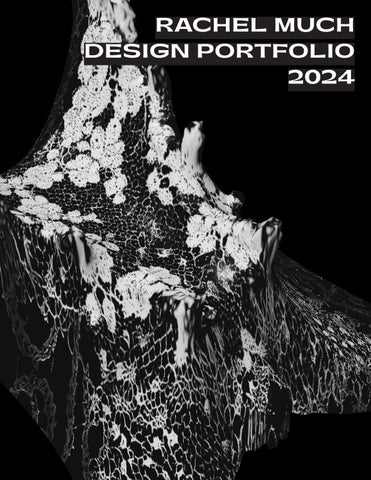
RACHEL MUCH DESIGN PORTFOLIO 2024
From the Bin: Trashy Match
Veiled Figures: AI Lace Making
Behind the Scenes
The Climatorium at Hurley
Retiro Organopónicos
Joy [R/H]ide
MAS Offices
The Mechanical Gesture
Portraits
RACHEL MUCH
APPLICANT FOR POSITION IN ARCHITECTURE
rachelmuch@gsd.harvard.edu
404-861-7906
EDUCATION
Harvard University
Graduate School of Design
Masters of Architecture Candidate 2019-2023
Honors
Studio High Pass: Core IV, Third Space, A Well Tempered Grid, Adaptive Quality
Distinction: Designer Developer, Core IV
Clifford Wong Prize Nomination Core IV
Leadership
Womxn in Design Careers Chair, 2023 Lead career initiatives, mentorship program, and created career resources for WiD
University of Chicago
Bachelor of Arts in Art History 2015-2019
GPA 3.87
Honors
Dean’s List 2015-2019
Nature As A Destructive Force Symposium 2018
Presented the paper “De Chirico and Raphael’s The Marriage of the Virgin: On the Fragmentation of the Italian Piazza”
Leadership
Smart Museum Student Curatorial Team 2019
Research and assisted with curation for exhibit “Down Time: On The Art of Retreat”
EXPERIENCE
Ajar
Property LLC
Managing Partner + Co-Founder
February 2024-Present
Co-founder of a Chicago based real estate and development practice responsible for property acquisition, rehab, and management
Perkins + Will
Perkins and Will Chicago Studio
Designer I
May 2023 - May 2024
Institutional Design Team - Bezos Learning Center
ACE Mentor - Architecture
Perkins and Will Chicago Studio
Architecture Internship
Summer 2022
Assisted in research and design development stage of a high rise housing development
bKL
bKL Chicago Studio Architecture Internship
Summer 2021
Conducted research on virtual reality and architecture, contributed to concept, massing and plan development for large scale mixed use and residential projects
HKS
HKS Atlanta Studio
Architecture Internship
Summer 2020
Created construction documents and produced design options for the mixed use Neuhoff project in Nashville
Career Services
Harvard GSD Career Service
Career Services Liaison
2021-2022
Acting as a liaison between career services and student groups, organizing and creating programs, assisting in research
Mansueto Urban Institute
University of Chicago
Research Assistant
2018-2019
Paid research assistant working with Professor Katherine Taylor in compiling archival research, writing and conducting a tour on, and creating a new website on campus architecture
Smart Museum of Art
University of Chicago
Docent
2016-2019
Paid position, gave and created architecture, public art and museum tours, coordinated events and museum programs
Frank Lloyd Wright Trust
Robie House, Chicago
Curatorial + Guest Relations Internship
2016
Led tours, assisted with restoration, researched for a Hyde Park neighborhood tour
National Building Museum
Washington DC
Curatorial + Guest Relations Internship
Summer 2017
Created programming for Studio Gang’s summer installation Hive and researched and wrote materials for Making Room exhibit
SKILLS + Certifications:
LEED GA Certified October 2023
Digital Tools:
Rhino, VRay, Revit, Lumion, Enscape, Grasshopper, Bongo, Python, AI Image Tools, Adobe Suite, 3D Printing
Physical Tools:
Model Making, Plotting, Zund Cutter, Woodshop, Oil & Acryllic Painting, Dark Room Photography, Pencil, Ink, Charcoal, Print Making
I. From the Bin: Trashy Match
From the Bin: Trashy-Match centers on a critical examination of recycling within the material, cultural and thus architectural fields.
Our overarching approach to recycling was through the lens of Baudrillard’s Simulacra and Simulation to investigate the destruction of the real through the process of salvage. Our project values the simulated over the real, Inverting Baudrillard Valuation. This allows for a fluid process of locating meaning inherent to recycling and an oscillation between real and hyperreal that forces a more than surface-level visual questioning. This process is applied to three categories of collected then recycled material.
Bin 1: Aesthetics
Bricolage is an aesthetic consequence of working with found materials and like multi-family housing has connotations of affordability and impermanence. Our process of veneering seeks to disrupt the reading of recycled material as composite, hiding its kit of parts tectonics through a monolithic veneered surface structured by the mitre cut.
Advisor: Jennifer Bonner Course: Core IV Studio Partner: Aggie Fielding Period: 15 Weeks
Bin 2: Materials
Boston Harbour Garage, located half a mile from our North End site, is a seven-story structure made from precast concrete elements due for demolition in the summer of 2021. Our project repurposes the readymade objects of the demolished garage into a new and reconstituted architectural object atop of a second car park site as a nostalgic monument to the endangered car park in the North End.
Bin
3: Form/Code
No term is more greatly recycled in code than ‘family’. Our project recycles the American Foursquare plan testing its inherent equivalency of space at a multiplicity of scales. Through manipulating the four square’s central partitions we test contemporary notions of ‘family’ and its associated organizations. Our proposal aims to trash the use of ‘family’ as a method to design housing and forefront a method of recoding that is spatial; to calculate units according to number of rooms and not individuals.
I explored how structural materials transform from Baudrillard’s reflection of reality stage into pure simulacrum and through this arrived at our for the veneerification of materiality–the application of a sign of a material to a physical material. In applying the mitre and ornamental cut, both accomplished with chain saws and concrete saws, to the section of three readymade precast elements we curated enough variety to negotiate the transitional wall thickness of interior to exterior and distinguish between public and private space.
II. Veiled Figures: AI Lace Making
Within this project I sought to digitize the handicraft of lace making through the use of FX tools and AI image making in tandem. The historical lace maker–usually a highly skilled female cottage industry laborer–transfered an illustrated pattern into fabric through bobbin or embroidery techniques. I believe that the material translation from image to object and craft to industry inherent in lace making makes it an especially interesting topic to analyze with AI.
In expanding my scope for this project, I became interested in the dualities of fabric when applied to a subject. Within the shroud typology draped fabric becomes a semi autonomous surface in which an absent or invisible object is figured. The overlay, another typology, creates a low poly simulacrum of its contained objects. Within this project I wanted to utilize fabric drape to imply our natural subject without its presence–to be an image of lace and an image of the object being draped.
Using Houdini, I analyzed the stresses of a pieces of fabric when draped over a taxidermy form.
Advisor: Andrew Witt
Course: Neural Bodies
Partner: Rain Chan, Seojeon Yun
Period: 4 Weeks
Through a series of translations structural nets derived from this tension map were fed into a custom neural network trained on the bobbin lace collection of the Cooper Hewitt’s collection. The resulting object was a controlled latent walk type animation where AI information was determined by a structural analysis and a physical object where the shroud takes on its 3D form etched into a crystal block.
Ground floor plan showing medical donut massing around the existing sound stage
Section showing the “stitch” between the medical donut and the sound stage and the attic perms
III. Behind the Scenes
Access to health care for pregnant women in Atlanta is a problem defined by location. My project, located in South Atlanta, is surrounded by a large young community with double the birth rate of the city average. Despite the concentration of young people and mothers in the area, there are very few health care options for mothers and families. While the neighborhood is lacking in health care access, it leads the nation in the number of film production studios with 9 in a 2km radius from the site. My project seeks to use the strength of Atlanta’s film industry to support mothers in an underserved neighborhood. I sited this project as an addition and renovation to one of the sound stages of Tyler Perry studios–the largest production studio in the city–and conceptually as an extension of the The Perry Foundation. It is the mission of the project to create empowering spaces accommodating the new subjects and forms of viewership of the public pregnancy. Within this project, the combined tools of the sound stage and the clinic give mothers–from the most public to the most private–agency in the medical and narrative aspects of pregnancy.
Advisor:
Elle GerdemanCourse: Thesis
Period: 15 Weeks
I added a donut of medical space around the existing soundstage that punctures into the filmic space on one side. The structure of the flexible medical and filmic spaces grows out of the informal logistics of the stage flat. The stage flat expands in the buildings facade and structure, creating a series of layered skirts of wooden billboards that peel away from the building’s mass. The design of the medical and theatrical space is determined by shared needs for ventilation and sound control which express themselves as a soft underskirt in the facade. Stuffed plastic pillows–filled with the significant textile waste of the production industry–drape down from the billboards for sound isolation.
The visuals of this project, a split screen aesthetic that flips between image and its support, reveals the behind the scenes spaces and support of medical and filmic production as the driver of the project. The flexible behind the scenes space expands into programmatic space that allows for the interaction between public figures and private mothers that utilize the space–including yoga spaces in the sound stage’s structural attic, birth classes between sound stages, and lactation rooms. The images created within the space are active instead of passive influencer pregnancy photos. A slight shift of the camera brings supports into the scene, showing how the mother crafts her pregnancy portrait. This inclusion legitimizes these photos.
The presentation of my thesis occupied an expanded theatrical field of my project–complimented by studio lights, cameras, and full scale stage flats. The project is about the creation of images and creates its own images.
IV. The Climatorium at Hurley
Our project, The Climatorium, acts as an institutional, educational and programmatic hub of climate research and policy in Boston around and on top of the downtown existing Hurley building. Boston presents itself as a city defined by its climate change action and policy. In 2018 waste ban codes prohibited the disposal of concrete waste in landfills. However, the code does not mandate that construction waste be kept in state, creating a sizable economy dedicated to transporting construction debris from Massachusetts to landfills in Pennsylvania and Ohio. Just two blocks away from our site the massive precast concrete government center garage is currently being dismantled. By recycling the monumental slotting concrete structural elements from the garage we want to position concrete waste as valuable spolia within the city. Within our project, we are reusing 9’ wide 62’ long concrete Ts, horizontal beams, and notched vertical supports from the garage to create a structural tower anchoring our conference center addition to the Hurley site. The recycled concrete elements push
Advisor: Jeanne Gang & Anika Schwarzwald
Course: Adaptive Quality
Partner: Sam Pires and Angel Escobar-Rodas Period: 15 Weeks
and pull from their core to step the facade for views connecting the climate work of the project to the government center.
Our recycled concrete tower is complemented by a mass timber system that balances the heaviness of the structure and positions the material as a contemporary alternative to poured in place concrete. Just as we are advocating for a radical rethinking of material reuse and disassembly, this additional system advocates for a radical adoption of a sustainable building material. The two systems are spanned by a three story steel truss, and the crux of our design comes from the synthesis and interactions between the three systems.
Structural plan and section
V. Retiro Organopónicos
Our project, located in Retiro about an hours drive from Medellin, locates itself within perirural space, existing between urban ambitions and an agrarian background, not quite belonging to either. The peri-rural space, therefore, is inherently picturesque, a place where agriculture functions not only for production but also as entertainment, retreat, and education.
Our project proposal, a small working orchard and food market for the community, highlights small scale food production by making theater of the process from growth to waste for visitors. The orchard has been designed as a closed loop rotational farming system comprising four mutually beneficial actors; chickens, fruit trees, herbs and mushrooms.
At the smallest scale, the project operates as a quadrant of four 0.1 acre sites; the size of land operable by one person. The four quadrants consist of a fixed residency for the worker and a rotating combination of chicken coop, covered mushroom deck and herb plantation.
Advisor: Camilo Restrepo Ochoa Course: The Well Tempered Grid Partner: Aggie Fielding Period: 7 Weeks
From the natural ground, the project steps down 5 feet for each band of production. Metal mesh and timber deck structures continue flush to natural ground as a circulation above excavated ground bringing the peripheral public space into the structure and allowing for an extension of the living space from the homes.
VI. Joy [R/H]ide
Urban mobility is controlled along socioeconomic, racial and gendered lines, an issue that gains particular potency in Atlanta, the most surveilled city in the US. There is a freedom in being invisible, but systems of power often intentionally withhold those freedoms from certain communities with prejudice. Surveillance and camouflage are intrinsically linked, whenever the technology and power structures underlying surveillance advances, deception must adapt in kind. Counter surveillance confounds by deliberately positioning the subject in relation to its context, becoming a technique to evade surveillance and a method of inquiry into the politics and strategies of surveillance.
By combining performative camouflage and a functional cart infrastructure, we argue that transient systems do not necessarily equate instability and can become a means of self-determinate community power. Our carts, delivering services to South Atlanta residents, exploit a gray area of Atlanta’s vendor regulations and serve to critique the objectives of those codes which continue to perpetuate the racial,
Advisor: Cory Henry Course: The Third Space Partner: Cindy Yiin Period: 7 Weeks
xenophobic biases that deliberately produce inequity.
Through a companion shed on the site of the 9 Gammon Building, we further challenge the distinction between legality and legitimacy by connecting and supporting the carts through community coalition. The incubator shed acts as a space to produce, service, and park the carts--a space for informal knowledge sharing and making. The shed, like the cart, is topped with a camouflaged shroud shielding the building from the aerial mechanical eye.
Floor Plan Showing organizational roads and relation to existing building
5: Elevations
The city of Atlanta’s stance on mobile vendors, seen annotated on the left, reveals their entrenched enforcement of inequity and forces any South Atlanta vendors to operate outside of the regulated system. Our project has continued to include an ongoing effort with Project South, a letter to the City of Atlanta suggesting that the city relax its heavy restrictions on mobile vending. Within this project, our carts exist within a legal loophole in Atlanta city code by providing a service ecosystem–including wifi, healthcare, preservation, legal assistance, and community advocacy carts–to develop an ecosystem to fill institutional voids.
VII. MAS Offices
Based ideologically in Beatriz Colomina’s The 24/7 Bed and in three curated images--Édouard Manet’s Olympia, Yoko Ono and John Lenon’s BedIn, and Hugh Hefner on his rotating bed--the project presents an office building for the New York Municipal Art Society based around the 24/7 bed as a totalizing work plane. The 12 story project organizes itself around four repeating nine squares which work to erode the distance between office and home space.
The three bed types--center aligned (2 users), corner aligned (1 user), and circular (3 users)--create different office environments within the nine square. Additionally, a play of delaminating interior facades interacting with an offset glass skin separates the restful interior world from the bustling street and control degrees of visibility.
Advisor: Jon Lott
Course: Core III Studio
Period: 7 Weeks
4: Interior Rendered Structural Section Detail
VIII. The Mechanical
Gesture
This photographic series explores a critique of Harold Rosenberg’s conception of the irreproducible artist’s gesture. Each photo was taken in an arcade with a shutter speed of ten seconds, using the camera as a recorder of gesture. The singularity of the gesture becomes convoluted by the reproducibility and distortion of the dark room process. Therefore, photography flattens the moment of painting and the gesture of the body.
School: University of Chicago
Advisor: Elisabeth Hogeman
Course: Dark Room Photography Period: 7 Weeks
IX. Portraits
Exploring portraits through an emphasis on sitter identity, visibility of the stroke, and highlighting artistic materiality has long been one of my passions. Within these works, I have developed my architectural interests in craft, visual culture, representation, and the body politics of space.
Self Directed 2018-2022