
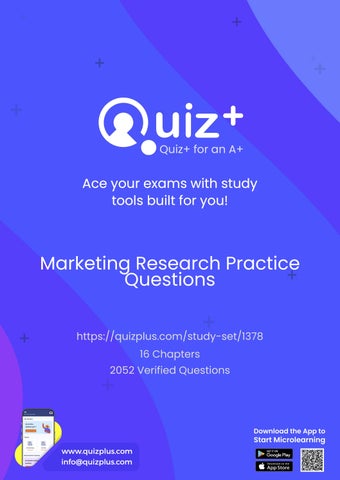
Marketing Research is a comprehensive course designed to equip students with the foundational concepts and practical tools necessary to gather, analyze, and interpret data relevant to marketing decisions. The curriculum covers research design, data collection methods, sampling techniques, survey and questionnaire design, data analysis, and the ethical considerations inherent in conducting marketing research. Students will learn how to formulate research questions, select appropriate methodologies, and present actionable insights that inform sound marketing strategies. Through case studies and hands-on projects, the course aims to enhance students ability to critically evaluate and apply research findings to real-world business challenges.
Recommended Textbook
CB 5 5th Edition by Barry J. Babin
Available Study Resources on Quizplus 16 Chapters
2052 Verified Questions
2052 Flashcards
Source URL: https://quizplus.com/study-set/1378 Page 2
Available Study Resources on Quizplus for this Chatper
127 Verified Questions
127 Flashcards
Source URL: https://quizplus.com/quiz/27465
Sample Questions
Q1) A need is a specific desire that spells out a way a consumer can go about addressing a recognized want.
A)True
B)False
Answer: False
Q2) Which of the following is based on the belief that firm performance is enhanced through repeat business?
A)Cause marketing
B)Transaction marketing
C)Internal marketing
D)Test marketing
E)Relationship marketing
Answer: E
Q3) Two common interpretive research orientations are _____.
A)regression and cluster analysis
B)psychology and sociology
C)phenomenology and ethnography
D)primary and secondary
E)qualitative and quantitative
Answer: C
To view all questions and flashcards with answers, click on the resource link above. Page 3
Available Study Resources on Quizplus for this Chatper
132 Verified Questions
132 Flashcards
Source URL: https://quizplus.com/quiz/27466
Sample Questions
Q1) Refer to Superfocus Scenario.Superfocus is trying to separate its market into different groups based on age so that it can create customized products for each group.This indicates that Superfocus is conducting the process of _____.
A)value reengineering
B)mass marketing
C)total quality management
D)social marketing
E)market segmentation
Answer: E
Q2) Since childhood,Meg's parents always told her that milk is good for health.As a result,Meg developed a liking for milk and started drinking it regularly.In this case,Meg's thinking or mental process is referred to as _____.
A)sensitization
B)affect
C)emotional contagion
D)emotional intelligence
E)cognition
Answer: E
To view all questions and flashcards with answers, click on the resource link above.
Page 4
Available Study Resources on Quizplus for this Chatper
134 Verified Questions
134 Flashcards
Source URL: https://quizplus.com/quiz/27467
Sample Questions
Q1) A state implemented a much needed hike in gasoline prices,increasing it by $2.This was followed by a public outcry against the price rise.A year later,the state further increased gasoline prices by half a dollar.This time round,the public accepted it as essential even though there was a general murmur of dissatisfaction.Which of the following will best explain the reason for the public's acceptance?
A)Preattentive effect
B)Skinner's Law
C)Weber's Law
D)Mere association effect
E)Mere exposure effect
Answer: C
Q2) _____ occurs when a stimulus shares some,but not all,of the characteristics that would lead it to fit neatly in an existing category.
A)Assimilation
B)Accommodation
C)Contrast
D)Distortion
E)Simulation
Answer: B
To view all questions and flashcards with answers, click on the resource link above.
5
Available Study Resources on Quizplus for this Chatper
130 Verified Questions
130 Flashcards
Source URL: https://quizplus.com/quiz/27468
Sample Questions
Q1) Which of the following is true of workbench memory?
A)It has unlimited duration.
B)It has limited capacity.
C)It is considered to be preattentive.
D)Its capacity remains the same across different levels of consumers' involvement.
E)It uses only semantic coding to store information.
Q2) According to which of the following laws,the capacity limit for the workbench memory is between three and seven units of information?
A)Skinner's law
B)Pavlov's law
C)Miller's law
D)Baddelay's law
E)Maslow's law
Q3) The physical characteristics of a message refer to the elements of a message that one senses directly.
A)True
B)False
To view all questions and flashcards with answers, click on the resource link above.
Page 6
Available Study Resources on Quizplus for this Chatper
131 Verified Questions
131 Flashcards
Source URL: https://quizplus.com/quiz/27469
Sample Questions
Q1) Compare and contrast two self-report measures for measuring emotions.Explain how consumers can experience both positive and negative emotions,and which self-report measure is best at capturing that?
Q2) Memories of previous,meaningful events in one's life are known as _____ memories.
A)procedural
B)implicit
C)autobiographical
D)iconic
E)echoic
Q3) Product involvement represents the temporary involvement associated with some imminent purchase situation.
A)True
B)False
Q4) Autonomic measures automatically record visceral reactions or neurological brain activity.
A)True
B)False
Page 7
Q5) Describe Maslow's hierarchy of needs and give an example of each type of need.
Q6) Explain the regulatory focus theory.
To view all questions and flashcards with answers, click on the resource link above.
Page 8
Available Study Resources on Quizplus for this Chatper
137 Verified Questions
137 Flashcards
Source URL: https://quizplus.com/quiz/27470
Sample Questions
Q1) _____ refers to the tendency of consumers to take excessive pride in themselves,including their appearance and accomplishments.
A)Trait vanity
B)Trait anxiety
C)Innovativeness
D)Frugality
E)Competitiveness
Q2) Which of the following is true about PRIZM?
A)It combines demographic and behavioral information in a manner that enables marketers to better understand and target their customers.
B)It classifies consumers into eight distinct segments based on resources available to the consumer as well as three primary motivations.
C)It was developed and marketed by Strategic Business Insights.
D)It is based on the premise that people with similar backgrounds and means disassociate themselves from each other's behaviors and lifestyles.
E)It is based on the premise that people with similar backgrounds tend to live away from one another.
To view all questions and flashcards with answers, click on the resource link above.
9
Available Study Resources on Quizplus for this Chatper
139 Verified Questions
139 Flashcards
Source URL: https://quizplus.com/quiz/27471
Sample Questions
Q1) Source likeability affects persuasion more for consumers with high need for cognition than for those with a low degree of this trait.
A)True
B)False
Q2) According to the ABC approach to attitudes,the statement,"I really like my smartphone," is an example of the behavior component of attitude.
A)True B)False
Q3) Contradicting thoughts are known as negative arguments.
A)True
B)False
Q4) According to the elaboration likelihood model of persuasion,if the consumer is influenced more by peripheral cues than central cues,any resulting belief or attitude change will likely be enduring.
A)True B)False
Q5) The behavioral intentions model is sometimes referred to as the ATO model. A)True B)False
To view all questions and flashcards with answers, click on the resource link above. Page 10
Available Study Resources on Quizplus for this Chatper
128 Verified Questions
128 Flashcards
Source URL: https://quizplus.com/quiz/27472
Sample Questions
Q1) Consumers avoid emulating members of aspirational groups as it tends to decrease their chances of membership into such groups.
A)True
B)False
Q2) Jane is a tomboy and aspires to become a mechanic.She wants nothing to do with her friends' Fashion Club.Jane considers this club to be an aspirational group.
A)True
B)False
Q3) Consumers who spread information about all types of products and services that are available in the marketplace are called _____.
A)surrogate consumers
B)opinion leaders
C)market mavens
D)universal shoppers
E)conspicuous consumers
Q4) Discuss some social networking websites of which you are a member.Give an example of how membership to these social networking websites influences your consumption behavior.
To view all questions and flashcards with answers, click on the resource link above. Page 11
Available Study Resources on Quizplus for this Chatper
127 Verified Questions
127 Flashcards
Source URL: https://quizplus.com/quiz/27473
Sample Questions
Q1) Cultural distance represents how disparate one nation is from another in terms of their CSVs.
A)True
B)False
Q2) Media acts as an agent of enculturation.
A)True
B)False
Q3) Countries with relatively high cultural distance scores are more similar and tend to value the same types of consumption experiences.
A)True
B)False
Q4) The American society places a high value on being independent as well as attaining personal milestones.According to the CSV dimension,the American society is most likely to be high in _____.
A)pluralism
B)protectionism
C)individualism
D)interventionism
E)isolationism
To view all questions and flashcards with answers, click on the resource link above. Page 12
Available Study Resources on Quizplus for this Chatper
126 Verified Questions
126 Flashcards
Source URL: https://quizplus.com/quiz/27474
Sample Questions
Q1) Generation X consumers have also been referred to as "latchkey" kids.
A)True
B)False
Q2) The reliance on schema-based heuristics in making decisions is known as cognitive
A)dissonance
B)distortion
C)structuring
D)divergence
E)imaging
Q3) Carl turned 55-years old in 2012.He retired early from his job as he had enough savings for a good life.Carl belongs to the _____ group.
A)greatest generation
B)silent generation
C)Generation X
D)Millennials
E)Baby Boomers
Q4) Men and women make consumer decisions identically.
A)True
B)False
To view all questions and flashcards with answers, click on the resource link above. Page 13
Available Study Resources on Quizplus for this Chatper
119 Verified Questions
119 Flashcards
Source URL: https://quizplus.com/quiz/27475
Sample Questions
Q1) Refer to Christmas Shopping Scenario.Lanny was trying to keep a track in her head of how much she was spending in an attempt to avoid going overboard and winding up with a huge credit card bill next month.This is an example of _____ budgeting.
A)formal
B)programmed
C)mental
D)performance-based
E)participatory
Q2) _____ is a personality trait that represents how sensitive a consumer is to immediate rewards.
A)Compulsivity
B)Impulsivity
C)Susceptibility
D)Sensitivity
E)Accountability
Q3) Consumers with attention deficit disorder typically have high degrees of impulsivity which makes them more prone to impulsive acts.
A)True
B)False
To view all questions and flashcards with answers, click on the resource link above.
Page 14
Available Study Resources on Quizplus for this Chatper
127 Verified Questions
127 Flashcards
Source URL: https://quizplus.com/quiz/27476
Sample Questions
Q1) The rate at which a promotion is transitioned into a sale is known as promotional _____ rate.
A)consolidation
B)evolution
C)transition
D)optimization
E)conversion
Q2) Limited decision making usually occurs when there are relatively low amounts of purchase risk and product involvement.
A)True
B)False
Q3) Value perceptions influence the activities found in the decision-making process.
A)True
B)False
Q4) Consumer decisions can seldom be analyzed from a combination of decision-making perspectives.
A)True
B)False
Q5) Explain the types of consumer search behavior with an example each.
Q6) Discuss five factors that influence the amount of search performed by consumers. Page 15
To view all questions and flashcards with answers, click on the resource link above.
Page 16
Available Study Resources on Quizplus for this Chatper
126 Verified Questions
126 Flashcards
Source URL: https://quizplus.com/quiz/27477
Sample Questions
Q1) Attribute correlation of different features of a product or a service is always positive. A)True
B)False
Q2) When considering a new product,consumers rely on the knowledge that they have regarding the relevant product category.
A)True
B)False
Q3) Evaluative criteria are the attributes,features,or potential benefits that consumers consider when reviewing possible solutions to a problem.
A)True
B)False
Q4) With affect-based evaluation,alternatives are evaluated across a set of attributes that are considered relevant to the purchase situation.
A)True
B)False
Q5) Explain affect-based and attribute-based evaluations.Give an example of each using one of your recent purchase decisions.
To view all questions and flashcards with answers, click on the resource link above. Page 17
Available Study Resources on Quizplus for this Chatper
127 Verified Questions
127 Flashcards
Source URL: https://quizplus.com/quiz/27478
Sample Questions
Q1) The locus element of the attribution theory involves judgments of whether the outcome was controllable or not.
A)True
B)False
Q2) If performance perceptions exactly match what was expected,neutral disconfirmation is said to occur.
A)True
B)False
Q3) Which of the following is a fundamental emotion evoked by positive,anticipatory appraisals which signal uncertainty about a positive outcome?
A)Curiosity
B)Desire
C)Hope
D)Anxiety
E)Surprise
Q4) Define consumer refuse.List the disposal alternatives available to consumers.Which alternative do you use most often?
Q5) List out some possible postconsumption reactions.
Q6) Differentiate durable and nondurable goods with examples.
To view all questions and flashcards with answers, click on the resource link above. Page 18
Available Study Resources on Quizplus for this Chatper
119 Verified Questions
119 Flashcards
Source URL: https://quizplus.com/quiz/27479
Sample Questions
Q1) If the relationship with the brand is strong,accepting negative information diminishes the consumer's self-concept.
A)True
B)False
Q2) When consumers get so mad at a business that they become violent or try to vandalize the business,it is called _____ revenge.
A)rancorous
B)retaliatory
C)restorative
D)distributive
E)procedural
Q3) A consumer chooses a competing choice,rather than a previously purchased choice,on the next purchase occasion.This behavior is called _____.
A)infiltrating
B)switching
C)hoarding
D)shilling
E)culture jamming
Q4) Explain critical incident in the context of consumer behavior.
To view all questions and flashcards with answers, click on the resource link above. Page 19
Available Study Resources on Quizplus for this Chatper
123 Verified Questions
123 Flashcards
Source URL: https://quizplus.com/quiz/27480
Sample Questions
Q1) You are undergoing sales training at your new job.The trainer teaches you ingratiation tactics.Name and describe two of these tactics.
Q2) Purchasing and using a product for a day before returning it for a refund is a practice known as retail borrowing.
A)True
B)False
Q3) The door-in-the-face technique is based on the self-perception theory,which proposes that consumers use perceptions of their own actions when forming attitudes.
A)True
B)False
Q4) Which of the following eating disorders includes binge eating episodes followed by self-induced vomiting?
A)Bulimia
B)Anorexia
C)Orthorexia nervosa
D)Pica
E)Rumination disorder
Q5) What role does value play in consumer misbehavior?
To view all questions and flashcards with answers, click on the resource link above. Page 20