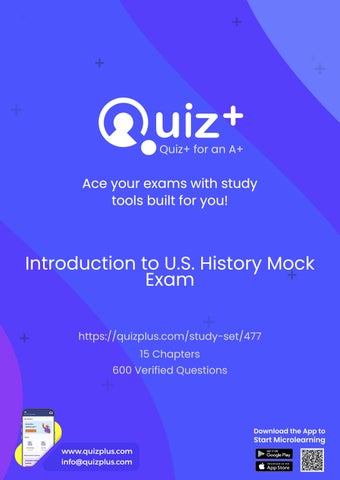
Introduction to U.S. History offers a comprehensive survey of the major events, movements, and themes that have shaped the United States from its earliest colonial beginnings to the present day. The course explores topics such as indigenous cultures, colonization, revolution, nation-building, civil war, industrialization, social reform, and the evolving role of the United States in a global context. By examining political, social, economic, and cultural developments, students gain a deeper understanding of the forces and people that have contributed to the American experience, while developing critical thinking and analytical skills in the study of history.
Recommended Textbook
Revel for Learning U.S. History Semester 1 1st Edition by H. W. Brands
Available Study Resources on Quizplus
15 Chapters
600 Verified Questions
600 Flashcards
Source URL: https://quizplus.com/study-set/477 Page 2
Available Study Resources on Quizplus for this Chatper
40 Verified Questions
40 Flashcards
Source URL: https://quizplus.com/quiz/8766
Sample Questions
Q1) Before the New and Old Worlds came together,the people in North America had not yet developed __________.
A) writing
B) agriculture
C) culture
D) religion
Answer: A
Q2) Which of the following provides evidence that Indian cultures had an oral tradition?
A) teepees
B) pueblos
C) creation myths
D) totem poles
Answer: C
Q3) The term Norman Conquest refers to the Viking invasion of __________.
A) France
B) Canada
C) England
D) Vinland
Answer: C
To view all questions and flashcards with answers, click on the resource link above.
Page 3
Available Study Resources on Quizplus for this Chatper
40 Verified Questions
40 Flashcards
Source URL: https://quizplus.com/quiz/8767
Sample Questions
Q1) Who was the ruler of the Aztec empire when the Spanish conquest began?
A) Atahualpa
B) Moctezuma
C) Henry VIII
D) Elizabeth
Answer: B
Q2) Puritans and Huguenots are both __________.
A) Protestant
B) Catholic
C) Moors
D) Jewish
Answer: A
Q3) According to the Arguing History video in section 2.5,the European conquest of the Americas was driven by __________.
A) a fear of diseases
B) a combination of motives
C) supernatural forces
D) technological change
Answer: B
To view all questions and flashcards with answers, click on the resource link above.
Page 4
Available Study Resources on Quizplus for this Chatper
40 Verified Questions
40 Flashcards
Source URL: https://quizplus.com/quiz/8768
Sample Questions
Q1) Which group formed the core of the colonial labor system in the American South?
A) African slaves
B) Indian slaves
C) contract workers
D) indentured servants
Answer: A
Q2) Most of the English colonists who went to America in the seventeenth century were attracted by the availability of __________.
A) cheap land
B) educational opportunities
C) urban conveniences
D) noble titles
Answer: A
Q3) In Pennsylvania and Maryland,authority rested with the colony's __________.
A) sponsors
B) merchants
C) priests
D) soldiers
Answer: A
To view all questions and flashcards with answers, click on the resource link above.
Page 5
Available Study Resources on Quizplus for this Chatper
40 Verified Questions
40 Flashcards
Source URL: https://quizplus.com/quiz/8769
Sample Questions
Q1) Compare and contrast views on religion held by the following people: Cotton Mather,George Whitefield,Jonathan Edwards,and Benjamin Franklin.
Q2) What was witchcraft associated with in colonial America?
A) divine will
B) indigenous rights
C) natural science
D) black magic
Q3) According to the introductory video in section 4.3,the people accused of witchcraft were perceived as threats to __________.
A) commerce
B) agriculture
C) slavery
D) security
Q4) In contrast to New England,the main source of agricultural labor in the South was provided by __________.
A) prisoners of war
B) African slaves
C) family members
D) hired workers
To view all questions and flashcards with answers, click on the resource link above. Page 6
Available Study Resources on Quizplus for this Chatper
40 Verified Questions
40 Flashcards
Source URL: https://quizplus.com/quiz/8770
Questions
Q1) The Sons of Liberty and the Committees of Correspondence both __________.
A) called for ending the boycott
B) opposed British control
C) condemned the Boston Tea Party
D) supported the Townshend duties
Q2) Which of the following granted the British army the authority to quarter its soldiers in American homes?
A) Stamp Act
B) Intolerable Acts
C) Navigation Acts
D) Declaratory Act
Q3) The ideals that inspired the American Revolution also influenced the __________.
A) policy of salutary neglect
B) abolitionist movement
C) French and Indian War
D) Proclamation of 1763
Q4) Compare and contrast American and British expectations of one another.What did the Americans expect from the British,and what did the British expect from the Americans?
Q5) How did the French and Indian War pave the way for the American Revolution?
To view all questions and flashcards with answers, click on the resource link above. Page 7
Available Study Resources on Quizplus for this Chatper
40 Verified Questions
40 Flashcards
Source URL: https://quizplus.com/quiz/8771
Sample Questions
Q1) Which battle ended the American Revolutionary War?
A) Yorktown
B) Philadelphia
C) Saratoga
D) Valley Forge
Q2) According to a letter from Anthony Allaire,after the Patriots' victory at the Battle of Kings Mountain,they __________ some of the Loyalist soldiers.
A) freed
B) rescued
C) court-martialed
D) enslaved
Q3) France was initially reluctant to agree to an alliance with the Americans because it questioned the Americans' __________.
A) ability to win the war
B) commitment to independence
C) loyalty to Britain
D) political motives
Q4) In what respects was the American Revolutionary War a civil war?
To view all questions and flashcards with answers, click on the resource link above.
Page 8
Available Study Resources on Quizplus for this Chatper
40 Verified Questions
40 Flashcards
Source URL: https://quizplus.com/quiz/8772
Sample Questions
Q1) Who would have most likely agreed with this statement?: "States are the characteristics and the soul of a confederation."
A) Patrick Henry
B) James Madison
C) Alexander Hamilton
D) John Jay
Q2) What is this statement from the Constitution also called?: "To make all Laws which shall be necessary and proper for carrying into Execution the foregoing Powers,and all other Powers vested by this Constitution in the Government of the United States,or in any Department or Officer thereof."
A) consolidated government
B) elastic clause
C) Bill of Rights
D) the Preamble
Q3) Impoverished farmers were concentrated in which part of Massachusetts?
A) eastern
B) western
C) southern
D) northern
To view all questions and flashcards with answers, click on the resource link above.
Page 9
Available Study Resources on Quizplus for this Chatper
40 Verified Questions
40 Flashcards
Source URL: https://quizplus.com/quiz/8773
Sample Questions
Q1) Which of the following was a victory for the Federalists?
A) government subsidies for farmers
B) government subsidies for manufacturers
C) creation of the Bank of the United States
D) passage of the Virginia Resolution
Q2) The Whiskey Rebellion strengthened the Federalists' view of the Republicans and their supporters as __________.
A) elitist
B) alcoholics
C) conservatives
D) radicals
Q3) Which of the following would have been punished under the Sedition Act of 1898?
A) yelling "fire!" in a crowded theater
B) publishing an antiwar editorial
C) petitioning for women's suffrage
D) defending the practice of slavery
Q4) How did party politics shape American political life during the first two administrations?
Q5) Compare and contrast Federalist and Republican views on the French Revolution.
To view all questions and flashcards with answers, click on the resource link above. Page 10
Available Study Resources on Quizplus for this Chatper
40 Verified Questions
40 Flashcards
Source URL: https://quizplus.com/quiz/8774
Sample Questions
Q1) What was the northern boundary of the Louisiana Territory?
A) Alaska
B) Canada
C) Colorado River
D) Ohio River
Q2) Which of the following is considered a failure of Jefferson's administration?
A) Revolution of 1800
B) Alien and Sedition Acts
C) Embargo Act
D) Louisiana Purchase
Q3) Which of the following Indian communities did the Lewis and Clark expedition encounter?
A) Powhatan
B) Pueblo
C) Shoshone
D) Iroquois
Q4) How was the presidential election of Thomas Jefferson in 1800 different from the elections of the previous two presidents and the elections of the next two presidents?
Q5) To what extent was Thomas Jefferson a man of contradictions?
To view all questions and flashcards with answers, click on the resource link above. Page 11
Available Study Resources on Quizplus for this Chatper
40 Verified Questions
40 Flashcards
Source URL: https://quizplus.com/quiz/8775
Sample Questions
Q1) Who wrote "The Star-Spangled Banner"?
A) Francis Scott Key
B) Henry Clay
C) Dolley Madison
D) George Glieg
Q2) How did Indians deal with the encroachment of white settlers into Indian lands in the early nineteenth century?
Q3) Americans hoped that war with Britain would result in the American annexation of __________.
A) Canada
B) Mexico
C) Louisiana
D) the Ohio Valley
Q4) Which of the following was destroyed during the British assault on Washington,D.C.?
A) Monticello
B) the White House
C) Independence Hall
D) Federal Hall
To view all questions and flashcards with answers, click on the resource link above.
Page 12
Available Study Resources on Quizplus for this Chatper
40 Verified Questions
40 Flashcards
Source URL: https://quizplus.com/quiz/8776
Sample Questions
Q1) Andrew Jackson's handling of the nullification crisis in 1832 and the battle over the Bank of the United States reflects the
A) weakness of the executive branch
B) strength of the executive branch
C) weakness of the legislative branch
D) strength of the legislative branch
Q2) To whom did George W.Harkins address his letter?
A) Canadians
B) Americans
C) Choctaws
D) Cherokees
Q3) In Memorial of the Cherokee Nation,what do the Cherokees point to as the basis for their legal claim to their ancestral land?
A) tribal agreements concluded before the Europeans arrived
B) the treaties signed with the U.S. government
C) French promises made during the French and Indian War
D) British guarantees in the Proclamation of 1763
Q4) How democratic was Jacksonian Democracy? What were its limits?
Q5) How did slavery influence American politics in the early nineteenth century?
To view all questions and flashcards with answers, click on the resource link above. Page 13
Available Study Resources on Quizplus for this Chatper
40 Verified Questions
40 Flashcards
Source URL: https://quizplus.com/quiz/8777
Q1) According to the Arguing History video in section 12.6,which of the following provides the strongest evidence that American democracy has expansionist tendencies?
A) Whig Party
B) Battle of the Alamo
C) Civil War
D) Manifest Destiny
Q2) According to the introductory video in section 12.1,who led a slave rebellion in 1831?
A) Henry Clay
B) Nat Turner
C) William Lloyd Garrison
D) Winfield Scott
Q3) Where did the Turner rebellion occur?
A) Virginia
B) New York
C) South Carolina
D) Georgia
Q4) How did the issue of slavery divide Americans between 1840 and 1850?
Q5) In what ways were the justifications for slavery and expansion similar?
To view all questions and flashcards with answers, click on the resource link above. Page 14
Available Study Resources on Quizplus for this Chatper
40 Verified Questions
40 Flashcards
Source URL: https://quizplus.com/quiz/8778
Sample Questions
Q1) According to the Past and Present video in section 13.6,the Republicans knew they would win which presidential election?
A) 1848
B) 1852
C) 1856
D) 1860
Q2) According to the video in the introduction,what triggered a series of events that would culminate in the Civil War?
A) the decline of the abolitionist movement
B) the discovery of gold in California
C) the acquisition of Florida from Spain
D) the revocation of the return clause in the Constitution
Q3) Which of the following would be punished under the Fugitive Slave Act of 1850?
A) hiding a fugitive slave from the authorities
B) reporting a fugitive slave to the authorities
C) accusing a black person of being a runaway slave
D) arresting a black person for being a runaway slave
Q4) How was the Missouri Compromise of 1820 weakened in the middle of the nineteenth century?
To view all questions and flashcards with answers, click on the resource link above. Page 15
Available Study Resources on Quizplus for this Chatper
40 Verified Questions
40 Flashcards
Source URL: https://quizplus.com/quiz/8779
Sample Questions
Q1) According to the Arguing History video in section 14.6,why did the majority of soldiers join the Confederate Army?
A) to keep their slaves
B) to defend the South
C) to avoid state taxes
D) to preserve the Union
Q2) The Emancipation Proclamation left slavery intact in which state?
A) Missouri
B) Georgia
C) Mississippi
D) Texas
Q3) Which of the following is associated with the doctrine of the states' right of nullification?
A) Virginia and Kentucky Resolutions
B) Compromise of 1850
C) War of 1812
D) Texas war of independence
Q4) In what respects was the conflict between the North and South from 1861 to 1865 a civil war? In what respects was it a rebellion? In what respects was it a war of independence?
Page 16
To view all questions and flashcards with answers, click on the resource link above.
Available Study Resources on Quizplus for this Chatper
40 Verified Questions
40 Flashcards
Source URL: https://quizplus.com/quiz/8780
Q1) According to the introductory video in section 15.3,Matthew Gaines once was a(n)__________.
A) Southern Democrat
B) Republican state senator
C) Ku Klux Klan member
D) Confederate officer
Q2) According to the introductory video in section 15.5,which of the following reflected the Southern view of the Civil War and Reconstruction?
A) Plessy v. Ferguson
B) The Birth of a Nation
C) the Freedmen's Bureau Bill
D) the Reconstruction amendments
Q3) In the parade of freedmen in Charleston in 1865,one of the banners linked the cause of the freedmen to which figure?
A) John Brown
B) John Wilkes Booth
C) Andrew Johnson
D) Mary Surratt
Q4) To what extent was Reconstruction a success? To what extent was it a failure?
To view all questions and flashcards with answers, click on the resource link above. Page 17