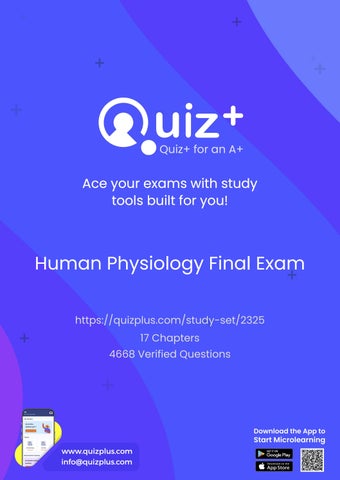
Human Physiology explores the fundamental mechanisms by which the human body functions at the molecular, cellular, and organ system levels. This course delves into the complex interactions among tissues, organs, and systems that maintain homeostasis, covering topics such as the nervous, muscular, cardiovascular, respiratory, digestive, renal, and endocrine systems. Emphasis is placed on understanding how physiological processes adapt to internal and external changes, as well as the integration of systems in maintaining overall health. Through lectures, laboratory exercises, and case studies, students gain a comprehensive foundation in human physiology, preparing them for advanced study in health sciences and related fields.
Recommended Textbook
Human Physiology From Cells to Systems 4th Canadian Edition by Lauralee Sherwood
Available Study Resources on Quizplus
17 Chapters
4668 Verified Questions
4668 Flashcards
Source URL: https://quizplus.com/study-set/2325 Page 2
Available Study Resources on Quizplus for this Chatper
104 Verified Questions
104 Flashcards
Source URL: https://quizplus.com/quiz/46213
Sample Questions
Q1) Which of these types of tissues uses the terminology "smooth"
A)connective tissue
B)epithelial tissue
C)glandular tissue
D)muscle tissue
Answer: D
Q2) Stem cells are not common to all multicellular organisms.
A)True
B)False
Answer: False
Q3) skeletal muscles and sweat glands
A)controlled variable
B)integrator
C)sensor
D)effector
Answer: D
Q4) Enzymes are carbohydrates.
A)True
B)False
Answer: False
To view all questions and flashcards with answers, click on the resource link above. Page 3
Available Study Resources on Quizplus for this Chatper
492 Verified Questions
492 Flashcards
Source URL: https://quizplus.com/quiz/46214
Sample Questions
Q1) a.concentration of K in the extracellular fluid
B.concentration of K in the intracellular fluid of a resting nerve cell
A)A is greater than B
B)B is greater than A
C)A and B are equal
Answer: B
Q2) Which of the following is the last step for synaptic signalling when the action potential arrives at the axon terminal of a presynaptic neuron
A)A neurotransmitter is released by exocytosis.
B)Calcium flows in the synaptic knob.
C)The neurotransmitter combines with protein receptor sites on the subsynaptic membrane.
D)The permeability is altered in a postsynaptic neuron.
Answer: D
Q3) ion that is actively transported out of the cell
A)Na<sup>+</sup>
B)K
C)A<sup>-</sup>
D)Cl<sup>-</sup>
Answer: A
To view all questions and flashcards with answers, click on the resource link above. Page 4
Available Study Resources on Quizplus for this Chatper
314 Verified Questions
314 Flashcards
Source URL: https://quizplus.com/quiz/46215
Sample Questions
Q1) initially process sound input
A)occipital lobes
B)temporal lobes
C)parietal lobes
D)frontal lobes
Answer: B
Q2) Which of these types of neuroglial cells line the ventricles of the brain
A)astrocytes
B)neurons
C)oligodendrocytes
D)ependymal cells
Answer: D
Q3) Microglia are phagocytic cells delivered by the blood to the central nervous system.
A)True
B)False
Answer: True
Q4) The ____________________ consist of several masses of grey matter located deep within the cerebral white matter.
Answer: basal nuclei
To view all questions and flashcards with answers, click on the resource link above. Page 5
Available Study Resources on Quizplus for this Chatper
434 Verified Questions
434 Flashcards
Source URL: https://quizplus.com/quiz/46216
Sample Questions
Q1) Which of these abnormalities could give rise to sensorineural deafness
A)rupture of the tympanic membrane
B)disease or injury in the organ of Corti
C)restriction of ossicular movement due to adhesions between the bones
D)damage to the occipital lobes of the cortex
Q2) Night blindness is due to a deficiency of vitamin C.
A)True
B)False
Q3) Which of these systems suppress the digestive organs during times of greater physical activity
A)sympathetic system
B)parasympathetic system
C)enteric nervous system
D)somatic nervous system
Q4) low acuity
A)rods
B)cones
C)both rods and cones
To view all questions and flashcards with answers, click on the resource link above. Page 6
Q5) The ____________________ is the layer of the eye that contains the photoreceptor cells.
Available Study Resources on Quizplus for this Chatper
260 Verified Questions
260 Flashcards
Source URL: https://quizplus.com/quiz/46217
Sample Questions
Q1) Which of these circumstances results in somatomedins being released from the liver
A)increased plasma growth hormone levels
B)increased plasma somatostatin levels
C)decreased plasma growth hormone levels
D)decreased plasma somatostatin levels
Q2) Plasma concentrations of a hormone are normally regulated by changes in secretion rate.
A)True
B)False
Q3) TRH controls the release of ____________________.
Q4) Which of these statements describes control of hormone secretion
A)Normally, the effective plasma concentration of a hormone is regulated by the rate of its synthesis.
B)In order to maintain homeostasis, the rate of hormone secretion remains constant.
C)All hormones are regulated with negative-feedback controls.
D)Neuroendocrine reflexes produce a sudden increase in hormone secretion in response to a specific, usually external, stimulus.
To view all questions and flashcards with answers, click on the resource link above. Page 7
Available Study Resources on Quizplus for this Chatper
237 Verified Questions
237 Flashcards
Source URL: https://quizplus.com/quiz/46218
Sample Questions
Q1) secreted by pancreatic alpha cells
A)ACTH
B)aldosterone
C)calcitonin
D)cortisol
E)DHEA
F)epinephrine
G)glucagon
H)insulin
I)parathyroid hormone
J)thyroid hormone
K)vitamin D
Q2) The outer portion of the adrenal gland is known as the ____________________, which secretes hormones belonging to the ____________________ chemical class.
Q3) Thyroid-stimulating immunoglobulin stimulates both the secretion and growth of the thyroid similar to TSH.
A)True
B)False
Q4) Hypernatraemia is a body's retention of _____________________.
To view all questions and flashcards with answers, click on the resource link above. Page 8
Available Study Resources on Quizplus for this Chatper
303 Verified Questions
303 Flashcards
Source URL: https://quizplus.com/quiz/46219
Sample Questions
Q1) Which of these statements applies multiunit smooth muscle
A)It is chemically activated.
B)It is under the control of the autonomic nervous system.
C)It is found in the walls of the digestive system.
D)It is the most dominant component of smooth muscle.
Q2) Which of these statements does NOT apply to cardiac muscle
A)contains gap junctions
B)found only in the heart
C)self-excitable
D)lacks tropomyosin
Q3) tension remains constant
A)isometric contraction
B)isotonic contraction
Q4) Muscle cells are the only cell types that contain intracellular contractile proteins.
A)True
B)False
Q5) Anaerobic exercise is endurance-type exercise.
A)True
B)False
To view all questions and flashcards with answers, click on the resource link above. Page 9
Available Study Resources on Quizplus for this Chatper
267 Verified Questions
267 Flashcards
Source URL: https://quizplus.com/quiz/46220
Sample Questions
Q1) The condition in which the pericardial sac becomes distended with excess fluid to the point that it impinges upon cardiac filling is known as ____________________.
Q2) Ventricular ejection occurs once the afterload has been overcome.
A)True
B)False
Q3) One important function of the intrinsic control of the heart (Frank-Starling law of the heart) is to maintain the left and right cardiac outputs in balance.
A)True
B)False
Q4) Heart rate can be increased by increasing _____.
A)stroke volume
B)end-diastolic volume
C)cardiac output
D)heart rate
E)end-systolic volume
F)sympathetic activity
Q5) Vitamins ____________________ and ____________________ have been shown to slow plaque deposition.
To view all questions and flashcards with answers, click on the resource link above. Page 10
Available Study Resources on Quizplus for this Chatper
262 Verified Questions
262 Flashcards
Source URL: https://quizplus.com/quiz/46221
Sample Questions
Q1) How is salt balance tied into blood pressure control
Q2) What is released by most sympathetic fibres at the arterioles
A)acetylcholine
B)dopamine
C)GABA
D)norepinephrine
Q3) Movement of fluid out of the capillaries into the interstitial fluid is known as
Q4) Oedema, venous pooling, and a reduction in cardiac output are consequences of standing still for a long time.
A)True
B)False
Q5) Which of the following does NOT occur to compensate for a fall in blood pressure below normal
A)increase in cardiac output
B)decrease in total peripheral resistance
C)increase in heart rate
D)venous vasoconstriction
Q6) Decreased venous radius _____ the venous return.
Q7) Mean arterial
Available Study Resources on Quizplus for this Chatper
199 Verified Questions
199 Flashcards
Source URL: https://quizplus.com/quiz/46222
Sample Questions
Q1) the first phagocytes to arrive at site of bacterial invasion
A)neutrophils
B)eosinophils
C)basophils
D)monocytes
E)lymphocytes
Q2) What does exposed collagen in a damaged vessel do
A)It activates factor I to initiate blood clotting.
B)It initiates platelet production.
C)It secretes ADP, which causes platelets to become sticky.
D)It activates factor XII to initiate blood clotting, and it initiates platelet aggregation.
Q3) Erythroblastosis fetalis can develop between a mother and fetus under which of these circumstances
A)Mother is Rh negative and fetus is Rh negative.
B)Mother is Rh neutral and fetus is Rh negative.
C)Mother is Rh negative and fetus is Rh positive.
D)Mother is Rh positive and fetus is Rh negative.
Q4) Describe haemostasis.
Q5) What are the different kinds of white blood cells, and how are they produced
To view all questions and flashcards with answers, click on the resource link above. Page 12
Available Study Resources on Quizplus for this Chatper
253 Verified Questions
253 Flashcards
Source URL: https://quizplus.com/quiz/46223
Sample Questions
Q1) ____________________ are plasma membrane-bound glycoproteins that serve as self-antigens.
Q2) Neutrophils are the first phagocytes to leave the blood and arrive at a site of bacterial invasion or tissue damage.
A)True
B)False
Q3) Which of the following is NOT a way by which antibodies exert their protective influence
A)neutralization
B)agglutination
C)direct destruction of foreign organisms
D)activation of the complement system
Q4) ____________________ in an infected wound is a collection of phagocytic cells, dead tissue liquefied by enzymes released from the phagocytic cells, and bacteria.
Q5) Viral-blocking enzymes induced by interferon are activated only upon viral invasion of the cell.
A)True B)False
Q6) ____________________ immunity is not self-generated compared to active immunity.
Page 13
To view all questions and flashcards with answers, click on the resource link above.
Available Study Resources on Quizplus for this Chatper
253 Verified Questions
253 Flashcards
Source URL: https://quizplus.com/quiz/46224
Sample Questions
Q1) Patients suffering from chronic obstructive pulmonary disease generally have more trouble exhaling than inhaling.
A)True
B)False
Q2) What factors influence the amount of gas exchange occurring at the respiratory membrane
Q3) At the systemic capillaries, the PO is in the range of the steep portion of the O -Hb curve.
A)True
B)False
Q4) When it relaxes, the diaphragm resumes an elevated, ____________________-shaped position.
Q5) The respiratory system is the only system involved with the exchange of gas between the cells of an organism and the external environment.
A)True
B)False
Q6) Systemic arterial PO is greater than tissue PO . A)True
B)False
To view all questions and flashcards with answers, click on the resource link above. Page 14
Available Study Resources on Quizplus for this Chatper
276 Verified Questions
276 Flashcards
Source URL: https://quizplus.com/quiz/46225
Sample Questions
Q1) Into which of these structures does most reabsorption occur
A)proximal convoluted tubule
B)glomerulus
C)distal convoluted tubule
D)loop of Henle
Q2) The micturition reflex centre is located in the ____________________ region of the spinal cord.
Q3) The Na cotransport system in the proximal tubule facilitates elimination of foreign organic compounds from the body.
A)True
B)False
Q4) The plasma clearance of the harmless foreign compound ____________________ is equal to the GFR.
Q5) stimulates K secretion by the distal and collecting tubules
A)renin
B)angiotensinogen
C)angiotensin I
D)angiotensin II
E)aldosterone
F)atrial natriuretic peptide
Page 15
To view all questions and flashcards with answers, click on the resource link above.
Available Study Resources on Quizplus for this Chatper
259 Verified Questions
259 Flashcards
Source URL: https://quizplus.com/quiz/46226
Sample Questions
Q1) Which tissues in the body contain the lowest percentage of water
A)blood
B)skeleton
C)muscle
D)adipose
Q2) ____________________ is a change in pH that causes overexcitability of the nervous system.
Q3) Each intracellular protein exerts more osmotic effect than each intracellular phosphate ion because the proteins are larger.
A)True
B)False
Q4) renin secretion
A)exhibits no change
B)is increased
C)is decreased
Q5) ECF and ICF become hypotonic.
A)overhydration
B)dehydration
C)both overhydration and dehydration
D)neither overhydration nor dehydration
To view all questions and flashcards with answers, click on the resource link above. Page 16
Available Study Resources on Quizplus for this Chatper
303 Verified Questions
303 Flashcards
Source URL: https://quizplus.com/quiz/46227
Sample Questions
Q1) Of the fluid entering the small intestine, what percentage is reabsorbed
A)100 percent
B)95 percent
C)85 percent
D)50 percent
Q2) carbohydrate digestion is completed
A)mouth
B)stomach
C)small intestine lumen
D)intracellularly in the small intestine brush border
E)colon
Q3) The small intestinal epithelium actively secretes digestive enzymes into the intestinal lumen.
A)True
B)False
Q4) The presence of ____________________ in the stomach is the main stimulus to enhance gastric secretion.
Q5) The primary mixing and propulsive motility of the small intestine is called ____________________.
Page 17
Q6) The ____________________ is the longest segment of the small intestine.
To view all questions and flashcards with answers, click on the resource link above.
Available Study Resources on Quizplus for this Chatper
157 Verified Questions
157 Flashcards
Source URL: https://quizplus.com/quiz/46228
Sample Questions
Q1) Sweating is the only mechanism for heat loss when body temperature is the same as environmental temperature.
A)True
B)False
Q2) The core temperature in women is 0.5°C higher in the last half of the menstrual cycle, from ____________________ to ____________________.
Q3) All causes of hyperthermia are pathological and fatal.
A)True
B)False
Q4) A(n) ____________________ energy balance occurs when the amount of energy in food intake equals the amount of energy expended by the muscles performing external work.
Q5) How can a person lose heat to an environment warmer than the body
A)by radiation
B)by evaporation
C)by conduction
D)by convection
Q6) The ____________________ humidity is the most important factor influencing the evaporation of sweat.
To view all questions and flashcards with answers, click on the resource link above. Page 18
Available Study Resources on Quizplus for this Chatper
295 Verified Questions
295 Flashcards
Source URL: https://quizplus.com/quiz/46229
Sample Questions
Q1) Which of these statements describes progesterone
A)It exerts a strong inhibitory influence on the uterine musculature.
B)It is responsible for the development and maintenance of female secondary sex characteristics.
C)It promotes duct development in the breasts.
D)High levels initiate the onset of labour.
Q2) As uterine contractions push the fetus against the cervix during parturition, oxytocin release from the posterior pituitary is reflexively increased, which further increases uterine contractions.
A)True B)False
Q3) The single gene within the Y chromosome that is responsible for sex determination is the ____________________.
Q4) Erection is a vascular phenomenon that involves decreased sympathetic and increased parasympathetic activity to the penile arterioles, resulting in arteriolar vasodilation and filling of the erectile tissue with blood.
A)True B)False
Q5) A tubal pregnancy occurs with prenatal development in the ____________________.
Page 19
To view all questions and flashcards with answers, click on the resource link above.