
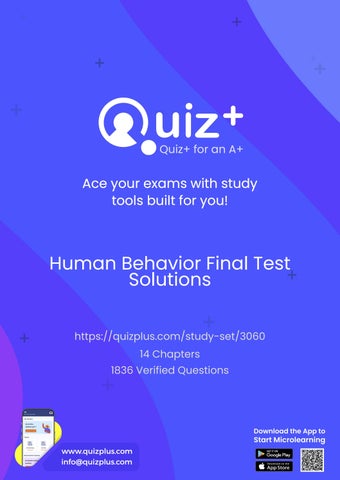
This course explores the complexities of human behavior through an interdisciplinary lens, drawing from psychology, sociology, anthropology, and biology. Students will examine the underlying factors that influence how individuals think, feel, and act within various social and cultural contexts. Key topics include motivation, cognition, emotion, personality, social interaction, learning, and development across the lifespan. Through lectures, case studies, and interactive discussions, learners will gain a deeper understanding of both typical and atypical behaviors, and investigate the practical applications of behavioral theories in everyday life.
Recommended Textbook
Experience Psychology 3rd Edition by Laura A. King
Available Study Resources on Quizplus
14 Chapters
1836 Verified Questions
1836 Flashcards
Source URL: https://quizplus.com/study-set/3060 Page 2
Available Study Resources on Quizplus for this Chatper
130 Verified Questions
130 Flashcards
Source URL: https://quizplus.com/quiz/60750
Sample Questions
Q1) In experimental research, demand characteristics tend to
A)increase the reliability of a study.
B)eliminate confounds in a study.
C)threaten the validity of a study.
D)affect the duration of a study.
Answer: C
Q2) Psychology began as a science in the discipline of
A)philosophy.
B)physics.
C)chemistry.
D)sociology.
Answer: A
Q3) In which of the following psychological approaches did researchers ask participants to think about what was going on mentally as various events took place?
A)behaviorism
B)functionalism
C)structuralism
D)humanism
Answer: C
To view all questions and flashcards with answers, click on the resource link above.
Page 3
Available Study Resources on Quizplus for this Chatper
132 Verified Questions
132 Flashcards
Source URL: https://quizplus.com/quiz/60749
Sample Questions
Q1) _____ stress is the momentary stress that occurs in response to life experiences.
A)intrinsic
B)differential
C)chronic
D)acute
Answer: D
Q2) Which of the following characteristics of the nervous system best reflects the brain's ability to coordinate information from all five senses?
A)complexity
B)adaptability
C)integration
D)electrochemical transmission
Answer: C
Q3) Resting potential is the
A)amount of time a signal travels through the central nervous system.
B)amount of time a neuron must "rest" in between firing episodes.
C)stable, positive charge of an inactive neuron.
D)stable, negative charge of an inactive neuron.
Answer: D
To view all questions and flashcards with answers, click on the resource link above.
Page 4
Available Study Resources on Quizplus for this Chatper
135 Verified Questions
135 Flashcards
Source URL: https://quizplus.com/quiz/60748
Sample Questions
Q1) In the context of sensory receptors, the intensity of the stimulus is communicated to the brain by varying the _____ of the action potential sent to the brain.
A)strength
B)frequency
C)depth
D)lucidity
Answer: B
Q2) The _____ is made up of axons of the ganglion cells, which carries visual information to the brain for further processing.
A)fovea
B)optic nerve
C)lens
D)iris
Answer: B
To view all questions and flashcards with answers, click on the resource link above.
Page 5
Available Study Resources on Quizplus for this Chatper
130 Verified Questions
130 Flashcards
Source URL: https://quizplus.com/quiz/60747
Sample Questions
Q1) The most widely used stimulants in the world are _____ and _____.
A)marijuana/cocaine
B)marijuana/valium
C)alcohol/cocaine
D)caffeine/nicotine
Q2) As Carlton is just about to fall asleep, he experiences an overwhelming feeling of wellness and a sense that everything is going to work out.This state of mind is referred to as
A)high consciousness.
B)hypnagogic reverie.
C)self-actualization.
D)activation-synthesis.
Q3) Explain how circadian rhythms affect physiological and psychological functioning.
Q4) According to Sigmund Freud, dreams symbolize
A)our conscious thoughts and feelings.
B)unconscious wishes and hidden desires.
C)random neurological activity.
D)our biological urges and needs.
Q5) What is psychological dependence and physical dependence of psychoactive drugs?
To view all questions and flashcards with answers, click on the resource link above.
Available Study Resources on Quizplus for this Chatper
130 Verified Questions
130 Flashcards
Source URL: https://quizplus.com/quiz/60746
Q1) How does culture influence learning?
Q2) You feel fine at the picnic until a spider very similar to the one that bit you last year and made you sick starts to walk onto your picnic blanket.This reaction is most likely a(n)
A)unconditioned stimulus (US).
B)unconditioned response (UR).
C)conditioned stimulus (CS).
D)conditioned response (CR).
Q3) Pavlov's dog salivates each time he hears a bell.Now, however, after several trials of salivating to the bell and not receiving any food, the dog stops salivating.Which of the following best explains the change in the dog's behavior?
A)Unconditioned response was triggered.
B)Extinction has occurred.
C)Generalization has occurred.
D)Spontaneous recovery wasn't triggered.
Q4) Describe the distinction between primary and secondary reinforcers.Give an example of each.
Q5) What is the difference between positive reinforcement-negative reinforcement and positive punishment-negative punishment?
To view all questions and flashcards with answers, click on the resource link above. Page 7
Available Study Resources on Quizplus for this Chatper
131 Verified Questions
131 Flashcards
Source URL: https://quizplus.com/quiz/60745
Sample Questions
Q1) Based on the famous case study of H.M., a patient who had severe epilepsy, H.M.underwent surgery that involved removing the hippocampus and a portion of the temporal lobes of both hemispheres in his brain.After the surgery, his epilepsy was cured, but his memory was impaired.Which of the following best describes the effect that surgery had on H.M.'s memory?
A)H.M.developed an inability to form new memories that outlive working memory.
B)H.M.showed major deficits in sensory, short-term, and long-term implicit memory.
C)H.M.'s procedural memory suffered the most damage.
D)H.M.could not learn new physical tasks.
Q2) Describe the working of the connectionist process.
Q3) Vince suffered serious brain injury to his cerebellum in a motorcycle accident.What effect will this have on Vince's life?
A)He probably won't remember his name.
B)He probably won't remember how to ride his motorcycle.
C)He probably won't recognize his wife.
D)He probably won't remember where he lives.
Q4) Define the distinction between proactive and retroactive interference.
Q5) Describe Baddeley's view of the three components of working memory.
To view all questions and flashcards with answers, click on the resource link above. Page 8
Available Study Resources on Quizplus for this Chatper
130 Verified Questions
130 Flashcards
Source URL: https://quizplus.com/quiz/60744
Sample Questions
Q1) According to Sternberg's triarchic theory of intelligence, _____ intelligence predominantly involves the ability to design, invent, originate, and imagine.
A)intrapersonal
B)analytical
C)creative
D)naturalist
Q2) If a child's mental age is higher than her chronological age, this means that
A)the child's IQ is above average.
B)the child's IQ is average.
C)the child's IQ is lower than average.
D)the child's IQ is deteriorating.
Q3) _____ refers to the tendency for two vivid stimuli, when they occur together, to become linked erroneously in memory.
A)Sunk fallacy
B)Illusory correlation
C)Endowment effect
D)Functional fixedness
Q4) Discuss the similarities and differences between the human brain and a computer.
Q5) List the characteristics of creative people.
To view all questions and flashcards with answers, click on the resource link above. Page 9
Available Study Resources on Quizplus for this Chatper
133 Verified Questions
133 Flashcards
Source URL: https://quizplus.com/quiz/60743
Sample Questions
Q1) The strange situation test is used to assess an infant's
A)level of cognitive development.
B)level of moral development.
C)style of attachment.
D)resilience.
Q2) Richie's parents let him do whatever he wants.They place no demands on him, and they place no rules or restrictions on his behavior.Richie's parents have a(n) _____ parenting style.
A)permissive
B)authoritarian
C)authoritative
D)neglectful
Q3) Berta is a fashion designer, who is not happy both at work and home.She is unable to create new designs for her clients.She has also filed for a divorce.According to Jeffrey Arnett, which of the following features of emerging adulthood is described by this scenario?
A)self-focus
B)instability
C)age of possibilities
D)feeling "in between"
To view all questions and flashcards with answers, click on the resource link above. Page 10
Available Study Resources on Quizplus for this Chatper
129 Verified Questions
129 Flashcards
Source URL: https://quizplus.com/quiz/60742
Sample Questions
Q1) Which of the following would suggest that you feel happy because you are laughing?
A)two-factor theory of emotion
B)james-Lange theory
C)cannon-Bard theory
D)yerkes-Dodson law
Q2) Autonomy refers to
A)the belief that one has the competence to accomplish a given goal or task.
B)the sense that one can gain skills and overcome obstacles.
C)the need to engage in warm relations with other people.
D)the sense that one is in control of one's own life.
Q3) Which of the following brain structures plays a central role in the experience of fear?
A)the thalamus
B)the amygdala
C)the cerebellum
D)the hippocampus
Q4) What are the four phases of the human sexual response pattern? Describe the characteristics of each phase and list the phases in the proper sequential order.
To view all questions and flashcards with answers, click on the resource link above.
Available Study Resources on Quizplus for this Chatper
131 Verified Questions
131 Flashcards
Source URL: https://quizplus.com/quiz/60741
Sample Questions
Q1) According to the five-factor model of personality, which statement best describes the relationship between neuroticism and personality?
A)Neuroticism is low in anxious and insecure individuals.
B)Neuroticism is high when a person is positive.
C)Neuroticism is high when a person is emotionally stable.
D)Neuroticism is low in self-satisfied individuals.
Q2) Which of the following is NOT a belief of the psychodynamic perspectives of personality?
A)Childhood experiences shape adult personality.
B)A person's personality can be truly understood by focusing exclusively on his or her behavior.
C)Aspects of individuals' personalities are unconscious because they must be.
D)The enduring patterns that make up personality are largely unavailable to an individual's conscious awareness.
Q3) Which of the following is true of Adler's individual psychology?
A)In Adler's view, pleasure is the key motivator in human life.
B)Alfred used the terms anima and animus to identify two common archetypes.
C)Adler believed that compensation is abnormal.
D)Adler argued that people have the ability to take their genetic inheritance.
To view all questions and flashcards with answers, click on the resource link above.
Page 12
Available Study Resources on Quizplus for this Chatper
131 Verified Questions
131 Flashcards
Source URL: https://quizplus.com/quiz/60740
Sample Questions
Q1) When individuals desire to have another person near and have a deep, caring affection for the person, they are displaying
A)romantic love.
B)affectionate love.
C)the mere exposure effect.
D)passionate love.
Q2) June is usually very quiet, but she recently discovered a different side of herself.During Mardi Gras, she found herself swept up in the festivities, doing the things that the other party-goers were doing.These were not behaviors that she would have ever considered engaging in on her own.Social psychologists would most likely attribute June's behavior to
A)inoculation.
B)social loafing.
C)deindividuation.
D)the bystander effect.
Q3) One explanation for the effects of deindividuation in groups is that groups
A)make people more inhibited.
B)reduce the diffusion of responsibility.
C)give people anonymity.
D)increase personal identity.
To view all questions and flashcards with answers, click on the resource link above. Page 13
Available Study Resources on Quizplus for this Chatper
132 Verified Questions
132 Flashcards
Source URL: https://quizplus.com/quiz/60739
Sample Questions
Q1) The _____ approach to psychological disorders primarily focuses on the brain, genetic factors, and neurotransmitter functioning as the sources of abnormality.
A)psychological
B)sociocultural
C)biological
D)evolutionary
Q2) John has sudden attacks of intense fear in which he experiences palpitations, he feels dizzy, and he has trouble catching his breath.During these attacks, he worries that he is going to die.From this description, it sounds like John has A)schizophrenia.
B)obsessive-compulsive disorder.
C)panic disorder.
D)generalized anxiety disorder.
Q3) What do psychologists believe is the etiology of generalized anxiety disorder?
Q4) List the symptoms of major depressive disorder.
Q5) Describe and give examples of the positive and negative symptoms associated with schizophrenia.
Q6) Write a note on borderline personality disorder (BPD).
To view all questions and flashcards with answers, click on the resource link above. Page 14
Available Study Resources on Quizplus for this Chatper
131 Verified Questions
131 Flashcards
Source URL: https://quizplus.com/quiz/60738
Sample Questions
Q1) One aspect of family therapy is the idea that a family member's symptoms are a function of the family relationships.If, for example, a teenage son is the scapegoat of the parents, which family-therapy technique would be the most appropriate to use?
A)validation
B)reframing
C)structural change
D)detriangulation
Q2) Dr.Susan is your family therapist.She believes that to adequately understand psychological problems, she must understand the role that you play in the family system.Which of these statements supports that underlying belief?
A)Older siblings are usually relied upon to provide therapeutic solutions.
B)The individual must be cured before the remainder of the family is infected.
C)The psychological symptoms of a person are a function of the family relationship.
D)Mothers and fathers are the cause of almost every psychological problem.
Q3) Describe the four main classes of drugs that are used to regulate mood.Explain how each type of drug works to control mood.
Q4) Describe integrative therapy and dialectical behavior therapy.
To view all questions and flashcards with answers, click on the resource link above. Page 15
Available Study Resources on Quizplus for this Chatper
131 Verified Questions
131 Flashcards
Source URL: https://quizplus.com/quiz/60737
Sample Questions
Q1) Twenty-year-old Lily has been smoking since she was 12 and wants to quit.While no method is foolproof, the most successful avenue for breaking the addiction involves A)nicotine replacement.
B)therapy.
C)behavioral strategies.
D)using a combination of methods.
Q2) What is the main difference between the theory of reasoned action and the theory of planned behavior?
A)The theory of reasoned action includes the stages of change model.
B)The theory of planned behavior includes the stages of change model.
C)The theory of reasoned action includes the idea that perceptions of control over the outcome are important.
D)The theory of planned behavior includes the idea that perceptions of control over the outcome are important.
Q3) What are the ways to prevent sexually transmitted infections (STIs)?
Q4) Describe problem-focused and emotion-focused coping styles.Are both coping styles equally effective at reducing stress?
Q5) Why is religious participation linked with health benefits?
To view all questions and flashcards with answers, click on the resource link above. Page 16