
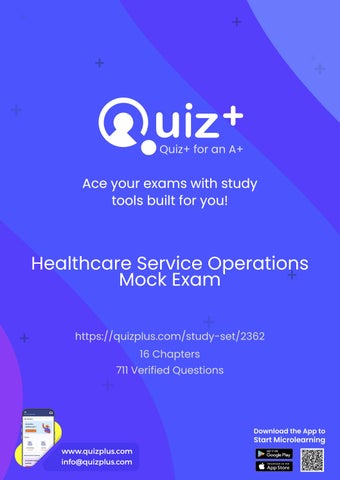
Healthcare Service Operations explores the principles, strategies, and tools essential for managing and optimizing processes within healthcare organizations. The course covers topics such as patient flow management, resource allocation, quality improvement, scheduling, supply chain management, and the application of operations management techniques in hospitals, clinics, and other healthcare settings. Students learn to analyze operations, identify inefficiencies, implement process improvements, and assess the impact of operational decisions on patient care, cost, and organizational performance. Case studies and real-world examples provide practical insights into the complexities unique to healthcare services, preparing students for leadership roles in management and operational excellence.
Recommended Textbook Service Management Operations Strategy Information Technology 9th Edition by
Available Study Resources on Quizplus 16 Chapters
711 Verified Questions 711 Flashcards
Source URL: https://quizplus.com/study-set/2362 Page 2
Available Study Resources on Quizplus for this Chatper
50 Verified Questions
50 Flashcards
Source URL: https://quizplus.com/quiz/46917
Sample Questions
Q1) Services are deeds, processes, and performances.
A)True
B)False Answer: True
Q2) The consumer participates in the service process, which is not the case in manufacturing.
A)True
B)False Answer: True
Q3) The Clark-Fisher hypothesis notes the shift of employment from one sector of the economy to another.
A)True
B)False Answer: True
Q4) Retail and wholesale trade had the greatest percentage of U.S. employment by industry in 2014.
A)True
B)False Answer: True
To view all questions and flashcards with answers, click on the resource link above. Page 3
Available Study Resources on Quizplus for this Chatper
70 Verified Questions
70 Flashcards
Source URL: https://quizplus.com/quiz/46918
Sample Questions
Q1) Firms classified as "available for service" view quality improvement efforts with disdain.
A)True
B)False
Answer: True
Q2) Which of the following is not identified as a strategy common to many successful service providers?
A) Close coordination between the marketing and operations.
B) The exploitation of information to generate new business.
C) A project-oriented organizational structure.
D) Redirection of the strategic service vision inward to focus on employees.
Answer: C
Q3) Wisdom is the last layer of the five layer data analytic model.
A)True
B)False
Answer: False
Q4) Information is a substitute for inventory.
A)True
B)False
Answer: True
To view all questions and flashcards with answers, click on the resource link above. Page 4
Available Study Resources on Quizplus for this Chatper
48 Verified Questions
48 Flashcards
Source URL: https://quizplus.com/quiz/46919
Sample Questions
Q1) Which of the following features does not illustrate a contribution that the customer can make in the delivery of services?
A) Substitution of customer labor for provider labor.
B) Smoothing service demand.
C) Service standardization.
D) None of the above.
Answer: C
Q2) The "project authorization" in the NSD cycle is part of the development step.
A)True
B)False
Answer: False
Q3) Check processing is an example of a process with ________.
A) indirect customer contact and low divergence
B) direct customer contact and low divergence
C) no customer contact and high divergence
D) no customer contact and low divergence
Answer: D
To view all questions and flashcards with answers, click on the resource link above. Page 5
Available Study Resources on Quizplus for this Chatper
50 Verified Questions
50 Flashcards
Source URL: https://quizplus.com/quiz/46920
Sample Questions
Q1) The Disney organization refers to its employees as cast members in order to promote its organizational culture.
A)True
B)False
Q2) Some organizations use a website for internal communications only.
A)True
B)False
Q3) Which of the following occurrences would be considered a "moment of truth" in a restaurant setting?
A) A diner considering the amount of tip to leave.
B) A child telling his parent what item on the menu looks good.
C) A waiter telling the cook what he really thinks of the manager.
D) A receptionist assigning a table to a customer.
Q4) Which of the following is the least likely source of difficulty with interactions between customers and contact personnel?
A) Poor employee selection and training.
B) Customers not understanding their role in the process.
C) Customers having no money to pay the bill.
D) Unrealistic customer expectations.
To view all questions and flashcards with answers, click on the resource link above. Page 6
Available Study Resources on Quizplus for this Chatper
46 Verified Questions
46 Flashcards
Source URL: https://quizplus.com/quiz/46921
Sample Questions
Q1) In a product layout, the bottleneck operation defines the capacity of the service.
A)True
B)False
Q2) The product layout often requires special equipment and special skills to deal with high volume of demand for service that is anticipated. These factors create a very inflexible layout.
A)True
B)False
Q3) A product layout would facilitate the concept of ________.
A) service in series
B) service in parallel
C) a first come, first served policy
D) balanced flow
Q4) Mid-Columbia Medical Center has a special employee-only entrance to enhance security.
A)True
B)False
To view all questions and flashcards with answers, click on the resource link above. Page 7
Available Study Resources on Quizplus for this Chatper
42 Verified Questions
42 Flashcards
Source URL: https://quizplus.com/quiz/46922
Sample Questions
Q1) Severity of failure, speed of recovery, service guarantee and perceived service quality are all factors governing service recovery expectations.
A)True
B)False
Q2) Which of the following is not true of a Customer Satisfaction Survey?
A) Survey can be completed at customer convenience.
B) Survey usually is conducted by operations personnel.
C) Primary focus of survey is on overall impression of service.
D) Survey is designed around common service dimensions.
Q3) Shigeo Shingo is credited with which of the following quality ideas?
A) Robustness.
B) Quality is free.
C) Poka-yoke.
D) Quality function deployment.
Q4) According to the SERVQUAL quality assessment instrument, responsiveness is the most important dimension of service quality.
A)True
B)False
To view all questions and flashcards with answers, click on the resource link above. Page 8
Available Study Resources on Quizplus for this Chatper
27 Verified Questions
27 Flashcards
Source URL: https://quizplus.com/quiz/46923
Sample Questions
Q1) Continuous improvement is a valuable concept, but it lacks measurement techniques.
A)True
B)False
Q2) Because customers participate directly in the service process, the success of technological innovation is dependent upon ________.
A) the user-friendliness of the innovation
B) the ability of customers to pay for the service
C) customer acceptance
D) market research
Q3) Data Envelopment Analysis (DEA), when used repeatedly, can facilitate the competitive strategy of cost leadership.
A)True
B)False
Q4) Which of the following statements is not part of Deming's 14-point philosophy?
A) Create constancy of purpose for improvements of product and service.
B) Promote numerical goals for the workforce.
C) Constantly and forever improve the system of production and service.
D) Cease dependence on mass inspection.
To view all questions and flashcards with answers, click on the resource link above. Page 9
Available Study Resources on Quizplus for this Chatper
40 Verified Questions
40 Flashcards
Source URL: https://quizplus.com/quiz/46924
Sample Questions
Q1) The ________ is a variation on the location set-covering problem.
A) Huff model
B) Greedy algorithm
C) maximal covering algorithm
D) shortest-path tree
Q2) The median has the property of minimizing the sum of absolute deviations from it.
A)True
B)False
Q3) The greedy algorithm is a solution procedure that is used for measuring the attraction of a customer to a facility.
A)True
B)False
Q4) The Huff model for retail outlet location postulates an inverse relationship between the attractiveness of a location and the travel time to that location for a particular customer.
A)True
B)False
To view all questions and flashcards with answers, click on the resource link above. Page 10
Available Study Resources on Quizplus for this Chatper
51 Verified Questions
51 Flashcards
Source URL: https://quizplus.com/quiz/46925
Sample Questions
Q1) Which of the following service providers likely would be involved in a single-level bidirectional service supply relationship?
A) Pharmacy.
B) Professor.
C) Garage.
D) Mortgage company.
Q2) Service tangibility increases as the focus of the service moves from property to people to process.
A)True
B)False
Q3) Bidirectional optimization could be considered an example of a win-win outcome.
A)True
B)False
Q4) The two-way classification for the taxonomy for outsourcing business services contains six cells. Which one of the following is not a descriptive title for one of the cells?
A) Facility support.
B) Professional.
C) Employee.
D) Facilitator.
To view all questions and flashcards with answers, click on the resource link above. Page 11
Available Study Resources on Quizplus for this Chatper
40 Verified Questions
40 Flashcards
Source URL: https://quizplus.com/quiz/46926
Sample Questions
Q1) Mayo Clinic is a service firm that would fall under which of the following categories?
A) Single location and single service.
B) Single location and multiservice.
C) Multisite and single service.
D) Multisite and multiservice.
Q2) American Express is an example of a firm that has a multisite, multiservice expansion strategy.
A)True
B)False
Q3) The famous Mayo clinic in Minneapolis is an example of a firm that employs a clustered service strategy.
A)True
B)False
Q4) 'Hiring local personnel' addresses the labor intensity factor in the ________ global service strategy.
A) multicountry expansion
B) following your customers
C) service offshoring
D) beating the clock
To view all questions and flashcards with answers, click on the resource link above. Page 12
Available Study Resources on Quizplus for this Chatper
47 Verified Questions
47 Flashcards
Source URL: https://quizplus.com/quiz/46927
Sample Questions
Q1) The strategy of segmenting demand to reduce variation makes use of the fact that demand for a service seldom is derived from a homogeneous source.
A)True
B)False
Q2) A cruise ship has available a certain number of rooms in each of 10 categories of appointments ranging from a two-bunk inside cabin to a suite with an outside patio and indoor sitting area. If a passenger requests a sailing date in which the desired cabin is sold out, which of the following actions would be considered the least viable alternative for the cruise line?
A) Offer an upgraded cabin at a reduced price.
B) Attempt to steer the passenger to an available date.
C) Overbook the cabin.
D) Offer a downgraded cabin with special privileges such as a $100 certificate for use in the casino.
Q3) ________ is not a strategy for reduction of customer-induced variability.
A) Adapt to customer skill levels
B) Require reservations
C) Limit service breadth
D) Target customers based on capability
To view all questions and flashcards with answers, click on the resource link above.
Page 13
Available Study Resources on Quizplus for this Chatper
34 Verified Questions
34 Flashcards
Source URL: https://quizplus.com/quiz/46928
Sample Questions
Q1) Multiple queue configuration may deter balking behavior.
A)True
B)False
Q2) Which of the following is not an effective way to manage the psychology of waiting?
A) Prominently display time with a large analog clock.
B) Inform customers when long waits are anticipated.
C) Use diversions to occupy customer waiting times.
D) Employ a take-a-number system to ensure fairness.
Q3) Which of the following queue configurations permits opportunities for division of labor and service differentiation?
A) Multiple queue.
B) Single queue.
C) Take a number.
D) Self-serve.
Q4) The main advantage of the multiple queue configuration is that it guarantees fairness to all by ensuring that a first-come-first-served rule applies to all arrivals.
A)True
B)False
To view all questions and flashcards with answers, click on the resource link above. Page 14
Available Study Resources on Quizplus for this Chatper
46 Verified Questions
46 Flashcards
Source URL: https://quizplus.com/quiz/46929
Sample Questions
Q1) The cost of service capacity is determined by ________.
A) the number of customers waiting
B) the total number of customers
C) waiting time
D) the number of servers on duty
Q2) Service capacity decisions have all of the following strategic characteristics, except ________.
A) the decision to invest in capacity will attract competitors
B) financial investment in capacity must be balanced against the costs of lost sales
C) inadequate short-term capacity needs can generate customers for the competition
D) hostile customers can result from inadequate capacity following a marketing campaign
Q3) The average time a customer should expect to wait can be calculated using just the mean arrival rate and the mean service rate.
A)True
B)False
To view all questions and flashcards with answers, click on the resource link above. Page 15
Available Study Resources on Quizplus for this Chatper
40 Verified Questions
40 Flashcards
Source URL: https://quizplus.com/quiz/46930
Sample Questions
Q1) Exponential smoothing uses a feedback control mechanism because ________.
A) is less than 1
B) calculations are based on modifying the previous smooth value
C) the calculation contains the forecast error
D) the weights given to past data are exponentially distributed
Q2) Because of the nontangible nature of service, forecasting does not play as important role in service operations as in manufacturing operations.
A)True
B)False
Q3) Historical analogy involves comparative analysis of the introduction and growth patterns of new items with similar previously introduced items.
A)True
B)False
Q4) Survey results are used in ________.
A) regression
B) cross-impact analysis
C) econometric models
D) Delphi method
To view all questions and flashcards with answers, click on the resource link above. Page 16
Available Study Resources on Quizplus for this Chatper
40 Verified Questions
40 Flashcards
Source URL: https://quizplus.com/quiz/46931
Sample Questions
Q1) Forward buying is used to avoid expensive interruptions of service, as a stock out at any stage of the physical goods distribution system would have far-reaching consequences for the other stages.
A)True
B)False
Q2) POS scanning is used to initiate a purchase order to a pre-approved vendor automatically when the stock levels are depleted (or reach a reorder point).
A)True
B)False
Q3) Lead time inventories are stocks that have been ordered but not yet received.
A)True
B)False
Q4) A continuous review system is generally used for Class C items in the ABC system of classification.
A)True B)False
Q5) ABC analysis is an application of the 80-20 rule. A)True B)False
To view all questions and flashcards with answers, click on the resource link above. Page 17
Available Study Resources on Quizplus for this Chatper
40 Verified Questions
40 Flashcards
Source URL: https://quizplus.com/quiz/46932
Sample Questions
Q1) A key assumption underlying project networks is: ________.
A) dummy activities take up no time
B) the critical path is known with certainty
C) an activity begins only after all predecessors are completed
D) a project network is cyclic
Q2) The term 'total slack' refers to the amount of time an activity can be delayed without delaying the start of a subsequent activity.
A)True
B)False
Q3) The four sequential stages of team development include all of the following, except ________.
A) forming
B) storming
C) coalescing
D) performing
Q4) Projects are terminated for all of the following reasons, except ________.
A) subtraction
B) addition
C) integration
D) starvation
To view all questions and flashcards with answers, click on the resource link above. Page 18