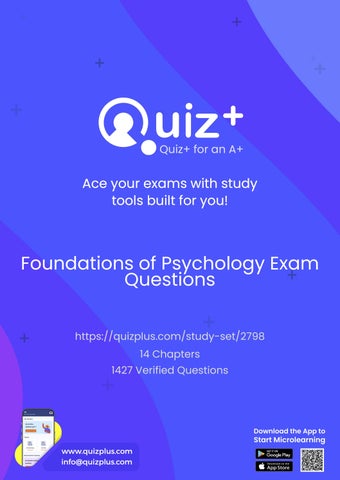
Foundations of Psychology introduces students to the fundamental concepts and theories underlying human behavior and mental processes. The course covers key areas such as biological bases of behavior, sensation and perception, learning, memory, motivation, emotion, development, personality, social psychology, and psychological disorders. Through a combination of lectures, discussions, and practical examples, students will gain insight into how psychologists study the mind and behavior, explore various psychological approaches, and apply scientific methods to real-world psychological questions. This course provides a comprehensive overview designed to build a solid base for further study in psychology and related fields.
Recommended Textbook
Experience Psychology 2nd Edition by Laura King
Available Study Resources on Quizplus
14 Chapters
1427 Verified Questions
1427 Flashcards
Source URL: https://quizplus.com/study-set/2798 Page 2
Available Study Resources on Quizplus for this Chatper
100 Verified Questions
100 Flashcards
Source URL: https://quizplus.com/quiz/55744
Sample Questions
Q1) A case study _____.
A) is an indepth look at a single individual
B) is useful for studying large populations
C) involves random assignment of participants
D) relies on the experimental method
Answer: A
Q2) According to the _____,people have the ability to control their lives and are not simply controlled by the environment.
A) humanistic approach
B) psychodynamic approach
C) evolutionary approach
D) behaviorism approach
Answer: A
Q3) In an experiment,the group that is NOT subjected to a treatment condition is known as the _____ group.
A) control
B) treatment
C) experimental
D) dependent
Answer: A
To view all questions and flashcards with answers, click on the resource link above. Page 3
Available Study Resources on Quizplus for this Chatper
112 Verified Questions
112 Flashcards
Source URL: https://quizplus.com/quiz/55743
Sample Questions
Q1) A powerful surge of oxytocin is released in a _____.
A) person who is in shock after a car wreck
B) long distance runner
C) young boy on a roller coaster ride
D) mother who has just given birth
Answer: D
Q2) Which of the following are correctly matched?
A) Frontal lobes-hearing, language processing, and memory
B) Occipital lobes-personality, intelligence, and the control of voluntary muscles
C) Temporal lobes-visual stimuli
D) Parietal lobes-spatial location, attention, and motor control
Answer: D
Q3) When a neuron sends an action potential,it is commonly said to be "_____."
A) firing
B) grading
C) depolarizing
D) classifying
Answer: A
To view all questions and flashcards with answers, click on the resource link above.
4
Available Study Resources on Quizplus for this Chatper
100 Verified Questions
100 Flashcards
Source URL: https://quizplus.com/quiz/55742
Sample Questions
Q1) Compare and contrast the two major theories of hearing,place theory and frequency theory.
Answer: Place theory states that each frequency produces vibrations at a particular spot on the basilar membrane.Research shows that place theory adequately explains high-frequency sounds but not low-frequency sounds.According to frequency theory,the perception of a sound's frequency depends on how often the auditory nerve fires.One limitation of frequency theory is that a single neuron has a maximum firing rate of about 1,000 times per second,and thus this theory cannot explain tones with frequencies that would require a neuron to fire more rapidly.To deal with this limitation,a modification of frequency theory called the volley principle states that a cluster of nerve cells can fire neural impulses in rapid succession,producing a volley of impulses.Thus,although individual neurons cannot fire faster than 1,000 times per second,by teaming up and alternating their firing,they can attain a combined frequency above 1,000 times per second.
Q2) Which of the following is the unit of measurement for assessing loudness?
A) Pitch
B) Saturation
C) Hue
D) Decibel Answer: D
To view all questions and flashcards with answers, click on the resource link above.
Page 5
Available Study Resources on Quizplus for this Chatper
100 Verified Questions
100 Flashcards
Source URL: https://quizplus.com/quiz/55741
Sample Questions
Q1) Compare and contrast the two major theories of dreaming (the cognitive theory of dreaming and the activation-synthesis theory of dreaming).
Q2) Drug addiction occurs when _____.
A) an individual will lie about taking a drug
B) a drug no longer causes a person to get high, but they take it again
C) physical and/or psychological dependence develops
D) a person can be without the drug no longer than five days
Q3) The concept of "theory of mind" is best described as _____.
A) thinking about thinking
B) individuals' understanding that they and others think, feel, perceive, and have private experiences
C) individuals' misinterpretation of their own subconscious thoughts
D) the psychological answer to the metaphysical concept of a soul
Q4) Night terrors typically occur _____.
A) among older adults
B) during non-REM sleep
C) following sleep apnea
D) within three hours of falling asleep
Q5) Explain the distinction between automatic and controlled processes.
To view all questions and flashcards with answers, click on the resource link above. Page 6
109 Verified Questions
109 Flashcards
Source URL: https://quizplus.com/quiz/55740
Sample Questions
Q1) Salivating at the presentation of food is an example of _____.
A) latent learning
B) a learned response
C) a reflex
D) insight learning
Q2) _____ in classical conditioning is the weakening of the conditioned response when the unconditioned stimulus is absent.
A) Generalization
B) Discrimination
C) Extinction
D) Latent learning
Q3) _____ is a theory of learning that focuses solely on observable behaviors,discounting the importance of such mental activity as thinking,wishing,and hoping.
A) Psychoanalysis
B) Behaviorism
C) Humanism
D) Conditioning
Q4) How does culture influence learning?
Q5) Discuss the distinction between associative learning and observational learning. To view all questions and flashcards with answers, click on the resource link above.
Page 7
Available Study Resources on Quizplus for this Chatper
100 Verified Questions
100 Flashcards
Source URL: https://quizplus.com/quiz/55739
Sample Questions
Q1) The _____ is the tendency to recall the items at the beginning and end of a list more readily than those in the middle.
A) halo effect
B) ambiguity effect
C) serial position effect
D) framing effect
Q2) Which of the following involves being able to consciously recall information from the past and recite it?
A) Sensory memory
B) Short-term memory
C) Declarative memory
D) Nondeclarative memory
Q3) Long-term potentiation is a concept that explains _____.
A) how people can remember material for several months
B) how memory functions at the neuron level
C) how cannibalized worms can pass on skills they had learned to the cannibals
D) why students should study exam material over a period of days instead of hours
Q4) Define the distinction between proactive and retroactive interference.
Q5) Describe the Atkinson-Shiffrin model of memory.
To view all questions and flashcards with answers, click on the resource link above. Page 8
Available Study Resources on Quizplus for this Chatper
100 Verified Questions
100 Flashcards
Source URL: https://quizplus.com/quiz/55738
Sample Questions
Q1) Creative people engage in _____.
A) divergent thinking but not in convergent thinking
B) deductive thinking
C) both convergent thinking and divergent thinking
D) functional fixedness
Q2) Lionel is a CEO of a company that is in financial crisis.He asks his employees to brainstorm and create a list of all possible solutions to keeping the company in business.Lionel is asking his employees to engage in _____.
A) convergent thinking
B) divergent thinking
C) heuristic thinking
D) functional fixedness
Q3) According to the textbook,_____ is the first step in the problem-solving process.
A) developing good problem-solving strategies
B) evaluating solutions
C) rethinking and redefining problems and solutions over time
D) finding and framing the problem
Q4) Define the five basic components of language.
Q5) What four steps are involved in the process of problem solving?
To view all questions and flashcards with answers, click on the resource link above. Page 9
Available Study Resources on Quizplus for this Chatper
107 Verified Questions
107 Flashcards
Source URL: https://quizplus.com/quiz/55737
Sample Questions
Q1) According to the text,some researchers disagree with the notion that the labels "easy," "difficult," and "slow-to-warm-up" are the best way to conceptualize temperament.These psychologists argue that _____ are the core dimensions of temperament.
A) object permanence and egocentrism
B) self-regulation, inhibition, and negative affectivity
C) parenting style and conservation
D) morality, identity, and prosocial behavior
Q2) Nathan is a happy and healthy 3-month-old baby.Based on preferential looking and habituation research,what can you predict about Nathan's perceptual abilities?
A) Nathan will not be able to distinguish between scrambled faces and real faces.
B) Nathan will prefer a stranger's face to his mother's face.
C) Nathan will prefer real faces to scrambled faces and he will also prefer his mother's face to a stranger's face.
D) Nathan will prefer real to scrambled faces but will not be able to distinguish his mother's face from a stranger's face.
Q3) What role do parents and peers play in adolescent development?
To view all questions and flashcards with answers, click on the resource link above.
Page 10
Available Study Resources on Quizplus for this Chatper
100 Verified Questions
100 Flashcards
Source URL: https://quizplus.com/quiz/55736
Sample Questions
Q1) According to self-determination theory,competence motivation involves _____.
A) drive-reduction
B) self-efficacy and mastery
C) environmental stimuli
D) maintaining optimal arousal
Q2) According to self-determination theory,people are most fulfilled when they satisfy which three fundamental needs?
A) Hunger, thirst, and sex
B) Hunger, security, and love
C) Competence, autonomy, and relatedness
D) Hunger, esteem, and achievement
Q3) Identify and rank the five needs in Maslow's hierarchy of needs.
Q4) Autonomy refers to _____.
A) the belief that one has the competence to accomplish a given goal or task
B) the sense that one can gain skills and overcome obstacles
C) the need to engage in warm relations with other people
D) the sense that one is in control of one's own life
Q5) Explain the distinction between intrinsic and extrinsic motivation.
Q6) What are the obstacles in the pursuit of happiness?
Q7) Explain drive reduction theory.Discuss the criticisms of drive reduction theory.
To view all questions and flashcards with answers, click on the resource link above. Page 11
Available Study Resources on Quizplus for this Chatper
100 Verified Questions
100 Flashcards
Source URL: https://quizplus.com/quiz/55735
Sample Questions
Q1) Face validity refers to whether _____.
A) two examiners will agree about a person's personality traits
B) the content of test items appears to be a good indicator of personality traits
C) the personality test will predict behavior outside the test situation
D) the person is giving answers to try to look better
Q2) Which of the following is NOT one of the Big Five personality factors?
A) Neuroticism
B) Agreeableness
C) Dominance
D) Extraversion
Q3) The Thematic Apperception Test (TAT)was created by _____.
A) Sigmund Freud
B) Karen Horney
C) Alfred Adler
D) Henry Murray
Q4) Evaluate the strengths and weaknesses of the trait approach to personality.
Q5) Describe Carl Rogers's approach to personality and how it is related to the more general concept of positive psychology.
Q6) Describe Maslow's approach to personality.
Page 12
To view all questions and flashcards with answers, click on the resource link above.
Available Study Resources on Quizplus for this Chatper
109 Verified Questions
109 Flashcards
Source URL: https://quizplus.com/quiz/55734
Q1) Juanita returned home after being away for several years.When she saw her father,whom she thought she disliked,she hugged him and cried.Based on her crying when she saw him,she determined that she must like him more than she thought.This is most consistent with the _____ of attitudes.
A) evolutionary theory
B) social learning theory
C) self-perception theory
D) social identity theory
Q2) Alex regularly gives donations of blood to the Red Cross because he received a life-saving transfusion when he was in a car accident two years ago.His helping behavior is best explained by _____.
A) the concept of reciprocity
B) reciprocal determinism
C) social exchange theory
D) self-perception theory
Q3) Define the concept of deindividuation.What effects can deindividuation have on our behavior? How do psychologists explain the effects of deindividuation?
Q4) According to social psychology,why do people develop stereotypes and prejudice?
Q5) Discuss the distinction between altruism and egoism.
To view all questions and flashcards with answers, click on the resource link above. Page 13
Available Study Resources on Quizplus for this Chatper
90 Verified Questions
90 Flashcards
Source URL: https://quizplus.com/quiz/55733
Sample Questions
Q1) Which of the following is NOT a symptom of post-traumatic stress disorder?
A) Flashbacks
B) Impulsive outbursts of behavior
C) Difficulties with memory and concentration
D) Feeling emotionally charged
Q2) In the film A Beautiful Mind,John Nash hears and sees people who are not actually there.These sensations are examples of _____.
A) hallucinations
B) delusions
C) mirages
D) catatonia
Q3) Which of the following is NOT classified as an anxiety disorder?
A) Specific phobia
B) Panic disorder
C) Depression
D) Social anxiety disorder
Q4) Write a note on the biological and psychological factors contributing to suicide.
Q5) What do psychologists believe is the etiology of generalized anxiety disorder?
Q6) Write a note on antisocial personality disorder (ASPD).
Page 14
To view all questions and flashcards with answers, click on the resource link above.
Available Study Resources on Quizplus for this Chatper
100 Verified Questions
100 Flashcards
Source URL: https://quizplus.com/quiz/55732
Sample Questions
Q1) The main goal of psychoanalysis is to _____.
A) persuade clients to abandon their irrational, misery-inducing beliefs
B) provide clients with insight into their unconscious conflicts
C) train clients to avoid maladaptive patterns of behavior through modeling of appropriate behaviors
D) demonstrate unconditional positive regard toward the client
Q2) _____ therapy is based on the assumption that abnormal behavior is due to faulty ways of thinking and believing.
A) Humanistic
B) Cognitive
C) Gestalt
D) Psychoanalytic
Q3) Which of the following is a goal of couples therapy?
A) To improve the communication between the partners
B) To facilitate better sexual relations
C) To decrease the number of rules set for each of the partners
D) To increase the amount of warmth between the partners
Q4) Explain the process of Beck's cognitive therapy.
Q5) Discuss six potential benefits of group therapy.
Q6) Explain the process of well-being therapy.
Page 15
To view all questions and flashcards with answers, click on the resource link above.
Available Study Resources on Quizplus for this Chatper
100 Verified Questions
100 Flashcards
Source URL: https://quizplus.com/quiz/55731
Sample Questions
Q1) Which of the following lists the stages of the stages of change model in the correct order?
A) Preparation, precontemplation, contemplation, action, maintenance
B) Preparation, action, precontemplation, contemplation, maintenance
C) Precontemplation, contemplation, preparation, action, maintenance
D) Precontemplation, contemplation, preparation, maintenance, action
Q2) Andrea was just fired from a job she really loved.You are her best friend so you try to offer her all the support that she needs.Giving Andrea a hug when she is down and telling her that you will "be there for her" is an example of _____ support,whereas loaning her money and telling her that she can stay with you until she finds another job is an example of _____ support.
A) tangible/emotional
B) emotional/tangible
C) psychological/physical
D) physical/psychological
Q3) Which of the following is an example of a sexually transmitted infection (STI)?
A) Erysipelas
B) Impetigo
C) Syphilis
D) Cellulitis
To view all questions and flashcards with answers, click on the resource link above. Page 16