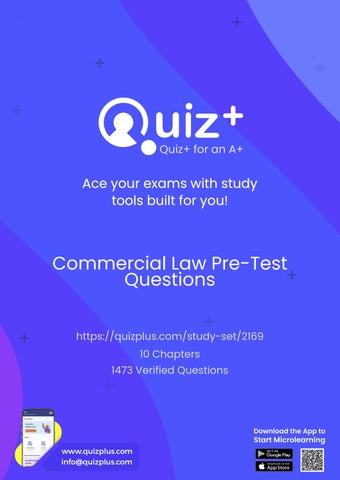
Commercial Law introduces students to the foundational principles and regulatory frameworks that govern business transactions and commercial relationships. The course covers essential topics such as contracts, agency, sales of goods, negotiable instruments, and secured transactions, alongside relevant statutory and case law. Emphasis is placed on the legal mechanisms facilitating trade and commerce, dispute resolution, and the implications of legal doctrines for both business operations and consumer protection. Through lectures, case studies, and practical exercises, students will develop an understanding of the legal environment in which businesses operate and learn to identify and address legal issues encountered in various commercial contexts.
Recommended Textbook Legal Fundamentals for Canadian Business 3rd Edition by Richard A. Yates
Available Study Resources on Quizplus
10 Chapters
1473 Verified Questions
1473 Flashcards
Source URL: https://quizplus.com/study-set/2169 Page 2
Available Study Resources on Quizplus for this Chatper
139 Verified Questions
139 Flashcards
Source URL: https://quizplus.com/quiz/43267
Sample Questions
Q1) Which of the following is correct with respect to the role of statutes in our legal system?
A)Only the federal Parliament may enact statutes.
B)In Canada, most new laws follow the Civil Code legal system.
C)Where a properly passed provincial statute is in conflict with a well-established common law principle, the statute will be void.
D)Once a statute has been interpreted and applied in a court, a subsequent judge in a lower court is not required to follow that decision if he or she disagrees with it.
E)A statute, if it is clear and concise and properly passed, will always override common law and equity.
Answer: E
Q2) Who brings a civil action?
Answer: The plaintiff
Q3) Substantive law is concerned with how legal institutions work.
A)True
B)False
Answer: False
To view all questions and flashcards with answers, click on the resource link above. Page 3
Available Study Resources on Quizplus for this Chatper
143 Verified Questions
143 Flashcards
Source URL: https://quizplus.com/quiz/43268
Sample Questions
Q1) Which of the following incidents describes the legal meaning of the tort of assault?
A)Unknown to you, I threw a hammer at your head but missed.
B)I threw a hammer at your head, but you saw it coming and ducked out of the way.
C)When you are asleep in the house, I sneak up and throw a hammer through your garage window.
D)I come up from behind you without your seeing me and hit the back of your knees, causing you to fall down.
E)I accidentally drop a hammer on your foot.
Answer: B
Q2) A duty is owed when:
A)It would be apparent to a prudent person that the conduct was likely to cause injury
B)A person undertakes to rescue someone in danger
C)A person making a misstatement knew that it would be relied on by a member of a group
D)A visitor comes on your property
E)All of the above
Answer: E
To view all questions and flashcards with answers, click on the resource link above. Page 4
Available Study Resources on Quizplus for this Chatper
167 Verified Questions
167 Flashcards
Source URL: https://quizplus.com/quiz/43269
Sample Questions
Q1) Which of the following is correct with respect to consideration?
A)It must be specific.
B)It is binding even though a duty to so act already exists.
C)It is to compensate for an act that happened in the past.
D)It must be reasonable.
E)At least some money must be involved.
Answer: A
Q2) Which one of the following correctly indicates the position of the parties in respect to contracts involving minors?
A)Contracts with minors are void, except beneficial contracts of service.
B)Contracts with minors are unenforceable by the minor against the adult and by the adult against the minor.
C)An adult cannot sue the minor on the contract even if the minor affirms the contract after reaching the age of majority.
D)All contracts with minors are void.
E)A minor can enforce a contract made by an adult with him despite the fact that he is a minor.
Answer: E
To view all questions and flashcards with answers, click on the resource link above. Page 5
Available Study Resources on Quizplus for this Chatper
177 Verified Questions
177 Flashcards
Source URL: https://quizplus.com/quiz/43270
Sample Questions
Q1) A fraudulent misrepresentation that induces another person to enter into a contract can result in which of the following remedies?
A)Rectification
B)Rescission and/or damages
C)Rescission only
D)Damages only
E)There is no remedy available for fraudulent misrepresentation.
Q2) To avoid a contract on the basis of non est factum, the mistake must have gone to the entire nature of the agreement, not just to some aspect of it.
A)True
B)False
Q3) A condition precedent is a term of a contract that will bring that contract to an end when the specified condition is met.
A)True
B)False
Q4) Joe owed Harry $500, but Harry was confused when Joe came to pay it back and refused to take the money for the payment.Explain Joe's legal position.
Q5) Explain what is meant by a novation.
To view all questions and flashcards with answers, click on the resource link above. Page 6
Available Study Resources on Quizplus for this Chatper
105 Verified Questions
105 Flashcards
Source URL: https://quizplus.com/quiz/43271
Sample Questions
Q1) Explain two methods in which a debtor becomes bankrupt.
Q2) If goods are purchased by description or by sample and what is actually delivered does not match the description or sample, caveat emptor applies.
A)True
B)False
Q3) Often the title of the goods will be transferred to a creditor as security for a loan.Sometimes this involves the use of a bill of sale, but the nature of the transaction is for the loan to be repaid.In this case, the creditor retains possession of the item used as security.
A)True
B)False
Q4) The Canada Consumer Product Safety Act (2011) gives regulators the power to force the immediate recalls of dangerous products and requires manufacturers to report incidents of products causing injury and to keep detailed records so that sold products can be traced.The passage of this Act also involved major changes to the Hazardous Products Act.
A)True
B)False
Q5) Explain why bankruptcy and insolvency are important for a business person.
To view all questions and flashcards with answers, click on the resource link above. Page 7
Available Study Resources on Quizplus for this Chatper
158 Verified Questions
158 Flashcards
Source URL: https://quizplus.com/quiz/43272
Q1) When an agent acts beyond the specific authority given by the principal, that action will not be binding on the principal.
A)True
B)False
Q2) A chauffeur, going against specific instructions, purchases a new car on behalf of his employer.The employer has done nothing to lead the seller to believe that the chauffeur has authority but is persuaded by the chauffeur to go for a drive before returning the vehicle.Explain the legal position of the parties.
Q3) What constitutes "just cause"?
Q4) If a third party relies on the principal's representation that the agent has the authority to act, which of the following is true?
A)The principal can claim the agent had no authority.
B)The principal cannot claim the agent had no authority.
C)The principal can claim estoppel.
D)The agent is solely liable for the conduct if it results in injury to the third party.
E)The agent can sue the principal for breach of contract.
Q5) Discuss the termination of employees and the notice to which they are entitled.
To view all questions and flashcards with answers, click on the resource link above.
Page 8
Available Study Resources on Quizplus for this Chatper
174 Verified Questions
174 Flashcards
Source URL: https://quizplus.com/quiz/43273
Sample Questions
Q1) Joe sold Harry his barber shop for $100 000.He was paid $20 000 in cash, the other $80 000 to be paid by Harry giving Joe 20% of the profits of the business until the amount is paid off.Unfortunately, a customer, Sam, is injured by Harry, who manages to cut off Sam's right ear while shaving him.Sam sues both Harry and Joe.Explain his likelihood of success.
Q2) If three partners set out a term in their partnership agreement that John would only be responsible for 10 percent of any losses, yet he has to pay 100 percent of a claim because the other partners have no funds, John could seek contributions from the other partners according to the partnership agreement.
A)True
B)False
Q3) A partnership enjoys tax advantages not available to a sole proprietor.
A)True
B)False
Q4) A corporation is a fiction that does not exist in reality.
A)True
B)False
Q5) Indicate three significant results of a corporation being classed as a separate legal personality.
To view all questions and flashcards with answers, click on the resource link above. Page 9
160 Verified Questions
160 Flashcards
Source URL: https://quizplus.com/quiz/43274
Sample Questions
Q1) In Ontario, both the tenant and the landlord must give 60 days' notice of termination of tenancy.
A)True
B)False
Q2) Which of the following is false with regard to the nature of mortgages?
A)A second mortgage is referred to as an equitable mortgage because it is the equity of redemption that is transferred to the mortgagee as security.
B)The land titles system of land registration provides that the mortgagee does not show up as the registered owner on the state of title certificate but merely as the holder of a charge against the property.
C)In the event of default, the first mortgagee must wait until the end of the redemption period to ask the court to make the foreclosure absolute if payment has not been made.
D)In the case of default, the property cannot be sold by a second mortgagee until the end of the redemption period.
E)Unlike an agreement for sale, under which an owner retains title to his property until the purchaser makes all payments, a mortgage is a document by which the owner conveys title to a lender.
To view all questions and flashcards with answers, click on the resource link above.
Page 10
Available Study Resources on Quizplus for this Chatper
131 Verified Questions
131 Flashcards
Source URL: https://quizplus.com/quiz/43275
Sample Questions
Q1) The Personal Information Protection and Electronic Documents Act (PIPEDA) applies only to federal government institutions.
A)True
B)False
Q2) Trademarks can be challenged up to 15 years after registration.
A)True
B)False
Q3) Which of the following is true with respect to the duty owed when a person is in possession of confidential information?
A)The nature of the duty is not to disclose confidential information about a business that would cause harm to the business or bring personal benefit.
B)There is an obligation of duty, but it stems from contract law.
C)A duty is only owed when the information is copyrighted or patented.
D)The duty is owed only between partners within a partnership.
E)There must be a fiduciary duty in order to have a legal obligation not to disclose confidential information.
Q4) Explain how a patent is obtained.
Q5) Give three examples of matters covered by copyright legislation.
To view all questions and flashcards with answers, click on the resource link above. Page 11
Available Study Resources on Quizplus for this Chatper
119 Verified Questions
119 Flashcards
Source URL: https://quizplus.com/quiz/43276
Q1) An electronic signature provides a digital certificate that authenticates the identity of a party to the contract.
A)True
B)False
Q2) Alternate dispute resolution has been effective in settling certain types of internet disputes.
A)True
B)False
Q3) Which of the following statements is incorrect in relation to the internet and computer fraud?
A)There is no satisfactory means of regulating the internet.
B)Finding and identifying the perpetrators of computer fraud presents a primary challenge.
C)New technologies have provided satisfactory means of regulating the internet.
D)Prosecuting in the appropriate jurisdiction makes it difficult and costly to reduce computer fraud.
E)Internet users need to be very careful with whom they deal and to whom they provide personal information.
Q4) Describe the North American Free Trade Agreement (NAFTA).
To view all questions and flashcards with answers, click on the resource link above. Page 12