
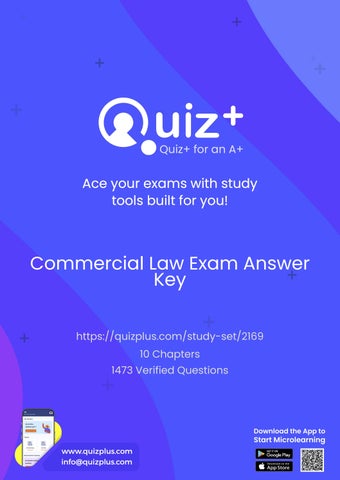
Commercial Law is a foundational course that explores the legal principles and regulations governing business and commercial transactions. The course covers topics such as contract formation and enforcement, the sale of goods, agency, negotiable instruments, secured transactions, and the legal structures of business entities. Students will gain an understanding of how commercial relationships are formed, managed, and resolved, and will examine relevant legislation and case law that shape modern commerce. The course also addresses issues related to international trade and consumer protection, equipping students with the legal knowledge necessary for navigating the dynamic world of business.
Recommended Textbook
Legal Fundamentals for Canadian Business 3rd Edition by Richard A. Yates
Available Study Resources on Quizplus
10 Chapters
1473 Verified Questions
1473 Flashcards
Source URL: https://quizplus.com/study-set/2169 Page 2
Available Study Resources on Quizplus for this Chatper
139 Verified Questions
139 Flashcards
Source URL: https://quizplus.com/quiz/43267
Sample Questions
Q1) Discuss the significance of the passage of the Charter of Rights and Freedoms in Canada's legal system.
Answer: Students should describe the nature of the Charter of Rights and Freedoms, why it was needed, and how it affected the rest of Canada's legal system.Before the Charter, there were few restrictions on government because of supremacy of Parliament.There was a need for overall entrenched rights that controlled the actions of government and government officials and agents.It is important that they indicate that the Charter only applies directly to governments but indirectly affects individuals' relations with each other because provincial and federal human rights legislation and other statutes must conform to the Charter.They should show that the Charter shifts power to the courts, that Parliament is no longer supreme, but also that there is an exception with the notwithstanding clause. Students' answers should show that they know what the Charter of Rights and Freedoms is, why it was passed, and that it fundamentally altered the relationship between the courts and Parliament in this country.
Q2) Who brings a civil action?
Answer: The plaintiff
Q3) What is the highest court in Canada?
Answer: Supreme Court of Canada
To view all questions and flashcards with answers, click on the resource link above.
Page 3
Available Study Resources on Quizplus for this Chatper
143 Verified Questions
143 Flashcards
Source URL: https://quizplus.com/quiz/43268
Sample Questions
Q1) Which of the following does not describe a crime?
A)An act prosecuted by the state
B)A serious injury inflicted on a person by the unintentional act of another
C)A charge laid by the police
D)An act that can be punished by imprisonment
E)A serious offence against the state
Answer: B
Q2) With intentional torts such as assault and battery, false imprisonment, or trespass, it is necessary that actual damage be shown.
A)True
B)False
Answer: False
Q3) The term that is used in tort law to describe a situation where an employer is held responsible for the conduct of the employee is ________.
Answer: Vicarious liability
Q4) Explain what is meant by innuendo.
Answer: An innuendo involves a hidden meaning that makes a basically innocent statement defamatory because of this hidden meaning.
To view all questions and flashcards with answers, click on the resource link above. Page 4
Available Study Resources on Quizplus for this Chatper
167 Verified Questions
167 Flashcards
Source URL: https://quizplus.com/quiz/43269
Sample Questions
Q1) "A person's intention to be bound by contracts is presumed." Discuss the accuracy of this statement.
Answer: It is inaccurate.Where contracts involve people in domestic relationships, an intention not to be bound is presumed.
Q2) "A verbal contract is every bit as binding as a written one." Discuss the validity of this statement.
Answer: The Statute of Frauds requires that contracts for things such as interests in land, etc., must be evidenced in writing.Otherwise, the statement is correct.
Q3) Explain the nature of the post-box rule.
Answer: When it is appropriate to respond by mail, the acceptance is effective when and where dropped in the mailbox.
Q4) All contracts must be in writing to be enforceable. A)True
B)False
Answer: False
Q5) What is the age of majority in your province?
Answer: The age of majority is 18 or 19, depending on the province.
To view all questions and flashcards with answers, click on the resource link above.
Page 5
Available Study Resources on Quizplus for this Chatper
177 Verified Questions
177 Flashcards
Source URL: https://quizplus.com/quiz/43270
Sample Questions
Q1) Which of the following is true with regard to remedies for breach of contract?
A)If the seller has committed a "fundamental breach" of the contract, an exemption clause absolves the seller from liability.
B)Non est factum is an equitable remedy forcing a person to comply with the terms of the contract.
C)The victim of a breach can recover damages that he could have avoided if he had tried to mitigate his loss.
D)Damages are awarded by the court to a person who has suffered loss because of a breach of an essential term of the contract, but are not awarded for a breach of a non-essential term (i.e., a warranty).
E)A person who breaches a contract is liable for all foreseeable loss that directly and naturally flows from the breach.
Q2) An assignee is in no better position than the original contractor.
A)True
B)False
Q3) Injunction is an example of an equitable remedy.
A)True
B)False
To view all questions and flashcards with answers, click on the resource link above. Page 6
Available Study Resources on Quizplus for this Chatper
105 Verified Questions
105 Flashcards
Source URL: https://quizplus.com/quiz/43271
Q1) Owen borrowed money from a credit union, guaranteed by his father, to buy a car.The credit union also registered a security interest under the Personal Property Security Act against the vehicle.Owen defaulted and, instead of repossessing the vehicle, the credit union demanded payment from the father.Explain the legal position of the father under these circumstances.
Q2) A warranty under the Sale of Goods Act is a contract term the breach of which will allow the victim of the breach to refuse to go through with his or her side of the agreement.
A)True
B)False
Q3) What is the difference in terms of legal responsibility between a co-signer and a guarantor of a debt?
Q4) What are the rights of the purchasers when the goods do not match the description?
Q5) What is the main purpose of the Sale of Goods Act?
Q6) The transfer of the title and possession of the goods in exchange for money must be intended or anticipated for the Sale of Goods Act to apply.
A)True
B)False
Page 7
To view all questions and flashcards with answers, click on the resource link above.
Available Study Resources on Quizplus for this Chatper
158 Verified Questions
158 Flashcards
Source URL: https://quizplus.com/quiz/43272
Q1) When another employer induces someone to leave her current employment, which of the following actions might the current employer pursue?
A)Action for theft
B)Action for inducing breach of contract
C)Action for breach of confidentiality
D)Action for unfair competition
E)Action for breach of fiduciary duty
Q2) Certification is notice to a labour relations board that the union intends to go on strike.
A)True
B)False
Q3) What is the significance of a union becoming certified?
Q4) Joe was an employee of Sam and was using his own car to deliver manufactured goods to a client.Since the client was in North Vancouver, the same area where Joe's girlfriend lived, Joe took time out to visit her for lunch.As he approached her house, he was involved in an automobile accident with George.George sued both Joe and his employer.Explain the likely outcome.
Q5) Distinguish between an agent and an employee.
Q6) Distinguish between a strike and a lockout.
Page 8
To view all questions and flashcards with answers, click on the resource link above.
Available Study Resources on Quizplus for this Chatper
174 Verified Questions
174 Flashcards
Source URL: https://quizplus.com/quiz/43273
Sample Questions
Q1) Discuss the advantages and disadvantages of partnership as a method of carrying on business compared to incorporation.
Q2) A corporation is a fiction that does not exist in reality.
A)True
B)False
Q3) If three partners set out a term in their partnership agreement that John would only be responsible for 10 percent of any losses, yet he has to pay 100 percent of a claim because the other partners have no funds, John could seek contributions from the other partners according to the partnership agreement.
A)True
B)False
Q4) "A partnership can be created by the conduct of the parties." Discuss the accuracy of this statement.
Q5) Explain what is meant by limited liability related to corporations.
Q6) Based on the clarification provided by the Supreme Court of Canada in the BCE case, explain the fiduciary duty owed by directors.
Q7) Discuss the role of the Partnership Act as it relates to people carrying on joint business activities.
Page 9
To view all questions and flashcards with answers, click on the resource link above.
Available Study Resources on Quizplus for this Chatper
160 Verified Questions
160 Flashcards
Source URL: https://quizplus.com/quiz/43274
Sample Questions
Q1) If someone stores goods on your property without permission, and you exercise no control over those goods, there is no duty to take care of them.
A)True
B)False
Q2) A fidelity bond is when the employee pays the employer a fee to cover himself while he is on the job.
A)True
B)False
Q3) Explain what is meant by bonding.
Q4) Consider the various remedies that are available to the mortgagee in the event of a default, and discuss the effectiveness of each.
Q5) Some businesses may be subject to both federal and provincial regulations.
A)True
B)False
Q6) Joe borrowed his neighbour Sam's lawn mower.At the same time, Sam asked Joe to look after a valuable camera for him while he was on vacation.Explain in relation to which of these items Joe has a higher duty to be careful.
Q7) Explain what is meant by riparian rights.
To view all questions and flashcards with answers, click on the resource link above. Page 10
Available Study Resources on Quizplus for this Chatper
131 Verified Questions
131 Flashcards
Source URL: https://quizplus.com/quiz/43275
Sample Questions
Q1) Yung created a machine that was not exactly new and novel in that it was an improvement on an existing patented machine.Which of the following is true?
A)Both Yung's improvement and the original machine lose their patent protection.
B)Yung could get a patent for his improvement, but has no right to make, sell, or use the original machine.
C)The patent holder of the original machine has the right to make, sell, or use the improvement because its machine is the basis of the improvement.
D)Yung could get a patent for his improvement, and would thereby get an independent right to make, sell, or use his machine with the original machine incorporated into it.
E)Yung cannot get a patent for his improvement because it is not entirely new or novel.
Q2) Explain how a patent is obtained.
Q3) Discuss the scope and purpose of the Personal Information Protection and Electronic Documents Act (PIPEDA).
Q4) What protection is given under trademark legislation?
Q5) When an author assigns copyright to a purchaser, what rights does he or she still have in relation to the work?
To view all questions and flashcards with answers, click on the resource link above.
11
Available Study Resources on Quizplus for this Chatper
119 Verified Questions
119 Flashcards
Source URL: https://quizplus.com/quiz/43276
Sample Questions
Q1) Employers are particularly vulnerable to the misuse of their computer resources by employees. Discuss.
Q2) Bilateral investment treaties (BITs) and foreign investment and promotion agreements (FIPAs) are government initiatives designed to stabilize the investment environment for corporations doing business abroad, especially for those involved in mining and natural resource extraction in countries where the political climate is unstable.
A)True
B)False
Q3) The regulation of imports coming into Canada is primarily regulated by the Customs Act. Explain the Customs Act.
Q4) Factors determining jurisdiction include:
A)Where the contract was to be performed
B)Where the contract was formed
C)Which jurisdiction is most closely connected
D)Where the parties reside
E)All of the above
Q5) Describe the North American Free Trade Agreement (NAFTA).
Q6) Describe the concept of cybersquatting.
To view all questions and flashcards with answers, click on the resource link above. Page 12
Q7) Discuss alternate dispute resolution with respect to international transactions.