


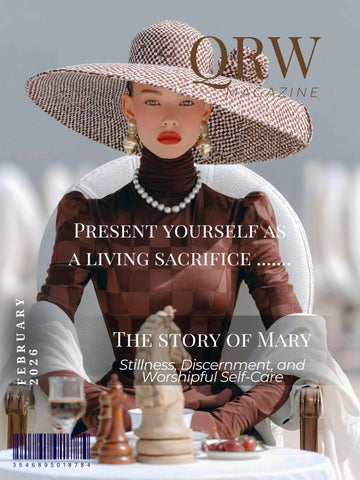



“I
beseech you therefore, brethren, by the mercies of God, that you present your bodies a living sacrifice, holy, acceptable to God which is your reasonable service.”
In this edition, we are looking at presenting ourselves as living sacrifices, holy and acceptable in God's presence. We will look at Mary of Bethany as an example of presenting oneself before God. On two occasions we find Mary seated at the feet of Jesus
In a world that often equates devotion with exhaustion, Mary of Bethany offers the quintessentially redeemed woman a corrective vision of worship. When Mary chose to sit at the feet of Jesus, she was not withdrawing from responsibility as intimated by her sister Martha, she was presenting herself as a living sacrifice. Her stillness and worship are what the QRW should aim for. they come from understanding th evalue of being available at the feet of Jesus regardless of what is going around you.
When read in the light of Romans 12:1, Mary’s posture becomes a principle of sacred self-care. She teaches us that reasonable service is not anxious striving but ordered presence. Rest, when rooted in communion with Christ, is not selfindulgence; it is stewardship of a life that has been entrusted to you by God. It keeps the offering alive, holy, and fit for divine use.
This issue invites us to reconsider where we are sitting and not what we are doing. The soul preserved at His feet can later be poured out without collapsing, as we see in John 12, when Mary again prostrates herself at Jesus's feet. This time to anoint him with precious oil.
Hannah M.
Editor-in-Chief

Romans 12:1 calls us into a life in which caring for ourselves becomes synonymous with honouring God. It invites us into sacred self-care rather than self-centred self-care. When we nurture our bodies, our hearts and our minds, we position ourselves to stand before God as a refined, strengthened and beautifully preserved vessel.
This verse is often read through the lens of worship and consecration. Yet within its spiritual depth lies a profound framework for biblical selfcare. The scripture outlines a way of life that honours God through the stewardship of the whole person.
Your body is the vessel through which God expresses Himself on earth Your voice, your assignment, your prayer life, your service, your compassion; all of it flows through your physical being
.Proper self-care then becomes an act of worship when it aligns with presenting oneself before God in purity, strength and readiness.
The redeemed life is a life that has been entrusted to God. Caring for that life is therefore a sacred responsibility.




Steward your physical health as an offering to God.

Guard what enters your mind, your emotions and your environment.

Live in a way that protects your ability to give God your best consistently.

Self-care is not selfish; it is a logical expression of worship.
The body carries your calling, your voice, your assignment and your worship. To present your body to God means caring for it in ways that keep you available, strengthened, and responsive to Him. Neglecting the body dishonours the vessel through which God speaks and moves.


A living sacrifice is a life that is daily surrendered to God. It is not an exhausted, depleted or broken-down sacrifice. True sacrifice in the Kingdom does not glorify burnout. God does not ask for a dead or diminished offering; He desires a vibrant one.



Holiness touches every aspect of your being. It includes purifying habits, thoughts, environments, and lifestyle choices. Living holy requires intentionality. It requires guarding yourself from anything that contaminates your strength, your peace or your purpose.
God is not asking anything excessive. He is asking for the simple, wise stewardship of the life He has given you. Caring for yourself is not indulgent. It is responsible. It is rational. It aligns with divine order.

Steward your physical health as an offering to God.
This includes rest, nourishment, movement, hydration, and creating rhythms that preserve vitality rather than drain it.
Live in a way that protects your ability to consistently give God your best. Your spiritual, emotional and mental reserves must be sustained so that your worship remains alive, not weakened by constant depletion.
Holy and acceptable
Guard what enters your mind, your emotions and your environment. Because you are set apart, you cannot treat yourself casually. You tend to yourself with reverence.
Reasonable service
Self care is not selfish; it is a logical expression of worship. When your wellbeing is preserved, your service to God becomes stable and sustainable.
1 Corinthians 6:19–20
“Do you not know that your body is the temple of the Holy Spirit who is in you, whom you have from God, and you are not your own?”
Galatians 6:9
““Let us not grow weary while doing good, for in due season we shall reap if we do not lose heart ”



Psalm 127:2
Proverbs 4:23
“Keep your heart with all diligence, for out of it spring the issues of life.”

“It is vain for you to rise up early, to sit up late, to eat the bread of sorrows; for so He gives His beloved sleep ”
Psalm 23:2–3
“He makes me to lie down in green pastures; He leads me beside the still waters. He restores my soul.”

Lamentations 3:22–23
“His mercies are new every morning.”
Mark 6:31
“Come aside by yourselves to a deserted place and rest a while.”
Isaiah 40:31
“But those who wait on the Lord shall renew their strength.”

j3 john 1:2
“Beloved, I pray that you may prosper in all things and be in health, just as your soul prospers.”

Psalm 46:10
“He makes me to lie down in green pastures; He leads me beside the still waters. He restores my soul.”
Proverbs 25:28
“Whoever has no rule over his own spirit is like a city broken down, without walls.”

Mark 6:31
“Be still, and know that I am God.”





What God inhabits must be honoured. 1 . 2 . 3 . 4 . 5 .
Romans 12:1 1 Corinthians 6:19–20
R E ST A S
C O M M A N D
Exodus 20:8–10
Matthew 11:28–30
Rest is woven into the Word of God.
E M OT I O N A L
G OV E R N A N C E
Proverbs 4:23
Proverbs 25:28
An unguarded soul is spiritually vulnerable.
Galatians 6:9 Isaiah 40:31
God values endurance over intensity.
H O L I ST I C
P RO S P E R I T Y
3 John 1:2 Psalm 23:2–3
Spiritual fruit requires physical and emotional health
Hebrews 4:9–11
“There remains therefore a rest for the people of God.”
2 Corinthians 4:16
Isaiah 30:15
“In returning and rest you shall be saved; in quietness and confidence shall be your strength.”
“Therefore, we do not lose heart. Even though our outward man is perishing, yet the inward man is being renewed day by day.”
Colossians 3:15
“Let the peace of God rule in your hearts.”
Ecclesiastes 4:6
“Better a handful with quietness than both hands full, together with toil and grasping for the wind.”

1 Kings 19:5–8: Please read Elijah is fed and allowed to sleep before receiving further instruction.


SELF CARE AS WORSHIP IN A WORLD OF PERFORMANCE


Mary of Bethany offers Scripture one of its most refined and corrective portraits of biblical self-care. Her choice to sit at the feet of Jesus is one of the most quietly radical acts in the Gospels. It challenges cultural norms, religious expectations, and internalised beliefs about worth, productivity, and service. When examined in light of Romans 12:1, her posture at the feet of Jesus emerges as a beautiful moment of devotion and as a disciplined act of sacred stewardship. She embodies what it means to present oneself to God as a living sacrifice, not through exhaustion or relentless output, but through a restful presence that preserves one for holy use.

To fully grasp the significance of Mary’s action, we must first understand its cultural implications. In the first-century Jewish world, women were not formally recognised as disciples. Sitting at a rabbi’s feet was the position of a learner, a student being taught Torah. This wasn’t a position for a woman. Mary refused to allow cultural expectations to dictate her spiritual posture. She prioritised what her soul required over what tradition demanded. In doing so, she models self-care rooted in discernment. Mary does not ask permission. She does not explain herself. She simply positions herself where revelation flows.
By contrast, Martha is described as “distracted with much serving.” The Greek sense of the word suggests being pulled apart, fragmented, and internally divided. Martha’s service, though sincere, has become a source of inner agitation. Her frustration is not about Mary sitting at the feet of Jesus. It is the result of a soul stretched beyond its centre. I have seen moments when I felt so fragmented from doing too many things that I ended up frustrated by what appeared to be inaction by someone else. I am sure many of us have been there. Jesus’ response is tender and corrective. He names Martha twice, signalling affection, and He also diagnoses her condition. “You are worried and troubled about many things.” Jesus points out that anxiety, not service, is the issue. She is concerned about too much. Jesus’ declaration that Mary has chosen “the one thing needed” reframes spiritual economy. He does not say the most important thing, as though others are irrelevant. He says the necessary thing. That upon which everything else depends.
Mary does not allow her body to be driven solely by demand, urgency, or expectation. She refuses fragmentation. While Martha’s body is pulled in many directions, Mary’s body is unified, settled, and intentionally placed in the presence of the Lord. In Romans 12:1, Mary presents herself whole, not scattered. This is a critical self-care principle. Mary understands what Romans 12:1 later codifies. Service that depletes the inner life is not reasonable service. It may appear faithful, but it is unsustainable. She protects her capacity to remain a living sacrifice.
By sitting, she ensures that her devotion does not become hollow, resentful, or compulsory. She safeguards the vitality of her offering. Mary recognises that intimacy with Christ must precede activity for Christ. The word reasonable carries the sense of being rational, intelligent, and appropriate. Mary’s choice reflects spiritual intelligence. She discerns that the presence of Jesus in her home is a moment to be honoured.
Mary of Bethany demonstrates that presenting oneself to God is not limited to dramatic acts of sacrifice. It also includes the daily discipline of being present, attentive, and replenished. She models self-care that is neither indulgent nor neglectful, but relational to the one who gives life. Her life teaches that self-care is about preserving capacity, capacity to hear God, capacity to love without resentment and capacity to serve without collapse. Mary’s choice addresses the soul before the schedule. She recognises that without anchoring herself in Christ’s presence, all service eventually becomes hollow, hurried, or resentful.
God desires offerings that are alive, sustained, and whole. Mary of Bethany instinctively lives out this principle. She invites the quintessentially redeemed woman to reconsider how she defines devotion, to ask whether her service flows from presence or from pressure, and to examine whether her body, mind, and soul are being presented to God whole or merely expended for Him. Mary shows us that the most sacred act of self-care is often the simplest. Sit. Listen. Receive. And in doing so, present yourself to God as a living sacrifice, holy and acceptable, which is indeed your reasonable service.
ROOTED IN ROMANS 12:1; MODELLED THROUGH MARY OF BETHANY
Afew minutes of stillness in scriture and prayer
ROMANS 12:1; LUKE 10:39; PSALM 5:3
What is the one thing needed today? Where must one preserve their peace?
This protects inner peace before any activity begins.
1 CORINTHIANS 6:19–20
Hydrate intentionally Nourish your body, do not just consume.
Move your body in some form, walking, stretching, or strengthening.
PSALM 46:10; COLOSSIANS 3:15
Are you operating from peace or pressure?
Have you become Martha today?
Realign with the stillness and guard the heart.
LAMENTATIONS 3:22–23
Where did you feel drained? Where did you sense grace.
Do not carry unfinished emotional burdens into sleep.
PRESERVING YOUR CAPACITY TO LOVE, LEAD, DISCERN AND SERVE WITHOUT COLLAPSE.
EXODUS 20:8–10; HEBREWS 4:9
Take some time to intentionally slow down
PROVERBS 25:28
Adjust your boundaries as required to protect the presence of God in your life
Read something edifying. Listen to a teaching. Spend time in worship without an agenda. Feed the inner woman intentionally.
EXODUS 20:8–10; HEBREWS 4:9
Take some time to intentionally slow down
PROVERBS 25:28
Adjust your boundaries as required to protect the presence of God in your life
Read something edifying. Listen to a teaching. Spend time in worship without an agenda. Feed the inner woman intentionally.
Romans 12:1
Your body is God’s Dwelling Place
1 Corinthians 6:19–20
Divine Invitation to Rest
Matthew 11:28–30
Covenant Sleep
Psalm 127:2
Proverbs 4:23
Withdrawal Without Guilt
Mark 6:31
Restoring
Psalm 23:2–3
Isaiah 40:31
Exodus 20:8–10
Luke 5:16
Ecclesiastes 3:1
Emotional regulation
Proverbs 25:28
Stillness and authority
Psalm 46:10
Managing weariness
Galatians 6:9
Lamentations 3:22–23

Mark 6:31
Proverbs 31:17
Choosing the better part
Luke 10:41–42
Abiding for fruitfulness
John 15:4
Focus on Recovery
Psalm 34:19
Continual guidance
Isaiah 58:11
God
1 Kings 19:5–8
Psalm 112:7–8
Colossians 3:15
Romans 8:6
Guarded mind and heart
Philippians 4:6–7