INNOVATION, MANUFACTURING EXPERTISE AND AN INTERNATIONAL OUTLOOK
Italy’s Cleaning Industry
In the broader narrative of European industry, professional cleaning is one of those sectors that often works behind the scenes but, in practice, supports quality of life, environmental safety and the efficiency of organizations.
It is a wide and articulated supply chain which, in Europe alone, generates impressive figures: the cleaning services segment by itself exceeds €160 billion in value and involves hundreds of thousands of companies and millions of workers.
If we consider the entire ecosystem - chemicals, machines,
the years. In an increasingly global market - where demand for professional hygiene grows alongside the complexity of environments, from healthcare to logistics, from hospitality to industry - Italian manufacturers have successfully carved out a competitive space by focusing on innovation, quality and flexibility. At the same time, the sector is undergoing profound transformation. Automation, robotics, digital monitoring and management systems, as well as low-impact environmental solutions, are redefining the very concept of professional cleaning. In parallel, demand is rising for increasingly highperformance and certified products, with strong attention to operator safety and environmental impact reduction.
Within this evolution, Italy brings a distinctive characteristic: the ability to combine industrial tradition with innovation. Many companies in the sector have decades of history behind them, yet they continue to invest in research, industrial design, digitalization and sustainability. The result is a supply chain that does not merely follow the market, but often helps shape it.
For this reason, Italian professional cleaning today represents a small yet significant laboratory of European industry - a place where technology, manufacturing and service culture meet to address increasingly complex needs.
To tell the story of Italy’s cleaning industry therefore means telling the story of a manufacturing ecosystem that works every day to make environments safer, more efficient and more sustainable.
Even in a historical phase marked by geopolitical tensions, wars, energy crises and global supply-chain disruptions, the Italian professional cleaning industry continues to demonstrate a remarkable capacity for adaptation, combining industrial tradition, technological innovation and an international vision.
PAPERDI SRL
Via Appia Antica, 53
81020 San Nicola la Strada (CE) +39 0823 490011 | info@paperdi.it paperdi.it @paperdisrl
Year 35 Supplement to Dimensione Pulito No 3 | 2026
Editor in Chief Giorgio Albonetti
Editorial director Ornella Zanetti | ornella.zanetti@quine.it
Dimensione Pulito periodico mensile registrato: autorizzazione del Tribunale di Milano N. 598 del 9.11.92. Edra Edizioni è iscritta al Registro Operatori della Comunicazione n. 12191 del 29/10/2005. La pubblicazione o ristampa di articoli e immagini della rivista deve essere autorizzata per iscritto dall’editore. Gli articoli pubblicati su Dimensione Pulito sono sotto la responsabilità degli autori. I manoscritti e i disegni pubblicati non saranno restituiti.
Dealers, service companies, food industry, healthcare, public bodies, public businnesses, hoPhlerie, professional laundries, pest management and environmental services, large distribution
34 Regulation FROM
STANDARDS TO SMART MACHINES
THE POWER OF EVOLUTION IN THE SIGN OF THE “SUPER STELLA”
The story of Rubino Chem is rooted in a past made of ingenuity, determination and ability to read change. A journey that spans three generations and begins in 1943, in an Italy marked by war, but animated by the spirit of initiative.
In Carbonara di Bari, today a district of the capital of Pulia, Rosamaria Palella ran a grocery store. In addition to the sale of salts, tobacco and chocolate, it produced soap for laundry in bars. It was in those years that his son Antonio Rubino, then fourteen years old, met the British military stationed in the area, and he came across an image of an Irish dancer depicted on a newspaper envelope. Impressed by that figure, he decided to keep it. An instinctive gesture that, years later, would become a business symbol. In 1960, after a period of experience as a representative in the detergent sector, Antonio gathered the family legacy and started an independent production, choosing just that ballerina as the distinctive sign of his products.
The brand Super Stella was born, intended to identify for decades a range
of detergents appreciated in the territory. In the 1980s, the image evolved along with the graphic trends of the time, but the bond with the “dancer” remained a strong identity trait. The most recent breakthrough came in 2002, when Luigi Rubino, son of Antonio, after gaining experience in the production and development of new formulations,
officially founded Rubino Chem srl. Convinced of the potential of a new formula, initially called Essenza, he invests resources and skills to give life to an autonomous industrial project. Having also the need to give an image to his products, he thought that Super Stella could well represent the new formulations. Since then, the ballerina
has become a trademark and accompanies the evolution of a company that today ranks among the main national players in research, development and production of high-performance and quality chemical formulations.
INDUSTRY 4.0
Rubino Chem manages the entire production chain within its headquarters in Puglia, operating according to the logic of Industry 4.0. Automation, process control, safety and resource optimization are the pillars of a production system oriented towards efficiency and sustainability. The company is ISO 9001:2015 certified and has obtained from the Ministry of Health the authorization for the production of Medical Surgical Devices (PMC n.36/2022), thus expanding its offer also to disinfectants with germicidal, bactericidal and virucidal properties. In internal laboratories, R&D is a daily activity aimed at delivering increasingly high-performance formulations while reducing environmental impact. Quality, innovation and responsibility
are not declarations of principle, but operational criteria that guide each stage: from the selection of raw materials to the choice of packaging, up to the final product inspection.
HIMIX PROFESSIONAL
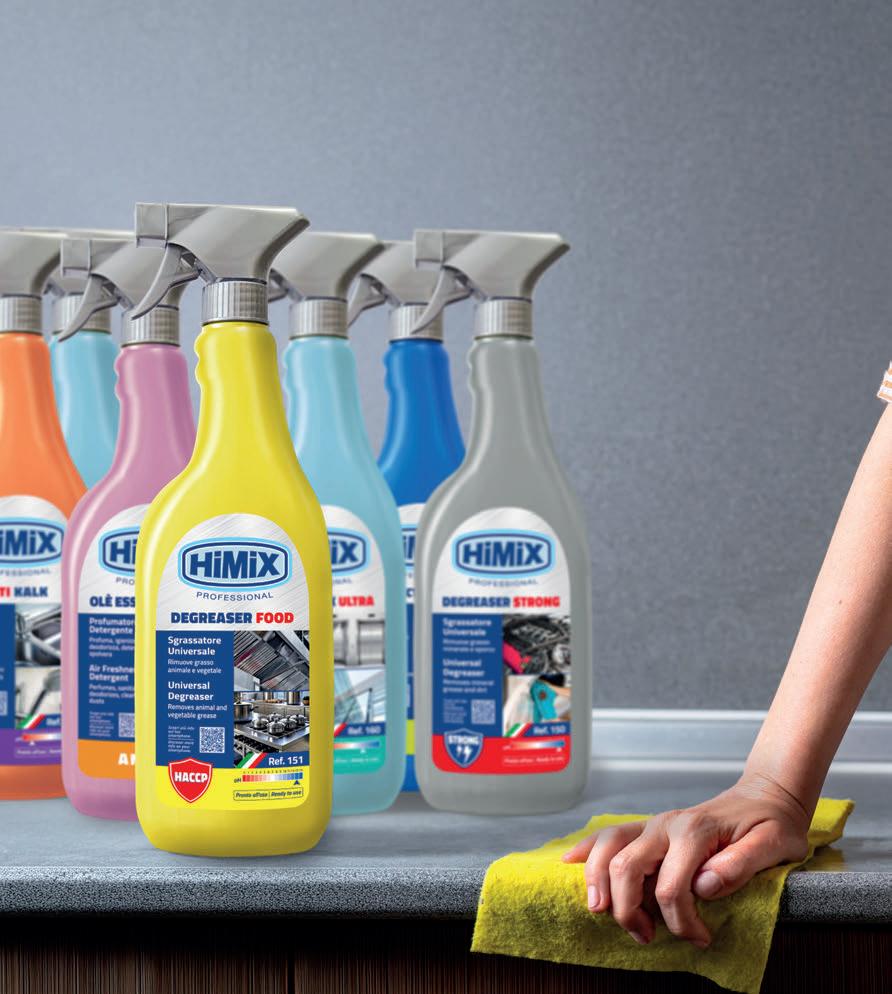
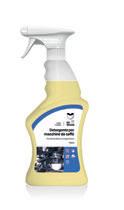
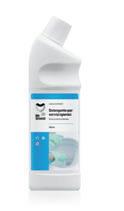
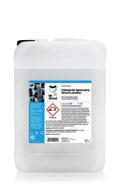
Among the most complete expressions of this philosophy is HiMiX Professional, the broadest and most structured line dedicated to professional cleaning. Designed to meet the technical requirements of the most demanding environments, HiMiX Professional offers high-performance detergents that respect surfaces and comply with HACCP control plans. The range is designed for sectors where hygiene is an essential requirement, including Ho.Re.Ca., food industry, transport and public environments, offering targeted solutions to ensure clean, safe and welcoming spaces. The formulations stand out for being ultraconcentrated, allowing high results with reduced dosages and optimizing costs and storage spaces.
In detail, the line includes references developed for specific needs:
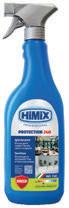
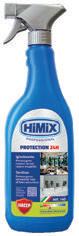
• Protection 24H, sanitizer enriched with quaternary ammonium salts, able to remove germs and bacteria and create a protective barrier active for up to 24 hours. Ideal for high-contact surfaces. Suitable for HACCP.
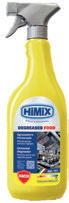
• Degreaser Food, ultra-concentrated, high-alkalinity degreaser, effective against animal and vegetable fats, carbonized residues, and oils, without corrosive action or streaks. Suitable for HACCP.
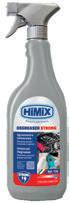
• Degreaser Strong, ultra-concentrated, high-alkalinity degreaser, effective against mineral fats, grease, oils, and carbonized residues.
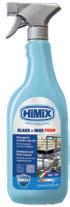
• Glass + Inox Food, cleaner for glass, crystal, and steel that removes
fingerprints and dirt, leaving an invisible protective film and a streak-free shine. Suitable for HACCP.
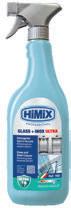
• Glass + Inox Ultra, cleaner for windows, mirrors, steel, and washable surfaces that removes grease and dirt, leaving an invisible protective film and a streak-free shine.
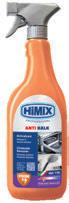
• Anti Kalk, concentrated descaling agent with rapid action against limescale and mineral deposits, designed to restore the shine of steel, ceramics, and glass without damaging surfaces. Suitable for HACCP.
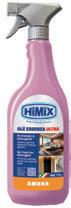
• Olè Essenza Ultra, ultra-concentrated perfumer that fragrances, sanitizes, deodorizes, cleans, and dusts environments and surfaces.
BEYOND THE DETERGENT
Today, Rubino Chem looks to the international market with the aim of becoming a point of reference in the distribution of chemical formulations, thanks to a know-how built over time and a loyal customer base that is increasingly attentive and demanding. From artisanal soap production to modern automated plants, the common thread remains the ability to transform intuition into an industrial project. That Irish dancer, kept in a drawer during the war, continues to represent not only a brand, but a symbol of continuity and entrepreneurial vision.
70026 Modugno BA www.rubinochem.it
RUBINO CHEM via Vigili del Fuoco Caduti in Servizoi 14/S
Reliability, safety, professional effectiveness
A public direction based on a long-term vision breaks the inertia of recent years and puts the production system back on a path of structural, innovative and sustainable growth
NEW INDUSTRIAL POLICIES
For years, in the European lexicon, the expression “industrial policy” has been pronounced with caution, associated with seasons of public interventionism, discretionary choices and logics of sectoral support. It has gradually been replaced by a horizontal approach based on competition, technological neutrality and confidence in the allocative capacity of the global market.
That paradigm today shows its limits. Geopolitical tensions, competition between large economic areas, energy crises, the pandemic, and disruptions to global value chains have made it clear that market integration alone does not guarantee security, resilience, and strategic autonomy. The location of critical production, access to raw materials, availability of semiconductors, and technological sovereignty have returned to
central government agendas.
The change of pace outlined in the White Paper “Made in Italy 2030”, promoted by the Ministry of Enterprise and Made in Italy, is set in this context. The document explicitly speaks of “Strategic State”: a definition that marks a cultural discontinuity. It is not a question of re-proposing an entrepreneurial state or market replacement, but of reaffirming the public role as a director, capable of interpreting the transformations underway, identifying relevant technological trajectories, coordinating institutional tools and levels, and measuring the effectiveness of interventions.
The “Strategic State” does not choose “national champions” arbitrarily, but builds frameworks within which companies can grow, innovate, integrate into supply chains and compete in
international markets.
It acts on several levels: infrastructural, regulatory, financial, training. And it does so with a selective logic, overcoming the fragmentation that has characterized many past policies.
The proposed strategy is divided into four closely connected phases. The first is the elaboration of a unitary industrial vision, which recognizes the centrality of manufacturing and production chains. The second is the translation of this vision into coordinated public policies, avoiding overlaps and dispersions of resources. The third concerns multilevel implementation, involving the State, Regions, the Chamber of Commerce system, agencies, and intermediate stakeholders. The fourth is continuous monitoring, with provision for five-year updates of the strategy based on achievements and the evolving
CRISTINA CARDINALI
. SHARE OF MADE IN ITALY MEANS OF EXPORT (% VALUES)
MADE IN ITALY OF EXCELLENCE
. TREND SHARE OF EXPORTS AND NUMBER OF SECTORS
international environment.
It is an approach that goes beyond the logic of episodic incentives, which are often discontinuous and poorly integrated with each other. In the past, many measures have been introduced in response to emergencies or contingent pressures, without a clear fit into a medium- to long-term design. The result has been a patchwork of sometimes effective, but rarely coordinated, tools.
GOVERNING THE FOUR TRANSITIONS
The context in which Made in Italy moves today is transformative. The White Paper identifies four structural transitions which are redefining the boundaries of industry and which cannot be addressed separately. They are profound dynamics, affecting the production structure, work organization, international relations and
Source: MIMIT Study Center on ISTAT data
consumption patterns. Governing them, and not suffering them, is the condition for maintaining and strengthening the centrality of Italian manufacturing.
The first is the demographic transition. Italy is one of the longest-lived countries in the world, but also one of those with the lowest birth rate.
The ageing of the population and the progressive reduction in the available labour force have direct effects on the productive capacity and balance of the economic system. It is not just a quantitative question, linked to the number employed, but a qualitative one: what skills will be available in the next ten years? What generational turnover in technical and manufacturing professions? The topic of human capital becomes central to industrial strategy. Attracting talent from abroad, brain
drain, enhancing female and youth employment, and strengthening technical and scientific education and professional development are not social policies separate from industry, but decisive levers of competitiveness. Without structural intervention on skills and labour participation, any reindustrialisation project risks coming up against an increasingly stringent demographic constraint.
The second transition is geopolitical. The globalization that has accompanied the last thirty years has not disappeared, but has changed nature. The idea of a world market that is increasingly integrated and neutral with respect to the political dimension has left room for competition between large economic areas where trade, technology and security are closely intertwined. Recent crises have shown
Current affairs
STRENGTHENING THE ITALIAN PRODUCTION STRUCTURE
The Strategic Plan outlined in the White Paper “Made in Italy 2030”, promoted by the Ministry of Enterprise and Made in Italy, is structured around ten objectives that make up an organic vision of industrial strengthening. They are operational guidelines that hold together competitiveness, innovation and cohesion. At its core is the consolidation of the manufacturing base, with a view to strengthening strategic chains and increasing the weight of industrial value added on the national economy. Alongside this, there is a need to increase productivity through investments in enabling
technologies, digitalization of processes and diffusion of innovation throughout the value chain, also involving small and medium-sized enterprises. Another objective concerns strengthening international positioning, supporting exports and the stable presence of Italian companies in the markets with the greatest potential, but also protecting quality production and combating counterfeiting and Italiansounding phenomena. The strategy also aims to make supply chains more resilient, reducing critical dependencies and promoting production
the vulnerability of excessively long and concentrated supply chains, especially in the critical raw materials, energy, and high-tech components segments. For a country like Italy, strongly exportoriented and integrated into global value chains, this means rethinking the supply structure and strengthening productive resilience. Diversification of partners, strengthening of European supply chains, greater autonomy in strategic sectors become structural elements of industrial policy. Economic security fully enters the competitiveness agenda. The third transition is digital. Advanced automation, artificial intelligence, robotics, microelectronics and strategic use of data are transforming manufacturing processes in depth. We’re not just talking about new technologies, but integrating digital systems across the entire value chain, from design to logistics, from manufacturing to after-sales service. The Italian supply chain model, characterized by a strong presence of small and medium-sized
integrations within Europe. The Plan gives a decisive role to human capital: investing in technical and scientific skills, fostering youth and female employment, attracting talent and supporting continuing training are essential conditions for sustaining the transformations taking place. In parallel, the aim is to strengthen innovation capacity through greater connections between businesses, universities, and research centers.
The energy and environmental transition is considered a strategic objective not only for
enterprises, requires a qualitative leap in interoperability and information sharing. Digital transformation is therefore both technological and organizational. It affects productivity, quality of work, the ability to customize products and respond in real time to global demand. In this scenario, industrial policy must accompany investment, foster access to enabling technologies, and support the diffusion of innovation even in smaller companies. Finally, the green transition represents one of the most profound and complex challenges. The decarbonisation of the economy, the reduction of emissions, energy efficiency and the circular economy are not only environmental objectives, but factors that directly affect the cost structure, technological choices and competitive positioning of enterprises. For Italian industry, historically energizing in some key sectors, the topic of energy is strategic. Ensuring secure, sustainable and competitively costed supplies means defending the manufacturing
sustainability, but as a lever for competitiveness, promoting energy efficiency, the circular economy, and the development of green technologies. This is accompanied by a commitment to ensuring conditions of access to credit and appropriate financial instruments, capable of supporting long-term investments.
Finally, the Plan aims to make public intervention more effective and measurable, through coordinated governance, constant monitoring of results, and periodic updating of priorities.
base. At the same time, the ecological transition opens up new markets and new specializations: technologies for energy efficiency, innovative materials, solutions for sustainable mobility and resource management represent areas in which Made in Italy can strengthen its presence. Governing the four transitions means taking a systemic perspective, understanding their interconnections and orienting the transformations in a manner consistent with the country’s strategic interests. Digitalization is a lever for environmental sustainability. The energy transition requires new skills and therefore intersects demographics. Geopolitical security influences technological choices and investments in innovation. It is in this intertwining that the visionary capacity of industrial policy is played out.
A NEW PRODUCTION MAP
The most innovative heart of the White Paper is the analytical reconstruction of Italy’s production chains: a real
Current affairs
HOW MUCH IS MADE IN ITALY OF EXCELLENCE WORTH?
knowledge infrastructure on which to base the new industrial policy.
The document identifies eighteen supply chains that, taken together, cover almost the entire national economy. Alongside the five “A” that historically represent the Italian manufacturing identity - agrifood, clothing-fashion, home furnishings, automation-mechanics and automotive - new strategic domains emerge and are consolidated such as the health economy, space and defense, digital and microelectronics, energy, chemicals, packaging and other technology-intensive sectors. It is a photograph that holds together tradition and frontier, historical manufacturing and new trajectories of development.
The novelty lies not only in the list of supply chains, but in the method by which they were rebuilt. The work is based on a detailed analysis of the six-digit ATECO codes, cross-referenced with a large amount of information from the National Institute of Statistics, InfoCamere, the Revenue Agency, and the National Register of State Aid. The result is a data-driven mapping that allows us to associate measurable economic quantities with each supply chain: turnover, added value, number of companies, employment, propensity to export, degree of territorial specialization, intensity and distribution of public aid.
This approach represents a qualitative
TO THINKING OF ITSELF AS AN INDUSTRIAL POWER IS A CHOICE OF THE FUTURE
potential bottlenecks.
The map is not static: it highlights relationships, value flows, territorial concentrations, productive specializations that can strengthen or weaken over time. Furthermore, the analysis allows us to measure the international positioning of Italian supply chains. The share of exports, the degree of integration into global value chains, and the presence in highly specialized niches provide concrete indicators on which to calibrate public policies. Not all supply chains present the same critical issues or opportunities: some are mature but highly competitive in foreign markets; others are undergoing technological consolidation; still others are strategic for national economic security.
The new production map thus becomes an operational tool. It allows for better targeting of incentives, avoidance of dispersal, identification of areas in which vertical and horizontal integrations can be fostered, support aggregation processes and strengthen territorial ecosystems. It also allows for a more precise evaluation of the effectiveness of public interventions, monitoring the evolution of each supply chain over time. By overcoming the fragmentation of sectoral policies, the supply chain logic offers a systemic vision of the Italian economy. It is a choice that recognizes the complexity of contemporary manufacturing and aims to enhance the interconnections between businesses, technologies, and territories.
leap compared to traditional sectoral readings. Sectors, by definition, separate homogeneous activities; supply chains, on the other hand, connect different production functions that contribute to the creation of a product or system. The supply chain logic allows us to follow the path from the supply of raw materials and components to the finished product and related services, highlighting interdependencies, critical nodes, and
MADE IN ITALY OF EXCELLENCE
Another central step concerns the quantitative definition of “Made in Italy specialization”, that is, that part of Italian exports that is concentrated in products and sectors in which the country presents a clear and persistent comparative advantage over time. By using a trade specialization indexbased on comparing the weight of a given
Source: MIMIT Study Center on ISTAT data
Current affairs
FINANCIAL RESOURCES OF COHESION POLICIES FOR THE PERIOD 2021-2027
European Structural Funds (FS Funds 2021-2027) 4.7962,326.105,1-
European Territorial Cooperation (ETC) programmes
Complementary Interventions and Programmes (POCs) 6.757,3154,3 374 7.285,6
Development and Cohesion Fund 4.1795,510.448,9- 52.244,4 Regular resources dedicated to cohesion 83,3127,4 17,7 2.128,4 TOTAL 96.598,436.835,71.638,7135.072,8
source: Presidency of the Council of Ministers. Department of Cohesion and Southern Policies. Tools
product in Italian exports with the weight of the same product in world trade-the document isolates segments where Italy is not simply present, but structurally strong. This is a rigorous approach, allowing us to overcome generic narratives about excellence and measure it objectively: export value, impact on overall turnover, contribution to national added value, and the number of employees involved. Thus, the areas in which Italian specialization is most marked emerge, often linked to quality-intensive production, design, manufacturing skills, and supply chain integration. Not everything Italy exports can be called excellence. Part of the export responds to price logic or standardized production, where competition is played mainly on costs. “Made in Italy by specialization”, on the other hand, coincides with those segments in which the product incorporates technical knowledge, creativity, customization, the ability to combine aesthetics and functionality. The strength of the Italian system lies
precisely in its ability to guard market niches with high added value, where competition is not only quantitative but qualitative.In these areas, the country’s reputation translates into international recognition that strengthens the competitive position of companies. The document highlights how, when compared with the main exporting countries, Italy maintains a prominent position, consistently placing itself among the world’s leading economies in terms of variety and depth of specialization.
This quantitative reading also allows us to better understand the contribution of Made in Italy to the trade balance and overall growth. Highly specialized supply chains not only generate exports, but also activate skilled employment, investment in innovation, and subcontracting networks spread across the country. In many cases, international competitiveness is founded on local productive ecosystems, in which small and medium-sized enterprises, large groups and research centres collaborate along the entire value chain.
Defining the perimeter of excellence in a precise way means, finally, orienting industrial policies more precisely. Knowing where the country is truly strong allows us to consolidate existing advantages, but also to identify areas where specialization can be strengthened through technological investments, training, and supply chain integration.
EUROPE AND THE WEST
The new public role is part of an evolving European framework. State aid rules, major joint projects of European interest (HICPs), digital and green transition programmes outline a space in which national policies must dialogue with those of the Union. The “Strategic State” is therefore also a State capable of positioning itself in Brussels, influencing common choices and intercepting strategic resources for its own supply chains. The European dimension is not an external constraint, but a multiplier of scale. Choices about energy, critical raw materials, enabling technologies, and economic security are increasingly being made at the supranational level, requiring an active presence in decision-making processes and in building industrial alliances. For Italy, it means contributing to the definition of common priorities, avoiding being subjected to them, and placing its supply chains within the strategic trajectories of the Union. National industrial policy, thus, is intertwined with European industrial policy in a relationship of coherence and complementarity. The aim is not to superimpose instruments, but to harmonise interventions, exploit financial synergies and strengthen the participation of Italian firms in the major continental programmes.
In a West undergoing new technological and commercial competitions, the ability to act within European institutions becomes an integral part of Made in Italy’s competitiveness strategy.
FORTY YEARS OF CHEMISTRY ONE TRUSTED PARTNER
Since 1984, Polychim has been a steady and authoritative presence in the professional cleaning market. Headquartered in Cinisello Balsamo, on the outskirts of Milan, the company has built a solid reputation over the decades, grounded in three inseparable pillars: reliability, innovation, and the ability to listen. A forty-year journey that today translates into a comprehensive product range — detergents, sanitizers, additives, waxes, cosmetics, and auxiliaries — designed for the cleaning and hygiene of environments and surfaces across the most diverse sectors: from industry to public facilities, from restaurants to transportation, from healthcare to nursing homes, all the way to professional laundries.
What sets Polychim apart in the industrial chemicals landscape is its commitment to customization. The core of its business is the development and manufacturing of customer-branded products, through a flexible and scalable service model capable of adapting to the most varied needs.
Customization can be limited to image - label, brand, packaging - or extend to the formulation itself, with recipes developed specifically to meet particular market requirements. In either case, the result is a product that speaks the customer’s language and strengthens their commercial identity.
Every solution begins with dialogue. Polychim’s technical team works closely with clients to understand their needs, translate them into concrete specifications, and develop effective formulations in its in-house laboratories. Research and development are ongoing activities, carried out with constant attention to worker health and environmental sustainability. In an industry increasingly oriented toward corporate responsibility, combining high performance with environmental respect is no longer optional, it is a fundamental requirement, and one that Polychim understood before many others.
The expertise accumulated over more than forty years in business allows the company to respond swiftly to market challenges, delivering products that unite effectiveness, safety, and added value. A structured yet flexible production process makes it possible to handle both small batches and large-scale output, without ever compromising on quality standards.
Polychim presents itself not simply as a supplier, but as a true industrial partner: a company that knows how to listen, design, and deliver, placing its chemical expertise at the service of its clients’ growth.
polychim.it
ENHANCING ITALIAN QUALITY
AFIDAMP has developed and promoted a certified quality mark, the “Italian Alliance for Cleaning Excellence.” The goal is clear and ambitious: to make the excellence of Italian professional cleaning manufacturers immediately recognizable, both in Italy and abroad. This project represents an important step in the association’s strategy, aiming to strengthen the competitive positioning of Italian industry in an increasingly complex global scenario.
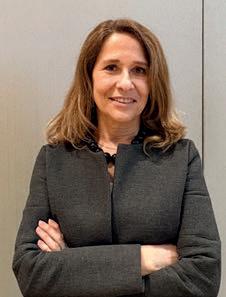
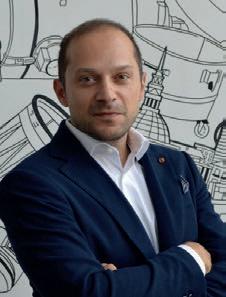
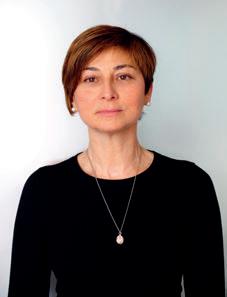
The origins and purpose of the initiative were presented at a press conference by Stefania Verrienti, AFIDAMP Director, Alessandro Panico, Coordinator of the International Affairs Group, and Virna Re, Board Member of the association.
The discussion highlighted not only the technical aspects of the mark but also the vision behind it. «This is not a symbolic or promotional mark»,
Obtaining the mark means joining a network of selected companies, all subject to the same verification process. This allows Afidamp to promote a coordinated group of companies sharing certified standards.
The idea is to create a structured visibility platform, capable of engaging with institutions, embassies, ministries, and international partners, offering a qualified and recognizable point of contact. The goal is to build a shared identity that is globally visible while protecting market shares.
The overall excellence and distinctive value of Italian industry now has the opportunity to emerge and stand out. In a global market where price often drives decisions, it is essential to bring verified quality, industrial solidity, and environmental and social responsibility back to the forefront
explained Stefania Verrienti. «The goal is to concretely and verifiably highlight companies that represent the excellence of the Italian professional cleaning industry.» Far from being a slogan or image operation, the project certifies overall company excellence through a structured, permanent, and verifiable system, based on objective criteria defined in the AFIDAMP technical document, and verified through an audit by an accredited third-party body.
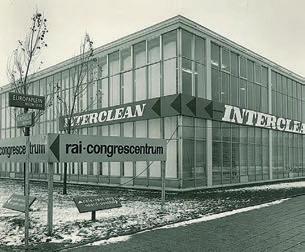
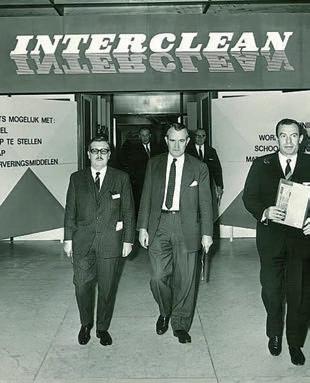
The starting point is practical experience. During Interclean Amsterdam 2024, the Italian presence was promoted in a coordinated way, in collaboration with ICE – Agency for the Promotion Abroad, under the slogan “Italian Golden Supplier.”
The initiative produced tangible results: greater visibility, a strong perception of quality among international visitors, and
CRISTINA CARDINALI
THE GOAL IS TO CONCRETELY AND VERIFIABLY HIGHLIGHT COMPANIES THAT REPRESENT THE EXCELLENCE OF THE ITALIAN PROFESSIONAL CLEANING
INDUSTRY
Stefania Verrienti
responsibility that characterizes many Italian companies in this sector.»
From this reflection, the AFIDAMP Board asked: can a communication initiative be transformed into a structured and permanent tool? Can we move from a narrative of excellence to a certification of excellence? The “Italian Alliance for Cleaning Excellence” was born precisely from this question.
NEW COMPETITIVE PRESSURES
growing interest in the Italian professional cleaning system. Most importantly, it generated new awareness among the participating companies: the recognition of belonging to a sector that is distinctive and recognizable.
«The value of this initiative is also cultural», emphasized Virna Re. «It means recognizing and making visible the heritage of skills, innovation, and
The context for this project is marked by increasing competitive pressures. Italian manufacturers operate in compliance with strict European regulations, high social standards, environmental obligations, and continuous investments in safety and innovation. These elements represent value, but also impact cost structures. Meanwhile, international markets are seeing non-European players offering competitive products, sometimes at prices below the procurement costs of European manufacturers. This creates imbalances and highlights the need for tools that objectively showcase what differentiates Italian industry: quality, reliability,
sustainability, and service capability. The “Italian Alliance for Cleaning Excellence” positions itself as a competitive lever based on credibility. It is not the company that declares its excellence; a third-party body verifies it based on a shared disciplinary framework developed by the sector.
«We are talking about verifiable technical criteria», explained Alessandro Panico. «These allow us to measure real aspects of the company: organizational solidity, service capability, commitment to innovation and sustainability. All these factors contribute to defining industrial excellence.» The new mark does not replace or overlap product certifications. It is not a sticker to place on a machine or cleaning product. It is a corporate quality mark. It certifies overall company excellence, evaluating industrial
From left: Stefania Verrienti, Afidamp Director, Alessandro Panico, Coordinator of the International Affairs Group, Virna Re, Board Member of the association
Competitiveness
REQUIRED CRITERIA
The technical disciplinary framework, developed by a focus team of AFIDAMP’s International Affairs Group, includes 17 evaluation criteria, organized into three main areas:
Solidity and Organizational Structure
Includes company longevity, governance stability, percentage of permanent employees, and formalized organizational structure. The goal is to measure continuity and the company’s ability to consolidate skills and know-how over time.
Service and Customer Orientation
Evaluates customer care
structure, after-sales service, multilingual capability, export presence, and geographic coverage. Excellence is not limited to product quality; it also includes the ability to support products in international markets with adequate technical and relational assistance.
Sustainability, Innovation, and Certifications
Covers system certifications (ISO 9001, ISO 14001, ISO
solidity, organizational structure, customer orientation, innovation capability, sustainability and ESG criteria, as well as international market presence and performance. The mark can be used in institutional communication: trade show stands, promotional materials, corporate websites, and documentation. It becomes a distinctive sign identifying the company as part of a selected network of Italian excellence.
A NETWORK FOR SYSTEMIC GROWTH
Obtaining the mark means joining a network of selected companies, all subject to the same verification process. This allows the association to promote a coordinated group of companies sharing certified standards.
«Building a system is one of the most important aspects of the project», added Virna Re. «Through this mark, companies can present themselves in international
45001), environmental and product certifications, patents and intellectual property, R&D investment as a percentage of turnover, and ESG policies. These elements reflect the company’s strategic orientation and its ability to anticipate regulatory and market developments. Each criterion contributes to an overall score calculated as a weighted average. To obtain the mark, at least 60% of the maximum score must be achieved.
specifically to avoid unnecessary bureaucracy - clarified Panico. It is mainly a mapping of data and information companies already possess.»
markets as part of a solid and recognizable industrial chain.»
The idea is to create a structured visibility platform, capable of engaging with institutions, embassies, ministries, and international partners, offering a qualified and recognizable point of contact. The goal is to build a shared identity that is globally visible while protecting market shares.
One concern expressed by companies during the preliminary phase was the risk of additional bureaucratic burden. AFIDAMP worked specifically to avoid this.
The audit, conducted by an accredited third-party body according to internationally recognized standards, relies mostly on documentation already available within the company. In many cases, one day is sufficient to complete the verification and deliver the results. «We designed the disciplinary framework
AFIDAMP does not participate in the evaluation process, ensuring full independence and confidentiality. Companies are free to choose the certifying body from among accredited entities meeting the required criteria. The result is a rigorous, voluntary certification that is proportionate and accessible. AFIDAMP has kept membership costs very low, especially during the launch phase, to encourage participation from as many companies as possible. This approach aligns with the spirit of the project, which arises from the shared commitment of its members. The ambition is clear: to transform the excellence of Italian professional cleaning from perceived value to certified value. In a global market where price often drives choices, the “Italian Alliance for Cleaning Excellence” aims to put verified quality, industrial solidity, and environmental and social responsibility back at the center.
INTERNATIONAL DEBUT
The first official showcase will again be Interclean Amsterdam, during Made in Italy Day on April 15. In the Italian lounge organized with ICE, in the presence of the Italian Ambassador to the Netherlands and institutional representatives, the first certified companies will be presented. AFIDAMP’s institutional stand in the associations area will also feature the visual identity of the “Italian Alliance for Cleaning Excellence,” focusing international attention on this new distinctive sign.
PAPER BETWEEN COMPETITIVE PRESSURE AND ENERGY SLOWDOWN
In 2025, the Italian paper industry declined in both production (-2.2%) and turnover (-4.6%), with exports decreasing and the domestic market supported by imports. Weak demand and high energy costs weighed heavily on the sector; early 2026 still shows stagnation
IMPACT ON CIRCULARITY
The production slowdown also had direct effects on circularity. In 2025, the paper industry used 5.14 million tonnes of recycled paper (waste paper), down -1.4% compared to 2024. The recycling rate in paper mills fell to 66.3%, compared to 70.9% the previous year. This is a significant figure considering that about half of the paper consumed in Italy “becomes paper again” thanks to the national industrial system: less production means a less efficient recovery loop.
The year 2025 closed with signs of slowdown for the Italian paper industry. Preliminary data processed by Assocarta outline a scenario in which production decreased, turnover declined, and the competitiveness of the national system came under pressure, within an international context marked by geopolitical uncertainty and tensions in energy markets. In 2025, paper and board production amounted to 7.8 million tonnes, down -2.2% compared to 8.0 million tonnes in 2024. Turnover fell to €7.9 billion, marking a contraction of -4.6% compared to €8.3 billion in 2024, as a combined effect of lower production and
weaker prices. On the trade side, imports increased by +7.6%, rising from 5.2 to 5.6 million tonnes, while exports declined by -4.1%, from 3.6 to 3.4 million tonnes. The trade balance deteriorated significantly, from -1.7 to -2.2 million tonnes (-32.5%). Apparent domestic consumption increased by +3.8%, reaching 10.0 million tonnes (compared to 9.6 million tonnes in 2024), but growth was mainly driven by imports. The market share covered by foreign suppliers thus rose to 56% (from 54%), setting a new historical record. At the same time, the share of production destined for export fell from 45% to 44%.
THE MACROECONOMIC CONTEXT
According to the International Monetary Fund, in the January 2026 World Economic Outlook, global growth in 2025 is estimated at +3.3%, supported by emerging economies (+4.4%), while advanced economies stand at +1.7%. Growth of +3.3% is also forecast for 2026, but with downside risks linked to geopolitical tensions, possible trade escalations, and financial instability. For Italy, GDP growth is estimated at +0.5% in 2025 and +0.7% in 2026, the lowest among major European economies. In the first 11 months of 2025, production
CRISTINA GUALDONI
PRE FINAL BALANCES 2025 ITALIAN PAPER INDUSTRY
values20242025variations in %
Production mlntons87,8-2,2
Sales mld€8,37,9-4,6
Import mlntons5,25,67,6
Export mlntons3,63,4-4,1
Balance mlntons-1,7-2,2-32,5
Approximate consumption mlntons9,6103,8
Import/consumption app. %56563,6
Export/production %4544-1,9
Recycling rate in paper mills %70,966,3-6,4
Source: Assocarta estimates based on official data
in the CEPI area declined by -2.3%, after +5.9% in 2024. Among main competitor countries: Germany (-2.7%), Sweden (-3.5%), Finland (-1.5%), Spain (-3.9%), France (-0.2%), while Poland grew by +3.7%. In Italy, during the same period, production recorded -2.1%, after +6.7% in 2024.
By segment:
• Graphic papers: -11.2% (coated papers +1%)
• Tissue papers: -2.2%
• Packaging papers and boards: +0.2%
• Folding boxboard: +3.2%
• Corrugated board: -0.7%
• Other packaging papers: -3.3%
• Other specialties: +0.6%
In the first 11 months of 2025, turnover recorded an estimated decline of -4.9%.
After a slightly positive first quarter, the trend progressively deteriorated. Prices showed a deflationary trend, particularly for graphic papers, as highlighted by quotations from the Milan, Monza, Brianza and Lodi Chamber of Commerce.
FOREIGN TRADE: IMPORTS RISING, EXPORTS UNDER PRESSURE
In the first 10 months of 2025, total imports (including tissue) increased by +7.6% in volume and +5.4% in value, with a reduction in implicit prices of -2.1%. The EU27 area accounted for 85% of total imports: +8.8% in volume and +5.7% in value (implicit prices -3%). Increases were recorded from Germany (+13.3%), Sweden (+13.1%), France (+6.8%), Poland (+19.0%), Slovakia (+36.0%) and Brazil (+31.7%), while flows from Austria (-2.0%), the USA (-3.5%) and Spain (-4.0%) declined. Extra-EU imports (around 700 thousand tonnes) increased by +1.4% in volume and +3.5% in value. On the export side, in the 10-month period there was a -4.3% decline in volume but only -1.1% in value, with implicit prices increasing by +3.3%. Folding boxboard (+15.7%) and tissue (+1.1%) performed well. Exports fell sharply to Turkey (-22.6%), Austria (-19.1%) and China (-63.7%), while
they increased to the USA, Slovenia and Belgium.
FIBRES AND WASTE PAPER UNDER PRESSURE
For virgin fibres, hardwood prices continued to rise in December, influenced by the Chinese market. Softwood remained in a situation of uncertainty. For recycled paper, the European Fastmarkets OCC Europe 1.04 index fell in December to €105.6/tonne, down -6% compared to November. In Italy, quotations for grades 1.02.00, 1.04.02 and 1.05 continued to decline.
ENERGY
On the energy front, structural criticalities are emerging. The average price of natural gas in 2025 increased by +5.7% compared to 2024. In January 2026, the price rose to €34.36/MWh, compared to €30.65/ MWh in December. The PSV-TTF spread widened: in 2025, the average spread increased by +4% compared to 2024, peaking in January 2026 at €3.6/MWh. The gap in electricity prices is even more evident: in 2025, the average Italian price reached €116.15/MWh, up +7% on 2024 and equal to 156% of the EU average. In December 2025, the Italian price was almost double that of France and one and a half times that of Spain.
2026 OUTLOOK
The January rapid survey on the Assocarta panel indicates expectations of substantial stagnation in the first quarter of 2026. The weakness of European markets, geopolitical tensions and the energy cost differential compared to competitors continue to squeeze margins and test the competitiveness of Italian companies. In a scenario where domestic consumption is growing but increasingly covered by imports, the central issue remains the ability of the national industrial system to regain competitiveness, while at the same time safeguarding its key role in the circularity of the Italian economy.
WHEN SPACE BECOMES A STRATEGIC ASSET
Running a professional activity efficiently requires not only strong strategic expertise, but also a broad, cross-functional vision capable of assessing the impact of every operational factor. Some elements may appear secondary at first glance, yet they directly and tangibly affect costs, workflow organisation and sustainability performance. In this context, space becomes a decisive operational asset across the entire workflow. When optimised, it enhances supply chain efficiency, reduces storage footprint and product handling, simplifies staff operations and increases overall productivity. Choosing the right partner means achieving all of this without adding complexity. Guided by this vision, Celtex has developed solutions specifically designed to support professionals in the hygiene and professional cleaning sectors. The Absolute and Compact ranges represent the most tangible expression of this approach.
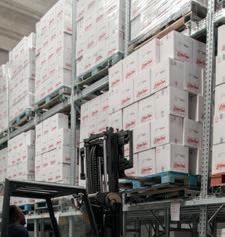
The new Compact folded hand towel range redefines the concept of compactness, transforming it into a true lever for logistics efficiency. Smaller, more compact cases, with the same quantity and quality of product inside. Compact demonstrates how targeted improvements can generate significant results without disrupting processes or production technologies. Up to 120% more folded hand towels per pallet, reducing the number of shipments required and lowering overall transport costs. Simply by optimising the case dimensions, with a more compact structure, the available space is maximised, and a series of tangible advantages are unlocked: reduced pallet and warehouse volume, simpler and more efficient deliveries, and easier product handling. Benefits that grow over time and across space.
The Absolute range features compact paper solutions conceived to free up to 50% of space while maintaining the same performances. From toilet paper to medical rolls, every product in the range is designed to deliver greater efficiency and sustainability through its ultra-compact format. More paper within the same volume translates into longer autonomy, fewer refills and reduced workload for service staff in their daily operations. The benefits extend across the entire logistics chain, from handling to storage, generating measurable savings in both time and resources.
Together, Compact and Absolute respond to the evolving needs of modern facility management, which increasingly prioritises not only operational performance but also the environmental impact of its decisions. By optimising space, both ranges streamline transport and deliveries, contributing to a tangible reduction in CO2 emissions throughout the supply chain. Solutions designed to generate real value in everyday operations: Celtex is a choice of efficiency for businesses and one that respects the environment.
celtex.it
MEGAMINI DISPENSING SYSTEMS DESIGN, PERFORMANCE
AND
Sponsored content
SMART HYGIENE MEETS ITALIAN DESIGN
In professional environments, the washroom has become a strategic space where hygiene, efficiency and brand perception converge. For facility managers and cleaning contractors, delivering a high standard of service while controlling costs is essential. This is where Celtex introduces Megamini dispensing systems: a complete range of solutions engineered to simplify operations, reduce waste and enhance user experience, without compromising on design.
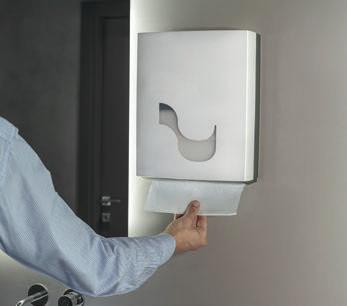
In high-traffic washrooms or hygiene-critical areas, the hand-washing zone requires reliable, hygienic and easy-tomanage products. The Megamini E-Control line answers this need with a comprehensive range of no-touch dispensers for hand towels, foam soap, hand gel and toilet seat cleaner. Touchless activation reduces cross-contamination risks, while programmable dispensing helps keep consumption under control. The hand towel dispenser features the possibility to customize the dispensing interval from 0.5 to 5 seconds and to adjust the sheet length from 15 to 80 cm. Moreover, the integrated stub-roll mechanism ensures every roll is fully used before the system switches to the next, eliminating waste and guaranteeing service continuity.
All E-Control models operate with rechargeable batteries designed for thousands of cycles, reducing the disposal of singleuse batteries and lowering maintenance costs over time.
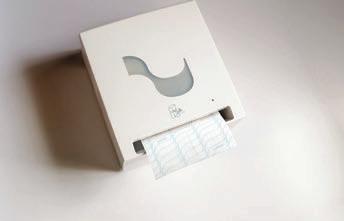
Alongside these, Megamini includes high-performance manual systems such as Formatic automatic-cut dispensers for roll towels. Designed for busy facilities, Formatic delivers one sheet at a time with consistent cutting, helping control usage while simplifying refill operations. Semi-transparent windows on the
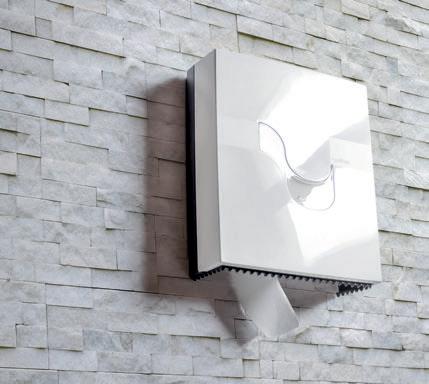
dispensers allow operators to check fill levels quickly, improving overall efficiency. In high-traffic facilities, continuity must extend beyond the hand-washing zone. Running out of toilet paper is not just inconvenient — it affects customer perception and operational efficiency. For this reason, Megamini Revolver dispenser is designed to ensure constant supply, offering up to 300 metres of autonomy. Its patented gravity-based mechanism automatically positions the next roll when one is finished, preventing downtime and reducing operator interventions. The system is compatible with Celtex Magnum toilet rolls featuring the patented Flutech® technology: a formula conceived for rapid dissolving that helps prevent pipe blockages — an important advantage in busy public facilities. Efficiency also means sustainability. By optimising paper consumption, reducing refill frequency and replacing disposable batteries with rechargeable ones, Megamini systems help lower environmental impact while improving cost control. Combined with certified Celtex paper products, PEFC and EU Ecolabel certified, they support responsible hygiene management.
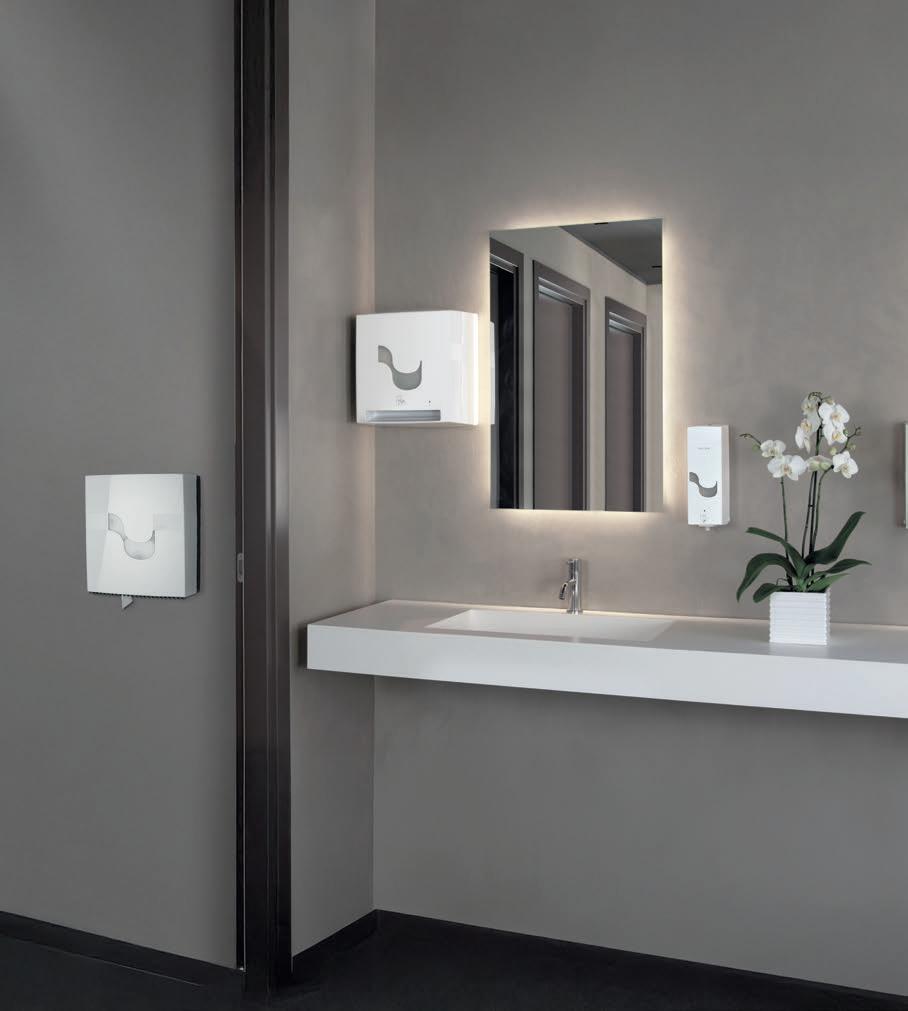
Lastly, Megamini systems stand out for their distinctive Made in Italy design. Inspired by rationalist lines and balanced volumes, their clean, modern aesthetics integrate seamlessly into any professional environment, from offices and restaurants to airports and healthcare facilities. Available in black or white, they transform the washroom into a well-designed, functional space. Because in modern facility management, hygiene is more than cleanliness: it is about efficiency, continuity and experience.
celtex.it
In an uncertain economic landscape, the cleaning sector must act as a unified system in order to remain competitive in international markets and enhance the value of Made in Italy
FACING TODAY’S CHALLENGES REQUIRES TEAMWORK
MAURIZIO PEDRINI
«Individual responses from single companies, no matter how courageous, are no longer enough. What we need is a system-wide strategy, and when necessary the entire sector must speak with one voice to institutions. That is exactly what we are trying to achieve through AFIDAMP and initiatives such as TIPSthe Inter-Association Team for Cleaning and Services - which we helped establish and which brings together all the players across the supply chain», says Andrea Loro Piana, CEO of Falpi and AFIDAMP board member responsible for relations with cleaning service associations and public institutions. In the first months
of 2026, the Italian industry represented by small and medium-sized enterprises is going through a complex transitional phase. After the crisis of 2023-2024, the situation is slowly stabilizing, with signs of recovery expected during the year. Unfortunately, the sharp increase in energy prices following the Gulf War has created new scenarios of uncertainty and concern. Despite the slowdown, the industrial system has shown a certain degree of resilience. In some cases, production has held up better than in other major European economies such as Germany and France. We spoke with Andrea Loro Piana - CEO and founder of Falpi in
Associations
1987, a leading manufacturer of industrial cleaning equipment, and AFIDAMP board member responsible for relations with cleaning companies’ associations and institutions - to assess the health of the hygiene technology manufacturing sector, which has always had a strong export orientation toward international markets. Our conversation also expanded to include Italian cleaning and facility management companies, increasingly active at the European level, as well as the protection and promotion of Made in Italy production in our sector. Within this framework sits the Italian Alliance for Cleaning Excellence, a project promoted by AFIDAMP - an association where Loro Piana served as vice-president and has been a long-time board member - and to which Falpi was the first company to join.
We are going through a very delicate economic and political period, both because of the difficult situation created by two wars near Europe and because of the challenging economic environment. What is your view of this situation?
I look at it with the clarity of someone who has been running a business for forty years and has gone through several crises, but also with the concern of someone witnessing geopolitical instability unprecedented for our generation. This situation creates a constant sense of underlying risk that keeps everyone on permanent alert and undermines the stability that every entrepreneur - and, if I may say, every family - needs in order to plan and invest in the future. Two conflicts on Europe’s doorstep, supply chains under pressure and volatile energy costs all weigh heavily on Italian manufacturing companies and on the market as a whole. The individual response of each company, however courageous,
WHAT WE NEED IS A SYSTEM-WIDE STRATEGY, AND WHEN IT IS NECESSARY THE ENTIRE SECTOR MUST SPEAK WITH ONE VOICE TO INSTITUTIONS
Associations
is no longer sufficient. What we need is a coordinated strategy, with the sector speaking with a single voice to institutions whenever necessary. This is precisely what we aim to achieve through AFIDAMP and initiatives such as TIPS - the Inter-Association Team for Cleaning and Services - which we helped establish and which brings together all the stakeholders across the supply chain. The recent creation of the Consulta dei Servizi, bringing together 19 national associations to highlight inconsistencies in the new Public Procurement Code - which still penalizes services compared to public works, particularly on the crucial issue of price revision and contractual balance - shows that networking and cooperation are the right path forward. Difficult times must be faced together, not alone.
Within the association you represent equipment manufacturers and are responsible for relations with cleaning companies’ associations and institutions. Do you believe our companies are still competitive in export markets?
Yes, our companies remain competitive and, in many cases, represent internationally recognized excellence. Italy is a European leader - and among the global leaders - in the sector of professional cleaning machines, equipment and products. The real issue is not the quality of what we produce, but the environment in which we operate. Our competitors - such as China and Turkey, but also European countries like Germany - benefit from national systems that support them with more favorable tax policies, structured export incentives, lower energy costs and lighter bureaucracy. In Italy we suffer from a systemic gap that has nothing to do with entrepreneurial capability but rather with the business environment. As AFIDAMP’s delegate for institutional relations, my role is to bring the voice of our members to the places where decisions are made and to make institutions understand that
professional cleaning is not a marginal sector. It is a supply chain that generates over €21 billion in revenue in Italy and employs more than 500,000 people. Above all, it is important to highlight that companies in our supply chain represent a strategic component of the national economy.
Let’s analyze both the main challenges and the opportunities for our manufacturers when exporting to foreign markets, starting from the traditional ones such as Europe and then looking at emerging markets. European markets, which we have long established and consolidated, remain our natural outlet. Demand for quality within EU countries is high, and strict environmental and regulatory standards reward Italian companies that have invested in certifications and sustainability. The main challenge is price pressure. European buyers are highly professional: they compare offers carefully, and competitors from outside the EU often enter the picture with significantly lower costs. The risk is a gradual commoditization of both products and services - a serious threat that penalizes companies investing in research, quality and regulatory compliance. On emerging markets - the Middle East, Southeast Asia and North Africa - the opportunities are enormous. Demand for professional hygiene is growing rapidly, driven by urbanization, tourism and increased awareness following the pandemic. For SMEs, however, it is difficult to enter these markets alone. They require investments in commercial presence, product adaptation and knowledge of local regulations. Here again, AFIDAMP plays a key role: creating collective visibility, opening doors and generating opportunities that a single company would struggle to achieve on its own. There is also an important fact we often take for granted: Italian products in professional cleaning are considered a benchmark in international markets. This is not rhetoric
but something we hear every day from our international partners. When professionals choose an Italian product, they know they can rely on design, build quality and reliability that are difficult to replicate consistently. It is an enormous reputational asset built over decades by our companies, and we must protect and enhance it with the right tools. AFIDAMP’s Italian Alliance for Cleaning Excellence initiative moves precisely in that direction.
Italian cleaning and facility management companies operating abroad are often highly structured organizations. How do you view this presence?
Italian service companies operating beyond national borders have shown remarkable adaptability and specialization. They operate in demanding markets such as Germany, France and the Netherlands, carving out significant space by focusing on expertise, flexibility and service quality. As an equipment manufacturer, I see their presence as a great opportunity for us as well. Wherever Italian service companies go, a natural channel opens for our products and solutions. At the same time, there is also a reverse phenomenon that says a lot about the strength of our domestic market: in Italy, major international companies operate successfully and have established some of their most competitive branches here. This is no coincidence. The Italian market is among the most challenging and stimulating in the world in terms of innovation and quality requirements. Companies that succeed in Italy achieve a level of excellence they can leverage anywhere. I believe the international presence of our companies will continue to grow, but under one condition: strengthening synergies between manufacturers and service providers. This is precisely what we are trying to build within AFIDAMP through relationships with the service company associations that are part of TIPS. The supply chain is a value chain: each link
Associations
becomes stronger when the whole system grows stronger.
How do you assess Made in Italy in the professional cleaning equipment sector?
Made in Italy in professional cleaning is an asset that must be defended and promoted with greater determination. I am not referring to a slogan but to a tangible value. Our products stand out for design innovation, material quality, sustainability and compliance with advanced regulations. The problem is that the Made in Italy label risks being diluted if it is not supported by verifiable criteria. Anyone can claim it, but not everyone can prove it through independent third-party certifications. For this reason, within AFIDAMP we felt the need to go further with the Italian Alliance for Cleaning Excellence project: a mark that does not certify a single product but the entire company, based on objective, measurable criteria verified by accredited bodies. The growth prospects abroad are
real, but today more than ever we must approach international markets with credible tools, not just with the rhetoric of “beautifully made products”. Alongside promotion, we must also have the courage to defend what we build. Our sector is exposed to unacceptable practices: systematic greenwashing, misleading compliance declarations, blatant copies of our products and even of our technical documentation. These are phenomena we can no longer tolerate silently. Companies that invest in research, certification and genuine quality cannot be placed on the same level as those who cheat. What we need is stronger institutional support to protect intellectual property and fair competition, as well as a clear market commitment that rewards transparency and penalizes deception.
Falpi was the first associated company to join the Italian Alliance for Cleaning Excellence project, which will have its first official presentation at the
Interclean exhibition. Why did you make this choice?
We joined first because we believe in the project and see it as consistent with the path our company has followed for forty years in terms of certified quality and sustainability. For us it is not a leap into the unknown but the natural continuation of a vision. I am sure others will follow. What matters is who not arriving, what matters is that many companies join. The expectations are high. Interclean Amsterdam, from April 14 to 17, will be the first international fair for the brand, and we expect the event to act as a catalyst for new members. The goal is not to create an exclusive club but to raise the bar for the entire Italian sector: to offer international buyers a clear and immediate tool to recognize companies that invest in quality, innovation and sustainability, distinguishing them from those that compete only on price. I hope this project will become a true industrial policy tool for the sector.
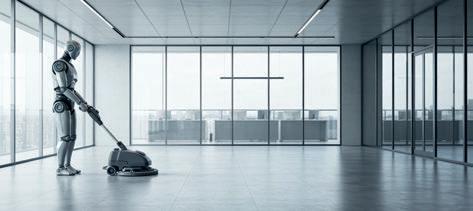
THE HUMANOIDS OF CLEANING
Professional cleaning enters the era of decision-making autonomy.
A step that marks a decisive shift not only technologically but culturally: robots no longer follow fixed trajectories - they are assigned objectives. For Italian companies, the time is now
STEFANO BELVIOLANDI
According to the International Federation of Robotics (IFR) World Robotics Report 2025, Italy ranked second in Europe for the number of new industrial robots installed in 2024: 8,783 units, with a density of 228 robots per 10,000 manufacturing employees. This represents fertile ground for the adoption of advanced solutions also in the cleaning sector, where the combination of large industrial surfaces, a strong manufacturing base and pressure on labour costs creates ideal conditions for the deployment of autonomous systems.
The professional cleaning industry has rarely been at the centre of technological innovation. For decades it remained on the margins, considered too operational, too physical and too far removed from the spotlight of Silicon Valley. Yet this is precisely why it now represents one of the most promising fields for autonomous robotics: the problems are real and measurable, the potential for improvement is enormous, labour-cost pressure is structural, and resistance to change is relatively low.
For Italian service and facility management companies, the question is no longer whether to adopt robotic cleaning systems, but when and how. The parameters to evaluate - managed surface area, types of contaminants, operational time windows, labour-cost structure and traceability requirements - are the same
FROM PROGRAMMING TO TASK ASSIGNMENT: THE RELATIONSHIP
BETWEEN HUMANS AND MACHINES IS CHANGING
AREAS OF APPLICATION
factors that have always guided investment decisions in the sector. What has changed is the technology now available. Facility management and industrial cleaning have long served as early testing grounds for automation. Not because of glamour, but because of operational logic: relatively structured environments, repetitive tasks and time windows compatible with the absence of human staff. The first autonomous floor-scrubbing machines - so-called AMRs (Autonomous Mobile Robots) - have been operating for almost a decade in airports, shopping centres and production plants.
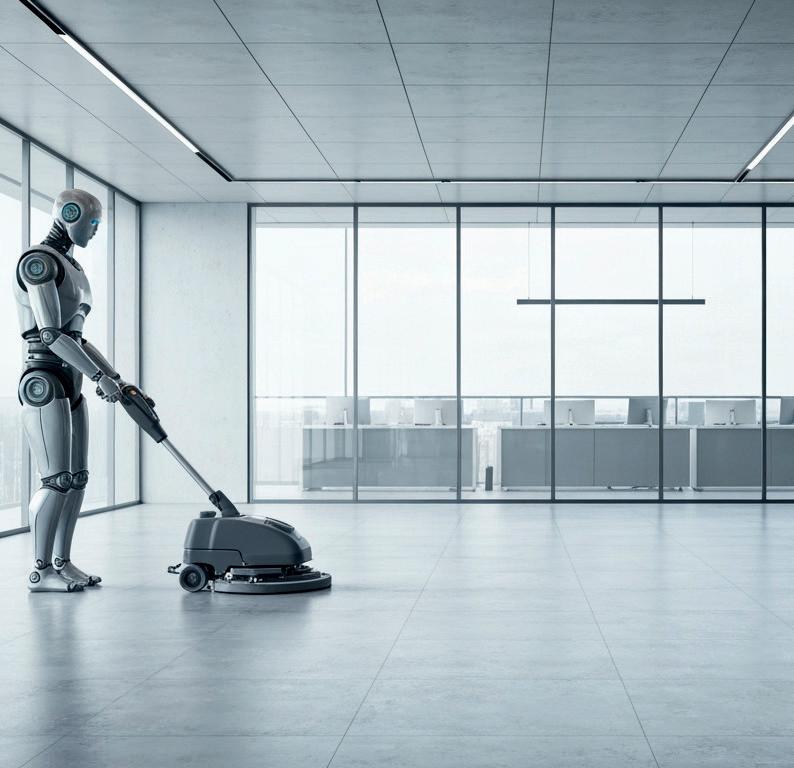
But the current generation represents a clear qualitative leap over these pioneering systems. Where previously a trajectory was programmed, today an objective is assigned. Where robots once followed static maps, they now perceive their surroundings in real time, adapt routes and identify critical zones. The transition is philosophical even before it is technical: from programming to task assignment.
Next-generation professional cleaning robots find practical application in five major areas, each with specific operational characteristics that support their adoption. Manufacturing plants and foundries A foundry floor is a hostile environment: waste oils, metal dust, machining residues and irregular surfaces. Autonomous systems typically operate overnight, when the plant is shut down, without interfering with production. The absence of operators during night cleaning shifts - often in environments with chemical hazards and slip risks - is not only an economic advantage but also a safety improvement. Airports and major transport infrastructures. Surfaces can extend to tens of thousands of square metres, while cleaning windows are measured in hoursbetween flights or during night shifts. The precision and consistency of robots are difficult for human teams to replicate at comparable cost and continuity. Hospitals and healthcare facilities. Here, cleaning is not aesthetic but clinical. It involves the control of HealthcareAssociated Infections (HAIs), strict protocols and complete traceability of interventions. Robots guarantee precise execution of protocols without variations caused by fatigue or human distraction, while producing digital logs for every cycle - valuable documentation for audits and accreditation processes.
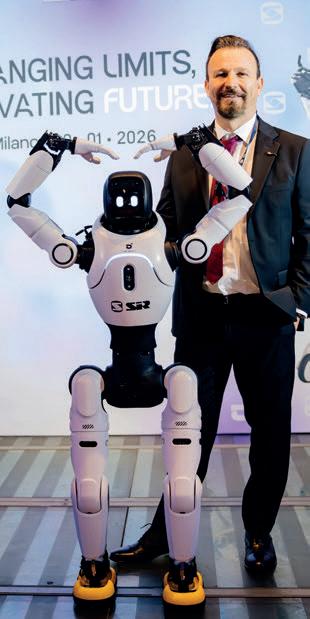
HUMANOID C5
A compact version of the C5, expected in the second half of 2026, is designed to expand accessibility beyond large industrial plants. It will offer the same operational performance at a lower cost and with higher decision-making autonomy. The formula is intended for medium-sized warehouses, showrooms, healthcare facilities, hotels and distribution centres. Photo Davide Passoni, CEO of SIR Robotics
Shopping centres and large retail spaces. Night-time cleaning automation in this segment has been a reality for years. New-generation robots add the ability to adapt to layout changes - temporary shelving, promotional displays - that earlier systems could not easily manage. Data centres and critical environments Where dust control is extremely strict, human presence must be minimized and operational continuity is essential, autonomous robots offer a manageable risk profile that traditional solutions struggle to guarantee.
THE FIRST HUMANOID ROBOTS ARRIVE IN ITALY
How will the cleaning sector change with the arrival of humanoid robots? What benefits will they bring to manufacturing - and beyond? These are natural questions linked to a future that has already begun. On 30 January in Milan, humanoid robots were officially presented in Italy for the first time.
They were developed by AgiBot, a Chinese company founded in Shanghai in 2023 by former Huawei engineers. Today AgiBot is already one of the world’s leading producers of humanoid robots, and it is estimated that by 2025 it manufactured around 40% of all humanoid robots globally.
To enter the Italian market, AgiBot partnered with SIR Robotics, a robotics company based in Modena with more than 40 years of experience in industrial robotics and nearly 4,000 robotic installations worldwide.
This partnership goes far beyond simple distribution. SIR Robotics not only supplies AgiBot robots but also trains and customises them for specific applications. To do so, it operates a facility called the Data Factory, where “skill packages” are developed and tested—sets of data that teach robots how to perform specific tasks. Cleaning a steel plant, sanitizing a nursing home or operating in a logistics warehouse
requires completely different capabilities. Each robot is therefore trained specifically for the environment in which it will operate. SIR Robotics also integrates robots into the customer’s existing digital and operational systems, allowing them to become operational without requiring major changes to the company’s infrastructure.
THE AUTONOMOUS CLEANING ROBOT
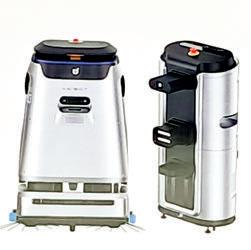
Among the solutions presented, the spotlight was on the C5, an autonomous cleaning robot designed for industrial environments and specialized in largesurface cleaning.
The performance figures are significant: 1,980 square metres per hour, with three hours of operational autonomy, allowing a maximum coverage of more than 5,500 square metres per cycle. The system claims 95% suction efficiency, capable of handling waste oils, metal dust and heavy processing residues typical of industrial environments in a single pass.
The C5 does not simply sweep. It integrates sweeping, washing and drying functions into a single machine, coordinating the three processes autonomously according to conditions detected in real time.
Its navigation system uses multiple sensors for dynamic obstacle avoidance, automatic zone-boundary recognition, intelligent work-area segmentation and closed-loop cleaning. If a section of floor is not cleaned satisfactorily, the robot identifies the problem area and automatically reprocesses it.
A factor often overlooked in discussions about cleaning robots - but crucial for real operational efficiency - is maintenance management. The C5 charging station operates fully autonomously, refilling clean water, collecting and disposing of wastewater, and cleaning the internal tank after each cycle.
The declared result is a 50% reduction in daily maintenance time compared with
THE AUTONOMOUS C5 CLEANING ROBOT
1,980 square metres per hour
5,500 square metres per battery cycle
previous solutions. The system can also be equipped with a mobile water tank, eliminating the need for modifications to the site’s hydraulic infrastructure.
THE REAL PARADIGM SHIFT
What distinguishes new-generation robots from their predecessors is not suction power or brush width. It is decisionmaking autonomy.
A traditional robot follows a predefined map: it travels along corridors, avoids fixed obstacles and returns to its base when the tank is full.
An AI-powered system like the C5 perceives the environment in real time, adapts its route based on dynamic obstacles and floor conditions, identifies areas requiring additional passes and manages the unexpected.
In other words, the machine is no longer told: «Go from point A to point B and then return to base».
Instead, it is told: «Clean this warehouse by six in the morning».
The machine decides how.
This conceptual shift - from programming to task assignment - radically changes the role of the operator who manages the system, the skills required and the relationship between humans and machines in professional cleaning. «We wanted to bring to Italy not only the technology but also the intelligence of humanoid robots. Thanks to our Data Factory, we have developed a robotic ecosystem that learns, adapts and collaborates naturally with people», said Davide Passoni, CEO of SIR Robotics, during the Milan event.
The underlying model is similar to smartphones and apps. Each robot can perform only what it has been trained to do, but it can learn new skills through updates distributed across the fleet.
A human operator performs a sequence of movements; those movements are recorded and converted into data; that data feeds the entire ecosystem. Each
robot learns from the experience of all the others.
To support this process, AgiBot has developed a dedicated platform called LinkCraft, which can convert videos of human movements into robotic action sequences without requiring programming skills.
FREEING TIME, NOT ELIMINATING JOBS
The relationship between automation and employment is an inevitable issue, and in cleaning it arises particularly clearly.
In Italy the sector includes more than 45,000 companies and about one million workers. Any significant impact from cleaning automation therefore affects tens of thousands of jobs.
Douglas Pong, president of Wolong Electric - the industrial group supplying motors and articulated modules for AgiBot robots - addressed the issue directly: robots will handle repetitive tasks, while humans will focus on creative and relational ones.
This distinction echoes the broader debate about AI in the workplace, but in cleaning it takes on very concrete meaning. «It is not about replacing human work, but about freeing time and value, restoring centrality to people’s talent», Passoni emphasized.
In professional cleaning this statement translates into practical reality: freeing an operator from the night shift cleaning a warehouse does not mean taking away a job - it means giving back hours and health.
Night shifts spent pushing floor-scrubbing machines in environments with chemical vapours, slip risks and intense physical fatigue fall exactly into the category of tasks people increasingly refuse to do. Reskilling workers toward supervision roles, system maintenance and data management generated by robots is the direction indicated by the industry—and a concrete training challenge for companies in the sector.
FROM STANDARDS TO SMART MACHINES
Rules, innovation and competitiveness: how international standardization affects performance, automation and the development of Made in Italy in professional cleaning
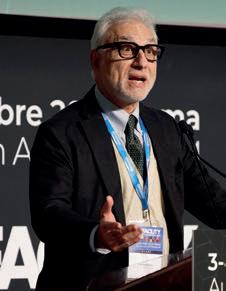
In an increasingly global and regulated market, technical standardization represents one of the main drivers of competitiveness for the Professional Cleaning sector. Machines and electrical equipment used in professional cleaningvacuum cleaners, scrubber dryers, single-disc machines and automated systems - are now at the center of a regulatory evolution involving safety, performance, sustainability and energy efficiency. Within this scenario operates Alessandro Panico, Head of the Italian Delegation in the international standardization committees IEC SC 59F (within the IEC framework) and CEI SC 61J at the national level, bodies responsible for the standardization of electrical cleaning equipment, including
professional and commercial devices. At the same time, he coordinates the International Affairs Working Group of AFIDAMP, the association representing the Italian professional cleaning supply chain: manufacturers of machines, components, systems and technological solutions. His activity therefore lies at a strategic intersection between industry, associations and international standardization, with a direct impact on the competitiveness of Made in Italy in the global arena. We met him to explore the topic of standardization as a strategic lever for the professional cleaning sector, with particular focus on machines, technological innovation and Italy’s contribution to international working groups.
CRISTINA CARDINALI
STANDARDIZATION IS PROGRESSIVELY INTEGRATING PRINCIPLES OF CIRCULAR ECONOMY, ENVIRONMENTAL TRANSPARENCY AND PRODUCT DURABILITY
Your role in the IEC SC 59F and CEI SC 61J committees places you at the center of defining standards for electrical cleaning equipment. How do these standards concretely affect the design of Italian professional machines? Technical standards influence machine design much more directly than people often imagine. When developing an industrial vacuum cleaner, a scrubber dryer or an autonomous cleaning machine, regulatory requirements do not come into play only during the final certification stage; they already influence the initial design choices.
Standards define requirements related to electrical safety, operator protection, the management of dust or emissions, water and chemical consumption, electromagnetic interference, but also product performance, energy efficiency and sustainability. This means that the architecture of the machine, the choice of components, the control systems and even the operating modes must be designed from the outset with this framework in mind. For Italian companies operating in a highly international market, working in alignment with IEC standards and the European regulatory system means developing products that can be marketed more easily and with greater compliance
Regulation
assurance in different markets.
In this sense, standards are not simply a compliance requirement; they become a tool that guides innovation and helps companies design machines that are safer, more efficient and more competitive.
How can work carried out in the regulatory field become a competitive advantage for Italian manufacturers of professional cleaning machines? Are companies sufficiently aware of the strategic impact of technical standards on their business, or is there still a cultural gap to fill?
Participating in international standardization activities allows companies to understand regulatory and technological developments in advance - or even influence market evolution and demand. This is a strategic element because it enables companies to anticipate requirements that will become mandatory in the coming years and to design products already aligned with future market developments and the state of the art. In the professional cleaning sector, which is strongly export-oriented, this aspect is particularly relevant.
Companies that understand and contribute to the definition of standards often manage to reduce the time needed to adapt to new regulations and gain easier access to international markets. They may also help define product requirements that highlight and reward their own technological innovations. However, a certain cultural gap still exists. Many companies perceive standards mainly as a constraint or a cost, whereas in the most industrialized countries participation in standardization is considered an integral part of industrial strategy. The work we are trying to carry out through AFIDAMP and through standardization bodies such as CEI and UNI is precisely aimed at strengthening this awareness.
In this context, the Italian Alliance for Cleaning Excellence project also plays a role. Its goal is to enhance the international profile of the Italian cleaning industry. The idea is to build a collaborative platform among companies, institutions and the Italian diplomatic network to promote abroad the technological value of Made in Italy, foster industrial relationships and create development opportunities in emerging markets.
In a world where global competition is increasingly intense, working as a system becomes essential.
The rapid emergence of autonomous machines and robots for professional cleaning is reshaping the market. Do you think the current regulatory framework is adequate to govern systems with decision-making autonomy and human–machine interaction?
Autonomous machines represent one of the most significant transformations the professional cleaning sector has experienced in recent years. We are no longer dealing only with electromechanical machines, but with complex systems that integrate sensors, navigation software, data processing capabilities and continuous interaction with the surrounding environment. In other words, the machine is progressively becoming an intelligent system capable of operating more and more autonomously in spaces shared with people. The regulatory framework is evolving precisely to take these new characteristics into account. The new European Machinery Regulation, for example, introduces more advanced requirements for managing risks related to systems with increasing levels of autonomy, while standardization work is integrating expertise from robotics, functional safety and human–machine interaction.
AFIDAMP has also worked on these topics with a dedicated guide on autonomous machines, aimed at helping the sector correctly interpret this technological evolution.
At the same time, it is clear that we are only at the beginning of a much broader transformation. If today we see robots automating specific cleaning or logistics functions, in the coming years we may witness the spread of increasingly versatile robots, potentially leading to humanoid robotic platforms. Several companies and research centers are already working in this direction, with the goal of developing robots capable of operating in environments designed for humans and collaborating directly with people. Naturally, these developments also raise new regulatory and standardization challenges. Technological innovation is advancing rapidly, and standardization will need to continue evolving to ensure that these systems are designed and used in a safe, reliable and transparent way. In this sense, dialogue between industry, standardization bodies and institutions will become increasingly important.
The integration of artificial intelligence, data collection and cloud platforms also opens new scenarios in terms of responsibility, cybersecurity and data management. Will standardization need to address these aspects as well? Certainly. Cleaning machines are becoming increasingly connected and intelligent. Today many solutions are capable of collecting operational data, communicating with cloud platforms and integrating with building management systems. This means that the sector is moving closer to issues that traditionally belonged to the ICT world, such as cybersecurity, data governance and algorithmic responsibility. Europe is already working on these aspects through instruments such as the AI Act and the
Data Act, which will inevitably have an impact on industrial and professional machines as well.
Looking ahead, cleaning equipment will increasingly become part of a broader digital ecosystem linked to smart building management and indoor environmental quality. Standardization will therefore need to evolve in order to integrate these new dimensions.
Looking at the near future, how do you see standards for professional cleaning equipment evolving? Will we witness convergence between electrical, digital and environmental standards within a single integrated framework?
We are already witnessing a gradual convergence between different regulatory fields. Cleaning machines can no longer be assessed solely in terms of electrical safety or mechanical performance; they must be considered within a more complex system that includes environmental sustainability, energy efficiency, digitalization and data management.
This evolution reflects a broader change in the way cleaning is perceived. It is no longer just an operational activity but an increasingly strategic function for the management of buildings and public spaces, for indoor air quality and for the health of working environments.
Current product standards are already being revised in this direction. At the same time, new regulatory initiatives are emerging that reflect a deeper transformation in how products are evaluated. Within IEC activities, new standards are being developed that address increasingly central themes for industry, such as Life Cycle Assessment (LCA), the management of repair, refurbishment and remanufacturing activities for equipment - with related safety requirements and subsequent testing - and the development of reliable methods for measuring and verifying product environmental claims. These new regulatory lines represent a
significant evolution compared with the past, because they shift attention from the machine’s safety and performance alone to the overall assessment of its impact throughout the entire life cycle. In other words, standardization is progressively integrating principles of circular economy, environmental transparency and product durability - elements that will become increasingly relevant also for the professional cleaning sector.
At international trade fairs such as Interclean Amsterdam, how important is it to present products already aligned with - or even anticipating - future standards?
It is extremely important, because major international trade fairs are not only commercial showcases but also key moments for technological and strategic dialogue among manufacturers, users, institutions and standardization bodies. Presenting products that are already aligned with - or even ahead of - future standards demonstrates not only innovative capacity but also a medium- to long-term industrial vision.
In a sector like professional cleaning, where technological evolution is increasingly rapid and global competition very strong, the ability to anticipate regulatory trends allows companies to position themselves as technological leaders in the market. It means developing solutions that are not merely compliant with current standards but already designed to meet the requirements that will likely become the benchmark in the coming years.
For this reason, companies actively participating in international standardization work often gain an important competitive advantage: they understand earlier than others the direction in which the sector is moving and can translate those signals into product innovation. When these solutions are presented at events such as Interclean
Amsterdam, they also become a way to communicate technological leadership and strengthen the credibility of Made in Italy in international markets.
At the same time, trade fairs represent an important moment of dialogue between industry and institutions. It is often in these contexts that new collaborations emerge, experiences are shared among different countries and collective initiatives - such as those promoted by AFIDAMP to enhance the global profile of the Italian cleaning industry - are consolidated.
Professional cleaning is increasingly part of ESG strategies and sustainable building management. Could future standards become real tools for objectively measuring the environmental performance of machines?
I believe this is one of the most interesting directions in which standardization is evolving. As mentioned earlier, technical standards are gradually expanding their scope: they no longer concern only machine safety and performance, but are beginning to integrate elements related to product life cycle, durability, repairability and the transparency of environmental declarations.
In this sense, standards could increasingly become useful tools for objectively measuring certain dimensions of equipment sustainability, providing shared and verifiable criteria. This is particularly important in a context where ESG strategies require clearer and more comparable indicators.
Rather than replacing environmental policies or existing certifications, technical standards can offer a shared methodological basis that helps the market distinguish between generic claims and genuinely measurable performance. And this is precisely the direction in which several new international standardization initiatives are currently moving.
GLASS LINE AND LAMPO THE INTEGRATED SYSTEM THAT TRANSFORMS GLASS CLEANING
When it comes to glossy surfaces, TTS has one clear mission: make them shine. Glass Line was designed to achieve this goal, cutting wasted time and effort and keeping the workflow smooth from start to finish. The range covers every stage of cleaning, from washing to drying, including the removal of stubborn dirt. It also makes it easy to clean high or hard-to-reach surfaces. Every tool features the Lampo connection for instant attachment to handles or poles. In practice, fewer unnecessary steps and more continuity in every movement.
THE TOOLS OF THE TRADE
Glass Line does not focus on a single tool. It focuses on the method. The washer support and sleeves prepare the surface and continuously collect dirt, supporting even, consistent work, including edges and areas prone to fingerprints. The squeegee completes the cycle and delivers the final finish with a clean, controlled pass. The scraper comes into play when targeted action is required, with no hesitation and no wasted time. The result is a clearer process, easier to teach and easier to replicate, even when teams or shifts change. When the procedure is clear, quality becomes more consistent.
LAMPO SYSTEM, THE CLICK THAT CHANGES THE PACE
Working well on glass requires more than the right tools. You also need to change tools at the right moment without slowing down or increasing risk. Lampo was created for this. It is the instant locking and release system that lets you switch tools in seconds while keeping them firmly secured during use. Every Glass Line tool is equipped with the Lampo fitting for instant connection to handles and poles with the Jack end adapter. Switching from washing to drying becomes natural, especially when working at height or on hard-to-reach surfaces.
The benefit shows in small details too, fewer pauses, fewer delays, fewer returns to pick up the right tool.
THE RIGHT ANGLE, AT THE RIGHT MOMENT
High windows, recessed glass, obstacles, handrails.
On site, the perfect trajectory rarely exists. The Jack Angled joint expands the working range and helps you find the right inclination without force. When you need to change perspective, the joint helps you set the angle.
The squeegee stays stable and movement remains clean, even near frames and profiles. Fewer repositionings. More continuity. Less strain on wrists and shoulders.
Above all, fewer corrections at the end of each pass.
PLASTIC SQUEEGEE, TRULY DIFFERENT
Among the most distinctive solutions in the range are the plastic squeegees, unique in their category. Maintenance becomes quick and simple. A light pressure on the lever releases the blade for easy replacement. When needed, stronger pressure allows easier plate opening compared to traditional squeegees. The version with a head adjustable up to 75 degrees adds control. The operator can leave it free to move or lock it at a precise angle, depending on the surface and movement required. A small detail on paper, a real advantage in the field, fewer interruptions and smoother workflow, especially when alternating large areas and critical spots.
ORGANIZATION AND STABILITY ON THE MOVE
The Aquarius holster completes the system approach to glass cleaning. It organizes tools and keeps them ready, reducing interruptions and unnecessary movement during work. It attaches instantly to the Belty belt or any work belt and releases just as quickly with one hand by pressing the dedicated button. The position can be locked to reduce swinging or left free to stay perpendicular to the floor, giving the operator greater stability while moving.
The removable divider creates up to four compartments to organize tools and simplify holster cleaning. A design built for daily operations, with a universal solution that fits any belt.
ONE SYSTEM FOR EVERY SURFACE
Lampo goes beyond glass. With one handle you can manage a wide range of professional cleaning tools, customizing the process without multiplying equipment. This also simplifies equipment management by reducing duplicates and making trolley setup faster. The method changes on the trolley too.
The Plug device for Magic and Nickita trolleys allows you to release floor frames without hand contact with potentially contaminated surfaces. Fewer contacts. More hygiene. More safety. A faster action, especially when the pace is demanding.
MORE SPACE ON THE TROLLEY, SMOOTHER OPERATIONS
Reduce the number of handles and you free up space. Free space and the workstation becomes truly functional.
With one handle and frames positioned outside active areas, the trolley stays accessible. Everyday tasks become faster, opening doors and drawers, removing trays, accessing compartments, emptying bins into the bag holder.
Even a compact trolley becomes a complete station, ready for planned operations and unexpected requests, without obstacles that slow you down. When space is well managed, the operator works with more order and fewer distractions
MORE CONSISTENT RESULTS, EVERY DAY
Glass Line and Lampo together make glass cleaning easier to manage and more consistent in results.
More consistent over time because they reduce waste and repetition.
More uniform because they guide you through a clear method and help maintain it even when operators change. Safer because the secure connection reduces the risk of accidental release, especially when working at height.
A practical way to improve finish quality without making the process more complex. When results are stable, final checks become faster too.
ttsystem.com
From the “pioneering” debut of the Seventies to the undisputed prominence of Made in Italy in the 2000s. The story of Italy’s presence at Europe’s leading professional cleaning trade fair
FACES, MEMORIES, EMOTIONS
MAURIZIO PEDRINI
Amarcord
On the international stage of Amsterdam, the history of Italian participation in Interclean mirrors the evolution of Italy’s professional cleaning industry. A gradual growth built on entrepreneurial determination, technical expertise and international vision. Interclean was founded in 1967 and, over the decades, established itself as the leading European trade fair dedicated to professional cleaning, hygiene and related technologies. Over time, it became an essential point of reference for hundreds of exhibitors and tens of thousands of visitors from all over the world. The exhibition, hosted at the RAI Centre in Amsterdam, is internationally recognized as a privileged meeting place for manufacturers, distributors, service companies and industry operators. From the very first editions of the 1970s, Italian manufacturers of machines, equipment and chemical products began exhibiting at the trade fair with a pioneering spirit. At the time, the national sector was still in the process of structuring itself, while international markets were dominated by large American and German groups. Yet precisely in that competitive context, Italian companies began to stand out for their design capabilities, production flexibility, attention to design and a particularly competitive price-performance ratio. Over time, that presence became consolidated and transformed into a leading role. Italy became one of the most represented countries, contributing significantly to both the qualitative and quantitative growth of the exhibition. But what are the memories of those who first chose to compete with major international players? What were the difficulties, the insights, the satisfactions? In this amarcord, we have gathered testimonies from some of the protagonists of that era, retracing data, episodes and moments that marked the history of the sector.
Giulio Guizzi, today AFIDAMP Ambassador, has always combined his entrepreneurial activity with strong association and cultural commitment.
“I REMEMBER THE 1985 EDITION FOR THE SCALE AND THE WAY ITALIAN PARTICIPATION WAS ORGANIZED”
Giulio Guizzi, AFIDAMP Ambassador
President of Pulindustria Cimex and Pulex, he was among the founders of AFIDAMP and served as its president during crucial years for the sector’s development. “With Pulex of Brescia I participated in Interclean as early as 1979, independently,” he recalls. “It was an almost solitary presence, but for us it represented a strategic opportunity to establish contact with international markets that were still little explored.” In 1981 came the first experimental collective participation of AFIDAMP member manufacturers. “It was a real exploit. The participation aroused considerable interest and helped give visibility to a production system that was rapidly maturing. In 1983 we returned with greater conviction, under the official aegis of AFIDAMP and thanks also to the organizational contribution of Moedco led by Alfredo Pellizzari.” A qualitative leap occurred in 1985, when Italian participation benefited from the patronage
of the Italian Trade Agency (ICE). “That edition represented a turning point. The initiative was successfully repeated in 1987 and 1989. In 1992, the Italy point occupied a highly prestigious area, both commercially and institutionally, also thanks to the exhibition design curated by Giulio Olgiati.” The 1985 edition remains impressed in Guizzi’s memory not only because of the associative role he held at the time, but also for the numbers and the overall impact of the Italian presence. “There were 24,000 visitors, all sector operators, constantly growing compared to 16,932 in 1981 and 22,505 in 1983. Exhibitors numbered 364: 190 Dutch and 174 foreign. Among these, 34 were Italian, followed by the British (24), Germans (20), Canadians (13), Americans (7) and French (59). At that moment it was evident that the Italian cleaning industry had achieved recognized international stature.” Fundamental was the synergy between AFIDAMP and ICE, supported by the representative office in Amsterdam. “That collaboration demonstrated that AFIDAMP had by then become an authoritative interlocutor for institutions and for the international trade fair system.”
Roberto Raimondi, past president of RCM spa, takes his memory back to 1976, the year of the company’s first participation in Interclean. “There were very few Italians present. There were us with the motoscopes and Wirbel with vacuum cleaners. The RCM team consisted of me and an interpreter, Professor Pellegreffi, who collaborated with the company for foreign contacts. We set up a basic stand, personally taking care of unloading and installation. They were different times, but that presence marked the beginning of an important journey.” In that edition, RCM presented four models: in addition to the already established R500 and R850, the new motoscopes R701 and R702 were introduced, both with a 70-centimeter cleaning width. “The R701 was a ‘walkbehind’ machine, an evolution of the previous R700, while the R702 was a ‘ride-on’ model, with seat and steering
Amarcord
“WE WERE PIONEERS OF THE GREAT GROWTH THAT WOULD LATER SEE ITALY BECOME A LEADING PLAYER IN EUROPEAN CLEANING”
Renzo, Roberto and Romolo Raimondi, RCM
wheel, more compact and maneuverable than the R850. It was designed to adapt to the limited spaces typical of many Italian production facilities of the time.” Maneuverability, operational comfort and productivity were already central elements in design. “Operators appreciated the possibility of working
seated, while companies recognized the benefits in terms of output.” RCM has never interrupted its participation in the exhibition. “We have often played a leading role, not only for the robustness and innovation of our products, but also for the originality of our stands. Emblematic was the 2004 edition, when
we dedicated much of the exhibition space to a small golf course with a pitch and putt tournament and a final prize: two tickets to the Formula 1 Grand Prix in Monza.” Today the company is led by the new generation of the Raimondi family. “My hope is that the tradition will continue for a long time.”
“FROM OUR FIRST PARTICIPATION, ICEFOR STOOD OUT AS THE ONLY COMPANY MULTI-CERTIFIED ACCORDING TO ISO 9001, ISO 14001 AND EMAS STANDARDS”
Sergio Antoniuzzi,
Icefor
Giancarlo Ruffo, founder and president of the Comac Group (Costruzione Macchine), is among the historic protagonists of the development of the Italian professional cleaning industry. His first participation in Interclean dates back to 1981, a moment he recalls as decisive for the company’s future. “For me and my collaborators, that presence represented a fundamental testing ground,” he recounts. “We participated together with other Afidamp-associated companies, if I remember correctly about ten in total. It was an extremely positive experience, also because it was the first time we exhibited at an international trade fair. Our stand attracted strong visitor traffic and, from a commercial standpoint, we were also favored by the advantageous exchange rate of the lira against the dollar.” That context allowed Comac to compete directly with already established American manufacturers, true giants of the sector. “At the time, the main references were Clarke and Advance, while Tennant produced cleaning machines but not scrubber dryers. Kärcher was not yet present on the market as we know it today. Advance, on the other hand, would later be acquired by Nilfisk. In that competitive context, the 1981 edition represented the decisive push for us. From that moment growth was constant and turnover doubled year after year.” Difficulties were not lacking, especially in the initial phase. “The first barrier was psychological. Presenting ourselves, almost as unknowns, on such an important international stage was not easy. Moreover, we came from a country where the culture of professional cleaning was still less developed compared to other European markets.” Ruffo also recalls
the operational difficulties related to the practical organization of participation. “There was a lot of manual work: we had to unpack the machines, assemble the stand, prepare every detail. At my side was a precious collaborator, Maria, who helped me with great patience.” The most intense emotion remains linked to direct contact with the international public. “The influx of visitors and potential customers was impressive. On that occasion I met commercial partners who would later contribute to the company’s expansion into strategic markets such as Germany, Spain and Great Britain. I returned to
“I STILL REMEMBER THE EMOTIONS OF THE LEGENDARY 1981 EDITION THAT LAUNCHED COMAC GROUP ON TO THE INTERNATIONAL MARKET”
Giancarlo Ruffo, Comac Group
turnover.” The 1981 participation therefore marked a real turning point. “Our priority after the trade fair was to fulfill the large number of orders received. It was a demanding challenge, but we managed to double production. During that period we also adopted a slogan that well expressed our spirit: to demonstrate that high-level scrubber dryers could also be produced in Italy. We felt a bit like David against Goliath, but that made the challenge even more stimulating.”
“FOR US ITALIANS, WHAT INTERCLEAN REPRESENTED WAS ANOTHER WORLD, A SORT OF PARADISE OF PROFESSIONAL CLEANING”
Elio Zibra, Dianos and honorary president of AFIDAMP
Verona with the concrete feeling of having achieved an important milestone.” At the time, he explains, Italian manufacturers generated great interest, despite inevitable organizational limitations. “We were a bit like some emerging companies we see today at international trade fairs: very present, sometimes with exhibition solutions that could still be improved, but with products capable of leaving a mark. Our stainless steel scrubber dryers, particularly the small C45, made a positive impression. 50-cm walk-behind machines achieved great success and still today represent an important share of our
Sergio Antoniuzzi, founder and president of ICEFOR spa, is among the protagonists of the development of ecological professional detergents in Italy. Participation in Interclean represented from the outset a moment of strong international recognition for his company. “As AFIDAMP members, we participated for the first time within Group Italy, in an exhibition area dedicated to Made in Italy and supported by the Italian Trade Agency,” he recounts. “The selected exhibitors represented high-level realities in the sectors of equipment, professional machinery and, to a lesser extent, detergents.” ICEFOR stood out for one precise element: certification. “We were the only company multicertified according to ISO 9001, ISO 14001 and EMAS standards. We had already launched an industrial path oriented toward sustainability, defined as ‘Ecological Formula,’ based on the use of raw materials of natural origin and highly biodegradable formulations.” The technical choices were very advanced for the time. “We used palm oil with 99% biodegradability, when the regulatory requirement was 80%. The formulations were free of dyes, fragrances, nonylphenols, formaldehyde, EDTA and heavy metals. Even preservatives were selected according to rigorous criteria of environmental and health safety. In a period when the concept of sustainable chemistry was not yet widespread, we can say we were among the forerunners.” On a human level, Antoniuzzi recalls with particular intensity the journey to
Amarcord
Amsterdam. “We all departed together from Linate airport. Among the exhibitors there was enthusiasm, team spirit and confidence in our ability to tackle the European and global markets.” Among the most significant memories is also the figure of Osvaldo Fiorentini, an entrepreneur capable of investing in large independent exhibition spaces and developing a very advanced international commercial presence. “I remember him as a person of great technical competence and strong industrial vision.” In 2000,
“THE 2002 EDITION MARKED THE MOST INTERESTING CHAPTER FOR AFIDAMP, THANKS TO THE COLLECTIVE PARTICIPATION IN COLLABORATION WITH ICE AND AN UNFORGETTABLE DINNER FOR NEARLY 400 GUESTS”
Toni D’Andrea, ISSA Pulire network
ICEFOR received an important official recognition during the Interclean gala evening: an AFIDAMP plaque for environmental commitment. In 2022, a further symbolic award arrived, an hourglass representing the continuity of the company’s path. “For us, sustainability has always been a strategic choice, not a mere regulatory adjustment.”
Elio Zibra, historic founder of Dianos and honorary president of AFIDAMP, initially experienced Interclean as a visitor. His first attendance dates back to 1976. “I went to Amsterdam to meet suppliers of raw materials for metallic waxes,” he recounts. “I was among the first to produce them in Italy, after discovering them precisely in the Netherlands.” What struck him most was the organization of the sector in Northern European countries. “Not so much the international presence of manufacturers, but the role of cleaning companies. I remember the surprise of some Italian entrepreneurs when they observed relatively low profit margins, compensated, however, by very high volumes of activity.” Italian manufacturers, he observes, were animated by great dynamism. “There was a desire to grow, to expand companies,
to develop new market segments. Many niches were still scarcely covered and dominated by foreign operators.” Over time, the fair changed, but remained a point of reference for innovation and organizational models. “For us, Interclean represented an advanced system not only technically, but also culturally. It was, in a sense, a a true testing ground for professional excellence.”
Toni D’Andrea, today CEO of ISSA Pulire Network, first visited Interclean in 1994, when he was working at Electrolux Euroclean. “It was already a place of global networking,” he recalls. “An opportunity to meet colleagues from all over the world.” In 1998 he participated as director of Afidamp. “The association had an institutional stand and represented the interests of Italian exhibitors.” The most significant moment came in 2002, when, thanks to ICE support, a large Italian collective participation and a dinner with approximately 400 guests were organized. “It was a memorable evening, during which ICEFOR was awarded for EMAS certification.” In the following years, the market and the exhibition underwent profound transformations. “Business models, technologies and service delivery methods have changed. Rental, pay-peruse, robotics and artificial intelligence are redefining the sector.” Over the decades, Italian presence at Interclean has steadily grown, both in number of exhibitors and in quality and recognizability of the offering. Italian companies continue to stand out for technological innovation, industrial design and attention to sustainability. Afidamp has played a central role in coordinating and promoting the Italian industry system, also through collaboration with ICE and international enhancement initiatives such as the Italian Golden Suppliers.
A path built thanks to the vision and determination of those pioneers who, from the 1970s onward, chose to compete with major global competitors, contributing to the development and international recognition of the Italian professional cleaning industry.
VOICES OF EXCELLENCE
PROFESSIONAL CLEANING IS ONE OF THE SECTORS WHERE ITALIAN MANUFACTURING EXCELLENCE SHINES MOST CLEARLY ON THE INTERNATIONAL STAGE. WE SPOKE WITH THE PROTAGONISTS OF THIS INDUSTRY, ASKING ABOUT INNOVATIONS, VALUES AND MARKET STRATEGIES TO BUILD A PORTRAIT OF A SECTOR THAT COMBINES RESEARCH, DESIGN AND INDUSTRIAL EXPERTISE. THE RESULT IS A SERIES OF CONVERSATIONS THAT REVEAL THE DEPTH AND AMBITION BEHIND MADE IN ITALY IN THE CLEANING INDUSTRY
ANNOVI REVERBERI
STEEL POWER BUILT TO LAST
“High performance, reliability and maximum versatility: these are the defining traits of the new AR Professional stainless steel pressure washer range, which Annovi Reverberi brings to the international market.
This launch embodies what Made in Italy truly means for us. The AR Professional stainless steel pressure washer and vacuum cleaner ranges reflect the careful selection of materials for durability and long-term reliability, combined with continuous innovation driven by ongoing research and development. A strong focus on sustainability, achieved through optimized and environmentally responsible production processes,
Our products selection
PRESSURE WASHER STAINLESS STEEL
completes an offering designed for professionals seeking quality and superior performance.
At the heart of everything lies the Annovi Reverberi know-how, synonymous with long-lasting quality and reliability. Our pressure washers and vacuum cleaners are the result of in-depth research aimed at delivering effective and targeted solutions for professional cleaning environments, giving our international partners a trusted manufacturer to rely on for efficiency, safety and long-term value.”
Fabrizio Busolini, Business Unit Director and Alessandro Pavoni, Project Manager at AR Professional Cleaning Division
AR Professional expands its range with new stainless steel pressure washers delivering high performance, maximum reliability and versatility for all professional applications. Corrosion-resistant and built to last, they ensure consistent efficiency across industry, marine, automotive and food sectors.
“WE ARE CONFIDENT IN A POSITIVE RESPONSE FROM THE INTERNATIONAL MARKET FOR THE BRANDS OF ANNOVI REVERBERI GROUP, SUCH AS AR PROFESSIONAL AND ALBERTI. WE ARE CONFIDENT TOO IN NEW SYNERGIES AND STRATEGIC COMMERCIAL PARTNERS.”
WET & DRY VACUUM CLEANERS
The AR Professional Wet & Dry vacuum cleaners range delivers high suction performance for both solids and liquids, combining power, reliability, and robust construction. Designed for continuous professional use, these vacuum cleaners ensure operational efficiency, ease of maintenance, and long service life, meeting the needs of industrial, craft, and commercial environments.
BETTARI
Interclean Hall 08 - Stand 528
Hygie-Clean Expo Casablanca November 5 - 7 2026
CLEAN QUALITY GLOBAL VISION
“At Interclean, we will present highperformance cleaning solutions designed to reduce dosing, consumption and environmental impact. Our new formulations combine professional effectiveness, operator safety and greater sustainability throughout the entire usage cycle.
This approach reflects our vision of Made in Italy: manufacturing quality built on continuous research and attention to detail. In-house production and full process control allow us to guarantee reliability and consistently high standards, values that have always defined Italian
Our products selection
AIR FRESHENERS
Elegant, long-lasting fragrances that transform any professional space into a pleasant and welcoming environment. Formulated to neutralise unpleasant odours, they help create clean, welcoming and distinctive spaces. Ideal for offices, hospitality, healthcare and public facilities, they enhance the overall perception of interiors with a refined and balanced fragrance experience.
craftsmanship applied to the professional cleaning industry.
On the international market, we bring this same commitment to every partnership. We develop solutions tailored to specific market needs, combining product performance with responsive technical support and fast adaptation to new requirements. Our international partners can rely on a trusted manufacturer capable of delivering consistency, innovation and long-term cooperation.”
Marco Bettari, CEO at Bettari
“INTERCLEAN IS AN IMPORTANT OPPORTUNITY TO ENGAGE DIRECTLY WITH THE INTERNATIONAL MARKET. WE AIM TO STRENGTHEN EXISTING PARTNERSHIPS, DEVELOP NEW COLLABORATIONS AND GATHER VALUABLE FEEDBACK TO GUIDE FUTURE DEVELOPMENT AND INNOVATION.”
SOLID DISHWASHER DETERGENT
Perfect hygiene and sparkling results for all tableware, designed to work with a dedicated dispenser for optimized dosing and zero waste. Highly concentrated, it ensures excellent cleaning efficiency while reducing packaging and environmental impact, making it an ideal, sustainable solution for professional kitchens.
GEA LINE
Complete professional solutions with high performance, safety, and environmental care. The Gea line of Ecolabel products combines effective cleaning power with eco-friendly formulations, ensuring sustainability and user safety. Ideal for professional environments, Gea delivers reliable, responsible, and high-quality results across all cleaning tasks, supporting both operational efficiency and environmental responsibility.
BEYOND PRODUCTS
“This year, Falpi brings to the international stage the latest version of Dosacontrol, a mature and well-tested platform featuring new devices making their trade fair debut. Dosacontrol integrates devices for the dilution and impregnation of microfiber textiles with a cloud platform. Thanks to RFID tags and QR codes, the system identifies containers and procedures, automatically prepares the correct mixtures, and records every dispensing operation, enabling real-time monitoring, reducing waste and ensuring full process traceability. New trolleys from the Kubipro series and a new solution for window cleaners complete the showcase.
Our products selection
DOSA-RAPID
Interclean represents a key moment for us to consolidate relationships and develop new collaborations, engaging with the market on digitalization, sustainability and performance measurability. This vision is deeply rooted in our identity. “Made in Italy by Falpi” means design and manufacturing oriented toward quality, durability, ergonomics and aesthetics: robust and functional solutions, conceived to simplify daily work and improve operational organization, while remaining understated and professional.”
Andrea Loro Piana, CEO at Falpi
“WE ARE CONVINCED THAT ANYONE WHO CHOOSES ONE OF OUR PRODUCTS KNOWS THEY CAN RELY ON AN ITEM THAT REFLECTS A BUSINESS VISION DRIVEN NOT ONLY BY NUMBERS, BUT ALSO BY THE CONTEXT IN WHICH THE COMPANY OPERATES: HUMAN, SOCIAL AND ENVIRONMENTAL.”
KUBI ECOLABEL
The Dosa-Rapid system ensures precise, automated textile soaking in compliance with CAM standards, eliminating operator error. By reading tags on the buckets, it dispenses detergent or disinfectant solutions that are fully traceable via Pocket Reader and manageable remotely.
The combination of all the elements underlying Falpi’s principles and values begins with designing its products according to “Eco-Design” principles that is, creating items that combine high quality, innovation, and refinement, while basing their design on sustainability and respect for the environment. This virtuous approach forms the foundation of Falpi’s project: the Kubi trolley with EU Ecolabel certification.
KUBI FUN WINDOW CARE
A professional trolley specifically designed for glass cleaning and the ergonomic organization of tools. Built to provide maximum stability and manoeuvrability, it is equipped with Ø 150 mm Soft wheels for quiet movement and Big-Foot wheels to easily handle uneven surfaces. It is the ideal compact and functional system for precise operation in any environment.
FALPI
SYSTEM THINKING HUMAN CARE
“Filmop stands out internationally for a systemic approach to professional cleaning, where every product is designed as part of a structured method. We develop systems that improve ergonomics, streamline processes and reduce environmental impact, with certified solutions focused on sustainability. Continuous innovation, textile expertise, and attention to operator health are at the core of our value proposition.”
“EVERY PRODUCT IS DESIGNED AS PART OF A STRUCTURED METHOD TO IMPROVE ERGONOMICS AND REDUCE ENVIRONMENTAL IMPACT.”
Paolo Scapinello, Business Development Manager at Filmop International
AUTOMATIC SECURITY
Filmop’s automatic locking system for Alpha trolleys instantly secures the central ring door and cover, protecting tools and chemicals from unauthorized access. The lock activates in a single motion. Close the door or lower the cover and the trolley is immediately safe, with no extra steps and no slowdown. The automatic mechanism also protects you if you get distracted. Reopening is only possible with a universal key, so access stays limited to authorized staff. After use, store the key in its dedicated compartment, secure and always within reach.
2014
2025
2006
Alpha is born. Modular organisation and guaranteed hygiene.
Equodose is here. Adjustable dosage, reduced waste. A new adjustable handle for customised ergonomics and constant comfort.
2023
Touchless release, zero risk of contamination with Click Safe
“Quality, innovation, sustainability and respect for people are the distinctive elements shaping Industrie Celtex’s enduring identity. An original approach not only to product specifications –always focused on achieving absolute quality – but also to a constant commitment to R&D. These values have allowed to solidify the company’s success internationally, navigating the complexities and intricate dynamics of global markets.”
A CONSTANT COMMITMENT PROTECT MORE CLEAN SMARTER
“Meeting people, building relationships, opening new doors: this is what Interclean means for us. We look forward to connecting with international partners and clients, while exploring new markets. We expect high-quality networking, meaningful meetings and concrete business opportunities. Our goal is to showcase the value of Italian manufacturing in terms of innovation, reliability and sustainability.”
“OUR IDENTITY IS BUILT ON QUALITY, INNOVATION, SUSTAINABILITY AND RESPECT FOR PEOPLE.”
Our products selection
ABSOLUTE
Daniele Mamoli, Sales Director AFH Export at Industrie Celtex
The compact paper range conceived to free up to 50% of storage space, without compromising performance. From toilet paper to medical rolls, every product is developed to deliver greater efficiency and sustainability thanks to its ultra-compact format. More paper within the same volume means longer autonomy, fewer refills and reduced workload for service staff. The advantages extend across the entire logistics chain, from handling to storage, generating measurable savings in both time and resources.
Our products selection
HIMIX PROFESSIONAL
“MEANINGFUL MEETINGS, CONCRETE OPPORTUNITIES. THAT IS WHAT WE COME TO INTERCLEAN FOR.”
Luigi Rubino, CEO at Rubino Chem
A detergent line delivering cleaning solutions for everyone and everywhere. Among the range, Protection 24H stands out as our most innovative solution. This Italian-made multipurpose cleaner, formulated with quaternary ammonium compounds, removes germs and bacteria while creating an invisible protective film active for up to 24 hours. Scientifically tested, it ensures long-lasting hygiene in demanding professional environments.
90 YEARS ONE VISION
“With more than 90 years of expertise in manufacturing insecticides and detergents, Indupharma offers reliable technical solutions designed to simplify the work of professional operators. As both a manufacturing and commercial company, active in Italy and abroad with our own brands and private label projects, we support those seeking superior performance as well as those who need a solid partner to develop dedicated product lines.
Our Made in Italy identity is rooted in formulation quality, in-house research, and a design-driven approach combining
Our products selection
TC6 DETERGENT FOR COFFEE MACHINES
Professional alkaline detergent engineered for the deep cleaning of coffee machine components, especially steam wands and milk frothing nozzles. Its powerful action dissolves greasy residues and calcium build-up without affecting aroma, ensuring hygienic, shiny surfaces and preventing the formation of unpleasant flavors. Ideal for busy bars and cafés requiring impeccable and reliable equipment.
effectiveness, safety, and environmental responsibility. Our production facilities, certified ISO 45001 and ISO 14001, ensure high standards at every stage. Internationally, we offer a complete ecosystem: professional products for cleaning and pest control, technical support, training, and tailored consultancy. In Europe, we are among the few companies covering both areas with professional-grade quality, holding a leading position in Italy and several international markets.”
Debora Cazzaro,
“MEETING
INTERNATIONAL PLAYERS IN THE PEST CONTROL AND DETERGENT MARKETS IS OUR CORE AMBITION AT THIS FAIR. WE OFFER PROFESSIONAL PRODUCTS, TECHNICAL SUPPORT, R&D CONSULTANCY AND REGULATORY ASSISTANCE, DEMONSTRATING OUR INTEGRATED APPROACH AND EXPERTISE.”
SP9 WASHROOM SURFACE & HYGIENE
SP9 is a ready-to-use professional hydrochloric acid cleaner designed for washroom environments. Its viscous formula enhances surface adherence and extends contact time, enabling the deep removal of limescale, residues, soap scum, and light mineral deposits. Suitable for ceramics, stainless steel, glass, and plastics, it delivers hygienic, streak-free finishes essential for hightraffic restrooms.
LP9 ALKALINE BIPHASIC DEGREASING
High-performance biphasic alkaline cleaner designed to tackle the toughest grease, oils, and urban grime. Nonfoaming and suitable for industrial floors, workshops and warehouses, it lifts embedded dirt without excessive suds and performs efficiently with scrubber dryers or pressure washers. A go-to solution for heavy-duty professional maintenance.
CEO at Indupharma
AI MEETS CLEAN SCIENCE
“Our main innovation is the evolution of Hy-genio, developed in collaboration with the University of Rome Tor Vergata. The system combines advanced sensors and AI-driven analysis to track mop movements, certify cleaned surfaces, and optimize cleaning paths — moving from simple data collection to real-time actionable insights for operators and service managers. We are moving from simple data collection to a system that turns sensor data into real-time actionable insights for operators and service managers.
Interclean is a key opportunity to
Our products selection
HY‑WELL
Hy‑Well is Hygenia’s advanced dilution system for super‑concentrated detergents. Using RFID and QR code recognition, it ensures precise, safe dosing, reduces waste, and optimizescosts, producing up to 1,300 liters of ready‑to‑use solution from a single 2.6‑liter bottle.
showcase how scientific research and industrial know-how can reshape professional cleaning. We expect to meet partners interested in automation, datadriven decision making, and solutions that improve performance, safety, and resource planning.
We combine engineering, design, and usability, typical of the Italian approach. Hy-genio integrates mechanical, electronic, and software components into a system built to enhance both efficiency and user experience.”
Pasquale Fierro, CEO at Hygenia
HYGENIO
Hy‑genio is a smart mop system that uses sensors to track cleaning movements and certify the square meters cleaned. Data is sent in real time to a web platform for analysis, enabling optimized workflows, better resource planning, and higher hygiene standards.
“OUR STRENGTH IS A SCIENTIFICALLY VALIDATED, AI‑ASSISTED SYSTEM DESIGNED FOR REAL‑WORLD PROFESSIONAL ENVIRONMENTS. IT REDUCES PHYSICAL STRAIN, IMPROVES EFFICIENCY, AND PROVIDES RELIABLE DATA FOR BETTER MANAGEMENT. THIS CREATES A SCALABLE AND FUTURE‑ORIENTED SOLUTION FOR GLOBAL CUSTOMERS.”
SOFT POWER STRONG IDENTITY
“Paperdi is a company in constant evolution, where innovation is not something we chase, it is something that chooses us. This year at Interclean, we present the new Bambù disposable towel: hygiene of cellulose paper combined with textile performance. Being at Interclean representing Made in Italy means bringing the industrial culture of our country, built on quality, ingenuity, and manufacturing excellence. The cleaning sector in Italy is a benchmark grounded in continuous innovation and constant process improvement, standing out for the ability to anticipate market
Our products selection
BAMBÙ
Bambù is designed to deliver a truly enveloping sensation, thanks to the natural softness of cellulose that gentlycaresses every fiber. At the same time, Bambù is highly durable: zero residue, zero streaks, for consistently flawless drying. Its highabsorbency, fast and efficient, ensures maximum performance even in the most demanding situations. Bambù towels are created for environments where hygiene is essential.
needs and deliver reliable solutions. Our value does not stop at the product: we invest in technical support and strong partnerships, contributing to the growth of our clients’ business. Our strength lies in a solid organizational structure offering not only high-quality products, but a complete and efficient service. Streamlined processes and dynamic resource management allow us to build long-lasting relationships based on reliability and genuine support for our partners’ growth.”
Alberico
V-FOLD TOWEL AVANECO
Made from recycled materials sourced from cardboard production scraps, it transforms production waste into a useful and responsible product. The packaging is 100% plastic-free, compact, and smart, designed to optimize space, transport, and disposal with minimal environmental impact. Ecolabel and FSC® certified, it’s the conscious choice for those who want to combine comfort, quality, and respect for the planet.
“GROWING CERTAINLY MEANS EXPANDING, BUT IT ALSO MEANS REINFORCING WHAT WORKS, VALUING THE PARTNERS WHO HAVE CHOSEN US AND DEVELOPING NEW GROWTH PERSPECTIVES TOGETHER. INTERCLEAN IS THE IDEAL ENVIRONMENT TO ACHIEVE BOTH: LOOKING AHEAD WHILE STRENGTHENING THE FOUNDATIONS WE HAVE BUILT OVER TIME.”
Renzi, Sales Director at Paperdi
POWER, PEOPLE PERFORMANCE
“High-efficiency battery compact solutions take center stage at Interclean, with the Flexy range and all Li-ion machines leading the showcase. These products combine professional performance, low energy consumption and outstanding manoeuvrability. The integration of high-efficiency brushless motors, produced in-house through our associated company Rotafil, together with patented mechanical systems, ensures superior cleaning results with reduced environmental impact.
We build machines designed to last over time, combining efficiency and reliability. Every product is developed with people
Our products selection
LW35 FLEXY
The LW35 Flexy combines highquality Italian engineering with a completely revamped, flexible design that is perfect for any environment. With a base of only 15 cm, autonomy of up to 45 minutes, and weight on the handle of only 960 g, it is the perfect machine for washing offices, restaurants, gyms, and clinics.
in mind: ergonomic design, lightweight construction, smooth manoeuvrability and intuitive controls are not optional features. We aim to reduce operator fatigue, simplify daily tasks and make professional cleaning more comfortable and sustainable. Our patented technologies enhance productivity while keeping energy and water consumption under control, reflecting our commitment to operational sustainability.
Interclean is our key stage to strengthen global presence and build new strategic partnerships.”
Claudia Massaro, Marketing Director at Lindhaus
“MADE IN ITALY MEANS FOR US, FULL CONTROL OF THE PRODUCTION CHAIN, IN-HOUSE ENGINEERING AND PROPRIETARY COMPONENTS. WE DESIGN AND MANUFACTURE KEY ELEMENTS INTERNALLY, GUARANTEEING QUALITY, DURABILITY AND CONSISTENT PERFORMANCE OVER TIME.”
LS38 L-ION
LS38 is a battery vacuum sweeper: a unique machine covered entirely by an international patent. It combines the mechanical force of two counterrotating rollers rotating at 2000 rpm to perfect suction across the entire width. With a height of only 14 cm, it easily cleans under furniture and vehicles.
LW44 FLEXY
The LW44 and 52 Flexy feature a patented Flexy joint that allows the tiller to rotate 360° or lock in the desired position every 15°. The machine is equipped with a powerful 36V-20Ah lithium-ion battery that provides 90 minutes of autonomy in eco-mode. Thanks to the display located on the handle, it is possible, by simply extending a finger, to manage all the functions of the machine.
“In TTS Cleaning, we offer the international market a value built on one of the most comprehensive product ranges in the sector and on true design flexibility. We develop solutions that adapt to different operating standards and to the specific requirements of global markets, ensuring certified quality, long-term reliability and continuous technical and commercial support for our partners at every stage of the collaboration.”
WIDE RANGE TRUE FLEXIBILITY BUILT TO SWEEP THE WORLD
“International is in the DNA of Dulevo: for 50 years we have exported our stateof-the-art sweeping technology across 80 countries through a network of 3 representative offices and 110 dealers. Our flexible production allows us to adapt to local specifications, and thanks to our efficient technical support and a wide supply of spare parts, we ensure the longevity of our sweepers with moderate downtime — if any at all.”
“WE DEVELOP SOLUTIONS THAT ADAPT TO DIFFERENT STANDARDS AND TO THE SPECIFIC NEEDS OF GLOBAL MARKETS.”
Alessandro Costantini, Export Sales Manager at TTS Cleaning
Our products selection
MAGIC
Magic is the trolley that has redefined the concept of modularity in professional cleaning. It is not conceived as a fixed configuration, but as a configurable system that adapts to different environments, surfaces and protocols.
A solid structure, interchangeable components and a wide range of accessories make it possible to create tailored solutions, from small healthcare settings to large hospitality facilities.
Our products selection
INDUSTRIAL SWEEPERS
“INTERNATIONAL
IS IN THE DNA OF DULEVO: 50 YEARS OF SWEEPING TECHNOLOGY ACROSS 80 COUNTRIES.”
For 50 years, Dulevo has specialized in the art of sweeping, with a wide range of industrial machines renowned for their robustness, efficiency, and superior dust filtration.
Amaury La Fonta, Indoor Business Line Manager at Dulevo
BUILT FOR THOSE WHO WORK
“Interclean marks a milestone for us on multiple fronts. We confirm our role as a leading player in the vacuum cleaner segment with the new AS 5 Next: a completely renewed design and a new lithium battery version with CAS batteries. The fair also marks the international debut of Rexa, the new 50-litre scrubber dryer already introduced in Italy. A new range of hot and cold water pressure washers completes the preview, reinforcing our one-stop-shop approach. For us, Made in Italy is a daily commitment: research, development and in-house production, attention to detail, reliability and focus on ergonomics,
Our products selection
REXA 50
Rexa 50 is the walk-behind scrubber dryer designed to achieve excellent cleaning results with extreme simplicity and manoeuvrability.
Cleaning widths of 53 cm and 60 cm, suction width of 75 cm, tank capacity of 50 litres and productivity of up to 3050 m²/h are just some of the high-level technical features that make Rexa 50 the perfect machine for working in any type of environment.
transforming innovation into real value for those who use our machines every day. Our distinctive value stems from a concrete balance: truly useful technical solutions, long-term reliability and competitive total cost. We design with the end user in mind, combining ergonomics and ease of use with a structured partnership approach for importers and dealers. Commercial support, product training and after-sales service to make distribution more effective and profitable.”
Luca Pedrotti, Sales & Marketing Director at Riello Cleaning Machines
“FOR
A COMPANY WITH A STRONG INTERNATIONAL FOCUS, AROUND 75% OF PRODUCTION IS DESTINED FOR EXPORT, ATTENDING INTERCLEAN IS AN ESSENTIAL STEP. IT IS ALSO AN OPPORTUNITY TO SHOWCASE THE CROSS-FUNCTIONAL WORK OF THE ENTIRE ORGANIZATION: MARKETING, R&D AND PRODUCTION, UNITE IN BRINGING CONCRETE INNOVATION TO THE MARKET.”
RUSH 65
VOYAGER 4
Rush 65 is the compact ride-on scrubber dryer designed to achieve impeccable cleaning quickly and easily. With a 65-litre capacity, 55 cm cleaning width and 75 cm suction width, it guarantees a productivity of 3200 m²/h. The numerous functions on the simple and intuitive control panel, together with easy access to the main components of the machine, make Rush a user-friendly ride-on scrubber dryer.
Voyager 4 is the compact and lightweight backpack vacuum cleaner that provides the operator great freedom of movement during cleaning operations. Thanks to its powerful brushless motor, Voyager 4 guarantees excellent performance for fast and effective results. It is available in four models, two with cable and two powered by CAS batteries, all designed to provide an exceptional cleaning experience.
FROM THE LAB TO THE RESULT
“Within a context such as Interclean, this year we would like to focus on our readyto-use solutions, with specific reference to our Kill One, a multi-insect insecticide based on cypermethrin and pyrethrum extract, with an immediate knockdown effect. Thanks to its convenient application, it ensures effectiveness against a wide range of pests, making it a key tool for professional operators in the sector.
Our concept of Made in Italy goes beyond product quality and manufacturing excellence. It encompasses a customeroriented approach and a service designed to meet and anticipate key needs — from
Our products selection
KILL ONE
technical-regulatory support to R&D, commercial assistance and logistics — always considering each client’s specific country of origin.
This approach is sustained by a wellestablished internal structure where every step is managed within defined methods and timelines. From the first commercial meeting to order definition, from regulatory consultancy to delivery, our processes place customer care at the forefront, providing clients with the highest level of reliability and peace of mind.”
“EVERY
YEAR, INTERCLEAN REPRESENTS AN OPPORTUNITY FOR MEETING, EXCHANGE AND GROWTH, THANKS TO THE PRESENCE OF A BROAD AND DIVERSE DEMAND THAT ALLOWS US TO PURSUE A TARGETED OFFERING
AND FURTHER EXPAND OUR PENETRATION INTO INTERNATIONAL MARKETS, WITH PRODUCTS UNDER OUR OWN BRAND OR AS PRIVATE LABEL.”
AIR CONTROL SYSTEM
Is a ready-to-use multi-insect insecticide based on Cypermethrin and Pyrethrum extract, featuring an immediate knockdown effect. It is the allin-one solution against the main infestation problems. Supplied in a convenient 500 ml bottle, it is easy to apply and provides knockdown, repellent action and long-lasting residual efficacy against a wide range of crawling and flying insects.
It consists of: Air Control S, the insecticide (currently being registered under the BPR Regulation in all European countries), which guarantees an immediate and effective knockdown effect and maximum repellency against flying insects such as flies and mosquitoes; Air Free, the automatic diffuser featuring three dispensing intervals and programmable operation.
CYPERFUM
Cyperfum is a ready-to-use fumigant insecticide based on Cypermethrin and Pyrethrum extract, ideal for rapid, effective and large-scale disinfestation treatments against flying and crawling insects. Easy to use, once activated it evenly disperses its active ingredients throughout the treated area, reaching even the most hidden spaces such as cracks, crevices and cavities.