People who love this world, people who pay attention, are gardeners, whether or not they have ever picked up a trowel. Because gardening is not just about digging. Or planting for that matter. Gardening is about cherishing. And to cherish, we must be present.
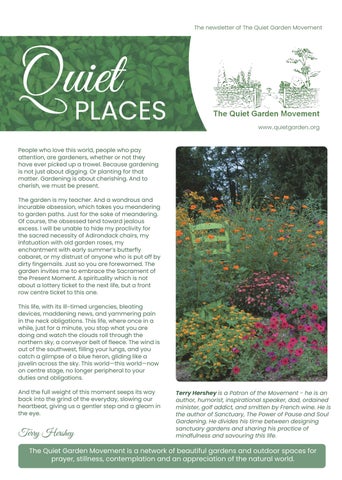
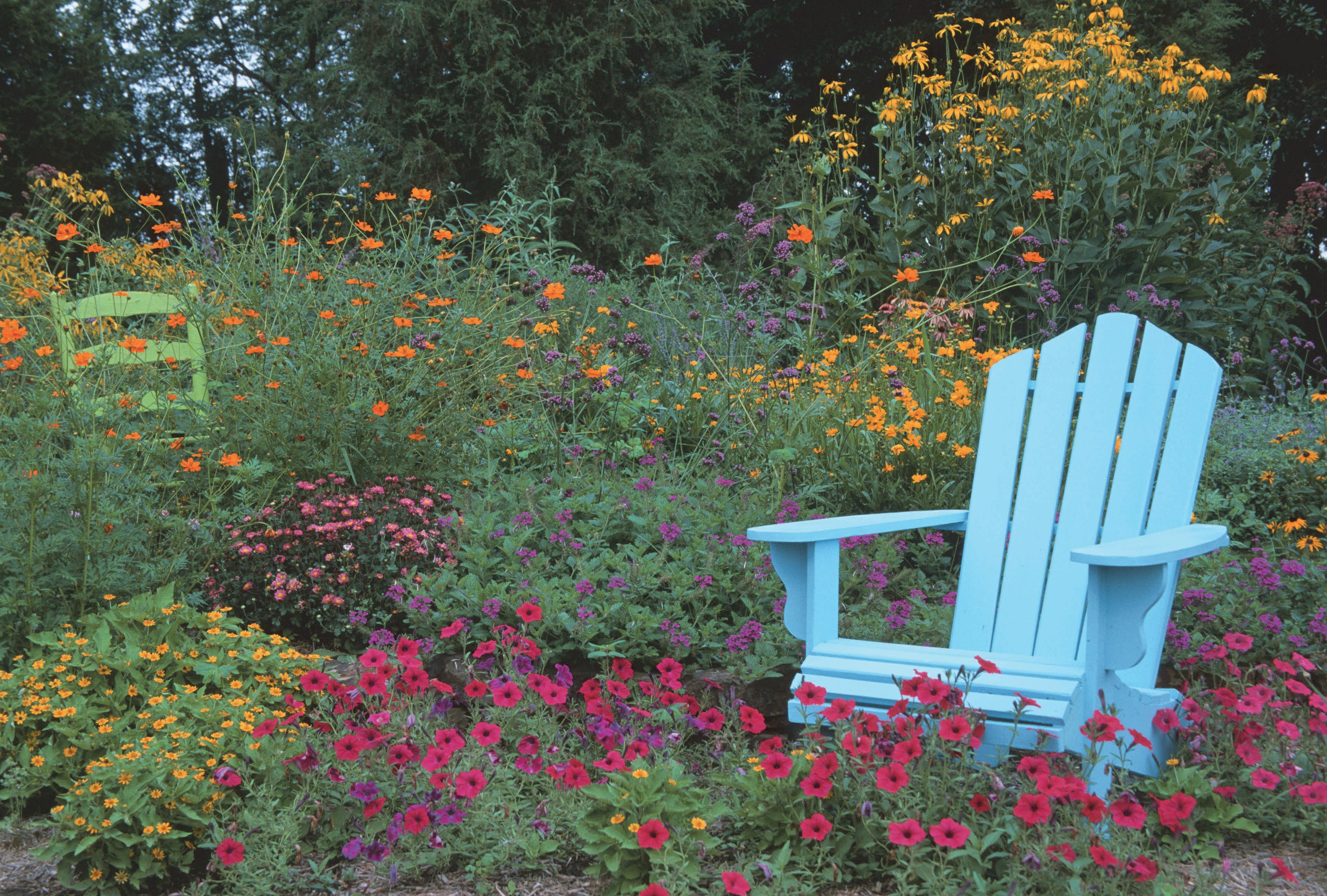
The garden is my teacher. And a wondrous and incurable obsession, which takes you meandering to garden paths. Just for the sake of meandering. Of course, the obsessed tend toward jealous excess. I will be unable to hide my proclivity for the sacred necessity of Adirondack chairs, my infatuation with old garden roses, my enchantment with early summer’s butterfly cabaret, or my distrust of anyone who is put off by dirty fingernails. Just so you are forewarned. The garden invites me to embrace the Sacrament of the Present Moment. A spirituality which is not about a lottery ticket to the next life, but a front row centre ticket to this one.
This life, with its ill-timed urgencies, bleating devices, maddening news, and yammering pain in the neck obligations. This life, where once in a while, just for a minute, you stop what you are doing and watch the clouds roll through the northern sky, a conveyor belt of fleece. The wind is out of the southwest, filling your lungs, and you catch a glimpse of a blue heron, gliding like a javelin across the sky. This world—this world—now on centre stage, no longer peripheral to your duties and obligations.
And the full weight of this moment seeps its way back into the grind of the everyday, slowing our heartbeat, giving us a gentler step and a gleam in the eye.
Terry Hershey
Terry Hershey is a Patron of the Movement - he is an author, humorist, inspirational speaker, dad, ordained minister, golf addict, and smitten by French wine. He is the author of Sanctuary, The Power of Pause and Soul Gardening. He divides his time between designing sanctuary gardens and sharing his practice of mindfulness and savouring this life.
The Quiet Garden Movement is a network of beautiful gardens and outdoor spaces for prayer, stillness, contemplation and an appreciation of the natural world.
Using Sustainable Flowers
Flowers are often symbols connecting theological themes and messages in Christian art and iconography.
Mary being given a white lily by the Angel Gabriel in depictions of the Annunciation, a symbol of her soul’s purity, innocence and beauty.
We have long brought foliage into the architecture of our churches. Verdant leaves carved in wood and stone. Green Men spewing their hedgerow meal out onto unsuspecting congregations.
As well as real stems and blooms. Even dead chrysanthemums. All examples of creation drawn into our churches to remind us, in thankfulness and praise, of the little gifts of God.
And we see the Christian tradition infusing botanical names, linking them to stories of the Gospels and, depending when they flowered, points in the liturgical season.
Irish shamrock with their three-lobed leaves, and the three-petaled Trillium, and the tri-coloured pansy, were immediately labelled symbols of the Trinity.
So, foliage adds stories, once rich in our culture, to the decoration of our churches, leading us yet more into the mystery of God. I say, bring in the local and the seasonal flower power!
Rt Revd Graham Usher, Bishop of Norwich
Quiet Waters, Bungay
Quiet Waters is a small Christian retreat house providing a friendly guest house experience in Bungay on the Norfolk/Suffolk border.
We have nine bedrooms, six bath/shower rooms and can sleep fifteen guests if we share rooms. There are two communal rooms and a small chapel. Our ground floor has a mobility access wing with two bedrooms and a shared wet room and guests can easily access the two sitting rooms, chapel and dining room (via a small stairlift).
We have two acres of garden including a small wooded area, a summer house and the River
Quiet Poetry
Night Walk in Starlight
The sky slips on her velvet cloak of deepest indigo, and over it she throws a veil of moonspun tulle, sparkling with diamonds in their thousands….. hot blue, cool red, white, embroidered into convoluted patternsone vast tapestry of night.
I wonder at this beauty, and with awe, reflect that every jewel’s a mighty sun, Supernovae, Neutrons, Giants, Dwarves, massive spinning orbs of white-hot gas. What I can see from Earth as ‘diamond light’ has travelled eons of time and space to reach my sight.
Asterisms, Constellations, Nebulae, form patterns in a universal void more vast than human mind can comprehend. My little eyes, with limited, weak sight, see just a splintered fragment of a whole, and only through the magic lens of night.
How small and insignificant am I, and yet, as complex and unique as stars….. their essence has created what I am.
Is that the roar of solar winds I hear!
But, no…a sudden veil of cloud obscures all light, returns me to the owl-screech, fox-bark hush of this world’s night.
Teresa Thacker
Waveney at the bottom of the garden, a favourite place for guests to sit and contemplate God's creation.
In the gardens we have set up a reflective trail using Psalm 23 garden reflections. We have developed a creative space too.
At Quiet Waters we offer individual retreats for guests to have a place to retreat, rest and find space to just 'be' with God. We have devotions twice daily where we pray, worship and listen to Lectio 365.
We also have Led Retreats in the house and workshops in our creative space cabin.
Quiet Waters: Quiet Waters Retreat House
The Royal Foundation of St Katharine
At the Royal Foundation of St Katharine in East London, the Quiet Garden sits at the centre of our retreat centre which has welcomed guests into silence and reflection for the last few decades of our long history.
Over the years, hosting retreats and quiet days here has revealed what many hosts will recognise: people are hungry for the renewal that springs from stillness and nature, yet many lack the time, resources or experience of a retreat routine to find it regularly, or at all.
It was this steady stream of stories — guests arriving weary or overwhelmed and leaving renewed — that inspired St Katharine’s to launch National Retreat Week - renew:all in 2023. The hope was twofold: to shine a light on the many places of retreat, including Retreat Houses and Quiet Gardens that faithfully offer sanctuary in communities across the UK; and to make retreat practices rooted in Christian traditions more accessible to those unable or unaccustomed to visiting them.
National Retreat Week – renew:all returns from 19-26 September 2026 and we invite you to take part in any way you feel able to. To find out more, please visit www.renewall.org.uk.
About the garden:
The Royal Foundation of St Katharine
New Gardens
The following gardens were recently welcomed to the movement. Full details can be found by searching www.quietgarden.org.
Living Waters Covenant Quiet Garden - Visit the garden here
Valley Presbyterian Church Labyrinth & Redwood Grove - Visit the garden here
The Garden of Tranquillity - Visit the garden here
Myrtle Rest - Visit the garden here
Edgiock Court Quiet Garden - Visit the garden here
Quiet Poetry
The Daisy
The Daisy said “How shall I live my life?” And God said When you wake in the morning give thanks For your life, for the day, for dew on The grass, the sun as it rises, the Scent of blossom as it falls to the Ground, the sounds that mean the day’s begun And the sight of people going by And look up at the sky where birds swoop And clouds race to the tops of the hills And remember that you live here and You belong here and this is your home. And give thanks.”
Janet Wilkes
Dore Abbey Quiet Morning
It is extraordinary how a building can be so instrumental in transforming the way we feel. Somehow standing within the quality of light and sound in this soaring, stone constructed space resets our tempo as we stand there letting it do its work in us. This place that speaks is the setting for a quiet morning three times a year as part of the Quiet Garden Movement.
If you come for 10.30 we share conversation and company with a cup of coffee and cake before making our way to the ambulatory where, with the help of poems, readings and music we find our way to a place of stillness.
There is freedom to sit in quiet reflection or to wander through the building and out into the cloister orchard and garden where, even there, the interior of the Abbey impacts our senses as we meet the outdoors. The time spent alone draws to a close after an extended period of quiet with shared prayer at 12.50.
If you would like to know our current availability and to be kept on an email list please contact: anniemidwife@gmail.com.
About the garden: Dore Abbey Quiet Garden
Pause in the Garden
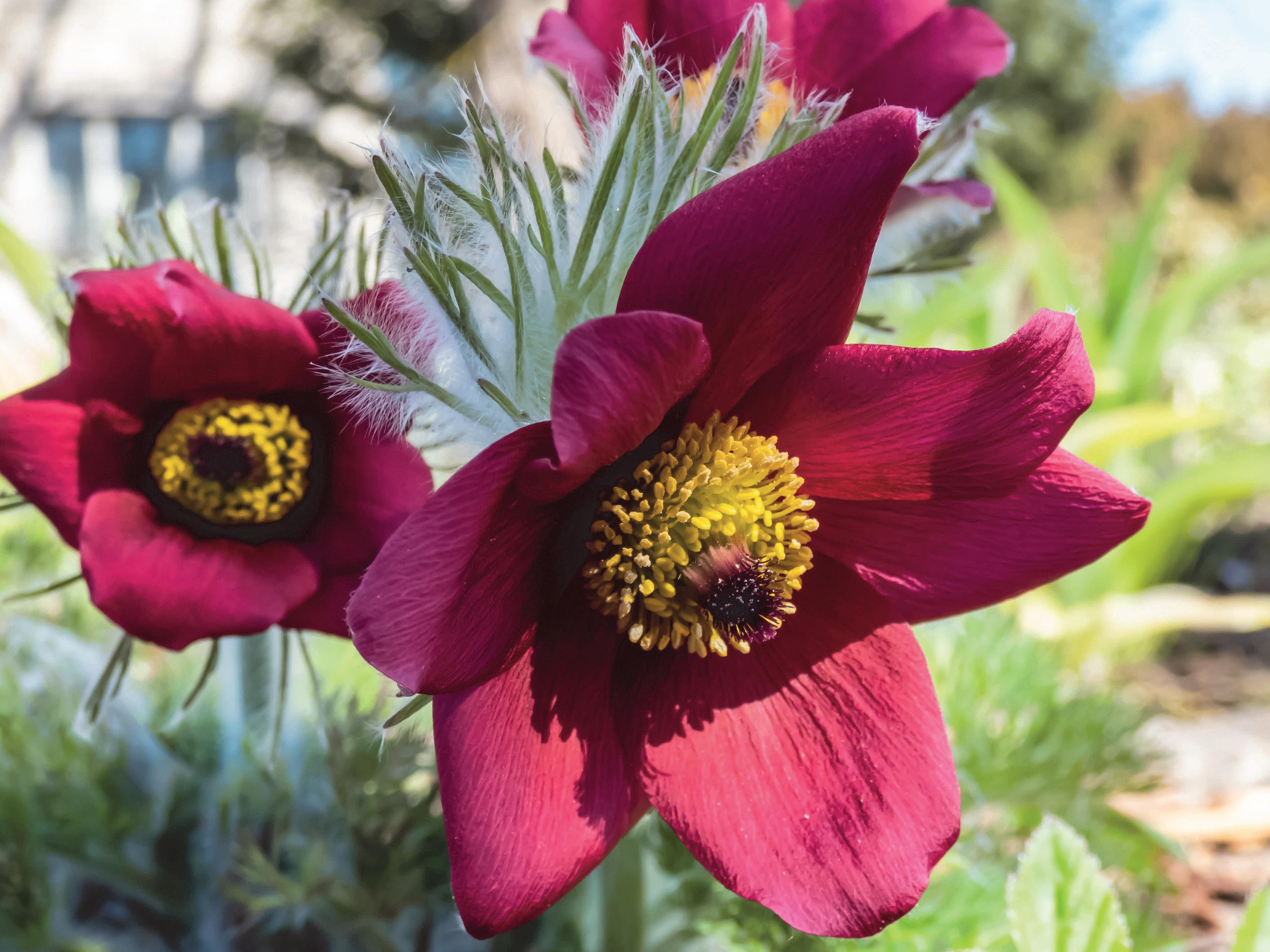
The beautiful Pasque Flower (Pulsatilla Vulgaris) blooms around Easter time, hence its name. The one here has deep, dark purple flowers replicating the darkness enfolded in the tomb which the disciples had left that first Good Friday. What they did not expect to find, after travelling to the tomb under cover of darkness, was the revelation of this new story.
The bright anthers of the Pasque Flower hidden deep within the bell-shaped petals are heavily laden with bright yellow pollen. As the wind blows the anthers begin to drop their specks of pollen over the petals, and as bees visit, the pollen spreads further and further. An illustrative metaphor for the spreading of the Good News of the Resurrection. The specks of pollen gathered in this story, the stone rolled away, the linen cloth left lying from Jesus’ body, resulted in the words, ‘He saw and believed.’ This is beautifully expressed in RS Thomas’s poem ‘Somewhere’, ‘the point of travelling is not to arrive but to return home laden with pollen you shall work up into honey the mind feeds on.’
the sweetness of the nectar of his Easter story on which you will feed your body, mind and spirit. And where He is asking you to take the pollen of this Good News?
About the Garden
Erw Dewi/Dewi’s Acre Quiet Garden
Our hosts are the hub of the Quiet Garden Movement, providing space for thousands of people to benefit from the natural environment and the opportunity to experience rest and spiritual refreshment away from an increasingly busy world.
We have two Quiet Garden Schemes, an Affiliate scheme for those individual hosts or host organisations who would like to open a garden for public use, and an Associate scheme for gardens within organisational settings such as schools, hospitals, places of work and community gardens.
To learn more about hosting your own Quiet Garden, please visit: https://quietgarden.org/become-a-host
Quiet Places is published by The Quiet Garden Trust (Registered Charity No. 1038528). The newsletter is edited by Sarah Godson and designed by Keith Osborn.
Our Patrons are The Rt Revd John Pritchard, Richard Foster, Terry Hershey, The Revd Lucy Winkett, Shane Connolly, Brian Draper, The Rt Revd Graham Usher, Prof. Ghillian Prance, The Most Revd Dame Sarah Mullally.