Hi again McGill Law! I find that in these letters, I’m always hoping for something. These probably come off as platitudes: I hope you’re having a nice start to term, I hope you had a great winter break… and now, I hope you had a relaxing reading week!
I also hope you know that these hopes are genuine. Though it might seem like I’m doing a whole lot of hoping—woof, semantic satiation!—it’s truly my wish that when you pick up your copy of the Quid, you find yourself less in a raging current than floating gently down a calm stream. (Said no one ever about law school, but a girl can dream.)
I’m sorry to say that there is no Quartier latin column in this issue. That’s because, for my reading week, I went to Ireland and the UK with Quid columnist Sébastien and our cherished friend Amy (hi Ames!). How many law students does it take to get across the pond and back unscathed? As it turns out, three is not enough. I was too busy navigating jet lag, rainy weather, and brutal exchange rates to write, and for that I do apologize. But hey, did you know that cuius est solum, eius est usque ad caelum et usque ad infero? That’s not really true anymore, but it’s fun to think about on a plane.
Suffice it to say that not only have I been doing some hoping for you, I’ve been doing a lot of hoping for myself recently: hoping that my flights aren’t delayed; that my bank account will withstand my souvenir purchases; and, of course, that I’ll manage to scrape together a couple of smooth, maybe even relaxing, days amidst what I presumptuously predict has been an awfully hellacious time for us all. Hopes don’t always come true, but a lot of mine did last week.They came true becauseAmy and I, verily perishing in Café Noya down Peel one January night, decided to check the Air Canada deals page “just for fun.”And when we found a great deal, we decided to do it,“just for fun.” I admit it was impulsive and indulgent, but it’s an impulse I do
not regret.When else will I discover that it takes three law students to figure out how to key open a hotel door? And more importantly, if the world isn’t going to do anything nice for me, I’ve got to do something nice for myself.
To quote my supervisor when I asked him for a week off so I could try to hold a baby lamb in Ireland (have done it, can confirm it healed me), “it’s nice to have achievable dreams.”Of course, I haven’t the faintest doubt that we’ll all achieve our lofty and ambitious law school desires. But no matter how hard I hope, I can’t actually guarantee the little things—for example, that you’re having a good time when you open this issue of the Quid. If you’re so inclined, help me out. No matter how you’ve started your day today, make the rest of it a good one. For me! Pretty please! I’ll see you next time.
2 | LEGAL LORE (Not So) Legal Lore: Une conversation avec mon amie Nina
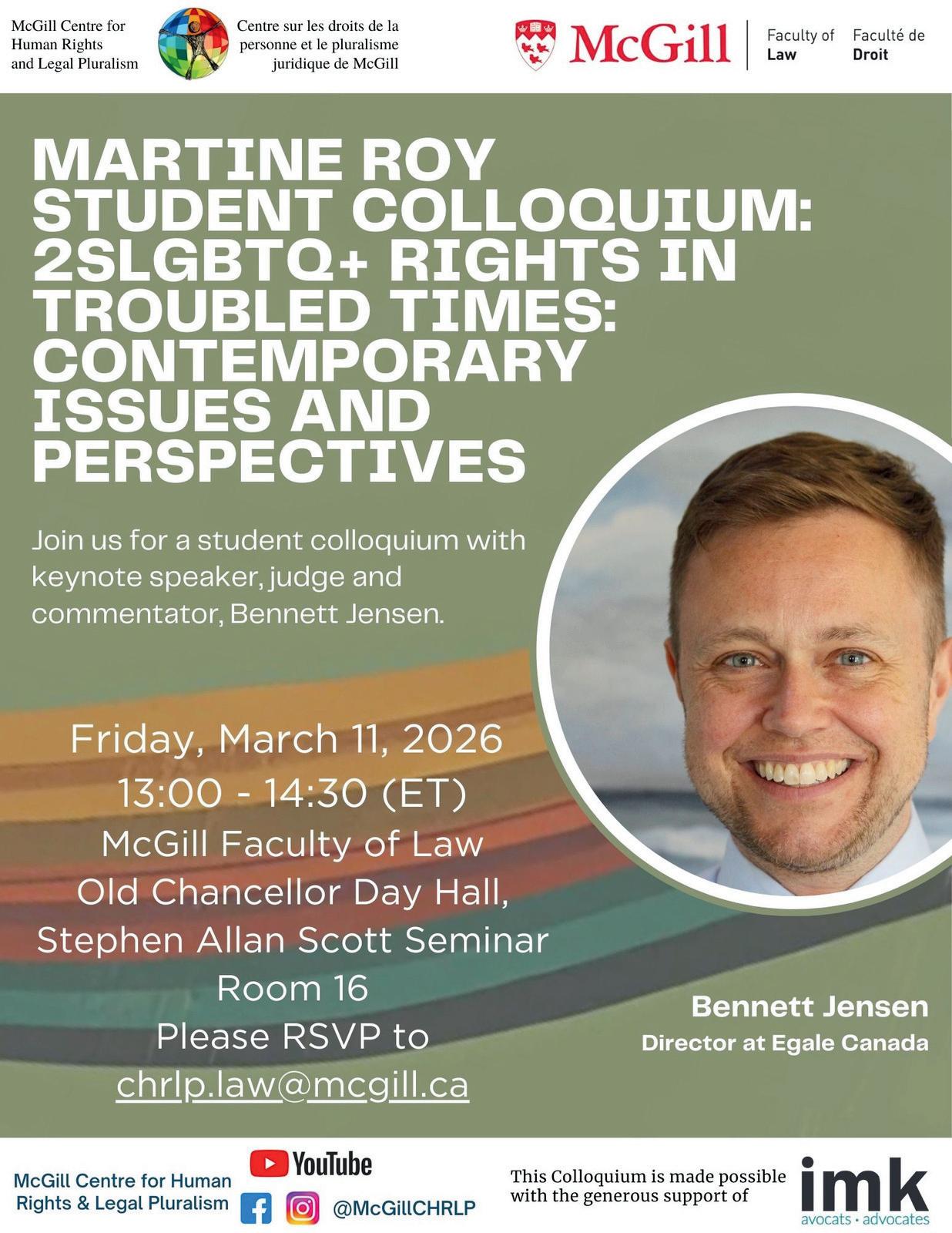
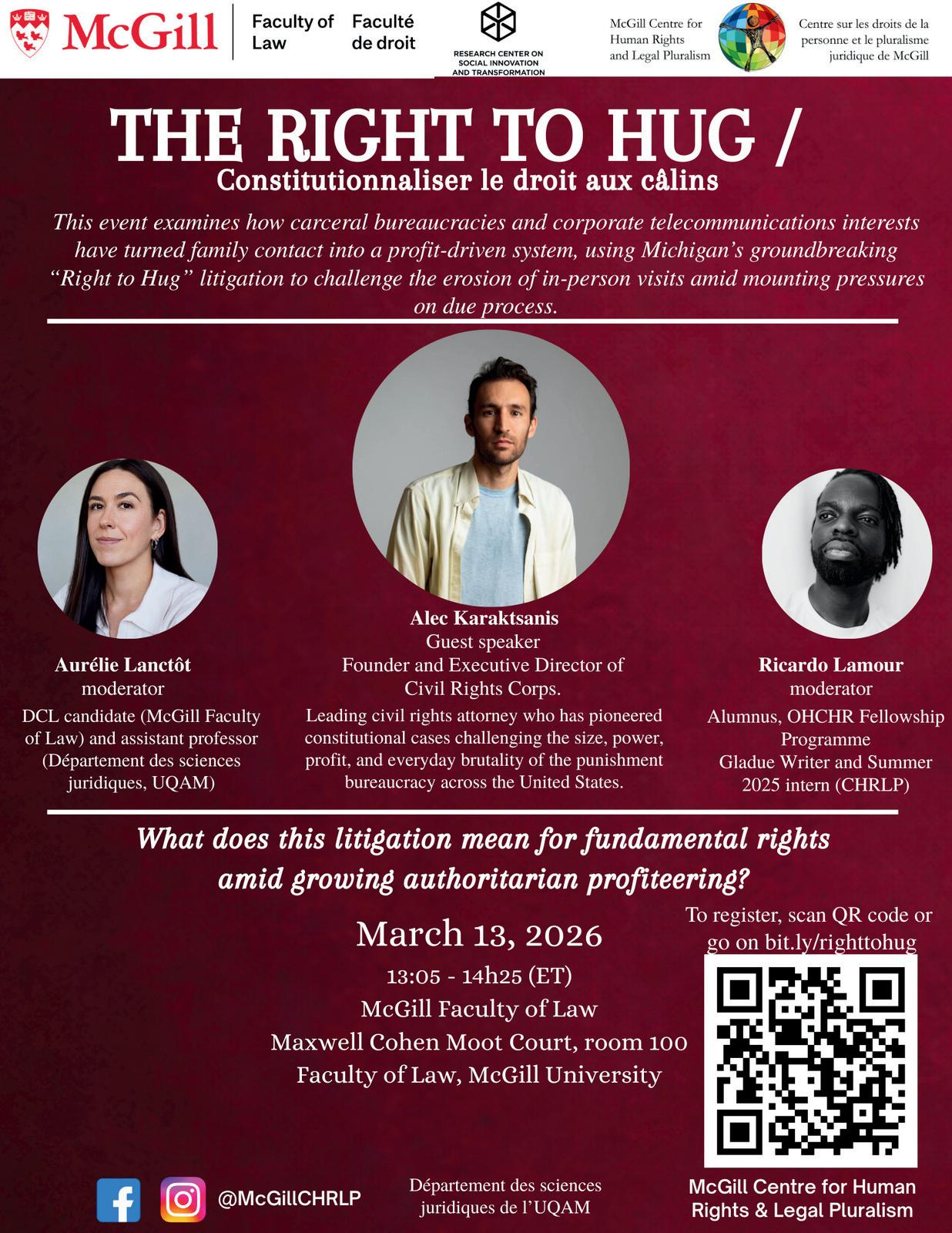
Rights in Troubled Times: Contemporary Issues and Perspectives
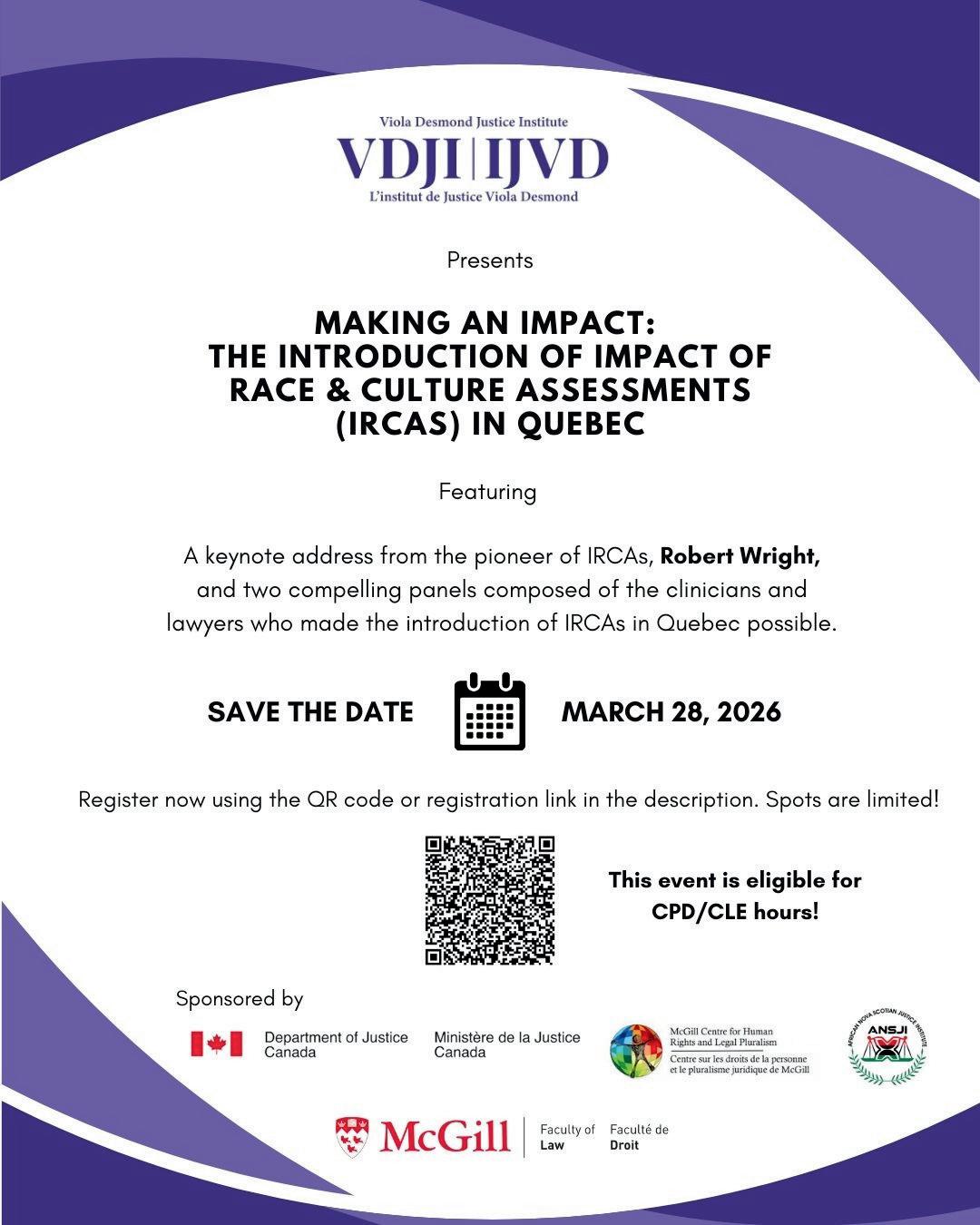
(IRCAs) in
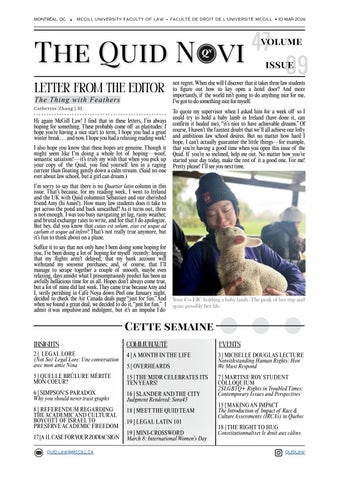
Your Co-EIC holding a baby lamb. The peak of her trip and quite possibly her life.
LEGAL LORE
(Not So) Legal Lore: Une conversation avec mon amie Nina
Heidi Zahiri | 3L
Dans l’esprit d’élargir les horizons de ma chronique, j’ai décidé ce mois-ci d’entretenir une conversation avec une de mes chères amies, Nina Heloir, qui est une athlète de haut niveau et qui étudie présentement dans le programme de cuisine et gastronomie de l’Institut de tourisme et d’hôtellerie du Québec (ci-bas l’« ITHQ »). Avec les examens finaux qui approchent et le froid et les nuages qui ne sont pas du tout rehausseurs de moral, j’espère que cette édition de Legal Lore saura vous rappeler que le monde va bien au-delà de McGill Law. Autour d’un souper de tacos qui a pris beaucoup trop longtemps à cuisiner, Nina et moi avons discuté de nos parcours respectifs, de nos ambitions et de l'importance d’entretenir des amitiés diversifiées.
Heidi: Bonjour Nini! Ça va?
Nina: Salut! Oui toi?
H: Oui. Qu’est-ce que tu as fait aujourd’hui?
N: J’ai été à l’école. On a fait des raviolis à la courge et au fromage de chèvre montés au beurre de sauge. C’était excellent.
H: Miam. Comment tu te sens?
N: Ça va bien. Je suis un peu stressée. Je ne suis pas habituée de me faire questionner et enregistrer.
H: Sans stress. Ça va être une conversation, comme on en a toujours. Comment on s’est rencontrées?
N: On s’est rencontrées au travail. Au restaurant Krood. Shoutout. On a cliqué et maintenant on est amies.
H: Oui. Shoutout au Krood. Comment te décrirais-tu aux gens qui vont lire ma chronique et qui ne te connaissent pas?
N: Je dirais que je suis une personne pétillante et qui aime bouger. Je fais de l'ultimate frisbee de haut niveau. Sinon, j’étudie en cuisine à l’ITHQ.
H: Tu fais beaucoup de choses dans la vie, comme ton sport et tes études en cuisine, qui sont assez intenses. Estce que tu te décrirais comme quelqu’un d’intense? Si oui, de quelle manière?
N: Oui. Émotionnellement, surtout. Je vis tout très intensément. C’est ce qui me fait sentir animée et vivante. J’aime aussi mes moments relaxants, parce que c’est fatigant de vivre beaucoup d’émotions, mais oui, j’ai besoin d’intensité. Moi j’ai une question pour toi. Ta vie est assez chargée. Est-ce que tu dirais que tu arrives à trouver un équilibre dans cette vie chargée là? Si oui, comment? Sinon, qu’est-ce qu’il te manque pour y arriver?
H: Oui c’est vrai que ma vie est assez chargée. Je vais à l’école, j’ai deux emplois qui ne sont pas très reposants et je refuse de sacrifier mon temps seule ou mon temps avec mes proches pour l’école ou le travail. Je pense que mon équilibre de vie pourrait être meilleur. Je dis oui à presque tout. Dans mon monde, être une bonne villageoise c’est important, et parfois le prix à payer c’est de manquer de sommeil ou de temps. Aussi, je suis dans une phase particulière de ma vie, qui ne durera pas encore bien longtemps. Est-ce que des fois j’ai vraiment besoin de faire mon lavage, de dormir plus ou d’étudier plus? Oui. Mais je suis entièrement satisfaite de la vie que je mène. Toi, comment tu balances tes responsabilités? L’école, le sport, le travail.Tu dois faire un stage obligatoire pour l’école cet été en plus de t’entrainer pour ton championnat mondial de frisbee en août. Comment vas-tu faire?
N: Je ne sais pas. C’est la première fois que ça m’arrive. Je dois faire un stage de 40 heures par semaine, et trouver un moyen d’insérer mes entraînements là-dedans. J’essaie de trouver un milieu de stage qui pourra m’accommoder, mais c’est sûr que je devrai concéder certaines choses. En ce moment, c’est graduel. Est-ce que je suis en train de tout donner à mon sport comme je l’ai fait les hivers derniers? Non. Et ça, c’est pas facile à gérer du tout.
H: Parce que tu n’as pas le temps de le faire ou parce que tu te mets de la pression?
N: Je me mets de la pression. Je suis aussi beaucoup plus fatiguée de mes journées avec l’école. J’ai moins d’espace et de temps. Il faut que j’apprenne à me pousser là-dedans, même si c’est difficile.
H: Et dans ta vie personnelle?
N: Depuis que je fais du sport compétitif, c’est le temps avec ma famille et mes proches que je sacrifie le plus. C’est difficile. J’aimerais avoir plus de temps avec eux. Ça m’apporte beaucoup de bonheur, mais mon sport m’apporte aussi beaucoup de bonheur. Comme tu as dis, en ce moment j’ai l’impression que je dois juste push through Je suis dans une étape particulière de ma vie ou je découvre quelque chose d’autre, la cuisine, qui me passionne aussi, même si je suis déjà engagée dans une passion qui prend beaucoup de mon temps, le frisbee. Mon équipe est très compréhensive. Je suis capitaine de mon équipe, mais je ne ressens aucune pression de faire des compromis. Je suis très reconnaissante d’avoir cet environnement là.
H: I feel you. C’est le prix à payer pour avoir plusieurs intérêts et pour faire l’effort de poursuivre tous ces intérêts et passions là.
N: Oui. Parlant d’ambitions, toi, c’est quoi tes ambitions avec le droit?
H: Je suis sûre que certaines personnes qui liront ceci pourront relate à mon expérience. Je suis arrivée dans mon programme avec une vision assez idéaliste et utopique de ce que j’allais faire avec mon diplôme en droit. Mon expérience dans mon programme a dégonflé mon ballon et a surtout enlevé les œillères que j’avais. C’est confrontant, parce qu’on devient de plus en plus conscient de la manière dont le monde fonctionne et c’est facile de se sentir impuissant. À plusieurs moments lors de mon bac en droit, je me suis dite que j’allais walk away et simplement ne pas pratiquer le droit. Je pense que maintenant, je suis capable de rationaliser et mettre le tout en perspective. Je veux faire de la défense criminelle. C’est une facette du droit social qui est super intéressante, mais surtout mal comprise selon moi. Le système de justice criminelle est lourd, et la seule manière dont je me vois pratiquer le droit serait d’accompagner les gens vulnérables de ma communauté dans leurs interactions quotidiennes avec ce système. Je ne parle pas de gros white collar crime. C’est ça mon ambition, pour l’instant. Je pourrais me réveiller demain et changer d’avis.
N: Cool.
H:Tu fais du frisbee depuis que tu as 8 ans.Tu as grandi dans des environnements dans lesquels tu côtoies souvent les mêmes personnes. Peux-tu me parler de l’importance d’avoir des amies qui viennent de milieux diversifiés et qui ne font pas du tout de leur quotidien ce que toi tu fais?
N: Ça m’apporte énormément. Une coach que j’ai rencontrée lorsque j’avais 18 ans m’a appris l’importance de ne pas rester dans mon sport, l’importance de prendre le temps d’aller à l’extérieur, d’avoir d’autres hobbys et d’entretenir mes autres amitiés. Je suis éternellement reconnaissante envers cette coach. J’aime beaucoup ma communauté, mais c’est important d’être ailleurs parfois et de côtoyer des gens qui ont des visions de la vie qui sont différentes. Ça peut juste faire grandir. Je ne sais pas c’est comment en droit, mais je suis sûre que c’est aussi possible d’élargir ses horizons. Allez rejoindre une équipe intramurale!
H: Shoutout à l’équipe de basket-ball intramurale! (Rires)
N: Bref, c’est important de sortir de sa zone de confort. C’est quelque chose que je chéris beaucoup.
H: Qu’est ce que ça t’apporte?
N: Différentes perspectives et la découverte de plusieurs versions de moi-même. Aussi, une prise de conscience de mes qualités et défauts.
H: Je pense que c’est important d’avoir des relations avec des gens qui sont capables de relate à ce que tu fais. Quand tu vas à l’école avec tes amis, que tu passes tes journées avec eux et que tu traverses les mêmes tempêtes, ça construit des amitiés super intimes et c’est une chose merveilleuse. Mais, je crois que
mes amitiés en dehors de l’école et du travail m’apportent des perspectives et des connaissances nouvelles, et ça, c’est inestimable. C’est très cool de pouvoir dire que j’ai une amie qui travaille dans les jeux vidéos, une amie qui fait du frisbee de haut niveau, ou un ami qui est en train de monter le Kilimandjaro. Ça me fait apprendre plein de choses et ça m’apporte des expériences nouvelles, comme le fait d’aller voir tes mondiaux en Irlande cet été.
N: Oui! C’est une autre forme d’éducation, d’une certaine manière.
H: Absolument. Pour conclure, qu’est ce qu’on peut te souhaiter pour la prochaine année.
N: Que je réussisse à trouver mon équilibre cet été.
H: Et de la chance à tes mondiaux.
N: Oui!Toi qu’est-ce qu’on te souhaite?
H: Je m’apprête à partir en échange à Berlin, donc un beau 5 mois unemployed, enfin! Et de vivre au lieu de survivre. Merci Nini!
N: Fait plaisir! Bye.
A Month in the Life.
A Photography Corner
Lysette Umwali | 2L
Dear Quid Readers,
I hope you all had a restful Reading Break!
The weeks leading up to the break were filled with thoughtful and engaging events celebrating Black History Month and diversity within our Faculty. It was a meaningful reminder of the importance of learning from each other and fostering a sense of community.
As we settle back into our academic routines, I hope you’re finding small ways to enjoy the warming weather, whether that means a walk between classes or enjoying a coffee in the sun. If you captured any moments over the break (or at any other time) that you would like to share, please send your photos through the link in the Quid Novi Instagram bio to be featured in our next issue.
Until next time,
Lysette
Quelle brûlure mérite mon coeur?
Manal Elhaoua | 1L
« It is emotionally burdensome to be an empath. I’d rather risk burning out for the sake of Allah than risk being burned on the day of judgement for burning others to the ground. I want to be an empath; I don’t want to be a monster. I don’t want to be someone that says I don’t want to look at Ghaza anymore because I need to protect my heart. I don’t want that. I don’t like that. […] I’d rather risk self-hatred if that means saving myself from the hereafter than drown in the delusion of self-love, if that means losing myself for eternity.»
Dr. Omar Suleiman a su verbaliser une tension que je vois partout autour de moi, et en moi aussi: celle de l’empathie célébrée tant qu’elle reste supportable, puis qui est abandonnée dès qu’elle commence à coûter.
Depuis l’enfance, on nous répète que l’empathie, c’est se mettre dans les souliers de l’autre. Enfiler une paire de souliers demeure un choix. On choisit de porter. Certains souliers ralentissent, certains blessent, certains nous obligent à marcher autrement, et d’autres, au contraire, nous portent vite vers les opportunités, vers les validations, vers ce qu’on appelle souvent un « bon futur ». Dans tous les cas, porter expose le cœur au risque de brûler.Alors, quelle brûlure méritemoncœur?
C’est là qu’on voit à quel point l’empathie devient sélective. On se permet de ressentir à certains moments, puis on se retient à d’autres.Onacceptecertainespairesàbras ouverts; on en rejette d’autres sans hésiter. Et, trop souvent, on garde l’empathie tant qu’elle nous rend fréquentables, puis on la range dès qu’elle menace un confort. Je finis parmedemander, suis-je réellement
empathique, ou attachée à l’idée d’être une personne authentique, une personne empathique?
Ironiquement, en droit, cette tension est évidente. On apprend à parler de justice, à manier les principes juridiques, et à débattre des droits et de l’éthique. Ce, au point où on devient capable de lire et d’analyser le feu à une distance considérable. Commenter le feu sans jamais s’en approcher pour quelqu’un d’autre, c’est être expert du vocabulaire de la brûlure, mais étranger à sa réalité. À force de s’abriter derrière les nuances, derrière l’exception de l’exception, on finit par étouffer la voix de la raison.
Ça me fait souvent penser à la Palestine. Elle agit comme un révélateur moral. Elle met à nu ce que vaut notre empathie lorsqu’elle devient émotionnellement coûteuse et socialement « risquée ». Il est faciledeporterunepairedesouliersquine dérange personne autour de nous. Cependant, abandonner la paire parce qu’elleestpesante,pendantqued’autresne peuvent même pas enlever la leur, me fait douter. Malgré les faits clairs qu’une génération palestinienne a été effacée sous nos yeux, qu’un génocide persiste, l’empathiedemeureunchoix,unedécision.
Cette décision devient concrète lorsqu’on a l’opportunité de poser un geste en solidarité, mais demeure freiné par l’hésitation d’assumer publiquement. Souvent, cette hésitation est originaire de la peur. La peur de compromettre son avenir. La peur que certaines portes se ferment. Or, cette peur reste une peur. Lorsqu’elle devient le principe qui gouverne votre vote, votre parole, elle finit par gouverner votre personne.Vous perdeztouteautodétermination.
Bâtir sa vie en fonction de principes, de lignes à ne pas franchir, de ce qu’on refuse de normaliser, c’est de la résilience, puisque notre fondation est
assumée. À l’inverse, vous plier en quatre pour préserver l’approbation d’autrui, pour rester compatible avec des structures quivousdemandentdecachervoscouleurs, c’est construire sur des bases fragiles. Ce quireposesurl’acceptationdesautrespeut êtreretirédujouraulendemain,parceque ça ne vous appartient pas. Si votre personnenevousappartientplus,versquoi revenir lorsque tout vous sera enlevé? Vos propreschaussuresaurontdéjàétévolées.
Alors, au moment où vous pouvez contribuer à un avancement, comme avec la cause palestinienne et que vous hésitez par peur de ralentir votre parcours, de déplaire à un milieu professionnel, posez-vous une question simple : qu’es-tu en train de protéger exactement? Ton avenir, ou l’illusion d’un avenir construit au prix de ton silence? Nous choisissons les souliers que nous portons, et avec eux, la personne que nous devenons.
Overheards
1L or 2L: "Aren't you eligible for an arranged marriage?"
The same 1L, or possibly 2L: "That's too much yearning... It's 2026, it's not the year of yearning!" ~
Professor:“Not to bring up my German civil law fetish…”
Simpson‘s paradox
Why you should never trust graphs
Lydia Etherington | 1L
I was given the reading week writing shift, which means I’m using my “break glass in case of emergency” writing topic, and you’re all about to learn statistics.
Disclaimer: the data and situations provided here are fiction and are merely intended to illustrate the statistical paradox.
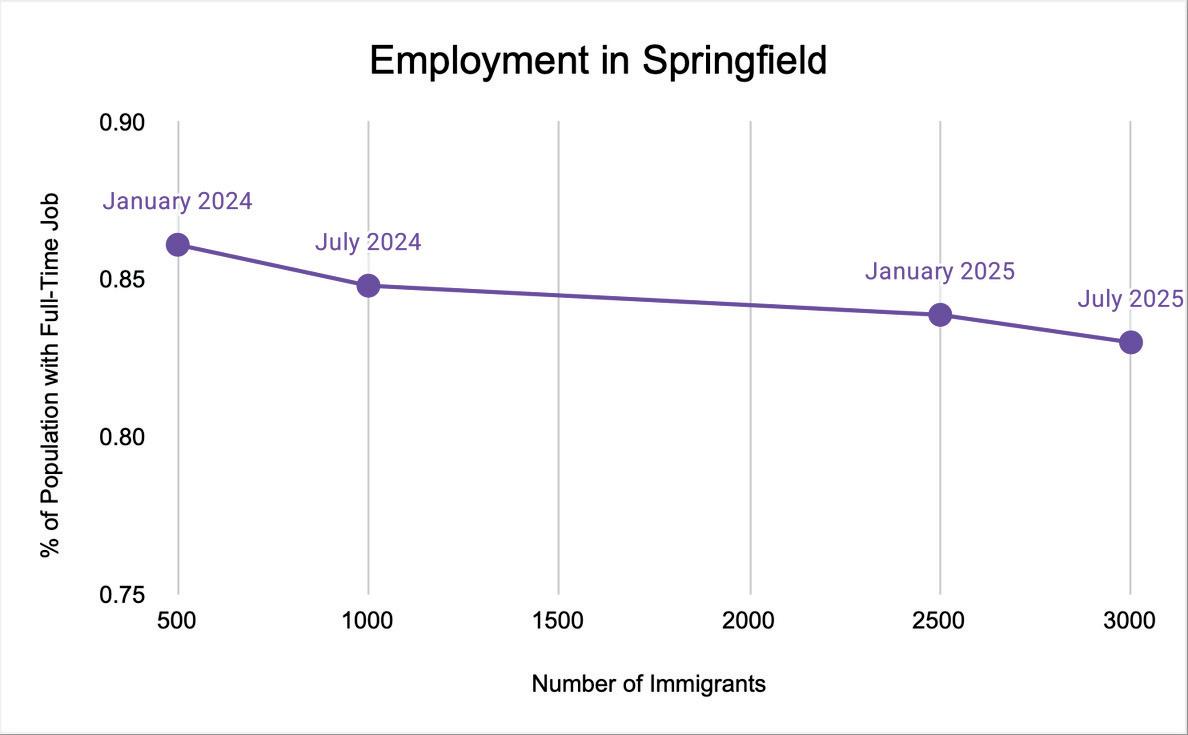
Let’s say you live in a small town called Springfield that’s had a recent increase in immigration. You’re watching the evening news, and this graph shows up:
What this graph is communicating is that the employment rate has decreased as the number of immigrants in Springfield has increased. In other words, the two are negatively correlated. The news anchors have found various inflammatory explanations for this. Maybe the immigrants are lazy and mooching off of social services. Or, maybe there just aren’t enough jobs to accommodate the growing population, and the increased competition has made itharderforpeopletofindemployment.
Depending on your familiarity with data, you may already be thinking of alternative explanations. Correlation is not the same thing as causation, so this could very well be a coincidence. Still, though, the numbers seem to suggest that it’s harder to get a job in Springfield now than it used to be.
To better understand why this correlation exists, you might look at which parts of the population are most impacted by the drop in employment rates.Are immigrant unemployment rates pulling the average down, while locals’ employment rates remain consistent?
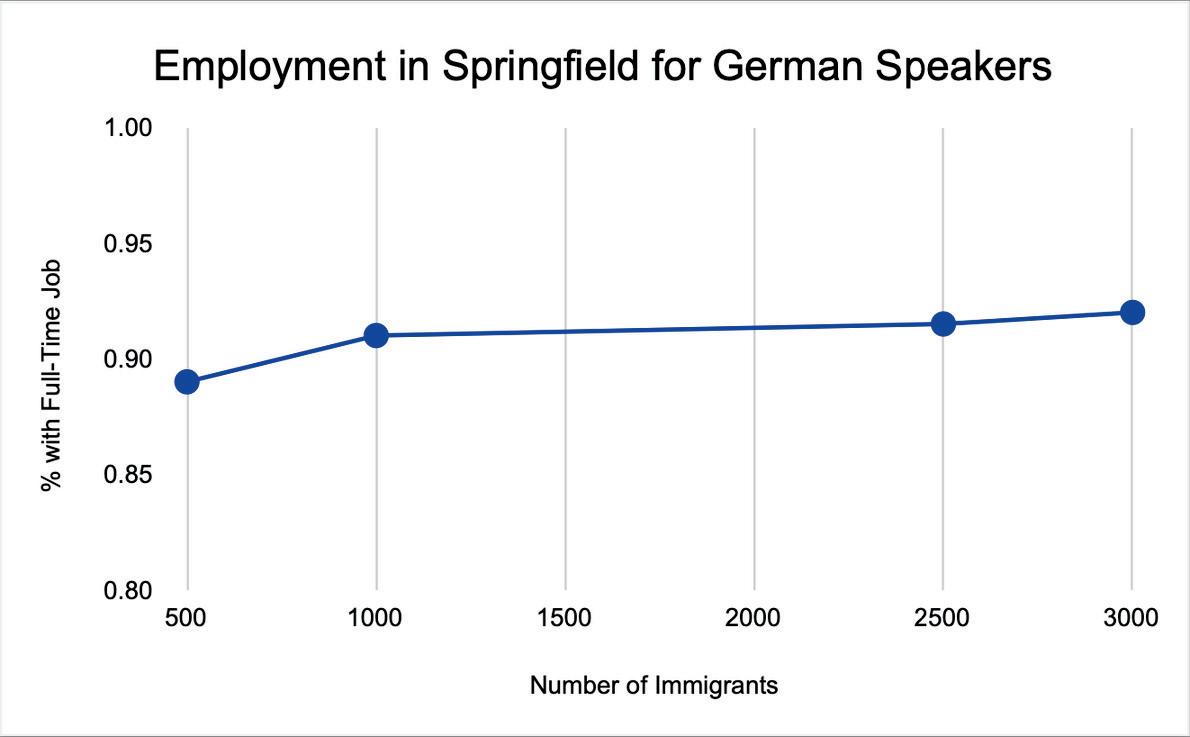
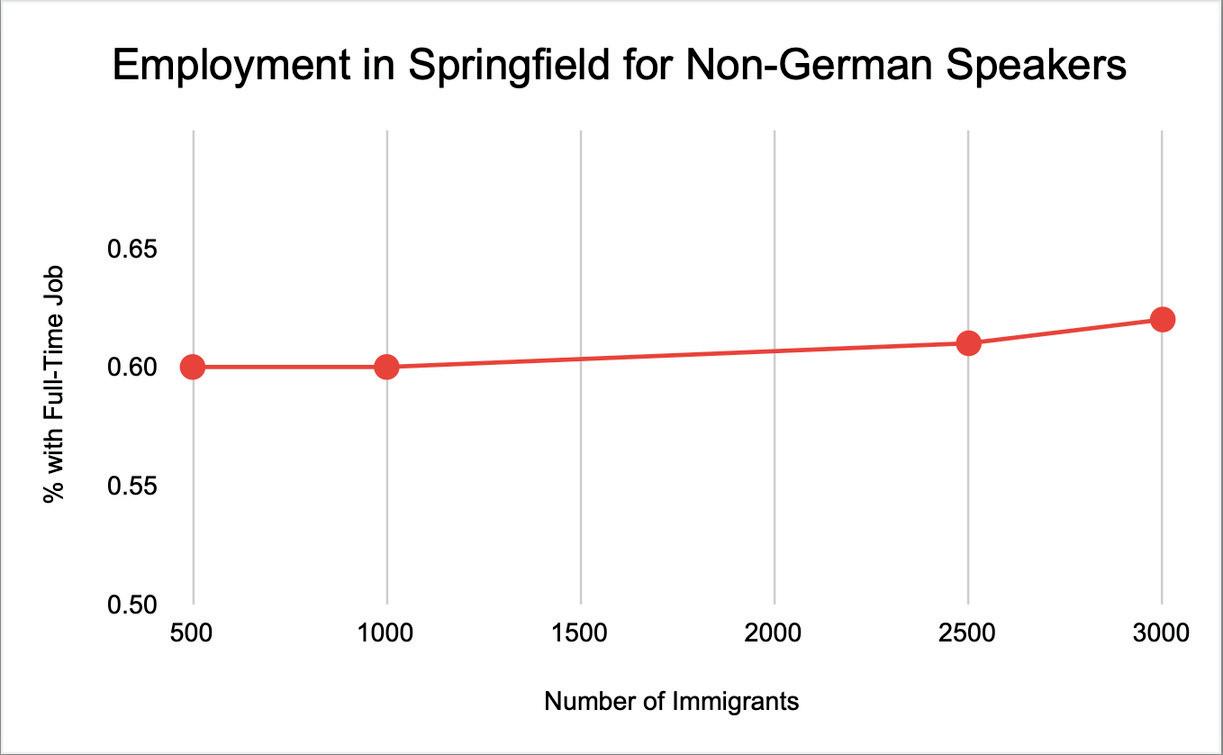
Let’s say that Springfield has a very high percentage of German speakers. So much so that not speaking German makes it significantly harder to navigate the city, make friends, or get a job. Though some of the immigrants speak German, many of them don’t. Knowing this, you look up the employment rate data, but this time, you separate the employment rates for people who speak German and people who don’t.You get these two graphs:
Hm, that’s weird. Even though the employment rate for non-German speakers is much lower on average, it looks like the employment rate has actually gone up slightly … for both groups. Everyone is either a German speaker or not, so … are the employment rates actually going up?
This unintuitive phenomenon is called “Simpson’s Paradox.”
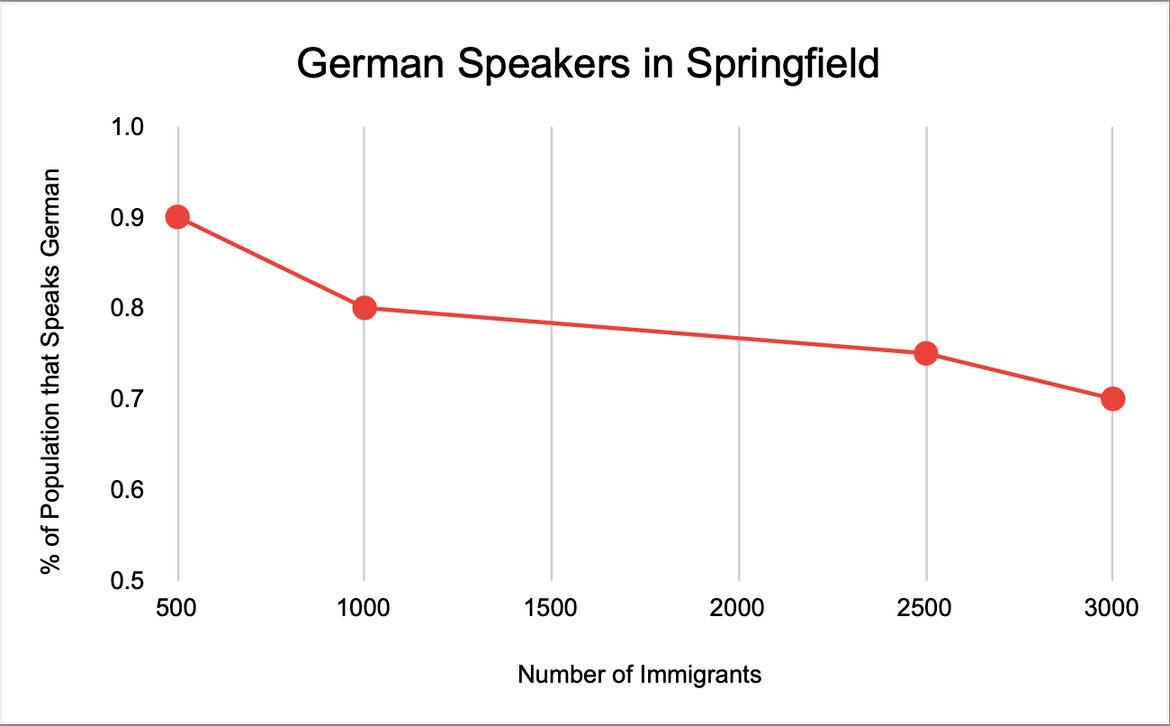
How does it work? The key insight is found by looking at the correlation between the proportion of German speakers and the number of immigrants in Springfield. The graph below tells us that, as the number of immigrants has increased, the proportion of German speakers has fallen significantly.
Please don’t run the numbers and think about what this means for Springfield’s population size.Just enjoy the hypothetical scenario.
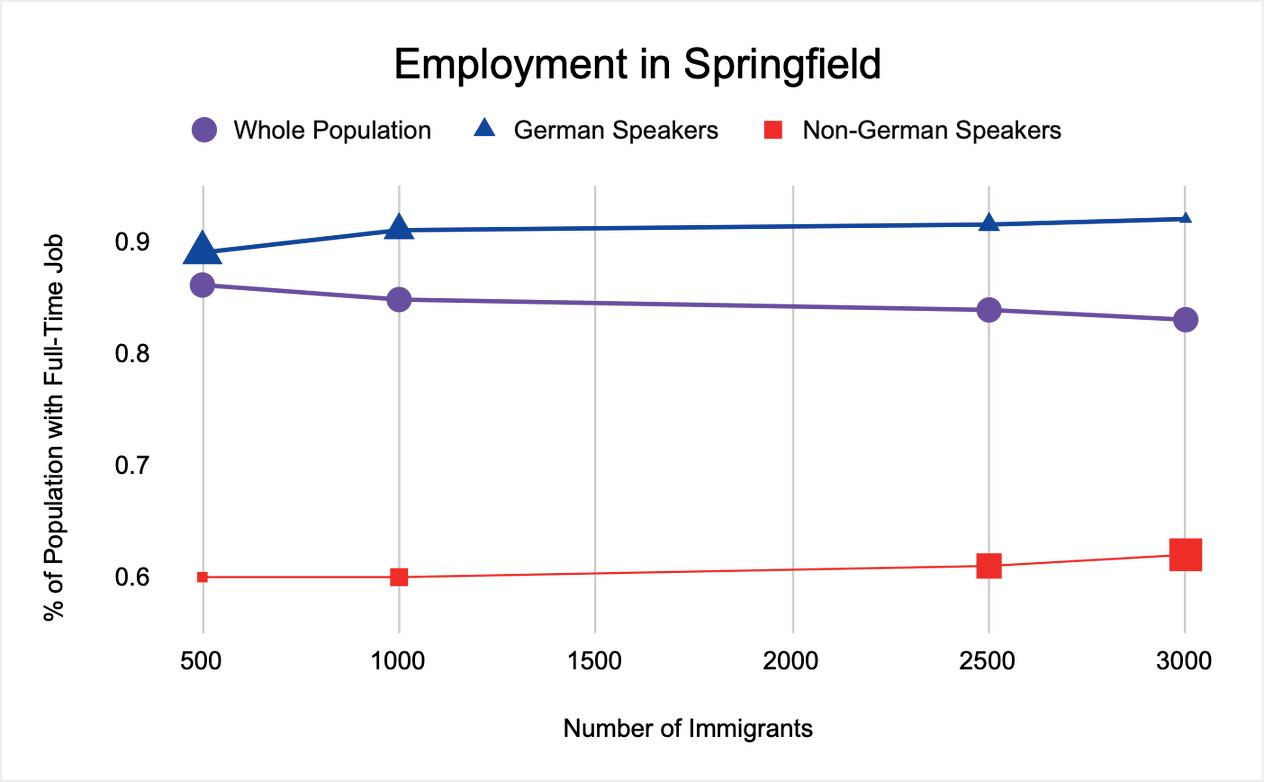
The overall employment rates—the ones shown in the very first graph—can be thought of as an average between the employment rate of German and non-German speakers. Remember that the employment rate for non-German speakers is consistently lower. What’s happening is that as the population average is calculated for each data point, the lower employment rate of non-German speakers becomes more and more heavily weighted as the number of nonGerman speakers increases.This pulls the population average down, even when employment rates are going up for both language groups. Plotting the average employment rate alongside both subgroups’shows this shift:
Note: the changing point sizes represent the sub-group’s changing proportionality in the overall population.
Mathematically, this is already very fun and cool. But it also has serious implications for how we read and use data.
What’s actually happening with employment in Springfield?You should draw different conclusions based on whether you’re a policymaker looking at the state of the population, or whether you’re an individual worried about your career prospects.
There are more immigrants and more unemployed people in Springfield now. The probability that a given person in Springfield is unemployed is increasing with the number of immigrants. Both of these statements are true for this dataset. As a policymaker, this matters. The information gained about the impact of language tells you to focus policy not on increasing job opportunities, but on addressing the language disparity. Perhaps you could create more pathways to learning German, or fight for equity between Germanspeaking and non-German-speaking job seekers.
But. As an individual, regardless of your language ability or immigration status, the probability that you will be unemployed is decreasing. Because, for whatever economyrelated reason, the employment rate is going up for both German and non-German speakers. If you are considering
leaving Springfield for better jobs, this is an important thing to know. And it is completely missing from the original graph that was on the news.
Simpson’s paradox can show up anywhere you see a correlation. One famous example is a study on gender bias in UC Berkeley admissions.The acceptance rates were lower for women than for men. But, when admissions data was separated by department, researchers saw that women were actually more likely than men to be admitted into every program. The secret third variable was that women were applying to more competitive programs. 1
None of the results created by Simpson’s paradox are false; they’re just incomplete. When we see data, it’s easy for us to jump to assumptions, even when we’re trying to be careful. As future decision-makers and leaders, tread carefully when you make decisions based on correlations. The heuristic for avoiding Simpson’s paradox is this: population-level data only tells us about the population. Knowing that there are more unemployed people in your city is helpful. But using that aggregated data to make statements about an individual’s experience—like your ability to get a job in Springfield, or a female applicant’s ability to get into UC Berkeley—can make you draw completely incorrect conclusions.
Peter J Bickel, EA Hammel & JW O’Connell,“Sex Bias in Graduate Admissions: Data From Berkeley”(1975) 187:4175 Science 398.
Referendum Regarding the Academic and Cultural Boycott of Israel to Preserve Academic Freedom
Référendum au sujet du boycott académique et culturel d’Israël pour préserver la liberté académique
Editor’s Note:
This piece was previously published on 16 February 2026 in the blog of Law Students for Palestine at McGill. It has been reprinted here in whole, by request of the authors. As it is a reprint, the Quid Novi has not undertaken our usual editing process, and it appears as it was first published.
Author’s Note:
Dear McGill Law Community,
Pursuant to Part 12, arts. 58-64 of the LSA Constitution, Radlaw McGill and Law Students for Palestine at McGill (LS4PM) have initiated a referendum to amend the Constitution of the LSA—the Referendum Regarding the Academic and Cultural Boycott of Israel to Preserve Academic Freedom.
Overview of the Referendum's Content:
This referendum seeks to enshrine at the highest level of our student association the understanding that academic freedom does not exist in isolation; rather, it imparts reciprocal obligations, principally to respect the academic freedom of others.
Therefore, in light of Israel's scholasticide and genocide of the Palestinian people—and the role of Israeli academic institutions in perpetuating these crimes; LS4PM calls on the McGill law community to join the campaign to have the LSA adopt the Palestinian Campaign for theAcademic and Cultural Boycott of Israel (PACBI).
The test of the proposed academic boycott explicitly notes that it is only engaged by bilateral institutional agreements (i.e McGill Law's exchange withTelAviv University Law).
In line with PACBI guidelines, under no circumstances does it impact individual academics, Israeli or otherwise. Finally, in line with longtime faculty collaborator Scholars at Risk, this amendment will ensure that Palestinian academic freedom is not only superficially recognized, but materially addressed through community engagement and academic collaboration.
The text of the referendum document is divided into three parts:
The first part consists of fifteen (15) 'whereas' clauses.These clauses are facultative, explaining the legal, political, and discursive framework undergirding the proposed amendment.
The second part consists of two (2) 'be it resolved' clauses, which are the operant parts of the referendum question.
These clauses would approve the amendments to By-law 9 and the introduction of By-law 15 to the LSA Referendum.The clauses also would ensure transparency from the LSA regarding the democratic outcome of the vote and its integrity.
Finally, the third part comprises the two constitutional changes themselves—the addition of By-law 15, and the amendment of By-law 9 to create an LSA committee to deliver on the obligations in By-law 15.
Participation in the Referendum Process:
Please keep an eye on your inboxes for information from the LSA Chief Returning Officer (CRO) regarding a General Assembly during the week of March 9th, 2026, as well as for voting instructions.
Any LSA member (i.e BCL/JD students) is eligible to vote. Graduate law students or non-law students are not eligible to vote in LSA referenda.
Please message lawstudents4palestine@gmail.com for any questions or follow-ups.
Law Students for Palestine at McGill (LS4PM)
8
‘Whereas’ Clauses: Les clauses ‘attendu que’
1.Whereas academic freedom is recognized under international human rights law as protecting the liberty of students and academics to engage in the processes of knowledge production and information exchange “regardless of frontiers”; to express opinions about their institutions and political systems without censorship or State interference; to participate in academic governance; and to enjoy the full protection of other internationally guaranteed human rights; 1 2
2.Whereas academic freedom must be exercised consistently with the aims of the right to education as set out in Article 13(1) of the ICESCR, including the promotion of human dignity, participation in a free society and respect among racial and ethnic groups; and whereas academic freedom carries the duties to respect the academic freedom of others, to respond to the contemporary problems and needs of all society, and to treat all without discrimination on any of the prohibited grounds; and whereas the UN Special Rapporteur on the Right to Education affirmed in 2024 that Israeli “academic freedom does not protect the advocacy of national, racial or religious hatred that constitutes incitement to discrimination, hostility or violence”; 3 4 5 6
3.Whereas Israel is an apartheid state whose unlawful occupation in Palestine violates the Palestinian people’s jus cogens norm to selfdetermination as affirmed by the International Court of Justice (ICJ) as recently as 2024, and constitutes a war crime under Canada’s Crimes Against Humanity and War Crimes Act; and whereas Israeli apartheid enables the suppression of academic freedom of Palestinians inside Israel and throughout occupied Palestine; 7 8
1.Attendu que la liberté académique est reconnue par le droit international relatif aux droits de l’homme comme protection de la liberté des étudiant.e.s et des universitaires de contribuer au processus de création du savoir et du partage d’informations « sans considération de frontières » (traduit); d’exprimer des opinions sur leurs institutions et systèmes politiques sans censure ni ingérence d’état; de participer à la gouvernance académique; et de bénéficier de la protection totale d’autres droits de l’homme protégés internationalement; 1 2
2.Attendu que la liberté académique doit être exercée en cohérence avec les objectifs du droit à l'éducation tels qu'énoncés à l'article 13(1) du PIDESC, y compris la promotion de la dignité humaine, la participation à une société libre et le respect entre les groupes raciaux et ethniques; et attendu que la liberté académique comporte le devoir de respecter la liberté académique d'autrui, de répondre aux problèmes et aux besoins contemporains de toute la société et de traiter tout le monde sans discrimination fondée sur l'un des motifs interdits; et attendu que le Rapporteur spécial des Nations Unies sur le droit à l'éducation a affirmé en 2024 que la « liberté académique [israélienne] ne protège pas le plaidoyage de la haine nationale, raciale ou religieuse qui constitue une incitation à la discrimination, à l'hostilité ou à la violence » (traduit);
6
3 4 5
8
3.Attendu qu'Israël est un État d'apartheid dont l'occupation illégale en Palestine viole la norme de jus cogens du peuple palestinien à l'autodétermination, telle qu'affirmée par la Cour internationale de Justice (CIJ) aussi récemment qu'en 2024, et constitue un crime de guerre en vertu de la Loicanadiennesurles crimes contre l'humanité et les crimes de guerre; et attendu que l'apartheid israélien permet la suppression de la liberté académique des Palestiniens en Israël et dans toute la Palestine occupée; 7
1 International Covenant on Economic, Social and Cultural Rights, 16 December 1966, 993 UNTS 3 art 13 (entered into force 3 January 1976) [ICESCR]; UN Committee on Economic, Social and Cultural Rights (CESCR), General Comment No. 13:The Right to Education (Art. 13 of the Covenant), 21st Sess, E/C.12/1999/10 (1999) at para 39 [CESCR].
International Covenant on Civil and Political Rights, 16 December 1996, GeneralAssembly resolution 2200A (XXI), article 19 [ICCPR]; UN Human Rights Committee (HRC), General Comment No. 34: Freedoms of Opinion and Expression (Art. 19 of the Covenant, 102nd Sess, CCPR/C/GC/34 (2011) at para 11 [CCPR].
2 UN Human Rights Council, Academic freedom: Report of the Special Rapporteur on the right to education, Farida Shaheed, 56th Sess, UN Doc A/HRC/56/58 (2024) at para 30 [Shaheed]; ICESCR, supra note 2 at art. 13.
3 Ibid.
4 Shaheed, supra note 3 at para 28; CESCR supra note 2 at para 39.
5 Shaheed, supra note 3 at para 44.
6 Legal Consequences arising from the Policies and Practices of Israel in the Occupied PalestinianTerritory,including East Jerusalem,Advisory Opinion, [2024] ICJ Rep 186.
7 CrimesAgainst Humanity andWar CrimesAct, SC 2000, c. 24.
4.Whereas PalestinianacademicfreedominGazahas beensystematicallyannihilatedbyIsrael’sintentional destruction of educational life and institutions as part of its ongoing genocide—including the bombardmentandtargeteddemolitionof alltwelve universities; the killing of over ninety-five university professors, deans, and presidents; the murder of thousands of students; and the deprivation of 90,000 students of higher education; constituting an“assaultonapeople’spast,present,andfuture” condemnedasscholasticidebyscholarsandexperts, including25UNSpecialRapporteurs;
5.Whereas Palestinian academic freedom in the West Bank is violently suppressed by Israel through the criminalization of over 411 student organizing groups and all political parties at Palestinian universities; the abduction, detention, and torture of studentsandfacultyfornon-violentactivism;the denial of visas to visiting international academics; the military-backed raiding of Palestinian universities; and the Knesset’s 2026 law denying accreditation to teachers with degrees from Palestinian universities, prohibiting their employmentinIsraelieducationsystems; 13 14 15
6.Whereas Palestinian and Israeli academic freedom is systematically denied within Israeli universities which collude with the security state to manipulate admissions in favour of Jewish-Israeli and military applicants over Palestinian citizens of Israel; surveil Palestinian and dissident Jewish-Israeli students and faculty; and refuse to defend their faculty members facing death threats for their critical research of Israel; and whereas all Israeli universities have remained silent on Israel’s stifling of Palestinian universities; but have aligned themselveswiththeIsraelistateandfar-rightgroups by “expelling scholarly debates which might challenge Zionist hegemony”, thereby perpetuating the “erosion of fundamental academic freedoms in Israeliuniversities”;
4.Attendu que la liberté académique palestinienne à Gaza a été systématiquement anéantie par la destruction intentionnelle de la vie et des institutions éducativesparIsraëldanslecadredesongénocideen cours, y compris le bombardement et la démolition ciblée des douze universités; le meurtre de plus de quatre-vingt-quinze professeurs d'université, doyens et présidents; le meurtre de milliers d'étudiant.e.s; et la privation de 90 000 étudiant.e.s de l'enseignement supérieur; constituantune«attaquecontrelepassé, le présent et l'avenir d'un peuple » (traduit) condamnéecommescolasticidepardesuniversitaires etdesexperts,ycompris25rapporteursspéciauxdes NationsUnies; 9
12
5.Attendu que la liberté académique palestinienne en Cisjordanie est violemment réprimée par Israël par la criminalisation de plus de 411 organismes étudiant.e.s et de tous les partis politiques dans les universités palestiniennes; l'enlèvement, la détention et la torture d'étudiant.e.s et de professeurs pour activisme non violent; le refus de visas aux universitaires internationaux en visite; le raid soutenu par l'armée des universités palestiniennes; et la loi de 2026 de la Knesset refusant l'accréditation aux enseignants titulaires de diplômes d'universités palestiniennes, interdisant leuremploidanslessystèmeséducatifsisraéliens; 13 14 15
6.Attendu que la liberté académique palestinienne et israélienne est systématiquement niée au sein des universitésisraéliennesquicollaborentavecl'Étatde sécurité pour manipuler les admissions en faveur des candidats juifs-israéliens et militaires par rapport aux citoyens palestiniens d'Israël; surveilleiller les étudiant.e.s et les professeurs palestiniens et juifs-israéliens dissidents; et refusent de défendre leur faculté face aux menaces de mort pour leurs recherches critiques sur Israël; et attendu que toutes les universités israéliennes sont restées silencieuses sur l'étouffement des universités palestiniennes par Israël; mais se sont alignées sur l'État israélien et les groupes d'extrême droite en « expulsant les débats universitaires qui pourraient remettre en cause l'hégémonie sioniste » (traduit), perpétuantainsi«l'érosiondeslibertésacadémiques fondamentales dans les universités israéliennes » (traduit); 16 17 18 19 20
UN Office of the High Commissioner of Human Rights, Press Release,“UN experts deeply concerned over‘scholasticide’in Gaza”(18April 2024), online: <https://www.ohchr.org/en/press-releases/2024/04/un-experts-deeply-concerned-over-scholasticide-gaza> [UNOCHR Scholasticide Brief].
10
9 University World News, Cochrane Paul. “90,000 students have lost access to HE in Gaza – Academic,” (16 January, 2025), online: <https://www.universityworldnews.com/post.php?story=20250116095244357>.
UN Office of the High Commissioner of Human Rights, Press Release,“Israel’s continuous assaults on Birzeit University are an attack on education itself: UN experts”(22 January 2026), online: <https://www.ohchr.org/en/press-releases/2026/01/israels-continuous-assaults-birzeit-university-areattack-education-itself> [UNOCHR Birzeit University Raid Brief].
11 The Faculty Association at Simon Fraser University, SFUFA Motion on Israel/Palestine, Motion Approved 7 June 2024, online: <https://www.sfufacultyforpalestine.ca/motion-on-israelpalestine>; UNOCHR Scholasticide Brief, supra note 9.
13
12 Scholars at Risk Network, “Protect and Promote International Academic Travel to the West Bank” (27 April 2022), online: <https://www.scholarsatrisk.org>.
UNOCHR Birzeit University Raid Brief, supra note 11; Shaheed, supra note 3 at para 42.
14 Knesset passes law banning graduates of PA universities from teaching in Israel, Knesset passes law banning graduates of PA universities from teaching in Israel (22 January 2026) (online) <https://www.timesofisrael.com/knesset-passes-law-banning-graduates-of-pa-universities-fromteaching-in-israel/>; Law for the Prevention of Employment of Education Workers Who Hold an Academic Degree from an Institution in the Palestinian Authority, 5785-2025 (Isr) [Approved 21 January 2026].
15 MayaWind, Towers of Ivory and Steel:How Israeli Universities Deny Palestinian Freedom, (London:Verso, 2024), at 153 [Wind].
16 Ibid. at 148–151.
17 Ibid. at 115–117.
18 Ibid. at 181–182.
20
19 Ibid.at 118–119.
7.Whereas Tel Aviv University (TAU) and Israeli universities are not independent civilian institutions, but central pillars of intellectual expansion and military power which underpin Israel’s settler colonial occupation of Palestine; develop and test weaponry used in war crimes; offer course credit and scholarships to Israeli soldiers for their deployments in Gaza; and facilitate global research collaborations that obscure Palestinian erasure “behind a veil of academicneutrality”; 21 22
8.Whereas TAU operates as a key site of collaboration between legal academics and the Israeli security state through its Institute for National Security Studies (INSS), which manufactures legal doctrines and hasbara to justify war crimes; including the “Dahiya doctrine” of disproportionate force against civilian infrastructure; the “third population” theory reclassifying civilians as legitimate targets; and the ethical calculus equating 3.14 Palestinian lives to one Israeli life; with the explicitaimto“shieldIsraelfromaccountability” and undermine international legal norms and tribunalssuchastheICJ;
9.Whereas McGill University maintains academic exchange agreements with TAU Law and other Israeli institutions; and whereas these exchange agreements thereby enable McGill’s academic cachet to be instrumentalized to normalize Israeli apartheid; undermine and delegitimize Palestinian academicfreedom; conferinstitutionallegitimacy
31
7.Attendu que l'Université de Tel Aviv (TAU) et les universités israéliennes ne sont pas des institutions civiles indépendantes, mais des piliers centraux de l'expansion intellectuelle et de la puissance militaire qui sous-tendent l'occupation coloniale de la Palestine par Israël; développent et testent des armes utilisées pour commettre des crimes de guerre; offrent des crédits de cours et des bourses aux soldats israéliens pour leurs déploiements à Gaza; et facilitent les collaborations de recherche mondiales qui obscurcissent l'effacement palestinien « derrière unvoiledeneutralitéacadémique»; 21 22
23 24
8.Attendu que la TAU fonctionne comme un site clé de collaboration entre les universitaires en droit et l'État de sécurité israélien par le biais de son Institut d'études de sécurité nationale (INSS), qui fabrique des doctrines juridiques et de la hasbara pour justifier les crimes de guerre; y compris la « doctrine Dahiya » de la force disproportionnée contre les infrastructures civiles; la théorie de la « troisième population » reclassant les civils comme des cibles légitimes; et le calcul éthique assimilant 3,14 vies palestiniennes à une vie israélienne; dans le but explicitede«protégerIsraëldelaresponsabilité» (traduit) et de saper les normes juridiques internationalesetlestribunauxtelsquelaCIJ;
9.Attendu que l'Université McGill maintient des accords d'échange universitaire avec la TAU Law et d'autres institutions israéliennes, permettant ainsi à son cachet académique d'être instrumentalisé pour normaliser l'apartheid israélien; saper et délégitimer la liberté académique palestinienne; conférer une légitimité institutionnelle aux doctrines juridiques qui subvertissent les principes
Raphael Magarik,“The Complicity of Israeli Academia,”Jewish Currents (23 May 2024), online: <https://jewishcurrents.org/the-complicity-ofisraeli-academia> [Magarik].
21 Ibid. at 105–111.
22 MayaWind,“The role of universities in Israeli apartheid and genocide, and the movement for a free Palestine”(2025) 53:1 VUE (Voices in Urban Education), online: <https://vue.metrocenter.steinhardt.nyu.edu/article/id/165/>.
23 United Nations Human Rights Council, From Economy of Occupation to Economy of Genocide: Report of the Special Rapporteur on the Situation of Human Rights in the PalestinianTerritories Occupied since 1967, by FrancescaAlbanese, UN DocA/HRC/59/— (16 June–11 July 2025).
24 Wind, supra note 17 at 94-96; Law Students for Palestine at McGill (LS4PM), "Academic Hasbara and ColonialTourism at McGill’s Faculty of Law" The Quid Novi (31 October 2025), online: <https://issuu.com/quidnovi/docs/vol_47_no_2_4f45f0d85a3c55>.
25 Diana Buttu,“Blaming theVictims”(2014) 44:1 Journal of Palestine Studies 91.
26 Asa Kasher,“Proper approach to the third population—not combatants and not civilians”[in
27 Hebrew] (2014) 5 (Special Issue) Military and StrategicAffairs 47. Wind, supra note 17 at 36-37, citing Uri Blau & Yotam Feldman, "Consent and Advise" Haaretz (29 January 2009), online: <https://www.haaretz.com/2009-01-29/ty-article/consent-and-advise/0000017f-e1a6-d9aa-afff-f9fe5e100000>
28 Report of the United Nations Fact-Finding Mission on the Gaza Conflict, UNHRC, 12th Sess, UN DocA/HRC/12/48 (2009).
29 McGill University Faculty of Law Student Affairs Office, “Exchange, Independent Study Away & Summer Programs” online: <https://www.mcgill.ca/law-studies/bcljd-studies/exchange>; University of McGill Senate,“Question RegardingAdoption of the MAUT Resolution on Academic and Cultural Boycott of Israel” (12 November 2025), online: <https://www.mcgill.ca/senate/files/senate/d2517_question_and_response_regarding_the_maut_resolution_endorsing_a_boycott_of_israeli_institutions.pdf>.
31
30 Shaheed, supra note 3 at paras 44–46; BDS Movement,“Israel’s Discriminatory System of Ethnic Privilege Is the RealThreat toAcademic Freedom”(9 February 2014), BDS Movement, online: <https://bdsmovement.net/news/israel%E2%80%99s-discriminatory-system-ethnic-privilege-real-threatacademic-freedom>.
32 33
10.Whereas in response to the Unified Call from Palestinian civil society and higher education for institutional non-engagement, faculty and student associations worldwide have adopted the Palestinian Campaign for the Academic and Cultural Boycott of Israel (PACBI), including at least19UniversityFacultyAssociationsandover 20 Student Associations in Canada, notably the Students’ Society of McGill University (SSMU) and the McGill Association of University Teachers(MAUT);34
11.Whereas the McGill Law Students’ Association (LSA) is an accredited student association whose freedom of expression includes the right to conduct and enforce democratically-adopted referenda engaging central sociopolitical issues; and whereas this right was unanimously upheld by the Quebec Court of Appeal in its April 2025 decision overturning the interlocutory injunction blockingtheSSMU’sPolicyAgainstGenocidein Palestine(PAGIP); 35 36
12.Whereas section 2.2 of the PAGIP confers a positive obligation on all McGill undergraduates to demand that our university cut all ties with institutions complicit in genocide, settlercolonialism,and/orapartheid;37
13.Whereas the same obligation is explicitly enshrined under sections 3.c.v-vi of the SSMU’s Policy Against Antisemitism and section 13.12 of the SSMU Positions Book; and whereas both of these provisions expressly affirm the student body’s right to advocate for Palestinian liberation through institutional boycotts, and that such critique or boycott of the state of Israel does not constitute prima facie antisemitism;38
32 33
fondamentaux du droit international; et ignorer l'appel unifié de l'enseignement supérieur et de la sociétécivilepalestinienneàlanon-coopérationjusqu'à cequ'Israëlseconformeaudroitinternational;
10.Attendu qu'en réponse à l'appel unifié de la société civile palestinienne et de l'enseignement supérieur pour le non-engagement institutionnel, les associations de professeurs et d'étudiant.e.s à travers le monde entier ont adopté la Campagne palestinienne pour le boycott académique et culturel d'Israël (PACBI), y compris au moins 19 associations de professeurs d'université et plus de 20 associations d'étudiant.e.s au Canada, notamment l'Association étudiante de l'Université McGill (AÉUM) et Association des professeur.e.s etbibliothécairesdeMcGill(APBM);34
11.Attendu que l'Association des étudiant.e.s en droit de McGill (AÉD) est une association étudiante accréditée dont la liberté d'expression comprend le droit de mener et d'appliquer des référendums adoptés démocratiquement sur des questions sociopolitiques centrales; et attendu que ce droit a été confirmé à l'unanimité par la Cour d'appel du Québec dans sa décision d'avril 2025 annulant l'injonction interlocutoire bloquant la Politique contre le génocide en Palestine(PAGIP)del'AÉUM; 35 36
12.Attendu que la section 2.2 de la PAGIP confère à l’ensemble de la communauté étudiante mcgilloise de premier cycle l'obligation positive d'exiger que notre université rompe tous les liens avec les institutions complices de génocide, de colonialismedepeuplementet/oud'apartheid;37
13.Attendu que la même obligation est explicitement inscrite dans les articles 3.c.v-vi de la Politique contre l'antisémitisme de l'AÉUM et dans l'article 13.12 du Livre des positions de l'AÉUM, qui affirment tous deux expressément le droit du corps étudiant de plaider en faveur de la libération de la Palestine par le biais de boycotts institutionnels, et que la critique ou le boycott de l'État d'Israël ne constitue pas de l’antisémitisme prima facie ;38
32 Boycott, Divestment and Sanctions Movement, Academic Boycott (last visited 15 Feb 2026), online: <https://bdsmovement.net/academic-boycott>
Pnina Sharvit Baruch & Keren Aviram,“Delegitimization of Israel:The Legal Framework,”in The Delegitimization Phenomenon: Challenges and Responses, Memorandum No 169 (Tel Aviv: Institute for National Security Studies, September 2017), online: <https://www.inss.org.il/wpcontent/uploads/2017/10/Delegitimization-of-Israel.pdf>
33 Canadians for Justice and Peace in the Middle East, "Who Supports BDS in Canada?" (June 2023), online: https://www.cjpme.org/who_supports_bds.; Students’ Society of McGill University, Endorsement of the Palestinian Campaign for the Academic and Cultural Boycott of Israel (PACBI), (posted 18 October 2025) Instagram (online: https://www.instagram.com/p/DP64ny0ke_a/?img_index=1) (accessed 12 February 2026); McGillAssociation of UniversityTeachers,“Resolution to Endorse theAcademic and Cultural Boycott of Israel”(27 September 2025), online: <https://profs4palestine-swcyg.wordpress.com/2025/09/27/maut-resolution-to-endorse-the-academic-and-culturalboycott-of-israel/>
34 Act respecting the accreditation and financing of students’associations, CQLR cA-3.01.
35 Association étudiante de l'Université McGill c. X , 2025 QCCA 475 at paras 78, 80; "McGill Student Society Wins Palestine Policy Injunction in Court" The Link (April 2025), online: <https://thelinknewspaper.ca/article/mcgill-student-society-wins-palestine-policy-injunction-in-court>.
36 Students’ Society of McGill University, “Policy Against Genocide in Palestine” (4 April 2025), s. 2.2, online: <https://ssmu.ca/wpcontent/uploads/2025/04/Policy-Against-Genocide-in-Palestine-2025-04-22-to-2028-05-01.pdf?x74610>.
38 to legal doctrines that subvert the core tenets of international law; and disregard the Unified Call from Palestinian higher education and civil society for non-cooperation until Israel complies with internationallaw;
37 Students’ Society of McGill University, “Policy Against Antisemitism” (4 April 2025), s 3.c.v-vi, online: <https://ssmu.ca/wpcontent/uploads/2025/05/Policy-Against-Antisemitism-2025-04-03-to-2030-05-01.docx.pdf?x74610>; Students’ Society of McGill University, “Positions Book” (4 April 2025), s. 13.12, online: <https://ssmu.ca/wp-content/uploads/2025/05/SSMU-Positions-Book-2025-04-03-1.pdf? x74610>; Levkovsky c.Student Society of McGill University, [2025] QCCS 1118.
14.Whereas McGill students made history in 1985 by leading McGill to be the first Canadian university to sever academic ties with South Africanapartheid; andwhereasintheirOctober 13, 2025 letter welcoming MAUT’s PACBI endorsement, the faculty of Birzeit University explicitly called upon McGill students to uphold thislegacybyjoiningthe“struggleforourshared humanity,inPalestineandeverywhere”; 39 40
15.Whereas Birzeit University has since been raided twice by the Israeli Occupation on December 9, 2025 and January 6th, 2026, deliberately obstructing the exercise of Palestinian academic freedom; and whereas Scholars at Risk, a longtime collaborator of the McGill Faculty of Law, condemned these violent incursions as “undermin[ing] academic freedom, institutional autonomy, and democratic society generally”; and whereas our commitment to decolonial knowledge production and our institution’s academic integrity therefore requires us to affirm that “[t]here is no academic freedom until it appliestoall—untilitappliestoPalestinians"; 41 42
14.Attendu que les étudiant.e.s de McGill ont marqué l'histoire en 1985 en menant McGill à être la première université canadienne à rompre les liens académiques avec l'apartheid sudafricain grâce à un plaidoyer soutenu dirigé par lesétudiant.e.s;etattenduquedansleurlettredu 13 octobre 2025 accueillant l'approbation du PACBI de APBM, la faculté de l'Université de Birzeit a explicitement appelé les étudiant.e.s de McGill à maintenir cet héritage en rejoignant la « lutte pour notre humanité partagée, en Palestineetpartout»(traduit);
15.Attendu que l’Université de Birzeit a depuis lors été perquisitionnée à deux reprises par les forces d'occupation israéliennes, le 9 décembre 2025 et le 6 janvier 2026, ce qui a délibérément entravé l'exercice de la liberté académique palestinienne ; et considérant que Scholars at Risk, collaborateur de longue date de la faculté de droit de McGill, a condamné ces incursions violentes comme « portant atteinte à la liberté académique, à l'autonomie institutionnelle et à la société démocratique en général » (traduit); et considérant que notre engagement en faveur d'une production de connaissances décoloniale et l'intégrité académique de notre institution nous obligent à affirmer qu'« il n'y a pas de liberté académique tant qu'elle ne s'applique pas à tous, tant qu'elle ne s'applique pas aux Palestiniens » (traduit).
39 Birzeit Letter: Union of Professors and Employees at Birzeit University, "Response to MAUT Motion" (13 Oct 2025), online: <https://www.instagram.com/p/DP3x2Wdjs0d/> .
McGill University Archives, "McGilliana" (n.d.), online: <https://mcgilliana.library.mcgill.ca/>; Students’ Society of McGill University, "MoA Update: SSMU Reaffirms Its Commitment to Freedom of Expression" (23 April 2025), online (blog): <https://ssmu.ca/blog/2025/04/moa-update-ssmu-reaffirms-its-commitment-to-freedom-of-expression/>.
40 Scholars at Risk, "Birzeit University" (6 January 2026), online: <https://www.scholarsatrisk.org/report/2026-01-06-birzeituniversity/ >; Friends of Palestinian Universities, "Right to Education Campaign: Birzeit University Raided 26 Times Since 2002" (n.d.), online: <https://friendsofpalunis.org/right-to-education-campaign-birzeit-university-raided-26-times-since-2002/>; UNOCHR Birzeit University Raid Brief, supra note 15; Shaheed, supra note 3 at para 42.
42
41 Magarik, supra note 21.
‘Be It
Resolved’ Clauses’ Les clauses ‘qu’il soit résolu’
1) Be it resolved that theLSAConstitutionishereby amendedtoincludethefollowingmodificationsto By-Law9andtheadditionof By-Law15;
2) Be it resolved that theLSAExecutiveissueapublic statementviaemailandsocialmediawithinone(1) week.Thismessageshallmention:
a) The referendum vote’s numerical outcome; b) The legitimacy of the referendum vote’s democratic process; and,
c) The LSA’s commitment to upholding its membership’s democratically expressed will.
1) Qu’il soit résolu que laconstitutiondel’AÉDsoitpar laprésenteamendéepourinclurelesmodifications suivantesauRèglement9etl’additionduRèglement 15;
2) Qu’il soit résolu que lecomitéexécutif del’AÉD publieunedéclarationpubliqueparcourrieletsurles réseauxsociauxdansundélaid’une(1)semaine.Le messagementionnera:
a)Lesrésultatsnumériquesduvoteréférendaire;
b) La légitimité du processus démocratique du voteréférendaire;et, c)L’engagementdel’AÉDàrespecterlavolonté démocratiquementexpriméedesesmembres.
(1) consist of at least three (3) student members at large, two (2) Faculty Councilors, theVice-Presidents Externaland/orAcademic,aswellastheLawSenator; (2) be responsible for ensuring the consistent applicationByLaw15; (3) be tasked with soliciting consultation and participation from the LSA membership with respect to the application of By-Law 15 and relaying any recommendations to the LSA Council, Faculty Councilanduniversityadministrators;
By-Law 15: ACADEMIC AND CULTURAL BOYCOTT OF ISRAEL TO PRESERVE ACADEMIC FREEDOM
1.The LSA endorses the Palestinian Campaign for the Academic and Cultural Boycott of Israel (PACBI).
2.In adherence with the Guiding Principles of the LSA Constitution and PACBI guidelines, By-law 15 shall apply only to McGill’s institutional partnerships and bilateral academicagreements,notindividualIsraeliacademics.
3.The LSA shall augment its support wherever possible for academic initiatives promoting solidarity with Palestinian students and scholars. Such support may include:
(1) providing outreach and/or material support for the Scholars at Risk Program; (2) organizing fora to discuss the legal and political dimensions of anti-Palestinian racism, Islamophobia, and antisemitism; (3) fostering inter-student-society relationships with Palestinian Law associations; and, (4) promoting the consideration of Palestinian scholasticide in admissions committee standards.
4.In collaboration with the PACBI Committee, the LSA Executive, Faculty Council Representatives, and the Law Senator shall consistently call upon the Faculty Council and McGill administrators to take all necessary steps to apply ByLaw15atalllevelsof facultyanduniversitygovernance.
5.The LSA shall monitor and report regularly on its implementation of sections 1-4 of By-Law 15 in accordance with By-Law 1.The LSA shall also provide a comprehensive description of its progress and future endeavours regarding sections1-4of By-Law15attheAnnualGeneralMeeting.
6.Sections 1-5 of By-Law 15 shall be maintained until the selfdetermination and the right of return of the Palestinian peoplearerealizedunderUNResolution3236.
Règlement 9: COMITÉS DE L’AÉD
3) Les comités de l’AÉD comprennent: (1) le comité des prix (2); [...] (16) le comité PACBI (32).
Comité PACBI
32. Le comité PACBI doit:
(1) être composé d’au moins trois (3) membres du corps étudiant, deux (2) membres étudiant.e.s du conseil de la faculté, de la vice-présidence aux affaires externes et/ou de la vice-présidence aux affaires académiques, ainsi que delasénatricededroit;
(2) être responsable d’assurer l’application systématique duRèglement15;
(3) être chargé de solliciter la consultation et participation des membres de l’AÉD concernant l’application du Règlement 15 et de transmettre toute recommandation au conseil de l’AÉD, au conseil de la facultéetàl’administrationdel’université;
Règlement 15: BOYCOTTACADÉMIQUE ET CULTUREL D'ISRAËL POUR PRÉSERVER LA LIBERTÉACADÉMIQUE
(4) la promotion de la prise en considération du scolasticide palestinien dans les standards du comité des admissions.
4.En collaboration avec le comité PACBI, le comité exécutif de l’AÉD, les membres étudiant.e.s du conseil de la faculté et la sénatrice de droit devront systématiquement appeler le conseil de la faculté et les administrateur.ice.s de McGill à prendre toutes les mesures nécessaires pour implanter le Règlement 15 à tous les niveaux de gouvernance de la faculté etdel’université.
6.Les articles 1 à 5 du Règlement 15 seront maintenus jusqu’à ce que l’autodétermination et le droit au retour du peuple palestinien soient réalisés conformément à la résolution 3236 del’ONU.
THE mjdr celebrates its ten years!
Célestine Poirier | 2L
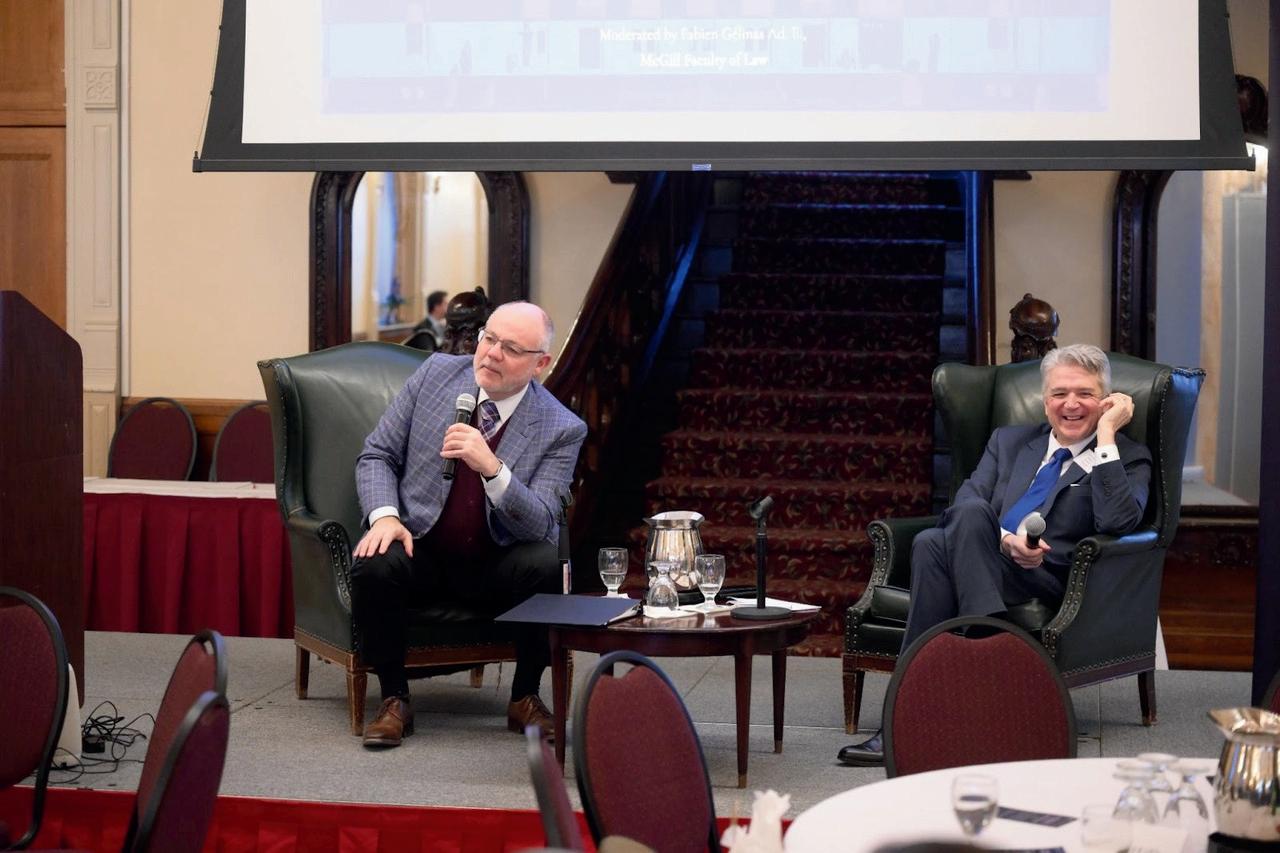
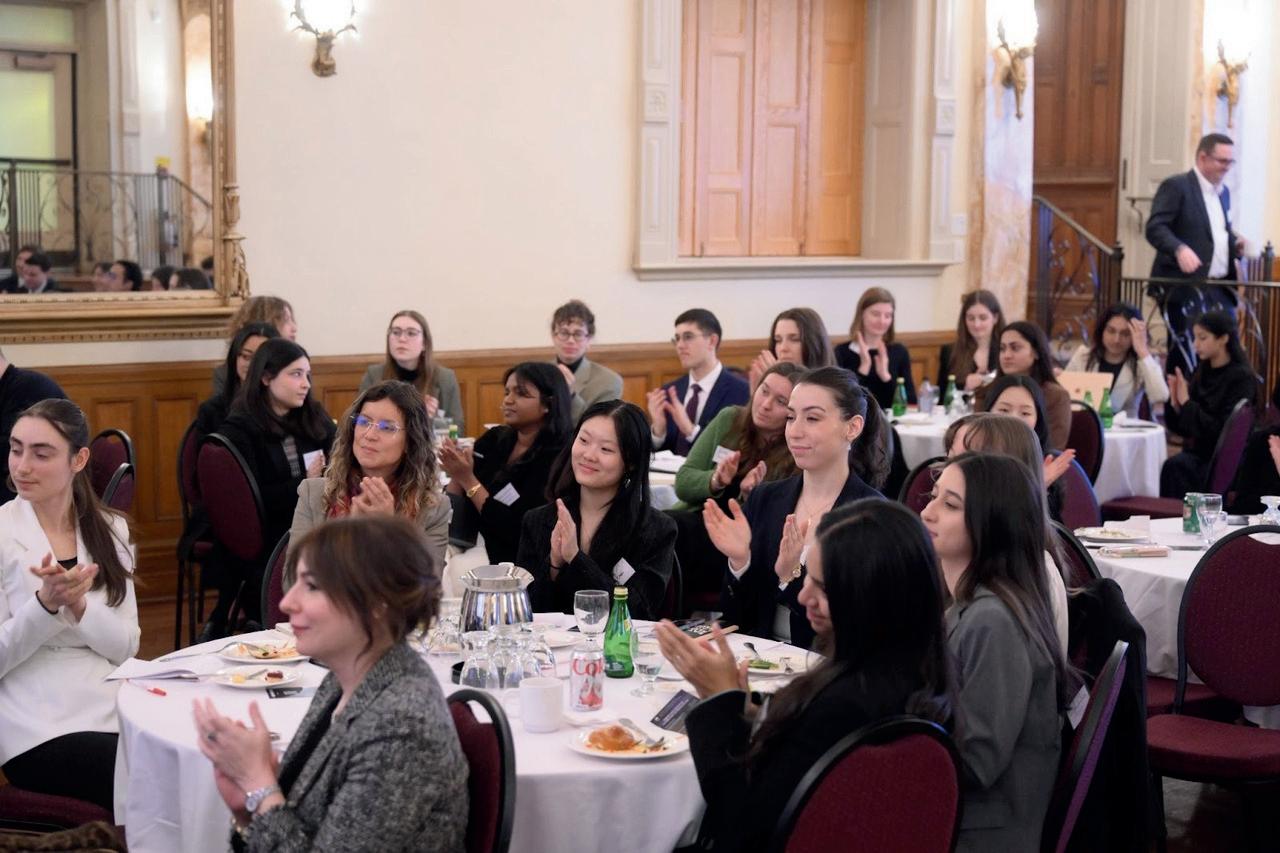
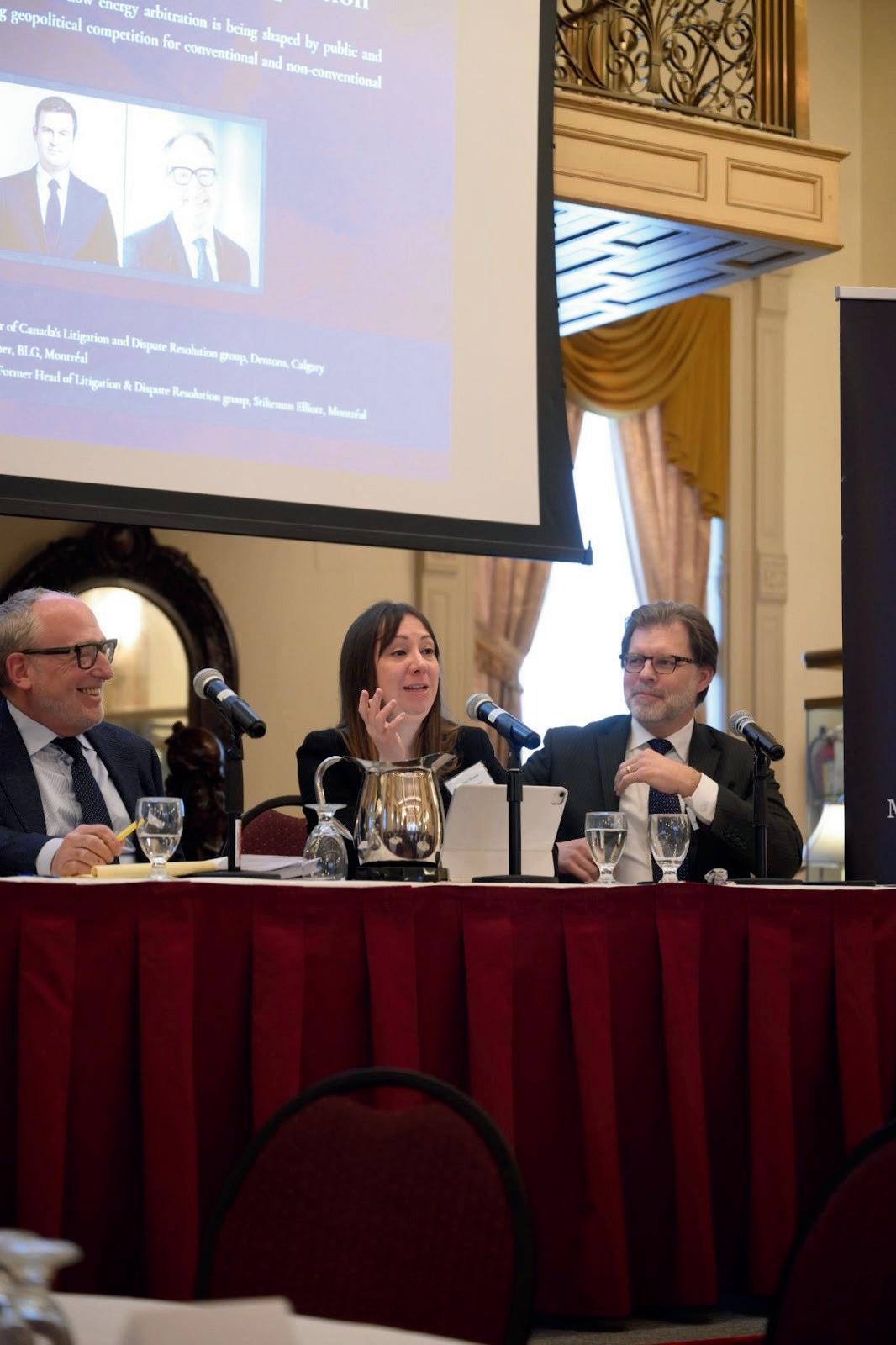
On January 16th, the McGill Journal of Dispute Resolution (MJDR) marked its tenth anniversary with the Decennial Symposium, Disputes in a Changing World Order, held at the McGill Faculty Club. Over 100 scholars, practitioners, alumni, and students gathered for a day of conversations about how dispute resolution is shifting alongside geopolitical, technological, and economic realities. The event was both a celebration of the journal’s first decade and a chance to (re)connect with the field’s community.
Keynote speaker the Honourable Russell Brown opened his address by marking the journal’s tenth anniversary, noting that a decade is“the difference between a promising experiment and an institution.”What began as a student initiative, he observed, has grown into a space that connects scholarship, practice, and a shared commitment to dispute resolution. Justice Brown also reflected on the day’s theme and took the opportunity to encourage current (and future) jurists and legal educators to build the adaptability required to navigate an“age of flux.”
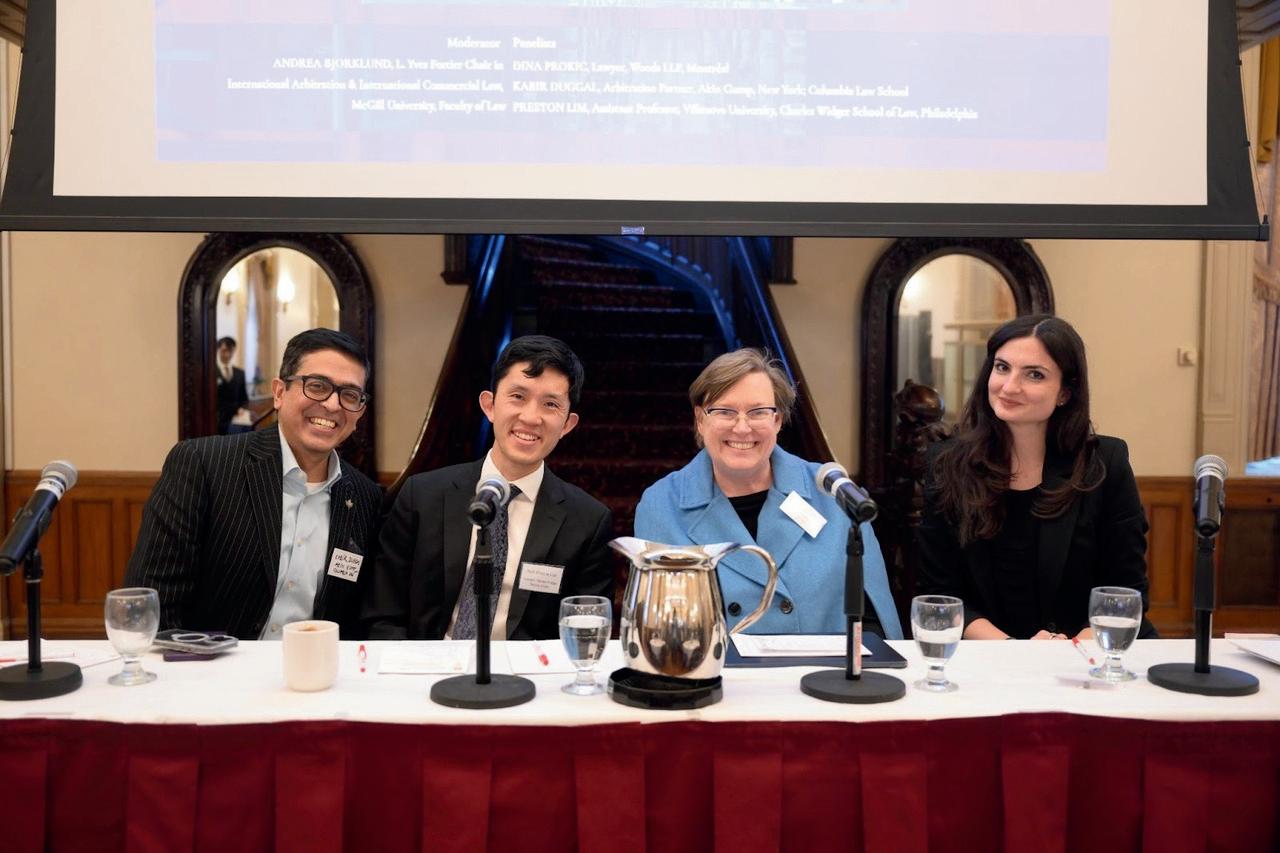
The day’s panels, Energy Arbitration in an Era of Geopolitical Competition, Investor-State Disputes in an Uncertain World, and The AI Race and the Future of Arbitration, exemplified how this “age of flux”is reshaping dispute resolution. The three panels brought together speakers from across Canada and abroad (including a former MJDR editor!) for discussions that were as lively as they were timely.The panelists engaged with each other enthusiastically and thoughtfully, addressing both recent headlines’ impact on the field as well as the broader questions shaping the future of dispute resolution. Their exchanges were animated, generous, and accessible, with each session flying by and leaving attendees with plenty to think about.
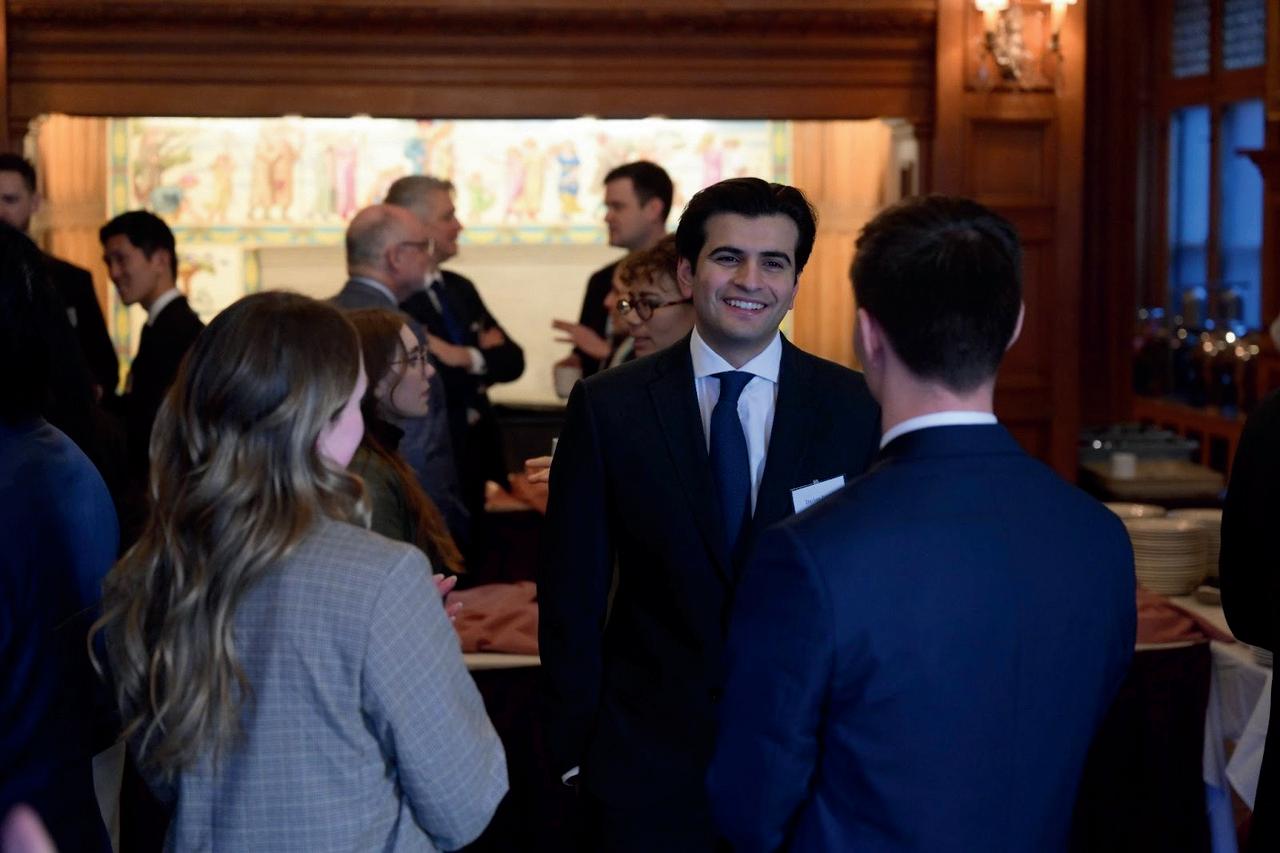
Between sessions, conversations spilled into the halls of the Faculty Club and continued over cocktails at Thomson House. Students chatted with peers from other universities and found themselves in unexpected exchanges with a variety of practitioners, such as expert-witness accountants, whose roles are rarely explored in class. For MJDR alumni, it was an opportunity to see first-hand how the journal they started has grown into a lasting institution.
While the symposium celebrated the journal’s first decade, it also looked toward the next.As Justice Brown noted, the real challenge now is to continue fostering the curiosity, collaboration, and care that have shaped the MJDR so far.We cannot wait to see where the next ten years will lead!
The MJDR is grateful to the Alumni Student Engagement Fund (ASEF), in addition to the generous sponsorship of Bennett Jones,Woods LLP, and the McGill Faculty of Law, for supporting this milestone event and helping bring together the community that made it possible.
10-03-2026 NO
Judgement Rendered: Sora45
EDITORIAL NOTE
COURT OF QUID NOVI
Alexander Ginnetti & Eveline Liu Plaintiff v. Sora45 Defendant
Welcome back to the city, everyone! We hope your March break was relaxing and productive. Eveline and I decided to catch flights instead of cases. Eveline went toVenice to see her friend, then visited Florence and Rome. I went to Madrid thinking I would find a Spanish duque…as you can tell, that didn’t work, since I am writing this column. Now let's get to slandering!
FACTS
On Valentine’s Day, I went to Sora45 for some drinks before going to a party. I ordered the samurai, while my date ordered the sword.
APPLICABLE TEST
We put this hotspot through our rigorous (and completely subjective) Slander and the City Scoring System, which evaluates the flavour and texture, value, service, setting, and the“ring by spring”factor.
ANALYSIS
Flavour and texture (50/60): As stated before, I ordered the samurai, which had pisco, Tanqueray gin, green Chartreuse, green apple, wasabi, dill, lime and soda. It was refreshing and fruity with a touch of spice and sourness. My date ordered the sword, which hadWhiskyToki Suntory, Sherry Fino, strawberry, honey, chamomile and soda. I found it to be bitter—so beware!
Value (8/10): Fair price for the quality and portion size. Cocktails range from $20–$30, which is the average for nice places around Montréal.
Service and Setting (5/5):The bartenders were all dressed handsomely, and the service was efficient and friendly. Sora45 shines in the setting. Located on the 45th floor of the PlaceVille Marie complex, the bar overlooks Montréal. I was there just as the sun was setting by Mont Royal, and it was one of the most beautiful sights.Tip: ask for a corner table/booth
Ring by Spring Factor (4/5): While the setting is beautiful, it was also filled to the brim, so I don’t think it's the best place to have an intimate conversation, unless you get a booth—which we did!
FOR THESE REASONS, MAY IT PLEASE THE COURT TO:
APPROVE the cumulative score of 67/80.
RECOMMEND for:
Drinks with the girls; Drinks with your special person; Drinks before an evening out…there are many amazing restaurants near the PVM complex.
ORDER all McGill Law students to walk over from the faculty.
Ginnetti Liu LLP Contributors | 2Ls
A 1L Case for your zodiac sign
Paige Hanic | 2L
Aries - McHale v Watson
An Aries will always act first, think later. They’re impulsive, chaotic, and bold. Not to mention, they’re the baby of the zodiac, making McHale v Watson the perfect case for them. Only Aries could launch scrap metal into another kid’s eye and get away with it because of a relaxed reasonable person standard for children. They have a youthful charm that begs to be forgiven immediatelyforeventheworstbehaviour.
Taurus - Carbolic Smoke Ball
Taureans are classically known to be stubborn and determined. Of course they would interpret an ad by a manufacturer as a binding contract— and they’d never let it go either. Taurus will always read the fine print and never forget that you owe them money. Plus, they love luxury and practicality. Nothing would piss them off more than investing in something for their health that didn’t even work.
Gemini - Palsgraaf
Geminis are curious, intellectual, and enjoy seeing things from multiple perspectives. That's why the duality in the reasoning of Palsgraaf makes perfect sense for this sign. Gemini can’t help but agree with both Cardozo andAndrews—and they refuse to pick a side. Geminis love to start conversations, and they’d revel in how much mileage professors get out of discussing this case. Also, the facts of the case are perfectly unhinged—like, what do you mean someone had fireworks in their suitcase? Geminis are drawn to that kind of gossip-worthychaos.
Cancer - Mustapha v Culligan
Cancers are deeply sensitive, so it only makes sense to assign them the case that brought us psychological damages. Even if the court doesn’t sympathize with you, Cancer probably does! And they’re not going to be quiet about it either. No one can pout and brood like a Cancer can. Some people see a fly in their water, but Cancers see life-ruining psychological trauma. And we have to thank them for thatsometimes.
Leo - Axa Assurances inc. c Groupe de sécurité Garda inc.
Leos are all about drama, and they love to be the centre of attention. Usually, nobody minds because their confidence is so fun to witness. They deserve the spotlight! I can’t think of anything more Leo than starting a fire on the job out of boredom for the sole purpose of making yourself look cool. That is unmatched levels of main-character delusion. The vicarious liability is the cherry on top, because a Leo will make it someoneelse’sproblem.
Virgo - Anns/Cooper
Only a Virgo could come up with such a meticulous, thought-out, comprehensive test like the Anns/Cooper framework for finding a duty of care.Virgos are so detailoriented that they won’t leave any stone unturned. Nothing gets them going like a multi-step process that they can walk the restof usthroughoverandoveragain.
Sagittarius - R v Brown
We can always count on independent, unburdened, untethered Sagittarians to party hard. They’re just unbothered by things that concern most people, and they’re always up for a new adventure.The fact that the concoction of drugs and alcohol taken in R v Brown was so ridiculously bizarre and such a one-off that it led to an acquittal is so Sagittarius. Only they could take “I don’t remember what I did last night”to such extremes—and make off with their freedom too!
Capricorn - Hadley v Baxendale
Capricorns are practical, disciplined, and they have money on their mind.That's why I have to give them Hadley v Baxendale, the contracts case that says if you didn’t plan ahead, too bad, not my problem.The court limited damages to what was reasonably foreseeable when a broken mill shaft caused delays and financial loss. A Capricorn would’ve never let something like that happen. They’re always 3 steps ahead. As for all the talk about“shafts”in this case? Well, Capricorn is the father of the Zodiac,afterall.
Aquarius - R v Morgentaler
Libra - Donoghue v Stevenson
The neighbour principle is so Libra that I almost can’t stand it. All Librans want to see is harmony and balance between people. They can’t stand unfairness and just want to keep the peace, so it makes sense that their case is one of the foundational Duty of Care cases.
Scorpio - Jones v Tsige Scorpios love to sit back, observe, and collect information about people. They might not share much about themselves, but they are dying to know all your secrets.That's why I’m assigning the case that brought us intrusion upon seclusion, Jones v Tsige, to Scorpio. An obsessive Scorpio could never resist snooping on their ex’s new partner’s bank information—but all hell would break loose if someone did it to them.
Aquarians don’t care about the rules —they’re going to do what they feel is right, especially if it has broader social implications. They live to trailblaze, so the jury nullification that gave us the groundbreaking Morgentaler decision is exactly their speed. You can always count on Aquarius to come to a decision in the most unconventional and controversial way.
Pisces - Alcock v Chief Constable of South Yorkshire Police
I feel like this one needs little explanation. Of course a Pisces would try to get damages for witnessing someone else’s misfortune. Pisces are intuitive and empathetic, taking on everyone else’s feelings whether they like it or not.The Piscean martyr complex is undeniable. And as a Pisces, I’m allowed to say that. Cry about it!
the QUID Meet TEAM
Nom: AnyaAbbes
Year of Study: 3L
Position: Social Media Manager
Briefly, what drew you to the Quid: When I was little, I wanted to be a novelist and a poet. Being part of the Quid is my way of keeping that dream on life support, and reminding myself that law school hasn’t completely killed it yet.
Qu'aimes-tu faire quand tu n'étudies pas?: I am an oil painter and an avid reader (I’m mostly drawn to strange, slightly unsettling books).
Give us a rec for your favourite Montréal café, resto, metro station, or hidden gem. Pas de gatekeeping!: I really love the Fountain of Redemption behind St Joseph's Oratory, especially in the spring or summer.
Nom: Isabella Drzemczewska Hodson
Year of Study: 1L
Position: Layout Editor
Briefly, what drew you to the Quid: I have been a lifelong reader of small print publications, especially when they are made with love and aimed at a particular audience. I wanted to give layout editing a try!
Qu'aimes-tu faire quand tu n'étudies pas?: I am a diehard pickleball addict, but when I'm not in the court, I enjoy beading, reading, writing, and makingYouTube videos.
Give us a rec for your favourite Montréal café, resto, metro station, or hidden gem. Pas de gatekeeping!: My daughter and I are superfans of Pizzeria No. 900 on Peel St (the SteCatherine St location is sub-par: go to Peel St).The calzone is a favourite!And make sure to try theTurkish breakfast at least once at Gunaydin - and bring your tupperware (seriously - I did. And I filled all 6 containers... you cannot possibly eat all the food they give you!).
Nom: Sébastien Offredo
Year of Study: 3L
Position: Columnist
Briefly, what drew you to the Quid: The Quid is where you can learn about what the McGill Law community does outside of law, and I wanted to contribute my own voice! I've been told that I am somewhat funny, but maybe that's people just being nice. My first article began with securing a quote from Professor Boulanger-Bonnelly about his time at a Charli XCX concert, and I've continued contributing since.
Qu'aimes-tu faire quand tu n'étudies pas?: Consistently refining my music taste (and when the weather in Canada permits it, I jog).
Give us a rec for your favourite Montréal café, resto, metro station, or hidden gem. Pas de gatekeeping!: Phin Café, un café vietnamien situé près de la Place Roy, a ouvert ses portes il y a moins d'un an. Il est souvent difficile d'y trouver une place à l'intérieur pour étudier, alors normalement je prends un café đen et un cinnamon roll à emporter.
Nom: Erin Porter Year of Study: 2L
Position: Columnist
Briefly, what drew you to the Quid: I was really drawn to doing creative essays and commentary on how questions related to the law manifest themselves in unexpected places— especially in pop-culture niches. I knew I needed something with a deadline to keep me accountable, and joining a student newspaper seemed like a no-brainer! I loved my experience writing and editing for my high school newspaper, and doing similar things in undergrad, so the Quid was a natural way to do something creative and participate in life at the fac.
Qu'aimes-tu faire quand tu n'étudies pas?: When I'm not sequestered in the library, you will usually find me knitting while I catch up on TV or movies! I'm also liable to be found shopping, eating, or sipping in new spots with my friends. Give us a rec for your favourite Montréal café, resto, metro station, or hidden gem. Pas de gatekeeping!: Greenspot in St. Henri for when you need a sub or a steamé!
Nom: Liam Hunt Year of Study: 1L
Position: Copy Editor
Briefly, what drew you to the Quid: Nothing better than speaking (writing) truth to power. Qu'aimes-tu faire quand tu n'étudies pas?: Right now, I'm really into playing the guitar, singing, and pranayama.
Give us a rec for your favourite Montréal café, resto, metro station, or hidden gem. Pas de gatekeeping!: This little clearing on the mountain, over the guardrail, just after sunset: 45°30'22.9"N 73°35'06.9"W.
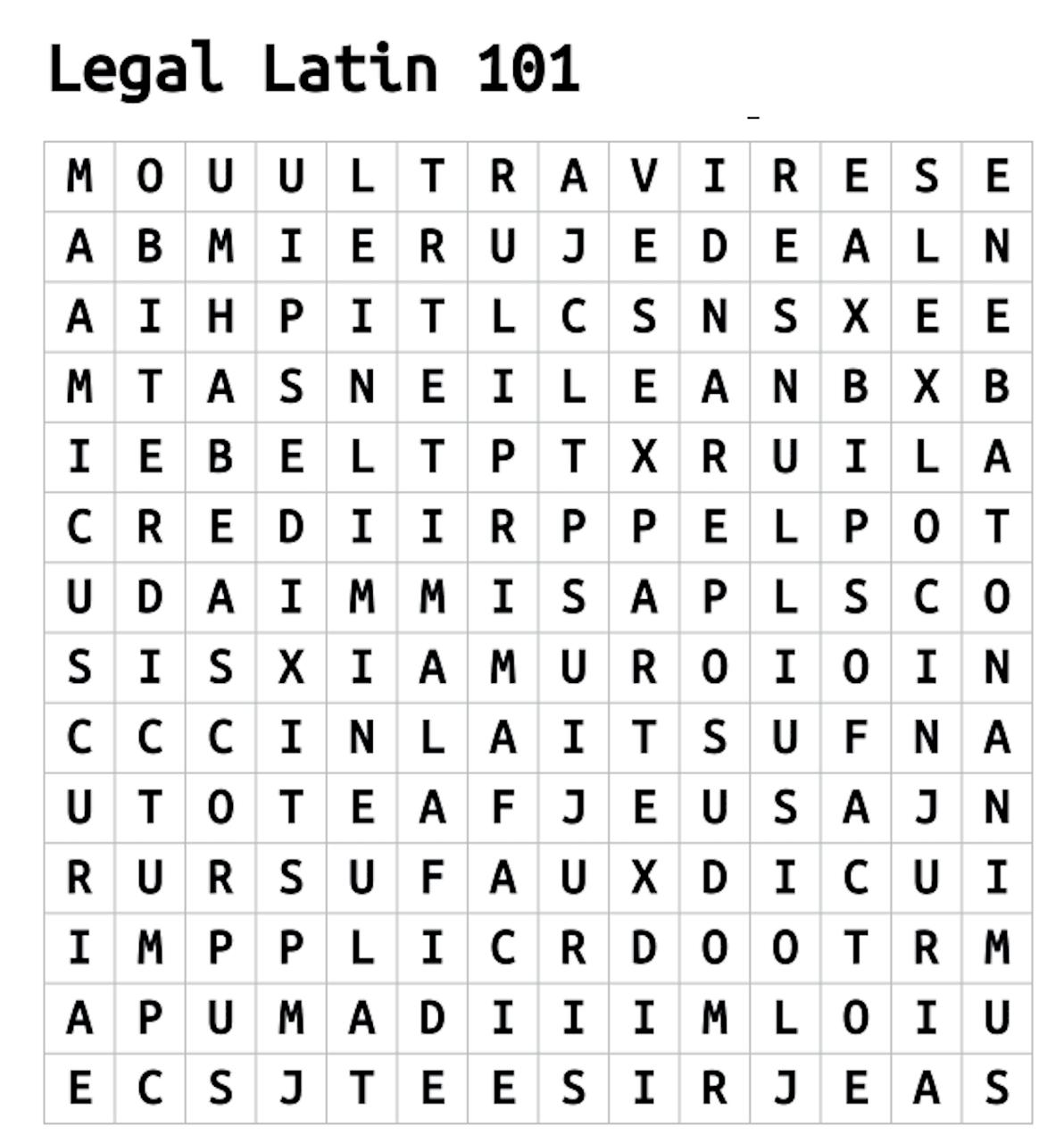
Legal latin 101
Gillian Hunnisett | 2L
Test your legal latin by finding all 30 terms. Stuck? Check out the mini dictionary!
Mini Dictionary
Ultra vires — Outside of powers.
Sui juris — Of one’s own right, or having full legal capacity.
Res nullius A— thing belonging to no-one.
Obiter dictum — Something said by the way, or a nonbinding statement of law.
Nota bene — Note well.
Modus operandi — Manner of working.
Mala fide — In bad faith.
Locus standi — Legal standing.
Lex loci — Law of the place.
Lex fori — Law of the forum.
Justa causa — Just cause, or lawful ground.
Ipso facto — By the very fact itself.
Ipse dixit — In their own words.
In specie — In tangible form.
In limine — On the threshold.
In camera — In private.
Injuria — Injury.
Holus bolus All— at once.
Habeas corpus — Have the body.
Ex parte Without— notice.
Ex gratia As— an act of grace, or as a favour.
De jure — By right or according to law.
Animus — Intention.
Amicus curiae — Friend of the court.
[Definitions from nortonrosefulbright.com/en-ca/about/re/latindeconstructed/latin-issue-18.]
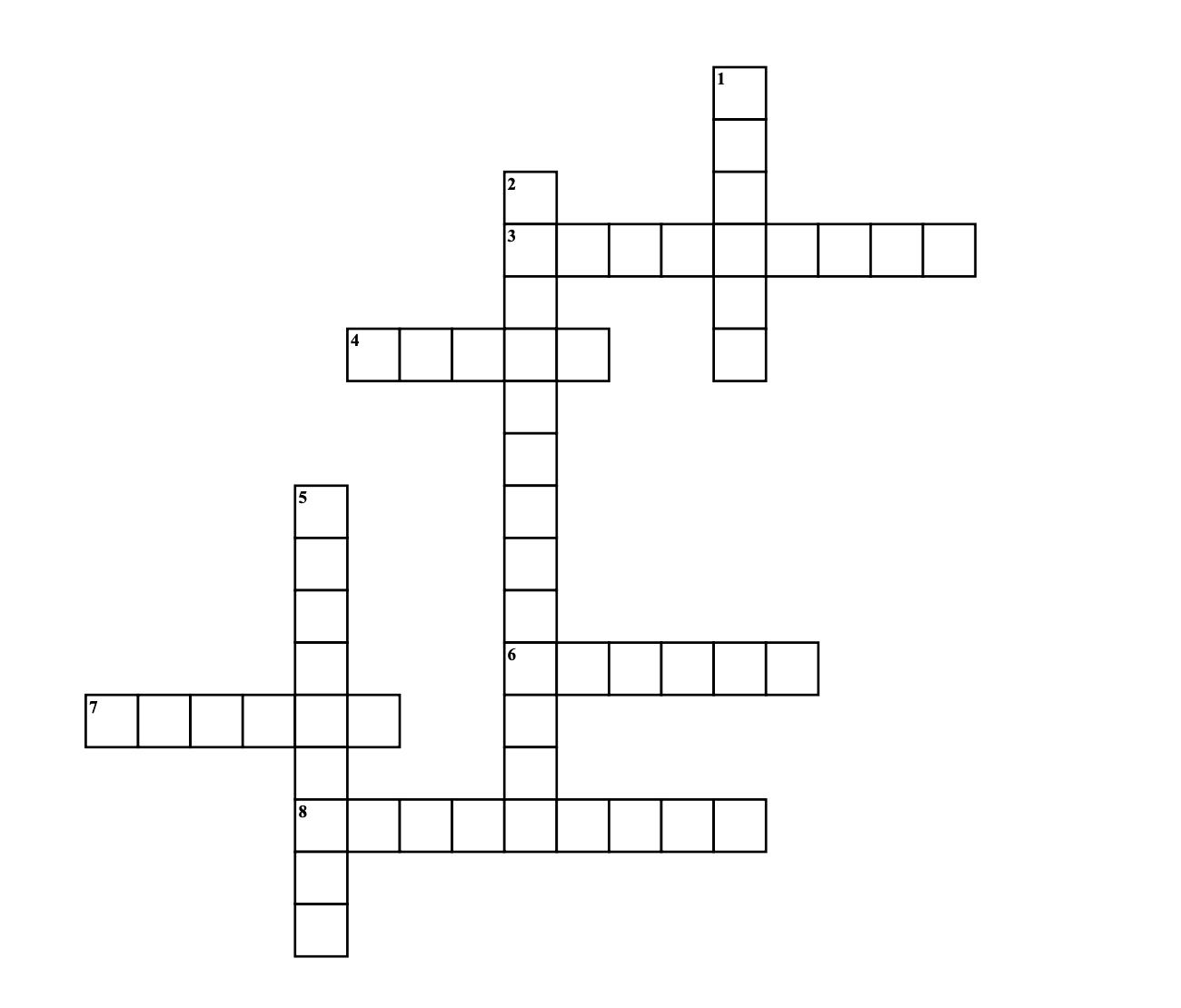
Mini CROSSWord
Across
[3] Jean ___ – first Black Canadian woman elected to the House of Commons (1993).
[4] Senator Flordeliz“Gigi”___ – Canadian surgeon known for advocating diversity and inclusion in health care.
[6] Maryka ___ – Canada’s first East Asian woman judge, appointed in 1993.
[7] Clara Brett ___ – first female barrister in Canada and the entire British Empire.
Every item appearing in the Quid Novi is an opinion piece that reflects only the views of the person(s) submitting the item. Neither the Quid Novi, the LSA, nor the Faculty of Law endorse any of the material or views contained therein. Given the nature of the publication and its limited resources, the Quid will not undertake to evaluate the factual accuracy of submissions. Submissions are presumptively publishable unless they do not conform to the guidelines contained in the Quid constitution
EDITORS-IN-CHIEF RÉDACTRICES EN CHEF
Catherine Zhang
Faith Dehghan
SOCIAL MEDIA DIRECTOR
DIRECTRICE DES RÉSEAUX SOCIAUX
AnyaAbbes
ART DIRECTOR
DIRECTRICE ARTISTIQUE
RaeAquino
LAYOUT EDITORS
ÉDITEUR.ICES DE MISE EN PAGE
Eveline Liu
Katya Tavitian
COPY EDITORS
SECRÉTAIRES DE RÉDACTION
Qi Rong Chen
Angel Drouin
Meera Khanna
COLUMNISTS CHRONIQUEUR.EUSES
Manal Elhaoua
Lydia Etherington
Alexander Ginnetti
Paige Hanic
Gillian Hunnisett
Eveline Liu
Lysette Umwali
Heidi Zahiri
CONTRIBUTORS CONTRIBUTEUR.ICES
Célestine Poirier
Law Students for Palestine at McGill (LS4PM)
Special thanks to RaeAquino and SouangWu for designing the layout.
Envoyez vos commentaires ou articles avant mercredi 17h00 à quid.law@mcgill.ca .Toute contribution doit indiquer le nom de l’auteur, son année d’étude ainsi qu’un titre et un sous -titre pour l’article. L’article ne sera publié qu’à la discrétion du comité de rédaction, qui basera sa décision sur la politique de rédaction disponible sur notre Instagram @quidlaw