The Quid Novi MONTREAL, QC
MCGILL UNIVERSITY FACULTY OF LAW - FACULTÉ DE DROIT DE L’UNIVERSITÉ MCGILL
45 05 31 OCT 2023
to have taken down posters of LETTER FROM THE EDITOR some Israeli hostages from the walls of the Faculty building. It is also misguided Pablo Mhanna-Sandoval | 2L
This week’s edition of the Quid reflects the pain that many of our readers have been feeling for weeks now. As the Faculty’s paper of record, we have decided to publish pieces from both individuals and organizations on the violence in Palestine and in Israel. This discussion has been ongoing and has shown that our Faculty is not isolated from the rifts we are observing in wider Canadian society. While on a recent walk with a new friend, we discussed the notion that people’s life experiences vary so greatly that it is very difficult, if not impossible, for all of us
to agree on certain political questions. Given recent events in Montreal, including on McGill’s campus and at Chancellor Day Hall, this seems to ring true. This does not relieve us as a community, however, of the responsibility of finding some common ground on the matter. If I may be so bold, I would argue that our student body agrees on the inexcusability of harming innocent civilians. However, the behaviour of many students at the Faculty does not reflect this belief–which I sincerely believe all of us share. It is deeply misguided for
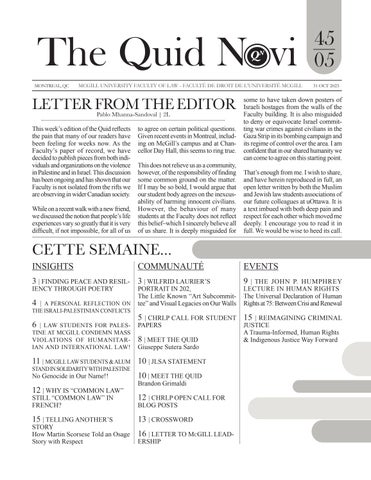
CETTE SEMAINE... INSIGHTS
COMMUNAUTÉ
3 | FINDING PEACE AND RESIL- 3 | WILFRID LAURIER’S IENCY THROUGH POETRY
4 | A PERSONAL REFLECTION ON THE ISRALI-PALESTINIAN CONFLICTS
6 | LAW STUDENTS FOR PALES-
TINE AT MCGILL CONDEMN MASS VIOLATIONS OF HUMANITARIAN AND INTERNATIONAL LAW!
PORTRAIT IN 202, The Little Known “Art Subcommittee” and Visual Legacies on Our Walls
No Genocide in Our Name!!
12 | WHY IS “COMMON LAW”
PAPERS
8 | MEET THE QUID
Giuseppe Sutera Sardo
10 | MEET THE QUID Brandon Grimaldi
STILL “COMMON LAW” IN FRENCH?
12 | CHRLP OPEN CALL FOR
15 | TELLING ANOTHER’S
13 | CROSSWORD
STORY How Martin Scorsese Told an Osage Story with Respect
That’s enough from me. I wish to share, and have herein reproduced in full, an open letter written by both the Muslim and Jewish law students associations of our future colleagues at uOttawa. It is a text imbued with both deep pain and respect for each other which moved me deeply. I encourage you to read it in full. We would be wise to heed its call.
EVENTS 9 | THE JOHN P. HUMPHREY LECTURE IN HUMAN RIGHTS The Universal Declaration of Human Rights at 75: Between Crisi and Renewal
5 | CHRLP CALL FOR STUDENT 15 | REIMAGINING CRIMINAL
11 | MCGILL LAW STUDENTS & ALUM 10 | JLSA STATEMENT STAND IN SOLIDARITY WITH PALESTINE
to deny or equivocate Israel committing war crimes against civilians in the Gaza Strip in its bombing campaign and its regime of control over the area. I am confident that in our shared humanity we can come to agree on this starting point.
BLOG POSTS
16 | LETTER TO McGILL LEADERSHIP
JUSTICE A Trauma-Informed, Human Rights & Indigenous Justice Way Forward
QUID NOVI • 31 OCT 2023
Vol 45 ● No 05
2
FINDING PEACE AND RESILIENCY THROUGH POETRY Weeam Ben Rejeb | 3L
The story of the Palestinian people is a long and beautiful one. For many of us, the plight of Palestine is a reality we grew up with, on our screens and in our hearts. We grew up learning about the Balfour Declaration, the 1947 UN Partition Plan, the subsequent Nakba, the Arab-Israeli war, the Intifada, and the siege on Gaza; and we continue to learn and witness the structural violence imposed on the Palestinian people. It didn’t start on October 7, and will not end with the destruction of Gaza. For my peers who became more intimately aware of Palestine and its struggle in light of the most recent iteration of violence, I wanted to share a few short poems and sayings by Palestinian artists and writers which have helped me grieve and find strength. I want you to remember that despite the violence, Palestinians also experience joy, love, passion, and dreams, and I hope that you can feel their words in your heart. Mahmoud Darwish She says: when are we gonna meet? I say: after a year and a war. She says: when will the war end? I say: the time we meet Marwan Makhoul In order for me to write poetry that isn’t political I must listen to the birds, and in order to hear the birds the warplanes must be silent Fadwa Tuqan Enough for Me Enough for me to die on her earth be buried in her to melt and vanish into her soil then sprout forth as a flower played with by a child from my country. Enough for me to remain in my country’s embrace to be in her close as a handful of dust a sprig of grass a flower. Maya Al-Hayyat Sooner or later, all leaves fall to the ground. You can be the last leaf. You can convince the universe that you pose no threat to the tree’s life.
Mahmoud Darwish The war will end The leaders will shake hands The old woman will keep waiting for her martyred son That girl will wait for her beloved husband. And those children will wait for their heroic father I don’t know who sold our homeland. But I know who paid the price.
WILFRID LAURIER’S PORTRAIT IN 202 The Little Known “Art Subcommittee” and Visual Legacies on Our Walls
Frédéric Mégret | Chair, Art Subcommittee
It was pointed out in issue 45:2 of the Quid (Nicolas Kamran, “If These Walls Could Talk: Critical Race Theory under the Watchful Eyes of Sir Wilfrid Laurier”) that a portrait of Sir Wilfrid Laurier was hanging in a room where critical race theory is taught. The portrait has been removed. It seems an apt occasion to remind or inform readers of the Quid of how decision making about space and art take place in the Faculty of Law. The Space Committee, consisting of myself as chair, Professor Rosalie Jukier, Assistant Dean Vanessa Batik, Building Director Margaret Baratta, and Faculty Administrator Debbie Carlone, reports to the dean. Reporting to it is the Art Subcommittee, consisting of myself as chair and Assistant Dean Batik, with Professor Aaron Mills serving as liaison between the Art Subcommittee and the TRC Subcommittee. The Art Subcommittee is committed to ensuring that our shared space reflects the rich tapestry of traditions that make it unique and is inclusive and, ideally, aesthetically pleasing and stimulating. This involves a rolling evaluation of choices that were sometimes made a long time ago for reasons long forgotten concerning pieces of art or memorabilia that now seem embedded in the decor. As the author pointed out, this is precisely the problem, and why it is important to critically assess some of these remnants and the extent to which they may now seem at odds with our faculty priorities. We could not agree more. The subcommittee had not gotten to room 202 because the entire second floor is slated for a fundamental remodelling to make way for an Indigenous teaching and learning space. It had, however, already removed from the Caren and Jordan H. Waxman Common Room a bigger portrait of Sir Wilfrid, based on the same assessment as the author’s. A fuller renewal of the pieces hanging in that splendid room is awaiting implementation. The subcommittee seizes this opportunity to salute student engagement with their surroundings and affirms its openness to all suggestions to make our shared spaces reflect our evolving identities, diversity, and engagements. 3
Vol 45 ● No 05
A PERSONAL REFLECTION ON THE ISRAELI-PALESTINIAN CONFLICTS Samuel Benzaquen, JLSA co-president | 2L
Disclaimer: The purpose of this article is not to advance arguments, provide historical context, or to interpret facts. There has been plenty of words written on these topics already, and I would encourage the Quid’s readers take the time to learn about the issue and form their own opinions. I do not normally discuss the Israel-Palestine conflict with people I know I will disagree with fundamentally. I have found that there are often insurmountable differences of opinion, and it is not productive or helpful to engage. I was considering not writing an article in the Quid because I couldn’t control which audience this would reach.
QUID NOVI • 31 OCT 2023
However, I feel compelled to express my perspective. I hope that it will help people understand my side and introduce some humanity into an increasingly divisive topic. To the average student, the Israel-Palestine conflict may seem to be another one of those heated political divides on campus. To me, though, the legitimacy of Israel as a Jewish homeland is not just some philosophical or political discussion. It is highly personal. My parents met in Israel. My grandparents and uncle currently live there. I lived in Israel for 2 years after high school. I visited many small towns near border lines, and ate with families on many Jewish holidays, not unlike the holiday on which the terrorists attacked on October 7. Just last December I visited the Erez crossing, one of the Hamas breach points. I do not read the news out of curiosity 4
or disconnected interest. I read it with dread and with pain that the land I used to live in is now embroiled in a brutal war. But my connection to Israel runs deeper than just my experience in the land. It implicates a core part of my Jewish identity. I have literally spent thousands of hours of my life studying the Torah, Talmud, and other religious Jewish works. All throughout these texts are mention of how Jews are connected to the land of Israel and cleave to it. Not Uganda. Not Saskatchewan. Israel. Just as Muslims pray towards Mecca, my entire life I have prayed three times a day facing towards Israel, as countless other Jews do. My eldest brother’s middle name is Israel. I have no objection to the notion of someone exercising their right to free speech. However, I would be lying if I said it doesn’t bother me deeply when someone who has no idea what Israel means to the Jewish people decides to deny the Jewish connection to the land and refer to Jewish people as colonizers. It upsets me when people who I would call my friends refer to the process of Hamas atrocities as an act of decolonization. It is disturbing when people stay silent when Jews are massacred for the simple act of existing but cry out for an immediate ceasefire when Israel dares to fulfil its moral duty to defend its citizens. I am not justifying all of Israel’s actions. But it would be comical if it weren’t sad that people who claim to be nuanced and educated completely and utter fail to recognize the Israeli side of the conflict.
Over the course of my upbringing, I was repeatedly instilled with the narrative that whatever country we live in, Jews are never safe. As a child, I learned the stories in the Torah describing Jewish exile from Egypt. I visited Holocaust museums and heard recountings from Survivors. My family’s history expresses the timelessness of this truth. My father’s family was exiled from Spain by the Inquisition in the 1400s, and my mother’s parents immigrated from Morocco to Canada in the 1970s due to increasing danger to Jews. But I never truly felt threatened. After all, Canada is built on a foundation of freedom of religion, respect, and tolerance for other cultures. My attitude has changed since the attacks on October 7. The day after the attacks, there were protestors celebrating the Hamas atrocities just minutes’ walk from my apartment. When tabling at the Y-intersection last Tuesday giving out snacks and candles, my friends were spat at and called “disgusting Jews”. They didn’t say “Israelis” or “Zionists”. They said “Jews”. After the walkout on Wednesday, I spoke to a student who claimed, “Only 50 people were killed on October 7” and “Zionists control CNN and New York Times”. There were people in Montreal openly waving Hamas flags. There are students in the Law Faculty ripping down posters requesting the release of hostages from Hamas. For the first time in my life, I feel like I am living in a society where a pogrom or lynching could happen against me or other Jewish people. And I don’t think I will ever be able to shake it off.
Lecture in Human Rights The Universal Declaration of McGill Centre for Human Rights at 75: Human Rights and Legal Pluralism Between Crisis and Renewal
Centre sur les droits de la personne et le pluralisme juridique de McGill
Anna Sevortian
CALL FOR STUDENT PAPERS The John P. Humphrey
O’Brien Fellow, McGill Faculty of Law Senior Advisor to the EU-Russia Civil Society Forum
Lecture in Human Rights
The Centre for Human Rights and Legal Pluralism (CHLPR) invites the submission of original or unpublished papers relating to the theme “Solidarity and Strength: Responses to New Challenges in LGBTI Activism and Advocacy” for the 2024 Martine Roy Student Colloquium.
The Universal Declaration of Human Rights at 75: Between Crisis and Renewal
The current moment in history poses new difficulties and opportunities for LGBTI rights and activism worldwide. The theme of ILGA-Europe’s 2023 Annual Conference – Rising to the Moment – asks how to build resilience, capacity, and unity within the movement in order to confront both internal and external pressures to activism and advocacy. In this 15, spirit, the 2024 Martine Roy Student Colloquium invites particNovember 2023 Anna Sevortian Alex Neve ipants to consider new issues in LGBTI activism, reflect upon lessonsO’Brien learned and pathways forwards, Fellow, McGill Faculty of Law 17:30 - 19:00 PM (ET) Former Secretary General, Amnesty International and place these issues within the greater international and domestic contexts in which theyCanada take place. Senior Advisor to the EU-Russia Civil Society Forum Adjunct professor of international human rights law, McGill Faculty of Law University of Ottawa and Dalhousie University The colloquium is named in honour of Martine Roy,Hall a strong advocate of justice for LGBTI communities since New Chancellor Day 1984 when she was discharged from the Canadian Armed Forces for her sexual orientation. In 2017, she and Maxwell Cohen Moot Court Ms. Roy continues her leadership and LGBTI advoothers received an apology from the Canadian Government. Room 100 Douglas lecture, the Colloquium aims to advance scholarship cacy to this day. In conjunction with the Michelle
on and engagement with LGBTI issues, both domestically and internationally.
The Colloquium will take place on Friday, March 15th, 2024. Selected students will be given the chance to present their papers, and the best paper will receive a prize. All the papers presented at the Colloquium will be published in a November 15, 2023 Working Paper Series: https://www.mcgill.ca/humanrights/research/working-papers Alex Neve Participation is 17:30 - 19:00 PM (ET) Former Secretary General, Amnesty International Canada open to all partandrights full-law, Yuri Romana-Rivas Adjunct professor of international human McGill Faculty of Law University of Ottawa andMcGill Dalhousie University Papers should be between time students registered at DCL O’Brien Fellow, Vanier Fellow, Faculty of Law New Day Hall Please include an usChancellor 5000 and 8000 words in length, McGill University at the time Join for a panel discussion abstract of noMaxwell more not including footnotes and bibliof submission. The colloquium Cohen Moot Court to mark the 75th Anniversary of the than 250 words with ographies. Please use a standard encourages an interdisciplinary Room 100 Universal Declaration of Human Rights,margins. the submission. Writers 12-point font and 1-inch approach to the theme, and underare welcome to submit Professor Citations should Mégret, follow either graduate and graduate students with moderator Frédéric papers and abstracts MLA, APA, or the Canadian Guide in all faculties are encouraged Co-Director and Professor at 10th in either CHRLP English or to Uniform Legal Citation to submit. Essays written for McGill Faculty of Law French. edition. classes, as well as original papers, are welcome for submission.
Yuri Romana-Rivas Professor Frans Viljoen
DCL O’Brien Fellow, Vanier Faculty of Law Professor, FacultyFellow, of Law,McGill University of Pretoria
Please submit papers, abstracts, and all questions to the Centre at chrlp.law@mcgill.ca by Friday, January 26th, 2024.
Join us for a panel discussion to mark@McGillCHRLP the 75th Anniversary of the Universal Declaration of Human Rights, with moderator Professor Frédéric Mégret, CHRLP Co-Director and Professor at McGill Faculty of Law
McGill Centre for Human Rights & Legal Pluralism
Professor Frans Viljoen Professor, Faculty of Law, University of Pretoria
@McGillCHRLP
McGill Centre for Human Rights & Legal Pluralism
5
Vol 45 ● No 05
LAW STUDENTS FOR PALESTINE AT MCGILL CONDEMN MASS VIOLATIONS OF HUMANITARIAN AND INTERNATIONAL LAW! First Public Statement of Law Students for Palestine at McGill Law Students for Palestine at McGill
As students of the Faculty of Law at McGill University, we are writing to express our solidarity with the people of Palestine and to condemn the violations of international law currently unfolding in Gaza. While we are a collective of current law students at McGill, the views we express are our own and do not reflect those of the faculty as a whole.
● Indiscriminate bombing, which as of October 26 has killed 6,850 See Human Rights Watch, “Questions and Answers: October 2023 Hostilities between Israel and Palestinian Armed Groups” (9 October 2023) online: <https://www. hrw.org/news/2023/10/09/questions-and-answers-october-2023-hostilities-between-israel-and-palestinian-armed#One>. 2 See Brian Buschard, “Israel Vows ‘Mighty Vengeance’: Unprecedented Hamas Attack Leaves At Least 200 Dead” Forbes (7 October 2023) online: <https://www. forbes.com/sites/brianbushard/2023/10/07/israel-vowsmighty-vengeance-unprecedented-hamas-attack-leavesat-least-200-dead/?sh=557db1ff688d>.
QUID NOVI • 31 OCT 2023
1
four Palestine Red Crescent paramedics.10
● Indiscriminate bombing, which has killed 3,000 Palestinian children in Gaza.5
● The use of white phosphorus on October 10th and 11th.11 ● The October 13th order to civilians in northern Gaza to evacuate, which resulted in the mass forced displacement of more than 1 million people.12
● Indiscriminate bombing, which has injured more than 17,000 Palestinians in Gaza.6
We approach this issue as a humanitarian catastrophe, condemning violence and breaches of international law by all parties. Grief does not discriminate, and we mourn with all those whose loved ones have been lost, displaced or put in danger by this conflict. The attack by Hamas on October 7, which targeted civilians and involved the taking of hostages, violated international humanitarian law.1 In response to the attack, Israeli Prime Minister Benjamin Netanyahu declared Israel at “war,” vowed to “take mighty vengeance,”2 and committed several war crimes3, including:
people, 70% of whom are children, women and the elderly.4
● Indiscriminate bombing, causing destruction to an UNWRA school7 as well as Gaza’s oldest church8 and numerous mosques.9 ● Indiscriminate bombing, causing destruction to healthcare facilities, ambulances, refugee camps and the killing of See WAFA News Agency, “Gaza death toll surges to 6,955, over 19,000 injured” (26 October 2023) online: <https://english.wafa.ps/Pages/Details/138673> [WAFA News Agency]. 5 See Farah Najjar, Joseph Stepansky and Arwa Ibrahim, “Israel-Hamas war live: Palestinian envoy urges UN to ‘stop this madness’” Al Jazeera (26 October 2023) online: <https://www.aljazeera.com/news/liveblog/2023/10/26/israel-hamas-war-live-un-ceasefirebid-fails-as-gaza-death-toll-soars> 6 See WAFA News Agency. 7 See UN News, “Israel-Gaza conflict: Deepening Concern for Civilians, as UN School is Hit” United Nations (17 October 2023) online: <https://news.un.org/ en/story/2023/10/1142432>. 8 See Chao Deng, “Israel Military Claims Responsibility for Church Blast in Gaza” The Wall Street Journal (20 October 2023) online: <https://www.wsj.com/livecoverage/israel-hamas-war-gaza-strip-conflict/card/israeli-military-claims-responsibility-for-church-blast-in-gaza-ItyUvoIPaeNBEsIeIS6J>. 4
By indiscriminately bombing Gaza13 and shutting off civilians’ access to water, internet, and electricity,14 Israel See United Nations Human Rights Office of the High Commissioner, “Gaza: UN experts decry bombing of hospitals and schools as crimes against humanity, call for prevention of genocide” (19 October 2023) online: <https://www.ohchr.org/en/press-releases/2023/10/ gaza-un-experts-decry-bombing-hospitals-and-school s-crimes-against-humanity#:~:text=Israeli%20bombardment%20on%20Gaza%20has,driving%20to%20treat%20injured%20people>. 11 See Human Rights Watch, “ Israel: White Phosphorous Used in Gaza, Lebanon” (12 October 2023) online: <https://www.hrw.org/news/2023/10/12/israel-white-phosphorus-used-gaza-lebanon> [Human Rights Watch] 12 See Amnesty International, “Israel/OPT: Appalling Gaza ‘evacuation order’ must be rescinded by Israel Immediately” (13 October 2023) online: <https://www. amnesty.org/en/latest/news/2023/10/israel-opt-appalling-gaza-evacuation-order-must-be-rescinded-by-israel-immediately/>. 13 See Amnesty International, Press Release, “Israel/ OPT: unlawful Israeli airstrikes on Gaza have ‘decimated’ entire Palestinian families” (20 October 2023) online: <https://www.amnesty.org.uk/press-releases/ israelopt-unlawful-israeli-airstrikes-gaza-have-decimated-entire-palestinian>. 10
See Amnesty International, “Israel must lift illegal and and inhumane blockade on Gaza as power plant runs out of fuel” (12 October 2023) online: <https://www. amnesty.org/en/latest/news/2023/10/israel-opt-israelmust-lift-illegal-and-inhumane-blockade-on-gaza-aspower-plant-runs-out-of-fuel/>. 14
3 See Amnesty International, “Damning evidence of war crimes as Israeli attacks wipe out entire families in Gaza” (20 October 2023) online: <https://www.amnesty.org/en/ latest/news/2023/10/damning-evidence-of-war-crimesas-israeli-attacks-wipe-out-entire-families-in-gaza/>.
6
See Middle East Monitor, “Israel has destroyed 31 mosques in Gaza Strip since 7 October: Ministry” (22 October 2023) online: <https://www.middleeastmonitor.com/20231022-israel-has-destroyed-31mosques-in-gaza-strip-since-7-october-ministry/>. 9
has violated Article 3 of the Geneva Convention, which requires that parties to a conflict distinguish between civilians and combatants at all times. Israel’s actions further violate Article 33 of the Geneva Convention, which prohibits collective punishment.15 These are war crimes, even when done in self-defense, when civilians are warned in advance, when combatants are hiding among civilians, and when the collective punishment is done strategically to neutralize a threat.16
While most of the attention has been on the atrocities occurring in Gaza, we cannot ignore the escalated violence also taking place in the West Bank. Between October 7 and October 26, 105 Palestinians have been killed in the West Bank.20 In the Palestinian town of Qusra, Israeli forces and settlers have damaged Palestinian homes and a mosque, burned down olive groves, and have even killed a father and a son during a funeral procession for four Palestinian men killed by settler violence earlier in the week.21
Long before October 7, Israel was imposing on Palestinians a system of Apartheid.17 Israel’s recent attempts to drive Palestinians out of Gaza also fits the UN definition of ethnic cleansing,18 and we share the concern of many in the international community that Israel may currently be engaging in genocide of Palestinians.19
We are deeply concerned by the systemic silencing of Palestinian voices and of those who express any show of solidarity for the plight of the Palestinian people. This systemic silencing often manifests through doxxing, harassment and intimidation.22 This undermines our collective rights as Canadians, to freedom of expression and freedom of peaceful assembly.23 While the 67 of us – a number that is quickly growing –would love to individually sign our names as we recognize that there is power in numbers, we are troubled by the fact that people who speak out against the ongoing occupation, apartheid and genocide of Palestinians are facing personal and professional repercussions and even risk losing their jobs.24
In 2020, the UN Special Rapporteur on the situation of human rights in the Palestinian Territory occupied since 1967 called out Israel’s collective punishment of Palestinians in the Gaza strip as violating the “foundational rule of virtually every modern legal system.” See United Nations Human Rights Office of the High Commissioner, Press Release, “Israel’s collective punishment of Palestinians illegal and an affront to justice: UN expert” (17 July 2020) online: <https://www.ohchr.org/en/press-releases/2020/07/israels-collective-punishment-palestinians-illegal-and-affront-justice-un>. 16 See Human Rights Watch, “Questions and Answers: October 2023 Hostilities between Israel and Palestinian Armed Group” (9 October 2023) online: <https://www. hrw.org/news/2023/10/09/questions-and-answers-october-2023-hostilities-between-israel-and-palestinian-armed#One>. 17 See Situation of human rights in the Palestinian Territories occupied since 1967, UNGA, 77, 356 (2022) Note by Secretary General at para 56, online: <https://documents-dds-ny.un.org/doc/UNDOC/GEN/N22/598/03/ PDF/N2259803.pdf?OpenElement>. See also Amnesty International, “Israel’s apartheid against Palestinians,” (last accessed 21 October 2023) online: <https://www. amnesty.org/en/latest/campaigns/2022/02/israels-system-of-apartheid/>. 18 See Office on Genocide Prevention and the Responsibility to Protect, “Genocide: Definition” (last accessed 21 October 2023) online: <https://www.un.org/en/genocideprevention/ethnic-cleansing.shtml>. 19 See Third World Approaches to International Law Review, “Public Statement: Scholars Warn of Potential Genocide in Gaza” (17 October 2023) online: <https:// twailr.com/public-statement-scholars-warn-of-poten15
tial-genocide-in-gaza/?fbclid=IwAR0z3lf2qAuZQCdck5_7eKiXbAEdyE_2bpPKhPgbL9wpnCYZQ4YLH7zE3II>. 20 See WAFA News Agency. 21 See Leila Fadel, Arezou Rezvani, and Ari Shapiro, “Palestinians brace for more violence after reprisal attacks in the West Bank” NPR (20 October 2023) online: <https://www.npr.org/2023/10/20/1207543936/ israel-palestine-hamas-west-bank>. 22 Maya Abuali, “How McGill fails Palestinian students” The McGill Tribune (last accessed 22 October 2023) online: <https://www.thetribune.ca/how-mcgill-fails-palestinian-students/?fbclid=IwAR09V1UJCmRjskmSOyONYZhf2D1pfPd3hMx4Hv0xxRyzlNh7xX0p4XtFOdc>. 23 Canadian Charter of Rights and Freedoms, s 2, Part I of the Constitution Act, 1982, being Schedule B to the Canada Act 1982 (UK), 1982, c 11. 24 See Brishti Basu, “Ontario doctor suspended, his address published after pro-Palestinian social media posts” CBC (20 October 2023) online: <https://www. cbc.ca/news/canada/doctor-doxed-suspended-palestinian-posts-1.7001887#:~:text=Canada-,Ontario%20 doctor%20suspended%2C%20his%20address%20 published%20after%20pro%2DPalestinian%20
Israel’s continued violations of international law in Gaza and the West Bank are clear and unjustifiable. War crimes by one group do not justify war crimes by another. As future jurists, we are horrified by the flagrant violations of international human rights and humanitarian law currently taking place in Gaza. We urge our fellow students and practitioners to take action to support the restoration of rights and dignity of Palestinians, in order to move toward a lasting peace, free not just of the violence of the last few weeks, but of the violence that Palestinians have been experiencing for decades under colonial occupation. Lastly, while we do not want to engage in a futile back and forth on the subject, we would be remiss to ignore the McGill Jewish Law Students Association (JLSA)’s response to an earlier version of this statement (published on social media) last Wednesday. We recognize the statement comes from people that are hurting and in immense grief. We would never want to diminish that and we share in their mourning. The JLSA’s statement did not meaningfully critique any of the points we have made and furthermore propagated numerous dangerous conspiracy theories based on IDF reports rather than third party analysts, including: the idea that most of the casualties are the result of Hamas using Gazans as human shields;25 that it was a Hamas rocket social,war%20between%20Israel%20and%20Hamas>. See also Anemona Hartocollis, “After Writing an Anti-Israel Letter, Harvard Students Are Doxxed” New York Times (18 October 2023) online: <https://www.nytimes. com/2023/10/18/us/harvard-students-israel-hamas-doxxing.html>. See also Alexandra Olson, Anne D’innocenzio and Haleluya Hadero, “Company bosses and workers grapple with the fallout of speaking up about the Israel-Hamas war” CTV News (21 October 2023) online: <https://www.ctvnews.ca/business/company-bossesand-workers-grapple-with-the-fallout-of-speaking-upabout-the-israel-hamas-war-1.6611503>. 25 It truly feels dystopian and vile to have to argue this. Just watching the live news coverage of what is occurring on the ground in Gaza will show any person that this is not the case. The idea that Hamas uses Palestinians as human shields has been debunked by Human Rights Watch and Amnesty International. See Human
7
Vol 45 ● No 05 that hit the Al-Ahli Hospital;26 that there is no credible evidence of the use of white phosphorus;27 and that Israel is not indiscriminately bombing Gaza.28 Rights Watch, “White Flag Deaths” (13 August 2009) online: <https://www.hrw.org/report/2009/08/13/whiteflag-deaths/killings-palestinian-civilians-during-operation-cast-lead. See also Saad Hasan, “Busting the myth of Palestinian ‘human shields’ in Gaza” TRT World (last accessed 26 October 2023) online: <https://www. trtworld.com/magazine/busting-the-myth-of-palestinian-human-shields-in-gaza-46645>. 26 Proof of what happened at the hospital is still disputed and investigations are on going. See Geoff Brumfiel, “Questions still swirl around Al Ahli Arab Hospital blast in Gaza. Here’s what we know” NPR (24 October 2023) online: <https://www.npr.org/sections/goatsandsoda/2023/10/24/1208211857/questions-still-swirlaround-al-ahli-arab-hospital-blast-in-gaza-heres-whatwe-k>. See also Aric Toler, et al., “A Close Look at Some Key Evidence in the Gaza Hospital Blast” New York Times (24 October 2023) online: <https://www. nytimes.com/2023/10/24/world/middleeast/gaza-hospital-israel-hamas-video.html>. 27 Human Rights Watch has documented evidence of its use on October 10 and 11. See Human Rights Watch, supra note 11. 28 Israeli officials have even admitted to indiscriminate bombing. See B’Tselem, “One crime does not justify another. The attack against civilians in Gaza must end”
Yet, what was most shocking about that message was the outright denial of the number of people who have been killed by Israeli airstrikes in Gaza. JLSA argued that Hamas controls the Gaza Health Ministry and that the numbers they provide are, therefore, unreliable. However, many experts, such as Human Rights Watch and the United Nations, rely on the Ministry’s numbers. Omar Shakir, Israel and Palestine director at Human Rights Watch, shared with the Washington Post that “everyone uses the figures from the Gaza Health Ministry because those are generally proven to be reliable […] In the times in which we have done our own verification of numbers for particular strikes, I’m not aware of any time when there’s been some major discrepancy.”29 (19 October 2023) online: <https://www.btselem.org/ gaza_strip/20231019_one_crime_does_not_justify_anothert_he_attack_against_civilians_in_gaza_must_end>.
Readers would do well to consult the expansive body of rigorous academic work on colonialism to better understand the relevant political and historical contexts. The dictionary definitions of “colonialism” and “apartheid” leave out important academic context necessary for a full and nuanced understanding of the terms and how they relate to the current situation. To deny the reality of what is going on in Gaza and the West Bank is to allow for genocide. Each time a specific group of civilians is the target of militarized violence we say, ‘never again.’ Yet, here we are, again, screaming at the top of our lungs “not again” as people turn away from the truth. In solidarity, Law Students for Palestine at McGill
29 See Adam Taylor, “Why news
outlets and the U.N. rely on Gaza’s Health Ministry for death tolls” Washington Post (25 October 2023) online: <https://www.washingtonpost.com/world/2023/10/24/
gaza-death-toll-palestinian-health-ministry/?fbclid=IwAR03wftbe1gkPLpXJ596iHkeR9ayWW3ToytWgsQlwIWJ38UgTvBsiSSpkMM>.
MEET Copy THE QUID Editor QUID NOVI • 31 OCT 2023
Giuseppe Sutera Sardo | 2L
Where are you from/where have you lived? I’m a proud Montrealer who cherishes his hometown roots, while also treasuring my important connection to Italy.
my passion for the subject has only grown with each passing year.
What drew you to the Quid? I figured the Quid would be a great way to keep up with what is going on at the faculty, while also developing my editing skills.
Qu’aimes-tu faire quand tu n’étudies pas? Whenever I have some free time, I usually head toward a soccer field or spend quality time with my beloved dog Mia. We both share a deep love for sports, although her dribbling skills need a bit of work.
Q: What did you do before McGill Law? In college, I studied natural sciences at André-Grasset. I then completed a double major at Concordia University in history and public policy. Quel était ton cours préféré avant de commencer à la faculté de droit? Throughout my academic life, I have been consistently drawn to courses related to American history, and 8
As-tu un quartier préféré à Montréal? #lavalourien
McGill Centre for Human Rights and Legal Pluralism
Centre sur les droits de la personne et le pluralisme juridique de McGill
The John P. Humphrey Lecture in Human Rights The Universal Declaration of Human Rights at 75: Between Crisis and Renewal
Anna Sevortian
O’Brien Fellow, McGill Faculty of Law Senior Advisor to the EU-Russia Civil Society Forum
November 15, 2023 17:30 - 19:00 PM (ET) McGill Faculty of Law New Chancellor Day Hall Maxwell Cohen Moot Court Room 100
Alex Neve Former Secretary General, Amnesty International Canada Adjunct professor of international human rights law, University of Ottawa and Dalhousie University
Yuri Romana-Rivas DCL O’Brien Fellow, Vanier Fellow, McGill Faculty of Law
Join us for a panel discussion to mark the 75th Anniversary of the Universal Declaration of Human Rights, with moderator Professor Frédéric Mégret, CHRLP Co-Director and Professor at McGill Faculty of Law Professor Frans Viljoen Professor, Faculty of Law, University of Pretoria
@McGillCHRLP
McGill Centre for Human Rights & Legal Pluralism
9
Vol 45 ● No 05
JSLA STATEMENT The Jewish Law Student Association
The JLSA is deeply disturbed by the statements put out by “Law Students for Palestine at McGill” (LS4PM), an unidentified group of our colleagues and classmates, which woefully misrepresents the reality of the situation in Israel and Gaza. In the interest of providing context, we have set out our responses to many of the claims that these statements make in the attached document (see here: https:// tinyurl.com/y7d7wkdh)
QUID NOVI • 31 OCT 2023
As Jewish law students, we are extremely concerned about the spread of misinformation online by LS4PM and other student groups about Israel, the indigenous homeland of the Jewish people and home to many of our family and friends. This kind of misinformation creates a toxic and unsafe environment for Jews both on campus and in general society. We are also gravely concerned about the allegations made by LS4PM that Israel is a colonial enterprise. The definition of colonialism is “domination of a people or area by a foreign state or nation.”1 Implying that Jews are foreign to Israel denies the historical connection of an indigenous people to their land and is itself an action of colonial repression. Just over two weeks ago, Hamas, a terror group that oppresses Gaza through its brutal and totalitarian re“Colonialism.” Merriam-Webster.com (accessed 24 October 2023). 1
10
gime, perpetrated some of the most barbaric atrocities that any of us have ever seen. Hamas is explicit in its call for the genocide of Jews. Art. 7 of the Hamas Covenant, its founding document, is perhaps the best example of this, as it implies that the murder of Jews is a religious obligation for Muslims and should be seen as a noble act.2 It was to this call that Hamas terrorists responded on October 7th. Hamas terrorists targeted Israeli towns, villages and even a music festival for peace, going house to house to murder civilians. They raped, tortured, and murdered over 1400 men, women, children, and elderly. They also took an unknown number of hostages back to Gaza, estimated to be over 220, the vast majority of whom are still being held.3 Faced with such an attack on its civilian population, Israel had no choice but to respond and neutralize the threat. The same day, Israel launched a counteroffensive to clear the terrorists from its territory “Hamas Covenant 1988”, reproduced in Lillian Goldman Law Library, The Avalon Project - Documents in Law, History and Diplomacy. United States, 2009. Web Archive, https://avalon.law. yale.edu/20th_century/hamas.asp 3 See TOI Staff, “Pictures of 1,000 Hamas massacre victims displayed at Tel Aviv University exhibition”, TimesofIsrael.com (19 October 2023), online: https://www.time2
sofisrael.com/pictures-of-1000hamas-massacre-victims-displayedat-tel-aviv-university-exhibition/
and made plans to dismantle Hamas’ military capabilities. This was in accordance with its right to self-defence, guaranteed to all states under the UN Charter.4 We ask all of you to stand with us and demand that See Chapter 7, Article 51, UN Charter, 26 June 1945, Can TS 1945 No. 7. 4
the hostages held in Gaza be freed immediately. We also call on Hamas to immediately cease all targeting of civilians by rocket fire and other terror means. We condemn any forms of violence against all civilians, Israeli and Palestinian, and pray for a time when peace will be restored permanently to the region.
MEET Copy THE QUID Editor Brandon Grimaldi | 2L
Where are you from/ where have you lived? I was born in Montreal and lived my whole life in the east-end borough of Saint-Leonard. What drew you to the Quid? I was always interested in journalism, particularly newspapers run by students. I was very excited to learn McGill had the Quid to offer. The fact that the Quid is able to combine strong researched works, opinion pieces, and some more laid-back articles all in one is something that I enjoy reading and contributing to. What did you do before McGill Law? Just a few Metro stops away, I completed my undergrad in political science and public policy at Concordia (they had a tunnel, but I got over it, walking up Peel in the winter is way more fun) Quel était ton cours préféré avant de commencer à la faculté de droit? Mes cours préférés étaient les cours d’histoire de n’importe quel temps ou pays. Je suis un gros history nerd! Was law school a dream come true or a happy accident? Do you want to be a lawyer? I’m not the “I’ve wanted to be a lawyer since I was 2” type of person, but attending law school was a goal of mine for quite some time. That being said, I was very happy that my midnight frantic, caffeine-fueled essay writing all the years prior paid off, and I am where I want to be. Very excited to one day practice as a lawyer…just don’t know where yet! As-tu un quartier préféré à Montréal? C’est difficile de ne choisir qu’un quartier, mais le centre-ville a tellement à offrir pour tout le monde à l’année longue, je l’aime bien!
MCGILL LAW JEWISH STUDENTS & ALUM STAND IN SOLIDARITY WITH PALESTINE No Genocide in Our Name!! Law Students for Palestine at McGill
McGill Law Jewish students & alum stand in solidarity with Palestine: No Genocide in our name!! We write this statement as a group of McGill law students and alumni who are proudly Jewish, anti-Zionist, and stand in unequivocal support of Palestinian liberation. We write this because we refuse to let our Jewish identities be weaponized in order to justify apartheid, war crimes, and the ongoing theft and annexation of Palestinian lands. We reject the framing put forth by groups, such as the McGill Jewish Law Association and McGill University administration, that fighting for Palestinian freedom and condemning the actions of the Israeli government makes Jews on campus unsafe. Rather, we know intimately that in order to resist anti-semitism, we must equally resist all other forms of racial, economic and social domination. As such, we know that our safety as Jews comes not from a theocratic ethnostate, but by condemning war and violence in all its forms and standing in solidarity with all marginalized peoples, including and especially Palestinians. To this end, we want to highlight that Jewish voices are not and should never be treated as a monolith. Equating Zionism with Judaism effectively and insidiously kneecaps any critiques of Israel by suppressing advocates for peace and writing off Jewish activists for Palestine as self-hating. We adamantly reject the notion that Zionism is coextensive with Judaism, believing instead that our Jewish values and the plight of our ancestors teach us to oppose apartheid, genocide, and oppression in all its forms. We accordingly refuse to let our faith be weaponized into violence against Palestinian civilians. Jews are too often presented as an essentialized community of Zionists. While many in our community share our opinions (we are particularly appreciative of the efforts of Law Students for Palestine at McGill), Jews who question or critique Zionism are being marginalized. We are disappointed with many of our brothers and sisters who have let fear cloud their judgment and weaken their commitment to human rights. We sympathize with the authors of the recent statement by the JLSA - they are motivated by trauma and pain. Yet, in justifying the killings of civilians, dismissing calls for a ceasefire, and denying that Palestinian voices are being suppressed, they are perpetuating the very pain they are now suffering. In light of the disappointing trend within our community to justify Israeli war crimes under the guise of self-defence, we adamantly remind all readers that such
voices do not represent all Jewish people. Instead, we look to the increasingly vocal minority of anti-Zionist Jews worldwide calling for an immediate ceasefire and a de-escalation of the conflict. Organizations like B’Tselem, Jewish Voice for Peace, Independent Jewish Voices, and If Not Now are part of the Jewish consciousness. Ignoring such voices, maligning them, or questioning their fidelity to Judaism advances an essentialist view of identity that obscures our complex, diasporic, and diversified history and subsequently likens critiques of Israel to antisemitism. Indeed, the notion that all Jews must support Israel is itself antisemitic and plays into the long-touted “dual loyalties” trope. A diverse religion thousands of years old resists being reduced to a modern political ideology. As we wrte this, the Israeli military has launched a bombing campaign that has killed over 5,000 Palestinians in Gaza, including at least 2,074 children, while Israeli settlers, armed by the Israeli state, are attacking Palestinian communities in the West Bank with impunity. Many Zionists have questioned the veracity of those numbers. However, the casualty figures reported by the Gaza health ministry have a proven track record of reliability, as they have consistently aligned with numbers derived from independent investigations conducted by third-party organizations such as the United Nations and Human Rights Watch. Furthermore, thousands of victims are the logical conclusion when a densely populated area is hit with hundreds of airstrikes per day. The sad reality is that while we go back and forth about the number of dead civilians, more are dying every minute. How many must die to matter? We, too, mourn the loss of Israeli civilian life and the targeted killing of more than 1200 civilians by Hamas militants. But we firmly reject the weaponization of our grief as a justification for further loss of life. Now is not the time to sit on the sidelines. We are watching a genocide unfolding in real time. None of us are free until Palestinians are no longer forced to endure apartheid, blockades, and settler violence. We join with Jewish communities around the world, many of us direct and intergenerational survivors of genocide, to call for the Boycott, Divestment, and Sanction of Israel and to end the siege of Gaza. Never Again is now: no genocide in our name.
11
Vol 45 ● No 05
WHY IS “COMMON LAW” STILL “COMMON LAW” IN FRENCH?” Orden Deko | 3L
QUID NOVI • 31 OCT 2023
Stories are composed of words and words, in turn, are storied. Whether the kind of word, etymology—the study of the origin of words and the historical development of their form and meanings1—acts as the narrator on how human thought and sound resulted in the combination of letters to create such words. This means that the famous pangram “the quick brown fox jumps over the lazy dog” has enough human history, explaining why “fox” is the word for fox or “lazy” the word for lazy, to fill an entire novel. This storytelling extends even further once you bring in the issue of translation. When a word emerges in one human language, but the thing it describes becomes widespread, how will it look in other languages? Here there are two stories. The first involves the innovation that brought the word into human speech in its original language. The second concerns its entrance into a foreign language. Did it become a loanword? If not a loanword, did the entrance into this secondary language engender a cognate or a calque? Stories are imbued, for example, in the lopsided dichotomy between the words ananas and piña to describe the word pineapple. Most languages, around 42, adopted some variation of the former word whereas 10 chose to incorporate the latter into their lexicons. The ubiquity of ananas is wholly the outcome of human agency, through a series of events, compiling a story. It was borrowed directly from Portuguese ananás, itself borrowed from Old Tupi nanas which means “excellent fruit.”2 As for the less popular Oxford English Dictionary, (Oxford: Oxford University Press, 2000) sub verbo “etymology”. 2 Another story emerges: What made pineapple an excellent fruit to the Tupi people? 1
12
choice, its origin derives from the imagination of Christopher Columbus who referred to the fruit as “pinecone of the [Indigenous].”3 More relevant to our Faculty is the story behind the word “common law” specifically in French which translates the British invention as “common law.” I have always wondered why the term “common law” has not been translated as droit commun much like civil law is droit civil? This seemingly runs contrary to the work of the Académie française and its devout North American counterpart, the Office québécois de la langue française, both of which exert great power to ward off anglicismes. As you’d expect by now, an anthology of stories exists to contextualize this anomaly. Why wouldn’t French translate “common law” into droit commun? Well, it seems that word has already been taken; droit commun or ius commune, the Roman legal concept, designates the set of rules which generally apply to all residents within a given territory. Despite also describing the common law itself, droit commun is a specific legal concept divorced from the formation of common law as a word and a separate legal system. To translate “common law” into droit commun would be a disaster; how would anyone know which droit commun you are talking about? French, however, as a part of the Romance family, has the advantage of borrowing from its sister languages when it needs a translation, as was the case when pineapple entered the European continent. Looking first to Spanish, “common law” is translated as derecho anThe actual translation contains the outdated term Indian. 3
glosajón. The same translation can be found in Occitan and Catalan, the former being native to southern France. Unfortunately, once again we are met with the obstacle of confusion. Derecho anglosajón which translates into Anglo-Saxon law already exists in French. Droit anglo-saxon signifies a corpus of written rules and customs that were in place during the Anglo-Saxon period in England, right before the Norman conquest (and the advent of the common law!). French linguists have not gone down without a fight, however. Other attempts at finding a translation include droit coutumier and droit jurisprudentiel. Although common law contains elements of customary law, droit coutumier gives the impression that the law in question is merely verbal, derived from tradition, whereas in reality, a great deal of emphasis exists on written text. On the other hand, droit jurisprudential or “judge-made law” would only be telling half the story since common law also relies on parliamentary statutes. Therefore, a story of practicality, of avoiding confusion underpins the term “common law” in the French language. This story was echoed in the late 1990s when the National Program for the Integration of Both Official Languages in the Administration of Justice agreed to continue using “common law” in French, without a translation, notably due to its predominant and pre-existing usage. While this story involves no tropical faraway lands nor mentions the explorers who reached them, it nonetheless reveals the brainstorming and creativity (or perhaps lack thereof) that resulted in the word “common law” remaining unscathed upon entry into the French language.
CROSSWORD Jessie Khalil | 3L
Down:
Across:
2. Thursday 5 - 7 3. Civil law degree 6. Monthly faculty email 7. Elected LSA queen 9. Intruders
1. Maxwell Cohen’s classroom nickname 4. Most expensive part of the basement 5. Nahum 8. Michael Shortt’s well of knowledge 10. Hotspot to hangout or study 13
Vol 45 ● No 05
McGill Centre for uman Rights nd Legal Pluralism
OPEN CALL FOR BLOG POSTS
Centre sur les droits de la personne et le pluralisme juridique de McGill The Universal Declaration of Human Rights at 75: Human rights protection in a fragile multilateral order
This is Criminal an open call for blog posts. The CHRLP invites as wide a diversity of voices as possible to submit posts on critical quesmagining Justice: tions touching on the above theme. We also welcome submissions about human rights and (or) legal pluralism more broadly. ma-Informed, Human Rights & reflections on the theme: debate. A strong piece will contain orig- tion, but we are interested in the general genousSome Justice Way Forward With the year 2023-2024 marking the inal analysis that spurs a critical reflec- ideas presented by the author and would 75th anniversary of the UDHR, and the
halfway point of the13, lifespan of the UN’s Monday, November 2023 Sustainable Development Goals, there 13:00 - 14:30 (ET) is a unique opportunity to reflect on the UN’s Faculty treaty-basedof andLaw goal-based human McGill rights frameworks and assess their effecw Chancellor Day Hall, Room 202 tiveness. The UN’s stated aims of promotease RSVP to chrlp.law@mcgill.ca ing international peace and security and
human rights seem as elusive as ever as humanitarian crises in several regions of With the world worsen and democracy backslides internationally. Regional insecurity seems further likely to persist with deadlock at the UN Security Council, dynamics of great power politics returning in the international system, and weakening state capacity and willingness for multilateral humanitarian interventions, such as UN Peacekeeping Operations. This theme invites prospective authors to consider where the UN ought to go from here and whether, and in what form, organizational reform is required. Must the treaty-based human rights approach embodied by the UDHR be adapted for the inter-state dynamics of the current age? The theme also allows prospective authors to imagine new alternatives or discuss existing ones, independent of the UN system, which still serve to promote the UDHR’s aims.
tion or starts an interesting conversation. Blog posts do not have to adhere to an academic style of argumentation and can be more casual in tone. However, to be considered for publication, a blog post must fulfill the following criteria:
like to read another draft. Generally, editors will return all submissions with feedback within 2 weeks.
• Short, incisive and argument-driven piece, 800-1200 words • 12-point, Times New Roman font with 1” or 1.5” spacing • Change in sections with a single line • Short subtitles, left-aligned in bold lettering • In-text hyperlinks encouraged • Sources as supporting evidence to the author’s claims, although citations are not necessary. If included, footnote form in adherence with the Canadian Guide to Uniform Legal Citation, 10th edition is preferred.
First read: The blog editors require 1-2 weeks to do a first read, after which the revised piece will be returned to the author with editorial comments and recommendations. These recommendations are intended to be constructive (rather than mandatory), and a collaborative approach is invited.
Benjamin Perrin
QUID NOVI • 31 OCT 2023
Recommended structure: • Brief introduction presenting the argument and necessary context for the reader; • 2-3 main body paragraphs working through a logical and How to submit a post: reasoned succession of points. Authors are asked to adhere to the Headings are encouraged; following standards when submitting • Conclusion summarizing the piece. Anything notcriminal mentioned iscussiontheir about reimagining justice argument with and calling the reader here is at the discretion of the author. to action.
rrin, a UBC law professor and author of We Justice accept original pieceson on aTrial rolling basis, he Criminal System (UTP,Examples 2023).of blog posts can be found here:
lCHRLP
and aim for publication within 3-4 weeks https://www.mcgill.ca/humanrights/blog McGill Centre for Human from reception, provided the submission & Legal process: Pluralism requirements are respected. PleaseRights be Editing mindful that we are not personal editors We receive submissions on a rolling and will not accept partially edited pieces. basis. Submissions may be accepted or Only advanced drafts will be accepted. rejected at the discretion of the editors. Authors may also be asked to revise and The primary purpose of a blog post is to re-submit their piece. This means that further a new idea, present a news devel- the piece needs substantially more work opment, initiate a discussion, or engage in in order to be considered for publica-
14
If accepted for publication, the piece will undergo the following editing process:
Second read: The author is then asked to submit a revised draft, at which time the editors will do a second read. If the editors find the piece ready, they will proceed with publication. If further drafts are requested, the editors will be in touch with the author. Image to accompany the post: When submitting the first or second draft, the author is asked, if possible, to send a high-resolution evocative image (to which they have the rights; reference included, please) to illustrate the piece. If no such image is available, the editors, in consultation with the author, will procure one from the public domain. Bio and photo of the author: When submitting the first or second draft, the author is asked to send a short bio of 2-3 sentences and, if comfortable, a high-resolution portrait-style photograph for posting on the web. Note: The editors retain the right to refuse, at any moment in the above process, to publish a piece. Considerations for the refusal will be communicated to the author. Submissions should be emailed to human.rights@mcgill.ca
McGill Centre for Human Rights and Legal Pluralism
Centre sur les droits de la personne et le pluralisme juridique de McGill
Reimagining Criminal Justice: A Trauma-Informed, Human Rights & Indigenous Justice Way Forward Monday, November 13, 2023 13:00 - 14:30 (ET) McGill Faculty of Law New Chancellor Day Hall, Room 202 Please RSVP to chrlp.law@mcgill.ca
With
Benjamin Perrin
Join us for a discussion about reimagining criminal justice with Benjamin Perrin, a UBC law professor and author of Indictment: The Criminal Justice System on Trial (UTP, 2023). McGill Centre for Human Rights & Legal Pluralism
@McGillCHRLP
TELLING ANOTHER’S STORY How Martin Scorsese told an Osage story with respect Gary Preteau | 4L
Martin Scorsese’s film Killers of the Flower Moon tells the story of a series of murders of the Osage people in the early 20th century known as the Reign of Terror. However, Scorsese is not Osage. This situation has led to discussions on whether artists should tell stories that are not theirs or does not represent their lived experience. Let me admit my bias at the outset. I consider Scorsese to be one of the best living filmmakers and consider Killers of the Flower Moon to be one of the year’s best films. I think Scorsese did a phenomenal job telling an Osage story without being Osage. The following discussion may have spoilers, but I tried not to delve
into more detail than could be gleaned from the film’s promotional material. First, it is pivotal that Scorsese left space for Osage involvement in this story about their community. Rather than the Osage being portrayed solely on Scorsese’s understanding, the Osage were consultants on the film and many Osage people acted in the film. Thanks to their efforts, the portrayal of the Osage language, clothing and customs produced a level of authenticity that Jim Gray, a descendant of a Reign of Terror victim, had not seen from a mainstream Hollywood film.1 Harmeet Kaur, “How the Osage Nation helped Martin Scorsese make ‘Killers of the Flower 1
Additionally, Scorsese responded to the concerns of the Osage. Prior to filming, Scorsese met with the Osage and descendants of people who were murdered in the Reign of Terror. The Osage expressed to Scorsese that they wanted him to “[b]e the director to make a film that this industry hasn’t seen.” Scorsese later overhauled the script and, rather than focusing the initial story on the FBI’s role in solving a murder, centred the story on the relationship between Ernest and Mollie Burkhart, an Osage woman, as the murders unfold. In his storytelling, Scorsese exhibits a self-awareness that is often missing when telling the story of another people. Scorsese is at his best telling stories of American crime and corruption. Past projects like Goodfellas, The Irishman, and Wolf of Wall Street all investigate American criminals and show these lifestyles to be the source of both glamour and moral decay. As mentioned earlier, Scorsese is a white American, not Osage. Consequently, the film is told from the perspective of Ernest Burkhart, the white man who marries into an Osage family. It is generally ill-advised to place a white character at the centre of an Indigenous story. It makes the Indigenous story about the white character and can produce stories which rely on the white saviour trope. However, Ernest is no white saviour of the Osage people. Nor is he treated like a neutral surrogate through which the audience sees the story. Scorsese revisits his recurring theme of American crime and explicitly depicts Ernest as greedy and the perpetrator of horrible crimes against the Osage. The most charitable interpretation of Ernest is that, while he does intentionally commit acts of evil, he is also stunningly naïve to other evils. My own interpretation is that of an evil man wilfully blind to the worst of his sins. Further, Scorsese does not glamourize Moon’ more authentic” (21 October 2023) online: <cnn.com/2023/10/21/entertainment/killers-ofthe-flower-moon-osage-nation-cec/index.html>
15
Vol 45 ● No 05 Ernest and his crimes, which has been a criticism of his prior works like Goodfellas and Wolf of Wall Street. Even the least media literate person could not find anything “cool” or aspirational about Ernest Burkhart.
dience, it was made for everybody not Osage.”2 He also expressed a desire for the film to be from the perspective of Mollie Burkhart and her Osage family but acknowledged that it would likely take an Osage to do that.3
As someone who has cinematically meditated on the crimes of white Americans for nearly half a century, Scorsese’s best way to tell this Osage story is through the perspective of the white criminals behind murder and exploitation. Rather than tell the Osage perspective without the lived experience to inform it, Scorsese took his perspective as a white storyteller of an Osage story seriously, both in pre-production and his narrative choices. The result was a story told through a white character’s perspective while openly condemning most of its white characters and did not obfuscate the realities of colonialism.
Cote’s points are compelling. An Osage recounting of the Reign of Terror would likely better represent the resiliency of the Osage Nation and could express the community’s suffering in ways that Scorsese’s perspective lacks. Additionally, the use of Ernest Burkhart’s perspective teaches a lesson of white crime and exploitation that is aimed to a non-Osage audience, as the Osage are already tragically familiar with it.
Killers of the Flower Moon is not free from criticism. Christopher Cote, a language consultant on the film, expressed conflicted feelings at the film’s premiere. He praised Scorsese’s representation of the Osage while also recognizing that the film “isn’t made for an Osage au-
In an ideal world, the Reign of Terror story would be told by an Osage filmKristen Chuba, “Osage Consultant Admits to Complicated Feelings Over ‘Killers of the Flower Moon’: “This Film Isn’t Made for an Osage Audience” (17 October, 2023) online: <hollywoodreporter.com/movies/movienews/killers-of-the-flower-moon-osageconsultant-mixed-feelings-1235620231/> 2
3
Ibid.
maker whose perspective could paint an accurate picture of the Osage experience during the Reign of Terror. However, Lily Gladstone, the film’s female lead, noted that an Osage filmmaker will not receive the same budget and resources as Scorsese.4 Gladstone also argued for the necessity of collaboration with prominent directors like Scorsese until Indigenous directors can reach such a stature to get studio-sized budgets.5 I am always grateful to watch a Scorsese film. Even with the outstanding criticism, I am glad that Killers of the Flower Moon shines a spotlight on Indigenous history that has been long ignored. I hope that the film’s success is a step towards a future where Indigenous filmmakers and stories have greater space in theatres around the world. Christian Zilko “Lily Gladstone Tempers Optimism About Native American Progress in Hollywood: ‘Nobody Is Going to Hand an Osage Filmmaker $200 Million” (23 September 2023) online: <indiewire.com/news/general-news/lily-gladstone-nobody-would-handosage-filmmaker-200-million-1234908271/> 4
5
Ibid.
LETTER TO McGILL LEADERSHIP McGill Law Students for Palestine at McGill
QUID NOVI • 31 OCT 2023
Dear Principal Saini, Associate Provost Campbell, Deputy Provost Labeau and Dean Leckey, We, a collective of 63 students in the Faculty of Law at McGill University, are writing this open letter to express our solidarity with the people of Palestine and to express our concern regarding the University’s failure to adequately respond to the ongoing crisis in Gaza. As students, we are deeply concerned by how McGill’s leadership and administration have responded to students’ needs as this global crisis has unfolded; and as future jurists, we are horrified by the flagrant violations of international human rights and humanitarian law currently taking place in Gaza. Many legal practitioners, scholars, experts on genocide, and humanitarian organi16
zations have clearly stated that Israel is committing war crimes in Gaza, including: • Indiscriminate bombing, as of October 26 has killed 6,850 people, 70% of whom are children, women and the elderly. • Indiscriminate bombing, as of October 26 has killed 3,000 Palestinian children in Gaza. • Indiscriminate bombing as of October 26 has injured more than 17,000 Palestinians in Gaza. • Indiscriminate bombing, destroying an UNWRA school as well as Gaza’s oldest church and numerous mosques; • Indiscriminate bombing, destroying healthcare facilities, ambulances, refugee camps and the killing of four Palestine Red Crescent paramedics; • The use of white phosphorus on
October 10 and 11; • The October 13 order to civilians in northern Gaza to evacuate, which has resulted in the mass forced displacement of more than 1 million people.
While most of the attention has been on the atrocities occurring in Gaza, we cannot ignore the escalated violence in the West Bank. Between October 7 and 26, 105 Palestinians have been killed in the West Bank. In the Palestinian town of Qusra, Israeli forces and settlers have damaged Palestinian homes and a mosque, burned down olive groves, and even killed a father and a son during a funeral procession for four Palestinian men killed by settler violence earlier in the week. Long before the October 7 events, Israel has been imposing a system of apartheid on Palestinians, as part of its ongoing settler colonial proj-
ect. Moreover, Israel has been imposing a blockade by land, air and sea on the Gaza Strip for the last 16 years. On October 8, October 10, and October 12, McGill issued communications expressing concern over the October 7 attack by Hamas on Israel, which targeted civilians, and involved violations of international humanitarian law. There was no mention of the evidence of war crimes and longstanding colonial violence by Israel in these emails. The University’s mission includes upholding integrity, equity and inclusiveness. Moreover, Principal Saini stated in his October 12 email that “our campus community can only thrive when all feel safe, supported, and included.” Despite this, the communications issued by McGill’s leadership have been incredibly harmful and have instilled a deep distrust towards the University. By failing to condemn Israel’s crimes, failing to acknowledge the pain and violence experienced by Palestinians, and explicitly using “othering” language, the University has failed to adequately respond to this moment of global crisis and has left many students, faculty and staff feeling alienated from this institution. McGill has yet to issue adequate communications expressing concern over Israel’s violations of international law or expressing explicit sympathy for Palestinian community members. The University has a pattern of staying silent when Arabs or other racialized groups are experiencing political violence. To selectively send out communications expressing concern only when the victims of such violence are racially white (as also evidenced by the Principal’s email sent on March 2, 2022, on the situation in Ukraine) is telling of the University’s implicit racism. The University has also committed to upholding academic freedom which extends to “intramural and extramural activities.” McGill claims it is committed to protecting academic freedom from undue influence from or pressure by internal or external actors who might limit the exercise of this freedom. These rights are reiterated in articles 25-26 of the Charter of Students’ Rights which encompasses students’ freedoms of opinion and expression. Despite this, there is a
systemic silencing of Palestinian voices and of those who express solidarity for the plight of the Palestinian people. This often manifests through doxxing, harassment and intimidation, undermining our aforementioned rights, as well as our collective rights of freedom of expression and freedom of peaceful assembly. In addition, the university administrators have unfairly equated pro-Palestinian activism with endorsing violence and hateful ideologies, employing the same colonial logic that long underpinned European colonialism, including in Apartheid South Africa. Within the Faculty of Law, on October 13, Dean Leckey issued a statement which was sent to the faculty and posted on his LinkedIn, only expressing solidarity for the victims of Hamas’s actions. In doing so, Dean Leckey’s words contributed to the erasure of the Palestinian victims at the hands of Israel, referring to them merely as “others.” After receiving feedback from disheartened community members, Dean Leckey issued a subsequent email on October 16 in which he acknowledged the pain of Palestinian students. However, he did not recognize the blatant violations of international law by Israel. His messaging remained the same on LinkedIn. This troubles us greatly given that as the Dean of one of Canada’s leading law schools, his words and position hold significant influence within the legal community. McGill prides itself on being a leading international institution that brings together students from 150 countries. As former Principal Fortier mentioned in a previous communication regarding the situation in Ukraine “global crises can affect us all.” Given the University’s commitments to equity, diversity, and inclusion, McGill has an obligation to condemn Israel’s war crimes and to ensure academic freedoms are upheld for all members of the community. This is also a pivotal moment and an opportunity for the University to be on the right side of history. In order to restore a sense of safety, inclusion, and trust for a significant segment of the McGill community, and to curtail damage to the University’s credibility as a leading site of rigorous knowledge
production, we urge the University’s leadership to take the following actions: 1. For Principal Saini to issue public communications condemning Israel’s violations of international law; 2. For Dean Leckey to issue subsequent messages on LinkedIn and to the law student body condemning Israel’s violations of international law; 3. For McGill University to establish an independent reporting mechanism for students, faculty and staff experiencing doxxing, harassment and intimidation and/or to commission a report to better understand the ongoing systemic silencing of pro-Palestinian voices and ensure accountability; 4. For the Faculty of Law to cease the clerkship program with the Supreme Court of Israel; 5. For Mcgill University to cease exchange programs with Israeli institutions, including Ben Gurion University of the Negev, Hebrew University of Jerusalem, Technion-Israel Institute of Technology, Tel Aviv University, and Hebrew University Business School; 6. For McGill University to cut ties with current and future Zionist donors; and 7. For McGill University to divest from weapons manufacturers which arm Israel (Boeing, Raytheon, Lockheed Martin, General Dynamics, Northrop, Grummand, etc.); 8. For McGill to add its voice to those calling on the Canadian government demanding an immediate ceasefire.
Sincerely, McGill Law Students for Palestine at McGill
CROSSWORD ANSWERS 1. Moot Court 2. Coffeehouse 3. BCL 4. Cafeteria 5. Gelber
6. Mot du doyen 7. Justine 8. PubDocs 9. SNAILS 10. Atrium 17
EDITOR-IN-CHIEFS | RÉDACTEURS EN CHEF Anna McAllister Pablo Mhanna-Sandoval SOCIAL MEDIA DIRECTOR | DIRECTRICE DES RÉSEAUX SOCIAUX Gabrielle Torrealba DIRECTOR OF DISTRIBUTION | DIRECTEUR DE DISTRIBUTION Kamil Chaoui ART DIRECTOR AND LAYOUT EDITOR | DIRECTRICE ARTISTIQUE ET ÉDITRICE DE MISE EN PAGE Souang Wu Camille Duhaime COPY EDITORS | SECRÉTAIRES DE RÉDACTION Ben Foster Brandon Grimaldi Despina Tritos Giuseppe Sutera Sardo Jerod Miksza COLUMNISTS | CHRONIQUEURES ET CHRONIQUEUSES Gary Preteau Orden Deko CONTRIBUTORS | CONTRIBUTEURS Frédéric Mégret Jessie Khalil Samuel Benzaquen Weeam Ben Rejeb McGill Law Students for Palestine Jewish Student Law Association Special thanks to Prairie Koo for designing the layout. ~ The Quid Novi is published weekly by the students of the Faculty of Law at McGill University. Production is made possible through the direct support of students. All contents copyright © 2023 Quid Novi.
Les opinions exprimées sont propres aux auteurs et ne réflètent pas nécessairement celles de l’équipe du Quid Novi. The content of this publication does not necessarily reflect the views of the McGill Law Students’ Association or of McGill University. Envoyez vos commentaires ou articles avant jeudi 17h00 à quid.law@mcgill.ca. Toute contribution doit indiquer le nom de l’auteur, son année d’étude ainsi qu’un titre et un sous -titre pour l’article. Les images doivent être soumises séparément. L’article ne sera publié qu’à la discrétion du comité de rédaction, qui basera sa décision sur la politique de rédaction disponible sur notre Facebook @quidnovi.mcgill.