45 03
The Quid Novi MONTREAL, QC
MCGILL UNIVERSITY FACULTY OF LAW - FACULTÉ DE DROIT DE L’UNIVERSITÉ MCGILL
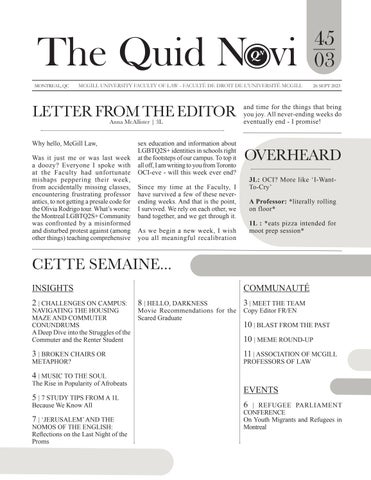
LETTER FROM THE EDITOR Anna McAllister | 3L
Why hello, McGill Law, Was it just me or was last week a doozy? Everyone I spoke with at the Faculty had unfortunate mishaps peppering their week, from accidentally missing classes, encountering frustrating professor antics, to not getting a presale code for the Olivia Rodrigo tour. What’s worse: the Montreal LGBTQ2S+ Community was confronted by a misinformed and disturbed protest against (among other things) teaching comprehensive
sex education and information about LGBTQ2S+ identities in schools right at the footsteps of our campus. To top it all off, I am writing to you from Toronto OCI-eve - will this week ever end? Since my time at the Faculty, I have survived a few of these neverending weeks. And that is the point, I survived. We rely on each other, we band together, and we get through it. As we begin a new week, I wish you all meaningful recalibration
26 SEPT 2023
and time for the things that bring you joy. All never-ending weeks do eventually end - I promise!
OVERHEARD 3L: OCI? More like ‘I-WantTo-Cry’ A Professor: *literally rolling on floor* 1L : *eats pizza intended for moot prep session*
CETTE SEMAINE... INSIGHTS 2 | CHALLENGES ON CAMPUS:
NAVIGATING THE HOUSING MAZE AND COMMUTER CONUNDRUMS A Deep Dive into the Struggles of the Commuter and the Renter Student
3 | BROKEN CHAIRS OR METAPHOR?
COMMUNAUTÉ 8 | HELLO, DARKNESS
Movie Recommendations for the Scared Graduate
3 | MEET THE TEAM Copy Editor FR/EN
10 | BLAST FROM THE PAST 10 | MEME ROUND-UP 11 | ASSOCIATION OF MCGILL PROFESSORS OF LAW
4 | MUSIC TO THE SOUL
The Rise in Popularity of Afrobeats
5 | 7 STUDY TIPS FROM A 1L Because We Know All
7 | ‘JERUSALEM’ AND THE
NOMOS OF THE ENGLISH: Reflections on the Last Night of the Proms
EVENTS 6 | REFUGEE PARLIAMENT CONFERENCE On Youth Migrants and Refugees in Montreal
Vol 45 ● No 03
CHALLENGES ON CAMPUS: NAVIGATING THE HOUSING MAZE AND COMMUTER CONUNDRUMS A deep dive into the struggles of the commuter and the renter student Sophie Rehel | 1L
QUID NOVI • 26 SEPT 2023
With back-to-school season back in full swing, I’m sure many of us have noticed a variety of unwelcome changes - the number of hours in a day seemingly decreasing and the number of dollars in your bank account following the same pattern. Every student has a set of hurdles they must clear simply to make it to campus on a daily basis, whether it be a monthly rent payment for a mouldy, questionably insulted apartment or a 2-hour long commute complete with bus, metro, and train rides. Whichever set of circumstances applies to you, the housing crisis and often lacklustre transit options are current issues which undeniably hit students close to home. The daily reality of the average university student is complete with crowded apartments, record-breaking housing prices, and a transit system struggling to balance increasing deficits with an ambitious 10-year plan. For students renting apartments and favouring proximity to campus amid the rising cost of living, balancing affordability and comfort has never been more difficult. With an influx of international, out-of-province, and local students moving to the downtown area to pursue their education, both universities and boroughs are struggling to keep up with an ever-growing demand for low-income housing. A recent study conducted by l’Unité de travail pour l’implantation de logement étudiant (UTILE) found that rent payments have increased by 20% over the past 2 years alone.1 Of the nearly 200,000 student renters in Montreal, only 50% make more than $20,000 https://globalnews.ca/news/9900874/ montreal-area-students-face-housingcrunch/ 1
2
annually. Facing these circumstances, students are opting to share spaces and split astronomical rent payments between groups. However, with spaces shrinking and groups growing, many are making tough decisions regarding their living situations. The level of overcrowding, with upwards of 3 students living in accommodations with one single bedroom, has reached an entirely new height. UTILE, a Montreal-based non-profit organization, is attempting to tackle the housing crisis and ease the financial burden carried by students in several cities across Quebec. Along with conducting research regarding the realities of student housing in the province, UTILE is currently in the process of bringing several affordable housing projects to fruition. By 2025, the organization aims to provide 1,500 rooms to student renters with the ultimate goal of housing 10% of the student population.2The organization is behind several housing projects which currently provide accessible units to students at below-market prices, including the recently constructed Woodnote building in the Plateau Mont-Royal. For those living off the island, the general lack of reliable public transit and predominantly car-centric infrastructure continue to hinder student mobility. Students who rely on public transportation find themselves grappling with unreliable, underfunded, and environmentally unsustainable transit options. In addition to the stress of long and unpredictable commutes, the unfortunate reality of the housing market remains a deciding factor for commuters as well, opting to lose
valuable hours to transit rather than rent. The concept of cities which can be navigated remains lost to most suburbs, despite an ever-increasing number of studies detailing their health, wellness, and environmental benefits. With the unveiling of the REM’s South Shore light-rail trains this summer, commuters’ lives appeared to be getting easier. The North Shore, West Island, and Centre of Montreal segments, which have remained inactive since construction began in 2021, are scheduled to be completed towards the end of 2024.3 However, what appears to be a positive and sustainable change for those commuting to the South Shore has proven to be both inconvenient and expensive. The debut of the new REM line comes with a non-competition clause, triggering the discontinuation of all existing bus lines providing service to the region. For many commuters, this will result in longer travel distances and more transfers between different modes of transportation.4Additionally, the price of monthly fares will nearly triple along with the added cost of parking at the stations themselves. Even as an avid supporter of the shift towards sustainable public transit, the issues facing the sector are undeniable. The inverse relationship between investments and revenues continues to grow with each passing year, digging dreams of expansion into a deeper deficit. Organizations such as TRANSIT are calling to update measures including the gas https://globalnews.ca/news/9847482/ rem-light-rail-changes-south-shorecommuters/ 3
https://rem.info/en/under-construction/ work-schedule 4
2
https://www.utile.org/en/home
tax, non-residential parking task, and vehicle registration costs in order to supplement the province’s ambitious plans.5 However, as public transit continues to lag in its development outside of urban centres, the immediate consequences of these measures remain a subject of heated debate. While the province battles rising housing costs and ramps up its pursuit of sustainable development, https://montreal.ctvnews.ca/groupsoffer-funding-solutions-for-quebec-s-strapped-public-transit-sector-1.6336300 5
students and vulnerable groups will likely continue to face the brunt of the blind spots. With new luxury condo developments popping up monthly and increasing attempts to disincentivize the use of cars as primary modes of transport, there seems to be a serious disconnect between the needs of the average citizen and the current services available to them. In anticipation of the projects proposed by organizations such as UTILE and the Minister of Transport and Sustainable Mobility, we can only hope that the coming years will ease the burden of daily activities and continue to develop in favour of accessible and sustainable living.
BROKEN CHAIRS OR METAPHOR? Chantal Prouse| 2L
This is more than just a broken chair that refuses to bend to our desire for comfort: It is a metaphor for the dangers of not learning law in a transsystemic environment. Just as the chair is stuck in one position and cannot accommodate various people’s heights, a lawyer versed in only one legal tradition may lack the creativity and imagination to resolve complex disputes. McGill has gone above and beyond yet again to emphasize the value of our legal education!
MEET THE QUID Copy Editor FR/EN Kim Baronet | 3L
Where are you from / where have you lived? I am from Québec city, but I’ve lived in Ottawa during my undergrad, in Nijmegen (Netherlands) as an exchange student, and in Kampala (Uganda) this summer for an internship with Refugee Law Project. What drew you to the Quid? I wanted to be on the Quid because student journals are a great and easy way to connect with your community and read fun articles every week! I’m happy to help keep the students informed of the faculty’s tea. I’ve also been involved with student journals in the past so it felt natural. What did you do before McGill Law? J’ai fait mon BI au cégep Garneau en Langues et Engagement International, puis mon baccalauréat à l’université Carleton en Études Globales et Internationales avec spécialisation en Droit et Justice Sociale. Enfin, j’ai décidé de retourner à Québec pour faire un certificat à l’Université Laval sur les Oeuvres Marquantes de la Culture Occidentale, bref j’ai lu beaucoup de livres.
Quel était ton cours préféré avant de commencer à la faculté de droit? All the classes for my certificate at Laval were amazing, it was basically a year-long book club on different topics. I had the best time and wish I could do it again as they change the curriculum every year! Was law school a dream come true or a happy accident? Do you want to be a lawyer? Since my international law courses were the best part of my undergrad, law school seemed like the obvious choice and I really enjoy the classes I’ve been taking so far. Qu’aimes-tu faire quand tu n’étudies pas ? I love to read and go on walks with my dog Django. He also gives the best snuggles. As-tu un quartier préféré à Montréal? I’m biased for the Old Port as that’s where Django and I live. I love the coffee shops, the restaurants, and the many dogs that are always walking around. The streets are beautifully decorated during the winter months and the summer months are always vibrant with the many activities and markets. Où aimerais-tu travailler dans cinq ans? Honestly, the only goal is to actually have a job. I wouldn’t mind being anywhere in the world. 3
Vol 45 ● No 03
MUSIC TO THE SOUL The Rise in Popularity of Afrobeats Ritchie Ngieme | 1L
You’ve heard it, I’ve heard it, we’ve all heard it. Whether it is through viral Tiktok dance challenges or in some of your favorite movies, the rising trend of Afrobeats might, at first glance, seem like a phenomenon that is taking the world by storm without proper explanation as to why it is successfully doing it. The reality is that, for several decades, the genre was already established within Western Africa as well as in other Sub-Saharan regions of the continent. While I do not claim to possess any psychic abilities, I believe that it is important to illustrate a comprehensive guide to understand what the globalization of Afrobeats means for the future of Africa’s cultural and economic spheres.
QUID NOVI • 26 SEPT 2023
A Little Bit of History I must admit that, as a proud enthusiast of this style of music, I was pleasantly surprised to learn that Afrobeats’ predecessor was…Afrobeat? I am aware that one would struggle to see the contrast between the two, aside from the missing “s”. But the difference is real. The origins of Afrobeat can be traced back to the early twentieth century in Ghana, where artists orchestrated blends between local sounds, American jazz, as well as Caribbean melodies (otherwise known as calypso).1 Quite an interesting mixture if you ask me. From these experimental melodies, the genre slowly expanded, until a Nigerian artist named Fela Kuti greatly popularized Afrobeat in the 1970s, by redefining some of its components.2 What started out as a fusion between traditional Ghanian music, jazz, and calypso evolved into a colorful mix that included major pop and rock influences.3 Not to mention that Kuti did not shy away from using his music as a vessel to address social issues in Africa.4 Who would have thought that such a movement would be the precursor of what is known today as “Afrobeats”? One must not confuse the two genres though, as they are indeed very distinct in sound. Whereas Afrobeat has prominent jazzy components, today’s term Afrobeats is loosely employed to describe the mix between a plethora of genres, including dancehall, West African hip-hop, house music and so many others.5 To help you make the 1
“Guide to Afrobeat Music: A Brief History of Afrobeat - 2023”, online: MasterClass<https://www.masterclass.com/articles/afrobeat-music-guide>. 2 “Afrobeat: 1970”, online: Jazz History Tree <https://www.jazzhistorytree.com/afrobeat-1970/>. 3
“Guide to Afrobeat Music: A Brief History of Afrobeat - 2023”, online: MasterClass<https://www.masterclass.com/articles/afrobeat-music-guide>. 4 Ibid. 5
4
Ibid.
distinction, think of a plate of food that you would order at a restaurant compared to a plate of food that you assemble at a buffet. One is more amalgamated than the other, no?
Nigerian singer-songwriter Tems at the 2023 Grammy Awards. Link: https://www.vogue.com/slideshow/tems-wore-viviennewestwood-for-her-inaugural-grammys-award-show Photo by Bet Bettencourt
Increasing Globalization When I pondered about what I wanted to convey in this article, I could not help but to reflect on how the perception of Afrobeats has changed over the last decade. If I played a Burna Boy or Wizkid song seven years ago in high school, I would have been labeled as “different” or “quirky”. As of today, it is almost impossible to attend a large event without hearing Rema’s hit song “Calm Down”. This is the lived experience of many Black people, who like myself, were intensely judged for our music choices back then, but embraced today. If you are wondering where I am going with this, then the answer is simple; the example that I provided, albeit sad, is a testament to how globalization can alter people’s taste and opinion. Thanks to social media, Afrobeats is highly accessible which is not very surprising, considering that it lends itself well to dance challenges. More importantly, Afrobeats is highly endorsed by American celebrities. To give you a brief example, FUTURE and Drake’s single “Wait For You” ascended at the very top of the Billboard charts only a week after its release back in 2022.6 In that song, the rappers sampled a Nigerian singer-songwriter known as Tems, and her voice served as one of the key components of the soundtrack. It is important to note that Tems was already an established artist in her own right. However, the exposure that she received following the release of the single propelled her career to new heights. Inversely, now that several Afrobeats artists like Davido, Fireboy DML or Kizz Daniel have reached the international scene, it is normal to witness an increase of American artists wanting to collaborate with them. Think of Chris Brown collaborating with Rema,7or Nicki Minaj being featured on Davido’s A Better 6
Trust, Gary. “Future, Drake & Tems’ ‘Wait For U’ Debuts at No. 1 on Billboard Hot 100”, (18 April 2023), online: Billboard <https://www.billboard.com/music/ chart-beat/future-drake-tems-wait-for-u-hot-100-chart-debut-1235068559/>. 7 Fidelis, Chiamaka. “Rema And Chris Brown Link Up In U.S, Set For A New Collaboration”, (15 February 2022), online: tooXclusive <https:// tooxclusive.com/rema-and-chris-brown-link-up-for-a-new-collaboration/>.
Time album.8 These examples represent how globalization entails benefits which are two-fold; on one end the marketing is profitable for Western artists. On the other end, Afrobeats singers get the opportunity to reach a wider audience. What Does This Mean for Africa? It is no secret that Afrobeats’ raging popularity across the globe has helped Africa flourish in more ways than one. The way in which West African artists manage to incorporate such rhythmic complexity to their songs while telling their story is nothing short of incredible. Through the vast exposure the world has had to Afrobeats, many people have started to be more aware and somewhat curious regarding other cultural aspects of Africa as a whole. If you want proof, take a quick glance at Ghana’s tourism industry. Just last year, the country registered a 47% increase in international tourism compared to 2021 and generated over $2.5 billion from that exponential increase.9 I will confess that, at first, it was hard for me to hide my excitement upon seeing these numbers. If anything, they demonstrate that a collective effort to promote what Africa has to offer could greatly strengthen the continent’s economy. More and more people are starting to realize that Africa is not a monolith, and that it holds so much that has yet to be explored. More than anything, Afrobeats is a unifying thread among all Black people, no matter if one comes from Congo, Jamaica, Burundi or Nigeria. Through these songs, each and every one of us can identify something that brings us life and puts a smile on our faces. At the end of day, shouldn’t that be what music is all about? So, the next time you’re catching the metro and blasting a foreign artist’s song before attending a dreaded lecture, listen closely to the words and try to think of it as an opportunity to immerse yourself in a new culture.
7 STUDY TIPS FROM A 1L Because we know all. Nathan Penman | 1L
Have you found law school to be difficult at times? Ever wished you knew ‘the secret’ to impressing your professors? Want a 1L to give you unsolicited advice? If you answered yes to any of these questions, you’re in luck! Here are the seven tips you need to know to ‘Elle Woods’ this thing we call law school. You’re going to want to spend at least five hours on that optional reading. A reading should feel akin to ‘stirring concrete with your eyelashes.’ And most important among the readings are optional ones! During exams, the other students will be referring to ‘required’ readings, so surprise your professors with your in-depth knowledge of content only ambiguously related to the course! Diamonds are made under pressure. Due tomorrow? Do tomorrow. Your body was made to secrete enzymes called stress and anxiety that will propel you to your academic potential. You should really listen to that serial killer podcast while doing your crim. readings. Get into the mood, the spirit, the essence of finding that ratio decidendi. How else will you unleash your inner Annalise Keating? Difficulties with French? Watch Suits with French subtitles. If it’s not something the French-dubbed Harvey Specter would say, then it’s not something you need to know for law school. The law library is the perfect place to spill tea. Literally or figuratively. Sure, there may be other students working hard around you, But trust me; who you saw this weekend is much more interesting than whatever they’re doing.
Burna Boy, known as the “African Giant”. Link: https://www.vulture.com/2020/08/song-review-burnaboy-level-up.html Photo by Amy Sussman/Getty Images for Warner Music
Read in your sleep. If the five-hour-reading approach isn’t working for you, pop those headphones on and listen to your readings while you sleep. It is, of course, undisputed that we only consciously use 10% of our brain; so, access the other 90% of that big brain of yours and listen to your readings in your sleep.
8
Nigeria, Guardian. “Davido Announces New Album And Nicki Minaj Feature”, (3 May 2020), online: The Guardian Nigeria News - Nigeria and World News <https://guardian.ng/life/davido-announces-new-album-and-nicki-minaj-feature/>. 9 Williams, By: Kojo Bentum. “Ghana generates over $2.5 billion from 914, 892 international tourists in 2022”, (7 April 2023), online: Voyages Afriq <https://voyagesafriq. com/2023/04/04/ghana-generates-2-5-billion-914-892-international-tourists-2022/>.
Write a Quid article instead of doing your readings. Nemo iudex in causa sua? If you follow this advice, I accept no legal responsibility, liability, or any other obligation I’ve seen in a syllabus. Please don’t tort me. 5
6
QUID NOVI • 26 SEPT 2023
‘JERUSALEM’ AND THE NOMOS OF THE ENGLISH Reflections on the Last Night of the Proms Anonymous | Law Student
I will not cease from Mental Fight, Nor shall my sword sleep in my hand: Till we have built Jerusalem, In England’s green & pleasant Land.1 British public life is distinctly musical. The FA Cup, the country’s oldest soccer competition, is always marked by a performance of Abide With Me; Remembrance Sunday with The Last Post; Christmas with Messiah; and, as we witnessed this spring, the coronation of a new monarch with Zadok the Priest. For a great many Britons, what occupies the forefront of their minds musically is the Last Night of the Proms, the closing of one of the world’s great music festivals. It is tradition to end the festival with a performance of British patriotic songs, and the crowd is encouraged to join in.1 Hoping to introduce my little family to a piece of my cultural inheritance (my grandfather, particularly, was a devotee), we decided to watch a recording of this year’s performance together.2 My wife, an American, found the last half hour very moving in spite of its content. Wood’s Fantasia on British Sea Songs is followed by Rule, Brittania and Land of Hope and Glory, and the night culminates in God Save the King, the national anthem. Taking pride of place, though, is Jerusalem, the penultimate song. You may know this song from its other appearances in British life: in many sporting contexts,
Jerusalem acts as the national anthem,3 and among British Republicans, it is often suggested as a full-time replacement for God Save the King. On its face, this is quite strange. Jerusalem is the setting of a poem by William Blake arranged by the great composer Sir Edward Elgar. The text does not match what one might expect in a patriotic hymn at all, saying only that England is “green” and “pleasant.” Compared to Land of Hope and Glory’s “mother of the free” with “fame as ancient as the days,” (let alone the triumphalism of Rule, Brittania) this almost seems like faint praise. There are three movements in the song: it begins with verses about a mythical visit by Jesus and Joseph of Arimathea to Britain during the years of His life that are unrecorded in the Bible (from about age 7 to age 30), proceeds to lament how Britain has degraded from that state, and ends with an invocation of the Christian apocalypse and a call to arms.4 The scenes we saw on our replay of the concert were consequently of citizens of one of the most secular countries on earth vowing not to cease until Satan has been defeated and Britain rebuilt as Jerusalem. I described the poem as myth, and I think this is a clue to what is going on.
1
William Blake, “And Did Those Feet in Ancient Time,” (1810), online: https://www.poetryfoundation.org/poems/54684/jerusalem-and-did-thosefeet-in-ancient-time.
Blake advances a thesis about Britain: that it has ancient roots; that, in the industrial age, its glory and beauty have diminished; and that British life is ordered to the nation’s redemption.5 The narrator speaks in the first person and in the imperative, stating “bring me my bow of burning gold…” and “I will not cease…” The participatory nature of the hymn at the proms (or indeed at a cricket match or rugby union) therefore allows it to act as a public vow or a credo. It is an affirmation that Britain once was Jerusalem and a commitment to make it so again. This strikes close to the centre of the British nomos, or “normative universe” which is located and defined by narrative.6 Blake did not create the British normative universe, but public and repeated singing of his poem gives life to those norms and allows them to become embodied in its singers. I will conclude with one expression of those norms which you will be familiar with. In British tort law, the Reasonable Person is constructed in the image of Christ. Lord Atkin in Donoghue v. Stevenson assumes that there exists a “rule that you are to love your neighbour,” which the Reasonable Person is aware of and expected to follow and, from this, proceeds the general law of negligence.7 If something like “act in such a way as builds Jerusalem on England’s green and pleasant land” is close to the core of the British moral universe, this decision, and the ongoing decision to keep it at the centre of tort law, is a logical one. If you are unconvinced that Blake helps us understand Donoghue v. Stevenson, then I at least hope I have convinced you to give the Last Night of the Proms a listen. It may or may not give you any insight into the psychology of the English people, but I assure you that it will be worth your while. 5
3
Traditionally, God Save the King was the final song, after which the crowd would spontaneously sing Auld Lang Syne. Auld Lang Syne has since been added to the official program.
Certainly not unique to Blake, of course. Compare J.R.R. Tolkien’s essay “On Fairy Stories.” 6
Robert M. Cover, “Nomos and Narrative” (1983) 97:1 Harv. LR 4 at 4.
2
Accessible here: https://www.youtube.com/ watch?v=L3qLWXUcltw.
4
C.f. Revelation 21:1-3.
7
Donoghue v. Stevenson, 1932 UKHL 100 at p.7.
7
Vol 45 ● No 03
HELLO, DARKNESS Movie Recommendations for the Scared Graduate Rose-Marie Maniatakos | 4L
Are you a 4L with a graduation date looming over your head? Do you dread leaving the cozy comforts of school and starting your life? Are you quaking at the idea of having to work on Fridays? Here, I employ my concerning amount of movie knowledge to propose to you three films that, though they may not solve the existential issues created by leaving beloved law school behind, will hopefully make you feel like your postgraduation plans aren’t so bad after all. 1. The Graduate (1967) Dir.: Mike Nichols Mrs. Robinson aside, The Graduate is an excellent case study on the student who leaves school on a high, only to realise a little too late that their life has already begun. Dustin Hoffman plays Benjamin, the eponymous graduate who enjoys his parents’ swimming pool to his heart’s content while being incessantly asked what he intends to do with his life. Apparently, putting his scuba gear to good use is not an acceptable answer. Nonetheless, Benjamin tries his best to navigate this new world of adulthood. He may not always succeed, but the attempt is sincere. There is one issue with this film if you grew up with the internet, and that is its sincere use of The Sound of Silence by Simon and Garfunkel. Heed my warning – it is played in full force at the most inopportune moments of the film. Remember that at the time of filming, this song was a beautifully crafted ballad, not yet warped by the bizarre internet humour of the future. QUID NOVI • 26 SEPT 2023
Mr. Braddock: Would you mind telling me then
what those four years of college were for? What was the point of all that hard work? Benjamin: You got me.
Dustin Hoffman dons his scuba gear to figure his life out in The Graduate (1967).
2.
Kicking and Screaming (1995)
Dir.: Noah Baumbach In his directorial debut, Baumbach teases out the question on every graduating cohort’s mind since the creation of universities: what now? For the film’s protagonists, the answer is nothing. Indeed, the four of them try to accomplish the most nothing possible in their first year post-grad. Moving to the big city? Try moving back to your old college campus and retaking classes for fun, hoping to impress undergrads with your abundance of knowledge. A film perfect for those who need to remember that graduation is the crucial end of something.
Max: I’m too nostalgic. I’ll admit it. Skippy: We graduated four months ago. What can you possibly be nostalgic for? Max: I’m nostalgic for conversations I had yesterday. I’ve begun reminiscing events before they even occur. I’m reminiscing this right now. I can’t go to the bar 8
because I’ve already looked back on it in my memory... and I didn’t have a good time.
3.
The Worst Person in the World (2021)
Dir.: Joachim Trier It’s hard for any law student to pinpoint exactly what the future holds – the legal world is so broad that so many changes can occur in any given person’s career, from a change in jurisdiction to a change in industry. I make it a habit to look up names from the graduate mosaics that decorate the walls of our faculty (admittedly, I’m not only curious but at times also in need of career ideas). I can confirm that most of McGill Law’s graduates take on often surprising twists and turns, a reminder that our careers will continuously evolve through time.
Josh Hamilton and Olivia d’Abo in Kicking and Screaming (1995).
Julie, or the worst person in the world, is no different. She’s a medical student. And then a photographer. And a writer. She’s married, but single. She wants children one day… or never. Trier’s delicate writing takes us down the path of a woman who has no idea what she wants and reminds us why we cannot fault her for it – everyone is the worst at some point. Central to the telling of this story is simultaneous sympathy and frustration for a protagonist who sometimes realises too late that her confused life choices must be balanced against the emotions of those around her.
Karianne: Julie, is there anything you’d like to do, as a career? Ole Magnus: Questions, questions, Karianne. That question was vulgar when we were students.
Renate Reinsve as The Worst Person in the World.
9
Vol 45 ● No 03
MEME ROUND UP Send us your memes!
BLAST FROM THE PAST
Spicing Things Up
QUID NOVI • 26 SEPT 2023
Since the Quid has existed for over 40 years, it is no surprise that from time-to-time the editors have attempted to spice things up to keep our relationship with our readers feeling exciting. Take this short-lived segment from 2004 for example. We are always open to your ideas McGill Law, no matter how vanilla (or not) they may be.
10
11
EDITOR-IN-CHIEF RÉDACTRICE EN CHEF Anna McAllister SOCIAL MEDIA DIRECTOR DIRECTRICE DES RÉSEAUX SOCIAUX Gabrielle Torrealba DIRECTOR OF DISTRIBUTION DIRECTEUR DE DISTRIBUTION Kamil Chaoui ART DIRECTOR AND LAYOUT EDITOR DIRECTRICE ARTISTIQUE ET ÉDITRICE DE MISE EN PAGE Souang Wu Amy Huang COPY EDITORS SECRÉTAIRES DE RÉDACTION Kim Baronet Jaime Fabian Wisaal Jahangir Karla Tejeda-Iglesias COLUMNISTS CHRONIQUEURES ET CHRONIQUEUSES Rose-Marie Maniatakos Ritchie Ngieme Nathan Penman Sophie Rehel CONTRIBUTORS CONTRIBUTEURS Chantal Prouse Special thanks to Prairie Koo for designing the layout. ~ The Quid Novi is published weekly by the students of the Faculty of Law at McGill University. Production is made possible through the direct support of students. All contents copyright © 2023 Quid Novi.
Les opinions exprimées sont propres aux auteurs et ne réflètent pas nécessairement celles de l’équipe du Quid Novi. The content of this publication does not necessarily reflect the views of the McGill Law Students’ Association or of McGill University. Envoyez vos commentaires ou articles avant jeudi 17h00 à quid.law@mcgill.ca. Toute contribution doit indiquer le nom de l’auteur, son année d’étude ainsi qu’un titre et un sous -titre pour l’article. Les images doivent être soumises séparément. L’article ne sera publié qu’à la discrétion du comité de rédaction, qui basera sa décision sur la politique de rédaction disponible sur notre Facebook @quidnovi.mcgill.