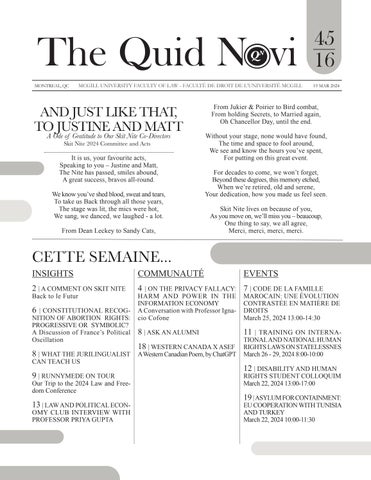
The Quid Novi MONTREAL, QC
MCGILL UNIVERSITY FACULTY OF LAW - FACULTÉ DE DROIT DE L’UNIVERSITÉ MCGILL
AND JUST LIKE THAT, TO JUSTINE AND MATT A Ode of Gratitude to Our Skit Nite Co-Directors Skit Nite 2024 Committee and Acts
It is us, your favourite acts, Speaking to you – Justine and Matt, The Nite has passed, smiles abound, A great success, bravos all-round. We know you’ve shed blood, sweat and tears, To take us Back through all those years, The stage was lit, the mics were hot, We sang, we danced, we laughed - a lot. From Dean Leckey to Sandy Cats,
45 16 19 MAR 2024
From Jukier & Poirier to Bird combat, From holding Secrets, to Married again, Oh Chancellor Day, until the end. Without your stage, none would have found, The time and space to fool around, We see and know the hours you’ve spent, For putting on this great event. For decades to come, we won’t forget, Beyond these degrees, this memory etched, When we’re retired, old and serene, Your dedication, how you made us feel seen. Skit Nite lives on because of you, As you move on, we’ll miss you – beaucoup, One thing to say, we all agree, Merci, merci, merci, merci.
CETTE SEMAINE... INSIGHTS
COMMUNAUTÉ
2 | A COMMENT ON SKIT NITE
4 | ON THE PRIVACY FALLACY: 7 | CODE DE LA FAMILLE
Back to le Futur
6 | CONSTITUTIONAL RECOGNITION OF ABORTION RIGHTS: PROGRESSIVE OR SYMBOLIC? A Discussion of France’s Political Oscillation
8 | WHAT THE JURILINGUALIST CAN TEACH US
9 | RUNNYMEDE ON TOUR
Our Trip to the 2024 Law and Freedom Conference
13 | LAW AND POLITICAL ECON-
OMY CLUB INTERVIEW WITH PROFESSOR PRIYA GUPTA
EVENTS
HARM AND POWER IN THE INFORMATION ECONOMY A Conversation with Professor Ignacio Cofone
MAROCAIN: UNE ÉVOLUTION CONTRASTÉE EN MATIÈRE DE DROITS March 25, 2024 13:00-14:30
8 | ASK AN ALUMNI
11 | TRAINING ON INTERNA-
18 | WESTERN CANADA X ASEF
A Western Canadian Poem, by ChatGPT
TIONAL AND NATIONAL HUMAN RIGHTS LAWS ON STATELESSNES March 26 - 29, 2024 8:00-10:00
12 | DISABILITY AND HUMAN
RIGHTS STUDENT COLLOQUIM March 22, 2024 13:00-17:00
19 | ASYLUM FOR CONTAINMENT:
EU COOPERATION WITH TUNISIA AND TURKEY March 22, 2024 10:00-11:30
Vol 45 ● No 16
A COMMENT ON SKIT NITE Back to le Futur
Nicolas Kamran | 4L
QUID NOVI • 19 MARCH 2024
The challenges of a Skit Nite review are not unlike those of Skit Nite itself: speaking to a common experience, avoiding cliché. Truth without triteness. The worn, used thought does not interest us even if faithful to a shared reality. At the risk of giving all this more thought than it probably deserves—a risk I am all too willing to take—it seems to me that the pitfall of Skit Nite lies here, that the very reality that it is tasked with satirising is steeped in cliché and repetition. We want to say something true about what it means to be a McGill Law student, and we immediately risk falling into redundancy and platitude. Yet it seems to me that the triumph of Skit Nite lies here as well, that it allows us to feel a little less alone in a redundant world. For the student frustrated with the enforced average, SAO response times, lack of compensation, passive bilingualism, organised recruitment, or the general elusiveness of a transsystemic legal education, Skit Nite is a reminder that we have all, at some point, felt the same. This is a kindness we should not take for granted. It is a thin and transient solidarity, but it is real and hard-won. I say ‘hard-won’ in two senses. The first is literal and should be rather obvious to anyone who attended: Skit Nite was a ‘win’, and an extreme logistical feat. Our performers and showrunners poured in hundreds of hours into thinking this through—the location, sponsors, writing, rehearsals, choreographies, impressions, outfits, lighting, sound, promotion. Our esteemed VP Ongoing Events, the formidable Matthew Boulden, even wrote a 4000-word piece in the Quid Novi on the history of Skit Nite—that’s one half of a writing requirement. And what remains seared into my mind is the notion that none of this needed to happen. No one forced our fellow McGillians to work so hard to make us laugh, but they did it anyway. They did so, I should note, under the capable leadership of Skit Nite Co-Directors Matthew Boulden and Justine Blanchette-Sirois. Matt and Justine also headed Skit Nite ‘23: La Renaissance, reviving it from its pandemic dormancy and turning it into a spectacle which—according to several Skit Nite alumni— surpassed our predecessors’ wildest dreams. No one forced this duo to invest hundreds of hours to bring back this Faculty tradition, but they did anyway. Thank you. Singing has always struck me as a remarkably vulnerable, intimate act, whether alone or before an audience. No one forced the Dean to sing for us, yet sing he did—and remarkably well at that—with the brilliant 2
Amy Huang accompanying him on piano. Thank you. The true mark of understanding is to speak with simplicity and humour. This is something that the showstopping Emma Butson and Dexter Deveau managed to pull off once more in ‘Married to the Law’. Emma makes a convincing common law in her impassioned pleas for consideration, and Dexter a familiarly resolute if curmudgeonly civil law. Professor Fox-Decent was a pleasant sight for many a comrade and fellow-traveller. All were hilarious from start to finish. No one forced them to get up on stage once again for us, yet they did. Thank you. Not being much of a ‘Hamilton’ fan myself, nor quite in touch with musical theatre at all, I can nonetheless appreciate the amount of preparation Nate Saad’s ‘L’Honorable François Legault’ must have demanded. He did not miss a beat, staying laser-focused throughout his performance as two back-up dancers swirled around him. His lyrics were sharp, trenchant rebukes to our premier’s politics of division. No one forced a 1L with plenty of other things to which he surely needed to attend do all this for us, yet he did. Thank you. Law school carries its share of emotional experiences, from excitement to disappointment, gratitude to outrage, relief to anxiety. Yet I get the sense that it is rarely sweet. Ian Marcoux and Anna Sas’s ‘Oh Chancellor Day’, sung to the tune of Dassin’s ‘Les ChampsElysées’, was a heartening exception to this trend. I felt closer to my peers for hearing them sing, and this is a tremendous gift. No one forced them to get up there and share their warmth with us, yet they did. Thank you. At its best, Skit Nite enables you to see your peers, professors, and administrative staff beyond their institutional roles and identities. This is exactly what we got to see with our very own McGill Law profs, be it those who participated in the hilarious ‘We’re McGill Law Profs’, Professors Jukier and Poirier in their sensational ‘Pouvez-Vous’ number (performed to the tune of ABBA’s ‘Voulez-Vous’), or the emerging superstars of solidarity in the Sandy Cats. Actively choosing to not take yourselves too seriously enables us to feel as though we form a genuine human community beyond papers, exams, references, and admissions. None of you were forced to get up there and show this side of yourselves, yet you did. Thank you. I am impressed by most, if not every person I meet at the Faculty of Law. Rarely often have I seen someone
and asked, ‘what are you even doing here in the first place?’ Please take it in the best way possible when I say that Corey Mandelzys is an exception to this latter trend: Corey, pal, you belong on the big screen. In ‘The Secret’, Corey’s long-awaited follow-up to his 2023 magnum opus ‘A Normative Interrogation’, we get yet another high-quality production—this time starring our very own LSA President Justine Blanchette-Sirois, Dean Leckey, a brief cameo from Matthew Boulden, and Corey himself. The camerawork and soundtrack complement a plot of humour, mystery, and genuine profundity. The performances hit every mark. Without giving away too much about ‘The Secret’ for those who have not yet seen it, I will tell you that it is all true: Law school is about friendship and memory, and yes, I can confirm that I have barely seen Corey participate in (let alone show up to) class in our shared threeand-a-half years here. The short film was a magnificent send-off for the ‘Bad Boy of Law’. I will miss you, Corey, though I have no doubt that we will all soon be seeing you everywhere. No one forced you to make us laugh once again, but you did. Thank you. The will to be genuinely silly in front of others belongs to a chosen few. How fortunate are we that Josh Johnson, Ella Johnson, and Allison Bender are among that special group. Rapid-fire bird jokes, many of which flew over my head (sorry, could not resist), filled up the Club Soda for a solid couple of minutes, to the amusement of all in attendance. Not a fowl note, you absolutely murdered it. No one forced you to think this hard about birds for the sake of our laughter, yet you did. Thank you. I am old enough to remember the Quid’s Darkest Hour, those few years when its readership barely extended beyond its contributors. This was the time when Anna McAllister took over as Editor-in-Chief. What she has managed to pull off in the years since is nothing short of a Renaissance of the Quid’s own, and there is perhaps no better symbol of this renewed triumph than Skit Nite’s ‘Quick Quid Quips’. Pablo Mhanna-Sandoval and Carolina Muñoz Jasa, stepping in at the last minute, put on a performance worthy of ‘Weekend Update’. I hope all are excited as me for our pending Q-Anon launch. No one forced the Quid writers to come up with all these jokes on their free time, but they did. Thank you. In a fitting end to a marvelous night, the brilliant and multi-talented Chlöe Shahinian and Max Touchette performed ‘I’m the Code’, a parody sung to Barbie’s ‘I’m Just Ken’. The dancers, the costumes, the lyrics, the lights, not to mention the singing and the lyrics themselves—a performance worthy of a summer blockbuster. Even as Touchette’s microphone malfunctioned, his charm and composure did not waver for an instant. I thought that after July, I would be sick of seeing pink everywhere I turned. I was wrong come March 13th. No
one forced you to get on stage and put together such an elaborate performance for us, yet you did. Thank you. If you attended Skit Nite, you saw what Rayan Tibiche-Dahmoune’s friends see every day: the funniest person in the room. His performance was simply electric. In ‘the Elevator’, he made for the quintessential ‘4LOL’ student, delivering line after line of sage yet aloof advice for the anxious 1Ls in attendance. As ‘Judge Leckey’, he brought back his patented impression of the Dean as he adjudicated claims made against the student-run courses of ‘Professor Drapeau’ and ‘Professor Pious’ of the ‘Mini-Mergers-Band’. His inflections, posture—Rayan just nails it. Yet nothing tops his performance in ‘My SAO Stopped Answering’, the autotune-soaked ballad of unrequited love performed to the tune of Drake’s ‘Hotline Bling’. The dancing, the acting, the singing—Rayan is a consummate performer. Skit Nite, and this Faculty of Law, will not be the same without him. No one forced him to entertain us, yet he did. Thank you. Carolina Muñoz Jasa is a performer with an intangible yet unmistakeable talent for delivery. For a sense of what I mean, one should look no further than ‘Soliloquy of a Student with a C’. The way she scans the room with her eyes, her sense of rhythm and volume, even the sharpness with which she drew her breath at the line, ‘it was exhilarating’. Carolina elevates every sketch with her presence and instinctual humour. No one forced her to return this year for Skit Nite, yet she did, and with force. Thank you. What I have written about Carolina easily applies to Marielle McCrum: she is absolutely hilarious, and it just seems to come so naturally for her. Now, if I had to choose one single aspect of her performance that truly sets her apart, I would have to write about vocal control. In ‘The Most Wonderful Time of the Year’, a parody of Clement Clarke Moore’s ‘A Visit from St. Nicholas’ (‘Twas the night before Christmas…) centered on exam-period ‘SNAIL removal’, Marielle’s delivery is simply flawless. Every line hits exactly where it should. Tone, inflection, timbre—Marielle knows how to squeeze the humour out of every word. Once more, no one forced her to return to this year for Skit Nite, yet she did, brilliantly so. Thank you. Pablo Mhanna-Sandoval shows himself once again to be an indispensable member of the Skit Nite crew. His poise, stage presence, and sense of timing are truly exceptional—no doubt carrying over from his budding stand-up career. He is never out of place in the slightest, visibly at home before an audience. What he brings to the table will no doubt ground Skit Nite in the years to come, as he hopefully continues to pursue his own artistic ambitions. No one forced you to give your time 3
Vol 45 ● No 16 to this endeavour once again, yet you did. Thank you. Marie Jolicoeur-Becotte—the lone 1L host this year— was positively brilliant, showing immense promise for the years to come. There is little I can say beyond the fact that her performance was, in many ways, the backbone of this show. She was perfect from start to finish, her acting giving a spark of realness to every scene she touched. My personal favourite moment of hers was in ‘The Elevator’ sketch, where Marie plays the stereotypically anxious 1L late for class. Beyond nailing every single line, what was remarkable was her capacity to play off the energy of Rayan’s character—heightening the moments of contrast at precisely the right time. No one forced you to jump into this endeavour, yet you did. Thank you. Now, there is a second sense to ‘hard-won’. Beyond the triumph of Skit Nite 2024 as an event, and even beyond the impressive sum of over $11,000 we were able to raise for charity this year, there is a broader sense in which Skit Nite represents something worth celebrating: It allows us to slow down and appreciate the experience we are going through together. We rarely ever get the chance to do this, and the day-to-day grind of law school arguably militates against such an exercise.
QUID NOVI • 19 MARCH 2024
Concretely speaking, how are we taught to ‘do’ law school? Well, we are taught how to ‘brief a case,’ summarise readings, and prepare outlines. Read the case, extract the rule. Read the article, extract the argument. Discard anything that cannot be removed for future use. Take what you need and move on. Very rarely are we invited to reflect on what we are doing, what it means to us, and how it shapes the way we live among one another. Skit Nite does not take itself as a particularly profound exercise in self-reflection, and we should probably not expect it to do so. With that being said, there is a real sense in which Skit Nite is this Faculty’s prime forum of collective self-recognition. It is the only night of the year during which our McGill Law community gets together and talks about itself. This, I think, is the kind of activity that lies at the core of solidarity. It is rare, imperfect, and a labour of love—but it is a chance to feel seen and heard in one another. Skit Nite 2024 will probably be the last one I ever attend, and, in all likelihood, the last time I see many of my McGill Law peers. To see and hear you has been one of life’s greatest joys, and I will miss you tremendously. Thank you.
ON THE PRIVACY FALLACY: HARM AND POWER IN THE INFORMATION ECONOMY A Conversation with Professor Ignacio Cofone Song-Ly Tran | 3L
At the start of the Fall 2023 semester, standing before a packed classroom, Professor Ignacio Cofone casually explained that the topic of his course was undefined. Apparently, to this day, the concept of privacy evades precise meaning.1 In the months that followed, Professor Cofone unpacked the facets of privacy law for his students (including myself), grasping the nettle in the face this domain’s routine contradiction and ambiguity. Aside Privacy Law, Professor Cofone teaches Artificial Intelligence Regulation and Advanced Obligations at McGill University’s Faculty of Law and holds the Canada Research Chair in Artificial Intelligence Law and Data Governance. I (virtually) sat down with Professor Cofone to discuss his new book, The Privacy Fallacy: Harm and Power in the Digital Economy.2 Our informal conversation has been paraphrased and minimally edited for clarity. Song-Ly: In broad strokes, where would you say your book sits within the existing literature on the subject? Professor Cofone: Every academic book tries to bring something to the table that is more than one thing. This book answers the question of “so what?” by elucidating the inefficiencies of the current model and offering the solution of a responsive liability regime. In exploring the extent of the problem (of relying on consent to protect individuals’ privacy), the book differentiates itself from prior works by not only compiling different criticisms but by linking them together. It is not just that people don’t read privacy policies, or that they don’t understand these policies because of their complex and ambiguous language. It is that people cannot understand them; foreseeing potential privacy harms is impossible. Consent fails because its underlying structure is ill-suited for privacy. The failure of consent is a symptom of the current paradigm. Throughout the book, you provide the reader with reallife examples, of when privacy interests were at stake. 1 Woodrow Hartzog, “What is Privacy? That’s the Wrong Question” (2021) 88:1 The University of Chicago Law Review 1677 at 1677. 2 Ignacio Cofone, The Privacy Fallacy: Harm and Power in the Digital Economy (Cambridge: Cambridge University Press, 2023).
4
Surely, during your research over the years, you have encountered many poignant and/or usefully illustrative cases. Are there examples that you repeatedly return to? One that particularly marked me was the Grindr data sharing case and the fine levied by the Norwegian Consumer Council. Grindr is a dating app particularly marketed toward gay men but also to LGBTQ people generally. The company was sharing users’ data, including which had identified themselves as HIV positive, to third parties. This case stuck out to me because everyone involved had noticed something wrong, but it was hard to pinpoint what was wrong through the existing legal mechanism. The idea is that so long as you are not doing something prohibited, and you give notice and obtain consent, there is no harm done. This argument formed part of Grindr’s defense. The Norwegian Consumer Council found Grindr’s practices were unsatisfactory but had to perform legal gymnastics to arrive at this conclusion. This case was a clear manifestation of our laws being ineffective at protecting people. The community placed their trust in the platform, disclosing their HIV status to engage with others in a context of confidence. The company targeted a vulnerable group, gave them a false sense of safety, and exploited their trust by unnecessarily giving their information to third parties. And they were doing this for years. This case generated outrage. Morally and ethically, we do care about the choices companies make. They cannot be allowed to expose people to harm with indifference. But currently, the legal test remains: But did they breach a priorly established provision? Was consent adequately provided?
privacy, is there something to be done in the face the myriad ways in which inferential, relational, and de-identified data reveal things about us? And if I may, are there any practices you specifically implement to protect your own privacy? The problem is precisely is that there is not much individuals can do to protect themselves. In a situation of lopsided power, giving the powerless more power won’t solve the problem. It’s not about choosing between Gmail and Outlook but rather what happens on the back end. Our choices are almost irrelevant. Some things can help on the margins like not having smart home devices, having as many things as possible password enabled, keeping a password manager, or placing a sticker on your laptop camera. But while I have a sticker on my laptop, I look at my phone way more and its camera is uncovered. The one thing I would recommend people to do is to call their legislators and say we need meaningful accountability in the information economy and a system that doesn’t put all the weight on people’s shoulders. What are three books you would recommend for people interested in further exploring what privacy looks like in the information economy or may look like in the future? Read widely. But my recommendations are: (1) Why Privacy Matters? by Neil Richards, (2) The Fight for Privacy by Danielle Citron, and (3) Privacy Is Power by Carissa Véliz.
Could you unpack the difference between a privacy loss and a privacy harm and walk me through the Grindr case we just discussed under the liability regime you propose? What would not performing legal gymnastics look like in litigating privacy claims? The proposed liability regime is a mechanism that different jurisdictions could turn into a legal test. But where the conversation should go in all cases is first to ask about privacy loss: What inferences were enabled? Why was the information valuable? In the Grindr case, the information allowed third parties to be more certain about the sexuality of app users. It doesn’t matter if the information collected explicitly said that this person is gay, this person is trans, or this person is non-binary. Loss occurs when the information receiver knows more than they did before. Next, we ask about harm: What values protected by privacy were breached by the privacy loss? In this case, it is clear: the app abused users’ trust and exploited their loss of privacy for profit. As I understand it, a core message of the book is to show the ineffectiveness of a system which relies on individuals to protect themselves from privacy loss. But, for those who read this book and want to do more to protect their 5
Vol 45 ● No 16
CONSTITUTIONAL RECOGNITION OF ABORTION RIGHTS: PROGRESSIVE OR SYMBOLIC? A Discussion of France’s Political Oscillation Sophie Rehel| 1L
QUID NOVI • 19 MARCH 2024
Over the past decade, we have witnessed a surge in various manifestations of right-wing ideology. In the current digital age, the convergence of regulatory challenges and the enticing force of algorithms has not only fostered the creation and dissemination of ideas but also facilitated communication within sub-internet cultures, including incel forums and neo-Nazi groups.1 Simultaneously, many observers have likened Europe’s political landscape to a resurgence of fascism, demonstrated by Italy’s election of neo-fascist Giorgia Meloni and France’s close call with Marine Le Pen.2 Against a backdrop of heightened national and international tensions, xenophobic, sexist, and racist sentiments have reached a peak. This trend is further compounded by events like January 6th and the strategic overturning of Roe v. Wade in the United States, prompting concerns about the future of critical issues such as immigration, multiculturalism, and women’s reproductive rights. However, France made history by enshrining the right to abortion in its constitution, a move backed overwhelmingly by MPs and senators in a joint parliamentary vote.3 Despite becoming legalized in many Western nations between the 1970s and 1990s, abortion has remained a contentious and heavily debated topic within the realm of applied ethics. Despite the Supreme Court of Canada’s decrimiAidan Scully, “The Dangerous Subtlety of the Alt-Right Pipeline,” Harvard Political Review (10 October 2021), online: https:// harvardpolitics.com/alt-right-pipeline/ 2 Katya Adler, “Far-right parties on the rise across Europe,” BBC News (29 June 2023), online: https://www.bbc.com/news/ world-europe-66056375 1
Allan Woods, “France adds abortion rights to the constitution. Could it happen in Canada?,” Toronto Star (4 March 2024), online: bit.ly/3PqlC8r 3
6
nalization of abortion in 1988, Canadian women have been led to believe that the matter is settled and that further discussion or advocacy is unnecessary. However, our neighbouring nation, along with Canada’s historical background and political demographics, disproves this notion. In 1991, the late Brian Mulroney’s government introduced a bill in the House of Commons seeking to criminalize abortion, only for it to narrowly fail in the Senate.4 Fast forward to 2023, Conservative MP Cathay Wagantall’s Bill C-311 attempted to trojan horse pro-life rhetoric into criminal law by urging judges to consider harm to a pregnant victim as an aggravating factor during sentencing.5 The issue resurfaces in Canadian politics in nearly every federal election, with religious rights groups persistently advocating for restrictions on the right to choose. While 80% of French citizens support abortion rights, only approximately 57% of Canadians believe the country requires laws to guarantee abortion rights.6 As we’ve seen, legalized yet unprotected rights are far from guaranteed, leaving us vulnerable to a similar fate as the US under the right circumstances. While the act remains largely symbolic, France is the first country and only in history to enshrine the right to terminate a pregnancy in its constitution. In fact, any references to abortion in the constitutions of other nations are explicity serve to outlaw the procedure.7 However, this ‘progressive “Mulroney-era documents reveal struggle with abortion laws,” CBC News (17 November 2013), online: https://bit.ly/4aa7wA4 5 Peter Zimonjic, “Liberals, NDP call Conservative bill a ‘veiled’ attempt to roll back abortion rights,” CBC News (11 May 2023), online: bit.ly/49URQAP 6 Supra note 3 at 11. 7 Supra note 3 at 4-5. 4
feminist’ move has been criticized as out of character in a nation facing immense backlash for Islamophobic policies which disproportionately affect Muslim women. France, the original architects of what we know in Quebec as Bill 21, are arguably even stronger advocates for complete “laïcité.” The nation has created quite a reputation for itself, banning children from wearing abayas in French schools, prohibiting the wearing of the hijab and other “conspicuous religious symbols” in sports competitions, and the outwardly outlawing the niqab regardless of the circumstances.8 While the laws claim to safeguard the fundamental importance of the separation between church and state, they have largely been weaponized to single out Muslim communities under the guise of public interest. In an era marked by the resurgence of right-wing views, the significance of demonstrating solidarity with marginalized groups cannot be overlooked. In light of France’s brief progressivist stand, the international community must also confront the paradox of its simultaneous ongoing Islamophobic political campaign and hope they follow their own example in this regard. While it remains crucial to recognize that unprotected rights are inherently precarious and even favourable outcomes do not eliminate the ongoing need for advocacy, it is equally as important to be wary of disingenuous political virtue-signalling. Feminism is not meant to be an exclusionary ideology which advocates for the rights and freedoms of some but not all, and if France wishes to publicly display its unwavering support for the rights of women, it must do so for all women. Rob Picheta, “France to ban the wearing of abayas in schools, fueling accusations of Islamophobia,” CNN (28 August 2023), online: https://bit.ly/49VxffO 8
Code de la famille marocain : une évolution contrastée en matière de droits Monday, March 25, 2024 13:00 - 14:30 (ET) McGill Faculty of Law New Chancellor Day Hall Room 609 Please RSVP at chrlp.law@mcgill.ca
With
Professor Halima Bensouda
Cette communication a pour objectif de présenter et de discuter différentes dispositions du code de la famille marocain actuel, leurs applications et leurs implications, s’agissant particulièrement des droits individuels et des droits économiques. Professeure Halima Bensouda est professeure chercheure à la faculté des sciences juridiques économiques et sociales Agdal, Université Mohammed V de Rabat, membre du bureau du département de droit privé, du Laboratoire et de la Clinique juridique.
@McGillCHRLP
McGill Centre for Human Rights & Legal Pluralism
7
Vol 45 ● No 16
WHAT THE JURILINGUALIST CAN TEACH US Ordren Deko | 3L
Upon first glance, “readability” (lisibilité) and “intelligibility” (intelligibilité) appear synonymous. This makes total sense of course, given the general idea behind both concepts. If a given text is readable, that is, decipherable, then it follows that it is comprehensible to its audience. The plain English movement—born out of the 1970s with the goal of simplifying legal documents to the average person—would firmly agree. Much to their dismay, however, exists an entire discipline that remains steadfast in examining the nuance that lies between etymological lines. They are called the jurilinguists. Jurilinguistics (la jurilinguistique) originated within Canada before spreading to the rest of the world, namely France.1 The jurilinguist’s object of study is the vocabulary and discourse of jurists, with the appreciation of the specialized and technical nature of legal language. It is not simply a matter of reaching for the dictionary and translating text word by word. Rather, scholars must wrestle with the intimate relationship that exists between legal terms and the legal cultures that mark them. 2 Let us return to the example of readability and intelligibility. Per Jean-Claude Gémar, a leading jurilinguist, “there is no need to confuse these words, which don’t mean the same thing, and are therefore not synonymous.”3 He explains that the readability of a legal text depends on its form (organization, architecture, style) whereas its intelligibility results from its content (message, substance).4 But the boundJean-Claude Gémar, “De la lettre à l’esprit: l’épopée de la jurilinguistique canadienne” (2016) 46:2 RDUS 391 at 408. 2 Florence Terral, “L’empreinte culturelle des termes juridiques” (2004) 49:4 Meta 876 at 879; Jean-Claude Gémar, “Analyse jurilinguistique des concepts de ‘lisibilité’ et ‘d’intelligibilité’ de la loi” (2018) 48:2 RGD 299 at 313. 3 Jean-Claude Gémar, supra note 2 at 310 [translated by author]. 4 Ibid
ASK AN ALUMNI
QUID NOVI • 19 MARCH 2024
1
8
aries between the two disciplines are not watertight, and neither can function independently of the other.5 Such a distinction may remain nonetheless minor but it can easily balloon when the stakes are high, for example, when one is in front of a judge arguing over the contents of a will or the provisions of a contract. It is then and there that the otherwise neglected role of the jurilinguist becomes critical. Following this incisive overview, the speciality of jurilinguistics can teach us two important lessons. The first relates to one’s contribution to the progression of law. As Gérard Snow, former director of the Centre de traduction et de terminologie juridiques, states, “just as a system of law cannot evolve in a healthy way without fundamental and practical research, so too must the language used to express it be constantly studied, analyzed, and refined.”6 In embarking on such an educational journey, law students, lawyers, and judges alike are then able to deepen their knowledge before taking the next step of enacting change. The second lesson is much more global. Indeed, the methodology behind the jurilinguist’s research and the emphasis on both semantics and semiotics is worthy of imitation even outside the legal context. The constant search for definitions at the centre of jurilinguistics can equally serve a purpose in our own interactions with each other. A heightened sensitivity towards meaning can translate directly into an increased sense of empathy. To put it simply, it is not enough to understand a word or even its potential multiple connotations, but also how it will be construed according to the worldviews of those around us. Only then can we begin to understand each other. 5
Ibid.
Gérard Snow, “L’indispensable recherche jurilinguistique et ce qu’elle permet d’apprendre du droit” (2003) 5:1 RCLF 211 at 213 [translated by author]. 6
McGill Law Alumni are here to answer your pressing questions! We asked: In what (non-obvious) way has your law degree been useful to you? Amee Sandhu, LLB'98 Making me feel like I belong in any environment where there is a problem to be assessed. Especially helpful when you don't feel like you belong for social/ diversity reasons.
Tony Fata, BCL/LLB'90 On my first day of law school, I took a tour of the faculty and the upper year student leading the tour (Brad) told us that the inscription above the west entrance to NCDH, “Audi Alterum Partem” meant spare parts for Audi’s! Of course, I soon learnt the importance of “letting the other side be heard.” Although I do not practice law, my legal training, including this important maxim, has framed the way I think and approach everyday business issues. In particular, I have been able to develop my skills relating to negotiations and consensus building by trying to always understand and take into account the position and views of the person that I am interacting with.
Allan Stein, BCL'76,LLB'77 After many years you will come to realize that the study and practice of law is really the study of people and behavior. If you stick around long enough you will come to understand people and their behavior and how to represent your clients interests. You cannot learn that in the first few years.
RUNNYMEDE ON TOUR Our Trip to the 2024 Law and Freedom Confernce
By the McGill Runnymede Society: Jake McConville | 2L, Co-President; Giordano Baratta | 2L, Co-President; Will Hanna | 1L, VP
The three of us spent our first weekend of February in Toronto, at the Runnymede Society’s annual Law and Freedom conference. Law and Freedom gathers hundreds of lawyers, students, and professors from across the country for two days of conversations on the most pressing issues of the day. This year’s event was headlined by justices Lauwers and Tulloch of the Ontario Court of Appeal on Friday and justice Malcolm Rowe of the Supreme Court of Canada on Saturday. We are all grateful to the Runnymede Society and McGill’s Alumni Student Engagement fund for their generous support of our trip. Part of our goal in attending was to leverage the things we learned and the connections we made to advance conversations in our faculty. To this end, each of us will share some thoughts on a panel that stuck with us. If any of what we say here sounds interesting to you, the Runnymede Society will be posting recordings of each panel on their Runnymede Radio feed in the near future. Excerpts from Justice Rowe’s remarks are also available online at the Hub.1 Jake: “Administrative Law and Charter Values: The Path Forward” There is a younger version of me who would be horrified at my interest in administrative law. The bright-eyed second year political science student who had just read John Locke for the first time and decided that the government simply needed to get out of the The Hub Staff, “Hub Exclusive: Supreme Court Justice Malcolm Rowe on postmodernism, democracy, and judicial overreach,”The Hub, (February 5, 2024), online: <https:// thehub.ca/2024-02-05/hub-exclusive-supremecourt-justice-malcolm-rowe-on-postmodernism-democracy-and-how-much-judges-shouldbe-deciding-public-policy/>. 1
way of things has gradually come to accept that state power is legitimate.2 I am therefore now less interested in the business of demolishing the administrative state and much more interested in ensuring that state actors exercise their power properly. The conversation around “charter values,” then, is an important one, and this panel featuring Justice David Stratas, Jennifer Bernardo, Mark Mancini, and Moira Lavoie was a timely and valuable contribution.3 I’d like to focus mostly on Justice Stratas’s remarks here. Justice Stratas took us through the history of the interaction of the Charter with judicial review of administrative action, beginning with Dolphin Delivery, which established that administrative decisions are state actions, and subject to Charter review, and proceeding to Slaight, which determined that statutes can never be interpreted in a way that contradicts the Charter.4 From there we turned to Charter Values, and the recent Commission Scolaire decision.5 The Charter Values paradigm (beginning, as most of us will have learned in 1L, with Doré) overruled Slaight and broadened the standard In my defense, getting really into antique liberalism from doing your readings is one of the more tame things you can do in your undergrad, particularly as it was fashionable around that time to try to resurrect increasingly baroque dead political movements featured in Paradox games. You can thank C.B. Macpherson for curing me of my minarchism some time around fourth year. 2
Respectively: Justice of the Federal Court of Appeal; Baker McKenzie; Incoming at Thompson Rivers University; Reynolds, Mirth, Richard & Farmer LLP. 4 RWDSU v. Dolphin Delivery Ltd., 1986 2 SCR 573 ; Slaight Communications Inc. v. Davidson, 1989 1 SCR 1038 3
Commission scolaire francophone des Territoires du Nord-Ouest v. Northwest Territories (Education, Culture and Employment), 2023 SCC 31. 5
into, in the view of most of the panel, a ‘vibes-based’ one.6 Commission Scolaire, it seems. makes the standard even more ‘vibes-based,’ requiring decision-makers to consider unwritten embedded principles in the Charter. Justice Stratas, for his part, made clear to us that as a sitting judge, he has to speak mostly through his judgments, and directed us to a case called Sullivan.7 There, he dismisses an appeal to a “general, unqualified entitlement to ‘freedom’ or ‘equality’” as nonexistent in the Charter.8 Stratas’ judgment, and the other panelists’ express statements, paint a picture of an overbroad and unclear standard, which it falls to the courts to clarify. I realize I haven’t done the subject justice here – the panel was necessarily a blitz through a complex topic, and my 500 word summary here is shorter still.9 However, I thoroughly enjoyed being led through some recent and complex jurisprudence and having a light shone on some cases we read in 1L that I remembered finding confusing the first time through. Stratas was a very impressive Mancini has used “vibes” in his own writing, see: Mark Mancini, “The Metastasis of Charter Vibes...again,” The Sunday Evening Administrative Law Review, (December 10, 2023), online: https:// sear.substack.com/p/issue-117-december-10-2023. 6
Sullivan v. Canada (Attorney General), 2024 FCA 7 (CanLII). 8 Ibid. at para. 11. 7
For more commentary, alongside the Mancini article, I recommend Paul Daly, “Die Another Day: Commission scolaire francophone des Territoires du Nord-Ouest v. Northwest Territories (Education, Culture and Employment), 2023 SCC 31,” Administrative Law Matters, (December 8, 2023), online: https://www. administrativelawmatters.com/blog/2023/12/08/ die-another-day-commission-scolaire-francophone-des-territoires-du-nord-ouest-v-northwest-territories-education-culture-and-employment-2023-scc-31/. Prof. Daly was in the audience and several of the panelists mentioned his piece. 9
9
Vol 45 ● No 16 speaker and gave some insight into the challenges faced in applying doctrine that has not yet fully matured (Sullivan was rendered only a few weeks after Commission Scolaire!). I will be watching for further developments in this area of judicial review from here on.
QUID NOVI • 19 MARCH 2024
Giordano: On Justice Malcolm Rowe and Judicial Activism In whom should we entrust the capacity to dictate contentious political, social, and moral issues—the courts or the democratic will of the Canadian populace? As we come up on close to a half-century of the post-Charter age, most Canadian jurists know all too well the debate over how the Supreme Court has, to some extent, positioned itself above the citizenry by assuming a more prominent role in political decision-making. A recent example of this trend can be seen in the Carter ruling, which Chief Wagner described as having “depended on the evolution of society, the evolution of technology, evolution of medicine, evolution equally of the moral values that link most Canadians.”10 I find myself inclined to skepticism of judicial activism, and to quote the wise words of my colleagues at the University of Toronto Law Review: is it ever just that an unelected judge serves as the unilateral decider concerning the moral values of most Canadians?11 If this is less judicial “fact-finding” in the context of moral, social, and political questions, and (in actuality) ‘policy-making,’ then the words of our very own Christopher Manfredi thirty years ago were markedly prescient: we now have an “imperial” judiciary whose authority undercuts democratic institutions.12 Tonda Maccharles, “Top Judge Touts Court’s Leadership Role,” The Toronto Star, online: <https://www.pressreader.com/canada/toronto-s tar/20180624/281479277143979>. 10
Gordon Lee, “Judicial Activism and its Harms: The Supreme Court’s Flawed Interpretation of Section 7,” University of Toronto Faculty of Law Review, online: https://www.utflr.ca/blog/judicial-activism 12 Manfredi was quoted by Justice Malcolm Rowe at the 2024 Runnymede Society keynote lecture.
However, the revelation that the Supreme Court of Canada itself is not immune to debate on the judicialization of politics, as highlighted by Justice Rowe’s own insightful remarks, was refreshing to hear. On that note, Justice Rowe eloquently underscored the essence of parliamentary democracy, which inherently encourages (or rather, necessitates) the creation of practical incentives to foster compromise and deal-making among participants. This approach ensures a dynamic ‘coalition’ arises among decision-makers from issue to issue; a permanent majority therefore cannot arise, preventing the winner-take-all outcomes common in judicial decisions. Rowe’s point raises a critical question: why indeed diverge from the pragmatic paths of political negotiation to litigation as a mechanism for shaping public policy? Beyond creating questions of legitimacy, real problems arise, as noted by former constitutional scholar William Ralph Lederman: “[i]f we characterize too many things as constitutional, we put too much of potential legal change to meet societal needs beyond the reach of the flexible statutory means of change… the problem of limiting what is to be considered ‘constitutional’ in this sense is very real. The limits have to be severe. You cannot constitutionalize the whole legal system.”13 Of course, this discussion merely dips its toes into how judicialization, in handing down decisions from above (a cynic might call this “decreeing from the mountaintop”), has an intrinsic link to the ongoing crisis of political polarization in the Western world, as it circumvents the natural legislative processes required for a thriving democracy. Justice Rowe, quoting Benjamin Disraeli, sagely reminds us that the solution is not to replace the judiciary’s role in policymaking (“the confederacy of nobles”) with a purely democratic process (“the democratic
11
10
WR Lederman, “Charter Influences on Future Constitutional Reform” in David E Smith, Peter MacKinnon & John C Courtney, eds, After Meech Lake: Lessons for the Future (Saskatoon: Fifth House Publishers, 1991) at 119. 13
multitude”) but to ensure a harmonious coexistence of both forces within the Disraelian framework of ‘One-nation.’ Striking a balance to this integration of the two will be vital in years to come for the health of Canadian democracy. Will: On Cultural Comptence and Civil Discourse Of all the books I have read over the last year, Jonathan Haidt’s The Righteous Mind has perhaps had the greatest influence on my thinking.14 The book offers an accessible overview of some of the most important developments in the field of moral psychology over the last half century and attempts to provide a response to the question of why our contemporary political culture has become so divided. Haidt answers this question by showing how nearly everything in our cognitive hardwiring predisposes us to social division. Our minds have evolved, for good reasons, to make us groupish, intuitive, and unreflective beings by default. While contemporary polarization may certainly be exacerbated by novel cultural influences including technology, disinformation, and the breakdown of traditional cultural institutions, Haidt shows that it is an age-old problem. What is really extraordinary, is that we have been able to develop a public sphere premised on open communication and collaboration in the presence of deep difference.15 I was once dismissive of all the worry Haidt is one of the leading social psychologists in moral foundations theory and foremost voices on the roots of political polarization in the U.S. He is a co-author of The Coddling of the American Mind and author of The Anxious Generation (set to be published later this month). I would highly recommend his work to any student of politics who has not explored (as I had not) the intersection of psychology and the social sciences. 14
For a classical historical account of the rise and fall of the European public sphere, see Jürgen Habermas’s The Structural Transformation of the Public Sphere: An Inquiry into a Category of Bourgeois Society. Justice Rowe took issue with Habermas’s legal philosophy. I do not know how Justice Rowe would characterize their differences, but I am quite confident those differences are not around this point. 15
about the preservation of free speech – I regarded it as overly alarmist or as a covert way of advancing ulterior interests. But as I have grown older, observed first hand how breakdowns in communication can lead to breakdowns in relationships, and become more aware of the blindspots in my worldview by inhabiting different cultural and intellectual milieus, I have come to better appreciate the fundamental importance of free discussion to liberal democratic societies. With Haidt and these conclusions in mind, I decided to involve myself with Runnymede to expose myself to new ideas and to contribute to the intellectual diversity of McGill’s faculty of law. Of all the talks I attended at this year’s Law & Freedom Conference, I was most impressed by the remarks offered by Chief Justice Michael Tulloch of the Ontario Court of Appeal. In his talk, Chief Justice Tulloch, who earned his stripes as a criminal lawyer before his appointment to the bench, stressed the necessity of ‘cultural competence’ among the members of the legal profession. According to Justice Tulloch, to be culturally competent is to be able to reach across the divide, listen, and understand those whose backgrounds or beliefs differ significantly from one’s own. To develop such a competency requires an awareness of the prejudicial and unreflective biases which cloud one’s thinking. His point, and what I take Haidt’s to be too, is that we will all too easily succumb to the default mode of division and misunderstanding unless we make a conscious effort of promoting intellectual openness and humility. We must choose to adopt the habits of cultural competence and civil discourse lest we revert to more hostile modes of engagement. According to Tulloch, the legitimacy of the law depends on ordinary individuals’ ability to see their own values reflected in the rules that govern them, and for that, the legal profession bears a special burden in learning how to communicate effectively with the clients and citizens we serve. Perhaps we might improve on this by first reflecting on how we communicate among ourselves. In the process of learning more about the underlying purposes of the orga-
nization, I unearthed an article written In 2019 for this journal by BCL/ JD alumna Gabriela Lopes titled “‘The Grey Zone’: Where does the Runnymede Society Stand?”16 Gabriela was interrogating the identity of what was then an only three-year-old student association. She arrived at the following conclusion: [The] mission of the Runnymede Society is to promote the hearing of positions that have contemporarily been obfuscated from the mainstream rhetorical culture of Canadian law schools. We invite speakers who stand on opposing ends of the intellectual and political spectrum to present their ideas on topics in law and open themselves up to critique or reflection by the public. We promote the interaction of those disparate dieas in debates and dialogues. We try to foster a self-analysis in the audience that is not usually enabled in a filter-bubble of perpetual agreement. All of this because we are adamant about the importance of free disagreement in a democratic society, and a fortiori in a See Vol 41 No 3 of this Journal. It is an excellent article that articulates the value of viewpoint diversity far better than I have here. 16
Faculty of law which aims to nurture critical and balanced legal minds. One of the most striking features of the conference environment was the prevalence of disagreement between those in attendance – panelists and audience members alike. Debate, at times jocular, but always respectful, seemed to permeate each of the conversations I participated in. As a curious, but agreeable person, I found the atmosphere both enlivening and exhausating. But my exhaustion was well worth it – especially knowing that it is the price I must pay to better understand those I disagree with and to do my part in counteracting the polarization and division which threaten the very core of our public life. Thank you for reading. While we have you, be sure to follow our socials for updates!: Instagram: @mcgillrunnymede X (Formerly, and in our hearts, Twitter): @mcgillrunnymede Facebook: facebook.com/McGillRunnymede And if you missed our debrief on Hak v. Quebec (AG), be on the lookout for a recording we plan to make available.
Training on International and Regional Human Rights Laws on Statelessness March 26 to 29, 2024 8:00 - 10:00 (ET) Online Event Please click here to RSVP https://forms.gle/32iL7AELFU5N6YpaA
Join us for a week of online training on international and regional human rights frameworks on the right to nationality, the protection of stateless persons and the prevention of statelessness. In furtherance of the UN Global Action Plan to End Statelessness, it will analyse the causes, impacts, and responses to the issue of statelessness around the globe.
11
Vol 45 ● No 16
Disability and Human Rights Student Colloquium Join us for a hybrid bilingual student colloquium, where students from across Canada will present their research work on disability and human rights. The colloquium will also welcome as a keynote speaker, Prof. Stephanie Chipeur, Law and Disability Policy Professor at the University of Calgary.
QUID NOVI • 19 MARCH 2024
Friday, March 22, 2024 13:00 - 17:00 (ET) McGill Faculty of Law New Chancellor Day Hall Donald E. Meehan Classroom Room 102 And by Zoom
Please contact chrlp.law@mcgill.ca for the event link. Please inform us if you require any accessibility accommodations. 12
LAW AND POLITICAL ECONOMY CLUB INTERVIEW WITH PROFESSOR PRIYA GUPTA Chris Irwin | 3L
CI: This is our first interview in our series talking to professors at McGill whose research intersects with our club’s interest in law and political economy. Today we have Professor Priya Gupta, who teaches Property Law as well as a seminar on Law, Race and Capitalism at McGill. We will be discussing her research interests, law and political economy, and her general thoughts on legal scholarship and law school. To start, could you briefly summarize your research interests, including how you ended up studying these fields, and where your research is headed right now? PG: Thank you for having me and for that first question. A lot of my research has focused on housing in particular and questions around “who can live where.” I look at how the law allocates resources and legitimizes different forms of segregation or exclusion within housing, particularly through the lens of race. I’ve examined different forms of housing and race and class in the U.S., Canada, India, and the U.K. More recently, in the last decade or so, I’ve turned to trying to understand the relationship between financial capitalism and cities - in part it continues my examination of housing, but it also broadens it to the forms of power that local government exercises. I would say that with both those sites - housing and local government - you cover a wide set of dimensions that structure daily life. Local governments have quite a lot of power in shaping people’s daily lives, and it’s not often recognized as primary site of legal analysis, particularly in law and political economy. CI: Thank you, that sounds really interesting. You touched on it a bit already, but how do you see the connection between those research areas and the broader idea of law and political economy scholarship, however you might define that term? PG: Thank you, this gets into what I find inspirational within this broad umbrella of law and political economy. If I think about it chronologically speaking, I’ve been very interested in the Legal Realists. From the 1920s and 30s and a bit before that, their work revealed the hidden assumptions within various spheres of economic law. They showed how certain allocations of resources and treatment of workers were established and justified, sometimes explicitly, but also more discursively and implicitly. As far as my own research interests, a lot has changed since the 1920s and 30s, which requires us to add on several other analytical lenses. First, legal pluralism and transnational law trains us to see law in a
global context – including the overlapping regimes and interests at play in any particular legal development. Second, we have postcolonial theory and what we might think of as its international law theoretical analogue in Third World Approaches to International Law (TWAIL), which (among other inquiries), critically examines the long legacies of colonialism, conquest, and enslavement in the structures and institutions of international law and economic development. In my work, their work has been indispensable for understanding the ways that capital is governed towards certain uses of land and certain forms of property rights protection in relation to housing. The insights from Indian law & postcolonial scholars, for example Upendra Baxi, Ratna Kapur, B.S. Chimni, Dipika Jain, and Gautum Bhan have been deeply informative in my understanding of how liberal rights in a market system often protect certain populations in certain moments at the same time that they create invisibilities through which further marginalization is enabled. Third, there is racial capitalism, an idea from the anti-apartheid movement in South Africa, extensively theorized later by Cedric Robinson. In the past two decades a variety of historical, literary, and sociological work by scholars such as Robin Kelley, Justin Leroy, Zenia Kish, Jodi Melamed, and Gargi Bhattacharyya have drawn on his work to examine the ways that capitalism requires the marginalization of certain populations – namely racialized ones – for the purposes of exploitation and extraction. There is also an amazing, growing literature specifically on enslavement and capitalism by Sven Beckert, Sharon Ann Murphy, our McGill colleagues Sabine Cadeau and Adelle Blackett, and others. Much of this work is dedicated to empirically re-telling the history of enslavement, particularly its financial structures, as crucial rather than an aberration to the development of agricultural, industrial, and financial capitalism. As Angela Harris and others have highlighted, there is so much more legal work to be done here! As for my own interest, that property and race are entwined has long been recognized, but theories of racial capitalism have enabled me to sharpen my understanding of the ways that financial capitalism has long established and entrenched that relationship. CI: In connection with that and your mention of the inspiring nature of this sort of scholarship, I was wondering if you have a favorite example of legal scholarship that takes this approach. 13
Vol 45 ● No 16 PG: Yes, that’s a fun question and I have a few... So first of all, as my Property students know, one of my favorite articles in property is by a legal realist, Morris Cohen. It’s called Property and Sovereignty and it was written in 1927. It’s a very accessible piece for showing the forms of power that property owners or capital owners held at that time and the way that capital owners were able to coerce people into labour so that they would be able to pay their bills and so on. He likens that power of coercion to political sovereignty in that you’re able to coerce people into certain forms of action that benefit you. So that’s one, but then of course, it has been almost 100 years since then and I’ll just point to a few other ones. There are two books, The Origins of International Investment Law: Empire, Environment and the Safeguarding of Capital by Kate Miles and Resistance and Change in the International Law on Foreign Investment by M. Sornarajah and they both critically examine international investment law. What they do is really masterful in terms of looking at the very technical details of the law and understanding how even law that appears to be neutral was designed in a way to reflect the interests of the powerful, and particularly the powerful nations and the international financial institutions. This means that various international investment regulations were designed to protect investors (primarily from the Global North) that were investing across jurisdictional borders, enabling extraction and exploitation in the Global South. Both works are really compelling, and they touch on a number of areas of law.
QUID NOVI • 19 MARCH 2024
Another theme here is how private actors exercise governance power, an idea that has been artfully examined in various economic spheres (separately) by Clarie Cutler, Fleur Johns, and Peer Zumbansen. Returning to the Indian postcolonial legal theorists, Ratna Kapur’s Makeshift Migrants and Law Gender, Belonging, and Postcolonial Anxieties, and Dipika Jain and Oishik Sircar’s Introduction in their edited collection New Intimacies, Old Desires: Law, Culture and Queer Politics in Neoliberal Times are exemplary demonstrations of how to conduct nuanced analyses of the many contradictions of liberalism and neoliberalism. Their insights travel well beyond the Indian context to help us see how citizenship, personhood and gender, and modernity are constructed by law in conversation with the market. Finally, in examining race and capitalism more specifically, we have Carmen Gonzalez and Athena Mutua’s agenda-setting article on racial capitalism and law in the Journal of Law and Political Economy (2022), which examines three dimensions through which we can understand their mutual constitutive relationship: exploitation, expropriation, and expulsion. CI: Thanks. Jumping off what you mentioned about international investment law, how do you see the connec14
tion between the local housing and municipal issues you mentioned earlier and these big, broader investment disputes issues which seem to happen on a different scale. PG: Yes, that’s a really fantastic question! One of my research interests has been in looking at the changing nature of real estate investment in cities and how it transforms what cities look like and who they’re being built for. If you start at the level of the international financial regulation, then you see how capital doesn’t just end up in foreign real estate investments, but rather it is governed towards them. Different actors are given different forms of incentives - everything from subsidies and tax breaks to fast tracked land use approvals to variances in zoning codes and so on. And so all of this has made real estate a very attractive place to park capital in the last 15-20 years. What that means is that that real estate - residential real estate in particular - is being built to serve the needs of investors and often primarily foreign investors. In my work on cities, I’m often looking at that interplay: why is capital landing there, and why is real estate taking that shape? In particular, how is capital from both the Global North and South being invested in the Global South? What exactly is making this an attractive place for it to land and then, when it does land there, what shape is it taking and who is that for? What kinds of new elite classes are being formed through those processes? What does that do to people’s daily lives in relation to housing, but also in relation to work, and in relation to leisure and communities? And what of participation and public space? These are the kinds of questions that animate my interest in international investment and cities. CI: Very interesting, thank you. I was also wondering about your research on financialization in the context of law, race, and capitalism, and whether you consider financialization to just be a new form that capitalism is taking, or whether it is a fundamental change to how it operates, as well as what roles race and law play in financialization. PG: Financialization, or financial capitalism, isn’t new per se. But let’s imagine that we look at capitalism as a whole, one way of distinguishing different forms of capitalism would be to think of it as in three overlapping categories or perhaps epochs (recognizing that all exist at the same time, with different footprints at different times): agricultural, industrial, and financial. What we see today that’s different is the degree to which agriculture and industry have been financialized - for example, the way that farming is dependent on financial markets or the way industry turns to financing from financial markets rather than just traditional bank lending. That said, if we look at financialization on its own, then we quickly introduce ourselves to a really rich variety of theory which I think can be broadly categorized into three large buckets. The first looks at the political economy
of what’s happening in financial capitalism, and so this would take seriously the entrance of non-financial firms into financial markets in a variety of ways, from farming and industry and so on. It also takes seriously the ascendancy of shareholder value and the pursuit of investment returns as a primary goal of corporate governance. Then the second bucket examines social studies of finance (SSF). This is the understanding of what kinds of rationalities and forms of knowledge are being promulgated by financial capitalism. We might think of the ways that government makes decisions and use a financialized version of utilitarian logic in making those decisions.
company was still operating today.
The last bucket is the cultures of the daily life of financialization and how so many people around the world are living within various dimensions of finance capitalism. We might even make decisions in our daily lives that follow financial logic and rationalities without even fully realizing it. So one example that we mentioned in class is the idea that, particularly in Canada and the United States, we are all increasingly in charge of providing for our own retirements and investments in a very active way. Randy Martin has written about this, and it goes it goes further than just being generally responsible for it in that it becomes part of daily life. You have to be “financially fit” by allocating and checking on your own investments. You have to teach your children about finances relatively early on and it has to be something where they take pride in making sure that they’re being responsible about finances. You can see this in advertisements for investment advisors which are seemingly everywhere right now. The newer ads are all focused on the personality of the investor, as if the advisor will meet some sort of existential need of investors by investing in certain areas or by investing in a way that reflects their values.
PG: Parkdale is a very diverse neighborhood in Toronto. It has a long history of political activism from immigrant communities and various forms of homeless and mental health services. The Parkdale Neighborhood Land Trust (PNLT) was formed by community members a little over a decade ago, and what it does is it has a community garden, but it also purchases housing units on behalf of the community. The housing is communally owned and is rented out at below market value and managed in order to meet the needs of the residents and the community. Also, there is always representation from the residents of those housing units on the Board. Recently in the past couple of years, they actually purchased over 200 units all over Toronto, through a program that the city had put in place to rejuvenate various units throughout the city. So now PNLT is fixing and managing them as affordable housing units throughout the city. PNLT is also actually the largest community land trust in Canada.
CI: So does this extend to things like the idea of investing in yourself? PG: There’s a whole discourse there as well! Investing in yourself or investing in relationships and kind of using finance as a metaphor to describe the the idea that if you put something in you should be getting something slightly bigger out of that effort that you put in.
PG: Yes, there’s been a lot of interesting work in England tracing companies like that and how they might continue to still benefit from the exploitation that they enacted during and after legal enslavement. CI: I see. So staying on financialization and looking at cities, I was interested to hear about your involvement in Toronto with the Parkdale Neighborhood Land Trust. Can you explain first of all what this is, as well as how it’s relevant to cities and financialization and your work?
I was on the board for a few years when I was living in Toronto and actually the land trust isn’t just a land trust. One of the things I found most inspiring about it is that it’s a true community organization with different forms of community events, including a community garden, a lending library, and a public school, where community members would come and teach a particular topic that they had expertise in. It is an exemplary illustration of how participatory democratic governance can operate.
You also asked how this relates to race. One of the ways it does that I have found intellectually interesting in the past few years is to look at the different forms of financial instruments that were tested during enslavement and during colonialism and conquest. You can see how the logic of those forms, or those particular forms themselves, continue to exist today. That’s just one very material way that financialization relates to race.
CI: Interesting, and I know Parkdale has a very famous legal clinic as well. On the land trust itself, something I was interested in is that these trusts are a way of using traditional property law, but then setting it up so its community run and managed for the sake of the community. But some of the stuff we’ve studied in your Race, Law, and Capitalism seminar talks a lot about inherent issues with certain legal forms and property. So do you think these creative, more democratic, workarounds avoid those issues by self-consciously thinking about them, or do you think there are still deeper fundamental issues?
CI: Interesting, yeah, I have a friend who worked in insurance, and the company she worked for used to insure ships transporting enslaved people. This same
PG: I think that, in considering community land trusts, at least the ones that I’ve seen, they actually appear to be the very rare example where (more or less) traditional private property 15
Vol 45 ● No 16 concepts are being used in a way that is progressive and equitable because of the form of community ownership that they take. CI: Thanks. And moving on now to a question more generally related to the law and political economy club at McGill, I was wondering if you see value in the idea of law and political economy scholarship being a broad, general category versus being framed as a specific and distinct area of scholarship that is currently emerging. PG: I tend to see the engagement with law and political economy as having a very long and diverse genealogy from at least the legal realists on forward through law and society, through critical legal studies, Third World Approaches to International Law, transnational law and legal pluralism, and Class Crits. I also think it’s essential to look beyond the US and Canadian academy for important work over the last century or more. There is so much work from the Global South that intuitively and deliberately contextualizes legal discussion in political economy, including notably from Argentina, Brazil, South Africa, Kenya, Nigeria, and of course South Asia. In that sense I’m a bit less interested in a label and more interested in what is generated when you see law within a political economic context, particularly a global political economic context and what kinds of like questions are revealed through that intellectual engagement.
QUID NOVI • 19 MARCH 2024
CI: Interesting. And there’s a lot of law and political economy scholarship that looks at not just the role of law, but also the role of lawyers and of law school in shaping lawyers, so I was wondering if you have thoughts about this application of the scholarship to legal education itself and what problems or changes you see as important. PG: Yes, one of the things that I tell my students in class, and Property class in particular, is that if you appreciate the context of the situation in front of you, you’re only going to be a better lawyer because it gives you an access to a wider set of facts that you can draw on as relevant for the case that you’re making. Or you’re in transactional law maybe it’ll give you some sense of the consequences of whatever it is that you happen to be working on in the moment. I think that sometimes people tend to think that the interdisciplinarity lends itself to quote unquote “policy arguments” that are outside of the law or that are equitably but not necessarily legally persuasive. I have to say that I disagree with that because it stifles the ability of the lawyer to construct the narrative around whatever is happening factually in front of them if they’re not able to appreciate what sociological, economic, geographic patterns are actually shaping whatever the particular situation is that’s in front of us. CI: Thank you, it’s interesting how this lens can help better understand the context of a case and how you might want to act as a lawyer. On a related note, for our last question, I was wondering how you think critical scholarship can inform legal practice. 16
PG: I think that, for students who are interested in understanding how this interdisciplinarity affects their legal practice, it is really incumbent on them to read a lot and to keep reading even when they’re in practice and to get involved. Get involved locally or get involved in something national or international, but make sure that they stay relevant in whatever topic it is they choose to pursue. I also often recommend an article by Annelise Riles called “A New Agenda for the Cultural Study of Law: Taking on the Technicalities” which is a real call to engage deeply with the technical aspects of law which often present themselves as seemingly neutral while obscuring profoundly political decisions and allocations. If you can do that, you’ll be the better lawyer for it, because you’ll be able to reveal how inequity is produced, how it is furthered, and how it continues to have a legacy, even if the law appears to be facially neutral.
CI: I see. So staying on financialization and looking at cities, I was interested to hear about your involvement in Toronto with the Parkdale Neighborhood Land Trust. Can you explain first of all what this is, as well as how it’s relevant to cities and financialization and your work? PG: Parkdale is a very diverse neighborhood in Toronto. It has a long history of political activism from immigrant communities and various forms of homeless and mental health services. The Parkdale Neighborhood Land Trust (PNLT) was formed by community members a little over a decade ago, and what it does is it has a community garden, but it also purchases housing units on behalf of the community. The housing is communally owned and is rented out at below market value and managed in order to meet the needs of the residents and the community. Also, there is always representation from the residents of those housing units on the Board. Recently in the past couple of years, they actually purchased over 200 units all over Toronto, through a program that the city had put in place to rejuvenate various units throughout the city. So now PNLT is fixing and managing them as affordable housing units throughout the city. PNLT is also actually the largest community land trust in Canada. I was on the board for a few years when I was living in Toronto and actually the land trust isn’t just a land trust. One of the things I found most inspiring about it is that it’s a true community organization with different forms of community events, including a community garden, a lending library, and a public school, where community members would come and teach a particular topic that they had expertise in. It is an exemplary illustration of how participatory democratic governance can operate. CI: Interesting, and I know Parkdale has a very famous legal clinic as well. On the land trust itself, something I was interested in is that these trusts are a way of using traditional property law, but then setting it up so its community run and managed for the sake of the commu-
nity. But some of the stuff we’ve studied in your Race, Law, and Capitalism seminar talks a lot about inherent issues with certain legal forms and property. So do you think these creative, more democratic, workarounds avoid those issues by self-consciously thinking about them, or do you think there are still deeper fundamental issues?
sarily legally persuasive. I have to say that I disagree with that because it stifles the ability of the lawyer to construct the narrative around whatever is happening factually in front of them if they’re not able to appreciate what sociological, economic, geographic patterns are actually shaping whatever the particular situation is that’s in front of us.
PG: I think that, in considering community land trusts, at least the ones that I’ve seen, they actually appear to be the very rare example where (more or less) traditional private property concepts are being used in a way that is progressive and equitable because of the form of community ownership that they take.
CI: Thank you, it’s interesting how this lens can help better understand the context of a case and how you might want to act as a lawyer. On a related note, for our last question, I was wondering how you think critical scholarship can inform legal practice.
CI: Thanks. And moving on now to a question more generally related to the law and political economy club at McGill, I was wondering if you see value in the idea of law and political economy scholarship being a broad, general category versus being framed as a specific and distinct area of scholarship that is currently emerging. PG: I tend to see the engagement with law and political economy as having a very long and diverse genealogy from at least the legal realists on forward through law and society, through critical legal studies, Third World Approaches to International Law, transnational law and legal pluralism, and Class Crits. I also think it’s essential to look beyond the US and Canadian academy for important work over the last century or more. There is so much work from the Global South that intuitively and deliberately contextualizes legal discussion in political economy, including notably from Argentina, Brazil, South Africa, Kenya, Nigeria, and of course South Asia. In that sense I’m a bit less interested in a label and more interested in what is generated when you see law within a political economic context, particularly a global political economic context and what kinds of like questions are revealed through that intellectual engagement. CI: Interesting. And there’s a lot of law and political economy scholarship that looks at not just the role of law, but also the role of lawyers and of law school in shaping lawyers, so I was wondering if you have thoughts about this application of the scholarship to legal education itself and what problems or changes you see as important. PG: Yes, one of the things that I tell my students in class, and Property class in particular, is that if you appreciate the context of the situation in front of you, you’re only going to be a better lawyer because it gives you an access to a wider set of facts that you can draw on as relevant for the case that you’re making. Or you’re in transactional law maybe it’ll give you some sense of the consequences of whatever it is that you happen to be working on in the moment. I think that sometimes people tend to think that the interdisciplinarity lends itself to quote unquote “policy arguments” that are outside of the law or that are equitably but not neces-
PG: I think that, for students who are interested in understanding how this interdisciplinarity affects their legal practice, it is really incumbent on them to read a lot and to keep reading even when they’re in practice and to get involved. Get involved locally or get involved in something national or international, but make sure that they stay relevant in whatever topic it is they choose to pursue. I also often recommend an article by Annelise Riles called “A New Agenda for the Cultural Study of Law: Taking on the Technicalities” which is a real call to engage deeply with the technical aspects of law which often present themselves as seemingly neutral while obscuring profoundly political decisions and allocations. If you can do that, you’ll be the better lawyer for it, because you’ll be able to reveal how inequity is produced, how it is furthered, and how it continues to have a legacy, even if the law appears to be facially neutral.a global political economic context and what kinds of like questions are revealed through that intellectual engagement. CI: Interesting. And there’s a lot of law and political economy scholarship that looks at not just the role of law, but also the role of lawyers and of law school in shaping lawyers, so I was wondering if you have thoughts about this application of the scholarship to legal education itself and what problems or changes you see as important. PG: Yes, one of the things that I tell my students in class, and Property class in particular, is that if you appreciate the context of the situation in front of you, you’re only going to be a better lawyer because it gives you an access to a wider set of facts that you can draw on as relevant for the case that you’re making. Or you’re in transactional law maybe it’ll give you some sense of the consequences of whatever it is that you happen to be working on in the moment. I think that sometimes people tend to think that the interdisciplinarity lends itself to quote unquote “policy arguments” that are outside of the law or that are equitably but not necessarily legally persuasive. I have to say that I disagree with that because it stifles the ability of the lawyer to construct the narrative around whatever is happening factually in front of them if they’re not able to appreciate what sociological, economic, geographic patterns are actually shaping whatever the particular situation is that’s in front of us. 17
Vol 45 ● No 16 CI: Thank you, it’s interesting how this lens can help better understand the context of a case and how you might want to act as a lawyer. On a related note, for our last question, I was wondering how you think critical scholarship can inform legal practice. PG: I think that, for students who are interested in understanding how this interdisciplinarity affects their legal practice, it is really incumbent on them to read a lot and to keep reading even when they’re in practice and to get involved. Get involved locally or get involved in something national or international, but make sure that they stay relevant in whatever topic it is they choose to pursue. I also often recommend an article by Annelise Riles called “A New Agenda for the Cultural Study of Law: Taking on the Technicalities” which is a real call to engage deeply with the technical aspects of law which often present themselves as seemingly neutral while obscuring profoundly political decisions and allocations. If you can do that, you’ll be the better lawyer for it, because you’ll be able to reveal how inequity is produced, how it is furthered, and how it continues to have a legacy, even if the law appears to be facially neutral.
WESTERN CANADA X ASEF A Western Canadian Poem, by ChatGPT
by McGill law students who LOVE Western Canada
In Western Canada’s wild terrain, Where moose and beavers reign. From snowy peaks to fields of wheat, Life’s an adventure, ain’t it neat? In Winnipeg or Edmonton’s city glare, We know how to have fun, we swear! Why do we laugh, you may ask? ‘Cause we bring the joy to our law school class. Now ASEF’s bursary, what a blast! Bringing us Western McGill Law students together so fast. We’ll party and joke, oh what a sight, Thanks to ASEF, making our days bright! So here’s to Western Canada’s charm, Next time you’re around come check out our farm. Thanks to ASEF, we’re one happy crew, Having fun together, and laughing too!
QUID NOVI • 19 MARCH 2024
On February 7, a group of Western Canadian McGill Law students got together at Thomson House to celebrate our regional pride. Thank you to ASEF for bringing us together to build community and have a laugh.
18
McGill Centre for Human Rights and Legal Pluralism
Centre sur les droits de la personne et le pluralisme juridique de McGill
Asylum for Containment: EU Cooperation with Tunisia and Turkey for the Externalization of Asylum
Thomas Spijkerboer Full Professor of Migration Law, Vrije Universiteit Amsterdam Faculty of Law
Join us for a hybrid panel discussion, chaired by Professor François Crépeau, with speakers: Professor Thomas Spijkerboer (virtually), Dr. Gamze Ovacık, and Hiba Sha’ath.
François Crépeau Full Professor, McGill University Faculty of Law
Friday, March 22, 2024 10:00 - 11:30 (ET) McGill Faculty of Law New Chancellor Day Hall Room 102 Hybrid event: https://mcgill.zoom.us/j/89638833812
@McGillCHRLP
Hiba Sha’ath PhD Researcher , Department of Geography at York University
Gamze Ovacık Steinberg Postdoctoral Fellow on Migration Law, McGill University Faculty of Law & the Centre for Human Rights and Legal Pluralism
McGill Centre for Human Rights & Legal Pluralism
19
EDITOR-IN-CHIEFS RÉDACTEURS EN CHEF Anna McAllister Pablo Mhanna-Sandoval SOCIAL MEDIA DIRECTOR DIRECTRICE DES RÉSEAUX SOCIAUX Gabrielle Torrealba DIRECTOR OF DISTRIBUTION DIRECTEUR DE DISTRIBUTION Kamil Chaoui ART DIRECTOR AND LAYOUT EDITOR DIRECTRICE ARTISTIQUE ET ÉDITRICE DE MISE EN PAGE Souang Wu Julius Grippo COPY EDITORS SECRÉTAIRES DE RÉDACTION Ben Foster Brandon Grimaldi Despina Tritos Giuseppe Sutera Sardo Jerod Miksza COLUMNISTS CHRONIQUEURES ET CHRONIQUEUSES Nicolas Kamran Ordren Deko Song-Ly Tran Sophie Rehel CONTRIBUTORS CONTRIBUTEURS Chris Irwin, McGill law students who LOVE Western Canada, McGill Runnymede Society Special thanks to Prairie Koo for designing the layout. ~ The Quid Novi is published weekly by the students of the Faculty of Law at McGill University. Production is made possible through the direct support of students. All contents copyright © 2024 Quid Novi.
Les opinions exprimées sont propres aux auteurs et ne réflètent pas nécessairement celles de l’équipe du Quid Novi. The content of this publication does not necessarily reflect the views of the McGill Law Students’ Association or of McGill University. Envoyez vos commentaires ou articles avant jeudi 17h00 à quid.law@mcgill.ca. Toute contribution doit indiquer le nom de l’auteur, son année d’étude ainsi qu’un titre et un sous -titre pour l’article. Les images doivent être soumises séparément. L’article ne sera publié qu’à la discrétion du comité de rédaction, qui basera sa décision sur la politique de rédaction disponible sur notre Facebook @quidnovi.mcgill.