The Quid Novi MONTREAL, QC
45 10
MCGILL UNIVERSITY FACULTY OF LAW - FACULTÉ DE DROIT DE L’UNIVERSITÉ MCGILL
16 JAN 2024
LETTER FROM THE EDITOR Help the Quid Plan Our New Year’s Resolutions Anna McAllister | 2L
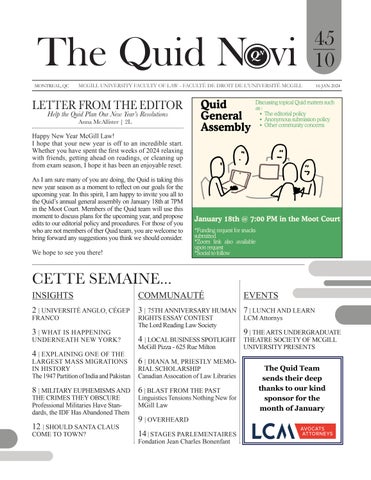
Happy New Year McGill Law! I hope that your new year is off to an incredible start. Whether you have spent the first weeks of 2024 relaxing with friends, getting ahead on readings, or cleaning up from exam season, I hope it has been an enjoyable reset. As I am sure many of you are doing, the Quid is taking this new year season as a moment to reflect on our goals for the upcoming year. In this spirit, I am happy to invite you all to the Quid’s annual general assembly on January 18th at 7PM in the Moot Court. Members of the Quid team will use this moment to discuss plans for the upcoming year, and propose edits to our editorial policy and procedures. For those of you who are not members of ther Quid team, you are welcome to bring forward any suggestions you think we should consider. We hope to see you there!
CETTE SEMAINE... INSIGHTS
COMMUNAUTÉ
EVENTS
2 | UNIVERSITÉ ANGLO, CÉGEP 3 | 75TH ANNIVERSARY HUMAN 7 | LUNCH AND LEARN FRANCO
3 | WHAT IS HAPPENING
UNDERNEATH NEW YORK?
4 | EXPLAINING ONE OF THE
LARGEST MASS MIGRATIONS IN HISTORY The 1947 Partition of India and Pakistan
RIGHTS ESSAY CONTEST The Lord Reading Law Society
LCM Attornys
4 | LOCAL BUSINESS SPOTLIGHT
THEATRE SOCIETY OF MCGILL UNIVERSITY PRESENTS
McGill Pizza - 625 Rue Milton
6 | DIANA M, PRIESTLY MEMORIAL SCHOLARSHIP Canadian Assocation of Law Libraries
8 | MILITARY EUPHEMISMS AND 6 | BLAST FROM THE PAST THE CRIMES THEY OBSCURE Professional Militaries Have Standards, the IDF Has Abandoned Them
12 | SHOULD SANTA CLAUS COME TO TOWN?
Linguistics Tensions Nothing New for MGill Law
9 | OVERHEARD 14 | STAGES PARLEMENTAIRES Fondation Jean Charles Bonenfant
9 | THE ARTS UNDERGRADUATE
Vol 45 ● No 10
UNIVERSITÉ ANGLO, CÉGEP FRANCO Thomas Lessard | 1L
Avec tout ce qui se passe dans l’actualité concernant la diminution du financement des universités anglophones par la CAQ, mon petit cœur de francophone est divisé. Car je ne puis m’empêcher de saisir d’où vient cette action radicale typiquement « Legauloise », sans pour autant y être en accord. À l’université McGill comme Concordia, environ 20%1 des étudiant.es ont le français comme langue maternelle. Ainsi, même si McGill se vante tout de même que 57% de ses étudiant.es maîtrisent « bien » ou « très bien » la langue française, sa langue officieuse ne cessera de basculer inévitablement vers l’anglais2. Sachant que seulement 21% de ses employé.es on le français comme langue maternelle, un bilinguisme institutionnel est loin d’être atteint. Mais n’est-ce pas aussi ce qui fait le charme de l’université anglo? Les statistiques ne mentent pas, les universités anglophones québécoises ont une plus grande ouverture internationale, l’anglais étant la langue qui rule la tour de Babel. Effectivement c’est cette même langue qui te servira probablement davantage si tu te cherches un travail au sein d’une mondialisation en accroissement perpétuel. Mais pas que : pouvoir t’ouvrir à une autre réalité au centre de ta propre province est quelque chose qui pourra t’enrichir aussi sur les plans culturels et relationnels. Baigner un pied dans ta langue, l’autre dans celle des autres.
QUID NOVI • 16 JAN 2024
Là où le cœur se fend Les jours de la semaine, c’est en prenant le métro que se divisera néanmoins ta vie anglo-franco. À la station Longueuil, le bras de vitesse se replace automatiquement pour dire bonjour au chauffeur d’autobus. Ce n’est en soi pas très compliqué. C’est à la station McGill que ça se complique. Quand t’ouvres les portes de la faculté et que tu dois manuellement changer ton langage. C’est à ce moment que tu deviens moins drôle, moins intéressant et où ta répartie tombe tristement à l’eau. Dans le fond, t’es pu tant comique, pi tu deviens un peu cave quand tu commences tes phrases par but hum… Après quand les autres te le font remarquer, ça te remet les deux pieds sur terre en titi.
anglais, tu trouveras tes pensées glisser sur les collines d’une langue beaucoup plus fluide que le français. Ça ne deviendra qu’un bruit de fond, qu’une lullaby qui te fera oublier que t’es censé prendre des notes et que ton examen s’en vient dans deux semaines. Tes neurones seront encore habitués aux consonnes plus mordantes du français, à son débit plus rythmé. Il leur sera difficile de rester éveillés face à une langue qu’ils ne pratiquaient qu’une session sur deux, dans la section 102 du Cégep de Saint-Hya. Cependant, tu te rendras compte qu’une ouverture à l’expertise anglophone et à sa nomenclature souvent plus moderne te permettra une connaissance beaucoup plus complète du sujet qui te passionne. Autonomie linguistique Tu ramasses une première paire de jeans sur le sol de ta chambre en bordel. Du bas de l’escalier, t’entends « Thomas là, tu la ramasses-tu enfin ta chambre? Nos invités s’en viennent. » Et puis toute ambition en toi disparaît soudainement. Parce que « Maman J’ALLAIS le faire. MAINTENANT ÇA M’TENTE PU. » Similairement, quand tu peux poser un regard sur ta langue qui provient de toi-même, qui n’est pas poussé par un établissement avec quelconque sorte d’autorité, celui-ci devient beaucoup plus curieux. Avenant. Ainsi, je me sens aujourd’hui plus proche du français dans un établissement qui s’en détache pourtant. Car sa substitution m’apporte une analyse comparée intéressante, une expérience translinguistique, si on peut le dire, qui me stimule. Et c'est peut-être ça que Legault oublie dans sa quête éternelle d'une province française. Car l'épanouissement francophone ne viendra jamais de l'entrave anglophone. Son désenclavement naîtra d'un intérêt profond de ses usagers internationaux pour le concept de la francophilie. Colonialisme exclu.
Anyway Quand les professeur.es feront leurs cours magistraux en « Concordia en français - Concordia University », en ligne: <https:// www.concordia.ca/content/concordia/fr/vie-etudiante/en-francais.html>. 2 Cette statistique est fondée sur les affirmations des étudiant.es ielsmêmes plutôt que sur quelconque test standardisé. Elle est donc probablement exagérée. « Sur les campus », en ligne: Vivre McGill en français <https://vivreenfrancais.mcgill.ca/mcgill-en-francais/sur-le-campus/>. 1
2
Deux nouvelles qui symbolisent le parfait exemple d’un fleurissement francophone individuel dans une reconnaissance de la réalité anglophone globale
Lord Reading Society announces its 75th Anniversary Human Rights Essay Contest!
In celebration of our 75th Anniversary, the Society is thrilled to announce the launch our Human Rights Essay Contest! Embrace the opportunity to express your thoughts and insights in either English or French, crafting an essay of a maximum of 2000 words that addresses your perspective on the most pressing human rights issues relevant to current Canadian law. Student contributors placing first, second, and third will receive cash prizes of $1,000, $600 and $400, respectively, as well as a Society membership for the year plus free admission to two Society events. For more information visit the Lord Reading Society website.
WHAT IS HAPPENING UNDERNEATH NEW YORK Kamil Chaoui | 2L
Anyone that has been scrolling on social media for the past days has vaguely heard about some tunnels built under synagogues in New York… or something like that. Since it’s been a busy start of the year for a lot of you, I’ll try to summarize what has been reported by the media. It all started last Monday in a historic Brooklyn synagogue that belongs to the Chabad-Lubavitch movement, an important Orthodox Jewish group. A conflict erupted in the premises, caused by the discovery of a secret underground tunnel. The police moved in, which provoked an even bigger brawl,1 https://www.ctvnews.ca/world/secret-tunnel-in-nyc-synagogue-leads-to-brawl-between-police-and-worshippers-1.6718796
which a lot of us saw on X, Instagram or TikTok. Nine members of the Hasidic community have been arrested and charged with “criminal mischief, reckless endangerment and obstructing governmental administration.”2 But why build a tunnel under a prayer building, and why fight over it? Well, according to CTV, the tunnel builders are among a faction of the Chabad movement that believes that Rebbe Schneerson (the leader of their movement who died in 1994) was a messiah who instructed them to expand the synagogue. However, other Chabad leaders opposed this dangerous project and brought in
1
a cement truck to fill the tunnel, which lead to this factional fight. A group of men, as we can see in multiple videos that garnered millions of views, tried to block the tunnel from being sealed. They were rapidly dispersed by the police. The tunnel, discovered under the Chabad-Lubavitch global headquarters in Crown Heights, was 60 feet long and eight feet wide. It connected four buildings owned by the Hasidic group through openings cut into basement walls. This excavation, carried out without proper approval from the Department of Buildings, raised concerns about the structural stability of the surrounding buildings. 3 I hope this summary keeps you up-todate on the news. https://www.jta.org/2024/01/10/ny/nyc-investigators-find-60-foot-underground-tunnel-beneath-building-next-to-chabad-headquarters 3
https://www.bbc.com/news/world-us-canada-67938683 2
3
Vol 45 ● No 10
LOCAL BUSINESS SPOTLIGHT McGill Pizza - 625 Rue Milton
Local Business Spotlight itle: McGill Pizza - 625 Rue Milton
As student events kick off with the beginning of the winter semester, I invite you all to consider ordering your next pizza lunch from McGill Pizza! Located minutes from campus on the mainfloor of a Milton Street apartment building, McGill pizza has been a staple in the community for three generations. Seemingly permanently decorated with Christmas decorations and crests representing each of McGill’s faculties (including law!) this classic campus restaurant offers to-go or dine-in options. Not only do they make great pizza, but McGill Pizza also boasts an impressive and affordable breakfast option to bring together friends after a night out. Their gyro and souvlaki sandwiches are also wonderful and their poutine will satisfy your craving in a pinch! While online hours suggest it is open regularly from 9:30-8:00 Tuesday-Friday, and 9:304:00 Saturday-Monday, in practice this gem is open much more sporadically. If you can catch it open, its a great spot that brightens our community.
EXPLAINING ONE OF THE LARGEST MASS MIGRATIONS IN HISTORY
QUID NOVI • 16 JAN 2024
udent events kick off with the beginning of the winter semester, I invite you all to consider ing your next pizza lunch from McGill Pizza! Located minutes from campus on the mainfloor of ton Street apartment building, McGill pizza has been a staple in the community for three rations. Seemingly permanently decorated with Christmas decorations and crests representing of McGill’s faculties (including law!) this classic campus restaurant to-go dine-in The 1947 Partitionoffers of India andor Pakistan ns. Not only do they make great pizza, but McGill Pizza also boasts an impressive Elina Qureshi, Sheenam Khuggar |and 1L dable breakfast option to bring together friends after a night out. Their gyro and souvlaki wiches are The also wonderful and their poutine will satisfy your craving in a pinch! of While online Roots of Partition process mass migration and replacement, causing the s suggest it is open regularly from 9:30-8:00 Tuesday-Friday, and 9:30-4:00 Saturday-Monday, death of over a million people.2 In this context, migration actice this gem is open much moreof sporadically. If you can catch and it open, its a great spot In 1947, in the aftermath British Colonialism, Pakistan became a tool to that reinforce the creation of two separate India became two separate states. The need for the Partition and distinct states. New social and political identities were tens our community.
did not arise out of a grassroots, pan-national desire of religious communities to uproot over 15 million people and create two new states.1 Instead, Partition was the result of strategic political decisions by two main political parties in India – the Indian National Congress and the Muslim League – in the aftermath of colonial rule. These parties continued to exploit the religious divisions that had developed in the colonial era until the nationwide violence and conflict became untenable. Subsequent violence and fearmongering eventually led to the forced displacement of religious minorities from provinces in both countries. The states of India and Pakistan were formed through an incredibly bloody and tragic Shahriar Yeasin Khan, “The Partition of British India, Mass Displacement and Related Legislations in Independent India” (Jan 26, 2023), online (blog): <https://rli.blogs.sas.ac.uk/2023/01/26/the-partition-of-british-india-mass-displacement-and-related-legislations-in-independent-india/>. 1
4
created by the refugees on both sides, which persist today. British Colonization as a Catalyst British colonial rule over India significantly reinforced religious and ethnic divisions. Colonial policies such as the census, which categorized the population based on their ethnicity, religion, and caste, deepened feelings of division between social groups.3 Once sown, these divisions were further intensified through governance structures. For instance, policies like the creation of different electoral districts for Muslims and William Dalrymple, “The Great Divide, The New Yorker (June 22, 2015), at para 4, online: <https://www.newyorker.com/magazine/2015/06/29/ the-great-divide-books-dalrymple>. 2
Ian Talbot, “Legacies of the Partition for India and Pakistan” (2019) 2:59 Politeja 7 at 28. 3
Sikhs reinforced the idea that these religious communities had inherently different, and perhaps opposing, political interests.4 The colonial government also provided access to resources, administrative positions, and political power to individuals based on their religious identities, allowing for an inegalitarian distribution of privileges in a way which fostered competition among the various groups.5 The British introduction of representative politics linked, for the first time, demographic strength with political power.6 It is essential to acknowledge that such divisions along religious and caste lines existed before colonization. However, by establishing what was essentially a zero-sum system, where (primarily) religious identity affected access to political power and resources, the British entrenched these divisions and made them irreversible and impossible to overcome. Role of Native Political Actors in Furthering Hostility The Indian National Congress and the Muslim League were developed under British rule. The Congress was developed as a vehicle for Indians to exercise democratic self-rule and resist colonialism. The League originated in the competitive environment created by the British to advocate for the rights and interests of Muslim communities.7 As Congress pushed for an independent India, Muslim leaders began to worry about protecting their interests and ensuring political representation in the new, postcolonial state.8 This worry contributed to the League eventually advocating for a separate state for Muslims.9 Violence as a Motivator of Migration The hostility that arose from political groups demanding self-governance transformed the religious diversity that had existed for millennia into a source of irreconcilable difference.10 Instead of one facet, religion had become the essence of identity for many.11 This difference erupted into unprecedented brutality.12 Religious targets experienced brutal arsons, forced conversions, mass abductions, and brutal sexual violence in their communities.13 The fear of violence motivated people to embark on extremely dangerous journeys across the border.14 In one Ibid, at 28. Ibid, at 28. 6 Ibid, at 28. 7 Ayesha Jalal, “From Minority to Nation” The Struggle for Pakistan: A Muslim Homeland and Global Politics (Boston: Harvard University Press, 2014) at 10. 8 Ibid, at 10. 9 Ibid, at 28. 10 Supra, note 2 at para 6. 11 Ibid, at para 12. 12 Ibid, at para 16. 13 Ibid, at para 2. 14 Ibid, at para 25. 4 5
report, Hindus fleeing the city of Lahore by train were massacred by a Muslim mob at the station.15 Peasants travelling by foot were slaughtered “like sheep” by mounted guerrillas camouflaged within the grass.16 For this article, I interviewed my mother, Satinder Khuggar. She is the child of a Partition survivor and spoke of the violence that forced her Hindu family to leave Pakistani Punjab for Indian Punjab.17 She remembers hearing stories of trains that would arrive from across the border carrying lifeless bodies.18 Despite the intense carnage at border crossings, the fear of staying motivated millions to make the journey from both sides. 19 Relative Replacement Theory Many migrants left their ancestral homes believing they would one day return home.20 Previous conflicts between religious groups had never caused such lasting change. 21 However, they underestimated how significantly the British Raj had bolstered religious differences.22 Their ancestral homes were eventually occupied by strangers, likely of a different religion with the same intention of seeking refuge.23 This “striking” swap of religious populations is described aptly by the term “relative replacement effect”.24 Migratory flows tended to display immigrants moving into the same places that emigrants were flowing out of.25 In Punjab, this led to an almost complete “switching” of populations from Indian Punjab to Pakistani Punjab, and vice versa.26 Census data reveals that Muslims in what became Indian Punjab dropped from 30 percent to 1.75 percent from 1931 to 1951.27 Hindus and Sikhs in what became Pakistani Punjab fell from 21.7 percent to 0.16 percent at the same time.28 This switch became permanent because of land allocations given to migrants by the newly formed governments of India and Pakistan. 29 Ibid. Ibid, at para 26. 17 Satinder Khuggar, “Conversation on Partition” (November 27, 2023) via phone call [communicated to author]. 18 Ibid. 19 Supra, note 2 at para 1. 20 Supra, note 17. 21 Supra, note 2 at para 8. 22 Supra, note 2 at para 12. 23 Bharadwaj, et. al, “The Big March: Migratory Flows after the Partition of India” (2008) Harvard Kennedy School, Working Paper No. 08-29 at 3. 24 Ibid. 25 Ibid. 26 Ibid. 27 Ibid. 28 Ibid. 29 Shahriar Yeasin Khan, “The Partition of British India, Mass Displacement and Related Legislations in Independent India” (26 January 2023), online (blog): <https://rli.blogs.sas.ac.uk/2023/01/26/the-partition-of-british-india-mass-displacement-and-related-legislations-in-independent-india/> 15 16
5
Vol 45 ● No 10 The Bureaucratic Reintegration of Refugees In the aftermath of Partition, the governments of India and Pakistan used their bureaucratic structures to gain a monopoly over land allocation and property management. One law provided for the institution of civil suits “relating to claims to property, but not immovable property, i.e. land” .30 Another law, the Resettlement of Displaced Persons (Land Acquisition) Act of 1948 allowed the government to acquire and redistribute any land for the resettlement of displaced persons.31 Such policies concentrated power over land allocation in the hands of the state and in doing so, affected the ability of displaced peoples to settle down.32 By consolidating control over the land, governing the resettlement process, and making refugees dependent on state processes to institute civil suits regarding their losses, the new states made themselves necessary, powerful, and therefore, legitimate. Overall, the relative replacement of migrants led to permanent settlement, as Partition continues to be central 30 31
32
Ibid. Ibid. Ibid.
Developing and Supporting Legal Information Specialists Perfectionnement et soutien des spécialistes de l'information juridique
Diana M. Priestly Memorial Scholarship
December 11, 2023
The Canadian Association of Law Libraries/Association Canadienne des bibliothèques de droit is pleased to announce it is accepting applications for the Diana M. Priestly Memorial Scholarship. This $2,500 scholarhsip will be awarded to an individual working to enhance their academic qualificaions for law librarianship and is open to students in Canadian law programs who Dear Mr. Leckey, meet the criteria. The closing date for applications is February 1, 2024. RE: DIANA M. PRIESTLY MEMORIAL SCHOLARSHIP
The Canadian Association of Law Libraries / Association Canadienne des bibliothèques de droit is pleased to announce it is accepting applications for the Diana M. Priestly Memorial Scholarship. Legal librarianship and information management is a rewarding alternative legal career path that is open to law graduates, and one CALL / ACBD would like to promote and support with your help. This scholarship will be awarded to an individual working to enhance their academic qualifications for law librarianship and is open to students in Canadian law programs who meet the criteria. The closing date for applications is February 1, 2024.
Established in honour of the late Diana M, Priestly, a distinguished Canadian law librarian, and in recognition of her distinctive contribution to law librarianship, the Scholarship is intended to support professional development in the field and is awarded to a Canadian citizen or landed immigrant who:
QUID NOVI • 16 JAN 2024
Moreover, the state-building process showcases how gaining a monopoly over power and maintaining a functioning bureaucratic structure can aid in the conception and imagination of a state before it is fully formed. Partition was never reversed, largely because the process of separation required the creation and maintenance of two separate and opposing identities. Political developments in the region since then have simply served to further polarize the two nations and complicate the path towards reconciliation and mutual understanding. A particularly lasting effect of the divisions sown by British colonialism has been the inability of our two populations to recall their common ground and shared identity, which has persisted for millennia. Our hope is that post-Partition senses of identity can adapt once more, to allow space for shared kinship for people across different religions in the South Asian subcontinent and diaspora. 33
Robert Leckey, Dean Faculty of Law McGill University Old Chancellor Day Hall 3644 Peel Street Montreal (QC) H3A 1W9 dean.law@mcgill.ca
Established in honour of the late Diana M. Priestly, a distinguished Canadian law librarian, and in recognition of her distinctive contribution to law librarianship, the Scholarship is intended to support professional development in the field and is awarded to a Canadian citizen or landed immigrant who:
• has previous law library experience and will be enrolled in an accredited Canadian Library School during the next academic term/year; or ●• has law library and will enrolled be enrolled in in an Canadian hasprevious a degree fromexperience or is currently anaccredited accredited or approvedLibrary School during the next academic term/year; or ● has a degree from or is currently enrolled in an accredited Canadian Library School Canadian Library School and will be enrolled in an accredited or and will be enrolled in an approved Canadian Law School during the next academic term/year; or Canadian Law School during the next academic term/year; or approved ● has a degree from or is currently enrolled in an approved Canadian Law School and • will will concurrently enrolled in anLibrary approved Law School and an be be enrolled in an accredited Canadian School Canadian during the next academic term/year; or accredited Canadian Schoool during nextand academic term/year, ● will be concurrently enrolledLibrary in an approved Canadian Lawthe School an accredited Canadian Library School during the next academic term/year.
An announcement regarding the award’s recipient will be made at the National Office: 705-1 Eglinton Avenue East • Toronto ON M4P 3A1 • Tel: 647.346.8723 office@callacbd.ca • www.callacbd.ca Association’s annual conference, to be held in Montreal in June 2024. For more information, please refer to the application form.
6
to the modern identity in India and Pakistan.33 The motivating factors behind migration in Partition illuminate how religious identities can be manipulated by political actors, as well as how migration can be used as an effective state-building tool when enforced with violence.
Supra, note 1 at para 4.
BLAST FROM THE PAST Linguistic Tensions Nothing New for McGill Law As McGill begins to plan how to navigate the upcoming tuition hike for English language universities in Quebec, discussion of the longstanding tensions that exist between Quebec and Englih Canada have been on the rise at the Faculty. Enjoy this 2003 comic created by a McGill Law student offering their comedic reflection on Quebec’s language laws.
7
Vol 45 ● No 10 As part of the process of leaving the Canadian Armed Forces, the good people at the Transition Centre are quick to tell recently minted veterans that returning to the civilian world will not necessarily be an easy process. It will take time, it will take getting used to, and it will require explaining aspects of the military to your civilian peers. I took these lessons to heart as I prepared to leave the military and start law school.
QUID NOVI • 16 JAN 2024
So, it was something of a shock to open the Quid Novi and find the dynamic reversed: a civilian was explaining aspects of the military to me and doing it badly. What I found in “My Latest Amazon Purchase” was an attempt to explain a rampant and criminal disregard for the international legal principle of proportionality and the civilian casualties it is meant to prevent. The principle of proportionality, as articulated in Article 51, Protocol 1 of the Geneva Conventions, holds that “loss of civilian life, injury to civilians, damage to civilian objects, or a combination thereof” cannot be “excessive in relation to the concrete and direct military advantage anticipated.”1 While Israel is not a party to Protocol 1, they nonetheless recognise the principle of proportionality as a part of customary international law and have accepted it as valid.2 But that acceptance does not Mark Lattimer, “Assessing Israel’s Approach to Proportionality in the Conduct of Hostilities in Gaza”, (16 November 2023), online: Lawfare <https://www.lawfaremedia.org/article/assessing-israel-s-approach-to-proportionality-in-the-conduct-of-hostilities-in-gaza>. 2 Ibid.
MILITARY EUPHEMISMS AND THEProfessional CRIMES THEY OBSCURE Militaries Have Standards, the IDF Has Abandoned Them Anonymous Student
align with what the world has seen in Gaza since October 7th. The devastation in Gaza is not a series of “mistakes” that could be made by “any military.” The rate of airstrikes suggests a kinetic targeting cycle that is far too short to do proper considerations of potential collateral damage, while the number of civilian casualties reported points to a conception of proportionality that would horrify even the most seasoned veterans in other militaries. Before getting into the details, allow me to explain some of the jargon. The “kinetic targeting cycle” is the process by which militaries identify potential targets and determine the most effective means to destroy them.3 Bluntly, it is determining who to kill, followed by how, when, and where. “Collateral damage” is the euphemism used to refer to the people or things that were not the target but were killed, injured, damaged, or destroyed in the course of hitting a target. To be blunt once again, it is who was killed in addition to whoever the strike was meant to kill. I use this language not to
be harsh or upsetting, but to counter the tendency to describe atrocities with euphemisms. Killing civilians through negligence or institutional apathy is not “over-zealous.” It is a blatant violation of proportionality, a foundational concept in international humanitarian law, which the state of Israel and the Israeli Defence Forces (IDF) have recognised.
they can operate with greater concern for collateral damage, leading to demonstrably better outcomes. According to Action on Armed Violence (AOAV), a charity that tracks the impact of armed conflict, the frequency and number of civilian casualties caused by IDF airstrikes has increased dramatically, compared to previous IDF operations in Gaza.
On October 25th, it was reported that the IDF had launched over 7,000 airstrikes in a mere 19 days.4 That is an average of 368 airstrikes per day. That is an average of fifteen airstrikes per hour. That is an average of one airstrike every four minutes. The casualty rates are not the result of choices made by individual soldiers. They are the result of institutional priorities, set at the highest levels of the IDF and Israeli government, reflected in the structure of the kinetic targeting cycle. I do not make these allegations of negligence or apathy without cause. The IDF’s approach to targeting makes it clear that they prioritize rate of fire over prevention of civilian deaths and suffering.
In October of this year, AOAV’s methodology identified 299 IDF airstrikes that met their threshold for analysis. Of those 299 airstrikes, 276 of them caused civilian harm, leading to 4,104 civilian casualties, including 2,798 killed. The average number of deaths “per civilian casualty-causing airstrike” was 10.1.5 This is higher than the global average of 7.4 and markedly higher than IDF operations in the recent past. The IDF’s bombing campaign in July and August of 2014, the next largest after the current operations, had an average number of 2.5 deaths per casualty-causing airstrike.6 It is well within the
Indeed, the IDF’s own track record demonstrates that
1
8
Many militaries also have a process for a non-kinetic targeting cycle. The kinetic/non-kinetic distinction refers to targeting with munitions (kinetic) or targeting with other non-lethal tools (non-kinetic), such as psychological operations. 3
Patrick Kingsley, “Israel’s Strikes on Gaza Are Some of the Most Intense This Century”, The New York Times (25 October 2023), online: <https://www.nytimes. com/2023/10/25/world/middleeast/israel-gaza-airstrikes.html>. 4
Iain Overton, “Numbers of civilian deaths per airstrike in 2023 Gaza at least four times higher than previous Israeli bombings, AOAV finds”, (7 November 2023), online: AOAV <https://aoav.org.uk/2023/ numbers-of-civilian-deaths-perairstrike-in-gaza-today-far-higherthan-previous-israeli-bombings-buthalf-that-of-russian-syrian-attacksin-mosul-and-aleppo-under-reporting-of-the-dead-or-less-letha/>. 5
6
Ibid.
IDF’s capacity to reduce the number of civilian casualties they cause in Gaza. They, as an institution, choose not to. The final euphemism I’d like to dispatch with is the acknowledgement that the “IDF has certainly been responsible for its share of harm.” Such language masks the extent of the devastation and the identity of the victims. The estimated death toll recently passed 20,000 people, just under one percent of Gaza’s prewar population. Of those 20,000 people, the Lancet estimates that “42.8% of the deaths were children under 18.”7 Multiple airstrikes against refugee camps and unprecedented casualties among UN aid workers demonstrate that the IDF’s “share of harm” includes a staggering number of civilian casualties. My point is not to adjudiLinda Dayan, “20,000 dead and counting: The battle over verifying Gaza’s death toll”, Haaretz (26 December 2023), online: <https://www.haaretz. com/israel-news/2023-12-26/ ty-article-magazine/.premium/20-000-dead-and-countingthe-battle-over-verifying-gazasdeath-toll/0000018c-a0ae-d92daddf-eaff010a0000>.
cate the legality or validity of Israel’s broader approach to Gaza, the West Bank, or the Palestinian people. Those questions are beyond the scope of this article and my own professional competence. My point is that the IDF is killing a disproportionate number of Palestinian civilians, an outcome they are able but unwilling to prevent. This is not the result of a few wrongdoers, as would be found in any other military. This is the result of structural choices which reflect institutional priorities.
THE ARTS UNDERGRADUATE THEATRE SOCIETY OF MCGILL The UNIVERSITY Arts Undergraduate Th PRESENTS of McGill University Presen Tickets available for 15$ via Eventbrite, just search AUTS McGill!
My point is also not to claim a moral equivalence between the IDF and Hamas. My point is to demonstrate that the IDF has failed morally based on the standards of international humanitarian law and the standards of a professional military, standards the IDF has previously accepted and endorsed.
7
Excusing this failure, continuing to support the IDF, continuing to wear their hoodie, is to accept this indefensible approach to civilian lives and its horrifying consequences. I would never accept such conduct from my soldiers. Neither should you.
Tickets available for 15$ via Eventbrite, just search AUTS M
Law Student: “But I thought we were going to St-Hubert for Jean Chrétien’s birthday!?”
OVERHEARD
Law Student: I was transferred to a new psychiatrist who commended me for my needle phobia because it “probably kept me safe to be worried about the COVID vaccine”
9
Vol 45 ● No 10
de candidatures – - SIMULATION APPEL Appel DE CANDIDATURES Simulation de négociationsCONSITUTIONNELLES: constitutionnelles : DE NÉGOCIATIONS La du Sénat LAréforme RÉFORME DU SÉNAT Le Centre d’analyse politique – Constitution et fédéralisme (CAP-CF) de l’Université du Québec à Montréal (UQÀM) tiendra du 5 au 11 mai 2024 sa première simulation de négociations constitutionnelles sur le thème de la réforme du Sénat du Canada pour des étudiant·e·s universitaires de partout au pays. Des candidatures d’étudiant·e·s de votre Faculté sont donc bienvenues !
La simulation pancanadienne – la première du genre – est financée par le Programme d’appui à la recherche du Secrétariat aux relations canadiennes du Gouvernement du Québec. La simulation permettra aux étudiant·e·s de se familiariser avec les revendications et les divers intérêts avec lesquels la fédération canadienne doit composer. Elle leur permettra également de développer leurs habiletés de communication verbale et écrite, ainsi que d’acquérir une e Centre d’analyse politique Constitution et fédéralisme (CAP-CF) de l’Université du et Québec expérience pratique de la – politique et du droit constitutionnel au Canada. Enfin, l’exercice mettra en réseau favorisera les échanges Montréal (UQÀM) tiendra du 5 au 11 mai 2024 sa première simulation de négociations entre les futures générations de juristes, de constitutionnalistes, de politologues, d’économistes, d’historien·ne·s et sociologues au pays.
onstitutionnelles sur le thème de la réforme du Sénat du Canada pour des étudiant·e·s La simulation se tiendra Donald Gordon Hotel and Conference Centre, situé à Kingston, ON. Les étudiant·e·s participant seront appelé·e·s niversitaires de partout au au pays. à représenter le gouvernement fédéral, une province, un territoire, une nation autochtone, ou encore un groupe d’intérêt (syndicat, groupes
sociaux, etc.). Les délégué·e·sde étudiant·e·s devront s’entendre sur desbienvenues amendements à !apporter à la Constitution canadienne, selon les es candidatures d’étudiant·e·s notre Faculté sont donc
formules en vigueur, pour réformer le Sénat. Les participant.e.s devront se pencher plus spécifiquement sur le fonctionnement du bicaméralcanadien, le rôle du Sénat dans la fédération canadienne, la représentation des diverses communautés, la sélection et le mandat des pancanadienne – la première du genre – est financée par le Programme d’appui à la a simulationisme sénatrices/sénateurs, ainsi que sur le processus d’amendement et les réformes non-constitutionnelles possibles. Ils/elles recevront une formaecherche du Secrétariat aux relations canadiennes du Gouvernement du Québec. La simulation tion en amont, grâce à des lectures préalables, et sur place, par des présentations offertes par les conférencières/conférenciers invité·e·s.
QUID NOVI • 16 JAN 2024
ermettra aux étudiant·e·s de se familiariser avec les revendications et les divers intérêts avec lesquels a fédération Les canadienne doit composer. Elleà leur permettra également deledévelopper leurs habiletés étudiant·e·s intéressé·e·s à participer la simulation doivent s’inscrire avant 30 janvier 2024 en remplissant le formulaire d’inde la politique et doivent du posséder un e communication verbale et écrite, ainsi que d’acquérir une expérience pratique scription et en téléversant leur relevé de notes non-officiel. Il est à noter que pour être éligibles, les participant·e·s roit constitutionnel aufrançais-anglais Canada. Enfin, mettra en réseau et les favorisera les échanges entre les bilinguisme passif, l’exercice leur permettant de comprendre tout dans deux langues officielles ainsi que de s’exprimer au moins dans une des officielles. Ils/elles doivent également avoir suivi des cours portant sur la politique canadienne et le droit canautures générations de langues juristes, de constitutionnalistes, de politologues, d’économistes, d’historien·ne·s dien, t sociologues aunotamment pays. sur la politique constitutionnelle et le fédéralisme. Les participant·e·s seront sélectionné·e·s au mois de février 2024.
n’ytiendra a pas de au coûtDonald d’inscription pour Hotel participer à laConference simulation et Centre, les participant·e·s de l’aide financière pour leurs a simulationIlse Gordon and situé à recevront Kingston, ON. Les coûts de transport. Les coûts d’hébergement seront assumés par le CAP-CF. tudiant·e·s participant seront appelé·e·s à représenter le gouvernement fédéral, une province, un nationnoter autochtone, ou encore un groupe d’intérêt (syndicat, groupes sociaux, etc.). Les erritoire, uneVeuillez que la Faculté de droit de McGill ne participe pas à la sélection des candidat.es : la sélection est effectuée élégué·e·s étudiant·e·s devront s’entendre sur des amendements à apporter à la Constitution par le comité d’organisation de l’événement. anadienne, selon les formules en vigueur, pour réformer le Sénat. Les participant.e.s devront se encher plusCette spécifiquement sur le fonctionnement bicaméralisme canadien, le rôle duRecord Sénat»).dans expérience de simulation apparaitra sur ledu relevé de notes de McGill (« Co-Curricular Cependant, aucun sélection et le mandat des a fédération crédit canadienne, la représentation des diverses communautés, la n’est accordé pour la participation à cet événement. énatrices/sénateurs, ainsi que sur le processus d’amendement et les réformes non-constitutionnelles Pour toute question concernant la simulation, veuillezgrâce contacter : simulation.constitution@uqam.ca. ossibles. Ils/elles recevront une formation en amont, à des lectures préalables, et sur place, par Vous pouvez également communiquer avec la Professeure Poirierinvité·e·s. à l’adresse suivante : johanne.poirier3@mcgill.ca. es présentations offertes par les conférencières/conférenciers
Pour soumettre votre candidature, remplissez le formulaire se trouvant au lien suivant. es étudiant·e·s intéressé·e·s à participer à la simulation doivent s’inscrire avant le 30 janvier 2024 en emplissant le formulaire d’inscription et en téléversant leur relevé de notes non-officiel. Il est à noter 10
AppelPARTICIPANTS de candidatures –- 1ST EDITION OF CALL FOR Simulation de négociations constitutionnelles : THE CAP-CF’S MOCK CONSTITUIONAL La réforme du Sénat NEGOTIATIONS: THE SENATE REFORM The Centre d’analyse politique – Constitution et fédéralisme (CAP-CF) of the Université du Québec à Montréal (UQÀM) will hold from May 5 to 10, 2024 its first mock constitutional negotiation on the theme of the reform of the Senate of Canada for university students from across the country. Student application from your Faculty are therefore welcomed.
The pan-Canadian mock negotiation – the first of its kind – is funded by the Government of Québec’s Programme d’appui à la recherche du Secrétariat aux relations canadiennes. The event will allow students to familiarize themselves with the demands and various interests with which the Canadian federation must deal. It will also allow them to develop their verbal and written communication skills, as well as gain practical experience in politics and constitutional law in Canada. Finally, the exercise will network and Le Centre d’analyse politique Constitution et fédéralisme deeconomists, l’Université duandQuébec promote exchanges between– future generations of jurists, constitutionalists, (CAP-CF) political scientists, historians sociologists in the country.
à Montréal (UQÀM) tiendra du 5 au 11 mai 2024 sa première simulation de négociations constitutionnelles sur le réforme Sénat du Canada des étudiant·e·s The simulation willthème be held atde thela Donald Gordondu Hotel and Conference Centre,pour located in Kingston, ON. Participating students will be called to represent the federal government, a province, a territory, an Indigenous nation, or even an interest group (union, social universitaires deupon partout au pays.
group, etc.). The student delegates will have to agree on amendments to be made to the Canadian Constitution, according to the formulas
in force, to reform the Senate. de The notre participants will have to look more bienvenues specifically at the!functioning of Canadian bicameralism, the role Des candidatures d’étudiant·e·s Faculté sont donc
of the Senate in the Canadian federation, the representation of various communities, the selection and mandate of senators, as well as the process and–possible non-constitutional reforms. will receive in advance, d’appui through prior readings, and on site, pancanadienne la première du genre – estThey financée par training le Programme à la La simulationamendment through presentations given by guest speakers. If they desire to, participants will also be able to register for a course offered by UQÀM.
recherche du Secrétariat aux relations canadiennes du Gouvernement du Québec. La simulation permettra aux étudiant·e·s de se familiariser avec les revendications et les divers intérêts avec lesquels Students interested in participating in the simulation must apply by January 30, 2024, by completing the registration form and a fédération uploading canadienne doit composer. leur be permettra développer leurspassive habiletés their unofficial transcript.Elle It should noted that également to be eligible,de participants must have French-English bilinla politique et du de communication écrite, ainsi que d’acquérir une expérience gualism,verbale allowing et them to understand everything in both official languages pratique as well as de to express themselves in at least one of droit constitutionnel aulanguages. Canada.They Enfin, mettra en on réseau et politics favorisera les échanges entre les the official mustl’exercice also have taken courses Canadian and Canadian law, particularly on constitutional futures générations defederalism. juristes, de constitutionnalistes, politologues, d’économistes, politics and Participants will be selected inde February 2024. There is no registration d’historien·ne·s cost to participate in the simulationau andpays. participants will receive financial assistance for their transportation. Accommodation costs will be covered by CAP-CF. et sociologues
are no application cost Gordon to participate in the simulation and the participants will recieve financialON. aid for their transportation La simulationThere se tiendra au Donald Hotel and Conference Centre, situé à Kingston, Les cost. Lodging costs will be covered by CAP-CF étudiant·e·s participant seront appelé·e·s à représenter le gouvernement fédéral, une province, un territoire, une nation autochtone, ou encore un groupe d’intérêt (syndicat, groupes sociaux, etc.). Les Please note that McGill’s Faculty of Law does not participate in the selection process: the selection is completed by the délégué·e·s étudiant·e·s devront s’entendre sur des amendements à apporter à la Constitution organizing committee of the event. canadienne, selon les formules en vigueur, pour réformer le Sénat. Les participant.e.s devront se pencher plusThis spécifiquement sur le du bicaméralisme canadien, le However, rôle du no Sénat simulation experience willfonctionnement be added to your McGill transcript (Co-Curricular Record). credit dans will be granted for it. a fédération canadienne, la représentation des diverses communautés, la sélection et le mandat des For any questions simulation, please contact: simulation.constitution@uqam.ca. sénatrices/sénateurs, ainsi regarding que sur the le processus d’amendement et les réformes non-constitutionnelles You mayrecevront also communicate with Professor Poirier at grâce the following address : johanne.poirier3@mcgill.ca. possibles. Ils/elles une formation en amont, à desemail lectures préalables, et sur place, par des présentations offertes par les conférencières/conférenciers invité·e·s. To submit your application, please visit the following link.
Les étudiant·e·s intéressé·e·s à participer à la simulation doivent s’inscrire avant le 30 janvier 2024 en remplissant le formulaire d’inscription et en téléversant leur relevé de notes non-officiel. Il est à noter 11
Vol 45 ● No 10
SHOULD SANTA CLAUS COME TO TOWN? Jacob McConville | 2L
I wrote this story for you, but when I began it I had not realized that girls grow quicker than books. As a result you are already too old for fairy tales, and by the time it is printed and bound you will be older still. But some day you will be old enough to start reading fairy tales again.1 Over the break, my wife and I celebrated our first Christmas with our 5-month-old boy. We braved the crowds at the Complexe Desjardins and eventually managed to get a photo with, in their words, the 'vrai Père Noel.' As could be expected from children of his age, our son was unfazed by his first encounter with celebrity, though he did seem to like my suggestion that he apply for a toymaking job. The experience led me to a question which seems to come up frequently in parenting circles: should we "do" Santa Claus? As in (at the risk of sounding like Ebenezer Scrooge), should we tell our son that he's real, and that he really comes down the chimney, and really brings the presents under the tree? While this sounds trivial on its face, I had two very serious concerns with Santa that cut deep into my personal parenting philosophy. First, it at least appears like you are forced to tell a lie to your children and maintain it for around 6-10 years. Secondly, parts of the Santa story sound like a crude and brutal attempt to compel children to behave. In this article, I hope to lay out these concerns, before explaining how I overcame them and came to the conclusion that we will nevertheless "do" Santa Claus in our house.
QUID NOVI • 16 JAN 2024
Casuistry Claus The permissibility of lying in general, and to one's children in particular, is a fascinating and often discussed. I am sure you have heard a few hypotheticals about hiding people from crazed murderers and so on. Space will not permit a full discussion of the question, so I will assume a priori that it is categorically wrong to lie to your children. You can achieve this either through Christian ethics or though Kantianism.2 If it is absolutely wrong to lie to our children, the existence of Santa Claus must be not a lie in order for the telling to be permissible. Most people, since they do not themselves believe in Santa Claus, would achieve this through equivocation – swearing "in both the scales against either side."3 "Almost all authors," C.S. Lewis, The Lion, the Witch, and the Wardrobe, (New York: HarperCollins, 1994), Preface. 2 For a Christian explanation, see Thomas Aquinas, ST II IIae Q 110. Kant deals with lying in a few places, see discussion in Thomas L. Carson, Lying and Decepiton: Theory and Practice (Oxford: Oxford University Press, 2010). 3 William Shakespeare, Macbeth, (Minneapolis, MN: First Avenue Editions, 2014) at I.III.
Newman tells us, argue that "when a just cause is present, there is some kind or other of verbal misleading, which is not sin."4 This would look like telling children that Santa Claus is real, and meaning by it that he's real in that he is a character that mum and dad play, while mentally reserving the fact that the jolly fat man who lives in Canada's Arctic is not.5 This will not do for me, for two reasons. First, when the child becomes of age, there is almost always a 'reveal' that Santa Claus was never real, which means that this was a lie rather than mere casuistry. St. Athanasius does not lie when he says "yes, he is close to you," because he truly was.6 Secondly, while a little bit of equivocation is probably necessary with children, as they do not always have the capacity to understand the full truth and a partial one will often do, I do not think that Santa is a sufficiently pressing cause to employ it. Even with the possibility of equivocation, the lying involved – often becoming deeply elaborate and layered as children get older and start poking holes in the Santa story – still presents a trouble to me. Panopticon on the Shelf Equally troubling is a major facet of Santa Claus's mythos. A not uncommon sound in the weeks leading up to Christmas is the voice of Michael Jackson or Michael Bublé telling us that: He's making a list He's checking it twice He's going to find out Who's naughty and nice, Santa Claus is coming to town He sees you when you're sleeping He knows when you're awake He knows when you've been bad or good So be good for goodness' sake7 These words present us with an eye which might be observing you at any time, attempting to determine whether you are a naughty or nice child. This is reinforced in 'traditions' like the extremely creepy Elf on the Shelf, which John Henry Newman, Apologia Pro Vita Sua, (Newmanreader, 2001), online: <https://www.newmanreader.org/works/apologia65/ index.html> at 348. 4
1
12
I maintain that if real the preponderance of evidence points to his domicile being in Canada’s Arctic, H0H 0H0. 6 Newman, supra note 4 at 357 5
“Santa Claus is Coming to Town,” Genius Lyrics, online:<https:// genius.com/Christmas-songs-santa-claus-is-coming-to-town-lyrics>. 7
others have rightly connected with mass surveillance.8 What these critiques often miss, though, is that the Elf, and this image of Santa Claus, are not mere preparation for living in a surveillance state; they are panoptic surveillance themselves. At any minute a child knows that he or she might be being observed. This is useful for the parents, since it serves, if only for a few weeks before Christmas, to "induce… a state of conscious and permanent visibility that assures the automatic functioning of power."9 Children will self-regulate in order to prevent receiving coal in their stocking. The cost, though, is that it can be terribly upsetting for them to go around paranoid about losing their gifts – producing something like the Calvinist anxiety described by Max Weber of not being among the elect.10 So, in Santa Claus' surveillance, we see a system of panoptic discipline to sort children between "naughty" and "nice," something at cross-purposes with the lessons I would like to teach my son. Children are certainly capable of committing faults, but Catholicism teaches that they are not fully culpable for them until they reach the age of seven.11 Even if they do commit faults, they can be assured of the Father's forgiveness if they seek it. If you do not subscribe to the Catholic view, you would likely still have a difficult time imagining anything a sixor seven-year-old could possibly do which would merit losing out on Christmas presents. In either case, there is therefore no such thing as a (inherently) naughty child, and certainly no such thing as one deserving of coal in their stocking. I do not mean by this to endorse bad behaviour, but rather merely to say that the punishment for it should never be ruination, and that redemption must always be possible in a way which it is not in the Santa myth. Santa and Sacrament In truth, the panoptic elements of the Santa Claus myth are not too troublesome – we can simply not play Santa Claus is Coming to Town or use that creepy elf (I intend not to). It is the lying that troubles me most. While thinking about Santa Claus, I remembered Charles Taylor's classic A Secular Age, which shone a different light on the question. In an enchanted world, as Taylor describes See e.g. Matt Beard, “Elf on the Shelf is a fun and festive way to teach your child to submit to the surveillance state,” The Guardian, 2019 online: <https:// www.theguardian.com/commentisfree/2019/dec/15/elf-on-the-shelf-is-a-funand-festive-way-to-teach-your-child-to-submit-to-the-surveillance-state>. 8
it, it would not be a lie to tell your child that Santa Claus is real, because he is. Briefly, the part of Taylor's argument that concerns us here is his discussion of magic. This discussion is situated within a broader argument about secularization and disenchantment – which we could say are the reasons why Santa takes the character he does, and why learning to question him and eventually disbelieving altogether is a kind of rite of passage for modern children. Taylor describes how sacramentals, like "blessed candles," formed a kind of "white magic," which residents of an enchanted world really believed would protect them.12 This intrigued me on two levels. First, as a Catholic, my house is already full of this white magic. I sleep with a third-class relic of St. André Bessette above my bed, I present myself for a throat blessing for St. Blaise's day, and I will be having a candle blessed on Candlemas. Secondly, I believe that all presents from Santa Claus take on this character. In the version of the story of St. Nicholas I have, for example, the tradition of gift-giving came from giving a dowry to poor women so that they could marry.13 I chose the preface from Narnia as my epigraph, and there the gifts from Santa Claus were a sword and shield, a horn and a cordial. In all cases, these were "tools not toys," magical items intended to strengthen the bearer on their respective journeys.14 This matches many of the characteristics of a sacramental provided in the Catechism of the Catholic Church: they are "instituted for the sanctification of certain ministries of the Church, certain states of life, a great variety of circumstances in Christian life, and the use of many things helpful to man… they can respond to the needs, culture and special history of the Christian people of a particular region or time." 15 All of the best Christmas presents I have received, including after learning that my parents were giving me the gifts from Santa, had a sacramental character. The coat my dad got me this year and the necktie my wife got me are elevated through the ritual of Christmas gift-giving and become enchanted tools to help me on my journey through life. It is in this sacramental sense – in his participation in the gift-giving ritual, and enabling children to understand the transformation that has taken place – that Santa Claus is real, and so in the end, we will be "doing" Santa Claus in our house. 12
Michel Foucault, Discipline and Punish: The Birth of the Prison, translated by Alan Sheridan, (New York: Vintage, 2012) at 521. 10 See Max Weber, The Protestant Ethic and the Spirit of Capitalism, Trans. Sephen Kalberg, (New York: Routledge, 2012) at 64-68.
Charles Taylor, A Secular Age, (Cambridge: Belknap Press, 2018) at 44-45.
9
See Code of Canon Law, online: <https://www.vatican.va/archive/ cod-iuris-canonici/cic_index_en.html> at Can. 97. For that matter, so does the civil law: see art. 1459 CCQ – a minor is not part of the set of those “endowed with reason” in art. 1457. 11
Michelle Bates, Jenny Tyler and Fiona Watt, eds., The Usborne Christmas Treasury, (London: Usborne House, 2001) at 22. 14 Lewis, supra note 1 at 118. 13
Catechism of the Catholic Church, online: <https://www.vatican. va/archive/ENG0015/_INDEX.HTM> at para. 1668. The Catechism later specifies that sacramentals need to be blessed – for this reason I use it here as an adjective rather than as a noun. 15
13
Vol 45 ● No 10
STAGES parlementaires
Nous sommes à la recherche de cinq diplômées
et diplômés universitaires souhaitant s’initier au travail parlementaire par un stage pratique de dix mois à l’Assemblée nationale du Québec.
Assorti d’une bourse d’excellence de 24 000 $, le stage vous permettra de : — découvrir les coulisses de l’Assemblée nationale grâce à deux jumelages avec des parlementaires; — réaliser des missions exploratoires à l’étranger et au Canada; — rédiger un essai sur un sujet lié au parlementarisme. Pour être admissible, vous devez : QUID NOVI • 16 JAN 2024
— avoir obtenu un diplôme d’une université québécoise (1er, 2e ou 3e cycle, incluant certificat et microprogramme) entre le 1er janvier 2022 et le 1er septembre 2024; — avoir la citoyenneté canadienne ou avoir obtenu la résidence permanente au Canada;
— remplir et envoyer le formulaire de candidature , accompagné de vos relevés de notes universitaires; — obtenir deux lettres de recommandation de professeurs ou d’employeurs.
14
De septembre 2024 à juin 2025, plongez au cœur de l’activité parlementaire! Soumettez votre candidature du 15 novembre 2023 au 15 février 2024.
fondationbonenfant.qc.ca/
stages-parlementaires
15
EDITOR-IN-CHIEFS RÉDACTEURS EN CHEF Anna McAllister Pablo Mhanna-Sandoval SOCIAL MEDIA DIRECTOR DIRECTRICE DES RÉSEAUX SOCIAUX Gabrielle Torrealba DIRECTOR OF DISTRIBUTION DIRECTEUR DE DISTRIBUTION Kamil Chaoui ART DIRECTOR AND LAYOUT EDITOR DIRECTRICE ARTISTIQUE ET ÉDITRICE DE MISE EN PAGE Souang Wu COPY EDITORS SECRÉTAIRES DE RÉDACTION Faith Dehghan Muna Tojiboeva Paul Ye Thomas Power COLUMNISTS CHRONIQUEURES ET CHRONIQUEUSES Kamil Chaoui CONTRIBUTORS CONTRIBUTEURS Elina Qureshi, Sheenam Khuggar Jacob McConville Thomas Lessard Special thanks to Prairie Koo for designing the layout. ~ The Quid Novi is published weekly by the students of the Faculty of Law at McGill University. Production is made possible through the direct support of students. All contents copyright © 2024 Quid Novi.
Les opinions exprimées sont propres aux auteurs et ne réflètent pas nécessairement celles de l’équipe du Quid Novi. The content of this publication does not necessarily reflect the views of the McGill Law Students’ Association or of McGill University. Envoyez vos commentaires ou articles avant jeudi 17h00 à quid.law@mcgill.ca. Toute contribution doit indiquer le nom de l’auteur, son année d’étude ainsi qu’un titre et un sous -titre pour l’article. Les images doivent être soumises séparément. L’article ne sera publié qu’à la discrétion du comité de rédaction, qui basera sa décision sur la politique de rédaction disponible sur notre Facebook @quidnovi.mcgill.