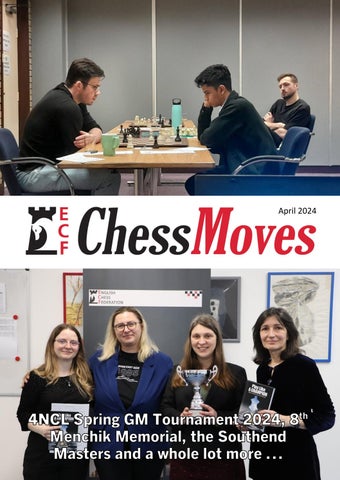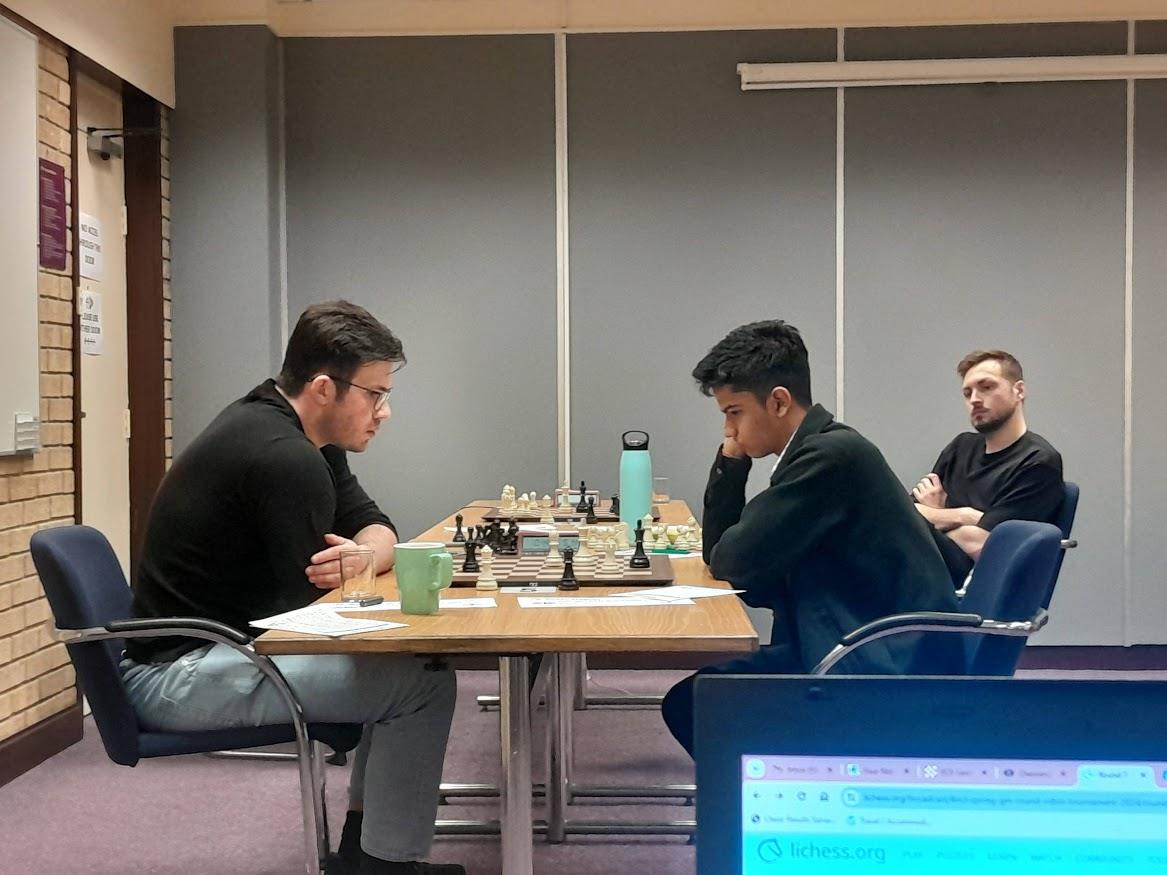



Menchik Memorial, the Southend
April 2024
www.englishchess.org.uk Page | 2 CONTENTS Events British Chess Championships 2024 by Nigel Towers 4 English Championship Series 2024 by Nigel Towers 4 Reykjavik Open 2024 by Matthew Wadsworth 4 8th Menchik Memorial 2024 by Aga Milewska 7 4NCL Spring GM Round Robin Tournament 2024 by Matthew Wadsworth 10 Southend Masters 2024 by Lance Leslie-Smith 15 Features Great British Chess Players by John Nunn 20 Mark Rivlin Interviews Maurice Ashley 22 Book of the Month by Ben Graff 24 Endgames That All Club Players Should Know by Glenn Flear 25 It’s a Puzzlement 32 From the Archives 34 News and Views Keith Escott (1948-2024) 36 Michael John Passmore 36 ECF Online Grand Prix 2024 36 Chess in Prisons and Why it Matters 36 UK Armed Forces Championship 37 ECF Arbiter Course Registration 37 World Senior Team Chess Championships - Call to Action 37 ChessFest 2024 Returns to Trafalgar Square 37 BBC2 Moves for Curve Media's Chess Masters 38 ECU-ETC Titles Webinar 2024 38 Junior Moves Littlewood’s Choice 38 Glorney Cup Teams Announcement 39 European Youth Chess Championship 40 Improvers Paul Littlewood on Tactics 41 Gormally’s Coaching Corner by Danny Gormally 41 Studies and Problems How to Solve a Study by Ian Watson 43 Monthly Conundrum by Christopher Jones 44 How to Solve a Study Solutions 47 Calendar 46
EDITORIAL

Welcome to the April edition of ChessMoves.
The British Chess Championships are fast approaching. Entries are coming through strongly, with Michael Adams’ entry already confirmed. If you’re hoping to play you can find all the information you need here: https://www.englishchess.org.uk/entry-form-now-open-for-2024-british-chess-championships/. May and June also see the English Championship series – full details here: https://www.englishchess.org.uk/english-championshipseries-2024/
Tournament reports as usual feature strongly this month, with news and games from both home and abroad. We have our usual entertaining selection of wide-ranging chess articles written by prominent authors. We top things off with all the latest domestic chess news.
All the games within are presented in PGN format here: https://www.englishchess.org.uk/wp-content/uploads/2024/04/April.pgn but note that you will need to use ChessBase or a PGN viewer to access the games.
Have a great month!
IM Andrew Martin Email: a.martin2007@yahoo.co.uk
CONNECT WITH US
Web https://www.englishchess.org.uk/
Twitter ECF main account https://twitter.com/ecfchess
Twitter ECF Online https://twitter.com/ECFonlinechess
Twitter ECF Women https://twitter.com/ecf_women
Twitter ECF Schools https://twitter.com/ECFSchools
Twitter ECF Juniors https://twitter.com/ECFJuniors2023
Facebook https://www.facebook.com/englishchess/
Threads https://www.threads.net/@ecfchess
Instagram https://www.instagram.com/ecfchess
YouTube https://www.youtube.com/c/EnglishChessFederation
Twitch Commentary https://www.twitch.tv/ecf_commentary
Twitch Streaming https://www.twitch.tv/ecf_streaming
Substack https://englishchessfederation.substack.com/
Chess.com ECF Members Club https://www.chess.com/club/english-chess-federation-members
Lichess English Chess Players Club https://lichess.org/team/english-chess-players
Lichess English Juniors https://lichess.org/team/england-juniors
Chess.com English Juniors https://www.chess.com/club/england-juniors
ChessMoves is © The English Chess Federation 2024. Photographs by Brendan O’Gorman unless indicated otherwise.
www.englishchess.org.uk Page | 3
British Chess Championships by
Nigel Towers
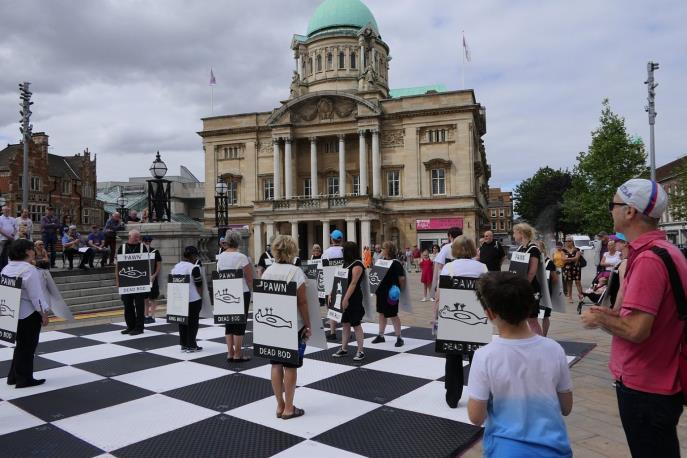
The 2024 British Chess Championships will be held in Hull at the City Hall and the nearby DoubleTree by Hilton, with events running from Thursday 25th July to Sunday 4th August 2024 across the two city centre venues.
To see the schedule of Championship and other events, together with details of the tournaments and the entry form for all competitions please use this link: https://www.britishchesschampionships.co.uk/
You can also see a list of entrants to date at the link here: https://www.britishchesschampionships.co.uk/entrants2024/
English Championship Series 2024
by Nigel Towers
This year’s English Championship series will take place in May and June 2024.
The English Seniors Championships will run between Friday 24th May and Tuesday 28th May 2024 with further details and entry form at the link here: https://www.englishchess.org.uk/english-seniorschampionships-2024/
The English Championship and English Women’s Championship will run side-by-side between Thursday 20th June and Sunday 23rd June 2024 with further details and entry form at the link here: https://www.englishchess.org.uk/englishchampionships-2024/
All events will take place at the Holiday Inn KenilworthWarwick, 212 Abbey End, Kenilworth
Reykjavik Open 2024 by Matthew Wadsworth
From 15th to 21st March I, along with 400 other participants, played in the Reykjavik Open. It was my second time playing in the tournament, and my experiences this year cemented it in my mind as one of the best opens in Europe. Reykjavik is a beautiful city, and the playing hall, the Harpa Concert Hall, is one of the best places I have ever played chess. It is therefore no wonder that the tournament is so popular, particularly with English players - almost 10% of the section was English, giving the tournament a familiar feel. At the top 27 GMs were playing, including the near-2700 Bogdan-Daniel Deac and the legend Vasyl Ivanchuk. Deac, the top seed by almost 70 points, ended up winning the event outright with 7½/9, after converting a marathon six-hour, 118move game in the final round.
Going into the event, my goal was relatively simple: I wanted to make a GM norm, which requires a 2600 rating performance along with a host of other criteria. Getting norms in open events is notoriously difficult, as you are often at the mercy of an unforgiving Swiss pairing system. A bad pairing at an inopportune time can easily derail someone’s norm chances through no fault of their own. With FIDE now requiring at least one of your norms to come from an open event, this is, I’m sure, a sentiment shared by many!
The first half of the tournament went more or less exactly to plan. I started with two nice wins against lower-rated opposition before a solid draw with Black to an Icelandic GM, Throstur Thorhallsson, in round 3. Following another win in round 4, I was beginning to feel confident - I felt I was playing relatively well, my preparation for each game had paid off nicely, and the inaccuracies I had made up to that point had gone unpunished by my opponents.
Rounds 5 and 6 were likely to be the key to the whole tournament. Firstly, it was a double-round day, with the morning round annoyingly early at 9am. Secondly, my opponent in the morning was Paulius Pultinevicius, a very strong Lithuanian GM who would go on to finish 3rd overall in the event. I managed to hold a nervy draw in the
www.englishchess.org.uk Page | 4 EVENTS
Fianchetto Grünfeld, and mercifully the game finished fairly quickly, giving me time to recuperate for the afternoon round. In that, I was paired against GM Sebastien Maze, another strong GM whom I had played alongside in the Guildford 4NCL teams a few years ago. I had decided to go all out for the win, and after turning down a quick draw built up a nice advantage on the white side of a King’s Indian. Unfortunately, I then rushed my queenside play and lost the thread completely, allowing him to win material and eventually convert a knight endgame. The loss most likely put the norm out of reach, but with three games left there was still a lot to play for!
I was probably still feeling the effects of the loss in the next two rounds - I won both games, but did not play at all well, and probably should have lost both. Nevertheless, the wins put me on 6/8 with one round to go, gaining a decent amount of rating and with a chance of finishing in the prizes if I won the last game. In it, I was paired as Black against Jules Moussard, a French grandmaster who had crushed me in our only previous meeting, at the European Individual Championship last year. Going into the game I knew that even a win would not be enough for a norm, which is probably what gave me the freedom to just play a normal game and enjoy the experience. I by no means played perfectly, but managed to score my highest-rated classical win to date, and my best win with Black by some distance.
Moussard, Jules (2621) - Wadsworth, Matthew J Reykjavik Open 2024 (9), 21.03.2024
1.e4 e5 In our previous meeting I played 1...c5 and lost quite badly in a sharp line of the Taimanov. This time I decided to go for something a little more solid.
2.Nf3 Nc6 3.Bc4 Historically, Moussard had played 3.Bb5 and 3. Bc4 about equally. In my preparation, I had spent more of my time on the Spanish, but I had a couple of ideas here as well.
3...Nf6 4.d3 Bc5 5.0–0 d6 6.c3 a5 7.Re1 Ba7 This move, given by Gawain Jones in his recent course on 1.e4 e5 (which I highly recommend!) is quite trendy at the moment. The idea is to delay castling, and potentially save a tempo by avoiding a later ...h6.
8.Nbd2 0–0 9.Nf1 Ne7 A fairly standard manoeuvre for Black in these positions: on g6 the knight protects e5, eyes the f4-square and gets out of the way of the c7-pawn.
9...Be6 was Gawain's recommendation, which also looks good for Black.
10.Ng3 Ng6 11.h3 c6 I prepare to break in the centre with ...d5 next move. I could even consider ideas like ...b5 and ...a4 if White allows it.
12.Bb3 White wisely retreats his bishop.
12...d5
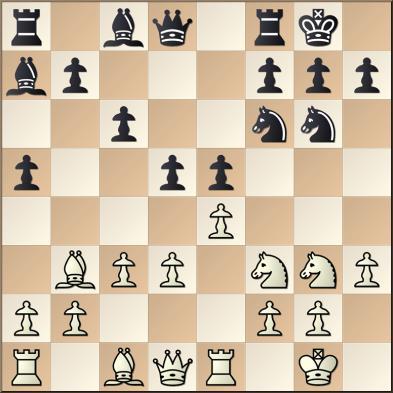
Quite a risky move, but I was confident at the time that everything held together, and afterwards I was very happy to see that it had been played before by Kramnik, Firoujza and Karjakin among others.
13.Bg5 The move I was expecting. White develops his last piece, and prepares to remove a key defender of the d5square.
13.exd5 Nxd5 14.Nxe5? White does not win a pawn here, because of the nice tactic 14...Nxe5 15.Rxe5 Bxf2+! 16.Kxf2 Qf6+, and Black picks up the loose rook.
13...h6 14.Bxf6 Qxf6 15.d4! An important move, creating a tricky central situation.
15.exd5 looks natural, and had been played in every game to reach this point. However, Black has the very strong intermezzo 15...a4!, and White is barely holding on. After 16.Bxa4 cxd5 White is a pawn up, but Black's position is overflowing with compensation, with a strong centre, good development, the bishop pair and excellent attacking chances on the kingside. I am not at all surprised that Black has won in all three games to get to this position.
15...dxe4? 15...exd4 was the correct recapture. I was worried about 16.e5, but after 16...Qe7 17.cxd4 Nh4! Black creates strong pressure against the white centre.
16.Rxe4? 16.Nxe4 is just very strong for White. In the game I intended 16...Qf4, but White has a fantastic position after 17.g3 Qf5 18.Nd6 Qxh3 19.Nxf7! Rxf7 20.Nxe5 Nxe5 21.Rxe5 Bg4 22.Qd3 Raf8 23.Rae1, and I am completely lost despite the extra piece. White's pin on
www.englishchess.org.uk Page | 5
the a2-g8 diagonal is simply too powerful, and ties down my entire position.
16...exd4 17.cxd4
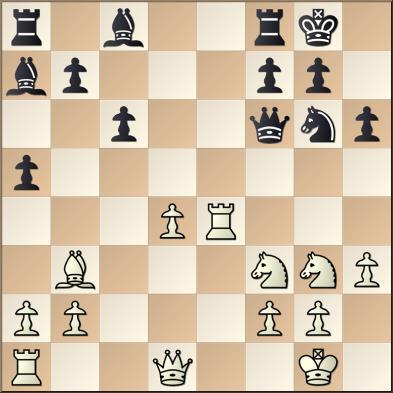
The more natural recapture - White accepts an IQP, but his active pieces should give him good attacking chances on the kingside. On the other hand, I have the bishop pair and a static weakness to aim at, so was relatively happy at this point.
17...Nf4 heading for the blockading square d5.
17...Bb8 was perhaps stronger, keeping control of the e5square.
18.Qd2 Nd5 18...Nxh3+? does not win material, as the black queen gets trapped after 19.gxh3 Qxf3 20.Rf4.
19.Ne5 Be6 20.Rae1 Rfd8 21.Kh2?
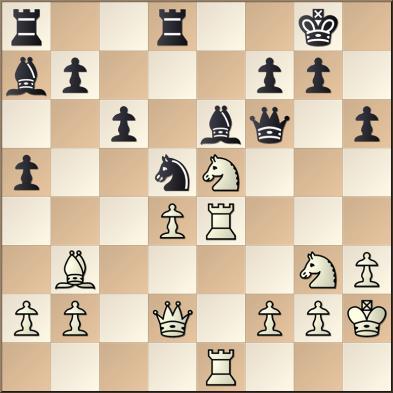
I was very surprised by this move; this does not seem like the sort of position where such a quiet move would be effective. Additionally, I am not convinced that the king is better on h2 than g1, which the rest of this game shows in great detail.
The slightly counterintuitive retreat 21.Nf3 was best, and White keeps some annoying pressure on the kingside.
21...a4! A nice tactic that allows me to take over the initiative.
22.Bc4 22.Bxa4 Bb6 is the point; I threaten Rxa4 and Ba5. White does not necessarily lose material, but he must seriously contort his position.
22...Bb6 23.R1e2 Ba5 This manoeuvre seemed logical, even without the skewer. White's queen is ideally placed on d2, so forcing it away should be to my benefit.
24.Qc1 a3! More tactics. White cannot take on a3 because of Nc3, forking the two rooks. Objectively, White is still fine here, but I have all of the momentum in the position, and White needs to play quite carefully to avoid disaster.
25.f4 White secures the knight on e5, but at the cost of weakening his kingside structure. We were both beginning to run low on time at this point.
25...axb2 26.Rxb2 Nc3 26...b5 was correct, but the position remains very unclear.
27.Bxe6 Qxe6 28.f5 Qf6 29.Rg4
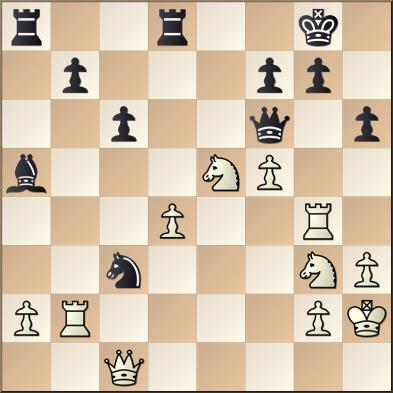
29.Qe3! is a very strong exchange sacrifice, which I had completely overlooked. The key line is 29...Nxe4 30.Nxe4 Qxf5 31.Rf2 and White picks up the f7-pawn, with fantastic compensation for the exchange.
29...Rxd4! I have always loved playing exchange sacrifices, and have often been guilty of forcing them in positions where they were unsuitable. However, this one seemed fairly obvious, and Black's compensation is very clear.
30.Rxd4 Qxe5 In return for the exchange I have a pawn, well-placed pieces, but most importantly a very unpleasant pin on theh2–b8 diagonal. I can ratchet up the pressure on that knight very quickly with ideas like Ne4, Bc7 and h5–h4, and it is not immediately apparent how White can hold on.
31.Rd3 Ne4 32.Re2 White's only hope is in tactical defence. From here on, the game gets extremely sharp,
www.englishchess.org.uk Page | 6
but the pressure is definitely more on White than Black to find accurate moves.
32...Bc7 Strengthening the pin on the knight, so that Rxe4 can simply be met by Qxe4.
33.Qb1? A nice tactical idea. White threatens 34.Rxe4 Qxe4 35.Rd8+, with a discovered attack on my queen. Unfortunately, b1 is the wrong square, however natural it may look to attack the b7-pawn.
33.Qc2! it was crucial for White to keep control of the c5square, to prevent Qc5+ in certain lines. Covering the a4square is another important detail: 33...Re8 34.Kg1 and I have nothing better than the amusing repetition after 34...Bb6+ 35.Kh2 Bc7.
33...Re8 33...Ra4! was the correct way to defend the knight. The main difference is that the rook does not get pinned on the e file, which will allow Black to capture on g3 a move sooner.
34.Qxb7 h5 Nowthat all of my pieces are perfectly placed, the h-pawn joins the attack. White cannot tolerate this pawn getting to h4, so his move is essentially forced.
35.h4 However, h4 now becomes an additional point of weakness which I can target.
35...Qf4
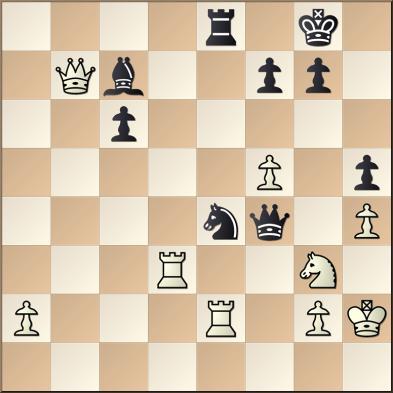
36.Qxc6?? The losing blunder.
36.Kg1! A theme seen before was the only holding move. I can either play a repetition with Qc1+ Kh2 Qf4, or go for a murky-looking endgame after 36...Rb8 37.Qxb8+! Bxb8 38.Rxe4 Qc1+ 39.Kh2 Kh7, where I wouldn't particularly want to play either colour!
36...Re7! After this calm move White is simply lost, as there is no good defence to Qxh4+, Nxg3 and the mating net that concluded the game.
37.f6 Nxg3 Other moves win, but this is the most immediate.
38.fxe7 Qxh4+ 39.Kg1 Qh1+ 40.Kf2 Qf1+ 41.Ke3 Qf4# 0-1
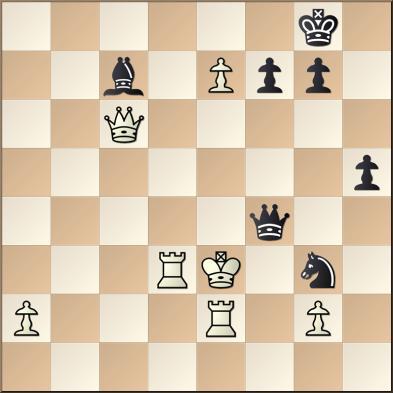
Moussard sportingly played this out, allowing this picturesque final position to be reached.
As a result of this win I finished in 2nd= (6th on tiebreaks) on 7/9, almost certainly the best tournament result of my life. Despite this, I’m not sure my performance was even the most impressive by an English player at the tournament! IM Peter Large played fantastically to finish on 6½ /9, beating multiple titled players and winning both the Senior and 2201-2400 categories. There was additional English success: Nigel Povah and Harry Zheng both finished 2nd in the Senior and 2001-2200 rating categories respectively. Overall, it was a highly successful tournament for English players, and I cannot recommend the tournament enough.
8th Menchik Memorial 2024 by Aga Milewska
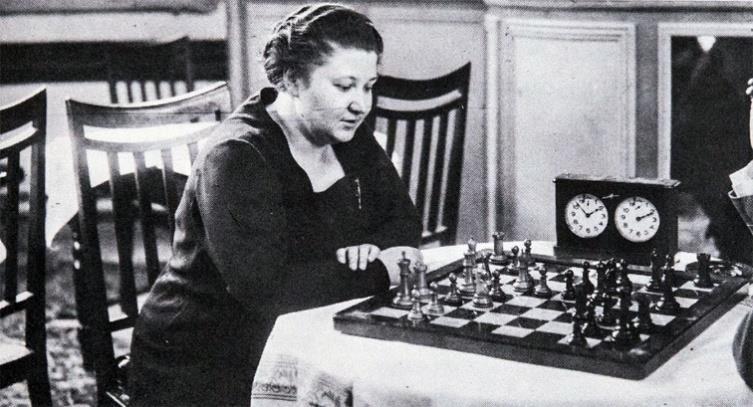
Vera Menchik (1906-44) was the first women's world chess champion, as well as the longest reigning champion, gaining the title at 21 and defending it multiple times until her untimely death.
www.englishchess.org.uk Page | 7
Although born in Russia to a Czech father and English mother, Vera Menchik lived in England from the age of 15 and became the strongest female player of the era while living in Hastings and London.
This year marks the 80th anniversary of Menchik’s death when a German V1 rocket destroyed her home in Clapham.
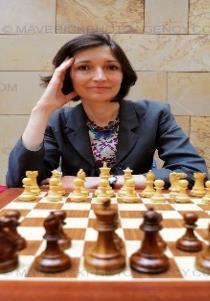
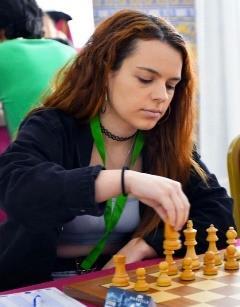
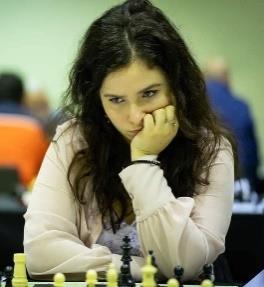

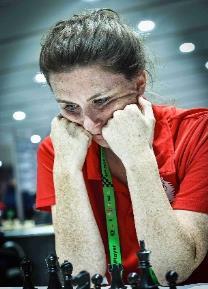


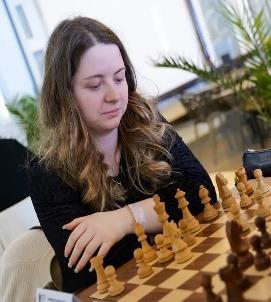
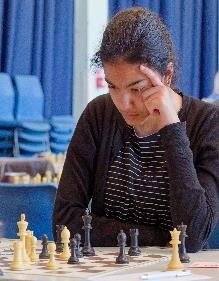

Harriet Hunt photo - British Chess News / John Upham Anusha Subramanian photo – Brendan O’Gorman
The tournament was staged by Chess Promotions Ltd and funded by the English Chess Federation with a grant from the Department of Digital, Culture Media and Sport (DCMS). It took place in March 2024 at the Mindsports Centre in London, was organised by Aga Milewska, and
called on some of the strongest female players in the British Isles and beyond, from legends like Harriet Hunt and Ketevan Arakhamia-Grant to the newest up and coming star in Bodhana Sivanandan, who at just nine years old is one of the strongest juniors in the world.
Alongside these players we welcomed IM Marta Garcia Martin, a strong player from Spain who recently came joint first at the Hastings Weekend Open, being held to a draw only by Keith Arkell, as well as several players who are regulars in the 4NCL National League: WFM Olivia Smith, Fiona Steil-Antoni, Kamila Hryshchenko and Anusha Subramanian. Finally, completing the field were WGM Andreea-Cristiana Navrotescu and WFM AndreeaMarioara Cosman.
Title norms were available - 7/9 for a WGM norm and 5½/9 for a WIM norm. The strength of the field meant that it wasn’t easy for anyone in the competition. At least one of the players had been playing in Reykjavik the day before, and had not long arrived back in England before the tournament started.
All the games were to be broadcast live to the internet and live commentary was provided by Mr Dodgy on his Twitch channel.
With the stage suitably set for all the players the games kicked off, with every one being hard-fought. In rounds 3 and 4 there was not a single drawn game.

In the end the tournament was won by IM Harriet Hunt, with Andreea-Marioara Cosman achieving a WIM norm and the best game prize for the tournament being won by Ketevan Arakhamia-Grant.
www.englishchess.org.uk Page | 8
Andreea-Marioara Cosman, Aga Milewska, Harriet Hunt and Ketevan Arakhamia-Grant

Overall it was a very enjoyable tournament for the players. A few of their comments are given below:
‘Thank you very much for organizing the tournament, I was very impressed with everything and it was by far the best closed tournament that I ever participated in. Also, the participants were lovely.’
‘Bodhana thoroughly enjoyed the tournament after returning straight back from Reykjavik. Very nicely arranged; in particular the playing conditions were great. Good games, learning and experience for Bodhana. Thanks to the ECF, organisers, arbiters, and players.’
‘Once again, thank you very much for inviting me to be part of Menchik tournament. I’m very grateful for everything you are doing for women’s chess.’
‘Thanks for organising the tournament; it was fun, even the last round was a huge battle.’ Rank Name
1 IM Hunt Harriet V 2307 ENG 7
2 WFM Cosman Andreea-Marioara 2115 ROU 6½ GM Arakhamia-Grant Ketevan E 2290 SCO 6½
4 IM Garcia Martin Marta 2356 ESP 5½
5 WGM Navrotescu AndreeaCristiana 2200 FRA 5
6 Hryshchenko Kamila 2186 ENG 4
7 WCM Subramanian Anusha 1997 ENG 3½
8 WCM Sivanandan Bodhana 2088 ENG 3
9 WIM Steil-Antoni Fiona 2154 LUX 2 WFM Smith Olivia 2054 WLS 2
All the games can be found on Lichess: https://lichess.org/broadcast/8th-menchikmemorial/eF1qvzJw, and round by round reports written
by Matthew Carr can be found on the English Chess Federation website: https://www.englishchess.org.uk/menchik-memorial2024-reports/
Garcia Martin, Marta - Arakhamia-Grant, Ketevan Menchik Memorial 2024, 26.03.2024
1.e4 c5 2.Nf3 e6 3.b3 d6 4.d4 cxd4 5.Nxd4 Nf6 6.Nc3 a6 7.Bb2 b5 8.Bd3 Bb7 9.0–0 Nbd7 10.Qe2 Be7 11.a4 b4 12.Na2 Qb6 13.c3 bxc3 14.Bxc3 d5 15.a5 Qa7 16.e5 Ne4 17.Bxe4 dxe4 18.Rad1 Rd8 19.Nb4 Qc5 20.Rc1 0–0 21.Nxa6 Qa7 22.Nc7 Nc5 23.Ndb5 Ba6 24.Nxa6 Qxa6 25.Bb4 Nxb3 26.Bxe7 Nxc1 27.Rxc1 Rc8 28.Re1 Rfe8
29.Bh4 Rc5 30.Nd4 Qxe2 31.Nxe2 Rxe5 32.Ra1 Ra8 33.a6 Rb5 34.Nc3 Rb6 35.Nxe4 Raxa6 36.Rd1 h6 37.f3 Rb2 38.Bg3 Raa2 39.Nf2 g5 40.Rf1 f5 41.f4 Kf7 42.h4 g4 43.h5 Rd2 44.Rb1 e5 45.Rb7+ Ke8 46.Rb8+ Kd7 47.fxe5 f4 48.e6+ Kxe6 49.Rb6+ Kd5 50.Rd6+ Kxd6 51.Bxf4+ Ke6
52.Bxd2 g3 53.Be1 gxf2+ 54.Bxf2 Kf5 55.Be3 Ra6 56.g3 Kg4 57.Bf4 Kxh5 58.Kf2 Kg4 59.Ke3 h5 60.Bc7 Rc6 61.Bb8 Rb6 62.Bc7 Rb2 63.Bd6 Rg2 64.Bc7 Rxg3+ 65.Kf2 Rb3 66.Bd6 Kh3 67.Kg1 Rb1+ 68.Kf2 Rb6 69.Be5 Re6 70.Bc7 Rg6 71.Kf1 Rg4 72.Kf2 Kh4 73.Bd8+ Kh3 74.Bc7 Rc4
75.Be5 Rc1 76.Bd6 Kg4 77.Kg2 Rc2+ 78.Kg1 Kh3 79.Be5 Rg2+ 80.Kf1 Rg5 81.Bc7 Rg7 82.Bd6 Rg6 83.Be5 Kg4 84.Bc7 Kf3 0–1
Subramanian, Anusha - Steil-Antoni, Fiona Menchik Memorial 2024, 26.03.2024
1.e4 e5 2.Nf3 Nc6 3.g3 Bc5 4.Bg2 d6 5.c3 Nf6 6.d3 O-O 7.b4 Bb6 8.O-O a6 9.Nbd2 Be6 10.Re1 Ng4 11.Re2 f5
12.h3 Nf6 13.Ng5 Qe8 14.d4 Bd7 15.exf5 Bxf5 16.Nc4 Ba7 17.Qb3 Kh8 18.dxe5 Bd3 19.Bxc6 bxc6 20.Rd2 Bxc4 21.Qxc4 Qxe5 22.Qh4 h6 23.Rc2 Qe1+ 24.Kg2 Ng4 25.Bf4 Qxa1 26.hxg4 Qe1 27.Nf3 Qe4 28.Rc1 Rae8 29.g5 Qg6
30.gxh6 Rxf4 31.Qxf4 gxh6 32.Rh1 Kg7 33.Rh4 Kh7 34.Rg4 Qe6 35.Rh4 Kg7 36.Nd4 Qd5+ 37.Kh2 Bxd4 38.Qxh6+ Kf7 39.Rxd4 Qe5 40.Qh7+ Kf6 41.Rf4+ Kg5 42.Rh4 Qe2 43.Qh6+ Kf5 44.Rf4+ Ke5 45.Qf6+ Kd5 46.Rd4 1-0
Hunt, Harriet V - Navrotescu, Andreea-Cristiana Menchik Memorial 2024, 26.03.2024
1.e4 e5 2.Nf3 Nc6 3.Bb5 Nf6 4.d3 Bc5 5.c3 d5 6.Qe2 dxe4
7.dxe4 O-O 8.O-O Qe7 9.Bxc6 bxc6 10.Bg5 a5 11.Nbd2 Ba6 12.c4 Qe6 13.Be3 Be7 14.Ng5 Qc8 15.Nb3 h6 16.Nf3 Nxe4 17.Nxe5 Bf6 18.Nxc6 a4 19.Nbd4 Qe8 20.Rae1 Nd6 21.b3 Bb7 22.c5 Ne4 23.Bf4 Nxc5 24.Qb5 Bxc6 25.Nxc6 Ne6 26.bxa4 Kh8 27.Be3 Qc8 28.f4 Qa6 29.f5 Ng5 30.Bc5 Rfc8 31.h4 Nh7 32.Re4 Qxb5 33.axb5 Rxa2 34.Rfe1 Raa8 35.Kh2 Nf8 36.Bf2 Nd7 37.Bg3 Nc5 38.Rc4 Nd3 39.Re3 Nb2 40.Rc2 Ra4 41.Ne5 Bxe5 42.Rxe5 Rb4 43.Rd5 Na4
www.englishchess.org.uk Page | 9
Players, arbiters, and support staff at the event - Picture by Tao Bhokanandh
Rtg FED Pts.
4NCL Spring GM Round Robin Tournament 2024
by Matthew Wadsworth
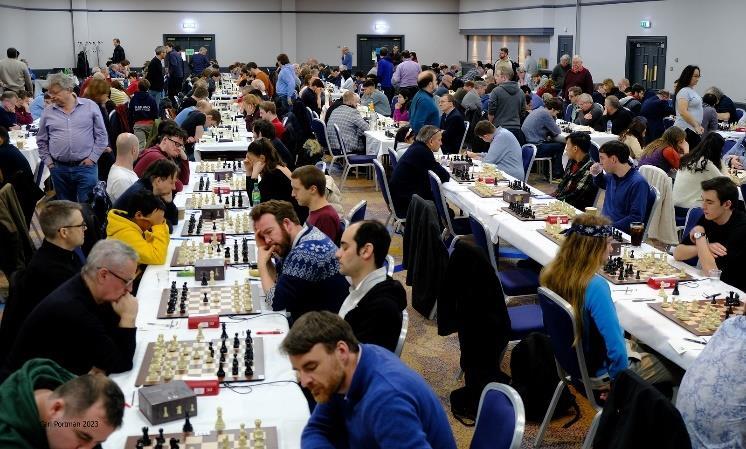
One of the most promising trends in English chess over the last couple of years is the increasing number of IM and GM round robin tournaments that are held across the country. I played in one such tournament in Peterborough from 23rd to 27th March, an event organised by the 4NCL and sponsored by the ECF, with Lance-Leslie Smith and Richard Buxton the arbiters. It is only due to the work of many passionate people behind the scenes that these events can be held at all, and I am thankful to them.
The structure of these tournaments is fairly uniform: three invited GMs (in this case, Szymon Gumularz and Pawel Teclaf of Poland and Alexander Cherniaev of England), seven norm seekers (IMs Shreyas Royal, Marcus Harvey and me, and FMs Rajat Makkar, Huseyin Can Agdelen, Samuel Chow and Koby Kalavannan), pairings released a week ahead of the first round, and a target score for GM and IM norms. Gaining norms in open tournaments depends on many factors totally outside your influence; these closed events offer a far more controlled environment, as you are guaranteed to play a mixture of opponents that would make a norm possible. It then simply becomes a case of playing good chess!
For me, the magic number was 6½, the target score for a GM norm. Over nine rounds your options for making this are four wins and five draws, five wins and three draws, or six wins and one draw, the final two options allowing for one and two losses respectively. To achieve any of these against this field was a daunting task, but one you had to face practically. Given that we all knew our pairings for the event ahead of time, it was possible to do quite detailed preparation for each opponent; unfortunately,
having come straight from another tournament, my opportunities for doing so were fairly limited!
I arrived at the venue, the Peterborough Milestone Hotel, around an hour before the first game started. While the hotel was perfectly nice, it must be said that the location was not ideal, with not a single restaurant or shop within walking distance. This made the logistics of lunch a particular challenge, as the gap between morning and afternoon rounds often did not provide enough time to get something to eat!
My first round was as Black against Sam Chow, an Australian FM who had consistently performed well in the 4NCL for the White Rose team. Before the tournament I knew that this game was basically a must-win if I wanted to make the norm, and I played accordingly, sacrificing a pawn in the opening and then turning down a repetition. After a tense middlegame I reached a pawn-up rook ending that, while theoretically drawn, posed huge problems for the defending side. Getting short on time Sam blundered, to give me the best possible start to the tournament.
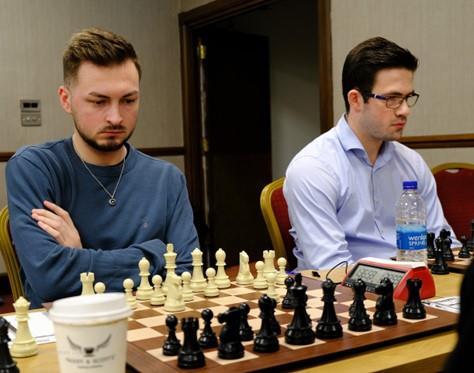
Despite my first round game taking a shade under four hours, it was by far the least tiring day of the tournament. The remaining days would see two games played (starting at 10am and 3pm), with eight hours of playing and three hours of preparation being a not uncommon daily workload. With this in mind, I was very happy to take a quick draw the following morning playing White against Teclaf, in order to have a rest and properly prepare for my remaining games. The afternoon game was of particular importance, playing Black against Marcus, who had started with 2/2. In over a decade of playing each other, I’m not sure we have ever had a peaceful, uneventful game, and this one was no exception; a 72-move slugfest where we both missed wins in a tricky endgame, before finally agreeing a draw.
www.englishchess.org.uk Page | 10 44.Rxc7 Rxc7 45.Bxc7 Rxh4+ 46.Kg3 Rb4 47.Ba5 Rb3+ 48.Kf4 Nb2 49.Bc7 Kg8 50.b6 Kf8 51.Rd8+ Ke7 52.Rg8 Nc4 53.Rb8 Kd7 54.Rd8+ Ke7 55.Rb8 Kd7 56.Rd8+ Ke7 57.Rb8 ½-½
Marcus Harvey and Matthew Wadsworth
I managed to continue my decent form in round 4, with a nice win against Cherniaev in a rook and opposite colour bishop endgame. In round 5 I had Black against the Turkish FM Agdelen, who was unlucky to be on only ½/4. After a weird opening, he totally outplayed me before allowing the position to slip to a draw in time trouble. From my point of view the game was both a lucky escape and a missed opportunity; nevertheless, I was very happy to be on 3½/5 after three days.
With four rounds to go, there were still four people in GM norm contention: Shreyas, Marcus and me on 3½/5, and Rajat a further half-point back. In round 6 both Rajat and Marcus won nice games while Shreyas unfortunately lost, to leave his norm chances all but gone. I managed to hold a draw against Gumularz, although he missed a very nice win towards the end of the game.
Round 7 was a rarity in the tournament, with all the games ending in draws. Marcus and Rajat ideally would have won but had to settle for draws against Sam and Agdelen respectively, while I missed a few chances to win against Shreyas. I was better throughout the game, missed some possibilities in the middlegame, then eventually reached the notorious rook and bishop versus rook endgame. On two occasions I had a tablebase win, but missed the key move each time. Shreyas’ defence in the last 25 moves, with his king pinned on the back rank, was particularly impressive, and he fully earned the draw which we agreed on move 114!
Going into the final day the situation was thus: Marcus needed 1½/2, while Rajat and I both needed two wins. Each of us had a tricky path: Marcus had to play both Polish GMs,whowere leading thesection,whileRajat and I were playing each other in the morning game. Rajat ended up beating me very impressively, while Marcus took a quick draw. This left both with must-win games in the final round; I have annotated them below, with some input by both players.
Harvey, Marcus R - Gumularz, Szymon
4NCL Spring APA (9.1), 18.03.2024
1.c4 Marcus had been playing exclusively 1.c4 in the tournament, most likely as a way to reduce his preparation workload and get his opponents into unfamiliar territory.
1...e5 2.g3 c6 Gumularz’s response is one of the trendier ways to play against the English nowadays. Black plans a quick d7–d5 to dominate the centre, in the style of the Alapin Sicilian. In fact, Marcus had himself won with 2... c6 against Koby in round 6.
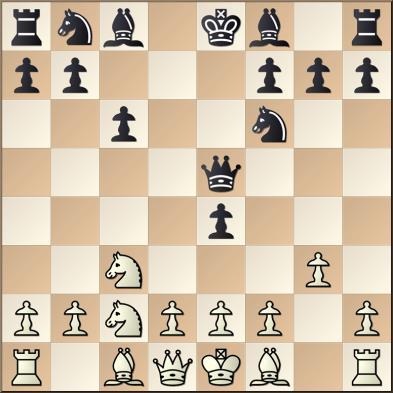
All of these moves are standard, and have been played in dozens of super-GM games in the last couple of years.
8.Ne3?! A rarely played move order, that doesn't seem to work out well for White.
8.Bg2 is standard; it does seem more logical to develop a new piece than move the knight for a fourth time!
8...Bc5 9.Qc2 0–0 10.Bg2 Re8 White's problem here is a lack of space. The e4-pawn is very annoying and well defended, while undermining it with d3 or f3 is inadvisable due to the knight's position on e3.
11.b3 Na6 12.a3 Bxe3 Quite a committal decision. Black spoils the white pawn structure, while also giving up the bishop pair.
13.dxe3 13.fxe3: the other recapture was also fine for White, but I prefer Black after 13...Bf5
13...Bf5 14.b4 Qe6 15.Qa2 Qd7 Black wants to retain the queens here, to allow for attacking ideas on the kingside.
16.0–0

Finally White gets castled, but Black has retained a small advantage. Gumularz plays the next few moves very ambitiously, looking to start an attack on the white king.
www.englishchess.org.uk Page | 11
3.Nf3 e4 4.Nd4 d5 5.cxd5 Qxd5 6.Nc2 Nf6 7.Nc3 Qe5
I'm sure that Marcus was happy to see this, as an unbalanced position was likely to give him some chances too.
16...Bh3 17.Rd1 Qf5 18.Qd2 Nc7 19.Qe1 Bxg2 20.Kxg2 Ne6 20...Re6! might have been even stronger, with the idea of swinging the rook to h6 at the right moment.
21.h3 h5 22.Bb2 a5 The kingside situation is stable for the moment, but now Black starts putting pressure on the queenside.
23.Rab1 axb4 24.axb4 Red8 25.Qf1 Ng5!
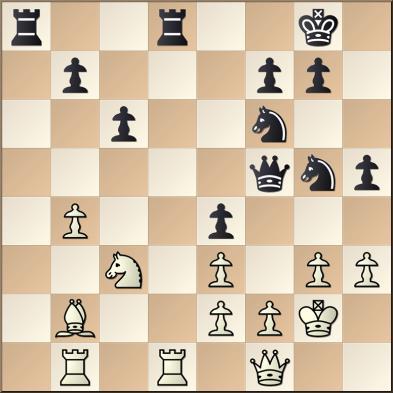
26.h4 26.Qh1 is recommended by the engine, but aside from being a hideous move to have to make was not in Marcus' plans, considering Qf1 was played just one move previously
26...Ne6! A nice manoeuvre by Black, forcing the weakening move 26.h4 before returning to e6. White's position is really hanging by a thread here.
27.f3!? Changing the (admittedly dire) kingside situationa decent practical try, although not the best move in the position.
27...Qg6 Black can enter a very promising endgame with the following line: 27...Rxd1 28.Rxd1 exf3+ 29.exf3 Qc2+ 30.Qe2 Qxe2+ 31.Nxe2 Nd5, and the double attack on e3 and b4 will net Black a pawn and good winning chances.
28.Ra1 Nc7? 28...exf3+ followed by Qc2 was still the correct plan for Black.
29.Nxe4! Suddenly White is the one with some nice tactical ideas.
29...Nxe4 30.fxe4 Qxe4+ 31.Qf3 Qxf3+ Not 31...Qxb4?!
32.Rxa8 Rxa8 33.Rd7 Qxb2 34.Qxf7+ Kh8 35.Qxh5+ Kg8
36.Qf7+ Kh8 37.Rxc7 Qxe2+ 38.Kh3 Rg8 39.Re7 Qd1!, which holds, but is very scary.
32.Kxf3 32.exf3, repairing the pawn structure, would be preferable, if it were not for 32...Rxd1 33.Rxd1 Ra2, when the pin on the second rank puts White in serious difficulties.
32...Rxd1 33.Rxd1 Ne6
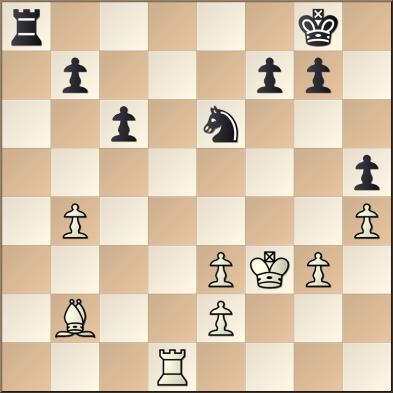
Marcus has done very well to reach an approximately equal ending from a difficult middlegame position. He tries his best over the next 25 moves, but unfortunately 2590 GMs have pretty good defensive technique!
34.Rd7 b5 35.Rd6 Rc8 36.Be5 Kf8 37.Rd7 Ke8 38.Ra7 Rd8 39.Ra6 Rd5 40.Ke4 Kd7 An excellent defensive set-up that holds Black's position together.
41.Ra7+ Ke8 42.Ra8+ Kd7 43.Ra7+ Ke8 44.Bd4 g6 45.Bf6 Rd2 46.Ke5 Rd5+ 47.Ke4 Rd2 Black is happy with the repetition at this point, but Marcus keeps pressing
48.Ra3! Rxe2 49.Ke5 Rd2 50.e4 Sacrificing the e2-pawn has allowed White to make some progress.
50...Kd7 51.Ra7+ Nc7
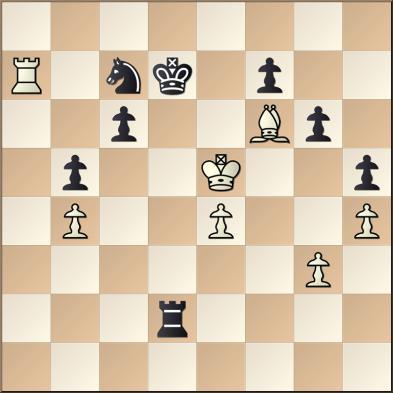
52.Be7! A nice tactical idea, looking to bring the bishop to c5 or the king to f6.
52.Bg5 Rd6 53.Be3 was an alternative way to proceed; however, 53...Re6+ 54.Kf4 c5! 55.Bxc5 Ra6 56.Rxa6 Nxa6 57.Bf8 Ke6 holds very comfortably.
www.englishchess.org.uk Page | 12
52...Kxe7 Black responds correctly. Other moves also drew, but would allow White to retain some winning chances. Despite White's active king, the rook ending should be a draw.
53.Rxc7+ Kf8 54.Rxc6 Rb2 55.Kf6 Rf2+ 56.Ke5 Rb2 57.Kf6 Rf2+ 58.Ke5 This time the repetition is unavoidable for both sides. A shame for Marcus not to get the win or norm, but he was able to put Black under significant pressure in the second half of the game. ½–½
Royal, Shreyas - Makkar, Rajat 4NCL Spring APA (9.5), 18.03.2024
1.d4 d5 Rajat needed to win his final game with Black - a daunting task against Shreyas, whose white repertoire is very dangerous.
2.c4
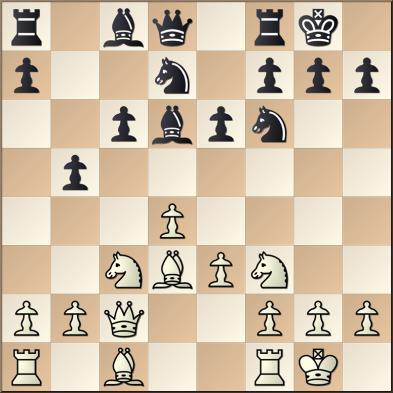
By transposition the game has reached a key tabiya of the Open Meran. Both players were well prepared, and the moves kept coming quickly.
10...Bb7 11.a3 A standard idea White wants to go b2–b4 to prevent Black's natural c6–c5 break.
11...Rc8 11...a5 is the main line here, but Rc8 is fully playable as well.
12.b4 a5 Black's goal is to pile pressure on the b4 pawn, with moves like Qe7 to come.
13.Qb3 This rare move came as a surprise to Rajat.
13.Rb1 is the main move, where Black is required to remember the key idea 13...c5!. Black blasts open the position, with full compensation for the sacrificed material. Most likely the game will end in a repetition, for example after 14.bxc5 Bxf3 15.gxf3 Nxc5 16.dxc5 Rxc5
17.Rxb5 Nd5 18.Rxc5 Qg5+ 19.Kh1 Qh5 20.f4 Qf3+ 21.Kg1 Qg4+=.
13...Ra8 13...e5 should equalise for Black, although the text move is also fine.
14.Rb1 Qe7 15.e4 e5 The obvious response to e3–e4 by White. The tension in the position makes the next few moves crucial for the direction of the game.
16.Ne2 axb4

17.dxe5?! An unnecessary intermezzo.
17.axb4 was simplest and best, although Black definitely gets some play after 17...Ra4 18.Bd2 Rfa8.
17...Bxe5 17...Nxe5 was even stronger: for example, 18.Nxe5 Bxe5 19.axb4 Rfd8, with Bc8–e6 next, and Black is taking over the position.
18.axb4 c5 Leading more or less by force to the ending we see in the game.
19.bxc5 Nxc5 20.Ba3! An important tactic, otherwise White is simply losing.
20...Nfxe4 21.Bxe4 Bxe4 21...Bxh2+! was an unexpected chance to aim for more: 22.Kh1 (22.Kxh2 Qc7+–+ and Black gets out of the pin with tempo and wins the queen next move) 22...Bxe4 23.Bxc5Qxc5 24.Kxh2 Bxb1 25.Qxb1 b4 White should hold this endgame, but it will not be an easy defence.
22.Bxc5 Qxc5 23.Qxb5 Qxb5 24.Rxb5
www.englishchess.org.uk Page | 13
c6 3.Nf3 Nf6 4.Nc3 e6 5.e3 Nbd7 6.Qc2 Bd6 7.Be2 0–0 8.0–0 dxc4 9.Bxc4 b5 10.Bd3
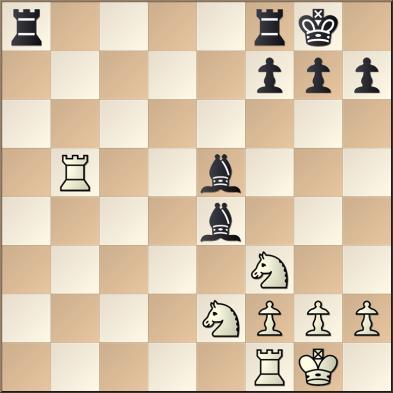
At first glance White really should not be losing this endgame, with equal material and so few pawns left. However, there is a lot of heavy material still left on the board, and Black's bishop pair allows him to make White's life seriously uncomfortable. This is doubly so when your opponent is playing for a GM norm and can press the position forever!
24...Bf6 25.Rb3 Rfd8 26.h3 h5 27.Re1 Bc2 28.Rb5 g6 Black takes his time, first improving his kingside structure.
29.Nf4 Ba4 30.Rc5 Bb3
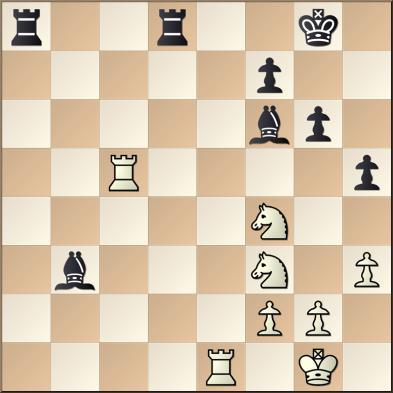
31.g4? A move indicative of the pressure White was under.
31.h4 followed by g3 and Ng5 looks as if it should hold for White, but even here Black keeps some pressure. 31.Rb5 Ba4 32.Rc5= was another decent direction, intending Nd5 with some activity. Had Shreyas found this idea, Rajat said he would probably have had to settle for a draw.
31...hxg4 31...Ra4 first was more precise, but either way Black is winning a pawn.
32.hxg4 Ra4 33.Re3 Bd1 34.Nd5 Rxg4+ 35.Kf1 Kg7
Objectively White is still holding, but Black has made very real progress over the last ten moves, which is psychologically difficult to deal with at the board.
36.Nxf6 Kxf6 37.Ne5 Rf4 38.Rd3! White should definitely get some material off the board, so that his king feels slightly safer.
38...Rxd3 39.Nxd3 Re4 40.Kg2 Be2 41.Nc1 41.f3 might be a better set-up, looking to retreat the knight to f2 rather than c1.
41...Rg4+ 41...Bc4 Rajat was surprised that trapping the knight on c1 wasn't enough towin; in fact, it made White's life easier, whereas if the rooks were off the board the endgame would be resignable. 42.f3 Rh4 43.Kf2 Ke6 44.Ke3 Kd6 45.Rc8 and White will be able to extricate the knight, with excellent drawing chances.
42.Kh3 Rc4! 43.Nb3 An only move for White.
43.Rxc4 Bxc4 is hopelessly lost, as the knight is trapped on c1.
43...Rf4 44.Kg2 g5 Now Black can simply push his kingside pawns and force White to find increasingly tough defensive moves.
45.Rc3 Kg6 46.Nc5 Bc4 47.Re3 47.f3. Again, I think White's defence is easier with the pawn on f3 rather than f2. This was the set-up that Rajat was expecting to face; during the game, he was optimistic of his winning chances even here. It is very easy to look at this position after the fact with an engine and conclude that White should hold easily. However, during a game, in the final round of a tough tournament, and with your clock rapidly ticking towards zero, this would be an absolute nightmare for White to defend.
47...Rg4+ 48.Kf3 Rf4+ 48...f5 was Rajat's initial idea, but 49.Nd7 Bd5+ 50.Ke2 would allow the white king to escape from the bottom right corner, where it would be subject to several mating ideas.
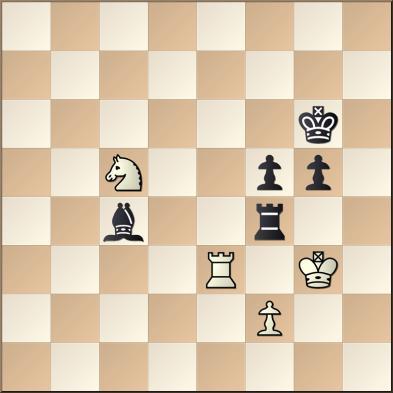
49.Kg3 f5
www.englishchess.org.uk Page | 14
50.Re8? The losing mistake, as Black can create a deadly mating net seemingly out of nothing.
50.f3 once again should hold theoretically, but Black can play this kind of position forever. Even if Shreyas defended perfectly from here, he might still have to be on the defensive end of rook and bishop versus rook for the second time in two days!
50...Bd5! And the threats of Rg4+ and Rf3+ are too much to stop.
51.Rd8 Rf3+ 51...Rg4+ Rajat surprisingly missed a relatively simple mate in three here, but what he played was also good enough for the win. 52.Kh3 Rh4+ 53.Kg3 f4#.
52.Kg2 Rd3+ 53.Kh2 Rd1 There is no way to save the white king from the mating net without giving up the f3 pawn, so Shreyas resigned. 0–1
Congratulations to Rajat, who with this impressive lastround win secured his second GM norm; I am sure it is only a matter of time before he gains the title! Meanwhile, Marcus came agonisingly close to his first GM norm, but he will for sure have more chances in the near future. As for the rest of the tournament, Teclaf and Gumularz finished a convincing 1-2 with 7 and 6½ respectively, while I finished fifth on 5/9 after a last-round draw. Despite a disappointing final day, I was still relatively happy with how I played in the event.
Southend Masters 2024 by Lance Leslie-Smith
The Southend Masters tournament made its grand return this year. The tournament was independently organised by International Arbiter and Organiser Lance Leslie-Smith alongside FIDE Arbiter Jake Hung.
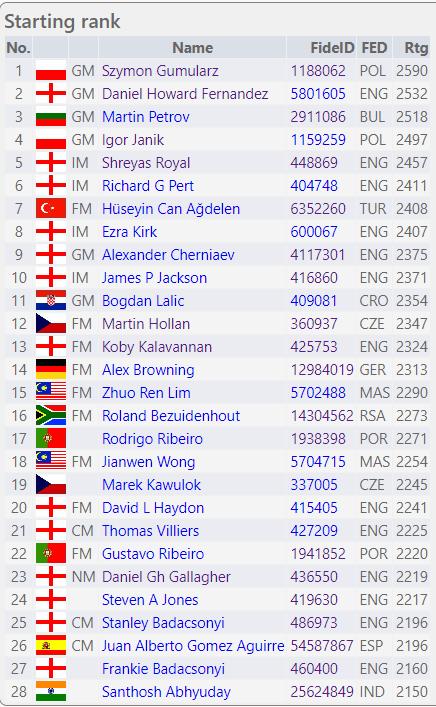
The tournament took place from 28th March - 1st April over the Easter weekend and bank holiday at the Southend Adult Community College, Southend East (Southend-on-Sea). The field (limited to a maximum of 30 entries) attracted 28 players from 12 different federations, and included six GMs, four IMs, nine FMs, three CMs, one NM and five untitled participants. The average rating of the field came in at 2324, verystrong for a Swiss open tournament, so we didn’t have to resort to using the Baku accelerated pairing system. The starting rank cross table can be found below:
Southend Masters 2024 Starting Rank Cross Table or https://chess-results.com/tnr874004.aspx?lan=1
Games were generally very competitive all the way through, barring the draw-fest in round 9. The bottom half of the field pulled up their socks and produced some amazing results. FMs Martin Hollan (CZE) and Jianwen Wong (MAS) achieved IM norms. Unfortunately, no GM norms or English norms were achieved, but the relentless efforts from the English players can’t go unrecognised. A special mention of IM Shreyas Royal and NM Daniel Gallagher for putting up outstanding performances in a field where nearly half of the players were English. Shreyas had a tough start to the tournament, conceding draws to two 2200 players, but then picked up the pace, gaining three wins in the next four games and ending up on 4½ out of 6 points. A GM norm was guaranteed with 7 out of 9 points, and Shreyas, going into round 8 with 5 out of 7 points after holding the top seed (and eventual winner) GM Szymon Gumularz (POL) to a draw, needed to win the last two games on demand to get the norm. He ended up conceding two draws, leaving him on a wellfought 6 out of 9 points. NM Daniel Gallagher had a great
www.englishchess.org.uk Page | 15
run, and at one stage was in a position to play for an IM norm. Going into round 8 on 4 out of 7 points, two wins would guarantee a norm, or potentially 1½/2, depending on his opponents’ average ratings. A tough battle against FM Jianwen Wong, ending in a loss, would spell the end of a fantastic effort from Daniel.
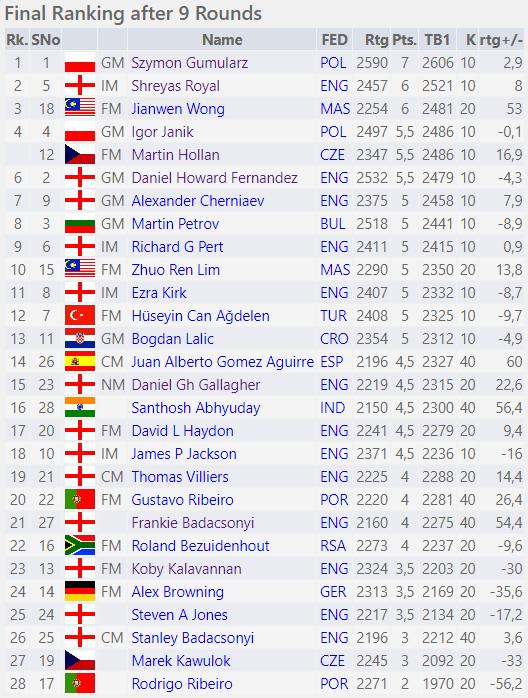
The tournament was won outright by GM Syzmon Gumularz (pictured below) a full point ahead of the chasing group with 7/9, followed by IM Shreyas Royal and FM Jianwen Wong, each with 6/9.

Organising title norm Swiss tournaments in the UK is not easy, and arguably the most difficult type of title norm tournament to organise. This year’s Southend Masters was my second title norm Swiss tournament, following the Mindsports Grandmasters Open in September 2023. The idea was to expand the Southend Masters tournament, which was a high category GM all-play-all in 2023, to a more inclusive tournament in 2024. This was done successfully, barring the fact that there was no availability for any cash prizes, even with the 66th Southend FIDE congress (with prizes) taking place alongside the Masters tournament.
A special thanks to the tournament sponsors. Without them, this event would not have been possible!
English Chess Federation
The Chess Trust Chessable (The Official Learning Partner)



The sponsorship allowed the tournament to go ahead by covering the running costs and players’ expenses. Additionally, bursaries were given to English norm seekers to support their aspirations to achieve WIM/WGM/IM/GM norms. This was an excellent initiative!
I would also like to express my gratitude to the GIANT Chess committee, which provided the venue for the
www.englishchess.org.uk Page | 16
GM Szymon Gumularz (tournament winner) pictured with the ECF Director of Women’s Chess Aga Milewska
tournament and ran the congress, and to the chief arbiter IA Matthew Carr for providing all the chess equipment and live boards/broadcasting, giving the tournament a professional environment and running the event effortlessly. A heartfelt thank you to the ECF Director of Women’s Chess Aga Milewska for being there for me and taking so much weight off my shoulders. I must express my gratitude for a well-deserved International Arbiter norm for all your hard work, and having just been put forward for the title! Thanks also to International Arbiter /Organiser Adam Raoof for publicising the event - a mentor to whom I’m hugely grateful for what I’ve learned from him.
A special mention to the Essex players for their performances (IM Richard Pert and FM David Haydon).
Finally, the person who did all the accounts and some behind the scenes work with me - Jake Hung: thank you for being there for me and being the foundation that I needed. Congratulations on being put forward for your FIDE Arbiter title!
All the games / PGNs can be viewed and downloaded here: https://chessresults.com/PartieSuche.aspx?lan=1&id=50023&tnr=874 004&art=3.
A PGN file containing all the games can also be downloaded on the Chess-results website page next to the ’Download Files’ line, and a selection of games isshown below.
Royal, Shreyas - Petrov, Martin Southend Masters Southend, United Kingdom (6.3), 30.03.2024
1.d4 Nf6 2.c4 e6 3.Nc3 Bb4 4.f3 c5 5.d5 b5 6.e4 0–0 7.e5 Ne8 8.f4 exd5 9.cxd5 d6 10.Nf3 c4 11.a4 dxe5 12.fxe5 Nd7 13.Be2 Nb6 14.Bd2 Bb7 15.d6 f6 16.Nxb5 Bxd2+ 17.Qxd2 fxe5 18.a5 Bxf3 19.Bxf3 e4 20.Be2 Nd7 21.0–0–0 Kh8 22.Nc7 Nc5 23.Qd5 Nd3+ 24.Bxd3 Nxc7 25.Qxc4 exd3 26.dxc7 Rc8 27.Rhf1 Qg5+ 28.Kb1 Rxf1 29.Rxf1 Qe7 30.Qf7 Qd6 31.Qf5 1–0
Gumularz, Szymon - Fernandez, Daniel Howard Southend Masters Southend, United Kingdom (8.1), 31.03.2024
1.d4 d5 2.c4 c6 3.Nf3 Nf6 4.Nc3 a6 5.e3 b5 6.b3 Bg4 7.a4 bxc4 8.bxc4 e6 9.c5 a5 10.h3 Bxf3 11.gxf3 e5 12.dxe5 Nfd7 13.f4 Bxc5 14.Bg2 Bb4 15.Qc2 f6 16.exf6 Qxf6 17.Bb2 d4 18.exd4 0–0 19.0–0 Qxf4 20.Nd5 Qd6 21.Nxb4 axb4 22.Qc4+ Kh8 23.a5 Nf6 24.Qc5 Qxc5 25.dxc5 Nd5
26.Rfe1 Kg8 27.Rad1 Nc3 28.Rd4 Na4 29.Ba1 Rxa5
30.Rxb4 Nxc5 31.Rg4 g6 32.Bf1 Rf3 33.Bc4+ Kf8 34.Be5 Nbd7 35.Bd6+ Kg7 36.Re7+ Kh8 37.Rf4 Rxf4 38.Bxf4 h5 39.Be3 Ra1+ 40.Kg2 Rd1 41.Bh6 h4 42.f4 Rd5 43.Bg7+ Kg8 44.Bxd5+ cxd5 45.Kf3 Nb8 46.Bd4 Nb3 47.Bf6 Nc6
48.Rg7+ Kf8 49.Rxg6 Kf7 50.Rh6 d4 51.Bxh4 d3 52.Rf6+ Kg7 53.Rxc6 Nd4+ 54.Ke3 Nxc6 55.Kxd3 Nb8 56.Ke4 Nd7 57.f5 Kf7 58.Bf2 Nf6+ 59.Kf4 Nh7 60.Bd4 Nf8 61.Kg5 Nh7+ 62.Kh5 Nf8 63.Kh6 Nd7 64.h4 Nf8 65.h5 Nd7 66.Kg5 Nf8 67.h6 Kg8 68.Bg7 Ng6 69.Kg4 Ne7 70.Kf4 Nc6
71.Kg5 Kh7 72.Kf6 Nd8 73.Bf8 Kg8 74.Bd6 Kh7 75.Bf4 Nc6 76.Be3 Kg8 77.Ke6 Nd8+ 78.Ke7 Nc6+ 79.Ke8
1–0
Kirk, Ezra - Hollan, Martin Southend Masters Southend, United Kingdom (6.4), 30.03.2024
1.Nf3 c5 2.c4 g6 3.g3 Bg7 4.Bg2 Nc6 5.0–0 d6 6.Nc3 e6 7.a3 Nge7 8.b4 0–0 9.e3 cxb4 10.axb4 Nxb4 11.Ba3 Nbc6 12.d4 a6 13.Nd2 b5 14.Bxd6 Qxd6 15.cxb5 Bd7 16.Nce4 Qc7 17.bxc6 Bxc6 18.Qc2 Rfc8 19.Rfc1 Qd8 20.Qb2 Rcb8 21.Qc3 Bd5 22.Bf1 a5 23.Nc5 Rc8 24.Qa3 Bf8 25.Ba6 Rxc5 26.Rxc5 Rxa6 27.Qd3 Ra8 28.Qc3 Nc6 29.e4 Nxd4 30.Qxd4 Bxc5 31.Qxc5 Bb7 32.Qb5 Qxd2 33.Qxb7 Qd8 34.Qb5 a4 35.Qb4 Qa5 36.Qxa5 Rxa5 37.Kf1 a3 38.Ra2 f5 39.exf5 exf5 40.Ke2 Kf7 41.Kd3 Ke6 42.Kc4 Ke5 43.f3 h5 44.h3 h4
Gallagher, Daniel GH - Jackson, James P
Southend Masters Southend, United Kingdom (7.9), 31.03.2024
1.Nf3 Nf6 2.c4 g6 3.Nc3 Bg7 4.e4 d6 5.d4 0–0 6.Be2 Nbd7 7.0–0 e5 8.Be3 Qe7 9.Qc2 c6 10.d5 Ng4 11.Bg5 f6 12.Bd2 Nh6 13.b4 f5 14.Ng5 Nf6 15.dxc6 bxc6 16.b5 c5 17.Nd5 Qd8 18.Bd3 f4 19.Nf3 g5 20.Ne1 Nxd5 21.cxd5 g4 22.a4 Rf6 23.Ra3 Nf7 24.Bc4 Rh6 25.g3 Rh3 26.Bc1 f3 27.Nxf3 gxf3 28.Rxf3 Nh6 29.Rb3 Qe8 30.f3 Qg6 31.a5 Nf7 32.b6 axb6 33.axb6 Nd8 34.Bb5 Nb7 35.Bc6 Rb8 36.Qa2 Bh6
37.Qa7 Rxg3+ 38.Kh1 Bh3 39.Qxb8+ Bf8 40.hxg3 Bxf1 41.g4 Na5 42.Ra3 h5 43.Rxa5 Qf7 44.f4 Qg6 45.Kg1 Bh3 46.Ra8 Qxg4+ 47.Kf2 Qg2+ 48.Ke3 exf4+ 49.Kd3 Qf3+ 50.Kc2 Qxe4+ 51.Kb2 Qe2+ 52.Ka1 Qe5+ 53.Bb2 Qe1+ 54.Ka2
1–0
Images from the tournament have been included below. All images / photos can be found on the chess results website:
www.englishchess.org.uk Page | 17
0–1
https://chessresults.com/Fotos.aspx?lan=1&key1=14999
I do intend to keep organising title norm tournaments and providing opportunities for the English chess community. A goal would be to try to expand the playing field and encourage more open Swiss tournaments with a large number of players.
www.englishchess.org.uk Page | 18
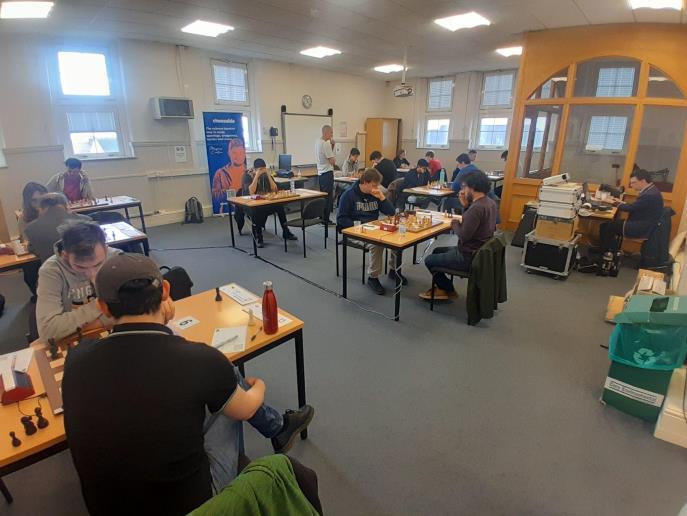
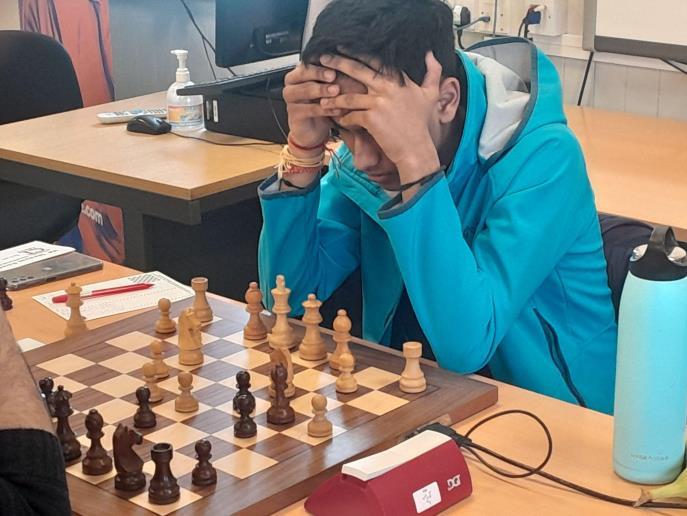
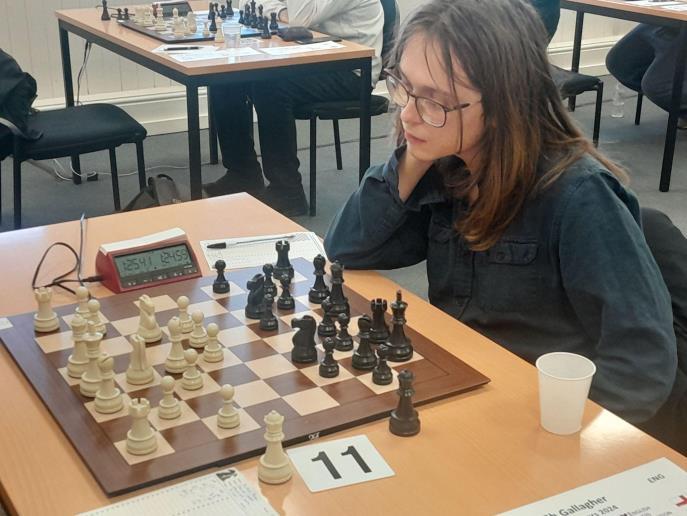
Playing hall (Room 16)
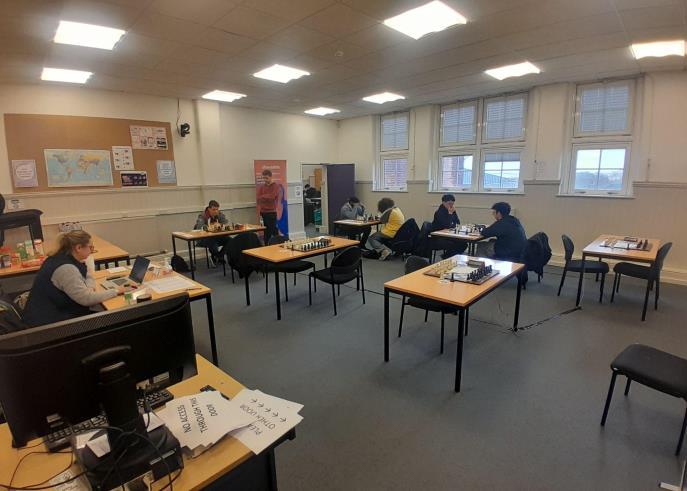
Playing hall (Room 17)
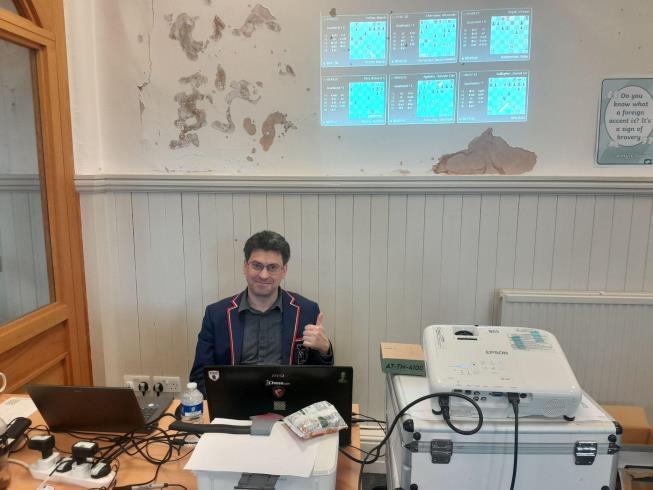
IA Matthew Carr (Chief Arbiter)
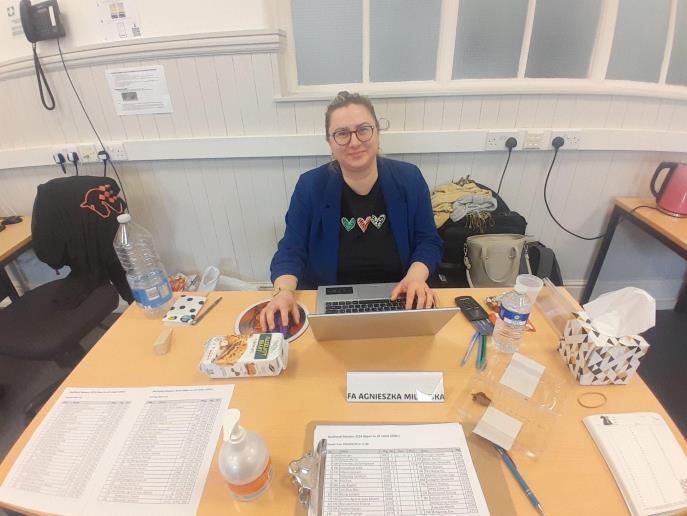
IA Aga Milewska (Deputy Chief Arbiter)
IM Shreyas Royal (ENG)
NM Daniel Gallagher (ENG)
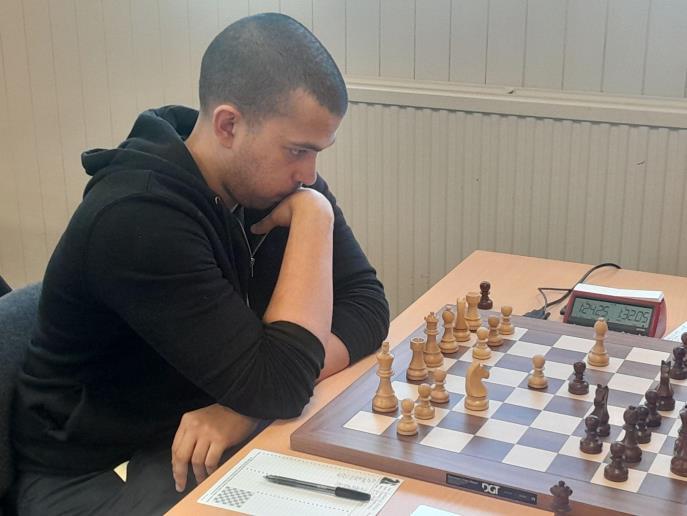
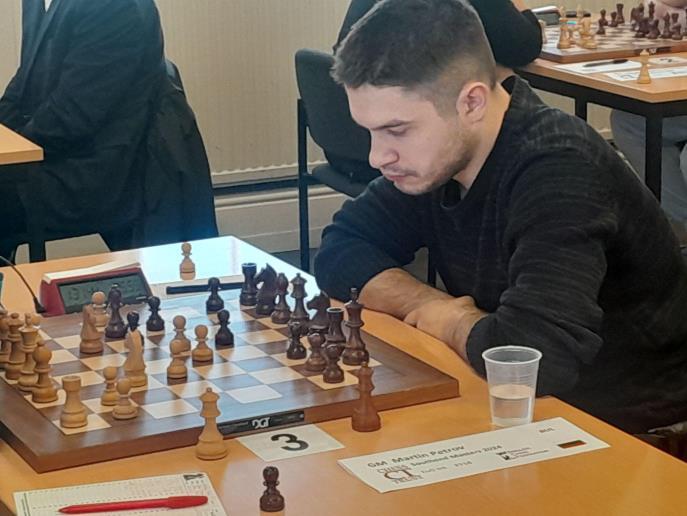

www.englishchess.org.uk Page | 19
GM Daniel Howard Fernandez (ENG)
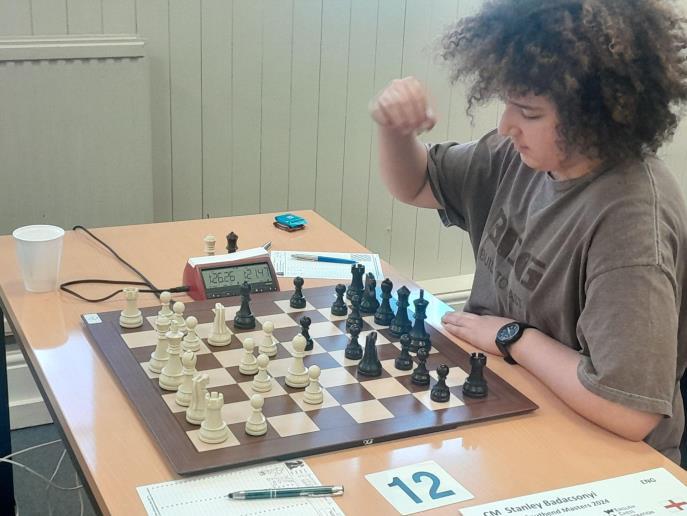
CM Stanley Badacsonyi (ENG)
FM David Haydon (ENG)
GM Martin Petrov (BUL)
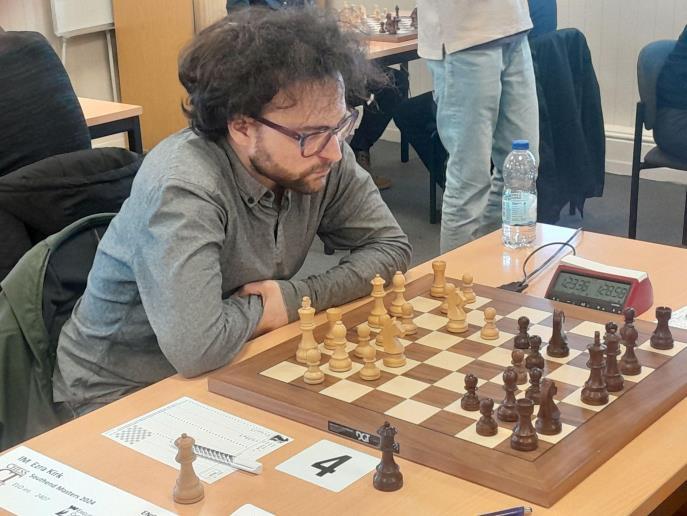
IM Ezra Kirk (ENG)
FEATURES Great British Chess Players
by John Nunn
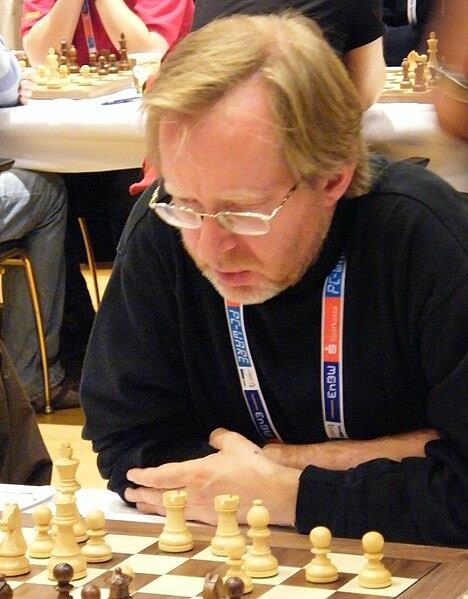
Murray Chandler (1960- )
Murray Chandler was born on 4th April 1960 in Wellington, New Zealand and spent his childhood in nearby Wainuiomata. He appeared on the international stage as early as 1974, when he played for the New Zealand team in the first Asian Team Chess Championship. From 1976 he spent much of his time in England, while continuing to play for New Zealand in events such as the Olympiads of 1976, 1978 and 1980. He won the New Zealand championship in 1975-76 and the Asian Junior Chess Championship in 1977, the latter victory automatically granting him the International Master title.
My first game against Murray was a draw in the 1977 Surrey Open, and I recall being amazed by this small barefoot blond kid who played really well. A few years later Murray, having learned the benefit of shoes (or at least flip-flops) in the English climate, switched his chess nationality to England and became a team-mate in a host of events. Murray became a grandmaster in 1983 and had a consistently high rating of roughly 2600 from 1987 to 1992.
Murray proved a reliable member of the English team, playing in all the Olympiads from 1982 to 1992 and scoring an excellent 9/11 at bothDubai 1986 and Novi Sad 1990. He also had many successes in individual events, perhaps his best result being joint second (with Polugaevsky) at the 1984 London (Phillips & Drew) tournament behind Karpov. In 2007 he returned to live permanently in New Zealand, and won the national championship in 2006 and 2008. He played for New Zealand in the 2008 Olympiad, but after that retired from over the board play.
Murray is known not only for his games but also for his chess-related business activities. He was the owner and editor of British Chess Magazine from 1991 to 1999 and in 1997 founded (with Graham Burgess and me) Gambit Publications; 27 years later, and with more than 2½ million books sold, the company is still run by the same trio. He was president of the New Zealand Chess Federation from 2015-21 and in 2017 was appointed a Member of the New Zealand Order of Merit for services to chess.
Murray’s chess style was uncompromising, and based on excellent opening preparation and a flexible approach which could adapt to each opponent. He beat Ulf Andersson twice with Black when the Swedish grandmaster was at the height of his powers, and scored multiple wins against players such as Adams, Timman, Ribli and Vaganian. One of these is given below.
Murray Chandler - Rafael Vaganian
London Phillips & Drew 1986 French Defence
1.e4 e6 2.d4 d5 3.Nc3 Bb4 4.e5 c5 5.a3 Ba5
This line has been a favourite with Vaganian for decades. While theory prefers the standard 5...Bxc3+, the Armenian grandmaster has had many successes with the line, which came to prominence after the famous FischerTal draw in the 1960 Leipzig Olympiad.
6.b4
The theoretical recommendation.
6...cxd4
6...cxb4 7.Nb5 is risky for Black. He wins a pawn, but releases the pressure against d4 and gives the white knight access to d6.
7.Nb5
www.englishchess.org.uk Page | 20
Murray Chandler - Photo by Frank Hoppe
The other main lines are 7.bxa5 and 7.Qg4. It’s hard to say which is the best option for White.
7...Bc7 8.f4
This is one of White’s more solid plans. He just supports the e5-pawn, and leaves regaining the pawn on d4 for later.
8...Bd7 9.Nf3
Murray decides to allow Black to take on b5. The alternative is 9.Nxc7+ Qxc7 and now 10.Nf3 or 10.Bb2, which should also give White some advantage.
9...Bxb5
It looks natural to swap off the bad bishop, and this also makes it harder for White to favourably regain the pawn, but he can take comfort in the acquisition of the two bishops.
10.Bxb5+ Nc6 11.0-0 Nge7 12.Bd3
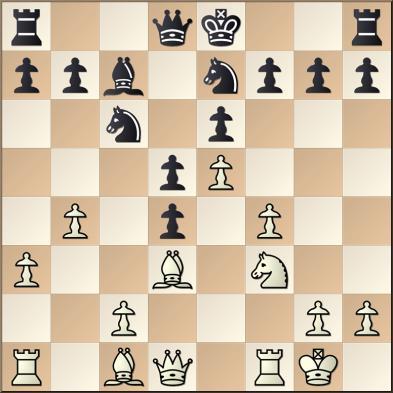
The most accurate line, in which White forgoes any chance of winning back the pawn and instead plays for a direct attack on the kingside based on f5. It also prevents castling due to the standard Bxh7+ sacrifice.
12...a6 13.Kh1 h6?!
This move misses the point. Black is still thinking about castling and wishes to rule out the bishop sacrifice, but playing ...h6 does nothing to hold up White’s f5 plan. 13...g6 was better.
14.Qe2 Qd7
14...0-0? is still bad, this time due to 15.g4 followed by f5. When White aims for f5 Black really misses his lightsquared bishop.
15.Bb2 Bb6
Black doesn’t want to surrender his extra pawn, but this releases the pressure against e5 and makes f5 easier to achieve.
16.Rae1
Most human players would go for this, but the computer suggests the interesting plan of 16.Rfb1!? Qc7 17.Bc1 followed by a4. The idea is that ...0-0 is always bad due to g4 and f5, but leaving the king in the centre exposes it to danger if White opens lines on the queenside.
16...Rc8?!
Too slow. 16...0-0-0?! is also dubious due to 17.Rb1! followed by Ba1 and a4, so Black should have played either 16...g6 or 16...Nf5, holding up f5.
17.g4?
The right idea but the wrong execution. 17.Nh4! was correct, meeting 17...g6 with 18.g4. This transposes into the game, but denies Black the resource mentioned in the following note.
17...g6?
Now everything runs smoothly. 17...h5! was correct, when the long tactical line 18.f5 hxg4 19.Ng5 g3 20.Nxf7 Rxh2+ 21.Qxh2 gxh2 22.Nd6+ Kd8 23.fxe6 Qxe6 24.Rf8+ Kd7 25.Nxc8 Bc7 leads to a totally unclear position.
18.Nh4
After this Black cannot prevent f5. White could also have played 18.Qf2 followed by Qh4, increasing the pressure on Black’s weakened dark squares.
18...h5 19.f5!
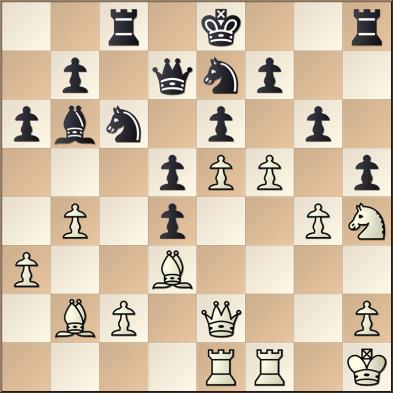
White is prepared to sacrifice a piece to achieve the longawaited breakthrough.
www.englishchess.org.uk Page | 21
19...hxg4 20.fxg6 Rxh4
Objectivelyspeaking, 20...Nxg6 would haveoffered better chances, although the ending after 21.Nxg6 fxg6 22.Qxg4 Kd8 23.Rf6 Kc7 24.Qxe6 is miserable for Black, as White’s h-pawn will become very dangerous.
21.gxf7+ Kf8 22.Bc1!
Threatening 23.Bg5 followed by Qxg4, with a decisive attack.
22...Nf5
22...g3 23.Bg5 doesn’t help, since 23...Rxh2+ loses to 24.Qxh2 gxh2 25.Bh6#.
23.Bxf5 d3!?
Black attempts to activate the b6-bishop. 23...exf5 24.e6 Qd6 25.Bf4 Qe7 26.Qd2 and 23...g3 24.Bd3 Rxh2+ 25.Qxh2 gxh2 26.Bh6+ Ke7 27.f8Q+ Rxf8 28.Rxf8 are clearly winning for White.
24.Bxd3
24.Qxd3 exf5 25.e6 Qc7 26.Bf4 is also winning.
24...g3 25.Qg2!
It’s not often that a player forces his opponent to win a queen!
25...Rxh2+ 26.Qxh2 gxh2 27.Bh6+ Ke7 28.Bg5+
Murray gains time on the clock before closing in for the kill. Sometimes computers suggest amazing lines. Here the machine likes 28.b5! axb5 29.f8Q+ Rxf8 30.Rxf8 d4 31.Be4 Nxe5 32.Rg8!, but why is this better than playing 28.f8Q+ immediately? The answer is that by blocking b5 White prevents ...Qb5 at the end of this line, and so leaves Black’s queen without any reasonable square. Congratulations to anyone who could see that.
28...Kf8 29.Bh6+ Ke7 30.Bg6!
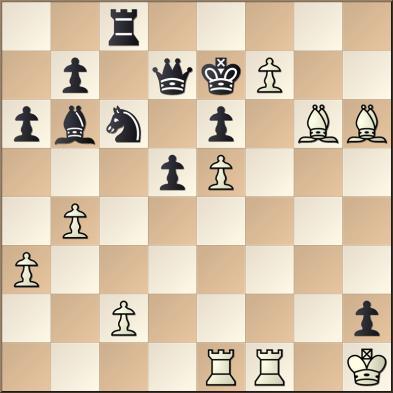
Threatening 31.f8Q+ Rxf8 32.Bg5+.
30...Bc7
30...d4 31.f8Q+ Rxf8 32.Bg5+ Rf6 33.exf6+ Kd6 34.f7 and 30...Qd8 31.Bg5+ Kf8 32.Bxd8 Rxd8 33.Re2 are also lost.
31.Bg5+ Kf8 32.Bh6+ Ke7 33.f8Q+ Rxf8 34.Bxf8+
34.Bg5+ Rf6 35.exf6+ Kd6 36.f7 is also effective.
34...Kd8 35.Rf7
Trapping Black’s queen.
35...Qe8 36.Bg7 Nxe5 37.Bf6+ 1-0
37...Kc8 38.Rxc7+ leaves White a rook and a piece up.
Mark Rivlin interviews
Maurice Ashley
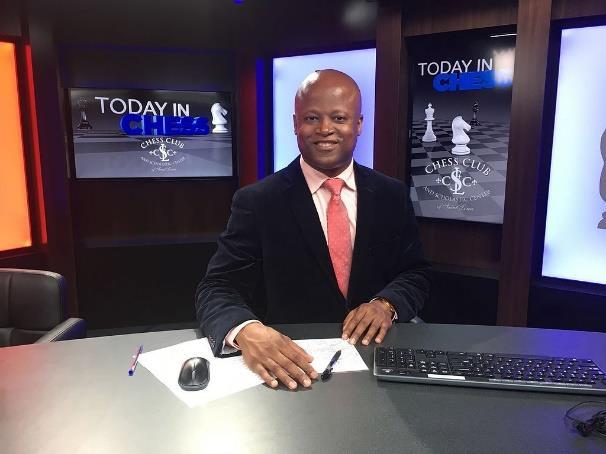
Credit: Jennifer Huemmer, CC BY-SA 4.0
A player, coach, author, commentator, and the world’s first African-American grandmaster, Maurice Ashley has a proud record of promoting chess. One of the top chess pundits on the circuit, Maurice stopped doing regular
www.englishchess.org.uk Page | 22
commentary two years ago in order to develop content. His four Chessable courses are available here: (https://www.chessable.com/author/GMAshley/, and two books were published in April 2024: ‘The LifeChanging Magic of Chess: A Beginner’s Guide with Grandmaster Maurice Ashley’ and ‘Move by Move, Life Lessons on and off the Chessboard’.
Please tell us about the children’s book that was published in April.
The children’s book is part of a series that includes books on skateboarding, drumming and baking. My fellow authors and I write about the various ways our passions transformed our lives. When I was approached to do this book, I never suspected how fulfilling it would be to work on. Now, I’m thrilled to see the final product, and I’m hopeful that it will help many kids see how beautiful a game chess really is.
Your coaching over the years has included two national team championships for Raging Rooks and Dark Knights from Harlem. How did you achieve these remarkable results?
I think my coaching results were simply a matter of conveying my obsession with chess to my students. They could see I wasn’t just a teacher in the classroom; I was deeply entranced by the game, and I loved sharing with my students the awe-inspiring moves that blew my mind. I think kids jump on board when they get that someone is truly in love with what they do.
You are a respected commentator and interviewer, and UK chess fans warmed to your excellent work at the London Chess Classic. How would you describe your interviewing and commentating styles?
My presentation style was heavily influenced by my upbringing in Kingston, Jamaica and Brooklyn, NY. In both places board games are often played outdoors, with music blasting and people talking non-stop. Everyone was pretty loud and aggressive, but it was all in good fun. I also love sports, and I always felt that chess battles resembled gladiators battling in the ring. That excitement is what I always wish to bring across to an audience who are giving me their precious time to watch me talking about chess.
Tell us about your chess journey which led to you becoming the first African-American grandmaster.
I got serious about chess at 14 in high school just playing with my friends and in the parks of NYC. I was hooked on the game, and studied every day like my life depended on it. I didn’t have a coach until I was 21, and already with a
US national rating over 2400. Once I did, I quickly got IM norms, but life got in the way when I had my first child, so it took me some time to get my three GM norms. It was definitely a non-traditional path to the title, but I think it made me appreciate the process much more
Standard play, rapidplay or blitz?
All of the above, but blitz for commentary.
Who is your favourite chess YouTuber?
Daniel Naroditsky.
Which players and coaches had the most influence on your chess career?
My favourite player growing up was Mikhail Tal, and later Garry Kasparov. The most important people during my early chess years were the men of the Black Bear School, a group of mostly African-American men who took chess very seriously, and who fought each other like lions over the chessboard. It’s a long list of players, but I would like to single out the late Ronald Simpson and my dear friend Willie Johnson. Later, my coaches IM Vitaly Zaltsman and GM Gregory Kaidanov were very impactful, but there were others as well. I wish I could name them all, because I believe I truly stood on the shoulders of giants.
What advice would you give to club players trying to put another 100 points on their rating?
I don’t believe in the rating obsession. I think if you are really passionate about the game and study because you love it, then you will grow slowly, but surely. That said, I do strongly urge club players to avoid memorizing openings as your main interest and focus on studying positional chess and endgames, in addition to solving those tactical puzzles that everyone loves. Positional chess and endgames don’t seem sexy, but they will help far more in the long run than anything else.
Outside chess, what are your interests?
Working out, dancing salsa and bachata, riding my bike, watching NBA basketball (Go Knicks!), travelling, learning languages, and buying books (which I hope to eventually read).
Did you enjoy your visit to a chess boxing event during the London Chess Classic?
The chess boxing event blew my mind. I thought it would be a joke at first, but I was shocked to see how into it the fans were. I realised that it reminded me of what chess in
www.englishchess.org.uk Page | 23
Brooklyn was like for me – all-out war. Plus my brother and sister are world champion fighters (kickboxing and boxing respectively), so I understand that people just love to see a good brawl. The level of technique for both boxing and chess still needs to improve, but now I think the sport does have a place in the chess ecosystem.
Tell us about some young American players whom UK fans may not know and who could become stars of the future?
In the age of social media it’s hard for young phenoms to fly under the radar. There is a 14 year old named Brewington Hardaway who is poised to follow in my footsteps as the next African-American GM in the US. It’s been 25 years since I gained the title, so for me it’s very exciting to finally see a young person of colour breaking through the wall. Hopefully, it will be a sign that others will follow soon after as well.
Book of the Month
by Ben Graff
‘Chess is a game for everybody, no matter who you are, where you come from or what your circumstances are.’
Maurice Ashley – The Life-Changing Magic of Chess
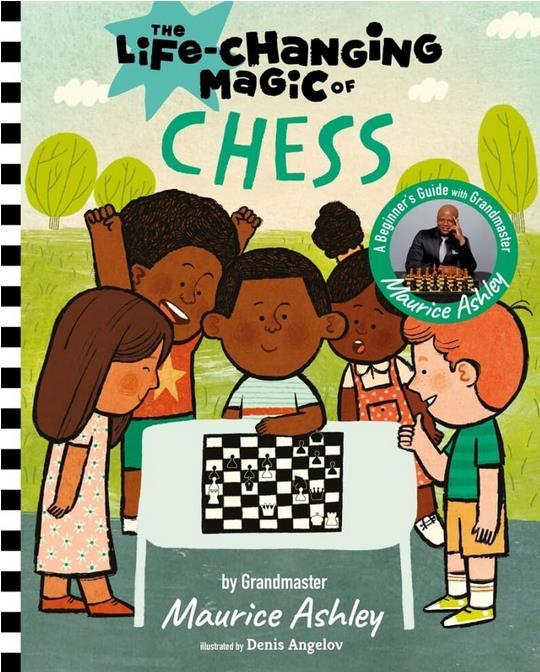
This month, in a first for this column, we talk with the author of the book we are reviewing. It was wonderful to hear directly from the world’s first African-American grandmaster, Maurice Ashley, on The Life-Changing Magic of Chess.
I began by asking Maurice what had inspired him to write this book.
Maurice said: ‘Iwas approachedby MagicCattowrite The Life-Changing Magic of Chess, and I instantly became very intrigued by the idea. It’s one of those things where you don’t realize there’s something you want to do until you’vebeenaskedtodoit.Ifeelvery satisfiedthat Igot to write exactly this book, since one of my most important missions in life is to inspire young people to follow their dreams.’
I noted that The Life-Changing Magic of Chess was very strong on the possibilities the game can offer away from the sixty-four squares in terms of building friendships and opportunities to travel. I asked Maurice to say a little more on this.
Maurice said: ‘I am amazed and grateful for the number of friends that I’ve made and the places I’ve been to because of chess. The game has also taught me many life lessons, from using losses as a way to grow, recognizing the genius in even your greatest adversary, and keeping a beginner’s mindset despite having reached the grandmaster title. Even today I am still learning so much
www.englishchess.org.uk Page | 24
The best new writing and the greatest classics under one roof… in association with Forward Chess
about chess, and my wish is that the book communicates my love and passion for the game to kids.’
Finally, I asked Maurice a more general question that I felt was important. It had struck me that Maurice’s book would help to welcome many new players to the game. As the world's first African-American GM Maurice is clearly an amazing role model. He has described this achievement as ‘both mattering and not mattering’. I wondered what he meant by this, and what he felt the game needed to do to become more inclusive?
Maurice said: ‘Diversity is a law of the universe, and the game of chess has always thrived on having people from all backgrounds picking it up and adding their special flavour and creativity to the sport. Imagine if chess had never made it to the people of Cuba or the Philippines, then there would have never been a Capablanca or Wesley So. While it shouldn't matter what you look like or what your skin colour is, I believe it's our collective responsibility to ensure that kids from all cultures have a chance to rise to the top of our game. It's one of the greatest powers of chess that it continues to break down allbarriers and bring innew fans from all over the world.’
In terms of The Life-Changing Magic of Chess itself, I thought this was a beautifully put together and heartwarming offering. Maurice manages to combine elements of both his own story with thoughts on players who have inspired him, and a helpful beginners guide to the game.
In ten simple chapters, Maurice covers topics ranging from ‘It’s like being a magician’ and ‘Everyone starts as a beginner!’ through to ‘Everybody is welcome’ , ‘Losing is learning’ and ‘What happens in your life can help you in chess’. All of which is likely both to give beginners some basic tips, and to encourage them to take further steps into the chess world.
Maurice’s journey from Jamaica to Brooklyn, and from beginner to serious player, is very well captured. His characterisation of watching the players in Prospect Park is a perfect illustration of his ability to convey a lot in very few words. ‘And their game was lightning-fast, using a clock to time the moves. I couldn’t take my eyes off their hands, flitting like a hummingbird’s wings as they moved piece after piece.’
We get a real sense throughout the book of the extent to which chess has taken Maurice on a magical life-long adventure. Moreover, while most readers of this book aren’t going to become grandmasters, where Maurice excels is in sharing a sense that chess can open up possibilities in anyone’s life. We should also give a shout-
out to Denis Angelov, whose lovely illustrations perfectly complement Maurice’s excellent writing. This is a very nicely put together work.
It is only fair to highlight that this is not a detailed guide to the mechanics of the game. From a technical perspective, other books will be needed for a learner to build their knowledge. Indeed, Richard James’s Chess Heroes series, which I reviewed last month, might be a logical next step. However, relaying reams of theory is not the main point of Maurice’s book. Rather it is to inspire, to tell a story, to create an imaginative spark that might light a fire which lasts a lifetime. It hugely succeeds on all these fronts.
Without question The Life-Changing Magic of Chess would make a very nice present to a child, and could well be a first important step on a very special journey. Maurice Ashley continues to break down barriers and to welcome others to the game that has given him so much. The Life-Changing Magic of Chess is yet another example of Maurice Ashley giving back, and then some.
Endgames All Club Players Should Know
by Glenn Flear
Rook against Bishop
A rook is essentially a superior piece to a bishop, and will become more so as play opens up. On a wide open board a rook will have influence on a greater number of squares (in the first diagram it's fourteen, compared to the bishop's nine).
In order to learn a few fundamentals, the first position to consider is the following one. Black's king is stuck in a corner, but he is able to save the game because of stalemate.
www.englishchess.org.uk Page | 25
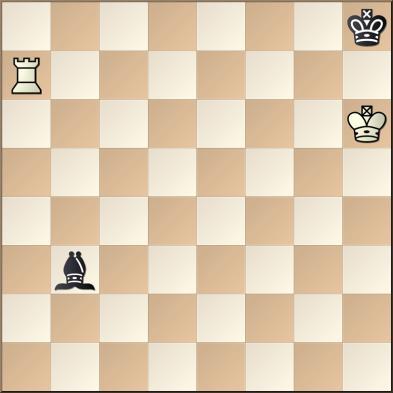
1...Bc4 Just waiting.
2.Ra8+ Bg8 Here, with stalemate threatened, White cannot make progress.
Once this resource is understood, it enables a plan of defence to be formulated in such situations. So, if pushed from a more centralised position, the defender should steer his king towards either of the corners that are the opposite colour to his bishop.
In the following case, despite being in the wrong corner, the game can be saved by employing some careful wriggling.
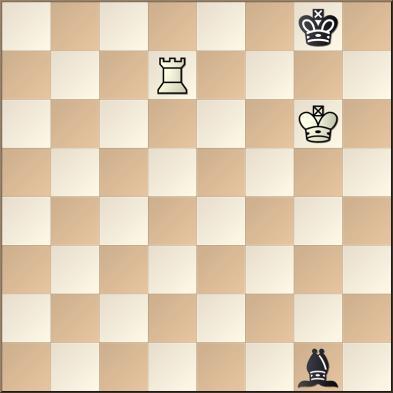
1...Kf8 2.Kf6 Bb6! Despite White’s seemingly being on the verge of delivering mate, Black can resist.
Erroneous, however, would be 2...Ke8? in view of 3.Ke6 Kf8 4.Rf7+ Kg8 5.Kf6 and Black is definitively stuck in the wrong corner.
3.Rb7 Bd4+ 4.Ke6 Kg8 Moving away from the other monarch.
5.Kf5 Kf8 6.Kg6 Ke8 etc.
Despite a successful defence in the example above, having the king near one of the wrong corners (i.e. the
ones that are the same colour as the bishop) can be fraught with danger. In the next example, Black cannot escape from the mating net, even if he first cunningly seeks to hide his bishop.
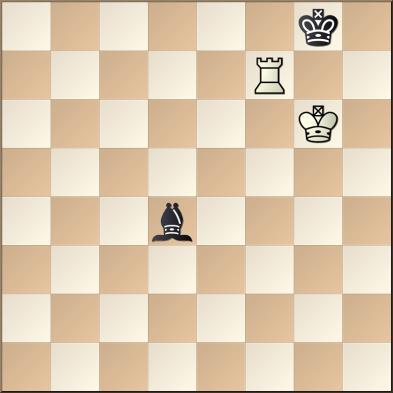
1...Bg1 2.Rf1! A temptation that inexperienced players often fall for is opting for 2.Rc7, threatening mate, but after 2...Kf8 3.Kf6 Bd4+ Black can thwart White's efforts.
2...Bh2 3.Rf2 Bg3 4.Rg2 Now the minor piece has to come out into the open!
4...Bd6 Losing are both 4...Bf4 5.Kf5+, and 4...Bh4 5.Kh5+.
5.Rd2 Be7 Or 5...Bf8 6.Rd8, and mate next move.
6.Ra2! And here Black's king can't escape his fate, as after...
6...Kf8 7.Ra8+ ...the bishop gets in the way.
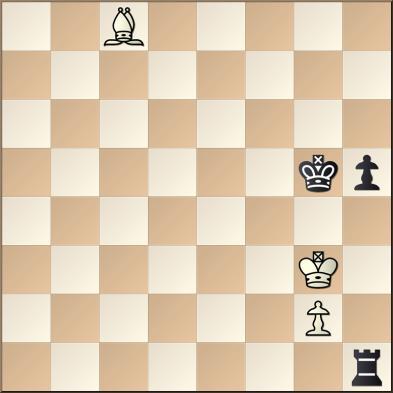
In the case of both sides having one pawn, the result will depend on a number of factors, but if the defender is tied down and there are certain soft spots where the stronger side can penetrate there can be good winning chances.
Moiseev, O – Botvinnik, M USSR Championship 1952
www.englishchess.org.uk Page | 26
1...h4+ 2.Kf3 Rc1 3.Bd7 Rc2! Better than 3...Rc3+ 4.Ke4 Rg3 5.Bh3, when Black would have to go back and try again.
4.Be6 Rc7! 5.g4 Alternatives don’t work either:
5.Bh3 Rc3+ 6.Ke4 Rg3 (this time it’s White in Zugzwang!)
7.Ke5 Re3+; 5.Ke4 Re7 6.Ke5 Re8!;
5.Bd5 Rc3+ 6.Ke4 Kg4 7.Ke5 Kg3 8.Bb7 Rc2.
5...Rc3+ 6.Kg2 h3+ 7.Kh2 Kh4 8.g5 Rc2+ 0–1
I really like the following analysis of Fischer's, showing how Black can win, as there are several clever ideas required to make progress step by step.
Fischer 1969

1.Bf4 Black’s king will get to f5 in any case, and alternatives are readily shown to be no better:
1.g4 h4;
1.Ke4 Kf6 2.Bd4+ Ke6 3.Kf4 Ra4 4.Ke3 Kf5; 1.Kf4 Ra5! 2.Bd2 Rf5+ 3.Ke4 Kf6 4.Bf4 Ra5.
1...Kf5 2.Bd6 Rb2 3.Bf4 Rb3+ 4.Kg2 Kg4 5.Bd6 Rb2+ 6.Kg1 Kh3 7.Be5 Rb4! 8.Bc7 Here 8.Bf4 is well met by 8...h4, whereas 8.Kf2 Rg4 9.Kg1 loses quickly to 9...h4.
8...Rg4 9.Kf2 Or 9.Kh1 Rc4 10.Bb6 Kxg3 etc.
9...Kh2 10.Be5 Kh1 11.Kf3 Rg8 12.Bf4 Rf8 13.Kf2 If 13.Ke3 then Black seizes more squares with 13...Kg2 before setting up a timely ...Rxg3.
13...h4 14.Kf3 h3 15.Kf2 h2 16.Kf1 Ra8 17.Kf2 Ra2+ 18.Kf1 Ra3 19.Kf2 Rf3+! 20.Kxf3 Kg1 21.Be3+ Kf1 0–1
In the following example I was able to hold the draw despite suffering from certain unfavourable factors (such as the weaknesses on f4 and h4). My active king was able to frustrate my opponent's attempts to get his king to one of the key squares under the right circumstances.
Flear, G – Favarel, J French League 2009
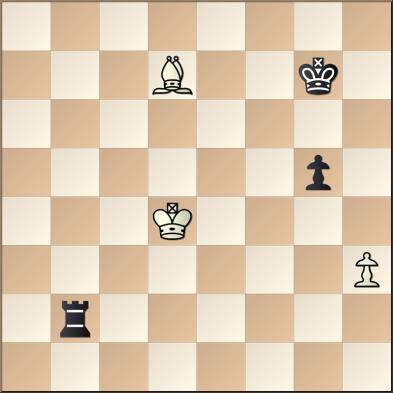
57.Ke5 Rb4 58.Bg4 Kg6 59.Bd7 Kh5 60.Kf6 Rb6+ Although 60...Kh4 may seem like an achievement, the counterattack against g5 keeps White afloat, so he can wait with 61.Bc8 etc.
61.Ke5 Kg6 62.Be8+ Kh6 63.Bd7 Rb7 64.Bf5 Rb2 65.Bg4 Rf2 66.Ke6 Kg6 67.Ke5 Rf1 68.Ke4 Kf6 69.Bc8 Rf4+ 70.Kd5 Rf3 71.Ke4 Rc3 72.Bg4 Rc4+ 73.Kd5!? Passive defence has its drawbacks: 73.Kf3 Ke5 74.Kg3? (74.Bd7 would still be OK) 74...Rc3+ 75.Bf3 Kf5 and White is forced back. Going further: 76.Kg2 Kf4 77.Bg4 Rc2+ 78.Kg1 Kg3 79.Kf1 Rh2 80.Kg1 Rxh3–+.
73...Ra4 74.Bd7 Ra1 75.Bg4 Re1 76.Kd4 Ke7 77.Kd5 Ra1 78.Ke5 Ra5+ 79.Ke4 Kd6 80.Bc8 Re5+ 81.Kf3 Rc5 82.Ba6 Ra5 83.Bc8 Ra4 84.Kg3 Ke5 85.Bd7 Rd4 86.Bc8 Rd8 The position of the bishop is noteworthy (i.e. not going to g4) in that 86...Rd3+ can be met by 87.Kg4.
87.Ba6 Kf5 88.Be2 Rd2 89.Bg4+ Ke5 90.Bc8 Rd8 91.Ba6 Rd4 92.Bc8 Kf6 93.Ba6 Kg6 94.Be2 Rd2 95.Ba6 Kh5 96.Bb5 Rb2 97.Be8+ Kh6 98.Bd7 Re2 99.h4 gxh4+ 100.Kxh4 Rg2 101.Bg4 Kg6 102.Bf3 Rg1 103.Be4+ Kf6 104.Bb7 Rg7 105.Ba6 Kf5 106.Bd3+ Kf4 107.Kh5 Rg5+ 108.Kh6 Rd5 109.Bc2 Rg5 110.Kh7 Ke5 111.Kh8 Kf6 112.Bd3 ½–½
Fine 1941
The question of potential entry squares is again a priority when there are two or more pawns for each side on the same wing. The next position illustrates the importance of this point.
www.englishchess.org.uk Page | 27
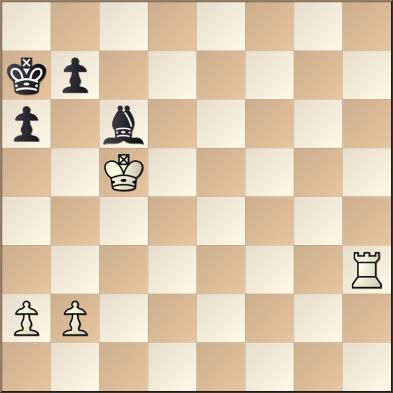
White firstly gets his king as close as possible to the pawns.
1.Kd6 Kb8 Or 1...Kb6 2.Rb3+ Ka7 3.Kc7.
2.Rh8+ Ka7 3.Kc7 Bf3 4.Rh6 Be4 5.Rb6 The white pieces have found nice outposts deep inside the black camp, and now he is ready to advance his pawns with decisive effect.
5...Bd5 6.a3 Bf3 Otherwise, 6...Bc6 7.Rxc6 bxc6 8.Kxc6 is a straightforward win, as the a6–pawn is soon lost.
7.b4 Be4 8.a4 Bf3 9.b5 axb5 10.axb5 Be4 11.Re6 Bd5 If 11...Bd3 the coup de grâce is 12.Ra6+! (12.b6+ is winning, but less elegant) 12...bxa6 13.b6+ Ka8 14.b7+ Ka7 15.b8Q#.
12.Re3 And mate follows.
It’s worth comparing how events unfolded above with the next example.
Fine 2 1941
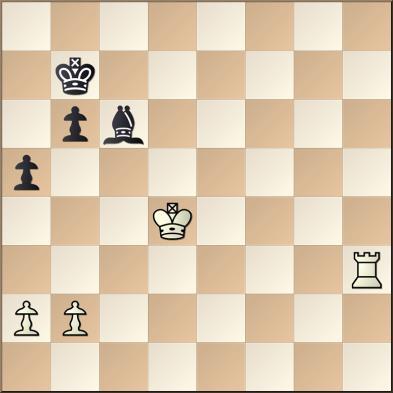
In this case Black has set up a tough-looking fortress and White is unable to penetrate to any effect.
1.Ke5 Kc7 2.Rh7+ Kb8 3.Kd6 That's as far as White's king will be able to go for now, so he can try advancing his pawns to stir up trouble.
3...Bf3 4.a4 Be4 5.Rf7 Bg2 Just waiting at present.
6.Rf4 Kb7 7.b4 axb4 8.Rxb4 Ka6 9.Kc7 Finally the king can approach the pawn, but now Black switches plan...
9...Ka5 ...and the counter-attack against a4 earns the draw.
In practical games I advise the defender to take particular care of the pawn structure. Avoid holes indeed, but also being squeezed!
Averbakh
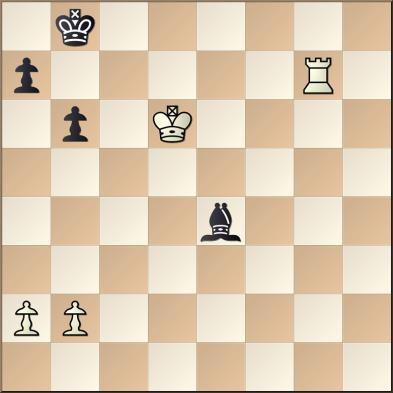
With Black to play he should continue with 1...a5, obtaining some breathing space (and heading towards the set-up in the previous example). On the other hand, where White has the move in the diagram, he can punish Black's lack of space as follows:
1.b4! Bf3 It's too late for 1...a5, as after 2.bxa5 bxa5 the a-pawn is loose and there are weaknesses on c5 and b6. The simplest way to exploit these factors is perhaps 3.Kc5 a4 4.Rg4 Bc2 5.Kb6+–
2.a4 Be4 3.a5 bxa5 4.bxa5 The threat is a5–a6, with a mating net.
4...a6 One can't put off this a-pawn advance for long: 4...Bd3 5.Kc6 Be4+ 6.Kc5 Bd3 7.Rg3 Be2 8.Kc6, and the only way to resist for any length of time is to play 8...a6 anyway.
5.Kc5 Bd3 6.Kb6 Kc8
www.englishchess.org.uk Page | 28
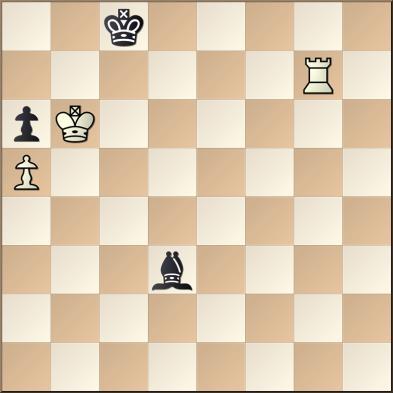
The technique for winning this position involves pushing the black king sufficiently far away from the pawns so that White can then seek a pure king and pawn endgame.
7.Rc7+ Kd8 8.Kb7 Be2 9.Kb8 Bf1 10.Rc1 Be2 11.Rc2 Bb5 12.Rd2+ Ke7 13.Kc7 Ke6 Or 13...Bc4 14.Rd4 Bb5 15.Re4+ etc.
14.Rd4 Ke5 15.Rd6 Be2 16.Kc6 Bb5+ 17.Kc5 Bf1 18.Rd1 Bb5 19.Re1+ Kf6 20.Kd6 Bd3 21.Re3 Bb5 22.Rf3+ Kg7 23.Kc5 Be2 24.Rf2 Bb5 25.Kb6 Kg8 26.Rb2 Bc4 27.Rc2 Bb5 28.Rc8+ Kf7 29.Ra8 Ke7 30.Rxa6+-
Here’s a position which dates back to the eighteenth century.
Philidor 1777
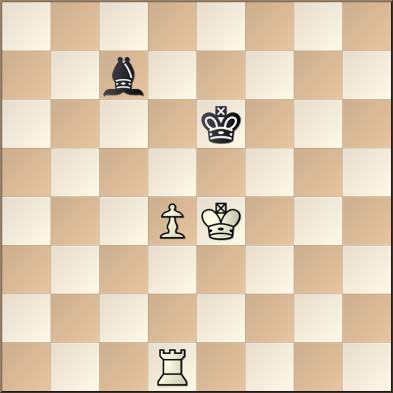
This might look like an easy win, and it is, more or less, but only if White uses the d5–square for his king and not his pawn.
1.Rh1 Instead, after 1.d5+?! Kd7 the winning process would become highly complex, as to makeprogress White would have to use either c5 or e5 for his king, and these squares can both be attacked by the opposing bishop. So all sorts of intricate manoeuvring would be needed, and in a practical game it might not be possible to find a way through. By the way, this particular position was thought to be a draw for nearly a century before a win was found!
1...Bg3 2.Rh6+ Kd7 3.Kd5 Bf2 4.Rh7+ Kd8 5.Ra7 Bg1
6.Kd6 Ke8 7.Ra8+ Kf7 8.d5 and the result is not in doubt.
So always think about how the advance of the passed pawn will be supported, and if your king will be able to help out or not.
As I mentioned earlier, the rook is generally superior to the bishop, but when passed pawns are involved sometimes surprises happen.
Flear, G – Giffard, N Lille 1986
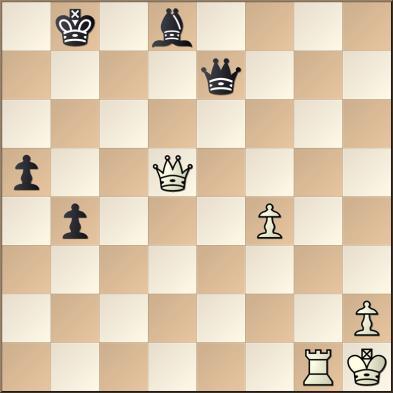
68...Qb7 69.Qxb7+ Kxb7 70.Rd1? A sloppy move that immediately gets punished.
Correct is 70.Kg2!, when White shouldn’t be losing.
70...b3! I clearly missed this one!
71.Rd3 If 71.Rxd8 then 71...b2 72.Rd1 a4 73.Rb1 a3
74.Kg2 Kc6 75.Kf3 a2–+.
71...a4 72.Rd4 Be7 73.Rd7+ Kc6 74.Rxe7 b2 75.Re6+ Kd5
76.Re5+ Kc4 0–1
The power of passed pawns is an important factor, so creating them is a noteworthy aspect of such battles.
Byelov - Utyatsky Kislovodsk 1960
www.englishchess.org.uk Page | 29
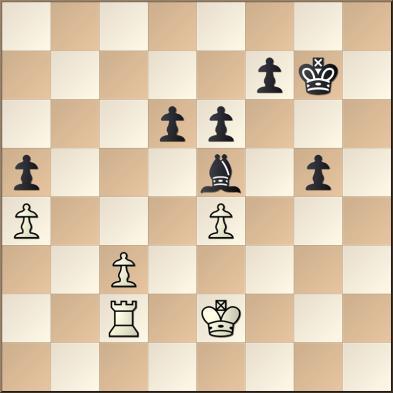
In this example Black has the potential to get matters moving on the kingside, so immediate action is required. White was able to create a strong passed pawn with a neat sequence.
1.c4 Bd4 2.e5! Bxe5 The alternative 2...dxe5 3.c5 is clearly inadequate for Black.
3.c5 dxc5 4.Rxc5 Kf6 5.Rxa5 White's passed a-pawn is going to be fast, but he will still need to be vigilant on the kingside.
5...Bd4 6.Rb5 Kg6 7.a5 f5 8.Rb4 Bg1 9.a6 g4 10.Rb7 f4 11.a7 Bxa7 12.Rxa7
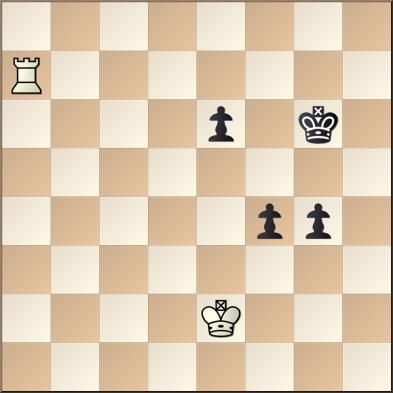
Club players are often afraid of such situations, but with the white king surveying the neighbourhood the black pawns can be kept from becoming too dangerous.
12...e5 13.Kd3 g3 14.Ke4 Kh6 15.Ra8 Kg7 16.Ra1 Kf6 17.Rh1 Kg5 18.Rh8 Kf6 19.Re8 Kg6 20.Re6+ Resignation came, in view of 20...Kf7 21.Rxe5 g2 22.Rg5+–. 1–0
When there are no passed pawns a typical plan is to create one.
Flear, G – Boyne, A Exeter 1983
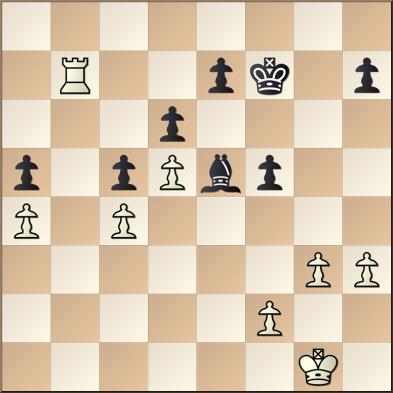
To break through White will need to create threats on both wings. Black has no counterplay, so White can take his time.
34...Bc3 35.Kf1 Bb4 36.Ke2 Kf6 37.g4 fxg4 38.hxg4 h6 39.Kf3 Kf7 40.Ke4 Bc3 41.Kf5 Bf6 42.f4 Bh4 43.Ra7 Be1 44.g5 The third weakness (a5, e7 and now a passed gpawn) appears!
44...hxg5 45.fxg5 Bc3 46.g6+ Kf8 47.Kg5 Bd2+ 48.Kh5 It’s Zugzwang.
48...Ke8 49.Ra8+ 1–0
Berthelot, Y – Flear, G Pau 1988
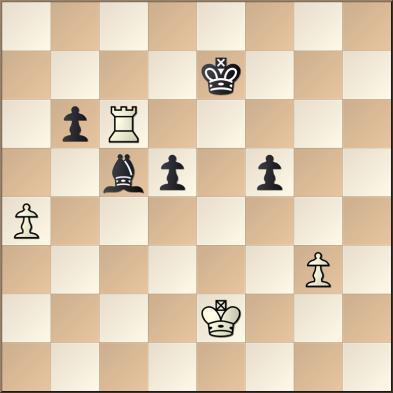
If the weaker side is tied down, a little patience can be required to get the best out of one's chances.
Instead of waiting for the time control, my opponent incorrectly opted to force matters:
38.a5? Here the calm 38.Kf3! threatening Kf4 is unpleasant for Black e.g. 38...Bd4 39.Kf4 Bf2 40.Rc2 Bc5 41.Kxf5.
38...Kd7 39.Rf6 bxa5 40.Rxf5 Ke6 41.Rf1 a4 Now Black has enough counterplay to save himself.
www.englishchess.org.uk Page | 30
42.Kd3 a3 43.Kc2 Ke5 44.g4 Ke4 45.g5 d4 46.g6 d3+
47.Kb3 Bd4 48.Kxa3 d2 49.Kb3 Kd3 50.Rh1 Be5 51.Rd1 As a general rule (in all endgames!), if the opponent can only wait, you should try and optimise your forces before committing yourself or seeking a breakthrough. ½–½
In the following example White's passed pawn is not dangerous, and Black will have the time to bring up his king. Then the superiority of having the rook becomes evident.
Kalaiyalahan, A – Flear, G Hastings 2016
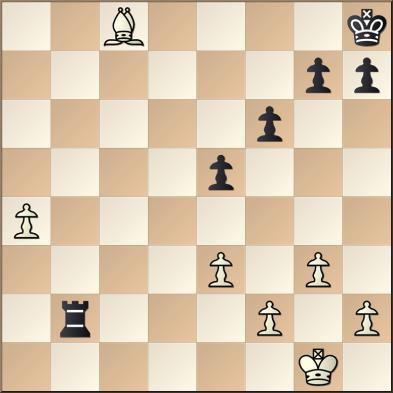
34...Ra2 35.Bd7 g6 36.g4 Kg7 37.Kg2 Kf8 38.Kg3 Ke7
39.Bb5 g5 40.h3 Kd6 41.Kf3 Kc5 42.Bd7 h6 43.Be8 Kb4
44.Bd7 Kc3 45.Bb5 Rb2 46.Bc6 Kd2 47.Ke4 Ke2 48.a5 Kxf2 49.a6 Ra2 50.Bb7 Ra5 51.Bc8 Ra3 52.Bb7 Ra5 53.Bc8 Ra4+ 54.Kf5 Kxe3 55.Kxf6 Kf4 0–1
All this went smoothly, as my opponent could not generate meaningful counterplay. In the following example, however, I was on the receiving end.
Smeets, J – Flear, G Aix-les-Bains 2011
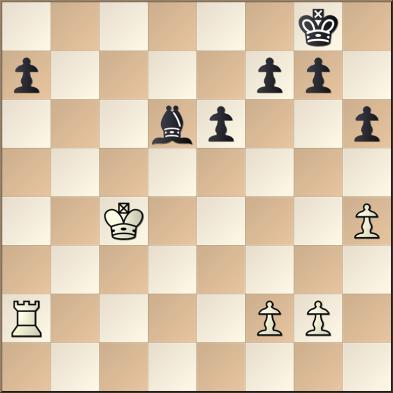
With three or more pawns apiece, but with all the pawns on the same wing, there are cases where the defender can hold, but only if he can organise a fortress.
49.h5! This stops any ideas of ...g6 and ...h5.
49...Bc7 50.Kc5! Better than the routine 50.Rxa7 Bb6 51.Ra8+ Kh7 52.f3 g6, when there would be some cause to retain hope.
50...f5 Or 50...Bb6+ 51.Kd6 Kf8 52.Rc2, and Black will have to move one of his kingside pawns anyway.
51.Rxa7 Bh2 52.g3 Bg1 53.Ra2 f4 54.g4 Kf7 55.Kd4 Kf6 56.Ke4 f3 57.Kxf3 Bh2 58.Ra5 Be5 59.Ke4 Bc3 60.Rb5 I had seen enough, but for those who need convincing: 60...Be1 61.f4 Bd2 62.Rb6 Kf7 63.Rc6, and the decisive Ke5 follows.
1–0
Experience from practical play suggests that we can give some general indications of the likely result when all the pawns are on one wing.
If the player with the bishop has an extra pawn and a reasonable structure then he has good drawing chances, so I was able to draw with the white pieces from the following position.
Flear, G – Ivanovic, M Marseille 2021
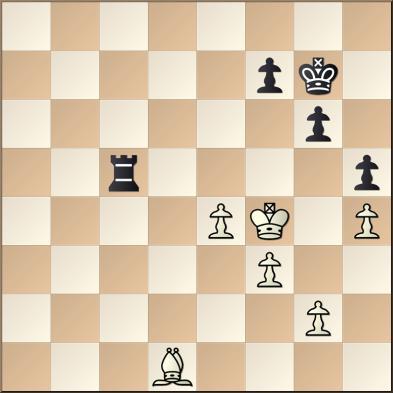
However, with three pawns each the stronger player should normally be able to win. Here’s an excellent example of the latter case, with the future world champion in action.
Speelman, J – Kasparov, G Graz 1981
www.englishchess.org.uk Page | 31
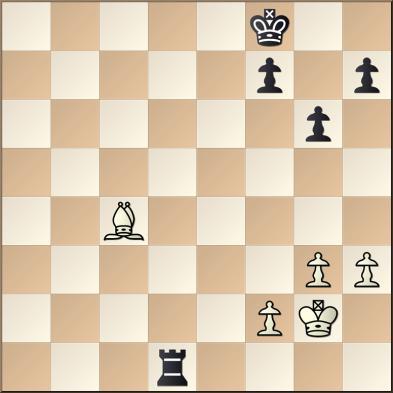
44.h4 Rc1 45.Bd5 Rc5 46.Bb3 Ke7 47.Ba2 h6 48.Bb3 Rc7
49.Ba2 Kd6 50.Kh3 Ke5 51.Kg4 Ra7 52.Bb3 Rb7 53.Bd1 Rb2 54.Kf3 Kd4 55.Be2 Rb3+ 56.Kg2 Kc3 57.Bf3 Rb5
58.Bc6 Rc5 59.Be8 Rc7 60.Kf1 Kd2 61.Ba4 Rc1+ 62.Kg2 Ke1 63.Bb3 Rc7 64.f4 Ke2 65.Bd5 Ke3 66.Ba8 f6 67.Kg1 Rg7 68.Kg2 White would seem to have a robust defence in place, but there is nevertheless a way through
68...g5! 69.hxg5 hxg5 70.fxg5 Rxg5 White resigned, as he has a problem on the g-file. Black threatens to push his fpawn, and allowing either ...Rxg3 or ...Kf2 isnot acceptable either. 0–1
It's a Puzzlement!
‘Chess is 99% Tactics’ - Richard Teichmann
Tactics are the most important aspect of the game for chess players of all levels, from beginner to grandmaster. On ChessPuzzle.net you can learn, train, and improve your tactical skills based on positions that happened in real tournament games.
Welcome to our puzzles section! Here are this month’s puzzles - all hand-picked by ChessPuzzle.net
We provide a link to the relevant ChessPuzzle.net page and a QR Code so you can try the puzzles interactively and get hints if needed or even the solutions!
When you click on the links below you need to play a move to see the hint and/or solution.
Puzzle 1 - WCM Pert, Nina – Spanton, T. 2nd Cambridge Int. Open, Cambridge, ENG
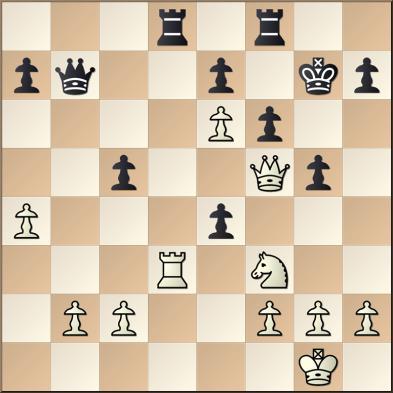
White to win - Puzzle One
Puzzle 2 - IM Kirk, Ezra – IM Wadsworth, Matthew 4NCL 2023-24, ENG
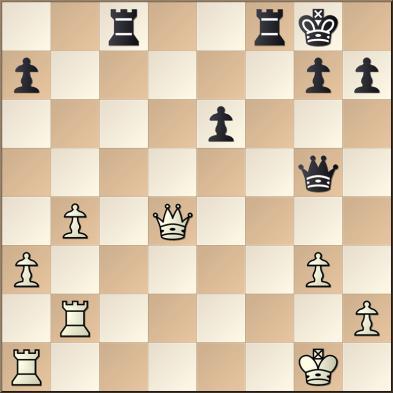
Black to win - Puzzle Two
Puzzle 3 - CM Bullen, Alex – Talsma, P. 4NCL Div 2, 2023-24, ENG
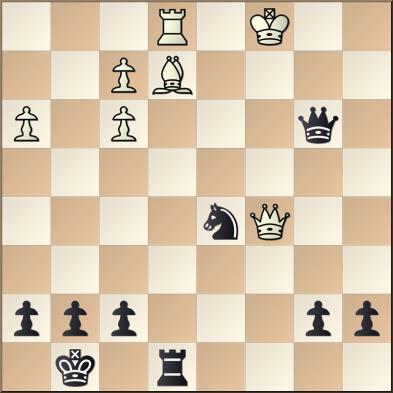
White to win - Puzzle Three
www.englishchess.org.uk Page | 32
Puzzle 4 - Keohane, Ben – Khoury, Theo
British Rapidplay 2024, Peterborough ENG
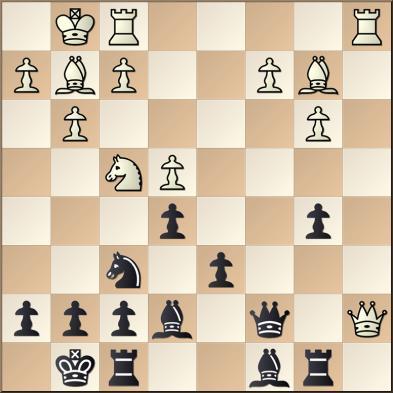
Black to win - Puzzle Four
Puzzle 5 - Pickard, C. – Dasgupta, Avyukt British Rapidplay 2024, Peterborough, ENG
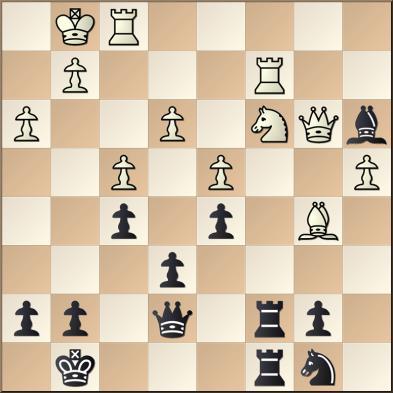
Black to win - Puzzle Five
Puzzle 6 - IM McKay, Roderick M – FM Ledger, Dave J 4NCL 2023-24, ENG
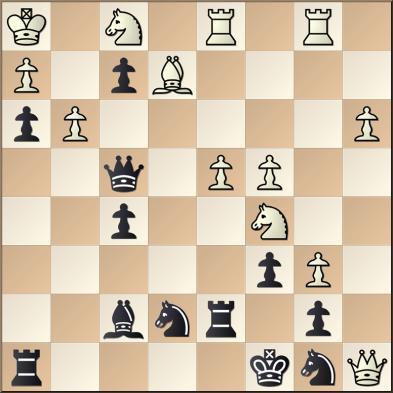
Black to win - Puzzle Six
Puzzle 7 - Bowcott-Terry, Finlay – McClement, A. 4NCL, Div 2 2023-24, ENG
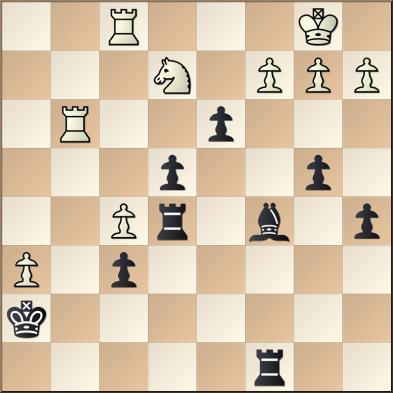
White to checkmate - Puzzle Seven
Puzzle 8 - White, S. – Baer, Bruce L. British Rapidplay 2024, Peterborough, ENG
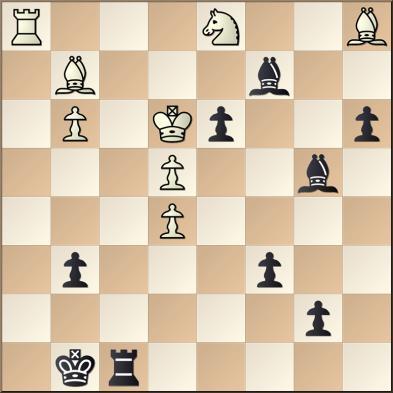
White to win - Puzzle Eight
Puzzle 9 Ganti, Shriaansh – FM Venkataramanan, T. British Rapidplay 2024, Peterborough, ENG
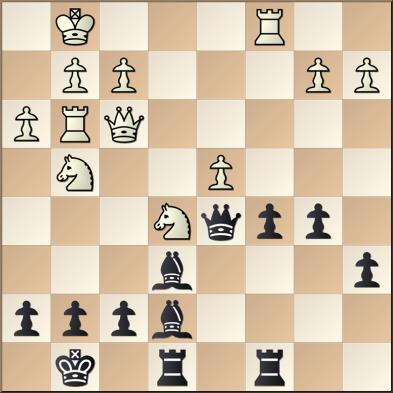
White to win - Puzzle Nine
www.englishchess.org.uk Page | 33
Puzzle 10 - Payne, Matthew J. – Redman, David J.
2nd Cambridge Int. Open, Cambridge, ENG
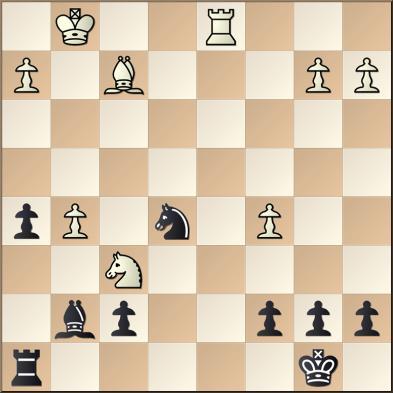
White to win - Puzzle Ten
Puzzle 11 - Young, Daniel J. – Zhao, George British Rapidplay 2024, Peterborough, INT
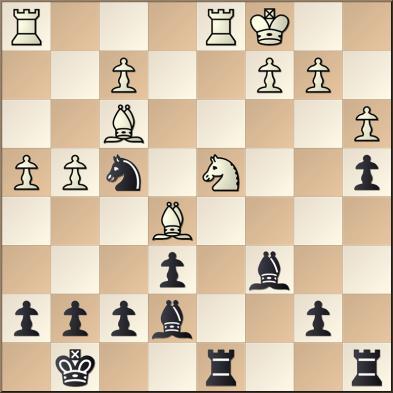
Black to win - Puzzle Eleven
Puzzle 12 - Caraway, Sam, - Hill, Callum British Rapidplay 2024, Peterborough, ENG
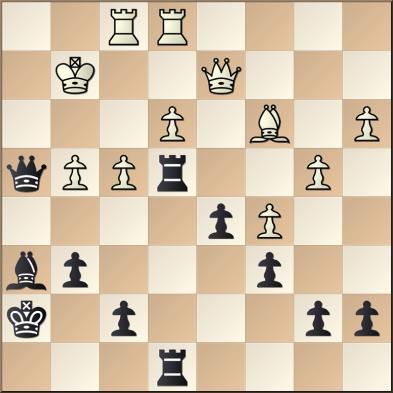
White to win - Puzzle Twelve
All in One
For all the puzzles on one page just visit:
https://chesspuzzle.net/List/9869?utm_source=ecf&u tm_medium=email&utm_campaign=aprilnews
… or via the QR code below:

From the Archives
‘Tis all a chequer-board of nights and days, Where Destiny with men for pieces plays’ Chess Pie, 1922-1936.
Among the metres of old and new publications that comprise the English Chess Federation library, there are many magazines, newsletters and periodicals. All are equally fascinating and deserving of a feature in their own right, but Chess Pie, consisting of only three issues, always attracts attention. Staff and students frequently return to view their beautiful covers, illustrated articles, plates and portraits, and devour a piece of the Pie
Chess Pie was first published as the official souvenir of the London International Chess Congress held in 1922. It was edited by chess author and journalist W. H. Watts, who explains in the editorial that he was initially met with reluctance by the British Chess Federation (BCF) when he suggested the publication of a Souvenir, with the latter prophesying that public enthusiasm for chess does not always equate to the garnering of a publication revenue. After continuing to ‘din the [BCF’s] ears’, they put Watts in touch with the like-minded Mr. S. J. Holloway, who had also conceived of such an idea, and who had a readymade title to share.
www.englishchess.org.uk Page | 34
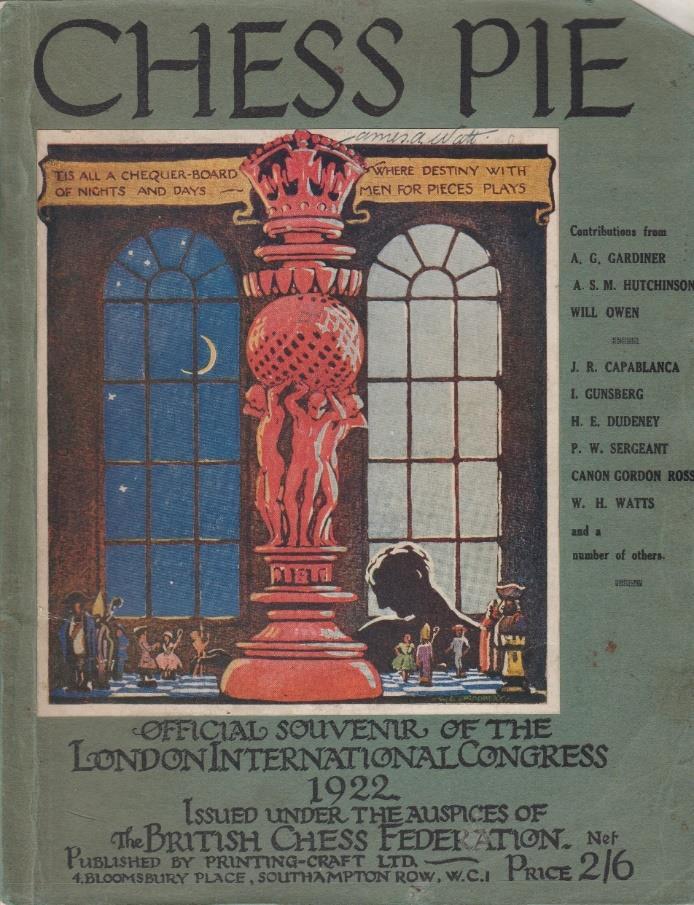
Working together to assemble contributions, funding and advertising support, the first Souvenir was published with a beautifully illustrated cover designed by Walter E. Spradbery. Drawing inspiration from Edward Fitzgerald’s 1859 edition of The Rubáiyát of Omar Khayyám and various historical military figures, the artist gives a brief description of his concept within the magazine, which positions chess as a metaphor for humanity’s struggle to navigate fate and free will.
Philosophy aside, the Souvenir’s focus was the London tournament to be held at Central Hall, Westminster. The event would cost over £1,000 (equivalent to £71,000 today) and would accommodate over 4,000 spectators. The first significant international chess tournament held in London since 1899 at the Royal Aquarium, it was not lost on Watts that the two events were held on the same site; Central Hall had been built where the Royal Aquarium once stood. And the Souvenir includes two beautifully clear plates of the two buildings.
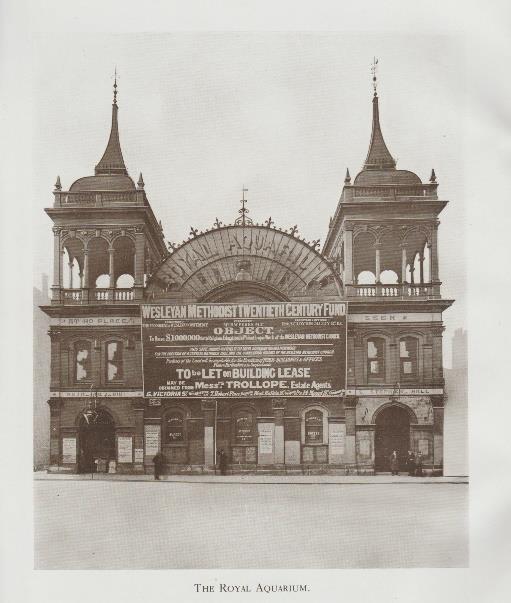
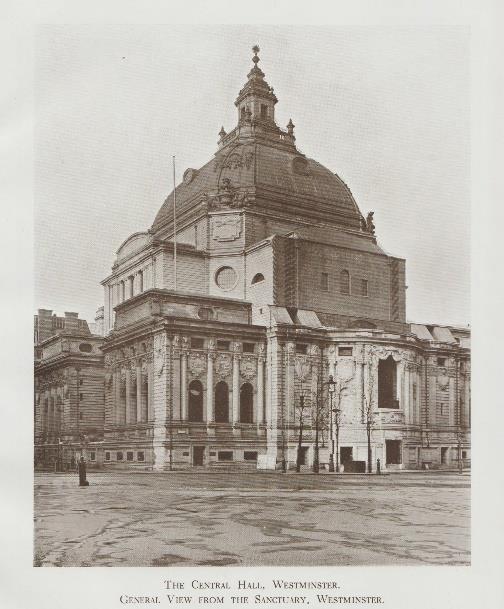
Royal Aquarium, page 18 Central Hall, page 19
It was, however, the second international event to be held in Britain following WWI. The first had been the Hastings Victory Congress held in 1919, an event that was run independently of but in collaboration with the BCF. At both these events, World Champion José Capablanca took the title. The Souvenir contains portraits and semiautobiographies written by the best of the best at the tournament, including Capablanca, Alexander Alekhine, Boris Kostich, Edward Lasker, and British Champion F. D. Yates.
Published before the tournament, the Souvenir does not include mention of what are now known as the ‘London Rules’, a set of conditions devised to standardise international matches. But it does contain many other interesting and unusual features, such as an autographs page and Capablanca’s horoscope!
www.englishchess.org.uk Page | 35
Cover of Chess Pie, 1922
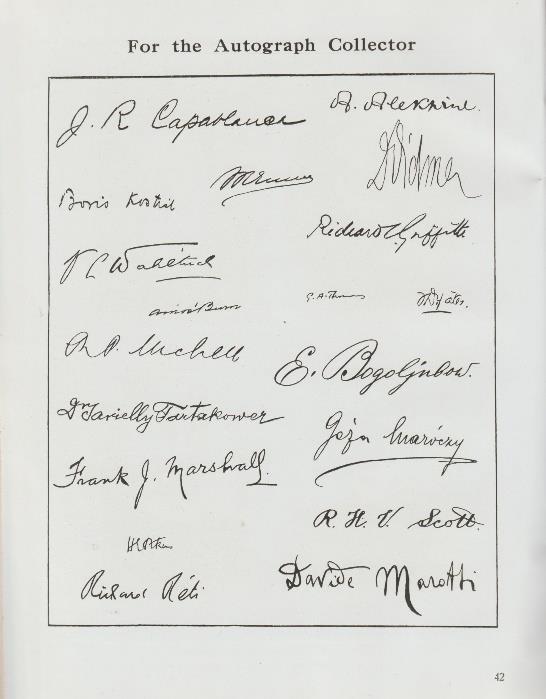
Autographs, page 42
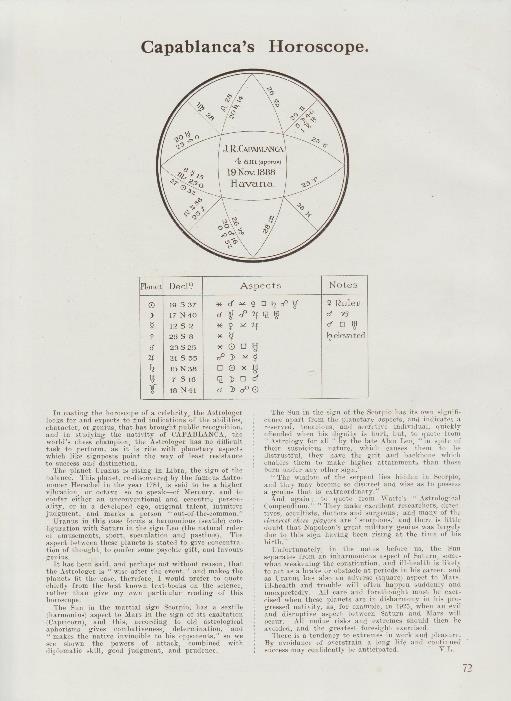
Capablanca’s Horoscope, page 72
The only other two issues of Chess Pie are No. 2 and No. 3, the official souvenirs of the International Team Tournament held in London on 18th – 30th July 1927, and the International Tournament held in Nottingham in August 1936 respectively. Adopting a similar format, all three issues contain details of chess matches, problems, humorous cartoons and histories.
With only three Chess Pies ever baked, the BCF was perhaps right to caution Watts, but they are nevertheless three unique and visually striking slices to savour.
NEWS and VIEWS
Keith Escott (1948 – 2024)
We regret to announce the death of Keith Escott on 15th March 2024. You can read his obituary here: https://warwickshirechess.org/death-of-keith-escott/
Michael John Passmore
Mike Passmore died on 21st April at the age of 83. He had been a member of Downend and Fishponds Chess Club since 1958, and soon became one of their top players, and therefore also one of the leading players in Bristol. As well as spells as president and secretary of his club, Mike also acted as tournaments organiser for the Bristol League and assistant match captain for Gloucestershire, where he looked after the Bristol half of the team. He became well known throughout the counties of the West of England as a regular Gloucestershire player starting from the 1960s. From the wealth of tributes that have come in, we realise the regard and respect that he had from everyone with whom he came into contact. Sportsmanship, kindness and generosity are watchwords that keep appearing. Mike was utterly loyal to his club over more than six decades, and utterly reliable both as a chess player and especially as a gentleman. He always smiled whatever the result, and it was especially pleasing that he won his final league game just two weeks before he died.
ECF Online Grand Prix 2024
The ECF Online Grand Prix Series 2024 starts on 7th April 2024 and runs for nine months.
The ECF Online Blitz and Rapid Grand Prix events are held at 2.00pm on the first Sunday of each month (for the blitz tournaments) and the third Sunday of each month (for the rapid tournaments) from April to December 2024. Further information can be found here: https://www.englishchess.org.uk/ecf-online-grand-prix2024/
Email enquiries should be directed to: director.homechess@englishchess.org.uk or office@englishchess.org.uk
Chess in Prisons and Why it Matters
The ECF runs a programme of support for chess in prisons, with visits from Carl Portman to a number of prisons across the country. Carl provides valuable support to prison communities, where it is recognised as providing purposeful activity for inmates, supporting
www.englishchess.org.uk Page | 36
the development of critical analysis and reasoning skills and helping to reduce reoffending rates. You can read Carl’s document covering the importance of this project here:
https://www.englishchess.org.uk/wpcontent/uploads/2024/03/Chess-in-Prisons-by-CarlPortman.pdf
UK Armed Forces Championship by
Kevin Thurlow
The results of this event were:
RAF Champion: James Kenyon
Army Champion: Ngadi Sherpa
Royal Navy Champion: William Bradley
MOD Champion: Richard Millener
Veteran Champion: Carl Portman
Blitz Champion: Glen Parker
Armed Forces Champion: William Bradley
Thanks go to Arbiter Chris Lamming and Assistant Arbiter Georgi Hristov, as well as Jimmy Blair (who coordinated everything), and UK Armed Forces Chess Association of course. RAF Wittering hosted the event again, and all the staff were really friendly and helpful. The Station Commander (Wing Commander Nicola Duncan) presentedthe prizes and commented that the RAF Trophy was bigger than she was. That was an exaggeration, but it is a large wooden chessboard with winners' names on metal plates, one in each square.
Many of the participants were new or irregular tournament players, and it was great to see the enthusiasm. More than 70 players took part in the blitz event as well. With the exception of the blitz event (Glen is a regular winner), I believe that none of the other trophy-holders has gained those prizes before.
Having driven past the venue many times in the past, it was nice to get a close look at the Harrier parked just inside the gate.
ECF Arbiter Course Registration
ECF Level 1 Arbiter Course
Course dates/schedule: five Tuesday evenings from 7.00pm to 9.00pm: 4th June; 11th June; 18th June; 25th June; 2nd July.
Course fee – £40.
Please note: participants must be at least Bronze members of the ECF on the date of the examination (2nd July).
Course lecturer: Alex Holowczak Assistant lecturer: Chris Howell.
The course will be delivered via Zoom. Enter online
World Senior Team Chess Championships - Call to Action
England will be sending its largest ever delegation of 42 players to the World Senior Team Chess Championships in the wonderful city of Krakow, Poland, from 1st to 12th July. As things stand we will be fielding a total of nine teams, with the England 50+ 1st team being an all-GM line-up led by 50+ World Champion Mickey Adams, and the 65+ 1st team also having a very strong line-up of GMs and IMs, led by 65+ World Champion John Nunn. There is still time for interested England senior players to join one of the teams and to watch our top teams in action.
The closing deadline is 10th May, and we are still considering further applications tojoinone of the England teams; so if you are rated over 1800 and aged 50 or 65 or over on 1st January 2024 you’re eligible If you’re interested in playing you can find further details on how to apply here:
https://www.englishchess.org.uk/Seniors/world-seniorteam-chess-championships-wstcc-2024/
ChessFest 2024 Returns to Trafalgar Square

ChessFest will be back on Sunday 7th July in London's iconic Trafalgar Square. Now in its fourth year, this fantastic free event sponsored by XTX Markets brings together chess lovers from across the UK for a funfilled day. Activities include chess lessons for beginners from CSC’s charity tutors, casual and competitive games, Challenge the Master, giant chess, simultaneous displays from some of the country's top players, and live performances on our living chess set, where famous games are re-enacted by The Provibers.
There will also be a ChessFest on July 21st in Liverpool at Chavasse Park. Further information will appear on the ChessFest website, as well as in the next issue of the CSC newsletter.
www.englishchess.org.uk Page | 37

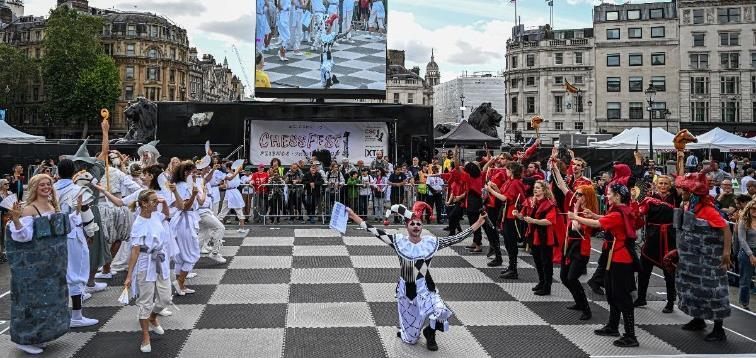
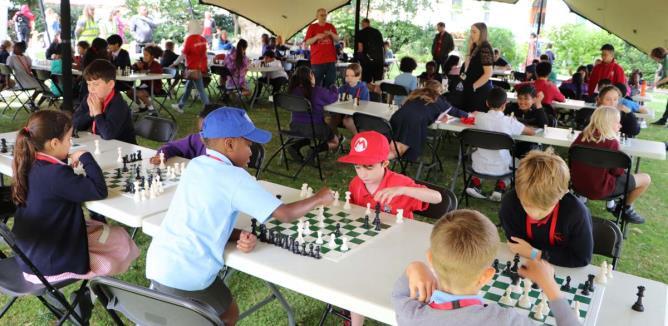
The week before, CSC will run two ChessFest school days in Manchester Square Gardens, London for children from 30 of the charity's schools from across the UK. You can read more news from CSC at the following link: https://mailchi.mp/chessinschools.co.uk/an-update-onthe-work-of-chess-in-schools-8258359?e=63fc5e8748
BBC2 Moves for Curve Media's Chess Masters
Chess returns to the TV after more than 30 years! Read all about it here: https://www.televisual.com/news/bbc2-moves-forcurve-medias-chess-masters/
ECU-ETC Titles webinar 2024
Members who would like to study for and then secure the titles of ECU Expert Coach (EEC) & ECU Junior Coach (EJC) are invited to apply for the European Chess Union online course. The ECF will nominate or support five ECF members to receive the tuition free of charge. More details here: ECU – ETC Online Seminar
JUNIOR MOVES
Littlewood’s Choice
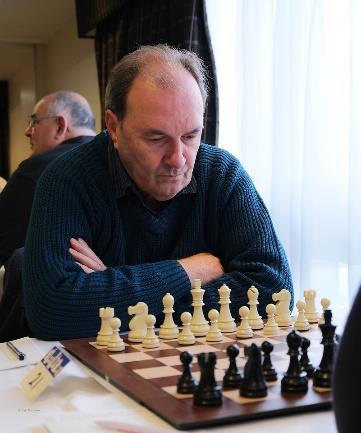
Recently I have become aware of the next exciting youngster on the horizon, who looks to have a bright future as he is only ten years old.
Supratit Banerjee came third in the World Cadets in Egypt and was awarded the CM title. This also allows him to play in Titled Tuesday events on chess.com…. a great opportunity to play against the best players in the world.
He has already had some decent scalps, mainly playing blitz, which suits his style. For example, consider the following, where his opponent is rated over 300 points higher than him.
Supratit Banerjee(CM) - Mikhail Bryakin(GM) Blitz Tournament
1.e4 g6 2.d4 Bg7 3.Nf3 c6 4.Bd3 d5 5.exd5 White takes a straightforward approach in the opening which gives him a slight advantage. 5.e5 would be more ambitious, but also gives Black interesting counter-chances.
5…cxd5 6.0-0 Nc6 7.c3 Bg4 8.h3 Bxf3 Black concedes the two bishops… which doesn’t matter at the moment, but could tell in the long run if the position opens up.
9.Qxf3 Nf6 10.Re1 0-0 11.Bf4 a6 12.Nd2 e6 Rather passive. More ambitious would be 12…Nh5 13.Bh2 Re8 14.g4 e5! which is very double-edged. Perhaps best for White would then be 15.Bf1 e4 16. Qg2 Nf6 17.f3, which leaves him standing slightly better.
13.Nb3 Ne7 14.Nc5 Ra7 15.Bg5 Nc6 16.Bh4 A cunning move, which sets a nasty trap for Black...
www.englishchess.org.uk Page | 38
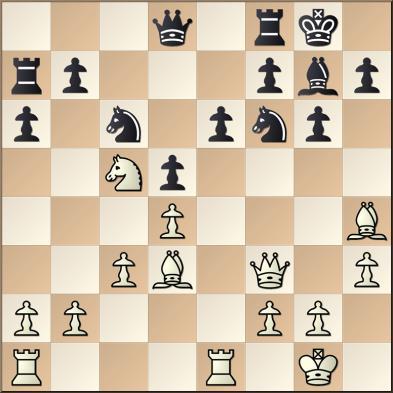
16…h6? and he falls right into it!
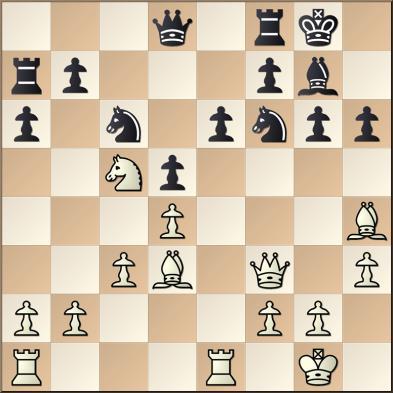
17.Bxg6! fxg6 18.Nxe6 Qe7? Shaken by the sacrifice, Black now makes another mistake. Better was 18 …. Qd6 19.Nxf8 Kxf8, when White stands much better but is not yet winning.
19.Nxf8 Qxf8 20.Bxf6 Qxf6 21.Qxd5+ Another pawn falls, and the position is now hopeless for Black.
21…Kh7 22. Re8 Ne7 23.Qd7 Nf5 24.Rae1 Qg5 25.Qf7 h5 26.Rg8 Kh6?? Black is completely lost and allows the beautiful finish 27.Qxg7+ Nxg7 28.Rh8#. However, no doubt with very little time left, White misses this. His position is so good, however, that any sensible move wins.
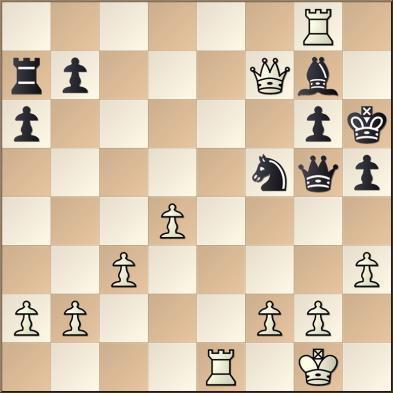
27.f4? Qxf4? Another mistake 27…Qf6 is better, but then follows 28.Qxf6 Bxf6 29.g4, winning.
28. Rxg7! Qg3 29.Rh7+ Kg5 30.Re6 Kh4 31.Qf6+ Qg5 32.Re4+ 1-0 It is mate next move.
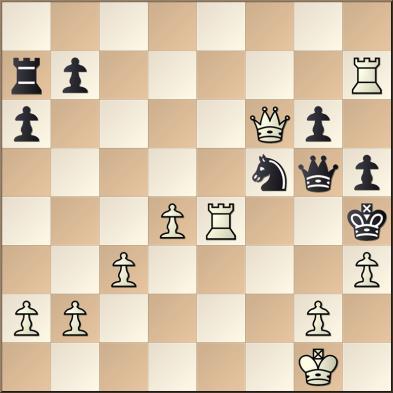
Apart from the minor blemish on move 27 this was an excellent game by Supratit, especially at such a fast time limit.
I will be very interested to see how he progresses over the next few years, along with all the other world-beaters we have at junior level at the moment.
Meanwhile, if you have played any interesting games as a youngster that you would like to have published in my column then please send them to me at plittl@hotmail.com. I cannot promise that they will appear, but I will give them every consideration.
Glorney Cup Teams Announcement
The ECF was pleased to receive 242 applications to represent England’s two teams in the Glorney Cup this year, which will be held in Hull between 23th and 25th July. We would like to thank everyone who took the time to apply on behalf of their child.
After consultation with the selectors the following teams have been selected, and their invitations have been accepted. Players are listed in ECF rating order from April 2024. The final board order will be determined later.
Under 18 (Glorney Cup)
England A
Rahul Babu; James Merriman; Dillan Duke; Kyle Pelling; Aaron Rich
England B (Under 16)
Jack Liu; Ruben Evans; Austin Ivan; Sathya Vaidyanathan; Dominik Swiatkowski
www.englishchess.org.uk Page | 39
Under 18 Girls (Gilbert Cup)
England A
Emily Maton; Anum Sheikh; Michelle Chan
England B (Under 14)
Mae Catabay; Sophie Mehta; Julie Oh
Under 14 (Robinson Cup)
England A
Nayan Keats Rastogi; Zac Welling; Shriaansh Ganti; Aditya Mittal; Arnav Kumar; Daniel Meredith
England B (Under 13)
Rock Yu; Senith Gunarathne; Sithun De Silva; Conor Beattie; Yiwen Ding; Edward Chu
Under 12 (Stokes Cup)
England A
Adithya Vaidyanathan; George Zhao; Srivathsan Sasikumar; Rezin Catabay; Ramsey Dairi; Arthur Kendall
England B (Under 10)
Junyi Zhang; Ayan Pradhan; Junyan Hu; Krish Keshari; Aarav Sai Katukuri; Adamjeet Singh
European Youth Chess Championship
The ECF is accepting registrations for the European Youth Chess Championship in Prague (Czech Republic). The rapid and blitz tournaments run from 16th August to 21st August 2024, and the standardplay event runs from 21st August to 1st September 2024.
The entry forms for these events are below: https://britchess.wufoo.com/forms/european-youthrapid-blitz-championship/ – closing date 24th May. https://britchess.wufoo.com/forms/european-youthchess-championships-2024/ – closing date 10th June.
IMPROVERS
Paul Littlewood on Tactics
I looked last week at various queen sacrifices, and while I was thinking about this article I came across the following game, which dramatically indicates the tactics that can occur when Her Majesty is sacrificed on Caissa’s altar.
H. J. Plaskett - A.J. Miles Lugano Open 1986
1.c4 e5 2.e3 d6 3.Nc3 g6 4.g3 Bg7 5.Bg2 Ne7 6.d4 0-0 7.Nge2 Nd7 8.0-0 f5 9.dxe5 An alternative is 9.b3 e4 10.Bb2, keeping the centre closed.
9….dxe510.b3c611.Ba3 Better is 11.Qd6 Rf6 12,Qd2 Rf7 13.Rd1 Qf8 14.Ba3, which gives White the initiative.
11…Qe8 12.f4 e4 13.Qd6 13.g4!? is an interesting alternative.
13…Rf7 14.Rad1 Nf8 15.Rd2?! Looking to double on the queen’s file, but cutting off the escape squares for White’s queen and so tactically suspect.
15…Ne6 16.Bh3 g5! 17.fxg5 Ng6?! 17…Bf8! 18.Qe5 Ng6 19.Qa5 b6 20.Qa4 Nxg5 21.Bg2 Ne5 is better for Black.
18.Bxf5 Bf8 19.Nxe4?! An exciting choice, and typical of Jim’s play, but not entirely sound. 19.Bxg6 Rxf1+ 20.Kxf1 hxg6 21.Qe5 Qf7+ 22.Kg1Bxa323.Nxe4Qc7 24.Qxc7 Nxc7 25.Nf4 is about equal, although still with everything to play for and with all results possible.
19….Bxd6 20.Nxd6 Qd8 An alternative is 20…Qe7! 21.Nxf7 Qxa3 22.Nh6+ Kh8 23.Bxg6 hxg6 24.h4 Qe7 25.Kh2 when Black is better.
21.Rd3 Rxf5 21…Qf8 22.Nxc8 Qxc8 23.Nd4 Rxf5 24.Nxf5 Nxg5 25.Rd6 is about equal. A possible continuation is 25…Nh3+ 26.Kh1 Qe8 27.Nh6+ Kg7 28.Nf5+ Kf7 29.Rd4 Qe6 30.Nh6+ with a draw.
22.Nxf5 Qxg5? In a desperate attempt to win, Tony avoids 22…Qxd3 23.Nh6+ Kh8 24.Bb2+ Ng7 25.Nf7+ Kg8 26.Nh6+, with a draw by perpetual check.
23.h4 Qh5 After 23…Nxh4 there could follow 24.Ne7+ Kg7 25.e4! Qg4 26.Rf2 b5 27.Bb2+ Kh6 28.Rh2 Kg5 29.e5! Nf4 30.Bc1 Nhg6 31.Nxg6 Kxg6 32.Nxf4+ Kg7 33.Nh5+ Kf7 34.Rf2+ Bf5 35.Rd7+ Ke6 36.Rd6+ Kxe5, reaching the position I will set as a problem later on.
24. g4! Qxg4+ 25.Neg3 Qh3 26.Nh6+ Kg7 27.Nhf5+?
This is an error, and in the second problem that I will set below I will ask you what the correct way for White to play is
www.englishchess.org.uk Page | 40
27….Kf6? However, Black now makes a mistake... no doubt under time pressure. The correct move was 27…Kf7, and then after 28.Nh6+ Ke8 29.Nh5 c5 30.Nf6+ Ke7 31.Nfg8+ Ke8 32.Nf6+ Kf8 33.Nh5+ Ke8 34.Nf6+ it is a draw by perpetual check.
28.Nh5+ Ke5 29. Nfg3! Nef8? Black had to play29…Qxf1+ 30.Kxf1 Nef8, but after 31.Rd4 White is a pawn up and still has a strong attack against the black king, e.g. 31…Ke6 32.Ne4 Kf7 33.Kf2 Be6 34.Ng5+ Kg8 35.Rd6, winning material.
30.Bb2+ Ke6 31.Ng7+ Ke7 32.Ba3+ 1-0
After 32…c5 then 33.Bxc5#
An exciting game, and we must thank both players for playing their part. Jim’s style reminds me very much of Tal’s, whose famous quote was: ‘You must take your opponent into a deep dark forest where 2+2=5, and the path leading out is only wide enough for one’.
My own record against Jim is quite good, mainly I think because I can anticipate the tactics and prevent him from taking me into that deep forest.
Here now are two positions from the game above for you to solve, with the answers at the end of the article.
Move 37 for White in the variation which occurs after White’s 23rd move
White to play… howwould you closethe matingnet about Black’s king and win the game?
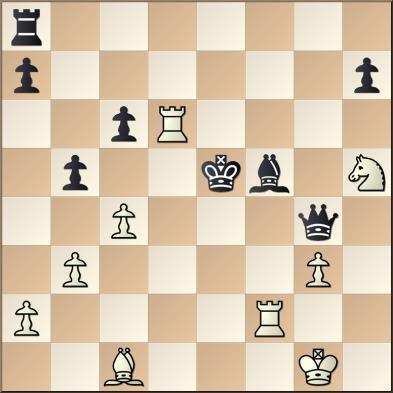
Variation after move 26 for Black
How should White play to obtain a winning material advantage?
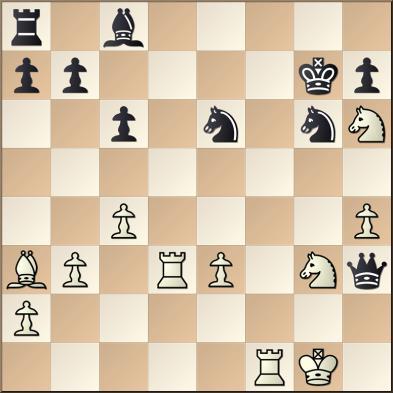
Answers:
Position 1
White wins by 1.c5!, with the main line being 1…Qxh5 2.Bb2+ Ke4 3.Rf4+ Ke3 4.Bc1+ Ke2 5.Rf2+ Ke1
Bd3
Position 2
White wins by 1.Ngf5+ Kf6 2.Bb2+ Ne5 3.e4! Qxd3 4.Ng4+ Kf7 5.Nxe5+ Ke8 6.Nxd3
Gormally’s Coaching Corner by
Daniel Gormally
How to Become a Grandmaster
The following article is really all about the difference between amateur players and those who are more experienced, like professional players and grandmasters.
Chess coaching (particularly online chess coaching) has really taken off in recent years. I started doing YouTube, which has led to taking on more students. Sadly for my bank balance, keeping hold of these students is a serious challenge, partly because the chess world is permeated with professional chess players trying the same thing, and partly because I have not yet developed a more regimented set-up that could compete with something like Jacob Aagaard’s killer chess training, for example.
One thing that strikes me when working with students is how they tend to over-generalise when discussing positions. When grandmasters or master level players looks at a chess position they will first look at variations. It is all about the specific concrete details of the position.
If I ask an amateur player to describe what they think about a particular position, I am quite likely to get a lot of waffle about some of the general features of the position,
www.englishchess.org.uk Page | 41
6.Bd2+ Kd1 7.Bh6+
8.Rxd3+ Ke1 9.Rf1+ Ke2 10.Rd2#
with very few concrete variations mentioned. All this waffle is doing is getting in the way of what is important, which is to break down the position by sheer brute force calculation. The amateur players overload their chess brain with too much information.
So how can the reader aspire to grandmaster level calculation?
The following tips should help:
1. Annotate your games. Very few amateur players bother to annotate and analyse their games. If you look at the 16 individuals playing in the Candidates currently taking place in Toronto, they will all own a copy of ChessBase on their laptop and have detailed files of their own games, as well as their potential opponents. This is the level of professionalism you need to aspire to if you want to achieve a level of success in chess. You might say, I don't have the time to do all this - I don't have the time to analyse my games. This brings me on to point 2
2. Manage the time you spend on chess effectively. There is nothing wrong withspending many hours online playing blitz chess, because recently this has been the path to many younger players getting very good very quickly. However, if you are spending 20+ hours every week playing blitz chess, then you clearly have enough time to analyse your games, which we have already discussed is an important part of the self-improvement method. You also have enough time for more focused elements of chess improvement, like solving puzzles and tackling training positions.
3. Play longer games online. I think for juniors it is one thing, for adult improvers it is quite another. For adults with limited time, I would recommend restrictingthe number of blitz games you play online and replacing at least some of these with rapidplay or even longer time controls. Analyse these games afterwards, either by yourself or with an engine, or by a combination of the two. That way, the games will hopefully make more of an impression, and you'll start to see more candidate moves than you were seeing before.
4. Solve chess puzzles and studies. This can be Puzzle Push, puzzles on Chess.com or Lichess, or puzzles and studies that you see in books or magazines. I recently learned that one of the best young players in Europe, Daniel Dardha from Belgium, tries to solve at least 100 Lichess puzzles a day. That is the kind of work ethic that will pay off in the long run.
5. Work on your calculation. A similar point to number 4, it must be admitted. When you look at the younger stars
like Pragg and Gukesh, all they will do is work on their calculation. I had a promising position in the late middle game against 2541-rated Adhiban in the recent Alicante tournament, and felt I had decent winning chances. But he spent some time working out how to nail down the draw, and he figured it out concretely. You can only do that if you train your calculation, which you can do by solving studies, training positions, buying books and courses on calculation, etc.
6. Don't over-rely on chess engines. A lot of amateur players (and many professionals) make the mistake of thinking that the best way to train their calculation is to use chess engines. Wrong! The best and most rewarding way is to use your own brain in the trial and error method. If every time you get stuck on a position you turn on an engine, you aren't really going to improve.
7. Buy chess books. If, for example, you live in or around London, then you probably have easy access to the Chess and Bridge shop in London, as well as Waterstones outlets which are likely to sell a wide selection of chess books. There is also the opportunity to buy books online. When I was going through a funk a few years ago it was because I had become over#dependent on using chess engines, and my laziness meant it was becoming difficult to use my own chess brain. Recently I started buying chess books again, and it reminded me of why I had become fascinated by chess in the first place, namely the way in which chess positions and the personalities behind them would come to life. For me the most fascinating part of chess is the analytical process, and how you problem solve your way to the best move. Although sales of chess books are on the wane, at least partly because they are forced to compete with other methods of improvement like those offered by online websites, it is my belief that chess books are still one of the best ways to access this analytical method.
8. Play as much as you can, even if this means online. I know this possibly contradicts one of my earlier points, but one of the things I noticed recently is how people like Nakamura would play a lot online, and how that would benefit him because he is constantly training his brain. OK - I can't compare myself with Hikaru Nakamura, but I have noticed that when I've come off a long chess break I've often played badly, so I've tried to consciously force myself to play every day, and I think it is paying off. If you think about it, it makes sense. If you were a middledistance runner and didn't train for a month, you would most likely be terrible. Why do we think it's any different when you are a chess player?
9. When training your calculation, work on captures and checks. David Howell mentioned this in one of his recent
www.englishchess.org.uk Page | 42
columns in the Sunday Times, and it is very good advice. If amateur players worked on these basics, they would be amazed at the improvements in their results. Also, train yourself to look further and not give up on lines too easily. Many players struggle to improve, as they have a tendency to be too superficial with their analysis and skimp through lines too quickly.
10. Play against engines. Although I'm slightly negative when it comes to chess computers because I've seen the downside, there is also an osmosis involved when you train with them a lot. I actually had my big breakthrough as a player when I was in my mid-teens after purchasing a Nigel Short Saitek chess computer. Although it was fairly feeble compared to today's monsters, I found that playing it a lot improved my tactics exponentially. I heard a similar story about Anand in the early 1990s. Because he was friends with Frederic Friedel from ChessBase, Vishy used to practise with Fritz a lot. He was already a tactical genius before this, but it made him more or less unstoppable, and he went on a long run of winning tournaments. So it always amazes me when I speak to amateur players who tell me that they can't be bothered to play against engines. You have an entity that is stronger than the best humanplayer on your phone or your laptop, and you can't be bothered to take advantage of that?
11. Look out for opponents’ mistakes. This also relates to number 10, because when you train with computers a lot you start becoming more alert to blunders inherent in a position. I recently read an article about a chess engine developed by Google’s Deep Mind technologies that can play to grandmaster level without calculating even one move ahead. Apparently, it just survives on evaluations alone. When they tested this engine against human players it preformed much better than it had managed in matches against its fellow engines, because we humans weren't taking advantage of its tactical errors. That made me realise that we don't spend enough time thinking about whether our opponents have made blunders or not, preferring to focus on our own play, so in my last two tournaments I've seen an uptick in my results as I've put this watchful approach into practice.
12. Focus on the technical side of chess. When I watched the recent Vera Menchik Memorial in London, I was surprised at some of the basic mistakes in endings that some of the players, who were often quite experienced, were committing. But that can only be down to a lack of study and experience in those specific endgames. About two years ago I didn't know how to mate with king, knight and bishop vs king, so I'm in the same boat. If you take the time and effort to study endgames deeply, it is obvious that you'll put yourself ahead of your peers. And one of the benefits of studying endgames is that you won't feel
the need or desire to do too much too soon, because you'll be confident in your ability once you reach the technical phase.
13. Remember, hard work pays off! Chess players have plateaux and periods where theydon't improve, but if you follow some of the advice given above I am certain that your hard work will pay off in the long run. Good luck!
STUDIES AND PROBLEMS
How to Solve a Study by Ian Watson
Memorial
This month's column remembers John Beasley, who died last month. He was perhaps the most important of British endgame study experts. In our November column I quoted several studies from a book he had just published, 'A Book of Bedtime Pawn Endings'. John preferred not to quote his own compositions in the books he wrote, so his studies often didn't get as much publicity as they merited. This month we have three by him, one whose solving I'll go through, and two for you to solve.
John set the problems that were used for the World Chess Solving Championship in 1994. Some of them he composed himself, including this study.

White to play and win
Clearly any move by the rook will threaten to promote with discovered check, and so Black will have to try to perpetual check the white king. OK, but which eighthrank square must it be? A good method for dealing with such questions is to try first the one that restricts the black options to a minimum. 1.Rb8 does that job well by preventing queen checks on the b-file. You quickly see
www.englishchess.org.uk Page | 43
that Black's moves can be forced, that the queen can be kept confined to the a-file. That already suggests that the theme of this study is likely to be both white king and black queen walking up or down their files. With that idea, it's not difficult to find 1.Rb8 Qa4+ 2.Kxg5 Qa5+ 3.Kxg6 Qxa6+, but where can you tuck away the white king? If you leavethe g-file, you freethe blackqueen from its imprisonment on the a-file. Still, it's very likely you've found the correct moves so far because they are so studylike, so elegantly showing a theme. Therefore, try going back down the g-file, now that you've cleared the pawns away, and see what happens. 4.Kg5 Qa5+ 5.Kg4 Qa4+ 6.Kg3 Qa3+ 7.Kg2 Qa2+ 8.Kg1 and that's it, isn't it? Oops, no, Black has 8...Qa7+. But, hey, it doesn't matter, Black can't capture the rook, because of g8Q+, so we can play 9.Kh1 and Black has no good checks left.
You know that must be the right solution, so you could even violate one of the basic rules of solving by not looking at the alternatives. Usually that's seriously unwise, because composers love to build tricks into their compositions, but in this study you could risk it.
Your first solving task is this next study by John which was published in The Problemist in 1972.
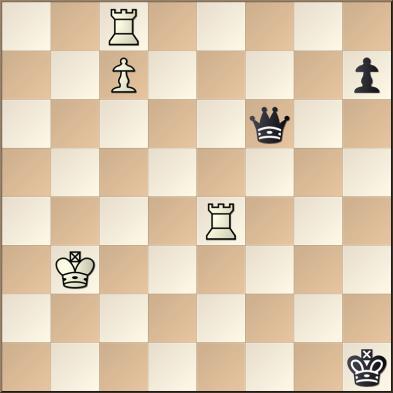
White to play and win
Your second solving task is from The Problemist in 2001. It is based around a theme that I described in a previous column (I hope you were paying attention!).

White to play and win
The solutions are given at the end of this magazine.
Ian Watson Email: ian@irwatson.uk
Monthly Conundrum
by Christopher Jones
First, let’s look at the problem with which I left you last time.
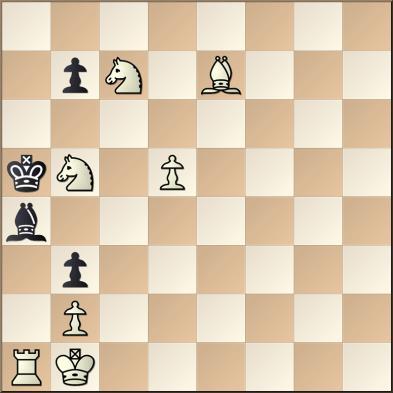
Mate in 3
Damien Grossi 3rd Prize, Storsti un Romani 1938
This was one of the two three-mover problems that solvers in the Minor section in the Winton British Championships in February were challenged to solve. It seems difficult to improve the positions of White’s pieces, and we don’t seem to be able to generate a threat, so it may come as no surprise that the key move is a waiting move: 1.Kc1!. To gain solving marks you need to give two continuations: 1…Kb6 2.Bb4! (2…Bxb5 [self-blocking!] 3.Na8#) and 1…b6 2.Ra2! (2…bxa2 [not check – hence the key move!] 3.b4#). As I said last time, problems in solving tourneys should be not only a challenge but also a pleasure to solve.
Here is another test of your problem-solving ability. I’ve mentioned before the excellent solving tourneys organized on Brian Cook’s website www.netchex.club Every few months there is a tourney online that follows the same pattern as the main in-person solving tourneys (such as the finals of the Winton British Solving championships, from which the Grossi problem above was taken). In this pattern, the second round sets you two ‘mate in three’ problems, and you have forty minutes in which to solve them. Below are the two problems from the second round of the competition on 10th February 2024. If you would like to see how you would get on, avert your gaze after the second diagram, returning to the text
www.englishchess.org.uk Page | 44
thereafter only after yoursuccess (or otherwise) in solving them. Remember that to score full points you need to give not only the first move but also any defences that enable Black to survive as far as move 3.
Alternatively, after briefly inspecting the diagrams, you may prefer to read on straight away, so as simply to enjoy some good chess!
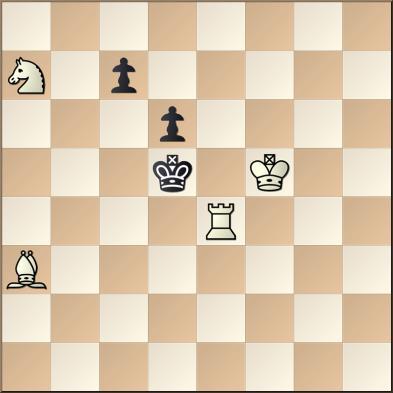
in 3
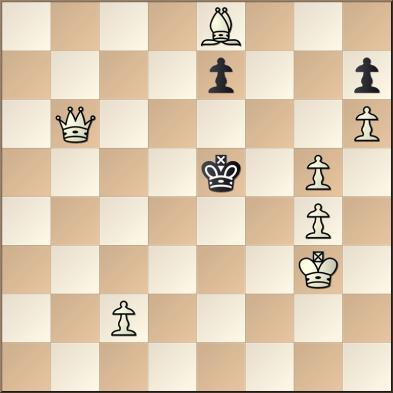
Mate in 3
The first of these two problems, by Charles King-Farlow, won second place in a tourney in the journal of the British Chess Problem Society, The Problemist, in 1962. If it were Black to play, he would have only two possible moves, both of them by the pawn at c7: going to c6 it would relieve the a7-knight of its duty to guard that square, and going to c5 it would relieve the a3-bishop of its duty to guard that square. How to exploit this? The key is 1.Ra4!, and now we have 1…c5 2.Bb2 (guarding d4), after which 2…c4 allows 3.Ra5#, and after 1…c6 2.Nc8!, so that 2…c5 then is metby 3.Ne7#. (If you were a purist, you might feel it to be a slight detraction that after 1.Ra4 c5 2.Bb2 is Zugzwang [if Black could pass he’d be OK], whereas after 1.Ra4 c6 2.Nc8, the mate 3.Ne7 is simply an unanswerable threat. But of course as a competitive solver you don’t need to worry about such niceties!)
The second of these problems, by Andrew Miller, also
appeared in The Problemist in 1973. Again, the key move creates Zugzwang: after 1.Qd8! if Black could just sit tight he wouldn’t be mated in three. But move he must, and we have 1…Ke4 2.Bc6, 1…Ke6 2.c4 and 1…e6 2.c3, in each case forcing mate on move 3. I don’t know whether in setting these problems Brian Cook was influenced by the comparison between the c-pawns in the two problems!
Finally, here is one of the two four-move problems that had to be solved in fifty minutes in round 5. I’ll give the solution next time, but you can of course find it before then, if necessary with the assistance of your computer!
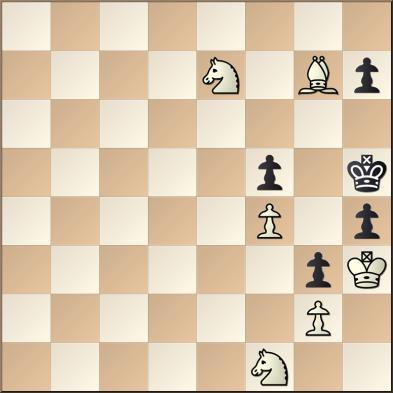
Mate in 4
Don’t hesitate to email me with any queries at all to do with this column.
Christopher Jones Email: cjajones1@yahoo.co.uk
www.englishchess.org.uk Page | 45
Mate

1.Announcement
●TheECU-ETCCommissionannouncesthe 2/2024online(viaZoom)Webinarfortrainers’ education&titles.
●Thesecondwebinarwillbefreefortwenty-five (25)participantsnominatedbyEuropeanNational ChessFederationsandfive(5)participants nominatedbyECUWOMCommission.
2.Titles
●IntheWebinarthetitleofECUExpertCoach (EEC)&ECUJuniorCoach(EJC)may/willbe awarded.
●Thetitlesmay/willbeawardedaspertheECUETCRegulations
●Eachparticipantmustsuccessfullymeetthe followingrequirements:
○PersonalCurriculumVitae(specialForm).
○ParticipationintheWebinar.
○Webinar’sTest.
○TitleFeePayment(€300or€200).
●Anytitlewillbeawardedaftertheapprovalofthe ECU-ETCCouncil&theECUBoard
3.Dates&Duration
●TheWebinarwillbeheldasperprogrambelow anditwillbelastforeighteen(18)hours:
DayDateCET
Monday06.05.202418:00-21:00
Wednesday07.05.202418:00-21:00
Thursday09.05.202418:00-21:00
Monday13.05.202418:00-21:00
Tuesday14.05.202418:00-21:00
Thursday16.05.202418:00-21:00
4.Participation
●IntheWebinarareentitledtoparticipateforfree (theRegulations’Webinarfeewillbewaived):
○.One(1)trainerpereachEuropeanFederation(25 intotal).First-come-firstservedpolicy.




○Five(5)femaletrainers’selectedbytheECU WomenCommission.
○Otherparticipantsmightbeallowed,afterApplication&ApprovalbytheECU-ETCSecretary.
●Thetotalmaximumnumberwillbeonthirty(30) participants.
●Failingtobeawardedanytitlewillleadtothe obligationofpaying€200asParticipationFee.
5.Lecturers/Syllabus
●TheWebinarwillbebasedontheECU-ETC Syllabus(Volume3-Advanced).
●TheLecturersandtheTopics(asperWebinar hour)willbe:
LecturerTopic SokolovI.Trading SokolovI.PatternRecognition MikhalchishinA.TypicalPawnStructures KrivecJ.ChessMotivation KrivecJ.ChessEmotions&Thoughts MikhalchishinA.PositionalSacrifices IllescasM.KingintheCentre IllescasM.ExchangingProblems IllescasM.ProphylacticMeasures GrivasE.GettingtoKnowOurselves GrivasE.AdvancedEndgameTheory1 GrivasE.AdvancedEndgameTheory2 StefanovaA.CommonTrainingMistakes StefanovaA.PsychologicalAspects StefanovaA.Chess&LifeChoices KjartanssonG.Exchanges-Plan&Technique KjartanssonG.RecognisingaTalent GrivasE.WebinarTest
6.Registration
●AllRegistrations&CVsshouldbesenttoECU Secretarybyemail(trainers@europechess.org)and by05.05.2024.




ECU-ETCTitles’Webinar2024-2
WebinarLecturers
GMIvan Sokolov
GMAdrian Mikhalchishin
GMEfstratios Grivas
GMAntoaneta Stefanova
WGMJana
GMMiguel Illescas
GMGudmundur
Kjartansson
Krivec
EVENTS CALENDAR
The full events calendar is updated daily, and can be found at https://www.englishchess.org.uk/event-calendar/
Week Beginning 29 April 2024
1 May 2024 Coulsdon Chess Daytime Chess Club Summer 2024
2 May 2024 Hendon FIDE Blitz
3 - 5 May 2024 4th Cornwall Spring Congress, Falmouth
4 - 6 May 2024 4NCL Season 2023/24 weekend 5 Rouynds 9-11, Daventry and Telford
4 - 6 May 2024 UKCC East Kent Megafinal 2024, Canterbury
4 May 2024 UKCC Surrey Megafinal 2024 (U7, U8, U9), Leatherhead
5 May 2024 UKCC Herefordshire Megafinal 2024, Hereford
5 May 2024 UKCC Surrey Megafinal 2024 (U10-U18), Leatherhead
5 May 2024 UKCC Teeside Megafinal 2024, Stockton-on-Tees
5 May 2024 Ealing Broadway FIDE Rapid 2024
Week Beginning 6 May 2024
7 May 2024 Muswell Hill FIDE Chess 2024
8 May 2024 Coulsdon Chess Daytime Chess Club Summer 2024
10 - 12 May 2024 Durham Chess Congress 2024
11 May 2024 ECF Counties Championship Quarter Finals
11 May 2024 Wimbledon EJCOA Zonal Rapidplay
11 May 2024 Scarborough Rapidplay Chess Event 2024
11 May 2024 Golders Green FIDE Rapid 2024
11 May 2024 Wimbledon FIDE Rapidplay
12 May 2024 UKCC 2nd North London Megafinal 2024, Potters Bar
12 May 2024 UKCC Birmingham Megafinal 2024
12 May 2024 UKCC Buckinghamshire Megafinal 2024, High Wycombe
Week Beginning 13 May 2024
14 May 2024 Muswell Hill FIDE Chess 2024
15 May 2024 Coulsdon Chess Daytime Chess Club Summer 2024
17 - 19 May 2024 33rd Frome Chess Congress and Somerset Championships
18 - 19 May 2024 2024 Leamington Open
18 May 2024 ECF Counties Championships Quarter Finals (U1650 and U2050)
18 May 2024 Sussex Junior Worthing Rapidplay
18 May 2024 UKCC Northumbria Megafinal 2024, Newcastle
18 May 2024 UKCC Nottingham Megafinal 2024
18 May 2024 Maidenhead Junior Tournament
18 May 2024 Southall FIDE Congress
19 May 2024 UKCC Essex Megafinal 2024, Colchester
19 May 2024 UKCC Kent Megafinal 2024, Tunbridge Wells
19 May 2024 EJCOA Bucks Qualifier May, Amersham
Week Beginning 20 May 2024
22 May 2024 Coulsdon Chess Daytime Chess Club Summer 2024
23 May 2024 Hendon Chess Club FIDE Rapid
24 - 28 May 2024 English Seniors Championship 2024, Kenilworth
24 - 25 May 2024 Wimbledon FIDE Congress
25 May 2024 2nd Warrington Rapidplay
25 May 2024 UKCC Manchester Megafinal 2024 (U8, U10)
25 May 2024 1st Bromley Rapidplay
25 May 2024 Poplar Rapid Tournament
25 - 27May 2024 Cotswold Chess Congress 2024, Gloucester
26 - 27 May 2024 Coulsdon Chess Late Spring Standardplay Congress
26 May 2024 Frodsham Rapidplay 2024
26 May 2024 UKCC Manchester Megafinal 2024 (U12, U14, U18)
26 May 2024 Kensington FIDE Rapid 2024
www.englishchess.org.uk Page | 46
How to Solve a Study – solution
(Beasley - 1972)
1.Rh4+ Qxh4 2.Rg8 Qh3+ 3.Kb4 Qh4+ 4.Kb5 Qh5+ 5.Kb6 Qh6+ 6.Kb7 wins.
Not hard to solve once you know the 1994 study, although finding 1.Rh4+ if you hadn't just been shown the theme might be challenging. I guess that John derived his 1994 study from this 1972 one; taking one of your own works and further developing the ideas is popular among composers in general, not only among chess composers.
(Beasley - 2001)
1.c5 Bxc5 2.Kf3 Kb6 3.h4 Bb4 4.Ke2 Kc5 5.Kd3 Kd6 6.h5 and wins.
Black can't catch the h-pawn, but he can jail himself, the theme that we looked at in the March column. If White starts with 1.Kf3 (to prevent 1...Bxe3) we get 1...Kb6 2.h4 Kc5 3.h5 Kxc4 4.h6 Bc5 5.h7 Bb4 6.h8Q c5, and Black has assembled the selfstalemating structure just in time. By playing 1.c5 White forces Black to temporarily block the c5-square with his bishop, and so gains the time to disrupt Black's self-jailing plan. The theme of this study could be called 'Anti-Self-Jailing'.

www.englishchess.org.uk Page | 47