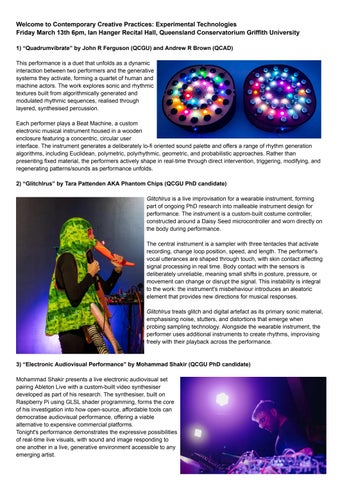
Welcome to Contemporary Creative Practices: Experimental Technologies Friday March 13th 6pm, Ian Hanger Recital Hall, Queensland Conservatorium Griffith University 1) “Quadrumvibrate” by John R Ferguson (QCGU) and Andrew R Brown (QCAD) This performance is a duet that unfolds as a dynamic interaction between two performers and the generative systems they activate, forming a quartet of human and machine actors. The work explores sonic and rhythmic textures built from algorithmically generated and modulated rhythmic sequences, realised through layered, synthesised percussion. Each performer plays a Beat Machine, a custom electronic musical instrument housed in a wooden enclosure featuring a concentric, circular user interface. The instrument generates a deliberately lo-fi oriented sound palette and offers a range of rhythm generation algorithms, including Euclidean, polymetric, polyrhythmic, geometric, and probabilistic approaches. Rather than presenting fixed material, the performers actively shape in real-time through direct intervention, triggering, modifying, and regenerating patterns/sounds as performance unfolds. 2) “Glitchlrus” by Tara Pattenden AKA Phantom Chips (QCGU PhD candidate) Glitchlrus is a live improvisation for a wearable instrument, forming part of ongoing PhD research into malleable instrument design for performance. The instrument is a custom-built costume controller, constructed around a Daisy Seed microcontroller and worn directly on the body during performance. The central instrument is a sampler with three tentacles that activate recording, change loop position, speed, and length. The performer's vocal utterances are shaped through touch, with skin contact affecting signal processing in real time. Body contact with the sensors is deliberately unreliable, meaning small shifts in posture, pressure, or movement can change or disrupt the signal. This instability is integral to the work: the instrument's misbehaviour introduces an aleatoric element that provides new directions for musical responses. Glitchlrus treats glitch and digital artefact as its primary sonic material, emphasising noise, stutters, and distortions that emerge when probing sampling technology. Alongside the wearable instrument, the performer uses additional instruments to create rhythms, improvising freely with their playback across the performance.
3) “Electronic Audiovisual Performance” by Mohammad Shakir (QCGU PhD candidate) Mohammad Shakir presents a live electronic audiovisual set pairing Ableton Live with a custom-built video synthesiser developed as part of his research. The synthesiser, built on Raspberry Pi using GLSL shader programming, forms the core of his investigation into how open-source, affordable tools can democratise audiovisual performance, offering a viable alternative to expensive commercial platforms. Tonight's performance demonstrates the expressive possibilities of real-time live visuals, with sound and image responding to one another in a live, generative environment accessible to any emerging artist.
Welcome to Contemporary Creative Practices: Experimental Technologies Friday March 13th 6pm, Ian Hanger Recital Hall, Queensland Conservatorium Griffith University 4) “A Place By The Mountain” by Madeleine Cocolas (QCGU PhD candidate) A Place By The Mountain is a composition that forms part of Madeleine Cocolas’s ongoing PhD research exploring how field recordings can be used as a catalyst for new compositions. The piece incorporates field recordings captured at Mount Kenashi as well as from the main street in Nakameguro, Tokyo which is named Yamate-Dori (this can loosely be translated to near the mountain). The field recordings are heavily processed and include the rhythmic humming of a gondola going up Mount Kenashi which has been turned into a bassline, ambulance sirens which have been re-pitched and harmonised, and recordings from the 24 hour store Don Quixote which have been processed through a resonator. Through the use of field recordings, the composition investigates contrasts between the quiet stillness of a mountain and the frenetic energy of a main street in Tokyo. In doing so it has sought to unify those sounds overall, allowing them to live side by side and tying them together with an emotional response on the piano. 5) “Untitled” by Miles Philip (QCAD PhD candidate) Miles Cosmo Philip has been writing and recording music for over 20 years, with extensive experience in various genres such as hard rock, prog rock, folk, ambient, electronica, house, breakbeat, and IDM. Working under his own name (Miles Cosmo), Philip has produced several albums, leaning into the darkly atmospheric progressive rock sound featured on recent release, Slaughter (2024). In contrast, Philip has spent the last decade exploring various forms of dance music (house, breaks) under the name Warm Natural, with recent release Milestones (2025) epitomising this sound. Philip’s honours project (University of Melbourne) explored generative modular synthesis composition, depicting the experience of having dementia - a project that has led to a greater focus on generative systems and experimental music. Philip’s current research explores the viability of generative AI as a collaborator in a creative practice. Intrigued by the idea of music as a living breathing space - ephemeral, inhabitable worlds - Philip’s compositions are characterised by atmospheric texture and detailed melodic arrangements. 6) “Orrery Arcana: Esoteric and Ecological Correspondences” by Nicole Carroll AKA n0izmkr (QUT) Orrery Arcana is a bespoke performance system that integrates custom sensing hardware, planetary gear mechanisms, Tarot‑driven chance operations, and real‑time ephemeris data into a ritualised improvisational framework. The instrument foregrounds embodied interaction and symbolic gesture, positioning improvisation as a semi‑automated process within a deliberately indeterminate system. The system and performance concept are designed to evoke a process akin to divination through automatic writing. The hardware comprises a hand‑built controller with a planetary gear train whose manual rotation governs timing and event sequencing. Each gear incorporates light, magnetic, and capacitive-touch sensors, activated through modular acrylic rings
Welcome to Contemporary Creative Practices: Experimental Technologies Friday March 13th 6pm, Ian Hanger Recital Hall, Queensland Conservatorium Griffith University embedded with magnets that encode Tarot correspondences. These sensor streams drive custom processes via Max/MSP and Python, controlling synthesis engines, sample playback, and audio processing derived from the performer’s field recordings. Mappings blend deterministic (astronomical data) and stochastic (real‑time Tarot draws) processes to generate an evolving, chance‑based score. First presented in 2018 at QGCU, Orrery Arcana has evolved through ongoing redesign and re‑voicing. In the current iteration, its sound world centres on field recordings made in the Ecuadorian rainforest in collaboration with members of the Cofán community and acoustic ecologists—materials originally captured as documentation of endangered soundscapes. Recontextualised here, they extend the work’s themes of cosmology, collaboration, and ecological connection.
7) “Dislocation Loops” by Timothy Tate (QCGU PhD Candidate) Dislocation Loops explores the creation of a sonic “lattice” using two custom-built audio samplers/filters, based around the venerable ISD1820 integrated circuit, and an obsolete BOSS delay/pitch shifter. The ISD1820 IC has the ability to act as both an audio sampler and resonant filter, being easily switched to either state. Sonic material is either sampled or filtered, whilst the delay/pitch shifter transforms the outputs of the two samplers, alternating between normal operation or ‘freezing’ sections of audio in its buffer. Each device is connected in a feedback loop, allowing each sampler to alternate between filtering, sampling and playback, resulting in a recursive layering process. As this process takes place, structure is created through sonic recursion, tension, release and transformation. Timothy Tate is an Australian creative technologist, researcher, composer and performer who makes use of obsolete recording technologies — magnetic tape/floppy disk drives, primitive sampling devices, CD Players — which he circuit-bends and uses in combination with his own hand-built electronics, to create notated compositions, immersive live performances, experimental electronic instruments and site-specific work. His music often explores notions of ‘composed glitch’ and weaves together complex feedback loops to create rich sonic landscapes. 8) “Hoop Snake” by Tara Pattenden and Mohammad Shakir (QCGU PhD candidates) Hoop Snake is a collaborative improvisation built around a single closed loop, with no clear point of origin. One performer works in Ableton Note, constructing live rhythmic sequences from samples collected together prior to performance; the other responds with a custom-built noise instrument, a wearable tactile controller whose sonic output becomes material for the next sequence — which shapes the next response, and so on. Like the mythical hoop snake consuming its own tail, the performance folds back on itself, each cycle digesting the last. Hoop Snake also previews an upcoming collaborative workshop in which participants will build their own noise instruments and learn live sequencing in Ableton Note before performing together and enacting the same feedback logic at a larger scale.