FEATURES


Where do student journalists end up post-grad?


LIFSTYLE
“I’m afraid to have a daughter.”
12
CROSSWORD

Buzz buzz... do you hear the bees?
11

Where do student journalists end up post-grad?
“I’m afraid to have a daughter.”
12
Buzz buzz... do you hear the bees?
11




First-year students moved into Jean Royce Hall (JRH) without running water.
AMS Assembly convenes for first in-person meeting
Sofia Tosello & Mikella Schuettler
Assistant News Editors
AMS Assembly kicked off fall semester with discussions around elections and budget approvals.
The AMS and faculty societies met in-person in Mitchell Hall for the first AMS Assembly on Sept. 19. Members updated Assembly on their activities over the summer, reviewed budgets and elected an Assembly speaker.
All motions passed unanimously, including the debated AMS Recognition Policy. All commission budgets were reviewed and approved.
Following a land acknowledgement and the announcement of the beginning of Consent Awareness Week, Assembly elected Sean Lee, ConEd ’26, as speaker over Kai Siallagan, ArtSci ’24, who emphasised his commitment to fostering an inclusive environment at Assembly.
“I want to make people feel comfortable speaking even if it gets tense. I want people to feel comfortable raising their voices,” Lee said.
Rector Owen Crawford-Lem informed Assembly students caught with open liquor will now be issued a Part I Court Summons, requiring them to show face in court, despite the conclusion of the University District Safety Initiative on Sept. 10.
The AMS is requiring students sign a Non-Disclosure Agreement (NDA) as part of a new policy.
The proposed “Recognition Policy” is designed to compensate students who volunteer their time consulting with the AMS, specifically on equity topics. The goal of the policy is to reduce the burden experienced by equity-deserving students at Queen’s, contributing to equity work for the AMS.
The policy passed unanimously and will go into effect on Oct. 1 after being reviewed by the AMS’ controller and Human Resource Officer.
Victoria Mills, vice-president (university affairs), expressed her excitement about the policy given its five-year-long journey.
“[The policy] was worked on by our predecessors but it was never successful,” Mills said. “We’re incredibly excited to recognize and amplify equity-seeking
students’ voices.”
As part of the consultation process, student consultants will be required to sign an NDA, requiring information about the consultation process isn’t disclosed to anyone.
Amaiya Walters, president of the Arts and Science Society (ASUS), raised concerns about the NDAs, citing student consultants are often representatives of equity-deserving student groups and need to discuss the topics of the consultation with their communities.
She emphasised equity-seeking students not only feel stressed about committing to a legally binding contract, but desire the chance to share important discussions about marginalized individuals with their community.
“When something happens in the community, people want to go [to] their community and tell them,” Walters said during Assembly.
Ruth Osunde, AMS social issues commissioner (internal), reiterated the policy is still in its infancy and may undergo changes in the future.
“The goal of the NDA isn’t to make students feel they’re signing a legal document,” Osunde said.
“We do aim to have transparency at the AMS so the goal [of the NDA] is not to keep [discussions] hidden. It’s to make sure whatever is going out to the student body is factually correct.”
Osunde and Mills promised to take into account the points raised by Walters, but the document will remain unchanged in its current form.
Students have raised concerns about the AMS’ event sanctioning form and process.
Simarjeet Singh, ArtSci ’26, expressed the long, online, event approval form assumes students planning events are able-bodied and primarily English speakers. Singh explained one of his friends with carpal tunnel syndrome wasn’t able to fill out the online form, forcing him to cancel his event.
See AMS on page 2
Since Sept. 1 approximately 60 residents of Roy House in Jean Royce Hall Phase Two have been without running water in their subsection due to a damaged pipe. Construction on the pipe means toilets, showers, sinks and other amenities in the subsection are out of commission.
JRH is predominantly a first-year residence building on West Campus, housing 597 students, 60 of which have been affected by the construction.
Students residing in Roy House are expected to use the facilities and bathrooms located in Miller House, based on emails from Residence Facilities Control Centre which were obtained by The Journal
Kalan Morris-Poolman, Comp ’27, a student living in Roy House who has been affected by the construction, reported waiting a long time to use facilities because they’re much busier.
“The lack of water has made tasks such as going to the bathroom, brushing my teeth, and taking a shower quite inconvenient,” Morris-Poolman told The Journal.


Construction to restore running water to the subsection began on Sept. 18, with crews entering the residence to gain access to the damaged sanitary pipe.
Several students living on the first floor of the residence were relocated to other residences across main and west campuses to accommodate the construction.
Currently, Queen’s Facilites estimates running water won’t be restored until Sept. 25, leaving residents without water for over four weeks. Although running water will be reinstated, construction on JRH Phase Two isn’t expected to be completed until Oct. 2.


“We regret any inconvenience being experienced; all efforts have been taken to minimize the impact of this unexpected service interruption,” said Matt Savoie, director (facilities & infrastructure) housing & ancillary services, in a statement to The Journal.
“Residence Facilities continues to provide regular updates to students, and the repairs are expected to be completed by early next week.”
Students expressed they don’t think the University is adequately addressing or responding to their concerns about their living conditions.
See Water on page 3
Activists call for Trudeau to fulfill promises
Meghrig Milkon Assistant News EditorMigrant rights activists took to the streets last weekend.
The Rally for Regularization, organized by the Kingston migrant justice group Migrant Justice YGK, gathered outside Kingston and the Islands MP Mark Gerretsen’s office Sept. 17. The protestors’ objective was to remind government officials of the regularization program promised in 2021 by Prime Minster Justin Trudeau.
“The rally was part of the Migrant Rights Network National Day of Action, a cross-country action to struggle for migrant justice,” said Vanessa E. Thompson, assistant professor in the Black studies and gender studies programs, in a statement to The Journal.
Regularization would allow for all migrant workers and their families to apply for and receive permanent resident status through a clear application process. It demands an immediate end to the detention and deportation of migrants, according to Migrant Rights Network’s 2022 update.
According to a census conducted in2021,immigrantsandpermanent residents made up 23 per cent of the population of Ontario, breaking the previous record of 22.3 per cent and representing the highest percentage since 1921.
1.3 million recent immigrants were permanently admitted from January 1, 2016, to May 11, 2021, accounting for 15.9 per cent of all immigrants living in Canada.
Twenty-three per cent of the population, were or had ever been a landed immigrant of a permanent resident of Canada in 2021 according to Statistics Canada.
“As the Migrant Rights Network demands, anyone in Canada should be included without valid authorization to work, study, or stay; and anyone in Canada with valid work authorization on humanitarian grounds,” Thompson said.
Supporting the rally was the SGPS, PSAC 901, the Black studies program at Queen’s, and other local organizations and networks, such as Just Recovery Kingston, the Ontario Public Research Group (OPIRG) Kingston, Mutual Aid Katarokwi Kingston, and Health Providers Against Poverty.
A letter from the Migrant Rights Network to Canada’s Federal Cabinet clarified there are approximately 1,146,008 migrants
accountable to adhering to their collective agreement.
....Continued from front page
Singh encouraged the AMS to adopt a more collaborative approach when it comes to event planning, suggesting providing a paper-copy
holding temporary permits, and around 500,000 undocumented individuals in Canada as of December 30, 2020. In 2020, the Canadian government granted 184,000 new permanent residence visas.
The disparity means one in 23 residents face exploitation and exclusions Thompson said. Despite their work in all essential infrastructure sectors, migrant workers continue to be exploited.
“Lack of permanent status keeps them in a state of illegality and precarity, and [the] lack of basic rights and protections. They’re left without health care, the right to study, the right to decent work as well as labor rights,” Thompson said.
Undocumented migrants frequently lead the fight for regularization, a movement that defies capitalist logic by using citizenship, borders, and migrant regimes as colonial tools in Thompson’s eyes.
“Prime Minister Justin Trudeau and Parliament should keep their promises. People have been waiting for almost two years for this promise to be fulfilled. It is time,” said Ayca Tomac, assistant professor global development studies and cultural studies, in a statement to The Journal.
Queen’s University should be more transparent about the importance it places on migrant students, Tomac expressed. For Tomac, its humiliating migrant students and their families must pay thousands of dollars for the University Health Insurance Plan (UHIP), as they’re not eligible for the Ontario Health Insurance Plan (OHIP).
Queen’s has sponsored refugee students through the World University Services of Canada (WUSC) program. The University supported 36 refugee students through the program over 34 years.
To achieve universal higher education, the migration system needs to be challenged, Thompson told The Journal. University students should be conscious of this issue because it is one of social justice and equality.
“Migrant justice is food justice, health justice, environmental justice. Students can be mindful about how migration and border regimes are interlinked with other social justice issues and be mindful about it when organizing on campus,” Tomac said.
option, implementing a progress tracker to indicate students’ form completion status, and permitting students to endorse the form using their initials or Student ID.
“I hope the AMS can find solutions to create a more inclusive and accessible campus,” Singh said at Assembly.
Callum Fraser, AMS campus affairs commissioner, reiterated most changes made to the online event form were based on student feedback. Fraser is in discussions
PSAC 901 members want Queen’s and legislators to respect their research.
PSAC 901 hosted students at Stauffer Library to demystify research, and discuss working conditions on Sept. 20. PSAC 901 is the union representing graduate teaching assistants, teaching fellows, research assistants, and postdoctoral scholars at Queen’s.
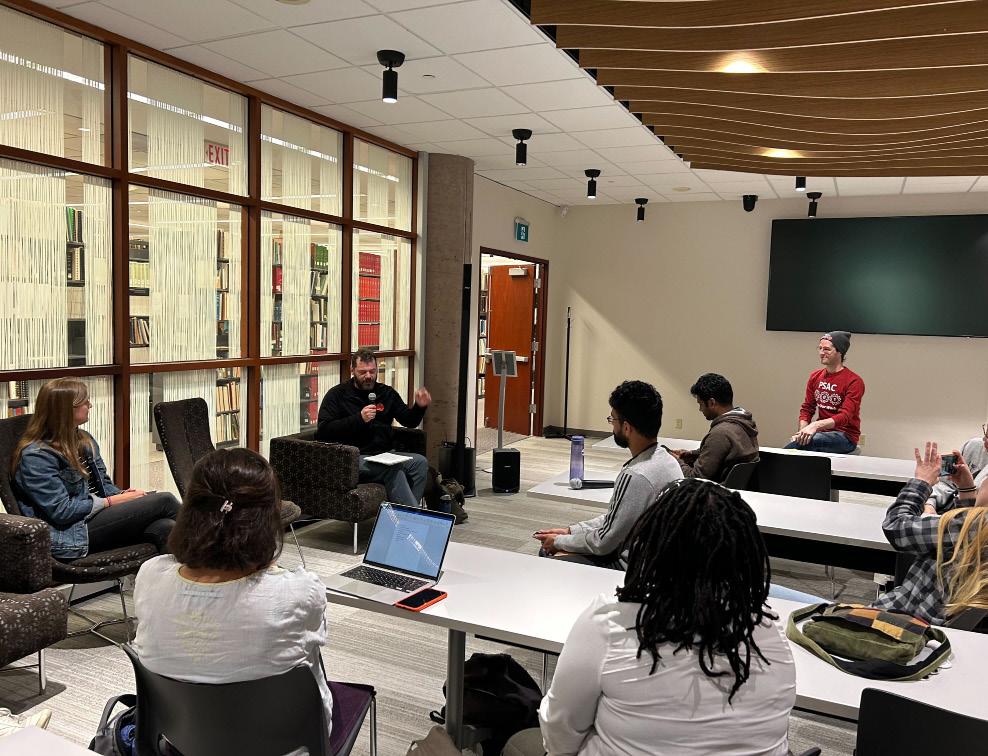
“Graduate student workers are also many things at once, not just students and trainees. We’re also academic laborers, teachers, and we produce scholarship and research that the University wouldn’t be able to function or have research output without the labour of graduate students,” PSAC 901 Vice-President (Community Relations) Levi Duhaime said in an interview with The Journal
Respect Our Research had three goals: to demystify research for the public, re-frame graduate student labourers as workers, and advocate for more funding from Queen’s and the provincial government.
“There is this misconception of us as students, and that’s a labor issue for us, because we’re workers. When we have this misnomer of being students, we unfortunately don’t receive all the protections and rights under the Employment Standards Act and Labour Relations Act,” Duhaime said.
with FormStack, the platform servicing the online event form, to improve its accessibility.
The AMS’ extensive event sanctioning process is designed to mitigate legal risks. Students are required to complete and electronically sign an online form describing their event, after which they receive authorization, according to Fraser.
Mills expressed her concern about the barriers imposed by the online form.
“The union being able to stand in with you or for you if you are unable to have these kinds of conversations,” Cameron said.
The discussion emphasized the additional hurdles international graduate student workers face at Queen’s. Attendees cited reduced funding opportunities, missing their support systems, and higher levels of discomfort advocating to themselves as challenges.
Speaking at the event were Queen’s Assistant Professor Rebecca Hall, Kingston & District Labour Council staff Doug Nesbitt, and PSAC Kingston regional representative Tim McIntyre.
Change must happen at the structural level, Hall explained, as faculty awareness of graduate student labourer issues vary department to department.
Nesbitt, a former member of PSAC 901, recalled his days as a PhD candidate without the stress of time to completion.
“Now there are degree completion timelines, and you’ll lose your funding after a certain period,” Duhaime said. “You have to jump through all these bureaucratic hoops to stay at your program in good standing.”
The tightened timeline for Masters and PhD students doesn’t mean standards aren’t still high, which Duhaime explained incentivizes graduate student labourers to work harder and longer hours.
Respect Our Research event attendees voiced concerns about power imbalances between themselves and their supervisors. Graduate student workers are dependent on their supervisors for funding, research support, and letters of recommendation to continue their careers in academia.
“I as the graduate student employee am entitled to good supervisorship,” PSAC 901 Information Officer Elizabeth Cameron said during the event.
“If that’s not the case, the student is able to switch. I know from experience; it is as simple as figuring out who your new supervisor will be and sending an email.”
Cameron reminded attendees the benefits of being part of the union and holding Queen’s
“We understand there are diverse needs with [the form] and we’re absolutely committed to working with you,” Mills said.
Ratification of the Judicial Affairs Office Positions
Assembly ratified six positions within the Judicial Affairs Office, led by Sylvie Garabedian, the recently ratified Judicial Affairs Manager.
“The biggest thing in the office is looking at educational campaigns.
An international student himself, Duhaime understands the additional precarity of having to secure study permits and visas to work and study at Queen’s. To access government support and health care, international graduate student workers must have filed a year of taxes, meaning students working on two-year completion timelines are halfway through their degrees before they’re eligible for support.
“We don’t have that support structure of the family and the community,” Duhaime said. “We’re not eligible for a lot of the domestic funding streams, like SSHRC, NSERC, and Tri-Council funding, so our funding is much more limited, and we don’t have access to those grants and scholarships that Canadian students [do].”
Respect Our Research was spearheaded by Western University’s PSAC 610 President Karuna D’Souza to show research conducted by graduate student labourers is for the public good and should be compensated accordingly, Duhaime explained.
The Canadian government acknowledged Canadians need a minimum of $26,000 annually to support themselves. For PSAC 610, the minimum guaranteed funding for PhD students is $17,000 per year, which Duhaime called below the poverty line.
The event targeting both students and community members had a smaller turn out than expected which Duhaime attributed to potential attendees showing support at the LGBTQ+ education counter-protest downtown.
“PSAC 901, and specifically, the political action committee, is certainly going to plan more events like this future and to continue vociferously advocating for proper compensation and protections for our labour,” Duhaime said.
educating students, so they know why it’s important to behave as responsible citizens in the community,” Garabedian said at Assembly. “The second part of it is restorative justice […] and it gives students a second chance.”
Assembly ratified Oluwamisimi Oluwole as the Judicial Committee Chair; Amin Nazari, Thomas Casola, and Bipan Dhillon as judicial affairs deputies, and Aastha Vaidhya as the Judicial Affairs Clerk.
Kingston community members faced off against parental rights advocates to peacefully counter protest in support of LGBTQ+ inclusive education in public schools.

Counter-protesters gathered at Confederation Park outside City Hall on Sept. 20 opposing 1 Million March 4 Children, a group advocating for the elimination of sexual orientation and identity education in schools and in school curriculum.
One Million March 4 Children organized protests across Canada, with one of these protests happening in Kingston.
Counter-protesters included students, educators, community members, labour union members, and local politicians.
In attendance was local King’s Town Councillor Gregory Ridge. Though he applauded both sides for peacefully putting “democracy to work,” he stood with the LGBTQ+ community.
“Schools are supposed to be a safe place for children. It’s supposed to be a place that if there are concerns at the home, they can bring them up to adults and professionals and get help,” Ridge said in an interview with The Journal.
Over the summer, both New Brunswick and Saskatchewan instituted policies requiring parental consent for students wishing to change their pronouns or preferred name who are under the age of 16. Ontario Premier Doug Ford echoed his support for such policies at an event on Sept. 1.
Queen’s University Philosophy Professor Lisa Guenther, who attended the counter-protest, claimed legislation requiring parental consent creates more difficulties for youth.
“When we legislate that we out trans kids and let their parents know,
... Continued from front page
“I don’t feel like the school is supporting us or addressing our concerns very well. For the first week we didn’t have water, the school completely left us in the dark, and only after being repeatedly emailed by our don did, we finally learn what was happening,” Morris-Poolman said.
“We later then met as a floor to discuss issues we were having, which was then communicated to the school through our don. Our don later got back to us with the schools’ response which addressed our concerns poorly and incompletely.”
Construction in JRH Phase Two is taking place from Monday to Friday between 7 a.m. and 5 p.m. Construction deemed to be “noisy” won’t begin until 8 a.m.
without them necessarily having a supportive family environment, we’re making it doubly hard for those kids to figure out who they are,” Guenther said in an interview with The Journal.
As an university educator, Guenther called on Queen’s University to do its part to educate students on sexual orientation and gender identities.
“I think [Queen’s University] has a responsibility to foster open and critical conversations about sex, gender, and sexuality in all of the disciplines where that’s relevant, which is a lot of them,” Guenther said.
Over the course of the day the counter-protest gained strength as more people filtered in. Passing cars blared their horns, and rally chants created a tense atmosphere.
Counter-protesters reported being peaceful and positive despite the intensity of the day and opposition across the street.
“This is kind of a tense situation,” Cameron McNeil, BMus ’23, said in an interview with The Journal. “I feel a lot of pride. We outnumber them, which is a good feeling. It
shows how much people in Kingston are willing to come together as a community.”
Protestors affiliated with 1
Million March 4 Children waved Canadian flags and sported bumper stickers reading “F— Trudeau” and “Small Fringe Minority.”
Part of the 1 Million March 4 Children movement was a school walk out and many young children were in attendance with their parents.
For drag performer and counter-protest organizer, Bee Witched, the disagreement was fuelled by misunderstanding.
“A lot of them think we want to groom their children or to plant these ‘bad ideas’ in their minds, and really all we truly want is for kids to feel like they’re loved and cared for, seen, heard and safe,” Witched said in an interview with The Journal.
Standing alongside community members were members of PSAC 901. One of the Union’s executive members Mia Akbar, MSc ’24, claimed union attendance was necessary to actively support their members.
“PSAC 901 is not unique in that it has a strong and vibrant queer membership. Other unions have queer membership as well,” Akbar said in an interview with The Journal.
Near the end of the rally, 1 Million March 4 Children protestors left their position in front of City Hall and marched into the square on the other side. When they returned from their lap around the other corner, protesters were forced onto a narrow slice of sidewalk, as counter-protestors had taken up both sides of the street.
Standing among their community in the counter-protest, former Queen’s University student Chip Wright, Comp ’24, was feeling the love.
“These people accept me for who I am, and I accept them for who they are—just as humans should,” Wright said in an interview with The Journal.
“What we’re standing here for today is to let kids know that there are people out there that are like you. That you are safe to be who you are.”
Queen’s Residence Society (ResSoc), the student government for residence, explained they’re working to address and advocate for the concerns of students.
“[Students] felt like there wasn’t much of a plan in place so [ResSoc] forwarded that information along to facilities [facilities has] been sending more frequent emails on the matter, updating students with what has been going on,” ResSoc President Nathan Beckner-Stetson said in an interview with The Journal.
“We’re hoping to still keep in touch with students, see how they’re feeling about things, and be that line of communication between the folks in Jean Royce and the folks in the administration.”
Students expressed concerns they’re not receiving the residence experience they paid for in interviews with The Journal. They brought their concerns to residence dons in a community meeting in Roy House, which were passed along by dons to the administration. Students will be notified by their dons when the administration answers their questions.
Queen’s has yet to notify students if they will be refunded a portion of their residence fees for the inconvenience.
Mikella Schuettler
Assistant News EditorA warm breeze rolled across Tindall Field and blew through the wooden slats in the new Indigenous outdoor gathering space. Students, faculty, and donors gathered to welcome a new member of the Queen’s community.
Sarah Funnell (Minwanimad) was appointed the first Associate Dean, Indigenous Health and Chair, for the Faculty of Health Sciences on Sept. 18 during the welcome ceremony at the new Indigenous
gathering space on campus.
In her new role, Funnell will support Indigenous students within the faculty and establish the new Office of Indigenous Health, promoting Indigenous ways of knowing in the Faculty of Health Sciences.
“I think the most important part of my role is to understand that I serve others,’ Funnell said in an interview with The Journal Funnell heard whisperings about the position, and when it was created, she decided to apply. Previously, Funnell was the Associate Medical Officer of Health for Ottawa Public Health, working on the City’s pandemic response, particularly within Indigenous communities.
“If I can meet with every single
student, Indigenous students, and hear what their experiences are like, I think that would be a good start,” Funnell said.
Funnell completed her medical degree in the Indigenous medical program, formerly known as the Aboriginal Medical Program, at the University of Ottawa and is a founding member of the National Consortium for Indigenous Medical Education. After earning her MSc in Epidemiology, her research focussed on Indigenous population health and data governance, according to a biography written by Queen’s Health Sciences.
Funnell’s Algonquin name, Minwanimad, was given to her by her great-aunt, it means pleasant breeze. She grew up among the Mississaugas of Alderville First
Nation, not far from Kingston, and is a band member of the Algonquin band Kitigan Zibi.
The position was made possible through a $1 million donation by Nancy Tatham, ArtSci ’86, and ArtSci ’00, and her partner Donna Henderson, who are activists in the Kingston community as well as long-time benefactors of Queen’s.
“We all who are lucky enough, fortunate enough, to live on these lands have a responsibility toward truth and reconciliation,” Tatham said in an interview with The Journal.
Tatham first heard about the Chair position at a Dean’s Advisory Council meeting from Jane Philpott, dean of health sciences. Tatham hopes the position will lead to more diversity in medical practice.
“To be a good practitioner you have to understand diversity, you feel to be able to provide good care,” Tatham said.
The position has been funded for five years by Tatham’s donation. Funnell who is excited by the welcoming she felt at Queen’s, despite it being an “ancient, colonial, academic institution,” will work closely with Colleen Davison, associate dean (equity and social accountability).
“I’m most excited about how welcoming everyone has been and it shows people are open to making change or considering different ways of doing things and incorporating Indigenous culture in the spaces that we occupy,” Funnell said.
—With files from Meghrig Milkon
‘These people accept me for who I am, and I accept them for who they are’Counter-protesters advocated for LGBTQ+ children’s rights. PHOTO BY JOSEPH MARIATHASAN
Journal and Eyeopener alumni talk about the importance of the student newspapers.
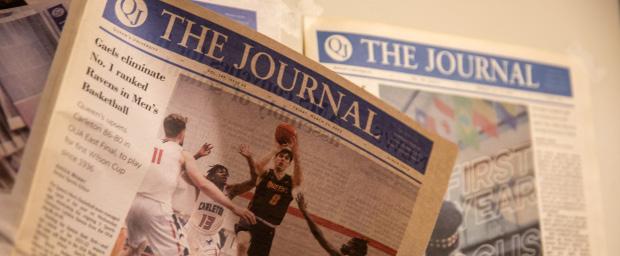
his experience at The Journal was the crux in his career upbringing.
As a student journalist, Gray had one of his stories recognized at a federal level, a turning point for the then aspiring journalist.
journalism field depends on those willing to break into the industry.
wanted to be journalists and train on international reporting.
institutions across Canada,” Bensadoun said.
Skylar SorokaFor working professionals like Jeff Gray, student newspapers are invaluable breeding grounds for breaking into the journalism industry.
“I don’t think there’s any substitute for it, I think all the many, many other people who go on to do this job professionally learned to cut their teeth at student papers,” Gray said in an interview with The Journal
In interviews with The Journal, Gray and two other student newspapers’ alumni shared their journey from student journalists to their current day lives. They underscored the significance of student newspapers as guiding lights for the future of journalism—especially in a time when the traditional art of news reporting is gradually waning.
Now married to Volume 121
Features Editor Alison Masemann with whom he has three kids, Gray started at The Journal in 1992 when, as a first-year student, he joined as a staff writer. He later assumed the role of news editor in 1993 and became Vol. 122 editor in chief in 1994. Taking his passion to Toronto Metropolitan University (TMU, formerly known as Ryerson University), Gray received a Bachelor of Applied Arts in Broadcast Journalism.
“I found working at The Journal, learning by doing, and the time I spent at The [Kingston] Whig for two summers, I learned way more about how to read a news story and how journalism worked in those two places than I learned anywhere else,” Gray said.
Gray noted he learned a lot in his graduate program at TMU, but the foundation of his love for journalism was kindled in Kingston.
Fast forward to today, Gray has worked at The Globe and Mail for 25 years and is currently a Queen’s Park reporter in Toronto. As a political studies graduate, Gray’s education at Queen’s paired with
In his first year at The Journal, the political studies student wrote a story quoted in the House of Commons.
“We had written a story about a visit by a Liberal MP during the original debate over NAFTA in 1993. This MP had said that free trade was a good idea and that Canada had to bite the bullet on deals like NAFTA to compete in the global economy.”
“The MP involved, Mary Clancy, claimed she was misquoted and faxed The Journal a condescending letter. We told her we stood by our story. The NAFTA bit was only a a small part of it, but it somehow caught the attention of NDP researchers on the Hill,” Gray said. Gray wanted to cover politics because he wanted to be part of the process that is democracy. Now, he’s part of the feedback loop helping people understand what their politicians are saying and doing.
“It’s just a key part of that machine that is, at the moment, not working very well,” Gray said.
While student newspapers operate within the confines of a university, they hold immeasurable value for aspiring journalists by offering opportunities for momentous stories with long-lasting impacts. Gray mentioned a notable experience from his time as editor in chief in 1995, when The Journal secured press passes, and sent reporters to Montreal to cover the Quebec referendum.
“You’re just kind of a random person and you end up in these situations being very close to famous or political people. It’s one of the things that makes the job so much fun,” Gray said.
Noting how Metroland Media Group—the subsidiary responsible for over 70 local newspapers in southern Ontario—announced the closure of many publications, Gray emphasized the harsh climate of getting a job in journalism in the current media landscape.
The Toronto Star’s parent company and several other newspapers announced their intention to seek bankruptcy protection for Metroland. With the termination of over 600 jobs, the
“There’s no question it’s way more difficult now [to get a career in journalism]. The number of jobs are not coming back,” Gray said. “I think if it’s something you really want to do, keep at it and hopefully, the stories you’re doing will make a difference and hopefully things will write themselves because we need to have more journalists working away for democracy to work.”
Since some student papers have been around for many decades, Gray explained how they’ve faced the same challenges that “real world” papers do. Publications like The Journal had more funding in the ‘90s when they were making money hand over fist, printing 10,000 copies twice a week as opposed to the present day, Gray said.
“Keep doing it. Take risks, push yourself, send that email, make that phone call, and make the story you’re writing the best possible story you can.”
For Emerald Bensadoun, her alma mater student paper is near and dear to her heart. In an interview with The Journal, The Globe and Mail reporter expressed the significance of exploring various media and discovering one’s preferred path when embarking on a fresh career in journalism.
Before her career, Bensadoun attended Carleton University where she earned her undergraduate degree in communication and film. It wasn’t until she attended TMU for her Bachelor of Journalism that she realized she was meant for a career in journalism.
Although Bensadoun has been both a content editor and weekend reporter at The Globe and Mail over a two-year period, she started pursuing journalism in 2014 when she worked as a freelancer.
“I kind of did my career in reverse. I started off freelancing in the Middle East during the Gaza war, and did a little bit of war correspondence, I realized that I didn’t actually know what I was doing so I went to TMU to get my Bachelor of Journalism,” Bensadoun said.
Bensadoun’s freelancing journey arose as a happy accident. She landed an internship at a media agency called “Top Speed” who were looking for people who
“I’d actually just gotten kicked out of the journalism program at Carleton but still wanted to be a journalist and thought maybe if I took this internship, I could get some more experience,” Bensadoun said. “About two days before it started, the Gaza war broke out and they completely revamped the program and said that instead of doing an internship, we were going to be thrown into freelancing.”
While she was reporting on the war, Bensadoun’s light bulb moment of wanting to become a journalist came to fruition. She finished her undergraduate degree and was then off to pursue a Master of Journalism (MJ) at TMU.
Bensadoun noted her time working at Carleton’s student newspaper The Charlatan was brief, but her time at TMU’s The Eye was pivotal to her journalism career due to her long tenure.
“My campus newspaper taught me way more about journalism than I think any program ever could have,” Bensadoun said.
Starting off as the satirical news editor for The Eye, Bensadoun worked her way up to the News Editor position which introduced her to different professors and grad students who helped her land her first internship as a radio room reporter at The Toronto Star, and then as an editorial assistant at CBC’s The National
During her time as news editor, The Eye uncovered that their student government had embezzled funds and committed fraud while receiving almost a million dollars of student funding to party, Bensadoun explained.
According to Bensadoun, the University would make up people who didn’t exist to vote in favour of school policies that would strip them of their watch dogs. The Eye’s reporting garnered national attention, which compelled school policy changes across the country, she said.
“Just because it’s [The Eye] a student newspaper doesn’t mean you don’t get to cover big issues. A lot of the stories that we covered got national attention and sparked a huge change, not only throughout our school, but throughout a bunch of other
“You really do get to make a difference with your journalism, even though you’re just at the beginning of your career.”
Student papers are crucial to what professional news publications do, not only because students learn so much through getting hands-on experience, but also because Canadian journalism is very small, Bensadoun explained. Working at campus newspapers provides access to journalism conferences where you meet up-and-coming journalists from across the country—a huge networking opportunity.
“You get the opportunity to build a network of people that you’re going to be working with for the rest of your life,” Bensadoun said.
“It would be an incredible shame to cut something that’s so instrumental in a lot of journalists’ lives and often gives them their first chance at writing bigger stories and making a difference.”
Sydney Ko, Queen’s Journal Alum
At the tail-end of her MJ at Boston University, Sydney Ko, Vol. 149 news editor is completing her professional project to graduate from the program.
When Ko migrated from Taiwan to Canada in 2018, The Journal gave her a place with a sense of community. She always knew she wanted to major in political studies but didn’t know what she was going to do with that degree. Having that degree under her belt solidified her ambition to become a journalist and report on politics and its impact on local events that affect people in their day-to-day life.
“Journalism is so challenging right now to break into. The reason why I decided to go into journalism school fresh out of my undergrad was [because] I wanted to be as well rounded as possible. You can survive as a print journalist solely, but the landscape is evolving consistently,” Ko said.
Continued online at queensjournal.ca/features
‘We need to have more journalists working away for democracy to work’
Features EditorPHOTO BY HERBERT WANG
Removing books from school libraries sets a dangerous precedent.
The Peel District School Board (PDSB) implemented a new procedure intended to ensure the books displayed in its schools’ libraries are inclusive. The procedure has led multiple schools to remove thousands of books from their libraries, solely because they were published in 2008 or earlier.
It’s untrue all books published in or before 2008 are non-inclusive. Removing books from a particular time period is a lazy alternative to creating criteria against which to evaluate the schools’ books for inclusivity.
Even if the PDSB had gone through the trouble of creating criteria and training librarians and educators to sort through and discard inappropriate material, removing books would still be irresponsible.
Even with the most extensive criteria and training, the decisions of those evaluating the books would be contaminated by their personal and political biases. Subjectivity has no role in moulding education.
Libraries are useful to students because of the caches
of information they contain. The large number of books in a library parallels the diversity of opinions in the world beyond it. Filtering those stories disallows secondary students from engaging with a healthy variety of materials and limits their preparedness for life after high school.
Engaging with perspectives that challenge students’ understanding of the world is crucial to development of critical thought, which
refers to the ability to recognize the biases in a source’s presentation of content, evaluate its credibility, and consider its implications.
Teaching inclusivity can only happen in the curriculum. Rather than trying to limit students’ awareness of non-inclusive materials, and providing no practice in critical engagement, PDSB classrooms should explain the importance of inclusivity. Books can’t be problematic
Queen’s failed the class of 2024 by never giving them a proper orientation.
In May 2020, Queen’s announced the 2020-21 school year would be delivered online. While this was the responsible decision to combat the spread of COVID-19, it was equally the first step in halting the first-year experiences of Queen’s now fourth-year students.
First-year students arrive excited to be in lecture halls and hopeful to connect with their professors and peers.
When they should’ve been growing beyond high school, their classrooms were replaced with Zoom meetings joined from their hometown bedrooms. Meetings with future friends were confined to awkward Instagram messages.
This isolation alone tainted the experience of first year and trickled into second year.
Perhaps the most prominent loss, though, was orientation week.
Aspiring Queen’s students know of and look forward to its traditions of welcoming first-year students to campus. Coverall painting, the semi-formal dance, and the Mystery Concert are


among a slew of memorable opportunities for incoming students to meet people in their programs while shaking the anxiety of leaving home and arriving somewhere new.
Instead, Queen’s offered a forgettable, online orientation week consisting of online games and stilted Zoom calls.
Perhaps intended as a sweet
for students if the conversation around them is thoughtful and informative.
Non-inclusive books can be helpful in promoting inclusivity—it’s difficult to explain why discrimination is negative without any books depicting it. Many books published before 2008 dvocate inclusivity, even if they don’t perfectly depict it. Erasing inaugural advocacy in the name of promoting inclusivity is inherently paradoxical.
substitute for the real thing, online orientation only further reminded its participants of what they were missing.
Queen’s could have remedied this in a number of ways.
The University could have allowed affected students to partake in following years’ events once in-person orientation was reinstated, or given students a make-up orientation week, so as to not impede on the class of 2025. Instead, the class of 2024 was neglected. They were left disappointed, watching their younger peers enjoy what they never had, and prohibited from joining in themselves.
The isolation continued into the school year, particularly for those who stayed home. Even students in residence, rather than being exposed to hundreds of new people in their classes, were limited to socializing with the people on their floor. The Athletics and Recreation Centre, Joseph Stauffer Library, and every student-run facility was closed in the 2020-21 year, preventing students from making regular use of campus.
Ontario’s emergency lockdown
This isn’t the first time the PDSB has placed limits on what literature is acceptable.
In 2018, English teachers claimed the PDSB was trying to ban To Kill a Mockingbird from its schools. While it’s true the novel contains racist content, when taught properly, it offers students the opportunity to understand and critically evaluate the reality of racism, analyze how the positionality of its author influences it, and to learn about the civil rights movement.
Discarding books is a performative, inattentive jab at inclusivity. Knowing they were planning on removing books, the PDSB should’ve established a complimentary procedure for re-stocking their shelves.
Re-organizing the library into inclusive and noninclusive sections would have benefited students both looking to see themselves represented in literature and to learn from history.
Erasing all potentially problematic material from libraries without education benefits no one.
—Journal Editorial Boardat the beginning of 2021 led the University to encourage those in residence to stay home after winter break. Whatever limited socialization residence offered only lasted half a school year for most.
Those students remained online for much of their second year as well. They continued to face difficulties bonding with peers, and professors while struggling to feel engaged by their education. They received an incomplete education at an unchanged price. Students whose first year of university was 2020 lost two years, half of their undergrad, to COVID-19 protocols. They got less time and support in acclimating to, or enjoying university than other incoming classes.
Many of those affected as first-year students, now in fourth year, will graduate this spring having never been properly oriented at Queen’s—and this is something the University should’ve remedied.
Maddie is a fourth-year sociology student and The Journal’s Senior Arts Editor.
HANNAH
ROMKEMAContributor

While post-lockdown has bestowed many gifts and curses, music fans and students alike are feeling the impact of record high concert ticket prices.
Live concerts are invaluable experiences, both for artists and their fans. While prices depend on the artists’ popularity and the venue, the last couple of years have seen a universal spike in ticket costs.
With the current state of the economy, few concerts that sell seats for less than $200. For bigger names like Taylor Swift or Drake, it’s not uncommon to pay upwards of $500 for nosebleed tickets, and sometimes as much as $1,200 for fans looking to get closer to the stage.
These prices aren’t sustainable, especially for students and young people with an array of living expenses to cover.
The major increase in ticket costs over the past few years has left fans unable to see their favourite stars.
As young people represent the dominant demographic of concert goers, it’s in the artists’ and
Dear Editors,
I wanted to quickly contact The Journal regarding the article: “The racism at ASUS orientation was preventable,” about the information contained within it about which parties approve orientation events. I first want to reiterate that
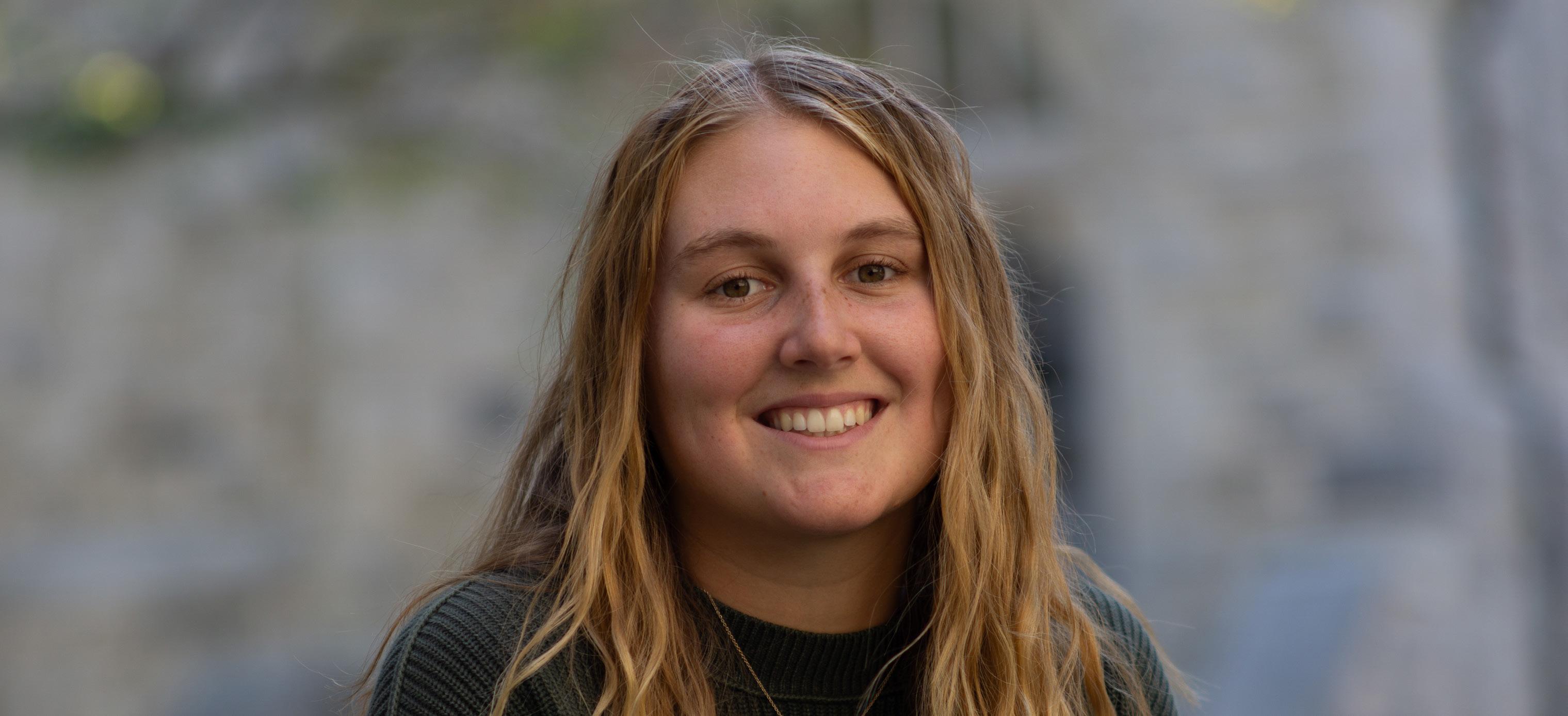
industry’s best interest to cater to listeners’ needs.
Though the exorbitant prices are a deterrent to some, they haven’t hindered the demand for concerts.
Artists like Taylor Swift, Ed Sheeran, and Drake frequently go on tour, with multiple sold-out concerts in enormous stadiums all over the world.
With artists reaping the rewards of inflation, the concert economy is as prosperous as ever regardless of ticket price. This doesn’t change the importance of addressing how these prices affect youth and students.
It can be difficult for students to devote a considerable percentage of their budget to a single event when they have financial limitations. After rent, tuition, and groceries, students hardly have a few hundred dollars left over to devote to a concert.
Instead of focusing on the economic benefits of high demand and high cost, it’s crucial for the music industry to consider inequality and resource allocation.
Performers and promoters must strike a balance between charging a price for tickets that protects their financial stability, and keeping events affordable for an audience of mixed socio-economic levels.
Efforts to mitigate scalpers from infiltrating the ticket market pose burdens to fans.
Most concerts are run through online stores, which come with
orientation pre-week socials are not orientation events. They don’t go through the same process of revision that includes the parties The Journal mentioned. Orientation pre-week socials are not subject to the same orientation event approval procedure and are primarily planned within the faculty orientation bodies and societies. Therefore, ORT had no role in approving this social whatsoever.
I also want to acknowledge that the imbedding of SOARB is outdated. As of March 2021, SORC (Senate Orientation Review
several pros and cons. While online box offices allow fans quicker access to buying tickets from any place in the world, digital platforms are finicky at best, and leave many hopeful fans frustrated and without tickets at worst.
For concerts with extreme demand, such as Taylor Swift and Morgan Wallen, ticket platforms like Ticketmaster mandate fans register for presale selection. Ticket buying slots are awarded in a lottery fashion, resulting in a randomized ticket distribution.
This ensures individuals who aren’t lucky enough to purchase tickets in the initial swarm of buyers and can’t afford the remaining seats have a fair chance.
With or without presale, popular shows often sell out within minutes. Many fans are then forced to purchase tickets from resellers—most of whom buy tickets for profit—at unreasonable prices.
When this happens, concerts become less of a community event, and more of an exploitative money-making scheme.
Concert ticket prices are only going to rise as this behavior continues. As this phenomenon grows, it's imperative artists and concert organizers take steps to address it.
Some artists, like Taylor Swift, have implemented strategies such as the Verified Fan program, which prioritizes offering genuine fans the
Committee) was approved to come into effect January 2022. The Orientation Policy can be found on the Queen's website. All Orientation Events are not subject to the approval of the Commissioner of Campus Affairs, any longer. The Deans and Designates act as final approvers on the Orientation events, with ORT reviewing the event forms in the earliest stages.
Sincerely,
Victoria Mills AMS Vice-President (University Affairs)opportunity to buy tickets. While this approach is a step in the right direction, more comprehensive measures are needed to effectively combat scalping.
Noah Kahan announced for his upcoming tour dates, all resold tickets must sell at face value to ward off scalpers trying to rip off devoted fans.
More touring artists should adopt this policy.
The sheer amount of proceeds made from concerts have transformed host cities into thriving economic hubs. They bring in thousands of visitors, leading to increased business for local restaurants, hotels, and retail establishments.
Taylor Swift’s Eras Tour generated so much money that she gave bonuses and $100,000 gifts to her workers. Though her crew doubtlessly deserves the extra income, the excess of revenue implies there’s more than enough money going around to lower the initial ticket prices.
Concerts may be all the rage, but that doesn’t justify organizers and artists in charging unreasonable fees and overcomplicating the ticket-buying process.
These events have the potential
to boost local economies and create a legacy when they’re managed effectively. In order to be a universally positive experience, they need to be affordable. Concerts should be a shared experience. Artists, promoters, and fans should engage in a constructive and collaborative dialogue about how to make concerts more inclusive and accessible as the industry continues to evolve.
Taylor Swift’s many efforts to engage with her fans and host communities is an example for other artists to follow. Fans are real people, happy to set aside large amounts of time and money to go and watch their idols perform, but they need to be shown gratitude and appreciation as well.
It's imperative that moving forward, concerts are recognized as a communal celebration. The music industry will do well to prioritize accessibility and inclusivity as they continue to chart their course forward.
Hannah Romkema is a third-year Con-Ed student. Hannah hopes that concerts can return to being fun, affordable events for entire communities.McFadden doesn’t often see the same level of energy at bars like The Brass Pub.
McFadden plans to sing two cover songs at Mini Desk. One will showcase her vocal abilities, and the other one is “for the girls.”
The song for the girls is a Taylor Swift cover, which she hopes will encourage people to engage with her performance, given Swift’s current popularity.
Writing a love song about falling for somebody and realizing one will never feel the same, McFadden will perform the unreleased original called “Fallen,” at the event.
“I think university students really resonate with that because everyone’s had a crush they like or a situationship they’re in. There’s a will they, won’t they situation.”
When she wrote the song, she tried to express the feeling of unrequited love. Once she experienced it herself, she conveyed them in the words and lyrics of “Fallen.”
“It’s a form of therapy for me to put it all down. It’s cool if I can have other people like it too.”
SUZY LEINSTER
Assistant Arts EditorQueen’s alumni are flocking back to Kingston to perform at The Mansion.
On Sept. 26 at 8 p.m., MUSE Magazine is hosting Mini Desk, an event inspired by NPR’s concert music series titled Tiny Desk Concerts. Live
from The Mansion, the event aims to showcase student musicians. There will be a total of six artists performing, each with a 15-minute slot to showcase their talent.
One of the artists, Sadie McFadden, ArtSci ’22, BEd ’24, said the event is a chance for her to collaborate and perform with students in a post-pandemic world.
McFadden worked at MUSE and attended past Mini Desk events when she was an undergraduate student. She said it was an electrifying experience to watch her friends on stage and see
them have the chance to perform for a live audience.
“I applied [to Mini Desk] because I was like, ‘wow I would really love to be part of that experience.’” Alumni were coming back from Toronto and Ottawa so they could be part of this experience. This clearly means a lot to people, and I want to be a part of it,” McFadden said in an interview with The Journal.
Having played at The Mansion before, she believes it’s the best venue for students to perform off-campus. Praising the crowd in the past for their enthusiasm and engagement,
McFadden looks forward to watching the band Colour Theory, with whom she has a personal connection. One of the lead vocalists, Daniel Todorovic, Comm ’25, is McFadden’s friend and they have played music together in the past.
Before the show begins, fans can find McFadden sipping on a “brew” and dancing the night away.
Alongside Colour Theory and McFadden, Whitby-based band Separator will also take the stage. Vocalist and guitarist Foster McAffee, ArtSci ’23, and bassist James Carr explained the importance of team chemistry when playing in a band.
The origins of the band
date back to their experience at an art camp the band members attended in their youth. McAffee and Carr met their three other bandmates—drummer Colton Mowbray, guitarist and vocalist Carter Menary, and guitarist Carson Young at this camp.
They playfully dubbed the camp, “Camp Rock,” in the early days of being acquainted. They weren’t always close friends, but McAffee said he wanted to be in a band with people who had similar musical backgrounds.
“We speak the same language, but it’s also important we all come from different yet comparable music backgrounds. We all have different unique perspectives and different ideas from each other,” McAffee told The Journal.
“I always thought I’d rather be in a band with people who are just kind of mediocre musicians but [who I] get along with, [rather] than, a bunch of really good musicians that I can’t stand. Turns out we’re—including myself—a pretty good group of musicians [who] I’m proud of,” he said.
McAffee organized past MUSE events involving Mini Desk and performed with Carr in the fall of 2022. This was McAffee’s first time performing in Kingston with Carr.

Separator will play three original songs, “Always,” “Brumaire,” and “Lobster.” The band’s sound is nostalgic to the ’90s Indie scene, complimented by an upbeat guitar playing in the background.
The other artists performing are Grace Delamere, Beksinski, Carnelian + Hala Amer. Tickets are available for sale on MUSE’s website, costing $10 each.
MADDIE HUNT
Senior Arts Editor
Queen’s Spanish and Latin American Students’ Association (QSALSA) has danced its way back to campus for another year.
Returning from summer break, QSALSA held their first beginner’s salsa and Bachata class on Sept. 20 in Ellis Hall. The club teaches students Latin dances such as salsa and Bachata, but also provides a space that allows students to broaden their perspectives on cultural practices, all while staying active and having fun.
“We’ve been mostly focused on teaching Latin dances, as the name suggests. salsa is one of the staple Latin dances but so is Bachata. Those are the primary things the club offers,” QSALSA Events Coordinator and Cuban Salsa Instructor Braulio Antonio, third-year PhD candidate
in physics, said in an interview with The Journal.
According to Antonio, before the onset of the pandemic the club had tango classes, Spanish conversation circles, and movie screenings in partnership with the Queen’s Film Club. Día de los Muertos [Day of the Dead] gave QSALSA the opportunity to have a
social media campaign where they shared facts about the Mexican celebration in Canada.
Through their Instagram page, Antonio said the club worked to bring awareness to Latin culture, and the different countries forming Latin America. He believes the cultural importance of QSALSA is to maintain these practices in Canada.
“I think it’s important to keep these practices alive because at the end of the day there are a lot of musicians, a lot of dancers that are building this genre,” he said.
“If it’s not practiced, if it’s not danced, then it just dies. When you have something that comes from just one place—Bachata
is 100 per cent Dominican—you really want to cherish it and to make sure it thrives.”
He encourages students to join because it’s simply fun.
“I think if you’re a dancer, you enjoy listening to the music. But there’s always something more to it when you can do it within a context. In this case, it’s the Latin social scene, the Latin music, and to know you’re doing it [dancing] right is an extra part that makes it more special, makes it more fun, [and] opens your perspective to other activities and other cultures.”
The club meets twice weekly on Wednesdays from 6:30 to 9:30 p.m., and on Thursdays from 6:00 to 7:30 p.m. in Ellis Hall room 319, with members of the Kingston community showing their support by volunteering as co-instructors.
While everyone is welcome, there’s a waitlist for people to join the club due to limited capacity in Ellis Hall. Antonio recommends tracking the club’s social media before the winter term begins.
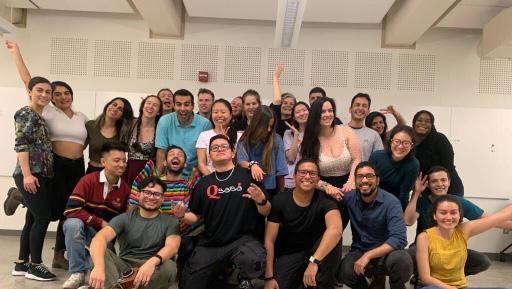
Ten incoming Queen’s students received the Schulich Leader Scholarship, Canada’s most coveted undergraduate STEM scholarship.
Among this year’s recipients were five students in the Faculty of Engineering and Applied Science who received $120,000 scholarships, and five students in the Faculty of Arts and Science, who received $100,000 scholarships. These individuals are among the 100 students across 20 partner universities in Canada who were awarded the honour this year.
“I think something that makes [the scholarship] unique is that it has a really strong network
and community that continues to get better every year,” said David Goodman, executive director Schulich Leader Scholarships and Schulich Foundation vice-president, in an interview with The Journal.
Goodman shared the scholarship program was born out of a desire to financially support Canada’s best students pursuing STEM fields with an entrepreneurial mindset. The hope is by eliminating financial pressures and not having a minimum GPA requirement to retain the scholarship year-to-year, students can enjoy their studies and explore non-academic pursuits.
Schulich Leader Ishaan Grewal, Sci ’27, echoed this sentiment. He explained the funding allowed him to attend Queen’s, and he hopes to join design teams and embrace the engineering experience as much as possible.
“I think [the scholarship]
opens a lot of avenues other students might not have. The scholarship, the Schulich Leader network, the mentorship [all] provide a great sense of community [and] help me grow as a person,” Grewal said in an interview with The Journal.
Grewal is in the direct-entry electrical and computer engineering innovation (ECEI) stream, which he chose over the general engineering stream because of its focus on innovation with specialized commerce classes for engineering students.
“I was really intrigued by the business aspect of things as well, because if I want to create my own start-up company, I need that experience,” Grewal said.
While Grewal appreciates the direction and focus his direct-entry stream provides, most students apply to the general stream with the potential to declare a specialization after their first year. Schulich Leader Torrin Bigrigg, Sci ’27, likes the broad exposure this stream provides.
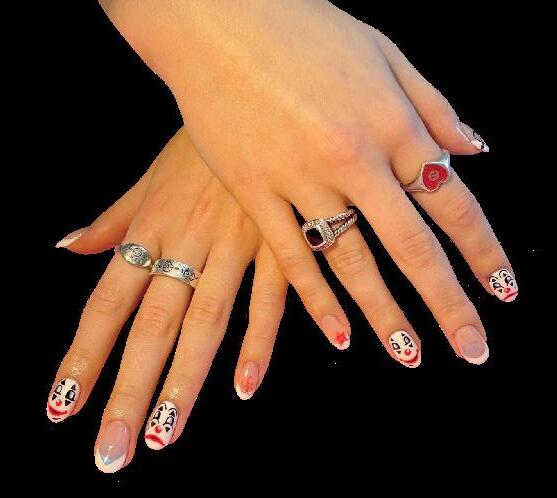
Students can get a full set of nails for $35
 Suzy Leinster Assistant Arts Editor
Student nail technician Renee Zhang, ArtSci ’23 and BEd ’24, turned her side hustle into an independent business from her bedroom.
Zhang spent her first year at Bader College in 2019 where she painted her friends’ nails for free. She experimented with shapes and colours, eventually gaining enough skill to consider doing nails professionally.
In the winter semester, when the pandemic forced Zhang to stay inside, she decided to learn how to do gel and acrylic nails as a hobby.
When Zhang entered her third year, she decided to open a business. At first, she was nervous because she didn’t have many friends coming out of the pandemic and assumed it would be difficult to build a clientele.
Eventually, word spread, and she had clients from all over Kingston.
“Things get around so quickly I don’t even catch where people come from. There was this girl
After her first few months of business, Zhang was completely booked for the next two months. This busy schedule allowed her to quit her part-time job at Starbucks and commit to being a nail technician full-time.
Zhang offers both gel and acrylic nails with prices ranging from $35 to $50 depending on design, material, and time required.
“I try to keep the prices as low as possible because I know students want to get their nails done, it’s really hard to get them done [with] awesome designs because it’s crazy expensive these days,” Zhang said.
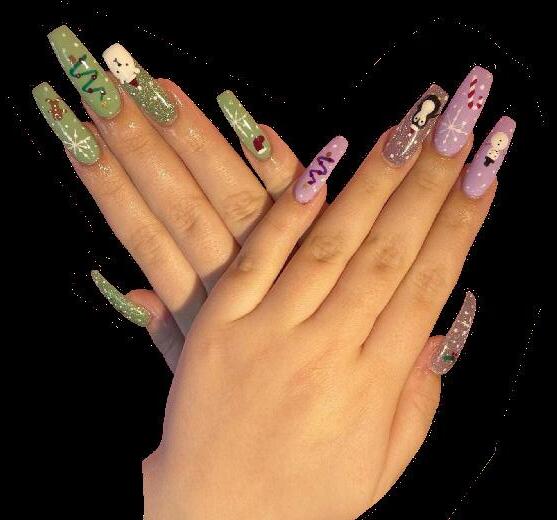
Originally, she didn’t have a formal booking system and told people to come to her whenever they were free. However, as school picked up, she didn’t have the time and had to plan specific time slots for her clients.
Now she estimates she works 30 hours a week on average, while balancing her teacher’s college practicum. Zhang enjoys her busy schedule.
As a self-described extrovert she doesn’t feel socially drained after working with clients. Her favourite parts of the job are talking to new clients and learning about who they are as people.
This is the first year Zhang has encountered competition in the nail technician field, and she said it is super awesome to see
In fact, having another nail technician lessens the burden Zhang feels when it comes to working with her clients. Sometimes she doesn’t have enough availability to fit everyone into her schedule and she is happy someone else can provide this service.
While most of her clients are Queen’s students, people from St. Lawrence College and
research before, now I’m kind of considering it,” Bigrigg said in an interview with The Journal Bigrigg hopes to become involved in the engineering community during her time at Queen’s by joining several clubs and applying to be an orientation leader next year.
The Schulich Leader network provides ongoing mentorship and support to its students. One aspect of this network is to connect upper year Schulich Leaders with incoming students to provide guidance and advice as they navigate their new programs.
For the first time, Queen’s
is hosting the Schulich Leaders Across Canada (SLXCA) conference on Sept. 23. Leaders from partner universities in Kingston, Ottawa, and Montreal will be in attendance.
“Clusters of Schulich Leaders from the host university and nearby universities come together for a day of learning, inspiration, and connection. It embodies what we’re trying to do throughout the entire year with the Schulich Leader network,” Goodman said.
“We’re trying to expose these students to thought leaders, mentors, and potential employers, where they can both learn and find opportunities.”
Canadian elections may soon fall victim to the same fate as unsuspecting Lennie in the Of Mice and Men
Written by John Steinbeck, the book tells the fictional story of George and Lennie searching for employment during the Great Depression. Along the way, Lennie, who doesn’t know his own strength, accidentally snaps the neck of a woman which prompts a lynch mob to chase them.
Foreseeing Lennie’s fate in the hands of the mob, George shoots him in the back of the head in an act of twisted mercy. Poor Lennie never saw it coming.
Unlike Lennie, Canada knows that a loaded gun is aimed at them.
Registry—similar to the Foreign Agents Registration Act in the US—which requires foreign agents to disclose their domestic political activities, such as lobbying, and relationships with foreign states. Foreign agents are sometimes high-profile individuals who seek to push foreign political agendas by influencing government officials and decision-makers.
This registry would empower Canadians with the ability to evaluate foreign agents, after having knowledge of their ties to foreign entities. Surely all of you have had someone in your life who hid details that you would’ve preferred to know before getting close to them—this is no different.
Her clients’ main point of contact is Instagram and Zhang uses this as an opportunity to screen potential clients based on their profiles and mutual followers.
Despite enjoying her job, Zhang’s biggest challenge is her allergy to the chemicals in the acrylic and gel nail polish.
“One day, I woke up, and my hands were covered in rashes. They were splitting open, and I found out it was because I’m allergic to everything I use. I have to be careful about touching things with bare hands.”
She mediates this issue by wearing gloves and making sure her workspace is sanitized. Zhang cares about her customers’ happiness and is a big advocate for clients to give her feedback during their appointments.
“I remember when I used to go to nail salons when I was younger, and you pick out a colour you realize you don’t want anymore, or they file your nail funny, but you don’t want to say anything,” Zhang said.
Zhang values good communication with her clients and gives them a space to talk and express themselves. Her business slogan is: My therapist is my nail artist—which encompasses her view of the service. Something very social, comforting, and fun.
Earlier this year, the Canadian Security Intelligence Service (CSIS) raised the alarm on Chinese foreign interference in Canada’s elections. A series of intelligence leaks from whistleblowers within CSIS brought to light these concerns. The leaks alleged China provided funding to 11 candidates in 2019 and donated to political campaigns under the table.
The anonymous informants claimed public interest outweighed the risks to their jobs.
False narratives about Conservative Member of Parliament (MP) Michael Chong were shared by users on the Chinese social media WeChat. Along with that, CSIS recently alerted NDP MP Jenny Kwan that she is a target of the Chinese government. All this comes amidst the dramatic backdrop of TikTok CEO Shou Zi Chew’s hearing in US Congress and the banning of the application on government officials’ electronic devices.
The Trudeau government’s initial handling of this issue, which involved the appointment of Special Rapporteur David Johnston, who recommended public hearings as opposed to a public inquiry, has been criticized by both the NDP and the Conservative Party. But as Canada announces a public inquiry into election interference, we must now move swiftly to collaboratively enact solutions that will address this serious issue.
One solution would be to introduce a Foreign Agent
Parliament passed a motion to introduce a bill addressing a possible registry later this year—the motion was completely opposed by the Liberal Party.
One possibility behind the Liberals’ opposition is found in Liberal MP Chandra Arya’s petition which cites that a potential law could pose “serious harassment and stigmatization risk for racialized communities.” A letter sent to the ex-Public Safety Minister Marco Mendicino by a senator backing the petition, invoked the Chinese Exclusion Act of 1923, suggesting a registry would be similar.
NDP MP Jenny Kwan—yes, the one who is actually being targeted by foreign interference—implored in a petition of her own that a registry be implemented as soon as possible. She stated that comparing a Foreign Agent Registry to the racist Chinese Exclusion Act is a false comparison. The historic racist law targeted all Chinese people, a Foreign Agent Registry would apply to anyone, Canadian or not, who lobby on behalf of any foreign government.
I don’t think this is a race issue.
Parliament recommenced this past week—let’s see what is done to deal with this critical issue.
Knowledge is power, and we know that foreign interference is happening right here in Canada. Unlike Lennie, we need to disarm the threat we face before serious damage is inflicted on our democracy.
As the end of September nears, let’s look at how each Queen’s Gaels Varsity team has been shaping up this season.
Women’s Rugby
Currently atop U SPORTS weekly rankings as number one in the nation, the Women’s Rugby team has gone undefeated so far this season.
With their first game against Trent University Excalibur Sept. 2, the team won 102-0. They played their second game against the University of Toronto Varsity Blues Sept. 9, winning 105-0. Their third, and most recent game posted a score of 53-0 against the Western University Mustangs.
With a 3-0-0 regular season, Women’s Rugby achieved 165 total points with zero total points against. The team has three more regular season games against the University of Guelph Sept. 23, followed by games against the Brock Badgers and McMaster Marauders.
Women’s Soccer
U SPORTS ranked the Queen’s Women’s Soccer team as third in the nation this week, just behind uOttawa and the University of British Columbia.

Shutting out U of T, Ontario Tech, and Carleton at Richardson Stadium, the Gaels have dominated their opponents at home so far this season. The team played Ontario Tech, where they won 3-0, and played Trent University, where they won 4-1, going undefeated in their season so far.
This season the team has scored 17 total goals for, with one goal against. They have seven games remaining in the regular season before OUA Playoffs when they host the U SPORTS Championship. At their remaining home games, the Gaels will face off against Toronto-Metropolitan University (TMU), the Royal Miltary College of Canada (RMC), and Trent University.
Men’s Football Queen’s football currently holds the number ten spot on the U SPORTS weekly ranking list.
The team fell 11-10 during a tight home opener against Laurier. The Gaels dominated their second game against U of T, where they won 42-9. Upon their return home, the team fell to
Western in another tight game with a final score of 32-27.
The team currently sits at a 1-2-0 season, with 79 total points for and 52 total points against. They have five more regular season games against the University of Windsor Sept. 23, followed by games at York University, Carleton, and the University of Guelph. The football team will return to Richardson Stadium for the homecoming game against uOttawa Oct. 21.
Men’s Soccer
The Queen’s men’s soccer team is currently seventh in the OUA East division, and 28th overall in the U SPORTS rankings. For the week of Sept. 6, Gaels Comm ‘24 forward Matthew Ciavarro was named U SPORTS Athlete of the Week.
The team tied their first two games at home 3-3 and 2-2 against U of T and Ontario Tech respectively. At their third home game against Carleton, the Gaels lost 2-1, and fell again to Carleton with a score of 4-1. They lost to Ontario Tech 1-0 Sept. 15 before achieving their first win with a 5-3 score over Trent University Sept. 17.
They currently have a 1-3-2 regular season with 12 total points for and 15 total points against. They have six remaining regular season games with home appearances in games against TMU on Sept. 23, followed by games against RMC and Trent University.
The Men’s Lacrosse team is currently ranked fourth in the Eastern Division of
the Canadian University Field Lacrosse Association (CUFLA).
Despite losing their first game against Trent University 8-5, the team has since won two against Bishop’s University and uOttawa, with scores of 9-7 and 7-5 respectively.
They’re sitting at a 2-1-0 season record with 21 total points for and 20 points against. Of seven regular season games remaining, four will take place at home, with the Gaels set to face off against the Carleton Ravens next Friday.
Following their championship season, the Women’s Lacrosse team is already looking hot. Having won all four games this season so far, their season record is 4-0-0 with 76 total points for and 16 total points against. They have seven regular season games remaining before they return home to host the OUA Championship Oct. 27-29.
The women’s field hockey team is third in the OUA East Division, ahead of McGill University.
The team tied their first game at home against the Guelph Gryphons 0-0 Sept. 16. On Sept. 17 they travelled to the University of Waterloo, where they lost 2-1.
They currently have a 0-1-1 record with one point for, and two total points against. They return home Sept. 24 for a game against Western University.
The Men’s Baseball team plays for an OUA
Open Championship League and is not a part of U SPORTS.
For each opponent the team faces, they play each other twice in the day, accounting for two games. With ten games under their belt this season, the team has faced off against five opponents.
The Gaels lost to U of T 6-2 in their season opener before winning their second game against the team 6-3 Sept. 9. The next day, Queen’s played Laurentian University where the Gaels won 9-0 the first game and lost 8-7 the second. The next weekend they played Laurier and TMU, winning one out of four games played. The following Tuesday, the Gaels played uOttawa, winning both games with scores of 8-2 and 11-8.
With a 5-5-0 record, they have 62 total points for, and 56 points against. The Gaels have four regular season opponents remaining, and will face off against Carleton Sept. 23.
Ranked third in the East Division of Ontario University Softball (OUS), the Women’s Fastpitch season sits at 3-3-0.
The team lost against Western University 7-0 both games, lost 7-4 in their first game of the day against the University of Windsor and won the second 7-1. Most recently, they played York University, where they won both games, scoring 7-0 and 17-0.
The team faces seven more opponents with the next game against TMU taking place Sept. 22.
Lauren McEwen, current Assistant Coach of the Women’s Rugby team at Queen’s, has had extensive impact on the Queen’s Rugby program. She has a continued passion for the Rugby program and the players at Queen’s.
McEwen started her Queen’s rugby career back in the 2011-12 season as a centre. She played all the way through to the 2015-16 season, where she scored a career total of 219 points. McEwan held the all-time scoring record at Queen’s until just recently, when current Gael, Lizzie Gibson, broke the record.
Having grown several formative relationships through rugby, McEwan became a coach to help bring that same sense of family through her leadership. She was named assistant coach for the Gaels in 2016.
At women’s rugby games McEwen can be seen in close contact with the players, lining up directly behind the kicker to provide
support and advice before and after the kick. In a previous interview with The Journal, Gibson cited McEwen as having a profound impact on her success, stating she’s much more than just a coach.
“She’s always been there for me emotionally” Gibson said. “She’s an expert, she watches me from behind and knows exactly what went wrong in my kick, but she’s also my biggest hype-man.”
With significant influence on the team, McEwen continues to grow Queen’s Rugby, even now that she isn’t a student and has a job teaching high school in Kingston. This is representative of McEwen’s love for rugby and the Gaels program.

“Watching them struggle and overcome their struggles and helping them through that has just been so rewarding,” McEwan said.
McEwen continues to grow as both a coach and mentor to her Gaels.
“Goals that I set for myself [are] to change with the way that the athletes in front of me are changing,” she said. “Evolve to their changing ways and to not kind of be stuck in a rigid mindset.”
McEwen praised the rest of the coaching team standing beside her.
“I really love the coaching staff that I work with,” she said. “We all bring something that is unique and special to our coaching staff. We all genuinely truly have so much respect and care for each other.”
A glimpse at how the Gaels line up so far this yearAIDAN MICHAELOV Assistant Sports Editor Lauren McEwan played five seasons for the Gaels from 2011-16. PHOTO BY JOSEPH MARIATHASAN Former Gaels centre reflects on her time in Women’s Rugby
Ahead of the Queen’s football game against Western last Saturday, the final phase of the Richardson Stadium Revitalization Project had its grand opening.
Principal Patrick Deane, Vice-Provost and Dean of Student Affairs Ann Tierney, Athletics and Recreation (A&R) Executive Director Linda Melnick, donors, and Queen’s Football alumni gathered before students, fans, and athletes for the grand opening of the new Lang Pavilion.
The Lang Pavilion will
include features dedicated to student-athlete success with therapy spaces, locker rooms, student-athlete meeting spaces and a new fan view area.
Aside from varsity teams and clubs, members of the Junior Gaels, a youth sports program, will make use of the pavilion.
According to a press release from A&R, the two-storey structure at the north end of Richardson Stadium now fully encloses the venue and gives Queen’s one of the best stadiums in Canadian university sport.

Fundraising for the Lang
Pavilion began in 2014. Over 300 donors contributed to the project.
In a quote from A&R’s press release, Stu Lang, Queen’s receiver from 1970-74, five-time Grey Cup champion, and one of the lead donors—expressed the importance of the pavilion.
“This building is not just about bricks and mortar,” he said. “It’s about preserving our distinguished history and nurturing the sporting dreams of all the student-athletes who will compete here.”
believe is the greatest game on Earth.”
Keep your head out of the game—Queen’s coaches are proactively preventing head trauma and CTE injuries by making moves towards safer sports.
Over the past few decades, studies surrounding contact sports have revealed detrimental effects resulting from head injuries, which greatly inhibit both the development and cognitive functions of the brain.

Sports like football, hockey, and rugby have faced increased scrutiny regarding the ways team doctors and coaches diagnose and treat head injuries to ensure adequate care of athlete’s brains.
More recently, Chronic Traumatic Encephalopathy (CTE) has been the focal point of concussion prevention and research. CTE is a neurodegenerative disorder thought to be caused by repeated brain traumas, which are commonly associated with contact sports. Often going unnoticed, CTE has been linked to emotional, physical, and other cognitive impairments, with symptoms manifesting years or decades after the initial trauma.
One of the major issues with diagnosing and treating CTE is that it can only be diagnosed through a brain tissue analysis, which can only be conducted after death. It requires slicing into the brain and dying it with chemicals that highlight abnormal brain tissue.
I had the chance to sit down with Steve Snyder, head coach of the Gael’s Men’s Football team, to investigate how much weight the football team places on keeping their players safe.
“Player safety is at the forefront of our game, and whatever we can do here at Queen’s to be a national leader in that area, we’re going to continue to do,” Snyder said. “We want to grow what we
Although head contact seems to be natural across all contact sports, Snyder emphasized the investments the Gaels make to protect their players.
“The big initiative we’ve taken this year is we’ve purchased Guardian caps for all of our players. They wear those in practice, which is an additional padding that slips over top of the helmet that the NFL uses, the CFL uses, and a lot of Division One NCAA teams use,” he explained. “It was a significant investment, but well worth it.”
Snyder assured me that Gaels coaching and medical staff have a layered approach to rehabilitating injured players, which they’re confident accurately assesses an athlete’s susceptibility to further trauma.
The Gaels coaching staff use this approach to slowly work injured Gaels back into the intensity of football, without dramatically exposing them to the explosive hits that frequent the sport.

While you’ll never separate brain-rattling hits from contact sports, increasing education related to traumatic brain injuries allows players, coaches and medical staff to be more proactive in, and better respond to their treatment of brain injuries.

“We’ve went as far as having an impact study done here before where the players wore a chip sensor in their helmets, in practice and in games to measure impact,” Snyder said. “We’re able to use that data to make things safer in the future, and monitor players as things are happening.”
Overall, while concussions are nearly unavoidable in contact sports, I’d say Gaels athletes are in good hands that prioritize negating the long term effects concussions can have on the human brain.
‘Player safety is at the forefront’
Assistant Sports EditorPHOTO BY JOSEPH MARIATHASAN The grand opening took place Sept. 16. RORY STINSON Senior Sports Editor PHOTO BY JOSEPH MARIATHASAN Many students were in attendance for the football game that followed the opening. The Gaels played Western after the grand opening, losing the game 32-27. PHOTO BY JOSEPH MARIATHASAN Lang Pavilion is officially in use AIDAN MICHAELOV
dancers, and implied the dancer was lazy, berating them about weight gain.
I can’t go two seconds on the internet without being advertised some form of shapewear.
From bodycon dresses with built in spandex shorts to bras that cover half my torso, my Instagram feed is covered in curvy women wearing different types of fabric to “emphasize” those curves.
It seems the Instagram algorithm has caught on to my body insecurity and my interest in
fashion, and keeps telling me about all the different ways I can make myself look “slim thick.”
Shapewear isn’t a new phenomenon. For much of history, women’s undergarments have been created to “enhance” figures. Though corsets were previously popular due to their practical use in supporting women’s busts and helping improve posture, it became popular in the 19th century to use corsets to make your waist appear smaller.
As time marched on, our society shifted away from corsets to bust-enhancing bras, before circling all the way back again to corset-like garments like waist trainers, arriving at the shapewear we know today.
This clothing is advertised as a universal tool to improve everyone’s figures. They’re meant to make plus-sized women feel
SINA SAYYAD Assistant Lifestyle EditorThis article discusses sexual violence and may be triggering for some readers. The Kingston Sexual Assault Centre’s 24-hour crisis and support phone line can be reached at 613-544-6424 / 1-800-544-6424.
If all the Lizzo rumors are true, we should never meet our heroes.
Last month, former Lizzo dancers Arianna Davis, Crystal Williams, and Noelle Rodriguez, filed a lawsuit against the singer and her entertainment company with shocking allegations.
The lawsuit accuses Lizzo and other dance crew leads of sexual and racial harassment, false imprisonment, disability discrimination, and assault. The dancers state other misconduct not included in the lawsuit exist, but these additional allegations lack sufficient evidence to be brought before court.
One of the most shocking allegations is the fat shaming dancers endured. Lizzo allegedly criticized the appearance of one of the

comfortable in tighter clothes, and help skinny women have even smaller waists.
By advertising shapewear to all types of bodies, waists trainers and sculpting bodysuits are passed off as “promoting body positivity” and “size inclusive.”
The only positive thing about shapewear is how they make consumers positive that there’s something wrong with their bodies no matter what size they are.
Though shapewear marketing insists the garments only “enhance” one’s figure, this is simply a marketing tactic to hide the disturbing truth that shapewear simply reframes fatphobia by creating an acceptable view of what being plus-size is like.

Instead of embracing all shapes and sizes, shapewear sells an ideal plus-sized body, one with perfectly wide hips, a small waist,
The dancers also spoke about a night out in Amsterdam to a nude strip club where Lizzo disregarded concern for her dancers’ consent. In this instance, Lizzo was demeaning and pressured her crew to attend.
At the event, performers were pressured to touch sex toys and eat bananas sticking out of other performers’ vaginas. Chants ensued pressuring Arianna Davis to touch one of the performer’s breasts, despite her repeatedly saying she didn’t want to.
Many of Lizzo’s supporters were quick to mention events were voluntary. The week after the Amsterdam incident Lizzo took her crew out again without disclosing their final destination. It was a nude cabaret bar. This action disregards the autonomy of the crew by preventing them from opting out of an evening where they’d be subject to unnecessary nudity.
Lizzo is a plus-sized singer and dancer who’s advocated for plus-sized women in the entertainment industry for years. By consistently speaking out against fatshaming, she’s been praised for her body positive advocacy and inclusivity.
This lawsuit contradicts Lizzo’s public persona, and shatters the image of the empowering icon fans have come to know and love. For
and a big bust. It’s designed to hide the parts of the human body that our society’s toxic beauty standards can’t stand, such as cellulite, bigger stomachs, and smaller chests.
Shapewear doesn’t enhance anyone’s natural beauty because natural beauty doesn’t need enhancing.
If anything, this messaging is actively dangerous. By marketing the “slim-thick” body type as the only acceptable body type for those who are plus-sized, shapewear perpetuates more toxic beauty standards.
This isn’t to say the technology isn’t useful. A built-in bra means those with larger chests can freely wear sleeveless dresses without having to endure the strapless bra, and built-in shorts can make many dress or skirt wearers feel more comfortable and mobile in their clothes.
her devoted fans, it hurts to see such a controversy plague their favourite artist, and explains why many were hesitant to believe these accusations and attempted to defend her on social media.
By failing to practice what she preaches, Lizzo’s actions risk to discredit the work body-positive activists have been doing for years. It reduces the voice of others advocating for acceptance of diverse body types and gives opponents of the movement ammunition against body positivity. Opponents to the body positivity movement can now simply appeal to Lizzo’s hypocrisy and set her as a bad example of the movement.
The allegations against Lizzo are another piece of evidence against the idolization of celebrities. By putting them on a pedestal and making them the face of social movements, we place the weight of activism on their shoulders. Their transgressions have more dire consequences when they represent social movements, as they set a negative public precedent in the eyes of society for these social movements going forward. We should be careful not to idolize celebrities and hold them to the same standard as we do their non-famous counterparts. If anything, Lizzo shows that its completely possible for a celebrity to be the complete opposite in private, of what they represent in public.
Despite this, by advertising shapewear as something meant to make people—especially plus sized people—more attractive, it can’t exist hand-in-hand with body positivity.
People come in all shapes and sizes, and whether it be athletic ability, varying diets, or simply genetics, we’re all shaped differently. Though most people don’t have the perfect diet and aren’t athletes, their appearances are worth respecting and appreciating.
Body positivity should be about discarding toxic beauty standards and accepting everyone as they are instead of making plus-sized people feel lesser for their bodies. It shouldn’t be about finding “acceptable” or “palatable” ways of existing.
Why the Lizzo controversy hurts so much
As a child, I remember coercing my younger brother into playing house.
I naturally assumed the role of the mother, while my brother became my son. I’d make him fake breakfast, drop him off at pretend school, and push him around in our little stroller—which was very clearly meant for a doll. Since then, I knew this would someday be my life.
subtly engrains in us the notion that parenthood—and specifically motherhood—is the default path. Women who deviate from this path are faced with resistance and are told they’ll eventuallychangetheirmind,ortheir “motherly instinct” will eventually kick in.
I don’t believe in such thing as “motherly instinct.”
While this language implies this ability is innate, no one is born to be a mother. Though women are taught to seek fulfillment by assuming the role of motherhood, not everyone is destined to do so.
never understood why, and could never imagine telling my own daughter that I didn’t like her, especially when I think about how much those words hurt me.
I’m afraid I’ll hurt her the same way my mom hurt me.
Much like the image of my future family, I’ve painted an idealized version of myself. Society tells women they have to be thin, pretty, kind, and malleable to be loved. I’m ashamed to admit it, but I’m guilty of believing I too have to be all these things.
away at a person, and I wouldn’t wish them on my worst enemy, let alone an impressionable girl the universe tasked me with raising.
The world is cruel, and I know how hard and exhausting it is to navigate being a girl. I can’t imagine raising a daughter in a world that doesn’t respect or value her, especially if she views herself the same way I sometimes view myself.
girl
The summer before I started high school, my parents separated. I had a really hard time accepting this new reality, which is why instead of coming to terms with my new life, I focused all my effort into painting an idealistic version of my future family.
I’ve always known I’ve wanted kids. Looking back, I think this deep-seated desire to have children stemmed from my early days of imaginative motherhood with my brother—a longing that only grew stronger as I got older.
From a very young age, society
I don’t plan on having kids anytime soon. The thought of having children—specifically a daughter—keeps me up at night.
I fear that I’m not, and will never be, a strong, confident, and independent woman that a daughter needs her mother to be, and the way my mother is for me.
My mother embodies the strength and independence I aspire to attain. I deeply admire her, but our relationship is complicated. Growing up, she saw me as an extension of my father and resented me for it.
She’d always tell me she loved me, but didn’t like me. As a child, I
“I can’t imagine raising a daughter in a world that doesn’t respect or value her, especially if she views herself the same way I sometimes view myself.
no longer be as insecure but even if I am, they’ll be my insecurities, not hers.
I won’t be able to protect her from this world, but I can help her navigate it. I can teach her what I wish I knew growing up. I can show her what it feels like to be valued, respected, and loved like I wish somebody taught me.
“I wish I could say I’m no longer afraid to have a daughter, but I’d be lying. I’m still afraid, but for different reasons.
I wish I could say I’m no longer afraid to have a daughter, but I’d be lying. I’m still afraid, but for different reasons.
I wouldn’t describe myself as an insecure person, but like most people, especially people my age, I have insecurities. There are some days where I feel comfortable in my skin, and other days where I don’t even know who I am or what I look like.
I spent most of my teenage years struggling with body image issues and questioning how I was perceived. I wanted to be someone people could love, more specifically, someone I could love.
While I’m beginning to accept myself for the person I am, I’d never be able to forgive myself if I injected these insecurities into my own daughter. I know first-hand how much insecurities can eat
I realize I need to be a better person, not only for myself, but for my future daughter. If I want her to be strong, confident, and independent then I too must be all these things. Before I even begin to think about bringing a child into this world, I need to re-evaluate my being.
After all, I’ll be the first woman she’ll ever know, and the first role model she’ll ever have, which is why it’s my responsibility to be all the things I want her to be.
Of course, this is easier said than done, but like I said, I’m only 20.
To become a better role model for my daughter, I have to deconstruct the flawed thinking I’ve subconsciously spent two decades refining. I hope as time goes on, I’ll

My initial instinct of fear has turned into determination. Raising a daughter would be a privilege and I’m determined to be the woman she’s proud to call Mom—the same way I proudly perceive my own mother.
Thankfully, I still have time to learn, change, and confront my fears to become the strong, confident, and independent women I know I am.
Yes, I’m still afraid to have a daughter. Having children in general is, and will always be, scary. But I’ve uncovered new motivation in the realization that I must be the woman that I want her to be.
“Though women are taught to seek fulfillment by assuming the role of motherhood, not everyone is destined to do so.
“My mother embodies the strength and independence I aspire to attain. I deeply admire her, but our relationship is complicated.
“I know first-hand how much insecurities can eat away at a person, and I wouldn’t wish them on my worst enemy, let alone an impressionableAllie reflects on her fears of having a daughter.
I’m afraid to have a daughter