
AI-focused College proposal divides Queen’s faculty
Faculty questions consultation processes as Queen’s says AI timeline requires urgency
E mm E t P aradis Senior News Editor
A proposed College of Computing has become more than a debate over AI at Queen’s.
The college was introduced at the April 16 Senate meeting as a notice of motion. If approved, the structure would create a new academic unit focused on interdisciplinary “X + AI” programming, pairing the School of Computing with other fields like politics, health, law, philosophy, or science.
For some faculty members, the proposed college has raised broader questions about consultation, academic governance, and how quickly the University should move when creating a new academic structure.
Queen’s proposal
In an interview with The Journal, Vice-Principal (Academic) Matthew Evans said the proposal is intended to prepare students for a workforce increasingly shaped by AI.
“It’s not just about coping,” he said. “It’s about thriving and doing really well in that environment.”
Evans said the college model is meant to make interdisciplinary programming easier at Queen’s.
“If we’re honest, Queen’s doesn’t do interdisciplinary programming very well,” Evans said. “We have some. But it can be a bit clunky and a bit difficult.”
The idea began around January 2025 after faculty from the School of Computing raised concerns about how Queen’s should respond to changes in computing and AI.
Evans said he formed a small working group including faculty from computing, the Department of Electrical and Computer Engineering, the deans of Smith Engineering and Arts and Science, and external advisors.
Evans said urgency around the proposal comes from how quickly AI is changing. If Queen’s misses approval timelines this fall, the college could be delayed from 2028 to 2029.
Budget concerns
The proposed college is also tied to financial questions within FAS.
With one of the highest tuition costs, Evans said the School of Computing currently brings in
about $20 million in annual revenue and costs the University about $10 million to operate, leaving about $10 million supporting the rest of FAS.
According to Evans, moving computing out of FAS would be “maximally bad,” for the faculty because it would remove that revenue. The college is designed to stay within FAS and reduce that impact while creating opportunities for departments to collaborate with computing.
Governance concerns
In an interview with The Journal, Daryn Lehoux, professor of classics and philosophy, said the proposal has raised concerns because a “college” isn’t an existing structure in Queen’s governance documents.
“It’s not the AI thing that’s got us upset. It’s the governance issue,” he said. “It’s the fact that they’re going around governance.”
He argued the proposed college creates a new kind of academic unit without the same established process. Additionally, many faculty members first heard about the proposal within the week that it appeared in Senate materials.
Evans rejected the idea that the University is bypassing governance processes. He said because Queen’s doesn’t currently have colleges, the Board of Trustees

2024 encampment racks up an additional $23K
J onathan r
E illy Editor in Chief
Strike picketing in 2025 and a 2024 pro-Palestine encampment cost Queen’s almost $600,000 in external security costs. Through a Freedom of Information request, The Journal obtained e-mails and spreadsheets

revealing some of Queen’s spending on external security contractors.
The documents show Queen’s spent $576,331 during the Public Service Alliance of Canada (PSAC) 901 strike protests, and $23,146 on the 2024 pro-Palestine encampment.
For the PSAC 901 strike, Queen’s paid $307,415 to Investigative Solutions Network (ISN) and $268,915 to Cancom Security to help manage security.

“It is common practice for CSES [Campus Security and Emergency Services] to engage licensed private security in times of high demand to augment campus security resources and help ensure the university can continue to operate safely and securely,” Queen’s wrote in a statement to The Journal
A spreadsheet showed that April 7 to 11 was the costliest pay period, with ISN and Cancom charging the University a combined $107,668. PSAC 901 — the union


would create the first one, then give Senate authority over future colleges under defined principles.
“Any new program, including every single X + AI program, would have to go through a completely normal program approval process,” he said.
A faculty member who specializes in AI in the School of Computing, granted anonymity over concerns about professional repercussions, said in an interview with The Journal that the college idea grew out of long-standing concerns within computing about Queen’s budget model.
According to the faculty member, the School of Computing had discussed structural changes internally for several years, including becoming a separate faculty or joining Smith Engineering.
“One thing that didn’t really seem to be explored was talking to other departments within Arts and Science who had the same issues and trying to come up with a joint
representing graduate student workers at Queen’s including TAs, teaching fellows, and postdoctoral scholars — went on strike for seven weeks during the 2025 winter semester, consistently holding picket lines at the intersection of University Ave. and Union St.
During this time, Queen’s hired external security to help monitor the protests, with former PSAC 901 President Jake Morrow claiming in a CBC article that security got physical with protestors at times.
According to an email from Director of CSES Chris Scott, $23,146 was spent on external security contractors for the 12-day encampment — alongside an additional $3,683 in extra CSES staffing — bringing the total encampment cost to $26,830.
“During last year’s PSAC strike and also during the encampment activities outside Richardson Hall in 2024, additional security personnel were engaged to support crowd management and monitoring efforts and respond to community security and safety concerns, including maintaining safe access to campus buildings, study spaces, and exam venues,” Queen’s said.
Queen’s said the cost figures were “accurate, or very close” to what was paid but couldn’t verify them exactly due to The Journal’s quick turnaround request.
The agreement between Queen’s and ISN included a mention for the

solution,” the faculty member said.
They said computing is “pretty clearly understaffed,” with course sizes growing and instructors struggling to keep up with enrolment growth.
“The quality of education is going down,” they said. Queens already has faculty in humanities and social sciences working on AI.
“Computing is where we’re weak in AI. The humanities are where we’re strong in AI right now,” they said.
What happens next
The proposal is expected to return for further discussion at Senate in the fall. If approved, the proposal would then move to the Board of Trustees.
Evans said any future programs created through the college would still need to pass through standard Senate approval processes.
company to “Conduct Open-Source Intelligence (OSINT) investigations to identify threats both prior to and during strike activities.” In its statement to The Journal, Queen’s expanded on that agreement.
“The university does, as a matter of practice, monitor publicly available social media content related to on-campus activities to maintain awareness of the campus environment. No additional online monitoring activities were undertaken outside of reviewing public posts.”
Emails also showed that external security was obtained for convocation, although its cost was not clear.
“In addition to the staff you are already supplying for the encampment, I would like to request 4 staff to assist with Convocation on Friday May 24th. We have concerns that protestors may try and disrupt the ceremony and we want to be prepared for that. Can you supply 4 staff for 07:30 - 15:30?” Murray Skeggs, manager of security risk and training, wrote to an external contractor.
While PSAC 901 achieved wage increases of 21.53 per cent over three years under their new collective agreement following the strike, University faculty have since claimed TA hours are effectively being reduced because budget allocations have not increased alongside wages. TAs, meanwhile, say they are facing heavier workloads to make up the difference.

“Nobody can believe this is happening,” Department Head Daryn Lehoux said.
GRAPHIC BY CLAIRE BAK
GRAPHIC BY CLAIRE BAK
Faculty of Arts and Science projected to run $8.5 million deficit next year
EmmetParadis Senior News Editor
Queen’sapproveditsFinal 2026-27OperatingBudget OverviewattheMay8Boardof Trusteesmeetingwithawarningthatfinancialpressuresare expectedtocontinuedespite newprovincialfunding.
Thebudgetprojectsa University-widesurplusof about$4.7millionin2026-27 beforereturningtoprojected deficitsof$3.2millionin202728,$10.8millionin2028-29, and$16.6millionin2029-30 becauseofinflationary pressures,compensation increases,anduncertainty aroundinternationalstudent enrolmentnumbers.
Thisfollowsseveralyearsof
Queen’s approves 2026-27 budget with projected $4.7 million surplus
financialstrainacrossOntario universities,includingprovincialtuitionfreezes,rising operatingcosts,andfederalcapsoninternational studentpermits.
Queen’sexpectstheOntario government’sFebruary fundingannouncement toprovideapproximately $26.7millioninadditional operatinggrantsin202627.Domesticundergraduateenrolmentisprojected toincreaseby425students nextyear,whileinternational undergraduateenrolment isexpectedtodeclineby250 studentsbecauseoffederal permitrestrictions.
TheFacultyofArtsand Science(FAS)remainsthe onlyfacultyatQueen’snot projectedtobeinstructural balancenextyear,accordingtothebudgetdocuments. Thefacultyisprojectedto runan$8.5milliondeficit in2026-27.
Tooffsettheshortfall,FASis
expectedtoreceive$39.7millioninfinancialsupportfrom theUniversity’scentralbudget.
Queen’sconfirmedina statementto The Journal that FASreceivedincreasedfinancialsupportthisyear.
DuringtheBoardmeeting, ProvostandVice-Principal (Academic)MatthewEvans said“it[additionalfunds]will begreatforawhile,butitwill eventuallyrunout.”
“Wewillneedtocontinue tobevigilantandcontinue tomaintainthecostcontrolsandthesustainabilitymeasuresthatweare undertakingatthemoment,” hesaid.
Thereportstatesthefaculty’soutlookimproved comparedtopreviousprojectionsbecauseofprovincialoperatinggrants. However,“futureyearsremain uncertainduetointernational studentpermitcapsandinflationarypressures.”
Atthesamemeeting,
trusteesalsoapprovedthe TuitionFeeReport202627and2027-28,including theSchoolofComputing tuitionincreasesof7.5per centin2026-27and6.6 percentin2027-28.The reportprojectscontinuedenrolmentgrowthin Computing,whichisexpected togenerateadditional tuitionrevenue.
TheUniversityisexpected toincreasespendingin severalareasnextyear. Facilitiesexpensesareprojectedtoriseby$6.4million, partlybecauseofdeferred maintenanceandutility costs.Informationtechnologyexpensesareexpected toincreaseby$3.8million, whilehumanresources expensesareprojectedto riseby$2.1million.
Queen’sstatementsaid theprovince’snewoperatingfundingincreaseswill beheldcentrallywhile theUniversityconductsa
Tuitionincreasesupto7.5per centafterprovinceliftsfreeze




AMS and SGPS leaders speak about their concerns with the changes
K S Assistant News Editor
NowthatOntariohasliftedits domestictuitionfreeze,Queen’s hasapprovedtuitionincreases forthenexttwoacademicyears.
OnMay8,theBoardof TrusteesreleasedtheTuition FeeReport2026-27and202728,approvinginprovincetuition increasesoftwopercentannuallyoverthenexttwoyears. Outofprovinceundergraduate tuitionwillincreasebyfiveper centannually,whileinternationaltuitionrateswillremain unchangedformostprograms.
TheSchoolofComputing,Juris DoctorofLaw,andMasterof Engineeringwereallapprovedfor higher-than-standardincreases forbothinprovinceandoutof provincetuition,risingby7.5per
centperyearstartingin202627.Thiswasapprovedunder theprovince’stuitionanomalies program,whichallowshigher increasesthannormal,uptoa maximumlevelequivalenttothe averagetuitionforsimilarprogramswithinOntario.
TheUniversityhaschosento utilizethemaximumincrease thresholdssetbytheprovince inalldomestictuitionrates.
InastatementtoThe Journal,Queen’ssaidtuition feesaretheprimaryrevenue sourcefortheUniversity.
“Whilethefinancialpictureat Queen’sisbetterthanitwasa yearago,we’reonlyprojectinga smallsurplusfor2025-26anda returntosmalldeficitsoverthe nextthreeyears,”Queen’swrote. “Risingcompensationcostsoffour percentperyearandinflationarycostsareexpectedtoabsorb muchof[the]gainswithinafew years,socontinuedbudgetdisciplineandcarefulspendingremain important.”
Thisincreasedoesnotextend tointernationalrates.Inthe report,Queen’sproposesa $10,000cuttointernational
FacultyofArtsandScience (FAS)tuitioninaneffortto remaincompetitiveininternationalstudentrecruitment.
Internationalstudentsbeginningdirect-entryundergraduate programsinthenexttwoyears willfacethesametuitionforthe durationoftheirstudies.
Thetuitionrecommendations outlinedinthereportmarkashift inhowtheUniversitysetsstudent fees.Goingforward,itisproposed thatdomesticandinternational tuitionbeapprovedtwoyearsin advanceasopposedtoannually.
Whilethereportmentions“dueregardforstudent demand,marketconsiderations, academicquality,andstudentaccess,”studentsremain concernedaboutthefeasibilityof financingtheireducation.
TheAMSandtheSociety ofGraduateandProfessional Students(SGPS)2026-27executiveteamssharedajointstatementwithTheJournal.While theyunderstandthe“balancing act”Queen’sisfacinginfundinga qualityeducationatareasonable price,theyexplainedtheycannot ignorestudentconcerns.
TheCanadianCampus WellbeingSurveyindicates,for thefirsttime,financialandwork pressuresarerankedhighest amongobstaclesaffectingacademicprogressacrossCanadian post-secondaryinstitutions.
Thestatementalsoreferenced resultsfromanAMSsurveyon studentexperience.Theresults showedover55percentofstudentsidentifiedtuition,ancillary fees,andfinancialaidastheir primaryadvocacyprioritiesfor studentleadership.
“Ourprimaryconcernishow theannual2percentincreasein tuitioncompoundsthecollective impactofarisingcostofliving
strategicproposalprocessover thesummer.
AccordingtotheUniversity, studentsexperiencingfinancialpressurecanaccess need-basedbursaries, emergencyfunding,and donor-fundedawardsthrough Queen’sFinancialAidand AwardsOffice.
thatiscurrentlyincontention withtheuniversity’sstagnant fundingforfinancialaidandthe provincialgovernment’sextreme cutstoOSAPgrants,”theAMSand SGPSwrote.
Theeffectsofanincreasingcostofeducation,“notjust tuition,”butthecompoundingcostoflivingandprojectedfinancialaid,arealready leadingto“unsustainable” demandonstudentservice, accordingtotheSGPSandAMS statement.
ThestatementsaidAMS FoodBankusageincreased by30percentbetween2024 and2026,whiletheSGPS FinancialAssistanceProgram usedaround96percentofits allocatedfundingin2025-26.
TheUniversitysaidinthe reportthat“Queen’scommitment tostudentfinancialassistance meetsandexceedstheTuition SetAsideprovisionmandated bytheOntariogovernment’s tuitionframeworkandStudent AccessGuarantee.”
However,theAMSand SGPShavetakenissuewith theapplicationoftheStudent AccessGuarantee.
“AccordingtotheUniversity’s budgetpresentation,they expectthe‘Ministrytoenhance StudentAccessGuarantee tomaintainaffordability,’ however,wehaveyetto seehowtheMinistryhas activelydemonstratedits interestandeffortsin supportingstudentsfinancially,” theexecutiveteamssaid.
TheAMSandSGPSsaid theywillcontinueadvocatingforprogramsaddressing therisingcostofeducation. Thegroupsalsocalledonthe Universitytosupportaccessible andaffordableeducation.
City says new milestone improves coordina on, but homelessness levels remain high
E P Senior News Editor
Ashundredsofresidentscontinuelivingunhoused,Kingston announceditreachedanational milestoneincoordinatinglocal supports.
TheCityofKingston announcedMay7thatKingston hadbecomethe21stcommunityinCanadatomeetfederal standardsfortwohomelessnessresponsetoolsunderthe ReachingHomeprogram:a “By-NameList”andacoordinated accesssystem.
ABy-NameListisarealtimelistofpeopleexperiencinghomelessnessintheregion thatissharedacrossparticipatingserviceproviders. Coordinatedaccesssystemsare designedtohelpagenciesprioritizeandconnectindividuals withhousing,outreach,andsupportservicesbasedonneed.
InastatementtoThe Journal,theCitysaidmeeting thefederalmilestonemeans “thelocalsystemisbetter equippedtoconnectpeopleto appropriatehousingandsupports whentheyneedthemmost.”
AstheConsolidatedMunicipal ServiceManagerforKingstonand FrontenacCounty,theCitysaid itoverseesthecoordinationand administrationoflocalhousing andhomelessnessservicesalongsidecommunitypartners.
UnitedWayKingston, Frontenac,Lennox,andAddington reportedmorethan4,400individualaccessedhousingsupports in2024,includingshelters,counselling,warmingcentres,andtransitionalhousingprograms.
Continued online at www.queensjournal.ca
Queen’s responds to funding model. GRAPHICBYANANYASHARMA
Mental Health Awareness Month highlights student well-being concerns
50 per cent of students report experiencing loneliness in a Queen’s survey
K S
Assistant News Editor
AsMaymarksMentalHealth AwarenessMonth,student well-beingisfrontandcenterat Queen’s.
AccordingtotheStudent HealthSurveysOverviewof2025 Results,coveringtheCanadian
coordinatorsforQueen’shuman resourcesdepartment,spoketo TheJournalabouteffortsmade tosupportstaffandfacultywellbeingthismonth.
Dias,takingtheleadon theThrive365wellnessprogrammingforfacultyand staffprogramsthismonth, saidmorethan420peoplehad registeredforeventsandinitiativesasofMay15.
HendersonandDiasboth emphasizedthenecessityoftime andresourcesdedicatedtopreventativementalhealthsupport andmentalhealthawareness.
“Wewantthisspecificawarenessmonthtoreducethe




CampusWellbeingSurvey, Queen’sstudentmentalhealth hasslowlytrendedupwardssince 2022,post-pandemic.
Still,50percentofstudents reportexperiencingloneliness, social,andidentity-baseddeterminantscontinuetoplayalarge roleinstudentwell-beingon campus,accordingtotheresults.
LindaHendersonand DanielleDias,employee wellnessandengagement
stigmaaroundmentalhealth talksandmentalhealthillness,” Diassaid.“Somanyemployees arenavigatingchallengesthat aren’tvisible,”Hendersonadded.
Wellnessisanongoingeffort forbothcoordinators,butMental HealthAwarenessMonthprovidesanopportunitytobuild onexistingmomentumand makefurtherprogress.
HendersonandDiasechoed thissentiment,consideringthe
muti-dimensionalityofwellness. EspeciallyafterCOVID-19,they found“socialconnection andbelonging”isoftenforgotten. Theysaidrebuildingasense ofbelongingcansupport mentalwell-beingandreduce stigmasurroundingstudentsmentalhealth.
WhilenotengaginginprogramminginMay,Edward Sy,AMSvice-president(universityaffairs),explainedin aninterviewwithTheJournal theyintendtoplanoverthe summertosupportmental wellnessduringtheschool year,whenmorestudentsare physicallyoncampus.
“Thisgoesbeyondjustthe socialmediacampaigns,but alsohowweincorporate mentalhealththroughout ourstudentfocus,”Sysaid.“A constantconcernIhearfrom studentsisaroundthewait timesforpsychologists,or how,ifyouareseekingexternalpsychotherapistsor mentalhealthsupports,itisn’t alwaysfullycovered.”
Hepointedoutcurrent challengesstudentsfacein relationtowell-being,notingthattheCanadianCampus WellbeingSurveyranks financialstressorsasstudents’ highestmentalhealthconcern.
Theconcernscomeas Queen’sapprovedtuition increasesearlierthismonth. Overall,hefeelspressurehas heightenedforstudents.
Headdedthatmental healthsupportsandservicesfromtheUniversity,the AMS,andtheprovincial governmentshouldbeableto stepupandrespondtothatadditionalpressure.
Senators discuss performance in external rankings
QuestionsaboutQueen’sresearch standingresurfacedduringthe AprilSenatequestionperiodas externalmetricscontinuedto placetheUniversitybehindseveralpeerinstitutions.
OnApril16,duringtheSenate questionperiod,Senatorsasked questionsabouttheUniversity’s positionamongU15Canadainstitutions,particularlyinresearch outputandfundingintensity.The discussionreflectedexternalmetricsindicatingshiftsinQueen’s researchstanding.
U15Canadacomprisesthe 15leadingresearchuniversitiesacrossCanadaandaimsto optimizeresearchandinnovationpolicies,butdoesnot formallyrankitsmemberuniversities.Inastatementto TheJournal,JamesHammond, directorofpublicaffairsatU15 Canada,insteaddescribesthem as“anassociationofresearchintensiveuniversities.”
Onemainconcernraised duringthequestionperiodwas Queen’scomparisonofresearch outputtootherU15universities. Accordingtodatafromthe NatureIndex,whichtracks researchoutputinleadingscienceandhealthjournals,Western University—whichranked10th inthe2024ResearchInfoSource rankings—hasoutperformed Queen’sin2025researchoutput. Asofpublication,Westernhad published225researchpapers in2025,whileQueen’shadpublished179.
Duringthequestionperiod, Senatorsalsosoughtaclearer explanationofhowU15comparisonsaremeasured,whatfactorsareconsidered,andwhere Queen’sstands.
Intheirstatement,Queen’s notedthatexternalrankingsystems—suchastheTimesHigher EducationWorldUniversity Rankings—weighfactorslike researchoutputandresearch impactdifferently,whichmay accountfordiscrepancies betweenmeasures.
Principal Patrick Deane discussed universi es’ “epistemological crisis”
LolaHustins
Assistant News Editor
Queen’sleadersdiscussthe roleofuniversitiesamidrapid developmentsinAI,shifting fundingpriorities,andwhat theydescribeasa“post-truth” epoch.
TheMay19webinar,held inthePolsonroomintheJDUC, wasorganizedbytheQueen’s UniversityOfficeofAdvancement andbroughttogetherregisteredalumni,staff,students, andcommunitymembers.
Thediscussionaimedto provideinsightintochallengesuniversitiesarefacing, howQueen’sisadaptingtoa changingworld,andhow alumniandsupportersremain essentialtotheUniversity’s futurestanding.
PrincipalPatrickDeanesat alongsideChancellorShelagh Rogersandbegantheconversationbydiscussinghow hisbackgroundinliterature deepenedhisunderstandingoftheUniversitystructure, withparticularemphasisonthe worksofGeorgeOrwell.
Orwell’sworkwasdiscussedprimarilyinrelationto theconceptoftruth,leading RogerstoaskDeanehowuniversitiesfunctioninwhatshe describedasa“post-truth” world.Deanesaidthechallenge facinguniversitiesisfundamentallyabouttruthitself.
“Acolleaguetalksaboutthe currentcrisisfacinguniversitiesasaveryfundamental one,becauseitisanepistemologicalcrisis,”Deaneresponded. WithQueen’sapproaching itsbicentennialanniversary, DeanerecalledtheUniversity’s centennialin1941andreflected onhowsoldiersreturning fromthewarsoughttoenrol inuniversityatatimewhen therewasademandforsciencebaseddisciplines.Deanenoted asimilarshiftoccurringtoday
withSTEMdisciplinesbeing increasinglypromotedacross thecountry.
In2025,theOntariogovernmentputaside$750milliontoboostfundingfor STEMdisciplines,aiming tofund20,500STEMspots peryear,accordingtothe CollegesandUniversities MinisterNolanQuinn,ina2025 CBCNewsreport.
Queen’saloneisexpected toreceive$15.9millionin 2025-26toinvestinSTEM programs,whileartsprograms, likedramaandmusic,havefaced cutbacks.
Repondingtopre-submittedaudiencequestionsabout thefutureofartsprograms atQueen’s,Deanesaid,“It’s amatterofurgencythat[the arts]besafeandpreservedand developed.”
Amongthealumniin attendancewasXiaoxiao Sun,ArtSci’12,whosaidinan interviewwithTheJournalthat Deane’scommentsonthearts resonateinaworldbalancing criticalthinkingwithadvancing technology.
BecauseU15Canadadoes notformallyrankitsmembers, SenatorsquestionedhowQueen’s standingamongpeerinstitutions shouldbeevaluated.
In2021,Queen’sUniversity haddroppedto16thinthe ResearchInfoSourcerankings forthe2021-22academicyear, placingitbelowallotherU15 universities.
Thisrankinghasnotchanged inthe2024dataandremains the“mostrecentpublicly availablecomparativedata,” accordingtoQueen’sinastatementtoTheJournal.However, Queen’sremainsaU15institution.
Whendiscussingthegrowingpresenceofartificial intelligenceamonguniversity students,Deanereturnedtothe importanceofthearts,describing themasan“irreplaceablehuman activity.”
However,Deaneacknowledged thatfacultiesarechangingwithAI andemphasizedtheimportance ofembracingandworkingwith thetechnologyasitcontinuesto transformprofessionalfields.
Anotheralumniwhoattended theevent,NilminiRatwatte, ConEd’01,connectedtheirexperienceineducationtoDeane’s remarks,reflectingonpreparing
Intheirstatement,the Universityacknowledgedthat Queen’sResearchInfoSource rankingrelativetootherU15 schoolsrequiresimprovement anditprojectsthatprogressis underway.
However,theUniversityalso said“wecannotbecertainuntil thecomparativeresearchdata arereleased.”Theyaddedthat theUniversity’srankingoften experiencesvolatilityduetoits comparativelysmallerfacultysize andhealthresearchecosystem.
DuringaMay19webinar aboutthefutureofuniversities andhighereducation,Principal PatrickDeanesaidQueen’s has“madeextraordinary stridesinresearch,”highlighting undergraduateinvolvementin researchactivities.
studentsforafutureincreasinglyshapedbyAI.Echoing Deane’sperspective,Ratwatte said“youcannotdoawaywith AI,”arguinguniversitiesshould focusonteachingstudentshow toengagewithAIsince“they’re alreadyusingitanywayand exposedtoit,andthat’sgoingto bethefutureway.”
LookingaheadtoQueen’s BicentennialVisionandthe broaderchallengesfacinguniversitiesworldwide,Deanesaidhe believesQueen’sclose-knitcommunitywillhelpsustaintheinstitution’sreputation,bothlocally andonaglobalscale.
Mental Health Awareness Month. GRAPHICBYANANYASHARMA
GRAPHICBYANGELINALIU
Leading Canadian research universities.
L H Assistant News Editor
The Delightfully Different Tea Room set to close at the end of May

After years of hosting dinner parties that nobody wanted to miss, Denise R. Paquette decided to use her passion for hospitality and open her own business in the Kingston food industry where she’s remained on and off for over 30 years — until now.
The past month has been one of the busiest yet for The Delightfully Different Tea Room ahead of its May 30 closure after nearly a decade on Wellington Street. Most days of the week, Paquette runs back and forth behind the counter, making egg salad sandwiches, baking quiches in the oven, and chatting with customers — most of whom she knows by name.
Regulars visiting The Delightfully Different Tea Room say it is a unique and unforgettable experience that truly lives up to its name. Valerie Goff, a local retiree, has been coming to the tea shop since it opened almost 10 years ago. “[The Tea Room] is a one of a kind restaurant. There is nothing there that can replace it. It will be a great loss to the downtown area,” Goff said in an interview with The Journal
One of her favourite parts of visiting was how customers were encouraged to pick a teapot to be served with from a wide range of eclectic options from elephant-shaped designs to asparagus-themed creations. Most of the teapots were accumulated by Paquette over road trips around Canada, though some were donated by friends.
Each customer and employee has their favourite pot out of Paquette’s collection of almost 200, each of which is steeped in individual charm.
“When I opened in July of 1998, I decided to open back up as a tea house, and I then started to collect some pots. When I would bring certain pots out, people would stop talking immediately and say ‘oh my god, look at that teapot,’” Paquette mentioned in an interview with The Journal “After that I thought, ‘you know what? I should probably collect eclectic teapots, and that’s how it started.”
However, these assorted teapots aren’t the only thing G off will miss. She shouts out The Tea Room’s reliably “excellent” food, “relaxing” background music, and Paquette’s personability. “She chats with her customers. She knows their names and their preferences,” Goff said.
Many of Paquette’s customers

have become close friends, as she’s known them for several years. Some customers have even known her 32-year-old son since he was a baby, when she was still working at her first cafe.
This initial cafe was opened in 1984 on Sydenham Street. 14 years later, she decided to relocate because there of an announcement that Hotel Dieu Hospital would be closing in February 2000. That same year, she opened The Delightfully Different Tea House on Wellington Street, deciding to focus on tea after CBC ’s announcement that tea was back in style.
She remained there for four years before she decided to close in 2004 and retire for 12 years. Together, she and her son spent the time sailing to the Bahamas. When Paquette returned in September 2016, she reopened as The Delightfully Different Tea Room where she’s remained since. As a result of these years sailing and adventuring, retirement isn’t completely unknown to Paquette.
She calls the present decision to retire “bittersweet.” She’s grateful to close The Tea Room on a high note, especially after breaking the sales record over the Mother’s Day weekend.
“It was a nice way to end with a bang. Everybody is cheerful, happy, and wishing me well. They all understand that I can’t be doing this forever,” Paquette said.
“I’m kind of looking forward to taking a breather and not having the responsibility of doing a payroll and always having to think and plan,” Paquette said. After closing, she’s hoping to work on a memoir and cookbook, while also having more free time for extracurriculars such as belly dancing.
However, Paquette’s decision to retire wasn’t made in isolation, but was influenced by an alleged rent increase of 44 per cent. According to Paquette, she tried to negotiate for the past year and a half, but was left ignored until she finally decided to give her departure notice in November of this year.
“I still like what I do, I still have the energy to do what I do, but I don’t want to be doing it for someone else,” Paquette said.
The Delightfully Different Tea Room isn’t the only local business that has been affected by an unsustainable increase in their rent. In January of
this year, Indian restaurant Darbar — which has been serving Kingstonians for almost 30 years — had to close its doors as a result of a 50 per cent rent increase from their landlord. As well, The Grad Club recently closed its doors due to bankruptcy, as they’ve been struggling with financials since the University planned to raise their rent 300 per cent.
As of 2024, residential tenants have rent increase caps of in Ontario, but commercial tenants, such as Paquette, face unlimited potential increases. Landlords are legally able to increase rent however much they want at lease renewal.
Paquette mentioned that there should be some sort of cap for commercial leases and that someone should step in to create this change. “What are [people] waiting for now? Are they going to wait till there’s absolutely no charm left here at all?”
Catherine Purcell, a retired former Queen’s academic counselor and regular of The Tea Room, shared a similar sentiment. “There are places where they know you when you walk in the door. It’s not like a chain, it’s a very personal kind of place. There’s a connection. We need more of those downtown, and unfortunately, now with the Tea Room closing, we’re going to have one less,” Purcell said.
“It’s one of the few places that you can go in downtown Kingston where the owner actually comes out, meets you, and chats with you. You feel comfortable even going by yourself if you want to go for tea,” Purcell added. “We’re going to miss it very much. It’s kind of a fixture downtown.”
Over the past month, Paquette has taken her time, explaining to each of her loyal customers why she’s closing; all of whom express their disappointment, with some customers even dropping off handwritten notes of gratitude. Many of her friends have placed orders to buy batches of soups and quiches to take home and freeze in preparation for the closure. As well, Paquette’s iconic decor dwindles as more and more customers take teacups and teapots home.
Paquette mentioned to The Journal that while she loves being in the food business, she wishes she had something to give people to look at and hold onto the memories. By giving away or selling
her tea pots, she hopes people can hold onto their memories from The Tea Room.
Louisa Holah, a 17-year-old employee of The Tea Room who’s been working for the past three years, has a definite favourite tea pot: a simple English Rose styled pot. Fitting, as Holah was born in Canada, but her whole family is from England.
Holah fell in love with the energy of The Tea Room, calling it her “comfort place.”
“The atmosphere of the tearoom is definitely one of a kind and I have yet to recapture it someplace else. You’re surrounded by beautiful pieces and decorations, you can smell freshly baked goods, you can hear oldies playing on the CD player, and you can simply feel warmth radiating around you. There’s so much to look at, it’s almost a tiny museum,” Holah told The Journal
Holah owes her introduction to The Tea Room to The Martello Alley, a vibrant art gallery and art shop beside the Tea Room, that’s co-run by Wendy and David Dossett, a married couple who opened the gallery in 2015, only a year before The Tea Room opened.
Holah told The Journal that when she stumbled upon The Martello Alley, the gallery’s owner heard her English accent and encouraged her to visit The Tea Room for afternoon tea.
As neighbours, Paquette said her and the Dossett’s established a “very, very good rapport together,” often encouraging customers to visit one another’s businesses, as Dossett did with Holah.
Wendy Dossett told The Journal she was “sad” to hear of the Tea Room closing, mentioning that she thinks Paquette’s BLT sandwiches are the “best in Kingston,” and that she will also greatly miss her salmon quiche.
Paquette claims that the success of her food lies in the fact that it’s “simple” and “fresh,” with her soups being a total hit amongst Kingstonians. As the second of six children, Paquette wasn’t able to do a ton of baking and cooking growing up, as “food was expensive and that was her mother’s domain.” But as she got older, Paquette began to collect recipe books, attracted to the various pictures of meals and treats.
“When I was 18, I remember my mother had those French
onion soup bowls above the fridge in the cupboard that nobody goes in. I made French onion soup from my recipe book, and it looked absolutely delicious, and it tasted just as good. My dad was over the top going on about how good the soup was and I remember my mother finally said, ‘Okay, that’s enough!’ It was so funny,” Paquette chuckled. That soup recipe is the one she uses to this day for her iconic French Onion soups.
But, the relationship between Paquette and the Dossett’s goes beyond love of soup and recommending customers. The Dossett’s invited Paquette to use their outside space for a patio during the summer months, which became Paquette’s “little slice of Europe” — full of flowers and art. Dossett used to joke that the patio would cost $1 a year and for the first few years, Paquette would always bring him a loonie, as a homage to the camaraderie.
One of Holah’s favourite memories of working at The Tea Room takes place on that very patio when she stayed late to help out with Paquette’s birthday party. The patio was nicely lit for the evening, teeming with Paquette’s friends with a live music backdrop, where everyone danced together to a cover of Van Morrison’s “Brown Eyed Girl.”
“There are lots of nice memories that I have of this place so it’s hard to pinpoint a favourite,” Holah told The Journal , “I just remember [Paquette’s birthday] being really good vibes and overall a very fun time.”
“Denise has been a very supportive role model to me throughout the years and I will miss her advice and simply bold and inspiring presence,” Holah said. Similarly, Paquette mentioned to The Journal many times how much she appreciates her staff. “It’s the reality. I couldn’t have done this without them, and they deserve to be recognized,” Paquette said.
Whether it’s personal connections with her staff or giving back to the community, many say that Paquette’s generosity and impact has always extended beyond the walls of the Tea Room.
Continued online at www.queensjournal.ca
EVA SHEAHAN
Managing Editor
Denise R. Paque e is hanging up her teapots
Denise R. Paquette, photographed on May 18.
PHOTO BY CLAIRE BAK
Why no one wants to fix the housing crisis
Taylor Fountain Editorials Editor
If you own a home, the Canadian housing “crisis” isn’t a crisis at all — it’s the best thing that ever happened to you, and if you’re wondering why governments keep announcing solutions that never quite solve anything, it’s because that’s the entire point.
Between 2020 and early 2022, Canadian home prices rose 65 per cent, the second-fastest appreciation of any Organisation for Economic Co-operation and Development country. Because of this, the average Canadian homeowner now holds a net worth 5 times more than the average renter.
Of course, this gap has nothing to do with financial discipline, or professional merit and everything to do with whether you happened to buy before the window closed.
And, contrary to how the issue is often framed; the high prices aren’t a bug in the system for people who already own a home. They are, in fact, the single most
important investment of their lives, and as the price of homes increase, so too does their return on investment.
In Canada, 52 per cent of the average household’s wealth is from real estate, nearly double that of Americans at 28 per cent.
This means if we are to implement corrective measures to decrease the price of homes, it will invariably come at the direct expense of existing Canadian homeowners.
Unsurprisingly — that is not something they want.
For instance, research from UBC Sauder in 2024 found that for every 10-percentage-point increase in homeownership rates within a Toronto ward, the likelihood of a councillor voting against new housing developments rose by 16 per cent.
Researchers attribute this to homeowners rationally protecting property values that increase with supply constraints.
Likewise, UBC Public Policy Professor, Paul Kershaw, identified homeowner’s reluctance to
see their properties values drop as a significant constraint in the efforts of Canadian lawmakers to address the crisis. 66.5 per cent of Canadians owned their primary residence in 2021 — a voter base that politicians are unwilling to alienate by letting prices fall.
And why would they?
Homeowners are much larger voting bloc than renters, homeowners vote more on average than renters, and their tax revenue constitute a significantly higher proportion of the government operating budget — all at the cost of further alienating a voting demographic that, in full transparency, is simply not a meaningful influential political force at the moment.
Obviously, the people most harmed by this are not difficult to identify. Homeownership among Canadians aged 25 to 29 has fallen from 44 per cent to 36 per cent in a single decade. The median first-time buyer in Ontario is now 40 years old.
The government response — first-time buyer incentives,
The future of Alberta is not for Seperatists to decide

Stay Free Alberta spent two years on a constitutional argument, but forgot to check whose land it was making it on.
Court of King’s Bench Justice Shaina Leonard struck down the citizen-led petition on May 13, which sought a referendum on Albertan independence. This decision wasn’t about politics, but about principle: the province had failed in its constitutional duty to consult First Nations. The land the movement treats as an inheritance — the resources, the territory, the political identity — was never uncontestably Alberta’s to begin with.
What Stay Free Alberta has assembled is less of a sovereigntist project than a prolonged expression of frustration that has mistaken volume for substance. The rhetoric is borrowed;
MAGA-adjacent in its self-pity, Americanized in its framing of federal governance as inherently tyrannical.
This is especially obvious when the Albertan independence movement is compared to other notable cases of separatism in Canada, such as with Québec. While Québec’s case of independence is unconvincing, Québec’s movement was, at the very least, contingent on cultural, linguistic, historical, legal, and political differences — something that the Albertan movement cannot emulate.
Yes, the 301,000 signatures reflect real anger, but anger is not a constitutional argument.
More damning than the procedural failures is what the movement didn’t bother to do at all. The independence project
foreign buyer taxes, supply pledges that materialize slowly if at all — have been calibrated with remarkable consistency to expand access at the margins without exerting any meaningful downward pressure on prices at the core. That consistency is not accidental.
Battles have played out in Vancouver, where single-family zoning survived decades of densification pressure before finally being dismantled provincially, over the objection of councils that had long treated neighbourhood “character” as a policy value worth protecting.
The vacancy taxes with teeth, the zoning reform at scale, the speculation levies that would actually move prices — these have remained perpetually adjacent to the policy agenda without ever quite landing on it, because the people with the most to lose from them have also been the most reliably present when decisions get made.
The political conditions for addressing that growth have never materialized because homeowners, collectively, have made sure they would not. They turn out, they organize, they write to councillors, and a political system that rewards the organized over the excluded has given them every tool to hold the line.
Let’s level with ourselves: this housing “crisis” is not Canada’s housing crisis, it’s our housing crisis.
incidental; it’s the entire point.
For every grievance the movement argues — whether unequal equalization payments, the failure to build new pipelines, or the over-regulation of Alberta’s energy industry — they are missing the point that we are on stolen land.
Alberta inherited a colonial legacy, and to assert sovereignty without consulting Indigenous peoples — the people who own the land — only further demonstrates how ideologically misplaced the movement actually is.
ILLUSTRATION
advanced as though Alberta was a settler province with the unencumbered right to determine its own political future. It is not.
The court’s ruling on Indigenous consultation was not a technicality; it was the movement’s foundational assumption exposed. You cannot claim self-determination for a settler province while the peoples whose self-determination was never recognized are not in the room. The victimhood language about Ottawa overreaching and equalization bleeding Alberta dry sits in sharp contrast to the actual, documented dispossession of Indigenous peoples that the movement declines to acknowledge.
And that’s the fundamental issue. The movement’s silence on Indigenous sovereignty is not
This is not even to suggest there aren’t certain aspects of the movement that are somewhat based on reality. For instance, the concept of “Western Alienation,” which refers to the longstanding perception in Western Canada that the Eastern Provinces — mainly Ontario and Québec — exercise a disproportionate influence in the Canadian government, is a real and documented phenomenon.
Fiscal arrangements, energy policy, and the consistent electoral irrelevance of Alberta can produce predictable resentments, and simply dismissing the movement outright likely does more to confirm the alienation than to answer it.
However, those grievances are insignificant when the movement is properly contextualized.
Alberta, contrary to what the separatists argue, belongs to its Indigenous peoples. To exclude them from the process continues to show that despite our efforts, we still haven’t kicked our settlercolonial tendencies.
— Journal Editorial Board
Please address complaints and grievances to the Editor in Chief and/or Managing Editor.
The Queen’s Journal is printed at KT Web Printing Inc. in Toronto, Ontario.
Contents © 2026 by The Queen’s Journal; all rights reserved. No part of this publication may be reproduced without prior

BY ANNA VAN RAATLE
OPINIONS Your Perspective
Why youth-centered anti-racism initiatives matter
Youth-led advocacy is essential for inclusive communities
Hassan amir Contributor
As anti-South Asian racism continues to rise across Canada, those best positioned to challenge it may also be the ones experiencing it most directly: young people.
From university campuses to online spaces, racism targeting South Asian communities has become increasingly visible. In response, youth-centered anti-racism initiatives have emerged not simply as awareness campaigns, but as critical tools for long-term social change.
Organizations like Heroes of South Asia demonstrate how youth-led advocacy can address racism through education, peer engagement, and digital storytelling in ways that traditional institutions often struggle to achieve. Unlike larger institutions that may rely on formal campaigns or delayed policy responses, youth-led organizations can respond quickly to online misinformation, create culturally relevant content, and foster peer to peer conversations that feel more authentic to younger audiences.
Research has shown that over 70 per cent of Gen Z primarily consume social and political information through social media platforms, highlighting why youth focused digital outreach can be especially impactful. The growing urgency of hate speech is reflected in national data. According to recent reporting from Queen’s University Faculty of Arts and Science, hate incidents targeting South Asian communities have sharply increased across Canada.
Specifically, In the Queen’s University article “Anti-immigrant politics is fueling hate toward South Asian people in Canada”, researcher Reena Kukreja argued that anti-immigrant political rhetoric is increasingly fueling hostility toward South Asian communities in Canada.
The article emphasized how narratives surrounding immigration, housing shortages, and economic insecurity have contributed to growing resentment toward racialized groups. It also highlighted how hate incidents targeting South Asians and Muslims have increased sharply in recent years.
For many South Asian Canadians, these statistics are not abstract numbers but lived realities. Research conducted by the Environics Institute found that approximately 40 per cent
more than ever
cultural change.
Engaging young people early in discussions of race, inclusion, and equity can shape how future professionals, policymakers, and community leaders understand social responsibility. These experiences encourage critical thinking and empathy while helping young people recognize the broader societal consequences of discrimination.

Amir explores youth-led adovacy in Canada.
of South Asian Canadians report experiencing discrimination at least occasionally because of their ethnicity. Nearly 30 per cent also reported direct or suspected exposure to hate incidents within a given year.
Furthermore, between 2019 and 2023, police-reported hate crimes against South Asians in Canada increased by more than 200 per cent, while online posts containing anti-South Asian slurs rose by over 1,350 per cent between 2023 and 2024.
These findings suggest racism is not limited to isolated incidents but is embedded within everyday experiences across workplaces, schools, and public spaces.
For students at Queen’s, these discussions are especially relevant because universities are spaces where social attitudes are continuously shaped and reproduced. Campuses are not isolated from broader political discourse. They often reflect it directly.
Online environments have further intensified these challenges. Analysis by the Institute for Strategic Dialogue identified a dramatic rise in online hate speech targeting South Asian communities.
Social media has also accelerated the spread of misinformation surrounding immigration, employment, and economic insecurity. These narratives often disproportionately target racialized communities and shape public perceptions long before meaningful dialogue can occur.
A recent academic study titled "Exposing Hate — Understanding Anti-Immigration Sentiment Spreading on Twitter" found that anti-immigration content spreads significantly faster online than pro-immigration messaging, contributing to broader polarization and reinforcing xenophobic narratives.
In this context, youth-centered organizations have proven particularly effective.
These groups operate directly within the environments where attitudes are formed and reproduced, including schools, universities, and online communities. Their approaches are often grounded in peer-to-peer
PHOTO BY HASSAN AMIR
engagement strategies, which research suggests are more effective in shifting long-term perspectives over time.
The work associated with Heroes of South Asia reflects this model through measurable outreach and engagement. The initiative has facilitated more than 6,300 interactions through workshops, campaigns, and digital advocacy efforts. It has also conducted more than 50 student outreach initiatives within educational settings.
These efforts are designed not only to raise awareness but also to normalize important discourse among younger populations in environments where the effects of racism are often avoided or minimized.
Partnerships have also played a major role in expanding the organization’s reach. Collaborations with Kiva at the University of Calgary connected anti-racism work with conversations surrounding economic empowerment and equity. Additional outreach involving UNICEF, The Knowledge Society, and Youth of Canada collectively engaged more than 3,700 young people through workshops and programming.
These collaborations demonstrate how youth-led anti-racism initiatives are not isolated efforts. Instead, they function within broader institutional and community networks that allow advocacy efforts to become more accessible and scalable.
In fact, youth-led organizations are also often more adaptable to the realities of digital communication than larger institutions.
While online platforms have accelerated the spread of xenophobia and misinformation, they also provide opportunities for counter-narratives, education, and community-building. Student and youth advocates increasingly use digital storytelling, social media campaigns, and peer engagement strategies to challenge stereotypes and amplify underrepresented voices.
Beyond immediate advocacy, youth-centered anti-racism initiatives contribute to long-term
Research has also shown that young people are more likely to engage with content shared by peers rather than institutions, particularly on issues involving identity, discrimination, and belonging. In contrast, traditional institutions may struggle to adapt quickly to evolving online narratives, particularly on platforms where misinformation and discriminatory content can spread rapidly.
In a rapidly evolving information landscape, this adaptability has become essential. The Government of Canada’s Anti-Racism Strategy has also highlighted the significant social and mental health impacts of racism and online hate including increased stress, exclusion, and barriers to opportunity.
Therefore, addressing racism early and proactively becomes not only a social issue but also a public health priority. Organizations like Heroes of South Asia represent only one part of a much larger antiracism ecosystem. However, their structure and outcomes reveal an important insight: the success of anti-racism efforts is closely connected to the extent to which young people are directly involved in shaping them.
In a country where anti-South Asian racism continues to evolve across both physical and digital spaces, youth-centered initiatives provide a dynamic and scalable approach to fostering inclusion and accountability.
Ultimately, youth-led organizations demonstrate that combating racism requires more than broad institutional statements. Their ability to combine lived experience, rapid digital outreach, andculturally relevant education allows them to engage young people in ways that are often more personal and immediate.
Research from the Aspen Institute found that nearly one in three young people are more likely to participate in conversations about social justice issues when discussions are led by peers rather than institutions or authority figures. As misinformation and online prejudice continue to shape public attitudes, empowering youth voices will remain essential for building more inclusive and socially accountable communities.
Hassan Amir is a third-year Health Sciences Student.
An insider’s guide to the bicameral system
niki BoytcHuk-Hale Staff Writer
I get a consistent stream of emails asking questions about key issues, but it’s almost exclusively after the fact. I just wish more students knew they can access this information ahead of time, show up to open session, and participate in the conversation.
I started this column two years ago to digest policies, student issues, and community matters. I can pretty much guarantee you that anything that touches our campus has a home within one of two places that make up our bicameral governance system. Two distinct bodies make decisions about how the University functions. At the broadest level, the Board of Trustees oversees the management of University finances and property, and the Senate has jurisdiction over all matters of academic character.
The Board-Senate split offers protection for the autonomy of academic expertise and the longevity of the institution, but even that line isn’t absolute. Faculty and students sit on the board too, bringing into the room with them the perspective of the people who learn and work on campus every day.
In theory, this is all very neat. But in practice, it’s a bit of a dance and occasionally someone’s toe is stepped on. For example, Senate approves seat allocations — the number of students we admit to each program — but that can have significant financial implications depending on the tuition rate of each faculty.
Both bodies rely on their standing committees to actually get the work done. By the time an item reaches an open session agenda, there has been a great deal of work done by the chair, committee, and the administration.
Many committee meetings are closed, but at a minimum, the public can access terms of reference, and key updates are brought to the open session. Documents related to the Board and Senate can be accessed through the Queen’s Governance Portal, as well as information on how to run for a seat.
If you’ve used the Academic Accommodations for Students with Disabilities Policy, that was approved by Senate. Needed to access the Harassment and Discrimination Prevention and Response Policy? That was the Board’s doing. There’s a policy for ancillary fees, strategic research, construction, and orientation. The library goes on and on.
<BIZ-SCI-TECH>
Queen’s students receive funding to work on balloon-borne radio astronomy experiment
Student-led BVEX team to upgrade its telescope for a second flight next summer
Uroosa Imtiaz
Business, Science, & Technology Editor
Felix Thiel, MSc ’23, PhD ’27, is one of Stirling Hall’s resident experts on radio astronomy.
Thiel is a PhD student in the Fissel Research Group, led by Queen’s Professor Laura Fissel in the Department of Physics, Engineering Physics and Astronomy. The group is behind the student-led Balloon-borne Very Long Baseline Interferometry Experiment (BVEX), which recently received a $291,000 grant from the Canadian Space Agency (CSA) to support the second generation of its telescope.
“I wanted something that we could build here at Queens,” Professor Laura Fissel, the project’s principal investigator, who has worked on balloon-borne instrumentation for most of her career, said in an interview with The Journal. “Interferometry is a way of combining light from
two telescopes. You measure the electromagnetic wave that you’re detecting with your telescope at two different locations and then you multiply it together.”
Very Long Baseline Interferometry (VLBI) allows astronomers to create some of the highest-resolution images in astronomy by linking radio telescopes, typically 10-50 metres wide, across vast distances.
“We are trying to show that you can use this Very Long Baseline Interferometry technique to have balloon telescopes join these global arrays of radio telescopes,” Fissel explained.
Since it began in 2021, BVEX has involved 14 undergraduate students, including eight Summer Work Experience Program (SWEP) internships, one Natural Sciences and Engineering Research Council of Canada Undergraduate Student Research Award (NSERC USRA), six honours thesis projects, and two research assistant positions. Four graduate students have also worked on the project, including Thiel, who joined BVEX in March 2022.
The original launch campaign occurred in August 2025 at the CSA’s Balloon Launch Facility in Timmins, Ontario. The group travelled to Timmins two weeks before the launch for rigorous
safety testing by the CSA.
“We were actually the biggest payload they ever launched on one of their gondolas, and so it was a learning curve for us, but it was also a learning curve for them,” Thiel said in an interview with The Journal . “The safety documentation alone for this payload was about 300 pages.”
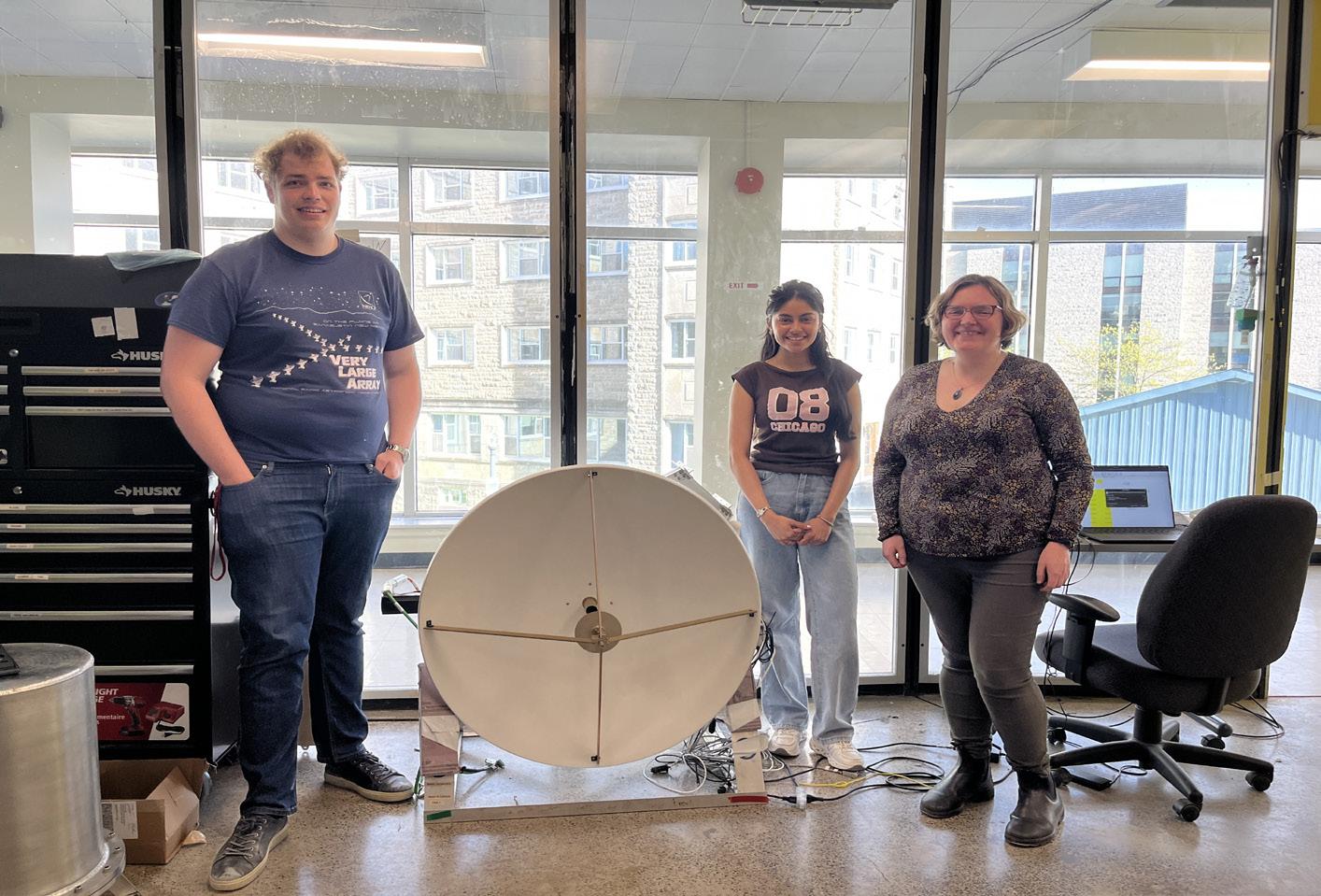
The BVEX looks like a satellite dish mounted onto an aluminum balloon gondola, carried by an ultra-thin plastic balloon filled with helium. The gondola and balloon were both provided by the CSA, which mounted the payload and inflated the balloon.
hours. The gondola carried several research payloads for student projects, of which BVEX was the largest.
by a factor of four as well as developing more sophisticated telescope controls.
“These balloon launches are really dramatic once they finally inflate the balloon and then let it go, and it’s really, really exciting,” Fissel said.
However, the experiment was cut short by an unexpected helium leak.
“It’s like a sandwich bag, right? It’s really thin, so even the act of inspecting for a leak can cause one,” Thiel explained. “It’s all wrapped up in cloth. When they bring it out, they unwrap it while they’re inflating it to prevent that from happening. So if there’s a defect, there’s no way to know.”
The balloon was intended to fly overnight at an altitude of 32 kilometres but was only able to reach 16.5 kilometres, and the gondola was released after three
High-speed rail could finally be coming to Canada — but Queen's students could be left behind
One of Canada’s busiest rail hubs wasn’t invited
Murray Halpin Business, Science, & Technology Editor
Canada is about to spend $90 billion on its first high-speed rail network and yet, Kingston hasn’t received an invitation.
Alto, the federal crown corporation behind the project, has promised a 1,000 km electric railway connecting Toronto to Quebec City, with stops in Peterborough, Ottawa, Montreal, Laval, TroisRivières, and Quebec City. Trains would reach speeds of 300km/h compared to Via Rail’s current average of around 110km/h. But to many people's concern, Kingston, one of the country’s busiest Via Rail hubs, didn’t make the cut.
For nearly 29,000 Queen’s students and over 170,000 Kingstonians who depend on Via Rail as the primary way in and out of a city with no commercial airport, the stakes are high to get Kingston included before plans are finalized and development proceeds.
Kingston and the Islands MP, Mark Gerresten, has been pressing Alto officials and the federal Minister of Transport directly on
the exclusion.
In a statement provided to The Journal, he was direct about what bypassing Kingston might mean for a city already short on options.
“Kingston already faces transportation gaps: no commercial air service, limited VIA reliability, and heavy dependence on the 401,” Gerresten stated. “Bypassing Kingston risks making that worse.”
Gerresten mentioned that Kingston’s inclusion is necessary to give students, commuters, and businesses faster and more reliable access to Toronto, Ottawa, and Montreal, while also driving growth and connectivity across the region.
“This isn’t about Kingston versus other communities,” he said. “It’s about designing a corridor that maximizes public benefit. Ultimately, this project should improve accessibility, support regional development, and deliver long-term value — not just reduce travel times between two endpoints."
City Councilor Conny Glenn, who represents the Sydenham district, made a similar argument.
“Bypassing Kingston with high speed just doesn’t make any sense, given how busy we are,” she said in an interview with The Journal Glenn argued Kingston must not be left out because of the value Kingston provides to the project, rather than the value the project provides to Kingston.
“The biggest product out of Kingston is people,” she said. “With all the educational institutions and research and innovation in healthcare, we are peoplebased. Even our military base is about communications and electronics, it's a highly educated workforce. We must be able to get people in and out.”
Glenn, who sits on the board for the Federation of Canadian Municipalities, was able to successfully move a motion through, calling on the federal government to do a review of the current structure and adopt what she described as a “passengerfirst approach” to rail. Similar to Gerretsen, Glenn doesn’t mind the idea of adding on extra time to the route if it means passengers are being served.
For Queen’s Students specifically, Glenn mentioned that she is consistently hearing complaints regarding the frustration of getting in and out of Kingston regularly as a student. “If we want to support our post-secondary and educational institutions, the reality is that we have to have a good rail service to get students in and out,” Glenn explained.
She stressed how without a more effective rail stop, more students will drive, leading to more emissions and ultimately a larger strain on the city’s already limited parking spaces. “From an environmental impact, having cars drive
“We found out the next day that the telescope landed in a small lake just north of Sudbury,” Fissel said. The CSA sent a team to recover the telescope and drove it back to Timmins that same day.
Because the experiment’s most expensive components were housed in an airtight pressure vessel, a “surprising amount still works,” Fissel added.
This includes the crystal oscillator clock specifically made for low earth orbit applications, worth $30,000. It provides the timing reference for the entire experiment.
The group received the grant in 2026 to upgrade the telescope and fly it next summer during the CSA’s launch campaign in Brazil.
The main upgrades include cooling the low-noise amplifier to improve the sensitivity
in and out of the city just doesn’t make sense. That sort of flies in the face of our environmental and sustainability goals that we have created for the city,” Glenn said.
Wanting Kingston included and figuring out how trains get there are two different problems.
Alto has proposed two potential paths through eastern Ontario. The northern route, which connects with Peterborough and travels through the rugged Canadian shield until Ottawa bypasses Kingston almost entirely. A southern option would curve through rural South Frontenac, bringing the rail closer to Kingston geographically, but cutting through acres of farmland, which could have devastating effects on farmland and properties.
Gerretsen told The Journal that he has been advocating for a solution that acknowledges both sides of the arguments. “We need a solution that balances national infrastructure goals with the realities on the ground, minimizing impacts on rural communities while ensuring Eastern Ontario benefits fairly,” he said.
After a 100 day public consultation period that concluded on April 24, residents in the region had the chance to voice their concerns around routing, land use, and the environmental impact which will be reflected in the public consultation report released this summer.
Both advocates drew a clear line between what Kingston needs now, and what Alto might eventually deliver.
In Glenn’s experience talking to the public, residents aren’t dying
“When I’m not thinking about building stuff, other work I do is to figure out if we do this for real, down the road you would want to […] have this be an outrigger station for the Event Horizon Telescope that’s floating around,” Thiel said.
The Event Horizon Telescope is a network of ground-based radio telescopes around the world that capture emissions from the same source which are combined by a correlator to create an Earth-sized telescope.
Want to contribute to the Business, Science, & Technology section? E-mail journal_bste@ams.queensu.ca
to have a flagship new service. “What passengers really want is reliable, on time, frequent service,” she claimed. “They don’t care if that’s Alto or Via”.
As well, Glenn pointed out the enormous scale of the $6090 billion Alto Budget. “With the amount of money they’re putting into Alto, if they would take even a small portion of that and put it into Via, we would have a strong reliable service here,” Glenn said. “The Alto build wouldn’t be operational until at least 2040, where Via Rail improvements could happen now.”
Her confidence in Kingston’s long-term growth is based on the city's expanding role as a federal military hub. Over 900 new housing units for Canadian armed forces members are already underway, as a result of a $1.4 billion investment in Canadian Forces Base (CFB) Kingston and bases nationwide by the federal government. Glenn mentioned that this kind of investment only holds up if people can actually travel in and out of the city.
“If the federal government wants that strategy to work here, it has to make sure that happens,” she said.
Whether that ultimately means an Alto stop or a stronger Via Rail service is still open to question, but the warning from Glenn and Gerresten was clear. If Kingston is bypassed, it could lead to generations suffering the economic impact of high speed rail skipping the city.
Students and Professor pictured with antenna. PHOTO BY UROOSA IMTIAZ
SPORTS
Local track phenom Wyatt Lee commits to Division I school
Fastest high school sprinter in Canada commits to North Carolina State University
Jacksen MacLean
Assistant Sports Editor
Wyatt Lee’s rise in the track and field world has been meteoric.
The senior from Frontenac Secondary School in Kingston started running competitively in the spring of 2024, only to medal in both the 100-metre and 200-metre at the 2024 Ontario Federation of School Athletic Associations (OFSAA) track championships a couple months later. He then earned more notice when he set a Canadian U18 60-metre record at indoor nationals, running it in 6.71 and taking home the title less than a year later.
Lee then garnered international attention a month after that when he broke the U18 Canadian 100-metre record three times, his best being 10.34. He also won the 2025 OFSAA 100metre and 200-metre events for good measure.
In an interview with The Journal, Lee talked about his late start in track and field. “In grade nine I did rugby. Wasn’t really my thing — wasn’t good at it, just was kind of fast,” Lee said. “In grade ten I started track because of my friend, and that’s really it. I wasn’t really an athletic type of person until I started to run.”
Lee expressed that he was “shocked” when he found out he first broke the Canadian U18 100-metre record. “Honestly, like, I wasn’t ever expecting to break it. I just didn’t know what to do besides be excited” he stated.
Lee attributes much of his success to his parents, who he says are his biggest supporters. He also gives credit to both his teachers and coaches at Frontenac, who have been supportive of him throughout his running career.
Besides his raw talent, Frontenac track and field Coach
Geoff Stephen has contributed much of the sprinter’s success to his competitive work ethic. “He wants to continuously improve. He’s not satisfied just resting on the previous successes. He wants to keep getting better each race, each week […]. I think that’s really helped him be successful,” Stephen said in an interview with The Journal
Despite his personal success, Stephen has also been impressed with Lee’s teamwork and selflessness while being on the school’s track and field team. “One of the things we’ve been happy to see and encourage is him working with the younger sprinters, just being willing to share that expertise. It’s one thing to be individually successful, but to have that sort of willingness to give back and help others is really nice to see.”
Lee’s accomplishments led to several Division I offers from National Collegiate Athletic Association colleges in the United States. After careful consideration, he decided to commit to North Carolina (NC) State University earlier in the month. He plans to study international business at the university in the fall.
“I just decided to let God do the talking, and he led me to NC State. I just like the coaches there, and there’s the best opportunity and best offer for me and my family,” the future commit said on his decision.
With all the attention he’s amassed over the last couple years, Lee has put an emphasis on ignoring the outside and focusing instead on his own journey and career path.
“I just try to mind my own business and be my own person,” he said. “Just believe in whatever I’m doing [and] keep getting better for the future ahead of me.”
Before he heads to North Carolina, Lee will look to defend his 100-metre and 200-metre titles at this year’s OFFSA and field championships. The event will be held in St. Catherines from June 4 to June 6.
“As long as he keeps that continuous improvement going, I think it’s definitely within his reach,” Stephen said on Lee’s chances of winning.
Men’s Hockey head coach retires after 20 years behind the bench
It was time for a new voice and to “be a dad,” Coach says
Noah Cyr Senior Sports Editor
The Memorial Centre home bench will have a new face at the helm.
Brett Gibson, the long-time head coach of the Men’s hockey team, announced through Queens Athletics and Recreation that he is retiring after 20 years behind the bench. He leaves the program as the winningest head coach in Queens Men’s hockey history with 281 regular season wins.
In an interview with The Journal , Gibson talked about the decision to step away from a mainstay in his life for two decades.
“It was a very hard decision, and I still have mixed feelings about it. But, at the end of the day, I just felt it was time.” He added that he’s invested so much time in the program but is excited to now “invest that time in my kids.”
Gibson started his illustrious coaching career at Queens in 2005 as an assistant coach, before taking over the following year. Gibson admitted. “when you’re 25-yearsold, you think you can change things quickly, I was humbled really quickly.”
Despite hardships in the beginning, Gibson’s vision of being a powerhouse eventually came to fruition, earning 17 playoff berths out of 20. This included
unsure whether professional football was realistic, but a strong showing at the East-West Bowl gave him momentum heading into his final year with the Gaels.
In an interview with The Journal, Kpehe talked about the momentum he carried through the CFL regional and national combines, where he focused on treating each stage as another chance to compete.
“I did everything I knew I could do, and I was really happy with my performance at the combine,” Kpehe said. After advancing from the regional combine, he earned the opportunity to perform in front of CFL coaches, general managers, and scouts at the national level.

12 straight playoff experiences, that ultimately led to a Queens Cup victory in 2018-19.
When success came for the Gaels, the opportunity came to represent Canada behind the bench in numerous events. “I’m forever grateful that Queens allowed me to coach at the FISU games [an international university sports event] and represent Queens.” He continued to say that “Hockey Canada noticed, and I think our program became better for it.”
Gibson’s drive and passion heavily influenced his coaching style, which he even admits can be demanding at times.
“I’ve always cared about my players,” Gibson said. “I wanted to have close relationships with the players.” These relationships are evident by the 33 weddings he has attended of former members of the Men’s hockey program.
While there are thousands of moments and memories that can be recalled over the years, Gibson highlighted four that stick out.
“Number one: winning the Queens Cup in front of 3,300
people at the Memorial Centre and having my kids on the ice with me, it was phenomenal,” Gibson exclaimed.
The second memory he recalled are the overtime winners of the Carr-Harris Cup which he candidly said “blew [his] mind away.” Three of the last seven games have gone to overtime, all going the Gaels way, including Derek Hamilton’s, ArtSci ’27, overtime winner this past February.
The third memory, which he paused before proudly voicing, was that the program never had a player fail out and not graduate from Queen’s in the 20 years he coached.
The last memory for him took place this last season and including going to the National Championship in Halifax, where Gibson played four years at St. Mary’s University. “For these players to bring me back to where it all started for me, that’s fate.”
Gibson will not be leaving the rink or the bench just yet, as he moves onto coaching his son’s minor hockey team.

and the celebration after Queen’s sealed the victory as moments that captured the closeness of the group.
‘I’m a Gael for life,’ former Queen’s football says
Malek Benameur Assistant Sports Editor
Three former Queen’s Football players are taking the next step in their careers after being selected in the 2026 CFL Draft.
Offensive lineman Niklas
Henning, ArtSci ’25, was selected second overall by the Toronto Argonauts, linebacker Justin Pace, ArtSci ’25, was taken 35th overall by the Edmonton Elks, and defensive end Steven Kpehe, Kin ’25, was picked 62nd overall by the Calgary Stampeders. The three selections followed a championship season for Queen’s, who captured its first Yates Cup since 2009.
For Kpehe, the draft marked the end of a year that shifted quickly. He entered the season
Before the draft, Kpehe helped Queen’s defeat Laurier in the Yates Cup, a game the Gaels entered with confidence despite being considered underdogs. Queen’s had lost to Laurier earlier in the season, but Kpehe said the team never doubted its ability to win the rematch.
“We didn’t care about the records. We didn’t care about any of that,” Kpehe said. “We were like, man, we’re gonna go and we’re gonna beat them. This is what Queen’s does.”
Kpehe described the championship win as one of the most memorable moments of his football career. He pointed to the defence’s strong first half, the team’s late-game resilience,
Draft night brought a different kind of pressure. Kpehe watched from 225 Johnson St., surrounded by family, friends, and former teammates. After the broadcast cut out and draft websites lagged, the room was left unsure of where the draft stood.
Then his phone rang. Calgary Stampeders defensive line coach John Bowman told him the team was about to select him. “I don’t even think I was speaking English in that moment,” Kpehe said. “Greatest phone call of my life.”
Since arriving in Calgary, Kpehe said the pace of professional football has moved quickly. Within days, he was learning the playbook, adjusting to rookie camp, and competing against players with NCAA and NFL experience.Still, Kpehe said
he is trying to stay grounded by reminding himself that the game is still football.
At the same time, the move to the CFL keeps him connected to former Gaels. Pace is now with Edmonton, while Henning’s second-overall selection added another standout story to Queen’s draft class. Kpehe, who lived with Henning and trained with him during the offseason, said his former teammate’s rise from walk-on to top CFL pick reflected his work ethic and athleticism.
“I called it in the third year that this guy is going to the NFL.”
For Kpehe, being drafted is also tied to what Queen’s Football meant to him. After winning a Yates Cup and becoming part of the program’s history, he said his connection to the Gaels will continue beyond graduation.
“Queens football has much pride and history, and being a part of it is a feeling like no other.”
Steven Kpehe, Niklas Henning, and Justin Pace.
PHOTO BY CLAIRE BAK
PHOTO SUPPLIED BY JAMES PADDLE GRANT

As the planets shift, so does your summer horoscope
What’s in the stars for your astrological sign as the summer picks up
THE PSYCHIC SCHOLAR

Capricorn (Dec. 22 – Jan. 19)


Aries (March 21 – April 19)
To Aries, the worker bee. You always have a goal or plan lined up, because you have a strong head on your shoulders and you’re going to thrive at your summer, job, internship, or what have you. But remember, that summer is for relaxing too. You are capable and rational, but you are also fun! Allow more spontaneity in your life this summer and don’t feel guilty about it. The world won’t fall apart if you take a break. Rent that kayak, win that Euchre tournament, some of the best parts of your summer won’t be planned at all.
It’s okay Capricorn! You need to learn how to make the best out of a bad situation. The intern on the floor below you is ready for a coffee date, all you need to do is ask. Shake that funk off and stop being such a debby downer all the time. Stop thinking about that time you almost hit a squirrel with your car and start thinking about all the good things coming your way!

Scorpio (Oct. 23 – Nov. 21) N Scorpio!
This summer is YOUR summer. Everyone hopes to have a #hotgirlsummer, but for you, it’s guaranteed. Spend the summer outside— both tanning on the beach and dancing at the club. You’re a sociable, lively person, who will attract many people this summer who won’t just notice you, but they’ll remember you. Romance, attention, and late-night adventures are all headed your way, Scorpio, so don’t be afraid to lean into the spotlight.


Pisces (Feb. 19 – March 20)
Let yourself drift to new opportunities as you reel in the little things in life. This summer, the tides are turning as you step out of your comfort zone. Start your adventures small with Ice Capps by the shore to work your way up to diving headfirst into cold lakes. After all, you’re the water sign, let’s get out there!
Libra (Sept. 23 – Oct. 22)
As you filter out negative energy, watch out for deception by those closest to you. Always keep an eye out for Selener. But don’t worry, The Journal will manifest positive vibes for you. Keep your friends close, but your enemies closer. It will make for an authentic caption for your summer photo dump.


Taurus (April 20 - May 20)
Taurus! You’re always the reliable and trustworthy companion of so many people so this is your time to have a messy girl summer! Get that tattoo you’ve been wanting or dye your hair on a whim. You only live once so this is your sign to start doing the things you’ve always secretly dreamed of. Remember that every messy situation now makes for a great story later! This is one summer for the books.
Virgo (Aug. 23 – Sept. 22)
Dear Virgo, time to let go of the seasonal depression and negativity that’s been clinging to you since syllabus week. Yes, being all doom and gloom makes sense when you’re being whipped by freezing rain on your walk to that 8:30 Econ lecture off four hours of sleep. But this summer, let the light in. You deserve a summer that feels warm inside and out. The sun is here now. The patios and beer gardens are opening.
Leo (July 23 – Aug. 22)

U Remember that grad trip to Southeast Asia you wanted to go on with your housemates? Yeah…Leo, time to lock in. You’ve earned it. No more worrying about that wallet. This summer will be one of wealth and abundance in every sense of the word. You’re up this summer— every side gig, every late night, all your hard work will literally pay off. Money is flowing, confidence is high, and checking that bank account won’t feel like psychological warfare.


Sagittarius (Nov. 22 – Dec. 21)
Let’s be honest, you’re too chronically online. For once, put down the Instagram reels and look up to see the beautiful world around you. Sacrifice scary screentimes for sunny days. Feel the wind flowing and songbirds singing as you finally pick up that book you’ve been meaning to read for five years. Life is worth living when you let yourself experience everything it offers you — even if that means deleting TikTok.

Gemini (May 21 – June 20)
Hey Gemini! This is the summer to get things together! You’re used to being the type B friend and now it’s time to lock in! Clean your room babe. The warm weather is begging you to come out of your hibernation and get a fresh start. So pick up the rogue socks off your floor and bring those mugs down to your kitchen sink. It’s time to buy a planner!

Cancer (June 21 – July 22)
Listen up, Cancer, you thought daughters are about to have a summer of romantic solitude and self-discovery. It’s okay not to run from point A to point B all the time. This summer, take your time. Smell the roses, visit the overpriced cafes, take corny photos of the sunrise. While this may not sound super exciting, you’re sure to have some sort of profound breakthrough, learning to love the magic of slow mornings and the art of being alone. Your summer will be quieter than others, but by no means, less

Aquarius (Jan. 20 – Feb. 18)
Get out there this summer! This is your sign to commit to what you’ve been afraid of. Dive headfirst into new experiences and enjoy every moment of the warm weather! Go for a blind date, pick up a new hobby, or text an old friend you’ve fallen out of touch with. You got this Aquarius!

‘Forthcoming’exhibitionproves
there’safutureinvisualarts
‘Crea ve Futures’ is a year-long program that empowers the futures of young ar sts
C N Senior Arts & Culture Editor
TheTettGallery'slatestexhibition, Forthcoming,affirmsthere arecreativefuturesforyoung artistsaspiringtoventureinto thearts.
Theexhibitiondeveloped throughtheprogram,Creative Futures:EmpoweringTeen Artists!whichencompasses allbranchesofcreativityand allowtheteens'toshapethe programitselfthroughtheir individualintereststoshapethe programitself.
Theinitiativeisfacilitated throughacollaborativeeffort betweenseveralartcentersin KingstonoverseenbyJung-Ah Kim,theprogramcoordinatorof
theTettCentre,MaddiAndrews, ArtSci’19,theexecutivedirector ofCultivateArtsCommons,and CharlotteGagnier,TheJournal Volume141’sphotoeditor,ArtSci ’16,thepublicprogramsand educationcuratorattheAgnes EtheringtonArtCentre.
TheCreativeFuturesprogramseekstoalleviatethe lackofaccesstoartsprograms forteenagersbydevelopinga year-longjourneythatoffers opportunitiesforyoungartists.
"Manyfolkswhoaren'tinthose artsstreamsdonotgettheprofessionaldevelopmentside[...] whichisalotofwhatyouneed togetyourfootinthedoorfor yourfirstprofessionalexperience outsideofschool,"Gagniersaid inaninterviewwith The Journal Andrewsaddedthat“sellingyourself”isavitalskillforaspiring artistshopingtoprogressinthe artsworlds.
FromSeptembertoMay, membersoftheprogramlearn fromartistsofallbackgrounds tounderstandhowtheircreativeprocessesinteractwiththe world'schallenges.Whileartificialintelligenceandeconomic
difficultiesriskjeopardizingviablecareersinthearts,Creative Futures’organizersargueit’s crucialforteenagerstorealize theartsremainanoption.
"Amidstalloftheuncertainty intheworldthatwe'reseeing, artistsaregoingtobecome ever moreimportantmovingforward[...]Climatecollapse,economicuncertainty,genocide,it isourcreativesthathelpcommunicatethesemessagesand findhopeandmeaning,”Andrews saidinaninterviewwith The Journal
“We'redoingourbesttopreparesomeoftheseyoungartists forthosefutureroleswherethey willbeplayingsuchanimportantpartinhowoursociety understandswhat'shappening aroundus."
Theimportanceoftheprogramdidn’tgounnoticedforthe studentsinvolved.
"[Theprogramis]agreatway todevelopmyskillswhilefindingacommunityandalsohaving experienceslikethisexhibition. Thiswouldbemythirdexhibition,andmyfirstexhibitionof beadwork,andIfeellikethat'san
exceptionalandbeautifulexperienceforme,"HugoLussier-Meek, aGrade8studentandyoungartist,saidinaninterviewwith The Journal Lussier-MeekisaMichif Beadworkerwhoseartreflects hisidentityasamemberofthe OntarianMétisDiaspora.The exhibitdisplaysseveralartpieces ofhis,includingabeadedscientificdioramaoftheGreatOrion Nebula,amedallioncomposedof overseventhousandbeads,and aninter-mediumpieceinspired byIndigenousfolksingerWilliam Prince.
Duringtheinstallationprocess,theTettGallery'semptycanvastransformedintoavibrantly colourfulspace.Eachstudent exploredadifferentmediumand emotion,whiletakingthetimeto explaintoTheJournalwhatthe programmeansforthem.
Aspartoftheinstallation process,everyartisttookturns peelingbackalargevinylsticker toreveallettersonthewallthat speltoutthenameoftheexhibition.Theprogram'syoungartists, suchasLussier-Meek,choseto titletheexhibition: Forthcoming
"Wewantedtomake[the exhibition’stitle]inawaythat representseverybodyand doesn'tleaveanyoneout,"Bella Wallace-Wood,aGrade12studentandyoungartistinvolved inCreativeFutures,saidinan interviewwithTheJournal TheexhibitshowcasesWallaceWood'spaintedpaper-mâché
Amidseasonreviewof‘Euphoria’
livesofthesecharactersas theyinevitablygotolder. However,theviolence,drugs, andgratuitousnudityfeelless “exciting”andjustuncomfortable.
Inahighschoolsetting, theextremeandalmost cartoonishactionsofthese charactersfeltrealistic.They depicteddepravedGen-Z kidspartyinganddoing drugs,representing theunfilteredAmericanhigh schoolexperiencethatmany peoplecouldrelatetoandgravitatetowards.
cardboardsculpture,"Woodpine," inspiredbythegianttigerlilies thatgrowathergrandparents' home.
Oneoftheexhibition'score themesisnostalgia.Grade9studentLuciaCamposexperimented withfantasythroughthecoloured pencilpiece,"DreamRealm." "Thisoneiscapturingchildlike wonderandthesortofworld weallhadinourheadswhenwe werekids,"LuciatoldTheJournal Anothersimilartheme ismemory.Grade12studentAleeshaNavidpainted, "AmbreenandPaula,"featuringsunflowersandskihillsin memoryofhersister'sfriend. "Eventhoughitendedsoabruptly, alloftheirmemoriesarestill worthsomething,anditwasto makeherfeellikeshewasstill there,"Navidsaid.
Althoughartisticprospects remainuncertain,thedirectors believeyoungartistsholdthe powertodefythesechallenges throughcreation.Byoffering opportunitiessuchasCreative Futures,theyhopetonourishthe developmentofemergingartists toensurepossibilitiesinthearts remainforthcoming.
Applicationsforthe2026-27 cohortareopenforteenslooking todeveloptheirartisticvoices, learnhowtopresenttheirwork, andcurateafinalexhibitionin thespring.
fromviewerslike,“Doesn’tthis looklikeabadsituationtobein?”
Themanyplotthreadslack substancebecauseofthejarring separationbetween everyone’sstorylines. Whilethefirsttwoseasons featuredseparatenarrative arcs,thecharacters’stories werestillinterconnectedand convergedatmanypoints throughouttheseasons.
S S Assistant Arts & Culture Editor
Afteranearlyfour-yearhiatus, thethirdseasonofEuphoria returnstomanymixedreviews concerningthestoryqualityas itsepisodesrelease. Euphoria(2019),createdby SamLevinson,followsagroup ofhighschoolstudentsasthey engageinviolence,sex,drugs,and alittonyofothervices. Euphoria
appearedtoconnectwithanew generationofyoungadults whoresonatedwiththe extremeactivitiesofthese fictionalcharacters.
InJanuaryof2022, Euphoriaentereditssecond season.WhileGen-Zculture developedinresponsetothepandemic,itseemedlikeanewtitan oftelevisionwasabouttoenter itsstride.
Issuesbeganafterthe secondseasonfinishedairing,sparkedbythetragic deathofcastmember AngusCloud,inJulyof 2023.Cloud’scharacterwas supposedtohavealargerrole inthethirdseason.Along withCloud’sdeath,fellowcast memberEricDane’shealth declinedfromALSduringthe filmingofthethirdseason,and
hepassedawayinFebruaryof 2026,twomonthsbeforeseason three’spremiere. Theseeventsaffectedmany membersofthecastandcaused somecriticstowonderifthe futureoftheshowwassafe. CoincidingwithCloud’sdeath andDane’sdeclineinhealth wastheexplosionofthecast’s fameandnotoriety;specifically,Zendaya,JacobElordi,and SydneySweeney.
Sincethethirdseason tooklongertorelease,it lookedasthoughwewould receiveaverydifferent Euphoria fromtheonelastseen.
Thechangeinsettingand timefromsecondtothird seasonwasveryjarringat first.Withsuchatimegap, itmayhavebeennecessary tofindnewstoriesinthe
However,inseasonthree,this “unfilteredexperience”isjustsad anduncomfortabletowatch. Watchingteenagersscrewingupandcreatingproblems forthemselves,whilepainful,stillpresentsthethemeof hope.Ahopethatafter highschool,theymight developintofunctioningmembersofsociety.
Seasonthreeflipsthisidea onitsheadbypresentingus withthe20-year-oldversions ofthesecharacters,allgrown upafterhighschool,andyet dumbasever.Theseason touchesoninterestingideassuch asthemanipulationofOnlyFans models,butalsothefreedom thattheplatformprovidesfor creatorswhohopetocontrol theircontent.Theotherstorylines followtheintricatepolitics betweendrugtycoons,theconsequencesofshadybusinessdeals, andeventheprocessofbreakingintotheindustryasayoung artist.Whilethesecouldallwork asframingdevicesforarcson Euphoria,theyserveseemingly nootherpurposeinseasonthree otherthantopromptcomments
Thethirdepisodeofthis seasondidbringmostofthe originalcastbacktogether, itfeltstaleandunnecessarywiththeinteractionsbetweentheactors beingveryscarce. Aneventasmonumentalasthe weddingbetweenNate(Jacob Elordi)andCassie(Sydney Sweeney)feltlikeitwas buildinguptosomethingmore withitsentiremaincastpresent forit.
Butallthatcameoutof itwasdisappointment,a greatexampleofthechange indynamicfromseasonstwotothree.With theentirecasttogetherforonly oneepisodesofar,theshownow feelslikeananthology.Likea beautifullyshotseries coveringthelivesandmistakes ofagroupofpeoplewhoare separateandengagedinstories removedfromeveryoneelse. Aturnaroundinquality seemsunlikelywithtwoepisodesleftbeforethefinale. Euphoriaislikelytobe anothershowthatfellflatinan attempttowrapeverythingup inabow.
Sam Levinson’s hit drama series returns with a mediocre recep on
The third season premiered on HBO on April 12.
GRAPHICBYANGELINALIU
Queen’s earns shoutout on Drake’s new album
E S Managing Editor
Drakesinglehandedlylifted Queen’sstudents’spirits.
Canadianicon,Drake,shouted out“Queen’sUniversity”onone ofhisrecentalbums, Habibti,in thesong,“SlapTheCity”featuringQendresa,withtheline,“you wenttoQueen’sUniversity/now youagraduate/shoutoutyour familythem.”TheQueen’scameo hascausedquiteastir,withmany Queen’sstudentsexpressing excitement.
“Wejustwentupintherankingsafterthat,”aReddituser
wroteabouttheline.Aswell, Queen’sRectorNikiBoytchukHaleandQueen’smicro-influencerAlexaPaebothfeatured thesongontheirsocialmedias, withPaewriting:“IfDrake’snew songisn’tasignforyoutochoose Queen’sUniversity,Idon’tknow whatis.”
Ifyouhappenedtomissthis semi-breakingQueen’snews,not tofear.AttheendofJune,classof ’26studentsaresuretobefloodingtheirInstagrampostswith convocationphotos,coveredwith thisparticularline.
Onarealnote,ifyoudid missthisguestappearance,it wouldn’tbeashockgiventhe sheeramountofmusicthatour honoraryGaelreleasedonMay 15.AfterDrizzy’smasterclass inalbumpromotion,leaving stacksoficeblocksinToronto’s
BondHotel’sparkinglotwiththe releasedayhiddeninside,Drake fanspatientlyawaitedthedropof Iceman,analbumhe’sbeenteasingforoverayear.
Turnsout, Iceman wasn’tthe onlysurprise.Drakeendedup releasingthreealbumsthatnight: Iceman,thelong-awaitedrap albumthatincludesaFuturefeature,Habibti,aslower,moreR&B album,andMaidofHonour,his mostexperimentalofthethree,
ashedabbleswithhousemusic. Somehavespeculatedthat thereasonforthemassrelease isastrategytogetoutofhisdeal withUniversalMusicGroup,who Drakesuedlastyearfordefamation,allegingthelabelpromoted KendrickLamar’sdisstrack,“Not LikeUs.”Therumoursmaybe trueasDrakehimselfalludesto thisrealityon Iceman withbars like,“swearmylabelgottafree me,baby,”from“JaniceSTFU”and
“I’mbetteroffindependent”on “MakeThemPay.”
Thenighthisalbumsdropped, May14-15,theCNTowerwaslit upinicybluetocelebratethe releaseofIcemanandasatributetotheartistwho’smade“the 6”hisown. Whateverthereasonforthe massdrop,somefeelthethree albumsareaquantityoverquality choice.Turnsoutbeingshouted outinalyricon Habibti maynot betheflexwethoughtitwas,as somehavetakentoInstagramto pokefunatsomeofDrake’slyrics forbeingcringeandshallow.
Anexampleofthisquestionablelyricismison Habibti’s“Fortworth”featuring PARTYNEXTDOOR,whereDrake whines,“theACisbroken/my hotelishotashell/runnin’out ofsodas/mightwalktoCircleK alone.”
Continued online at www.queensjournal.ca
A resurgence of Canadian cinema
Director Craig Walker reprises his adapta on of James Joyce’s novel
M R Assistant Arts & Culture Editor
FinnegansWake:ADreamPlay re-openedatKingston’sGrand TheatreonMay21inhonour ofthe25thanniversaryofthe originalproduction.Written anddirectedbyQueen’sDrama ProfessorCraigWalker,the playadaptsJamesJoyce’s notoriouslychallengingnovelof thesamename.
Why con nued investment in Canada’s arts and culture sectors sustains emerging ar sts
C N
Senior Arts & Culture Editor
Canadiancinemaisinitscomebackera. Thenominatedfilmsfor thisyear’sCanadianScreen Awardsprovetheimportance ofinvestinginCanadiancinema. BlueHeron(2025)isbreakingheartsacrosstheglobe, Deuxfemmesenor(2025)is invitingsexbackintocomedy, andEndlessCookie(2025)is provingtherearenolimitstoanimation.Butthekeytosustaining thismovementisaccessto federalandprovincialfunding. Throughoutfilmhistory, theCanadiangovernment hasplayedapivotalrolein suportingCanadiancinema. Continuedinvestmentin Canada’sartsandculturesectorgeneratesbillionsofdollars foroureconomywhileempoweringartiststostayhereandcreate.However,austeritymeasures
raiseconcernsoverpotentialarts fundingcuts,riskinghistorical repeats.
Inthe1970s,thegovernmentallowedproducersto100 percentwrite-offtheirinvestmentsinCanadiantax-shelter films,whichkickedoffDavid Cronenberg’scareerwiththe bodyhorror,Shivers(1975). Afterchangestothetaxcode, theboomofCanadianfilmproductionfizzledoutuntiladecade later.
ThroughthedefunctOntario FilmDevelopmentCorporation, theTorontoNewWavesaw thecreationofAtomEgoyan’s Exotica(1997),JohnGreyson’s Lilies (1996),andKingston-born PatriciaRozema’s I’ve Heard the MermaidsSinging(1987).But thiscorporationcrumbledunder aftercutsunderMikeHarris’ conservativeleadership.
Withthesamepowertofinanciallysustainthesefilmmovements,thegovernmentcanalso ruinthem---somethingCanada’s learntthehardway.It’sbeen morethanthreedecadessince theriseandfalloftheToronto NewWave.Ifnewfilmmakers facesimilarbudgetconstraints, theresurgenceofCanadian cinemacouldmeetthesame abruptend.
But,theCanadianScreen Awardnomineesprovethefinale
ofCanadiancinemaisnowhere insight.
Blue Heron (2025)
NominatedforBestMotion Picture,OriginalScreenplay,and AchievementinDirection,Sophy Romvari’sfirstfeaturefilm, Blue Heron,openedattheScreening RoomonMay15.Thissemiautobiographicaldramafollows aHungarianfamilyadjustingto theirnewhomeonVancouver Island.Astheyoungestdaughter,Sasha,remembersherolder brother’smentalhealthchallenges,shemustreckonwiththe systemfailingherfamily.
Inaninterviewwiththe HollywoodReporter,Romvari remarked,“WhenIstartedmakingworkinCanada,Iwasnot awareoftheprivilegeofliving inacountrythathasaccessto artsfunding.Theversionofthis filmthatIwould’vemadewithin theAmericansystemwouldbe very,verydifferent—andIdon’t knowifthatonewould’vegotten distribution.”
Romvarireceivedfunding frombothTelefilmCanadaand theNationalFilmInstituteof Hungary.
Continued online at www.queensjournal.ca
Assoonasthedoorstothe theatreareopened,audience memberswereimmersedin theplay.Theroomwasentirely transformed,takingonthelook ofanIrishtavern.SeanRoberts, whoplaysH.C.E.,wasalreadyin character,sleepinginabedplaced abovethebar.
Manyaudiencemembers seemedtobefamiliarwiththe play,itsdirectors,anditsactors. Beforethelightsdimmed,many discussedhavingseentheoriginal productionorhavingtriedtoread thesourcematerialinthepast.
Joyce’soriginalnovelisknown foritsuseofmultiplelanguages anddialects,andmanyreaders, includingWalker,haveconsidered itachallenge.Walkerexplained thatthebookonlystartedtomake senseonceitwasreadoutloud, whichinspiredhimtotakeonthe adaptation.
“Thisworksbetterasspoken, orheard,literature,thensilently readliterature,”Walkersaidinan interviewwith The Journal
Thoughtheperplexingnature ofJoyce’slanguagewasnot removedentirely,theplayproved tobemoredigestibleinadifferentway.Walker’sproductionput audiencemembersinthesame situationasH.C.E.,(whospends theentireshowinadream), strugglingtofollowalongand constantlybeingturnedaround.
“Thebookcanbevery,very entertaining,thoughitdoesn’t alwaysgiveupthatpleasure
immediatelytoeverybodywho readsit.Buttheproduction isentertainingimmediately.” Walkersaid.Thejumbledphrasing,Irishaccents,andthespeed theactorsspeakat,oftenmeant thatsomeaudiencemembers missedafewjokes.However, SiobhánMcMahongaveastandoutvisuallycomedicperformance, usingherfacialexpressionsand physicalitytomaketheentire crowdlaugh.
“ThebestpleasureofreadingFinnegansWakecomesfrom thisoddstateinwhichyouclearly understandsomethings,andyou don’tfullyunderstandothers, butyoucantakepleasureinthem anyways,”Walkerstated.
WalkerconfessedtoThe Journalthatthiswaslikelythe mostchallengingtextthatanyof themhadencountered.However, despiteafewslipupsovertongue twisters,theactorsknewexactly howtosuccessfullystatetheir complicatedlines.
Whileitisn’texactlyamusical,thereareseveralsongs throughouttheplay,which requiredalltheperformers tosing,dance,andsometimes evenplayaninstrument.Walker discussedhavingtoadapthis charactersslightlyinthe2026 adaptationtofittheneedsofhis actors.
ForactorMelissaMorris,he playedonhermusicalability andintroducedanaccordion totheproduction.Morris,who portraysA.L.P.,playedimpressivelywhilesimultaneously dancingandacting.Thesesmall adjustmentshelpedeachactor shine,placinganemphasison
theirstrengths
Drake’s albums released on May 15. GRAPHICBYANGELINALIU
The Canadian Screen Awards will be held on Sunday, May 31.
GRAPHICBYANGELINALIU

two identities at once.
I’m homesick for my old life before university
Learning to navigate moving out and on
Julia ludden
Postscript editor
University is often said to be some of the most enjoyable years of your life, but I can’t seem to let go of my life before.
My university experience so far has led me to feel homesick for my life before change. There are certain types of people whose personality and outlook on life adapts very well to change and uncertainty.
I am not one of those people.
I grew up in the suburbs of Chicago and now, I go to school in Kingston, Ontario. This alone was a big change.
I wanted to pause myself and my relationships from home in perfect condition until I could hit play, over and over, picking up right where I left off. This, of course, is not possible.
I was genuinely mourning the undivided life I used to live.
When anyone from home would visit me at school and vice versa, I was constantly uncomfortable, unable to figure out how these two parts of me could fit together. I felt like I was split in two — half in Canada and half back home in the U.S.
I was never fully happy in one place because I didn’t know which was where I belonged.
Moving out and moving to a city where you don’t know many people can cause anyone distress. Instead of handling this stress and moving on to the next stage of my life, I tried to live in two different places at once. I wasn’t ready to accept that my reality for the past four years of high school was over.
This suspended my emotions in a state of constant despair. Many of my friends and loved ones told me I should transfer and move home, but I thought I owed it to myself to give Queen’s at least two years.
Now, I am an incoming junior and honestly, I don’t know if I would have been happier transferring, but I am okay with where I am nevertheless.
Although, I will admit my mind is eagerly waiting for the day when I settle down and pick a spot to live, I have learned to accept my reality now. Even if I don’t live at home, and some of my relationships from that time have ended, I am still a result of all I have experienced. Moving away led me to find out who I was without holding on to who I used to be. A fresh start was pivotal in gaining perspective on who I am. With every new change that
I am sure will come throughout my life, I grow into a wiser self.
Acceptance is one of the most important, yet, excruciatingly difficult things to force yourself to find.
University will probably never be my favorite era of my life, because regardless of how fun it is. The struggle of being a part of two realities at once creates an unsettled state.
In high school, nothing was that ambiguous. I didn’t have to think in depth about where I’d end up because it felt so far away. This changed once I felt the first taste of growing up. But after growing to accept that university may not be my favourite era of life, I can look through a growth lens and see how much I have changed — for the better.
I will never get back the innocence of my early teenage years because I am not the same person I was then. But this doesn’t have to be negative.
In fact, growing up, leaving versions of you behind, is how you learn tough lessons and discover what reality you want to create for yourself.
As a teenager I thought the world revolved around my relationships at the time and if anything disturbed them, it would end. Now, I know that life will never be stable, because change is an unavoidable part of living. Relationships will come and go, but I will still be myself at the end of the day. Having dealt with overwhelming homesickness showed me that I could get through situations that felt hopeless. Change isn’t my favorite thing, but that doesn’t mean it has to be the end of the world, like I once thought. The idea of home doesn’t have to be so set in stone, instead your home can grow and adapt with you.
Naviagting
ILLUSTRATION BY JULIA LUDDEN