the journal Queen’s University
—
Vol. 153, Issue 25
—
F r i day , m a r c h 1 3 , 2 0 2 6
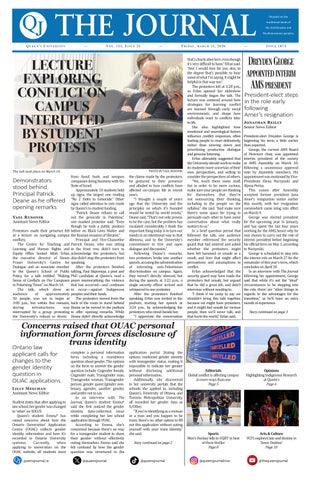
LECTURE EXPLORING CONFLICT ON CAMPUS INTERUPTED BY STUDENT PROTESTS The talk took place on March 10.
from fossil fuels and weapon companies doing business with the State of Israel. Approximately 10 students held up signs, the largest one reading “No 2 Sides to Genocide.” Other signs called attention to cuts made by Queen’s to student funding. “Patrick Deane refuses to call out the genocide in Palestine,” Yael Rusonik one masked protestor said. “Even Assistant News Editor though he took a public position Protestors made their presence felt before on Black Lives Matter and at a lecture on navigating campus the Russian invasion of Ukraine.” Principal and Vice-Chancellor conflicts. The Centre for Teaching and Patrick Deane, who was sitting Learning and Human Rights and in the front row, didn’t turn to Equity Office hosted Aftab Erfan, acknowledge the protestors, but the executive director of Simon also didn’t stop the protesters from Fraser University’s Centre for speaking. After the protestors finished Dialogue and an associate member in the Queen’s School of Public talking, Paul Akpomuje, a poet and Policy, for a talk entitled “Making PhD candidate at Queen’s, read a Sense of Conflicts on Our Campuses poem memorializing the violence that has occurred—and continues in Polarizing Times” on March 10. The talk, which drew an to occur—against Indigenous audience of approximately peoples and their lands. The protestors moved from the 50 people, was set to begin at 3:00 p.m., but within five minutes, back of the room to stand behind during introductions, was Deane as he moved to the podium interrupted by a group protesting to offer opening remarks. While the University’s refusal to divest Deane didn’t directly acknowledge
Demonstrators stood behind Principal Patrick Deane as he offered opening remarks
PHOTO BY YAEL RUSONIK
the claims made by the protestors, he gestured to their presence and alluded to how conflicts have affected on-campus life in recent years. “I thought a couple of years ago that the University and the principles on which it’s founded would be tested by world events,” Deane said. “That’s not only proven to be the case, but the problem has escalated considerably. I think the important thing today is to turn our minds in an intentional way to that dilemma, and to the University’s commitment to free and open dialogue and discussion.” Following Deane’s remarks, two protestors broke into another speech, accusing the administration of tolerating anti-Palestinian discrimination on campus. Again, they weren’t directly silenced, but during the speech, at 3:22 p.m., a single security officer arrived and whispered to one protester. After the protestors finished speaking, Erfan was invited to the podium, starting her speech at 3:24 p.m., by acknowledging the protestors who stood beside her. “I appreciate the conversation
Concerns raised that OUAC personal information form forces disclosure of trans identity
Ontario law applicant calls for changes to the gender identity question in OUAC applications Lilly Meechan Assistant News Editor
Student states that after applying to law school, her gender was changed to ‘other’ on SOLUS. Queen’s student Emma* has raised concerns about how the Ontario Universities’ Application Centre (OUAC) collects gender identity information and how it’s recorded in Ontario University systems. Currently, when applying to universities on the OUAC website, all students must queensjournal.ca
complete a personal information form, including a mandatory question about gender. The options on the form to answer the gender question include: Cisgender female, Cisgender male, Transgender man, Transgender woman, Transgender person, gender queer/gender nonbinary, agender, another gender, and prefer not to say. In an interview with The Journal, Queen’s student Emma* said she first noticed the gender identity data-collection issue while completing her law school application through OUAC. According to Emma, she’s concerned because there’s no way for a transgender student to share their gender without effectively outing themselves. Emma said she felt confused by how the gender question was structured in the @queensjournal
application portal. Stating the options combined gender identity with transgender status, making it impossible to indicate her gender without disclosing additional personal information. Additionally, she discovered in her university portals that the schools she applied to, including Queen’s, University of Ottawa, and Toronto Metropolitan University, all recorded her gender data as X/Other. “If you’re identifying as a woman or a man and you happen to be trans, there’s no other option to fill out this application without outing yourself with your trans identity,” she said.
that’s clearly alive here, even though it’s very difficult to have,” Efran said. “And I would love for you also, to the degree that’s possible, to hear some of what I’m saying. It might be helpful in that way too.” The protestors left at 3:28 p.m., as Erfan opened her slideshow and formally began the talk. The lecture was centered around how strategies for learning conflict are learned through early social environments, and shape how individuals react to conflicts later in life. She also highlighted how emotional and neurological factors influence conflict responses, often leading people to react defensively, rather than slowing down and prioritizing productive dialogue and genuine listening. Erfan ultimately suggested that the University should work to make its students more uncertain of their own perspectives, and willing to consider the perspectives of others. “Yes, teach them some stuff, but in order to be more curious, make sure your people are thinking for themselves, that they’re not outsourcing their thinking, including to the people on the syllabus” she said. “And make sure there’s some space for trying to persuade each other to have some conversation about what really matters to us.” In a brief question period that followed the talk, one audience member referenced the security guard that had entered and asked whether the protestors might have felt harassed or unsafe as a result, and how that might affect perceptions and assumptions in conflict. Erfan acknowledged that the security guard may have made the protestors feel unsafe, but argued that he did a great job, and didn’t intervene without needing to. “I think if we jump to say we shouldn’t bring this talk together, because we might have protesters, and it might feel unsafe for various people, then we’ll never talk, and that hurts the world,” Erfan said.
—
Situated on the
traditional lands of
the Anishinaabe and
Haudenosaunee peoples.
Since 1873
Dreyden George appointed interim AMS president President-elect steps in the role early following Amer’s resignation Jonathan Reilly Senior News Editor President-elect Dreyden George is beginning his term a little earlier than expected. George, the current AMS Board of Directors chair, was appointed interim president of the society at AMS Assembly on March 10, following a unanimous approval vote by Assembly members. His appointment was motioned by VicePresidents Elena Nurzynski and Alyssa Perisa. This comes after Assembly accepted former president Jana Amer’s resignation notice earlier this month, with her resignation cominwhich came intog into effect on March 9. George was elected president for the upcoming year in January, and has spent the last four years working for the AMS, hence why he was chosen to carry out the role of interim president before beginning his official term on May 1, according to Nurzynski. George is scheduled to step into the interim role on March 27 for the remainder of this year’s term, which concludes on April 30. In an interview with The Journal following his appointment, George said that while it’s not the “ideal” circumstances to be stepping into the role, there’ are “silver linings in regards to the advantages for the transition,” as he’ll have an extra month of experience. Story continued on page 3
Editorials Global conflict is affecting campus in more ways than one Page 5
Opinions Highlighting Indigenous Research at Queen’s Page 6
Story continued on page 2
Sports Men’s Hockey falls to UQRT in best of three thriller Page 8
Arts & Culture VCFS explores fate and destiny in ‘Amor Destino’ Page 10
@queensjournal
@queensjournalnow
@thequeensjournal
News
2 • QUEENSJOURNAL.CA
FRIDAY, MARCH 13, 2026
NEWS Queen’s sends out survey that considers
The survey also considers expanding the timetable further into weekday evenings Yael Rusonik Assistant News Editor
Queen’s is weighing the possibility weekend classes, sparking concerns over workload and scheduling. In late February, teaching faculty at Queen’s, alongside teaching fellows and teaching assistants, were sent a survey considering the expansion of “the normal teaching day.” Five models of expansion were proposed, one of which involved expanding into evenings
expanding classes to weekends
during weekdays, specifically from 5:30 p.m. to 9:30 p.m., and the other four of which involved expanding into mornings and evenings on Saturday and Sunday. Respondents were asked how such timetable expansions could impact their quality of life and quality of service. The survey also asked if faculty would feel safe travelling to and walking on campus during extended hours, and if they would feel comfortable requesting scheduling accommodations if necessary. In a written statement to The Journal, Vice-Provost (Teaching and Learning) Gavan Watson explained the University’s motivation for
distributing the survey. “Queen’s is experiencing sustained pressure on classroom capacity, particularly in large centrally scheduled teaching spaces,” Watson said. Watson explained that the survey was sent out by the University Timetabling Committee, whose membership includes faculty, support staff, a student, and the University Registrar. He clarified that the survey was one step in a consultative process designed to gather information and claimed that any recommendation arising from the process will follow the procedures set out in the PSAC 901—the University’s union of Graduate Teaching Assistants,
including all unionized and non-unionized staff. The chart was found in an “Efficiency and Accountability Report” provided by the Nous Consulting Group. According to a written statement to The Journal, QUFA claimed the University had rejected QUFA’s initial attempt to access the Nous report in Senate, but the organization was able to obtain a largely redacted version of the document through a Freedom of Information and Protection of Privacy Act (FIPPA). QUFA also expressed their frustration with the redacted nature of the document, explaining that without the surrounding context, they were unable to truly understand the salary expenditure data. They claimed it was unfair that despite faculty, students, and staff being strongly encouraged to fill in the surveys that produced the data in the report, they were unable to access it. “Our Members are the people entrusted to carry out the mission of the university—namely teaching and research—but how can we possibly believe that senior leadership truly values our roles if we cannot even be entrusted to see this document?” QUFA said. In response to this questioning, the University explained that the report was requested and funded by the Government of Ontario and delivered to the provincial government. They added that
planning documents of this nature aren’t normally made public as they include confidential information that could offer a business advantage. Queen’s further explained that there are several reasons behind the University’s higher spending on administrative salaries, including an overly decentralized approach to delivering services, many manual and paper-based processes, and out of date systems all of which led to inconsistency in service quality and inflated costs. The University explained that they launched the Queen’s Renew Program in 2024 as an attempt to mitigate these issues. “Under the Queen’s Renew Program, process improvements are underway in Facilities, Finance, and Human Resources to make services more efficient, consistent, and financially sustainable by modernizing systems, reducing paper-based processes, and standardizing service delivery,” the University said. They referenced some specific items of progress, including developing a new central and automated HR intake system, improving facilities service to modernize systems and support management services, working toward a university wide enterprise budgeting and planning system, and creating a new procurement dashboard to improve visibility into expenditures and provide more consistent procurement support.
Queen’s spent highest share of salary budget on administrators out of all U6 schools in 2023
Salary information was obtained by QUFA through a FIPPA request Yael Rusonik Assistant News Editor A consultant report shows Queen’s devoted 54 per cent of its salary spending to administrators in 2023, the Queen’s University Faculty Association (QUFA) revealed. In the February issue of QUFA’s Voices, it was revealed that, in 2023, Queen’s spent a greater proportion of its salary expenditure on administrative salaries than any other U6 institution. Queen’s spent $232 million on administrative salaries (54 per cent) and $232 million on faculty salaries (46 per cent). No other U6 University spent more than 50 per cent of their salary expenditures on administrative salaries, with the University of Ottawa only spending 42 per cent. The University clarified in a written statement to The Journal that “faculty” refers to salaries for those employed by Queen’s who are engaged in instruction and research activities, including those without academic rank, such as teaching and research assistants. “Administrative” refers to all other salaries paid by the University and not reported under the “faculty” category,
Salary expenditure chart, outlined in a Nous Consulting report.
PHOTO SUPPLIED BY QUFA
Teaching Fellows and Postdoctoral Scholars—collective agreement. A statement released by the PSAC 901 expressed concerns that an expansion of teaching hours could affect working conditions, academic quality, and well-being. They claimed their members are already working beyond their capacity, and that extending irregular work hours is an excuse to avoid addressing the underlying structural issues driving classroom pressures, resource shortages, and hiring constraints. In an interview with The Journal, PSAC 901’s Co-Lead Steward Yuanjin Xia discussed religious concerns, recognizing that expanding classes to weekends could affect the ability of Jewish students to keep Shabbat, or the ability of Christians to attend church, among other potential
religious conflicts. She explained that expanded timetables could also negatively affect students as part-time jobs and student clubs both tend to rely on weekends and weekday evenings in their scheduling. “[I’m a teaching fellow, and] I did an informal survey of the students I’m teaching in my class,” Xia said. “There is a stereotype that Queen’s is predominantly for rich kids, but that’s not the case. Some undergraduates talked about worries over having to attend class on weekends because they had part-time jobs.” Xia ultimately explained that rather than expanding the timetable, the University should address underlying structural issues by offering more small size classes and more teaching fellowships to graduate students.
OUAC applicant points out issues with data collection Continued from front page...
The Journal reached out to OUAC to discuss Emma’s concerns about While going through the why and how OUAC collects and application process, she later distributes gender identity data, discovered her gender had changed but they declined to comment on within Queen’s internal student the situation. system, SOLUS, after submitting Queen’s added that it’s her application. “committed” to improving “I have transitioned at Queen’s; practices and systems and I’ve changed all my documents ensuring that all systems respect [...] so everything on SOLUS gender identity. was perfect. But as soon as this After noticing the change, application was entered into the Emma said she also contacted university system, they basically OUAC to request that her changed my gender from female information be corrected to other,” she continued, “And that across institutions. made me very upset because I However, she was told put so much work into it [...] and by OUAC that changes to the they essentially just changed it and system would have to go misgendered me.” through a voting and committee After noticing the change, process. She was also advised Emma said she contacted campus that correcting her gender for resources, including the Human the current application cycle Rights and Equity Office (HREO) would require her to contact each and staff at the Yellow House, university individually. before being directed to the Office More broadly, she said the of the University Registrar. experience raised concerns about “I was in touch with the human transparency in how sensitive rights [and equity] office, and applicant information is collected they connected me to the interim and used. She said she chose registrar, and she has been fantastic,” to speak publicly to increase she said. “[The registrar] is really awareness and accountability. putting effort into getting this “I am really struggling with how changed. They put an IT work order much they want to know about in, and she’s trying to connect with their applicants, and then all of this other University leaders.” information just disappearing into In a statement to The Journal, a huge black box, and nobody really Queen’s stated that it was aware knows what’s being done with it,” of the concerns and has since Emma said. begun reviewing how the As an alternative, she suggested University collects and records a two-step approach to collecting gender identity. gender data. This model would “Queen’s is actively engaged first ask applicants to identify their in reviewing how applicant gender, for example, as a woman, gender data received from OUAC then include a separate, optional is integrated into our student question asking whether their information systems. University gender identity differs from their officials are in conversation with sex assigned at birth. peer institutions on this issue and She argued this format would are working with OUAC to explore allow applicants greater control how the gender identity question over how much information in OUAC might be structured they choose to share while still differently to better reflect enabling institutions to collect current practices and minimize demographic data. unnecessary disclosure of sensitive *Names changed for privacy and information,” Queen’s wrote. safety reasons
News
FRIDAY, MARCH 13, 2026
QUEENSJOURNAL.CA • 3
AMS hosts it first ever meet your faculty event, tackling AI and the future of post-secondary
dean (teaching and learning). beyond using what AI produces, William Nelson, associate dean but also how those outputs are (teaching and learning), was shaped and created in the scheduled to be a panellist but was first place. unable to attend due to illness. “That critical reflection can be Despite coming from separate about things like, what are the faculties, all panellists had methods and tools that we are similar things to say about AI in using? What are the embedded the classroom. Emphasizing that biases that are in there? What Lilly Meechan universities will need to focus less voices are excluded from the largeAssistant News Editor on output and broad policies to scale text sets that are the basis police AI and focus more on how of how large-scale models are Queen’s leaders stress that AI can be used appropriately as a working? These kinds of questions collaboration and adaptability learning tool for both students and are really important to ask,” will determine the future of staff, university-wide. Asberg said. Ontario universities. “There are contextual elements Panellists also emphasized that The AMS hosted a Meet Your where it’s appropriate or likely student voices are increasingly Faculty event on March 12, from inappropriate to use these kinds of shaping how AI is discussed and 4 p.m. to 6:30 p.m. The event was tools [AI]. And so, if we’re thinking governed in classrooms. Rather held in person at Wallace Hall in about challenges, it’s that, maybe than top-down rules, faculty the JDUC, with about 50 students provocatively, I don’t think that a described a growing shift toward and faculty in attendance. The singular, one-style-fits-all rule about collaboration, co-creation of mixer was split into two panels, generative AI, just like any other norms, and open dialogue about each lasting about 40 minutes, kind of tool, would necessarily appropriate use. and followed by a Q&A with work,” Watson stated. The second panel featured Amy students and a chance to network Rowbotham shared that a Burns, dean of education, Lisa at the end. challenge with developing policy Tannock, dean of the faculty of The event began with a land and rules around AI is the speed Health Science, and Kevin Mumford, acknowledgment from the at which AI is developing. Explain associate dean of interdisciplinary moderator and Academic Affairs that it’s a relatively new technology, programs for Smith Engineering. Manager, Shrika Vejandla. She he said, creating firm policy may Panellists described the outlined the topics of the two fail to take into account the ever- next decade of post-secondary panels: the first, Artificial changing landscape of AI. education as increasingly Intelligence (AI) in the classroom, “I do think a policy that is static collaborative, flexible, and and the second, what post- and doesn’t take into account the outward-facing. Though speaking secondary education will look like rapid pace of change wouldn’t be from different faculties, panellists in the next decade. something that would serve us repeatedly returned to similar The first panel hosted Gavan particularly well,” Rowbotham said. themes, including the need for Watson, vice-provost (teaching Asberg highlighted the interdisciplinary learning, stronger and learning), Mark Asberg, vice importance of literacy and student participation in shaping provost and university librarian, critical reflection while using AI. policy, and a version of higher and Kate Rowbotham, assistant Arguing that students need to go education that prepares students to
Ranging from AI to OSAP, panellists outline challenges shaping the next decade of education
‘QBR’ editors pay out of pocket after ComSoc print funding cut
The club received $200 for its winter print edition, down from over $2,000 in previous years Jonathan Reilly Senior News Editor After issues relating to funding received by the Commerce Society (ComSoc), Queen’s Business Review (QBR) members are paying printing costs out of their own personal pockets. One of QBRs Editors in Chief, Jacob Krajnac, Comm ’27, said the club received just $200 in funding from ComSoc for the production costs of its print this winter—a drop from what they received in print support for previous years. According to Krajnac, QBR has historically received between $2,000 and $5,000 to support the print, which he said typically costs between $3,000 and $4,000. “This year, instead of a number in any thousand range, we received $200,” he said in an interview with The Journal. Documents provided by ComSoc to The Journal confirmed the drop. According to the society’s budget records, QBR requested $5,500 for the production costs of its Winter 2026 print launch but was approved
for $200. The society also approved $100 for administrative printing costs, $50 for miscellaneous costs, and $320 for food for a launch event. ComSoc data also showed QBR received $2,300 for its Winter print issue during the 2024-25 academic year. In an interview with The Journal, ComSoc CFO Alex Chou, Comm ’27, and ComSoc President Prem Mehta-Spooner, Comm ’26, said club funding decisions are determined through a budgeting process managed by its finance team and approved by ComSoc Assembly. Chou confirmed that projected requests from clubs have exceeded the amount available for allocation this year. According to data shared with The Journal, clubs requested $131,127 in funding during the Fall 2025 semester and $84,809 in eligible funding requests for the Winter 2026 semester, following a change in the club budgeting process. Chou explained that the total pool of funding available for clubs is calculated from student fees collected from commerce students, minus a reserved portion and the net expenses of ComSoc Assembly. “When it comes to managing and administering the finances of a student organization like ComSoc, projections are inherently subject to changing circumstances
and evolving realities that can cause actual figures to differ from initial estimates,” Chou wrote in a follow-up statement to The Journal. In the interview, Mehta-Spooner encouraged clubs to seek diversification of revenue, including through attaining sponsorships, but recognized broader pressures affecting club funding. He explained that the number of commerce clubs has continued to grow, increasing competition for available funds, while sponsorship patterns have shifted in recent years. “We’re seeing a shift in how sponsors are contributing to our clubs,” he said, noting that firms are increasingly providing expertiseand other non monetary offers rather than direct financial contributions. He also said funding decisions consider several factors, including the feasibility of requests, previous spending patterns— though he noted that historical spending alone doesn’t justify an expense—and ComSoc’s overall operational capacity when allocating funds across more than 55 clubs. For QBR, the impact of this funding is immediate. Krajnac said $200 is nowhere near enough to produce the club’s print edition, even after efforts to reduce costs. “We continue to take steps to decrease any and every cost associated with the event of the print launch and of the print itself. But, with $200, there’s no amount of expense reduction that will allow us to print even one copy.”
Gavan Watson speaking at the panel.
contribute meaningfully to society beyond university. “I would actually argue that we need to start thinking about higher education as an opportunity to give back. So, higher education provides us with this incredible opportunity to think deeply [...] and become so immersed in something that we are then deemed to be some kind of an expert. And with that expertise, I argue post-secondary is really about sending people back out into the world to make a difference.” Burns said. Mumford particularly focused on the future of interdisciplinary studies, arguing that rigid faculty structures may need to give way to more flexible and collaborative models. When addressing the financial future of post-secondary education amid the new provincial government cuts to Ontario Student Assistance Program (OSAP), Burns discussed how the most significant structural changes will be shaped and controlled by the government. Tannock followed up by highlighting that this reality means that student civic engagement and advocacy will be
PHOTO BY JASHAN DUA
especially important. “It’s a piece of work, but vote. Register to vote and show up,” Tannock emphasized. In audience questions, panellists rejected the idea that today’s students are less capable, arguing instead that universities must adapt to changing conditions and learning practices. They also pushed back on a strict divide between teaching and research, describing both as central to the university’s role. “The students are amazing. You’re in a different world than the one that we went through school in, and the systems have to adapt,” Tannock said.
AMS Assembly appoints Dreyden George as Interim AMS President amid resignation Continued from front page...
He said the club has already While serving as interim explored multiple vendors and president, he said his main focuses formats in an attempt to lower will be supporting the president’s production costs. portfolio, providing guidance to “We have checked with multiple his new team when necessary, and vendors. We try different formats. ensuring the current vice presidents This is the cheapest we can do,” won’t have to absorb any of the he said. portfolio’s responsibilities. In an effort to receive funding, George also clarified why he’s QBR brought a motion to ComSoc coming into the role on March 27 Assembly on Feb. 23 under the rather than immediately, adding he’s Student Venture Fund, which wrapping up his responsibilities as allows clubs and students to Chair of Board of Directors ahead apply for monetary support for of the planning for the AMS’ Annual their initiatives. General Meeting and upcoming According to an e-mail sent from board meetings. Mehta-Spooner to Krajnac, which “That 27th date [ensures] I’m was shared with The Journal, QBR not throwing, on to the Vice-Chair, requested funding for 66 printed all those different things that copies to meet the accessibility are in addition to their current requirement under the funds responsibilities, [including] policy that states at least three transition manuals and stuff they’re per cent of Commerce students doing with the committee chairs,” receive the project’s direct value. he said, adding he’ll be officially The estimated cost for this quantity, resigning from his current role at a using the current supplier, was March 26 Board meeting. $2,622 and was presented as the Given Amer’s resignation, George minimum needed to meet that said he won’t receive the traditional threshold through printed copies. transition experience, although he’s Despite this, during the going to parse through transition voting period, QBR accepted an documents and speak with past amendment to reduce its request presidents to ensure he’s set up to $750. It was suggested that for success. QBR look into alternative suppliers, When asked if he’s aware of a adjust their page length or format, similar situation to this in the past, and use other methods to reduce George said he’s curiously looking costs. Ultimately, QBR still didn’t into it. pass their funding request. “I actually have been asking Now, Krajnac says the club’s around,” George said. “I need to moving forward by paying know two things: if I’m the first the print cost out of their own Native president, and if I’m going personal pockets, cutting two- to be the longest serving president.” thirds of their planned print, and A full recap of the Assembly ultimately paying $1,800 without meeting can be found external funding. at www.queensjournal.ca.
4 • QUEENSJOURNAL.CA
FEATURES
The Stages Amateur DJ Competition took place from Jan. 27 to Feb. 10.
Features
GRAPHIC BY CLOEY ACONLEY
FRIDAY, MARCH 13, 2026 within the DJ world. For Toronto audio engineer and DJ “FORTYFOUR”, Maxwell Murchie, who has collaborated with Mike Kiofos (2x Juno Nominated producer and song writer), DJing in the 90s is a romantic idea. “Sometimes I sit and fantasize oh man, if I was a DJ in the 90s, it’d be so much better,” Murchie said in an interview with The Journal. Despite the changes that DJing has faced through technological democratization, other DJs argue there are a lot of benefits to DJ in the post-streaming world. “Nowadays, you can visualize the tracks playing and sync it up with the press of a button, so [DJing] is a lot easier technically and a lot newer programs help with that, making it easier for the average person to get into. But Djing is about 20 per cent
creating a successful set. “[DJing] really brings a curated energy to the dance floor and that is something that AI simply cannot do— it requires presence, being tuned in with others, seeing the vibe and figuring out what people are into,” Saban said. This responsivenessis what many DJs say is at the heart of the craft. “You’re curating someone’s experience with the way you’re arranging songs. You’re observing an audience, you’re feeling off of what they want and their energy. I would say that the art for me has always come from creating an experience through music,” Kelly said. According to Kingston DJ’s, the ability to read the room and respond is what sets DJs apart from solely playing a curated playlist.
technical work and 80 per cent
“It’s nice seeing your music
The art of DJing: Finding out what makes a party pulse out the window and hit a DJ,
Feeling similar nostalgia for the
‘The Journal’ takes and The Journal sought to find old age of music is Vanese “VJ” feeling the crowd, knowing what get appreciated in real time what is drawing so many Smith, a DJ and music producer in to play, and trying to get the and it’s really fun to control the a trip to spin city out people to the art form. Toronto, who i s t h e energy moving. That’s the hardest energy of a room, based on what Eva Sheahan Features Editor
A sweaty mob of university students, clutch dollar beers and vodka cranberries, waiting for something to happen. Then the Disc Jockey (DJ) plays the right song— and the dance floor erupts. Nowadays, with the rise of digital DJing, prices for digital DJ equipment are m u c h cheaper than equipment needed for turntablism. As well, digital streaming brings a plethora of music right to the DJs fingertips, whereas, in the past, DJing relied on the difficult and more expensive practice of finding vinyls. As a result of this technological democratization, DJing for students is alluring and doable, as seen with Stages Nightclub’s Amateur DJ Competition from Jan. 27 to Feb 10. Yet, discourse circulates the Kingston DJ world about whether this change in DJing is truly for the better. Over the end of January and beginning of February, Stages Nightclub hosted an Amateur DJ Competition where six local student DJ’s from Queen’s competed for a $1000 award, with the contestants including: Angelina Liu, ArtSci ’26, Ellie Sun, HealthSci ’26, Devin O’Grady, ConEd ’26, Matthew Witz-Tsofin, ArtSci ’26, Riley Spavor, CompSci ’26, Max Logunov, CompSci’27. Despite only picking up DJing in the last year, Liu won the competition, which sparked a broader conversation among DJs about why students continue to be drawn to DJing, even though the music scene has changed so much. The competition was centered around Amateur DJs, but Kingston is no stranger to DJing with live student DJs taking over the local bars and clubs every weekend. In a time when everyone can access a world of music at the tip of our fingers, there’s some sort of magic within the art that keeps DJ’s in Kingston booked and spinning. It seems here in Kingston, you can throw a vinyl record
“The rise of DJs has sort of been co-founder of Loop Sessions very enabled by digitalized DJing, Toronto, a music organization for example those little controllers, that focuses on vinyl record like the one I started on. [DJing] culture. From Jan-March, she is more accessible, which really recently hosted a winter residency helps with accumulating that like at Queen’s about DJing and music for creating a passionate hobby and production. Smith was also a being able to go further with it,” said consultant involved with a Disney Mina Saban, ArtSci ’26, Stages only Channel original movie about female resident DJ, in an interview young DJs called Spin (2021) that with The Journal. was filmed in Brampton, Ontario. Liu believes digital streaming She has a cameo in the final has made it easier for DJs to scene that was filmed at Rebel, a familiarize themselves with more nightclub in Toronto. music, leading to more diverse “It’s a different world now. It’s and well-rounded sets. easy to hop on a laptop and find “I think people have a larger new music, but before I used to knowledge of music than they scour record stores for new music, did before because of and I would read music magazines streaming, so that’s a good thing, to find songs that I loved. Once I because only a human person found songs I loved, I wanted to can respond to the human energy share them with others to see if they’re feeling and observing. Since they’d love it too. It became a way people have greater music bases to connect, and DJing and music and a greater selection of things became a way to share and tell they like, there’s more a story that was unique to you,” opportunity to e f f e c t i v e l y Smith said. respond,” Liu said in an interview While reflecting on the way with The Journal. the music world has shifted Echoing a similar sentiment is from physical and digital, Smith Kingston DJ, Laura Kelly, ArtSci ’14, mentions having the utmost founder of Many Moons Events, has respect for the “generation whose been working as a DJ for over trained their body and devoted 20 years at venues such as The themself to the craft.” Toucan, Hotel Wolfe Island, “I think the biggest issue with Musikki Cafe, and The Grad Club. the way music is treated right now. Though Kelly is a vinyl DJ, she also There’s too much music, while sees the positives that accompany there are a lot of options, but we’re digital streaming. “A lot of my only human and our brains can favourite DJs are younger than me only hold so much,” Smith said in an and they grew up listening to music interview with The Journal. Smith in a digital format and they know encourages student DJs to learn more about music than me because about DJing’s rich history and to they’ve had access to everything critically engage with music and at their fingertips,” Kelly said in an music production. In his memoir, interview with The Journal. titled Night People, Mark Ronson, However, as a vinyl DJ herself, 10-time Grammy winning DJ and Kelly appreciates the tactile music producer, wrote about his element of DJing. She was experience as a turntablist in 90s introduced to DJing through the New York City. He writes in Night campus radio station, CFRC, and People that he’s telling “a tale of mentions fond memories of going nineties New York—a time when through the shelves of CDs and DJing wasn’t about being a vinyls to find new music. Spotify lord, punching play “When you get a digital file to on your biggest tunes in Vegas for download, it’s much less two hundred stacks. It was the tactile. I feel it’s a lot less exciting. I domain of faceless maestros who discovered music, literally knew a disco classic.” by judging a record by its Even for some younger DJs, that cover,” Kelly said. era still holds a certain mystique
part because it can only be music you’re DJing. It’s about obtained from experience,” Max creating an atmosphere, you’ve Logunov said in an interview with got to take the crowd through a The Journal. Logunov competed journey, rather than keep the in the Stages DJ competition on room static,” Murchie said. Jan. 27. He started DJing six For many student DJs, the years ago, taught by celebrity journey into the booth begins with radio host, DJ Gagarin. a simple love of music. Though times have changed Liu was also introduced to DJing in the DJ world, student DJs tell through her passion for music, an The Journal that the importance of outlet she was particularly attached DJing has remained because of the to last year over her exchange to human connection that it inspires, Auckland, New Zealand. On a a sentiment that’s echoed by one whim, she decided to try DJing with of the most famous DJs currently one of her exchange friends. working in the music scene. “The atmosphere of being on Ronson writes in his memoir exchange, when you’re in a city that DJing is like having “sex with where nobody knows who you are, three hundred people at once. A kind of fuels you to try a lot of new high fueled by our strongest things, and things that I wouldn’t instincts: connection, belonging, normally do here. But I ended up sharing, and compassion.” bringing a lot of those However, not only DJs believe things over, including DJing,” that DJing is a way to unite a said Liu. group of people. “[The most Liu won Stages’ Amateur DJ valuable thing about including a competition and has also DJed at DJ] is dancing. Dancing completely Daft Brewing and Royal changes the energy of an event. Tavern, even though she only It brings people together. Good started mixing around eight DJing encourages dancing and months ago. human connection,” said Associate For undergraduates Curator, Academic Outreach, and students lookingto get into Community Engagement at Agnes DJing, student DJs at Queen’s Etherington Art Centre, Nasrin agree that other students Himada in an interview with The should just go Journal. She argues that DJing for it. belongs in the art gallery because “My advice: don’t let anyone it’s just as much an art form as any stop you. If people are trying to other. She mentions that working convince you not to block out closely with DJs in art curation the noise and you’re going to see is an absolute game changer results,” said Saban. Saban was for overall event quality. sometimes nervous and doubtful Dancing, music, mixing are all before starting to DJ professionally, related,inHimada’sview,asdifferent especially as the only woman DJ forms of artistic expression that at Stages, but she pushed through encourage human connection. those feelings and recommended “DJing is inseparable from music others to do the same. and sound in all their aspects, Student DJs, like Liu, Logunov, which are crucial for art galleries and Saban, say that when that and curation,” Himada said. As well, connection between DJ and people she points out that she wants more clicks, the energy of the room is students to engage with Agnes unifying and powerful. and to encourage this, it’s crucial As iconic DJ Mark Ronson wrote, to have these creative and lively “The shift [of a good DJ] is seismic. spaces at the museum. Cups slam to countertops, the sofa As an observer, Himada notes gets shoved back, bodies flood that DJing is so valuable in shaping the floor with raised hands—a the atmosphere of an event. DJs collective FINALLY overtakes the confirm that this awareness of the place […] The room is alive, buzzing, crowd’s energies is necessary in and somehow, united.”
FRIDAY, MARCH 13, 2026
The Journal’s Perspective
Editorials
QUEENSJOURNAL.CA • 5
EDITORIALS
A war on ‘wokeness’ is a war on education
The cancellation of military fellowships sends a troubling message about the role of education in the military. On Feb. 27, the Pentagon released a memo announcing that they’ll be cancelling Senior Service Fellowships at 22 different institutions, Queen’s included as the only Canadian university. Following the announcement, Pete Hegseth, the U.S. secretary of war, stated on X that the listed universities were subjecting the U.S “warriors” to “woke indoctrination.” It’s unfortunate to see condemnation of educational institutions in the military, especially because critical thinking is essential for senior service members. The memo comes as yet another symbol of the Trump administration’s attack on higher education. Time and time again, the Trump administration has sought to vilify higher education as “woke” instead of acknowledging the importance of education and critical thinking. Framing education as a tool of indoctrination dismisses its value, and forbids important lessons such as those on diversity and gender identity. Universities are supposed to be the cite of knowledge and critical thinking. If these institutions are producing people “indoctrinated with wokeness,” it’s possible graduates just have
the right ideas. “Wokeness” refers to an active awareness of systemic social injustices, particularly racism, sexism, and inequality, awareness that should be important to senior service members. Hegseth’s condemnation of higher education suggests he doesn’t want service members to be attuned to these injustices, indicating a concerning shift away from critical thought in the military. Many of the schools included on the list were from the Ivy League, which is especially ironic as Hegseth himself attended Princeton, and clearly it failed to “indoctrinate” him with “wokeness.” Ivey League schools are among the top ranked universities in the U.S. It’s surprising to see well renowned educational institutions deemed inadequate for senior military service members. In some ways, Hegseth’s post on X was paternalistic, assuming senior service members can’t form their own opinions. The pervasive belief that people can’t think for themselves can cause inadvertent censorship, stemming from the belief that the public, or in this case the military, needs to be protected from dangerous or unsuitable information. These assumptions create bias and build echo chambers—the last thing senior
Volume 153, Issue 25 www.queensjournal.ca @queensjournal Publishing since 1873
Editorial Board Editors in Chief
Sarah Adams Meghrig Milkon Julia Ludden
Production Manager
Jonathan Reilly
News Editor
Lilly Meechan
Assistant News Editors
Yael Rusonik Emmet Paradis Features Editors
Cloey Aconley
Editorials Editor
Cloey Aconley
Eva Sheahan Julia Ludden
Editorials Illustrator
Isaac-Paul Hofbauer
Opinions Editor
Marijka Vernooy
Arts & Culture Editor Assistant Arts & Culture Editors
Daniel Gill-Sitoski Veer Bhalla
service members should be exposed to. The document said the Department of War would be “strategically refocusing.” The content of this refocus has yet to be revealed, but one notable point is that the document has mostly replaced secular institutions with private Christian universities. The shift in alignment is especially concerning for a military that claims to be officially neutral and secular in policy. Senior Service members navigate complex challenges. Doing this without a well-rounded education is challenging, and unsupported by the recent cancellations. While military education is set to be refocused, it remains to be seen if the new effort will
Global conflict is affecting campus in more ways than one
Students stranded in Qatar amid the conflict in Iran highlights the risks that come with international study, and the importance of supporting Iranian students grappling with the realities of war. Following the Feb. 28 airspace closure, 16 students and one faculty member have been unable to leave Doha, Qatar. The group was returning from a field course in Sri Lanka, via Qatar, when the ongoing conflict in Iran led to the airspace shutdown, grounding their returning flight. While it’s concerning to see fellow students left abroad, particularly during a rapidly escalating conflict, the proper steps have been taken to ensure their safe and timely return to campus. The students returned to Canada on March 9. Meanwhile, instances like this one shouldn’t deter Queen’s from pursuing research interests abroad,
THE QUEEN’S JOURNAL
students are still participating in a diversity of experiences and broadening their world view. The trip itself was primarily for field work in Sri Lanka and was unlikely to be affected by conflict. Fortunately for the students and faculty in Doha, they’re supported and backed by the University which has access to funds, resources, and public accountability making their timely return even more likely. The approximately 85,000 Canadians currently in the Middle East might not ILLUSTRATION BY JULIA LUDDEN have the same support. particularly outside of the west. Many Canadians abroad Queen’s primary concern, as have faced barriers to return, an institution sending students some even electing to leave the abroad, should always be safety. active conflict zone on foot, or While the airspace shutdown expressed frustrations of being was difficult to predict, there’s a unable to attain a visa to return critical need to stay up to date home. One Canadian woman is with political conflict to ensure facing the unimaginable choice of the safety of students. There’s choosing to flee with her kids, or currently exchange options for stay in Iran, because her husband Queen’s students available in doesn’t have Canadian citizenship. Israel at Ben-Guiron University of Students following the group in the Negev, situated approximately Qatar should consider how this 40 kilometers from the active situation extends far beyond conflict in Gaza. Both Isreal campus, more seriously affecting and Palestine are considered those without the institutional high risk, and the Government backing of a university. of Canada has advised While Queen’s has prioritized against travel to the region. its students safe return home, However, the Middle East there’s more the University could particularly has a rich history that be doing to support students should continue to be studied and affected by the conflict in Iran. interacted with by students from Many Iranian students on everywhere. Universities sending campus have been unable to students abroad should avoid contact family abroad, and have active conflict, while ensuring
ILLUSTRATION BY JULIA LUDDEN
support a critical education. Framing education as ideological “indoctrination” not only misrepresents the purpose of universities but erodes the value of critical thought for senior service members. —Journal Editorial Board
DANIELLE SMITH’S CHANGES ARE BASED ON RHETORIC NOT REALITY Meghrig Milkon Editor in Chief Behind every immigration debate are real people who left everything behind in search of safety. Budgets may matter, but they should never come at the expense of human dignity. Yet immigration has increasingly become a political talking point rather than a human reality. In a 13-minute video posted on Feb. 11, Danielle Smith addressed Albertans about the province’s financial challenges, pointing to growing budget deficits that she linked to federal immigration policies, a claim rooted in political rhetoric rather than reality, and one that risks undermining immigrants and asylum seekers’ dignity and constitutional rights. Continued online at www.queensjournal.ca
reported increased mental health and financial struggles with being unable to receive support from family. While the University has offered extensions for tuition payment, Iranian students haven’t been afforded the same leniency regarding mental health support. Queen’s also needs to consider how Iranian students in Kingston have been affected by the conflict. Continued online at www.queensjournal.ca
Margaret Young
Postscript Editor Business, Science & Technology Editors
Katarina Krivokapic
Ananya Sharma Noah Cyr
Senior Sports Editor
Jashan Dua
Photo Editor
Claire Bak
Assistant Photo Editor
Claire Judice
Video Editor Graphics Editor
Arden Mason-Ourique
Copy Editors
Madeleine Hamilton Shae Soeterik Mabel Johnson
BIPOC Advisory Board Members Lael Alva
Mayah Ricketts
Business Staff Business Manager
Mannat Mehra
Sales Representatives
Hannah Aberdeen Kian Mirzaei
Fundraising Representative
Jessica Sivaguru
Want to contribute? For information visit: www.queensjournal.ca/contribute or email the Editor in Chief at journal_editors@ams.queensu.ca Contributions from all members of the Queen’s and Kingston community are welcome. The Journal reserves the right to edit all submissions. The Queen’s Journal is an editorially autonomous newspaper published by the Alma Mater Society of Queen’s University, Kingston. Situated on the traditional lands of the Anishinaabe and Haudenosaunee peoples. The Journal’s Editorial Board acknowledges the traditional territories our newspaper is situated on have allowed us to pursue our mandate. We recognize our responsibility to understand the truth of our history. Editorial opinions expressed in The Journal are the sole responsibility of The Queen’s Journal Editorial Board, and are not necessarily those of the University, the AMS or their officers. Queen’s Centre, 3rd Floor, Rooms A620/A616 284 Earl St, Kingston, ON, K7L 3P4 Email:
journal_editors@ams.queensu.ca
Please address complaints and grievances to the Editor in Chief and/or Managing Editor. The Queen’s Journal is printed at KT Web Printing Inc. in Toronto, Ontario. Contents © 2026 by The Queen’s Journal; all rights reserved. No part of this publication may be reproduced without prior permission of The Journal.
6 • QUEENSJOURNAL.CA
Opinions
OPINIONS
FRIDAY, MARCH 13, 2026
Your Perspective
Highlighting Indigenous Research at Queen’s: Voices of Indigenous Research Column
Talking Heads: To street party or to house party this St. Patrick’s Day
PHOTO BY JOURNAL FILE PHOTO
"House party, because I've stood around outside and done nothing on St Pattys for two years too long." —Jonathan Reilly, Senior News Editor
“House party because if I wanted to stand on the streets with a bunch of sweaty strangers I would’ve stayed at the Vic-Pit.”
—Anaya Sharma, Business, Science, and Technology Editor
“House party: yes, if there is a live band. Street party: yes, if there is an open keg.”
—Marijka Vernooy, Senior Arts & Cultures Editor
“House parties are more fun because you are surrounded by friends and PHOTO BY CLAIRE BAK you can play games!” Skyler shares her research about the intersection of human health with the environment. Métis with ties to the Red River area in 2014. Many of the Tłı̨chǫ community, serving as a meaningful Settlement through Lac Ste. Anne, people rely on fishing and hunting form of knowledge sharing and —Cloey Aconely, Editorials & and a current member of the Métis to access healthy country foods, but giving back. Features Editor Nation of Ontario. climate change is posing a threat to Stories help both the Through the STEM Indigenous these ways of living. community and researchers alike “House party, so you can discreetly Academics (STEMInA) Research The main objectives of the to understand what the lake leave with your closest friends for Experience Program at Queen’s, broader study are to understand was, what it is now, and what shawarma in true Irish spirit.” Skyler Gruner I’ve had the opportunity to large-scale changes in the lake, it represents from a human Contributor work with Dr. Élise Devoie in the including: increases in water perspective that extends beyond —Katarina Krivokapic, Business, Department of Civil Engineering, temperature because of climbing numerical reconstructions. This Science, and Technology Editor There is a strong relationship exploring the impacts of climate air temperature, whether storytelling aspect will allow between the health of our planet change on aquatic ecosystems in contaminants are entering the community members to feel “Uhhhh yes.” and its direct and indirect impacts the Northwest Territories (NWT), lake from the surroundings a stronger connection to the on human health. Health is a Canada. Changes in average air after wildfire, how microbial research process, understanding —Eva Sheahan, Features Editor matter of balance: an internal temperature, wildfire activity, communities are changing, what exactly we’re doing in their balance between physical, mental, precipitation patterns, ice cover, where and when fish spawn, community and how our work “Street parties because then all the huzz are in the same place.” emotional, and spiritual well-being, and permafrost thaw are altering and how we can support lake impacts their daily lives. and an external balance between lake ecosystems, in turn, harming preservation and recovery Rather than generating ourselves, the land, the sky, the fish habitat and health. by predicting how climate parallel data, this project weaves —Julia Ludden, Production Manager water, and all the beings with In 2022, Tłı̨chǫ Elders and change impacts these delicate together community knowledge whom we share this world. land-users from the community lake systems. and quantitative environmental "I don't know, I usually always work As a Métis Health Sciences research to support transparency on St. Patricks Day. Even if I wasn't student, I’ve joined this and understanding between working, I still would be doing team to explore how these researchers and the community anything else." climate-related changes impact of Whatì. human health, using storywork Ultimately, our planet’s —Madeleine Hamilton, Copy Editor and narrative methods health and our own health are to capture a holistic view of connected in ways that aren’t “House party because if I’m going to community health. This component always visible, but which require pass out, I want it to be on a couch of the broader research project action and care. By bridging not on the street.” complements the quantitative environmental research and methods by centring community community knowledge, this work —Isaac-Paul Hofbauer, Opinions voices as a critical form of highlights the importance of Editor knowledge that both contextualizes protecting lake and fish health, and enriches scientific findings. which is inextricably intertwined More specifically, this project with human health. In listening aims to produce a community- to the land and to the stories Want to contribute to centred storytelling product that of those who know it best, The Journal? captures the voices and stories of we can move towards a future that Elders and community members honours this interconnectedness Email the PHOTO SUPPLIED BY JACQUELINE GOORDIAL in Whatì. By connecting these Sky in Northwest Territories. and supports healthier futures Editors in Chief at I’m a third-year undergraduate of Whatì, NWT, brought to light stories to our broader lake and for both people and planet. journal_editors@ams.queensu.ca Health Sciences student with observations of recent changes fish research, this component a driving passion rooted in the in fish health and abundance in of the project facilitates Skyler Gruner is a third-year Health place where environmental health their lake, particularly following a bidirectional communication Sciences student. intersects with human health. I’m large forest fire that occurred in the between researchers and the
Lake health, fish health, human health. We’re all interconnected
FRIDAY, MARCH 13, 2026
Business, Science, & Technology
QUEENSJOURNAL.CA • 7
<BIZ-SCI-TECH>
Women shaping the future of science at Queen’s
Celebrating women in science Katarina Krivokapic Business, Science, & Technology Editor
For more than a century, International Women’s Day has been a moment to recognize the contributions of women. At Queen’s, those contributions are visible in research, teaching, and mentorship. From operating rooms to computing labs, women are shaping the direction of science while helping the next generation find their place in it. Two examples can be found in very different corners of campus: cardiac surgery and computing. At the heart of medicine Dr. Carolyn Teng, an assistant professor and cardiac surgeon at Queen’s, traces her path into cardiac surgery to an experience
Queen’s researcher receives 2025 Polanyi prize in chemistry Machine learning research aims to identify promising drug candidates early Ananya Sharma Business, Science, & Technology Editor Drug development is often a long and tedious process; sometimes, taking over a decade and billions of dollars before a treatment reaches patients. In fact, over 90 per cent of drug trials fail in the early stages. New research at Queen’s is aiming to change that using artificial intelligence (AI) to determine successful drug candidates, receiving the 2025 John Charles Polanyi Prize in Chemistry. The Prize is awarded annually to five researchers who’re in the early stages of their career, continuing their postdoctoral studies or appointed to a faculty position at an Ontario university. For 2025, the prizes have a value of $20,000 each and are broadly defined in the categories of Physics, Chemistry, Physiology or Medicine, Literature, and Economic Science. In an interview with The Journal, Dr. Fawang Meng, the recipient of the 2025 Polanyi Prize in Chemistry and a Banting postdoctoral fellow in the Department of Chemistry, shared insight into his research. “My research focuses
in early medical school. During her first time in a cardiac operating room, she was able to hold a patient’s heart during surgery—an experience she still describes as unforgettable. “It was a life-changing moment for me,” she said in an interview with The Journal. “I still think about how amazingly lucky I’m to be able to do what I do.” Teng had originally planned to pursue neurosurgery after studying neuroanatomy and behavioural neuroscience. But the physiology of the heart and the immediate impact of cardiac surgery ultimately drew her in. Today, she works in a field that has long had limited representation of women. In 2015, women made up only 11 per cent of cardiac surgeons in Canada. At Queen’s, however, the cardiac surgery division looks somewhat different: three of its four surgeons are women. “That makes us quite unique,” Teng said. “Possibly even internationally.” on the early stages of drug discovery where we want to identify molecules or compounds with desired properties that make it a good candidate for a drug trial,” Meng said. Using machine learning, Meng’s work helps identify which compounds satisfy multiple properties, such as effectiveness, safety, and chemical stability, before moving them forward in drug development. According to Meng, datasets produced by advances in computing power and automated laboratory systems are key to training modern machine learning models. “We have accumulated an enormous amount of data points, and those data points provide the foundation to build up really powerful machine learning models,” Meng added. By analyzing those datasets, AI learning models can predict how different chemical compounds might behave. “Based on those predictions, we can select a few of the most promising [compounds], and submit those compounds into experimental settings. The new data can also feed back into the model, so the model can use it for the next round of prediction,” Meng said. Continued online at www.queensjournal.ca
From cardiac surgery to computing, women are advancing science at Queen’s.
Across medicine more broadly, she notes that the demographics of the profession are changing. Since 2005, women have made up roughly 55 to 60 per cent of graduating medical students in Canada. Even so, disparities remain in leadership roles and certain specialties. In most surgical fields, women still account for fewer than 30 per cent of surgeons. Gender inequities also appear in patient care. Historically, clinical studies often relied primarily on male participants, which left gaps in the evidence used to diagnose and treat women. This imbalance has been
particularly evident in cardiology, where gaps in knowledge continue to threaten women’s heart health. “Women have different physiology,” Teng said. “That obviously needs to be factored in when we’re discussing diagnosis and treatment.” In her practice, she observes social factors that influence when patients seek care. Women with cardiac symptoms sometimes delay treatment, particularly when they’re also tasked with caregiving responsibilities. Understanding those patterns, Teng says, can help physicians better support patients and
PHOTO BY JASHAN DUA
encourage them to prioritize their own health. Reprogramming the future of computing Across campus, Sara Nabil is exploring how technology might be designed differently when human experience is prioritized. Nabil is an assistant professor and head of the iStudio Research Lab in the School of Computing, where her team investigates how technology can be combined with design. Continued online at www.queensjournal.ca
Sports
8 • QUEENSJOURNAL.CA
SPORTS
with graduating forward Nolan H u tc h e s o n ArtSci ’26, with a back-door tap in taking the 2-1 lead. The second period started with yet another Gaels goal in the first five minutes, courtesy of Gaels forward Liam Tanner, Kin ’28, who ripped it past the Patriotes goaltender. The illustrious celebration wouldn’t last long as the Patriotes would score in transition to make PHOTO SUPPLIED BY JAMES PADDLE-GRANT it 3-2. Shortly after, Gaels line up to faceoff at Memorial centre. penalty trouble for the Gaels would flip the momentum towards the Patriotes who’d score on the Trois Rivieres on March 7 and 8. Powerplay and tie the game up Game one at home featured at three. a crowd of approximately Period three’s intense playoff 850 fans at the Memorial energy in the building was centre for the Wednesday night matched by both teams playing affair, which fueled them for their as conservative as they can, trying Noah Cyr first goal less than five minutes not to make a mistake. Team Senior Sports Editor into the game. A powerplay defence was outstanding, keeping goal, off the heavy shot from the offences to the outside to One game will a decide the fate Michael Renwick, ArtSci ’27, low percentage scoring chances. of Men’s Hockey. gave the Gaels the early It came down to the final After a yet another upset edge. The Patriotes would three minutes, which looked against the Concordia Stingers, respond seven minutes like a harmless play turned into the Men’s Hockey team faced the later, pouncing off a turnover a nightmare for the Patrtiotes. University of Quebec Trois Rivières in the Gaels end and finding As the bouncing puck loomed Patriotes in the OUA semifinals the open point-man who towards the net, Hutcheson located starting on March 4—a best would tie the game. A bounce-back it and put it past the screened of three series, followed by shift by the Gaels wouldn’t keep Patriotes goaltender for his back-to-back game two and three the game tied for long, after second of the night. Tanner would on the road to settle the series in a beautiful tic-tac-toe goal, ending also add his second by way of
Men’s Hockey falls to the University of Quebec Trois Rivières Patriotes in best of three thriller
The Gaels have one more opportunity to earn a spot at Nationals
FRIDAY, MARCH 13, 2026 empty net and the Gaels would take Game one 5-3. Game two was a Saturday night matchup in Trois Rivieres where the Patriotes fans were loud and engaged throughout the game. Both teams would trade scoring chances, but nobody could solve the netminders. It wasn’t until the second where the Patriotes would get on the board first, off a ricochet off the end-boards that would bounce straight back to the Patriotes player. Just when the Gaels thought they would go into third down one, a weird bounce led to a scoring chance for the Patriotes who put it over the shoulder of Gaels goalie Tanner Wickware, MIR ’26, and taking a two- goal lead going into the final period. The Gaels would answer quickly in the third, as Hutcheson scores his third of the series, giving the Gaels life again. The momentum was contagious throughout the Gaels bench who would fire 17 shots on the Patriotes goalie, but ultimately unable to achieve the second goal and drop the second game 2-1. A do-or-die game three for the OUA gold medal game, featured two strong physical teams laying it all out on the line. The Patriotes pushed hard in the first period with the Gaels goalie Wickware stopping all 18 shots keeping the game tied going into the second period. The middle period had been the period with the most scoring all series long, and that continued in this game as the Patriotes score just 30 seconds into the frame. A three on two broke out on the
power play after a questionable hit at the Patriotes blueline lead to the first goal of the game. Less than two minutes later, the Patriotes struck again off a battle behind the net won by the Patriotes and centered to the forward coming off the bench for a 2-0 lead. The Gaels would be reeling from these two goals as the Patriotes went into full shutdown to end the game. Needing a spark, the Gaels turned to a unlikely source, rookie defenceman, Thomas Sirman, ArtSci ’29, who’d score his first goal of the playoffs to cut the deficit to just one. In the third period, the Gaels would desperately try to claw back to tie and force overtime. Despite generating some quality chances, it was to no avail, and the Gaels would surrender an empty net. The Patriotes would secure the 3-1 victory, win the series, and advance to the OUA gold medal game and an automatic berth to the USports National Championships. Even though the Gaels lost the semi-finals series, they still have a chance to punch their ticket to the USports National Championships with a win in the OUA Bronze medal game on March 14 at the iconic Mattamy Homes centre, formally Maple Leaf Gardens, where they will take on the Toronto Metropolitan University Bold. The Bold finished at the top of the OUA West, with a record of 19-9, whereas the Gaels will continue their run of upsets.
Queen’s Summer Storage Special 5 x 10 Unheated Unit May 1 - September 1
5 x 10 Climate-Controlled Unit May 1 - September 1
$300 + tax
$400 + tax
Perfect for bikes, mattresses, mini fridges & apartment contents Safe & secure facility No long-term contract required
124 William Henderson Dr, Amherstview, ON K0H 1G0 Only 30 minutes from Queen’s Campus Reserve Early - While Supplies Last 613-691-9090 - info@theviewstorage.com
Diversions
FRIDAY, MARCH 13, 2026
QUEENSJOURNAL.CA • 9
HOROSCOPES
What St. Patty’s Day has in store for your astrological sign While temperatures are predicted to drop below zero, the stars predict a flaming weekend of fun THE PSYCHIC SCHOLAR
Capricorn (Dec. 22 – Jan. 19) You will feel drawn to text someone from your lectures whom you’ve been flirting with all semester, and this is a really good idea. Don’t be lonely this St. Patty’s weekend play your cards right, and you might have a new companion as spring dawns.
Scorpio (Oct. 23 – Nov. 21) You’re about to receive recognition for a talent you didn’t even know you had, Scorpio! Also, there’s no better time to focus on improving your physical health as summer draws closer, especially as you hope to prepare for a summer of adventure and travel.
Aries (March 21 – April 19) You’ll be the talk of the town this weekend as playful Mercury unites with your ruling planet, Mars. Ahead of the Aries Equinox next week, set your affairs in order early so you can cut loose this weekend and make the most of your newfound social skills! Prepare to be popular.
ACROSS
Pisces (Feb. 19 – March 20) This is shaping up to be your best St. Patty’s Day weekend ever, as romance and luck abound due to a few key planetary placements. Next week could go awry, as Pisces season concludes, so make a plan tackling your major deadlines for next week early so you can take full advantage this weekend. 9. Falco of “The Sopranos” 10. Play the flute 11. 18-Wheeler 12. Picnic pest 13. Children’s author Asquith 21. San ____, Calif. 22. Opposite of WNW 25. Contributes 26. Preparing to drive a golfball, with “up” 27. Decrees 28. “____, then that” (material conditional statement 29. 30. Novelist Graham 31. Rm. coolers 32. Tree with catkins 33. AI-generated junk 34. Bad check letters 36. Orange pop brand 39. Take advantage of 40. “Happy Days” Character 41. Actress Thurman 46. Fur attached to the side of hats 47. “Citizen Kane” Studio 48. Where kitties get pampered 50. “I completely agree” 52. “Now I get it” 53. Viral infection you might get from kissing 54. Violinist Leopold 55. CPR pros 56. Lacking slack 57. _____ gon, an eight sided shape 58. Small, in Paris 59. Compete 60. Resistance measurement 61. Debtor’s letters
49. You might order it medium rare 50. Dove’s classic product, a bar of _____ 1. Cop’s snack 51. What an attic is 5. One quoted 59. “Ta-Da!” 10. Old Russian ruler 62. Store posting 14. Like some chardonnays 63. An irritant chemical used in an 15. Jog ones memory aerosol to disable attackers 16. Vintner’s prefix 64. Breakfast chain known for their 17. Airstream owner pancakes 18. Prefix with task or grain 65. Outdo Libra (Sept. 23 – Oct. 22) 19. Leaves out 66. ____ Frutti You will be overbooked this 20. Where to find Mr. Snuffleupagus 67. Outback birds weekend, you social butterfly! 23. Big Letters in home security 68. Seoul, South ____ Parties, brunches with friends, date 24. Clean ___ (fresh start) 69. “Now!” nights… how will you decide 28. Molten metal channel what to prioritize? It might help to 32. Prescription phrase “Hi solvers, this is a REBUS DOWN make a spreadsheet, in this case. 35. “May the ____ be with you” puzzle - which means that But don’t worry—you’ll have plenty 36. Niagara _____ 1. ‘Light my Fire’ band the ____ throughout this puzzle, of energy to see each plan through. 37. Agnus ______ 2. Church area certain boxes contain 38. “Noted” 1965 Rodgers and 3. Luau strings, informally multiple letters (see Hammerstein musical, or a hint to 7 4. Supermodel Banks squares in this puzzle 5. _____ la creme 38-Across). I tried my best 6. “____ be seeing things” 42. Make haste to make this puzzle easier, 7. Lean 43. Staircase part so I hope you 8. ____’acte, as displayed in 44. Make ____ (get rich) enjoy! - Blake” 45. Where one can find the Cochlea 38-Across 48. Rings a bell Leo (July 23 – Aug. 22) CROSSWORD BY BLAKE GILL You’ll be unusually sensitive this Taurus (April 20 Aquarius (Jan. 20 – Feb. 18) weekend, ruminating on the past May 20) The moon is spending a lot of the and reflecting on how to deepen Someone from weekend in Aquarius, bringing your current relationships. This is your past will make introspection and high emotions. all good for personal growth but an appearance Seek out your Leo friends who may try not to sink too far into yourself. this week (an be feeling similarly, and don’t feel As the life of the party personified, ex-friend or lover, shame if you need a night in on Leos need to hit the streets this perhaps) and it’s this busy weekend. Prioritize your weekend and mix it up with friends up to you how you handle it. On one hand, the emotions to head into next week and strangers, or risk catching the transformative energy of Pisces season’s last days with a clear heart (and mind!). worst case of FOMO ever! might mean it’s best to let go of old connections. On the other: Aries season is close at hand, and the possibility of new beginnings might mean responding to that “U up?” text is the right call.
Sagittarius (Nov. 22 – Dec. 21) Don’t sleep through spring, Sagittarius. You’ve been keeping it chill for the past couple weeks, but that’s about to come to an end. Expect the stork to bring a brainchild this week that will kick you out of bed and occupy the majority of your time going forward. This is a good thing– embrace it!
Gemini (May 21 – June 20) Treat every random interaction with equal respect this week. You’re going to come across a helpful stranger who’ll advance your progress on an important goal, but only if you step outside your comfort zone and talk to anyone who crosses your path. Be social and be rewarded!
Cancer (June 21 – July 22) As Jupiter moves into your Zodiac sign, symbolizing growth and good fortune, you might be the luckiest shamrock of all this weekend, Cancer. Forget the four-leaf clovers; any rainbow you follow will most certainly reward a pot of gold. Keep an open mind and have confidence everything will work out for you this week.
Virgo (Aug. 23 – Sept. 22) The recent Mercury retrograde may have destroyed some close relationships. Look forward to a period of rebuilding starting this week. If it helps, the stars are demanding you grab some buddies and split the Guinness this weekend to take a well-earned break.
Arts & Culture
10 • QUEENSJOURNAL.CA
FRIDAY, MARCH 13, 2026
ARTS & CULTURE
The Vogue Charity Fashion Show ran at the Kingston Grand Theatre from March 5 to 7.
PHOTO BY NANDINI VERMA
VOGUE Charity Fashion Show explores fate and identity in ‘Amor Destino’
Queen’s largest student-run fashion show blended art and philanthropy this year Veer Bhalla Assistant Arts & Culture Editor Fate took the runway at this year’s Vogue Charity Fashion Show. The annual VOGUE Charity Fashion Show (VCFS) returned to the Kingston Grand Theatre this March. Produced entirely by Queen’s students, the show combines fashion, dance, and performance in a runway-style production that engages the audience from start to finish. This year’s show
raised funds for Martha’s Table, a Kingston-based organization that provides food programs and essential community support. The production was led by Co-Presidents Sydney Chung, HealthSci ’26, and Madeline Veening, ArtSci ’26, alongside Creative Directors Ceallachan Tierney, ArtSci ’27, Irene Gratsias, ArtSci ’26, and Isabella Tarantino, ArtSci ’27, who oversaw the design and flow of each scene to maintain a cohesive narrative. Each scene in VCFS blends runway walks with choreographed dance and music. Rather than presenting collections consecutively, the production uses performance between and alongside the models to expand on the themes of each scene, creating a format that
combines elements of a fashion show with theatrical storytelling. The opening scene, “Trusting Fate,” set the tone with flowing silhouettes and dramatic accents. The models’ movements followed a measured pace, highlighting the details and craftsmanship of the garments while keeping the audience engaged in the story. Scene two, “Pulled to Perform,” focused on the performative aspects of identity. Bold patterns and structured shapes paired with precise choreography, creating a sense of coordination and enhancing the overall visual impact of the runway. In the third scene, “Why?,” soft pastels and asymmetrical cuts combined with sonic choreography to create a surreal, introspective atmosphere.
The scene invited viewers to consider themes of choice, uncertainty, and consequence, keeping attention on the shapes and movement of the garments rather than individual expression. “The Mask Slips,” the fourth scene, highlighted the contrast between outward appearances and inner truth. Structured, pageant-inspired garments transitioned into moments of vulnerability, reflecting the show’s exploration of identity and authenticity. Models walked at a steady pace to maintain focus on the garments and staging. Scene five, “A Fate Worse Than Death,” shifted to darker colours and layered textures. Mourning-inspired silhouettes and a moment in which a
model moved downstage with black paint across her face evoked judgment, scrutiny, and the weight of consequence. The scene emphasized texture and layering through the positioning of the models, drawing attention to the construction and depth of each outfit. Between several runway scenes, dance performances expanded on the show’s themes. One interlude featured dancers in sports jerseys in choreography centred on themes of masculinity, while another segment incorporated lingerie-inspired styling paired with heels. Music also shaped the atmosphere throughout the evening, including a slowed-down rendition of “Can’t Help Falling in Love” accompanying a dance performance. Later in the show, a live band performed “Any Way You Want It,” drawing strong reactions from the audience. The penultimate scene, “Therefore I Am,” highlighted resilience and presence. Metallic gold, silver, and bronze tones drew attention to the reflective quality of the garments, while posture and movement emphasized clarity and control. The walk highlighted the design and form of each outfit without drawing attention to individual models. The finale, “Fates Align,” brought the production to a harmonious close. Soft pastels and flowing silhouettes suggested convergence and unity, demonstrating that separate journeys can intersect to create a sense of collective resolution. By the end of the night, Amor Destino guided the audience through a full emotional journey, from curiosity and tension to clarity and cohesion. The production demonstrated that VCFS isn’t just a fashion show, but a space for storytelling, experimentation, and community impact.
The Dan School’s ‘Animal Farm’ More than a suit: How Dress for is a dark, contemplative delight Success Kingston builds confidence
This adaptation of barn and towering against the back wall. Audiences Orwell’s classic novel theatre’s file into rows of seats mounted challenges where the stage normally sits—priming viewers to the audiences’ roles in self-reflection that’ll soon be the narrative demanded of them. Marijka Vernooy Senior Arts & Culture Editor A haunting new Queen’s production blends allegory and satire for a brilliant, must-see performance. The Dan School of Drama and Music’s Winter Major Production, Animal Farm, runs at the Rotunda Theatre (the Rot) in Theological Hall from March 5 to 15. The show was adapted from George Orwell’s satire Animal Farm (1945) by Director Craig Walker. The Dan School production is visually stunning and emotionally gripping, using puppetry, elaborate masks, and captivating student performances to bring Orwell’s dystopian fable to life. Something feels different the moment you step inside the Rot. Perhaps it’s the set, resembling the inside of a
It could be the music, an eerie rendition of composer Dmitri Shostakovich’s “Waltz No. 2,” performed by Kingston musicians Jan Le Clair on accordion, and Claire Mak on violin. The score later includes works by Prokofiev, Mussorgsky, Bach, and Marcello. Perhaps it’s the animal masks mounted among the beams of the barn, casting long shadows amongst the Edison-style lightbulbs strung about its rafters. There’s nothing cute about these creatures; their twisted snouts, wide eyes, and sunken jowls conjure grotesque, mesmerizing depictions of Orwell’s inhuman characters. The masks were fashioned by students in DRAM348: Mask Making, led by Clelia Scala. They’re custom-made for each actor,
blending elaborate prop-making and unique identity in their artistry. But the humans who don these masks are the real points of interest, using forearm crutches painted to resemble hooves as they lurch across the space in the style of real horses and pigs. It’s an uncanny effect, and coupled with the beautifully-crafted masks, it works. The viewer isn’t transported into a fantasy world. They’re transported into Orwell’s unsettling nightmare. The inspiration for Animal Farm came from that unsettling feeling. In conversations with Assistant Director Nic Lindegger, ArtSci ’26, Walker found other potential adaptations of Orwell’s Animal Farm to be missing “a feeling of grimness.” “One of the decisions I made was to keep as much of the narration as possible, because that’s where a lot of the tone is: in the narration,” Walker said in an interview with The Journal. Continued online at www.queensjournal.ca
The organization supports women and students in Kingston through clothing and career development Amena Mirza Contributor In a small boutique in Kingston, women step out of the fitting room smiling. Moments earlier, some may have felt unsure about their futures, as entering the professional world can feel uncertain. Organizations like Dress for Success Kingston aim to help change that. Dress For Success Kingston is a local affiliate of the global Dress for Success movement, a non-profit dedicated to helping women achieve economic freedom. The organization supports women at different stages, from preparing for their first interview to advancing in their careers. It provides professional clothing,
career development programs, and mentorship opportunities. Inside the Dress for Success Kingston boutique at 700 Dalton Ave., volunteers work one-on-one with clients to select professional outfits tailored to the opportunity they’re preparing for. During each appointment, clients are presented with options for professional clothing from racks of blazers, full suits, and dresses, alongside shoes and accessories. In addition to professional clothing, clients can access other essentials such as winter coats, bras, underwear, socks, makeup and feminine hygiene products. The organization’s mission extends beyond clothing. “Confidence isn’t just about appearance, it’s about feeling capable and supported,” said Manager of Programs Hanna Kitchingman in an interview with The Journal. Continued online at www.queensjournal.ca
FRIDAY, MARCH 13, 2026
Arts & Culture
QUEENSJOURNAL.CA • 11
Postscript
12 • QUEENSJOURNAL.CA
FRIDAY, MARCH 13, 2026
Shae finds peace through life’s challenges.
GRAPHIC BY CLOEY ACONLEY
Like the lotus flower, I too, am at ease in muddy waters
How symbols of rebirth have allowed me to reframe my thinking Shae Soeterik Copy Editor It’s all too easy for me to spiral. Whether that be in worry, dread, or despair, I used to feel like my life was dictated by the next bad thing that was going to happen to me. I could never find peace, always anxious that each time I felt good, it would be the last. And when something inevitably did go wrong, it would consume me. Every thought would lead back to what went wrong, making even the smallest things feel like disasters that I would never come back from. Every problem, big or small, didn’t feel like regular everyday parts of life, but instead they felt like they defined me. Issues around navigating who I was, my relationships with the people around me, and day-to-day stresses would often turn into uncontrollable and static rumination. I knew I had to let go, I just didn’t know how.
problem, big or “Every small, didn’t feel like
regular everyday parts of life, but instead they felt like they defined me. I would hear phrases like
“rejection is redirection” or “the only way out is through”, and while both are true and helpful, they weren’t strong enough to overcome my catastrophizing nature. I needed to shift my entire mindset around trials and tribulations, but nothing ever seemed meaningful enough to help me do so. That was until a few months ago, when I came across a Buddhist phrase that gave me a new way to think about my worries: “May we live like the lotus, at ease in muddy waters.”
“
I needed to shift my entire mindset around trials and tribulations, but nothing ever seemed meaningful enough to help me do so.
Reading those words felt like a release and gave me a way to ease up on the constant feeling that I was going to drown in the waters of my own fears. I had found a new way to navigate the feelings that had so much authority over how I felt and who I was. To me, being at ease in muddy waters means being comfortable with the difficulties in life, and allowing them to help me grow instead of succumbing to them. The mud is part of the journey and is essential in allowing the lotus to grow and bloom, just as the difficulties in life are essential for building resilience and character. To me, it’s more than
just accepting uncontrollable circumstances; it’s also reframing them in my mind as moments that are going to make me stronger. While staying connected to the inevitable challenges in my life, I don’t remain attached and let them control who I am. I felt as if I’d already known this at the back of my mind, but seeing it put into words in this way gave it new meaning and gave me a new purpose. The lotus is also a symbol of rebirth, something else that has made me more accepting of unavoidable change and struggle. The lotus blooms over and over. Closing at night to open again in the morning, emerging just as full as it did before.
it’s more than “To me, just accepting
uncontrollable circumstances; it’s also reframing them in my mind as moments that are going to make me stronger.
The spiral, once the path of my doom-filled thoughts, has turned into a symbol that gives me strength through this shifted mindset, by representing growth and rebirth like the lotus. The spiral turns into a symbol of hope, rather than despair, and points me in a new direction of being. Found in so many places in nature, like the shape of a
seashell, the curve of a plant’s stem, or the formation of a storm, the spiral symbol also keeps me grounded in the natural world, reminding me of my connection to everything around me, good, bad, or in between. Like the symmetry between images of brain cells and the universe, or the birth of a cell and the death of a star, these connections are important, and ground me with the big and unanswerable parts of life. I find it important to keep these reminders at the top of my mind, remembering the beauty that I coexist with—the sacred geometry keeping me at ease and in harmony with the world around me. Though, it’s not always easy to be willing to accept challenges and change. Ruminating is easy and comfortable. So is staying exactly where you are, even if it’s painful. Old habits die hard. I still sometimes fall back into old patterns of thinking, finding a comfortable familiarity in my own pity and feelings of despair.
I find it important “ to keep these reminders
at the top of my mind, remembering the beauty that I coexist with. Choosing to grow is difficult and takes time. But in the end, it feels so much better than letting the things outside of your control define who
you are. Like a phoenix rising from the ashes, a butterfly emerging from a cocoon, or a snake shedding its skin, there are so many ways to think about the constant cycles in our lives and how we can overcome and move beyond.
to grow “Choosing is difficult and
takes time.But in the end, it feels so much better than letting the things outside of your control define who you are. There are forces constantly at play in all aspects of our lives, and their uncontrollable nature can give way to the feeling that our whole lives are out of control. But it’s not about gaining control or letting go of every care completely. It’s about understanding the space that can exist in between. Learning to make peace with the mud, living alongside it, not as an antagonist, but as a fortifying energy. I now choose to embrace the pain of living, letting it strengthen rather than hinder me, knowing that after each obstacle I’ll bloom again and again. Want to write a postscript? E-mail journal_postscript@ams.queensu.ca