Students cite communication problems and unprofessional behaviour
Emmet Paradis & Jonathan Reilly Journal Staff
The commissions of campus affairs and clubs are under fire, with allegations ranging from a lack of communication to inappropriate language.
Concerns about the AMS Clubs Commission’s ratification process and conduct with external groups have surfaced, with an allegation of inappropriate language about the Clubs Commissioner. As for the Campus Affairs Commission, internal stakeholders say e-mails are going unanswered, and timelines are being rushed.
Clubs Commission issues
In an interview with The Journal, AMS Clubs Commissioner Xian Tronsgard said the commission oversees roughly 300 AMS-ratified clubs and is responsible for ratification, re-ratification, renewal, grants, and outreach events.
According to Tronsgard, prospective clubs must operate for two semesters before becoming eligible to apply. Applications are reviewed by the club advisory committee, which she said includes herself as a non-voting chair, the vice-president (university affairs), the social issues commissioner, and AMS Assembly members.
Clubs are assessed on whether their applications are complete, their mandates overlap with existing groups, their budgets are detailed, and whether they’ve established a strong enough identity to be sustainable long-term.
“We really want to feel that the club will be around for the next 10 years,” she said.
Rather than only telling clubs they didn’t meet eligibility requirements, she said the commission now cites “the specific policy that they didn’t meet to be a lot clearer.” Tronsgard added that clubs can book consultations to review their applications and receive feedback.
In an interview with The Journal, Marc Moreno of Queen’s Hispanic Organization for Pre-Medical Education alleged that his club experienced repeated delays, missed meetings, and unclear communication during the ratification process.
Moreno alleged that during a public interaction in the ARC, Tronsgard said to him, “You’re such
a f—king asshole.”
When asked about that interaction in The Journal’s interview, Tronsgard declined to comment beyond the AMS’s statement.
In a written statement to The Journal, the AMS said it was aware of the interaction.
“The interaction occurred during a public event where an individual, who was upset with the outcome of their club ratification process, engaged in verbally aggressive behaviour toward staff,” the statement said. “The individual was aware of the ratification process and appropriate avenues to raise concerns, but instead chose to use inappropriate methods in a public setting.”
The AMS said it’s committed to maintaining a respectful environment and that abuse toward staff will not be tolerated.
Tronsgard said the commission is in the process of restructuring how it supports prospective clubs. She also pointed to a proposed “procedural fairness clause,” which she said would make club-related rubrics public online.
In response to concerns about the ratification process, she said the commission recognizes student frustration and is working to address it through policy changes.
Campus Affairs Commission issues
Queen’s StuCons (QSC) Head Manager Kaiwen Tee, ArtSci ’26, said in an interview with The Journal that she’s been dealing with issues surrounding the AMS’s process for approving student events.
According to Tee, the system requires multiple approvals, including review from the AMS Campus Affairs Commission. However, Tee said delays and communication gaps have led to concerns from many clubs, concerns which have been brought to her.
Tee said clubs would submit forms but then not get responses, adding when she would reach out to Campus Affairs Commissioner Ali Hussein to address the issue, she also wouldn’t receive a response.
She explained Hussein would claim “’You can e-mail me at any time,’ but [when] we sent multiple emails and follow-ups, there was no response. […] In general, there was a lot of defensiveness going on.”
She said the issue was first raised with AMS leadership in September and October, but only limited changes were made to address the concerns. She added that “a lot” of meetings about the system occurred without QSC staff, despite the service playing a required role in approving events with more than 100 attendees or alcohol.
The sanctioning form itself has also confused, Tee said, noting that earlier versions included incorrect QSC pricing information and unclear instructions for clubs submitting requests.
In some cases, Tee said clubs received approval for events only a day before they were scheduled to take place.
Internal timelines were also rushed, according to Tee, who said she was only informed QSC was needed at an AMS awards show a week before the event. She said that by this time, her schedules were already sent out, as there’s a standard practice of two weeks’ notice.
“Last year, I remember the QSC head manager was getting [Microsoft] Teams’ messages from people at the AMS being like, ‘Can you book this in two days? You need to do this stuff.’ And that’s a lot of pressure, so I don’t know if it’s a broader trend within the AMS,”
Top five earners at Queen’s all bring in over $400,000 salaries in 2025
Jane Philpott remains highest earner despite new provincial role
Lilly Meechan Assistant News Editor
Queen’s 2025 Sunshine List revealed a persistent gender pay gap, with men making up most earners and receiving higher average salaries than their female counterparts
Published on March 27, the Ontario Sunshine List identified Ontario’s top public sector earners making more than $100,000 in 2025. Among them were 1,469 Queen’s employees, with an average salary of $174,914. Compared to 2024, the number of Queen’s employees on the list decreased by seven people, while the average salary rose by $2,158.
Of the 1,469 employees on the list, 690 were female, and 753 were male, making men 62 per cent of the total. The average salary for female employees was $167,697, compared with $181,991 for male employees. The average raise for female employees was 4.7 per cent, almost one percentage point higher than for male counterparts, who experienced an average raise of 3.6 per cent.
The Journal compiled a list of the top five highest earners at Queen’s for the 2025 calendar year.
5. Paul Kubes, Professor, Canada Excellence Research Chair in Immunophysiology and Immunotherapy, $414,920 Professor and Canada Excellence Research Chair in Immunophysiology and Immunotherapy, Kubes, earned $414,920 in 2025. His salary increased by 65.2 per cent from 2024, rising from $251,138 to $414,920.
In 2024, it was announced that Kubes would be joining Queen’s as a new research chair to advance research on cancer and chronic disease, making him a part of the Queen’s Health Sciences and the Queen’s
Cancer Research Institute.
4. Patrick Deane, Principal and Vice-Chancellor: $418,609
In 2025, Principal Patrick Deane ranked as Queen’s fourth-highest earner, with a salary of $418,609. His pay remained unchanged from 2024, marking a third consecutive year without a raise. In 2024, Deane ranked as the University’s fifth-highest earner, meaning he moved up one spot in this year’s top five.
Among Ontario university employees listed under the President and Vice-Chancellor category in 2025, 20 people appeared on the Sunshine List, with the overall average salary being $357,318.
Deane’s salary was above the category average, though lower than several of Ontario’s other top-paid university presidents and vice-chancellors, including Western President Alan Shepard at $506,000, University of Guelph President Rene Van Acker at $496,493, McMaster President Susan Tighe at $465,621, and Carleton President Wisdom Tettey at $419,502.
3. Elspeth Murray, Director (Centre for Entrepreneurship, Innovation and Social Impact), Academic Director (Master of Management Innovation and Entrepreneurship), Associate Professor, Smith School of Business: $425,762
Murray ranked as Queen’s third-highest earner in 2025, with a salary of $425,762. Her pay increased by 4.8 per cent from $406,166 in 2024, following a 20.7 per cent decline the previous year from her 2023 salary of $512,348.
Murray has been teaching at the Smith School of Business since 1996. She has held several senior academic leadership roles at Smith over the years. She served as associate dean of MBA programs, director of the Centre of Entrepreneurship, Innovation & Social Impact, and associate professor of Strategy & Entrepreneurship at Queen’s.
2. Shai Dubey, Lecturer, Smith School of Business: $517,422
Dubey was ranked as Queen’s second-highest earner in 2025, with a salary of $517,421. According to the list, his pay increased by 8.9 per cent from 2024, when he earned $475,107. That follows a 29 per cent increase in 2024 from his 2023 salary of $368,407, continuing a sharp upward trend in recent years. He has been a Queen’s employee since 2010 and taught negotiation and international business law through the Smith School of Business and Queen’s Faculty of Law. In 2025, he was listed as a Lecturer.
Among employees in that position category in 2025, 117 people appeared on the Sunshine List, with an average salary of $154,837.
1. Jane Philpott, former Director of the School of Medicine and Dean of the Faculty of Health: $556,520
Philpott remained Queen’s top earner in 2025, with a salary of $556,520. Her pay increased by 0.7 per cent from 2024, when she earned $552,435, after a 1.2 per cent increase the previous year.
Philpott served as director of the School of Medicine and dean of the Faculty of Health Sciences at Queen’s from July 2020 until November 2024. She stepped down to begin her new role as Chair of the Primary Care Action Team, an initiative by the Ontario government to connect every Ontarian to primary health care.
On the Ontario public salary disclosure website, Philpott’s 2025 position is listed as “Chair, Connecting Every Ontarian to Primary Health Care Initiative,” rather than one of her former Queen’s roles, but her employer is stated as Queen’s University. While her LinkedIn claims she’s still a professor of family medicine at Queen’s, it remains unclear what portion of her salary is tied to her previous University position versus her 2024 provincial appointment.
Tee said. The Journal reached out to the AMS and Hussein to address these concerns, but didn’t receive a response in time for publication.
NEWS Queen’s, Simon Fraser University partner on bid for national supercomputing system
The proposed project could place Canada among global leaders in AI infrastructure
Emmet Paradis Assistant News Editor
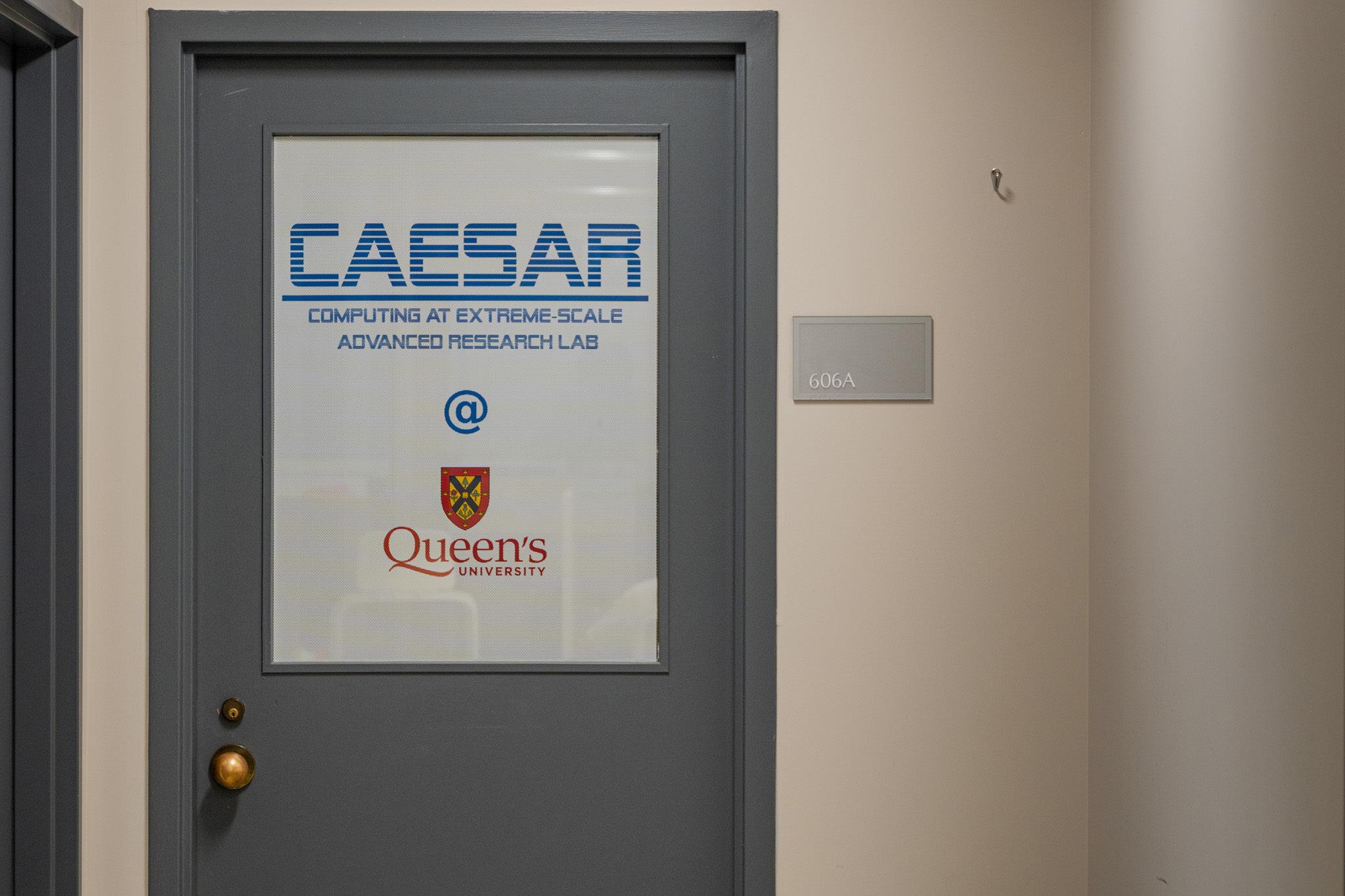
Queen’s and Simon Fraser University (SFU) have partnered to pursue federal funding for a supercomputing initiative that could position Canada among global leaders in artificial intelligence (AI) infrastructure.
The partnership is part of the federal governments Sovereign Compute Infrastructure Program (SCIP), which is expected to allocate up to $926 million toward building advanced computing systems across the country.
If successful, Queen’s would host a top 10 leadership class supercomputer, while SFU would operate a complementary, top-25 system designed to work alongside it, allowing users to scale projects from smaller workloads at SFU to large-scale processing at Queen’s.
The partnership also builds on broader efforts by Queen’s to expand its role in AI, including recent investments in talent, such as the hiring of former NVIDIA engineer Ian Karlin, and infrastructure to support large-scale research.
In an interview with The Journal, Vice-Principal (Research) Nancy Ross, said she’s “been working
together with the institutional folks over the last couple of years positioning the University to be able to take this project on.”
Ross said the initiative is intended to address a gap between Canada’s AI expertise and its computing capacity, noting many researchers rely on systems outside the country to run large-scale projects.
“What folks have been able to do to make sure they can run AI is buying time on clouds [remote computing servers run by companies like Amazon or Google] outside of Canada, which is very expensive,” Ross said. “And then it’s not secure.”
According to Ross, this reliance raises concerns around both cost and data sovereignty, particularly in sectors such as energy, healthcare, and national security.
The proposed system would be accessible to researchers, government, and private-sector companies, supporting large-scale projects ranging from drug discovery to climate modelling.
While Queen’s brings experience designing advanced computing systems, SFU contributes operational expertise from running large-scale infrastructure, including Canada’s largest public system serving thousands of researchers and industry partners.
The Journal also spoke with Ryan Grant, an associate professor in electoral and computer engineering and technical lead on the project.
He reiterated that the partnership reflects a strategic alignment
between the two institutions, describing the collaboration as a “natural alliance.”
“We’re creating a nice pipeline for academic users and industrial R&D [research and development] to be able to use one system at a smaller scale, then we come up and go larger and larger scale,” Grant said.
The initiative is additionally tied to broader economic and geopolitical considerations. Both Ross and Grant pointed to the need for Canada to develop domestic AI infrastructure rather than relying on
foreign providers.
“We want to make sure that we are AI producers of the future, not AI consumers of the world economy,” Grant said.
He added that relying on external systems could pose risks if access to AI technologies becomes restricted.
Beyond research and industry, the project is expected to create opportunities for students, particularly in engineering and computing fields. Grant also highlighted opportunities for training and collaboration between students, researchers, and
Queen’s announces a review of the budget model
Provost expects implementation of new model by the spring of 2027
Lilly Meechan Assistant News Editor
Queen’s is looking to create a new model that aligns closer to the Bicentennial Vision and research goals.
On March 26, the Provost and Vice-Principal, Matthew Evans, announced in Senate that the University is launching a review of the current budget model, which has been in place for the last 13 years. The purpose of the review is to consider how a new model could better align with the University’s priorities, particularly in relation to the Bicentennial Vision. The Journal reached out to the University for an interview, but was directed to an April 1 The Gazette article announcing the review.
Under the current model, revenue is largely distributed to faculties based on enrolment and program fees. Faculties then cover their own direct costs and contribute to shared service expenses through a set formula. But according to a recent article in The Gazette, that system is no longer functioning to the extent that it produces the best university-wide outcomes that
Queen’s aspires to. The article highlights government regulations on domestic student fees, domestic enrolment limits, and international student caps as reasons the current budget is falling short.
Over the coming months, the University will begin consultations on possible alternatives. According to the Queen’s Gazette, that process will include exploring different budget model options, engaging members of the university community, and holding more focused conversations with academic and administrative leaders.
The provost emphasized creating a new model that fosters increased research output and academic performance, and highlighted entrepreneurial revenue generation as one principle it wants to preserve in any future model. Evans also pointed to teaching and learning, as well as stronger collaboration across campus, as priorities for the review.
“Other key principles to take into account include meaningfully incorporating teaching and learning and creating better partnerships across the university, so central service units, such as student services, facilities, and many others, are clearly seen as partners vital to the university’s mission,” Evans said.
Based on The Gazette, the review comes as the University’s academic performance indicators face increased scrutiny over its
research performance relative to peer institutions. According to the article, Queen’s has seen slower growth in research funding, output, and impact than other U15 schools, and now ranks at or near the bottom of the group on several major research funding metrics.
Evans also said recent provincial funding changes, such as the injection of 6.4 billion into post-secondary schools over the next four years, have created some financial flexibility that could help the University manage a transition to a new model.
According to Evans, the review isn’t intended to increase the total amount of money available at Queen’s, but rather to reconsider how existing funds are distributed. It also won’t determine how much services cost, which remains part of the Renew Program, nor will
it govern how funds are allocated within individual faculties, which will remain under the authority of deans. The review timeline overlaps with the Renew Program, Queen’s broader initiative to improve operations and implement a new university-wide budgeting tool.
What could change, however, is the balance of revenues and costs across the institution, including how deficits are distributed between faculties.
At Senate, Evans said a revised model would not change the total amount of money in the University, but would “change the distribution of that money” and “quite likely” alter “the pattern of deficits” across Queen’s.
The review will begin this spring, and more details are expected as consultations begin.
industry partners. If successful, Ross said the project could significantly shape the future of research and innovation at Queen’s and across Canada. “I think it’s really going to be an exciting time for this University,” Ross said.
Grant said the proposal is currently in a competitive funding stage, following an earlier statement of interest submitted by Queen’s in 2025. A full federal call for proposals is expected in April, and institutions across Canada are anticipated to submit competing bids.
AMS YeAr in review
Nurzynski and Perisa share their advice for the incoming executive team
Before handing the reins over to Team DAE, two outgoing AMS vice-presidents look back on a year of new services, student initiatives, and behind-the-scenes challenges.
Vice-President (Operations) Elena Nurzynski and Vice-President (University Affairs) Alyssa Perisa recapped the proudest and most challenging moments of their terms for The Journal. Former President Jana Amer, who has since resigned from her role, didn’t respond to The Journal’s request for comment.
Both Nurzynski and Perisa described the move into the JDUC as an important accomplishment for the team, alongside successfully obtaining free student summer access to the ARC.
Queens could host one of the world’s fastest supercomputers if federal funding is secured.
PHOTO BY JASHAN DUA
The announcement was made on March 26.
PHOTO BY JASHAN DUA
Queen’S relAY for life rAiSeS $255,000 for the CAnAdiAn
CAnCer SoCietY
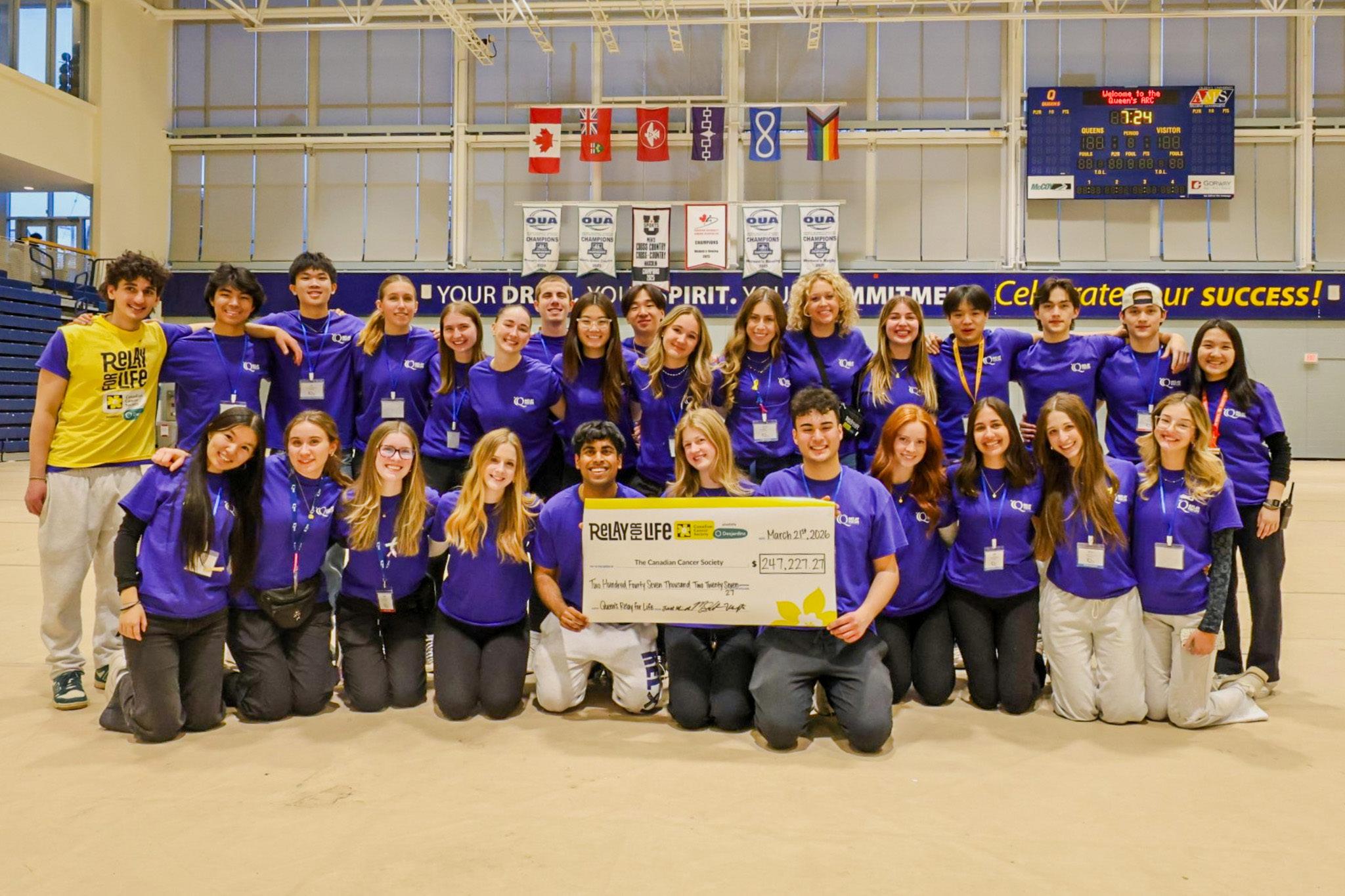
Over 650 members of the Kingston community showed up for the event
Yael Rusonik Assistant News Editor
Queen’s Relay for Life didn’t just meet expectations, it blew past them.
This year, the Queen’s Relay for Life team raised $255,000 for the Canadian Cancer Society, exceeding their previous year’s earnings by $30,000 and exceeding their initial fundraising goal by $85,000. Their overnight event, which took place in the ARC on March 20, saw over 650 attendees from both the Queen’s community and the broader Kingston community.
The Journal sat down with one of the current co-chairs, Kavi Gupta, HealthSci ’27, and two of the incoming co-chairs, Jackson Cohen, HealthSci ’28, and Ella Johnson, ArtSci ’27, to recap the event.
“I really felt this year, that it was so connected,” Gupta said.
“Everyone, regardless of their faculty, background, even individuals who don’t even go to Queen’s, had the time to come show up and to share their story.”
Cohen explained that one aspect of the event attendees really engaged with this year was the non-competitive relay.
“We [have a tradition where we] hand people a bead every time they complete a lap, and the goal, as the night goes on, is to grow a bigger and bigger bead bracelet,” Cohen said. “We ran out of beads within the first two or three hours, [...] and we had bought way more than we thought we’d need.”
The trio also highlighted the luminary ceremony portion of the event. The ceremony began with planned survivor testimonies, but after the speeches concluded, the executives spontaneously opened a space for anyone to share
their stories.
“It was just an outpour of so many different individuals, from students to staff to community members to survivors themselves, that went up,” Gupta said.
“They spoke, for example, about how fundraising for the Canadian Cancer Society gave them a second shot at life. Some cancers previously, 10 years ago, might not have had any positive outcomes.”
Gupta shared that he was incredibly happy with the outcome of the event and its fundraising, noting that $255,000 is enough to fund 43 clinical trials, send 170 children to medically supportive camps, or provide 5,600 days’ worth of meals to people undergoing treatment.
“We want to just make a greater impact on the community,” Cohen said. “My vision for this is to get as many students involved as possible. I want to try to involve
everyone. Because while I think the money is an amazing aspect of it, and it’s incredible, another piece to it is that it builds this really strong community.”
and fundraising.
Still, Johnson and Cohen expressed ambitions to make the event even bigger in the coming year.
Two Queen’s student teams win ninth Mayor’s Innovation Challenge
KPARK and BrightSite take top prizes at City Hall pitch competition
Emmet Paradis Assistant News Editor
From tackling Kingston’s parking problem to improving access to eye care, two Queen’s student teams are turning everyday challenges into award-winning ideas.
The City of Kingston announced the winners of the ninth annual Mayor’s Innovation Challenge on March 20, following a pitch competition at City Hall where eight finalist teams presented their projects.
The competition is designed to empower post-secondary students to “tackle real-world issues and bring forward ideas that can help shape Kingston’s future,” according to the city’s announcement.
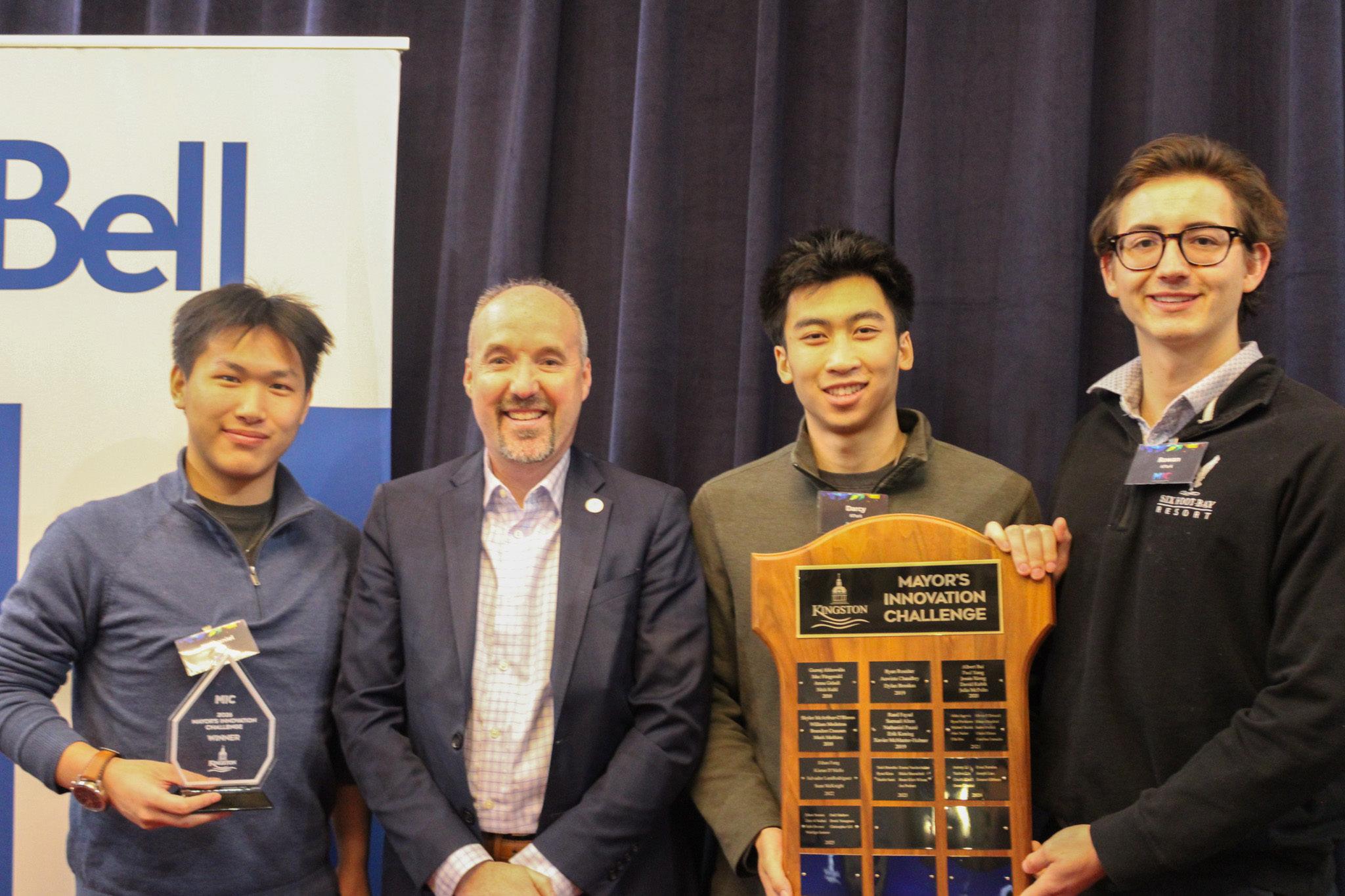
The Dunin-Deshpande Innovation Centre Prize was awarded to KPARK, a smart parking platform developed by Nathaniel Cheung, Darcy Cheung, and Rowan Horner, all Sci ’28.
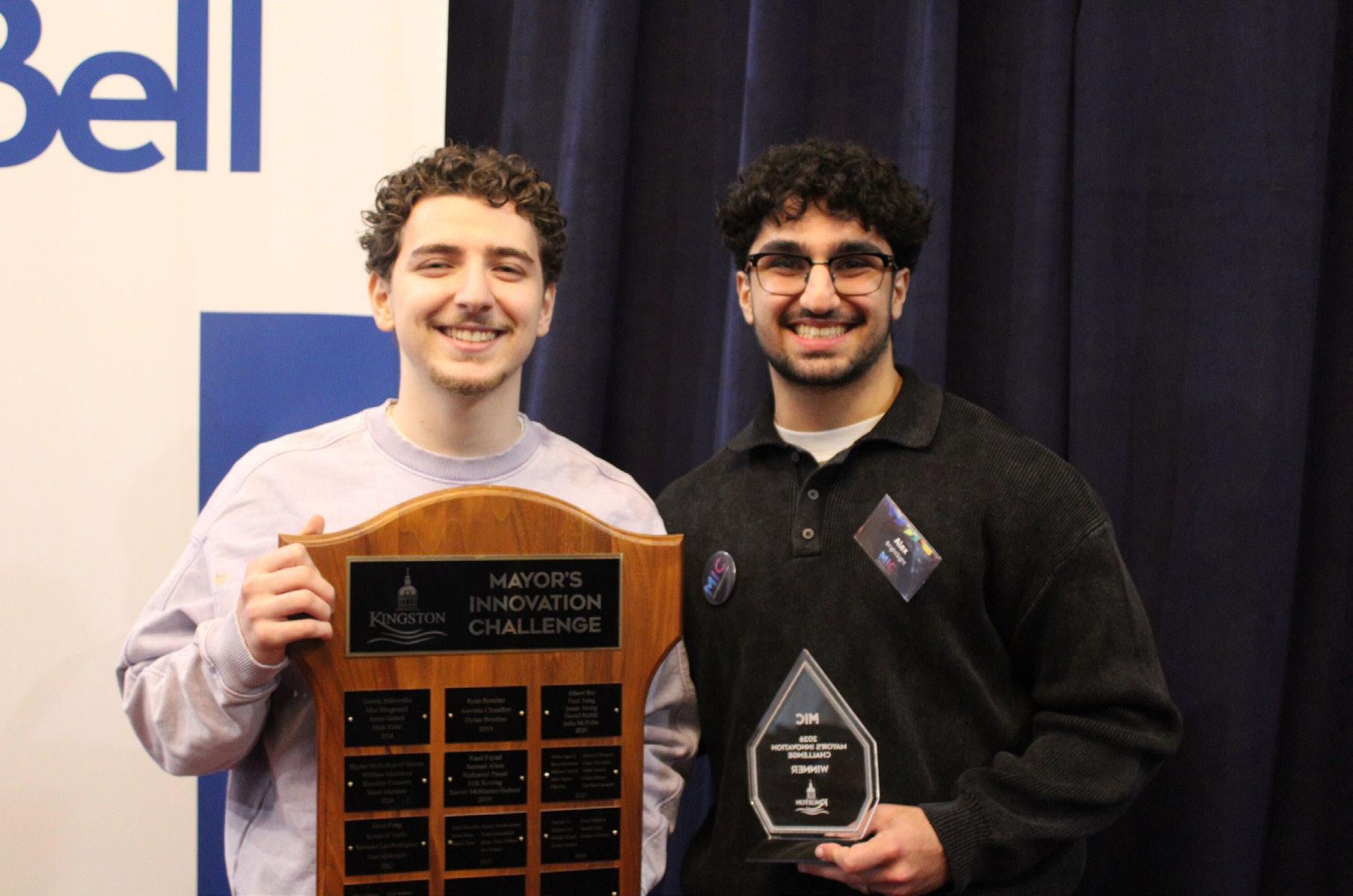
The Public Sector Innovation Prize, sponsored by Bell, was awarded to BrightSight—an initiative to improve access to eye care for underserved youth developed by Hussain Al Moman, Kamran Asim, and Alex Afrouz, all HealthSci ’28.
The teams met with The Journal to discuss their accomplishments.
KPARK
KPARK was initially developed during a QHacks Hackathon, a 36-hour event where students build projects from scratch, where the team set out to address a common frustration. The team won, with the prize being an entry into the innovation challenge.
“We always had trouble making it on time to our intramurals because we could never find parking,” Darcy said. “So, we thought, how can we build a product that would help us and help others park faster.”
Their platform uses computer vision technology to detect available parking spaces through cameras, rather than relying on individual sensors for each spot.
The system then relays real-time data to an interface, allowing users to view parking availability across a selected area.
The team said the challenge differed significantly from their previous experience presenting technical projects.
“They were really interested in possible economic factors that it could help generate,” Darcy said. “It was definitely a switch in mentality.”
Following their win, the team will work with the DuninDeshpande Queen’s Innovation Centre to further develop and scale their product, with plans to pilot the system on campus before expanding to downtown Kingston.
“We just want to make the overall idea of parking not so much of a hassle,” Nathaniel said.
BrightSight
BrightSight approached the competition from a different angle as one of only two non-profit teams, according to Al Moman.
The idea originated informally. “We were hanging out in Alex’s apartment one day, and we were brainstorming ideas,” Al Moman said.
The group identified a gap in access to vision care, particularly among youth who may not be aware of available resources or can’t afford necessary treatment.
Their initiative is run through a website and connects underserved youth with local optometry clinics and covers the costs of prescription glasses when needed. Their primary demographic includes individuals under 19.
Individuals apply, they get appointments scheduled with BrightSight’s partner optometrist clinic, gets examined, and receive their glasses. They usually get their funding through donations
“We didn’t have the funds to help them, that wasn’t a good feeling,” Asim said. “So, getting this grant […] it’s really helpful.”
In a statement to The Journal, the team emphasized the personal motivations behind the project.
Afrouz drew on his experience working in an eye clinic in Waterloo, where he saw patients unable to afford proper care.
Asim highlighted his background in Cape Breton, where high child poverty rates encouraged his commitment to supporting underserved youth. Al Moman referenced a family member whose
untreated vision issues worsened over time.
During the pitch competition, the team said they felt out of place among “actual businesses.” Despite this, they remained confident in their impact-motivated approach.
The group was ultimately awarded a $10,000 prize, along with access to additional training and mentorship opportunities.
“There were so many good projects that day,” Al Moman said. “We were very happy.”
Both teams emphasized that their wins didn’t only provide funding, but also validation and a path to expand on their ideas.
From left to right: Darcy Cheung, Rowan Horner, and Nathaniel Cheung.
From left to right: Houssein Al Moman and Alex Afrouz.
The overnight event took place on March 20.
SUPPLIED BY ELLA JOHNSON
PHOTO
FEATURES
Queen’s Pub, among other services, behind the approximately $800,000 gap in projected and actual AMS services budgets
According to Nurzynski, market research wasn’t ‘necessarily’ done Cloey aconley
Features Editor
A quiet student pub, racks of unsold clothing, and a bustling coffee shop where sales fall short, the AMS services are closing out the year thousands of dollars away from breaking even.
The shortfall isn’t just numbers on a balance sheet; its fewer shifts, tighter margins, and uncertainty for staff and customers of AMS services.
When Emma* started her job at the Queen’s Pub and Restaurant (QP) this summer, she expected somewhere near the 10 to 12 hours a week she requested. Instead, she spends her few shifts surrounded by empty tables.
Emma’s experience isn’t an isolated one—it’s a snapshot of a much larger financial strain unfolding across student-run services.
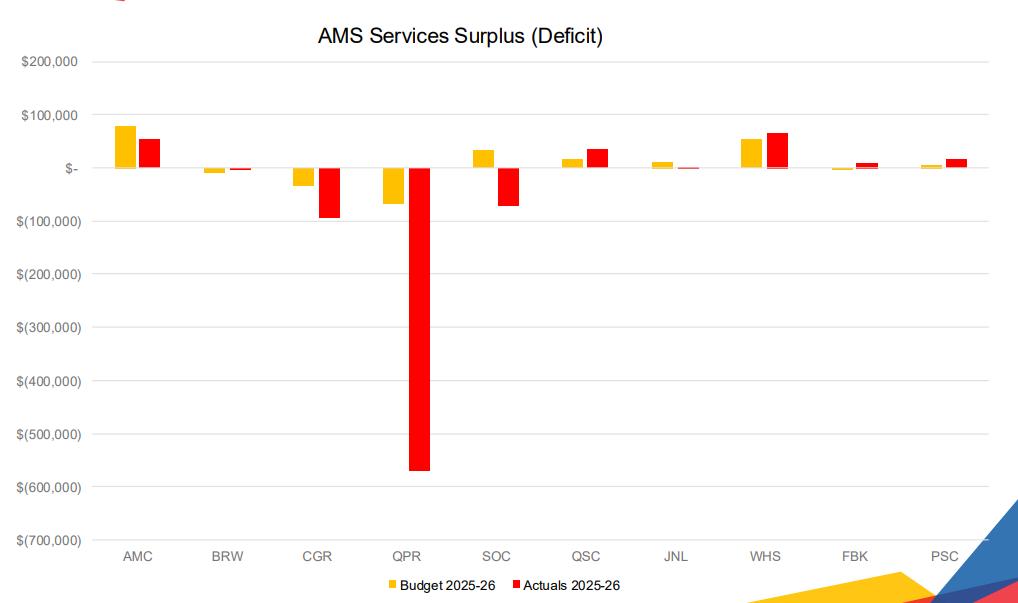
In just one year, the AMS projected budget deficit has more than doubled, going from a $247,526 deficit to $514,412. In their nine-month update, the actual deficit came in at $852,202, $300,00 higher than expected. The initial deficit projections were primarily driven by the offices portfolio and partially offset by a projected $86,140 surplus in services.
What Emma experienced on the floor is now showing up in the AMS’s financials, with the gap between expectation and reality embedded at the heart of the AMS’s growing deficit.
AMS Vice-President (Operations) Elena Nurzynski explained in an interview with The Journal how the expected surplus in services is primarily driven by the move into the newly renovated JDUC. “It’s a new building, so we were expecting to see a lot of excitement, engagement, and curiosity with the new building and therefore a lot of foot traffic through our services, so that was the biggest piece that we were anticipating when building the budget,” Nurzynski said.
However, recent actuals suggest a decrease in student engagement with the new services in the JDUC. $570,777 of the deficit is attributable to the newly revitalized Queen’s Pub (QP), and $72,000 is due to Society 58, formerly Tricolour Outlet, which are both located in the JDUC.
With the movement of various AMS services, and the grand re-opening of the QP, The Journal set out to understand how the 2025-26 services budget was constructed.
Building the Budget
When Head Managers assume
their positions in May, they begin working with the AMS VicePresident (Operations) to construct a budget reflective of their services needs and expected revenue.
For most of the services managers, they’ve had varying experiences building their budgets.
Head Manager of the AMS Media Centre, what’s expected to be the most profitable service in 2026, Jordan Medulan, explained in an interview with The Journal how she constructed her budget.
“It’s a lot of just looking at past years and the pattern recognition in order to build something that will support you in the areas that you need to be supported, as well as […] projections of what you think based on industry knowledge,” she said.
For the head managers, they began working on their budget in May. Society 58, formerly Tricolour Outlet, Head Manager Tatyana Grandmaitre-Saint-Pierre, however, told The Journal her budget was constructed for her prior to assuming her role. As of March 31, Grandmaitre-Saint-Pierre no longer assumes the position of Head Manager, with responsibilities now being assumed by Alexis Collins-Barrieau.
Other head managers, including Ashlyn Acorn from CoGro and The Brew, as well as Greyson Martyn of The QP had various experiences constructing their respective budget.
Acorn began her role after
was built based on industry standards and data from the old QP.
“I was brought on while the budget was being created, and so I definitely was aware of how it was being created, and I kind of consulted, but at the same time I was very early into my role for a brand-new service that we really had no idea how exactly it would perform,” Martyn said in an interview with The Journal
Whether they’re built in consultation with the outgoing head manager, or prepared in advance, services budgets are approved by the AMS board of directors, and eventually presented at the AMS Corporate Special General Meeting, around November or December.
Martyn noted that the QP is constantly updating its budget, considering actual versus expected sales. However, the budget for the QP presented at the Corporate General Meeting on Dec. 2 was over $50,000 off target.
“I wasn’t at Assembly for that [budget presentation], but
calculated the QPs expected revenue, based on industry standards and the institutional knowledge of the operations officer.
“Ultimately it came down to an average ticket price of $21 which equates to a drink and an appetizer. We multiplied that by having a full seating for lunch and dinner, and that’s basically how it came up with the revenue,” Nurzynski said.
However, a full seating at lunch and dinner hasn’t been accurate.
“Since opening, we’ve seen that this [a full seating] isn’t necessarily the case, but we’re constantly adapting and finding new ways to decrease costs and bring in revenue,” Martyn said.
To better understand student engagement with the QP, The Journal attended The Pub from March 11 to 13 between 4 and 7 p.m. On the 11 at 4 p.m. the QP had only two seatings, for a total of six customers, and six seatings at 5 p.m. However, it got busier towards 6 p.m. with a planned event. On the 12 at 5 p.m. the QP
the interim head manager, Alex MacKinnon, left in the fall, and the budget had already been approved by the Board of Directors. However, she didn’t see a need to update it. When asked about why they chose to hire a head manager for the full year in May, Acorn said it was a decision made by the executives at the time.
“I wasn’t able to change the budget at all, because they [the outgoing head manager] had put a lot of work into making it and it was very sound,” Acorn said.
For Martyn, he began his role while the QP budget was being created, which he told The Journal
from what I heard, she [VicePresident (Operations), Nurzynski was presenting the Budget,” Martyn said.
Nurzynski explained that the budgets are Built in May, approved in July or August, but aren’t presented to Assembly until November.
“Once it’s approved by the board, you don’t change it,” Nurzynski said.
The Money Sink
The largest driver of the deficit, the QP, was expected to generate a $13,382 surplus in May.
Nurzynski explained how they
had a total of two seatings and four customers, and on the 13, there were a total of six seatings with roughly 24 customers at 5 p.m. The QP has a maximum occupancy of 110 diners.
The lower-than-expected attendance began with a soft opening in the summer; however, Martyn explained the QP was expecting increased engagement when students returned to campus.
“We hired some staff for the summer, that was kind of our baseline team that we wanted to kind of grow with for the summer and hear their feedback before bringing on more students for the
school year,” Martyn said.
However, even staff hired in the summer aren’t receiving regular hours at the pub.
“There’s like 40 servers and roughly 42 serving shifts in a full week that are available, so it doesn’t feel like an option right now to reach out and ask for an extra shift because there’s just no shifts to be taken,” said Emma.
Emma explained how she was hired over the summer, expecting to work around 12 to 15 hours a week, but currently receives roughly one three hour shift a week. She also noted that some of her co-workers were relying on The Pub as a full-time job through the summer but have received significantly less hours.
“I have a friend who’s also a co-worker, and she’d quit her other job beforehand expecting this [the Queen’s Pub] to be her full-time job. She wanted 35 to 40 [hours], and I think she was only getting […] less than 20 a week,” Emma said.
Emma cited the lack of attendance as the primary reason for lower hours, explaining how sometimes when the patio was open, they would see a slight increase in engagement, but as the weather got colder and the novelty of the new pub wore off, attendance has waned.
“They just totally overestimated how busy it would be, and now they’ve just got all this staff that kind of, you know, barely have a job,” Emma said.
Nurzynski explained how the QP staffing budget was primarily influenced by industry knowledge, and previous data from the Queen’s Pub, which hasn’t been operational since 2020. . She highlighted that the operations officer and pub’s permanent staff had experience in the restaurant industry, that was essential in building the budget. However, Nurzynski didn’t identify any specific market analysis that was undertaken prior to opening.
“I wouldn’t necessarily say market research was done,” Nurzynski said.
Continued online at www.queensjournal.ca
AMS Services Surplus and Deficit Presented at 2026 Corporate Annual General Meeting by Nurzynski.
PHOTO SUPPLIED BY ELENA NURZYNSKI
AMS services deficit increases since May projections.
PHOTO SUPPLIED BY DANIELGILL-SITOSKI
Darts
Three Queen’s leaders rack up over $46K in expenses during five-day trip to China: Revealed through an anonymous Reddit account, three Queen’s administrators spent roughly $46,215 in an October recruitment trip to China. In the midst of cost cutting measures, particularly in the Arts, its disappointing to see the administration spending unnecessarily on limousines and hotels. Because this information was discovered through a freedom of information request, it’s unknown how many other administrators have exhibited this kind of spending. As austerity measures come into effect, administrative spending should be a significant concern for students.
AMS President’scredit card revoked following unauthorized personal use: In a Jan. 28 Special Assembly, it was revealed that AMS president Jana Amer had been using the presidential credit card for unauthorized personal expenses. While the expenses were repaid to the AMS, the Assembly led to further inquiries, and Amer’s eventual resignation. If anything, the findings of the Special Assembly should encourage students to understand how their student fees are being spent and will strengthen the AMS credit card policy going forward. The event captured the interest of many students and will hopefully lead to more engagement with the AMS going forward.
to see student concerns delegitimized and swept under the rug. The dismissal is especially unfortunate as Queen’s claims to be “committed to advancing sustainability and fighting climate change.”
Antisemitic and transphobic FOCO street interview sees widespread attention: Posted on Instagram, a FOCO street interview asked offensive questions targeting the transgender and Jewish community. Clearly orchestrated to elicit a reaction, both the interviewer and interviewees should be ashamed for engaging in this type of rhetoric. It’s disheartening to see the Queen’s community portrayed as openly hateful, and while condemnations
Laurels
New Black Legacy Mentorship Program helps connect Kingston youth with student mentors: This year, the Social Issues Commission launched the Black Legacy Mentorship program, which connects Black youth in Kingston with Queen’s student mentors. For many Black youths in Kingston, who may not see themselves represented in a predominately white institution such as Queen’s, the program’s an important step to increasing access to post secondary.
Bottoms Up opens as Kingston’s first gay bar in over a decade: It’s
and upset TMU, ranked first in the OUA West. It’s thrilling to see such an impressive run from the Men’s program.
Queen’s researchers secure $1.2 million in funding from the Ontario government: Announced on Jan. 21. six Queen’s projects including galaxy evolution, neural activity, and opensource computing will see $1.2 million in provincial funding. While this allocation wasn’t from the University itself, its positiveto see research funded at Queen’s—something highlighted as a strategic priority in the bicentennial vision. With the recent tuition unfreeze, it’s exciting to other initiatives directing funding towards universities in Ontario.
TAs speak out against increasing workload and reduced hours: Though Teaching Assistant (TA) wages have increased as a result of the PSAC 901 strike in 2025, their hours have decreased, and many are overseeing more students due to increased enrollment. Unfortunately, this highlights how the 2025 strikes didn’t lead to as positive of an outcome as many students had hoped. It’s frustrating that students can’t advocate more for how their tuition dollars are being spent.
Students rally amid internet shutdowns and human rights concerns in Iran: On Jan. 16, over 50 students and members of the Kingston community gathered to protest human rights abuses occurring in Iran. The internet blackout has had difficult mental health and financial concerns for the Iranian student population, and the University should be doing more to ensure their needs are met at this time.
Queen’s rejects request for divestment from fossil fuels: A student backed call for divestment from fossil fuels was rejected by the University on Dec. 16. The most upsettingthing wasn’t only that the request was denied, it was that Queen’s barely consulted with the student group prior to submitting their anti divestment recommendation. Whether divestment form fossil fuels are feasible or not, it’s frustrating
were issued, there should be more concrete action to reduce the chances of this ever happening again. Incendiary street interviews when people are intoxicated are predatory, and feed into a dark corner of internet culture that shouldn’t be platformed at Queen’s, or anywhere.
Distressed man breaks into Waldron Tower leaving students shaken: Early on Oct. 25, a distressed man broke into the Waldron Tower residences, leaving students concerned for their safety. While the incident didn’t garner much attention around campus, students should be more concerned for the security of residences on campus. While rooms are currently under renovation in Waldron tower, no additional security measures have been put in place.
Students say DAN School left in “crisis” due to budget cuts: On June 16, Dan School of Drama and Music students were informed of cost cutting measures, including the reduction of one on one teaching by half. Students and faculty of the DAN school raised concerns about the quality of music education at Queen’s. Its overall frustrating to see large amounts of funding allocated to engineering and commerce, while the arts are so severely underfunded, they can barely run their programs. Even still, the university has failed to take accountability for the dramatic cuts to arts programs across campus.
Continued online at www.queensjournal.ca
exciting to see the opening of Kingston’s first gay bar in over a decade. Kingston used to have a strong history of gay and lesbian bars, one that’s beginning to revive with the opening of Bottoms Up. One gay bar, Shay Foo Foo’s, opened in Kingston about two years ago but unfortunately shut down, and The Journal is happy to see this one thriving. However, with many new establishments, Bottoms Up will have to navigate the challenges that come with the first year of business, and work to create a welcoming and safe environment for queer patrons.
ARC to offer free summer access for students starting in 2026: Free summer access to the ARC was one of the most actionable changes seen by this year’s AMS executive. No one wants to spend $100 for a gym they have access to year around and making it available to undergrads during the summer months was a positive use of student fees. Because many students pay tuition for summer courses, they should be encouraged to spend some time in Kingston over the summer and retain access to the same amenities.
Men’s Hockey takes down TMU in overtime for OUA Bronze: While many spectators might focus on the gold medals, an OUA bronze was a huge accomplishment for the Men’s Hockey team. The team had to upset second ranked Concordia to make it to the bronze medal series,
‘Art & Solidarity’ displays Iranian hope and resilience: On March 15, a group of students affiliated with the Iranian Association of Queen’s University, organized an exhibit featuring Iranian food, music, and artwork. Amid the violence in Iran and mounting death tolls following protests on Jan. 8 and 9, the depiction of Iranian life and culture was a beautiful and hopeful way to spread their message.
Students are working to preserve and build a queer legacy on campus: A new course, HIST 402 “LGBTQ Lives and Archives” brings students to the archives to study LGBTQ2SIA+ history in Kingston. Being a fourthyear seminar, the class is very hands on, utilizing existing archives at Queen’s. The students are all very passionate, and it’s inspiring to have another avenue to explore LGBTQ2SIA+ history in Kingston.
Queen’s deficit projected to drop to $2 million from budgeted $26.4 million deficit in May: While it’s positive to see a decrease in the operating deficit, such a sharp decrease raises concerns about austerity measures. While an increase in investment returns is partly the cause of the deficit decrease, programs especially the arts are still struggling with funding.
After two-year hiatus Bader College reopens for Winter 2026: Bader College is an expensive institution to uphold, one that many Queen’s students will never see. However, it’s positiveto see the university reorient its focus to more research initiatives.
Continued online at www.queensjournal.ca
ILLUSTRATION BY SHAE SOETERIK
OPINIONS
Who wants to pay tuition fees only to be taught by robots?
Expanding Artifical Intelligence isn't so 'intelligent'
Norma Möllers & Carolyn Lamb
Contributors
The administration’s aggressive lobbying for ‘more AI everywhere’ could lead to a significant deterioration of working conditions for graduate student workers and faculty, with ripple effects for students’ learning conditions.
We’ve been living with the administration’s fabricated austerity regime now for close to three years. Many students have felt the impact of larger class sizes and significantly less face time with instructors, or in a shift from labs or essays to less labour-intensive multiple-choice exams, simply because instructors don’t get enough TA hours to mentor and grade students. And even though the province recently announced a significant funding increase for Ontario universities, on the backs of low-income students, the provost clarified that he’s intent on continuing to starve the university of the resources needed to improve our teaching and learning environment.
What does austerity have to do with AI? Well, the administration may do what some schools have already done, which is to try to cut labour costs by automating aspects of teaching. We say “try” because this calculation rarely works out: automation usually just siphons money into the tech industry instead of cutting costs. This dynamic follows a playbook which well predates the emergence of generative AI: under the guise of technological inevitability, employers lay off employees, rehire
them at lower wages, intensify workloads, and normalize precarity. All of which would pose significant strains on the quality of education at Queens, because taking away resources from educators always means taking away resources from students.
If you think that this is a faraway scenario, think again: previous rounds of bargaining suggest that the administration has been quietly trying to lay the groundwork for automating aspects of teaching.
For example, in their negotiations with PSAC 901 last year, the administration tried to remove existing protections so that they could replace TAs with AI. In QUFA’s last round of bargaining, the administration tried to gain control over our intellectual property, which would’ve allowed them to use our materials as training data for courses designed and taught by generative AI software.
Through drastic cuts in TA hours, the administration also has already informally created a situation where many professors are forced to rely on AI because they wouldn’t otherwise be able to shoulder their workload. Indeed, the provost’s ‘AI advisor’—another expensive position on Queen’s already bloated higher admin salary bill—has actively encouraged QUFA members to use AI to deal with TA cuts or increases in administrative workload. The push for automation in teaching is likely going to be intensified in light of the administration’s plan to expand remote micro-credential offerings, first revealed in The Journal’s recent reporting.
What would increasing automation of teaching mean for students concretely? Because generative AI models don’t have a humanlike understanding of the words that they use, and often “hallucinate,” it would
mean lower-quality teaching materials, lower-quality feedback, inaccuracies in grading, and additional student fees. At the same time, it would allow educational-tech corporations to access a massive trove of student data to monetize or use to train AI models.
Chemistry students have already experienced these effects when Stemble, an AI grading system, was adopted in first year Chemistry courses. As a PSAC 901 member reported at a recent QUFA event on workplace surveillance, the grades students received from Stemble were often wrong and contradicted what the instructor had said in class. The system also didn’t save time for TAs, who still had to comb through its output to check it for correctness. And every student in the course had to pay a mandatory fee of $90 to submit their assignments through this system—a concrete example of how, instead of saving money overall, high-tech systems tend to funnel more money to tech companies.
At the same time, it’s well documented that generative AI reproduces and amplifies social biases from its training data—including biases against female, racialized, queer, nonbinary, trans, disabled, immigrant, or first-generation students. This could result in all types of marginalized students being given lower grades across the board. Even if the information about someone’s race or gender isn’t given to the AI, it can guess these traits based on subtle patterns like word choices used in an assignment. Corporations often don’t take accountability for harmful inaccuracies in their products’ output, which means that the labour to correct them falls on students, TAs, and instructors. This means that students would
pay three times for ed tech: first, with additional fees; second, with their data; and third, with their time spent on correcting inaccuracies.
A recent survey conducted by Queen’s suggests that the administration’s push for more AI isn’t well aligned with students’ perspectives and needs. For example, students are quite concerned about how the use of generative AI impacts independent and critical thinking. With good reason: as educators, we know that learning can’t be automated (memorizing isn’t the same as understanding), and there’s emerging scientific evidence to support these concerns. The administration’s current path also doesn’t seem to align with current labour market trends.
Plans to drastically slash FAS, gutting arts, humanities, and social sciences in favour of STEM and AI sit uneasily with indications for a rising labour market demand in the humanities and social sciences, and an entry-level hiring crisis in software jobs, where technology corporations first experimented with the above-mentioned Gen AI-austerity playbook on their own employees. These misalignments are, of course, not unique to Queen’s, and in response, students at other universities are beginning to put pressure on their administrations to reconsider their investment in the AI bubble.
For the higher education sector as a whole, the result appears to be increasing stratification: as some commentators have pointed out, the introduction of AI in higher education is heading in a direction in which “small numbers of elite students will have access to a more traditional, largely tech-free liberal arts education, while everyone else has a ‘degraded, soulless form of vocational training administered by AI instructors.’” One wonders
which of these two paths the current administration is pursuing for Canada’s oldest university.
QUFA has been working on these issues through the creation of a task force, co-chaired by the authors of this opinion piece, which prepared suggestions for how to address problems related to generative AI in our upcoming bargaining this spring.
To protect our University from the automation of labour and related consequences for equity, academic freedom, and privacy, we've proposed to strengthen our collective agreement with respect to technological change and data rights. As we move into bargaining, we hope to have more conversations with the Queen’s community—students, graduate student workers, and staff—about how AI impacts their education and work, so we can strategize together about how to keep Queen’s a thriving learning environment.
For the last couple of years, the discussion on generative AI in higher education has been largely centred on academic integrity—wrongly so, in our view, because as we’ve argued here, the issues at stake for universities are much more expansive. Often, critical views such as ours are dismissed as ‘doomerism’ or ‘luddism’. But this isn’t just an illinformed historical understanding of what the luddism was as a labour movement and tactic for labour struggle, but completely misses the points we’ve laid out here. It’s not about being against technology. It’s about the struggle for good working conditions—and our working conditions are your learning conditions.
Norma Möllers is an Associate Professor of Sociology. Carolyn Lamb is an Assistant Professor at the School of Computing.
Norma and Carolyn confront the recent implementation of Generative AI in university and its ramifications.
PHOTO BY CLAIRE BAK
<BIZ-SCI-TECH>
Street medicine adaptS care for KingSton’S unhouSed
As homelessness increases, care is being adapted to work beyond traditional healthcare settings
katarina krivokapic Business, Science, & Technology Editor
A prescription only works if someone has a place to keep it.
For many people who are unhoused, storing medication, keeping wounds clean, attending appointments, and getting rest
aren’t possible. Medications are lost or stolen, and dressings can’t be changed regularly without access to clean water or supplies. As a result, common conditions like skin infections, chronic wounds, and asthma can worsen or return. Street medicine addresses this gap by adapting care to real living conditions.
On Instagram, family physician and emergency physician Jill Wiwcharuk (Street Doctor Jill) shows what this looks like in practice. In her videos, she describes the day-to-day realities her patients face and how those affect their health. She explains how street sweeps displace people and interrupt care without
addressing the causes of homelessness, and why standard advice like returning for follow-up depends on whether someone can actually come back. For her patients, the issue is whether medical advice is practical and usable in their daily lives.
Her approach reflects this. Street medicine functions as a link between clinical care and community settings for people who are underserved due to social and economic barriers. Care is simplified and delivered as much as possible in a single visit, since follow-up isn’t guaranteed. Physicians may choose medications that don’t require refrigeration, provide supplies directly, and avoid treatment plans that depend on multiple appointments. The focus is on what patients can realistically follow.
This model is also used locally. In Kingston, the Street Health
Your brain on porn
How online behaviour may unexpectedly shape offline perception
While the adult entertainment industry promises to gratify, the irony is that it delivers the opposite. For a generation that seeks to optimize every corner of their lives—tacking sleep, cutting out alcohol, and cold plunging at dawn—we often tend to overlook our porn consumption. Pornhub alone receives 3.4 billion site
visits monthly, and its average user spends around four hours consuming porn weekly.
While a couple of hours a week may not seem like much, over time, it does silent damage to your brain, which shows up as changes in behaviour.
Pornography addiction can make you irritable, short-tempered, stressed, and more anxious.
To understand the damage being done, it’s important to understand the system being damaged. The brain has a reward circuit, the mesolimbic pathway, a network of structures that evolved over millions of years to motivate crucial survival behaviours: food, connection, sex, and achievement. What runs this system is dopamine, the neurotransmitter
Centre operates year-round to serve people who have difficulty accessing standard care. In addition to its clinic, it delivers services through the Portable OutReach Care Hub, a retrofitted RV that brings health and community services directly to priority groups, such as those experiencing homelessness. This reduces common barriers such as transportation, identification requirements, and appointment scheduling that prevent people from being seen.
The need for this care is acute.
A 2024 report found that the number of people experiencing homelessness in Kingston increased by 133 per cent over three years, from 207 people to 483. Life expectancy is also significantly lower, by approximately 30 years, than that of the general population.
For many, Kingston’s emergency department and urgent care centre have become the main point of access. In these settings, patients without stable housing have reported being treated as “less than human” by healthcare providers, along with poor communication about wait times, diagnosis, and treatment.
Homelessness and health are closely connected. Some conditions, such as schizophrenia, can contribute to housing instability. Others develop or worsen as a result of homelessness, including skin infections, injuries, and chronic disease complications. Even routine treatment becomes difficult. Managing diabetes, for example, requires regular meals, refrigeration for some types of insulin, and safe storage for supplies—conditions that are often not available.
The Street Health Centre serves people who are homeless or
physical partner.
Essentially, your brain is being flooded with stimuli in quantities it wasn’t designed to experience, and being the adaptable organ that it is, it compensates for the additional stimuli. It does so by reducing dopamine receptor density in a process known as downregulation.
The result is tolerance. You need more to feel the same. Content escalates, and the habit deepens In fact, pornography viewers are increasingly choosing more violent forms of pornography This may be attributed to the desensitizing effect of regular consumption.
Rather than exploring curiosity, users then tend to chase a diminishing return with an increasingly eroded reward system.
precariously housed, as well as those who may have been incarcerated or are at risk for infections like Hepatitis C. These groups often face overlapping challenges, including unstable housing, low income, and higher exposure to trauma.
Care is also trauma-informed. Missed appointments and inconsistent treatment are accounted for, and substance use is managed through harm reduction. This helps patients stay connected to care within a system that often does not accommodate their circumstances.
The Centre also connects patients to housing support, mental health care, and income assistance. These supports are important because many health problems are tied to living conditions. Treating an infection without addressing where someone sleeps or how they access food may mean the health problem will return.
Street medicine can reduce pressure on the healthcare system. Managing issues earlier and in community settings, it helps prevent complications that would otherwise lead to emergency visits or hospital stays. Some programs have reported reductions in emergency visits by up to 75 per cent and hospitalizations by 66 per cent.
It also shows a gap in how healthcare is designed. The system assumes patients have stable housing, storage, and transportation, but with rising homelessness, that isn’t always the case. When those conditions aren’t in place, care becomes difficult to deliver.
By meeting patients where they are, street medicine makes treatment more practical and improves access and trust for some of the most vulnerable patients.
as behaviour progresses towards compulsive use and compromised prefrontal cortex function.
The reward system structurally shrinks, and less grey matter means less capacity to feel genuine reward from real life.
The neuroplastic impairments expand beyond the mesocortical dopamine pathway into other regions of the prefrontal cortex associated with driving motivation, self-regulation, and other cognitive and executive functions.
Functional connectivity pathways in the brain with internet pornography addiction are like those observed in drug addiction, and in some respects, even those seen in schizophrenia.
associated with desire and anticipation. It’s released when you expect it, and it’s the chemical that makes you get out of bed and pursue things.
This system is finely calibrated, real-life rewards—genuine human connection, physical achievement, or a moment of intimacy—release dopamine in natural, sustainable amounts. However, something different occurs when you open an incognito browser window.
Porn scenes act as hyper stimulating triggers that lead to unnaturally high levels of dopamine secretion. This harms the dopamine reward system and makes it unresponsive to natural sources of pleasure, which is why users will eventually experience difficulty in attaining arousal with a
Neuroimaging studies reveal that prolonged exposure to pornography negatively impacts the prefrontal cortex of the brain, which is responsible for governing emotional processing and selfregulation of behaviour.
The damage to what’s basically the braking system of the brain, especially in younger individuals whose prefrontal cortices aren’t developed till their mid-twenties, results in hypofrontality, a term describingimpulsivity,compulsivity, and impaired judgement. The part of the brain wired to say ‘no’ is worn away.
Frequent porn consumption is associated with reduced grey matter volume in the corpus striatum of the basal ganglia, a region involved in habit formation
According to research conducted at Cambridge University, comparative fMRI scans of compulsive porn users and nonusers revealed that compulsive users showed the same brain activity patterns as drug addicts showed their chosen drug, with the same craving response and compulsive drive.
More importantly, the study revealed that they craved it more while enjoying it less. Compulsive porn users had a stronger desire with lower satisfaction than those struggling with drug addiction.
Continued online at www.queensjournal.ca
KSHC to deliver care to people facing barriers to traditional healthcare.
PHOTO BY JASHAN DUA
GRAPHIC BY ANANYA SHARMA
Players of the year crowned by ‘the Journal’
Familiar names highlight the top performers of the season
Noah Cyr Senior Sports Editor
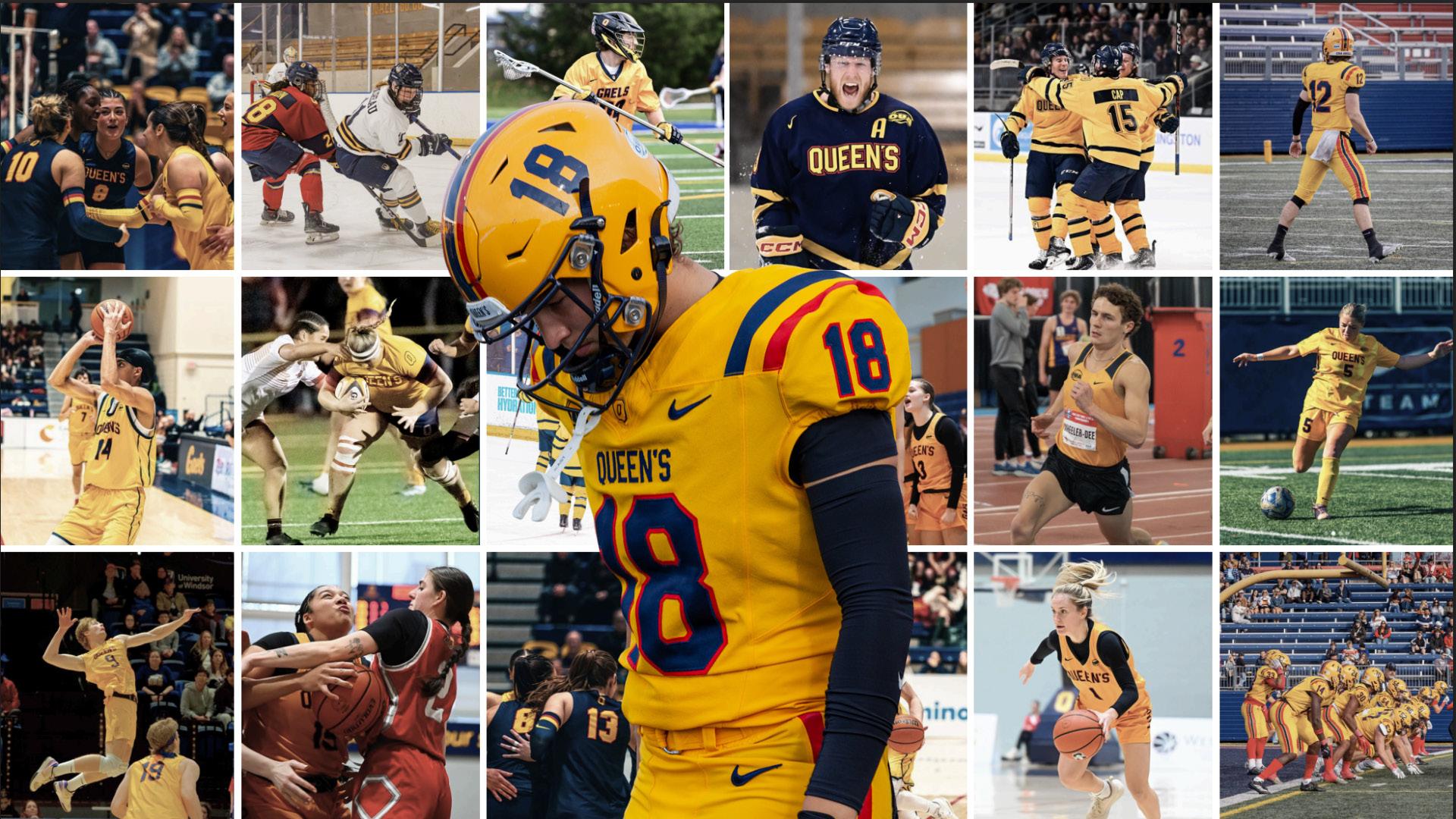
The Journal’s top player picks from every Queen’s Varsity team.
Ollie Engen, Kin ’28, of Men’s Basketball takes home his second straight player of the year after another stellar season for the Gaels. Logging the most minutes for Queen’s with 631 minutes of the
floor, Engen amassed 430 points, good for fourth in the OUA. Engen was named an OUA First Team All Star having been named to the OUA All-Rookie Team a season ago.
Kiyara Letlow, MSc ’25, led the Women’s Basketball team to a near perfect season just dropping one game in the regular season. Letlow finished her final season averaging 15.8 points and 12.3 rebound. She set the USports record for rebounds in a career with 1,411, and was named a USports Second Team All Canadian for her tremendous season.
Men’s Cross Country and Distance Track: Jude Wheeler-Dee, ArtSci ’26, of Men’s Cross Country
and Distance track is nothing short of impressive. In his fifth and final season running for the Gaels, he added to his storied career with an OUA Championship gold in Cross Country, a USports team gold in Cross Country, and two gold in Distance Track’s 1500m and 3000m. To top the season off a FISU appearance in Italy, representing both Queen’s and Canada.
Woman’s Cross Country and Distance Track: Elizabeth Vroom, Sci ’27, shined for the growingly dangerous Gaels Women’s Cross Country team, being a key contributor of their OUA championship. Vroom in the OUA distance track Championship
captured a silver in the 1500m, and a bronze in the 4x800m event, that helped her to be named a Student Athlete of the Week in February.
Jared Chisari, MSc ’26, earns this years nod as Men’s Football’s player of the year after an outstanding season for the fifth year running back. Chisari in all OUA statistical rushing categories ranked in the top four, including first in yards per rush with 10.1. He was recognized as an OUA First Team All Star and a USports Second Team All Canadian.
Tanner Wickware, MIR ’26, the Men’s Hockey starting goaltender was the primary reason the Gaels were able to go on their magical run to the USports Championship. Wickware started every game from Nov. 16 on including the playoffs where he led the entire OUA with a .944 save percentage and 271 saves.
Sophie Hudson, Sci ’26, the Captain of the Women’s hockey team, led her team to be the top team in the OUA East this past season. The fifth year forward led the OUA in points with her teammate Mikayla Cranney ArtSci ’28. Hudson after the season was named a U Sports First Team All-Canadian to round out her USports career.
Marcus D’Acre, ArtSci ’26, was named the Men’s Rugby Player of the Year for the second straight year. D’Acre was honoured for his performance during the season being named the Canadian University Men’s Rugby Championship Player of the Year.
Jiggy Schonfeld, Kin ’28, of Women’s Rugby earns the Player
of the Year recognition after an outstanding season by her and her team led to a USports National Championship. Schonfeld, a Back Row third year, was named a U Sports All Canadian and will look to defend the National Championships next year.
Jacob Ball, ArtSci ’28, shined in his first year as a Gael and takes home our Player Of The Year for Men’s Soccer. Ball was tied for second in the OUA in goals with nine and was recognised as an OUA All Star.
Mattson Strickler, ConEd ’26, is the Women’s Soccer Player of the Year for the second straight year at The Journal in her final season as a Gael. Strickler amassed 12 points in just nine games. For her efforts, she was named a East Division Second Team All Star.
Nikola Mitrovic, ArtSci ’26, takes home the Player of the Year for the OUA Champion Men’s Volleyball team. Mitrovic was a key contributor of the Gaels offence, particularly in the playoffs where he averaged 4.67 kills per set. He was recognized for his breakout season with being named an OUA Second Team All Star.
Claire Carter, Comm ’28, is Women’s Volleyball’s high-flying outside is this years Player of the Year. Carter, a consistent contributor in all three phases of the game including her explosive serve, that allowed her to finish second in the OUA in service aces. The good news for Gaels fans is that she’ll be a force at the ARC for at least one more season.
Quotes of the year 2025-26
A Gaels year in review told by the coaches and athletes
Noah Cyr Senior Sports Editor
A Journal tradition like no other, where we reminisce and share our favourite interview moments.
Our first one is from Men’s Football Quarterback Alex Vreeken, Kin ’26, explaining a situation involving one of his teammates at a cottage.
“He thinks there’s a stick out in front of him, so he reaches out to grab it, but it’s actually a water snake, so he screams and throws it. Meanwhile, I’m swimming and pop my head up, and this thing lands right in front of my face, so I’m freaking out.”
—Alex Vreeken’s water snake catastrophe.
“I will say this on the record, the OUA struggles putting out schedules and sometimes doesn’t get it right.”
—Women’s soccer head
coach Dave McDowell on how the back-to-backs affect the way he manages minutes.
“We are trying to play as fast as we’ve ever played before. We’ve built on the concepts from last year and I’m just excited to see how we’re able to come out and hit the ground running.”
—Women’s rugby Head Coach Dan Valley laying out the expectations for fans about his team before they sprinted to an OUA Championship.
“There’s no other place like the ARC, especially when it’s packed, and the student body and the fans are our six player on the court.”
—Women’s Basketball coach
Claire Meadows on how important the ARC is for her team before their undefeated regular season at home.
“An athlete to watch that maybe hasn’t seen the court a ton [in previous years] is Abigail McAlpine.”
—Women’s Volleyball Head Coach Shanice Marcelle, talking about graduating opposite McAlpine, who has a monster year being in several OUA offensive stats.
“It’s a very prestigious trophy, it’s like 50 pounds, to win it, you can’t explain it really. We have been building to this and I’m grateful for everyone involved.”
—Men’s Head Coach Steve Snyder reflecting on the Yates Cup.
“Be good today, deal with the game or practice in front of you, be great at those things and the players will be able to play at the best of their ability.”
—Men’s Head Coach Stephan Barrie explaining his team’s mindset during the season and into the playoffs.
“Every time they’re out there running with the brutal wind coming off Lake Ontario and the water was going upwards, the wind was so bad, but he’s doing the work, no complaining, and I thought to myself, yeah this kid’s tough.”
—Cross Country coach Mark Bomba on first year Andrew Neal’s experience running on a windy day in Kingston.
“My ability to keep a clear head when things get tight allows me to have good messaging to the athletes when their emotions are high. I think I’m able to present a calm and collected approach for them to rely on.”
—Men’s volleyball head coach Gabe Degroot give diplomatic answer when asked how he’s able to stay so calm during the game.
“I use the word all the time, and it follows me around, it’s delusional confidence, I don’t care who we
play, bring it on. I don’t think, I expect to win.”
—Men’s Hockey head coach Brett Gibson before their Cinderella run to the National Championship.
“You’re in the middle of a race, and you’re hurting, but that one side of your brain is saying, well, this is the last time you’re gonna hurt like this. Eight minutes of pain for a lifetime of memories is very much worth it.”
—Jude Wheeler-Dee on his mindset during his race to help fuel him to victory.
Lastly, Reed Venning’s ArtSci ’26, honest opinion of Windsor.
“Right now I’m looking across into Detroit, and its not the prettiest view but maybe if we ventured out a bit more but I can’t say too much about Windsor, if I’m being honest.”
—Reed Venning being in Windsor for the fourth time in as many months.
Vol. 153 weighs in on their top picks.
GRAPHIC BY CLAIRE BAK
GRAPHIC BY ANANYA SHARMA Top quotes from Vol. 153.
The school year’s wrapping up, but the astrological year is just beginning
This spring and summer are going to be hot, hot (or so the stars say)
THE PSYCHIC SCHOLAR
Capricorn (Dec. 22 –Jan. 19)
Don’t stir the pot too much when it comes to your work life this week. You may feel restless but consider the value of stability and slow progress over quick changes that demolish years of effort. Whatever big adjustments you have in mind will actually have
Scorpio (Oct. 23 – Nov. 21) A bird in the hand is better than two in the bush, as they say. If you get too caught up in hypotheticals this week, you may walk away empty-handed. Concentrate your efforts on real-world projects instead of getting lost in fantasy, and base plans on what’s actually happening
Libra (Sept. 23 – Oct. 22)
Just like Gemini, you’re blowing a personal matter out of proportion, and it’s harming the brand. Pick your battles, and consider the harm to your image if you insist on getting justice for every petty comment. Sometimes it’s better to cut the haters off and move on!
Taurus (April 20 - May 20)
Aries (March 21 – April 19)
Your adventurous spirit sees you springing to action this Aries season. Enjoy your birthday time and all the attention that comes with it, but beware burning too brightly ahead of exams! If this happens, you’ll certainly burn out.
BY
BLAKE GILL
Pisces (Feb. 19 – March 20)
Small mistakes will have outsized consequences this week, Pisces. Be on your guard, especially to threats from fringe friends looking to take advantage of your trusting, giving nature. Better safe than sorry, especially
Sagittarius (Nov. 22 – Dec. 21)
CROSSWORD
You know what secret passions lie near to your heart, but they may surprise others. As one is revealed over the next week, absorb your close friends’ reactions without getting too caught up in what others believe about you. Determined Taurus spirits have the grit to see even the wildest dreams to fruition.
Leo (July 23 – Aug. 22)
Last week’s full moon filled your head with delusions of grandeur, but don’t get lost in the sauce. Let loose and have fun this week, but don’t forget about the worldly, practical to-do list hanging over your head as summer creeps closer.
Aquarius (Jan. 20 – Feb. 18)
If you’ve been struggling to determine the source of your persistent unhappiness over the past few weeks, the answer lies within. Consider how much your “doom and gloom” worldview may be contributing to your poor day-to-day experience and return to tried-and-true methods to cheer yourself up. Take things one day at a time!
Let your creative side loose this week, Sagittarius. It’s getting a little warmer, stirring your interest in fashion, music, and other projects that excite your artistic side. Now is a great time to consider which summer projects require planning ahead now.
Gemini (May 21 –June 20)
You’re beefing hard with someone in your close circle, but it’s really not that deep. If your friends have been encouraging you to let things go, they’re right; holding on to grudges will harm you (and your precious Gemini reputation) more in the long run.
Cancer (June 21 – July 22)
An opportunity will present itself this week which doesn’t come along too often! Seize your chance or risk kicking yourself for a long time to come. Don’t let your lazy tendencies get in the way of securing future success.
Virgo (Aug. 23 – Sept. 22)
If someone asks you for emotional support this week, give it freely and ask nothing in return. If someone asks for financial support, be wary. You may need to hold their bills up to the light to see if you’re being taken advantage of.
ARTS & CULTURE
Reflections on the final year of the Queen’s Bachelor of Fine Arts
One last exhibition will mark the end of an era in Ontario Hall
Cloey Aconley Editorials Editor
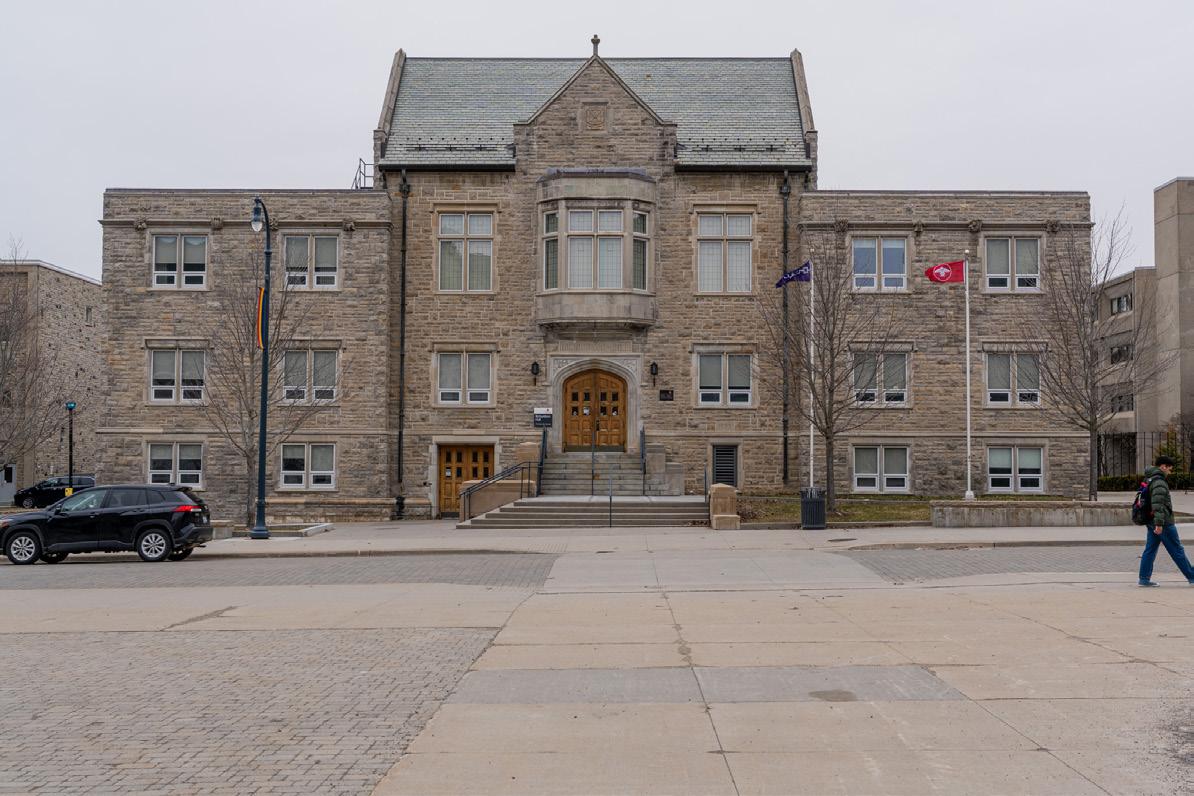
In a nearly empty studio space, the last Queen’s Bachelor of Fine Arts (BFA) cohort is preparing to say goodbye.
In 2022, the BFA class of 2026 was told their program would be suspending admissions indefinitely, making their year the last to graduate the program. While the pause was only supposed to be for two years, and Queen’s cites plans to re-open the program in the future, 2026 will be a bittersweet graduation for the 16 remaining students in the program.
Students Fiona McMillan, Emma Fleming, and Paige Chiusolo, all BFA ’26, all considered more traditional art schools, but chose Queen’s for the small class sizes, studio space, and opportunity to interact with a diverse student body.
“I wanted to interact with people that had nothing to do with my discipline because I thought it would make me more well rounded and not just get stuck in an echo chamber of being a painter who only talks to painters,” McMillan said in an interview with The Journal.
Chiusolo mentioned how she’s a part of the Queen’s Themed Entertainment Development Team, a group comprised of fine arts,
humanities, and STEM students alike. She expressed worries that losing the BFA program will “close them [other students] off to the more creative artsy side of Queen’s,” Chiusolo said in an interview with The Journal
The BFA program is an avenue for students who want to attend a traditional university while following their passion for art.
“I’ve not necessarily been passionate the way I am about art anywhere else,” Fleming said in an interview with The Journal.
McMillan recalls being told the program was halting admissions and feeling in shock. “I was very young and I was very confused, and now I’m less young, but I’m still quite angry about it,” she said.
All three all noted how their small class of 16 has only gotten closer over the years, as their studio space in Ontario Hall has gotten emptier. Small class sizes are important for an arts education, allowing BFA students to hone their craft, and form lasting friendships.
The fine arts studio space is important to the BFA students, who shared their gratitude for an open space to create and connect with each other. “We just spend all of our time in this building [Ontario Hall] and have gotten so exponentially close to one another,” McMillan said.
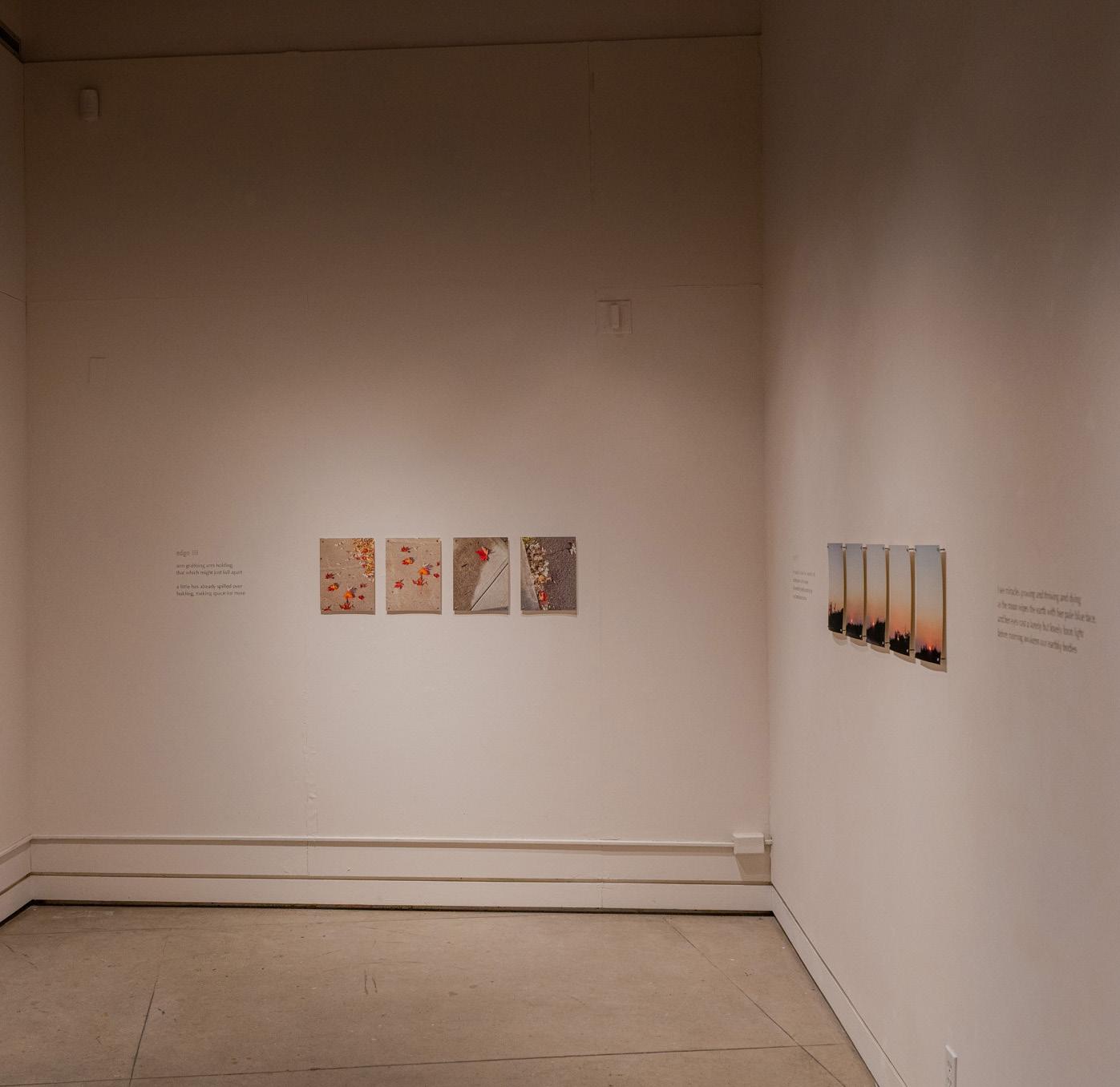
For the BFA class of 2026, working up to their final exhibition feels more important than ever. The exhibition’s an
opportunity for the graduating fine arts students to share what they’ve been working on and celebrate their development over four years in the program.
“I know this is probably going to be the highest attendance of any show, and the most sentimental, I’d say, which I’m grateful to be a part of, but almost devastated that I won’t get to come back next year and see the next one,” Chiusolo said.
For Chiusolo, McMillan, and Fleming, losing fine arts at Queen’s means losing four years of fond memories. All three shared their disappointment that future classes won’t have the same experience.
“I think the only reason there is so much anger is because this program is so great,” McMillan said.
Chiusolo noted that the studio space will probably need some updates before the program could reopen again but hopes the overall structure of the program won’t change significantly.
From the studio space to small classes, and bonding over a shared love of their work, the BFA class of 2026 will have to leave Queen’s knowing the program won’t continue after them. What McMillan called a “special corner” of campus will cease to exist, but McMillan, Chiusolo, and Fleming all expressed gratitude for the memories they’ll be taking with them in their future artistic studies and endeavors.
Postcards, art, and poetry: “the shy caterpillar project”
One Waterloo-based art initiative could foster connection at Queen’s
Marijka Vernooy
Senior Arts & Culture Editor
A new poetry project emerging at the University of Waterloo (UW) could form unexpected connections on Queen’s campus.
UW environmental sciences graduate student Sasha* launched the shy caterpillar project on Jan. 9, leaving five postcards featuring his own art and poetry at a student help desk on-campus. The anonymous project allows Sasha to share his artwork with fellow students and UW faculty, working through his social anxiety through practiced communication skills and low-stakes presentation. Now, Sasha has a vision for how the shy caterpillar project could spread to other universities, potentially helping students at Queen’s express themselves
in a unique way. Sasha’s poems are short, usually only a few lines. Their topics are positive and uplifting, which is “really important when sharing with a universal or non-specific audience, even though I totally understand and support poetry in general discussing complex ideas,” Sasha wrote in a statement to The Journal.
One of Sasha’s favourite metaphors is “the mountain of mindfulness.” He also enjoys using erasure poetry to replace negative emotions with positive ones. For example, “regret” may become “resilience.”
The initiative’s caterpillar symbol developed as part of Sasha’s hope to “come out of my shell a bit,” he wrote. He chooses to write on postcards with artwork he finds positive, like Studio Ghibli characters and work by Eric Carle, famous for his children’s picture book The Very Hungry Caterpillar (1969).
Generally, the project features two kinds of postcards: “Poetry cards,” featuring a longer poem and small drawing, and
‘Feeling Along the edges oF UncertAinty’ embrAces AmbigUity
Alanna Veitch’s Union Gallery exhibition blends poetry and photography, rethinks uncertainty
Daniel Gill Assistant Arts & Culture Editor
Union Gallery’s newest Project Room exhibition, Feeling Along the Edges of Uncertainty, asks viewers to sit with the unknown.
Created by interdisciplinary artist, poet, and PhD candidate in the Department of Gender Studies Alanna Veitch, PhD’28, Feeling Along the Edges of Uncertainty is on display from March 3 to May 9 and combines photography and poetic text to explore how instability shapes emotional, political, and embodied experience.
The exhibition encourages audiences to take their time. Sparse poetry and open-ended imagery are displayed on the walls, creating space for rumination. Veitch’s work centres liminal spaces, or the “in-between.” The photographs are spontaneous images Veitch didn’t initially intend to take, transforming the accidental images into reflections on vulnerability and perception.
In an interview with The Journal, Veitch described uncertainty as a “complex emotion” particularly visible through disability and embodied difference. Identifying as a disabled artist and emerging scholar, Veitch approaches uncertainty not solely as an anxiety, but as something socially produced and collectively experienced.
“Art cards,” drawings customized to a particular audience or on-campus office with limited writing.
“Regarding poetry, I just really enjoy both reading and writing poetry, especially more tactile poetry forms like erasure poems and concrete poetry,” Sasha wrote. Group poetry readings or slam poetry events can be challenging for their “extroverted” nature, so Sasha developed the shy caterpillar project as a introverted and extroverted way to share his work with the UW community.
“I think the sharing piece really helps with my personal social anxiety specifically, and I’ve found over time it’s become a lot easier to share the initiative with others,” he wrote.
Since launching the project in January, Sasha has delivered postcards to over 50 different locations on the UW campus.
Continued online at www.queensjournal.ca
“affective economy,” shaped by systems that affect us all such as economic precarity and accessibility rather than personal failure.
The exhibition grew directly from Veitch’s doctoral research. Discovering Union Gallery’s student call on the theme “in this economy?!” while developing her dissertation allowed her to translate academic research into art, building a portfolio of research beyond traditional scholarship.
Poetry and photography operate as parallel modes of inquiry in the exhibition. Veitch explained that the show’s structure emerged from her poetry manuscript, organized around the idea of “edges,” both physical and metaphorical. Living with disability informed this framework, taking inspiration from the experience of navigating spaces by tracing literal edges of walls for balance.
Images like an IV bag of medicine and photos taken while last year’s TA strike was occurring reflect what Veitch describes as “intense uncertainty.” Blown up, the photographs retain a quality of striking immediacy that was particularly resonant, emphasizing how ordinary encounters can still bear emotional weight.
Despite its theoretical grounding, Feeling Along the Edges of Uncertainty remains deeply personal. Veitch hopes audiences approach the work with curiosity, allowing themselves to be affected rather than searching for definitive meaning. “Part of doing creative work is to affect audience members,” she said, adding that the exhibition represents an ongoing process of trusting viewers to interpret the work.
Drawing on theorist Sara Ahmed’s work on affect, Veitch frames emotion as circulating between people rather than existing purely within individuals. “Emotion is not something we own,” she said. “It connects us to one another and binds us together in cultural and social spaces.” Uncertainty becomes an
Ultimately, the exhibition reframes instability as something productive rather than limiting. By merging theory, lived experience, and artistic experimentation, Veitch offers a reminder that the future may be uncertain, but that uncertainty can still be the site of connection.
The exhibit runs through May 9.
PHOTO BY JASHAN DUA
In Quilt’s ‘Held/Close,’ Queen’s student writers play with form and proximity
The undergraduate literary publication launched their newest volume this week
Marijka
Vernooy Senior Arts & Culture Editor
This spring, one Queen’s publication hit the six-year mark with their bi-annual volume of student works.
On March 30, Queen’s undergraduate literary publication Quilt launched their sixth volume, Held/Close with an intimate gathering at Lay Low Café. The 73-page volume was the club’s longest ever since their founding by the English Department Student Council in 2020, marking a new chapter for the publication as they incorporated non-literary academic works into the collection. Copies of Held/Close were sold at the Lay Low event.
The launch event was a joyful success, opening at 6:30 p.m. with a gentle
FoUr wAys to deFrost in Kingston now thAt spring hAs
FinAlly Arrived
The best ways to step back outside after winter
Daniel
Gill Assistant Arts & Culture Editor
Spring’s officially underway, and Kingston is finally beginning to thaw.
After nearly six months of rushing between buildings and layering sweaters under winter coats, the first stretch of consistently warm weather feels like permission has been granted to re-enter the outside world.
If you’re unsure of how to transition from winter hibernation mode to spring activity, here are four easy ways to defrost while still in Kingston.
Walk (or run) by the water
There’s no clearer sign winter is ending than people reappearing along the Kingston waterfront. Stretching along Lake Ontario, the waterfront trails offer kilometres of paths for walking, running, or simply standing still and appreciating fresh air again.
While it might still be too cold for a swim, the abundance of trails, scenic views, and historic landmarks makes the area an ideal place to ease back into spending time outdoors without committing to anything more strenuous than a casual stroll, or a jog for the more eager.
Read a book outside
After months spent studying
acoustic guitar set by Queen’s student musician Dani Tess, ArtSci ’28. Quilt members and their loved ones chatted as the mid-spring sunlight filtered through Lay Low’s high windows, sipping on signature cocktails “Held” (a tequila-cranberry twist) and “Close” (a warm, melty, hot chocolate-Kahlua delight).
Around 7 p.m., members of Quilt’s executive team took the mic to address the audience and shout out the team of editors, illustrators, and organizers who brought Held/Close to life. Authors were then invited to read excerpts of their work and share a bit about their respective meanings, a portion of the event I found beautiful.
Works ranged from poetry to short fiction to academic essay, a diversity that makes
under fluorescent library lighting or in your room, reading outdoors can feel revolutionary. Green spaces like City Park or the shoreline can provide a low-pressure reintroduction to spring weather.
Whether you’re tackling course readings or reading purely for enjoyment, sitting outside on a park bench or blanket with nothing but a novel and fresh air can feel rejuvenating. With plenty of green space on campus and throughout Kingston, spring is the perfect time to reopen your books outdoors.
Discover Kingston’s museums
Spring weather in Kingston can still be unpredictable, making museums the perfect middle ground between staying inside and exploring the city again. The Great Lakes Museum is a particular standout, offering both indoor and outdoor experiences suitable for shifting spring conditions.
With other institutions like the PumpHouse Museum dotted around town, and temperatures finally warm enough to make longer outings outside worthwhile, museums offer an engaging way to spend an afternoon while easing back into city life.
Wander Princess St. without a plan
Sometimes the best way to enjoy the season is simply walking with nowhere specific to go.
Princess St. Kingston’s main downtown retail corridor, offers something for nearly every interest.
After months of freezing temperatures, it’s easy to forget the outside world exists beyond the walk between campus and home.
Window shopping, grabbing a coffee, or stepping into a localstore you’ve never visited before are simple ways to enjoy the city now that wandering outside is once again comfortable.
Whether you’re walking by the water, reading in the sun, visiting a museum, or aimlessly
Held/Close unique among Quilt’s other volumes. “Quilt brings together the academic and the literary,” Co-Editor in Chief Madeleine Chiappetta, ArtSci ’27, said in an interview with The Journal. “Bringing back the interdisciplinary aspect of Quilt was really important to me, and I’m glad we got to do it in this edition.”
Chiappetta referred to “Location, Location, Location,” an essay on colonial power in Spanish architecture by Eve Raine, ArtSci ’26. Chiappetta said she hopes future authors will submit academically inclined works to Quilt.
As a publication, Quilt fosters space to write for all students. “Having a place like Quilt to submit their work with a hard deadline helps people take the time to write,” Chiappetta said. Quilt accepts submissions twice a year for its fall and winter editions, both from within their some 50-person membership, and
strolling down Princess St., spring has finally arrived, and Kingston is ready to be enjoyed to the fullest again.
the Queen’s student body.
“There’s a lot of different places at Queen’s and in the broader community to publish things that are more traditional,” Chiappetta said. Through the inclusion of works like “Location, Location, Location,” Quilt shifts their literary canon to encompass a larger range of expression.
For example, Chiappetta also highlighted “Ocean/Wave” by Sarah O’Keefe, ConEd ‘26, two poems in conversation with one another which break conventions of form to create meaning. “It’s kind of experimental poetry,” Chiappetta explained. “Giving a place for that in publication is really important.”
Quilt itself is a labour of love. In-house illustrators and authors work together “to develop a vision related to the piece,” Chiappetta said.
For Held/Close, Quilt chose the general theme after receiving submissions as a
colonial perspective of land ownership,” she said in an interview with The Journal. This perspective was
Union Gallery’s
‘Pedestrian Values’ examines capitalism in the urban space
The installation rethinks how cities teach us to value land, labour, and each other
Veer Bhalla Assistant Arts & Culture Editor
The city around you is quietly teaching you how to think about value. In Pedestrian Values, urban infrastructure becomes a site for critique.
Created by visiting artist Cassie Paine, the exhibition runs in the Main Space at Union Gallery from March 3 to May 9. Through sculpture, installation, and printmaking, the show examines how capitalist and colonial value systems are reinforced through the built environment. Drawing from her experience growing up in Windsor, Ontario—a post-industrial border city shaped by auto manufacturing—Paine explores how economic precarity and urban development inform how people relate to space. Using altered materials like traffic barrels, construction mesh, and cast coins, the exhibition critiques systems that prioritize profit and growth over collective well-being.
Pedestrian Values’ ideas are rooted in both personal experience and broader observation. Growing up in Windsor, Paine was exposed to “a specific capitalist and
“through-line,” according to Chiappetta. “With Held/Close, we found all the works in the edition focus on more of a moment. Works spoke to different definitions of both ‘held’ and ‘close,’” she said. “It can be kind of a comforting hold from a parent or partner, or when you’re gripped tightly by anxiety or depression,” Chiappetta explained. This idea led to Held/Close’s cover imagery, featuring an illustration of someone pinned for inspection, like a bug.
Being “held” might be comforting and intimate, but also scrutinizing, Chiappetta said. She enjoyed seeing how the edition’s works played into different angles of the title.
With plenty to examine, capture, and explore, Held/Close is a collection of unique, inspiring works that gives voice to the student body it represents.
value beyond critique and into collective reflection,” Paine explained.
reinforced through education, policy, and everyday interactions with the city.
A recurring visual motif throughout the exhibition is the banknote pattern from the board game Monopoly. Enlarged and embedded into objects like construction mesh and scattered coins, the imagery acts as a direct critique of capitalist systems.
The game itself, which rewards players for accumulating wealth and bankrupting others, becomes a metaphor for how value is taught and internalized from an early age.
The materials and processes behind the work are central to its meaning. Paine incorporates metal fabrication, bronze casting, and screen printing, alongside interventionist strategies that alter familiar elements of public space. These methods allow her to both replicate and disrupt the visual language of urban infrastructure, encouraging viewers to reconsider objects they might otherwise overlook.
One element unique to this iteration of the exhibition is the inclusion of works produced during a plaster coin workshop hosted by Union Gallery.
“Participants were invited to carve coins reflecting shared values and social needs, which are now displayed as part of the installation. This addition introduces a collaborative dimension, expanding the exhibition’s exploration of
Paine sees art as a way to open dialogue rather than provide definitive answers. While engaging with political and economic systems carries a responsibility, she emphasized the importance of reflection and critical awareness. “There is a responsibility of artists to critically engage with the world around them,” Paine said.
At the same time, Pedestrian Values acknowledges the complexity of that engagement. Paine reflected on her own position within the systems she critiques, noting that participation in capitalism is often unavoidable. This tension is embodied in the work “Deconstruct/Reconstruct,” which features a bronze excavator bucket merged with a three-dimensional scan of her hand. Attached to a scaffolding structure, the piece invites viewers to physically interact with it, reinforcing their own involvement in cycles of construction and extraction.
Through this interactivity, Pedestrian Values asks viewers to consider their relationship to place. Rather than presenting a singular message, the exhibition encourages ongoing reflection, both within the gallery and beyond it.
“I hope that the exhibition prompts the viewer to critically engage and consider their environment,” Paine said. Ultimately, the work challenges what is often taken for granted. By reworking the materials and symbols of urban life, Pedestrian Values reveals how deeply systems of value are embedded in the spaces people move through every day.
Last Words
Sarah and Meg reflect on Vol. 153
Meghrig Milkon Editor in Chief
A medium s’mores Blizzard, a large box of fresh, crispy fries with mayo, Takis, Grocery Checkout yogurt pretzels, and a cold case of Coca-Cola—those were my go-to orders on a typical press night. Not the healthiest choices, but the ones that brought me the most joy in the middle of all the chaos.
I’ve read so many of these articles before, obsessing over every word, who they thanked, and the stories they chose to tell. I never understood how they managed to capture it all in around 800 words. I don’t have an answer. So, I’ll tell you about one of the worst weeks of this job.
It was the middle of winter. That morning, I had just left a midterm after staying up late the night before to study for it, last-minute, as usual. On my way out, we got an e-mail telling us we had to attend a Special Assembly for something I already knew was coming. Call it a gut feeling, or the naivety of someone always chasing a story—I was right. The story broke because I followed that intuition.
What I didn’t anticipate was everything that came after. From Tuesday through the end of that week, I barely slept. Not just because of the chaos that followed, but because I was shaken by late-night calls filled with anger, by the comments, and by students who refused to read yet spoke as if they knew everything. I saw a kind of hate to a degree that I had
never seen before, and I kept falling deeper into that rabbit hole.
Jonathan, I know you’re reading this. You probably already know which night I’m talking about. I just hope you’re not too disappointed to see that I failed to follow the advice I gave you that same night: ignore the noise and go to bed; there’s a press night tomorrow, and we have a paper to put out. Dear reader, if you’re wondering, we did put it out, and we did a damn good job at it too.
Those three days were some of the worst, but also, in a strange way, the “tamer” ones. The comments kept coming—that I was undeserving of the job, criticisms of my background as an Arab woman, and accusations that I defended Western thinking. Maybe there’s some truth in that; maybe I’m “whitewashed” in that way. I found myself struggling to make my voice heard in meetings, cast as the problem, often for wanting to defend the integrity of the paper and its history.
But I won’t dwell on the negative. Partly because I think my experience was unique and partly because there was more good than bad, at least I think there was.
Vol. 153, you taught me many things: patience, kindness, when to slow down, and when to rush. You gave me friendships that will last a lifetime and skills I’ll carry with me wherever I go. You also gave us chaos, with non-ending issues with student politics, bureaucracy, and the weight of ongoing conflicts across the world. You allowed us to navigate it all.
You also took away the home
I had come to cherish and replaced it with a space I don’t think anyone will ever love quite the way I do. I know some alumni might be sad or angry with this, but I am happy with where we ended up.
To the next generation of QJ staff who will walk through its doors: take this for whatever it’s worth. Respect it. Not just the walls or the desks, but the weight it carries. You’ll feel it the moment you step inside; let it settle on your shoulders. Be gentle and move with it, not against it.
There will be days when that weight feels like too much, when the easiest thing to do is turn around and run. Don’t. Stay. Open the photo albums. Call the alumni who once sat where you are now. Lean on your staff, even when it feels easier to pull away. They will steady you. They will remind you why you’re here.
Speaking of wanting to run, did you all really think the only thing keeping me grounded was food? Of course not. It wasn’t just the food. It was the people I shared it with. And if you’re wondering who was always there, well, that would be Sarah. Or, as I like to call her, Lisa.
Continued online at www.queensjournal.ca
Sarah Adams Editor in Chief
A job that was as unforgiving as it was addictive.
It feels like just yesterday I was sitting in the front office of The Journal house at 7 a.m., on a slightly wobbly chair, racing to lay out Issue 1 before the 8 a.m. print deadline as the sun crept over the homes of 190 University Ave. My heart was pounding, my hands unsteady, caught somewhere between the
weight of 153 years of student journalism and sheer exhaustion, but even in that chaos, I knew I was exactly where I was meant to be.
And more than anything, I was completely hooked.
If I could go back to that terrified version of myself, I’d tell her this: it all works out. The moments that feel impossible become the ones you’re most proud of, and the decisions that feel like they might break you are the ones that build something stronger than you ever thought possible.
I look back on the summer months as a hazy dream, days spent chasing time in a boiling house with bats scurrying overhead as we worked late into the evenings, until, suddenly, it was gone.
I can’t help but admit that my heart drops passing The Journal house on 190 University Ave., our big red home. I can’t quite bring myself to fully look at it, because to do so would mean confronting all the memories held inside it, and knowing those moments won’t exist again, not for me, and not in the same way for the future of The Journal. But when I think about those times, I have to remind myself that I’m looking at them through rose-tinted glasses. It wasn’t always good. The simple things—like using the washroom or using broken chairs and desks or having drinkable water—made working there hard.
I know alumni are disappointed, thinking we didn’t fight hard enough or didn’t care enough. But it was never for a lack of trying or for a lack of love. What I wish I had known in those heated summer months is that what we would build here would be better than I ever imagined; a space where we can breathe, work, and actually look forward to. It didn’t erase the
loss, but it gave us something new—something stronger.
The AMS made life hell for us this year, and I need that to be clear. But I wouldn’t trade it for anything. I remember the pit in my stomach as we hit publish on the AMS President having her credit card revoked, knowing the fallout that would come. But I knew we had done our job. And when Joe Brean emailed us to say it was excellent student journalism—that he was proud of us for trusting our gut—we felt, for the first time, that we weren’t alone. That we were backed by 153 years of people who had done this before us.
And in many ways, The Journal had been there for me long before I ever had the chance to show up for it.
Before I ever set foot on campus, The Journal was already shaping my Queen’s experience. When I was placed on West Campus and searching for what life might look like, one article—“West Campus isn’t that bad”—gave me a sense of comfort at my first moment of isolation in university that I didn’t know I needed.
And I couldn’t have imagined then that the same paper would go on to do that for me in a million other ways. I’ll always be grateful for what The Journal has given me—and this year, I only hope I gave something back.
The Journal is in the most capable hands for Vol. 154 and beyond, and I genuinely can’t wait to watch all the incredible things Jonathan and Eva will do next year. The two of you will without a doubt make The Journal a better place, and all I ask is that you never forget why you wanted to be here.
PHOTO BY JASHAN DUA
Sarah and Meg pay tribute to the old ‘Journal’ house sign outside the new office.