The Queen's Journal, Vol. 153, Issue 27

Page 1


Campus Radio Raises ConCeRns oveR ams

RefeRendum pRoCess

Station says communication, oversight, and transparency issues put its student fee at risk

E mm E t P aradis

Assistant News Editor

CFRC 101.9 FM is calling for greater transparency in how the AMS runs referenda after narrowly renewing its optional student fee in Fall 2025.

In an interview with The Journal, Dinah Jansen, executive director of CFRC, Queen’s campus and community radio station, said the station isn’t trying to frame the issue as a dispute solely between CFRC and the AMS, but as a broader concern about how referenda were administered.

“The lack of organization, the lack of personnel, the lack of training, the lack of communication, the lack of working forms, everything was really just a gong show,” Jansen said.

CFRC receives funding through an optional AMS student fee of $8.22. Jansen said the station passed its most recent fee renewal by a narrow margin, at just over 52 per cent, and would’ve faced an existential threat if it had failed.

“We’re the longest running campus station globally, the second oldest radio station in Canada, we would ultimately have to wrap up our operations probably after a year,” she said.

Jansen said CFRC had wanted to undergo its triennial review in the winter 2026 referendum cycle but was told in August 2025 that all groups under triennial review would be required to participate in the fall referendum instead.

In a timeline document shared with The Journal, CFRC said it raised concerns at the time that fall campaigns historically see lower turnout, which increases the percentage of “yes” votes required to meet approval thresholds. She said this put the station at an “existential risk” because a failed renewal wouldn’t have guaranteed another chance in the winter cycle and could’ve forced the station to attempt the more difficult process of establishing a brand-new fee.

The same document alleges that the station later discovered 11 triennial review groups appeared in the winter 2026 cycle, despite CFRC having been told by the AMS that all such groups would run in the fall.

Story continued on page 2...

OPINIONS

AMS budget deficit balloons to over $850K in nine-month update

Queen’s Pub shortfall comprises more than half the Society’s overall deficit

The AMS’ budget is falling short of projections, with recent financial figures suggesting lower student engagement with services than expected.

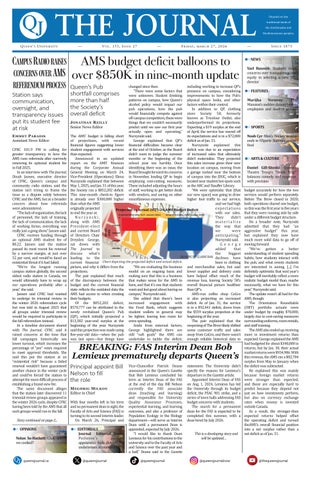
Announced in an updated report on the AMS’ finances during the Corporate Annual General Meeting on March 24, Vice-President (Operations) Elena Nurzynski explained that between May 1, 2025, and Jan. 31 of this year, the Society ran a $852,202 deficit. This nine-month check-in figure is already over $300,000 higher than what the AMS originally projected to end the year at. Nurzynski, along with AMS President-elect and current Board of Directors Chair Dreyden George, sat down with The Journal to discuss what’s leading to the current financial picture, and why it differs from the projections.

changed since then.

“There were some factors that were unknown. Student drinking patterns on campus, how Queen’s alcohol policy would impact our pub operations, how the pub would financially compete against off-campus competitors, these were things that we couldn’t necessarily predict until we saw our first year actually open and operating,” Nurzynski said.

George explained that QP’s financial difficulties became clear at the end of October, as the Board didn’t want to judge the summer months or the beginning of the school year too harshly. Once identifying there was an issue, the Board brought forward its concerns in November, leading QP to begin employing cost-cutting measures. These included adjusting the hours of staff, working to get better deals with vendors, and saving on other miscellaneous expenses.

including working to increase QP’s presence on campus, considering improvements to how the Pub’s physical space looks, and other factors within their control.

In addition to QP, clothing store Society 58, formerly known as Tricolour Outlet, also underperformed its projections. Expecting a $19 surplus at the end of April, the service has veered off its expectations and is in a $72,000 deficit as of Jan. 31.

Nurzynski explained this deficit was due to an expectation of increased sales that ultimately didn’t materialize. They projected this sales increase given their new location on campus, moving from a garage tucked near the bottom of campus into the JDUC, which is located near student hot-spots such as the ARC and Stauffer Library.

The pair explained that much of the discrepancy between the budget and the current financial state reflects the outdated data the AMS had access to when creating their budgets.

Of the $852,202 deficit, $570,777 can be attributed to the newly revitalized Queen’s Pub (QP), which initially projected a $13,382 year-end surplus at the beginning of the year. Nurzynski said this projection was made using five-year-old data—when the pub was last open—but things have

“We are evaluating the business model on an ongoing basis and making sure that this is a business that makes sense for the AMS to have, and that it’s one that students want and feel good about having on campus,” Nurzynski said.

She added that there’s been increased engagement with the Food Bank, which suggests student wallets in general may be tighter, leaving less room for extra spending.

Aside from external factors, George highlighted there are still “soft goals” the AMS can undertake to tackle the deficit,

“We were optimistic that [that our new space] was going to draw higher foot traffic to our service, and we had high expectations with our sales. They didn’t materialize the way that we were anticipating,” Nurzynski said.

George added that the biggest declines have been in clothing and merchandise sales, but said lower supplier and delivery costs have helped offset much of the revenue loss, leaving Society 58’s overall financial picture healthier than QP’s.

AMS-run coffee shop CoGro is also projecting an increased deficit. As of Jan. 31, the service is in a $92,441 deficit, down from the $559 surplus projection at the beginning of the year.

The pair explained that the reopening of The Brew likely shifted some customer traffic and sales away from CoGro, and there wasn’t enough reliable historical data to

BREAKING: FAS Interim Dean Bob Lemieux prematurely departs Queen’s

Principal appoint Bill Nelson to fill the role

m E ghrig m ilkon

With four months left in his term and no permanent dean in sight, the Faculty of Arts and Science (FAS) is turning to its second interim leader. On March 26, Principal and

Vice-Chancellor Patrick Deane announced in the Queen’s Gazette that Bob Lemieux concluded his term as Interim Dean of the FAS at the end of the day. Bill Nelson currently the FAS associate dean (teaching and learning) and responsible for University Quality Assurance Processes, experiential learning, and learning outcomes, and also a professor of Population Ecology in the Biology department—will serve as Interim Dean until a permanent Dean is appointed, expected by July 2026.

“I would like to thank Dean Lemieux for his contributions to the university and to the Faculty of Arts and Science over the past year and a half,” Deane said in the Gazette

statement. The University didn’t specify the reasons for Lemieux’s departure in the Gazette article.

Appointed Interim Dean of FAS on Aug. 1, 2024, Lemieux has led the University through its budget deficit, the PSAC 901 strike, and a series of town halls addressing FAS budget concerns with students.

The search for a permanent dean for the FAS is expected to be completed this summer, with a dean hired by July 2026.

This is a developing story and will be updated…

budget accurately for how the two services would perform separately. Before The Brew closed in 2020, both operations shared one budget, so this was the first year in five years that they were running side by side under a different budget structure.

On a broader note, Nurzynski admitted that they had “an aggressive budget” this year, but explained they now have much more solid data to go off of moving forward.

“We’ve gotten a better understanding of student spending habits, how students interact with the pub, and what events students are interested in seeing. [...] I’m definitely optimistic that next year’s budget will inevitably reflect a more realistic budget model than, maybe necessarily, what we have for this year,” Nurzynski said.

The update wasn’t all bad for the AMS, though.

The Orientation Roundtable (ORT) portfolio actuals were under budget by roughly $70,000, largely due to cost-saving measures surrounding uniforms, room rentals, and staff training.

The AMS also ended up receiving more in investment returns than expected. George explained the AMS had budgeted for about $348,000 in returns, but by Jan. 30, their actual market returns were $934,986. With this revenue, the AMS ran a $82,784 surplus from May to January when the deficit was subtracted.

He explained this was mainly because foreign market returns were stronger than expected, and those are especially hard to predict because they depend not just on how investments perform, but also on currency exchange rates when money is invested outside Canada.

As a result, the stronger-than expected returns helped offset the operating deficit and turned theAMS’s overall financial position into a net surplus rather than a net deficit as of Jan. 31.

Noah Cyr: Men’s Hockey season ends in USports National quater final
Daniel Gill-Sitoski: Queen’s Theatre Troup’s “Death Trap” balances comedy and suspense with precision
Yael Rusonik: Students voice concerns over transparency and equity in selecting a new SPS director
Marijka Vernooy: The Mansion’s sudden closure leaves employees and student groups
Nolan Su-Hackett: Chat, are we cooked?
Chart depicting the projected deficit and actual deficit.
GRAHPIC BY CLAIRE BAK

Student claims structural design flaws and oversight gaps hollowed out upper-year course options

While students are raising concerns with the now disbanded online degree plan, administrators insist the situation is under control.

On Dec. 18, 2023, the Faculty of Arts and Science (FAS) announced it would no longer accept admissions to Arts and Science Online (ASO) degrees and certificates, due to budget tightening. Since then, the University has been teaching out the six fully online degree programs. Due to the teach-out, a part-time student says it has left remaining students with too few upper-year online options and no clear written plan for how part-time students will complete their degrees.

Arts and Science Online teach-out raises broader concerns about oversight and fairness

the suggestion that students are being left without a viable route to graduate.

According to Brook, part-time students have been affected differently from those who moved through the online programs on a full-time timeline. They said Queen’s never provided part-time students with a clear closure notice, a stated completion window, or a multi-term teachout plan that reflected that longer timeline.

Brook alleged that while full-time students were generally able to move through the program while more upper-year options still existed, part-time students are now reaching the point in their degrees when those options have shrunk. Brook claimed that the degree framework was vague, allowing Queen’s to cut 300-level options.

“The six fully online ASO degrees were approved under Ontario’s current framework with vague ‘200level or above’ language instead of clearly defined thirdyear cores. That design has now been used to cancel most genuine 300 level options while still claiming students meet their plans on paper,” Brook wrote.

In an interview with The Journal, Bill Nelson, associate dean (teaching and learning), disputed

In a statement to The Journal, Brook*, a current ASO part-time student, alleged the Summer 2026 Distance Education calendar includes only two 300-level courses—PSYC 397 and HLTH 332—stating the offerings don’t “meaningfully serve the current cohort” of online students. They also argued that the courses are either limited in scope or have unclear applicability across the six ASO degree programs.

CFRC raises concerns with the AMS’ referendum fee process

Continued from the front page...

In a statement to The Journal, AMS Secretariat Racheal Reddy said all groups undergoing triennial review are scheduled for the fall cycle by default, and that deferrals to winter occur only when the Student Activity Fee Review Committee (SAFRC) determines additional information or clarification is needed for a submission to meet policy requirements.

Jansen said CFRC still hasn’t received a clear explanation for why it was required to go in the fall while other groups were deferred. In her statement, Reddy said deferrals are determined on a case-by-case basis by the SAFRC, but didn’t address why CFRC wasn’t deferred.

Jansen also raised concerns about the administration of the referendum period itself, arguing forms were malfunctioning, responses from the elections team were often delayed or absent, and it wasn’t clear who was responsible for overseeing the process.

In the documents shared with The Journal, CFRC alleges there was no ratified elections team in place when the fall election period began on Oct. 20, 2025, and that the station was told at one point the elections team wouldn’t be ratified until December, after the referendum had concluded.

“There was no governance team basically through the entire fall period,” Jansen said. “And this is highly problematic.”

During a January Special Assembly, former AMS President Jana Amer said the fall referendum period coincided with staffing shortages and vacant positions

He shared that FAS planned the teach-out to ensure students could complete their degrees by Fall 2026. Additionally, he said the Faculty is working with part-time students individually to create completion plans, but to create an individual plan, students must take the first step and reach out for advising.

“Every single student, including the part-times, they have a pathway to graduation,” Nelson said.

Brook explained that the issue isn’t simply whether some individualized pathway exists, but whether part-time online students still have access to the kind of upper-year academic depth they reasonably expected when they enrolled.

Nelson, however, said online offerings vary from year to year because departments rotate which courses are available, and said the FAS’s goal is to preserve the overall number of online courses available to students. According to Nelson, 10 per cent of FAS courses are typically online.

“We are aiming to maintain the same number of online courses that we’ve always had,” Nelson later stated, “we still have robust offerings for online courses.”

Beyond concerns about Queen’s ASO programming, Brook argued

that Ontario lacks clear, provincewide rules requiring universities to publish written teach-out plans, preserve meaningful upper-year course options during phase-outs, or guarantee realistic completion windows for part-time students.

The implications, Brook argues, go beyond course registration. They insisted that students with limited upper-year coursework could face disadvantages when trying to transfer into four-year programs, apply to graduate or professional schools, or compete for jobs.

Brook said they tried to raise these concerns with both Queen’s internal Ombuds Office and the Ontario Ombudsman. According to e-mails shared with The Journal, the Queen’s Associate Ombudsperson, Heather Trojek, responded that no systemic review was needed as they hadn’t received any additional complaints.

The Ontario Ombudsman, via e-mail, told Brook that they can review complaints about publicly funded universities, but normally expect complainants to use universities’ internal processes.

Alongside reaching out to administrators and the provincial government, Brook also contacted the AMS with her concerns and a policy brief in early February.

In an interview with The Journal, Vice-President (University Affairs) (VPUA), Alyssa Perisa, confirmed

Team Dae hopes To rebuilD sTuDenT TrusT in The ams During upcoming Term

that the AMS had received the brief, but because of internal turnover, the e-mail didn’t reach her office until the end of February. Perisa shared that since receiving the policy brief, she and the Commissioner of External Affairs (CEA) have been working together to review the document, initiate internal discussions, and coordinate with the Arts & Science Undergraduate Society (ASUS) to determine next steps. As well, she’s working to update the incoming VPUA and CEA to ensure they’re up to date, as, due to timing, she assumes most of the advocacy work won’t take place until the summer or the 2026 Fall semester.  Brook said the case should raise wider questions about fairness, accountability, and public trust in Ontario’s university system. She argued that if a program can be wound down without clear protections for upper-year depth or part-time completion timelines, similar risks could face other students in future closures or restructurings.

*Name changed for privacy reasons

on by tariffs, the potential impacts of Bill 33, and work culture issues within the AMS brought on by its recent controversies. George plans on addressing these issues by working to better understand and mitigate how Bill 33 would potentially affect student life, and further engaging with senior managers and volunteers to set a better tone within the AMS.

within the organization, including in areas responsible for elections administration.

“In terms of communication and oversight, deadlines and procedural requirements are communicated through the Civic Affairs Office, with oversight from the Secretariat and the AMS President,” Reddy wrote.

“Structurally, the Civic Affairs Office is responsible for administering elections and referenda processes, while operating independently to preserve procedural integrity.”

Despite her concerns, Jansen praised the AMS marketing team, saying its work helped raise awareness of the referendum and may have helped several groups keep their fees.

However, CFRC also says campaigning opportunities were limited. Jansen said groups were initially assigned only two tabling days in the ARC and weren’t given notice or flexibility to organize in-person outreach.

The station further alleges that referendum results weren’t communicated within the timeline required by AMS policy, which states that results must be announced within 12 hours of the end of voting. According to the documents, CFRC received results from an elections e-mail address at 11:11 p.m. on Nov. 15, nearly 24 hours after voting ended, while the official e-mail from the Chief Returning Officer wasn’t received until the afternoon of Nov. 17.

Jansen said that the delay was especially difficult given what was at stake for the station.

Reddy said the AMS “takes the concerns raised seriously,” and is reviewing the process.

Incoming AMS executives outline plans to bolster accountability, affordability, and engagement

Meechan &

‘The Journal’ acknowledges that a staff member is affiliated with the incoming VPOPS, but wasn’t involved in reporting or writing this story to maintain ethical journalistic standards. After a turbulent semester, Team DAE is setting out its vision for the AMS.

This past January, students voted in a new AMS executive team, selecting Dreyden George, ArtSci ’27, for president, Edward Sy, HealthSci ’28, for vice-president (university affairs) (VPUA), and Avery Papoulidis, HealthSci ’27, for vice-president (operations) (VPOPS). Now, almost two months after their election, The Journal sat down with the trio to learn more about their vision for the upcoming school year.

According to George, the members of team DAE have been meeting weekly and have been taking every opportunity to engage with the outgoing executives and head managers in an attempt to ensure a smooth and comprehensive transition into their roles on May 1.

In their upcoming terms, team DAE hopes to rebuild student relationships with the AMS

by prioritizing accountability, affordability, and engagement.

President

On March 10, following the resignation of previous AMS President Jana Amer, George was appointed interim president and will officially step into the role on March 27. While this early transition was unexpected, George said he views it as an advantage, as he’ll have more time in his role.

During his time as president, George hopes to rebuild trust in the AMS through increased transparency and accountability. For him, this involves greater engagement with The Queen’s Journal through increased communication and the building of positive relations, a sentiment he then extended to any “partner” the executives work with. He also hopes to further communication through traditional social media channels, the implementation of office hours where students can come speak to their executives, and additional resources to help the internal affairs office increase voter turnout.

George also hopes to help ensure the AMS works better within its budget, while also ensuring important AMS services, such as the food bank or student experience bursary, remain well-funded and accessible. One plan he has to increase affordability within the AMS involves encouraging further cross-department collaboration to combine resources to produce larger-scale events.

In the coming school year, George anticipates some challenges arising from higher prices brought

Vice-President (Operations)

Similarly to George, Papoulidis also understands the importance of strengthening student relationships with the AMS come May 1.

“I think that, right now, it’s no surprise that there’s a lack of trust toward the AMS,” Papoulidis said. “A big goal of ours is to really figure out specific strategic initiatives and goals to at least attempt to mend that relationship by being transparent.”

As VPOPS, Papoulidis will also be working with AMS services to address the $852,202 budget deficit attributed to AMS, and the $570,777 deficit specifically attributed to the Queen’s Pub, which Papoulidis has worked in as the Assistant Manager of Marketing and Events. She plans on analyzing foot traffic and numbers from the past year to better understand the status of JDUC services and to learn how to further increase student engagement with such services.

“I think that all of the pieces are intertwined together,” she said. “Engagement will likely increase if people see more trust and accountability within the AMS, and engagement will also likely increase if they see more collaborative opportunities.”

As she transitions into her role, Papoulidis plans on sitting down with the head managers of different AMS services to create goal plans and budgets, and to have conversations with permanent staff and other stakeholders within the AMS to determine how they can better support society services

Students voice concerns over transparency and equity in selecting a new SPS director

Tensions surrounding the process have led to the resignation of interim Director

Eugene Lang

A community meeting for the School of Policy Studies (SPS) allegedly ended in faculty infighting, slammed doors, and a sudden resignation.

Students from the SPS have raised transparency and equity concerns to the University regarding the selection process for a new director of the SPS. After months of back-and-forth, these concerns ultimately led to infighting among faculty members at a SPS community meeting on Feb. 27, and the resignation of Interim Director Eugene Lang.

The Journal spoke with students, faculty, and administrators to reconstruct the incident. While The Journal also reached out to Lang for his version of events, he didn’t provide a response.

Two students from the SPS, Ben Salazar and Menka Bélanger, both MPA ’26, spoke with The Journal to clarify their recollection of the timeline of events and share their thoughts on the conduct of the selection committee.

The pair explained that, as early as January, SPS students were expressing concerns to the University about a lack of student involvement in the appointment process for the new director. Salazar and Bélanger claim that while students have previously been represented on SPS selection committees, none were given formal positions during this process.

In response to these early concerns, the University set up “Lunch and Learn” sessions with the five candidates short-listed for the director position.

According to Bélanger, however, these sessions were initially

presented as being part of an ordinary guest lecture series, with their true purpose—introducing students to the candidates—only being clarified by Lang after the first “Lunch and Learn” had already taken place.

Students were then told that, if they wanted to send feedback to the selection committee, they had to attend or review all five sessions.

For Bélanger, however, this raised accessibility issues, as the first lecture had already passed, some of the other lectures conflicted with midterms and reading week, and the recordings were supposedly difficult to hear.

28 MPA students signed a letter raising these concerns to the selection committee on Feb. 18. The students also wrote that the Collective Agreement between the Queen’s University Faculty Association (QUFA) and the University indicates there should be student representation directly on the selection committee.

The Collective Agreement states that when appointing a new head of department, “one (1) undergraduate and/or one (1) graduate student (where appropriate) from the Department” should be nominated to the committee.

The chair of the committee, StefanievonHlatky,respondedtothe student letter in an e-mail obtained by The Journal, agreeing that the “Lunch and Learn” scheduling was “extremely challenging,” and explaining the timing was a result of having to work around the travel and teaching schedules of candidates. Concerns regarding the committee’s interpretation of the Collective Agreement weren’t addressed.

At a SPS community meeting that took place on Feb. 27, Associate Dean (Graduate) James Fraser began by addressing some of the concerns that students have brought forward in their letters.

Bélanger claimed that Fraser echoed the scheduling rationales previously provided by Hlatky, while indicating that the true purpose of the “Lunch and Learns” was initially left undisclosed

spring senaTe learns abouT upcoming review of Queen’s buDgeT moDel

Senate also discusses the appointment of a new interim

ArtSci Dean

Senators approved new dean appointment rules and inquired about Queen’s budget model review.

On March 26, Senate held its second-to-last meeting of the 2025-26 school year. The meeting was held in a hybrid format where senators and observers could attend in person at 2:30 p.m. in Robert Sutherland Hall or online via Zoom. The

as to protect the privacy of the candidates.

In this speech, Fraser also revealed that the committee had already decided on their recommendation for the new director and that they were confident it would be approved.

“After that, it was a lot of people cutting through, overlapping each other,” Bélanger said. “One person would say something, and three people would respond.”

When Bélanger eventually had the chance to talk, she brought forward new concerns surrounding equity in the selection process. She expressed frustration that, despite the selection committee initially working with a list of 55 diverse candidates, none of the five candidates ultimately short-listed were visible minorities.

In a written statement to The Journal, the University claimed that they were unable to confirm or comment on candidate details, and that under the QUFA Collective Agreement all decisions and deliberations by the Committee are to remain confidential.

At the meeting, as students continued bringing up concerns regarding the appointment process, Lang admitted that it seemed there was a lack of communication about what role different people were meant to play.

Salazar recalls Rose then pointing to Lang, and saying the communication issues were his fault, and that as Interim Director, it was Lang’s responsibility to communicate with students. Bélanger claims that, in this moment, Rose raised his voice. In a written statement to The Journal, Rose claimed that he “certainly” didn’t raise his voice.

Bélanger and Salazar claim that the exchange then intensified further, with both Rose and Professor Kyle Hanniman leaning toward Lang across the table.

When asked to comment on these events, Hanniman wrote to The Journal that neither him nor Rose ever left their seats, with Hanniman explaining that he was sitting in a swivel chair on the same side of the table as Lang, facing him.

governance through Senate or Senate committees.

Hanniman clarified that his comments to the room were iterating that it was not the responsibility of the hiring committee to share information regarding the “Lunch and Learns” with the SPS community, but the responsibility of the Director of the SPS.

According to Bélanger, Lang argued that having stepped down from the selection committee early in the process, he shared all the information that he was permitted to. When Lang asked the room for specific examples of communication failures on his part, Bélanger and Salazar claim that none were provided.

Instead, they remember Rose claiming that Lang shouldn’t have stepped off the committee, as that resulted in him being less aware of what was going on, and therefore unable to communicate with the students. Lang then asked Rose if he wanted to “get into” why he stepped off the committee, to which Rose supposedly responded that it wasn’t important.

After some more back and forth, Bélanger and Salazar explain that Lang stood up, resigned on the spot, and exited the room.

After Lang’s departure, the students said they weren’t given further opportunity to speak. Fraser ultimately assumed chairing duties before concluding the meeting approximately 15 minutes later.

In notes written by Bélanger directly after the meeting, she recalls Lang returning approximately 10 minutes after his departure, and directly addressing Rose, saying something along the lines of “congratulations, buddy, you’re the new Director of the School of Policy Studies,” before exiting once more.

Rose and Hanniman similarly recall Lang making this statement, with both adding that Lang slapped his hand on Rose’s shoulder when saying it.

On the same day, interim Dean of Arts and Sciences Bob Lemieux announced that Fraser would be stepping in as the new interim director of the SPS.

On March 3, Fraser and Lemieux hosted a virtual town

hall for SPS students. Bélanger and Salazar claim that Fraser and Lemieux indicated they would not address the Feb. 27 incident due to HR considerations, and Fraser apologized for not having pushed harder to include students during the selection process. Fraser then proposed future governance reforms to ensure student representation in future selections.

The Journal wrote to Fraser asking him to elaborate on what these reforms might be, but received no response.

Salazar claims that, at the town hall, many MPA students were visibly emotional about Lang having stepped down.

“We all love Lang very much,” Salazar said. “He’s a professor we’re all very comfortable with, and he’s very supportive of us. […] [People] were criticizing the choice of Fraser because he’s not a part of the school. He’s a dean. He’s not a policy person.”

In rectifying the situation, both Bélanger and Salazar hope that the University offers an official apology addressing their conduct throughout this process. Bélanger also hopes that, rather than only considering reforms for future selection processes, some remedy is made to involve students in the current process before a candidate is officially announced.

In a written statement to The Journal, Lemieux claimed that the SPS is committed to an equitable and accountable hiring process for its new director.

“Current MPA students in SPS were provided with opportunities to engage in the process,” he said. “And the committee endeavoured to accommodate their schedules while also navigating the logistical constraints and availability of the candidates.”

Lemieux claimed that Fraser will continue in the role of acting director until a new director is ultimately appointed at the end of June.

In reference to direct questioning regarding Lang’s resignation, Lemieux asserted that the University “does not comment on individual personnel matters.”

meeting passed several motions, ranging from final assessment reports and implementation plans to procedures for the appointment of Deans, but the main focus was the provost’s budget model presentation.

Principal and Vice-Chancellor, Patrick Deane, began the opening session with a land acknowledgment. Following the land acknowledgment, Deane presented the Marget Hooey Governance Award to graduate student Senator and the Society of Graduate and Professional Students VP (Campaigns and Community Affairs) elect, Sakura Koner. The award is presented to a student who has made a significant contribution to the University’s good

Before the Senate moved on to pass the Consent Agenda, a moment of silence was held for the passing of Chris Knapper, who established the Centre for Teaching and Learning at Queen’s in ’91.

Reports

Deane then proceeded with his Principal Report, during which he highlighted news from the federal and provincial governments. He said the federal government is currently focused on decision-making through a Canadian defence and sovereignty lens, and to keep this in mind while conducting research.

“I can say, without exaggerating, that almost all policy decisions now being made in Ottawa are oriented towards this notion of defence and advancement of Canadian sovereignty,” he said.

The Senate then moved to the Provost report, with Provost and Vice-Principal (Academic), Matthew Evans, delivering a budget model—a framework for determining how funds are organized—presentation.

Evans said Queen’s is beginning a review of its current budget model, which has been in place for about 13 years. He described the current model as “the closest that you can get to a pure economic model,” meaning it considers only economic factors. He then clarified that the model is used to allocate funds to the faculties, but the distribution of revenues and costs within the faculties is at each faculty’s discretion.

He gave several reasons why the budget model will be changed and why now is the time to do so, arguing the current model doesn’t align with Queen’s goals, specifically regarding the Bicentennial Vision, and that the lifting of tuition

freezes and new injection of funds from the provincial government opens up the opportunity for change.

During the presentation, Evans stressed that changing the model wouldn’t increase the total amount of money in the University but would redistribute existing resources and likely change deficit patterns across faculties.

The presentation sparked a lengthy conversation between Evans and senators.

Several members raised concerns that, based on the presentation, it sounded as though the new model would measure a faculty’s success through research production, putting some faculties at a disadvantage, for reasons such as increased class sizes and fewer TAs.

Continued online at www.queensjournal.ca

The Mansion’s sudden closure leaves employees and student groups in the dark

Last-minute notice and communication delays mark last days of local nightlife venue

Former employees, student patrons, and local musicians are picking up the pieces after The Mansion announced on March 11 via Instagram their closure after 17 years of business.

The post currently has 167 comments, nearly all sympathetic toward the loss of this icon in the Kingston bar scene. After one final night of partying on March 11, the space closed indefinitely. Though some students mourn The Mansion’s closure, others are struggling to re-book events and find new employment after the sudden announcement.

The towering house at 506 Princess St. has a rich history, turning from residence to antique shop to bar on New Year’s Eve ’94. The space then operated as “Aykroyd’s Ghetto House Café,” co-owned by the Saturday Night Live (SNL) star and Kingston local Dan Aykroyd. After a series of other bars and restaurants inhabited the space, current owners opened “The Mansion” in 2009, as it’s remained since.

Any student knows the feeling of arriving at The Mansion: the hum of Princess Street traffic fades as you step onto the patio, where mismatched tables scrape softly against the ground and the air carries a mix of cigarette smoke, perfume, and spilled beer. You push through the heavy front doors, and the shift is immediate: dim amber light pools over worn floors, bass pulses faintly from somewhere above, and the sweet, sharp scent of alcohol lingers thick in the air, almost pulling you toward the bar.

If you’re there for an event, you

make your way up the staircase, each step creaking under the weight of bodies moving in both directions. The music grows louder with every step until it vibrates through your chest, and when you reach the second floor, the space feels alive—heat rising, voices shouting over one another, laughter cutting through the noise. You edge your way forward, shoulders brushing strangers, navigating the packed dance floor where bodies sway in tight clusters, or slipping past the line of people waiting for karaoke, their anticipation buzzing just as loudly as the music.

What feels at first like pure chaos is, in fact, part of what has made The Mansion such a defining and unique fixture in Kingston’s live music scene, via multi-level performance spaces

“The Basement” and “The Living Room,” The Mansion garnered a reputation as a top Kingston venue for local and student bands, as well as touring musicians. Queen’s students took advantage of The Mansion’s proximity to the student neighbourhood to host club events and live shows.

“There truly is no other place like The Mansion,” wrote student band Last Call’s lead singer Skylar Flann, ArtSci ’27, in a statement to The Journal. She noted the venue’s versatility and range of musical genres represented through its performers. “I would consider it to have been the heartbeat of student bands and events, generally, in Kingston,” she wrote. She expressed her concern as to where future events might be held for both clubs and student musicians.

Flann shared her favourite memory performing with Last Call was QMC’s Battle of the Bands event in 2024. “It was our first performance as a band, and had it not been for the win that night, we might’ve never gotten the opportunities we’ve had since,” she wrote.

Lead singer Devin O’Grady, ConEd ’26, of student band Doghouse echoed these nostalgic

sentiments. “The Mansion had a really special place in the student music scene,” he wrote in a statement to The Journal. “I feel like every band ended up playing there at least once.”

But The Mansion’s closing involves more than misty-eyed nostalgia, especially for employees freshly out of work. Pippa Bryan, ArtSci ’26, began working as a server and bartender at The Mansion last March, and was let go along with the rest of staff on March 11.

“I actually found out I was officially done work when they [The Mansion] posted on Instagram,” Bryan said in an interview with The Journal

Shortly beforehand, Bryan says she and other staff members were notified in a group message that The Mansion’s building was up for lease, and they’d be notified of further changes. When The Mansion announced closure on March 11, Bryan said she was still formally scheduled to work March 13 based on the schedule released earlier that week.

Bryan described her relationship with The Mansion as “love-hate.” She said though it was probably a great place to visit, and she enjoyed the live music events, working there was “frustrating” at times.

Though Bryan had been considering finding a new job for the summer prior to closure, she hadn’t secured another job at the time of The Mansion’s closing. “It was frustrating when I initially saw the post on Instagram, because I didn’t know it was coming that soon,” she said.

Another employee, Ella Maher, ArtSci ’27, shared similar sentiments. She began working at The Mansion as a bartender in September 2024 until its closure last week. March 11 was a chaotic day for staff; Maher estimated about 30 minutes before The Mansion’s Instagram post, one of her managers sent a message to employees explaining the closure.

Angelina Liu, ArtSci ’27, who

has worked at The Mansion from August 2024 to December 2024, remembers pleasant time as an employee but was surprised and sad when it closed. Well, only slightly surprised. She explained in an interview with The Journal she did have a slight idea of a potential closure, saying she knew The Mansion was renting their top floor and figured it was due to finances.

The reasons for The Mansion’sclosure weren’t disclosed in their Instagram post, and Maher says from communication with staff, reasons for closure and the venue’s future are somewhat unknown.

“The landlord didn’t want to continue having them on the lease, and he’s planning on taking over the business himself, maybe fixing it up to sell or just running it on his own,” Maher said in an interview with The Journal, something she alleges is based on communication staff received from owners Dave Owens and Casey Fisher.

When she found out The Mansion was closing for good, Maher said she felt prepared. “I wasn’t absolutely shocked, because he [Dave] had said it before,” she said. Maher shared she was more surprised at the sudden change in employment status. “I’ve talked to my coworkers, and they’re all kind of scrambling to figure out what to do,” she said.

The Mansion didn’t respond to The Journal’s multiple requests to comment.

Student groups with established bookings at The Mansion prior to closure were forced to find new eventspaces following the Instagram announcement. Sketch comedy group Queen’s Players were forced to relocate to the Ale House Canteen within a week of their winter show’s opening night on March 18.

“Queen’s Players was initially notified by the Official Mansion Instagram post alongside the general public,” wrote Finance Director Monique Kelly, Sci ’27, and President Megan Schierau, ArtSci ’26, in a statement to The Journal “Shortly after the announcement we

were in contact with Dave, as he kept us posted for the potential of keeping the winter show at Mansion, which was ultimately a no,” they wrote.

“The Mansion was a special place for Queen’s Players and was the main venue for numerous years,” they wrote. “The state of the show and how the club functioned was built on the layout of the mansion, and the setup was comfortable and repeatable for every show.”

Despite scheduling challenges, the group ended their time at The Mansion on a positive note. “We are so grateful for the wonderful times we’ve had,” Kelly and Schierau wrote. “You may take Queen’s Players out of the Mansion, but you will never take the Mansion out of Queen’s Players.”

On the last night of operations, the venue drew a crowd. At karaoke night on March 11, the place was “packed,” said Connor Zakary, CompSci ’27, in an interview with The Journal

“They were selling out,” Zakary said, noting most kegs had been tapped by the time he left around 1 a.m. The Mansion hosted karaoke that evening, and the queue reached a three-hour wait at one point.

“I saw a guy spend $20 to get the fifth spot in line,” Zakary said.

Zakary recalls speaking with Owens on the night of March 11 about shared memories, such as when the former Mansion owner watched the AL Division Series Major League Baseball (MLB) face-off between the Toronto Blue Jays and the New York Yankees in October 2025. Owens gave Zakary and his friends free shots each time the Blue Jays scored.

On March 11, faithful patrons made The Mansion’s last night a memorable one.

“When I was there in the afternoon watching baseball, it was a traditional funeral,” Zakary said.

Continued online at www.queensjournal.ca

The Mansion officially closed March 11.
PHOTO BY CLAIRE BAK

Poilievre’s podcast appearance fuels division and undermines accountability

Canadians listening to ‘The Joe Rogan Experience’ should press pause and consider the episode’s implications.

On March 19, Pierre Poilievre, leader of Canada’s official opposition, appeared on the highly controversial podcast ‘The Joe Rogan Experience.’ While the appearance might’ve been a strategic move to appeal to the Canadian right wing, or appease moderates by answering easy questions, the episode is a worrying indication of the Americanization of Canadian politics.

Instead of appealing to strictly Canadian voters, it’s unfortunate to see Poilievre leaning into the far-right social media sphere. Rogan’s podcast is known to espouse beliefs against gender equality and civil liberties, while actively feeding into political polarization via clips on social media.

Overall, Poilievre handled himself well. He didn’t criticize Mark Carney, and shutdown any notions of the U.S annexing Canada as a “51st state.” Poilievre also criticized American sanctions on Canadian goods, noting how it makes life more expensive

for U.S citizens.

While these responses all make Poilievre look good in the eyes of the Canadian voter, it’s easy to answer lowball questions from someone who doesn’t know the first thing about Canadian politics. The episode speaks to a broader problem of

per year when the number only sits at around 300,000, and espousing that the Alberta oilsands have “no impact” to groundwater or the environment.

Of course, Rogan wasn’t capable or knowledgeable enough to challenge these claims.

Politicians need to be

politicians becoming celebrities, and podcasters or social media influencers becoming journalists.

Poilievre’s episode was full of misinformation; saying Canada takes in one million immigrants

Alberta’s MAID bill is a constitutional crisis in waiting

Alberta’s Bill 18 won’t protect the vulnerable—it’ll punish those who’re already suffering.

The province’s proposed restrictions on medical assistance in dying (MAID)—a procedure wherein a patient is given medication to intentionally and safely end their life—will turn a policy meant to safeguard vulnerable patients into one that unnecessarily limits the autonomy of Canadians enduring profound suffering. Currently, anyone can qualify for MAID if they’re at least 18 years old, mentally competent, and are living with a “grievous and irremediable” medical condition

Introduced on March 18, Bill 18, the Safeguards for Last Resort Termination of Life Act, restricts patients from accessing MAID if their death isn’t reasonably foreseeable. Bill 18 seeks to limit MAID eligibility to those whose death is reasonably foreseeable, meaning it’s likely to happen within 12 months, to prohibit MAID for mature minors, mental illness, and advance requests. If passed, it’d be among some of the most constitutionally reckless pieces of healthcare legislation of late.

The language of protection is easy to weaponize, so it came as no surprise that when the Alberta government introduced Bill 18,

on March 18, Premier Danielle Smith framed it as compassion.

“I think that we’re failing in our duty to give people hope,” Smith said to reporters at a press conference. “We believe MAID must be a compassionate option reserved only for those who will not recover from terminal illness.”

No one who has to watch a loved one die in agony would dispute the emotional pull of that framing. But a bad law wrapped up in sympathetic messaging is still a bad law, especially when it aims to strip a constitutional right from those suffering and silences the physicians meant to help them.

Among federal procedural safeguards for the MAID standard practice model is the classification of cases as either Track 1 or Track 2, referring to reasonably foreseeable natural death, which is defined as 12 months or less, and the lack thereof, respectively. Bill 18 would restrict MAID eligibility to those whose death is reasonably foreseeable and therefore, eliminate Track 2 entirely. It would permanently ban MAID for those whose sole underlying condition is mental illness and remove future pathways for mature minors. It seeks to prohibit healthcare providers from initiating conversations surrounding MAID, bar referrals to out-of-province assessors, and would go as far as to require a family member to witness the procedure.

make politics more digestible for a large audience, increasing accessibility. However, concerns about polarization and selfselection still exist.

In one fell swoop, Poilievre was able to reach millions of viewers, appeal to right-wing Canadians, while answering easy questions to satisfy moderates. The U.S. is already harshly polarized along lines of political identity characterized by personal demonization and fueled by social media rhetoric, and it’s frightening to think Canada might be headed in the same direction.

challenged, but unfortunately, we live in a world where podcasts get more views than press conferences, and leaders aren’t held accountable.

The podcast space does help

To retain some popularity in the face of a righter leaning Liberal party, Poilievre had to go even further, appearing on a far right associated podcast. We live in a world where people self-select what they want to hear, and unfortunately, the CBC isn’t getting the same traction Joe Rogan’s podcast is. What’s disappointing is seeing a prominent Canadian politician stooping to the level of the American right.

Curtailing clinical communication removes patients’ right to informed consent and autonomy. Those who’re suffering, who may not know they qualify, or who lack the language or confidence to bring it up, would be left without information about a legal right.

Smith was quick to cite a 136 per cent increase in Track 2 MAID provisions as justification for the Bill, but that isn’t the whole truth.

Of all MAID deaths in Canada within the last year, 95.6 per cent fall under Track 1, while only 4.4 per cent of provisions occur under Track 2. Growth in the use of a legal medical service isn’t in itself evidence of abuse and could very well reflect patients gaining access to a service that is their legal right.

The policy outlined by Bill 18 would significantly limit access to a relatively small group of patients without meaningfully changing the nationwide use of MAID.

At its core, Bill 18 is an encroachment on civil rights. By restricting MAID to those within 12 months of death, the Bill essentially creates a two-tiered system. Under the new system, Albertans with

terminal diagnoses retain access, while those enduring equally intolerable suffering from non-terminal conditions won’t.

This includes early to mid-stage Amyotrophic Lateral Sclerosis, Huntington’s disease, or treatment-resistant chronic pain.

All Bill 18 does is tell some patients their suffering counts less than that of others. All Bill 18 does is invite constitutional challenge and prolong the suffering of those it claims to protect.

The genuine policy response to concerns about vulnerability is better supports—training assessors, funding palliative care, and mental health services—not creating additional barriers to MAID.

Restricting MAID from those who require it most won’t solve Canada’s mental health crisis or fix a lack of acccess to palliative care. Most of all, Bill 18 is anything but “compassionate”.

Ananya is a second-year Life Sciences student and one of The Journal’s Business, Science, & Technology Editors.

PHOTO BY JASHAN DUA
ILLUSTRATION BY JULIA LUDDEN

Chat, are we cooked?

Nolan urges students to reassess current AI anxieties.

No, the AI Job threat isn’t what it seems

The statement “AI is taking our jobs” has struck fear in the hearts of the working class but has been especially alarming for new graduates looking to enter the job market.

The fear that Artificial Intelligence (AI) is eliminating job opportunities for new graduates is being overstated, causing unnecessary panic among the next generation of workers. The creation of AI has indeed shifted the dynamic in the job market, allowing companies to become more productive by offloading some work that was primarily done by humans to be done directly by AI or assisted by it.

Despite this truth, there’s a large disconnect between the amount of fear that new grads feel towards the idea of AI taking their jobs and the reality of job cuts that have been attributed directly to it. Studies have shown that 62 per cent of university seniors are either somewhat or very concerned about generative AI, whereas only 5 per cent of job cuts had an explicit relation to AI in 2025.

When it comes to explaining the recent job market struggle, AI’s rise as a cultural and corporate obsession has made it an easy target. Although AI has had an impact, it’s only one piece of the puzzle, and its role is often overstated relative to other forces such as post-pandemic complications, outsourcing, and broader market shifts.

Generally speaking, job cuts have been on an upward trend, with a reported 58 per cent increase in job cuts from 761,368 in 2024 to 1,206,374 in 2025. The contribution of AI is real and creates an impact. However, it’s still far from the main cause. In the US, the top four most cited reasons for the layoffs include DOGE Actions (293,753), market and economic conditions (253,206), store, unit, or department closing (191,480), and restructuring (133,611), whereas AI comes in fourth with 54,836.

The data shows that while AI is clearly a contributor to the broader issue, it's far from the whole reason. This pattern is visible in the technology sector as well, which is often the first in mind when AI is mentioned.

In the tech space, there’s a large proportion of cuts that come from issues relating to the pandemic and outsourcing. The technology sector expanded aggressively during the pandemic due to increased demand for technological services, but post-pandemic, demand normalized, and cuts followed.

Similarly, there has been long-standing pressure to outsource internal processes, with 76 per cent of global executives reporting outsourcing their IT functions. Not only has it been an issue, but the amount of money dedicated to outsourcing has been projected to increase at a rate of 5.5 per cent until 2029. There are many alternative factors to blame for the increase in job cuts across the board, but it isn’t being communicated adequately.

AI has become an easy and dramatic explanation to show to the public, even when it’s not the main cause. The first thought that comes to mind shouldn’t be that “AI is taking our jobs” but that it’s taking

our headlines.

AI’s perception as a job taker is built around its hype in the media, running ahead of its proven results and widening the gap between perception and reality. Its high visibility in recent times makes for a punchier headline for outlets and even more so for those affected. Coupled with high incentives for companies to push AI, serving as the golden ticket to investor support, makes for a snowball of AI news; it’s easier for companies to frame job cuts as “AI Restructuring” rather than the aforementioned larger pieces of the puzzle.

Large corporations like Amazon disingenuously announced large job cuts with a connection to AI, which were later walked back as leaning down the bureaucracy. Framing cuts this way serves stakeholders while simultaneously creating a convenient scapegoat for the failing job market as a by-product. Not only have companies created this scapegoat, but they’re boasting the abilities and impact of it for productivity despite its unproven capabilities.

In a survey with a sample of 2,000 CEO’s conducted by International Business Machines, a large IT consulting firm, only 25 per cent of AI initiatives forecasted an expected return on investment, and only 16 per cent have scaled enterprise-wide. Although a large majority of companies are indeed experimenting with AI, its adoption isn’t trivial and doesn’t always guarantee the clear-cut productivity boost narrative that’s driven by the media.

Partially fueled by the media landscape, there’s an impression growing that AI is taking over the role of new grads, but junior hires have never wholly served the purpose of creating an immediate output. The primary role of a junior

the gRoup of seven

A working history of women rectors

I think a lot about the past Rectors. How their elections played out, the issues that defined their term, what they said in their convocation address, how they approached committee work, and how their time in office shaped who they became.

I especially find myself thinking about the women who’ve held this role. The list of Rectors is long. The list of women isn’t: I’m the seventh in over a century.

The job is complex and demanding, and I cringe acknowledging that the women before me faced additional challenges simply because of their gender. I’m grateful to serve at a time when those barriers feel more subdued, if not entirely gone.

is to be a sponge that accumulates knowledge, eventually creating a large return, an investment. Even if it’s the case that an AI can complete a portion of work that a junior would regularly do, the broader purpose of the junior to grow shouldn’t be overlooked.

By cutting junior hiring, companies would be severing their talent pipeline, leading to a reduced pool of talent for upper positions in the long run. While an argument can be made that the production increases of AI will justify a decrease in hiring, it’s short-sighted and doesn’t paint the whole picture.

The Federal Reserve Bank of San Francisco argues that in the long run, productivity increases can lower the effective cost of labour, promoting firms to expand and create new industries. So, while productivity gains may reduce hiring in the short run, they do not tell the whole long-term story.

It’s true that new grads are facing the toughest job market since pre-pandemic levels, but this time it is coinciding with the rise of AI. Jobs have generally been declining, and those who need their first jobs, like new grads, are going to be affected disproportionately.

A suffering economy causes this to take effect as companies may be less willing to take a chance on new and unproven talent, resulting in periods of economic downturn being especially bad for new grads. This disproportionate effect on new grads is not new. However, what’s new is the tendency to attribute that familiar pattern too heavily to AI’s perceived impact on junior-level roles, even though broader economic weakness is likely doing much of the work.

Nolan Su-Hackett is a fourth-year Computer Engineering Student.

Looking across the list of Rectors since 1913, women tend to appear in clusters, serving back-to-back terms before long gaps return. I’ve had the pleasure of being in contact with some of them: Alex da Silva’s tenure occurred during my first year at Queen’s, and Kelley McKinnon serves on the Rector’s Advisory Committee. From time to time, I hear from others as well over e-mail or LinkedIn.

In 1986, Kelley McKinnon broke the glass ceiling. Her term also coincided with that of Queen’s first female Chancellor, Agnes Benidickson. There’s a great photo of the two of them on stage in Grant Hall at convocation. It would be another 36 years before two women would hold these roles at the same time again—Chancellor Rogers and myself.

Antoinette Mongilo, the third woman elected in 1990, wrote to me recently. She described how the experience instilled courage: “I found myself thinking, if Queen's believed in me, then perhaps I was capable of more than I had imagined. Coming from a blue-collar, working-class immigrant family, these experiences were especially impactful. They gave me confidence navigating professional environments and reinforced the importance of relationship-building—skills that have proven invaluable in both my professional and personal life.”

Seven men would precede Antionette before Josha Manzanilla in 2006. Writing to me while awaiting the arrival of her third baby, Josha detailed that the “typical” rector had long been some combination of male, graduate student, and white. “While I reveled in being able to disprove their prejudice by simply existing, and doing my best to serve my fellow students, it was definitely not easy having to constantly deal with microaggressions questioning why I was, and how did I get to be, here.”

<BIZ-SCI-TECH>

Queen’s researcher receives national grant to explore new cystic fibrosis strategy

Synthesizing molecules could open new doors for CF research

Ananya sharma

Business, Science, & Technology Editor

Despite being the most common fatal genetic illness in Canada for children and young adults, Cystic Fibrosis (CF) still has no cure. But new research at Queen’s hopes to improve that reality.

CF is an inherited condition that affects multiple organs, including the lungs, digestive system, and pancreas. It’s known as a progressive condition, which means it worsens over time.

New research at Queen’s led by Dr. Lucia Lee, assistant professor in the Department of Chemistry, has received the Cystic Fibrosis Canada Grant for Innovative Research, a seed grant designed to help researchers explore promising new directions and generate the evidence needed to pursue larger-scale studies and clinical impact.

The grant is valued at $325,000, divided among seven innovative early-stage research projects across Canada,

which include Cystic Fibrosis Canada’s first-ever clinical trial planning grant, aiming to allow those with CF to be a part of the research.

In an interview with The Journal, Lee shared why the grant was awarded to her research team in particular.

“So, [Cystic Fibrosis Canada’s] specifically funding research ideas that are new and innovative and a little bit of a higher risk.”

At the molecular level, the disease stems from a broken protein called the Cystic Fibrosis Transmembrane Conductance Regulator (CFTR). In healthy individuals, this protein sits in the cell membrane and regulates the flow of chloride ions and water in and out of cells. When it malfunctions, the results are severe.

According to Lee, the surfaces lining the airways and digestive organs become dangerously dehydrated on the outside,

Warmer Weather brings increased Lyme disease risk

Climate change is contributing to the increase in ticks in Kingston

katarina krivokapic

Business, Science, & Technology Editor

The first warm weekend in Kingston usually means crowded patios, studying on the pier, and more time spent outdoors. But as temperatures rise, so does something less visible: the risk of tick bites, and with them, Lyme disease.

Once considered relatively rare in Canada, Lyme disease is becoming an increasingly relevant concern for students spending time outdoors. There were 5,809 reported cases nationwide in 2024, according to the Public Health Agency of Canada, and the incidence has been increasing since 2009.

The disease is a bacterial infection caused by Borrelia burgdorferi and transmitted to humans through the bite of infected blacklegged ticks. Early symptoms can include fever, headache,

causing the body to produce excessive mucus.

“People with cystic fibrosis often complain of their symptoms as if they’re drowning inside because of the sticky surface of their airway,” Lee noted. “It was featured in the movie, Five Feet Apart, so maybe people will be able to relate because of it.”

Existing therapies attempt to repair the faulty CFTR protein rather than replace its function entirely. Some drugs known as CFTR modulators can help correct how the protein

folds, partially restoring its ability to transport chloride.

However, these treatments don’t always work for everyone. “The problem is that this is very mutation specific,” Lee said. “People who don’t have this specific mutation don’t benefit from these drugs.”

Among some of the major concerns regarding CFTR modulating therapies are accessibility and cost.

“In Canada, thankfully, the government is able to cover the cost of the drugs,” Lee added. “It

actually costs up to $300,000 per person per year, and people in different countries where this accessibility isn’t allowed are just left without even an option.”

Lee’s research takes a different approach—creating synthetic molecules that mimic the function of the CFTR protein rather than attempting to repair it.

fatigue, and a characteristic bullseye-shaped rash. If left untreated, it can spread to the joints, heart, and nervous system.

According to Robert Colautti, an associate professor in Queen’s Department of Biology, the rise in Lyme disease can be attributed, in part, to climate change.

“Lyme disease is carried by blacklegged ticks, and their northward expansion is largely enabled by warming temperatures,” he said in an interview with The Journal

Continued online at www.queensjournal.ca

Dr. Lee’s research aims to treat cystic fibrosis.
PHOTO BY ANANYA SHARMA

Cloey’s Corner: What the World Baseball Classic says about the impact of international sporting competitions

International sports can be a critical tool in shaping the global balance of power

The 2026 World Baseball Classic (WBC) was so much more than just a tournament.

Running from March 4 to 17, the WBC saw Venezuela win their inaugural title against the U.S. with a tiebreaking double in the top of the ninth inning. The Venezuelan win is more than a medal; it represents a challenge to American hegemony in sports. Instead of cheering for a Venezuelan player in the primarily American Major League Baseball (MLB), Venezuelan fans were able to stand behind their country. A fact well represented by the lingering fans in the stadium, long after the final inning.

In early 2026, the Trump administration launched a major military intervention in Venezuela, capturing then-President

Nicolás Maduro and his wife. For Venezuelan baseball fans, they were left cheering for a league based in a country actively threatening their political sovereignty.

The WBC was an important opportunity for international baseball fans to cheer for something other than teams in the MLB. Across many sports, international competitions are a way to get the sport out there, and give international fans a chance to cheer for something based outside the U.S. International competitions are critical for growing the global popularity of sports and allowing international fans to cheer for their own country.

International sporting competitions have long been a source of pride for fans and athletes alike. Many athletes don’t even get paid to represent their country, and unlike large profit driven leagues, money from international competitions often gets reinvested into growing the sport domestically.

Continued online at www.queensjournal.ca

Men’s Hockey season ends in Usports national qUarter final

A heavily doubted team that was battle-tested from the start

“Sometimes you do [win], sometimes you don’t, but we will be in the fight every single time,” said Head Coach Brett Gibson in an interview with The Journal

Over the week of March 16, the Queens Men’s hockey team travelled to Halifax, Nova Scotia, for the 2026 USports National Championship. The team got to the city early in the week to not only do some sightseeing but also get a couple of practices before the quarterfinal game against the second seed University of New Brunswick Reds on March 20. The Gaels were slotted in the seventh seed, coming off an overtime victory in the OUA bronze medal game over the Toronto Metropolitan University Bold.

The Gaels, in their golden jerseys, were gifted a power play early in the first period after the Reds took a too many

men penalty. Unfortunately for the Gaels, the penalty kill would fuel the Reds, who would score three minutes after killing off the penalty, taking the early 1-0 lead. The Reds would continue to push, with Gaels goaltender Tanner Wickware, MIR ’26, making some huge stops like he has all playoff long. Despite the great play from Wickware, the Reds would capitalize on a power play of their own, making it 2-0 going into the second period. The second frame looked more like the Gaels team we’ve become accustomed to seeing: hardworking and straightforward. Controlling most of the play in the offensive zone for the first five minutes of the period but the Gaels would ultimately have nothing to show for it. Just when you thought the momentum switched, the Reds would score off a heavy shot off the rush, energizing the pro-UNB crowd and taking a commanding 3-0 lead. The Gaels would answer just under two minutes after the Reds’ goal with a great two-on-one passing play with Gaels forwards Dharan Cap, Sci ’26, and Aidan Castle, ArtSci ’29, who put it home, cutting the deficit to just two.

In the final period, with a semi-finals berth on the line, the Gaels trailed by two, continuing attempts to chip away at the lead. The Gaels would do just that, forcing a turnover and Gaels forward Sebbie Johnson, ArtSci ’29, puts away a rebound to get within one with just over 12 minutes left in the period. The gritty group

continued to force the UNB team into turnovers, waiting for their opportunity. Immediately when the Gaels were about to make a push, the Reds scored with just under five minutes left, putting a dagger into the Gaels’ hopes. The Reds would add another one to make it 5-2, and that’s how the Gaels’ season would end.

The Journal sat down with Head Coach Brett Gibson to reflect on the USports national experience and the season as a whole. Gibson, a player for the Saint Mary’s Huskies in his playing career, joked that it felt like “a little bit of fate,” but continued to say that he’s “forever grateful for the guys bringing me back to Halifax.”

Talking about the game, Gibson described his team as “shell-shocked,” particularly in the first period. As an honest coach, he understands that his team has played a lot of high-intensity hockey over the past two months. Gibson emphasized, however, his team “didn’t quit, and that’s the difference between this group, we could’ve rolled over, but we didn’t”

The season as a whole wasn’t an ideal season for the Gaels however, they found a way to make it happen, and Gibson was more than appreciative of his veterans who stepped up at the right time. “You can never doubt Men’s Hockey, and hopefully our first years learned a lot from Jack [Duff], Nolan [Hutcheson], and Wicks moving forward.”

Continued online at www.queensjournal.ca

Diversions

As the planets shift, so does your early spring horoscope

What’s in the stars for your astrological sign as the semester winds down

THE PSYCHIC SCHOLAR

Capricorn (Dec. 22 – Jan. 19)

This weekend, you’ll receive the chance to put a long-suffering problem behind you once and for all. Do whatever it takes to make this happen, and trust that the universe is working everything out in your favour, even if you don’t understand it at first!

Scorpio (Oct. 23 – Nov. 21)

Now isn’t the time to alter your appearance. Don’t cut your hair, get a new tattoo, try a new style, or otherwise switch things up for the next week or so! Trust when you’ve got a good thing going, and don’t stir the pot too much. Wait for warmer weather to start exploring again.

Libra (Sept. 23 – Oct. 22)

You will make two major decisions this week: one will be the wrong choice, and one will be the right choice. You won’t know which was which until much later, but you’ll learn plenty from both paths. If you can eventually identify the wrong decision, you’ll never make it again.

Aries (March 21 – April 19)

You’ve been flirting with a budding romance this spring, and it’s starting to take flight.

Even though there are only a few months left in the school year, you won’t regret making things official before summertime, even if the relationship requires some long distance to make it work. When you know, you know—and you might’ve found your person!

Quack the Code

ACROSS

1 End-of-week relief letters

5 Thick slice of concrete

9 Casper, for one

14 Hammer or sickle

15 Milk: Prefix

16 Midday meal

17 Study of wine prefix

18 Continental currency

19 the 'O' of EGOT

20 Sealed vessel used to heat food with steam

23 Fill up

24 "Peg ___ Heart"

25 Big tub

28 Stuffed up full of mucus, in a way

31 Your, to Yves

34 Tehran native

36 Upper limit

37 Shield border

38 "I don't know if I believe that..."

42 Muscle quality

43 Tail movement

44 "___-daisy!"

45 Qty.

46 Shower activity

49 Taxonomic suffix

50 Big ___

51 Nintendo Switch avatars

53 *Futile search, or what you've been doing this whole puzzle!

60 Hit the town

61 Voting group

Taurus (April 20 - May 20)

If one of your friends has been acting distant, it’s because they’re struggling with something they’re too ashamed to share. Gently inquire and see how you can be someone for them to lean on in this difficult time. Even a simple check-in will remind them how strong your friendship is, and how much you care.

62 "Jeopardy!" host Trebek

63 Cursor mover

64 Doing nothing

65 Sugar source

66 "Steady ___ goes"

67 "Bill & ___ Excellent Adventure"

68 Teases DOWN

1 Sporty car roof

2 Attendee

3 Actress Skye

4 Dentist's directive

5 Sherlock Holmes or Hercule Poirot

6 Yanny's counterpart

7 43,560 square feet

8 Direct sales model, for short

9 Down in the dumps

10 Sled dog

11 "___ upon a time ..."

12 "The Lion King" villain

13 Mon. ___ Fri.

21 Flavourful

22 Pizazz

25 Scenic view

26 "Get ___!" (PDA reaction)

27 Tease

29 Vapes

30 Tank filler

31 Prefix with sphere

32 Freddy Krueger locale

33 "Later!"

Pisces (Feb. 19 – March 20)

If you’re feeling directionless regarding the future, simply turn to your past. Whatever gave you joy and spiritual nourishment before will do so again. Just be careful to dig up positive hobbies, interests, and passions. Falling back into old habits is a trap you must avoid.

Sagittarius (Nov. 22 – Dec. 21)

Perform every favour asked of you this week and you’ll be handsomely rewarded by fate. Remain cruel, callous, and close-guarded, and suffer the consequence of damaging important relationships as the year progresses.

35 Opposite of SSW

37 Ear: Prefix

39 Playground fixture

40 Summer cooler

41 Like some poses

46 "Winnie the Pooh's" attire

47 "You've convinced me!"

48 Nephews counterpart

50 Show embarrassment

52 Shake ___ (fast-food chain)

53 Courts

54 Promises to pay

55 Final notice?

56 Ye ___ Shoppe

57 Jai ___

Leo (July 23 – Aug. 22)

58 Transmit 59 Old flames

60 "Today" rival, for short

Gemini (May 21 –June 20)

Even you, magical Gemini, have your limits. If you feel you’ve bitten off more than you can chew, you’re probably right. Focus on the most important tasks this week and remember stressful times won’t last forever. If you can survive this wave of busy work, the rest of the semester will be smooth sailing for you.

Cancer (June 21 – July 22)

You’re on the verge of abandoning a project or hobby that will greatly improve your career success, Cancer. Don’t let go of something just because it’s hard. Consider the far-reaching consequences of every action, and knuckle down to get it done before the semester ends!

Unfortunately, a problem will soon present itself bigger than anything you’ve faced this year. Be ready to lean on friends and family, and don’t be too proud to ask for help. Remember that everything you’ve gone through before has made you stronger, and this too shall pass.

Virgo (Aug. 23 – Sept. 22)

You’ve spent too long recovering from a betrayal, Virgo. It’s time to let your guard down and consider bringing others close to you again. You can only heal when you’re willing to let go of the past, and stop using what happened as an excuse to be scared of people who want to show you love.

Aquarius (Jan. 20 – Feb. 18)

Now is a good time to go tech-free for a bit, Aquarius. If you feel like you’re developing a dependence on social media’s fast acting dopamine hits, you might consider getting a trendy flip phone instead. It will clear your mind, and the retro aesthetic perfectly matches your quirky Aquarian sensibilities.

Blake Gill
CROSSWORD BY BLAKE GILL

ARTS & CULTURE

Queen’s Theatre Troupe’s

‘Deathtrap’ balances comedy

and suspense with precision

The student production delivers strong performances, hilarious moments, and shocking twists

Queen’s Theatre Troupe (QTT)’s production of Deathtrap demonstrates suspense and comedy as complementary theatrical forces, not opposing ones.

Running from March 24 to 28 at the Tett Centre’s Rehearsal Hall, QTT’s production of Ira Levin’s celebrated comedy-thriller, famous for intricate plotting and twists, finds new life in this ambitious student staging.

Guided by co-directors Alfonsina Moreno, ArtSci ’27, and Mara Chiu, ArtSci ’27, both directing theatre for the first time, the production balances technical precision with confident performances, creating an evening that keeps audiences laughing one moment and holding their breath the next.

At its core, Deathtrap follows playwright Sydney Bruhl, a oncesuccessful writer desperate for a comeback who discovers what may be the perfect script written by one of his students. Artistic envy quickly spirals into deception, manipulation, and increasingly dangerous schemes.

The play’s reputation rests on its twists, something QTT handles with admirable restraint,

allowing revelations to unfold naturally rather than chasing shock value. Each turn lands cleanly, prompting audible gasps alongside bursts of laughter.

Part of the production’s success lies in preserving surprise. “No one really knows what it’s about,”

Chiu said in an interview with The Journal. “We love to see people’s reactions. How everyone’s so surprised about everything.”

The production’s greatest strength lies in its performances.

The cast demonstrates a clear understanding of Levin’s tonal tightrope, resisting the urge to play scenes purely for comedy or melodrama. Sydney, played by Gael Salas, ArtSci ’26, emerges as both charismatic and unsettling, grounding the increasingly outrageous narrative in believable motivation while his secretary and student Clifford Anderson, played by William Mercer, ArtSci ’26, emerges as an equally cunning and manipulative force.

Moreno credited the cast’s collaboration for achieving the show’s balance between tension and humour. “We have a really amazing cast,” she said in an interview with The Journal. Rehearsals involved continual discussions about “what things should be more comedic, and what things should be more serious,” allowing actors to shape performances while maintaining tonal clarity.

Design elements elevate the production. The lighting in particular was a standout aspect, playing a crucial role in shaping the atmosphere. The set is filled with lamps that provide a warm

and inviting glow, while smartly executed stage lighting is used for moments of heightened drama.

The choice of venue also strengthens the production’s impact. Staged in the round at the Tett Centre’s Rehearsal Hall rather than a traditional proscenium theatre, the show makes effective use of the spaces’ hallways and depth. The directors intentionally sought a flexible staging environment to support unconventional blocking and movement, resulting in a show that feels both bigger than a typical play while also being more intimate.

Moreno explained the team wanted a space allowing a less conventional staging style, one capable of shaping “the environment of the vibe of the show.”

Despite logistical challenges, including limited rehearsal time in the performance space, the production feels polished and cohesive. Chiu noted the team first rehearsed in the venue only days before opening, requiring rapid adjustments to spacing and movement.

What’s most impressive is how seamlessly Deathtrap balances humour and danger. Comedy emerges in all the right places, allowing tension to build even during the play’s funniest moments. Audiences relax just long enough before the next twist tightens the screws again.

By the final revelation, the production has earned its impact through careful buildup. QTT’s Deathtrap succeeds not only as an entertaining thriller but as a hilarious comedy, demonstrating how strong performances, thoughtful design, and trust in the material can come together to create an exciting live experience.

The JUNO Awards: What to watch

Breaking down this year’s standout nominees, surprises, snubs, and more

Marijka Vernooy

With Canada’s biggest night in music less than a week away, there’s plenty to discuss.

The JUNO Awards are Canada’s largest music honours, presented annually by the Canadian Academy of Recording Arts and Sciences (CARAS).

On March 28, the Canadian music industry’s top performers, producers, and more will pack Hamilton’s TD Coliseum to conclude nearly a week of celebrations with the long-awaited awards ceremony. The show will be broadcast via the Canadian Broadcast Company (CBC). Whether you’re an avid Canadian music fan or just tuning in for the first time, here are the hottest categories to watch at this year’s ceremony.

Album of the Year

The battle between pop

and country music wages on, with country and folk LPs

The Hard Way by Cameron Whitcomb and Josh Ross’ Later Tonight facing off against three records from Canadian titans of global pop:

Tate McRae’s So Close to What, Justin Beiber’s SWAG II, and The Weeknd’s Hurry Up Tomorrow Off the bat, I think Daniel Caesar’s incredible album Son of Spergy was snubbed from this category, especially considering he’s up for Artist of the Year. His nominations for Traditional R&B/Soul Recording of the Year and Contemporary R&B Recording of the Year seem stilted considering his project wasn’t nominated for the album category’s overall top prize, and are an unfortunate continuation of the JUNOs’ history of underrepresentation.

It’s also disappointing to see Bieber and The Weeknd nominated, as SWAG II in particular was critically panned. Hurry Up Tomorrow received mildly positive reviews, but its accompanying film by the same name currently holds just 14 per cent on Rotten Tomatoes, marring the

Union Gallery’s ‘DwellinG in DelUsion’ explores hoUsinG insecUrity

Fibre art meets social commentary in recent installation

Homeownership has become increasingly unattainable for young people. Dwelling in Delusion turns that reality into something tangible through craft.

Created by Ashleigh Barnes, ArtSci ’26, the installation reimagines a “dream house” through fibre art. Built from a pajama set, the piece takes the form of a wearable dollhouse, complete with a bedroom, laundry room, and small, carefully stitched details. Located right by the entrance to Union Gallery, the work responds to the realities of housing insecurity, particularly for young people navigating rising costs and economic instability.

Barnes said the project began as a response to the pressures and expectations surrounding homeownership. These pressures come from cultural messages that frame owning a home as a milestone of success, as well as from family, peers, and the realities of an increasingly unaffordable housing market.

“It feels so far beyond realistic that I’ll ever be able to own my own home,” Barnes said in an interview with The Journal

The installation sits somewhere between play and critique.

whole project.

McRae’s So Close to What is an excellent work of playful pop and is a nomination well-deserved. But with both McRae and Bieber reportedly skipping the JUNOs all together, it may be time to consider which Canadian musicians deserve these nominations, and which are only qualified through previous success and label prestige.

Artist of the Year

As mentioned, Caesar joins this category along with McRae, Bieber, and The Weeknd. An interesting final addition to this category is bbno$, whose self-titled 2025 album produced a plethora of TikTok audios from viral hits like “1-800” and “two.”

While I think this is a solid project and a positive sign of growth for bbno$, the strength of McRae and Caesar make them top contenders for this award. Perhaps bbno$ will take home the TD Fan Choice Award, for which he’s also nominated, given his online success Bieber and The Weeknd, frankly, stand no chance.

whimsical, inner child fulfilling details was very cathartic,” Barnes said. While owning a home feels increasingly unattainable, it continues to be framed as a marker of success—an expectation Barnes playfully pushes back on by constructing her own “dream home” in fabric.

The use of fibre art is central to the piece. “For me, fibre art is a pivotal medium for craftivism, and craftivism is connected to feminisms,” Barnes said, positioning it in opposition to systems like capitalism and patriarchy. Materials associated with care, repair, and domestic labour become tools for critique.

“I see fibre art and its history of being undervalued and feminised as the perfect medium to resist these dominant systems of power,” Barnes said.

The installation also reflects Barnes’ academic background in Environmental Studies. Themes of economic precarity, consumerism, and environmental instability intersect throughout the work. Rather than isolating housing as a single issue, the piece situates it within a broader network of overlapping crises.

“There are failing systems,” Barnes said, pointing to capitalism and consumer-driven growth as underlying pressures shaping everyday life.

At first glance, its soft textures and miniature features feel whimsical. A closer look reveals the installation is backed with labour: hand-stitched elements, felted objects, and intricate scenes that replicate domestic space on a reduced scale.

Barnes said the idea began as an ironic response to Union Gallery’s curatorial theme ‘In This Economy?!’. Instead of rejecting the expectation of homeownership, she chose to recreate it. “Allowing myself to create something full of

Breakthrough Artist or Group of the Year

Last year, I wrote a fairly negative review of Goldie Boutilier’s pop-country effort Goldie Boutilier Presents… Goldie Montana which I stand by. However, as an artist, she deserves her flowers, having amassed over a million monthly Spotify listeners this year. Other standouts in this category include Sofia Camara for her debut EP Hard to Love, approaching a Gracie Abrams-style sound that’s catchy and contemporary. Saya Gray’s production is top-notch, and her bold combination of jazz and soul-influenced sounds on SAYA hopefully marks good things to come from her.

Despite its critical focus, Dwelling in Delusion leaves room for imagination. The work leans into escapism but doesn’t fully resolve it. The softness of the materials and the familiarity of domestic space offer a sense of comfort, even as the concept underscores its inaccessibility. Barnes describes the tension between comfort and inaccessibility as intentional since imagination can provide relief, but it doesn’t replace material security. “Sometimes big issues can feel overwhelming and rather isolating,” Barnes said. She hopes visitors leave recognizing that art and craft can offer a way to process those feelings.

The installation’s scale and detail suggest it may not be finished. Barnes noted there were additional elements she wanted to include, hinting that “Dwelling in Delusion” could continue to evolve.

For now, the piece stands as both a reflection of present conditions and a reworking of what “home” can look like, even if only in fabric.

Whether you’re watching the ceremony live on CBC or scrolling social media for updates, there’s a lot to look forward to at this year’s JUNO awards. The wealth of domestic talent, especially in the breakthrough category, indicates positive directions for the future of Canadian music.

Want to write and contribute for Arts & Culture? E-mail journal_ac@ams.queensu.ca

The year I became Jess from ‘New Girl’

Navigating the many different shapes and forms of platonic love

This year, I was the only girl in an all-boys unit.

What began as a random, complicated living situation has led me to a deep, profound reflection of what it means to share life and love equally with men and women—and how to tune out the gendered noise.

For context, I live in a house with 14 people. It all started when my girlfriends and I decided to move into an on-campus house with affordable rent that had two units—one for six people and one for eight. Instead of choosing one unit, we moved into both, turning the house into one interconnected explosion of chaos and young adulthood.

Going into our fourth-year, we had a lot of open spaces as a result of sublet turnover when one of my guy friends mentioned that he and his friends were looking for a house next year. Eventually, after some deliberation, we decided that they should move in with us, with most of them falling to my unit, leaving me the only girl in a six-person unit.

“Instead of choosing one unit, we moved into both, turning the house into one interconnected explosion of chaos and young adulthood.

Growing up, I was always very comfortable hanging out with

the opposite gender. As my brother was always my closest sibling in age to me and my best friend, I never overthought friendships between men and women. I was comfortable with the concept, but as move-in day drew near, I felt a lot of anxiety and shame. I worried about the basic stuff, like whether the boys would be messy or whether I’d have enough privacy.

But mostly, my concerns ran deeper—I worried about my perception. When I’d tell girls about my decision, they’d gasp about how awful that sounds and when I tried to defend the decision, I felt like a pick-me. I also had men tell me that living with all guys made me “damaged goods,” because no man would want to spend time with a girl who was constantly surrounded by other dudes.

“I worried about the basic stuff, like whether the boys would be messy or whether I’d have enough privacy.

I was constantly reminded of deep gender divides and gendered expectations, and had a fantasy of isolating myself completely in a room of pink and flowers to bask in overt femininity that I was worried was being threatened.

But when the boys moved in, my girlfriends and I welcomed them with open arms and vice versa—I never let on my concerns.

From that moment on, it was constant wine nights, game nights, and deep conversations over breakfast. In September, we all went to my cottage to celebrate my new housemate’s birthday, which was two nights of cake, swimming, ladder toss,

and Wii tournaments.

I’m an avid believer that you can fall in love with people platonically, as well as romantically. When I think back to that time, I feel a wave of nostalgia because we truly all were falling in love—learning each other’s mannerisms, teasing one another, truly getting to know each other.

“From that moment on, it was constant wine nights, game nights, and deep conversations over breakfast.

Recently, on my Instagram, my algorithm is constantly pushing The Atlantic’s “The Friend-Group Fallacy,” article, a thoughtful article about loneliness and the desire for a tight-knit community of friends that the writer eventually decides aren’t the norm, mostly existing within sit-coms.

While I agree that this is likely true, I couldn’t help thinking about how lucky I was. The Sunday dinners that the writer yearns for in the article are a staple at my house. It’s a comedic portrait—the 14 of us, stuffed into our eclectic living room, slurping noodle soup out of soggy paper bowls.

I do think in many ways that the girls’ and my lives would be easier and quieter if we lived in a simple six-person house. Or at least, it’d certainly be cleaner. But I can’t help believing with conviction that we’d be missing out on something special. Or at least missing out on an interesting sociological experiment.

When the girls head up to their unit, I’ve never once felt uncomfortable or alone. I’ve always felt treated with utter respect and care, like a

true friend.

Obviously, the friendships between men and women are always going to have certain parts of one another that we can’t breach or that we may not fully understand about each other’s experiences, but I don’t think that that makes our friendships less valuable.

With my girlfriends, we wear our hearts on our sleeves. We spill over with love—always hugging, always verbally telling one another how much we love each other. My housemates show love in different ways that are quieter but contain just as much depth. Love in our house is performed and displayed through action, consistency, and presence.

My chef housemate always makes sure I’ve eaten before a night out and always cooks enough for me to try some. My chill housemate always makes time to watch our shows: Attack on Titan and A Knight of the Seven Kingdoms. My caring housemate always takes care of my cat without even being prompted to. He’ll play with her constantly, feed her, shower her in kisses—whenever I can’t find her, I always know where she’ll be. My clown housemate always knows how to cheer me up, dragging bits to make me laugh until my stomach hurts. My sassy housemate likes to tease me. No matter what, grab me by the shoulders and give me a little shake, letting me know he’s there.

“The Sunday dinners that the writer yearns for in the article are a staple at my house.

A few days ago, while lying around in the living room

and drinking wine, I asked my friends what I should write about and shared with them all the ideas I had. One of my friends piped up, saying she’d been watching a lot of New Girl and suggested I write about my unit, how it connects to our broader home, and ultimately write a happy article. “There’s a lot of sadness in this life, but there’s a lot of joy in this house,” she said.

She’s right. There’s a lot of sadness in this life. There are expectations, assumptions, and pressures that try to tell us what our relationships should look like.

“My housemates show love in different ways that are quieter but contain just as much depth.

There’s a poem by American poet Ada Limon, called “Accident Report in the Tall, Tall Weeds,” about a man she knows who’s obsessed with plane crashes and knows everything there possibly is to know about them. She writes: “It was almost a year before I learned that his brother was a pilot. I can’t help it; I love the way men love.”

I, too, love the way that men can love, and I realized this year that societal gendered expectations obscure the value of male-female friendships and prevent us from recognizing the different, but equally meaningful, forms of love that exist.

Want to write a postscript? E-mail journal_postscript@ams.queensu.ca

Eva reflects on her year in a co-ed house.
JOURNAL FILE PHOTO

Turn static files into dynamic content formats.

Create a flipbook