Lilly Meechan: Staff alarmed by leaked consultation documents
FEATURES - PAGE 4
Veer Bhalla: Queen’s students are shifting away from the University District—and here’s why
EDITORIALS - PAGE 5
Proposed restructuring lacks student voices and a clear vision
OPINIONS - PAGE 6
Dylan Blaschuk: Canada’s starving for international shelter
BST - PAGE 7
Canada’s largest cancer research tumour bank consolidates its operations at KHSC
ARTS & CULTURE - PAGE 11
‘Velvet Vision’ explores the cost of artistic obsession
SPORTS - PAGE 8
Noah Cyr: Final Stretch: Men’s Hockey
Queen’s alumnus among four charged in London explosives and firearms investigation
Former student was a member of an EngSoc design team, according to his LinkedIn
Jonathan Reilly Senior News Editor
A Queen’s University alumnus is among four people facing firearms and explosives-related charges after a trespassing investigation at Western University led police to a nearby residence.
Fei (Frank) Han, Sci ’23, lives in London and completed a master of Engineering at Western in 2024 after earning a Bachelor of Applied Science from Queen’s the year prior, according to his LinkedIn profile. Han was charged alongside three others following a multi-day investigation by the London Police Service.
Police say the incident began early Jan. 24, when Western campus special constables arrested a trespasser after a foot pursuit
on Western’s campus and seized a loaded handgun. Officers later determined that a second individual was involved, prompting further investigation.
That investigation led police to Han’s residence at 212 Chesham Place, where, officers allege, they discovered hazardous chemicals capable of being used to create explosive devices. Police have said no completed explosive devices were found at the home.
Han was initially charged on Jan. 27 with one count of unlawful possession of explosives, according to police. On Feb. 3, police laid additional charges jointly against all four accused, including possession of a loaded or unloaded regulated firearm, careless storage of a firearm, weapon, prohibited device, or ammunition, unauthorized possession of a prohibited or restricted firearm, and knowingly manufacturing or transferring a firearm, device, or ammunition.
All charges haven’t been proven in court.
Han’s LinkedIn profile indicates he was involved in student rocketry teams at both Queen’s and Western, including the Queen’s Rocket Engineering Team (QRET), where he served as a general member for four years before becoming aerostructures co-lead. The Journal contacted QRET for comment, but didn’t receive a response in time for publication.
Police say Han’s one of
three accused who
the Chesham Place residence.
The others charged are Jerry Tong, 27, of Ottawa; Zekun Wang, 26, of London; and Feiyang (Astrid) Ji, 21, of London. As of the police’s most recent update on Feb. 3, all four accused remained in custody. In a statement to CBC, Western said it was working closely with police and that its priority was campus safety.
Start Dates: September, January and May
lived at
The investigation began on Jan. 24.
PHOTO BY JASHA DUA
‘We’re just going to be a shrunken, impoverished Faculty of Arts and Science,’ department head says
Lilly Meechan Assistant News Editor
With size reductions proposed for Arts and Science, faculty warn the consequences could extend well beyond budgetary concerns.
Leaked consultation documents from NDSIK Management Consultants, obtained by The Journal, outline a long-term restructuring plan for the University, including a 3,500-student cut to the Faculty of Arts and Science (FAS) by limiting both streams to 3,000 students.
The leaked documents illustrate two separate consultation events. The first is the Provost Retreat on Jan. 31, 2024, where discussions focused on the future size and focus of Queen’s. The second is a round of documents recording a May 24, 2024, Strategy Session for Senior Leaders.
The senior leaders’ session included an activity in which all groups at the meeting placed ping-pong balls into bins to indicate where they thought university resources should be allocated across five disciplines: social science, health, science and engineering, arts and humanities, and interdisciplinary.
In an interview with The Journal, a FAS department head, who requested anonymity due to fear of reprisal, attended the May consultation session and participated in the ping-pong activity, said that the Provost treated the exercise as a “vote” but failed to provide clear instructions. He explained that this resulted in
Staff alarmed by leaked consultation documents implications for ArtSci
two groups refusing to participate and several arguments among those at the meeting.
“Someone put up their hand at the beginning and said, ‘Are we voting for what we think the University is going to do, or are we voting for what we want the University to do?’ And the provost’s answer was either,” they said.
The department head also said that despite the fact that he knew and attended the May meeting, he wasn’t aware of the January Provost Retreat, alongside many other department heads in ArtSci, who weren’t informed of the retreat or the substance of the consultations until The Journal published the
leaked documents.
Concerns about consultation were echoed by Queen’s Senator Adnan Husain, professor in the Department of History, who said the Senate had limited awareness of the consultation process that informed the restructuring proposals.
Husain said similar concerns arose again during subsequent consultation meetings after the original 2024 sessions, including one he attended in August. He explained that the way those meetings were structured, mainly focused and framed around STEM, affected how participants were invited to think about
Leaked plan proposes 10,000-student virtual school
University can’t yet say what SPACE would teach or how much it would earn
Yael Rusonik Assistant News Editor
As Queen’s maps out its future for 2041, one of the ideas on the table is a fully virtual school.
A leaked consultant document from NDSIK Management Consultants, obtained by The Journal, which provided preliminary recommendations aimed at restructuring the University ahead of its Bicentennial Vision for 2041, suggested the creation of a new school called the School of Professional and Continuing Education (SPACE).
The document proposes that 10,000 students would attend this completely virtual school, which would offer
micro-credentials and other “life-long learning opportunities.”
A report outlining the alignment between the Arts, Humanities, and Social Sciences (AHSS) and the Bicentennial Vision clarifies that the development of such a school isn’t explicit in the Bicentennial Vision as to allow for “operational flexibility in the context of implementing this goal.”
In an interview Principal and Vice-Chancellor Patrick Deane gave The Journal last week, he explained the idea for SPACE first emerged in 2024, out of a recognition that the University needed additional means of generating revenue in order to supplement its full credit offerings, and that lifelong learning was becoming an increasingly popular social trend.
Despite specific questioning from The Journal, the University didn’t prove clarity on what type of micro-credentials and opportunities SPACE would offer, how Queen’s would ensure online classes were
of the same quality as in-person classes, how much revenue SPACE is projected to generate, how much of SPACE’s revenue would go towards supporting traditional academic programs, or whether professors would be paid the same rate to teach online classes as they’re to teach in-person classes.
Instead, the University provided a statement to The Journal explaining that the creation of SPACE is an ongoing discussion, but that the discussions haven’t sufficiently advanced to provide specific answers and details yet. They’re aiming to provide more information in the coming months.
After reading the initial article about the leaked consulting document, Krishna Chopra, ArtSci ’26, argued in a statement to The Journal that the push toward micro-credentials reflects a manufactured narrative that university education “isn’t worth it.”
“That idea has been pushed hard by neoliberal policymakers
long-term academic planning at Queen’s.
He also noted that the Senate was never informed of a proposal to essentially reduce the FAS student body by 3,500, though smaller seat transfers had already occurred. He mentioned the 300 enrolment seats transferred out of ArtSci approved by the Senate in April, categorizing this transfer as a “worrying sign.”
He also noted that FAS voted at a Faculty Board meeting before the Senate passed the motion, which asked the Senate not to approve the transfer until further evaluation was complete, but the Senate was never informed of that vote.
“They voted overwhelmingly to ask the Senate not to ratify the seat transfer until there had been a more thorough evaluation and assessment of how this might affect various programs, and also what amount of savings for the University or extra income would really be acquired. None of this was presented to Senate when it was asked to approve this enrollment plan,” Husain explained.
and industry leaders who benefit from a narrowly trained workforce rather than graduates with critical thinking, historical awareness, and civic literacy,” Chopra said. He also expressed frustration with the virtual learning plan that has been suggested for SPACE.
“This vision also accelerates a move toward online and modular education while ignoring what actually makes a university valuable,” he said. “Classes are only part of the experience. In-person learning enables labs, research, mentorship, peer networks, clubs, and campus culture, things micro-credentials simply can’t replace.”
Both the department head and Husain shared the view that the University administrators enjoy saying they practice meaningful consultation, but argued that the consultation they’ve experienced to date has fallen short.
“Everything’s just kind of decided behind closed doors and then justified publicly. And they tip their hat, they make gestures at consultation all the time, but there’s nobody listening to anything any of us has to say. […] It just feels like we’re being told what to do all the time, and that’s it,” the department head said.
Both interviewees also pointed to staffing reductions already underway in FAS as evidence that enrolment cuts are being accompanied by a contraction of academic and administrative capacity.
The department head noted that some lower-level administrative staff were let go over the summer, while upper-level administrative positions were left untouched, raising their concerns that students may struggle to access essential support services, such as course registration and degree advising.
Hussain highlighted that the University introduced a voluntary retirement program last academic year and then reopened it the following year, but only for FAS. Noting that any staff were able to retire, which can result in gaps in programs that can’t be planned for or fixed.
“There is a voluntary retirement program that is meant to encourage people to take retirement and then not replace […] it’s just blanket cutting, and that has devastating consequences,” Hussian argued.
Together, faculty members said layoffs and retirements—combined with proposed enrolment reductions—risk reshaping ArtSci in ways that are difficult to reverse.
“We’re just going to be a shrunken, impoverished Faculty of Arts and Science,” the department head said.
Chopra claimed that a move towards micro-credentials and online learning puts Queen’s at risk of losing its longterm academic identity. He suggests that the University should instead be investing in core undergraduate programs, strengthening research and teaching capacity, expanding paid internships and co-ops tied to existing degrees, and building interdisciplinary programs that connect the humanities with professional and technical fields.
“Not hollowing out education into bite-sized credentials,” he said.
A full compilation of the consultant document can be found at www.queensjournal.ca
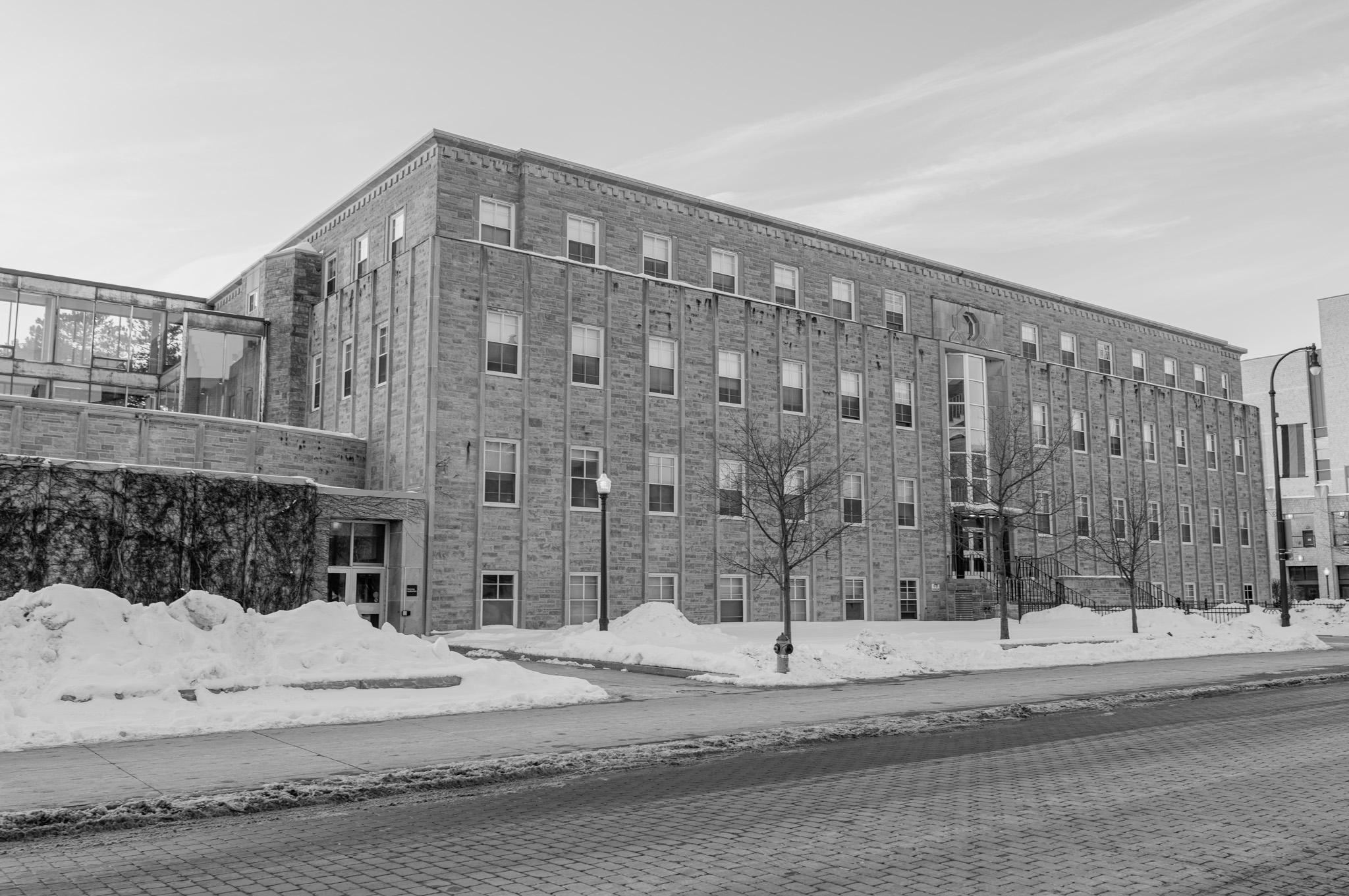
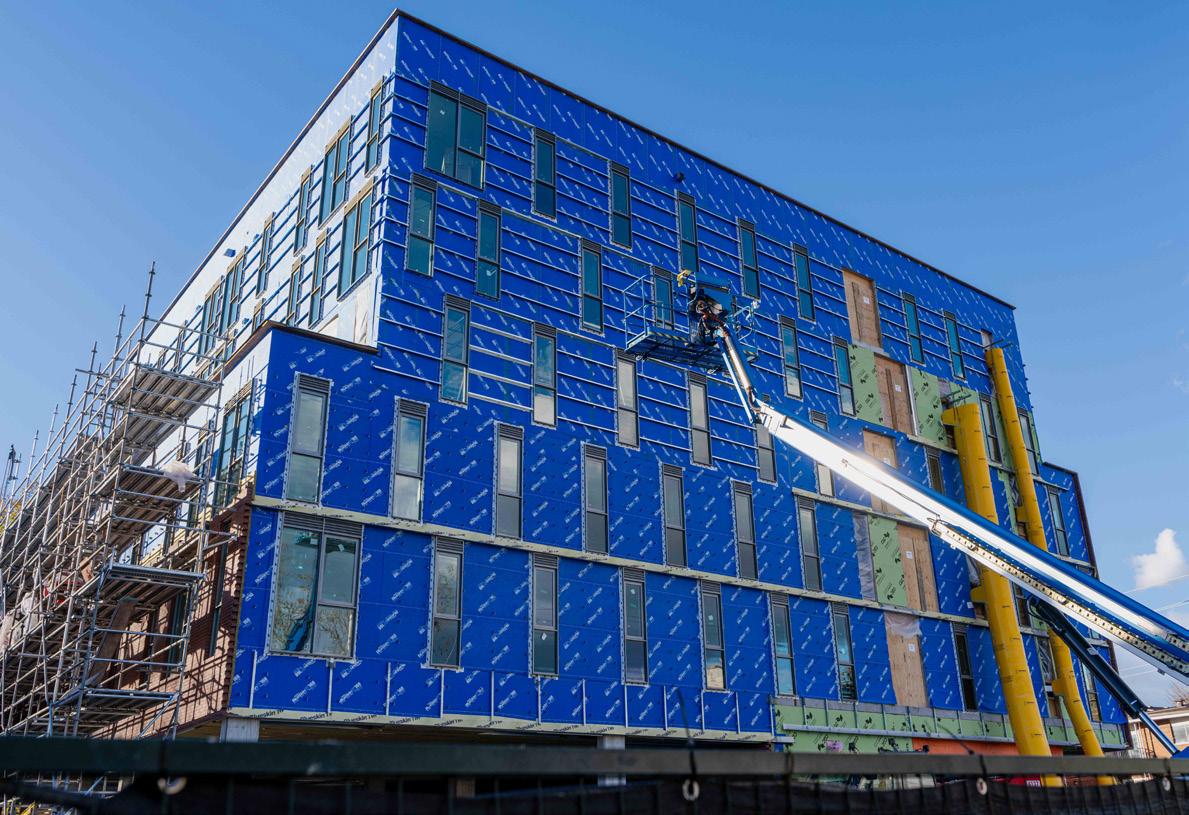
Dunning Hall, the Faculty of Arts and Science building.
PHOTO BY JASHAN DUA
With rents among Canada’s highest, Kingston’s rethinking its student housing strategy
‘For far
too long
we haven’t
considered students as constituents, and that has to change,’ City Councilor said
Yael Rusonik Assistant News Editor
With Kingston offering the fourth most expensive rental market in Canada, City Council has decided a new strategy is needed.
The Kingston City Council passed a motion on Feb. 3 to develop a Student Housing Strategy following the adoption of the new Official Plan. The strategy is set to consider ideas such as new zoning tools, density permissions, built-form guidelines specific to student housing, and partnerships with institutions and the private sector.
Councilor Conny Glenn, who first moved this motion, spoke to The Journal about why she brought the idea to council.
“The motion really is to make sure that we’re [the city] doing a fulsome plan for everybody who lives here,”
Glenn said. “For far too long, we haven’t considered students as constituents, and that has to change.”
She explained her frustration with the current cost of student housing in Kingston, recognizing the difficulty of paying such high rent while simultaneously paying for an education. She said that multiple students have come to her explaining that their living conditions are poor, but they’re afraid to file a report, as they have nowhere else to go.
Glenn suggested that, to create better student housing conditions, Kingston must be zoned in a way that better allows for densification and encourages building for students.
“If we stop finger-pointing, and the adults get together in the room and start actually working
and fixing the problem, then we’re going to make progress,” Glenn said. “And that’s what I see coming.”
The Journal also spoke with David Gordon, a professor at the University’s School of Urban and Regional Planning. He suggests three main strategies for dealing with the housing situation in Kingston, the first of which is encouraging the creation of more student residences to reduce pressure and reliance on the local housing supply.
“I’m very proud of [the new residence we built on Albert Street], we just need about 10 more of them,” Gordon said. “And we should have some graduate residences. Grad students here, they can pay rent 12 months a year.”
He claims the space for these residences exists, whether that be on property the University already owns on Clergy Street, or over the parking lot behind Stauffer Library. “The main problem seems to be that the University doesn’t rush to invest in housing,” Gordon said.
Students launch petitions calling for AMS president’s resignation
Organizers say issue about accountability, not
just money
Emmet Paradis Assistant News Editor
Two student-led petitions are circulating, calling for the resignation of AMS President Jana Amer. One petition calls specifically for Amer’s resignation, while another demands the resignation of the entire AMS executive team.
A review of Amer’s credit card spending found that out of $27,225.50 charged on the card since the start of the term, Amer repaid $640.70 after she couldn’t provide receipts for certain transactions. Including $377.32 that were identified as personal expenses. Following the review, the AMS revoked Amer’s corporate credit card and set her spending limit to zero.
The news has prompted debate across campus and online, with some students arguing the situation warrants immediate resignation and others saying the AMS’s internal processes should be allowed to run their course.
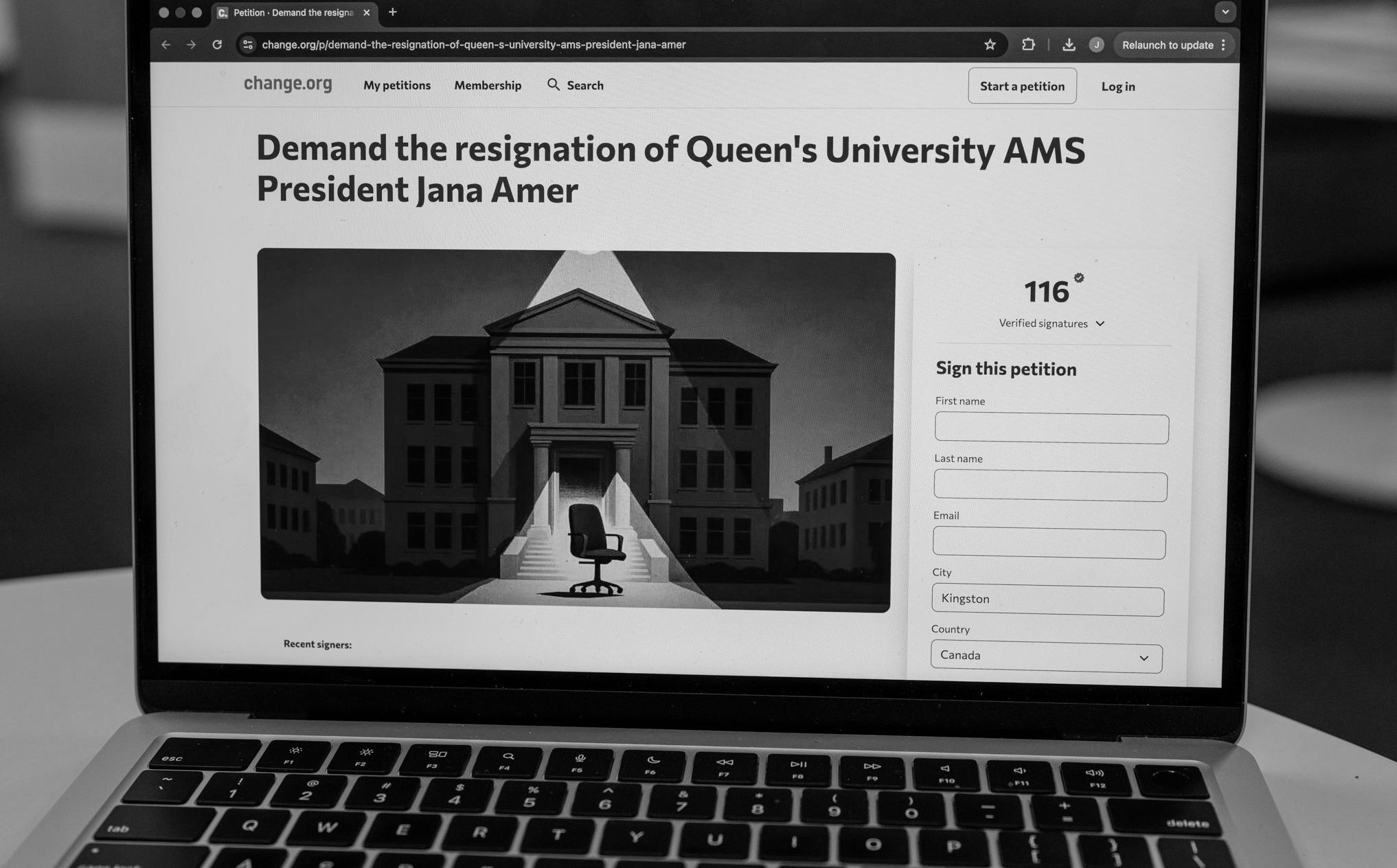
Sam Moravej, ArtSci ’27, said he started one of the petitions after seeing the news circulate on social media. Moravej launched the petition on Jan. 31, which has received 116 signatures as of publication.
“I first saw the story on Instagram, and I thought it was
super shocking,” he said.
Moravej is a vice-president in the Queen’s International Affairs Association and has been involved in Model UN and Queen’s Model Parliament. He said his involvement in student organizations made the situation feel more personal, as many clubs rely on the AMS for funding approvals and financial administration.
“A lot of our clubs and our finances are controlled by the AMS,” he said. “As soon as I saw the personal charges and all that, I was really upset.”
His petition calls specifically for Amer’s resignation.
Moravej said he chose a petition because he sees it as an accessible and familiar way for students to express collective concern.
Even though, according to a statement from the AMS to The Journal, petitions themselves don’t carry formal authority within AMS governance.
“I’m trying to get this out to as many people as possible,” he said.
A separate petition, started by another student identified on the petition as Fae M, was also launched on Jan. 31 and has garnered 35
signatures as of publication. That petition calls for the resignation of not only the president, but also both Elena Nurzynski, Vice-President (Operations) and Alyssa Perisa, Vice-President (University Affairs). That petition frames the issue as a broader failure of leadership.
The AMS’s statement to The Journal said they’re aware of the petition and understand it reflects concerns from some students. They emphasized that any action regarding the president must follow constitutional procedures to
In a written statement to The Journal, the University claimed that they’re exploring future opportunities for more student housing on university-owned land, both on and off campus, and are in the process of developing a Queen’s housing strategy to guide future housing and renewal projects.
The second pillar of Gordon’s strategy for bettering the housing situation involves encouraging the development of purpose-built student accommodations to again reduce pressure on the local housing market. He referred to the soonto-open Hive, or the new Unity Place building on Princess St., as examples.
“These are developed by companies that are experts in student housing, [...] they’re managed really well,” he said. “The only problem is when they’re new and when there’s a shortage of other housing, it’s very expensive.”
ensure fairness, due process, and institutional integrity.
Moravej said that, for him, the core issue is accountability in a high-profile student leadership role.
“If you use your corporate credit card on something personal, you should be getting fired,” he said. “If not worse.”
He also criticized what he viewed as a lack of responsibility in public responses so far.
“I think it was just a whole bunch of blaming and deferring blame,” he said. “It was a whole bunch of not taking accountability.”
Some students have argued under the posts that the controversy is being exaggerated, particularly given the relatively small dollar amounts reported. Moravej rejected that framing.
“If we can inform the students that probably wouldn’t know about this otherwise, and that isn’t on Reddit, I think that is a job well done,”
He also suggested that Queen’s students band together to set up a non-profit housing corporation that can be used to invest in the Kingston Student Housing Co-op, to help them buy and build more houses for students. “In the end, the only way that things are going to stay affordable is if they’re owned by a non-profit,” Gordon said.
City Council will be presenting the cost and estimated timing for the completion of the Student Housing Strategy in the second quarter of 2026.
The third idea Gordon suggests is encouraging near-campus densification through the development of back-lane suites and mid-rise apartments. He suggested that something of the Hive’s scale should be built on every intersection of Johnson Street and Brock Street. Then, spaces that currently hold two houses and 10 bedrooms could instead offer closer to ninety bedrooms.
he said.
According to their statement, the AMS constitution outlines two formal mechanisms for removing a sitting president: a vote of non-confidence by AMS Assembly, or an impeachment referendum initiated by the student body.
A non-confidence motion requires at least two weeks’ written notice and approval by a two-thirds majority of Assembly members. An impeachment referendum requires signatures from 10 per cent of AMS members and must be conducted in accordance with AMS election policy.
The AMS also noted that Assembly may pass non-binding motions calling on the president to resign, which formally record Assembly’s position but don’t remove an executive from office.
They added that they haven’t received any formal resignation requests through official governance or administrative channels.
Petitions started following AMS president credit card revoked.
PHOTO BY JASHAN DUA
‘I
Queen’s students are shifting away from the
University District—and here’s why
feel like I miss out on living with multiple people and feeling like a family, but I’ve heard the horror stories about the University district,’ student says about apartment living
Veer Bhalla Assistant Arts & Culture Editor
For some Queen’s students, offcampus living no longer smells like spilled drinks, moldy appliances, and damp basements. Instead, it hums softly, with elevators gliding between floors, doors clicking shut with key fobs, a concierge nodding hello behind a polished front desk.
In Kingston, where rent ranks among the highest in Canada, choosing a high-rise apartment might seem like an unlikely rite of passage for students. Single-unit apartments come with higher price tags and fewer housemates, yet they continue to draw a steady stream of undergraduates away from the chaos of student housing. To understand why, The Journal spoke with five Queen’s students who traded crowded living rooms and party-packed streets for quiet hallways and skyline views.
For Tofunmi Onigbogi, Sci ’28, apartment living wasn’t a later upgrade—it was his introduction to university life. While many first-years were squeezing into residence buildings and secondyears learning the rhythms of student neighbourhoods, Onigbogi was unpacking his life into a high-rise building on Princess St.
An international student from Nigeria, Onigbogi arrived in Kingston later than planned after delays with his visa. With classes already underway and limited housing options left, he met with an off-campus living advisor who sent him a short list of available rentals across the city. Convenience quickly became the deciding factor. Unity Place offered immediate move-in, and for a student still finding his footing in a new country, that certainty mattered.
Living alone, Onigbogi said, has quietly reshaped his academic routine. Without roommates moving through the apartment in the morning, no alarms ringing through the walls, no footsteps in the hallway, there’s less urgency to start the day early. “If I was living with other people, I’d probably be more incentivized to wake up earlier,” he said in an interview with The Journal.
Dorm life had been his original plan. When he was preparing to come to Queen’s, he imagined a shared space, built-in community, and the steady rhythm of residence life. But when a dorm room never materialized, an apartment felt like the closest alternative.
Now, Onigbogi occupies a three-bedroom unit in Unity alone. His initial roommates were unable to secure visas in time, leaving him with extra bedrooms, and an unexpected kind of quiet.
For prospective student renters, popular options based on proximity to campus include Unity Place, Unity Point, and GeoCentral, all three these high-rises are owned by Peakmade, an Atlanta-based real estate real estate company based out of Atlanta, Georgia. As of January 2026, Peakmade controls more than 43,000 student housing units across the United States and six in Canada, five of which are located in Kingston.
Another prominent option’s Foundry Princess, one of seven “Foundry” properties operated by Toronto-based Integris Student Living, whose portfolio spans Ontario and includes additional developments in Kingston, such as Foundry Mack.
Named the “best city to Canada to live in as a student” in 2023 with a nearly 17 per cent student population, Kingston faces a high demand for rental housing near campus. But this demand has also entrenched a rental market long associated with scarce supply and landlords whose practices students have repeatedly described as difficult, and at times, exploitative.
According to Afra Kabeer, ArtSci ’28, the appeal of student housing was simple: it’s close to campus. Still, she told The Journal that convenience comes at a cost. Each month, she pays what feels like a premium price for comparatively little, especially when stacked against nearby condos, where renters get more “bang for their buck.”
For Saachi Jain, HealthSci ’28, and Mehta Hussain, CompSci ’28, apartment living made sense for a different reason. Both said they were drawn to the built-in structure of student-oriented buildings; an environment that mirrors residence life without its constraints.
They said this structure helps eliminate many of the uncertainties and logistical hurdles that often define off-campus living, particularly when it comes to navigating landlord relationships. “[I really like] organization and structure, so the structure of an apartment [building] makes me feel like I’m at home mentally; there’s a front desk if I have an issue so I don’t have to jump through hoops to contact a landlord,” Hussain said in an interview with The Journal.
That sense of ease extends beyond management and into the
rhythms of their daily lives.
The two share a two bed-two bath in Unity Place and enjoy the building’s proximity to Kingston’s downtown core, living above retail spots like Insomnia Cookies and Kinton Ramen and being a ten minute walk away from the Athletics Recreation Centre (ARC).
Beyond convenience, safety was another key factor in their decision.
considerations around housing extend beyond immediate safety
“There’s so many fobs to get upstairs, it makes the place feel a lot safer. Any time there’s a maintenance issue, there’s a clear process to go through everything. I’ve lived in apartments before and prefer them,” Jain said.
Kabeer told The Journal that safety has weighed heavily on mind since a distressing incident in the early hours of Jan. 20.
Living with four other secondyear girls, Kabeer was jolted awake at midnight by loud, persistent knocking at the door. Assuming it was one of her housemates, she got up to answer—only to be met instead by screaming from the other side. Shaken, Kabeer called 9-1-1. The operator remained on the line with her as she waited, frightened, for help to arrive.
Police later told her the disturbance involved a person experiencing significant impairment and substance use. Officers were ultimately able to de-escalate the situation, but the incident left a lasting impression.
“That was definitely very scary and is something that wouldn’t happen in a condo. This is one of the reasons why I want to move next year; I’m glad I had the student housing experience, but after that incident, that’s something I’m rethinking,” she said.
For other students,
concerns. Familiarity, routine, and a sense of continuity also shape where, and how, they choose to live.
Apartment living feels less like a choice and more like a return for Hussain. She grew up in Dhaka, Bangladesh, a city shaped by density and vertical life, where apartments, not houses, are the norm. “Dhaka is a really crowded city, so very few people live in houses, and I’ve lived in an apartment my whole life; it’s what I’m familiar with,” she said.
Yet, the transformation of historically low-rise neighbourhoods into sleek highrises has sparked concern for students, with Hussain arguing it tears away at the city’s urban fabric and the quintessential student experience. Some students describe a sense of isolation, missing the energy and spontaneity that once defined on-campus living.
Hussain, for instance, admits to missing house parties, pointing out that “it’s not the same to party in apartments.” At Queen’s— repeatedly ranked among Canada’s top party schools— this is no small detail. For Kabeer, the rowdy house parties of Homecoming weekend stand out as some of her most cherished memories from student housing, a reminder that student life is as much about community and shared experiences as it is about a place to sleep.
“I live right in front of the street where all the street parties happen, so my roommate and I all have breakfast together, and have people over, and it’s a really fun vibe because all of our neighbours are doing the same thing, people are outside, and the vibes are just really good overall,” Kabeer said. Students living in condos also mentioned missing the proximity to campus, with some telling The Journal that being farther away has made it harder to stay motivated to study, showing how location subtly shapes daily student life.
Jain noted that she doesn’t bump into her HealthSci peers as often, since she’s not on campus with them as much—a sentiment echoed by other students. Henna Porecha, ArtSci ’28, who shares a four-bedroom at Foundry Princess with three roommates, feels the same way, sensing that the distance from campus subtly thins the threads of everyday connection.
“I live 20 minutes from Stauffer, and I don’t end up studying as much when I’m not in the library, so if I can’t go to the library because of [the weather] I don’t end up getting much done,” Porecha said in an interview with The Journal
Though a bit removed from the typical student housing hub, Porecha appreciated the perks of being near shops and services that usually require a bus ride, all while staying within walking distance of campus. Yet it wasn’t the convenience that sealed the deal—it was the desire to dodge the infamous student housing nightmares.
“I didn’t want to live in the student [district]. I’d a friend tell me they had rats in their place and that made me decide I don’t want to live there,” Porecha said. The issue isn’t unique to her—there’s even a Reddit thread dedicated to supporting Kingston tenants living downtown who have to deal with rat infestations.
Continued online at www.queensjournal.ca
JOURNAL FILE PHOTO
Students say high-rise apartment buildings can make campus life feel isolating.
Proposed restructuring lacks student voices and a clear vision
Between spreadsheets and strategy, Queen’s forgot to consult its own students on proposed alterations to faculty funding.
The Journal obtained consultant documents detailing a proposed restructuring at Queen’s, including an increased focus on research and graduate education, online continuing education offerings, and the likely slimming of arts departments. While the potential for accessible education via the internet is exciting, the documents validate the worst fears of both Faculty of Arts and Science (FAS) students and faculty members, as well as appearing disingenuous in their sudden interest in graduate students.
The documents detail a desire to increase enrolment to 40,000 students by 2040, 10,000 of which would attend online through a new school entitled the School of Professional and Continuing Education (SPACE). While the idea of continuing education is exciting, offering more opportunities for mature students to return to school, it raises questions about the effectiveness of online learning. There’s definitely a market for online education, but the jury’s still out on if it can replace the classroom.
The documents also recommend a reduction of 3,500 FAS students, justified on the basis of “concentrating our research.” Justification aside, the lack of administrative initiative regarding the future of ArtSci at Queen’s is concerning.
In one section, the documents describe an exercise where administrators were given balls representing university funding and asked to sort them into bins based on where they should be allocated. The majority were allocated towards Health and Science, and Engineering.
While not a clear indication of the university’s future, the exercise is a
frightening example of the decision-making process behind the proposed cuts. It’s disappointing not to see evidence of further student and faculty consultation, implicating profit as the primary motivation behind administrative decisions.
The University can shape the desirability of their programs via investment and outreach, butinstead,ischoosingtodoawaywiththemto align with market trends.
The report also recommended a significant increase in the number of graduate and professional students. However, this goal comes across as disingenuous in the face of increased TA workloads with lower pay.
A year after 2,000 graduate students protested their working conditions by walking off the job, a prioritization of graduate funding doesn’t seem likely. It’s frustrating to only see graduate studies taken seriously on account of their ability to turn a profit, not when they’re struggling to make rent and pay for groceries.
While the objectives outlined in the documents seem misaligned with the material reality at Queen’s, the unfortunate truth is that the consultancy is in response to provincial funding cuts to universities. We can talk all we want about the Universities financial decision making, but they’re ultimately at the mercy of a provincial government that doesn’t seem to value higher education.
Even with funding cuts and international tuition caps, it’s disappointing to see the University operate as a business, instead of a forum to prioritize dialogue, critical thought, and the equality of all students. Ultimately, education, not profit, should be at the heart of discussions surrounding the future of the University.
—Journal Editorial Board
Queen’s can’t afford to stay in denial about AI use
Academic integrity’s increasingly important in the age of ChatGPT.
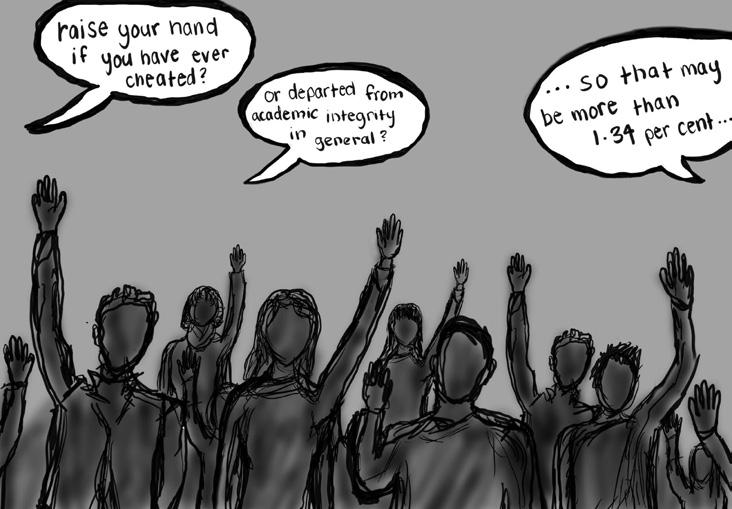
A senate approved report from Jan. 29 found that only 1.34 per cent of students departed from academic integrity in the 2024-25 academic year. Interestingly, unauthorized content generation, including Artificial Intelligence (AI) use is classified as a breach of academic integrity, something 55 per cent of students have anonymously reported doing. The discrepancy between the senate report and self-reported data highlights the need for better regulation regarding AI use.
Any student walking through Stauffer library can attest to the overwhelming use of AI in the academic setting. ChatGPT’s presence on almost every computer screen makes the senate report genuinely laughable. The question of AI regulation isn’t an easy one, but it doesn’t absolve the university from taking a stance on the issue.
Using AI to generate answers, summarize information, and write up reports represents a dangerous offloading of critical thought. The
culture of AI use at Queen’s has become so ingrained that even well-intentioned students feel they need to use AI to remain competitive with their classmates.
With this, students are losing the ability to read, write, and learn—all essential components of a university degree. AI use enters a dangerous spiral when teaching assistants begin to mark AI work using AI. At which point is a vicious cycle has begun, where no real work is being done.
To combat decreasing literacy rates and a growing loss of critical thinking, the University needs to defend academic integrity with a more structured policy.
AI can be utilized effectively in various disciplines, making a uniform policy unlikely. However, the current lazes faire approach isn’t going to be enough. Training students in how to use AI can be beneficial for synthesizing large amounts of data, or for their future in the workforce. However, training should be structured to elevate critical thought, not diminish it.
Professors are feeling lost trying to navigate the lack of regulation, and in many cases, are resorting to increasing in person assessments. However, the in-person test is not always the most accessible form of assessment, and the art of the essay writing is on the brink of extinction.
While AI regulation is complicated, the current approach is beyond optimistic.
When colleges cut journalism, the public pays the price
Emmet Paradis Assistant News Editor
Ontario’s publicly funded colleges are in a financial crisis, and journalism programs are among the casualties.
Most recently, Algonquin College has recommended suspending 30 programs, including its journalism diploma, as part of proposed cuts that would take effect in Fall 2026 if approved by the college’s Board of Governors.
The cuts are part of a broader trend across the province, where Ontario’s public colleges face a growing structural funding gap driven by an unstable funding model built on international tuition, and federal cuts to international enrolment. When colleges shrink under financial strain, the public loses not just programs, but the trained professionals and informed citizens those programs produce.
Across Ontario and Canada, journalism programs have been collapsing for years. Durham College’s journalism program has been suspended, Cambrian College’s journalism diploma was among nine programs cut when its School of Media Studies was eliminated entirely. Other institutions including Loyalist, Humber, Wilfrid Laurier and Mohawk College, have also suspended or discontinued journalism offerings in recent years.
These decisions are often framed as necessary budgetary adjustments. But cutting journalism, the field that trains people to investigate, explain, and hold power accountable, is a lasting error.
Journalism education does more than prepare graduates for careers in media. It provides students with critical thinking, ethical reporting skills, and a deep understanding of public affairs. That loss doesn’t stop at campuses, it reaches straight into the health of our democracy.
Some might argue that budget shortfalls leave colleges with no choice, but the root of this crisis isn’t sudden. Ontario’s colleges are funded significantly below the national average per student, with operating grants approximately 7700 dollars per student lower than other provinces. This underfunding, combined with recent immigration policy changes are anticipated to cut international enrolment by more than 49 per cent.
Journalism plays a unique role in democratic societies. Trained journalists expose injustices, draw attention to marginalized voices, and give context in an age of misinformation.
College journalism programs are especially important because they offer practical, skills-based training in more affordable and accessible settings, lowering the barriers to entry for students who might not otherwise see a path into the field.
Continued online at www.queensjournal.ca
ILLUSTRATION BY JULIA LUDDEN
ILLUSTRATION BY JULIA LUDDEN
Canada's starving for international shelter
Canada's struggling with multipolarity
Dylan Blaschuk Contributor
If Canada wishes to maintain autonomy in a newly multipolar world, it’ll have to work with new centres of power to avoid foreign domination.
Sober Too Late
In the 2025 Canadian Federal election, a naïve Pierre Poilievre planned to join the surging trend of populist-style rightwingers popping up around Western democracies. It seemed like a straight shot.
I remember attending a talk only months prior to the election where a student boldly declared, “The Conservatives are almost guaranteed to win at this point!” The professors hosting the talk were quick to note that one can never know until the election is held, yet ultimately, they conceded that the student was probably right.
The plan was so simple: follow the zeitgeist, cozy up to Trump, enact some simple tax cuts, and everybody's happy. What we all missed, including the actual winner of the 2025 election at that time, Mark Carney, was that we were closer to a multipolar
world than we ever have been before.
Donald Trump will undoubtedly be remembered as the man who collapsed the international rules-based order and ushered in the dawn of the multipolar world. In 2025, we were already living in that world. As a result of this, no state that’s unable to align itself with a superpower or become one itself could survive the whims of the US empire.
Importantly, among these states is Canada, which just happened to be at the doorstep of the budding imperium. And what did the United States want with Canada?
Total political dominance. When Canadians were made aware of this, the Liberals easily took the election along with Carney. The only problem was that ourrealization had yet to translate into concrete action or solutions, and now Canada is in a race to find friends, rally the federation and improve defence before the clock strikes midnightand darkness falls on an already dim Canada indefinitely. So now we’re sober, about as sober as the Italians when Napoleon crossed the Alps and began to capture their cities; or Yugoslavia when the Third Reich suddenly shared a border with them and began to work with separatist groups to break up their confederation. For
me, the latter comparison is surprisingly reminiscent
This article makes the surface-level comparison between Canada and Yugoslavia; I’ll leave it to you to decide whether that’s pre-WWII or post. An interesting question, though, is whether it matters. Either way, we find ourselves trapped between two superpowers. Will Carney be our Tito and play both sides for all we can get? Or will we collapse into bloody war and violence?
Canada is a weak country; we now have separatists in both the east and west, with Quebec and Alberta, discontent with their place in the federation. This means that Canada can no longer enjoy the privileges of a rules-based international order and real politics rules; the vultures are swarming in to see what they can get. We have no choice but to entertain them, for a failure to walk the tightrope between superpowers will mean being swallowed whole by any one of them. Ours is a battle for simple autonomy and survival. Canada seems eager to give an ear to anyone who will provide insurance But there’s the irony: if it must be provided to us, we shouldn’t use it. China
China appears to be in an
unstoppable ascendancy, determined to achieve the former glory of the middle kingdom. What’s more, they sincerely have the economic and military base to back it up.
Carney has been striking deals with China to mutually lower tariffs; increased economic interdependence would be a great thing for Canada. The issue: China doesn’t care about the benefits received from Canadian trade. In fact, Canada can only ever become more reliant on China in our current precarious position.
The only benefit is that the more involved China becomes with Canada, the more incentive they have to protect it from the domination of other powers.
The European Union
Canada seeks to align itself with the European Union. In a way, this makes plenty of sense because Europe is finding itself in increasingly dire straits as a result of facing a very similar dilemma to Canada. The world is being carved up among the emerging poles, and Europe has been taken by surprise, much as Canada has.
Equally, this doesn’t make any sense for geographic reasons and because of the immense influence upon Europe which the United States and Russia continue to exercise.
Combine that with US naval power, and having allies across the pond seems increasingly futile in terms of deterring hostile takeover, in the business and military sense.
A Pessimistic Future
I’m afraid for the future of Canada if the content of this article hasn’t already made that abundantly clear. Mark Carney appears to be trying very hard to find us a way out of a horrible situation.
But he’ll scarcely accomplish this if even his own people no longer view Canada as a project worth preserving. We’ve become such an apathetic nation that we scarcely even follow our own news anymore, opting instead for American news because it’s more interesting to us.
This calls to mind the struggles of Yugoslavia, and to hold together a patchwork federation while foreign superpowers seek to take their cut. This isn’t to say that we have nearly as many problems as Yugoslavia ever had, but the nature of our problems is undeniably similar.
The economic problems Canada faces are sizable yet solvable; the bigger question is whether we can suffer through the means by which we will have to employ to solve them.
We have lost our
souls! Therefore, we can be carved up with little resistance. Without the will to fight, we have turned a very difficult battle into an impossible one.
Hope
Asking that question is the key to our surprising way out of this: Improving our defence. Another massive change in the new world is the asymmetric nature of war and the power of the insurgency. Not that we need to wage an insurgency—although one day we might—rather, we need to be more like a porcupine who is just prickly enough to no longer be worth challenging.
In the age of realism, which is our multipolar world, the capability to make war shall determine one’s autonomy. This is why Russia, China, and the US are the major poles in today’s international climate. Thankfully, Carney seems to be aware of this and is making a serious effort to increase Canada’s security capabilities. The question remains, however, will we have the will to fight, and make no mistake, we’re already at war.
Dylan Blaschuk is a second year Politics, Philosophy and Economics student.
PHOTO BY: JASHAN DUA
Dylan reflects on Canada's involvement in International Politics.
<BIZ-SCI-TECH>
Canada’s largest cancer research tumour bank consolidates its operations at KHSC
The decades-old biobank centralizes its operations at KHSC, expanding capacity for cancer research and precision medicine
Ananya Sharma
Bussiness, Science, & Technology Editor
Canada’s largest clinical trials tumour bank, for the first time in its nearly 30-year history, has moved its operations under one roof at Kingston Health Sciences Centre (KHSC).
On Jan. 28, KHSC announced that the Tumour Tissue Data Repository (TTDR), a national biobank that’s part of the Canadian Cancer Trials Group (CCTG), has consolidated its previously dispersed facilities into a single, centralized space at KHSC.
TTDR houses biological samples collected from patients enroled in CCTG cancer clinical trials. In an interview with The Journal, Dr. Lois Shepherd, senior investigator at CCTG and professor emeritus in
the Department of Pathology and Molecular Medicine at Queen’s, the repository was established to ensure long-term scientific value beyond the completion of individual trials.
“The Tumour Tissue Data Repository is what’s called a biobank or a biorepository,”
Shepherd said. “All the samples that we have are associated with patients who have been put on a clinical trial to treat cancer or look at different aspects of cancer.”
The repository was formally established in 1997 to prospectively collect patient samples so researchers could revisit them after the trial outcomes were known.
“When a trial was finished, and the primary outcomes were known, we would have a rich biological collection of samples that researchers could ask specific questions about, like why patients responded to treatment, who might respond and who wouldn’t, and why they got adverse effects,” Shepherd added.
What began as a collection of tumour biopsy samples has since expanded into a biological archive. According to Shepherd, the TTDR now includes blood, plasma,
serum, urine samples, and their extracted DNA and RNA—all approved for research use.
While the repository has been based in Kingston, its activities were previously scattered across multiple sites at KHSC and Queen’s, a setup that eventually became impractical as the volume and complexity of the samples grew.
“We were located in a whole variety of different areas around the hospital, as well as Queen’s,” Shepherd explained. “We were outgrowing our space, and it wasn’t particularly efficient.”
The TTDR maintained dozens of ultra-low temperature freezers—some stored in different locations—while other aspects of sample processing and analysis took place elsewhere.
“Our clinical trial numbers grow every year,” Shepherd said. “We recruit patients not only from Canada, but the United States, South America, Europe, and the Far East. So, we have a growing number of samples that we have to accommodate.”
The consolidation brings the entire operation into Watkins wing at KHSC, “supported in part by funding from the Canada Foundation for Innovation,” which enabled renovations and the acquisition of new equipment.
The newly consolidated TTDR is co-located closer to the Queen’s Laboratory for Molecular Pathology (QLMP), which provides molecular and genomic analysis for clinical trials, hospital patients, and
external researchers.
“The flow of samples and the interaction and the sharing of technology and technologists has vastly improved, or will vastly improve, the efficiency of the whole operation,” Shepherd said.
According to Shepherd, QLMP’s growing genomics program supports oncology care at KHSC, helping clinicians identify tumour markers that guide treatment decisions.
“That allows them to tailor treatment according to what they find,” Shepherd said. “So, I think overall it’s a win-win for all patients—both those on clinical trials and those receiving care at KHSC.”
The centralized facility also includes a digital pathology and imaging suite, an area Shepherd says is rapidly evolving with the integration of artificial intelligence and bioinformatics.
“There are opportunities for faculty to develop projects that will use the expertise of the TTDR and
the QLMP,” Shepherd said. “Their students will beable to work within our facilityand develop research projects under theguidance of the people that run it.”
Shepherd added that the long-term vision is to make high quality, digitized data accessible to researchers worldwide.
“Once you have images mounted digitally, you can export them to researchers around the world to ask specific questions of that raw data,” Shepherd noted.
As cancer research increasingly shifts toward precision medicine, Shepherd emphasizes the consolidated facility positions Kingston to play a central role in that transition.
“All of this is with an intent to focus on patient care,” Shepherd said. “To increase the personal aspect of an individual’s diagnosis and hone the approach to treating patients, to minimize side effects and maximize results.”
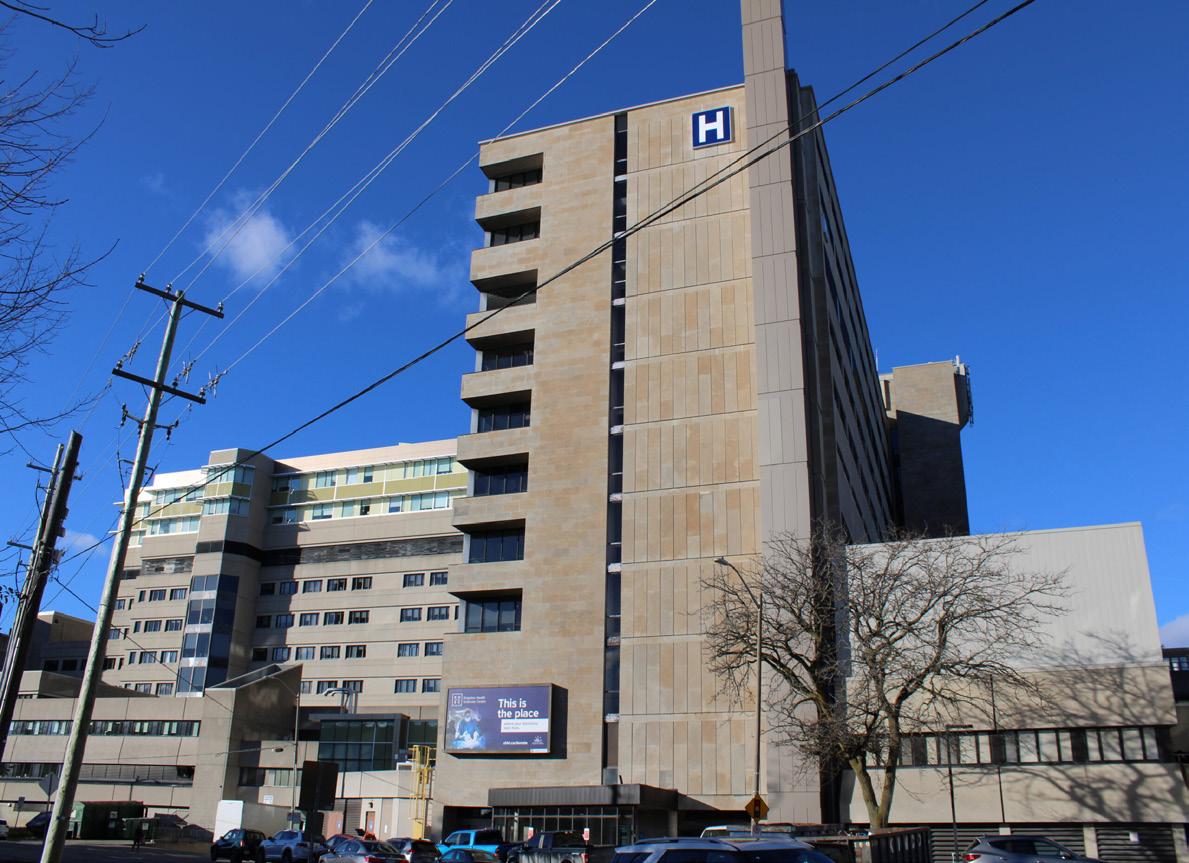
The announcement was made on Jan. 28. JOURNAL FILE PHOTO
SPORTS
Final Stretch: Men’S BaSketBall
‘Be good today,’ says head coach about the key to sucess
Noah Cyr Senior Sports Editor
For many teams, they could be said to be in the final stretch of their season.
Final Stretch continues with the Queen’s Men’s Basketball team, who have discovered a groove, winning six games in a row. After a slow start to the season, the Gaels currently have a record of 12-7, sitting at third place in the OUA East, just behind uOttawa. To evaluate the recent success and the whole season in its entirety, The Journal caught up with Men’s Basketball head coach Stephan Barrie.
Barrie described the season being in a “tough spot,” as the program had expectations of a set lineup that was ruined due to the season ending injury of fifth year player Isaac Kruger, ArtSci ‘25. “We were just in a tough spot, and we had to adjust and [as a young group] it took us a little bit of time to figure things out.” The Gaels lost their first five of six games but then rattled off five before Winter Break.
Barrie’s preaching to his team “to get better every day,” seeing tremendous growth with his team. Despite losing to uOttawa and Carleton early in 2026, Barrie acknowledged that the team had leads going
into the fourth quarter but just couldn’t find a way to finish the games off. “If you’ve a lead in the fourth quarter against top team 10s, you’re doing a lot of well,” said Barrie. However, he did emphasize the fact that it’s going to take a “40-minute effort” to be successful.
According to Barrie, to be successful down the stretch is to take it “one game at a time.” He continued saying, “when you’re in it, you can’t look at the totality of it, it’s literally a day-by-day existence.” This mantra has been used over the last number of years that has allowed the players and coaching staff to be in a comfortable position heading into a stressful time of year.
A positive for this team is that they do have returning players who were participants in the OUA Championship and the USports championship last year. Barrie is hoping that this experience will help them but also is excited for the firstyear athletes to “go through it and can figure it out.”
It’s an intriguing time for the Gaels Men’s basketball team as their young core continues to find success and is starting to emerge as a real playoff threat. Barrie knows that this group has the chance to be “very successful this year but also over the next several years.”
With the regular season almost coming to a close, the Gaels will finish their last three games at home, beginning Feb. 6 at the ARC.
Men’s and Women’s Hockey
poised for an exciting finish
A big weekend ahead for Gaels Hockey
the Women travelling to North-eastern Toronto to take on the Ontario Tech (OT) Ridgebacks and the York Lions on Jan. 30 and 31, respectively. Coming into the game, Queen’s sat at the top of the OUA East standings with 40 points.
In a low scoring affair, the Gaels got off to an early
Volleyball Weekend Recap
‘I’ve to owe it to the Queens fans for bringing the energy,’ player says
each game has major ranking complications heading into the playoffs. The Marauders heading into the match were 11-3 at the top, and the Gaels weren’t far behind at 9-5. The first game of the first match featured a tight back and forth affair, with the Gaels narrowly edge the victory 25-23. After the tight victory, Queen’s took control and cruised to 25-15 and 25-16 victories, respectively.
Noah Cyr Senior Sports Editor
An emotional weekend turned out successful in the last regular season volleyball action at the ARC.
On Jan. 30 and 31, both the Women and Men’s Varsity Volleyball teams welcomed the McMaster Marauders for a doubleheader weekend with serious playoff implications as the OUA teams jockey for position. The second game’s viewed as extra special, as graduating athletes are recognized in the annual “Seniors Night.” Each graduating athlete was presented with a framed picture or jersey and a bouquet of flowers, embraced by the coaching staff and family.
On the Women’s side, the OUA is incredibly tight with seven teams divided by just seven points,
lead with Mikayla Cranney, ArtSci ’27, with her 15th goal of the season. The Ridgebacks tied the score early in the third to make it 1-1.
Goaltender Emma Tennant, Sci ’27, was spectacular, putting up 33 saves and forcing a shootout.
During the shootout, after a Ridgebacks goal, Queen’s forward Taya Leonard, Kin ’27, scored on a nice backhand move. A stop by Tennant, set up Cranney to take control of the shootout with a goal and made no mistake with a forehand move opening up the goalie and sliding it into the open cage. The third shooter for the Ridgebacks had to score to keep it alive, and Tennant
The second match had the Gaels coming back from behind and winning the first two games by a score of 26-24. The first game was highlighted by a seven-point service run by Pascale Galarneau to secure the win. The Marauders try to claw back in the third game to avoid the weekend sweep, but to no avail, as the Gaels don’t drop a set and defend home court.
To reflect on the game, season and her career, The Journal sat down with graduating outside Abigail McAlpine, ArtSci ’26. “If I could go back to experience that feeling again, it was unreal,” McAlpine said, describing the feelings and emotions of the thrilling comeback in the second game. She continued to say that there was a great sense of belief in coming back because “we knew we had each other’s backs,” which ultimately helped them prevail in the game.
McAlpine was very gracious
answered back with a goal to cut the deficit to 3-1. The Gaels would add another goal late in the second to make it 4-1 and cruise to the finish line securing the win and the weekend sweep.
With the two wins, they continue to control the OUA East and climb to eighth in the USports rankings.
On the Men’s side, the Gaels came into it looking for a winning result at home in a tight OUA East. It was a tall task taking on the number one team the Concordia Stingers, according to USports rankings since Jan. 26. The Gaels put up a good fight limiting the Stingers’ chances, but it was no match for the Stingers offence as they
when talking about her time at Queen’s, that’s dwindling to an end. “I feel like a big thing about Queen’s is the community, it really feels like a home away from home.” Although reflective, she still sees the goal at hand, to get to a national championship. “The momentum we’ve set, I think we’re gonna end on a high.”
On the Men’s side, the Marauders have struggled coming in with a lackluster 5-9 record going into the weekend. However, games are played for a reason and after a smooth first match that saw the Gaels sweep, the second game the Gaels were in for a shock. The second match, the Marauders came out swinging taking the first two games 25-21 and 25-23. The Gaels however preserved winning the next two games and setting up a deciding fifth set. In the fifth set, Queens got out to a quick start and didn’t look back and securing the comeback.
With the win Queen’s sits in third, one point back of first place in the OUA.
Both varsity teams will travel to Toronto to take on the University of Toronto Varsity Blues for a double header on Feb. 6 and Feb. 7, where Queen’s Volleyball will be hosting an alumni event after the games.
left to put the game out of reach.
Coming off the tough loss, the Gaels look to bounce back against the Nipissing Lakers on Jan. 31. The Lakers got out to a quick 2-0 lead early in the first period and controlled the neutral zone in much of the play. Poised for a comeback in the third period, the Lakers scored right off the opening faceoff to take a commanding 3-0 lead. The Lakers would add an empty net and finish the game with a 4-0 win.
The Gaels have a massive rivalry weekend that includes the McGill Redbirds on Feb. 6 at the Memorial Centre at 7:30 p.m., and the Carr Harris Challenge Cup on Feb. 7 against the RMC Paladins at the Slush Puppie Place,
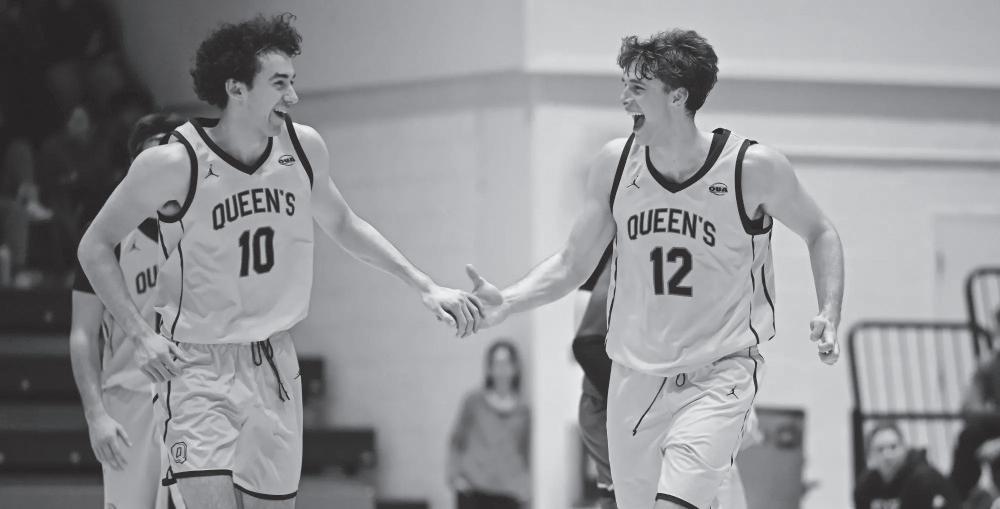
Men’s basketball last regular season game on Feb. 6.
PHOTO SUPPLIED BY: ATHELTICS & RECREATION
Noah Cyr Senior Sports Editor Men’s and Women’s hockey had two different weekends.
first, starting with
Fiery horoscopes to beat the winter blues
The deep freeze is over—your bright future is written in the stars
THE PSYCHIC SCHOLAR
Taurus (April 20-May 20)
Go, go, go, Taurus! Now’s the time to get up and moving, especially if 2025 has been a bit slow going for you so far. This is the perfect time to engage in a group activity, be it charity work, a new hobby, or just reconnect with friends you may have neglected in your winter cozied up around the house.
Libra (Sept. 23 – Oct. 22)
Your space is cluttered, and it’s throwing you off. You’re ruled by Venus, planet of love and beauty, so tackiness in any aspect makes you sick. Update your room, wardrobe, or workspace to feel instantly better—nothing like getting a jump on spring cleaning in February!
Cancer (June 21 – July 22)
Exploring new cultural interests in the form of food, cinema, and travel will be fruitful for you this week. You’re loving the late winter vibes, but you’re also itching to experience something new. Expect new opportunities on the horizon and take risks as the week winds down.
Sagittarius (Nov. 22 – Dec. 21)
You’re going to hurt someone’s feelings accidentally with your bluntness this week. Having to beg and scrape for an apology will be a bummer, but necessary. If that’s not something you want to do, approach all interactions with kindness and sensitivity this week.
Aries (March 21 – April 19)
Expect big new things in your love life close to Valentine’s Day in classic bold, Aries fashion. This is an opportunity to fine-tune your appearance, get a new haircut, get those professional headshots done, and prepare for your time in the spotlight as romantic prospects seek you out!
Gemini (May 21 – June 20)
You’ll find yourself more in the public eye this week, so be aware of how you appear to others and how you can use your newfound popularity to strengthen creative and work-related goals. Also, keep working on developing empathy. After Reading Week, events will transpire where you’ll need it!
Capricorn (Dec. 22 – Jan. 19)
Get outside to clear your head. Winter is taking its toll on you, and taking some quiet space to yourself in the sunshine will help clear gathering clouds and leave you at peace as February bleeds into a (hopefully) warmer March.
Power, Pride and Progress
ACROSS
1 *Poet Angelou*
5 *'YOU GET A CAR, YOU GET A CAR' Mogul*
10 *Hendrix Hairdo*
14 Fed. power dept.
15 *Davis or Desmond*
16 Defensive spray
17 The first man?
18 Belgian painter James
19 Somewhat
20 Extensive research paper for a PHD
23 Confidentiality doc
24 *___ Ababa, Ethiopia*
28 Saturday, in Spanish
32 Believes (in)
35 "Lisa Bonet ___ basil" (classic palindrome)
36 Singer Bareilles
37 FICA funds it
38 *Blank Panther star who died at age forty-three in August, 2020*
42 Clothes line
43 Sweeties
44 *Barack _____*
45 Lawmakers
48 Anne of Green
49 Country singer Tucker
50 Opposite of 'neath
51 What's celebrated throughout February and the theme of this puzzle
59 *Tina Turner or Etta James, vocally*
62 Moons
63 Swedish Furniture Store
64 Caboose 65 Really love something
66 Compass letters
67 *Martin Luther _____ Jr.*
68 Dot on a computer screen
69 City on the Rhein DOWN
1 Anthropologist Margaret
2 *Whitney Houston Lyric: " _______ Will Always Love You"
3 Affirmative votes 4 Weaponry 5 Exaggerate 6 Ship of 1492 7 *Parks of the Civil Rights Movement* 8 Tons
Mata ___
*Poet Gorman*
Blubber 12 Color TV pioneer
Multivolume ref.
Fund
Klutz
Bleak 26 How Mario introduces himself in video games
Leo (July 23 – Aug. 22)
Leo, you’re in the grips of a passionate romance that is going to send you on a near month-long bender of obsession. If you’re happily single, look forward to an important new show, interest, or hobby taking over as the week moves on. If you’re starting to lose your sanity as Valentine’s Day looms, lean on friends for support.
Virgo (Aug. 23 – Sept. 22)
One-on-one time with your friends and partners will be crucial this week. Let your sensitive side blossom as you deepen your connection with someone special; play your cards right, and a new romance will last you through spring!
Scorpio (Oct. 23 – Nov. 21)
You’ve spent a lot of time this month exploring self-expression in the way of art and beauty, and it’s important to keep this trend going as February wraps up. Think of the new interests you may have discovered and how you can explore them more in the real world.
27 *Tupac ___kur and Lil ____ X*
28 Potpourri bag 29 Greek goddess of wisdom 30 "Toughen up guy!" 31 Plus 32 Cod relatives 33 Wall St. figures 34 ___ Paulo, Brazil 36 "The Lion King" villain 39 *Nigerian native*
40 Flies through the sky 41 Recede 46 RoboCop, e.g. 47 Chess champ Mikhail
48 Dr. Seuss' real last name
50 Chicago airport
52 "Take ___!" (track coach's order)
53 *Kid ____, Pursuit of Happiness rapper*
54 Kentucky's Fort
55 "Peter Pan" fairy, for short
56 "Your point being?"
57 You probably watch plenty of them a day on Instagram
58 Sign of boredom that's super contagious
59 Biblical boat
60 Hawaiian garland
61 Light brown
Pisces (Feb. 19 –March 20)
You need to keep your trap shut around fire signs like Aries, Leo, and Sagittarius this week, Pisces. You also need to journal more to keep track of the prophetic dreams you’ve been having! Turn inward, choose peace, and remember that loose lips sink ships, especially this close
Aquarius (Jan. 20 – Feb 18)
Fiscal, fiscal, fiscal… it’s time to take a hard look at your finances. How you spend or save reflects what you feel you deserve, and how you’re able to manage your life. Identify where there’s excess, and where you can splurge. You’re a smart cookie, Aquarius, but it’s time to get smart with money.
Shifting planets mean shifting fortunes this week.
ARTS & CULTURE
Ascendant rock group Kasador reflects on recording, touring, and everything in between
With their unflinching vision and unstoppable hustle, this band won’t be Canada’s secret much longer
Marijka Vernooy Senior Arts & Culture Editor
It takes an exceptional band to release an album, EP, launch an international tour, and have their music featured on multiple national sports broadcasts all in the span of a few months.
Kasador is that band. You might’ve heard their song, “Golden” playing alongside the Toronto Blue Jays’ record-breaking season last fall. The song has hundreds of thousands of streams on Spotify, part of their popular third album, Momma Might’ve Raised a Fool, which released Nov. 4. Or maybe you know Kasador from their vibrant social media presence, constantly promoting new projects, like
their current Canadian-U.K. tour. Consisting of vocalist
Cam Wyatt, ArtSci ’15, bassist Boris Baker, MSc ’18, drummer Stephen Abdubofuor and guitarist Thomas Draper, Kasador is a Kingston-born rock outlet ready to take on the world. But the music comes first. “I think success [means] making good music. Liking what you do,” Wyatt said in an interview with The Journal.
“Being a musician is playing music, so if you’re succeeding in playing music, you’re succeeding as a musician.”
Baker agrees that success lies in the process. Kasador has been hard at work writing music, at a near-relentless pace extending into 2026. “We’re always kind of releasing something,” Baker said in an interview with The Journal.
“There’s always something
new.” The pair explained how the traditional, extended process of releasing music interferes with the creative process. “You write a song, do a hundred mixes of it, slightly re-write it, re-record the whole thing, wait for like a year and release it, and [then] you don’t even care about the song,” Wyatt said. Baker added that industry practices typically advise artists to wait for the right time to release certain projects, contingent on several factors.
“Don’t listen to people who tell you to wait to do anything,” Wyatt said. In the past, Baker said, the band would record an album every couple of years, leaving plenty of time to play songs live and in the studio before release. Now, Kasador takes a quicker approach to writing material, bringing songs sometimes 80 per cent complete into the studio before recording. If the band believes in the song, they’re inclined to release it as soon as possible.
‘Midheaven’ marks an ending, and a turning point, at the Agnes
The collaborative exhibition is the final show in the Agnes Etherington
Art Centre’s off-site garage space before its move into a new building
Daniel Gill
Assistant Arts & Culture Editor
Kingston’s art scene is reaching new heights this winter with “Midheaven.”
On view from Jan. 30 to Mar. 29, “Midheaven” is the final exhibition staged in the Agnes’ off-site garage space at the Rideau Building, which has served as the gallery’s temporary home during construction of the new Agnes facility. The show was curated by Emelie Chhangur, director and curator at the Agnes, and created by artist Stacey Sproule in collaboration
with Erika DeFreitas, Sara Keller, Ambivalently Yours, and Victoria Cheong.
“This is our last show before we move into our new landmark building,” Chhangur said in an interview with The Journal. “So, this means we’re turning a corner.”
That sense of transition is central to “Midheaven,” which Chhangur views as a culmination of the Agnes’ experimental work in the garage space.
Sproule was invited to create the exhibition through what Chhangur called a “wild invitation to do whatever she wanted in the space.” The
result’s a unique solo exhibition composed entirely through collaboration.
“It’s experimental research at its heart,” Sproule said in an interview with The Journal. “I’m always conscious of trying to create structures that are more supportive for artists.”
The exhibition blends hand-drawn animation, projection, sound, and participatory objects into a calm, blue-hued environment. It opens with the piece “We Begin and End with Blue,” Sproule’s collaboration with DeFreitas, which fills an entire wall with drawings, sketches, and written memories
“Let’s get it out there and we’ll just write another one,” Wyatt said. That was the approach to Kasador III, the band’s forthcoming EP on April 14. It features their new single, “Ultraviolet Daydream,” which released Jan. 31. Wyatt said the band began mixing the new EP just 12 days after recording it. A week later, it was mastered. “We found a sustainable thing, where we can release an EP every six or seven months,” Wyatt said. The band’s developed a unique model. “We’ll just put out two EPs—that’s 10 songs—and then we’ll go record 3 more and cut the weakest ones [and] combine them for an album.”
Kasador’s driven creative process lines up with their holistic approach to music as a career, which Baker described as “sustainability.”
“It’s all about being sustainable. It’s about being able to release music at a cadence you feel good about, to post in a way
you can do more often,” Baker said.
But releases don’t blow up out of nowhere; “You have to work it,” Wyatt said. This is why Kasador’s approach works.
Promoting music on social media, touring it, and workshopping it live are all part of this process. “It’s a lot easier to work [music] when it’s fresh, and you care about it,” Wyatt said.
Kasador is hard at work. As they embark on their Momma Might’ve Raised a Fool Tour, they look forward to playing together as a band in the U.K. for the first time. Many of the tour dates were secured by Wyatt and Baker themselves, reaching out to promoters and bands abroad to hop on bills.
The band’s endless hustle is also earning them success close to home: CBC asked if they could license Kasador’s song “Squeeze” for its broadcast of the 2026 Milano-Cortina Winter Olympic and Paralympic Games. A major accomplishment for Wyatt and Baker, who have been playing music together since their time in student bands at Queen’s.
continued online at www.queensjournal.ca
exploring water, atmosphere, and the colour blue. The work emerged from months of correspondence between the two artists, creating what Sproule described as an “intuitive exchange.”
In the next space, “Only Sky,” co-created with Keller, projects clouds drifting slowly across the wall. Using rotoscoping and cyanotypes
without cameras, the artists “took a picture in collaboration with the sky,” creating a looping image that feels subtly alive.
continued online
From left to right: Bassist Boris Baker, guitarist Thomas Draper, drummer Stephen Adubofuor, and vocalist Cam Wyatt.
PHOTO SUPPLIED BY KASADOR
‘Midheaven’ is on view until March 29. PHOTO BY CLAIRE BAK
‘Dancing With The Stars (QU Edition)’ brings the hit ABC show to Queen’s
Behind the twirls and lifts lay moments of campus-wide connection
Veer Bhalla
Assistant Arts & Culture Editor
The Queen’s Competitive Dance Team’s sold-out Dancing With The Stars (QU Edition) lived up to the hype.
The show took place on Feb. 3. and started at 7:30 p.m. at the Isabel Bader Centre for The Performing Arts’ Jennifer Velva Bernstein Performance Hall. Seats were packed; even the obstructed view spots were filled. The show paired members of the Queen’s University (QU) Competitive Dance Team with “stars” on campus, where they performed before a panel of judges.
Inspiration came from the hit American Broadcasting Company (ABC) show Dancing With The Stars, where celebrities and dancers pair together and train to compete with other celebrity-dancer pairs in front of judges Nicole Le Donne, Artsci ’27, and Naomi Budinszky and Brooke Harris, both ConEd ’27. Its new season found immense popularity amongst a
Gen Z audience with the inclusion of online personalities like Alix Earle, Robert Irwin, and Dylan Efron.
The QU Dance Team ‘stars’ included Jake Kost, Alexa Pae, and Taite Marsden, all ArtSci ’26, Osa Osaseri, and Iain St. Arnault, both Artsci ‘27, James Simone, and Everett Smith, Sci ’28, Jacob Mclean, Kin ‘26, Johnny Shenouda, HealthSci ‘26, and Tyler Doughty, ArtSci ’29.
They were supported by QU Dance Team members Gemini Wttewaaal, Stephen Andrews, and Laine Andrews, all ArtSci ’29, Sienna Trigg and Sophia Simonelli, ConEd ’29, Abby Panetta and Rowan Hernandez, ArtSci ’28, Curtis Smith, Sci ’28, Tori Muxlow, ConEd ’28, and Olivia Sawchyn, ConEd ’27.
Tickets to the show sold out 15 minutes after the team announced ticket sales on their Instagram, and posts around the event were more engaged with compared to the rest of their Instagram. “We were
[hitting] some of [our] marketing goals with our posts; being able to see over 1,000 shares on our Instagram or the 2.5 million profiles that visited our profile were things that we anticipated,” said backstage manager Indee Kwajah, HealthSci ‘28, in an interview with The Journal.
“[Selling out in] 15 minutes was kind of crazy and we weren’t expecting that, but we were definitely expecting a large audience out there,” she said.
Apart from some minor technical glitches that took place when playing a video showing the process of preparing for the show, the audience’s eyes were glued to the stage throughout the night.
Highlights included football player Osaseri and dance team vet Trigg’s endearing choreography to “Loveboat” by Jack Jones, and dance team rookie Hernandez and volleyball
‘Velvet Vision’ explores the cost of artistic obsession
The documentary about filmmaker James Bidgood screened in Kingston as part of this year’s ReelOut Queer Film Festival
Assistant Arts & Culture Editor
James Bidgood is a name known to few, but those who learn his story are unlikely to forget it.
On Jan. 30, the documentary Velvet Vision: the Story of James Bidgood and the Making of Pink Narcissus (2025) directed by Bart Everly played at The Screening Room as part of the 27th annual ReelOut Queer Film Festival.
Positioning itself as a tribute to James Bidgood’s life and legacy, Velvet Vision ultimately becomes something more unsettling: a study of what happens when artistic integrity collides with cultural indifference.
Bidgood was a New York–based photographer and filmmaker whose work reshaped queer
visual culture long before it found mainstream recognition. Best known for directing Pink Narcissus (1971), Bidgood created a lush, homoerotic fantasy worlds that rejected realism in favour of colour, artifice, and excess. Working largely in isolation, he constructed elaborate sets and costumes inside his small New York City apartment. Though Pink Narcissus later became a cult classic and a touchstone of queer cinema, Bidgood’s contributions were overlooked for decades. The film was initially released anonymously and frequently misattributed.
The documentary’s first half is its most engaging. It carefully charts Bidgood’s artistic rise, situating his work within a period that offered little space for openly queer
expression. The story of Pink Narcissus, shot almost entirely inside Bidgood’s apartment and released without his name attached, remains compelling, particularly in detailing the painstaking labour and isolation required to bring it to life.
These early sections benefit from well-chosen interviews, most notably with filmmaker John Waters. His commentary is insightful, situating Bidgood within a broader queer cultural lineage. His presence lends the documentary a sense of legitimacy, reinforcing the idea that Bidgood’s vision mattered, even if recognition arrived too late.
Formally, however, Velvet Vision struggles. Its amateurish editing and inconsistent visual presentation stand in stark contrast to Bidgood’s meticulously crafted imagery.
continued online at www.queensjournal.ca
player Smith’s electrifying salsa choreography. The crowd also went wild when dance team veteran Simonelli unbuttoned football player St. Arnault’s shirt mid-choreography—a risk that awarded them 10s from all the judges. The audience was made up of parents, friends, and partners of the performers. Given the event’s set up, where people of varying interests came together to dance. With ‘stars’, performers, and fans combined, the night was one big musical number away from being a fourth High School Musical movie. Ultimately, the judges and an audience vote declared Simonelli and St. Arnault winners of the show, a win that was well deserved
following a performance of “Feeling Good” by Michael Bublé that showcased the insane chemistry the two of them share as performers.
Beyond the competition however, the show felt like a rare moment where the entire university was somehow together, not divided by faculties or teams. Instead, the space was unified by choreography and a love for dance, along with the courage needed to express that love on the stage.
While Simonelli and St. Arnault deserved their win, the real winners, in a way, were the audience members who experienced a night full of joy, passion, and creativity.
Global wins at this year’s GraMMys could pave the way for a canadian Musical renaissance
Celebrating identy brought international artists success across the board at the prestigious award show
Marijka Vernooy
Senior Arts & Culture Editor
At the 68th annual GRAMMY awards, global artists took home a significant number of trophies—a shift in global tastes that Canadian music can benefit from.
Bad Bunny’s DeBí TiRAR MáS FOToS won Album of the Year, the first time in history a primarily Spanish-language Latin album scooped the title. International artists across the board shifted into the spotlight this year, with Canadian-born musician Cirkut winning (non-classical) Producer of the Year and British popstar Lola Young winning Best Solo Pop Performance for “Messy.” Netflix’s KPop Demon Hunters gave K-Pop its first ever Grammy’s win when “Golden” won best song written for visual media. Wins like these on an American stage, traditionally the most prestigious, prime global listeners to appreciate a breadth of music—including Canadian work. Though we share
a border with the U.S., Canada lags further behind in global music rankings. According to a 2025 report from the International Federation of the Phonographic Industry (IFPI), Canada has the world’s eighth-largest music market. However, on a case-by-case basis, Canadian musicians have dominant star power; Drake and The Weeknd are some of Spotify’s top-streamed artists, ever.
American unrest drives a growing appreciation for global artistry. Multiple artists, including Bad Bunny, criticized U.S. Immigrations and Customs Enforcement (ICE) officers’ lethal use of violence against civilians in their GRAMMYs acceptance speeches. While American musicians will always have a large place on the global stage, audiences’ shifting attentions send a clear message: dominance doesn’t equal greatness, especially today. Instead, greatness comes from authenticity, nuance, and honoring one’s unique identity. Bad Bunny embodies this perfectly, and Canadian artists can learn a thing or two.
continued online at www.queensjournal.ca
The show took place on Feb. 3 at the Isabel Bader Centre. PHOTO SUPPLIED BY THE QU DANCE TEAM
‘Velvet Vision’ played Jan. 30 at The Screening Room.
PHOTO BY MARIJKA VERNOOY
Daniel Gill
What the six loves of my life taught me
There’s no better way to discover yourself than to live with others
Cloey Aconley Editorials & Features Editor
They say we’re a mosaic of the people we love—and there’s no one else I’d rather be made of.
I came to Queen’s equally intimidated and excited. I moved across the country alone at 17, not sure if I’d meet any friends, let alone the community I’ve become so grateful for.
Everything about Queen’s was scary to me. The lecture halls, residence, and my new rugby team, seemed to be packed full of larger than-life personalities and talent. I didn’t know where I fit, or if I even could.
I missed the mountains in Vancouver reminding me which way was which, and the coastline I grew up by. Most of all I missed my family, but I had no idea a brand new one was right around the corner.
First year was exciting, but confusing and lonely at times. When my housemates and I moved into our house in second year, I’d no idea about the bond we were about to form, and all the memories I’d be taking away. To me, friendship‘s one of the most beautiful and wholesome forms of love, so coming home to a house full of it each day’s a blessing I never want to take for granted.
It’s normal to change in university. When I look back at myself in first year, I know I’m not the same person who stepped foot on campus in 2022. Some of the biggest positive changes have been attributable to my housemates, and I wouldn’t have it any other way, because they’re by far some of the most incredible people I know.
From Tommy, also known as Madi, I’ve learned to be completely, and authentically myself. She’s never been anything but weird, but that’s why we love her. Her humor is some of the funniest slapstick I’ve ever heard, and I always know she’s awake if I can hear an ad-libbed song coming from the kitchen. I used to think everyone had to fit into a “niche” or a box for me to understand who they are and what they love. Tommy completely shattered that assumption. Her interests are wide and varied, ranging from reality tv to true crime. She taught me that the right people will love you for exactly who you are—and love her we do.
Tommy also taught me to hold the people I love to a high standard. Through every mistake I’ve made, Tommy has reminded me that I can be better, that goodness is a virtue everyone should uphold and cherish. She accepts nothing but the best from the people around her, an art so many young women lose in the desire to be accepted.
“Some of the biggest positive changes have been attributable to my housemates,
The second Maddy in my house, known as Nelly, has taught me about ambition and belief in myself. I see her passion for rugby on the field each day, quadrupled by the amount of time and dedication she puts in off the field. As the captain of our rugby team, Nelly has shown me that leadership isn’t just about what people see, it’s the work that goes in behind the scenes. From video review, to hours of meetings with coaches, I’ve immense respect for Nelly’s hard work and determination.
Nelly doesn’t just give her time to rugby, she gives it to
the people she loves, and who love her right back. One of the most generous people I know, Nelly inhabits the room off the noisy living room without complaint and would give you the shirt off your back if you asked for it—a fact well demonstrated by our use of her closet. Ask any one of us whose clothes we’re wearing and nine times out of 10 it’s going to be hers.
Pippa’s truly one of the most unique people I’ve ever known and one of the funniest. I wish it would rub off on me, but even to this day, I know my sense of humor will never measure up to hers.
Everyone who’s ever met Pippa loves her, and it’s because she’s the kindest, most empathetic and genuine person. From Pippa, I learned to be completely open in every aspect of my life. Whether its love, sex, or emotions, Pippa has taught me that I have nothing to hold back, and nothing to be ashamed of.
A student of psychosexology, Pippa has brought no shortage of sex jokes into our home, all underlined by the genuine sincerity that if we had any questions we could ask them, with absolutely no judgement.
As a relatively reserved person myself, Pippa’s openness has brought out a side of me that I never thought I would get to meet. I never even used to hug my friends, now, we nap together in the same bed, because we miss each other from across the hall.
Without knowing it, Jayne, my fourth roommate, has taken on the daunting task of rewriting so many of the assumptions I used to have about myself. I used to believe my love of books, art, and movies was lame.
Growing up and going to university as an athlete forces you into a box, where all you think about is your sport and none of your other interests matter. For the longest time I
was ashamed of my love of writing and The Journal because it wasn’t the same thing all my peers were doing.
One of the most multifaceted people I know, Jayne turned those assumptions I had on their head. A lover of writing and indie music, as well as an incredible athlete—Jayne doesn’t fit into one box—which is why I, along with many others, love her so much.
“Whether its love, sex, or emotions, Pippa has taught me that I have nothing to hold back, and nothing to be ashamed of.
Jayne exhibits a sense of decisiveness and confidence that’s rare among people our age. She’s an incredibly capable leader on our rugby team and watching the way Jayne interacts with others only affirms my respect for her. I’m the type to second guess myself, while Jayne has taught me to be confident in who I am as a person and the beliefs I hold.
On a more superficial note, Jayne is my fashion inspiration. I’ve genuinely never seen her in a bad outfit and we’ve been friends for four years.
Our time with our fifth and final roommate, Jess, was cut short due to her internship, but I’ll always look fondly on our time living with her. Equal parts smart and funny, Jess taught me to be more laid back and spontaneous. I would have no idea where she was all day, then she’d turn up in the living room, drink in hand, ready to chat. My favourite memory with Jess was booking concert tickets without a thought to how we would get there or where we would stay, and then driving six hours—taking the long way to go to Canada’s Wonderland—to camp at Darien lake.
After Jess left for her internship, a second Chloe moved in to Jess’s room, and while short, our time living together was memorable. Beyond how to use her espresso machine, Chloe taught me about a level of commitment and resilience that I’ll always respect. She suffered a knee injury after which some might never return to rugby, and watching her recover will always be inspiring to me. We’re all so excited to cheer her on in the PWR this season.
In 2021, Marina Keegan wrote ‘The Opposite of Loneliness’ for the Yale Daily News, as she prepared to graduate from Yale. The essay garnered international attention when Keegan tragically passed away just days after its publication. While the story behind the essay is deeply upsetting, it’s always stuck with me.
“We don’t have a word for the opposite of loneliness, but if we did, I could say that’s what I want in life,” Keegan wrote. If there was a word for the opposite of loneliness, it’s what I’ve been lucky enough to find at Queen’s. I’ve been incredibly fortunate to find community in almost every aspect of my life in university, but most of all, I’ve found it with my housemates.
“We don’t have a word for the opposite of loneliness, but if we did, I could say that’s what I want in life,” Keegan wrote.
I’m scared to graduate and leave this chapter of my life behind, where I don’t get to come home to my best friends each day. But in some irrevocable ways, my housemates have become a part of me and for that, I’m so grateful.
Want to write a postscript? E-mail journal_postscript@ams.queensu.ca
Cloey reminisces on the past four years with her housemates. GRAPHIC BY CLOEY ACONLEY