the journal
Queen’s University
Vol. 143, Issue 23
SGPS debate sees little contention
T h u r s day , F e b r ua ry 1 1 , 2 0 1 6
since
1873
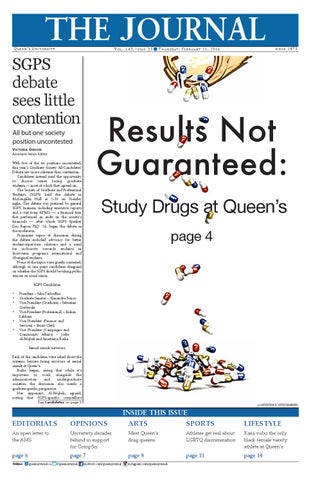
Results Not Guaranteed:
All but one society position uncontested V ictoria G ibson Assistant News Editor
With five of the six positions uncontested, this year’s Graduate Society All-Candidates’ Debate saw more cohesion than contention. Candidates instead used the opportunity to discuss issues facing graduate students — most of which they agreed on. The Society of Graduate and Professional Students (SGPS) held the debate in McLaughlin Hall at 5:30 on Tuesday night. The debate was prefaced by general SGPS business, including executive reports and a visit from KPMG — a financial firm that performed an audit on the society’s financials — after which SGPS Speaker Eric Rapos, PhD ’16, began the debate as the moderator. Prominent topics of discussion during the debate included advocacy for better student-supervisor relations and a need for inclusivity towards students in short-term programs, international and Aboriginal students. None of the topics were greatly contested, although at one point candidates disagreed on whether the SGPS should be taking public stances on social issues.
Study Drugs at Queen’s page 4
SGPS Candidates • President – Saba Farbodkia • Graduate Senator – Alexandru Sonoc • Vice President (Graduate) – Sebastian Gorlewski • Vice President (Professional) – Kishan Lakhani • Vice President (Finance and Services) – Stuart Clark • Vice President (Campaigns and Community Affairs) – Jodie Al-Mqbali and Anastasiya Boika Sexual assault survivors Each of the candidates were asked about the systemic barriers facing survivors of sexual assault at Queen’s. Boika began, saying that while it’s important to work alongside the administration and undergraduate societies, the discussion also needs a graduate-specific perspective. Her opponent, Al-Mqbali, agreed, noting that SGPS-specific counsellors See Candidates on page 3
ILLUSTRATION BY KEITH SAUNDERS
INSIDE THIS ISSUE
EDITORIALS
OPINIONS
ARTS
SPORTS
LIFESTYLE
An open letter to the AMS
University decades behind in support for CompSci
Meet Queen’s drag queens
Athletes get real about LGBTQ discrimination
Kasa-vubu the only black female varsity athlete at Queen’s
page 6
page 7
page 8
page 11
page 14
Online:
queensjournal.ca
@queensjournal
facebook.com/queensjournal
instagram.com/queensjournal
News
2 •queensjournal.ca
2016-17 AMS Executive Team announced J ordana G oldman Assistant News Editor On Feb. 9, the recently elected 2016-17 AMS executives — Tyler Lively, David Walker and Carolyn Thompson — announced the team of students that will join them as the AMS Executive Team for the following year. The process of hiring the Executive Team — previously called the AMS Council — included reviewing 64 applications and two rounds of interviews. The hiring of the 2016-17 service and government managers will be announced after Reading Week, according to the AMS. The Journal was unable to obtain interviews with the new team in time for print, as the announcement was made on Tuesday night. We’ll update this story as we receive more information.
Queen’s professor Dr. Kerry Rowe has been elected to the US National Academy of Engineering (NAE). NAE, a private non-profit organization in the United States, elects new members who are distinguished in their research achievements. Only 20 engineers of NAE’s
CORRECTIONS A photo accompanying an article on volleyball player Scott Brunet was mislabeled. The subject in the photo was misidentified as Scott Brunet when it was actually his brother Chris. An article on work conditions for Student Constables included an inaccurate figure regarding a Non-Academic Discipline incident. Around 17 per cent of NAD cases since May 1, 2015 involved the intervention of Student Constables, not a quarter of cases. The article also contained unclear information about an incident at the Underground involving a StuCon and another student. The student in question is alleged to have first inappropriately touched the chest of a TAPS manager. Later in the night — but not immediately after — StuCons asked the student to leave due to his level of intoxication and the student pushed a StuCon down a few stairs. Inaccurate and unclear information appeared in the Feb. 5 issue of The Journal. The Journal regrets the errors.
For full results of SGPS elections visit qjlongform.com on Friday
Commissioners • • • • •
Academic Affairs: Leah Brockie, Con Ed ‘17 Campus Activities: Greg Kurcin, ArtSci ’16 Environmental Affairs: Liam Dowling, Con Ed ‘18 Municipal Affairs: Francis Campbell, ArtSci ‘17 Social Issues: Leandra Keren, Comm ‘17
Directors • • • • • • • •
Hospitality and Safety Services: Brandon Kim, ArtSci ‘16 Media Services: Max Garcia, CompSci ‘17 Retail Services: Leo Burns Scully, PheKin ‘16 Student Life Centre: Sam Anderson, Sci ‘17 Advancement: Caitlin McKeen, ArtSci ‘16 Communications: Bianca Balazic, ArtSci ‘17 Human Resources: Emma Jones, ArtSci ‘16 Information Technology: Michael Judd, CompSci ‘17 GRAPHICS BY ASHLEY QUAN
Queen’s professor elected to US National Academy of Engineering M ikayla W ronko Assistant News Editor
Thursday, February 11, 2016
2,200 elected members are Canadian, and Rowe is one of only two civil engineers listed as foreign members. Rowe served as the vice principal (research) at Queen’s from 2000 to 2010 and he’s currently a professor at Queen’s. Dr. Rowe’s conducts research in the field of geosynthetics, which are synthetic products used to stabilize terrain. He’s now turning his focus
to assessing the effectiveness of plastic (geomembrane) liners and geosynthetic clay liners in limiting contamination from waste disposal facilities and mining operations. Rowe is also an elected member of The Royal Society United Kingdom, a Fellow of the Canadian Academy of Engineering and a Fellow of the Royal Society of Canada.
ALTERNATIVE DISPUTE RESOLUTION POSTGRADUATE CERTIFICATE
From arbitration to community outreach, this program offers the unique skills you will need to launch your career as an arbitrator, conciliator, employee relations officer, mediator and many other exciting career options.
business.humber.ca/postgrad
News
Thursday, February 11, 2016
queensjournal.ca
•3
Candidates discuss underrepresented groups and taking a stance on social issues Continued from front page
are in dire need. (The student to embedded counsellor ratio is currently 4,500 to one.) Sonoc added that there’s a harmful stigma around sharing experiences of sexual assault similar to the stigma around mental health. Clark built on Sonoc’s point, saying that, most importantly, “any response we take must not revictimize people who are sharing their experiences.” Lakhani, who worked with a sexual health and disease service during his Masters degree at University of Manchester, said approachability is important for encouraging survivors to come forward. Gorlewski reminded the audience that mental health is inherently tied into the care of sexual assault survivors and stated that there’s a need for additional graduate counsellors. Farbodkia rounded out the conversation, concluding with her point that any response needed to be proactive rather than reactive. Integration of underrepresented student groups Candidates also discussed the integration of underrepresented student groups — specifically, those in eight-month or one-year programs and those from minority groups on campus, such as Aboriginal students or international students. The candidates talked about providing liaison programs, welcome brochures and other tangible information about services on-campus as methods to tackle the issue. Several candidate brought up institutional pressures for graduate students and discussed methods of improving student-supervisor relations. All candidates agreed on the
issue, and presented solutions ranging from Teaching Fellow (TF)-Teaching Assistant (TA) mentorship programs to more structured research goals. Public stances on social issues The one contentious issue was whether the SGPS should take a public stance on social issues, which outgoing Rector Mike Young asked of all the candidates. Farbodkia and Boika said it should be an issue-by-issue situation, while Sonoc stressed the importance of action over statements. Gorlewski, meanwhile, said such an action should rarely be taken but that there are some exceptions. Al-Mqbali and Lakhani were hesitant to impart the beliefs of the executive over the student body as a whole, and Clark said students outside of council needed to be consulted first. Farbodkia began by saying it depends on the issue. But taking a stance on a contested issue was a bad idea, as the SGPS is meant to represent everyone, she said. “The majority doesn’t necessarily mean the truth,” she said. Sonoc said he would take a stance if he could also take action on the issue. If the stance is taken to merely chastise or give support, it wouldn’t be “terribly useful”, he said. Gorlewski brought up an exception. He said if there was a violation of basic human rights or a hate crime on campus, the SGPS would need to take a public stance. Al-Mqbali agreed with Gorlewski’s point, but said public bodies could not impart their personal beliefs upon the organization. Lakhani then brought the discussion back to Farbodkia’s statement about a majority, and said majority
systems are what allows minorities to be underrepresented. Boika added that such discussions should be made issueby-issue to “make sure we as an executive are standing as a unit, rather than divisive.” Finally, Clark said his job wouldn’t be to lead student opinion, but rather reflect it. Therefore, it’s important to have discussions with students outside of the SGPS council before making any decisions on public stances, he said. — With files from Jordana Goldman
From left: Saba Farbodkia and Sebastian Gorlewski.
Anastasiya Boika is the current Features Editor at The Journal. She had no involvement in writing or editing this article.
For full candidate profiles visit qjlongform.com From left: Stuart Clark and Kishan Lakhani.
From left: Anastasiya Boika, Jodie Al-Mqbali and Alexandru Sonoc.
PHOTOS BY EMMA SEWELL
CONTRIBUTORS OF THE MONTH Kyle Curlew
Charlotte Sanders
Emma Sewell
Clayton Thomson
Kyle is a hardworking and enthusiastic contributor. His expertise in the field of surveillance keeps students well-informed and entertained from safe web browsing to cyber anonymity. Kyle’s flare for all things cyberspace is contagious. He always delivers edgy and well-written articles. Kyle is a pleasure to work with. If you haven’t read his content, I suggest you do!
January was a breakout month for Charlotte, as she contributed multiple times and to multiple sections. Although most her stories have been published in The Journal’s Lifestyle section, Charlotte came through in the clutch for the News section to provide coverage of the COMPSA student elections. Charlotte was easy to work with and eager to continue writing. We’re glad to see that she’s continued to write for The Journal during the first weeks of February.
Emma is an enthusiastic photo contributor, who does an amazing job on every assignment. She’s always willing to pick up photo assignments on short notice and helped out tremendously during election season. She’s become The Journal’s go-to Talking Heads photographer and makes the segment fun to do. Her diverse photo portfolio and her willingness to learn has made her one of our most valuable contributors.
Since he first contributed to The Journal in November, Clayton has been enthusiastic to pick up stories, especially during AMS elections. While covering CESA, Clayton did a good job of learning about ConEd issues under tight deadlines and helping out with our election microsite. He’s been open to covering a variety of topics and reliable when it comes to edits. We look forward to having him write again for the News section.
Longform
4 •queensjournal.ca
Thursday, February 11, 2016
Five dollars, a pill and an “A”
PHOTO BY KENDRA PIERROZ
While easy to access, study drugs are a serious gamble for the mind and body Visit qjlongform.com for the full article N ick P earce Features Editor
Four
years ago, hundreds of students filed into the rows of desks lining the inside of Grant Hall. The rectors listed instructions, some students fidgeted and one second-year student took a seat. It was December exams and he’d just tried Ritalin for the first time. He studied in bursts for most of the previous week. But time spent scouring assigned readings and month-old notes came in 30-minute increments and then he started to drift off. The time he put in wasn’t reflected in the results, he thought. His girlfriend agreed. She gave him one of her Ritalin tablets. At the time, it looked like a children’s Advil. He gulped it down and an hour later it kicked in. The exam prep went well. A renewed urgency guided his efforts as he honed in on his studies. A month later, he got his marks back. He was pleased. He’s one of a growing number of students that are adding study drugs — ADHD medications like Adderall, Ritalin and Vyvanse — to their study to-do list. The drugs are stimulants meant to raise dopamine in the brain. Chemically, stimulants range from coffee to cocaine. But in terms of study drug stimulants, the
two types are amphetamines like Adderall and methylphenidates like Ritalin. Both raise dopamine activity in the brain. A 2013 National College Health Assessment (NCHA) survey taken from 32 Canadian post-secondary schools and 34,039 students reports found that almost four per cent (3.7) of students had taken unprescribed stimulants or study drugs in the past year. Men are more likely to take them — scoring a 4.7 per cent compared to 3.3 per cent among female students. However, over one in 10 students admit to taking one or more kinds of unprescribed medication, which suggests these numbers may be higher. The Journal spoke with Dr. Paul Sandor, a psychiatry professor at U of T. His research often touches on ADHD. He said the recent upswing in ADHD diagnoses has been misrepresented. The criteria have simply been more clearly defined, which allows physicians to catch more cases, he said. “Roughly 4 to 5 per cent of the general population meets diagnostic criteria for ADHD,” he said. “It is unfortunate that there are some people who are incorrectly diagnosed with ADHD, this may include both unwarranted diagnosis and also under diagnosis.” There’s a misconception that ADHD fades in a person’s teens. Instead, many people just develop better coping methods in their
ILLUSTRATION BY KEITH SAUNDERS
adulthood, according to Sandor. “They continue to face challenges because of short attention span, impulsive behaviour and restlessness.” Four years later, the second-year student is now a Masters student and has continued to use study drugs. He returned to study drugs in his fourth year of his undergraduate degree. At the time, he was juggling a full-time AMS job, a full course load, a role with Residence Life and the diagnosis of cancer in a close relative, and felt he needed an edge. He began taking study drugs borrowed from friends and their friends. A “B” student in his second year, his lowest mark was an “A-” in fourth year and an “A” in his fifth year. He would take Adderall or Ritalin on Sundays and dedicate the day to work. Students often rake in better grades over their stay at Queen’s without taking Adderall. Speaking with The Journal recently, the student agrees that he started getting better marks in third year due to new study skills. But he still attributes most of his success to Adderall. Dr. Michelle Arnot, a pharmacology proffesor at U of T, said there’s a psychological factor to dependency. Students might take a study drug for an exam or paper and find they score highly instead of on the assignment. Afterwards, a good mark will be attributed to the drug and their own abilities. “Next time they’re in a crunch they think ‘oh, this helped last time, this will help again,” she said. Myths surrounding cognitive enhancement help prop up physiological reliance. The Masters student likes to poke fun at the 2011 film Limitless, where a mysterious pill makes the main character a genius. And it’s not just Hollywood — it’s a common misconception that study drugs cause “brain gain” and increase memory and cognition. Reality, however, resists science fiction. “There have been a few studies that have shown improvement in focus in novel and attention-based tasks,” Dr. Arnot said. “But that seems fairly mild. There’s little evidence for
pronounced improvement in memory or cognitive enhancement.” People who’ve taken study drugs also report that they can make people hone in on the wrong task. They might clean their room for hours, but leave homework unfinished. Effectiveness aside, the Canadian health community has other, more serious concerns. In 2005, Health Canada banned Adderall XR after 20 heart and stroke-related deaths — 14 of which involved children — were linked with the drug.
“Next time they’re in a crunch they think ‘oh this helped last time, this will help again” — Professor Arnot, Pharmacology U of T Health Canada reversed the ban the same year but doubts lingered. Serious side effects have followed the drug’s prescription and, in some cases, have been suggested to include bodily harm and suicide. In 2015, Health Canada issued warnings about the two main classes of ADHD medications — methylphenidate and amphetamines – for “suicidality”. Suicidality includes everything from suicidal thoughts to actions and in some rare cases, suicides themselves. These warnings were based on reports, though — there’s little scientific evidence of suicidal dangers. Health Canada readily admits this, but prefers physicians and their patients are aware of the risks. The drug remains widely prescribed and often serves as an invaluable aid for patients managing ADHD. But if you’re on campus and need some help to focus, it’ll cost $5 — maybe $20 around exams. *** Dr. Arnot, the U of T professor, said symptomology lists may be
taken advantage of. Reliance on self-reporting and symptomology results in a variety of prescriptions. The risk of a student seeking a prescription without ADHD is largely left to an individual doctor’s comfort level, she added. “[Students] may be trying to get Adderall or Ritalin to help with their college courses or they just want it to sell to make some extra money,” she said. “They look online: “what do I need to report to get medication and they go on the doctor’s office and say I have this and this and this. Ta-dah.” Indeed, googling “Adderall Prescription” brings up a series of articles explaining the process — and how to fake it. After he acquired a prescription, the Master’s student said he began sharing it with friends and selling it to friends of friends with demanding schedules. Sharing side effects A second-year ArtSci student’s housemate was curious: what did Concerta feel like? The second year gave her one, but the housemate was disappointed: nothing happened. The drug had nothing to “correct”, as the housemate’s friend presumably had a healthy level of dopamine. Besides that occasion, the Arts and Science student said, she never sold or handed out Concerta on principle. But she said she would relent in a case where a friend had a full plate of classes and work, even if the friend didn’t have ADHD. The danger here is that prescriptions are far from universal, Dr. Arnot said. “It’s not one size fits all. You can’t put on the same dress or take the same medication and the same dose across the board.” The Masters student agrees. As an 180-pound man, he lends out his prescription carefully. He’s worried someone smaller could take his dose and hurt themselves. Doses are mostly based off a milligram per kilogram algorithm. While several factors complicate the matter, the model remains a common tool for physicians. Sharing prescriptions, then,
Longform
Thursday, February 11, 2016 means students may simply take what’s in front of them if they’re apathetic or ignorant about the dosage. Still, the Masters student estimates that half the students he’s sold or given drugs to didn’t report any side effects. “If you give someone with ADHD low doses of amphetamines, Ritalin or Adderall, you see a change in behavior. If you give someone with someone without ADHD, you won’t see as a big a change occur,” Dr. Arnot said. Stimulants like Adderall raise dopamine levels. If dopamine levels don’t need to be raised, the effects are muted — as the second-year ArtSci student’s housemate discovered. The risks aren’t limited to disappointment, though. “Taking a drug that has an addictive profile, it’s a bit like playing Russian roulette,” Dr. Arnot said. “You have no idea how the brain is actually going to respond. As result, you don’t know if you’ll become addicted.” Dr. Richard Beninger, former head of Queen’s Psychology department, described the possible side effects of study drugs. Without the supervision of a medical professional, the use of prescription drugs is a risky endeavor, he said. “The short answer is they work,” Beninger told The Journal. The long answer is that they can lead to side effects ranging from increased heart rates to hallucinations. The guesswork of prescription drugs needs a physician’s consultation for safety, Dr. Beninger said, and the already-present risk only multiplies with increased doses and the lack of instructions from a physician. Overdosing on stimulants, including ADHD medications, can even lead to schizophrenia-like symptoms. “Sometimes people come to the emergency room with delusions and hallucinations as possible schizophrenia symptoms and they’re given anti-psychotics [drugs] to settle them down,” he said. “Then [doctors] realize they’ve been snorting cocaine for days or taking amphetamines.” Milder overdoses, meanwhile, can cause anything from confusion to high or low blood pressure. As for side effects, Beninger described accelerated heart rates, sweating, runny nose and erectile dysfunction as some milder possibilities. A student experiencing Adderall’s side effects might start grinding their teeth or develop a twitch. Acne may start dotting their face, or they’ll begin tossing and turning at night, unable to sleep. “There’s a window in which you want your dopamine activity. If you have too little, you may find it difficult to focus, and if you have too much, you may focus on too many things and be easily distracted. So you don’t want to mess around with your level of dopamine activity,” Beninger said. All this can be avoided by consulting a physician. But many students obtaining Adderall from friends and friends of friends will never receive this consultation. Friends of friends Study drugs are readily available to most students. Upticks in ADHD diagnosis, permissive attitudes and
“Brain gain” is a common misconception about using study drugs.
a high-stress academic environment create a ready-made market for unprescribed use of Adderall and similar drugs. A 2013 NCHA survey of Queen’s found 91.74 per cent of students feel overwhelmed by all they had to do. 58.4 per cent of students surveyed also believed academics were “difficult or very hard to handle.” One student under such pressure — an ArtSci ’18 — took Adderall multiple times for two weeks during the final stretch of exams in first year.
After about six hours the dose would begin to die off, and the effects disappeared after eight hours. While he was studying, he said he was never afraid getting caught. Local police have taken preventative steps to combat drug abuse, according to Kingston Police Media Relations Officer Steve Koopman. Police are present at various Queen’s events to discuss the dangers of drug use and recently busted a drug ring operating close to the Queen’s campus, he told The Journal.
“It was pure profit, it’s not like you were selling weed and you pick up a $100 worth of weed and sell it for 160 and make a 60-dollar profit. Everything was profit. I paid 8 bucks for the dispensing fee, that’s it. ” — Student drug dealer at the University of Guelph “[It was] genuinely [the] only way I could have passed first year. I got A’s on my exams and was failing beforehand,” he said while on a break from his homework in Stauffer. He would ask friends of his, some of whom had prescriptions, to lend him some Adderall or pick some up for him. He would usually pay around $15 for 60 milligrams of pills. It seemed like the only option at the time, he said. “I just put myself in a situation where there would be no natural way to cover that much material for class,” he said, adding that he left much of the work up to the last minute. He feels he was fairly responsible about it: he said he did some research and took Adderall with experienced friends — he called them “mentors” — that had taken it before. He would start his day by emptying out an Adderall pill into a glass of water. He would drink half, splitting the 60-milligram dose into two 30-milligram doses. The medication took an hour to kick in and after three or four hours he was at his peak. Fascinated by his studies, he read entire Wikipedia articles for background information. “You’re happy while you’re working. [Work] makes you happy,” he said.
But the social nature of study drugs means many students never feel that they’re at risk of being outed or exposed in a sting operation, and easy access and strong demand makes selling the drugs good business for some students. The Journal spoke with a student who dealt Adderall in his residence at the University of Guelph last year. Although he doesn’t attend Queen’s, he’s a case study in the economics of dealing Adderall. He said he had an Adderall prescription since the third grade, but he hated the side effects. He felt the loss of appetite, insomnia and difficulty socializing was the tradeoff for doing well in school. “You’re like a zombie, over-focused on everything,” he said. In first year, he was given a combination of anti-depressants and antipsychotics as a response, but that too made him depressed. This past summer, he decided to go off his medication. He says he’s happier now: he’s doing better in school and has no trouble socializing. But in his first year, he made just under $2,000 selling his Adderall prescription. “Last year, just kind of being in residence, everybody wanted in. I could also basically get as much I wanted. I had a prescription with repeats on it, [so] every time I
queensjournal.ca
PHOTO BY KENDRA PIERROZ
wanted, I’d just contact my doctor and they’d send a prescription over to Guelph,” he said. A reliable supply resulted in mass amounts of Adderall moving through his dorm room. “I had a friend on [a varsity team] and knew a lot of guys wanted it. So I would give it to another dealer, I was at the top. I would have someone come into my room, he’d give me 300 bucks and I’d give him a bunch of pills and that was all,” he said. During midterms or exams he would have someone come by his room once a week. He’d be paid anywhere from $60 to $100 and would hand over his pills. Business dried up outside of these periods, however. When he sold pills individually, he would arrange a meeting place and sell his stock: $10 for 20 milligrams and $5 for 10 to 15 milligrams. “Sometimes if I didn’t know you, I would sell a 10 milligram pill for the price of a 20 [milligram pill],” he said. Selling an Adderall prescription has an enviable return on investment. “It was pure profit, it’s not like you were selling weed and you pick up a $100 worth of weed and sell it for 160 and make a 60 dollar profit. Everything I sold was profit. I paid 8 bucks for the dispensing fee, that’s it.” He would also deal to friends if they had to spend a night studying or buckle down for an assignment.
•5
Some of them would crush it and snort it — maybe for a faster affect, he said. He was never worried about police or getting caught. No one came knocking on his door, and he rarely dealed directly to begin with. However, he did receive some heated texts from potential customers. “Some girl got really mad, really pissed at me once because I didn’t have any. I was like I don’t have any,” he said. “I did [have some], but I didn’t want to give it her. I blocked her on my phone. So there was nothing too crazy.” He spent some of the money going out with friends or buying alcohol. He tended to buy weed as a sleep aid to counteract the medication he was taking. But most of it’s still sitting in his bank account. He says he did have some doubts. “The moral dilemma of being like, shit, I’m moving so much drugs. Some people didn’t even understand how it worked. They would have an exam the next day and they would just take this during exam, which is not how it fucking works.” Still, there’s not much he regrets about selling his prescription. His business has quieted down recently he went off his prescription and consequently has less Adderall available to sell. He’ll still take it himself as a study aid sometimes, but he finds the loss of appetite and lack of sleep exhausting. Out of residence, he’s only made around $200. The Masters student doesn’t have any regrets either — for now. “It changed my life for the better. I went from being a B to an A student. Maybe, I will [become dependent]. Maybe I’ll fall into that deep hole of addiction. It might be naïve for me to say I’ll never have regrets,” he said. He, like Student Wellness Services, encourage students to eat well, exercise regularly, take some personal time to relax and maintain a support network of friends and family. “It’s hard to predict to the future, especially with an addictive substance, but I feel like you run the same risk with alcohol on a consistent basis or smoke marijuana on a consistent basis. But it’s been such a positive in my life. I’m really glad I discovered it.” He continues to take it every third day. Visit qjlongform.com for the full article
ILLUSTRATION BY VINCENT LIN
6 • queensjournal.ca
Thursday, February 11, 2016
The Journal’s Perspective
EDITORIALS
An open letter to the AMS
THE QUEEN’S JOURNAL
Re: The Journal is Wrong About AGM, Here’s Why
www.queensjournal.ca @queensjournal
When newspapers make a factual our suggestion. We did say, “there needs to be a error, we print a correction. This ensures that we’re transparent and way for services that are necessary to receive the funding they need.” don’t mislead readers. In light of the AMS’s And we stand by that argument. The AMS is well aware of misrepresentation of The Journal’s editorial, they might be advised to the problems StuCons face. But students voting at the referendum do the same. On Tuesday night, the AMS weren’t. There’s a problem published a blog post entitled with that, and it’s one that we “The Journal is Wrong About don’t think the AMS would AGM, Here’s Why”. In it, they disagree with. Democracy can’t work if implied that The Journal had recommended to the AMS that voters are uninformed on what they reinstate the Annual General they’re voting on. And while a Assembly (AGM) as a means for referendum may have reached more students than an AGM, the passing student fees. This blog post was a response AMS’s claim that it reached 17,000 to The Journal’s editorial “Student students drastically overestimates fee policy leaves StuCons hanging”. the number of students who actually Our editorial discussed a change voted on it. The AMS’s response ignored in AMS policy, which made a student-wide referendum the only clear evidence of the flaws in avenue for passing or increasing their new system that resulted in the underfunding of an essential student fees. The editorial laid out student service. They instead the problems caused by the resorted to an attack on Queen’s change — exemplified by the University’s student newspaper Queen’s Student Constables based on an inaccurate assumption. The AMS implying The Journal (StuCons) failing to get a fee increase, despite a legitimate is against democracy — aside from their misinterpretation of need for funding. Nowhere did the editorial state our editorial — is ironic that reinstating the AGM was considering The Journal contacted the AMS several times regarding the answer. incidents involving In fact, the editorial clearly recent stated that “An AGM that allows StuCons, only to be denied huge and unnecessary student comment. Their Communications fees isn’t desirable” — just in case Officer declined to comment, anyone should assume that was stating that an article on the reality
of working as a StuCon may dissuade students from applying for the position. The AMS’s newfound love of referenda also comes at the tail end of a year where they nullified the fall referendum in a closed door meeting to which student groups affected by the decision weren’t invited. The AMS did not clarify the reasons for their decision until 13 days after the referendum, even when asked directly in an interview with The Journal. When the situation calls for it, the AMS is not above making decisions behind closed doors without asking for every student’s opinion. The AMS can’t follow their principles only when it’s convenient to do so. It’s galling to be called undemocratic by a group of student politicians who resist attempts to be held accountable and miss opportunities to be transparent. But we shouldn’t be having a “Who’s the most democratic?” contest right now. We should be discussing whether this policy change is what’s best for students in light of what happened to the StuCon fee. The AMS made a change that negatively impacted students. They’re now being called out on it, but their response has been to ignore the issue and cling to a
Volume 143 Issue 23
narrative of promoting democracy that hasn’t worked out in this case. We don’t call for student government to listen less to students, but we do expect that the AMS will act in the best interests of students. And there’s no question that the StuCon fee failing to pass was not in students’ best interests. We suggest the AMS take steps to avoid that happening again. But, instead, their solution is that StuCons — who are underpaid and often harassed — simply put on a smiling face and campaign even harder, just like MUSE Magazine. But with all due respect to MUSE, a lifestyle magazine isn’t as essential to student life as a security service. No one likes to be criticized. But good government means being open to constructive criticism. It’s the AMS’s prerogative to disagree with The Journal’s opinion, as long as they get it right. We welcome open discussion because that’s how we arrive at the best solution. What we don’t welcome is a refusal to face the real issue at hand. At the end of the day, valuable input from the AMS requires them to be factually correct, respectful and professional, as befits student leaders. — Journal Editorial Board
Publishing since 1873
Editorial Board Editors in Chief
Sebastian Leck Anisa Rawhani
Production Manager
Jacob Rosen
Assistant News Editors
A version of this article was published online on Feb. 9. It’s unclear where trans students fit in Canadian Interuniversity Sports (CIS), but institutions can ensure that space is made for students who can’t check one gender box or the other. The International Olympic Committee (IOC) recently announced a new policy wherein trans athletes no longer need surgery to compete. Trans men can compete without restrictions, while trans women have to prove they’re below a certain testosterone level. In light of the IOC’s change, the CIS, the governing board for Canadian university sports, is reassessing its own policies, which currently offer no guidance on how and where non-binary, gender fluid or trans students can compete. Changing genders involves a process of hormone therapy, which complicates things in competitive sports, because current sports standards ban certain substances that give an athlete a competitive edge. While the CIS and
high-level sports sort themselves out, it’s left up to individual institutions to decide how to handle gender identification. It’s up to institutions like Queen’s to ensure that a lack of policy, or strict gender binaries, doesn’t deter trans students from participating. It’s concerning that Queen’s lacks clear guidelines for trans athletes. Athletics and Recreation, for instance, declined to comment on their policies regarding trans student athletes because there wasn’t anyone available to speak on the matter. But we don’t need a whole new system — we just need to make space in the old one.
For Athletics and Recreation, this means taking a look at where non-cisgender athletes fit into their pre-existing structure and providing a point of contact for athletes to answer questions about how they can identify and play on a sports team, and what accommodations are available. This point of communication could also help Athletics determine how many students this may affect and anticipate the needs of students who don’t fit a gender binary. Gender equity is an increasingly important topic in our society, but change at a higher level is often prompted by pressure from below. We can’t sit back and wait for other people to take the first steps.
Victoria Gibson Jordana Goldman Mikayla Wronko
Features Editors
Anastasiya Boika Nick Pearce
Editorials Editor
Jane Willsie
Opinions Editor
Kate Meagher
Arts Editor
Ramna Safeer
Assistant Arts Editor
Lauren Luchenski
Sports Editor
Adam Laskaris
Assistant Sports Editor
Joseph Cattana
Lifestyle Editor
Erika Streisfield
Assistant Lifestyle Editor Digital Manager
Kailun Zhang Kayla Thomson
Photo Editors
Kendra Pierroz Stephanie Nijhuis
Video Editor
Anna Maria Li
Copy Editors
Vishmayaa Jeyamoorthy Katie King
Graphics Editor Editorial Illustrator Web Developer
Ashley Quan Keith Saunders Daniel Clarke
Contributing Staff Staff Writers and Photographers Joshua Finkelstein Renee Robertson Emma Sewell Sean Sutherland Contributors Zelia Bukhari Max Garcia Natanya Levine Josh Malm
Business Staff Business Manager Sales Representatives
Is there room for trans athletes? The answer is up to Queen’s
Arwin Chan
News Editor
Katelyn Martinko Michael Ozburn Geoff Roberts Renee Robertson
Outreach Manager Office Administrator
Emma MacNaught Jasmit De Saffel
Want to contribute? For information visit: www.queensjournal.ca/contribute
There are many resources available at Queen’s for Athletics and Recreation to consult, from the Equity Office to the Positive Space Program. Here’s a chance for Queen’s to make sure we’re keeping up with changes made at higher levels of sport and set an example for other universities on how to make varsity sports teams accessible to all students, no matter their gender identification. — Journal Editorial Board
Contributions from all members of the Queen’s and Kingston community are welcome. The Journal reserves the right to edit all submissions. The Queen’s Journal is an editorially autonomous newspaper published by the Alma Mater Society of Queen’s University, Kingston. Editorial opinions expressed in The Journal are the sole responsibility of The Queen’s Journal Editorial Board, and are not necessarily those of the University, the AMS or their officers. 190 University Ave., Kingston, ON, K7L 3P4 Editorial Office: 613-533-2800 Business Office: 613-533-6711 Fax: 613-533-6728 Email: journal_editors@ams.queensu.ca Please address complaints and grievances to the Editors in Chief. The Queen’s Journal is printed on a Goss Community press by Performance Group of Companies in Smiths Falls, Ontario. Contents © 2015 by The Queen’s Journal; all rights reserved. No part of this publication may be reproduced without prior permission of The Journal. Circulation 4,000
ILLUSTRATION BY KEITH SAUNDERS
Thursday, February 11, 2016
Your Perspective
queensjournal.ca
•7
OPINIONS
Computer Science is here to stay It’s time to make IT happen, Queen’s
Max Garcia, COMPSA President, says Queen’s is decades out-of-date in its treatment of Computer Science.
Max Garcia, CompSci ’17
4. In the next 10 years, the Arts boasts the world-class Laboratory the Department of Biomedical and and Science budget will be frozen. of Percutaneous Surgery. Molecular Sciences. Cognitive Science, which Since then, thousands of This will result in no potential hires Take 10 seconds to look around programs neural models, was you. What do you see? I bet your Internet companies have come for the School of Computing. As if this weren’t enough, founded in 1984 by the late Roger smartphone, tablet or laptop are and gone, but their underlying technology has become engrained there’s another side to the story, Browse and is believed to have within arm’s reach. one that needs to be addressed been the first such program in Magical though they may seem, in everything we do. From requesting a cab via urgently in order to maintain the the world. these products are not the result of Software Development students the supernatural or divine. They’ve a mobile app to purchasing top-notch quality of education mostly originated in the last 20 years Christmas gifts online or sharing Queen’s is known for: this is are highly recruited by banks to work in fields of security, network, thanks to the hard work of people photos and videos on Facebook increased enrolment. The amount of applications data, quality assurance and graphic with a passion for innovation or YouTube, the field of computer science has never seen so Queen’s Computing receives is design analysis. and programming. Computing and the Creative something to be extremely proud However, while our generation much growth. Computers are evidently of. It speaks to the stellar education Arts is home to the Human has witnessed first-hand the fastest technological evolution in everywhere and constantly available at the school — an Media Lab — which is one of a the history of mankind, Queen’s advancing — from business education that’s sustained by some kind nationwide. Game Development students University still refuses to recognize to education, communication, of the nation’s best researchers, this new era of technology and transportation, medicine and lecturers and innovators of the have their work showcased in the annual Creative Computing Fair. continues to treat the School of entertainment — but Queen’s has computing industry. It also speaks to the diversity And Wall Street is currently shifting kept its gearshift on first for the last Computing as if it were 1995. the School of Computing offers its models to include algorithms In 1995 Netscape was the most 21 years. While it’s astonishing that the in its programs. In addition to its that students in Computing and valuable Internet Company in the world and Pixar Animation School of Computing hasn’t been flagship Computer Science degree, Mathematics work on. Through these programs, Studios revolutionized the film allowed to hire a new group of the School of Computing has six industry by releasing the first professors, the next facts are even different specializations — a clear the School of Computing demonstration that computer fulfills Queen’s mandate to feature length computer-animated more alarming: be an innovative and research 1. In 2011, the undergraduate science is found everywhere. film: Toy Story. The thought of Biomedical Computing intensive institution. ratio in social media that could connect student-to-faculty Above everything, Queen’s the future of people from any corner of the world Computing was 11:1. Today represents computer-assisted health care and has the highest percentage of it’s 24.9:1. was unimaginable. 2. Seven professors retired in 1995 was also the last time ADMISSION NUMBERS OF BY JANUARY BY JANUARY PERCENTAGE the School of Computing was 2007. None were replaced. 2016 INCREASE THE SCHOOL OF COMPUTING 2015 3. The School of Computing APPLICANTS TO THE allowed to hire a new group of 1,255 702 78.77% professors using university funds. currently has only 18.5 faculty SCHOOL OF COMPUTING One more position was opened members who do teaching, OFFERS GIVEN OUT BY THE 52 367.31% 243 in 2006 and the School won half research and administration; by SCHOOL OF COMPUTING 130 15.38% 150 of a position through a Queen’s 2017 this number is expected TARGET NUMBER OF STUDENTS ESTIMATED National Scholar competition in to be reduced even further due ACTUAL NUMBER OF STUDENTS 170 8.82% 185+ (INCLUDING COMPUTING AND THE CREATIVE ARTS) 2015; the professor is shared with to retirement.
PHOTO BY STEPHANIE NIJHUIS
women enrolled in a computer science program in the nation, with more than 33 per cent, while the average in other computer science programs is 20 per cent. Computer Science isn’t a socially awkward man coding or playing World of Warcraft in his mom’s basement. Computer Science is a discipline that’s changed the way we transfer and analyze information and communicate. Computer Science will continue to grow and more industries will adopt a technological and digital focus. Industries like banking, medicine, consulting, automotive, film, sports, gaming, among others, have begun to adapt to the age of computers and a digital world. It’s time for Queen’s to do the same. Computer Science is here to stay and now is the time to support its development and the School of Computing. Support us in continuing to innovate and find ground-breaking research. Support the teaching and education of this science by hiring new professors. Because through professors we will be able to learn and master current concepts, concepts that when applied will change the world around us. Computer Science is here to stay. Is Queen’s ready? Max Garcia is a third-year Cognitive Science major and COMPSA president.
LETTER TO THE EDITOR Re: Student fee policy leaves StuCons hanging In all our years at Queen’s, we never thought we would see the student newspaper call for its student government to listen less to students. Their strong call for the reinstatement of approving student activity fees through the Annual General Meeting due to the defeated fee increase for the Queen’s Student Constables implies just that. The responsibility for the failed fee increase lies with the three of us as the AMS Executive. The entire Student Constable management team made an exceptional case
for the fee increase, a fee increase in the last decade. Since we’ve buzzword, it’s a prerequisite to that would not just cover increased arrived at Queen’s, seven fees have any standing afforded to the AMS. costs, but also reduce prices for bypassed referendum with the We are only taken seriously when clubs and faculty societies when Annual General Meeting. Six of we speak for our students, and we booking student constables. which have been AMS fees. The are dismissed when our partners We certainly made mistakes Journal — ostensibly our student sense that we are out of touch with during this referendum period newspaper — wants your student student needs. that failed to deliver that message government to consult less students, Bypassing a referendum and we accept that. We will review because consulting 17,000 students through the Annual General the mistakes made this campaign, rather than 70 leads to a less Meeting isn’t only wrong, it and we’re confident that a new certain outcome. distances us from the students proposal will be presented When The Journal endorsed who pay our salaries, and who next year. Team CBW around this time last we’re supposed to serve. That Let’s be clear about this fact: year, they said we had “yet to distance has real risk to cause The Journal wants us to reinstate determine specific methods for long-term harm to the advocacy the practice where fees would garnering student opinion”. They that the AMS engages in, by be confirmed at the Annual were right. Throughout this year, harming our standing with students. General Meeting — an event we learned that seeking student Running a referendum that has reached quorum once opinion is more than just a campaign isn’t easy, nor should it
be. But it’s a fair price to pay in order to have students (no pun intended) buy-in to our programs and services. Students should tell the AMS how they want their money spent. It should never be the other way around. Sometimes democracy teaches hard lessons, sometimes we don’t always get our way. That does not give us the right to rig the rules of the game. Kanivanan Chinniah, AMS President Kyle Beaudry, AMS Vice President (Operations) Sarah Letersky, AMS Vice President (University Affairs)
8 •queensjournal.ca
Thursday, February 11, 2016
ARTS
PHOTOS BY STEPHANIE NIJHUIS
Mark Iain Làz (left), who performs as Sienna Towers, and Andres Caravante, who performs as Mimi Osa, both realized that drag was their ideal creative outlet.
For the love of drag
The art of cross dressing gains exposure in the Kingston community J ane W illsie Editorials Editor
getting into the chest and community,” Caravantes said. to embrace. Mark Iain Làz, ArtSci ’18, credits “I liked the idea of just like hip-padding, tights and corset is a Caravantes with introducing him showing the more feminine side more arduous process. Being a drag queen isn’t that to the drag scene. There aren’t many shows in of myself that I don’t necessarily “Andres — Mimi — started Kingston where the performer get to show in everyday life in an difficult to do on a student budget, Caravantes said. You can even around this time last year and I was simulates a blowjob on an acceptable manner,” he said. “So, drag seemed like an easy make body padding from couch always like, ‘I could do that, I could unsuspecting audience member. totally do that, I would love to do The art of drag is fun, glamorous way to kind of get that outlet of, cushions or padded underwear. Good drag show etiquette is that,’” Làz said. and hilarious. Like all good art, well, I want to act over-the-top When in drag, Làz goes by the it’ll bend your expectations and and want to do this and not be answering questions, dancing and persecuted for it the same way I interacting with the queens, but name Sienna Towers. remove your inhibitions. “Really, Sienna Towers is Andres Caravantes, ArtSci ’18 would be if I acted that way as most drag queens work only on just a play on the joke that I’m tips — and wigs aren’t cheap. — known as Mimi Osa when a male.” a Toronto queen, that I’m a Drag is a hobby for in drag — started performing in very metropolitan girl when Caravantes, not a life plan — August of 2015. The art of drag is fun, I’m performing,” he said. For “Once I started doing it, I as his goal is to go to law glamorous and hilarious. Làz, drag queens don’t have was like really into it. I just love school. But for now, drag is an Like all good art, it’ll bend to choose between funny lip-syncing and no one will watch easy way to make money, even beautiful — they can you if you’re not wearing a wig and if it takes at least three hours to your expectations and remove or be both. a pound of makeup,” he said. transform into Mimi Osa. your inhibitions. “There’s this huge divide For Caravantes, his aptitude for “I’m still kind of playing between, you know, whether drag began at an early age. with who exactly Mimi Osa “I came out really early, so like is,” Caravantes said. “I’ve always “Usually when you see a drag drag is strictly female impersonation when I was 12, and my favourite wanted to style my drag after queen and you’re enjoying the or not, or if it can be a farce in and artist is Mariah Carey, so I’ve that kind of lady who pushes performance you might go up and of itself. It can be fun, which I fully always been lip-syncing and doing her husband off the ledge and hand them a $5 bill or a $20 bill if believe it can be, but I also think acts all widowy when she really you want them to meet you in the it could look amazing as well,” dances around my house when.” back alley later,” Caravantes joked. Làz said. Drag allows Caravantes killed him.” Làz said he was also drawn While it takes Caravantes only While drag shows happen to exhibit a side of himself that he doesn’t often get a chance an hour to put on the makeup, regularly at the Grad Club and Sir in by the history behind drag. John’s Public House, there aren’t His favourite documentary, many opportunities for students to Paris is Burning, documents the engage. Caravantes thinks students lives of drag queens during the LITERATURE would get involved if given the underground movement of ball culture in the 1980s New chance, though. “I’m trying to bring that to York City. Drag queens congregated campus and integrate the drag scene in Kingston with the Queen’s regularly in basement bars or
Some light reading for reading week Just three books for all your leisure reading needs
N atanya L evine Contributor As the weather outside goes from premature spring back to the gloom of February, many — myself included — find themselves spending reading week alone in Kingston. A book can provide a well-needed escape. I’ve done your homework for you (because no one wants homework on their week off) and chose some books that are perfect
for reading week. Here are three of my favorite books, three journeys you can embark on and return from in a week. The Sun Also Rises by Ernest Hemingway Join Jake Barnes, American ex-patriot and narrator of Hemingway’s The Sun Also Rises, in his day-to-day existence in Paris. The book starts by describing Barne’s life in a way some
might consider mundane. But Hemingway makes the routine lives of the “Lost Generation” of the 1920s into something beautiful. As we follow Barnes, the reader is kept in each environment just long enough to tire delicately from it and crave a change of pace and scenery. After a lovely week of fishing — the calm before the storm — the novel plunges into the heart of the fiesta at the running of the bulls in Pamplona. The beauty of the celebration and theuniquenessofBarnes’friends — a comic group of caricatures of the Lost Generation — keep the reader constantly entangled in the
story, flipping page after page. Hemingway’s ability to be concise in his language use is something writers and readers of all generations admire. The Sun Also Rises is a quick story that will give you a glimpse of the young artists (as they may call themselves) of the 20s keeping your eyes open to the parallels between our generation and theirs. The Three Stigmata of Palmer Eldritch by Philip K. Dick Philip K. Dick was never grounded in his own time, and spent much of it imagining what the world would look like 50
big halls and participated in balls — events where they walked the catwalk dressed in a certain category of drag, such as school girl or executive realness. Balls were the only place these queens, who were mostly African-American, could be powerful and in control. “Executive Realness”, a category of drag, is when queens dress like high-powered business executives. “Everyone was cheering them on, walking down these hallways, people are cheering them on, rating them, giving them 10 out of 10 on these cards, and that made them feel good because then, there, they could be the executive,” Làz said. Drag queens are incredibly confident when performing. For Làz, summoning this confidence comes from letting everything else go and knowing he can be amazing. “There’s this trope that the gay guy is really, really, flamboyant and just very out there and confident, and I love that because it’s great. Being confident and unapologetic is great,” he said. “But I think when I go up there and I try to summon that kind of confidence, I think of when I was a kid and just watching from the sidelines because I couldn’t really participate, that kind of thing. And kind of just showing that I can do this.”
years in the future. Perhaps you’re too comfortable in reality and you want to see what happens when everything you thought was certain falls away. Perhaps you want to understand what it feels like to reach the top of a staircase, to open a door, and enter someone else’s mind. That is what happens to Leo Bulero, one of the major characters in Philip K. Dick’s finest piece of work (in my humble opinion): The Three Stigmata of Palmer Eldritch. Written in 1965 and set in the 21st century, some elements of Dick’s predications are eerily and uncannily accurate. See The classic on page 10
Arts
Thursday, February 11, 2016
queensjournal.ca
•9
FILM FESTIVAL
Reelout wheels out of Kingston A quick-fire review of some of this year’s film highlights
Fire Song, one of the films at this year’s Reelout Queer Film + Video Festival, focuses on the experience of living on a First Nations reserve.
J osh M alm Staff Writer The Reelout Queer Film + Video Festival screened its closing gala to an enthusiastic crowd this past Saturday, wrapping up an entertaining, illuminating and educational nine-day celebration of sexual and gender diversity in film. Reelout — which began in 1999 as a project to celebrate queer media arts — has remained relevant and subversive as discussions on sexuality and gender have blossomed in Canadian society. After 17 years, the festival continues to be an artistic forum for debate and discussion on topics related to various marginalized communities. This year’s theme, “In the Dark,” covered issues such as poverty, First Nation reserves, sexual violence and the devastation of war. “We had a lot of terrific visiting filmmakers and some great audience questions and it is nice
to see that people were engaged,” festival director Matt Salton said. As part of my coverage of this year’s festival, I was treated to three very different films — Fire Song, a Canadian drama about life on a First Nations reserve, the trippy, apocalyptic Spanish film Velociraptor and the light-hearted romantic comedy Portrait of a Serial Monogamist. Fire Song Fire Song, which made its debut at the Toronto International Film Festival in 2015, depicts the young and intelligent Shane, an Anishinaabe teenager at a crossroads in his life. When the film begins, Shane is torn between staying on his reservation and attending university in Toronto. He also finds himself choosing between his girlfriend Tara and his friend David, for whom he harbours secret romantic feelings.
Faced with mounting relationship pressures, traditional values in his community, rising tuition costs, the suicide of his younger sister and his mother’s chronic depression, Shane — played by newcomer Andrew Martin — begins to break down and cope with his stress in increasingly harmful ways. The film focuses on issues that affect many Aboriginal peoples. As a film that confronts alcoholism, substance abuse, racism, homophobia and sexual violence, Fire Song authentically and successfully tackles issues that have been relevant to all of us at one time or another. Fire Song is a refreshing, hard-hitting, but ultimately positive depiction of problems affecting youth in Canada’s marginalized communities and a fantastic example of oft-unseen First Nations cinema. The film is based partly on director Adam Garnet Jones’
Velociraptor is set just before an impending apocalypse, but still manages to be funny and relateable.
experiences in his own community. “When I went to write this film I started thinking about and remembering a time in my own community when there had been a cycle of youth suicide and that feeling of heaviness in the community, of everyone being afraid of, you know, is this the end? Are we going to lose somebody else?” Jones said. “And everyone is so worried about what is going to happen next, but nobody knows what to do and so exploring that kind of feeling and looking back on my own experiences.” Velociraptor On Saturday afternoon, I went to see Chucho E. Quintero’s surrealist, indie doomsday-dramedy Velociraptor, a film with complex, taboo subject matter that’s buttressed by occasional moments of hilarity. The film follows two friends, Alex and Diego, as they prepare for an inevitable apocalypse. The two characters spend their last hours on Earth together, divulging sexual secretes and desires. Alex, who’s gay, tells stories about his sexual experiences to Diego, whose sexuality remains ambiguous. The two confide their sexual exploits and fantasies until Alex proposes that the two have sex. He’s still a virgin, he tells Diego, and he wants to enjoy his first time in the company of someone he loves. Velociraptor is visually stunning and the chemistry of the two leads — actors Pablo Mezz and Carlos Hendrick Huber — carries the film to the end. The film successfully deconstructs beliefs about sexuality through the dialogue of the two protagonists, and it’s captivating to see the two bond over fears
PHOTOS BY REELOUT QUEER FILM FESTIVAL
and desires concerning sexuality and intimacy. Mixing science fiction, romance and drama, Velociraptor is a fresh take on the strength of friendship and the excitement of sexual exploration. Portrait of a Serial Monogamist At the closing gala this past Saturday, I watched the final film of the festival — John Mitchell and Christina Zeidler’s romantic comedy Portrait of a Serial Monogamist. The film follows radio journalist Elsie, a serial dater who recently broke up with her latest girlfriend for a younger woman. After a friend challenges her to put an end to her relationship addiction, Elsie commits to being single for five months. With a straightforward and predictable plot, Portrait of a Serial Monogamist feels like one long TV episode. Elsie is a typical romantic comedy lead — kind of immature and a bit of a screwball, but just charming enough for you to root for her and forgive her shallowness. The film’s portrayal of Elsie and her experience is surprisingly poignant, touching and at times cringe-worthy, especially if you’ve ever been that crazy ex-partner. Although it’s labeled as a queer film, co-directors John Mitchell and Christina Zeidler’s urged viewers to consider Portrait of a Serial Monogamist as a romantic comedy. Instead of focusing on specific queer issues, the plot follows Elsie’s quest for self-understanding. “That is what is subversive about our film. It was just them as people and they weren’t trying to hide who they were. They’re already out, they’ve lived their lives and that’s how we played with the genre,” Zeidler said.
WINTER CLOTHING STAYING ALL 40% OFF
WARM JUST GOT CHEAPER
ALL WINTER FOOTWEAR
30% OFF
SKIIS & SNOWSHOES
20% OFF
Trailhead rentals include skates, snowshoes and X- ski
trailheadkingston.ca • 262 Princess Street • 613-546-4757
Arts
10 •queensjournal.ca
Thursday, February 11, 2016
The classic, the sci-fi and the in-between Continued from page 8
The plot synopsis is too complex to explain briefly (although the book is less than 300 pages long), so I recommend letting Dick tell you himself. After all, he’s a master at easing readers into another, vividly-imagined version of the Earth (and surrounding planets) with delicacy. This story was published in a selection of four stories (alongside Man in the High Castle, Do Androids Dream of Electric Sheep, and Ubik). The stories share several themes and ideas which could only be conceived by a schizophrenic on speed in 1965. Although the idea of entering Dick’s mind may seem unnerving, I’d highly recommend it. I’ve never seen myself as clearly as I have
through his eyes. Rant by Chuck Palahniuk “Some people are just born human, the rest of us, we take a lifetime to get there.” The journey of Buster “Rant” Casey — told by Fight Club creator and personal (anti)hero Chuck Palahniuk — is another trip worth taking this reading week. Told in the style of an oral biography — composed of chapters told from the perspectives of different first-person narrators — it begins by zeroing in on the upbringing of Rant Casey, and spins out of control as the book goes on. The novel starts in the generic small town of Middleton, nowhere USA. It ends by leaving the reader in the dust of an epic, vaguely
biblical journey, questioning the truths of existence. Although I’ve read the majority of Palahniuk’s books, I’m always still pleasantly surprised by how they can still, well, surprise me. He has a distinct style and unifying themes that run throughout many of his works, and an extremely sharp eye for social satire and an extremely sharp tongue. His voice is so distinct that he seems to become one of his own characters. He has a wonderful way of keeping his novels, well, novel. Palahniuk’s genius shines most clearly at the end, when every page reveals a new twist or a new level to the story. As it concludes, he somehow manages to root the outlandish tale firmly into the world we live in today.
WORK YOUR DEGREE WITH A POSTGRAD Our postgraduate certificates help you accelerate your career by providing specialized training that builds on your previous degree or diploma combined with the opportunity to gain practical experience taking on real-world challenges.
qjlongform.com
business.humber.ca/postgrad
sometimes the full story doesn’t fit in print.
EVENT MANAGEMENT POSTGRADUATE CERTIFICATE
The Office of the University Ombudsman offers confidential, free support to members of the University community. The Office provides dispute resolution assistance for both academic and non-academic issues.
www.queensu.ca/ombudsman ombuds@queensu.ca
From trade shows to weddings to cultural festivals, this program offers the unique skills you will need to launch your career as an event coordinator, special events organizer, account representative, corporate meeting planner and many other exciting career options.
business.humber.ca/postgrad
Thursday, February 11, 2016
queensjournal.ca
• 11
SPORTS
A different kind of fatherly advice Russ Holmberg assisting son Matt’s coaching career as women’s hockey head coach S ean S utherland Staff Writer Russ Holmberg isn’t an official assistant coach for Queen’s women’s hockey program, but that doesn’t prevent him from providing his opinions to the team. With his son Matt serving as the head coach of the Gaels, his advice has a different meaning than it would coming from just any informal advisor. Instead, he provides in-game advice from his perch in the Memorial Centre stands. Russ called his role with the team is “an extra pair of eyes” in the stands. He added that there’s a difference watching the game from the bleachers as opposed to behind the bench. “There have been times when I’ve come down to the room after a period, and what I talk about in terms of what I saw and what the coaches talk about what they saw can be quite different,” Russ said. “I think that is a valuable part of having that extra pair of eyes that is looking at the game from a little bit of a different perspective.” He added that while he gives his perspective on the game, the ultimate call on how to take the advice comes from Matt Holmberg and his assistant coaches.
The position began when Russ made the trek down from the Holmbergs’ hometown of Pembroke, ON, to attend games as a fan before growing into a larger advising role. After Russ made the move to Kingston in 2011, his attendance became more frequent. While his son has made his mark at the collegiate women’s level, Russ Holmberg made a name for himself in the Pembroke hockey community, coaching boys at the minor hockey level. He coached for the town’s minor hockey association, taking the lead for teams in various age groups from atom to midget. On top of that, he served as part owner and coach of the Junior A Pembroke Lumber Kings, and spent two years as the commissioner of the Silver Stick tournament, an international minor hockey tournament. It only makes sense, then, that his son follows in his footsteps. Matt Holmberg was one of the many kids to play under his father, representing Pembroke at the “A” level. When the younger Holmberg’s playing career wrapped up, moving behind the bench was already on his mind. No longer able to play minor hockey, Matt Holmberg wondered if he could fill a slot on his dad’s coaching staff the next year. “I can remember driving home after
what would have been [Matt’s] last game as a midget. He asked if I was going to be coaching the following year. I said ‘It’s too early to say, I hadn’t really thought about that,’” Russ said. “I asked why and he said ‘Well, if you do, I’d like to help.’ So way back then, there was some coaching seeds that were starting to germinate in Matt.” Both generations of Holmberg coaches have a similar persona behind the bench and, for the most part, neither brings negative emotions. Russ cited two moments in his coaching career where he lost his cool – Matt remembers both of them, and added that those memories stick out to him because they were so rare. Matt’s path in women’s hockey, as opposed to his father’s role in boy’s hockey, was the major difference the two could find between them. Now in his seventh year at the helm of
the program, Matt has seen success. He’s the winningest coach in the program’s history and led the Gaels to OUA titles in 2011 and 2013. But while those were major moments in his coaching career, Matt said they aren’t the ones that stick out the most in the father-son coaching relationship. Instead, Matt pointed out a moment from the 2008-09 season when he was serving as an assistant coach with the program. Harold Parsons — Queen’s head coach at the time — wasn’t able to attend two games, so Holmberg took the reins as head coach for those games with his father on the bench as an official assistant coach. “It was just he and I on the bench in those particular games and that was a lot of fun,” Matt said. “So my very first game as head coach, Dad joined me on the bench. So that was pretty special.”
COMMUNITY OUTREACH
Athletes combat LGBTQ-phobia Get REAL looks to end LGBTQ discrimination
Emily Hazlett has been involved in Get REAL since last school year.
J oseph C attana Assistant Sports Editor As Emily Hazlett sat at the back of the packed Duncan McArthur Hall last month, she couldn’t help but tear up. During a Get REAL presentation for Queen’s Faculty of Education, multiple audience members from the teacher’s college went to the front of the stage, took the microphone and shared their personal experiences with the LGBTQ community. Started in 2011, Get REAL is a student-run initiative dedicated to eliminating homophobic and transphobic discrimination. The program arrived at Queen’s in 2013. Better known for her time as a starting guard on the women’s basketball team, Hazlett has an expanded role in the Queen’s
PHOTO BY KENDRA PIERROZ
community, acting as the presentation manager for Get REAL. “To actually hear someone else share their story instead, versus us always talking to the kids, was really touching,” Hazlett said. Tackling homophobia hits home for Hazlett. At age 16, Hazlett brought home her first girlfriend to her parents, opening up questions about her sexuality. It wasn’t until last summer that she was entirely up front about her bisexuality with her close friends in Fredericton. While her family and friends are now very supportive, Hazlett said she was occasionally bullied on her soccer team growing up due to her identity. “Even though my experience in high school wasn’t awful or anything, I remember little bits and pieces and that really sucked … and I don’t want it to happen to anyone else.”
Matt Holmberg (left) poses with his father Russ in his office.
During a typical hour-long presentation, Get REAL ambassadors share personal stories to students while the discussing the use of homophobic and transphobic language in social settings. Through these talks, they hope to combat LGBTQ discrimination. More and more Queen’s athletes have gotten involved in Get REAL, including women’s basketball player and co-coordinator of Queen’s Get REAL Robyn Pearson. After meeting Get REAL founder Chris Studer during her second year at Queen’s, Pearson has been involved ever since. With her current focus on social media and editing videos, Pearson has tried to get the message out into the Queen’s community. At the end of the 2014-15 school year, a promotional video for Get REAL made by Pearson aired at Colour Awards, where varsity athletes are celebrated annually by Queen’s Athletics. Throughout the video, varsity athletes across all sports shared their experiences with the LGBTQ community as well as their fight against homophobia. “A lot of athletes want to do their part and step forward,” Pearson said. “[They] realized it is a really easy way for them to get involved on campus in something that affects them or that can affect their teammates everyday.” For Pearson, Get REAL provides a real change from when she grew up. “There was so much closed-mindedness,” Pearson said. “[Now] you can see through each and every one of these presentations … you have affected at least one or two people, and there is no better feeling than that.” Working alongside Pearson to oversee
PHOTO BY KENDRA PIERROZ
the Get REAL Queen’s chapter is former women’s rugby prop Devon Stride. Originally from Kingston, Stride has played a pivotal role in expanding Get REAL into local high schools. While the perception may be that people involved with Get REAL are part of the LGBTQ community, Stride said allies also provide strong support. “I think that it takes individuals to stand up and have the confidence to say that ‘I don’t really care what you call me, I still support this’ … it is really important for someone who is an ally,” she said. One of the greatest feelings for Stride comes when people from outside the LGBTQ community approach her. “People will also come up and say, ‘My friend identifies this way and I want to help them, how do I help?’ and that’s so positive to see students who are so young grasp the idea and to see and want change.” Stride felt this during Get REAL’s nail painting day in the ARC. Queen’s students sent photos of their painted nails to support a young boy from Ottawa who was being bullied for wearing nail polish to school. “There were people who came who we didn’t even know,” Stride said. “They must have liked our page, but I never met them before … and [they] started to share personal details how they identify and how great this is.” For Stride, Get REAL is just one step in the journey to ending discrimination. “It was really awesome … for people who identify in the LGBTQ community to have a place where they feel comfortable to come and express themselves to feel validated and accepted.”
Sports
12 •queensjournal.ca
Thursday, February 11, 2016
FOOTBALL
Showcasing a nation in Texas Chris Osei-Kusi represents Canada U19s J oshua F inkelstein Staff Writer
Emma Chown (right) scored 12 tries for the Gaels this year in the regular season.
JOURNAL FILE PHOTO
WOMEN’S RUGBY
Training for the top Pair of Queen’s athletes members of national program A dam L askaris Sports Editor Six sessions a week would seem like a busy enough off-season for most women’s rugby players, but two Gaels have added extra field time with hopes of stepping up their game. Third-year Emma Chown and first-year Geneviève Kasa-vubu have been participating in the Rugby Canada 7s Ontario U20 Regional Development Program this year. After the pair was scouted into the program to represent Canada at the senior women’s level, they’ve moved into a routine of travelling several times a month to Guelph for this added practice. “Moving up a level demands more from me,” Kasa-vubu said. “The challenge is sharpening skills and breaking bad habits.” While Kasa-vubu played on the 7s roster at the 2015 Youth Commonwealth Games, this will be Chown’s first time representing Canada at the international level.
While Chown’s now in her final year of the U20 program, Kasa-vubu’s involvement can still continue for two more seasons. Chown said there’s room for more Queen’s players to get recruited into the program — including the team’s 13 other rookies. “A lot of them have really great potential for 7s,” she said. While Rugby Canada primarily targets players at the university level, many top high school talents — among them Kasa-vubu in her first time competing — are included in the development program, which Chown said helps to diversify the team. Chown says while the dynamic in the program is competitive, it’s also friendly. One of the highlights of the program for Chown has been developing friendships with players she’s previously only known as foes. “You get to know them on a more personal level,” she said. Chown’s greatest offensive strengths on the field come from
her speed and elusiveness, as was seen in her game-winning try in the 2015 CIS quarterfinal over Acadia. Running down the sideline and touching the ball in the far corner, Chown made the try after evading a trio of Acadia defenders. Such momentum helps her thrive in the 7s game. “You’ve got a lot of space to run, it’s a good game for me,” she said, adding that the seven-minute halves opposed to the 40-minute halves in the 15-a-side format allow for more running to take place due to a lesser focus on fatigue. Queen’s own 7s team, made up of 12 of the athletes from the main squad, heads to Burnaby, BC next month for the Canadian University Championship. And while the team’s looking to return from that event with some hardware, it’s admittedly the main fall season that the team holds in the highest regard. “I just want to have a really successful year next year,” Chown said. “Our goal is always CIS gold.”
While Richardson Stadium undergoes construction, Queen’s receiver Chris Osei-Kusi has found another football field: AT&T Stadium in Arlington, Texas. Home of the NFL’s Dallas Cowboys, the ground played host at the end of January to the International Bowl — a series of exhibition games between Canada and the United States’ top U19 football players. In his first year with Queen’s, Osei-Kusi was the lone representative for the Gaels on the roster. “Just being selected to play for my country was an amazing feeling,” he said, “I was honoured to be one of the few players selected.” The selection came following a season in which Osei-Kusi established himself as one of the Gaels’ surest future contributors. He made three catches throughout the season, and scored one touchdown with a 42-yard punt return. He was also chosen for the OUA all-rookie team in recognition of his strong offensive contributions following the season. During the exhibition game, Osei-Kusi made one catch for the Canadian team. Though Canada
lost — after a 33-0 shutout by an American team with many players being scouted to play professionally — he said his time in Texas will impact his game in the upcoming seasons. “The whole week preparing for the International Bowl was full of learning experiences,” he said. While he noted many positives, including the chance to play against some of the highest-level athletes in the continent, it was also challenging. At practices, for instance, he said he would often feel “frustrated or overwhelmed”, but the tough week of training in the build-up to the game taught him to overcome those thoughts. “[The tough practices will have] a direct correlation with my football future,” he said. With the game played on American ground, the Canadian players had to adapt their style to slightly different rules. The field was also shorter than the standard Canadian football ground, measuring only 100 yards as opposed to 110. Other than these differences, Osei-Kusi said the game was similar to those he played at Queen’s. “Of course it was nerve-racking playing where the Dallas Cowboys play,” he said. “But as the game went on, it was just football.”
HAVE A BURNING QUESTION ABOUT
QUEEN’S SPORTS?
Tweet it to @QJSports for your chance to have your question answered by our staff in next issue’s mailbag Osei- Kusi poses at midfield of AT&T Stadium.
SUPPLIED BY CHRIS OSEI-KUSI
Sports
Thursday, February 11, 2016
Nominate a GREAT Queen’s instructor for the
Every Tuesday
Every Wednesday
Every Thursday
ANY PASTA DINNER
ANY APPETIZERS
VEAL MILANESE
(regular $18-$20)
with dinner entrée
(regular $22)
ONLY $ 1695
3-5pm Everyday
3-5pm Everyday
from 5pm Everyday
GOURMET PIZZAS
20oz PINTS OR 5oz WINE
THREE COURSE PRE-FIXE DINNER
ONLY
7
$
Submit online: queensu.ca/alumni
HALF PRICE
ONLY
5
$
ONLY
25
$
14-0675 Queen’s University Marketing
Alumni Award for Excellence in Teaching.
Nominations are accepted from Queen’s students, faculty, staff, and alumni.
• 13
s l a e D g i D g i B ONLY $ 1395
Deadline is February 26, 2016.
2016
queensjournal.ca
alumni@queensu.ca queensu.ca/alumni/ 613.533.2060
184 Princess Street • 613-544-3948 • www.windmills-café.com WINDMILLS CATERING FULL-SERVICE CATERING FROM THE EXPERTS
MEDIUM 2-TOPPINGS JOURNAL FILE PHOTO
+FREE 2 FOR 1
IGHT MOVIEwitN h
MOVIE ADMISSION
21
V IE OSSI MMI ON AD
at the box office!
UE CODE online or
Redeem your UNIQ
XXXXXXXX
(613)
follow the m/PizzaPizza and Visit www.Cineplex.co 2 for 1 movie admission offer. m your instructions to redee points for your online purchase. Earn 20 bonus SCENE times until April 30, 2016. Offer valid for show
period of February the promotional for showtimes during apply for an IMAX®, Admission ticket per free ticket will (BOGO) General performance. (1) Buy 1 Get 1 An applicable surcharge valid towards one or a Reserved seating performance only. *This voucher is n, D-Box Seating for same day, same screenings, or Front Digital 3D presentatio April 30, 2016. Valid non-feature film (age restricted), 8, 2016 through points offer. Not valid for D, VIP Room admission ticket earns SCENE or special discount coupon, voucher UltraAVX®, UltraAVX®3 points. Paid admission not valid for to earn SCENE® with any other promotion, for cash and are are not eligible redeemable be tickets . Cannot be combined cannot BEFORE PURCHASE DABLE. Offers BOGO General Admission ONLINE ORDER ARE NON-REFUN Row Centre™ Events. OM, CONFIRM YOUR conditions. TICKETS earning terms and OFFER AT CINEPLEX.C NO SUBSTITUTIONS. APPLY. REDEEMING MAY as per standard NS WHEN L RESTRICTIO EXTENSIONS ALLOWED. DABLE. ADDITIONA re-sale. NO TIME license. ONS ARE NON-REFUN nt LP or used under ONLINE TRANSACTI Entertainme Cineplex ®
www.pizzapizza.ca Download our mobile app!
8
756056456402
Some restrictions apply. Tax & delivery extra. While supplies last. Not valid in conjunction with any other offer. Registered trademarks of Pizza Pizza Royalty Limited Partnership, used under license. © Pizza Pizza 2016. 18354 ® Cineplex Entertainment LP or used under license.
18347 PP Queens University Ads Valentines Day_rev7.indd 1
2016-02-02 4:13 PM
14 •queensjournal.ca
Thursday, February 11, 2016
LIFESTYLE
SUPPLIED BY RENEE ROBERTSON
Robertson spent nine days as a “backpacktivist” with Operation Groundswell: a program devoted to redefining travel and volunteerism.
TRAVEL DIARIES
Backpacking with a purpose One student activist’s trip to Guatemala R enee R obertson Staff Writer Last reading week, I joined a group of “backpacktivists” for a nine-day excursion to Guatemala with Operation Groundswell: a program devoted to redefining travel and volunteerism. I went into this experience with a critical mindset, but also a hopeful one. The program satisfied those feelings, and at times, went beyond. As volunteers, we weren’t just assigned to your typical volunteer project but rather, we were given an in-depth and insightful perspective on Guatemalan culture and the organizations we worked with. With seven other white, female
students and two white, male in the Guatemalan highlands. On Operation Groundswell leaders, the last day of the program we we stood out as a team with woke up at 3 a.m. to camp out tremendous privilege. During the on the summit of one of Central program we were lucky enough America’s highest points to watch to hear about Guatemalan culture the sun rise above the clouds. The people we met, the culture from former guerrillas, learn about and deconstruct myths regarding we were exposed to and the scenery fair trade, and have a blast while we saw will forever be engrained in my memory. doing it. But while the adventure Our days were packed with activities. We hiked up volcanoes, component of the trip was great, made our own soaps and bags the whole experience had a lasting with local Guatemalan women, as and deeper impact on both the well as de-pulped, grinded and locals and myself. Some might argue that I could roasted our own coffee beans on the side of a volcano. After a have had the same impact if I’d two-day hiking excursion we settled just donated the money directly in for a couple of days to build to the Guatemalan organizations stoves for women’s associations with whom we worked with. But
in reality, I would never have done that. I paid for the experience and for the opportunity to help other people first-hand — to see the faces of the people I would be benefiting and have a deeper understanding of their struggle. “For our generation, it’s all too easy to feel desensitized by the guilt being directly thrust upon us whenever we read the newspaper, turn on the TV or talk to a charity fundraiser on the street,” Mikel Iriarte, an Operation Groundswell leader, said. “Paying up is never
going to cure the world’s wealth and civil rights disparities.” If I’d just donated the money, I wouldn’t be reflecting upon NGOs and volunteerism. I wouldn’t know some of the local challenges that Guatemalan people face. I wouldn’t be writing this article now and the conversations that need to be had about volunteerism wouldn’t occur. This experience was more than just backpacking, it was truly meaningful and a trip I’ll never forget.
BLACK HISTORY MONTH
Kasa-vubu a versatile talent Rugby player the university’s only black female varsity athlete adam laskaris
Sports Editor
This article was originally published online on Feb. 8. When committing to Queen’s, Geneviève Kasa-vubu admitted that the university’s lack of diversity made her hesitate. “I kind of just took it as a challenge,” she said. “Sometimes it [the lack of diversity] does bother you, but I’m too busy to feed myself into that.” Luckily for Queen’s, Kasa-vubu chose what some might consider the harder path. She turned down offers from three other schools and joined the Queen’s women’s rugby program. Before starting university, Kasa-vubu, ArtSci ’19, represented Canada at the Youth Commonwealth Games in Rugby 7s. Her team returned home from
the event with a silver medal, losing to Australia in the final. Kasa-vubu revelled in the opportunity to compete at the highest level she’d ever played. “It brought out a different side of me to push myself to keep up with [the other players],” she said. The next week, she began her first day at Queen’s in pursuit of an economics degree. Her season ended with another silver medal — this time at the CIS Women’s Rugby Championship, where the team capped their best finish in history. In a sport with specific responsibilities for each position, Kasa-vubu’s versatility is a major asset for her team. This comes from years spent playing the sport first at Guelph’s John Ross CVI and then transitioning into roles with various levels of Rugby Ontario and later Rugby Canada. While she’s listed on the
Queen’s Athletics website as a fly half and an eight man, Kasa-vubu spent most of the university season in the flanker role. In high school, she began as a winger and a fullback and she played as a prop on Canada’s 7s team. Kasa-vubu said she thrives due to her willingness to adapt and learn new roles. “As long as I’m playing rugby, I’m happy wherever they put me,” she said. Kasa-vubu is the only black female athlete currently on a Gaels’ varsity team. And with lineage from Trinidad and Tobago and the Democratic Republic of the Congo, she knows she’s in an extreme minority in a white-heavy school. While Kasa-vubu holds a unique position at Queen’s, and there’s occasional prejudice, she said her focus is the game. “Some people just aren’t worth
Kasa-vubu’s versatility is a major asset for the women’s rugby team.
your time,” she said. “You should focus on what you need to get done and surround yourself with the people that are there to support you.” Kasa-vubu praised her teammates and coaches specifically for helping her get acclimatized to the school. For the most part, though, Kasa-vubu’s story is only just beginning. Kasa-vubu is training at Queen’s and in Rugby Canada’s
PHOTO BY KENDRA PIERROZ
regional development program, often travelling to Guelph to participate in practices and tournaments. On the Queen’s lineup, Kasa-vubu is among 14 rookies who’re looking to build the program to be consistently among the country’s best. “I’m playing alongside a few of the best athletes in the province,” she said. “We can only get better from here.”
Lifestyle
Thursday, February 11, 2016
queensjournal.ca • 15 2/10/2016 https://www.brainbashers.com/printsudoku.asp?q=oo8o6oo5o1ooo2ooo4oo7ooo3ooo7oooo4ooo7ooo3oo1ooo4ooo5oooo3ooo1ooo2oo6ooo
Sudoku
BrainBashers Sudoku February 10 Super Hard
Bateman recommends making a schedule and staying consistent.
Sudoku © Kevin Stone Sudoku Ref: 53504
PHOTO BY KENDRA PIERROZ
FITNESS
© Kevin Stone [www.brainbashers.com]
Crossword
Printed from BrainBashers [www.brainbashers.com]
A beginner’s guide to strength training N athan B ateman Contributor So you want to get big and strong? It’s a simple process: lift, eat well, rest and repeat. Continue this routine for approximately four years or so and you’ll be golden. While this may seem a little intimidating, if there’s one key to success in the gym, it’s consistency. Each training session is of the utmost importance; it takes a lot of small steps to make big changes. However, for beginners these small steps can be unclear. To follow is a simple routine that has been proven effective on individuals starting out in strength training. The routine I’ll be recommending is a variation of “Starting Strength” by Mark Rippetoe, a full body routine that you’ll do three times per week. Each exercise has three sets of five repetitions, unless otherwise specified. Between each set you should rest as long as you need, but usually around one or two minutes is good. As for the weights used, it’s best to start with just the bar on all lifts in order to learn the form. For lower body lifts (Deadlift/ Squat) advance by 10 lbs every week and on upper body lifts advance by 5 lbs. It will
feel too easy when you start, but in a few months you’ll be working for it. Make sure to eat enough food to facilitate the necessary growth. When the lifts stop progressing, try decreasing the weight by 10 lbs or so and then working your way back up. Once you’ve stopped progressing entirely, then it’shttps://www.brainbashers.com/printsudoku.asp?q=oo8o6oo5o1ooo2ooo4oo7ooo3ooo7oooo4ooo7ooo3oo1ooo4ooo5oooo3ooo1ooo2oo6ooo8ooo2oooo8 time to start a new routine. Workout A and Workout B are very similar, but it’s important you alternate between them each training day. Make a schedule for the week that will include a minimum of three training days with rest days in between. Workout A (#sets x #repetition) • Squat - 3 x 5 • Bench Press - 3 x 5 • Deadlift - 3 x 5 • Pull Ups - 3 x failure (as many as you can) (If you can’t do a full bodyweight pull up, then use the pull down machine instead. Pick a weight you can do for about 10 reps) Workout B (#sets x #repetition) • Squat - 3 x 5 • Overhead Press - 3 x 5 • Deadlift - 3 x 5 • Pull Ups - 3 x failure
SQUAT: Keep your feet a little over a shoulder width apart and make sure your knee travels over your middle toe. Point your feet outward slightly and stick your butt back as you squat. Make sure to put your weight on your heels, rather than the balls of your feet. BENCH PRESS: While lying down, squeeze your shoulder blades together and down as you bench and always keep your feet planted firmly on the floor. Keep your butt firmly on the bench, creating an arch in your lower back. Touch the bar to the bottom of your sternum. DEADLIFT: Keeping your back straight is essential. Drive through your heels and lift the bar off the ground. This lift is both the most simple and complex in terms of technique. Don’t overthink it. Back straight, drive through the heels. OVERHEAD PRESS: Squeeze your glutes and also squeeze your shoulder blades together and down. Stay balanced on your heels. To learn the form of all these exercises, never be afraid to ask for guidance from fellow gym goers. Those with lots of experience will gladly help you out and show you how to improve your form. Videos of powerlifters are also a great resource. If there’s one thing to remember: regardless of what program you’re doing, consistency and discipline are the real keys to success.
ACROSS 1 Unescorted 5 Third degree? 8 Admitting clients 12 Not pizzicato 13 Scull tool 14 Give a darn 15 Mary’s follower 16 Genetic initials 17 Eastern potentate 18 Shoelace hole 20 Cried like a puppy 22 Flightless bird 23 Reaction to fireworks 24 Gen. _____ E. Lee 27 Knight’s glove 32 Atmosphere 33 Plant bristle 34 Preceding 35 Blood bit 38 Bottom-row PC key 39 Spy org. 40 Mao’s successor 42 Angelic babe 45 Mini-program 49 Luau entertainment 50 Tier 52 Corporate emblem 53 On in years 54 First lady 55 So 56 Sampras or Seeger 57 Father 58 Criterion
DOWN 1 Store transaction 2 Salver 3 High point Wine glass 5 Part of Iberia 6 Solo of “Star Wars” 7 Heavy cart 8 Spotted wildcat 9 Tract 10 Great Lake 11 Dweeb 19 Dorothy’s auntie 21 A billion years 24 Music genre 25 Lubricate 26 Arm bling 28 Amaze 29 Still frozen 30 Blunder 31 ____ Aviv 36 Long, harsh speech 37 ____ de cologne 38 Dosage unit
41 42 43 44 46 47 48 51
Pixar film about Carl Fredricksen Bloke Ginormous Raised Traditional tales Early birds? Whistle sound Latin 47-Down
Last Issue’s Answers
16 •queensjournal.ca
Lifestyle
From left to right: Tarreisha Agard, ArtSci ‘17, Zelia Bukhari, ArtSci ‘18, and Michelle Robinson, ArtSci ‘16, at ACSA’s African dance workshop.
Thursday, February 11, 2016
PHOTO BY KENDRA PIERROZ
POSTSCRIPT
A step into African culture A dance workshop teaches more than just smooth moves Z elia B ukhari Contributor
I know that sounds funny. How the night, when I guess my face experiences with friends from and appropriated by many could a dance workshop you looked dumbfounded and the certain countries and regions of people today. It’s imperative that African do once help you grow? But by lack of movement from my body Africa. Through them I’ve learned y no means would I ever label fully immersing myself into this was probably giving away how aspects of music, dance, food dance is something that those workshop, I was overcoming my much I was struggling, many of the and language. These unparalleled, who do not identify as African are myself a dancer. influential cultural aspects shape exposed to, especially in our day As a child, even with the effort fears, going into the unknown and dancers came to help out. By the end of the night, I a person, just as much as the and age where the dominant idea and support of my parents — and addressing my blatant inexcusable the trial and error of every form of ignorance of what this style of truly felt a sense of community. understanding of the historical past. of African dance is misunderstood. Robinson put it perfectly when The sense of community, along dance under the sun — it just never dance really consists of and the The dance being taught was lively and powerful, with a flow she stated, “These workshops with the ability to socialize, enjoy valuable history it holds. worked out. We started off with a warm up that demanded the use of your celebrate the legacy of black and feel the history that’s in every Many kids are blessed with the ability to move gracefully to a beat, that had me smiling ear to ear. We full effort and complete soulful Canadians and promote inclusivity, move, left my heart full of many but not me. I was the kid at the all stood in a circle, and one by devotion. The music was upbeat, diversity and community in a fun wonderful emotions. I can confidently say my and dynamic setting.” back who would grasp the move one we went around and everyone fast paced and captivating. My favourite part of the younger self would have stuck to minutes after everyone else. I much would copy the move each whole night was the feeling African dancing, had she known preferred doing my own thing, person had chosen to share. of being a part of a united of it then. February is about which was essentially bouncing my Everyone’s personal choice My favourite part of the whole group of people who came acknowledging, celebrating and knees while my hands swayed back was so much fun, and in a night was the feeling of being a together to share their love honouring the richness of Black way gave insight into a tidbit and forth — you get the picture. part of a united group of people and enthusiasm for African history. But when February passes, Besides occasionally “breaking of what their individual who came together to share their music, dance culture I hope many of you will continue it down” (a term I use very loosely) style embodied. love and enthusiasm for African to spread the spirit of this month. and history. Obviously, I just rolled at Undies every once in a while, I “It’s important for ACSA my hands while dancing don’t really dance much. music, dance culture and history. In case readers at home to hold these African A part of me is embarrassed and side to side. Many want to do some dancing on dance workshops for the ashamed that I don’t use my body others were throwing in their own, I asked the members I left the dance workshop same reason it’s important for as a form of deeper expression typical African moves that were of ACSA to list their favourite more often. Dance is one of mesmerizing and isolated certain feeling more energized than us to acknowledge February as African and Caribbean songs. the most passionate manners parts of my body I’d never even when I walked in. I used much Black History Month,” Danielle So, here’s some of given thought to. We then moved on of that energy to practice my Leacock, VP external at ACSA, of communication. our favorite African and Through movement, a person to learning a choreographed piece, newly-learned moves all the way said. “Not only is it an opportunity Caribbean songs: can act out a story. Every set led by Michelle Robinson, which home, probably appearing mildly for students and the wider of motions describes multiple ACSA is set to perform in their crazy to bystanders, but to be Kingston community to participate African Songs honest, I didn’t care. The dance in activities that aren’t offered Culture Show. emotions and experiences. According to Michelle, most was bringing me way too much joy. monthly, but [it] also allows for Hence, when the opportunity 1. Your Number by Ayo Jay “Doing the African dance makes community members who do not arose to participate in an African ACSA dances include various steps 2. Kukere by Iyanya dance workshop led by the African from all over Africa, such as the me feel really good and happy identity as African or Caribbean to 3. Bom Bom by Timaya and Caribbean Student Association combinations of kukere and shoki because the vibrant beats of the experience a bit of our culture.” (remix ft. Sean Paul) “This exposure can only benefit (ACSA), I enthusiastically leapt to from Nigeria, dance styles such as music just uplifts my spirits and 4. Fester Skank by Lethal the challenge. I spent the whole kuduro from Angola, coupé décalé puts me in a good mood every in the attempt to de-stigmatize Bizzle (ft. Diztortion) weekend leading up to the Monday from Ivory Coast, azonto from single time,” ACSA Marketing and accept these cultures within 5. Dangerous Love by Fuse trying to find anyone to go with Ghana, dancehall from Jamaica, Officer Elorm Vowotor said. “I Canadian society and gives African ODG (ft. Sean Paul) me. The nervousness, excitement soca from Trinidad and Tobago choose to express myself through and Caribbean students and 6. Skelewu by Davido and bundle of many other nouns and traditional West African dance. it because it’s a way to let loose, be community members, a chance to feel at home, despite being “[All] to create a unique free and have fun.” were too much to bear along with Caribbean Songs This workshop added a vital miles away.” afro-fusion style,” she said. the idea of flying solo. After this workshop, African I’m going to be as real as component to Black History I went into MacGillivray1. Show Yourself by Konshens Brown Hall, a somewhat shady possible with everyone right now. Month that’s often overlooked dance has come to mean many 2. Ravin by Popcaan gymnasium on the outskirts of For someone that’s not used to within our education system. different things to me. I was in 3. Fallin by Kes campus that literally nobody has dancing with rhythm, while the Throughout our lives, we’re taught complete awe of how one’s body 4. She Ready by heard of. I was promptly greeted moves were difficult, they were by the struggles, the history, the can move with such unity and Machel Montano by some of the brightest smiles and no means impossible with a little pain — all things that are extremely self-expression. On the other hand, 5. Light it up by Major Lazer a warm-hearted ambience. From dedication and practice. Each and important and necessary to mainstream media has completely 6. Virginity by Vybz Kartel the moment I stepped foot into the every member of ACSA that was learn — but cultural aspects bombarded our Western society 7. One Wine by Machel with their idea of African dance gym, I was certain this experience present was more than willing to are lost. Montano and Sean Paul All my knowledge in regards to with no regard to historical or was going to educate, enlighten help me improve. Multiple times throughout African society stems from personal social context; hence it’s exploited and help me grow as a person.
B