MARCH 4, 2026 • VOLUME 96 • ISSUE 18
The official student newspaper of Quinnipiac University since 1929
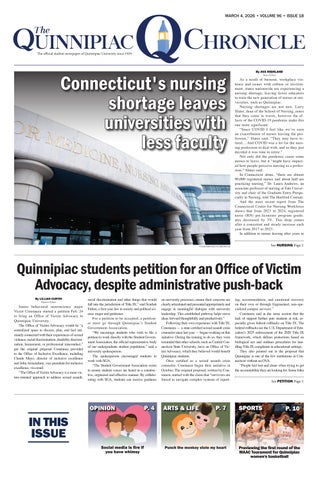
Connecticut's nursing shortage leaves universities with less faculty
By AVA HIGHLAND News Editor
As a result of burnout, workplace violence and issues with culture or environment, states nationwide are experiencing a nursing shortage, leaving fewer educators to train the new generation of nurses at universities, such as Quinnipiac. Nursing shortages are not new. Larry Slater, dean of the School of Nursing, notes that they come in waves, however the effects of the COVID-19 pandemic make this one more significant. “Since COVID I feel like we’ve seen an exacerbation of nurses leaving the profession,” Slater said. “They may have retired… And COVID was a lot for the nursing profession to deal with, and so they just decided it was time to retire.” Not only did the pandemic cause some nurses to leave, but it “might have impacted how people perceive nursing as a profession,” Slater said. In Connecticut alone, “there are almost 90,000 registered nurses and about half are practicing nursing,” Dr. Laura Andrews, an associate professor of nursing at Yale University and chair of the Graduate Entry Prespecialty in Nursing, told The Hartford Courant. And the most recent report from The Connecticut Center for Nursing Workforce shows that from 2023 to 2024, registered nurse (RN) pre-licensure program graduates decreased by 3%. This drop comes after a consistent and steady increase each year from 2017 to 2023. In addition to nurses leaving after years in See NURSING Page 2
TYLER MIGNAULT/CHRONICLE
Quinnipiac students petition for an Office of Victim Advocacy, despite administrative push-back By LILLIAN CURTIN Opinion Editor
Junior behavioral neuroscience major Victor Constanza started a petition Feb. 24 to bring an Office of Victim Advocacy to Quinnipiac University. The Office of Victim Advocacy would be “a centralized space to discuss, plan, and feel intimately connected with their experiences of sexual violence, racial discrimination, disability discrimination, harassment, or professional misconduct,” per the original proposal Constanza provided to the Office of Inclusive Excellence, including Claude Mayo, director of inclusive excellence and John Armendariz, vice president for inclusive excellence, via email. “The Office of Victim Advocacy is a more victim-oriented approach to address sexual assault,
racial discrimination and other things that would fall into the jurisdiction of Title IX,” said Scarlett Fulton, a first-year law in society and political science major and petitioner. For a petition to be accepted, a petitioner must go through Quinnipiac’s Student Government Association. “We encourage students who wish to file a petition to work directly with the Student Government Association, the official representative body of our undergraduate student population,” said a university spokesperson. The spokesperson encouraged students to work with SGA. “The Student Government Association exists to ensure student voices are heard in a constructive, organized and effective manner. By collaborating with SGA, students can receive guidance
on university processes, ensure their concerns are clearly articulated and presented appropriately and engage in meaningful dialogue with university leadership. This established pathway helps move ideas forward thoughtfully and productively.” Following their own experience with Title IX, Constanza — a state-certified sexual assault crisis counselor since last year — began working on this initiative. During the training to do so, they were reminded that other schools, such as Central Connecticut State University, have an Office of Victim Advocacy, which they believed would benefit Quinnipiac students. Once certified as a sexual assault crisis counselor, Constanza began their initiative in October. The original proposal, written by Constanza, started with the claim that “survivors are forced to navigate complex systems of report-
OPINION
ARTS & LIFE
P. 4
P. 7
ing, accommodation, and emotional recovery on their own or through fragmented, non-specialized campus services.” Constanza said in the same section that the lack of support further puts students at risk, especially given federal rollbacks on Title IX. The federal rollbacks are the U.S. Department of Education’s 2025 enforcement of the 2020 Title IX framework, which defines protections based on biological sex and outlines procedures for handling Title IX complaints in educational settings. They also pointed out in the proposal that Quinnipiac is one of the few institutions in Connecticut without an OVA. “People feel lost and alone when trying to get the accountability they are looking for. Some folks See PETITION Page 3
SPORTS
P. 10
IN THIS ISSUE Social media is fire if you have whimsy
Punch the monkey stole my heart
Previewing the first round of the MAAC Tourament for Quinnipiac women's basketball