
![]()


By CHLOE GRANT
Copy Editor
Quinnipiac University’s Student Government Association hosted its annual State of the QUnion panel in the Center for Communications, Computing and Engineering building on Feb. 18.
The panel consisted of Quinnipiac administrators Chief Experience Officer Tom Ellett, Provost Debra Liebowitz, Vice President of Inclusive Excellence John Armendariz and via Zoom, President Marie Hardin.
“I was very excited about getting to be part of it,” Hardin said in an interview with The Chronicle. “I’ve heard so much about it, and I think it is such a cool tradition, because it connects the administration with students. So I absolutely love it, and it met all my expectations.”
The State of the QUnion encourages students to express their concerns, suggestions and general queries to administrators and this
year, students had a lot to say.
The conversation began with financial struggles as students shared their personal experiences and addressed the importance of scholarships and creative partnerships. Many also took this opportunity to bring up the importance of on-campus job opportunities and easy access to federal work study opportunities.
“If people who have federal work study don’t have a job, see me,” Ellet said. “I will work diligently with you individually to see what opportunities exist. Help students one by one. That’s what it’s about here.”
He also encouraged students to stay on top of checking student experience portals like Bobcat Central for job opportunities, as well as using job search platforms, such as Handshake and Indeed.
As the conversation shifted, students took Hardin’s dog Tator’s presence at the panel as an opportunity to bring up the possibility of

implementing therapy dogs on Quinnipiac’s three campuses.
The panel expressed a general concern for the financial burden of bringing an animal handler onto campus and Ellet instead encouraged the idea of working alongside SGA to potentially bring a therapy dog onto campus once a week.
While friendly campus golden retriever George is enough to bring a smile to your face, students are eager to see more furry friends at Quinnipiac.
Throughout the panel, a handful of students also expressed concern for the current parking situation, explaining how the lack of parking spaces is a major struggle for commuter students.
Administrators responded by sharing some of the difficulties they’ve encountered in implementing new lots on the Mount Carmel Campus, and explaining the process for

acquiring a permit to build new parking lots.
“There is some talk about potentially looking at a space of additional parking. Nominal, maybe 100+ spaces,” Ellet said. “But again, that has to go through a process, and that will take time.”
With rumblings going around campus of new shuttle stops being built, the panel confirmed that there are no current plans for this addition.
Students are encouraged to utilize the current shuttle system to the best of their ability to minimize parking struggles.
The discussion shifted with inquiries about a new dining option on campus. With rumors of a new “all-you-care-to-eat” swipe system being implemented, students were curious about what the administration plans to do with the space that once housed the campus bookstore.
See QUNION Page 3

EDITOR-IN-CHIEF
Alexandra Martinakova
MANAGING EDITOR
Gina Lorusso
MARKETING DIRECTOR
Emily Adorno
CREATIVE DIRECTOR
Tyler Mignault
NEWS EDITOR
Ava Highland
OPINION EDITOR
Lillian Curtin
ASSOCIATE OPINION EDITOR
Joanna Farrell
ASSOCIATE ARTS & LIFE EDITOR
Sophie Murray
SPORTS EDITOR
Claire Frankland
ASSOCIATE SPORTS EDITORS
Emily Marquis
Cooper Woodward
DESIGN EDITOR
Katerina Parizkova
SOCIAL MEDIA EDITOR
Elisabeth McMahon
ASSOCIATE SOCIAL MEDIA EDITOR
Taylor Huchro
MULTIMEDIA PRODUCTION EDITOR
Quinn O’Neill
ASSOCIATE MULTIMEDIA PRODUCTION EDITOR
Harper Ferraro
ASSOCIATE PHOTOGRAPHY EDITORS
Ryley Lee
Lily Zahka
COPY EDITORS
Anthony Angelillo
Amanda Dronzek
Chloe Grant
The views expressed in The Chronicle’s opinion section are those of the respective authors. They do not reflect the views of The Chronicle as an organization.
THE CHRONICLE is distributed around all three university campuses every Wednesday. Single copies are free. Newspaper theft is a crime. Please report suspicious activity to university security (203-582-6200). For additional copies, contact the student media office for rates.
ADVERTISING inquiries can be sent to thequchronicle@ gmail.com. Inquiries must be made a week prior to publication.
SEND TIPS, including news tips, corrections or suggestions to Alexandra Martinakova at thequchronicle@gmail.com WITH CONCERNS, contact The Chronicle’s advisor Vincent Contrucci, at vincent.contrucci@quinnipiac.edu
LETTERS TO THE EDITOR should be between 150 and 300 words and must be approved by the editor-in-chief before going to print. The Chronicle reserves the right to edit all material, including advertising, based on content, grammar and space requirements. Send letters to thequchronicle@ gmail.com. The opinions expressed in this paper are those of the writers and not necessarily those of The Chronicle.
Staff Meetings

By
Assistant Professor of Journalism and Program Director of Sports Communications Nick Pietruszkiewicz hosted Quinnipiac senior men’s basketball forward Amarri Monroe Wednesday morning in the newest edition of “What’s Your Story?”
The 2024-25 MAAC Player of the Year is the first student-athlete to be featured in the YouTube series.
“I think when I first started this, it was a journalism thing,” Pietruszkiewicz said. “Then it evolved. And so we started this semester with (President Marie) Hardin. Last year, we brought along Greg Amodio, Director of Athletics here. I want (students) to walk away having gotten something from it.”
Every institution has its handful of athletic stars. Statistically, Monroe happens to be one of Quinnipiac’s. He transferred from Wofford College as a rising sophomore and will wrap up his third and final season in Hamden at the end of March.
After clinching two consecutive regular season championships in 2023-24 and 2024-25, Quinnipiac was upset in the MAAC Tournament, falling short of its elusive first NCAA Tournament berth.
Monroe entered the transfer portal as one of the most coveted players in the league last summer. Several decorated programs, such as the University of Connecticut, University of Miami and Kansas State University, offered significant Name, Image and Likeness (NIL) deals to the Newburgh, New York native.
In the end, Monroe opted to be the big fish in the small pond.
“At first, (my mom) said it was time for me to go,” he said. “‘What else can I do here?’ And I was like, ‘I can win a championship here.’ And after that, she just supported me.”
Quinnipiac’s window to the national tournament is closing. Monroe is the single holdover from those former MAAC regular-season winning teams. The same teams that returned from Atlantic City, N.J., empty-handed.
If there was ever a right time for the program to break through with Monroe at the forefront, it would be now.
“I want (people) to say, ‘Oh, Amarri Monroe, the player who led Quinnipiac to its first March Madness berth,’” Monroe said. “I don’t care about how many points I scored, any of that. I just wanted them to say, ‘Oh, he came back when Quinnipiac went to March Madness for the first time ever.’”
Monroe’s legacy won’t solely be basketball-related. Current faculty and staff
Monroe hopes to be one of those role models, someone who is the antithesis of the phrase, “Never meet your heroes.”
Post-basketball, Monroe doesn’t plan on playing professionally for the long haul because of the demand on the body — he sees himself on the sidelines as a coach, cultivating a culture that he learned at Quinnipiac.
“I think I kind of have the resume to go (Monroe proceeded to knock on the wooden table in front of him) straight to college to coach,” he said. “If I have to coach high

will remember the name Monroe for years to come because of his character.
“I care about others a lot, and I don’t really think I fit this basketball stereotype, like cocky and cool,” Monroe said. “I talk to everyone, follow everyone on Instagram. (If you) see me in person, (I’ll) have conversations. I was a kid once, I’m a fan of many other people out there. I’d hate it if they ignored me.”

school, I think that’d be pretty fun too, because I definitely took my high school career for granted. So I think coaching high school would be great, just to make sure kids don’t do the same (thing) I did. Because honestly, I got lucky.”
Luck or not, Monroe’s tenure with Quinnipiac has quite literally been historic. He recently hit the 1,500 point threshold on Feb. 12 and is on the heels of the program’s Division I all-time steals record, among other impressive accolades, in his last three seasons.
What the numbers don’t show is who Monroe is, why he was asked to sit down in front of people on a Wednesday morning to share his story.
“I like having genuine relationships,” he said. “You never know, someone in this room could end up bigger than I am. Never want to overlook anyone.”
Monroe played his final home conference game in a Quinnipiac uniform Feb. 22. And of course, the certified “mama’s boy” had his mother, Yuetta, in the crowd — most likely crying happy tears.
“I think too often we look at the people who play sports or are in politics or in entertainment, (like) they’re not people,” Pietruszkiewicz said. “(Monroe’s), just a guy, right? He just happens to be really good at what he does.”
By AVA HIGHLAND News Editor
Built on empowerment and community, the nation’s first multicultural sorority, Mu Sigma Upsilon Incorporated, is expanding to Quinnipiac University. The University of Connecticut’s MSU is working with Quinnipiac to be the next chapter in the state.
Founded in 1981, MSU is a national organization with 70 chapters across the country, with UConn’s being the only one in Connecticut, according to their website.
“We recognize that diversity isn’t just race or anything, but it’s everything, religion, creed, how you grew up, your culture, things like that,” UConn marketing major and MSU member Elviany Quiroz said.
Across the 70 chapters, the national organization has 1910 sisters with over 120 ethnicities.
MSU sets itself apart from other Greek organizations by being built on diversity, rather than evolving over time.
“While other Greek organizations are and continue to grow more diverse, our organization foundation is based on diversity and our sisters embrace multicultural ideals and interests,” according to their website.
MSU also follows three main goals: academic excellence, unity amongst all women and to be active in the university and community.
UConn’s MSU has collaborated with Quinnipiac in the past, which is one of the reasons the university appealed to UConn MSU expansion. Being in close proximity for more future collaborations also drew them to Quinnipiac to create another “support network.”
“We want to empower more women here in Connecticut, and we’ve been wanting to expand to Quinnipiac for a while, so we’re really excited to start our process into having our another chapter over there,” Quiroz said.
MSU hosts several events and activities to align with their goals, including study night, community service, as well as Stepping and Strolling.
“Stepping is to pay homage to African American sisters, that cultural heritage, and then strolling is more of a dance form, kind of like synchronized dancing,” Quiroz said.
MSU is “noted as the first multicultural organization to embrace traditions of stepping,” according to their website.
Currently, UConn MSU’s biggest goal is to increase their presence and garner more interest.
UConn’s chapter held a “Ladies Night Informational” via Google Meet Wednesday, Feb. 25, at 7 p.m. for Quinnipiac students interested in joining MSU. Students will hear from both active members and alumni who also play a large role in expanding the organization.
While still in the early stages, UConn
is eager to expand its network and community to Quinnipiac.
“I haven’t been able to express how excited

By ALEXANDRA MARTINAKOVA Editor-in-Chief
Quinnipiac University students pursuing a Masters in Teaching in the School of Education receive reduced tuition and internship placement help to ensure full experience, regardless of their Bachelor’s degree.
While the help that the university offers to its graduate students with internship placements has been a staple of the program, the newer addition is the aforementioned tuition offset.
“The idea is simply that in order to become a highly qualified teacher, you really need to experience the full arc of the calendar year in school,” said Anne Dichele, dean of the School of Education. “The school district who hires the resident pays Quinnipiac a stipend amount of money to be utilized as the offsetted tuition.”
For the last three years, the degree is also a registered apprenticeship program through the Department of Labor, only one of the 14 in the state.
“RA (Resident Assistant) Programs enable and energize more employers to participate and provide them access to larger talent pools that
First year health sciences major Abigail Murphy shared what she thinks students would like to see at Quinnipiac.
“Either a new healthy dining station or just more options,” she said. “Because a lot of students have expressed the need for healthier foods and stuff that fuels our bodies.”
This led to talk of ensuring transparency and trust in financial decisions with students at Quinnipiac and debate about where tuition money is truly being spent.
“There has to be a relationship of trust (between) the students (the) faculty and administrators and vice versa, in terms of thinking about how we use our resources. I think a couple of things here,” Hardin said. “Helping students understand the principles we use to make budget decisions. Because we have a set of principles that we use to make those budget decisions and to help our students better understand our overall financial picture.”
Students also expressed concern with acces-
have been trained for entry-level to management positions, thereby meeting industry demands and reducing unemployment rates across the country,” according to its website.
In order to be certified, according to Connecticut Education, all candidates admitted must hold a valid Connecticut teaching certificate and a minimum cumulative grade of B- for all undergraduate courses.
Quinnipiac’s MAT is usually a 15-month long program, shortened if a student is enrolled in the 4+1 program to only three semesters, instead of five.
The school partners with about 20 different school districts in Connecticut and ensures every single placement of every student, providing in return workshops on campus and pay for those teachers that work as mentors.
Currently, the program has a 98% successful job placement rate.
“We want the highest quality experience for our students,” Dichele said. “It’s not a formal vetting but we really want to be sure that if we’re
placing students in a district, that they are getting a year of really quality support.”
The tuition offset that the students receive by being enrolled in this internship/residency part of the graduate program is a set stipend that the school sets each year, and is based on the program the students are in, as the university offers MAT in Secondary, Elementary and Special Education.
These programs typically run around 45-52 credits for completion.
“A typical master’s degree, if you think of it in terms of cost of credit and number of credits, usually it’s around $30,000,” Dichele said. “Right now the amount of tuition offset is at $15,000.”
Credits for these programs run from anywhere from around $750 to $1,000, so the $15,000 offset runs as high as 50% of the entire tuition, excluding any additional costs.
Another bonus that comes from the internship is that quite a number of students end up with permanent placements following their graduate year.
“The schools actually hire them, they’re in-

terviewed by the school district and then they will call us back and say ‘We want this person,’” Dichele said. “I can tell you that many of our residents tend to be hired.”
Despite popular belief, the +1 year is open to students with any Bachelor’s degree, as long as they have the desire to teach.
“If you’re interested in becoming a teacher, particularly in the STEM fields, which we desperately need out in the high school, the opportunity to get your master’s degree with almost no tuition, a year of experience, it’s right there for you,” Dichele said. “If you’re not sure what you want to do after graduation, now’s the time to come and talk to us, because you could walk right into this program in July, be done the following September and be in your own classroom.”
Students in this program typically attend courses at Quinnipiac at night, two or three times per week depending on what certificate they are going for and work in their own classroom for the full week.
sibility and inclusivity on campus, with questions about increasing the number of elevators and about gender-neutral bathrooms, which there is an apparent lack of, especially in older facilities.
“I know we’re always thinking about (how we) retrofit things or do things. But where the buildings were set up to have gender specific bathrooms only, that’s hard to change,” Liebowitz said.
On the topic of accessibility, there is rising frustration on campus about the bridge behind the Irmagard Tator Residence Hall, which has been out of order and gated off to students for several months now. With members of the audience sharing how the roadblock has made it increasingly difficult to get around on campus, the administration reassured that they will be following up with an engineer on the rebuilding status.
Following a brief discussion, The State of the QUnion came to a close with a raffle drawing students were able to enter prior to the event. Active audience members received additional tickets with every question they asked the panel.
By CLAIRE FRANKLAND Sports Editor
Sports were always a safe spot growing up, a place where I could go and forget about all the worries of school and life and just play. Every time I stepped on the ice, it was like clearing my head, giving myself time to practice, compete and just hang out with my friends.
So tell me why, on a random day in February in the year 2026, I open my phone to see a mass shooting at an ice rink in Rhode Island during a high school hockey team's senior night. Let that sink in.
A mass shooting at a hockey team’s senior night. I don’t know how much more disturbing it could get and it simply needs to stop.
A night that was supposed to be celebratory, ruined. A place where kids are supposed to have fun and enjoy something most have probably done their whole lives, ruined. What else needs to happen for this violence to stop?
As someone whose brother is currently a high school senior that played the last game of his high school career on the same night as the horrific events, I don’t even have
words to express how I’m feeling right now. Fearful? Angry? Upset?
Officials say the altercation was believed to be the result of a family dispute, but why does it even need to get to that point? What solution is a gun supposed to bring to any dispute?
What possesses a person in broad daylight, in a public place, to shoot multiple people and kill his own son and ex-wife?
Not only did the individual have two guns on them, including a Sig Sauer P226 and a Glock, but police further found weapons at a storage unit in Maine that is linked to the individual, according to NBC Boston.
Now, the first question that crosses my mind is: why? Why does any individual need this many weapons in their name?
Before people run to say “self-protection,” there should be no reason this individual should have felt the need to carry a gun to a high school hockey game to begin with.
Not to mention, this is Rhode Island’s second mass shooting in the last two months, the other being the shooting at Brown University, which resulted in the death of two students and nine others were injured.
As curious as I was, I immediately opened X to find the video recorded on a
livestream of the game. While the video doesn’t show the exact altercation, it does show the various gunshots fired off, ringing through the rink as every athlete and coach froze, made my heart sink.
How must everyone in that arena feel?
Not to mention the athletes and coaches?
Hockey is unique from many other sports in that you’re playing inside a structure that is completely enclosed. One can’t simply run away from danger. And that’s probably what frightened me the most.
What if the door to the rink was jammed and the shooter turned to the ice?
These kids had no choice but to skate as fast as they could to a door and hope they could get out of the enclosed rink.
On Feb. 20, high school hockey games resumed in Rhode Island, while the arena remains closed to the public, as of publication. Not only do these two teams have to continue on with their seasons and lives with what they lived through, but so does every other athlete in neighboring towns.
When tragedy happens in the hockey community, it affects all, even those thousands of miles away. This should never be the answer; no one should have to experience this.

By ALEXANDRA MARTINAKOVA Editor-in-Chief
I’ve always hated icebreakers. Having to come up with an interesting fact about yourself for a room full of people you’ll never see again and who, frankly, couldn’t care less about your fun fact should be classified as a humiliation ritual.
I could never come up with anything that didn’t seem lame. “I have a dog.” Congrats, so do 50% of people in the class. “I used to do sports.” OK, once again, so does probably half of the class. “I am an only child.” Well, in this state of the world, so is 49% of Europe, so that’s not that impressive either.
So I really thought about it, about what really sets me apart from other students here and what could be considered a fun fact: that I’m a polyglot.
Put that dictionary away, it literally just means I can speak five or more languages.
Trust me, it is not as impressive as it sounds.
My mother tongue is Slovak and due to the little thing that used to be called Czechoslovakia — no, it doesn’t exist anymore and it hasn’t for the past 30 years, which really most college students should know considering they weren’t even alive at that point — I can understand Czech as if it were my mother tongue too.
So you know, because of that, back home, nobody really counts Czech as their second language, the same way Czech wouldn’t count Slovak as one either.
My third language is English, but like, so is everyone else’s. Whether you like it
or not, it is considered the unofficial “universal” language of the world, so yeah, my parents threw me into a British school since kindergarten and now we’re here. So that doesn’t really count either.
My fourth language is German. I’ve been learning it since I was about eight and I completed my graduation exam with a B1 cer tificate in high school. But then again, I live about 15 minutes by car from the Austrian border, so that doesn’t really count either.
Romanian, since it doesn’t fit into any of these categories, and the only reason I can speak it is because I lived there with my mom for a year.
only speak one lan guage, and even that barely. This is how I think about it, and so do the major ity of the people back home.
at me like I’m insane.
cultures I have been exposed to and how much richer my life has become because of that.
I can easily move between countries and count that there is at least one language that I can use to find my way around. All of the Slavic countries? No issue, they are all so similar anyway. Germany, Austria or

But not because of the aforementioned facts, but because I didn’t realize what a gift I was given.
I didn’t realize just how many more doors opened for me because I can understand so many different languages. How many more
anywhere from Dubrovnik, Croatia; Frankfurt, Germany; Milan, Italy or the center of Romania. So for the majority of people it is simply easy to stay in their English language.
But English is not the official language
of this country. In fact, there just isn’t one. The U.S. is a country built on a mixture of cultures from people immigrating from all over the world. Very often I tend to hear people boast about their “ethnicities,” that they are Italian, British, Polish and so on, just because their grand-grand-grand-grand mother decided she had enough of the communist grey and ran across half of the world.
Congrats, but I’m sorry, if you like to go around boasting about this, why don’t you make the effort to learn that language then?
And I understand not everyone can learn them as easily as I can. I got the gift of languages, but don’t ask me to do any complicated multiplication from my head; I think it would actually explode. That’s what calculators are for.
But at least try. Trust me, it will open up a whole new world for you, and I don’t even mean to quote Aladdin. It can be as simple as watching your favorite TV show with subtitles in different languages. That’s how most of us learn English anyway. And if you find even that hard, think about that before you start making fun of someone who can’t speak English well.
Being able to meet new people, try new foods, listen to different music, all of this has only opened up the horizons, and now my dreams and goals are vaster than anything I could’ve thought of as a kid.
Being multilingual has never hurt me. It only ever helped me. And it might help you too, one day.
By EMILY MARQUIS Associate Sports Editor
One of my girlfriend’s friends calls me a lesbian.
It’s not something I’ve ever been comfortable with. She paints it as a joke, poking fun that the only men I ever find handsome happen to play hockey for the Boston Bruins.
But that’s the thing. Those are men.
I am bisexual. And claiming that my choice to exclusively date women from here on out suggests anything otherwise enrages me.
Because no matter what essayist and author Malayika Kannan believes, expressing sexuality as a choice — particularly one meant to combat the patriarchy — is so harmful.
Within her essay titled “Lowkey, I Chose To Be A Lesbian,” Kannan describes a plethora of reasons to which she has chosen to identify herself as a lesbian. It is not my place to police that label on others; she is perfectly entitled to her own personal journey to finding a label that best fits her own sexuality.
What I do have a problem with is highlighting this personal choice within an essay. A choice, and explanation, that reduces the experience of other queer individuals.
This essay, which is making its rounds across the queer community after an initial shoutout from Grammy Award-winning rapper Doechii, has led to widespread, deserved hate.
My issues with this essay begin halfway through the piece, after she dictates through flowery language and extended metaphors her own journey into a sapphic lifestyle that decenters men. Kannan’s sixth paragraph finds the elephant in the room and circles it in bright red marker.
“‘Born this way’ discourse had its moment, but
I think it frames queerness as an unhelpable accident of your birth and not a wonderful, principled choice you could make for yourself.”
It’s a take that reeks of the privilege of easy acceptance. In parts of the world, including right here stateside, the legality of queer relationships is second to social pressures. Gay marriage has been legal in Massachusetts since 2004, but I can prom ise I am not the only kid who sat in church trying to rectify something impossible to change.
I think demeaning “‘Born this way’ discourse” diminishes the simple truth. People don’t get to choose their sexuality. An off-handed re mark a woman makes on the street wishing she did not like men has more in common with the child begging in a pew to “please let me find a boy crush” than most care to realize. Good or bad, queer ness is not a choice.
I recognize I can’t ever capture the brevity of this situation, as some one who has attraction to both genders. For me “compulsory heterosexuality” doesn’t ex ist. Choosing to be with a man is just that — a choice available because of who I am attracted to.
love to a political action in the same breath, I truly cannot understand.
Then, to add a cherry to this horrific, borderline homophobic sundae, she attempts to justify this perception of queerness through the lens of rejecting labels. She discusses how there shouldn’t be gatekeeping within the community, and how she wants to share this queerness — an amorphous not specific to one gen— with everyone. She cites the biphobia that seems to arise every June regarding the legitimacy of queer women in straight presenting relationships. The same biphobia that she inadvertently — and I choose to believe it was inadvertent to hold my peace — perpetuates.

But to suggest that those who are bisexual can simply choose to reject men, whether it be for personal reasons or to dismantle the patriarchy, and then claim another sexuality in hopes to enter “lesbian spaces” is problematic on a level that burns a fire in my bones.
How Kannan manages to erase bisexuality with her perception of lesbianism and reduce sapphic
In a weird way, her argument feels like the other side of the “gold star lesbian” coin. For those unaware of the terminology, “gold star lesbians” are women who have only dated and been with other women. What was once a term to protect the queer community — preventing someone’s intimate moment from turning into a college “experiment” — has now become a weapon against non-les-
The lack of invitation to a unified sapphic culture for non-lesbian women is its own can of worms that Kannan has no interest in dissecting in this essay. Instead, she’d prefer to bring down multiple sectors of the queer community, suggesting that the choice to date or marry a man is marred with hidden promotion of the patriarchy. Conversely, she believes that the choice to date
or marry women as a non-lesbian is indicative of adopting the label.
If we take tally, she just erased bisexuality. You’re either lesbian or upholding the patriarchy. She says it herself.
There is a line in the middle of this essay, right after Kannan has presented queerness as a choice, where she says something haunting.
“I want to open the wide house of queerness to (straight women).”
The problem is, this house isn’t wide. Labels mean something and diminishing someone's label as the means to a political end is harmful.
There is no implicit binary here. The options are not to uphold the patriarchy or practice lesbianism. There are plenty of women who reject the patriarchy and decide to be romantically or sexually engaged with men. There are also lesbians who are upholding the patriarchy through ideas like bioessentialism. All people can choose to reject the patriarchy and all can choose to maintain it, regardless of gender or sexuality.
You are not more queer or less queer because of the label you choose, despite what Kannan’s now-deleted TikTok would suggest her detractors think. You are just you. You love who you love.
I love my girlfriend because she makes me see the good in the world and genuinely connects with me in a way that no one else on this planet does. I think she is beautiful inside and out.
I don’t love her because I aim to defeat the patriarchy. I don’t love her because I have sworn myself off men forever, choosing to leave my bisexuality behind to become a lesbian.
I just love her.
Can’t that be enough? Isn’t that what the queer community has fought for? The right to just love.
By REX NAYLOR Staff Writer
Over the past few months, I have seen more videos on my Instagram feed making fun of or making light of very serious situations in our world. Whether it be politics, the ICE shootings in Minneapolis or the Epstein files, it seems people would rather poke fun at heavy situations than speak up about them.
For the past few years, Instagram has been known as the “wild west” of social media for short-form content. It seems anything can be posted. And the more deranged a video is, the more engagement it gets.
Instagram Reels has become known as a breeding ground for racism, homophobia and antisemitism. Content is unregulated and designed for engagement, promoting hateful rhetoric to those who choose to engage.
Terms like “mythical Reel pull” or “gem alert” have become tell-tale signs if a Reel has become viral, and gives someone a reaction of disgust, surprise or humor. The problem is, many of the videos depict an unfortunate situation, one that is often sensitive and covered as such on the news. It seems Instagram and other social media platforms have become an escape for people to express their thoughts in a non-confrontational way. With the introduction of Artificial Intelligence, there are countless videos that force you to do a double take, not fully believing what you’re seeing.
Just recently, clips from podcasts of CIA whistleblower John Kiriakou have flooded my feed and many of my peers’ feeds. One story
he tells revolves around an incident where he gave the address of the Director of the Iraqi Intelligence Service to former U.S. Secretary of State General Powell.
Eight hours later, the U.S. fired 47 cruise missiles into the Iraqi Intelligence Headquarters. By then, it was the middle of the night and the director was home, and the missiles hit only a janitor. This story has led to jokes and memes about the absurdity of the situation.
Comment sections are filled with “47 cruise missiles vs. a janitor” GIFs, using the incident as a reference to unfavorable outcomes and circumstances. There are many

other stories similar to this in which the coping mechanism on social media is to create memes rather than treat the situation as one of terror, but something to joke about with friends and in the comment section.
Most concerning is what I’ve seen regarding Alex Pretti and Renee Good, two victims of ICE shootings in Minneapolis. Videos using AI face swapping can put them on the faces of characters in popular movies.
Although this is creative and could be used positively, it is disrespectful on many levels. People not taking the deaths of the two seriously and moving past it isn’t OK.
The most widespread version of all of this is the “Kirkified” images and videos.
Not long after political activist Charlie Kirk was
assassinated, photos of popular figures had been face-swapped with Kirk’s face. The trend blew up on instagram with each video paired with the song “We Are Charlie Kirk.”
Now a new word has been created, it being “lowkirkenuienly,” combining “lowkey,” “Kirk” and “genuinely.” The word comes from all three being overused and not evoking a feeling.
By creating a new one, the same ideas feel fresh, but the cycle is likely to repeat again. In many of these situations, controversial people or situations are often made fun of, rather than pushed back on. Maybe this is how Generation Z copes with unfortunate events, using humor to mask the larger problems lying beneath.
Humor has always been a coping mechanism for people dealing with loss or grief and at the surface level, there’s nothing inherently wrong with it. However, when incidents have jokes made in light of them as quickly as they have, that’s where the problem begins.
While older generations watch news about possible wars or assassinations, Gen Z goes to Instagram and TikTok, making jokes about being drafted or finding themselves in a war, relating it to video games.
The problem is, the possibility of these things happening seems to be increasing and the chances of us being in less than ideal situations are very real possibilities.
To make jokes and use humor as a coping mechanism is all well and good, as there’s no real immediate harm, but at this point, it seems like people are in denial regarding their life in the present and down the line.
By GINA LORUSSO Managing Editor
Children and sexual innuendos should never exist in the same space.
So you can imagine how shocking it was to see a baby brand center its marketing around sexual messages.
CEO Chelsea Hirschhorn founded Frida in 2014 after discovering the Swedish nasal aspirator, then brought the company to the U.S. to expand its market. The brand sells an assortment of health and wellness products for babies like cold and flu medicine, hygiene accessories, colic relief and postpartum recovery kits for moms.
Frida has often marketed itself as the brand that says what others won’t about motherhood. That tone has probably resonated well with women who appreciate honesty — but there’s a difference between being blunt about bodily functions and using sexual innuendos to sell products designed for infant use.
The first post that came across my feed featured the packaging of a touchless thermometer, which read, “How about a quickie?” My initial response was something along the lines of “Oh, this is really weird.”
After realizing it was only a thermometer, I began to wonder how this product warranted such a phrase on its box.
Then I dug deeper.
Frida posted an Instagram Reel highlighting
yet another thermometer — this one for rectal use. The caption said, “This is the closest your husband’s gonna get to a threesome…”
Absolutely disgusting for a baby brand to be promoting in what’s supposed to be a safe space for mothers and children. This post has since been deleted, but why was it approved in the first place?
First off, deleting a post without acknowledging a situation or addressing consumer concerns is one of the first rules of public relations and marketing. Transparency is critical to a brand’s reputation — you simply cannot choose to go silent when your brand integrity is questioned.
As a communications and marketing intern, I understand that some brands may sensationalize or put quirky phrases on their packaging to increase engagement. It’s the shock value that brings people in and gets them talking. This, however, is something no brand should utilize — ever.
The current marketing team includes Director of Packaging Brian
Byrd, Vice President of Marketing Strategy Adam Gagliardo and Package Design Production Manager Aaron Camello. All men. Coincidence? I think not.
It’s been rumored that the brand has also been hiding comments that call out this messaging on their social media or blocking accounts. It appears that they’re avoiding taking responsibility for such a disturbing

I’m a college student right now, but when I consider my future, I’m almost afraid to bring a child into this world. Moms purchase products for their children with intention — whether it’s the quality of the products themselves or the company’s values. Likewise, marketing is also done with intention. This situation with Frida was clearly deliberate and the brand just alienated the very audience it relies on. What makes this even more troubling is the fact that there are ongoing conversations about what we, as a society, can do to keep
children safe. Yet here is a company that is profiting directly from babies and new mothers, leaning into a language that sexualizes necessary, routine childcare.
A thermometer is a healthcare tool. Turning it into a punchline of a nauseating sexual joke makes its purpose incredibly unserious. New mothers are overwhelmed, exhausted and vulnerable. They rely on brands that provide clarity and trust, but when a company inserts crude jokes into this space, it chips away at that trust.
Humor can absolutely be a part of modern branding, especially in parenting where the reality of messiness and smelly babies resonates. But there is a line between relatable and reckless. Frida definitely crossed that line. If the goal for Frida was to appear edgy or disrupt the apparently “sterile” tone of baby product packaging, there were countless other ways to do it. Ways that don’t involve your husband and child in a threesome.
Creativity doesn’t require brands to be controversial. When they normalize inappropriate messaging, they contribute to a landscape where children seem unsafe. There should never be an instance where sexualizing children is acceptable — it’s a sickening reflection of the society we live in.
If you don’t see a problem with this, then you are the problem.
McSteamy. Cal. Jason. Sebastian. Marcus. No matter how you knew him, actor Eric Dane has probably graced your screens more times than you realize. It was a gift every time.
Dane died from amyotrophic lateral sclerosis (ALS) Feb. 19. ALS is a neurodegenerative disease that destroys nerve cells in the brain. Dane announced his diagnosis just 10 months prior.
From when he first made his diagnosis public, and after his death, “Grey’s Anatomy” fans took to social media to say things like “I had to watch McSteamy die twice.” But it’s not the case.
Mark “McSteamy” Sloan was a fictional character; Dane was a real person. And you didn’t watch him die; his family did. The world lost a great man, but his family lost a father and partner, and fans need to be respectful and aware of that.
“Grey’s Anatomy” was his breakout role, after multiple smaller roles, and cocky womanizer Mark Sloan was probably what people will know him best for. Dane died exactly 20 years after his first appearance on the show, which aired on Feb. 19, 2006.
His first role was a small part in the 90s hit show “Saved by the Bell,” and even after his death, he will appear in the newest season of “Euphoria,” as Cal Jacobs. He was hilarious and brought some of the most comedic moments in a relatively dark show. I don’t think anyone will forget
the “Cal, put your penis away” scene.
Or the scene with Fezco (Angus Cloud) that brought the line, “You're confused?
I’m fucking confused, bro.” The scene has a whole new impact now that both Cloud and Dane have died since the latest season
“Burlesque.” He seemed to always be in my favorite TV shows or movies one way or another.
Yes, Dane was a tremendous actor, but towards the end of his life, he became an advocate. Even though the disease is debilitating, Dane still attended conferences and events where he spoke. In September, he received the “Advocate of the Year” award from the ALS Network.

Knowing that he didn’t have long to live, Dane recorded his last interview on Netflix’s show, “Famous Last Words,” where he said goodbye. He did this knowing that Netflix wouldn’t air it until he died.
The message was more moving than any role he ever acted in.
I personally know how hard it is to watch someone go from full of light and life to losing them to a disease before they're even dead. If you haven’t watched it yet,
Even at the end, he was still the funny, charming man we all knew him as. The beginning of the interview starts with him being brought in via a wheelchair, jokingly saying, “Well
you had to get me out here somehow.”
While his light is still there, you see him struggle to articulate words and communicate. His optimism throughout the interview is nothing short of inspiring. He said he “always had a sense of humor about this.”
He took the opportunity to say goodbye to his daughters, saying, “Overall we had a blast, didn’t we?” He stumbled on his words, looking visibly defeated, having to fight to get them out. He brought up some of his favorite memories and shared wisdom.
I was crying all throughout the message. From the way he was speaking, I felt like his kid too, listening to a dad advise his daughter. He said to live in the moment, because he didn’t do enough of it. He focused on regrets and got stuck in his head. You can’t change the past, but the future is unknown, according to Dane.
He also said to fall in love. Falling in love doesn’t necessarily mean with a person, but finding your passion. Whatever makes you want to get up in the morning. He fell in love with acting, which got him through his darkest times.
He advised choosing your friends wisely. His friends didn’t need to do anything special, but they showed up.
His final piece of advice was to fight. Never give up. He said that this disease was taking over his body, but it’d never take his spirit. I believed him, and I could see it.
He followed his own advice, where he said, “Fight until your last breath.”
By SOPHIE MURRAY Associate Arts & Life Editor
Whether you follow the news closely or not, the case of Nancy Guthrie has likely crossed your radar.
Eighty-four-year-old Nancy Guthrie, mother of Today Show host Savannah Guthrie, went missing Feb. 1 and has yet to be found. Her disappearance is both grim and baffling. But beyond the disturbing details lies another layer to the case: What happens when a missingperson investigation becomes a national spectacle? When a case involves someone in the public eye, in this case a family member to one, it doesn’t just unfold within police departments, it unfolds across social media feeds, television panels, Reddit threads and tabloids.
To understand how the spotlight can complicate a case, it’s important to first understand the timeline.
Nancy was last seen on Jan. 31 around 9:45 p.m., when her son-in-law dropped her off at her home in Tucson, Arizona, after a family dinner. Over the next few hours her Google Nest doorbell was disabled around 1:47 a.m. and her pacemaker signal went offline at 2:28 a.m. This is believed to be the time she was taken out of her home.
The next morning, Nancy was expected to attend a virtual church service. When she didn’t show up and nobody could reach her, family members became concerned. By 12:15 p.m., on Feb. 1, a missing-person report was filed.
Deputies responding to her home noted that Nancy’s personal belongings, including her phone and other essential items, were still
‘America's
By EMILY ADORNO Marketing Director
inside. Given her limited mobility and lack of any indication she had left voluntarily, authorities quickly considered the situation more serious than a routine missing-person case.
An extensive search was conducted, and on Feb. 2, the investigation escalated to a criminal case.
“At this point, investigators believe she was taken from her home against her will, possibly in the middle of the night. Taken against her will includes possible kidnapping or abduction. She couldn’t walk 50 yards by herself,” Pima County Sheriff Chris Nanos told CBS News that he believed she had been abducted.
As the investigation intensified, so did the media coverage. Several outlets reported receiving ransom notes claiming responsibility for her abduction. On Feb. 2, a Tucson CBS affiliate said it received a letter demanding payment for Nancy’s release, and later, TMZ reported $6 million Bitcoin ransom demand.
TMZ founder Harvey Levin said he had received further messages claiming Guthrie
was alive but scared.
The public nature of the ransom notes highlights one of the dangers of high-profile cases: they invite opportunists.

A 42-year-old California man, Derrick Callella, was arrested and charged with criminal complaint after allegedly sending further fraudulent ransom demands to the family. False leads like these don’t just exploit a grieving family, they can divert time, resources and attention from legitimate investigation efforts.
Nancy’s children, Savannah, Annie and Cameron, posted a video pleading for her safe return, emphasizing that they would require proof of life before paying any ransom. The message was heartfelt, but it also became part of the media cycle that continuously dissected and amplified every development.
The first major breakthrough in the case came 10 days later, when surveillance footage from her Google Nest doorbell camera was recovered.
Only particular parts of the video and some screenshots were released
by the FBI. In that you can see a masked man wearing a jacket, backpack, gloves and has a holster with a gun, tampering with the camera and later disabling it.
On Feb. 12, the FBI Phoenix office announced on social media that the reward for information about her disappearance was increased from $50,000 to $100,000. Meanwhile, investigators continued collecting forensic evidence, including discarded gloves found two miles from Nancy’s home.
Yet as law enforcement worked behind the scenes, the case continued to play out in the public eye. Social media users analyzed screenshots. Comment sections filled with uninformed and insensitive accusations.
This level of public investment can be a double-edged sword. Yes, media coverage spreads awareness and can generate tips. On the other hand, intense public scrutiny can muddy the waters. False information spreads like wildfires. Conspiracy theories take hold. A serious case is at risk for being used as entertainment as speculation can easily replace fact.
The search for Nancy Guthrie remains an active and deeply serious criminal investigation, one that continues to demand careful attention from law enforcement. Beyond the facts, at its core, this case is about a missing mother, family seeking answers and authorities working to find her.
At the same time, the case underscores how modern media can rapidly transform tragedy into speculation.
What really makes “good television?” Is it talent? Is it drama? Or watching someone break down after model Tyra Banks cuts off all of their hair and bleaches it?
Netflix’s three-part docuseries “Reality Check: Inside America’s Next Top Model” revisits the cultural experience that defined early 2000s reality TV. With interviews from former contestants, production insiders, judges and creator Banks herself, the show is ripped apart from the seams exposing how its brand was built on aspiration and extravaganza.
Through each cycle, discovery was promised for an unknown person to be transformed into a highfashion success story. Weaved into that promise were moments literally built for extreme tension.
The makeover episodes, perhaps the show’s most anticipated installments, distilled this formula perfectly. A new haircut could mean empowerment, but most likely devastation. Tears were guaranteed. Resistance was framed as ingratitude. While the cameras stayed rolling, the discomfort remained entertaining.
That was the genius of “America’s Next Top Model.” It understood that audiences are drawn to extremes. “Reality Check” tries to justify those pinnacles and moments where the camera lingered for too long.
Arguing that many uncomfortable moments were just a product of the environment, it blurred the line between mentorship and spectacle.
The documentary also does not shy away from moments that aged poorly. Revisiting the racially insensitive photo shoots, storylines that boxed contestants into neat narratives about their identity or sexuality and challenges between modeling and humiliation.
Often the conversation returned to the show’s handling of eating and body image, explaining
that conversations were more often made spectacle rather than concern.
Watching those clips now is uncomfortable in a different way. What may have once been defended as pushing boundaries feels careless. The tears, the visible discomfort and the forced vulnerability is hard to ignore with how neatly they fit into the architecture of “good TV.” The more intense the breakdown, the better the episode.
“Reality Check” acknowledges that reality television in the early 2000s operated for its zeitgeist. Banks and members of the production team admit mistakes were made in the series, but they stop short of full admittance. The accountability offered feels measured as if the show is willing to revisit its past, but only to a point.
One of the most memorable moments of tension in the show is briefly touched on in the series as well. Banks’ on-camera confrontation with Cycle 4 contestant Tiffany Richardson where she screamed, “Be quiet, Tiffany. Be quiet. Never in my life have I yelled at a girl like this!” This clip has lived online for years to encompass the volatility.
For this specific moment in the docuseries, the outburst is reframed as the result of pressure and Banks trying to describe the emotional weight of helping women in an unforgivable industry. That context is important, but so is perspective.
Richardson does not appear in the series and the absence is striking. A series marketed as a reckoning reopens one of reality TV’s largest confrontations without giving the person at the center a place to reflect on how it impacted her. That imbalance goes beyond just this moment. For much of the series we get in-depth chats from notable figures that built the show’s relevance, like judges and hosts Jay Manuel,
Miss J. Alexander and Nigel Barker. As their voices speak for the behind-the-scenes experience, audiences have no sustained focus on the women whose breakdowns and vulnerabilities built the franchise.
Alexander’s presence is especially striking in the series as he reflects on suffering a stroke in recent years and having to deal with the aftermath. It is humanizing to the toll that the industry itself has taken, yet the revelation carried a larger weight as Banks never reached out to Alexander.
For a documentary that offered a reflection and a sense of reunion, the absence in this case speaks volumes.
Banks’ leadership is contextualized to be for the good of the show and working through the fears of pressure. But when longtime colleagues recount hardship without acknowledgement from their leader, the narrative is fractured.
Meanwhile, the women whose breakdowns and insecurities fueled the show’s most memorable episodes receive comparatively limited space. So how is it fair that they built the ratings, that their reactions became GIFs and viral clips, yet in the retelling, their voices feel secondary?
It complicates the idea that “Reality Check” is purely about accountability. Instead, it raises a quieter question: who gets to control the narrative of what “good TV” costs?
If “America’s Next Top Model” once thrived on the illusion of family, built on tough love and
transformation, the documentary revealed how fragile that construction was. The authority gets closure, and the contestants are left with moments that defined them publicly whether they chose the legacy or not.
And so the opening question lingers: What makes “good TV?”
If the answer is tension and spectacle, then “Top Model” mastered it. But “Reality Check” reminds viewers that what we once consumed as entertainment came at a real human cost.
The tears were not scripted and even for many of the winners, there was no financial benefit.
Maybe the real reality check is not just about the show itself, but about the audience that rewarded it. What we once applauded as dramatic television now
And perhaps that shift says more about us than it does about the modeling

By ANTHONY ANGELILLO Copy Editor
There was a week in elementary school when the library felt like the most important place in the building. The room turned into a pop-up bookstore and the day moved faster because everyone had the same thought in their head: ‘Do not miss it.’
For many of us in Generation Z, Scholastic orders, classroom magazines and Scholastic Book Fairs became parts of our childhood.
The fairs have operated since 1981 and have always been built around kids, schools and access to new reading material to expand our young minds.
The ritual felt even simpler. You circled titles with a pencil, folded the order form and hoped your parents would say ‘Yes.’ At the fair, you walked the booths, deciding what to spend your parents’ money on.
Scholastic built that feeling on a formula that worked with more than 97,000 fairs reaching over 30 million children each year. Recent totals include more than 55 million books sold or distributed while raising over $241 million for school and classroom libraries.
Those numbers look like business. In a classroom, they looked like independence. You could stand in front of a display and decide what kind of reader you wanted to be.
So when Scholastic Book Clubs launched
‘The
By ALEXANDRA MARTINAKOVA Editor-in-Chief
in 1948, students could order affordable books from classroom magazines. Adults handled the logistics and kids brought the energy.
The magazines mattered just as much as the order forms. Scholastic produces more than 30 classroom magazines for different ages.
Issues would be passed from desk to desk, training us to read without feeling like a punishment.
What I miss is how excited my classmates and I were whenever the fair was on. We would look at the books and see what we liked and didn’t like, and were always looking forward to seeing what toys and pencil grips were there, knowing damn well our parents wouldn’t let us buy them, regardless of how cool they were.
However, that energy did not follow us as we grew up.
School days are filled with assignments, grades and schedules. Phones turned every spare minute into scroll time. Books did not disappear, but the path to them changed.
The National Assessment of Educational Progress reported that in 2024, national reading scores declined compared to 2022 at grades four and eight, and also decreased since 2019. Those scores do not measure nostalgia, but they do signal a real shift in how often kids practice reading.
This is where the book fair memory stops feeling like a cute throwback. The fair made books visible, and it made choosing a
book feel social. Reading became an event instead of a private habit.
The fairs also supported libraries and classrooms in ways students rarely noticed. Scholastic Book Fairs helped raise more than $241 million for school and classroom libraries in the past year, and delivered more than 1 million free books annually to under-resourced schools.
This is where the budget for school libraries and librarians comes into play. Literacy outcomes need stronger investment and staffing, especially where funding gaps limit what students can access.
I do not romanticize every part, but the fair did something that lasts and it was making reading feel like a choice you controlled.
That feeling stays with my generation, even after we left the paper flyers behind. We buy books online, borrow eBooks and follow recommendations from friends and algorithms. None of that erases the original memory.
The Scholastic era gave many of us our first proof that reading could fit into an ordinary day. A book
could show up in my backpack and quickly change my mood.
If schools and communities want students to read more, they can learn from what worked. Make books visible. Make the choice real. Build moments that feel like events, not assignments.
A generation does not outgrow the things that shaped it. We just carry them forward in quieter ways and we decide what deserves a place in the next version of growing up.

I have never seen “The Office,” so I didn’t really care when my roommates started freaking out over a new spin off to the show called “The Paper.”
But when we, all survivors of the student media experience, sat down to watch the first episode, we ended with our jaws on the ground and one question floating around — “Did they put a freaking camera into our media suite?”
Truthfully, not only the plot points, but even the dynamics between the characters were so familiar to us. It was as if someone had been listening to the conversations happening in our media room and turned them into a TV show. And honestly, we were mad we didn’t think of that first.
“The Paper” is a 10-episode Peacock mockumentary series released last September. The plot is as simple as that the same “documentary” crew that followed people around at Dunder Mifflin is now following around the newsroom of a dying newspaper in Toledo, Ohio — the Toledo Truth Teller — and the volunteers trying to keep this rapidly sinking ship above surface by using their palms as buckets.
It’s arguably an interesting story, with the newly hired Editor-in-Chief Ned Sampson (Domhnall Gleeson) desperately trying to get his “staff” to restore the Truth Teller to its former glory by hunting for stories and dealing with, you know, the same things that the people who try to put together The
Chronicle every week deal with as well.
The writers and producers of this show clearly did their homework on this one. As someone who worked in a small newsroom and shared that space with a different company before, the show captured the little nuances pretty well.
The Toledo Truth Teller only has a
paper: Ned, Mare Pritti (Chelsea Frei), Managing Editor Esmeralda Grand (Sabrina Impacciatore) and Barry (Duane Shephard Sr.). The rest of the staff is made up from the accountants of the other company Softees, and the appearance of Oscar Martinez (Oscar Nunez) from the original series.

In a very comedic way, he has a hatred towards the documentary people, yelling that he does not consent to being filmed. However, his contract from the original show didn’t state an end date, so tough luck for him.
The other workers posing as reporters on Ned’s staff are Adam Cooper (Alex Edelman), Adelola Olofin (Gbemisola Ikumelo) and Detrick Moore (Melvin Gregg), but in all honesty, none of these characters really stood out for me. In fact, I somehow zoned out when they were on screen, as their stories were just boring.
Each character is quirky in their own way. The obvious comedic relief is Esmeralda, with her thick “Italian” accent and her naive mind. She is in charge of TTT Online, their website full of clickbait, and is actively trying to see Ned fail.
In a sense, she is supposed to be a villain, especially from the start, Ned is painted as this hero of the paper, even after it is revealed he’s a little
bit of a nepo baby in the company. He only got the position of editor-in-chief through his father’s connections.
Ned’s story is one that many journalism students might see themselves in. After graduation, he couldn’t find any jobs in his field and spent years in sales instead, to support himself and earn a living. That’s why, when the opportunity presents itself, he jumps at it with open arms.
Incredibly realistic plot, maybe too realistic because I don’t really want to be reminded of the slow death of the industry I am actively trying to get my degree in.
As someone who has never seen “The Office,” I didn’t see any sort of comparisons that my roommates watching with me picked up, but on the other hand, I enjoyed the show for what it was.
The plot points and even the twists are very simple, but nothing more was needed, in my opinion. It’s a nice show to have in the background, when it’s not reminding you of the fact that you are working in a dying industry.
I am excited for the second season, as the show has officially been renewed. I want to see where the Toledo Truth Teller goes after the staff won three awards at the Ohio Journalism Awards for the first time since the 1970s and what changes that brings to the character dynamics.
But you best believe that if I see any more familiar things in season two, I am looking for that camera in SC 125.
By JOANNA FARRELL Associate Opinion Editor
Yacht rock is not just a genre; it's a feeling. There’s nothing quite like rolling your windows down on a beautiful, sunny, summer day, feeling the wind through your hair and imagining that you weren’t born in the early 2000s but rather, you’re alive in the peak of the 1960/70s, driving a Volkswagen van on your way to surf at a beach in California.
For readers who haven’t dipped their toes into this wondrous genre of music, I have some recommendations. Bands and songs to add to your “summer beach drive” playlist that will completely enhance your driving experience… just make sure to keep your eyes open while you listen.
America is arguably one of the best yacht rock bands to ever exist. While not all their songs fall into the classic yacht rock sound, the ones that do should be on every road trip and beach playlist.
The band was founded in 1970 by the sons of U.S. Air Force personnel stationed in London, and the rest is history as they climbed the charts for years to come.
So what America songs are worth your time if you’re looking for that perfect beachy sound?
Here’s a couple to listen to.
“Ventura Highway” is about as good as it gets when it comes to yacht rock and is probably the first song that comes to your head when you think of the genre. I won’t spoil it, just know that if I could listen to this song for the first time again, I would wipe it from my memory every day.
“Sister Golden Hair.” Again, another classic, if you totally ignore the meaning
behind the lyrics, this song is upbeat, fun and overall, just an easy listen with the windows down. Don’t listen to the lyrics too hard, and it’s a happy song.
“Tin Man.” A core component to any good yacht rock song is the beat, and “Tin Man’s” is nice, light and airy, leaving room to do a little sway in the driver’s seat while the feeling of salty air is closer than you think.
STEELY DAN
St eely Dan is a core component of the yacht rock genre. If you’ve never heard a Steely Dan song, either you’re lying or you just didn’t know it was Steely Dan.
Steely Dan was formed in 1971 by two friends who met in college. If you’d like to know why they named the band Steely Dan… well, I’ll let you look that up.
So, which Steely Dan songs should
make it to your playlist that you save until the weather goes above 60 degrees?
Here are three.
“Reelin’ In The Years.” My personal favorite. This song is exactly what you’re looking for in a beach trip song. It’s fun, easy to sing and it has an upbeat tune that makes the song an easy listen even if you don’t know it.
“Do It Again.” This is their No. 1 song on Spotify, and it’s no mystery why. The moment you press play, the song kicks off with a groovy beat that’s hard not to get behind. This song is less upbeat than “Reelin' In The Years” but nonetheless has that charm that transports you back in time.
“Rikki Don’t Lose That Number” –Arguably the hardest song to get into on the list. The song starts off with a strange mix of percussion instruments before falling into a

bass-heavy groove. It really takes about a minute of listening to get rolling, but once you’re at the chorus, it’s no doubt why this would be a summer classic by the coastline.
MIX IT UP
Now, six songs don’t exactly make a playlist, especially from only two artists. Here are some other songs to beef up your playlist while you drive by the shore.
“Brandy (You’re a Fine Girl)” – This song by Looking Glass is quite literally about a woman who works at a port and yearns for a sailor. Accompanied by a fun beat and chorus, this song is a perfect addition to this playlist.
“Dance with Me” – Orleans did a beautiful job with this song; it is the epitome of summer love. It’s the perfect song for the beach at night, driving, sharing time with your person with no reservations other than wanting to pull over and dance in the headlights.
“Right Down the Line” – To wrap up the list, this song by Gerry Rafferty is yacht rock. It’s just the whole genre, and I will not elaborate. This is another song like “Ventura Highway” that, if you haven’t listened to it, I won’t spoil it.
As far as yacht rock goes, this is a solid start. I could write for miles about every song I love and why it’s essential to have on your playlist, but, quite frankly, no one has time for that.
So, this summer, press pause on your everyday life and press play on this playlist and discover the wonderful world of music outside the past 20 years. Feel the summer breeze and soak up every moment with your new favorite genre.
Learning
By ANTHONY ANGELILLO Copy Editor
People love to talk about the future like it’s the finish line. They point at you, hype you up and say you are “destined” for something big. It sounds like support, but it can feel like pressure. That fear is not just personal. It is part of what it feels like to be a student right now. You are asked to plan your career and your life while keeping up with classes, jobs, relationships and the noise in your own head. If your mental health already runs hot, the future feels like a threat instead of a promise.
What makes it harder is that anxiety does not just live in your thoughts. It shows up in your sleep, your focus and your energy.
This is why I have stopped treating the future like one big decision. The future is a stack of small choices. It’s how you handle one rough morning, one late-night spiral, one bad grade or one awkward conversation. It’s not “Will I be OK in four years?” It’s “What can I do today so tomorrow is not worse?”
A healthier future also leaves room to pivot. A lot of us arrive with one identity in mind, only for reality to edit the plan.
That can feel like failure if you believe your future is supposed to be linear. It’s not. Changing direction can be a mental health skill because it shows you are listening to yourself.
For a long time, I saw myself in politics. I loved history and debating, while people around me treated that path as if it made perfect sense for me.
Then I watched conversations turn into teams, where loyalty mattered more than the truth. In a climate where politics affects people's rights, safety and daily lives, pretending it is all just “debate” is not being careful about how the real world works. So I didn’t lose interest, but I questioned whether this world would allow me to do meaningful work.
Studying communications is how I keep my future in my own hands. When I am writing, commentating and talking through ideas, I can turn pressure into a plan instead of letting it sit in my head. It gives me structure, purpose and a reminder that I am building something, even on days when my mind tries to tell me I am not.
So yes, the pressure still shows up. My brain can still turn life into a maze. People can keep their predictions about what I am destined to be. I do not need the fear that comes with it. I am trying to build a future that pushes me to keep going when my mind tries to convince me that one bad day can turn life into a maze.
We do not need to have our whole lives figured out; we just need to keep showing up, take care of our minds so our goals can be reached.

By CLAIRE FRANKLAND Sports Editor
Quinnipiac had its fair share of representation at the 2026 Milano Cortina Winter Olympics. From coaches to athletes, gold medals and cherished memories, the Bobcats were well represented in ice hockey.
Former Bobcat and current Colorado Avalanche alternate captain defenseman
Devon Toews travels back to the U.S. with a silver medal as part of Team Canada.
After Toews’ Olympic Games participation was questionable, the defenseman made his way to Italy, appearing in all games for Team Canada.
The Abbotsford native has the highest plus-minus of the tournament with nine. Additionally, he appeared in every game for Team Canada, tallying one goal and two assists, one of which was the assist on the game-tying goal of the gold medal game.
WOMEN'S ICE HOCKEY
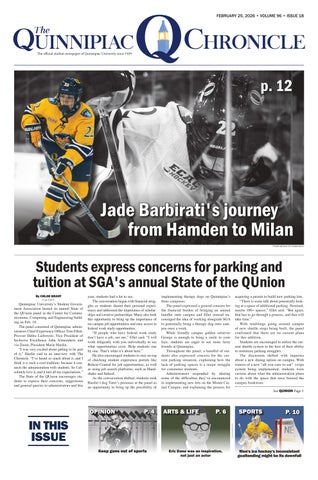
Quinnipiac women’s ice hockey showed up at this year’s Olympics, with assistant coach Brent Hill, freshman forward Jade Barbirati and former Bobcat defenseman Kati Tabin ‘20.
As part of Team USA’s coaching staff,
Hill will return to Hamden with an Olympic gold medal team on his resume, after the U.S. defeated Canada in a thrilling 2-1 overtime win.
The U.S. was dominant in Olympic competition, outscoring its opponents 33 to 2, while earning five shutout wins. The gold medal game was the only game for Team USA where it was held to fewer than five goals.
Hill was a part of various milestones for USA Hockey, coaching forward Hilary Knight to her fifth Olympic medal, while further breaking the U.S. women’s ice hockey record for career goals at 15.
Hill also coached defenseman and forward Laila Edwards to her first gold medal, making her the first black woman to play for Team USA and the first to win gold.
Tabin will return to the States with a silver medal, as a part of Team Canada, after falling to the U. S. in the gold medal game.
Throughout the tournament, Tabin would record five shots on net and 69 minutes and 14 seconds of ice time.
Barbirati will come back to Hamden after finishing in 10th with Team France. The Aix Les Bains native appeared in all four games, totaling around 65 minutes of ice time, seven shots on net and a penalty for roughing.
By COOPER WOODWARD Associate Sports Editor
Quinnipiac women’s indoor track and field won the MAAC Championship for the first time in program history Feb. 22.
Quinnipiac finished with 173.5 points, outscoring its closest opponent, Sacred Heart University, by a margin of 75 points. The Bobcats took home medals in 10 events, highlighted by senior sprinter Nyasia Dailey, setting the conference record in the 60-meter dash in 7.5 sec-
onds. Senior sprinter Izzie Anzaldo was named MAAC MVP and MAAC Track Most Outstanding Performer, winning titles in the 200m, running the fastest race for a Bobcat since 2018, 400m and 4x400 relay.
On pole vault, sophomore jumper Talia Graham and junior jumper Lauren Fadario had podium finishes, while Graham tied her personal record at 3.80m.
At the meet, 16 Bobcats set personal records across multiple events.

By ALEXANDRA MARTINAKOVA Editor-in-Chief
Quinnipiac men’s ice hockey has been a solid contender this year to make its way back to the NCAA Tournament, and maybe even end its decade-long drought in Lake Placid, N.Y.
Across all lines, on the offense and defense, Quinnipiac has seen consistent improvement throughout the season. The incoming freshmen class exceeded everyone’s expectations, tallying a total of 69 goals on the season so far, leading both the ECAC and NCAA in multiple categories. Quinnipiac also secured two Hobey Baker Award nominees in forwards freshman Ethan Wyttenbach and sophomore Chris Pelosi.
What remains a big unknown for the Bobcats is what happens in its crease.
Junior netminders Matej Marinov and Dylan Silverstein have been splitting their time in net since last year, a trend that contin-
Silverstein got the start in Quinnipiac’s season opener against Boston College Oct. 3, but since then only played 12 more games.
“He’s doing great, big win for him obviously,” head coach Rand Pecknold said after the win against BC. “I was excited for him tonight, to give him a start.”
And while it is understandable why this would be the case in the early weeks, this late in the game it might be only causing more confusion. To put it plainly, Quinnipiac still does not have a designated starting goaltender, despite there only being two more regular season games left.
If a team had two solid goaltenders that it could rely on, it would be the dream scenario.
In Silverstein’s second season with the Bobcats, the Los Angeles, California native appeared in 13 games so far with a 8-1-4 record.
In Marinov’s third season with the Bobcats, the Nitra, Slovakia native appeared in 22 games so far with a 17-2-3 record.

Silverstein sits on .916 save percentage as of publication and at one point led the nation in goals against average. Marinov, on the other hand, sits at a .905 save percentage.
But it is hard to objectively only take into account the statistics, as Marinov has found himself in the net this season against opponents such as No. 20 Maine, No. 13 UConn and No. 14 Dartmouth, while Silverstein only faced No. 10 BC and No. 11 Cornell out of the top 20 teams in the nation.
An easy example to look at is the 2026 CT Ice Tournament, where Silverstein earned a 5-1 win against Sacred Heart who plays in the AHA and Marinov started in the 4-2 loss against UConn in the finals.
Despite playing in eight more games than Silverstein, Marinov has only started back-to-back games three times this season — against Maine back in October, on the road against Clarkson and St. Lawrence in late November and against RPI and Union in early December.
“He was good, he battled,” Pecknold said of Marinov fol lowing a win over Boston University Nov. 15. “He did a good job tonight and he had some awesome saves.”
Since then, the two goalies have been splitting weekends, with Sil verstein starting in Friday games five out of eight times.
“Frequent goalie rotation can disrupt team chemistry and make it harder for players to adjust to different styles,” wrote the Youth Coach of Western Canada Hockey Academy’s Manitoba Wolves. “Goalies might also struggle to establish momentum or confidence with limited consecutive starts. This approach can lead to uneven performances, as consistency often develops through regular game time. Additionally, over-rotating might prevent one goalie from standing out as a reliable choice during a critical playoff moment.”

This year, Marinov has indeed found himself in the Bobcats’ net more often than years prior, that is true, but as mentioned before, only played back-to-back three times. Silverstein has not played a back-toback weekend once this entire season.
While it might be obvious to assume based on stats alone that Marinov will find his way into the net once postseason comes back around, it is hard not to notice the parallels between this and the last season.
When you take a look at Quinnipiac’s 2025 postseason, there might be some truth to his statements.
Taking on Brown in last year’s ECAC Quarterfinals, Marinov started both games, as well as the ECAC Semifinals loss to Cornell in Lake Placid, N.Y. However, that was after only playing 14 games that season, and it also was his first time playing back-to-back games in the same weekend.
Silverstein, who played 23 games before, started in the Regionals loss to UConn, after not playing for a full month — as the first round of the NCAA Tournament was played March 28 and his last game was against Clarkson Feb. 28.
“Matej made some huge saves for us,” Pecknold said after the Bobcats’ senior night win over Colgate Feb. 21. “We weren’t perfect, but Matej bailed us out when we made mistakes.”
The Bobcats still have the last two regular season games on the road against Dartmouth and Harvard. If they win in regulation against the Big Green, the Cleary Cup will find its way to Hamden for the sixth time in a row and they will face the lowest surviving seed of the first round of ECAC playoffs. Which goaltender will end up in the net and whether or not Quinnipiac will be finally able to break its Lake Placid curse, only time will tell.
By EMILY MARQUIS Associate Sports Editor
For a team as accomplished in the MAAC as Quinnipiac men’s tennis, it would be easy to say that the biggest goal this season is a third straight conference title.
But for head coach Bryan Adinolfi, this season is more than just the hardware the squad hopes to bring home from West Windsor, N.J.; it’s about building a lasting culture that drives the growth of an entire program.
Like any championship team, it starts with the “small things,” especially in a conference that is as tightly contested as the MAAC.
“In tennis, I think it’s kind of rare to have a conference where there are lots of teams that can win the whole thing,” Adinolfi said. “In our conference, there are lots of teams that can win the whole thing, and there’s going to be a couple of very good teams that get left out of the postseason tournament.”
Aspects of any sport that may get lost in the shuffle when one team is inherently more talented — traits like injury prevention and fitness — are at the top of the Bobcats’ list of controllables that will help facilitate greater MAAC success.
Despite the Bobcats steadily improving conference record during Adolfini’s tenure, a heavy fo cus from the coach ing staff remains on ensuring that the culture of the team is of utmost im portance — start ing with a strong work ethic.
“We have a great group
of guys,” Adinolfi said. “The guys that, you know, have it in them… they motivate the ones that maybe don’t have it as much. So that culture causes everyone to work hard.”
Another “small thing” that can’t be understated? The importance of team chemistry. For a sport that Adinolfi describes as largely “individual,” the squad’s cohesiveness remains a strength.
“It definitely helps that there is a lot of familiar faces going into the season,” sophomore Elias Hoxha said. “It’s important… to be able to integrate the new players.”
New additions have been key to the success of Quinnipiac in the past. In his freshman season, it was Hoxha who scored the match clinching set in No. 4 singles to secure a second straight MAAC Championship. His success in singles, with a 10-0
A big catalyst for this mixing up of the pairs is the loss of Daniel Velek ‘25. The Sezimovo Usti, Czech Republic native played a big role on this Bobcat team, both as a veteran presence and as a consistent winner on the court.
“Last year the seniors, Danny and Yasha (Laskin ‘25), I think have had a great impact on my game and my personal development in college tennis,” Hoxha said.
However, Adinolfi believes that the team has done a good job filling the space that Velek has left behind, both in the locker room and on the court.
“As we move through the spring season, I’m noticing that it maybe was a bigger loss for us in the fall, and that other players are stepping up into their role,” Adinolfi said.

out of three (matches).”
Braun Simo, one of the team’s captains, seems to be a key candidate in filling that void. The new No. 1 singles player, as well as joining freshman Alessandro Sciacca in No. 1 doubles, has made his mark on the young season. The two-time All-MAAC player is 3-2 in singles this spring.
The No. 1 doubles pairing is also improving. Although the doubles point has eluded the Bobcats for much of the young season, Braun Simo and Sciacca have won their individual match in three of the Bobcats’ five contests.
This calls into question the elephant seemingly looming over the Bobcats’ season: their record.
Sitting at 1-4 as of publication, the Bobcats have struggled out of the gate early against non-conference opponents, earning the first match win 4-3 against Illinois State University on Feb. 20.
This isn’t new for Quinnipiac. Last season, it ended the season with a 2-11 record against non-conference opponents, failing to secure a non-conference win until March 9 against Colgate.
However, this difficult schedule is by design. The schedule is packed with the maxi-
mum number of matches allowed under NCAA rules, which is against strong nonconference opponents.
“It’s a little risky because losing a lot is tough on the confidence, but it also makes you better,” Adinolfi said.
There’s no better example of this than in the team’s road match against Columbia University on March 7. Columbia is consistently ranked in the top 25 of the Intercollegiate Tennis Association Collegiate Tennis Rankings and eliminated the Bobcats from the NCAA Tournament two seasons ago.
That’s where Adinolfi’s idea of culture comes in. Winning MAAC tournaments and playing high profile non-conference opponents are just the start of that vision for the future of Quinnipiac men’s tennis. The goal is to bring in talent for the future that would otherwise not give the squad a second look, and build a reputation for the program.
“One of the goals as a coach that I try to pass down to the players is that little by little, with the improvements, we would like to get recognized as a mid-major (program) in a small conference,” Adinolfi said. “I think that two years ago, (Columbia) wouldn’t have responded to my email, but because we won the conference, we got a little bit of extra recognition.”
According to Adinolfi, inviting in that stronger non-conference competition could be a draw to tennis players with aspirations beyond the MAAC. At Quinnipiac, players have the opportunity to win in conference play and face some of the best in the country outside of the MAAC.
But that starts with conference success, which the team needs to continue to replicate to build that culture.
The Bobcats will have to wait until March 22 to get that first chance at conference play, taking on Sacred Heart at home at 11 a.m.
By NOAH KIM Staff Writer
Quinnipiac baseball enters the 2026 season off the back of a successful 2025 campaign, with head coach John Delaney leading his team to a program record 17 MAAC wins. The conference tournament brought more, as Quinnipiac made its way to the lower final before falling 7-3 to the topseeded Rider Broncs.
The Bobcats’ success was led by their offense, leading the conference in batting average, at .305, and 74 home runs. The team will be without former Bobcat and batting average leader infielder CJ Willis ‘25 and home run leader third baseman Sebastian Mueller ‘25. Along with two of their top producers, Quinnipiac faces the loss of 10 other athletes from last season. Despite the losses, the Preseason MAAC Poll has the Bobcats at third.
Though Willis and Mueller are gone, most of Quinnipiac’s offensive pieces return to Hamden for another season.
Junior infielder Kyle Garbowski, senior infielder Alex Irizarry and senior catcher Christian Smith are all back, the three Bobcats finishing second, third, and fourth, respectively, in batting average behind Willis. Smith, who batted .329 and finished with a team-lead tying 15 home runs, was named to the Preseason All-MAAC Team.
Garbowski and Irizarry also did signifi cant damage at the plate last season. Gar bowski batted .331, with 81 total hits, good for a joint second place in the conference. Meanwhile, Irizarry hit .330, led the team with a .642 slugging percentage and hit 15 home runs, tying Smith and Mueller.
“I think that the key to success at the plate is focusing on winning one pitch at a time,” Garbowski said. “Mak ing the next batter’s at-bat more important than yours by being selfless at the plate.”
For the Bobcats, each batter was impor tant last season, as eight players batted .300 or higher, seven with 65 or more hits.
While the offensive attack will likely be spearheaded by Garbowski, Irizarry and Smith, top-down success at the plate, as Quinnipiac had last season, will be extreme ly beneficial for further triumph.
If the Bobcats want to make a regional run, though, pitching must be in lock step with hitting. While the team recorded the second most runs in the conference, with 449, falling only behind Fairfield, the con ference champions, they also surrendered the third most runs, with 442, and the most walks, with 340.
Also returning are two solid bullpen pitchers, sophomore J.C. Franconere and senior Matt Alduino. Franconere had a
ond on the team with 4 saves over a
While Quinnipiac looks like it has the pieces, full-season consistency is needed. The Bobcats’ last season lost out on scoring as potentially high as the No. 3 seed in the tournament and earning a first-round bye in their last two weekends. Against Siena and Sacred Heart, the nipiac, the team went 2-4. The losses dropped it to No. 5 in the tournament
The 2026 season has already kicked off with an out-of-conference series with Old Dominion and North Florida. In both series,
ries with ETSU and UNC Greensboro before starting MAAC play on Friday, March 13, against Sacred


By COOPER WOODWARD Associate Sports Editor
Getting to the level of collegiate athletics is a feat very few people have achieved. Getting to the professional level is even rarer. But representing your country on the biggest stage of them all at the Olympic Games? That’s the highest level and honor that any athlete can reach.
For Quinnipiac, the latest current ath
“It feels unreal,” she said. “(It) was crazy to me … the people around the rink, everything was like ‘wow.’”
Barbirati’s love of hockey started at five years old in Aix Les Bains, France, joining her older sister in ice skating lessons. Those lessons saw a coach put a stick in the hands of Barbirati for the very first time. From there, her passion for hockey was born.

“He was truly the first person to show me the love of hockey,” she said.
15 years after that first lesson, Barbirati finally began to see the fruits of her labor, crossing the pond and committing to John Abbot College in Ste-Anne-de-Bellevue, Quebec, a school prestigious for development in Canadian hockey.
From the second she stepped on the ice, her presence was felt.
In her first year, Barbirati appeared in 29 games, recording 15 goals and 39 total points, finishing second on the team and third in the league in both. She would also help lead the Islanders to their second straight Quebec Junior Hockey League Championship.
She would follow up her impressive debut season with a near-historic campaign.
Appearing in all 30 contests for John Abbott, Barbirati tallied 57 points and 25 goals, which ranked second and fourth in the league, respectively, only trailing her teammate. Her run would come to an end in the postseason, as they fell in the championship.
Head coach Noemie Marin gave high praise to Barbirati during this streak.
“The first thing that comes to mind when I think of Jade is that she is extremely competitive,” Marin said in an interview with Web Vision. “In practice, she always wants
Her final season at John Abbot was derailed by injury, she appeared in only 10 games and recording six goals and eight assists as the team was eliminated early in the playoffs.
During her years as an Islander, she would get called back to France to represent her country in the Women’s World Championships, helping the nation take home gold in 2021 and bronze in 2023. Barbirati credits the time at John Abbot and the time representing her home nation as a period of growth.
“At first I was super hard on myself, but I’m much better now,” she said. “I’ve grown up a lot.”
After finishing her final year in Quebec, it came time for Barbirati to make the next step in her career. Ultimately, she decided to travel across the border and spend the next four years in Hamden.
Barbirati’s decision to make the move to the NCAA was one she considered a no-brainer.
“(The NCAA) is the best level of women’s hockey so when I got the opportunity to come I had to say yes,” she said. “(Quinnipiac) is a really good program with a really good coaching staff.”
Barbirati’s relationship with head coach Cass Turner also furthered her confidence in her decision to call Quinnipiac home.
“She really listens to us and is there to help us improve,” Barbirati said. “I think I made a great decision coming here because I know that with her, I will make a lot of progress in my game and as a person in general.”
It didn’t take long for Barbirati to introduce herself in Bobcat gold. In her second collegiate game against the Maine Black Bears, she recorded two goals, including the game-winner in overtime. It was the kind of performance that put her on the map of ECAC hockey and proved to Bobcat nation
that she was here to stay.
“It’s clear that she’s very competitive,” Turner said. “It’s such a great thing to have on our team.”
Despite battling injuries for the majority of the year, Barbirati would put up solid numbers. In 13 games played, she would tally nine points on four goals and five assists. In the face of a down year by her own standards, her rookie year will be one she’ll never forget. Towards the end of the 2025 calendar year, Barbirati got the call athletes everywhere dream of getting: being asked to represent France in their first-ever Olympic bid in the 2026 Winter Games in Milan.
“I was really happy to know that, especially doing it with my best friends,” she said.
While in Milan, Barbirati appeared in all four games, totaling seven shots and 65 minutes of ice time. As a team, France struggled, suffering defeats in all four games. Despite the performance, Barbirati still had the time of her life and now has her sights set on the 2030 games in France.
“Even though we didn’t win a game, we always managed to find the strength to come back the next day to play and give it our best,” she said. “I think that’s a beautiful strength we showed.”
Although Barbirati returned from Milan without hardware, she came back with something much more valuable than any medal ever could. Her path from a five - year- old in France to a junior college standout in Quebec, to a Bobcat and now an Olympian was never a straight climb, but decision after decision led her to becoming the athlete she is today.
Barbirati’s arrival to Hamden brings a wealth of experience in two different countries to a roster with 15 players on or under the age of 20. The best part? She’s just getting started.