MORE THAN A JOB: WHY VALUES MATTER TO STUDENTS CHOOSING FUTURE EMPLOYERS Drawing on the latest Cibyl Graduate Insights UK 2026 research, Sandra Scannell, Employer Engagement Manager, considers what matters to Queen’s students when choosing future employers – from integrity and continuous learning to empathy, progression and workplace culture. The article also includes additional insight from Student Officer for Accessible Education, Mórrigan McAvoy, on the importance of authenticity and shared values.
What are students looking for when deciding which employers to work for? For many, the answer goes beyond salary, job title or career progression. Students are increasingly considering whether an organisation’s values, culture and approach to its people align with their own expectations and priorities. The latest Cibyl Graduate Insights UK 2026 research, based on responses from 2,065 Queen’s University Belfast students, offers insight into the values and career priorities shaping students’ decisions. Alongside this research, Student Officer Mórrigan’s perspective helps illustrate why these issues are important to students as they consider their future careers.
What matters to Queen’s students? The Cibyl research highlights the importance of values such as integrity, honesty, continuous improvement and learning. Among Queen’s students, integrity and honesty were identified by 44% of respondents, while 43% selected continuous improvement and learning. Empathy and helping others were also particularly important to Queen’s students, with 41% identifying empathy and 38% selecting giving back and helping others.
These findings suggest that students are not only thinking about what they want to achieve through their careers, but also about the kind of environment they want to work in and the contribution they hope to make. As Mórrigan explains: “People want to see their own personal values reflected in the company that they work for.” This reflects a wider expectation that employers should demonstrate a genuine commitment to their stated values, rather than simply presenting them as part of a recruitment message.
More than a job description The research also shows that students want to understand what working for an organisation will actually look and feel like. Interesting work and good progression are among the most important attributes students look for in an employer. However, these priorities sit alongside the need for good working conditions, job security, work-life balance and a friendly workplace culture. For employers, this means that recruitment communications need to provide more than a list of responsibilities and requirements. Students want to understand: · What will the day-to-day work involve? · What opportunities will there be to learn and progress? · What kind of support will be available? · How does the organisation approach wellbeing and work-life balance? · What is the culture like within the team? · How do the organisation’s values influence everyday decisions? Being clear about these areas can help students make informed decisions and develop a more realistic understanding of the opportunities available to them.
Values need to be more than statements Organisations often communicate their values through careers websites, job descriptions and employer branding. However, students are likely to look for evidence that these values are reflected in the lived experience of employees. For example, an organisation that highlights empathy and inclusion should be able to demonstrate how these principles influence its recruitment processes, workplace culture and support for staff. Similarly, employers that promote learning and development can strengthen their message by explaining how graduates are supported when they join, what training is available and how progression is encouraged. Mórrigan highlights the importance of recognising the individual contribution that each person can make: “They want to be seen as a unique person that contributes to the overall picture of the organisation.” This is an important consideration for employers engaging with students. While students want to understand the organisation they may join, they also want to know that they will be valued as individuals rather than viewed simply as applicants, employees or numbers.
Creating a culture where students can see themselves The Cibyl research indicates that Queen’s students place particular importance on empathy and helping others. This may be reflected in the questions they ask employers about workplace culture, support and inclusion. Students may want to know whether an organisation creates an environment where people can ask questions, develop confidence and seek support when needed. They may also be interested in how teams work together, how different perspectives are valued and whether employees are encouraged to contribute ideas. These considerations are especially relevant when engaging with students who may be unfamiliar with professional environments or who are trying to understand where they might fit within an organisation.
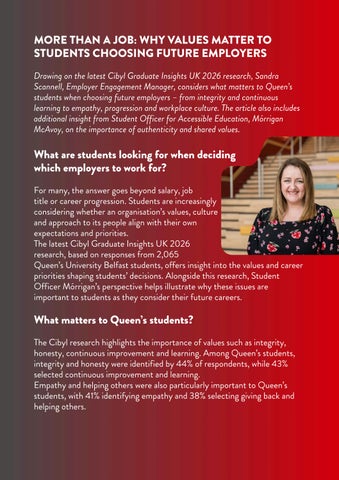
Mórrigan McEvoy, Student Officer Accessible Education at Queen's Students' Union
Employers can help by making their engagement more personal and accessible. This could include: · Introducing students to a range of employees and recent graduates. · Sharing honest examples of different career journeys. · Explaining what support is available during the transition into work. · Making opportunities to ask questions clear and welcoming. · Providing realistic insight into the workplace and team culture. · Demonstrating how inclusion and wellbeing are supported in practice. This type of engagement can help students see the people and culture behind the organisation.
What can employers take from this? The findings offer several useful considerations for organisations looking to build meaningful connections with Queen’s students.
1. Be clear about the experience of working for you Students want to understand the role, working conditions and expectations. Employers should provide clear information about responsibilities, progression, training, location, flexibility and the recruitment process wherever possible.
2. Show how values influence everyday work Values are most meaningful when students can see how they are reflected in decisions, behaviours and workplace practices. Sharing practical examples can be more effective than relying on broad statements.
3. Make learning and progression visible With continuous improvement and learning identified as a key value among Queen’s students, employers should explain how graduates will be supported to develop their skills and build their careers.
4. Demonstrate empathy and support Students want to know that they will be treated as individuals. Employers can communicate this by explaining how they support wellbeing, encourage questions, build relationships and help new employees settle into the workplace.
5. Create opportunities for authentic conversations Students may find it easier to understand an organisation through conversations with employees who can offer honest and relatable perspectives. Recent graduates, placement students and early-career colleagues can be particularly valuable in helping students picture themselves in the organisation.
Looking beyond the job The Cibyl research suggests that students’ expectations of employers are shaped by a combination of career ambitions and personal values. They are looking for interesting work and opportunities to progress, but also for integrity, empathy, supportive working conditions and a culture where they can feel that they belong. For employers, the opportunity is to move beyond telling students what they stand for and show them. By being transparent about the working experience, demonstrating values through action and treating students as individuals, organisations can build stronger and more meaningful connections with the future graduate talent they hope to attract.