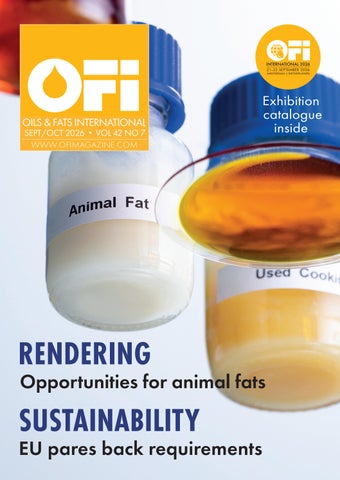
OILS & FATS INTERNATIONAL SEPT/OCT 2026 ▪ VOL 42 NO 7
Exhibition catalogue inside
WWW.OFIMAGAZINE.COM
RENDERING
Opportunities for animal fats
SUSTAINABILITY
EU pares back requirements
BE R 15
T
ON
M
I VIS
US
U STAND N
CONTENTS
IN THIS ISSUE – SEPT/OCT 2026 Plant, Equipment & Technology
FEATURES
30
OFI reports on some of the latest projects, technology and processes around the world
Rendering
18
EU opportunities for animal fats EU renewable energy regulations offer opportunities for Category 1, 2 and 3 animal fats for use as feedstocks in biodiesel, renewable diesel and sustainable aviation fuel production
Instrumentation & Process Control
Photo: Adobe Stock
Photo: Adobe Stock
Speciality fats
24
34
Enzymatic pre-treatment to improve performance Enzymatic hydrolysis improves crystallisation, minimises yield losses and mitigates contaminant formation, while enhancing processing efficiency and product quality in speciality fats
NEWS & EVENTS
Global round-up of news
Cover Photo: Neste
OILS & FATS INTERNATIONAL
Comment
Standardisation gives the edge
2
Oilseed and edible oil plants that adopt a standardised information model consistently spend less time on upgrades and also ensures that process knowledge is transferable and reusable, as well as allowing AI and analytic tools access to high quality data
News
4
EU pares back requirements The EU has simplified sustainability reporting requirements, illustrating a shift towards a more pro-business, competitiveness policy agenda
Russian attacks lead to fall in Ukraine export capacity
Biofuel News
10
Sustainability
40
New phase in war
B50 set to raise Indonesian palm oil consumption by 11%
Renewable News
12
BASF opens new speciality emollients plant
Transport News
14
Low water levels on Rhine supporting rapeseed prices
Biotech News
16
Bayer drops push for US tariffs on Chinese glyphosate imports
Diary of Events
43
International events listing
OFI International 2026
Show catalogue
www.ofimagazine.com
OFI – SEPTEMBER/OCTOBER 2026
1
EDITOR'S COMMENT
VOL 42 NO 7 SEPTEMBER/ OCTOBER 2026
OILS & FATS INTERNATIONAL
EDITORIAL: Editor: Serena Lim serenalim@quartzltd.com +44 1737 855066 Assistant Editor: Gill Langham gilllangham@quartzltd.com +44 1737 855157 ADVERTISING: Mark Winthrop-Wallace markww@quartzltd.com +44 1737 855114 PRODUCTION: Production Editor: Carol Baird carolbaird@quartzltd.com CORPORATE: Managing Director: Tony Crinion tonycrinion@quartzltd.com +44 1737 855164
New phase in war Since Russia invaded Ukraine in February 2022, Ukraine’s cumulative wartime agricultural damage has suprassed US$90bn, with direct annual sector losses reaching up to US$3bn, according to a recent Reuters report. And in a troubling new phase of attacks this summer, both sides have targeted the other’s commercial vessels, logistics and infrastructure assets, disrupting export flows from the Black Sea region. Ukraine’s capacity to export grain and vegetable oil via the Black Sea has fallen by around a third following intensified Russian missile and drone attacks, Reuters wrote on 15 July. More than 90% of Ukraine’s grain and vegetable oil exports are shipped through three key ports in the southern Odesa region — Odesa, Chornomorsk and Pivdennyi — leaving the country’s agricultural export chain highly exposed. Ukraine’s largest sunflower oil producer and exporter, Kernel – which accounts for an estimated 8-10% of global sunflower oil exports – has suspended operations at Chornomorsk, while its vegetable oil trans-shipment terminal in the Odesa region has suffered repeated attacks.
SUBSCRIPTIONS: Jack Homewood subscriptions@quartzltd.com +44 1737 855028 Subscriptions, Quartz House, 20 Clarendon Road, Redhill, Surrey RH1 1QX, UK
As Ukrainian farmers prepare to harvest sunflower across more than 5.2M ha this season, Ukrainian processors are revising down their purchase prices for new-crop sunflower to around US$444/tonne, compared with US$660–730/tonne during the 2025/26 season, UkrAgroConsult wrote on 18 August (see p4).
SUBSCRIPTION RATES: Print & digital: Single issue – £45 1 year – £182 (UK), £210 (overseas) 2 years – £328 (UK), £377 (overseas) 3 years – £383 (UK), £440 (overseas)
“Export logistics remain a key factor behind the decline,” according to the news agency. “Higher freight and vessel insurance costs, combined with limited throughput at ports and land-border crossings, continue to weigh on the competitiveness of Ukrainian exports.”
Digital only: Single issue – £29 1 year – £170 2 years – £272 3 years – £357 © 2026, Quartz Business Media ISSN 0267-8853 WWW.OFIMAGAZINE.COM A member of FOSFA Oils & Fats International (USPS No: 020747) is published eight times/year by Quartz Business Media Ltd and distributed in the USA by DSW, 75 Aberdeen Road, Emigsville PA 17318-0437. Periodicals postage paid at Emigsville, PA. POSTMASTER: Send address changes to Oils & Fats c/o PO Box 437, Emigsville, PA 17318-0437 Published by Quartz Business Media Ltd Quartz House, 20 Clarendon Road, Redhill, Surrey RH1 1QX, UK oilsandfats@quartzltd.com +44 1737 855000 Printed by Stephens & George Print Group, Merthyr Tydfil, Wales
@oilsandfatsint
Oils & Fats International
2 OFI – SEPTEMBER/OCTOBER 2026
The country is expected to export 4.15M tonnes of sunflower oil in 2025/26, compared with 6.122M tonnes in 2023/24, and Ukraine is once again relying on alternative modes of transportation, such as rail, although this can only replace around one-third of the volumes handled through its Black Sea ports. Up until recently, Russia’s grain industry has been mostly untouched by the war but this has changed since Ukraine started targeting Russian commercial shipping in the Black Sea and Sea of Azov, with attacks reportedly affecting around 220 vessels, including oil tankers, grain cargo ships and passenger ferries. The Guardian reported on 14 August. Under normal circumstances, approximately 60% of Russia’s vegetable oil exports move through the Azov and Black Sea ports but drone attacks have reportedly forced the suspension of operations at EFKO’s Taman vegetable oil terminal, while Russian vegetable oil shipments from the Black Sea appear to have slowed sharply, according to Riverside Tanker Chartering’s August market report. “They are instead being redirected towards the Baltic ports of St Petersburg, Kaliningrad and Ventspils.” The market response is already becoming visible beyond the Black Sea. India, for example, could increase soyabean oil purchases to around 620,000 tonnes in August, while reducing sunflower oil imports to approximately 180,000 tonnes, the lowest level since February, Reuters wrote on 17 August (see p4). The longer Black Sea terminals, vessels and transport corridors remain exposed, the more buyers will shift to alternative origins and oils. For Ukraine, the stakes are particularly high: agricultural exports remain one of its biggest sources of foreign currency earnings, with no end to the war in sight after four-and-a-half years. Serena Lim, OFI Editor, serenalim@quartzltd.com www.ofimagazine.com
THE ADVANTAGE STARTS AT THE SOURCE Better refining yields. Lower refining costs1. The lowest carbon footprint2 . That’s the
advantage of soybean oil from U.S. soybeans, whether crushed in-market or imported from the U.S. What’s Nourishing Your Business? SCAN TO SEE THE SOURCE OF YOUR ADVANTAGE.
1 Compared with oil made from Brazilian or Argentine soybeans, USSEC Soybean Oil Value Calculator, Centrec Estimates. 2 Compared to soy grown in other countries, according to Mérieux NutriSciences | Blonk, Agri-Footprint™ database 6.3.
NEWS UKRAINE: Global agrifood investor Saudi Agriculture & Livestock Investment Company (SALIC) has completed the integration of Ukrainian subsidiary Continental Farmers Group (CFG) into Olam Agri, a global agrifood company in which it has an 80% ownership stake. CFG manages around 200,000ha of agricultural land in western Ukraine; operates storage facilities with a capacity of approximately 530,000 tonnes; and produces more than 1M tonnes/year of grain. The integration was expected to expand Olam Agri’s sourcing options by leveraging CFG’s agricultural strengths in key crops. SALIC is the agricultural arm of the Public Investment Fund owned by the Saudi Arabia’s sovereign wealth fund, and aims to achieve food security for Saudi Arabia through domestic and international investments.
Russian attacks lead to fall in Ukraine export capacity Ukraine’s capacity to export grain and vegetable oil via the Black Sea has dropped by a third due to intensified Russian missile and drone attacks, Reuters reported on 15 July, citing the nation’s leading farmers’ union, UAC. Agricultural exports like grains and vegetable oils remained Ukraine’s main source of foreign currency earnings, with more than 90% shipped through Odesa, Chornomorsk and Pivdennyi ports in southern Odesa, which had been handling about 6M tonnes/month of cargo, Reuters wrote. “Russia has begun systematically striking port infrastructure, terminals and the entire transport logistics chain,” the trading department of UAC said in a weekly report published on 14 July. Leading Ukrainian agribusiness and top grain exporter Kernel Holding had announced its sunflower oil trans-shipment terminal in the Odesa region had been damaged in a 14 July attack by Russia, World Grain reported on 16 July. The strike had triggered a large-scale fire that damaged about half of the terminal’s sunflower oil storage capacity and critical trans-shipment infrastructure, Kernel added. Approximately
WORLD: Global vegetable oil prices increased by 2% in July to reach their highest level since June 2022, according to the benchmark United Nations’ Food and Agriculture Organization (FAO) Vegetable Oil Price Index released on 7 August. The index averaged 195.7 points in July, up 3.7 points compared to June. A rise in palm oil prices was largely underpinned by firm demand from Indonesia’s biodiesel sector and higher crude oil prices, which outweighed downward pressure from seasonally higher production in Southeast Asia, the FAO said. World soyabean oil prices also increased, underpinned by persistently robust feedstock demand in the USA and stronger global import demand.
25,000 tonnes of sunflower oil belonging to Kernel and a US company storing its product at the terminal were damaged. Kernel said it had also halted operations at Chornomorsk port due to a series of Russian attacks, World Grain wrote. As a result of the attacks, monthly grain shipping capacity had dropped to about 4M tonnes/ month, UAC said. According to the Ukrainian Ministry for Deveopment of Communities and Territories, Russian strikes had hit 67 Ukrainian seaport facilities and 35 civilian vessels in July alone, World Grain wrote on 25 August. ASAP Agri analysts said “the overall reluctance” of ship owners to call at Ukrainian ports had put upward pressure on freight rates. Some market participants said they expected grain flows to increasingly shift towards Romanian export channels through Constanța-Varna-Burgas, or reroute through Romania’s Constanța port and the Danube River, Fastmarkets wrote on 15 July. However, the Danube route was also constrained by drought, the World Grain report said.
Ukraine new-crop sunflower prices fall
Photo: Adobe Stock
IN BRIEF
Sunflower processors in Ukraine are revising new crop prices due to logistics constraints, UkrAgroConsult wrote on 18 August. Prices had dropped to around US$444/ tonne, compared to US$660–730/tonne during the 2025/26 season, the report said. Export logistics remained a key factor behind the decline, with higher freight and vessel insurance costs, combined with limited throughput at ports and land-border crossings, impacting the competitiveness of Ukrainian exports. In the current season, Ukrainian farmers were preparing to harvest a sunflower planted
4 OFI – SEPTEMBER/OCTOBER 2026
area of more than 5.2M ha, the report said. However, forecasts of high temperatures at the time of the report could put additional stress on crops and reduce yield potential, UkrAgroConsult wrote. The impact of logistics constraints was extending to global vegetable oil markets, with buyers adapting to tighter Ukrainian supply by diversifying sourcing and switching between oil types, the report said. According to a 17 August Reuters report, India’s soyabean oil imports were set to hit a record high in August as competitive prices prompted refiners to boost purchases for festive demand. Indian soyabean oil imports in August were likely to rise to 620,000 tonnes, almost 46% above the average monthly imports of 424,549 tonnes to date in the current marketing year, which began in November, according to four sources – who did not wish to be named – directly involved in trade deals. Russia and Ukraine accounted for the bulk of India’s sunflower oil imports, which were likely to fall to 180,000 tonnes in August, the lowest since February 2026 and down 28% from the previous month, the dealers said.
UNITING INDUSTRY, SCIENCE & TECHNOLOGY 21-23 September 2026, Amsterdam, the Netherlands www.ofimagazine.com/ofi-international-2026
www.ofimagazine.com
How not ha volum disrup would tlenec costs,
Clean-label processing at scale.
Achieve It.
SIT US ON VI
Safe. Scalable. Sustainable. Alcohol-based.
E
R
ND
5
ST A
NUMB
Monarc Clean Oilseed ProcessingTM is a proven, patented alcohol-based process that enables companies to replace current solvents in their extraction supply chains, deliver high-value cleanlabel ingredients and products (including organic), create an overall safer working environment and meet sustainability goals – all at the scale and economics of current solvent technology. Futureproof your operations while seizing the opportunity to meet growing public demand for clean-label. Products made with Monarc show superior characteristics. CPM|Crown enables you to expand your clean-label options without abandoning legacy oilseed processing. Our first plant installation is already in process. Adopt the cleanest oilseed processing technology for humans, animals and biofuels.
Feeding, Fueling and Building a Better World. crownsales@cpm.net | +1.651.639.8900 | OneCPM.com
NEWS
FDA seeks to modernise GRAS framework The US Food and Drug Administration (FDA) has published a proposed rule that would make it mandatory for manufacturers to inform it when they conclude the use of a substance added to human or animal food is 'generally recognised as safe' (GRAS), the US Department of Health and Human Services (HHS) said on its official website on 10 August. "Since the US Congress established the GRAS exemption in 1958, manufacturers have been permitted to reach their own conclusions that certain substances are GRAS under the conditions of their
EU: EU member states imported about 2.85M tonnes of palm oil in 2025/26, a decline of just over 5% compared to the previous year, according to EU Commission (EC) data reported by Germany’s Union for the Promotion of Plants and Protein (UFOP). The fall was due to EU-wide changes in legal requirements in member states – such as Germany and France – under which palm oil-based biofuels were excluded from counting towards national quota obligations or from receiving tax incentives, due to palm oil’s indirect land use change (iLUC) classification, UFOP wrote.
enable the agency to prioritise post-market safety evaluations while minimising unnecessary regulatory burden, the HHS said. The HHS and US Department of Agriculture also submitted the federal government’s first proposed definition of ultra-processed foods (UPFs) for final review. "Although research had linked high consumption of UPFs to preventable chronic diseases, including type 2 diabetes and heart disease, the absence of a standardised federal definition had limited research consistency across the federal government," the HHS said.
Third record year for Brazilian soyabeans
Photo: Adobe Stock
IN BRIEF
intended use," the HSS said. "The proposed rule would modernise that framework by making GRAS notifications mandatory and expanding the public-facing inventory of submitted notices, significantly improving transparency while strengthening the FDA’s ability to oversee ingredients entering the food supply." For substances already on the market based on industry self-GRAS conclusions, the proposal would establish a time-limited streamlined submission pathway, allowing manufacturers to provide the FDA with information about existing uses. This would
Soyabean production in Brazil is expected to reach 184M tonnes in 2026/27 – a record level for the third consecutive year and an increase of almost 2.2% on the previous year’s revised estimate of 180M tonnes, according to latest US Department of Ag-
riculture (USDA) forecasts. In its ‘Brazil - Oilseeds and Products Update’ published on 6 July, the USDA said an increase in soyabean planted area was the main driver of record production as yields could be held back by higher production costs, elevated
interest rates and El Niño-related weather concerns. Brazilian soyabean exports were forecast to reach another record level of 117.5M tonnes in 2026/27 – an increase of 2.1% compared to the current season’s revised estimate of 115M tonnes – supported by strong global demand, while domestic crushing was expected to continue expanding. China remained the main destination for Brazilian soyabeans. In 2025, Brazil exported a record 108.1M tonnes of soyabeans, up 9.5% from the previous year. Of this total, 85.4M tonnes, or 78.9% of total exports, was shipped to China, the report said.
Palm oil producers forecast tighter supply amid higher prices Leading palm oil producers expect production in 2027 and 2028 to be impacted by drier and hotter weather brought on by the current El Niño weather pattern In reporting its 2026 first half results on 12 August, Wilmar International said declining rainfall in Kalimantan, Indonesia, since July could strongly affect crude palm oil (CPO) production yield. “With 70% to 80% of Wilmar’s Indonesian estates located in Kalimantan, prolonged dry conditions could affect yields with a lag, leaving production more exposed in 2027-2028 than in the second
half of 2026,” CIMB Securities said in a note on 14 August. Wilmar’s fresh fruit bunch (FFB) yield was estimated to have dropped 6% year-on-year to 1.92M tonnes in the first half of 2026 although this was offset by the group’s high sales volumes and robust earnings growth in the period, with pre-tax profit rising 13% year-on-year to US$1.06bn, based on a revenue of US$38.6bn, CIMB said. SD Guthrie also posted a near doubling of net profit of US$241.3M for its second quarter (April-June) results, compared with US$124.3M in the previous year.
6 OFI – SEPTEMBER/OCTOBER 2026
While El Niño’s effect on palm oil production typically lagged – often emerging 12-24 months after the event as moisture stress affected FFB yields – the impact on CPO prices was generally felt much earlier, The Star wrote on 9 July. To date, Malaysia’s benchmark CPO prices had climbed 18% to US$1,163/tonne this year, according to Reuters. In the near-to-medium term, tightening global supplies due to El Niño, and resilient demand underpinned by Indonesia’s B50 biodiesel mandate, were expected to keep CPO prices elevated, SD Guthrie said.
UNITING INDUSTRY, SCIENCE & TECHNOLOGY 21-23 September 2026, Amsterdam, the Netherlands www.ofimagazine.com/ofi-international-2026
www.ofimagazine.com
E B
C
CBS
CBR
D1
D
13
3•
S TA N
3 • STA 1 D
1 ND
PMF
• STA N
MCT
3 • S TA
N
EXCLUSIVE TECHNICAL KNOW-HOW FOR YOUR QUALITY INGREDIENTS. We provide Hydrogenation Cie - Dry Fractionation plants for specialty fats products. EXPERTS IN: EDIBLE OIL EXTRACTION AND REFINING • WASTE OIL PRE-TREATMENT FOR BIOFUELS • BIODIESEL PRODUCTION • OLEOCHEMICALS • LUBE OIL RE-REFINING TECHNOILOGY Srl • Via Federici, 12/14 - 04012 Cisterna di Latina (LT) Italy contacts: Andrea Bernardini - andrea.bernardini@technoilogy.it • Mario Bernardini - mario.bernardini@technoilogy.it
NEWS IN BRIEF USA: The US Food and Drug Administration (FDA) has reopened the public comment period on butylated hydroxytoluene (BHT) in human food and as a food contact substance. BHT is used primarily as an antioxidant in the oils and fats sector to slow oxidation and prevent rancidity. The FDA published a notice on 13 May in the US Federal Register requesting information on the current uses and safety data for BHT in human food and as a food contact substance as part of its post-market assessment of chemicals in food. The FDA said it was extending the comment period to 31 August in response to a request from stakeholders to allow additional time for interested parties to submit data and comments. INDONESIA: The government’s planned commodity exchange, announced byPresident Prabowo Subianto during his 2027 budget proposal speech on 14 August, is expected to cover palm oil, nickel and coal, Reuters wrote on the same day. Scheduled for launch on 1 January 2027, the new commodity exchange would develop reference prices for key commodities. Since taking office in 2024, Prabowo had pushed policies to expand state influence over critical minerals in the resource-rich nation, including the launch in May of a new state export firm, Danantara Sumberdaya Indonesia (DSI), to monitor key commodity shipments. Subianto said that in its first two months of operation, DSI had monitored more than 6,500 transactions for the three key commodities and had overseen US$14bn in exports.
EU maximum MOAH levels may be adopted in October The EU’s new maximum levels for mineral oil aromatic hydrocarbons (MOAH) in food are expected to be formally adopted in October. Mineral oil hydrocarbons are a group of chemical compounds that originate primarily from crude petroleum and are generally categorised into mineral oil saturated hydrocarbons (MOSH) – which tend to accumulate in the body with relatively lower toxicity – and MOAH, which may include potentially carcinogenic substances. MOAHs are mainly found in processed foods due to contamination during processing, transport and packaging. The proposed new levels follow a favourable vote on 13 May by the member states at the Standing Committee on Plants Animals Food and Feed (SC PAFF) on a European Commission (EC) amendment to Regulation (EU) 2023/915 on maximum levels of MOAHs in food. “Subject to scrutiny by the European Parliament and the [European] Council, adoption [of the amendment] is targeted for October 2026,” according to the EC. The amendment would insert a new provision into the regulation with proposed MOAH maximum levels in milligrams per kilogram (mg/kg) or parts per million (ppm) of total MOAH (≥C10 to ≤C50) for various food categories including: Food category
Proposed MOAH maximum level (mg/kg or ppm)
Oilseeds; oil fruits; maize, rapeseed, sunflower, soyabean & linseed oils; dairy 2.0 butter/fat
Food category
Proposed MOAH maximum level (mg/kg or ppm)
Grapeseed, cottonseed, 10.0 from 2027; 5.0 blackcurrant seed & from 2028; 2.0 from argan oils 2030 Olive pomace & refined 10.0 from Mar 2028; olive pomace oil 5.0 from Mar 2029; 2.0 from 2030 Fish oils & oils from 10.0 from 2027; 5.0 marine organisms/algae from 2030 Olive oil
4.0 from Mar 2027; 2.0 from 2028
Other oils & fats, including cocoa butter
4.0 from 2027; 2.0 from 2028
Infant/young children's foods & formulae
0.50/1.0/2.0, depending on fat/oil content
Although the general application date for the new levels was expected to be 1 January 2027, specific maximum levels would be phased in after that date, mainly on 1 January 2028 and 1 January 2030. The European Commission (EC) said the phased approach was agreed for commodities where achieving concentrations below the analytical limit of quantification required more time.
USA imposes new tariffs of 10% and 12.5% The US administration has imposed new tariffs of 10% and 12.5% on goods from 60 trading partners alleging those countries had failed to curb imports involving the use of forced labour, Reuters reported on 24 July. The tariffs were imposed on 24 July, the same day that temporary Section 122 import duties previously introduced by the US administration expired, the report said. They would cover 99.4% of all US imports but many products and commodities – including oil and gas, fertilisers and specific food products – would be exempt. As part of agreements made with the USA in February, Indonesia and Malaysia had secured exemptions for palm oil and it was expected that the White House would confirm the continuation of those provisions, LIPSA wrote on 24 July.
8 OFI – SEPTEMBER/OCTOBER 2026
The new tariffs followed a Section 301 unfair trade practices investigation. Economies facing a 10% rate included Canada, India, Indonesia, Mexico, Malaysia and the UK, as each had a forced labour import prohibition, FreightWaves wrote on 28 July. The 12.5% tariff would apply to all other nations – including China and Vietnam. Canadian and Mexican goods entering free of duty under the USA, United Mexican States and Canada (USMCA) free trade agreement would be exempt. The new duties would layer rather than replace other tariffs, according to the Reuters report. Ordinary customs duties, antidumping and countervailing duties, and existing Section 301 duties would therefore still apply to covered goods, meaning Chinese and Brazilian would face both.
UNITING INDUSTRY, SCIENCE & TECHNOLOGY 21-23 September 2024, Amsterdam, the Netherlands www.ofimagazine.com/ofi-international-2026
www.ofimagazine.com
SIT US ON VI
1
0
ST
AN
D NUMBER
BIOFUEL NEWS FINLAND: Renewable fuels producer Neste has reported record results for the second quarter of 2026. The company’s renewable products segment reached all-time high earnings before interest, taxes, depreciation and amortisation (EBITA), supported by a record high sales margin and sales volumes exceeding 1M tonnes, Neste said on 24 July when presenting its results for the January-June period. “The conflict in the Middle East dominated global oil and product markets through most of the period, creating an exceptional market environment for Neste,” said Heikki Malinen, president and CEO of Neste. “At the same time, we benefited from favourable regulatory decisions that will continue to support demand for renewables.” The renewable products segment reported comparable EBITDA of €859M (US$993M), up from €174M (US$201M) during the second quarter of the previous year and sales margins reached a record-high level of US$1,223/tonne, up from US$361/tonne. During the second quarter, Neste produced 1.126M tonnes of renewable fuel, including 977,000 tonnes of renewable diesel, 126,000 tonnes of sustainable aviation fuel (SAF), and 23,000 tonnes of other products.
B50 set to raise Indonesian palm oil consumption by 11% Domestic palm oil consumption in the food sector was forecast at 7.6M tonnes, an increase of 100,000 tonnes compared to 2025/26 due to continued demand from the cooking oil and food processing industries. The nation entered an El Niño period in 2026 that was expected to persist until 2027, according to a June 2026 report by Indonesia’s Meteorology, Climatology and Geophysics Agency (BMKG). As prolonged droughts lasting more than three months typically reduced palm oil yields for three to six months, the USDA expected a 2% decline in Indonesia’s production potential and revised its 2026/27 Indonesian palm oil production forecast to 47.2M tonnes. With higher domestic use and limited output growth, palm oil stocks were set to fall by 28% to 3.1M tonnes in 2026/27, the report said.
Indonesia’s launch of its 50% palm-oil based biodiesel blending (B50) programme on 1 July is expected to increase domestic palm oil consumption by 11% to 25.3M tonnes, according to a US Department of Agriculture (USDA) report. The B50 transition was also forecast to reduce exportable palm oil shipments to 23.1M tonnes in 2026/27, the 5 August ‘Indonesia: Oilseeds and Products Update’ said. Increasing the biodiesel mandate from B40 to B50 would increase crude palm oil (CPO) use from 15.2M tonnes to 16.3M-17M tonnes, energy minister Bahlil Lahadalia was quoted by Reuters as saying in a 9 July report. As the country’s biodiesel industry continued to drive domestic palm oil consumption, the USDA expected industrial palm oil use to increase by 16% to 17.4M tonnes in 2026/26.
Global SAF prices surge by 10% from 2025-2026
Photo: Adobe Stock
IN BRIEF
Sustainable aviation fuel (SAF) prices surged by 10% between 2025 and 2026, BloombergNEF reported from its 27 July ‘Sustainable Aviation Fuel Price Survey 2026’ report. The global average of SAF prices surveyed was US$1,817/tonne (US$5.54/gallon) in 2026, with SAF now trading at a premium around five times higher than conventional jet fuel.
“SAF prices closely track fossil-derived jet fuel prices, which have risen 60% following the closure of the Strait of Hormuz,” the report said. “Supply-demand dynamics also play a role, particularly in mandated markets such as the UK and the EU, where 2% SAF blending mandates took effect in 2025.” The 2026 survey included pricing for three types of SAF: SAF produced via the hydro-processed esters and fatty acids (HEFA) pathway averaged US$1,817/tonne; advanced bioSAF produced from waste feedstocks via the biomass-to-liquids or gas-to-liquids process, averaged US$3,399/tonne for 2028-2031 delivery; and e-SAF, produced using hydrogen and carbon dioxide, averaged US$5,015/tonne for 2026-2028 delivery, approximately seven times the price of conventional jet fuel. Global SAF production totalled 1.9M tonnes in 2025, equivalent to 0.6% of worldwide jet fuel demand.
Bunge to supply certified soyabean oil for Brazilian biorefinery Global agribusiness giant Bunge has signed a five-year agreement with Energy company Acelen Renewables to supply 300,000 tonnes/year of certified soyabean oil for the company’s planned biorefinery in the Brazilian state of Bahia, due to become operational in 2029. Announcing the supply agreement on 8 July, Acelen said this would be the first 10 OFI – SEPTEMBER/OCTOBER 2026
large-scale sustainable aviation fuel (SAF) and renewable diesel (HVO) production project in South America, with 1bn litres/ year of capacity. The biorefinery would be built on an existing industrial site in São Francisco do Conde, Bahia, a city on the Atlantic coast in east-central Brazil. In addition to using soyabean oil as a
feedstock, the facility would produce biobased fuels from used cooking oil (UCO) and macaúba – a type of palm and native Brazilian crop – using hydro-processed esters and fatty acids (HEFA) technology. Acelen Renewables is owned by Mubadala Capital, a global alternative asset management company headquartered in Abu Dhabi, United Arab Emirates (UAE).
UNITING INDUSTRY, SCIENCE & TECHNOLOGY 21-23 September 2026, Amsterdam, the Netherlands www.ofimagazine.com/ofi-international-2026
www.ofimagazine.com
RENEWABLE NEWS
BASF opens new speciality emollients plant German chemical and biotech giant BASF has opened a new plant in Düsseldorf to produce specialty emollients, particularly for skin care and sun protection products. Emollients bind and help retain skin moisture while improving the sensory profile of personal care products. The Düsseldorf facility is BASF’s thirdlargest site in Europe and its largest worldwide for the production and development of cosmetic ingredients. With the investment – the largest at the Düsseldorf site in 10 years – BASF was expanding its ability to produce speciality products to meet growing market demand, the company said on 16 July.
WORLD: German chemical and biotech giant BASF published a report on 9 July showing progress made by its Care Chemicals divisionon the sustainable cultivation of palm kernel oil (PKO), coconut oil, castor oil and bioactives. In 2025, BASF said it was able to trace about 98% of its global PKO and palm derivative volumes back to the oil mill level, with 79.2% of PKO oil from Roundtable on Sustainable Palm Oil (RSPO)-certified sources. However, economic and geopolitical uncertainties, combined with limited availability of RSPO-certified PKO, meant the company was unable to fully achieve its sourcing target for these materials, BASF said.
in cosmetics to solubilise lipophilic active ingredients and disperse pigments. BASF’s Care Chemicals division offers a range of ingredients for personal care, home care, industrial & institutional cleaning and technical applications. In addition to emollients, the division’s product portfolio includes surfactants, emulsifiers, polymers, chelating agents, cosmetic active ingredients and UV filters. Other renewable feedstocks used by BASF include biodegradable polymers, mild surfactants, solutions based on sustainable argan oil, Asia’s super-fruit rambutan and certified palm kernel oil.
New design uses found for olive pits
Photo: Adobe Stock
IN BRIEF
“The new plant is more than an investment in production,” said Agus Ciputra, head of BASF’s global Personal Care business unit. “By expanding our production capacity for speciality emollients based on renewable raw materials, we are laying the foundation for … personal care solutions that meet evolving consumer expectations for performance, formulation flexibility and sustainability.” BASF’s emollients include its Cetiol CC product, which aids make-up removal in facial cleansing lotions, and Cetiol Sensoft, which enhances the solubility of crystalline ultra-violet (UV) filters. The company’s emollients are also used
Olive pits are being used to produce furniture, interior panels, construction products and lower-carbon paving, according to a 14 July Olive Oil Times report. Olive oil milling produced an estimated 1.2M tonnes/ year of crushed olive pits, according to the Spanish Biomass Association (Avebiom),
which said many of Spain’s largest olive oil mills separated the pits to generate thermal energy for heating mills and water, or for sale as fuel for industrial boilers. However, a growing number of companies were turning pits into construction and design products, the report said. After producing kitchen
cutting boards, plates and coasters using olive pits, Uruguay-based Olivos de las Ánimas was also developing flooring and wall cladding. The firm had also experimented with different-coloured resins and had produced a table made from ground olive pits bound with resin. Cypriot design firm Pit-toTable was producing decorative and functional panels by combining olive pits with a binding agent, the report said. Meanwhile, researchers and officials in Barcelona were preparing to repave some of the city’s streets with asphalt containing olive pit-based biochar. According to Barcelona’s city council, the lower-impact asphalt would be used in public works projects from October to December 2026.
Catalyxx to invest €120M in Sines renewable chemicals site Spanish renewable chemicals company Catalyxx announced on 22 July that is set to invest €120M (US$138M) in a new plant at Sines, Portugal. The firm’s first commercial-scale plant would produce butanol, hexanol and octanol from bioethanol for use as alternatives to conventional petrochemicals. Catalyxx said Sines was selected due to its established industrial infrastructure,
deep-water port, logistics links and access to renewable energy. Following trials of the company’s catalytic process under operating conditions at its demonstration facility in Seville, Spain, Catalyxx said it had developed the expertise to support industrial scale-up. At the time of the statement, the Catalyxx Ibérica facility was entering its final development phase, with construction
12 OFI – SEPTEMBER/OCTOBER 2026
www.ofimagazine.com
scheduled to begin by the fourth quarter of 2026. Engineering work at the Sines plant was being conducted with the support of global energy, chemicals and resources company Worley and international consultancy Quadrante. The company said the Sines facility was expected to reduce CO₂ emissions by approximately 105,000 tonnes/year. www.ofimagazine.com
UNITING INDUSTRY, SCIENCE & TECHNOLOGY 21-23 September 2026, Amsterdam, the Netherlands OFI – MONTH 2018 www.ofimagazine.com/ofi-international-2026
1
MORE THAN ENERGY
Efficient high temperature energy solutions with steam and thermal oil. R 14
US VISIT
STAND N U BE
Engineering | Design | Consulting Commissioning | After Sales Service
ON
M
Services by GekaKonus:
GekaKonus GmbH · Siemensstraße 10 · D-76344 Eggenstein-Leopoldshafen Tel.: +49 (0) 721 / 9 43 74 -0 · Fax: +49 (0) 7 21/ 9 43 74 - 44 · info@gekakonus.net · www.gekakonus.net
When you choose Oil-Dri®, you get more than a reliable adsorbent. You gain a world-class team of technical service experts to help you make tough decisions and save refinery resources for pre-treatment of oils and fats. ®
ADSORBENT MINERAL TECHNOLOGY
EDIBLE OILS
RENEWABLE DIESEL BIODIESEL
LEARN MORE AT ODCPURIFICATION.COM MADE IN
USA
30+ YEARS OF EXPERT TECHNICAL SERVICE www.ofimagazine.com
OFI – SEPTEMBER/OCTOBER 2026
13
TRANSPORT NEWS PERU: APM Terminals Callao has launched the next phase of its project to expand and modernise its port facility in Callao, Peru. APM operates the North Multipurpose Terminal at the Port of Callao – the largest port in Peru and on the Pacific coast of South America – with operations including the mooring, loading and unloading of solid and liquid bulk, including edible oils and biofuels. The first phase of the project, completed last July, increased storage capacity at the facility from 25,000 tonnes to 85,000 tonnes. The next stage – Stage 3B – would be delivered in two phases over the next four years, with an investment of US$570M, APM Terminals said on 26 June. USA: Agribusiness cooperative Ag Processing Inc (AGP) announced the opening of its new Terminal 4 export facility at Port of Grays Harbor in Aberdeen, Washington, on 3 August. The new terminal would more than double annual exports of agricultural commodities, including soyabeans, AGP said. Initially announced in March 2022, the project included a ship loader at Terminal 4, expanded unloading and storage capabilities, along with supporting port infrastructure.
Low water levels on Rhine supporting rapeseed prices European rapeseed prices are being supported by low water levels on the Rhine River, UkrAgroConsult wrote on 7 August. The low water levels risked halting cargo traffic on a key stretch of the Rhine, effectively splitting the waterway into two separate zones, Reuters reported on 9 August, quoting the federal association of German inland shipping (BDB). BDB managing director Jens Schwanen told the Rheinische Post that water levels at the Kaub gauging station, a major bottleneck for Rhine navigation, were forecast to drop into single digits for the first time due to lack of rainfall. “Commercial shipping will no longer be able to transport goods in the region at such low levels.” Navigation restrictions had forced barges to operate at significantly reduced loads, increasing transportation costs for rapeseed, vegetable oils
and meal, while supporting procurement prices at crushing plants, the UkrAgroConsult report said. November rapeseed futures on MATIF remained above €520 (US$599)/tonne, while German cash prices for early August delivery had risen to €511-531 (US$590-612)/tonne, only about €20 (US$23)/tonne below the mid-July peak. The price rally was due to logistical bottlenecks rather than concerns about crop production, according to the report. However, the outlook for elevated prices was limited, with global rapeseed and canola production in 2026/27 forecast to reach a record 97M tonnes, supported by larger crops in the EU, Ukraine and Russia, UkrAgroConsult wrote. Analysts expected EU rapeseed demand to remain firm, supported by steady consumption in the biodiesel and food oil sectors.
Port of Constanța terminal expansion complete
Photo: Port of Constanța
IN BRIEF
Romanian integrated logistics supplier Transport Trade Services (TTS) has announced the completion of its US$26.2M grain storage/handling expansion at the Canopus Constanța terminal at the Port of Constanța,
World Grain wrote on 29 July. Storage capacity at the facility had increased to 180,000 tonnes following the expansion, announced on 20 January. The project included six 11,000 tonne storage silos; five 825 tonne buffer silos, a new cargo receiving station for river barges; equipment for new truck unloading stations; conveying equipment required to handle cargo flows and connect the new facilities to the existing terminal; and three weighing stations on the vessel loading line. TTS is the joint venture owner of Canopus Star SRL Constanța (one of TTS Group’s three port operators at the Port of Constanța), along with Cargill Agricultura, the Romanian subsidiary of global agribusiness giant Cargill. The Port of Constanța (pictured) was a strategic hub connecting the Black Sea with the Danube and Central Europe and the fourth largest seaport in Europe, World Grain wrote.
Houthis announce new blockade of key Middle East shipping lane Houthi rebels in Yemen have announced a new naval blockade of a key Middle East shipping lane, FreightWaves reports. In a social media post on 20 July, the Houthis linked the action at the Bab-elMandeb Strait at the southern end of the Red Sea to what they claimed was a siege by Saudi Arabia and warned of escalation if Riyadh retaliated, the 20 July report said. In their post, the Houthis said the latest
maritime embargo was a response to an “unjust and oppressive siege” and that they were ready for “all options”, while urging further mobilisation. Previous Houthi attacks on vessels in the Red Sea in late 2023 in support of Gaza had led to a drop in grain and oilseed shipments at the Suez Canal, with shipping companies forced to re-route around the Cape of Good Hope to avoid the strikes, raising freight
14 OFI – SEPTEMBER/OCTOBER 2026
rates, according to Anadolu news agency. According to World Trade Organization (WTO) data, in the first half of January 2024, grain and oilseeds volumes through the Red Sea were 0.9M tonnes lower, down threefold year-on-year and 63% compared to the three-year average for that period. Houthi actions eased off in 2025 and major carriers had only just recently announced a return of scheduled services.
UNITING INDUSTRY, SCIENCE & TECHNOLOGY 21-23 September 2026, Amsterdam, the Netherlands www.ofimagazine.com/ofi-international-2026
www.ofimagazine.com
WORLDWIDE EXPERIENCE AND KNOW-HOW
SPREAD THE NEWS! FOR SALE NOW...
SECOND-HAND MARGARINE PRODUCTION LINES FOR SALE IN DENMARK VARIOUS CAPACITY RANGES BASED ON SSHE NH3 COOLING: 600 KG/H – 1200 KG/H – 1800 KG/H 1000 KG/H – 2000 KG/H – 3000 KG/H 1500 KG/H – 3000 KG/H - 4500 KG/H 1800 KG/H – 3600 KG/H - 5400 KG/H FOR PRODUCING A WIDE RANGE OF HIGH-QUALITY MARGARINE PRODUCTS SUCH AS: • Table margarine
THE PROCESSING PLANTS CONSIST OF THE FOLLOWING MAIN EQUIPMENT:
• Industrial margarine
• Oil in-take system
• Puff Pastry • Shortening
• Emulsifier preparation
• Low fat spreads
• Water Phase preparation
• Recombined butter
• Emulsion pre-mix and buffer
The equipment will be sold as a mix of new- and second-hand, fully overhauled, and carefully tested before shipment. Mechanically warrantee is granted. Ex works factory in Denmark. INSPECTION & SALES CONTACT: Torben From FH SCANDINOX A/S - DENMARK Phone head office: +45 7534 3434 Mobile phone/WattsApp: +45 4055 5359 E-mail: TFR@fhscandinox.com www.fhscandinox.com
WORLDWIDE EXPERIENCE AND KNOW-HOW
• Pasteurisation • Crystallisation (Gerstenberg & Agger) Incl. HP pump and pinmixers • Resting tube • Continuously rework • CIP plant (in case needed) • Hot water system • SCADA automation system
BIOTECH NEWS SOUTH KOREA: The South Korean government has revised standards for mandatory labelling to cover specific food items that do not contain detectable genetically modified (GM) DNA or protein, including edible oil and fats products, the US Department of Agriculture (USDA) reported on 17 July. Announced on 8 July by the Republic of Korea’s ministry of Food and Drug Safety (MFDS), the new requirements would take effect on 31 December 2026. They covered edible oils including soyabean, corn, canola and cottonseed oils; animal oils and fats – such as edible tallow oil and lard; and processed edible oil and fats products including mixed cooking oil, flavoured oil, shortenings and margarines. The move followed the government’s approval of the revised Food Sanitation Act on 30 December 2025, to expand mandatory GM labelling requirements to non-detectable products. Product categories other than soya sauce, saccharides and oils and fats products were not subject to the expanded GM labelling requirement. For example, a salad dressing containing soyabean oil would not be subject to mandatory GM labelling unless it contained ingredients with detectable foreign DNA or protein.
Bayer drops push for US tariffs on Chinese glyphosate imports German chemical giant Bayer has withdrawn its petition to impose duties on Chinese imports of glyphosate – the chemical used in the company’s weedkiller Roundup – following pressure from farmers, reported on 17 July. In its 30 June petition to the International Trade Commission (ITC), Bayer said that it was losing sales to Chinese competitors and claimed the Beijing government was subsidising and directing a plan to increase market share. The petition had been filed under the name Monsanto, which Bayer acquired in 2018, and Ruveon, a unit recently formed to handle Bayer’s US glyphosate business. Farm groups had criticised the petition, saying anti-dumping duties would raise costs for growers who used the herbicide. On 17 July, Bayer notified the ITC that it was no longer seeking an investigation. “Since filing
our petitions, we have engaged directly with farmers and agricultural trade associations..”, Ruveon said. “Today’s decision reflects our commitment to putting farms first.” All glyphosate sold in the USA originated from Bayer or Chinese companies, Capital Press wrote. ▪ Bayer announced a 1.9% gain in quarterly adjusted profit following a strong rebound in sales of seed technology related to its dicamba weedkiller, Reuters reported on 4 August. Second-quarter EBITDA totalled US$2.46bn, above market expectations of US$2.24, the report said. In 2025, a ruling by the US Environmental Protection Agency cleared the use of several dicamba sprays which had been halted over concerns they could drift and damage neighbouring areas, Reuters wrote. Farmers using dicamba required Bayer-compatible seeds, the report said.
Gene technology for resilient canola tested Photo: Adobe Stock
IN BRIEF
Scientists at Canada’s Kingston-based Performance Plants have been developing new canola varieties designed to cope with extreme weather, including excess heat and drought, while increasing the amount of carbon stored in the soil, Global News wrote on 11 July. The study was one of nine projects selected
for HARVEST, a new agri-tech business accelerator funded by Agriculture and Agri-Food Canada and managed by Ontario Genomics. The scientist had focused on “precision breeding,” identifying naturally-occurring genes that helped plants respond to environmental stress and enhancing those traits. Although the company was currently applying the technology to canola, the approach could have broader applications, explained Jiangxin Wan, Performance Plants’s president and chief technology officer. The company had been working with a seed producer to incorporate the technology into existing seed varieties, Global News wrote. More testing was required but the researchers said they hoped it would ultimately give farmers more tools to cope with increasingly unpredictable growing conditions.
Companies to develop water-stress solutions for canola French agricultural biotechnology firm Elicit Plant and US-based Mosaic Biosciences have launched a programme to help canola growers preserve yield potential under water-stress conditions across North America, AgriBusiness Global wrote on 22 July. Canola is one of Canada’s most important field crops, with producers reporting a record 9.47M ha planted in 2026. Although production levels were smaller in the USA, canola was also important in
16 OFI – SEPTEMBER/OCTOBER 2026
northern-tier US growing regions, particularly North Dakota, the report said. Across these production areas, climate variability and water-stress events created additional pressure for growers to maintain productivity and protect yield potential. The agreement combined Mosaic Biosciences’ focus on crop resilience and grower value with Elicit Plant’s expertise in helping crops manage water stress through its EliTerra technology platform, AgriBusiness
Global wrote. As part of the programme, the companies would conduct extensive agronomic evaluation across key North American canola production regions. Mosaic Biosciences is a US biotech company focused on drug discovery and development. Elicit Plant develops crop treatments based on plant biological mechanisms to improve resilience, particularly against water stress.
UNITING INDUSTRY, SCIENCE & TECHNOLOGY 21-23 September 2026, Amsterdam, the Netherlands www.ofimagazine.com/ofi-international-2026
www.ofimagazine.com
Lowering TCO by increasing lifetime. Key benefits of the OLFC flaking mill Largest rolls on the market with heavy-duty bearings which increases roll lifetime by up to 150%, lowering TCO. Intuitive Human Machine Interface with real-time performance metrics and Bühler process know-how. Innovative product sampling solution and new feed gate safety system to simplify routine tasks and drive seamless operation. Built on our proven hydromechanical design for consistent flake thickness. Curious? Contact us via: oilseeds@buhlergroup.com
Innovations for a better world.
RENDERING
EU renewable energy regulations offer opportunities for Category 1, 2 and 3 animal fats for use as feedstocks in biodiesel, renewable diesel and sustainable aviation fuel production Serena Lim Understanding the EU biofuels market offers strategic opportunities for animal fats, the European Fat Processors and Renderers Association (EFPRA) Congress heard on 27-30 May this year. The EU market for biofuels – liquid transport fuels produced from biomass – is driven by policies that aim to address
energy security, climate action and decarbonisation of hard-to-abate sectors including aviation and shipping, Beatriz Álvarez, public and governmental affairs manager of SARIA Group, said at the congress. The key EU biofuels legislation is the Renewable Energy Directive (RED), complemented by the ReFuelEU Aviation and FuelEU Maritime regulations These are all part of the EU’s Fit for 55 legislative package designed to reduce the EU’s net greenhouse gas (GHG) emissions by at least 55% by 2030, compared with 1990 levels.
Renewable Energy Directive
The RED sets renewable energy targets in all sectors of transport and is implemented through obligations on fuel suppliers, with incentives for waste and
EU classification of animal by-products The EU Animal By-Products Regulation classifies animal by-products into three risk categories: Category 1: Highest risk materials – including specified risk materials (SRMs) such as the brain, spinal cord, eyes, tonsils and intestines of ruminants (animals with four-chambered stomachs such as cows, goats and sheep). Category 2: Medium risk materials – including manure, digestive tract contents; and fallen stock. These materials must be sterilised if processed and can be used in biogas plants or technical products – such as oleochemicals, biodiesel and fertilisers – but not for feed. Category 3: Lowest risk materials – parts of animals fit for human consumption but not used such as hides, hooves, feathers and some offal; former foodstuffs no longer for human consumption; and by-products from healthy slaughtered animals like bones and skins. These materials can be used in pet food and processed animal protein (PAP) for non-ruminant feed; fertilisers; and technical products such as oleochemicals, biodiesel and cosmetics. 18 OFI – SEPTEMBER/OCTOBER 2026
Photo: Neste
EU opportunities for animal fats
residue feedstocks. Annex IX Part A and Part B of the RED contain lists of eligible feedstocks. To comply with the 2030 transport target under the third update of RED (RED III), EU member states have two options: • Achieve at least a 29% renewable energy share • Achieve a 14.5% reduction in GHG intensity Biofuels and biogases; renewable electricity; renewable fuels of nonbiological origin (RFNBO) and recycled carbon fuels can count towards the transport target. For the renewable energy target, multipliers are applied to incentivise certain fuels and technologies: • x 4 for renewable electricity in road transport • x 1.5 for renewable electricity in rail • x 2 for biofuels produced from Annex IX feedstocks • x 2 for RFNBOs
‘Advanced’ biofuel sub-target
An additional sub-target is also included in RED III. Member states must ensure that a minimum 5.5% share of transport energy comes from ‘advanced’ renewable fuels and RFNBOs by 2030. At least 1% of this 5.5% share must come from RFNBOs. Only fuels made from Annex IX Part A feedstocks qualify for this sub-target. Used cooking oil (UCO); Category 1 & 2 animal fats; and food and feed crops such as rapeseed biodiesel and corn ethanol u cannot count towards this target. www.ofimagazine.com
RENDERING Annex IX Part A and Part B
Food/feed crops, other materials Although Annex A and B and the advanced biofuels sub-target are in place to incentivise the use of waste and residue feedstocks, food and feed crops such as rapeseed, corn and sugar beet are still used to produce biodiesel and ethanol in the EU. Looking at the feedstocks used for fatty acid methyl esters (FAME) and hydrotreated vegetable oil (HVO) consumed in the EU, wastebased feedstocks (Annex IX A and B) represent roughtly 53% of feedstocks used, compared to 38% of crop-based feedstocks, according to the European Biodiesel Board (EBB) 2025-2026 Statistical report published in June. ‘Other’ sustainable feedstocks are all from wastes and residues and account for the remaining 9% of feedstocks used, 20 OFI – SEPTEMBER/OCTOBER 2026
Including Category 1 & 2 animal fats
Including Category 3 animal fats Figure 1: EU RED biofuel feedstocks and calculation rules
Figure 2: EU consumption without multipliers (kilotonne of oil equivalent – ktoe) and include mostly Category 3 animal fats and palm fatty acid distillate (PFAD), the EBB report says. The EU has not banned food/feed crop biofuels because they still represent a large installed industry, provide near-term emissions reductions versus fossil fuels, and help meet renewable energy targets while advanced fuels scale up. However, under RED III, food/feed crop biofuels are generally capped at 2020 consumption levels, plus 1 percentage point, with a maximum of 7% in transport energy. High indirect land use change (ILUC)risk feedstocks, currently only palm oil, are being phased out by 2030, when they will no longer count towards RED transport targets. Feedstocks that do not fall under Annex A, Annex B, feed and feed crops or high ILUC risk crops fall under ‘Other materials’. These are feedstocks that can be used for biofuel production but receive no incentives or restrictions – no double counting, no special quota benefit and no consumption cap. Category 3 animal fats
Source: SARIA
Annex IX Part A and Part B contain lists of eligible feedstocks that receive special treatment when used to produce biofuels, biogas, or other renewable transport fuels (see Figure 1, right). This is to encourage the use of wastes and residues rather than crops that can create indirect land use change (ILUC). Part A: ‘Advanced’ feedstocks are largely wastes, residues or non-food materials with ILUC risk. They include straw, corn cobs, forestry residues, manure, sewage sludge, certain industrial waste gases, algae and other agricultural residues. Fuels produced from Part A feedstocks count twice towards the 29% transport renewable energy target; can count towards the advanced biofuel sub-target; and are not subject to the Part B cap of 1.7% of transport energy consumption under RED. Because of these advantages, Part A feedstocks often generate the highest compliance value in EU biofuel markets. Part B is a much narrower list focused on waste oils and certain animal fats. These are UCO and Category 1 and 2 animal fats classified under EU animal byproduct rules. Fuels produced from Part B feedstocks count twice towards the 29% renewable energy target. However, they do not qualify for the advanced biofuel sub-target and their contribution is capped (generally at 1.7% of transport energy consumption under RED). Although the RED sets legally binding targets at EU level, each member state must transpose it into national law. However, countries have flexibility in how they design national policies to meet the targets and rules, and different countries are at varying stages of compliance.
Source: Eurostat; RED I/II methodology
u
fall under this category. The impact of the EU’s incentives on waste and residue-based biofuels has led to their increasing share in the region’s biofuels consumption (see Figure 2 above).
Sustainability, emissions savings
Biofuels consumed in the EU must comply with strict sustainability and GHG criteria. They must avoid deforestation and biodiversity loss and ensure minimum GHG savings of 50-65% compared with fossil fuels. In this respect, both UCO and animals fats offered higher GHG savings than vegetable oils. According to default values established in legislation, UCO-based biodiesel offered 84% GHG emission savings, while Category 1 and 2 animal fats delivered 78% GHG savings compared with fossil fuels, Álvarez said. Actual savings were often higher. There is mandatory certification for biofuels placed on the EU market which applies to the entire chain. They must be verified through independent third party audits and based on European u Commission-recognised voluntary www.ofimagazine.com
Source: European Biodiesel Board
RENDERING
Figure 3: EU production of FAME, HVO and HEFA/SAF (million tonnes)
Conclusion
% use of feedstocks for FAME and HVO produced in EU
* including crude glycerine including crude glycerine, spent bleaching earth, technical corn oil, tall oil, manure/sewage sludge
Figure 4: % use of feedstocks for FAME and HVO production in EU u schemes, the most common being ISCC EU, she added. The Union Database (UDB) is an EUwide traceability system for renewable and low-carbon fuels which is expected to cover the entire supply chain. Designed to enhance transparency and prevent fraud, its start date is still uncertain.
ReFuelEU aviation
ReFuelEU Aviation is part of the EU Fit for 55 package that mandates increasing use of sustainable aviation fuel (SAF) in jet fuel at EU airports, rising from 2% in 2025, to 6% in 2030 and 70% by 2050, with a special push for synthetic hydrogen-based fuels. SAF includes: • Advanced biofuels (Annex IX Part A feedstocks like residues and wastes). • Waste-based biofuels (Annex IX Part B like UCO and animal fats). • Synthetic aviation fuels (e-SAF) from renewable hydrogen. • Other non-food and non-feed cropbased biofuels. No multipliers are applied to feedstocks, which must all meet strict sustainability and GHG criteria under EU renewable energy rules. 22 OFI – SEPTEMBER/OCTOBER 2026
FuelEU Maritime
FuelEU Maritime is also part of the Fit for 55 package and is designed to cut GHG emissions from shipping. It applies to ships using EU ports, not just EU-flagged vessels and instead of mandating specific fuels, it regulates the carbon intensity of the energy mix used in shipping. The regulation sets progressively stricter limits on lifecycle emissions per unit of energy used on ships: • 2025: –2% • 2030: –6% • 2035: –14.5% • 2050: –80% These reductions apply to well-to-wake emissions (fuel production plus use onboard). Eligible fuels are: • Renewables: Biofuels (FAME, HVO, bioLNG, bio-methanol) & RFNBOs. • Low-carbon: LNG, LPG, ammonia, hydrogen, methanol, electricity. Eligible feedstocks are Annex IX (A & B), including Category 1 and 2 animal fats, as well as ‘Other’ feedstocks including Category 3 animal fats. Food and feed feedstocks are excluded, and all feedstocks must meet sustainability and GHG criteria under EU renewable energy rules.
Source: European Biodiesel Board
*
According to the EBB report, the EU’s production of FAME, HVO and HEFA (SAF) totalled 14.7M tonnes in 2025 against EU demand of 17.36M tonnes (see Figure 3, above). This comprised 10.5M tonnes of FAME, 3.9M tonnes of HVO and 0.3M tonnes of hydroprocessed esters and fatty acids (HEFA) against EU demand of 12.24M tonnes of FAME, 3.89M tonnes of HVO and 1.23M tonnes of HEFA. FAME production continues to dominate but there is moderate and consistent growth in HVO volumes, rising from about 3.2M tonnes in 2021 to around 3.9M tonnes by 2025, the EBB report says. “Notably, HEFA exhibits significant relative growth, starting at negligible levels but roughly doubling every year to 0.3M tonnes by 2025.” Feedstocks used to produce FAME and HVO in the EU in 2025 comprised 33% rapeseed oil, 21% Annex A feedstocks; 16.5% UCO; 5.5% Category 3 animal fats; and 3% Category 1 and 2 animal fats (see Figure 4 left). In the EU, the energy production and transport sectors account for the highest share of GHG emissions, at around 26% each in 2022, the EBB says. And yet the share of renewable energy sources in transport in the EU only reached 11.2% in 2024 against the target of 29% by 2030. Roughly 62% of the energy used in EU road transport comes from fossil diesel, and 25% from fossil gasoline. “Renewables like all biofuels combined (6%) and electricity (<1%) are by far the minority share.” Biodiesel will therefore continue to be necessary as it addresses the reality of the existing EU vehicle fleet, and animal fats will have a role to play in FAME, HVO and SAF production. ● Serena Lim is the editor of Oils & Fats International
www.ofimagazine.com
U
VISIT
12 BER
US
STAND N
M
ON
Purity You Can Trust Expertise You Can Rely On 90+ Years of Edible Oil Filtration Excellence Amafilter® leads the way in solid liquid filtration solutions designed for maximum efficiency and product purity Trusted filtration solutions for all edible oil applications
SIT US ON VI
Genuine spare parts From laboratory testing to full plant support R NUMBE
6
S
TA ND
www.amafiltration.com www.ofimagazine.com
OFI – SEPTEMBER/OCTOBER 2026
23
SPECIALITY FATS By reducing the diglyceride content in edible oils, enzymatic hydrolysis improves crystallisation, minimises yield losses and mitigates contaminant formation, while enhancing processing efficiency and product quality in speciality fats Véronique Gibon, Rasmus Bøg Alstrup, Sabine Danthine, Eleni Ioannidi, Anne Fromm
Photo: Adobe Stock
Enzymatic pre-treatment to improve performance Extraction methods also have a strong impact on diglycerides, and uncontrolled artisanal shea butter production tends to promote their formation. The main diglycerides in palm oil are dipalmitoyl (PP), palmitoyl-oleoyl (PO) and dioleoyl (OO) types, while shea butter mainly contains distearoyl (SS), stearoyloleoyl (SO) and dioleyl (OO) types, with varying proportions of sn-1,2 and sn-1,3 positional isomers. While these oils are widely used in food and speciality fat production, excessive diglyceride levels reduce product quality and limit downstream applications. Diglycerides are known to be precursors of glycidyl esters (GE) – carcinogenic and genotoxic contaminants induced by oil
Figure 1: Representative diglyceride reductions after enzymatic hydrolysis 24 OFI – SEPTEMBER/OCTOBER 2026
refining. They are generally associated with the formation of carcinogenic 3-monochloropropane-1,2-diol (3MCPD), which originates from chlorinated precursors present in crude oils. Various technical refining solutions are currently used to limit their formation. Although effective, these are often costly and sometimes face challenges due to increasingly strict regulatory directives. Another important aspect concerns the disruptive effect of diglycerides on fat crystallisation. This has implications for many food applications, particularly for speciality fats such as cocoa butter equivalents (CBEs), where diglycerides form eutectic interactions with u triglycerides and negatively affect
Source: Novonesis
Most edible oils contain partial glycerides, such as mono- and diglycerides. Diglycerides are often present at significant levels in crude oils like palm oil and shea butter and, unlike monoglycerides, diglycerides are not removed during conventional refining. In palm oil, increased diglyceride formation is associated with lipase activity in overripe fruit or during prolonged harvesting. Some high-quality (premium grade) crude oils have a low diglyceride content (< 4%), while low quality oils can reach 10%. Conventional palm oil typically contains 5-7% diglycerides. In crude shea butter, diglyceride levels may range from 5-20%, with a higher content reflecting lower quality or prolonged storage.
www.ofimagazine.com
US
BE R3
VISIT
STAND N U
M
ON
Figure 2: Improved palm oil fractionation: (a) Enhanced crystallisation behaviour; (b) Higher olein yield; (c) Harder stearin u tempering behaviour and hardness. Potential solutions to reduce diglycerides in edible oils, such as short path distillation, selective adsorption, membrane separation, or supercritical CO2 extraction, are often costly and difficult to integrate into standard refining schemes. Therefore, there is a need for an efficient, sustainable and scalable method to reduce diglyceride levels within standard edible oil refining.
Enzymatic hydrolysis principle
Edible oil refiners need to comply with environmental regulations, and the introduction of enzymes into refining processes is now becoming common practice. In this context, reducing the diglyceride content in edible oils through enzymatic hydrolysis fits perfectly within current industry expectations for more efficient and sustainable processing. Novonesis has developed a new solution, which is a liquid lipase that selectively hydrolyses mono- and diglycerides, without altering the triglyceride composition (patent pending). Hydrolysis generates free fatty acids (FFAs), which can then be distilled during physical refining, enriching the fatty acid distillate fraction. Preferably applied to crude oils, although also suitable for semi-refined or refined oils, the enzymatic hydrolysis process consists of mixing the oil with an aqueous solution containing the enzyme. After reaction, centrifugation separates the treated oil, resulting in a substantially reduced diglyceride level. Figure 1 (previous page) illustrates representative diglyceride reductions obtained after enzymatic hydrolysis for different grades of palm oil, shea butter and related fractions. Hydrolysis is effective regardless of the type of diglycerides present, whether palmitic in palm oil or stearic in shea butter. Lowerquality oils can thus be upgraded into higher-quality feedstocks, highlighting the value of the approach. 26 OFI – SEPTEMBER/OCTOBER 2026
Reducing GE and 3-MCPD
Current strategies to reduce GE and 3-MCPD in refined oils focus on limiting their formation during refining or removing them after formation. Chemical refining is a costly solution applicable to all types of crude oils. Physical refining, under specific deodorisation conditions (such as Dual Temperature) can also be effective, and combining it with an integrated poststripper provides additional efficiency. Double refining enables optimal GE reduction, although it is the most expensive approach. In all cases, the effectiveness of mitigation is closely linked to the crude oil quality. In this respect, reducing the diglyceride content in crude oils below a certain threshold through enzymatic hydrolysis appears to be the best way to safely refine a wide range of oil grades, while minimising health concerns. The formation of 3-MCPD is closely linked to the presence of chlorinated precursors in the crude oil. To reduce this risk, many refiners have introduced a washing section, either at the mill or at the refinery, and this practice is becoming increasingly common to minimise the amount of 3-MCPD in the refined oil. Enzymatic hydrolysis can be readily integrated into these existing practices, either, in combination with, or immediately after the washing step. Enzymatic hydrolysis therefore presents a particularly attractive solution for the simultaneous reduction of GE and 3-MCPD contents in refined oil, supporting, after conventional refining, the EU compliance of GE <1 ppm and 3-MCPD < 2.5ppm.
Improved palm oil fractionation
Dry fractionation is a modification process that combines crystallisation and separation of partially crystallised oil. The most crucial step is bulk crystallisation: if this is successful, separation is child’s play.
Source: Novonesis
SPECIALITY FATS
Palm oil is the most fractionated oil in the world, both for commodity and speciality fats. Reducing its diglyceride content through upstream enzymatic hydrolysis improves the quality of the crystals formed, making them better structured, larger and more robust. Crystal stacking is enhanced: triglycerides associate selectively, according to their chain length, unsaturation and positional isomerism, in an arrangement close to thermodynamic equilibrium, improving the overall viscosity of the suspension. Applied to the first fractionation step as an example (see Figure 2 above), improved crystal stacking has a direct effect on the olein fractions with higher iodine values (IV) obtained more rapidly than for conventional palm oil. This is complemented by a wider crystallisation range, allowing higher than usual IV levels to be reached. The enhanced crystallization behaviour is illustrated in Figure 2a (above), which compares conventional (diglyceride content 7%) and enzymatically-hydrolysed (diglyceride content <2%) palm oils. The olein IV 59, for instance, is obtained in a significantly shorter time (4 hours against 8 hours). Additionally, enzymaticallyhydrolysed palm oil enables reaching a super olein quality (IV 64-65) in a single fractionation step, whereas two steps are typically required when starting from conventional palm oil. Enzymatic hydrolysis also offers important advantages in terms of process yield. Reducing the diglyceride content in palm oil has an immediate effect on filtration efficiency; better crystal quality enables increased olein production for a similar IV. As shown in Figure 2b (above) for olein IV 59, the yield gain is approximately 3%. Figure 2c (above) demonstrates the impact of better crystallisation selectivity on the stearin quality, with a lower IV and harder solid fat content (SFC) melting profile when starting with the enzymatically-hydrolysed palm oil. u www.ofimagazine.com
The effective technology and complex services
STATE-OF-THE ART OILSEEDS AND OIL PROCESSING TECHNOLOGIES ■ ■ ■ ■
■
Horizontal agriculture Local mechanical processing Patented system of energy recovery Complex approach including Physical Oil Refining Unique combination of extruders and screw presses
www.farmet.eu
S
TA N
www.ofimagazine.com
SIT US ON
1
1
VI
D NUMBER
OFI – SEPTEMBER/OCTOBER 2026
27
Figure 3: Hard PMF route in multi-step dry fractionation of palm oil – quality limitations due to excessive digylcerides
Source: Novonesis
SPECIALITY FATS both the stearin and olein fractions are subsequently refined. The stearin quality can be improved by integrating enzymatic hydrolysis into the solvent fractionation scheme of the crude Shea Butter (see Figure 4, left). This is particularly relevant for lower-quality crude shea butter with high diglyceride levels – which can be effectively reduced – enhancing crystallisation and enabling direct formation of the most stable polymorphic form. Enzymatically-hydrolysed crude shea butter with 4% diglycerides can yield crude shea stearin with 2% diglycerides; a further reduction is possible with an additional enzymatic hydrolysis step, before final refining, making a refined Shea Butter Stearin with less than 1% diglycerides a realistic target. In this perspective, enzymatic hydrolysis appears as a particularly valuable route for helping refiners to meet the specifications required for all speciality fractions in the manufacture of speciality fats.
Figure 4: Benefits of enzymatic hydrolysis for Shea Butter Stearin quality u
Another added value relates to improvement in the cold resistance of oleins. Lower cloud points, observed across all olein qualities (IV 56 to IV 65), are also associated with improved longterm cold resistance, as less diglycerides remain in the liquid fractions. In particular, better cold stability can eliminate the need for blending with seed oils to meet trade specifications for colder export markets.
Speciality fats quality
Speciality fats belong to a unique category of high added-value fats designed to replicate the functionality of other premium fats, with cocoa butter equivalents (CBEs) being a prime example. CBE formulation relies on combining specific fractions derived mainly from palm oil (Hard Palm Mid Fraction – Hard PMF – P2O source) and usually from shea butter (Shea Butter Stearin – S2O source). To deliver the required performance in confectionery applications, CBEs must exhibit a low diglyceride content, ensuring efficient crystallisation, improved thermal stability, and good compatibility with cocoa butter in confectionery applications. In this context, minimising the diglycerides in both palm and shea butter fractions is the major objective for improving CBE quality. For palm oil, the benefits of low 28 OFI – SEPTEMBER/OCTOBER 2026
diglyceride content extend across the multiple fractionation steps of the Hard PMF route. Reduced diglyceride levels enable faster enrichment of P2O in the Soft PMF and improved crystallisation efficiency, leading to a shorter processing time and better product quality (see Figure 3 above). Starting fractionation from an olein IV 56 with a diglyceride content as low as 2-3% enables the obtainment of a super olein IV 65 in a shorter time than usual, thereby securing a high-quality Soft PMF (P2O: 48% minimum) with very low diglyceride content (<2%). P2O crystallisation can be pushed even further in this step. This Soft PMF is the right product for producing premium grade Hard PMF with high P2O content (65-70%), while a very low diglyceride content (< 1%) is a possible target. Enzymatic hydrolysis of palm oil is, in this respect, an excellent alternative that favours eco-friendly dry fractionation over solvent fractionation for Hard PMF production. Unlike the Hard PMF obtained through a multi-step dry fractionation of refined palm oil, Shea Butter Stearin is produced via a single-step solvent fractionation, often starting from crude shea butter dissolved in acetone. This stearin is particularly enriched in S2O (70-75%), and
Source: Novonesis
Conclusion
Selective enzymatic hydrolysis of diglycerides is an innovative and effective solution to improve edible oil quality. It provides multiple benefits, ranging from a gentle and cost-effective way to reduce the formation of toxic contaminants (GE and 3-MCPD) during refining, to a solution for mitigating the adverse effects of diglycerides in multiple crystallisation applications. In particular, reducing the diglyceride content improves the dry fractionation of refined palm oil, thereby enhancing the production efficiency and quality of Hard PMF, a key ingredient in CBEs. The quality of Shea Butter Stearin, another CBE component, typically obtained by solvent fractionation, can also be improved through the integration of enzymatic hydrolysis steps. Overall, this approach opens new possibilities for formulating high-quality CBEs with fewer processing constraints. Beyond these technological advantages, reducing diglycerides may also provide broader benefits for fat-based food formulations, especially in view of studies suggesting the potential harmful health effects associated with their consumption. In this context, enzymatic hydrolysis appears as a cutting-edge solution with numerous potential applications yet to be explored. ● Dr Véronique Gibon is a consultant in oils and fats processing (Artemis Lipids by VG); Rasmus Bøg Alstrup, Eleni Ioannidi and Anne Fromm are, respectively, science manager, senior scientist and global marketing manager at Novonesis; Dr Sabine Danthine is a professor at Belgium's University of Liège.
www.ofimagazine.com
PLANT & TECHNOLOGY
Global round-up of news Oils & Fats International reports on some of the latest projects, technology and process news and developments around the world
Global agribusiness giant Bunge has invested US$5M in upgrading its soyabean processing facility in Porto Corsini, Ravenna, Italy, World Grain reported on 7 July. Construction was completed in June, and the plant was expected to be fully operational in time for the next harvest season, Bunge said on 3 July. The expansion would allow Bunge to double the processing of Italian soyabeans, and increase its purchases of soyabeans produced in Italy’s main agricultural regions, the company said. The upgrade included a modern seed receival system; new silo and chain conveyors; the addition of a rear truck unloading facility; increased storage capacity; and expand-
IN BRIEF USA: Soyabean processor and biodiesel producer Incobrasa Industries has opened a new crushing plant next to its existing facility in Gilman, Illinois, World Grain wrote. The new plant – part of a US$250M project – would double the company’s production capacity and had the capacity to process almost 100M bushels/year of soyabeans for use as soyabean meal and oil for the biodiesel and animal feed sectors, the 23 June report said. “Incobrasa’s new crush plant is the single largest extraction process in the country,” said Incobrasa quality control manager Kerry Fogarty. “Requiring 300,000 bushels/day, it will provide a stable market for 7,000 local family farms. The company, which is Brazilian-owned and US-operated, produces a range of products including biodiesel, food grade bottled vegetable oil and animal feed.
Photo: Pixabay
Bunge invests US$5M to upgrade soyabean plant
ed in-house laboratory testing. The soyabeans would be used for a wide range of purposes, supplying the feed and food supply chains, as well as the biofuel production sector, Bunge said. Italy is the EU’s leading soyabean producer, and is
projected to harvest 848,000 tonnes of the oilseed in 2026, according to the EU. Bunge operates several facilities in Italy at Porto Corsini including its crushing plant, a multi-oil refinery, a vegetable oil bottling plant and a biodiesel production plant.
ORLEN group launches HVO unit in Poland Polish oil and gas company ORLEN has launched a plant to produce hydrotreated vegetable oil (HVO) from rapeseed and used cooking oils (UCO) in Płock, Poland. Involving an investment of PLN 800M (US$218M), the plant had a capacity to produce about 300,000 tonnes/year of HVO, ORLEN said on 25 May. The company had also established two diesel hydro-desulphurisation units for the co-hydrogenation of vegetable oils, which would increase rapeseed and UCO processing by over 100,000 tonnes/year. The new plant increased the ORLEN Group’s production potential to approximately 700,000
tonnes/year of biofuels, with plans to increase to 1.1M tonnes by 2030. “The launch gives ORLEN more control over a key area of the biofuels market. We are increasing our own production of advanced bio-components, strengthening cost efficiency and becoming independent of the volatility of the external market,” said Ireneusz Fąfara, president of the ORLEN management board. ORLEN said it was also developing a programme to integrate farmers, industry and technology partners to support the development of domestic raw materials – particularly for second-generation biofuels – which would ultimately power the HVO plant.
COFCO Brazilian crushing plant scheduled to open by 2028 Chinese state-owned agribusiness COFCO has announced a major expansion of its operations in Brazil, with plans to build the country’s largest soyabean crushing complex, UkrAgroConsult reported. The investment would be carried out by the company’s overseas arm, COFCO International, which would allocate approximately US$400M to expand its existing 30 OFI – SEPTEMBER/OCTOBER 2026
processing facility in Rondonópolis. The project was scheduled for completion by early 2028, the 21 April report said. Following expansion, the plant’s crushing capacity would more than double from some 4,500 tonnes/day to about 10,000 tonnes/day, making it the largest soyabean crushing complex in Brazil, UkrAgroConsult wrote. As well as producing soyabean oil,
meal and biodiesel, the complex would also strengthen Rondonópolis’ position as a major agribusiness hub in central-west Brazil. COFCO is China’s largest food processor, manufacturer and trader. It is a major global trader of soyabeans, corn and other agricultural commodities, and handled over 108M tonnes of commodities in 2024, with revenues of US$38.5bn, its website said. www.ofimagazine.com
PLANT & TECHNOLOGY
Cargill upgrading French sunflower site Global agribusiness giant Cargill is investing US$150M in upgrading its sunflower processing site in Saint-Nazaire, France, with construction scheduled to begin in November and commissioning planned for March 2029. The investment would allow the site to shift from lower protein meal to high and super-high protein sunflower meal, creating a new regional source of plant-based protein for the animal feed sector and reducing reliance on imported meal, the company said on 29 April.
“This investment strengthens our ability to connect French farmers to growing demand for high-value protein meal,” said Alexis Cazin, president of Cargill’s Agriculture and Trading group in EMEA [Europe, the Middle East and Africa]. It also represented a significant step forward in improving the site’s energy resilience. By using processed sunflower hulls to generate energy on site via a new biomass boiler, Cargill said it expected to reduce its natural gas use by more than 100GWh/year and cut CO2 emissions
by approximately 20,000 tonnes/year – around 90% of the site’s CO2 emissions. In addition, excess sunflower hulls would be converted into agricultural biomass pellets and supplied to external customers, including district heating networks. Active in France since 1964, Cargill has a network of 14 sites in the country, most of them in western France – in Brittany, Normandy and Pays de la Loire – in line with the company’s focus on local agricultural production including sunflower, rapeseed, corn, wheat, apple pomace and poultry. u
New partnership for catalyst and enzymefree esterification
Oilseed preparation performance is driven by consistency, control, and how effectively equipment responds to variability in materials and operating conditions. French designs cracking, flaking, conditioning, and pressing systems with a focus on mechanical durability, stable and dependable operation, and long term serviceability, where uptime, maintenance access, and energy use directly influence plant performance. Across food and industrial applications, French preparation equipment provides uniform material quality through each step of the preparation process, controlled thermal exposure, and reliable operation under changing seed or other oil bearing material conditions. This balanced approach helps protect oil and cake quality while supporting efficient and stable downstream processes.
CRACKING MILLS
FLAKING MILLS
At the French Innovation Center, processors evaluate preparation approaches using their own oilseeds. Working with experienced engineers, trials help refine operating conditions, manage variability, and reduce unnecessary heat and energy input before scale up, supporting informed preparation decisions as processes and expectations evolve. STAND NO. 17 TE
20
N
SCREW PRESSES
26
VISIT US AT II
www.ofimagazine.com
YOUR PARTNER IN PROCESSING
OF
Process technology company Inventure Renewables and process equipment and engineered technologies supplier CPM|Crown said on 6 August that they were working in partnership to bring catalyst- and enzyme-free esterification technology to biodiesel producers. CPM|Crown would offer Inventure’s SimplEster esterification technology as a bolt-on to its current sodium methylate systems technology, giving producers a path to increased feedstock flexibility, added capacity and more efficient conversion of lower-carbon feedstocks. A commercial installation demonstrating the technology’s performance had been established at Western Iowa Energy (WIE)’s 170M litres)/year biodiesel facility in Wall Lake, Iowa. Producing biodiesel since May 2006, WIE had the capacity to produce biodiesel from low carbon feedstocks including distiller’s corn oil, UCO, animal fats, waste oils and greases, and vegetable oils, with the capability of distilling or cold filtering the finished product, the firms said. At WIE, the SimplEster add-on had increased plant capacity by around 15% and also allowed WIE to convert free fatty acids into on-spec biodiesel within its own process, rather than selling them downstream. As the process required no added catalyst or enzyme, it removed two of the most expensive and maintenance-heavy inputs in biodiesel production, the firms said. The system ensured an acid value below 0.5mg KOH/g and, as the process was adjustable, it could be configured to produce a range of acid value targets as low as 0.2mg KOH/g, depending on a producer’s existing infrastructure, process, feedstocks and finished fuel requirements.
R N AT I O N A
L
French Oil Mill Machinery Company | Piqua, Ohio We make machines to make people’s lives better.
W W W . F R E N C H O I L . C O M
OFI – SEPTEMBER/OCOTBER 2026
31
PLANT & TECHNOLOGY IN BRIEF BRAZIL: State-run oil company Petrobras’ board of directors has approved a final investment decision (FID) for a dedicated plant to produce sustainable aviation fuel (SAF) and renewable diesel at its Presidente Bernardes Refinery (RPBC) in Cubatão, São Paulo state. Part of the company’s 2026-2030 business plan, the RPBC project would involve an investment of approximately US$1.2bn, Petrobras said on 19 June. Following approval of the investment, Petrobras said it would move forward to the final phase of contracting and execution of agreements, with construction expected to begin by the end of 2026. The plant would have a production capacity of up to 15,000 barrels/day of SAF and renewable diesel, with start-up scheduled for 2030. EGYPT: Clean fuels company Axens is working in partnership with financial firm Green Sky Capital (GSC) to develop a 200,000 tonnes/ year sustainable aviation fuel (SAF) facility set to become the first SAF production plant in Egypt and across Africa, Axens said on 3 June. Production was scheduled to begin by the end of 2027 to produce SAF using Axens’ Vegan hydro-processed esters and fatty acids (HEFA) technology. This technology could process a wide range of feedstocks – such as vegetable oils, animal fats, tall oil and used cooking oil (UCO) – to produce SAF or hydrotreated vegetable oil (HVO), Axens said.
LDC to build Argentine soya/sunflower facility Global agribusiness giant Louis Dreyfus Company (LDC) has announced plans to build a new sunflowerseed and soyabean processing plant at the site of its existing facility in Bahía Blanca, Buenos Aires province, Argentina. Construction was expected to begin by the end of 2026 and, on completion, the new facility – expected to be one of the world’s largest sunflower crushing plants – would have a crushing capacity of up to 4,000 tonnes/day of sunflowerseeds or soyabeans, the company said on 8 June. The investment included the installation of equipment specifically designed for efficient oilseeds processing including preparation systems for cleaning, dehulling, conditioning and flaking, as well as high-capacity presses and high-efficiency solvent extraction technology. In addition, the plant would feature an integrated area for seed reception and loading of processing by-products (meals, pellets and oils), as well as enclosed product conveyor systems designed for continuous operation and enhanced
emissions control. To optimise energy usage and reduce operational carbon emissions, the plant would also include advanced automation and integrated material handling systems, as well as thermal energy infrastructure based fully on renewable biomass (sunflower husks). LDC said the investment would expand its industrial network in the country – reinforcing oilseed processing capabilities in one of Argentina’s most prominent sunflower production regions – to address growing global demand for vegetable oils in food and biofuel applications. ▪ LDC has opened its expanded canola processing complex in Yorkton, Saskatchewan, Canada. The facility produces canola oil and feed meal for food, feed and renewable energy customers The investment had more than doubled the facility’s crush capacity to over 2M tonnes/year, the company said on 23 July. LDC’s global activities include grains and oilseeds, coffee, cotton, food and feed solutions, freight, juice, rice and sugar.
FrieslandCampina expands butter capacity Global dairy company FrieslandCampina has expanded butter production capacity at its Lochem facility in the Netherlands. With the expansion, the company said it was responding to growing demand for butter products, including butter for professional customers under the Debic brand and consumer products for brands such as Campina Botergoud, Frico and Frau Antje. The expansion was linked to the previously announced centralisation of butter production in Lochem, the company said on 18 June. Last June, FrieslandCampina closed its butter factory in Den Bosch, transferring production to the Lochem facility. “This expansion is an important step for our factory in Lochem. We are not only increasing our butter capacity but also taking a step forward in more efficient and more sustainable production,” said Winnie Schouten, plant director at FrieslandCampina Lochem. FrieslandCampina processes milk into dairy
Photo: Adobe Stock
u
products and ingredients, operating in 30 countries. In addition to butter, the company produces butter oil, milk powder and filtration products from milk at the Lochem site. The site processes large volumes of milk and cream and, in addition to consumer butter packs, mainly supplies bulk products, such as milk powder in bags, to business-to-business customers and the international dairy market.
ADM modernising key facilities at US headquarters in Decatur Global agribusiness ADM plans to invest more than US$103M to modernise key facilities at its US headquarters in Decatur, Illinois, World Grain wrote on 23 June. The Decatur facility processes corn and soyabeans into ingredients, fuels and nutrition products for the food, beverage and industrial sectors, and is one of the world’s 32 OFI – SEPTEMBER/OCTOBER 2026
largest integrated agricultural processing hubs, according to the report. As part of the project, critical facilities across Cargill’s west and east soyabean plants would be upgraded, World Grain wrote. The project would enhance soyabean crushing and refining operations; improve isolate, textured vegetable protein
and other protein production lines; and modernise storage elevators. By replacing more than 40,000 input/ output modules and associated control systems, ADM said it would be able to significantly improve equipment monitoring, reduce unplanned downtime, and boost production efficiency. www.ofimagazine.com
PLANT & TECHNOLOGY
Kenya Airways to develop SAF refinery Leading African airline Kenya Airways has signed a memorandum of understanding (MoU) with Rubis Energy Kenya, a subsidiary of French energy company Rubis Énergie, to develop a sustainable aviation fuel (SAF) refinery in Nairobi. The project would be the first SAF facility on the African continent, Kenya Airways said on 10 May. The MoU would establish a framework for the joint engineering, financing and operation of the 32,000 tonnes/year facility, which would use Dragonfly modular technology to process
feedstocks, including waste animal fats, used cooking oil and other vegetable oils. By locating the facility near Jomo Kenyatta International Airport (JKIA), the partnership aimed to integrate production directly with existing infrastructure. “Currently, JKIA consumes 2.9M litres of jet fuel every day, an amount equal to filling the tanks of 52,727 family cars,” George Kamal, acting group managing director and CEO of Kenya Airways, said. “While we currently depend entirely on imports, this refinery allows us to produce
a sustainable, local version of that fuel.” Dragonfly, the United Arab Emirates-headquartered company Rubis has partnered with to provide modular SAF refineries, planned to bring the facility online within 24 months. “A Dragonfly refinery can be sited close to both the feedstock and consumers of the fuel, and utilise the existing Rubis infrastructure to provide a long-term daily supply of SAF to Kenya Airways at Jomo Kenyatta International Airport,” said Karl W Feilder, CEO of Dragonfly.
Acelen to develop Brazilian refinery Energy company Acelen Renewables has secured US$1.5bn to develop a biorefinery in Brazil with capacity to produce 1bn litres/year of sustainable aviation fuel (SAF) and renewable diesel. Scheduled to become operational in 2029, the biorefinery would be built on an existing industrial site in São Francisco do Conde, Bahia, a city on the Atlantic coast in east-central Brazil, the company said on 21 May. Once operational, the facility would produce bio-based fuels from a range of feedstocks including soyabean oil, used cooking oil (UCO) and macaúba – a type of palm and native Brazilian crop – using hydro-processed esters and fatty acids (HEFA) technology. A native tree in Brazil, macaúba or Acrocomia aculeata is adapted to semi-arid conditions and low-quality soils and its fruits can be processed into pulp oil, kernel oil and residual biomass. As part of the project, the company said it planned to cultivate 144,000ha of degraded land, with 20% of that volume allocated to partnerships with family farms and small producers. Acelen said it was partnering with Honeywell UOP, Alfa Laval and Construcapon on the project and had commercial agreements with Trafigura, Moeve, Bunge and BGN. Overall, the company said its first integrated unit would involve an investment of more than US$3bn and would include agro-industrial development with planting, extraction and processing of macaúba co-products. Acelen Renewables is owned by Mubadala Capital, a global alternative asset management company headquartered in the United Arab Emirates (UAE). www.ofimagazine.com
OFI – SEPTEMBER/OCTOBER 2026 33
INSTRUMENTATION & PROCESS CONTROL
Photo: Adobe Stock
Oilseed and edible oil plants that adopt a standardised information model consistently spend less time on upgrades and ensure that process knowledge is transferable and reusable, as well as allowing AI and analytic tools access to high quality data Tomáš Svoboda Every oilseeds processing plant is complex almost by definition. Seed preparation alone brings a variety of machines – cleaners, dehullers, flakers – each with its own integrated controls and communication model. The extraction section connects an extractor, desolventiser-toaster, and miscella distillation into one energy-intensive system that needs to be orchestrated. Downstream, a typical refinery adds degumming and neutralisation with multiple centrifuge trains, bleaching earth dosing with filter presses, and a deodoriser under high vacuum. Each of these steps must be integrated into a centralised process control system to orchestrate the process plant as a single, interconnected whole. When control applications grow organically – project by project, piece by piece, sometimes supplier by supplier 34 OFI – SEPTEMBER/OCTOBER 2026
Standardisation gives the edge – inconsistencies accumulate, including different tag naming conventions, bespoke logic written by whoever happened to be on site, and alarm messages that say something slightly different on every unit. The immediate costs show up during commissioning, with longer handovers, fragile interfaces, avoidable trips during start-ups and product changeovers. The deferred costs are more insidious: a growing system maintenance burden as undocumented configurations are no longer understood; and escalating upgrade costs when individual components can no longer be changed without touching everything around them. Additionally, poor data quality simply cannot support modern analytical tools and AI, energy management, or sustainability reporting – an AI model trained on data from inconsistently tagged history will learn the noise as readily as the signal. The information model is not a separate infrastructure from AI; it is the prerequisite for it. There is an alternative: a shared plant information model, object-oriented control, open self-describing communication, the NAMUR Module Type Package (MTP) and standard state-based control.
A shared plant model
Think of the plant as a map with a legend. The information model is the legend – with common names, units and meanings – so that operators, engineers and software all read the plant the same way. The plant hierarchy is the map, from site level down through areas and lines to individual equipment and control modules. A measured process value or valve position alone carries no meaning, but semantics do. When the model travels with the signal, every value arrives with its name, unit, location, status and expected states. Integration work then shifts from discovery and programming toward streamlined configuration, and the plant gains consistent names from process screens to the historian, alarms defined once and reused everywhere, and a single structure that energy monitoring and analytics tools can follow with fewer mapping effort and errors. On that foundation, common functions can be defined as reusable types: a dosing pump, a centrifuge block, a filter press sequence, engineered once and then represented with parameters rather than rewritten as new code. A change to the type propagates to every instance, and www.ofimagazine.com
INSTRUMENTATION & PROCESS CONTROL when an experienced engineer leaves, the know-how stays in the library rather than departing with the person and buried in custom logic programmed many years ago locked in vendor specific obsolete engineering software. IEC 63280 – the MTP standard developed in the VDI/VDE/ NAMUR 2658 working group – takes this one step further. It defines a formal vendor-independent control information model that an equipment module exports as a machine-readable description of its services, states and events. Rather than writing custom integration code each time a skid is connected, the higherlevel system reads that description and configures the interface automatically. For oilseeds plants, where seed preparation and several refining steps rely on third-party skids, this matters. Instead of negotiating a bespoke interface with every supplier, the plant owner can require MTP compliance in the procurement specification, and integration becomes a matter of importing the description. GEA Westfalia Separator Group, a leading producer of centrifugal separators, is already offering MTP certified machines. MTP pairs naturally with OPC UA (see ‘Automation standards and frameworks’, p36) an open, platform-independent communication standard that carries the semantic model alongside the data. Every variable is accompanied by its name, engineering unit, data type and position within the information model, so a historian or analytics application receives self-describing data with no separate tag-mapping exercise. The practical benefit is a common information model that can be used consistently by control systems, historians, reporting tools and analytical applications. For AI applications, in particular – whether a soft sensor estimating free fatty acid content before the laboratory result arrives, or an anomaly detector watching the extractor miscella pumps – this removes the most time-consuming part of model deployment, which is usually not the algorithm itself but the months spent cleaning, relabelling and aligning the process data before any training can begin. Beyond name, unit and position in the hierarchy, each variable node in an OPC UA server exposes its expected operating range, native sample rate and, critically, a status code stamped on every individual reading that distinguishes a good measurement from one flagged as uncertain or failed. For any data-driven application, this changes the problem materially: the data set arrives prelabelled for quality, rather than requiring a separate, timeconsuming audit before any model training can begin.
Beyond ‘SCADA vs DCS’
For years, plants were asked to pick a side: PLC-based automation with SCADA on top, or fully integrated DCS (see box, right). That divide made sense when the two families genuinely differed in capability and lifecycle tooling. Today, this distinction matters far less. A PLC-based system engineered with object-oriented types, state-based patterns, a governed alarm strategy (ISA18.2) and a high-performance Human-Machine Interface (HMI) philosophy (ISA-101) – where displays are designed to emphasise abnormal situations rather than decorative graphics – can deliver the disciplined behaviour once associated only with a DCS. Additionally, an MTP-compatible information model can act as a “common language” basis for both worlds. Conversely, a DCS that allows OPC UA integration and can interpret MTP acts as a flexible platform rather than a rigid monolith. The practical outcome for oilseeds is a hybrid-by-design architecture: deep procedure automation and high availability where solvent extraction and deodorisation demand it; flexibility u www.ofimagazine.com
Figure 1: Hierarchical automation model illustrating the progression from process objects and reusable control models to equipment modules and plant-level unit templates
Source: Siemens
Open, self-describing modules
NAMUR and ISA NAMUR is an international association of process industry end users that develops practical recommendations and requirements for automation systems, particularly in the chemical, pharmaceutical and food industries. ISA: Many of the automation practices discussed in this article originate from standards developed by the International Society of Automation (ISA), one of the principal organisations defining modern process automation engineering practices.
PLC/SCADA and DCS These acronyms dominate any conversation about plant automation. For a non-specialist, the useful distinction is less about technology and more about typical scope and role. PLC (Programmable Logic Controller): A rugged industrial computer that reads sensors and drives equipment such as motors, valves and heaters. It runs the fast, local control logic that keeps a single machine or unit operating safely. SCADA (Supervisory Control and Data Acquisition): The software layer operators actually watch. It presents process screens, alarms and trends. It supervises many PLCs across the plant. SCADA observes and coordinates; the PLCs act. DCS (Distributed Control System): An integrated environment that combines controllers, engineering tools, alarm management and operator screens in one coherent system. It is traditionally chosen for tightly coordinated continuous plants such as large refineries, where many units must move together. OFI – SEPTEMBER/OCTOBER 2026
35
INSTRUMENTATION & PROCESS CONTROL u
and fast onboarding where they do not – for example, for fast integration of a new flaker into an oilseed mill. Because the model, alarm behaviour and HMI presentation follow the same standards on both platforms, operators and engineers meet the same conventions everywhere. Platform choice then becomes an optimisation rather than a constraint, provided the type libraries, MTP-compliant descriptions and OPC UA namespace stay constant across generations.
State-based control
Individual modules manage their own states: running, standby, fault and maintenance. The challenge is coordinating many such transitions coherently, especially during planned events such as a startup; shutdown and grade change; and, critically, during abnormal situations where the correct recovery sequence matters most. State-based control, described in ISA106 (see ‘Standards’ below), makes plant states and their permitted transitions explicit. Instead of an operator following a checklist from memory, the system enforces the conditions for each transition automatically and records every change with a time stamp, which itself becomes useful operational data. Consider a deodoriser startup: heating the oil, pulling vacuum, establishing steam flows, reaching steady conditions, then cutting over to a different feedstock. Each is a named state with defined entry and exit conditions. Formalised this way rather than left to individual discretion, startups become faster, safer and more consistent across shifts. In abnormal situations, the system guides the transition through pre-validated steps. This does not remove operator authority; it makes the options clear and reduces cognitive load at the moment it is highest.
Open architecture
No discussion of standardisation today is complete without the Open Process Automation Standard (O-PAS), developed by The Open Group (see ‘Standards’, below) O-PAS seeks to address vendor lock-in by separating software, control functions and hardware into inter-operable layers connected through open interfaces. In principle, this allows software to survive hardware refreshes and encourages competition at every architectural layer. The challenge is organisational rather than technical. O-PAS assumes that someone must design, integrate and maintain this multi-vendor architecture throughout its lifecycle. For large petrochemical firms with dedicated automation teams, this may be realistic. For most oilseed processors, where automation expertise is concentrated in a handful of people, the additional integration and lifecycle burden can outweigh the potential benefits. The principles behind O-PAS remain valuable. Open interfaces, standardised semantics and modular upgrades are exactly the direction the industry should take. For most plants, however, the practical path is not becoming their own system architect but requiring suppliers to deliver these capabilities through standards such as OPC UA, MTP and other reusable information models.
guide. Naming, units, alarm classes and standard states for all new equipment, you can simply refer to existing standards. 3. Refactor one unit with reusable types. Wherever the obsolescence of the system forces the update or process control needs to be reengineered and optimised: typical candidates with suboptimal controls are conditioners and desolventiser-toasters. 4. Use OPC UA for new and retrofitted connections. Expose data through a namespace that reflects the model; new clients then connect by subscription rather than custom drivers. 5. Specify MTP in future equipment procurement. It will not be universal at once but requiring it builds the expectation and the supplier ecosystem. Industry experience with these approaches consistently shows the cumulative effect: each improvement lowers the cost of the next.
Conclusion
ISA-101: High-performance HMI design that lowers operator cognitive load and improves abnormal-situation detection.
Standardisation is not about choosing one vendor for all time. It is about securing the process knowledge embedded in the control application. It semantically models how the plant behaves, what its equipment can do, and how transitions are managed in an explicit, portable, maintainable form, rather than scattered across undocumented code, unwritten institutional knowledge and incompatible configurations. The technology is mature; the missing ingredient is usually the commitment to treat process know-how as a structured asset. Broader initiatives such as O-PAS point in the right direction but for most oilseeds operations, the nearer opportunity is not to rebuild the architecture from scratch but to demand that suppliers deliver on the same principles through frameworks that already embed them. Plants that begin incrementally – one well-modelled unit, one MTP-conformant skid, one OPC UA connection – done properly, build momentum. The discipline is modest; the difference only becomes undeniable when systems age, migrations are required, or a data science project stalls not on the algorithm but on the data it was supposed to learn from. Disciplined organisations keep costs under control precisely when the undisciplined ones cannot. ●
O-PAS (The Open Group): Open, interoperable process automation architecture; a directional framework shaping supplier development and interoperability expectations.
Tomáš Svoboda is a technical account manager at Siemens
A practical path forward
None of this requires a greenfield plant or a wholesale system replacement. For a running facility the realistic approach is incremental: 1. Agree on a site hierarchy and write it down. A one-page area, unit and tag structure beats a long committee process. Start with what exists and iterate. 2. Publish a short information model
Automation standards and frameworks MTP (IEC 63280 / VDI/VDE/NAMUR 2658): Machine-readable description of equipment modules, enabling automatic interface configuration to the orchestration layer. OPC UA (IEC 62541): Platform-independent communication carrying semantic context with the data; the common OT/IT exchange mechanism. ISA-106: Procedural automation for continuous operations; the basis for plant states, procedures and transitions. ISA-18.2: Alarm-system lifecycle, from rationalisation through configuration to performance monitoring.
36 OFI – SEPTEMBER/OCTOBER 2026
www.ofimagazine.com
Optimize your edible oils and fats production Improve operational performance Increase capacity, reduce energy consumption, and improve equipment reliability. Increase operational resilience Strengthen cybersecurity and improve resource efficiency. Enable intelligent production Deploy secure, industry-grade AI across your production environment.
Connect with our industry experts Cristian Ivan Soto Diaz Global Industrial Developer c.soto@siemens.com
Tomáš Svoboda Vertical Solution Architect svoboda.tomas@siemens.com
Learn more
SIT US ON VI
www.ofimagazine.com
R2 NUMBE
4
ST
AN D
OFI – SEPTEMBER/OCTOBER 2026
37
ADVERTORIAL The Sustainable US Soy label connects global brands to verified on-farm conservation practices, supporting a more secure and resilient food system Grocery shopping is a shared experience that connects people across the globe. Whether a quick stop after work or a planned weekly trip, these moments in the aisle represent more than a routine chore. They are a series of small but significant choices. For many, the grocery store has become the ideal place to turn a personal sense of responsibility into a positive environmental impact. In a recent survey, 60% of consumers noted that everyone has a responsibility to protect the environment — and they are looking for ways to act on that belief through intentional purchasing.1 The Sustainable US Soy label provides this sense of purpose and confidence. This small label offers a simple way for consumers to do their part, knowing that their purchase aligns with their values. While this moment feels like a private decision for a family, it is the final link in a verified global supply chain. This single purchase connects the shopper to a network of people, from international food companies to family farmers, each
The value of the Sus for global brands a
making specific choices to support a reliable supply. Connecting corporate action to consumer values To meet these growing consumer expectations, international food companies are increasingly looking for ways to clearly demonstrate responsible sourcing. These brands recognize their role in a sustainable value chain and use the Sustainable US Soy label to translate corporate responsibility into a clear choice for the
38 OFI – SEPTEMBER/OCTOBER 2026
consumer. For brands, the label helps turn broader sustainability commitments into something consumers can quickly recognize and act on at the shelf. One company reported a 23% increase in sales in less than one year after adding the label to its product packaging.2 To support that trust, the Sustainable US Soy label is backed by the U.S. Soy Sustainability Assurance Protocol (SSAP), which connects verified on-farm practices to the sustainability
commitments brands make to consumers. Think of the SSAP as a verified record of performance that monitors soybean production at a national scale. Because this system is backed by independent, third-party audits, it gives global buyers the confidence to trust their sourcing. How US farmers scale sustainable soybean production While the label may appear on a finished consumer www.ofimagazine.com
ADVERTORIAL
Sustainable US Soy Label s and food companies
product, the work behind it begins on U.S. soybean farms. In 2026, U.S. soybean farmers are meeting rising world demand by planting more than 86 million acres of soybeans.³ This scale is possible because these farmers recognize that sustainable practices are the very tools that enable them to farm successfully year after year. These on-farm decisions are what allow global brands and buyers to confidently source verified sustainable soy products. Their approach www.ofimagazine.com
centers on three primary pillars: Environmental stewardship: Farmers protect soil health and water quality through conservation tillage and cover crops that build organic matter and reduce erosion. They also maintain natural vegetation buffers to manage water flow and protect local wildlife and pollinators. Economic viability: By using precision tools such as GPS and variable-rate technology, farmers can precisely target where seeds and nutrients are needed. This approach prevents waste and keeps the land productive for future generations. Social responsibility: Farmers uphold high standards for worker safety and community support. By using the latest scientific and plant-breeding innovations, they protect their crops while safeguarding the natural environment.
a shared commitment to sustainability and reliable sourcing. Each participant in this value chain contributes to a positive global outcome. When buyers choose U.S. Soy, they support a system that prioritizes land and water protection alongside global food security. This collaboration creates a reliable, verified supply chain that benefits everyone involved. From the first seed planted to the final item in a shopping cart, selecting the Sustainable U.S. Soy label is a smart choice that supports a more resilient and secure
global food system. Strengthen your commitment to a secure and reliable supply chain by choosing the U.S. Soy label: https://ussec. org/buyer-tools/sustainable● us-soy-label/ 1. Sustainable Soy Foods Align With Consumer Values, USSEC, June 2023 2. Sang Hoon Kim, Sajo Daerim Corporation, Seoul, South Korea 3. Farmers say they plan to plant a lot more soybeans in 2026, Farm Progress, Pam Caraway, March 2026
Benefits of supporting a verified sustainable system From farming decisions in the United States to sourcing commitments from global brands to purchasing choices made in grocery aisles around the world, the Sustainable U.S. Soy label helps connect each part of the supply chain through OFI – SEPTEMBER/OCTOBER 2026
39
SUSTAINABILITY
Photo: Adobe Stock
The European Union has simplified sustainability reporting requirements, illustrating a shift towards a more pro-business, competitiveness policy agenda Keith Nuthall The sustainability policies of the European Union (EU) have shifted significantly under the two European Commission (EC) presidencies of German politician Ursula von der Leyen. During her first European Commission (2019–2024), the major emphasis was on initiatives such as the European Green Deal, which included requirements to make the EU a ‘climate neutral’ jurisdiction by 2050, backed by laws on renewable energy, pollution, emissions and sustainability reporting and monitoring – all of which have had a significant impact on the oils and fats sector. The von der Leyen Commission II of 2024-29 is a very different political beast, with the emphasis shifting more strongly towards European competitiveness, economic growth, industrial policy and reducing regulatory burdens, while retaining the EU’s sustainability objectives. Von der Leyen’s 2024 political guidelines explicitly put sustainable prosperity and competitiveness at the centre of the agenda. 40 OFI – SEPTEMBER/OCTOBER 2026
EU pares back requirements The oils and fats industry – which includes significant numbers of large companies – was challenged by von der Leyen’s launch of the EU Corporate Sustainability Reporting directive (CSRD) and Corporate Sustainability Due Diligence Directive (CSDDD) under her first presidency.
CSRD and CSDDD
“The CSRD mandates companies to report sustainability information, and the CSDDD requires companies to trigger change in corporate behaviour,” Accountancy Europe explains. The CSRD aims to boost transparency, consistency and reliability of sustainability reporting by EU companies, requiring them to disclose high-quality, standardised, comparable and reliable information for sustainable decision-making. The CSDDD requires sustainable corporate behaviour, telling companies to identify and address their own adverse human rights and environmental impacts and those created by their value chains. Working with an ambitious European Financial Reporting Action Group (EFRAG)
sustainability reporting board chair Patrick de Cambourg, the EC approved a detailed set of data points under the CSRD. The resulting European Sustainability Reporting Standards (ESRS) had vigorous reporting requirements, focusing on ‘double materiality’ – reporting both the impact of the environment and society on a company; as well as a company’s impact on the same. This contrasted with a rival global set of guidance by the International Sustainability Standards Board (ISSB), which looks to deliver ‘single materiality’ information for investors on a company’s vulnerability to environmental and social trends. Initial feedback on the ESRS was that they were far too detailed and onerous. Accountancy Europe said in 2023 that there were initially more than 400 data points across 13 reporting standards. These were pared back following consultation and were reduced still further when the EC approved the standard in 2023. As major oils and fats companies work u internationally and inevitably interact www.ofimagazine.com
Improve Oil Quality. Improve Process Performance. The Dallas Group’s filtration and purification solutions for oils, fats, and oleochemicals improve product quality, extend oil life, and increase process efficiency.
FRYING OIL LIFE EXTENSION
The best ice condensation of all time
Extends frying oil life and reduces operating costs.
OLEOCHEMICAL PURIFICATION Removes contaminants from oleochemical production.
CATALYST REMOVAL & POLYOL PROCESSING Efficient catalyst removal for cleaner polyol and surfactant production.
Improve quality. Reduce Waste. Talk to our filtration experts. Scan to learn which solution is right for your process. +1.908.534.7800 info@dallasgrp.com www.dallasgrp.com
THE NEW I C E G E N E R AT I O N • Enhanced flow design VI
SIT US ON
• Steam savings of up to 60 % • Mechanical venting
www.ofimagazine.com
R2 NUMBE
9
ST
AN D
• A consistent vacuum 24 / 7 • A turnkey system from one source
– SEPTEMBER/OCTOBER 2026 41 +49 511 2129-360 OFI | sales@koerting.de | koerting.de
SUSTAINABILITY u with nature, their boards, managers and directors have had to pay close attention to all these requirements, which were substantial. Indeed, commenting on the CSDDD and related EU sustainability legislation, FEDIOL – the EU vegetable oil and protein meal industry association – has said: “While the EU takes the lead on environmental, social and governance ambitions, it should ensure that its companies can contribute to these goals without unnecessary loss of competitiveness. Avoiding duplication and overlaps is an essential means to avert this.”
Paring back of standards
With the impact of Russia’s invasion of Ukraine in 2022, the accession of Donald Trump as US president in 2025, and the fall-out from the Covid pandemic, the von der Leyen II commission concluded that streamlining was needed, along with a delay to the introduction schedule of mandatory sustainability reporting. This was even though the largest companies (with 500 or more employees) had already started reporting from 2024 and 2025. A sweeping Omnibus bill of EU legislative rationalisation was launched in February 2025 just two months after von der Leyen took office for a second time. This proposed changes to the CSRD and the CSDDD that would cut reporting and sustainability policy requirements under both laws. These proposals were approved in December 2025 and took effect in March this year, crucially increasing the threshold for companies covered by the CSRD’s mandatory reporting demands to a minimum 1,000 employees, and a net turnover exceeding €450M. Listed small and medium-sized enterprises (SMEs) and financial holding organisations were also removed from the directive’s scope. The EC also started consultations in May on a new draft revised ESRS which it says will “reduce mandatory datapoints by over 60% and total datapoints by over 70%.” “The new ESRS are shorter and clearer, introduce new flexibilities for companies, and simplify the materiality assessment used to determine what must be reported. Overall, these changes are expected to reduce reporting costs per company by more than 30%,” the EC said on 6 May. An announcement on the final shape of the new ESRS is due by September. There has also been a similar trimming of CSDDD requirements. EU ministers and the European Parliament last December agreed that implementation thresholds should be 42 OFI – SEPTEMBER/OCTOBER 2026
increased to 5,000 employees and a net turnover of €1.5bn. They also agreed to ease requirements on these larger companies to assess the sustainability impact of their value chains so checks are only made on “chains of activities where actual and potential adverse impacts are most likely to occur”. The deadline for member states’ transposition into national law has also been delayed by a year to July 2029.
Changes welcomed
The oils and fats industry has generally welcomed these changes. “Some proposed changes provide improvements,” FEDIOL said on June 2025 in a joint comment with COCERAL (the European association of trade in cereals, oilseeds, rice, pulses, olive oil, oils and fats, animal feed and agro supply) and European animal feed manufacturers association FEFAC. Some key changes requested by the three associations in the amended CSRD and CSDDD have been delivered. A key move requested was that companies apply a “risk-based approach” in their sustainability and related reporting “to focus efforts where they are most needed and with the greatest impact”. The amendments tell companies to undertake a “scoping exercise” based on “reasonably available” information, so that businesses only “carry out an in-depth assessment in the areas where adverse impacts were identified to be most likely to occur and most severe”. The industry bodies were also concerned about the ‘Climate Transition Plans’ required by the CSDDD, and the EC has delivered, with this requirement being scrapped as it was “disproportionate, particularly due to the administrative burden on companies and supervisory authorities...” FEDIOL also wanted to see more harmonisation within the CSRDD, so that member states did not introduce diverging national rules. There has also been progress here, with the amendments insisting that national rules directly mirror EU instructions on prioritising adverse impacts, the duties to address adverse impacts on the environment, to monitor due diligence measures, and more. Dr Louise Gorman, assistant professor in finance, Trinity Business School, Trinity College Dublin, said: “There appeared to be a general recognition over the past few years that the requirements of the ESRS were excessively burdensome.” Dr Gorman also welcomed how smaller companies with less than 1,000 employees would be protected from
excessive data requests from larger partners seeking sustainability information about their value chain. Under the reforms, these smaller companies must only hand over streamlined data identified within European Financial Reporting Advisory Group (EFRAG)’s voluntary standard for SMEs. That “brings much needed clarity [and] helps guide ESRS reporting undertakings in their expectations of what data they can expect from value chain parties,” said Dr Gorman.
Additional requirements
The CSRD and CSRDD changes come as other sustainability legislation continues to be developed by the EU, which has imposed additional requirements on the industry. In its 2025-26 annual report released in June, FEDIOL stressed how the two directives impact other EU legislation, such as the 2024 forced labour regulation, which bans the sale, import and export of products made with such labour in the EU. FEDIOL has joined the EU Expert Group on Forced Labour, which helps develop guidelines and secondary legislation, with the organisation sharing expertise on forced labour due diligence in agricultural supply chains. FEDIOL has also been working with the EC to improve guidance, smoothing the implementation of the EU Deforestation Regulation (EUDR), due to take effect on 30 December for large- and medium-sized operators, and on 30 June 2027 for micro and small operators.
Conclusion
The easing of sustainability reporting and corporate due diligence requirements in the CSRD and CSDDD illustrate the EC’s shift towards a more pro-business, competitiveness-focused policy agenda. These changes were included in the Omnibus I simplification package, which took effect in March this year. Member states now have until 19 March 2027 to transpose the main provisions of Omnibus. “The Omnibus I simplification package reduces complexity and unnecessary barriers, cuts red tape, enhances efficiency and introduces more flexibility for companies that remain subject to its scope with the aim to boost EU competitiveness, especially in a constantly changing geopolitical framework,” the European Council concluded on 24 February when announcing its approval of the package on 24 February. ● Keith Nuthall is the director of International News Services Ltd www.ofimagazine.com
DIARY OF EVENTS 21-23 September 2026
13-14 October 2026
5-6 November 2026
20-22 April 2027
OFI International 2026 Amsterdam Congress Centre @ Park Inn by Radisson, the Netherlands www.ofimagazine.com/ ofi-international-2026
OFIC 2026 Kuala Lumpur Convention Centre, Malaysia https://mosta.org.my/events/ ofic-2026/
European Commodities Exchange Rotterdam, the Netherlands www.ece-rotterdam2026.eu
Argus Biofuels & Feedstocks Asia Conference Singapore https://www.argusmedia. com/en/events/conferences/ biofuels-and-feedstocks-asiaconference
20-22 October 2026
5-7 November 2026
3rd Berlin Symposium on Structured Lipid Phases Berlin, Germany https://eurofedlipid.org/3rdberlin-symposium-onstructured-lipid-phases/
Argus Biofuels Europe Conference London, UK www.argusmedia.com/en/ events/conferences/biofuelseurope-conference-andexhibition
6th Yabited Fats and Oils Congress Grand Hyatt Istanbul, Turkey https://yabited2026.com/
29 September-1 Oct 2026
20-23 October 2026
Globoil India 2026 The Westin Mumbai Powai Lake, Mumbai, India https://globoilindia.com/ 1-2 October 2026 5th ICIS Pan American Oleochemicals Conference Ritz Carlton, Miami, USA https://events.icis.com/ website/13907/ 6 October 2026 Sustainable Aviation Fuel Forum Madrid, Spain https://informaconnect.com/ sustainable-aviation-fuelsforum/ 6 October 2026
12-14 October 2026 6th International Symposium on Lipid Oxidation and Antioxidants Wageningen, the Netherlands https://eurofedlipid.org/6thinternational-symposiumon-lipid-oxidation-andantioxidants/
For a full events list, visit: www.ofimagazine.com Information subject to change www.ofimagazine.com
22 October 2026 Grain Academy 2026 Varna Sofia, Bulgaria https://grain-academy.com/
12-14 November Indonesian Palm Oil Conference and 2027 Price Outlook (IPOC 2026) BICC Nusa Dua, Bali, Indonesia https://gapki.id/en/ipoc/
8-11 June 2027 25th EFPRA Congress Liverpool, UK https://www.efpra2027.com/ 12-15 September 2027
5-7 April 2027
21st Euro Fed Lipid Congress & Expo, Rotterdam, Netherlands https://eurofedlipid.org/21steuro-fed-lipid-congress-andexpo/
38th Palm & Lauric Oils Price Outlook Conference & Exhibition (POC2027) Kuala Lumpur, Malaysia
27 October 2026 4th Sustainable Vegetable Oils Conference (SVOC) Shanghai, China https://cpopc.net/event/4thsustainable-vegetable-oilsconverence-svoc 27-28 October 2026 12th ICIS Asian Surfactants Conference Kuala Lumpur Malaysia https://events.icis.com/ website/14105/agenda/ 3-4 November 2026 Annual Roundtable on Sustainable Palm Oil Swissôtel, Jakarta, Indonesia https://rt.rspo.org/
HVO / Biofuel Filtration
VI
Sharplex Vertical Pressure Leaf Filter For Pretreatment
SIT US ON
TA ND
S
Black Sea Oil Trade InterContinental Athénée Palace Hotel Bucharest, Romania https://ukragroconsult.com/ en/upcoming-conferences/
2026 North American Renderers Association (NARA) Annual Convention Tucson, Arizona, USA https://nara.org/about-us/ events/
2-5 May 2027 AOCS Annual Meeting & Expo Hilton Chicago, Illinois, USA https://www.aocs.org/ event/2027-aocs-annualmeeting-expo/
R NUMBE
9
28-30 September 2026
Quick Deliveries Supplied with CE
or U-Stamp
Best Quality
4-6 November 2026 Sustainable Aviation Futures North America Marriott Marquis, Houston, USA https://www.safcongressna. com OFI – SEPTEMBER/OCTOBER 2026 43
EXHIBITION CATALOGUE OFI INTERNATIONAL 2026 ‘Uniting Industry, Science & Technology’ 21-23 September 2026 Amsterdam Congress Centre @ Park Inn by Radisson, the Netherlands
Organisers
Supporters
WELCOME TO THE SHOW AMSTERDAM CONGRESS CENTRE, THE NETHERLANDS, 21-23 SEPTEMBER 2026
We wish to extend our warmest thanks to all our partners and supporters – the Netherlands Oils and Fats Industry (MVO), the German Society for Fat Science (DGF), Euro Fed Lipid, the Netherlands Oils, Fats and Oilseeds Trade Association (NOFOTA), FOSFA International and TRIACT. With their support and the presence of major companies, suppliers, traders, policy experts, and renowned speakers, OFI International 2026 promises to be the major networking event of the year. We wish everyone a successful show and hope you will all leave with new information, contacts and perspectives at a time of major change, challenges and opportunities for our industry.
Photo: Port of Amsterdam
The Port of Amsterdam is home to major oils, fats and biofuel producers
W
elcome to OFI International 2026, OFI’s second premier event in the Netherlands for the global oils and fats industry. Back bigger and more essential than ever, this year’s event is being held at the Amsterdam Congress Centre @ Park Inn by Radisson on 21-23 September and features four powerhouse conferences. The OFI Commercial & Technical Conference will present updates on the key challenges currently facing our industry including the EU Deforestation Regulation (EUDR), sustainability, traceability, biofuels/HVO/SAF, the global vegetable oil market and prices, trade agreements, food safety and innovations, and solutions in processing and refining. The DGF Contaminants Conference will spotlight one of the most pressing issues for the oils and fats industry: contaminant management and mitigation. Organised by the German Society for Fat Science (DGF), leading
experts will gather to discuss both emerging contaminants – such as persistent organic pollutants (POPs) and process-related compounds – as well as ongoing challenges including mineral oil hydrocarbons (MOH), 3-MCPD and glycidyl esters. The Euro Fed Lipid Oleochemistry Conference will present recent advances in the design, synthesis and functionalisation of renewable building blocks, with a particular emphasis on lipids and biobased amphiphiles as platforms for high-performance materials. The TRIACT Oleochemicals Training Session will give a global overview of vegetable oils and animal fats derivatives and broaden corporate scope and vision of oleochemicals. Alongside these conferences, all delegates and visitors will have the chance to visit the major technology suppliers to our industry at our exhibition.
ABOUT OILS & FATS INTERNATIONAL Oils & Fats International (OFI) is the market-leading magazine dedicated to commercial issues within the oils and fats industry. Since 1985, the magazine has gained a reputation for presenting key issues with a business focus and continues to provide an authoritative and objective source of information for everyone involved in this multi-billion dollar industry. OFI is part of Quartz Business Media, UK, a leading international exhibition and publishing company.
Tony Crinion Managing Director Quartz Business Media Ltd
CONTENTS C1 Cover C2 Welcome to OFI International 2026 C3 Timetable & supporters C5-6 OFI Commercial/Technical conference programme C7 DGF Contaminants conference programme C8 Triact oleochemicals training session programme C9 Euro Fed Lipid Oleochemistry conference programme C10 Networking floorplan & exhibitors list C11-17 Exhibitor profiles
OFI INTERNATIONAL 2026 EXHIBITION CATALOGUE C2
TIMETABLE & SUPPORTERS AMSTERDAM CONGRESS CENTRE, THE NETHERLANDS, 21-23 SEPTEMBER 2026
ORGANISERS Oils & Fats International (OFI) specialises in the global oil crops and animal fats industry, with a flagship magazine, weekly newsletter and worldwide conferences and exhibitions. Since 1985, the magazine has gained a reputation for presenting key issues with a business focus and continues to provide an authoritative and objective source of information for everyone involved in this multi-billion dollar industry. OFI is part of Quartz Business Media, UK, a leading international exhibition and publishing company. MVO – The Netherlands Oils and Fats Industry is committed to oils and fats in a sustainable world, is a partner in achieving a balance between People, Planet and Profit, and represents 95% of companies in the Netherlands 21 September 2026 12.15-15.15 De Bonte Hen linseed oil windmill tour and Zaansche Molen museum visit 15.00-18.00 Exhibitor build-up Registration Badge collection 18.00-19.30 Welcome reception First floor, Amsterdam Congress Centre @ Park Inn by Radisson
that are active in the production, processing and trade of vegetable and animal oils and fats through contacts with the government, social organisations, science and media.
STAND 37 DGF: The Deutsche Gesellschaft für Fettwissenschaft e.V. (DGF) – the German Society for Fat Science – is dedicated to advancing lipid science and technology through interdisciplinary collaboration across scientific, medical, technological, agricultural and ecological fields. The society promotes both fundamental and applied research, supports professional education and training, and provides independent expertise. As a leading source of information on fats, oils and related products, the DGF fosters the exchange of knowledge between academia, industry and public institutions.
22 September 2026
23 September 2026
08.00-18.00 08.00-18.00 Registration, badge collection Registration, badge collection 08.50-17.10 9.00-17.40 OFI Commercial/ OFI Commercial/ Technical Conference Technical Conference Carmichael/Charcoal room Carmichael/Charcoal 09.00-15.50 room DGF Contaminants 09.30-15.20 Conference DGF Contaminants Coral/Cyan room Conference 08.45-17.00 Coral/Cyan room Euro Fed Lipid Oleochemistry 09.00-17.10 Conference Triact Oleochemicals Tangerine room Training 08.30-17.30 Tangerine room Triact Oleochemicals Training 09.00-18.00 Lavender room Exhibition 09.00-17.30 Exhibition Amsterdam Congress Centre @ Park Inn by Amsterdam Congress Centre Radisson @ Park Inn by Radisson
Triact specialises in the field of oleochemicals derived from vegetable oils and animal fats. The company offers training courses focused on technical and markets approaches to oleochemicals, providing a global overview of these products and their applications. Triact is dedicated to enhancing the expertise of professionals in the oleochemicals sector, including technical sales and product development.
SUPPORTERS
STAND 37 Euro Fed Lipid is a federation of 11 scientific associations concerned with lipids, fats and oils representing 2,000 individuals and companies. Its mission is the furthering of lipid science and technology and the cooperation and exchange of ideas between scientists and technologists at a European level. FOSFA International is a trade federation operating on behalf of its more than 1,200 members. It provides standard contract forms and supporting services that are the foundation for fair and transparent global free trade and in oils, oilseeds and fats. FOSFA’s members - representing buyers, sellers, producers and processors, analysts, surveyors and brokers – operate from 90 countries and rely on FOSFA’s services to confidently execute contracts and keep the shipping and transportation of commodities simple and reliable. NOFOTA (Netherlands Oils, Fats and Oilseeds Trade Association) is the Dutch umbrella organisation of companies connected to the production, consumption and trade of vegetable and animal oils and fats, oilseeds and their derivatives. It draws up standard contracts which are used internationally, and provides a mechanism for the settlement of disputes by its arbitration institute.
OFI INTERNATIONAL 2026 EXHIBITION CATALOGUE C3
We make storage active Chane is a liquid bulk storage partner, specialising in end-to-end services for storage, processing and logistics. Collaborating closely with our customers, we provide reliable services that help their businesses run smoothly, as well as creating the infrastructure that facilitates their growth. We make storage active by connecting supply and demand in new ways and thinking ahead towards the future. Chane offers storage facilities at strategic locations across the Netherlands, France, the United Kingdom, Spain, Portugal and Poland. With a total capacity of over 5,6 million cubic metres (CBM), our terminals handle a highly diversified base of liquid bulk products and offer excellent integrated and innovative service solutions.
20 terminals in 6 European countries With a total storage capacity of 5,6 million CBM Creating a sustainable future together
SIT US ON
ST
AN D
R2 NUMBE
7
VI
OFI INTERNATIONAL 2026 EXHIBITION CATALOGUE C4
OFI COMMERCIAL/ TECHNICAL CONFERENCE AMSTERDAM CONGRESS CENTRE @ PARK INN BY RADISSON, 21-23 SEPTEMBER 2026
‘RESPONDING TO MARKET DEMANDS’ This two-day conference presents updates on the key challenges currently facing the oils and fats industry including the EU Deforestation Regulation (EUDR), sustainability, traceability, biofuels, the global vegetable oil market and prices, trade agreements, food safety and innovations, and solutions in processing and refining.
TUESDAY 22 SEPTEMBER
Marieke Leegwater, Senior Policy Advisor, Solidaridad Network
08.50-09.00: Welcome and opening Tony Crinion, Managing Director, Quartz Business Media, UK
11.40-12.00: Panel discussion
EU DEFORESTATION REGULATION (EUDR) Moderator: Frans Claassen, Managing Director, MVO – The Netherlands Oils and Fats Industry
THE FUTURE OF SUSTAINABLE MOBILITY Moderator: Bram van Santen, Corporate Director, Connex BV
09.00-09.30: Latest update on the EUDR and its implementation and enforcement Ralf van de Beek, Director for International Agribusiness & Food Security, Directorate General for Agriculture, Ministry of Agriculture, Fisheries, Food Security and Nature, the Netherlands Jessica van Zetten, the Netherlands Food and Consumer Product Safety Authority (NVWA) 09.30-09.50: EUDR from an operator’s perspective Mark Wong, Head, Downstream Sustainability, SD Guthrie International 09.50-10.10: Palm oil producer’s view of the EUDR Izzana Salleh, Secretary General, Council of Palm Oil Producing Countries (CPOPC) 10.10-11.00: Networking break 11.00-11.20: Role of certification schemes Ruben Brunsveld, Deputy Director, Market Transformation EMEA, Roundtable on Sustainable Palm Oil 11.20-11.40: Role and position of smallholders under the EUDR
16.05-16.25: Global biofuel market developments and availability of waste and advanced feedstocks Rohaise Low, Strategic Industry Expert, Fastmarkets, UK
12.00-13.30: Lunch
13.30-14.00: Compliance and enforcement in Europe of the EU Renewable Energy Directive (RED) in Europe Mark Bressers, Managing Director, Dutch Emission Authority (NEa) 14.00-14.20: New veterinary legislation and used cooking oil (UCO) imports Steven Danneel, Coordinating Senior Inspector, Animal By-Products, Tactical Direction & Expertise Division, Directorate Enforcement, the Netherlands Food and Consumer Product Safety Authority (NVWA) 14.20-14.40: Biofuel policies across the EU and tools for fraud prevention Domenico Mininni, Policy Director, European Biodiesel Board (EBB) 14.40-15.00: Panel discussion 15.00-15.45: Networking break 15.45 -16.05: Biodiesel production in the Netherlands and beyond Dickon Posnett, Director of Corporate Affairs, Argent Energy
16.25-16.45: Advanced process technologies for waste and edible oil residuals in HVO and SAF production Raül Sanchis i Gonzàlez, Technoilogy, Italy 16.45-17.10: Panel discussion
WEDNESDAY 23 SEPTEMBER OILS AND FATS TRADE AND PRICES Moderator: Ron van Noord, Secretary General, Netherlands Oils, Fats and Oilseeds Trade Association (NOFOTA) 09.00-09.20: Global vegetable oil market – current prices and future trends Karim El Afany, Regional Managing Director, EMEA Agriculture and Biofuel, Fastmarkets 09.20-09.40: The vegetable oil outlook – what are the key impact drivers for the oils, fats and oilseed markets Artem Hammerschmidt, Head of Vegetable Oils and Biofuels Research, Cefetra Analytics/Cefetra Group BV, the Netherlands 09.40-10.00: Impact of CEPA for EU vegetable oil markets Frans Claassen, Managing Director, MVO – u The Netherlands Oils and Fats Industry
OFI INTERNATIONAL 2026 EXHIBITION CATALOGUE C5
OFI COMMERCIAL/ TECHNICAL CONFERENCE AMSTERDAM CONGRESS CENTRE @ PARK INN BY RADISSON, 21-23 SEPTEMBER 2026
u
WEDNESDAY 23 SEPTEMBER ... continued
10.00-10.20: The impact of the EU-Indonesia trade deal and palm oil’s role in supplying the world Dr Fadhil M Hassan, Senior Economist and Head of Foreign Affairs, Indonesian Palm Oil Association (GAPKI) 10.20-10.40: Strategic position of Dutch ports in the oils and fats markets Kesih van den Berg, Senior Business Manager, Bulk Cargo and Shipping, Port of Rotterdam Authority, the Netherlands 10.40-11.00: Panel discussion 11.00-11.30: Networking break GUARANTEEING QUALITY, FOOD SAFETY & SUSTAINABILITY IN PROCESSING AND REFINING Moderator: Loek Favre, Strategy and Innovation Advisor 11.30-12.00: Lowering Bunge’s carbon footprint while meeting global demand for food Erik Schweitzer, Director Process Excellence, Bunge Europe, the Netherlands 12.00-12.20: Solutions and choices towards the lowering of carbon footprints in oils and fats processing and refining facilities Gabriele Bacchini, Global Sales Director, CMB, Italy 12.20-12.40: Where plant automation meets artificial intelligence (AI) and machine learning (ML) to drive business value Andrea Pallares, R&D Engineer, Desmet, Belgium
12.40-13.00: The importance of optimising degumming and bleaching conditions in vegetable oil production Dr Pat Howes, Technical and Marketing Director, Natural Bleach, Malaysia 13.00-14.00: Lunch 14.00-14.30: Current EU regulations regarding processing contaminants in oils and fats, with an update on Mineral Oil Aromatic Hydrocarbons (MOAH) Frans Verstraete, Deputy Head of Unit, Food Processing Technologies and Novel Foods, European Commission, DG SANTE Q&A 14.30-14.50: The Netherlands Food and Consumer Product Safety Authority (NVWA) – Success of the new Dutch policy on Mineral Oil Saturated Hydrocarbons. (MOSH) and MOAH Bob Duijnhouwer, Senior Advisor, Chemical Safety of Food, The Netherlands Food and Consumer Product Safety Authority (NVWA). Els Biesta-Peters, Coordinating Senior Inspector, The Netherlands Food and Consumer Product Safety Authority (NVWA)
Kevin Shadlock, Sales and Business Development Manager – Specialty Group, CPM | Crown 16.20-16.40: Meeting global demand for protein with innovative oilseed preparation technology Christian Ziemann, Head of Market Segment Oil & Biomass, Bühler Group, Switzerland 16.40-17.00: Organic DHA oil from algae Jaap Peters, CEO, Progress Biotech, the Netherlands 17.00-17.20: Sustainable oils and fats, created responsibly by biotechnology Dr Heleen Goorissen, Head of Research and Development, NoPalm Ingredients, the Netherlands 17.20-17.40: Panel discussion 17.40: Wrap-up and close of conference
14.50-15.10: MOSH/MOAH mitigation in practice Nor Shaza Abdul Rahim, Senior Scientist, SD Guthrie International 15.10-15.30: Panel discussion 15.30-16.00: Networking break INNOVATIONS IN INGREDIENTS & TECHNOLOGY Moderator: Dr Leendert Wesdorp, Chairman, Benelux Lipid Network 16.00-16.20: Clean oilseed extraction – a new commercial alcohol-based solvent extraction technology
Correct at time of print
OFI INTERNATIONAL 2026 EXHIBITION CATALOGUE C6
DGF CONTAMINANTS CONFERENCE
AMSTERDAM CONGRESS CENTRE @ PARK INN BY RADISSON, 21-23 SEPTEMBER 2026
‘EMERGING AND PERSISTENT CONTAMINANTS IN OILS AND FATS – CHALLENGES AND INNOVATIONS’ This conference will spotlight one of the most pressing issues for the oils and fats industry: contaminant management and mitigation. As analytical methods become more sensitive and global regulations tighten, the list of substances under scrutiny continues to expand. Organised by the German Society for Fat Science (DGF), leading experts from research, regulatory agencies and industry will gather to discuss both emerging contaminants, such as persistent organic pollutants (POPs) and process-related compounds, as well as ongoing challenges including mineral oil hydrocarbons (MOH), 3-MCPD, and glycidyl esters. Participants can expect insights into the latest scientific findings, risk assessment approaches, and innovative mitigation strategies that support compliance and consumer safety.
TUESDAY 22 SEPTEMBER 09.00-09.30: End-to-end automated mineral oil analysis in food: A journey for a consensus and unbiased method across laboratories Céline Vocat, Research Assistant Chemical Contaminants, Nestlé Research Centre, Lausanne, Switzerland 09.30-10.00: Food contaminants and consumer safety: Addressing blind spots Rebekka Siegmann, Campaigner, foodwatch e.V. Berlin, Germany 10.00-10.30: MOH contamination through jute packaging: exposure and mitigation Michiel Kokken, Global Head of Regulatory and Scientific Affairs Cocoa, Head of Regulatory EMENA at Olam Food Ingredients, Amsterdam, the Netherlands 10.30-11.20: Networking break 11.20-11.50: Avoiding MOH from lubricants in oils and fats production Ludger Brühl, Max Rubner-Institut (MRI), Federal Research Institute of Nutrition and Food, Detmold, Germany 11.50-12.20: New guidance document and new standard method for characterising mineral oil hydrocarbon (MOSH/MOAH) contaminations and quantifying MOAH by number of aromatic rings via comprehensive two-dimensional gas chromatography (GC×GC) Maurus Biedermann, Head of Analytics, Consumer Goods and Gas Chromatography, Official Food Control Authority of the Canton of Zurich, Zurich, Switzerland
12.20-12.50: Analytical challenges in MOSH/MOAH and PAH determination and how modern methods address them Marco Nestola, Research & Development Manager, Trajan Scientific and Medical, Sprockhövel, Germany 12.50-14.20: Lunch 14:20-14.50: Contaminants without legal maximum levels – no limits or defined procedures? Uta Verbeek, Managing Director, Meyer Science GmbH, Munich, Germany 14.50-15.20: The 392-million-entry CompreHensive European Food Safety (CHEFS) database: AI opportunities and future directions? Floor van Meer, Senior researcher Data Science, Wageningen Food Safety Research, Wageningen, the Netherlands 15.20-15.50: Contaminants in packaging Nicola Ackermann, Business Development Manager, SGS INSTITUT FRESENIUS GmbH, Taunusstein, Germany
WEDNESDAY 23 SEPTEMBER 9.30-10.00: Halogenated POPs in oils and fats – from well-known to newly emerging? Kerstin Krätschmer, Project leader NRL POPs, Scientist, Wageningen Food Safety Research, the Netherlands 10.00-10.30: Chloroparaffins: Official perception – analysis – occurrence Jan Kuhlmann, Team Leader, Chromatography, SGS Germany GmbH, Hamburg, Germany
10.30-11.20: Networking break 11.20-11.50: The challenges of MCPDE/ GE analysis in an edible oils and fats producer QC laboratory: How analytical innovation helps reduce consumer risk Ralph Zwaagerman, Global Project Lead Analytical Development, Bunge, Wormerveer, the Netherlands 11.50-12.20: Navigating the challenges of phthalates analysis in vegetable oils and fats: Analytical insights and practical solutions Zuzana Zelinkova, Cargill Food Solutions, FSQR Analytical Chemistry Group EMEA, Bergen op Zoom, the Netherlands 12.20-12.50: Enhanced determination of extraction solvent residues in RBD oils: technical hexane Fernando Campos, Director European Corporate Analytical, ADM Hamburg AGResearch, Hamburg, Germany 12.50-14.20: Lunch 14.20-14.50: Oilseed crushing:Looking for viable alternatives for hexane Wim De Greyt, R&D and Innovation Director; Desmet, Zaventem, Belgium 14.50-15.20: Successful use of short path distillation to reduce contaminants in edible and marine oils OIiver Stoll, General Manager, VTA Verfahrenstechnische Anlagen GmbH & Co KG, Niederwinkling, Germany 15.20: Close of conference
Correct at time of print
OFI INTERNATIONAL 2026 EXHIBITION CATALOGUE C7
TRIACT OLEOCHEMICALS TRAINING SESSION
AMSTERDAM CONGRESS CENTRE @ PARK INN BY RADISSON, 21-23 SEPTEMBER 2026
‘TECHNICAL AND MARKET APPROACH’ Run by Christian Pinon, an oleochemicals bioengineer of 35 years, this training session will give a global overview of vegetable oils and animal fats derivatives and broaden corporate scope and vision of oleochemicals. Dedicated to technical sales, product and application development, purchasers, business & product managers and team managers, this session will strengthen know-how and boost creativity around oleochemical products and their markets.
TUESDAY 22 SEPTEMBER 08.30-09.00: Welcome of participants 09.00-09.10: Opening presentation 09.10-9.40: History and definitions After a brief history, some basic definitions will ensure that everyone, not regarding the background and experience, is prepared for the rest of the course. The main focus being on fatty acids and functional groups. 09.40-10.50: Raw materials A review of lipid sources, palm, tallow, soyabean, rapeseed, etc. provides the keys of understanding of how oleochemistry relies on those sources and what it implies technically and for the market. 10.50-11.10: Networking break 11.10-12.40: Review of product groups and production routes No manufacturer covers the whole range of oleochemicals. A wide review of the product groups and production routes aims for each one to be positioned in the global scope of oleochemical derivatives. This may also allow to broaden creativity in the product development. 12.40-13.30: Lunch 13.30-15.20: Review of product groups and production routes Entering any market implies having the necessary registrations and certifications, some being product related, others are linked to the targeted applications, not forgetting themes such as sustainability.
15.20-15.40: Networking break 15.40-17.30: Product functionalities After having reviewed the products, let’s see what these products are able to do technically. This will prepare for the main chapter related to the applications.
16.00-15.10: Market players & vision A review of market leaders, and the global keys of understanding with interaction to geography, politics, market dynamics, carbon sources, climate and energy. 17.10: Close of conference
17.30: Close of day
WEDNESDAY 23 SEPTEMBER 09.00-10.20: Regulatory, quality & certifications 10.20-10.30: Product alteration Once a product is delivered, what are the potential sources of unstability, specifically related to oleochemicals. What can be done to improve the shelf life? 10.30-11.00: Networking break 11.00-12.40: Applications & markets Having in mind the products and their functionalities, the overview of a large range of applications will show the main markets of oleochemicals, and, also aims to be a source of inspiration for market development. 12.40-13.40: Lunch 13.40-15.30: Applications & markets Having in mind the products and their functionalities, the overview of a large range of applications will show the main markets of oleochemicals, and, also aims to be a source of inspiration for market development. 15.30-16.00: Networking break
Correct at time of print
OFI INTERNATIONAL 2026 EXHIBITION CATALOGUE C8
EFL OLEOCHEMISTRY CONFERENCE
AMSTERDAM CONGRESS CENTRE @ PARK INN BY RADISSON, 21-23 SEPTEMBER 2026
‘From Oils and Fats to Polymeric Materials: Innovations and Applications’ This symposium brings together leading academic and industrial experts working at the forefront of bio-based polymers, surfactants, emulsions and sustainable materials, who will present recent advances in the design, synthesis and functionalisation of renewable building blocks, with a particular emphasis on lipids and bio-based amphiphiles as platforms for high-performance materials.
TUESDAY 22 SEPTEMBER 08.45-9.00: Introduction and welcome Chairs: Dr Sylvain Caillol, Institute Charles Gerhardt Montpellier (ICGM), France; and Prof Andriy Voronov, North Dakota State University, Fargo, USA Euro Fed Lipid introduction 09.00-09.30: From biomass to vitrimers: Progress towards more sustainable polyer networks Prof Audrey Llevot, Bordeaux University, CNRS, Bordeaux INP, Laboratoire de Chimie des Polymères Organiques (LCPO), France 09.30-10.00: Phenolic lipid-derived vitrimers for additive manufacturing Prof Sara Dalle Vacche, Politecnico di Torino, Italy 10.00-10.30: Rhodium-catalysed reductive hydroformylation of oleochemicals: A homogeneous catalysis route to polyols and their applications Prof Sebastien Tilloy, Artois University, Le Centre de Recherche en Informatique de Lens (CRIL UMR 8188), Lille University, Unité de Catalyse et Chimie du Solide (UCCS), Lens, France 10.30-11.00: Networking break 11.00-11.30: Natural oils and carbon dioxide: An eco-friendly pathway to non-isocyanate polyurethane foams and coatings Dr Lourdes Irusta Maritxalar, Polymat and Department of Polymers and Advanced Materials, Physics, Chemistry and Technology, Faculty of Chemistry, University of the Basque Country (UPV/EHU), Donostia-San Sebastián, Spain
11.30-12.00: Upcycling waste streams from vegetable oil processing into bio-based materials: A circular bioeconomy approach Youssef Habibi, Sustainable Materials Research Center (SUSMAT-RC), College of Chemical Sciences and Engineering (CCSE), University Mohammed VI Polytechnic (UM6P), Benguerir, Morocco 12.00-12.30: Esters of PEG, PTMEG and polyglycerol: The challenge of their use in cosmetics Dr Jean-David Rodier, R&D Director, Gattefossé SAS, Lyon, France 12.30-14.00: Lunch 14.00-14.30: Vegetable oil-based polymers for functional and advanced applications: From energy harvesting and shape memory to sensors and soft robotics Prof Sergejs Gaidukovs, Riga Technical University, Latvia
Dr Larisa Tsarkova, Assistance Professor, University of Duisburg-Essen and German Textile Research Centre North West, Krefeld, Germany. Co-authors: Zoriana Demchuk; Andriy Voronov; Jochen S Gutmann; Department of Coatings and Polymeric Materials, North Dakota State University, Fargo, USA 16.30-17.00 Development and functionalisation of vegetable oils for the plasticisation and cross-lining reactions of elastomers Dr Veronique Bounor Legare, Université Claude Bernard Lyon 1, INSA Lyon, Université Jean Monnet, CNRS UMR 5223, Ingénierie de Matériaux Polymères, Villeurbanne, France 17.00: Close of conference
14.30-15.00 Functionalisation of oils and fatty acids: Towards more environentally-friendly additives or monomers in plastics Dr Claire Negrell, Research Engineer, CNRS - Institute Charles Gerhardt, Montpellier, France 15.00-15.30 Filters used in the oleochemical and biodiesel industry and batch filtration challenges Dr Bart Scholten, Group Business Development Manager – Envirogen Technologies, the Netherlands 15.30-16.00: Networking break 16.00-16.30: Multifunctional behaviour of cosurfactants in the mini-emulsion copolymerisation of plant oil-based acrylic monomers and styrene
Correct at time of print
OFI INTERNATIONAL 2026 EXHIBITION CATALOGUE C9
NETWORKING FLOORPLAN & EXHIBITORS LIST AMSTERDAM CONGRESS CENTRE, THE NETHERLANDS, 21-23 SEPTEMBER 2026 COMPANY
STAND NUMBER
A ANDREOTTI IMPIANTI SPA
OFI Conference Carmichael/ Charcoal room
8
B BUHLER AG
DGF Conference Coral/ Cyan room
18
C Triact Course Lavender room
CHANE TERMINALS BV CLARIANT INTERNATIONAL LTD 7 CMB SPA 26 CPM | CROWN 5 D DGF 37 DESMET NV 15 E ENVIROGEN GROUP EURO FED LIPID
21 37
F FILTRATION GROUP BV – AMAFILTER® FRENCH OIL MILL MACHINERY CO
EFL Conference Tangerine room
6 17
G GEA WESTFALIA SEPARATOR GROUP GMBH 38 GEKAKONUS GMBH 14 H 12 28
PMI – TECH (EUROPE) BV
JJ-LURGI ENGINEERING SDN BHD 10 JOHANNES FILTRATION BV 25 L 2
M 3
O OLEXA® 22
RONO MASCHINENBAU GMBH
COMPANY
STAND NUMBER
U 11
R
J
MYANDE GROUP CO LTD
STAND NUMBER
P
HF PRESS+LIPIDTECH HUM OIL & FAT TECHNOLOGIES
LECO EUROPE BV
COMPANY
29
S SD GUTHRIE INTERNATIONAL 33 SEPIGEL 23 SHARPLEX FILTERS (INDIA) PVT LTD 9 ST EQUIPMENT AND TECHNOLOGY LLC 16
UNITED ENGINEERING (EASTERN) CORPORATION LLP 24 V VTA VERFAHRENSTECHNISCHE ANLAGEN GMBH & CO KG 1 W WR GRACE & CO
T T-1 ABRAZIV DOO 27 TAIKO ACTIVATED CLAYS EUROPE BV 19 TECHNOILOGY SRL 13 TRAJAN SCIENTIFIC AND MEDICAL 20
OFI INTERNATIONAL 2026 EXHIBITION CATALOGUE C10
4
EXHIBITOR PROFILES
AMSTERDAM CONGRESS CENTRE, THE NETHERLANDS, 21-23 SEPTEMBER 2026
8
26 CHANE TERMINALS BV
ANDREOTTI IMPIANTI SPA Via Di Le Prata 148 - 50041 Calenzano Italy Tel: +39 055 44870 E-mail: info@andreottiimpianti.com Website: www.andreottiimpianti.com LinkedIn: https://it.linkedin.com/ company/andreotti-impianti-s-p-a Andreotti Impianti Spa is a first class Italian engineering company, globally recognised as one of the leaders in the design and manufacture of plants for oilseeds crushing and solvent extraction, edible oils and fats refining, and oleochemicals (glycerine, fatty acids, biofuels). The company has enjoyed worldwide success for over 60 years.
18 BUHLER AG Gupfenstrasse 5, 9240 Uzwil Switzerland Tel: +41 71 955 11 11 E-mail: oilseeds@buhlergroup.com Website: www.buhlergroup.com/global/ en/industries/Oilseed.html LinkedIn: https://www.linkedin.com/ showcase/18461924 Bühler’s product portfolio and services encompass the entire oilseed preparation value chain. This includes ship unloading, grain storage and handling, weighing, cleaning, drying, aspiration systems, conditioning, cracking, dehulling, flaking, grinding, and pelleting of hulls and extraction meal. Buhler’s plants, designed by expert engineers, ensure top productivity and high availability. For 80 years, the company’s solutions have been proven in oil mills worldwide, handling up to 20,000 tonnes daily. Additionally, Buhler offers product training and follow-up assistance.
Admiraliteitskade 62 3063 ED, Rotterdam, The Netherlands Tel: +31 756812812 E-mail: info@chane.eu Website: www.chane.eu LinkedIn: https://www.linkedin.com/ company/chaneterminals/ Chane is at the heart of the supply chain, in ports all across Europe, ideally positioned to help its partners navigate an ever-changing operating environment. To deal with the evolving dynamics in global trade and production, Chane’s customers need a more proactive kind of support. The company specialises in end-to-end services for storage, processing and logistics. Chane provides dependable services that help its customers’ businesses run smoothly, as well as creating the infrastructure that facilitates their growth. At 21 sites in six European countries, Chane helps its customers adapt, helping them make their business safe and sustainable going forward.
7
CMB SPA Registered Office: Via Isonzo, 9 – 00148 Rome Italy Operational Headquarters: Via Appia, km 55.900 – 04012 Cisterna di latina Italy Tel: +39 06 96871028 E-mail: info@cmb.it Website: www.cmb.it LinkedIn: https://www.linkedin. com/company/cmb-oils-and-fats/ posts/?feedView=all CMB is an engineering group, headquartered in Italy, with offices in Malaysia and China, operating in the fields of oils & fats, oleochemicals and biodiesel. CMB’s commitment to know-how improvement and technology enhancement, coupled with its technological excellence and team expertise, allows CMB to provide its clients with improved and sustainable products.
5
CLARIANT INTERNATIONAL LTD
Hardstrasse 61, 4133 Pratteln, BL Switzerland Tel: +34 925971974 E-mail: jorge.herrero@clariant.com Website: https://www.clariant.com/ en/Business-Units/Additives-andAdsorbents/Oil-Purification LinkedIn: https://www.linkedin.com/ company/clariant/?trk=top_nav_home
Clariant is one of the world’s leading speciality chemicals company, advancing sustainable aviation through innovative solutions like TONSIL™ RNF adsorbents. These highperformance products enable efficient purification of renewable feedstocks, supporting the production of cleaner aviation fuels. Clariant’s expertise helps customers meet sustainability goals while maintaining operational excellence.
CPM|CROWN Hawk (First Floor) 141 Humber Enterprise Park Aviation Way Brough HU15 1YJ UK Tel: +44 1482 640099 E-mail: crownsales@cpm.net Website: OneCPM.com LinkedIn: https://www.linkedin.com/ company/cpm-crown/ An innovative, global leader and partner in oilseed processing, CPM|Crown offers custom process engineering, equipment and piloting for crush, refining, biofuels, oleochemicals, plantbased proteins and other speciality extraction.
OFI INTERNATIONAL 2026 EXHIBITION CATALOGUE C11
EXHIBITOR PROFILES
AMSTERDAM CONGRESS CENTRE, THE NETHERLANDS, 21-23 SEPTEMBER 2026
The only facility of its kind in the world, Crown’s Global Innovation Center is a full-scale pilot plant, analytical lab and training facility that equips customers to develop, test, scale and commercialise to meet market demands profitably, efficiently and sustainably. Crown’s Lifecycle360TM program is a suite of single-source support services that helps customers optimise their operations, from preengineering to debottlenecking ageing plants.
15
Envirogen Group provides filtration and water treatment solutions with a strong focus on the food and beverage industry. The group supplies a full range of filtration equipment like filter cartridges, filter bags, self-cleaning strainers and pressure leaf filters including spare leaves. For water needs, Envirogen provides installations to produce purified water to makeup water for the boiler using softeners, reverse osmosis or ion exchange units. The group’s team of experienced engineers is available to support customers find the best filtration or separation solution to reduce operational costs.
6
DESMET NV De Kleetlaan 7B, 1831 Diegem (Brussels) Belgium Tel: +32 2 716 11 11 E-mail: Info@desmet.com Website: www.desmet.com Linkedin: https://www.linkedin.com/ company/desmet Desmet is a leading global provider of customengineered plants and equipment for the food, feed and biofuels industries. The company’s reliable and innovative technologies transform oilseeds, grains and tropical oils into protein feed/food, edible oils/fats, oleochemicals and biofuel. Desmet accomplishes this through the dedicated work of over 1,000 employees located in 16 offices worldwide. With its three long-standing brands – Desmet, RoseDowns and Stolz – Desmet has a combined experience of over 300 years and is always ready to deliver best-in-class engineering expertise.
21 ENVIROGEN GROUP Penningweg 71, 1507VS Zaandam The Netherlands Tel: +31 75 204 72 00 E-mail: NLsales@envirogen.com Website: http://www.envirogengroup. com Linkedin: https://www.linkedin.com/ company/envirogengroup
FILTRATION GROUP BV – AMAFILTER® Hanzeweg, 21, Lochem, Gelderland The Netherlands Tel: +31 573 297 777 Amafilter® customer service e-mail: info.fgnl@filtrationgroup.com Website: www.amafiltration.com LinkedIn: www.linkedin.com/showcase/ amafilter-filtration Since the 1930s, Amafilter® – now part of Filtration Group – has been designing and manufacturing solid-liquid filtration systems for the food and beverage, chemical, and minerals industries, delivering reliable, high-performance solutions for demanding industrial filtration applications. Amafilter® offers a comprehensive range of filtration products and support customers worldwide through a trusted network of agents with whom the company has built longstanding partnerships.
17 FRENCH OIL MILL MACHINERY CO
1035 W. Greene St, Piqua, Ohio 45356, USA Tel: +1 937 773 3420 E-mail: sales@frenchoil.com Website: https://frenchoil.com LinkedIn: https://www.linkedin.com/ company/the-french-oil-mill-machineryco./ The French Oil Mill Machinery Company has designed and manufactured oilseed processing equipment in Piqua, Ohio, USA, since 1900. French mechanical screw presses, including the French Achiever, separate liquids from solids, pressing crude oil from soyabean, canola, corn germ, sunflower, cottonseed and other oilbearing materials in more than 80 countries. French supplies conditioning equipment and complete pressing systems for full press and prepress applications. ISO 9001:2015 certified and family owned in its fourth generation. The company engineers, machines and assembles its equipment in the USA, supporting equipment throughout their service life with parts, rebuilds and field service.
38 GEA WESTFALIA SEPARATOR GROUP GMBH Werner-Habig-Str. 1 59302 Oelde Germany Tel: +49 25 22 77-0 E-mail: www.gea.com/contact Website: https://www.gea.com/en/ food/oils-fats/ LinkedIn: https://www.linkedin.com/ showcase/gea-food/ GEA is a trusted technology partner to the global oils, fats and biofuels industries. With decades of experience in centrifugal separation and process engineering for olive and palm oil recovery as well as edible oil refining, the company helps producers maximise product yield, quality and operational efficiency. GEA’s portfolio covers the entire edible oil refining value chain, from crude oil clarification, u
OFI INTERNATIONAL 2026 EXHIBITION CATALOGUE C12
EXHIBITOR PROFILES
AMSTERDAM CONGRESS CENTRE, THE NETHERLANDS, 21-23 SEPTEMBER 2026
u
physical and chemical refining, processing solutions for biodiesel and HVO/SAF pretreatment, enabling the efficient processing of challenging waste oils and residues. By combining process expertise with innovative separation technology, GEA helps customers create lasting value and sustainable operations.
14
more than 165 years of industry experience and over 2,500 screw presses delivered worldwide, the company combines proven process expertise with German engineering. The portfolio includes mechanical press systems, pressing and refining plants and integrated technologies for processing oilseeds, animal by-products, and specialty materials. In addition to delivering new equipment, the company supports customers throughout the entire asset lifecycle with spare parts, modernisation projects, retrofits, commissioning, technical support, process assessment and maintenance services.
28
GEKAKONUS GMBH Siemensstr. 10 76344 Eggenstein-Leop Germany E-mail: info@gekakonus.net Tel: +49 721 943740 Website: https://gekakonus.net/en/ Established in 1957, GekaKonus GmbH has more than 60 years of experience in heating technology and more than 50 years of experience with high pressure steam boilers for process heating in the edible oil industry and thermal oil process heating.
12 HF PRESS+LIPIDTECH Schlachthofstrasse 22 21079 Hamburg, Germany Tel: +49 40 77179-0 E-mail: service-plt@hf-group.com Website: https://www.hf-press-lipidtech. com/en/ LinkedIn: https://www.linkedin.com/ company/hf-press-lipidtech-harburgfreudenberger-maschinenbau-gmbh HF Press+LipidTech develops, manufactures, and supplies plants, equipment and process solutions for oilseed processing, crude oil refining, and biomass utilisation. Backed by
HUM OIL & FAT TECHNOLOGIES HUM Mühendislik ve Tic. Ltd. Şti. Ataşehir Bulvarı, Gardenya Plaza 5, D:19 34758, Ataşehir- Istanbul Türkiye Tel: +90 216 456 37 03 E-mail: hum@hum.com.tr Website: www.hum.com.tr/ LinkedIn: www.linkedin.com/ company/3063277/admin/feed/posts/ HUM Oil & Fat Technologies builds plants and plant units globally, specialising in engineering and manufacturing solutions for oilseed crushing and edible oil refining plants. With over 65 years of experience, HUM designs and manufactures high-quality equipment and systems for the global edible oil industry. Based in Türkiye, HUM provides comprehensive top-level engineering, in-house manufacturing, successful project execution, professional commissioning assistance, and reliable after-sales services. Through its expertise, HUM also offers guidance for renovation investments and plant modernisation projects. Combining decades of process know-how with innovative technologies, HUM continues to deliver efficient and reliable solutions to its esteemed partners worldwide.
10 JJ-LURGI ENGINEERING SDN BHD
No.7-13A-01 Level 13A, Jebsen & Jessen Tower, UOA Business Park (Tower 7) Jalan Pengaturcara U1/51A, Seksyen U1 40150 Shah Alam, Selangor Darul Ehsan Malaysia Tel: +603 5030 6363 E-mail: jj-lurgi_enquiry@jjsea.com Website: www.jj-lurgi.com LinkedIn: https://www.linkedin.com/ company/jjlurgi/ JJ-Lurgi is a joint venture between Jebsen & Jessen Pte Ltd Singapore and Air Liquide Global E&C Solutions, Germany. The company’s engineering roots are in Germany. In Asia, JJ-Lurgi has established a strong network to support its key clients across the Asia Pacific region. With a combined experience of more than 200 years, JJ-Lurgi has become a reputable technology provider in the oils and fats industry. The company provides proven technologies for oilseeds extraction, refining of edible oils, fats modification, oleochemicals and biodiesel plants. It supports its clients from design through to installation and commissioning, while dedicated after-sales service teams provide support for troubleshooting, plant upgrading and automation, spare parts and process consultation.
25
JOHANNES FILTRATION BV Amsteldijk-Noord 33 1422 XX Uithoorn, The Netherlands Tel. +31 297 785 129 E-mail: info@johannesfiltration.com Website: https://johannesfiltration.com/ LinkedIn: https://www.linkedin.com/in/ evert-c-terweij/
OFI INTERNATIONAL 2026 EXHIBITION CATALOGUE C13
EXHIBITOR PROFILES
AMSTERDAM CONGRESS CENTRE, THE NETHERLANDS, 21-23 SEPTEMBER 2026
In line with our Johannes Filtration BV’s parent company, Johannes hopes to forge a close working relationship with its clients in Europe by offering various filtration products (including Tapis manufactured products) to meet its clients’ demand in the edible oil and other markets. Johannes Filtration, as the personal filtration specialist, constantly provides product innovation to further improve the industry’s needs and processes.
2
LECO EUROPE BV Vouersweg 118, 6161 AG Geleen The Netherlands Tel: +49 2331 39 69 711 E-mail: info_eu@leco.com Website: https://www.leco.com/ LinkedIn: https://www.linkedin.com/ company/leco-europe/ LECO develops advanced analytical instrumentation for laboratories across industry, research and academia. Its portfolio includes elemental analysis, thermogravimetric analysis, metallography, hardness testing, protein determination, glow discharge spectroscopy and advanced separation science solutions, including GC-MS, GC×GC, GC-FID and GC-HRMS. With expertise in comprehensive twodimensional gas chromatography and highperformance TOFMS and HRMS, LECO helps laboratories characterise complex samples with confidence. Its technologies support applications in environmental analysis, food safety, petrochemicals, metabolomics, aroma and flavour, forensics and research. Through its European Application & Technology Centre in Berlin and UK Training Centre, LECO also provides demonstrations, training and expert application support.
3 MYANDE GROUP CO LTD No.199, South Ji’an Road, Yangzhou City Jiangsu Province, China Tel +86 514 87849111 E-mail: info@myande.com Website: https://www.myandegroup. com/ LinkedIn: https://www.linkedin.com/company/ myande-group-co-ltd/ Myande Group is a leading provider of turnkey engineering solutions and equipment manufacturing in the fields of oilseeds, and oils & fats deep processing. Since its establishment, Myande has delivered over 1,600 project cases in more than 80 countries, earning longterm trust from clients worldwide. Myande provides complete turnkey services, covering process design, equipment manufacturing, automation control, installation, and commissioning. With over 1,600 experienced engineers and a modern 130,000m² production facility equipped with advanced manufacturing technologies, Myande ensures high-quality and efficient solutions for global customers, including ADM, Bunge, Cargill, Louis Dreyfus Company, COFCO and many other industry leaders.
22
OLEXA® 11 47 Allée d’Irlande Z.A.C Artoipole, 62223 Feuchy France Tel: +33 3 21 553600 E-mail: Hello@olexapress.com Website: www.olexapress.com LinkedIn: https://www.linkedin.com/ company/olexa/
OLEXA® is a leading French manufacturer renowned for its advanced systems dedicated to oil and fat extraction, as well as a wide range of specialised industrial applications. With nearly a century of innovation and engineering excellence, OLEXA® delivers high-performance, fully customised solutions to clients across the globe. Proudly upholding a 100% Made in France commitment, OLEXA® combines cuttingedge technology, robust manufacturing, and expert know-how to meet the most demanding industrial challenges.
11 PMI TECH (EUROPE) BV Helmkamp 48 7091 HR Dinxperlo The Netherlands Tel: +31 315 652 803 E-mail: Info@pmi-group.com Website: https://www.pmi-group.com/ LinkedIn: https://www.linkedin. com/company/pmi-technology/ posts/?feedView=all (PMI – MY) https://www.linkedin.com/ company/pmi-tech-europebv/?viewAsMember=true (PMI-EUROPE) https://www.linkedin.com/ company/pmi-tech-na-inc/ about/?viewAsMember=true (PMI-USA) PMI-Technology is Malaysia’s leading homegrown provider of solid-liquid filtration solutions, specialising in the design, manufacturing, assembly, delivery and commissioning of advanced filtration systems. With nearly four decades of experience, PMI deliver customised solutions for industries including edible oils, food processing, sustainable fuels, potable water, wastewater and mining. The company’s in-house engineering expertise ensures reliable, high-performance systems that meet international standards and customer requirements. Supported by offices in Malaysia, Singapore, the Netherlands and the United States, PMI provides responsive technical support, spare parts and innovative filtration solutions to customers worldwide with proven reliability and long-term value. u
OFI INTERNATIONAL 2026 EXHIBITION CATALOGUE C14
EXHIBITOR PROFILES
AMSTERDAM CONGRESS CENTRE, THE NETHERLANDS, 21-23 SEPTEMBER 2026
u
29 RONO MASCHINENBAU GMBH Ringstr. 6 23923 Selmsdorf Germany Tel: +49 38823 5448-0 E-mail: info@ro-no.de Website: https://ro-no.com/brochure LinkedIn: https://www.linkedin.com/ company/18075938/ RONO, located in northern Germany, is a global machinery supplier for the yellow fat industry. RONO’s wide experience is wellknown around the world. RONO delivers highquality solutions along the production of diverse types of margarine (eg puff pastry margarine, table margarine, low fat spreads, shortenings, CBS, ghee and texturised butter). The portfolio includes scraped surface heat exchangers, pilot plants, and various process equipment, as well as spare parts and services for other brands’ models, such as the Kombinator and Perfector.
33 SD GUTHRIE INTERNATIONAL SD Guthrie International Zwijndrecht Refinery Lindtsedijk 8, 3336 LE Zwijndrecht The Netherlands Tel: +31 88 64 64 599 E-mail: nl.sales@sdguthrie.com Website: https://sdguthrie-international. nl/ LinkedIn: https://www.linkedin.com/ company/sd-guthrie-international/?origin alSubdomain=my SD Guthrie International helps food, feed, and technical manufacturers develop products with predictable functionality. The company refines and modifies Roundtable on Sustainable Palm Oil (RSPO)-certified palm oil and other oils
into tailor-made oils and fats that meet exact customer specifications. Backed by one of the world’s largest RSPO-certified integrated palm oil value chains, SD Guthrie offers supply security, full traceability and batch-tobatch consistency. The company’s European refining operations in the Netherlands and the UK connect responsible sourcing with local technical expertise and hands-on application support, helping customers tailor formulations to their precise requirements. The result: reliable quality, a resilient supply chain, and confidence as customers prepare for the EU Deforestation Regulation (EUDR).
23 SEPIGEL Avenida del acero 14 19200 Azuqueca de Henares Guadalajara Spain Tel: +34 949 010 000 E-mail: sepiolsa.info@minersa.com Website: www.sepigel.net LinkedIn: www.linkedin.com/company/ sepigel/ SEPIGEL® is the bleaching earths brand of the MINERSA Group, serving the edible oils, renewable fuels and speciality applications industries worldwide. With a comprehensive portfolio ranging from naturally active clays to highly activated bleaching earths, SEPIGEL® provides reliable and efficient solutions tailored to customer needs. Backed by the expertise, innovation, and resources of MINERSA Group, SEPIGEL® combines advanced R&D capabilities with a strong global distribution network to ensure consistent quality, technical support, and dependable supply. The company’s commitment to innovation, sustainability and long-term partnerships makes SEPIGEL® a trusted partner for customers across international markets.
9 SHARPLEX FILTERS (INDIA) PVT LTD R-664, T.T.C. Industrial Area MIDC Rabale, Navi Mumbai Maharashtra , India 400701 Tel: +91 9820029829, + 91 22 27696331 E-mail: sales@sharplexfilters.com Website: www.sharplex.com LinkedIn: https://www.linkedin.com/in/ satishkhadke/ Sharplex Filters (India) Pvt Ltd is a premier manufacturer of high quality filtration solutions with a major thrust in the edible oil industry. With a strong commitment to innovation and quality, Sharplex provides a range of advanced filtration equipment designed to ensure purity and efficiency in edible oil processing. Sharplex’s product range includes vertical and horizontal pressure leaf filters, pulse jet candle filters, spare filter leafs and polishing bag filters which are engineered to meet the stringent demands of edible oil production, enhancing product clarity and safety. Leveraging state-of-the-art manufacturing facilities and teams of expert engineers, Sharplex has established itself as trusted partner for the edible oil industry’s filtration needs.
16 ST EQUIPMENT AND TECHNOLOGY LLC 101 Hampton Avenue, Needham, MA, USA 02494 Tel: +1 78 972 2300 E-mail: info@steqtech.com Website: www.steqtech.com LinkedIn: https://www.linkedin.com/ company/st-equipment-technology/ ST Equipment & Technology (STET) LLC is a pioneer in sustainable, water-free particle
OFI INTERNATIONAL 2026 EXHIBITION CATALOGUE C15
EXHIBITOR PROFILES
AMSTERDAM CONGRESS CENTRE, THE NETHERLANDS, 21-23 SEPTEMBER 2026
separation. Since 1989, STET has utilised its proprietary dry triboelectrostatic belt separation technology to help industries extract high-value products from raw materials and waste streams. Operating entirely without chemicals or water, this environmentally friendly, single-step process delivers high-throughput fractionation for fine particles across diverse sectors. Globally recognised for its end-to-end service model, STET designs, builds and optimises custom separation systems. The technology serves critical industrial applications worldwide, specialising in mineral beneficiation and, most recently, in highefficiency processing for the animal feed and human food industries
27
T-1 ABRAZIV D.O.O. 24430 Ada, Senćanski put 59B Serbia Tel: +381 24 854 585 E-mail: office@t-1.rs Website: http://www.screw-presses.com/ LinkedIn: https://www.linkedin.com/ company/t-1-ada/ For more than 40 years, T-1 Ada has delivered engineered screw press solutions to vegetable oil producers and rendering plants worldwide. The company manufactures OEMquality after-market wear parts, from worm assemblies and press cages to cage bars and other precision components. T-1 Ada’s combination of technical expertise, modern production, precision hard-faced components and machine-specific development helps operators achieve higher throughput, lower residual oil, longer component life and reliable performance. The company also develops custom parts from drawings, samples or measured components across a wide range of screw press brands when documentation is unavailable. Today, T-1 Ada supports processors in nearly 40 countries worldwide.
19 TAIKO ACTIVATED CLAYS EUROPE BV Weena 505 3013 AL Rotterdam The Netherlands Tel: +31 (0)10 800 5479 E-mail: office@taikogroup.eu onno.rolink@taikogroup.eu lars.kahlmann@taikogroup.eu Website: www.taikoclaygroup.com LinkedIn: https://www.linkedin.com/ company/taiko-activated-clays-europe/ Taiko Clay Group is a premier global producer of high-performance activated bleaching earths. The company provides advanced purification solutions that optimise oil colour, removes impurities and ensure food safety. Visit Stand 19 to discover how Taiko’s sustainable, precision-engineered clays enhance refining efficiency for vegetable oil and fat processors worldwide.
13
TECHNOILOGY SRL Via D. Federici 12-14 04012 – Cisterna di Latina Italy Tel: +39 (0)6 9696181 E-mail: info@technoilogy.it Website: www.technoilogy.it Linkedin: https://www.linkedin.com/ company/technoilogy TECHNOILOGY is an international engineering company specialised in the design and manufacturing of industrial plants for edible oils extraction and refining; dry & acetone solvent fractionation; speciality fat & fat modification; oleochemicals; biodiesel production; and waste oil pre-treatment for biofuel production such
as HVO and SAF. The company also provides special plants for process development – from laboratory experimentation to small-scale production. With 3 branch offices in Dubai, India, and Malaysia, and 12 representative offices throughout the world, TECHNOILOGY has installed more than 1,450 industrial units worldwide. The company is owned by the Bernardini family, active in the fats and oils industry since 1950.
20 TRAJAN SCIENTIFIC AND MEDICAL 7 Argent Place, Ringwood Victoria 3134, Australia Tel: +61 3 9837 4200 E-mail: info@trajanscimed.com or CHRONECT@trajanscimed.com Website : https://chronect.trajanscimed. com/ LinkedIn: https://www.linkedin.com/ company/trajan-scientific-and-medical/ Trajan Scientific and Medical empowers laboratories with innovative solutions that enable more precise, sensitive and confident analytical measurements. The company’s portfolio combines automation platforms, application development, consumable science, chromatography components, and integrated workflows to advance laboratory performance. Through CHRONECT™ automated workstations, Trajan Scientific and Medical delivers applicationdriven solutions that connect automated sample preparation with mass spectrometry analysis for complex testing challenges. Supporting the food and consumer industries, Trajan Scientific and Medical helps laboratories improve efficiency, ensure reliable detection of contaminants and achieve greater confidence in analytical results. With decades of scientific expertise and global support, Trajan Scientific and Medical partners with customers to advance better u science and outcomes.
OFI INTERNATIONAL 2026 EXHIBITION CATALOGUE C16
EXHIBITOR PROFILES
AMSTERDAM CONGRESS CENTRE, THE NETHERLANDS, 21-23 SEPTEMBER 2026
u
24
UNITED ENGINEERING (EASTERN) CORPORATION LLP Plot 75, Sector 3, IMT Manesar, Gurugram 122052, India Tel: + +91 124 4273011/12/13/14 E-mail : sales@uec-india.com Website: www.uec-india.com LinkedIn: https://www.linkedin.com/ company/uec-india United Engineering (Eastern) Corporation LLP (United India), established in 1951, is an engineering and manufacturing company specialising in edible oil processing plants, including oilseed preparation, mechanical pressing, solvent extraction, refining, and turnkey EPC solutions. With installations in over 47 countries, United India has extensive experience in executing international projects. SORS International, United’s Canadian sister company, complements United India by providing engineering, project coordination, and client support for North American and international markets. Together, United India and SORS International combine manufacturing expertise, engineering capabilities and global project execution to deliver reliable and cost-effective industrial processing solutions worldwide.
1 VTA VERFAHRENSTECHNISCHE ANLAGEN GMBH & CO. KG Bernrieder Str. 10, 94559 Niederwinkling Germany Tel: +49 9962 9598-0 E-mail: info@vta-process.de Website: www.vta-process.de Linkedin: https://www.linkedin.com/ company/vta-process
VTA is a leading provider of thin film and short path distillation technology for the flavours, fragrances, chemical, pharmaceutical and food industries. A key area of expertise is edible oil refining, offering proven solutions for the removal of MOSH, MOAH and other undesired compounds while preserving product quality and maximising yield. In fish oil refining, VTA provides highly efficient solutions for EPA and DHA concentration using short path evaporation and fractionation distillation. In addition, the company offers advanced stripping technologies for the removal of free fatty acids and other undesired contaminants while preserving product quality and ensuring high yields. Further core competencies include the deodorisation of marine and edible oils, as well as the concentration of monoglycerides.
NOTES
4 WR GRACE & CO 7500 Grace Drive Columbia, MD 21044, USA Tel: +1 410 531 4000 E-mail: https://grace.com/contact-us/ Website: https://grace.com/ LinkedIn: https://www.linkedin.com/ company/wr-grace/ WR Grace, a Standard Industries company, is a leading global supplier of speciality chemicals and solutions that enable industries to enhance modern life. The company’s technology solutions help refiners reduce glycidyl esters in edible oils and fats and minimise feedstock pre-treatment solid waste for renewable diesel and SAF.
Correct at time of print
OFI INTERNATIONAL 2026 EXHIBITION CATALOGUE C17
u
R 22 BE
VISIT US
TAND N U NS M
O