

![]()


Afrimat is the foundation of South Africa's construction industry, from its cities to its rural towns. We supply the crucial aggregates that build our roads, buildings, and infrastructure, and we ' re proud to be constructing a stronger future, together.
Afrimat is a leading mid-tier mining & materials company, unlocking and enhancing the earth's mineral potential to build a better world.


The annual Institute of Quarrying Southern Africa (IQSA) returns on 16-17 April in Durban, South Africa. Judging by the feedback from exhibitors and the industry at large, there is a generally positive sentiment among the quarrying community, with the construction industry showing signs of recovery amid improved project activity in some major provinces.
After a turbulent period marked by a protracted economic slowdown and a lack of meaningful investment in infrastructure development, the South African construction industry is showing signs of recovery, sustained by government’s renewed focus on infrastructure spending, particularly by the South African National Roads Agency Limited (SANRAL).
SANRAL is implementing a massive infrastructure drive, investing over R50-billion to upgrade and maintain national roads.
Key projects include the R28-billion N2 Wild Coast Road, the R11,5-billion Moloto Road upgrade, and the R18-billion to be invested in Mpumalanga national roads over the next five years. Recent funding includes a R7-billion loan from the New Development Bank for improvements.
The findings of the Afrimat Construction Index (ACI) for the fourth quarter of 2025 also show a marginal year-on-year increase, boosted by a solid 5,4% increase in the volume of building materials produced and a 2,2% real increase in the sales value of building materials.
committing R1,07-trillion in public investment for infrastructure development over the next three years.
Key focus areas are transport and logistics, which accounts for 40% of the infrastructural budget, followed by energy (17%) and water and sanitation. However, one would only hope that these planned projects come to market. It is not the first time that government has committed to infrastructural investment, but in the past, there have been significant project delays, under-spending and execution challenges that lag behind the ambitious timelines announced.
Apart from discussing the market dynamics with the industry, I am also looking forward to the Health and Safety awards. As part of ASPASA’s drive to champion Zero Harm in the South African extractive industry, every year the surface mining industry association conducts its stringent Health and Safety (ISHE) Audit, with a strategic intent to enhance member compliance and drive best practices.
Over the years, the audit has become a comprehensive safety net that tests companies’ procedures and policies against national legislation and internationally accepted standards. Instead of reprimanding companies where non-compliances are found, the ISHE Audit points out issues and highlights corrective actions to ensure compliance with the legislation.
MUNESU SHOKO
Publishing Editor Email: munesu@quarryingafrica.com
LinkedIn: Munesu Shoko
Quarrying Africa
Economist Dr Roelof Botha, who produces the ACI on behalf of Afrimat, is hopeful that the R141-billion that the National Treasury has set aside for water resources and road infrastructure in the current fiscal year will result in the speedy implementation of new projects.
Speaking at AfriSam’s annual Budget Breakfast event in Sandton in February, Econometrix Chief Economist Dr Azar Jammine noted government’s focus on infrastructure investment to stimulate economic growth. In the 2026 Budget, government announced a 3,5% increase in infrastructural investment,
As with the previous years, the 2025 audit once again demonstrated ASPASA members’ commitment to achieving Zero Harm. Despite the complex nature of mining compliance in South Africa, which is characterised by constant changes to legislation and inconsistent interpretation of mining legislation by regional inspectors, members of ASPASA continue to demonstrate high levels of health and safety compliance.
This year’s IQSA Conference is a must-attend event for quarrying industry professionals. It will bring together leaders, innovators and experts to discuss critical topics such as safety, technology and operational efficiency, while providing high-level networking opportunities.
See you all there! a


ADDRESSING QUARRIES’ OPERATIONAL REALITIES


Publishing Editor: Munesu Shoko
Sub Editor: Glynnis Koch
Admin: Linda T. Chisi
Design: Kudzo Mzire Maputire
Web Manager: Thina Bhebhe
Quarrying Africa is the information hub for the sub-Saharan African quarrying sector. It is a valued reference tool positioned as a must-read for the broader spectrum of the aggregates value chain, from quarry operators and aggregate retailers, to concrete and cement producers, mining contractors, aggregate haulage companies and the supply chain at large.
Quarrying Africa, published by DueNorth Media Africa, makes constant effort to ensure that content is accurate before publication. The views expressed in the articles reflect the source(s) opinions and are not necessarily the views of the publisher and editor.
The opinions, beliefs and viewpoints expressed by the various thought leaders and contributors do not necessarily reflect the opinions, beliefs and viewpoints of the Quarrying Africa team.
Quarrying Africa prides itself on the educational content published via www.quarryingafrica.com and in Quarrying Africa magazine in print. We believe knowledge is power, which is why we strive to cover topics that affect the quarrying value chain at large.

Printed by:

Email: munesu@quarryingafrica.com
Cell: +27 (0)73 052 4335

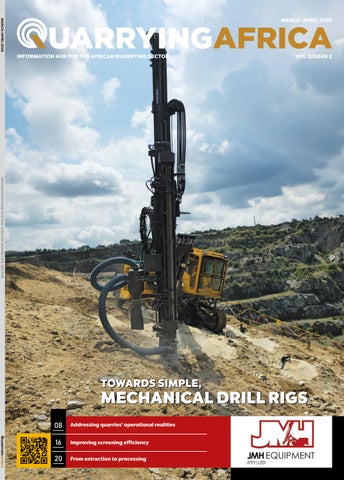
While there is a general sentiment that the industry is shifting towards smart, connected systems, JMH Equipment, the southern African distributor of the Soosan Cebotics range of hydraulic crawler drills, has observed growing demand for simple, mechanical machines, with local quarry operators chasing reliability, ease of maintenance and cost control. On the back of that trend, the company has seen a growing uptake of its Korean-made SOOSAN Cebotics range, particularly the JD-1400E. By Munesu Shoko.
Under the stewardship of JMH Equipment since 2007, the SOOSAN Cebotics range of hydraulic crawler drills has gained a strong foothold in the southern African market, with a continuously growing installed base in South Africa, Namibia, Angola and Botswana.
Having initially made its mark in the mainstream mining sector, the range has steadily seen a growing uptake in the quarrying sector in recent years, while the installed base continues to multiply significantly in the mainstream mining sector, confirms Maurits Holtzhausen, MD of JMH Equipment.
The growth of the SOOSAN Cebotics range, says Holtzhausen, is in line with the growing trend towards simple, straightforward production machines in the quarrying sector. “Despite the apparent move towards high-tech machinery in mining, we see a significant and enduring need for simple drills in quarrying. Simple, mechanical production machines remain crucial for reliability, ease of maintenance and cost control,” says Holtzhausen.
The SOOSAN Cebotics range maintains a simple, straightforward and durable design, which reduces the likelihood of failures in demanding environments.
2007

Under the stewardship of JMH Equipment since 2007, the SOOSAN Cebotics range of hydraulic crawler drills has gained a strong foothold in the southern African market
The growth of the SOOSAN Cebotics range is in line with the growing trend towards simple production machines in the quarrying sector
The SOOSAN Cebotics range maintains a simple, straightforward and durable design, which reduces the likelihood of failures in demanding environments
JMH Equipment offers three hydraulic crawler rig models – the JD-800E, JD-1300E and JD-1400E
The JD-1400E, with a hole range of 89 to 127 mm, is the most selling model in the range
The ‘simplicity approach’ makes it easier and faster to maintain, which is key to reducing downtime and costs.
“There is a growing demand for machinery that is less complex and costs less to operate, especially when specialised, premium machines are not necessary for the job. The quarrying environment is often demanding, requiring machines that are rugged and reliable which, in the SOOSAN Cebotics case, is best achieved through
64-102 mm
The JD-800E, the smallest in the range, comes with a hole range of 64 mm to 102 mm

The growth of the SOOSAN Cebotics range is in line with the growing trend towards simple, straightforward production machines in the quarrying sector.
straightforward engineering,” says Holtzhausen.
The SOOSAN Cebotics hydraulic crawler drills, he adds, are easy to maintain and cost-effective to run. With the absence of computers, the mechanical layout of the drills ensures minimum downtime for quarries and mines.
JMH Equipment offers three hydraulic crawler rig models – the JD-800E, JD-1300E and JD-1400E. The JD-800E, the smallest in the range, comes with a hole range of 64 mm to 102 mm. The mid-size JD-1300E offers a hole range of 76 mm to 115 mm.


yet quality alternative. Over the years, we have supplied these parts to some of the largest contract miners operating in the region,” says Holtzhausen.
Ahead of this year’s Institute of Quarrying Southern Africa (IQSA) Conference and Exhibition, which takes place from 16-17 April in Durban, Holtzhausen is excited to see the improving business conditions in the quarrying environment. He believes that quarry operators’ fortunes have improved significantly in the past year or two as meaningful infrastructure projects have come to market.
Holtzhausen’s views are corroborated by the Afrimat Construction Index (ACI), a composite index of activity levels in the building and construction sectors which is compiled every quarter by economist Dr Roelof Botha on behalf of Afrimat. The findings of the ACI for the fourth quarter of 2025 show a marginal year-on-year increase, boosted by a solid 5,4% increase in the volume of building materials produced and a 2,2% real increase in the sales value of building materials.
The JD-1400E, with a hole range of 89 to127 mm, is the best-selling model in the range, confirms Holtzhausen. At the time of writing in early April, the company had just delivered four units to three customers in one week, signalling the growing demand for the JD-1400E.
One of the reasons behind the growth of this particular model – which made its debut in 2014 and has since benefitted from slight upgrades over the years – is its versatility, which allows it to be deployed across applications, including construction, quarrying and mining.
The drill comes with common components such as the Yamamoto YH135 drifter, a Cummins CTAA8.3 or QSL9 engine, which is warranteed by Cummins Southern Africa, as well as Kawasaki hydraulic pumps. These are components well known to the industry and can be serviced by existing technicians. By eliminating the need for specialised, expensive, or off-site Original Equipment Manufacturer (OEM) service, businesses can achieve faster repairs and keep production running smoothly.
“This is complemented by the high availability of parts. JMH Equipment keeps a large stockholding of all the parts, ensuring high machine uptime for our customers. In addition, we offer complementary aftermarket drifter spare parts for any make and model of both underground and top-hammer drill rigs, offering cost-sensitive customers a cost-effective,
Although the activity levels in South Africa’s construction sector remain subdued, the ACI’s seasonally adjusted reading has increased for the second consecutive quarter – the first time this has occurred since the brief recession of 2020. The most impressive aspect of the latest ACI is the positive growth trend for the indicators that carry the largest weighting, namely the sales values and volume of production of building materials.
“This year’s IQSA Conference comes at a time when quarries are seemingly enjoying growth in demand for their aggregates and related products. At this year’s show, we will showcase how our SOOSAN Cebotics range of hydraulic crawler drills combines cost-effectiveness and simplicity. Known for their robust construction and simple, computer-free design, these machines are highly regarded for reducing maintenance downtime and related costs,” concludes Holtzhausen. a


At this year’s Institute of Quarrying Southern Africa (IQSA) Conference and Exhibition, which takes place on 16-17 April in Durban, South Africa, Caldas for Crushers Wears Spares will highlight solutions that directly address the operational realities faced by quarrying and mining customers across Africa. By Munesu Shoko
The market for modular and mobile crushing solutions is experiencing significant growth in Africa, driven by a global shift towards flexible, on-site processing, improved return on investment (ROI) and increased sustainability in mining and construction.
Mobile and modular crushing units are also increasingly favoured for their rapid deployment, reduced transportation costs and the ability to operate in remote

At this year’s IQSA Conference, which takes place on 16-17 April in Durban, South Africa, Caldas will highlight solutions that directly address the operational realities faced by quarrying and mining customers across Africa
30
Customers can also feel confident knowing they have support from a team that has built experience over 30 years

One of the emerging trends in the quarrying sector is the growing demand for modular and mobile crushing solutions, which is driven by the need for flexibility and faster project turnaround
In addition, there is a shift towards evaluating solutions based on lifecycle cost and productivity, rather than just capital cost
To address these emerging trends, Caldas’s strategy is centred on combining cost competitiveness with technical depth and local support
The company’s focus at the upcoming IQSA Conference will be on its Caldas CQ modular crushing range, alongside its well-established wear parts and aftermarket support offering
or confined locations, offering a cost-effective alternative to traditional fixed infrastructure.
This is one of the trends that Michael Da Camara, Chief Operating Officer at Caldas, has observed in the African quarrying sector. “One of the emerging trends is the growing demand for modular and mobile crushing solutions, which is driven by the need for flexibility and faster project turnaround,” says Da Camara.
In addition, explains Da Camara, there is a shift towards evaluating solutions based on lifecycle cost and productivity, rather than only on capital cost. “We also see increased emphasis on supply chain reliability and local stockholding,” he says. “These trends are pushing suppliers to deliver more than just products – they must deliver reliable, long-term solutions.”
To address these emerging trends, Caldas’s strategy is centred on combining cost competitiveness with technical depth and local support.
“We have developed the CQ modular range to provide a practical and scalable alternative to traditional plant setups. At the same time, we continue to invest in local stockholding, ensuring that customers have rapid access to critical spares and wear parts,” says Da Camara.
“In addition, our team works closely with customers to optimise crusher performance, liner selection and maintenance strategies – helping them reduce downtime and improve overall efficiency,” he adds.
In line with these trends, Caldas for Crushers Wears Spares’ focus at the upcoming IQSA Conference and Exhibition will be on its Caldas CQ modular crushing range, alongside its well-established wear parts and aftermarket support offering. These solutions are designed to provide a balance between costeffectiveness, reliability and ease of implementation.
“Importantly, we are not just showcasing equipment –we are presenting complete, supported solutions backed by local expertise and stockholding,” he says.
The Caldas CQ modular range is engineered for robustness and simplicity, which are critical in African operating environments.
Key benefits include modular design, allowing for quick installation and scalability; reduced capital outlay
On the wear parts side, Caldas focuses on delivering high-performance manganese liners and critical spares that optimise crusher efficiency and longevity.


compared to traditional fixed plants; simplified maintenance, with accessible components and standardised parts; and proven performance, supported by quality components and sound engineering.
“During the design phase of these plants, we recognised that many contractors in Africa needed durable crushing plants at a lower capital investment. Our focus has been on keeping the designs simple, straightforward and easy to maintain,” he says.
These plants offer immediate availability, are simple to transport and operate, and require low skill levels.
Customers can also feel confident knowing they have support from a team that has built experience over three decades.
On the wear parts side, Caldas focuses on delivering high-performance manganese liners and critical spares that optimise crusher efficiency and longevity. “Ultimately, our value lies in helping customers achieve a lower cost per ton, rather than simply offering the lowest upfront price,” says Da Camara.
In conclusion, Da Camara says the quarrying industry in southern Africa continues to evolve, but the fundamentals remain the same – reliability, performance and support are critical.
“At Caldas for Crushers Wears Spares, we pride ourselves on being more than just a supplier. We are a long-term partner to our customers, providing solutions that are proven in real-world conditions,” he states.
IQSA 2026, adds Da Camara, provides an excellent platform for the company to engage with the industry, share its latest developments and reinforce its commitment to supporting quarrying operations across the region. a

for African conditions. Proven in the


When downtime costs you tonnes, you need parts you can trust. Caldas delivers high-performance wear parts designed for durability, consistency, and maximum throughput.
From manganese liners to critical components, we support your plant with:

In line with the growing trend towards data-driven decisions in the quarrying sector, as the industry continues to evolve under increasing demands for higher productivity and efficiency, Loadtech will use this year’s Institute of Quarrying Southern Africa (IQSA) Conference and Exhibition to showcase its precision load cell technology alongside its cloud-based data platform. By Munesu Shoko.
Mines and quarries are increasingly running data-driven operations, leveraging data analytics and insights from various sources to optimise processes, predict equipment failures, and improve overall efficiency and safety.
At this year’s IQSA conference, which takes place from 16-17 April, Loadtech will demonstrate how it is putting precision at the heart of quarrying
According to Loutjie van der Merwe, Loadrite divisional manager at Loadtech, the quarrying industry is increasingly embracing digital transformation, with a strong focus on data-driven decision-making, automation and operational transparency. There is also a growing emphasis on cost control, productivity
ViewIT, Loadtech’s AIpowered remote monitoring system, transforms data into meaningful insights through cloud-based analytics, dashboards and reporting tools
Launched in mid-2024, Loadtech ViewIT provides businesses with an easy-touse data intelligence platform that brings together data ingestion, storage, visualisation, analysis and trend prediction in one unified interface

ViewIT is Loadtech’s in-house-developed remote monitoring system that allows customers to view any of their assets from anywhere, be it a silo, weighbridge, hoppers or mobile crushers.

“The IQSA Conference presents a valuable opportunity to demonstrate how the integration of Loadtech’s weighing technology with the ViewIT platform delivers a complete, end-to-end solution for modern quarry operations – driving accuracy, visibility and performance across the value chain.
The quarrying industry is increasingly embracing digital transformation, with a strong focus on datadriven decision-making, automation and operational transparency
There is also a growing emphasis on cost control, productivity optimisation and sustainability through better resource management
At the IQSA conference, Loadtech will demonstrate how it is putting precision at the heart of quarrying
The company will showcase its precision load cell technology for belt scales and crushers, alongside its cloud-based data platform, ViewIT
optimisation and sustainability through better resource management.
“We are addressing these trends by combining robust hardware with intelligent software. Loadtech’s reliable load cell solutions ensure accurate data capture at the source, while ViewIT, our artificial intelligence (AI)-powered remote monitoring system, transforms this data into meaningful insights through cloud-based analytics, dashboards and reporting tools. This empowers quarry operators to optimise processes, improve efficiency and make proactive, informed decisions,” says van der Merwe.

At this year’s IQSA conference, which takes place from 16-17 April, Loadtech will demonstrate how it is putting precision at the heart of quarrying. The company will showcase its precision load cell technology for belt scales and crushers, alongside ViewIT, its cloud-based data platform designed to provide real-time visibility of production and equipment performance.
Loadtech’s load cells are engineered for accuracy, durability and reliability in harsh quarrying environments, ensuring precise measurement of material flow on conveyors and crushers. When integrated with ViewIT, users gain access to real-time data, remote monitoring and automated reporting. This enables improved production tracking, reduced material losses, better maintenance planning and enhanced operational efficiency.
“The IQSA Conference presents a valuable opportunity to demonstrate how the integration of Loadtech’s weighing technology with the ViewIT platform delivers a complete, end-to-end solution for modern quarry operations – driving accuracy, visibility and performance across the value chain,” says van der Merwe.
Launched in mid-2024 and available on both Apple and Android platforms, Loadtech ViewIT provides businesses with an easy-to-use data intelligence platform that brings together data ingestion, storage, visualisation,
analysis and trend prediction in one unified interface. ViewIT is Loadtech’s in-house-developed remote monitoring system that allows customers to view any of their assets from anywhere, be it a silo, weighbridge, hoppers or mobile crushers. In an environment where mines and quarries generate lots of data from their assets, the system helps them to interpret the raw data into actionable insights. Dashboards can be tailor-made to meet each customer’s data viewing and reporting needs.
Loadtech ViewIT is directly aimed at the mining industry’s growing appetite for data-driven operations. Mining companies and their quarrying counterparts can leverage historical data to forecast future events, optimise resource allocation and minimise unnecessary spending.
Data analytics enables real-time monitoring of assets, allowing quarry and mine managers to make timely decisions and respond proactively to potential issues. Analysing data from various stages of the quarrying process, from extraction to processing, also helps operations to identify bottlenecks, optimise efficiency and improve product quality.
“The Loadtech ViewIT system is our response to the industry’s need for an easy-to-use, cost-effective online productivity tracker at the customer’s fingertips. Remote monitoring in mining and quarrying offers numerous benefits, including enhanced safety, increased efficiency, proactive maintenance and improved operational decision-making, leading to reduced downtime and costs,” concludes van der Merwe. a


As part of its commitment to the quarrying industry, Multotec will again exhibit at this year’s Institute of Quarrying Southern Africa (IQSA) Conference. Pieter Uys, regional sales manager – Consumables (West) at Multotec, tells Quarrying Africa that the company’s major highlight at the show will be two new products that address blinding in tertiary applications, thus improving screening efficiency. By Munesu Shoko.
In a rapidly evolving, high-pressure quarrying industry, new solutions are critical for quarries to remain viable and profitable. As material specifications become stricter and demand for consistent, high-volume output increases, innovative screening technologies are necessary to maximise throughput and profitability.
With that in mind, Multotec will use the upcoming 55th IQSA Conference and Exhibition – to be held at the Elangeni Hotel in Durban, South Africa, on 16-17 April
2026 – to showcase solutions that are designed to usher in a new era in screening efficiency.
Multotec will be showcasing two new products that are, however, still in the testing phase – the End Tension PU Mat and the Side Tension Rubber Mat. Together, says Uys, these products are designed to improve screening efficiency, reduce recirculating load and minimise the need for manual intervention,
Multotec will use the upcoming 55 th IQSA Conference and Exhibition to showcase solutions that are designed to usher in a new era in screening efficiency

Multotec will be showcasing two new products that are, however, still in the testing phase – the End Tension PU Mat and the Side Tension Rubber Mat
These products are designed to improve screening efficiency, reduce recirculating load and minimise the need for manual intervention, ultimately lowering operational costs
Multotec will continue testing the Side Tension MBV Mat, which was featured at the last 2025 IQSA exhibition
Quarries are beginning to recognise the need for solutions that address these issues at the root, rather than just managing the symptoms
ultimately lowering operational costs.
Designed for high-frequency screens, the End Tension PU Mat tensions from the top to the bottom of the screen. Uys tells Quarrying Africa that this mat has shown excellent results in limestone quarries during the initial phase of testing, improving underflow tonnage and reducing recirculating load.
The Side Tension Rubber Mat installs the same way as the traditional woven wire mesh and comes in apertures from 4 mm to 40 mm, and thicknesses of 6 mm to 12 mm, depending on the application. It has been particularly effective in addressing blinding in tertiary applications.
“These products specifically address a key challenge many quarries face – blinding in tertiary applications when
16-17
This year’s IQSA Conference and Exhibition will be held at the Elangeni Hotel in Durban, South Africa, on 16-17 April 2026

“While some of our solutions, such as soft rubber panels, high-flow panels, vibroplast panels and flapper panels, have been available for some time, we have made significant advances in side tension solutions designed to replace woven wire mesh without requiring costly deck conversions. These mats have become increasingly common but remain a significant capital investment for quarries.
regional sales manager – Consumables
wet, sticky, or fine materials clog the screen mesh, filling the apertures (holes) in the screening media,” explains Uys.
“While some of our solutions, such as soft rubber panels, high-flow panels, vibroplast panels and flapper panels, have been available for some time, we have made significant advances in side tension solutions designed to replace woven wire mesh without requiring costly deck conversions. These mats have become increasingly common but remain a significant capital investment for quarries,” he adds.
In addition, Multotec will continue testing the Side Tension MBV Mat, which was featured at the last 2025 IQSA exhibition. The product is moving into a second phase of testing and has delivered strong results in addressing blinding.

Commenting on some of the features and benefits, Uys says the main advantage of these three solutions is that they are self-cleansing. They are engineered to be ‘alive’ in operation, vibrating with the screen’s mechanics to maintain a clean surface, unlike rigid woven wire mesh.
Another key benefit is the extended lifespan. Polyurethane and rubber surfaces are smoother and have lower friction than woven wire mesh, allowing product to flow freely and reducing wear and tear.
From a health and safety perspective these mats are made of smooth materials, with fewer sharp edges than woven wire mesh, reducing the risk of injury during installation or maintenance. In addition, this significantly reduces noise levels.
The modular design of the MBV side tension mats is another major benefit. Sections are cast in 305 mm units from side plate to side plate. This modularity allows for targeted replacement in case of damage, reducing downtime compared to conventional screening media that requires complete replacement or patching.
focus on long lifespan of screening media in primary applications. Traditional screening media, he says, often wears out too quickly, leading to frequent replacements and downtime.
Blinding in tertiary (and some secondary) applications is a common industry setback. “Fines can accumulate on screens, preventing sellable product from passing through. In many operations, this results in frequent plant stoppages for manual cleaning, thus increasing labour costs and significantly reducing overall plant efficiency. This also leads to recirculating loads, inefficiencies and higher energy costs,” explains Uys.
Quarries, he says, are beginning to recognise the need for solutions that address these issues at the root, rather than just managing the symptoms.
Multotec’s approach to addressing these trends is solution-driven. “We focus on research and development (R&D) to understand specific operational challenges and design products that directly address them,” says Uys.
The process typically involves testing new ideas in the company’s R&D facility in Spartan, implementing operational trials at live quarry sites, and refining products based on real-world feedback, which can include improvements in lifespan, self-cleansing efficiency, or material and aperture design.
“The R&D focus allows us to proactively address emerging trends, ensure our solutions deliver measurable benefits and maintain a competitive edge in the screening media space. This ensures that the solutions we bring to market are not only technically sound but also deliver measurable improvements in efficiency, cost reduction, and overall plant performance,” says Uys.
“Overall, these products enhance efficiency, reduce labour costs and improve safety, while ensuring more consistent screening performance, ultimately translating into improved plant uptime and lower maintenance requirements,” says Uys.
Commenting on some trends emerging in the quarrying sector, Uys makes special mention of the growing
While the company has been heavily focused on screening media solutions, Multotec is also expanding its holistic approach to the quarrying process. For example, the company has added new slurry pumps and cyclones, as well as ceramic wear solutions. “We have introduced new wear solutions and cyclones that have proven successful in various quarries,” says Uys. These products are backed by end-toend technical support. Multotec considers the full process flow, helping clients identify upstream adjustments that can prevent downstream issues.
“This broader perspective allows us to offer a complete package of solutions, combining innovative products with technical expertise to improve overall plant efficiency. Furthermore, this holistic approach enables us to move beyond solving isolated challenges and instead optimise the entire process, delivering long-term value and improved operational performance for our customers,” concludes Uys. a

The annual Institute of Quarrying Southern Africa (IQSA) conference and exhibition returns on 16-17 April 2026 at Elangeni Hotel, Durban, KwaZulu Natal. Ahead of the show, Quarrying Africa speaks to two key exhibitors, Bell Equipment and Astec Industries, about the solutions they will highlight at this year’s show and some of the key trends taking root in the local quarrying sector. By Munesu Shoko.

The annual Institute of Quarrying Southern Africa (IQSA) conference and exhibition returns on 16-17 April 2026 at Elangeni Hotel, Durban, KwaZulu Natal
The South African quarrying sector is currently operating with remarkable resilience, navigating deep-seated constraints such as a struggling construction industry, as well as regulatory and financial pressures that hinder optimal growth.
Under the topical “Thriving in Uncertainty” theme, this year’s IQSA conference will highlight the industry’s adaptability and resilience in volatile times.
In the quest to thrive in uncertainty, the quarrying industry relies heavily on its supply chain partners to provide solutions that speak directly to their evolving needs and allow quarry operators to keep up with global and local trends.
At this year’s show, Astec Industries’ exhibit will hinge on three key pillars – local manufacture, mobile crushing and screening, as well as the ‘JOZI Modular Plant System’.
The importance of local manufacture cannot be reiterated enough, explains Calvin Fennell, Business Line Manager Capital Sales at Astec Industries Africa Middle East. The original equipment manufacturer (OEM) operates a major manufacturing hub in Elandsfontein, Johannesburg, South Africa, serving the Africa Middle
East region, as well as the global market through Astec’s international footprint, with crushing and screening equipment.
“The Titan T-Series local production programme is underway in South Africa – starting with the T200 and T300 – to shorten lead times and strengthen regional support. We will also showcase the newly launched A-Series jaw crushers, with the A50 being the debut model. South African localisation for the A Series is in the pipeline to complement Titan production,” explains Fennell.
Local manufacture in South Africa, continues Fennell, offers shorter delivery and commissioning times, as well as direct access to local spares, service and engineering, reducing downtime and risk for regional quarries. In addition, producing locally improves supply chain resilience against global disruptions while strengthening local community relationships and supporting local skills development.
Astec will also use this year’s event to showcase its rapid - deployment lineup of mobile crushing and screening solutions, including the GT125 tracked jaw, the FT2650 tracked jaw, the GT205 mobile incline screen and the GT165 direct-feed screen, as well as the FT200 tracked cone crusher. These solutions speak
Bell Equipment Sales South Africa will cast the spotlight on its Finlay mobile crushing and screening range, as well as Kobelco excavators.

Astec will use this year’s event to showcase its rapid-deployment lineup of mobile crushing and screening solutions.

to the growing need for fast time -to - production and flexible circuits.
“Our mobile plants combine proven jaw and screening platforms with quick setup and easy redeployment between pits – ideal when geology or demand shifts,” Fennell says.
Another major talking point at the Astec stand will be the ‘JOZI Modular Plant System’ – to be launched later this year.
Bell exhibits
At the 2026 IQSA Conference, Bell Equipment Sales
South Africa (BESSA) will cast the spotlight on its Finlay mobile crushing and screening range, Bell articulated dump trucks (ADTs) and Kobelco excavators.
“Together, these solutions provide a complete end-toend system for quarrying operations – from extraction and loading to hauling and processing – helping customers improve productivity, efficiency and cost per tonne,” says BESSA OEM Manager Geran Lazarus.
At this year’s show, Astec Industries’ exhibit will hinge on three key pillars – local manufacture, mobile crushing and screening, as well as JOZI Modular Plant Systems
At the 2026 IQSA Conference, Bell Equipment Sales South Africa will cast the spotlight on its Finlay mobile crushing and screening range, Bell ADTs and Kobelco excavators
Bell notes that quarries are placing a major focus on material optimisation – maximising usable product and reducing waste
Astec notes that African producers are pivoting to mobile and modular solutions to compress project timelines and de - risk capex

Kobelco excavators provide fast cycle times, high breakout forces and fuel-efficient hydraulics. Finlay
Finlay mobile crushers and screens offer high throughput, efficient material separation and reduced cost per tonne, while Bell ADTs are renowned for their fuel-efficiency, stable operation and capability to handle challenging terrain.
Collectively, says Lazarus, these solutions help operators boost production, reduce costs and improve reliability across every stage of operation.
“We go beyond supplying equipment. By combining Finlay, Bell and Kobelco with expert advice, training and support, we ensure the right machine for the right application, helping quarries increase output, reduce waste and improve long-term profitability,” says Lazarus.
Commenting on some trends taking root in the quarrying market, Lazarus notes that quarries are placing a major focus on material optimisation –maximising usable product and reducing waste. Material optimisation in quarries focuses on maximising the extraction and utilisation of valuable material while minimising waste.
“The advent of data-driven operations – using telematics to track performance and uptime – is one of the major trends we see in the quarrying industry,” explains Lazarus. Quarries are increasingly running data-driven operations, leveraging data analytics and insights from various sources to optimise processes, predict equipment failures and improve overall efficiency and safety.


With pressure to reduce emissions, manage dust and operate responsibly, quarries are placing a major focus on sustainability, says Lazarus. The strong focus on sustainability ensures regulatory compliance, reduces
operational costs and secures the industry’s “social licence to operate” within local communities.
“In response to these trends, we strive to provide customers with a complete view of the total cost of ownership across our product range. We provide and support world-class telematics and monitoring systems to improve uptime and decision-making. We also make use of pre-screening and integrated processing to maximise yield,” says Lazarus.
According to Astec’s Fennell, African producers are pivoting to mobile and modular solutions to compress project timelines and de - risk capex. At the same time, operators are doubling down on efficiency, safety and skills.
“To respond to these emerging requirements, we are expanding local manufacturing capabilities, with the Titan T-Series now already produced in South Africa and the A-Series jaws planned to join soon. We are also standardising our modular designs to speed up delivery and relocation. In parallel, our GT/FT and Ranger mobile trains help customers cut re-handling, optimise energy use per tonne and scale easily in line with demand,” concludes Fennell. a

After a long review process that started in 2015, the South African Revenue Service (SARS) is fundamentally changing how the diesel rebate system works. Traditionally, diesel refunds were processed through the Value Added Tax (VAT) system, and in future, diesel refunds will be treated as a standalone Customs and Excise rebate. In a one-on-one with Quarrying Africa, Andrew Hancock, tax consultant at Colenbrander Inc., unpacks the changes and their impact. By Munesu Shoko.
After a long review process that dates back to 2015, SARS has decided to remove diesel refunds from VAT entirely
Under the new diesel refund regime, diesel users in the farming, forestry and mining sectors can now claim refunds on 100% of eligible diesel purchases and use, instead of the previous 80%
From late 2025 into 2026, all existing diesel refund users must re-register, link their equipment and activities, and prepare for a new digital claims platform that will fully replace VAT-based claims by 2026/2027
As part of its commitment to modernising Excise systems to provide a digitally enhanced, streamlined experience that optimises service delivery and compliance, SARS has announced the development of a new Diesel Refunds regime. Under the new dedicated platform, diesel refunds will become a standalone Customs and Excise process, not a VAT offset. This change, explains Hancock, is driven by compliance failures, fraud risk and administrative complexity under VAT.
In future, primary sector claimants operating onland in qualifying farming, forestry and mining activities will be entitled to claim a refund on 100% of eligible diesel used. This amendment streamlines the administration of the Diesel Refund Scheme.


““After a long review process that dates back to 2015, SARS has decided to remove diesel refunds from VAT entirely. In future, the diesel refunds regime will be treated as a standalone Customs and Excise rebate, with its own registration, compliance rules and claim process.”
SARS has announced the development of a new Diesel Refunds regime.

In the Budget Speech of 2025, the Minister of Finance announced that, to align with the policy intent of the Diesel Refund Scheme, there would be an adjustment to the rate for onland diesel users. Note 6 to Part 3 of Schedule 6 of the Customs and Excise Act No. 91 of 1964 (The Customs Act), currently allows for diesel users in the farming, forestry and mining sectors to claim refunds on 80% of eligible diesel purchases and usage.
As a result of the announcement, Note 6 to Part 3 of Schedule 6 of the Customs Act will be amended to reflect that diesel users in the mentioned sectors can now claim refunds on 100% of eligible diesel purchases and use, instead of the previous 80%.
The system rollout commenced in January 2026 with a closed-group pilot with specified traders to evaluate the system’s efficiency before a full-fledged implementation.
Initially, SARS had communicated that by April 2026, complete registration would open to all traders, with the current VAT-based process continuing in the background for a period to ensure a smooth transition.
However, the revenue authority has recently communicated that the new Diesel Refund registration system will open later than initially envisaged. Although good progress has been made in developing a modernised system, SARS says additional time is
As part of its commitment to modernising Excise systems, SARS has announced the development of a new Diesel Refunds regime
Under the new dedicated platform, diesel refunds will become a standalone Customs and Excise process, not a VAT offset
The system rollout commenced in January 2026 with a closed-group pilot with specified traders to evaluate the system’s efficiency before a full-fledged implementation
In the near future, complete registration will open to all traders, with the current VAT-based process continuing in the background for a period to ensure a smooth transition
required to pilot and test the system to ensure it is stable, secure and functional.
The move fundamentally changes how diesel refunds work. “For years, diesel refunds were processed through
Mining contractors will now be able to register as users, having previously been excluded from the system.

the VAT system, allowing refunds to be offset against VAT payable or included in VAT refunds. This created administrative complexity, excluded certain business structures, and made the system vulnerable to abuse,” explains Hancock.
“After a long review process that dates back to 2015, SARS has decided to remove diesel refunds from VAT entirely. In future, the diesel refunds regime will be treated as a standalone Customs and Excise rebate, with its own registration, compliance rules and claim process,” he adds. “While VAT registration still exists in the background, diesel refunds will no longer affect VAT liability calculations directly. This means no more automatic setoffs between VAT payable and diesel refunds.”
To support this change, explains Hancock, SARS is simplifying qualifying industry categories, introducing clearer and more flexible logbook rules, and enforcing stronger upfront compliance checks. The aim is to make the system easier for legitimate users while closing loopholes that previously enabled fraud.
“From late 2025 into 2026, all existing diesel refund users must re-register, link their equipment and activities, and prepare for a new digital claims platform that will fully replace VAT-based claims by 2026/2027,” urges Hancock, who highlights some of the major changes.
• Monthly storage and usage records required (not per-transaction VAT style)
• SARS will provide minimum prescribed logbooks
• Entity-specific simplified logbooks will be allowed (simplified)
• Exemptions:
• Underground mining: no usage logbooks
• Fishing, offshore mining/shipping: no storage logbooks
• All current diesel refund users must re-register on the new system
• Sellers of diesel must also register
• Contractors using diesel on behalf of users must be linked via formal
• Registration is done via RAV01, now separate from VAT registration
• Risk profiling introduced before registration approval
• Supporting documents mandatory and digitally uploaded
• Typical registration turnaround: 2-6 weeks, depending on risk rating
One of the immediate benefits of the new diesel refund system, says Hancock, is the fact that the qualifying sectors, including mining, can now claim refunds on 100% of eligible diesel purchases and use, instead of the previous 80% – a financial boost for the sector.
In addition, mining contractors will now be able to register as users, having previously been excluded from the system. “Contractors’ fuel usage was previously restricted to the ‘dry’ basis through the registered user. Under the new regime, contractors’ usage on ‘wet’ contract basis will be allowed,” says Hancock.
According to SARS, the new Diesel Refunds system offers enhanced traceability through the mandatory registration of sellers, improving oversight and compliance across the supply chain.
It also allows for the provision of online status updates, allowing users to track the progress of claims in real time. Automated validations built into the system are designed to minimise errors and reduce processing delays.
Hancock urges eligible users to always look at their logging compliance and align with the required criteria, such as usage logging (fuel burnt), eligible activities adequately evidenced, and proof of activity location.
Once registered, logging records will be simultaneous with return submission. It is envisaged that usage logs will be uploaded onto the profile with the return claim. Assets will be loaded onto the profile and identified as diesel-using equipment.
“Users must align themselves with registered fuel suppliers who, under the new regime, will also be required to register. If the fuel supplier is not registered, users will not be able to claim their diesel refund,” concludes Hancock. a

Introducing the new ENDURON® crusher range by Weir, purpose-built to meet the evolving needs of the industry. Engineered for high performance and energy efficiency, they are easy to install, simple to commission, and ready to take on the most demanding applications. With a unified hydraulic and lubrication system, advanced control, and premium ESCO® wear parts, ENDURON® crushers deliver reliability, reduced downtime, and lower operational costs.
Backed by Weir’s legacy of technical excellence and global service support, this next-generation range reflects our commitment to customer intimacy and sustainable innovation. ENDURON® crushers aren’t just built to perform, they are built to endure. www.global.weir We listened. We redesigned. We rebuilt.
John Deere ADTs have proven their mettle in the field since the first introduction some three years ago.

Following the July 2022 introduction of its articulated dump truck (ADT) range in Africa, John Deere has recorded remarkable growth in three years, with a large population of units hard at work across applications. Central to the multi-faceted growth – which balances sales performance, market penetration, brand recognition and a growing installed base – is not only a product that has proven its mettle in tough operating conditions, but more importantly, the aftermarket support behind it. By Munesu Shoko.
July 2022 marked the introduction of the John Deere production class equipment in Africa, representing the second phase of the original equipment manufacturer’s rollout of its ‘yellow metal’ equipment range in the region. At the centre of the production class equipment rollout was the 460E-II – the first John Deere ADT to be launched in Africa.
An average 20% year-on-year growth of the ADT range has been recorded since the introduction in July 2022

Just over three years later, Griffiths Makgate, Director Sales and Marketing, Construction and Forestry for Africa Middle East, tells Quarrying Africa that the range has surpassed expectations, with a large installed base operational in countries such as South Africa, Namibia, Zambia, Ivory Coast, and, more recently, Tanzania, amongst others.
An average 20% year-on-year growth has been recorded since the introduction. The growth, he says, does not only reflect financial performance, but also various important levers such as market penetration, brand awareness, and machine population, indicating that the John Deere ADT has successfully moved from the launch phase to sustainable, long-term growth.
“It has been quite an interesting journey thus far. When we first launched, we were fully aware of the competitive nature of the ADT market. We brought in the 460E-II first, which was a culmination of a
Following the success of the 460E-II, John Deere Africa expanded the range with the P-Tier range, introducing the 42-t 460 P-Tier in April 2024
July 2022 marked the introduction of the John Deere production class equipment in Africa, representing the second phase of the company’s rollout of its ‘yellow metal’ equipment range in the region
Just over three years later, the range has surpassed expectations, with a large installed base operational in countries such as South Africa, Namibia, Zambia, Ivory Coast, and, more recently, Tanzania, amongst others
The first six ADT units were deployed in two distinct applications and these provided ample lessons and feedback for further product improvement
The first four ADTs went into a taxing diamond mining application in Namibia, while the other two were deployed in a copper mining application in Phalaborwa, South Africa
thorough research and development (R&D) regime, informed by customer needs. It ticked all the right boxes, from increased productivity and uptime to efficiency, and lower total cost of ownership (TCO).
Beyond the product, our support regime has been a key growth factor within such a short period, setting the tone for the success we see today,” says Makgate.
The first six units were deployed in two distinct applications and these provided ample lessons and feedback for further product improvement. Four units went into a taxing diamond mining application in Namibia, while the other two were deployed in a copper mining application in Phalaborwa, South Africa.
The Namibian operation, says Makgate, proved to be one of the toughest testing grounds for the John Deere ADT. Characterised by wet, muddy and slippery conditions throughout the year, the application probably presented the toughest underfoot conditions in which the John Deere 460E-II had ever been deployed.
The John Deere product, says Makgate, proved equal to the task. One of the standout features was the Traction mode, which optimises the differential lock, ensuring maximum tractive effort and preventing the trucks from getting stuck in slippery conditions.
“In Traction Mode, the truck locks up four differential locks – one in each axle and one in transmission, thus allowing a fully loaded ADT to travel as smoothly and efficiently as possible, even in tough underfoot

conditions. The new wheel-speed sensors also provide accurate reading, complementing the ground-speed radar in confirming that the traction-boosting auto-differential lock engages when needed,” explains Makgate.
The John Deere engines powering the machines are designed to maintain high performance at high altitudes, primarily through advanced turbocharging, which compensates for the lower air density and oxygen availability found at higher elevations. Unlike naturally aspirated engines that lose 3-4% of their horsepower for every 300 m of elevation gain, turbocharged John Deere engines use exhaust gases to drive a turbine, forcing extra air into the combustion chamber to maintain near-optimal oxygen levels.
While the often dry conditions found in Phalaborwa offer a more stable environment for hauling compared to wet conditions in Namibia, Makgate notes that the operating environment remains challenging due to the extreme temperatures synonymous with the Limpopo area.
In such a sweltering environment, running hydraulic machines is generally challenging primarily because heat degrades the hydraulic fluid’s properties and damages the system’s seals and components, leading to performance issues and potential system failure.
Nonetheless, John Deere machines have proven their mettle, with machines continuing to perform well with no major mechanical issues in such taxing conditions.
“Some of the sites have very tight turns, which cause side shaft and final drive failures. With the John Deere trucks, we have not received any feedback from any customers who have experienced these failures. The client has been happy with how the John Deere product gets the better of sharp turns through the specialised articulated steering, advanced hydraulic systems and superior weight distribution, allowing the ADTs to navigate confined spaces and narrow haul roads with ease,” says Makgate. 20 000
One of the standout features on the John Deere ADT is the Traction mode, which optimises the differential lock, ensuring maximum tractive effort.

Across both sites, the first machines have to date averaged about 20 000 hours on the clock, and counting. “However, the rollout was not without challenges. Technical issues are part of equipment operations, but what stood out was the proactive, empathetic, and fast response times from both the OEM and the dealer, to transform issues into trust-building, long-term partnerships with our clients. Launching a product in the market is one thing, and being able to back it up is quite another, and this was an area in which we proved to be strong,” says Makgate.
Based on these capabilities, both these clients have since significantly grown their fleets of John Deere ADTs which, according to Makgate, is testament to customer satisfaction, not only with the product, but also the aftermarket support. Beyond these two clients, the John Deere ADT population has grown significantly across Africa, with the industry now well aware of the machine’s capability.
Following the success of the 460E-II, John Deere Africa expanded the range with the P-Tier range, introducing the 42-tonne (t) 460 P-Tier in April 2024 and the 38-t 410 P-Tier a month later.
The smaller 410, says Makgate, was a product specifically targeted at the coal market and it has gone on to establish itself as a formidable offering in that market segment, especially in the coalfields of Mpumalanga, South Africa.
Garrett Adamson, product manager at John Deere, says mining and infrastructure projects across Africa are becoming more complex. Beyond raw performance, productivity now depends just as much on technology, safety and Total Cost of Ownership (TCO), as it does on moving material.
“Sites are larger, operators are working longer shifts, and equipment often operates far from workshops. Customers want machines that are intuitive to operate, easy to service, and designed to reduce risk – both for operators and maintenance crews,” says Adamson.
On the John Deere P-Tier ADTs, adds Adamson, the cab is really the command centre of the machine. Operators work in a quiet, pressurised cab designed to reduce fatigue over long shifts. An easy -to - read monitor brings key machine information together, including the rear- camera display, so operators can stay aware of their surroundings without distraction.
“Comfort plays a big role in consistency and safety.

The standard high-back air-suspension seat adjusts multiple ways for all-day support, and customers can opt for a premium heated and ventilated seat with heavy-duty suspension and an adjustable seat pan. For operations in hot, dusty regions or cooler high-altitude sites, the optional automatic temperature control system allows operators to set a desired temperature and stay comfortable throughout the shift,” explains Adamson.
Visibility and awareness are also critical on busy job sites, says Lauren Meyer, product marketing manager at John Deere. “Visibility is one of the biggest contributors to safe and efficient operation. For improved operator experience and situational awareness, John Deere ADTs come with varying levels of vision systems to increase visibility and situational awareness from the operator’s seat. Optional rear- camera systems give operators a clear view when backing up, helping avoid obstacles and congestion around crushers, stockpiles, or loading areas,” says Meyer.
For sites with heavy traffic and constant interaction between machines and personnel, customers can opt for the John Deere Advanced Vision System (AVS). AVS increases the operator’s field of view to potential jobsite hazards, enhancing awareness and navigation in busy work areas. The system uses digital cameras mounted in the front grille and on the mirror bows, displaying images on a trio of dedicated in - cab monitors.
Integrated with the ADT’s articulation, the mirror- bow cameras automatically pan as the machine turns, helping operators stay aware of what is around them.
Serviceability, says Meyer, is another major concern in remote operations. This, she says, is an area where John Deere has seen strong appreciation from customers. All daily checks and periodic service points are accessible from ground level. And all this can be done by lowering the front suspension of the truck by the press of a button, to reach the serviceable components of the truck.
There is also an optional factory - installed auto - lube system, which is electrically powered and integrated with machine diagnostics. It helps ensure consistent lubrication while simplifying daily routines – a big advantage on sites where skilled maintenance resources may be limited.
Beyond these product features, Makgate says the aftermarket regime has been the key success driver for the John Deere ADT range in Africa. He highlights the importance of alignment between the OEM and the dealer, which calls for the presentation of a united front, both focused on supporting customers first.
John Deere maintains an open relationship and collaboration with its dealer partners, which has cemented customers’ confidence. “Close collaboration and flexibility between us and our dealer partners have been critical drivers of brand growth. By working together, we have ensured consistent, high-quality service, which builds long-term brand loyalty and trust,” concludes Makgate. a

Pure Grading Power ANTLER CONTROL
The rough-and-ready workhorse. No distractions. Just grading.
• Traditional antler controls that put every movement directly in the operator’s hands
Favoured by operators who trust machine feel and proven fundamentals
When your job calls for reliability, skilled operators, and straightforward performance, G-Tier delivers exactly what’s needed. Nothing more. Nothing less.
*Terms and conditions apply. (Available at https://www.deere.africa/en/) https://www deere.africa/en/ I africa@johndeere.com I Customer care: 0800 983 821
built around your control
JOYSTICK CONTROL
Technology-led grading
The advanced performer. Built for accuracy, consistency, and control.
• Fingertip or dual joystick control options
Designed for applications where accuracy must stay consistent from start to finish
When precision, automation, and repeatable results matter most, P-Tier supports your operator with technology that works as hard as they do.

Following the local launch of the UJ443E fully electric mobile crusher late last year, Sandvik Rock Processing reports strong early interest in the technology. The first two Sandvik UJ443E machines in Africa – the third and fourth units to be produced globally – have been sold to local mining contractors through southern African distributor, S&R Enterprises, signalling the impending fundamental shift towards fully-electric mobile crushing technology in Africa. By Munesu Shoko.
During the last quarter of 2025, Sandvik Rock Processing announced the launch of its first fully-electric mobile crusher in Africa, the UJ443E, marking a major step in the transition from legacy diesel-powered machines to fully-electric mobile crushing plants. This comes on the back of the industry’s quest to simultaneously reduce equipment lifecycle costs and meet sustainability goals.
Commissioned on site at the start of January this year, the first UJ443E has been deployed in a Platinum Group Metals (PGM) application in Rustenburg, North West Province, South Africa. At the time of writing, the second unit was undergoing a cold commissioning process at the S&R Enterprises facility in Gauteng,
ahead of its delivery to a customer also operating in a PGM environment.
“The delivery of the two UJ443E machines marks the first time Sandvik mobile crushing units built on a fully electric track platform are being deployed to work in Africa,” says Tarynn Yatras, Vice President Sales Area Africa for Sandvik Rock Processing. “The first two fully electric machines on the continent – the third and fourth UJ443E units to roll off the global Sandvik production line – highlight Africa’s pioneering attitude in technology adoption.”
PC Kruger, Business Line Manager Crushing at Sandvik Rock Processing, agrees, saying that African contractors are in fact outpacing some of their global peers in the uptake of Sandvik fully electric mobile crushing
During the last quarter of 2025, Sandvik Rock Processing announced the launch of its first fullyelectric mobile crusher in Africa, the UJ443E, marking a major step in the transition from legacy diesel-powered machines to fully-electric mobile crushing plants

Based on early local data, Sandvik Rock Processing has already seen a 20% saving on diesel consumption when powering the UJ443E with a genset compared to running a comparable diesel-powered UJ440
“ “
African customers across industries –particularly in the mining, quarrying and even construction, sectors – are increasingly open to adopting electric crushers. This shift is driven by the need to reduce high diesel costs, lower maintenance requirements, improve operational efficiency, while meeting sustainability goals.

In addition to the competitive initial investment, Sandvik fully-electric models provide lower TCO compared to the traditional diesel-hydraulic counterparts. These machines can operate via the electrical grid or, in the absence of one, with an onboard genset using diesel or biofuels such as hydrotreated vegetable oil (HVO).
Following the local launch of the UJ443E fully electric mobile crusher late last year, Sandvik Rock Processing reports strong early interest in the technology
The delivery of the two UJ443E machines marks the first time Sandvik mobile crushing units built on a fully electric track platform are being deployed to work in Africa
The CJ412 jaw crusher has enhanced connectivity features, providing the operator with live operating parameters
The first two UJ443E are under Sandvik’s Hyper Care programme, where the local teams are in constant communication with the factory to ensure seamless operation
solutions, proving that technology adoption in the region is increasingly strategic rather than merely imitative.
Both Kruger and Yatras report early interest in electromobility in the African crushing industry. The sale of the two UJ443E units follows hard on the heels of the delivery of the first Sandvik dual-powered machine, a QA452e tracked mobile, triple-deck sizing screen with Doublescreen technology, late last year. Sold by southern African distributor, S&R Enterprises, the unit was, upon its arrival, immediately delivered to a contractor working on a flagship dam project in Lesotho.
Commenting on the major drivers behind the early adoption of the fully electric crushing technology, Yatras notes that the uptake of electric crushers aligns with the
Fully electric track drives on the Sandvik UJ443E improve machine manoeuvrability while significantly reducing reliance on hydraulic systems.

industry’s push for lower-carbon, more cost-effective and operationally flexible solutions.
“African customers across industries – particularly in the mining, quarrying and even construction, sectors – are increasingly open to adopting electric crushers. This shift is driven by the need to reduce high diesel costs, lower maintenance requirements, improve operational efficiency, while meeting sustainability goals,” explains Yatras.
Apart from the significant reduction in diesel costs, says Kruger, electric crushers are favoured for having fewer moving parts, which results in reduced oil changes and component replacements, thus reducing maintenance costs significantly.
“In addition to the competitive initial investment, Sandvik fully-electric models provide lower total cost of ownership (TCO) compared to the traditional diesel-hydraulic counterparts,” says Kruger. “These machines can operate via the electrical grid or, in the absence of one, with an onboard genset using diesel or biofuels such as hydrotreated vegetable oil (HVO),” says Kruger.
8 m³
The savings are much higher when powering the machine with grid electricity. Diesel is the largest contributor to operating costs for crushers. Replacing diesel consumption with electricity, which is generally much cheaper per kilowatt, significantly reduces daily running costs. Electric motors are also highly efficient at converting power into mechanical energy compared to diesel engines, which lose significant energy as heat.
A larger feed hopper is provided with a patent-pending folding and locking mechanism. The standard volume is 8 m³, which can be increased with optional hopper extensions
Built on a fully electric track platform, the Sandvik UJ443E is fitted with the proven CJ412 jaw crusher. The latest generation unit features smart technology for real-time performance monitoring and adjustment.
Based on early local data, adds Kruger, Sandvik Rock Processing has already seen a 20% saving on diesel consumption when powering the UJ443E with a genset compared to running a comparable diesel-powered UJ440.
“The Sandvik CJ412 jaw crusher has enhanced connectivity features, providing the operator with live operating parameters, heavy duty electric drive, and onboard hydraulics for closed side setting (CSS) adjustments,” says Kruger. The crusher comes with an unblock facility, which reduces the need for an onboard rock hammer, thus improving safety and reducing downtime.
The fully electric track drives provide better control
The Sandvik UJ443E fully electric mobile jaw crusher marks a significant step in Africa’s transition from diesel-powered to fully electric mobile crushing technology.

and agility when tracking and loading. This significantly reduces the need for hydraulics on the plant and ultimately long-term service costs. In fact, the UJ443E consumes about 90% less hydraulic fluid than its predecessors, which translates into lower maintenance costs and a lighter environmental footprint.
The machine features a redesigned feed station with patent-pending hydraulic lift function for improved maintenance access and fixed jaw removal. A larger feed hopper is provided with a patent-pending folding and locking mechanism. The standard volume is 8 m³, which can be increased with optional hopper extensions.
Other innovations include three-speed electric tracks for precise movement, a redesigned feed station with hydraulic tilt access for easier maintenance, and a downstream 125-amp connection for integrating other downstream electric equipment such as cone crushers and screening plants.
To ensure that the local support teams are acquainted with the new fully-electric crushing plant, Sandvik Rock Processing brought in three master technicians from the Ballygawly, Northern Ireland factory. During their twoweek stay in South Africa, the technicians took the local Sandvik and S&R Enterprises teams through the hot and cold commissioning processes. According to Yatras, their stay provided a platform for knowledge transfer to the
local support teams.
The first two UJ443E are under Sandvik’s Hyper Care programme, confirms Kruger, where the local teams are in constant communication with the factory to ensure seamless operation. The Sandvik My Fleet telematics enhances support by enabling remote diagnostics and performance monitoring. Real-time monitoring allows for constant tracking of machine performance, early detection of alarms, and for ensuring optimal, efficient operation.
As with any new product, both Sandvik Rock Processing and S&R Enterprises have invested heavily in the necessary parts and spares. “We have identified critical component and recommended spares lists. Based on that exercise, both Sandvik and S&R Enterprises have invested in a sizeable stockholding of these components, allowing us to be able to support these machines in the field,” says Yatras.
Given the early interest in the technology, Yatras is positive that the uptake of electric crushers will only accelerate in the coming years as Sandvik and its local partners build positive reference cases and the local African industry witnesses the benefits of the technology.
“While historically perceived as a laggard in technology adoption, Africa is emerging as a global leader in
Early market interest in the Sandvik UJ443E highlights growing demand for cost efficient, lower-emission mobile crushing solutions in Africa’s mining and quarrying sectors.

specific technology sectors, and we are seeing that with electric crushing technology. Rather than following the traditional, slow adoption path, local contractors are moving quickly to make the most of modern solutions,” says Yatras.
Yatras commends S&R Enterprises for playing a central role, in partnership with Sandvik, in shifting customer mindsets about new technology, highlighting that both the OEM and its distributor have been the primary architects of these new products, and that they possess the most accurate information to address consumer anxieties.
Within just over a year of its existence, the distributor partnership between Sandvik Rock Processing and S&R Enterprises has recorded massive successes. In fact, says Yatras, on the back of the partnership – the first sales area-managed distributorship agreement for Sandvik Mobiles in the world – Sandvik Rock Processing recorded one of its most successful years in mobile sales in Africa in 2025.
“Traditionally, Sandvik has always employed a dealer direct model, where partnerships for mobile
suppliers are managed by the factory. With S&R Enterprises, we took a different approach, making it the first ever sales area-managed partnership, and that has paid dividends. In Africa, the importance of local partnerships cannot be stated enough – they provide essential, on-the-ground expertise to navigate complex regulatory, cultural and logistical landscapes,” explains Yatras.
In conclusion, Kruger notes a modularised approach to mining in Africa, especially given the need for mobility and cost-effective operation. Modular plants have always been favoured for their ability to be moved quite quickly, while they could also be run on grid electricity. Electric mobile crushers, he says, are set to revolutionise the mining industry by combining the flexibility of on-site processing with the lower operating costs and sustainability of electric drives.
“In addition, their track-mounted agility enables them to be easily moved around on and between job sites. We are super excited to see what the UJ443E will bring in the 400-600 tonnes per hour production environments,” concludes Kruger. a

In January 2024, Africoal – a leading opencast mining contractor with a strong operational footprint in the coalfields of Mpumalanga, South Africa – took delivery of its first ever SANY excavators. Impressed by both the performance of the machine and the backup support, the company has, within two years, grown its fleet of SANY excavators to seven. Based on this performance, Ross Robertson, CEO of Africoal, expects SANY to be the company’s preferred excavator supplier for the long haul. By Munesu Shoko .

The first SANY excavators to join Africoal’s large fleet of yellow metal equipment were three 120-tonne (t) SY120C-9 units delivered in January 2025, after initially taking delivery of the SANY SMG200 motor grader during the last quarter of 2024.
The machines quickly made their mark, prompting the contract mining company to place an order for two 94,2-t SY980H units, which were delivered during the last quarter of 2025. During the same period, the company further bolstered its fleet with two 21-t SANY SY210C units, bringing to seven the number of SANY hydraulic excavators in the Africoal stable.
Africoal is an established name in the South African coal industry. The company has its roots in the coalfields of Mpumalanga, where at one point it was a successful owner-operator of up to nine coal mines before transitioning to a purely contract mining model in 2019, following the acquisition of the business by the current shareholders.
The decision to migrate from the owner-operator model to contract mining, explains Robertson, was largely to derisk the business against prevalent market volatility in the coal sector. The coal sector is characterised by intense boom-and-bust cycles, where periods of high demand, surging prices and heavy investment are often followed by sharp downturns, bankruptcies and the contraction of mining operations.
Over the years, Africoal has become a household
name in contract mining, and currently executes four opencast mining projects on behalf of one of the leading coal mining groups in South Africa. The company currently mines about 3,2-million m³ a month and given the mining right asset base of its large client, Africoal sees significant growth opportunity. However, Robertson is very clear about the company’s growth aspirations – he does not want to become “too big”, and for him that means mining anything beyond the 5-million m³ a month mark.
“When an operation becomes too big and geographically dispersed that, as a leader, I cannot get to each operation every day, I get the sense that we might start losing control, which is not ideal for our operating philosophy. Yes, it might sound good to be moving large volumes, but with that comes the risk of not being able to manage cost control, lose the attention to detail aspect and the personal touch that we are renowned for as an organisation, which I believe form part of our competitive edge,” says Robertson.
To be able to move these large volumes per month, Africoal runs one of the largest fleets in the coalfields – a total of just over 380 pieces of yellow metal equipment, anchored by about 200 articulated dump trucks (ADTs), nearly 50 bulldozers and about 70 excavators, amongst other solutions.
“When we took over the business in 2019, we did not
380
Africoal runs one of the largest fleets in the coalfields – a total of just over 380 pieces of yellow metal equipment


The integrity of the machine is at a standard that we are very comfortable with. As it stands, we will stick to SANY for our excavator needs. I foresee a big future for the SANY brand in our stable. We are currently investigating moving to bigger trucks such as 100-t rigids over time, and we will be looking for the ideal loading tools for these trucks from SANY.
3,2-million m³
Africoal currently mines about 3,2-million m³ a month
In January 2024, Africoal took delivery of its first ever SANY excavators
The first SANY excavators to join Africoal’s large fleet of yellow metal equipment were three 120-tonne SY120C-9 units
The machines quickly made their mark, prompting the contract mining company to place an order for two 94,2-t SY980H units
The Africoal experience of SANY has thus far been positive. The company is pleased with the product which has to date performed as per expectations
have any scientific model on how to recapitalise the fleet. Over the years, we have adopted what we call ‘a third, a third and a third’ approach, whereby at any given time we have a third of our fleet brand new, a third of our fleet paid off or under hire purchase, and a third of the fleet paid off and operating without a capital cost against them,” explains Robertson.
Africoal, adds Robertson, is also trying to find an equilibrium between its monthly repair and maintenance

spend and its monthly finance costs for those assets still under financing. “We are very close to that point,” he says. “We have spent a lot of time and energy in controlling spares- and maintenance-related costs. We have also invested in our people, particularly regarding skills development, to ensure asset preservation and asset integrity, ultimately leading to cost savings.”
Africoal operates a multi-brand fleet and values its buying decisions that are largely informed by the relationships it establishes with original equipment manufacturers or dealers. “Integrity and honour are very important to us. When we partner with a company, we do our homework first and make sure that the culture of the potential partner aligns with ours, and that the people that represent that particular brand are likeminded – that is very important to us,” says Robertson.
From the onset, he adds, the SANY Southern African team exhibited these traits. Robertson highlights the respect that the Africoal team was shown as refreshing. “Our mentality is to operate on a very personal level, treating everybody that we engage with dignity, and we expect the same treatment,” stresses Robertson. “When we get the sense that we are not important enough or big enough to be taken seriously, by our supplier or partner, we quickly move away from that relationship.”
The Africoal experience of SANY has thus far been positive, says Robertson. From a technical point of view, the company is pleased with the product which has to date performed as per expectations. From a service and maintenance perspective, the Africoal team is familiar with all the major components on the SANY excavator, including the Cummins engine, the filtration system and the hydraulic systems.
In terms of performance, Robertson is particularly impressed by the integrated control system on SANY excavators, which is designed to optimise performance, fuel efficiency and operational precision by coordinating the engine, hydraulic system and main control valve.
According to Robertson, there were some quality
concerns raised by some industry peers before Africoal decided to go the SANY route. However, he says, the long-standing notion that Chinese earthmoving equipment is of poor quality is actively being dispelled, with the SANY product proving its mettle in Africoal’s high-production environments. He believes that OEMs such as SANY are increasingly seen as a “compelling” offering that blends quality, technology and affordability.
“The integrity of the machine is at a standard that we are very comfortable with. We believe in the machine. As it stands, we will stick to SANY for our excavator needs. I foresee a big future for the SANY brand in our stable. We are currently investigating moving to bigger trucks such as 100-t rigids over time, and we will be looking for the ideal loading tools for these trucks from SANY,” he says.
Beyond the product, Robertson is impressed by the support and the open communication channels between Africoal and SANY. From the onset, he says, the configuration of the very first deal made sense for Africoal because it had a tailored approach. “We value communication and transparency, and we got that from SANY from the very first day,” he says.
Robertson also commends the professionalism of the service and aftermarket teams. Parts availability has been “superb” and Africoal has never had to wait for any critical spares, thus maximising equipment availability.
“For us, it is important that the OEM understands our business needs and is willing to support us accordingly. What we see with other OEMs is a big disconnect between the branch and the OEM itself – with branches often run as franchises not aligned to the OEM. We have not experienced that with SANY – they get the basics done well and that takes care of 95% of the day-today engagements and needs. Dealing with responsive people who communicate well, managing customer expectations, makes for a great relationship,” concludes Robertson. a


Welcome to our international guests from United Kingdom | New Zealand | Hong Kong Australia | Malaysia


Annual conference & exhibition


Venue: SCAN QR CODE FOR DIRECTIONS
Elangeni Hotel Snell Parade, Durban, KwaZulu-Natal


16 - 17 APRIL 2026


OUR CONFERENCE will feature international speakers from The Institute of Quarrying affiliated branches from the UK, Australia, New Zealand, Malaysia and Hong Kong. Including 2 Keynote addresses and other industry presentations.


Our theme for the year is “Thriving in Uncertainty”.

OUR EXHIBITION will feature 36 stands and will be open for the duration of the conference.


Young Professionals – We will host a group of young professionals from Australia, New Zealand and other affiliated branches of the Institute of Quarrying. They will visit operations in Johannesburg and Cape Town.


Flotation cells are the heartbeat of mineral processing plants across sub-Saharan Africa. Whether it is copper, platinum group metals, gold or phosphates, the efficiency of the flotation stage determines how much valuable material actually makes it out of the slurry and into the plant’s revenue stream. And as every plant manager knows, flotation is a fragile balance. Slight shifts in density, level or foam stability can send efficiency plummeting.
That is exactly why robust, densitycompensated level measurement has become a ‘must-have’ rather than a ‘nice-to-have’. Among the available solutions, the VEGABAR 86 has emerged as a smart, durable and lowmaintenance option for plants dealing with tough slurry conditions and constantly shifting process variables.
Flotation cells rely on a stable froth layer to effectively separate valuable particles from waste. The chemistry is simple on paper: aerated slurry forms bubbles, valuable particles cling to the bubble surfaces and the froth layer transports them to the top for removal. But in reality, maintaining that froth layer at the right
The VEGABAR 86 gives operators a stable, low-maintenance and highly accurate way to control the froth layer and keep yield consistent over the long term

Density-compensated level measurement maximises flotation cell efficiency.
The sticky nature of froth layers further complicates the process, as do pressures typically ranging between +80 and +200 mbar and process temperatures from +25°C to +35°C
Flotation cells operate in extremely demanding conditions. They are constantly exposed to sudden changes in density and varying solids content, while turbulent surfaces caused by aeration create additional instability
Over time, continuous buildup and abrasion from suspended solids can significantly impact equipment integrity
This is where the design of the VEGABAR 86 stands out. The VEGABAR 86 is purpose-built for challenging environments characterised by sticky, abrasive, and slurry-heavy processes
Across the African mining sector, equipment reliability is a massive factor in operational continuity. Remote locations, abrasive ores and fluctuating plant feed make stable measurement technology essential
thickness is anything but simple. If the froth is too thin, it lacks the buoyant structure needed to carry hydrophobic particles upward. If it’s too thick, it signals excessive reaction time, often meaning that less of the medium is being processed, throughput drops and energy and reagent costs rise. Complicating this further is constantly changing slurry density. Feed variations, solids loading, air entrainment and chemical dosing all shift the density

For plants that have implemented densitycompensated level measurement in their flotation cells, the benefits are evident from the start.
profile inside the tank. Without compensation, a level sensor might misread the process, giving operators a false sense of stability while efficiency slides.
A density-compensated level measurement solves this by simultaneously measuring both level and density. The VEGABAR 86 uses electronic differential pressure to calculate accurate level values even when solids content swings. This stabilises the control loop and lets operators keep the froth exactly where it needs to be.
Flotation cells operate in extremely demanding conditions. They are constantly exposed to sudden changes in density and varying solids content, while turbulent surfaces caused by aeration create

additional instability. Over time, continuous buildup and abrasion from suspended solids can significantly impact equipment integrity.
The sticky nature of froth layers further complicates the process, as do pressures typically ranging between +80 and +200 mbar and process temperatures from +25°C to +35°C. Many traditional instruments struggle to withstand these challenges: mechanical components wear out, impulse lines become clogged, capillaries lose their accuracy and the need for frequent cleaning can severely hamper productivity.
This is where the design of the VEGABAR 86 stands out. The VEGABAR 86 is purpose-built for challenging environments characterised by sticky, abrasive, and slurry-heavy processes. What sets it apart is VEGA’s proprietary CERTEC ceramic measuring cell, which ensures long-term stability and performance, even in settings where abrasion is a constant threat.
This ceramic sensor resists wear far more effectively than traditional metallic diaphragms, particularly when exposed to slurries with high solids content. As a result, it experiences less measurement drift and is far less prone to failure, reducing the operational headaches often associated with froth flotation cells.
Another important advantage of the VEGABAR 86 is its design, which eliminates the need for mechanical components such as capillaries or impulse lines. This means operators do not have to contend with blockages, signal delays or the regular maintenance routines involving hot water and compressed air that other instruments require. The absence of these mechanical parts contributes to greater measurement reliability and ease of use. Additionally, the VEGABAR 86 can simultaneously measure density and level. This integrated capability empowers operators to respond swiftly to changing process conditions, such as sudden collapses in the froth layer or fluctuations in solids loading, ensuring more consistent control and improved process stability. The instrument employs electronic differential pressure by digitally processing signals from two linked sensors, rather than relying on fluid-filled capillaries. This approach maintains high accuracy
even as environmental factors such as temperature, vibration or leaks vary.
For plants that have implemented density-compensated level measurement in their flotation cells, the benefits are evident from the start. The foam layer becomes more stable, leading to increased recovery rates and allowing operators to spend less time manually adjusting levels. Consistent froth formation also means that plants can avoid overdosing on collectors or frothers, which helps to reduce reagent consumption. Finally, the wear-free ceramic cell and absence of mechanical parts translate into lower maintenance requirements, fewer unplanned stoppages and a longer lifespan for the instrument.
Across the African mining sector, equipment reliability is a massive factor in operational continuity. Remote locations, abrasive ores and fluctuating plant feed make stable measurement technology essential.
The VEGABAR 86’s ability to withstand heavy slurry conditions while at the same time still providing density-compensated accuracy makes it especially wellsuited to flotation cells used in African gold, PGM, base metal and phosphate processing plants. It fits the geometry of rougher and cleaner cells, and its ceramic sensing technology performs well even when buildup is unavoidable.
Flotation efficiency rises and falls on control, particularly the control of level and density. Trying to manage flotation with instruments that drift, clog or can’t cope with density changes is essentially running a plant with crossed fingers.
The VEGABAR 86 gives operators a stable, low-maintenance and highly accurate way to control the froth layer and keep yield consistent over the long term. With its CERTEC ceramic cell and electronic differential pressure technology, it offers a combination of durability and precision that directly supports production efficiency.
For plants looking to improve recovery rates without increasing reagent or maintenance costs, densitycompensated level measurement with the VEGABAR 86 is one of the smartest upgrades available. a
For us it’s no problem.


VEGAPULS 6X
The perfect radar level transmitter for measurement of bulk solids in all environments.
Everything is possible. With VEGA.
• Highest operational reliability, immune to noise, dust and abrasion
• Non-contact operation - safe, reliable and maintenance-free
• Easy measuring beam alignment with swivel bracket and aiming app
The advanced diesel-electric drive system on the Metso Lokotrack LT400J enables lower fuel consumption and reduced operating costs.

The Metso Lokotrack LT400J, now available through Pilot Crushtec, introduces a new generation of diesel-electric digitally advanced mobile jaw crushing technology to Africa’s mining, quarrying and recycling sectors. Combining high production capacity with improved energy efficiency, intelligent controls and enhanced serviceability, the Metso LT400J is engineered to deliver consistent performance, lower operating costs and increased machine availability in demanding applications.
The advanced high-capacity Metso LT400J marks the local rollout of the next generation of Metso Lokotrack EC range
Typical production rates range between 300 and 600 tph, depending on application conditions, making it suitable for primary crushing circuits on mines as well as large quarrying or recycling operations
50
The LT400J can operate for up to 50 hours before refuelling, which reflects a significant fuel saving compared with conventional diesel-hydraulic machines
The advanced highcapacity Metso LT400J marks the local rollout of the next generation of Metso Lokotrack EC range, according to Charl Marais, Sales Manager at Pilot Crushtec. Featuring a diesel-electric drive system, it makes operating costs even more economical
“The LT400J is designed as a true production machine,” Marais says. “It is built to run for long periods with minimal interruption, while maintaining high throughput and reliability in demanding applications.”
Typical production rates range between 300 and 600 tonnes per hour, depending on application conditions, making it suitable for primary crushing circuits on mines as well as large quarrying or recycling operations. Its energy efficiency and reliability underpin longer work

Electric drive systems maintain stable performance regardless of temperature variations, as there is less efficiency loss associated with hydraulic oil heating or component wear. This translates directly into improved operational consistency which is a key factor in maintaining steady production rates.

The LT400J is designed as a true production machine. It is built to run for long periods with minimal interruption, while maintaining high throughput and reliability in demanding applications.
The nip angle can be adjusted and with three nip angle adjustments linear utilisation is improved in various feed material conditions and production rates.
“This machine can operate for up to 50 hours before refuelling, which reflects a significant fuel saving compared with conventional diesel-hydraulic machines,” he says. “Lower fuel consumption of course also directly reduces operating costs.”
Operational economy is further enhanced by flexibility in power sourcing, as operators have the option to connect directly to grid electricity, reducing fuel usage and emissions even further.
Wayne Warren, Africa Sales Manager at Pilot Crushtec, notes that having all the main process functions electrically driven improves overall efficiency while helping to deliver more consistent performance over time.
The LT400J incorporates dedicated lifting tools and improved access around the fixed jaw end, making the removal and replacement of wear liners safer and more efficient cycles, he explains.
Africa’s mining, aggregates and construction sectors will gain a productivity and efficiency boost with the arrival of the Metso Lokotrack LT400J – now available through Pilot Crushtec
Operational economy is enhanced by flexibility in power sourcing, as operators have the option to connect directly to grid electricity, reducing fuel usage and emissions even further
Having all the main process functions electrically driven improves overall efficiency while helping to deliver more consistent performance over time
“Electric drive systems maintain stable performance regardless of temperature variations, as there is less efficiency loss associated with hydraulic oil heating or
Available in southern Africa through Pilot Crushtec, the Metso Lokotrack LT400J combines high production capacity with improved energy efficiency.

component wear,” Warren explains. “This translates directly into improved operational consistency which is a key factor in maintaining steady production rates.”
A major step forward in the Lokotrack LT400J is its expanded digital control architecture, significantly enhancing usability and operational precision. Warren highlights the redesigned remote-control system as one of the most noticeable upgrades.
“The remote is no longer just a basic control unit,” he explains. “It now features an LCD screen that allows the operator to see machine functions in real time and make adjustments directly from where they are standing.”
This reduces the need for two-person coordination during setup or adjustment; traditionally, one operator would be stationed at the machine and another on the controls. With the Metso LT400J, a single operator can monitor and manage key functions more safely and efficiently. The interface is also more intuitive, aligning well with younger operators accustomed to digital devices and touch-based navigation.
Marais adds that the machine’s intelligent remote monitoring systems incorporates more sensors than previous models.
“There is a higher level of feedback from the machine,”
he says. “That allows operators to adjust parameters such as crusher settings and conveyor positions without physically intervening which is a significant time-saver and an added safety benefit.”
The digital controls support improved production consistency and preventative maintenance by providing clearer operational data and system status information. Customers can respond more rapidly and conduct quicker troubleshooting, reducing unnecessary stoppages and limiting downtime.
The significant technological advances in the LT400J – in terms of software, sensors and control philosophy – call for a high level of technical understanding for both operation and maintenance. Typical customers are therefore expected to be sophisticated operators with the necessary skills and resources.
“Our strategic relationship with Metso ensures that Pilot Crushtec continuously develops its aftersales support, training and technical readiness for new technologies,” Warren says. “We invest in ensuring that both our teams and our customers are equipped to manage the advanced digital and electrical systems on the crushing solutions we provide.”
For the arrival of the Metso LT400J in South Africa, two

senior Metso master technicians, including one from the factory where it was built, were hosted at Pilot Crushtec’s Jet Park facility to conduct in-depth training sessions with the local technical and workshop teams.
“Working directly with the factory specialists allows our technicians to fully understand the machine, its capabilities and its complexities,” he says. “With any new generation machine, there is always an element of training.”
He emphasises that the Pilot Crushtec team is also well equipped to assist customers with upskilling their operators and maintenance teams so they can extract full value from the technology.
Marais highlights how the improvements in design impact both operation and maintenance, reflecting Metso’s broader design philosophy of integrating real-world operational feedback into equipment development. He points to the redesigned extended discharge conveyor as an example.
“The discharge conveyor can operate at three different angles,” he explains. “You can raise it to build a higher stockpile, lower it to feed directly into the next unit in the crushing circuit or drop it horizontally to the ground for maintenance access.”
This last function is particularly significant as it allows
technicians easier access to the underside of the jaw crusher – an area that often becomes difficult to inspect or service on conventional machines.
“Liner changes have also been simplified,” he notes. “The LT400J incorporates dedicated lifting tools and improved access around the fixed jaw end, making the removal and replacement of wear liners safer and more efficient.”
In addition, the bypass chute behind the jaw crusher is hydraulically adjustable, allowing it to move away from the service area and improve working space during maintenance. Warren adds that the machine was effectively redesigned from the ground up.
“Every aspect was reviewed and improved where it could be,” he says. “There is now enhanced engine access through large gull-wing doors, for instance, providing clear unobstructed access to service components.”
Combined with reduced hydraulic complexity –including a much smaller hydraulic tank used primarily for tracking and setup – these design improvements help shorten service times, reduce maintenance effort and ultimately increase machine availability in demanding African applications.
Enhancing the value of mobility in crushing, the Metso LT400J’s track-mounted design allows rapid relocation within a site or between sites, enabling operators to respond quickly to changing production requirements. a
AfriSam is a leading construction materials group in southern Africa. Since establishing its first cement plant in 1934, the company has grown into a formidable construction materials group with operations in South Africa, Lesotho and Eswatini. www.afrisam.co.za
Through several business units, Babcock offers a range of products and services, including construction and mining equipment, engineering solutions for steam generation and power plants, crane hire and gear rental, industrial generators, welding equipment and DAF truck sales and service www.babcock.co.za
With more than 16 years of experience in Proximity Detection Systems solutions, Booyco Electronics has supplied over 6 500 sets of mining vehicle equipment installations across southern Africa, as well as more than 55 000 pedestrian RFID installations. www.booyco-electronics.co.za
In 1986, when VEI pioneered On Board Weighing Solutions and Payload Monitoring, we based them on the knowledge we acquired by listening to customers so that we took particular care of the details that make their jobs easier and our products simpler to use. www.veigroup.com/en
LOADTECH Load cells Onboard Weighing are specialists in onboard weighing providing complete solutions onboard your heavy goods vehicle, primarily in the application of load cell and transducer systems for payload protection and accuracy in the commercial vehicle sector. www.loadtech.co.za
JBI Industrial Solutions specialises in a diverse range of weighing systems in partnership with PFREUNDT GmbH. We provide solutions for both mobile and static weighing needs. The PFREUNDT weighing systems are versatile and deliver significant benefits across various industries, including extraction, disposal, recycling, industry and agriculture. www.jbisolutions.co.za

Pilot Crushtec International (Pty) Ltd is South Africa’s leading supplier of mobile and semi-mobile crushing, screening, recycling, sand washing, stockpiling, compacting and material handling solutions.
www.pilotcrushtec.com

Sandvik Rock Processing is a leading supplier of equipment, tools, parts, service and solutions for processing rock and minerals in the mining and infrastructure industries. Applications include crushing, screening, breaking and demolition. www.rockprocessing.sandvik/en

Astec Industries has been a global leader in providing innovative Rock to Road™ solutions since 1972, specialising in equipment for asphalt road building and aggregate processing. www.astecindustries.com


John Deere offers a comprehensive range of construction equipment, including ADT’s, excavators, loaders, dozers, graders, skid steers and TLB’s, designed to enhance productivity, efficiency, and performance on job sites of all sizes. www.deere.africa/en/construction


Weir Minerals Africa offers a wide range of equipment solutions including pumps, hydrocyclones, valves, dewatering equipment, wear-resistant linings, rubber products, screens and crushers – backed throughout the product lifecycle by high levels of aftermarket support. www.global.weir


For over 40 years, BME has been at the forefront of mining innovation, delivering cutting-edge solutions in commercial blasting and mining chemical processing. As a trusted partner in the industry, we provide a comprehensive range of products and services designed to enhance safety, efficiency, and sustainability in mining operations worldwide. www.bme.co.za


