
EXPO CHICAGO: Hung Liu

Page 1


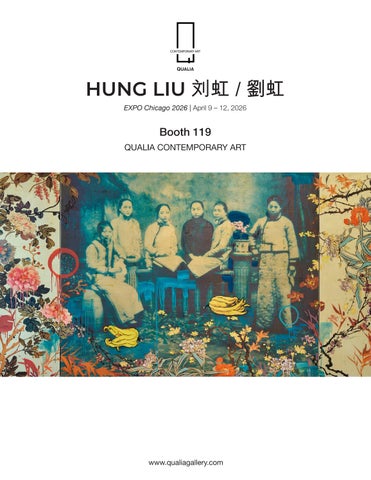
HUNG LIU 刘虹 /

EXPO Chicago 2026 | April 9 – 12, 2026

QUALIA CONTEMPORARY ART

HUNG LIU 刘虹 / 劉虹

b. 1948, Changchun, China

d. 2021, Oakland, CA, USA

One of the first Chinese-born artists to establish a major career in the United States, Hung Liu spent decades giving visual form to history’s overlooked figures—orphaned children, women soldiers, refugees, comfort women, migrant laborers—whom she described as “spirit-ghosts.”

On view in Chicago, Liu’s resin-based mixed media works fuse portraiture, historical photography, and painterly dissolution. They are at once emotional and indexical; honoring the forgotten and the displaced through shimmering layers of image and material.

Born in Changchun in 1948, Liu’s early life was shaped by the turbulence of the Cultural Revolution. She was sent to the countryside for “reeducation” as a farm laborer, where she spent four years working in the fields. It was there that she taught herself photography, secretly documenting fellow villagers—many of whom had never been photographed before. She trained as a Socialist Realist painter before emigrating to the United States in 1984, settling eventually in Oakland, California, where she taught at Mills College for three decades.

Liu’s distinctive technique involved using historical photographs as source material for large-scale paintings characterized by filmy washes, gestural drips, and Zen-like ensō circles that lend her works a dreamlike, dissolving quality—the antithesis of the rigid propaganda style of her youth. In her resin-based mixed media works, the process is equally layered: painted or photographic images are digitally printed onto prepared wooden surfaces, sealed in successive layers of translucent resin, and then hand-painted by the artist using various colors of ink. The result is a luminous, almost jewel-like surface in which figures seem to hover between presence and memory, clarity and dissolution.

Mixed media/resin on wood panel with silver leaf and paint

20 1/2 x 20 1/2 x 2 in

HUNG LIU
She: Amethyst, 2015

Teng Lou Springtime, 2007

Mixed media/resin on wood panel with paint

18 x 17 x 2 in

HUNG LIU

Mixed media/resin on wood panel with gold leaf and paint

20 1/2 x 20 1/2 x 2 in

HUNG LIU
Turquoise (Pink Shirt), 2011

Autumn Wind, 2016

Mixed media/resin on wood panel with gold leaf and paint

41 x 78 in

HUNG LIU

Carved wood panel with ink (Lithostone optic)

17 x 24 in

HUNG LIU
Companions, 2018

Double Exposure, n.d.

Mixed media/resin on wood panel with gold leaf and paint

20.5 x 41 x 2 in

HUNG LIU

Mixed media/resin on wood panel with silver leaf and paint

60 x 114 in

HUNG LIU
Floral Pavilion, 2014

Imperial Parade, 2019

Mixed media/resin on wood panel with gold leaf, silver paint

18 x 21 1/2 x 2 in

HUNG LIU

Carved wood panel with ink (Lithostone optic)

17 x 24 in

HUNG LIU
Ironing, 2018

Light Source, 2016

Mixed media/resin with paint

20.5 x 41 in

HUNG LIU

Migrant Mother, 2018

Carved wood panel with ink (Lithostone optic), Edition 2 of 3 24 x 24 in

HUNG LIU

Portrait No. 1 (Country Portraits and Landscapes), 2014

Mixed media/resin on wood panel with paint

13 1/2 x 10 1/2 x 2 in

HUNG LIU

Portrait No. 5 (Army Portraits), 2014

Mixed media/resin on wood panel with paint

13 1/2 x 10 1/2 x 2 in

HUNG LIU

Portrait No. 6 (Army Portraits), 2014

Mixed media/resin on wood panel with paint

13 1/2 x 10 1/2 x 2 in

HUNG LIU

Portrait No. 7 (Factory Portraits), 2014

Mixed media/resin on wood panel with paint

13 1/2 x 10 1/2 x 2 in

HUNG LIU

Portrait No. 10 (Country Portraits and Landscapes), 2014

Mixed media/resin on wood panel with paint

13 1/2 x 10 1/2 x 2 in

HUNG LIU

Portrait No. 11 (Country Portraits and Landscapes), 2014

Mixed media/resin on wood panel with paint

13 1/2 x 10 1/2 x 2 in

HUNG LIU

Portrait No. 13 (Country Portraits and Landscapes), 2014

Mixed media/resin on wood panel with paint

13 1/2 x 11 x 2 in

HUNG LIU

Portrait No. 15 (Factory Portraits), 2014

Mixed media/resin on wood panel with paint

13 1/2 x 10 1/2 x 2 in

HUNG LIU

Portrait No. 17 (Country Portraits and Landscapes), 2014

Mixed media/resin on wood panel with paint

13 1/2 x 10 1/2 x 2 in

HUNG LIU

Portrait No. 18 (Country Portraits and Landscapes), 2014

Mixed media/resin on wood panel with paint

13 1/2 x 10 1/2 x 2 in

HUNG LIU

Portrait No. 20 (Factory Portraits), 2014

Mixed media/resin on wood panel with paint

13 1/2 x 10 1/2 x 2 in

HUNG LIU

Portrait No. 22 (Country Portraits and Landscapes), 2014

Mixed media/resin on wood panel with paint

13 1/2 x 11 x 2 in

HUNG LIU

Portrait No. 23 (Factory Portraits), 2014

Mixed media/resin on wood panel with paint

13 1/2 x 10 1/2 x 2 in

HUNG LIU

Portrait No. 25 (Factory Portraits), 2014

Mixed media/resin on wood panel with paint

13 1/2 x 10 1/2 x 2 in

HUNG LIU

Portrait No. 26 (Factory Portraits), 2014

Mixed media/resin on wood panel with paint

13 1/2 x 10 1/2 x 2 in

HUNG LIU

Portrait No. 33 (Army Portraits), 2014

Mixed media/resin on wood panel with paint

13 1/2 x 10 1/2 x 2 in

HUNG LIU

LIU Reader (Gold), 2018

Mixed media/resin (no paint)

20.5 x 20.5 in

HUNG

Untitled (Army Portraits), 2014

Mixed media/resin on wood panel with paint

13 1/2 x 10 1/2 x 2 in

HUNG LIU

Untitled (Army Portraits), N/A

Mixed media/resin on wood panel with paint

13 1/2 x 10 1/2 x 2 in

HUNG LIU

Untitled (Country Portraits and Landscapes), 2014

Mixed media/resin on wood panel with paint

13 1/2 x 10 1/2 x 2 in

HUNG LIU

Untitled (Country Portraits and Landscapes), 2014

Mixed media/resin on wood panel with paint

13 1/2 x 10 1/2 x 2 in

HUNG LIU

Untitled (Country Portraits and Landscapes), 2014

Mixed media/resin on wood panel with paint

13 1/2 x 10 1/2 x 2 in

HUNG LIU

Untitled (Self Portrait with Circle), 2014

Mixed media/resin on wood panel with paint

13 1/2 x 10 1/2 x 2 in

HUNG LIU

Untitled (Self Portrait), 2014

Mixed media/resin on wood panel with paint

13 1/2 x 10 1/2 x 2 in

HUNG LIU

Winter Blossom, 2011

Woodblock print with acrylic ink on Rives BFK

Image: 23 1/4 x 23 1/2 in, Paper: 32 1/4 x 29 3/4 in, Framed: 36 3/4 x 33 3/4 x 1 3/4 in

HUNG LIU

Installation View: Mixed

(On view Jan 14 – Feb 28, 2026) |

Miedations
Photo by Glen Cheriton

HUNG LIU 刘虹 / 劉虹

1948 - 2021; Changchun, China - Oakland, California, USA

Education

1986 MFA in Visual Arts, University of California, San Diego, CA

1981 Graduate Degree, MFA equivalent, in Mural Painting, Central Academy of Fine Art, Beijing, China

1975 BFA in Art and Art Education, Beijing Teachers College, Beijing, China

Solo Exhibitions

2025 Hung Liu: Happy and Gay, Georgetown University Art Galleries, Washington, DC; traveling to Bowdoin College Museum of Art, Brunswick, ME, 2026

2024 Hung Liu: Pulse, 1989 to 1996, RYAN LEE Gallery, New York, NY

2024 Hung Liu: Living Memory, Nasher Museum of Art at Duke University, Durham, NC

2024 Hung Liu: Control and Freedom, Vicki Myhren Gallery, Denver, CO

2023 Hung Liu: Making History, National Museum of Women in the Arts, Washington, DC

2023 A Question of Hu: The Narrative Art of Hung Liu from the Collections of Jordan D. Schnitzer and his Family Foundation, Jordan Schnitzer Museum of Art at Portland State University, Portland, OR

2023 Hung Liu: Witness, San Francisco Museum of Modern Art, San Francisco, CA

2022 Reveries: The Art of Hung Liu, Honolulu Museum of Art, Honolulu, HI

2022 Seven Poses: A Gift Fit for a Queen, Kemper Museum of Contemporary Art, Kansas City, MO

2022 Remember This: Hung Liu at Trillium, Jordan Schnitzer Museum of Art, Eugene, OR

2021 Hung Liu: Portraits of Promised Lands, National Portrait Gallery, Smithsonian Institution, Washington, DC

2021 Hung Liu: Golden Gate, de Young Museum, San Francisco, CA

2021 Remembering Artist Hung Liu, Oakland Museum of California, Oakland, CA

2020 Hung Liu: The Sun Also Rises, Minnesota Street Project, San Francisco, CA

2019 Hung Liu: The Long Way Home, Grace Museum, Abilene, TX; traveled to Amarillo Museum of Art, Amarillo, TX

2019 Hung Liu: Migrant Stories, Wichita Art Museum, Wichita, KS

2018 Hung Liu: Transformation, Loveland Art Museum, Loveland, CO

2018 Fetching Water, Gail Severn Gallery, Ketchum, ID

2018 Hung Liu in Print, National Museum of Women in the Arts, Washington, DC

2017 Daughters of China, Kala Art Institute, Berkeley, CA

2017 Promised Land, Rena Bransten Gallery, San Francisco, CA

2017 We Who Work: Prints and Tapestries by Hung Liu, Santa Cruz Museum of Art & History, Santa Cruz, CA

2017 Hung Liu: Scales of History, Fresno Art Museum, Fresno, CA

2016 Hung Liu: Daughter of China, Resident Alien, Katzen Arts Center, American University Museum, Washington, DC

2014 Summoning Ghosts: The Art of Hung Liu, Kemper Museum of Contemporary Art, Kansas City, MO; traveled to Palm Springs Art Museum, Palm Springs, CA, and Oakland Museum of California, Oakland, CA

2013 Questions from the Sky: New Work from Hung Liu, San Jose Museum of Art, San Jose, CA

2013 Hung Liu: Offerings, Mills College Art Museum, Oakland, CA

2012 Happy and Gay, Rena Bransten Gallery, San Francisco, CA

2011 (re)Pressed Memories, Tamarind Institute, Albuquerque, NM

2011 First Spring Thunder, Alexander Ochs Gallery, Beijing, China

2011 Hung Liu: Resin Paintings, 10 Chancery Lane Gallery, Hong Kong

2008 Tai Cang, Great Granary, Xin Beijing Art Gallery, Beijing, China

HUNG LIU 刘虹 / 劉虹

1948 - 2021; Changchun, China - Oakland, California, USA

Solo Exhibitions

2008 Hung Liu: Now and Then, Fred Jones Jr. Museum of Art, University of Oklahoma, Norman, OK

2007 Hung Liu: Memorial Goods 1988 to 2006, ACA Gallery of SCAD, Atlanta, GA; traveled to Pei Ling Chan Gallery, SCAD, Savannah, GA

2005 Hung Liu: Polly, Portrait of a Pioneer, Rena Bransten Gallery, San Francisco, CA

2003 Geography of Memory: Selected Works by Hung Liu, Monterey Museum of Art, Monterey, CA

2002 Strange Fruit: New Paintings by Hung Liu, Arizona State University Art Museum, Tempe, AZ; traveled to Boise Art Museum, Boise, ID, Laguna Art Museum, Laguna Beach, CA, and Crocker Art Museum, Sacramento, CA

2001 Beyond the Frame: Hung Liu, Knoxville Museum of Art, Knoxville, TN

1998 Hung Liu: A Ten Year Survey, 1988 to 1998, College of Wooster Art Museum, Wooster, OH; traveled to Muscarelle Museum of Art, Williamsburg, VA, Kemper Museum of Contemporary Art, Kansas City, MO, University of California, San Diego, CA, Bowdoin College Museum of Art, Brunswick, ME, and Ackland Art Museum, Chapel Hill, NC

1997 Hung Liu: Unfolding Memory, Embodying History, Center for Curatorial Studies, Bard College, Annandale on Hudson, NY

1995 Parameters: Hung Liu, Chrysler Museum, Norfolk, VA

1994 Jiu Jin Shan, Old Gold Mountain, de Young Museum, San Francisco, CA

1994 Hung Liu, Paintings and Installation, Fine Arts Gallery, University of California, Irvine, CA

1991 Bad Women, Rena Bransten Gallery, San Francisco, CA

1988 Hung Liu: Resident Alien, Monadnock Building, San Francisco, CA

HUNG LIU 刘虹 / 劉虹

1948 - 2021; Changchun, China - Oakland, California, USA

Group Exhibitions

2025 Front Lines: Women Etchers at the Fore, 1880 to Today, Bowdoin College Museum of Art, Brunswick, ME

2025 Beyond the Object: Selections from the Permanent Collection, Art, Design & Architecture Museum, University of California, Santa Barbara, CA

2025 Tending and Dreaming: Stories from the Collection, San José Museum of Art, San Jose, CA

2025 Together/Apart: Modern and Contemporary Art of the United States, Patricia and Phillip Frost Art Museum, Miami, FL

2023 Can You See Me Now? Painting the Aging Body, RYAN LEE Gallery, New York, NY

2013 A Place in Time, National Portrait Gallery, Smithsonian Institution, Washington, DC

2010 Culture Revolution: Contemporary Chinese Paintings from the Allen Memorial Art Museum, Akron Art Museum, Akron, OH

2008 Half Life of a Dream: Contemporary Chinese Art from the Logan Collection, San Francisco Museum of Modern Art, San Francisco, CA

2007 Contemporary Combustion: Chinese Artists in America, New Britain Museum of American Art, New Britain, CT

1997 American Kaleidoscope: Art at the Close of This Century, Smithsonian American Art Museum, Washington, DC

1994 Asia America: Identities in Contemporary Asian American Art, Asia Society, New York, NY

1993 The 43rd Corcoran Biennial of Contemporary American Painting, Corcoran Gallery of Art, Washington, DC

1993 In Transit, New Museum of Contemporary Art, New York, NY

1990 Precarious Links: Emily Jennings, Hung Liu, and Celia Muñoz, San Antonio Museum of Art, San Antonio, TX; traveled to Lawndale Art and Performance Center, Houston, TX

1980 National Fine Arts Colleges Exhibition, National Gallery of Art, Beijing, China

1978 Portraiture Exhibition, Winter Palace Gallery, Beijing, China

Awards

and Grants

2018 Inaugural Artist Award, San Jose Museum of Art, San Jose, CA

2018 Inaugural Artist Award, Berkeley Art Center, Berkeley, CA

2017 Hung Liu Day, proclamation by the City Council of Berkeley, CA

2016 Distinguished Woman Artist Award, Council of One Hundred, Fresno Art Museum, Fresno, CA

2011 Lifetime Achievement in Printmaking Award, Southern Graphics Council International, Statesboro, GA

2009 Honor Award for Design, U.S. General Services Administration, San Francisco Federal Building, San Francisco, CA

2009 UCSD Alumni Association, 50th Anniversary, 100 Influential Alumni, San Diego, CA

2000 Outstanding Alumna Award, University of California, San Diego, CA

1999 Joan and Robert Danforth Distinguished Professorship in the Arts, Endowed Chair, Mills College, Oakland, CA

1998 Joan Mitchell Foundation Painters and Sculptors Grant, New York, NY

1994 Best Exhibition by an Emerging Artist, International Association of Art Critics, United States section

1993 Eureka Fellowship, Fleishhacker Foundation, San Francisco, CA

1992 Society for the Encouragement of Contemporary Art Award, San Francisco Museum of Modern Art, San Francisco, CA

1991 Painting Fellowship, National Endowment for the Arts, Washington, DC

1989 Painting Fellowship, National Endowment for the Arts, Washington, DC

HUNG LIU 刘虹 / 劉虹

1948 - 2021; Changchun, China - Oakland, California, USA

Public Art Installations

2016 Highland Hospital Acute Tower Replacement Project, Highland Hospital, Oakland, CA

2008 Take Off, San Francisco International Airport, International Terminal Gate A5, San Francisco, CA

2006 Going Away, Coming Home, Oakland International Airport, Terminal 2 Window Project, Oakland, CA

2004 Hearts in San Francisco, Civic Center, exterior entrance of the Asian Art Museum, San Francisco, CA

2002 Above the Clouds, Cerritos Library, Cerritos, CA

1996 The Long Wharf, 1 Embarcadero Center, SkyDeck, 41st floor, San Francisco, CA

1995 Fortune Cookie, San Jose Museum of Art and City of San Jose collection, San Jose, CA

1992 Map No. 33, Esplanade Ballroom Lobby, Moscone Convention Center, San Francisco, CA

1988 Capp Street Project: Reading Room, Community Room of Chinese for Affirmative Action, Kuo Building, San Francisco, CA

1986 Up and Tao, Media Center and Communications Building, University of California, San Diego, CA

1981 The Music of the Great Earth, Foreign Students Dining Hall, Central Academy of Fine Arts, Beijing, China

Selected Public Collections

Ackland Art Museum, Chapel Hill, NC

Allen Memorial Art Museum, Oberlin College, Oberlin, OH

Arizona State University Art Museum, Tempe, AZ

Art Bridges Foundation, Bentonville, AR

Asian Art Museum, San Francisco, CA

Boise Art Museum, Boise, ID

Bowdoin College Museum of Art, Brunswick, ME

Brooklyn Museum, Brooklyn, NY

Crocker Art Museum, Sacramento, CA

Dallas Museum of Art, Dallas, TX

Denver Art Museum, Denver, CO

de Young Museum, San Francisco, CA

Herbert F. Johnson Museum of Art, Cornell University, Ithaca, NY

Iris and B. Gerald Cantor Center for Visual Arts, Stanford University, Stanford, CA Jordan Schnitzer Museum of Art, University of Oregon, Eugene, OR

Kemper Museum of Contemporary Art, Kansas City, MO

Los Angeles County Museum of Art, Los Angeles, CA

Metropolitan Museum of Art, New York, NY

Mills College Art Museum, Oakland, CA

Museum of Modern Art, New York, NY

Nasher Museum of Art at Duke University, Durham, NC

National Gallery of Art, Washington, DC

National Museum of Women in the Arts, Washington, DC

National Portrait Gallery, Smithsonian Institution, Washington, DC

Oakland Museum of California, Oakland, CA

HUNG LIU 刘虹 / 劉虹

1948 - 2021; Changchun, China - Oakland, California, USA

Selected Public Collections

Pennsylvania Academy of the Fine Arts, Philadelphia, PA

The Phillips Collection, Washington, DC

San Francisco Museum of Modern Art, San Francisco, CA

San Jose Museum of Art, San Jose, CA

Smithsonian American Art Museum, Washington, DC

Syracuse University Art Museum, Syracuse, NY

Virginia Museum of Fine Arts, Richmond, VA

Walker Art Center, Minneapolis, MN

Whitney Museum of American Art, New York, NY

Williams College Museum of Art, Williamstown, MA

Zimmerli Art Museum, Rutgers University, New Brunswick, NJ

Selected Public Collections

2025 Hung Liu: Happy and Gay

2024 Hung Liu: Pulse, 1989 to 1996

2022 Hung Liu: Seedlings

2022 Melodramas: In Memory of Hung Liu

2021 Hung Liu: Portraits of Promised Lands

2017 Hung Liu: Promised Land

2016 Hung Liu: Daughter of China, Resident Alien

2016 Hung Liu: American Exodus

2016 Hung Liu: Scales of History

2015 Hung Liu: Questions from the Sky

2014 Hung Liu: Now and Then

2013 Summoning Ghosts: The Art of Hung Liu

2013 Qianshan: Grandfather’s Mountain

2011 Hung Liu: Great Granary

PICTURING THE CULTURAL REVOLUTION

Lim, Nancy. “Picturing the Cultural Revolution.” In Hung Liu: Portraits of Promised Lands, 25–36. New Haven, CT: Yale University Press, 2021.

HUNG LIU’S EARLY WORK

In 1968, under Mao Zedong’s sweeping “Down to the Countryside Movement,” twenty-year-old Hung Liu was resettled in rural China for proletariat reeducation. In the wide farmlands of Dadu Lianghe, fifty miles north of Beijing, she labored for four years, joining seventeen million other “sent-down youth” who had been exiled from the country’s urban centers and charged with the creation of a Communist utopia. Liu threshed rice and bound corn, dug trenches of frozen mud during winter, fertilized fields, and collected wood; and in the scarce moments between, she survived on meager rations of grain, cooking oil, and soap. As the days grew into seasons that passed into years, she felt the heavy endlessness of her exile, uncertain when it would end. When the occasional plane flew overhead, she wondered, “Is it coming to take us away from here?”

Surprisingly, Liu’s most reliable—if sporadic—moments of rest were delivered through the village’s political meetings, convened to broadcast the Communist Party’s newest instructions. Because attendance counted toward time in the fields, people diligently made themselves present—and then napped, breastfed their children, or finished their needlework and other household chores. “Nobody listened,” Liu recalled, and indeed, so long as their bodies were visible, active participation was irrelevant. Their labor and devotions could be applied elsewhere—to sewing, to chatting—such that this space of civic gathering and propaganda transmission became redefined, by the villagers themselves, as a sphere of rest, autonomy, and even self-determination. Liu, who soon came to feel the same motivating freedom, picked up her pencil and started sketching.

She drew the villagers around her, reinscribing their inattentive, dreaming bodies onto her paper pad. With soft graphite lines, she rendered pant legs and slumped shoulders; other times, she explored more narrative details: a toddler dozing in his mother’s lap or an elderly woman mending her shoes (figs. 1, 2). Sketched within a minute or two, the drawings are casual and schematic, reflecting Liu’s decision to bypass technical veracity in favor of speed. Despite their concision, however, the sketches indulged the artist’s curiosity for the expressive humanity around her. From childhood, she had shown an acute sensitivity to personalities who crossed her path; she drew careful portraits of each visitor to her mother’s home, and during her middle and high school years, while receiving formal instruction at art clubs and the Beijing Children’s Palace of Culture, she painted landscapes en plein air and sketched live models and plaster busts. These foundational experiences seeped into Liu’s drawing practice in the village meetings, connecting her earlier days of art-making to her new reality of enforced labor and limited creative supplies.

Thus, while the sketches appear as simple impressions of the scenes around her, the fragile continuity she was able to recover between her previous and current lives suffuses the images with a self-preservationist impulse. This same drive inspired her to subscribe to Peking Weekly, a Communist magazine published in English. Her proficiency in “the language of imperialism,” which she had learned at her mother’s insistence, proved an invaluable resource; reading its pages, she recalled, “gave me the feeling that I hadn’t been ‘reformed’ into something like the clods of earth in the fields around me, stupefied and numb to it all.” Drawing, too, became a hopeful, even redemptive act, as it threaded—however tenuously—her reality with both her past and glimpses of an alternate present.

As villagers became acquainted with Liu’s sketches, they eventually began asking for posed portraits, curious to engage in more deliberate self-presentations. Liu happily obliged, and together she and the villagers embarked on more self-conscious interpersonal terms that gave formal shape to their respective roles as sitter and artist (cats. 5–7). She turned her gaze to her own visage as well, drawing each element with time and detail, from the braid slung over her shoulder to her headscarf’s shaded drapery (fig. 3).

Ultimately, it was not the act of drawing alone that held redemptive capacity; it was also her relationships with the neighbors. Their increasingly nuanced dynamic produced drawings wholly distinct from their high-profile counterpart: the “portraits” on view in the propaganda circulating furiously in urban centers (fig. 4). Ideological missives in the country’s rural areas were often not visual in scope; they tended to be broadcast aurally, through loudspeakers and at village meetings, to accommodate low literacy rates and a disinterest in spending meager disposable income on the Communist daily paper. But in Beijing—throughout Liu’s childhood and on her irregular trips home to visit family during exile—the Party’s posters, statues, flyers, and billboards saturated the visual landscape.

Readers of Mao’s Little Red Book were typical protagonists, as were laborers in sociable conversation, their figures framed by a colorful backdrop of factories or fields. Meant to reify optimism for the country’s health and productivity, and disavow the realities of the catastrophic Great Leap Forward, these featured bodies were invariably reduced to key symbolic components so as to ensure narrative legibility: resolute eyes and directional gazes, crisp hand gestures such as bold, raised fists, and ruddy cheeks whose hue of Communist red was Party-dictated in meticulous efforts to bolster sentimental patriotism.

Despite Liu’s childhood immersion in these spectacles, she understood clearly that the relationship between these depictions and reality was tenuous. “When I was in the countryside on a rainy day when our pants were dirty,” she recalled, “no one had a smile on their face like on the posters. In the war, no one posed heroically.” This romantic “pseudo-realism,” as one author has called it, inspired Liu’s own coinage: “socialist surrealism,” intended as a play on the phrase “socialist realism,” the aesthetic China had adopted from the Soviet Union in the mid-1950s and disseminated throughout the country’s public spaces and educational settings. Even when the universities reopened in 1972, the prescribed academic training rested fully on this model, despite its basis in the Western canon and bourgeois Platonic ideals. In the context of a state that mandated even the precise hue of red for Mao’s cheeks, the freedom Liu experienced while sketching quickly and unconstrained—first in the meetings and eventually in the village—became its own joyful defiance. “That was my chance,” she said. “I loved it—nobody cared, you know. In the city, everybody knows what you are doing. But in the village, they cut me some slack.”

www.qualiagallery.com

Liu’s unrelenting search for hopeful paths became fundamentally characteristic. When she finally left Dadu Lianghe in 1972 to begin university in Beijing, she sought relief from the strictures of the state’s art curricula by escaping each morning to the outskirts of the city, alone, to paint subjects in formats and mediums guided purely by personal will rather than the will of the state. This led to speedy, postcard-sized landscapes of fields, outhouses, dirt paths, and shacks, and she delighted in these humble exercises of color and form (fig. 5). But in their refusal to depict a rosy-cheeked Mao or other Party-approved motifs, the landscapes incited questions from Liu’s watchful roommate (who had earned the nickname “Government”) about her commitment to a proletarian future. Liu ignored the surveillance and continued painting, hiding some under her bed to dry and throwing most others away. By the time of her graduation in 1975, she had produced more than five hundred of these paintings, keeping faith, day after day, in art’s deliverance of a singular kind of freedom.

Presaging such future acts were her sketches in the village. Casual but insistent, discreet but public nonetheless, they were ultimately an assertion over the dominion of representation. And it is this that makes them elementally important in Liu’s oeuvre. They rejected the Party’s sanctioned vision of ideal citizenry, as well as the tonal monotony of its visual tropes to which she had become so attuned from years of immersion. Instead, her explorations of Dadu Lianghe’s body politic dignified its individuals as such, rather than as mass signifiers. Even while sketching quickly and broadly, she attended to the specificity of every person, drawing them unencumbered by ideological missives and asserting instead their freedom to inhabit a physicality—as exhausted laborers, as breastfeeding mothers, as daydreaming children.

Liu sometimes drew isolated body parts in her sketchbook as well (fig. 6). A floating limb torques, droops, and materializes in space. But rather than intending her study of the hand as practice toward a Communist lexicon of didactic gestures—such as the pointed index finger or the open, outstretched palm—she pursued the particularities of its form entirely outside the symbolic realm. Indeed, all throughout her years at the village, Liu’s sketches remained unmediated by the government’s propaganda tactics and its dependence on the optics of revolution and spectacle. This was notable during a period of enormous pressure to engage with politicized representation, whether as viewer or artist, reader or author. Her sketches abided instead by a humanity—in the interpersonality that generated them, in her embrace of the body’s expressions, in her honesty in transcribing what she saw, and in Liu’s vision itself.

This approach profoundly shaped her photographs as well. That photography even emerged as a possibility for Liu is striking. Cameras had become rare in China’s cities (most were smashed or confiscated), and vernacular photography had all but disappeared. Any extant knowledge of the medium was marshaled by the state to train a new school of photographers, and this rising generation produced extensive “documentations” of the nation’s revolutionary progress. Their photos were then enhanced in the darkroom: retouchers whitened Mao’s teeth, purged compositional distractions (or foes), and even tinted bowls of soup to impart an appearance of bounty (fig. 7). The final images “originated in life but [were] higher than life,” as one retoucher famously said, and state channels zealously disseminated these parallel, fictive visualizations of the country—a new world construction.

Prior to 1970, Liu had never used a camera. Additionally, her exposure to the medium was limited to studio portraits with family, occasional snapshots with classmates, and the ubiquitous propaganda throughout the city. But as she and a friend were preparing for their departures in 1968, he left his camera with Liu for safekeeping, anticipating that otherwise it would be destroyed at the military camp to which he had been assigned. Nearly two years into Liu’s reeducation, she abruptly remembered its existence after overhearing villagers discussing their photo IDs. Thus, by chance and sudden recall, she found herself with a camera during one of the most consequential times of Chinese life and at a critical moment in twentieth-century world history.

Liu waited patiently for one of her permitted trips to Beijing to acquire rolls of film. This was no easy task; as a sent-down youth rather than a state photojournalist, she was an emphatically atypical customer at the photo supply store she visited. But with money borrowed from her mother, she managed to purchase several rolls, even learning from the salesman how to load them, and upon her return to the farm, she began taking pictures of friends. Liu experimented with shutter speed, lighting, and focus, grasping for a technical foundation however she could, all while taking care with her ever-diminishing number of exposures. When she eventually turned to the villagers with requests to take their portraits, some responded warily: “The only time in my life I had my picture taken was when the Japanese occupied northeast China and I had to put it on my ID card,” Liu recalled hearing. Others feared the gauzier but widespread superstition that the camera would steal their souls.

With time, however, she gained their trust—their comfort with each other tracking their mutual comfort with the medium—especially after she gifted them the photos, painstakingly developed in a corner of her mother’s home (cats. 1–4). In the absence of a darkroom, she would wait for nightfall to begin, and then, using secondhand chemicals and a lightbulb she painted red, work through the night to develop the portraits, eventually scavenging an enlarger to scale her photos from thumbnail size to larger sheets. “And then I carried my pictures like my harvest back to the village,” she said. “The people there were all amazed.”

At first glance, Liu’s images seem to align loosely with the conventions of propaganda and studio portraiture. She depicts her subjects from chest up, occasionally stretching the frame to show their bodies in full, and they often stand outdoors, posing in a field at high noon. In a few cases, Liu applies these conventions in a duplicative attempt—one photo features a uniformed youth standing before an elaborate bridge, a trope of Communist progress (fig. 8). But on the whole, she uses architecture as a compositional aid: doorjambs outline the body, while large walls anchor it in space. In her general refusal to produce crisp, politicized images populated by symbols and tropes, the buildings that are present tend to dissolve, becoming specters in the periphery, while other times they appear arbitrary or accidental. Even Mao’s portrait, if visible, hangs companionably beside other memorabilia, all the wall’s elements on candid display rather than dutifully minimized or erased (fig. 9). “I had this great satisfaction and pleasure that I could do something so casual so they didn’t have to go to town and to the effort of putting on new clothes,” she said of her honest and low-key approach to these shots. “They could just stand in front of the fence or whatever.” Her ambivalence about the background differed sharply from the constancy of her interest in the human subject, who holds almost total visual primacy in this series. Unlike propaganda’s narrow focus on political subjectivity, Liu’s tender documents of humanity radiate with her subjects’ richness and complexities. These portraits are heightened by her “mistakes,” such as eyes that closed at the click of the shutter or mouths that froze mid-sentence—all those bodily disobediences that only photography could surface (cat. 4).

For a time, Liu took her camera to a river near town that reminded her of Russian paintings she had studied as a child. The resulting photos were themselves painterly, the shadowy trees and the water’s dappled surface so lyrical they drew dangerously close to the individualistic, “bourgeois” pictorialism considered punishable in China’s cities (fig. 10). Their lush, excessive poetry connects them to her village portraits, and this shared quality reveals Liu’s overall focus on photos beholden to the pleasures of sight—both naked sight itself and sight as revealed through the camera lens and on the printed sheet. Already in this incipient period of her career, she believed intensely in the vitality of image-making beyond prescribed state functions. This understanding led her to regard her photographs as acts of sensuousness that explore embodied life and embrace the joys of vision.

She then tied this—in her photos, her sketches, and all her practice to come—to the pleasures of interpersonal communion, which she deepened through gifts of her work to the villagers. These offerings contain hidden worlds of time and care, from her nocturnal experiments in the darkroom to her long and unreliable truck rides back to the village from Beijing. She called them her “harvest,” and indeed she tended to them, developed them, and then gave them away. While certainly “a gesture of solidarity between the city girl and her roughhewn subjects,” as one author has described, they were above all a bestowal, to herself and those around her, of memory.

Her photos and drawings, and their subsequent circulation, were joyful provocations to the systematic erasure of history ignited by Mao’s condemnation of the past. Whether eagerly or against their will, people throughout urban centers burned family portraits and destroyed other cherished mementos. In this context, Liu’s images are willful—as modest as they initially seem—enacting in these early, formative years what would come to be a lifelong devotion to remembrance and the unassailable worthiness of memory (fig. 11).

QUALIA CONTEMPORARY ART

Praised by renowned art historian Alexander Nemerov as “a hidden gem in Silicon Valley,” Qualia Contemporary Art presents a diverse program of emerging and established artists working across a wide range of media and is dedicated to facilitating dialogue between Asian and international contemporary practices.

Since opening in Fall 2020, the gallery has mounted over 30 exhibitions: highlights from these presentations include the U.S. debuts of Pan Hsinhua, Lyu Peng, and Xu Hongming; local artists like Younhee Paik, Stella Zhang, Nick Dong, and Joe Ferriso; and internationally-recognized artists including Paul DeMarinis, Guillermo Galindo, Yang Jiechang, and Wang Tiande.

The gallery has also collaborated with leading Chinese artists such as Xu Bing, Wang Dongling, Gu Wenda, and Gu Gan, as well as with prominent scholars including Alexander Nemerov, Richard Vinograd, Ouyang Jianghe, and Xie Xiaoze.

Turn static files into dynamic content formats.
Create a flipbook
EXPO CHICAGO: Hung Liu by qualiacontemporaryart - Issuu