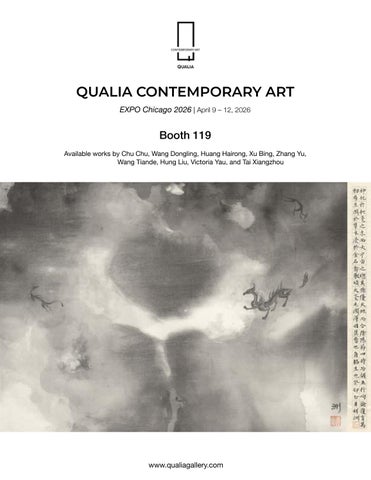

QUALIA CONTEMPORARY ART
EXPO Chicago 2026 | April 9 – 12, 2026
Booth 119
Available works by Chu Chu, Wang Dongling, Huang Hairong, Xu Bing, Zhang Yu, Wang Tiande, Hung Liu, Victoria Yau, and Tai Xiangzhou
Qualia Contemporary Art is pleased to present its inaugural presentation at EXPO Chicago: a group exhibition featuring works by Xu Bing, Wang Dongling, Tai Xiangzhou, Wang Tiande, Zhang Yu, Chu Chu, Victoria Yau, Hung Liu, and Huang Hairong. This nine-artist, cross-generational survey of contemporary Chinese art migrates between neocalligraphy, cosmological landscape, and tampered with surfaces—at once venerative of Chinese ink tradition and rebellious.
The presentation is anchored by Chicago’s deep institutional engagement with contemporary Chinese art: Tai Xiangzhou, whose work is held by the Art Institute of Chicago and who was the subject of the museum’s 2021 exhibition Cosmoscapes, and Victoria Yau, whose work was recently acquired by Northwestern’s Block Museum of Art and exhibited at Stanford University’s Center for East Asian Studies.
XU BING 徐冰
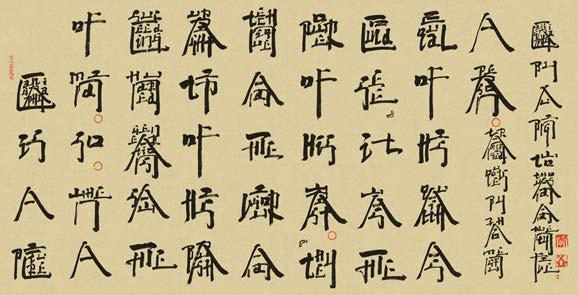
英文方块字书法:抄赵孟頫语录
Copying Zhao Mengfu's Quotes, 2025
Ink on xuan paper
34 × 61.5 in | 86.4 x 156.2 cm
XU BING 徐冰
b.1955, Chongqing, China
Lives and works in Beijing and New York
Historically, calligraphy transforms writing into art, a visual discipline in which meaning is inseparable from brushwork, gesture, and form. Xu Bing’s Square Word Calligraphy unsettles that tradition by shifting attention away from immediate comprehension and toward the visual authority of script itself. This long-running series transforms English words into square configurations that resemble Chinese characters, producing a script that first appears illegible but gradually reveals itself as perfectly legible English. In doing so, Xu estranges both languages at once.
That tension between visual authority and unreadability runs throughout Xu Bing’s practice. He first came to international prominence with Book from the Sky (1987–91), a monumental installation composed of thousands of meticulously invented Chinese characters that appear authoritative but cannot be read.
Across his work, Xu returns again and again to systems of language, reading, and translation, treating them as structures that shape how meaning is produced and understood. The result is a practice that stages cultural translation itself, guiding the viewer through confusion, recognition, and finally the pleasure of meaning.
SELECTED PUBLIC COLLECTIONS
Museum of Modern Art, New York, NY, USA
Metropolitan Museum of Art, New York, NY, USA
Solomon R. Guggenheim Museum, New York, NY, USA
British Museum, London, UK
Victoria and Albert Museum, London, UK
Ashmolean Museum of Art and Archaeology, University of Oxford, Oxford, UK
Art Institute of Chicago, Chicago, IL, USA
Princeton University Art Museum, Princeton, NJ, USA
National Museum of Asian Art, Smithsonian Institution, Washington, DC, USA
Asian Art Museum, San Francisco, CA, USA
Cleveland Museum of Art, Cleveland, OH, USA
National Gallery of Canada, Ottawa, Canada
National Gallery Prague, Prague, Czech Republic
Museum Ludwig, Cologne, Germany
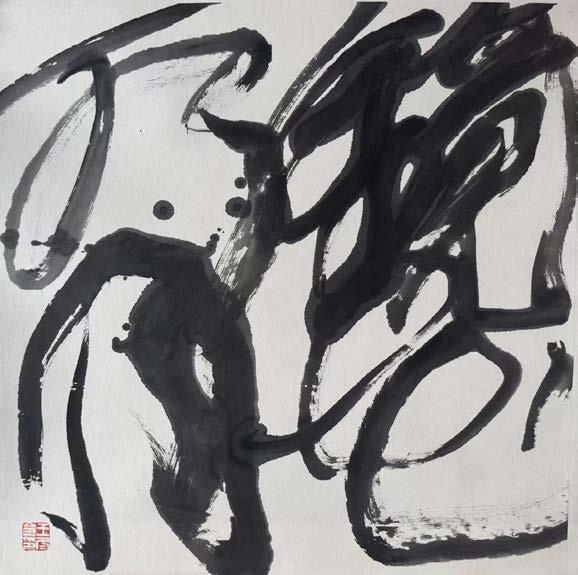
WANG DONGLING 王冬龄
Flower in the Mirror, Moon on the Water 镜花水月, 2025
Ink on xuan paper
21 5/8 x 21 5/8 in | 55 x 55 cm
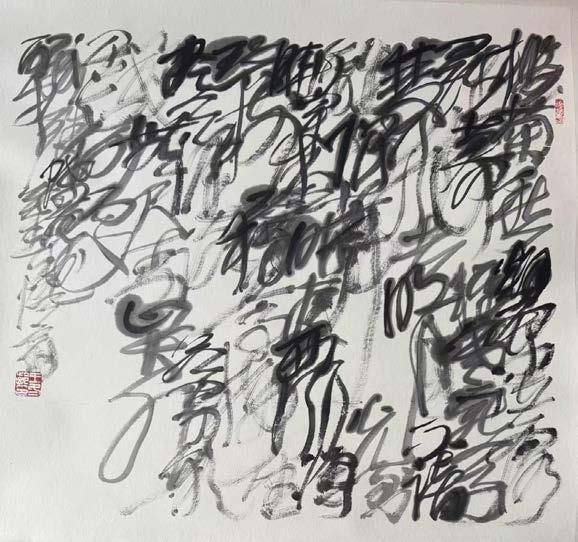
WANG DONGLING 王冬龄
Yan Shu’s Words in Chaos Script 晏殊词乱书, 2016
Ink on xuan paper
29 1/2 x 31 1/2 in | 75 x 80 cm
WANG DONGLING 王冬龄
b.1945, Rudong, Jiangsu, China
Lives and works in Hangzhou, China
Wang Dongling is one of China’s most celebrated living calligraphers and ink artists, known for pushing calligraphy beyond legibility and into the realms of painting, performance, and abstraction. The works on view come from his Chaos Script series, in which overlapping Chinese characters dissolve into sweeping fields of movement and rhythm. Unconstrained lines swirl across the surface like wind, water, rain, or tangled plant forms, transforming writing into image, gesture, and atmosphere.
Classically trained and long associated with the China Academy of Art in Hangzhou, where he taught for decades and helped shape the discourse around modern calligraphy, Wang emerged as a major figure in experimental ink from the 1980s onward. His practice begins in deep command of historical script traditions, but pushes them toward an expanded form in which writing becomes bodily, immersive, and spatial.
Reinterpreting calligraphy through both performance and abstraction, Wang treats the brushstroke as a record of movement, pressure, and force. In these works, script is no longer primarily a vehicle for semantic meaning, but a charged field of rhythm, energy, and form.
SELECTED PUBLIC COLLECTIONS
British Museum, London, UK
Victoria and Albert Museum, London, UK
Metropolitan Museum of Art, New York, NY, USA
Guggenheim Museum, New York, NY, USA
Los Angeles County Museum of Art, Los Angeles, CA, USA
Harvard Art Museums, Cambridge, MA, USA
Yale University Art Gallery, New Haven, CT, USA
Cantor Arts Center, Stanford University, Stanford, CA, USA
University of California, Berkeley, Berkeley, CA, USA
National Art Museum of China, Beijing, China
National Library of China, Beijing, China
China Academy of Art, Hangzhou, China
Zhejiang Museum of Fine Art, Hangzhou, China
Hong Kong Museum of Art, Hong Kong
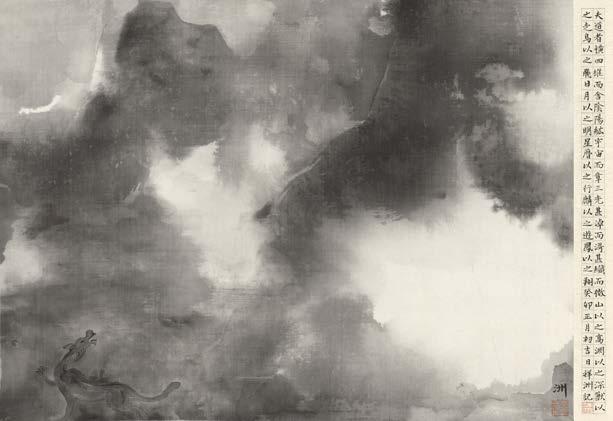
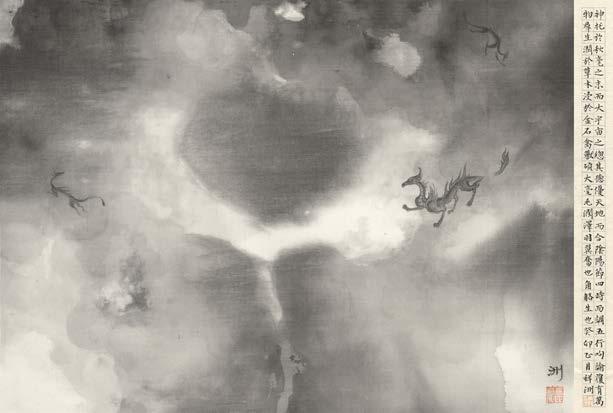
Qilins Freely Wandering 馮夷出巡, 2023
Ink on silk
14 1/2 x 20 7/8 in | 36.8 x 53.1 cm
TAI XIANGZHOU 泰祥洲
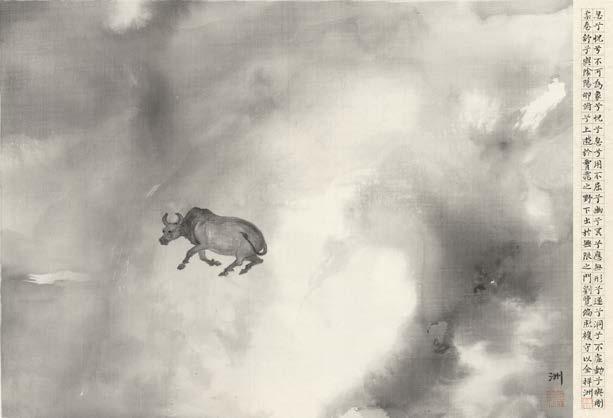
Taurus Star 金牛之星, 2023
Ink on silk
14 1/2 x 20 7/8 in | 36.8 x 53.1 cm
TAI XIANGZHOU 泰祥洲
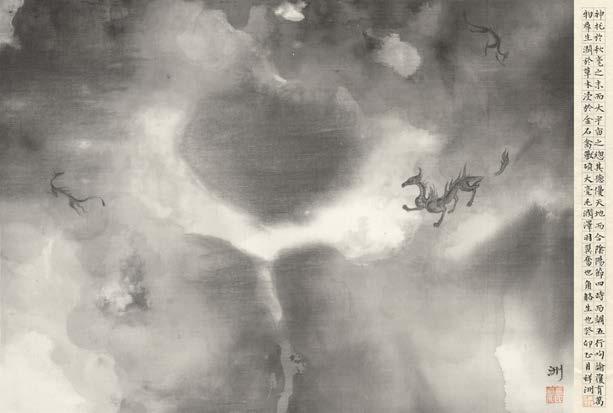
Delimiting the Four Seasons and Attuning the Five Phases 節四時而調五行, 2023
Ink on silk
14.4 x 21 in | 36.6 x 53 cm
TAI XIANGZHOU 泰祥洲
TAI XIANGZHOU 泰祥洲
b.1968, Yinchuan, Ningxia, China
Lives and works in Beijing, China
Born in 1968 to a scholarly family in Yinchuan, the former capital of the Tangut Xixia kingdom, Tai Xiangzhou studied calligraphy from childhood under the exiled master Hu Gongshi and pursued the study of Chinese traditional culture with the prominent mentor Feng Qiyong. He later earned a doctorate from Tsinghua University, where his dissertation Celestial Tales retraced the history of Chinese landscape representations through their origins in classical cosmology—the elaborate systems of correspondence between the celestial, terrestrial, and human realms. He also spent time as a paintings conservator at the Palace Museum in Beijing, where he became intimately familiar with traditional techniques and materials.
Tai’s ink constellations begin as blots of ink from a large brush on raw silk—often antique silks prepared according to ancient methods—that unpredictably bleed across the fibers before resolving into mythic, cosmological imagery. His paintings evoke the monumental grandeur of Song Dynasty landscape painting while asking, speculatively, what a Song landscape would look like if it encompassed the vastly expanded scope of contemporary knowledge about the universe. Rocks fly through space, landscapes turn abstract, perspective is reimagined as it might exist in another realm or another time. Calligraphic pairings extend their accompanying imagery with inscriptions from classics of Chinese literature, often excerpted from the early Han Dynasty book Huai Nan Zi (淮南子).
SELECTED PUBLIC COLLECTIONS
Art Institute of Chicago, Chicago, IL, USA
Brooklyn Museum, New York, NY, USA
Seattle Art Museum, Seattle, WA, USA
Asian Art Museum of San Francisco, San Francisco, CA, USA
Freer Gallery of Art and Arthur M. Sackler Gallery, Smithsonian Institution, Washington, DC, USA
Harvard Art Museums, Cambridge, MA, USA
Yale University Art Gallery, New Haven, CT, USA
Princeton University Art Museum, Princeton, NJ, USA
Minneapolis Institute of Art, Minneapolis, MN, USA
Nelson-Atkins Museum of Art, Kansas City, MO, USA
Nasher Museum of Art at Duke University, Durham, NC, USA
Oklahoma State University Museum of Art, Stillwater, OK, USA
Arthur M. Sackler Museum of Art and Archaeology, Peking University, Beijing, China
Tsinghua University Art Museum, Beijing, China
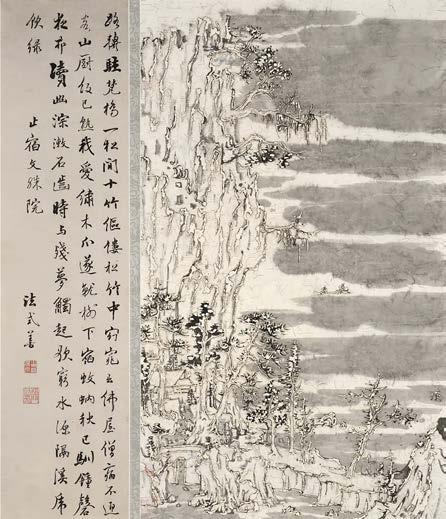
Hermit Tao’s Hut in the Snowy Mountain Vista 陶庐登雪图, 2022
Xuan paper, ink, burn marks, high-resolution calligraphy scan 34 x 29 in | 86.36 x 139.7 cm
WANG TIANDE 王天德
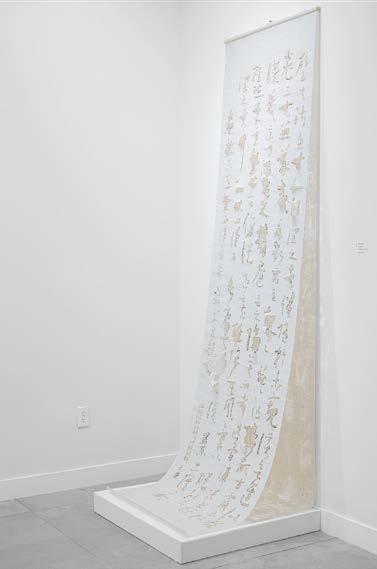
Boundless, 2021
Xuan Paper, Ink and burn marks
120 x 32 in | 304.8 x 81.28 cm
WANG TIANDE 王天德
WANG TIANDE 王天德
b. 1960, Shanghai, China
Lives and works in Shanghai, China
Wang Tiande is one of the leading figures in contemporary ink, an artist who has built his practice by testing how far the languages of calligraphy and landscape can be transformed without severing their connection to history. Intervening upon the material surface itself, he layers sheets of xuan paper atop one another, inscribes the lower sheet with calligraphy or landscape imagery in ink, and burns the transparent upper sheet with incense. The act of burning is integral to the work aesthetically, materially, and spiritually. It introduces irreversible destruction while producing an effect of disappearing cultural memory, in which forms are at once revealed, obscured, and partially consumed. The incense itself carries resonances of Buddhist and Daoist ritual, linking image-making to practices of devotion, remembrance, and release.
Wang’s best-known works emerge through a process that is at once precise and violent. After he became interested in the formal possibilities of the burn mark in the early 2000s, he developed a signature method in which incense functions almost as a second brush. The resulting landscapes and calligraphic inscriptions are never simply painted or written; they are seared into being through perforation, shadow, and partial concealment. Ink and fire make unlikely collaborators, producing images that hover between presence and absence, legibility and erasure. What appears is less a stable picture than a suspended afterimage, shaped equally by what remains and what has been lost.
Burning passes it through another material state, turning landscape, writing, and memory into something fragile, spectral, and newly contemporary. By paper puncturing, and translucent, Wang gives cultural memory a physical form, transmitted through damage, residue, and afterimage.
SELECTED PUBLIC COLLECTIONS
British Museum, London, UK
Cernuschi Museum, Paris, France
Metropolitan Museum of Art, New York, NY, USA
Brooklyn Museum, Brooklyn, NY, USA
Herbert F. Johnson Museum of Art, Cornell University, Ithaca, NY, USA
Museum of Fine Arts, Boston, MA, USA
Los Angeles County Museum of Art, Los Angeles, CA, USA
Art Institute of Chicago, Chicago, IL, USA
Asian Art Museum, San Francisco, CA, USA
Berkeley Art Museum and Pacific Film Archive, Berkeley, CA, USA
Spencer Museum of Art, University of Kansas, Lawrence, KS, USA
Smithsonian American Art Museum, Washington, DC, USA
Bowdoin College Museum of Art, Brunswick, ME, USA
Vancouver Art Gallery, Vancouver, Canada
Montreal Museum of Fine Arts, Montreal, Canada
Hong Kong Museum of Art, Hong Kong
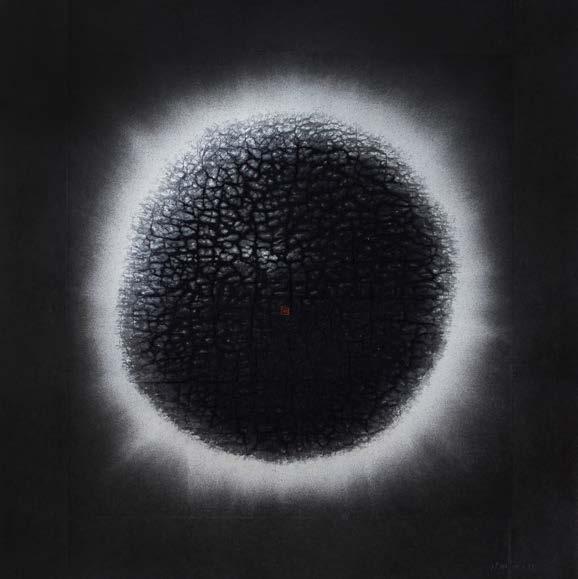
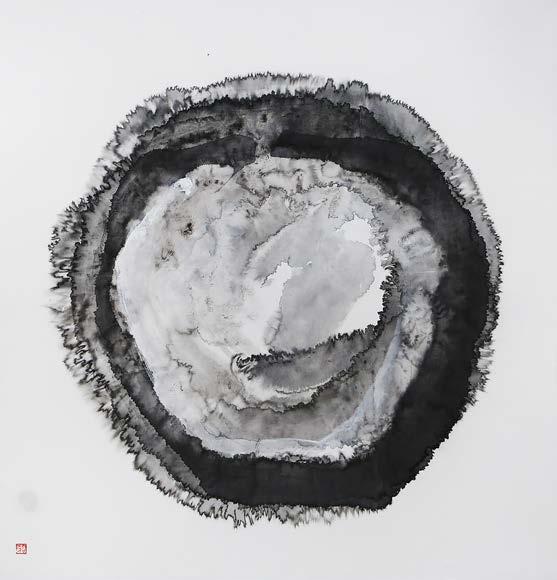
Divine Light Series No. 15: Floating Incomplete Circle, 1995
Ink on xuan paper
38.19 x 37.80 in | 97 x 96 cm
ZHANG YU 张羽
8746, 1987
paper, brush, ink, powder laundry detergent
21.65 x 20.08 in | 55 x 51 cm
ZHANG YU 张羽
Rice
ZHANG YU 张羽
b.1959, Tianjin, China
Lives and works in Beijing, China
Zhang Yu has spent decades pushing ink beyond the conventions of ink painting, treating the medium as a site of material, conceptual, and historical inquiry. As one of the central figures of China’s experimental ink movement in the 1990s, Zhang approached ink as an open problem: how to create something unprecedented within one of the most tradition-bound mediums in Chinese art. He later reflected that he was preoccupied with “how to make something that did not already exist in art history.” In Zhang’s practice, ink is no longer asked to depict the world so much as to generate one.
In the famed Divine Light series, on view in Chicago, Zhang rejects figuration and suppresses the trace of the brush, allowing ink to pool, diffuse, and stain xuan paper. The result feels both cosmic and tactile: halos, granular dispersions, and subtle tonal shifts resemble celestial bodies, erosion, and film grain, while the paper itself shifts from passive to active.
These rare works, produced in the 1990s and early 2000s, have since entered major institutional collections, including the Metropolitan Museum of Art and the Los Angeles County Museum of Art. Other placements include the Chinese Culture Center in San Francisco, the Benetton collection in Venice, the Louisiana Museum of Modern Art in Denmark, and the Estella Collection.
SELECTED PUBLIC COLLECTIONS
Metropolitan Museum of Art, New York, USA
National Art Museum of China, Beijing, China
Hong Kong Museum of Art, Hong Kong
Chinese Culture Center, San Francisco, USA
Benetton Museum, Venice, Italy
Louisiana Museum of Modern Art, Humlebæk, Denmark
Chengdu Modern Art Museum, Chengdu, China
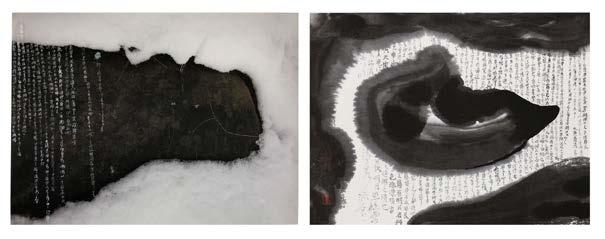
Winter·Sixty Ninth Pentad·Zhi Shi Qu (冬·六十九候:雉始鸲), 2017-2019
Photography, Ink and Silver Colour on Xuan Paper
13.78 x 17.72 x 0.79 in | Framed: 49 x 25.5 in
CHU CHU 儲楚
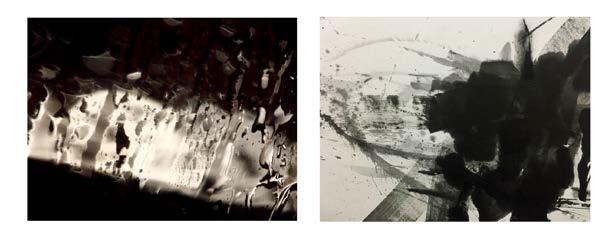
Winter·Sixty Fifth Pentad·Rippling Springs (冬·六十五候:水泉动), 2017-2019
Photography, Ink and Colour on Xuan Paper
13.78 x 17.72 x 0.79 in | Framed: 49 x 25.5 in
CHU CHU 儲楚
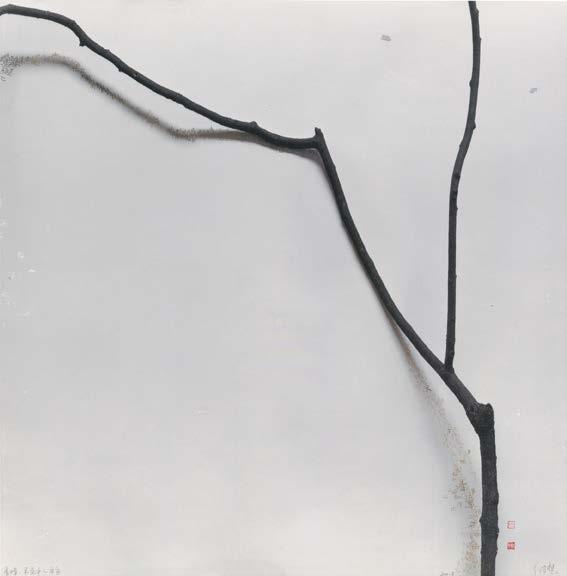
Camphor-The Universe in a Nutshell (树语-香樟), 2011-2018
Photography, Chinese ink and calligraphy on paper
23.62 x 23.62 in
CHU CHU 儲楚
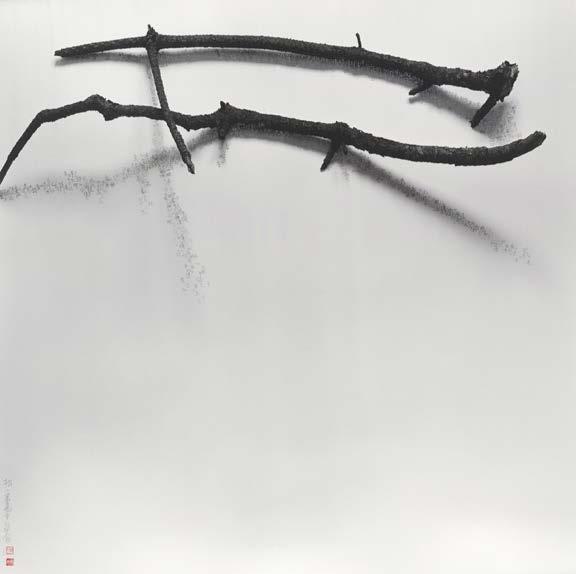
Pine-Book of Odes (树语-松), 2010-2019
Photography, Chinese ink and calligraphy on paper
23.62 x 23.62 in
CHU CHU 儲楚
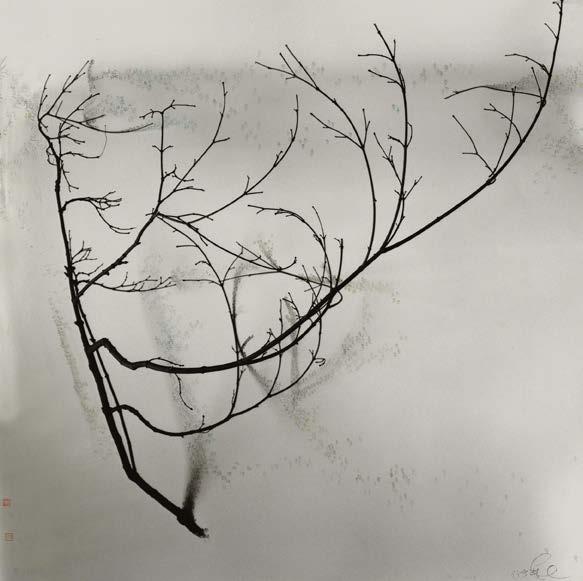
Tea - Book of Odes (树语-茶), 2010-2019
Photography, Chinese ink and calligraphy on paper
23.62 x 23.62 in
CHU CHU 儲楚
CHU CHU 儲楚
b. 1975, Hangzhou, Zhejiang, China lives and works in Nanjing, China
Chu Chu’s hybrid photography-calligraphy practice occupies a distinctive position within contemporary ink discourse: she often begins with photography and works inward, allowing brushwork, text, and layered intervention to complicate and transform the image’s relationship to its source. Across bodies of work that combine photography, calligraphy, and painting, she produces images that are sensuous yet conceptually dense, moving between the languages of contemporary photography and Chinese ink practice without allegiance to either.
Her method is recursive, accumulative, and deliberately unstable: some works are photographed and reprocessed multiple times within a single piece, creating a recursive practice that pushes against—or even nullifies—the category of “photography” itself. Photographs are revisited, reworked, and overlaid with ink, calligraphy, color, acrylic, and other media, at times pushing both text and image toward near-illegibility.
Chu Chu amplifies the dissonance in imagery with an analogous tension through media. Calligraphy carries the force of an irreversible gesture, while photography implies capture, repetition, and mechanical mediation; Chu Chu binds the two together so that fixity and instability remain in play at once. Drawing on natural forms, classical literature, and philosophical texts, her compositions hover at the threshold of recognition, yielding images that are lyrical, elusive, and resistant to immediate interpretation.
SELECTED PUBLIC COLLECTIONS
Harvard Art Museums, Cambridge, USA
Smith College Museum of Art, Northampton, Massachusetts, USA
Rhode Island School of Design, Providence, USA
Philadelphia Museum of Art, Philadelphia, USA
Centre Pompidou, Paris, France
Stavanger Kunstmuseum, Stavanger, Norway
Shanghai Minsheng Art Museum, Shanghai, China
Three Shadows Photography Art Centre, Shanghai, China
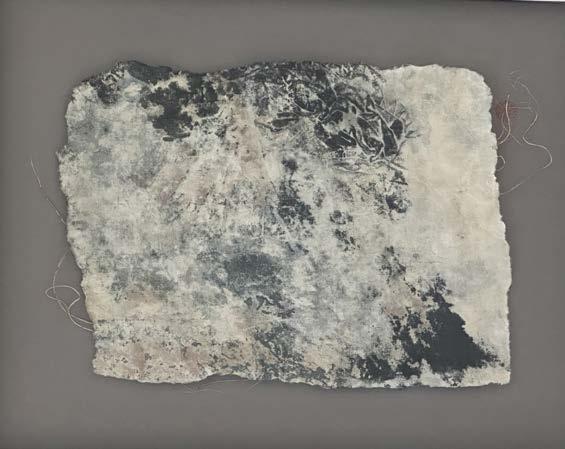
Mammoth Rock, 1984
Watercolor and thread on paper mounted on paperboard
15.5 x 12 in
VICTORIA YAU 黛文洵美
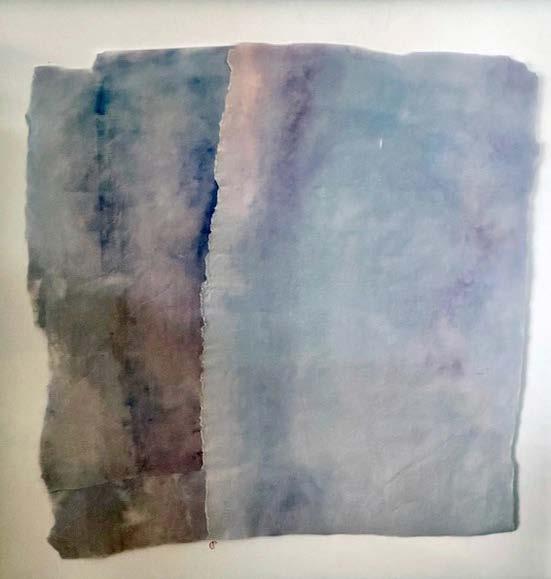
Watercolor collage on paper mounted on paperboard
29.5 x 28 in
VICTORIA YAU 黛文洵美 Evening Shadow, 1980
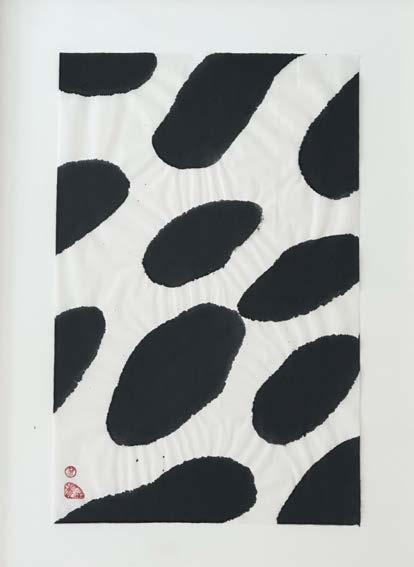
Ink on rice paper
19 x 11.75 in | Framed: 25.75 x 19 in
VICTORIA YAU 黛文洵美
Kissing Stone, 1995
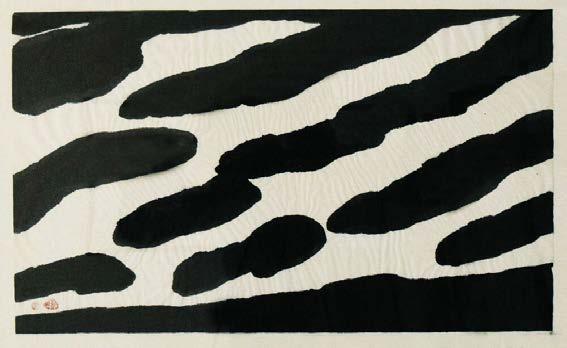
Passing River, 1996
Sumi ink on rice paper
18.5 x 31 in
VICTORIA YAU 黛文洵美
VICTORIA YAU 黛文洵美
b.1939, Shanghai, China
d.2023, Evanston, Illinois, USA
Victoria Yau trained in calligraphy and landscape painting in Taipei under some of the leading figures in twentieth-century ink painting, including Sun Duoci and Fu Chuan-fu. She moved to the United States at the age of twenty-one and, over the following six decades, produced more than seven hundred works across abstract ink painting, watercolor, multimedia collage, printmaking, and textiles. Following a devastating studio flood, fewer than three hundred of these works remain.
As an early figure in Asian American abstraction, Yau carried shanshui sensibilities into abstraction, emphasizing rhythm, repetition, and bodily presence over representational fidelity. Her work explores the threshold between representation and abstraction, reducing landscapes and seascapes to their most elemental characteristics, with subject matter revealed or clarified through poetic, evocative titles. In collage and mixed media works, Yau treated paper like a sculptural medium through cutting, crumpling, folding, and layering.
Her poetic reimagining of the classical shanshui, which she called “Mountain Cloud,” positions landscape as a mutable, embodied practice shaped by migration, gender, and the experience of making art across cultures and disciplines. An avid reader and writer, Yau also studied philosophy and wrote poetry. Yau described her artworks as “truly her daughters,” the daughters she “never had in her physical life.”
SELECTED INSTITUTIONAL EXHIBITION HISTORY
Art Institute of Chicago, Chicago, IL
Smithsonian Institution, Washington, DC
American Academy of Design, New York, NY
Illinois State Museum, Springfield, IL
Fairweather Hardin Gallery, Chicago, IL
Dorothy Rosenthal Gallery, Chicago, IL
SELECTED
EXHIBITIONS / MUSEUM
PRESENTATIONS
2025
Pouring, Spilling, Bleeding: Helen Frankenthaler and Artists’ Experiments on Paper
The Block Museum of Art, Northwestern University, Evanston, IL
Victoria Yau: Mountain Cloud: Qualia Contemporary Art, Palo Alto, CA
Victoria Yau Retrospective: Evanston Art Center, Evanston, IL
2024
黛文洵美:山水記憶 / Victoria Yau: “I slept in the mountain cloud”: East Asia Library / Stanford University Libraries and Center for East Asian Studies, Stanford University, Stanford, CA
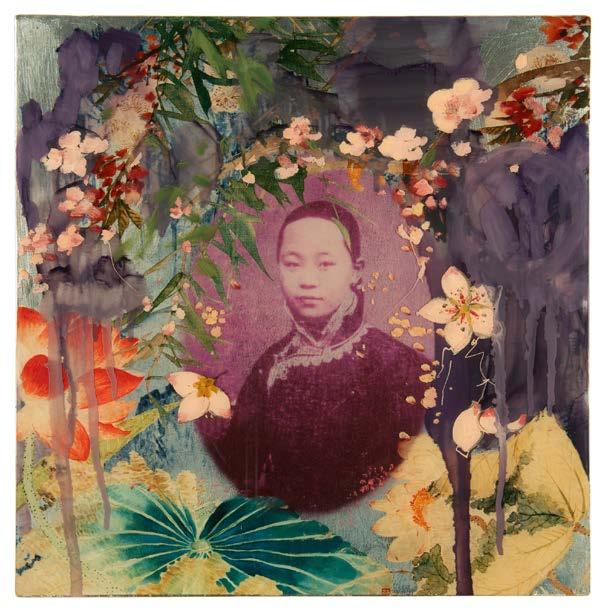
She: Amethyst, 2015
Mixed media/resin on wood panel with silver leaf and paint
20 1/2 x 20 1/2 x 2 in
HUNG LIU
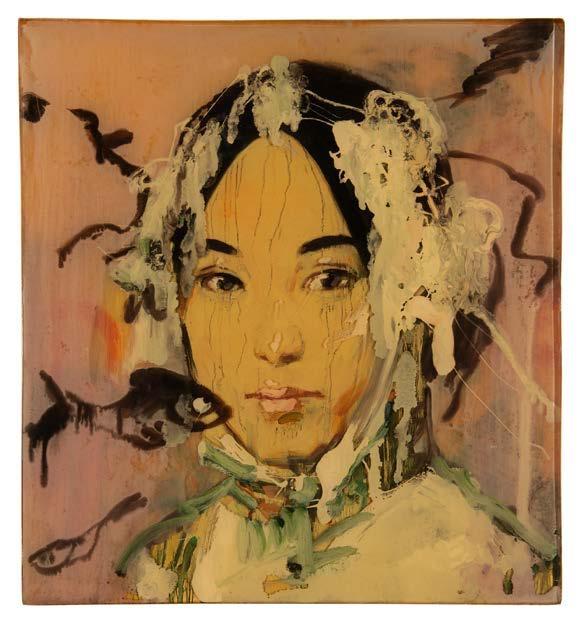
Teng Lou Springtime, 2007
Mixed media/resin on wood panel with paint
18 x 17 x 2 in
HUNG LIU
HUNG LIU 刘虹
b.1948, Changchun, China
d.2021, Oakland, CA, USA
One of the first Chinese-born artists to establish a major career in the United States, Hung Liu spent decades giving visual form to history’s overlooked figures—orphaned children, women soldiers, refugees, comfort women, migrant laborers—whom she described as “spirit-ghosts.”
On view in Chicago, Liu’s resin-based mixed media works fuse portraiture, historical photography, and painterly dissolution. They are at once emotional and indexical; honoring the forgotten and the displaced through shimmering layers of image and material.
Born in Changchun in 1948, Liu’s early life was shaped by the turbulence of the Cultural Revolution. She was sent to the countryside for “reeducation” as a farm laborer, where she spent four years working in the fields. It was there that she taught herself photography, secretly documenting fellow villagers—many of whom had never been photographed before. She trained as a Socialist Realist painter before emigrating to the United States in 1984, settling eventually in Oakland, California, where she taught at Mills College for three decades.
Liu’s distinctive technique involved using historical photographs as source material for large-scale paintings characterized by filmy washes, gestural drips, and Zen-like ensō circles that lend her works a dreamlike, dissolving quality—the antithesis of the rigid propaganda style of her youth. In her resin-based mixed media works, the process is equally layered: painted or photographic images are digitally printed onto prepared wooden surfaces, sealed in successive layers of translucent resin, and then hand-painted by the artist using various colors of ink. The result is a luminous, almost jewel-like surface in which figures seem to hover between presence and memory, clarity and dissolution.
SELECTED PUBLIC COLLECTIONS
Allen Memorial Art Museum, Oberlin College, Oberlin, OH
Arizona State University Art Museum, Tempe, AZ
Asian Art Museum, San Francisco, CA
Bowdoin College Museum of Art, Brunswick, ME
Brooklyn Museum, Brooklyn, NY
Dallas Museum of Art, Dallas, TX
Denver Art Museum, Denver, CO
de Young Museum, San Francisco, CA
Herbert F. Johnson Museum of Art, Cornell University, Ithaca, NY
Cantor Center for Visual Arts, Stanford University, Stanford, CA
Kemper Museum of Contemporary Art, Kansas City, MO
Los Angeles County Museum of Art, Los Angeles, CA
Metropolitan Museum of Art, New York, NY
Mills College Art Museum, Oakland, CA
Museum of Modern Art, New York, NY
Nasher Museum of Art at Duke University, Durham, NC
National Gallery of Art, Washington, DC
National Museum of Women in the Arts, Washington, DC
National Portrait Gallery, Smithsonian Institution, Washington, DC
Oakland Museum of California, Oakland, CA
Pennsylvania Academy of the Fine Arts, Philadelphia, PA
The Phillips Collection, Washington, DC
San Francisco Museum of Modern Art, San Francisco, CA
San Jose Museum of Art, San Jose, CA
Smithsonian American Art Museum, Washington, DC
Syracuse University Art Museum, Syracuse, NY
Virginia Museum of Fine Arts, Richmond, VA
Walker Art Center, Minneapolis, MN
Whitney Museum of American Art, New York, NY
Williams College Museum of Art, Williamstown, MA
Zimmerli Art Museum, Rutgers University, New Brunswick, NJ
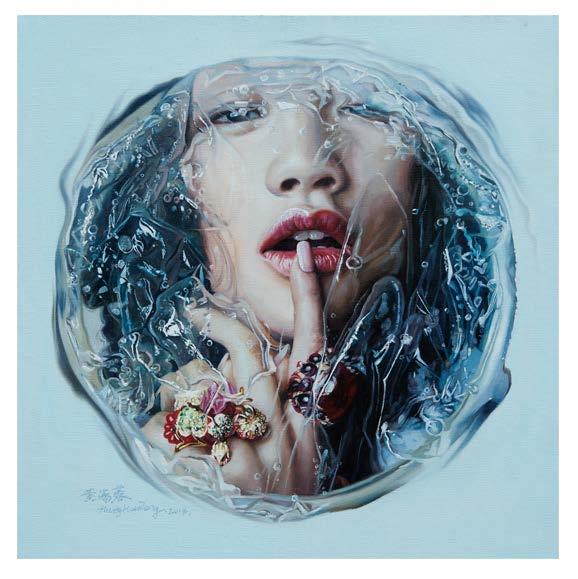
Vow《誓言》, 2014
Oil on canvas
23.62 x 23.62 in | 60 x 60 cm
25.5 x 25 in | 64.8 x 63.5 (Framed)
HUANG HAIRONG 黄海蓉
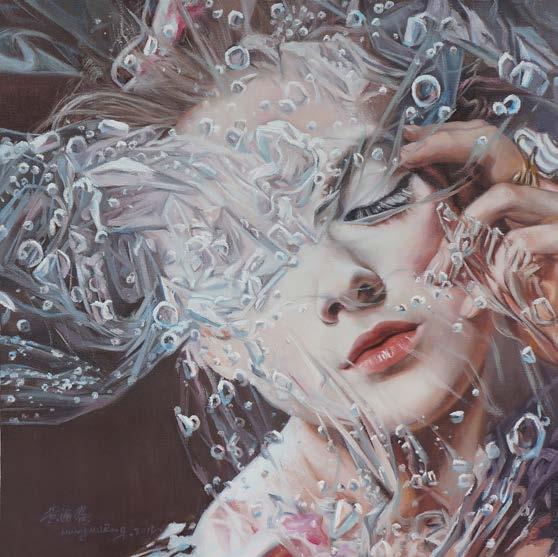
HUANG HAIRONG 黄海蓉
Camouflage《粉饰》, 2012
Oil on canvas
23.62 x 23.62 in | 60 x 60 cm
25.5 x 25 in | 64.8 x 63.5 cm (Framed)
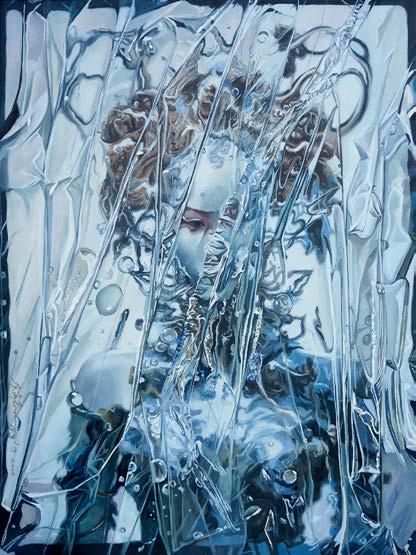
Born in instructions No. 1《生于指令》, 2024
Oil on canvas
31.50 x 23.62 in | 80 x 60 cm
34 x 27 in | 86.4 x 68.6 cm (Framed)
HUANG HAIRONG 黄海蓉
HUANG HAIRONG 黄海蓉
b.1983, Hubei, China
Lives and works in Beijing, China
Huang Hairong’s hyperreal female portraits operate at the boundary between figuration and dissolution. Her paintings render women’s faces with photographic precision—every pore, every eyelash, every reflection in the iris executed with meticulous technical command—only to interrupt the image with water-like veils, translucent washes, and flowing distortions that ripple across the surface, partially obscuring the very features they have so painstakingly rendered.
The tension in Huang’s work lies in this deliberate contradiction: the hyperreal clarity of the portrait invites sustained looking, while the liquid interruptions resist the viewer’s desire for full access to the image. The water-like effects—at once decorative and destabilizing—create a push-and-pull between seduction and unease, between the intimacy of the gaze and the barrier of the veil. The faces seem to exist behind glass, behind water, behind some membrane that separates the viewer from the subject.
Huang’s paintings draw on the long tradition of female portraiture in both Chinese and Western art history, but her technique—which fuses the precision of oil painting with effects that evoke ink wash—situates her work within a distinctly contemporary dialogue about image-making, beauty, and the mediation of the human face. In an era of filtered selfies and digitally manipulated images, Huang’s painted veils feel uncannily resonant: they ask what it means to truly see a face, and whether clarity is ever really possible.
SELECTED PUBLIC COLLECTIONS
M+ Sigg Collection, Hong Kong
Hubei Museum of Art, Wuhan, China
Luohu Art Museum, Shenzhen, China
Guan Shanyue Art Museum, Shenzhen, China
Uli Sigg Collection
Art Documentation Art Center
QUALIA CONTEMPORARY ART
Praised by renowned art historian Alexander Nemerov as “a hidden gem in Silicon Valley,” Qualia Contemporary Art presents a diverse program of emerging and established artists working across a wide range of media and is dedicated to facilitating dialogue between Asian and international contemporary practices.
Since opening in Fall 2020, the gallery has mounted over 30 exhibitions: highlights from these presentations include the U.S. debuts of Pan Hsinhua, Lyu Peng, and Xu Hongming; local artists like Younhee Paik, Stella Zhang, Nick Dong, and Joe Ferriso; and internationally-recognized artists including Paul DeMarinis, Guillermo Galindo, Yang Jiechang, and Wang Tiande.
The gallery has also collaborated with leading Chinese artists such as Xu Bing, Wang Dongling, Gu Wenda, and Gu Gan, as well as with prominent scholars including Alexander Nemerov, Richard Vinograd, Ouyang Jianghe, and Xie Xiaoze.