
QSaltLake Magazine | Issue 381 | March 2026

Page 1


PHOTO: TONY LUONG FOR UNCLOSETED MEDIA.

• Skin cancer

• Mohs surgery

• Acne

• Moles

• Eczema

• Laser hair removal

• Vbeam & IPL

• Tattoo Removal

• CO2 resurfacing

• Botox

• Juvederm

• Dysport

• Belotero

• Radiesse

• Sculptra

• Microneedling

• Microneedling w/ PRP

• Chemical peels

• Facials

Michael R. Swinyer P.A.-C
Breton Yates M.D., FAAD
Elena Hadjicharalambous M.D., FAAD
Grace Brummer M.D., FAAD
Shane Farr
SDPA Dip. Fellow
Jennifer Walker
SDPA Dip. Fellow
Lyndsie Thompson
SDPA Dip. Fellow
Joshua Winters
SDPA Dip. Fellow
Rachel Webb Master Esthetician
Douglas M. Woseth M.D., FAAD
Katheryne Bell M.D., FAAD

Help.

For more

than three decades, QSaltLake has existed for one reason: to tell our stories when few others would.

We have covered our community’s victories and setbacks, celebrated milestones, reported from the Utah Capitol, and amplified voices too often ignored. We have been here—consistently, unapologetically, proudly.

Today, I’m writing to you with urgency. In the past three months, QSaltLake has lost more than 30% of its base advertising revenue. Last year’s Pride issues, traditionally among our strongest editions, were among the most difficult to fund in our history. The economy and current political climate has made some businesses hesitant to be publicly associated with LGBTQ+ media, even when they privately support equality. Advertising is the backbone of a free community publication. When ad revenue drops, it affects how many pages we can print, how widely we distribute, and how boldly we can report. It affects our ability to pay writers, photographers, designers and printers.

But QSaltLake has never survived on advertising alone. It has survived because this community believes it matters.

How you can help

If you believe that too, here are concrete ways you can help:

• Become a QVangelist. TALK ABOUT US SHARE OUR STORIES on social media. Forward links. Encourage friends, coworkers and chosen family to READ THE MAGAZINE .

• TALK TO BUSINESS OWNERS you know. Many want to reach the LGBTQ+ market but don’t know how. Tell them about QSaltLake and the loyalty of our readers.

• MENTION US when you meet with marketing reps. If you’re involved in advertising decisions at

your workplace, suggest QSaltLake as part of the media mix.

• Engage with our advertisers. CLICK ON ADS in the digital edition. If you need a service, CALL THE PHONE NUMBER in the ad and tell them you saw it in QSaltLake. Measurable engagement helps advertisers renew.

• ENCOURAGE CORPORATE ALLIES to be visible. Remind businesses that supporting LGBTQ+ media is not political — it’s smart community outreach to real customers.

• Consider direct support. READER MEMBERSHIPS , one-time donations, and sponsorship connections all help stabilize independent LGBTQ+ media during uncertain times.

• Contribute your voice. Submit letters to the editor, pitch story ideas, volunteer at events, or connect us with potential sponsors and grant opportunities.

Community publications across the country are facing similar challenges. Independent LGBTQ+ media is often the first to feel economic and political pressure, and yet it remains essential. When mainstream outlets move on, we stay. When legislation targets our community, we report. When there is joy to celebrate, we spotlight it. This magazine belongs to you. We are not asking for sympathy. We are asking for partnership. If QSaltLake has ever informed you, connected you, entertained you, or made you feel seen, now is the moment to return that support. Help us STRENGTHEN OUR ADVERTISING BASE . Help us GROW OUR READERSHIP. Help us demonstrate that our community is engaged, loyal and worth investing in. HELP US THRIVE

Become a QVANGELIST—and let’s ensure that LGBTQ+ voices in Utah continue to be heard. Q

We can receive contributions at VENMO, PAYPAL, CASHAPP, or by credit card.

staffbox

publisher/editor Michael Aaron

designer Christian Allred

sales Michael Aaron, 801-997-9763 x1 sales@qsaltlake.com

Rivendell Media, 908-232-2021 ext 200 sales@rivendellmedia.com

national neWs editor Craig Ogan

contributors Joshua Adamson Pickett, Diane Anderson-Minshall, Chris Azzopardi, Paul Berge, Jeff Berry, Paul Campbell, Laurie Bennett-Cook, Roger Cox, Stephen Dark, Jennifer Dobner, Jack Fertig, Greg Fox, Ian Giles, Oriol Gutierrez Jr., Tony Hobday, Blake Howell, Ashley Hoyle, Joshua Jones, Christopher Katis, Alpha Mercury, Sam Kelly-Mills, Craig Ogan, Peter Reynolds, Mikey Rox, Terri Schlichenmeyer, Mark Segal, Gregg Shapiro, Petunia Pap Smear, Steven Petrow, Ed Sikov, Justin Utley, JoSelle Vanderhooft, Ed Walsh, Ben Williams, D’Anne Witkowski distribution Roger Cox publisher Q Media Group

222 S Main St, Ste 500 (by appt. only) Salt Lake City, Utah 84101

tel: 801-997-9763

CONTACT EMAILS:

general: info@qsaltlake.com

editorial: editor@qsaltlake.com

arts: arts@qsaltlake.com

sales: sales@qsaltlake.com

Check us out online at: QSALTLAKE.COM

FACEBOOK.COM/QSALTLAKE INSTAGRAM.COM/QSALTLAKE TWITTER @QSALTLAKE

QSaltLake Magazine is a trademark of Salt Lick Publishing, LLC., dba Q Media Group Copyright © 2026, Salt Lick Publishing, LLC. All rights reserved. No material may be reprinted or reproduced without written permission from the publisher. Free printed copies are limited to one per person. For additional copies, call 801-997-9763. It is a crime to dispose of current issues or otherwise interfere with the distribution of this magazine. Printed locally in the USA on recycled paper. Please recycle this copy when done.

news

The top national and world news since last issue you

should know

Not the gay games yet

At least 43 out LGB athletes are competing at the 2026 Milan Winter Olympics. This is the largest LGB contingent in Winter Games history. Team USA includes eight out athletes, roughly 3 percent of the delegation. Showing that stereotypes can match reality, women make up the majority, with 34 out athletes compared to nine men. What stereotypes do you ask? Twenty-two out women compete in ice hockey. Six out men compete in figure skating. Other represented sports include alpine and freestyle skiing (five athletes), speed skating (four), skeleton (two), and one each in snowboarding, curling, and biathlon. At least 13 countries have an out player on the team, according to Outsports. Here’s a list of all out athletes, compiled by Outsports: OUTSPORTS.COM/ OLYMPICS/TEAM-LGBTQ/

Don Lemon in

legal squeeze

A federal judge in Minneapolis wouldn’t allow charges against Don Lemon for his involvement with an anti-ICE demonstration in a church. The US Justice Department believed Lemon was a protest leader and not acting as a journalist, so it found other legal venues to bring charges. Lemon

was arrested while covering another semi-criminal event, the Grammy Awards. Also arrested was Georgia Fort, an independent journalist. In this media-crazed age, she surrendered to federal agents while live-streaming on Facebook Live. Minnesota has seen weeks of protests over the deaths of protesters by DHS agents in Minneapolis. The disruption came about because the anti-ICE activists believed the church was led by an ICE officer, so they invaded the church with Lemon and Fort. Several of the non-journalists were charged under the federal FACE Act. The FACE Act was used by a previous administration to arrest protesters praying on sidewalks in front of abortion clinics. Lemon was on CNN and was one of the first out Black anchors on national cable news. He came out publicly in his 2011 memoir Transparent, and has been in a biracial marriage with a NYC real estate agent since 2024.

Fired for speaking up

Even a lesbian who is a good consumer-fraud attorney needs to watch their mouth. Glenna Goldis was dismissed from the New York Attorney General’s Office after publicly criticizing what she described as the risks of pediatric transgender medical therapy. Goldis had worked in the office’s consumer frauds bureau since 2022, focusing on protecting low-income New Yorkers.

But over the past two years, she increasingly voiced concerns — on her personal blog and in public forums — about medical practices involving puberty blockers, hormones, and surgeries for minors. According to Goldis, tensions intensified as she published essays questioning the scientific claims made by major medical organizations and as she sought permission to speak at a Federal Trade Commission workshop on the topic. Supervisors warned her that her commentary could violate the office’s “outside activities” policy, which restricts employees from publicly addressing matters related to the agency’s work without prior approval. Goldis maintains that her speech was constitutionally protected. She says internal pressure intensified after she challenged statements made in agency press releases and court filings. After refusing to stop her public commentary, Goldis was terminated and barred from the premises. She argues her firing expresses a broader unwillingness within Democratic political circles to debate pediatric transgender medicine.

Lawsuit forces Florida to pony up HIV Funds

The Florida Department of Health is temporarily reversing its cuts to the AIDS Drug Assistance Program after a lawsuit accused officials of illegally slashing the program without proper rule-making. The agency now says it will pursue the formal regulatory process before attempting any reductions, a move that keeps medication flowing to low-income Floridians — for now. Florida officials claim a looming budget

deficit of $120 million was the reason for the proposed cut. The lawsuit never went to trial, but the threat got the decision changed. ADAP currently serves more than 30,000 people earning up to 400 percent of the federal poverty level. The proposed cuts would drop eligibility to 130 percent, eliminating access for over half of enrollees. Critics say the state’s budget crisis is manufactured. “We have the damn money,” Florida State Democratic Party Chair Nikki Fried said. “They were able to spend $500 million building Alligator Alcatraz with no bid contracts. We are still in a state of emergency for almost two and a half years. They can put the money in the coffers. They’re choosing not to.”

Gay Cheerleaders

Jeremy Greer has been called one of the NFL’s most viral cheerleaders. The 26-year-old New England Patriots cheer person performed at the Super Bowl this year. Greer, who uses he/they pronouns, shot to national attention after a jubilant sideline dance during the Patriots’ January 10 playoff win over the Los Angeles Chargers racked up millions of views across social platforms. Growing up in Texas, Greer never imagined an NFL cheerleading career was possible. That changed when he discovered Driss Dallahi, who, along with Steven Sonntag, became one of the first men to join the Patriots’ cheer squad in

2019. Dallahi, who is gay and now manages the Patriots’ cheerleaders, said he hopes Greer’s visibility inspires young people the same way. Male cheerleaders have become increasingly common in the league since Quinton Peron and Napoleon Jinnies broke the Super Bowl barrier with the Los Angeles Rams in 2019. OutSports now counts 71 men on NFL cheer squads. A backlash followed the Minnesota Vikings’ addition of its first male cheerleaders last year being a little too non-binary during cheer routines for some NFL fans and commentators. But Greer and Dallahi say the support they receive — and the chance to be role models — far outweighs the noise.

Dumbledore casting caused ‘vague hurt’

John Lithgow’s non-binary Jimpa co-star Aud Mason-Hyde says the actor’s decision to join the upcoming Harry Potter series felt “vaguely hurtful” and “difficult,” given J.K. Rowling’s history of comments about transgender women competing in women’s sports or being in women’s prisons or other women-only spaces in Scotland. A relative unknown, Mason-Hyde, who appears opposite Lithgow (who has 150 screen appearances to his credit, the first of which was as a transgender character, Roberta, in The World According to Garp in the 1980s) in the new drama,

praised him as “a beautiful human” and said their on-set experience made the news especially disorienting. “I never felt invalidated or questioned or doubted in my identity or in my transness by him,” they told OUT. Lithgow, they said, was consistently warm, supportive, and generous — which made his choice to play Dumbledore “a strange decision” that left them “disconcerted.” Still, Mason-Hyde emphasized that the casting does not diminish the bond they formed or the work they created together. “He’s making this decision after we made and premiered the film. It can’t take away from what we had, the time we spent together, and the beautiful work he does in this movie — and how authentically he played the role.” No word of any reaction from Lithgow or Rowling when this was written.

Bad Ballot News: Oregon initiative withdrawn

LGBT civil rights organizers have withdrawn their amendment to the Oregon Constitution to protect same-sex marriage, transgender people, and abortion rights. The coalition behind Initiative Petition 33 offered no public explanation, but recent reporting shows the campaign spent $1.3 million while collecting fewer than 8% of the signatures needed by July to qualify for the November ballot. Equal Rights Oregon said that “after thoughtful consideration,” it had made the “difficult decision” to halt the Equal Rights for All measure. The proposal would have added a constitutional guarantee that equal rights “shall not be denied or abridged” based on pregnancy and related health

decisions, gender identity, or sexual orientation, including the right to marry. The initiative drew support from major civil rights groups — including the ACLU of Oregon, Basic Rights Oregon, Planned Parenthood Action of Oregon, and the Latino Network — as well as labor unions such as the AFL-CIO and SEIU Local 503. But signature-gathering lagged: Willamette Week reported the campaign had submitted just 12,194 signatures since May 2025, far short of the 156,231 required. Polling shows Oregonians broadly support abortion rights and same-sex marriage but remain divided on transgender surgical and pharmaceutical procedures for minors, a dynamic analysts say may have complicated the campaign’s path.

Good Ballot News: Virginia outs marriage inequality

Virginia Gov. Abigail Spanberger has signed legislation sending several proposed constitutional amendments to voters, including a measure to remove the state’s 2006 ban on same-sex marriage from the Virginia Constitution. Although the ban has been unenforceable since the U.S. Supreme Court’s 2015 Obergefell v. Hodges ruling, advocates argue that leaving it in place is discriminatory and could become consequential if federal protections were ever overturned. Spanberger said the amendment would ensure that “Virginia families know that here… it is not just a Supreme Court decision that protects them, but also our state constitution.” LGBT issues dominated the 2025 gubernatorial race, with Republican Winsome Earle-Sears running ads attack-

ing Spanberger on transgender rights. Equality Virginia praised the ballot measure, calling it a long-overdue step toward fully protecting marriage equality in the commonwealth. Thirty states, Utah among them, currently have marriage inequality provisions in state statute or the state constitution. Should Obergefell be “sent back to the states” as some Supreme Court Justices say it should, marriage inequality could become the law of the land in 30 states, again. Gay Days, Orlando, Pauses

For more than three decades, Gay Days Orlando has served as a rolling, red-shirted celebration of queer visibility that grew from a grassroots park outing into one of the nation’s largest LGBTQ+ travel events. This week, organizers announced a pause. In a statement Sunday, Gay Days said it will not hold its June 4–7, 2026 event, citing the political climate, changes to its host-hotel agreement, the loss of key sponsors, and more extensive challenges facing LGBT events nationwide. These factors, they said, made it “impossible to deliver the experience our community deserves. This is a pause — not an ending,” organizers wrote, promising a more sustainable return. They encouraged visitors to still wear red and gather at the parks on June 6, honoring a tradition that began in 1991 and helped cement visibility in Orlando.

BTW: the intrepid QSaltLake just announced another iteration of the Annual Q DAY AT LAGOON in Farmington, Utah. Neither snow nor rain nor heat nor gloom of night nor the Bark of the Eagle Forum stays these party-hungry people. Q

Utah House passes HB174 to permanently ban youth gender-affirming care

The Utah House of Representatives voted 54–15 on Feb. 5 to pass first substitute HB 174, a bill that would permanently ban gender-affirming medical care for transgender minors, following a lengthy and contentious floor debate that underscored deep divisions over science, medical ethics, and youth mental health.

Sponsored by Rep. Rex P. Shipp, R-Cedar City, HB 174 builds on SB 16, a 2023 law that prohibited gender-affirming surgeries for minors and imposed a temporary moratorium on puberty blockers and cross-sex hormones. While SB 16 allowed youth already receiving care to continue treatment under a grandfather clause, HB 174 would make the moratorium permanent and require those treatments to end by January 28, 2027. Presenting the bill, Shipp framed gender dysphoria as a mental health condition that should be addressed through psychological care rather than medical intervention. He cited potential risks of puberty blockers and hormone therapy, including impacts on bone density, fertility, neurocognitive development, and cardiovascular health. Shipp also sharply criticized a Utah Department of Health and Human Services report mandated

under SB 16, arguing it failed to meet the standards of a true systematic medical review and showed significant bias.

“These kids do need care,” Shipp told lawmakers. “But we shouldn’t be damaging physically healthy bodies. As minors, they should not be making life-altering decisions.”

Dailey-Provost also pushed back forcefully against claims that European countries have banned gender-affirming care. She noted that countries such as Sweden, Finland, and the United Kingdom continue to allow treatment through tightly regulated clinical pathways, rather than imposing blanket bans. The widely cited UK Cass Review, she said, acknowledges shortcomings in available evidence but does not recommend prohibiting care outright.

Rep. Jennifer Dailey-Provost delivered the most detailed opposition testimony of the debate, offering an in-depth scientific rebuttal that challenged both the evidence cited by supporters and the framing of the issue itself. Dailey-Provost argued that proponents of HB 174 relied on selective citation, cherry-picked studies, and mischaracterizations of medical consensus to justify sweeping restrictions. She warned lawmakers against equating low-certainty evidence with evidence of harm, stressing that uncertainty is common across pediatric medicine because of ethical limitations on conducting randomized controlled trials involving children. Holding transgender healthcare to a higher evidentiary standard than other pediatric treatments, she argued, creates an unfair and inconsistent benchmark.

She further challenged assertions about detransition and suicide rates, arguing that opponents misrepresented data by ignoring a wider perspective.

According to Dailey-Provost, studies often cited to claim high detransition rates rely on small samples and fail to account for confounding factors such as social stigma, family rejection, economic instability, and lack of access to supportive care. She added that higher suicide risk among transgender youth is more strongly linked to discrimination and denial of care than to medical treatment itself.

“A counterfactual is not a neutral outcome,” Dailey-Provost said, stressing that untreated gender dysphoria carries documented mental health risks. “Denying healthcare to a marginalized, at-risk population of children is always a mistake.”

She concluded by warning lawmakers that basing public policy on what she described as “bad science” would result in real harm to vulnerable families across the state.

Other lawmakers framed their support for the bill as an issue of caution rather than ideology. Rep. Clancy said the seriousness and long-term consequences of healthcare treatments justified delaying such decisions until adulthood.

After the debate was cut short by a successful motion for the previous question, the House approved HB 174. The bill now moves to the Utah Senate, where it is expected to face continued scrutiny from medical professionals, LGBTQ+ advocates, and civil rights groups who warn it will further restrict access to care for transgender youth in the state. Q

Rep. Rex P. Shipp, R-Cedar City
Rep. Jennifer Dailey-Provost, D-Salt Lake

Utah House committee unanimously advances bill targeting drag shows

A Utah House committee unanimously advanced a bill Tuesday that supporters say clarifies existing law governing sexually explicit performances in public spaces — a measure critics say is an effort to restrict drag shows and LGBTQ+ events.

House Bill 114, sponsored by Rep. Colin W. Jack, R-Cedar City, passed out of committee on a voice vote after more than an hour of testimony and discussion. The bill is titled Adult Oriented Performance Materials Amendments and creates a new, standalone criminal statute for certain live performances deemed pornographic or harmful to minors.

Supporters repeatedly emphasized that the legislation does not create new prohibitions, but instead reorganizes existing statutes to make them easier for law enforcement to understand and enforce.

“Currently in law, it is illegal to perform in front of or include children in pornographic or lewd performances,” the sponsor told the committee. “That’s already in statute now. What this bill does is make it clearer for everyone — law enforcement or performers — where the line is.”

Under the bill, provisions related to live performances are separated from statutes governing the distribution of pornographic materials. The new section mirrors existing penalties and adds a clarified legal standard requiring that a performer act intentionally, knowingly, or recklessly with regard to the presence of a child.

Daniel Strong of the Commission on Criminal and Juvenile Justice, which helped draft the legislation, said Utah law already goes “about as far as one could go without infringing on the First Amendment.”

“If a performance meets the legal definition of obscenity or pornography, it is not protected by the First Amendment,” Strong said. “If it doesn’t meet that test, it remains protected speech. That is not changing under this bill.”

Strong acknowledged that similar proposals in past years raised constitutional concerns, but said this version was narrowly built to reorganize existing law rather than expand it.

Despite those assurances, some public commenters expressed concern that the bill could be used to target drag performances or LGBTQ+ visibility in public spaces.

Cameron Whiting, a Logan resident, warned that vague language around what is “harmful to minors” could criminalize drag shows or even “being gay in public.”

“If a parent brings their kid to Pride or to a drag show, that’s their choice as a parent,” Whiting said. “Laws like these could criminalize drag shows.”

Supporters countered that the bill relies on long-established legal definitions rooted in U.S. Supreme Court case law and includes exceptions for material with serious artistic, political, or literary value.

“This is not about targeting any one group,” said Alexis Ends, a Washington County resident and parent of four who testified in favor of the bill. “It’s about protecting children and making sure our laws are clear and consistently applied.”

Multiple supporters cited incidents in southern Utah, particularly St. George, where they said large public performances raised concerns, though were difficult for law enforcement to address under current statutes.

After adopting a substitute version of the bill, the committee voted unanimously to send HB 114 to the full House for further consideration.

The bill now moves to the House floor, where it is expected to face additional scrutiny amid broader nationwide debates over drag performances, LGBTQ+ expression, and public morality laws. Q

Rep. Colin Jack, R-Cedar City

Utah House approves HB 193 limiting transgender medical coverage

The Utah House of Representatives on Feb. 5 passed HB 193, a bill restricting publicly funded insurance coverage for gender transition-related medical care for adults, following a heated debate over taxpayer responsibility, medical autonomy, and the treatment of transgender adults.

The bill, sponsored by Rep. Nicholeen P. Peck, R-Tooele, passed 48–21 and now heads to the Utah Senate for consideration.

Peck described the legislation as a matter of fiscal responsibility, aimed at protecting municipalities and other public employers from possible legal or financial exposure when deciding which procedures to cover in government-sponsored insurance plans.

“This bill basically just says that publicly funded insurance cannot pay for transition procedures,” Peck said. She added that if a public plan has already paid for a transition procedure for an individual, it must also cover a detransition procedure should that person later seek one.

Supporters emphasized that the measure does not prevent adults from seeking care, simply clarifying who is responsible for paying.

“Any adult can do whatever they would like to do,” Peck said. “The question is just who pays for it. We shouldn’t be forcing municipalities to pay for elective procedures.”

Opponents, however, framed the bill as discriminatory. Rep. Sahara Hayes, D-Millcreek, spoke against the bill at length, stressing both the personal and practical consequences.

“One person’s elective is somebody

else’s medically necessary,” Hayes said. “And that is the distinction that should be made between the patient and their doctor. Not 104 legislators in the exam room with them.”

Hayes also stressed that the legislation targets adults, not minors, and that adults are capable of making major, permanent decisions for themselves.

“It is not our job to tell adults what they should be doing with or to their own bodies,” she said. “It is our job to be making our constituents’ lives better and to be removing barriers to success for them. And this bill does the opposite. We all have constituents. Every single person in this room has a constituent that is going to be hurt by this legislation if it passes.”

The debate concluded with a motion to end discussion, and the House voted along party lines to pass HB 193. The measure now moves to the Senate, continuing Utah lawmakers’ ongoing attention to transgender health care and public insurance coverage policy.

Also by Peck, the Utah House of Representatives voted on Feb. 5 to approve HB258, sponsored by Rep. Nicholeen P. Peck, R-Tooele, requiring private insurers to provide coverage for detransition procedures if they cover comparable transgender transition treatments.

The measure, titled Insurance Coverage Amendments, cleared the House following floor debate and two amendments to clarify how insurers would apply the policy.

Peck described the bill as a “simple” effort to create parity within private insurance plans.

“In the private insurance world, some private insurance companies are paying for transgender procedures but are not paying for detrans procedures,” Peck told colleagues. “We just want to make sure that if we’re covering one population of people, that we also cover the other population of people.”

The bill does not mandate that insurers cover gender-related procedures outright. Instead, it requires that if a private insurance plan covers hormone treat-

ments or surgeries for gender transition, it must also cover comparable hormone treatments or surgeries for detransition.

Rep. Raymond Ward, R-Bountiful, proposed a substitute version of the bill, which Peck accepted as a friendly amendment. Ward said the updated language separates hormone treatments and surgical procedures to ensure the requirements run in parallel.

“If you’re covering hormonal treatments for the purpose of making a transgender transition, then you need to cover hormonal treatments for a detransition,” Ward explained. “If you are covering trans surgeries for the purpose of transition, then you need to cover surgeries for detransition.”

Ward said the substitute avoids a broader interpretation that could have required insurers to cover all detransition procedures if they covered any transition-related care.

During questioning, Rep. Karianne Lisonbee, R-Davis, asked whether hormone treatments could result in physical effects that might later require surgical intervention. She raised a hypothetical scenario involving a young person who received hormone treatment in another state and experienced changes to genital development.

Ward responded that many effects of hormone therapy reverse after treatment stops, though some do not. He added that certain surgical remedies in such cases are not well defined and have lower success rates, saying he preferred the bill’s approach of tying coverage directly to whatever transition services an insurer already provides.

The House later adopted an amendment from Rep. Shelley striking language that limited coverage to procedures an insurer “considers medically necessary.” Peck supported the change, saying the procedures referenced in the bill are elective and that removing the phrase would avoid confusion in how the requirement is applied.

In closing, Peck urged support for the measure, calling it “a good step forward” in addressing what she described as a growing detransition population.

HB258 passed the House 53-16 on party lines and now heads to the Senate for further consideration. Q

Rep. Nicholeen Peck, R-Tooele
Rep. Sahara Hayes, D-Millcreek

Another front in Utah’s culture wars: HB399’s attempt to kill SocialEmotional Learning

House Bill 399, sponsored by Utah Rep. Trevor Lee, R-Layton, has revived debates at the Utah State Capitol over how public schools address student character, well-being, and what opponents describe as ideological influences in classrooms. Though the bill stalled in committee this month, its emergence underscores a widening conflict in education policy, driven by national conservative activism targeting social-emotional learning and multicultural curricula.

HB399, formally titled the Prohibition Against Student

Character Tracking and Grading Systems, sought to restrict the ways Utah public schools can track and grade students on character-related skills, life skills, and nonacademic competencies. Advocates maintained such moves were needed to curb “wokeness” and protect parents’ values from what they see as subjective or ideological influence. Opponents, including the Utah Education Association and the Utah School Social Work Association, warned the bill could undo decades of progress supporting student wellness and mental health, reversing gains on teen suicide prevention and emotional support instruction.

“This bill doesn’t just touch grading; it impacts how schools are allowed to implement and coordinate social-emotional supports. The language has implications for prevention systems, early identification, and how schools partner with families when students are struggling,” wrote Tiana McCall, chair of the

School Social Work Association. “If you care about student mental health, bullying prevention, suicide prevention, and keeping support systems intact, now is the time to review the bill and engage.”

Ballet West’s Peter Pan Lee defended his proposal in committee meetings by framing the issue broadly:

“For social and emotional learning, it’s really gotten bad. That’s how they’ve been able to implement it in the schools,” he told lawmakers, questioning who should define “good character.”

Although HB399 was ultimately held by the House Education Committee, likely ending its chances this session, its supporters portrayed the bill as part of a larger campaign to rein in educational practices they view as ideologically biased.

HB399 emerged amid a nationwide push by conservative parent groups and activists to challenge SEL, a learning model that teaches skills such as empathy, emotional self-regulation, and interpersonal communication. One of the most visible of these groups, Moms for Liberty, has aggressively campaigned against SEL and similar concepts, arguing — without evidence from mainstream research — that SEL is a pathway for “progressive” ideas about gender identity, sexuality, and politics in schools.

Founded in 2021, Moms for Liberty presents itself as an advocate for “parental rights” in education, but critics and civil rights groups note the organization’s ongoing campaigns against LGBTQ-inclusive curriculum, gender identity discussions, and multisector diversity work. They have also targeted books and lessons that include LGBTQ themes.

In national training events and materials, group leaders have warned members to watch for SEL programs in school contracts and curricula, claiming — without supporting evidence — that such programs expose children to “progressive ideology,” including acceptance of homosexuality and gender diversity. These claims echo broader culture-war messaging among educational activists on the right.

LGBTQ+ Concerns and Education Policy

Though HB399 does not explicitly mention sexual orientation or gender identity, its focus on curbing what opponents call “character education” and SEL is inseparable from debates over LGBTQ-inclusive classrooms. Social-emotional learning as practiced in many districts includes affirming environments for LGBTQ youth and guidance on interpersonal respect, which critics conflate with ideological messaging. SEL has also been described by some Moms for Liberty activists as a “bait and switch” that leads to more extensive cultural instruction — a characterization contradicted by most educational research, which ties SEL to positive results such as enhanced academic performance and peer relationships.

LGBTQ advocates in Utah have been vocal in denouncing recent educational proposals they see as part of a pattern of exclusionary policy moves. Last year, for example, then-controversial legislation to ban Pride flags from schools and public buildings, also sponsored by Lee, drew strong criticism from LGBTQ organizations, who said such measures send an alarming message to queer youth and undermine safe school climates.

Rep. Trevor Lee, R-Layton
Utah

Salt Lick Dancing brings queer country flair to Salt Lake City

On any given Wednesday night, the dance floor at MILK+ transforms into a boot-stompin’, toe-tappin’ celebration of queer joy.

From 7 to 10 p.m., Salt Lick Dancing hosts a free weekly country and line dancing event that’s become a midweek ritual for LGBTQ+ folks and allies alike.

“What began six months ago as a simple dance night has grown into a vibrant, welcoming community where connection is just as important as choreography,” said organizer Edward Glass.

“It’s the highlight of my week,” said one dancer.

“Making friends as an adult is hard, but Salt Lick is making it easier,” said another.

Though hosted in a club venue, the vibe is relaxed and come-as-you-are. Some dancers show up in full Western flair; others arrive straight from work. Monthly theme nights invite extra creativity,

from Valentine’s “Stoplight Parties” to prom and graduation celebrations, but costumes are always optional.

Each week, they post a different set of lessons on their Instagram page. The evening kicks off at 7 p.m. with partner dance lessons, including two-step and West Coast Swing. Line dance lessons follow at 8 and 9 p.m., with beginner-friendly instruction and plenty of repetition to help newcomers feel confident. In between lessons, a “jukebox” of familiar favorites keeps the floor full.

And while country music is part of the mix, it’s far from the only soundtrack. Organizers emphasize that line dancing spans cultures and genres, with playlists that include pop, jazz, hip hop, and more. Whether you’re stepping to “Boot Scootin’ Boogie,” grooving through the “Cupid Shuffle,” or trying a new intermediate routine, there’s room to

jump in — or simply watch and learn. You can see their ever-growing list of songs HERE

Best of all, the event is free. Organizers encourage attendees to support MILK+ by grabbing a drink at the bar, but there’s no cover charge and no pressure to stay the whole time.

Salt Lick welcomes the entire community, leading with love and respect and inviting allies to do the same. For

many, it’s more than a dance night. It’s a space to build friendships, move their bodies, and experience queer community in a setting that mixes tradition with new energy. So brush off those boots or just bring yourself. Every Wednesday, Salt Lick is ready to dance. Q

More information can be found on the group’s social media pages: INSTAGRAM and WHATSAPP, as well as links to their practice list, line dancing 101, and requests HERE

Project Rainbow reports significant growth in 2025

Project Rainbow Utah, a community-led nonprofit dedicated to uplifting and empowering LGBTQ+ individuals across the state, announced strong growth and expanded impact in 2025. Founded in 2018 as a 501(c)(3) organization focused on visibility and support, Project Rainbow uses statewide flag campaigns and its Community Fund to foster inclusion and provide financial backing to local initiatives and events.

According to an end-of-year impact report published by the organization, Project Rainbow surpassed its 2025 goals by securing 6,223 flag sign-ups across 13 counties in Utah through all campaigns, including mailed flags and sales through its merchandise store. This participation helped the nonprofit raise $240,000 in revenue, up from $205,000 in 2024, enabling the group to reinvest more than $50,000 into its Community Fund Grant program in 2026 to support pride celebrations and over 30 events statewide.

Flag campaigns remained a mainstay of the organization’s outreach strategy within a politically hostile climate, as many Utah lawmakers enacted restrictions on pride flags at schools and on government property. In response, local leadership in Salt Lake City introduced alternative pride-themed flags featuring the city’s sego lily, which can be flown where traditional flags are prohibited — a development Project Rainbow leaders praised for supporting queer visibility.

Volunteer engagement also surged in 2025. The nonprofit registered 446 volunteers, with an estimated 800+ participants participating in flag installation routes. The group recorded 1,030 volunteer hours, totaling a contribution worth more than $35,000 in community service.

Project Rainbow’s Community Fund awarded 32 organizations more than $36,000 in grants last year, funding activities such as film screenings, poetry nights, drag performances, meet-ups,

and other spaces that build connection and support for LGBTQ+ Utahns. Beyond these awards, the organization extended more than $18,000 to pride festivals and long-term partners, bringing the total Community Fund support in 2025 to over $54,000 and more than $400,000 since its founding.

In addition to external grants, Project Rainbow increased internal investments, adding paid roles such as an Operations Project Manager and stipends for volunteer leaders to guarantee sustainable growth and fair employment opportunities in the community.

The group said its work in 2025 also included responding to legislative changes affecting higher education. After Utah lawmakers banned DEI initiatives on public college campuses, Project Rainbow partnered in collaboration with community organizations to help co-host Lavender Graduation ceremonies for LGBTQ+ students from Weber State University, University of Utah, Salt Lake Community College, and Westminster University, assuring students could celebrate their scholarly accomplishments in affirming spaces after campuses were restricted from sponsoring such events.

Project Rainbow’s mission centers on raising flags as symbols of love and acceptance while raising funds that supply critical support to those working toward a more embracing future for queer Utahns. The organization’s stated values stress uplifting belonging, being a symbol of safety and love, fostering togetherness, and investing deeply in community.

This year, Project Rainbow leaders were optimistic that increased community engagement and partnerships would allow them to extend their reach even further, particularly in rural areas and underserved areas of Utah. Q More info at projectrainbowutah.org

Chad Call elected to USAPrides board

In an Instagram post, Utah Pride Center Executive Director Chad Call says he was “nominated and elected by the U.S. Association of Prides to serve on their board of directors.”

USAPrides’ annual conference was held Feb 5–8 in Milwaukee, Wisconsin.

“It was such a treat to meet so many dedicated and passionate leaders in our Pride movement. Thanks USAPrides for trusting me with this role. And thank you for sending me back home energized and ready to PLAN UTAH PRIDE!” Q

Out Salt Lake-based speedskater competed in Milan Olympics, finished

ninth in 1,000 meters

When Conor McDermott-Mostowy took the ice on Feb. 11 at the 2026 Winter Olympics in Milan-Cortina, he brought with him more than years of elite training and national-team expectations. He also represented a quieter, more complex version of queer life in Utah — one defined by discipline, long hours, and a deep focus on sport and science.

Shortly before the race, he wrote on Instagram that simply qualifying for the Olympics was “the greatest honor of my life.”

“Regardless of my results today, I feel an abundance of pride,” McDermott-Mostowy wrote ahead of his race on the social media platform, where he refers to himself as the “Secretary of Skate,” on Wednesday. “I am so proud of myself for getting here after missing the team four years ago. I’m proud to be the first [and] only openly gay man in Speedskating and the only one on Team USA this year. I’m proud to be a part of the best team in the world, Team USA!”

McDermott-Mostowy ultimately finished ninth overall in the men’s 1,000-meter event and did not make the podium. He got off to a slow start, with his first lap timed at 16.71 seconds — a slower split for him — but he steadily picked up the pace, closing in on 38 miles per hour in his later laps as he powered through the race.

His teammate, Jordan Stolz, earned gold in the event with a time of 1:06.28, breaking the Olympic record by more than a second and securing the largest margin of victory in the 1,000 meters since 1984. Together, Stolz and McDermott-Mostowy posted the two fastest times among the American delegation, leading Team USA in the event.

An out gay long-track speedskater training in Salt Lake City, McDermott-Mostowy had made Utah his home base as he prepared for the biggest competition of his career. His days were structured around training blocks, recovery, and work, allowing little

room for nightlife or traditional social scenes. Still, small points of connection mattered.

“I have met a couple of people through a friend at Encircle, an amazing non-profit I got connected to,” he told QSaltLake in March 2025. “But that’s really the extent of my integration into the Salt Lake queer community.”

Coming from Washington, D.C., Salt Lake City presented a cultural shift. “My experiences with the queer community in SLC are novel,” McDermott-Mostowy said.

“Growing up in DC, religion wasn’t a dominating feature of the community as a whole, and I’d say visibility for queer people was much higher.”

I’m planning to apply to medical school, including at the U of U, but I suppose that will take me where it takes me.”

He credited the speedskating community in Utah with being consistently welcoming. “I haven’t really had any issues being out and training in Salt Lake,” he said.

“The speedskating community is amazing and has always been very accepting. I’m not the only gay person at US Speedskating, which I think helps.”

Training in Utah — home to the Utah Olympic Oval and a deep pipeline of elite winter athletes — allowed him to focus on performance without compartmentalizing his identity.

Outside of training, McDermott-Mostowy’s ambitions ran beyond medals. He worked as a research assistant in the Department of Neurosurgery at University of Utah Health and planned a future in medicine.

“I’m certainly planning to stay in Salt Lake City and keep training on the national team through 2026,” he had said. “As for after that, I am not really sure.

Even romance followed an unhurried, intentional pace. He met his boyfriend years earlier, long before things became serious.

“We would play text tag every few months for probably over a year,” he said. It wasn’t until a break in the 2022 season, back home in D.C., that timing aligned. “I made concrete plans to grab brunch when I got back,” he said. “And the rest is history.”

McDermott-Mostowy earned his Olympic spot by winning the men’s 1,000-meter event at the U.S. Olympic Trials in January, securing his first trip to the Games after barely missing the team in 2022. Though he was not considered a podium favorite in Milan, his ninth-place finish capped a four-year journey marked by illness, injury, and persistence — and, as he wrote before he stepped onto the ice, an “abundance of pride.” Q

Utah Queer Film Festival Year-Round

UQFF Year-Round features seasonal programming at Utah Film Center, spotlighting bold, beautiful, and boundary-pushing LGBTQIA+ films.

This next two screenings:

WED, MARCH 18, 7 P.M.,

UTAH FILM CENTER

Salomé

Salomé is a 1923 American silent drama film directed by Charles Bryant and Alla Nazimova. It is an adaptation of the 1891 Oscar Wilde play of the same name. The play itself is a loose retelling of the biblical story of King Herod and his execution of John the Baptist (here, as in Wilde’s play, called Jokanaan) at the request of Herod’s stepdaughter, Salomé, whom he lusts after.

Salomé is often called one of the first art films to be made in the United States. The highly stylized costumes, exaggerated acting, minimal sets, and

absence of all but the most necessary props make for a screen image much more focused on atmosphere and on conveying a sense of the characters’ individual, heightened desires than on conventional plot development.

Featuring a presentation by Connell O’Donovan and The Mildred Berryman Institute For LGBTIQ2S+ Utah History.

RSVP FOR FREE

WED, APRIL 15, 7 P.M.,

UTAH FILM CENTER

Sanctuary

Sanctuary is a feature-length documentary that exposes the plight of LGBTQIA+ individuals within modern faith systems, told through the eyes of a visionary architect whose passion project becomes a lifeline. As doctrine collides with identity, a sacred space rises from rejection, offering refuge and hope. Alongside his journey, scholars and spiritual leaders from a variety of religious traditions share

how they are transforming their institutions to welcome the marginalized and reimagine what it means to belong.

Featuring a Q&A with Co-Directors, Autumn McAlpin and Vienna Boyes, and “Sanctuary” architect Doug Staker.

RSVP FOR FREE

Join Utah Film Center for a special Best of Fest screening of ASSEMBLY, winner of the 2025 Utah Queer Film Festival Grand Jury Prize for Best Feature: Documentary. The evening will include a post-screening Q&A moderated by the Utah Queer Film Festival team.

Directed by and centered on internationally acclaimed artist Rashaad Newsome, Assembly documents the creation of his most ambitious work to date: a monumental multimedia exhibition and performance at New York City’s historic Park Avenue Armory. Once a symbol of white military power, the Armory is radically reimagined as a living, immersive celebration of Black and queer culture.

Through stunning video projections, holograms, sculpture, collage, music, dance, and African fractal patterns, Newsome transforms the space into a site of resistance, beauty, and collective power. Assembly challenges colonial structures while honoring the depth, complexity, and resilience of Black experience—inviting audiences to reconsider history, identity, and who gets to shape cultural institutions.

DATE & TIME : Wednesday, February 18, 2026 at 7:00 PM

LOCATION: Utah Film Center, 375 W 400 N, Salt Lake City

ADMISSION: Free

Save the date – QSaltLake Day at Lagoon – July 19

Each summer, Utah’s LGBTQ+ community claims a day of joy, connection, and roller coasters at Lagoon Amusement Park. This year, QSaltLake Lagoon Day is set for Sunday, July 19.

The annual gathering draws

hundreds of queer Utahns and allies to the iconic Farmington amusement park. Attendees are encouraged to wear red to stand out in solidarity and celebration. Our chill space will be available as an all-day hangout for picnics, rest, and meeting new friends. A group photo is scheduled for 4 p.m.

“Seeing two young guys holding hands, laughing, and wearing matching red shirts … It changed something in me,” shared Tyler Bennett, a past attendee. “It was a simple moment, but I’ll never forget how free they looked.”

While the event is not exclusive, since general visitors will also be in the park, the energy on QSaltLake Day is unmistakably queer and welcoming.

Lagoon, Utah’s largest amusement park, boasts ten major coasters, dozens of games and rides, a water park, and the historic Pioneer Village. Opened in 1886 and still family-owned, the park also carries a legacy of civil rights. Under the leadership of Robert Freed, Lagoon formally desegregated in the 1940s, ahead of many public venues in the state, a move that earned Freed recognition from the NAACP.

The discount code will be announced around July 1. Q

For more information about the park, go to LAGOONPARK.COM. For more information about the QSaltLake Lagoon Day, see our FACEBOOK EVENT

Utah Sage 2.0 Weekly Monday Luncheons

Looking for a simple, welcoming way to socialize? This newly renamed social group (formerly Silver Pride) meets every Monday from 2–4 PM in the north room at La Puente Restaurant, 3205 S State Street. This independent, no-membership, no-fundraising gathering is open to everyone, especially LGBTQIA+ seniors, who want to share a meal, connect, and enjoy good company.

Just drop in whenever you can, pay for your own food, and bring your best behavior. For more information email BECKYAMOSS@GMAIL.COM

“My overall experience was great. I love the window, and from sales to scheduling, the experience was very good. The installers are highly skilled professionals and I would recommend Renewal by Andersen to all my contacts.”

views quotes

“My impression is that the tennis world is ready for gay players. In my case, I can be open about it ... It would be nice if the path we’ve chosen encourages other players as well.”

— Mika Brunold on increasing acceptance for LGBTQ+ athletes in professional tennis.

“For a long time, I believed that to be a basketballer, I had to present as straight and not show this side of my personality ... While it hasn’t always been easy, hiding it and pretending to be someone I’m not was never an option.”

— AJ Ogilvy on why he chose to come out publicly as gay.

“People continue to approach me with personal stories about their queer journeys… it’s been a privilege to stand beside them.”

— Laura Dern reflecting on the impact of a historic TV coming-out moment and ongoing LGBTQ+ connection.

“We are allowed to voice our opinions… we need to lead with love and compassion.”

— Chloe Kim, spoken in the context of LGBTQ+ visibility and inclusion at the 2026 Winter Olympics.

“I will not just be quiet about issues affecting LGBTQ people, because it is something that affects us in our everyday lives.”

— Amber Glenn on speaking out about LGBTQ+ rights and political issues at the Olympics press events.

The Trump Administration’s

takedown of a Pride Flag at Stonewall is one small beat of its

LGBTQ erasure

THIS STORY was originally published by UNCLOSETED MEDIA, an LGBTQfocused investigative news outlet.

The Trump

administration removed a large Pride flag at the Stonewall National Monument, which sits adjacent to The Stonewall Inn — the birthplace of the modern LGBTQ rights movement.

“Under government-wide guidance … only the U.S. flag and other congressionally or departmentally authorized flags are flown on NPS-managed flagpoles, with limited exceptions,” a spokesperson for the National Park Service told Gay City News. “Any changes to flag displays are made to ensure consistency with that guidance.”

The news went viral and sparked outrage both online and in person: Bravo TV host and executive producer Andy Cohen wrote in the comments of an Uncloseted Media post: “Put [the flag] back every day.” And on Tuesday, a rally in front of the monument drew over 100 protesters.

“To think you can go to Stonewall and just take down the Pride flag—that is telling of the time we are living in,” Stacy Lentz, co-owner of the bar and co-founder of the Stonewall Inn Gives Back Initiative, told The New York Times. “The flag is not just an abstract symbol; it tells LGBTQ people, especially younger ones, that their history will not be sidelined.”

The Trump administration’s erasure of LGBTQ history has been aggressive and fast. Here are just a few of the moves he’s made in his first year in office:

Jan. 21, 2025: Nearly all LGBTQ and HIV-focused content and resources are deleted from the White House’s website.

Feb. 3, 2025: Mentions of LGBTQ people are erased or minimized across

federal government websites. The LGBTQ acronym is morphed to exclude transgender people on the State Department’s “Resources for LGB Prospective Adoptive Parents” page and the “Social Security for LGBQ People” page. The Centers for Disease Control and Prevention (CDC) also removes mentions of trans people from their Youth Risk Behavior Survey, which asks about LGBTQ-related bullying.

June 3, 2025: During the first week of Pride Month, the Department of Defense removes LGBTQ icon Harvey Milk’s name from a U.S. naval vessel and plans to rename it.

July 10, 2025: Mentions of bisexuality are removed from parts of the National Park Service’s website on the Stonewall National Monument, though some would later be restored. This comes five months after mentions of trans people were erased.

Aug. 21, 2025: The White House publishes a list of 20 Smithsonian exhibits deemed objectionable, including many that highlight LGBTQ communities. Targeted works include the American History Museum’s LGBTQ+ exhibit that explores queer and disabled people.

Sept. 20, 2025: The CDC removes or restricts webpages related to LGBTQ health and equity. Deleted pages include “About Shigella Among Gay, Bisexual, and Other Men Who Have Sex With Men” and “STI Information for Transgender and Gender Diverse Persons.”

Oct. 1, 2025: FBI Director Kash Patel fires a trainee for displaying a Pride flag on his desk, labeling it an improper “political” message.

It’s head-spinning to think about all that’s been lost in the first year of Trump 2.0. But it shouldn’t be surprising. Trump is surrounded with queerphobic people: Speaker of the House

Mike Johnson believes that “any form of sexual immorality, such as adultery, fornication, homosexuality, bisexual conduct, bestiality, incest, pornography or any attempt to change one’s sex, or disagreement with one’s biological sex, is sinful.” And Secretary of Defense Pete Hegseth served as publisher for a magazine where editors said that “the movement to legitimize the homosexual lifestyle and homosexual marriages … must be vigorously opposed.”

As I reflect on all of this, my takeaway is that we need to see the U.S. government under Trump for what it is: an

anti-LGBTQ hate group. Given their actions, we should see them as no different from groups like MassResistance or Alliance Defending Freedom, organizations that have made fighting against LGBTQ rights a core part of their missions.

It feels extreme to suggest this simply because it’s the U.S. government we’re talking about. But when I assess the facts and interrogate my own bias, reporting that the Trump administration is a homophobic and transphobic institution is — at this point — a reflection of an objective truth. Q

Trump

How about

that Super Bowl halftime show? Amazing, right? Bad Bunny managed to create a microcosm of Puerto Rico right there on the football field, complete with a sugar cane farm, faltering electric lines, replicas of traditional Puerto Rican homes and businesses, Lady Gaga and Ricky Martin (not to mention a couple of hot guys grinding on each other).

Billboard called it “a joyous celebration of identity, history, and unity.”

Donald TRUMP CALLED IT, “Absolutely terrible,” claiming that the show made “no sense.”

“Nobody understands a word this guy is saying,” TRUMP WROTE on Truth Social.

Note, he didn’t say “I don’t understand.” He said “nobody understands,” because his brain has been rotted away by racism, and, to him, nobody who understands Spanish is worth any kind of recognition or consideration at all.

“And the dancing is disgusting,” Trump continued, “especially for young children that are watching from throughout the U.S.A., and all over the World.”

Ah, yes. Won’t someone think of the children? We wouldn’t want them to see something terrible on TV. Like moms and ICU nurses being murdered in the street by Trump’s personal fascist army. We wouldn’t want kids to see other kids tear-gassed by their government or locked up in measles-ridden concentration camps.

But, of course, those are things that Trump wants everyone to see. Because he’s very proud of these things.

But Puerto Ricans telling their stories and expressing joy? Absolutely not.

Conservatives are very mad about the whole thing. (The Bad Bunny thing, not the people being murdered on the street by the government or kids being locked up. That they love.)

They’re basically screaming that the NFL hates the U.S. and has betrayed its loyal fan base of white racists (ha, “racists” just auto-corrected to “rapists.” Also an acceptable answer, TBH).

But as my wife, who is fluent in Spanish and a big fan of Bad Bunny, pointed out: Why wouldn’t the NFL want one of the biggest musical stars in the world to play the Super Bowl? Isn’t the Super Bowl halftime show supposed to be a BFD?

It is, indeed.

But something that conservatives, who worship capitalism, are not willing to acknowledge is that the NFL is a business. And U.S. businesses are supposed to do two things: Make money, and make more money.

“The NFL looked at its audience data, saw that its fastest-growing demographic is Latino, saw that the most-streamed artist on the planet sings in Spanish, and made the obvious business decision,” writes JOURNALIST PARKER MOLLOY “Money. Growth. New markets.”

You know, the Holy Trinity of capitalism.

But even that doesn’t trump racism.

See, conservatives claim to love the United States, but they hate the whole “united” part. To the fascist weirdos running the country right now, one group of people can be united against another group. And there are plenty of groups that conservatives hate. If you’re not white, cis gender, heterosexual, and male, well, you’re in for at least some degree of hurt. And yes, this includes white women who are hurt by misogyny and sexism, even though they CONTINUALLY VOTE to uphold the very power structure that oppresses them.

Trump and his supporters simply cannot fathom the idea that people might be united in ways that seek to protect and heal. Especially not white people uniting to protect the immigrants in

their communities. This is, quite simply, seen by Trump as colluding with the enemy. And anyone who colludes with the enemy is a traitor. AND YOU KNOW WHAT HAPPENS TO TRAITORS.

The fact is, most people do not want to live surrounded by trigger-happy fascists. Most people do not want to live in fear. Most people don’t want their neighbors to be thrown to the ground, handcuffed, and disappeared.

And a lot of those “most people” are white.

White people have, historically, been pretty bad at being allies. White people were pretty content to pretend that racism was generally understood to be a bad thing, but also easy to spot: a man in a white hood saying the n-word, for example. Racism couldn’t possibly be the undergirding of an entire nation built on genocide and slave labor, and anyone making such a claim was hysterical.

But fascism, eventually, eats its own. They’re starting with the people they consider most disposable: transgender people and immigrants. But anyone with even a hazy recollection of history knows how this story goes.

In the words of Bad Bunny, “The only thing more powerful than hate is love.” Q

D’Anne Witkowski is a writer living with her wife and son. She has been writing about LGBTQ+ politics for nearly two decades. Follow her on X @MamaDWitkowski.

Once,Gonna put you in a home

when the boys were little, we stopped at a red light next to a newly built assisted living center. Gus commented on how big it was. I explained that the residents likely had their own rooms, there was probably a large dining hall, a rec room, and an exercise area. After thinking for a second, he announced that when I got old, he wasn’t going to put me in a place like that. He was putting me somewhere with two to three other guys in a room; he wasn’t going to spend that kind of money on me!

The fact of the matter is that LGBTQ+ parents may have to transition into an assisted living or retirement community one day, and their kids will likely help decide which one. That move is difficult for anyone; being gay brings a whole different set of concerns.

I spoke with Afton January, the communications and PR manager at Salt Lake County Aging and Adult Services, to learn what the kids of gay parents should keep in mind when helping with this type of move. She suggests a good starting point is to review the community’s policies to see how they define inclusion and discrimination, to see if sexual orientation and gender identity are specifically listed. She also advises asking if staff are trained on LGBTQ+ cultural competency and what that entails, and don’t hesitate to ask if that training is universal, encompassing everyone who works there – from the caregivers to the front desk people, dining staff, security, and housekeeping. January adds, “Observe the culture of the community. Are there LGBTQ+ residents currently living there? Does the community recognize Pride Month or have affinity groups that are inclusive and affirming? Notice inclusive language on marketing materials and intake forms. Are there options aside

from ‘husband/wife’ or ‘mother/father?’”

She also notes that it may be a good idea to ask about accountability if a staff member uses inappropriate language or behavior. And don’t forget to review their residents’ rights statement.

“Be sure to tour any communities or facilities you are considering and find out whether there are residents or residents’ loved ones you can talk with to get an idea of their experiences.”

Moving to a new community can be frightening and potentially force LGBTQ+ parents back into the closet as they try to navigate a new living situation. They can face a litany of threats ranging from homophobia to mistreatment by staff.

“First, understand that these are real and valid concerns for your older loved ones,” January adds. “Take them just as seriously as you would other safety considerations and respect that your loved one may not want to be ’outed’ in the process of interviewing communities. Be sure to ask about the process for grievances with both staff and other residents. Ultimately, trust your gut. If answers to questions feel vague or dismissive, keep looking. “

She also reminded me that LGBTQ+ people’s past experiences of rejection or invisibility can lead to deep feelings of isolation in a new living setting. Something so simple as being paired with an appropriately chosen community peer member can help mom or dad feel less like an outsider. So can “recommending diverse programming, affirming reading materials and artwork in shared spaces,” January suggests.

In the end, Gus decided that he wasn’t going to put me in a home at all. He’d let his wife take care of me. Boy, am I nice to his girlfriend! Q

Thanks to Afton January for her insights. You can learn more about Aging and Adult Services and all they’re doing for the LGBTQ+ community at saltlakecounty.gov/aging.

Gay Boys and Sex Trafficking: An Under-Resourced Epidemic

Boys make up half of sex trafficking survivors, but there is only one safe house in the country that serves them.

Editor’s note: This story contains graphic depictions of sex trafficking, child abuse and sexual abuse. THIS STORY was originally published in UNCLOSETED MEDIA, an LGBTQ focused investigative news outlet.

At 16 years old, JOSE ALFARO remembers being trapped in a dimly lit room and told to give a naked stranger a massage and “let him do what he wants.”

“I was terrified and I had a bodily reaction of tremor, just shaking uncontrollably,” Alfaro, now 34, told Uncloseted Media. “I felt cold, even though I wasn’t cold. I didn’t know what to do when I’m in a room with two adult men and the door is locked.”

Alfaro, who was raised in the small, conservative town of Navasota, Texas,

says he was given the choice of conversion therapy or living on the streets after he came out to his parents. In search of a male mentor, he leaned on relationships with older men he met online for acceptance and for basic needs, including a place to live.

He started messaging with Jason Gandy, a 31-year-old he met on Gay.com. Gandy began by asking Alfaro questions about his day and telling him he cared about him and wanted to be his friend.

“He showed a tremendous amount of sympathy and presented this world of luxury and wealth, and said that he wanted to support me and take care of me,” Alfaro says.

Alfaro, who was sleeping on a friend’s couch, “didn’t know where else to go,” so he began meeting with Gandy and subsequently moved into

his place. Over time, Gandy exploited Alfaro to dozens of men for sex.

Alfaro as a teenager. Photo courtesy of Alfaro.

“Clients were allowed to do whatever they wanted to me,” he says. “I was uncomfortable, traumatized and at many times very, very violently hurt. I was terrified and in pain, but too afraid to leave. I didn’t know where I would go.”

It wasn’t until Alfaro was an adult and reflected on what happened that he realized he had been trafficked.

“The adults say this is normal, they’re making me feel like this is okay,” he remembers thinking. “I was just trying to find ways to mentally accept it, especially without a way out.”

In 2018, a federal jury convicted Gandy on four counts of sex trafficking of minors, and he is cur-

PHOTO

rently serving a 30-year sentence.

While LGBTQ youth make up a disproportionate share of both homeless and trafficked populations, the experiences of queer boys are often unseen, dismissed or mislabeled. A 2023 report says that boys represent the “fastest-growing segment of identified human trafficking victims.”

While research is limited—especially due to underreporting—some reports say it is possible that almost half of sex trafficking survivors are boys. But as of 2025, there is only one safe house in the U.S. for men, and zero for boys under 18.

“Boys are less likely to come forward because of the stigma and because they don’t think there’s help available,” Bob Williams, the founder of that safe house, told Uncloseted Media. “People have no clue. People don’t understand that boys are victims, too.”

Subscribe for LGBTQ focused, accountability journalism.

Why Boys Are at Risk

Sex trafficking is the crime of using violence, fraud or coercion to force someone into commercial sex acts, often controlling their lives. According to Polaris, a leading anti-trafficking organization, LGBTQ people are seen as particularly vulnerable to being trafficked due to bias and discrimination and often a deeper desperation for a job or housing, which “gives traffickers an opening to step in and pretend to be the answer to a problem.”

While sex trafficking reportedly affects women more, these numbers likely don’t paint the full picture. Boys or men who are victims of sexual violence are less likely than girls or women to self-identify, partially due to societal messaging about being tough.

Jonathan Doucette, hotline training and development manager at Polaris, says that gay boys struggle with fitting into traditional masculinity and may feel even more shame.

“I was silenced by society long before I was silenced by my trafficker,” Alfaro says. “Society tells me something’s wrong with me because I’m gay. Society tells me something is wrong with me because I am not masculine enough.

And so therefore, I’m the problem and no one is going to help me.”

After Alfaro moved in with Gandy, he remembers being placed on a strict regimen of working out twice a day and eating only greens and healthy protein. Alfaro was allowed a phone upon request to “get his parents off his back” and earned the privilege to walk around the block alone.

Once Alfaro was in “good enough”

shape, Gandy proposed that he start working at his massage business with him, which was a cover for sexually exploiting boys under 18.

Gandy would put up ads of Alfaro on his own website and taught him how to post on Craigslist to get clients and “earn money.” He told Alfaro that he would be in trouble if anyone found out because he was a minor.

After three months of being forced to have anal sex, be fondled and give oral sex to over 50 men, Alfaro escaped, leaving in the middle of the night while Gandy was asleep.

But where was he going to go?

Why Boys Are Overlooked

According to a 2013 report by Every Child Protected Against Trafficking, law enforcement has “little understanding” of commercially sexually exploited boys. For example, they believe boys are not pimped and therefore not in need of services.

“We’re led to believe that men are perpetrators and women are victims,” says Steven Procopio, a clinical social worker who works with male survivors. “We don’t have a national dialogue like women have. … There’s a lot of gender bias when it comes to trafficking survivors and a great deal of homophobia. People are not looking out for it.”

Under the Trump administration, resources have been buried even further underground. Trump’s executive order that restricts federally funded websites from using language related to sex or gender forced Polaris to remove references to gender from parts of its website.

“It hasn’t changed anything in how we meet survivors on the hotline or how we train people,” Doucette told Uncloseted Media. “But it makes people feel even less welcome. It is certainly not a good thing for queer boys looking for help. … They don’t see themselves listed [or represented].”

“I was so ashamed,” JOHN-MICHAEL LANDER , an author and keynote speaker from Ohio, told Uncloseted Media. “I thought it was my fault, and I didn’t know how to come forward. … I would wear the same thing every day at school and not shower just to get someone to check on me [but] no one did.”

Lander was groomed and trafficked throughout high school. In a 2021 testimony, he says his mentors in the swim world, which included a doctor and a lawyer, reached out and built trust with his mother in an effort to control him.

“[The lawyer] would manage the money and pay the diving costs in alignment with the legalities to keep my amateur status. He indicated that he knew other professionals who wanted to help and provide the family with their expertise.”

These men were leading a trafficking circle, which led to Lander, at 14, being exploited into sex for the first time with a 60-year-old man at a motel.

Alfaro as a teenager Photo courtesy of Alfaro.

“I had never had sex with anybody,” he says. “I was really scared. And I remember I froze, I couldn’t move. And it was like I left my body.”

Every weekend for four years, Lander remembers being driven to Columbus, Ohio, and “auctioned” off with other young teenagers in white Speedos on stage while men walked around the room. They would be sold for the weekend and the men could do what they wanted.

Lander says the culture of sports and masculinity made it hard to talk about because people expected him to “be tough.”

“It seems hard for the public to understand how a coach or person in power could sexually abuse a male athlete,” Lander says. “Many men think that they can handle it and push the experience aside, and ‘get over it.’”

“There’s toxic masculinity in our culture where if you do express vulnerable feelings as a boy when you’re growing up, you’re … met with hostility or anger from people in your life,” says Doucette. “The stigma can just be so large that survivors might feel like [they] have to take care of this by themselves.”

“I felt so isolated,” says Lander. “When I finally told my mom what was happening, she looked at me and she slapped me across the face and said, ‘It’s not nice to make lies about people. If this person or these people were doing this, you must have caused it.’”

So Lander stayed silent.

Why Boys Don’t Get Help

When boys muster the courage to come forward, they often don’t receive the resources they need.

JESSE LEON experienced this after he was trafficked from 11 to 14 by a shopkeeper who locked him in the backroom of a convenience store and sexually abused him. He eventually brought in other men who were allowed to drug Leon and do whatever they wanted sexually.

“Sometimes it’d be just somebody who wanted to do oral sex on me. Sometimes it would be more,” Leon told Uncloseted Media. “[The shop owner] threatened that if I didn’t return … he would find out where I live and kill me and kill my family.”

He says that messaging about masculinity, especially coming from

a Latino household, where machismo culture encourages boys to be tough and take care of their family at all costs, made him go back every day.

At 14, Leon was addicted to hard drugs and severely traumatized. After three years of being trafficked, he got into a bloody fight at school because he was “seeing the faces of all the men” who were abusing him. The school reported it, and the state sent him a therapist for weekly talk therapy. But he needed much more support.

“She never once recommended drug and alcohol treatment, even though she knew I was addicted,” he says. “No one from the state ever followed up. Once I was handed off, they assumed that because I was in therapy that I was getting the resources I needed. No one checked in with me and when my mom asked for a translator or a therapist who could speak Spanish, they said no.”

Leon says that he feels he was overlooked because he was a boy. “Males can’t be victimized,” he says. “There’s still a belief that males are perpetrators, they’re not victims. There’s no safe space for men to destigmatize reaching out for help. You deal with it, it happens, you move on.”

A 2023 REPORT found significant gaps in recognizing and responding to trauma in boys who are experiencing or are at risk of sexual exploitation.

While many indicators of trafficking are consistent across genders, boys often express trauma through externalizing behaviors such as aggression, defiance, anger or bullying—responses that are frequently misinterpreted by providers as delinquency or behavioral disorders like ADHD, rather than signs of victimization.

“Law enforcement just doesn’t realize that this is happening,” says Williams. “If we can’t help these young boys, they face a lifetime of addiction, prison or death.”

Because male survivors often don’t self-identify due to stigma, homophobia and mistrust of authority, Williams says that professionals must be trained to recognize nonverbal cues and build trust over time. Effective training also requires confronting gender bias; challenging the myth that trafficking is only a women’s issue; and creating safe, affirming spaces for male victims to disclose.

Almost 20 years later, Alfaro is still recovering. He now works full time in advocacy, centering on spreading awareness on the domestic trafficking of minors and underscoring the importance of increasing resources for marginalized communities and—in particular—queer boys.

“I did not know what resources were,” he says. “I didn’t really think that there was anything that could help me. … I don’t want anyone to feel like that ever again.” Q

Stonewall National Monument Visitor Center

AsI stepped into the Stonewall National Monument Visitor Center, the first thing that greeted me was my reflection framed by the words “See History. Be History.” It felt like both a welcome and an invitation. As part of the Wall of Solidarity — a lively exhibit celebrating love, community, and queer joy — the frame establishes the mood for what comes next. It’s not just a space to learn about history, but a place where you feel yourself become part of it.

Located at 51 Christopher Street in New York City’s Greenwich Village, the Visitor Center occupies part of the original Stonewall Bar. Much of the original interior of the Stonewall

Bar had been lost. However, one architectural detail, the Archway was able to be preserved. Privately operated by co-founders Ann Marie Gothard and Diana Rodriguez, the Visitor Center is the result of six years of dedication to returning this historic site to the LGBTQ+ community. For Diana, the project is especially meaningful. She comes from four generations of military service members, including her Uncle Tony, a Vietnam veteran who returned home seriously ill but continued serving others as an administrator at the Veterans Administration (VA) in New York City. When he passed away at just 47, his family learned he had died of AIDS. No colleagues from his military unit or

the movement forward.

One of the most powerful add-ons comes from Mark Segal, who was at Stonewall on the night the rebellion began. As curator of the exhibit’s historical context, he shares firsthand memories of the events leading up to, during, and after June 28, 1969. His experience brings a personal immediacy that turns history into something vividly alive.

the VA attended his funeral. Today, the flag laid on his coffin, along with his medals and dog tags, is displayed inside the center. The tribute honors him — and countless members of a generation lost to HIV/AIDS whose stories often went unrecognized.

Inside the 2,100-square-foot space, 57 years of queer history have been carefully curated into a series of immersive exhibits.

The Stories of Stonewall grounds visitors in the evolution of the building, the neighborhood, and the uprising that reshaped LGBTQ+ activism. The exhibit also honors Marsha P. Johnson and Sylvia Rivera, two revolutionary figures in trans history whose courage and advocacy helped drive

A particularly memorable touch is a fully functioning 1967 Rowe AMI jukebox featuring a playlist curated by DJ Honey Dijon. Marsha P. Johnson recalled that “I Heard It Through the Grapevine” by Marvin Gaye was playing during the police raid. Hearing it now deepens its symbolism. In an era when queer spaces couldn’t advertise their existence and gathering openly could be dangerous, people often found places like Stonewall through whispers and quiet networks — you genuinely “heard it through the grapevine.”

As you explore the photographs, stories, and music, the night of the Stonewall Rebellion feels closer than expected. The space pulls you into the emotions of that moment when frustration, courage, and unity combined to spark a movement that changed LGBTQ+ history.

That sense of continuity carries into the Stonewall National Monument Theater and the Stonewall Generations exhibit. Visitors can watch videos and listen to reflections from activists and allies — including Marsha P. Johnson, Sylvia Rivera, Mark Segal, Adam Lambert, and Chel-

sea Clinton — who speak about the ongoing struggle for LGBTQ+ equality and how the legacy of Stonewall shapes the activism of today. Their voices form a bridge between past and present.

The Visitor Center encourages participation through two interactive exhibits created in partnership with the Parsons School of Design: (We)ave Made History and Setting the Table. (We)ave Made History highlights young activists shaping the future of the movement. It

pride journey

represents where LGBTQ+ advocacy is headed, complementing the rest of the center’s focus on where the community has been.

Setting the Table reimagines the dinner table as a symbol of queer gathering, chosen family, and connection. Visitors are invited to answer a simple question: Who would you invite to dinner? Responses are written on napkins and placed at a setting on the table. Some are heartfelt — such as “My Bubi, because she passed when I was young and I wanted more time with her.”

Others bring humor and joy, like “RuPaul and the last dinosaur before the meteor hit.”

Yet the feeling that stayed with me most wasn’t tied to a single artifact. It was the overall atmosphere. Even surrounded by strangers, I felt connected, safe, and free to absorb the experience without hesitation. The center radiates the same spirit of community and courage that Stonewall has come to symbolize.

No matter how you identify, the Stonewall

National Monument Visitor Center welcomes everyone. Its message — rooted in belonging, support, and love — is universal. And that

makes it an essential and unforgettable stop on any trip to New York City. Q

To learn more and to plan your visit, go to stonewallvisitorcenter.org.

When buying or selling real estate, you don’t want a part-time agent working a side hustle, but a professional who’s versed in winning multiple offer battles, marketing strategies to get the best price, knowing LGBTQ vendors and allies for mortgages, inspections, attorneys, etc. With four decades as a full-time agent/broker and the first ‘out’ REALTOR® in Utah, I’d love to help you with this huge financial decision. I sell downtown condos in Salt Lake, homes with casitas in St. George, homes of those who have passed, and 1031 exchanges on income or commercial properties. Text or call anytime. exchanges on income or commercial properties. Text or call anytime.

Babs De Lay, Urban Utah Homes and Estates 801.201.8824

‘Money

Proud: The Queer Guide to Generate Wealth, Slay Debt, and Build Good Habits to Secure Your Future’ by

C.2025, WM. MORROW, $24, 320 PAGES

Before you came out, you didn’t talk about it. Everything was hush-hush, zipped mouth, change the subject. But then you started to share, a little here, a little there with people you trusted. Before that, though, no discussions. Same thing with your finances: you didn’t talk about them, either, and so you didn’t learn – but the new book “Money Proud” by Nick Wolny fixes all that.

Once upon a time, Wolny says, he avoided thinking about his money. He was “living what felt like a great queer life,” but he often noticed that there was never enough cash in his pocket and thoughts of security nagged him. What if there was ever an emergency, and he needed serious funds, fast?

q scopes

MARCH

ARIES March 20–April 19

March invites you to slow the chasing and savor a mutual desire. Confidence feels sexy when it’s shared, not proved. Let someone meet you halfway as chemistry deepens when you’re both choosing each other.

TAURUS Apr 20–May 20

Your senses are fully awake, craving touch, warmth, and intention. Romance thrives when comfort meets curiosity. Let pleasure be a conversation, not a mere habit, and allow someone to learn what delights you most.

GEMINI May 21–June 20

Words flirt, glances linger, and connections feel playful

Like so many gay people, he says, understanding his sexuality, coming out or staying in, was the focus of “every waking second of my adolescence…” and that took precedence over money manners. Because of it, he never really learned how to be money savvy.

And “yes, being queer affects your money.”

Being financially illiterate, Wolny says, is an LGBT issue because of the heavy mental toll that debt and lack of knowledge can have. Also, he points out, “queer people have a long history of enduring economic discrimination,” plus, “politics are downright diabolical these days…”

To begin seizing your best financial life, there are seven “Homophobic Thought Patterns to Unlearn,” including avoidance as normal, and “comparison culture.”

Learn how to map your expenses, so you know where you sit. Understand why you’re in debt and remember that not all debt is bad, then learn the “snowball method” of eliminating what you owe. See how easy it is to build wealth without feeling sad or restricted. Learn how to avoid “traps” in spending and in making more money – and on that

yet sincere. March rewards honesty beneath the banter. Say what you mean with charm, and you’ll discover how quickly sparks turn meaningful.

CANCER June 21–July 22

You’re radiating emotional availability, and it’s drawing the right energy closer. Don’t hide softness behind caution. Vulnerability is your invitation this month. Open the door and let intimacy come inside.

LEO July 23–August 22

Desire follows when you drop the spotlight and let connection breathe. Being admired is nice, but being known is better. Spring favors lovers who see the real you and stay present for it.

VIRGO August 23–Sep 2

Release the planning and let real moments surprise you. Intimacy grows when control loosens and trust leads. There’s

note, find tips on ways to raise your income. And finally, learn what you need to know about investing, because you might not need an expert to do it.

Does all this sound like common sense? It is – until author Nick Wolny explains it from the POV of a gay man. That’s when “Money Proud” becomes sharply relevant to millions of LGBTQ people who need this info.

Using this book is like taking a class on money management. Wolny starts out easy, with the very basics that are more psychological than they are financial. He moves through each category of wealth management and debt elimination, slowly but with an appropriate amount of gentle scolding so that readers understand the importance of what they’ll read, without getting mired down or lost. Plain-talk sidebars of “Tea” (drag slang for “truth”) will help you decipher financial terms and acronyms, and easy-to-use charts and prompts serve as guides to make you confident and smart about the moola you make. And if your wallet’s a bit thin, well, open it up and invest in “Money Proud.” You’ve spent all this time silent about your finances. Now’s the time to read up and talk about them. Q

quiet magic in letting someone witness you exactly as you are.

LIBRA Sept 23–October 22

Balance meets boldness in your love life now. Attraction feels effortless when you honor your primal instincts. Choose what feels aligned, not just agreeable, and watch romance find its rhythm.

SCORPIO Oct 23–Nov 21

Depth feels less guarded and more shared this month. You’re discovering that intimacy doesn’t weaken intensity, it refines it. Let closeness unfold naturally, and desire will follow with purpose.

SAGITTARIUS

Nov 22–December 20

Adventure takes a more intimate form this month. Curiosity turns inward, inviting meaningful connection. Stay present with someone who excites your mind as much as your spirit.

CAPRICORN

Dec 21–Jan 19

Love asks for flexibility, not armor. Emotional openness becomes a strength when you allow it. This month, connection grows where you release expectations and lean into feeling.

AQUARIUS Jan 20–Feb 18

You’re attracting people who celebrate authenticity without needing explanations. One bond feels especially affirming. Let it develop with no labels and trust that mutual respect is its own foundation.

PISCES Feb 19–Mar 19

Romance drifts in gently and is guided by intuition with emotional clarity. You’re more attuned to subtle signals now. Follow what feels tender and true, and let connections flow where it goes. Q

Kyle’s

Bed & Breakfast by

1 Sally Ride’s org.

Sparring pokes

Gay porn director Rainier

What comes after “Come...”

Shape of the President’s office

Utensil for giving Oliver “more”

Type of lens

19 Guy that uses his head

20 With 40- and 54across, Moira Rose said to strut like this 22 Language suffix 23 Risky business, briefly

It arouses two body openings

Accumulated, as debts

Org. of fey Dudley

See 20-Across

42 Catherine (19542026) who played Moira Rose on “Schitt’s Creek” 44 Fish dish

45 Mon. follower

46 French painter Pierre Auguste

48 Eavesdroppers’ aids 51 Blow your own horn

53 “Put ___ Happy Face”

54 See 20-Across 62 Dutch resort isle

63 Repeal homophobic laws, e.g. 64 E-mail option

65 Fair-hiring org. 66 “If ___ I Would Leave You” 67 Trainees learn these

Poet Gidlow 69 What a hoar!

1 Ani DiFranco’s “___ Pretty Girl” 2 De novo 3 Hole entered by a Minuteman

4 Blood deficiency

5 He played Quentin Crisp in “The Naked Civil Servant”

6 Admit openly

7 Gathering places for Gaius Julius

8 Single-master

9 Tuna type

10 Undercover crack investigator, perhaps

11 Minn. neighbor

12 Peace Nobelist Wiesel

13 Give for a while

18 Some prefer to eat it semi-firm

21 Chest muscle, for short

24 Mistake by Glenn Burke

25 Nouveau ___

26 Marc Antony, for one

27 Does some yard work

29 Jude of “The Talented Mr. Ripley”

30 “West Side Story” girl

31 Found, as a relic

32 Recesses for Rev. Perry

35 Cat’s cry

36 “Gypsy”’s “___ Need Is the Girl”

39 Like some causes

41 Archie’s heartthrob

43 Mouth-to-lungs

47 Charlotte of “Facts of Life”

49 They may be tight or split

50 Addison-Steele periodical

52 Fancy hair goo

54 Jamie cross-dressed on “M*A*S*H”

55 Bite it

56 Debra Jo of “That 70’s Show”

57 Faint, with “over”

58 Some actors have big ones

59 Shankar of sitar 60 Ted Casablanca bit

KATHY GRIFFIN isn’t here to make you comfortable

Griffin on how she became so outspoken, leading ‘Fuck ICE’ chants

at shows, and what she loves about ‘Heated Rivalry’

Oncamera from her Malibu home, Kathy Griffin looks harmless, even friendly. But I’m not Gary Busey, Mel Gibson, Larry Ellison or Sean Penn, who are among Griffin’s neighbors — the people, she says, she might run into in aisle 9.

“I’m here in Malibu terrorizing celebrities as much as I can at the grocery store where they all try to avoid me,” she says. Griffin has spent her entire career as a stand-up comedian, fearlessly digging her nails into Hollywood’s most elite, not even sparing the President of the United States. In 2017, she was investigated by the Department of Justice for a viral photo that depicted her holding up a severed model head covered in fake blood that resembled Donald Trump. In the years that followed, she lost her mother Maggie, beat lung cancer, and went through her second divorce. The resulting tour and YouTube special, “My Life on the PTSD List,” was her first in six years. Her latest tour, “New Face, New Tour,” is irreverently inspired by her third facelift.

“I have no secrets,” she says. Your ticket, she says, will give you at least two hours of new

celeb takedowns and moments reserved for political solidarity and current events, plus a chance to “look at the face right up close in person.”

What’s the first kind of laugh you’re hoping to hear from a crowd when you get out there? I have a video that I open my shows with, and I stole the idea from Cher because I went to see her one time and she has a video that’s a retrospective of her work. And I thought, oh, that’s a good way to get the audience pumped. I can tell based on their reaction to the video what kind of audience they are. Some audiences like more political stuff, some audiences like more family stuff, some audiences like more pop culture. And I can tell just from that opening video. When you get out there every night, you are obviously carrying a heavy load along with all of us. What does comedy feel like to perform for you right now? With everything that’s going on in the world, I actually don’t start my show with comedy. I start my show just talking to the audience. I was in Canada the day Catherine O’Hara passed away, and she was Canadian, and I thought, “Well, I can’t just go start the show.” So I acknowledged it. I acknowledge what’s going on with ICE, and we talk about that for a minute. And then I go, “OK, everybody, can I move on to the funny stuff?”

People are even protesting ICE at your shows. I have people chant “Fuck ICE” five times in a row, and I feel like it helps us get out some aggression. I always make a point of reminding everyone that Renee Good was also a gay woman. I would argue that that murder was a hate crime as well as a murder because you could tell her wife was gay, she presented as gay. And I think that guy couldn’t handle two gay women just kind of following him and just being legal observers. So every show I’m like, “Let’s not forget Renee Good was a mom, all these great things. She was also a gay woman.”

Is this why you’ve put pressure on people like Anderson Cooper and Andy Cohen to speak out about it? It worked! I guilted them, and I shamed them! And they both can’t stand me, but I couldn’t help it. I said, “I’ll put our beef aside, and Anderson, you have to go to Minnesota. We need famous faces there.” And by the way, then his thunder was stolen by Don Lemon, who I’ve been corresponding with. And then I said to Andy, “Andy, I know you do a silly show, ‘Watch What Happens Live,’ but take a minute.” And then he did.

You’re demonstrating the power of speaking up. I do my little YouTube show that I don’t even know if anybody watches. I just do it every Tuesday and hope somebody watches. With that show, “Talk Your Head Off,” what do you love about having an outlet like that? What does that kind of direct, unfiltered platform give you that traditional media never did? Well, it gives me a platform to just pop off to the camera. And usually I don’t have guests. My co-host is one of my wigs, and I can do stuff that isn’t really appropriate for my stand-up act, but I tell stories. And recently I’ve been talking mostly about ICE because it’s so ever-present even here in California. Being a comedian, you have to be on top of the news. And that’s our number one news story. And also, the folks

that are watching my YouTube show are probably not Trumpers. And so we talk about Trumpism and what to look for. And, of course, I make fun of him as much as possible. And sometimes the stuff is so dark. I’m not funny for a few minutes, and then I’ll try to bring back a laugh later. But I’m in a phase where I really have to play it by ear because the news is changing so rapidly and it’s so dramatic. Nothing like I’ve ever seen in my 65 years. So I think as a comic, it’s OK for me to take certain moments and be serious about these topics. How do you decide when it’s OK to make a joke out of a serious moment, and when you should keep it serious? Well, for example, the way people protest against ICE can be funny. Recently, there was a white nationalist Nazi named Jake Lang, and he came to Minnesota to be pro-ICE. And so the townspeople threw dildos at his car.

The joke almost writes itself. It really does. And I can just show a clip of it, and it’s hilarious.

It would be great if you had a dildo moment on stage. I could. BYO.

You once joked to me that you try to keep your shows to two hours and if they run longer, you’re a “bad girl.” Last weekend I was naughty. Time for my spanking. I was naughty. I’m trying to get down to an hour and a half, but I’m working on all this new stuff, and people are so gracious. I’m not shitting you. Guess what? I go out, they fucking stand. I’m like, what? Well, you’ve earned your place. I think the audiences coming to the live shows, they know my story. They know about the Trump head picture and how much Trump goes for me. And I think they’re very well aware of that. And that’s fine with me. I’m not trying to get any Trumpers to come to my shows. I’m just happy to have my own fan base.

It sounds like you question your icon place in pop culture. Oh, of course. I’m not an icon. My mother would kill me if

she was still alive. She’d go, “What the hell are you talking about? A goddamn icon? What is that? A statue? You’re not an icon. You’re Irish Catholic from Chicago. You’re not even from Forest Park, Illinois. You’re not even from Chicago. Don’t be high and mighty.”

This sounds like some Midwesterner modesty. Oh yeah. My family is all about the Midwestern common sense. I’m wearing this top that’s Gucci, and my mother would just ream me for it: “What the hell is Gucci? It’s goddamn high and mighty, for Christ’s sake.” And then she would drink from a box of wine.

I hope you do have moments where you recognize what you’ve accomplished. I got a big award, and I was named Advocate of the Year, and I was on the cover of The Advocate magazine. I still am, actually. And the award was from Out magazine, and Sia gave me the award, and then I put her on the spot and I made her sing “Unstoppable” a capella and it caused a gay panic.

Speaking of “Unstoppable,” you’ve survived Trump. You went through so much. We talked about it the last time that we spoke. The Trump picture still defines me. And so I deal with it everywhere I go. My social media is as bad as AOC’s. I’ve had people tell me, “Your social media responses from Trumpers? I’ve only seen AOC have worse ones than you,” which I thought was really funny. And I met her, and I told her that. She was like, “Yeah, mine are pretty bad.” And so I just block, block, block. And I’m on Threads a lot, which is kind of a D-list platform. I’m popular on Threads, which is very on-brand. I don’t have a million Instagram followers. I don’t have a million TikTok followers. But I’m big on Threads, and that’s where I belong.

I just saw how much you loved Bad Bunny’s Super Bowl performance on Threads. Oh, I want to be Mrs. Bunny. I could make that work. I don’t know what Kendall Jenner was thinking breaking up with him, but he is sexy, and he could be the next Mr. Grif-

fin. And Lady Gaga will officiate. Are comedians getting braver or more cautious in this moment? It depends on who it is. I would like to see Jimmy Fallon get political, and he’s not. That’s the place where it’s kind of very safe. And I would’ve liked Colbert to push back on CBS/Paramount more the way Jimmy Kimmel did. But, obviously, Jimmy is the winner in this one because he sat down with [top Disney executives] Bob Iger and Dana Walden and just looked them right in the face and said, “No, I’m not going to stop making fun of Trump. And you’ll have to take me off the air.” And then Trump got him off the air for something like three nights, and the backlash was so enormous that even Bob Iger said, “OK, we’ll let you do whatever you want about Trump.” And I’ve gone on there and made fun of Trump many times, and now his audience kind of expects it. So I think Jimmy Kimmel is really leading the way. And right now, the way we got him back on the air is the most successful of our moves as lefties. People wrote in and wrote old-fashioned letters and emailed ABC and Disney. I wish more celebrities would have that level of balls.

Where did you get your balls from? My dad. My dad always said, “I don’t care if you never work again, just say whatever you want.” Which was horrible advice. And my mother would say, “Stop saying that, John. Jesus Christ, you’re just drunk.” He took it to heart, because my dad was like that. He would say the most inappropriate shit, and it would make me laugh so hard.

Ever since I was a little girl, he would just say things that were wrong. I remember one time one of our friends did a remodel of their rec room, which is like a basement, and my dad was a real handyman, so the friend wanted dad to like it. So he walks in, dad’s holding my hand. I was like 6, and my dad looks around the remodel rec room and he goes, “What a shit box.” And I just thought

that was the funniest thing. And the family just burst out laughing. They weren’t offended. And so I was dumb enough to think, “Oh, people will know when I’m kidding.” They don’t! Especially the president.

You have really been the same person your whole life. I’m the same person I was on “My Life on the D-List,” except there’s no cameras. But I swear to God, my life is just the same as that.

As someone who has survived Trump, what advice do you have for people to get through this era, especially for queer and trans people who are exhausted and scared? Well, first of all, you should be exhausted and scared. So stay alert, stay vigilant, and stay together. That’s one thing the gay community has always done better than any other group. You guys are so good at mobilizing and organizing. So, just like you see the people in Minneapolis with their whistles on every corner, that’s how I think the gay community will handle it when Trump goes for you. So once again, you guys are natural community organizers. Organize it on Grindr. I’m not sure how you can make it work, but you will.

Before we wrap, I want to give you the floor. What’s on your mind right now around “Heated Rivalry”? First of all, I’m a hockey fan, and what cracks me up is how little hockey there was in that. The idea that they would be flirting during the slapshot was hilarious to me. And the mom not knowing he was gay and the mom going out and crying was funny to me because I’m like, “Girl, please.” You knew since he was 3. Those two guys are so hot, and I think it’s great because in my generation, “Will & Grace” was the big, revelatory gay show. And now we got gay guys just blowing each other in every shower from here to Russia. Q

Chris Azzopardi is the editorial director of Pride Source Media Group and Q Syndicate. He has interviewed a multitude of superstars, including Cher, Meryl Streep, Mariah Carey and Beyoncé. His work has also appeared in The New York Times, Vanity Fair, GQ, and Billboard. Reach him via X @chrisazzopardi.

Saint Patrick’s Day, but make it gay

Saint Patrick’s Day wasn’t a thing in my family. Donning the green, or hanging a shamrock on the front door, were moot points to my Italian-American family. Besides, many a snarky one of my ethnic siblings will tell any Irish descendant,

“Well, Saint Patrick was Roman. He was an original Italian…so?”

Even the Irish potato candy was banished from our house. It was seen as a curse. It was one long ago March 17th that my grandparents, who adopted and raised me, discovered their schizophrenic daughter had run away. The night before, my grandmother Madeline (later my mother) and my mother Lisa (later my sister) made the confection. This confection production was especially out of character for Madeline. Her relationship with cooking was limited to traditional meals learned from Caroline, her Sicilian-born mother. (I only remember Caroline’s beating a raw egg into hot marinara sauce as a curious childhood after-school snack.) Later dishes were learned from my grandfather (later my father), Bucky’s Calabrian mother.

As for Nonna Caroline? On the farm in Sicily, she was assigned to the sewing room and the duty of washing laundry by hand in a body of water. It may have been a large barrel, but a body still. When she made pizza during the Depression, the dough was bought from the local baker back in Philly. I do not mean to say the cooking was bad! It was a repetition of ancestral foods with American mid-century things like steak, baked apples with pork or ham, and Salisbury steaks. I still make those, by the way. Despite the 1980s appropriation of my suburban youth: Taco Tuesday? This was only once celebrated.

“You bite into it, and it falls apart, makes a mess,” was the dining review given by Madeline. “What’s the point?” The kit was never purchased again. Which is just fine

by me, now I know real tacos.

But my palate was already strong. I once asked mom to bring home a can of Chef Boy-R-Dee and decried it as pizza sauce. But back to March 17th.

While the potato candies were seen as a curse by my mother, my father had a fondness for many things Irish. Especially crimson-haired Maureen O’Hara in many John Wayne movies. While Daddy never went to hang shamrocks, he did a fine Irish accent by way of Hollywood. He also requested corned beef and cabbage every Saint Patrick’s Day.

Yet how could the sainted Madeline stomach the beef, but not the candy?

Furthermore, I always wondered if the birthfather was not Italian? It was astounding to think of heresy to meatballs on Sunday. Like the shock of when my husband (then fiancé) told my teenage cousin David that he was a Baptist, not my and my family’s Roman Catholic.

The idea of his culture was seemingly more mysterious or taboo than who he actually might be.

It was about six years ago when I learned the truth. Someone on Facebook contacted a cousin of mine via our last name. Looking for Lisa. This woman, slightly younger than me, claimed she may be my half-sister.

The circumstances of shared memory were astonishing. Lisa recalled birthfather as having long hair, being a musician, and as it was the 1970s, living in a van in Long Beach or Santa Monica. Lisa said, years later, he was gay or bi. My (would-be) half-sister confirmed these things. And, one memory in particular sealed the deal: He dealt acid. Lisa claimed to conceive me on acid!

I won’t go into too much detail about the birthfather. He is very private. But Lisa’s elusive schizophrenic memory was remarkably lucid. I can tell you stories about giant squirrels if you ApplePay me. Birthfather’s on the LGBTQ+ spec-

trum. He was happy I had a good family. He was proud to learn that I am a gay writer.

A note on Lisa: She came home from adventures by the time I was five-years-old. She willingly let me be adopted. However, as she aged, medications left her unable to keep up with her mental health issues. Madeline committed her to a facility a few years ago. This was before mommy passed away at 92.

So, birthfather is not “straight.” As an older man, Lisa always said she wanted a gay son (later brother).

“It was the hardest sex I ever had,” she said. “You had to be a gay boy.”

But, to me, more importantly than sharing not being straight in common with my birthfather, he’s Italian-American! I am, through his sperm, basically all Southern Italian. Madeline, Sicilian. Bucky, Calabrian. Birthfather, Apuglian. The football to the heel.

But only his paternal half has a vowel at the end of the family name.

“His mother was mostly Irish, but she had some Blackfoot in her, too,” my half-sister told me.

I’m a something-teenth Native-American!

“By the way,” she added. “You’re one of nine.”

More about that later!

What a revelation! Bucky spent time in the West and fell in love with what his generation called “Indians.” Dad loved the Irish. Were he alive, he might be pleased. Certainly, he’d be blown away by the Blackfoot lineage.

But, we’re sticking to the Irish side. My favorite cousin, Joy, was first contacted by the birthfather’s daughter. Joy, who looks like a combination of Cher from Moonstruck and Fran Drescher, once scoffed at my making corned beef and cabbage for the holiday.

“Eww, why are’ya makin that? You’re not even Irish…well, maybe a little bit,” she said. Then, in her typical attitude, “Eww, the smell.”

I really make it because I like the cliche of it. Any real Irish-American will say their grannies served ham and pota-

toes. Beef was for the well-to-do. In the end, the crockpot steams away that day because my father, born in 1924, loved it. Now, it has more meaning as I have some Irish blood. I am a very symbolic person. Did Bucky love Irish “things” because of his boyhood among Irish boys at Catholic school? Actresses such as Maureen O’Hara, Irene Dune? Or was that just his part of it…

Did he look at my pale complexion, my blond boyhood hair, and wonder if me, his only son and grandson, was in fact part Irish? Probably not. But maybe I long for symbolism in the everyday because I never knew my biological dad until I was in my forties.

Symbolism, again: This past February 1st was my husband’s birthday. I learned it’s the feast of the female patron saint of Ireland, Saint Brigid. I promptly ordered a Saint Brigid’s Cross. Despite his not being Catholic, he is part-Irish. This particular cross is a Celtic symbol absorbed by the Catholic church. He loves that it’s a symbol of protection, health, and good fortune.

Cousin Joy claims no memory of her uncle Bucky eating corned beef and cabbage every year. This, despite living next door to her family in a traditional brick rowhome. That’s Phillyspeak for a townhouse. We shared a connecting wall for many years. This lack of her memory regarding corned beef is actually beautiful. Sometimes our treasury of memories is how special, how secret, how (that word again) symbolic it is. Both my parents are now gone, and Lisa is apart, now living in what my family, smilingly and bittersweetly, refers to as “her own little world.” Happily for her, not for me perhaps, she forgets, sometimes, that our parents are now no more. So, selfishly in a way, I cherish perhaps it’s only me who carries my father Bucky’s memory of Saint Patrick’s Day. Q

Sebastian Fortino is a writer & editor based in the Four Corners of New Mexico. He’s originally from Philadelphia and is a graduate of Fordham University, Lincoln Center. His work has appeared in multiple LGBTQ+ publications such as the South Florida Gay News, Metrosource, Philadelphia Gay News, and others in the Portland, Ore. area. He is still navigating life in the desert. Thankfully, he has yet to see a snake. Sadly, he has not seen a prairie dog.

Thethe perils of petunia pap smear

A tale of the last straw

road

to finding companionship is fraught with danger and excitement.

As a geriatric queen from the ancient Cretaceous era, I often find myself regaling some of the younger gurls with stories and escapades from my princess days. Way back before personal computers and cell phones with dating apps, this wrinkled warrior used to meet other gay people the old-fashioned way: cruising.

My story begins at 1 a.m. on a warm summer night at the infamous Lady Bird Park Rest Area in Logan, Utah where I found myself parked in Queertanic, my beloved 1975 Buick Electra land yacht, in an otherwise empty parking lot in front of the restroom, clutching a bag of suspiciously sticky Twizzlers and wondering if there were any other boys out and about that night. While waiting for some possible action, I contemplated the likely effects of fluorescent bathroom lighting washing out the vibrant color of my beehive wig and matching caftan (it’s very important that the curtains match the carpet). To counteract the effects of poor lighting, I donned my fiercest feather boa (usually reserved for emergencies) and marched toward the restroom door, determined to be noticed. I realized that, in the world of cruising, one never truly knows where the adventure might lead or whose phone number might be scrawled on the stall door.

Just as I reached the halfway point between Queertanic and the building, a car full of boys, clearly emboldened by the scent of Twizzlers wafting in the breeze, zoomed into the lot, windows down, faces grimacing with mischief. They hollered, “Hey, nice boa! Does it come in leopard print?” and let out a chorus of cackles that echoed over the parking lot. Before I could respond with my best withering glare, they began to get out of their car, each boy wielding a baseball bat, and they began to advance toward

me while waving their bats menacingly. In my desperation to find companionship, I had foolishly forgotten that it was a Tuesday night, the night that Mormon boys would attend their weekly Boy Scout meetings at the church. After the meetings would finish, the boys would regularly “go hunting” for queers.

Realizing that this was indeed a “Desperate Housewives” moment, I raced back to Queertanic as fast as my high heels would allow and jumped in. Fortunately, I was able to lock the door just before the fastest boy reached it, grabbing onto the handle and trying to yank it open. Angered at my successful survival skills, the boys began to bang their bats on the hood of Queertanic. I clutched my sticky Twizzlers, revved Queertanic’s engine, and launched into a high-speed escape out of the rest area and onto the city streets. In my mirror, I noticed that the boys raced back to their car. They whipped the car around, and I could hear their tires screeching like a drag queen’s heels at midnight. They began to chase me in a manner that would’ve made Mario Kart proud while I tried to maintain my dignity (and my feather boa) through a series of dramatic twists and turns and flooring my engine to its limits. I even turned off my headlights in an attempt to become less visible prey. After what seemed like hours of pursuit, and most likely many gallons of gasoline burned, I eventually found sanctuary behind a darkened Mormon church house on a shadowy side street. I decided to lie low until the danger passed, and the car full of boys sped by in search of their next victim. After waiting for about thirty minutes, all the while trembling in fear, I remembered being chased and harassed on several other occasions, and then I began to get angry. And as everyone ought to know, nothing is more dangerous than an angry drag queen. I cautiously began the journey home. About halfway there, I approached an intersection and noticed that in front of Queertanic, stopped at the traffic light,

was the very same car full of asshole boy scout hunters. My anger suddenly overflowed in epic proportions. They had reached my very last straw! I decided then and there that I was sick and tired of this harassment shit, and it was time for the hunters to become the hunted! I pulled Queertanic behind their car and carefully advanced until my front bumper touched their rear bumper. Then, I floored the accelerator while honking loudly on the horn. Queertanic, being a gigantic land yacht with a huge engine (there is tangible, lifesaving value in being a ‘size queen’), valiantly pushed their much smaller car out into the middle of the intersection. I heard them screaming in anger as I watched them throw open their car doors and jump out to threaten me again. Meanwhile, I threw Queertanic into reverse, made a near miraculous U-turn, and sped away, before they could even comprehend what happened. This time, I had enough of a head start that I was able to make a clean and speedy getaway. I brushed myself off, adjusted my boa, and made a vow: next time, I’d park closer to the restroom door — and maybe invest in a getaway scooter. After all, adventure waits for no queen.

This story leaves us with several important questions:

1. What color wig and caftan look best in fluorescent light?

2. Is there a minimum speed limit for drag queen getaways, or does it depend on the boa’s wind resistance?

3. Would Queertanic qualify for “Most Fabulous Escape Vehicle” at the annual Pride parade?

4. If I invest in a getaway scooter, should it be glitter pink or rainbow-striped for optimal visibility?

5. Is there an app for tracking Boy Scout hunting nights, or should I rely on my wig’s sixth sense?

6. Does this experience qualify me to be a demolition derby driver?

These and other eternal questions will be answered in future chapters of The Perils of Petunia Pap Smear. Q

bricks & rainbows of marmalade

The New Owner Has Opinions

The black SUV was gone by morning, which somehow made everything worse.

“See?” Alex said, pacing the kitchen barefoot. “That was just a vibe. Marmalade District is full of rich weirdos.”

“That man smiled at us,” Eli said, poking suspiciously at a bowl of cereal. “Nobody smiles like that without intent.”

By 6 p.m., the house had entered Full Panic Preparation Mode. Paige had printed the lease and highlighted sections like she was preparing for trial. Nora cleaned aggressively, muttering, “If he thinks lesbians live in filth, he’s wrong.” Mateo wore a button-down shirt he only used for court dates and exes’ weddings. Jonah Googled “tenant rights Utah” so many times his phone asked if he was okay.

The doorbell rang exactly at seven.

Eli opened it to reveal the man from the SUV, now in a tailored coat and boots that cost more than the house’s monthly utilities.

“Hello,” he said brightly. “I’m Grant Whitaker. I’m so thrilled to finally meet you all.”

He stepped inside without waiting to be invited.

Grant was maybe forty, handsome in a way that suggested he’d never used public transit, and carried a leather portfolio like a threat. He glanced around the living room with polite disdain.

“Charming,” he said. “Original woodwork?”

“Original mold,” Mateo replied. Grant laughed, but it didn’t reach his eyes. “Now, before anyone panics, let me be clear — I have no intention of evicting you immediately.”

Immediately.

Jonah visibly flinched.

“I purchased this property,” Grant continued, “because Marmalade is transitioning. Families are coming back. Professionals. People who value … order.”

Paige folded her arms.

“We value order.”

Grant smiled at her, then at Nora. “Of course. And I’m very support-

ive of, well, alternative lifestyles.”

Eli choked on his water.

“The issue,” Grant went on, “is that this house is underutilized. Seven unrelated adults, multiple pets, rotating romantic partners…”

“Hey,” Mateo said. “We rotate responsibly.”

Grant ignored him. “I’ll be renovating the property over the next year. You’re welcome to stay through the end of your lease, but there will be changes.”

“What kind of changes?” Nora asked. “Rent adjustments,” Grant said lightly. “Usage policies. And expectations around conduct.”

Alex sat down hard on the arm of the couch. “Define conduct.”

Grant opened his portfolio. “Noise. Guests. Gatherings. Certain … displays.”

Mateo’s jaw clenched. “Are you saying we can’t be gay in our own house?”

“Oh, you can be gay,” Grant said. “Just discreetly.”

The room erupted.

“You can’t…” Jonah started.

“That’s illegal,” Paige said.

“This is discrimination,” Eli added.

Grant raised a hand. “Everything I’m proposing is compliant with Utah law. You’ll receive formal notice next week.”

He headed for the door, then paused.

“Oh,” he said

casually. “One more thing.”

Everyone froze.

“I’ll be living next door,” Grant said, smiling again. “I like to keep an eye on my investments.”

After the door shut, silence hung thick and angry.

Mateo finally said, “I’m burning his SUV.”

“No,” Nora said. “We fight smarter.”

Eli’s phone buzzed.

A text from an unknown number read:

“You should really read the fine print on that lease. See you soon. —G”

Eli looked up, heart pounding.

“I think,” he said, “we’re already screwed.” Q

Q mmunity groups

BUSINESS

LGBTQ+ Affirmative

Therapists Guild

 lgbtqtherapists.com

* robin@lgbtqtherapists.com

Utah LGBTQ+ Chamber of Commerce

 utahlgbtqchamber.com

* info@utahgaychamber.com

Utah Independent Business Coalition

 utahindependentbusiness.org

801-879-4928

DOMESTIC VIOLENCE

National Domestic Violence Hotline

1-800-799-7233

YWCA of Salt Lake

 YWCAUTAH.ORG

322 E 300 S 801-537-8600

HEALTH & HIV

Planned Parenthood

 BIT.LY/ PPAUSLCHIV

654 S 900 E 801-322-5571

Salt Lake County Health Dept STD Clinic

 SLCO.ORG/ HEALTH/STD-CLINIC/

610 S 200 E, 2ND FLOOR

WALK-INS M-F 8A-5P APPTS 385-468-4242

UAF Legacy Health

 UAFHEALTH.ORG

150 S 1000 E 801-487-2323

Weber-Morgan Health

Mon., Weds 1-4:30p 477 23rd St, Ogden Appt 801-399-7250

HOMELESS SVCS

VOA Homeless Youth

Resource Ctr, ages 15—21

880 S 400 W 801-364-0744

LEGAL

Rainbow Law Free Clinic

2nd Weds 6-7:30pm

Olpin Student Union, Panorama East probono@law.utah.edu

POLITICAL

Equality Utah

 equalityutah.org

* info@equalityutah.org

376 E 400 S 801-355-3479

Utah Libertarian Party

129 E 13800 S #B2-364 libertarianutah.org

866-511-UTLP

Utah Stonewall Democrats

 utahstonewalldemocrats.org

 fb.me/ utahstonewalldems

SPIRITUAL

Center for Spiritual Living

 spirituallyfree.org

10:30 meditation, 11am celebration svc Sun

LGBTQIA+ support group 4th Sat, 11am

4516 S 700 E Ste 102

The Divine Assembly

 thedivineassembly.org

10am Sunday worship

389 W 1830 S, SLC

11:15am meditation, 12:30pm mtg 532 E 800 N, Orem

First Baptist Church

 firstbaptist-slc.org 11a Sundays

777 S 1300 E 801-582-4921

Mt. Tabor Lutheran Church 10:30a Sunday worship

175 S 700 E 801-328-0521

 mttaborslc.org

Sacred Light of Christ

 SLCCHURCH.ORG

823 S 600 E 801-595-0052

11A SUNDAYS

SOCIAL

Alternative Garden Club

 UTAHAGC. ORG/CLUBS/ ALTGARDENCLUB/

* ALTGARDENCLUB@ GMAIL.COM

1 to 5 Club (bisexual)

E @1TO5CLUBUTAH

blackBOOTS Kink/BDSM

Men’s leather/kink/ fetish/BDSM 4th Sats; blackBOARD class, 2nd Tues; Leather Church 3rd Sundays at Try-Angles

 BLACKBOOTSSLC. ORG

CUB Adventures

 thecubadventures.com fb.com/groups/312955669422305/

Gay Men’s Sack Lunch Noon Weds.

 utahpridecenter.org

68 S Main St 801-539-8800

Gay Men’s Support Group

Noon Wednesdays

 utahpridecenter.org

68 S Main St 801-539-8800

Mindfully Gay

 MINDFULLYGAY. COM

OWLS of Utah (Older, Wiser, Lesbian Sisters)

 bit.ly/owlsutah

qVinum Wine Tasting

 qvinum.com

Seniors Out and Proud

 soaputah.org

E soaputah

* info@soaputah.org 801-856-4255

Temple Squares Square Dance Club

 templesquares.org 801-449-1293

Utah Bears

 utahbears.com

E utahbears

* info@utahbears.com

6pm Weds Salt Lake

Roasting Co 860 E 400 S

Utah Male Naturists

 umen.org

 fb.me/utahmalenaturists

* info@umen.org

Utah Pride Center

 utahpridecenter.org

* info@utahpridecenter.org

1380 S Main St

801-539-8800

Venture OUT Utah

 bit.ly/GetOutsideUtah

SPORTS

Cheer Salt Lake

 CHEERSALTLAKE. ORG

EQ @ CHEERSALTLAKE

QUAC — Queer Utah

Aquatic Club

 quacquac.org

* questions@ quacquac.org

7pm Tues, Thurs; 10:15am Sun, Fairmont

Aquatic Ctr, 1044

Sugarmont Dr. Salt Lake Goodtime

Bowling League

 bit.ly/slgoodtime

Stonewall Sports SLC E SLCStonewall

 stonewallsaltlakecity. leagueapps.com 385-243-1828

Utah Gay Football League E UtahGayFootballLeague

Venture Out Utah E Venture.OUT.Utah

SUPPCLASSIFIEDSORT

Alcoholics Anonymous

801-484-7871

 utahaa.org

LGBTQ+ meetings: Sun. 3p Acceptance

Group, All Saints, 1710

Foothill Dr

Tues. 7p Live & Let Live, Mt Tabor Tues. 7p Pride in Recovery, Narcotics

Anon. UPC, 68 S Main Wed. 7p Sober Today, 1159 30th St , Ogden Wed. 7p Bountiful

Men’s Group, Am. Baptist, 1915 Orchard Dr, Btfl

Fri. 7p Stonewall

Group, Mt Tabor Lutheran, 175 S 700 E Crystal Meth Anon

 crystalmeth.org

USARA, 180 E 2100 S Clean, Sober & Proud Sun. 1:30pm

Leather Fetish & Kink Fri. 8pm

Genderbands

 genderbands.org

EQ @genderbands

LifeRing Secular Recovery

801-608-8146

 liferingutah.org

Weds. 7pm, Sat. 11am

How was your week?

First Baptist, 777 S 1300 E

LGBTQ+ Affirmative Therapists Guild

 lgbtqtherapists.com

* robin@lgbtqtherapists.com

YOUTH/COLLEGE

Encircle LGBTQ Family and Youth Resource Ctr

 encircletogether.org

EQ @encircletogether

91 W 200 S, Provo, 190 S 100 E, St. George 331 S 600 E, SLC 81 E Center, Heber City Gay-Straight Alliance Network

 gsanetwork.org

OUT Foundation BYU

 theout.foundation

 fb.me/theOUTfoundation

Salt Lake Community College LGBTQ+

 slcc.edu/lgbtq/ UofU Student Pride Ctr Q uofupride

USGA at BYU

 usgabyu.com

 fb.me/UsgaAtByu Utah Valley Univ Spectrum

 linktr.ee/spectrumqsa

 uvu.edu/lgbtq/ * lgbt@uvu.edu

801-863-8885

Liberal Arts, Rm 126

Youth Discord Virtual Hangout

6p Wednesdays

Open to all youth 14-20. Email jay@ utahpridecenter.org to get access

Utah Pride Center

Weekly Programming

Monday through Friday 3-5PM

AFTER-SCHOOL / QUIET STUDY

Students of all ages are invited! Get access to free Wi-Fi, computers, printers, and snacks.

Mondays

QUEER WOMEN’S PEER SUPPORT GROUP, 7-8pm

Peer-led support group for queer women and fem-identifying people 18+.

Tuesdays

GAY MEN’S PEER SUPPORT GROUP, 6:30-8pm

Open to men ages 18+ who identify as gay, bisexual, or questioning. It is a peer-led support group with discussions guided by volunteer facilitators.

PRIDE IN RECOVERY, 7-8pm

Weekly Narcotics Anonymous recovery meeting for LGBTQ+ adults 18+.

Wednesdays

GAY MEN’S SACK LUNCH, 12-1pm

Bring your lunch and enjoy lively conversations with other guys in the community. Open to gay men 18+.

YOUTH ONLINE PROGRAMS, 6-8pm

A welcoming, virtual space where LGBTQ+ youth can come together to talk, share experiences, and support each other. Open to youth 14-20. Email Jay at jay@utahpridecenter.org to get access to the UPC Youth DiSCORD.

Thursdays

YOUTH IN PERSON DROP IN HOURS, 4-8pm

The UPC History Library is a place to curl up with a good book. Check out. The Computer Lab is a good place to catch up on some homework. Welcoming ages 14–20 to join for fun, connection, and support

Reoccurring Programming:

SIT & STITCH, 6-8pm 1st & 3rd

Mondays

Get your stitch on with friends! Bring your knitting, crochet, cross-stitch, or any other craft you’re working on. Meet new people, give/ receive crafting tips, and enjoy snacks, movies, and music in a safe, welcoming space.

GET CONNECTED TO HEALTH INSURANCE, 4-6pmfirst Tuesdays Utah Health Policy Project will help get you connected to an affordable health insurance plan no matter your current economic situation. Open to queer folx and allies. No appointment required.

RELIGIOUS TRAUMA SUPPORT GROUP, 6-8pm, 1st & 3rd Tuesdays

Religious trauma among the LGBTQ+ community looms large and has left deep wounds for many. Right now in the world (and in Utah particularly), the religious culture can make coming out and becoming one’s true self a difficult and costly process. Often it means losing family, losing community, and losing faith. UPC is proud to offer a monthly support group for those with Religious Trauma to help understand what it is, how it affects us, and how to begin to heal. Our dear friends Pastor Curtis and LCSW Candace Peterson will be there to help facilitate the discussion.

More info at UTAHPRIDECENTER.ORG

A home for bears and their admirers

We are a social/service group for those that identify as men, organized to support and promote diversity, inclusion, foster positive involvement in our community, and provide opportunities which enhance the personal growth of our members, the Bear community, and the LGBT community as a whole.

UtahBears.com

utahbearsinc@gmail.com E @utahbears c @utahbears2011

loneliness, improve the health and well-being of older adults and to empower them to lead meaningful and connected lives in which they are engaged and participating in the community. Our Mission is to reimagine aging by empowering older adults to live life to the fullest potential guided by these five pillars:

• Cherish the Journey

• Encourage the Body

• Inspire the Mind

• Nurture the Spirit

• Empower the Future Find us at SeniorsOutAndProudUtah.org and Facebook.com/SOAPUtah

Recent events: Snowshoeing, Bingo, Valentines Pot Luck & Dance, Movie Night, Walking Groups, Theater groups

Turn static files into dynamic content formats.
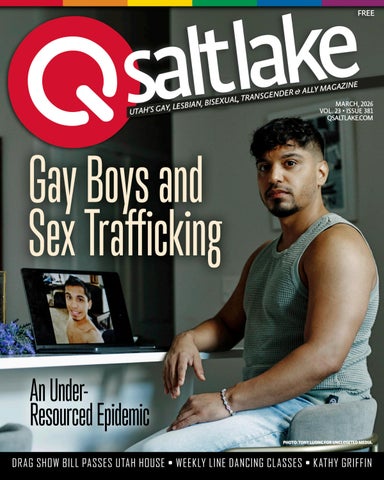
Create a flipbook
QSaltLake Magazine | Issue 381 | March 2026 by QSaltLake Magazine - Issuu