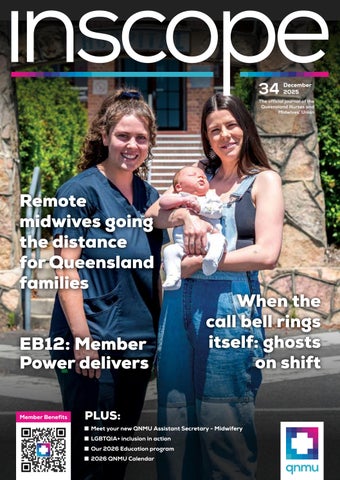
InScope 34 December 2025

Page 1


THE OFFICIAL JOURNAL OF THE QUEENSLAND NURSES AND MIDWIVES’ UNION

ISSN 2207-6018

ABN 84 382 908 052

106 Victoria Street West End Q 4101

(GPO Box 1289

Brisbane Q 4001)

T 07 3840 1444

1800 177 273 (toll free)

F 07 3844 9387

E inscope@qnmu.org.au

W www.qnmu.org.au

EDITOR

Sarah Beaman, Secretary, QNMU

PRODUCTION

QNMU Communications Team

PUBLISHED BY

The Queensland Nurses and Midwives’ Union

AUTHORISED BY

S. Beaman, Secretary, Queensland Nurses and Midwives' Union, 106 Victoria St West End 4101

PRINTED BY Kingswood Print Signage, 80 Parramatta Rd Underwood 4119

INDEPTH

12 Member power delivers EB12 16 When the call bell rings itself 22 Nursing identity through the lens of end-of-life care

26 Helping members when they need us the most

30 Inclusion in action

34 The value and importance of Enrolled Nurses in health care and aged care settings

36 Inside the work and impact of the QNMU Policy Committee 2024-2025

40 It's all happening in aged care

42 Remote midwives going the distance for Queensland families

48 Politics over evidence: A threat to trust and democracy

Acknowledgement of Country:

DISCLAIMER:

Statements expressed in articles in InScope are those of the contributor and do not necessarily reflect the policy of the Queensland Nurses and Midwives’ Union unless this is so stated.

Copyright of articles remains with the contributor and may not be reproduced without permission.

Statements of facts are believed to be true but no responsibility for inaccuracy can be accepted.

Other material may be reproduced only by written arrangement with the Union.

Although all accepted advertising material is expected to conform to the QNMU’s ethical standards, such acceptance does not imply endorsement.

Where individuals in this publication are described as registered health practitioners and/or QNMU members, this was accurate, to the best of our knowledge, at the time of writing. No representation is made as to the current status of the individuals’ registration.

For the current status of an individual’s registration, please refer to the NMBA register, at www.ahpra.gov.au Visit www.qnmu.org.au/privacy to read our privacy statement.

52 A new era for midwifery: Shaping the future together

Design by: Ingeous Studios
FRONT COVER: Melissa Botha, baby Patrick Fleming and Kirsty Donnel. Read their story on page 42. Photo: Lucy Robertson-Cuninghame.

The world needs our courage, compassion and collective strength

THERE IS a lot in the world that needs attention right now, both abroad and here at home.

Across the world, innocent lives are being lost to violent conflicts, and the growing threat of climate change affects us all.

At home, our healthcare system is struggling.

Aged care is under pressure, community care lacks transparency, private hospitals are facing financial pressures and closing, mental health services are underfunded, and hospitals are stretched to their limitsstill feeling the impact of COVID-19 and years of poor planning and underinvestment.

It’s clear the system is broken.

I attended the Global Nurses United conference in San Francisco in early October and was humbled by the fight nurses and nursing unions are facing around the world to protect their

professions, their workers and their communities.

Our enterprise bargaining and unending work to stop employers eroding hard fought for gains in pay and working conditions were overshadowed for me for a few days by the global fight other nursing unions are facing worldwide.

While our fight for safe staffing and safe workloads across all sectors will never stop and remain valid in our context, we must recognise the context and perspective of the battles being fought in countries where being a union member can lead to jail or death. Even in the USA, Immigration and Customs Enforcement (ICE) officers are raiding hospitals and schools detaining lawabiding humans and subjecting them to inhumane conditions and outcomes that have led to deaths. Healthcare workers in these hospitals are facing moral and ethical distress at being

forced to report when a patient (who also happens to be an immigrant) is admitted. Nurses reported that ICE officers then come and forcibly remove these patients.

Children are returning home from school to find their parents have been kidnapped by ICE officers. These are law-abiding humans and this is occurring at the behest of a democratically elected government!

In recent years, many countries have experienced a noticeable shift toward right-wing populism.

Alongside this political movement, there has been a revival of more traditional or regressive views on gender equality.

In some cases, this shift has led to rhetoric and policies that weaken the rights and freedoms of women, ethnic minorities, and gender-diverse people.

Examples include new restrictions on reproductive rights and the reduction of protections against gender—and race— based violence.

These developments suggest a broader reaction against progress made over past decades – progress often achieved through the advocacy of unions and social movements promoting equity and equality.

With our growing membership and increasing activism, QNMU members are experiencing a renewed sense of collective strength and purpose.

Our members’ voices are informed, united, and determined.

The progress we achieve is never by chance.

It is the result of clear intent, dedicated effort, thoughtful leadership, and a shared vision that turns challenges into opportunities.

Now, more than ever, we must use our collective voice.

As nurses, midwives, and unionists, we have a responsibility to make the realities of the healthcare system, and the need for equity, visible to all.

We must continue to highlight our shared investment in healthcare, in our communities, and in the wellbeing of humanity.

Speaking up is only the first step; ensuring our voices are heard requires persistence and unity.

The work ahead may be slow and, at times, demanding, but we are guided by a clear purpose and a strong sense of direction.

Every member has a role to play –through perspective, advocacy, and solidarity.

It is through this shared commitment that we build our power, strengthen our influence, and continue our work toward meaningful, lasting change.

Because as nurses, midwives, and carers, we know we cannot do this alone.

Our leadership, our voices, and our determination matter – not only to our professions, but to our communities, our country, and the generations that follow.

In closing, I want to pay my respects to QNMU Organiser Kim Ramsdale, a nurse and unionist who personified advocacy and fierce determination.

Kim passed away unexpectedly in early October having just turned 67.

Her passing is devastating and will be felt across the QNMU staff and its members with so many of you reaching out to share your stories of her tenacity and unwavering and dogged pursuit of fairness and equity for members in their workplaces.

Vale Kim Ramsdale. May you rest in peace.

As nurses, midwives, and unionists, we have a responsibility to make the realities of the healthcare system, and the need for equity, visible to all.
Sarah Beaman QNMU Secretary

QNMU members frequently contact us with questions about their wages, entitlements and other workplace conditions.

Being informed about your agreement, workplace policies and procedures, and any other professional and industrial issues, is the first step to ensuring you receive what you are due.

Our Tea room series, which appears in every edition of InScope, explains some of the common queries we receive from members.

If you have any topics you’d like covered, we’d love to hear your suggestions – email inscope@qnmu.org.au

For more information on your wages, entitlements and other workplace conditions, visit www.qnmu.org.au/ wages_conditions

Accessing your own or family members' medical records

Q: Can I log in to access my own or my family's medical records while at work?

THE SHORT answer is NO.

The QNMU has seen a significant number of members seeking support in disciplinary processes for accessing the medical records of:

■ themselves

■ family members

■ friends

■ other staff members

■ patients not in their care.

Accessing these types of records without the proper authority is sometimes seen as a reportable matter to the Crime and Corruption Commission if you work in the public sector, and in extreme cases it could land you in court under a privacy provision.

The QNMU has supported members in both of these scenarios after members have accessed medical information without the proper authority.

Queensland Health has a computer process where they review employee access of patient files and look for things like similar names or addresses.

These incidents are then flagged and reviewed.

If the access was appropriate and in the process of providing care, then nothing further will normally happen.

This is most often seen in smaller communities when it is inevitable that family will access health services and you may be the only nurse on shift at that time.

It

is important to remember that personal information can only be used and disclosed for the purposes for which it was collected.

One clear example we have dealt with, was when a new mother accessed her baby’s medical information while in the maternity unit.

The mother was also an employee of the hospital and was interested in her baby’s medical information, so she logged into the system to have a look.

The result of this action was the mother was provided with a ‘please explain’ letter that resulted in a non-disciplinary warning.

It is important to remember that personal information can only be used and disclosed for the purposes for which it was collected –and in the context of a hospital, information is collected and included in records for the provision of healthcare to individual patients.

Q:

So how can I see my medical records if I want or need to?

If you have questions about our Tea room column, email memberconnect@qnmu.org.au

But, if it is deemed that the access was inappropriate, then the outcome could be anything from a ‘please explain’ letter to a full disciplinary process.

Like any other member of the public, you can access your own medical records under the Administrative Access Scheme or a Right to Information request.

Keep up to date with private sector enterprise bargaining activities

THERE ARE currently a number of enterprise bargaining activities underway across the private sector.

However, developments are moving quickly in this space - often changing week to week - making it difficult to provide timely updates in this journal.

Instead, we encourage you to stay informed by regularly reading our monthly e-newsletter Qnews, visiting the Private Sector Bargaining campaign page (https://bit.ly/48TddF6) on our website and keeping an eye out for any QNMU emails specific to your workplace or employer.

These channels will provide the most up-to-date information on bargaining progress – including what stage negotiations may be at, and any actions you may be asked to take.

Negotiations underway include:

■ Mater Hospital: Currently at Stage 5 – Mater has put a poor offer on the table that strips away long-standing hard fought

for entitlements and fails to ensure competitive rates of pay. Mater wants to give very little with one hand, while taking a whole lot away with the other. QNMU members are being prepared to defend their entitlements and advance their claim.

■ Uniting Care Health: Currently at Stage 5 - UCH has put an offer on the table with two wage options – neither of them likely to retain or attract nurses and midwives. One of the options although offering slightly higher rates (but even then, still below parity) wants nurses to forgo their current entitlement to an extra week of leave for participating in on-call/recall. Ironically, UCH still expects nurses to participate in oncall regardless of the lost fatigue relieving incentive!

■ Ramsay: Currently at Stage 3Our endorsed Log of Claims will be served on Ramsay at the first bargaining meeting to be held in mid-November.

■ Wesley Mission Queensland: Currently at Stage 6 - Members

stopped management from cutting key entitlements and secured an improved 7% pay rise (backdated), plus 4% and 4% for non-aged care staff, though this is still not enough to lift overall wages. Members continue to stand firm against attempts to tie federal work value increases to a ‘yes’ vote.

Meanwhile Queensland Fertility Group enterprise bargaining has wrapped up after 59% of nurses employed by Virtus Health voted to approve management's latest offer.

Once approved, the new agreement's 4.25% wage increase negotiated for 2025 will be applied to base rates and back paid from the first full pay period in July.

In February, management originally only offered nurses 3.05% per year over four years, but was forced to offer more after members rejected it with a 90% ‘no’ vote followed by 100% endorsement of, and participation in, protected industrial action.

Mater UCH
Ramsay WMQ
QFG

New Code offers stronger safety protections for healthcare workers

A NEW CODE of Practice has been unveiled that puts the safety of healthcare and social assistance workers – including you - front and centre.

The Model Code of Practice: Healthcare and Social Assistance Industry is Australia’s first industry-specific Code, designed to tackle the hazards most relevant to our sector.

The QNMU, through the ANMF and ACTU, played a key role in shaping this Code alongside Safe Work Australia.

As part of the workforce with the highest number of work-related injuries in the country, and a compensation claim rate more than double the national average, we welcome this new Code and the added protections it provides.

It’s an important step that recognises the unique risks faced by nurses, midwives and carers every day, from unsafe workloads and manual handling injuries to the physical and emotional toll of frontline care.

However, the Code is still to be adopted as an approved code of practice in Queensland, which means we can’t yet rely on it to hold employers accountable.

Our focus now is making sure the Minister signs off, so the Code becomes enforceable. To read the code visit: https://bit.ly/COPhealthcare

Longtime activist Kym Volp honoured as QNMU Life Member

AFTER NEARLY five decades of QNMU membership and more than 40 years serving on our Council, long-time activist Kym Volp has been recognised with one of our union’s highest honours, being named a QNMU Life Member.

The Life Member honour is a distinction reserved for those who have given truly exceptional service to their union and profession.

Throughout her remarkable tenure, including roles as President, Vice President, Executive Member and Councillor, Kym has been a steadfast advocate for nurses and midwives, offering tireless leadership, wisdom and support.

Her influence has reached far beyond her home patch of Toowoomba, shaping positive outcomes for nurses and midwives across Queensland.

Kym’s commitment, compassion and integrity have left an enduring legacy within the QNMU and the wider nursing community.

We extend our heartfelt congratulations to Kym on this well-deserved recognition.

Chief Nurse

Shelley Nowlan farewells Queensland Health

AFTER 38 years of distinguished service with Queensland Health, Adjunct Professor Shelley Nowlan resigned as Queensland’s Chief Nurse and Midwifery Officer in October.

Shelley, a QNMU member for 35 years, began her career as a nurse at Toowoomba Base Hospital and went on to serve in senior nursing leadership roles across eight of Queensland’s Hospital and Health Services, including Executive Director of Nursing positions and Deputy Director-General of Clinical Excellence Queensland.

Her leadership in the Chief Nurse role over the past nine years has been instrumental in advancing nursing practice, workforce policy, and enterprise bargaining outcomes for nurses and midwives across the state.

Throughout her career, Shelley’s contribution to healthcare has been recognised through numerous honours, including a Premier’s Award for her work on the Cyclone Larry response, an Australia Day Award, and the Outstanding Achievement in Nursing Award.

Shelley’s deep commitment to nursing, midwifery, and the communities they serve leaves a legacy that will be felt across Queensland’s health system for years to come.

Kym (centre, in the striped shirt) pictured with QNMU Assistant SecretaryMidwifery Fridae King (right) and colleagues from the Toowoomba Base Hospital Branch.

Congratulations Emma Miller winner

CONGRATULATIONS TO long-time QNMU member and activist Annette Brownlie on receiving a 2025 Emma Miller Award – one of the union movement’s highest honours.

Annette has been a QNMU member since 1978 (47 years!), working more than two decades as a nurse and midwife at the Mater before dedicating herself full time to peace activism.

Over the years, she has brought her quiet determination and union values to many campaigns across Queensland, nationally and internationally.

As Chairperson of the Independent and Peaceful Australia Network (IPAN), Annette has led community engagement, organised conferences, and worked tirelessly to bring unions (including the QNMU) into the peace movement.

She is also Vice-President of the United Nations Association of Australia Queensland Division, where she manages the Peace and Security Program, and convenor of the Pacific Peace Network.

Annette’s support of her Mater colleagues, where she was a dedicated QNMU Workplace Representative, reflected the same commitment to fairness, care, and advocacy that shapes her wider activism today.

“Annette is well-known not only for her selfless dedication and drive, but also for the gentle, respectful way she inspires co-operation and action,” QNMU Secretary Sarah Beaman said.

“She has always stood up for what’s right, both in her nursing career and in her community, so we’re thrilled to see her recognised with this award.”

Named after pioneering Queensland suffragist and workers’ rights activist Emma Miller, the awards are hosted annually by the Queensland Council of Unions to honour women unionists who demonstrate outstanding leadership and commitment.

2025 Local Branch elections complete

THE QNMU Local Branch elections have now wrapped up, with Delegates and Alternate Delegates in every corner of the state ready to represent you for the next three years.

The QNMU currently has 139 Branches across Queensland, ranging from the largest –Gold Coast University Hospital branch, with 3874 members, to the smallest – Blue Care Bli Bli with just 18 members.

This year, we also welcomed the new Branches of Mercy Residential Care Queensland and Mater Private Mackay to our ranks – both experiencing the QNMU electoral process for the very first time.

There will be further elections early next year to fill any casual vacancies in preparation for our Annual Conference.

Local Branches form the foundation of the QNMU’s democratic structure.

Elected Delegates and Alternate Delegates represent members at the QNMU Annual Conference, where they debate and vote on motions that help shape the direction of our union.

For more information about Local Branches and how you can get involved, visit www.qnmu.org.au/branches

Christmas closure arrangements 2025 – 2026

THE QNMU offices in Brisbane, Toowoomba, Bundaberg, Rockhampton, Townsville, Cairns, Sunshine Coast and Gold Coast will close from 3pm on Wednesday 24 December 2025 and will reopen at 8.30am on Friday, 2 January 2026.

During this time, Officials will be on call to deal with emergencies such as dismissals. Members who require emergency advice or assistance should ring the Brisbane office on (07) 3840 1444 or 1800 177 273 (toll free outside Brisbane) and leave a message with contact details.

We wish you safe and enjoyable festive season!

Queensland Health compulsory closure and leave arrangements

Queensland Health (QH) has released compulsory closure and leave arrangements for the 2025/26 Christmas/New Year period.

These arrangements apply to those who work in a unit that closes or only operates with very limited staffing in the period between Christmas and New Year. They do not apply to continuous shift workers.

If you work in a unit that closes on public holidays or operates on very limited staffing and you are required to be on leave during this time, you will also receive the concessional day’s leave.

Part-time employees are only entitled to the concessional leave day when Monday, 29 December 2025 would be one of their rostered ordinary days of work.

Please note, since EB11 nurses and midwives can no longer have their annual leave balance debited on a public holiday, nor can they be required to take annual leave on a public holiday by their employer.

Date Leave

Thursday 25 Dec 2025 Christmas Day public holiday.

Friday 26 Dec 2025 Boxing Day public holiday

Monday 29 Dec 2025 Concessional Day (leave on full pay without debit)

Tuesday 30 Dec 2025 Annual/recreational leave, TOIL or accrued hours

Wednesday 31 Dec 2025 Annual/recreational leave, TOIL or accrued hours Thursday 1 Jan 2025

For information about your penalty rates for the Christmas and New Year period please check your workplace enterprise agreement.

For QH public hospital employees this would be EB12, other agreements apply to QH employees working in other services.

The minimum Award rates you must be paid can be found in the Aged Care Award 2010 and the Nurses Award 2020 (which applies to any nurse, midwife or carer not covered by an enterprise agreement through their workplace).

To check your agreement, log in to our website (www.qnmu.org.au) and go to your personalised member profile page.

WINS

REPRODUCTIVE HEALTH

LEAVE WIN AT GOLD COAST HHS

QNMU MEMBERS within Gold Coast HHS Women’s, Newborn and Children’s Services have secured recognition of their right to access Reproductive Health Leave (RHL).

Members raised concerns after being advised that due to critical staffing shortages, their RHL applications would not be approved and they would instead need to take sick leave.

Despite escalating locally to their Midwifery Unit Manager and further to senior nursing management, the issue remained unresolved.

With the support of the QNMU, members continued to pursue and escalate the matter.

As a result, the Health Service has revised its position stating the RHL applications will be approved and paid.

This is a significant outcome.

The HHS’s initial refusal undermined the very intent of RHL, which is to reduce the stigma of addressing and discussing reproductive issues that may require an individual to access leave.

MEMBER SECURES

UNPAID WAGES WIN

A QNMU member working in a general practice has successfully recovered underpaid wages from her former employer.

The member noticed she was not being paid overtime rates, and that she was also not receiving the minimum rate required under the Nurses Award

However, when she and the QNMU raised this with the employer, it argued that the member was employed as an administrative employee, and that the entitlements were not owed.

The QNMU commenced proceedings against the employer for underpayments and contraventions of the Fair Work Act 2009

During the proceedings the matter settled, with the member recovering all her outstanding wages plus interest.

FAIRHOLME COLLEGE SCHOOL NURSES

SCHOOL NURSES at Fairholme College have achieved a significant pay rise thanks to strong member action.

Bargaining began with members identifying that school nurses were paid well below comparable roles elsewhere.

They held a series of meetings, including nurse-only discussions, to highlight their critical role and steadily increasing workload.

Their efforts paid off, with Fairholme agreeing to lift the base rate for nurses by 10% on top of its original 3.5% annual offer.

This excellent outcome was won through the active engagement and leadership of members.

MEMBER SECURES LEGAL

WIN AGAINST COSMETIC CLINIC

A QNMU MEMBER has successfully defended herself against a debt claim brought by her former employer.

GREAT WIN FOR MEMBERS AT CHURCHIE RE PAID MEAL BREAKS

A MEMBER WORKING at Anglican Church Grammar School turned to the QNMU for support after nurses were told they were required to be available during designated meal breaks despite not being paid.

QNMU members were able to secure 18 months backpay for the unpaid time, for all nurses working at the school.

While undergoing training, the member observed some unsafe practices and after reporting them, ultimately decided to cease working for that employer.

In response, the employer launched legal action against her to recover so-called “training costs”.

With QNMU support and the assistance of a local law firm, the member successfully defended the case and won a contribution towards the QNMU’s legal fees.

This outcome is a clear reminder that QNMU members are not alone when faced with unfair or retaliatory treatment from employers.

STRONGER ROSTERS AND SAFER WORKLOADS AT LOGAN OPERATING THEATRES

LOGAN HOSPITAL operating theatre nurses have secured a major win on safe staffing and fatigue management thanks to the efforts of a combined working party between QNMU members, management, and staff.

After months of consultation, the working party finalised a new night shift staffing roster that ensures safe, timely care can be delivered 24 hours a day, seven days a week.

This initiative builds on earlier steps, such as the introduction of Saturday evening sessions to reduce staff fatigue, and establishes consistent minimum staffing levels across the full week.

The new roster will require the recruitment of additional registered nurse positions across Anaesthetics, Scrub Scout, and PACU.

The staffing profile includes:

■ Anaesthetics: 2 RNs

■ Scrub Scout: 4 RNs (including a Night Duty Floor Coordinator)

■ PACU: 2 RNs

■ plus 1 additional RN on the 12.30 shift.

On-call teams will remain in place across all three areas to help manage busy periods and reduce fatigue.

This is a great result and reflects the determination of Logan Hospital's perioperative nurses to work collectively for safe staffing solutions.

It strengthens both patient care and staff wellbeing, and is another example of what can be achieved when members and management work together.

LUMUS IMAGING MEMBERS’ STAND FOR PIA SECURES KEY WINS

QNMU MEMBERS at Lumus Imaging have secured a strong outcome after months of stalled bargaining.

Despite six meetings where the employer refused to table a wage offer, members stood firm, voting 100% in favour of taking protected industrial action (PIA).

When faced with the possibility of members engaging in PIA, Lumus finally presented an offer: 4% plus super and reclassification increases in year one (totalling 5.1%), followed by 3% rises in years two and three, with allowances also increasing 3% annually.

Members also won a new classification level (2.4), which was one of their key claims.

WESLEY HOSPITAL

NURSES WIN BACK THEIR TEAROOM

WHEN MEMBERS in the Wesley Hospital’s Dialysis Unit arrived to find their tearoom earmarked for conversion into doctors’ suites, without consultation, they decided enough was enough.

Forced to take breaks in a noisy public cafeteria, the team of 15 nurses, supported by their QNMU Organiser, took collective action.

Together, they wrote to hospital executives demanding proper consultation and the right to a fit-for-purpose staff space.

And their unity paid off.

Consultation was reinstated, and funding has now been secured for a brand-new, dedicated tearoom.

PROFESSIONAL JUDGEMENT GUIDES SAFE STAFFING AT GOLD COAST

QNMU MEMBERS in the Medical Decisions and Medical Assessment Units across Gold Coast HHS are chalking up a win for professional judgement.

In February, the Executive Directors of Nursing and Midwifery (EDNMs) issued a memo stating that every 10hour night duty shift must be paired with a six-hour offset shift in inpatient units.

Members quickly raised concerns, arguing the directive conflicted with the Business Planning Framework (BPF) principle that nurses and midwives are best placed to determine safe staffing needs.

The QNMU responded on members’ behalf, and following proper consultation with member leads in each unit, the change was dropped.

The decision reminds us that the professional judgement of nurses remains central to safe staffing decisions.

MESSAGES OF THANKS AND SUPPORT ARE WINS IN OUR BOOK!

EVERY MESSAGE of thanks and support we receive is a win for the QNMU. It’s proof that what we do to support and advocate for each other makes a difference – not just in our workplaces, but across the community.

COMMUNITY SUPPORT FOR EB12

WE RECEIVED this lovely email in support of our EB12 campaign recently:

It’s from Sajeevkumar, the former secretary of Navodaya Australia Inc., a progressive, secular, and cultural organisation, with branches in all states.

Most of its members are migrants from the southern Indian state of Kerala.

Our community stands in solidarity with QNMU as it takes industrial action for fair pay and conditions.

We fully support our nurses in their fight for better working conditions. Our community is with you.

To show our support, we published a social media post today, which has been shared on all our social media pages and has wide coverage in Australia.

This will help to get wide publicity among the people in our community.

The post was in Malayalam, but it spoke about the increasing cost of living, the need for better wages, and the significance of QNMU public sector members taking industrial action for the first time in 23 years.

“…Participants took part by wearing pink-coloured clothing, and using badges and stickers bearing their demands, while stepping away from duties that do not directly affect patient care.,” the post said.

“Navodaya Australia extends its heartfelt greetings to the dedicated nurses of Queensland who have stepped forward, demanding better conditions and a fair wage revision.”

It goes to show how much respect everyone in our community has for nurses and midwives; and it’s heartening to know that everyday Queenslanders are behind us!

HEARTFELT WORDS OF THANKS

AND THEN there was this from a member who wanted to thank the QNMU for having her back during a seven-month employment case: Thank you so much for all standing by me and supporting me when I most needed it.

I am forever thankful to QNMU for getting me through the most stressful period of my life, especially being so far away from home and family.

You are really all amazing at what you do and support us nurses and midwives when we need you the most.

Every message like this reinforces the value of having your union by your side.

AFTER MONTHS of tireless campaigning, thousands of Queensland Health nurses and midwives have achieved a historic victory.

On 29 October 2025, the Queensland Industrial Relations Commission certified the new EB12 agreement – locking in improvements to wages and conditions and marking a powerful moment in the history of our union.

This win belongs to you.

Across Queensland – from the Torres Strait to Toowoomba and everywhere in between – QNMU members stood shoulder-to-shoulder and showed what true union power looks like.

You attended meetings, shared your stories, painted your workplaces pink, and took protected industrial action for the first time in 23 years.

You showed courage. You showed unity. You showed Queensland Health that when nurses and midwives stand together, we are unstoppable.

Campaign

beginnings

EB12 has been a campaign of member action from start to finish.

It began in mid-2024, when members started sharing their stories through Public Hospital Watch, shining a light on the daily realities of understaffing, burnout, and unrelenting workloads.

These stories became the backbone of our campaign for an agreement that would recruit, retain, and respect nurses and midwives.

By August 2024, momentum was building.

More than 12,000 members signed the QNMU’s EB12 petition, calling on both major political parties to commit to maintaining nation-leading wages and conditions for nurses and midwives.

You wanted clear commitments before the state election – and you made sure your voices couldn’t be ignored.

Significantly, we were able to secure important pre-election commitments from both major parties that formed the basis of our campaign claims.

When negotiations formally began in January 2025, members were ready.

The first offer that insulted a workforce

In May, Queensland Health tabled its first formal EB12 offer –and members were outraged.

The proposal included an underwhelming wages offer and attempted to strip away hard-won rights and entitlements nurses and midwives had fought decades to secure.

It sought to erode protections around parental leave, flexible work, and consultation on patient safety – even opening the door to the widespread outsourcing of public health services.

Adding insult to injury, the government then threatened to withhold backpay if members moved to take lawful protected industrial action.

EB12 by the numbers

Member power. Historic wins. Real results.

12,000+

members signed the pre-election petition calling on both major parties to protect nation-leading wages and conditions.

150+ hours

spent at the bargaining table –every minute backed by member power and persistence.

83.8% of Queensland Health nurses and midwives voted YES to the EB12 agreement.

$1.8 billion

secured in wages, conditions, and entitlements – nearly double the value of the original offer.

11%+

minimum wage increase over three years – with additional classification structure adjustments lifting earning potential for half the workforce.

$4,500+

more for nurses and midwives progressing to the new pay point Grade 5.8 from 1 December 2027.

60,000+

public sector nurses and midwives benefiting from improved wages and conditions.

1 April 2025

backpay guaranteed – ensuring every nurse and midwife receives what they’re owed.

In the government’s third and final offer, you secured $1.8 billion in wages,

conditions, and entitlements – nearly double the value of the government’s initial offer.

23 years since QH nurses and midwives last took protected industrial action –until EB12.

Double time for overtime for all shift workers – a national first from 1 July 2027.

It was an unprecedented move – and it backfired spectacularly.

That threat only strengthened your resolve.

Instead of intimidating you, it united you.

Across Queensland, members overwhelmingly rejected the offer and demanded respect.

You packed out report back meetings, proudly wore EB12 stickers and shirts, and turned your workplaces into spaces of pink solidarity.

When Queensland Health underestimated you – when they tried to strip away your hard-won rights, weaken protections, and threatened to withhold backpay – you stood firm.

Time and time again, you proved them wrong.

You stood up, spoke out, and said enough is enough.

Historic action, unbreakable unity

When Queensland Health refused to improve its offer, members did what hadn’t been done in a generation –you voted to take protected industrial action (PIA).

On 5 June 2025, for the first time in 23 years, Queensland Health nurses and midwives began collective industrial action across the state.

From Cairns to Caboolture, Logan to Longreach, across metro hospitals and regional clinics, the message was clear: nurses and midwives will not be taken for granted.

Workplaces turned pink in a show of solidarity.

Members donned pink scrubs and t-shirts, and handed out stickers, posters, and placards.

In addition to a lengthy list of approved statewide member actions, thousands of members in dedicated wards, units, and areas escalated additional, specific protected industrial actions targeted at forcing the government to improve its EB12 offer.

The campaign made front pages and national headlines.

You’ve set new national standards. And you’ve reminded the state – and the country – that nurses and midwives are the beating heart of our health system.

The country saw – perhaps for the first time in decades – the collective power of Queensland’s nurses and midwives in full force.

Queensland Country Bank Stadium in Townsville lit up pink in solidarity.

Social media was flooded with member photos and messages of support.

After the government came back with a second inferior offer, members stood strong and united again – with many preparing to take the next step and sign up to be ready to strike.

Members spoke out in the media, bravely sharing their experiences on the frontline.

When the government referred negotiations to the Queensland Industrial Relations Commission in late June, members didn’t back down.

Stage by stage, members escalated their campaign.

Holding Pink Power Day, signing up for further action, and refusing to let your voices be sidelined.

Every action sent a message not just to Queensland Health, but to every decision-maker in the state: nurses and midwives will fight for what’s right.

That unity, determination, and courage changed everything.

Member power delivers results

As part of the massive recruit, retain, respect EB12 campaign, your collective action didn’t just improve an enterprise agreement – it shifted government priorities and reshaped Queensland’s health workforce agenda.

Because of your pressure:

■ Budget provisions were secured to make the first steps of the Health

Workforce Strategy for Queensland to 2032 strategy possible – a commitment to recruit thousands more nurses and midwives.

■ We were able to secure a commitment from both major political parties – Labor and the LNP – to maintaining nation-leading wages and conditions for nurses and midwives before the election.

■ Queensland Health was forced to improve its first offer – and then improve its revised offer again.

In the government’s third and final offer, you secured $1.8 billion in wages, conditions, and entitlements – nearly double the value of the government’s initial offer.

Through unity and action, members achieved:

■ A minimum 11% wage increase over three years, plus classification structure adjustments that lift the earning potential for half the workforce.

■ The highest public sector wage offer in Queensland this year, with guaranteed backpay from 1 April 2025.

■ Double time for overtime for all shift workers – a national first –from 1 July 2027.

■ New and improved allowances, rewarding the vital work you do and putting more money in your pockets.

■ Expanded RANIP and increased rural/remote isolation bonuses.

■ Stronger rights and protections – not just preserved, but strengthened.

■ A stronger foundation for EB13 and beyond.

None of this was guaranteed. The state government needed a lot of persuading – and you provided it.

This is what union power looks like: nurses and midwives standing together and refusing to settle for less.

The people behind the power

At every stage, it was members who led the way.

Ward by ward, shift by shift, you built this campaign.

From signing pledges and delivering petitions to fronting cameras, handing out flyers, wearing pink, and finding impactful ways to pressure your employer in your ward, area or unit, every action mattered.

For many, it was their first taste of union activism – and it won’t be their last.

QNMU Secretary Sarah Beaman said the campaign was a powerful reminder of what can be achieved through solidarity.

“EB12 proves what we’ve always known – when nurses and midwives stand together, we win,” she said.

“This agreement is yours. You fought for it, you improved it, and you secured it. It’s a testament to your strength, courage, and unwavering commitment to one another.”

In September, following months of negotiations and industrial action, members endorsed the improved offer through workplace meetings and surveys.

By mid-October, more than 28,000 Queensland Health nurses and midwives took part in the formal ballot – and an overwhelming 83.8% voted YES

On 29 October 2025, EB12 was officially certified in the Queensland Industrial Relations Commission, bringing this long and hard-fought campaign to a successful close.

Stronger for the future

While EB12 marks a major victory, the work doesn’t stop here.

The agreement lays a strong foundation for EB13 and future campaigns, ensuring nurses and midwives continue to have a powerful

voice in shaping the future of healthcare.

This campaign has made it abundantly clear: members are the union – every action you take, every meeting you attend, every time you stand up for your colleagues and patients, clients or residents, you strengthen our collective voice.

Together, you’ve improved wages and conditions for more than 60,000 nurses and midwives across Queensland.

You’ve set new national standards. And you’ve reminded the state – and the country – that nurses and midwives are the beating heart of our health system.

Through EB12, you’ve shown the strength of solidarity and the power of persistence.

You’ve proven that collective action works, and that when we stand together, we win.

You fought for this agreement –and won.

This moment belongs to you – and it sets the stage for even greater achievements to come.

While the fight for safe workloads, respect, and fair pay will continue, with this victory behind us, we are stronger, more united, and ready for what’s next.

And together, we’ll keep building a better future for nurses, midwives, and the communities we care for.

This agreement is yours. You fought for it, you improved it, and you secured it.
Turning Point: When members said enough

In April 2025, Queensland Health made a mistake that changed everything.

After months of stalled negotiations, they tabled an insulting first offer – a deal that not only failed to recognise the value of nurses and midwives, but also threatened hard-won rights and conditions.

The proposal sought to weaken consultation on patient safety, strip away protections around parental and flexible work arrangements, and open the door to outsourcing public health services.

Then came the kicker: a threat to withhold backpay if members dared to take lawful protected industrial action.

Instead of backing down, members rose up.

Workplaces across Queensland turned pink as thousands of nurses and midwives declared: enough is enough.

This was the moment that sparked the first protected industrial action in 23 years – a historic show of solidarity that united more than 60,000 nurses and midwives, drew national attention, and forced the government back to the table.

It was the turning point of the EB12 campaign – proof that when nurses and midwives stand together, there’s nothing we can’t achieve.

When the call bell rings itself

For decades, academics researching the paranormal have looked to nurses.

Supernatural studies involving hospitals, aged care facilities, nurses and carers have occurred worldwide.

These studies have been conducted not by self-trained, black-clad 'ghost hunters,' but by academic institutions including the University of Virginia’s Division of Perceptual Studies (UVA DOPS) and parapsychology units at the University of Edinburgh and the University of Hertfordshire.

The University of Arizona’s Centre for Consciousness Studies and Sweden’s Lund University’s Centre for Research on Consciousness and Anomalous Psychology, among others, have also collected data on high strangeness.

The majority of this research was conducted in hospitals, aged care homes and palliative care facilities –places where death is a daily occurrence.

With this in mind, it’s highly likely the skilled staff who spend more time with patients than anyone else — nurses and carers — boast a vast and unparallelled collective understanding of death and associated phenomena.

Working daily, and nightly, in large, enclosed settings home to constant death is not a 'normal' occupation. Most people only encounter death once or twice in their lives.

Nurses and carers however are on the frontline of mortality, they witness it more often and in greater detail than most other frontline emergency workers, and they are asked to absorb experiences most other people never encounter. In the same buildings, midwives and other nurses often work closely to safely usher or sustain new life.

Constant and prolonged birth and death, tens of thousands a year in some facilities, has given these settings a reputation as being liminal spaces –or areas of transition, places where the impact of constantly crossed

thresholds is felt and somehow recorded.

Few hospitals do not have a resident ‘ghost.’

Up north there is the glowing blue nurse, an ethereal figure dressed in a dated uniform who continues to do the rounds decades after her death.

At another is the ghost of a teenage male, an angry youth who occupies the theatre where he died and regularly interferes with electrical medical equipment.

“I have seen and felt so many inexplicable things at work,” a Brisbane based Registered Nurse (RN) said.

“I don’t doubt for a second that unexplained events occur before, during and after someone dies.

“Yet I do not know one person who would put their hand up to talk about it publicly. You do that and you lose all credibility, and maybe your job.”

There are several schools of thought. Some nurses and carers are experiencers, while others are fervently not. All agree, however, that nurses, carers and other medical professionals have learnt not to discuss what are currently deemed paranormal or otherworldly encounters.

“Speak about that stuff and you’ll never get a good job,” said a male RN from western Queensland.

“You’ll get a reputation very quickly. We might discuss it with a trusted colleague, or our family, but we’re not in a hurry to raise it with management or discuss it in the news. It would be career suicide.”

Offer an anonymous conversation, and the stories flow.

“There was an elderly gentleman who used to get up to use the toilet, wash his hands and leave the hot

water running,” said a Brisbane RN with 20-plus years’ experience.

“It was something he did every night. And it kept happening after he died. The other patients in that room were bed bound and there was no way they were getting up.”

There are stories of call bells ringing and lights turning on in empty rooms and actual physical meals being delivered by a nurse long dead.

“Every hospital I have ever worked in has ghost stories,” a Mackay RN said.

“There was an angry spirit who hurled stuff around at 3am, just when you were tired enough for it to really scare you. I was terrified at first, but after a while you’re so busy and exhausted, you get to a point where you just say, ‘Cut it out,’ and it did.”

This sentiment is reoccurring. Ask around and it is swiftly evident that nurses and carers regularly encounter and absorb unusual activity while working to protect their patients.

“It’s 2am, it’s dark, it’s silent and the water is running in that room again, the mirror is all steamed up and all the other patients are fast asleep,” she said.

“But you’ve got things to do so you ignore your fear and you get in there, turn off the tap, wipe down the mirror and get on with it. I swear the hair on the back of my neck stood up every time and the feeling was undeniable, but you just get on with it.”

One concerned Gold Coast Enrolled Nurse (EN) said she taught herself how to “cleanse” a room after an elderly aged care resident was harassed by a seven foot “shadow figure.” She said while exorcising a space was not part of her job description, she felt compelled to try

There was an angry spirit who hurled stuff around at 3am, just when you were tired enough for it to really scare you.
It started with glimpses of something dark out of the corner of my eye. Then it started appearing clear as a bell, a large figure, which felt male, like a tall shadow that hugged the wall in this one room, and then started peeking out into the hall.

and protect a resident who was experiencing sleep deprivation and extreme distress.

“I was seeing this thing too,’’ the EN said.

“It started with glimpses of something dark out of the corner of my eye. Then it started appearing clear as a bell, a large figure, which felt male, like a tall shadow that hugged the wall in this one room, and then started peeking out into the hall.

“We all knew about it because you could feel it, but no one was going to report it or ask for help. So we looked into it ourselves.

“It was upsetting the new resident, this poor woman who inherited the room, so I went online and learnt how to sage. I opened the window and did my best with sage spray, because of the smoke alarms, and told this shadow in no uncertain terms to get the f**k out.

“It did. I simply couldn’t stand by and watch this lovely woman be terrified in what was her own room.”

Another aged care carer also reported an encounter with something dark.

“There was a gentleman who died very lonely and bitter, he was angry

because he spent his life looking after his family, but for whatever reason no one was there for him,” she said.

“His children were living overseas, and had only a handful of visits in the eight years he was there. Sometimes you see people die not long after they give up, and it was like this man reached a point where he decided to call it a day.”

She said the man died relatively suddenly, without his family, and his room was swiftly cleaned and reallocated.

“The man who moved in almost immediately started struggling with lethargy and depression, he kept saying he felt inexplicably sad, although we did at first put this down to his moving into care,” she said.

“But he maintained he was not feeling himself. He lost weight and his health really started to deteriorate, and his adult children were worried.

“Another staff member and I, who have a spiritual background, knew there was something in the room because we felt it too. So one day, when the resident was with his family, we used salt and a ritual to clean that room right out.

“We also used essential oil, and brought in some flowers, to lift the mood. It wasn’t much, a good cleaning to put an end to this sadness, and it did the trick.”

Hello Care recently reported some aged care staff like to leave a window or external door ajar to allow a soul to leave following a death.

“That’s a thing, I know many carers who like to open a room right up, open the windows and doors, after a resident passes. It’s important to give the person a chance to leave, to make sure they know they are free to be elsewhere. Even if it’s just for a little while.”

Others are flat out dismissive.

“Nup,” said a Brisbane RN with 35 years’ experience.

“It’s b*****t, there’s nothing to it.”

But according to the studies, including Brief Research: A Follow-Up Study on Unusual Perceptual Experiences in Hospital Settings

Related by Nurses by Alejandro Parra of Interamerican Open University, the evidence exists.

The results of Alejandro Parra’s study, published in Journal of Scientific Exploration, found 235 of 344 nurses

interviewed across 36 South American hospitals experienced at least one paranormal encounter.

Others reported far more.

The study found the most common anomalous experiences included a “sense of presence or apparitions, hearing strange noises, voices or dialogues, crying or complaining” as well as “intuitively knowing a disease, hearing patients’ undeniable near death experiences, religious intervention and frequent anomalous experiences in relation to children.”

The study found:

■ Close to 40% had experienced, or had trusted peers experience, a “mystical” or special “connection” in relation to a medical context while at work.

■ Close to 30% of those interviewed witnessed events such as hearing strange noises, voices or dialogues, crying or moaning, but found no source for them.

■ More than 20% witnessed patients recover quickly and completely from disease or trauma following some form of intervention (e.g., prayer groups, laying on of hands, rites, or objects, images of beatified saints, rosaries).

■ More than 20% experienced intuitively “knowing” what was wrong with a patient just by seeing him/her, before, or without knowing his/her medical history.

■ More than 13% reported “knowing” about a patient’s situation or outcome despite having no contact or information about their condition.

■ More than 12% witnessed unexplained events in relation to children.

■ More than 8% experienced consistent failures of medical equipment around certain patients – and not others.

■ Close to 8% of those interviewed said patients reported extrasensory experiences such as knowing things they should not because they were interned and/or isolated.

■ Around 6% reported seeing energy fields, lights, or “shock” around, or coming from, a hospitalised patient.

“It really should be normalised,” a Brisbane RN said.

“After all, one day they might find out these things aren’t paranormal, just something we were yet to understand, like electricity and electromagnetic fields once were.

“And if they are paranormal, shouldn’t we be paying attention

rather than ridiculing the people who experience these things day after day?

“I think it’s fair to say nurses know a lot more about death, and what approaching death looks like, than most people.”

References

Journal of Scientific Exploration: Brief Research: A Follow-Up Study on Unusual Perceptual Experiences in Hospital Settings Related by Nurses

Authors: Alejandro Parra, Interamerican Open University

(PDF) Brief Research: A Follow-Up Study on Unusual Perceptual Experiences in Hospital Settings Related by Nurses

International Journal of Nursing Studies: Spirituality or psychosis? - an exploration of the criteria that nurses use to evaluate spiritual-type experiences reported by patients

Authors: Jennie Eeles, Trevor Lowe, Nigel Wellman.

Spirituality or psychosis?—an exploration of the criteria that nurses use to evaluate spiritual-type experiences reported by patients - ScienceDirect

Journal of Palliative Medicine: Patients’ and caregivers’ needs, experiences, preferences and research priorities in spiritual care: A focus group study across nine countries

Authors: Lucy Ellen Selman1, Lisa Jane Brighton2, Shane Sinclair3, Ikali Karvinen4, Richard Egan5, Peter Speck2, Richard A Powell6, Ewa Deskur-Smielecka7, Myra Glajchen8, Shelly Adler9, Christina Puchalski10, Joy Hunter11, Nancy Gikaara12 Jonathon Hope13; the InSpirit Collaborative https://pmc.ncbi.nlm.nih.gov/articles/ PMC5758929/

GHOST STORIES

HIS YOUNGER SELF

Had a 17-year-old male come in, cardiac arrest [details removed]. We weren’t able to revive him and afterwards we moved him into one of the private rooms to await his mum’s arrival.

Mum and two younger brothers (both around 13 years of age) turn up, we break the news and escort them into the room.

The nurse looking after those beds came up to me to chat about what happened and we started talking about his brothers and how they’re going to have a tough time.

She mentioned that the little one should be OK because he’s about 4 or 5 years old, while the others are older and will probably take the news a lot harder.

I told her that there were only two brothers there so where is the younger one and does he have someone looking after him?

Her eyes went wide and she looked ashen, telling me there was a little blonde-haired boy that followed them into the room as well.

We both went to check on the family and sure enough there was only the two brothers and mum in the room. She looked pretty damn shook. But it doesn’t end there…

Turns out this family live on the same street as the nurse, and the mother saw her out walking one day and invited her in for a cuppa.

When she walked into the house she saw a family portrait of 3 boys and their mum.

She recognised all three of them as the boys she saw in the room that night.

Slowly she put two and two together and realised that the youngest boy in

the photo was the same boy she saw in the room.

That boy was the now deceased 17-year-old, who was about 4 years old when the picture was taken.

FOOD DELIVERY…FROM THE PAST

My first NUM said when she was at the old Manly Hospital she would occasionally find NBM patients with food on their trays.

When quizzed they would always describe a friendly nurse in a yesteryear Army uniform having brought it to them.

I HAVEN’T SEEN A GHOST, BUT WEIRD THINGS HAPPEN ALL THE TIME

I haven’t seen a ghost, but I did have an eerie situation. I had a gentleman on a ventilator.

About 3am, his wife called and said her husband had come to her in a dream and told her he needed a priest.

And could we please find one, and that she would be coming as soon as possible.

Once a patient is put on a ventilator, he cannot speak as the tube passes his larynx into his trachea.

A priest arrived and gave him the last rites. The man sat up in bed and kissed the cross the priest held, lay back and died.

He had had liver cancer, and when he died, he bled out... Unfortunately, it was an ugly death because of all the bleeding.

Fortunately, the wife did not arrive until we had finished cleaning the patient, and put him in a clean gown and sheets.

The wife arrived and said she had been delayed because she had had a flat tire and had to ask her neighbour to bring her.

I have no doubt that the patient found a way to delay his wife long enough so that we could make him presentable for his wife to see him.

It was so eerie the way it happened. I shall never forget it.

WORKING FOR ETERNITY

I was on my third night in a row so I don’t know if I was just sleepy or what. But I went to the bathroom which was outside the ward and walked back in.

The rooms (6 beds) entrances were on the left and as I came up the corridor I saw someone in light blue walk into the room. I thought it was my colleague, and I thought ‘oh good I’ll ask her to come round with me while I do my observations’.

Anyways, I followed her into the room, and saw them go into the bathroom at the other end. I thought ‘oh she's cleaning but I’ll ask anyways if she has time now.’ I go in; no one!!

No person in blue…Then my colleague walks into the room…and says she saw someone in light blue walk into room!

Ghost, I’m sure! Though I'd hate to pass away and continue to be at work. Writing it out doesn't sound spooky but at 3am, in the dark, on a ward when you are tired from being busy, it feels more substantial.

CONFIRMATION PIRATE

I was washing a patient who had died, when all I could hear was “My heart will go on” sung loud like a pirate would sing it in my ears.

The wife missed his death, she sat with her husband for a long time, as

I was in a panic – How was I going to pass this on without sounding mad and just say my imagination was working overtime and I was deluded.

I caught her as she was leaving the room and said words to the effect of “I just have to tell you, I keep on hearing my heart will go on.” She said, “That was our ditto (like in Ghosts).” I said, “It was sung like a pirate would.”

She just took a deep heaving breath and said, “He always sung it like that.” He was in his 50s and died of alcoholism, but I could feel he had one fun, wild soul.

AGED CARE

I used to work as a carer in aged care, and after a resident passed away, their room remained empty for a few days.

One night, my colleague, assigned to that area, noticed the call bell from the empty room going off.

She turned it off, but it buzzed again, so she asked me to go with her. We unplugged and reconnected it, but it kept buzzing.

We then asked a Senior Carer for help. He entered the room, opened the sliding door to the garden, and swept his hands over the bed while saying, “Go, get out now, leave now.”

He continued this motion, gradually moving toward the sliding door, and finally closed it. The call bell did not go off again after that.

RBWH

Another well-known tale involves an old janitor. He worked at the hospital for decades and when he passed away, his ghost was seen in the hallways he used to clean.

People say he still has his mop and bucket, and he's just going about his

cleaning duties as if he never left.

This story gives the impression that he was so attached to his job that his spirit still lingers to carry it out.

HAUNTED BALLOON

In another case, a travel nurse reported a birthday balloon, which was the only allowable decoration, repeatedly floating on its own in a community hospital hallway.

The balloon would disappear and reappear, with some speculating it was the action of a child's spirit.

THEATRE GHOST

Everyone at Mackay Hospital was aware that one theatre was home to the ghost of a teenage boy who died there.

This ghost was seen and played havoc with electrical equipment in ways that defied logic and regularly spooked staff.

SHADOW PERSON

I work in aged care, and I’ve seen a crouching shadow person. I’ve seen it in a few of the residents’ rooms or in the halls. I don’t like it. I work night shift and I’m a Christian person.

HAUNTED RESIDENT

I have a resident who seemed to be haunted.

I made her a dream catcher... and she slept well for two months but is now being bothered again and so is the resident across from her.

SMOKING DEPARTED RESIDENT

I’ve have been working in aged care for 15 years, during this time I did night

shift for seven years.

We had a resident who smoked and after two weeks of his passing you could still smell cigarette odour coming from his room.

I stood outside his room and said to him it is time to go, the next day the odour was no longer there.

RING RING

I’ve seen a lot in my 15 years as a carer, but the call bells are a thing.

I remember a resident that had passed.

She was being cremated then interned into the family plot a month later.

For that month, her sensor mat was always going off, mainly on afternoon and night.

Alot of staff were scared to go into the room to reset the sensor.

I’d go in if it I was on shift, acknowledge her and turn it off. She didn’t do it for the rest of the shift.

Another person I looked after had a photo frame on a display cupboard. He died at Easter 4 years ago.

The room wasn’t filled for about a year in that time I would always walk in when it was empty and say hi to the spirit.

One night I didn’t, and the picture frame fell off the cupboard.

I have plenty more stories, most people are afraid night shift.

SPOOKY NURSING MOVIES

■ The Ward

■ The Power

■ The Grudge

■ Grave Encounters

■ Hospital

■ Saint Maud.

Nursing identity through the lens of end-of-life care

This is the second of two articles providing an overview of the findings from a grounded study that set out to explore patient suffering at the end of life, as experienced by those caring for them – the nurses. In the first article (published in InScope Edition #33) we saw how dying disrupts our expectations of healthcare and affects our behaviours and identity, individually and collectively.

DYING IS simply not what’s meant to happen.

Clinical and funding models of modern healthcare favour and incentivise intervention, so while death is acknowledged (although unwelcome and resisted), dying is commonly denied or diminished, rather than acknowledged and honoured.

In researching suffering at the end of life, the study generated a new level of understanding of nursing identity.

Within acute healthcare at least, and whether we like it or not, nurses exist within a dominant medical paradigm.

This exerts a powerful influence on nursing identity and can cause dissonance between a nurse’s personal / professional values and sense of self, and the prevailing operational and social culture of the organisation.

Identity is in part defined by how we perceive we are being perceived. This is a universal truism.

As humans, we are motivated to adjust our words, actions, and behaviours to meet the powerful need for ‘fit’ and inclusion in what we see as the dominant group.

At the site of this study, for example, nurses wore scrubs with the clinical specialty embroidered (e.g., Vascular Surgery, Haematology) rather than Registered Nurse – a strong sense of belonging for sure, but how then were they identified?

If this was a universal change, how would this affect our self-identity, our sense of self, and our role towards those who suffer and need care?

Nursing is perhaps disadvantaged by having a professional title that is also a socially owned descriptive verb. We hold a role of central and historic importance in healthcare but can struggle to claim this centrality or find our voice when it comes to advocating for a patient or resident who is suffering as they near the end of life. We can be conflicted - between our personal identity (as a nurse and

patient advocate), and the identity we adopt from the prevailing ward identity or speciality.

In the first article (see Inscope #33), it was presented that the dominant culture and influence of acute healthcare has the potential to negate palliation.

Similarly, nurses can moderate and modify their expectations both of themselves and of others in the context of suffering at the end of life: it can raise their voice, but can also silence it.

In interviews, nurses described examples of when they spoke out but also when they felt wholly unable to do so.

If the nursing voice and response is variable, then surely, so is patient representation and care?

As nurses, we enter the drawn curtain and are intimately close to patients. If we are silenced, the potential for patients to receive low benefit interventions when nearing end of life increases.

Here’s the words of a few nurses:

"Needless suffering is that frustrating time when you can see that someone is visibly distressed and yet your hands are tied."

"We can be asking for days and days and days for an acute resuscitation plan. It just doesn’t get done and you just cross your fingers and hope that it doesn’t happen in that time period."

"Why are we still doing what we’re doing? It can be really frustrating sometimes."

Some nurses shed tears of frustration when describing this; they witnessed unresolved suffering and felt powerless.

Nurses have profound potential to ameliorate this suffering but there is a deeply felt imbalance at times which limits their influence and care.

Nurses can be conflicted not only with this imbalance but can be caught between the evident needs and best interests of our patients, the concerns of family or clinicians who seek to

treat, and those who need to ‘have the conversation’.

Voice-voicelessness refers to the variability among nurses in feeling able to articulate concerns or to influence a shift in focus towards comfort and dignity in response to suffering.

Acts of representation have the potential to strengthen the nurse in both voice and deed, but a conclusion of the study was that, while some people are assertive, and some assertive people are nurses, not all nurses are assertive.

Sometimes the opportunity or personal potential to participate in dialogue associated with clinical care is simply not there. Other times, nurses described themselves as having to be ‘naggy’ or pushy to create influence:

"I’m also very good at being naggy, advocating for them to the doctors if they have pain and it’s not being addressed. I don’t mind being a nuisance anymore. It’s funny, some things aren’t in your nature to do for yourself, but you do it for someone else."

"Some days we might have to push it for a few days before they actually hear us."

"You try to chase the doctors to get alternate pain relief, and it just doesn’t happen."

Has nursing lost its unique profile in the muddling milieu of modern healthcare?

What of its presumed and proud role as patient advocate and holistic professional?

Power dynamics in social situations, institutions, and relationships can alter our behaviour and sense of self.

It can (and does) undermine personal autonomy and in healthcare this can profoundly influence how we as nurses perceive and present ourselves.

Nurses see themselves as part of a team which can at the same time exclude them or create reciprocal imbalance, generating internal conflict with their personal beliefs, ideals, and desired actions.

This is an enduring challenge not only for the individual nurse (and for nursing) but also for patients receiving their care.

It is also a clarion call to nursing leaders.

If nurses are able to discern and respond to suffering and find a voice within the discourse around care at the end of life, they can practice moral agency.

We carry the power to make a difference in patients’ lives, if we will take it (and the literature supports this - see for example, Liaschenko & Peter, 2016).

In asserting the inherent value in our care competence, nursing promotes the wellbeing not only of the patient, but of the group, and the institution with which they strongly identify.

In response to suffering, nursing care can be (and very often is) quietly delivered through relational care and acts of human attending, but it is a conclusion of this study that when this happens, the humanity of compassion, and voice when available, is sourced from within the personhood of the nurse.

That is, it is made possible through nursing, but is not guaranteed.

The flow of compassion may or may not be running well, and may not be replenished.

Nursing makes act of compassion possible, where the nurse is compassionate.

We need nursing and healthcare structures that give voice and validity to care as well as to cure.

This applies to everyone who struggles with the competing paradigms of healthcare.

So how can we create the perfect conditions, to respond to suffering, to give nursing a strong voice, and to better recognise dying?

The model of reciprocal compassion (see Figure 1) is a distillation of findings from the reported study.

It is presented to demonstrate that the source of compassion that flows through acts of attending to people experiencing suffering (Cassell’s ‘fracture of personhood’ (1991)) at the end of life is human and relational, but can equally be organisational and systemic.

The model’s underpinning is that of

reciprocity: the benefit and progressive enhancement of compassionate practice by nurses is also warranted to nurses.

This is not the limit of this model, however.

Its central tenets of compassionate care are transferable across setting and discipline such that compassion practice can be normalised across traditionally competing domains and paradigms, to and through nurses and their multidisciplinary associates as well as to patients and families.

Provider organisations should take note.

There is intense humanity and empathy sourced from deep within individuals who are nurses; it is delivered through personal acts of attending care.

But (how) is this corporately guaranteed and safeguarded?

Are nurses enabled to debrief, to receive supportive supervision, to participate in evaluating patient outcomes?

What of their needs?

Healthcare organisations might badge themselves as compassionate and include it as a ‘core value’, but they are relying on the individuals they employ to simply be compassionate.

This isn’t good enough! What about when the source runs dry – or was never present?

In an industry fixated on measurable outcomes, Sinclair et al.’s study (2021) demonstrates that compassion and its composite features (see Table 1) can be measured and thus, enhanced.

These attributes of compassion can and should be applied to care workers as much as care recipients.

The literature tells us that patients in receipt of compassion feel acknowledged and understood – that comfort and dignity lies in the genuine commitment and interest of others.

Feeling ignored or unseen, with needs, and wants unresolved, adds to existential distress and to the ‘fracture of personhood’ described so compellingly by Cassell in 1991.

FIGURE 1: Theoretical model of reciprocal compassion

This doesn’t apply to just patients, but to us all.

Nursing’s focus is more technical than ever.

It appears to share the thrust and determination of persuasive diseasefocused treatment and life-extension.

Yet the intimacy of end-of-life care distils the nursing experience, distinct from its equally valuable features of visible, measurable and technical care.

This distillation gives place, meaning, and validity to quiet, compassionate care.

While a simple presentation, attending to the constituent elements of this model (Figure 1) will enable compassion to flow through the organisation to the benefit of all.

In its schematic presentation, the outer level incorporates core acts of compassionate care.

While these apply to patients, they apply equally to nurses, indeed to all members of the healthcare team.

The inner level conveys the essential attributes, features and enablers required for compassionate and therapeutic care to arise and be sustained.

These also apply to the needs of nurses engaged in human caring on behalf of the organisations they represent.

Thus, all recipients and beneficiaries of this relational care are placed in the centre of the model.

Organisations cannot claim compassion as a core value if they rely solely on those they employ to simply be compassionate.

This model offers a construct that informs and enables compassionate care to patients and compassionate support to staff, by those with responsibility to them.

The attributes, features and enablers inherent within this model, practiced consistently and reciprocally between, towards and through nurses, advocates a consistent language and behaviour of care that pervades intent, whether curative or carative.

This is a siren call to nurse managers and leaders.

Situating nurses centrally as equal associates within a carative / curative paradigm empowers the nursing voice, optimises agency, and responds to suffering.

With action and discourse so enabled, the inevitable human experience of dying might not be then denied but rather, taken more wholly into account as an undeniable factor in collective, mutual treatment discussions and decisions that give the patient control, symptom support, and time to prepare.

In summary, the constructs of nursing identity and dying denied are interrelated.

As witnesses to suffering, nurses can suffer, their distress due in part to situational frustrations, of feeling at times powerless to represent patients who themselves are powerless.

If the timeless element of nursing is caring, and human caring creates the care environment (Watson, 1988), it is proposed that compassion towards nurses is both essential and efficient if the flow of compassion is to be maintained for the benefit of the patient who suffers at the end of life, and indeed, for all patients and healthcare recipients.

References

Cassell, E. J. (1991). The Nature of Suffering and the Goals of Medicine. Oxford University Press, USA.

Jones, D. A., Pound, G. M., Eastwood, G. M., & Hodgson, C. L. (2021). Estimate of annual in-hospital cardiac arrests in Australia. Critical Care and Resuscitation, 23(4), 427.

Liaschenko, J., & Peter, E. (2016). Fostering nurses’ moral agency and moral identity: the importance of moral community. Hastings Center Report, 46, S18-S21.

Sinclair, S., Hack, T. F., MacInnis, C. C., Jaggi, P., Boss, H., McClement, S., ... & Thompson, G. (2021). Development and validation of a patient-reported measure of compassion in healthcare: the Sinclair Compassion Questionnaire (SCQ). BMJ open, 11(6), e045988.

Watson J. (1988). Nursing: human science and human care. A theory of nursing. NLN publications, (15-2236), 1–104.

Sincere

TABLE 1: 15-Item Sinclair Compassion Questionnaire descriptors (Sinclair, et al., 2021)

Helping members when they need us the most

When work issues become overwhelming, the QNMU Servicing team is there to guide members through the process, ensuring they’re supported, represented and never left to face it alone. In this article we step you through the team’s people and just how they have your back.

THE QNMU Servicing team is part of our Member and Specialist Services division and provides direct one-onone assistance to members facing workplace issues.

Most members first connect with us through the Member Connect team –nurses and midwives with many decades of collective experience who answer calls and emails every day from members seeking advice or support.

When an issue needs more intensive involvement, Member Connect refers it on to one of our Servicing Industrial Officers, Servicing Organisers, or Servicing Officers, who can guide members through the next steps and ensure consistent, high-quality representation.

At this point the issue becomes what the team refers to as a ‘matter’.

The matters we assist with are as varied as the workplaces our members come from; from performance concerns, return to work post-injury, and roster disputes, to bullying, discipline action or termination of employment to name just a few.

Our overarching goal is to ensure members do not feel alone and are empowered throughout their matter, whatever the outcome.

What the team does

Member Connect assess each request for representation and determine the level of representation required.

Our Servicing Officers and Organisers represent members at ward or service level to try to resolve issues.

They attend meetings with members and work to ensure processes are followed correctly so members can achieve the best outcome possible. These officials draw on extensive nursing and union experience to support our members.

For more complex or higher-level matters, Servicing Industrial Officers provide industrial representation.

Many of these officers have backgrounds in nursing, law and industrial relations.

At this level, representation can involve appearances before Industrial Relations Commissions or Human Rights Commissions, or complex negotiations with employers.

The team is guided by the Member Representation Policy, which can be found on our website and has recently been updated.

This provides a framework for members to understand decisions that are made, the directions representation can take, and clarifies expectations of both the Servicing officer and the member.

No matter the level of representation required, the Servicing team helps members navigate difficult situations and complex systems that can seem unfair.

Supporting members to achieve the best outcomes

To help matters progress smoothly, members can support their own case by:

■ submitting all documents relevant to a matter with their request for representation, or promptly when requested

■ keeping communication channels open to allow for quick clarification or updates

■ understanding that matters need to be triaged by urgency and, at times, emergent issues for other members may need to take precedence.

Recent matters

The Servicing team assists members across Queensland in a wide range of workplace matters.

Here are just a few recent examples to show how we help members achieve fair outcomes.

Underpayment

A member was terminated from a medical centre in a regional city. On

review of payslips, it was recognised the member had been paid below the Nurses Award and had not been receiving the fifth week of annual leave they were entitled to each year. Representation resulted in the member being back paid nearly $40,000.

Support following professional concerns

A member started work for a specialised medical clinic and when undertaking training developed significant concerns about the practices she observed. After raising these with management, the member chose not to continue with the employment. The employer subsequently cancelled her accommodation and began proceedings against her.

Representation resulted in the member being reimbursed for travel and unpaid hours. The employer discontinued the proceedings against our member.

Discipline and caution on sharing confidential information

A member faced disciplinary action for sharing information with the union about issues on the ward. The Servicing team appealed the decision and was initially successful; the health service appealed, and the original decision was ultimately upheld. While the member was unsuccessful, the case clarifies that the Industrial Court takes a strict view of members sharing information that contains patient material, even when shared with their union.

These matters highlight not only the diversity of issues our team manages, but the complexity of the work involved.

Each case requires careful assessment, collaboration and timely information from members. The best outcomes happen when representation is a partnership.

Our overarching goal is to ensure members do not feel alone and are empowered throughout their matter, whatever the outcome.

Trends and caution for members

Recent matters have also highlighted some emergent trends that serve as important reminders for members.

These aren’t theoretical risks, they’re the kind of issues that can lead to disciplinary action and even termination.

■ Mental health units are increasingly using CCTV footage to assess the accuracy of visual observations. Members found to be recording observations inaccurately are facing serious disciplinary action including termination, as well as the potential for catastrophic patient outcomes. If workloads prevent you from undertaking visual observations as ordered, report the workload to your team leader immediately and complete workload forms.

■ Never share any documents containing any patient information, including sending them to personal email accounts. Courts have found this to be misconduct, even when done for safety purposes. Always check with your local policies before sharing anything. Speak with your organiser or Member Connect official before sharing documents with the QNMU.

■ Only view information you need for patients in your care. Employers are taking serious action against members looking up information on records systems inappropriately – including their own medical records. Audits are undertaken regularly and employees are held accountable.

INCLUSION IN ACTION

At the QNMU, inclusion isn’t just a value – it's a practice.

OVER THE past few years, QNMU employees have demonstrated a strong and ongoing commitment to advocacy and inclusivity within the LGBTQIA+ space.

From establishing an employee Pride Committee to embedding gender-inclusive practices in the workplace, this ongoing work has been driven by genuine commitment, not tokenism.

That commitment was recently recognised when the QNMU received the 2025 Union Pride Award for Outstanding Union Achievement – an honour that celebrates the union’s leadership in advancing equality and inclusivity for LGBTQIA+ workers across Queensland.

The Queensland Council of Unions (QCU) Pride Awards hold deep significance because they do more than recognise achievements – they affirm identity, validate struggle, and celebrate solidarity across the union movement.

This recognition represents more than an award.

For many LGBTQIA+ unionists, being seen and celebrated in a traditionally heteronormative space like the labour movement is powerful.

These awards publicly acknowledge that queer workers are not just present – they are leading, shaping, and strengthening the movement.

Recognition from the QCU sends a clear message: LGBTQIA+ advocacy is union business.

Building inclusion from the inside out

The QNMU’s employee pride committee was established, with active engagement from community and allies who are dedicated to giving our LGBTQIA+ members a stronger voice.

Together, they’ve worked to educate, advocate, and transform how inclusion is lived everyday.

Employees also developed and delivered multiple training sessions about LGBTQIA+ issues and gender inclusive language in the workplace.

This training reached 80% of staff, as well as the QNMU Executive, QNMU Council, and Delegates at the 2024 Annual Conference.

QNMU officials also implemented the practice of including pronouns in email signatures and on name badges. Further, the committee successfully advocated for the implementation of gender-neutral bathrooms within the QNMU office and continues to champion safe spaces within workplaces.

Why it matters

As the Queensland Human Rights Commission puts it: “Making an effort to get pronouns right is about respect and inclusion.”

Using correct gender pronouns is a simple yet powerful act of respect, inclusion, and affirmation.

It signals that we see people as they truly are – not as we assume them to be.

Pronouns are deeply tied to a person’s gender identity. For trans, non-binary, and gender diverse individuals, being addressed with the correct pronouns is an essential form of social recognition.

Misgendering – using incorrect pronouns – can be invalidating, alienating, and even traumatic.

When we normalise sharing and respecting pronouns, we help build environments where people feel safe to be themselves.

This is especially important in health and caring settings.

When cisgender people (those whose gender identity matches their sex assigned at birth) include pronouns in email signatures, introductions, or name tags, it helps normalise the practice – and signals that everyone’s identity will be respected.

This small change is a meaningful act of solidarity with the LGBTQIA+ community, showing that inclusion at the QNMU isn’t just policy – it’s practice.

In a union movement built on collective strength, inclusion is paramount.

Pride is union business

The union movement in Australia has been leading the charge on workers’ issues for centuries. LGBTQIA+ rights are not fringe concerns –they are central to the fight for equity. LGBTQIA+ workers are disproportionately affected by harassment, underemployment, and unsafe working conditions.

Trans and gender diverse individuals, in particular, face systemic exclusion from certain industries and roles.

These are not just social issues; they are violations of workplace rights.

The fight for LGBTQIA+ rights is inseparable from the fight for workers’ rights.

It’s a fight for dignity, safety, and recognition. And it’s a fight that unions are uniquely equipped to lead.

Let us build a movement where EVERY worker, regardless of gender identity or sexual orientation, is seen, heard, and protected.

Let us be the generation that didn’t just wave the rainbow flag, but rewrote the rules of solidarity to include everyone.

When we say, “an injury to one is an injury to all”, we must mean it.

Allyship in practice

Allyship is not a label, it’s a practice. It’s not enough to quietly support LGBTQIA+ colleagues or nod in agreement during Pride Month.

Across Australia, LGBTQIA+ workers continue to face discrimination, exclusion, and systemic barriers to advancement.

The union movement – built on the principles of equity and justice – must be a loud and unwavering voice in dismantling these barriers.

How to be a good ally:

■ Speak up, especially when it’s uncomfortable. Challenge homophobic or transphobic remarks. Silence is complicity.

■ Push for gender inclusive policies. Advocate for gender-neutral language, anti-discrimination protections, and access to transition related healthcare.

■ Create space for LGBTQIA+ voices. Don’t speak for the community – create platforms and spaces where LGBTQIA+ workers can speak for themselves.

■ Educate yourself and others. Allyship is a journey. Attend workshops, read widely, and share resources with your peers.

■ Celebrate, but also follow through. Pride events like the QCU Awards are important, but they must be accompanied by structural change. Ask yourself, what happens when the rainbow flags are packed away?

Allies within unions hold unique power.

They sit at negotiation tables, draft policy, and shape workplace culture.

That power must be wielded with intention – to protect, uplift, and transform.

So, to everyone reading this: Your voice matters. Your actions matter. Start with something simple – like choosing to use your pronouns – and stand with us in making inclusion part of everyday union business.

For many LGBTQIA+ unionists, being seen and celebrated in a traditionally heteronormative space like the labour movement is powerful.

The value and importance of Enrolled Nurses in healthcare and aged care settings

ENROLLED NURSES (ENs) are an essential part of Australia’s health care and aged care workforce and are a vital part of the nursing workforce.

There are approximately 72,000 ENs in Australia who make up nearly 20% of the nursing workforce.

Working alongside Registered Nurses (RNs), medical practitioners, allied health professionals, and care workers, ENs play a critical role in ensuring safe, effective, and compassionate care for patients and residents as part of the nursing team.

Their contributions extend beyond clinical tasks, encompassing patient advocacy, emotional support, and the maintenance of high standards of practice across diverse care environments.

At the core of their value is the unique blend of practical skills, knowledge and patient-centred care that ENs provide.

Enrolled Nurses undertake comprehensive training, through a diploma (or advanced diploma) of nursing, which equips them with a strong foundation of knowledge and skills for clinical and nursing practice.

This training allows them to administer medications, monitor vital signs, provide wound care, assist with chronic disease management, respond to acute care issues, assist with and implement plans of care, and support rehabilitation programs.

Importantly, ENs operate within a defined scope of practice, under the Nursing and Midwifery Board of Australia (NMBA) enrolled nurse standards for practice ensuring that the care they deliver is safe, evidence-based, and holistic while also complementing the responsibilities of RNs and other health professionals.

In acute healthcare settings, ENs are often a vital part of the frontline staff providing day-to-day clinical and personal care.

Their close and regular interaction with patients means they are well positioned to notice subtle changes in a person’s condition, report concerns promptly and contribute to early detection and intervention.

This vigilance is critical in preventing complications and improving outcomes.

Moreover, their ability to build trust and rapport with patients and their significant others fosters effective and open communication, which can enhance compliance with treatment plans and contribute to better recovery experiences.

In aged care, the importance of ENs cannot be overstated.

They are often the consistent presence in the lives of residents, ensuring continuity of care and promoting quality of life and acting in a vital collaborative role between RNs and care workers.

Aged care requires not only clinical skills but also empathy, patience, and strong interpersonal abilities.

Enrolled Nurses provide support with daily activities, coordinate the work of personal care workers, manage complex medication regimens, and care for residents with dementia, palliative needs, or multiple chronic illnesses.

Their role is central to maintaining the dignity, independence, and comfort of older Australians, particularly in an environment where the demand for high quality aged care is rapidly increasing.

Equally significant is the leadership role ENs play within multidisciplinary teams.

They act as a vital link between RNs and personal care workers, helping to coordinate care and ensure consistent standards are met.

By mentoring junior staff and sharing their knowledge, ENs contribute to workforce development, and the overall resilience of the health and aged care sectors.

Their presence also helps to address workforce shortages, enabling health services to meet the growing demand for care.

However, it should not be understated, ENs are not simply a response to workforce shortages or a cost-effective alternative; they are highly skilled professionals in their

own right, bringing vital expertise, compassion, and dedication to every setting.

Their presence strengthens the health system’s ability to meet the growing demand for care, while upholding their own professional standards and consistently delivering safe, high-quality care.

Importantly, ENs stand as proud advocates for their profession, ensuring their role is recognised, respected, and celebrated as an essential pillar of healthcare.

The value of ENs extends beyond clinical practice to the broader goals of the health system.

They embody person centred care, advocating for patients’ rights and preferences, and ensuring care is delivered with respect and compassion.

By supporting preventative health initiatives, chronic disease management, and end of life care, ENs contribute significantly to reducing hospital admissions, improving population health outcomes, and easing pressures on the health system.

The QNMU notes the importance and value of ENs with a number of our members holding union roles as Workplace Representatives, Delegates, Councillors and Assistant Secretary-Nursing.

There is also a relatively new QNMU Statewide Aged Care Enrolled Nurses’ branch that fiercely advocates for ENs, and is not limited to the aged care setting.

Enrolled Nurses are indispensable to both healthcare and aged care.

Their combination of clinical skill, compassion, and commitment makes them vital to the delivery of safe, high quality, and holistic care.

Recognising and supporting the role of ENs is not only a matter of valuing the nursing profession but also a necessary step in ensuring a sustainable, patient centred health and aged care system for the future.

Please join with us in acknowledging the vital role that ENs play.

Inside the work and impact of the QNMU Policy Committee 2024-2025

Each year the Queensland Nurses and Midwives’ Union Policy Committee (QPC) brings together a diverse group of member voices from across the nursing and midwifery professions to develop informed, evidence-based policies and position statements.

Drawing on their unique knowledge, skills and expertise, the QPC ensures that members’ voices shape the QNMU’s positions, providing guidance for practice, workplaces, and the professions.

The 2024-2025 QPC term addressed a range of complex policy issues impacting nurses and midwives. While much of this work happened quietly and diligently behind the scenes, through regular meetings, consultation and drafting sessions, the impact is far reaching, guiding how we influence and safeguard the practice environment of nurses and midwives across Queensland.

This term the QPC developed the:

■ Access to early childhood education and care position statement

■ Enabling Enrolled Nurse scope of practice position statement

■ Nurse-led models of care position statement

■ Nursing and midwifery research career pathways discussion paper

■ Public sector over census practice position statement

■ Use of personal mobile phones for work purposes position statement

■ Gender services for children and adolescents position statement.

Position statements and discussion papers developed by the QPC play a crucial role in advocating for our nursing and midwifery professions, using evidence to shape public discourse and influence legislative, professional and regulatory decisionmaking.

As we reflect on the significant accomplishments of the 2024-2025 QPC term, it offers an opportunity to take a closer look at the QPC, who’s involved, and how the policy development process happens in practice.

About the QPC

Each year the QNMU Annual Conference elects 18 Delegates to form the QPC. The Committee is responsible for developing and reviewing policies and position statements that are referred via the QNMU Annual Conference or other business put forward by the QNMU.

The QPC provides a collaborative forum where members bring their diverse expertise, knowledge and skills from varied nursing and midwifery roles to research, discuss and address complex policy issues.

Through robust discussions, QPC members help shape the QNMU’s positions on key issues and develop policies and position statements that are informed, evidence-based, and represent the voice of our members.

The QPC Committee members 2024-2025

The QNMU thanks the following QPC members for their valued work and contribution:

Back row: Deborah Twigg, Dan Prentice, Samantha Ley, Elisha Neal, Julia (Jules) Lasseter-Allen, Tony Thattayathu, Fiona Henderson, Simon Ong and Allison Wolf
Front row: Ashleigh Pawsey, Florentina Beres, Luke Mathews, Nicole Mackay, Kieran Sturgeon, Chris Cocks, David Sheldon, Bronwyn Dagan and Alan Ramsay

■ Allan Ramsay* - Cairns Private Hospital

■ Allison Wolf* - Kowanyama Primary Health Care Centre

■ Bronwyn Dagan - Moranbah Hospital

■ Christine Cocks - Sunshine Coast University Hospital

■ David Sheldon - Townsville Correctional Centre

■ Elisha Neal - CHQ Child and Youth Mental Health Service

■ Fiona Henderson - Cairns Hospital

■ Florentina Beres - Logan Hospital

■ Jody Lamb* - Beaudesert Hospital

■ Juanita (Jo) Konings - Townsville University Hospital

■ Julia Lasseter-Allan - Royal Brisbane Women's Hospital

■ Kieran Sturgeon - The Prince Charles Hospital

■ Luke Mathews - Hervey Bay Hospital Pialba

■ Lynne Ray - Tully Hospital

■ Nicole Mackay - St Andrews Hospital Toowoomba

■ Samantha Ley* - Inala Indigenous Health Service Southern Queensland Centre of Excellence

■ Tony Thattayathu - Tully Hospital

■ Wendy Smyth - Townsville University Hospital

* The Committee notes the resignations of these members during the QPC’s term.

Reflecting on the 20242025 term accomplishments

The 2024-2025 QPC was tasked with addressing seven resolutions referred to the committee by the Annual Conference and the QNMU Council.

The impact of QPC’s work has been tangible, producing guidance for members on key professional and practice issues including scope of practice, over census practices, and addressing emerging workplace concerns such as the growing use of personal mobile phones in the workplace.

Key issues for the QPC included advocating for access to early childhood education and care, promoting the implementation and expansion of nurse-led models of care, and calling for the reinstatement of Queensland public gender services for all children and adolescents.

The QPC also worked collaboratively with the QNMU Statewide Research Branch to lay the foundations for advocating for a research career pathway for nurses and midwives, as a significant step towards recognising, rewarding and developing research expertise across the professions.

How does the QPC develop a policy or position statement?

Policy and position statement development is a year-round collaborative process, and the QPC plays a vital role at every stage.

The Committee meets regularly throughout the term for a minimum of five online meetings and up to two in person, full day meetings to discuss and refine the QPC’s work.

Over the course of these meetings, the typical process involves:

1. Identifying priorities - The QPC receives a request to develop a policy or position statement on a key issue impacting members via Annual Conference Notices of Motion or other work referred by the QNMU.

2. Defining the scope and objectives – The QPC must determine the overall context in which the policy or position statement should be developed and the key objectives it aims to address. The QPC examines a range of professional, industrial, social and other issues that might be impacted.

3. Research and collaboration –The QPC gathers evidence and conducts an in-depth research analysis of the issue. This includes literature reviews, reviewing

relevant government policy, legislation, regulatory and professional frameworks, and drawing from the insights and expertise of members and subject matter experts.

4. Drafting and deliberation – The QPC, with the assistance of QNMU Convenors, draft the policy documents, which are discussed and reviewed by the QPC in detail. The Committee engages in respectful, informed debate to consider varied member perspectives and refine ideas.

5. Consultation and feedback –Draft documents are reviewed at every meeting and discussed to ensure the language, grammar and evidence is refined and represents members voices. The Committee invites input from subject matter experts and relevant reference groups, where appropriate.

6. Review and endorsement – Once all feedback has been incorporated, the QPC prepares a report to Annual Conference and the QNMU Council with a presentation that identifies key achievements of the Committee. The completed work of the Committee is published on the QNMU website as a resource for members.

Your voice matters

Joining the QPC is a unique opportunity to have real impact on policy development and shape the nursing and midwifery professions through informed, collaborative advocacy. It is a chance to engage with complex policy issues, work alongside committed peers and ensure that nurses and midwives voices are at the centre of policy conversations.

Nominations open for the next term at the 2026 QNMU Annual Conference.

To learn more, visit www.qnmu.org.au/QPC

with Merry Christmas $avings

QNMU members receive free access to Union Shopper, an exclusive discount program designed to save QNMU members money on a range of products and services across leading retailers and big-name brands.

Cash in on the discounts just in time for Christmas or save on costly travel expenses!

Gift cards Deals and savings Cashback rewards

Shop great deals on groceries electrical goods, apparel, footwear, jewellery, travel, accommodation, dining, auto, fuel, homewares, furniture, banking and mortgages …and SO much more!

Access your member benefit and start shopping today!

To access Union Shopper and start saving visit www.qnmu.org.au/discounts or scan the QR code.

It’s all happening in AGED CARE

BARGAINING IN AGED CARE

Multi-employer bargaining

The QNMU has led the first application in the country for multienterprise supported bargaining (MESB) in aged care – a move that could reshape how wages and conditions are negotiated across that sector.

Our MESB application is now in front of the Fair Work Commission which we hope will hand down its decision sometime in early 2026.

If accepted, this application will compel Anglicare Southern Queensland, Superior Care and Catholic Healthcare to negotiate with QNMU members for improved wages and working conditions their nurses and carers.

Enterprise bargaining

QNMU members employed by the following employers have participated in enterprise bargaining this year:

■ Murroona Gardens Care Facility

■ Berlasco Court

■ Laura Johnson Home

■ Carinya Home for the Aged

■ NoosaCare

■ Arcare

■ St Paul de Chartres

■ Beauaraba Living

■ Beaumont Care

■ Illawarra Retirement Trust

■ Nazareth Care.

A new enterprise agreement was also recently voted up by 93% of Bolton Clarke employees. Bolton Clarke management agreed to the QNMU’s request that the first-year wage increase of 3.5% would be paid early, even though the new agreement provided for that increase to be paid around two months later.

AGED CARE FINAL WORK VALUE CASE INCREASE

From the first full pay period on or after 1 October 2025, aged care RNs, ENs, AINs and Carers will receive the second of the Stage 3 Award

wage increases, delivered through the Unions’ successful Aged Care Work Value Case with the Fair Work Commission (FWC).

This increase is fully funded by the Federal Government, and you should see it reflected in your pay even if you already earn above the Award minimum rate.

Why am I receiving this increase?

Because members of the QNMU and ANMF pushed for it in the Fair Work Commission (FWC).

This is the final instalment for AINs and PCs, completing the Stage 3 Award increases, which have been phased in since January 2025 through the Work Value Case.

Through this case, the FWC ruled that aged care nurses and carers have been historically undervalued.

The Stage 3 increases range from 3.5% to 8% for AINs and Carers, depending on classification and qualifications. RNs and ENs will also receive a third and final instalment in August 2026.

SUPPORT FOR BLUECARE ENS

The QNMU is deeply disappointed by BlueCare’s recent decision to cut Enrolled Nurse (EN) positions from its workforce.

This decision will not only diminish the quality of aged care services, but it also displaces highly skilled ENs who bring critical expertise to multidisciplinary teams.

ENs are essential to delivering safe, high-quality care, and their skills remain valued and urgently needed across the health system.

For example, several Hospital and Health Services (HHSs) across Queensland are actively recruiting Enrolled Nurses and have expressed their commitment to supporting those affected by BlueCare’s cuts.

The QNMU will continue to stand with members affected by workplace changes and advocate for the recognition and respect they deserve.

INTRODUCING THE NEW RESIDENT SAFETY CONCERN REPORTING FORM

NEW!

The QNMU is focussed on strengthening the voice of aged care workers and gathering evidence that will empower you to push for lasting improvements in your workplace.

To support you in driving meaningful change, the QNMU has launched a new Resident Safety Concern Reporting Form, which makes it easy to report resident safety concerns in your workplace.

Thank you to all those who have already raised a safety concern. This helps us to build the evidence needed to change aged care – not just in your workplace, but across the whole sector.

Learn more about the Aged Care Resident Safety Concern Reporting Form.

LAUNCH OF OUR NEW AGED CARE NEWSLETTER

We’re pleased to launch our new QNMU newsletter Connected in Care -

NEW!

a quarterly publication just for you and your aged care colleagues.

This four-page, easy-to-read (and printable) newsletter is dedicated to aged care members, with updates that matter most in your workplaces.

Inside you’ll find:

■ the latest on enterprise bargaining news and updates

■ information about aged care reform and legislative changes

■ updates on union activity and power building

■ member wins on industrial and professional issues including workloads, scope of practice and occupational violence

■ information about QNMU’s aged care CPD opportunities, webinars, and more!

In this first edition we’re highlighting our new Resident Safety Concern Reporting Form for aged care nurses and carers.

Please read, print, share, and put this newsletter up on your tearoom noticeboard so every member and colleague can stay informed.

WANT TO KNOW MORE?

Visit www.qnmu.org.au/AgedCare for more information on:

■ the new Resident Safety Concern Reporting Form

■ the QNMU’s new newsletter for aged care – Connected in care

■ wage increases and the outcomes of the Work Value Case

Don’t miss any aged care updates from the QNMU. Login to the QNMU member portal to update your communication preferences via bit.ly/4e0776g

If you require urgent workplace advice or assistance, please contact our Member Connect team via memberconnect@qnmu.org.au or phone (07) 3099 3210

What do my wage increases look like?

Use our quick Wage Increase Calculator to estimate how much more you should be receiving from the first full pay period in October, based on your classification:

Complete the calculator at https://bit.ly/4nRQiyD

MIDWIVES

GOING THE DISTANCE FOR QUEENSLAND FAMILIES FO F NG DISTANCE NSLAND S

(L-R) Melissa Botha, Kirsty Donnel and baby Patrick Fleming

FROM FLYING out over some of Australia’s most pristine waterways to conduct clinics, to navigating rising flood waters, critical neonatal care and complex transfer arrangements, Queensland’s remote midwives are proud of their extraordinary workplaces and the important role they play in their diverse and distant communities.

We spoke to three QNMU members about the challenges and rewards of delivering care across remote Queensland.

Karen, Thursday Island

After a year in one of the State’s most isolated regions, Clinical Midwife Karen Dayes has no qualms in saying it’s “been a beautiful year”.

Based on Thursday Island, off the tip of Cape York in Far North Queensland, she’s finally starting to feel embedded in community.

“It’s such a different model of care,” she said.

“There’s the isolation and then there’s nuances because culture is very different here, but the people are welcoming and once they trust you... then you’re okay.”

Karen works with the Outer Island Midwifery Group Practice, which operates from the Thursday Island Hospital within the Torres and Cape Hospital and Health Service.

With communities spread across multiple islands, much of the travel is by helicopter with long days and sophisticated coordination required for appointments and birthing as well as managing transfers to Cairns for complex cases.

“There’s good health literacy on a lot of the islands and they look after their babies so well,” she said.

“They are wonderful mothers.”

The integration of culture, religion and healthcare weaves a unique tapestry in the region.

“Sometimes there’s a prayer before we start doing a clinical handover, and the day is blessed.

“Religion plays a very important role up here.”

Then there’s management of complex cases, as well as women who haven’t presented for medical

The challenges are big, the distances vast but clinical midwife Karen Dayes has fallen in love with the variety and beauty of remote Thursday Island.

support for long periods of time.

“Because of the distances and the referral process, people sometimes turn up and they have a lot of medical issues that haven’t been addressed.

“Sometimes the remoteness is hard for people’s health.”

A recent patient presented with an anal fistula that she had been managing for seven years.

“She’d had two babies but kept putting off surgery and it just kept reoccurring,” Karen said.

“In other cases, sometimes the babies are quite sick and it can be shocking for the mothers, because it may be the first time they have to leave their island and going to Cairns or Brisbane can be quite confronting."

The complex logistics of arranging travel, accommodation, referrals and appointments for mothers and their babies is a significant part of the role.

“It is hard to coordinate and it’s hard for the mothers. We try and set up as much as we can but there’s a lot of challenges,” Karen said.

But flying out over the islands, seeing the beauty of the region, is never lost.

“On your days off you can head out to a remote island and you don’t see anyone… you just swim in this beautiful, crystal clear water with sting rays flapping about.

“Yeah, it’s beautiful. I can definitely say I love it.”

Melissa, Stanthorpe

For Stanthorpe Midwifery Group Practice Midwife Melissa Botha empowering mothers, supporting their decisions and helping them to make good choices, is at the heart of the work she loves doing.

Being more than 200km from the nearest neonatal intensive care unit, and with helicopter transports for pre-term babies not uncommon, Melissa says working in the State’s ‘coolest’ region is consistently challenging and rewarding.

“I’ve worked in the city and it’s definitely not for me,” she said.

“What we do here is before (birth), after and everything in between.

“There’s always a lot going on but I love it.”

Having conversations with mothers that are not always possible due to the volume of women in larger hospital services, is one of the highlights for Melissa.

“It’s a different blueprint in a regional community,” she said.

“When a pregnancy goes well, everybody knows and when it doesn’t people know that too.

“But there’s a lot of care here both in the practice (MGP) and in the community.”

Being able to birth in community is something she is passionate about.

“With the change to MGP, we are able to encourage more people to stay closer to home, if they are able to,” she said.

“It is really important people should be able to choose.”

A sentiment she has adopted in choosing to return to the place where she grew up to practice.

“I love the peacefulness and how communitybased we are,” she said.

“I like that it’s not the rush of the city and that we have more time to care – people don’t tend to come

(L-R) Kayla Bonner and baby Bridie Bonner, Melissa Botha (centre) and Liam Fleming and babyPatrick
(L-R) Melissa Botha, Kayla Bonner with baby Bridie Bonner and Kirsty Donnel with baby Patrick

and go; they live here, so we see each other in the street.

Growing up in the town has meant she feels an integral part of so many generations.

“There’s so much history in a small town and it’s beautiful to be part of bringing new generations into the community,” she said.

“If I reflect back, I never thought I would be here (being a midwife) and doing something so special.”

Being encouraged to work to the optimal scope of her potential, is also a huge draw card.

“It’s a growth area 100%,” she said.

“In the last year I’ve qualified to be able to do water births, I can suture, and I can do cervical ripening balloons and above all that I have the joy of bringing a baby into the world.”

If there are any drawbacks, they are not many.

“I can get very emotionally involved sometimes and it can be really hard to separate work from life because you get so involved in all these women’s lives and you always want what’s best for them,” Melissa said.

“And being on-call 10 days out of 14, carries a weight.

“It is quite a lot. The phone can ring any minute and that’s definitely something you have to get your head around. But it’s like a love. I love this.”

“I’m part of a great team, where you know we all help each other. If we need an extra pair of hands someone is there for us. You never feel like you’re alone.”

And would she recommend working in a regional hospital?

“Yes definitely. I think if you’re someone who wants to increase your practice to the maximum, I would highly recommend it.”

I like that it’s not the rush of the city and that we have more time to care –people don’t tend to come and go; they live here, so we see each other in the street. - MELISSA

(L-R) KirstyDonnel, babyPatrick Fleming and Melissa Botha

Lorraine, Weipa

Weipa-based Midwifery Group Practice (MGP) Endorsed Midwife Lorraine Woods loves being part of a small but experienced team supporting women and families in the remote Western Cape communities.

She paints a vivid picture of the value of MGPs in remote communities and what life is like in the remote corners of our state.

How long have you worked in the area and what’s involved?

For the past four years, I’ve worked servicing the remote Western Cape communities of Weipa, Mapoon, Napranum, and Aurukun—known as the ‘Southern Sector’.

This work is incredibly diverse and deeply rewarding.

We are a small but experienced team that includes midwives, doctors, and nursing staff, all working collaboratively to support women and families through their pregnancy, birth, and postnatal journeys.

Despite our size, we’re backed by strong support networks such as RSQ, RFDS, and tertiary hospitals.

Our care is relationship-based.

Much of our work involves reaching out directly to women in their communities — picking them up for appointments, conducting home visits, and simply waiting patiently when needed.

One memorable hearing check took place outside on a community lounge, with cars driving

The red dirt becomes part of you. Life here is simple but rich … I feel honoured to walk alongside women in these communities. – LORRAINE WOODS

Despite the setting, baby passed with flying colours.

These are the moments that define our care: connected, flexible, and community-centred. How has MGP changed birthing in Weipa?

It’s been a game-changer.

Women speak very positively about the opportunity to give birth close to home, rather than being flown to a tertiary hospital weeks in advance, far from their family and country.

The ability to go home just six hours after birth, surrounded by loved ones, is something many cherish.

We're proud that women here are not only birthing their babies — they’re owning their birth experiences.

That autonomy is one of the most rewarding aspects of working here.

by, dogs barking, and windchimes in the breeze.

We practice with a high degree of trust and independence, closely supported by our medical colleagues.

The relationship we have with local women is built on mutual respect and understanding.

They are incredibly appreciative of the care we provide—and we, in turn, have gained insight into the challenges many face: limited access to work, food, and stable income.

Faced with such isolation, what are some of the challenges?

The wet season isolates us for up to six months of the year, with road access cut off — we fly to communities like Aurukun instead of driving the corrugated 2.5-hour journey.

And although our model of care is strong, not all women can birth in Weipa due to clinical or social factors.

Working away from a large tertiary setting comes with limitations, but it also comes with opportunities: amazing births, strong interprofessional relationships, and genuine community trust.

I love this town, the people, and the lifestyle.

The red dirt becomes part of you.

Life here is simple but rich, filled with weekend camping trips, 4WD adventures, and meaningful connections.

Most of all, I feel honoured to walk alongside women in these communities as they navigate one of the most significant times in their lives.

THE SUCCESS OF MGP CARE

Midwifery Group Practice models have been in place across Queensland for more than 20 years.

Evidence shows, midwife-led models of care, such as MGP result in a 24% reduction in pre-term births and a 16% reduction in pregnancy and neonatal loss.

(L-R)AmySchmidtGPO,LorraineWoodsCM(inpink),
Letitia Funnell CM and Pamela Jones CM

Politics over evidence:

A threat to trust and democracy

HAVE WE reached the point where we are normalising governments and politicians spruiking misinformation, discrediting experts and ignoring the evidence?

When did evidence become optional and what does that say if we continue to allow it?

Selective honesty has become a political tactic with public services too often serving their own needs rather than the public interest.

This practice erodes trust and weakens democracy.

In health, evidence is not optional.

Nurses and midwives and other health practitioners are required to provide safe, effective, evidence-based care, and are held accountable when they do not.

By contrast, politicians can, and have, ignored evidence with impunity, even when their choices may have severe consequences.

Is it not the role of government to act in the public interest and put the health of their citizens first?

A case in point is the Queensland Government recently rushing through legislation to cease funding for drug checking services, effectively banning pill testing.

This is despite research undertaken by the University of Queensland (2025)1 which found that drug checking services provided valuable harm reduction.

The LNP government hid behind its pre-election commitment of not supporting pill testing, discounting the research which shows that drug checking can change people’s drugtaking behaviour, helping to save lives. Making legislative changes without scrutiny and without stakeholder consultation is a blatant disrespect of the government’s democratic process.

It also puts the lives of Queenslanders at risk.

Similarly, is the Queensland Government’s decision to pause access

to Stage 1 (puberty suppression) and Stage 2 (gender affirming) hormones for children and adolescents, while undertaking a review of the evidence.

The decision seems less about evidence and more about opportunism, using a local governance issue at a single health service as justification for halting gender affirming care.

An independent evaluation in 2024 of the Queensland Children's Gender Service (QCGS) found the service provides safe, evidence-based care that is consistent with national and international guidelines.

In disregarding the evidence, the government has caused harm to young people and their families and prevents new patients from accessing essential treatments.

The tendency for governments to disregard evidence is not confined to Queensland.

The Robodebt debacle saw the federal government repeatedly ignore evidence that the scheme was unlawful, inaccurate and harmful.

The aged care sector is another example where for years unions, academics, the media, the Productivity Commission and some providers called out systemic problems of understaffing, neglect, cost cutting measures, inadequate funding and poor regulation.

It wasn’t until the Royal Commission into Aged Care Quality and Safety that any reform in this sector saw the light of day.

Successive governments could ignore the mounting evidence until a public inquiry forced their hand to act.

We must remain vigilant that both the spirit and intent of aged care reform, as outlined by the Royal Commission, continues.

Failure to meet the Closing the Gap targets is yet another stark example.

Established in 2007, the targets remain unmet while Aboriginal and Torres Strait Islander peoples continue

to experience entrenched socioeconomic inequality.

Governments know that real progress requires genuine partnership with Aboriginal and Torres Strait Islander communities, supported by ring-fenced funding.

Yet, they are not being impelled to act and the transformational changes required continue to be placed in the too hard basket, leaving Aboriginal and Torres Strait Islander peoples disadvantaged.

Initiatives such as the Northern Territory National Emergency Response introduced by the federal government in 2007, were designed to address the systemic disadvantage for Indigenous people in more than 70 regional Indigenous communities.

The interventions were met with much criticism and illustrated that governments can make choices contrary to evidence presented by experts, preferring the politically convenient narrative and scapegoating over evidence-based policy decisions.

This issue is not limited to the Australian context.

In the USA, President Trump has repeatedly disregarded evidence and delivered misinformation.

This was evident during the COVID-19 pandemic where he promoted miracle cures such as antimalarial drugs and disinfectants without any evidence and questioned the need for mask-wearing.

More recently, President Trump inaccurately linked autism to the use of paracetamol by pregnant women.

In response, former President Obama accused Trump of committing ‘violence against the truth’.

Take a minute to let that set in.

A former President is calling out the current President for undermining public health and contradicting decades long research and data causing harm and unnecessary anxiety to parents of autistic children and the wider community.

This highlights what happens when politics overwhelms evidence - public trust is corroded, science is sidelined, and democracy destabilised.

That politicians choose when or if they use evidence for policy, is not new.

The ancient Romans knew that lead in water pipes caused illness, but emperors ignored this evidence because lead was cheap with limited available alternatives.

The cholera outbreak in England during the mid-1800s saw the government initially disregard the evidence that cholera bacteria spread through contaminated water and not the air.

Politicians disregarded the evidence as it was expensive to reform the water and sewage systems.

And in the 1960s, despite growing evidence from overseas that thalidomide, prescribed for morning sickness, was linked to birth defects, the Australian Government delayed decisive action with the drug remaining available longer than other countries, unnecessarily affecting hundreds of Australian families.

History shows that governments have long chosen when to use evidence and when to ignore it.

What is different today is the scale and speed at which we receive information about these decisions.

Media cycles demand constant content, and algorithms decide what we read, magnifying some narratives while burying others.

In this environment, politics overwhelms evidence faster than ever before.

To be fair, policy development is a complex interplay where politicians juggle competing interests, navigate public pressures and resist the temptation of leaning into their own biases and ideologies.

However, more than ever in a world where misinformation, as well as

information, spreads instantly and reliable evidence is available at our fingertips, we must use this capability for truth telling.

When truth becomes optional, democracy is put at risk.

So why are we accepting government policy that is not evidencebased?

Research suggests that we process new information selectively in order to confirm our beliefs and judgements.2

Emotions also play a part, able to override analytical thinking and influence our perception and decisionmaking.3

Add to this the sheer overload of information and digital fatigue, our capacity to interrogate or our willingness to investigate is diminished. It’s from this position that we are placing our trust in political decisions which are at odds with the truth.

When our inclination to interrogate is diminished, truth itself becomes vulnerable, which is why truth telling in politics is more urgent than ever.

Truth telling is rightly recognised as essential to addressing past injustices, yet it should also be expected as a foundation of all government decisionmaking and public service delivery today.

The danger with evidence-free politics or policy making, when ideology replaces evidence, is that public trust in decision-making is eroded.

When truth is optional for those in power, democracy itself is weakened.

The erosion of evidence in political decision-making erodes the trust on which democratic institutions stand.

Governments must be held to the same standards of truth that other professions demand, like our health practitioners.

Just as nurses and midwives are accountable for providing safe, evidence-based care, so too should

politicians be accountable for grounding decisions in truth and transparency.

Embedding truth telling and evidence-based policy making at the heart of government is not optional – it really is the price of sustaining a healthy democracy.

If the examples above show us anything, it is that government ‘by the people for the people’, cannot be ‘someone else’s job’.

We must participate.

In an ideal world, we would participate wherever politics impacted our lives, but the reality is we do not have the time and capacity to do that.

However, many of us do have the opportunity to participate in a professional context – through things like enterprise bargaining, or consultations on proposed changes to legislation, or membership with professional bodies that represent our interests.

Moreover, those of us with the privilege of education, a practical working knowledge of how public policy impacts our communities and the time to do so, can reach out directly to legislators and say our piece.

If we do not, evidence suggests that politicians will not do it for us.

References

1Salom, CL, Thomas, N, Kocar, S, Lilly, K, Barber, T, Juckel, J, McLachlan, J, Robinson, M, Peacock, A, Bruno, R and Olsen, A. (2025). Final Report: Evaluation of Queensland Drug Checking Services 2025. Institute for Social Science Research, The University of Queensland. Brisbane, Australia.

2Park, H., Arazi, A., Tallura, B., Celott, M., Panzeri, S., Stocker, A. & Donner, T. (2025). Confirmation bias through selective readout of information encoded in human parietal cortex. Nature Communications, 16, 5391.

3Jung, N., Wranke, C., Hamburger, K. & Knauff, M. (2014). How emotions affect logical reasoning: evidence from experiments with moodmanipulated participants, spider phobics, and people with exam anxiety. Frontiers in Psychology, 5

A new era for midwifery: Shaping the future together

Introducing new QNMU Assistant Secretary – Midwifery, Fridae King

I AM HONOURED to write to you as the Queensland Nurses and Midwives' Union’s first elected Assistant Secretary - Midwifery.

This role is a milestone for our profession, and I would like to thank my fellow members for voting for me.

My purpose is clear: to strengthen members’ voices, support local action and translate our collective experience into lasting social, political and workplace change that safeguards midwives, women and their families.

My foundations in practice and leadership inform everything I do.

After years living and working in regional and rural Australia, my family and I recently embraced the vibrant energy of city life.

The transition has been exciting for our little boy, as he explores new opportunities and experiences.

I trained through a Bachelor and Master of Midwifery, hold a Postgraduate Certificate in Child and Family Health and am an International Board-Certified Lactation Consultant (IBCLC).

Across Midwifery Group Practice, clinical education and midwifery consultant roles, and earlier work in management, and community services including disability and mental health, I’ve developed a broad perspective on clinical and community care, workforce systems and service delivery — all of which guide my advocacy for you.

As a committed QNMU activist, I’ve dedicated myself to tackling the realworld challenges faced by midwives and nurses in both public and private sectors across Queensland.

My union involvement includes serving as a Regional Organiser, acting as Branch Chair, Delegate, Workplace Representative, moving successful motions at our Annual Conference and serving on the QNMU Policy Committee (QPC).

I’m also a graduate of the QNMU Executive Leadership Program and have direct, on-the-ground experience solving staffing and workload issues.

Most recently, on midwifery and neonatal workforce retention research, I was recognised as a finalist in the Positive Practice Environmental Awards — underscoring our focus on creating workplaces where clinicians stay and thrive.

At just 16, I witnessed the profound challenges my family faced when my two brothers were born preterm, requiring lengthy hospital stays.

This experience ignited my passion for women and children’s advocacy, as I became deeply involved in their care.

It shaped my understanding of the vital support needed during such vulnerable times.

Now as the Assistant SecretaryMidwifery I am dedicated to empowering women and their families and striving to create real, positive change in their lives.

My journey is fuelled by the belief that every woman and child deserves compassionate care and the opportunity to thrive.

This drives my work and commitment to three strategic pillars: Safe Work, Secure Work and Respected Work.

In practice this means overseeing major campaigns for midwifery, women and children’s health; analysing the professional, industrial and social environments that shape our work; and lobbying for services that provide safe, woman-centred care in supportive workplaces.

Over the years, the QNMU secured significant, tangible wins.

Wins that prove collective power works. Every win has been powered by members speaking up, by evidence and by sustained advocacy.

And with the support and hard work of allies including the Australian College of Midwives and the Office of the Chief Nurse and Midwife who have lobbied and campaigned alongside us.

Recent Midwifery Wins 2023

Historic Funding Investment: Through persistent advocacy, we secured $16 million in funding for midwifery services – a major investment in strengthening Queensland’s maternity care and a strong acknowledgment of the critical role midwives play in our health system.

Australia's First Chief Midwife Officer in Government. In a groundbreaking achievement, we successfully lobbied the State Government to introduce the position in Queensland which was also the first of its kind in Australia. This milestone elevates midwifery leadership at the highest levels of government and ensures midwives have a voice in policy decisions that affect women and families.

2024

Publicly Funded Homebirth: Our campaign secured publicly funded homebirth services, expanding women’s choice and recognising the value of continuity of care – and reflecting our commitment to woman-centred care and midwifery expertise.

Midwifery Ratios - Counting the babies! One of our most significant wins was ensuring babies are counted as individuals alongside their mothers in legislationregardless of Commonwealth funding arrangements. This reform reflects the real workload of midwives and supports safer staffing. We continue to work with Queensland Health as ratios roll out across HHS level 5 and 6 and will campaign for ratios across all maternity services.

We’ve maintained a QNMU presence during the ratio rollout and our Count the Babies survey conducted at RBWH and Townsville (September 2025) will be repeated in six months to assess workload and safety impacts.

2025

Part-Time Continuity of Carer Models: In collaboration with the Office of the Chief Midwife and QNMU members we will create and trial part-time continuity of carer models, creating flexible work options that support work-life balance, while retaining the benefits of continuity for women, and supporting workforce sustainability.

Endorsed Midwives' Allowance: Your advocacy secured an allowance for Endorsed Midwives, recognising their advanced skills and responsibilities with appropriate remuneration.

Rural and Remote Midwifery Initiatives: Our paper addressing rural and remote challenges attracted national interest and was presented at the National Australian College of Midwives Conference by our own Dr Belinda Maier, (Strategic Midwifery Policy and Research Officer).

Better Wages and Working

supporting midwives and protecting, enhancing and strengthening midwifery practice across Queensland, and I am excited to work alongside you.

Priorities through 2026

■ Strengthen midwifery leadership with defined professional and organisational authority, protected time and formal roles so leaders can shape service delivery and policy.

■ Advocate for optimal scope of practice, appropriate remuneration and recognition of advanced skills.

■ Expand recruitment and retention: campaign for continuity of carer graduate pathways, scale part time continuity models, increase First Nations student placements, and double rural placements.

■ Enhance staff wellbeing, including resources and support for clinicians providing Termination of Pregnancy services.

■ Ensure Hospital and Health Services include babies in business planning and enforce EB12 compliance, including the Endorsed Midwife allowance.

■ Push nationally on funding levers (maternity bundling, Medicare reviews) and a consistent, practitioner reported Scope of Practice framework.

How can you contribute?

...join me as we share our experiences, engage and advocate to secure safe, respected and more sustainable midwifery care across Queensland.

Conditions

: We continue to achieve tangible improvements in wages and working conditions, ensuring midwives are valued and respected.

Looking ahead to 2026

The QNMU remains committed to

Advocating together drives meaningful change so in 2026, be part of the collective and take action! Share local evidence and case studies, take part in surveys and consultations, join working groups, and attend QNMU education and our new Building Midwifery Power series. Speak up for your rights and your colleagues, complete workload forms, attend Branch meetings and consultative forums, sign up as Workplace Representatives, and get involved in QNMU events.

And join me as we share our experiences, engage and advocate to secure safe, respected and more sustainable midwifery care across Queensland.

Fridae King
QNMU Assistant SecretaryMidwifery

Queensland’sEmbracingsummer for body and soul

AS SUMMER rolls in and the festive season beckons, now is the perfect time for nurses and midwives to reap the many wellbeing perks of fresh air, blue skies and a bit of outdoor time.

Even though most of us are still working shifts through the holidays, there are school breaks, Christmas events and long, warm weekends inviting us to reconnect - with nature, our families and ourselves.

Stepping outside, making the most of the great weather and changes to the usual routine can be one of the simplest ways to restore energy and reset after a busy year.

Daylight for circadian cycles and good sleep

Summertime is a perfect time to get some sunshine on your face but that doesn’t mean we need to be baking in the noonday sun.

Even a few minutes of gentle daylight in the morning can do wonders.

Early light exposure helps regulate our circadian rhythm - the internal

clock that keeps our sleep, appetite, energy and mood in sync.

Having a stable circadian rhythm ensures we are naturally more tired at night and more alert in the morning, it can even help regulate our internal temperature and support mental resilience.

Many of us who work late or night shifts where most of our waking hours are under artificial light or our daylight exposure is limited, know only too well how a disrupted circadian cycle can affect our sleep, mood and broader health.

But the good news is that something as simple as having a cup of tea in morning sun, watering your plants, going for a short walk or stepping outside for a few minutes just after you wake up can help.

And Queensland summer mornings are glorious!

Morning sunlight carries more UVA than UVB rays, which are softer and less intense.

These longer wavelengths help set the body’s rhythm and even trigger nitric oxide, a natural compound that supports healthy blood pressure and circulation.

So, in a sense, morning light gently sets the body up for the day ahead; and summer, with its lighter, brighter, mornings make it the perfect season to build healthy daylight habitsespecially before the cooler, darker months make it a tougher task.

Nature’s medicine

Once you’re up and about, it’s not just the daylight that can help your body and mind recharge.

Stepping outside the house or workplace into a natural environment, even your own backyard, can be a great source of natural medicine.

A study led by UNSW Sydney found that “nature prescriptions” (deliberate time spent in green or blue spaces) can lower blood pressure, reduce anxiety and depression, and even boost physical activity.

Taking a break outdoors isn’t indulgentit’s a reminder that caring for ourselves helps us care better for others.

Similarly, the Royal Botanic Gardens in Victoria has reported that just 10 to 20 minutes in nature can meaningfully lower stress levels and improve selfreported wellbeing.

The sounds and textures of the outdoors like birdsong, the chirp of cicadas at night, rustling leaves or rolling waves can also have a powerful effect on our bodies and minds.

Research shows that natural soundscapes slow the body’s “fight or flight” response and encourage relaxation (Gould van Praag et al., 2017).

While summertime camping or bush hikes are fantastic for these kinds of relaxing moments, time in a natural environment doesn’t need to be long or carefully choreographed to have an impact.

A few minutes of sunlight filtering through leaves or a deep breath of ocean air can calm a racing mind.

Even ten mindful minutes on the verandah looking into a garden

between shifts can restore more than you’d expect.

For nurses and midwives, whose days often involve constant decisionmaking, emotional labour and irregular hours, time in nature offers more than rest, it restores capacity to care, both for ourselves and others.

Connection and community

At this time of year, getting outdoors is also about connection — backyard barbecues, beach walks, picnics and long evenings with family and friends.

For those of us who spend much of the year indoors, these bright, social, unhurried moments can feel like a reset button.

Taking time to share a meal, a cuppa or a quiet chat outdoors lets us slow down, listen and reconnect in ways that restore our sense of belonging, something we all need after a year of caring for others.

But Mental Health Australia (2022) also notes that “social connection is

one of the most influential factors in people’s quality and length of life”.

They draw on research shows that strong social connections don’t just feel good — they help lower stress, support better mental health, boost immune and cardiovascular function, and even contribute to a longer life.

This indicates the benefits of positive socialising is as vital to our wellbeing as regular exercise or good nutrition.

So, it’s important we actually make time for meaningful moments and connections, even amid the bustle of Christmas shopping and end-of-year busyness.

They replenish our energy, ease stress, keep us physically healthy and remind us what wework so hard for.

A little Christmas reminder on self-care

As nurses and midwives, many of us habitually prioritise others’ wellbeing before our own.

But taking time to enjoy all that summer has to offer – the great weather, the festive feels - is not selfish; it’s restorative.

It enhances our mood, eases stress, strengthens our resilience, keeps us physically healthy and helps us show up better for our patients, families and communities.

So, this December, when that sunshine beckons and the beach or park is calling, slap on the SPF 50+, grab a hat and step outside with awareness.

Soak in the light, feel the fresh air, and savour connections with family and friends.

Taking a break outdoors - whether it’s five minutes standing barefoot on the lawn, or a weekend by the coast, isn’t indulgent - it’s a reminder that caring for ourselves helps us care better for others.

References

Cancer Council. (n.d.). 10 Fast facts about sun protection. Cancer Council SA [website]. https:// www.cancersa.org.au/prevention/sunsmart/fastfacts-about-sun-protection

Cancer Research UK. (n.d.). How does the sun and UV cause cancer? Cancer Research UK [website]. https://www.cancerresearchuk.org/ about-cancer/causes-of-cancer/sun-uv-andcancer/how-does-the-sun-and-uv-cause-cancer

Chomley, F. (2021). Nature for Health and Wellbeing: A review of the evidence. Royal Botanic Gardens Victoria. https://www.rbg.vic.gov.au/ media/ydgkcbk1/rbg260-nature-for-health-andwellbeing-report-fa-r3-spreads.pdf

Massy-Westropp, M. (2023). Nature prescriptions can improve physical and mental health: study. UNSW Sydney. https://www.unsw. edu.au/newsroom/news/2023/04/-natureprescriptions--can-improve-physical-andmental-health--s

Mead M. N. (2008). Benefits of sunlight: a bright spot for human health. Environmental health perspectives, 116(4), A160–A167. https://doi. org/10.1289/ehp.116-a160

Mental Health Australia. (2022). Position statement – Social participation and mental health (June 2022). https://www. mentalhealthaustralia.org.au/sites/default/files/ docs/position_statement_-_social_participation_ and_mental_health_-_final_0.pdf

Queensland Health. (n.d). Sun safety in outdoor settings. Queensland Health [website]. https:// www.health.qld.gov.au/public-health/industryenvironment/environment-land-water/sunsafety-in-outdoor-settings

Traynor, S. (2024) We all need a daily dose of sunlight – but how much? What’s that Rash ABC News. https://www.abc.net.au/news/ health/2024-01-05/what-are-the-healthbenefits-of-sunlight/103154434

C P D

1. How might you incorporate more time outdoors into your routine during busy periods?

2. After reading this article, what one change could you make in your personal or professional life to better care for your own wellbeing over the summer months?

3. How could your workplaces better support staff to maintain balance and connection, particularly during demanding seasons or rosters?

Don’t forget to make note of your reflections for your record of CPD at www.qnmu.org.au/CPD

Balancing the fun in the sun with safety

QUEENSLAND’S SUNSHINE is part of our identity, but it deserves respect.

Sunlight helps our bodies produce vitamin D and supports immune and bone health, yet we also live under some of the world’s strongest UV conditions with the UV Index usually sitting at 3 or above all year round even in winter.

Almost all skin cancers (around 99% of non-melanoma and 95% of melanoma) are caused by overexposure to ultraviolet (UV) radiation (Cancer Council NSW, n.d.).

The sun emits UVA, UVB and UVC rays.

UVC is filtered by the atmosphere, but UVA and UVB reach us easily and

can cause skin cancer -UVA penetrates deep into skin, damages DNA and accelerates ageing, while UVB is the major cause of sunburn.

That doesn’t mean avoiding the outdoors, it just means making protection part of your day: slip on clothing, slop on SPF 50+, slap on a hat, seek shade and slide on sunglasses.

INJURY MANAGEMENT:

YOUR EMPLOYER’S OBLIGATIONS

FOR THOSE of us who have sustained an injury in the workplace you will know that returning to work can be difficult time.

So, it is important you know what is expected of you and your employer.

In Queensland, the majority of nurses and midwives injured at work will receive workers’ compensation according to the Workers Compensation and Rehabilitation Act 2003 (WRCA)

This sets out not only the compensation benefits but how an injured worker and the employer engage with one another.

Your employer will also have workplace rehabilitation policies and procedures that are required to support you during this process.

This includes suitable duties.

For a more detailed understanding of this, we recommend members go online to WorkSafe.qld.gov.au and click on the Rehabilitation and return to work tab.

What happens when my workers’ compensation claim ceases?

Once an insurer such as WorkCover has closed you claim you no longer have a 'compensable injury'. This means any protection afforded by the WCRA also ceases.

Unfortunately, many workers continue to feel the effects of their injuries, and this has significant implications regarding ongoing employment.

For workers in this situation, protection would now fall under Queensland’s Anti-Discrimination Act 1991

While the Act makes it unlawful to treat a worker with a physical or psychological condition less favourably, it does not mean an employer must make every accommodation that would allow the person to continue working.

So what are they required to do?

For a worker who continues to have a functional incapacity, an employer must look to make reasonable adjustment to allow the worker to do their job.

The types of things that the employer must consider are:

■ changes to hours and recess breaks

■ modifications to duties and tasks

■ changes to the work environment.

Courts have determined that employers do not have to create a new role specifically for the worker to meet obligations to reasonable adjustment.

Often during the process, an employer will direct a worker to attend an appointment with a medical practitioner to compare the functional capacity of the worker with the role to which they are employed and provide advice the employer.

The employer then determines what adjustments are required and whether they represent an unreasonable risk to the health and safety of the worker and others.

As part of this assessment the employer will need to consider the genuine occupational requirements of the position - sometimes referred to as the ‘inherent’ requirements.

The worker should be given a copy of any report, and it must be paid for by the employer.

Workers should also be aware that employers cannot use any workers’ compensation document in this process.

The QNMU regularly assists members at this point when they are advised by the employer, they intend on releasing the worker on the grounds of ill health.

This is because the legislation allows employers to end the employment relationship in a circumstance where accommodating a worker’s needs would represent unjustifiable hardship on their part.

What to do

If you are going through this process or are concerned about what may happen to you after an injury you should contact the QNMU for advice.

Contact our Member Connect Team on memberconnect@qnmu.org.au or call them on (07) 3099 3210 or 1800 177 273 (toll-free outside Brisbane)

C P D

1. What steps should you take if your workers’ compensation claim ends but you are still affected by your injury?

2. Do you know what “reasonable adjustment” means and how it might apply to your situation if you are unable to perform all your usual duties?

Don’t forget to make note of your reflections for your record of CPD at www.qnmu.org.au/CPD

BURNS IN THE BUSH :

Improving paediatric burn care in rural and remote Queensland

DR MALEEA HOLBERT1,2, SENIOR RESEARCH FELLOW, KYLIE FISCHER 2,3, CLINICAL NURSE/PHD CANDIDATE, PROFESSOR BRONWYN GRIFFIN1,2, PROFESSOR OF NURSING, QUEENSLAND CHILDREN’S HOSPITAL SCHOOL OF NURSING AND MIDWIFERY, GRIFFITH UNIVERSITY TORRES AND CAPE HOSPITAL AND HEALTH SERVICE

Background

Children living in rural and remote areas of Australia are more likely to suffer severe burn injuries than their metropolitan peers, and are at greater risk of delayed treatment, preventable complications, and poorer longterm outcomes 1-4. Distinct environmental and lifestyle factors — including exposure to farm machinery, planned burns, motorbike use, and recreational fires — shape injury patterns. Yet, access to specialist burn services is limited, with long distances and social barriers often preventing timely care2, 5, 6

Our study

The Burns in the Bush project is working to map current models of acute paediatric burn care across rural Queensland. Phase 1 of the study used purposebuilt electronic surveys with over 170 clinicians from five Hospital and Health Services (all Modified Monash Model classification 7, Figure 1), Retrieval Services Queensland, and the Queensland Ambulance Service. Phase 2 will involve interviews and consensus meetings to co-design practical strategies with rural clinicians.

Figure 1 Modified Monash Model, image from Australian Government Department of Health

Findings so far

Clinicians highlighted frustrations, including infrequent burn presentations, variable adherence to best-practice guidelines, and difficulties accessing timely specialist advice. Barriers included limited staff training, lack of burns-specific resources, technology and telehealth challenges, and the sheer distance from tertiary centres. Yet there were clear enablers: committed rural staff, strong telehealth partnerships, effective first aid practices (20 minutes of cool running water), and accessible guidelines such as the Primary Clinical Care Manual. Importantly, positive workplace culture and family engagement were seen as powerful facilitators of good outcomes.

Next steps

Our team is now working with rural clinicians to co-design strategies and practical 'care bundles' to overcome barriers and leverage enablers. The aim is to ensure that no matter where a child is injured, they receive evidence-based, timely burn care that can prevent lifelong complications.

Funding

C P D

This project has received funding from the Tropical Australian Academic Health Centre and the Children’s Hospital Foundation.

1. What role can telehealth play in supporting timely and evidence-based care for children with burns in rural areas?

2. How can we better prepare rural clinicians for infrequent but high-impact presentations like paediatric burns?

Don’t forget to make note of your reflections for your record of CPD at www.qnmu.org.au/CPD

References

1 Coombes J, Möeller H, Fraser S, et al. Administration of Burns First Aid Treatment to Aboriginal and Torres Strait Islander children in community settings. Burns. Dec 2024;50(9):107219. doi:10.1016/j.burns.2024.07.023

2 Duke J, Rea S, Semmens J, Wood F. Urban compared with rural and remote burn hospitalisations in Western Australia. Burns. Jun 2012;38(4):591-8. doi:10.1016/j.burns.2011.10.015

3 Möller H, Harvey L, Falster K, Ivers R, Clapham KF, Jorm L. Indigenous and non-Indigenous Australian children hospitalised for burn injuries: a population data linkage study. Med J Aust. May 15 2017;206(9):392-397. doi:10.5694/mja16.00213

4 Griffin BR, Ooi A, Kimble RM. Childhood exhaust burns in rural and remote regions. Rural Remote Health. Sep 2020;20(3):5893. doi:10.22605/ rrh5893

5 Frear CC, Griffin B, Watt K, Kimble R. Barriers to adequate first aid for paediatric burns at the scene of the injury. Health Promot J Austr. Aug 2018;29(2):160-166. doi:10.1002/hpja.184

6 Gong J, Tracy LM, Edgar DW, Wood FM, Singer Y, Gabbe BJ. Poorer first aid after burn is associated with remoteness in Australia: Where to from here? Australian Journal of Rural Health. 2021;29(4):521-529. doi:https:// doi.org/10.1111/ajr.12752

When survival isn’t the end of the story

This article is part of an InScope series exploring treatment-related distress – the emotional and psychological impacts that can accompany medical treatment. Providing direct, holistic care means nurses and midwives are often well placed to recognise, support, and advocate for those affected by these often-unseen experiences.

AS NURSES, we walk beside people through some of the most traumatic moments of their lives.

We’re there during the crisis, the diagnosis, the surgery, and often again in recovery when the worst has passed.

But what happens after that?

What happens after discharge, when doctor signs off on a return to work, and your patient – for all intents and purposes – is expected to get back to their normal lives?

For most people the end of treatment is imagined as a finish line. Families celebrate, friends expect life to 'return to normal,' and even health professionals shift their focus from active care and treatment, to monitoring and maintenance.

For some patients however, survival is not a return to their old life, but can be the start of an entirely new and sometimes disorienting chapter, in which they feel quite different from their old selves – not only physically, but also emotionally and socially.

They may be grappling with lost physical function or changes to employment, of feeling a shift in their identity, relationships or purpose.

Post-treatment depression and other mental health issues following a life-threatening illness or injury are not uncommon.

According to Beyond Blue, people recovering from serious illnessincluding cancer, heart disease, stroke, and major trauma - are at increased risk of depression and anxiety, particularly during transition periods such as discharge or the end of active treatment (Beyond Blue, 2023).

Far from feeling grateful, some patients are overwhelmed by loss, uncertainty, and the weight of survival itself.

“When my dad came out of the other side of his bowel cancer, he got on with life but there was a behavioural shift that was hard for us to understand,” cancer survivor Jane told InScope.

“He was more slap-dash with things, less interested in his usual pursuits,

When my dad came out of the other side of his bowel cancer, he got on with life but there was a behavioural shift that was hard for us to understand

indifferent, agnostic – it was like he just didn’t care anymore, and that attitude was really hard to comprehend coming from someone who we felt should have been feeling on top of the world.”

But after her own cancer battle Jane says she finally understands.

“I have this inertia I can’t seem to shake, lack of will, lack of energy, I feel exhausted by life and cautious about making decisions or plans as if they’ll all just be snatched away or come to nothing,” she said.

“I’m absolutely happy to be alive and in better health but I’m unsure my brain still works.

“I feel like I’ve become small and breakable, not resilient and strong like I should feel having survived, and all that makes me feel like I’m failing and drifting – untethered and irrevocably changed, fearful and mortal.”

What can nurses and midwives do?

With fewer opportunities for contact with patients post-treatment, it can

sometimes be difficult for nurses and midwives to identify signs of depression or disconnect.

The Royal Australian and New Zealand College of Psychiatrists (RANZCP) notes that common symptoms of post-treatment depression include:

■ persistent sadness

■ withdrawal

■ fatigue

■ difficulty sleeping.

These are symptoms that can easily be mistaken for part of the physical recovery process. (RANZCP, 2023).

But there are also subtle cues that nurses and midwives might recognise as signs of emerging psychological distress – particularly if they have had continued care of the patient through their treatment and recovery, and are familiar with the patient’s pretreatment personality and behaviour.

A patient missing follow-up appointments, sounding withdrawn on the phone, being uncharacteristically reserved during consultations or

showing less engagement in their recovery – these can all indicate a problem.

There may be signs of them neglecting their personal hygiene or grooming, unintentional weight loss or gain, or difficulty understanding instructions or making decisions.

This is where we can step in, not just without clinical skills, but with our capacity for compassion, listening, and advocacy.

Our role may include:

■ initiating mental health referrals

■ encouraging peer support, or

■ identifying social work organisations that might help.

Or it could simply be validating our patients’ feelings and reassuring them that post-survival sadness is not a failure or character flaw, but is instead a common and treatable response to trauma.

As health professionals, we also have a role in advocating for improved systemic responses.

The Australian Commission on Safety and Quality in Health Care recommends better integration of mental health screening into routine care for patients with chronic and serious illness (ACSQHC, 2023).

Advocating for trauma-informed practice, multidisciplinary care, and continuity of mental health support post-discharge is part of the quality, patient-centred care we champion every day.

Surviving serious illness is not the final chapter for many patients, for some it’s the start of a new and often uncertain journey marked by emotional recovery as much as physical healing.

By staying alert to subtle signs of struggle, checking in, and pushing for systems that keep mental health in focus, we can make sure no one has to face that journey alone.

References

Australian Commission on Safety and Quality in Health Care. (2023). Psychological safety and trauma-informed care. Retrieved from https:// www.safetyandquality.gov.au

Beyond Blue. (2023). Chronic illness and depression. Retrieved from https://www. beyondblue.org.au/mental-health/chronicphysical-conditions-and-mental-health

Royal Australian and New Zealand College of Psychiatrists. (2023). Mental illness and physical health. Retrieved from https://www.ranzcp.org/ news-policy/policy-and-advocacy/physical-health

1. How might you recognise the difference between normal physical recovery and signs of post-treatment depression in a patient you’ve cared for over time?

2. In what ways can continuity of care help nurses and midwives identify psychological distress that others might overlook? Reflect on how your ongoing relationship with a patient can inform your observations and responses.

3. What strategies could you use to sensitively raise concerns about a patient’s emotional wellbeing following treatment?

Don’t forget to make note of your reflections for your record of CPD at www.qnmu.org.au/CPD

I feel like I’ve become small and breakable, not resilient and strong like I should feel having survived, and all that makes me feel like I’m failing and drifting – untethered and irrevocably changed, fearful and mortal.
C P D
Postoperative care during inpatient rehabilitation after coronary artery grafting surgery: What do nurses need to know?

CORONARY ARTERY bypass grafting (CABG) surgery is the most viable treatment for many cardiac patients, with more than 17,000 procedures performed in Australia in 2000 (Australian Institute of Health and Welfare [AIHW], 2023).

Cardiac rehabilitation following surgery is vital, especially given that up to 20% of patients with previous acute cardiovascular disease die within three years of surgery and 40% are re-admitted to hospital for a cardiac-related reason (Redfern et al., 2020).

After surgery, nurses play a crucial role in delivering inpatient cardiac rehabilitation that includes mobilisation, healthcare and lifestyle education, and wound management until discharge. This postoperative care is considered vital as it prepares patients for the long journey of recovery and rehabilitation after discharge.

However, the current inpatient cardiac rehabilitation pathway, which was developed 30 years ago, is generic in its content and delivery.

Individualising postoperative care delivery after CABG surgery

A ‘one size fits all’ approach to inpatient cardiac rehabilitations does not meet patients’ complex needs, especially as they are usually older, have multiple comorbidities, and limited health literacy. It is important for nurses to understand that individualising postoperative care will enhance patient engagement and post CABG recovery.

An observational study

A research team at the School of Nursing and Midwifery at Griffith University recently conducted an observational study to describe postoperative care pathways for patients after CABG surgery.

The study was undertaken in a surgical cardiology unit at a tertiary hospital in southeast Queensland. The interactions between 10 patients and the nurses assigned to their care were observed every 30 minutes over four hours during postoperative days 3 and 4. In all, 96 observations were documented (Nasrawi et al, 2025).

Study findings suggest that during postoperative period, nurses provided patients with education that focused on respiratory exercises, wound care, anticoagulant therapy, and thromboembolic deterrents (TED) stockings.

Pain management was only discussed with two out of 10 patients (Nasrawi et al., 2025).

Postoperative education was the main strategy observed; however, patients were overwhelmed by the often-complex information they received.

Clearly, there is a need to integrate postoperative care and inpatient cardiac rehabilitation by implementing patient-centred education tailored to patients’ needs.

What can nurses do?

■ Integrate inpatient cardiac rehabilitation into postoperative care pathways.

■ Use an individualised approach when preparing patients who have undergone cardiac surgery for discharge, to support their active participation in subsequent phases of rehabilitation.

C P D

1. How can nurses tailor postoperative education for CABG patients to account for age-related factors, comorbidities, and limited health literacy, while still ensuring essential information is effectively communicated?

2. Given the study’s findings that patients were often overwhelmed by complex postoperative information, what strategies can nurses implement to enhance patient understanding and engagement during inpatient cardiac rehabilitation?

Don’t forget to make note of your reflections for your record of CPD at www.qnmu.org.au/CPD

References

Australian Institute of Health and Welfare [AIHW]. (2023, August 2027). Coronary revascularisation in Australia. https://www.aihw.gov.au/reports/ heart-stroke-vascular-diseases/coronary-revascularisation-australia-2000/ summary

Nasrawi D, Latimer S, Massey D, Gillespie BM. Postoperative care pathways for patients following coronary artery bypass grafting surgery: An observational study. Aust Crit Care. 2025 Jul;38(4):101234. doi: 10.1016/j. aucc.2025.101234. Epub 2025 Apr 25.

Redfern J, Figtree G, Chow C, Jennings G, Briffa T, Gallagher R, Foreman R; Roundtable Attendees. Cardiac Rehabilitation and Secondary Prevention Roundtable: Australian Implementation and Research Priorities. Heart Lung Circ. 2020 Mar;29(3):319-323. doi: 10.1016/j.hlc.2020.01.001. PMID: 32115123.

CATCH-UPS, CONVERSATIONS AND COLLECTIVE PURPOSE

Nurses and midwives from every corner of Queensland came together recently for our 2025 QNMU Member Summit and Meeting of Delegates - Reignite and Rejuvenate: Empowering nurses and midwives now. And what fantastic gatherings they were!

From inspiring talks by celebrity chef and mental health advocate Julie Goodwin, and R U OK? Day ambassador and Olympian Rachael Lynch, RN, OAM, to lively branch discussions, every event was filled with a sense of solidarity, purpose, and fresh ideas for the year ahead.

We shared stories and updates and took stock of the big issues facing our professions. But most importantly, our feedback suggests everyone walked away feeling energised, supported and proud to be part of a union that stands strong together. We can’t wait to do it again in 2027!

QNMU STANDS IN SOLIDARITY WITH QUEENSLAND TEACHERS

The QNMU was proud to stand shoulder-to-shoulder with Queensland teachers in August when more than 50,000 educators walked off the job in a powerful show of strength for better pay, safer workplaces, and fairer conditions. Our presence was met with incredible enthusiasm! The striking teachers were excited to see the QNMU on the ground and passed on their solidarity for our ongoing fight for better wages and conditions in our public sector EB12 negotiations.

It was big, loud and inspiring - a reminder that when unions unite, our collective voice cannot be ignored!

Cairns
Hervey Bay
Cairns
Hervey Bay
Mackay Mackay
Sunshine Coast Sunshine Coast Townsville Townsville
Toowoomba
Toowoomba
Gold Coast Brisbane Brisbane Brisbane

DELEGATES CHART OUR COURSE AT ANNUAL CONFERENCE

Our 2025 Annual Virtual Conference brought QNMU local delegates together in a mouseclick meeting hall earlier this year to network, debate and help shape the direction of our union’s work. Local Branch Delegates and Alternate Delegates gather online every second year in lieu of a face-to-face conference, making space in the calendar for our big in-person Member Summit and Meeting of Delegates - now held across the state (see page opposite). With 280 delegates and alternates registered (and 88 observers), members put forward and debated 59 motions, carrying 51.

CHECKING IN AT HOSPITAL’S R U OK? DAY

The QNMU was at Queensland Children’s Hospital for R U OK? Day, in September meeting with members and having conversations that matter.

We know nurses and midwives are carrying heavy workloads and working under intense pressure, so our officials and Wellbeing team were there to listen, check in, and remind members that our support is always available.

If you are a member and require assistance, please contact our Member Connect Team on memberconnect@qnmu.org.au or (07) 3099 3210 or 1800 177 273 (toll-free outside Brisbane).

If you are in crisis, for immediate support, call one of the following numbers 24/7:

■ Lifeline Australia – 13 11 14

■ beyondblue – 1300 224 636

■ Suicide Call Back Service – 1300 659 467.

WENDY IS A WINNER!

Congratulations to long-time QNMU Delegate Wendy Frankish who was awarded the Alan Bambrick Memorial Unionist of the Year award at the QCU Rockhampton Labour Day dinner earlier this year.

For more than 25 years, Wendy, an RN with the Rockhampton Alcohol and Other Drug Service, has been a staunch and vocal activist for our union, standing strong for nurses, midwives and the wider union movement. Wendy’s passion and dedication have made a lasting mark on our collective fight for fairness and respect at work.

Erin Crighton, Erin Ellis and Madeline Wong
Hannah Moore and Ella Dawes
Samantha Horgan
QNMU’s Anna Stewart participant Shirley Nield with QCH Admin officer Emma
Cairns
FNQ
Sunshine Coast
West Moreton Branches
Logan
Toowoomba
Wide Bay
Townsville Rockhampton

Success comes in chapters. Decide what comes next.

ELEVATE YOUR EXPERTISE IN NURSING IN 2026 AND SAVE.

Apply now to secure your spot in one of CQU’s specialist

graduate certificates offering Commonwealth Supported Places* .

› Clinical Nursing

› Correctional Nursing

› Mental Health Nursing

› Domestic and Family Violence Studies

› Positive Psychology

EXPERT TEACHERS REAL SUPPORT FLEXIBLE STUDY

*Eligibility criteria apply.

Feel confident and covered with your QNMU membership

FREE CPD portal

Access hundreds of free online modules, webinars, and podcasts designed to meet your CPD requirements for annual registration.

Events and education courses

Boost your CPD hours with the QNMU’s education and events, while learning how to build power and resolve workplace issues.

Professional Indemnity Insurance

Enjoy peace of mind with one of the most comprehensive Professional Indemnity Insurance (PII) policies on the market – meeting the NMBA’s PII Standard.

*Subject

and any

qnmu.org.au/cpd

qnmu.org.au/events

qnmu.org.au/insurance

Nurses and midwives must renew registrationtheir annuallyby 31May.

Conveyancing services at exclusive QNMU member rates

As a financial member of the QNMU, you and your immediate family members can access conveyancing services at exclusive QNMU member rates through LegalBenefit.

Don’t navigate your property conveyancing alone. Contact us today to receive the support and advice you deserve. Why choose LegalBenefit?

• Exclusive QNMU member rates for you and your immediate family members

• Over 20 years of combined Australian conveyancing experience

• Personalised support through every phase of the property transaction process

Turn static files into dynamic content formats.

Create a flipbook
InScope 34 December 2025 by Queensland Nurses and Midwives' Union - Issuu