During her r·esidency Midge Allom made n·ips to a Dairy
fragment them into e>,.-periential moments. Photographs,
Research Fam1 at Mutdapilly (west of Ips,vich). This farm is .i
statistical graphs, descriptions from the farmers who work
computerised data gathering Dairy of the Departtnent of
with the cows, the cows' own tails, and other aspects of the
Primary Industries which monitors and researches methods of
Fann, all combine to build a series of complex cow portraits
milk production. The Faculty of Envirorunental Sciences has
of the Mutdapilly Mob. Midge's exhibitions at both Eagle
close links to the farm (p1incipally through Professor Janet
Street Pier and Brisbane City Gallery were filled with a
Chaseling) who uses the farn1 tu demonstrate the creation and
multiplic.:ity of technological effects - vi<leo and soun<l
MUTDAPILLY MOB MUTDAPILLY MILK MlDGf AlLOM
application of statistical informatitm. It is one part of the larger
recordings, infra-red devices, things to squeeze and press -
vision of Environmental Sciences which seeks to marry
im-iting the viewer to handle the mob, manage them, and get
scientific and mathematical knowledges to the world around
to know them. All these aspecb conjure up the inteme
us, that we may use such (human) knowledges in the service
physicality of the cow and are revealing of the many ways in
of better understanding our place in the (greater than human)
which we can know the cows. Within the artist's inclusive
universe. These art,vorks by Midge Allom share this aim, as
embrace and between sensory fragments of image, sound,
she invites us to become connecte<l with the Mutdapilly Mob
story, and bio-statistical data, there emerges the all-important
through returning their gaze, listening to their sounds, reading
experience of perception. The intensive management of the
of their individual personalities, obsening their statistical data,
cows' lives, matched by the equally intensive ,and interactive
feeling, smelling all(;! generally playing with the many aspects
nature of Midge Allom 's art, brings us face to face with our
of their lives which Midge has represented in her works of art.
O\\'n collecnve portrait, closing the gap between human and
The human animal is part of the food chains, ecosystems, and
animal, art and science, representation and reality, the.
landscapes of this planet. Like the cow, we are warm blooded
observer and the observed. How we experience the Mutdapilly
and milk-producing. Like the cows at Mutdapilly, we are
Mob and just what understandings and pe1·ceptiuns we will
membe1·s of herds or social groups as well as institutionalised,
gain is part of another complex equation determined by the
disciplim:d individuals who are monjtored for economic
arrangement ,and management of our own )jving por·traits.
productivity. "Natural" experiences of lactation are altered and regulated by industries, technology, language, and systems of
Beth Jackson
social meaning. fn this exhibition Midge Allom has brooght
Curator
together the many aspects of these various discourses in order
Griffith Artworks
to synthesise them into an holistic understanding as well as
-------------------------------------•d'---------L•�_.._,.-. �
--=r'j,,•-..W'::.------------------------
v Since the foundi11g of Griffith University in 1971, GriHith Artworks
and learning. The research and concerns of Environmental Sciences arc
(then the Queensland Film and Drama Centre) has held an artist-in
ones which affect all levels of human and non-human society. Factors
residence program as a central focus within its broad interdisciplinary
from disparate sources must be taken into account in order to
brief. Hosting over thfrty residencies in this time, Griffith Artworks has
understand the complex and delicate relationship we have with our
achieved a national reputation for the program, supporting artists from
environments. Environmental Sciences, like many works of art, seek to
diverse
including filmmake,·s,
develop an holistic understanding of the world. The ENCOMPASS
photographers, craftspersons, painters, musicians, writers, performance
project saw artists Kate Barnes and Midge Allam work with scientists,
artists, and multimedia practitioners. Residencies are one of the most
researchers, staff, and students from the university and, in Midge's
backgrounds and fields of practice
ENCOMPASS:
A dual artist-in- residence project jointly hosted by Griffith Arnvorks and
the Faculty of Environmental Sciences, Griffith University.
important means by whid1 artists can gain access to financial, technical,
case, the dairy research farm at Mutdapilly, to create works which
and administrative support and, consequently, a concentrated period of
explored both actual and metaphorical meanings of the research in
creative development. It is also one of the most: en,·iching ways for a
visual, sculptural,
community to experience contemporary art. The artists, the university,
resulted in highly innovative and stimulating exhibitions. Works by both
and the wider community have been greatly enriched over the years by
artists hav<' been acquired for the Griffith University Art Collection
the artist-in-residence program. While all of our residencies havt·
whC'r<' they will continue to enhance the educationa.l, socio-cultura.l,
involved collaboration with other university elem.cnts and faculties, and
and provocative nature of the collection.
and
multimedia fon11s. Their residencies have
also involved staff and student participation, the dual residency project ENCOMPASS is unique in its marrying of artistic concerns to specific
Dr George PNclin
research projects. The Faculty of Environmental Sciences, like G1;f6th
Acting Director
Artworks, has existed since the University's foundation and was
Grilfoh Artworks
centrally formative of the original, interdisciplinary model of teaching
June 1997
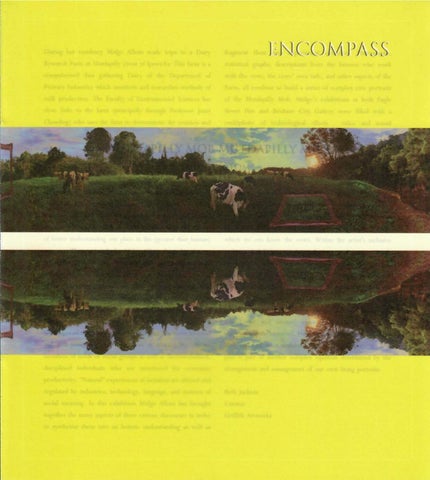
ENCOMPASS received assistance from the Queensland Government through the Arts Office. The artists gratefully acknowledge the assistance of the staff at Griffith Artworks. Cover ima9e: Kate Barnes Panoromo from Riparian Zone 1996 computer manipulated image. Interior ima9es: Kate Barnes Riparian Zone and ,�/ono Culture from Riparion Zone 1996 computer manipulated images; Midge Allom Mutdapilly Champions 1997 computer manipulated image.
v
MIDGEALLOM
KATE BARNES 7 Jtm,
RESIDENCY
22 Apr
R1PAR1AN ZONE
14 - 28 Aug, 1996
1996
Installation, Environmental Sciences I level 1, Nathan campus. 30 Aug - 26 Sept, 1996
Eagle Street Pier, Brisbane City.
27 Sept - 25 Oct, 1996
MUTDAPILLY MOB
26 Jun - 27 Jui, 1997
Brisbane City Gallery, King George Square, Brisbane City. The Brisbane City Gallery is operated under a management
Eagle Street Pier, Brisbane City. Panorama
Oct, 1 996
MUTDAPILLY MOB: BANG TAIL MUSTER
Installation, Northern Path, Nathan campus bushland.
RIPARIAN ZONE
I 9 Aug - 11
RESIDENCY
from Riparian Zone 1996 computer manipulated image.
Environmental Sciences I level 1, Natl,an campus.
agreement between the Queensland College of Art, Griffith University and the Brisbane City Gallery. Technical design production by Greg Evans.
World Wide Web Site
Macintosh design production by Rowan Alexis.
URL: http://w"\\w.gu.edu.au/�vis/.braw /encompas.s/titlea.htrnl
Sound design production by Leigh Wayper.
Kate Barnes would like to acknowledge the following people for their invaluable expertise, advice, and support in the production of this body of work: Dr Thorsten Mosisch, Chris MarshaLI, Hamish McKic, Adam Wolter, Greg Wade, Graham Kirkpatrick, and Marlene Hall.
Midge Allom would like to acknowledge and thank: Mutdapilly DPI Research Station particularly John An.sell; the Faculty of Envi1·onmental Sciences particularly Assoc Prof Janet ChaseDng, Don Kerr, and Glen Scarffe; Queensland Dairy Authority; Baral Building Services; AB's Honey; Holy Cross Lauudry; Fleming Produce Pty
�
ii."a • • CCISR
Ltd; Homcleigh House; and the dairy farmers of the Brisbane Valley for their hospitality and generosity.
ODA � �
QUEENSLAND 0 A I R Y _UTHORITY
QUEENSLAND GOVERNMENT
Griffith Artworks, Griffith University, Nathan, Q 41I l Telephone: (07) 3875 7414 Facsimile: (07) 3875 7932 Email: Artworks@gu.edu.au
URL: http://www.gu.edu.au/gwis/gaw/welcome.html
Catalogue design: Susi Blackwell ISBN O 86857 879 7
�.--..
DPI
C-1101Hd!·1d·I
During her residency,
Kate
Barnes
accompanied field
macro environmental awareness. Kate Barnes' other works
researchers to the catchment area of the Mary Ri\'er (in the
include computer manipulated images of the landscape. The
Connondale Ranges), wherl' l'nvironmcntal scientists arc
large panorama, featured on the cover, moves from natural
researching strategics for the rehabilitation of stream-beds
bushland to pastoral landscape. What was once the pinnacle
and tl1e causes for their degradation, chief among "-I-Lich arc
of the picturesque, the pastoral landscape is hen: seen as a
deforestation, unrcsti-icted cattle access, and the dumping of
degraded site. In contrast to conventional photography or
waste. The small catchment streams which feed the river
landscape painting, the computer manipulations "embed" the
RIPARIAN ZONE KATE BARNES system proper create what scien!;ists ha,·e called a Riparian
viewer within the images, acting as a constant reminder that
Zone. This zone, where the aquatic and terrestrial con\'erge,
we are never neutral or impartial observers. In this way tJ1e
is an area ,ich in bio-divcrsity and nutril'nts and crucial to
artworks themselves inhabit a Riparian Zo,w between us and
the health of the sunounding environments. In the works of
the environment, connecting us to the landscape, filtering
art produced during her residency, Kate Barnes represented
and feeding our perceptions. The smaller, intense images
the Riparian Zone, creating a visual symbology for cco·
resemble boLl1 aerial maps taken from vast distances, and
awareness and exploring the wider metaphoric resonances
also detailed close-ups of forest textures. They feature the
which the Riparian Zone has for understanding and seeing
image of .i dragonfly. The dragonfly is a creature which has
the world. The forest canopy is central and l'Ssential Lo the
evolved to inhabit the Riparian Zone. It is a creature of great
Riparian Zone. It reduces water temperatures and the
flexibility, inhabiting both water (as a nymph) and land (as
amount of sunlight striking the water, critically ljmiting the
an adult). Kate Barnes' use of the dragonfly may be seen to
growth of algae and other aquatic plants. Leaf litter from the
symbolise human capacities for flexibility and adaptation, for
canopy provides essential nutrients, while fallen logs and
the ability to specialise and yet to remain unbordcred. Kate
branches create natural "debris dams" • important habitats
Barnes' works awaken us to the significance of the Riparian
for fish and invertebrates. Kate Barnes created "Artificial
Zone which 1:xists in catchment streams and is so crucial to
Canopies" which melded with the actual forest ceilings,
our on-going understanding of and relationship with the
along the Nortl1 Path of the bushland at the uni,·ersity's
Australian landscape. She also awaken� us to the possibility
•
Nathan campus. These canopies can be read metaphorically
of many other Riparian Zones which may exist in our lives.
as representing protective filtering shelters in society which nurture healtJ1 and dis-ersity in the stream bed of human
Beth Jackson
relations.
Curator
Mirror
domes
captured
reflections
of
the
surroundings, creating micro webs of connectedness and a
Griffith Artworks