



STUDENT RESEARCH JOURNAL EDITION 6, 2025

Our main inspiration for this cover is the fundamental role of curiosity within research, an idea that undoubtedly will be proven to you again and again throughout the pages of this journal. The centrepiece of the cover is Earth, which, beyond a not-so-subtle nod to our school slogan, 'Watch Us Change the World' pays tribute to just how broad and impactful our curiosity in research can be for the world. We also chose to represent the nature of curiosity through incorporating imagery of a classic investigative corkboard, complete with multicoloured panels and chaotic strings connecting them together, alluding to how research often feels like playing a detective solving an impossible case.
Collaborating on this cover also gave us an even deeper insight into the themes we aimed to represent. We each made our own drafts, and unexpectedly, found that we each had similar interpretations of this year's edition! To create the final cover, Chloe designed the background while Tara drew the girls in the foreground. Anna, the creator of last year’s cover, guided us through this process.
Discussing and artistically representing amazing ideas from the rest of the editorial team and all other contributors really displayed the importance of having a place for students like us to share our curiosity, which is Perspective at its very core.
We really hope this cover enhances your experience and understanding of our purpose as a team, as students, but most importantly, as researchers.
TARA AND CHLOE



The sixth edition of Perspective is now ready to share with readers, and the authors and editorial team join with me in hoping you enjoy the articles within. There is much to celebrate with this edition as it marks our biggest collection of student research thus far with almost fifty articles, poems and artworks encapsulating the diverse perspectives our students.
The collection comes from studies completed in the 2025 academic year. Many of these are class assignments, especially the pinnacle work completed by students sitting the Higher School Certificate in History, Science and Society and Culture. These papers represent over a year of dedicated scholarship where foundational skills of setting and answering a research question are developed. We also share with you student-directed research from many younger students who have created projects for the Sokratis Research Program, to enter competitions, for the College’s student-run Artificial Intelligence conference and, most excitingly, stemming from their own interests. Research for no other reason than ‘just because’; just because it is interesting and just because it matters.
Abraham Lincoln said, ‘the best way to predict the future is to create it’. I believe the students whose work is represented here are taking strong steps to not only create their own future, but our global futures. They are asking questions and experimenting with a range of approaches to consider how they’ll investigate the topic. Our young authors are also using the written word to begin designing the next steps as they encourage others to be more aware of both the issue and what can be done. They are creatively researching, thinking, writing and sharing futures about which they care deeply.

The sixth edition marks an exciting period of growth from the first edition of Perspective in 2021. It is incredible to think that the twelve Year 12 students who contributed to that first edition are now mostly in the workplace – in a range of careers – or are finishing double degrees and postgraduate studies. Where will the authors of this edition be in five years’ time? We wish them the very best as they hone their research skills and prepare for a new school year or the first year beyond school.
A very talented and committed group of students deserve credit for bringing this edition to life. Lead Student Editor, Jenny Xu (Year 11 2025), has inspired her team to collaborate on the theme, design and editorial principles of the edition. A special mention goes to our Lead Student Designer, Anna Le (Year 11 2025) with Chloe Wang (Year 10 2025) and Tara Sproules-Nath (Year 10 2025) who designed the eyecatching cover. Leahara Wijesuriya (Year 9 2025) served as our Logistics Lead and Imogen Kee (Year 10 2025) as Promotions Lead. We were also supported by a team who conducted interviews with some of the authors to gain insights into the research process. You can read these reflections between some of the articles. Thank you to Swapna Baggam (Year 11 2025), Kitty He (Year 11 2025), Imogen Kee (Year 10 2025), Hakone Liceralde (Year 10 2025) and Alice Mao (Year 11 2025) for initiating this work.
The entire editorial committee have worked hard to read each paper and follow up to ensure publication readiness. This can be a complex task and they have brought the College values of Care, Courage, Integrity, Respect and Responsibility to every element of the publication process. We would not have an edition to celebrate without the efforts of the following student

editors, including those already mentioned above: Emelia Caulfield (Year 11 2025), Katelyn Hsu (Year 7 2025), Jemma (Year 10 2025 ), Isis Li (Year 10 2025), Isabelle Port (Year 10 2025), Sophia Sayegh (Year 7 2025), Emily Tse (Year 11 2025), Lucy Xie (Year 11 2025) and Jocelyn Ying (Year 11 2025).
Thanks also go to the Pymble Ladies’ College Community Engagement team for their support in making the journal a reality, especially the talented graphic designers and editors, Mrs Rachel Fairbairn and Mrs Catherine Cottrell, who turn Word documents into publications! The entire student committee joins with me in extending sincere gratitude to my assistant, Mrs Emma Coupland, who manages the meeting schedules, agendas and the exacting process of collecting permissions to publish. It is always a pleasure to work with fellow Pymble staff on such a worthwhile endeavour as Perspective.
Congratulations to all the authors, editors and designers for their dedication and perseverance and well done on our sixth edition!
DR SARAH LOCH DIRECTOR – PYMBLE INSTITUTE
What is a perspective? Some might say that it’s a particular way of considering something. Others might suggest that it’s a lens through which we understand the world, or the ability to view things in relation to one another. Of course, the editorial team would tell you that it’s the name of Pymble’s research journal.
Perspective is a student publication that collates the passion projects and major works submitted by students from across the College. Led by the wonderful Dr Loch, the editorial team has spent the last year reading and refining the collection of work you see before you today.
Until a few months ago, I had never contemplated why Perspective had been chosen as the title for Pymble’s research journal. When I was first introduced to the journal in Year 8, I had never even dared to consider my submissions as ‘perspective’. The word seemed to connote legitimacy, depth and value–characteristics that seemed so far out of reach for a student in Middle School.
My curiosity about the origins of Perspective came up during a recent conversation with Dr Loch. As we sat on a bench opposite the Jacaranda Cafe, Dr Loch spoke about how she had chosen the journal’s name due to its connection to student voice. She had realised that the same sense of responsibility and legitimacy that I feared so much as a writer and a young woman was important and necessary, and had created Perspective to encourage students to share their passions with the wider community. Inspired by the multitude of perspectives in this
year’s edition, our theme, "Why Research?" draws on the intellectual curiosity that compels students to seek out new ways of seeing the world. So, we wanted to hear directly from the Perspective team about what has sparked their interest and how they have fuelled their curiosity.
I think a good way to build a strong foundation for curiosity is, where possible, to look at phenomena close to your life. My general curiosity towards rising academic standards was supported by my observations about how friends around me were experiencing stress. This made the topic seem much more approachable for my Personal Interest Project.
Alice Mao (Researcher and Editor, Society and Culture)
My interest in iconoclasm came from the Big History course, when I was doing deep dives into the changes made to the Smithsonian. I think that it’s very important to understand the construction of history to understand history itself, because you need to know who is making it, who is promoting it and what parts have been left out.
Christiana Soo (Researcher, History and Politics)
Reading submissions has shown me how many different ways there are to approach a single problem. It has made me a more open-minded researcher, which is a meaningful quality because it allows me to appreciate others' creativity more.
Kitty He (Editor for GBE, History and Politics)

Despite the variety of passions and topic areas encompassed by this year’s edition, one thing remains in common across all submissions. Every student who contributes to Perspective is driven by a sense of curiosity–a desire to ask why and how Perspective exists because of every student’s desire to explore those questions, and to take on the challenge of exploring unfamiliar complex or uncomfortable ideas.
And there is no one better to guide us through this process than Dr Loch. The editorial team would like to extend our utmost thanks to Dr Loch for her mentorship and guidance, and for the way that she has welcomed each and every one of us into the Perspective community. Dr Loch is truly the heart of research at Pymble. In a world where research can often be perceived as exclusive and daunting, she has created an environment that makes it so much easier for us to exercise intellectual curiosity and courage–whether that be submitting a piece of work, contributing an idea or leading an editorial team.
We would also like to thank all of the students who have contributed to the magazine, as well as the editors for each section.
• Literature and the Arts
Hakone Liceralde (Year 10 2025)
Sophia Sayegh (Year 7 2025)
Helena Tang (Year 11 2025)
• Philosophy and Ethics
Jemma (Year 10 2025)
Emelia Caulfield (Year 11 2025)
Lucy Xie (Year 11 2025)
• History and Politics
Kitty He (Year 11 2025)
Imogen Kee (Year 10 2025)
Isis Li (Year 10 2025)
• Geography, Business and Economics
Kitty He (Year 11 2025)
Chloe Wang (Year 10 2025)
Swapna Baggam (Year 11 2025)
Jocelyn Ying (Year 11 2025)
• Science, Engineering and Maths
Alice Mao (Year 11 2025)
Jocelyn Ying (Year 11 2025)
• Technology
Sophia Sayegh (Year 7 2025)
Emily Tse (Year 11 2025)
Aryana Dinesh (Year 7 2025)
Aarna Ashwin (Year 7 2025)
Katelyn Hsu (Year 7 2025)
Tara Sproules-Nath (Year 10 2025)
Lastly, we would like to thank our readers for your interest in the research of Pymble students. We hope that this edition brings you new ideas, new discoveries and new perspectives.
Cheers,
JENNY XU AND THE PERSPECTIVE EDITORIAL TEAM
In this Q&A, students share their passion for research, drawing inspiration from personal experiences and unique interests. From exploring history to diving into AI, their stories reveal what drives their research journeys. They also offer helpful tips and insights into the challenges they faced, making this article a great resource for anyone starting their own research.
ALICE ZHANG-KIM, YEAR 10
INTERVIEWED BY KITTY HE YEAR 11
What tips would you give other researchers?
I definitely encourage everyone to read the news and keep up with the latest developments in the world — most of my ideas and research come from there. Getting into the habit of reading and analysing academic articles from scholars is also useful for research. Always include a few book sources — if the topic is extremely niche, find something in the State Library or ask for other primary resources. Pick something you’re passionate about writing! Whether that be related to you, people you care about or a topic you enjoy.
LAUREN KORENBLYUM, YEAR 12
Why are you passionate about research?
I find that research gives me the greatest academic autonomy that I've ever experienced. There's an endless world of possibilities it opens up, and particularly when conducting your own study or thesis, you can find so many rabbit holes and come to nuanced and exciting conclusions. There have been so many times when, in the middle of a research task I'm completing, I've found articles or evidence that has not only enriched, but even contradicted my entire view on the topic.
What was your inspiration for your work?
In 2024, I had the opportunity to travel to Japan on a study tour surrounding military history. While there, I visited many sites including the Yasukuni Shrine in Tokyo, where I learned about its controversial commemoration of Japanese victims alongside war criminals, and its uncertain status as a lingering symbol for imperial Japan. Fuelled in further conversations that I had with Japanese students and hearing of their minimal knowledge surrounding WWII, I was inspired to engage with the Shrine as the focus of my History Extension Major Work. I found it shocking that history could be conflated by a supposedly positive and emotive public space, and wanted to examine the impact of broader commemoration on the historical narratives propagated by nations towards their citizens.
What process did you go through to produce your work?
To produce my work, I engaged in many months of researching, drafting, and re-drafting. I initially went through many sources, papers and articles to form my argument and perspective. Once doing this, I grouped them into different sections to make my paragraphs and planned out a dot-point stream of connected ideas that I wanted to form each argument. From here, I took on a slow, highly scrutinised progression of writing my essay, reading what I'd completed every few sentences to ensure that I was cohesive and linking to my overall judgement. Once finishing my first draft, I submitted many versions to my teacher and kept on editing accordingly up to the submission date. I also gave myself a few weeks to perfect my footnotes and bibliography, meeting with a librarian to make sure that everything was cited correctly.
What challenges did you encounter?
While writing my essay, I kept on encountering research and new evidence that often deviated from my initial path, yet changed my own perspective on my argument. It was challenging to continue adapting my judgement as I went, but I found that reevaluating my paragraph prior to the new information, and ensuring that I was still on the same track, allowed me to iron out any inconsistencies. I also found the footnoting difficult to perfect, as I would often get tangled in a web of blocked sites or unavailable information to document exact page numbers or the original source. Meeting with my allocated librarian was helpful to track down these missing details and certify consistency in my references.
I find that research gives me the greatest academic autonomy that I've ever experienced. There's an endless world of possibilities it opens up ... LAUREN KORENBLYUM
What tips would you give other researchers?
I would encourage other researchers to embrace the unknown and often lack of certainty that arrives with research–had I not been willing to budge from my initial understanding of my topic, even when already half-way through my essay, I would've had a far less nuanced outcome. I also suggest footnoting and referencing as you write–it is hard to track down the exact sources or references if doing it afterwards, and even though it seems unimportant, accuracy in citations is really important! Maintaining academic integrity and avoiding plagiarism is central to research, and acknowledging exactly where your information came from ensures that research can be an open and continually developing field.
Why are you passionate about research?
I am very passionate about my research because seeing children being abused by teachers and care givers under the guise that it was to help or to mould the student into a good and obedient person, frustrates me so much and I am appalled at how it was allowed for so long.
What challenges did you encounter?
There wasn't a lot of research conducted to provide solid evidence on how the abuse affected the students.
What tips would you give other researchers?
Give yourself a long timeframe to complete your work. Do not leave it till the last second!!
What was your inspiration for your work?
My decision to research the Emu War was because it is one of the most unusual yet revealing episodes in Australian history. At first, I was drawn to its absurd reputation, having discovered it through one of my favourite historical YouTube channels, ‘Oversimplified’. But through research, I discovered its significance as a case study of government failure in responding to rural crises. My research process combined primary sources, such as newspaper reports and letters, with secondary sources from historians and ecologists. This allowed me to balance the satirical accounts with evidence of the real struggles faced by the soldier-settler farmers. From this investigation, I learned how a seemingly comedic conflict had the potential to reflect deeper issues of poor governance, misuse of military power, and the complexities of resolving conflict.
I
think just go for it! Your topic doesn't have to be life-changing or super dramatic, just something you want to look at.
ALICE
MAO
What was your inspiration for your work?
I was compelled to research this topic based on observations from my own life. Through interacting with people of multiple generations, I've often felt that academic pressure has notably increased. Based on my experiences as a tutor, I've also noticed that children of younger ages are being pushed towards learning pathways and academic growth. I simply wanted to confirm this trend and pry into the reasoning behind it.
What challenges did you encounter?
Finding sources was a massive challenge in this project. It was unexpectedly difficult to find relevant research into academic pressure for this generation, and the sources were even sparser for earlier generations. Given the Australian focus of my work, the range of information on the internet was narrowed further. Rather than finding quotes that directly discussed a point I was attempting to make, I was forced to branched off into tangential topics such as university enrolment and search for implications. This made me consider this area of research as a potential future pathway–I believe it is an important topic that deserves a larger corpus of work.
What tips would you give other researchers?
I think just go for it! Your topic doesn't have to be lifechanging or super dramatic, just something you want to look at.
Why are you passionate about research?
I love using research as a way to learn about how the world around us works. I'm always super interested in asking "how" and "why", even to simple questions, like "how do we learn?" and "why do we learn in the way that we do?"
What was the inspiration for your work?
I initially participated in the Australian Brain Bee where I got interested in neuroscience and got a base understanding of the topic. I combined it with my passions for helping others and my love for learning and came up with this topic!
What process did you go through to produce your work? I produced my work with the support of the Pymble Talent Development Program.
What challenges did you encounter?
I had to learn about the format, structure and conventions of a policy brief, a presentation style that I was not previously familiar with.
What tips would you give other researchers?
Research what you love and pursue your passions! There's no point in choosing a topic that drains you to learn about. Instead, consider what you're most interested in learning about and devote your energy to that!
HAKONE LICERALDE, YEAR 10
I like to think of myself as someone who tries to keep an open mind and stay curious about the world. After school, I hope to do something related to law or journalism, mainly because I love reading, writing and debating, and I’ve always been fascinated by how stories can help us understand people and the world. Something not many people know about me is that I have a deep appreciation for classic cinema, particularly the films of Frank Capra and Alfred Hitchcock. In many ways, engaging with these films mirrors the research process: one observes meticulously, deciphers underlying societal commentary, and draws connections that are not immediately apparent. I think that kind of curiosity and observation is surprisingly akin to the research process, and this lifelong pondering is something I hope to continue cultivating.
Why are you passionate about research?
I’m passionate about research because it’s the closest I can get to time-travel without leaving my desk. There’s something exhilarating about peeling back layers of a question, finding connections others might overlook, and turning abstract curiosity into something tangible. Research isn’t just about answers but about seeing the world in a way that demands both rigour and imagination.
What was your inspiration for your work?
I’ve always been drawn to the weird spaces where law meets espionage. It’s fascinating how invisible rules and secret strategies can shape whole industries. And
honestly, who wouldn’t be intrigued by Nolan’s corporate espionage blockbuster Inception? It's one of my favourite films where cinematic thrill meets real-world stakes. I wanted to explore that same tension in reality, diving into economic espionage and the legal and ethical puzzles behind it. And it turns out, it’s as captivating as any movie plot. Ultimately, my aim was to probe not merely the actions themselves, but the underlying structural and normative frameworks that delineate what is deemed lawful, ethical, or socially permissible within these spheres.
What challenges did you encounter?
The biggest challenge was sifting through mountains of legal and economic data while keeping the narrative human and ethical. Balancing technical accuracy with readability was tricky, as was resisting the urge to get lost in the fascinating minutiae of every spy case study.
I’m passionate about research because it’s the closest I can get to time-travel without leaving my desk.
HAKONE LICERALDE
What tips would you give other researchers?
When you first approach research, it can feel like standing in a room filled with hundreds of sealed envelopes, each containing a secret you’re desperate to know, but with no clue which one to open first. The possibilities are vast, thrilling and terrifying all at once. The responsibility feels immense, almost suffocating at first. Whenever I feel this way, I remind myself of the words of Wernher von Braun, “research is what I'm doing when I don't know what I'm doing.” At first glance, it seems counterintuitive. How could ignorance be the cornerstone of discovery? But that is exactly the beauty of it. Research is not about knowing the path in advance; it is about daring to step into the unknown and trusting that your curiosity will illuminate the way. The process is profoundly human because it demands patience, resilience, and, above all,
courage. It stretches the mind, but it also stretches the heart, because research also demands honesty, curiosity and imagination in equal measure. Perhaps that is its most exciting paradox: the more you feel you don’t know, the closer you are to discovering something extraordinary. And sometimes, the bravest act you can commit is simply to begin.
What drew you personally to the topic of economic espionage, and why did you feel it was important to write about?
I was drawn to the topic of economic espionage because it reveals how power, ethics, and legality interact in contemporary society. We like to imagine markets as polite, rule-bound spaces run by rational adults, yet economic espionage exposes how often competition depends on information asymmetry. Part of what first pulled me in was my admittedly geeky affection for John le Carre’s novels. I’m fascinated by le Carre’s representations because, unlike traditional film and literary portrayals, they offer a less romanticised, more ethically complex, and ultimately more realistic vision of espionage. Writing about this topic felt important because it forces us to confront an uncomfortable reality: that modern prosperity isn’t always shaped by innovation, but by who controls knowledge, and the lengths to which corporate entities will go to acquire and protect it.
Was there a particular case study or real-world event that made economic espionage feel especially relevant or urgent to you?
Yes. The contrast between U.S. v. Chung and U.S. v. Lee made the issue feel especially urgent. In both cases, sensitive technology ended up benefitting China’s industrial and strategic interests, yet only U.S. v Chung resulted in a conviction under the foreign espionage provisions, under the reasoning that subsidies (China’s 863 Program) did not meet the statute’s requirement of intent. That inconsistency showed me how limited the law can be when intent is difficult to prove. Writing about this issue felt important because trade secret theft is not merely a corporate issue. It affects national security, technological progress, and trust between states. I wanted to explore how something that looks abstract and technical has very real consequences for people and for democratic institutions.
How do you feel undertaking research to produce this piece challenged your own existing perspective and assumptions? What did you learn?
Undertaking research for this piece upended my assumptions on legal frameworks for espionage. As the idealistic, somewhat naïve aspiring lawyer I am, I went in thinking laws were the ultimate solution to
ethical problems, like a perfectly calibrated thermostat keeping human behaviour in check. However, the truth is, information moves faster than legislation can respond, ethical boundaries sadly bend under pressure, and wrongdoing often looks astonishingly ordinary until its consequences unfold. As Will Harvey says, “What is research but a blind date with knowledge?” and I can attest that this blind date was full of surprises. Most times research reveals uncomfortable truths you’re not always prepared for. I learned that the law can constrain behaviour, but understanding, discernment, and responsibility are what shape the world we actually live in.
Ultimately, what question do you most want readers to leave the piece still thinking about?
I want readers to keep thinking about where responsibility should really sit. Should the burden be on individuals, corporations, or states to protect information and act ethically? And what if the knowledge is stolen, but it is used to address a pressing global challenge-say, a pharmaceutical company acquiring research that could save millions of lives? Does the potential benefit justify the wrong doing, or does the act of theft itself carry an unavoidable moral cost? The question I want readers to wrestle with is how we weigh ethical compromise against practical gain, and whether society is willing to accept success built on shortcuts that violate trust and integrity.
Most times research reveals uncomfortable truths you’re not always prepared for.
HAKONE LICERALDE
Why do you think research is valuable to you? What do you feel is most enjoyable about it?
Research is valuable to me because it teaches me how to think. How, not what. It trains me to question first impressions and sit with complexity instead of avoiding it. What I find most rewarding is the sense of quiet confidence research gives me. When you research, you’re no longer repeating opinions, but building your own understanding. There is something deeply satisfying about that process. It’s the same satisfying feeling I get when I update my glasses prescription and suddenly everything is crisp-my poor parents’ wallets, unfortunately, see this satisfaction quite often. Ultimately, research is valuable to me because it turns every question into a journey, and the most enjoyable part is exploring the world with my own
eyes, along with my mentors, charting paths that no one else has quite walked before and that’s a very rewarding feeling.
INTERVIEWED BY ALICE MAO Y11
What inspired you to choose an experimental process over data analysis?
In short, I'd picked first hand experimentation as my source of data to analyse due to a scarcity of currently accessible data and documented research into the nuances of the magnetocaloric effect relevant to my topic. Additionally, I took inspiration for my experimental setup and methods from previous scientists' experiments (e.g. Zimm et al., 1998 as documented in the reference list), scaled down their components to make sure the equipment and resources were attainable, and changed factors such as the environment of the experiment in order to derive data that I could analyse for my report.
What were some major changes (if any) you had to make to your method, and how did you manage this? There was one somewhat major change to my method which occurred later in the project, which was an extension of slightly changing my research question. Initially my question was about the relationship between field strength and the magnetocaloric effect's efficiency, however the report suggested findings that mirrored some existing conclusions, so I decided my research question would become investigating thermal noise's effect. Changes to the method as a result of this included removing the thermal isolation of the setup initially planned (taking away the aircon and a container to try maintain a desired temperature) and removing some distance intervals (i.e. 5cm, 7cm, and 9cm) in order to better tailor the data for analysing this topic.
Do you intend to pursue this topic into higher education, and if so, what direction do you think you’ll take it in?
I do intend to pursue this topic further as there are still many aspects of the magnetocaloric effect yet to be investigated prior to household implementation, and I hope to be at the forefront of relevant research and discoveries. I'm currently set to be studying quantum engineering, so the pathway from my research project would likely stem from magnetism, as a fundamentally quantum concept, I believe furthering research could uncover and harness the physics behind phenomena like the magnetocaloric effect. Such discoveries can lead to potential environmentally friendly solutions that also improve resource management in technology as magnetism is naturally occurring.
How likely is it that barriers (such as the cost of sourcing powerful magnets and the environmental thermal noise detailed in your report) will be overcome to make this refrigeration commercially viable?
In order for magnetic cooling to be commercially viable, there are several factors to take into consideration, but I do think many of these issues have solutions. The main barrier will likely be economic factors, given that the materials, design and components of a homeworthy magnetocaloric fridge all have a cost. Minerals like pure Gd aren't plentiful enough for industrial use, however there are a number of documented experiments that synthesise compounds out of more accessible elements, such as iron, lanthanum and silicon alloys. The mechanism to remove and replace the magnetocaloric material into the magnetic field additionally needs to be energy efficient or the environmental impact won't be minimised, and other issues such as how the mechanism sits in the fridge with the space that a commercial refrigerator is expected to have. These barriers are more focused on the design and engineering of the fridge, which are still major aspects of commercial release, but I think they are more likely to be overcome in the near future.
In order for magnetic cooling to be commercially viable, there are several factors to take into consideration, but I do think many of these issues have solutions.
SAMANTHA HE
What have you gained from this research project that you would like to share with younger aspiring scientists?
I definitely gained a grand amount of experience into scientific research (and a love for Excel's data analysis package), and even then, these projects are more of a window into a larger world of science and data analysis that I can now step into with more confidence. It might feel a little tedious looking into the numbers and tables but visualising it and deriving a conclusion that no one has sought yet, puts you up among the world's scientists already. It's an investment, but one well worth the time and effort.
INTERVIEWED BY SWAPNA BAGGAM, YEAR 11
What initially drew you to the Communist Party Case as a subject, and why do you think it still resonates today?
Out of all the categories for the National History Challenge, I knew immediately that I wanted to do Democracy; however, narrowing down a specific area was difficult as there were so many avenues I wanted to explore. I started out by researching events which best represented the theme of Conflict and Resolution in Australian politics, then I wrote down a list of the ones I found more interesting and did a deeper dive on each one to finalise my decision. In the end, I chose the Communist Party Case because I thought it demonstrated the role of law in politics exceptionally well. I was specifically interested in how law resolved the conflict back then, and whether it could possibly present a new solution to issues arising today, especially as the political climate during the case very much mirrors a lot of our current global issues.
You have undertaken a very research intensive study of this topic. Was there a particular quotation or source that most shaped the direction of your piece?
‘Why should not Communists, who are traitors to Australia, be required to answer the charge that they are Communists and to prove their innocence, if possible?'
(Senator George Rankin, Senate Hansard, 20 June 1950, 4539.) This quote (although I did not include it in my essay) was what inspired the main idea behind my argument. Within this question, there is an unspoken assumption from the senator that the ideology of the person, not their actions, is a crime. This attack on political freedom is from the government themselves. However, because the government is elected by the people, therein lies the glaring flaw of democracy: if the people want certain outcomes, then governments will make certain decisions. Democracy is only good when the people in it are good. This ultimately led to the creation of my thesis and thus guided the direction of my research towards the constitution and the High Court.
While researching, did you find yourself sympathising more with Parliament’s fear of subversion or the High Court’s defence of constitutional limits?
I definitely agreed more with the High Court’s position, although I am perhaps aided by hindsight and a more liberal outlook. I think that there are certain lines you cannot cross in an open democracy and political freedom is one of them. At the same time, I do understand why Parliament made the Act and why they felt the need to protect their citizens from this assumed danger, as a new, uncertain world order would have provoked a lot of anxiety and fear, especially after WWII.
What do you hope modern readers take away from revisiting a case decided more than seventy years ago?
My main wish is that people learn to think more critically about things. Nothing is so simple as a binary black-andwhite conflict, and the real world has a lot more nuance than the media and fiction would like to lend it. I’ve seen a lot of rhetoric (especially on social media) reducing world events to a good side vs. a bad side, and while it is true that one side typically tends to be more flawed, it is also important to consider that we do make a difference to these narratives. How does this affect my emotions and biases? What should I do with this information? These are questions we must ask ourselves going forward.
Why do you think research is valuable to you? What do you feel is most enjoyable about it?
This may sound strange, but I love collecting and accumulating information. I explored a huge range of sources for this, such as legal documents, academic journals, and even transcripts of parliamentary debates, which the librarians at the State Library helped me find; collecting knowledge allows me to see patterns and think objectively about complex issues which is incredibly useful for thinking critically. At the same time, I get a sense of purpose from applying research to real-world problems – understanding history or law is not just about knowing facts, but about using that knowledge to understand how decisions and ideas shape the world. Research is just so valuable in and of itself because of this process.
How did your engagement with differing academic sources and research shift or underpin your understanding of Democracy in Australia over time? I used a variety of different sources to gain better insight into the nuance of this topic. Reading books and academic journals offered historical and theoretical context, showing how ideas like civil liberties have developed over time. Legal documents and Hansard helped me conceptualise these ideas into a tangible effect, as I was able to see how the government and courts operated, and how laws like the Communist Party Dissolution Act were debated and justified. Newspapers, podcasts, and websites shed light on public opinion and the ways media is/was used to shape public perception. Working through all these really shows how fragile democracy is, and how susceptible it can be to just about anything, which is why history as a whole is crucial to our future.
LUCY JACKSON, YEAR 12
This essay was written for Year 12 Extension History
History has no inherent direction due to its lack of an endpoint and contingent nature. Historians have conflicting views regarding this notion and have thus produced compelling historiography, both in support of the idea that history has an inherent direction, and against it. The 19th Century German philosopher Georg Wilhelm Friedrich Hegel was highly influential in fuelling theories of teleology in history. His theory of the progress of the consciousness of freedom argues that the direction of history follows a path of progressive cognitive abilities, freedom, and awareness, and thus has an endpoint when full consciousness of freedom is achieved. Hegel’s theory is flawed by its narrow, ethnocentric approach and its disregard for contingency. Similarly, 20th Century American historian Francis Fukuyama’s prominent thesis The Endpoint of History–influenced by his experience of the ideological conflicts surrounding the Cold War–argued that history is the conflict between ideologies, and could therefore reach an endpoint if this conflict ceased to exist. The arguments of the French 20th Century philosopher Raymond Aron indirectly challenges those of Fukuyama, rightly critiquing the idea of a static society. Furthermore, the Whiggish interpretation, in which history is viewed–through the lens of the present –as innately moving in the direction of progress, is convincingly disputed by Herbert Butterfield. The varying ways these individuals construct and present history reflect their underlying views on the nature of history and are frequently shaped by the context in which they lived. Despite different existing interpretations, the lack of an inherent direction to history remains a historical truth.
An influential determinist view of history is centred around the idea that history’s inherent direction is towards increased levels of consciousness and freedom until full freedom is ultimately achieved. Hegel (1770-1831), a German, idealist philosopher, and historian, had a highly structured and purpose-driven view of the direction of human consciousness within history. Having lived in the wake of the Enlightenment, Hegel’s view was informed by the heavy focus on reason and progress. Additionally, he was significantly informed by philosopher Immanuel Kant’s view of historical development.1 Hegel’s historiography
promoted the view that history has an ending and an inherent purpose, and is a rational, designed process driven by dialectical ideas. Hegel’s ‘Introduction to the Philosophy of History’ (1837) claims that “World history is the progress in the consciousness of freedom—a progress that we must come to know in its necessity”. It traces this supposed progress by focusing on historical milestones and ending with his own theory as the culmination of historical progress.2 Contemporary Australian philosopher Peter Singer outlines this theory of the pre-determined, teleological ‘Progress of the Consciousness of Freedom’ in his book ‘Hegel: A Very Short Introduction’ (2001). This begins with the notion that the Persian Empire is where “true history begins” as their rule was based on “an intellectual or spiritual principle”, marking the beginning of the “growth of consciousness of freedom”.3 With the Greek victory over the Persians at Salamis, “the tide of world history passed … to the world of the Greek city-states”.4 Hegel argued that, though the Greeks could exercise their free will, they derived their motivations from habit and not from reason.5 Similarly, Hegel argued that the Romans were not completely free due to the outward conformity demanded of them. Hegel writes: “World history is the process by which the uncontrolled natural will is disciplined in the direction of the universal, the direction of subjective freedom. The East knew (and knows) only that One person is free; the Greek and Roman world knew that Some are free; the Germanic world of Europe knows that All are free.” 6 American philosopher Sally Sedgwick, who specialised in German idealism, commended Hegel’s approach to history in 2010 to push back against reductive critiques of his work. She stated that “[Hegel’s] own approach is neither naively empiricist nor excessively rationalist but somehow combines insights of each of these extremes.”7 Thus, Hegel’s theory of history’s progressive nature and its ultimate endpoint provide a coherent argument supporting that history had an inherent direction.
Theories of history that present it as a linear progression toward freedom often integrate the biases of their authors rather than provide an objective examination of global development. This is demonstrated in Whig history, which borrowed many elements from Hegel
and is particularly evident in Hegel’s own philosophy of history, which frames his Germanic world–and his theory–as the culmination of historical progress and freedom. Hegel’s account of history is highly Eurocentric and disregards the complexities of the countries and civilisations that he neglected. For example, he regarded what he referred to as ‘the Oriental World’ as a stationary civilisation, where individuals had no freedom of consciousness.8 Hegel’s theory of history is primarily focused on European culture, politics and traditions and presents Christian-Germanic societies as the epitome of history’s teleological progress.9 Hegel lived during the 18th and 19th centuries, during the height of colonialism, where European dominance was often rationalised as proof of Europe’s superiority as the ‘most advanced’ civilisation.10 These ideas would have been influential in his claims that Africa lay outside of world history, Asia was stagnant, and Europe drove progress. Furthermore, 19th century Danish philosopher Søren Kierkegaard–who lived in Denmark at a time when Hegelianism dominated European philosophy–provided a strong critique of Hegel’s lack of acknowledgment of contingency.11 He disagreed with attempts to apply Hegelian systems to ethics and religion, and as an existentialist focused on individualism, Kierkegaard also challenged Hegel for not accounting for humans as powerful agents in history.12 Kierkegaard argued that, as a ‘backward-looking prophet’, Hegel “failed to grasp” the inherent uncertainty in history as “brought about by freely acting agents choosing among a set of alternative possibilities”.13 In response to Hegel’s teleological, predetermined view of history, Kierkegaard discusses how necessity in history is simply an illusion created by retrospection, while contemporaries see events as contingently as they actually were.14 Thus, the view of history as a linear, teleological progression towards freedom is faulted by its disregard for the role of contingency in history and the partisanship brought by the historian.
Another compelling argument, which emerged in the 20th Century and was inspired by Hegel, supports that history has an inherent direction by claiming that if an ideology emerged that removed ideological conflict, history’s direction would be its actualisation. Francis Fukuyama’s neo-Hegelian theory of ‘the end of history’ proposes that in the aftermath of the Cold War, a static society was emerging in which ideological conflict no longer existed, ostensibly resulting in the end of political development; or as he put it, history.15 Hegel also shaped Marx’s historical materialism–a similarly directional
but material, rather than ideological theory. However, Marx’s non-liberal theory was no longer regarded as legitimate at the end of the Cold War. Fukuyama’s essay, The End of History? (1989) argues that we are witnessing “the end point of mankind’s ideological evolution and the universalisation of Western liberal democracy as the final form of human government”.16 His thesis rests on the notion that there are no major ideological or philosophical issues that cannot be solved by the philosophies of democracy and capitalism. Fukuyama’s reading of Hegel is a Kojevean one, and he outlines the perspective put forward by Kojève–a French 20th century philosopher–that “The Battle of Jena marked the end of history because … the basic principles of the liberal democratic state could not be improved on”.17 Kojève was influenced by his desire “to resurrect … the Hegel who proclaimed history to be at an end”.18 Fukuyama presents two main arguments as to why liberal democracy marked the end of ideological conflict. One of which, as outlined by postmodern historiographer Keith Jenkins, is that the “liberal economic principles of the free market have produced unprecedented levels of prosperity so that, both intellectually and materially, liberal capital is in the ascendency”.19 Additionally, Fukuyama argued that no rival ideologies had survived the 20th century.20 In his essay, Fukuyama puts forward the “two major challenges to liberalism” as fascism and communism, both of which he claims have been defeated; fascism by World War II and communism by the end of the Cold War.21 Thus, Fukuyama argues that history has an inherent direction due to a lack of competing ideologies and the idea that once liberal democracy is actualised in the material world as well as the conscious world, it will be the endpoint of ideological development.22
The arguments presented by Fukuyama in The End of History do not adequately support the idea that history has an inherent direction or endpoint and have been subject to many criticisms. His theory assumes that the elimination of ideological conflict is possible and ignores the role that human nature and agency play in driving history. Twentieth century French political philosopher Raymond Aron presents several arguments in his work The Opium of the Intellectuals (1955) that respond to ideas similar to Fukuyama’s. Aron’s strong rejection of Marxism, which was highly dominant within his surrounding intellectual circles, was influential in his critique of the idea that history has an inherent direction. He saw the Marxist view of history as dangerously dogmatic and as requiring a radical change in human
nature, leading to his criticism of blindly accepting a supposed historical destiny.23 Critiquing the idea of ‘the end of history’, Aron outlines the complexities in human societies and behaviour and emphasises the impossibility of eliminating conflict, which Fukuyama claims liberal democracy will do. Aron acknowledges that as technology advances, higher levels of prosperity, equality and liberty in politics and economics could be achieved but highlights that this would not resolve problems arising from human nature or larger, macrolevel structures of society. Thus, he argues that a ‘static society’, a true endpoint in societal development, is not possible.24 Regarding economics, Aron posits that even if all demands were satisfied, as Fukuyama implies they would be, “it would still be necessary to divide essential work and share equitable incomes which, as regards luxury articles, would still remain unequal.”25 This challenges Fukuyama’s argument about the economic prosperity and elimination of conflict that liberal democracy would achieve. Similarly, Aron outlines how political conflicts cannot be completely resolved: “race hatreds will survive class distinctions. Collectivities will not cease to clash with one another… The desire for power is no less basic than the desire for wealth”.26 Fukuyama fails to account for the threat of other “ideological competitors” to liberal democracy, dismissing forces like religion, nationalism and ethnicity, which have all had considerable impacts on history.27 Additionally, for a ‘static society’ to be achieved, humans would have to overcome their instincts and act solely out of reason. Aron states that we cannot “change the nature of men and societies: the former remain unstable, and the latter hierarchical.”
28 While Aron acknowledges that someone’s upbringing and psychology influence their decisions, he points out that “the decision taken at a given moment was not the necessary effect of training or environment,” thus leaving room for human agency in the process of history. Aron further discusses the impact of uncertainty, claiming that “the margin of uncertainty can be identified as the human capacity to choose, to will and to create.”29 Thus, despite potential progress towards prosperity and equality, a ‘static’ endpoint of history and a lack of ideological conflict is impossible.
Other neo-Hegelian theories positing that history follows a linear trajectory towards progress and liberty have provided similarly influential – yet deeply flawed – ways of understanding the past. This is demonstrated through Whig history which, stemming from the British Whig Party and drawing on Hegel’s philosophy, presents history as an inevitable march toward “liberty, parliamentary rule and religious toleration”.30 While Whig history has been largely dismissed in academia, aspects of its philosophy are implicit in many areas of society, such as school curriculums and politics. Thomas Macaulay, a 19th century politician and historian, played a key role in defining and espousing Whiggism.31 Like Hegel, Macaulay lived during European imperialism which, along with British nationalism and his political roots, led him to glorify his own era and nation. This can be seen in his work History of England from the Accession of James II, in which he states that, “… [Britain’s] opulence and her martial glory grew together … gradually established a public credit fruitful of marvels which to the statesmen of any former age would have seemed incredible.”32 However, the Whig theory of history was compellingly denounced by 20th Century British historian Herbert Butterfield’s essay The Whig Interpretation of History (1931). Butterfield’s critical approach to the Whiggish teleological view of history was influenced by having lived through World War I – an event which dismantled illusions of inevitable progress and reason within civilisation.33 Butterfield argues that “[the Whig interpretation of history] has often been an obstruction to historical understanding because it has been taken to mean the study of the past with direct and perpetual reference to the present”, thus causing historians to “imagine that he has discovered a ‘root’ or an ‘anticipation’ of the 20th Century, when in reality he is in a world of different connotations altogether”.34 This, he states, produces “a scheme of general history which is bound to converge beautifully upon the present,” which subsequently distorts the past and projects onto it a post hoc purpose.35 Ultimately, as argued by Butterfield, “Real historical understanding is not achieved by the subordination of the past to the present, but rather by our making the past our present and attempting to see life with the eyes of another century than our own.” 36
Thus, theories claiming that history follows an underlying direction of progress towards the systems and values of the present provoke misunderstandings of the past and rest on presentist beliefs.
Liberal theories that posit an inherent direction to history, and subsequently the possibility of an endpoint, are erroneous views of history and neglect to take into account the role of individual agency, contingency, and the nature of human societies. Furthermore, any attempt to ‘discover’ the direction of history or to claim its endpoint is predisposed to rest on chronocentrism. Hegel’s theory of the progress of consciousness fails to account for the vast majority of the world, providing only a narrow, ethnocentric view of history and allocating an unfounded superiority to his own time. Additionally, Fukuyama’s ‘End of History’ theory fails to consider the complexities within human behaviour and societies which make a static society impossible as well as the impact that contingent events can have on the course of history. Furthermore, the Whig interpretation of history encourages a distorted and unobjective understanding of the past while also fuelling exaggerated or imagined causation between events in different time periods. As history is intrinsically prone to contingent events and the forces of human agency, the idea that it has an inherent direction and can have an endpoint is untenable.
1 “Georg Wilhelm Friedrich Hegel: Philosophy of History,” OBO, accessed April 17, 2025, https://www.oxfordbibliographies.com/ display/document/obo-9780195396577/obo-9780195396577-0133. xml.
2 G. W. F. Hegel and Leo Rauch, Introduction to the Philosophy of History: With Selections from The Philosophy of Right (Indianapolis: Hackett Publishing Company, Inc, 1998).
3 Peter Singer, Hegel: A Very Short Introduction, Very Short Introductions 49 (Oxford; New York: Oxford University Press, 2001), 67.
4 Singer, 68.
5 Singer, 70.
6 Hegel and Rauch, Introduction to the Philosophy of History, 10.
7 Sally Sedgwick, “Reason and History: Kant versus Hegel,” Proceedings and Addresses of the American Philosophical Association 84, no. 2 (2010): 51.
8 Singer, Hegel, 63–64.
9 Buchwalter Andrew, “Is Hegel’s Philosophy of History Eurocentric?,” in Hegel and History (SUNY Press, 2010), 87, https://www. degruyterbrill.com/document/doi/10.1515/9781438429113-007/ pdf?licenseType=restricted.
10 Alexis Heraclides and Ada Dialla, “Eurocentrism, ‘Civilization’ and the ‘Barbarians,’” in Humanitarian Intervention in the Long Nineteenth Century, Setting the Precedent (Manchester University Press, 2015), 1, https://doi.org/10.2307/j.ctt1mf71b8.7.
11 Robert Stern and Nicholas Walker, “Hegelianism Outside Germany in the Nineteenth Century: France, Northern Europe and Italy,” in Routledge Encyclopedia of Philosophy, 1st ed. (London: Routledge, 2016), https://doi.org/10.4324/9780415249126-DC037-1.
12 Jody Ondich, “Søren Kierkegaard,” April 23, 2018, https://mlpp. pressbooks.pub/introphil/chapter/soren-kirkegaard/.
13 Jonas Hodel, “Hegel as a ‘Backward-Looking Prophet’?: Kierkegaard’s Critique of Hegel’s Philosophy of History,” Hegel Bulletin, November 28, 2024, 1–19, https://doi.org/10.1017/hgl.2024.44.
14 Hodel.
15 Francis Fukuyama, “The End of History? On JSTOR,” 1989, 3–9, https://www.jstor.org/stable/24027184?seq=1.
16 Francis Fukuyama, 4.
17 Francis Fukuyama, 5.
18 Francis Fukuyama, 4.
19 Keith Jenkins, review of Review of The End of History And The Last Man, by Francis Fukuyama, Teaching History, no. 74 (1994): 39.
20 Peter Fritzsche, review of Review of The End of History and the Last Man, by Francis Fukuyama, The American Historical Review 97, no. 3 (1992): 817–19, https://doi.org/10.2307/2164782.
21 Francis Fukuyama, “The End of History? On JSTOR,” 9.
22 Francis Fukuyama, 3–18.
23 Raymond Aron, Memoirs: Fifty Years of Political Reflection (New York: Holmes & Meier, 1990), 214–23, http://archive.org/details/ memoirsfiftyyear00aron.
24 Raymond Aron, The Opium of the Intellectuals, 1955, 149–55.
25 Raymond Aron, 152.
26 Raymond Aron, 154.
27 Allan Bloom et al., “Responses to Fukuyama,” The National Interest, no. 16 (1989): 19–35.
28 Raymond Aron, The Opium of the Intellectuals, 154.
29 Raymond Aron, 163.
30 Adrian Wilson and T. G. Ashplant, “Whig History and PresentCentred History,” The Historical Journal 31, no. 1 (1988): 1–16.
31 “Week 95: The History of England,” Robert Menzies Institute, 95, accessed April 16, 2025, https://www.robertmenziesinstitute.org.au/ book-of-the-week/week-95-the-history-of-england/.
32 “The Whig Interpretation of History,” accessed April 16, 2025, https://www.age-of-the-sage.org/philosophy/history/whig_ interpretation_history.html.
33 “The Whig Interpretation of History.”
34 H Butterfield, “Interpretation of History,” 1931, 11–12.
35 Butterfield, 12.
36 Butterfield, 16.
Age-of-the-Sage. “The Whig Interpretation of History,” n.d. https:// www.age-of-the-sage.org/philosophy/history/whig_interpretation_ history.html.
Andrew, Buchwalter. “Is Hegel’s Philosophy of History Eurocentric?” SUNY Press EBooks, July 2, 2010, 87–110. https://doi. org/10.1515/9781438429113-007.
Aron, Raymond. “Memoirs: Fifty Years of Political Reflection.” Internet Archive. Holmes & Meier Publishers, Inc., 1990. https://archive.org/details/memoirsfiftyyear00aron/page/116/ mode/2up?view=theater&q=dogmatic.
Aron, Raymond. “The Opium of the Intellectuals.” The American Catholic Sociological Review 19, no. 2 (June 1958): 177. https://doi. org/10.2307/3709413.
Bloom, Allan, Pierre Hassner, Gertrude Himmelfarb, Irving Kristol, Daniel Patrick Moynihan, and Stephen Sestanovich. “Responses to Fukuyama.” The National Interest 16, no. 16 (1989): 19–35. https:// www.jstor.org/stable/24027185.
Butterfield, H. The Whig Interpretation of History. 1931. Reprint, Norton Library, 1965. https://www.clarehall.cam.ac.uk/wp-content/ uploads/2022/08/Butterfield_selected.pdf.
C. Behan McCullagh. The Truth of History. Routledge, 2002. Christensen, Chris. “The Trouble with Hegel | Issue 129 | Philosophy Now.” philosophynow.org, 2018. https://philosophynow.org/ issues/129/The_Trouble_with_Hegel.
Čičak, Zoran. “History Repeats Itself: Tragic Past or Absurd Present?” Horizons: Journal of International Relations and Sustainable Development 18, no. 18 (2021): 126–41. https://www.jstor.org/ stable/48614117.
Colen, José, and Elisabeth Dutartre-Michaut. The Companion to Raymond Aron. Springer, 2016.
Duquette, David. “Georg Wilhelm Friedrich Hegel: Philosophy of History.” Oxford Bibliographies, October 30, 2019. 10.1093/ obo/9780195396577-0133.
Evans, Lawrence. “Philosophy Now.” Philosophynow.org, 2018. https:// philosophynow.org/issues/129/Hegel_on_History.
Fox-Williams, Jack. “Hegel’s Understanding of History | Issue 140 | Philosophy Now.” philosophynow.org, 2020. https://philosophynow. org/issues/140/Hegels_Understanding_of_History.
Fritzsche, Peter, and Francis Fukuyama. “The End of History and the Last Man.” The American Historical Review 97, no. 3 (June 1992): 817. https://doi.org/10.2307/2164782.
Fukuyama, Francis. “Reflections on the End of History, Five Years Later.” History and Theory 34, no. 2 (May 1995): 27. https://doi. org/10.2307/2505433.
Fukuyama, Francis. “The End of History?” The National Interest 16, no. 16 (1989): 3–18.
Georg Wilhelm Friedrich Hegel, and Irwin Edman. Hegel: Introduction to the Philosophy of History. 1837. Reprint, Whitefish, Mt: Kessinger Publishing, 2005.
Hegel, G. W. F., H. C. Brockmeyer, and W. T. Harris. “Hegel’s Phenomenology of Spirit.” The Journal of Speculative Philosophy 2, no. 4 (1869): 229–41. https://www.jstor.org/stable/25665666.
Heraclides, Alexis, and Ada Dialla. “Eurocentrism, ‘Civilization’ and the ‘Barbarians.’” JSTOR. Manchester University Press, 2015. https://www. jstor.org/stable/j.ctt1mf71b8.7.
Hodel, Jonas. “Hegel as a ‘Backward-Looking Prophet’?: Kierkegaard’s Critique of Hegel’s Philosophy of History.” Hegel Bulletin, November 28, 2024, 1–19. https://doi.org/10.1017/hgl.2024.44.
Hodges, Donald Clark. “The End of ‘the End of Ideology.’” The American Journal of Economics and Sociology 26, no. 2 (1967): 135–46. https://doi.org/10.2307/3485443.
Jenkins, Keith. “Review: [Untitled] on JSTOR.” Jstor.org 74 (2025). https://doi.org/10.2307/43258019.
Jouni-Matti Kuukkanen. Philosophy of History. Bloomsbury Publishing, 2022.
Knutsen, Torbjørn L. “Answered Prayers: Fukuyama, Liberalism and the End of History Debate.” Bulletin of Peace Proposals 22, no. 1 (1991): 77–85. https://doi.org/10.2307/44481557.
Mahoney, Daniel J. “Review: The Politic Liberal Rationalism of Raymond Aron.” Polity 24, no. 4 (June 1992): 693–708. https://doi. org/10.2307/3235056.
Marx, Karl, and Friedrich Engels. The Communist Manifesto. Communist Workers’ Educational Association, 1848.
McCabe, David. “Hegel and the Idea of Philosophical History.”
History of Philosophy Quarterly 15, no. 3 (1998): 369–88. https://doi. org/10.2307/27744789.
McCarraher, Eugene. “Is the Owl of Minerva Flying?” Commonweal, October 25, 2024. https://research.ebsco.com/linkprocessor/ plink?id=6f0a8efb-d705-36d8-baba-84535d322f77.
Mueller, John. “Did History End? Assessing the Fukuyama Thesis.” Political Science Quarterly 129, no. 1 (2014): 35–54. https://www.jstor. org/stable/43828612.
Ondich, Jody. “Søren Kierkegaard.” Pressbooks.pub. Pressbooks, April 23, 2018. https://mlpp.pressbooks.pub/introphil/chapter/sorenkirkegaard/.
Pace, David. “Structuralism in History and the Social Sciences.” American Quarterly 30, no. 3 (1978): 282–97. https://doi. org/10.2307/2712503.
Saltzstein, Peter. “Chaos & an Unpredictable Tomorrow.” Philosophynow.org, 2010. https://philosophynow.org/issues/114/ Chaos_and_An_Unpredictable_Tomorrow.
Sedgwick, Sally. “Reason and History: Kant versus Hegel.” Proceedings and Addresses of the American Philosophical Association 84, no. 2 (2010): 45–59. https://www.jstor.org/stable/25769934.
Singer, Peter. Hegel: A Very Short Introduction. Oxford: Oxford University Press, 2001.
Smith, Steven B. “Hegel’s Discovery of History.” The Review of Politics 45, no. 2 (1983): 163–87. https://doi.org/10.2307/1406952.
Stern, Robert, and Nicholas Walker. “Hegelianism Outside Germany in the Nineteenth Century: France, Northern Europe and Italy.” Routledge Encyclopedia of Philosophy, 1998. https://www.rep. routledge.com/articles/thematic/hegelianism/v-1/sections/ hegelianism-outside-germany-in-the-nineteenth-century-francenorthern-europe-and-italy.
Teshale Tibebu. Hegel and the Third World: The Making of Eurocentrism in World History. Syracuse University Press, 2011.
Tucker, Aviezer. A Companion to the Philosophy of History and Historiography. Somerset: Wiley, 2011.
Vicens, Leigh. “Theological Determinism.” Internet Encyclopedia of Philosophy, 2015. https://iep.utm.edu/theological-determinism/.
LAUREN KORENBLYUM, YEAR 12
This essay was written for Year 12 Extension History
Commemoration has played a central role in shaping collective responses to conflict and forging national narratives, harnessing empathy and modulating peoples’ connections to the past. In post-war, post-imperial Japan, the elevation of Shinto commemoration–notably via the Yasukuni Shrine–was, and continues to be, utilised to reflect and preserve history and customs amidst sociopolitical turmoil. The Shrine’s key function following WWII to memorialise all civilian soldiers, employees, and sacrifices into Shinto deities simultaneously enabled the image of imperial Japan to be connected to these historic and religious traditions. Public interpretations of the war within Japan, therefore, pertained less criticism towards Japan’s actions, abetting Japan’s political negligence towards their imperial period and configuring the nation’s modern image as a ‘friendly’ global power. Japan’s use of the Yasukuni Shrine to align nationalism with political narratives raises the question of whether commemoration itself can dually function as a political tool and an ethical symbol of remembrance. Many global historians view Yasukuni and broader commemorations of imperial or colonial pasts as inherently oppressive and regressive in supporting global development, given its neglect of the experiences of imperial subjects. Contrastingly, Japanese revisionists’ justification of traditional values and politics preserved in skewed remembrance resembles a more right-wing approach than standard historical revisionists, bridging a divide between Japanese and foreign narratives. Nonetheless, historians and nations collectively recognise the significance of commemoration in surfacing historical and cultural memories and connections to the past, and hence its mobilisation to shape national unity has ensued. Commemoration is therefore pivotal in constructing collective perceptions of history and, when utilised to foster and conserve national narratives, can alter public understandings and support of socio-political agendas.
Commemoration’s function as a nexus between remembrance and national unity through its grasp of empathetic connections to history has enabled
nations to project specific ideas and narratives to their populations. The nature of commemoration allows it to act, as proposed by Japanese Sociologist Hiro Saito, as a “vehicle of collective memory”,1 that emanates past events into a living, current, and shared experience, fostered through emotive responses.2 Within Japan’s Yasukuni Shrine, the prompting of emotional relationships to history has been utilised to embed nationalistic appreciation within historical Japanese attitudes, and historians’ representations. The Shrine’s initial function from its opening in 1869 lay mainly as an entertainment site, hosting festivals and celebrations with a close proximity to Japan’s imperial palace.3 Daily rituals were, and continue to be, conducted, wherein offerings associated with Japan’s Emperor would be made, solidifying a monarchical omnipresence within commemoration and public visibility.4 The Shrine’s actual procedure for enshrinement has remained unchanged, requiring Emperor approval and alignment with the biannual ‘Shokon’ ceremony,5 alongside a selective verification as to whether the soldiers enshrined had died honourably.6 This concept of commemoration within the Shrine, designed to be honourable rather than victimising, fostered a collective national narrative supporting imperial brutality and militarism exacerbated through the production of nationalistic history. The reestablishment of ‘kokutai’ in imperial Japan,7 a 1937 Government Document defining it as “national polity or essence”,8 converted a historic Japanese concept into an imperial-monarchic devotion.9 Alongside the conception of an increasingly imperial national narrative, historians too adopted sympathetic attitudes towards imperialism and sacrifice, epitomised by Tokutomi Sohō. Sohō (1863-1957), a historical journalist who shifted from liberal to conservative in the late Meiji period, advocated for “vigorous imperialistic expansion and the building of a powerful military” in collaboration with the Government’s Home Ministry, despite a previous hostility towards government leaders.10 Japan’s narrative and histories, coinciding with the Shrine’s establishment, homogenised a sense of imperial national unity, channelling what Japanese Historian Akiko Takenaka refers to as
‘institutionalised grief’,11 where war and deathly sacrifice were viewed as holding a higher religious purpose. By enshrining the dead into Shinto deities, the Japanese populace developed a “readiness to accept loss with pride and gratitude”, which was vital during Japan’s WWII campaign.12 Takenaka views the Shrine’s mobilisation through a cultural history lens, believing that it engenders a connection between peoples’ uncertainty of war and a traditional, religious form of commemoration, subsequently garnering war support and nationalism.13 Thus, by institutionalising imperial values within history and the Yasukuni Shrine, Japan was able to embed honour and monarchical-based commemoration and garner a publicly-supported militaristic narrative.
As pre-1945 patriotism collapsed, though, revisionism was introduced into commemoration which prompted a reconsideration of past events, utilised by Japan to romanticise and rekindle nationalism among its people. Revisionism has encouraged the construction of historical accounts that challenge, and seek to alter, the knowledge and writings of previous events, its approach from the 20th century aligning with postmodern existentialism and usurping pre-existing historical ideas.14 Japan’s post-war government, to circumvent the same war guilt and accountability that had been inflicted upon Germany, transitioned its commemorative methods to employ a revisionist justification of its Imperial Empire through historical empathy.15 Via the Yasukuni Shrine, Japan has accentuated a favourable view of imperialism. Militaristic festivals and army enactments at the Shrine were reinitiated by Yoshida Shigeru’s government after the war,16 and pensions and bursaries were funded by the Shrine for the families of commemorated victims, presenting an atoned and sympathetic narrative.17 The Shrine’s role in both commemorating the dead and glorifying imperialism helped sustain nationalist sentiment among Japan’s populace, encouraging revisionist historians to rewrite Japan’s wartime legacy. Michiko Hasegawa, an associate professor at Saitama University born in 1945, specialises in Japanese imperial history and is credited by American historian William Chapmen as representing “the essence of [Japanese] revisionist theory.”18 Her writing frequently presented on the Japan Broadcasting Corp, or NHK, Hasegawa has expressed that “it was necessary to wage war to preserve our identity”, emphasising the need to commemorate imperial Japan as a greater liberation from western colonialism.19 Though potentially unreliable and directly motivated by politics, Hasegawa’s revisionism aligns greatly with the
national narrative Japan has created, with symbols like the Yasukuni Shrine: a defence for the Imperial Empire that evades war guilt. The form of commemoration at Yasukuni, therefore, preserves a revisionist identity that American Archaeologist Ruth Benedict characterises as “shame culture”, wherein Japan is governed by fears of external judgement and social conformity rather than more Western ideas of guilt and internal conscience, prompting a moral suppression of war guilt.20 Despite not being a titled historian, Benedict’s theory is rationalised by many mainstream Western and Japanese historians, with Dutch scholar Willem van Kemenade further hypothesising that this separation from guilt has fostered “Japan’s spectacular simultaneous rise to great power” and its “resurgence as an economic superpower”.21 To maintain its modern development without feeling an onus of war responsibility, preserving the Shrine in a revisionist lens has been essential for Japan’s pro-patriotic narrative. Revisionism within commemoration hence allows for more nationalistic and sympathetic public views to emerge, promoting historic glory rather than purely recognising past atrocities.
While revisionism has shaped commemoration within Japan, it has also sparked significant international criticism. Differing global interpretations of commemoration have led to diplomatic tensions, particularly with East Asian neighbours. Commemoration has historically been relevant for mainly domestic affairs, encouraging public connections to the past and national values, however the globalised scale of conflict has forced an involvement of many nations within commemorative sites. The Yasukuni Shrine, though standing as a symbol for the Asia-Pacific War and hence commemorating people and events in surrounding nations, has significantly harmed Japan’s relations with neighbouring countries and preventing, as suggested by 20th century Australian historian Michael Roe, their “present day self-respect” and acceptance of war guilt.22 Roe has specialised in understanding human heritage and history, upholding a revisionist and post-modern perspective through his works, such as ‘Australia, Britain, and Migration, 1915-1940’ published in 1995.23 However, Roe’s staunch criticism of Japan’s government and practice of commemoration within the Shrine, believing that “it is with humility and tolerance, rather than pride or vituperation, that we should commemorate the past”, demonstrates a divide between Japanese and global revisionist scholars, particularly evident among East Asian historians who hold a more post-colonial view of
Japanese revisionism.24 The dissimilarity largely emerges from Japan’s challenge in perpetuating their ‘shame culture’ over guilt and prolongation of imperial values,25 often scapegoating other East Asians as subjects of Japan’s Empire rather than victims to Japan.26 A common practice of enshrinement that has subjugated East Asians was Japan’s mass commemoration of civilians, particularly in response to the 1952 Law for the Protection of War Victims and Bereaved Families, which mandated pensions for victims’ families.27 Speculated as an evasive strategy, the Japanese government began enshrining non-combatant civilians as “persons killed in action”, which was contentiously upheld in Professor Sakihara Seishu’s Case against the Japanese government, where he failed to remove his mother’s name from the Shrine despite her death in Okinawa due to Japanese actions.28 Civilians from across Japan’s Imperial Empire have been abundantly featured in the Shrine, detailed by its official site as having “died as Japanese”,29 but contrastingly viewed by Korean historian Hae-Dong Yun as Japan’s move “to gain hegemony over the common [Korean, Taiwanese, etc] people.”30 Considered a revisionist in assessing Korean post-colonial theory, Yun holds a largely critical stance towards Japan’s imperial and modern government; both regarding its past infringement upon Korean sovereignty and present prolongation of tension through its Yasukuni practices and unapologetic position.31 This contrasting revisionist view is echoed by many Korean historians and civilians, popular newspaper ‘The Hankyoreh’ writing that Japan holds a “sickness” and “weird and distorted view of history”,32 a position heightened in 2014 when families of bereaved victims were denied access to the Shrine.33 Harsh Korean opposition to the Shrine and Japan’s imperial embracement has further ensured Japanese revisionism’s separation from modern revisionism and global standards. Japanese revisionist interpretations of the Yasukuni Shrine have thus deepened the divide with foreign historiographical perspectives, reinforcing the isolation of pro-imperial national narratives and commemorative practices from global discourse.
Beyond international perceptions, religion’s incorporation into commemoration has heavily influenced collective ideas and historical narratives. In Japan, the Yasukuni Shrine’s ties to Shintoism blur the line between tradition and politics, reshaping national values. Religion is foundational to the governance and beliefs of most nations, and hence a leading consideration in how commemoration is performed and its reception by
individuals. Within Japan, Shintoism has been framed as synonymous with the Yasukuni Shrine and its symbolic commemoration of people into deities.34 However, Japan’s rapid secularisation throughout the mid-20th century posited a potential devaluation of Shintoism within commemoration, and hence a coalignment of Shinto and right-wing secular politics emerged that historian Mark Mullins labels as ‘Yasukuni fundamentalism.’35 Mullins views that, in post-war Japan, conservative elites and right-wing politics have revitalised Shintoism, not as a state religion, but rather a public spiritual ‘tradition’ that all Japanese people are culturally connected to: a ‘fundamental’ element of Japanese society.36 Though similarly moderate and more sociologically-focused like Takenaka, Mullins’ theory has been reflected in Japan’s continued emphasis upon tradition alongside its desire to embrace modernity, heightened by frequent and consistent visits to the Shrine by Japanese Prime Ministers.37 Prime Minister Junichiro Koizumi (2001-06), for example, encouraged a revival of nationalistic and pro-imperial narratives via the Shrine throughout his leadership.38 Historian Koichi Nakano views Koizumi as destroying previously liberal and secular leadership efforts and unconstitutionally reimplementing Shintoism.39 Though Nakano’s post-modern and leftwing beliefs characterise a dislike of Japan’s revisionist politics, these concerns were echoed with Prime Minister Shinzo Abe’s September 2014 cabinet reshuffling that saw a fifteen out of nineteen majority for right-wing lobby group ‘Nippon Kaigi.’40 Nippon Kaigi upholds an ultranationalist ideology, viewing Japan’s WWII imperialism as liberation–similarly to Hasegawa–and the Tokyo War Crime tribunals as illegitimate, whilst desiring to reform Japan’s constitution and its separation from state Shinto.41 With Nippon Kaigi ensuring a more polarised status of Japanese politics, Japan’s government has leveraged Shinto to align with Japan’s revisionist narrative, employing Shintoism as tool for spreading right-wing nationalist rhetoric. Religion’s use in commemoration has therefore been precarious, holding the potential to lose cultural significance and act as a greater political tool to foster unity within collective narratives.
Further difficulties arrive with the inclusion of religion into commemoration when it coincides with modernised non-religious practices, fostering division between core national narratives and modern expectations. While Shintoism in Japan has indeed transformed into more a cultural relic within Japanese commemoration, its inconsistencies with certain modern ethical standards
has challenged Japan’s commemorative ability. As Mullins continues to explore in his theory of ‘Yasukuni fundamentalism’, he identifies a dissimilarity between Shinto practices at the Shrine and Japan’s current constitution, which many post-colonial historians have accused of being violated.42 Within the constitution, Japan explicitly separates the state from religion, however its over-alignment with right-wing politics and politician visitation has limited the legitimacy of Japan’s secularism, even with Shinto’s religious dissipation.43 This precarious position of Shintoism within Japan was further contributed to by the controversial, and externally criticised, enshrinement of fourteen “Class A” war criminals at Yasukuni in 1978.44 Convicted WWII leaders including imperial Prime Minister Hideki Tojo were elevated into Shinto deities within the Shrine, memorialising their legacy into a positively perceived and public view of honourability, historian Shaun O’Dwyer criticising Japan as manipulating its right to “write its past as it sees fit.”45 O’Dwyer, a scholar in modern Confucianism and political thought within Japan,46 views existing political narratives within Japan as abusing an entitlement to commemorate and producing history with a solely imperial focus, hindering its social conscience particularly when abusing Shintoism.47
The commemoration of convicted and globallyrecognised War Criminals positions the Yasukuni Shrine, and Shintoism, as fostering a tolerant and accepting commemoration of its imperial past rather than the greater global condemnation.48 Japan’s difficulty in separating religion and state within the Yasukuni Shrine has thus cultivated a political and socially influential support of its traditional nationalistic values. As such, the link between commemoration and religious traditions of a nation is vital in dictating the past’s presentation and ultimately shaping the narratives projected upon the wider public.
By considering the Yasukuni Shrine, we can recognise commemoration’s immense significance and role in constructing national histories and collective narratives. Commemoration is undoubtedly an outlet for individual connections and empathetic understandings of the past, yet more underlying is the growing influence of revisionism, which holds the potential to perpetuate controversial narratives and even prevent authentic remembrance. The revisionism that has been applied to the Yasukuni Shrine has assisted in prolonging Japan’s historic imperial values, despite the Shrine’s
function in commemorating losses to said imperialism, simultaneously shifting Japanese politics and histories towards right-wing nationalism. Through continuing to align commemoration at the Shrine with Shinto customs and the idea of honourability, traditionalism has been preserved in public psyches, enabling controversies and criticisms of the Shrine to exist largely undisputed in domestic Japanese rhetoric. Despite Japan’s diversity, the widespread complacency toward the Shrine–largely insulated from international criticism–demonstrates how commemoration fosters internal unity. This unity has helped Japan progress without fully confronting a ‘war guilt’ narrative. It is important, however, to view commemoration in a holistic light, with Japan displaying its ability to dually bridge international division and unity under national values.
1 Hiro Saito, “From Collective Memory to Commemoration,” in Handbook of Cultural Sociology (London: Routledge, 2010), 629, https://ink.library.smu.edu.sg/soss_research/1897.
2 Anna Clark, Private Lives, Public History (Australia: Melbourne University Publishing, 2016), 76.
3 Akiko Takenaka, “Mobilizing Death in Imperial Japan: War and the Origins of the Myth of Yasukuni,” Asia-Pacific Journal 13, no. 38 (September 21, 2015): 3, https://apjjf.org/akiko-takenaka/4377.
4 Yasukuni Jinja, “History of the Yasukuni Jinja,” March 2008, https:// www.yasukuni.or.jp/english/about/history.html.
5 Akiko Takenaka, “Enshrinement Politics: War Dead and War Criminals at Yasukuni Shrine,” Asia-Pacific Journal: Japan Focus 5, no. 6 (June 4, 2007): 3, https://apjjf.org/akiko-takenaka/2443/article.
6 Yukio Hiyama, “How Japan Honors Its War Dead: The Coexistence of Complementary Systems,” nippon.com, August 21, 2013, https://www. nippon.com/en/in-depth/a02402/how-japan-honors-its-war-deadthe-coexistence-of-complementary-systems.html.
7 Josefa Valderrama López, “Beyond Words: The ‘Kokutai’ and Its Background,” HMiC, 2006, 3.
8 Japanese Ministry of Education, “Kokutai no Hongi - Cardinal Principles of the National Entity of Japan” (The Government of Japan, 1937), 1, Weatherhead East Asian Institute Columbia University, https:// afe.easia.columbia.edu/ps/japan/kokutai.pdf.
9 William Theodore de Barry, Carol Gluck, and Arthur Tiedemann, Sources of Japanese Tradition, 2nd ed., vol. 2 (New York: Columbia University Press, 2005), 975.
10 John D. Pierson, “The Early Liberal Thought of Tokutomi Sohō,” Monumenta Nipponica 29, no. 2 (July 1974): 221, https://doi. org/10.2307/2383806.
11 Akiko Takenaka, “Institutionalizing Grief: Yasukuni Shrine and Total War,” in Yasukuni Shrine: History, Memory, and Japan’s Unending Postwar (University of Hawaii Press, 2015), 94–95, https://www. degruyterbrill.com/document/doi/10.1515/9780824856939-006/html.
12 Sherilyn Bouyer et al., “Yasukuni Shrine in Japan” (The Contested Histories Initiative, March 3, 2022), https://contestedhistories.org/wpcontent/uploads/Japan_-Yasukuni-Shrine-in-Tokyo-.pdf.
13 Takenaka, “Mobilizing Death in Imperial Japan: War and the Origins of the Myth of Yasukuni,” 11.
14 James M Banner Jr, “All History Is Revisionist History,” National Endowment for the Humanities, June 2022, https://www.neh.gov/ article/all-history-revisionist-history.
15 Karin Narita, “Return to Utopia? Vision and Practice of the Japanese Right at Yasukuni Shrine,” Journal of Political Ideologies 29, no. 3 (September 1, 2024): 388, https://doi.org/10.1080/13569317.2024.24 18189.
16 Narita, “Return to Utopia? Vision and Practice of the Japanese Right at Yasukuni Shrine,” 386.
17 Akira Nishimura, “The Commemoration of the War Dead in Modern Japan,” Numen 66, no. 2/3 (2019): 140.
18 William Chapmen, “Now the Japanese Are Acting As If They’re No. 1,” The Washington Post, July 15, 1984, https://www.washingtonpost. com/archive/opinions/1984/07/15/now-the-japanese-are-acting-asif-theyre-no-1/32e5f6cd-8b20-4d26-9978-54c76d57aaeb/.
19 John Burgess, “Japan’s Fading Memories,” The Washington Post, August 13, 1985, https://www.washingtonpost.com/archive/ politics/1985/08/13/japans-fading-memories/612c06ee-0dee-42028249-348c36981588/.
20 Ruth Benedict, “The Japanese in the War,” in Chrysanthemum and the Sword: Patterns of Japanese Culture (United States: Houghton
Mifflin, 1946), 40–41.
21 Willem van Kemenade, “Japanese Politics, the Yasukuni Shrine and the Question of War Guilt,” China and Japan: Partners or Permanent Rivals? (Clingendael Institute, 2006), 42, https://www.jstor.org/stable/ resrep05400.7.
22 Marilyn Lake, Memory, Monuments and Museums: The Past in the Present (Melbourne University Press, 2006), 11.
23 Cambridge University Press, “Australia, Britain and Migration, 1915–1940,” Cambridge University Press & Assessment, July 1995, https:// www.cambridge.org/universitypress/subjects/history/twentiethcentury-regional-history/australia-britain-and-migration-19151940study-desperate-hopes.
24 Lake, Memory, Monuments and Museums: The Past in the Present, 11.
25 Benedict, “The Japanese in the War,” 40.
26 Sarah Hyde, “Japan’s Way of Remembering World War II Still Infuriates Its Neighbours,” The Conversation, August 10, 2015, http:// theconversation.com/japans-way-of-remembering-world-war-ii-stillinfuriates-its-neighbours-45663.
27 Tanaka Nobumasa, “Desecration of the Dead: Bereaved Okinawan Families Sue Yasukuni to End Relatives’ Enshrinement,” Asia-Pacific Journal: Japan Focus 6, no. 5 (May 3, 2008): 3, https://apjjf.org/ nobumasa-tanaka/2744/article.
28 Nobumasa, “Desecration of the Dead: Bereaved Okinawan Families Sue Yasukuni to End Relatives’ Enshrinement,” 2.
29 Yasukuni Jinja, “History of the Yasukuni Jinja.”
30 Hae-dong Yun and Michael Kim, “Colonial Publicness as Metaphor,” in Mass Dictatorship and Modernity, ed. Michael Kim, Michael Schoenhals, and Yong-Woo Kim (London: Palgrave Macmillan, 2013), 161, https://doi.org/10.1057/9781137304339_9.
31 Yun and Kim, “Colonial Publicness as Metaphor,” 170.
32 Jukka Jouhki, “The Second Invasion: Notes on Korean Reactions to the Yasukuni Shrine Issue” (Finland, University of Jyväskylä, 2009), 2, https://www.academia.edu/179474/The_Second_Invasion_Notes_on_ Korean_Reactions_to_the_Yasukuni_Shrine_Issue.
33 Yin-Hyung Gil, “Family of Koreans in Yasukuni Shrine Stopped in Their Tracks,” July 11, 2014, https://english.hani.co.kr/arti/english_ edition/e_international/646533.html.
34 Paul Watt, “Japanese Religions” (Stanford University, October 2003), http://spice.fsi.stanford.edu/docs/japanese_religions.
35 Mark Mullins, “Postwar Religious Nationalism,” in Yasukuni Fundamentalism: Japanese Religions and the Politics of Restoration, vol. 28 (Hawaii: University of Hawaii Press, 2021).
36 Mullins, “Postwar Religious Nationalism,” 72–73.
37 Koichi Nakano, “The Ghost of Historical Revisionism in Contemporary Japan,” East Asia Forum, September 24, 2014, https:// eastasiaforum.org/2014/09/24/the-ghost-of-historical-revisionismin-contemporary-japan/.
38 Nakano, “The Ghost of Historical Revisionism in Contemporary Japan.”
39 Nakano “The Ghost of Historical Revisionism in Contemporary Japan.”
40 Norihiro Kato, “Tea Party Politics in Japan,” The New York Times, September 12, 2014, sec. Opinion, https://www.nytimes. com/2014/09/13/opinion/tea-party-politics-in-japan.html.
41 Kato, “Tea Party Politics in Japan.”
42 Mark Mullins, Yasukuni Fundamentalism: Japanese Religions and the Politics of Restoration, vol. 28 (Hawaii: University of Hawaii Press, 2021), 12.
43 Andrew Van Winkle, “Separation of Religion and State in Japan:
A Pragmatic Interpretation of Articles 20 and 89 of the Japanese Constitution,” Washington International Law Journal 21, no. 2 (March 1, 2012): 365, https://digitalcommons.law.uw.edu/wilj/vol21/iss2/5.
44 Shaun O’Dwyer, “The Yasukuni Shrine and the Competing Patriotic Pasts of East Asia,” History and Memory 22, no. 2 (2010): 147.
45 O’Dwyer, “The Yasukuni Shrine and the Competing Patriotic Pasts of East Asia,” 147.
46 Shaun O’Dwyer, “Shaun O’Dwyer,” Shaun O’Dwyer Blog and Article Archive (blog), July 14, 2020, https://shaunodwyer.wordpress.com/.
47 O’Dwyer, “The Yasukuni Shrine and the Competing Patriotic Pasts of East Asia,” 148.
48 Mullins, “Postwar Religious Nationalism,” 44.
BILIOGRAPHY
Banner Jr, James M. “All History Is Revisionist History.” National Endowment for the Humanities, June 2022. https://www.neh.gov/article/ all-history-revisionist-history.
Barry, William Theodore de, Carol Gluck, and Arthur Tiedemann. Sources of Japanese Tradition. 2nd ed. Vol. 2. New York: Columbia University Press, 2005.
Benedict, Ruth. Chrysanthemum and the Sword: Patterns of Japanese Culture. United States: Houghton Mifflin, 1946.
Bouyer, Sherilyn, Mairiri Niino, Paula O’Donohoe, and Caroline Chisaki Morita. “Yasukuni Shrine in Japan.” The Contested Histories Initiative, March 3, 2022. https://contestedhistories.org/wp-content/uploads/ Japan_-Yasukuni-Shrine-in-Tokyo-.pdf.
Burgess, John. “Japan’s Fading Memories.” The Washington Post, August 13, 1985. https://www.washingtonpost.com/archive/politics/1985/08/13/ japans-fading-memories/612c06ee-0dee-4202-8249-348c36981588/.
Cambridge University Press. “Australia, Britain and Migration, 1915–1940.” Cambridge University Press & Assessment, July 1995. https://www. cambridge.org/universitypress/subjects/history/twentieth-centuryregional-history/australia-britain-and-migration-19151940-studydesperate-hopes.
Cartwright, Mark. “Shinto.” World History Encyclopedia, April 3, 2017. https://www.worldhistory.org/Shinto/.
Chapmen, William. “Now the Japanese Are Acting As If They’re No. 1.” The Washington Post, July 15, 1984. https://www.washingtonpost.com/ archive/opinions/1984/07/15/now-the-japanese-are-acting-as-if-theyreno-1/32e5f6cd-8b20-4d26-9978-54c76d57aaeb/.
Clark, Anna. Private Lives, Public History. Australia: Melbourne University Publishing, 2016.
De White, Melissa. “War Never Really Ended in Asia.” Stanford University News, September 27, 2020. https://news.stanford.edu/stories/2020/08/ war-never-really-ended-asia.
Drozdzewski, Danielle, Emma Waterton, and Shanti Sumartojo. “Cultural Memory and Identity in the Context of War: Experiential, Place-Based and Political Concerns.” International Review of the Red Cross 101, no. 910 (April 1, 2019): 251–72. https://doi.org/10.1017/S1816383119000110.
Fahey, Rob. “Yasukuni and the Politics of Remembrance.” Rob Fahey Blog (blog), August 16, 2016. http://www.robfahey.co.uk/blog/explainingyasukuni/.
Fallows, James. “Why Yasukuni Matters: The Snarls of Asian History,” December 29, 2013. https://www.theatlantic.com/international/
archive/2013/12/why-yasukuni-matters-the-snarls-of-asianhistory/282691/.
Gil, Yin-Hyung. “Family of Koreans in Yasukuni Shrine Stopped in Their Tracks,” July 11, 2014. https://english.hani.co.kr/arti/english_edition/e_ international/646533.html.
Greenberg, Jack. “Koreans’ Enshrinement at Yasukuni Continues to Haunt Their Descendants.” The Korea Times, February 8, 2025. https://www. koreatimes.co.kr/www/nation/2025/02/113_391774.html.
Hiyama, Yukio. “How Japan Honors Its War Dead: The Coexistence of Complementary Systems.” nippon.com, August 21, 2013. https://www. nippon.com/en/in-depth/a02402/how-japan-honors-its-war-dead-thecoexistence-of-complementary-systems.html.
Huffman, James L. “Yasukuni Shrine on the Silver Screen: Spirits of the State.” Asia-Pacific Journal: Japan Focus (blog), March 29, 2006. https:// apjjf.org/james-l-huffman/1744/article.
Hyde, Sarah. “Japan’s Way of Remembering World War II Still Infuriates Its Neighbours.” The Conversation, August 10, 2015. http://theconversation. com/japans-way-of-remembering-world-war-ii-still-infuriates-itsneighbours-45663.
Jouhki, Jukka. “The Second Invasion: Notes on Korean Reactions to the Yasukuni Shrine Issue.” University of Jyväskylä, 2009. https://www. academia.edu/179474/The_Second_Invasion_Notes_on_Korean_ Reactions_to_the_Yasukuni_Shrine_Issue.
Kato, Norihiro. “Tea Party Politics in Japan.” The New York Times, September 12, 2014, sec. Opinion. https://www.nytimes.com/2014/09/13/ opinion/tea-party-politics-in-japan.html.
Japanese Ministry of Education. “Kokutai no Hongi - Cardinal Principles of the National Entity of Japan.” The Government of Japan, 1937. Weatherhead East Asian Institute Columbia University. https://afe.easia. columbia.edu/ps/japan/kokutai.pdf.
Kurti, Peter. “Postcolonial Theory and Revisionism Rages against the Past.” The Centre for Independent Studies (blog), April 6, 2022. https://www. cis.org.au/publication/raging-against-the-past-guilt-justice-and-thepostcolonial-reformation/.
Lake, Marilyn. Memory, Monuments and Museums: The Past in the Present. Melbourne University Press, 2006.
Martini Grimaldi, Cristian. “A Different Perspective on Japan’s Yasukuni Shrine.” ucanews.com, September 4, 2024. https://www.ucanews.com/ amp/a-different-perspective-on-japans-yasukuni-shrine/106242.
Memory and Spatial Practice: Yasukuni Shrine and Japan’s Unending Postwar. Brigham Young University, 2015. https://www.youtube.com/ watch?v=Zoz5EKtFtmQ.
Mitima-Verloop, Huibertha, Trudy Mooren, and Paul Boelen. “Kindled Emotions: Commemoration and the Importance of Meaning Making, Support and Recognition.” PLOS One 18, no. 4 (April 24, 2023): 1–18. https://doi.org/10.1371/journal.pone.0284763.
Mullins, Mark. Yasukuni Fundamentalism: Japanese Religions and the Politics of Restoration. Vol. 28. Hawaii: University of Hawaii Press, 2021.
Nakano, Koichi. “The Ghost of Historical Revisionism in Contemporary Japan.” East Asia Forum, September 24, 2014. https://eastasiaforum. org/2014/09/24/the-ghost-of-historical-revisionism-in-contemporaryjapan/.
Narita, Karin. “Return to Utopia? Vision and Practice of the Japanese Right at Yasukuni Shrine.” Journal of Political Ideologies 29, no. 3 (September 1, 2024): 387–408. https://doi.org/10.1080/13569317.2024.2418189.
Nishimura, Akira. “The Commemoration of the War Dead in Modern Japan.” Numen 66, no. 2/3 (2019): 139–62. https://www.jstor.org/ stable/26745126.
Nobumasa, Tanaka. “Desecration of the Dead: Bereaved Okinawan Families Sue Yasukuni to End Relatives’ Enshrinement.” Asia-Pacific Journal: Japan Focus 6, no. 5 (May 3, 2008): 1–4. https://apjjf.org/ nobumasa-tanaka/2744/article.
O’Dwyer, Shaun. “Shaun O’Dwyer.” Shaun O’Dwyer Blog and Article Archive (blog), July 14, 2020. https://shaunodwyer.wordpress.com/.
O’Dwyer, Shaun. “The Yasukuni Shrine and the Competing Patriotic Pasts of East Asia.” History and Memory 22, no. 2 (2010): 147–77. https://doi. org/10.2979/his.2010.22.2.147.
Pierson, John D. “The Early Liberal Thought of Tokutomi Sohō.” Monumenta Nipponica 29, no. 2 (July 1974): 199–224. https://doi. org/10.2307/2383806.
Rozman, Gilbert. “‘Ukeikasuru Nihon Seiji’ (‘Japan’s Politics Leaning to the Right’).” The Asan Forum, August 18, 2015, 1–8. https://theasanforum.org/ ukeikasuru-nihon-seiji-japans-politics-leaning-to-the-right/.
Saito, Hiro. “From Collective Memory to Commemoration.” In Handbook of Cultural Sociology, 629–38. London: Routledge, 2010. https://ink. library.smu.edu.sg/soss_research/1897.
Shibuichi, Daiki. “The Yasukuni Shrine Dispute and the Politics of Identity in Japan: Why All the Fuss?” Asian Survey 45, no. 2 (2005): 197–215. https:// doi.org/10.1525/as.2005.45.2.197.
Taenaka, Akiko. “Enshrinement Politics: War Dead and War Criminals at Yasukuni Shrine.” Asia-Pacific Journal: Japan Focus 5, no. 6 (June 4, 2007): 1–9. https://apjjf.org/akiko-takenaka/2443/article.
Takenaka, Akiko. “Institutionalizing Grief: Yasukuni Shrine and Total War.” In Yasukuni Shrine: History, Memory, and Japan’s Unending Postwar, 94–130. University of Hawaii Press, 2015. https://www.degruyterbrill.com/ document/doi/10.1515/9780824856939-006/html.
Takenaka, Akiko. “Mobilizing Death in Imperial Japan: War and the Origins of the Myth of Yasukuni.” Asia-Pacific Journal 13, no. 38 (September 21, 2015): 1–15. https://apjjf.org/akiko-takenaka/4377.
Valderrama López, Josefa. “Beyond Words: The ‘Kokutai’ and Its Background.” HMiC, 2006, 125–36. https://ddd.uab.cat/record/15098.
van Kemenade, Willem. “Japanese Politics, the Yasukuni Shrine and the Question of War Guilt.” China and Japan: Partners or Permanent Rivals? Clingendael Institute, 2006. https://www.jstor.org/stable/resrep05400.7.
Van Winkle, Andrew. “Separation of Religion and State in Japan: A Pragmatic Interpretation of Articles 20 and 89 of the Japanese Constitution.” Washington International Law Journal 21, no. 2 (March 1, 2012): 363. https://digitalcommons.law.uw.edu/wilj/vol21/iss2/5.
Watt, Paul. “Japanese Religions.” Stanford University, October 2003. http:// spice.fsi.stanford.edu/docs/japanese_religions.
Weis, Florian. “Contesting Remembrance(s): Reflections on a PostColonial Debate.” Rosa-Luxemburg-Stiftung, 2020. https://www.rosalux. de/en/postcolonial-debate.
Yamaguchi, Tomomi. “Ramseyer, the Japanese Right-Wing and the ‘History Wars.’” Journal of International Women’s Studies 24, no. 9 (December 2022): 27. https://vc.bridgew.edu/jiws/vol24/iss9/4/.
Yasukuni Jinja. “History of the Yasukuni Jinja,” March 2008. https://www. yasukuni.or.jp/english/about/history.html.
Yun, Hae-dong, and Michael Kim. “Colonial Publicness as Metaphor.” In Mass Dictatorship and Modernity, edited by Michael Kim, Michael Schoenhals, and Yong-Woo Kim, 159–77. London: Palgrave Macmillan, 2013. https://doi.org/10.1057/9781137304339_9.
This essay was written for History Extension
Changing philosophical paradigms have played a critical role in influencing modern perceptions of iconoclasm, though these transitions often intersect with broader socio-political movements in determining the ethicality of controversial monuments. Iconoclasm refers to the act of destroying images and icons in order to challenge “venerated institutions on the ground[s] that they are erroneous or pernicious”.1 Propelled by the recent spate of iconoclastic demonstrations in the United States following the Black Lives Matter movement,2 the debate between conservationists and iconoclasts has become increasingly prominent within a burgeoning post-truth society, raising crucial questions about the ethics of representation and its impacts on “collective memory”.3 Academic historians have traditionally taken a negative stance on iconoclasm, asserting that preserving historical monuments is integral to acknowledging historical complexities and preventing the indiscriminate destruction of history.4 Newer philosophies such as postcolonialism have shifted focuses towards previously marginalised voices, fuelling iconoclastic attitudes in public sentiment. However, changing philosophies have often operated in parallel to the independent development of sociopolitical movements. Historical philosophies typically interweave with broader generational movements, and together they collaboratively influence societal attitudes. Furthermore, there are circumstances where historians have relinquished their authority over the construction of History, whereby social movements worked independently from historical philosophies to influence iconoclastic attitudes. Throughout time, iconoclasm has remained a pertinent topic in the discussion of a historian’s duties, ultimately demonstrating how changing philosophies have significantly influenced iconoclastic attitudes with the support of socio-political movements.
As the dominant philosophy of academic historians, empiricist methodologies have significantly influenced attitudes favouring conservation over iconoclasm. Academic historians are traditionally regarded as the
primary authority in the construction of History and aim to uphold their historical obligations by rejecting iconoclasm and abiding by conservationist principles. Rooted in Enlightenment ideals, the Rankean Empiricist Framework views monuments as neutral educational tools with scientific observable insights, shaping the historian’s role as one to preserve and interpret rather than to alter and destroy.5 Heritage organisations such as UNESCO, museums, and archives have further fostered a widespread institutional bias in favour of conservation.6 As such, empiricism has fundamentally shaped legislature, preservation policies, and educational curricula that discourage iconoclasm in favour of critical engagement with historical artefacts.7 However, the reach of empiricism in influencing broader public sentiment has been limited by emotional responses to controversial monuments.8 Monuments can represent human atrocities whereby a public response would prioritise social healing over academic memorialisation.9 As Khunti explains, iconoclasm inadvertently facilitates the “Disneyfication of Heritage” which can “whitewash”10 and oversimplify the past, but makes it “easier to digest” for a public audience seeking to suppress traumatic experiences.11 This demonstrates how empiricism contradicts with the desires of society to move past psychologically distressing events. Historical preservation remains central to a historian’s values and obligations, leaving academic “purists” to principally discourage iconoclasm, as all monuments, whether contentious or not, exist as important reminders of past indiscretions.12 Thus, whilst empiricism has had a limited influence on public attitudes to controversial monuments, ultimately as historical authorities over iconoclastic action, they have upheld History’s conservationist principles.
Revisionism has been significant in yielding the pacification of both extreme iconoclasts and conservationists. In the 1960s, revisionism introduced “recontextualization” in the form of memorial plaques, twin monuments, and relocations of monuments to museums as a mediary attempt to resolve the debate.13 It upheld historical preservation through adherence to empirical methodologies while simultaneously
recognising the tendentious nature of controversial memorialisation.14 By nature, revisionism challenges the notion of historical neutrality, asserting that monuments exist as ideologically stagnant reminders in a dynamic world.15 Empiricist historian Richard Evans supports that “historians are simply not trained to make moral judgements” but rather through recontextualization they are given the power to balance the tension between past and present values.16 A highly contentious site for memorial remembrance is modern Germany, whose Erinnerungskultur (Culture of Remembrance) movement constantly struggles between upholding preservationist obligations and condemning National Socialism.17 In 1936 Hamburg, a neo-classical memorial was erected commemorating the 76th Infantry WWI Regiment inscribed “Germany must live, even when we must die”18 glorifying the ultra-nationalistic ideologies of the Nazi regime.19 Subsequently, the Foundation of Hamburg Memorials erected a “counter monument”20 in 1985 to recontextualise the original,21 the latter dedicated to the victims of the 1943 Allied bombing through a graphic abstract sculpture featuring twisted metal bodies.22 Keith Lowe asserts that these revisionist counter monuments “hold each other to account”, allowing conservationists to maintain historical obligations, and iconoclasts to gain a previously excluded voice.23 Revisionism therefore offers a historically conscious and ethically responsive alternative to placate both iconoclasts and conservationists, encouraging greater public scepticism towards the uncritical preservation of controversial monuments, while also maintaining the historical integrity and obligations of conservators.
Historical universalism to pluralism marked a major shift where the iconoclast debate began to emphasise diverse experiences and marginalised voices. “Historyfrom-below” philosophies such as postcolonialism legitimised iconoclasm as a form of historical redress rather than cultural erasure.24 By recentring past narratives around “the powerless, the inarticulate [and] the poor”, these critical frameworks expose how traditional commemorative practices have often perpetuated dominant power structures and ignored marginalised voices.25 Cecil Rhodes, the highly controversial former Cape Colony prime minister, donated significant funds for his statue to be erected at the University of Oxford for him “to be remembered for 4,000 years”. As a known imperialist, Rhodes passed anti-human-rights legislatures such as the Franchise and Ballot Act (1892)
which significantly exacerbated racial segregation in the Cape Colonies and were only rectified upon the cessation of Apartheid in 1994.26 Upon further postcolonial discussions, his statue gained significant global attention in 2015 sparking the #RhodesMustFall movement.27 The philosophical shift to “history-frombelow” provoked discussions in resisting the glorification of oppressive systems and that, in some circumstances, historical monuments should be removed.28 Historical sociologist Gary Younge supports that the inherent nature of monuments as “erected with eternity in mind” contradicts the fundamental fluidity of societal values, asserting that statues themselves are inherently “antihistory”.29 Accordingly, postcolonial theory believes that by iconoclastically removing the power these monuments hold over society, healing ensues in the further reflection and condemnation of the past. Thus, the philosophical shift from empirical focuses towards marginalised voices of history has prompted a discussion challenging the authority of universalist grand narratives and increasing iconoclastic attitudes.
Nevertheless, whilst philosophical ideologies have contributed significantly to changing attitudes to iconoclasm, they have often operated alongside sociopolitical movements rather than as the sole catalyst. The Annales School had a significant role in encouraging a resurgence of preservationist culture, and its international impact was further strengthened by the development of censorship hyperconsciousness during the Cold War Period.30 Founded in 1929, the Annalists’ approach to contentious monuments views them not as isolated moral failures, but as products of macro-historical systems to which they encourage recontextualization and conservation.31 By prioritising the role of historians as ‘problem-solvers’ rather than ‘narrative-writers’, Annalists “remind us how all accounts are shaped into stories”, reinforcing conservationist values and drawing attention to previously disregarded social microhistories.32 Cecil Rhodes, for example, would not be judged in isolation but placed within Braudel’s longue durée (long term) frameworks including colonial economic systems, racial ideologies, and global trade structures. 33 Thus, the Annalist movement enabled Rhodes’ monument to remain standing during the 1950s as a material artefact embedded in a broader matrix of historical contexts, despite the then concurrent decolonisation of colonial empires in Asia and Africa. The Erinnerungskulter movement34 emerged in the Cold War as a response
to the heavy human loss, distrust of institutions, and deep-seated desire to avoid future cataclysmic conflict.35 Accordingly, Braudel’s interpretation of the Annalist philosophy emerged opportunistically post-war, aligning with the societal need to heal by acknowledging violent atrocities as important lessons.36 As Keith Lowe notes, the erasure of Nazi values in contemporary society is “not accurate and not helpful in confronting problems of the future” and rather, controversial monuments are fundamental in maintaining and retaining crucial political conversations.37 The Annales School provided a foundational framework for the Cold War hyperconsciousness and Erinnerungskulter movement to divert iconoclastic attitudes towards recontextualization, demonstrating how philosophies intersect with social movements.
The philosophical shift to postmodernism substantially heightened scepticism towards controversial monuments by challenging the principle of historical objectivity, ultimately enabling iconoclasts to “reclaim history”.38 Similar to the Annales School, postmodernism emerged independently but gained traction alongside burgeoning civil rights movements. It underpinned the rise of ‘Cancel Culture’39 embodying iconoclastic principles that aim to reclaim history, particularly amongst historically marginalised communities who see monuments “not just as symbols of past oppression, but…representations of…institutional racism” which continue to exist.40 Thus, postmodernism developed ‘Cancel Culture’ as a response to the failings of traditional historiography in accounting for the political weight of memory.41 The controversial statue of Dr. James Marion Sims has been a target of this denunciation as both ‘the father of modern gynaecology’ and an ‘abusive white supremacist’.42 During the American Civil War, he revolutionised women’s health through his surgical advances in vesicovaginal fistulae by experimenting on unconsenting enslaved AfricanAmerican women. Postmodernism and postcolonialism have enabled discussions that challenge celebratory narratives that revere his medical prowess and encourage moral accountability.43 His statue, once in Central Park, was removed in 2018 following pressure from the Black Lives Matter movement.44 In an attempt to reclaim history, modern iconoclasts contend that public spaces “are an expression of power” and should reflect contemporary values rather than glorifying outdated oppressive ideologies.45 They assert that destroying controversial monuments does not destroy history itself, but rather the power it holds over modern society; an
embodiment of postmodernist beliefs. This demonstrates how postmodernists view monuments as expressions of societal values, and through their role in ‘Cancel Culture’, have enabled iconoclastic action to become a crucial tool in challenging historical authority and legitimacy.
Furthermore, the proliferation of a post-truth movement in the 21st century has emerged as an extension of postmodernist theory amplifying mass-iconoclastic action through the rise of social media and Web 2.0.46 The primacy of emotional resonance over empirical reasoning in a post-truth society asserts that history is often weaponised and interpreted through selective memory rather than objective fact. In a post-truth world, the court of public opinion can work to override expert consensus, turning history into a cultural battlefield rather than an academic subject for reflection.47 Web 2.0 has elevated “perceptions [as] more important than truth”, such that any academic nuance becomes easily dismissed as an elitist or complicit in attempts to maintain systems of oppression.48 The post-truth decline of epistemic authorities has enabled the expansion of social media algorithms such as X (formerly Twitter) and Instagram that not only disseminate information but also attempt to shape reality. Historical journalist Jesper Huor notes the role of social media in escalating the 2015 iconoclastic actions of ISIS in Palmyra, Syria.49 In ISIS’ previous attempts to publicise images of violence online, they have been halted by platform censorship. However, in turning to monumental destruction, the iconoclasm of Islamic idolatry has been turned into performative spectacles where the visual symbolism circulates more powerfully in a post-truth media-consuming society over any academic debate for its preservation or contextualisation. Iconoclasm then becomes a media spectacle, reinforcing tribalism of ‘us’ vs ‘them’ and elevating performative action over meaningful discussions.50 Thus, a postmodern and burgeoning post-truth society has escalated iconoclastic action and politicised conservation, stripping it of its neutral, scholarly grounding.
Nonetheless, in some circumstances, iconoclasm has occurred completely independent from philosophical changes due to the decentralisation of historians as the authority in dictating attitudes to controversial monuments. Within ancient theological civilisations, the political sway of sovereigns and religious institutions had a more significant impact on societal attitudes to iconoclasm over philosophies. By presenting their iconoclastic actions as ecclesiastically ordained, autocratic sovereigns upheld
the Roman principle of “damnatio memoriae” (the condemnation of memory) justifying iconoclasm as ethical and overruling any conservationist objections.51 This enabled Roman nobilis (nobles) to ensure their ‘eternal legacy’ through erasing predecessors, effectively becoming the executioners of truth.52 Similarly, in the Egyptian 18th dynasty, Pharaoh Akhenaten’s dedication to Aten, the sun god, led to a deliberate monotheistic campaign to iconoclastically destroy the traditional polytheistic pantheon.53 Whilst inevitably, this dramatic upheaval of societal values was initially received unpopularly among the citizens, Akhenaten’s words were absolute and irrefutable, leaving polytheism as the controversy which had to be exterminated. Since sovereigns rather than historians controlled the historical narrative, societal “collective memory”54 and attitudes to controversial monuments were influenced by political objectives rather than philosophical thought.55 Thus, within ancient civilisations, sovereigns had the primary authority towards iconoclastic attitudes rather than philosophies underpinned by the theological values that governed society. This ultimately enabled powerful political individuals to alter history and adjudicate ethicality.
Similarly, a revival of iconoclastic action appeared in the post-WWII period, completely independent of historical philosophy, and driven instead by societal pressures. Society’s strong distrust of institutions and desire to move past the depressive brutality of dictatorial regimes fuelled an iconoclastic movement that forged solely through generational movements rather than philosophical shifts. During this term, “many [academic historians] abandoned the value of scholarly neutrality to embrace the cause of their nations” ultimately facilitating mass-iconoclastic action.56 In response, Allied authorities undertook extensive efforts for the denazification of iconography. In 1947, the US Army demolished the Ehrentempel (Honor Temples) in Munich which housed the sarcophagi of the Nazi Beer Hall Putsch martyrs and the Swastika Blutfahne Flag.57 In initial discussions, historian Hans Eckstein “expressed the typical modernist position”, opposing the repurposing of the Ehrentempel into an art gallery.58 This demonstrates how historians prioritised the rehabilitation of German welfare over their historical duties and philosophies during this post-dictatorship period.59 Hanfstaengel wrote that “the radical elimination” of the temples would “[re-]awaken memories of brutal Nazi methods”, perpetuating further psychological ramifications.60 Local councils upheld this view and were
reluctant to reconstruct as it left the unwanted impression that “we could not separate ourselves from monumental remnants of the Nazi empire”.61 These iconoclastic actions had very little opposition due to a societal desire to separate from the horrors of the past rather than philosophical reasoning and ultimately resulted in the mass destruction of monumental artefacts. 62
As the principal authority over History, historians have asserted their role in determining societal responses to controversial movements through philosophical shifts. The transition from empiricist, to revisionist, to historyfrom-below philosophies, have significantly determined iconoclastic positions via ethical conversations that challenged preservationist views. However, catalysed by the democratisation of history, socio-political movements have also emerged as a key driver of iconoclastic attitudes in conjunction with philosophical shifts; from the Annales School with the Erinnerungskulter movement to postmodernism with the escalation of civil rights movements, and recently a post-truth world with the rise of social media. Furthermore, as demonstrated in Ancient theological autocracies and the post-WWII era, during the recentralisation of historical authority away from a historian’s values, iconoclastic attitudes can become heavily dependent on societal movements rather than philosophies. Nonetheless, the authority of historians in the construction of History has been more prominent in determining historical ethics, despite the integral role these movements have played when historians relinquish their power. As such, changing philosophies have ultimately had a greater influence in attitudes to iconoclastic exploits within controversial monuments. TO WHAT EXTENT HAVE
1 Oxford English Dictionary, “iconoclast (n.), sense 2,” July 2023, https:// doi.org/10.1093/OED/7734365886.
2 Taraneh Meshkani, “Urban Iconoclasm: The Legacy of Toppled Statues,” ACSA 110th Annual Meeting - EMPOWER, January 1, 2022, 677, https:// doi.org/10.35483/acsa.am.110.92.
3 Eric Langenbacher, “Does Collective Memory Still Influence German Foreign Policy?,” The Brown Journal of World Affairs 20, no. 2 (2014): 55, https://www.jstor.org/stable/24590974.
4 Hermann Parzinger, “Cultural Heritage under Attack: Learning from History,” Cultural Heritage and Mass Atrocities (Getty Publications, 2022): 59, https://doi.org/10.2307/jj.6142257.10.
5 Andreas Boldt, “Ranke: Objectivity and History,” Rethinking History 18, no. 4 (March 7, 2014): 458, https://doi.org/10.1080/13642529.2014.8936 58.
6 Andrzej Tomaszewski and Michael Falser, “Values and Criteria in Heritage Conservation: Proceedings of the International Conference of ICOMOS, ICCROM, Fondazione Romulado Del Bianco: Florence, March 2nd- 4th 2007,” The Bamiyan Buddhas, Performative Iconoclasm and the “Image of Heritage”, (Firenze: Polistampa, January 1, 2008), 160. http:// proxy.fid-lizenzen.de/han/torrossa-ebooks-altertum/digital.casalini. it/9788859604495
7 David M. Trubek and John Esser, “‘Critical Empiricism’ in American Legal Studies: Paradox, Program, or Pandora’s Box?,” Law & Social Inquiry 14, no. 1 (1989): 45, https://doi.org/10.2307/828516.
8 Matthew H. Johnson, “On the Nature of Empiricism in Archaeology,” The Journal of the Royal Anthropological Institute 17, no. 4 (2011): 769, https:// doi.org/10.2307/41350754.
9 Sebastian Brett et. al, “Memorialization and Democracy: State Policy and Civic Action,” Memorialization and Democracy: State Policy and Civic Action (International Center for Transitional Justice, January 6, 2007), https://www.ictj.org/publication/memorialization-and-democracy-statepolicy-and-civic-action.
10 William Bülow and Joshua Lewis Thomas, “On the Ethics of Reconstructing Destroyed Cultural Heritage Monuments,” Journal of the American Philosophical Association 6, no. 4 (2020): 487, https://doi. org/10.1017/apa.2020.11.
11 Roshni Khunti, “The Problem with Printing Palmyra: Exploring the Ethics of Using 3D Printing Technology to Reconstruct Heritage,” Studies in Digital Heritage 2, no. 1 (September 26, 2018): 6, https://doi.org/10.14434/ sdh.v2i1.24590.
12 Martyn Hammersley, “On Methodological Purism: A Response to Barry Troyna,” British Educational Research Journal 19, no. 4 (1993): 339, https:// doi.org/10.2307/1500688.
13 Nigel Harris, “Role of Revisionism in History,” reviews of Trade in Early India: Themes in Indian History by Ranabir Chakravarti; Origins of the European Economy: Communications and Commerce, AD 300-900 by Michael McCormick, Economic and Political Weekly 37, no. 22 (2002): 2139, https://www.jstor.org/stable/4412191.
14 John Morrill, “Revisionism’s Wounded Legacies,” Huntington Library Quarterly 78, no. 4 (2015): 582.
15 Philip Dwyer and Nikolas Orr, “Smashing Statues: Re-Evaluating Iconoclasm in History,” The English Historical Review 138, no. 592 (November 17, 2023): 431, https://doi.org/10.1093/ehr/cead100.
16 Richard J Evans, “History, Memory, and the Law: The Historian as Expert Witness,” History and Theory 41, no. 3 (August 2002): 330, https://doi. org/10.2307/3590689.
17 Andreas Pohl, “Can Australia Learn from Germany’s Notion of Erinnerungskultur to Confront Our Genocidal Past?” Arena, October 12, 2023, https://arena.org.au/a-culture-of-remembrance/.
18 See Appendix 1. (Editor’s note- removed for publication)
19 “Memorial 76th Infantry Regiment - Hamburg - TracesOfWar.com,” Tracesofwar.com, 2025, https://www.tracesofwar.com/sights/5567/ Memorial-76th-Infantry-Regiment.htm.
20 James E. Young, “The Counter-Monument: Memory against Itself in Germany Today,” Critical Inquiry 18, no. 2 (1992): 271, https://www.jstor. org/stable/1343784.
21 See Appendix 2. (Editor’s note- removed for publication)
22 “Memorial Horrors National Socialism - Hamburg - TracesOfWar.com,” Tracesofwar.com, 2025, https://www.tracesofwar.com/sights/5568/ Memorial-Horrors-National-Socialism.htm.
23 Keith Lowe et al., “Culture of Memory: Germany’s Post-WW2 Statues and Memorials”, History Hit, 13 May 2025, https://access.historyhit. com/videos/culture-of-memory-germany-s-post-ww2-statues-andmemorials
24 Edward Palmer Thompson, “New Ways in History,” Times Literary Supplement, April 7, 1966, 279.
25 Jesse Lemisch, Barton J. Bernstein, and Irwin Unger, “Towards a New Past: Dissenting Essays in American History,” The Journal of American History 55, no. 2 (September 1968): 529, https://doi.org/10.2307/1899564.
26 William Beinart, “Rhodes Must Fall: The Uses of Historical Evidence in the Statue Debate in Oxford 2015-6,” Oxford and Empire Network, June 2019, https://oxfordandempire.web.ox.ac.uk/article/rhodes-must-falluses-historical-evidence-statue-debate-oxford-2015-6.
27 Simukai Chigudu, “More than Just a Statue: Why Removing Rhodes Matters,” The Guardian, May 24, 2021, https://www.theguardian.com/ commentisfree/2021/may/24/oriel-college-rhodes-statue-anti-racistanger.
28 Thompson, “New Ways in History”, 279.
29 Gary Younge, “Why Every Single Statue Should Come Down,” The Guardian, June 2021, http://theguardian.com/artanddesign/2021/jun/01/ gary-younge-why-every-single-statue-should-come-down-rhodescolston.
30 George Huppert, “Lucien Febvre and Marc Bloch: The Creation of the Annales,” The French Review 55, no. 4 (1982): 510, https://doi. org/10.2307/392003.
31 Nawiyanto, Ana Handayani, and Dewi Salindri, “Annales School of History: Its Origins, Development and Contributions,” IOSR Journal of Humanities and Social Science 27, no. 5 (2022): 40, https://doi. org/10.9790/0837-2705083945.
32 Natalie Zemon Davis, “Censorship, Silence and Resistance: The ‘Annales’ during the German Occupation of France,” Historical Reflections / Réflexions Historiques 24, no. 2 (1998): 353, https://doi. org/10.2307/41299120. https://doi.org/10.2307/41299120.
33 Fernand Braudel, On History (Chicago: University of Chicago Press, 1980), 27.
34 Pohl, “Can Australia Learn from Germany’s Notion of Erinnerungskultur to Confront Our Genocidal Past?”
35 Raymond L. Garthoff, “Why Did the Cold War Arise, and Why Did It End?,” Diplomatic History 16, no. 2 (1992): 288, https://www.jstor.org/ stable/24912158?seq=1.
36 Jeremy D Popkin, From Herodotus to H-Net: The Story of Historiography, 2nd ed. (New York; Oxford: Oxford University Press, 2016) 105.
37 Lowe, “Culture of Memory: Germany’s Post-WW2 Statues and Memorials”
38 Aleida Assmann, “Transformations between History and Memory,” Social Research 75, no. 1 (2008): 54, https://doi.org/10.2307/40972052.
39 Eve Glasberg, “What Toppled Confederate Statues and Cancel Culture Have in Common,” Columbia News, October 18, 2021, https://news. columbia.edu/news/david-freedberg-new-book-iconoclasm.
40 Eva Berger, “Contextualising Monuments and Movies: Iconoclasm through the Lenses of Media Ecology and General Semantics,” A Review of General Semantics 12, no. 14 (2020): 48.
41 Glasberg, “What Toppled Confederate Statues and Cancel Culture Have in Common,”
42 Priyal Shende, Akshay Jagtap, and Bansari Goswami, “The Legacy of
James Marion Sims: History Revisited,” Cureus 16, no. 9 (September 15, 2024), https://doi.org/10.7759/cureus.69484.
43 Jill Strauss et al., “Contested Site or Reclaimed Space? Re-membering but Not Honoring the Past on the Empty Pedestal,” History and Memory, Museums and Monuments: Memorials of Violent Pasts in Urban Spaces 32, no. 1 (2020): 135, https://doi.org/10.2979/histmemo.32.1.02.
44 P. R. Lockhart, “New York Just Removed a Statue of a Surgeon Who Experimented on Enslaved Women,” Vox, April 18, 2018, https://www.vox. com/identities/2018/4/18/17254234/j-marion-sims-experiments-slaveswomen-gynecology-statue-removal.
45 Gregory P. Downs, Eric Foner, and Kate Masur, “Opinion | Why We Need a National Monument to Reconstruction,” The New York Times, December 14, 2016, https://www.nytimes.com/2016/12/14/opinion/whywe-need-a-national-monument-to-reconstruction.html.
46 Tim O’Reilly, “Web 2.0 Expo SF 2010: Tim O’Reilly, ‘State of the Internet Operating System,’” YouTube, May 6, 2010, https://www.youtube.com/ watch?v=hAau6W--iMo.
47 Chi Luu, “Cancel Culture Is Chaotic Good,” JSTOR Daily, December 18, 2019, https://daily.jstor.org/cancel-culture-is-chaotic-good/.
48 Turgay Yerlikaya and Seca Toker Aslan, “Social Media and Fake News in the Post-Truth Era: The Manipulation of Politics in the Election Process,” Insight Turkey 22, no. 2 (2020): 181, https://www.jstor.org/stable/26918129.
49 Axess Television, “Iconoclasts in the Age of Social Media – Part IV–Perspectives on Iconoclasm,” YouTube, April 7, 2023, 3:57 https://www. youtube.com/watch?v=eDnMRwsgaqI.
50 Jessica Koehler , “Tribalism in the Age of Social Media | Psychology Today Australia,” Psychology Today, April 25, 2023, https://www.psychologytoday. com/au/blog/beyond-school-walls/202304/tribalism-in-the-age-ofsocial-media.
51 Christoph Schreiter and Johann Heinrich Gerlach., “Dissertationem Juridicam de Damnatione Memoriae, Praescitu Superiorum, in Florentissima Philurea,” (München, Bayerische Staatsbibliothek) 1689.
52 Lauren Hackworth Petersen, “The Presence of Damnatio Memoriae in Roman Art,” Source: Notes in the History of Art 30, no. 2 (2011): 2, https:// doi.org/10.2307/23208566.
53 Donald B. Redford, “Akhenaten: New Theories and Old Facts,” Bulletin of the American Schools of Oriental Research 369 (May 2013): 26, https://doi. org/10.5615/bullamerschoorie.369.0009.
54 Langenbacher, “Does Collective Memory Still Influence German Foreign Policy?,” 55.
55 Peterson, “The Presence of ‘Damnatio Memoriae’ in Roman Art’, 2
56 Popkin, From Herodotus to H-Net: The Story of Historiography, 115
57 Heather Wolfe, “Review: [Untitled] on JSTOR,” review of Manuscript and Print in London, c. 1475–1530 by Julia Boffey, JSTOR 53, no. 3 (2014): 760, https://doi.org/10.2307/24701798.
58 Gavriel David Rosenfeld, Munich and Memory: Architecture, Monuments, and the Legacy of the Third Reich (Berkeley: University of California Press, 2000), 87.
59 “Protokolle Des Bayerischen Ministerrats 1945-1962,” Bayerischer Ministerrat, February 15, 1947, https://www.bayerischer-ministerrat. de/?vol=ehr11&doc=ehr11p010.
60 Rosenfeld, Munich and Memory: Architecture, Monuments, and the Legacy of the Third Reich, 88
61 Rosenfeld, Munich and Memory: Architecture, Monuments, and the Legacy of the Third Reich, 89
62 Bayerischer Ministerrat, “Protokolle Des Bayerischen Ministerrats 19451962,”
Ahmad, Achrati. “Deconstruction, Ethics and Islam.” Arabica 53, no. 4 (2024): 472–510. https://doi.org/10.2307/4057645.
Alexandra D. Motica. “Is Cancel Culture the New Damnatio Memoriae?” Polemics, January 9, 2021. https://www.polemics-magazine.com/opinion/ is-cancel-culture-the-new-damnatio-memoriae.
Assmann, Aleida. “Transformations between History and Memory.” Collective Memory and Collective Identity 75, no. 1 (2008): 49–72. https:// doi.org/10.2307/40972052.
Axess Television. “Iconoclasts in the Age of Social Media – Part IV–Perspectives on Iconoclasm.” YouTube, April 7, 2023. https://www. youtube.com/watch?v=eDnMRwsgaqI.
Bayerischer Ministerrat. “Protokolle Des Bayerischen Ministerrats 1945-1962,” February 15, 1947. https://www.bayerischer-ministerrat. de/?vol=ehr11&doc=ehr11p010.
Beinart, William. “Rhodes Must Fall: The Uses of Historical Evidence in the Statue Debate in Oxford 2015-6.” Oxford and Empire Network, October 2019. https://oxfordandempire.web.ox.ac.uk/article/rhodes-must-falluses-historical-evidence-statue-debate-oxford-2015-6.
Berger, Eva. “Contextualising Monuments and Movies: Iconoclasm through the Lenses of Media Ecology and General Semantics.” A Review of General Semantics 12, no. 14 (January 2020): 47–53.
Boldt, Andreas. “Ranke: Objectivity and History.” Rethinking History 18, no. 4 (October 2014): 457–74. https://doi.org/10.1080/13642529.2014.8936 58.
Brett, Sebastian, Louis Bickford, Liz Ševčenko, and Marcela Rios. “Memorialization and Democracy: State Policy and Civic Action.” Memorialization and Democracy: State Policy and Civic Action. International Center for Transitional Justice, January 6, 2007. https://www. ictj.org/publication/memorialization-and-democracy-state-policy-andcivic-action.
Bülow, William, and Joshua Lewis Thomas. “On the Ethics of Reconstructing Destroyed Cultural Heritage Monuments.” Journal of the American Philosophical Association 6, no. 4 (2020): 483–501. https://doi. org/10.1017/apa.2020.11.
Burton, Elizabeth. “Akhenaten: The Pioneer of Atenism and Monotheism.” The Collector, May 9, 2020. https://www.thecollector.com/akhenatenmonotheism/.
Centre, UNESCO World Heritage. “UNESCO World Heritage CentreDocument - State of Conservation of World Heritage Properties - a Statistical Analysis (1979-2013).” UNESCO World Heritage Centre, February 15, 2014. https://whc.unesco.org/en/documents/134872.
Chigudu, Simukai. “More than Just a Statue: Why Removing Rhodes Matters.” The Guardian, May 24, 2021. https://www.theguardian.com/ commentisfree/2021/may/24/oriel-college-rhodes-statue-anti-racistanger.
Clavir, Miriam. “The Social and Historic Construction of Professional Values in Conservation.” Studies in Conservation 43, no. 1 (1998): 1–8. https://doi. org/10.2307/1506631.
Davis, Natalie Zemon. “Censorship, Silence and Resistance: The ‘Annales’ during the German Occupation of France.” Historical Reflections / Réflexions Historiques 24, no. 2 (1998): 351–74. https://doi. org/10.2307/41299120.
Downs, Gregory P., Eric Foner, and Kate Masur. “Why We Need a National Monument to Reconstruction.” The New York Times, December 14, 2016, sec. Opinion. https://www.nytimes.com/2016/12/14/opinion/why-weneed-a-national-monument-to-reconstruction.html.
Dursteler, Eric, and Deborah Howard. A Companion to Venetian History, 1400-1797. Vol. 4. Leiden; Boston: Brill, 2014.
Dwyer, Philip, and Nikolas Orr. “Smashing Statues: Re-Evaluating Iconoclasm in History.” The English Historical Review 138, no. 592
(November 17, 2023): 431–41. https://doi.org/10.1093/ehr/cead100.
Evans, Richard J. “History, Memory, and the Law: The Historian as Expert Witness.” History and Theory 41, no. 3 (August 2002): 326–45. https://doi. org/10.2307/3590689.
Fernand Braudel. On History. Chicago: University of Chicago Press, 1980. Freedberg, David. “The Fear of Art: How Censorship Becomes Iconoclasm.” Social Research: An International Quarterly 83, no. 1 (2016): 67–99. https://doi.org/10.1353/sor.2016.0019.
———. “The Power of Images: Studies in the History and Theory of Response.” The Journal of Aesthetics and Art Criticism 49, no. 1 (June 15, 1989): 137–68. https://doi.org/10.2307/431656.
Garthoff, Raymond L. “Why Did the Cold War Arise, and Why Did It End?” Diplomatic History 16, no. 2 (1992): 287–93. https://www.jstor.org/ stable/24912158?seq=1.
Gavriel David Rosenfeld. Munich and Memory: Architecture, Monuments, and the Legacy of the Third Reich. Berkeley: University of California Press, 2000.
Gedenkstaetten-hamburg.de. “Foundation,” 2016. https://www. gedenkstaetten-hamburg.de/en/foundation.
Glasberg, Eve . “What Toppled Confederate Statues and Cancel Culture Have in Common.” Columbia News, October 18, 2021. https://news. columbia.edu/news/david-freedberg-new-book-iconoclasm.
Gorman, Jonathan. “Historians and Their Duties.” History and Theory 43, no. 4 (2004): 103–17. https://doi.org/10.2307/3590638.
Grubb, James S. “When Myths Lose Power: Four Decades of Venetian Historiography.” The Journal of Modern History 58, no. 1 (1986): 43–94. https://doi.org/10.2307/1881564.
Hammersley, Martyn. “On Methodological Purism: A Response to Barry Troyna.” British Educational Research Journal 19, no. 4 (1993): 339–41. https://doi.org/10.2307/1500688.
Harris, Nigel. “Role of Revisionism in History.” Edited by Ranabir Chakravarti and Michael McCormick. Economic and Political Weekly 37, no. 22 (2002): 2139–41. https://www.jstor.org/stable/4412191.
Hirsch, Afua . “Toppling Statues: Why Nelson’s Column Should Be Next.” History Hit, August 22, 2017.
Huppert, George. “Lucien Febvre and Marc Bloch: The Creation of the Annales.” The French Review 55, no. 4 (1982): 510–13. https://doi. org/10.2307/392003.
Iccrom.org. “Homepage | ICCROM,” 2013. https://www.iccrom.org/. “Iconoclasm.” In Oxford Dictionary, n.d. Johnson, Matthew H. “On the Nature of Empiricism in Archaeology.” The Journal of the Royal Anthropological Institute 17, no. 4 (2011): 764–87. https://doi.org/10.2307/41350754.
Khunti, Roshni. “The Problem with Printing Palmyra: Exploring the Ethics of Using 3D Printing Technology to Reconstruct Heritage.” Studies in Digital Heritage 2, no. 1 (September 26, 2018): 1–12. https://doi.org/10.14434/ sdh.v2i1.24590.
Koehler , Jessica . “Tribalism in the Age of Social Media | Psychology Today Australia.” www.psychologytoday.com, April 25, 2023. https://www. psychologytoday.com/au/blog/beyond-school-walls/202304/tribalismin-the-age-of-social-media.
Lachmann, Renate. “Russia’s Iconoclasms.” European Review 30, no. 1 (November 2022): 126–32. https://doi.org/10.1017/s1062798722000448. Lafferière, Carolyn . “Iconoclasm in the Premodern World - Center for the Premodern World.” Center for the Premodern World, June 3, 2024. https://dornsife.usc.edu/center-for-the-premodern-world/iconoclasmin-the-premodern-world/.
Langenbacher, Eric. “Does Collective Memory Still Influence German Foreign Policy?” The Brown Journal of World Affairs 20, no. 2 (2014): 55–71. https://www.jstor.org/stable/24590974.
Lemisch, Jesse, Barton J. Bernstein, and Irwin Unger. “Towards a New Past: Dissenting Essays in American History.” The Journal of American History 55, no. 2 (September 1968): 529–33. https://doi.org/10.2307/1899564.
Leopold von Ranke. The Theory and Practice of History. 1973. Reprint, Routledge, 2010.
Lockhart, P. R. “New York Just Removed a Statue of a Surgeon Who Experimented on Enslaved Women.” Vox, April 18, 2018. https://www.vox. com/identities/2018/4/18/17254234/j-marion-sims-experiments-slaveswomen-gynecology-statue-removal.
Lowe, Keith , Gunter Demnig, Sabrina Mittermeier, and Susan Neiman. “Culture of Memory: Germany’s Post-WW2 Statues and Memorials .” History Hit, n.d.
Łukaszewicz, Jadwiga W. “Ethics and Basic Principles of Restoring Historical Stone Monuments.” Protection of Cultural Heritage, no. 8 (December 20, 2019): 175–84. https://doi.org/10.35784/odk.1083.
Luu, Chi. “Cancel Culture Is Chaotic Good.” JSTOR Daily, December 18, 2019. https://daily.jstor.org/cancel-culture-is-chaotic-good/.
Morrill, John. “Revisionism’s Wounded Legacies.” Huntington Library Quarterly 78, no. 4 (2015): 577–94.
Nawiyanto, Ana Handayani, and Dewi Salindri. “Annales School of History: Its Origins, Development and Contributions.” IOSR Journal of Humanities and Social Science (IOSR-JHSS 27, no. 5 (2022): 39–45. https://doi. org/10.9790/0837-2705083945.
Nora, Pierre. “Between Memory and History: Les Lieux de Mémoire.” Representations 26, no. 26 (1989): 7–24. https://doi.org/10.2307/2928520.
Parnell, Steve. “Post-Truth Architecture.” Architectural Review, December 20, 2016. https://www.architectural-review.com/essays/post-trutharchitecture.
Parzinger, Hermann. “Cultural Heritage under Attack: Learning from History.” In Cultural Heritage and Mass Atrocities, 59–77. Getty Publications, 2022. https://doi.org/10.2307/jj.6142257.10.
Petersen, Lauren Hackworth. “The Presence of Damnatio Memoriae in Roman Art.” Source: Notes in the History of Art 30, no. 2 (2011): 2. https:// doi.org/10.2307/23208566.
Pohl, Andreas. “Can Australia Learn from Germany’s Notion of Erinnerungskultur to Confront Our Genocidal Past?” Arena, October 12, 2023. https://arena.org.au/a-culture-of-remembrance/.
Popkin, Jeremy D. From Herodotus to H-Net: The Story of Historiography. 2nd ed. New York; Oxford: Oxford University Press, 2016.
Redford, Donald B. “Akhenaten: New Theories and Old Facts.” Bulletin of the American Schools of Oriental Research 369 (May 2013): 9–34. https:// doi.org/10.5615/bullamerschoorie.369.0009.
Roller, Matthew B. “Demolished Houses, Monumentality, and Memory in Roman Culture.” Classical Antiquity 29, no. 1 (April 2010): 117–80. https:// doi.org/10.1525/ca.2010.29.1.117.
Schreiter, Christoph, and Johann Heinrich Gerlach. Dissertationem Juridicam de Damnatione Memoriae, Praescitu Superiorum, in Florentissima Philurea, 1689.
Shende, Priyal, Akshay Jagtap, and Bansari Goswami. “The Legacy of James Marion Sims: History Revisited.” Cureus 16, no. 9 (September 15, 2024). https://doi.org/10.7759/cureus.69484.
Stocker, Mark. “Why Toppling Statues Is (Almost Always) WrongHistory Reclaimed.” History Reclaimed, December 12, 2023. https:// historyreclaimed.co.uk/why-toppling-statues-is-almost-always-wrong/.
Strauss, Jill, Aline Sierp, Ulrike Capdepón, and Susana Kaiser. “Contested Site or Reclaimed Space? Re-Membering but Not Honoring the Past on the Empty Pedestal.” History and Memory, Museums and Monuments: Memorials of Violent Pasts in Urban Spaces 32, no. 1 (2020): 131–51. https://doi.org/10.2979/histmemo.32.1.02.
Taraneh Meshkani. “Urban Iconoclasm: The Legacy of Toppled Statues.” ACSA 110th Annual Meeting - EMPOWER, January 1, 2022, 677. https://doi. org/10.35483/acsa.am.110.92.
Taronas, Laura. “Akhenaten: The Mysteries of Religious Revolution.” American Research Center in Egypt, 2023. https://arce.org/resource/ akhenaten-mysteries-religious-revolution/.
Thompson, Edward Palmer. “New Ways in History.” Times Literary Supplement, April 7, 1966, 271–94.
Tim O’Reilly. “Web 2.0 Expo SF 2010: Tim O’Reilly, ‘State of the Internet Operating System.’” YouTube, May 6, 2010. https://www.youtube.com/ watch?v=hAau6W--iMo.
Tomaszewski, Andrzej, and Michael Falser. “Values and Criteria in Heritage Conservation: Proceedings of the International Conference of ICOMOS, ICCROM, Fondazione Romulado Del Bianco: Florence, March 2nd- 4th 2007.” The Bamiyan Buddhas, Performative Iconoclasm and the “Image of Heritage,” January 1, 2008, 160.
Tracesofwar.com. “Memorial 76th Infantry Regiment - HamburgTracesOfWar.com,” 2025. https://www.tracesofwar.com/sights/5567/ Memorial-76th-Infantry-Regiment.htm.
Tracesofwar.com. “Memorial Horrors National Socialism - HamburgTracesOfWar.com,” 2025. https://www.tracesofwar.com/sights/5568/ Memorial-Horrors-National-Socialism.htm.
Trubek, David M, and John Esser. “‘Critical Empiricism’ in American Legal Studies: Paradox, Program, or Pandora’s Box?” Law & Social Inquiry 14, no. 1 (1989): 3–52. https://doi.org/10.2307/828516.
Tunselmann, Alex von. “Why the Statues Are Coming Down.” History Hit, July 15, 2021.
Valls, Andrew. “What Should Become of Confederate Monuments? A Normative Framework.” Public Affairs Quarterly 33, no. 3 (July 1, 2019): 177–94. https://doi.org/10.2307/26910028.
Wolfe, Heather. “Review: [Untitled] on JSTOR” 53, no. 3 (2014): 758–60. https://doi.org/10.2307/24701798.
Wulff Barreiro, Federico. “The Restoration of the Oratory of the Partal Palace in the Alhambra of Granada, Grand Prix Europa Nostra 2019.” Built Heritage 5, no. 1 (May 7, 2021). https://doi.org/10.1186/s43238-02100026-w.
Yerlikaya, Turgay, and Seca Toker Aslan. “Social Media and Fake News in the Post-Truth Era: The Manipulation of Politics in the Election Process.” Insight Turkey 22, no. 2 (2020): 181. https://www.jstor.org/ stable/26918129.
Young, James E. “The Counter-Monument: Memory against Itself in Germany Today.” Critical Inquiry 18, no. 2 (1992): 267–96. https://www. jstor.org/stable/1343784.
Younge, Gary. “Why Every Single Statue Should Come Down.” The Guardian, June 2021. http://theguardian.com/artanddesign/2021/jun/01/ gary-younge-why-every-single-statue-should-come-down-rhodescolston. TO
ISLA CAMPBELL
The United Nations is ostensibly politically neutral, however the repeated intervention in global affairs highlights the paradoxical nature of interventionism from a neutral party. The basic principles of peacekeeping missions run by the United Nations (UN) have been key to resolving international conflicts. However, at times, they have proven to be significant obstacles in the way of fast and effective intervention. Since its formation in 1945 to promote global peace and security, the UN has sent missions across the globe. Each mission has been guided by three peacekeeping principles: consent of the parties involved in conflict, impartiality in decision making and limited use of force when intervening. The UN was designed to foster global stability and maintain political relationships between nations without escalating any violence, but the practical application of the principles has varied dramatically across different conflicts. Through case studies across the past 40 years, it is evident that the principles of consent, impartiality, and limited use of force have both enabled and hindered conflict resolution, depending on how they have been applied in specific contexts.
Requiring the consent of the parties before taking action ensures the legitimacy of the UN peacekeeping mission and the cooperation of the nation(s) involved; however, action may stall indefinitely if the consent is withdrawn. One example of a successful operation is the mission to Namibia, known as UNTAG, from 1989-90, where consent was given from both South Africa and the South West Africa People’s Organisation (SWAPO). This allowed the UNTAG mission to operate freely to ensure the peaceful transfer of power following Namibia’s thirtyyear fight for independence. The peacekeeping mission oversaw elections, with the voter turnout reaching 97%, demonstrating how consent built public confidence in the democratic process. Martti Ahtisaari, a Special Envoy from the UN, noted that the “consent [of both parties] allowed the UN to operate without obstruction and [to] build trust with both sides”. This emphasises how vital consent was to the success of UNTAG, as it legitimately facilitated logistical operations, built trust between the parties, and allowed the UN to act as a neutral authority, thereby reducing the risk of manipulation or renewed conflict.
However, the case of the UNAMIR mission to Rwanda from 1993-96 demonstrates the dangers of requiring consent from both parties. UNAMIR was deployed to mediate a peace deal between the Hutu-led Rwandan government and the Rwandan Patriotic Front (RPF), and consent was initially given by both parties to allow the operation to deploy; however, strict limitations were placed on the use of force and mandate. When the genocide of the Tutsis began in 1994, consent was withdrawn by the government’s failure to cooperate. UN troop numbers were reduced from 2,500 to 270, and over 800,000 people were killed across one hundred days. Roméo Dallaire, the UN force commander recalls being told to “sit tight [...] while people were being slaughtered”, demonstrating that the strict adherence to the principle of consent impeded timely intervention and hindered the progress of urgent humanitarian action. The UN forces were legally constrained, but morally expected to act, highlighting the tension between legitimacy and moral responsibility, and that action is often contextdependent. In situations of rapidly escalating violence, it can undermine the resolution of the conflict rather than support it. While consent can be used as a mechanism for conflict resolution that builds legitimacy and trust, as in Namibia, Rwanda demonstrates that the UN may need flexible mandates in the future to respond effectively in situations where consent has been withdrawn or not fully obtained.
Whilst the principle of impartiality that attempts to maintain the UN’s political neutrality maintains the credibility of the missions, failing to maintain impartiality can lead to the eventual collapse of the operation. The mission to Cambodia–UNTAC-from 1992-93, following the Paris Peace Agreements, aimed to oversee a muchneeded ceasefire between four Cambodian factions following the collapse of the Khmer Rouge. Peacekeepers were instructed to demobilise and disarm the soldiers to prevent renewed fighting, and to resolve decades of distrust and violence in Cambodia. A UN mandate instructed the peacekeepers to treat all sides equally in their mission, including the former Khmer Rouge members.
As a result of quick, impartial action from the UN, Cambodia saw a 90% voter turnout in the 1993 elections, with over 96% of the population registered to vote, despite threats from the Khmer Rouge to disrupt elections with violence. Impartial actions from the UN built trust between factions, and encouraged cooperation moving forward, as well as ensuring equal security and campaign access for all of the parties in the election. Indeed, following the elections, the UN officially declared the elections “free and fair”, reinforcing the success of the principle of impartiality in legitimising the election results and overseeing Cambodia’s peaceful transition into a constitutional monarchy.
Contrastingly, the mission sent to Bosnia and Herzegovina, Croatia, Serbia, Montenegro and Macedonia, known as UNPROFOR, during the Bosnian War from 1992-95, was deemed a failure because of its lack of impartiality. The ethnic conflict between the Bosniaks, Croats and the Serbs was damaging and violent, leaving 100,000 dead, and, in an attempt to mediate the conflict, the UN declared “safe areas” to protect civilians. However, the actions of the peacekeepers led to a perceived bias towards Bosnian Muslims, thereby eroding the trust placed in the UN by the Serbs. As a result, the Bosnian Serb forces systematically killed over 8,000 Bosniak men and boys after capturing the “safe area” of Srebrenica, and 20,000 Bosniak civilians were forcibly displaced. At the Srebrenica Massacre, the UN failed to protect the civilians, leading to “the worst atrocity in Europe since World War Two,” according to Al Jazeera journalist Alma Milisic. Throughout UNPROFOR, the mission’s lack of impartiality caused violence and mistrust from some parties, reducing the possibilities of cooperation, undermining the operation’s credibility, and contributing to a civilian massacre. These juxtaposing situations highlight that impartiality is vital to maintaining trust between the conflicting parties, ensuring the moral transparency of the UN’s peacekeeping missions, and maintaining the UN’s paradoxical politically neutral interventionist strategy.
The vital principle of limited use of force that restricts peacekeepers to only defensive actions or civilian protection aims to sustain neutrality and avert escalation. However, such constraints impede timely intervention in high-risk conflicts. Since 2006, there has been an ongoing peacekeeping force of about 10,000 soldiers present in Lebanon, an operation known as UNIFIL, in order to monitor the cessation of hostilities between Israel and Hezbollah, and to ensure the security of Lebanese borders. UNIFIL operates in a particularly
volatile region with complex political dynamics, and has managed to continue to use limited force, despite escalating hostilities, attacks on peacekeepers and accusations of bias. The operation has played an essential role in stabilising the fragile situation by deterring hostilities and facilitating humanitarian aid from other nations. Ultimately, despite its limited mandate, UNIFIL has been vital to the prevention of conflict escalation and to providing a buffer between the conflicting parties. The mission’s success underscores how a restrained use of force can contribute to relative stability in conflict-prone areas, and how limited use of force has enabled the UN to maintain its political impartiality, despite its interventionist tactics.
On the other hand, the UN’s mission to Mali–MINUSMA -from 2013 to the present has been less successful. The operation was deployed to foster the political process in Mali, protect civilians, and assist in re-establishing state authority following the Tuareg rebellion to the north, the subsequent military coup in the south, and the occupation of the northern region by Islamist extremist groups. MINUSMA has faced major challenges due to its limited mandate, especially as it is operating in a region with active insurgent groups and ongoing hostilities. The mission’s inability to proactively engage in combat has hindered its effectiveness in protecting the civilians and supporting Mali’s government. The peacekeeping operation has been unable to take decisive actions to prevent attacks by armed groups due to the constraints on force. Where MINUSMA illustrates the drawbacks of limited force in situations where proactive, preventative engagement is vital in high-intensity conflict zones, UNIFIL demonstrates that limited use of force can also be employed effectively to maintain peace and stability. The limitation of force can enhance neutrality and maintain the UN’s theoretical political impartiality; overly restrictive mandates undermine the UN’s interventionist tactics.
UN peacekeeping functions within a paradox. Whilst it must intervene to preserve peaceful balance, political neutrality is vital. In some scenarios, this delicate balance fosters legitimacy and trust, enabling democratic transitions. In others, strict adherence to impartiality, consent and limited force left missions in a state of paralysis as violence escalated. These principles maintain the UN’s credibility, yet they can also halt decisive action when it’s most needed. To remain effective in the 21st century, the UN must evolve its interventionist strategy to uphold diplomatic neutrality and adopt the flexibility to act swiftly when necessary.
Bellamy, A. J., & Williams, P. D. (2010). Understanding Peacekeeping. Polity.
Control Risks. (2025, June 23). UNIFIL mandate renewed: what it means for Lebanon and Israel. Controlrisks.com. https://www. controlrisks.com/our-thinking/insights/unifil-mandate-renewedwhat-it- means-for-lebanon-and-israel?
Dallaire, R. (2004). Shake Hands with the Devil : the Failure of Humanity in Rwanda. Arrow. https://eddierockerz.com/wp-content/ uploads/2020/11/shake-hands-with-the-devil-the-failure-ofhumanity-in-rwanda-pdfdrive-.pdf
General Assembly. (2025). The Situation in Bosnia and Herzegovina. Un.org. https://docs.un.org/en/A/54/549
General Assembly Security Council. (2025). Report of the Independent Inquiry into the Actions of the United Nations during the 1994 Genocide in Rwanda. Un.org. https://docs.un.org/en/A/51/342
Hoffman, M. (2019, August 23). Low voter turnout in Upper House election may reflect an indifference to democracy. The Japan Times. https://www.japantimes.co.jp/news/2019/08/03/national/medianational/low-voter-tur nout-upper-house-election-may-reflectindifference-democracy/
Human Rights Watch. (2023, December 15). Rwanda: Events of 2023. Human Rights Watch. https://www.hrw.org/world-report/2024/ country-chapters/rwanda
Human Rights Watch. (2024a). Democratic Republic of Congo | Country Page | World | Human Rights Watch. Www.hrw.org. https://www.hrw.org/africa/democratic-republic-congo
Human Rights Watch. (2024b, May 9). Sudan: Ethnic Cleansing in West Darfur | Human Rights Watch. Human Rights Watch. https://www.hrw. org/news/2024/05/09/sudan-ethnic-cleansing-west-darfur
Inter-Parliamentary Union. (2025, August 14). CAMBODIA: Parliamentary Elections Constituent Assembly, 1993. Archive.ipu.org. http://archive.ipu.org/parline-e/reports/arc/2051_93.htm
Israel Center for Grand Strategy . (2024, November 4). The Day After UNIFIL in Southern - ICGS ICGS. - Lebanon https://icgs.org.il/en/publications/the-day-after-unifil/ Klobucista, C., & Ferragamo, M. (2023, December 12). The Role of Peacekeeping in Africa.
Council on Foreign Relations. https://www.cfr.org/backgrounder/ role-peacekeeping africa
Mats Berdal, & Spyros Economides. (2008). United Nations interventionism, 1991-2004. Cambridge University Press. Milisic, A., Sharma, Y., Adler, N., Psaropoulos, J. T., Jamal, U., & Marsi, F. (2025, July 11).
Reliving History: How the Srebrenica genocide unfolded 30 years ago today. Al Jazeera. https://www.aljazeera.com/the-srebrenica-genocide-as-ithappened-30-years-ago?
Revolutionary Papers. (2025). South West Africa People’s Organisation (SWAPO) & Ovamboland People’s Organization (OPO). Revolutionarypapers.org. https://revolutionarypapers.org/entry/ swapo-and-opo/
Royal Embassy of Cambodia Washington D.C. USA. (n.d.). Monarchy. Royal Embassy of Cambodia to the United States of America in Washington D.C. https://www.embassyofcambodiadc.org/monarchy. html
EMILY CHIANG, YEAR 10
This essay was entered in the National History Challenge
“If we had a military division with the bullet-carrying capacity of these birds, it would face any army in the world.” - Major Gwynydd Purves Wynne-Aubrey Meredith, leader of the military operation against the Emus.
The Great Emu War of 1932 was a military campaign launched by the Australian government against a population of emus in Western Australia, and stands as one of the most unusual conflicts in the nation’s history. Intended to protect struggling farmers from crop destruction, the operation instead exposed the government’s poor planning and ultimately ineffective strategy. Although it was initially framed as a practical solution to a rural crisis, the Emu War became a public embarrassment and a hilarious gag used to criticise the government. This campaign highlighted the limits of military intervention in domestic issues, and ultimately reflected a failure in conflict resolution, driven by political miscalculation, the misuse of military power, and the mockery by the public.
The Emu War exemplifies a failure in conflict resolution stemming from the Australian government’s poorly conceived understanding of the issue they faced. Following the First World War, the Soldier Settlement Scheme was put in place with the aim to resettle returned soldiers on farms.1 Many veterans were given land in the Wheat Belt of Western Australia2 to encourage agricultural advancement in hopes of boosting Australia’s economy, which was extremely reliant on exports of wheat and wool.3 In Western Australia, 48 farming estates totalling almost 90,000 hectares were given to the soldiersettlers.4 However, the Great Depression, caused by the Wall Street Crash in America (1929), led to extreme economic unrest. The Crash was caused by a period of excessive speculation in the stock market, which led millions of people to invest their savings to buy stocks, driving the prices to unsustainable levels, and resulting in extreme financial hardships and recession. This is reinforced by the National Museum of Australia, which
stated that the Crash caused “global economic instability” and “was the catalyst that sent countries around the world into depression”.5 This source reveals the dire situation that the farmers of Australia faced. There was even a depressing nursery rhyme that children sang at the time, which went: “We’re on the susso (Australian slang for government sustenance payments during the Great Depression) now, We can’t afford a cow, We live in a tent, We pay no rent, We’re on the susso now”.6
The severe economic downturn caused by the Depression caused significant damage to the new farmers in the Wheat Belt, triggering lowered prices and bad harvesting seasons.7 The fragile situation was further destabilised by the sudden mass migration of 20,000 emus during their annual breeding season.8 As the emus searched for food and water in the newly cleared farmland, they “wreaked havoc with the farmers’ fences, which let in other pests including rabbits”.9 Lacking proper fencing and experiencing a steep drop in wheat prices, the soldier-settlers turned to the federal government for assistance. This is showcased in a letter from the Premier of Western Australia, Sir James Mitchell, to Sir George Pearce, who was the Minister of Defence at the time. Mitchell wrote: “The farmers in the Campion… are facing ruin by the depredations of the emus” and asked Pearce to “consider the possibility of lending the farmers… some machine guns and ammunition to deal with the pest”.10 Mitchell, regarding the emus as “pests”, clearly highlights the government’s reductionist view of their own national bird. This is further exemplified in an ABC Archive video from 1932, where the reporter stated that “its (emu’s) migrations to the South West had made it a nuisance to wheat farmers”.11 The emus, which were simply native animals who were following migratory patterns that had been observed by First Nations people for thousands of years, were reframed as an invasive threat.12 This mischaracterisation led the government to treat emus as a military problem rather than an environmental one, prompting an ultimately ineffective response. Therefore, the Australian government’s fruitless response to the issue resulted in its failure to resolve the conflict.
The misuse of military power was another reason that led to the government’s failure in resolving the Emu War. Rather than offering sustainable support to struggling farmers, Defence Minister Sir George Pearce escalated the crisis by deploying three soldiers with Lewis machine guns to Western Australia’s Wheatbelt.13 According to The Argus on the 19th of November, 1932, Pearce “warmly defended the employment of military forces and the use of machine-guns” against the emu population, insisting that armed intervention was necessary to protect national agricultural interests.14 However, this justification failed to account for the campaign’s undeniable ineffectiveness. Major G.P.W. Meredith, who commanded the operation, later famously remarked that “if we had a military division with the bullet-carrying capacity of these birds, it would face any army in the world”.15 His sardonic tone not only highlighted the unpredictability of the emus but underscored the mismatch between military tactics and natural behaviours. Furthermore, it was reported that the birds scattered in all directions when the soldiers opened fire, making them extremely difficult targets and rendering the entire campaign impractical and illogical.16 Years later, the long-term legacy of this decision was still being criticised. One unnamed ecological expert stated that “the policy has backfired against both the politicians and the military”.17 Rebecca Toy commented that the War was a “humbling and absurd episode” in National Geographic (7 December 2024), suggesting that the war caused the government to undermine its own legitimacy.18 Thus, the misuse of military power within the Emu War showcases the Australian government’s failure in conflict resolution.
The Emu War failure is further exemplified by the public backlash and mockery faced by the Australian government throughout the crisis. Many newspaper outlets framed the emus as a legitimate opposing army to ridicule the government’s unsuccessful tactics.19 The Perth Daily News satirically claimed that “no treaty of peace has been concluded and the emus remain in possession of disputed territory”.20 This overblown militaristic language mirrors typical wartime reporting and mocks the government by elevating the emus as ironic victors of the war. Federal Labor parliamentarian A.E. Green even stated that the emus were deserving of medals.21 Furthermore, satirical newspaper headlines such as “Gunners Replace Boys on Cycles” (The News, Adelaide, 3rd November 1932) ridiculed the government’s decision to deploy soldiers.22 The newspaper’s humorous tone showcases the public's incredulity at the decision to militarise an agricultural issue. This view is reinforced
by renowned Australian ornithologist Dominic Serventy, who commented that “the Emu Command had evidently ordered guerrilla tactics, and its unwieldy army soon split up into innumerable small units that made use of the military equipment uneconomic”.23 Serventy’s personification of the emus as organised military resistance not only amplified the irony but highlighted the futility of the military’s approach, which failed even against an unarmed adversary. Further criticism came from scientific observers like Colin Tudge, who wrote in his book ‘The Bird’ that “farmers regard the migrating emus as the people of ancient Egypt regarded locusts”.24 This draws a powerful historical parallel, aligning the emus with biblical plagues, while subtly mocking the government for responding to a natural phenomenon with machine guns instead of informed agricultural policy. Therefore, the backlash and mockery clearly illustrate that the Emu War was never perceived by the public as a justified campaign, revealing the government’s failure at resolving the simple conflict at hand.
In the end, the Emu War concluded in December of 1932, when the government recalled Major Meredith and his two soldiers, conceding that the military operation had failed to achieve its objectives. With thousands of rounds of ammunition fired but little impact on the emu population, the campaign was widely ridiculed as ineffective and wasteful. The government ultimately shifted towards infrastructural solutions, building better fencing to prevent the emus from entering the soldiersettler farms. The Emu War thus ended not with victory, but with retreat.
In conclusion, the Emu War of 1932 reflects a failure in conflict resolution by the Australian government, serving as a cautionary tale of policy miscalculation and an enduring symbol of bureaucratic failure. What began as an attempt to protect struggling farmers quickly became a national embarrassment, with ineffective military action and public ridicule underscoring the government’s inability to address the root of the crisis. From misreading the environmental challenge to escalating it with force, the campaign revealed more about governmental overreach than it did about pest control. Ultimately, the Great Emu War of 1932 serves today not only as a hilarious historical oddity, but as a warning of how poor planning, political pressure, and misplaced authority can turn a national crisis into a global phenomenon to be joked about for years to come.
1 Soldier Settlement after the First World War (2021, March 11). Australian War Memorial. https://www.awm.gov.au/learn/schools/resources/anzac-diversity/aboriginal-anzacs/soldier-settlement
2 The Wheatbelt and Central Coast. (n.d.). 49 Events and Places. https:// socialsciences.org.au/wp-content/uploads/2019/10/49%20Event%20 and%20places%20places%20The%20Wheatbelt%20and%20Central%20 Coast%20final.pdf
3 Way, W. (2013). The Wheat Crisis of the 1930s. In A New Idea Each Morning: How food and agriculture came together in one international organisation (pp. 129–152). ANU Press. http://www.jstor.org/stable/j.ctt31ngr3.16
4 Australian Bureau of Statistics. (2012). SETTLEMENT OF RETURNED SOLDIERS 1914-18. https://www.abs.gov.au/ausstats/abs@.nsf/featurearticlesbytitle/72BB159FA215052FCA2569DE0020331D#:~:text=At%20the%20 30th%20June%2C%201924,acres%20in%20the%20Irrigation%20Areas
5 Great Depression (n.d.). National Museum Australia. https://www.nma. gov.au/defining-moments/resources/great-depression
6 ibid
7 One Hundred Years On The Land - The History of the Agricultural Bureau of South Australia. (Ch 3) (n.d.). Government of South Australia. https://pir. sa.gov.au/__data/assets/pdf_file/0020/62750/100yrs-chapter3.pdf
8 Burton, A. (2013). Tell me, mate, what were emus like? Frontiers in Ecology and the Environment, 11(6), 336–336. http://www.jstor.org/ stable/23470486
9 Grey, O. (2021). Australia Faced Ruthless Birds During the Great Emu War. The Archive. https://explorethearchive.com/great-emu-war
10 Emu Pest: Military Aid Sought. (1932, October 8). The Argus. p. 22.
11 ABC. (2022, December 30). The Great Emu War: how it started and who won | ABC Australia [Video]. YouTube. https://www.youtube.com/ watch?v=ejiYxSWrkdY
12 Raven, M., Robinson, D., & Hunter, J. (2021). The Emu: More-ThanHuman and More-Than-Animal Geographies. Antipode. https:// yumi-sabe.aiatsis.gov.au/sites/default/files/outputs/2024-03/Antipode%20-%202021%20-%20Raven%20-%20The%20Emu%20 %20More%E2%80%90Than%E2%80%90Human%20and%20 More%E2%80%90Than%E2%80%90Animal%20Geographies.pdf
13 Emu Hunters Baffled. (1932, November 4). The Age. https://www. watoday.com.au/national/western-australia/from-the-archives-1932-thegreat-emu-war-begins-20221027-p5bth1.html
14 “Emu War” Defended. (1932, November 12). The Argus, p. 22. https:// trove.nla.gov.au/newspaper/article/4509731
15 “New Strategy in a War on the Emu, by a Special Correspondent. (1952, July 5). The Sunday Herald, p. 13. https://trove.nla.gov.au/newspaper/ article/18516559
16 Kulik, R.M. (2025, January 14). Emu War. Britannica. https://www.britannica.com/topic/Emu-War
17 Recalling the Emu War of WA (1973, October 4). The Canberra Times (ACT : 1926 - 1995), p. 15. http://nla.gov.au/nla.news-article110750551
18 Toy, R. (2024, December 7). The bizarre story of when Australia went to war with emus—and lost. National Geographic. https://www.nationalgeographic.com/history/article/australian-emu-war-history
19 Emu War Still On (1932, November 9). News (Adelaide, SA : 1923 - 1954), p. 5. http://nla.gov.au/nla.news-article128938827
20 The Emu War (1932, November 9). The Daily News (Perth, WA : 18821955), p. 7 (HOME EDITION). http://nla.gov.au/nla.news-article82880770
21 Gore, J. (2016). Looking back: Australia’s Emu Wars. Australian Geographic. https://www.australiangeographic.com.au/nature-wildlife/2016/10/australias-emu-wars/
22 Emu War Opens. (1932, November 3). News (Adelaide, SA : 1923 - 1954), p. 10. http://nla.gov.au/nla.news-article128942100
23 Freegard, G. (n.d.). The Emu War. Pickering Brook Heritage Group.
https://old.pickeringbrookheritagegroup.com.au/misc1.html
24 NELSON, J. R. (2015). Birds and War. The Massachusetts Review, 56(3), 447–460. http://www.jstor.org/stable/24494424
ABC. (2022, December 30). The Great Emu War: how it started and who won | ABC Australia [Video]. YouTube. https://www.youtube.com/ watch?v=ejiYxSWrkdY
Australian agricultural and rural life (n.d.). State Library NSW. https://www. sl.nsw.gov.au/stories/australian-wheat
Australian Bureau of Statistics. (2012). Settlement of Returned Soldiers 1914-18. https://www.abs.gov.au/ausstats/abs@.nsf/featurearticlesbytitle/72BB159FA215052FCA2569DE0020331D#:~:text=At%20the%20 30th%20June%2C%201924,acres%20in%20the%20Irrigation%20Areas
British MovieTone. (2015, July 21). Western Australia Makes War On Emus [Video]. YouTube. https://www.youtube.com/watch?v=Y1wA0PKeJqc&t=66s
Burton, A. (2013). Tell me, mate, what were emus like? Frontiers in Ecology and the Environment, 11(6), 336–336. http://www.jstor.org/ stable/23470486
Currey, A. (2018, August 1). Reaping the harvest of war. Australian War Memorial. https://www.awm.gov.au/articles/blog/harvest-of-war
Emu Hunters Baffled. (1932, November 4). The Age.https://www.watoday. com.au/national/western-australia/from-the-archives-1932-the-greatemu-war-begins-20221027-p5bth1.html
Emu Pest: Military Aid Sought. (1932, October 8). The Argus. p. 22. Emu War Defended. (1932, November 12). The Argus, p. 22. https://trove. nla.gov.au/newspaper/article/4509731
Emu War Opens (1932, November 3). News (Adelaide, SA: 1923 - 1954), p. 10. http://nla.gov.au/nla.news-article128942100
Emu War Still On (1932, November 9). News (Adelaide, SA: 1923 - 1954), p. 5. http://nla.gov.au/nla.news-article128938827
Freegard, G. (n.d.). The Emu War. Pickering Brook Heritage Group. https:// old.pickeringbrookheritagegroup.com.au/misc1.html
Gore, J. (2016). Looking back: Australia’s Emu Wars. Australian Geographic. https://www.australiangeographic.com.au/nature-wildlife/2016/10/ australias-emu-wars/
Great Depression (n.d.). National Museum Australia. https://www.nma.gov. au/defining-moments/resources/great-depression
New Strategy in a War on the Emu, by a Special Correspondent. (1952, July 5). The Sunday Herald, p. 13. https://trove.nla.gov.au/newspaper/ article/18516559
Grey, O. (2021). Australia Faced Ruthless Birds During the Great Emu War. The Archive. https://explorethearchive.com/great-emu-war
Huan, G. (2025, February 6). The Great Emu War: How Australia Lost a Battle Against Birds. Scientific Origin. https://scientificorigin.com/thegreat-emu-war-how-australia-lost-a-battle-against-birds
Jovanović, S.M. (2019). The Emu Strikes Back: An Inquiry into Australia’s Peculiar Military Action of 1932. Academia. https://www.academia. edu/39897978/The_Emu_Strikes_Back_An_Inquiry_into_Australias_Peculiar_Military_Action_of_1932
Kulik, R.M. (2025, January 14). Emu War. Britannica. https://www.britannica.com/topic/Emu-War
Nelson, J. R. (2015). Birds and War. The Massachusetts Review, 56(3), 447–460. http://www.jstor.org/stable/24494424
One Hundred Years On The Land - The History of the Agricultural Bureau of South Australia. (Ch 3) (n.d.). Government of South Australia. https://pir. sa.gov.au/__data/assets/pdf_file/0020/62750/100yrs-chapter3.pdf
Questions – Destruction of Emus (n.d.). Parliament of Australia. https://parlinfo.aph.gov.au/parlInfo/search/display/display.w3p;query=Id%3A%22hansard80%2Fhansards80%2F1933-12-06%2F0014%22
Raven, M., Robinson, D., & Hunter, J. (2021). The Emu: More-ThanHuman and More-Than-Animal Geographies. Antipode. https:// yumi-sabe.aiatsis.gov.au/sites/default/files/outputs/2024-03/Antipode%20-%202021%20-%20Raven%20-%20The%20Emu%20 %20More%E2%80%90Than%E2%80%90Human%20and%20 More%E2%80%90Than%E2%80%90Animal%20Geographies.pdf
Recalling the Emu War of WA (1973, October 4). The Canberra Times (ACT: 1926 - 1995), p. 15. http://nla.gov.au/nla.news-article110750551
Soldier settlement after the First World War (2021, March 11). Australian War Memorial. https://www.awm.gov.au/learn/schools/resources/anzac-diversity/aboriginal-anzacs/soldier-settlement
The Emu War (1932, November 9). The Daily News (Perth, WA: 18821955), p. 7 (Home Edition). http://nla.gov.au/nla.news-article82880770
The Emu War. (1933, December 27). The Star (Christchurch). p. 5, Papers Past. The National Library. https://paperspast.natlib.govt.nz/newspapers/ TS19331227.2.79#image-tab
The Wheatbelt and Central Coast. (n.d.). 49 Events and Places. https:// socialsciences.org.au/wp-content/uploads/2019/10/49%20Event%20 and%20places%20places%20The%20Wheatbelt%20and%20Central%20 Coast%20final.pdf
Toy, R. (2024, December 7). The bizarre story of when Australia went to war with emus—and lost. National Geographic. https://www.nationalgeographic.com/history/article/australian-emu-war-history
Way, W. (2013). The Wheat Crisis of the 1930s. In A New Idea Each Morning: How food and agriculture came together in one international organisation (pp. 129–152). ANU Press. http://www.jstor.org/stable/j.ctt31ngr3.16
What is the reason for Japan’s persistent reluctance to fully acknowledge the legacies of its wartime atrocities? An investigation into the cover-up of Unit 731 and biochemical
JEMMA, YEAR 10
When I first learned about Unit 731 upon stumbling across a YouTube video a few years ago, I was somewhat surprised that I had never heard of it before. Having had the preconception of Japan being characteristic of a culture that puts harmony, respect and responsibility at the forefront of their priorities, I was astonished to learn upon my research, that they had never (and still have not) apologised, much less fully acknowledged, the extremities of their war crimes. Moreover, I was particularly interested in the reasons behind why Unit 731, in itself, has remained beneath public knowledge for such a long period of time, especially considering the extent to which atrocities were committed.
This paper seeks to explore:
1. Broader exploration of the use of biological warfare in Unit 731
2. An understanding of the mechanisms at play that resulted in the event’s cover up
Unit 731 was the centrepiece of covert biological and chemical warfare research that operated under the Japanese Imperial Army between the years 1933-1945. Based in Harbin, China, the facilities which have been dubbed as “world class death factories” operated under the guise of disease prevention to conduct a series of horrific human experimentation which caused the deaths of some hundred-thousand civilians and prisoners of war. When the Russians invaded Manchuria in 1945, all evidence of the unit was burned and all records subsequently destroyed. As a result, this history has not had light shed on until very recent years. Decades later, its perpetrators were protected from prosecution and its victims (of which we will never really know the real number) have been largely forgotten.
Since the beginning of time, military history is full of examples of disease being the greater mechanism of attack than actual physical combat during times of conflict. In the earlier years, Romans dumped infected carcasses in enemy drinking wells and 14th century Mongols threw infected animals into towns under siege to cause outbreaks. Then, when the Tartars tossed plague infested corpses over the walls of Genoa and later when the Brits gave the American Indians blankets full of smallpox, it is quite evident that there have been countless instances.
As a response to the effects of poison gas used in World War 1, the 1925 Geneva protocol was established-a treaty which prohibited the use of chemical and biological weapons in international armed conflicts. Whilst the protocol was signed by numerous nations, it failed several challenges in its ratification. Critically, it did not technically ban the development or production of such weapons, nor did it establish enforceable verification methods. As a result, chemical and biological warfare continued to persist, and whilst some were not classified as a direct violation of the protocol due to minor technicalities (or rather a lack thereof) in the official documents, many countries violated the protocol in its principle.
The most notable example of this was the infamous Nazi medical experiments conducted during the Holocaust, and the other case-Unit 731.
Amongst others, these are just a few of the atrocities committed through the program:
1) Vivisection which was performed on living victims without anaesthesia to study organ function and disease progression, entailing:
• The removal of organs to observe effects of their absence
• Deliberate infection with deadly pathogens to monitor progression
• Dissection of pregnant women and their fetuses
2) Frostbite testing which consisted of:
• Limbs submerged in freezing water or exposed to subzero temperatures
• Frozen limbs were then struck with sticks to test numbness, then thawed to observe effects
3) Syphilis and Sexual Transmission Studies: Infected men and women were forced to have sexual intercourse; later dissected to study disease progression.
Experiments were also conducted outside the facilities. Unit 731 doctors injected an altered form of the bubonic plague into fleas and then released those fleas into Chinese villages. Another case involved the General of Unit 731- Shiiro Isshi who handed out small packages branded as sweets and proceeded to tell his workers to hand them out to the Chinese children in the villages. Whilst villages interpreted this as an initial act of kindness and generosity, they later found out the candy was laced with anthrax bacteria.
Many agree that these atrocities are of similar degrees to Nazi Germany’s treatment of Jews during the Holocaust. However, unlike the Nazis’ trials, which were globally condemned in the Nuremberg Trials (later resulting in the Nuremberg Code), most of the Japanese perpetrators never faced prosecution. In fact, many key members of the unit would go on to thrive in their medical careers post-war without any fear of retribution, and the rest of the world would remain ignorant of such horrific acts for years to come.
The end of Unit 731 arrived when the Russians invaded Manchuria in 1945. Within the few years prior to this, Allied concerns had heightened regarding Japan’s willingness to engage in biological warfare. The Japanese surrender at the end of the year, prompted the United States to begin its investigations and conduct interrogations for its concerns a few years later. However, one should note that at this particular stage, the United States was not as concerned about Japanese militarism and had shifted its priorities to securing a stable anti-
communist ally in Asia, in light of the Cold War and arms race development. As a result, General Douglas MacArthur negotiated a bargain which would involve the occupying United States government to grant political immunities to those responsible for atrocities, on the single condition that they would receive the data the unit had collected from their human experiments. The later declassification of two documents from the US government in 2001, revealed that the U.S.’s eagerness to obtain such data, even extended to providing monetary benefits to Japan, in an effort to obtain any material that could aid them in triumphing over the Soviets in the arms race.
Interestingly enough, the only case where members of Unit 731 served any kind of punishment was conducted by the former Soviet Union. In 1949, a series of hearings known as the Khabarovsk War Crime Trials were conducted, which prosecuted twelve members involved in Unit 731. Unfortunately, due to how the USSR was perceived during the context of the Cold War, the trial was completely dismissed by the West as “communist propaganda” and, in fact, totally ignored until several decades later.
The extended classification of United States’ records revealed two main consequences: firstly, in their failure to sufficiently administer justice, and preventing 5 decades worth of academic insight into the unit’s warfare practices. From this, we’re able to recognise in part why any information about the unit and subsequent warfare practices were kept closed off to the public during this extended period of time. However, it still does not explain why Japan, as an individual government, has not acknowledged or formally apologised for these actions.
Japanese historiography of World War II always details how they suffered but never why they suffered.
To further understand the lack of acknowledgment given to Unit 731, we first need to recognise the prevalence of historical revisionism in Japan. Japanese perception of World War II often focuses on the narrative that they came out purely as victims of war, often either downplaying or ignoring their other wartime actions which would characterise them as otherwise. This is mainly due to the way history is taught in their school curriculum, where the sole emphasis is on the Hiroshima
and Nagasaki atomic bombings that they suffered from, and the intense hardships of its people. Infamous events such as the Nanjing massacre and the history of ‘comfort women’ are either glossed over or completely omitted from history textbooks assigned to national curriculums.
As a result, many students leave school completely unaware of the full extent of its country’s wartime aggression, much less about the scale of its biochemical warfare, due to the fact that they have only ever been exposed to a victim-centric narrative. Given this, it is no surprise why Unit 731 is so widely unknown. Now, one should ask themselves, what is the reason for such skewed historical narratives? The answer lies in Japan’s own bureaucratic and political culture. Acknowledging the state’s direct role in atrocities like Unit 731 would open the door to official state apologies to China, Korea and other Asian nations whose citizens were involved in the experiments. Considering that Japan is a largely conservative political establishment, such an admission to these crimes is seen as a direct threat to preserving their national honour and prestige. Furthermore, the
Japanese public’s relationship with its past is complex. For the immediate post-war generation, silence was a form of psychological survival-a way to cope with the trauma of catastrophic defeat and the moral burden of a war. This created a cultural taboo against discussing the more “unheroic” aspects of the war, often maintained within families themselves. Subsequent generations educated within the system, inherit this void of information in their history classes. When they are confronted with evidence of Japanese aggression, the common reaction is not malice but genuine disbelief and a perception that such claims are politically motivated attacks designed to shame Japan. This creates a defensive nationalism that further insulates the public from engaging with such uncomfortable historical truths.
In essence, the ignorance surrounding Unit 731 is not merely a story that went unforgotten, but a result of a multi-layered concealment which involved the initial geopolitical bargain with the U.S, sustained by a government with a vested interest in preserving the honour of their country, and internalised by a public that has been systematically presented with a fragmented and sanitised version of its own history.
Brody, Howard, Sarah E. Leonard, Jing-Bao Nie, and Paul Weindling. “United States Responses to Japanese Wartime Inhuman Experimentation after World War II: National Security and Wartime Exigency.” Cambridge Quarterly of Healthcare Ethics: CQ: The International Journal of Healthcare Ethics Committees 23, no. 2 (2014): 220–30. https://doi. org/10.1017/S0963180113000753.
Byrd, Gregory Dean. General Ishii Shiro: His Legacy Is That of Genius and Madman. n.d.
Dyson, Daniel. “Unit 731 & the American Cover Up.” Doctoral, University of Central Lancashire, 2023. https://doi.org/10.17030/uclan.thesis.00048605.
EBSCO. “Geneva Protocol Is Signed | Research Starters | EBSCO Research.” Accessed October 5, 2025. https://www.ebsco.com/research-starters/ diplomacy-and-international-relations/geneva-protocol-signed Frischknecht, Friedrich. “The History of Biological Warfare.” EMBO Reports 4, no. Suppl 1 (2003): S47–52. https://doi.org/10.1038/sj.embor.embor849.
Gold, Hald. “Japan’s Infamous Unit 731: First-Hand Accounts of Japan’s Wartime Human Experimentation Program (Tuttle Classics) | Mitpressbookstore.” March 12, 2019. https://mitpressbookstore.mit.edu/ book/9780804852197.
Green, Shane. “The Asian Auschwitz of Unit 731.” Accessed September 5, 2025.
https://www.theage.com.au/world/the-asian-auschwitz-of-unit-73120020829-gdujca.ht ml.
Hardie, W.F.R. “152The Distinction between the Voluntary and the Involuntary.” In Aristotle’s Ethical Theory, edited by W.F.R. Hardie. Oxford University Press, 1980. https://doi.org/10.1093/ acprof:oso/9780198246329.003.0008.
Holocaust Encyclopedia. “Nazi Medical Experiments.” Accessed October 5, 2025. https://encyclopedia.ushmm.org/content/en/article/nazi-medicalexperiments.
Masalski, Kathleen “Examining the Japanese History Textbook Controversies.” Accessed September 5, 2025. http://spice.fsi.stanford.edu/ docs/examining_the_japanese_history_textbook_controvers ies.
Nie, Jing-Bao. “The United States Cover-up of Japanese Wartime Medical Atrocities: Complicity Committed in the National Interest and Two Proposals for Contemporary Action.” The American Journal of Bioethics 6, no. 3 (2006): W21–33. https://doi.org/10.1080/15265160600686356.
Nie, Jing-Bao. “The West’s Dismissal of the Khabarovsk Trial as ‘Communist Propaganda’: Ideology, Evidence and International Bioethics.” Journal of Bioethical Inquiry 1, no. 1 (2004): 32–42. https://doi.org/10.1007/ BF02448905.
Peterson, Robert. “Japan - Insects, Disease, and History | Montana State University.” Accessed September 5, 2025. https://www.montana.edu/ historybug/yersiniaessays/shama.html.
“Shiro Ishii | American Experience | PBS.” Accessed September 5, 2025. https://www.pbs.org/wgbh/americanexperience/features/weaponbiography-shiro-ishii/.
Yang, Grace. “Cognitive Dissonance, Social Psychology, and Unit 731.” Accessed September 5, 2025. https://www.brandeis.edu/writing-program/ write-now/2022-2023/yang-grace/index.htm l.
Propaganda played a highly significant role in shaping public attitudes during the Cold War, acting as a core instrument for influencing how citizens in both capitalist and communist nations manipulated and swayed public attitudes. Within the years 1945 to 1962, propaganda was deliberately used by governments to create loyalty and embed fear or pride in their nations. As historian John Lewis Gaddis notes, “dictatorship would use all the methods available to it, propaganda, subversion, surveillance in accomplishing its objectives” (The Cold War, A New History, 2005). Through the use of sport, education, and entertainment, propaganda worked to emotionally persuade public perception, promoting ideological alignment and creating lasting national narratives.
Sport emerged as one of the most emotionally charged tools of Cold War propaganda. Both the United States and the Soviet Union weaponised international competition to demonstrate ideological dominance. One powerful example is the 1962 Soviet propaganda poster titled “The USSR is a Mighty Sports Power!”, which portrays a triumphant Soviet athlete surrounded by Olympic medals. The imagery projects strength and victory, reinforcing to Soviet citizens that their nation is successful and globally dominant. According to John N. Washburn, the Soviet approach to sport was, “an element of state power and control, means of ideological indoctrination, a source of propaganda, and as a weapon of class warfare for international Communism”. This visual propaganda transformed athletic achievement into symbolic proof of communism’s superiority, embedding pride and nationalistic sentiment in the Soviet public.
A more violent example occurred during the 1956 Olympic Games in Melbourne, in the infamous water polo semi-final between Hungary and the USSR. This match, later dubbed the “Blood in the Water” game, took place shortly after the Soviet Union destroyed the Hungarian Uprising. The New York Times article, “Fists Fly, Blood Flows When Foes Meet in Water Polo Match in Olympic Play”, highlighted the violence when a Soviet player struck Hungarian Ervin Zádor, leaving him bleeding in the pool. The American press used the incident as a form of anti-
Soviet propaganda, portraying the USSR as inherently brutal and tyrannical. Sports shows how both sides used sport not just for entertainment, but to emotionally rally their populations and frame the Cold War as a clash of good versus evil. Sport became a symbolic battlefield for shaping public opinion in the Cold War as it fostered patriotism and ideological loyalty while demonising the opposition, playing a highly significant role in swaying public perspective. Sport shaped public attitudes by emotionally linking national pride to ideological success, using powerful visuals and international competitions to portray either communism or capitalism as dominant and morally superior.
Education was another crucial battleground for Cold War propaganda, shaping young minds and embedding ideological loyalty from childhood. In the United States, government-funded films like Duck and Cover (1951) served dual purposes: teaching safety in case of nuclear attack and reinforcing the perception of American calmness, rationality, and preparedness. The film, featuring a turtle named Bert, combined catchy jingles and simple visuals to make children feel protected under the American system, subtly embedding anti-communist fear.
Following the Soviet Union’s successful launch of Sputnik in 1957, the U.S. also passed the National Defence Education Act (NDEA) in 1958. This legislation allocated over 840 million USD to improve American science, math, and language education. While the law publicly emphasised academic competitiveness, it was laced with ideological messaging, for example, emphasising the autonomy of state education systems, reinforcing American values of decentralisation and individual rights in contrast to Soviet central control. Through these efforts, education became a long-term mechanism for shaping ideological worldviews. Young Americans were raised not only to be educated but ideologically loyal to capitalism and democracy while fearful of the Soviet regime. Propaganda in education shaped young minds by embedding ideological loyalty early on, ensuring that public attitudes were aligned with the values and fears promoted by each government’s political agenda.
Popular culture was perhaps the most widespread form of Cold War propaganda, deeply embedded in everyday life. In the United States, Hollywood was enlisted to portray communism as dystopian and dangerous. One prominent example is the 1962 film “Red Nightmare” in which a man wakes up in a communist version of America. The film portrayed communism as oppressive, fearful, and joyless, functioning as emotional manipulation to build public resistance to communist ideas. Additionally, the House Un-American Activities Committee (HUAC) blacklisted suspected communists within the film industry, ensuring that media aligned with pro-capitalist values and reinforcing public suspicion of the Soviet Union. The Soviet Union also used popular culture as propaganda. Films like “The Cranes Are Flying” (1957) depicted themes of love, sacrifice, and national duty, promoting Soviet resilience and humanity. Cultural institutions like the Bolshoi Ballet were sent on international tours as “cultural ambassadors” of the USSR. These performances were carefully curated to showcase artistic excellence, presenting Soviet society as civilised, unified, and superior. As historian Thomas Sanders argued, “the Soviet system of art was part and parcel of the Bolshevik effort aimed at nothing less than the creation of a new human type: the New Soviet Man” (2015). These cultural exports were more than entertainment, they were ideological tools designed to
inspire admiration abroad and reinforce identity and loyalty at home. By embedding propaganda in familiar cultural forms, both regimes emotionally influenced how people understood their world and where their loyalties belonged. Popular culture shaped public attitudes by weaving ideological messages into entertainment, making propaganda more personal and emotionally persuasive in reinforcing loyalty and fear toward the opposing systems. Propaganda was not just a supplementary feature of the Cold War, it was the core mechanism by which both capitalist and communist powers shaped and sustained public opinion. It functioned as a deliberate, strategic instrument designed to generate emotional responses, ranging from pride to paranoia, and align citizens with national ideologies. The use of sport, education, and popular culture provided everyday mediums through which complex political ideologies were simplified and widely promoted within the public. Propaganda was not only effective but essential to the Cold War’s tensions and profoundly influenced how people understood the world and their place within it. Propaganda’s role in shaping public attitudes during the cold war was both significant and enduring.
BIBLIOGRAPHY
A Comparison of Soviet & American Cold War Posters. (2025). Comradegallery.com.
https://www.comradegallery.com/journal/east-vs-west-soviet-americancold-w ar-prop aganda-posters?srsltid=AfmBOoq_AJ2uUOMcEM2TG4jhrCYtpsKQowmosV KpCc 4d_leTXH_OHIw
A History of Sports & Dictators, Part 4: Soviet sports propaganda - Human Rights Foundation. (2024, November 6). Human Rights Foundation. https://hrf.org/latest/a-history-of-sports-amp-dictators-part-4-sovietsports-propaganda/
Angestav, O., & Obydenkova, A. (n.d.). Cold War Politics and Sports Ice Hockey Competitions and the Image of the USSR in Western Mass Media. Brown University Library. (n.d.). Views and Re-Views: Soviet Political Posters and Cartoons | Medium: Posters. Library.brown.edu. https://library.brown.edu/cds/Views_and_Reviews/medium_lists/posters. html
Ceplair, L. (2023, May 18). The 1950s Hollywood Blacklist Was an Assault on Free Expression. Jacobin.com. https://jacobin.com/2023/05/hollywood-blacklist-free-expressioncommunism huac-screewriters
Crawford, R. (2017). Cold War Games: Propaganda, the Olympics, and U.S. Foreign Policy, by Toby C. Rider. The International Journal of the History of Sport, 34(3-4), 283–284. https://doi.org/10.1080/09523367.2 017.1327759
Denson, B. (2025, May 28). Russia Took the Boy Scouts’ Motto of “Be Prepared” to a Whole New Level. Medium; Smorgasbord of History. https://medium.com/smorgasbord-of-history/russia-took-the-boyscouts-mott o-of-be prepared-to-a-whole-new-level-d07f3cf09c1c Fitzpatrick, S. (1979). Education and Social Mobility in the Soviet Union 1921-1934. Cambridge, Eng.; New York: Cambridge University Press. Freedman, L. D., & Westad, O. A. (2006). The Global Cold War: Third World Interventions and the Making of Our Times. Foreign Affairs, 85(3), 157. https://doi.org/10.2307/20031990
Gaddis, J. L. (2005). The Cold War: A New History. Penguin Books. https:// ia803100.us.archive.org/33/items/thecoldwaranewhistory/The%20Cold %20Wa r%20%20a%20new%20history.pdf
Harry S. Truman Library & Museum. (2021). House Un-American Activities Committee | Harry S. Truman. Www.trumanlibrary.gov. https://www.trumanlibrary.gov/education/presidential-inquiries/houseun-amer ican-activities-committee History.com Editors. (2009, November 24). Soviets put a brutal end to Hungarian revolution. November 4, 1956. HISTORY.
https://www.history.com/this-day-in-history/November-4/soviets-putbrutal-end -to-hungarian-revolution Hope, C. (2011). Cold War Educational Propaganda and Instructional Films, 1945-1965.
https://scholarscompass.vcu.edu/cgi/viewcontent. cgi?article=3415&context=etd Jans Bock-Schroeder. (2024, September 11). The Bolshoi Theater: A
Cultural Powerhouse. Soviet-Union.com.https://soviet-union.com/ bolshoi-theater
JFK Library. (2021, October 22). The Cold War. Jfklibrary.org; John F. Kennedy Presidential Library and Museum. https://www.jfklibrary.org/learn/about-jfk/jfk-in-history/the-cold-war Llewellyn, J., & Thompson, S. (2018, March 26). Cold War Propaganda. The Cold War; Alpha History. https://alphahistory.com/coldwar/coldwar-propaganda
National Archives. (n.d.). Station 1, Document 1. https://www.archives.gov/files/legislative/resources/education/cold-warin-polit ical-ca rtoons/primary-source-sheets.pdf
Nuclear Vault. (2009). Duck And Cover (1951) Bert The Turtle [YouTube Video]. https://www.youtube.com/watch?v=IKqXu-5jw60 Primary Sources: Cold War. (2024). https://www.oerproject.com/en/oer-materials/oer-media/html-articles/ origins/u nit8/pri mary-sources-cold-war#source9 Red Nightmare (1962). (n.d.). Alphahistory.com. https://alphahistory.com/coldwar/red-nightmare-1962/ Red Nightmare (1962) Restored Version. (2025, January 15). YouTube. https://www.youtube.com/watch?v=GRBB9Ft4WwE Red Nightmare (Short 1962) - Plot - IMDb. (2025). IMDb. https://www.imdb.com/title/tt0050261/plotsummary / (2021, September 11). Cold War-era Ballet tours were high-stakes artistic displays. UW Magazine — University of Washington Magazine. https://magazine.washington.edu/cold-war-era-ballet-tours-were-highstakes-
artistic-displays/ Shaw, T., & Youngblood, D. J. (2017). Cold War Sport, Film, and Propaganda: A Comparative Analysis of the Superpowers. Journal of Cold War Studies, 19(1), 160–192. https://doi.org/10.1162/jcws_a_00721 Soviet Textbooks | A Visual Guide to the Cold War. (n.d.). Coldwar.unc.edu. https://coldwar.unc.edu/media/soviet-textbooks/ The Soviet State and Workers. (2017). Cambridge Core, 377–398. https:// www.cambridge.org/core/books/abs/cambridge-history-of-communism /soviet state-and-workers/940180D9AF0561280128E38C5A685167
U.S. Department of State. (2019). The Olympic Boycott, 1980. State.gov. https://2001-2009.state.gov/r/pa/ho/time/qfp/104481.htm
Washburn, J. N. (1956). Sport as a Soviet Tool. Foreign Affairs, 34(3), 490. https://doi.org/10.2307/20031180
Young Pioneers. (2015, November 11). The Museum of Russian Art. https://tmora.org/online-exhibitions/postage-stamps-messengers-ofthe-sovie t-future/t he-human-project/young-pioneers
21 Soviet Sport Propaganda Posters From the Mid-20th Century. (2018, October 5). Vintag.es. https://www.vintag.es/2018/10/soviet-propaganda-sport-posters.html
This essay was entered in the National History Challenge and was a state winner in the Democracy category
While the gavel came down forty-one years ago, the reverberations of the Communist Party Dissolution Act 1950 (Cth)–and its subsequent court case–still echo through Australian democracy. The Liberal government introduced the Act with the aim of stopping the spread of communism: it would dissolve the Communist Party, and allow the Governor-General to take away the civil rights of anyone branded a communist1. Within months, the Party mounted a challenge and the High Court struck the legislation down in “perhaps the most revered of [its] constitutional decisions.”2 In the face of Cold War hysteria, the High Court’s ruling established the need for democratic means beyond electoral majorities. This conflict not only demonstrated what happens when the will of the majority contradicts the Constitution, but also strengthened Australian democracy through its resolution.
The High Court was established as the main defender of civil liberties in Australia because of the Communist Party Dissolution Act 1950 and its aftermath. This essay will first examine historical public opinion of the Act before considering the High Court’s response and how that shaped future rulings. As it will show, while the Act was democratic, it was not constitutional. That is, the decision to pass the law was supported by the public and their representatives, but it undermined the principles of liberal democracy by allowing the majority to override individual rights. Democracy is normally safeguarded because it reflects the will of its citizens3. However, the resolution of this event demonstrates that Australian democracy is protected partly by popular vote but also by the judiciary, especially in the absence of a formal bill of rights4
During the early 1950s, the rise of communism both internationally and within Australia provoked intense anti-communist sentiment that led to the Act’s implementation. Soviet influence, seemingly distant behind the Iron Curtain in Europe, had now come knocking at the door of the Asia-Pacific. The 1949 Chinese Revolution was perceived as a significant expansion of communist ideology in the region, with
Lawrence McIntyre, Minister for External Affairs, noting “the attitude of the Australian Government [...] of the so-called Central People's Government of China is based on our attitude towards Communism everywhere… one of no compromise towards Communism anywhere in any form.”5 Similarly, the outbreak of the Korean War was used as further justification for the Act by Prime Minister Robert Menzies, declaring in his election speech that “The Korean War encouraged my determination to ban the Communist Party.”6 These international events increased domestic scrutiny towards the Communist Party of Australia (CPA). Within Australia, it had already assumed outsized influence in trade unions such as the Miners Federation, the Australian Railways Union, the Seamen’s Union, and more7. The 1949 coal strike in particular, which was partly organised by the CPA and saw 23,000 coal miners refuse to work for seven weeks, had Menzies stating in an address to Parliament that the strike “would not be smashed–and it must be smashed –unless those who organised the disruption were recognised as criminals.”8. This suggested to the Liberal government that communism did not need to invade; they could destabilise Australia from within. Therefore it was imperative to get rid of them.
Both the Parliamentary and public attitudes towards the CPA swung heavily against the Party. In fact, Menzies’ victory in the 1949 election was partly due to his promise to outlaw communism on grounds of national security9 Thus the Act was not only a political opportunity exploited by Parliament, but also a reflection on the democratic consensus towards banning communism. Parliamentary rhetoric branded it an ‘alien and destructive pest’10 and ‘a conspiracy against this country’11. Even Labor–though it resisted the Bill on legal grounds–made clear it did not defend communism itself, showing that hostility to the CPA was effectively bipartisan12. Public hostility to the CPA during the Red Scare atmosphere was equally strong. Opinion polls throughout the late 1940s and early 1950s showed that a majority of Australians originally supported banning the Communist Party13, and the 1951 referendum, though it failed, still showed 49.44% of voters in favour of amending the Constitution to give Parliament that power14. The press was overwhelmingly in favour of the ban with twelve newspapers supporting it,
two papers remaining neutral, and just one paper against it15. In both political and popular terms, communism in Australia had few defenders and many enemies.
The passing of the Communist Party Dissolution Act 1950 (Cth) created a direct conflict between the democratic majority and the Constitution. In response, the Communist Party and its legal allies challenged the Act in the High Court, with the case revolving around whether it exceeded the powers granted to Parliament under the Constitution. The Act had several aspects which were called into question: its capacity to proclaim someone a communist, its declaration of the CPA as unlawful, and its ability to forbid communists from holding a job in labour unions16. The CPA’s legal argument did not contest the legitimacy of the Act’s ratification; rather, it claimed that the government’s attempt to dissolve a political organisation and restrict the rights of individuals overstepped the constitutional limits17. Parliament’s defence was that the Communist Party was engaged in subversion, and that it had the legislative power to protect itself against acts which could overthrow the system of government in Australia18
Only a few months after the challenge was filed, the High Court delivered its landmark decision, striking down the Communist Party Dissolution Act 1950 (Cth) as unconstitutional with a final bench of 6-1 in favour of the CPA19. They accepted that the Commonwealth did have legislative power to protect itself from subversion, however they stated that it could not simply declare a fact in order to pass legislation. The fact must be determined to actually exist by a court. Parliament had essentially declared the Communist Party to be guilty of subversion in the Act’s preamble without evidence, which was not constitutional20. Chief Justice Latham, in particular, emphasised that “the power to decide whether the Communist Party is a danger to security … is not one which can be vested in the Executive.”21 Considering that Australia has no Bill of Rights to guarantee civil liberties, the democratic majority could have passed legislation overriding individual freedoms if the Court did not exist. It is clear from this event that the judiciary protected democracy in a manner that its citizens could not, establishing its role as the main defender of civil liberties.
The High Court’s decision in the Communist Party Case, as with all historical events, is not only relevant to the 1950s. George Winterton calls the case “undoubtedly one
of the High Court’s most important decisions.”22 It shaped Australian constitutional democracy in the decades that followed for two main reasons: the first being that the law, not the government, determines legislative facts. This principle was reaffirmed in Lim v Minister for Immigration (1992), where the High Court held that indefinite mandatory detention of asylum seekers was unconstitutional unless it was under court supervision23 Brennan, Deane and Dawson JJ stressed that detention can only be for purposes permitted by the Constitution (e.g., deportation), and not just because Parliament says so24, directly echoing Dixon J’s reasoning in the Communist Party Case.
The second reason is the judiciary’s role in protecting rights enshrined in the Constitution. As legal lecturer Peta Stephenson notes, the case “demonstrated the vital role that the High Court […] plays in securing the rights and freedoms of individuals.”25 In Australian Capital Television Pty Ltd v Commonwealth (1992), the Court struck down legislation banning political advertising on radio and television. The Court found that representative democracy, as required by the Constitution, implied a freedom of political communication26. Mason CJ argued that such freedom was necessary to ensure accountability of government27. Both cases stand for the idea that parliamentary sovereignty cannot override constitutional structures of democracy, and further cements Australia’s democracy as one governed by both the people and the law.
The Communist Party Case revealed the High Court’s critical role in defending the Constitution, and consequently the rights of all citizens. At the same time, it demonstrated just how fragile these civil rights are in Australia. Winterton argued that the case was “the closest Australia has come to a bill of rights moment,” showing both its importance and its limits. The case can influence court rulings; it cannot decide who interprets the law beyond the bench. Looking back, the case matters less for its immediate outcome and more for its long-term legacy: it strengthened constitutionalism as a concept and proved that courts can restrain government during times of fear. That restraint remains vital for keeping Australia’s democracy stable today and into the future.
1 Communist Party Dissolution Act 1950 (Cth), No.16 of 1950, Clause 4 (1.)
2 Cheryl Saunders and Adrienne Stone, The Oxford Handbook of the Australian Constitution (Oxford, United Kingdom: Oxford University Press, 2018).
3 United Nations, “Democracy,” United Nations, 2021, https://www.un.org/ en/global-issues/democracy.
4 Australian Human Rights Commission, “How Are Human Rights Protected in Australian Law?,” How are human rights protected in Australian law?, 2020, https://humanrights.gov.au/our-work/rights-andfreedoms/how-are-human-rights-protected-australian-law.
5 Lawrence McIntyre to Percy Spender, “BRIEF by McINTYRE for SPENDER,” Brief for Colombo Conference of British Commonwealth Foreign Ministers, January 9, 1950.
6 Museum of Australian Democracy, “Robert Menzies, 1951,” Election Speeches (Museum of Australian Democracy, n.d.), https:// electionspeeches.moadoph.gov.au/speeches/1951-robert-menzies.
7 James Supple, “The 1950s Great Labor Split: Battle for Control That Drove Labor Apart,” Solidarity Online, June 14, 2012, https://solidarity.net. au/marxist-theory/the-1950s-great-labor-split-battle-for-control-thatdrove-labor-apart/.
8 “‘CREATE LAWS to SMASH STRIKE’—APPEAL by MR MENZIES,” The Argus, June 29, 1949, http://nla.gov.au/nla.news-article22738280.
9 Museum of Australian Democracy, “1951: Communists and Communism - Australian Referendum Recap,” Museum of Australian Democracy at Old Parliament House, n.d., https://moadoph.gov.au/explore/ democracy/1951-communists-and-communism-referendum.
10 Museum of Australian Democracy, “Robert Menzies, 1951.”
11 19. Commonwealth, Parliamentary Debates, House of Representatives, 9 May 1950, 2278 (Percy Speaker, Minister for External Affairs and Minister for External Territories) (Austl.).
12 19. Commonwealth, Parliamentary Debates, House of Representatives, 9 May 1950, 2267 (Ben Chifley, Leader of the Opposition) (Austl.).
13 Morgan, Roy. “Australian Gallup Poll, Survey 82, August 3, 1951,” 2018. https://doi.org/10.26193/BMAFWT.
14 Parliamentary Library of Australia, Handbook of the 44th Parliament (2014), “Part 5 – Referendums and Plebiscites – Referendum results,” https://parlinfo.aph.gov.au/parlInfo/search/display/display.w3p;query=Id% 3A%22handbook%2Fnewhandbook%2F2014-10-31%2F0049%22
15 Murray Goot and Sean Scalmer, “Party Leaders, the Media, and Political Persuasion: The Campaigns of Evatt and Menzies on the Referendum to Protect Australia from Communism,” Australian Historical Studies 44, no. 1 (2013): 71–88, https://doi.org/10.1080/1031461X.2012.760635.
16 Communist Party Dissolution Act 1950 (Cth)
17 Australian Communist Party v. Commonwealth, 83 CLR 1 (High Court of Australia 1951).
18 Ibid.
19 Ibid.
20 Commonwealth of Australia Constitution Act 1900 (Imp), 63 & 64 Vict, c. 12, s. 71.
21 Australian Communist Party v. Commonwealth, 83 CLR 1 (High Court of Australia 1951), p. 258, Latham CJ.
22 H. P. Lee and George Winterton, Australian Constitutional Landmarks (Cambridge University Press, 2004), pp. 108-144.
23 Lim v Minister for Immigration and Ethnic Affairs, 176 CLR 1 (High Court of Australia 1992).
24 Lim v Minister for Immigration and Ethnic Affairs, 176 CLR 1 (High Court of Australia 1992), p. 33.
25 Peta Stephenson, “A Stream Cannot Rise Higher than Its Source: Australia’s Landmark Communist Party Case,” International Association of Constitutional Law Blog, December 19, 2019, https://blog-iacl-aidc.org/ constitutional-landmark-judgments-in-the-commonwealth/2019/12/19/ a-stream-cannot-rise-higher-than-its-source-australias-landmarkcommunist-party-case.
26 Australian Capital Television Pty Ltd v Commonwealth, 177 CLR 106 (High Court of Australia 1992).
27 Mason CJ, Australian Capital Television Pty Ltd v Commonwealth, 177 CLR 106, p. 139.
Books
Albinski, Henry S. Australia and the China Problem during the Korean War Period. Department of International Relations, Research School of Pacific Studies, The Australian National University, 1964.
Davidson, Alastair. The Communist Party of Australia: A Short History. Stanford, California: Hoover Institution Press, 1969.
Gerangelos et al., Winterton’s Australian Federal Constitutional Law 5th Edition. Sydney: Thomson Reuters Australia, Limited, 2022.
Gollan, Robin. Revolutionaries and Reformists: Communism and the Australian Labour Movement 1920-1955. Australian National University Press, 1975.
Lee, H. P., and George Winterton. Australian Constitutional Landmarks. Cambridge University Press, 2004.
Macintyre, Stuart. The Party: The Communist Party of Australia from Heyday to Reckoning. Allen & Unwin, 2022.
Saunders, Cheryl, and Adrienne Stone. The Oxford Handbook of the Australian Constitution. Oxford, United Kingdom: Oxford University Press, 2018.
Symons, Beverley. Communism in Australia. National Library Australia, 1994.
Webb, Leicester. Communism and Democracy in Australia: A Survey of the 1951 Referendum / by Leicester Webb. Melbourne: Cheshire, 1954.
Documentaries
Infamous Victory – Ben Chifley’s Battle for Coal. DVD. Australian Broadcasting Corporation, 2008.
Academic Journal Articles
Bernatskyi, Bohdan, and Marina Gorbatiuc. “Protecting Australian Democracy: From Attempting to Ban the Communist Party to Resisting Foreign Interference.” Australian and New Zealand Journal of European Studies 15, no. 2 (2023).
Curthoys, Ann, and Joy Damousi. “Remembering the 1951 Referendum on the Banning of the Communist Party.” Australian Historical Studies 44, no. 1 (2013). https://doi.org/10.1080/1031461X.2012.760638.
Douglas, Roger. “A Smallish Blow for Liberty? The Significance of the Communist Party Case.” Monash University Law Review 27, no. 2 (2001). https://www5.austlii.edu.au/au/journals/MonashULawRw/2001/11.html.
Goot, Murray and Scalmer, Sean. “Party Leaders, the Media, and Political Persuasion: The Campaigns of Evatt and Menzies on the Referendum to Protect Australia from Communism,” Australian Historical Studies 44, no. 1 (2013). https://doi.org/10.1080/1031461X.2012.760635.
Kennett, Geoffrey. “Individual Rights, the High Court and the Constitution.” Melbourne University Law Review 19, no. 3 (1994). https://classic.austlii. edu.au/au/journals/MelbULawRw/1994/4.html.
Ricketson, Sam. “Liberal Law in a Repressive Age: Communism and the Law 1920-1950.” Monash University Law Review 3, no. 2 (1976). https://www.austlii.edu.au/cgi-bin/viewdoc/au/journals/
MonashULawRw/1976/18.html.
Winterton, George. “The Significance of the Communist Party Case.” Melbourne University Law Review 18, no. 3 (1992). https://www.austlii. edu.au/cgi-bin/viewdoc/au/journals/MelbULawRw/1992/6.html.
Legal Documents
Australian Capital Television Pty Ltd v Commonwealth (1992), 177 CLR 106 (Austl).
Communist Party Dissolution Act 1950 (Cth) (Austl.) https://www. legislation.gov.au/C1950A00016/asmade/text
Lim v Minister for Immigration and Ethnic Affairs (1992), 176 CLR 1 (Austl.). Government Documents
Cth. Parliamentary Debates. House of Representatives. 9 May 1950. https://parlinfo.aph.gov.au/parlInfo/search/display/display.w3p;query=Id %3A%22hansard80%2Fhansardr80%2F1950-05-09%2F0000%22;rec=0
Cth. Parliamentary Debates. Senate. 24 October 1950. https://parlinfo.aph.gov.au/parlInfo/search/display/display.w3p;query=Id %3A%22hansard80%2Fhansards80%2F1950-10-24%2F0002%22
Parliamentary Library of Australia, Handbook of the 44th Parliament (2014), “Part 5 – Referendums and Plebiscites – Referendum results,” https://parlinfo.aph.gov.au/parlInfo/search/display/display.w3p;query=Id %3A%22handbook%2Fnewhandbook%2F2014-10-31%2F0049%22
Personal Communications
McIntyre, Lawrence. Letter to Percy Spender. “BRIEF by McINTYRE for SPENDER.” Brief for Colombo Conference of British Commonwealth Foreign Ministers, January 9, 1950. https://www.dfat.gov.au/about-us/ publications/historical-documents/volume-22/Pages/008-brief-bymcintyre-for-spender Podcasts
Adams, Phillip. “What Is the Legacy of the Golden Age of the Communist Party of Australia.” Podcast. ABC Radio National, April 4, 2022. https:// www.abc.net.au/listen/programs/latenightlive/what-is-the-legacy-ofthe-golden-age-of-the-communist-party-in/13826204. Newspapers
Brisbane Telegraph. “EDITORIAL.” January 5, 1950, p. 4 (City Final). http:// nla.gov.au/nla.news-article216592225.
Daily Mirror. “ANTI-RED ACT CHALLENGE.” March 9, 1951, p. 2 (Country Edition). http://nla.gov.au/nla.news-article275191093.
Sun. “HIGH COURT DECLARES ANTI-RED ACT INVALID.” 1951. http://nla. gov.au/nla.news-article230071660.
The Argus. “‘CREATE LAWS to SMASH STRIKE’—APPEAL by MR MENZIES.” June 29, 1949. http://nla.gov.au/nla.news-article22738280.
The Herald. “Ban Communist Party, Say Most Australians.” May 18, 1950. http://nla.gov.au/nla.news-article244169140.
Westralian Worker. “COMMUNIST PARTY DISSOLUTION BILL EXPLAINED IN DETAIL.” August 25, 1950. http://nla.gov.au/nla.newsarticle148310990.
Websites
Australian Human Rights Commission. “How Are Human Rights Protected in Australian Law?” Australian Human Rights Commission, 2020. https:// humanrights.gov.au/our-work/rights-and-freedoms/how-are-humanrights-protected-australian-law.
Australian National University. “From Bust to Boom - the Communist Party in the 1940s - Archives - ANU.” Archives. Australian National University Library, n.d. https://archives.anu.edu.au/exhibitions/redsunder-bed-100-years-communism-australia/bust-boom-communistparty-1940s.
Australian National University. “Reds under the Bed: 100 Years of Communism in Australia.” Archives. Australian National University Library, n.d. https://archives.anu.edu.au/exhibitions/reds-under-bed-100-years-
communism-australia-0. australiancstg. “High Court Case Study: The Rule of Law.” Australian Constitution Centre, January 2, 2023. https://www. australianconstitutioncentre.org.au/the-rule-of-law-ndash-thegovernment-overreached-when-it-banned-the-communist-party/.
Cottle, Drew. “How Australia Failed to Destroy Communism.” Australian Society for the Study of Labour History, 2015. https://www.labourhistory. org.au/hummer/the-hummer-vol-10-no-1-2015/australia-failed/. Morgan, Roy. “Australian Gallup Poll, Survey 82, August 3, 1951,” 2018. https://doi.org/10.26193/BMAFWT.
Museum of Australian Democracy. “1951: Communists and Communism - Australian Referendum Recap.” Museum of Australian Democracy at Old Parliament House, n.d. https://moadoph.gov.au/explore/ democracy/1951-communists-and-communism-referendum.
Museum of Australian Democracy. “Australian Democracy.” Museum of Australian Democracy at Old Parliament House, n.d. https://www. moadoph.gov.au/explore/democracy/australian-democracy.
Museum of Australian Democracy. “Communist Party Dissolution Act 1950.” Magna Carta and Modern Australia, 2014. https://magnacarta. moadoph.gov.au/story/communist-party/.
Museum of Australian Democracy. “Referendums A to Z.” Museum of Australian Democracy at Old Parliament House, n.d. https://www. moadoph.gov.au/explore/democracy/referendums-a-to-z.
Museum of Australian Democracy. “Robert Menzies, 1951.” Election Speeches. Museum of Australian Democracy at Old Parliament House, n.d. https://electionspeeches.moadoph.gov.au/speeches/1951-robertmenzies.
O’Lincoln, Tom. “The Rise of Australian Communism.” Into The Mainstream by Tom O’Lincoln. marxists.org, n.d. https://www.marxists. org/subject/stalinism/into-mainstream/ch02.htm
Parliamentary Education Office. “Communist Party Dissolution Act 1950.” Peo.gov.au, 2025. https://peo.gov.au/understand-our-parliament/historyof-parliament/history-milestones/australian-parliament-history-timeline/ events/communist-party-dissolution-act-1950.
Pecinovsky, Tony. “The Communist Party and the Press: A Glimpse at Nine Decades.” People’s World, January 26, 2010. https://www.peoplesworld. org/article/the-communist-party-and-the-press-a-glimpse-at-ninedecades/.
Piccini, Jon. “Still under the Bed? Red-Baiting’s Long History in Australian Politics – and Why It’s Unlikely to Succeed Now.” The Conversation, February 25, 2022. https://theconversation.com/still-under-the-bedred-baitings-long-history-in-australian-politics-and-why-its-unlikely-tosucceed-now-177543.
Rule Of Law Institute. “Implied Freedom of Political Communication.” Rule of Law Education Centre, July 19, 2019. https://www.ruleoflaw.org. au/implied-freedom-of-political-communication-case-note-and-newresource/.
Rule Of Law Institute. “The Communist Party Case: 65 Years On.” Rule of Law Institute of Australia, March 9, 2016. https://www.ruleoflaw.org. au/65th-communist-party-case/.
Ryan, Lyndall. “Caught Out: Edna and Jack Ryan and the 1951 Referendum.” Inside Story, October 13, 2014. https://insidestory.org.au/ caught-out-edna-and-jack-ryan-and-the-1951-referendum/.
Scalmer, Sean. “Stuart Macintyre’s Rich History of the Communist Party of Australia Recaptures a Lost Political World.” The Conversation, March 7, 2022. https://theconversation.com/stuart-macintyres-rich-historyof-the-communist-party-of-australia-recaptures-a-lost-politicalworld-176684.
Stephenson, Peta. “A Stream Cannot Rise Higher than Its Source: Australia’s Landmark Communist Party Case.” International Association of Constitutional Law Blog, December 19, 2019. https://blog-iacl-aidc.org/
constitutional-landmark-judgments-in-the-commonwealth/2019/12/19/ a-stream-cannot-rise-higher-than-its-source-australias-landmarkcommunist-party-case.
Supple, James. “The 1950s Great Labor Split: Battle for Control That Drove Labor Apart.” Solidarity Online, June 14, 2012. https://solidarity.net. au/marxist-theory/the-1950s-great-labor-split-battle-for-control-thatdrove-labor-apart/.
The Robert Menzies Institute. “Menzies & Communism,” 2024. https:// www.robertmenziesinstitute.org.au/wp-content/uploads/2024/08/ menzies-communism.pdf
United Nations. “Democracy.” United Nations, 2021. https://www.un.org/ en/global-issues/democracy.
Williams, George. “The Communist Party Dissolution Bill and Its Aftermath.” Australian Society for the Study of Labour History, May 8, 2010. https://labourhistorycanberra.org/2015/05/the-communist-partydissolution-bill-and-its-aftermath/.
Woodhouse, Faye. “2001 ASSLH Conference – Anti-Communism and Civil Liberties: The 1951 Communist Party Dissolution Referendum Debate at the University of Melbourne.” Australian Society for the Study of Labour History, 2001. https://labourhistorycanberra.org/2015/01/2001conference-anti-communism-and-civil-liberties/.
Writers, Staff. “From the Archives, 1951: Communism-Busting Powers Defeated at Referendum.” The Sydney Morning Herald, September 20, 2019. https://www.smh.com.au/politics/federal/from-the-archives1951-communism-busting-powers-defeated-at-referendum-20190920p52tbn.html. www.austlii.edu.au. “LawCite,” n.d. https://www.austlii.edu.au/cgi-bin/ LawCite?cit=[1951]%20HCA%205.
Since the mid-20th century, thousands of children have been caught in the crossfire of global armed conflicts, spanning from the forests of Uganda to the frigid mountains of Nepal. The recruitment and use of child soldiers is one of the greatest violations of international law, stripping children of their innocence and exposing them to unimaginable trauma. In response, global communities have established a range of measures, including legal combatants, for the sole purpose of addressing this issue to a limited extent. Examples include the United Nations Convention on the Rights of the Child, its Optional Protocol on the involvement of children in armed conflict, the Rome Statute of the International Criminal Court, and many other resolutions, all of which explicitly prohibit the recruitment and use of children under 18 in hostilities. While these have made changes in enabling prosecutions of perpetrators and supporting rehabilitation for existing child soldiers, their effectiveness is only partially successful in dismantling child soldiering norms in conflict-ridden nations, emphasising the need for world peacemakers to make new approaches that can ultimately target this social justice issue palpably.
International law has made considerable headway in defining the recruitment and use of child soldiers as a prosecutable offence. However, its effectiveness is substantially limited by inconsistent enforcement and gaps in international and domestic implementation. A prime example is the landmark case of Prosecutor v. Thomas Lubanga Dyilo at the International Criminal Court (ICC). Lubanga, leader of the Union of Congolese Patriots in the Ituri region of the Democratic Republic of the Congo, was found guilty by the ICC on 14 March 2012 of the war crimes of recruiting and enlisting children under the age of 15, and deploying them to take an active part in hostilities. This was the first time the ICC sentenced a conviction specifically for the use of child soldiers, marking a significant step in codifying legal action against the exploitation of children in armed conflicts. With this verdict, the ICC sentenced Lubanga to fourteen years of imprisonment from 2012, underscoring the international community’s recognition of his war crimes. The ICC’s
ruling was further marshalled by Article 8(2)(b)(xxvi) and (e)(vii) of the 1998 Rome Statute, stating “conscripting or enlisting children under the age of fifteen years” within international and non-international armed conflicts is considered a war crime (ICC, the Prosecutor v. Lubanga | How Does Law Protect in War? - Online Casebook, n.d.). This provided sufficient legal grounds for Lubanga’s prosecution, affirming that recruiting children for the purpose of illegal exploitation in armed conflicts is a serious violation of humanitarian rights and international law.
The case, however, also revealed major limitations in the implementation of other legal activities aimed at reducing child soldiering in war-torn areas. In June 2008, the trial was halted because the prosecution had not disclosed over 200 pieces of potentially exculpatory evidencewhich they had obtained from the United Nations under confidentiality agreements - to the defence. As a result, the judges ruled that this breached Lubanga’s right to a fair trial as these materials did not receive consent to be shared, exposing structural weaknesses in international justice and legal systems, as in-depth research and investigations had not been fulfilled. Furthermore, the Human Rights Watch released a report in February 2012 stating that “These groups were implicated in widespread killings, torture, and rape”, revealing how the ICC had narrowly restricted Lubanga’s charges to only child soldier recruitment, and omitted these other atrocities (First Verdict at the International Criminal Court: The Case of the Prosecutor vs. Thomas Lubanga Dyilo Questions and Answers, 2012). This not only eliminated justice for thousands of victims but also limited the broader deterrent impact by allowing these immoralities to go unpunished. Yet despite these constraints, the case of Prosecutor v. Thomas Lubanga Dyilo has still significantly influenced practical child protection efforts, such as the United Nations Mission in South Sudan (UNMISS) Child Protection Units, which since 2015 have released over 2,000 child soldiers, and providing them access to education, skills-based training and mental health support to help them successfully transition back into everyday
life. This demonstrates that while international law can establish moral and legal standards against the use of child soldiers, its effectiveness still depends on sustained and intentional implementation, highlighting the persistent gap between legal accountability and practical prevention.
Additionally, international law has partially succeeded in promoting the rehabilitation and reintegration of child soldiers through providing victims with structured paths for recovery, but results still remain distinctly inequitable. An example of rehabilitation programs being established to address trauma inflicted on communities follows the devastating insurgency of the Lord’s Resistance Army (LRA) in northern Uganda. Led by Joseph Kony from the late 1980s through the 2000s, over 24,000 children were abducted and “were put on the front lines of combat and were even forced to kill, mutilate, and rape family members, schoolmates, neighbours, and teachers” (Bunting, 2017). During this time, many humanitarian programs, such as the Children of War Rehabilitation Centre, emerged in Uganda to provide rehabilitation and psychosocial support to returnees of the LRA conflict. The centre offers vocational training, education, and counselling services to help former child soldiers transition back into society by aiming to reunite and follow up with families during the challenging return of abductees. For instance, the centre has a dedicated family tracing team that collects messages from both relatives and returning children, which are then shared across LRA-affected areas to motivate other abducted children to escape and return home. It is noted that “At the peak of the LRA conflict, the rehabilitation centre facilitated the recovery of over 18,000 young people” (Rehabilitation Projects, n.d.). Similarly, in Nepal, following the Maoist uprising, thousands of demobilised children were provided access to schooling, medical treatment, and other community support networks. This was mainly provided by programs like the UNICEF Programme for the Reintegration of Children Associated with Armed Forces and Armed Groups (CAAFAG), and strong beliefs in the Optional Protocol to the Convention on the Rights of the Child on the involvement of children in armed conflict (OPAC), stating in Article 6 that “States Parties shall, when necessary, accord to such persons all appropriate assistance for their physical and psychological recovery and their social reintegration” (General Assembly Resolution, 2000).
While these examples highlight how international law functions as a mechanism for prosecution and deterrence, the effectiveness of these programs is still frequently limited by structural and societal challenges. Many former child soldiers face enduring psychological trauma, with some investigations even discovering that the mental health effects experienced by child soldiers often include post-traumatic stress disorder (PTSD), difficulties in achieving normal social development, and a higher risk of alcohol and substance abuse (Singh & Singh, 2010). In addition, social stigma further complicates reintegration, as communities may view returning children with suspicion or fear, which might limit their opportunities for future education, employment, and social inclusion. Moreover, underfunding and inconsistent implementation of programs reduce their reach and long-term sustainability, meaning only a fraction of affected children fully benefit from these interventions. Therefore, while rehabilitation and reintegration programs demonstrate the tangible impact of international law in providing legal and institutional support for vulnerable children, the persistence of child soldier recruitment in ongoing conflicts accentuates a critical limitation: that international law can facilitate recovery but is far less effective in preventing initial exploitation. This tension highlights that the protective and rehabilitative dimensions of international law, though valuable and effective to a partial extent, are only a marginal part of a more complex effort needed to eradicate the use of child soldiers globally.
In conclusion, international law has been somewhat effective in addressing the use of child soldiers by empowering prosecutions and fostering rehabilitation initiatives. Examples like the ICC’s Lubanga case underscore both the potential and the limits of accountability, while post-conflict programs in Uganda and Nepal illustrate the value and failures of reintegration efforts. In essence, international law provides essential moral and legal pressure against the recruitment of children in armed conflicts, but its capacity to fully eradicate the practice still remains constrained by enforcement gaps, corruption, and entrenched dynamics of other ongoing conflicts. The struggle against child soldiering, therefore, embodies both the strengths and shortcomings of international action, as laws alone cannot dismantle a practice so deeply embedded in wartorn societies. Genuine progress will depend on
reinforcing legal frameworks with stronger enforcement mechanisms like more preventative measures, more sustained international support, and stronger political commitment to protect the world’s most vulnerable demographics. Only when laws are matched by action can societies start to hope to end the tragedy of child soldiering.
Andersson, F. (2018). UNMISS and partners in milestone training, aim is national action plan against use of child soldiers. [online] UNMISS. Available at: https://unmiss.unmissions.org/unmiss-and-partners-milestone-trainingaim-national-actio n-plan-against-use-child-soldiers [Accessed 8 Oct. 2025].
Betancourt, T.S., Meyers-Ohki, S.E., Charrow, A.P. and Tol, W.A. (2013). Interventions for Children Affected by War. Harvard Review of Psychiatry, [online] 21(2), pp.70–91. doi:https://doi.org/10.1097/ hrp.0b013e318283bf8f.
Bunting, I. (2017). Lord’s Resistance Army | rebel organization. In: Encyclopædia Britannica. [online] Available at: https://www.britannica. com/topic/Lords-Resistance-Army. casebook.icrc.org. (n.d.). ICC, The Prosecutor v. Lubanga | How does law protect in war? - Online casebook. [online] Available at: https://casebook.icrc.org/case-study/icc-prosecutor-v-lubanga.
Human Rights Office of the High Commissioner (n.d.). Optional Protocol to the Convention on the Rights of the Child on the involvement of children in armed conflict. [online] OHCHR. Available at: https://www.ohchr.org/en/instruments-mechanisms/instruments/ optional-protocol-conven tion-rights-child-involvement-children [Accessed 9 Oct. 2025].
Human Rights Watch (2012). First verdict at the International Criminal Court: The case of the Prosecutor vs. Thomas Lubanga Dyilo questions and answers . [online] pp.1–14. Available at: https://www.hrw.org/sites/default/files/related_material/2012_DRC_ Lubanga.pdf [Accessed 24 Sep. 2025].
Human Rights Watch (2025). Children in the Ranks: The Maoists’ Use of Child Soldiers in Nepal. [online] Hrw.org. Available at: https://www.hrw.org/reports/2007/nepal0207/nepal0107.htm [Accessed 8 Oct. 2025].
International Center for Transitional Justice (2009). Thomas Lubanga and the ICC. [online] ICTJ, pp.1–2. Available at:
https://www.ictj.org/sites/default/files/ICTJ-DRC-Lubanga-Trial-2009English.pdf [Accessed 24 Sep. 2025].
International Criminal Court (2019). Lubanga Case. [online] Icc-cpi.int. Available at: https://www.icc-cpi.int/drc/lubanga.
International Criminal Court. (2024). ICC - Child soldier charges in the first International Criminal Court case. [online] Available at: https://www.icc-cpi.int/news/icc-child-soldier-charges-firstinternational-criminal-court-c ase. invisiblechildren.com. (n.d.). | Rehabilitation Projects. [online] Available at: https://invisiblechildren.com/program/rehabilitation-project/.
NCTC (2010). National Counterterrorism Center | Groups. [online] Dni.gov. Available at: https://www.dni.gov/nctc/groups/lra.html.
Rozenberg, J. (2012). Delay in Lubanga judgment demonstrates ICC weaknesses. The Guardian. [online] 14 Mar. Available at: https://www.theguardian.com/law/2012/mar/14/delay-lubangaweaknesses-icc-model.
Singh, A.R. and Singh, A.N. (2010). The mental health consequences of being a child soldier – an international perspective. International Psychiatry, [online] 7(3), p.55. Available at: https://pmc.ncbi.nlm.nih.gov/ articles/PMC6734971/.
UN News. (2021). FROM THE FIELD: Ugandan forced to commit ‘horrendous acts’ as 9-year-old child soldier. [online] Available at: https://news.un.org/en/story/2021/02/1083812.
Un.org. (2020). THOMAS LUBANGA | Security Council. [online] Available at: https://main.un.org/securitycouncil/en/sanctions/1533/materials/ summaries/individual/tho mas-lubanga.
UNMISS. (2015). Child Protection. [online] Available at: https://unmiss. unmissions.org/child-protection.
ATHENA WU, YEAR 8
This essay was written for the John Locke Junior Essay Competition
In contemporary democratic societies, elections are the key mechanism for choosing leaders and shaping policies that reflect the people’s aspirations and needs. This process, ideally reflecting the true will of the people, grants elected officials the democratic legitimacy and authority to govern. However, the extent to which elections accurately capture the electorate’s intentions and confer a clear mandate remains subject to debate. In cases where the governing party wins an election, they do not necessarily have a mandate to rule as a multitude of factors including voter turnout, electoral systems, campaign misinformation, and unforeseen issues can mean that an election victory does not always equate to broad public support or clear consensus on policies. This leads to a sequence of important questions: How do we calculate popular will? Do election outcomes truly reflect the public’s will and, consequently, do they legitimately empower governments to implement their agendas?
This essay will use “mandate” to mean the philosophical right to rule a country and have your decisions obeyed, and “authority” to mean the practical right that the government exercises its authority; an exercise of power that Thomas Paine in Common Sense described as a necessary evil to benefit citizens (Paine, 1776, p.3) Elections can be broadly defined as formal group decision-making processes by which a population chooses an individual or multiple individuals to hold public office. “The will of the people’’ refers to the actual desires and needs of the majority of the population as they relate to governance, and democratic legitimacy is the right of an elected government to rule based on the fair and free choice of the electorate.“Free and fair” means that all voters are allowed to vote, that they are given the ability to vote with their own volition, and that the election is not being tampered with (Polyarchy: Participation and Opposition, 1971).
It will begin by examining the theoretical underpinnings of democracy, identifying that its conception of a
mandate relies on three important criteria—freedom from tampering, quality voting, and reliable parties—and then compare those three criteria to reality to show that democratic elections convey only an imperfect mandate and hence winning an election does not necessarily provide a mandate to govern.
Democracy in theory suggests that such a regime has at the very least a recurring, free and fair election, more than one political party, and more than one source of information (Dahl, 1989, p. 85). However, the practical implementation of democracy often falls short of its ideals. Democracy aims to provide a political system where power is held directly by the people or through elected representatives, ensuring the fair and free participation of all eligible citizens in decision-making processes that affect their lives, thereby promoting “liberty, equality, and justice” (Bufacchi, 2011, p. 11). Yet, the presence of multiple parties and sources of information does not guarantee truly free and fair elections, or that the electorate is well-informed and capable of making rational decisions. Therefore, the real-world execution of democracy often reveals discrepancies that undermine these democratic principles (Macnish & Galliott, 2020, p. 110-174).
A seeming contradiction in democratic societies is that their elections are heavily legislated. Yet, as John Locke articulated, it is precisely this legislation which confers freedom: “The end of law is not to abolish or restrain, but to preserve and enlarge freedom. For in all the states of created beings, capable of laws, where there is no law there is no freedom” (Locke, 1988, p. 198). This ideal underscores the fundamental principle that laws in a democratic society should serve to enhance individual freedoms rather than restrict them. Therefore, when rights are infringed upon during the electoral process, it does not confer a legitimate mandate to govern.
In his First Treatise of Government, John Locke critiques the divine right of kings and argues for government by the consent of the governed. He emphasises that legitimate
authority comes from the people’s consent, not inherent power. Locke’s argument centres on the idea that rulers derive their authority from the consent of the governed, which contrasts sharply with the notion of divine right. However, Locke acknowledges that even this system is imperfect in representing people. These imperfections stem partly from its occasional disregard for minority rights and partly from its reliance on majority rule, which can sometimes marginalise nuanced perspectives and needs.
This highlights the challenges inherent in ensuring that a democratic system faithfully represents the diverse interests of its populace. While Locke’s vision of law and governance provides a foundation for democratic principles, the practical implementation often falls short, revealing the complexities and limitations of achieving true representation and freedom in a democratic society.
For a party to have a sufficient mandate to rule, they must meet at least three main criteria. First, the electoral process must be safeguarded against fraud and manipulation to ensure that the results truly reflect the will of the people. This involves rigorous checks and balances, independent oversight, and transparent procedures to prevent any form of electoral fraud or manipulation. The concept of “free and fair” elections implies that there is no explicit tampering; therefore, we will assume that elections are free from fraud and manipulation, ensuring that the electoral process is not overtly tampered with. This foundational principle is critical because the legitimacy of a government rests on the authenticity of the electoral process.
Second, every individual must vote, and when they do, they must vote rationally. Rational voting requires voters to be well-informed, motivated, and capable of critically assessing their choices. However, reality often deviates from this ideal (Lithwick, 2023). Many voters do not turn out to vote, influenced by apathy, disillusionment, or logistical challenges. Even when they do vote, they can be swayed by misinformation, emotional appeals, or superficial aspects of candidates rather than substantive policy issues. The influence of campaign funding exacerbates this problem, as well-financed campaigns can disproportionately affect voter perceptions and choices. Additionally, the impact of social media and
online platforms can further distort the decision-making process, spreading misinformation and echoing biased viewpoints, which leads to poor decision-making. Therefore, the criterion of rational voter behaviour is frequently unmet, undermining the electoral mandate’s robustness.
Third, political parties must prioritise the public good, act with transparency, and avoid corrupt practices to maintain the trust of the electorate (Macnish & Galliott, 2020, p. 110-174). This involves a commitment to ethical governance, accountability, and the pursuit of policies that benefit the broader society rather than specific interest groups. Unfortunately, this criterion is often compromised by political corruption, lack of transparency, and the prioritisation of special interests over the public good. When political parties engage in irresponsible behaviour, corruption, or prioritise narrow interests over the public good, they erode the trust placed in them by voters. Corruption scandals, opaque decisionmaking processes, and policies that favour a select few at the expense of the majority contribute to a perception of dishonesty and inefficacy in governance.
These criteria are seldom met in reality, resulting in an imperfect mandate. The topic asserts the notion of ‘free and fair elections,’ and therefore, we assume that the first criterion is met. However, the second criterion of rational voter behaviour is frequently unmet due to factors such as low voter turnout, lack of political education, misinformation, and the influence of campaign financing. Similarly, the third criterion of responsible party behaviour is often compromised by political corruption, lack of transparency, and the prioritisation of special interests over the public good. Consequently, since these criteria are not met, the validity of the mandate conferred by elections is significantly weakened.
There are many challenges that can influence democratic legitimacy, resulting in an imperfect mandate to govern. One significant factor is the nature of voting itself, whether it is compulsory or optional. In cases of optional voting, low voter turnout may result in a lack of a strong mandate to govern effectively, as the will of the majority of eligible voters may not be represented. This raises concerns about the legitimacy of the elected government’s mandate. Another challenge is unforeseen
issues and changing circumstances pose another challenge. Elections capture voter preferences at a specific moment, often based on the promises made by political parties. However, unexpected crises such as the cost of living crisis or the COVID-19 pandemic can arise after the election (Macnish & Galliott, 2020, p. 110-174). These unforeseen issues can prevent the elected government from fulfilling its promises, as their focus shifts to addressing these new, pressing challenges. This phenomenon underscores a fundamental limitation in representative democracy: citizens vote for their representatives at regular intervals, typically every few years, and this singular act constitutes their primary contribution to political decision-making. As a result, when the government fails to complete its promised agenda due to these crises, it can lead to voter dissatisfaction and a perceived lack of accountability, as the initial electoral mandate may not reflect the subsequent priorities and actions required to manage unforeseen events. Thus, the election may not confer a true mandate for governing if the basis for voter decisions is not actualised in policy.
Additionally, electoral systems and campaigns themselves can be influenced by misinformation, media bias, the role of money, and special interest groups. Misinformation and biased media can distort the information available to voters, influencing their decisions based on false or slanted information. The influence of money in politics, through campaign contributions and lobbying by special interest groups, can also skew the political process, making it less reflective of the popular will and more responsive to those with financial power.
Finally, voter suppression tactics are another critical issue, as they can disenfranchise segments of the population, preventing a truly representative election. These tactics undermine the democratic process and result in an election that does not accurately reflect the will of the people, hence failing to confer a legitimate mandate for governing.
These flaws in voting are difficult to mitigate but can be reduced if certain measures are implemented. First, strict campaign finance regulations can reduce the influence of money in politics (International IDEA, n.d.). This can be achieved by limiting campaign contributions, enhancing transparency in funding sources, and enforcing rules against corrupt practices. Second, enhancing voter education and engagement is critical. Educating the
electorate about the importance of voting and providing them with accurate information can lead to more informed and rational voting decisions. Civic education programs and voter outreach initiatives play a vital role in this regard.
To improve voter turnout, measures like strict campaign finance regulations, voter education, and electoral reforms such as proportional representation can be implemented. However, these reforms often face resistance from those benefiting from the status quo. Even when implemented, the influence of money and misinformation in politics remains a problem. Reforming electoral systems to reduce biases and inequalities, such as by adopting proportional representation, can help ensure that election results more accurately reflect the diversity of voter preferences.
While compulsory voting systems and education campaigns can help increase voter turnout and encourage rational voting, these measures often remain unpopular and do not fully address underlying flaws. Therefore, while elections are our best means of bestowing a mandate, they are not always the most effective way to determine what people truly want.
Therefore, while democratic elections are intended to reflect the will of the people and confer a mandate to govern, the reality is that they often fall short of this ideal. The imperfections in voter behaviour, electoral systems, and the broader democratic process mean that election outcomes do not always provide a clear or accurate mandate for governing. Winning a free and fair election does not automatically confer a mandate for governing but rather provides a conditional and imperfect legitimacy that must be continuously scrutinised and upheld through ongoing democratic engagement and reform.
BIBLIOGRAPHY
Ahmed, A. (2014). Democracy and the politics of electoral system choice: engineering electoral dominance. Cambridge University Press.
Bufacchi, V. (2011). Social Injustice. p. 111
Dahl, R.A. (1989). Democracy and Its Critics Democracy and Its Critics. Yale University Press.
Dahl, R.A. (1971) Polyarchy: Participation and Opposition. Yale University Press
Hobbes, T. (1996). Leviathan. Oxford University Press. Lithwick, D. (2023). Lady Justice. Penguin Press.
Locke, J. (1988). Two treatises of Government. Cambridge University Press.
Macnish, K. & Galliott, J. (2020). Big Data and Democracy.
Money in Politics, International IDEA, accessed June 24, 2024 https://www.idea.int/theme/money-politics
Paine, T (1776). Common Sense. Library of America
Przeworski, A. (2010). Democracy and the Limits of Self-Government. Cambridge University Press.
Rousseau, J.J. (1762). The Social Contract. Arcturus Publishing Ltd.
Van der Ejik, C., & Franklin, M. (2012). Elections and Voters. Bloomsbury Publishing.
ALICE ZHANG-KIM YEAR 10
This essay was entered in the Harvard International Review Academic Writing Competition
“When the tide came in, these kids started swimming. But not like I had seen before. They were more underwater than above water, they had their eyes wide open-they were like little dolphins”. When Anna Gislen, a Swedish researcher, met these children in the Mergui Archipelago, she was shocked at their familiarity with the water (Thomson, 2016).
The children were part of a small tribe called the Moken (Lippe-McGraw, 2024). The Moken have a vast knowledge of the sea and its movements, enabling them to live purely off oceanic flora and fauna in a sustainable manner (Lippe-McGraw, 2024). They spend their entire lives at sea. Gislen found that the Moken had evolved stronger corneas that sharpened their underwater vision as well as an increased natural lung capacity (Thomson, 2016). They originally traversed the entire Mergui archipelago and had limited contact with the modern world.
However, this nomadic lifestyle was challenged by governmental threats from both the Burmese and Thai governments, which both lay claim to islands in the Archipelago. In 1962, the Tatmadaw–the Burmese military –seized control of Myanmar in a military coup (Burma Human Rights Network, 2020). The Tatmadaw soon began efforts to persecute all Moken individuals. During the course of this persecution, the Tatmadaw fabricated stories to conceal the murder of Moken. They claimed that they needed to “clear the land while searching for missing pearls” and were “attempt[ing] to control pirateinfested areas” (Burma Human Rights Network, 2020). At sea, the Moken people were killed by sea pirates. On land, the Burmese government massacred them and destroyed many of their temporary shelters.
The ongoing persecution and assimilation of Moken into a non-nomadic lifestyle has been exacerbated within the context of global commercialism and capitalism. Many aspects of the volatility, uncertainty, complexity and ambiguity (VUCA) of commercialism and capitalism have damaged the Moken and their way of life.
Corporations, especially fishing and pearl exploration
companies, have made significant inroads into the regions traditionally occupied by the Moken. These companies have exploited Moken people due to their water-related enhanced features. The practice of dynamite fishing is particularly problematic. Dynamite fishing involves the use of explosives to stun or kill fish, shattering the surrounding oceanic environment (Ocean – Find Your Blue, Smithsonian National Museum of Natural History, 2018). Companies particularly desire Moken people due to their sharper underwater vision and increased lung capacity (Burma Human Rights Network, 2020). Yet, Moken are often not educated on the dangers inherent within dynamite fishing. Thus, they are often forced into perilous situations. Hundreds of Moken men have died due to improper knowledge of equipment or safety practices, and those surviving are often pushed to the brink of their physical capability (Human Rights Watch, 2015). The death and injury of many Moken men has exacerbated cultural loss, with Moken women choosing to marry Burmese men (Burma Human Rights Network, 2020). Without the ability to practise their nomadic oceanic traditions, many children are robbed of their traditional connection to the sea. Moken people, unable to pursue their traditional foraging techniques, traditions, foods and lifestyle, lose crucial cultural knowledge and resources.
Moreover, oil discoveries in the Mergui Archipelago by international energy companies including Petronas and Unocal have further incentivised the Burmese government to discriminate against Moken (World Ocean Forum, 2020). The Burmese government has capitalised on oil interests and forced the Moken people to relocate. The intersection of commercial interests and global capitalism that is a hallmark of a VUCA world has greatly damaged Moken people and their traditional lifestyle.
On top of commercialism and government discrimination, increased environmental pollution and degradation caused by non-Moken actors have also contributed to displacement. Commercial fishing and the broader impacts of climate change have caused a decline of natural fish populations. Moreover, gold mining and deforestation in mountain slopes in Burma has caused
soil erosion along the banks of the Tanintharyi River (Brockmann Consult, 2023). Such erosion has raised ocean sediment levels in the Mergui Archipelago and is clearly visible from space (Brockmann Consult, 2023).
In response to discrimination and forced relocation, many Moken people have fled to live on land. Yet, persecution at the hands of the Burmese government makes it difficult for Moken to work outside of dangerous commercial enterprises. With citizenship withheld due to their nomadic way of life, they are often unable to dispute discriminatory behaviour by employers and the government (Human Rights Watch, 2015). The Burmese government has also imposed strict travelling restrictions that do not allow Moken people to reside or work anywhere without an approved permit (Human Rights Watch, 2015). Thus, the Moken are forced to work in sectors below legal standards. They work in appalling conditions, given low to minimum wages and have no access to any health, welfare or education benefits (Human Rights Watch, 2015). Thailand also offers little help, with the Thai government also refusing to acknowledge the Moken people as citizens due to their nomadic lifestyles (Human Rights Watch, 2015). Thus, the Moken are unable to access health, education or welfare benefits.
The path forward for the Moken seems uncertain, with the confluence of VUCA factors such as commercialism and climate change challenging their very existence. However, not all hope is lost. In 2017, a group of Moken people were accused of unlawfully occupying beachfront land (Thalang, 2017). After challenging the accusations in a Thai court, they were cleared from any charges. The court also formally recognised their “tradition, history and culture” as Moken people (Thalang, 2017). Legal support from charities and increased Moken understanding of land procedures has allowed Moken people to more firmly assert their rights in court.
Moreover, it should be noted that the experience of the Moken is not wholly unique. Discrimination and destruction caused by the government is an experience shared by many Indigenous peoples. Conflict between the demands of a VUCA world and the traditional ways of life of many Indigenous peoples has come to prominence recently in international fora.
For example, in Billy v Australia (Columbia Law School, 2019), fourteen Torres Strait Islanders and Australian nationals challenged the Australian Government’s slow adaptability to climate change through a petition
submitted to the United Nations Human Rights Committee (UNHRC). The group claimed that inaction was directly harming Indigenous practices and rights in contravention of Australia’s obligations under the International Covenant on Civil and Political Rights (ICCPR). Due to unprecedented oceanic flooding, Indigenous graves had been destroyed, damaging significant spiritual sites. The UNHRC, taking into account the strong connection with land demonstrated by the Torres Strait Islanders, found that Australia failed to properly protect Indigenous people against the impacts of climate change. The UNHRC declared that Australia was obliged to take further action protecting the Indigenous peoples. Australia is currently constructing seawalls on affected islands to minimise oceanic destruction. The example set by Billy v Australia might provide some instructive value to Indigenous peoples such as the Moken. Climate litigation, and the enforcing of rights promised under binding international agreements such as the ICCPR, provides an avenue to enforce rights being neglected by governments.
The Moken, alongside various other Indigenous groups, are increasingly losing their connection to culture, land, and heritage. This loss is driven not only by governmental intervention and discrimination, but also exacerbated by the volatile, uncertain, complex, and ambiguous nature of global capitalism, commercialism, and climate change. As the United Nations Declaration of Rights of the Indigenous Peoples (UNDRIP) makes it clear, when Indigenous culture is lost, all humankind loses out on the “diversity and richness of civilizations and cultures” that is so valuable (United Nations, 2007). The issues facing the Moken and other indigenous people are therefore part of a broader battle to protect the “common heritage of humankind.” (United Nations, 2007).
BIBLIOGRAPHY
Brockmann Consult. 2023. “Mergui Archipelago.” Brockmann Consult. January 30, 2023. https://www.brockmann-consult.de/water-colour/ mergui_archipelago/.
Burma Human Rights Network. 2020. “The Coming Extinction: The Moken People of Burma’s Mergui Archipelago a Research Report By.” https:// progressivevoicemyanmar.org/wp-content/uploads/2020/12/The-MokenPeople-of-Burma-AFD.pdf.
Columbia Law School. 2019. “Daniel Billy and Others v Australia (Torres Strait Islanders Petition).” Climatecasechart.com. 2019. https://www. climatecasechart.com/document/daniel-billy-and-others-v-australiatorres-strait-islanders-petition_191e.
Human Rights Watch. 2015. “Stateless at Sea | the Moken of Burma and Thailand.” Human Rights Watch. June 25, 2015. https://www.hrw.org/ report/2015/06/25/stateless-sea/moken-burma-and-thailand.
Lippe-McGraw, Jordi. 2024. “Inside the Mission to Save the Moken Sea Nomads.” Forbes, January 30, 2024. https://www.forbes.com/sites/ jordilippemcgraw/2024/01/30/inside-the-mission-to-save-the-mokensea-nomads/.
Ocean – Find Your Blue. Smithsonian – National Museum of Natural History. 2018. “Fishing with Dynamite. Smithsonian Ocean.” Ocean.si.edu. 2018. https://ocean.si.edu/ecosystems/coral-reefs/fishing-dynamite.
Thalang, Jeerawat Na. 2017. “Sea Gypsies Turning the Tide.” Bangkok Post, 2017. https://www.bangkokpost.com/thailand/special-reports/1197265/ sea-gypsies-turning-the-tide.
Thomson, Helen. 2016. “The ‘Sea-Nomad’ Children Who See like Dolphins.” Bbc.com. BBC Future. 2016. https://www.bbc.com/future/ article/20160229-the-sea-nomad-children-who-see-like-dolphins.
United Nations. 2007. “United Nations Declaration on the Rights of Indigenous Peoples.” United Nations Declaration on the Rights of Indigenous Peoples, September. https://www.un.org/development/desa/ indigenouspeoples/wp-content/uploads/sites/19/2018/11/UNDRIP_E_ web.pdf.
World Ocean Forum. 2020. “Moken: People of the Water.” Age of Awareness. January 17, 2020. https://medium.com/age-of-awareness/ moken-people-of-the-water-b358dd6f9609.
Conversation is incessantly unavoidable; embarrassment, naturally, tags along. In the universe that society is, our ‘first times’ become the cornerstones of our appearance to others. A first conversation, a first glance, reveals who we are and how we think. Yet, the first words that come to mind aren’t always the best, so we ignore these first thoughts and pick out the phrases ideal to the person we decide to be that day. As an introvert, I do not seek the pleasure of the drug socialisation was, because once you step off the cliffside, it really is quite difficult to pull yourself back up onto the safety of the roads. Once you start pretending to be someone else, it really is quite difficult to revert back into your original self.
The Cambridge Dictionary offers the following meaning for the word ‘appearance’. ‘the way a person or thing looks to other people:’
When it becomes plural, the definition then changes to: ‘what things look like or seem to be rather than what they actually are:’
In the base form, the word ‘appearance’ is very gentle. Friendly, almost, like a lone rooster in a meadow; one that allows you to approach it with grace and dignity without fear of accidentally strangling it in a desperate struggle to suppress the fierce beast. It is just a rooster. Nothing more to it. But when we add the ‘s’, the word suddenly becomes a lot less pure. It—and what it is describing— becomes more sinister. Even the definition is now suspicious of itself. The rooster is now a dinosaur with wings. Dealing with it becomes a lot harder.
Some advice, then: keep your mouth shut no matter what, and you—coupled with a frown and distasteful glare—will look like, in the most primitive form, an ape with a scowl and harsh dislike for the world. No one wants to pick a fight with you. Most of the time, you become invisible. (It really is annoying to spit up the effort to partake in such banter at its worst, tolerably lighthearted at its best.) In a place where we dress and style our hair the same, it is our words that shape our appearance into who we are seen as. To yourself, you can become someone smarter with a philosophicallyambiguous phrase, prettier when you throw out a few compliments; all these costumes become free from just a change up of your tone and choice of words. There’s no ‘get-it-free-for-one-ad’ or ‘watch-a-video-and-unlockall-premium-features’ involved when you’re picking your facade.
Appearances (plural) are filled with the many white lies sprinkled throughout conversations held, just like coconut powder sprinkled over the entirety of some soybean mochi, sold 5 pieces a pack priced $12.80 for freshly made ones—or $10.80, for the ones pre-packaged and stored in the freezer which tasted like frozen lychees when you ate them after a hot meal. Here is where I’ll introduce myself as an introvert. Words, silence and appearance (singular) are now invaluable to me. And as such, I did not seek the pleasure of the drug socialisation was; I never missed or felt jealous of those in the limelight, because once you step off the cliffside, it really is quite difficult to pull yourself back up onto the safety of the crossroads.
It becomes unnecessary to don a mask at home. Unless, of course, you count the quick ten minutes after I finish dressing up on the weekends, ready to go out to classes. I don’t try and pretend to be someone else; it just happens. This time, it’s not the words that change me, but the powder on my face and loose bracelets compiled on one wrist. I look more extroverted and outgoing. It’s a clear contrast from the baggy pyjama pants and coat I wear at night which makes me look like a reclusive, ready-to-hibernate ape with my hair sticking out from the high collar snug around my neck. Other times, I’m just an ordinary ape. I sound the same at home as I do in school—well, maybe a little more aggressive, grumpy and loud—because I know no one really cares about what I say. I am not an introvert or an extrovert at home. I am not a decoration that stands beside others. There is no need for me to disappear, because I simply just exist in that moment without an appearance for anyone to judge (myself included) in the safe proximity of my bed.
When we renovated our house, it was decided that one of the four walls of my room would be replaced with sliding glass doors—the type that lets you see your own reflection. During the day, you could see a semblance of your silhouette that would become refined, softened, at the edges during nightfall. The idea at the start was for it to be a makeshift mirror so we did not need to spend the extra money, effort and time conversing with strangers at the store. I use it to do my hair and makeup on weekends and check for any dark eye circles on weekdays. It is where I decide whether I need to brush my teeth a second time, and if my lips needed some more balm. It is where I decide which necklace best matches my t-shirt, or if I should even wear one at all. But today, it
is a slow Monday morning, so I rub hair oil scented with rosewater into the strands of my hair. As I do so, I look at my own face thinking, ‘Yes, I should definitely take a shower again tonight’ and ‘I wonder if looking at my phone really does turn my eyes square’ until my hands were no longer wet and my hair smelt sweet like crushed sugar cubes.
I stare into my reflection some more, unwilling to tie my hair up. I would look completely different, one moment ready to go out to a wedding and the next, ready for a round of badminton, still half asleep. I would congratulate the bride and groom with a polite smile and say, ‘Please enjoy Australia—there is a cute gift shop down in Strathfield!’ because I knew them as a child and they had been dating for the past thirteen years. I would laugh and wipe the sweat off my face and fix my stance before saying, ‘You can serve next,’ and running in for a lift because that’s what they all like to start off with.
But I wasn’t going to either, so I stay silent and leave with my hair loose, halfway up, because really, there was—and is—nothing more to say and no one else to become.
MAY ZHANG, YEAR 11
“Memories are like waves. Some roll in gently, barely brushing the shore. Others surge forward with ruthless force, eroding, drowning, dragging everything under.”
It is seldom that the sun visits the old beach house. Burrowed within its mossy walls of decomposing timber, only a few rays find their way through to form a dreary haze. Yet amidst the backdrop of wintry air and waves rhythmically crashing, the lingering smell of life seems to teeter on the brink of purgatory. The salt air still smelled the same—briny, sharp, like childhood summers—but the wind seemed bitter, biting at her. She looked upon a desolate shell, soulless at last, unhaunted, with no whisper of the past about its staring walls. The house was a sepulchre, and there would be no resurrection. Mum was really gone. And she had taken a part of me with her
Here, the leaning door handle was shrouded in a fine layer of dust, patiently waiting to be disturbed as Avery reached for the keys with her stiff hands. And, with the occasional clatter of metal against metal, she rotated her hands, facing the agonising squeak of a dying mouse as the rusty handle unlatched a trove of memories.
***
“Baby, you’re home from school early. Just in time for dinner!” Mum whistled a chirpy tune, her apron thrown over her broad shoulder as she, armoured in oven mitts, brought out a steaming pot of spaghetti on to the patchwork tablecloth. She was the strongest person I knew. It seems all else falls away when I’m home with her. Wait is that - No she didn’t… she added the eye balls! “Spaghetti Monster is here! Arghh, come eat your supper or I’ll eat you!” Using forks and two gummy drops she turned the spaghetti into an animated, living monster. It seemed she was able to breathe life into everything she touched. I quickly scammered into the tall chair, my giggles mixed with the spaghetti monster’s wet, slithering roar as strands of pasta flailed wildly, her humming never faltering. ***
The once pristine walls adorned with portraits and crayon drawings now ivory, flaked in laughter’s absence. The tomato sauce stains had long since faded. She traced the indent where her mother used to sit, dust coating her fingertip like ash. Now, only her absence remained, woven into the silence, lingering like a ghost, and like a Hamlet, the ghost of her mother had haunted her.
Outside, the wind howled. It had always been loudest when she was alone. The now mellow sun peered through the misty windows as it descended one more time, spotlighting the dirt and rubble on the floor. She followed the path created by saffron rays, footsteps crunching on the sand still damp from the rain. She grimaced, bracing for the wind’s blow to land, to steal the breath from her lungs as it always did. Instead, there was a fresh sea breeze carrying something sweet, teasing strands of her hair like gentle fingers tucking them behind her ear—just as her mother used to.
Sea mist sprayed her, droplets landing like soft snow. She sank down next to the shoreline traced by driftwood and draped in seaweed. Slowly, golden streaks began to paint the sky–their light kissing the waves in a delicate shimmer until darkness crept over the land. Somewhere, a songbird chirped a familiar tune. Her gaze drifted downward to her reflection in the water; her face was illuminated, her dimples deepened by the early freckles of stars.
She let out a crisp breath, the stuffiness in her heart dissolving with it, her vision blurring—but not with sorrow.
The waves did not drown, did not pull, did not haunt. They carried. And in their echoing song, in the hush between each rise and fall, she found her mother— etched into every crevice, every ripple of silvered foam. I imagine what it would be like to be buried under the earth, in the semi-darkness, bundled in her arms with the lingering presence of comfort.
Somewhere, a familiar bird song echoed.
On these days, the breeze clings to my hair and the sky returns with a tint of flaming orange, no longer shrouded by darkness. The waves rolled forward, unbroken. And she let them take her forward too.
LORIAH, YEAR 6
There’s always a perpetual tension in this room. You can hear the muffled cries of children in the surrounding barracks, the screams of victims falling to the callous hands of death, the gunshots that constantly reverberate in both reality and our minds, and the malice laced behind a soldier’s laugh, just as they’re about to kill you. You can see the blood, the tainted scarlet ink of the devil, promising a fate of agony, anguish, and affliction. You can feel the poison seeping through your veins, the slow, slow realisation that you can no longer hold on to the crumbling cliff. But it’s not the fall that will end you. Only when you hit the jagged rocks waiting at the bottom, in depths of shadow darker than the most sinister nights, will you know the true infliction pain is capable of.
But today is silent. There are still the same tears, the same barked orders somewhere close by, the same fear and hunger that has followed me for days, weeks, and months. Yet the camp is quiet, almost lethargic, as if the wind had slowed, the sun dimmed, with nothing left to power this suffering. And against my will, that small, futile hope within me flares, a stranger in this place of desperation.
I stumble off my coarse mattress, a scrap of cloth thinner than even my weak, frail body. I limp towards the far wall, passing the shivering bodies in these bunks, to the crack in the concrete just large enough for me to peer through. Standing in the distance, pass the barbed fence, a blur of honey and warm auburn shades greet me. The morning sun has just peeked over the horizon, painting the leaves with gold tinges, its rays the only light left in our lives. The svelte silhouettes of the branches mingle with the blend of green and oranges leaves, the changing colours of the canopies a congregation of coruscating gems.
It’s beautiful. Innocent. A star in this sky of darkness. And it seems like a sign from the gods, that joy is still existent, that things can change, that they may be better days. I think it’s a message. To not just me, but to all of us. That one day, people will breathe peace, not war, even if I am not alive for it. That the green leaves will eventually become amber. That one day we, those in this barrack, but also in this camp, won’t have guns shoved into ours backs for no reason, that one day we will smell summer air and not rotten corpses, that one day we will fly out of this cage and spread our wings again. That the world, the soldiers and their weapons, the ones who choose chaos over calm, will one day see strength in not bloodshed and control, but unity and love.
That there will be a better place for better people in a better generation, even if I have to sacrifice all I have.
SARAH L, YEAR 6
From choosing what to wear for a good first impression to deciding which product to buy at the store, we are constantly surrounded by colour in one form or another. Though we might not always notice it, the colour spectrum plays a huge role in our decision-making and reactions. Quietly shaping the way we see and experience the world, the rainbow isn’t just decoration–it’s a powerful tool that has shaped our social and industrial experiences for centuries. But there’s one question–is there really a pot of gold at the end of the rainbow? Scientists and artists have believed for centuries that colour has an impact on our emotions, decisions and moods. Studies have shown that over 90% of people will buy something if they like its colour, whilst 60% will refuse if they dislike it. In fact, Pablo Picasso once observed, “Colours, like features, follow the changes of the emotions.”
Colour isn’t just decoration–it’s far more powerful than that. It is a powerful communication tool that quietly shapes our decisions, emotions, and mood. Think about it: have you ever chosen a pencil case just because it was your favourite colour? That simple, impulsive decision wasn’t just about convenience and practicality–it was about emotion, personal connection, memories, and identity.
“The chief function of colour should be to serve expression.” Henri Matisse once remarked. And so it was. Designers and artists have utilised colours and patterns to shape their audience into listening, into noticing and liking their designs. Clothing choices say everything about someone, whilst marketing strategies find clever ways to weave persuasion in through colour. Take the Google logo for example.
The designer, Ruth Keda, decides to break from conventional colour patterns and designs, choosing a combination of vivid red, yellow, green and blue. The saturation of the colours leaves a bright impression on the audience, giving off fun and cheerful vibes. The primary colours red, yellow and blue are used strategically to convey strength, trustworthiness, and gives off the impression that Google is foundational and revolutionary–a starting point for everything. In singular view, red symbolises passion, urgency and excitement, whilst yellow represents happiness, creativity, and fun. Blue signifies professionalism, trustworthiness, and reliability, with all three colours blending into a message of energy, happiness and reliability. Keda then
decides to add an unconventional twist to these three foundational colours–bright green, which is a secondary colour. This inclusion of a secondary colour in a blend of primary colours breaks the typical flow–highlighting the company’s commitment to innovation, challenge and creativity. This deliberate choice is a carefully considered design choice that communicates the company’s core values of innovation, reliability, and a willingness to break from tradition, showing the true value of colour. Additionally, colour can evoke emotions in us. Because of the buildup of thousands of memories, opinions, and experiences, the stereotypical impressions of colours and their emotions and meaning build up inside our brains. One 2020 survey observed the emotional associations of over 4000 people, asking them which colours are connected to certain feelings.
Fifty-one percent of participants linked black with sadness, whilst sixty-eight percent associated red with love and fifty percent associated pink with love, as well. Memories of funerals and closing your eyes and crows and nighttime and space and void and emptiness give us impressions of sadness when we see black. Experiences of roses and heart pictures and blood and hearts and flowers and lipstick and bows and kisses make us feel love when we see red and pink. Thousands of experiences and memories have built up inside our bodies to show us what each colour means–and how we should feel when we see it. You see, colour isn’t definite. It is defined by centuries of opinions, countless memories and associations and experiences forging the connections we make today.
We don’t just see colour–we feel it. It calms us, guides us, draws us, and sometimes even speaks for us when words don’t suffice. In a world where everything might have been grey, colour reminds us that not everything is conveyed by words and text.
Some things are found only by reaching the pot of gold at the end of the rainbow.
This poem was highly commended in the Year 5 and 6 section of the Pens Against Poverty Writing Competition
The rain pelts down, storm clouds lashing as the gale drags them on shivering.
Even the ancient oaks are spindly, as The woman in rags huddles in the bus shelter thinking of the children she was forced to give away, trapped below the poverty line.
She couldn’t feed them, couldn’t house them with the mere $10 she earned a week.
A car creeps by, headlights melting eyes. Gas crowds out of its purring engine, Polluting the world in vicious Dreariness.
The woman closes her weather-beaten eyes tear-stained face limpid and remembers a time of affluence–
Where meadows sheltered a cottage nestled in reeds of gilded sunlight. Where doves tweeted sweet symphony from the rooftops of the barn where sheep graze on luscious haystacks the sky is blue and a red wheelbarrow rests on its side, Teetered.
The gaunt woman shivers, breaking out of the cradle of her memories. Her eyes startle wide. A pigeon pirouettes into the sky, wings flapping as it coos a mellifluous tune. Out of the gloom, a pair of polished school shoes.
A smooth hand offering a piece of toasted bread with the wafting scent of kindness.
A calloused hand, reaching out in gratitude, accepting that token of love.
They meet, touching for only a fleeting moment.
Yet that moment is the most precious one in history.
The old woman glances up.
She sees a young girl with cascading locks and a smile.
The woman’s own face breaks into a million wrinkles of happiness.
Stay brave.
Remember all of those who tore themselves out of reach of the poverty line.
You can do it too.
All it takes is a pinch of kindness and love.
This is the winner of the Years 3 and 4 Stories section in the Pens Against Poverty Writing Competition
The glistening creek reflected the sunlight as fish darted through the water. Yindi plunged her hand into the icy water trying to catch the fish, but the fish were too quick. Children splashed in the water near her when Yindi heard her mum’s voice calling for her: dinnertime! Yindi waded out of the water and ran towards the campfire. She could already smell the scent of yummy bush tucker and could hear grandma telling her special stories.
The crisp, sharp voice jolted Yindi back to reality “Elizabeth, daydreaming again?” the voice snapped. Yindi turned her head around, then realised Ms. Arkwright was talking to her. Yindi had almost forgotten that she had a new name, Elizabeth. “Sorry Ms. Arkwright” she said in a shaky voice, as she told herself to stop thinking of her old life and start paying attention to Ms. Arkwright’s lecture on how to wash clothes properly.
Yindi had been stolen from her family. They said she would be happier here, destined to become a domestic servant for strangers in some big house–they were wrong. They had taken Yindi from her home to a school where she would learn how to cook and clean. They had taken her name from her. They had taken away almost everything.
Yindi slept in a long room with ten other children stolen from their families, just like her. Yindi only had one thing left of her old life, a necklace beaded with shells. Her mother had given it to her when she was younger. Her mother had told her that it would remind her to stay brave even in the hardest of times.
Now all Yindi had was the necklace.
As Yindi turned the necklace in her hands feeling the pretty shells, she knew that she did not belong at this school. She needed to get back to her family, where she truly belonged.
The next day Yindi escaped.
When all the children were taken outside, Yindi snuck away from the group. She rushed past the buildings to where the bush began and ran as fast as she could. Yindi didn’t stop to rest that whole day or the next. She wasn’t going to give up. Yindi was going to make it back home.
Somehow, Yindi managed to make it all the way back to her home country. She had no idea how she had gotten back; she had just let her instincts take hold of her. Then, Yindi smelt it. The smell of delicious bush tucker, and in the distance Grandmother’s stories being told around the fire. Yindi started to smile as she raced through the bush into a familiar clearing.
Shocked faces looked at her, then her parents and sisters rushed towards her. “Yindi,” her mother cried, “we thought you were gone.” The air was now filled with laughter and happiness, and at the same time the sun broke through the clouds.
Yindi had finally come home.
This poem was the winner of the Year 3 and 4 section of the Pens Against Poverty Writing Competition
Among the seeds in packets, I waited.
Every day a person visits, But I am always untouched.
Nobody took a second glance at me, Nobody even tried. All I’ve been called is ugly, Twisted and crippled; unwanted.
I wait day and night, For anybody to even come for me. To buy me, And give me a sense of belonging.
My longing has turned into hunger, Turned me into a tangled beast. A hopeless heap of emotions, That only someone rejected can feel.
Then, he came for me.
It was a typical Tuesday morning when he came. He was a regular visitor, One with yearning in his eyes. So, I waited.
The man passed every box, Every beautiful seed. Then, his eyes landed on me. Me!
He grabbed me gently from the aisle, And returned to the cashier. Then I was shipped off to his house, And planted in a plane of green.
I took as many nutrients as I could, Absorbed the sun and water. I grew and grew and grew, While my owner grew with me too.
Then one horrible day, I waited for my man. Silence. No footsteps or talking.
Silence.
Maybe he was working? Maybe he was taking a break.
Thoughts raced through my mind. Until I realised that he was gone.
My heart shattered to pieces, I howled in agony. The only family I had, Never to be seen again.
Water raced down my branches, Combined of tears and rain. They spilled down into the ground, And into my roots.
The lonely days passed, Winter turned into Summer. Purple leaves spread across my chest, And the sound of laughter engulfs me.
I, the Jacaranda tree, Always stands tall and proud. Families come and leave, And I have finally found belonging and peace.
PAANYA KHATRI, YEAR 9
Picture, if you will. Your fate is not your own, instead a thread spun by your fathers, suitors, and society. Women are bound to passivity and obedience, their lives steered by men. Making their emotions more complex, torn between propriety and transgression, adored yet unheard, cherished yet controlled. A woman desires as fiercely as a man, yet the world’s expectations smother her. As Dame Judi Dench says, “Shakespeare is for anyone who has ever been in love, felt jealousy, hatred or desire…” His stories have endured, for his truths are still felt. Today I’ll be comparing Shakespeare to Luhrmann’s modern adaptation, exploring the roles and expectations of Women in the Elizabethan era, and identifying how little has changed.
In Act 2, Scene 2 Romeo says, “With love’s light wings did I o’erperch these walls…” Uses a metaphor that continues on in “For stony limits cannot hold love out...” This expresses celestial imagery, stating love is an angelic force that lifted him above Juliet’s tall walls. There is also a hyperbole–is love really that powerful? To Romeo, absolutely, and that is what makes his passion pressing. Shakespeare presents Juliet as docile and saintly, emphasising her virginity and purity; in line with gendered expectations that objectify women. While Shakespeare dramatises through language, Luhrmann amplifies it visually.
Luhrmann shows this scene using mise en scène, closeups and slow motion as Romeo predatorily advances towards Juliet. Who instinctively backed away, a small grasp on her innocence and filial duty. Her once white angelic costume turns sheer, symbolising her fragility. Her ethereal beauty contrasts Romeo, a gender imbalance. He treats her like a delicate ornament: admired. Showing how male passion is portrayed as active and destructive. While Shakespeare sets the scene on a balcony, Luhrmann modernises a hypersexualised pool. Both highlight Juliet’s femininity but Luhrmann redefines her as a daring figure reflecting female agency. This tension and traditions show why this story remains relevant today. In Act 1 Scene 1, Sampson says “Ay, the heads of the maids or their maidenheads…” Shakespeare uses a pun and Crude innuendo. “Heads” mean both beheading and loss of a woman’s virginity, blending humour with threat. Depicting women as objects of male control. Shakespeare critiques the gender norms of his time, where female virtue was policed and male aggression normalised. Luhrmann removes this humour making the line feel threatening to highlight toxic masculinity
allowing his audience to make this inexcusable behaviour. Luhrmann Skipps this quote, this sexual joke to create a fast-entertaining montage, a design. Sampson is shown leaning forward eyes wild and mouth mid-taunt in a Dolce & Gabbana shirt which contains religious iconography, chunky chains and sunglasses, oozing cockiness. His costume and exaggerated body language show his overconfidence and set the film’s intense, modern tone–a contemporary twist on Shakespeare. Shakespeare’s expectations of women still hold “ Enduring value” because misogyny persists in workplaces, relationships and even marriages. This reflects the limited choices 4 centuries ago and still resonates today.
That’s why Shakespeare never grows old. It continues to speak to every generation. Don’t you think?
Even now, when wrapped in Shakespeare’s timeless poetic verse or Luhrman bold modern visuals, the message sits the same: Women are adored for beauty yet silenced in desire. His characters feel real, and their struggles mirror our own. The roles and expectations of women? Still a work in progress but far from over. But Juliet’s defiance still gives hope. His work continues the messy complexity of gender, reminding us that the world changes but our hearts stay the same and he gets the heart of it all Every Single Time.
11
This artwork won second place in the Secondary Artists of the Year competition by Staedtler

“FAMILIAR GAZE”
“Familiar Gaze” is an oil on canvas study exploring light, movement and expression. The artwork was developed using a reference for composition, but the focus of the piece is my own interpretation of mood and
brushwork. I aimed to capture the sensation of pause and weightlessness— a fleeting moment where the subject appears both powerful and vulnerable.
ACCALIA ROBINSON, YEAR 12
This paper is an excerpt from the Society and Culture Personal Interest Project (PIP) major work
In the schooling system, where equality should be a given, globally, many students with genetic disabilities still find themselves on the periphery of true inclusion. Despite decades of policy reforms and commitments to equity, the lived educational experience for students with genetic disabilities often does not reflect this. The Disability Discrimination Act 1992 and the Disability Standards for Education 2005 were designed to ensure equitable access and reasonable adjustments in schools. However, policy on paper does not guarantee practice in classrooms. This chapter explores the persistent gap between inclusive intentions and actual implementation. Through a cross-cultural analysis of schooling sectors and integration of Bronfenbrenner’s Ecological Systems Theory, it argues that systemic disparities continue to limit opportunities for students with genetic disabilities. Ultimately, shaping their identity, well-being, and access to social mobility.
To fully understand these impacts, Bronfenbrenner’s Ecological Systems Theory serves as a powerful framework. His model illustrates how different layers of a student’s environment influences their development. At the centre is the microsystem, which is the student’s immediate relationships and interactions, such as the connection between teachers, classmates and family. Surrounding this is the mesosystem, which includes the connections between systems, such as the relationship between home and school (El Zaatari & Maalouf, 2022). The exosystem includes indirect influences like school funding or parent workplace stress. The macrosystem consists of societal values, policies, and cultural norms. Finally, the chronosystem encompasses how these layers influence a person’s development over time, across life stages (Oliva Guy-Evans, 2025). This layered theory helps us analyse how the failure of inclusive policies at the macro level directly impacts the schooling experiences of students with genetic disabilities. These students experience exclusion in education, one of the key socially valued resources that determines a person’s ability to participate in society. Without fair access to education, social mobility is hindered, reinforcing cycles of marginalisation.
Genetic disabilities refer to any condition that restricts a person’s mental, sensory, or mobility functions, specifically resulting from inherited or spontaneous DNA mutations (Australian Disability Network, 2024). It includes conditions like Down Syndrome, Cerebral Palsy, and Autism Spectrum Disorder. Often, these disabilities affect physical, intellectual, and behavioural development, therefore requiring a diverse range of educational support. Under the Disability Standards for Education, schools are legally required to provide reasonable adjustments to ensure students can participate on the same basis as their peers (Department of Education, 2023). In 2024, individuals with disabilities made up an average of 25.7% of school enrolments (ACARA, 2024). Yet, as Graham (2020) asserts, this obligation is often met with superficial gestures rather than embedded pedagogical shifts. Interview participant one, a support teacher specialist at a comprehensive Sydney high school, articulated: “We should always be teaching inclusively, through inclusive practices, such as scaffolded instruction, step-by-step visuals, and to do formatted practices… but we’re constantly disadvantaged through systematic barriers such as funding.” This sentiment reflects Bronfenbrenner’s macrosystem, where societal structures such as legislation aim to protect rights, but are filtered through exosystem influences like funding allocations and school-level priorities. Therefore, students at the microsystem level experience the direct results, such as under-supported classrooms, untrained teachers, and isolation. This implication of inadequate education creates barriers by impeding life chances. Limiting access to employment opportunities later in life, higher risk of poverty, developing chronic illness and involvement with the criminal justice system (Carey, 2023).
This funding gap is reflected immensely in the socioeconomic analysis of schooling sectors, such as private and public. On the macro level, federal funding continues to favour private and independent schools. The majority of disability enrolments exist in public schools, with an estimated 206,000 SWD, almost double the amount of enrolments compared to private schools, despite massive underfunding (NSW Teachers Federation, 2024 & Martin, 2024). Federal funding arrangements funnel approximately 80% of their resources to private institutions, while public schools receive only 20%, often
delivered via unpredictable state-based funding formulas. The current Students With Disabilities (SWD) payment sits at $2,600 per student, which is well short of the estimated $12,000 needed to provide meaningful inclusion Martin, 2024). Yet, public schools are disproportionately responsible for educating students with complex needs. The Grattan Institute reports that students with disabilities are overrepresented in these underfunded settings, where resources such as educational aides and assistive technologies are inconsistently implemented (Bennett et al., 2025). This was further echoed by NSW Teachers Federation Senior Vice President Natasha Watt, who remarked, “Private schools are flushed with the public’s money, purchasing skyscrapers and constructing extravagant castles, while public school students are cramming into demountable classrooms” (NSW Teachers Federation, para. 4, 2024). As Haythorpe explains: “Governments talk about a fully inclusive education environment, but they haven’t been prepared to fund public schools to prove it” (Brett Henebery, para. 2, 2024). Ultimately, showing it is not just peers or teachers that might marginalise SWD, it is the system itself. Through open-ended discussion in my questionnaire, one student with a disability reaffirmed this, disclosing, “My school would hold bake sales to raise funds towards making" the school more accessible with ramps and lifts, highlighting how the responsibility for inclusion is often unfairly pushed onto under-resourced schools and students themselves, rather than being adequately supported by government policy and funding.
This inequity became more evident through the examination of my content analysis, which explored the inclusion of teaching practices, peer support and evidence-based practice as advertised on school websites. To produce an appropriate analysis of different schooling institutions, the top ten ranked HSC schools from each sector (private, public, private selective and public selective) were analysed, totalling 40 schools. The content analysis (Table 1) showed that while public school websites reference learning support structures and wellbeing teams, private selective, private comprehensive and public selective schools, totalling 30 schools, often make no mention of disability inclusion, with only 10 out of 30 schools mentioning the use of support classes and 17 out of 30 discussing learning support strategies. Despite receiving greater funding, these institutions are not legally required to enrol students with disabilities and may discourage applications from those with complex needs (Anti-Discrimination NSW, 2024). Interview Participant Two, a teacher who has worked in both private and public school settings, explained: “Private schools have hardly any students with higher-needs disabilities. In the public system, I was making many more significant adjustments in NCCD and juggling a lot of other issues inside and outside the classroom.” These results indicate that PWD are being disadvantaged by not receiving equitable access to educational practices, particularly in ‘high performing’ schools where inclusion is often deprioritised in favour of academic reputation.
Average of the top ten HSC student scores across each school sector
These patterns are reinforced within the mesosystem, which is the interaction between school and home. Depending on the relationship, this can either reinforce or challenge exclusion (Guy-Evans, 2025). When students don’t receive adequate support at school, families are left to advocate alone, often without the expertise or resources to create change. Interview Participant Three, a parent of a student with Down Syndrome at a public school, stated, “There is a huge difference between being legally compliant and being inclusive. Adjustments are often superficial, such as a worksheet printed in a larger font or a scribe for an exam. That’s not differentiated instruction, that’s accommodation.” This further illustrates the content analysis findings that many schools fail to implement adequate and meaningful adjustments for their students with disabilities. Overall, the data reveals that while inclusive language is often present, its practical application is inconsistent, leaving many students without the support they need to thrive.
Standardised testing, which is designed to test a handful of strengths, amplifies these inequalities that PWD face in educational institutions. In turn, this further highlights the gap between inclusive intention and practice. The Australian Coalition for Inclusive Education (2021) argues that despite adjustment provisions, standardised assessments like NAPLAN and the HSC continue to overlook SWD because they are rooted in rigid formatting, indicating a resistance to change. This reflects a broader issue of cultural lag, where societal awareness of the need for inclusive education is growing, but institutional systems, particularly within education, are slow to adapt, resisting meaningful change and continuing to uphold outdated norms that exclude diverse learners. As Interview Participant One said: “Most traditional teaching methods don’t work for the majority of students, even those without a disability.” For students with Down Syndrome, the challenges are
evident. Due to a combination of cognitive and languagerelated factors, including challenges with phonological awareness, working memory, and processing speed, they may struggle to read quickly and formulate responses under time pressure (Fletcher & Buckley, 2002). This leads to incomplete responses, lower scores, and missed opportunities, highlighting the chronosystem impact of long-term educational exclusion. These outcomes can create barriers to further life chances, such as higher education, employment, and independence, thereby denying access to critical social and economic opportunities and contributing to lifelong exclusion (AIHW, 2024).
The exclusion of students with disabilities from meaningful educational experiences has far-reaching consequences for both personal development and long-term social mobility. Primary data underscores these impacts, with Questionnaire question five revealing that only 46.2% (Table 2) of students with disabilities felt supported in academic activities, compared to 66.7% of students without disabilities. The trend continues with extracurriculars, with only 38.5% of students with disabilities feeling included, in contrast to 72.2% of students without disabilities. When asked to expand on their responses one student with Down Syndrome said, “I love learning and really want to be part of everything, but sometimes, I feel like I don’t belong… even when I try.” Illustrating how this lack of inclusion isn’t only academic but also rooted through emotional and social exclusion which in return erodes self-worth and identity. When students are excluded from education opportunities, they are denied access to future pathways, including employment, leadership, and social participation. This lack of social mobility creates an intergenerational cycle where students are prevented from progressing in society, often internalising this as personal failure rather than systemic injustice (Graham et al., 2010).
This is further seen through the response of a student with Cerebral Palsy who attends a private school. In our interview, she recalled that for academic roles, she felt as if she was not properly considered as a possible candidate, as she feared others reviewed her as ‘different’. Contrastingly, when she received a nonacademic leadership position, she questioned whether it was due to her peers and teachers “feeling sorry” for her. This indicates that the perceptions held by other groups can deeply determine how individuals with disabilities see themselves and their ‘position’ within institutions, impacting their personal and social identity. Through my personal reflection, I discussed how, as someone without a disability, I have never questioned whether or not I deserved an award or position. When I received certain achievements, I felt proud, and my self-worth was boosted. However, after listening to the participants in my questionnaire and interviews, I found that for PWD, receiving or not receiving an achievement can cause uncertainty in integrity and even cause the development of negative self-worth and low selfesteem. Bronfenbrenner’s theory confirms this point: that relationships in the microsystem are central to identity formation. Highlighting how stereotyping, discrimination, and prejudice from others can distort how PWD perceive their own abilities and values, often leading them to internalise limiting beliefs and question the legitimacy of their achievements
ACIE Roadmap. (2024, March 7). Australian Coalition for Inclusive Education. https://acie.org.au/acie-roadmap/
Australian Government. (1992). Disability Discrimination Act 1992. Federal Register of Legislation. https://www.legislation.gov.au/ C2004A04426/2018-04-12/text
Australian Government. (2005). Disability standards for education 2005. Federal Register of Legislation; Australian Government. https:// www.legislation.gov.au/F2005L00767/latest/text
Australian Human Rights Commission. (2023). Disability Rights. Australian Human Rights Commission. https://humanrights.gov.au/ our-work/disability-rights
Australian Institute of Health and Welfare. (2022, July 5). People with disability in Australia: Education participation needs and challenges. Australian Institute of Health and Welfare. https://www.aihw.gov.au/ reports/disability/people-with-disability-in-australia/contents/education-and-skills/education-participation-needs-and-challenges Carey. (2023, January 18). Understanding the reduced educational attainment levels and poor “life chances” of young people in care. Youth & Policy. https://www.youthandpolicy.org/articles/poor-life-chancesof-young-people-in-care/
El Zaatari, W., & Maalouf, I. (2022). How does the Bronfenbrenner bio-ecological system theory explain the development of students’ sense of belonging to school? SAGE Open, 12(4), 1–18. https://doi. org/10.1177/21582440221134089
Fletcher, H., & Buckley, S. (2002). Phonological awareness in children with Down syndrome. Down Syndrome Research and Practice, 8(1), 11–18. https://doi.org/10.3104/reports.123
Bronfenbrenner’s ecological theory makes clear that these exclusions are cumulative. A lack of macrosystem support (legislation), exosystem resources (staff, training, funding), and microsystem relationships (peers, teachers) creates a developmental environment where students with disabilities are denied the chance to see themselves as capable and valued members of society. Until inclusive policy is backed by equitable funding and widespread teacher training, students with genetic disabilities will continue to face exclusion not only from education but from social progress itself. As one student reflected: “My teachers really tried to help, but they just didn’t have the time or support. It made me feel like I didn’t belong.” Social inclusion is not about access alone; it is about transformation. For students with genetic disabilities, the education system must not merely allow presence but must ensure participation, empowerment, and visibility across every system of development.
Graham, L. J. (2023). Inclusive Education for the 21st Century: Theory, Policy and Practice. Allen & Unwin.
Guy-Evans, O. (2025). Bronfenbrenner’s Ecological Systems Theory. Simply Psychology.
https://www.simplypsychology.org/Bronfenbrenner.html
Henebery, B. (2024, May). Private schools taking lion’s share of disability support. https://www.theeducatoronline.com/k12/news/privateschools-taking-lions-share-of-disability-support--new-data/284606
Martin, S. (2024, April 28). Revealed: Private school students reap thousands more than public students in disability funding. The Guardian. https://www.theguardian.com/australia-news/2024/apr/29/ revealed-private-school-students-reap-thousands-more-than-public-students-in-disability-funding
Majority of NSW private schools get more public funding than comparable public schools. (2024, September 6). NSW Teachers Federation. https://www.nswtf.org.au/news/2024/09/06/majority-of-nsw-private-schools-get-more-public-funding-than-comparable-publicschools/
Orban, H., Jessurun, M., & Bennett, S. (2025, June 29). How to reform the NDIS and better support disabled people who don’t qualify for it. The Conversation. https://theconversation.com/how-to-reform-thendis-and-better-support-disabled-people-who-dont-qualify-forit-258799
Over the centuries, discipline has held a crucial role in shaping students’ behaviour and values. Traditionally, corporal punishment was the most prevalent form of discipline in schools 1. It was deemed an efficient means to ensure obedience and good behaviour 2. Nevertheless, in the late 20th century, many schools shifted away from this method. There was substantial evidence to suggest that corporal punishment did not work, with increasing awareness of student welfare. By utilising secondary research sources and primary research through a crossgenerational questionnaire, evidence was gathered to examine the hypothesis: The schooling system’s methods of discipline have changed throughout the years, from corporal punishment to more accommodating, kinder consequences. This change reflects a social and cultural transformation in the ways authority, childhood, and mental health are visualised. Through a comparison of the experiences of Generation X and Generation Z, this essay aims to provide evidence showing how discipline in schools has evolved across decades.
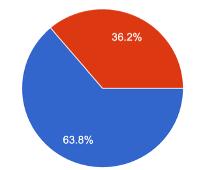

1: Discipline exposure
Table 1: Range of discipline
Range of Discipline
% who experienced this punishment
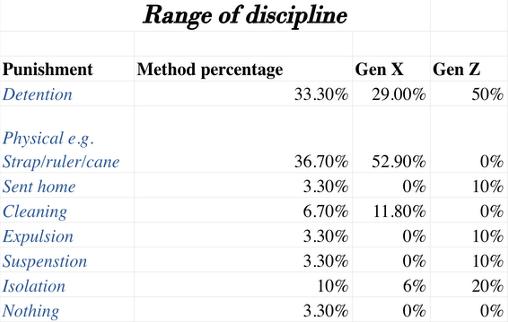
In traditional Australian school systems, corporal punishment was used to enforce compliance. The early 1980s saw the legal abolition of corporal punishment throughout public schools in nearly all states. This change reflected a broad social change,3 encouraged by a growing number of psychological studies proving long-term emotional damage, and short-term academic loss for children punished physically as a part of their education.4
My questionnaire confirmed this hypothesis, as seen in Figure 1, “Have you ever been disciplined in school? Discipline -the strategies, policies, and practices used by schools to guide student behaviour, e.g. detention, the cane, spanking.” And Table 1, 52.9% of Gen X participants revealed that they experienced physical punishments, such as caning and ruler strikes. Conversely, of all Gen Z participants, 0% reported that they experienced corporal punishment. One of the questions asked was: If yes, what did you do to warrant discipline? And what was the punishment? A Gen X responded to this with their experience, quoting, “Screamed when a door slammed,” and as a punishment, “Hit on the back of my knuckles with a big fat ruler”. An additional Gen X respondent quoted, “Fighting, selling stolen goods”, and as a punishment, “Strap in front of school”. This information highlights a feature of earlier generations’ methods for enforcing discipline, rather than an informal mode in schools under present-day attitudes. In contrast, one Gen Z respondent noted, “I have never experienced any kind of physical discipline at school nor witnessed it,” showing a complete generational shift in disciplinary norms. The contrast between generations proves the hypothesis that with legal reform and changes in educational theories, disciplinary norms have gradually become more flexible.
Did/do teachers in your school have different methods of discipline?
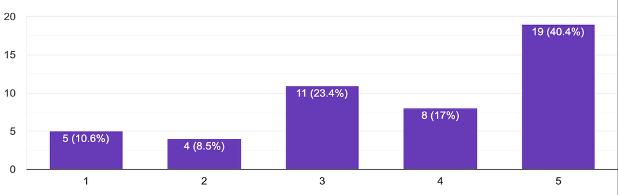
2: Effectiveness of discipline
Teaching methods have been continually evolving, alongside views on justice and corporal punishment. In earlier generations, punishment was often applied uniformly and without much explanation.5 Modern disciplinary methods, however, focus on the student. They rely on communicating and creating opportunities for students to explain their positions, and logical consequences are chosen rather than arbitrary punishments.6 This institutional change of the role of the teacher, from an authoritarian figure to a guide for learning, reflects the change of attitudes surrounding corporal punishment.
The use of disciplinary practices by teachers is illustrated in Figure 1. When responding to a 1-5 question, 40.4% of participants responded with 5, 17% with 4, and 23.4% with 3. This represents a consensus that discipline methods applied in schooling institutions weren’t strictly monitored, which creates uncertainty and fear surrounding authoritarian figures.7 Moreover, of the respondents, Gen X reported an average response of 4, and Gen Z reported an average response of 3. These findings suggest that fairness in the modern classroom is no longer equated with unfair punishment, but rather with an effort for consistency and understanding. Pointing to an increased unity and carefully supervised sets of discipline practices, reflecting greater emphasis placed on the well-being of students. These findings are supportive of my hypothesis and show how schools have changed their attitudes towards discipline, now making it sensitive to students.
Do you
Different discipline methods and changes surrounding them brought conversations about the effectiveness of corporal punishment. Previous generations were accustomed to receiving physical punishment without interference or explanation. Corporal punishment was often seen as an opportunity to teach children to respect authority, learn obedience and compliance. In reality, it uses fear as a mechanism to achieve such things and the lasting effects of corporal punishment can lead to an increased chance of anxiety, depression, and externalising behaviours. This data brought awareness to the public on how corporal punishment impacts students and to advocate against its use.
As seen in Table 2, when respondents were prompted with Question 9, “Do you think that physical discipline is effective?” A large percentage of both Gen Z and Gen X answered ‘No’. A total of 87% of Gen X respondents answered ‘No’, and a similar proportion of Gen Z respondents, 73% answered ‘No’. A Gen X participant noted, “It made you very scared to do something wrong. It does not make you change your behaviour”. This reflects the fear felt by students subjected to corporal punishment. Furthermore, a Gen Z participant noted, “NO, it doesn’t make someone a ‘good student’ it just makes them afraid to do anything themselves without being told its ok”. The two quotes show a shared understanding that punishment derived from fear is not useful in fostering change in behaviour. Consequently, what these consistent numbers represent is a picture of how public awareness raises general opinion. The consistent disapproval across both generations highlights how public awareness and personal experiences contribute to the rejection of corporal punishment in education. This confirms the hypothesis that school discipline has progressed from a control based on fear to one targeting support for students.
In this essay, it is argued that the transformation of disciplinary practices in Australian schools reflects broader social and cultural attitudes towards authority, childhood and mental health. Evidence gathered from primary and secondary research supports the hypothesis that disciplinary methods used by schools have changed from a use of corporal punishment to supportive studentoriented strategies. The contrast between the experiences of Generation X and Generation Z demonstrates a strong path towards prioritising fairness, consistency, and wellbeing. This evolution of schools signifies an enlightened understanding in society at large about disciplines effects on students.
1 “Corporal Punishment,” Education Queensland, April 14, 2019, https:// education.qld.gov.au/about-us/history/history-topics/corporalpunishment.
2 Allyson Holbrook, A Historical Perspective on Discipline in New South Wales Classrooms, n.d.
3 The University of Newcastle and Alan Barcan, “Public Schools in Australia from the Late 1970s to the Late 1980s: The Seeds of Change,” Education Research and Perspectives 37 (2010): 1–37, https://doi.org/10.70953/ erpv37.10006.
4“Disciplinary Measures,” Australian Law Reform Commission , n.d., accessed July 23, 2025, https://www.alrc.gov.au/publication/seen-andheard-priority-for-children-in-the-legal-process-alrc-report-84/10children-in-education/disciplinary-measures/
5 “Corporal Punishment,” Education Queensland, April 14, 2019, https:// education.qld.gov.au/about-us/history/history-topics/corporalpunishment.
6 “Wellbeing in Australian Schools,” Australian Law Reform Commission, accessed July 23, 2025, https://www.aitsl.edu.au/research/spotlights/ wellbeing-in-australian-schools.
7 “Corporal Punishment In Australian Schools – Essay! – Gemsbooknook,” accessed July 23, 2025, https://gemsbooknook.wordpress. com/2024/06/09/corporal-punishment-in-australian-schools-essay/.
8 “Corporal Punishment In Australian Schools – Essay! – Gemsbooknook.”
9 Heather L. Bender et al., “Use of Harsh Physical Discipline and Developmental Outcomes in Adolescence,” Development and Psychopathology 19, no. 1 (2007): 227–42, https://doi.org/10.1017/ S0954579407070125.
10 “Wellbeing in Australian Schools,” AITSL, accessed July 23, 2025, https:// www.aitsl.edu.au/research/spotlights/wellbeing-in-australian-schools.
Australian Law Reform Commission. Wellbeing in Australian Schools.” Accessed July 23, 2025. https://www.aitsl.edu.au/research/spotlights/ wellbeing-in-australian-schools.
Bender, Heather L., Joseph P. Allen, Kathleen Boykin McElhaney, et al. “Use of Harsh Physical Discipline and Developmental Outcomes in Adolescence.” Development and Psychopathology 19, no. 1 (2007): 227–42. https://doi.org/10.1017/S0954579407070125.
“Corporal Punishment In Australian Schools – Essay! – Gemsbooknook.” Accessed July 23, 2025. https://gemsbooknook.wordpress. com/2024/06/09/corporal-punishment-in-australian-schools-essay/.
“Disciplinary Measures.” Australian Law Reform Commission, n.d. Accessed July 23, 2025. https://www.alrc.gov.au/publication/seen-and-heardpriority-for-children-in-the-legal-process-alrc-report-84/10-children-ineducation/disciplinary-measures/.
Education. “Corporal Punishment.” April 14, 2019. https://education.qld. gov.au/about-us/history/history-topics/corporal-punishment.
Holbrook, Allyson. (n.d.). Historical perspective on discipline in New South Wales classrooms.
The University of Newcastle, “Public Schools in Australia from the Late 1970s to the Late 1980s: The Seeds of Change.” Education Research and Perspectives 37 (2010): 1–37. https://doi.org/10.70953/erpv37.10006.
XIAOYIN LIN, SOUMYA SHAH, KYRAA VIG, YEAR 10
Fear is a fundamental survival mechanism, enabling rapid detection of and response to potential threats. While the neural architecture underlying fear processing has been extensively studied, adolescence represents a uniquely sensitive developmental window in relation to this. This gap in the literature provided the rationale for our experiment, which was carried out as part of the Sokratis program. In this, we conducted a year-long research initiative in which we chose to investigate the science behind fear. This field of science allowed us to run a practical experiment, wherein we garnered measurable physiological and behavioural data. It’s interesting to see how such a reaction, one of fear and anxiety, can be triggered by a domestic experience, thus the decision to explore that concept comprehensively.
This study aims to systematically examine fear responses in adolescents through both subjective and physiological measures. Specifically, it investigates how male and female participants differ in their emotional and autonomic reactivity to fear-inducing stimuli. By integrating self-report surveys, behavioural video analysis, and continuous heart-rate monitoring via technology during the screening of the horror film, this research captures real-time fear responses in adolescents.
The research process enabled us to obtain first-hand data within an ethically valid media context, allowing us to gain a clearer and more comprehensive understanding of the mechanics of fear underlying the gendered adolescent brain. This study was conducted within a school setting, with students being active participants in the collection of experimental data. The results were later synthesized into two posters that were presented at the Sokratis Showcase Evening. Through a small sample group, our research piloted an approach that could be replicated at The Scots College, a boys school in eastern Sydney, further making our research robust.
Research consistently shows gender-based differences in responses to fear and horror stimuli. Wühr et al. (2017) examined gender stereotypes in film preferences, concluding that males demonstrated a significantly stronger preference for horror films featuring aggression and violence. This aligns with broader psychological research suggesting males are more likely to seek highsensation experiences. Moreover, Kuhn et al. (2023) explored sex-dependent stress responses and found that while women displayed stronger emotional expression
and internalised coping, men showed heightened neural stress activation despite outward suppression. These findings unveil how gender-based patterns of horror engagement stem from both social conditioning and biological mechanisms.
Film psychology studies also demonstrate that horror films elicit fear by deliberately engaging the brain’s threat-response systems. Zillmann’s Excitation Transfer Theory suggests that suspense and delayed resolution heighten emotional intensity by sustaining physiological stimulation. Studies on visual perception show that low lighting and obscured imagery increase anxiety by forcing the brain to anticipate unseen threats. Sound design research further indicates that sudden loud noises trigger startle reflexes linked to the amygdala. Analyses of horror films such as The Shining (1980) and The Conjuring (2013) reveal how camera movement, colour, and pacing align with these psychological principles to maximise fear and emotional immersion.
Neuroscientific research indicates that fear is processed through a threat-detection network centred on the amygdala and its interactions with prefrontal regions. During adolescence, this circuitry shows heightened reactivity due to the slower maturation of the prefrontal cortex, resulting in amplified emotional processing. Cahill (2001) found that females exhibit greater amygdala activation when exposed to salient stimuli, an effect associated with estrogen’s facilitation of responsiveness. In contrast, testosterone has been shown to reduce amygdala reactivity while enhancing prefrontal cortical engagement in males, supporting stronger regulation of emotional responses (van Wingen, 2011). Finally, females display stronger connectivity between the amygdala and language-related cortical regions, which may increase conscious and verbal encoding of fear.
A central component of this study involved examining adolescents’ psychological and physiological responses to horror films. To address this objective, an experiment was conducted on a sample of 14 students, seven from Pymble Ladies’ College and seven from The Scots College, between grades 10 to 12, selected from an expression of interest application with informed consent. Prior to data collection, the study was reviewed and approved through the school’s Ethics Committee, ensuring that all procedures complied with ethical standards for research involving minors.
Before viewing the short horror film Vicious (produced by ALTER, specialist Youtube channel), students completed a pre-experimental survey documenting their current emotions and prior experiences with horror films, before entering the screening room. The short film was chosen for its psychological intensity constructed by the use of conventional horror film techniques, including jump scares and selective lighting in numerous scenes. The reason behind selecting this film was to imitate the holistic viewing of a generic horror movie in order to capture all the key elements. Combined with its lack of graphic content and the ability to be accessed by school-monitored accounts, this made it age and studyappropriate for student participants.
To ensure a controlled viewing environment, the classroom was prepared by lowering the window blinds to create a dark and immersive room, minimising distractions and allowing students to focus on the film. Participants were positioned at separate tables in pairs, spaced evenly to avoid stimulating interactions in the course of viewing. This procedure ensured that the results were more accurate and reliable, enabling more in-depth insights later in the study.
During screening, participants’ heart rates were continuously monitored using smartwatches, with data recorded via personal smartphones. Observable behavioural responses, including flinches, verbal reactions, and eye movements, were recorded by video using a laptop positioned at the front of the classroom. Alongside this, the research team members were examining all participants and were noting their reactions. Due to differences in data quality between the schools, behavioural analysis was conducted only for Pymble participants. As a result, this behavioural response data reflect only the female group, while physiological and self-reported data include participants from both schools.
Following the screening where the film is played once per session, participants submitted their heart rate data and completed a post-experimental survey assessing their perceived emotional and stress levels. Survey data were tabulated, where specific questions were placed as column headers in an Excel sheet, and the participants’ answers were inputted in the cells beneath. Heart rates for each individual were organised in a similar tabular format, with heart rate intervals of one minute being placed in the column header, and participants’ personal measurements for each interval recorded in the rows underneath. Heart rate values were extracted from smartwatch recordings or directly from heart rate graphs for each participant.
Observable behavioural responses, including flinching, eye aversion, and closing of the eyes, were quantified using a tally table derived from the analysis of the
classroom video recording. Each instance of an observable reaction was counted as a single occurrence, with multiple responses from the same participant recorded separately. Some participants did not exhibit any observable reactions within certain categories, while others displayed multiple responses. Consequently, not every participant recorded at least one response in each behavioural category.
A total of 14 students participated in the experiment: fourteen Pymble students (girls, n=14), of which a sample of seven Pymble students’ data and seven Scots students (boys, n=7) data were randomly selected for analysing. Although the sample size was small and the film lasted only 11 minutes, insightful observations were able to be drawn from this experiment to reveal clear gender-based differences.
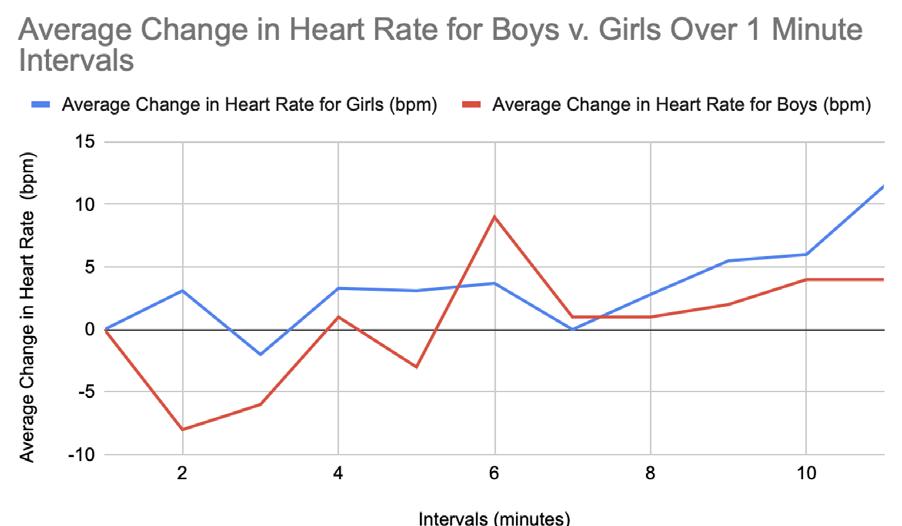
Figure 1: Measure of change in average heart rates for Pymble and Scots participants.
Figure 1 compares the average change in heart rate across the film for participants from Pymble (blue line) and Scots (red line), revealing clear gender-based differences in physiological responses to suspense. Overall, heart rates increased for both groups as the film progressed, indicating rising arousal and stress in response to sustained tension. However, female participants displayed a more stable elevation in heart rate, suggesting prolonged physiological engagement with suspenseful stimuli.
The steadier increase in female heart rates suggests a longer maintenance of heightened alertness and emotional processing, potentially increasing sensitivity to the cumulative effects of fear-inducing scenes. This pattern may be partially explained by gender-related differences in emotional regulation and threat processing, including hormonal influences on amygdala reactivity, though social and contextual factors cannot be excluded. These findings may reflect broader attentional patterns shaped by contemporary media consumption, as shortform digital content typically promotes rapid emotional shifts rather than prolonged suspense. However, further discussion on these topics is beyond the scope of this study and these issues should be considered in continued research into this area.
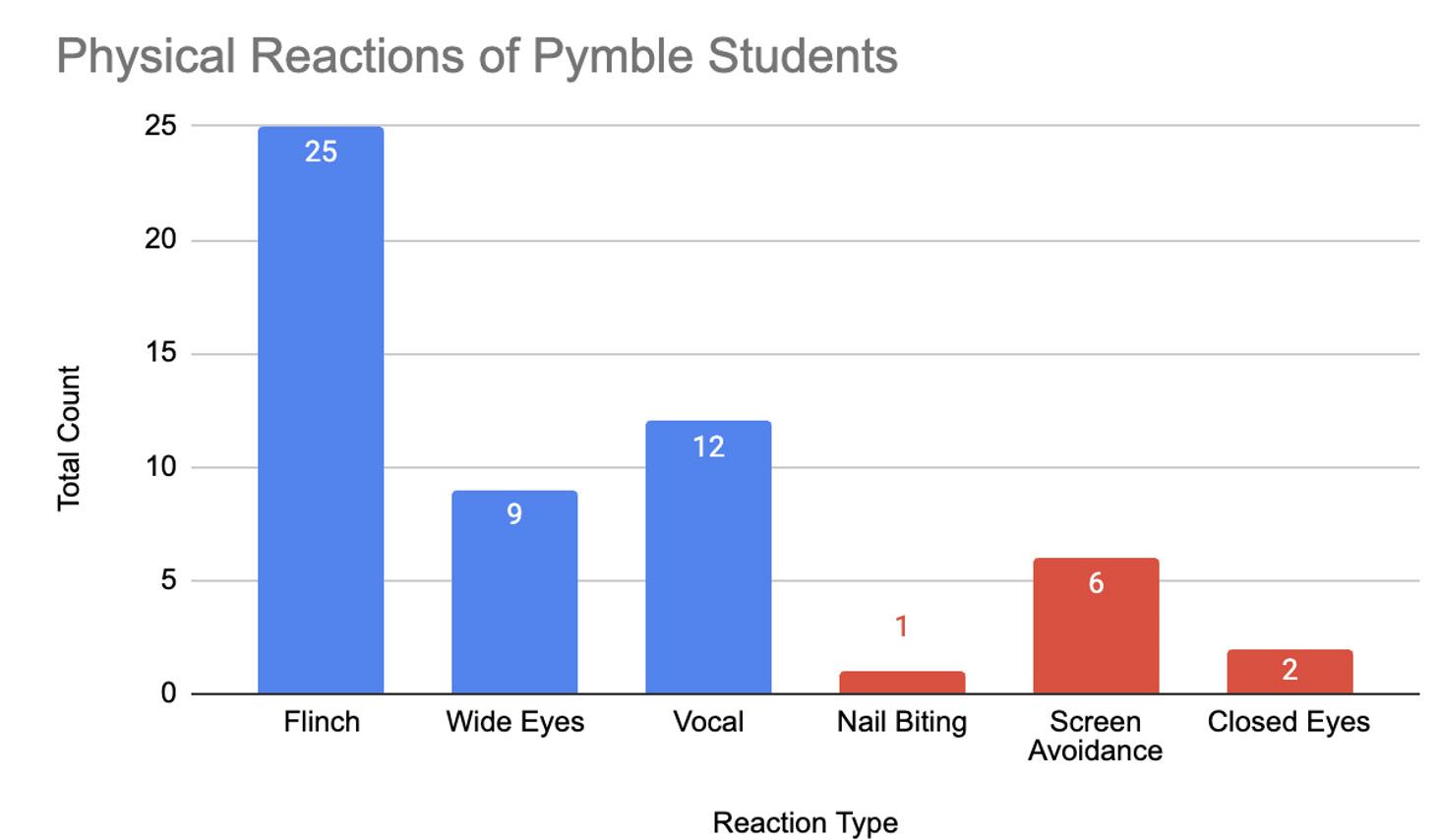
Figure 2: Physical reactions of Pymble participants displayed in a column graph.
Figure 2 illustrates the distribution of physical reactions exhibited by Pymble students (n=7), with the blue bars depicting startle reflexes; flinching, widening of eyes, and vocal reactions, and the red bars portraying avoidancebased behaviours; nail biting, screen avoidance, and closing of eyes. The most frequent response recorded was flinching, reflecting an involuntary startle reflex triggered by sudden auditory or visual stimuli. This dominance suggests that the film effectively employed shock-based techniques, such as jump scares, to elicit immediate physiological responses. Vocal reactions and widened eyes were the next most common behaviours, indicating intensified visual attention.
In contrast, avoidance-based behaviours, including avoiding screen contact, closing eyes, and nail biting, were rare. This pattern suggests that, despite experiencing fear, most students remained visually engaged with the stimulus rather than withdrawing from it. The low prevalence of disengagement supports the notion of an approach tendency, wherein individuals are motivated to confront or observe a stimulus rather than avoid it, usually driven by interest or curiosity. In this context, information-seeking and threat-monitoring (the process of assessing potential danger) appear to override the impulse to avoid distressing stimuli.
Furthermore, the near absence of nail biting, a behaviour often associated with prolonged or internalised anxiety, indicates that the fear experienced was acute and situational rather than sustained. Observationally, some students appeared to remain tense following moments of heightened suspense, suggesting residual arousal that may persist beyond the immediate stimulus.
In conclusion, psychological horror films evoke fear in both genders, but responses differ due to psychobiological factors. Females exhibit more sustained fear responses, possibly influenced by oestrogen and heightened amygdala activation, while males show sharper, regulated reactions due to greater prefrontal control as evident from the experimental results.
Along the course of conducting this study and gathering various insights from the experiment, we have discovered that long-established gender-based stereotypes, including common assumptions that males are “braver” and females are more fearful, are generalised and not fully supported by scientific evidence as proven by our psycho-biological research where both genders experience fear but manifest it differently.
To improve this study, the sample size of the experiment should be increased as it was limited by resources and participants. For example, sample sizes for both male and female participants were equal but limited to seven participants per gender group. Diversity of each data set was therefore reduced by the small sample size, possibly making it difficult for trends to accurately represent each gender, and necessitating the support of secondary data. Potentially, another modification would be to add more variables apart from heart rate as it may not be a reliable indicator of fear. Trends such as skin conductance and rate of respiration as additional evidence could be considered in the future, however, limited resources prevented the acquisition of more advanced technology for this experiment.
Ultimately, the results of this experiment offer insights into adolescents' behaviours, psychosocial phenomena, and the influence of gender on behavioural and physiological reactivity. Gender-specific differences, particularly in attentional processes and associated outcomes such as anxiety, rumination, and internalisation, may facilitate the prediction of long-term consequences of distressing stimuli, including film exposure, in individual adolescents. Consequently, these findings also underscore the importance of considering age and gender when developing medical and psychological treatment strategies, as individuals experience and regulate trauma differently. By highlighting how gender and age influence stress and fear responses, this research supports the adoption of more personalised approaches to psychological trauma in medical care, providing a valuable indicator of post-traumatic responses and enabling more effective support for vulnerable populations, including those engaged in mental health services. In essence, due to the comprehensive research that we were able to conduct, we had the opportunity to win “Best Research Methodology” as part of the Sokratis initiative.
We thank The Scots College students and Pymble Ladies’ College team member, Ilesha, for their collaboration. We acknowledge the guidance and supervision of Ms Patmore, Dr Loch, and Dr Mann throughout the conduct of this research, and we thank the students from both Pymble Ladies’ College and The Scots College who voluntarily participated in this study. We also would like to thank Pymble Ladies’ College for conducting the Sokratis initiative each year that enables students to explore their passions for numerous academic disciplines.
Adams, S. (2008, August 10). Horror film gene that makes some scream while others laugh. The Telegraph. https://www.telegraph. co.uk/news/2535221/Horror-film-gene-that-makes-some-screamwhile-others-laugh.html
ALTER. (2015). Horror short film “Vicious” [Video]. YouTube. https:// www.youtube.com/watch?v=4d0ggz0aibg
Bose, P. & Bradford, S. (2022, October). Why do some people enjoy horror movies? The Scientist. https://www.the-scientist.com/whydo-some-people-enjoy-horror-movies-72181
Cahill, L., Uncapher, M., Kilpatrick, L., Alkire, M. T., & Turner, J. (2001, January). Sex-related hemispheric lateralization of amygdala function in emotionally influenced memory: An fMRI investigation. Learning & Memory, 8(6), 392-399. https://pubmed.ncbi.nlm.nih.gov/11124043/ Chen, C., Park, B., & Shi, C. (2020, October 23). Repeated exposure to suspenseful audiovisual media reduces emotional and physiological responsiveness. Frontiers in Psychology, 11, 558234. https://www.frontiersin.org/journals/psychology/articles/10.3389/ fpsyg.2020.558234/full
Hanich, J. (2010). Cinematic emotion in horror films and thrillers: The aesthetic paradox of pleasurable fear. Routledge. https:// www.routledge.com/Cinematic-Emotion-in-Horror-Films-andThrillers-The-Aesthetic-Paradox-of-Pleasurable-Fear/Hanich/p/ book/9780415516570
Perez, P., et al. (2021, September 14). Conscious processing modulates heart rate dynamics during narrative perception. Cell Reports, 36(5), 109569. https://www.sciencedirect.com/science/ article/pii/S2211124721011396
Taborska, A. (2024, September 17). Crafting fear: Filming techniques to evoke emotion in horror movies. Raindance. https://raindance. org/crafting-fear-filming-techniques-to-evoke-emotion-in-horrormovies/
Tedeschi, E., et al. (2022). Group size and fear perception: Evidence from experimental studies on danger perception and emotional responses. Journal of Experimental Psychology: General, 151(4), 765783. https://psycnet.apa.org/record/2022-16196-002
Wedgbury, A. (2024, November 22). The art of fear: How camera movements shape cinematic terror. Drwedge. https://drwedge. uk/2024/11/22/how-camera-movements-shape-fear/ Zwiky, E., König, P., Herrmann, R. M., Küttner, A., Selle, J., Ptasczynski, L. E., Schöniger, K., Rutenkröger, M., Enneking, V., Borgers, T., Klug, M., & Dohm, K. (2024, June 4). How movies move usMovie preferences are linked to differences in neuronal emotion processing of fear and anger: An fMRI study. Frontiers in Behavioral Neuroscience, 18, 123-134. https://pmc.ncbi.nlm.nih.gov/articles/ PMC11185070/
ALICE
This essay is a Society and Culture Mini-Personal Interest Project
School is, for most people, the place aside from home where most time is spent. Through school, students learn soft and hard skills that allow them to function in societal occupations. It is unsurprising, then, that given the changing contexts between Generation X and Generation Z, such as rising job threats, school life and its pressures have also adapted for the worse. Both through a primary questionnaire with 51 respondents and secondary research, the hypothesis, ‘That achievement standards in senior school have increased across generations, leading to more associated stress and pressure,’ has been discussed and largely supported with an Australian focus.
Due to the necessity of standardising the comparison of students, academic outcomes are integral to the school experience. However, high standards are increasingly normalised for Generation Z to detrimental effect. Although data directly comparing acceptable high school grades across generations is limited, this trend can be reflected through the pursuit of tertiary education. For most of Generation X, an average of 28.3% of people participated in higher education by age 19 (Long et al, 1999, p.18). By contrast, this figure is 51.8% for students born in 2000-2005 (Australian Department of Education, 2023). The near doubling indicates how the achievement norm has shifted from completing high school to also successfully enrolling in higher education.
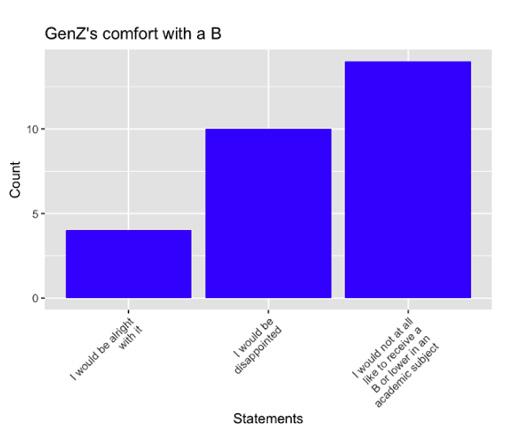
1: Both generations
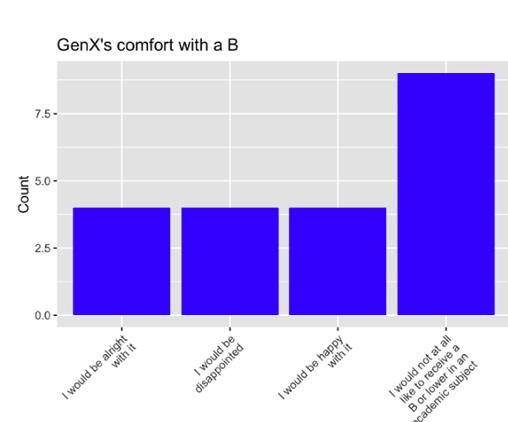
Figure 1 from primary research shows how these heightened states of socialisation are corroborated by grade expectations. For Generation X, 38% of participants declared that they would be pleased or alright with a ‘B’ grade for an academic subject, whilst only 14% of Generation Z respondents agreed (Questionnaire, 2025), demonstrating how Generation Z tends to have higher expectations of their outcomes. Most participants from both generations agree that school material appears to have become more difficult, with a Generation Z Australian reasoning that, ‘we're all building on what the people the year before us did’ (Questionnaire, 2025). It has been similarly assessed by secondary sources that the curriculum is ‘cluttered’, with ‘breadth’ to prepare for an ‘increasingly complex world’ (Hickey, 2021). However, some participants have offered more nuanced statements, such as a Generation X Australian responding that school is ‘less challenging with technology,’ creating individual variability in experiences. From these perspectives, it is generally observed that school outcomes have become more demanding throughout generations.
Academic standards are not the only signifier - the enjoyment or stress associated with school also reveals how this agent of socialisation can build people’s self-concept. According to an Australian Council for Educational Research report (2018), Australian students have higher school-related anxiety than the OECD average, with 65% experiencing stress due to grades. For students, ‘sense of life purpose was related to grades indirectly via academic identity’, andnow more than ever, ‘students today are saturated with messages about performance’ (Yukhymenko-Lescroart & Sharma, 2022;
Perfas, 2023). In addition, youth mental health has been declining generationally (Blowes, 2023). To summarise, secondary research shows that, increasingly, students build their identities around grades, leading to higher levels of associated stress.
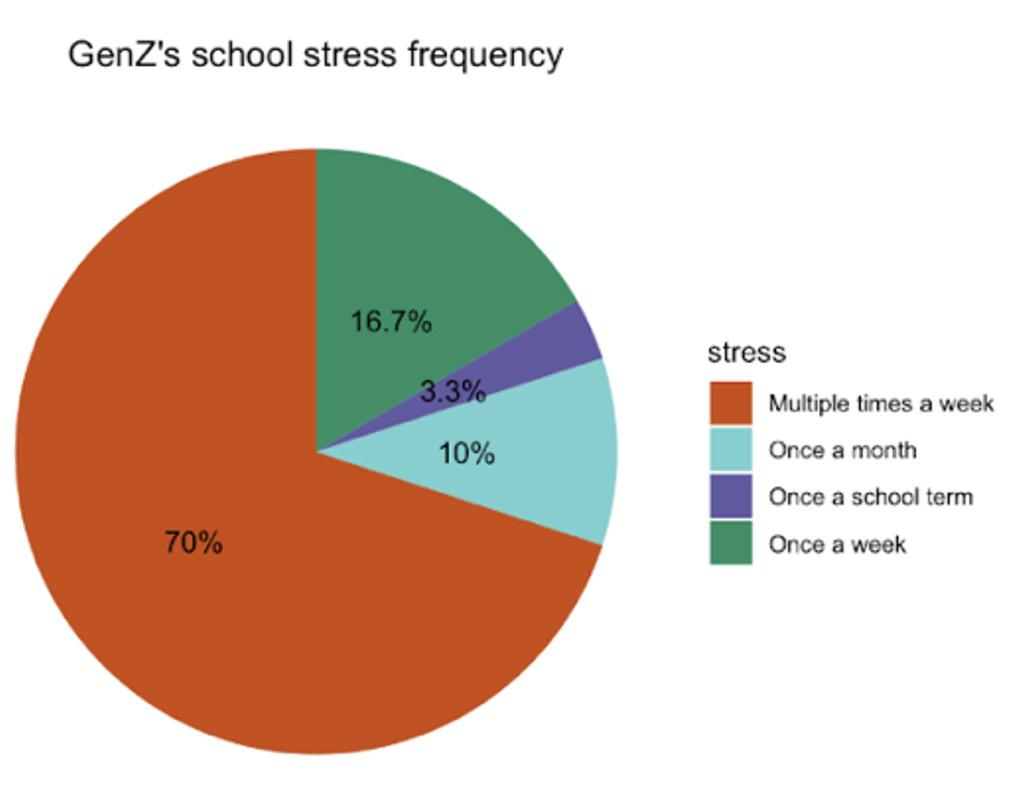
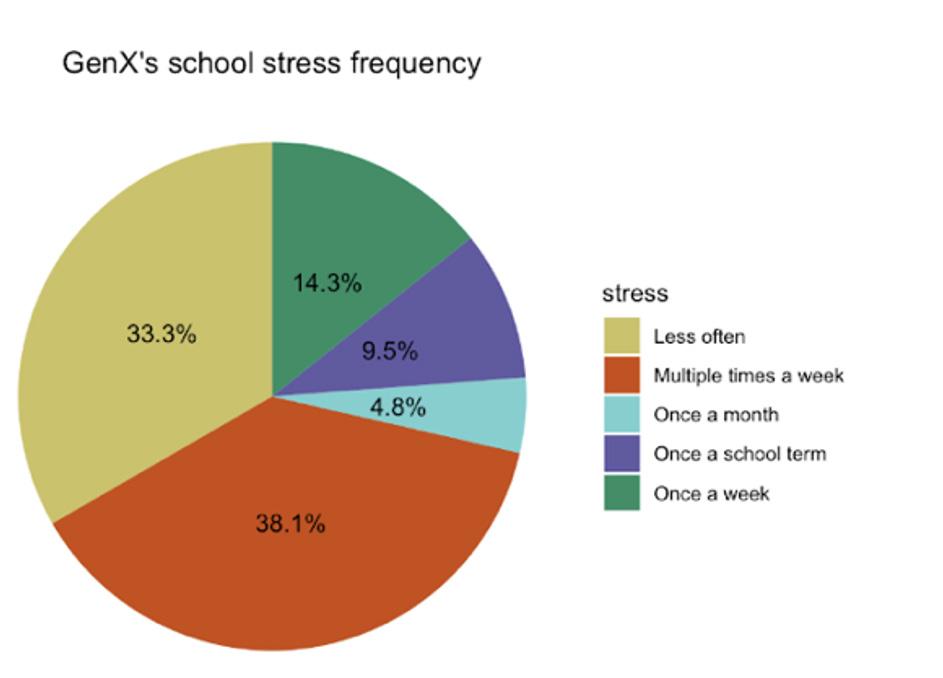
Figure 2: Both generations answer to Question 4. How often does/did high school cause significant for you?
Primary research results also agree. For example, there is a startling difference between the proportion of people claiming to stress ‘less often’ than once a term, from 33.3% of Generation X to 0% of Generation Z. Furthermore, 70% of Generation Z, compared to 38.1% of Generation X, felt stressed about schoolwork multiple times a week, exemplifying claims of grade-related anxiety (Questionnaire, 2025).
Table 1: Both generations answer to Question 6. How often did/do you feel like you enjoyed high school? (1= Very often, 5 =Not at all)
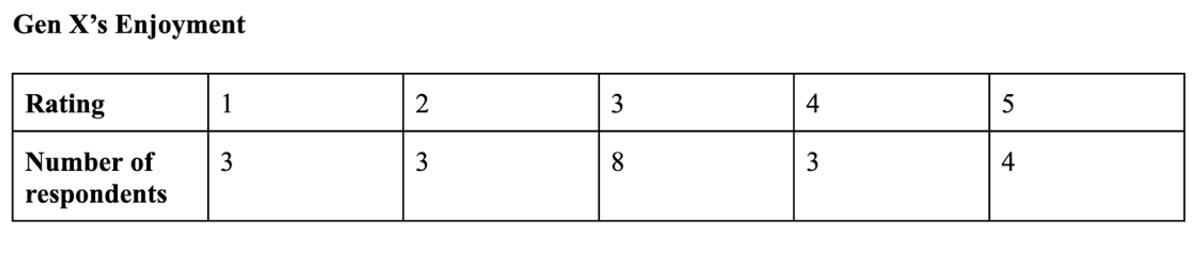

In Table 1, their respective enjoyments of school hours provide another contrast. A similar proportion of Generation X and Generation Z enjoyed school somewhat to very often (options 1-3), but no Generation Z participants labelled it not at all enjoyable (option 5) (Questionnaire, 2025). This shows more complexity behind the issue-school stress may not necessarily negate a positive social identity constructed with peers and teachers. Overall, primary and secondary research mesh together to show stark intergenerational increases in academic pressure, with outcomes becoming a larger part of self-concept, although this may not directly correlate to a negative school experience.
To fully understand these generational differences, explanations can be obtained from secondary research and supported by primary results. Australian trends indicate that jobs require more demanding qualifications. For example, ‘90% of employment growth over the next 10 years will be in jobs that need post-secondary qualifications’ (Jobs and Skills Australia, 2024). This places a far greater emphasis on achieving the necessary grades to qualify for these programs, justifying Generation Z’s concern with academics. In contrast, employers from the 1980s commonly hired unqualified workers, especially for skilled trade jobs (Webster et al, 2001). Furthermore, the significant majority of questionnaire respondents also commented that more skills are required now to get a well-paying job. From Figure 3, 100% of Generation Z answered a general ‘Yes’ to the question, with most saying, ‘Yes, definitely.’ In Generation X, there was a greater divide, as 9.5% answered ‘No, not in general’, but an overwhelming 76.2% also answered ‘Yes, definitely’ (Questionnaire, 2025).
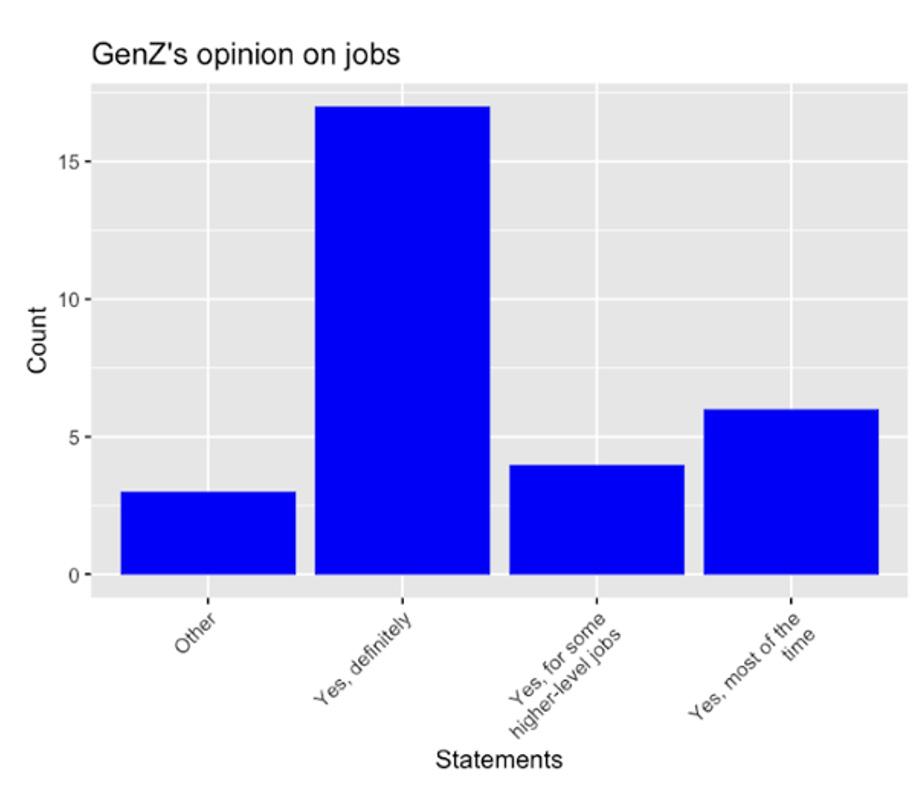
Figure 3: Both generations answer to Question 10. Do you believe that more skills are being required now to get a well-paying job?
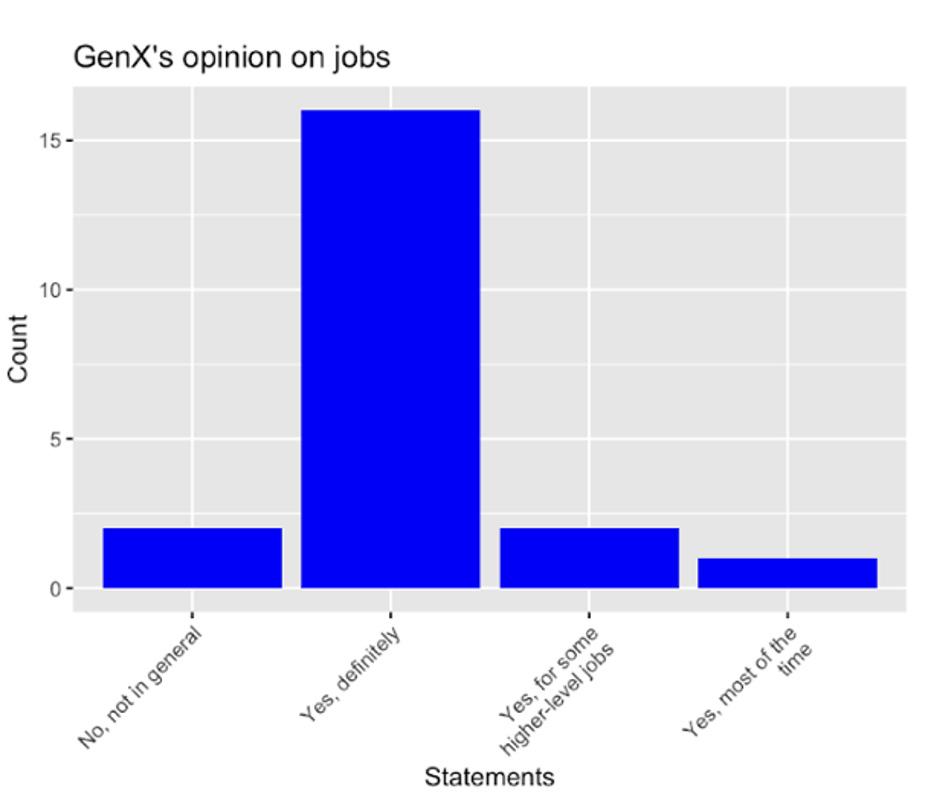
The Australian Government’s skills documentation supports these responses, as recent job shortages are ‘concentrated among high-skilled professional occupations’, so to reach these openings, extensive qualifications are necessary (2023). Generation Z also faces financial challenges from rising property prices to lowered social safety nets (McKinsey, 2024), also impressing upon parents the need to academically prepare their children for the worst (Perfas, 2023). That is not to say Generation X did not seek financial success or struggle in similar ways (Szabo, 1985). However, comparative secondary data shows that their barriers were lower, and the standards inflated by technology prove an additional challenge (McKinsey, 2024). For these reasons, market competitiveness serves as a viable reason for the difference in school approach between Generation X and Generation Z.
Secondary findings in this area suggest the existence of academic stress and financial insecurity for Generation X but emphasise the especially pronounced nature of outcomes-based identity formation and high standards for Generation Z. Primary research through the questionnaire method is supported by this data but differs in individual accounts due to the variability of respondents’ backgrounds and life circumstances. Overall, it can be concluded that Australian students and schools’ responses to macro-level employment threats over generations have manifested in different standards for socialisation, sparking anxiety. It is of great concern that school, a highly formative agent of socialisation, has not sufficiently allayed students' concerns that their grades define their person.
Questionnaire. (2025). Academic Standards Across Generations (see appendix)
References – Secondary
Australian Government. (2024, November 18). 90% of future jobs will need post-secondary qualifications - but that doesn’t always mean uni. Jobs and Skills Australia. https://www.jobsandskills. gov.au/news/90-future-jobs-will-need-post-secondaryqualifications-doesnt-always-mean-uni
Australian Government. (2023). Current skills shortages. Jobs and Skills Australia. https://www.jobsandskills.gov.au/publications/ towards-national-jobs-and-skills-roadmap-summary/currentskills-shortages
Australian Department of Education. (2023). Key findings from the 2023 Higher Education Student Statistics. Higher Education Statistics. https://www.education.gov.au/higher-educationstatistics/student-data/selected-higher-education-statistics2023-student-data/key-findings-2023-student-data
Blowes, M. (2023, November 28). Study shows generational decline in Australia's mental health. University of Sydney. https:// www.sydney.edu.au/news-opinion/news/2023/11/28/studyshows-generational-decline-in-australias-mental-health.html
Hickey, C. (2021, June 3). A ‘crowded curriculum’? Sure, it may be complex, but so is the world kids must engage with. The Conversation. https://theconversation.com/a-crowdedcurriculum-sure-it-may-be-complex-but-so-is-the-world-kidsmust-engage-with-157690
Long, M., Carpenter, P., & Hayden, M. (1999). Participation in education and training 1980-1994. ACER. https://www.lsay.edu. au/__data/assets/pdf_file/0024/181419/LSAY_lsay13.pdf
McKinsey & Company. (2024, August 28). What is Gen Z? https:// www.mckinsey.com/featured-insights/mckinsey-explainers/whatis-gen-z
Perfas, S. (2023, September 11). How achievement pressure is crushing kids and what to do about it. The Harvard Gazette. https://news.harvard.edu/gazette/story/2023/09/howachievement-pressure-is-crushing-kids-and-what-to-do-aboutit/
Schmid, M. Australian Council for Educational Research. (2018, October 11). PISA Australia in Focus Number 4: Anxiety. ACEReSearch. https://research.acer.edu.au/ozpisa/33/ Szabo, J. (1985, December 6). Stress on Rise in College Students. Los Angeles Times. https://www.latimes.com/archives/la-xpm1985-12-06-vw-820-story.html
Yukhymenko-Lescroart, M., & Sharma, G. (2022). Sense of life purpose is related to grades of high school students via academic identity. National Library of Medicine. https://pmc.ncbi.nlm.nih. gov/articles/PMC9674496/
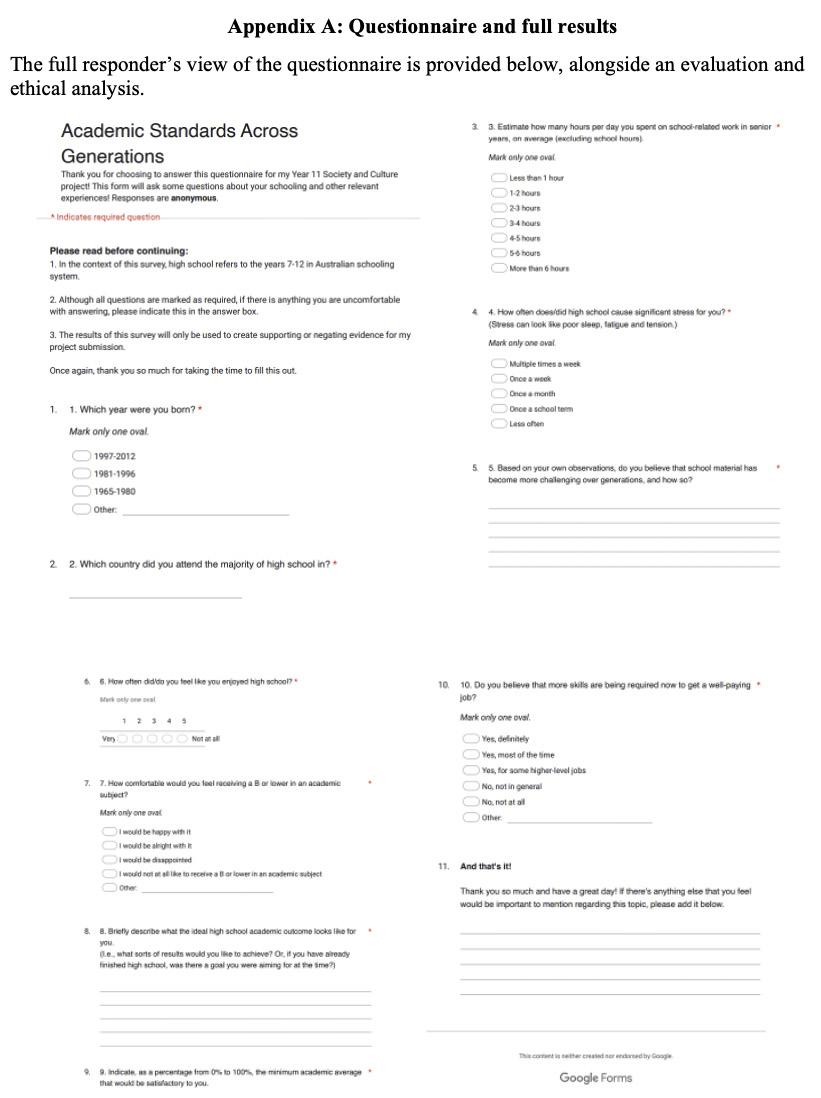
This questionnaire was a very rich research method, providing diverse observations from respondents’ lives and supporting statistics. It was aimed towards gaining numerical data to establish trends but also asking long responses to look into people’s explanations and thoughts for these trends. Generational analysis was completed with the R coding language, which is useful for faceting graphs into different generations and presenting colourful graphics. The questionnaire was distributed to Gen Z through peers and to Gen X through teachers and parental connections. There was a total of 66 responses, which were Australia-focused but included voices from several other backgrounds like India and Vietnam. However, as these were a significant minority, it did not affect the Australian background of the synthesis. 15 of these responses could not be used as they were from Gen Y individuals. As expected, there was a greater proportion of Gen Z respondents due to accessibility, which may mean that the information gathered for them was more reliable. Furthermore, there is likely to be selection bias, as the majority of Gen Z respondents are females from private schools. This could have unforeseen consequences, such as augmenting certain statistics, but is still representative of general schooling trends at least within this demographic.
Ethical research practices, making the questionnaire valid, were maintained in several ways. First, the respondents were kept anonymous, which prevented their responses from being tied to their identity and facilitated honesty. Furthermore, they were notified that their responses would not be abused or published in external sources, which was maintained throughout the reportwriting and distribution process. They were also given the option to opt out of required questions by indicating in the text box, which means that they can avoid revealing information that is uncomfortable to them.
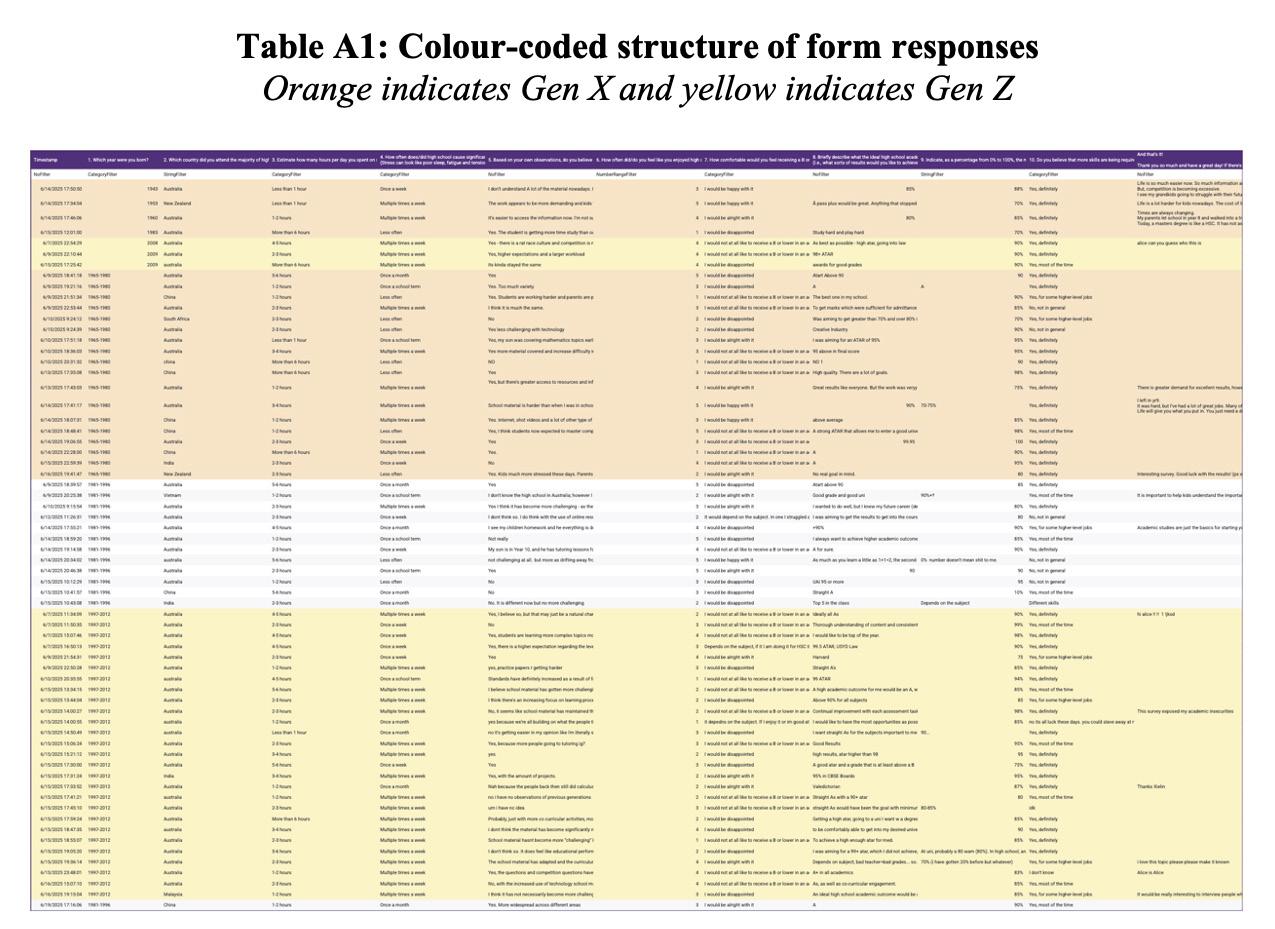
Appendix B: RStudio Code
In order to conveniently manage the large dataset, the R programming language was used to process the data. Notable tools were Base R for data manipulation and ggplot2 for graphing.
Figure B1: Example RStudio interface

As a further insight, the following code was used to generate Figure 2.
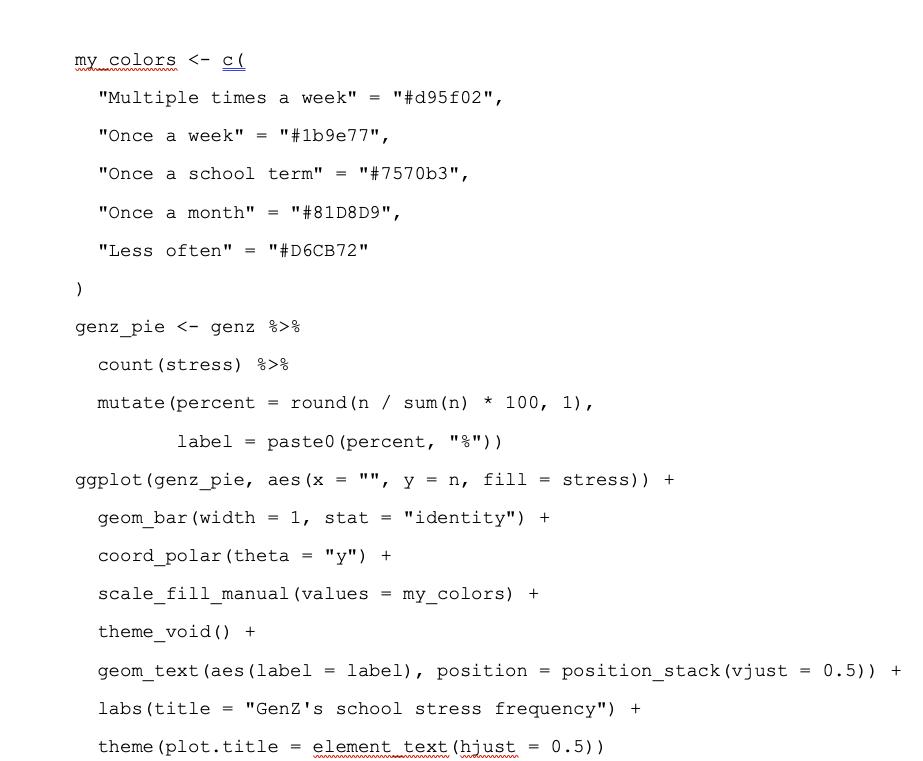
NICOLE ZHANG, YEAR 10
Architecture often serves as a silent witness to humanity’s most defining and most devastating moments. The remnants of conflict and oppression that remain etched into the built environment hold both aesthetic and moral significance, forcing societies to confront the ideologies and violence that shaped them. The question of how to engage with these legacies is one that holds immense significance, as it extends beyond simply preservation or destruction.
The destiny of the structures concerns how collective memory and national identity is shaped through the treatment of spaces that embody both the triumphs and transgressions of the past. When this issue is approached thoughtfully, such structures can be transformed from monuments of oppression into symbols of remembrance and growth, yielding positive outcomes for society such as becoming tools for reflection, education and reconciliation. However, when left unexamined or displayed without context, the monuments risk perpetuating the very injustices they were born from. Throughout history, especially within the last century, there has been a lot of discussion as to how these monuments should be dealt with after the fall of the regime that constructed them. Therefore, it is imperative that societies carefully navigate the delicate matter on how these sites will be treated by finding a way to honour truth and foster healing based on the unique needs of every situation.
Architectural remnants of conflict and oppression are symbolic for humanity as they function as tangible reminders of humanity’s capability for resilience. They serve as a structural embodiment of the corrupt regimes that repressed societies for decades or even centuries. When these structures are preserved, rather than completely eradicated, communities are eternally confronted with the visible material consequences of political extremism. Spaces such as propaganda monuments, prisons, and concentration camps can hold immense amounts of emotional weight and create a lived experience of remembrance for those that choose to visit in the present day. This, in turn, allows future generations to not forget the past in order to not repeat it.
Moreover, many of these structures perform a didactic function, as their existence operates as a lesson in the consequences of ideological extremism and human
cruelty. Visitors are confronted with the physical spaces where violence and oppression were inflicted, causing their historical knowledge to be transformed into a morally reflective experience. It not only fosters empathy for victims but also raises awareness for the social and political conditions that enabled such atrocities. In doing so, societies are encouraged to learn from and remember the horrors of history and reinforce the collective responsibility to prevent recurrence. An example of this would be the ruins of The Congress Hall (Die Kongresshalle) in Nuremberg. It was initially built in 1935 with the intent of it becoming a massive assembly hall for the Nazi Party’s rallies, meetings and congresses. The building, modelled after the Colosseum, planned to seat 50,000; its excessive grandeur was intended to awe the attendees and project the image of eternal power of the ‘Thousand Year Rule’. However, construction was never completed due to the outbreak of World War Two in 1939.
After the Nazi Party fell, the building was abandoned. Nowadays, it is visited by many for educational purposes, as it serves as a powerful reminder and warning of the dangers of totalitarianism and the consequences of blind allegiance to dictatorial power and extreme ideologies. The decision to preserve Congress Hall in its incomplete state, rather than erasing the structure, allows visitors to recognise a harmful regime that sought domination through propaganda and spectacle.
Furthermore, the preservation and restoration of structures like these also serve as symbols of hope for the future. They demonstrate the progression and change of societal values throughout history and that although hurt may have been inflicted upon people in the past, the future does not have to remain a reflection of that. Rather, new and better things can be achieved from reflecting on these monuments. A prime example of this are the large marble blocks that lie in two parallel rows in front of the Foro Italia in Rome, which were built under the rule of Mussolini’s fascist dictatorship in Italy. Each stone is inscribed with a significant event in the history of his regime, commemorating what he considered to be memorable achievements. The inscriptions include the founding of the fascist party (1919) as well as the colonial conquest of Ethiopia (Abyssinia) after World War Two, seven blocks remained blank, since Mussolini had clearly overestimated the endurance of his regime and ideology,
reflecting Mussolini’s belief in the party’s eternal power. Three of these were later inscribed with dates symbolically closing the Fascist era: 25th July 1943 (the fall of Fascism), 2nd June 1946 (the referendum approving the Republic), and 1st January 1948 (the new constitution). Preserved in this way, the site has now been transformed into a hopeful symbol of Italy’s growth and renewal into a more socially equitable democratic system.
On the other hand, there are reasons as to why certain monuments that originate from periods of conflict should not remain standing in the interests of reconciliation. Architectural legacies from periods of oppression or conflict can unintentionally celebrate or legitimise the ideologies behind them. Most structures that were built during those periods of time were built with the intention of glorifying those who imposed domination and dispossession upon others, making their presence deeply offensive to marginalised groups within society. A clear example is the statue of Captain James Cook in Sydney’s Hyde Park, whose inscription claims he “discovered” Australia. This assertion disregards tens of thousands of years of Indigenous history and has been criticised for perpetuating colonial narratives that frame invasion as exploration. The monument has been repeatedly defaced with messages such as “no pride in genocide” and “change the date,” expressing frustration towards the ongoing celebration of colonial figures. While former Prime Minister Malcolm Turnbull condemned the vandalism as a “totalitarian campaign” to erase history, others argue that leaving such monuments unaltered continues to legitimise outdated and harmful ideologies. As a result, debates have emerged across Australia about whether these structures should be removed, relocated, or reinterpreted in order to promote a more honest and inclusive national memory.
To some communities, keeping monuments that are perceived as physical manifestations of past pain, suffering and intergenerational trauma can frame governments as ignorant and insensitive. In these instances, it becomes the moral responsibility of governments to actively engage in reconciliation processes that acknowledge and redress the injustices these structures represent. Governments are custodians of public space and national identity, which means they play a crucial role in determining which narratives are preserved and which are reinterpreted. After the fall of the Nazi Party in 1945, the German government was proactive in undertaking deliberate efforts that ensured that public spaces no longer contained structures that glorified the regime. Instead of preserving sites that celebrated Nazi power, Germany chose to repurpose them to become places dedicated to education for future generations. Examples of repurposed sites include Auschwitz and Dachau concentration camps that have
now become memorial museums, and the ruins of the Berlin Anhalter Bahnhof (one of the many train stations used to transport Jews to camps) remind passersby of past persecution.
Ultimately, the legacies that are left by the architectural remnants of conflict and oppression present societies with both a challenge and an opportunity. These structures not only have the potential to evoke trauma, but also possess the capacity to transform into instruments that foster understanding and public dialogue when approached in a sensitive way. The choice to preserve, remove or reinterpret such monuments needs to undergo consideration as each path carries consequences. By confronting these legacies with critical engagement and circumstantial analysis, societies are able to ensure that the physical traces of oppression do not subconsciously perpetuate harm, but instead serve as enduring reminders that warn communities of the mistakes made in the past and guide society towards a hopeful future.
Australian Heritage Council. (2018). Protection of Australia’s commemorative places and monuments. Department of Agriculture, Water and the Environment. https://www.dcceew.gov.au/ parks-heritage/heritage/organisations/australian-heritage-council/publications/commemorative-places-monuments
Baguley, M., Kerby, M., & Andersen, N. (2021). Counter memorials and counter monuments in Australia’s commemorative landscape: A systematic literature review. Historical Encounters, 8(3), 93–120. https://doi.org/10.52289/hej8.308
Edensor, T., & Sumartojo, S. (2023). Reified monuments, counter memorials and anti-memorials: Contested colonial heritage in Melbourne – commemorating John Batman. Postcolonial Studies, 26(4), 557–580. https://doi.org/10.1080/13688790.202 3.2234119
Expatica. (n.d.). Nazi ruin converted into concert hall in Nuremberg. Expatica. https://www.expatica.com/de/general/nazi-ruin-converted-into-concert-hall-in-nuremberg-95954/ Grieves, G., & Spiers, A. (Eds.). (2024). Art and memorialisation: Truth-telling through creative practice in settler colonial Australia (Indigenous-Settler Relations in Australia and the World, Vol. 6). Springer Singapore. https://doi.org/10.1007/978-981-97-6289-7
The Guardian. (2017, August 26). Captain Cook statue and two others in Sydney’s Hyde Park attacked by vandals. The Guardian. https://www.theguardian.com/australia-news/2017/aug/26/ captain-cook-statue-and-two-others-in-sydneys-hyde-park-attacked-by-vandals
Unknown Author. (n.d.). Rome’s uncomfortable heritage: Dealing with history in the aftermath of WWII. ResearchGate. https:// www.researchgate.net/publication/257731579_Rome%27s_Uncomfortable_Heritage_Dealing_with_History_in_the_Aftermath_of_WWII
When will advancing technology make most of us unemployable? What should we do about this?
LILY ZHANG,
This essay was written for the John Locke Essay Competition
In this essay, I will present three main points. Firstly, I will address short term unemployment, and argue that it will occur but only temporarily. Secondly, I will be discussing Say’s Law and how human employment will be boosted by advancing technology in the long term. As my final point, I will explore the vitality of the boosting of technology to make the period of temporary employment shorter, and how society’s employment will focus more on creativity and human traits in the future.
Keynes first referred to and coined a term called ‘technological unemployment’ in the 1930s, and described it as having the progression of technology being so efficient that the finding of new uses for labour is nearly impossible. ‘We are being afflicted with a new disease [...]– namely, technological unemployment.’ In 1934, Bartlett wrote, ‘Although the word was only invented in the 1930s, the concept [...] discussed by economists and feared by workers ever since the beginning of the Industrial Revolution.’ This belief extends further into history, tracing back to Aristotle’s speculation about the possibility of technologies replacing human labour.
Let me propose that a particular supermarket employed five cashiers to help customers efficiently pay for their products without needing to wait in long queues. Then, self-checkout machines were invented. The supermarket purchased five of these self-checkout machines. Selfcheckouts eliminated the need for human interaction, making it more effective by serving more people. It is also more cost effective through not having to pay the machines to work. This allowed the owners of the supermarket to fire four of their previous cashiers, who were immediately unemployed, and keep only one of the previous five employees to oversee the self-checkout process. Therefore, using this logic, 80% of employees will be fired, where human employment is sacrificed for the purpose of higher efficiency.
Recent achievements like the invention of AI have sparked fear in our society, as was in the earlier technological revolutions. To argue that we are mistaken in our
dystopian vision of a world without jobs is naive. David Ricardo argued that technological advancement may reduce the demand for labour and reduce wages. He said, in Chapter 31 titled ‘On Machinery’, of his book On the Principles of Political Economy and Taxation, ‘the substitution of machinery for human labour is often very injurious to the interests of the class of labourers’. Technology has caused unemployment in many circumstances: one of which happened in Detroit, throughout the 1950s, unemployment rates skyrocketing to 8.3 %. Wages reduced. People chose to work for less pay rather than being unemployed. History has repeated itself so many times, so how can this time be different?
The productivity of a society can be increased with technological advancements, with the same output of goods and services being made with less labour. As a result, less labourers will be required, thus resulting in the argument of there being unemployment. This kind of argument can be applied beyond the case of technological advancement. If technological advancements led to an increase in the demand for certain products, then would unemployment still be expected to decrease? Say’s law can be applied to our society. Unemployment would not happen in the long term because of the demand influenced by the demand. Consider the following hypothetical example. Let us suppose that there are four farmers, with each farmer sustaining ten people each. After a sprinkler (an ‘advancing technology’) was introduced, the farmers could provide for twenty people each because they would not need to water the plants routinely. Therefore, two farmers will be out of business if the population remains the same. But let us suppose that because of the plentiful food, people can afford to have more children because food is cheap. Previously, children would die of malnourishment because not enough food could be produced, so birth rates were kept relatively low. As Bartlett notes, the issue concerns not ‘just the question of whether men are going to be replaced by machines. It really has to do with the question of what will result from any factor which increases output per unit of labour.’
Notice that, according to this argument, in order for technological advancements to cause unemployment, the output of a given good or service must remain the same. But with the new farming technology, a higher
population can be sustained. That means that the original workforce will be needed or more to fulfil the demand of society. This is analogous to the society we live in now. So, to determine whether or not technological advances cause unemployment, one question we must ask is whether or not they increase the demand for products (such as food, in our example). Say’s Law argued against Ricardo that technological advancements will not cause unemployment. In our example, a greater supply of food, caused by the fact that farms produce more food after the invention of sprinklers, creates its own demand: the population naturally rising to accommodate the higher production of food, and the higher population implying a greater demand for food as more food is required to sustain a higher population.
On the other hand, Jeremy Rifkin, author of The End of Work, argues that ‘Say’s law, [...] has proven wrong. Agricultural production has been stymied by everincreasing output pitted against ineffective demand, with terrible consequences for farm families and rural communities’ (p. 113) Although it may be true that technological advancements in agriculture caused increasing unemployment in the agriculture industry, perhaps these same advancements created new jobs in other sectors. In the long term, there will be plentiful benefits for employment amalgamated through advancing technology. The World Economic Forum writes that new job growth of 95 million, catering to the proliferating masses of unemployment. Data Analysts, Big Data Specialists, Digital Marketing Specialists and more will replace the jobs lost. Although, in the short-term, jobs will be lost due to the advancement of technology, technology will provide jobs in the long term. There is a difference between technology causing unemployment in one particular sector of work, and technology causing unemployment overall.
Not only will technology boost employment, human jobs will be more focused on creativity and leadership, where what becomes automated is a burden lifted. Keynes himself believes technology may be able to solve the ‘world economic problem’, which allows us to engage with higher activities that could improve society overall. Advancing technology will also advance society itself because we can find technological solutions to present world problems using a steady stream of innovations and the deployment of advancing technologies will develop solutions for: poverty, hunger, clean energy, and all the other issues humans face. Creativity, through all its aspects, is something that only humans can use as a tool. With the nearing of technological unemployment, it is also important to note that this will also come with an era where all of employment allows human workers to use their humanistic traits as tools, such as emotional intelligence and leadership, leaving behind manual labor and focusing on the future. These values will be even
more important when advancing technology will be used as a tool to make our society a better place.
In the status quo, our present and near future world will potentially make most of us unemployed. If society boosts the advancement of technology, the period of temporary unemployment reduces and the future will focus employment more on the humanistic traits of people. Therefore, we should use technology as a tool to further advance our society.
Bartlett, Bruce (1984) “Is Industrial Innovation Destroying Jobs?” Cato Journal 4(2), pp. 625-650.
Davepon, Christian and Souto, Estela (2017) “Technological Unemployment: Why Keynes Is More Relevant Than Ever”, Available at: Technological Unemployment: Why Keynes Is More Relevant Than Ever. New Tech Revolution @sciencespo Medium, Last accessed: 04/06/2024.
Kande, Mohamed and Sonmez, Murat (2020) “Don't fear AI. It will lead to long-term job growth”, Available at: Don't fear AI. The tech will lead to long-term job growth. World Economic Forum (weforum.org), Last accessed: 04/06/2024
Keynes, John Maynard (1963) “Economic Possibilities for our Grandchildren”, in Essays in Persuasion, New York: W. W. Norton & Co., pp. 358-373.
Ricardo, David (2001) “On Machinery” in On The Principles of Political Economy and Taxation, 3rd ed., Kitchener: Batoche Books.
Rifkin, Jeremy (1995) The End of Work: The Decline of the Global Labor Force and the Dawn of the Post-Market Era, New York: G. P. Putnam & Sons.
VARADA VINAY, YEAR 10, PYMBLE LADIES' COLLEGE
Australia’s housing market has become a symbol of widening inequality and economic strain. Sydney’s median house price is over thirteen times the median household income, one of the highest ratios globally (Housing Affordability Report, 2024). This highlights the severity of Australia’s housing crisis, where many Australians are struggling to own a home due to rising costs and limited supply. Alarmingly, the proportion of people stating housing affordability stress as a reason for seeking assistance from the Salvation Army rose from 19% in 2013-14 to 36% in 2023-24 (Australia’s housing crisis, n.d.). This paper addresses the housing crisis in Australia by examining the Singapore public housing model.
Access to good quality, affordable housing is a key aspect fundamental to wellbeing. It can help reduce poverty and enhance equality of opportunity, social inclusion and mobility (Gurran et al. 2021; Maclennan et al. 2019, as cited in AIHW, 2025). Understanding the extent of Australia’s housing challenges requires measuring housing affordability through indicators such as housing costs relative to income and housing stress. These challenges are largely caused by a declining supply of homes for sale and rent. According to the OECD, Australia’s level of housing supply was 420 homes per 1,000 people in 2022.
Several factors contribute to this shortage, including population growth, a strong preference for living in urban, and semi-urban areas, and declining investment in social housing, leading to gentrification. The federal government has committed nearly $32 billion to housing programs, including funding to increase Commonwealth Rent Assistance and state housing initiatives (Hutchens, 2024). Additional efforts such as New South Wales’ Landcom projects aim to increase the supply of affordable homes. Despite these measures, ongoing shortages and rising rental stress indicate that current initiatives have not yet resolved Australia’s housing crisis. Planning delays, regulatory barriers, and rising property prices have prevented these initiatives from fully easing the housing shortage (Micallef, 2025). The consequences of this housing crisis include homelessness, financial hardship, reduced quality of life, mental health issues, and social inequality.
Australia is not alone in facing housing affordability challenges, countries such as Canada and the United Kingdom are experiencing similar pressures, providing lessons that may inform potential solutions. In Canada, millions of homes need to be built to meet population demands, but construction is not keeping up. High land
costs, restrictive zoning laws, and other hurdles hinder the construction as well, particularly in urban areas such as Toronto and Vancouver, where demand is the highest. In the United Kingdom, low-income families face severe difficulty finding accommodation as social housing provided by councils and housing associations becomes increasingly scarce.
To explore potential solutions to Australia’s housing crisis, it is useful to examine international models, such as Singapore’s Housing and Development Board (HDB). Established in 1960, is often regarded as one of the world’s most successful public housing programs, transforming the nation from widespread housing shortages and slums into a country where over 80% of the population now lives in affordable, high-quality housing (HDB History and Towns, 2025). Singapore faced a severe housing shortage crisis due to limited colonialera housing development and growing population putting a strain on existing resources, with most people living in slums and crowded squatter settlements. In 1966, 147,000 new housing units were required, but only 14,000 new homes were being built every year (Yuen, 2007).
The Housing Development Board (HDB) was set up on February 1st, 1960, its aim was to tackle this serious issue. With a brief span of 10 years, HDB had built a sufficient number of flats for Singaporeans and resolved the housing crisis. Housing units are sold on a ninetynine year leasehold to applicants who meet a certain income, citizenship, and property leasehold ownership requirements. HDB had many different factors to consider, and to successfully achieve these goals, they needed a well-thought public housing strategy. This strategy had 3 fundamental pillars:
1. The concept of a sole agency. A sole agency in charge of public housing allows for more effective resource planning and allocation. It also makes it easier to secure the land, raw materials, and manpower for large scale construction to optimise results.
2. A total approach to housing. This includes covering all aspects that meets resident’s needs and lifestyle aspirations. For example, building housing near schools, shops, and places of gathering to bring the community together.
3. Strong government support. Political and financial commitment from the government, helped put public housing on the right track quickly, making the process much smoother and successful.
The design of HDB’s also plays a key role in the heritage and identity of Singapore, and at the same time allowing for room for progressive modernisation (“Design Through the Decades”, 2024). In the 1960s, flats were basic and functional to optimise space, keep costs low and allow for ease of construction. In the 1970s, this planning was expanded to create comprehensive towns, including recreational, educational, and transport facilities. By the 1990s, each town started to gain its own distinct identity, with unique street architecture and paintings around the buildings, fostering pride among residents. In recent years, HDB has focused on planning for smart, green towns. This will incorporate smart technologies that are well-designed, sustainable, and community centric, such as eco-precinct, rooftop gardens etc.
While Singapore’s HDBs have delivered affordability, social cohesion, and economic benefits, the system faces criticisms and challenges. A major issue is aging flats lose value, raising concerns for seniors relying on home equity. Once a flat’s ninety-nine year lease expires, ownership reverts to the Singapore Land Authority with no compensation, creating insecurity for long-term residents. To address aging stock, the government introduced the Selective En bloc Redevelopment Scheme (SERS) in 1995, which compensates residents of certain older flats and relocates them. However, only about 4% of HDB flats have been selected, and the government warns against relying on it.
The case of Singapore demonstrates how strong government intervention, long-term planning, and public housing provision can significantly improve housing affordability and stability. In contrast, Australians have mainly relied on private dwellers, with limited investment in social and public housing, contributing to persistent shortages and rising costs. A key question is, what elements could be taken from the Singapore model and implemented into Australia’s future solution? In general, Australians prefer detached housing rather than high-rise apartments, traditionally known as the “Great Australian Dream”. Home ownership in Australia is also widely viewed as a key way to build personal wealth, which further drives demand and contributes to rising property prices. Integrating these preferences with Singapore’s three pillars could create a long-term feasible solution. A basic overview of this solution could be:
1. Identification of Land – Building houses on underutilised land that is close to nearby amenities or has space for the construction of amenities. For example, redeveloping Brownfield sites, which are previously developed or underutilised lands, often situated in low-income areas, provides environmental and community benefits.
2. Design and Construction – Building compact homes that balance density with private space to keep into consideration the “Great Australian Dream”. Following
Singapore’s ‘total approach to housing’, these dwellings will be situated near schools, shops, jobs, amenities, as well as community sports centres and parks. Housing should incorporate sustainable design and renewable energy.
3. Allocation – Public housing will be provided to those who meet certain income brackets and will prioritise families before individuals. The Singapore model also aims to demographically mix the people living in these blocks, to ensure diversity. Applying this in Australia may raise ethical concerns, such as potential social engineering, where government policies influence who lives where.
4. Ownership – The properties are owned by the government, not private dwellers. Similar to Singapore, ninety-nine year leases could be implemented, and families could pay this in instalments. The rent is also subsidised as people are only paying for the house, not the land as it is owned by the government.
5. Resell and allotment – Residents can sell their homes back to the government after living in them for a set period. This allows them to gain a profit if the property’s market value has increased, while the government retains control over the housing stock and ensures it remains affordable for future residents.
6. Ongoing maintenance – Residents maintain their homes, while the government manages overall zone maintenance.
The proposed public housing model offers several potential benefits, including improving underutilised land, providing affordable housing, and fostering community development. However, it also faces significant feasibility challenges related to land acquisition, construction costs, allocation processes, and financial sustainability. Local opposition, often referred to as NIMBYism (“Not In My Backyard”), can delay or block public housing projects, making it harder to implement new developments. Additionally, if housing is located too far from workplaces, residents may face long commutes, reducing accessibility and liveability. Addressing these challenges requires careful planning, carefully planned funding methods, and strong community engagement. Ultimately, by adapting lessons from Singapore’s HDB system to the Australian context, decision makers can work towards a more equitable and sustainable housing future.
Australia's housing crisis (n.d.). Salvation Army. https://www. salvationarmy.org.au/need-help/homelessness-support-services/ homelessness-week/homelessness-statistics/australia-housing-crisis/ Australian Institute of Health and Welfare. (2025, July 15). Housing affordability. https://www.aihw.gov.au/reports/australias-welfare/ housing-affordability
Design Through the Decades (2024). Housing and Development Board. https://www.hdb.gov.sg/about-us/history/design-throughthe-decades
HDB History and Towns (2025). Housing and Development Board. https://www.hdb.gov.sg/about-us/history
Housing Affordability Report (2024). ANZ. https://www.anz.com.au/content/dam/anzcomau/bluenotes/ documents/ANZ_CoreLogic_%20Housing_Affordability%20Report_ November-2024.pdf
Hutchens, G. (2024). Australia's housing crisis in 10 graphs, from the federal budget. ABC News. https://www.abc.net.au/news/2024-0515/federal-budget-housing-crisis-in-10-graphs/103847336?utm_ campaign=abc_news_web&utm_content=link&utm_ medium=content_shared&utm_source=abc_news_web
Micallef, C. (2025). Australia falls further behind ambitious 1.2 million new homes target. News.com.au. https://www.news.com.au/finance/ business/other-industries/australia-falls-further-behind-ambitious12-million-new-homes-target/news-story/6b41f72194c1be6aa224e8 7e1b0edd1b?utm_source=chatgpt.com
Yuen, B. (2007). Squatters No More: Singapore Social Housing. Global Urban Development Magazine. https://www.globalurban.org/ GUDMag07Vol3Iss1/Yuen.htm#:~:text=At%20night%2C%20many%20 others%20would,as%20summarized%20in%20Table%202
CHLOE AYTON, YEAR 10
The goods and services tax (GST) is an indirect tax of 10% imposed onto retailers and passed down to consumers, applied on most goods, services and other items sold or consumed in Australia. A few exemptions exist, such as basic foods, education, and menstrual products. All revenue is collected by the Federal Government and directed to the States and Territories based on the principle of horizontal fiscal equalisation (Ergas & Pincus, 2019).
In order to increase government revenue and address the structural budget deficit, a reform of the GST rate from 10% to 12% should be undertaken, as well as directing revenue earned from the increased rate (2%) towards the federal government rather than the States and Territories. Additionally, the range of products exempt from the tax should be extended to include select items that promote preventative care products to offset the effects of the tax change on low-income households. Whilst these new tax exempt products may be subject to change, items such as preventative care products (e.g. toiletries, vitamins and supplements, probiotics) or products that improve overall health (treadmills, bicycles, gym memberships, etc.) should be considered.
The purpose of directing the 2% revenue towards the Federal Government opposed to the States and Territories is to provide a new source of revenue to compensate for income tax cuts, which primarily affect federal revenue, not state revenue (Department of the Treasury, 2019). Predictions of the Stage 3 income tax cut could cost the Federal Government an estimated $105.7 billion over the forward estimates period from 2023–24 to 2027–28 (Australian Government Treasury, 2024), whilst the estimated decrease to receipts are forecasted to be $17.1 billion over the five years from 2024–25 (Australian Government Treasury, 2025). This contributes to the current Federal Budget deficit which is forecasted to be $42.1 billion in 2025–26 (Australian Government Treasury, 2025), with the forecasted gross debt to reach over $1,022.0 billion (Australian Government Treasury, 2025).
Despite these projected statistics, the Albanese government has expressed intentions of returning to a surplus period, which occurred in the 2022-2023 and 2023-2024 financial year (Ministers–Treasury Portfolio 2024)
primarily due to cyclical factors (Oster et al., 2023). Such factors include higher commodity prices and a stronger than expected labour market (Reserve Bank of Australia, 2023), of which the Government claimed around 82% of these cyclical benefits were banked (National Australia Bank, 2023). These cyclical factors that contributed to the surplus period emphasises the need for a more disciplined fiscal policy, as the return to a deficit period the following year reveals the short-lasting and nonstructural nature of this additional revenue, and with the proposed combination of increased government spending and reduced government revenue, a return to a surplus period makes will prove difficult to achieve.
Furthermore, continuing to increase government expenditure without accordingly increasing government revenue may only worsen the cost of living; the shortfall between government spending and taxation may increase inflationary pressures as aggregate demand increases, and consequently bracket creep may negate the positive impact the federal government intended for the tax cuts to have. Thus, this proposed policy would serve to assist the government toward a balanced budget and tackle the structural budget deficit that the government has been running on since the 2007-2008 financial year (Parliamentary Library, Parliament of Australia, 2022).
Whilst the outcome of widening the bracket of tax exempt products may seem to clash with the objective of increasing government revenue, the benefits of providing more affordable necessities to households will ensure low income households can still afford healthcare products. Promoting preventative care products would consequently reduce long-term public health expenses and provide relief to health and aged care spending, which totalled $146.1 billion in 2024-2025 (Department of Health and Aged Care, 2024).
Exempting hygienic and healthcare orientated products from the GST tax would ensure such products remain affordable to low-income households, preventing illnesses at early stages and consequently reducing long-term healthcare strain. Moreover, as GST is a regressive tax by nature, an increase in the GST will disproportionately impact lower income earners as the amount of tax paid as a percentage of disposable income is greater than high income earners as the tax is applied uniformly (Kagan, 2025). Promoting merit
goods-goods or services subsidized by the government to encourage consumption (Pettinger, 2019) - will thus serve to offset the backlash of applying this regressive tax, as ensuring essential care products remain affordable to all households, and welfare-orientated objectives are retained. This will make the reform rate more politically viable and hence serve to mitigate the extent of public backlash. Moreover, the implications of raising a consumption tax and reducing an income tax may be a viable shift for the overall economy, as the nature of income tax discourages productivity, whilst consumption tax encourages saving and investing. This will have the long-term impact of improving economic growth, and work towards structurally changing the nature of government debt in the economy to work towards reducing public debt and ensuring economic stability for future generations.
This proposed GST increase is not to act as a permanent solution to the structural budget deficit, but to act as a temporary means to address the budget deficit, allowing time for the government to decrease spending and increase revenue to prevent the consequences of a prolonged budget deficit. As government bonds are issued to fund the budget deficit, the private sector faces crowding out as these new debt securities enter the credit market, competing with corporate bonds and consequently increasing real interest rates as issuers compete for limited savings. The cost of the new debt securities results in additional pressure on the budget deficit, via the cost of the interest payments relating to the new debt. Prolonged budget deficits encourage the government to refinance existing loans, rather than applying expenditure towards paying off these securities. The continual cycle of using debt instruments and credit creation to fund obligations will only worsen the structural deficit, costing future generations via obligations of interest and principal payments.
This proposed reform of the GST can be portrayed as acting as a temporary fix until fiscal policy corrects this overreliance on debt instruments to fund expenditure, as the current continual growth of debt is unsustainable, and ultimately worsens the government’s capacity to repay loans. Increased GST as a means to temporarily provide revenue will address the government’s lack of revenue to compensate for the income tax, until government revenue manages to exceed expenditure through a more disciplined fiscal policy.
The appeal for such a policy is made evident through revealing the current impact of the government deficit; refinancing debts worsens the productivity of private sectors in the sensation of crowding out. This reduced
productivity may lead to an economic downturn as business investment declines, affecting all parts of the economy. This proposed policy provides the government a continual flow of revenue as fiscal policy corrects itself through funding projects that will supply a return on investments, rather than relying on debt securities which has become the norm. It also addresses the government's loss of revenue from the income tax cuts, which allows public debt to be addressed, as productivity is encouraged and consumption discouraged.
Australian Government Treasury. (2024). Amending tax cuts to deliver broader cost-of-living relief.
Australian Government Treasury. (2025). Budget 2025–26 Overview. https://budget.gov.au/content/overview/download/ budget-overview.pdf?utm_source
Australian Government Department of Health and Aged Care. (2024). Budget 2024-25: Communication pack. Australian Government, Department of Health and Aged Care.
Department of the Treasury. (2019, March 8). At a glance. Department of the Treasury. https://treasury.gov.au/review/taxwhite-paper/at-a-glance
Ergas, H., & Pincus, J. (2019). Reflections on Fiscal Equalisation in Australia.
Kagan, J. (2025). Understanding Regressive Taxes: Definition & Common Types. Investopedia. https://www.investopedia.com/ terms/r/regressivetax.asp
Ministers – Treasury Portfolio. (2024, September 30). Labor delivers biggest ever back-to-back surpluses. https://ministers. treasury.gov.au/ministers/jim-chalmers-2022/media-releases/ labor-delivers-biggest-ever-back-back-surpluses
National Australia Bank. (2023). 2023-24 budget economic commentary. National Australia Bank. https://business.nab. com.au/wp-content/uploads/2023/05/2023-24-BudgetEconomic-Commentary.pdf?utm_source=chatgpt.com
Oster, A., Brand, J., Pearson, D., Colhoun, I., Masters, S., Spence, G., Viney, B., Ziebell, P., De Iure, R., McDonald, B., Kelly, T., & Burg, G. (2023). Federal Budget in Brief 2023-24 Budget. National Australia Bank. https://business.nab.com.au/ wp-content/uploads/2023/05/2023-24-Budget-EconomicCommentary.pdf
Parliamentary Library, Parliament of Australia. (2022). Briefing Book key issues for the 47th Parliament (Parliamentary Library Paper). Department of Parliamentary Services. https://www. aph.gov.au/-/media/05_About_Parliament/54_Parliamentary_ Depts/544_Parliamentary_Library/Research_Papers/2023-24/ Briefing_Book_key_issues_for_the_47th_Parliament.pdf
Pettinger, T. (2019, December 14). Merit and Demerit Goods. Economics Help. https://www.economicshelp.org/microeconomic-essays/marketfailure/merit-demerit-goods/ Reserve Bank of Australia. (2023). RBAFOI-232459—Document for release. Reserve Bank of Australia. https://www.rba.gov.au/ information/foi/disclosure-log/pdf/232459.pdf
Twenty-nine years ago, with America still recovering from its Cold War-era fear of spies, members of Congress realised that the nature of foreign espionage had transformed. It had transformed into something both more pervasive and insidious: the theft of proprietary information. Economic espionage now costs U.S. businesses billions annually, with an American Society for Industrial Security survey revealing losses estimated at $2 billion per month according to FBI Director Louis Freeh.1 In response, the Economic Espionage Act (EEA) of 1996 provided the first comprehensive statute criminalising trade secret theft, imposing fines of up to $250,000 for individuals and $10 million for corporations, alongside prison sentences of 15 years.2 While the legislation represented a significant step in acknowledging the seriousness of corporate espionage, its effectiveness has been mixed, with narrow definitions and challenging enforcement limiting its overall deterrent impact.
To effectively evaluate economic espionage, it is essential to establish a framework that categorises the various practices involved. These specific criteria could be useful in identifying when ethical issues arise in intelligence gathering:
1. The methods used to obtain the information seem dubious, as they may exceed the bounds of ethical or lawful business conduct.
2. The information being pursued could be considered confidential.
3. The intended use of the information counters public interest.
By these measures, espionage tactics are inherently ethically dubious because they violate a duty to be truthful in business dealings. We have this duty because honesty respects others as rational agents, maintains trust essential for functional business interactions, and fulfills a moral obligation that cannot be universally violated without undermining ethical principles. From a deontological perspective, such violations contravene the Golden Rule and Kant’s Categorical Imperative, reinforcing the inherent immorality of economic espionage regardless of potential gains.
Unlike the cinematic portrayals of spies, modern espionage is often conducted by cyber-hackers, employees and agents. Foreign enemies (and allies) traded in their military spies for ones who spied on trade
secrets. The introduction of the EEA by Senators Kohl and Specter was therefore justified: prior statutes, including the National Stolen Property Act, failed to account for intangible assets, while mail and wire fraud statutes were hindered by evidentiary limitations. Yet, despite these legislative efforts, the Act’s enforcement has struggled. The Act has two primary sections: Section 1831, which addresses economic espionage by a foreign power, and Section 1832, which addresses the theft of trade secrets for the benefit of someone other than a foreign power.³ Despite this legislation, initial prosecutions under 1831 for foreign espionage are rare compared to those under 1832. Courts have heard only nine such cases since 1996, and only six convictions have resulted.4 For example, the contrasting outcomes of U.S. v. Chung and U.S. v. Lee reveal both the potential and the limitations of the EEA’s 1831 provision. In Chung (2009), former Boeing engineer Dongfan Chung was discovered with over 300,000 pages of technical documents hidden in his home, including information on rocket technology.5 Evidence showed he had acted for decades with the intention of benefitting the Chinese government.
The court convicted him under 1831, marking the first successful trial conviction for economic espionage. By contrast, Lee involved defendants who stole trade secrets to establish a competing company in China, seeking financial support through the Chinese government’s 863 Program.6 Although the conduct clearly involved China’s economic interests, the court acquitted them under 1831, reasoning that subsidies did not meet the statute’s requirement of intent. These cases reveal the difficulty in legally capturing the broader, often ambiguous harm of economic espionage, raising questions not only about deterrence but also about the potential national security implications when foreign governments gain advanced technological knowledge. Although enforcement saw an uptick post-2009, with the PRO-IP Act of 2008 and the establishment of the Intellectual Property Enforcement Coordinator, U.S. economic losses from espionage remain substantial.7
All organisations gather some form of intelligence on their competitors, whether through monitoring market trends or profiling industry players. It could be contended that in a competitive environment, almost any method of collecting such information is considered acceptable. However, there seems to be a reasonable case for suggesting that there are limits to acceptable forms of
intelligence gathering. The industry association SCIP defines intelligence as an ‘unequivocally ethical’ practice,8 suggesting a normative difference between espionage and intelligence gathering. The line into espionage is crossed when methods become deceptive, invasive, or harmful, regardless of legality. For instance, in 2001, Procter & Gamble (P&G) admitted that investigators it hired had obtained confidential market documents from Unilever’s rubbish bins.⁹ P&G ultimately decided to come clean to Unilever about the supposedly ‘rogue operators’ who had apparently overstepped the mark.10 While “dumpster diving” is not strictly illegal, the act prompted a $10 million settlement and public scrutiny, demonstrating that unethical conduct carries reputational as well as financial consequences.
If the previous case illustrates the tensions caused by competition between rivals, this example shows that industrial espionage can also escalate to national security concerns. In 2002, Ericsson, the Swedish telecommunications company, became the centre of a diplomatic espionage incident. While known for software, Ericsson also develops radar and missile systems for Sweden’s Gripen fighter jets. Allegations arose that Ericsson employees leaked sensitive information to a Russian intelligence service, leading to the arrest of three employees and suspension of two others.11 The Russians subsequently announced expulsions of two Swedish diplomats. The case concluded with Ericsson pleading guilty to violations, including bribery and withholding information from the U.S. Department of Justice. The company agreed to pay a $206 million fine in early 2025. Ericsson had clearly got itself embroiled in a case of industrial espionage with major implications for diplomatic relations. The potential harms thus extend far beyond financial loss, encompassing both moral and geopolitical dimensions. Determining exactly when questionable practices become unethical is not straightforward. Corporations consist of multiple individuals, making control over information difficult, and a significant amount of corporate activity occurs via shared infrastructure and communication networks, all of which are easily be observed, infiltrated, or tracked. Advances in communication technologies have also made the replication and exploitation of this digital information easier, while refined reverse engineering techniques have increased the risks of intellectual property theft.12
Given the increasing ease with which corporate information can be accessed, copied, or exploited digitally, and the challenges in controlling data, determining exactly when business practices cross into unethical or unlawful territory is increasingly complex. This raises a pressing question for Australia: do existing legal frameworks adequately address these modern risks, or do they leave gaps similar to those that prompted U.S. legislation? In Australia, under the Espionage and Foreign
Interference Act 2018, information is usually not defined as “property” since it cannot be physically possessed. However, unlawful access of data is criminalised. Section 7 of Part II of the Telecommunications Act 1979 prohibits intercepting communications over telecommunications systems, covering activities like wiretapping.13 The only actions not covered by these crimes are where: (1) an individual with permission to access the information disseminates the information; (2) the information is reverse engineered. For example, during an official overseas delegation visit to a sensitive Australian horticultural facility, one member covertly entered a restricted area and photographed a valuable fruit tree.14 Although staff deleted the images, it later emerged that several branches had been smuggled out of Australia. This stolen plant material almost certainly allowed scientists to reverse engineer two decades of Australian research and development. This raises the questions: do Australia’s civil laws cover these areas adequately, and is it economically sensible to criminalise?
Criminalising industrial espionage raises concerns about its impact on innovation. Stronger trade secret protections risk discouraging cooperation between firms. While civil law already incentivises firms to protect their own information through security measures, criminalisation would shift enforcement costs to the state and impose high policing burdens. It’s important to note that innovation thrives on collaboration and knowledge spillovers, which excessive criminal penalties could inhibit. Moreover, shifting enforcement burdens from firms to the state may strain policing resources without clear evidence of enhanced deterrence. Nevertheless, leaving industrial espionage largely unpunished would perpetuate ethical violations and economic harm. The challenge lies in balancing legal enforcement, ethical norms, and the practical realities of a highly interconnected global economy. A nuanced legal approach that codifies trade secret protections at the federal level while preserving avenues for cooperation is therefore preferable to blanket criminalisation.
Ultimately, economic espionage represents one of the greatest yet least visible threats of the contemporary era. The U.S. demonstrates that even where statutes exist, narrow drafting and judicial interpretation can neuter their effect. Addressing these challenges requires coordinated multilateral efforts to replace unilateral sanctions. If states and corporations are to safeguard the economic foundations of modern society, our laws too must evolve to confront this most modern form of espionage. At its core, economic espionage raises profound ethical dilemmas. Competitive intelligence is a legitimate practice, but the line into espionage is crossed when methods become deceptive, invasive, or harmful. Economic espionage thus constitutes not only a legal wrong but also a moral violation with broad social consequences.
1. William M. Fitzpatrick, “Competitive Intelligence, Corporate Security and the Virtual Firm,” Competitive Intelligence Magazine, December 31, 2002, accessed August 24, 2025, https://go.gale.com/ps/i.
2. United States Department of Justice, “1122. Introduction to the Economic Espionage Act,” Justice Manual, updated June 2015, accessed August 24, 2025, https://www.justice.gov/archives/jm/ criminal-resource-manual-1122-introduction-economic-espionage-act
3. Robin L. Kuntz, “How Not to Catch a Thief: Why the Economic Espionage Act Fails to Protect American Trade Secrets,” Berkeley Technology Law Journal 28, no. 2 (2013): 901–936, https://btlj.org/ data/articles2015/vol28/28_AR/28-berkeley-tech-l-j-0901-0936.pdf.
4. United States Department of Justice, “Former Boeing Engineer Convicted of Economic Espionage in Theft of Space Shuttle Secrets for China,” press release, July 16, 2009, accessed August 24, 2025, https:// www.justice.gov/archives/opa/pr/former-boeing-engineer-convictedeconomic-espionage-theft-space-shuttle-secrets-china.
5. United States National Counterintelligence and Security Center, “The 863 Program,” overview document, accessed August 24, 2025.
6. United States Department of Justice, “PRO-IP Act Initial Annual Report 2008–2009,” accessed August 24, 2025, https://www.justice.gov/sites/ default/files/dag/legacy/2012/12/06/pro-ip-report-fy2009.pdf.
7. Cision PR Newswire, “SCIP Changes Name to Strategic and Competitive Intelligence Professionals,” August 11, 2010, accessed August 24, 2025, https://www.prnewswire.com/news-releases/ scip-changes-name-to-strategic-and-competitive-intelligenceprofessionals-100524874.html.
8. Andrew Edgecliffe-Johnson, “P&G Admits Spying on Unilever,” Financial Times, August 31, 2001.
9. Owen Gibson, “P&G Admits Spying on Rival Unilever,” The Guardian, September 7, 2001, https://www.theguardian.com/media/2001/sep/07/ marketingandpr.
10. Andrew Osborn, “Sweden Expels Russian Jet ‘Spies,’” The Guardian, November 12, 2002.
11. Donald Macintyre, “Guardian Exclusive: Hackers Target Net Firms,” The Guardian, March 18, 2002, accessed August 24, 2025, https://www. theguardian.com/technology/2002/mar/18/security.hacking.
12. Telecommunications (Interception and Access) Act 1979 (Cth), accessed August 24, 2025, https://www.legislation.gov.au/Series/ C2004A02124.
13. Mike Burgess, “ASIO Director-General Details 'Relentless' Acts of International Espionage,” SBS News, July 30, 2025, accessed August 24, 2025, https://www.sbs.com.au/news/article/tip-of-theiceberg-asio-director-reveals-the-espionage-acts-costing-australiabillions/2hpogecyc
The prevalence of foreign aid in the modern world is necessitated by global conflict and profound inequalities, resulting from a variety of physical and social factors, including territorial and ideological disputes and limitations on physical geography. As such, given physical proximity, susceptibility to disease, and weakened political structures, it is often distinguished to be in nations that are developing in nature. In these circumstances, foreign aid serves developing nations in two ways protection in conflict and successive sustained peace1, and economic support for developmental investment.2 In both of these instances, sponsor nations have a personal motive, which must be fulfilled for aid to be given. Although not always malicious in intent, these incentives often conflict with those of developing nations. As developing nations, by their nature, often do not have the physical capacities to facilitate their own growth and survival in the face of conflicts3, foreign aid serves as a prerequisite to maintain quality of life in face of conflicts, disease, and natural disasters. This results in high amounts of dependency to donor nations.
CAUSES
To interact with the necessity for foreign aid, we must first notice the likelihood in these nations for conflict, often taking place for extended periods of time, without permanent resolution. These circumstances have heavy implications on quality of life, often reducing the GDP 4 , and size of the working population⁵, consequently impacting development.
Here, we must make a few observations:
1. Developing countries are often in an increased number of conflicts - 8 of 10 of the world's poorest countries were actively in conflict in and leading up to 2002⁶;
2. These conflicts typically arise in the form of civil war, heavily contingent on citizen participation in militia or rebel groups7
3. Individuals who participate in these conflicts often have economic or personal incentives, including:
a) A lack of employment or resources to the extent of poverty⁸;
b) The employment of children in militias and armed groups, either forcefully or by choice⁹;
c) Religious or cultural incentives, including as protection from religious prosecution10 ;
d) Inadequate governmental structures11;
4. The conflicts extend for large periods of time and often only end with external intervention or an eventual stalemate. We can look at the example of the IsraelHamas peace deal; only occurring after external intervention by the US and fulfilment of its incentives12
With these observations, we can structure reasoning as to why these conflicts occur in the first place. Conflicts arise due to the socio-cultural and economic conditions of countries, which often create financial and cultural incentives for individuals to participate in conflict. These primarily stem from systemic or personal inequalities, social, political, and economic13. As a result, almost all circumstances necessitating foreign aid trace back to economic vulnerability and inequality.
The stereotypical notion of foreign aid manifests itself in the form of Western donors, humanitarian organisations stationed globally, but often with the greatest contribution from prosperous Western countries. Under this characterisation of aid, we see the United States prevailing in the industry, with 1.202.67 billion USD invested in 202514, followed by the European Commission and Germany. We are sold the picture of organisations like the Red Cross providing essential services to war-torn locations. However, foreign aid does not solely encompass this category of aid, but also in private or individual negotiations for long-term, developmental support.
Thus, the nature of foreign aid in developing nations manifests in two primary forms: humanitarian and developmental aid. Humanitarian aid serves as the aid we typically see, with international institutions like the United Nations or NGOs primarily facilitating the distribution of aid, often to countries with conflict, disease, or other factors impacting the quality of life of citizens. In this circumstance, the primary purpose of foreign aid is to provide stability for nations. On the other hand, the economic and social progression of developing nations often lies contingent on developmental aid, typically involving far larger amounts of money and resulting in greater long-term impact. This aid is used to mitigate the inequalities of developing nations, improve the physical condition of citizens and structures15. Given this aid is supportive, not essential, investment often occurs directly from donor countries, coming in the form of loans and the creation of new infrastructure or programs16. In these instances, countries are not obligated to give aid, and as a result, those that do often have conditional incentives to provide support in the
first place17. Such incentives typically align with the economic and political goals of donor nations.
To further characterise the nature of these developmental negotiations, we can take the example of Papua New Guinea. In 2022, Australia funded the creation of an NRL team in PNG18, facilitating economic opportunity and global recognition. As a result, PNG received a direct social and economic benefit from this negotiation. However, as part of Australia’s conditions, this economic deal was presented as interlinked to a global security deal, preventing the establishment of Chinese military or policing forces in the country19, as well as maintaining the already established relationship of aid between Australia and PNG. In the circumstances where this security deal is broken, funding can be withdrawn from the upcoming NRL team, set to play in 202820. In these circumstances, it is difficult to directly align the political ideologies of PNG to Australia or China, with all three nations having differing perspectives on international relations and affairs. As a result, it is likely that the nation that succeeded in negotiations with the nation would have an influence, to some extent, on the political decisions and structure of Papua New Guinea.
This exemplifies the consequences that occur when developmental aid is provided and received. Thus, it indicates the political influences that donor nations have over developing nations21. We see alliances forming and broken as a result of financial need and the political polarisation of nations as a result of the influences of their donor states. Here, the direct impact of foreign aid on the political sovereignty of nations is demonstrated.
However, indirect infringements of sovereignty on developing nations are also established, resulting from economic leveraging and international decisions that influence the nature of developing nations. China’s Belt and Road Initiative is a developmental strategy facilitated by the Chinese government in 201322. With the incentive to further economic and political connections and influence for China, this initiative invested in over 150 countries with 66.2 billion USD in contracts and investments and 57.1 billion USD in foreign aid in the first half of 202523. Especially in the circumstance of the former, countries with typically low GDPs often are given large sums of money in the form of loans in order to facilitate infrastructure creation. As a result, China has given out the greatest amount of loans globally, adding up to 500 billion USD in total24
Debt Trap Diplomacy is a primary economic and political concern that arises in instances of substantial loans, often shown as a side effect of China’s Belt and Road Initiative. In these circumstances, the inability of developing nations to repay loans resulted in such nations being ‘debt trapped’, or coerced into the incentives of China25. Here,
these nations often fall under heavy political influence of the nation, as a way to alleviate the burden China places on them, as well as repaying the nation through infrastructure and assets, giving China social control over essential systems in the country26. Even when these countries are able to pay off debts, political systems still typically mirror that of China, given that they have already been established in that way. For instance, we see China’s 6.3 billion USD loan to Kenya in 2010 and 2015, 3.6 billion of which was used for the creation of the MombasaNairobi Standard Gauge Railway27, a system controlled by China. As a result, China accesses and is able to control the trading and economic routes of East Africa28. The debt from Kenya to China is also proposed to be repaid through the Chinese operation of the Mombasa Port29, further facilitating trade routes. Beyond this, China's claims over the SGR barred the creation of a US-backed highway in 2025, limiting the economic and political independence of Kenya30
In these circumstances of profound economic vulnerability, developing nations are typically unable to decrease the prevalence of political and economic leveraging, often infringing on the sovereignty of such nations in the instance of foreign aid. International policy often lies contingent on the incentives of donor countries, and results in an imbalance of power. As a result, the only solution is to diversify the number of donor nations, giving developing nations greater choice in which countries they align themselves with, or the creation of NGOs in the sector of developmental aid. Incentivising greater investment from third party or independent donors also limits the political leverage which donor nations have. Thus, we have a long way to go before the sovereignty of developing states lies independent of foreign aid.
1 ABC News. ‘$600 Million Deal to Help PNG’s NRL Team Bid May Hinge on Promise to Avoid Security Pact with China’. 13 October 2024. https:// www.abc.net.au/news/2024-10-14/png-australia-nrl-deal-securitypact-with-china/104467706.
2 ‘Australia, PNG Unveil Deal for Papua New Guinea Team to Enter NRL in 2028 - ABC News’. Accessed 10 September 2025. https:// www.abc.net.au/news/2024-12-12/png-australia-unveil-new-nrlteam/104716250.
3 Australian Aid | Australian Government Department of Foreign Affairs and Trade’. Accessed 9 October 2025. https://www.dfat.gov.au/aboutus/publications/Pages/australian-aid.
4 Belt and Road Initiative: Is China’s Trillion-Dollar Gamble Worth It? 16 October 2023. https://www.bbc.com/news/world-asiachina-67120726.
5 CEPR. ‘Poverty and Civil Wars’. 29 October 2008. https://cepr.org/ voxeu/columns/poverty-and-civil-wars.
6 China: Is It Burdening Poor Countries with Unsustainable Debt?’ Accessed 2 October 2025. https://www.bbc.com/news/59585507.
7 Development Aid - New World Encyclopedia’. Accessed 3 October 2025. https://www.newworldencyclopedia.org/entry/Development_aid.
8 Development Assistance and Conditionality | OECD’. Accessed 16 October 2025. https://www.oecd.org/en/publications/developmentassistance-and-conditionality_e3a383cb-en.html.
9 DevelopmentAid. ‘The Role of Donor Countries in the Aid Sector and Their Responsibilities for Its Effectiveness’. Accessed 16 October 2025. https://www.developmentaid.org/news-stream/post/169250/the-roleof-donor-countries-in-the-aid-sector.
10 Chinese Debt Trap Diplomacy: Reality or Myth?’ Accessed 4 October 2025. https://www.tandfonline.com/doi/full/10.1080/19480881.2023.2 195280#d1e321.
11 Hynd, Stacey. ‘Trauma, Violence, and Memory in African Child Soldier Memoirs’. Culture, Medicine and Psychiatry 45, no. 1 (2021): 74–96. https://doi.org/10.1007/s11013-020-09668-4.
12 Jellinek, Sergio. Causes Of Civil War In Developing Countries. n.d.
13 Kieh, George Klay. ‘Civilians and Civil Wars in Africa: The Cases of Liberia, Sierra Leone, and Côte D’Ivoire’. Peace Research 48, no. 1/2 (2016): 203–28.
14 Le, Thai-Ha, Manh-Tien Bui, and Gazi Salah Uddin. ‘Economic and Social Impacts of Conflict: A Cross-Country Analysis’. Economic Modelling 115 (October 2022): 105980. https://doi.org/10.1016/j. econmod.2022.105980.
15 Lilja, Jannie, Tobias Lindé, Abeer S. Ahmad, and Gary Milante. ‘Foreign Aid Composition and Sustaining Peace After War’. Journal of Peacebuilding & Development, SAGE Publications Inc, 19 June 2025, 15423166251348785. https://doi.org/10.1177/15423166251348785.
16 Nielsen, Richard A. ‘Rewarding Human Rights? Selective Aid Sanctions against Repressive States’. International Studies Quarterly 57, no. 4 (2013): 791–803.
17 Nrdc-Ita.Nato.Int. ‘China’s Influence in Africa: Challenges and Strategic Implications’. Accessed 16 October 2025. https://nrdc-ita.nato.int/ newsroom/insights/chinas-influence-in-africa-challenges-andstrategic-implications.aspx.
18 The Relation between Conflict and Development in Developing Countries’. Accessed 15 October 2025. https://www.researchgate. net/publication/348716764_The_relation_between_conflict_and_ development_in_developing_countries.
19 SBS News. ‘Australia and PNG’s $600m NRL Deal Comes with a Security Condition’. 12 December 2024. https://www.sbs.com.au/news/ article/australia-and-pngs-600m-nrl-deal-comes-with-a-securitycondition/95sgz67nt.
20 SBS News. ‘Hamas’ next Move Is Unknown, but One Person May “hold the Key” to a Lasting Peace in Gaza’. 14 October 2025. https:// www.sbs.com.au/news/article/gaza-peace-deal-what-happens-next/ mxbnk7p2v.
21 Significance Of Mombasa Port For Chinese Outreach In Africa –Analysis – Eurafrica Press & News. n.d. Accessed 15 October 2025. https://eurafrica.info/2024/11/15/significance-of-mombasa-port-forchinese-outreach-in-africa-analysis/.
22 Statista. ‘Humanitarian Aid by Country Worldwide 2025’. Accessed 16 October 2025. https://www.statista.com/statistics/275597/largersdonor-countries-of-aid-worldwide/.
23 Stewart, Frances, Douglas Holdstock, and Antonio Jarquin. Root Causes of Violent Conflict in Developing countries. Commentary: Conflict—from Causes to Prevention? Education and Debate. British Medical Journal Publishing Group, 9 February 2002. https://doi. org/10.1136/bmj.324.7333.342.
24 Thayer, Bradley A. ‘Considering Population and War: A Critical and Neglected Aspect of Conflict Studies’. Philosophical Transactions of the Royal Society B: Biological Sciences 364, no. 1532 (2009): 3081–92. https://doi.org/10.1098/rstb.2009.0151.
25 The Africa Report. ‘Chinese Interest Derails Kenya’s US-Backed Highway’. Accessed 10 October 2025. https://www.theafricareport. com/393162/chinese-interest-derails-kenyas-us-backed-highway/.
26 There Can Be No Peace without Development, and There Can Be No Development without Peace - United Nations Development Programme | UNDP’. Accessed 10 October 2025. https://stories.undp.org/therecan-be-no-peace-without-development-and-there-can-be-nodevelopment-without-peace.
27 UNU-WIDER: Journal Special Issue: Civil War in Developing Countries’. Accessed 9 October 2025. https://www.wider.unu.edu/ publication/civil-war-developing-countries.
28 WANG, Christoph NEDOPIL. China Belt and Road Initiative (BRI) Investment Report 2025 H1 – Green Finance & Development Center. 17 July 2025. https://greenfdc.org/china-belt-and-road-initiative-briinvestment-report-2025-h1/.
29 Were, Anzetse. Debt Trap?: Chinese Loans and Africaʼs Development Options. South African Institute of International Affairs, 2018. https:// www.jstor.org/stable/resrep25988.
30 What Is Development Aid and Why Is It Important? DevelopmentAid’. Accessed 9 October 2025. https://www.developmentaid.org/newsstream/post/149960/what-is-development-aid-and-why-is-itimportant
SAMANTHA HE, YEAR 12
This paper was written for Science Extension
ABSTRACT
The magnetocaloric effect (MCE) in gadolinium (Gd) has garnered potential for a new energy-efficient and sustainable alternative to current household refrigeration technologies, but its experimental detection is highly sensitive to magnetic field strength and surrounding environmental thermal noise. The present study investigates the relationship between applied external magnetic field intensity (controlled via magnet separation distances of 4 cm, 6 cm, and 8 cm) and the resulting adiabatic temperature change (ΔT) in a ≈ 20 g Gd sample, while quantifying the impact of uncontrolled temperature fluctuations on measurement precision. In non-ideal conditions, ambient noise (e.g., air currents, sensor instability) may obscure weak MCE signals, particularly at larger magnet distances where ΔT is small. To rectify this, we employ high-precision temperature logging with remote temperature sensors to measure ΔT under varying field strengths and analyse the signal-to-noise ratio (SNR) to assess detectability thresholds. Results ascertained from a firsthand investigation highlight challenges of MCE experimentation within non-laboratory-controlled environments, the thermal noise mitigation bridging a critical gap between theoretical and real-world implementations of household magnetic cooling.
LITERATURE REVIEW
Traditional household refrigeration has many uses, and the current method implemented in all manufactured home fridges, a vapour-compression cycle of refrigerant, i.e. Vapour Compression Refrigeration System (VCRS), has been used since its first domestic production in 1934 (The History of the Refrigerator, 2010). Refrigerants typically comprise hydrocarbons, ammonia, carbon dioxide, and most commonly, fluorocarbons. This includes hydrofluorocarbons (HFCs,) chlorofluorocarbons (CFCs), and hydrochlorofluorocarbons (HCFCs), all synthetic greenhouse gases that can trap heat up to thousands of times more potently than CO2 (What Is the Concentration of CFCs in the Atmosphere, and How Much Do They Contribute to Global Warming?, 2023).
Although some of these refrigerants, including R-22 consisting of HCFCs and R-11 containing CFCs have been phased out, legislation in accordance with the Montreal Protocol states that already-purchased refrigerators cycling CFCs/HCFCs aren’t banned for 2016 - 2029 (Fs-R22-Phase-out.Pdf, n.d.). These are still serviced with CFCs and HCFCs, with the rest of the refrigeration
systems on the market utilising HFCs. Hydrofluorocarbons have a smaller capability for ozone depletion, however still prove a threat to global warming and climate change (Refrigeration and Airconditioning-Consumers-DCCEEW, 2025).
This spurs interest in alternative methods for refrigeration to minimise the current contribution to environmental degradation, operational costs and substantial energy consumption (Marshall, 2022). Recently, a new form of refrigeration has emerged as a promising option: magnetic cooling. This process involves the magnetocaloric effect, offering substantial potential for a higher efficiency refrigeration system bearing a reduced environmental impact.
The magnetocaloric effect (MCE) is a thermodynamically significant phenomenon, where a magnetic material undergoes a temperature change upon being exposed to an externally applied magnetic field (Pecharsky & Gschneidner, 1997). The element Gadolinium (Gd), with a Curie temperature of around 293 K, nearing room temperature, is one of the most suited materials for MCE due to its strong magnetic entropy change. Understanding how the MCE in Gd depends on magnetic field strength is essential for forwarding implementation into household refrigeration as a viable alternative. However, experimental detection of the temperature change as a measure of MCE is complicated by environmental thermal noise, particularly in nonlaboratory settings where temperature fluctuations can obscure small but significant cooling effects (Thermal Noise-an Overview. ScienceDirect Topics, 2021). This presents areas of research to examine, particularly the theoretical relationship between MCE and magnetic field strength, then leads into the experimental challenges in measuring MCE in unstable non-labcontrolled environments and conditions to address the criteria needed for household implementation of such technology.
The magnetocaloric effect arises from the alignment of magnetic moments in a material when subjected to an external magnetic field, leading to a change in the object’s magnetic entropy, and thus temperature (Tishin & Spichkin, 2016). For gadolinium, the adiabatic temperature change (ΔT) is proportional to the square of the applied magnetic field (ΔT Δ B) (Pecharsky & Gschneidner, 1997). Given that the magnetic field strength
(denoted by B) of permanent magnets’ attraction decays with distance (d) following an inverse-square law (B ∝ 1/d²) (Experiment of The Month, Millersville University, 2018), ΔT should theoretically scale as ΔT Δ 1/d2.
Experimental studies have confirmed this relationship in controlled environments. Gd exhibits a ΔT of around 3 - 4 K under a 1 T field, decreasing significantly at lower fields (Zimm et al., 1998). Similarly, ΔT in Gd is highly sensitive to field variations, with weaker fields (i.e. < 0.5 T) producing near-negligible cooling (Dan’kov et al., 1998). These findings suggest that in experiments using permanent magnets (typically 0.1-0.5 T at close distances), the resulting signal may be detectable only at smaller magnet separations (i.e. 4 cm), while larger distances (i.e. 8 cm) may produce negligible measurements that cannot be distinguished from noise.
Most recorded MCE experiments have been conducted in thermally regulated environments to minimize noise (Spichkin & Gimaev, 2014). However, in non-ideal settings, factors such as air currents, human interference (i.e. breathing near setup), and sensor instability introduces significant thermal fluctuations (Thermal Noise-an Overview, ScienceDirect Topics, 2021). Studies on thermal noise suggest that even minor disturbances (± 0.1-0.5°C) can obscure small MCE-induced temperature changes (Kitanovski et al., 2015).
For example, a study on low-field MCE detection found that without thermal shielding, ambient fluctuations led to a 50% reduction in measurement accuracy. It additionally demonstrated that in open-air experiments, temperature drift could mask MCE signals below 1 K (Lyubina et al., 2010). This proves to be problematic for Gd samples exposed to weak fields, where ΔT may be less than 0.5 K and likely negligible (K. A. Gschneidner & Pecharsky, 2008). Such findings stress the need for noise-reduction strategies when conducting MCE experiments outside controlled lab environments, i.e. general households.
The reviewed existing literature confirms that the extent of temperature change in Gd via the magnetocaloric effect is strongly field dependent with the exhibited relationship ΔT ∝ 1/d⁴, how surrounding environmental noise significantly impacts weak field detection of MCE and establishes how smoothing techniques can enhance signal clarity. However, few studies have systematically quantified how thermal noise affects MCE at varying field strengths within non-thermoregulated settings. A first-hand experiment will address this research gap by statistical changes in temperature across differing distance intervals between magnets, whilst assessing thermal noise interference through moving-average filtering.
How does the magnitude of temperature changes exhibited in gadolinium via the magnetocaloric effect depend on the applied magnetic field strength, and to what extent does environmental thermal noise obscure measurable cooling in non-thermoregulated experimental conditions?
1. Null hypothesis (H0): there will be no statistically significant effect observable in changing the magnet separation distance and observed temperature change (ΔT) in the surrounding air of the Gd sample.
2. Alternate hypothesis (H1): the magnitude of the recorded temperature change (ΔT) of the immediate surrounding air, due to the magnetocaloric effect in Gd, is inversely proportional to the square of the distance between magnets (i.e. ΔT ∝ 1/d²). Thus, there will be higher ranges of thermal change recorded with smaller magnet separation distances.
3. Null hypothesis (H0): thermal noise from the nonthermoregulated environment will have no statistically significant effect on the signal-to-noise ratio (SNR) as the magnetic fields change.
4. Alternate secondary hypothesis (H2): thermal noise induced by a non-thermoregulated environment will reduce the signal-to-noise ratio (SNR) of temperature change measurements by ≥ 50% by weaker fields in comparison to stronger magnetic fields.
Data collection
A ≈ 20 g gadolinium sample (1.5×1.5×1.5 cm³) was exposed to controlled magnetic fields generated by two opposing 339 N neodymium magnets positioned at 4 cm, 6 cm, and 8 cm separations. Temperature was recorded at 0.1 s intervals using a PASCO sensor connected to SPARKvue software under 20°C ambient conditions. For each trial, after a 5 second baseline recording, the sample was inserted into the field until minimum temperature was observed (held for a further 5 seconds), then withdrawn while monitoring thermal recovery, leaving another 5 second recording period once the temperature reverts for accuracy and control. Three trials per magnet spacing interval were conducted, with all data exported as time vs temperature .csv files for analysis. This protocol ensured consistent measurement of the magnetocaloric effect while controlling for environmental variables.
Each trial’s dataset was reviewed for artefacts (e.g. sudden temperature spikes or drops due to sensor dislodgement or operator interference), but outliers were not removed, as no extreme values were found to be present beyond ±2 standard deviations of the mean, thus they fall within the reasonable range of the data. Data was then cleansed to retain only the period between 5 seconds before sample insertion and 5 seconds after sample removal,
to isolate the magnetocaloric phase and thermal reequilibration. Using Excel, individual trial datasets were averaged at each time point for each magnet spacing to mitigate variability between individual trials, then were coupled as a table with the three intervals of the independent variable against time.
Additionally, to derive a simpler representation of the magnetocaloric effect, the minimum temperature reached after Gd insertion was extracted for each trial, as well as the maximum temperature after removal were isolated, allowing for quantification of both the cooling and subsequent warming phases. Averages were computed for values in each of the three distance conditions, then standardised relative to the average of the initial 5-second control temperature to express ΔT more clearly in the cooling phase. The values were subtracted from each data recording to quantify the temperature changes, enabling the MCE signals to be isolated.
A comparative analysis was conducted to assess the magnetocaloric effect (MCE) in gadolinium by measuring temperature changes (ΔT) across varying magnet separations. Initial qualitative trends were visualized in Excel by plotting the average temperatures vs. time for each interval, followed by a moving-average filter to reduce noise and clarify cooling phases. To statistically evaluate field strength dependence in accordance with H₁ (ΔT ∝ 1/d²), a regression was performed using the Data Analysis Toolpak, with significance determined via p-value, where if p < 0.05, H1 is supported. Additionally, signal-to-noise ratios (SNR = ΔT/σ) were calculated using baseline fluctuations (σ from 5 s pre-insertion data), where SNR < 2 indicated noisedominated results. This approach combined a graphical trend analysis with quantitative validation of MCE-field relationships and noise interference.
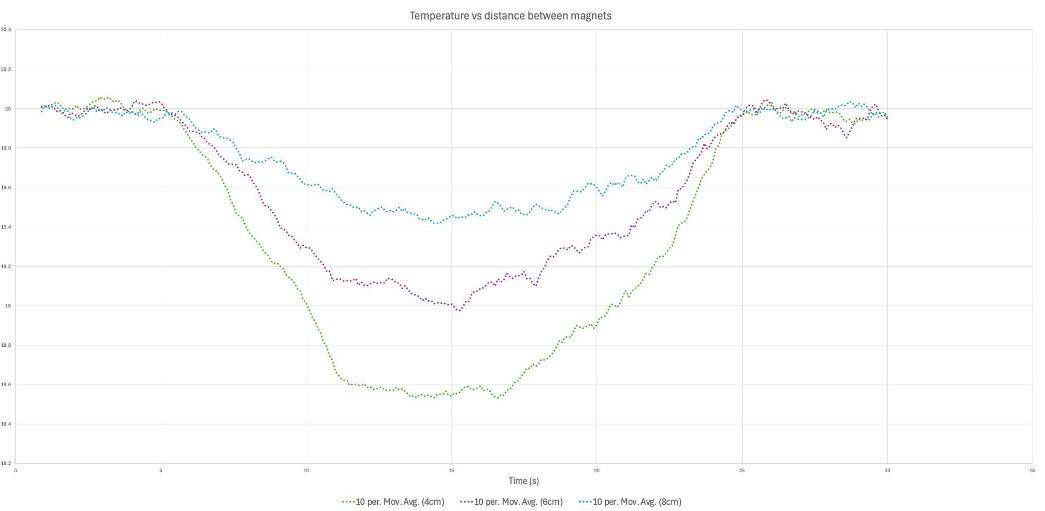
Figure 1: Graph of isolated moving averages for each separation interval, period of 10 entries i.e. 1 second, 2025.
Table 1: Table comprising absolute maximum ∆T for each magnet separation interval and their respective absolute SNR calculated with the average standard deviation σ = 0.405282517, 2025.
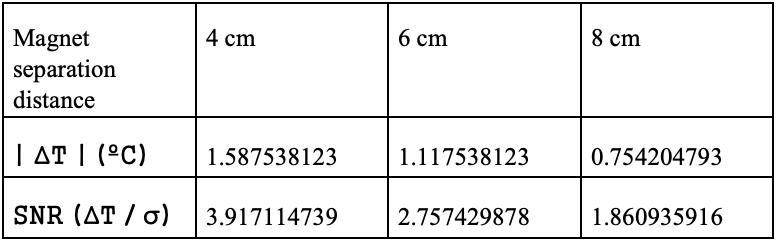
Table 2: Summary output of regression statistics calculated via Data Analysis Toolpak in Excel with the respective maximum absolute ∆T in each separation interval against the corresponding 1/d2 (i.e. for 4 cm: 625, 6 cm: 277.78, 8 cm: 156.25), 2025.
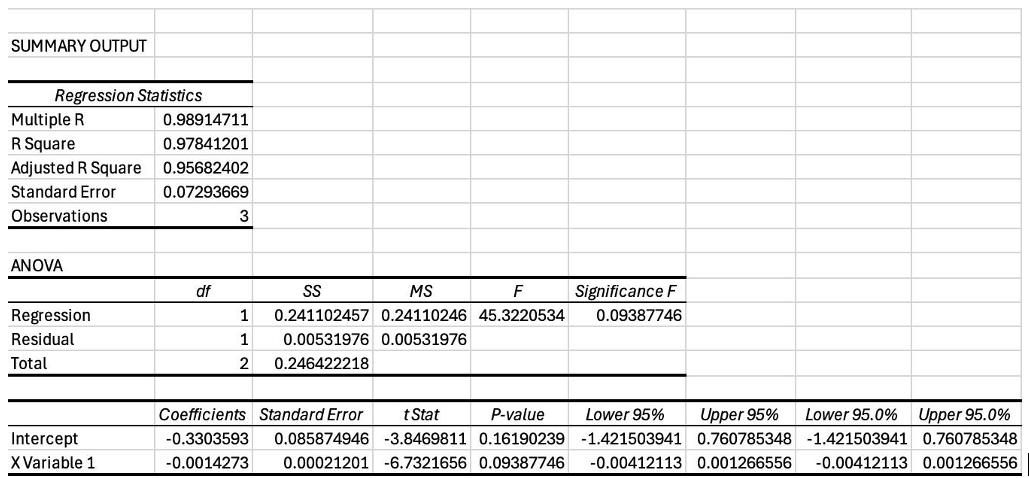
DISCUSSION
Sample and Setup Characteristics
This study measured the temperature change over time in a 20 g gadolinium (Gd) sample subjected to a magnetic field, simulating the magnetocaloric effect (MCE) using opposing neodymium disc magnets at three separations: 4 cm, 6 cm, and 8 cm. Each trial employed the same Gd sample mass, ambient room conditions (≈20°C), and temperature sensor configuration remained undisturbed. The PASCO temperature probe, with a resolution of 0.01°C, was fixed in position to ensure consistent spatial alignment relative to the field centre.
Temperature readings were recorded at 0.1 second intervals for the total period of around 30 seconds. To reduce variability, data collection began with a 5-second baseline period, followed by the Gd insertion into the magnetic field, sustained exposure, and then withdrawal. This sequence ensured each dataset captured the controlled temperature prior, the active MCE, and thermal recovery phases.
Figure 1 shows a temporal temperature profile of the Gd sample for all three magnet distances, using the trendline from moving averages as a means to reduce thermal noise and fluctuation present in the original data. The 4 cm spacing consistently exhibited the greatest decrease in temperature, followed by 6 cm and 8 cm, indicative of the negative correlation between field separation and the
observed cooling magnitude as expected. The minimum temperatures reached in each condition were:
• 4 cm: 18.407°C (ΔT ≈−1.59°C from control mean = 19.994°C)
• 6 cm: 18.877°C (ΔT ≈−1.12°C from control mean)
• 8 cm: 19.240°C (ΔT ≈−0.75°C from control mean)
ANALYSIS OF RESULTS
Relationship with magnetic field strength: H₁
The linear regression analysis of MCE in gadolinium revealed a strong relationship between the inverse-square of magnet distance (1/d²) and ∆T, with an R² value of 0.978 (see Table 2), indicating that approximately 97.8% of the variance in ΔT can be explained by the applied magnetic field strength. Additionally, the r value is 0.989, meaning that there is a strong positive correlation between the inverse square of the magnets’ distance and the adiabatic temperature change. However, the intercept’s p-value of 0.162 (> 0.05) suggests that the adiabatic temperature shift was not statistically significant.
The positive correlation between 1/d² and ΔT supports H₁, confirming that the MCE scales predictably with field strength, as expected from theoretical models (Pecharsky & Gschneidner, 1997). The strongest cooling effect was observed at 4 cm separation (ΔT ≈-1.5°C), decreasing to -0.8°C at 6 cm and -0.3°C at 8 cm, consistent with dipole field decay (B ∝ 1/d²). This aligns with prior studies demonstrating that gadolinium exhibits significant MCE near room temperature due to its high magnetic entropy change (Gómez et al., 2013). However, the non-zero intercept suggests minor systematic error, possibly from thermal drift or sensor calibration bias. Future experiments should employ active temperature stabilization to minimize baseline fluctuations. Signal-to-Noise Ratio (SNR) and Environmental Interference (H₂). The SNR values (see Table 1) demonstrate that detectability of the MCE diminishes with weaker fields. At 4 cm, the SNR was sufficiently high (> 3) to clearly distinguish the MCE from noise, whereas at 8 cm, the SNR had dipped below the detection threshold (SNR < 2), where noise obscures the signal to a major extent, thus making its data statistically invalid.
This finding supports H₂, confirming that environmental thermal noise significantly impacts weaker MCE signals. Previous studies have noted similar challenges in uncontrolled settings, where convective air currents and sensor instability introduce ± 0.2°C fluctuations (Bjørk et al., 2010). The firsthand results suggest that, for reliable MCE measurements below 6 cm separation with the permanent magnets used, thermal shielding or noisereduction algorithms are necessary.
The current findings align with established MCE literature, where gadolinium’s cooling response has been welldocumented under controlled conditions (Franco et al., 2018). However, most prior experiments use superconducting magnets or cryogenic environments, minimizing noise (Zhou et al., 2020). The present study extends these findings by demonstrating that even in suboptimal conditions, the MCE remains detectable at stronger fields but becomes unreliable quickly as the field weakens.
The R² value (0.978) was comparatively ideal, given lab-grade MCE studies typically report R² > 0.9 (Jr. Gschneidner K. A. et al., 2005), which establishes and solidifies the correlation between the distance between magnets and the resulting adiabatic temperature change, however the noise undermines the statistical significance of this conclusion.
1. Thermal instability
The lack of temperature regulation introduced ± 0.2C thermal fluctuations, reducing SNR at weaker fields as exhibited in the 8 cm measurements, which proved to be noise-dominated as its SNR value was less than 2. Future setups should use insulated chambers or possibly Peltier cooling to stabilize ambient conditions.
2. Sensor latency and calibration error
Given the experiment was on a smaller temperature scale, the remote sensor having a ±0.1C precision presents the possibility that it contributed to residual thermal noise as the general fluctuation trend was ±0.2C. If the sensor was calibrated wrong, it would undermine the accuracy of the entire experimental dataset, although systematic error can be overcome by offsetting it if the calibration values are known. For precision, however, only more precise technology with smaller margins of error would contribute to lessening the possible temperature fluctuations.
1. Noise-reduction techniques
The noise was proved to be an obstruction to the results’ accuracy in the present study’s investigation, in which for real-world implementation of such technology, the reduction of the fluctuations needs to be considered. In signal processing, there is technology that filters out noise and other artefacts in data in real-time, which can greatly improve not only the accuracy of the data, but also increase the value of the SNR in weaker fields.
2. Material comparisons
Although gadolinium is one of the most suited materials for the magnetocaloric effect, scientists have already synthesised alloys that can also exhibit MCE. With the complications found in this investigation,
including the noise and also the time it takes to demonstrate MCE, future research could involve investigating how other materials and alloys capable of it compare to gadolinium, and if they possess better properties.
This study investigated the relationship between magnetic field strength and the magnetocaloric effect (MCE) in gadolinium, while assessing the impact of environmental thermal noise on measurement reliability. The results supported H₁, confirming that ΔT scales predictably with 1/d², with the strongest cooling observed at 4 cm
Dan’kov, S. Yu., Tishin, A. M., Pecharsky, V. K., & Gschneidner, K. A. (1998). Magnetic phase transitions and the magnetothermal properties of gadolinium. Physical Review B, 57(6), 3478–3490. https://doi. org/10.1103/PhysRevB.57.3478
Donoho, D. L. (1995). De-noising by soft-thresholding. IEEE Transactions on Information Theory, 41(3), 613–627. https://doi. org/10.1109/18.382009
Experiment of The Month, Millersville University. (2018). https://www. millersville.edu/physics/experiments/023/ Franco, V., Blázquez, J. S., Ipus, J. J., Law, J. Y., Moreno-Ramírez, L. M., & Conde, A. (2018). Magnetocaloric effect: From materials research to refrigeration devices. Progress in Materials Science, 93, 112–232. https://doi.org/10.1016/j.pmatsci.2017.10.005
Gschneidner, Jr., K. A., Pecharsky, V. K., & Tsokol, A. L. (2005). Recent developments in magnetocaloric materials—IOPscience. https://iopscience.iop.org/article/10.1088/0034-4885/68/6/R04
Gschneidner, K. A., & Pecharsky, V. K. (2008). Thirty years of near room temperature magnetic cooling: Where we are today and future prospects. International Journal of Refrigeration, 31(6), 945–961. https://doi.org/10.1016/j.ijrefrig.2008.01.004
Jr, K. A. G., & Pecharsky, V. K. (2000). Magnetocaloric Materials. Annual Review of Materials Research, 30(Volume 30, 2000), 387–429. https:// doi.org/10.1146/annurev.matsci.30.1.387
Lyubina, J., Schäfer, R., Martin, N., Schultz, L., & Gutfleisch, O. (2010). Novel Design of La (Fe,Si)13 Alloys Towards High Magnetic Refrigeration Performance. Advanced Materials, 22(33), 3735–3739. https://doi. org/10.1002/adma.201000177
Marshall, M. (2022). The refrigerator as a problem and solution: Food storage practices as part of sustainable food culture. Food and Foodways, 30(4), 261–286. https://doi.org/10.1080/07409710.2022. 2124726
Moving Average Filters. (1997). https://www.dspguide.com/ch15.htm
Pecharsky, V. K., & Gschneidner, Jr., K. A. (1997). Giant Magnetocaloric Effect in ${\mathrm{Gd}}_{5}({\mathrm{Si}}_{2}{\mathrm{Ge}}_{2})$. Physical Review Letters, 78(23), 4494–4497. https://doi.org/10.1103/ PhysRevLett.78.4494
Refrigeration and airconditioning—Consumers—DCCEEW. (2025). https://www.dcceew.gov.au/environment/protection/ozone/rac/ consumers
Spichkin, Y. I., & Gimaev, R. R. (2014). Experimental methods of the magnetocaloric effect studies. International Journal of Refrigeration, 37, 230–236. https://doi.org/10.1016/j.ijrefrig.2013.09.018
The History of the Refrigerator: Ancient Origins to Today | Whirlpool. (2010, September 2). https://www.whirlpool.com/blog/kitchen/histo-
separation (SNR = 3.92). However, H₂ was also validated, as SNR dropped significantly at 6 cm (2.76) and 8 cm (1.86), indicating that noise dominates in weaker fields. While the MCE’s field dependence was evident, thermal instability and sensor limitations reduced measurement precision compared to controlled lab studies. Future work should focus on improving thermal regulation and exploring noise-filtering methods to enhance weak field detectability. These findings have implications for educational demonstrations of MCE, emphasizing the need for controlled environments when testing subtle thermodynamic effects.
ry-of-the-refrigerator.html
Tierney, J. E., Haywood, A. M., Feng, R., Bhattacharya, T., & Otto-Bliesner, B. L. (2019). Pliocene SSTs and alkenone saturation indices [Dataset publication series]. Supplement to: Tierney, JE et al. (2019): Pliocene Warmth Consistent With Greenhouse Gas Forcing. Geophysical Research Letters, 46(15), 9136-9144, Https://Doi. Org/10.1029/2019GL083802; PANGAEA. https://doi.org/10.1594/ PANGAEA.904916
Tishin, A. M., & Spichkin, Y. I. (2016). The Magnetocaloric Effect and its Applications. CRC Press. https://doi.org/10.1201/9781420033373
What is the concentration of CFCs in the atmosphere, and how much do they contribute to global warming? | MIT Climate Portal. (2023). https://climate.mit.edu/ask-mit/what-concentration-cfcs-atmosphere-and-how-much-do-they-contribute-global-warming Zhou, Z. N., Akamine, H., Li, J., Yang, L., Higashizono, T., Hu, Q. D., Nishida, M., & Li, J. G. (2020). Tuning martensite transformation behavior and magneto-caloric effect in Ni44Mn36In14Co6 alloy through doping the fifth element Cu. Journal of Alloys and Compounds, 817, 153150. https://doi.org/10.1016/j.jallcom.2019.153150
Zimm, C., Jastrab, A., Sternberg, A., Pecharsky, V., Gschneidner, K., Osborne, M., & Anderson, I. (1998). Description and Performance of a Near-Room Temperature Magnetic Refrigerator. In P. Kittel (Ed.), Advances in Cryogenic Engineering (pp. 1759–1766). Springer US. https://doi.org/10.1007/978-1-4757-9047-4_222
APPENDICES
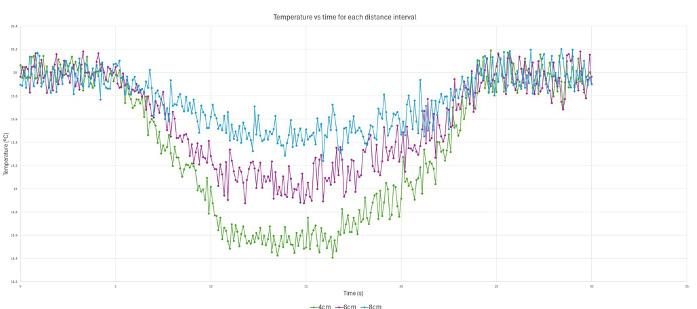
Figure 2: Full linearly connected scatter plot of cleansed data, mean baseline temperature = 19.994C
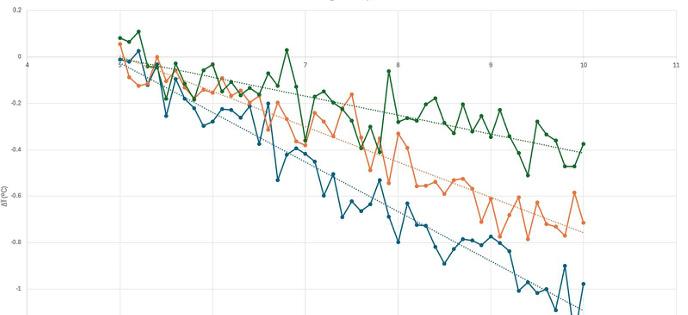
Figure 3: ∆T plotted against time, with the line of best fit being the rate of temperature change in between roughly 5-10 seconds; the initial active MCE phase
EVELYN ZHU,
YEAR 12
This paper was written for Science Extension
ABSTRACT
Climate change significantly increases the frequency of fires, wreaking havoc on the equilibrium of ecosystems globally. One such ecosystem is the tropical savannah, which dominates Kakadu National Park (KNP) and is made up of a mosaic of grasslands and forests. The biodiversity and stability of this savannah ecosystem is threatened by the grass-fire cycle–a positive feedback mechanism by which fire increases the amount of grass, which then increases the likelihood and severity of fire. In Kakadu, understanding the cycle is particularly pertinent since it is not currently considered in fire management strategies. Thus, this research investigates whether more frequent fire increases the prevalence of native sorghum grass–a dominant understorey grass. The findings indicated that higher fire frequency was not correlated with increased sorghum occurrence. In contradicting the established paradigm of the grass-fire cycle, these results invite further research into understanding the complex interactions of grass, fire, and other factors in the tropical savannah ecosystem, so that ecologically and culturally valuable natural places like Kakadu National Park can be adequately protected.
LITERATURE REVIEW
Fire regimes in Australia
Climate change continues to exacerbate ecological disturbances, with one of the most marked and wellestablished being fire (Camac et al., 2017; Enright et al., 2014; Moritz et al., 2012). It is predicted that, due to hotter and drier conditions and increased biomass, the risk of wildfires will increase in Australia, making effective fire management increasingly crucial (Moritz et al., 2012). Across Australia, the greatest extent of fire occurs in monsoonal, tropical savannahs in the Northern Territory–an ecosystem which is also among the most flammable in the world (Petty et al., 2023; Russell-Smith, Yates, et al., 2017).
Kakadu National Park
Kakadu National Park, in the Top End of the Northern Territory, is the largest national park in Australia (19,910 km2) and is jointly managed by Indigenous Traditional Owners and the Australian Government (World Heritage Places-Kakadu National Park-DCCEEW, n.d.). It is a UNESCO World Heritage site on account of both its biodiversity and its rich, cultural significance to the Indigenous peoples who have been its inhabitants and
caretakers for at least 40,000 years (Petty et al., 2023; Trauernicht et al., 2013). The Top End has a very marked seasonal difference in rainfall between the monsoonal wet and the dry seasons (Seasons in Kakadu National Park Australia, n.d.; Weather & Seasons, n.d.). Over 90% of the average annual 1570 mm of rain falls during the monsoonal wet season–November to March (RussellSmith, Evans, et al., 2017; Weather & Seasons, n.d.).
Tropical savannah in Kakadu Kakadu supports a wide variety of ecosystems, but savannah makes up 80% of the national park (Landscapes-DCCEEW, n.d.). Savannahs are biomes partway between grassland and forest, with trees or shrubs sporadically scattered among grass (Scholes & Archer, 1997). Eames et al. (2023) report that tropical savannahs comprise more than two-thirds of annual burned area globally as the world’s most burned biome. This is on account of the aforementioned rainfall seasonality: high rainfall during the wet season enables high vegetation productivity and therefore high biomass and fuel load, especially flammable grasses (Russell-Smith et al., 2003). During the dry season, the fuel dries and cures, becoming so vulnerable to ignition that more than half of the savannahs in north Australia are burnt annually (RussellSmith et al., 2003; Russell-Smith, Evans, et al., 2017).
Vegetation composition and its implications for savannahs
As such, vegetation and fauna in savannahs are adapted to tolerate fire to some extent (Enright et al., 2014; Scholes & Archer, 1997). However, in ecosystems around world, increasing fire frequency and fire intensity, as well as warmer, drier climates, are driving changes in vegetation composition to the point that conversions between different ecosystems may occur–such as forest to savannah, savannah to grassland, and vice versa (Anadón et al., 2014; Enright & Fontaine, 2024; RussellSmith et al., 1998). This is conceptualised by Enright and Fontaine, (2024) with the interval squeeze model, wherein a shorter interval between fires stresses (or “squeezes”) populations, reducing the likelihood of species’ survival and increasing the likelihood of an ecosystem state conversion. This is particularly significant in savannahs due to the inherent variability between shrub/treedominance and grass-dominance. A proportional increase in grasses such as native Sorghum species and invasive grass species is of great concern, since this empirically threatens woody species and the whole ecosystem’s flammability (Bowman et al., 2014; Bowman
& Panton, 1993; Enright & Fontaine, 2024). Since sorghum is one of the most common grass species in Kakadu, it will be the focus of this research (Landscapes - DCCEEW, n.d.).
In tropical savannahs, the mechanism which may be responsible for grass proliferation is the grass-fire cycle: a positive feedback loop where fire kills fire-sensitive trees but favours life forms like grass (which can grow rapidly in the decreased canopy cover between fires), increasing grass biomass, which then increases the fuel load for more intense, future fires (Bowman et al., 2014; DaySmith, 2025). In other words, it is expected that increased fire frequency increases grass abundance. Considering this, it is critical that fire management strategies account for vegetation composition in addition to fire intensity and frequency, and the role of grass species, such as sorghum, in fire regimes.
Indigenous and current fire management
In the Top End, Indigenous people, such as the BininjKunwok clans of the Stone Country, traditionally used low-intensity fire to manage grasses, clear paths, reduce the risk of more destructive wildfires in the late dry season (LDS), and for cultural purposes (Murphy et al., 2015; Petty et al., 2023; Russell-Smith et al., 2003). However, European colonisation devastated many Indigenous communities, dispossessing Traditional Owners of their land, spreading disease, and preventing the practice and preservation of knowledge about traditional burning (Trauernicht et al., 2013). This led to significant shifts in the fire regime towards more destructive, intense fires in the LDS and decline in the biodiversity of the Top End (Petty et al., 2023; Russell-Smith et al., 1998). Since the establishment of Kakadu National Park in 1979, the park has aimed to employ Indigenous burning patterns on a larger scale (i.e. using helicopters rather than walking to set fires), successfully shifting the fire regime away from destructive, LDS fires (Murphy et al., 2015; RussellSmith, Evans, et al., 2017). However, these strategies are not perfect: there are concerns about large-scale fires being set in the early dry season (EDS) increasing grass proliferation (via the grass-fire cycle) and lacking ecological nuance (Petty et al., 2023).
With both Indigenous and scientific knowledge indicating that increasing grass-dominance is a concern which must be addressed in future fire management, this research thus aims to explore how fire frequency affects the prevalence of sorghum grass. Not only is this research critical due to the urgent need for informed fire management strategies in Kakadu National Park, which have extreme conservation and cultural significance, but the park serves as an exemplar to other managed savannahs in Australia and globally. Thus, it must ensure its fire management strategies effectively address the grass-fire cycle.
How does the frequency of fire in tropical savannahs in Kakadu National Park affect the occurrence of Sorghum spp. of grass?
Higher fire frequency leads to an increase in the occurrence of Sorghum spp. Null hypothesis: Higher fire frequency does not lead to an increase in Sorghum spp. occurrence.
The data was collected from 133 permanent plots in Kakadu National Park as part of the Three Parks Savanna Fire-Effects Plot Network (Russell-Smith, n.d.). The network is part of the Long-Term Ecological Research Network, which operates within the Terrestrial Ecological Research Network, supported by the Australia Government and is run by academics at Charles Darwin University. The data is publicly available under Creative Commons license 4.0. Vegetation data is collected periodically (roughly every 5 years) from the plots, which are each roughly 40 x 20 metres in size, permanently marked by a number plate, central metal star picket and GPS waypoint to ensure consistency and validity (for coordinates, see Table A9). Permanent transects lie within the plots and the species occurrences were counted and recorded for each 1x1 meter quadrat. The data includes five surveys periods: T1–during 1994/1995/1996, T2–during 1999/2000, T3–during 2004/2005, T4–during 2009, and T5–during 2013/2014. All the data was collected during December and January, during the wet season, which accounts for seasonal differences in vegetation composition, ensuring validity. Fire severity data was collected bi-annually on the ground, aided by satellite-derived fire mapping, and included categorical data about severity as well as time between fires. This dataset was chosen due to its comprehensive record of both vegetation and fire data, which was necessary to answer this investigation’s aim.
The data was first cleaned to exclude any plots which did not have occurrences of Sorghum spp, since they would be irrelevant to the study. The species observed include S. brachypodum, S. intrans, S. laxiflorum, S. plumosum, S. timorense, and other unspecified Sorghum spp., all of which were collated as Sorghum spp. Moreover, plots which had been classified as lying in floodplains or lowland rainforest were excluded, since these biomes did not constitute a tropical savannah and were irrelevant. Plots which had only been sampled once were excluded, since they would not indicate changes in Sorghum spp. occurrence. Plots which had not been burnt at all during the study were also excluded, since changes in Sorghum spp. occurrence would not be related to fire frequency. After cleansing, the final number of plots included was 60.
Data analysis was performed using Excel. The occurrences of Sorghum spp. in the quadrats within one plot were averaged for each sampling period (T1, T2, T3, T4, & T5) to obtain a value representative of the whole plot. This was mapped using Excel to gain an understanding of the distribution of the grass across the national park. Occurrence was also graphed to observe the variation and distribution of the data.
Using the fire severity data, which listed the time since fire in years for each plot every season, the cumulative years since fire was calculated for each plot. A larger number indicated that fire was less frequent, since more time had elapsed between burns during the 20 years that the plots were established. This was also mapped using Excel to gain an understanding of the distribution of fire frequency across the national park.
Descriptive statistics were then determined for the cumulative time since fire and for the average Sorghum spp. occurrence across all five survey periods. Plots were categorised into severely burnt, moderately burnt, and mildly burnt by dividing the range of cumulative time since fire into tertiles, so that varying levels of fire frequency could be compared. ANOVAs were performed for each sampling period (T1-5) and for the average sorghum occurrence across the study duration to compare the three levels of fire frequency. Sorghum spp. occurrence was graphed against the cumulative years since fire and by fire severity category. Regression analysis was also performed to determine whether there was a correlation and relationship between fire frequency and Sorghum spp. occurrence in order to answer the research question.
LITERATURE REVIEW
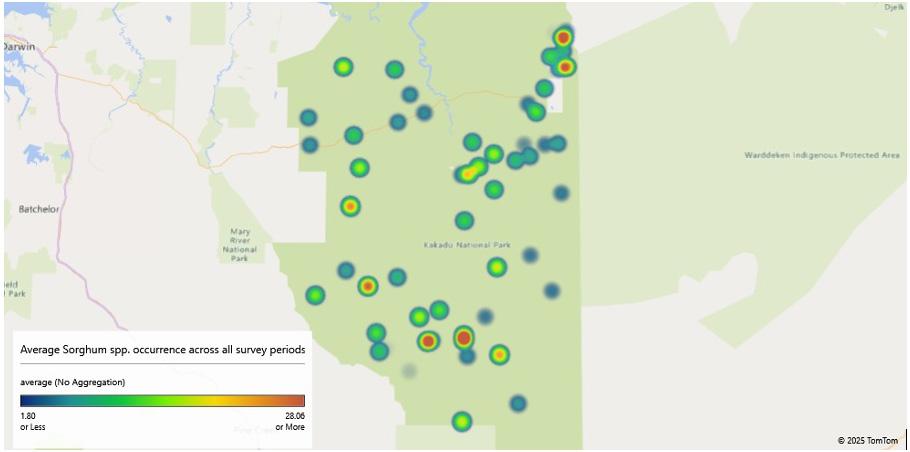
Figure 1: Heat map of average Sorghum spp. occurrence per plot across all survey periods.
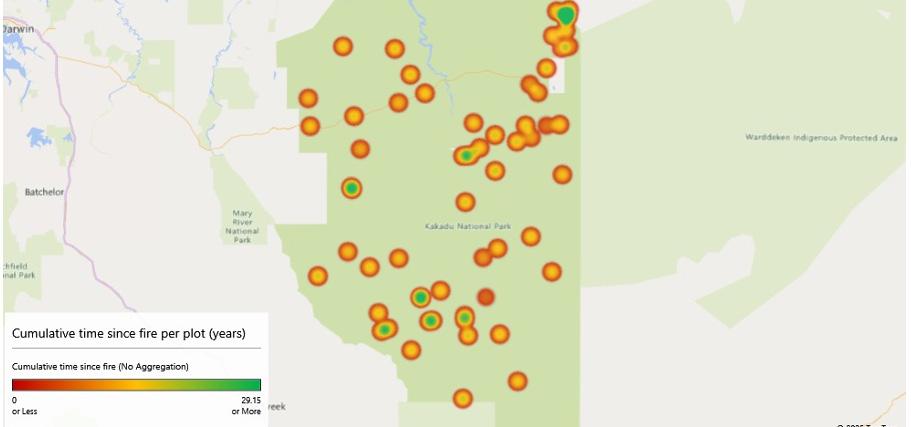
Figure 2: Heat map of cumulative time since fire per plot in years.
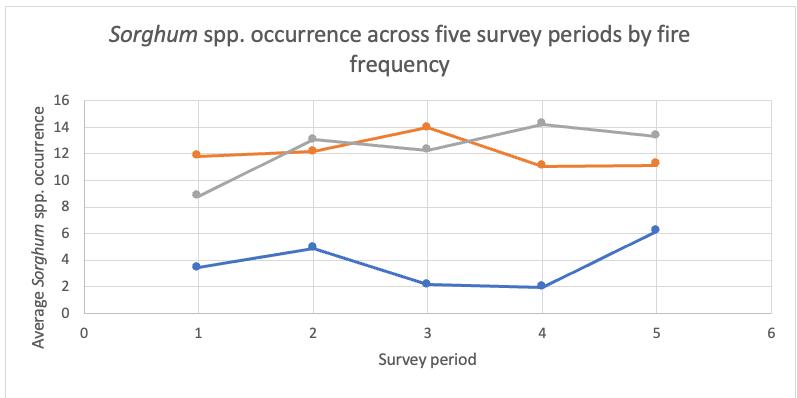
Figure 3: Line graph of average Sorghum spp. occurrence for three levels of fire frequency over all survey periods.
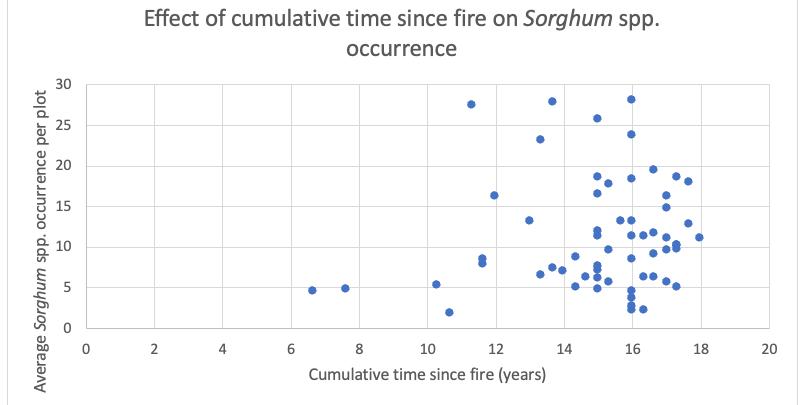
Figure 4: Scatter plot of average Sorghum spp. occurrence per plot across all survey periods against cumulative time since fire.
Table 1: Regression statistics of linear regression between cumulative time since fire and abundance of Sorghum spp. per plot
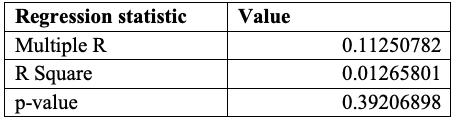
Table 2: F-value, F-critical value, and p-value of ANOVA comparing the Sorghum spp. occurrences of the three categories of fire frequency in survey period T1.
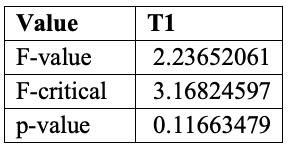
Table 3: F-value, F-critical value, and p-value of ANOVA comparing the Sorghum spp. occurrences of the three categories of fire frequency in survey period T2.
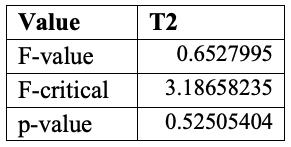
Table 4: F-value, F-critical value, and p-value of ANOVA comparing the Sorghum spp. occurrences of the three categories of fire frequency in survey period T3.
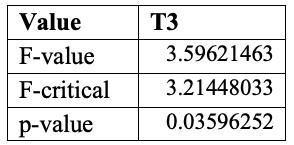
Table 5: F-value, F-critical value, and p-value of ANOVA comparing the Sorghum spp. occurrences of the three categories of fire frequency in survey period T4.
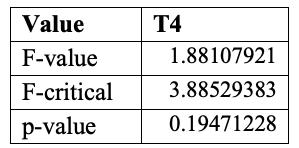
Table 6: F-value, F-critical value, and p-value of ANOVA comparing the Sorghum spp. occurrences of the three categories of fire frequency in survey period T5.
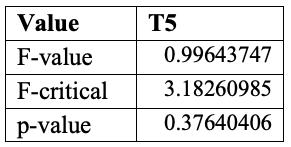
Table 7: F-value, F-critical value, and p-value of ANOVA comparing the Sorghum spp. occurrences of the three categories of fire frequency, averaged across all survey periods.
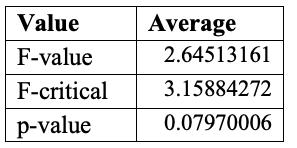
Overall, the results do not support the hypothesis. Sorghum spp. occurrence in all three categories of fire frequency fluctuated across the different survey periods and was lowest in the severe fire frequency category across all survey periods, while occurrence was similar between moderate and mild fire frequency (Figure 3). Although Figure 3 suggests a notable difference in Sorghum spp. occurrence between severe fire frequency and the other two categories, the results of the ANOVA in Table 7 comparing the average Sorghum spp. occurrence across all survey periods between the three categories of fire severity indicate that there is no statistically significant difference (p = 0.07970006 so p > 0.05). Except for T3 in Table 4, all F-values are lower than the F-critical and all p-values are above the significance level of 0.05
(see Table 2, Table 3, Table 5, and Table 6), so the null hypothesis is not rejected.
Moreover, there is no correlation between cumulative time since fire and average Sorghum spp. occurrence per plot (Figure 4). This is supported by the regression statistics in Table 1. Although it indicates that there is very weak, linear, positive correlation (R2 = 0.0127 and R = 0.11250782), it is statistically insignificant since the p-value is greater than 0.05 (p = 0.39206898). This does not align with the established grass-fire cycle and the expected negative correlation in the data, since the predicted response of grass to fire is that more fire would favour grass proliferation (Day-Smith, 2025; Enright & Fontaine, 2024; Enright et al., 2014; Scholes & Archer, 1997). Thus, given these results, the alternate hypothesis must be rejected.
The use of secondary data from an observational study meant that some variables could not be controlled, such as climate factors like rainfall, soil nutrients, temperature and more. Moreover, the plots were located in a variety of conditions, and some were located near campgrounds or tourist attractions, which could have introduced confounding variables such as human management, exposure to ignition sources and more, reducing validity. This could also contribute to the variation across the park in Sorghum spp. occurrence and fire frequency seen in Figure 1 and Figure 2, where the northeast and southwest regions feature both more sorghum grass and less fire.
In addition, some plots were only surveyed 2, 3, or 4 times rather than at all five survey periods. This meant the sample size of data collected during certain survey periods (i.e. T4) and of certain plots was very limited, which decreased reliability. This could have contributed to the high variance in the data, as visualised in Figure A5 and Figure A6, and to the descriptive statistics (specifically, range and standard deviation) reported in Table A10 and Table A11. There was a gap of roughly five years between each survey, which does not enable a thorough understanding of changes in sorghum occurrence within the gap. To improve validity and reliability, a study with a longer duration and more frequent data collection (annually or bi-annually) would increase the amount of data collected, as well as the confidence in the data.
The methodology involved averaging the occurrence (number of Sorghum spp. individuals) of all quadrats in each plot, which produced a value representative of each plot, but was liable to be influenced by outliers, especially since some plots only had a few quadrats where sorghum grass was present, reducing reliability. Additionally, all species were collated, which may have impacted the nuance of the analysis and its validity, since variables unique to particular species (such as some species being more flammable than others) were not controlled. Moreover, the outlier plots identified in Figure A6 with
abnormally low cumulative time since fire (i.e. high fire frequency) were not excluded–a choice which was made to retain the category of “severe fire frequency” for comparison. However, this may have impeded the reliability of the data, since the number of plots in each fire frequency category were inequal, with severe fire frequency only having four plots (the aforementioned outliers). The small sample space also decreases confidence in the results.
Future research would benefit from a more controlled environment, such as establishing plots with identical initial abundances of sorghum grass which are then exposed to different frequencies of fire. Paired t-tests would then be appropriate for analysing the data, which would enable more specific and more valid conclusions to be drawn for each plot about the relationship between fire frequency and sorghum occurrence. A longitudinal study of a longer duration, more frequent sampling, and more plots would also reduce some of the issues with reliability and validity.
It is also possible that this research suggests the existence of a threshold of high fire frequency beyond which sorghum populations cannot recover easily. Such thresholds have already been theorised for other plant species/life forms, including fire-tolerant alpine eucalyptus trees, and this would explain why the data does not abide by the paradigm of the grass-fire cycle (Camac et al., 2013; Fairman et al., 2017; Johnstone et al., 2016; Walsh & McDougall, 2005). Thus, further research, as outlined above, into this possibility for grasses is necessary to understand grass-fire dynamics. Although this research does not support the hypothesis,
Anadón, J. D., Sala, O. E., & Maestre, F. T. (2014). Climate change will increase savannas at the expense of forests and treeless vegetation in tropical and subtropical Americas. Journal of Ecology, 102(6), 1363–1373. https://doi.org/10.1111/1365-2745.12325
Bowman, D. M. J. S., MacDermott, H. J., Nichols, S. C., & Murphy, B. P. (2014). A grass–fire cycle eliminates an obligate-seeding tree in a tropical savanna. Ecology and Evolution, 4(21), 4185–4194. https:// doi.org/10.1002/ece3.1285
Bowman, D. M. J. S., & Panton, W. J. (1993). Decline of Callitris intratropica R. T. Baker & H. G. Smith in the Northern Territory: Implications for Pre- and Post-European Colonization Fire Regimes. Journal of Biogeography, 20(4), 373–381. https://doi.org/10.2307/2845586
Camac, J. S., Williams, R. J., Wahren, C.-H., Hoffmann, A. A., & Vesk, P. A. (2017). Climatic warming strengthens a positive feedback between alpine shrubs and fire. Global Change Biology, 23(8), 3249–3258. https://doi.org/10.1111/gcb.13614
Camac, J. S., Williams, R. J., Wahren, C.-H., Morris, W. K., & Morgan, J. W. (2013). Post-fire regeneration in alpine heathland: Does fire severity matter? Austral Ecology, 38(2). https://www.researchgate.net/ publication/255978288_Post-fire_regeneration_in_alpine_heath-
the limitations of the methodology may have contributed to these results. A greater understanding of sorghum grass in the grass-fire cycle in Kakadu National Park is still critical in order to inform more effective fire management strategies, to preserve the biodiversity and cultural significance of this global treasure (McGregor et al., 2010; Russell-Smith, Evans, et al., 2017).
Thus, the effect of fire frequency on Sorghum spp. occurrence in Kakadu National Park was investigated using secondary data from the Three-Parks Savanna Fire-Effects Plot Network. The hypothesis–that higher fire frequency would increase sorghum occurrence–was not supported, since the correlation between these variables was statistically insignificant (p = 0.39206898). Moreover, the difference between fire frequency categories (mild, moderate, and severe) with respect to sorghum grass occurrence was statistically insignificant (p-values were greater than 0.05 and F-values less than the critical value). The main limitations are due to the inability to control all variables, the limited sample size and study duration, and the incomplete data. A more experimentally controlled investigation may improve validity, reliability, and confidence in the results. These findings, especially since they run counter to the expected trend, underpinned by the grass-fire cycle, demonstrate that further research is required into the complex dynamics of fire and grass in savannahs, especially the possibility of a threshold of fire frequency beyond which the grass does not recover as predicted. This information is particularly pertinent to Kakadu’s fire management strategies and, by extension, fire management globally, especially as climate change exacerbates natural disasters like fires.
land_Does_fire_severity_matter
Day-Smith, M. (2025). Fire, flammability and grasses: Does fire regime effect the grass-fire cycle in a northern Australian savanna? [Thesis, La Trobe]. https://doi.org/10.26181/28719761.v1
Enright, N., & Fontaine, J. (2024). Interval squeeze: Altered fire regimes and demographic responses interact to threaten woody species persistence as climate changes. Frontiers in Ecology and the Environment. https://doi.org/10.1890/140231
Enright, N. J., Fontaine, J. B., Lamont, B. B., Miller, B. P., & Westcott, V. C. (2014). Resistance and resilience to changing climate and fire regime depend on plant functional traits. Journal of Ecology, 102(6), 1572–1581. https://doi.org/10.1111/1365-2745.12306
Fairman, T. A., Bennett, L. T., Tupper, S., & Nitschke, C. R. (2017). Frequent wildfires erode tree persistence and alter stand structure and initial composition of a fire-tolerant sub-alpine forest. Journal of Vegetation Science, 28(6), 1151–1165. https://doi.org/10.1111/jvs.12575
Johnstone, J. F., Allen, C. D., Franklin, J. F., Frelich, L. E., Harvey, B. J., Higuera, P. E., Mack, M. C., Meentemeyer, R. K., Metz, M. R., Perry, G. L., Schoennagel, T., & Turner, M. G. (2016). Changing disturbance regimes, ecological memory, and forest resilience. Frontiers in Ecology and the Environment, 14(7), 369–378. https://doi.org/10.1002/ fee.1311
Landscapes—DCCEEW. (n.d.). Retrieved February 24, 2025, from https://www.dcceew.gov.au/parks-heritage/national-parks/ kakadu-national-park/natural-environment/landscapes#savanna-woodlands
McGregor, S., Lawson, V., Christophersen, P., Kennett, R., Boyden, J., Bayliss, P., Liedloff, A., McKaige, B., & Andersen, A. N. (2010). Indigenous Wetland Burning: Conserving Natural and Cultural Resources in Australia’s World Heritage-listed Kakadu National Park. Human Ecology, 38(6), 721–729. https://doi.org/10.1007/s10745-010-9362-y
Moritz, M. A., Parisien, M.-A., Batllori, E., Krawchuk, M. A., Van Dorn, J., Ganz, D. J., & Hayhoe, K. (2012). Climate change and disruptions to global fire activity. Ecosphere, 3(6). https://doi.org/10.1890/ES1100345.1
Murphy, B. P., Cochrane, M. A., & Russell-Smith, J. (2015). Prescribed burning protects endangered tropical heathlands of the Arnhem Plateau, northern Australia. Journal of Applied Ecology, 52(4), 980–991. https://doi.org/10.1111/1365-2664.12455
Petty, A. M., deKoninck, V., & Orlove, B. (2023). Cleaning, Protecting, or Abating? Making Indigenous Fire Management “Work” in Northern Australia. Journal of Ethnobiology. https://doi.org/10.2993/02780771-35.1.140
Russell-Smith, J. (n.d.). Three Parks Savanna Fire-effects Plot Network: Plot-based Vegetation Sampling Data, Northern Territory, Australia, 1994+ [Dataset]. https://datacommons.anu.edu.au/DataCommons/ rest/display/anudc:5836?layout=def:display
Russell-Smith, J., Evans, J., Edwards, A. C., & Simms, A. (2017). Assessing ecological performance thresholds in fire-prone Kakadu National Park, northern Australia. Ecosphere, 8(7). https://doi.org/10.1002/ ecs2.1856
Russell-Smith, J., Ryan, P. G., Klessa, D., Waight, G., & Harwood, R. (1998). Fire regimes, fire-sensitive vegetation and fire management of the sandstone Arnhem Plateau, monsoonal northern Australia. Journal of Applied Ecology, 35(6), 829–846. https://doi. org/10.1111/j.1365-2664.1998.tb00002.x
Russell-Smith, J., Yates, C., Edwards, A., Allan, G., Cook, G., Cooke, P., Craig, R., Heath, B., & Smith, R. (2003). Contemporary fire regimes of northern Australia, 1997–2001: Change since Aboriginal occupancy, challenges for sustainable management. International Journal of Wildland Fire, 12, 283–297. https://doi.org/10.1071/WF03015
Russell-Smith, J., Yates, C., Whitehead, P. J., Smith, R., Craig, R., Allan, G., Thackway, R., Frakes, I., Cridland, S., Meyer, M., & Gill, M. (2017). Bushfires ‘down under’: Patterns and implications of contemporary Australian landscape burning. International Journal of Wildland Fire, 16, 361–377. https://doi.org/10.1071/WF07018
Scholes, R., & Archer, S. (1997). Tree-Grass Interactions in Savannas. Annual Review of Ecology and Systematics, 28, 517–544. https://doi. org/10.1146/annurev.ecolsys.28.1.517
Seasons in Kakadu National Park, Australia: a visitor's guide for Kakadu travel in Kakadu National Park. (n.d.). Retrieved March 10, 2025, from http://www.kakadunationalparkaustralia.com/kakadu_seasons.htm
Trauernicht, C., Murphy, B. P., Tangalin, N., & Bowman, D. M. J. S. (2013). Cultural legacies, fire ecology, and environmental change in the Stone Country of Arnhem Land and Kakadu National Park, Australia. Ecology and Evolution, 3(2), 286–297. https://doi.org/10.1002/ ece3.460
Walsh, N. G., & McDougall, K. L. (2005). Progress in the recovery of the flora of treeless subalpine vegetation in Kosciuszko National Park after the 2003 fires. Cunninghamia. https://www.researchgate.net/ publication/268377854_Progress_in_the_recovery_of_the_flora_ of_treeless_subalpine_vegetation_in_Kosciuszko_National_Park_after_the_2003_fires
Weather & seasons. (n.d.). Retrieved March 10, 2025, from https:// northernterritory.com/plan/weather-and-seasons World Heritage Places—Kakadu National Park—DCCEEW. (n.d.). Retrieved March 10, 2025, from https://www.dcceew.gov.au/parks-heritage/heritage/places/world/kakadu
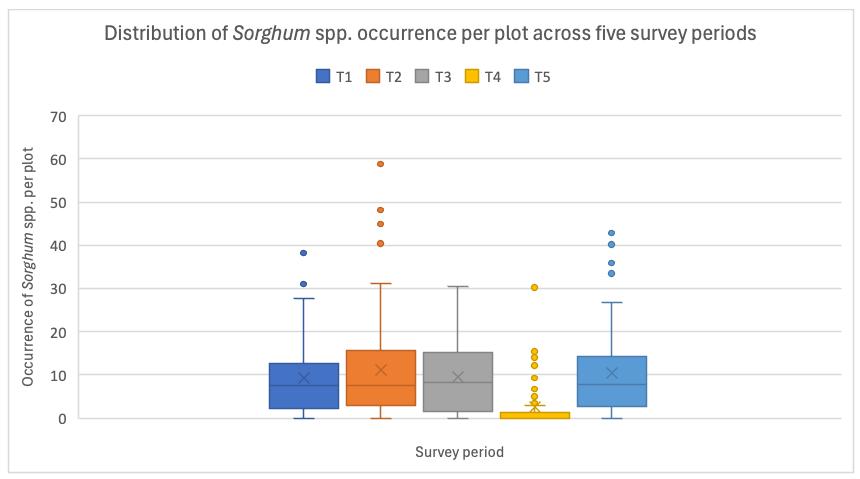
Figure A5: Box-and-whisker plots of Sorghum spp. occurrence per plot for each of the five survey periods.
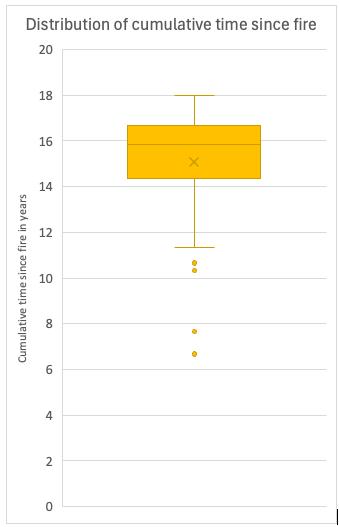
Figure A6: Box-and-whisker plot of distribution of cumulative time since fire per plot across all survey periods
APPENDICES
Table A8: Table of Sorghum spp. occurrence and fire data by plot
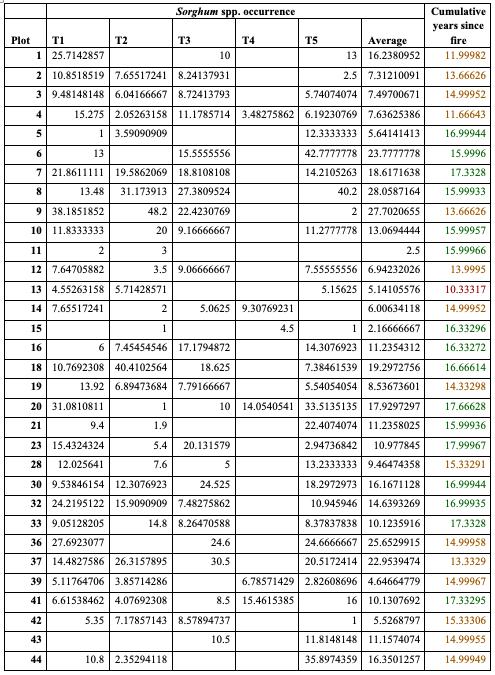
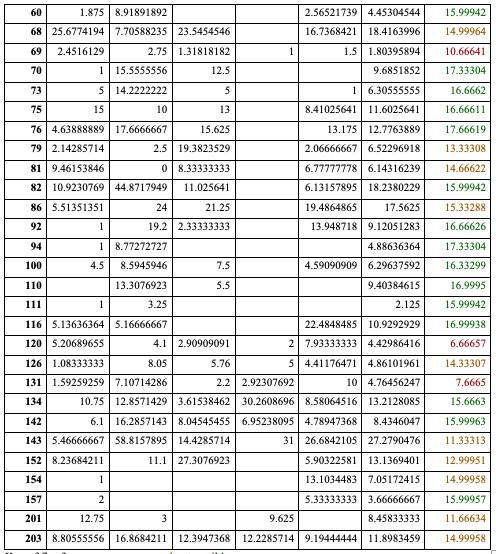
Key of fire frequency: severe, moderate, mild
Table A9: Table of location, district, and biome of each plot
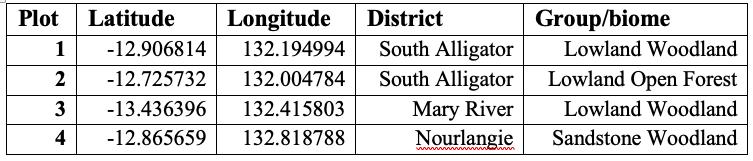
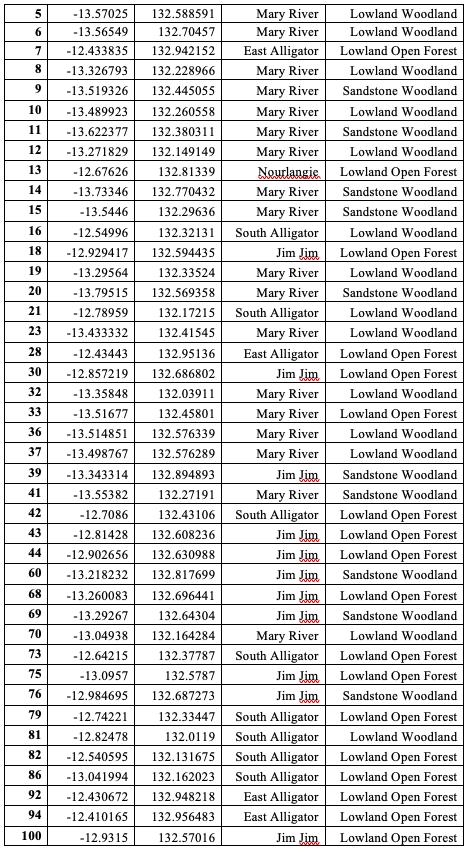
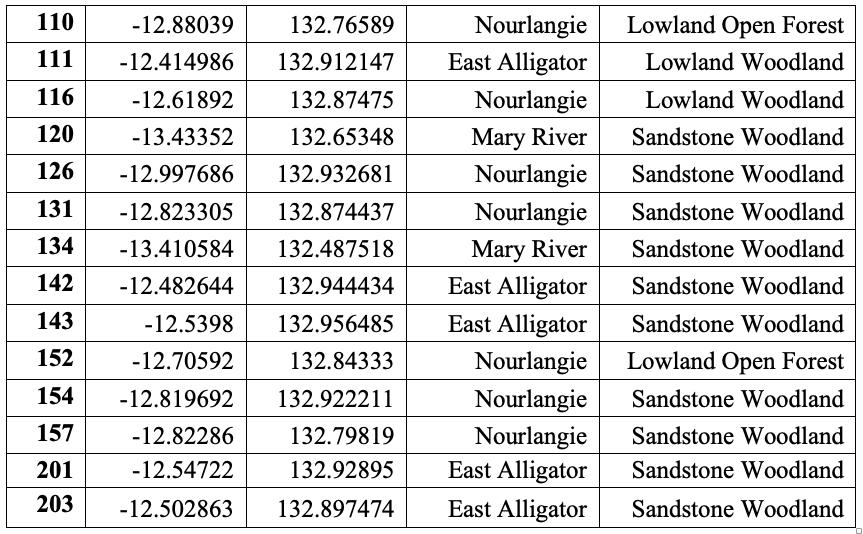
APPENDICES
Table A10: Table of selected descriptive statistics of cumulative years unburned per plot across all survey periods.
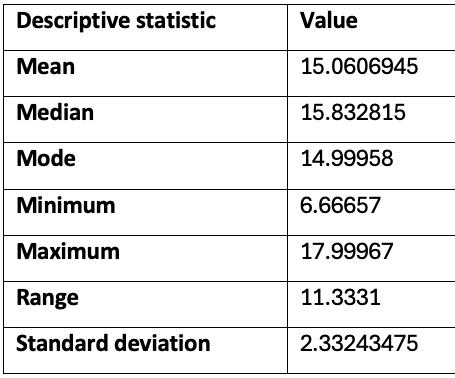
Table A11: Table of selected descriptive statistics of average Sorghum spp. occurrence per plot across all survey periods.
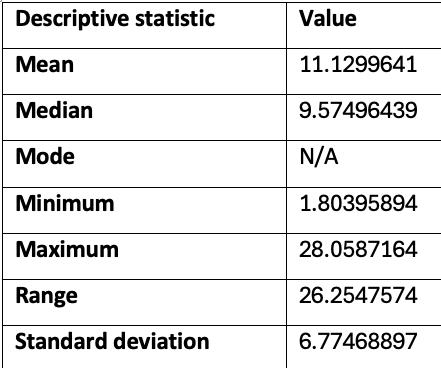
This report was written for the Health and Movement Science collaborative investigation project
Our question focuses on how early sport specialisation specifically increases the risk of stress fractures for female athletes. Sport specialisation includes intensive, specialised training of specific muscle groups that is often repeated over an extended period of time with little variation. When specialising in a sport at a young age, it can cause slower development in other muscle groups and contribute to the risk of stress fractures due to overuse. Our question explores the extent to which early specialisation in sports increases the risk of stress fractures in adolescent females.
Data for our research was collected using both quantitative and qualitative approaches to provide information for us to investigate to what extent does early specialisation in a sport increases the risk of stress fractures in adolescent females. Quantitative data was collected through a survey that was sent to adolescent females in the Pymble Elite Sports Program, where we gathered data about their early specialisation in terms of age, training hours, years of specialisation and duration out of sport due to injury. Furthermore, qualitative data was collected through the same survey, as well as a more specific questionnaire for a physiotherapist, where we looked at gathering information specifically about the experiences of the girls in their individual sports and their own feedback/advice. Our method for collecting qualitative data was collecting data into a second, more in-depth survey for those participants who were interested in a further interview.
The quantitative data showed that if participants were playing a very contrasting sport (in terms of body groups used), outside of their main sport, they were 62% less likely to get a stress fracture. This data relates to our research question, as if an athlete has little variation in sport (specialising in only one sport), they are at an increased risk of stress fracture injuries. Furthermore, early specialisation in high-impact/intensive/repetitive sports such as gymnastics, diving and athletics was revealed to be a significant catalyst for stress fracture injuries, evident through the majority of 9 out of 13 athletes with stress fractures, specialising in individual-based sports. Moreover, all 13 surveyed athletes with stress fractures agreed that their stress fracture was located in an area of high stress.
The qualitative data from the physiotherapist’s answers also mention how, ‘repetitive stress on the same muscles and bones [...] increases the risk of overuse injuries like stress fractures’, and that the common sports of the adolescent female patients she treats with stress fractures mainly play individual sports like ‘long-distance running, gymnastics, ballet [...] sports that involve repetitive impact or intense training from a young age.’ This is clearly linked to specialisation in terms of individual-based sports and how the risk of stress fractures is aggravated by intense/repetitive training. To add, the physiotherapist acknowledges that, ‘Participating in a variety of sports [...] helps to develop a well-rounded athlete, which in turn helps with injury prevention. It reduces repetitive strain, improves muscular coordination and balance, and often leads to better motor development. For longterm success and overall health, it’s usually better to let young athletes explore a range of sports first’. Clearly, this explains how a variety of sport participation can help to prevent the risk of stress fractures, with many health benefits, which is mentioned in our secondary research annotated bibliography resources.
Findings from our primary data collection closely correspond with the existing secondary research conducted about the impact early sport specialisation has on an increased risk of stress fractures in adolescent female athletes. The dominant themes from our secondary research include that adolescent females who play individual-based sports and high-impact/ intensive/repetitive sports are more likely to experience a stress fracture injury, and a variety of sport participation has many health benefits for them, including injury prevention.
Statements from Myer, Jayanthi, Difiori et al. (2015) in a paper on specilaisation in sport reiterate these similar trends observed in both the participant survey and physiotherapist statements. For example, one statement from the article mentions, ‘Other individual, technical sports such as gymnastics, dance, swimming and diving typically require early specialisation and high intensity volumes in prepubescent stages’, whilst mentioning further in the summary of the article that, ‘Increased degree of specialisation is positively correlated with increased serious overuse injury risk’. The statement mentions very similar early specialisation sports to the sports played by the participants in the survey conducted, and the sports of the adolescent female patients with stress fractures treated by the physiotherapist.
To add, Myer, Jayanthi, Difiori et al. (2015) also mention how, ‘Youth should be encouraged to participate in a variety of sports during their growing years to influence the development of diverse motor skills’, which is very similar to the recommendations of the physiotherapist and her viewpoint of variety of sport participation. Additionally, two statements from Myer, Jayanthi, Difiori et al. (2015), namely, ‘unstructured play [...] improve motor skill [...] which can reduce injury risk during adolescence’ and ‘unstructured free play may potentially have a protective effect from serious overuse injury’, both highlight a similar message from the physiotherapist about the health benefits and injury prevention of variety of sport participation. On the other hand, there is one table Myer, Jayanthi, Difiori et al. (2015) mentioning ‘gymnastics, diving, figure skating’ as ‘recommendations for stage of specialisation and sport’. This statement can be questioned further in terms of whether early specialisation may be more beneficial than risky to athletes who want to play an individual sport that is very skill-specific, as this was a point made by one of the survey participants, as she expressed the need to ‘develop good habits and learn skills’ as a gymnast. In all, both the primary research and secondary research have very similar correlations in terms of viewpoints on early specialisation and the risk of stress fracture injuries and a minor difference.
The findings collected from the primary and secondary research suggest that early specialisation in a sport has a considerable extent in increasing the risk of stress fractures in adolescent females. This research is highly beneficial in developing a general understanding of early specialisation in sport from athletes and physiotherapists/ experts, whilst identifying the common trends of early specialisation which contribute to the risk of stress fractures in adolescent females (individual-based sports, variety of sport participation and high-impact/intensive/ repetitive sports). It is understood that the different combinations of these trends (each in its severity) can contribute accordingly to the risk of stress fractures.
This research would be beneficial to adolescent females who are thinking of or have specialised early in a sport, in terms of understanding the implications of early specialisation and the risks associated. The potential for further research in the topic area of early specialisation in sport and the risk of stress fractures in adolescent females would be to research into the optimum age to begin sport specialisation. We could compare female athletes who have specialised in different age groups and view if they have an increased risk of stress fractures by collecting physiological data, such as measuring bone mass of female athletes who specialised at a young age compared to athletes who specialised at later stages.
Beck, B., & Drysdale, L. (2021). Risk Factors, Diagnosis and Management of Bone Stress Injuries in Adolescent Athletes: A Narrative Review. Sports, 9(4), 52. https://doi.org/10.3390/ sports9040052
Blagrove, R., Bruinvels, G., & Read, P. (2017). Early sport specialization and intensive training in adolescent female athletes: Risks and recommendations. Loughborough University, 39(5), 14–23. https://doi.org/10.1519/SSC.0000000000000315'%255D
Catlin, D. H., Fitch, K. D., & Ljungqvist, A. (2008). Medicine and science in the fight against doping in sport. Journal of Internal Medicine, 264(2), 99–114. https://doi.org/10.1111/j.13652796.2008.01993.x
Green, T. (2019, May 21). Early Sports Specialisation. Science for Sport.
https://www.scienceforsport.com/early-sports-specialisation/ Jayanthi, N. A., Post, E. G., Laury, T. C., & Fabricant, P. D. (2019). Health Consequences of Youth Sport Specialization. National Athletic Trainers’ Association, 54(10), 1040–1049.
https://doi.org/10.4085/1062-6050-380-18
Myer, G. D., Jayanthi, N., Difiori, J. P., Faigenbaum, A. D., Kiefer, A. W., Logerstedt, D., & Micheli, L. J. (2015). Sport Specialization, Part I: Does Early Sports Specialization Increase Negative Outcomes and Reduce the Opportunity for Success in Young Athletes? Sports Health, 7(5), 437–442. https://doi.org/10.1177/1941738115598747
Myer, G. D., Jayanthi, N., DiFiori, J. P., Faigenbaum, A. D., Kiefer, A. W., Logerstedt, D., & Micheli, L. J. (2016). Sports Specialization, Part II: Alternative Solutions to Early Sport Specialization in Youth Athletes. Sports Health, 8(1), 65–73. https://doi. org/10.1177/1941738115614811
MILLY XU, YEAR 10
Since Alan Turing’s thought experiment in 1950, the idea of machines ‘thinking’ like humans has captivated scientists and the public alike. Artificial Intelligence is designed on this very premise-it seeks to replicate the brain’s ability to process and interpret information, through systems inspired by human neural networks. The many types of machine learning models designed for different functions can be grouped under one term: Artificial Neural Networks (ANNs).
Early generations of neural networks, such as the singlelayer perceptron, relied on mathematical abstraction of neurons. These then evolved into the more advanced Recurrent Neural Networks and Convolutional Neural Networks (RNNs and CNNs), allowing machines to recognise patterns with increased accuracy, process spatial and sequential data, and contain a memory function for past inputs. Amongst these subtypes is the Spiking Neural Network (SNN). First conceptualised by Wolfgang Maass in 1997, SNNs differ from other models because they more closely imitate the behaviour of biological neurons through electrical spiking. They are therefore referred to as the “‘third generation’ of neural networks”-still a part of the broader ANN family, but operating with distinct differences to traditional first and second generation models (Maass, 1997).
Artificial Neural Networks are designed to perform tasks without being explicitly programmed for each possible prompt. Instead, they operate on one of the main principles of machine learning recognising patterns in large datasets The more accurately a model recognises these patterns, the better it can predict and respond to inputs. Each ANN contains internal variables known as weights or parameters, which determine how information passes through the network (LeCun, 2015). During the model’s training phase, the network is fed a dataset and asked to make predictions. It then compares its predictions with the correct answers, calculates the level of error, and adjusts its weights accordingly. This process of trial and error is known as error-driven learning, or backpropagation (Rumelhart, 1986).
Structurally, ANNs are made up of layers. First, an input layer that receives data, then one or more hidden layers that process it, and finally an output layer that produces a final result. Each layer is composed of “neurons” that transmit values to each other. When a neuron receives
input, it applies a mathematical function, called an activation function, to decide whether to send a signal to the next layer (Goodfellow, 2016). Through millions of these calculations, ANNs are capable of processing complex patterns, such as identifying faces or spoken words.
A significant application of ANNs is in computer vision, a field of artificial intelligence that allows machines to understand images. Convolutional Neural Networks (CNNs, a subtype of ANNs), are used for a range of visualbased tasks, including recognising handwriting, identifying objects in photos, and even detecting tumours in medical scans (Krizhevsky, 2012). The success of CNNs highlights the importance of ANNs in forming the foundation of many modern artificial intelligence systems.
In contrast, Spiking Neural Networks represent a newer and more biologically realistic machine learning model. While ANNs process information continuously, SNNs communicate through spikes, or discrete electrical pulses, more closely mirroring how real neurons transmit signals in the brain (Maass, 1997). Each artificial neuron in an SNN has a membrane potential, which builds up as it receives spikes from connected neurons. When the potential crosses a threshold, the neuron sends information to others, after which the potential resets. This approach means that time becomes an important factorinformation is passed on not only by which neurons fire, but also by when they fire (Ghosh-Dastidar & Adeli, 2009).
Learning in SNNs typically relies on Spike-TimingDependent Plasticity (STDP), where the strength of connections between neurons changes based on the timing of their spikes (Bi & Poo, 1998). For example, if one neuron fires just before another, their connection strengthens, creating a learned pattern. This timing-based mechanism allows SNNs to handle time-dependent data (like sound waves or movement) more naturally than ANNs. Although their performance doesn’t match traditional ANNs in current applications, their energy efficiency and biological realism make them a promising direction for the future (Tavanaei, 2019).
Traditional ANNs are only loosely inspired by the brain. The “neurons” in their models function by passing activation values between layers, neglecting how real neurons work (LeCun, 2015). In biological neurons,
information is carried by action potentials - short electrical spikes travelling from stimuli to the brain - that happen when the neuron’s membrane potential passes a threshold. This potential comes from the difference in ion concentrations across the cell membrane, which changes the neuron binds neurotransmitters from other cells. Real neurons are highly dynamic, and the timing, frequency, and pattern of spikes carry important information about the stimuli information they are transmitting. ANNs, on the other hand, use smooth activation values and ignore these timing effects, so they can’t naturally handle timingdependent information like SNNs.
Spiking Neural Networks aim to achieve higher biological accuracy by using neurons that behave more like real ones. As explained previously, each neuron integrates incoming signals, and when it reaches a threshold, it fires a spike and then resets, just like a biological neuron. Information is based not just on which neurons fire, but in the exact timing of their spikes. Learning in SNNs often relies on STDP, where the strength of a connection changes depending on the timing of spikes between neurons (Bi & Poo, 1998). This allows SNNs to detect patterns over time, handle sequences of data, and respond to continuous input, similar to how our senses work (Ponulak & Kasinski, 2011). Some studies even indicate that SNNs can replicate higher level neuronal behaviours. For example, neural adaptation and neural oscillations (Brette, 2015). Neural adaptation means individual neurons can adjust how they respond to sustained input, gradually reducing the firing rate if they receive repeated spikes. It means SNNs can focus on changes in input, improving its ability to process dynamic, timing-dependent information.
From a computational perspective, ANNs are powerful but resource intensive. Through parallel computation, they can handle large amounts of information at once. Their training is supported by powerful hardware, and backpropagation allows them to adjust millions of parameters quickly and accurately. However, training large-scale models like ChatGPT requires vast datasets to be processed, advanced GPUs (graphics processing units), and has significant energy consumption. Each neuron in an ANN processes every input at every step, even when the information is not relevant, resulting in unnecessary and repetitive calculations (Strubell, 2019). Despite their effectiveness, the lack of efficiency limits scalability and adds to the growing environmental footprint of machine learning.
The SNN approach performs far fewer calculations, as they transmit information only when a threshold is reached. This could considerably reduce energy consumption, as inactive neurons do not consume
unnecessary resources (Davies, 2018). When implemented on specialised neuromorphic hardware, such as Intel’s Loihi chips or IBM’s TrueNorth chips, SNNs can achieve an energy efficiency hundreds to thousands of times higher than traditional ANNs (Merolla, 2014; Davies, 2018). The neuromorphic hardware is designed to more closely mimic the structure and function of the human brain, requiring less computational energy and achieving greater efficiency.
However, despite their potential, training SNNs is difficult. Unlike ANNs, where methods like backpropagation and gradient descent allow reliable adjusting of parameters, SNNs deal with sudden spikes, making it hard to calculate how the neural network should learn. The usual mathematical functions are unable to work on spikes of information. To work around this, researchers have developed alternate gradient methods, which approximate the effect of a spike and enable the network to adjust its parameters. While this helps, it is still not as stable or reliable as training traditional ANNs (Neftci, 2019).
Recent research is exploring ways to combine the benefits of ANNs and SNNs. One approach is a hybrid model, where an artificial neural network is first trained with the conventional method, then converted into a spiking neural network for use on neuromorphic hardware. This preserves the efficiency of training ANNs while reducing energy use (Rueckauer, 2017). It involves neuromorphic processors such as Intel’s Loihi 2, which simulates millions of spiking neurons and supports neuronal adaptation and efficient timing-dependent signalling (Davies, 2021). Researchers are also developing event-based sensors, such as dynamic vision sensors (DVS), also known as neuromorphic cameras. They generate spikes only when light intensity changes, so work naturally with SNNs (Gallego, 2020).
Artificial Neural Networks and Spiking Neural Networks are two stages in the ongoing effort to model human intelligence with computers. ANNs have revolutionised technology through things like pattern recognition, computer vision, and natural language processing. SNNs, though still developing, provide a more biologically accurate and energy-efficient approach that could shape the next generation of neural computation. Ultimately, the future of machine learning could be about finding the balance between accuracy and efficiency, driving both practical innovation and scientific understanding.
Bi, G., & Poo, M. (1998). Synaptic modifications in cultured hippocampal neurons: Dependence on spike timing, synaptic strength, and postsynaptic cell type. Journal of Neuroscience, 18(24), 10464–10472. https://doi.org/10.1523/JNEUROSCI.18-24-10464.1998
Brette, R. (2015). Philosophy of the spike: Rate-based vs. spike-based theories of the brain. Frontiers in Systems Neuroscience, 9, 151. https://doi.org/10.3389/fnsys.2015.00151
Davies, M., et al. (2018). Loihi: A neuromorphic manycore processor with on-chip learning. IEEE Micro, 38(1), 82–99. https://doi. org/10.1109/MM.2018.112130359
Davies, M., et al. (2021). Advancing neuromorphic computing with Loihi 2. IEEE Computer Architecture Letters, 21(2), 97–100. https://doi. org/10.1109/LCA.2021.3079067
Gallego, G., et al. (2020). Event-based vision: A survey. IEEE Transactions on Pattern Analysis and Machine Intelligence, 44(1), 154–180. https://doi.org/10.1109/TPAMI.2020.2968598
Ghosh-Dastidar, S., & Adeli, H. (2009). Spiking neural networks. International Journal of Neural Systems, 19(4), 295–308. https://doi. org/10.1142/S0129065709001940
Goodfellow, I., Bengio, Y., & Courville, A. (2016). Deep learning. MIT Press. https://www.deeplearningbook.org
Han, S.-H., Kim, K. W., Kim, S., & Youn, Y. C. (2018). Artificial neural network: Understanding the basic concepts without mathematics. Dementia and Neurocognitive Disorders, 17(3), 83–89. https://doi. org/10.12779/dnd.2018.17.3.83
Krizhevsky, A., Sutskever, I., & Hinton, G. E. (2012). ImageNet classification with deep convolutional neural networks. Advances in Neural Information Processing Systems, 25, 1097–1105. https://proceedings.neurips.cc/paper/2012/file/c399862d3b9d6b76c8436e924a68c45b-Paper.pd f
LeCun, Y., Bengio, Y., & Hinton, G. (2015). Deep learning. Nature, 521(7553), 436–444. https://doi.org/10.1038/nature14539
Maass, W. (1997). Networks of spiking neurons: The third generation of neural network models. Neural Networks, 10(9), 1659–1671. https://doi.org/10.1016/S0893-6080(97)00011-7
Maier, H. R., Galelli, S., Razavi, S., Castelletti, A., Rizzoli, A., Athana-
siadis, I. N., Sànchez-Marrè, M., Acutis, M., Wu, W., & Humphrey, G. B. (2023). Exploding the myths: An introduction to artificial neural networks for prediction and forecasting. Environmental Modelling & Software, 167, 105776. https://doi.org/10.1016/j.envsoft.2023.105776
Merolla, P. A., et al. (2014). A million spiking-neuron integrated circuit with a scalable communication network and interface. Science, 345(6197), 668–673.
https://doi.org/10.1126/science.1254642
Neftci, E. O., Mostafa, H., & Zenke, F. (2019). Surrogate gradient learning in spiking neural networks. IEEE Signal Processing Magazine, 36(6), 61–63.
https://doi.org/10.1109/MSP.2019.2931595
Ponulak, F., & Kasinski, A. (2011). Introduction to spiking neural networks: Information processing, learning and applications. Acta Neurobiologiae Experimentalis, 71(4), 409–433. https://pubmed.ncbi. nlm.nih.gov/22332756/
Rueckauer, B., et al. (2017). Conversion of continuous-valued deep networks to efficient event-driven networks for image classification. Frontiers in Neuroscience, 11, 682. https://doi.org/10.3389/ fnins.2017.00682
Rumelhart, D. E., Hinton, G. E., & Williams, R. J. (1986). Learning representations by back-propagating errors. Nature, 323(6088), 533–536. https://doi.org/10.1038/323533a0
Strubell, E., Ganesh, A., & McCallum, A. (2019). Energy and policy considerations for deep learning in NLP. Proceedings of ACL, 3645–3650. https://doi.org/10.18653/v1/P19-1355
Tavanaei, A., Ghodrati, M., Kheradpisheh, S. R., Masquelier, T., & Maida, A. (2019). Deep learning in spiking neural networks. Neural Networks, 111, 47–63. https://doi.org/10.1016/j.neunet.2018.12.002
Yamazaki, K., Vo-Ho, V.-K., Bulsara, D., & Le, N. (2022). Spiking neural networks and their applications: A review. Brain Sciences, 12(7), 863. https://doi.org/10.3390/brainsci12070863
Zhang, Z. (2016). A gentle introduction to artificial neural networks. Annals of Translational Medicine, 4(19), 370. https://doi.org/10.21037/ atm.2016.06.20
ARANA ROY, YEAR 12
This paper was written for Science Extension
ABSTRACT
This report aimed to determine the extent to which the reintroduction of grey wolves has influenced the recovery of riparian willows in Yellowstone National Park’s Northern Range. Data on the grey wolf populations from 2003 to 2018 (excluding 2004, 2005, 2006 and 2016) was sourced from the Yellowstone Wolf Project Reports. Data on willow heights and elk populations came from the Twenty Years of Salix height in response to experimental manipulation of browsing and water table, Northern Range of Yellowstone National Park dataset, an experiment conducted by David Cooper and N. Thompson Hobbs from Colorado State University. The data was cleansed using Excel and analysed by comparing trends in wolf and elk population with average willow heights in fenced and unfenced plots. An F-test assessed variance between fenced and unfenced willow heights, and a two-sample T-test assuming equal variance evaluated the differences in mean willow heights. The T-test results showed a significant difference between fenced and unfenced willow heights (critical two-tail value < t-stat, 2.07 < 4.27), suggesting that browsing pressure from elk-directly influenced by wolf predation -affected willow growth. These findings indicate that the wolf reintroduction contributed to reduced elk browsing, therefore facilitating willow recovery.
LITERATURE REVIEW
The reintroduction of wolves (Canis lupus) into the Northern Range of Yellowstone National Park in 1995 is hypothesised to facilitate the recovery of ecosystem dynamics through a tri-trophic cascade involving elk (Cervus canadensis) and riparian vegetation, such as willows (Salix spp.) (Beschta & Ripple, 2010a). This cascade represents a broader ecological principle: that apex predators can indirectly affect primary producers by limiting herbivore numbers or altering their behaviour.
In the 70 years following wolf eradication in 1926, elk populations proliferated, with their browsing habits focusing on riparian vegetation, including willows, causing significant degradation of these ecosystems
(Ripple & Beschta, 2006). The absence of top-down pressure from predators allowed elk to forage freely, particularly in low-lying riparian areas, reducing the regeneration potential of key woody species. Riparian zones, crucial for biodiversity, soil stability, and nutrient cycling, were among the most impacted areas during this period.
However, the reinstated wolves have significantly altered elk behaviour, leading to reduced browsing intensity on riparian vegetation (Beyer et al., 2007a). As a result, willows and other deciduous woody plants have shown signs of recovery, with their height growing above the browsing level of elk (Beschta & Ripple, 2016a). These studies reveal how strongly wolves can influence the structure and biodiversity of terrestrial ecosystems, with the recovery of willow height and density interpreted as evidence of a trophic cascade (Beschta & Ripple, 2010a).
Nonetheless, this recovery has not been consistent across all areas of the park. Some studies suggest that the observed recovery is spatially limited, depending heavily on hydrological conditions, stream morphology, and the presence of other species such as beavers. These findings introduce complexity to the cascade model by suggesting that wolf reintroduction may not be the sole driver of ecosystem recovery. Kauffman et al. (2010), for instance, reported only partial willow recovery, with minimal regrowth in some areas despite the presence of wolves. This challenges the universality of the cascade and emphasises the importance of considering local environmental variables.
Many studies have focused on the behavioural responses of elk to wolf predation and how it affects browsing pressure. Fortin et al. (2005) demonstrated that elk adjusted their movement patterns and spent less time in risky riparian zones. Few studies have quantitatively examined the long-term interaction between reduced elk densities and willow recovery at a park-wide scale. This limits understanding of whether the vegetation recovery is primarily driven by wolves or by a combination of other factors, such as changing climate patterns, altered snowpack, or water availability (White & Garrott, 2005a).
By addressing the extent to which wolves have contributed to the recovery of riparian willows, the current research provides insight into broader ecological interactions within Yellowstone. Understanding this dynamic is essential for ecological restoration worldwide, where apex predator reintroductions are increasingly proposed as conservation tools.
SCIENTIFIC RESEARCH QUESTION
How has the reintroduction of grey wolves influenced the recovery of riparian willows in the Northern Range of Yellowstone National Park?
HYPOTHESIS
Initial hypothesis:
The reintroduction of wolves has significantly facilitated the recovery of willows by regulating elk population dynamics, resulting in enhanced growth and regeneration of willows in riparian zones of Northern Yellowstone National Park.
Null hypothesis:
That the introduction of wolves has had no effect on the recovery of willows in riparian zones of Northern Yellowstone National Park.
METHODOLOGY
Wolf Populations:
The data on Northern Yellowstone wolf populations (Figure 1) were collected from the annual Yellowstone Wolf Project Reports (National Parks Service, n.d -c.) from 2003 to 2018, excluding 2005, 2006, 2007 and 2016 (will be addressed further in Discussion). The reports contained the populations for the Northern Range, the Non-Northern Range and the total wolf population within Yellowstone. The packs within the National Park changed slightly over the years, generally more in regard to territory boundaries, however, the packs used for this report are those allocated as inhabitants of the Northern Range, as that is the area relevant to willow height monitoring and where a high elk count was found. The number of wolves within the range was collected using aerial monitoring, GPS satellite data, VHF (Very High Frequency) and GPS (Global Positioning System) collars and ground observations (National Parks Service, n.d. -b). The radio collars allow scientists to study and collect data on the survival, reproduction, dispersal, predatorprey interactions, territories and social dynamics of the wolves (Cassidy, 2025). To clean the data and produce the graph, total wolf counts, including both adults and pups, were extracted from each project report and compiled in Microsoft Excel to create a line graph. This dataset is considered reliable as it is directly from the official reports of the National Park, which have been systematically collected and carefully monitored over time.
Ethical consideration: In order to accurately count wolf populations, human-wolf interactions did occur, primarily
when collaring wolves. These collars do not harm or hinder the wolves in any way and are applied using ethical wildlife handling protocols designed to minimise stress to both animals and researchers.
Elk Populations:
The data on Northern Yellowstone elk populations (Figure 1) was collected from the dataset of the Twenty years of Salix height in response to experimental manipulation of browsing and water table, northern range of Yellowstone National Park (Cooper & Hobbs, 2023) and cross-verified against the Yellowstone National Park graph of elk populations (National Parks Service, n.d. -a). The data was inserted into Excel and ordered by year in ascending order. The averages for each year were found and plotted onto a line graph alongside corresponding annual wolf population averages over the same time frame, thus excluding 2005, 2006, 2007 and 2016. Data were organized chronologically in Excel, and annual averages calculated. These were plotted alongside corresponding annual wolf population averages from the same time frame, thus excluding the years 2005, 2006, 2007, and 2016 for consistency. Elk counts were performed by National Park rangers through aerial surveys conducted up to twice yearly to ensure accuracy.
Willow Heights:
The graph of Yellowstone's average fenced and unfenced willow heights (Figure 2) was produced using the data from the Twenty years of Salix height in response to experimental manipulation of browsing and water table, northern range of Yellowstone National Park dataset (Cooper & Hobbs, 2023), with the experimental design by Hobbs et al. (2024b). The data was gathered from 4 experimental sites along Elk Creek and Blacktail Deer Creek within the Northern Range, starting in 2001. Each experimental site had four ~1-hectare plots and had one of four treatment levels: (1) A control plot with no fence or dam, (2) A plot dammed but not fenced, (3) A plot fenced but not dammed, and (4) A plot dammed and fenced. The fences were 2.4 m high to eliminate herbivorous browsing, and the dams allowed plots to receive elevated water tables (Bilyeu et al., 2008) to simulate the effects of natural beaver dams. Each plot contained approximately 20 randomly selected willows of 3 species (Salix geyeriana, S. bebbiana and S. boothii). Every year, in the autumn of 2001- 2020 and spring of 2002-2019, they were measured in height (from ground surface to tip of tallest stem) to measure the browsing intensity. To ensure data reliability, there were 21 replications of the experimental sites created in 2009 to expand the spatial extent of the measurements, which became known as the “observational sites”. The data from the observational sites were included in this report. The data were also recorded over a long period of time, allowing for clearer results. As this report is only observing wolves as a factor for willow growth, the water table observations (whether the plant was dammed or
undammed) have been excluded from this report. The data was cleaned in Excel by filtering out the year and height of the willow according to the type of treatment: fenced, unfenced, dammed and undammed. After filtering the fenced and unfenced data on separate Excel sheets, both sets were ordered by year in ascending order from 2003 to 2018, excluding 2005, 2006, 2007 and 2016. Following that, the annual average willow heights for each treatment were calculated and plotted on a dual-axis graph.
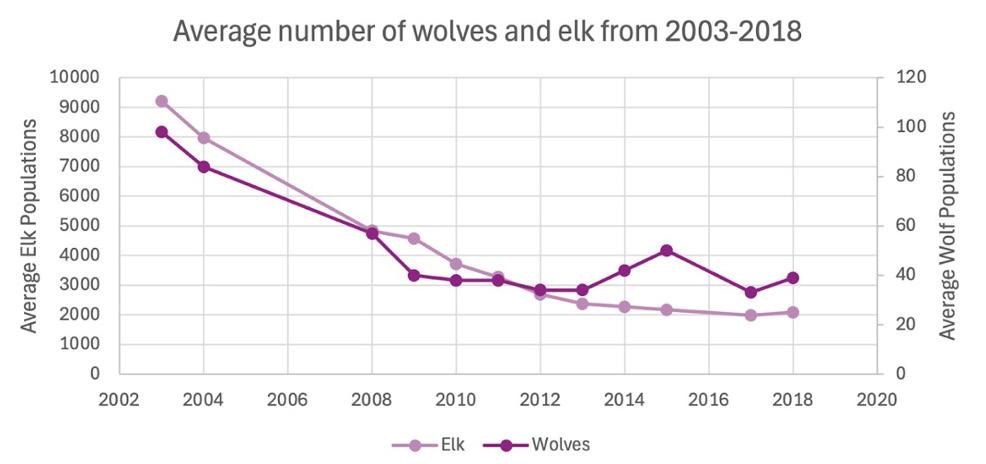
Figure 1: Dual line graph containing the average population numbers of grey wolves (right) and elk (left) in the Yellowstone Northern Range from 2003-2018 (excluding 2005, 2006, 2007 and 2016).
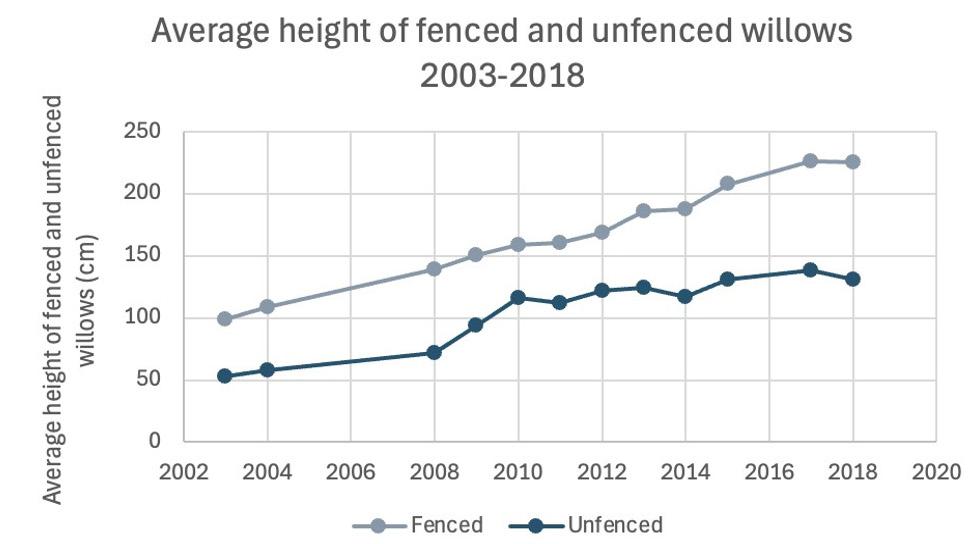
Figure 2: Dual line graph containing the average height of fenced (light blue) and unfenced (dark blue) willows in the Yellowstone Northern Range from 2003-2018 (excluding 2005, 2006, 2007 and 2016). Figure 2 shows the mean height of riparian willows under two treatments. Fenced willows showed steady linear growth, reaching over 220 cm by 2018. In contrast, unfenced willows increased at a slower rate, plateauing around 130–140 cm.
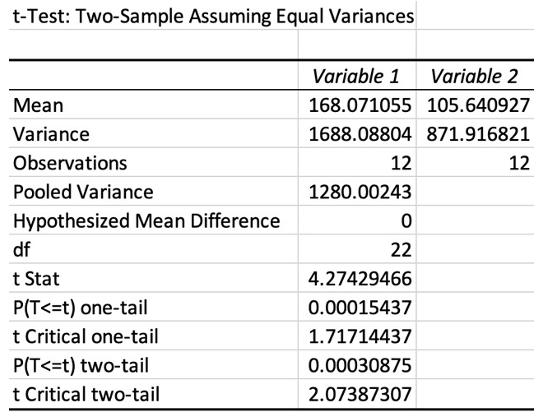
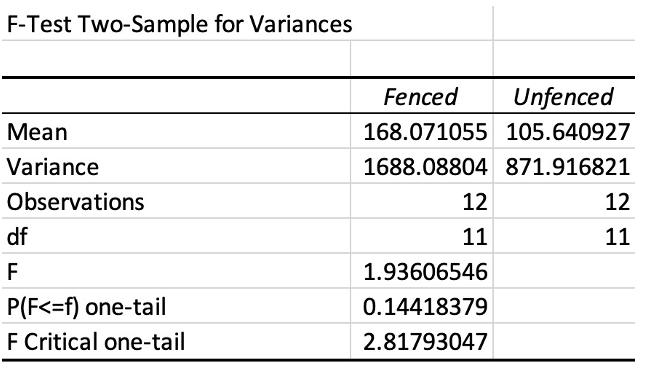
Figure 1 shows a clear decline in elk populations from 2003 to 2018, coinciding with fluctuations in wolf populations following their reintroduction. Between 2003 and 2008, elk numbers dropped from ~9200 to ~4800, while wolf populations stabilised between 35–40 individuals.
An F-test (Figure 4) revealed no significant difference in variances between fenced and unfenced willow heights (F = 1.936 < F Critical = 2.818, p = 0.144 > 0.05, fail to reject null), justifying the use of a t-test assuming equal variances. A two-sample t-test (Figure 3) confirmed a statistically significant difference in willow height between treatments (t Critical two-tail = 2.07 < t Stat = 4.27, p two-tail = 0.0003 < 0.05, df = 22, reject null), therefore, grey wolves have significantly facilitated the recovery of riparian willows in the Northern Range of Yellowstone National Park.
The results of this investigation support the hypothesis that the reintroduction of grey wolves into the Northern Range of Yellowstone National Park facilitated the recovery of riparian willows (Salix spp.). The mean willow height in areas with fencing (where herbivores were unable to browse) was 168.07 cm, significantly higher than the 105.64 cm observed in unfenced areas. The t-test yielded a t-stat of 4.27 and a two-tailed p-value of 0.0003, both indicating a statistically significant difference between the means. This supports the interpretation that the herbivory of elk plays a significant role in reducing willow growth, and that its reduction—influenced by wolf activity—facilitates recovery of the vegetation.
The F-test for variance (F = 1.93 < F Critical = 2.81, p onetail = 0.14) shows no significant difference in variance between the fenced and unfenced groups, justifying the use of the t-test assuming equal variances. This strengthens the reliability of the statistical conclusion, confirming that the observed difference is not due to uneven data spread but likely to ecological conditions.
Wolves were reintroduced in 1995 after being extirpated in the 1920s. Since then, ecological dynamics in the park have shifted. One prominent theory supported by multiple peer reviewed sources is the trophic cascade model— the concept that top predators regulate ecosystems by controlling populations of herbivores. When wolves prey on the elk, elk populations decline or modify their behaviour, and riparian zones can regenerate due to decreased browsing pressure. The observed statistically significant increase in willow height in fenced zones parallels what might be expected in areas protected by natural predation and behavioural deterrents.
Moreover, Fortin et al. (2005) explain that not only do wolves reduce elk numbers through predation, but their presence also alters elk behaviour—elk begin to avoid high-risk areas such as riverbanks and open valleys where ambush is more likely. This allows willows and other riparian flora to regenerate even without a dramatic decrease in elk population size.
The wolf population data (Figure 1) shows a general decline from 2003 to 2018, which could raise questions about the sustainability of their ecological influence. However, it is important to consider that the leading cause of wolf mortality in Yellowstone is intraspecific strife—conflict between pack members and rival packs, often over territory and mates, leading to increased deaths. This form of population regulation is natural and typical of apex predator dynamics in confined areas. The observed ecological effects persist despite population fluctuations, suggesting that even relatively small wolf numbers can exert strong behavioural pressure on elk.
One limitation in the analysis was the absence of data for 2004, 2005, 2006, and 2016. These years were excluded as the Twenty years of Salix height in response to experimental manipulation of browsing and water table, Northern Range of Yellowstone National Park dataset (Cooper & Hobbs, 2023) used did not contain data for those years. To maintain consistency across the wolf population and willow height data, those years were removed across both datasets. While this ensures data integrity, it also means certain trends (e.g. shorter-term fluctuations) could have been missed.
It’s also worth addressing contrasting interpretations found in other studies. Kauffman et al. (2010) challenges the idea that wolves alone are responsible for willow recovery, noting that in some areas of Yellowstone, vegetation did not significantly regenerate despite reduced elk presence. They argue for a more complex interaction involving hydrology, climate, beaver activity, and other herbivores like bison. This highlights an important limitation: attributing ecological change solely to one factor, such as wolf reintroduction, risks oversimplifying an intricately interconnected system. Nevertheless, the results of this investigation reinforce the conclusion that wolf presence is a key enabling factor in the recovery of riparian flora, likely in conjunction with other ecological variables.
Another consideration is the limited spatial scope of this study. Data was extracted specifically from the Northern Range, which has unique topography, species density, and ecological history compared to the rest of the park. This region also contains the highest concentration of wolf packs and previously had dense elk populations. Therefore, while conclusions drawn here are valid for the Northern Range, they may not generalise to other regions of Yellowstone without additional data. Expanding the geographical scope could strengthen future findings.
Wolf population data came from the Yellowstone Wolf Project Reports, compiled using a combination of GPS satellite collars, VHF signals, aerial surveys, and ground tracking—all reliable and standard scientific practices (Cassidy, 2025). The willow height data came from a peer-reviewed long-term dataset curated over two decades. The statistical analysis followed appropriate assumptions and produced interpretable results, with visualisation via graphs helping to highlight patterns clearly.
Looking ahead, several future directions would enhance understanding of predator-driven ecosystem dynamics. Firstly, conducting similar studies in other ecosystems where apex predators have been reintroduced—such as lions in southern Africa, lynx in Scotland or sea otters in
North America—would help test the universality of trophic cascade effects. Such comparative studies could also reveal how variables like ecosystem size, prey diversity, and human interference mediate these outcomes.
Secondly, future research should include multi-species monitoring—not just wolves, elk, and willows, but also beavers, songbirds, and aquatic organisms. These species interact directly or indirectly with riparian habitats and could reflect broader ecosystem responses to predator presence. Integrating more biodiversity indicators would offer a fuller picture of ecological health.
In conclusion, the data supports the interpretation that the grey wolf reintroduction has positively influenced the recovery of riparian willow in the Northern Range of Yellowstone National Park. This aligns with much of the peer-reviewed literature while acknowledging the complexity and regional variability of ecosystem responses. With stronger and broader methodologies, future research can continue to clarify the role apex predators play in maintaining ecological balance, not just in Yellowstone, but across the globe.
This investigation explored the extent to which the reintroduction of grey wolves (Canis lupus) has influenced the recovery of riparian willows (Salix spp.) in the Northern Range of Yellowstone National Park. By analysing data on willow height and wolf and elk (Cervus canadensis) populations from 2003 to 2018 (excluding 2004–2006 and 2016 due to missing data in the willow dataset), the study found strong evidence supporting the presence of a trophic cascade. Specifically, a decrease in elk density and increase in willow height indicates that wolves have contributed to vegetation recovery by reducing elk numbers and altering their browsing behaviour.
The results demonstrated that mean willow height in unfenced areas was significantly higher than in fenced areas, indicating that areas exposed to natural wolf–elk dynamics saw more substantial growth. This suggests behavioural changes in elk—driven by the presence of wolves—reduced browsing pressure on riparian vegetation. Statistical analysis further supported this pattern, showing significant differences in willow growth associated with elk density reductions.
While previous studies have noted that hydrological and climatic factors influence willow recovery, this investigation shows that wolf-driven regulation of elk remains a primary driver of vegetation response during this period. Intraspecific strife was identified as a leading cause of wolf mortality, reflecting natural limits on predator populations and offering a possible explanation for temporary fluctuations in trophic cascade strength.
Overall, the findings provide strong evidence that wolf reintroduction has positively influenced willow recovery, particularly in areas where elk density was consistently reduced. This supports the broader ecological theory that apex predators can restore ecosystem function. The study contributes to ongoing global discussions about rewilding and predator reintroduction, suggesting that under the right conditions, apex predators can be powerful tools for ecological restoration.
Beschta, R. L., & Ripple, W. J. (2010). Recovering Riparian Plant Communities with Wolves in Northern Yellowstone, U.S.A. Restoration Ecology, 18(3), 380–389. https://doi.org/10.1111/j.1526100X.2008.00450.x
Beschta, R. L., & Ripple, W. J. (2016). Riparian vegetation recovery in Yellowstone: The first two decades after wolf reintroduction. Biological Conservation, 198, 93–103. https://doi.org/10.1016/j. biocon.2016.03.031
Beyer, H. L., Merrill, E. H., Varley, N., & Boyce, M. S. (2007). Willow on Yellowstone’s Northern Range: Evidence for a Trophic Cascade? Ecological Applications, 17(6), 1563–1571.
Bilyeu, D. M., Cooper, D. J., & Hobbs, N. T. (2008). Water Tables Constrain Height Recovery of Willow on Yellowstone’s Northern Range. Ecological Applications, 18(1), 80–92.
Cassidy, K. (2025). Using Radio Collars to Study Yellowstone Wolves (U.S. National Park Service). https://www.nps.gov/articles/using-radio-collars-to-study-yellowstonewolves.htm
Cooper, D., & Hobbs, N. T. (2023). Twenty years of Salix height in response to experimental manipulation of browsing and water table, northern range of Yellowstone National Park (Version 14, p. 4988901 bytes) [Dataset]. Dryad. https://doi.org/10.5061/DRYAD.SQV9S4N7N
Fortin, D., Beyer, H. L., Boyce, M. S., Smith, D. W., Duchesne, T., & Mao, J. S. (2005). Wolves Influence Elk Movements: Behavior Shapes a Trophic Cascade in Yellowstone National Park. Ecology, 86(5), 1320–1330.
Hobbs, N. T., Johnston, D. B., Marshall, K. N., Wolf, E. C., & Cooper, D. J. (2024). Does restoring apex predators to food webs restore ecosystems? Large carnivores in Yellowstone as a model system—Hobbs—2024—Ecological Monographs—Wiley Online Library. https://esajournals.onlinelibrary.wiley.com/ doi/10.1002/ecm.1598
Kauffman, M. J., Brodie, J. F., & Jules, E. S. (2010). Are wolves saving Yellowstone’s aspen? A landscape-level test of a behaviorally mediated trophic cascade. Ecology, 91(9), 2742–2755.
Larsen, A., Larsen, J. R., & Lane, S. N. (2021). Dam builders and their works: Beaver influences on the structure and function of river corridor hydrology, geomorphology, biogeochemistry and ecosystems. Earth-Science Reviews, 218, 103623. https://doi.org/10.1016/j.earscirev.2021.103623
National Parks Service. U.S. Department of the Interior. (n.d.- a). Elk— Yellowstone National Park (U.S. National Park Service). Retrieved February 3, 2025, from https://www.nps.gov/yell/learn/nature/elk.htm.
National Parks Service. U.S. Department of the Interior. (n.d.- b). Wolf Management—Yellowstone National Park (U.S. National Park Service). Retrieved February 6, 2025, from https://www.nps.gov/yell/learn/ management/wolf.htm
National Parks Service. U.S. Department of the Interior. (n.d.- c). Yellowstone Wolf Project Reports—Yellowstone National Park (U.S. National Park Service). Retrieved February 3, 2025, from https://www. nps.gov/yell/learn/nature/wolfreports.htm
Ripple, W. J., & Beschta, R. L. (2006). Linking wolves to willows via risk-sensitive foraging by ungulates in the northern Yellowstone ecosystem. Forest Ecology and Management, 230(1), 96–106. https://doi.org/10.1016/j.foreco.2006.04.023
White, P. J., & Garrott, R. A. (2005). Yellowstone’s ungulates after wolves – expectations, realizations, and predictions. Biological Conservation, 125(2), 141–152. https://doi.org/10.1016/j.biocon.2005.01.048
EMMA LIM, YEAR 12
This paper was written for Science Extension
ABSTRACT
The potential problem of outbreaks caused by dormant viruses trapped beneath melting sea ice has become a recent concern. This report investigates the relationship between immune gene diversity and Penguin breeding population dynamics by correlating sequence variation of key immune genes found in Antarctic penguins with long-term breeding population monitoring of Emperor and Gentoo penguins. It was found that low amino acid variance was analysed in major histocompatibility (MHC) and interferon (IFN) proteins of Emperor penguins, which correlated positively with a declining breeding population rate of 1,466 individuals annually. Furthermore, a high amino acid variance in MHC and IFNs of Gentoo penguins also correlated with an increasing/stable breeding pair population, with an annual increase of 20 pairs. Although the results are supported by current literature, the investigation is limited by the reduced availability of biobanks and accurate breeding population data. Future research that analyses a broader range of molecules that aid immune responses in a larger variety of lineages of penguins to support the positive correlation between low genetic diversity and decreasing population growth rates found in this report.
LITERATURE REVIEW
Introduction
Global Warming has caused an increase in the Earth’s surface temperature since the Industrial Revolution. Through primarily anthropogenic activities, such as the burning of fossil fuels, deforestation, and livestock farming, greenhouse gases have increased significantly (Yadav & Upadhyay, 2023). The consequences of Climate Change have led to the melting of glaciers and polar ice, causing a loss of approximately 2700 gigatonnes from the Antarctic ice sheet (Australian Antarctic Program, 2022). Antarctica harbours viruses and pathogens beneath the sea ice. These microbes are confined to the small veins between ice crystals, and among them are dormant and/or anoxic opportunistic microorganisms (Yarzábal et al., 2021). Emperor penguins (Aptenodytes forsteri) are particularly susceptible to diseases owing to a lack of immunogenetic diversity. As such, methods of gene sequencing would be beneficial to the survival of this species as the Earth’s surface continues to warm.
There is evidence that microorganisms in the Antarctic biosphere are affected by the increased temperatures. Brazilian research groups have detected drug-resistant fungi in samples of Antarctic rocks, soils, and seawater, many of which have never been previously recorded (Yarzábal et al., 2021; de Menezes et al., 2020). Though studies carried out by Knowlton et al. (2013) have shown that the viability of bacteria and viruses decreases with increasing age, experiments by Rassner et al. (2016) show that virus particles remain stable in supraglacial meltwater due to low viral decay rates, and infection of downstream bacteria by supraglacial viruses has been shown to occur. The Earth’s cryosphere is melting at an unprecedented rate, leading to the reactivation and release of previously frozen pathogens into neighbouring aquatic and terrestrial ecosystems. In 2016, an Anthrax outbreak linked to Climate Change infected approximately 2,300 reindeer and a twelve-year-old child, due to abnormally high temperatures in the region melting frozen human and animal remains containing spores (Luhn, 2016). Thus, recent outbreaks of diseases caused by the reactivation of these dormant viruses, resulting from the melting of permafrost, are severe and of concern.
Penguins have the slowest evolutionary rates among birds. A study by Cole et al. (2022) tested the integrated evolutionary speed hypothesis (IESH) between lineages of 17 avian orders and their ancestors. Penguins and their sister group (Procellariiformes) had the lowest evolutionary rates. A. forsteri breeds and spends 8-9 months on the ice. However, breeding colonies are extremely isolated, and the lack of selective pressure make them susceptible to infections (Ings & Denk, 2022). This isolation and relaxed selective pressures over generations have led to A. forsteri developing low genetic diversity in their immune systems, alongside their low evolutionary rates. These include genes that code for major histocompatibility (MHC) proteins, toll-like receptors (TLRs), and interferon (IFN) proteins. MHC genes encode molecules that initiate specific immune responses. It is divided into MHC class I and class II (Minias et al., 2019). Alleles in both MHC classes encode proteins that can respond to a limited number of antigens, and high MHC allelic diversity is advantageous as it increases the spectrum of pathogens that an
organism can recognise and defend against. TLRs are well-defined pattern recognition receptors responsible for recognising pathogens and inducing innate immune responses. A study by Xu et al. (2020) reveals that low TLR genetic diversity is prevalent in many vulnerable avian species, including the Chinese egret. IFNs are cytokines that play a crucial role in both innate and adaptive immune responses. As revealed in other animals, IFN genes evolve under distinct selective constraints, and sequence changes between populations may be due to increasing resistance to specific viral infections (Manry et al., 2011).
The diversity of avian MHC class II gene sequences has been extensively studied in chickens, quails, and some songbirds, but has been largely overlooked in Emperor penguins (Kikkawa et al., 2005). A study conducted by Sallaberry-Pincheira et al. (2016) on Humboldt (Spheniscus humboldti) and Magellanic (Spheniscus magellanicus) penguins examined the impact of local and global environmental pressures, genetic drift, and gene flow on patterns of MHC I and II diversity between species. Results revealed that MHC I was more diverse than MHC II in both species, likely due to the large populations, high movement between colonies, and similar environmental pressures. Another study by Tsuda et al. (2001) provided the first report of sequencing and polymorphic studies on penguin MHC genes, investigating nucleotide variations in Adelie (Pygoscelis adeliae), Chinstrap (Pygoscelis antarcticus), Gentoo (Pygoscelis papua), and Little (Eudyptula minor) penguins. Findings revealed significant genetic diversity in penguin MHC class II B genes, with Gentoo penguins showing the highest diversity. They could be divided into two clusters of penguins with similarly related MHC genes, corresponding to their two known subspecies. This indicates the presence of genetic differences between penguin subspecies. Direct research is still needed to confirm these patterns to understand the extent of MHC diversity in A. forsteri.
Proposal
The emperor penguin’s vulnerability to diseases and infections has not been thoroughly investigated, as there is currently no study or research dedicated to examining the emperor penguins' susceptibility to pathogens (Tsuda et al., 2001). By analysing amino acid sequences of MHCs, TLRs, and IFNs found in Antarctic penguin species, the genetic diversity of their immune systems can be identified. Correlating genetic diversity to fluctuations in penguin population in the Antarctic over time can help determine whether susceptibility to infection is a concern for the declining numbers of penguins. As climate conditions are changing at an increasing rate due to Global Warming, creating new environmental pressures to wild A. forsteri, such as loss of habitats, increased exposure to pathogens, and genetic shifts due to loss of
population, assessing vulnerability and susceptibility to such pressures is critical to ensure the conservation of these species.
SCIENTIFIC RESEARCH QUESTION
How does genetic variation in TLRs, MHCs, and IFNs correlate with the population trend of Emperor and Gentoo penguin breeding populations?
HYPOTHESIS
Penguin populations that exhibit lower TLR, MHC, and IFN genetic diversity will correlate with decreasing population trends, while those with higher genetic diversity will correlate with stable/increasing population trends.
METHODOLOGY
MHC, TLR, IFN Sequence Variability Analysis
To analyse the immune systems of a variety of penguin species, different samples of MHCs (including MHC I, MHC II, etc.), TLRs (TLR1, TLR2, TLR3, etc), and IFNs (IFN gamma, IFN delta, IFN beta) were collected from Emperor, King, Adelie, Gentoo, and Chinstrap penguins, which can be found around the Antarctic peninsula during the year. Due to the relatively small amount of available data, all variations of these proteins were included in the analysis to provide a larger, diverse dataset and to reduce the risk of bias if a single type of protein (e.g. MHC class I) were chosen from each species. Computed samples of TLRs and IFNs for Emperor penguins were included in the analysis. Five species of penguins were selected for study, excluding those that migrate and breed in the region around South America. These samples were categorised into their respective proteins. Software MEGA (Molecular Evolutionary Genetics Analysis) was used to create a phylogenetic tree for each class of protein, which created a visual representation of the relatedness between proteins/ amino acid sequences. Evolutionary divergence and speciation were inferred from the distance between branches in the tree.
Population Growth Analysis
Two species, one that was more genetically diverse and the other less so, were selected from the data shown in the phylogenetic trees (Gentoo and Emperor, respectively). Occurrence datasets from GBIF (Global Biodiversity Information Facility) were collected. In the spreadsheet, the occurrences of individuals, nests, and both individuals and nests over time, from 1980 to 2022, were collected for both species and used to create scatter plots. T-tests were used to analyse the trends of the scatter plots and determine whether the rate at which either species is declining is significantly different from the other, to determine if differing population growth rates were due to random variables. Data is presented in Figure 1.
Field survey data collected by investigators from the British Antarctic Survey (BAS) include annual ground counts of occupied and incubating nests, eggs (a proxy for breeding pairs), hatched chicks, and chicks expected to fledge. In total, 10 Gentoo colonies were surveyed annually, with surveys carried out one week after peak egg-laying (CEMP Standard Method A3A) (Dunn et al., 2021). The number of breeding pairs from 1979 to 2021 was used to calculate the breeding population growth rate of Gentoo penguins, as shown in Figure 2. Satellite imagery from the MAXAR VHR satellite constellation was collected over 16 Emperor penguin colonies from 2009 to 2023, spanning the Bellingshausen Sea to the Weddell Sea, by researchers from BAS to model input and output data on Emperor penguin population dynamics (Fretwell et al., 2025). The mean global abundance of Penguins from the observed colonies was used to calculate the population growth rate over the 14 years, as displayed in Figure 3.
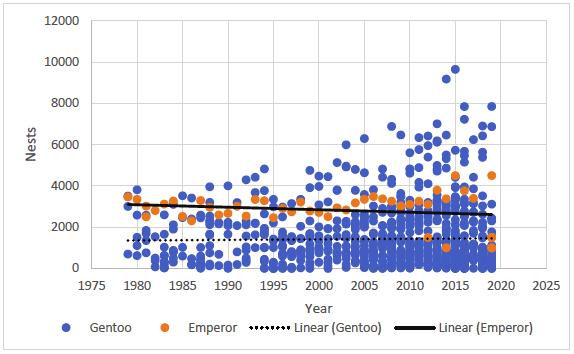
1: Population Trends Regarding Emperor and Gentoo Penguins.
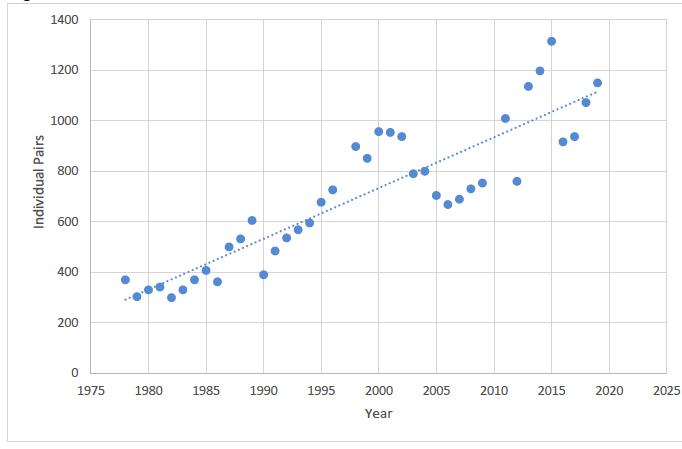
Figure 2: Field survey count of Gentoo breeding pairs on Signy Island from 1978 to 2019. A positive trend can be observed, alongside a strong rebound between 2005 to 2011.
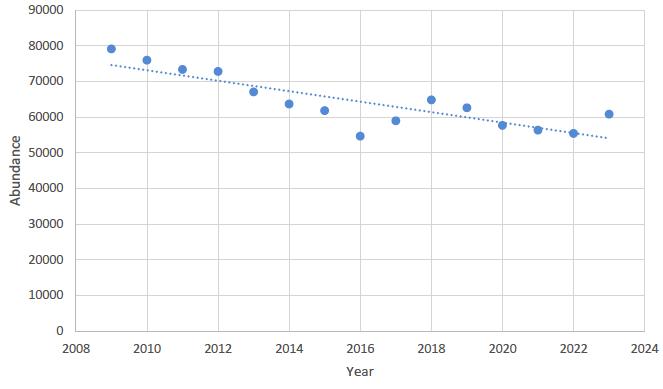
Figure 3: Satellite count of individual Emperor penguins from 16 Emperor penguin colonies across the Antarctic peninsula. A strong negative trend can be observed, with fluctuating population size between 2016 to 2020.
The results collected were reasonably similar to what was hypothesised, with the decreasing population of the emperor penguin breeding population correlating with low amino acid divergence within MHC and IFN phylogenetic trees (see Appendix, Trees 1 and 2, Editor’s note: Appendices removed for publication).
The MHC sequences of all penguin species have formed tight clusters, connected by short branches of fewer than 20 individual nucleotide substitutions, with tightly packed clades (see Appendix Tree 1. Editor’s note: Appendices removed for publication). These tightly packed clusters show that there is slight sequence variation between MHC molecules, which suggests the diversity of MHC proteins within the Emperor penguin population is limited compared to other species, such as the Gentoo penguin, and is supported by past investigations that have observed that Aptenodytes are most related to their common ancestor when compared to other genera (Vianna et al., 2020). The phylogenetic tree of all penguin IFN sequences shows more variation in branch length between clades. A. forsteri IFN sequences form closer clusters connected by shorter branch lengths (less than 25 nucleotide substitutions) (see Appendix Tree 2, Editor’s note: Appendices removed for publication). Exceptions include predicted sequences that exhibit abnormally long branch lengths relative to neighbouring clades. Gentoo penguin IFN sequences are in clades more distant from one another. All species show varying branch lengths between 0.07 and 60 nucleotide substitutions. This indicates significantly more variation compared to other penguin species, suggesting that the Gentoo penguin possesses higher genetic variation in immune function than many other Antarctic penguin species. This is supported by past investigations, which have found that Gentoo penguins exhibit the most differentiation between populations (Clucas et al., 2018). Gentoo and Emperor penguins both exhibit TLR sequences in close clusters, connected by short branch lengths of less than 20 nucleotide sequences, with a few exceptions of longer
branch lengths exceeding 60 nucleotide sequences (see Appendix Tree 3, Editor’s note: Appendices removed for publication). Both Gentoo and Emperor penguins exhibit similar sequence variability in TLR molecules, which may be attributed to the limited number of samples available in biobanks. However, this can be attributed to the fact that Spheniscidae exhibit the lowest evolutionary rates among multiple bird families (Cole et al., 2022). A broader analysis of sequences found across both fossilised and current penguin taxa is needed to create a more accurate generalisation of genetic diversity between species.
Phylogenetic analysis provides results that moderately support the hypothesis but is highly limited by sampling issues (e.g. small sample size, low quality of molecular markers). Although low sequence variability can be observed in A. forsteri, it is essential to consider that these results lack precision and may lack statistical power, thereby limiting the accuracy of any generalisation about the species. The restricted biobank on the emperor penguin reduces the opportunity to observe naturally occurring mutations that may impact the organism's susceptibility to viral diseases, which are worth investigating. A larger sample of sequences should be analysed, and future research should explore a wider variety of molecules (e.g., cytokines, antibodies, complement proteins) to deepen the understanding of disease susceptibility.
Figure 1 presents the individual nest occurrences between 1979 and 2019 around the Antarctic Peninsula for Emperor and Gentoo penguin populations. The two-sample Welch's t-test indicates that the number of Emperor Penguin occurrences over the same period is statistically different from the number of Gentoo Penguin occurrences, suggesting that the observed difference is likely due to factors such as genetic diversity variability. The data show a slight increase in nest occurrences over time for Gentoo penguins, and a slight decrease for Emperor penguins. However, the extreme disparity between sample sizes increases the chance of generalising the population trends of both species. Slight deviations from the linear trend in A. forsteri nest occurrences from 2012 to 2019, possibly caused by GPS inaccuracy during data collection, could lead to skewed results. However, these were not removed from the results to avoid narrowing the variance and misinterpreting what reflects natural variation. Furthermore, the usage of occurrences over abundance provides a less accurate measure of the size and growth of the population. Future studies could utilise colony abundance data collected from remote sensing devices (e.g. satellites) to observe changes in the penguin population's dynamics more accurately.
Figure 2 includes the number of breeding pairs in the Gentoo Penguin population on Signy Island. Regression
analysis reveals a strong, positive trend over time (R² of ~0.800), indicating an average annual increase of ~20 pairs. The number of breeding pairs has increased relatively steadily from 1978 to 2019, which aligns with the hypothesis that high amino acid variation correlates with increasing population growth rates. Gentoo IFN and MHC sequences (see Trees 1 & 2) show the most amount of variation compared to other penguin species, which correlates with the increasing breeding population. It is essential to note that the population data were collected from Signy Island, a subantarctic island approximately 600 km from the Antarctic Peninsula, where the Gentoo breeding population may face distinct ecological pressures that could skew breeding pair numbers for the entire species. Hence, Figure 2 may not be directly comparable to the amino acid divergence due to differences in the location where the data were collected. Prior research has reported that Gentoo penguin breeding populations increased by 19% (19952008) and by 32% between 2005 and 2010 (Baylis et al., 2013) across Subantarctic and South Atlantic islands. Still, other colonies around the Antarctic Peninsula have been reported to be decreasing or stable (Ghys et al., 2008). Further studies in breeding colonies along the Antarctic Peninsula will yield results that reduce uncertainty in the correlation between genetic diversity and population growth of Gentoo penguins.
Figure 3 includes the number of individuals in the breeding population of Emperor Penguins across the areas situated between the Bellingshausen Sea and the Weddell Sea. Regression analysis reveals a strong, negative trend over time (R² = approximately 0.712), indicating an average annual decrease of roughly 1,466 individuals between 2009 and 2023. This overall decline in the A. forsteri breeding population across the Antarctic Peninsula supports the hypothesis that low sequence variability will correlate with diminishing population growth. As the sequences of IFNs and MHCs, as well as the abundance in the A. forsteri breeding population, were all sourced from similar geographical locations along the edges of the Antarctic continent, the correlation is robust. Population size fluctuations between 2016 and 2018, where the abundance increased by ~10000 individuals, and the 2020 rebound of ~5000 individuals, are possibly due to significant climatic developments (Schiel et al., 2019), and the overall declining population size supports the annual 1.6% population reduction analysed by Fretwell et al. (2025). Current literature has reached a consensus that Emperor penguin populations will be affected by a changing climate, but there is a limited understanding of their total breeding population (Fretwell et al., 2012). A better understanding of Emperor penguin biogeography, achieved using remote sensing, is necessary to accurately predict how the species responds to the consequences of global warming (Ancel et al., 2017).
While the data collected from genetic and population dynamic analysis shows a correlation between the genetic diversity of integral components of the immune system (TLRs, MHCs, and IFNs) and the breeding population size over decades, this does not prove that low genetic diversity within a species is a direct cause of a declining breeding population.
There are numerous confounding variables influencing the observed positive correlation that are not accounted for, with the most detrimental being the projected loss of sea ice, predicted to render eight major colonies quasi-extinct by 2080 under extreme climate conditions (Jenouvrier et al., 2021). Without controlling these external variables, causation can only be assumed; hence, future investigations, such as controlled pathogen exposure experiments and analysing quantities of pathogens in penguin microbiomes (e.g., nests) over time and correlating such data with successful breeding rates of different penguin species, are warranted.
Current literature has reached a consensus that Antarctic penguin populations, most significantly the Emperor penguin, will be detrimentally impacted by reduced sea ice caused by Global Warming. However, there is a lack of understanding of the species’ biogeography and genomics that makes modelling the extent to which Emperor penguins will be affected by Climate Change difficult. There is also limited research on the potential impact of viral outbreaks on Antarctic glaciers, which
may put the Emperor penguin breeding population at further risk of quasi-extinction much sooner than most climate models predict. Results from genomic analysis present a correlation between low sequence diversity in immune systems and declining breeding populations, which supports the hypothesis. A. fosteri MHC and IFN sequences form tighter clusters connected by short branches no longer than 20 nucleotide substitutions, compared to Gentoo penguin sequences that are found further apart in both phylogenetic trees, which aligns with current research. However, the limited availability of biobanks reduces the precision of this investigation, making it difficult to definitively justify that low genetic diversity is a cause of the annual decrease of 1,466 individuals in Emperor penguin breeding populations. It is also important to note that the lack of information on the breeding population of Gentoo penguins located on the Antarctic Peninsula raises questions about the validity of the results, as the annual increase of 20 pairs in the Signy Island Gentoo breeding population may not reflect the breeding population across the Antarctic continent. Future research into penguin genomics must analyse a large sample size of sequences across multiple lineages and species to accurately deduce the role that genetic variation plays in population dynamics. It is crucial for models to accurately predict the future consequences of Global Warming on Antarctic penguin populations, enabling the appropriate coordination of conservation efforts and informing future research into protecting these species.
IMMUNE GENES IN EMPEROR PENGUINS REVEAL LOW DIVERSITY IN DECLINING BREEDING POPULATIONS, SUGGESTING VULNERABILITY TO SEA-ICE PATHOGENS
Ancel, A., Cristofari, R., Trathan, P. N., Gilbert, C., Fretwell, P. T., & Beaulieu, M. (2017). Looking for new emperor penguin colonies?
Filling the gaps. Global Ecology and Conservation, 9, 171–179. https:// doi.org/10.1016/j.gecco.2017.01.003
Baylis, A. M. M., Crofts, S., & Wolfaardt, A. C. (2013). Population Trends of Gentoo Penguins Pygoscelis Papua Breeding at the Falkland Islands. Marine Ornithology, 41(1), 1-5. http://doi.org/10.5038/20741235.41.1.1000
Clucas, G. V., Younger, J. L., Kao, D., Emmerson, L., Southwell, C., Wienecke, B., Rogers, A. D., Bost, C.-A., Miller, G. D., Polito, M. J., Lelliott, P., Handley, J., Crofts, S., Phillips, R. A., Dunn, M. J., Miller, K. J., & Hart, T. (2018). Comparative population genomics reveals key barriers to dispersal in Southern Ocean penguins. Molecular Ecology, 27(23), 4680–4697. https://doi.org/10.1111/mec.14896
Cole, T. L., Zhou, C., Fang, M., Pan, H., Ksepka, D. T., Fiddaman, S. R., Emerling, C. A., Thomas, D. B., Bi, X., Fang, Q., Ellegaard, M. R., Feng, S., Smith, A. L., Heath, T. A., Tennyson, A. J. D., Borboroglu, P. G., Wood, J. R., Hadden, P. W., Grosser, S., … Zhang, G. (2022). Genomic insights into the secondary aquatic transition of penguins. Nature Communications, 13(1), 3912. https://doi.org/10.1038/s41467-02231508-9
de Menezes, G. C. A., Porto, B. A., Amorim, S. S., Zani, C. L., de Almeida Alves, T. M., Junior, P. A. S., Murta, S. M. F., Simões, J. C., Cota, B. B., Rosa, C. A., & Rosa, L. H. (2020). Fungi in glacial ice of Antarctica: Diversity, distribution and bioprospecting of bioactive compounds. Extremophiles, 24(3), 367–376. https://doi.org/10.1007/s00792-02001161-5
Dunn, M., Adlard, S., Lynnes, A., Briggs, D., Fox, D., & Morley, T. (2021). Population size and breeding success of gentoo penguins on Signy Island from 1978 to 2020. (Version 1.0, p. 2 files, 5.75 kB) [Text/csv].
NERC EDS UK Polar Data Centre. https://doi.org/10.5285/883C6B40024E 41E8-9C3E-2668A44B5751
Fretwell, P. T., Bamford, C. C. G., Skachkova, A., Trathan, P. N., & Forcada, J. (2025a). Model input and output statistics on fifteen-year assessment of emperor penguin breeding populations from the Bellingshausen sea to the Weddell sea from VHR satellite imagery, 2009-2023 (Version 1.0, p. 6 files, 175 KB) [Text/csv, application/pdf]. NERC EDS UK Polar Data Centre. https://doi.org/10.5285/C8D8FFE60AFF-493C-B40F-E63F0C35F081
Fretwell, P. T., Bamford, C., Skachkova, A., Trathan, P. N., & Forcada, J. (2025b). Regional emperor penguin population declines exceed modelled projections. Communications Earth & Environment, 6(1), 436. https://doi.org/10.1038/s43247-025-02345-7
Fretwell, P. T., LaRue, M. A., Morin, P., Kooyman, G. L., Wienecke, B., Ratcliffe, N., Fox, A. J., Fleming, A. H., Porter, C., & Trathan, P. N. (2012). An Emperor Penguin Population Estimate: The First Global, Synoptic Survey of a Species from Space. PLoS ONE, 7(4), e33751. https://doi. org/10.1371/journal.pone.0033751
Ghys, M. I., Rey, A. R., & Schiavini, A. (2008). Population Trend and Breeding Biology of Gentoo Penguin in Martillo Island, Tierra Del Fuego, Argentina. Waterbirds, 31(4), 625–631. https://doi. org/10.1675/1524-4695-31.4.625
Ings, K., & Denk, D. (2022). Avian Malaria in Penguins: Diagnostics and Future Direction in the Context of Climate Change. Animals, 12(5), 600. https://doi.org/10.3390/ani12050600
Jenouvrier, S., Che‐Castaldo, J., Wolf, S., Holland, M., Labrousse, S., LaRue, M., Wienecke, B., Fretwell, P., Barbraud, C., Greenwald, N., Stroeve, J., & Trathan, P. N. (2021). The call of the emperor penguin: Legal responses to species threatened by climate change. Global Change Biology, 27(20), 5008–5029. https://doi.org/10.1111/ gcb.15806
Kikkawa, E. F., Tsuda, T. T., Naruse, T. K., Sumiyama, D., Fukuda, M.,
Kurita, M., Murata, K., Wilson, R. P., LeMaho, Y., Tsuda, M., Kulski, J. K., & Inoko, H. (2005). Analysis of the sequence variations in the Mhc DRB1-like gene of the endangered Humboldt penguin (Spheniscus humboldti). Immunogenetics, 57(1–2), 99–107. https://doi. org/10.1007/s00251-005-0774-6
Kikkawa, E., T. Tsuda, T., Hosomiti, K., Tsuda, M., Inoko, H., Kimura, A., K. Naruse, T., & Murata, K. (2015). Molecular Evolutionary Analysis of Seven Species of Penguins (Order: Sphenisciformes) in MHC Class I Gene. Major Histocompatibility Complex, 22(3), 156–163. https://doi. org/10.12667/mhc.22.156
Kikkawa, E., Tanaka, M., Naruse, T. K., Tsuda, T. T., Tsuda, M., Murata, K., & Kimura, A. (2017). Diversity of MHC class I alleles in Spheniscus humboldti. Immunogenetics, 69(2), 113–124. https://doi.org/10.1007/ s00251-016-0951-9
Luhn, A. (2016, August 1). Anthrax outbreak triggered by climate change kills boy in Arctic Circle. The Guardian. https://www.theguardian.com/world/2016/aug/01/anthrax-outbreak-climate change-arctic-circle-russia
Minias, P., Pikus, E., Whittingham, L. A., & Dunn, P. O. (2019). Evolution of Copy Number at the MHC Varies across the Avian Tree of Life. Genome Biology and Evolution, 11(1), 17–28. https://doi.org/10.1093/ gbe/evy253
Rassner, S. M. E., Anesio, A. M., Girdwood, S. E., Hell, K., Gokul, J. K., Whitworth, D. E., & Edwards, A. (2016). Can the Bacterial Community of a High Arctic Glacier Surface Escape Viral Control? Frontiers in Microbiology, 7. https://doi.org/10.3389/fmicb.2016.00956
Sallaberry-Pincheira, N., González-Acuña, D., Padilla, P., Dantas, G. P. M., Luna-Jorquera, G., Frere, E., Valdés-Velásquez, A., & Vianna, J. A. (2016). Contrasting patterns of selection between MHC I and II across populations of Humboldt and Magellanic penguins. Ecology and Evolution, 6(20), 7498–7510. https://doi.org/10.1002/ece3.2502
Schiel, R., Güpner, F., & Spitzenberger, H.-J. (2019). Population size and condition of the Emperor Penguin Aptenodytes forsteri colony of Snow Hill Island, Weddell Sea, Antarctica: Observations from 29 December 2018. Marine Ornithology, 47(2), Article 7. http://doi. org/10.5038/2074-1235.47.2.1316
Tsuda, T., Tsuda, M., Naruse, T., Kawata, H., Ando, A., Shiina, T., Fukuda, M., Kurita, M., LeMaho, I., Kulski, J., & Inoko, H. (2001). Phylogenetic analysis of penguin (Spheniscidae) species based on sequence variation in MHC class II genes. Immunogenetics, 53(8), 712–716. https:// doi.org/10.1007/s002510100369
Vianna, J. A., Fernandes, F. A. N., Frugone, M. J., Figueiró, H. V., Pertierra, L. R., Noll, D., Bi, K., Wang-Claypool, C. Y., Lowther, A., Parker, P., Le Bohec, C., Bonadonna, F., Wienecke, B., Pistorius, P., Steinfurth, A., Burridge, C. P., Dantas, G. P. M., Poulin, E., Simison, W. B., … Bowie, R. C. K. (2020). Genome-wide analyses reveal drivers of penguin diversification. Proceedings of the National Academy of Sciences, 117(36), 22303–22310. https://doi.org/10.1073/pnas.2006659117
Yadav, N., & Upadhyay, R. K. (2023). Global Effect of Climate Change on Seasonal Cycles, Vector Population and Rising Challenges of Communicable Diseases: A Review. Journal of Atmospheric Science Research, 6(1), Article 1. https://doi.org/10.30564/jasr.v6i1.5165
Yarzábal, L. A., Salazar, L. M. B., & Batista-García, R. A. (2021). Climate change, melting cryosphere and frozen pathogens: Should we worry…? Environmental Sustainability, 4(3), 489–501. https://doi. org/10.1007/s42398-021-00184-8
Zhang, G., Li, C., Li, Q., Li, B., Larkin, D. M., Lee, C., Storz, J. F., Antunes, A., Greenwold, M. J., Meredith, R. W., Ödeen, A., Cui, J., Zhou, Q., Xu, L., Pan, H., Wang, Z., Jin, L., Zhang, P., Hu, H., … Wang, J. (2014). Comparative genomics reveals insights into avian genome evolution and adaptation. Science (New York, N.Y.), 346(6215), 1311–1320. https://doi.org/10.1126/science.1251385
This report was produced as part of the Sokratis Research Program, where it was the winner of the 3 Minute Sokratis Competition.
ABSTRACT
Endometriosis and polycystic ovary syndrome (PCOs) are women’s health conditions that pause and tear apart the lives of millions of women worldwide. Yet awareness among teenagers for the two common conditions remains disproportionately low. This paper explores the gap in women’s health education for teenage girls, with a focus on endometriosis and PCOS, through primary data gathered from a survey of twenty-two Year 9 girls and a literature review. Our findings reveal extremely limited awareness, and strong student demand for greater education and support in schools. Filling the gap is “essential to breaking stigma” as said by Vanessa Ferguson, CEO of Adora Fertility clinic.
Adolescence is the most critical period for health education; however women’s health often remains on a tangent of our school curricula. Disorders such as endometriosis and PCOS are not only medical but also social issues, affecting mental health, self-confidence, and long-term wellbeing. Even though 190 million women worldwide face endometriosis, one in seven women are estimated to have endometriosis in Australia and one in ten in Australia live with PCOS, awareness for the two still remain staggeringly low, particularly among young people.
When my Sokratis Research partner, Tala, and I found out about the frequency of endometriosis and PCOs we asked: Why haven’t we been taught about this? This is why our research project originated from questioning, and more specifically, Is there a gap in women’s health education for teenagers? The evidence suggests that the answer is yes. This minor thesis documents our preliminary findings, which point to the urgent need for increased education and more frequent and open conversations about women’s health in schools.
Endometriosis is a chronic condition where tissue similar to the endometrial tissue a female sheds each month grows outside the uterus, causing pain, reduced quality of life, and a 25-50% chance of infertility. Despite affecting millions, diagnosis is often delayed by 7–10 years, in part due to stigma and blowing off symptoms for short-term sickness.
PCOS, characterised by irregular periods, excess androgen (a typical male hormone) and polycystic ovarian cysts, is one of the most common endocrine disorders in women of reproductive age. Symptoms like acne, weight gain (result of excess androgen) which actually worsens PCOs symptoms, irregular periods, and excess hair growth can have negative psychosocial impacts, particularly on teenagers when forming identity and body image is most vulnerable. Adolescents with PCOs experience more severe depressive symptoms than those without it. Hormonal PCOS acne and hirsutism (excess hair growth all around the body and face), for instance, clash with western beauty standards, leading to bullying or isolation in school settings. For teenage girls, this creates not only a medical struggle but also a social one. Despite these realities, the usual women’s health education in high school is often limited to the biological process of menstruation, contraception, and pregnancy.
To investigate further, we conducted a small-scale, anonymous survey of twenty-two girls aged 14-15 at our school. We used the data collection method: simple random selection. The survey asked three core questions and one optional question:
1. Have you heard of endometriosis before?
2. Have you heard of PCOS before?
3. Would you discuss menstrual health with friends/ teachers or keep it personal?
4. (Optional) What do you think our school should do to support education about these conditions?
The survey revealed a strikingly low awareness on both of the conditions.
• Endometriosis: 16 students (73%) had not heard of it, while 6, (27%) had. Out of those who had, most learned about it from a recent school assembly presentation rather than formal lessons.
• PCOS: 19 students (86%) had not heard of it, and only 3 (14%) had, with social media and school presentations being their primary sources of knowledge.
• Comfort in discussing menstrual health: 17 students (77%) preferred to keep discussions private within family or close friends, while only 5 were comfortable sharing with friends but not teachers. Only one indicated willingness to share openly with a teacher.
• Optional responses: A minority provided suggestions, including
• “teach it in PDHPE,” “more assemblies,” “free pads and tampons, the tampon machines are crusty and don’t work–and you also have to pay,” and “learn about it in science since it relates to us.”
The results highlight three key findings:
1. Severe lack of awareness. Even though there is high prevalence, the majority of students surveyed had never heard of endometriosis or PCOS. This demonstrates that essential reproductive health conditions are absent in secondary level education.
2. Stigma and silence. Most girls felt a little bit uncomfortable openly discussing menstrual health openly, but mostly with teachers, which is understandable. This echoes broader research that menstrual stigma is deeply embedded in cultural/ sexist attitudes for girls experiencing early symptoms of PCOS or endometriosis, this one—way silence can delay seeking help and diagnosis.
3. Student demand for education. The few who responded to the optional question expressed a clear desire for structured learning—through PDHPE, science classes, or assemblies—as well as practical support like free menstrual products. This aligns with calls from public health experts to embed reproductive health education within schools.
Our introductory research (there is much more to go) confirms that there is a large gap in women’s health education for teenagers. Most of the girls surveyed had little to no awareness of endometriosis or PCOS, and many expressed reluctances to discuss menstrual health openly.
Without awareness, conditions such as PCOS and endometriosis will remain unheard of, blocking early intervention. It should never take more than a year for diagnosis, especially not a decade. By making women’s health a common conversation just like any other health conditions, schools can empower young women to recognise symptoms, seek support, and feel less isolated in their experiences. This research is only a starting point. Tala and I are working with Vanessa Ferguson and Dr Hadwen to expand the scope. Ultimately, we aim to transform the silence around women’s health into a culture of openness, education, and support.
Chen, F.C., Guo, J.G., Liu, C.L., Li, L.Y., Lu, W.L., Zheng, X.Z., & Zhang, J.Z. (September 2024). Depression, anxiety and self-esteem in adolescent girls with polycystic ovary syndrome: a systematic review and meta-analysis. Frontiers. https://www. frontiersin.org/journals/endocrinology/articles/10.3389/fendo.2024.1399580/full
Endometriosis. Office on Women's Health. https://www.womenshealth.gov/publications/our-publications/fact-sheet/endometriosis.html. Accessed March 22, 2023.
Endometriosis. Office on Women's Health. https://www.womenshealth.gov/publications/our/publications/fact-sheet/endometriosis.html. Accessed March 22, 2023.
FAQs: Endometriosis. American College of Obstetricians and Gynaecologists. https://www.acog.org/womens-health/faqs/ endometriosis. Accessed March 22, 2023.
Hailes, J.H. (2024). Let’s talk about polycystic ovary syndrome. Jean Hailes for Women's Health. https://www.jeanhailes.org.au/ news/lets-talk-about-polycystic-ovary-syndrome
Johnston-Robledo I, Chrisler JC. The Menstrual Mark: Menstruation as Social Stigma. 2020 Jul 25. In: Bobel C, Winkler IT, Fahs B, Hasson KA, Kissling EA, Roberts TA, editors. The Palgrave Handbook of Critical Menstruation Studies [Internet]. Singapore: Palgrave Macmillan; 2020. Chapter 17. PMID: 33347160. https:// pubmed.ncbi.nlm.nih.gov/33347160/
Lynch, K.L. (n.d.). Adolescent health. World Health Organization. https://www.who.int/health-topics/adolescent-health#tab=tab_1
Schenken RS. Endometriosis: Pathogenesis, epidemiology, and clinical impact. https://www.uptodate.com/contents/search.
Schenken RS. Endometriosis: Treatment of pelvic pain. https:// www.uptodate.com/contents/search
Simon, V.; Peigné, M.; Dewailly, D. The Psychosocial Impact of Polycystic Ovary Syndrome. Reprod. Med. 2023, 4, 57-64. https:// doi.org/10.3390/reprodmed4010007
Smith RP. Endometriosis. In: Netter's Obstetrics and Gynaecology. 3rd ed. Elsevier; 2018. https://www.clinicalkey.com
Teede, H.T. Monash University. (2023). 2023. MONASH University. https://www.monash.edu/__data/assets/pdf_file/0003/3379521/ Evidence-Based-Guidelines-2023.pdf
What are the symptoms of endometriosis? National Institutes of Health. https://www.nichd.nih.gov/health/topics/endometri/conditioninfo/symptoms
Your guide to endometriosis (2025). Endometriosis Australia. https://endometriosisaustralia.org/understanding-endometriosis
has
two decades affected the Tasmanian Devil’s social behaviour, immune system, and genes, as well as their population, and how will this affect nature and our future?
CHARLOTTE LAM, YEAR 7
This report was completed for the Sokratis Student Research Program, and was awarded Runner-Up in the 3 Minute Sokratis Competition
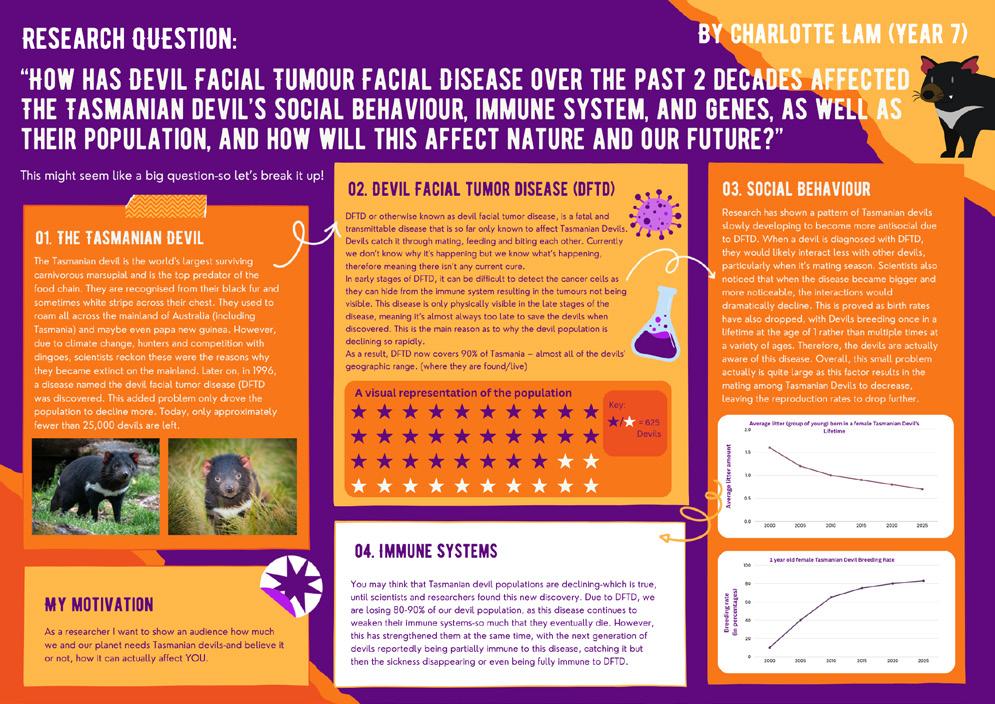
The Tasmanian devil is the world's largest surviving carnivorous marsupial and is the top predator of the food chain. They are recognised for their black fur and sometimes white stripe across their chest. They used to roam all across the mainland of Australia (including Tasmania) and maybe even Papua New Guinea. However, due to climate change, hunters and competition with dingoes, scientists reckon these were the reasons why they became extinct on the mainland. Later on, in 1996, a disease named Devil Facial Tumour Disease or DFTD was discovered. This added problem only drove the population to decline more. Today, only approximately fewer than 25,000 devils are left.
DFTD or otherwise known as Devil Facial Tumour Disease, is a fatal and transmittable disease that is so far only known to affect Tasmanian Devils. Devils catch it through mating, feeding and biting each other-in other words, normal everyday behaviour. Currently we don’t know why it's happening but we know what’s happening, therefore meaning there isn’t any current cure.
In early stages of DFTD, it can be difficult to detect the cancer cells as they can hide from the immune system
resulting in the tumours not being visible. This disease is only physically visible in the late stages of the disease, meaning it’s almost always too late to save the devils when discovered. This is the main reason as to why the devil population is declining so rapidly. As a result, DFTD now covers 90% of Tasmania–almost all of the devils’ geographic range (where they are found/live).
Research has shown a pattern of Tasmanian devils slowly developing to become more antisocial due to DFTD. When a devil is diagnosed with DFTD, they would likely interact less with other devils, particularly when it’s mating season. Scientists also noticed that when the disease became bigger and more noticeable, the interactions would dramatically decline. Therefore, the devils are actually aware of this disease. Overall, this small problem actually is quite large as this factor results in the mating among Tasmanian Devils to decrease, leaving the reproduction rates to drop further.
You may think that Tasmanian devil populations are declining-which is true, until scientists and researchers found this new discovery. Due to DFTD, we are losing 80-90% of our devil population, as this disease continues to weaken their immune systems-so much that they eventually die. However, this has strengthened them at the same time, with the next generation of devils reportedly being partially immune to this disease, catching it but then the sickness disappearing or even being fully immune to DFTD.
DFTD has caused a big impact on Tasmanian devil genes by lowering genetic diversity. Genetic diversity, if you don’t already know, is the range of different traits found within a species. For example, humans don’t all have the same eye or hair colour, skin tone, or height—this is due to genetic diversity. It refers to the variety of different versions of genes present in the DNA of individuals within a species. Due to DFTD hitting them so hard, their genetic diversity has lowered, meaning their chance of survival as a population is decreasing, with them all having the same negative response. But here's the funny part-because
of the disease being so common in Tasmanian devils, it has developed to become like a small cold we might get, making it a neutralised and expected within genes. However, this positive outcome is only evident in a small number of devils as we are just on the pinnacle of DFTD; the rise of the new generation of devils.
HOW WILL IT AFFECT NATURE?
If Tasmanian devils become extinct, smaller native animals such as bandicoots are declining rapidly with the help of feral cats and domestic animals. Devils are known as nature’s vacuum cleaners, because they eat every remaining-bones, fur and meat as they have the strongest jaws than any other mammal in the world. Without them, they wouldn’t be able to remove slow, sick and diseased animals.
Native animals have adapted over time for our country's needs, therefore not having them will result in unwanted animals becoming too numerous. This results in disasters for almost everything as these animals affect the bigger things (agriculture, land and water) which ripple to the other dimensions in the environment (economy, finance, sickness and diseases).
HOW WILL IT AFFECT US?
This ultimately affects humans, as the environment begins to collapse. For example, if unwanted, domesticated species take over, agriculture, waterways, and soil health will eventually suffer. These are major, big things in our ecosystem. This would have a direct and big impact on Australia's economy, as agriculture and tourism are major industries. A dirty, pest infested environment not only makes Australia look less enticing for tourists, but decreases crop and livestock growth. This is major as beef, lamb and grain industries are one of Australia’s biggest marketing and international trade which are responsible for the country’s main profits. A polluted ecosystem also increases the risk of disease outbreaks, potentially leading to new diseases, viruses and sickness to rise - in other words, a whole health crisis outbreak. Additionally, larger pest populations and weaker natural controls could contribute to more frequent and intense bushfires. The cost of living could rise even further due to crop and livestock demand, as well as high taxes because of the need to invest more in pest control and repairing the ecosystem (e.g. by planting trees). Job losses for zoo staff, park rangers, tour guides, farmers, and agricultural transporters may also occur because of the negative impact on tourism, environmental balance, and agricultural productivity.
Overall, DFTD has affected Tasmanian devils in various ways, mostly negative, but results do show that there is some hope with scientists still finding a way to cure the disease as well as the newer devils being reported partially or fully immune to the disease.
SITIAN CHEN, YEAR 10
Task avoidance, commonly known as procrastination, is a widespread behavioural phenomenon, though its precise definition remains contested as it manifests differently across individuals (van Eerde, 2003). However, while its influences and intentions may vary, it is a widely accepted notion that task avoidance often yields harmful outcomes, hence stressing the importance of understanding it (Klingsieck, 2013; Ahmed et al., 2023). The aim of this review is to provide further insight into the behavioural contributors of task avoidance and propose research-backed methods of overcoming it, and thus evaluates the impact of the three key psychological factors of habits, mindset and stress. Understanding how these factors interact and awareness of effective interventions is increasingly important given the mental health burdens resulting from rising demands in education (Wiedermann et al., 2023). With developments such as AI rapidly increasing the standard, it is crucial to learn how to optimise time, and avoid being caught up in unproductive pursuits (Choudhary & Sybol, 2025).
Habits are behaviours that are instinctive responses to specific cues, and can often differ from or overtake conscious intent (Gardner et al., 2020). When avoidance behaviours become habitual and lack intervention from outside influences, they can sustain task delay even when motivation is present due to their automatic nature (e.g. defaulting to checking social media). Hailikari et al. (2021) found that “students’ ability to organise their time and effort has the strongest association with procrastination” and noted that nearly “every second student regularly procrastinates”, with poor time-management habits reinforcing delay. Procrastination can be understood as a maladaptive habit loop that impedes students’ academic success, and embedding repeated planning routines is a common method of breaking old, destructive habits and establishing new ones. The STOP Procrastination trial reported that after ten weeks of habit based behavioural training, 90.9% of participants found their difficulties with procrastination improved and 81.9% their inner dialogue, and that habits coupled with low psychological flexibility created a self-perpetuating cycle of avoidance (Ferreira et al., 2025). However, habits mostly stem from an individual’s environment, and a change of setting or schedule can often lead to goals regaining command over habits, hence reducing procrastination (Neal et al., 2007). Therefore, task avoidance is less a matter of
conscious choice than the product of entrenched habits, and interventions targeting such routines are well suited to effectively reducing procrastination.
Mindset and self-belief are another central factor in task avoidance, often determining how individuals approach or delay important goals, hence influencing their performance and self-efficacy (Lindsley et al., 1995). Steel (2007), in his meta-analysis of 691 correlations revealed that procrastination can be linked to several mental attributes such as low self-efficacy and self-esteem, self-handicapping, disagreeableness and distractibility, as it leads to a lack of motivation or drive to complete tasks efficiently. This can be due to a fear of failure, or a lack of purpose or meaning, and can result in individuals becoming less adaptable to challenges as they internalise their fears further rather than adopting a growth mindset where they learn from their shortcomings. Klassen (2008) expands on self-efficacy as a cause for procrastination as “procrastinators suffer from low self-esteem that results in a general tendency to engage in behaviours-like task delay and avoidance-that protect self-presentation by providing an excuse for poor performance and negative outcomes.”
Building on the proposal of task avoidance as a psychological mechanism dependent on the individual’s attributes and objectives, Temporal Motivation Theory (TMT) formalises utility, or how desirable a task is, as a product of expectancy, value, delay and impulsiveness, with procrastination occurring when expectancy or value is low, or when delay is high (Steel & König, 2006). As a result, the framework highlights how pessimistic beliefs about the task at hand and even an abundance of time can amplify procrastination, and how in order to minimise it a change in mindset is needed to view tasks with an increased urgency and importance. BellezaTerrejon et al. (2024) found the rise of AI technologies to correlate with increased procrastination, and that the perceived effortless efficiency of generative technologies may lead to students further delaying tasks at hand. Accordingly, interventions that target mindset through cognitive reframing, expectancy enhancing strategies, and self-affirmation show promise in reshaping the beliefs that form the base of task avoidance. Therefore, procrastination can be seen not only as a behavioural negligence but also as a reflection of how individuals perceive their own competence and need to achieve their goals
Stress, the response of the body when perceived demands exceed perceived coping resources, can impair cognitive functions such as attention and memory, overwhelm emotion regulation, and reduce self-control (Stanislawski, 2019; Schneiderman et al., 2005). These effects can often create a pathway to depression that perpetuates task avoidance by amplifying avoidance. Solomon and Rothblum (1984) found that up to 47% of the students in their study demonstrated task aversiveness as many felt “overwhelmed by the task”, and the aversion had correlated significantly with depression and irrational beliefs, suggesting procrastination is a way of temporarily evading an anxiety that becomes compounded when later faced. It has also been noted that procrastination may in fact function as an “emotional (mis)regulation strategy” in which individuals prioritise short-term reliefs from unpleasant activities (e.g. scrolling social media, hanging out with friends) over long-term achievement (Turner & Hodis, 2023; Tice & Bratslavsky, 2000). High stress reduces cognitive resources and increases the likelihood of maladaptive coping, with a depressive spiral revealed as students with lower selfregulatory resources allocated less effort to academic tasks which in turn amplified their avoidance (Lindsley et al., 1995). Similarly, Sirois (2023) suggests stress as a precursor to procrastination as individuals try to regulate their mood by steering clear of tasks that elicit negative emotional states, which only further damages their emotional regulation and task progression. As a result, overwhelming academic demands create a cycle where stress contributes to depression, and depressive states further erode motivation, thereby sustaining procrastination. Consequently, interventions that enhance stress management and emotional regulation, such as mindfulness training or cognitive reappraisal techniques, are crucial in disrupting this cycle and reducing procrastination.
A solution for addressing procrastination through habits is the use of implementation intentions, which link specific cues to concrete goal-directed actions. Gollwitzer (1999) demonstrated that when individuals form “if-then” plans, they are significantly more likely to initiate tasks automatically, as they bypass the need for willpower at the moment of decision. An example of such a plan would be, “If I take public transport home today, then I will review my study notes for the entire trip.” Wood and Neal (2007) found that altering habitual contexts reduced the likelihood of lapsing into distraction. For example, a student prone to defaulting to social media in their bedroom could shift their study routine to an unfamiliar library, reinforcing the ‘study here’ and not ‘scroll here’ association. Over time, these new patterns become automatic, replacing avoidance habits. By deliberately engineering environments and coupling them with
implementation intentions, individuals can create new habits to reduce procrastination.
A solution that addresses both mindset and stress would be the integration of Mindfulness-Based Stress Reduction (MBSR) programs, which builds stress management and emotional resilience. Mindfulness interventions work by training individuals to observe stressful thoughts non-judgmentally, reducing the impulse to escape through delay. For example, Sirois and Tosti (2012) found that students practising mindfulness reported significant decreases in procrastination scores, mediated by improved emotional regulation capacity. An MBSR program could involve short, guided meditation sessions before study periods, combined with cognitive reappraisal exercises where students reinterpret stressful academic tasks as manageable challenges. For instance, before starting an exam preparation session, a student might engage in a five minute breathing exercise, followed by consciously reframing exam stress as a motivator rather than a threat. By lowering stress reactivity and building healthier coping mechanisms, mindfulness-based strategies disrupt the stress-depression-procrastination cycle and foster sustained task engagement.
Many of the studies used in this research were shortterm as they occurred over a few weeks and did not have any follow up data after a longer period of time, meaning results may be inapplicable to real life scenarios. Most studies were also conducted on students, who are known to be unreliable as adolescents and young adults are at an age of rapid change and development, and as most studies were located in Western countries in higher socioeconomic areas, there may be demographic bias.
Habits, mindset, and stress each play crucial roles in task avoidance. Habitual procrastination behaviours can overtake intent as they trap individuals in a cycle of avoidance, negative beliefs about ability and failure influence how individuals interpret challenges and whether they respond with delay, and stress undermines emotional regulation which can lead to depressive states, often exacerbating procrastination. Effective interventions address these factors, and resolve task avoidance by targeting the individual.
Ahmed, I., Bernhardt, G. V., & Shivappa, P. (2023). Prevalence of academic procrastination and its negative impact on students. Biomedical and Biotechnology Research Journal (BBRJ), 7(3), 363–370. https://doi.org/10.4103/bbrj.bbrj_64_23
Choudhary, L., & Sybol, S. S. (2025). Impact of AI on Students Mental Health and Well-Being. Advances in Computational Intelligence and Robotics, 205–234. https://doi.org/10.4018/979-8-3373-5786-7. ch008
Ferreira, A., Caetano, S., Xavier, S., Marques, M., Martins, J., Queirós, A., & Martins, M. J. (2025). STOP procrastination: acceptability and feasibility of a new acceptance and compassion-based intervention in higher education. Current Psychology, 44. https://doi.org/10.1007/ s12144-024-07270-0
Gardner, B., Lally, P., & Rebar, A. L. (2020). Does habit weaken the relationship between intention and behaviour? Revisiting the habit‐intention interaction hypothesis. Social and Personality Psychology Compass, 14(8). https://doi.org/10.1111/spc3.12553
Gollwitzer, P. M. (1999). Implementation intentions: Strong effects of simple plans. American Psychologist, 54(7), 493–503. https://doi. org/10.1037/0003-066x.54.7.493
Hailikari, T., Katajavuori, N., & Asikainen, H. (2021). Understanding Procrastination: A case of a study skills course. Social Psychology of Education, 24(2), 589–606. https://doi.org/10.1007/s11218-02109621-2
Klassen, R. M., Krawchuk, L. L., & Rajani, S. (2008). Academic procrastination of undergraduates: Low self-efficacy to self-regulate predicts higher levels of procrastination. Contemporary Educational Psychology, 33(4), 915–931. https://doi.org/10.1016/j.cedpsych.2007.07.001
Klingsieck, K. B. (2013). Procrastination: When good things don’t come to those who wait. European Psychologist, 18(1), 24–34. https://doi. org/10.1027/1016-9040/a000138
Lindsley, D. H., Brass, D. J., & Thomas, J. B. (1995). Efficacy-Performance Spirals: A Multilevel Perspective. The Academy of Management Review, 20(3), 645. https://doi.org/10.2307/258790
Neal, D. T., Wood, W., Labrecque, J. S., & Lally, P. (2012). How do habits guide behavior? Perceived and actual triggers of habits in daily life. Journal of Experimental Social Psychology, 48(2), 492–498. https:// doi.org/10.1016/j.jesp.2011.10.011
Schneiderman, N., Ironson, G., & Siegel, S. D. (2005). Stress and health: Psychological, behavioral, and Biological Determinants. Annual Review of Clinical Psychology, 1(1), 607–628. National Library Of Medicine. https://doi.org/10.1146/annurev.clinpsy.1.102803.144141
Sirois, F. M. (2023). Procrastination and Stress: A Conceptual Review of Why Context Matters. International Journal of Environmental Research and Public Health, 20(6), 5031. https://doi.org/10.3390/ ijerph20065031
Sirois, F. M., & Tosti, N. (2012). Lost in the Moment? An Investigation of Procrastination, Mindfulness, and Well-being. Journal of Rational-Emotive & Cognitive-Behavior Therapy, 30(4), 237–248. https:// doi.org/10.1007/s10942-012-0151-y
Sofía Emilce Belleza-Torrejón, Celeste, C., María, N., Guarniz, M., & Quispe-López, J. M. (2024). The Development of Artificial Intelligence as An Influential Factor in Procrastination. International Journal of Religion, 5(10), 5461–5467. https://doi.org/10.61707/zjthpd48
Solomon, L. J., & Rothblum, E. D. (1984). Academic procrastination: Frequency and cognitive-behavioral correlates. Journal of Counseling Psychology, 31(4), 503–509.
Stanisławski, K. (2019). The Coping Circumplex Model: An Integrative Model of the Structure of Coping With Stress. Frontiers in Psychology, 10(694). https://doi.org/10.3389/fpsyg.2019.00694
Steel, P. (2007). The nature of procrastination: A meta-analytic and theoretical review of quintessential self-regulatory failure. Psychological Bulletin, 133(1), 65–94. https://doi.org/10.1037/00332909.133.1.65
Steel, P., & König, C. J. (2006). Integrating Theories of Motivation. Academy of Management Review, 31(4), 889–913. https://doi. org/10.5465/amr.2006.22527462
Tice, D. M., & Bratslavsky, E. (2000). Giving in to Feel Good: The Place of Emotion Regulation in the Context of General Self-Control. Psychological Inquiry, 11(3), 149–159. https://doi.org/10.1207/ s15327965pli1103_03
Turner, M., & Hodis, F. A. (2023). A Systematic Review of Interventions to Reduce Academic Procrastination and Implications for Instructor-based Classroom Interventions. Educational Psychology Review, 35(4). https://doi.org/10.1007/s10648-023-09838-x
van Eerde, W. (2003). A meta-analytically derived nomological network of procrastination. Personality and Individual Differences, 35(6), 1401–1418. https://doi.org/10.1016/s0191-8869(02)00358-6
Wiedermann, C. J., Barbieri, V., Plagg, B., Marino, P., Piccoliori, G., & Engl, A. (2023). Fortifying the foundations: A comprehensive approach to enhancing mental health support in educational policies amidst crises. Healthcare, 11(10), 1–11. https://doi.org/10.3390/healthcare11101423
Wood, W., & Neal, D. T. (2007). A new look at habits and the habit-goal interface. Psychological Review, 114(4), 843–863. https://doi. org/10.1037/0033-295x.114.4.843
THENULYA, PYMBLE LADIES' COLLEGE
Artificial intelligence (AI) in medicine refers to the use of machine learning models to analyse medical data, providing valuable insights to healthcare professionals and enhancing patient outcomes. Early cancer detection provides significant benefits, including higher survival rates, since individuals diagnosed at an earlier stage have a much better chance of survival. In Australia, research shows that early-stage breast cancer has a five year survival rate of 81%, while rates are far lower at advanced stages. Detecting cancer early also allows for less aggressive treatments, resulting in fewer side effects and faster recovery. This leads to a better quality of life, as patients can maintain their health and daily routines with minimal disruption. Additionally, early diagnosis reduces the risk of cancer spreading to other parts of the body. The purpose of this essay is to explore how artificial intelligence is being applied in the early detection of cancer, examining key benefits such as improved accuracy, speed, and accessibility. It will also assess potential risks and limitations, including possible errors, ethical concerns, and other challenges, before considering whether AI should complement or replace traditional medical practices.
Artificial intelligence is the capability of computer systems to perform tasks that typically require human intelligence, such as reasoning, problem-solving, and decisionmaking. The table below compares traditional cancer diagnosis methods with AI-based approaches: Breast, prostate, and lung cancers made up about half of all new cancer cases in 2023. Because these cancers are so common, they provide large datasets for researchers, making them useful examples of how AI is currently applied in cancer care.
Artificial intelligence helps detect cancer earlier by rapidly and accurately analysing medical images such as mammograms, CT scans, MRIs, and even dermatology photos. AI systems are trained to recognise subtle patterns in these images, for example, small tumours or irregular cells, that might be overlooked by humans. Beyond imaging, AI assists doctors by analysing biopsy samples for abnormal cells, improving the consistency and precision of diagnoses. For instance, Google’s AI model for breast cancer has been shown to identify
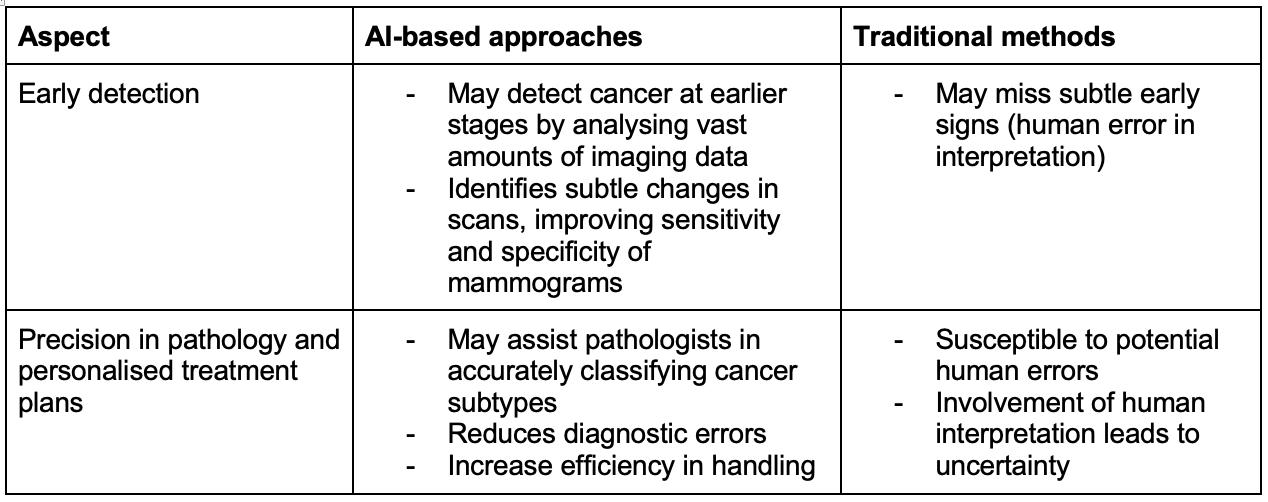
AI is transforming cancer detection by introducing advanced technologies into medical imaging and pathology. Modern AI tools can analyse scans with remarkable accuracy, often matching or surpassing expert radiologists in identifying early signs of cancer. These algorithms detect extremely subtle patterns, such as small tumours or hidden lesions, leading to earlier and more reliable diagnoses. In pathology, AI models analyse digital biopsy slides to classify cancer types and identify which patients may benefit from specific targeted therapies. AI speeds up diagnosis and enables earlier treatment because it processes data much faster than humans. The technology also supports telemedicine and rural healthcare, making quality diagnostics more accessible. As AI becomes more advanced, it continues to lower costs, personalise treatment decisions, and improve patient outcomes globally.
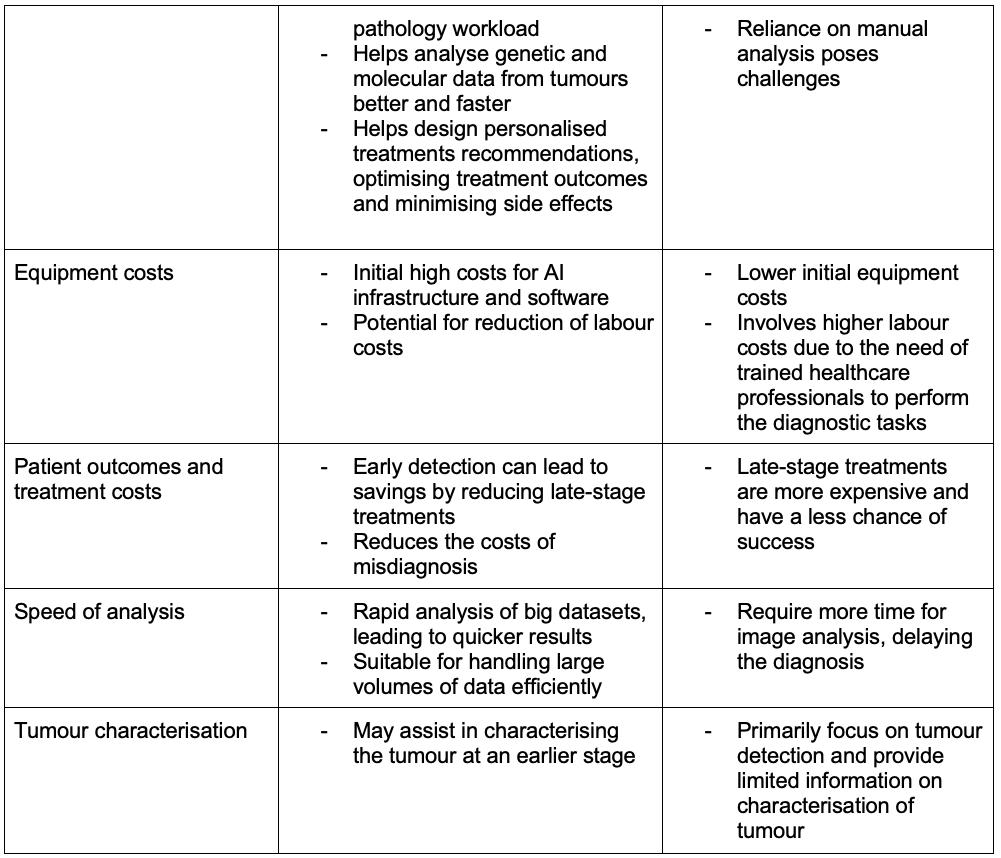
AND CHALLENGES OF RELYING ON AI
Although AI offers many benefits, it also brings significant challenges. False positives (incorrectly identifying cancer) and false negatives (missing cancer) can occur when algorithms misinterpret data or are trained on incomplete or biased datasets. These errors may lead to unnecessary treatments or delayed diagnoses. For example, if AI is trained primarily on data from one demographic group, it may perform less accurately for others, creating bias in medical outcomes. Ethical and legal concerns also arise, especially around accountability. If an AI model makes an incorrect diagnosis, determining who is responsible can be complex. Additionally, since AI systems rely on vast amounts of sensitive data, patient privacy and data security must be protected. Finally, over-reliance on AI could gradually reduce the diagnostic skills of human doctors, emphasising the need for balance between AI and expert clinical judgment.
THE ROLE OF DOCTORS ALONGSIDE AI
AI supports, but does not replace, medical professionals. It analyses patient data and imaging results, providing quick and accurate suggestions that doctors then review
within the broader context of patient care. This ensures that AI assists decision-making rather than controlling it. For example, in some documented cases, doctors have disagreed with AI-generated diagnoses and chosen alternative treatment plans, demonstrating that final medical decisions always remain in human hands.
The future of AI in cancer diagnostics looks promising. As algorithms continue to improve in accuracy, AI will likely be used for diagnosing a wider range of cancers, not just common types like breast and lung cancer. Integration into hospital systems worldwide will make these tools a standard part of clinical care, helping more patients benefit from precise diagnostics. A notable example of AI’s growing potential can be seen in a 2020 study conducted at Moorfields Eye Hospital in London, where researchers developed an AI system capable of detecting over 50 eye diseases with the same accuracy as expert ophthalmologists. Although this study focused on eye conditions rather than cancer, it demonstrates how AI can match specialist-level diagnostic skills, offering insight into how similar models could be applied in cancer detection and treatment in the future. At the same time, new regulations and ethical standards are being developed to ensure AI technologies are used safely, responsibly, and transparently across healthcare systems worldwide.
AI has become a powerful tool for early cancer detection by analysing medical images and identifying subtle signs that human experts may miss. While it offers benefits such as improved accuracy, faster results, and more accessible care, it also presents risks, including errors, bias, and ethical challenges. Therefore, AI should be seen as an assistant to doctors, not a replacement, ensuring that expert clinical judgment continues to guide patient care while technology enhances efficiency and accuracy.
Alowais, S. A., Alghamdi, S. S., Alsuhebany, N., Alqahtani, T., Alshaya, A. I., Almohareb, S. N., Aldairem, A., Alrashed, M., Bin Saleh, K., Badreldin, H. A., Al Yami, M. S., Al Harbi, S., & Albekairy, A. M. (2023). Revolutionizing healthcare: The role of artificial intelligence in clinical practice. BMC Medical Education, 23, Article 689. https://doi.org/10.1186/ s12909-023-04698-z
Cancer Research Institute. (2025, February 11). Early detection saves lives: The essential cancer screenings you can’t afford to skip. https:// www.cancerresearch.org/blog/early-detection-saves-lives-the-essential-cancer-screenings-you-cant-afford-to-skip
Crosby, D., Bhatia, S., Brindle, K. M., Coussens, L. M., Dive, C., Emberton, M., Esener, S., Fitzgerald, R. C., Gambhir, S. S., Kuhn, P., Rebbeck, T. R., & Balasubramanian, S. (2022). Early detection of cancer. Science, 375(6586), eaay9040. https://doi.org/10.1126/science.aay9040
Eisemann, N., Bunk, S., Mukama, T., Baltus, H., Elsner, S. A., Gomille, T., ... & Katalinic, A. (2025). Nationwide real-world implementation of AI for cancer detection in population-based mammography screening. Nature Medicine, 31(6), 917–924. https://doi.org/10.1038/s41591024-03408-6
eCancer. (2024, January). New AI method makes cancer tracking faster and easier using blood tests. https://ecancer.org/en/news/26593new-ai-method-makes-cancer-tracking-faster-and-easier-usingblood-tests
Esteva, A., Kuprel, B., Novoa, R. A., Ko, J., Swetter, S. M., Blau, H. M., & Thrun, S. (2017). Dermatologist-level classification of skin cancer with deep neural networks. Nature, 542(7639), 115–118. https://doi. org/10.1038/nature21056
IBM. (n.d.). What is artificial intelligence in medicine? IBM Think. https://www.ibm.com/think/topics/artificial-intelligence-medicine Katwaroo, A. R., Adesh, V. S., Lowtan, A., Umakanthan, S., Shanker, V., & others. (2024). Diagnostic, therapeutic, and ethical impact of artificial intelligence in modern medicine. Postgraduate Medical Journal, 100(1183), 289–296. https://doi.org/10.1093/postmj/qgad135
McKinney, S. M., Sieniek, M., Godbole, V., Godwin, J., Antropova, N., Ashrafian, H., ... & Suleyman, M. (2020). International evaluation of
an AI system for breast cancer screening. Nature, 577(7788), 89–94. https://doi.org/10.1038/s41586-019-1799-6
Moorfields Eye Hospital NHS Foundation Trust. (2020, August 13). Moorfields and Google Health publish landmark research showing how AI could transform eye care. https://www.moorfields.nhs.uk/ news/moorfields-and-google-health-publish-landmark-researchshowing-how-ai-could-transform-eye-care
National Breast Cancer Foundation (Australia). (n.d.). Breast cancer stats. https://nbcf.org.au/about-breast-cancer/breast-cancer-stats/ NASA. (2023, September 8). What is artificial intelligence? https:// www.nasa.gov/what-is-artificial-intelligence/ OncoBites. (2024, January 24). AI vs. traditional methods in cancer diagnostics. https://oncobites.blog/2024/01/24/ai-vs-traditional-methods-in-cancer-diagnostics/
PubMed. (2015). Artificial intelligence in medicine: Present and future. Artificial Intelligence in Medicine, 64(2), 101–113. https://pubmed.ncbi. nlm.nih.gov/25993143/
PubMed. (2022). Artificial intelligence in medical imaging: Opportunities, applications and risks. Frontiers in Oncology, 12, 35298272. https://pubmed.ncbi.nlm.nih.gov/35298272/
SkinVision. (n.d.). How SkinVision helps detect skin cancer early. https://www.skinvision.com/
World Health Organization. (n.d.). Promoting cancer early diagnosis. https://www.who.int/activities/promoting-cancer-early-diagnosis
CHLOE WANG, YEAR 10
INTRODUCTION - WHAT’S AT STAKE?
For a system that is tasked solely with educating and nurturing the minds of the future, the school system exhibits many characteristics that are at odds with neuroscience on how to protect the adolescence brain. Early start times and high-pressure academic environments create conditions that undermine learning and damage wellbeing. Neuroscience shows that these practices disrupt sleep and intensify stress and anxiety, doing more harm than good to developing young minds.
So, how can schools align with the way adolescent brains actually develop? Research reveals that later start times and academic stress-management education not only heavily improves academic outcomes but also promotes the healthy growth of the adolescent brain. And without actively changing these aspects, schools risk continually perpetuating a system that unknowingly makes learning more difficult the brain’s most critical period of growth.
RESEARCH OVERVIEW - HOW DID WE GET HERE?
Research methods
The evidence presented and analysed is drawn from the following peer-reviewed neuroscience and education studies and data collection methods:
• EEG (Electroencephalography) studies that track adolescent circadian rhythms, sleep patterns, and brain activity during learning.
• Meta-analyses conducted over large student populations that evaluate the impact of school start times on academic and health outcomes.
• Brain imaging research that maps individual differences in learning pathways and memory systems.
• Together, these findings create a comprehensive picture of how school structures interact with and inhibit adolescent brain development.
RESEARCH RESULTS
Using this research, the two most pressing threats of school to teen brain development can be identified as:
• Sleep and Circadian Rhythms: Adolescent brains experience a natural delay in melatonin release, shifting sleep onset by about 2.5 hours. Teenagers are biologically programmed to sleep later and wake later, yet most schools begin before 8:20 a.m. EEG studies confirm that there is generally reduced attention and alertness in very early morning classes in students.
• Stress Vulnerability: Adolescents on average have much more heightened reactivity in the hypothalamicpituitary-adrenal (HPA) axis compared to adults,
producing stronger and longer production of the cortisol hormone in response to stress. Chronic academic stress disrupts the function of the prefrontal cortex, the executive decision-maker of the brain, which increases the long-term risks for anxiety and depression.
Discussion of data and research
Supported by the data, results and research, key conclusions can be drawn on both the harms and potential solutions for each of the previously outlined threats to adolescent brain development.
• Early Start Times and Brain Function: Learning before 8:30 a.m. occurs during the adolescent brain’s biological “night.” Studies show that delaying school start times by even one hour leads to 25–77 minutes more sleep per night, improved exam scores, and lower illness rates. These findings demonstrate that aligning school schedules with circadian rhythms enhances both academic achievement and physical health.
• Stress as a Developmental Threat: Chronic schoolrelated stress coincides with critical periods of brain maturation, making its effects especially harmful. High academic pressure elevates cortisol for prolonged periods, impairing the hippocampus and prefrontal cortex. This not only diminishes memory and decisionmaking but also sets up adolescents to develop lasting mental health challenges. Protective factors such as teaching and placing emphasis on a growth mindset show significant reductions in poor stress management, suggesting that supportive educational environments can improve brain health.
Current schooling practices unintentionally harm adolescent brain development. The evidence strongly supports reforms that realign education with neuroscience. Schools and teachers should prioritise the following two key changes, which are practical to implement and have strong precedents.
1. Delay School Start Times:
• Implement start times no earlier than 8:45 a.m., a roughly 30 minute pushback.
• Evidence shows this change improves sleep, boosts academic performance, and reduces illness rates, as it allows for adolescents to rest according to their unique circadian rhythms.
• Real-world precedent: One Minnesota high school saw average SAT scores increase from 1,288 to
1,500 points after delaying start time from 8:00 a.m. to 8:30 a.m., even though it was initially met with scepticism from both the staff and parents. However, it succeeded even beyond the classroom, with school violence and dropout rates sharply falling as well.
2. Reduce School-Related Stress:
• Foster growth mindsets and emphasise mastery over high-stakes testing.
• Evidence shows that this will provide safe, emotionally supportive environments that reduce chronic stress exposure through promotion of a growth mindset, especially in the later years of schooling.
CONCLUSION: WHAT DOES THE FUTURE LOOK LIKE?
Aligning schools with adolescent brain science offers three benefits: better academic outcomes, healthier brain development, and stronger long-term mental health. With these key reforms, schools will no longer unknowingly weaken their own mission of education through their brain hostile systems, enabling both schools and students to confidently make strides toward their collective goals, but this time, as a team.
Dikker, S., Haegens, S., Bevilacqua, D., Davidesco, I., Wan, L., Kaggen, L., McClintock, J., Chaloner, K., Ding, M., West, T., & Poeppel, D. (2020). Morning brain: real-world neural evidence that high school class times matter. Social Cognitive and Affective Neuroscience, 15(11), 1193–1202. https://doi.org/10.1093/scan/nsaa142
Goldberg, H. (2022). Growing Brains, Nurturing Minds—Neuroscience as an Educational Tool to Support Students’ Development as Life-Long Learners. Brain Sciences, 12(12), 1622. https://doi. org/10.3390/brainsci12121622
Kelley, P., Lockley, S. W., Kelley, J., & Evans, M. D. R. (2017). Is 8:30 a.m. Still Too Early to Start School? a 10:00 a.m. School Start Time Improves Health and Performance of Students Aged 13–16. Frontiers in Human Neuroscience, 11(11). https://doi.org/10.3389/ fnhum.2017.00588
Minges, K. E., & Redeker, N. S. (2016). Delayed school start times and adolescent sleep: A systematic review of the experimental evidence. Sleep Medicine Reviews, 28(1), 86–95. https://doi. org/10.1016/j.smrv.2015.06.002
Rogers, A. (2016, November 22). Delaying School Start Times to Boost Adolescent Academic Performance. Neurology; European Medical Journal. https://www.emjreviews.com/neurology/article/delaying-school-st art-times-to-boost-adolescent-academic-performance/
Romeo, R. D. (2013). The Teenage Brain: The Stress Response and the Adolescent Brain. Current Directions in Psychological Science, 22(2), 140–145. https://doi.org/10.1177/0963721413475445
Terada, Y. (2018, August 24). The Science Behind Student Stress. Edutopia. https://www.edutopia.org/article/science-behind-student-stress/
Yip, T., Wang, Y., Xie, M., Ip, P. S., Fowle, J., & Buckhalt, J. (2022). School Start Times, Sleep, and Youth Outcomes: A Meta-analysis. Pediatrics, 149(6), e2021054068. https://doi.org/10.1542/ peds.2021-054068
and ethical dilemma. What are the societal, ethical and scientific implications of xenotransplantation as an emerging solution in modern medicine?
CAMILLE
As the population grows, the gap of people receiving organ transplants and those in need of donation widens substantially, posing an almost ‘impossible’ dilemma of who should be receiving the organs, and how we are unable to accommodate the health needs of thousands of people. This growing crisis has prompted researchers to explore alternatives beyond human donation. One of the most controversial yet promising solutions is xenotransplantation - the transplantation of animal organs into humans.
Xenotransplantation has a long history of experimentation, from early attempts to major breakthroughs, from the baboon heart transplant into Baby Fae in 1984 to the genetically modified pig heart transplants in 2022. Advances in gene editing, particularly CRISPR, have rekindled hopes that xenotransplantation could offer a sustainable and ethical source of organs. However, beyond scientific challenges like immune rejection and viral transmission, it also raises ethical and societal concerns over animal use, public health, and equitable access.
If xenotransplantation becomes a normal part of medicine, it could bring huge changes not just to healthcare, but to society globally. The new ability to transplant xeno-organs safely into human bodies will significantly reduce the impacts of the dilemma of organ shortages in communities all over the world, as well as decrease the emotional burden of countless families. People might no longer have to wait months or years in uncertainty, and the idea of dying from organ failure could become far less common. However, this progress would also reshape how people see themselves, and how they see others.
One major shift could be in how society perceives people who have animal organs, challenging the beliefs of many on the superiority of humans to ‘underdeveloped’ animals. Some may view xenotransplants as symbols of medical progress, living proof of human innovation, whilst others might react with discomfort or prejudice, seeing them as “less natural” or even questioning their humanity. This could lead to new and intense forms of social
stigma, especially in communities or cultures where mixing human and animal biology is seen as impure. More evident forms of social disruption may be more prominent within children, especially due to their inability to fully understand or empathise with those who have received animal organs.
Recipients might face misunderstanding or discrimination until public attitudes evolve which may take decades as the technology progresses.There may also be psychological and identity effects, as patients may struggle with the idea of carrying part of another species inside them, while society would need to reconsider what defines a person as “fully human” (Rollin, 2020, p. 1). Over time, as successes begin to increase and survival rates improve, acceptance of the procedure is quite possible, but the full transition into society may be more of a challenge than one expects.
On a global scale, xenotransplantation could widen the division between wealthy and developing nations. Advanced countries with strong biotechnology industries might dominate access and production, leaving poorer regions excluded. This could widen healthcare inequality worldwide. At the same time, a successful global rollout would demand international cooperation to manage disease control, animal welfare standards, and ethical regulations. In the long run, xenotransplantation has the possibility to unite nations through collective scientific goals, or perhaps, expose and widen global divides over how far humanity should go to extend life.
The ethical debate around xenotransplantation cannot be separated from long-standing concerns about animal welfare, from food production to organ harvesting. Each year, billions of animals are raised and slaughtered for food, often in cramped, stressful and short-lived conditions. Xenotransplantation follows a similar path: pigs bred in sterile, highly controlled environments and killed once their organs have matured. Some argue this strips animals of natural behaviours, denies them social interaction and reduces their lives to a utilitarian function. As Rollin (2020) explains through the concept of telos, the natural purpose or "bigness" of the pig and "lowness" of the cow, xenotransplantation exploits animals' very
nature for human benefit. The question remains whether our desperate hunt for organs can righteously outweigh the suffering these animals will face.
On the other hand, supporters highlight that the purpose here is not trivial, but a life-saving necessity. Whereas battery farming sustains diets that humans could replace with alternatives, xenotransplantation directly addresses the growing issue of shortages of transplantable organs. One pig’s sacrifice has the potential to extend a human life by decades, offering a stronger ethical justification than meat consumption. In the end, the crux lies in whether prolonging human life justifies the means of animal confinement and slaughter.
Beyond welfare, xenotransplantation raises questions about the ethics of genetic modification itself. Animals used for these procedures are often genetically altered to make their organs less likely to be rejected by human immune systems. In 2002, scientists created three generations of pigs with specific glucose knockouts, which have shown significant results in decreasing the risk of hyperacute immune rejection within baboons. The change in genetics extended the sustenance of the organ, increasing it to around two to six months, but was insufficient to fully evade the immune system. Due to the ethical dilemma surrounding genome modification, some worry that once this line is crossed, genetic modification could extend into more radical and potentially exploitative means, no longer restricted to health care and research, but for personal preference or appeal.
Still, supporters maintain that genetic modification in this context is a precise and carefully regulated intervention, driven by medical necessity rather than vanity. If a modification prevents organ rejection and saves human lives, it is both rational and compassionate to pursue it, because if millions of human lives could be saved, attempts into this nascent solution may just be what we need. The greater ethical danger, perhaps, lies not in the technology itself but in how far humanity is willing to normalise reshaping life for human convenience. Xenotransplantation, therefore, becomes a test case not only for medical innovation but also for society’s willingness to define ethical boundaries.
SCIENTIFIC IMPLICATIONS
News of the first transplant of a pig heart into a human recipient was widely reported during 2022, raising hope that the emerging solution may alleviate the stress of organ shortages. In centuries of experimentation, no human or nonhuman recipient has survived longer than a few months, often dying of hyperacute rejection or infection. Many patients that did receive these experimental organs did not qualify for organ transplant due to their poor condition, meaning that this procedure
still has much to offer as a nascent solution in the medical world. But before this is widely implemented, the question remains: how can scientists mitigate the risk of immune rejection of the xeno-organ while also limiting the risk of spreading pathogenic diseases?
Immune rejection occurs when the recipient’s immune system recognises the transplanted organ as foreign and signals an attack against it. This happens because human immune cells identify the pig organ’s proteins and sugars on the surface of cells as non-self. There are several types of rejection. Hyperacute rejection occurs within minutes to hours when pre-existing antibodies attack the donor organ, causing rapid clotting and failure, the most common form in xenotransplantation. Acute rejection develops days to weeks later as T cells and antibodies attack the graft, while chronic rejection progresses over months or years, causing scarring and loss of function.
The major reason organ rejection is such a problem in xenotransplantation is the phylogenetic distance between humans and pigs, with the last common ancestor being 97 million years ago, meaning tissues and cells differ significantly at a molecular level. Genetic modifications are introduced to the porcine genome to decrease immunological responses. For example, researchers are modifying pigs by removing certain antigens and adding human-compatible genes to reduce immune attacks. Advances in immunosuppressive therapies also create more effective and safe post-transplant environments. These innovations are greatly improving graft and organ survival, creating hope that immune rejection may one day be eradicated.
Another major challenge of xenotransplantation is the danger of cross-species disease transmission. Pig organs may harbour pathogens harmless to pigs but harmful to humans. The greatest concern is porcine endogenous retroviruses (PERVs), embedded in pig DNA and potentially able to infect human cells. If adapted in humans, they could cause new diseases, especially as transplant recipients take immunosuppressive drugs that weaken defences. This risk extends beyond the patient to the wider community. To minimise this, pigs bred for transplants are raised in pathogen-free facilities and undergo intensive health screening. Geneediting technologies like CRISPR have also been used to inactivate PERVs, lowering the risk further. While no evidence shows xenotransplants have transmitted diseases to humans, ongoing monitoring and safety measures remain crucial.
Overall, xenotransplantation offers significant potential to address the global shortage of donor organs while highlighting complex immunological, ethical, and
social challenges. Advances in genetic modification and immunosuppression demonstrate that previous barriers are gradually being overcome, but careful research, social oversight and determination from researchers ensure the growth of xenotransplantation as a nascent solution to the organ shortage problem across the globe.
Arabi, T. Z., Sabbah, B. N., Lerman, A., Zhu, X.-Y., & Lerman, L. O. (2023). Xenotransplantation: Current Challenges and Emerging Solutions. Cell Transplantation, 32, 096368972211487. https://doi. org/10.1177/09636897221148771
Cooper, D. K. C., Ekser, B., & Tector, A. J. (2015). A brief history of clinical xenotransplantation. International Journal of Surgery, 23(PMC4684730), 205–210. https://doi.org/10.1016/j.ijsu.2015.06.060
Denner, J. (2021). Porcine Endogenous Retroviruses and Xenotransplantation, 2021. Viruses, 13(11), 2156. https://doi.org/10.3390/ v13112156
Dunkelberger, J. R., & Song, W.-C. (2009). Complement and Its Role in Innate and Adaptive Immune Responses. Cell Research, 20(1), 34–50. https://doi.org/10.1038/cr.2009.139
Hawthorne, W. J. (2024). Ethical and legislative advances in xenotransplantation for clinical translation: focusing on cardiac, kidney and islet cell xenotransplantation. Frontiers in Immunology, 15. https://doi. org/10.3389/fimmu.2024.1355609
Johnson, L. S. M. (2022, January 19). Xenotransplantation: Three Areas of Concern. The Hastings Center. https://www.thehastingscenter.org/ xenotransplantation-three-areas-of-concern/
Pedersen, A. B., & Davies, T. J. (2009). Cross-Species Pathogen Transmission and Disease Emergence in Primates. EcoHealth, 6(4), 496–508. https://doi.org/10.1007/s10393-010-0284-3
Rollin, B. E. (2020). Ethical and Societal Issues Occasioned by Xenotransplantation. Animals, 10(9), 1695. https://doi.org/10.3390/ ani10091695
RSPCA. (2018, November 9). What are the animal welfare issues with genetic modification of farm animals? – RSPCA Knowledgebase. Rspca.org.au. https://kb.rspca.org.au/knowledge-base/what-are-the-animal-welfare-issues-with-genetic-modification-of-farm-animals/ Xi, J., Zheng, W., Chen, M., Zou, Q., Tang, C., & Zhou, X. (2023). Genetically engineered pigs for xenotransplantation: Hopes and challenges. Frontiers in Cell and Developmental Biology, 10(1093534). https://doi. org/10.3389/fcell.2022.1093534
JACQUELYN ZHU, YEAR 10
The speech was presented at the Pymble Ladies’ College student-run AI Symposium
What if the next Picasso was not a person, but a piece of code? An algorithm trained on millions of images, capable of producing work that rivals human art? Once a speculative question, this is now a tangible reality many artists are facing. Generative tools such as OpenAI’s DALL·E, Adobe Firefly, and Midjourney are not just novelties; they mark a profound shift in the creative landscape. This article discusses the implications of this shift, raising ethical questions that extend far beyond aesthetics. How do we distinguish genuine artistic expression from machine-generated output? Can something created by an unfeeling machine be considered art? And what ethical concerns arise when we mindlessly accept it as such?
The question "Is AI art real art?" appears deceptively simple, yet it leads to the more complex question of what art truly is. According to the Oxford English Dictionary, art is “the expression of human creative skill and imagination…producing works to be appreciated primarily for their beauty or emotional power.” This definition assumes two conditions - creativity and emotional resonance.
We are currently witnessing the rise of machinegenerated images that meet these criteria, at least superficially. For casual consumers of digital media, the line between human and synthetic art is becoming increasingly blurred.
At its core, the word ‘art’ is polysemic. Its meaning shifts depending on context, intent, and interpretation. For some, art is defined by the messages it conveys. For others, it is any form of visual expression, regardless of who-or what- created it. We identified three fundamental areas that create a distinction: identity, process, and originality.
Art is inseparable from the identity of its creator. A child asked to depict “grief” will produce something radically different from a war veteran or a cancer survivor, all shaped by lived experience, memory, and emotion. AI, by contrast, has no internal world: its grief is a reflection of statistical patterns.
Further, the process between the two varies significantly. Conventional art demands years of training and refinement, whilst AI condenses this artistic process into typing a prompt.
Moreover, while AI outputs may look original, they are fundamentally derivative. Generative models are trained on human datasets, from which they extrapolate patterns and styles. Unlike a human artist, who transforms influence into something new and personal, AI regurgitates.
These distinctions are widely debated within creative industries, leading to unease and anger amongst artists. For freelancers and independent creators in particular, AI threatens to replace years of mastery with instantaneous, low-cost outputs. Cartoonist Matt Bors captures this fear, “to illustrators, [AI is] very upsetting because it feels like you’ve eliminated the need to hire the illustrator. A.I art does seem like a thing that will devalue art in the long run” (Kuta, 2022).
Two recent examples have thrust this anxiety into public attention.
In 2022, Jason Allen submitted a piece titled Théâtre D’Opéra Spatial to the Colorado State Fair, and won first place. The work, although visually stunning, had been entirely generated using Midjourney, an AI program. When Allen (n.d.) revealed this, the backlash was swift. Many accused him of violating the spirit of the competition, yet he defended himself, citing over 600 carefully crafted prompts. Nonetheless, the U.S. Copyright Office denied him ownership on the grounds of no human author.
Since then, in 2024, major companies, like Coca Cola and Toys' R Us have experimented with fully AI-generated advertisements. While these campaigns faced heavy criticism, they also marked a turning point in commercial efficiency, offering a faster, cheaper and more convenient alternative to hiring human animators and actors.
To understand the ethical concerns, it's vital to look at how these AI systems are trained.
Most image generators rely on massive datasets scraped from the internet. These images are collected, often
without consent, and fed into machine learning models that identify patterns in colour, shape, composition, and style.
From this, the model builds a “latent space”, which is a complex, multi-dimensional map. This space is impossible for the human mind to visualise, and yet, is mathematically possible. It doesn’t store exact copies of artworks but rather, learns relationships between visual elements and characteristics. When you type in a prompt, the model generates a new image by sampling from this map, assembling something that feels original, but is fundamentally stitched together from millions of artworks.
One of the biggest sources of training data is Common Crawl, a project that routinely captures huge portions of the internet. While this practice may be legally permissible under current laws, its ethical implications are far more contentious. Many artists never gave consent; some even were actively against the use of their work in these models and data sets. In some cases, the legality of this practice is being challenged. Such as the lawsuit against Stability AI for allegedly using copyrighted Getty Images.
To prevent the use of artwork in AI training models, some artists have adopted protective measures. Tools like Glaze and Nightshade alter the pixels on an artwork, making them harder for AI models to use during training. Others use digital protests, such as the hashtag #NoAI. However, these solutions are limited, and the burden of protection unfairly falls on creators themselves.
Artist Kelly McKernan, along with Sarah Andersen and Karla Ortiz (2023), filed a landmark lawsuit in 2023 against major AI companies, including Midjourney, Stability AI, and DeviantArt. They claim that these companies violated copyright law by using their work without consent in training datasets.
The outcome of this case could reshape the legal landscape of generative AI. A successful ruling may establish a legal precedent. It may also empower artists to regain control over their work or even license it ethically for AI training, opening a new market for artists. Even if the case does not succeed outright, it has already sparked a vital public conversation, giving artists more power and voice over their artworks.
So where does this leave us? This isn’t just a conversation about copyright or lawsuits. It’s a bigger question about creativity, value, and what it means to express in the age of artificial intelligence.
We have to decide what boundaries we protect. Not just for artists, but for creative expression itself. Because in the end, it’s not just about what art looks like. It’s about what it means, and where it comes from.
Allen, J. (n.d.). Space opera theater. Jason M. Allen. https://www. jasonmallen.com/space-opera-theater
Anderson, S. (2024). The Alt-Right Manipulated My Comic. Then A.I. Claimed It. New York Times. https://www.nytimes.com/2022/12/31/ opinion/sarah-andersen-how-algorithim-took-my-work.html
Andersen, S., McKernan, K., & Ortiz, K. v. Stability AI Ltd., Midjourney, & DeviantArt, et al., No. 3:23-cv-00201 (N.D. Cal. Jan. 13, 2023) (Complaint). https://www.stablediffusionfrivolous.com/pdf/00201/1-1-stable-diffusion-complaint.pdf.
Batycka, D. (2022). An A.I.-Generated Artwork Won First Prize at a Colorado State Fair. Human Artists Are Infuriated. Artnet. https:// news.artnet.com/art-world/colorado-artists-mad-ai-art-competition-2168495
Baxter, C. (2024). AI art: The end of creativity or the start of a new movement? BBC. https://www.bbc.com/future/article/20241018-aiart-the-end-of-creativity-or-a-new-movement
Chayka, K. (2023). Is A.I. Art Stealing From Artists? The New Yorker. https://www.newyorker.com/culture/infinite-scroll/is-ai-art-stealingfrom-artists
Dans, E. (2022). It’s AI: but is it art? Medium. https://medium.com/ enrique-dans/its-ai-but-is-it-art-fb7861e799af
Di Placido, D. (2024). Coca Cola’s AI-Generated Ad Controversy, Explained. Forbes. https://www.forbes.com/sites/danidiplacido/2024/11/16/coca-colas-ai-generated-ad-controversy-explained/
Di Placido, D. (2024). Toys ‘R’ Us AI-Generated Ad Controversy, Explained. Forbes. https://www.forbes.com/sites/danidiplacido/2024/06/26/the-toys-r-us-ai-generated-ad-controversy-explained/
Go, G. (2023, July 7). How AI Models have been trained? Found My Art In It [Video]. YouTube. https://www.youtube.com/watch?v=geCOxcx308Q
Horvath, B. (2024). Coca-Cola causes controversy with AI-made ad. NBC News. https://www.nbcnews.com/tech/innovation/coca-cola-causes-controversy-ai-made-ad-rcna180665
Kuta, S. (2022, September 6). An AI-generated artwork won first place at a state fair. Artists aren’t happy. Smithsonian Magazine. https://www.smithsonianmag.com/smart-news/artificial-intelligence-art-wins-colorado-state-fair-180980703/
Oksanen, A. (2023). Artificial intelligence in fine arts: A systematic review of empirical research. Science Direct. 1(2). https://www.sciencedirect.com/science/article/pii/S294988212300004X
Parra, D., & Stroud, S. (2023). The Ethics of AI Art. The University of Texas Centre for Media Engagement. https://mediaengagement.org/ research/the-ethics-of-ai-art/
Puri, A. (2025). The Alt-Right Manipulated My Comic. Then A.I. Claimed It. Image Generators and Visual Artists. https://www.culawreview.org/journal/original-or-stolen-the-battle-between-ai-imagegenerators-and-visual-artists
Roose, K. (2022). An A.I.-Generated Picture Won an Art Prize. Artists Aren't Happy. The New York Times. https://www.nytimes. com/2022/09/02/technology/ai-artificial-intelligence-artists.html
Schor, Z. (2024). Andersen v. Stability AI: The Landmark Case Unpacking the Copyright Risks of AI Image Generators. Jipel. https://jipel. law.nyu.edu/andersen-v-stability-ai-the-landmark-case-unpacking-the-copyright-risks-of-ai-image-generators/ Steynberg, D. (2024). The Ethical Implications of AI on Creative Professionals. Medium. https://bytemedirk.medium.com/the-ethical-im-
plications-of-ai-on-creative-professionals-38ec6ed983e2
Studio Art Quilt Associates. (2025). Artificial Intelligence (AI) Generated Art - FAQ. https://www.saqa.com/artificial-intelligence-ai-generated-art-faq
United States Copyright Office. (2023, February 21). Decision of the Review Board of the United States Copyright Office: Re: Second Request for Reconsideration for Refusal to Register Theatre D’opéra Spatial. https://www.copyright.gov/rulings-filings/review-board/docs/ Theatre-Dopera-Spatial.pdf
Vaus, J. (2024). How Does AI-Generated Art Work? Builtin. https:// builtin.com/artificial-intelligence/how-does-AI-generated-art-work Vox. (2022, June 1). AI art, explained [Video]. YouTube. https://youtu. be/SVcsDDABEkM
Waite, T. (2023). What is AI image scraping, and how can artists fight back? Dazed. https://www.dazeddigital.com/art-photography/article/57996/1/what-ai-image-scraping-how-can-artists-fight-backmeta-getty-stable-diffusion
Wall, S. (2023). Artificial Intelligence and Art: How Will AI Impact Artists? CG Spectrum Institute. https://www.cgspectrum.com/blog/ what-is-ai-art-how-will-it-impact-artists
EMILY CHIANG, YEAR 10
The speech was presented at the Pymble Ladies’ College student-run AI Symposium
The first time I used ChatGPT in early 2023, I distinctly remember hearing my friends say that it was a much better ‘search tool’ than Google or Safari. Needless to say, I didn’t believe them. How could some new, random AI chatbot be better than the search engines I had been using since I was in Kindergarten?
I remember sceptically creating an account and asking ChatGPT some bizarre question along the lines of, ‘Why is King of Shadows not a good book to study in English?’ I’m convinced there is not a single person in my year group that genuinely enjoyed our collective miserable experience of studying the book in Year 7. The speed of the response that the bot gave me caused me to jump in my chair and, as I read the response, I began to feel an unorthodox mixture of excitement and nervousness. The points made were valid, but lacking depth. They made sense, but only to a certain extent.
In the past few years, I have seen many of my peers begin using ChatGPT as their main ‘search engine’ rather than Google during school and asking it to write essays for inspiration for their own work (we all know that we have all done it at least once). I’ve grown increasingly curious about the extent to which AI can impact education. What would the future look like now that we have AI integrated into our learning? Would children in the future walk into a classroom with a robot at the front of the class instead of a human teacher? Is a world like that possible?
This is the question many people, including myself, have been wondering in the past few years, where we have seen technology take many large leaps forward, becoming more advanced and futuristic. After researching and uncovering different perspectives on the topic of AI in education, I have discovered many interesting things about AI and its potential. Let’s have a look at these intriguing discoveries together.
Firstly, what actually is AI? When most people hear the fancy term ‘Artificial Intelligence’, they immediately think of humanoid, talking robots, self-driving cars and new and upcoming online platforms such as ChatGPT and DeepSeek. However, the actual definition of AI is, “the ability of a digital computer or computer-controlled robot to perform tasks commonly associated with intelligent beings” (Britannica). In other words, AI is technology’s ability to do human tasks. Now, many people might be wondering, if artificial intelligence can do anything that
humans can do, why don’t we just have these machines do all the work for us?
Contrary to popular belief, AI isn’t exactly capable of doing everything humans do just yet. The main difference between getting a human to do a task and getting AI to do a task is the ability to ponder and actually think about different aspects of a topic and the ability to feel emotions. A famous example is this, if you tell an AI robot to go buy you coffee, it becomes its only objective. It would buy you a coffee without thinking of possible variables. On the other hand, if you got a person to go fetch you a coffee and they realise that the coffee at the nearest store is too expensive, they might call to ask if you really need it or if you want them to go to another cheaper shop. AI isn’t yet capable of thinking of all the possible variables of a specific task no matter the programming, and it is something that scientists and engineers are working to figure out.
Now that we know a little bit more about AI, let’s delve into the world of AI and its connections to education. There have been many theories about how AI will impact the future of education and a myriad of negative and positive responses to new AI platforms snaking their way into many schools. Is AI going to be an evil dictator and rule over kids education, or is it going to be a nice assistant in helping teachers and students alike?
Many sceptics believe that AI can only cause people harm, and that it will not positively impact students’ learning in any way, shape or form. Firstly, they believe that AI chat models such as ChatGPT do not optimise for student learning. Although these models answer the students’ questions, responses aren’t designed to teach the students and often lack in-depth explanations of concepts. ChatGPT also often gives incorrect responses in pretty packages. When asking AI chatbots a question, students often automatically believe what they say. However, there is a reason why AI isn’t as reliable a source compared to teachers and even peers. AI gathers information and makes a conclusion based on the information they are given without thinking of other possibilities. For example, if you asked an AI bot, "What colour is grass?", it could look at one hundred or so sources. If sixty of those sources say that grass is blue, and the other forty say that grass is green, the AI bot would tell you that grass is blue. However, if you asked a human this question and they saw a source that told them grass is blue, they would question the source since they can think logically. This is why it is important to remember that the ‘intelligence’ AI has is truly artificial.
But is AI all that bad? Graduate School of Education Dean, Daniel Schwartz, says that, “Technology offers the prospect of universal access to increase fundamentally new ways of teaching”. In reality, AI has just as much, and if not more positive potential in the ever-evolving realm of education. and has the capacity to enhance learning for students and teachers alike.
For teachers, AI can be a useful assistant in various ways. For example, it has the ability to enhance personalised support for teachers. It can provide feedback on teachers’ presentations and speeches, and it can also serve as a sort of ‘practice student’ (asking follow-up questions, etc). AI can also be useful for helping teachers generate ideas. For example, a Kindergarten teacher can ask ChatGPT ideas for games that can help the younger kids learn new concepts in a fun way.
As for students, AI also has many ways that can be of assistance to them. One of these ways is by enabling learning without fear of judgement. Although teachers often encourage participation in class, many students are introverted and afraid to ask questions due to fear of judgement from their peers, especially in their teenage years. AI can be a way for students to gain knowledge and feedback without fear and help them become more willing to engage in lessons. AI also has the ability to power adaptive learning platforms, which can adjust difficulty and content based on students’ progress and performance. These technologies are already in place for testing, such as NAPLAN. Adaptive AI Learning platforms can help provide feedback and recommend additional resources for the students to learn to the best of their ability.
It is also important to remember that AI technologies aren’t limited to the infamous ChatGPT. They also include things such as virtual reality (VR) and augmented reality (AR), which can help create an immersive and fun lesson for students by stimulating real-world environments. Take for example the new form of AI being used in classrooms in China, where schools have begun using headbands to monitor students’ attention levels during lessons. These headbands pick up electrical signals using technology also known as electroencephalography (EEG), which is also used by doctors in hospitals and labs. Although having to wear a headband that monitors your attention levels seems rather dystopian, studies have actually shown that these headbands have made students more diligent in their learning and pay better attention in class.
It has also been reported that students have studied better and achieved higher scores due to the headbands constantly monitoring their attention levels. So, after all of this, can we come to a conclusion at all? The answer is no. AI has the potential to both positively and negatively impact education, and in all honesty, I have barely dipped my toes into the vast ocean of the growing use of AI in our learning. AI is an ever shifting and changing realm of study, and it is something that I believe we all should explore further to see just in what way AI will change the educational world as we know it today.
SARAH BAI, YEAR 10
There is a fine line between protection and excuse. To confront oneself with the honest truth is to confirm the deepest insecurities. This is self-deceit: the practice of allowing oneself to believe that a false or unvalidated feeling, idea, or situation is true, often paired with viewing oneself in an unrealistically favourable light. It is the mind’s way of dimming the lights on discomfort and repainting bruises as blessings. Self-deceit is not a single moment of delusion, but a repeated decision to look away, to believe that harm is care, silence is peace, and suffering is deserved. Over time, self-deceit corrodes our ability to discern what is true, blurring boundaries between protector and perpetrator, love and possession. At its core, self-deceit is the internalisation of a lie so convincing it feels like safety. Yet, safety built on illusion is fragile. When we deceive ourselves, we do not simply hide from truth; we bury agency, accountability, and often our very identity.
Yet self-deceit is often subconscious. We are not fully aware that we are lying to ourselves, which raises a question: Is self-deceit a form of psychological therapy or the foundation of depression and anxiety? In a world dominated by meticulously curated realities and digital performance, this issue is most prevalent.
The question of whether beliefs are voluntary or subject to conscious choice is central to understanding selfdeception. John Locke’s essay Concerning Human Understanding (1690) argues that belief formation is not entirely under voluntary control; beliefs arise naturally in response to perceived evidence (Locke, 1690/1975). However, Locke also contends that individuals hold responsibility for how they maintain or revise those beliefs when presented with new information. Self-deception, then, can be viewed as a failure of this responsibility. It is a reflex refusal to critically evaluate evidence or confront dissonant truths because doing so threatens one’s emotional security.
As philosopher Thomas Reid contended, people tend to “perceive what they wish to see,” allowing desires and fears to cloud judgment (Reid, 1785). This raises a moral dilemma: while we may not initially choose to believe, we often opt to sustain such falsehoods that comfort us. Thus, self-deceit sits uneasily between involuntary psychological mechanisms and voluntary ethical failing. So, is self-deceit morally wrong, or is it part of our human nature? This philosophical lens reinforces the complexity of self-deception; it is not mere ignorance, but a wilful retreat from inconvenient truths. It invites reflection on personal accountability: how often do we choose comfort over honesty, and at what cost, both to ourselves and society as a whole?
The roots of self-deception are deeply embedded in human cognition. According to cognitive psychology, the brain is designed to prioritise efficiency over perfect accuracy, relying on heuristics: mental shortcuts that enable rapid decision-making in a complex world (Tversky & Kahneman, 1974). However, these shortcuts often distort reality, subtly shaping how we interpret ourselves and others. This idea, though widely supported, is not without dispute; some researchers argue that such biases may be adaptive rather than deceptive (Gigerenzer, 2008). Nonetheless, cognitive bias remains a powerful explanation for how individuals construct their own “subjective reality,” reinforcing perspectives that shape their behaviour and actions.
Types of cognitive biases influencing self-deceit are confirmation bias; the tendency to seek, interpret, and recall information that aligns with our existing beliefs (Nickerson, 1998). If we only absorb what reinforces our worldview, we create an oyster of stubborn prejudice, impermeable to growth. The halo effect, identified by Nisbett and Wilson (1977), causes us to judge a person’s entire character based on a single trait. Pretty privilege is a potent example. When someone appears physically attractive, we unconsciously assign them moral goodness or kindness. Conversely, a single flaw can unfairly define someone in our eyes. Optimism bias (Sharot, 2011) is perhaps the most dangerous: the belief that negative outcomes are less likely to happen to us than to others. It is a veil that blinds people to risk, enabling reckless choices and a sense of personal invincibility. When people assume they are immune to pain or consequence, they mistake fortune for immunity, and that illusion can be fatal. Finally, the Dunning-Kruger effect reveals how those with the least ability often overestimate their competence (Kruger & Dunning, 1999). This illusion of superiority and overconfidence sets the stage for disillusioning failure, rooted not in malice but in ignorance masquerading as confidence. In simple words, we lie to ourselves to make us feel better; however, hiding the truth makes us more vulnerable to utter disappointment.
These cognitive biases are not mere flaws but serve emotional regulation functions. They preserve selfesteem, provide psychological resilience, and protect against hopelessness. For instance, Taylor and Brown (1988) proposed that positive illusions (mildly distorted self-perceptions) are associated with better mental health outcomes, including higher motivation and stress resistance. However, these protective mechanisms come at a cost: by distorting facts, they impair self-assessment and hinder personal growth.
Religion often confronts self-deception head-on, urging believers to live in truth. The Christian Bible warns against self-delusion, stating, “If we say that we have no sin, we deceive ourselves, and the truth is not in us” (1 John 1:8, KJV). Spiritual self-deceit is framed as a refusal to align with divine truth, with consequences both personal and communal. Paradoxically, religion can actually enable, almost promote, self-deception through cognitive biases. Believers may develop optimism bias, believing they are specially protected by divine favour, and halo effects, assuming moral superiority due to their faith. This can foster complacency and moral blindness, as theologian Joseph Pak observed, “self-deception is closely related to sin, often creates false assurance of salvation, and is caused by disordered love” (Pak, 2024). Thus, religious identity may both illuminate and obscure truth, illustrating the complex interplay between faith, cognition, and selfawareness.
SOCIETAL CONSEQUENCES OF SELF-DECEPTION
Modern technology has amplified self-deception by externalising it. Social media platforms incentivise performative self-deception. Users curate idealised identities, selectively sharing highlights and covering flaws. This not only creates distorted self-images but also distorts social reality. Research by Montag, Lachmann, Herrlich & Zweig (2019) indicates that gratification from likes and shares activates reward pathways in the brain, reinforcing the desire to maintain these curated personas. This feedback loop conditions users to prioritise social approval over authenticity. Moreover, algorithmic echo chambers reinforce confirmation bias by filtering content to match users’ pre-existing views, deepening ideological divides and fostering collective self-deception. The resultant digital “highlight reel” culture pressures individuals to sustain illusions of happiness and success, perpetuating emotional dissonance and dissatisfaction.
On a macro scale, collective self-deception plays a central role in shaping societal narratives and global events. It allows populations to rationalise uncomfortable truths, whether about inequality, violence, or climate change, in ways that preserve comfort or group identity. This erosion of facts makes it easier for societies to accept distorted narratives, especially when they serve a political or psychological purpose.
A historical example can be seen in Adolf Hitler’s leadership during Nazi Germany. His deep belief in Aryan supremacy and the demonisation of Jews were not just political strategies; they were convictions bolstered by pseudoscientific theories and years of cultural conditioning. This ideology was echoed and reinforced by a broader population that either genuinely believed in it or chose to accept it rather than confront the moral implications of resistance. Historian Ian Kershaw introduced that many Germans during this time fell
into “working towards the Führer,” adjusting their own behaviour and beliefs to align with Hitler’s, not always out of fear, but often because they had internalised parts of the regime’s ideology (Kershaw, 1993).
Today, similar dynamics can be seen when leaders operate within feedback loops that reinforce selective versions of reality. For example, climate denial among political figures often stems from a mix of economic selfinterest and cognitive dissonance; accepting the science would mean confronting the long-term consequences of current policies. In this way, self-deception becomes more than a psychological bias. It becomes a structural force that builds decisions, deflects accountability, and allows these harmful systems to persist under the guise of normality. When reinforced by media, institutions, or ideology, collective self-deception can influence not just how history is remembered, but how it is made.
Self-deceit can take many forms, from convincing yourself that you “deserve” a snack after a so-called hard day to believing you love someone who is ultimately holding you back. After exploring its psychological and philosophical dimensions, the question remains: Does the acknowledgement of self-deceit help or harm?
Ethically, recognising self-deceit is healthy as it fosters self-awareness, honesty, and personal growth. Yet, selfdeceit can also serve as a temporary shield, protecting us from pain or feelings of inadequacy. In moments of despair, it offers comfort and hope. However, acknowledging it allows us to correct harmful patterns, build emotional maturity, and form genuine connections. To recognise self-deceit is to change illusion into integrity, and in doing so, rediscover what it means to be truly human.
Bible — 1 John 1:8 (King James Version). (n.d.). The Holy Bible, King James Version. https://www.biblegateway.com/passage/?search=1%20John%201%3A8&version=KJV
Cross, P. (1977). Not can, but will college teaching be improved? New Directions for Higher Education, 17, 115. Haidt, Jonathan. (2012). The Righteous Mind: Why Good People Are Divided by Politics and Religion. Pantheon Books. https://archive.org/ details/righteousmindwhy0000haid_e6f9
Kahan, Dan M. (2013). Ideology, motivated reasoning, and cognitive reflection: An experimental study. Judgment and Decision Making, 8(4), 407–424. https://ndg.asc.upenn.edu/wp-content/uploads/2017/08/Ideology-motivated-reasoning.pdf
Kershaw, I. (1993). The Nazi Dictatorship: Problems and Perspectives of Interpretation. London, UK: Arnold. Locke, J. (1690/1975). An Essay Concerning Human Understanding (P. H. Nidditch, Ed.). Oxford University Press. https://www.gutenberg.org/ files/10615/10615-h/10615-h.htm
Montag, C., Lachmann, B., Herrlich, M., & Zweig, K. (2019). Addictive Features of Social Media/Messenger Platforms and Freemium Games against the Background of Psychological and Economic Theories. International journal of environmental research and public health, 16(14), 2612. https://doi.org/10.3390/ijerph16142612
Nisbett, R. E., & Wilson, T. D. (1977). The halo effect: Evidence for unconscious alteration of judgments. Journal of Personality and Social Psychology, 35(4), 250–256. https://deepblue.lib.umich.edu/ bitstream/handle/2027.42/92158/TheHaloEffect.pdf?sequence =1
Pew Research Center. (2021, August 18). More Americans now say government should take steps to restrict false information online than in 2018 (Short Read).
https://www.pewresearch.org/short-reads/2021/08/18/more-americans-now-say-government-s hould-take-steps-to-restrict-false-information-online-than-in-2018/
Reid, T. (1785). Essays on the Intellectual Powers of Man. https://archive.org/details/essaysonintellec02reiduoft
Scott Jeffrey. (n.d.). Self-Deception Examples: 4 Powerful Ways We Trick Ourselves. Retrieved from https://scottjeffrey.com/self-deception-examples
Stanford Encyclopedia of Philosophy. (2023, March 13). Self-Deception. In The Stanford Encyclopedia of Philosophy (E. N. Zalta, Ed.). https://plato.stanford.edu/entries/self-deception/ Taylor, S. E., & Brown, J. D. (1988). Illusion and well-being: A social psychological perspective on mental health. Psychological Bulletin, 103(2), 193-210.
Vanourek, G. (n.d.). Self-Deception: Why We Do It and How to Stop It. https://greggvanourek.com/self-deception/
SOPHIA SAYEGH, YEAR 7
You can’t call yourself free if someone else pays the price for your choices. Society seems to be unfamiliar with the true meaning of ‘freedom’ and how to differentiate that from ‘responsibility’. Freedom is having the capability to make your own choices in a shared community and responsibility is the ability to accept the consequences. Only together can freedom exist. So, can freedom exist in its purest form, with no limits or does it require ‘bumpers’? From this perspective, although freedom is a right, it cannot be used to encourage acts of harming others; instead, true liberty demands accountability and moral responsibility.
Freedom is not only tested in moments of protest or crisis—it is revealed in the small, ordinary choices we make each day. Some of which, we don’t even realise we do, yet its harm on the environment and others is immense. Excessively streaming video content accounts for over 1% of global greenhouse emissions, with Netflix alone consuming more electricity than entire countries such as Argentina, according to the 2024 Digital Footprint Analysis. Through this, we can say that the amount consumed by our seemingly harmless digital habits highlights the urgent need for greater awareness and accountability. Freedom, in this context, must be balanced with responsibility—our right to choose must not come at the expense of the planet’s sustainability.
In most recent events, there have been many protests in the major cities of Australia, with the topics of climate change, Palestine and Israel, gender and race equality and many other topics people are very passionate about. These protests although mostly peaceful, are there to serve the greater good. However, sometimes they can get out of hand and eventually become destructive or even violent. In 2022, a climate change protest took place in the morning of April 13th on the Sydney Harbour Bridge. But the Harbour Bridge’s peak time was the morning and as a result, caused major traffic jams on both the connecting north and south sides of Sydney.
When political leaders make choices, it isn’t just policy on paper—it's families torn apart, communities silenced, and lives forever changed. Because of this, wars have been formed and have ruined people’s lives. An Australian example of this is the Stolen Generation and when thousands of Aboriginal and Torres Strait Islander children were taken away from their families and they weren’t returned. The damage is still active today as some people have not seen their family in years. During this time, the government thought they had the ability to tear apart young children from their parents and loved ones. Some time later, Prime Minister Kevin Rudd realised the impact
the past had on others and acknowledged the actions done and said ‘sorry’, making Aboriginal and Torres Strait Islanders feel heard.
So, can you be truly free if your choices hurt other people? Freedom without responsibility is just selfishness, in political decisions, social behaviours and even everyday habits prove that one person’s actions become another person’s pain. The paradox of freedom is simple: without responsibility, it collapses, and without liberty it suffocates. To live free is to balance both eternally.
Australian Broadcasting Association. (27 June, 2022). Climate protesters who blocked the Sydney Harbour Tunnel could face up to two years in jail under new laws. https://www.abc.net.au/ news/2022-06-27/blockade-australia-protesters-close-sydney-harbour-tunnel/101185660
Australian Institute of Aboriginal and Torres Strait Islander Studies. (2025). Family History. The Stolen Generation. https://aiatsis.gov. au/explore/stolen-generations
Climate Cosmos Team. (2025). Sustainability. 8 Everyday Habits That Harm the Environment (Yet Most People Still Do). https://climatecosmos.com/sustainability/8-everyday-habits-that-harm-the-environment-yet-most-people-still-do
SUN, YEAR 10
A successful society can be determined by various practical aspects, ranging from economic factors to perceived extents of wellbeing, all of which relate to each other in interconnected forms of principle and practice. Extensively influencing these aspects, freedom, or lack thereof, serves as an integral factor of determination in whether a society can prevail. This brings the question, to what extent is freedom necessary for societal success? The specific guidelines of a successful society are ultimately mapped through the following aspects: the material fulfillment and accommodation of citizens' needs, enjoyment of individuals, and political success and prosperity of the nation, factors chosen in order to measure the comparative quality of life of those living in a society. Fulfilling the central role of governments, these factors determine the status of a society both from a global perspective, and in the treatment of its people. Consequently, in order to maximise such quality of life, an amount of freedom must be maintained, to the point where it is, idealistically, inversely proportional to the extent of what the government provides for its people. As such, the amount of freedom necessary for a society to succeed is directly related to the quality of other structures in society.
John Locke describes freedom as the capacity for an individual to, “order their actions, and dispose of their possessions and persons, as they think fit”1. As a result, a lack of freedom is manifested in the infringement on the ability for an individual to exercise their will. In lesser extents, freedom is restricted through the prevention of damaging acts, resulting in laws and regulations created to maintain the order of society2. These often take form as an interpretation of Locke’s Social Contract Theory3, where individuals consent to restricting their freedoms in certain circumstances in the exchange of protection from others acting against them, mostly for the reason of safety or social stability. To a greater extent, the restriction of freedom entails surveillance and the suppression of decisions⁴, even at an extent where freedom serves as a trade off for governmental agendas. This is often seen through restrictions on an individual's speech, movement, or personal ideals.
Material fulfillment is the primary economic factor to determine quality of life5in a state6. The metrics to determine such prosperity of individuals lie contingent on an individual's ability to provide for themselves, often facilitated by what the government provides to aid them in such fulfillment. This extent of governmental
influence renders individuals unable to be entirely free to govern themselves, often with the implications of various forms of involvement in controlling the nature of markets and the workforce7. In the circumstance where these structures do not exist, individuals cannot ensure their own prosperity and are often faced with major power, and consequently wealth imbalances. This results in a heavy disparity in the access individuals have to resources they want or require8. Thus, a limitation of freedom is necessary to maintain the material adequacy of a maximal amount of individuals. Although wealth can still exist without these limitations, the socioeconomic difference between individuals limits the extent this fulfillment exists through society. However, in the circumstance where governments do fail, and are unable to fulfill the equilibrium necessary for a just and fulfilling system, freedom serves as a prerequisite for individuals to be able to protect themselves against mistreatment or inadequacies from the state9. As a result, in societies where the people cannot rely on their government, either to protect them or have adequate capital to support them, higher extents of freedoms are necessary.
Idealistically, a highly provident government with lower extents of personal freedom advocates for the greatest fulfillment of financial need in individuals, allowing for adequate resource distribution while preventing the prevalence of exploitative or unethical practices. As such, rigid laws which restrict, and in turn, protect the citizens are able to be implemented without the trade off of governmental exploitation. As the providence of governments increase, so too does the capacity of the people to take advantage of such benevolent systems, with wealth and stability facilitating them with the physical capability, and methods of self-protection to do so. In governments which are unable to provide, either through economic restriction or political desires for extreme capitalism there is a greater need of freedom to ensure societal success. This results from the inability for individuals to maintain their economic bottom line if they are restricted, as established through failed communist systems in history; governments which restrict and do not provide often overlook the fundamental needs of citizens10. Consequently, in idealistic, and successful government systems, highly provident societies require lower levels of freedom, in the prevention of exploitation, and lesser providing societies require greater extents of freedom to fulfill citizens' economic needs.
The accommodation of individuals is also dependent on governmental control, with systems of equality unable to function without state intervention. Following the concept of psychological egoism, individuals prioritise their own fulfillment, as opposed to the quality of life of others, hence requiring the state to restrict their economic freedoms. As established through Thomas Hobbes’ The Elements of Law, Natural and Politic11, the motivations and actions of individuals are seen to mirror their own desires, as opposed to a balance in providing for the self, and providing for others. Hobbes continues to state that all individuals are drawn to the desire for power and enjoyment12. Hence, those lacking the ideal of ultimate power and fulfillment, that being all citizens, have the incentive to attempt to gain those means. This extent of self motivation requires an amount of governmental restriction and promotion of equitable ideals in order to fulfill the needs of those less capable, especially in the circumstance of lower providence. As a consequence, it is shown that a government which provides maximally for its citizens benefits from lower degrees of freedom, accommodating for measures of equity and fulfillment of all, while a government providing minimally requires individuals to have freedoms in order to create their own success.
The enjoyment of individuals serves as another determinant for a successful society, ranging from factors of comfort to the capacity for individuals to do what they enjoy. As such, individual pleasure is heavily interlinked with material fulfillment13. However, personal enjoyment extends further due to its individualized nature, with personal values and priorities shaping what is perceived as desirable. As a result, happiness for individuals requires an extent of choice14, where the necessity for freedom is inherent. Beyond this, the nature of freedom itself also serves as a pathway for happiness to individuals15, not stemming from practical outcomes, but instead from the conceptual idealisation of self governance. This is often established in individuals who desire freedom, often being unsatisfied with their lives, and, as a consequence, is typically demonstrated in citizens of low providing states. This stems from the desire of unfulfilled individuals to be able to improve their own lives. If an individual lives with a heavily repressed, but also enjoyable life, they do not have the incentive or desire to trade their comfort for idealised freedom.
The extent of freedom must also be well maintained, forming a balance between individuals having the choice to do what they enjoy, while also not allowing for the limitation of happiness to one to serve as a trade off for the enjoyment of another. Ultimately, every extent of freedom results in some disappointed population, but such extent can be limited through assessing the condition of state providence, and giving citizens an
extent of freedom that leaves them content, but not unrestricted. Following the utilitarian perspective16, with the final goal for an individual being pleasure, the capacity for individuals to reach their desire of happiness serves as a central pillar in determining the success of society. This utilitarian ideal can only be achieved when individuals are fulfilled, but not exploitative of their society, as both unresolved needs and exploitation of others result in net displeasures or suffering.
A country’s success is not only determined by the quality of life for individuals, but also generalised status of the state as a whole, determined by the power and stability of a country17. Often political, this extent of success is dependent on the governmental structures of a state, hence heavily influenced by the amount of freedom individuals possess. In order to maintain a state which succeeds on the global and political scale, individuals must have both an incentive to maintain societal order, while not being repressed to allow corruption of their country. Although generally manifested in democracy, this extent of freedom does not necessarily have to stem from a fully democratic system, only necessitating that the individuals are free enough to defy the government in instances of corruption. As such, the amount of freedom necessary is not determined by power citizens have, but the incentives and intentions of the government. In circumstances of overly lenient systems, individuals often turn to personal gain, typically neglecting the generalised quality of their society, while overly repressive governments increase the prominence of social unrest.
Machiavelli reflects this through The Prince18, stating that a prince, or leader, should be feared but not hated. As a consequence, individuals are not driven to the need to rebel or defy authority, while still being controlled to an extent that they have an incentive to follow the law19. This involves a necessary prerequisite of governmental control, demonstrating the crucial nature for repression of freedoms to a degree. However, it also indicates how an excessive violation of freedom impacts the incentives of individuals to comply with the law20. Thus, it is demonstrated that countries with greater providence, and consequently greater satisfaction with the government require less freedom to maintain stability, while the opposite occurs for lower providing countries.
A distinct exception is demonstrated through highly provident countries. When governments have the incentive and capacity to fulfill its people’s needs, individuals are content with their life even when their ability to choose is neglected21. Consequently, those who are fulfilled typically are more productive in society, while not desiring to escape its repression. As a result, the amount of freedom necessary for a holistically successful society depends entirely on the benevolent capacity of its government.
In specifically low provident countries, individuals rely on the ideals of capitalism to succeed, with people often needing the capacity to fully provide for themselves22 As a consequence, these societies necessarily require high amounts of personal freedom to maintain an extent of individual wealth and enjoyment. The conditions of these people also directly contribute to the generalised political structure of a country, with more prosperous citizens facilitating the power of a state on the global scale. As these individuals are given greater personal responsibility to fulfill their needs, the direct correlation between freedom and responsibility requires for higher freedoms to be given in order for individuals to comply with their governments. On the other hand, highly provident countries rely on a repression of freedoms to maintain its economy and capacity to provide, having to give citizens an incentive to work in order to have the means to maintain its system. Thus, this ensures that people do not misuse the resources given to them, while also giving the government greater capital to begin with. As well as this, providence often comes with the consent of a government's laws23, trading inherent freedom to comfort and stability. The capacity for these countries
1 'A State of Perfect Freedom’, accessed 10 August 2025, https://www.johnlocke.org/landing-page/a-state-of-perfect-freedom/.
2 'Global Freedom Is in Decline, But What About Democracy?’, Journal of Democracy, n.d., accessed 10 August 2025, https://www.journalofdemocracy.org/online-exclusive/global-freedom-is-in-decline-but-what-about-democr acy/.
3 Social Contract Theory | Internet Encyclopedia of Philosophy, n.d., accessed 10 August 2025, https://iep.utm.edu/soc-cont/.
4 Vincenzo Bove et al., ‘Political Repression in Autocratic Regimes’, Journal of Comparative Economics 45, no. 2 (2017): 410–28, https:// doi.org/10.1016/j.jce.2016.11.004.
5 ‘Does National Income Inequality Affect Individuals’ Quality of Life in Europe? Inequality, Happiness, Finances, and Health on JSTOR’, accessed 10 August 2025, https://www.jstor.org/stable/24720985?searchText=how+quality+of+life+influences+societal+success&sea rchUri=%2Faction%2FdoBasicSearch%3FQuery%3Dhow%2Bquality%2Bof%2Blife%2Binfluences%2Bso cietal%2Bsuccess%26so%3Drel&ab_segments=0%2Fbasic_ search_gsv2%2Fcontrol&refreqid=fastly-def ault%3A03cc6d48cbe8320834eab56a438da31e.
6 Nicholas Buttrick and Shigehiro Oishi, ‘Money and Happiness: A Consideration of History and Psychological Mechanisms’, Proceedings of the National Academy of Sciences of the United States of America 120, no. 13 (n.d.): e2301893120, https://doi.org/10.1073/ pnas.2301893120.
to remain provident, both politically and economically, consequently requires the, often heavy, restriction of personal freedoms.
Through considering factors of quality of life, including material fulfillment, happiness, and political stability, the amount of freedom necessary for a society to succeed can be determined. There is no standard extent of freedom which allows for a nation to succeed, but instead a necessary relationship between the providence of a government and ideal amount of freedom associated, often forming an inversely proportional relationship. Individuals receive their successes and enjoyments from either the state or themselves, with an intentional equilibrium necessary to ensure they are neither neglected nor harming the lives of others. As such, high providing governments require little freedom to prevail, while low providing societies require greater extents of freedom.
7 Jinjin Wu and Hanyu Xiao, ‘Government Size, Fiscal Decentralization, and Budget Slack: Evidence from Chinese Prefectures’, China Review 25, no. 1 (2025): 43–73.
8 Daniel McFadden, ‘Free Markets and Fettered Consumers’, The American Economic Review 96, no. 1 (2006): 3–29.
9I an Vásquez, The Central Role of Economic Freedom in Democracy, n.d.
10 Daniel Deudney and G. John Ikenberry, ‘The Myth of the Autocratic Revival: Why Liberal Democracy Will Prevail’, Foreign Affairs 88, no. 1 (2009): 77–93.
11 Thomas Hobbes, The Elements of Law Natural and Politic, n.d.
12 Ross Rudolph, ‘Conflict, Egoism and Power in Hobbes’, History of Political Thought 7, no. 1 (1986): 73–88.
13 ‘Understanding the Role of Income in Personal Happiness: A Comprehensive PSM Analysis in the United States A Comprehensive PSM Analysis in the United States on JSTOR’, accessed 10 August 2025, https://www.jstor.org/stable/27365021?searchText=happiness+in+determining+the+success+of+a+society &searchUri=%2Faction%2FdoBasicSearch%3FQuery%3Dhappiness%2Bin%2Bdetermining%2Bthe%2B success%2Bof%2Ba%2Bsociety%26so%3Drel&ab_segments=0%2Fbasic_search_gsv2%2Fcontrol&refr eqid=fastly-default%3Af553a79195c484f78da216b4e2d9f4f2&seq=1.
14 Darrin M. McMahon, ‘What Does the Ideal of Happiness Mean?’, Social Research 77, no. 2 (2010): 469–90.
15 ‘Freedom and Happiness: Does Freedom Make People Happy?’, accessed 10 August 2025, https://www.researchgate.net/publication/361240665_Freedom_and_Happiness_Does_Freedom_Make_ People_Happy
16 Julia Driver, ‘The History of Utilitarianism’, in The Stanford Encyclopedia of Philosophy, Fall 2025, ed. Edward N. Zalta and Uri Nodelman (Metaphysics Research Lab, Stanford University, 2025), https://plato. stanford.edu/archives/fall2025/entries/utilitarianism-history/.
17 ‘Political System - Stability, Governance, Institutions | Britannica’, accessed 10 August 2025, https://www.britannica.com/topic/political-system/Stable-political-systems.
18 Machiavelli, The Prince (1532).
19 ‘WHY DO PEOPLE COMPLY WITH THE LAW? Legitimacy and the Influence of Legal Institutions on JSTOR’, accessed 10 August 2025, https://www.jstor.org/stable/44174080?searchText=why+do+people+follow+the+law&searchUri=%2Factio n%2FdoBasicSearch%3FQuery%3Dwhy%2Bdo%2Bpeople%2Bfollow%2Bthe%2Blaw%26so%3Drel&ab _segments=0%2Fbasic_search_ gsv2%2Fcontrol&refreqid=fastly-default%3Aad1eb85a9d681a08b3ce3 46981091a5&seq=1.
20 Adesoji O. Adelaja et al., ‘Public Opinion on the Root Causes of Terrorism and Objectives of Terrorists: A Boko Haram Case Study’, Perspectives on Terrorism 12, no. 3 (2018): 35–49.
21 Daniel B. Klein, ‘The People’s Romance: Why People Love Government (as Much as They Do)’, The Independent Review 10, no. 1 (2005): 5–37.
22 ‘The Impact of Capitalism on Poverty Maybe Isn’t What You Assume’, World Economic Forum, 7 October 2022, https://www. weforum.org/stories/2022/10/capitalism-link-to-poverty-employees-dignity/.
23 John Dunn, ‘Consent in the Political Theory of John Locke’, The Historical Journal 10, no. 2 (1967): 153–82.