T O W A R D S A T R U LY J U S T, H E A L T H Y A N D P E A C E F U L W O R L D
UNDER THE
SUN
JUNE 2026 | PARTNERSHIP WITH THE CANADIAN FOODGRAINS BANK
NEWS FROM ALONGSIDE HOPE
Cultivating community and compassion Grow Hope project spreads across Saskatchewan
“Having enough to feed my children means regaining my dignity and my place in life.”
By Kim Umbach
Alongside Hope Volunteer Coordinator
L
ast summer, after the Canadian Lutheran Anglican Youth (CLAY) gathering in Saskatoon wrapped, a group of Alongside Hope staff and CLAY leaders travelled to the town of Biggar. They toured the farm of Dianna Dolack, who had recently designated 80 acres to Grow Hope Saskatchewan, an ecumenical partnership led by the Canadian Foodgrains Bank bringing together farmers, churches and donors to help end hunger far from home. Dolack handed out grains of oats to everyone in the group, recalls Anslim Hameed, Alongside Hope’s Fundraising and Donor Relations Facilitator. “She asked us to squeeze the grain open. If it was black inside, the oats in the whole section were unusable. I didn’t know there were good oats and bad oats.” For Hameed, who focuses on tracking donations, it was eye-opening to see the effort involved in a growing project, and the inevitable loss than can occur. Dolack is one of several farmers who has offered acres and expertise to grow a crop for Grow Hope Saskatchewan. Churches and other supporters fundraise up to $350 per acre to cover the cost of seed, fertilizer, fuel and other essentials. When the crop is harvested and sold, the proceeds — often as much as $600 per acre — are donated to the member equity accounts of the Canadian Foodgrains Bank. Those proceeds are then matched by the Government of Canada up to 4:1, depending on the kind of project. Thanks to this match, a $350 acre sponsorship can grow into more than $3,200 worth of food security support for communities in crisis around the world. In 2025, seven farm families, six member agencies, and hundreds of donors supported 508 acres, raising a record-breaking $326,671. Since the project began, more than $1.675 million has been forwarded to the Foodgrains Bank, supporting lifesaving food assistance, nutrition programs, and long-term agricultural training around the world. For Alongside Hope and the Diocese of Qu’Appelle, which joined the project in 2023, this partnership has allowed us to extend our global impact while strengthening relationships across denominations. Last year communities across Saskatchewan gathered for six summer field days — from the Bruno Cherry Festival to the Doerksen family threshing bee — to learn, share stories and celebrate the dedication of local farmers. It was at CLAY that the National Youth Project “And It Was So” was launched, using initiatives like Grow Hope to help young people see what hope in action looks like. In a world where headlines are often filled with conflict, climate instability and economic uncertainty, Grow Hope Saskatchewan tells a different story. What began with just a handful of partners in 2017 now includes the Mennonite Central Committee Saskatchewan, Development and Peace - Caritas Canada, Canadian Baptist Ministries, Synod of Saskatchewan of the Presbyterian Church in Canada, Alongside Hope and most recently, Canadian
Continued on page 2
www.alongsidehope.org
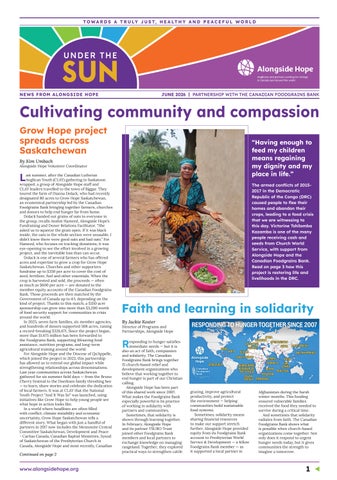
The armed conflicts of 20152017 in the Democratic Republic of the Congo (DRC) caused people to flee their homes and abandon their crops, leading to a food crisis that we are witnessing to this day. Victorine Tshilomba Kazamba is one of the many people receiving cash and seeds from Church World Service, with support from Alongside Hope and the Canadian Foodgrains Bank. Read on page 3 how this project is restoring life and livelihoods in the DRC.
Faith and learning in solidarity By Jackie Koster
Director of Programs and Partnerships, Alongside Hope
R
esponding to hunger satisfies immediate needs — but it is also an act of faith, compassion and solidarity. The Canadian Foodgrains Bank brings together 15 church-based relief and development organizations who believe that working together to end hunger is part of our Christian calling. Alongside Hope has been part of this shared work since 2007. What makes the Foodgrains Bank especially powerful is its practice of working in solidarity with partners and communities. Sometimes, that solidarity is shown through learning together. In February, Alongside Hope and its partner TSURO Trust joined other Foodgrains Bank members and local partners to exchange knowledge on managing rangeland. Together, they explored practical ways to strengthen cattle
grazing, improve agricultural productivity, and protect the environment — helping communities build sustainable food systems. Sometimes, solidarity means sharing financial resources to make our support stretch further. Alongside Hope provided equity from its Foodgrains Bank account to Presbyterian World Service & Development — a fellow Foodgrains Bank member — as it supported a local partner in
Afghanistan during the harsh winter months. This funding ensured vulnerable families received the food they needed to survive during a critical time. And sometimes that solidarity radiates from faith. The Canadian Foodgrains Bank shows what is possible when church-based organizations come together. Not only does it respond to urgent hunger needs today, but it gives communities the strength to imagine a tomorrow.
1