THE
POINT
PALOS VERDES HIGH SCHOOL - ISSUE 2, VOLUME 30 - NOVEMBER 7, 2025
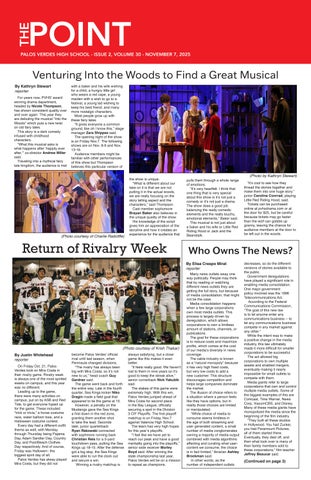
Venturing Into the Woods to Find a Great Musical By Kathryn Stewart reporter For years now, PVHS’ award winning drama department, headed by Nicole Thompson, has shown consistent quality over and over again. This year they are debuting the musical “Into the Woods” which puts a new twist on old fairy tales. This story is a dark comedy infused with childhood characters. “What this musical asks is what happens after ‘happily ever after,’” co-director Andrew Miller said. Traveling into a mythical fairy tale kingdom, the audience is met
with a baker and his wife wishing for a child, a hungry little girl who wears a red cape, a young maiden with a wish to go to a festival, a young lad wishing to keep his best friend, and many more nostalgic characters. Most people grow up with these fairy tales. “It gives everyone a common ground, like oh I know this,” stage manager Zara Shippee said. The opening night of the show is on Friday Nov.7. The following shows are on Nov. 8-9 and Nov. 13-16. Audience members might be familiar with other performances of this show but Thompson believes this particular version of
(Photo courtesy of Charlie Radcliffe)
the show is unique. “What is different about our take on it is that we are not putting it in the actual woods, we are really focusing on the story telling aspect and the characters,“ said Thompson. Cast member sophomore Brayan Baker also believes in the unique quality of the show. His knowledge of the script gives him an appreciation of the storyline and how it creates an experience for the audience that
Return of Rivalry Week
pulls them through a whole range of emotions. “It’s very heartfelt. I think that one thing that is very special about this show is it’s not just a comedy or it’s not just a drama. The show does a good job balancing the really comedic elements and the really touchy, emotional elements,” Baker said. This musical is not just about a baker and his wife or Little Red Riding Hood or Jack and the Beanstalk.
By Justin Whitehead reporter On Friday Oct. 21, Palos Verdes took on Mira Costa in their rivalry game. Rivalry week is always one of the most spirited weeks on campus, and this year was no different. Leading up to the game, there were many activities on campus, put on by ASB and Red Tide, to get everyone hyped up for the game. These included “trick or trivia,” a horse costume race, water balloon toss, and a Halloween costume contest. Every day had a different outfit theme as well, with Monday through Thursday being Pajama Day, Adam Sandler Day, Country Day, and Pool/Beach Clothes Day respectively. And of course, Friday was Hallowen– the biggest spirit day of all. Palos Verdes has alway played Mira Costa, but they did not
become Palos Verdes’ official rival until last season, when Peninsula changed divisions. “The rivalry has always been big with Mira Costa, so it’s not new to us,” head coach Guy Gardner said. The game went back and forth the entire way. Late in the fourth quarter, Sea Kings kicker Niko Dragin made a field goal that appeared to tie the game at 15. However, a penalty on the Mustangs gave the Sea Kings a first down in the red zone, granting them another shot to take the lead. Seconds later, junior quarterback Ryan Rakowski connected with sophmore running back Christian Reis for a 5-yard touchdown pass, putting the Sea Kings up 18-15. After the defense got a big stop, the Sea Kings were able to run the clock out and secure a win. Winning a rivalry matchup is
always satisfying, but a close game like this makes it even better. “It feels really good. We haven’t lost to them in nine years so it’s good to keep the streak alive,” senior cornerback Nick Yakubik said. The stakes of this game were extremely high. With this win, Palos Verdes jumped ahead of Mira Costa for second place in the Bay League, officially securing a spot in the Division 3 CIF Playoffs. The first playoff matchup is on Friday, Nov.7 against Valencia High School. The team has very high hopes for this year’s playoffs. “I feel like we have yet to reach our peak and have a good mentality going into the playoffs,” senior wide receiver Morley Boyd said. After winning the state championship last year, Palos Verdes will be on a mission to repeat as champions.
“It’s cool to see how they thread the stories together and make them into one huge story.” junior Caroline Conrrad, playing Little Red Riding Hood, said. Tickets can be purchased online at pvhsdrama.com or at the door for $25, but be careful because tickets may go faster than the wolf can gobble up granny, leaving the chance for audience members at the door to be left out in the woods.
Who Owns The News? By Elisa Crespo Mirat reporter
(Photo courtesy of Krish Thakar)
(Photo by Kathryn Stewart)
Many news outlets sway one way politically. People may think that by reading or watching different news outlets they are getting the full story, but because of media consolidation, that might not be the case. Media consolidation happens when a few large corporations own most media outlets. This process is largely driven by deregulation, which allows corporations to own a limitless amount of stations, channels, or publications. The goal for these corporations is to reduce costs and maximize profits, which comes at the cost of our media’s diversity in news coverage. The cable industry is known as a “natural monopoly” because it has very high fixed costs, but very low costs to add a new customer. This structure discourages competition and helps large companies dominate the market. The illusion of choice refers to a situation where a person feels like they have options, but in reality those choices are limited or manipulated. “While choice of media to consume seems limitless in the age of both streaming and user generated content, a small number of media conglomerates owning a majority of media output combined with media algorithms affecting and curating what usercontent we consume, the choice is in fact limited,” librarian Ashley Brockman said. In other words, as the number of independent outlets
decreases, so do the different versions of stories available to the public. Government deregulations have played a significant role in enabling media consolidation. One major government policy involved was the 1996 Telecommunications Act. According to the Federal Communications Commission, “The goal of this new law is to let anyone enter any communications business -- to let any communications business compete in any market against any other.” While the intent was to make a positive change in the media industry, this law ultimately made it more difficult for smaller corporations to be successful. The act allowed big corporations to own multiple assets and enabled mergers, eventually making it nearly impossible for small outlets to compete with them. Media giants refer to large corporations that own and control multiple media outlets. Some of the biggest examples of this are Comcast, Time Warner, News Corp, ViacomCBS, and Disney. Many of these media giants have monopolized the media since the beginning of the film industry. “They built all these studios in Hollywood. You had Zucker, you had Paramount Pictures, all of them started there. Eventually, they died off, and then what took over is many of their family members sold to these corporations,” film teacher Jeffrey Beaucar said.
(Continued on page 3)