
NEWSLETTER
JANUARY 2026
RURAL ONTARIO DEVELOPMENT PROGRAM
Now Open for Applications until February 26th, 2026.
Small Businesses can get 35% of eligible costs, up to a maximum of $10,000 in funding for a Project under the ROD Program - Business Development.
To be eligible to apply to the Rural Ontario Development (ROD) Program – Business Development, an Applicant will be a Currently Operating Business that:
• has 1 to 20 employees on its current payroll and for the duration of the Project, excluding the owner(s) of the business (Indigenous businesses are exempt from the minimum employee requirement)
• is physically located in Rural Ontario (as defined in the section below)
• is paying agricultural, commercial or industrial property tax, either directly or through rent or lease or is in a property that is exempt from property taxes as per the Assessment Act (Section 3) (Indigenous businesses are exempt from this requirement)
Eligible Project types
1. Market development Projects to support small Rural Ontario businesses to increase their competitiveness. Example Projects:
• complete a market analysis and/or a marketing plan
• development of new marketing or promotion (website design, promotions or advertising)
• implementation of a business or
marketing plan to access or expand into a new market (one-time tradeshow entrance and exhibiting fees)
2. Enhancing cyber security Projects to support small Rural Ontario businesses to increase their cyber security. Example Projects:
• implementation of activities to increase cyber security measures within a business
• cyber security analysis
• training fees related to cyber security
3. Succession planning Projects to support small Rural Ontario businesses to increase their readiness for business succession.
Example Projects:
• succession plan for business
• training related to succession planning
4. Accessibility improvements Projects to support small Rural Ontario businesses to increase their accessibility. Example Project:
• Improve accessibility infrastructure (ramps, door opener, etc.)
Additional details and application HERE.
AGMS:
SEE NOTICES ON PAGES 2-3
Tender Fruit
• District 3 & 4 - Tuesday, March 24, 2026 at Colasanti’s Tropical Gardens, Leamington
• District 1, 2 & 5 - Thursday, March 26, 2026 at Hilton Garden Inn, Niagara on the Lake Fresh Grape
Thursday, March 5, 2026 at Marketing Board, St. Catharines





2026 NOTICE OF ANNUAL GENERAL MEETINGS OF TENDER FRUIT GROWERS FOR YEAR ENDING JANUARY 31ST, 2026
Pre-registration is required Please Email: sarah@ontariotenderfruit.ca and indicate which meeting you are attending.
Districts 3 & 4 – Essex, Kent and Lambton – Tuesday March 24,2026
Time: 12pm(lunch)– 3pm (in-person at Colasanti’s Tropical Garden)
• Guest Speaker: Dr. John Cline Professor of Pomology and Tree Fruit Physiology, UofG
o Research on ACC Thinner for peaches/plums
Business Section:
• Minutes March 25, 2025
• Presentation of 2025 financials
• Announcement of Auditors for next fiscal
• Chairman’s Report
• Secretary’s Report
• Elections to Grower Committee
• Election of Directors
• Other Business
ANNUAL GENERAL MEETING OF ALL PRODUCERS AND Districts 1, 2 and 5 Grower Committee Elections– Niagara- Thursday March 26,2026
Time and Place: 9:30am to approx. 1:30pm– In person at Hilton Garden Inn 500 York Road NOTL
Agenda: 9:30am
• Guest Speakers:
o Dr. John Cline Professor of Pomology and Tree Fruit Physiology, U of G
• Research on ACC Thinner for peaches/plums
o Vineland Research and Innovation Centre- Rachael Leblanc, Michael Pautler
• Results of 2025 new variety trials, scouting activities 11:00am Business Section:
• Presentation of 2025 financials
• Announcement of auditors for next fiscal
• Minutes March 27, 2025
• Chairman’s Report
• Secretary’s Report
• Elections to Grower Committee
12:15pm: Buffet Lunch

AGENDA ANNUAL GENERAL MEETING FOR YEAR ENDING DECEMBER 31, 2025
Time: 10:00 am
Date: Thursday March 5, 2026
Place: GRAPE & TENDER FRUIT (ONTARIO) LIMITED – Board Office
1634 South Service Road, St. Catharines, Ontario L2R 6P9
AGENDA:
▪ Auditors’ Report
▪ Announcement of Auditors for 202 6 Presentations:
▪ OAFRI Research Project-Kathryn Carter, Ken Slingerland
▪ Minutes – March 4, 2025
▪ Business arising from the minutes
▪ Chairman’s Report
▪ Secretary’s Report
▪ Electoral Districts
▪ Elections – 2026 Fresh Grape Growers’ Committee
▪ Any other business

2026 CHANGES TO SAWP CONTRACTS
A reminder to growers that the new SAWP contracts are available at the following link, including changes from 2025: https://www.canada.ca/en/employmentsocial-development/services/foreign-workers/ agricultural/seasonal-agricultural/requirements. html#sawp-contract
The following are some of the main changes. Growers are encouraged to carefully review all changes.
Exterior Locking Doors
A new clause was added to mandate that employerprovided accommodations are equipped with exterior locking doors and windows, with door keys or numeric codes provided to workers at no cost. In case of lost keys, a reasonable cost shall apply, no greater than $10.00.
Laundry
A new clause was added to define the adequate number of washing and drying machines that should be provided within the employer-provided accommodation that is aligned with the Schedule F – Housing Inspection Report (HIR). Schedule F requirement is as follows: One washer and one dryer available for every 10 workers as well as clotheslines on the premises.
Pay Advances
This clause was modified to clarify that employers must pay an advance to the worker so they can purchase food/ personal items if needed. Replacing “may” with “shall” ensures the for-contract language does not suggest that it is optional for employers to pay an advance to workers.
OFVC TENDER FRUIT SESSIONS
Wednesday, February 18, 2026:
9:30 Curculio Chronicles: Adventures in Keeping Fruit on the Branch - Hannah Fraser, OMAFA
10:00 The Hidden Threat to Nectarine Beauty: Thrips and Their Control - Dr. Justin Renkema, AAFC; Dr. Rose Buitenhuis, Vineland Research and Innovation Centre
10:30 Bacterial Spot of Peach and Tree Health: Management Perspectives from Down South - Dr. Hehe Wang, Clemson University, USA
11:00 Precision Pollination: A Novel Approach for Improving Yield Security - Dr. Matt Whiting, Washington
State University, USA
2:00 Thinning Peaches with ACC (Accede) - Dr. Shan Krishna Kumar, Penn State, USA
2:30 Irrigation in Peach Orchards - Dr. Srijana Thapa Magar, University of Georgia, USA (Live stream)
3:00 Tree Fruit Hardiness and Tools for Reducing Cold Damage - Dr Matt Whiting, Washington State University
3:30 Soil Health Testing: What We’ve Learned from Ontario Orchards and Vineyards - Heather White, University of Guelph
Register today at: www.ofvc.ca
CANADA’S AGRICULTURE DAY 2026
Canada’s Agriculture Day will be celebrated on February 10, 2026. This year marks the 10th anniversary of this national celebration, encouraging Canadians to share their stories and support for local agriculture.
IN MEMORIAM
Earle Muir
Passed away on December 19, 2025, in his 93rd year. A fourth-generation fruit farmer in Niagara-on-theLake, Earle devoted his life to farming and was known for his strong work ethic, fairness, and kindness. Our condolences to the Muir family. https://www. morganfuneral.com/memorials/earle-muir/5669262/

NEW OCAF INTAKE OPENING
OSCIA is geared up to deliver new cost-share opportunities for Ontario farmers under the On-Farm Climate Action Fund (OFCAF). OFCAF supports Ontario farmers in adopting Beneficial Management Practices (BMPs) that reduce greenhouse gas (GHG) emissions and store carbon.
A new OFCAF intake opens Tuesday, February 24, 2026, at 9:00 am ET for three categories: Nitrogen Management, Cover Cropping and Rotational Grazing Systems.
NEXT STEPS
1. Review the OFCAF Program Guide to find detailed information on: Eligibility criteria (e.g., the practice must be new to the proposed acres)
• Available funding
• Documentation required with your application
• How to apply
• Participation in a Knowledge Sharing Event (KSE)
• Multi-year project opportunities & more…
2. Register for a Virtual Program Information Session delivered by OSCIA Field Representative staff to learn more about OFCAF funding opportunities and ask questions. Sessions are delivered online and preregistration is required:
• Wednesday January 28th – 7-8pm: Register here
• Friday February 6th – 12-1pm: Register here
• Wednesday February 11th – 12-1pm: Register here
• EN FRANÇAIS - Thursday February 19th – 7-8pm: Register here
MORE INFORMATION: Connect with OSCIA programs staff by emailing ofcaf@ontariosoilcrop.org or reach out to your local OSCIA Field Representative; click here to find their contact information.
MARKET DIVERSIFICATION AND TRADE RESILIENCY INITIATIVE
The governments of Ontario and Canada are investing $20 Million in funding through SCAP to help growers and processors invest in their operations to expand markets.
Intake opens February 17, 2026 | Deadline: March 17, 2026 at 11:59 p.m. Projects must be within 1 of the 3 project categories:
• Schedule 1: Project Category – Market Development and Diversification Implementation Planning
• Schedule 2: Project Category – Implement Market Development and Diversification
• Schedule 3: Project Category – Implementation of Equipment and Technology
Additional details can be found HERE.
GROCERY CODE OF CONDUCT
As of Jan. 1 2026, Canada’s Grocery Code of Conduct is in effect. This establishes a voluntary, structured framework to govern relationships between grocery retailers, suppliers and producers in Canada’s food supply chain. The Code is designed to curb practices such as unilateral contract changes or unexpected fees and introduces a formal dispute resolution process. To learn more about the code visit the website of the Office of the Grocery Sector Code of Conduct (OGSCC).
CANADAGAP FOOD SAFETY UPDATES
CanadaGAP Version 11 comes into effect in 2026, updating food safety manuals, audit requirements and record-keeping expectations. Changes may affect documentation, training and audit preparation for produce growers. Read more on CanadaGAP and Version 11 here.
2026 GREEN BOOK AVAILABLE TO ORDER
Only $23 + HST | Volume Discount Available Employers in Ontario must provide easy access to the Occupational Health and Safety Act (OHSA) for all employees. The 2026 Consolidated Edition provides clear, practical guidance to help organizations comply and maintain a safe work environment. The 2026 Edition of the Pocket Ontario OH&S Act & Regulations (Consolidated Edition) includes all legislative amendments announced up to 2026. Order it HERE .
HEALTH & SAFETY RESOURCES
Please be reminded that the OTFG has Health and Safety information available for members on our website. Visit: https://ontariotenderfruit.ca/growers/index and use your grower number as the login and then click on the ‘industry’ heading. Documents are in Word so that you can customize them to your operation.
CONTINUING THE DRONE & IPM CONVERSATION: OPMC WINTER WEBINAR
The Ontario Pest Management Conference (OPMC) is excited to announce its first Winter Webinar, a FREE event open to all interested in the latest advances in pest control.
The upcoming webinar features Dr. Rebecca SchmidtJeffris, Research Entomologist from the US Department of Agriculture. Dr. Schmidt-Jeffris will explain how drone application helps overcome the labor-intensive nature of biocontrol in large-scale organic orchards.
Key points include:
• How drones can deliver natural enemies with more even coverage across crops
• The survival rates of pest predators when released by drone compared to manual methods
• Best practices for adapting drone releases to orchard environments
• Challenges such as ensuring target-site delivery and protecting the often costly natural enemies during flight
Integrated pest management relies on combining multiple tactics to control pests sustainably. Biocontrol, the use of natural enemies like predatory insects, plays a crucial role in reducing pesticide reliance. However, applying these beneficial organisms evenly over large fields has been a barrier to wider adoption.
Drone application offers a promising solution by:
• Reducing labor costs and time required for releases
• Increasing the precision and consistency of pest predator distribution
• Potentially improving pest control outcomes in organic and conventional systems
Registration is required to participate. Details: February 3, 2026 from 1:00 – 2:30 pm EST
Register: https://www.ontariopmc.ca/winter-webinar
IFTA 2026 ANNUAL CONFERENCE PROGRAM
The IFTA 2026 Annual Conference takes place February 8-12, 2026 in Fresno, California. See the program schedule here: 2026-IFTA-Program-Fresno-CA-12-30-2025-1.pdf
2025 YEAR IN REVIEW: STRENGTHENING THE LINK BETWEEN TENDER FRUIT GROWERS AND CONSUMERS
By Jessica McCann, Farm & Food Care Ontario, Communications Coordinator
Through its Silver Partnership with FFCO, Ontario Tender Fruit Growers reached millions of Ontarians by connecting with them through events, outreach campaigns, online engagement, and digital storytelling.
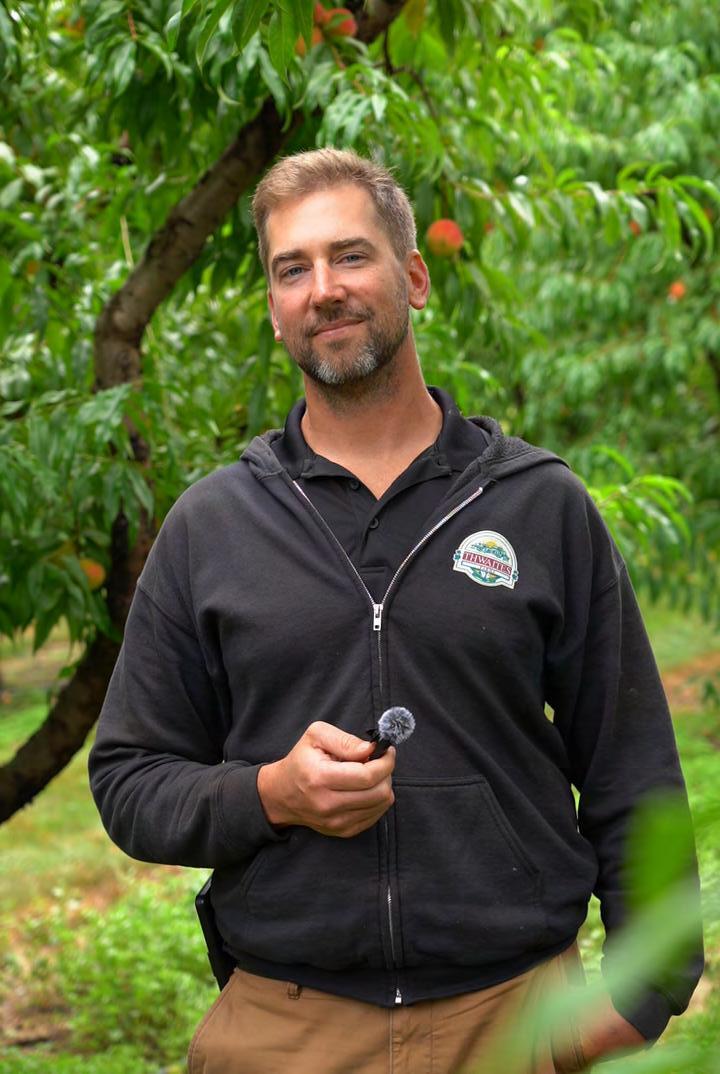
The FFCO Faces Behind Food project was featured in GO Transit and TTC stations across the Greater Toronto Area, with posters prominently featuring Canadian farmers and food producers. The campaign connected with an estimated 14.8 million people, amplifying the real people and stories behind the food they eat. Ontario Tender Fruit Growers and @FacesBehindFood partnered to highlight four growers in 2025, garnering more than 35,600 views. In early 2026, this project will also feature a week-long account takeover with an Ontario peach grower; Nelson Thwaites.
This year was also highly successful for the More than a Migrant Worker (MTAMW) project. This initiative is the result of FFCO and OFVGA’s shared work. FFCO facilitated photo/video shoots at seven different farms over the course of the year, for a total of 25 interviews for the MTAMW campaign. Further to the project’s
reach, MTAMW project representatives and featured farm workers joined one of FFCO’s farm tours in the fall. A full bus of AAFC staff had the opportunity to visit McGregor’s Produce and meet their valued seasonal agriculture workers. This allowed the group to see firsthand and engage with the very people impacted by the policies and programs they work on.
FFCO continued to showcase Ontario agriculture through three highly successful Breakfast on the Farm events in 2025. The season began on June 14 in Innerkip, welcoming visitors to a local dairy farm, followed by two August events in Norfolk County. The year concluded with FARMtoberfest, where FFCO partnered with KitchenerWaterloo Oktoberfest to bring the farm to the city. FFCO also spent 10 days at the Royal Agricultural Winter Fair, where the new three new FarmFood360 tours filmed in 2025 were premiered. This interactive exhibit enabled visitors to experience real Ontario farms through virtual reality, attracting thousands. Each year, FarmFood360. ca attracts over a million viewers.
In 2025, FFCO hosted eight farm tours. Food industry professional tours were held in Ottawa and the Greater Toronto Area. Four culinary student tours were hosted for 256 students from across Ontario. FFCO also hosted 12 Virtual Food and Farming Field Trips (nine in partnership with AgScape). These virtual tours reached more than 35,600 people and continue to be an accessible way for audiences to experience and ask questions about farming and food in Canada.
At FarmPhotos.ca, an expansive public photo library, FFCO added many new photos of peaches, pears and fresh grapes. The library is free for non-commercial use, with thousands of images available for download for use in media and education. Media outlets and organizations are encouraged to use these photos as accurate images that depict modern farming and farming practices in Ontario.
To learn more about FFCO’s initiatives, visit www. FarmFoodCareON.org and subscribe to the monthly e-newsletter. Comments and questions can always be directed to FFCO staff at info@farmfoodcare.org.
How you can protect yourself and your farm business

Cyber security isn’t foolproof, but simple, consistent steps can greatly reduce risk—much like how we approach biosecurity. Here are some practical actions you can take:
Make sure hardware and software is kept up to date. Use strong passwords that aren’t shared between employees and remove access from employees who no longer work for you. Back it up. Copy your most important information regularly and store it in a safe place. Install valid anti-virus software, firewalls and malware detection systems that are kept up to date.
Never use public Wi-Fi to check your on-farm systems when you’re away. Use a Virtual Private Network (VPN) or connect to your monitoring apps using the cellular data on your device.
Don’t click on unverified links in emails or text messages. If you’re not sure whether a message is legitimate, use a different method – like a phone call – to contact the supposed sender to verify the request.
Never reveal sensitive business or personal information to unsolicited callers. This is especially true if they say they are from a financial services provider.
Track your connected devices. Know which devices, sensors, computers, servers, mobile devices, automated equipment, environmental control systems, financial systems, and other hardware are connected in your on-farm networks.
Train yourself and your team. Establish basic rules to recognize where threats come from and what to do – or not do. Free online videos are available to help with training.
Excerpts from recent OFA Viewpoints
“Cyber security often tends to be one of those things that most people don’t worry about until it happens to them or someone close to them. On our farm, we ended up bringing in some IT expertise to conduct an audit of all our systems, which we’d been piecing together for close to 40 years. Taking any kind of preventative action will reduce your risk in both the short and long-term.”
Teresa Van Raay, Director, Ontario Federation of Agriculture October 2024
“Ultimately, we need to think about cyber security on the farm like we do biosecurity – an investment into a best practice that, while not foolproof, will go a long way to minimizing or even avoiding risk. There is no such thing as 100% security, but with cyber criminals looking for weak or vulnerable targets, there are steps to minimize risk as much as possible.”
Cathy Lennon, General Manager, Ontario Federation of Agriculture May 2023

OFA FACT SHEET
August 2025

Why cyber security matters on the farm and how to protect yourself
Overview
Today’s world is so connected that it’s a matter of when, not if, a business will face a cyber security problem. Breaching incidents of all kinds, from compromised information to financial fraud or data held for ransom are on the rise, and agriculture is not immune to these threats.
The agri-food industry can be particularly vulnerable, especially at the farm level where many small, independent businesses have limited IT resources – and cyber security often tends to be one of those things that most people don’t worry about until it happens to them or someone close to them.
Threats come from criminals, state-sponsored international hackers and activists.
Cyber security lingo
Computer virus: a type of malware that spreads between computers and damages data and software.
Data breach: private or sensitive information accessed, stolen, or shared without permission
Key cyber security threats:

Ransomware: malicious software that locks or encrypts your files and demands payment to unlock them
• Outdated, unmaintained systems running old software
90% of farming systems haven’t been updated*
Most farms don’t have a software patching or updating policy
• No data backup
Data can’t be recovered in security breaches, computer or server failures, or virus situations
• Weak access control
Sharing passwords, using a single login for all users, and not removing access from former employees all compromise systems
• Fake emails and text messages
Increasingly sophisticated but fake requests for banking or personal details can cause financial loss or data theft.
“Phishing” – a scam to trick people into giving away personal information, like passwords or credit card numbers, by pretending to be a trusted person or organization.
Ignoring cyber security = disruption, financial losses, decrease in customer trust