
NEWSLETTER
WORKING FOR WORKERS ACT –HIGHLIGHTING RECENT CHANGES
WSPS held a webinar January 22nd outlining the most recent changes to the Working for Workers Act. Another virtual session is being held on April 6th -sign up here: https:// shop.wsps.ca/collections/safety-connectionworking-for-workers-act-where-are-we-now
Some changes include the following: Workplace Harassment Definitions
• Changes in definition of harassment result in a need to change your company policies to include language that harassment can also be virtual (i.e. via social media)
Cleaning of Workplace Washroom Facilities
“Washroom facility” in this context means a:
• washroom
• toilet facility
• clean-up facility
• urinal
• shower
• other similar facility
Records of cleaning
As of January 1, 2026, an employer or constructor must keep, maintain, and make available records of cleaning of these washroom facilities. To meet this requirement, the employer or constructor must ensure:
• the posted records include the date and time of the two most recent cleanings of the washroom facility
• the records of cleaning are posted either:
- in a visible place in or near the washroom facility to which the record pertains, where it is most likely to come to the attention of
workers
- electronically where workers can access it (workers must be provided direction on where and how to access the records)
It is our understanding that the record keeping requirement is not applicable to worker housing washrooms.
WSPS ROAD SAFETY IN THE AGRICULTURAL SECTOR
Workplace Safety & Prevention Services (WSPS) offers free Safety Connection: Road Safety in the Agricultural Sector events. Join representatives from the Ministry of Transportation (MTO) and WSPS for an essential session on essential session on road safety in the agricultural sector. Attend in person at the Ministry of Agriculture, Ontario Building, Rittenhouse Hall, 4890 Victoria Avenue North, Vineland Station, L0R 2E0 on February 24, 2026 at 10:00 am to 12:00 pm, including a casual networking session with the MTO, WSPS and peers, and virtually on February 25, 2026 at 10:30 am to 12:00 pm.
Please register HERE.
FEDERAL AGRIMARKETING MARKET DIVERSIFICATION PROGRAM
Open for application Feb 13, 2026 until available funding has been fully committed. The Market Diversification for SMEs (forprofit) Program aims to:
• open new, non-traditional markets and expand export activities to diversify and increase the volume and value of Canadian exports and interprovincial trade
...continued page 2




• prioritize projects that help Canadian agricultural and agri-food sectors (including fish and seafood) diversify beyond traditional markets to support the long-term growth of the sector and to help lessen current and future trade uncertainties
• target new opportunities in high-growth potential and non-traditional markets to increase and diversify exports and strengthen interprovincial trade
Funding - The maximum Agriculture and Agri-Food Canada (AAFC) non-repayable contribution toward a project under the program will normally be less than $100,000 per project, with a maximum duration of up to 18 months from the contribution agreement effective date. Projects must have a minimum total cost of $20,000, for a minimum AAFC contribution of $14,000.
Cost-sharing - Contributions toward eligible costs will normally be shared between AAFC and you as follows:
• AAFC – a maximum of 70%
• You – a minimum of 30%
Your portion of the cost-share must be cash contributions.note1 In-kind contributions are ineligible.
More details HERE.
UPDATED CANADAGAP MANUALS
Updated version of the CanadaGAP Food Safety Manual
- Fresh Fruit and Vegetables Manual, Version 11.0has now been released. For certification purposes, the new manuals will take effect on April 1, 2026. A corresponding update to the CanadaGAP audit checklist will be issued before that date.
Resources on the CanadaGAP Website - To help with the transition, the following resources can be found on the CanadaGAP website: https://www.canadagap.ca/ manuals/downloads/:
• Updated manuals (free download)
• Document outlining the main changes to the manuals
• Revisions documents tracking the changes from the previous version of the manuals
• Document summarizing commodity-specific differences
• Chart outlining which sections of the manual are applicable to different types of operations (i.e.,
production, packing, storing, repacking, wholesaling, brokerage)
• PowerPoint presentation on the main changes
Due to the fact that a new version of the CanadaGAP manuals has not been released for 3 years, there are a number of changes for Version 11.0. Changes were made based on user requests, to align with changes in Global Food Safety Initiative (GFSI) benchmarking requirements, and to clarify interpretation of existing requirements. Re-benchmarking against GFSI Benchmarking Requirements (v2024) is currently underway for Version 11.0 of CanadaGAP Program normative documents.
CanadaGAP maintains seven separate generic HACCP models, which are available to members on the CanadaGAP website. These HACCP models will also be updated for 2026.
Forms will be updated in CropTracker to reflect the changes.
FREE HEALTH & SAFETY ASSESSMENTS FOR ONTARIO WORKPLACES
A safer workplace starts with understanding your risks, and WSPS’ free consulting assessments give you a clear, expert-guided starting point. We take a practical, hands- on approach to identify hazards, uncover compliance gaps, and strengthen your health and safety program at no cost and with no obligation. Each assessment delivers straightforward, actionable insights so you can reduce risk, prevent incidents, and make confident, informed decisions. Available to all Ontario workplaces in the Manufacturing, Services, and Agriculture sectors, these free assessments give organizations of any size access to trusted health and safety expertise. Ready to strengthen your workplace safety? Book your free assessment today.
IN MEMORIAM
Tom Tancock
Tom passed away on January 17, 2026, surrounded by his family, after a short but hard-fought battle with cancer. Tom was a farmer through and through. He gave his time generously to education, research, and committees, and will be greatly missed by all who knew him. https://www.tributearchive.com/obituaries/46994273/ thomas-william-tancock
SUSTAINABLE GROWTH AND ADOPTION PROGRAM (SGAP)
News Release: Bioenterprise Canada Launches Round 3 of the SGAP.
This program is helping support food and agri-food tech businesses in southern Ontario by providing access to the resources needed to develop and scale innovative technologies, practices, and process enhancements into their operations. SGAP is funded by the Government of Canada, through the Federal Economic Development Agency for Southern Ontario (FedDev Ontario).
SGAP offers non-repayable, matching contributions up to $100,000 to later-stage food and agri-food tech businesses ready to expand, modernize and enhance sustainability. Eligible applicants must collaborate with an eligible Sustainability Project Partner to meet their growth and adoption needs through one or both of the following:
• The integration of proven clean technologies into operations; and/or
• The implementation of sustainability enhancement activities
To qualify for the program, food and agri-food technology businesses must be generating a minimum of $200,000 in annual revenues and meet thresholds on project impact, potential environmental benefits, and economic outcomes for the sectors. Eligible organizations must be located in southern Ontario, ensure all project activities take place in southern Ontario, and collaborate with an eligible Sustainability Project Partner.
Funding can be used for advisory services, operational assessments, equipment acquisition, employee labour, and other costs directly related to the project. A full list of program objectives and eligibility criteria can be found in the SGAP program guide available on the Bioenterprise Canada website.
The intake is open until March 18 at 11:59 pm ET. Details are available on Bioenterprise.ca. For project-specific questions, please email submissions@bioenterprise.ca.
SPECIES AT RISK PARTNERSHIPS ON AGRICULTURAL LANDS PROGRAM
A new Species at Risk Partnerships on Agricultural Lands (SARPAL) program intake will open on Mar. 10 at 9am will close when available funding has been fully allocated.
SARPAL supports Ontario farmers with cost-share funding to implement projects that help manage and recover species at risk (SAR) on agricultural lands in seven categories:
1. Tree and Shrub Planting
2. Cross-Fencing for Rotational Grazing
3. Establishment of In-Field Perennial Grass Strips
4. Fencing to Exclude Livestock from Woodland Areas
5. Forage Harvest Management (Delayed Haying)
6. Grassland Restoration
7. Wetland Restoration
Program Highlights
• 50% cost-share
• Up to $40,000 per farm business per program year
Next Steps
• Review the Program Guide.
• Complete an Environmental Farm Plan and Action Plan (verified by OSCIA).
• Enroll ahead of time on the OSCIA Portal (note however, that applications will only be accepted starting at 9am on March 10).
Questions? Contact sarpal@ontariosoilcrop.org
ONTARIO FARMERS SUPPORT SCHOLARSHIPS FOR CHILDREN OF SEASONAL WORKERS
News release provided by OFVGA
A new program has been launched by the government of Jamaica to provide scholarships to the children of Jamaicans working on Ontario fruit and vegetable farms through the Seasonal Agricultural Worker Program (SAWP).
The scholarship program, supported by a $10,000 grant from the Ontario Fruit and Vegetable Growers Association (OFVGA) as part of efforts to help mark the 60th anniversary of SAWP this year, will help 10 Jamaican students pay for costs associated with attending high school, from accommodation and transportation to books and uniforms.
In 1966, Jamaica became the first country to provide seasonal workers to Canadian fruit and vegetable growers, when 264 Jamaicans arrived in Ontario to help with apple harvest. This launched a strong partnership between Jamaica and Canada, and laid the foundation for SAWP, one of Canada’s longest-running and most respected labour programs.
Today, more than 30,000 workers from Mexico, Jamaica, Trinidad & Tobago, Barbados, and the Eastern Caribbean Islands come through SAWP to support Canada’s horticulture sector each year.
One of the strengths of the program is an annual review process that involves the governments of the workers’ home countries, the Canadian government and Canadian farm employers; this has led to consistent and ongoing positive improvements to SAWP.
Over the last several years, federal and provincial governments, with the support of employers and workers’ home country governments, have introduced a series of new measures to strengthen worker protections and support, including:
• Open work permits for vulnerable workers
• Expanded mobility
• Stronger protections from reprisals
• Dedicated supports and funding
• Improved workplace injury coverage
• Better housing
Through its More than a Migrant Worker initiative, the OFVGA gives a voice to the thousands of seasonal and temporary workers who come to Ontario each year, empowering them to share their stories and highlighting what these jobs mean to them and the essential role they play in feeding Canadians.


2026 NOTICE OF ANNUAL GENERAL MEETINGS OF TENDER FRUIT GROWERS FOR YEAR ENDING JANUARY 31ST, 2026
Pre-registration is required Please Email: sarah@ontariotenderfruit.ca and indicate which meeting you are attending.
Districts 3 & 4 – Essex, Kent and Lambton – Tuesday March 24,2026
Time: 12pm(lunch)– 3pm (in-person at Colasanti’s Tropical Garden)
• Guest Speaker: Dr. John Cline Professor of Pomology and Tree Fruit Physiology, UofG
o Research on ACC Thinner for peaches/plums
Business Section:
• Minutes March 25, 2025
• Presentation of 2025 financials
• Announcement of Auditors for next fiscal
• Chairman’s Report
• Secretary’s Report
• Elections to Grower Committee
• Election of Directors
• Other Business
ANNUAL GENERAL MEETING OF ALL PRODUCERS AND Districts 1, 2 and 5 Grower Committee Elections– Niagara- Thursday March 26,2026
Time and Place: 9:30am to approx. 1:30pm– In person at Hilton Garden Inn 500 York Road NOTL
Agenda: 9:30am
• Guest Speakers:
o Dr. John Cline Professor of Pomology and Tree Fruit Physiology, U of G
• Research on ACC Thinner for peaches/plums
o Vineland Research and Innovation Centre- Rachael Leblanc, Michael Pautler
• Results of 2025 new variety trials, scouting activities 11:00am Business Section:
• Presentation of 2025 financials
• Announcement of auditors for next fiscal
• Minutes March 27, 2025
• Chairman’s Report
• Secretary’s Report
• Elections to Grower Committee
12:15pm: Buffet Lunch

AGENDA ANNUAL GENERAL MEETING FOR YEAR ENDING DECEMBER 31, 2025
Time: 10:00 am
Date: Thursday March 5, 2026
Place: GRAPE & TENDER FRUIT (ONTARIO) LIMITED – Board Office
1634 South Service Road, St. Catharines, Ontario L2R 6P9
AGENDA:
▪ Auditors’ Report
▪ Announcement of Auditors for 202 6 Presentations:
▪ OAFRI Research Project-Kathryn Carter, Ken Slingerland
▪ Minutes – March 4, 2025
▪ Business arising from the minutes
▪ Chairman’s Report
▪ Secretary’s Report
▪ Electoral Districts
▪ Elections – 2026 Fresh Grape Growers’ Committee
▪ Any other business

Evaluating the open gable trellising system on productivity and fruit quality in table grapes
By Ken Slingerland (Horticultural C onsultant), Laura Dobbyn (Fresh Grape Research Assistant ) and Kathryn Carter (OMAFA, Project Lead)
Background
New table grape varieties such as TimpsonTM, IvoryTM and StrawgrapeTM have attributes that are appealing to consumers (seedless, visually appealing and flavourful) and provide an opportunity to expand Ontario’s fresh market and compete with fresh grape imports. However, these new varieties require a shift in viticultural practices to maximize yield and fruit quality Trellising and training systems directly influence vine architecture , balance, and canopy microclimate, which in turn influence fruit set, cluster quality, and winter survival.
In Ontario, table grape production typically relies on the use of the 4- or 6-arm Kniffen trellis systems with cane pruning. However, these systems are poorly suited to new cultivars such as TimpsonTM, IvoryTM and StrawgrapeTM as they do not adequately control vine vigour. This leads to excessive canopy shading and poor air circulation, resulting in reduced yields, poor fruit quality and increased disease pressure. To address these issues, the breeder recommended the adoption of an open-gable training system with angled arms (>120°), designed to improve light penetration and airflow within the vine canopy
In 2025 the Ontario Fresh Grape Growers received funding for research that will help p ilot competitive production strategies for Ontario fresh table grapes. The work will include evaluating the impact of new open gable training systems on yield and fruit quality for specific, promising new varieties of table grape in Ontario vineyards .
Methodology
In 2024/25 a trial block was established at Smith ’s Vineyards Inc. with TimpsonTM, IvoryTM and StrawgrapeTM cultivars. Vines planted with a spacing of 1.7 m (5.5 ft) between vines and x 3.8 m (12.5 ft) between rows for a vine density of 634 vines per acre1. Timpson and Ivory were planted as potted vines, while Strawgrape TM was planted as dormant vines. An open gable trellis with an arm angle of ~ 110°2 (Figure 1) was installed on the planting in the summer of 2025. The vines were planted in a section of the vineyard that already had a wind machine installed to mitigate cold injury.
In 2025, vine growth was monitored throughout the season and when the trunk of the vine reached the top of the trellis in the fall, all shoots on the trunk below 3 -4 feet were removed.
1 This spacing was modified slightly from the breeder’s recommendation of 1.8 metres (5.9 feet) × 3.5 metres (11.5 feet) (642 v ines per acre), to accommodate equipment.
2 The arm angle was modified slightly from the breeder recommendations of arm angles of 120° -140° to accommodate equipment access.
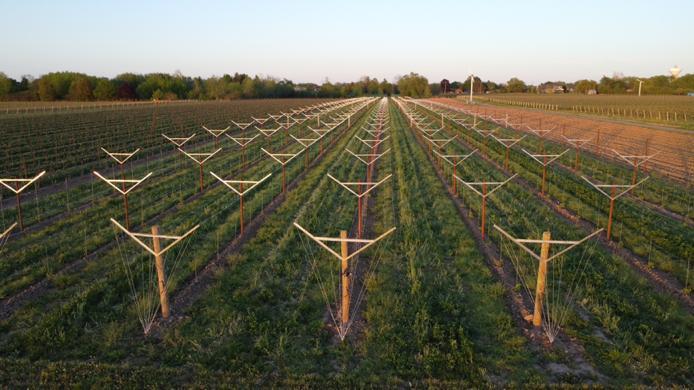
Figure 1. Arial view of open-gable trellis-note the Y shaped trellis with angled arms, splits the vine canopy into two sides maximizing light exposure and airflow resulting in improved fruit quality and reduced disease pressure. (photo: Smith’s Vineyards Inc).
Observations of 2nd year growth
StrawgrapeTM – dormant vines had good , healthy growth (good quality wood and minimal disease) and reached the top of the 6 ft trellis in July (Figure 2), and the trunk was headed. The vines filled the trellis 2.1- 2.7 m (7 -9 ft) by early September There were a considerable number of side shoots at the top of the trunk, and during dormant pruning 2 side shoots will be selected and trained to form the arms on the table wires. A small amount of fruit was produced on the vines. By early October, the trunks had hardened off a nd leaf senescence started.
IvoryTM – potted vines grew slower than StrawgrapeTM , but growth was healthy and vines reached the top of the trellis by September The tip of the trunk was headed in the summer to encourage more side shoots near the top of the trellis. In early October, the trunks had hardened off but the leaves were still gree n, indicating that the vines might be more vulnerable to cold injury.
TimpsonTM – potted vines grew slower than StrawgrapeTM , but growth was healthy and vines reached 1.5 - 1.8 m (56 ft) by September The tip of the trunk was headed in the summer to encourage more side shoots near the top of the trellis. In early October, the trunks had hardened off, but the leaves were still green , indicating that the vines might be more vulnerable to cold injury. The Timpson vines required more trunk support then anticipated, and in future plantings young vines will be trained to a 5-foot bamboo stake at planting to provide better trunk support.
StrawgrapeTM, which were planted slightly earlier as dormant vines demonstrated stronger growth and vigour through the 2025 season than the TimpsonTM and IvoryTM, which were planted slightly later as potted vines .
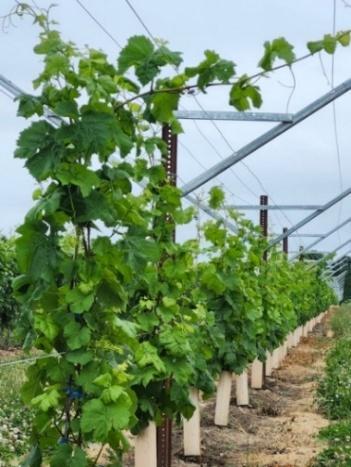
Figure 2. June 26th StrawgrapeTM plant growth. (Photo: Laura Dobbyn).
Discussion
Due to nursery availability in 2024, IvoryTM and TimpsonTM grape vines were planted in late spring of 2024 as softwood cuttings. This would have been a contributing factor which impacted their growth in 2025. Additonally, in 2024 Timpson and Ivory vines had a considerable amount of downy mildew infections, which also had a negative impact on the cold hardiness of the vines, resulting in increased cold injury . Minimal disease (particularly downy mildew) was observed in 2025
In 2026, data will be collected to evaluate the impact of the open gable training system on vine vigour, yields and fruit quality Additionally, information will be collected on the labour, and economic costs of implementing the open gable trellis system. For details on the trellis components and additional information on the training system please contact Larissa Osborne larissa@ontariotenderfruit.ca
Acknowledgements: The Ontario Fresh Grape Growers would like to extend their gratitude to Niagara Peninsula Fruit and Vegetable Growers Association (NPFVGA) and Smith Vineyards Inc. for their insight and support.