September 2026 - Issue #55
SENIORS, VETERANS, FAMILIES, COMMUNITIES
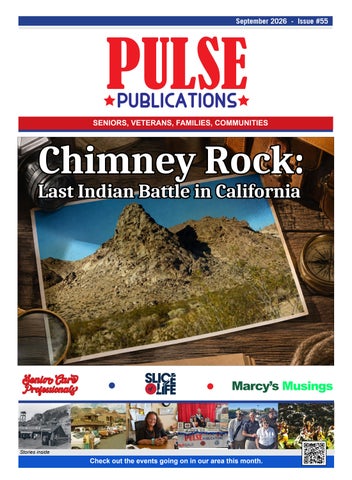
Chimney Rock: Last Indian Battle in California
Senior Care Professionals
Marcy’s Musings
Stories inside
Check out the events going on in our area this month.
2
September 2026 #55
Editorial
A
S WE APPROACH 9-11, a day we should never forget, the horrific acts committed against AMERICA. Although it was 25 years ago it is still fresh in our memories.
P O Box 290066 - Phelan, CA 92329-0066 10405 Mountain Road - Piñon Hills, CA 92372
FRANCES CONKLE
We are happy to welcome HITT Plumbing to our family of advertisers. A company that has been in the High Desert for many years.
CEO Mother Road Enterprises 1 760 617 3774 FrancesConkle@gmail.com
JAMES CONKLE
Publisher 1 760 617 3991 jim@motherroadenterprises.com 66jimconkle@gmail.com
The TEAM at PULSE MEDIA strive to bring you great stories, with awesome photos, to share the history and culture of our area. This is all made possible by our advertisers.
LORI WESTON
1 760 680 9472 Lori@motherroadenterprises.com
JORGE LEANDRO RODRIGUES Graphic Designer 55 16 99991 0229 Leandro@pulsemedia.info
Our writers are always open to discuss ideas for articles. You can contact them directly.
e l k n o C m i J
TIFFANIE NICOLE
1 760 221 9798 tiffaniepulsepublications@gmail.com
DEBBIE WALKER
1 760 900 9429 DWalker@pulsecustompublications.com
Inside Pg 7
Marcy's Musings
Pg 10
Daggett Days 2026
Pg 12
Chimney Rock
Pg 15
Dumber Than Dirt
Pg 20
Grand Canyon Caverns
Pg 22
Events
Our Writers
Jaylyn and John Earl
Happy Wanderers Exploring the Mystery and Majesty of the Southwest Deserts thedesertway.com
John Beyer
John Beyer has been published in numerous magazines, newspapers and the like for decades, writing on a variety of topics.
J. P. Garner
John Wease
John is a retired high school John Wease is a football coach and veteran. published author, with his He has published two modern-day western fiction books, lives in Barstow, and novel “The Horseman” loves being a member of available at the usual online the HIgh Desert branch of sources. the California Writers Club.
Liz McGiffin
1 760.887.3427 Published author in local magazines, newspapers and book/Borrow SmartRetire Rich. Representing Senior Kicks Club
Marcy Taylor
1 760 985 1918 mltaylor@gmx.com President of Mohahve Historical Society and Founder of the Apple Valley and Victor Valley Legacy Museums
Paul Sebastian
1 442 285 9216 paul@pulsemedia.info
Tiffanie Nicole
1 760 221 9798 tiffaniepulsepublications@gmail.com Trusting words has lost its meaning when actions speak louder than promises ever could.-Tiffanie Nicole
September 2026 #55
3
4
September 2026 #55
Your banner ad could be here! Let PULSE be the voice and the door knocker for your business!!
September 2026 #55
5
6
September 2026 #55
Marcy’s Musings
Mltaylor@gmx.com 1 760 985 1918
"The Way" Leads the Way
T
HE AUG. 1, 2026 event hosted by "The Way Resource Center," located on the property of the Historic Apple Valley Inn, was much more than the advertised Backpack Giveaway. The parking lot was packed with cars belonging to families with children, all eager to not only pick up school supplies, but to visit vendor booths, many with give-aways, fill a bag with delicious free fruit, enjoy a complimentary lunch, and best of all, ride the colorful train that took one excited group after another on a ride around the grounds, making wide turns and loop-de-loops, evoking laughter and screams from the passengers. According to program director Minnie Grissett, "the goal of the event was to provide backpacks, while also connecting families with local vendors, community resources, and educational materials on workers' rights and labor laws." Attendees were encouraged to pick up a "passport," which also doubled as a train ticket, to get stamped while visiting the vendor tables and booths. Many stations were health-related, such as Healing Enhanced, Community Health Systems, Community Health Action Network, CSL Plasma, Molina Health
sure to mark your calendar for the next event, the Labor Day Community Brunch, scheduled for Sept. 5 with the theme: "Bring a Cultural Dish, Share a Cultural Dish." For more information, follow "The Way" on social media @The_Way_resource_ center or www.thewayresourcecenter.org. Care, Me Skin Care, Mother's Nutritional Center, Emmanuel's House food bank, and SALVA Food Distribution. A number of booths offering community services were also on hand: Barstow Family Resource Center, Victorville Lions Club, CASA (Court Appointed Special Advocates), and the Inland Coalition for Immigrant Justice. To enhance your wardrobe, cool clothes were on sale at Elevate Up Gear, and accessories at The Cross booth. Other participants offered fun games, balloon art, Dr. Kamillah's Children's Books,and custom gifts from Creations Outside the Box. A big thank you goes out to Pastor David Green, Program Director Minnie Grissett, all of their staff and volunteers, and the many community partners who helped to make this a fun and successful event, despite the 104 degree temperature. Be
Two Important Centennials Celebrated in Old Town Victorville
T
HE MORNING OF JULY 12, 2026, a team of five City of Victorville Employees from various departments and four Old Town Victorville stakeholders met at the Victor Valley Legacy Museum on lower
Seventh Street for the first of the planned quarterly collaboration meetings to focus on key points, plan some local events, and establish a good working relationship moving forward. Blight is being cleaned up; buildings are getting a fresh coat of paint. Existing murals are being refurbished, with more murals and public art on the horizon. Excitement was in the air for the Centennial of the Victorville Fire Department to be held at the 8th Street Fire Museum Saturday August 8th starting at 9:00 AM. Guided tours will cover 100 years of fire department history, from bucket brigades and the loud fire siren, to modern day fire fighting methods. The second important Centennial will take place Sat. Sept. 12 from 10-2 as we September 2026 #55
7
Mltaylor@gmx.com | 1 760 985 1918 celebrate 100 years of the Route 66 coming up the pass, then heading down Seventh Street, left on "D," then across the bridge to Oro Grande, Helendale, and on to Barstow
and destinations east. California is one of the eight states through which the Mother Road passes, with Victorville an important stop along the way. The event will stretch along Seventh Street from "D" Street to Forrest. Visitors can expect to see a long line of antique and vintage cars, bands and entertainment on the stage near the arch, food trucks, vendors hawking Route 66 memorabilia, and open businesses. Grab a map and take a walking public art tour, starting at the arch and heading towards the Veterans statue, with exciting murals and paintings along the way. Be sure to visit long- time businesses such as the Guadalajara Market, as well as the Soap Shop, Santa Fe Trading Company,
and the Victor Valley Legacy Museum farther up Seventh Street. Come back the following Saturday, September 19, to celebrate Santa Fe Trading Company's 25th Anniversary from 9-2, and the Blech family's many years of living and owning businesses on the street. Treat yourself to music, food, and vendors offering a wide variety of handmade items. Learn some local history at the Victor Valley Legacy Museum, and spend some time at the newly refurbished courtyard enjoying a bite to eat and listening to some Route 66 era Rock and Roll on 45s and 78s (if you're old enough to know what those are.) We hope to see you there. Call (760) 985-1918 for further information.
Lucerne Valley Museum Grand Reopening
I
T WAS "A HOT TIME" (ie over 100 degrees) at the Lucerne Valley Museum Association's Grand Reopening of their outstanding Open Air Museum Saturday July 15. Hosted by President Chelea LaGrange, VP Michael Rasberry, and Secretary Rusty LaGrange, the event included a "Duck Hunt" for kids, two versions of "Desert Detectives" (one for kids, another for adults), a prize wheel, free raffle tickets, complimentary pizza and lemonade, the opportunity to purchase "Lucerne Valley: A Wild West Town of Character(s)" and the chance to join the Lucerne Valley Museum
8
September 2026 #55
Association. In addition to the Museum volunteers, Association members, and local families on hand, book contributors Bill and Jan Lembright (and the LaGrange family), Lucerne Market owner and staff including the Lembrights, Linda Gommel and Debbie Schultz, as well as Chamber President Angie Miller were also in attendance. History buffs Marcy Taylor and Rick Bui made the trek from Apple Valley. While Marcy and a number of Mohahve Historical Society and Lucerne Valley Museum volunteers have worked together for a number of years to support each
other's events, for Rick it was his first experience to get up close and personal with the extensive displays of vintage wagons, fascinating mining and farming machinery, desert plants, the old San Bernardino jail, and so much more, all sporting brand new signage. The star of the show was the diesel pusher, recently located (last April) from the Mitsubishi Cement Plant, arriving amongst a lot of ceremony. While Rick was educating himself and enjoying photographing the many displays and accompanying markers, Marcy was busy hunting for plastic ducks and completing the scavenger hunt, with her partner Autumn, an extremely bright little girl more than ready to start first grade. Rick also assisted with putting a very heavy antique plow back in place, knocked out of position due to heavy rains and a broken tongue. You go, Rick! Please make plans to visit the Lucerne Valley Open Air Museum at 33187 Highway 247 (Old Woman's Springs Road), just past the intersection of Highway 18 as it heads to Big Bear. Call for an appointment at (760) 646-2661 or 2660. Individuals, families, groups, organizations are all welcome. Let's keep history alive and well in the Mojave Desert.
Mltaylor@gmx.com | 1 760 985 1918
Apple Valley Sunset Concerts in the Park
F
OLLOWING THE FOUR MAY CONCERTS in the Courtyard, the Town of Apple Valley kept the party going for seven more beautiful Thursday summer nights with the June and July Sunset Concert series. My partner Pat Orr and I were there all summer at the Apple Valley Historic Advisory Committee display area, sharing Apple Valley history, with a different exciting theme each week. This year's themes included Vintage Shop
Local, Terri Lee Dolls and Friends, Old Apple Valley Postcards and Maps, Roy Rogers and Dale Evans, Movies Made Locally, the Apple Valley Country Club and Golf Course, and the SBC Fair. In addition to several MHS members helping out, some Town Council members and Town employees joined in the fun, as well as our AV Concerts "regulars." The Apple Valley Legacy Museum was recognized on Sponsor Appreciation Night
for the fifth year, with Marcy Taylor and Delvin Harbour enjoying a complimentary meal and accepting the Certificate from the Town Council. Yes, we took a concert break during those hot August nights, but we'll be right back in the Courtyard every Thursday in September from 6-8:00. See you there!
Movie Under the Stars
O
N THE BEAUTIFUL WARM SUMMER NIGHT of July 17, the Apple Valley Legacy Museum presented the 1955 feature film "Foxfire." While most of it was filmed in Kingman and Oatman, Arizona, the opening and closing scenes at the Historic Apple Valley Inn were easily recognizable.And yes, the handsome star
not only got the girl, but also found the gold so they could live happily ever after! Thanks to Byron Ward for suggesting this movie, and for providing the "then and now"scenes at the Apple Valley Inn, which in the movie was known as the La Paz Guest Ranch.A special thanks to Eric the projectionist, Dano the entertainer, and the Friends of the Apple Valley Library, who provided the raffle prizes. We appreciate all of you who attend, support, or volunteer
at our events. Let's keep on keepin' on to preserve and share local history!
September 2026 #55
9
Dagget Days 2026 Double The Fun By John Wease
T
HIS YEAR’S 62ND ANNUAL DAGGETT DAYS FESTIVAL is so chock full of fun they are spreading it over two days. Saturday, September 12, will be dedicated to Daggett’s important part in our local history. Daggett played a fundamental role in the success of the Calico silver and borax mining districts. It was the supply depot for mines as far away as Death Valley and was the freight shipping terminal for both the silver and borax. It is estimated that during the peak years $100,000 in silver was shipped from Daggett each month and seven or eight freight cars daily, each hauling fifteen tons of borax. Thanks to the dedication of Daryl Schendel and the Daggett & Calico Historical Society, much of Daggett’s history has been preserved. From 9:00-11:00, there will be a special presentation by Jeff Mall at the Daggett Community Center at 35331 Afton Street. Jeff’s great grandfather, George Schuster, won the 1908 New York to Paris Great Automobile Race driving a Thomas Flyer automobile. If you are unfamiliar with that brand, you are in luck. Local car building legend, Rodney Rucker, will be there with his Thomas Flyer. There is a $10 admission charge that includes coffee and Danish. Space is limited so RSVP by calling 760-254-3050 (Calico Woodshop).
From 11:00-12:00 the Historical Society will serve a fund-raising lunch at Jobby Hall’s 1950s Chevron Station (known to locals as “Mugwumps”). For $15, you can enjoy a complete smoked pork meal with dessert and a drink. While there you can visit the Mugwump’s Tortoise Habitat and 10
September 2026 #55
1907 Thomas Flyer that won the 1908 around the world race.
the Sagebrush Press Museum located behind the station in a 1930s Baltimore and Ohio boxcar. The visitor center next door will be open as well as the yard full of antique vehicles and other relics. From 1:00-3:00 guided tours of Alf’s Blacksmith’s Shop will run every forty-five minutes. Alf built the twenty mule team wagons that famously hauled borax and silver ore to Daggett. The blacksmith shop is remarkably well-preserved and looks like Alf and his crew will return soon to continue their work. Under a roof out back are two ore wagons and a water tank wagon. This three wagon combination, with a hundred-foot-long team of twenty mules out front made the two day trip from the Borax mine complex of Borate to the rail depot in Daggett. The water tank wagon is a mock-up for display but very interesting. It is easy to see that the bows of a covered wagon were cut off. This was the covered wagon that Seymour Alf moved to California in. This site is rarely open to visitors and a must see. The Daggett Museum will be open and has some incredible displays. They have a flyer for a self-guided tour of all of Daggett’s historical sights. The Stone Hotel outside areas and Daggett Cemetery will be open to visitors.
Sunday from 9:00-3:00 will be a fun family day. There will be over fifty local area vendors. A parade will start at noon. There will be a genuine twenty mule team wagon on display as well as a Studebaker 1800s chuckwagon. There will be a hit ‘n miss engine display. The Calico Mountain gunfighters will have three shows. There will be “Saving Slow-poke in the park,” quick draw demonstrations, burros, and
1880s twenty mule team ore wagon built in Daggett
horses from Smoke’s Equine Oasis. There will be a beard and mustache contest as well as a watermelon seed spitting contest. A 25’ climbing wall will be available for all who dare. Face painting, drone demonstrations, popcorn, games, and… what more do you need? Come and join in the fun from 9:00-3:00 both days. The Daggett & Calico Historical
Society is a non-profit that could really use your support. You can become a member or easily make a donation on their website. Or, come to their event on September 12, pay for the tours, events and meal. You can help them preserve Daggett’s history while you have a wonderfully enjoyable time. Maybe I’ll see you there.
September 2026 #55
11
Chimney Rock: Last Indian Battle in California
By Jaylyn And John Earl www.thedesertway.com
O
N FEBRUARY 16, 1867, the quiet expanse of Rabbit Springs Dry Lake in Lucerne Valley erupted with vengeance. Three years after the Las Flores massacre, another clash flared. What followed was less a battle than a sudden strike: a posse of settlers descended on a small Indigenous band—likely Serrano— wrongly believed to be Southern Paiute (Chemehuevi) responsible for recent attacks in the nearby mountains. It has been cited as the last skirmish between Native Americans and European settlers in California. The world that native people knew was coming to end, and reservation life would sadly be in their futures. In 1863, violence struck where Lake Arrowhead is today. A Spanish man named Polito fell beneath Chemehuevi arrows, and the raiding party vanished into 12
September 2026 #55
the desert, driving off a mule stolen from Sam Pine, slaughtering it for meat as they fled. Soon after, they shot down a horse and mule belonging to W. F. Holcomb and Pete Smith. Around that same time, the Indians ambushed Dr. Smith in Cajon Pass, leaving him wounded but alive.
Bill Holcomb rallied a posse and pushed into the desert after the raiders, but the pursuit collapsed when their provisions
ran out. In Cajon Pass, another strange incident unfolded: S. P. Waite, firing at something a blue jay was diving toward, unknowingly shot an Indian. Only with daylight did he realize what he had done. By 1866, the danger had crept back into the mountains. J. W. Gillette, Ed Parrish, and Nephi Bemis rode out from the Dunlap Ranch to gather stray cattle. Gillette’s mule gave out, so he turned back to fetch Pratt Whiteside. Gillette stayed behind with Whiteside’s herd. Then the horses of Parrish and Bemis came thundering home without their riders; Parrish’s saddle smeared with blood. Gillette raced to the ranch house to alert the sick Bud Dunlap and gather armed men. They found young Bemis at sundown on March 2, 1863. The ground around him told the story: thirty to forty Chemehuevi warriors had overwhelmed him. Whiteside and Parrish were found the next morning. Parrish still clutched a stone, the last weapon he had managed to grab. The Indians had stripped all three bodies and taken Whiteside’s rig and pistol. That night, they slipped back into the desert after eating Whiteside’s horse.
Winter of 1867 brought them again. They swept through Little Bear Valley, looting homes, then struck the place of Bill Kane, stealing the horses, supplies, and guns of George Lish and John Dewitt.
At dawn, Frank Talmadge, Jonathan Richardson, George Armstrong, and Bill Kane rode out after them. When they returned to Kane’s home, they found only ashes—everything the Indians could not carry had been burned or smashed. The families were moved to safety at the mill, and riders from San Bernardino were already on their way. Fresh snow had fallen overnight, whitening the mountains and desert floor. It made the raiders’ trail stand out sharply, and the men pressed on, following the prints toward whatever waited ahead. The Indians were hidden behind a fallen log, silent and waiting. Bill Kane rode almost directly over them without realizing it. A sudden crack of gunfire shattered the stillness—Kane’s horse dropped beneath him, throwing him hard to the ground. His rifle flew from his hands, leaving him with only his pistol.
View from the top of Chimney Rock with Rabbit Springs Dry Lake in the distance, 2016.
The Indians closed in, trying to finish him where he crouched behind a tree. At the last moment, Frank Talmadge burst onto the scene, firing as he came. His shots dropped one Indian, and the rest scattered into the timber. With the danger momentarily broken, the men retreated to the mill to gather ammunition and more fighters. By dawn, Talmadge, Kane, Jonathan Richardson, and George Armstrong had been joined by William Caley, A. J. Currey, Tom Enrufty (“Noisy”), Henry Law, George Lish, Tom Welty, Frank Blair and Joab Roar. In the thick timber atop the first ridge beyond the mill, the posse met a force of nearly sixty Indians. The air erupted with gunfire and the hiss of arrows. For a long, punishing stretch, the ridge shook with hundreds of exchanged shots. At last, the Indians gathered their wounded and slipped toward the desert, fading into the trees and rock. The posse did not pursue. They carried their own wounded back down the ridge— Tom Welty shot through the shoulder, Bill Kane hit in the leg. Only one Indian had
been killed, but the fight had carved its mark on everyone who survived it. More riders thundered up from San Bernardino, bringing fresh ammunition, hardtack, and the grim resolve of men who knew the desert well. With their numbers swelling, the posse split—one column forcing its way through the jagged mountain passes, the other sweeping down through the narrow throat of Cajon Pass. They regrouped at the Dunlap Ranch on the Mojave River, forming a single determined force. Riding beneath a cold sky, the men gathered: Jack Ayres, Samuel Bemis, Edwin Bemis, Bill Bemis, Harrison Bemis, Frank Blair, George Birdwell, Sam Button, George Armstrong, W. F. Holcomb, Jack Martin, John McGarr, Joseph Mecham, George Miller, John St. John, Bart Smithson, Johnathan Richardson, and an unidentified man whose name was lost to time.
They found the Indians entrenched high on a rocky mountain northwest of Rabbit Springs, the stone rising like a fortress above the desert floor. The climb was brutal, and three or four men fell sick and had to turn back. But the next morning, more riders appeared—armed, and ready to join the chase: Tom Enrufty (“Noisy”), Griffith, George Lish, Preacher Stout,
Stout’s son, Stout’s son‑in‑law, and David Wixom. Our photos depict a great vantage point to watch for an approaching posse out for revenge in 1867. The Battle of Chimney Rock, known as the last Indian Battle in southern California. Down on the desert floor, Billy “Grizzly Bill” Holcomb rode at the head of a worn‑thin posse drawn from Belleville and the scattered mining settlements of the high country. For over a month they had followed the faint, wind‑scoured trail of a small Chemehuevi band, tracking them across dry basins and stony ridges to a lonely place near a barren lakebed called Rabbit Springs.
With the reinforcements, the posse grew into a restless frontier army—men hardened by the Mojave, now gathered beneath a rocky stronghold where the next clash waited. The Indians were waiting for them. Hidden among the rocks above a narrow pass, they held their fire until the posse rode into the choke point—then the canyon exploded with gunshots and the hiss of arrows. The men wheeled their horses and returned fire, the echoes rolling off the stone walls. Under the sudden fury of the exchange, the Indians scattered back into the rocks, leaving the pass choked with dust and gun smoke. In the chaos, Stout’s son‑in‑law was hit. The men carried him back to camp, his September 2026 #55
13
following, the Indians’ traditional mountain food gathering areas were lost to white encroachment. – Chimney Rock Marker Text Bonus trivia! In 1931, John, William and Frank Talmadge bought the Las Flores Ranch in Summit Valley with consolidated properties, including the Dunlap Ranch, from the R.F. Garner estate following weeks of negotiation. The valuable property, comprising of 4,900 acres together with improvements and 800 head of stock was sold for a consideration of $80,000 dollars. Coordinates for Chimney Rock: N 34° 27.000 W 117° 00.240 11S E 499632 N 3812052 Note: All photos were taken by John Earl exclusively for The Desert Way. blood marking the trail behind them. It was clear he needed to be taken to San Bernardino for treatment, but sending riders to escort him would strip the posse of too many men. With their numbers too thin to continue the fight, the decision was made: the pursuit would end. Bitter cold and storming in the mountains quelled the men’s spirit for fighting. They had not had a home cooked meal in over a month. After thirty‑two relentless days—through mountains, passes, snow, and desert—the long campaign against the raiding parties came to a close. The Indians withdrew from the high country, and their mountain forays ended with the fading echoes of that last ambush in the boulders. Hidden on the ragged hillside, a lone Chemehuevi warrior lingered. With the posse slowly retreating below, he loosened one final arrow—more defiance than celebration—before turning to follow his people across the open desert. Their path would carry them more than a hundred miles east, toward the safety of the Colorado River and the lands they knew. Some locals later claimed it was a case of mistaken identity, and the small party of Paiute Indians that were confronted at Chimney Rock simply snuck out the back way without significant injuries and were never captured. In spite of the legend, there had not been a last ditch battle at Chimney Rock, but it was the only Indian battle that took place in San Bernardino County. A few Indian attacks took place around Camp Cady and the Government Road in the ensuing years, but the Indians never fought against the sawmills again. 14
September 2026 #55
Resources
Daily_Press_1964_04_08_9
Chimney Rock was designated a California Historic Landmark (No.737) on June 6, 1960. Billy Holcomb Chapter of ECV along with the Lucerne Valley Museum Association and the Lucerne Valley Chamber of Commerce erected historic markers. Conflicts between Indians and white settlers over the rich lands of the San Bernardino Mountains culminated in the battle at Chimney Rock on February 16, 1867. Although the Indians defended themselves fiercely, they were forced to retreat into the desert. In the years
•
Lazenby, Cindy Chimney Rock https:// lucernevalley.net/history/chimney_ rock.htm
•
Historical Landmark CHL # 737 Chimney Rock San Bernardino https:// www.californiahistoricallandmarks. com/landmarks/chl-737
•
Historical Marker The Last Indian Fight https://www.hmdb.org/m. asp?m=125886
•
California State Parks CHIMNEY ROCK https://www.parks.ca.gov/ ListedResources/Detail/737?page_ id=27958
•
Cattle Drives of the I S Ranch: Mountains to Desert – The Desert Way with Jaylyn and John
•
Wilbur’s Grave: Death and Taxes in Belleville – The Desert Way with Jaylyn and John
Excerpts from: If God Meant for Us to Fly
Dumber Than Dirt By J. P. Garner
H
E HAD BEEN FLYING almost daily when his F4 Phantom malfunctioned at about 3,500 feet. He was routinely in enemy airspace two times a day, and sometimes three. July 3rd, 1972 would be one of those days. Things were going a “bit crazy” back then because we were going “downtown” now—meaning we were bombing Hanoi— and the Air Force seemed hellbent on getting their first Ace. That’s an honor awarded an aviator who has shot down five enemy aircraft. Vietnam produced five aces, of whom only two were pilots—one from the Navy and the other from the Air Force: CPT Richard Ritchie. “Stevie” to his friends and comrades in arms. He once shot down two MIGs in two minutes. The other three aces were Weapons Systems Officers. Wizzo’s they were called. The acronym was in keeping with the military’s fondness for keeping things short, and easy to remember. But, given their duties, they probably could have been considered wizards. The magic—or havoc—they wrought with the weapons at their command was unlike anything seen before. Laser-guided missiles. Two thousand pound bombs. Jets capable of supersonic speeds, equipped with cannons and not simply machine guns.
H
E THOUGHT he had been born at the Freedmen’s Hospital in Washington, D.C. That was understandable because, in 1946, it was the only place a Black person could receive medical treatment. But on checking his birth certificate. he discovered that he had actually been born at Gallinger Municipal Hospital. It was known for its psychopathic ward. Blacks were allowed there as well because of it.
Wizzos were specially trained to sit in the backseat of the F4 Phantom and operate its radar, navigation, and weapons systems. That’s what CPT Tony Marshall was doing when, on his 266th mission into North Vietnam, he was ejected unexpectedly from his aircraft. He and CPT Steven Cuthbert, the pilot, had been marking targets for the guys behind them. They would fire off a rocket at 7,000 feet, and when it hit the ground, they would pull off and orbit, calling for corrections off the smoke. Marshall had just finished calling the altitudes. There was nothing to look around for, so he decided to change the film in his camera to document the upcoming fireworks because, as he would later describe it, “it was gonna be great. Two thousand pound bombs blowing up oil storage.” He wasn't paying attention to the Phantom pulling out. But the guys that were watching them from behind on their little TV’s saw something white come off the airplane. They saw a puff of vapor,
which was later assumed to be fuel. Cuthbert was still calling corrections off the smoke as they were heading “downhill.” The only thing Marshall can figure is that his frontseater was going to strafe the target before they put a 2,000 pound bomb on it … which was dumber than dirt. The Phantom pitched violently out of control for three cycles, and then it let them fly it again. They were at 3,500 feet, racing through the sky at 550 knots (632.93 miles per hour) and pointed downhill, when Cuthburt realized that when the aircraft “tucked,” they weren't gonna get out of there. So, without any warning, he pulled the handle to eject them from the aircraft. Marshall heard an explosion, felt his canopy leaving the Phantom, and then he went first. He was instantly rocketed into a 600 mile-an-hour wind that struck him full-force in the eyeballs because he didn’t have his visor down. The world went white. The next thing he remembers is being on the ground … in North Vietnam.
Freedman LTC Marion Anthony Marshall—retired and “Tony” to his friends—sounded disappointed when he shared this detail. The feeling probably had less to do with the intentional irony in the hospital’s name, than it did the injustice it represented that still functions openly in our country. When you first see its name and do so quickly, you might think you’re seeing “Freemen,” rather than “Freedmen,” as if the facility was named after a historical
figure, rather than a historical event. Freedmen’s Hospital started out as a camp during the Civil War, then moved to its present location where it was officially designated a federal facility in 1869 by an act of Congress. Its sole purpose, at the time, was to provide medical care for the "freed" slaves of the South. Thousands of whom had fled the plantations of their Southern masters and sought refuge in Washington, D.C. September 2026 #55
15
The prejudice imposed on Blacks back then—after being freed —was the same that Tony would have to overcome 100 years later to become a fighter pilot. And that unexpected outcome might not have happened if not for the timely help of his mother. Of her life before he was born, he knows very little except that she was the youngest of ten kids. But what she was afterward in his life had everything to do with what he became. “She set me on my path,” he remarks with some reverence, as he mentally catalogs key events in his early life with his mother. Annie Rebecca Marshall was twentyseven when he was born to her twentyone days before Christmas in1946. It was cold and windy on that Wednesday when he came into the world at 1:10 pm. On the back of his head was a knot. The cause, he says, was possibly encephalitis but it’s why that, in all his baby pictures, he is wearing a cap. Eventually it disappeared, but, other than that, he was okay as a baby so long as he was moving. But as soon as his mother stopped pushing the stroller, he’d start crying. He thinks back to that time and smiles when he admits that, “I was a spoiled little
brat.” We laugh at that, him being a spoiled brat. Maybe as a baby but not as he grew up. Beyond this, he knows nothing else of his two years in Washington D.C. Of his father, he knows even less, and that’s by choice rather than circumstance. “He’d show up to get something to eat, and sometimes give me and my sister a quarter and some ice cream,” Tony says. There’s no gratitude in his voice. He admits that, in most situations, he’d choose to say nothing of his father unless pressed and, then, it was grudgingly. There was nothing remarkable about the man who, when asked, Tony will say, “… was nonexistent.” He’d rather not discuss him. He says that in a way that you know not to probe any further. It’s not bitterness that you hear, but a rigid contempt for the man who sired him that is equal, in depth, to the unwavering love and respect he has for his mother. Early on, the nickname “BB” was assigned to him by his mother because of her fondness for the comic strip Red Ryder, and the Little Beaver. Appearing regularly in newspapers, the comic strip— created by Stephen Slesinger and artist Fred Harman—recounted the adventures of a rugged cowboy and his young Native American sidekick. “Everybody in the family knew me as BB,” he recalls with some joy, as he assembles the good times. “So I never knew my real name.” Even now, his sister still calls him BB and when he wrote her letters from the Hanoi Hilton, he’d sign them with the same two letters, which probably annoyed his North Vietnamese captors. For two years the Marshall family lived at No. 48 H Street, NE, which was a small apartment. His mother worked in the
cafeteria at the “Naval Yard,” which was formerly the U.S. Naval Gun Factory but had been renamed in 1945. The contractor built and tested ordinance and heavy guns for the U.S. Navy, along the Anacostia River. As a child, BB was quiet most of the time until he needed to be heard, but he was not loud. Only persistent. That would be true of him later, in his years as a Wizzo, and later a fighter pilot and unit commander. A quiet persistence that, at times, when the circumstances required it, may have seemed a form of defiance that earned him respect. A kind of resistance—or maybe wisdom—that was cleaved from the unique perspective into human nature that comes from growing up Black and on a tobacco farm in America. Like when a superior wanted a gay airman assigned to Tony’s unit discharged dishonorably and he declined. “The airman had served his time and was being hounded,” he recalls. “So I said if you want him to get a dishonorable, you do it … he didn’t.” Tony pauses to let me digest his response to his commander then, without boasting, he adds, “I took care of my airmen.” That attitude came from Annie … and was the thing that defined his actions as a prisoner of war.
The Good Samaritan By J. P. Garner
I
T’S NOT OFTEN THAT WE HEAR about a cop doing something good. It’s mostly the wrong—either real or fabricated—that we hear about. And what’s happening with ICE should not be confused with cops. Especially now that I was informed of a cop who did the right thing simply from the goodness of his heart. He paid for a week in a room in a local motel for a homeless mother and her two kids. He found them living in her car, suffering in the heat, and desperate for a 16
September 2026 #55
solution. She didn’t ask for the help, and he wasn’t required to pay for the room out of his own pocket. But he did. He was moved by the one thing that so often moves us when we see a homeless person: compassion. He’s a City of Barstow policeman. He didn’t want his picture taken and neither did she. He just wanted to help. I share this story because it’s time we hear about cops who do the right thing—who are, like the Good Samaritan, simply good people with a good heart.
September 2026 #55
17
18
September 2026 #55
September 2026 #55
19
Grand Canyon Caverns, along Route 66 By John Beyer
R
OUTE 66 HAS MANY PLEASANT SURPRISES for those wanting to go out and explore paths that are not as traveled as they once were. This is the 100th Anniversary of the Mother Road, coined by the iconic American writer John Steinbeck, so it is time to hit the road. So, during this centennial year, I decided to visit some of the places along this black ribbon of asphalt. One such natural wonder is the Grand Canyon Caverns. These Caverns are some of the largest dry caverns in the United States. Dry caverns, such as Grand Canyon Caverns, constitute only three percent of all the world’s caverns. Most caverns contain water, which creates those marvelous stalagmites and stalactites -those are the pointy thingies that either hang from the ceiling or reach up from the floor of the cavern. Scientifically speaking, a stalagmite is a rock formation that rises from the floor of a cave due to the accumulation of material on the floor from ceiling drippings. They are typically composed of calcium, but may consist of lava, mud, peat, pitch, sand, and sinter.
Model of Gertie, the giant sloth who fell into the caverns
Having visited the caverns in 2021 with my lovely wife, Laureen, I thought another venture below the Earth's crust was in store, but this time it would be my oldtime buddy, Paul Bakas, whom I would be traveling with. Paul had never visited the caverns before 20
September 2026 #55
Cold War supplies left over from the government in the Grand Canyon Caverns
and was pretty excited at the prospect. “I’m excited,” he had told me. Heading northeast out of Kingman, we passed through the towns of Hualapai (not to be confused with the next town), Walapai, Antares (home of the Giganticus Headicus), Hackberry, Valentine, Truxton, and Peach Springs. The Grand Canyon Caverns are thirteen miles east of Peach Springs, a small town that has a lot to offer the thousands of people visiting each year. A person could spend time at the Hualapia Ranch and learn how to quick draw and other cool cowboy kinds of stuff. And then in the evenings, listen to cowboy stories and songs around a warm and bright campfire, while stuffing your gullet with s’mores. While driving, I was keeping my eyes on the road, but also looking right and left for any signs of wildlife. This was beautiful country. Thousands upon thousands of acres of grasslands hug Route 66. It was magical – if one enjoys the solitude of empty roads and beautiful scenery. There were highway signs warning drivers to watch for deer, elk, cattle, and Sasquatches. Since it was early in the morning when we arrived at the Grand Canyon Caverns, we did not need reservations for a tour of the underworld. Normally, reservations are highly recommended since this geological wonder receives hundreds of thousands of visitors each year.
With three minutes to spare, we grabbed onto the first tour with only four others in the group. Our guide was funny, surefooted, and extremely knowledgeable about these caverns. About 340 million years ago, the southwest was covered by oceans. This was during the Mississippian Period, and there were a lot of fish and other ocean critters swimming around here and there. When the waters dried up over the eons, those little skeletons of the fishes and other critters settled to the bottom of the oceans. Through millions of years, the calcium in the bones mixed with the mud, creating a limestone bedrock. Another bunch of time passed, and the bottom of those now empty oceans moved up to over five thousand feet above sea level.
A left-over wheelbarrow which was used to build the walkway in the canyons
Then, 35 million years ago, rainfall flowed into that limestone, creating caverns down below, the same rainfall that carved out the Grand Canyon itself. Turns out, the caverns had gone unnoticed until 1927, when a local miner, Walter Peck, was riding his horse across the area and nearly fell into a large hole in the ground. After exploring this
The Grotto, where visitors can have lunch, with reservations
unsuspected cavity in the earth, Peck learned there were labyrinths of caves below the surface. And, being a miner, he thought there may be untold riches within those cavernous tunnels. Unfortunately, for Peck, there was no gold or silver to be found, but being the entrepreneur he was, he came up with another money-making venture. For twenty-five cents, tourists would be lowered into the darkness of the caves to explore for themselves. They were lowered over two hundred feet into the earth by sticking their feet into a rope harness. This became known as Dope on a Rope.
This enterprise went on for decades, and then in 1962, a new entrance was created, and the installation of an elevator reaching down two hundred feet was installed. No more dopes on ropes. As we ventured further into the earth, our guide explained this rock formation and that rock formation. Very interesting, but then a sad moment with the discovery Peck had made of a Paramylodon Harlani back in the early days of his exploration of the caverns. This giant sloth Peck had found is believed to have fallen into the original hole in the ground around 11,000 years
The venue that visitors can use for weddings, etc hundreds of feet below the surface of the earth
ago and died there. The name given to the huge mammal was Gertie. A model of her is along the winding path in the caverns. What a sad ending for poor Gertie. One huge cavern contains thousands upon thousands of provisions left there by the federal government during the Cold War. “These caverns were designated a fall-out shelter,” he said. “They wanted supplies to be placed here, just in case. The only thing they forgot was lanterns. Gets dark down here with no lights.” In fact, when the dozens of lights along the walkways are turned off, a person cannot see their hand in front of their face. At another juncture, there used to be a bedroom suite that could be rented for the night. The late Ozzy Osbourne once spent the night there in total darkness - of course, he did. Now, the area is used for a wedding venue, which is booked quite often. Rather Vampy, if one asked me. A person can also choose to have their lunch below the surface of the earth, in the Grotto. This restaurant is situated over two hundred feet below the surface, and serves spectacular food with your choice of beverages, including the adult variety. Laureen and I ate there on the last trip in 2021. With the tour over, we all headed back up to the surface of the earth in a brand new elevator and fast. Nearly twenty stories in what seemed like a matter of seconds. Pretty impressive. Are the caverns worth a trip? Most definitely yes, and a great way to experience new adventures and learn so much more about the wonderful geology in the deserts of Northeastern Arizona along Route 66. For more information: https://gccaverns.com/ John can be reached at: beyersbyways@gmail.com
September 2026 #55
21
. . . t u o s s i m Don’t
! p u ’ n i l l fi e r a events
SWIM
Upcoming
Seniors With Inquiring Minds (SWIM) meets every Thursday from 1:00-2:00 pm in the Percy Bakker Center located at 9333 E Avenue in Hesperia, CA 92345
Sept. 3, 10, 17, 24 Apple Valley Concerts in the Courtyardevery Thursday 6-8:00 free admission Sept. 8- Friends of the Apple Valley Library General Membership Meeting 11:15 all are welcome Sept. 14- NAACP Branch 1082 General Membership Meeting 6:00 Branch office- all are welcome Sept. 12- Apple Valley Happy Trails Parade, Street Fair, Car Show- Parade starts at 10:00 Hwy 18 and Central Sept. 12- Victorville Route 66 Centennial Car Show and Street Fair 10-2:00 Seventh Street between D Street and Forrest Sept. 19- Santa Fe Trading Co. Crafts Fair celebrating 25 years- 9-2:30 Seventh Street at A Street Sept. 23- Mohahve Historical Society meeting at Apple Valley Chamber Office, speaker Steve Reyes 7:00 Doors open 6:30
Sept 3 - What does the Town of Goffs have to offer? Laura Misajet Sept 10 - Save Lone Pine Canyon from Limestone Mining Michelle Falb Sept 17 - PACE Senior Care - Jeanette Kitzmann Sept 24 - End of Life Preparation - Flo Donaldson
Breakfast Lunch Dinner All day every day
Senior citizen over 55 years old 20% OFF EVERY MONDAY! 7am -9pm! 20% Military Discount EVERY DAY! (Excluding holidays, discounted items) 14236 Valley Center Dr #A Victorville CA 92395 - (760)955-1113
22
September 2026 #55
Community Events
September 2026 #55
23
24
September 2026 #55
September 2026 #55
25
26
September 2026 #55