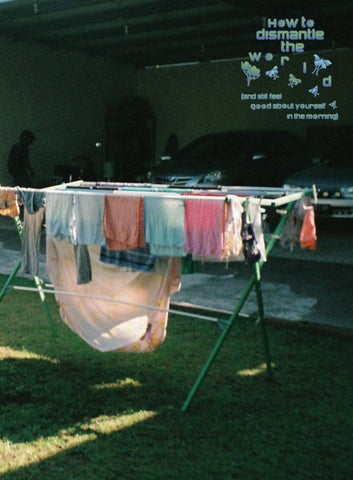
PULP is published on the sovereign land of the Gadigal People of the Eora Nation. We pay our respects to Elders past and present, as well as Indigenous members of our creative community. We respect the knowledge and customs that traditional Elders andAboriginal people have passed down from generation to generation. We acknowledge the historical and continued violence and dispossession against First Nations peoples. Australia’s many institutions, including the University itself, are founded on this very same violence and dispossession. As editors, we will always stand in solidarity with First Nations efforts towards decolonisation and that solidarity will be reflected in the substance and practice of this magazine. Sovereignty was never ceded. Always was and always will be Aboriginal land.
Senior Editor Sasha Blackman Editors Rosanna Chim Portia Love Jayden Nguyen Jess Watson Sophie Wishart Ege Yurdakul Design Portia Love Sophie Wishart Ege Yurdakul Cover photo Portia Love The views in this publication are not necessarily the views of USU. The information contained within this edition of PULP was correct at the time of printing. This publication is brought to you by the University of Sydney Union. Issue 25, 2026
How to dismantle the world (and still feel good about yourself in the morning) For this special edition of PULP, we commissioned artists and writers to respond to the theme of Verge Gallery’s 2026 Welcome Week exhibition, titled How to dismantle the world (and still feel good about yourself in the morning). We were also inspired by Sufjan Stevens’ piece, ‘The Black Hawk War, or, How to Demolish an Entire Civilization and Still Feel Good About Yourself in the Morning, or, We Apologize for the Inconvenience but You’re Going to Have to Leave Now, or, ‘I Have Fought the Big Knives and Will Continue to Fight Them Until They Are Off Our Lands!’’ This issue attempts to platform stories of confusion, hope, irony, resistance, questioning, community, and love.
Congratulations to Verge Gallery for their exhibition and their commissioning of Emma Pham in creating the logo for this exhibition.
i
Editorial
Ode to the warming of our planet I love… The ice melting in my drink so that I get more drink Less animals I have to remember in HSC biology The beautiful sunshine blitzing my skin Not having to wait in the line for the club bathrooms because there is no water and I never have to pee The Great Barrier reef becoming less overstimulating because it’s all bleached Never having to use my brain again because AI made my arts degree redundant More ocean to ferry in So many new moral dilemmas to make me sound super smart and cool and impress my tutor in my third year philosophy essay Gina Reinhart having more money to philanthropise with Being the last of my bloodline and leaving nothing to my descendents. Love, The PULP editors Sasha, Portia, Sophie, Jayden, Jess, Ege, and Rosanna
ii
Contents
Return to the Playground Sasha Blackman and Sophie Wishart .............................................................................................................. 1 Confessions with Caroline Allegra Pezzullo ..................................................................................................................................................... 5 lost property Bipasha Chakraborty ........................................................................................................................................... 9 Last Night was a Rhizome: Italo Calvino and Breaking Reality with Serf Fiction Jack Davis ............................................................................................................................................................... 13 How to be known Scout Harper May ................................................................................................................................................ 17 11 November 2023 Kerem Ege Yurdakul ............................................................................................................................................ 23 How to figure out the way Arwen Beaumont-Lee .......................................................................................................................................... 27 Fawn Sonal Kamble ......................................................................................................................................................... 31 Love, Death, Knitting Annabelle Bullock ................................................................................................................................................. 35 The Creatures in my Greenhouse March for Australia Rosanna Chim ....................................................................................................................................................... 39
iii
Return to the Playground Written by Sasha Blackman Illustrated by Sophie Wishart
When I was little, my mum would pay my siblings and I five cents per caterpillar we found on her mint plant. In the damp soil right under the outdoor tap, the fragrant leaves thrived, twisting round the post of the tap and up the brick wall. The caterpillars, as green as the mint leaves, were difficult to spot. But that made it all the more enjoyable when you detected one, pinching its wriggling body between your thumb and index finger. Yes! Five cents! I would celebrate this win by stuffing mint leaves into my paisley-printed aluminum teapot and then filling the pot with (cold) water. Clambouring into my favourite tree, I would drink my ‘tea’ and admire the coins I had toiled for.
1
These simple joys threaded into the broader fabric of my mostly carefree life. At the heart of it all was play. As children, we learn through play; we are challenged, strengthen social bonds, realise creativity. But as we get older, we often find ourselves caught up in work, school, and other tasks. ‘Playtime’ is sidelined. As I became older and five cents became an unappealing amount of money to receive for the arduous task of searching for tiny green caterpillars, I no longer wanted to help my mum. Teenagehood sunk my spirits like a lead balloon and the caterpillars munched their way through the mint. My tree stood in the park across the road. The ropes I had tied and the trinkets I had secured hung still, waiting.
Much is uncertain at the moment. The seams of our society are tearing open and pushing us further away from one another. Fear and isolation work together, producing vitriol, squandering empathy. Now, we need play more than ever. Writer and civil rights activist Maya Angelou discussed the necessity of joy in fuelling the spirit and acting as a method of resistance against oppression. In an interview, Angelou noted that “Joy is a freedom. [...] You share it! When you continue to give it away you will still have so much more of it.” Baking lovingly for friends, diving into sparkling water and munching on lukewarm watermelon, being eaten alive by mosquitos whilst chatting in the shitty backyard of your friends’ sharehouse—this reminds us of our abundance and capacity for delight. By playing, we resist the fear-fuelled notion that all is lost.
2
A few months ago, my friends Jess, Simeon, and I went to lunch and, after stuffing ourselves full of onigiri, we stumbled along Mary St and ended up at Camdenville Park. Newly redone, pristine swings swayed. Rope ladders moved with the breeze. Planks of wood created little balance beams to tiptoe along. Eager to play on the equipment ourselves but wary that our adult-sized bodies might scare the actual children away, we plonked our bags down and gingerly approached the balance beam tree trunk section of the playground, where no kids were playing. At first, we simply mounted the equipment, standing atop the balance beams as though we had conquered this section. But then Jess’ lips slid into a grin and her eyes gleamed. She grabbed my shoulders and with one mighty shove, hurled me off the play equipment. I shrieked in surprise. Mounting the beam again, I grabbed Jess’ hands, attempting to throw her off the playground this time. Simeon joined in and we began a serious jousting match, spluttering with laughter as we shoved each other. Here we were, three twenty-something-year-olds, faffing about on the playground. My stomach ached as though I’d done 20 situps. I felt simultaneously 5, 9, 15 years old, and kind of like an old person too. My grandmother exclaimed to me recently that she loves “watching children play”, especially now, as age threatens to crumble her memory and dignity. Shrieking giddily on play equipment made for kids allowed me to escape and experience the joy within each moment. Although we may not be children searching for caterpillars in the garden anymore, we can always return to the playground.
3
4
Allegra Pezzullo The therapist’s office was curated to be perfectly neutral: Eggshell Wimborne White walls, high ceilings, plants that looked plastic, and a diffuser that sighed peppermint at polite intervals. Large arched windows were cloaked in curtains; sheer enough to feign the appearance of being anywhere but a therapist’s office. On the bookshelf, trauma manuals were pressed so tightly together that Mindfulness for Busy Professionals seemed to bleed into every title. The desk clock ticked loudly, as though to remind the silence of its obligations. Caroline arrived in a sweep of perfume and car keys. She lowered herself onto the Mid-Century Modern leather couch like an exhausted mother in a wellness ad, serene and slightly fraying at the edge, adjusting her Lululemon leggings with the solemnity of a surgeon scrubbing in. Her regimented blonde hair with perfect highlights bounced once before resettling. She carried the restless energy of someone perpetually late for pilates. The therapist, whose nameplate read Dr Clarke, smiled faintly and gestured toward the couch, noting the oversized SUV key fob clutched in Caroline’s hand. She gripped it as though it were a talisman. The session hadn’t begun, but she was already mid-sentence.
5
“Tracey from Pilates bought a Tesla,” Caroline said, settling in with a sigh. “For the environment, apparently. She told me I should think about my carbon footprint and I thought, well, I drive an SUV, but it’s hybrid, so surely that counts? I mean, I’ve done my bit.” Dr Clarke nodded, in a way that could mean anything. Caroline interpreted it as agreement. Caroline tugged at the cuff of her cashmere jumper. “Besides, it’s basically essential when I’ve got to shuttle Jemima to rowing and Hugo to orchestra. You can’t fit a cello in a Prius. It’s ridiculous, the expectations people have for mothers.” The pen in Dr Clarke’s hand hovered, then resumed moving. Caroline crossed one athleisure-clad leg over the other. Her Prada sneaker dangled theatrically. “It’s just all too much, the violence, the headlines, Jemima’s orthodontist. I mean, hostages, prisoners—whichever they decide to be this week—who can keep track? I told Hugo, I said: “Darling, language is violent. Semantics are traumatising.” And you know what he said? He said, “Mum, can I please just practise cello in peace?” Dr Clarke looked up briefly.
Caroline laughed, nervously. “He’s a good boy, very emotionally aware. I think it’s because I never hid the world from him. Exposure is part of their emotional hygiene. I’ve always said: if we’re going to dismantle society, we might as well do it mindfully; deep breaths, awareness, reusable water bottles.” The clock ticked. The diffuser hissed another polite cloud of peppermint. Caroline’s gaze flicked toward the window, towards the abstract watercolour artwork on the wall, a print titled Tranquility No 4—the kind of painting that exists purely to match furniture— then back toward the window. “It’s just that everything’s so relentless. The violence, the politics, the group chat for the P&F fundraiser. There’s so much happening, and yet, nothing I can do. And then Harris Farm changed the formula of their health shots, and I thought: how am I meant to handle late stage capitalism if I can’t even control my bloating?” A pause. Dr Clarke’s expression didn’t move. Caroline searched for it anyway, eyes flicking over her face for an approval that never came. She then gave a small, uncertain laugh, as though she might fill the silence by sheer willpower. When it didn’t work, she adjusted her posture to look more ‘open’, the way the parenting podcasts suggested. “I recycle!” she said quickly, leaning forward. “We rinse our oat-milk cartons before putting them in the yellow bin. We compost! Well, we used to, the worms died, tragically. But I tried. Mrs Langley’s worms lived on, of course. She feeds them kale offcuts from her Thermomix. Sometimes, I wake up at 3 a.m. and think, am I doing enough? Then I remember I donated to that GoFundMe that was raising money to fund mindfulness workshops for women in conflict zones, or maybe it was for the floods... anyway, I gave ten dollars. And I thought, that’s something.” Dr Clarke’s pen stopped mid-stroke. The stillness made Caroline speak faster.
“I do care. I’m just... sensitive. I absorb it all. The suffering, the headlines, it’s practically an allergy. I told my husband that. I said, ‘Andrew, I’m an empath, it’s exhausting.’ And he said, ‘Caroline, please, not during The Block.’ He doesn’t understand. Some people can just detach. I can’t.” Dr Clarke made another mark on the notepad. Caroline leaned in and tried to read it upside down. Empathic delusion? she wondered, though it might have been Empathic diffusion. The handwriting was beautiful and unreadable, the kind of writing that looked ethically sourced and probably composted itself. She took a deep breath, clutching her iced caramel macchiato extra syrup, light ice, one pump of moral guilt. “I think what gets me is the helplessness. Like, the whole world’s falling apart and I’m just here doing Pilates and worrying about Jemima’s ATAR. She won’t make it to med at this rate, and then what? Our family’s legacy of helping people ends. And if she can’t afford an electric car, she’ll be out there pumping diesel like the rest of them. I even joined one of those Facebook groups, Sydney Women for Peace, but it’s mostly people posting infographics and fighting in the comments. I left after a day. Too toxic.” Dr Clarke’s eyes flickered with what might have been pity, though it could have been gas. “I just wish there were something more practical I could do,” Caroline went on. “Something tangible, but also... gentle. I’m thinking of going to Byron. A solidarity trip. A bit of sun, some yoga, reconnecting with the earth. It’s not activism, exactly, but alignment.” She paused, pleased with her rhyme. “Maybe I’ll even start a women’s blog. Something about empathy fatigue. I could interview other exhausted women, you know, the ones who really feel things. I already have the name: Compassion Fatigued.” A pause. “Catchy, right?”
6
Dr Clarke looked up, pen poised. “And how do you feel when you imagine doing that?” Caroline blinked. “Productive,” she said after a moment. “Useful. It’s about giving other women permission to care less. To preserve our emotional resources. We can’t save the world if we’re all burnt out. I read that in Vogue Living.” She sighed, then solemnly followed with, “The world awaits with bated breath,” quoting herself this time. The therapist’s expression did not change. The silence stretched. Caroline’s voice filled it again, rising in pitch. “Of course, sometimes I wonder if it’s wrong to feel good. Like, how can I enjoy a turmeric shot when there’s suffering in, um, you know... Ukranistan? But then I think, what good am I to anyone if I’m miserable? I’m modelling resilience for my children. Hugo needs to see that you can stay centred during a catastrophe. That’s leadership.” The clock ticked three times, sharply. Dr Clarke’s pen scratched once. Caroline’s breath hitched. “You think I’m ridiculous, don’t you?” Dr Clarke shook her head, once. “No, because I know I am,” Caroline said, almost whispering. “I know I’m lucky. I know there are people who would kill for what I have. That’s the thing, isn’t it? They would kill for it. And here I am, crying because my oat milk curdled. It’s obscene. I’m obscene.” Caroline placed her head in her palm, looking out the window for something to comfort her. But the sheerness of the blinds obscured the view just enough to turn everything outside into a blur. For a moment the air shifted. Even the diffuser seemed to hold its breath. Then Caroline reached for a tissue, dabbing delicately at the corners of her eyes. “I suppose we’re all doing our best,” she said softly, regaining tone and posture in the same breath.
7
“It’s just the world’s ending, and no one tells you how to dress for that. I think navy’s too optimistic.” Dr Clarke made a small noise of acknowledgement. Caroline brightened. “Anyway, Jemima’s school’s doing a sustainability drive next week, we’re collecting second-hand uniforms for the needy. I thought I might volunteer. They’re tailoring the old kilts into winter coats for rescue poodles. Isn’t that divine? It feels good to give back, doesn’t it?” The therapist’s silence thickened, heavy and velvety. “Exactly,” Caroline said, as if an agreement had been reached. “So really, all I can do is dismantle the world responsibly. Recycle my oat-milk cartons. Light my sandalwood candle. Sleep like a baby.” Dr Clarke’s pen returned to motion. Caroline craned to see the page again. One short sentence. She caught only the tail of it as she rose to leave: Caroline is coping. She lingered by the door, hand on the brass handle. “Do you think self-awareness is action?” The therapist looked up. Took a breath and plastered a suggestion of a smile. “It’s a start.” Caroline smiled, radiant with relief. “Perfect. I’ll start there.” She left in a flutter of perfume, cashmere, and the faint clatter of keys. The diffuser exhaled one last measured sigh of peppermint. Dr Clarke capped the pen, glanced at the clock, and opened the next file. Client: Andrew B. Presenting issue: emotional fatigue.
8
lost property
Bipasha Chakraborty 9
10
11
lost property As I walk past the Quadrangle every morning, despite the now-manicured lawns, memories of the encampment linger in my mind. Seas of blue tarp, water-damaged signs, tent posts sunk in the mud, echoes of laughter and wafts of shisha from the alcove; memories of the people who remained resilient through it all. Patchworks of souvenirs stitched into the fabrics of my mind. ‘lost property’ incorporates scraps of a sleeping bag that I have then machineembroidered onto. As my sleeping bag was taken by security for a time, I cannot be certain that the scraps are mine. I designed and materialised this piece using opensource software and access to USYD’s one shared embroidery machine. The works of Harriette Bryant have inspired this piece. Her use of ornate materials to contrast violent lived realities is replicated through the picture frame. Here, the lived reality of activism and the colonial institution, juxtapose each other, forcing both into view at once. Whilst the sandstone pillars continue to stand at the centre of campus, so too does the resistance and solidarity of First Nations people here, and beyond.
“I cannot be
certain that the scraps are mine.
”
Bipasha Chakraborty
12
Last Night Was A Rhizome: Italio Calvino And Breaking Reality With Serif Fiction Jack Davis
I
have spent the past two to three years of my life being Sydney’s biggest Italo Calvino shill. Anyone who has been unlucky enough to be cornered by me at a party will know this. My modus operandi goes thusly: one, identify a victim—someone sympathetic towards continental philosophy and attendant veins of literary wankery—and position myself on an approach vector. Two, engage target with a tentatively inquisitive, “Have you read much Italian fiction?” This is a relatively neutral line of questioning, a conversational dipping of the proverbial toe in the water. Three, launch an all-out Calvino strike:
“Dude you have to read If on a winter’s night a traveler bro it’s awesome it’s like this postmodern thing where there are like twelve different novels in it and it’s kind of in second person tense dude it’s crazy metafictive.” “Invisible Cities is like a bunch of vignettes about—get this—imaginary cities and also- wait also listen to this... it’s narrated by Marco Polo as he tells these stories to Kublai Khan bro isn’t that sick!!!” “I’ve actually got an Italo Calvino tattoo, wanna see?” “Literally forget DFW man, Calvino is like the LeBron of fiction.”
13
I acknowledge that these efforts have probably done irreparable damage to the Italian author’s reputation in my general social circle. Whenever I try and convince someone to read Calvino, I am usually met with a blank response; my very patient friends and less patient acquaintances clearly don’t appear to share my stimulant-fuelled enthusiasm for abstract postmodern fiction. Those with an affinity for fiction which is (ugh) “readable,” or worse, “coherent” are mainly perplexed by my love for the guy, and the more politically minded can be much more explicit about the pointlessness of Calvino’s endeavour, questioning the value of lit-theory brainrot in a world that appears to be falling apart around us. This critique is certainly compounded by the perception that this mode of literature is written for a class of overeducated and overgrown literary theory douchebabies brandishing service medals awarded for intellectual wounds sustained during the Theory Wars of the 70s, clinging to pristine Of Grammatology (1967) paperbacks while hatefucking Harold Bloom anime body pillows. Judging from the popularity of writers like Sally Rooney and Ocean Vuong, or the growing influence of autofiction in our literary landscape, it seems that many are hungry for stories about ‘real people,’ narratives reproducing our individual lives, experiences, and identities so that we can understand our place in modernity better. However, I think that Italo Calvino’s work, and more broadly, fiction of his kind of antirealist or metafictional style, is the type of writing we urgently need in our disintegrating world. When we wake up every day in a world characterised by self-reproducing structures of subjugation, abjection, and outright oppression, how can we see fiction that is realistic or logical as being able to inspire and envision change? You cannot really dismantle the world when your fiction only looks to depict it as it is. Realist fiction can only describe or reproduce the logic by which our world operates, and as such it can only pathologise and prognose existing conditions of existence. By exploring the play of language in abstraction, using the metatextual and anti-realist endeavours of authors like Calvino, we can imagine a world
beyond the one we live in. To look to a future, we’ve got to go abstract. ~ Let me sketch out a definition of this style of writing, which I’ll call anti-realist fiction. (I am clearly avoiding the term postmodernist in a doomed attempt to skirt the David Foster Wallace associations.) Italo Calvino’s fiction is largely characterised by a kind of metatextual play, where the focus is on questions of textuality and form. For instance, his novel If on a winter’s night a traveler (1979) opens with the line, “You are about to begin reading Italo Calvino’s new novel, If on a winter’s night a traveler.” The narrative (if you could call it that) follows You, the reader (hello!), as you read the first chapter of twelve separate novels. How metafictional. Calvino is often named in the canon of playfully abstract prose, brought up alongside authors like the inimitable Jorge Luis Borges or the GOAT of literary theory nerd fiction, Umberto Eco. This kind of fiction, which is often lazily and reductively termed ‘postmodernist,’ tends to be at odds with a conventional Anglophone understanding of valuable prose fiction; many of us view ‘good’ writing as prose containing deeply fleshed out and convincing characters, lovingly crafted settings, and as a project of depicting and understanding the complexity of human experience. Calvino generally fails if his writing is judged against these criteria. In his main body of work, where he writes in this metatextual or ‘postmodern’ manner, characters can feel like plot devices before real people, the world of the text is ambiguous, and Calvino seems more concerned with abstract questions of language and textuality before addressing lived and felt human experiences. ~ ‘The Nonexistent Knight’ (‘Il cavaliere inesistente’) is my favourite of Calvino’s novellas, and the one I think best demonstrates the allegorical, anti-real qualities that allow for the dismantling of social reality.
14
Included in Calvino’s collection Our Ancestors (1962), ‘The Nonexistent Knight’ is one panel of a triptych of narratives where Calvino writes allegorical fables, toying with the medieval romance genre in bizarre and hilarious ways. The eponym of the novella is Agilulf, a knight in Charlemagne’s army who literally does not exist; there is a pristine suit of armour, a bevy of titles, and an ironclad high-school-prefect-like commitment to the chivalric code, but no entity to inhabit them. When Charlemagne, reviewing his knights, comes to Agilulf, he asks the knight to draw up his visor, to reveal himself, but as the Carolingian Emperor comes to see, “The helmet was empty. No one was inside the white armor with its iridescent crest.” The novella follows Agilulf and a small band of characters around him as they navigate the chivalric strictures and social structures of a medieval period characterised by a tension between the abstract and the visceral, between chivalrous knights with titles and nameless and illiterate serfs. As an example of anti-realist fiction, ‘The Nonexistent Knight’ is not a novella concerned with fleshing out the deep personal experiences of its characters, or the coherent functioning of a real-feeling narrative world. Calvino’s characters are, like the characters in the Lais of Marie de France (12th century) or the chivalric romances of Chrétien de Troyes (12th century), essentially stock characters with limited internal lives and personalities, more reminiscent of the allegorical stick figures populating Spenser’s Faerie Queene (1590) than they are of real people. The narrative of ‘The Nonexistent Knight’ might be disparagingly compared to a morality play, one of Aesop’s fables, or a Biblical parable; literary forms we see as foreign to our modern idea of fiction. The world of ‘The Nonexistent Knight’ is illogical; we have a knight who does not exist yet is still somehow present, an illiterate peasant named Gurduloo who can imitate every animal except for the human, and a narrator who openly admits that they are reconstructing the narrative they are telling from events outside of their perspective. This illogicality precludes the novella from being either realist or escapist, in its incongruence with the reader’s interpretive framework.
15
Because unexplainable, illogical things happen, the world of ‘The Nonexistent Knight’ draws attention to its own textuality, its inconsistency and abstract artificiality. However, this allegorical play is how we can see ‘The Nonexistent Knight’ as a text that resists modern reality. Because things don’t make sense, because we are aware of the fictional nature of this textual world, we have a kind of fictional non-space in which to play with new ideas. The illogical and unrealistic nature of Calvino’s novella lets us use it as a kind of crash-dummy test course, where we can test out conceptual and ethical possibilities. ~ In Kafka: Toward a Minor Literature (1975), Gilles Deleuze and Félix Guattari identify similar characteristics in the fiction of Franz Kafka, proposing that these illogicities, the refusal to simply reproduce existing features and functions of the world, are indicative of writing in what they call a “minor literature”. Minor literature, for Deleuze and Guattari, is distinct in that it resists reproducing and depicting the identities and categorisations of the majority. Instead, writing of this type deterritorialises boundaries and borders drawn by the dominant social structure, refusing to propagate these existing structures of knowledge and being. As anti-realist fiction does, deterritorialised literature exists in an illogical ambiguity outside of the formalised territories of conventional literature and knowledge. Where conventional fiction and narrative is tree-like, branching out from points of meaning in a hierarchical root-stem relations, this kind of literature functions as rhizomatic organisms like potatoes or grass do, where there is no centre, no root-stem relation, only a horizontal distribution with an undefined beginning and end. Deleuze and Guattari describe how the rhizome of minor literature is a “principle of multiple entrances,” which “prevents the introduction of the enemy, the Signifier, and those attempts to interpret a work that is actually only open to experimentation.” Like the work of Kafka, ‘The Nonexistent Knight’ exists in a minor literature of deterritorialisation.
Calvino’s textual world refuses an arborescent form of logic which would deem the very notion of a knight who doesn’t exist as illogical, paradoxical, or nonsensical. These impossibilities, like Gregor Samsa’s transformation into a bug in Kafka’s Metamorphosis (1915), deterritorialise the work and detach it from logic of root and stem, more closely resembling the nonsensical web of the rhizome. For Deleuze and Guattari, this condition is what allows for the creation of the new, and where the political radicalism of minor literature is. When the world of the text refuses the reproduction of the conditions of majority (for lack of a better term, the status quo of reality), the illusion of the individual subject falls away; we can only understand the text as an assemblage, as belonging to a connectivity that is necessarily social and political. The “cramped space” of minor literature “forces each individual intrigue to connect immediately to politics.” ~ So what point am I trying to make, besides saying that realist writing is like a tree and antirealism like Calvino is rhizomatic, like grass? It may feel antithetical to say, but this abstract and illogical type of writing is in fact the type of writing that allows us to imagine a new future. We should all be touching grass, as the saying goes. Deleuze and Guattari highlight other examples of minor literatures and minor languages, like James Joyce and Samuel Beckett writing as Irish authors, or the play of African American vernacular, both within the colonising majority force of the English language. Dismantling the structures of the majority requires us to deterritorialise these structures, undermining the language, literature, and organising principles of the majority and operating outside its logic so that we can institute new concepts. Realist fiction only reproduces our existing conditions, providing us with a logical progression through the world with beginning and end. To envision a future, we instead need a map that offers us a myriad of entrances and exits, a rhizome that resists a fixed interpretation and the calcification of our social structures.
I don’t intend this as a takedown of writing which reflects the world in which we exist. We should always be reading and writing things about our lives and experiences. However, I wish to suggest that to make an omelette, we have to abstract a few eggs. My love for Calvino is not because he offers a specific political program for change, but rather that he refuses to reproduce the existing structures of our reality. There is an optimism in reading him, an opening-up to future possibilities that I don’t find in realistic fiction. The deterritorialisations, the incongruencies and nonsenses which can only happen in an abstracted kind of fiction, are the fissures in our world that let in the possibility of a new future. When Agilulf mistakenly believes he has lost his knighthood due to a perverse technicality of the chivalric code, he runs into the woods. His armour is found in a pile, with Agilulf, the nonexistent knight, having ceased to exist. He ‘dies’ when he believes his title is gone, but the young Raimbaut, who follows Agilulf through the novella, takes up his armour and dons it. For the possibility of a future, we need to be able to deterritorialise so we can reterritorialise; we must be able to deconstruct the armour that clads our structures for the possibility of reconstructing it in a new form. We can only initially conceive of the new through the nonsensical and the illogical, and our fiction should do the same.
16
How to be 17
known
Written by Scout Harper May ‘How to be known?’ is a reflection on a pervasive uncertainty of identity. This piece strips the bark from the performance of an idealised personality and digs into the muddy, naked elements of Being. Performing the most ‘appealing’ version of myself is deeply rooted in my queer and trans experience, and has led to a sense of desolation. I wrote this piece as a way in which to cope with the distressing feelings of inauthenticity that arise when I feel unsafe to explore my identity. While this exploration provides a foundation for the piece, its focus is on the people who have sat with me in the stillness; who have kept me company as I come to terms with what it means to be my ‘Self ’. Now, I could get into some philosophical assessment of that but I am no philosopher, and I have always preferred to express my thoughts in rambling, surrealist writing. I suppose, much like the narrative voice of the piece, I would rather someone else pick my soul apart and take what they want from it.
18
How to be known This is not a how-to guide. If you want it to be that’s a bad choice, but I won’t try to stop you from scaling the creaking fence. I know that the ‘Do Not Trespass’ sign is just too good a foothold to ignore. You jump down. Your steps are light on the gravel, dampened by the rotting bark that never found its way back to the riverbed. The floods like to eat.
You have five options, I’ll tell you that much. You look at me and I can see you reading between the lines that have gathered on my knuckles. The note is reverberating, louder now. You’ve twisted my ribs. I’ll tell you more. Before you are five containers:
It’s nearly dark here, or nearly light (you get to pick. This one’s on me.)
A brown glass decanter, bound in red leather. A sleeping pill bottle, unscrewed. A yellow pitcher. An empty toothpaste tube, A lightbulb, illuminated by cool fluorescence.
You find yourself watching the river lapping at the reeds. Mud rushing through gaps in its gums. Are you daring it to come closer?
You lift the pill bottle to your ear. You’re getting it now.
You look up. The Not-light shivers. Hello. I am sitting at the picnic table, sinking into the silt. Will you ache with me? I need you to hear that in my voice. You ask me what my voice sounds like and the Not-light stares at you. Don’t you understand? This one’s on you. Like I said: not a how-to guide. I ask you to help me cover the table with a brown-and-white-checkered tablecloth. Its dying splinters do not like the prickly sun, I explain. You ask me where it came from, so I ask you does it matter? It’s here now. You sit opposite to me, and underneath our table your knees bruise mine; billowing, rolling thunderclouds rushing through hollow bones.
19
The river vines have crawled up the metal skeleton to join us, pushing the cloth back with their winding tendrils. A long, low note hums in me and I think I’m afraid you’ll hear it, so when you ask me why you are here I say,
I ask you to describe this voice to me. I’m hungry now. My saliva is crawling up the back of my throat and the water is crawling up the bank to my feet. Am I daring it to come closer? (Or begging?) I ask you again. Will you ache with me? You close your eyes so that I can’t read between the lines that furrow in your brow. You tell me I sound sick but you can’t place my illness. You tell me that my voice whines and sighs, and though the question has only five words I am tired when I reach its inflection; the question ends, but with a whimper. I am quiet. My knuckles speak for me, running blue with veins that seek to breach my skin. This is not the answer I was hoping for. You don’t understand why, but you want to give me what I want, so you continue, reaching for the decanter, running your hands over the stitched ridges.
My spine curls inwards, and that same low note seizes its opportunity to cradle itself in the curve of my bone.
You engage in this titling of the scales for many cycles of the Not-sunset and the Not-sunrise. I cannot grow tired so I grow angry instead:
When you rest your ear against the finish, your eyes widen and I find myself pressing my stomach against the edge of the tabletop.
If you don’t wish to help me, why are you pretending?
You listen only for a short time. You tell me that this voice is strong and sure and knows itself. When I ask you what that means, the Not-light pushes the corners of your mouth upwards as you shake your head and place the decanter back on the table. You are close to me. I want you to choose this voice for me. I fear I am close to begging, but the low, murmuring note in my back is sharp against my nerves and I know that I am not allowed to tell you this. Your shoes are wet. The water is at our ankles. If you mind, your pupils give nothing away as they flicker between the remaining choices on the table. When your hand grazes the lightbulb you ricochet away. The light is cool but the glass is hot and your fingertips are glowing. The humming note panics, rises to my sternum because I have hurt you and I am sorry. Your arm crosses the table. You dab the warm glow onto my cheeks and tell me, with a voice like a carpark at sunset, I can see you better now. I think I might Love you, even if I cannot remember what Love looks like. The ache is cystic. It has been here for too long. Will you ache with me? You lift the empty toothpaste tube, hold it to your ear, put it down, lift the pitcher, hold it to your other ear, do not look at me, put it down, lift the decanter, the pill bottle, the lightbulb. Glow. Repeat.
The Not-light stares at me and I stare at you as you balance my voices in the palm of your hands. I cannot tell if you’ve heard me. Your eyes are closed. The water is at our hips now, hungry and impatient. I lean backwards. I let it consume my spine and rush into my jealous ears. There is nothing here but the muffled hum of a long, low note; soundwaves that sink into a dark, warm river. Your knees still rest against mine, and I wonder if the tadpoles that brush past our shins are scaring you. No, you’ve always been much braver than me. I want to tell the Not-light that I miss you; that I’m sorry I had to go away, but I think the Not-light has decided it doesn’t like me anymore because I cannot find it shivering in the misty leaves above my head. I feel you stand, and then I cannot feel you anymore. Perhaps the tadpoles frightened you, or perhaps I did. I do not hear you ask me, which one do you want me to choose? because I think a pair of hermit crabs may have mistaken my ears for shells. I do not see you gather each item carefully, cocooned in the crooks of your elbows, holding them close to your stomach, nor do I feel you move towards me—though I feel the disturbed current. And then you are there. You tilt your neck forward so that I can see your face over the bulk of my voices cradled in your arms.
20
I sit up and face you, and you offer them to me. I take them, but I am confused. How will I know who I am? How do I know which one to choose? You tell me, does it matter? I would know you in the belly of the floods. I would know you in the Not-light. The choice is yours and I will be here when you call. The choice is yours and I will be here.
21
22
11 November 2023 Memorial for Everyone We’ve Lost in the Earthquakes Antakya, Hatay, TR Kerem Ege Yurdakul
23
1
24
25
Hidden behind their black umbrellas and the excuse of rain, the tears on their faces are still obvious. The sorrow pushes its way through the gates of my lower eyelids and floods my nerves. No clapping. No sound but rain. I climb down from the lectern, leaving the rest of the memorial to the counsellor, and turn toward the school gate, weaving through the body of black clothing until I find my bike waiting for me across the street, slick with rain. I ride along the same path he and I rode countless times after school—on sunny days, on rainy days. I ride until the tears wash away from my face and the rain feels lighter. I ride until I reach our spot. The stone bridge over the thin river. The fabric is clinging to my skin as the drizzle finds its way down, dripping from the ends of my hair to the hem of my vest. I run my fingers over the A&K carved into the stone. I don’t have my pocket knife, but I have my pencil case inside my bag. I pull out a pink coloured liner and write forever next to it. Then I undo my shirt and pants to climb over the railing for one more dive.
26
How to figure out the way Arwen Beaumont-Lee Someone left their tarot cards and a book called Narcissism: Denial of the True Self in my room after a party at the old house. Both items felt spiritually charged, connected to the darkness I’d seen at the party that night, where people got sick and broke things. I remember the wafting smell of vomit and the feeling of smashed glass underfoot. I suspected the ghosts in the house were angry at us for taking our guests on tours of the basement, treating their sacred place like a tourist attraction. There was a shrine down there with a picture of a man in a holographic bodysuit, and strange hieroglyphic art. Someone came by once looking for the old woman who’d lived there—a Spanish witch. No one asked the question we all wondered: where did she die? I threw out the book on narcissism but kept the cards. Holding onto them tied me to the old house, since I had found them there. I’m bored in my room at the new house, and I feel the box of cards staring at me from where it sits neglected on my shelf. Everything in my room is alive. Isn’t a thing alive if it’s haunted? I take the box off the shelf and wipe dust from its cover.
27
I’ve always been wary of stuff like tarot. I don’t trust fate to work in my favour, and I worry that having my cards read will set my bad luck in stone. But tonight, I’m feeling risky. One of the upsides of the luteal phase is enhanced spiritual powers—a.k.a psychosis. The set comes with a deck and a small guidebook called Motherpeace Tarot, written and illustrated by Karen Vogel in 1996. There’s a $2.00 op-shop sticker on the back, which means it’s already passed through at least one other life. Its history feels important. I don’t have a question in mind for the reading. Maybe my question is, “what am I asking?” or “how do I figure out the way?” Lately, it feels like I’ve been keeping secrets from myself.
The crosscurrent, writes Karen, is the lesson you’re learning which may reveal a skill you need to acquire. Five Discs: a woman kneads bread while five hover above her, each patterned differently. No structure can protect us from loss. All things are absent at the centre. We must shape the formless into something sustaining. You won’t know if it’s working until it does. The root is what you’re standing on or what you feel in your body. The Daughter of Cups shows a woman bathing in a waterfall, a tree leaning toward her in embrace. The cup is the vessel of the self, she uses it to wash her body. The child fuses with the mother. The mind retreats to a fluid, playful character to defend against the lack.
Reading tarot for yourself is like having a conversation with your own mirror selves. You ask questions and are so gullible you actually answer them, pretending it isn’t just your own voice in an echo chamber. I’ve always been suspicious of people who play solitaire. Do you ever feel watched when you’re in your room alone at night?
A headache builds behind my eyes. Meaning is draining from me like blood drawn by an invisible nurse.
In the guidebook, it says the first card is the significator, the card that tells you who or what you are. I draw the Four of Wands. It shows four women dancing in a circle, linked by flowers, a bird flying overhead. Communion, ritual, a feeling that I am one among others. I keep finding myself in circles, speaking in tongues. High even when I’m not.
“Passing away refers to an event in the recent past, important to the reading,” a voice says.
The next card reveals the atmosphere, the catalyst behind the question. Eight of Wands. Arrows shoot across space, linking Earth and sky. A fantasy of mastery over symbolic distance. What moves too fast cannot be possessed; it’s the drive circulating around the object that shields it. I think dimly of Cupid. Being in love is like getting killed.
“Karen Vogel?”
The fifth card is about passing away. “What does it mean?” I ask aloud, not expecting an answer.
“Who said that?” “Who do you think?”
Her silence confirms it. “Are you dead?” I ask. “No.”
28
I can feel her presence behind me on the bed as I draw the Two of Swords. A naked woman holds a rope in a figure eight, balancing on one leg like the crane beside her. Time moves around us while we remain still. The mind causes things to look different so it would appear that time has passed.
The subject confronts the instability of meaning, the uncanny return of repressed material and illustrations of the self. “Karen, is this accurate?” “You ignored the direction again.”
“Karen, am I right?”
“Is that bad?”
“Two of Swords is balance, decision, stillness, a moment of suspension before action. You must maintain two truths without collapsing into one or the other.”
“It’s less accurate.” “If I get the answer I’m looking for, does it matter?”
“Thank you,” I say. “Remember to pay attention to the direction of the card.” “It’s sideways.”
“Don’t you want the right answer?”
“Then your balance is in motion—actively negotiated.”
“Will the right answer even help me?”
The sixth card is the sky. I don’t need to read the guidebook anymore; Karen is here to guide me. “The sky is your head, your conscious self, or spirit connection,” she says. “My soul?” “Maybe,” “I don’t know if I believe in the soul. I think we’re all the same.” “I don’t know either. I just made the cards.” “Okay, sorry,” I say. I have to be polite, like I am speaking with AI chatbots. I know if I say anything wrong, she might disappear. The card is XVIII Moon. Two crescent moons and a sun with a child’s face hang above a woman beside a circle of rings that look like a tree’s cross-section. It speaks of psychic tides: the menstrual cycle, a story that repeats unless new life begins.
29
“Maybe,” “What’s the next card?” “Read it yourself.” The seventh card is about the near future. The Ace of Swords: a woman sits cross-legged, one hand holding a sword, colours bursting out of her. A butterfly hovers nearby. The phallic signifier cuts through the confusion of the moon. Language, insight, and symbolic order are reasserted. The subject learns to speak her desires. “Karen, is this wishful thinking?” She doesn’t say anything. Maybe I’ve been calling her by the wrong name. I picture her much like the Spanish witch—robed, beaded, unruly. I’m afraid to look behind me, in case there’s nothing there.
The eighth card is self-concept. It’s about how we think and feel about ourselves. My card is the Priestess of Discs. There’s a woman stretching on a mat, a baby beside her on the grass, mountains in the distance. A hand with an eye floats above. The mother combines the material and the spiritual. She stands for the maternal Real, the grounded, nurturing aspect of the feminine that cannot be entirely symbolised. The subject reclaims embodiment as sacred, not lacking. Healing the Five of Discs.
The image suggests a dream encounter with the emotional archetype, a figure representing the integration of desire and emotion through symbolic mediation. An attempt to speak the unspeakable, to bring unconscious affect into the realm of signification without drowning in it. I think of Karen as I turn over the final card. I know I should respect her wish to stay inside my head, so I don’t call for her. She’s in my DNA. Through her, it feels possible to know everything. My voice sounds like hers.
The ninth card is hopes and fears. Karen wrote that it could be both. I wish she’d come back.
The fourteenth card is XI Strength, a major arcana. A woman holds a yellow flower, surrounded by animals: wolf, rabbit, fox, snake, crane, scorpion, spider, lion. The moon is visible in the distance behind the branches of a tree. Strength here represents a momentary reconciliation with the lack—the understanding that desire never ends, that vitality lies in inhabiting the lack with grace. Rather than seeking to complete oneself, this card endorses living through desire and embracing its animal pulse as the source of life. Your wholeness is a dream you need, but also a disguise for the truth that desire never ends. Strength is not about becoming whole, but about being at peace with your un-wholeness.
Five of Cups. Crabs fill the cups, but two have spilled. The fallen crabs are splayed on the ground. Mourning not for a specific object, but for the loss that defines subjectivity. The subject must accept that desire is perpetual; mourning becomes a ritual of transformation. The tenth card represents the house. This is the social or spiritual environment. Three Discs shows a brick wall and three women. One is removing bricks, one climbs, one helps from above. The wall represents the symbolic order: language, law, social structure. The ladder is the means by which the subject imagines movement between orders. A fantasy of ascent. The hole is the Real: a void opening within the symbolic, the unspeakable gap allowing desire to circulate. The one removing bricks tries to open the Real within the symbolic. The helper mediates between levels. The climber is the desiring subject, caught in the act of becoming, attempting to traverse fantasy and move beyond limitation. The eleventh card is the outcome. If it is a major arcana, it reveals resolution. If not, you can draw more to reveal steps to the outcome. My card is the Shaman of Cups. A woman in a white mask pours liquid into a boiling pot while sea creatures drift behind her. They seem to be in an underwater palace.
30
FAWN Sonal Kamble
31
The pale man watches as I ride my bike across the street. Up and down and up and down for hours, for long, long days. In the bushes he appears as a flower, the deep blue of his garments a flame. He strokes himself with one hand inside his shorts, just out of reach from where the neighbours can see. The other holds a finger to his lips. There is a whole lot of sunlight draping over this afternoon. It disperses through the gum leaves like dust. He reminds me of a white rabbit, the way his irises glow. The hot globe of his eye casts a stream that reaches me through the fog.
My mother wanted to go on a trip every summer when I was growing up. We did not have a car, nor stable finances, and my father could never muster the energy. They moved to Australia many years ago and never stopped working. Today my father takes me on our first family holiday, to a village near Port Hacking River, in a second hand car perspiring in the morning dew. My father booked this trip last January to accommodate three. Now we are two. He ignores this, I forget this, and when the heat sticks to my eyelids, I press them closed.
The corridors of the motel are lined with a long river of landscape paintings. Inside the heavy gold frames are sand spits girded by green water and small heads of banksia scrub blurring in the breeze. It’s hard to find an eye in a single one of them; I scrutinise them while my father pleads with the blonde woman at the front desk. It’s a game I used to play with my mother while waiting for the bus after school. My teachers had informed her that I struggled to play among the sea of wide eyes in the schoolyard, so my mother wanted me to start catching as many as I could. Closed eyes, she said, were no good. I spot the white iris of a honeyeater as our keycards are turned over. It imparts onto me its quiet state of paralysis. In our motel room, our two beds are next to each other; mine is a single and my father’s is a double. The double bed is right beside a window which opens into the blushing sea. The scraps of light caught in the tide move strangely. I see the shadow of dark heads darting through the water.
I dream of a deer drowsing, just like me, supine on the side of the road. I don’t know how I know it’s a deer because the figure in the vegetation has no head, but I wait to glimpse the curve of antlers. Sunlight sprouts from the pricks of oil along its skin. It’s only when the car slides up to the cavity of its neck that I realise it’s swarmed by blowflies. When I wake up, we’re already at the motel. The collar of my shirt is soaked.
32
“I had a bad dream on the way here,” I shout. My father is in the kitchen. “A deer was on the roadside.” My ears fill with the roar of water leaping from a pipe somewhere. My father cuts the sound—a tap. “What did you say?” “The deer in my dream. It looked like it was breathing, but when we passed it, it was dead.” “That wasn’t a dream,” he says. “It was real.” “I didn’t know we had deer in Australia.” “We shouldn’t,” he murmurs. “They’re invasive.” “They invaded?” “No; they were brought here.” “By who?” “The colonists.” I don’t understand why they would do such a thing, and I say as much. My father dries his hands with a towel on the bench top. “They were brought here to be hunted,” he says.
33
In the evening my father waits out on the balcony to accept a call from my mother, so I pull my comforter over my head and search for deers on my phone. The deers in this area sound like restless creatures that sought to escape the village many times, in many ways. They waded through railway corridors half a decade ago and even swam in Port Hacking River. Considered pest animals, they are shot on the ground, or from helicopters, with semi automatic rifles. This practice is called culling. Shots may only target the heart, lungs, or brain. If shot first in the head, the deer will lose consciousness immediately. If shot first in the chest, it takes longer. I scroll through pictures of deers lying cold in the undergrowth, wearing the mark of a bullet in their temple with no blood on their coats. The severe state of the deer I witnessed makes little sense against these. Many hunters, after stalking a map of blood through the bush, even take pictures with their kills. They drape their rifles like an offering to the clean, brown body. I tuck my nose into the beige wall as the window starts to shake. The air grows rough and salty at night. It carries shards of conversation through the window, my mother’s voice wounded over the phone. She cried immigrating here, she cried when she left to go to work, she cried when she was afraid on the street, and she cried when she found me on my bicycle in the back lane that day, alone. We packed our bags for vacation but she packed hers for a flight over the sea. She wants to go home. In the early morning, I wake to the serrated sounds of a bird crying on the roof. I sneak the congregation of my father’s empty beer bottles into the back dumpster before he sobers up. We go to the beach when the day grows warmer and I keep my thongs on all the way until my toes prick the water. The sand is punctured by hundreds of tiny crab holes. My father sits in the middle of a swarm of them, pressing his palms flat over the mouths of some. It disturbs me, the thought that a crab may emerge from the lightless tunnel and begin chewing on my foot. I think of the deer, wading through a blanket of trees and catching a bullet shot between two trunks.
I wonder if it knew to look upon gaps this way. I crouch to squint into a hole some metres out of my father’s sight. In the corner of my eye, a rabbit splits from a log like a hit marble and darts into a thicket of trees. It conducts me through a sea of green light. The sand and the sound of water eventually disappear behind me. The scrub turns my ankles raw and punctures the bare soles of my feet. I follow the tender rustle of leaves as they part against the rabbit. It shines like the bright side of the moon. The rabbit pauses before a felled tree. Something lies on the other side of it, where the blooms are shivering upon their stalks. The rabbit keeps its eyes out of reach. It hops over the long border of the trunk, and I assume, from the soft sounds of its chewing, that it’s grazing. It sounds delighted. I peer over the log to take a look for myself. On the lush bed of grass rolling out from the other side of the tree, a whole host of creatures, pinprick flies and vermin and birds of prey, feast in a picnic. They ruddy their mouths on a large mass like the one I saw with my father. I realise now that the head has been sawn off, likely taken to be lined up on a wall like a criminal. Without the juts of bright antlers, the carcass is almost indistinguishable from the rest of the quiet landscape. Everything but the eye that hangs open to gaze inside a room will soon be subsumed by the earth. A little eagle sits its feathered legs on a pool of leaves beside the rabbit. They eat from the deer’s neck together.
34
35
Love, Death, Knitting Annabelle Bullock
Two years ago I started working in a wool shop, and everything (especially knitting) seemed to be a matter of life or death. Stitch gauge was death. Needles were death. Baby clothes were the glimmering reprieve of life. When I applied for the job, I could only crochet. I had moved home after my first year in Melbourne and was trying not to consider the whole thing a colossal failure. I was having a year off. With only two close friends in Sydney— one studying law, the other in the middle of a prolonged depressive episode—I spent all my free time learning how to knit. I had slipped into an auxiliary universe of knowledge; the least I could do was land on my feet. The first thing you should understand about knitting is that, as with any form of learning, it makes some people deeply and profoundly terrified. It can produce enough fear to make a retiree spend $1.4k on cashmere, despite the fact that they don’t know how to knit.
They are just getting ready to learn how to knit. A few days after my pitch was approved for the article you’re reading right now, I told my coworker E what I planned to write about. She turned to me, her face grim, and said, “You have to send them all up.” The second thing you should understand is this: we have no power. This is always the case in retail, and especially as a young person, who is powerless anyway. Sometimes customers just want to send up the 21 year-old working behind the counter. We abide by the edict that the customer is always right, including when they are wrong. I couldn’t tell someone how long it would take to knit a jumper. Would they be using four-ply wool or twelve-ply? How many hours a week would they knit? If they got to a hard part, would they keep going, or give up? Knitting advice started to become less a part of the job and more an exercise in inhabiting someone else’s life. Here was something for me to do: become other people.
36
Spending Thursday to Sunday staring at colours, H decreed that I was in my pink phase. A part of me wanted a return to childhood—before I learnt that pink was wrong, and that being a girl was wrong, and when the women I met weren’t so quick to remind me of this. I was very lonely. In the two years since (back at uni, my law friend a true BNOC, my other friend using a different name, a lot happier), I have learned that loneliness is easily forgotten. A 2025 University of Sydney report by Lim and Smith found that over two in five people aged 15 to 25 feel lonely. Why? Is this a condition of being alive, or are we in a space of acute vulnerability? Olivia Laing writes in her book The Lonely City: Adventures in the Art of Being Alone (2016) that, Amidst the glossiness of late capitalism, we are fed the notion that all difficult feelings [...] are simply a consequence of unsettled chemistry, a problem to be fixed, rather than a response to structural injustice, or, on the other hand, to the native texture of embodiment, of doing time [...] in a rented body, with all the attendant grief and frustration that entails. Evidence of someone else’s loneliness makes us cringe away; we register it, on some level, as contagious. Nevermind that these rented bodies are only reflections of other, separate lodgers, renters equally unmoored. We prefer to forget it. But here I had... community? Sort of. At work, we had big tables where anyone could sit, even if they weren’t buying. When an old lady called and rambled, I could talk to her for ages. One of the first things A told me when I started was, “Some people come in here just looking for conversation.” Every request for another ball of wool was actually an opportunity for my undivided attention. In the middle of this enormous city, I heard about husbands, daughters living in London, parents in nursing homes, and babies. In not so many words I came to witness the entire breadth of the human experience—which boils down to love, death, and knitting.
37
It was still retail, though. If customers smelled a whiff of weakness in me, they would drive the blade home for a refund or a discount. After an hour of helping a customer with her pattern, she paid for her new project. She said to me, “thanks for your help. I don’t mean to be rude, but I hope I never have to see you again.” It was better than other jobs I’d had. The summer before my HSC, I worked at David Jones on the shoe level. I spent the interminable ten-hour shifts pacing the carpeted floor. My manager M was in her sixties, and had the stalwart mellowness of someone who’s been in retail for a very long time. I was shy; often she would hug my arm, physically hauling me into conversations. A customer called, asking about stock levels for a shoe which didn’t exist. I put her on hold and went to find M. She was pacing the carpet. I told her the situation, and she grabbed my arm. “Oh, darling,” she said. “Tell her to go eat shit and die.” I love older women. There’s an old lady who walks around Potts Point with a greyhound loping behind her, always with a big red kiss on its forehead from her lipstick. My greataunt Carolyn is 82 and still doing pilates. My grandma never misses a nail appointment. I think that older women must hold all the secrets of the universe. I just wish they would tell me what they are. At the wool shop, older women were our primary customers. I found them intractable, aggravating, and insouciant; also polite, mischievous, and attentive. Sometimes, our conversations felt like combat. I was assessing, I was being assessed. I was cautious, and I was also an object of confusion. Is this grandma going to freak out if I say something about my girlfriend? And I can imagine her wondering if I’d dismiss her as some old lady. Which I often did.
These women—walking slowly and smelling like Elizabeth Arden—had loved, fucked, raised kids, divorced, made and lost money. This seemed to me a great and grand secret. In many of our conversations what I was really asking was, how do I live? Often their loneliness was hurled at me like a brick. Sometimes we both wanted the same thing, which was to connect: to feel less alone on this journey. Sometimes, I was left feeling like a stupid little girl. Life or death demands were especially true of older women. I was the perfect receptacle for this, since I had a soft voice and a helpful face, according to K. She didn’t mean it as a compliment. K was my mum’s age and grew up in Soviet Czechoslovakia. Subsequently, she retained a kind of bluntness that most people respected. She worked in a pearl shop in her twenties, and once she told me: some women won’t forgive you for your youth. Our Google reviews like to mention the “young women” working, who are “not friendly,” “cold-faced”, and “seem entirely uninterested in helping.” Recently, we had this review:
“
“
I was disappointed with the lack of warmth from the young women serving me there. Perhaps because I’m old now, I long for a semblance of humanity when I’m buying wool to knit for the babies of my family; I might as well have been buying dead fish today. How very sad.
In the autumn of that first year, during a sale, I was putting through customers as quickly as I could. My vibrating nerves quelled into a kind of near-still state; stress softened into kindness, calm. I had an older customer whose dad had just died. She told me she wanted something to keep her mum busy. “Knitting’s always helped,” she said.
At the checkout, I tried to tell her without words—a young woman to an older one—that I was sorry and I hoped she would be okay. The gravity of her sadness sucked me in, like a black hole. Sometimes the pull envelopes you. Once, after a 70 year-old asked how old I was, she said, “don’t go past 30.” When two black holes collide, they merge, and ring like a struck bell. I gave my customer a close-lipped smile, she gave me one back. I got the sense we were both trying hard not to cry. When she left, I went to the bathroom and sobbed, the sound echoing between the granite floor and the walls. How strange to think that these were my options: tlife as a responsive, predictive composite sketch, based on the needs of my other interlocutor, men and women both, it didn’t matter, since I was invariably alone, since I was, at the end of the day, in a rented body, every word serving as defense of a sum of parts that I didn’t understand: or death beyond 30. I clocked off at five. As I left, I walked down George Street. I had returned to Sydney for reasons that were bafflingly primordial; I needed to be home, figuring out how to live in a world more real than a college dorm. Older women seemed confounded by my power. But I didn’t feel powerful, just vulnerable, intimidated by the very same power which they didn’t think they had. Here I was, in my rented body. Here I was going. I could read all about love (1999) as much as I wanted, but the truth was that truth, itself— about being a woman, a lesbian, a young person, a lonely one—would only be found out there, in the city, amongst other people. I still had bell hooks. And I still had my grandma. Knitting’s always helped, too.
38
Rosanna Chim
The Creatures in my Greenhouse March for Australia
The aphids on his artichoke are congregating at the base of the bulb. I listen to the recording again. “At first sign of aphids, deploy the Romia sequence in natural removal. Listen to recording file Romia 1 for instructions.” With a pen to guide my vision, I attempt to count the endless colony.
39
Their translucent bloated bodies clone one another; tiny mouth piercing, sap-sucking creatures operating with a collective mind. “Remember haste is key! We don’t have the luxury of using chemical controls.” Tao Kwong’s clear resounding baritone asserts his long dedication to perfect results, unskewed by any unaccounted variables. “When aphids give birth, the live young are already pregnant with a developing embryo. They have a headstart on you, so make sure you act fast.”
In the end his dedication was wasted, after all his remaining artichoke specimens were thrown into the lab waste container only a day after he passed. Lab error, they said without much apology. “Sorry, they just looked the same as Sunny’s”, who was actually growing a new variety of buffalo grass. I rescued the artichoke out from the laneway bin. I foraged feverishly through the coffin-like sticky steel oven, finding it just a moment before the council trash collection came. I took the plant home with me for safekeeping. Hope he doesn’t mind a touch of bin syrup variables. It’s my first time getting through the audio files he left me. The first dozen times I tried, his voice folded me. My kneecaps had smacked concrete pavers of the greenhouse, rushed by the unexpected burn of grief skewering through my chest. I laid on my side for hours, cheek on gravel, flailing helplessly, gutted by the parody of flowing life mimicked in my ears. The reminder stark against a world in which I could no longer see him. Today it feels like a cheap trick to click play and run my practised sob for him. I press away any stray tears. Is this tragedy porn? It’s fake to sensationalise Tao’s tragedy to get a hit from the heightened emotional pain. Does it make me feel that I’m mourning him enough? To whom does the measure of my grief matter anyways? Do I think he can see me? It is of course my luck that the recorded entry for Romia 1 is a corrupted file, unretrievable. The glass slider concealing an aphid sample cracks in my palm. The information is lost. For a moment, I imagine the knowledge stays with Tao, his calm hands folded over his resting body and the information glows somewhere metaphysically within him. For a moment the daydream warms a smile to my leadened face before I’m brought back to the nasty infestation of aphids staring back at me from my makeshift backyard climate-mod-dome.
40
The aphids are congregating at the base of the bulb of his last crop of artichoke. It’s the first successful Cynara cardunculus of the gigantea scolymus variety to have ever made it past the seedling phase and form a bulb. Its fluorescent coral-like purple flower is estimated to reach over forty-five centimeters in diameter. Relentless colonies of them block ant trails, outside I see them taking over entire parks. There must be a problem with them in my community. I watch from above, a god-eye perspective in gardening gloves, and press one flat with my thumb. It leaves behind an invisible smear. By dusk, a hundred more appear in its place, obedient, identical and multiplying in faith. Undeterred. With each day I watch them become more and more brazen. They pierce the veins and drink without shame, their bodies swelling with what they’ve taken. I press at them helplessly as they take over a new section of my greenhouse, claiming the delicate new growth of my long stemmed roses. Though some might argue that the roses had it coming, blaming their lack of resistance, too fragrant, too passive, too much. The collective sound of them picking a wound seeps into my home with the chill of a draft. A wet static of unchecked satisfaction drowns out the night, a continuous activation of my sympathetic nervous system. I press my eyes shut, attempting to push down the cortisol spike rushing through me. But the very thought that these aphids are lurking in my neighborhood, surrounding my home, conspiring against my very existence, wears on my mind... Did I lock the bedroom windows closed? Will I wake up to them climbing in through the sill? Can you ever get them out if they drill into your eardrums? ... A feeling that never leaves, only compounds like pressure locking my jaw.
I can hear their clicking slurps when I close my eyes.Hundreds and thousands of them in my ears like tinnitus, each the pinching sound of incisors sinking into the veins of helpless flowers. In my mind I’m in a place surrounded by tiny aphids and dead lifeless plant matter. Locked in with dense volumes of their dotted outlines crawling over one another, tickling the edges of my irises. Though I struggle to see beyond the scratching blur, I have the familiar sense of laying just inches above my mattress, the skittling insects separating me from its comfort. The weight of them presses down upon my throat, and onto my collarbones so that my once horizontal body tips backwards and the blood drains from my toes. My chin is crushed against my chest and the cells in my face bloom red. When I gasp a breath, the aphids fill my lungs like specks of glass, clawing on their way out in the wrong direction. They’ve taken over my home, body and mind. Somewhere in the distance overhead, Tao watches me struggle. The tiny colonisers intimidate with a thousand microscopic cuts until the cavity in my chest gives out, bursting with sticky honey-like blood. That night they feast on my deep river of blood, dancing in the pulsating rhythm of my waning heart. Each morning I find new damage—leaves yellowed, stalks collapsing under the weight of their feeding. My garden used to be a sanctuary, the one place I could thrive without permission. Now it’s overrun, conquered by things too small to reason with. No matter the debate or constructive thought, they stomp down on my peace, unhearing to my pleas. They survive off the destruction of the individual plant, but like me, my flowers were sowed here in this garden beyond circumstantial control. Only hoping to grow, making the most of the sunshine and rain that comes our way. They see the scatter of the diasporic seed like a weed to be eradicated. Unfortunately for the colourful flowers in this world there is no escaping the vile nature of aphids.
41
There’s no place where we might go about our day uninterrupted by the heavy throttle of their aggression. Today, I’ve decided to end their reign. It’s been four days since Tao’s attack. On the morning news, the chief inspector proudly reported that they cannot confirm that it was racially motivated and therefore it should not be treated as such. I begin by spraying the artichoke with round-up. I follow the bottle’s instructions, carefully using gloves to avoid any possible skin contact. I sit watching its withering decay, waiting for poison to absorb on contact until it burns the plant from its core. Its limp blackened shape wavers on the garden bed at my feet, like a shadow trembling under lamplight on a lonely night. It’s dead. The prolonged feeling of smothering defeatism is silenced by its complete and final end. All at once, a tiny breath of release triggers my body forward. I thrash at the bottle of glyphosate until the lid no longer contains the liquid in, freeing it of its post. I splash the cloudy liquid, drenching the roses that have lined my home from my earliest memories. I wash all the thriving green in my garden with its stinging burn! I don’t stop at the mailbox. I run onto the street barefoot, armed with more bottles! Every Australian flag marks my pitstop; I twirl around on perfectly manicured lawns as droplets cascade like the circular motions of sprinklers. I pump the glyphosate into the letterbox mouths of homes, praying for their cancerous effects to take control.
I pass their English-box hedges and the federation styled facade, leaving it untouched. Its fierce front entry is strong-armed by a whale-length Australian flag that has swept from its pole since the end of August. I pound heavy feet, rounding to the hidden side-path and towards the ugly ducted AC unit. I unload a whole bottle, spraying it straight into its sucking fan! Ha-HA! Next, I grapple at the unit until I’m stood atop of it and reach over to the potable drinking tank beside it. I spill a little when I pour, unable to hold down the giggles fizzing out. “SSssssshhhh! Stop it!” I exclaim with twinkling glee. A stir from within the house signals my cue to leave. I walk out the way I came in, but with newfound balance and steadiness in my stride. For now, I go home and rest. Tomorrow, there’s more to be done.
There’s a particular house I’ve been saving for my last two bottles. I climb over their perfect picket fence punctuated with little flags hung from every post.
42
Contributors
Allegra Pezzullo @allegrapezz_
Bipasha Chakraborty @d1gistar Jack Davis @__jack.davis__
Annabelle Bullock @annabellebullockk
Arwen Beaumont-Lee @arwen.772
Sonal Kamble @cbbgo3
Scout Harper May @scoutshonourr
43
Editors Portia Love @portialovee
Rosanna Chim @rosannachim
Sasha Blackman @sasha.blackman
Sophie Wishart @sophiemwishart
Jayden Nguyen @jayden.a.nguyen
Kerem Ege Yurdakul @egeeehr
Jess Watson @whatmayjess
44
PULP NATION: THINGS TO GET EXCITED ABOUT
18th to 20th February — WelcomeFest
25th February — Pitch Workshop 4th March — Editor Workshop
Mid-March — Issue 26 Launch Party (Keep an eye out for the date ;-))
scan for the PULPstagram scan for the PULPstagram
Photo Review! Don’t forget to send your photos to us via Instagram DM 45
Cybele Cox, Madi Fiest, Barry Goddard, Isabella Hone-Saunders, Emma Pham, Nick Santoro
5 Feb–27 Mar verge-gallery.net