PULP is published on the sovereign land of the Gadigal People of the Eora Nation. We pay our respects to Elders past and present, as well as Indigenous members of our creative community. We respect the knowledge and customs that traditional Elders and Aboriginal people have passed down from generation to generation. We acknowledge the historical and continued violence and dispossession against First Nations peoples. Australia’s many institutions, including the University itself, are founded on this very same violence and dispossession. As editors, we will always stand in solidarity with First Nations e!orts towards decolonisation and that solidarity will be re ected in the substance and practice of this magazine.
Sovereignty was never ceded. Always was and always will be Aboriginal land.
Senior Ed or's N e
Ed o al
PhotoReview
1For further reading, see PULP 19 ‘When did I become bound by the
shackles of my iPhone?’ by Kate Saap.
2A special thanks to
for all of their generous help with this piece.
Jim Fishwick
THE ART OF POOPING
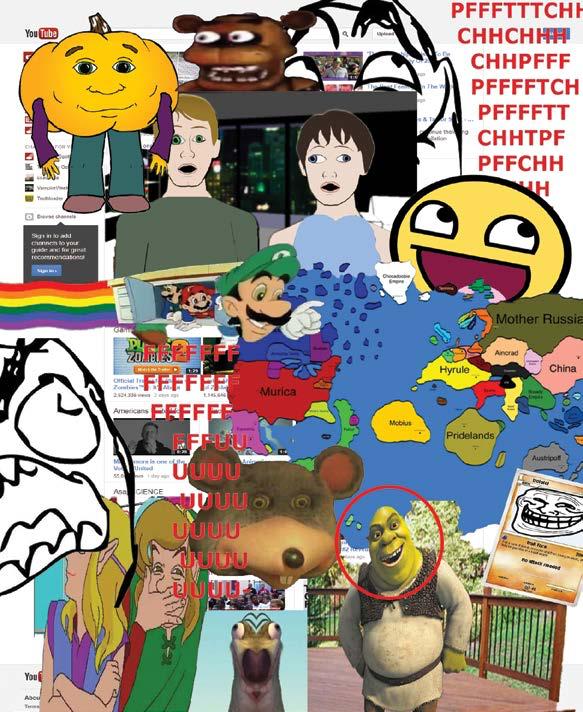
When I was younger, I was obsessed with YouTube Poop. Every evening I would sit trans xed in front of one of two computers I shared with my family, and let the images ow over me. No doubt my parents were concerned, or at least confused, by the cacophony of discordant and loud noises that emanated from the dining room or the bedroom I shared with my brother. I imagine that they would not have approved of the foul language that was emanating from classic cartoon characters like Spongebob, made to say words like ‘fuck’ or ‘shit,’ or how the sudden elevations in volume may a!ect my eardrums. Or better yet, how these ashing colours and strobe-like visuals would dry out my eyeballs.
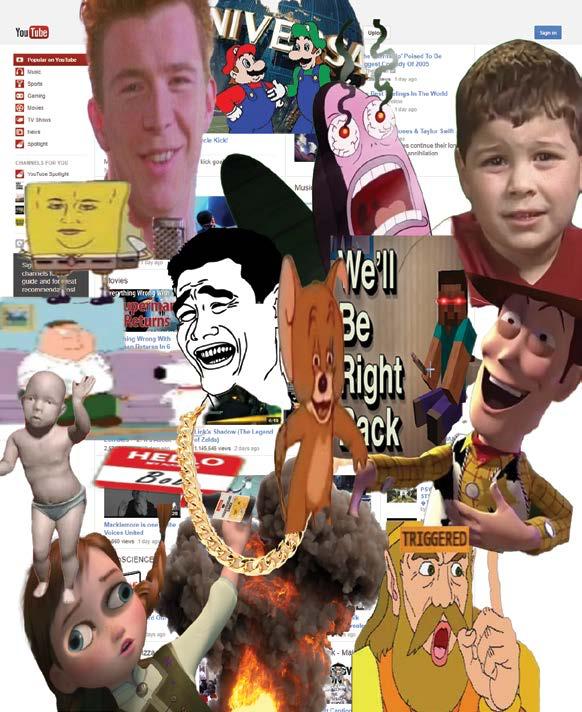
You may not know YouTube Poop, but you can certainly recognise it. It’s around us all the time. e above description could have come from any era of Gen Z internet, whether from staying up late consuming brainrot Instagram reels, or sharing dank memes on Facebook in 2016 from some account called ‘viva la memeolution 2: electric boogaloo.’ YouTube Poop is the pre-eminent de ner of our visual language in the Age of the Internet. Fast-paced content, rapidity of images, an eternal owing out of recognisable memes and iconography. It all began with an edit.
YouTube Poop (YTP) sprung from internet forums in the mid-2000s, but found a place on the video streaming platform YouTube (hence the name). An edit of !e Super Mario Bros Super Show inspired other anonymous users to share their edits, made possible thanks to the concomitant emergence of cheaper at-home video editing so%ware. Soon YouTube was ooded with similar edits, and no doubt you would have seen some of these in your time, or recommended to you by the almighty algorithm. Youtubepoop: Toy Story Poop1 , Youtube Poop - What is Spaghetti?2 , Youtube Poop: Everybody Loves MAMA LUIGI for dinner3 . Rudimentary in nature, these edits carved out a signature style and were recognisable to anyone trawling through the net.
Besides the moniker of YTP and recognisable memes and phrases such as ‘spadinner,’ ‘mama luigi,’ and ‘spingebill,’
1 MrW00fers. Youtubepoop: Toy Story Poop. YouTube.com, 2008.
2 Lindblom, Je! Youtube Poop - What is Spaghetti?. YouTube.com, 2007.
many videos would feature sporadic cuts and edits to repeat a single word or syllable, reversing clips, changing around the letters and words to make a character say something they didn’t, and the sudden elevation of noise to unbearable levels. ese techniques had names in their community: stuttering, sentence mixing, and ear r*pe (it should be noted that, as a relic from the early 2010s, a lot of terminology is insensitive). As YTP became more proli c, and editors exed their skills, it became more complex, the edits more sporadic, and the connection between the original source text more abstract. Users such as IMAPERSON, MycroProcessor, OrpheusFTW, MountainDewMaNN, and madanonymous pushed the form and turned what was a weird internet meme into something resembling an artistic genre of the video medium.
I remember upon discovering these videos I immediately set about making my own. Using rudimentary editing so%ware such as Windows Movie Maker, and editing the only source of videos I had on hand (home movies shot by my brother and I on our family camcorder), I began to remix, rejig, and edit these videos. Over time, I learnt how to use so%wares such as Sony Vegas Pro and eventually Adobe Premiere. I downloaded episodes of SpongeBob and laid them down on the track. I knew the list of plug-in e!ects available on Sony Vegas like the back of my hand. I could shi% the axis of the frame, splice together incongruous footage, make Patrick say ‘cum’. Reality could be bent to my will. I became a pooper.
Poopers, the term used for creators of YouTube Poops, forged a community forum to engage in discussions of all things Poop. No longer available, YouChew.net hosted a hub of threads and forums. Poopers had codes of ethics. ey supported piracy, they refrained from bullying newer members and instead welcomed them as they were learning the ropes. Within YTP there were various sub-genres. Some poopers stuck with their particular niche while others branched out.
YTP Music Videos (YTPMVs) would edit clips to sync up with a song, or they would pitch the sounds of the clips and remix in a way to make a new song entirely. YTPMVs were so
3 umbsy. Youtube Poop: Everybody Loves MAMA LUIGI for dinner. YouTube.com, 2007.
IN THE AGE OF DIGITAL REMEDIATION
popular they even branched o! into their own community with prominent users, inside jokes and recurring songs. Some classic YTPMVs include Ronald McDonald insanity4 , Robotniktrousle5 , Soldier Vs. Masked Spy6 , THE JOJ7, and PATRICK USED TO AVAST ASSES, THEN HE TOOK AN ARROW IN THE KNEE LOLOLOL IM FUNY AINT I XDDD!8. YTPMVs never fail to inspire awe in me at the level of time, skill, and dedication it would take to nd the perfect sounds, clips, and audio to create something that sounds melodically perfect.
Tennis Poopers would o%en go back and forth editing each other’s videos in what were called ‘rounds,’ the number of which would be agreed upon by the users. e rounds could go on for as long as they wanted, and the number of users involved could be just as large. I remember being a part of a 20 round match between 5 di!erent poopers. e videos would be edited beyond comprehension. ere was so much joy in seeing the original source video turned into a kaleidoscopic collage of loud sounds, bright colours, and amorphous shapes with each passing round. ere would be no winners in these matches, it was all in the name of friendly competition.
Of course, these techniques and styles are nothing new. Remix cinema has been around as long as cinema has existed. As soon as George Melies realised he could allude audiences by splicing his footage of a simple magic trick, his subject
could be manipulated behind an editing desk. At the same time, it proved that with cinema, the nal re–write occurs at the last stages of production. Dziga Vertov’s Man with a Movie Camera (1929) is an early remix lm, superimposing street scenes to have cities folding in on itself, speeding up and slowing down footage, cross cutting to create associations between contrasting images. Despite crediting Vertov as director, one could argue that it was his wife, the editor of the lm, who could be the real authorial voice of the lm. Karen Pearlman’s short A er the Facts (2018), highlights that the editors of a lot of early cinema were women. At the same time, sampling has long been used in hip-hop, a technique that YTPMV nds its basis in, and points to the ways in which a lot of innovative genres o%en build on the innovations made by women, African Americans, and other marginalized groups.
e remix lm as we know it today emerged in the 1950s with Bruce Conner’s A Movie (1958), which combines various incongruous clips together to stitch together a humorous narrative. Other remix lms o%en use the viewers’ awareness that these clips have been taken out of their contextual milieu, to elicit humorous or shocked reactions. is is not too dissimilar to Dadaism, and the ways in which artists of this movement would use collage techniques and deliberately avoid any explicit meaning in order to speak to a particular time and place in post-WW1 Europe.
So too, does YTP draw on pre-existing material to elicit responses from the viewer, o%entimes using nostalgic TV shows and remixing them for comedic purposes, humour arising from the knowledge that these clips have been altered since their last memory of them. Meanwhile, poopers o%en dismiss any attempts at intellectualising the genre. Academics such as David Bailey9 attempting to nd a message to the madness ended up nding their own videos remixed10. e snake eats its own tail.
What YTP o!ers us that earlier forms of art do not is the way its aesthetics can speak to our particular milieu in the Internet Age and the proliferation and over-consumption of information. At the same time, in a period of corporate oligarchies, and capitalist control over images and content — be it via streaming services or video sharing apps — embracing the remix means taking back control over our content. Before I explain this, however, I need to explain the current media space we nd ourselves in.
4 mrhorseshoe. Ronald McDonald insanity. YouTube.com, 2008.
6 Wazgul. Soldier Vs. Masked Spy. YouTube.com, 2010.
7 Cs188. THE JOJ. YouTube.com, 2010.
8 Alex Tristan. PATRICK USED TO AVAST ASSES, THEN HE TOOK AN ARROW IN THE KNEE LOLOLOL IM FUNY AINT I XDDD!. YouTube.com, 2014.
9 David Bailey. Youtube Poop Manifesto. YouTube.com, 2010.
10 chemistryguy. David Bailey Talks to his Hand. YouTube.com, 2010
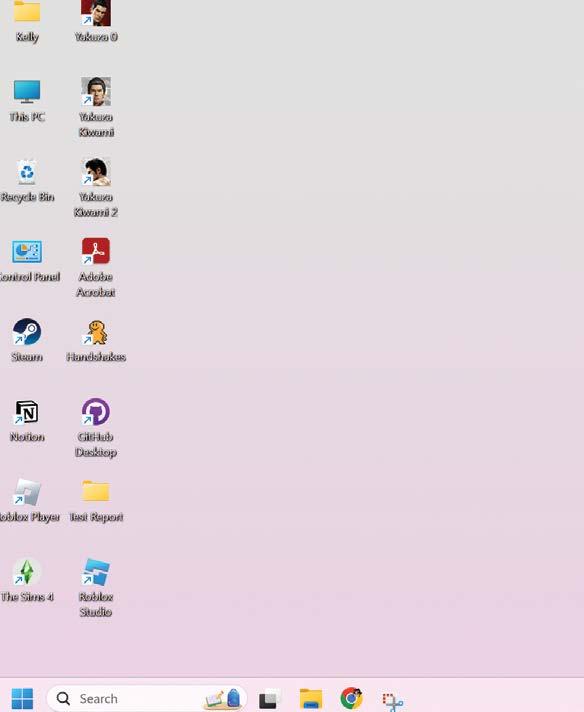
Jay Bolter and Richard Grusin attempt to describe our changing relationship with media over time in their book Remediation: Understanding New Media9, by using the terms immediacy, hypermediacy, and remediation. Immediacy is a direct relationship with the world of an image. You have a painting of a landscape and it is rendered in a realistic way to bring you closer in proximity to that landscape. ey act as ‘windows’ to another world. According to Bolter and Grusin, however, “[i]t is important to note that the logic of transparent immediacy does not necessarily commit the viewer to an utterly naive or magical conviction that the representation is the same thing as what it represents,” but rather a “contact point between the medium and what it represents.” (p. 30) When thinking about YTPs we can consider an unedited piece of source material as o!ering us, generally, a sense of immediacy. A typical cartoon show will not undercut its own sense of reality or the viewer’s connection to its world like a YouTube Poop might.
Hypermediacy on the other hand undercuts this transparency. Bolter and Grusin use the example of a desktop, wherein right clicking on something might produce a text box. In this instance, you have a visual eld of icons interrupted by the literary world of drop down menus and text boxes. “In current interfaces, windows multiply on the screen: it is not unusual [...] to have ten or more overlapping or nested windows open at one time.” is “heterogeneous space” of “[i]cons, menus, and toolbars [...] Unlike a perspective painting or three-dimensional computer graphic, [...] does not attempt to unify the space [...]. Instead, each text window de nes its own verbal, each graphic window its own visual, point of view.” (p. 32, 33) Representation is thus, “conceived of not as a window on to the world, but rather as ‘windowed’ itself”. (p. 33) In this way, this is what happens in a YTP when text appears or multiple source videos appear in one. Here, our visual relationship with the source material is being interrupted by not only multiple other visual sources but also auditory and written sources too.
At the same time, however, “the logic of hypermediacy” is to “express itself both as a fracturing of the space of the picture and as a hyperconscious recognition or acknowledgment of the medium.” (p. 38) In this way, when watching a Poop, not only are you aware of the various media interacting within the video, but you are also conscious of the construction of the work by the user in the editing of these clips.
While hypermediacy may borrow mere images or sources,
remediation aims to represent a medium in its entirety. At the same time, these windowed worlds o%en remain separated, there is a clear border separating the cut-out piece of a collage or a desktop window, whereas in YTPs these borders dissolve and the distinction between one medium and the next is blurred. “ is tearing out of context,” Bolter and Grusin suggest, “makes us aware of the arti ciality of both the digital version and the original clip. e work becomes a mosaic in which we are simultaneously aware of the individual pieces and their new, in-appropriate setting. In this kind of remediation, the older media are presented in a space whose discontinuities, like those of collage and photomontage, are clearly visible.” (p. 46-47) Remediation is all about feedback and user interaction, the rendering of something old through digital processes, with YouTube Poop existing as an essentially digital version of this process. Digital remediation takes the old, swallows it, and ‘poops’ it back out. It is, as Bolter and Grusin suggest, the “de ning characteristic of the new digital media.” (p. 45)
is description could easily apply to a YTP, wherein the medium of lm, audio, video, etc. are run through digital programs and edited, divorced from their contexts, made to shi%, stretch and interact, their discontinuities made apparent.
Just as YouTube Poopers attempt to remediate older mediums such as lm and television, lm and television can seek to remediate YouTube Poops: “remediation operates in both directions.” Luiz Eduardo Kogut’s Videotape10 (2018), for instance, is a montage lm overlaying various videos captured both on computer screens and out in the real world. e not quite opaque image gives the illusion of staring through a window, with the lm directly drawing attention to this at various points, such as the re ective surface of the computer or the laundromat dryer. e lm trips viewers up with its meta-textual framing. Several times when the cursor on the screen or the YouTube timeline popped up, I had to check I wasn’t interacting with my laptop at all. Kogut’s short utilises the remediative techniques of YTP to create a beautiful and emotive piece that blurs the lines between di!erent media and digital spaces. Windows inside windows, and it all collapses into something that touches the soul, but I can’t quite explain why. Jon Rafman’s SHADOWBANNED11 (2018) more closely resembles the random combination of sights and sounds we’re familiar with. But here, we go behind the walls of the digital archives, rendered through 3D modelling as both an ancient ruin and an endless series of hallways, full of wires draped across the oor ready to be tripped on, and sparks ying out everywhere. Rafman’s short embodies the chaotic nature of being ‘plugged in’, and evokes the scrawl of conspiracy laden posts that ood our social media feeds, with a constant cutting of images drawn from various sources, too much information for one person to fully comprehend. Here, the techniques of YTP are made to embody a di!erent psychological state, not one of tranquility, but of horror. is idea of entire
11 Bolter, Jay David, and Grusin, Richard. Remediation: Understanding New Media. MIT Press, 2000.
worlds within the video recalls Yabujin’s AZEROY14 series, which speaks of the eponymous Azeroy as some mystical land locked behind gates. ere, “everyone is happy in Azeroy,” there are “no broken bones in Azeroy,” and “all of my wishes” are in Azeroy. e series becomes a pilgrimage of sorts to an Edenic paradise, or perhaps we are already there. Again, images and videos weave in and out, creating associative ideas, at times comforting and other times unnerving. Despite YTP no longer being as prevalent as it once was, you can still nd its traces in meme videos while scrolling through Instagram or TikTok, the random, excessive miscellany of abrupt sounds, images, and text reminding us of its predecessors. “No medium, it seems, can now function independently and establish its own separate and puri ed space of cultural meaning.”
In our era of seeming in nite possibilities, source material is increasingly cut o!. Films are cut from release schedules and pulled from streaming services. Remediation is important as it relates to remix culture and the ght against copyright law. Remediation, as the de ning characteristic of our modern media culture, is useful to understand in relation to the terms RO and RW culture that Lawrence Lessig introduces in his book Remix: Making Art and Commerce !rive in the Hybrid Economy15
Here, Lessig is borrowing from the computer terms ‘Read Only’ and ‘Read/Write.’ He is suggesting culture is de ned as either ‘RO’ or ‘RW’. In an RO culture, artistic objects are created by a few specialised people and handed down to the masses for consumption. In a RW culture, artistic objects are created in the same manner, but the consumer goes away having absorbed that and then creates something new from it. e best example would be hearing a song, then singing it yourself. In this process of singing — this amateur creativity — you are learning how to sing, how to produce music, so that the world may gain more musicians, and more creatives.
RO culture dominated the twentieth century due to the limits of technology. Creating music was limited to the elites because to create your own professional remix of a song required massive amounts of money unavailable to the average consumer, and the same applied with remixing cinema. Copyright law was also in place to protect the lenders of these cultural products, and to regulate consumers. Lessig traces a history, then, where technology and the elites come out of lockstep. Soon, technology becomes cheaper and easier to access and use. Nowadays, anyone can edit an episode of Spongebob on their
computer as long as they have an Adobe subscription (or if they pirated it). e Internet lends itself to a democratised RW culture that copyright law is falling behind in working with.
Remediation is the perfect exempli cation of RW culture rendered digitally, with YTP as the zenith of this history of remixes that have been going on seemingly forever. A lot of poopers would be hit with copyright strikes on their videos despite the obviously transformative nature of their work. In a way, their garishness and abrasiveness could be seen as the ultimate rebellion against copyright law. What they are attempting to create is not another product that can be so easily consumed as something like sampling in mainstream hip-hop. e aim is to transform, to destroy, to play, to put the product in the hands of the creator, and mix it like silly putty. To stretch, to bend, to dissolve the boundaries. is is exempli ed in the poopers’ deliberate attempts to eschew meaning.
YTPs are what’s le% when an increasingly RW culture must t within the restraints of an outdated RO culture, in which elites hold on to the power and money that limits creative freedom: it is shit, it is poop, it is YouTube Poop, it is the detritus of our internet, and RO culture that has festered and risen to the surface. rough remediation we can ght against the RO world that copyright creates — remediation is exactly this process of taking things, creating something new and feeding it back into culture that Laurence Lessig argues for.
***
Regardless of whether you are ghting the oligarchies of copyright ownership with piracy or you are burning your retinas right before bed with a healthy dose of brain rot, YTP speaks to our current moment as a culture dominated by internet aesthetics. Past media have been consumed and regurgitated and consumed again in this massive digital soup of ones and zeroes. Our visual eld is constantly bombarded by screens, and those screens are divided within windows upon windows of content. Despite emerging as a genre in the early 2010s, and dying a slow death, these aesthetics have not died, and mainstream media is slowly catching up, and as more lmmakers who have grown up on these videos start to make their mark on the industry, we may see more and more of the YTP aesthetic in these coming years. While my pooping days are over, I can’t say these videos haven’t a!ected me profoundly, and made me look upon the world with newer, more fragmented eyes.
14 Yabujin. AZEROY. YouTube.com, 2018. 15 Lessig, Lawrence. Remix: Making Art and Commerce !rive in the Hybrid Economy. Penguin Press, 2008.
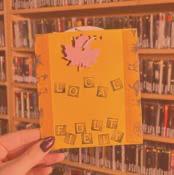
TOP TEXT BOTTOM TEXT
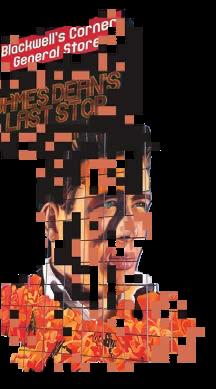
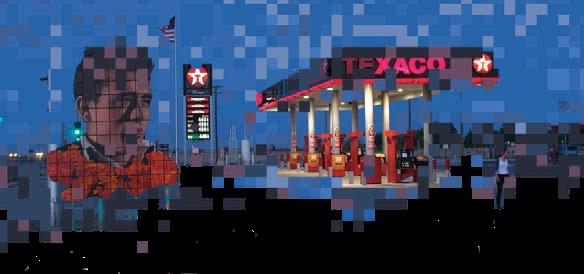
There’s an intersection between Los Angeles and San Francisco that I think about a lot. It’s next to Blackwell’s Corner — the very last place James Dean visited before he died. ere is a giant cut-out of him beside the road; his blasé impression remains a constant image in my mind. e image has been stuck there since the beginning of 2018 during a family trip to the USA. We had own into San Francisco and spent ve days there before driving down to Los Angeles. It was on this road trip that we came across the intersection in Lost Hills, California — completely by coincidence.
I remember standing by the huge cut-out of James Dean with my sister, living in a moment of immortal jelly as Mum snapped a picture of us beside him. I remember looking up. Feeling a bit funny. I remember the faded red
‘TEXACO’ sign, the slowly scooping sun, and the way the clouds smiled back at me. e winter breeze was sweet, and streetlights were sparse in the fading sunlight. e air turned cool as the so% roll of car tyres crinkled with each passed-over pebble. My little red boots were dusty in the gravel, kicking up smoke as I walked through the carpark, trailing a%er Dad.
It felt exciting in that place; like more. A more that dri%ed down from the stars in the sky and tickled my heart: a cold warmth. e feeling was fond, even in its disconnection. It was so% and it was quiet. I couldn’t always place that moment in time, or restrict it to the past or the present. It felt like a moment removed from time entirely. It was too plural, too arbitrarily connected, for me to reduce to a point in time or space. I miss that place now, and wonder whether it would be the same if I went back. I miss that moment, miss myself. I miss people, but maybe I don’t. I don’t miss anyone, I think. Maybe I just miss.
James Dean’s shadow shook so%ly in the wind. Trees and tu%s of grass bordered the petrol station; the plains surrounding were void. I felt as though my brain was gone and my heart had taken its place. I thought only through feeling and the feeling hurt. But it was a good hurt that made me think; a hurt that made me wonder past the sky.
17191
I remember feeling a need to label that physical intensity. is intensity that morphed into a sense of overwhelm so consuming I felt that nothing could be funnelled into a singular actuality. I let that feeling — whatever it was, consume me. And in the jumbled throws of it, I caught a depth in the sky. A depth that came from the amounting of seemingly meaningless moments to that of a whole. I watched the intersection become that whole in the front of my mind; those mundane fragments amounting to a complete.
I wondered if it was just me feeling all these things as I walked into the gas station with my sister, our parents in front of us. Inside, there was silence and ickering lights; statues of elderly women with wide eyes and aquiline noses o!ered us their palms. I went quiet, took my little sister’s hand. Pickled eggs lined plastic shelves and red-topped metal barstools stood tucked under the diner counter. Flickering uorescent light emanated from above; my eyes pulsated
beneath my glasses in specks of purple and green. It was all unfamiliar as our new sneakers squeaked against the patterned linoleum.
We washed our pale hands in the powder blue sinks of the gas station bathroom. Country music crackled through the speakers. My sister’s giggles echoed through my brain, tugging at memories of us talking about how much we despise that genre. e memories felt too distant to grasp as she stood there right beside me — I couldn’t hold them; they fell through my hands like purple soap. e music never le% the bathroom: it paused in time and space with her and me. e feeling was intense then. I shivered as I made eye contact with myself in the mirror, lowered my gaze as I watched the nal soapy suds slip down the drain.
I remain unable to properly articulate this feeling. is feeling of more that hints at a beyond in some weird way. A way that feels collective, but also not at all. I still feel that feeling. When I’m sitting in the shower; mid-way through a ballet class; sitting on a park bench, drunk with my friends — it eats at me all the time. It hasn’t stopped since I visited that intersection seven years ago. I do new things, acquire new hobbies, make new friends, yet constant it remains. And I still can’t tell if I like it.
As the four of us walked out of the gas station, I remember the LED sign next to James Dean’s cut-out: ‘FRESH FUDGE.’ It was ickering over and over through so% clouds of dust; bright yellow as it snapped like glow sticks. I remember watching as pale sunlight fell on the gas pumps and the sky turned a deeper blue. I remember the frost in the air as I stood by the car, and how I paused for a moment before I got back in.
e so% crackle of the radio fell into the moment. Tra c
lights glowed red in the square of the intersection. Each road expanded out to nothing. Only mountains were visible far to the right. Big green street signs went dull as we passed them: the speed was at sixty- ve. Wires stretched over top, above and across the broken white lines. ere was a grit to the highway; dust settled across the car window under rays of cool violet light. I remember glancing at my sister beside me, tapping her hand. She took my palm and squeezed it while our parents chatted in the front seat. She told me she loved me while her head faced toward the window, hair messy with unbrushed kinks. I asked her if she felt any di!erent there, but she just turned and looked at me funny, her face ivory in the early moonlight.
I wondered then why it was only me stuck with that feeling. She was there too, just as I was. And though I’ve asked her about it many times since, she doesn’t remember. She doesn’t remember the feeling that stayed for the rest of the car trip. She doesn’t remember how it took up the seat between her and me.
e stars were milky white in the darkness, baby teeth all shined up. Headlights were bright, streetlights sporadic and dim. Darkness enveloped plains of mottled grass and ‘NO TRESPASSING’ signs with tipping letters we kept passing by. e road invited me into a warm calm that lusted over the intricacies of my mindscape as we sped along the empty roads of California. I remember the feeling coming and going, fading in and out with each slight hill. Remnants of the feeling travelled with me to Big Sur, but they faded on the Golden State Freeway into Los Angeles. I wonder, now, if the feeling is embedded in that place: the place before Los Angeles where everything empties out the side of the mind, and you become lled with a di!erent feeling. A feeling that is perhaps easier to categorise.
Cross-Cultural Conversations
Kyoto’s National Museum of Modern Art
Sasha Blackman
Sasha Blackman
Memento
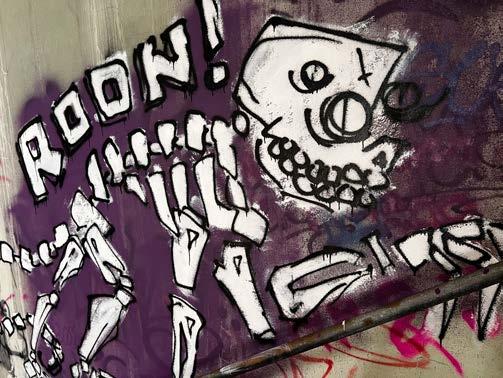
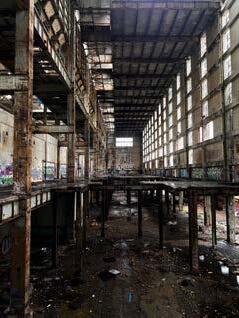
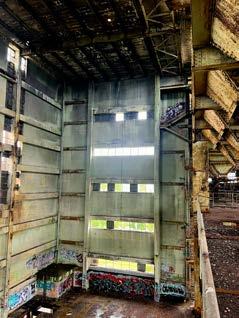
is one in particular was painted with 3 di!erent colours of high-pressure acrylic gloss spray paint on a concrete wall under an hour, eight storeys o! the ground in a famous urbex location just out from Newcastle, the only real preplanning was deciding colours and “wow, I’m going to paint it up there!” e tail, claws, and extra eyes are improvised. And if I’m lucky it’ll be a couple weeks before someone else comes and paints over it. Hopefully someone else thinks it’s cool and snaps a picture before then.
I bougt myself a wiping boy
Mo Sturgess Giddy
◊ Three fake tampons — actually plastic vials wrapped in plastic that say TAMPON TAMPON TAMPON on it, used to sneak an accumulative single shot of vodka into year ten formal
◊ one box of hair rollers
◊ one set of The Wiggles bedding for a twin single
One empty bottle of cranberry juice — beating both water and coffee in yearly consumption rates thus far
Two screws/nails/bolts? — unknown origin, unknown home, unknown usage
One hair tie — snapped, then knotted together, snapped again in a new breaking point but not in the bin
Three used tissues — not in the bin
One receipt — Chemist Warehouse $14.99 Norlevo 1 1.5mg Tablet 1 - Levonorgestrel (S3), in the bin
One 2024 journal — orange glitter pen scrawl. Dear Dumb Diary, this year I am going to start running really I actually promise this time I’m going to be a whole new ft person and people will see me and think who is that she’s ft I bet she doesn’t even exercise and that’s her natural body but they will be wrong and it will be a lot of effort. p.s. we don’t like Jess anymore, I can’t remember why but it was serious. A mosaic of record covers — curated perfectly to draw in an earring toting boy, leading in an arrow to an awaiting bed, pulling him by his belt loops with promises of J. J. Cale and Jonathon Richman, yet blu-tacked to the wall in such a manner that a single knock will send them careening down on whoever dares to sleep below them
One spray can of Hello Kitty deodorant — almost empty, mildly dented, used as bug spray
Three bottles of expensive perfume — from three separate birthdays, but the same Aunt, full to the brim, standing in a popular girl thruple. You’ll have to buy more of the Hello Kitty stuff for bug spray, this stuff will only mean that you can smell when the cockroaches are approaching, it won’t kill them
One glass bottle of musty perfume with a swirl lid — gifted to grandma for her birthday then subsequently left to me a few months later. It doesn’t smell like her, I don’t think she ended up wearing it more than once
One bottle of cinnamon extract — much smaller than the others, for baking, smells like me
One cardboard box flled with objects that smell, feel or look like a certain day, in order from earliest to latest
◊ One sparkly pink translucent lego block
◊ One small toy of Winnie the Pooh dressed as a zebra
◊ One drawing of a love heart that looks like a pear. Maybe it’s a drawing of a pear,
◊ One letter written on origami paper with a signed BBFL contract
◊ One pressed lavender fower
◊ One EOS lip balm
◊ One sticker from the wheel of a BMW
◊ One note on lined paper, water stained, that might say “pass to Mo” or “that’s a no”
◊ One empty mint Tic Tac packet
◊ One crushed silver ring, no longer a ring, now the letter B
◊ One coaster
◊ One student discount fyer for buy one, get one free Gillette razors
◊ Another coaster
◊ Seven bus tickets in Italian
◊
One letter in good condition, always folded along the same lines, signed “I love you”
Best before date
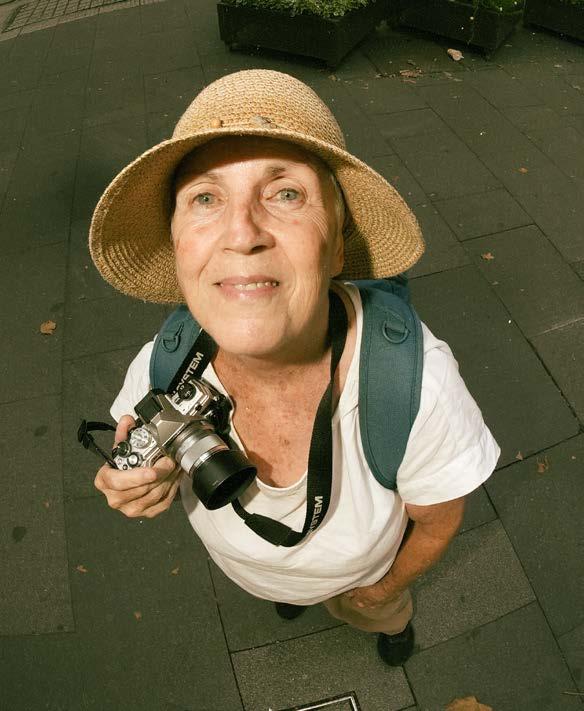
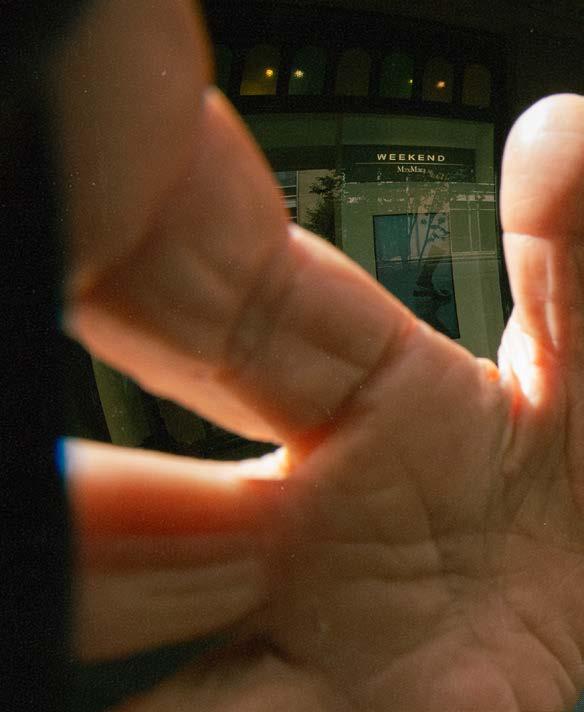
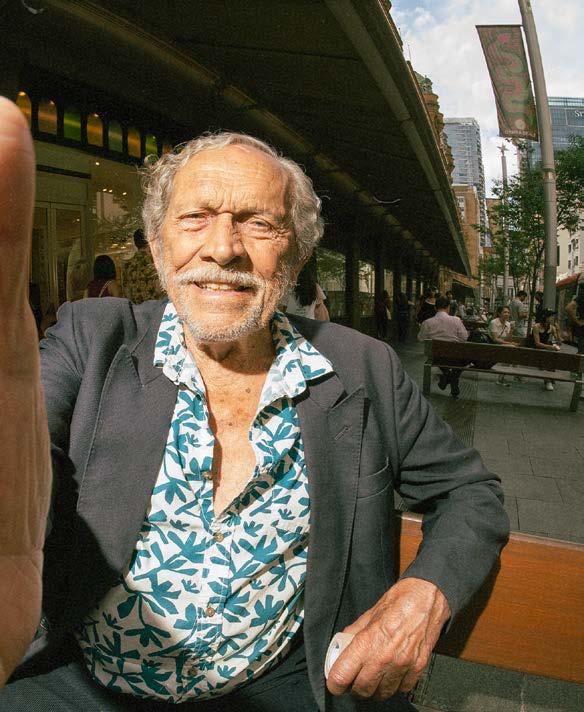
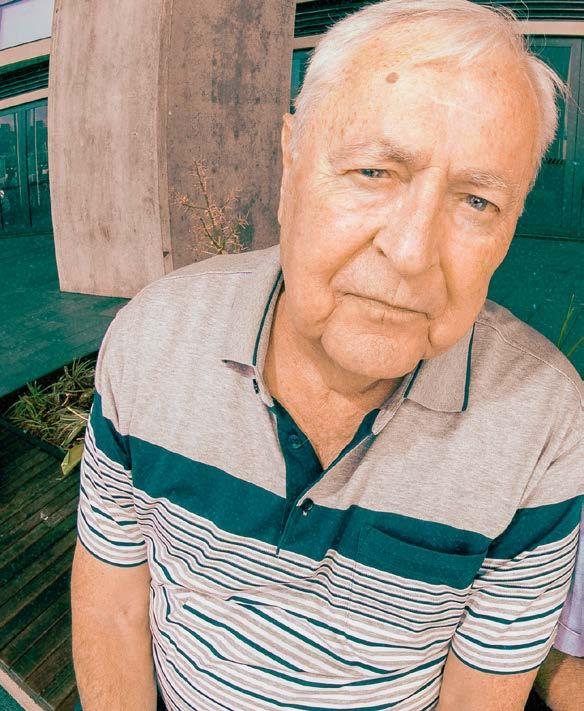
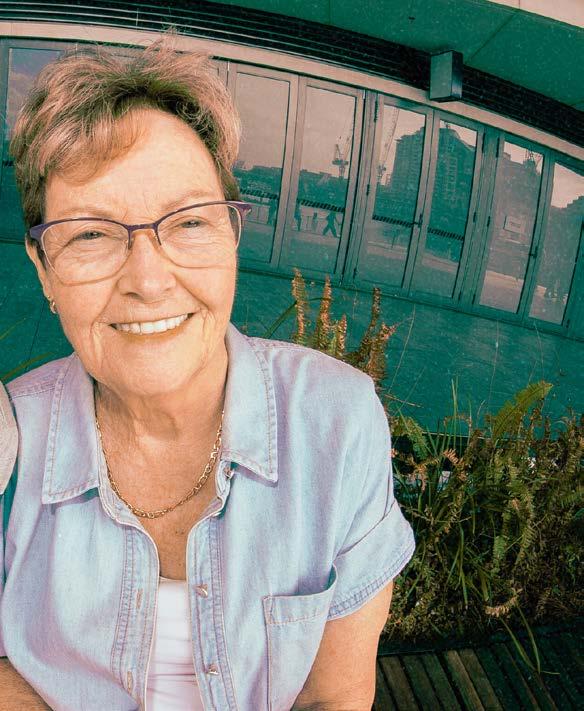
roughout history, humanity has obsessed over the fruitless pursuit of holding onto youth. Partly due to vanity and partly in fear of our own mortality. is series of street portraits explores that xation through a dialogue of young and old.
A sheye lens was chosen to recontextualise imagery of seniors with an aesthetic typically reserved for skaters, rappers, and extreme athletes — marrying old age and the inner youth I found in the people I came across on a quiet Sunday a%ernoon.
Shot across Newtown and Sydney CBD, thxe series captures subjects in their everyday environments. Initiating with a smile and then a chat, each participant opened up to me about their life story and re ections of youth.
Sylvestre Lattao
e velvet on the walls. It is wine red with a tinge of purple and a hue of wealth.
e women are dressed in their nest attire; cocktail dresses, with pearls and diamonds that shimmer in the lights of the theatre chandeliers. e men ensured that they match their suit ties to the colour their prospective partner is wearing.
e buzz of chitter-chatter below us is loud, and the clinking of champagne glasses lls the vast spacious opera house. e intricacies of the architecture exude the hundreds of years of artistic beauty, while also making sure we understand that we no longer have it in the way we once did. It feels depressingly nostalgic. I’m lucky enough to be sitting in one of the boxes. One of those balcony-type things.
e hum of pleasantries die down as the lights dim. Darkness blankets silent faces looking to the stage with anticipation. e band in their pit makes a scutter of movement as string players raise their bows, wind and brass instrumentalists take
It is wine red.
their rst breaths, and the conductor lowers his hand to notify the players of their rst note. e curtains on the stage pull apart. ere are a couple of women in majestic costumes. Skirts, with ve layers of fabric, drown the women stuck in them. eir dresses are beige, but the details are incredibly delicate that the lack of colour doesn’t even matter. eir silhouettes are alluring, with their hair in half-up, half-down braids. ey take a breath and begin singing in harmony.
A er een minutes of the show, the women are still spinning and singing beautifully. I turn to Atticus. His eyes are glued on the stage. I love the show, but I’m starting to get bored. I turn my eyes back to the stage. A man has appeared suddenly in pantaloons, dancing in circles while he sings. His voice sounds deeper, but there is no real di erence between his words. I take a sip of my champagne and listen intently. I’m trying to understand what’s happening, but I wasn’t brought up in an opera-loving house. I’m only really here for Atticus. I ick through the programme to nd the brief summary of the play. Allegedly, it’s a comedic drama that re ects the ‘love of life.’ I don’t know, it sounds cliché to me. I’m trying to focus, but the seats are really uncomfortable. I lay my hands over the barrier and wait for the show to interest me.
I feel a drip of liquid on my skin. It falls from above me. I wipe it o passively, with my eyes still on on the stage. A little giggle falls from my mouth as the actors pretend to punch each other and bicker like brothers. e show continues. I feel another drip of liquid. I wipe it o again — it is beginning to become tedious. It happens again. is time around, it’s a bigger drip. I take a look at my hand. It’s not water. It’s thicker than water. I wipe it with my other hand to take a deeper look, but it leaves a smear of sheer colour. It looks almost brown. I can feel my eyebrows knit. I pull my hand to my nose to smell it. It is sweet and metallic. Atticus isn’t even looking at me while I wave my hand around trying to gure out where the drips are coming from. ere’s a small, wet, dark red patch on the ceiling.
“Atticus,” I hiss at him, as I gently tap his shoulder.
He leans into me and pushes his ear closer to my mouth.
“ ere’s blood falling from the ceiling,” I show him my hand and point to the blotch of crimson on the cream painted roof above us.
He limply throws the back of hand in my vague direction and rolls his eyes, “Just watch the show.”
I do as I’m told.
I turn back to the show. I’m trying my best to put it at the back of my mind. e dripping speeds up. I can no longer ignore it. I tried to, but it’s splashing on me. It infests my nostrils and nests there. It is now falling at the same beat of the song. I look up once again to see the stain on the ceiling is spreading and spreading rather quickly. I turn to Atticus, he is stonefaced. I poke at him, trying to get his attention, but he is engrossed in the show. A little bit too much. He doesn’t even acknowledge me this time. I look at my pale blue dress. It has splatters of blood, which is not exactly a civilised look. I need some air.
“I’m going to the bathroom. I’ll be back soon,” I informed Atticus, thinking he’d respond.
He sits there, staring at the stage with no movement in his expression.
“Okay then,” I mumble annoyedly as I open the door at the back of the box.
I make my way to the bathroom. My breathing is getting heavier, and quicker. My heart is pounding. ere’s a thudding in my ears. Hands are shaky. Eyes are wide. Vision is blurry. Breathe. Just breathe. I take a few deep breaths. I focus on my re ection. I think this is a bad dream. Or maybe a hallucination. I’m unsure what I am thinking. But the red on my blue dress is still there. It’s still there. I throw cold water on my wrists, I’ve heard it helps regulate the nervous system. Does it? Has it? I close my eyes and list what I can hear, what I feel, and where I am. It’s okay… I’m okay.
I lean into the mirror, ensuring that my makeup still looks fresh through the sweating. A drop of wet blood is perched on
my cheek bone. I’d wipe it o!, but I don’t have my makeup bag to touch it up. I dab it in, melting it into my foundation. I de nitely need to buy blush in this shade. I pat down my dress, tilt my head to make sure I look put together and make my way through the hallway. e roofs are rounded, with yellow lights perched on the marble gargoyles in the corners of the stairwells. I get back to the door of the box and let myself in. I give Atticus a quick over-the-shoulder hug… again, no reaction. e show is now building up to, what I assume is, the climax. e music is becoming more ominous. It’s transferred into a minor key — I am lled with dread?
I sit in my seat and the blood has become a stream. It’s splashing on me heavier now, my arms are covered in red. e songs continue. I look around the theatre, skimming every face I see. No heads have turned to the ow of blood falling heavily down to the rst oor.
In the background of the play, I can hear a scream. I get out of my seat and look down. I can’t see anyone screaming. No one else is hearing it. Do they hear it? Do they see the blood? Am I going crazy? ere are multiple screams and cries now. My breathing is getting heavier again. I’m panicking. Panicking. Spiralling. I bend over the parapet, frantically looking back and forth at the stalls to see if there’s something going on.
e heads below me, somehow still stuck looking in the direction of the stage, are painted with a thick, dark red. Some are wiping their eyes clean, while others are shading their face as though the sun is blinding them. e once beautiful hairstyles are no longer pretty and done up. ey’re doused with it. I feel a drip on my head. I touch it with my trembling hand, and look in horror. It’s on me. Not just a splash anymore, a whole spill of blood is on me. My eyes are shielded by a lm of salty water. I take a gulp and slowly tilt my head to see the ceiling. What was once only a patch of crimson has now seeped to cover half the roof of the theatre. e screams get louder as I look. Squinting my eyes to see through the darkness of the dim lighting in the seating area, I can see faces.
I see faces. So many of them.
I see faces. Screaming.
I see faces.
Crying.
I see faces.
Pleading for mercy.
e more I stare with my eyes wide and jaw open, the more faces I see. e blood continues to spread at a concerningly rapid pace. ere are faces of men. ere are faces of women. ere are faces of children. It doesn’t take long for the halls to begin ooding. One by one, the people in the stalls stand up as it reaches knee level.
“Atticus! Aren’t you seeing this?”
He isn’t hearing me. Maybe he does, but he isn’t responding to me. His clothes are sopping.
I grab his shoulders and shake him.
He hits my hands o! his shoulders, his eyebrows furrowing. He reaches for his opera glasses, zooming back into the show.
e actors slip around the stage while continuing their performance. e violins are muted by the wood growing fuller with the liquid, the wind instruments have to open their spit valves every minute, and the clean percussion sound is disrupted by the splashing. I try to focus back on the show. e screams are louder than ever. It drowns out the band. It drowns out the voices. No one is helping. I scream into the crowds for help.
Everyone turns their heads towards me in unison, apart from one woman in the box across from us. She’s hitting her partner the way I’m hitting Atticus. God, she kind of does look a bit hysterical. Is that how they’re all looking at me? Atticus nally looked at me as well. He looked as emotionless as before, but I grabbed his shoulders again and dagger my eyes into his.
“Atticus, please, we need to help them! Atticus, can you… hear… m…” My voice trails o! as I scan his face, petri ed.
His eyes are completely blank. I’ve never seen him like this before.
I stumble back, my lips trembling in disbelief. My back hits the wall and I turn my head to the crowd, hesitating to move my eyes from the man in front of me. I focus on some of the faces that are staring. Blank eyes everywhere. Blank eyes staring at me. I yell into the abyss of cold glares.
“Do any of you see this? e blood is lling this place up! ere’s blood all over you. How can you sit here and not see this?” I cry, with a mix of tears and watered down blood covering my cheeks, lips and neck.
As I am crying to the crowds, the music is still going, but the cries and screams are louder than ever. My face relaxes and I spit out a mix of saliva and blood. Now that I’m silent, everyone turns their head back to the show. e actor and actress are now singing to each other. One slips and her eyes go sti!. e other cries while he wraps his arms around her in embrace. e screams have become quiet and the blood has simmered down to just dripping once again. e actor’s song comes to an end and the curtains close.
Everyone in the stalls are praising the show. ey are all standing, ooded up to their stomach in blood. ose in the booths are sitting clapping, except for myself and the woman across from me. We give each other a knowing look. eir hands are red. As they clap, splatters of red ll the air.
I am slouching in my chair. And I stare past everything.
It is wine red.
e velvet on the walls. Looks as it did before, just wet.
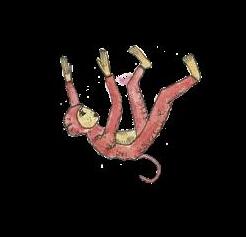
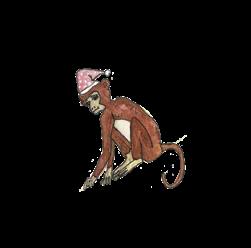
ere’s a game called Wall Kickers. You’re a little pixel monkey and you have to jump from wall to wall to move upwards — hence the name. Along the way up, you encounter holes in the walls which you fall through — leading to your death, spikes on the walls, impaling you — leading to your death, electrifying panels, electrocuting you — leading to your death; and so on and so forth.
KickOnOnGirl
Clara Medani(
Sometimes while jumping, you land on a surface moving incredibly fast, like a treadmill — you don’t have enough time to react, you’re falling. e fall leads to your death. It’s quite tragic. Sometimes the realisation that the ground is moving comes as such a shock that you ip the other way out of sheer terror. You realise once you’re falling, that you did it to yourself. If you were only calm and rational, it would have been okay. Your heart drops and your muscles seize and you go on kicking your way from wall to wall without inhaling a single breath — you are tense.
Before leaving the ground, the grass is neon and two millimetres deep. e earth underfoot stays solid and stern while above ground, blue birds hover on the timber staircase, overgrown with thick summer grass. Nature doesn’t demand anything of you, it tickles your back with a silk scarf.
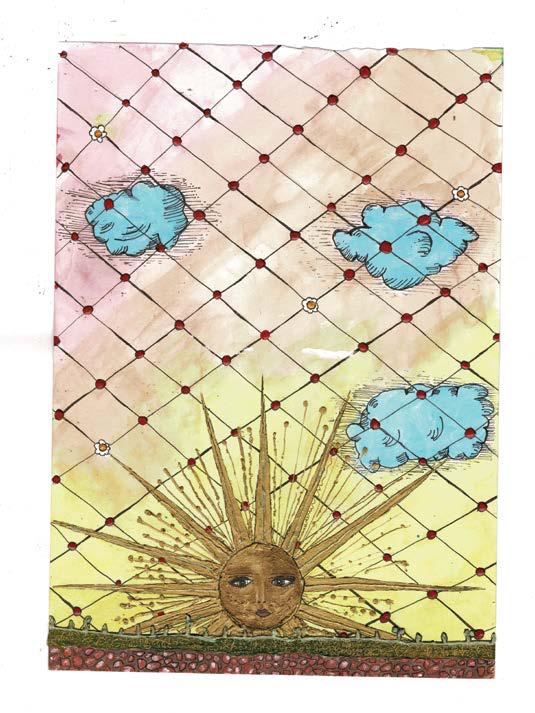
ere is always the debilitating awareness however, of an impending reality that you’re destined to meet, unable to prevent, and so burdened by the approaching of. You will die in this safe haven. You are standing on the earth on which you will die. Here is your killer. Some would call you a silly monkey, knowing only of your end yet jumping forever. But you can enjoy the garden and know that you will fall. Other than this small grievance, the grassy woodlands of Jungle Jumps are bliss. Anyway, you have a job. You — Jumpy Monkey — are Chief banana dispenser tester for NASA and you cannot stay on the ground forever. Before commencing e Great Jump, you relish in the warmth of the orange sky, and watch the pale blue clouds passing through one another like moving cars.
As soon as you leave the ground, you cannot return to that ideal. You begin to question if you’d even truly been there — if it ever truly existed. You never think about it again. From then on, you jump.
e higher you jump, the stranger things become. Your world is morphing and deforming, but you hardly notice. You don’t stop once to wonder how you look. You never try to catch your re ection. no mirrors here. It is quiet and empty, and you only have one motive; one purpose; one goal; one joy. Jumping.
And so you jump. But where are you jumping? You got so caught up on locating a clear space on which you could land; with kicking and kicking from wall to wall, calculating your jump’s brevity and depth, noting your airtime, controlling the length at which you drop before and jumping the opposite direction with the pure force of gravity and your sheer physiological excellence, you got so caught up in all this; you never stopped to wonder why you jump: what is up there? What are you so desperately trying to reach? No one told the silly monkey that a rainbow has no end.
is no nish line. You’ll never stop and feel accomplished. It never stops. e di culty of one stage becomes suddenly laughable when compared to the next. As you jump, your expectations that you have of yourself, they jump alongside you. Silly monkey does not know that there is a mean trick being played on him; the rope he’s trying to catch is being pulled by the human hand.
Sometimes you intentionally jump into open air until a split second before it’s too late. You like feeling the veins in your neck pop, the sudden absence of a heartbeat. For that split second, you are not yourself at all, you are nothing more than fear. You’re an animal, and you’re playing with re.
Clara Medani(
Sometimes you do too well for too long. You get cocky. You kick back. You deserve a break. You jump willy-nilly. You’re barely kicking, it’s more like swimming. Your silhouette radiates all the colours of the rainbow. You’re invincible, barely landing anymore. Blindly tapping walls with gentle caresses you shoot upwards and upwards until you’re impaled.
e play symbol bulges stupidly before the sub-saharan beauty of your jungle. Is heaven nothing but a blank slate? THE END. Play again? What’s wrong? Why are you crying? Here is a gi%, do not dwell. Here, a new environment. Let me lead you to a new life. You can always begin again.
You’ve moved on to the mystical world of Celestial Skip. With this new life, you are a new person. You are a cat in space. e mobile game would excel by having the option to acquire a space helmet for the cat skin but one cannot have everything I suppose.
As you oat, you never truly leave that garden. No matter how fast or high or mindlessly you jump, you are calm. You past colossal planets patterned with deep shades of stone and metal. ey hover behind you as great statues do. You have time to admire them as you move. ey exist beautifully. No one expects them to be, but they are. Isn’t it enough just to be beautiful?
Considering all this, you jump And jump
dotted by sporadic beeps. Gravity works erently in space. Your heart does not race, and neither do you. Your muscles do not tense. You really are swimming now. e beeps echo your heartbeat, as if in a labour induced coma. You’re oating. Perhaps, this is heaven.
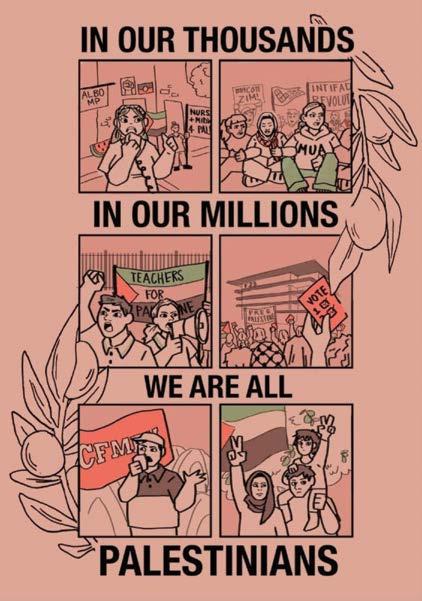
Since October 7th, 2023, the Palestine movement has grown across the globe. e staunch resistance and bravery of Palestinians facing invasion and occupation should be an inspiration to us in our ght here in Australia.
We must draw inspiration from anti-war movements throughout history. In the 1960s and 70s, the slogan ‘stop work to stop the war’ was used in protests against the Vietnam War; students joined workers on strike to rally in their work site to support Australian National ey brought attention to the
is is one of a number of wins at USYD. A%er a sit-in outside
Tel Aviv University’s stall at the exchange fair, representatives from Israel sent an email to management saying they would not return to our campus. More recently, a%er student and sta! rst tie with an Israeli university has been cut. USYD no longer has an exchange program with Bezalel Academy of Art and Design.
High school students across a number of schools have organised walkouts with support from Teachers for Palestine. Recently, Sheik Wesam, a student support o cer who er challenging the selective moral outrage over the recent video of two nurses, was reinstated a%er student protests.
At the ports, members of the Maritime Union of Australia were on the frontlines blocking cargo from Israeli shipping company ZIM, joined by other unionists, students, and community members. is kind of direct action costs the company money, but also builds strength amongst unions to ght for Palestine.
We have also seen members of the NSW Nurses and Midwives Association staunchly speaking out at the picket outside ce, condemning his support for genocide. e same money going towards building weapons ghter jets that drop bombs on Gaza could be going towards healthcare and education.
We must look to all these examples to know there is hope, and together we can ght for Palestine is a ght that everyone must be involved ght against war and ght for a better world for all of us.
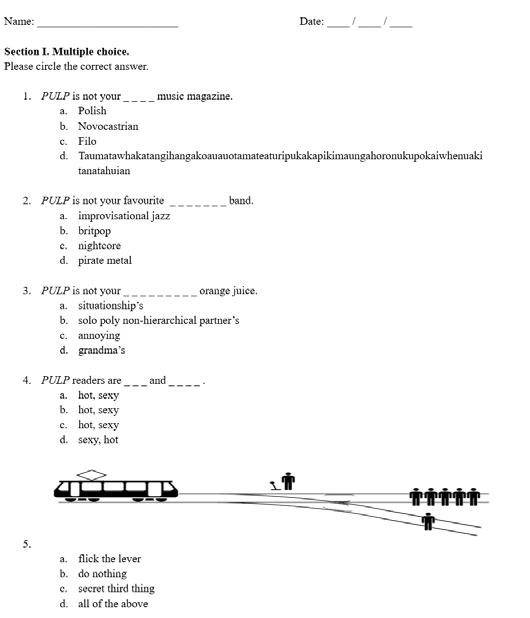
PULP Grammar Test
The Sound of Sydney: AN ORAL HISTORY OF FBI’S LIBRARYCD
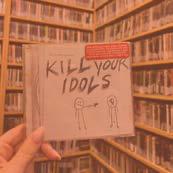
Your Idols (2003) a compilation of 21 songs (many of which were only demos), that encapsulated the Sydney scene at the time.
Dan Zilber Music Director 2003-14
The Kill Your Idols one, was I think right at that peak kind of indie dance. The artwork was all done by Levens, who was a long-term announcer, DJ, at fbi. He went through multiple different shows and was here from, like, literally day one. He was on air as an 18-year-old as the drive announcer. It was him and Linda Mariano who would go on to host mornings on Triple J for years. You know, he did the artwork and, it was very much a representation of that sort of indie-dance era.
I mean you look back through the track list and some of these bands or many of them, like, donʼt exist. Some of them only existed kind of in that moment, and then thereʼs others here that kind of had long term careers, you know, over years. Itʼs kind of confronting, like the bands that were successful and could thrive for five, maybe even ten years, just donʼt exist anymore.
I think thatʼs increasingly the case. Like, we have a very short shelf life in Australia for music, and thatʼs not always the case everywhere in the world. A lot of other places have much bigger populations, but they also cater to older listeners. But you know, something that we got to really revel in was like youth culture and youth music.
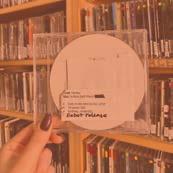
Kill Your Idols is not an isolated artefact of Sydney music history. In the back of )i radio headquarters, lies a treasure trove of Australian music that cannot be found elsewhere. )i has accrued an inimitable collection of over 20,000 CDs. Next to the top dance release of 2014 is a demo by an o ce worker in a pub rock band that only ever recorded one single. Next to that is a collection of ambient beats made by a student in their bedroom, beside the blues singer that has been gracing Sydney stages for decades. Some of the CDs were donated by record labels, others from presenters’ personal collections, or even gi%ed by taxi drivers and strangers o! the street. Each CD has been carefully archived with o%en handwritten descriptions
But as Iʼve gotten older, Iʼve thought about, well, what are the pathways for, you know, for music, to exist beyond turning 30? But I would say that one of the, one of the sort of most significant moments, maybe on any of these compilations, but certainly on the Kill Your Idols one was the, the fbi Idols. But yeah, like, I mean, that, fbi Idol song that turn up your radio, that was just, that kind of became an anthem for me.
I donʼt know if itʼs still really used at the station, like this is the first thing ever broadcast. But you know, thatʼs what happens over time. But I do think, you know, projects like this, where weʼre talking about the history, I think nostalgia is also a really useful tool for the station. Like we know that itʼs an 18 to 25-year-old youth station, but we also know that there are significant numbers of older listeners because they want something different or they, you know, the programming appeals to them for whatever reason.
for presenters. On each spine is a red, yellow or green sticker signifying whether an act is international, Australian, or a Sydneysider.
Having played full-time on air for over twenty years, )i is the barometer of Sydney music. Located on Botany Road, Redfern, )i sits on the borders of the CBD, connected to the diverse communities of the inner city, the inner west, and beyond.
In a town trammelled by lock-out laws and continuous crackdowns, its sustenance on donations and fundraising drives is a testament to )i’s vitality.
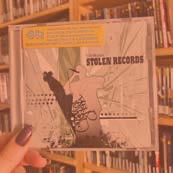
Take )i’s mixtape: Stolen Records (2004). In the 2000s, commercial radio stations frowned upon music they called ‘rap crap’ -
a vague, racially driven term to designate any music that vaguely t into the genres of Hip Hop or RnB. Yet, with )i’s mission to pioneer emerging culture, and the subaltern voices that subsequently de ned that culture, no genre could be le% unplayed. Despite the inevitable changes in )i’s programming policy, it has always been rooted in the role of radio as a form of resistance; an ampli er of marginalised voices. In light of )i’s diverse listenership, rap has always been an integral part of this. In 2004, Dan Zilber created the Stolen Records compilation, a key leaf in )i’s project of antiracism — the title deliberately evoking the political impetus of the tape.
Cassandra Wilkinson President 1997-2021)
You know, actually when you think about most important CDs or most important albums, probably one of the standout records for me was when Dan Zilber did the first Hip Hop compilation. Dan pulled together an album which showcased a whole lot of artists, like Elephant Tracks, Earthboy, and Hilltop Hoods, I mean, I canʼt remember exactly who was in it. It was one of those records where it, you know, itʼs in, it seems crazy now, but that music was not getting played on the radio.
One of Triple Mʼs main ads would say that they play “no rap crap,” and Dan Zilber championed that ʻrap crapʼ kind of stuff, because fbi is fbi. It meant he was championing local. You know, so I think a big part of the transition from deriding it as Hip Hop through to people. Like itʼs really at the centre of music today. I think Dan personally played a really pivotal role in that.
His understanding that he could build an audience for the fbi really led to pushing the culture in that direction. You know, you can never say how big a push that was, but he was there before anybody else, and that record came at a time when no other radio station was doing compilations of local rap music.
I mean, that was a mad idea, right? But yeah, really, really powerful, important thing for fbi to do.
You know, it turned out to be part of a growing role that fbi would play in anti-racism in music and Australian culture. I think thatʼs something that we very much owe to the more recent generation of volunteers. Yet the roots, the roots of it were there, but the current generation really made that their own mission and I think thatʼs an incredible contribution that theyʼve made.
Despite the formidable role )i has maintained in Sydney culture, its nancial lifeforce as a notfor-pro t organisation was always inevitably tenuous.
By the 2008 Global Financial Crisis, )i’s life support of donations and fundraising — which was already piecemeal and ad hoc — was under serious threat. In the words of Dan Zilber, unlike commercial
stations which relied upon broader corporate entities, )i ran “on the smell of an oily rag and lots and lots of volunteers putting in hours.” From compilation CDs, art auctions, to the famous Ask Richard Campaign, and many live performances, through to the mass mobilisation of volunteers and supporters — )i’s survival has been indebted to the creativity
of its volunteers and presenters alike. Above, is a compilation made by Lee Tran Lam, presenter of Local Fidelity, featuring songs donated by local artists and a hand-cra%ed cover by Lee Tran herself. Awarded Album of the Week in May 2009, the compilation sold for ten dollars each with all the proceeds going straight to )i.
Stephen Goodhew Music Director 2013-2017
I donʼt know to me, and I know other people Iʼve spoken to who are around at the same time feel the same way and that just might be a bit of bias because we were there during that time, but it felt like a bit of a golden age for fbi. You know, it was just immediately post the ʻsave fbiʼ campaign, there was a lot of hope and optimism about the future of the station.
It was like pre-COVID, pre-streaming. fbi was a really important way for young emerging artists to break into the music industry, and I just remember it being like, for me personally, really
Despite these neardeath experiences, )i, with their mission to play 50% Australian music, maintained their commitment to amplifying grassroots talent that may have been otherwise neglected by commercial radio or major labels. Music Open Day saw ocks of artists coming into the station hand-delivering demos on burnt CDs, keen for their rst radio play. Some of these CDs had cover art, some were in entirely plain packaging straight from O ceworks.
fun, really exciting. Every day just discovering new bands. You know, bands that were new, bands that were old, or at least, you know, at that point in my life seemed old to me, but now I look back and Iʼm like, oh, those were still babies.
I guess, the perspective of time. I just, I remember there being a lot of fun and energy. And yeah, everyone there was so happy and enthusiastic, it was just a really fun time.
But it was still a pretty young station, like it was, you know, six, seven years old. But, you know, I think there was this sense that, okay, like, the station almost did disappear. It was like a near-death experience, there was like a renewed appreciation for each day.
Iʼm just kind of maybe reading between the lines, interpreting, but, yeah, I think there was just an appreciation that this wasnʼt something they take for granted, that it was something special, and that it needed a lot of love and care and work to keep the gift to, and which it did.
Others simply wrapped up their demo in the rippedout pages of a medical textbook, or in the case of Rainbow Chan, her demo was dropped o! in a hand sewn and embroidered fabric sleeve. From a father with a newborn handing in a demo to the station — who later turned out to be a member of rock band and )i success-story Wolfmother — or music director Stephen Goodhew being live serenaded in his o ce, Music Open Day encouraged everyone and anyone to come in and take a
shot. With the commitment of presenters, volunteers, and sta! to scour the city for new releases, )i has been responsible for the rst radio plays of some of the biggest Australian exports from e Kid LAROI and Julia Jacklin, to 1300 and Nina Las Vegas, and countless invaluable independent artists. One notable story is of a 15-yearold Flume who handed in his rst demo under the name ‘Harley’ to the station in 2007.
Lee Tran Lam Journalist and
When I interviewed Flume for the 10th birthday, he says he remembers being in his car with his dad. He had sent his demo to fbi and they were going to the beach and he heard his song ʻComeʼ on fbi. He was 11 when fbi went to air full-time and he said he remembered fbi go to air in 2003, which is pretty cool.
Host of Local Fidelity 2007-2023
It was then at the first SMAC (Sydney Music, Arts and Culture) awards, Flume won, maybe one or two awards and I think maybe he was touring, and he did, like, a digital video chat kind of like, thank you speech, and he said, you know, this time last year I was like working at the local newsagent and the Hard Rock Cafe. I think that mightʼve been the first award heʼd won. And then he won like heaps and heaps.
However, despite a population of over ve million people sprawling across over hundreds of kilometres, until the mid2010s Sydney’s music scene was enclosed to the inner city and its adjoining suburbs. is geographic limitation has historically excluded Sydney’s most diverse communities. is couldn’t be more apparent than with the mainstream
And actually, his first gig was at the fbi social in 2011, which was the venue we had at Kingʼs Cross Hotel. It mightʼve been the Northern Lights competition and he was one of the finalists. He said it was the first gig he had ever played, and it was his he said it was a day of firsts because someone came up to him and said, “hey Iʼm a fan of your music”, and heʼs like, “oh, thatʼs the first time that ever happened to me.”
I mean, how many other radio stations will literally play music by someone whoʼs unsigned, whoʼs a teenager. Thereʼs so many examples of bands we played when they were teenagers, whether it was Bridezilla or Flume or the Kid LAROI. You know, I went back over the years, Iʼve gone back and looked at the music that we played and some of these, you know, we played someone who was 16 and they were really promising and then they went on and did something else. Like itʼs, you know what I mean? Like, Iʼm still glad we played them. Doesnʼt make it any less relevant.
con ation (both among the media and governing bodies) of Western Sydney Hip Hop culture and the postcode wars and gang violence — most potently yet uncritically symbolised in the Mount Druitt drill group Onefour (who received their rst radio plays on )i). Yet, despite this blatant prejudiced homogenisation of the city’s most diverse communities,
since 2017, artists across Greater Sydney have carved out a space for a music scene on their own terms through music open days run by )i in collaboration with Campbelltown Arts Centre and Blacktown Arts Centre. Rebecca Hatch was one of the standout stars from the 2017 ‘Trax’ open day at Blacktown Arts Centre, with her independently released single ‘Leeway.’
John-Ernest Dinamarca Volunteer 2015-2017
Project manager of fbi outreach programs with Campbelltown Arts Centre and Blacktown Arts Centre
So with the kind of the Campbelltown music open day, there wasnʼt really I guess like a focus on Hip Hop per se.
I think that there were a lot of artists that were kind of coming up in kind of Southwestern Sydney that attended music open day and similar initiatives, but that particular music open day was more just about opening up the scene and opening up the music industry.
To people in Southwest Sydney, it was about kind of breaking down barriers and breaking down, I guess, the kind of the assumption that in order to, to kind of get your foot in the door, you have to like move into the inner west, or you have to relocate. It was like a recognition that, you know, like Western Sydney had a lot to offer. I, at the time I was beginning to get involved with Blacktown Arts Centre
e )i music library is an icon of the station. While the age of the CD may be long gone, it is crucial to )i platforming the diverse sounds of Sydney. In this way, the library is
And I felt like that there was this second and third generation of people of colour, particularly from kind of Southeast Asian and Polynesian backgrounds that were beginning to take up space and kind of occupy cultural spaces in a way that just never happened when I was a kid. They were telling their own stories in a very unique way.
And a lot of them were using the kind of the language and the sounds of Hip Hop in order to tell their kind of unique stories. So, I think that there was, I guess, like a recognition that it was important to tap into Western Sydney and that there were a lot of stories that weʼre missing out on by not kind of bridging those gaps between, I guess different parts of different parts of Sydney.
Like growing up in Blacktown, I grew up around Hip Hop. Hip Hop and R&B were like the two big sounds growing up. It was very strange for a Filipino guy in his teens to be listening to things like Sonic Youth or the Dillinger Escape Plan or something. It was such an outlier growing up. I think itʼs less of the case now. Cause I feel like itʼs a bit more like people, are a lot more eclectic in their tastes now and itʼs not so kind of hinged on any particular subcultures. But yeah, I think that thereʼs always been a love for Hip Hop particularly in Blacktown.
synonymous with )i, not only aurally, but visually — the backdrop to many a photo op. It may no longer be growing how it once did, as the world of radio continues to transform,
a%er almost 30 years since the rst test broadcast, )i continues to be a laboratory for the best independent artists to make their mark on so-called Sydney.